AB 2605: State government: Office of Permit Assistance.
- Session Year: 2015-2016
- House: Assembly
- Latest Version Date: 2016-07-22
Previously existing law established the Office of Permit Assistance within the Trade and Commerce Agency to, among other things, provide information to developers relating to the permit approval process. Under existing law, a state agency which is the lead agency for a development project is required to inform the applicant for a permit that the Office of Permit Assistance has been created for this purpose.
This bill would instead require a state agency that is a lead agency for a development project to inform the applicant for a permit that the Governors Office of Business and Economic Development has been created for this purpose. The bill would also delete various obsolete provisions relating to the Office of Permit Assistance.
Existing law establishes procedures for a land use decision by a local agency concerning a specified hazardous waste facility project, as defined. Existing law requires the Office of Permit Assistance to take specified actions with regard to land use decisions regarding a proposed hazardous waste facility project.
This bill would transfer these duties to the Department of Toxic Substances Control.
Existing law requires the Director of the Governors Office of Business and Economic Development to ensure that the offices Internet Web site contains information to assist an individual with the licensing, permitting, and registration requirements necessary to start a business, including fee requirements and fee schedules of state agencies.
This bill would establish the Permit Assistance Program within the Governors Office of Business and Economic Development. The bill would require the program to, among other things, provide permitting and regulatory compliance assistance to businesses and provide mediation and 3rd-party neutral facilitation to resolve conflicts between applicants and permitting and regulatory entities. The bill would require the program to manage and regularly update the tools provided on the offices Internet Web site. The bill would require the office to report annually on the activities and outcomes of the program.
Previously existing law established the Office of Permit Assistance within the Trade and Commerce Agency to, among other things, provide information to developers relating to the permit approval process. Under existing law, a state agency which is the lead agency for a development project is required to inform the applicant for a permit that the Office of Permit Assistance has been created for this purpose.
This bill would instead require a state agency that is a lead agency for a development project to inform the applicant for a permit that the Governors Office of Business and Economic Development has been created for this purpose. The bill would also delete various obsolete provisions relating to the Office of Permit Assistance.
Existing law establishes procedures for a land use decision by a local agency concerning a specified hazardous waste facility project, as defined. Existing law requires the Office of Permit Assistance to take specified actions with regard to land use decisions regarding a proposed hazardous waste facility project.
This bill would transfer these duties to the Department of Toxic Substances Control.
Existing law requires the Director of the Governors Office of Business and Economic Development to ensure that the offices Internet Web site contains information to assist an individual with the licensing, permitting, and registration requirements necessary to start a business, including fee requirements and fee schedules of state agencies.
This bill would establish the California Permit Assistance Program within the Governors Office of Business and Economic Development under the authority of the director. Development. The bill would require the program to, among other things, provide direct permitting and regulatory compliance assistance to businesses and provide mediation and 3rd-party neutral facilitation to resolve conflicts between applicants and permitting and regulatory entities. The bill would require the program to manage and regularly update the tools provided on the offices Internet Web site. The bill would require the office to report annually on the activities and outcomes of the program.
Previously existing law established the Office of Permit Assistance within the Trade and Commerce Agency to, among other things, provide information to developers relating to the permit approval process. Under existing law, a state agency which is the lead agency for a development project is required to inform the applicant for a permit that the Office of Permit Assistance has been created for this purpose.
This bill would instead require a state agency that is a lead agency for a development project to inform the applicant for a permit that the Governors Office of Business and Economic Development has been created for this purpose. The bill would also delete various obsolete provisions relating to the Office of Permit Assistance.
Existing law establishes procedures for a land use decision by a local agency concerning a specified hazardous waste facility project, as defined. Existing law requires the Office of Permit Assistance to take specified actions with regard to land use decisions regarding a proposed hazardous waste facility project.
This bill would transfer these duties to the Department of Toxic Substances Control.
Existing law requires the Director of the Governors Office of Business and Economic Development to ensure that the offices Internet Web site contains information to assist an individual with the licensing, permitting, and registration requirements necessary to start a business, including fee requirements and fee schedules of state agencies.
This bill would establish the California Permit Assistance Program within the Governors Office of Business and Economic Development under the authority of the director. The bill would require the program to, among other things, provide direct permitting and regulatory compliance assistance to businesses and provide mediation and 3rd-party neutral facilitation to resolve conflicts between applicants and permitting entities. The bill would require the program to manage and regularly update the tools provided on the offices Internet Web site. The bill would require the office to report annually on the activities and outcomes of the program.
Previously existing law established the Office of Permit Assistance within the Trade and Commerce Agency to, among other things, provide information to developers relating to the permit approval process. Under existing law, a state agency which is the lead agency for a development project is required to inform the applicant for a permit that the Office of Permit Assistance has been created for this purpose.
This bill would instead require a state agency that is a lead agency for a development project to inform the applicant for a permit that the Governors Office of Business and Economic Development has been created for this purpose. The bill would also delete various obsolete provisions relating to the Office of Permit Assistance.
Existing law establishes procedures for a land use decision by a local agency concerning a specified hazardous waste facility project, as defined. Existing law requires the Office of Permit Assistance to take specified actions with regard to land use decisions regarding a proposed hazardous waste facility project.
This bill would transfer these duties to the Department of Toxic Substances Control.
Under existing law, the Public Utilities Commission has regulatory authority over public utilities, including common carriers, as defined, subject to the preemptive authority of Congress pursuant to the Commerce Clause of the United States Constitution. The Public Utilities Act requires the tariff schedules of carriers to be produced and made available for inspection upon the demand of any person.
This bill would make nonsubstantive changes to that provision.
(a)The Permit Assistance Program is hereby created within the Governors Office of Business and Economic Development.
(b)The program shall do all of the following:
(1)Provide permitting and regulatory compliance assistance to businesses.
(2)Assist businesses in accessing information and resources related to permitting and regulatory compliance.
(3)Provide mediation and third-party neutral facilitation to resolve conflicts between applicants and permitting and regulatory entities.
(4)Work with federal, state, regional, and local permitting and regulatory entities to exchange best practices and implement improvements to modernize permitting processes.
(5)Manage and regularly update the offices Internet Web site pursuant to Section 12097.1.
(c)The program shall work cooperatively with local, regional, federal, and other state public agencies and private sector business and economic development organizations.
(d)Notwithstanding Section 10231.5, the Governors Office of Business and Economic Development shall report to the Governor and the Legislature annually on the activities and outcomes of the program.
SEC. 2.Section 12019.5 of the Government Code is amended and renumbered to read:12097.1.(a)The director shall ensure that the offices Internet Web site contains information on the licensing, permitting, and registration requirements of state agencies, and shall include, but not be limited to, information that does all of the following:
(1)Assists individuals with identifying the type of applications, forms, or other similar documents an applicant may need.
(2)Provides a direct link to a digital copy of all state licensing, permitting, and registration applications, forms, or other similar documents where made available for download.
(3)Instructs individuals on how and where to submit applications, forms, or other similar documents.
(b)The director shall ensure that the offices Internet Web site contains information on the fee requirements and fee schedules of state agencies, and shall include, but not be limited to, information that does all of the following:
(1)Assists individuals with identifying the types of fees and their due dates.
(2)Provides direct links to the fee requirements and fee schedules for all state agencies, where made available for download.
(3)Instructs individuals on how and where to submit payments.
(c)The office shall ensure that the Internet Web site is user-friendly and provides accurate, updated information.
(d)(1)Each state agency that has licensing, permitting, or registration authority shall provide direct links to information about its licensing, permitting, and registration requirements and fee schedule to the office.
(2)A state agency shall not use the Internet Web site established under this section as the exclusive source of information for the public to access licensing requirements and fees for that agency.
(e)The office may impose a reasonable fee, not to exceed the actual cost to provide the service, as a condition of accessing information on the Internet Web site established under subdivisions (a) and (b).
SEC. 3.Section 65460.5 of the Government Code is amended to read:65460.5.A city or county establishing a district and preparing a plan pursuant to this article shall be eligible for available transportation funding.
SEC. 4.Section 65923.8 of the Government Code is amended to read:65923.8.Any state agency which is the lead agency for a development project shall inform the applicant for a permit that the Governors Office of Business and Economic Development has been created to assist, and provide information to, developers relating to the permit approval process.
SEC. 5.Section 66033 of the Government Code is repealed.SEC. 6.Section 25199.4 of the Health and Safety Code is repealed.SEC. 7.Section 25199.7 of the Health and Safety Code is amended to read:25199.7.(a)At least 90 days before filing an application for a land use decision for a specified hazardous waste facility project with a local agency, the proponent shall file a notice of intent to make the application with the Department of Toxic Substances Control and with the applicable city or county. The notice of intent shall specify the location to which the notice of intent is applicable and shall contain a complete description of the nature, function, and scope of the project. The Department of Toxic Substances Control shall immediately notify affected state agencies of the notice of intent. The local agency shall publish a notice in a newspaper of general circulation in the area affected by the proposed project, shall post notices in the location where the proposed project is located, and shall notify, by a direct mailing, the owners of contiguous property, as shown in the latest equalized assessment roll. A notice of intent filed with a local agency shall be accompanied by a fee which shall be set by the local agency in an amount equal to the local agencys cost of processing the notice of intent and carrying out the notification requirements of this subdivision. A notice of intent is not transferable to a location other than the location specified in the notice and shall remain in effect for one year from the date it is filed with a local agency or until it is withdrawn by the proponent, whichever is earlier.
(b)A notice of intent is not effective and a proponent may not file an application for a land use decision for a specified hazardous waste facility project with a local agency unless the proponent has first complied with subdivision (a).
(c)Within 90 days after a notice of intent is filed with the Department of Toxic Substances Control pursuant to subdivision (a), the department shall convene a public meeting in the affected city or county to inform the public on the nature, function, and scope of the proposed specified hazardous waste facility project and the procedures that are required for approving applications for the project.
(d)The legislative body of the affected local agency shall appoint a seven member local assessment committee to advise it in considering an application for a land use decision for a specified hazardous waste facility project. The members of the local assessment committee may be appointed at any time after the notice of intent is filed with the local agency but shall be appointed not later than 30 days after the application for the land use decision is accepted as complete by the local agency. The local agency shall charge the project proponent a fee to cover the local agencys costs of establishing and convening the local assessment committee. The fee shall accompany the application for a land use decision.
(1)The membership of the committee shall be broadly constituted to reflect the makeup of the community, and shall include three representatives of the community at large, two representatives of environmental or public interest groups, and two representatives of affected businesses and industries. Members of local assessment committees selected pursuant to this subdivision shall have no direct financial interest, as defined in Section 87103 of the Government Code, in the proposed specified hazardous waste facility project.
(2)The local assessment committee shall, as its primary function, advise the appointing legislative body of the affected local agency of the terms and conditions under which the proposed hazardous waste facility project may be acceptable to the community. To carry out this function, the local assessment committee shall do all of the following:
(A)Enter into a dialogue with the proponent for the proposed hazardous waste facility project to reach an understanding with the proponent on both of the following:
(i)The measures that should be taken by the proponent in connection with the operation of the proposed hazardous waste facility project to protect the public health, safety, and welfare, and the environment of the city or county.
(ii)The special benefits and remuneration the facility proponent will provide the city or county as compensation for the local costs associated with the operation of the facility.
(B)Represent generally, in meetings with the project proponent, the interests of the residents of the city or county and the interests of adjacent communities.
(C)Receive and expend any technical assistance grants made available pursuant to subdivision (g).
(D)Adopt rules and procedures which are necessary to perform its duties.
(E)Advise the legislative body of the city or county of the terms, provisions, and conditions for project approval which have been agreed upon by the committee and the proponent, and of any additional information which the committee deems appropriate. The legislative body of the city or county may use this advice for its independent consideration of the project.
(3)The legislative body of the affected jurisdiction shall provide staff resources to assist the local assessment committee in performing its duties.
(4)A local assessment committee established pursuant to this subdivision shall cease to exist after final administrative action by state and local agencies has been taken on the permit applications for the project for which the committee was convened.
(e)A local agency shall notify the Department of Toxic Substances Control within 10 days after an application for a land use decision for a specified hazardous waste facility project is accepted as complete by the local agency and, within 60 days after receiving this notice, the Department of Toxic Substances Control shall convene a meeting of the lead and responsible agencies for the project, the proponent, the local assessment committee, and the interested public, for the purpose of determining the issues which concern the agencies that are required to approve the project and the issues which concern the public. The meeting shall take place in the jurisdiction where the application has been filed.
(f)Following the meeting required by subdivision (e), the proponent and the local assessment committee appointed pursuant to subdivision (d) shall meet and confer on the specified hazardous waste facility project proposal for the purpose of establishing the terms and conditions under which the project will be acceptable to the community.
(g)(1)If the local assessment committee finds that it requires assistance and independent advice to adequately review a proposed hazardous waste facility project, it may request technical assistance grants from the local agency to enable the committee to hire a consultant. The committee may use technical assistance grant funds made available to it to hire a consultant to do either, or both, of the following:
(A)Assist the committee in reviewing and evaluating the application for the project, the environmental documents prepared for the project pursuant to the California Environmental Quality Act (Division 13 (commencing with Section 21000) of the Public Resources Code) and any other documents, materials, and information that are required by a public agency in connection with the application for a land use decision or a permit.
(B) Advise the local assessment committee in its meetings and discussions with the facility proponent to seek agreement on the terms and conditions under which the project will be acceptable to the community.
(2)The local agency shall require the proponent of the proposed hazardous waste facility project to pay a fee equal to the amount of any technical assistance grant provided the local assessment committee under paragraph (1). The funds received as a result of the imposition of the fee shall be used to make technical assistance grants exclusively for the purposes described in paragraph (1).
(3)The local agency shall deposit any fee imposed pursuant to paragraph (2) in an account created in the city or county treasury, maintain records of all expenditures from the account, and return any unused funds and accrued interest to the project proponent upon completion of the review of the proposed hazardous waste facility project.
(h)This section applies only to a specified hazardous waste facility project.
SEC. 8.Section 25616 of the Public Resources Code is amended to read:25616.(a)It is the intent of the Legislature to encourage local agencies to expeditiously review permit applications to site energy projects, and to encourage energy project developers to consider all cost-effective and environmentally superior alternatives that achieve their project objectives.
(b)Subject to the availability of funds appropriated therefor, the commission shall provide technical assistance and grants-in-aid to assist local agencies to do either or both of the following:
(1)Site energy production or transmission projects which are not otherwise subject to the provisions of Chapter 6 (commencing with Section 25500).
(2)Integrate into their planning processes, and incorporate into their general plans, methods to achieve cost-effective energy efficiency.
(c)The commission shall provide assistance at the request of local agencies.
(d)As used in this section, an energy project is any project designed to produce, convert, or transmit energy as one of its primary functions.
(a)The California Permit Assistance Program is hereby created within the Governors Office of Business and Economic Development under the authority of the director. Development.
(b)The program shall do all of the following:
(1)Provide direct permitting and regulatory compliance assistance to businesses.
(2)Assist businesses in accessing information and resources related to permitting and regulatory compliance.
(3)Provide mediation and third-party neutral facilitation to resolve conflicts between applicants and permitting and regulatory entities.
(4)Work with federal, state, regional, and local permitting and regulatory entities to exchange best practices and implement improvements to modernize permitting processes.
(5)Manage and regularly update the offices Internet Web site pursuant to Section 12097.1.
(c)In implementing the program, the director The program shall work cooperatively with local, regional, federal, and other state public agencies and private sector business and economic development organizations.
(d)Notwithstanding Section 10231.5, the Governors Office of Business and Economic Development shall report to the Governor and the Legislature annually on the activities and outcomes of the program.
SEC. 2.Section 12019.5 of the Government Code is amended and renumbered to read:12097.1.(a)The director shall ensure that the offices Internet Web site contains information on the licensing, permitting, and registration requirements of state agencies, and shall include, but not be limited to, information that does all of the following:
(1)Assists individuals with identifying the type of applications, forms, or other similar documents an applicant may need.
(2)Provides a direct link to a digital copy of all state licensing, permitting, and registration applications, forms, or other similar documents where made available for download.
(3)Instructs individuals on how and where to submit applications, forms, or other similar documents.
(b)The director shall ensure that the offices Internet Web site contains information on the fee requirements and fee schedules of state agencies, and shall include, but not be limited to, information that does all of the following:
(1)Assists individuals with identifying the types of fees and their due dates.
(2)Provides direct links to the fee requirements and fee schedules for all state agencies, where made available for download.
(3)Instructs individuals on how and where to submit payments.
(c)The office shall ensure that the Internet Web site is user-friendly and provides accurate, updated information.
(d)(1)Each state agency that has licensing, permitting, or registration authority shall provide direct links to information about its licensing, permitting, and registration requirements and fee schedule to the office.
(2)A state agency shall not use the Internet Web site established under this section as the exclusive source of information for the public to access licensing requirements and fees for that agency.
(e)The office may impose a reasonable fee, not to exceed the actual cost to provide the service, as a condition of accessing information on the Internet Web site established under subdivisions (a) and (b).
SEC. 3.Section 65460.5 of the Government Code is amended to read:65460.5.A city or county establishing a district and preparing a plan pursuant to this article shall be eligible for available transportation funding.
SEC. 4.Section 65923.8 of the Government Code is amended to read:65923.8.Any state agency which is the lead agency for a development project shall inform the applicant for a permit that the Governors Office of Business and Economic Development has been created to assist, and provide information to, developers relating to the permit approval process.
SEC. 5.Section 66033 of the Government Code is repealed.SEC. 6.Section 25199.4 of the Health and Safety Code is repealed.SEC. 7.Section 25199.7 of the Health and Safety Code is amended to read:25199.7.(a)At least 90 days before filing an application for a land use decision for a specified hazardous waste facility project with a local agency, the proponent shall file a notice of intent to make the application with the Department of Toxic Substances Control and with the applicable city or county. The notice of intent shall specify the location to which the notice of intent is applicable and shall contain a complete description of the nature, function, and scope of the project. The Department of Toxic Substances Control shall immediately notify affected state agencies of the notice of intent. The local agency shall publish a notice in a newspaper of general circulation in the area affected by the proposed project, shall post notices in the location where the proposed project is located, and shall notify, by a direct mailing, the owners of contiguous property, as shown in the latest equalized assessment roll. A notice of intent filed with a local agency shall be accompanied by a fee which shall be set by the local agency in an amount equal to the local agencys cost of processing the notice of intent and carrying out the notification requirements of this subdivision. A notice of intent is not transferable to a location other than the location specified in the notice and shall remain in effect for one year from the date it is filed with a local agency or until it is withdrawn by the proponent, whichever is earlier.
(b)A notice of intent is not effective and a proponent may not file an application for a land use decision for a specified hazardous waste facility project with a local agency unless the proponent has first complied with subdivision (a).
(c)Within 90 days after a notice of intent is filed with the Department of Toxic Substances Control pursuant to subdivision (a), the department shall convene a public meeting in the affected city or county to inform the public on the nature, function, and scope of the proposed specified hazardous waste facility project and the procedures that are required for approving applications for the project.
(d)The legislative body of the affected local agency shall appoint a seven member local assessment committee to advise it in considering an application for a land use decision for a specified hazardous waste facility project. The members of the local assessment committee may be appointed at any time after the notice of intent is filed with the local agency but shall be appointed not later than 30 days after the application for the land use decision is accepted as complete by the local agency. The local agency shall charge the project proponent a fee to cover the local agencys costs of establishing and convening the local assessment committee. The fee shall accompany the application for a land use decision.
(1)The membership of the committee shall be broadly constituted to reflect the makeup of the community, and shall include three representatives of the community at large, two representatives of environmental or public interest groups, and two representatives of affected businesses and industries. Members of local assessment committees selected pursuant to this subdivision shall have no direct financial interest, as defined in Section 87103 of the Government Code, in the proposed specified hazardous waste facility project.
(2)The local assessment committee shall, as its primary function, advise the appointing legislative body of the affected local agency of the terms and conditions under which the proposed hazardous waste facility project may be acceptable to the community. To carry out this function, the local assessment committee shall do all of the following:
(A)Enter into a dialogue with the proponent for the proposed hazardous waste facility project to reach an understanding with the proponent on both of the following:
(i)The measures that should be taken by the proponent in connection with the operation of the proposed hazardous waste facility project to protect the public health, safety, and welfare, and the environment of the city or county.
(ii)The special benefits and remuneration the facility proponent will provide the city or county as compensation for the local costs associated with the operation of the facility.
(B)Represent generally, in meetings with the project proponent, the interests of the residents of the city or county and the interests of adjacent communities.
(C)Receive and expend any technical assistance grants made available pursuant to subdivision (g).
(D)Adopt rules and procedures which are necessary to perform its duties.
(E)Advise the legislative body of the city or county of the terms, provisions, and conditions for project approval which have been agreed upon by the committee and the proponent, and of any additional information which the committee deems appropriate. The legislative body of the city or county may use this advice for its independent consideration of the project.
(3)The legislative body of the affected jurisdiction shall provide staff resources to assist the local assessment committee in performing its duties.
(4)A local assessment committee established pursuant to this subdivision shall cease to exist after final administrative action by state and local agencies has been taken on the permit applications for the project for which the committee was convened.
(e)A local agency shall notify the Department of Toxic Substances Control within 10 days after an application for a land use decision for a specified hazardous waste facility project is accepted as complete by the local agency and, within 60 days after receiving this notice, the Department of Toxic Substances Control shall convene a meeting of the lead and responsible agencies for the project, the proponent, the local assessment committee, and the interested public, for the purpose of determining the issues which concern the agencies that are required to approve the project and the issues which concern the public. The meeting shall take place in the jurisdiction where the application has been filed.
(f)Following the meeting required by subdivision (e), the proponent and the local assessment committee appointed pursuant to subdivision (d) shall meet and confer on the specified hazardous waste facility project proposal for the purpose of establishing the terms and conditions under which the project will be acceptable to the community.
(g)(1) If the local assessment committee finds that it requires assistance and independent advice to adequately review a proposed hazardous waste facility project, it may request technical assistance grants from the local agency to enable the committee to hire a consultant. The committee may use technical assistance grant funds made available to it to hire a consultant to do either, or both, of the following:
(A)Assist the committee in reviewing and evaluating the application for the project, the environmental documents prepared for the project pursuant to the California Environmental Quality Act (Division 13 (commencing with Section 21000) of the Public Resources Code) and any other documents, materials, and information that are required by a public agency in connection with the application for a land use decision or a permit.
(B) Advise the local assessment committee in its meetings and discussions with the facility proponent to seek agreement on the terms and conditions under which the project will be acceptable to the community.
(2)The local agency shall require the proponent of the proposed hazardous waste facility project to pay a fee equal to the amount of any technical assistance grant provided the local assessment committee under paragraph (1). The funds received as a result of the imposition of the fee shall be used to make technical assistance grants exclusively for the purposes described in paragraph (1).
(3)The local agency shall deposit any fee imposed pursuant to paragraph (2) in an account created in the city or county treasury, maintain records of all expenditures from the account, and return any unused funds and accrued interest to the project proponent upon completion of the review of the proposed hazardous waste facility project.
(h)This section applies only to a specified hazardous waste facility project.
SEC. 8.Section 25616 of the Public Resources Code is amended to read:25616.(a)It is the intent of the Legislature to encourage local agencies to expeditiously review permit applications to site energy projects, and to encourage energy project developers to consider all cost-effective and environmentally superior alternatives that achieve their project objectives.
(b)Subject to the availability of funds appropriated therefor, the commission shall provide technical assistance and grants-in-aid to assist local agencies to do either or both of the following:
(1)Site energy production or transmission projects which are not otherwise subject to the provisions of Chapter 6 (commencing with Section 25500).
(2)Integrate into their planning processes, and incorporate into their general plans, methods to achieve cost-effective energy efficiency.
(c)The commission shall provide assistance at the request of local agencies.
(d)As used in this section, an energy project is any project designed to produce, convert, or transmit energy as one of its primary functions.
(a)The California Permit Assistance Program is hereby created within the Governors Office of Business and Economic Development under the authority of the director.
(b)The program shall do all of the following:
(1)Provide direct permitting and regulatory compliance assistance to businesses.
(2)Assist businesses in accessing information and resources related to permitting and regulatory compliance.
(3)Provide mediation and third-party neutral facilitation to resolve conflicts between applicants and permitting entities.
(4)Work with federal, state, regional, and local permitting and regulatory entities to exchange best practices and implement improvements to modernize permitting processes.
(5)Manage and regularly update the offices Internet Web site pursuant to Section 12097.1.
(c)In implementing the program, the director shall work cooperatively with local, regional, federal, and other state public agencies and private sector business and economic development organizations.
(d)Notwithstanding Section 10231.5, the Governors Office of Business and Economic Development shall report to the Governor and the Legislature annually on the activities and outcomes of the program.
SEC. 2.Section 12019.5 of the Government Code is amended and renumbered to read:12019.5.12097.1.(a)The Director of the Governors Office of Business and Economic Development director shall ensure that the offices Internet Web site contains information on the licensing, permitting, and registration requirements of state agencies, and shall include, but not be limited to, information that does all of the following:
(1)Assists individuals with identifying the type of applications, forms, or other similar documents an applicant may need.
(2)Provides a direct link to a digital copy of all state licensing, permitting, and registration applications, forms, or other similar documents where made available for download.
(3)Instructs individuals on how and where to submit applications, forms, or other similar documents.
(b)The Director of the Governors Office of Business and Economic Development director shall ensure that the offices Internet Web site contains information on the fee requirements and fee schedules of state agencies, and shall include, but not be limited to, information that does all of the following:
(1)Assists individuals with identifying the types of fees and their due dates.
(2)Provides direct links to the fee requirements and fee schedules for all state agencies, where made available for download.
(3)Instructs individuals on how and where to submit payments.
(c)The Governors Office of Business and Economic Development office shall ensure that the Internet Web site is user-friendly and provides accurate, updated information.
(d)(1)Each state agency that has licensing, permitting, or registration authority shall provide direct links to information about its licensing, permitting, and registration requirements and fee schedule to the Governors Office of Business and Economic Development. office.
(2)A state agency shall not use the Internet Web site established under this section as the exclusive source of information for the public to access licensing requirements and fees for that agency.
(e)The Governors Office of Business and Economic Development office may impose a reasonable fee, not to exceed the actual cost to provide the service, as a condition of accessing information on the Internet Web site established under subdivisions (a) and (b).
SECTION 1.SEC. 3.Section 65460.5 of the Government Code is amended to read:65460.5.A city or county establishing a district and preparing a plan pursuant to this article shall be eligible for available transportation funding.
SEC. 2.SEC. 4.Section 65923.8 of the Government Code is amended to read:65923.8.Any state agency which is the lead agency for a development project shall inform the applicant for a permit that the Governors Office of Business and Economic Development has been created to assist, and provide information to, developers relating to the permit approval process.
SEC. 3.SEC. 5.Section 66033 of the Government Code is repealed.SEC. 4.SEC. 6.Section 25199.4 of the Health and Safety Code is repealed.SEC. 5.SEC. 7.Section 25199.7 of the Health and Safety Code is amended to read:25199.7.(a)At least 90 days before filing an application for a land use decision for a specified hazardous waste facility project with a local agency, the proponent shall file a notice of intent to make the application with the Department of Toxic Substances Control and with the applicable city or county. The notice of intent shall specify the location to which the notice of intent is applicable and shall contain a complete description of the nature, function, and scope of the project. The Department of Toxic Substances Control shall immediately notify affected state agencies of the notice of intent. The local agency shall publish a notice in a newspaper of general circulation in the area affected by the proposed project, shall post notices in the location where the proposed project is located, and shall notify, by a direct mailing, the owners of contiguous property, as shown in the latest equalized assessment roll. A notice of intent filed with a local agency shall be accompanied by a fee which shall be set by the local agency in an amount equal to the local agencys cost of processing the notice of intent and carrying out the notification requirements of this subdivision. A notice of intent is not transferable to a location other than the location specified in the notice and shall remain in effect for one year from the date it is filed with a local agency or until it is withdrawn by the proponent, whichever is earlier.
(b)A notice of intent is not effective and a proponent may not file an application for a land use decision for a specified hazardous waste facility project with a local agency unless the proponent has first complied with subdivision (a).
(c)Within 90 days after a notice of intent is filed with the Department of Toxic Substances Control pursuant to subdivision (a), the department shall convene a public meeting in the affected city or county to inform the public on the nature, function, and scope of the proposed specified hazardous waste facility project and the procedures that are required for approving applications for the project.
(d)The legislative body of the affected local agency shall appoint a seven member local assessment committee to advise it in considering an application for a land use decision for a specified hazardous waste facility project. The members of the local assessment committee may be appointed at any time after the notice of intent is filed with the local agency but shall be appointed not later than 30 days after the application for the land use decision is accepted as complete by the local agency. The local agency shall charge the project proponent a fee to cover the local agencys costs of establishing and convening the local assessment committee. The fee shall accompany the application for a land use decision.
(1)The membership of the committee shall be broadly constituted to reflect the makeup of the community, and shall include three representatives of the community at large, two representatives of environmental or public interest groups, and two representatives of affected businesses and industries. Members of local assessment committees selected pursuant to this subdivision shall have no direct financial interest, as defined in Section 87103 of the Government Code, in the proposed specified hazardous waste facility project.
(2)The local assessment committee shall, as its primary function, advise the appointing legislative body of the affected local agency of the terms and conditions under which the proposed hazardous waste facility project may be acceptable to the community. To carry out this function, the local assessment committee shall do all of the following:
(A)Enter into a dialogue with the proponent for the proposed hazardous waste facility project to reach an understanding with the proponent on both of the following:
(i)The measures that should be taken by the proponent in connection with the operation of the proposed hazardous waste facility project to protect the public health, safety, and welfare, and the environment of the city or county.
(ii)The special benefits and remuneration the facility proponent will provide the city or county as compensation for the local costs associated with the operation of the facility.
(B)Represent generally, in meetings with the project proponent, the interests of the residents of the city or county and the interests of adjacent communities.
(C)Receive and expend any technical assistance grants made available pursuant to subdivision (g).
(D)Adopt rules and procedures which are necessary to perform its duties.
(E)Advise the legislative body of the city or county of the terms, provisions, and conditions for project approval which have been agreed upon by the committee and the proponent, and of any additional information which the committee deems appropriate. The legislative body of the city or county may use this advice for its independent consideration of the project.
(3)The legislative body of the affected jurisdiction shall provide staff resources to assist the local assessment committee in performing its duties.
(4)A local assessment committee established pursuant to this subdivision shall cease to exist after final administrative action by state and local agencies has been taken on the permit applications for the project for which the committee was convened.
(e)A local agency shall notify the Department of Toxic Substances Control within 10 days after an application for a land use decision for a specified hazardous waste facility project is accepted as complete by the local agency and, within 60 days after receiving this notice, the Department of Toxic Substances Control shall convene a meeting of the lead and responsible agencies for the project, the proponent, the local assessment committee, and the interested public, for the purpose of determining the issues which concern the agencies that are required to approve the project and the issues which concern the public. The meeting shall take place in the jurisdiction where the application has been filed.
(f)Following the meeting required by subdivision (e), the proponent and the local assessment committee appointed pursuant to subdivision (d) shall meet and confer on the specified hazardous waste facility project proposal for the purpose of establishing the terms and conditions under which the project will be acceptable to the community.
(g)(1) If the local assessment committee finds that it requires assistance and independent advice to adequately review a proposed hazardous waste facility project, it may request technical assistance grants from the local agency to enable the committee to hire a consultant. The committee may use technical assistance grant funds made available to it to hire a consultant to do either, or both, of the following:
(A)Assist the committee in reviewing and evaluating the application for the project, the environmental documents prepared for the project pursuant to the California Environmental Quality Act (Division 13 (commencing with Section 21000) of the Public Resources Code) and any other documents, materials, and information that are required by a public agency in connection with the application for a land use decision or a permit.
(B) Advise the local assessment committee in its meetings and discussions with the facility proponent to seek agreement on the terms and conditions under which the project will be acceptable to the community.
(2)The local agency shall require the proponent of the proposed hazardous waste facility project to pay a fee equal to the amount of any technical assistance grant provided the local assessment committee under paragraph (1). The funds received as a result of the imposition of the fee shall be used to make technical assistance grants exclusively for the purposes described in paragraph (1).
(3)The local agency shall deposit any fee imposed pursuant to paragraph (2) in an account created in the city or county treasury, maintain records of all expenditures from the account, and return any unused funds and accrued interest to the project proponent upon completion of the review of the proposed hazardous waste facility project.
(h)This section applies only to a specified hazardous waste facility project.
SEC. 6.SEC. 8.Section 25616 of the Public Resources Code is amended to read:25616.(a)It is the intent of the Legislature to encourage local agencies to expeditiously review permit applications to site energy projects, and to encourage energy project developers to consider all cost-effective and environmentally superior alternatives that achieve their project objectives.
(b)Subject to the availability of funds appropriated therefor, the commission shall provide technical assistance and grants-in-aid to assist local agencies to do either or both of the following:
(1)Site energy production or transmission projects which are not otherwise subject to the provisions of Chapter 6 (commencing with Section 25500).
(2)Integrate into their planning processes, and incorporate into their general plans, methods to achieve cost-effective energy efficiency.
(c)The commission shall provide assistance at the request of local agencies.
(d)As used in this section, an energy project is any project designed to produce, convert, or transmit energy as one of its primary functions.
A city or county establishing a district and preparing a plan pursuant to this article shall: shall be eligible for available transportation funding.
(a)Be eligible for available transportation funding.
(b)Receive assistance from the Office of Permit Assistance, pursuant to Section 15399.53, in establishing an expedited permit process pursuant to Section 15399.50, at the request of the city or county.
SEC. 2.Section 65923.8 of the Government Code is amended to read:65923.8.Any state agency which is the lead agency for a development project shall inform the applicant for a permit that the Office of Permit Assistance Governors Office of Business and Economic Development has been created in the Office of Planning and Research to assist, and provide information to, developers relating to the permit approval process.
SEC. 3.Section 66033 of the Government Code is repealed.66033.(a)At the end of the mediation, the mediator shall file a report with the Office of Permit Assistance, consistent with Chapter 2 (commencing with Section 1115) of Division 9 of the Evidence Code, containing each of the following:
(1)The title of the action.
(2)The names of the parties to the action.
(3)An estimate of the costs avoided, if any, because the parties used mediation instead of litigation to resolve their dispute.
(b)The sole purpose of the report required by this section is the collection of information needed by the office to prepare its report to the Legislature pursuant to Section 66036.
SEC. 4.Section 25199.4 of the Health and Safety Code is repealed.25199.4.The Office of Permit Assistance in the Office of Planning and Research shall, for any proposed hazardous waste facility project, do all of the following:
(a) Assist in identifying state and local permits required for the proposed hazardous waste facility project.
(b) Convene meetings or conferences, as necessary, prior to the submittal of applications for permits to state and local agencies, for the purpose of determining the scope of the hazardous waste facility project, identifying the questions that state and local agencies will have concerning the project, and determining decisionmaking schedules.
(c) Assist state and local agencies in consolidating public meetings and hearings permitted or required by law or regulation for approval of the permits for the project.
(d) Encourage the joint review and processing of applications for permits.
(e) Work with the applicant and public agencies to ensure that decisionmaking deadlines are met.
(f) Call meetings or conferences to resolve questions or mediate disputes arising from applications for a permit for a hazardous waste facility project.
SEC. 5.Section 25199.7 of the Health and Safety Code is amended to read:25199.7.(a)At least 90 days before filing an application for a land use decision for a specified hazardous waste facility project with a local agency, the proponent shall file a notice of intent to make the application with the Office of Permit Assistance in the Office of Planning and Research Department of Toxic Substances Control and with the applicable city or county. The notice of intent shall specify the location to which the notice of intent is applicable and shall contain a complete description of the nature, function, and scope of the project. The Office of Permit Assistance Department of Toxic Substances Control shall immediately notify affected state agencies of the notice of intent. The local agency shall publish a notice in a newspaper of general circulation in the area affected by the proposed project, shall post notices in the location where the proposed project is located, and shall notify, by a direct mailing, the owners of contiguous property, as shown in the latest equalized assessment roll. A notice of intent filed with a local agency shall be accompanied by a fee which shall be set by the local agency in an amount equal to the local agencys cost of processing the notice of intent and carrying out the notification requirements of this subdivision. A notice of intent is not transferable to a location other than the location specified in the notice and shall remain in effect for one year from the date it is filed with a local agency or until it is withdrawn by the proponent, whichever is earlier.
(b)A notice of intent is not effective and a proponent may not file an application for a land use decision for a specified hazardous waste facility project with a local agency unless the proponent has first complied with subdivision (a).
(c)Within 90 days after a notice of intent is filed with the Office of Permit Assistance Department of Toxic Substances Control pursuant to subdivision (a), the office department shall convene a public meeting in the affected city or county to inform the public on the nature, function, and scope of the proposed specified hazardous waste facility project and the procedures that are required for approving applications for the project.
(d)The legislative body of the affected local agency shall appoint a seven member local assessment committee to advise it in considering an application for a land use decision for a specified hazardous waste facility project. The members of the local assessment committee may be appointed at any time after the notice of intent is filed with the local agency but shall be appointed not later than 30 days after the application for the land use decision is accepted as complete by the local agency. The local agency shall charge the project proponent a fee to cover the local agencys costs of establishing and convening the local assessment committee. The fee shall accompany the application for a land use decision.
(1)The membership of the committee shall be broadly constituted to reflect the makeup of the community, and shall include three representatives of the community at large, two representatives of environmental or public interest groups, and two representatives of affected businesses and industries. Members of local assessment committees selected pursuant to this subdivision shall have no direct financial interest, as defined in Section 87103 of the Government Code, in the proposed specified hazardous waste facility project.
(2)The local assessment committee shall, as its primary function, advise the appointing legislative body of the affected local agency of the terms and conditions under which the proposed hazardous waste facility project may be acceptable to the community. To carry out this function, the local assessment committee shall do all of the following:
(A)Enter into a dialogue with the proponent for the proposed hazardous waste facility project to reach an understanding with the proponent on both of the following:
(i)The measures that should be taken by the proponent in connection with the operation of the proposed hazardous waste facility project to protect the public health, safety, and welfare, and the environment of the city or county.
(ii)The special benefits and remuneration the facility proponent will provide the city or county as compensation for the local costs associated with the operation of the facility.
(B)Represent generally, in meetings with the project proponent, the interests of the residents of the city or county and the interests of adjacent communities.
(C)Receive and expend any technical assistance grants made available pursuant to subdivision (g).
(D)Adopt rules and procedures which are necessary to perform its duties.
(E)Advise the legislative body of the city or county of the terms, provisions, and conditions for project approval which have been agreed upon by the committee and the proponent, and of any additional information which the committee deems appropriate. The legislative body of the city or county may use this advice for its independent consideration of the project.
(3)The legislative body of the affected jurisdiction shall provide staff resources to assist the local assessment committee in performing its duties.
(4)A local assessment committee established pursuant to this subdivision shall cease to exist after final administrative action by state and local agencies has been taken on the permit applications for the project for which the committee was convened.
(e)A local agency shall notify the Office of Permit Assistance Department of Toxic Substances Control within 10 days after an application for a land use decision for a specified hazardous waste facility project is accepted as complete by the local agency and, within 60 days after receiving this notice, the Office of Permit Assistance Department of Toxic Substances Control shall convene a meeting of the lead and responsible agencies for the project, the proponent, the local assessment committee, and the interested public, for the purpose of determining the issues which concern the agencies that are required to approve the project and the issues which concern the public. The meeting shall take place in the jurisdiction where the application has been filed.
(f)Following the meeting required by subdivision (e), the proponent and the local assessment committee appointed pursuant to subdivision (d) shall meet and confer on the specified hazardous waste facility project proposal for the purpose of establishing the terms and conditions under which the project will be acceptable to the community.
(g)(1) If the local assessment committee finds that it requires assistance and independent advice to adequately review a proposed hazardous waste facility project, it may request technical assistance grants from the local agency to enable the committee to hire a consultant. The committee may use technical assistance grant funds made available to it to hire a consultant to do either, or both, of the following:
(A)Assist the committee in reviewing and evaluating the application for the project, the environmental documents prepared for the project pursuant to the California Environmental Quality Act (Division 13 (commencing with Section 21000) of the Public Resources Code) and any other documents, materials, and information that are required by a public agency in connection with the application for a land use decision or a permit.
(B) Advise the local assessment committee in its meetings and discussions with the facility proponent to seek agreement on the terms and conditions under which the project will be acceptable to the community.
(2)The local agency shall require the proponent of the proposed hazardous waste facility project to pay a fee equal to the amount of any technical assistance grant provided the local assessment committee under paragraph (1). The funds received as a result of the imposition of the fee shall be used to make technical assistance grants exclusively for the purposes described in paragraph (1).
(3)The local agency shall deposit any fee imposed pursuant to paragraph (2) in an account created in the city or county treasury, maintain records of all expenditures from the account, and return any unused funds and accrued interest to the project proponent upon completion of the review of the proposed hazardous waste facility project.
(h)If the local assessment committee and the proponent cannot resolve any differences through the meetings, the Office of Permit Assistance may assist in this resolution pursuant to Section 25199.4.
(i)
(h)This section applies only to a specified hazardous waste facility project.
SEC. 6.Section 25616 of the Public Resources Code is amended to read:25616.(a)It is the intent of the Legislature to encourage local agencies to expeditiously review permit applications to site energy projects, and to encourage energy project developers to consider all cost-effective and environmentally superior alternatives that achieve their project objectives.
(b)Subject to the availability of funds appropriated therefor, the commission shall provide technical assistance and grants-in-aid to assist local agencies to do either or both of the following:
(1)Site energy production or transmission projects which are not otherwise subject to the provisions of Chapter 6 (commencing with Section 25500).
(2)Integrate into their planning processes, and incorporate into their general plans, methods to achieve cost-effective energy efficiency.
(c)The commission shall provide assistance at the request of local agencies and shall coordinate that assistance with the assistance provided by the Department of Permit Assistance, created pursuant to Section 15399.50 of the Government Code. agencies.
(d)As used in this section, an energy project is any project designed to produce, convert, or transmit energy as one of its primary functions.
SECTION 1.Section 488 of the Public Utilities Code is amended to read:488.(a)Subject to any rules the commission may prescribe, the schedules of carriers shall be produced and made available for inspection upon the demand of any person. The form of a schedule shall be prescribed by the commission and shall conform, in the case of any common carrier subject to federal regulation, as nearly as possible to the form of schedules prescribed by the federal Surface Transportation Board.
(b)Subdivision (a) is not applicable to network railroad transportation.
(a)Subject to such any rules as the commission may prescribe, the schedules of carriers shall be produced and made available for inspection upon the demand of any person. The form of every such a schedule shall be prescribed by the commission and shall conform, in the case of any common carrier subject to federal regulation regulation, as nearly as possible to the form of schedules prescribed by the federal Surface Transportation Board.
(b)Subdivision (a) is not applicable to network railroad transportation.
|
Date
|
Status
|
|---|---|
| Apr 28, 2016 | Read second time. Ordered to Consent Calendar. |
| Jul 22, 2016 | Chaptered by Secretary of State - Chapter 78, Statutes of 2016. |
| Jul 22, 2016 | Approved by the Governor. |
| Jul 11, 2016 | Enrolled and presented to the Governor at 4:30 p.m. |
| Jun 30, 2016 | Read third time. Passed. Ordered to the Assembly. (Ayes 37. Noes 0. Page 4651.). |
| Jun 30, 2016 | Read third time. Passed. Ordered to the Assembly. |
| Jun 30, 2016 | In Assembly. Ordered to Engrossing and Enrolling. |
| Jun 28, 2016 | Read second time. Ordered to Consent Calendar. |
| Jun 27, 2016 | From committee: Be placed on second reading file pursuant to Senate Rule 28.8 and ordered to consent calendar. |
| Jun 14, 2016 | From committee: Do pass and re-refer to Com. on APPR. with recommendation: To Consent Calendar. (Ayes 9. Noes 0.) (June 13). Re-referred to Com. on APPR. |
| May 12, 2016 | Referred to Com. on B., P. & E.D. |
| May 5, 2016 | Read third time. Passed. Ordered to the Senate. (Ayes 79. Noes 0. Page 4687.) |
| May 5, 2016 | Read third time. Passed. Ordered to the Senate. |
| May 5, 2016 | In Senate. Read first time. To Com. on RLS. for assignment. |
| Feb 19, 2016 | Introduced. To print. |
| Apr 27, 2016 | From committee: Do pass. To Consent Calendar. (Ayes 19. Noes 0.) (April 27). |
| Apr 21, 2016 | Re-referred to Com. on APPR. |
| Apr 20, 2016 | From committee chair, with author's amendments: Amend, and re-refer to Com. on APPR. Read second time and amended. |
| Apr 13, 2016 | From committee: Do pass and re-refer to Com. on APPR. with recommendation: To Consent Calendar. (Ayes 7. Noes 0.) (April 12). Re-referred to Com. on APPR. |
| Apr 7, 2016 | Re-referred to Com. on E.S. & T.M. |
| Apr 6, 2016 | Read second time and amended. |
| Apr 5, 2016 | From committee: Amend, and do pass as amended and re-refer to Com. on E.S. & T.M. (Ayes 9. Noes 0.) (April 5). |
| Mar 28, 2016 | Re-referred to Com. on J., E.D., & E. |
| Mar 18, 2016 | From committee chair, with author's amendments: Amend, and re-refer to Com. on J., E.D., & E. Read second time and amended. |
| Mar 17, 2016 | Referred to Coms. on J., E.D., & E. and E.S. & T.M. |
| Feb 22, 2016 | Read first time. |
| Feb 21, 2016 | From printer. May be heard in committee March 22. |
|
Date
|
Description
|
Location
|
Votes
|
|
|---|---|---|---|---|
| Jun 30, 2016 | Consent Calendar 2nd AB2605 Nazarian | Senate Floor |
Passed |
|
| Jun 13, 2016 | Do pass, but first be re-referred to the Committee on [Appropriations] with the recommendation: To Consent Calendar | Senate Standing Committee on Business, Professions and Economic Development |
Passed |
|
| May 5, 2016 | AB 2605 NAZARIAN Consent Calendar Second Day Regular Session | Assembly Floor |
Passed |
|
| Apr 27, 2016 | Do pass. To Consent Calendar. | Assembly Standing Committee on Appropriations |
Passed |
|
| Apr 12, 2016 | Do pass and be re-referred to the Committee on [Appropriations] with recommendation: To Consent Calendar | Assembly Standing Committee on Environmental Safety and Toxic Materials |
Passed |
|
| Apr 5, 2016 | Do pass as amended and be re-referred to the Committee on [Environmental Safety and Toxic Materials] | Assembly Standing Committee on Jobs, Economic Development, and the Economy |
Passed |
This list shows positions taken on this bill by organizations on the date displayed, which is linked to the original source.
Positions by individuals are not included.
|
Organization
|
Position
|
Date
|
|---|---|---|
| California Association For Local Economic Development | * Support | Apr 5, 2016 |
Office of Senate Floor Analyses (916) 651-1520 Fax: (916) 327-4478 | AB |
CONSENT
Bill No: AB 2605
:
SENATE BUS., PROF. & ECON. DEV. COMMITTEE: 9-0, 6/13/16
AYES: Hill, Bates, Block, Gaines, Galgiani, Hernandez, Jackson, Mendoza, Wieckowski
SENATE APPROPRIATIONS COMMITTEE: Senate Rule 28.8
ASSEMBLY FLOOR: 79-0, 5/5/16 (Consent) - See last page for vote
SOURCE: California Association for Local Economic Development
DIGEST: This bill establishes the Permit Assistance Program within the Governor’s Office of Business and Economic Development (GO-Biz). This bill also removes references to the non-existent Office of Permit Assistance (OPA), which previously existed within the Governor’s Office of Planning and Research (OPR) and subsequently within the Technology, Trade and Commerce Agency (TTCA), and replaces references with the appropriate state entity.
Existing law:
- Establishes GO-Biz to serve as the lead state entity for economic strategy and marketing of California on issues relating to business development, private sector investment, and economic growth. (Government Code (GC) §§ 12096 – 12098.5)
- Authorizes GO-Biz to provide, including but not limited to, the following:
(GC § 12096.3)- Economic and demographic data;
- Financial information to help link businesses with state and local public and private programs;
- Workforce information, including but not limited to, labor availability, training, and education programs;
- Transportation and infrastructure information;
- Assistance in obtaining state and local permits;
- Information on tax credits and other incentives; and
- Permitting, siting, and other regulatory information pertinent to business operations in the state.
This bill:
- Codifies the Permit Assistance Program (Program) within GO-Biz and requires it do the following:
- Provide permitting and regulatory compliance assistance to businesses.
- Assist businesses in accessing information and resources related to permitting and regulatory compliance.
- Provide mediation and third-party neutral facilitation to resolve conflicts between applicants and permitting and regulatory entities.
- Work with federal, state, regional, and local permitting and regulatory entities to exchange best practices and implement improvements to modernize permitting processes.
- Manage and regularly update the office’s Internet Web site pursuant to Section 12097.1.
- Work cooperatively with local, regional, federal, and other state public agencies, private sector business, and economic development organizations.
- Report to the Governor and the Legislature annually on the activities and outcomes of the Program.
- Designates the Department of Toxic Substances Control (DTSC), instead of OPA, as the entity with whom a proponent of a hazardous waste facility project must file a notice of intent for a land use change and requires DTSC to immediately notify affected state agencies of the notice of intent. Also requires DTSC to assume certain public meeting requirements.
- Requires DTSC, instead of OPA, to be notified by a local agency after an application for a land use decision regarding a proposed hazardous waste facility has been accepted.
- Deletes other obsolete references to OPA.
- Makes references to GO-Biz and the Director of GO-Biz consistent throughout code.
Background
The sponsor of this bill is the California Association for Local Economic Development. According to the Author, “The Office of Permit Assistance was dissolved with the [TTCA] via a budget trailer bill in 2003. As a result, several references to the office in various sections of code were not updated and continue to reference the office despite the fact it is no longer in existence. AB 2605 makes minor changes and clears up any possible ambiguity between the old office and new unit and further clarifies the responsibilities of the GO-Biz Permit Assistance Unit and the Department of Toxic of Substances Control.”
The Permit Assistance Unit (Unit) was established by GO-Biz based on its statutory authority to provide assistance to businesses in obtaining state and local permits and support small businesses in complying with regulatory requirements, which may include permitting. Current statute does not require GO-Biz to offer permit assistance, statute only authorizes the activity among an array of other actions GO-Biz may take. Therefore, as an uncodified program, a future Administration may choose to not continue permit assistance under GO-Biz. This bill would codify a permit assistance entity under GO-Biz in the GC.
The Unit provides businesses with comprehensive permit, regulatory, and compliance assistance. It works in partnership with the California Business Investment Service and other GO-Biz units in serving employers, corporate executives, business owners, and site location consultants who are considering California for business investment and expansion. Among other services, the Unit schedules pre-application meetings between businesses and the appropriate regulatory agencies to help streamline the permitting process. In some instances, GO-Biz can assign a project manager to personally guide an applicant through the entire permit process. Services are confidential and provided without cost. The goal of the Unit is to help businesses solve permitting and regulatory challenges.
The Unit is also responsible for maintaining the California Government Online to Desktops (CalGOLD) Web site. On this site, businesses can obtain a list of the required federal, state, and local permits, as well as webpage links, addresses, application forms, and other contact information. In July 2015, GO-Biz launched the California Business Portal, which expanded on the utility and availability of a searchable online application that could provide individualized information to businesses.
FISCAL EFFECT: Appropriation: Fiscal Com.: Local:
California Association for Local Economic Development (source)
OPPOSITION: (Verified 6/28/16)
None received
ARGUMENTS IN SUPPORT: The California Association for Local Economic Development supports the bill. They write, “AB 2605 is necessary because it clears up ambiguity between the old office and the new unit and further clarifies the responsibilities of the GO-Biz Permit Assistance Unit and the Department of Toxic Substances Control. We believe this clarity will make it easier for those who need permit assistance to locate the correct contact at the State and get the help they need to create, expand, or locate their business in California.”
ASSEMBLY FLOOR: 79-0, 5/5/16
AYES: Achadjian, Alejo, Travis Allen, Arambula, Atkins, Baker, Bigelow, Bloom, Bonilla, Bonta, Brough, Brown, Burke, Calderon, Campos, Chang, Chau, Chávez, Chiu, Chu, Cooley, Cooper, Dababneh, Dahle, Daly, Dodd, Eggman, Frazier, Gallagher, Cristina Garcia, Eduardo Garcia, Gatto, Gipson, Gomez, Gonzalez, Gordon, Gray, Grove, Hadley, Harper, Roger Hernández, Holden, Irwin, Jones, Jones-Sawyer, Kim, Lackey, Levine, Linder, Lopez, Low, Maienschein, Mathis, Mayes, McCarty, Medina, Melendez, Mullin, Nazarian, Obernolte, O'Donnell, Olsen, Patterson, Quirk, Ridley-Thomas, Rodriguez, Salas, Santiago, Steinorth, Mark Stone, Thurmond, Ting, Wagner, Waldron, Weber, Wilk, Williams, Wood, Rendon
NO VOTE RECORDED: Beth Gaines
6/30/16 8:55:30
**** END ****
SENATE COMMITTEE ON
BUSINESS, PROFESSIONS AND ECONOMIC DEVELOPMENT
Senator Jerry Hill, Chair
2015 - 2016 Regular
Bill No: Hearing Date: June 13, 2016
Author: | |||
Version: | April 20, 2016 | ||
Urgency: | No | Fiscal: | Yes |
Consultant: | Nicole Billington | ||
Subject:
SUMMARY:
Establishes the Permit Assistance Program within the Governor’s Office of Business and Economic Development (GO-Biz). Removes references to the non-existent Office of Permit Assistance (OPA), which previously existed within the Governor’s Office of Planning and Research (OPR) and subsequently within the Technology, Trade and Commerce Agency (TTCA), and replaces references with the appropriate state entity.
Existing law:
- Establishes GO-Biz to serve as the lead state entity for economic strategy and marketing of California on issues relating to business development, private sector investment, and economic growth. (Government Code (GC) §§ 12096 – 12098.5)
- Authorizes GO-Biz to provide, including but not limited to, the following:
(GC § 12096.3)- Economic and demographic data;
- Financial information to help link businesses with state and local public and private programs;
- Workforce information, including but not limited to, labor availability, training, and education programs;
- Transportation and infrastructure information;
- Assistance in obtaining state and local permits;
- Information on tax credits and other incentives; and
- Permitting, siting, and other regulatory information pertinent to business operations in the state.
This bill:
- Codifies the Permit Assistance Program (Program) within GO-Biz and requires it do the following:
- Provide permitting and regulatory compliance assistance to businesses.
- Assist businesses in accessing information and resources related to permitting and regulatory compliance.
- Provide mediation and third-party neutral facilitation to resolve conflicts between applicants and permitting and regulatory entities.
- Work with federal, state, regional, and local permitting and regulatory entities to exchange best practices and implement improvements to modernize permitting processes.
- Manage and regularly update the office’s Internet website pursuant to Section 12097.1.
- Work cooperatively with local, regional, federal, and other state public agencies, private sector business, and economic development organizations.
- Report to the Governor and the Legislature annually on the activities and outcomes of the Program.
- Designates the Department of Toxic Substances Control (DTSC), instead of OPA, as the entity with whom a proponent of a hazardous waste facility project must file a notice of intent for a land use change and requires DTSC to immediately notify affected state agencies of the notice of intent. Also requires DTSC to assume certain public meeting requirements.
- Requires DTSC, instead of OPA, to be notified by a local agency after an application for a land use decision regarding a proposed hazardous waste facility has been accepted.
- Deletes other obsolete references to OPA.
- Makes references to GO-Biz and the Director of GO-Biz consistent throughout code.
FISCAL EFFECT:
According to the Assembly Appropriations Committee analysis dated April 20, 2016, this bill will have minor and absorbable costs to GO-Biz and no additional costs to DTSC.
COMMENTS:
- Purpose. The sponsor of this bill is the California Association for Local Economic Development. According to the Author, “The Office of Permit Assistance was dissolved with the [TTCA] via a budget trailer bill in 2003. As a result, several references to the office in various sections of code were not updated and continue to reference the office despite the fact it is no longer in existence. AB 2605 makes minor changes and clears up any possible ambiguity between the old office and new unit and further clarifies the responsibilities of the GO-Biz Permit Assistance Unit and the Department of Toxic of Substances Control.”
- History of State Permit Assistance. OPR created OPA in 1977, which the Legislature later institutionalized with SB 992 (Garamendi, Chapter 1263, Statutes of 1983). GC § 65923.8 describes OPA’s role to “assist, and provide information to, developers relating to the permit approval process.” The Legislature moved OPA to the TTCA in 1993 with AB 2351 (Assembly Ways and Means Committee, Chapter 56, Statutes of 1993). The California Environmental Protection Agency (CalEPA) also set up regional Permit Assistance Centers, which the Legislature institutionalized in 1999 with AB 1102 (Jackson, Chapter 65, Statutes of 1999).
In 2003 with AB 1756 (Assembly Budget Committee, Chapter 228, Statutes of 2013), the Legislature repealed the requirements for CalEPA’s permit assistance centers and abolished TTCA. GO-Biz replaced many of the duties of TTCA.
- Current Permit Assistance at GO-Biz. The Permit Assistance Unit (Unit) was established by GO-Biz based on its statutory authority to provide assistance to businesses in obtaining state and local permits and support small businesses in complying with regulatory requirements, which may include permitting. Current statute does not require GO-Biz to offer permit assistance, statute only authorizes the activity among an array of other actions GO-Biz may take. Therefore, as an uncodified program, a future Administration may choose to not continue permit assistance under GO-Biz. This bill would codify a permit assistance entity under GO-Biz in the GC.
The Unit provides businesses with comprehensive permit, regulatory, and compliance assistance. It works in partnership with the California Business Investment Service and other GO-Biz units in serving employers, corporate executives, business owners, and site location consultants who are considering California for business investment and expansion. Among other services, the Unit schedules pre-application meetings between businesses and the appropriate regulatory agencies to help streamline the permitting process. In some instances, GO-Biz can assign a project manager to personally guide an applicant through the entire permit process. Services are confidential and provided without cost. The goal of the Unit is to help businesses solve permitting and regulatory challenges.
The Unit is also responsible for maintaining the California Government Online to Desktops (CalGOLD) website. On this site, businesses can obtain a list of the required federal, state, and local permits, as well as webpage links, addresses, application forms, and other contact information. In July 2015, GO-Biz launched the California Business Portal, which expanded on the utility and availability of a searchable online application that could provide individualized information to businesses.
- Prior Related Legislation. AB 29 (Pérez, Chapter 475, Statutes of 2011) established GO-Biz within the Governor's Office to serve as the lead entity for economic strategy and marketing of California on issues relating to business development, private sector investment, and economic growth.
AB 1756 (Assembly Budget Committee, Chapter 228, Statutes of 2003) eliminated the TTCA, including the OPA. Some programs were transferred to other agencies, including the Small Business Loan Guarantee Program and the California Business Investment Services. The bill also eliminated the authority for the regional Permit Assistance Centers under CalEPA.
AB 1102 (Jackson, Chapter 65, Statutes of 1999) authorized the establishment of Permit Assistance Centers and environmental management system pilot projects.
AB 2351 (Assembly Ways and Means, Chapter 56, Statutes of 1993) eliminated the OPA at the GOPR and established the Department of Permit Assistance at the TTCA. The new department was vested with all of the duties and purposes of the OPA.
SB 992 (Garamendi, Chapter 1263, Statutes of 1983) created the OPA within the GOPR and delegated certain responsibilities, including providing information to developers and mediating disputes.
- Arguments in Support. The California Association for Local Economic Development supports the bill. They write, “AB 2605 is necessary because it clears up ambiguity between the old office and the new unit and further clarifies the responsibilities of the GO-Biz Permit Assistance Unit and the Department of Toxic Substances Control. We believe this clarity will make it easier for those who need permit assistance to locate the correct contact at the State and get the help they need to create, expand, or locate their business in California.”
SUPPORT AND OPPOSITION:
Support:
California Association for Local Economic Development (Sponsor)
Opposition:
None on file as of June 7, 2016.
-- END --
Date of Hearing: April 27, 2016
ASSEMBLY COMMITTEE ON APPROPRIATIONS
Lorena Gonzalez, Chair
ABPCA Bill Id:AB 2605
Author:(Nazarian) – As Amended Ver:April 20, 2016
Policy Committee: | Jobs, Economic Development, and the Economy | Vote: | 9 - 0 |
Environmental Safety and Toxic Materials | 7 - 0 |
Urgency: No State Mandated Local Program: No Reimbursable: No
SUMMARY:
This bill establishes the California Permit Assistance Program within the Governor’s Office of Business and Economic Development (GO-Biz). This bill also removes references to the Office of Permit Assistance (OPA) and replaces these references with the Department of Toxic Substances Control (DTSC), which deals with the procedures for new hazardous waste facility permits. Specifically, this bill:
- Establishes the California Permit Assistance Program under GO-Biz to, among other things, provide permitting and regulatory compliance assistance to businesses; provide mediation and conflict resolution; and work with federal, state, regional, and local permitting and regulatory entities to exchange best practices and implement improvements to modernize permitting processes.
- Requires the director of GO-Biz to work cooperatively with local, regional, federal, and other state public agencies and private sector business and economic development organizations during program implementation.
- Requires GO-Biz to report to the Governor and the Legislature annually on the activities and outcomes of the program.
- Deletes the requirement that OPA provide various permit assistance for proposed hazardous waste facility projects.
- Designates DTSC, instead of OPA, as the entity with whom a proponent of a hazardous waste facility project must file a notice of intent for a land use change, and requires DTSC to immediately notify affected state agencies of the notice of intent. Also requires DTSC to assume certain public meeting requirements.
- Requires DTSC, instead of OPA, to be notified by a local agency after an application for a land use decision regarding a proposed hazardous waste facility has been accepted and transfers certain meeting requirements.
FISCAL EFFECT:
- Minor/absorbable costs to GO-Biz. GO-Biz has an active permit assistance unit that conducts the activities required under this bill. The only new duty to GO-Biz is the addition of an annual report and GO-Biz indicates this cost is absorbable.
- No additional costs to DTSC since the changes proposed within this bill are consistent with DTSC’s current process and procedures for new hazardous waste facility applications.
COMMENTS:
- Purpose. In 2003, the Legislature abolished the State Technology, Trade and Commerce Agency (TTCA), and the OPA. GO-Biz replaced much of the duties of the former TTCA. The Permit Assistance Unit has been established under GO-Biz and is now responsible for many of the duties previously given to the OPA. Although GO-Biz is currently managing many of the duties outlined in the bill, supporters are concerned a future Administration may choose to not operate a Permit Assistance Unit and would like to see these activities codified. Current statute does not require GO-Biz to offer permit assistance, current statute only authorizes the activity.
Analysis Prepared by: Misty Feusahrens / APPR. / (916) 319-2081
Date of Hearing: April 12, 2016
ASSEMBLY COMMITTEE ON ENVIRONMENTAL SAFETY AND TOXIC MATERIALS
Luis Alejo, Chair
ABPCA Bill Id:AB 2605 (
Author:Nazarian) – As Amended Ver:April 6, 2016
SUBJECT: State government: Office of Permit Assistance
SUMMARY: Removes references to the Office of Permit Assistance (Office) within the Office of Planning and Research and replaces these references with the Department of Toxic Substances Control (DTSC), which deals with the procedures for new hazardous waste facility permits. Specifically, this bill:
- Deletes the requirement that the Office provide various permit assistance for proposed hazardous waste facility projects, including assisting state and local agencies in consolidating public meetings; working with the project applicant and local government to ensure deadlines are met; and, holding meetings to resolve questions or mediate disputes from applications for a permit for a hazardous waste facility project.
- Replaces the Office with the DTSC as the entity a proponent of a hazardous waste facility project must file a notice of intent for a land use change with. Replaces the Office with the DTSC as the entity that immediately notifies affected state agencies of the notice of intent.
- Replaces the Office with the DTSC as the entity that is required, within 90 days after the notice of intent for a land use change has been filed, to convene a public meeting in the affected city or county to inform the public on the nature, function, and scope of the proposed hazardous waste facility project and the procedures required for approving applications for the project.
- Replaces the Office with the DTSC as the entity that is notified by a local agency after an application for a land use decision, regarding a proposed hazardous waste facility, has been accepted. Replaces the Office with the DTSC as the entity that is required to convene a meeting of lead and responsible agencies for the proposed hazardous waste facility project within 60 days of receiving the notice from a local agency that a land use decision has been accepted.
- Deletes the authorization for the Office to assist with a resolution if the local assessment committee and proponent of the hazardous waste facility project cannot resolve any differences through meetings.
EXISTING LAW:
- Authorizes DTSC to implement the state and federal hazardous waste management programs. Among the requirements, the state hazardous waste control law governs the procedures for approval of new hazardous waste facilities, including requiring DTSC to review and make permit decisions on hazardous waste facility permits. (Chapter 6.5 within Division 20 of the Health and Safety Code.)
- States the intent of the Legislature that the Director of DTSC shall secure and maintain authorization for the state hazardous waste program pursuant to the requirements of Section 3006 of Public Law 94-580, the Resources Conservation and Recovery Act (RCRA) of 1976 (42 U.S.C. 6926), and to implement the state program in lieu of the federal program.
- Requires the Office, for any proposed hazardous waste facility project, to do all of the following:
- Assist in identifying state and local permits required for the proposed hazardous waste facility project;
- Convene meetings, as necessary, prior to the submittal of applications for permits to state and local agencies, for the purpose of determining the scope of the hazardous waste facility project;
- Assist state and local agencies in consolidating public meetings and hearings for approval of the permits for the hazardous waste facility project;
- Encourage the joint review and processing of applications for permits;
- Work with the applicant and public agencies to ensure that decision making deadlines are met; and,
- Call meetings to resolve questions or mediate disputes arising from applications for a permit for a hazardous waste facility project.
- Requires the proponent of a hazardous waste facility project to file a notice of intent to make the application for a land use decision with the Office and the applicable city or county at least 90 days before filing the application for a land use decision. Requires the Office to immediately notify affected state agencies of the notice of intent. Requires, within 90 days after a notice of intent is filed with the Office, the Office to convene a public meeting in the affected city or county to inform the public on the nature, function, and scope of the proposed specified hazardous waste facility project and the procedures that are required for approving applications for the project.
- Requires a local agency to notify the Office within 10 days after an application for a land use decision for a hazardous waste facility project is accepted as complete by the local agency and within 60 days of receiving this notice. Requires the Office to convene a meeting of the lead and responsible agencies for the project, the proponent, the local assessment committee, and the interested public.
FISCAL EFFECT: Unknown
COMMENTS:
Need for the bill: According to the author, “this bill is intended to clear up any possible ambiguity between the Office of Permit Assistance that was within the Trade and Commerce Agency and was dissolved in 2003, with the Governor’s Office of Business and Economic Development (GO-Biz). As a result of the dissolution of the Office, several references to the Office in various section of code were not updated and continue to refer the Office despite the fact that it no longer exists. The GO-Biz Permit Assistance Unit is now responsible for many of the duties previously given to the Office of Permit Assistance. Additionally, the Department of Toxic Substances Control is statutorily responsible for the permitting of hazardous waste facilities.”
Hazardous waste regulation: Any person who stores, treats or disposes of hazardous waste as described in the Hazardous Waste Control Laws (Health and Safety Code, Division 20, Chapter 6.5) must obtain a permit or a grant of authorization from DTSC. The RCRA is the federal law that regulates facilities that treat, store or dispose of hazardous waste. DTSC administers the federal RCRA program in California. The DTSC is authorized to issue hazardous waste facility permits (both new facility permits and permit renewals), and to impose conditions specifying the types of hazardous waste that may be accepted for transfer, storage, treatment or disposal in California.
Currently, DTSC processes hazardous waste facility permit applications for new facilities and for facilities submitting permit renewal applications. There are approximately 119 permitted hazardous waste facilities, which are mainly legacy facilities, with very few new facilities submitting permit applications within the last decade. While DTSC has not been carrying out the functions for new hazardous waste facility project currently assigned to the Office, DTSC is required to review and provide the opportunity for public comment on draft permit decisions for any new hazardous waste facilities, therefore the changes proposed within this bill are consistent with DTSC’s current process and procedures for new hazardous waste facility applications.
REGISTERED SUPPORT / OPPOSITION:
Support
California Association for Local Economic Development (sponsor)
Opposition
None received
Analysis Prepared by: Josh Tooker / E.S. & T.M. / (916) 319-3965
Date of Hearing: April 5, 2016
ASSEMBLY COMMITTEE ON JOBS, ECONOMIC DEVELOPMENT, AND THE ECONOMY
Eduardo Garcia, Chair
ABPCA Bill Id:AB 2605 (
Author:Nazarian) – As Amended Ver:March 18, 2016
SUBJECT: State Government: Office of Permit Assistance
SUMMARY: Updates code sections to reflect the elimination of the Office of Permit Assistance which had been administered through the Technology, Trade, and Commerce Agency (TTCA) and the Office of Permit Assistance which had been operated by the Governor's Office of Planning and Research (OPR). Neither of these two Offices of Permit Assistance currently exist. In some instances another state entity is assigned the task and in other cases the Office of Permit Assistance duty is eliminated. Specifically, this bill:
- Replaces the Office of Permit Assistance formerly operated by OPR with the Governor's Office of Business and Economic Development (GO-Biz) as the entity to which developers needing information and assistance on the permit approval process are referred. Under existing law, a state agency which is the lead agency for a development project is required to inform a permit applicant that the OPR Office of Permit Assistance is available to provide information about the permitting process.
- Deletes the requirement that a final report be filed upon the conclusion of a state mediated land use dispute, including mediation on public actions related to local general plans and zoning, the California Environmental Quality Act, development impact fees, annexations and incorporations, and the Permit Streamlining Act. This information was to be used to prepare a report that is no longer required. Also deletes an out-of-date reference to the Office of Permit Assistance at the former TTCA as the entity that the final report is to be filed.
- Removes the requirement that OPR's Office of Permit Assistance assist, among other things, in identifying state and local permits required for proposed hazardous waste facility projects; convene meetings prior to the submittal of project applications; assist state and local agencies in consolidating public meetings and hearings permitted or required by law; work with applicants to ensure decision making deadlines are met; and call meetings and conferences to resolve questions or mediate disputes.
- Replaces OPR's Office of Permit Assistance with the Department of Toxic Substances Control as the responsible agency for notifying affected state agencies regarding the filing of a notice of intent to file an application for the siting of a hazardous waste facility, and the
convening of a public meeting to inform the public on the nature, function, and scope of a proposed hazardous waste facility. The Department of Toxic Substances Control also becomes the state government entity notified by a local agency following a land use decision related to the siting of a new hazardous waste facility.
- Deletes the option for a local assessment committee and a proponent of a hazardous waste facility to request assistance from OPR's Office of Permit Assistance to help resolve differences that occur during the review and evaluation of the facility permit application. No replacement government entity is provided.
- Deletes the requirement that the Office of Permit Assistance, at the former TTCA, offer assistance to local governments interested in establishing an expedited permit process related to the Transit Village Development Planning Act of 1994.
- Deletes the requirement for the Commission to coordinate local assistance with the Office of Permit Assistance at the former TTCA relating to the siting of renewable energy projects.
EXISTING LAW:
- Authorizes GO-Biz to market business and investment opportunities available in California by working in partnership with local, regional, federal, and other state public and private institutions to encourage business development and investment in the state.
- Authorizes GO-Biz to support small businesses by providing information about accessing capital, complying with regulations, and supporting state initiatives that support small business.
- Authorizes GO-Biz to provide, including, but not limited to, all of the following:
- Economic and demographic data;
- Financial information to help link businesses with state and local public and private programs;
- Workforce information, including, but not limited to, labor availability, training, and education programs;
- Transportation and infrastructure information;
- Assistance in obtaining state and local permits;
- Information on tax credits and other incentives; and
- Permitting, siting, and other regulatory information pertinent to business operations in the state.
- Authorizes GO-Biz to work cooperatively with local, regional, federal, and other state public and private marketing institutions and trade organizations in attracting, retaining, and helping businesses grow and be successful in California.
FISCAL EFFECT: Unknown
POLICY ISSUE FRAME
It is the author's intent that this bill remove outdated provisions of the code relating to the duties of the Office of Permit Assistance, previously undertaken by the TTCA and OPR. In reviewing the measure for hearing, the JEDE staff have requested information on the prior duties and asked for conformation from the state entities which are proposed to take on the new duties. In each case, confirmation has been provided.
Technical and code maintenance bills can be deceivingly complex. While the bill addresses several code deficiencies, two policy issues arise with those changes. The first issue being the assignment of permit assistance responsibilities to GO-Biz. While GO-Biz is ready to step in and currently operates a unit that provides permit assistance, GO-Biz may need additional statutory direction to become statutorily responsible for this new duty.
In the second issue, a section is struck regarding the assistance of the OPR Office of Permit Assistance in helping to resolve ongoing differences between a local assessment committee and an applicant for siting a new hazardous waste facility. It may be prudent to retain the duty and assign a different state entity to facilitating disputes.
The analysis includes background on the statutory history of the Office of Permit assistance and GO-Biz' current Permit Assistance Unit. Amendments are discussed in Comment 3.
COMMENTS:
- Author Purpose: According to the Author, "In 2003, the Legislature abolished the State Technology, Trade and Commerce Agency, including with it the Office of Permit Assistance. The GO-Biz Permit Assistance Unit in now responsible for many of the duties previously given to the Office of Permit Assistance, including providing direct permit assistance to businesses, administering Cal-GOLD, and assisting with permitting projects of statewide importance.
Additionally, since the abolishment of the Office of Permit Assistance, the Department of Toxic Substances Control has taken over the functions related to the permitting of hazardous waste facilities. However, current law still prescribes many aforementioned duties to the old Office of Permit Assistance. AB 2605 makes clarifying changes related to GO-Biz and the Department of Toxic Substance Control reduces ambiguity and overall, advances the state goal of empowering and creating business growth in the state of California."
- Permit Assistance Unit at GO-Biz: The Permit Assistance Unit within GO-Biz provides businesses with comprehensive permit, regulatory, and compliance assistance. Among other services, the unit schedules pre-application meetings between businesses and the appropriate regulatory agencies to help streamline the permitting process. In some instances, GO-Biz can assign a project manager to personally guide an applicant through the entire permit process. Services are confidential and provided without cost. The goal of the unit is to help businesses solve permitting and regulatory challenges.
The Office of Permit Assistance works in partnership with the California Business Investment Service, and other GO-Biz units in serving employers, corporate executives, business owners, and site location consultants who are considering California for business investment and expansion.
The unit is also responsible for maintaining the California Government Online to Desktops (CalGOLD) website. At www.calgold.ca.gov businesses can obtain a list of the required federal, state, and local permits; webpage links; addresses; application forms; and other contact information. In July 2015, GO-Biz launched the California Business Portal which expanded on the utility and availability of a searchable online application that could provide individualized information to businesses. http://www.business.ca.gov/Programs/Permits.aspx
- Uncodified Program at GO-Biz: The Permit Assistance Unit was established by GO-Biz, based on its statutory authority to provide assistance to businesses in obtaining state and local permits and support small businesses with complying with regulatory requirements, which may include permitting. Prior to the demise of the TTCA, the state operated an Office of Permit Assistance and maintained small regional offices to help businesses obtain permits.
As an uncodified program, a future Administration may choose to not operate a Permit Assistance Office. Current statute does not require GO-Biz to offer permit assistance, statute only authorizes the activity among an array of other actions GO-Biz may take. Members may wish to consider first establishing a Permit Assistance Program in statute, thereby making it clear that permit assistance is a primary duty of GO-Biz.
- Challenges with Tracking Business Assistance: When GO-Biz was codified in 2011, it had limited technology capabilities. Business services were largely tracked through unit-specific data bases, which could not easily account for a business who received assistance through multiple units within GO-Biz or quickly produce a report differentiating between in-state and out-of-state businesses. It is not unusual, as an example, for a business looking to relocate to California to work with the Permit Assistance Unit, the California Business Investment Services, and the Office of Innovation and Entrepreneurship.
GO-Biz recognized these data collection and retrieval challenges and is currently in the process of transitioning to a new Customer Relationship Management computer-based platform. According to GO-Biz, the new system, related to the development of the California Business Portal, will allow for improved data management.
Members may wish to pursue a discussion with GO-Biz on the content of the new tracking criteria so that in the future, GO-Biz can provide timely reports on the businesses seeking permit assistance, including the headquarters of those businesses, and the types of permit challenges the businesses were experiencing.
- Related Legislation: Below is a list of the related bills.
- SB 992 (Garamendi) Office of Permit Assistance: This bill created the Office of Permit Assistance within the Office of Planning and Research and delegated certain responsibilities, including providing information to developers and mediating disputes. Status: Signed by the Governor, Chapter 1263, Statutes of 1983.
- AB 2351 (Assembly Ways and Means) Permit Assistance at the Commerce Agency: This bill, among other actions, eliminated the Office of Permit Assistance at the Governor's Office of Planning and Research and established the Department of Permit Assistance at the California Trade and Commerce Agency. The new department was vested with all of the duties and purposes of the Office of Permit Assistance. Status: Signed by the Governor, Chapter 56, Statutes of 1993
- AB 1102 (Jackson) Regional Permit Assistance Centers: This bill defined the duties of the Deputy Secretary for Enforcement and the Deputy Secretary for External Affairs in the California Environmental Protection Agency. The bill also authorized the establishment of Permit Assistance Centers, and environmental management system pilot projects. Status: Signed by the Governor, Chapter 65, Statutes of 1999.
- AB 1756 (Assembly Budget Committee) Repeal of Commerce Agency and Permit Centers: This bill eliminated the Technology, Trade and Commerce Agency, including the Office of Permit Assistance. Some programs were transferred to other agencies, including the Small Business Loan Guarantee Program and the California Business Investment Services. The bill also eliminated the authority for the regional Permit Assistance Centers. Status: Signed by the Governor, Chapter 228, Statutes of 2003.
- Double Referral: This measure has been double referred to the Assembly Committee on Jobs, Economic Development, and the Economy and the Assembly Committee on Environmental Safety and Toxic Materials (ESTM). Should this measure pass JEDE, it will be referred to ESTM for further policy consideration.
REGISTERED SUPPORT / OPPOSITION:
Support
California Association for Local Economic Development (sponsor)
Opposition
None Received
Analysis Prepared by: Toni Symonds / J., E.D., & E. / (916) 319-2090
Discussed in Hearing
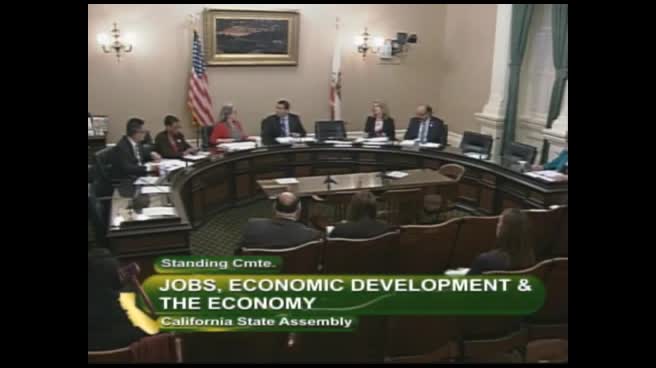 2MIN
Assembly Standing Committee on Jobs, Economic Development, and the Economy
Bill Author

Bill Co-Author(s):