AB 2635: Public health: food access.
- Session Year: 2015-2016
- House: Assembly
- Latest Version Date: 2016-09-16
Existing law, until July 1, 2017, creates the California Healthy Food Financing Initiative. The initiative required, by July 1, 2012, the Secretary of Food and Agriculture to prepare recommendations, to be presented upon request to the Legislature, regarding actions that need to be taken to promote food access in the state. The initiative establishes the California Healthy Food Financing Initiative Council and requires the council to implement the initiative, as specified. The initiative authorizes the secretary to establish an advisory group, as specified. The initiative creates the California Healthy Food Financing Initiative Fund in the State Treasury, comprised of federal, state, philanthropic, and private funds, for the purpose of expanding access to healthy foods in underserved communities and, to the extent practicable, to leverage other funding, as specified. Under existing law, moneys in the fund may be expended upon appropriation by the Legislature.
This bill would extend the effectiveness of these provisions until July 1, 2023.
This article shall remain in effect only until July 1, 2023, and as of that date is repealed, unless a later enacted statute, that is enacted before January 1, 2024, deletes or extends that date.
This article shall remain in effect only until July 1, 2023, and as of that date is repealed, unless a later enacted statute, that is enacted before January 1, 2024, deletes or extends that date.
This article shall remain in effect only until July 1, 2017, 2023, and as of that date is repealed, unless a later enacted statute, that is enacted before January 1, 2018, 2024, deletes or extends that date.
|
Date
|
Status
|
|---|---|
| Jun 21, 2016 | From committee: Do pass and re-refer to Com. on APPR. with recommendation: To Consent Calendar. (Ayes 5. Noes 0.) (June 21). Re-referred to Com. on APPR. |
| Sep 16, 2016 | Chaptered by Secretary of State - Chapter 394, Statutes of 2016. |
| Sep 16, 2016 | Approved by the Governor. |
| Aug 25, 2016 | Enrolled and presented to the Governor at 5 p.m. |
| Aug 19, 2016 | In Assembly. Ordered to Engrossing and Enrolling. |
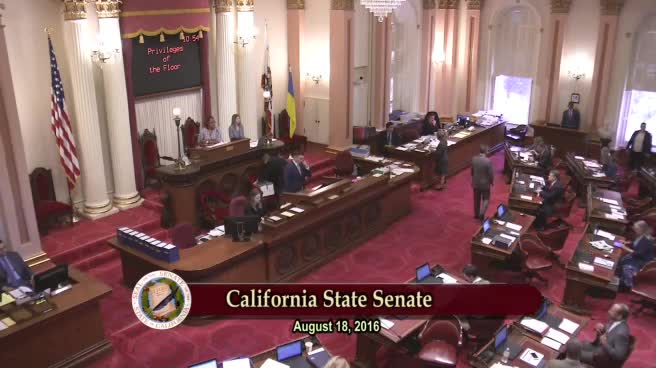
| Aug 18, 2016 | Read third time. Passed. Ordered to the Assembly. (Ayes 38. Noes 0.). |
| Aug 18, 2016 | Read third time. Passed. Ordered to the Assembly. (Ayes 38. Noes 0. Page 5113.). |
| Aug 18, 2016 | Read third time. Passed. Ordered to the Assembly. |
| Aug 15, 2016 | Read second time. Ordered to third reading. |
| Aug 11, 2016 | From committee: Do pass. (Ayes 7. Noes 0.) (August 11). |
| Aug 8, 2016 | Referred to APPR. suspense file. |
| Aug 1, 2016 | In committee: Hearing postponed by committee. |
| Feb 19, 2016 | Introduced. To print. |
| May 12, 2016 | Referred to Com. on AGRI. |
| May 5, 2016 | Read third time. Passed. Ordered to the Senate. (Ayes 79. Noes 0. Page 4687.) |
| May 5, 2016 | Read third time. Passed. Ordered to the Senate. |
| May 5, 2016 | In Senate. Read first time. To Com. on RLS. for assignment. |
| Apr 28, 2016 | Read second time. Ordered to Consent Calendar. |
| Apr 27, 2016 | From committee: Do pass. To Consent Calendar. (Ayes 19. Noes 0.) (April 27). |
| Apr 13, 2016 | From committee: Do pass and re-refer to Com. on APPR. with recommendation: To Consent Calendar. (Ayes 10. Noes 0.) (April 13). Re-referred to Com. on APPR. |
| Mar 10, 2016 | Referred to Com. on AGRI. |
| Feb 22, 2016 | Read first time. |
| Feb 21, 2016 | From printer. May be heard in committee March 22. |
|
Date
|
Description
|
Location
|
Votes
|
|
|---|---|---|---|---|
| Aug 18, 2016 | Assembly 3rd Reading AB2635 Committee On AGRI.(Dodd) By Pan | Senate Floor |
Passed |
|
| Aug 11, 2016 | Do pass | Senate Standing Committee on Appropriations |
Passed |
|
| Aug 8, 2016 | Placed on suspense file | Senate Standing Committee on Appropriations |
Passed |
|
| Jun 21, 2016 | Do pass, but first be re-referred to the Committee on [Appropriations] with the recommendation: To Consent Calendar | Senate Standing Committee on Agriculture |
Passed |
|
| May 5, 2016 | AB 2635 AGRI. Consent Calendar Second Day Regular Session | Assembly Floor |
Passed |
|
| Apr 27, 2016 | Do pass. To Consent Calendar. | Assembly Standing Committee on Appropriations |
Passed |
|
| Apr 13, 2016 | Do pass and be re-referred to the Committee on [Appropriations] with recommendation: To Consent Calendar | Assembly Standing Committee on Agriculture |
Passed |
This list shows positions taken on this bill by organizations on the date displayed, which is linked to the original source.
Positions by individuals are not included.
|
Organization
|
Position
|
Date
|
|---|---|---|
| California Food Policy Advocates | ** Support | Aug 18, 2016 |
| California Retailers Association | ** Support | Aug 18, 2016 |
Office of Senate Floor Analyses (916) 651-1520 Fax: (916) 327-4478 | AB 2635 |
THIRD READING
Bill No: AB 2635
Author: Committee on Agriculture
Introduced: 2/19/16
SENATE AGRICULTURE COMMITTEE: 5-0, 6/21/16
AYES: Galgiani, Cannella, Berryhill, Pan, Wolk
SENATE APPROPRIATIONS COMMITTEE: 7-0, 8/11/16
AYES: Lara, Bates, Beall, Hill, McGuire, Mendoza, Nielsen
ASSEMBLY FLOOR: 79-0, 5/5/16 (Consent) - See last page for vote
SUBJECT: Public health: food access
DIGEST: This bill extends the operation and repeal dates for provisions of the California Healthy Food Financing Initiative until July 1, 2023, and January 1, 2024, respectively.
Existing law:
- Establishes the California Healthy Food Financing Initiative (CHFFI) to expand access to nutritious foods in underserved urban and rural communities and to eliminate food deserts in California.
- Establishes the CHFFI Council to develop financing options and program parameters to accomplish the purpose of the initiative.
- Requires the California Department of Food and Agriculture (CDFA), by July 1, 2012, to prepare recommendations regarding actions that need to be taken to promote food access in California.
- Establishes the CHFFI Fund which is comprised of federal, state, philanthropic, and private funds, for the purpose of expanding access to healthy foods in underserved communities.
This bill extends the operation and repeal dates for provisions of the CHFFI until July 1, 2023 and January 1, 2024, respectively.
Background
The CHFFI was established for the purpose of promoting healthy food access to underserved communities. The CHFFI Council is required to develop program parameters and financing options to accomplish this goal (Health and Safety Code §104660 et seq.).
The CDFA is required to develop recommendations for actions to be taken to promote food access. In a 2012 report titled “Improving Food Access in California,” recommendations include:
- Improving the distribution of fresh produce
- Expanding retail options for healthy food
- Helping low-income consumers purchase food
- Supporting nutritious school meals
According to this report, the state can use existing infrastructure and relationships with farmers and food distributors to increase food access, and the state can coordinate existing state and federal resources to target them toward use in underserved communities. (http://www.cdfa.ca.gov/exec/public_affairs/pdf/ImprovingFoodAccessInCalifornia.pdf)
Comments
Need for this bill. Current efforts are underway by a variety of public and private entities to achieve the goal of increasing food access. It has been argued that CDFA has the expertise, relationships, and infrastructure to further these efforts through a collaborative statewide program. According to the 2012 CDFA report previously referenced, “Government and private efforts to increase food access are already underway at the federal, state, and local levels. In order to harmonize these efforts and avoid duplication, the state can take an active role in coordinating efforts and sharing information among the various entities working to increase food access. CHFFI can serve to facilitate this coordination and make sure communities have partners at the table and that they are connected to the appropriate funding sources.”
Food deserts. Food deserts are generally defined as poor inner-city neighborhoods and rural communities where residents live far from the closest grocery store or supermarket. USDA defines this distance as greater than a mile for urban communities and greater than 10 miles for rural communities, with exceptions for physical barriers (e.g. highways, waterways). Residents within a food desert do not have access to healthy foods and are limited to less-healthy, and sometimes more expensive, alternatives available at the nearest convenience store or fast-food restaurant. Additionally, research shows that residents of underserved communities have higher rates of diet-related diseases, such as obesity and diabetes.
Federal and state HFFI: In 2010, the Obama Administration established the Healthy Food Financing Initiative (HFFI) to support projects that increase access to healthy, affordable food for communities located within food deserts. With over $400 million in funding, the initiative will work to eliminate food deserts within seven years. With coordination among the U.S. Departments of Agriculture, Health and Human Services (HHS), and the Treasury, HFFI increases healthy food access by developing and supporting grocery stores, small retailers, corner stores, and farmers markets that provide healthy foods. As of 2015, the total amount of funding awarded under the Community Economic Development Program within HHS is over $44.5 million. The 2014 Farm Bill also provided $125 million for HFFI, and the Treasury awarded $22 million in HFFI financial assistance to Community Development Financial Institutions that finance businesses providing healthy food options. Other assistance includes federal tax credits ($250 million), below-market-rate loans, and grants.
Additionally, HFFI programs have been successful in Pennsylvania, where the initiative first originated, and in New York.
State funding. To date, California has not provided state funds to support CHFFI. This bill extends the sunset date for this initiative, allowing more time for financial support to be identified and for the program to have a significant impact in California.
FISCAL EFFECT: Appropriation: No Fiscal Com.: Yes Local: No
According to the Senate Appropriations Committee, this bill would result in a cost pressure for the Legislature to fund the CHHFI. The amount is unknown, but likely would be minimally in the hundreds of thousands of dollars (General Fund or special fund).
California Food Policy Advocates
California Retailers Association
OPPOSITION: (Verified 8/12/16)
None received
ARGUMENTS IN SUPPORT: According to the author, “CHFFI is intended to increase access to healthy and nutritious foods. The law is mirrored after successful HFF Programs in the states of Pennsylvania and New York and addresses the issue by encouraging the active pursuit of opportunities to increase the number of grocery stores, farm stands, farmers’ markets, direct farm to institutions and consumer markets, and community gardens in underserved urban and rural communities. As CHFFI is set to expire in July of 2017, this bill extends it till July 2023.”
ASSEMBLY FLOOR: 79-0, 5/5/16
AYES: Achadjian, Alejo, Travis Allen, Arambula, Atkins, Baker, Bigelow, Bloom, Bonilla, Bonta, Brough, Brown, Burke, Calderon, Campos, Chang, Chau, Chávez, Chiu, Chu, Cooley, Cooper, Dababneh, Dahle, Daly, Dodd, Eggman, Frazier, Gallagher, Cristina Garcia, Eduardo Garcia, Gatto, Gipson, Gomez, Gonzalez, Gordon, Gray, Grove, Hadley, Harper, Roger Hernández, Holden, Irwin, Jones, Jones-Sawyer, Kim, Lackey, Levine, Linder, Lopez, Low, Maienschein, Mathis, Mayes, McCarty, Medina, Melendez, Mullin, Nazarian, Obernolte, O'Donnell, Olsen, Patterson, Quirk, Ridley-Thomas, Rodriguez, Salas, Santiago, Steinorth, Mark Stone, Thurmond, Ting, Wagner, Waldron, Weber, Wilk, Williams, Wood, Rendon
NO VOTE RECORDED: Beth Gaines
Prepared by: Anne Megaro / AGRI. / (916) 651-1508
8/15/16 20:30:02
SENATE COMMITTEE ON APPROPRIATIONS
Senator Ricardo Lara, Chair
2015 - 2016 Regular Session
AB 2635 (Committee on Agriculture) - Public health: food access
Version: February 19, 2016 | Policy Vote: AGRI. 5 - 0 |
Urgency: No | Mandate: No |
Hearing Date: August 8, 2016 | Consultant: Robert Ingenito |
This bill meets the criteria for referral to the Suspense File.
Bill Summary:
AB 2635 would extend the operation and repeal dates for provisions of the California Healthy Food Financing Initiative (CHFFI) until July 1, 2023 and January 1, 2024, respectively.
Fiscal Impact:
The bill would result in a cost pressure for the Legislature to fund the CHHFI. The amount is unknown, but likely would be minimally in the hundreds of thousands of dollars (General Fund or special fund).
Background:
Current law establishes the CHFFI for the purpose of promoting healthy food access and expanding that access to underserved communities. The CHFFI Council is required to develop program parameters and financing options to accomplish this goal. The current sunset date of CHFFI is July 1, 2017.
Proposed Law:
This bill would extend the operation and repeal dates for provisions of CHHFI until July 1, 2023 and January 1, 2024, respectively.
Related Legislation:
- AB 2413 (Pérez), Chapter 583, Statutes of 2014. Creates the Office of Farm to Fork within the California Department of Food and Agriculture (CDFA) to, among other things, promote food access and increase the amount of agricultural products available to underserved communities and schools within California.
- AB 581 (Pérez), Chapter 505, Statutes of 2011. Creates the California Healthy Food Financing Initiative for the purpose of promoting healthy food access to underserved communities.
Staff Comments:
As noted above, CHFFI is intended to be a public-private partnership program that (1) increases access to healthy foods in underserved, urban, and rural communities, and (2) inspire innovation in healthy food retailing. The program emulates successful similar programs in Pennsylvania and New York. Existing law also creates the CHFFI Fund, which is to be comprised of federal, state, philanthropic, and private funds. However, since its inception, CHFFI has operated without funding. While the program has released a report, developed a website, and held meetings, this activity was done without appropriated funds.
This bill would give CHFFI additional time to achieve its goals. As noted above, under current law, it will cease operations on July 1, 2017.
The CHFFI has not yet received any state funds, and this bill simply would extend its repeal date so it can be funded in the future if the Legislature elects to do so.
-- END --
SENATE COMMITTEE ON AGRICULTURE
Senator Cathleen Galgiani, Chair
2015 - 2016 Regular
Bill No: AB 2635 Hearing Date: 6/21/16
Author: | Committee on Agriculture | ||
Version: | 2/19/16 | ||
Urgency: | No | Fiscal: | Yes |
Consultant: | Anne Megaro | ||
Subject: Public health: food access
SUMMARY
:
This bill would extend the operation and repeal dates for provisions of the California Healthy Food Financing Initiative until July 1, 2023 and January 1, 2024, respectively.
BACKGROUND AND EXISTING LAW
:
Existing law establishes the California Healthy Food Financing Initiative (CHFFI) for the purpose of promoting healthy food access to underserved communities. The CHFFI Council is required to develop program parameters and financing options to accomplish this goal (Health and Safety Code §104660 et seq.).
Existing law directs the California Department of Food and Agriculture (CDFA) to develop recommendations for actions to be taken to promote food access. In a 2012 report titled “Improving Food Access in California,” recommendations include:
- Improving the distribution of fresh produce
- Expanding retail options for healthy food
- Helping low-income consumers purchase food
- Supporting nutritious school meals
According to this report, the state can use existing infrastructure and relationships with farmers and food distributors to increase food access, and the state can coordinate existing state and federal resources to target them toward use in underserved communities. (http://www.cdfa.ca.gov/exec/public_affairs/pdf/ImprovingFoodAccessInCalifornia.pdf)
Existing law:
- Establishes the CHFFI to expand access to nutritious foods in underserved urban and rural communities and to eliminate food deserts in California.
- Establishes the CHFFI Council to develop financing options and program parameters to accomplish the purpose of the initiative.
- Requires CDFA, by July 1, 2012, to prepare recommendations regarding actions that need to be taken to promote food access in California.
- Establishes the CHFFI Fund which is comprised of federal, state, philanthropic, and private funds, for the purpose of expanding access to healthy foods in underserved communities.
PROPOSED LAW
:
This bill:
- Extends the operation and repeal dates for provisions of the California Healthy Food Financing Initiative until July 1, 2023 and January 1, 2024, respectively.
ARGUMENTS IN SUPPORT:
According to the author, “CHFFI is intended to increase access to healthy and nutritious foods. The law is mirrored after successful HFF Programs in the states of Pennsylvania and New York and addresses the issue by encouraging the active pursuit of opportunities to increase the number of grocery stores, farm stands, farmers’ markets, direct farm to institutions and consumer markets, and community gardens in underserved urban and rural communities. As CHFFI is set to expire in July of 2017, this bill extends it till July 2023.”
COMMENTS
:
Need for this bill. Current efforts are underway by a variety of public and private entities to achieve the goal of increasing food access. It has been argued that CDFA has the expertise, relationships, and infrastructure to further these efforts through a collaborative statewide program. According to the 2012 CDFA report previously referenced, “Government and private efforts to increase food access are already underway at the federal, state, and local levels. In order to harmonize these efforts and avoid duplication, the state can take an active role in coordinating efforts and sharing information among the various entities working to increase food access. CHFFI can serve to facilitate this coordination and make sure communities have partners at the table and that they are connected to the appropriate funding sources.”
Food deserts. Food deserts are generally defined as poor inner-city neighborhoods and rural communities where residents live far from the closest grocery store or supermarket. USDA defines this distance as greater than a mile for urban communities and greater than 10 miles for rural communities, with exceptions for physical barriers (e.g. highways, waterways). Residents within a food desert do not have access to healthy foods and are limited to less-healthy, and sometimes more expensive, alternatives available at the nearest convenience store or fast-food restaurant. Additionally, research shows that residents of underserved communities have higher rates of diet-related diseases, such as obesity and diabetes.
Federal and State HFFI: In 2010, the Obama Administration established the Healthy Food Financing Initiative (HFFI) to support projects that increase access to healthy, affordable food for communities located within food deserts. With over $400 million in funding, the initiative will work to eliminate food deserts within seven years. With coordination among the US Departments of Agriculture (USDA), Health and Human Services (HHS), and the Treasury, HFFI increases healthy food access by developing and supporting grocery stores, small retailers, corner stores, and farmers markets that provide healthy foods. As of 2015, the total amount of funding awarded under the Community Economic Development Program within HHS is over $44.5 million. The 2014 Farm Bill also provided $125 million for HFFI, and the Treasury awarded $22 million in HFFI financial assistance to Community Development Financial Institutions that finance businesses providing healthy food options. Other assistance includes federal tax credits ($250 million), below-market-rate loans, and grants.
Additionally, HFFI programs have been successful in Pennsylvania, where the initiative first originated, and in New York.
State funding. To date, California has not provided state funds to support CHFFI. This bill would extend the sunset date for this initiative, allowing more time for financial support to be identified and for the program to have a significant impact in California.
RELATED LEGISLATION
:
AB 2413 (Pérez), Chapter 583, Statutes of 2014. Creates the Office of Farm to Fork within CDFA to, among other things, promote food access and increase the amount of agricultural products available to underserved communities and schools within California.
AB 38 (Pérez) of 2013. Would have created the Office of Farm to Fork within CDFA to, among other things, promote food access and increase the amount of agricultural products available to underserved communities and schools within California. Held under submission in the Assembly Committee on Appropriations.
AB 1321 (Ting), Chapter 442, Statutes of 2015. Establishes the Nutrition Incentive Matching Grant Program in the Office of Farm to Fork within CDFA to encourage the consumption and purchase of fresh fruits, nuts, and vegetables by connecting farmers with food assistance recipients.
AB 2385 (Ting) of 2014. Would have created the Market Match Nutrition Incentive Program within CDFA. Held in Assembly Appropriations.
AB 581 (Pérez), Chapter 505, Statutes of 2011. Creates the California Healthy Food Financing Initiative for the purpose of promoting healthy food access to underserved communities.
PRIOR ACTIONS
:
Assembly Floor: | 79 - 0 |
Assembly Appropriations Committee: | 19 - 0 |
Assembly Agriculture Committee: | 10 - 0 |
SUPPORT
:
California Food Policy Advocates
California Retailers Association
OPPOSITION
:
None received
-- END --
Date of Hearing: April 27, 2016
ASSEMBLY COMMITTEE ON APPROPRIATIONS
Lorena Gonzalez, Chair
ABPCA Bill Id:AB 2635
Author:(Committee on Agriculture) – As Introduced Ver:February 19, 2016
Policy Committee: | Agriculture | Vote: | 10 - 0 |
|
|
Urgency: No State Mandated Local Program: No Reimbursable: No
SUMMARY:
This bill extends the end date for the California Healthy Food Financing Initiative (CHFFI) from July 1, 2017 to July 1, 2023.
FISCAL EFFECT:
Negligible fiscal costs. The CHFFI has not yet received any state funds, and this bill simply extends its repeal date so it can be funded in the future if the legislature chooses to do so.
COMMENTS:
- Background. The CHFFI, created in 2012, is intended to be a public-private partnership program that increases access to healthy foods in underserved, urban, and rural communities and inspire innovation in healthy food retailing. The program would be a mirror of successful HFFI programs in Pennsylvania and New York. Existing law also creates the CHFFI Fund within the State Treasurer’s Office, which is to be comprised of federal, state, philanthropic, and private funds. However, since its inception, the CHFFI has operated without funding. While the program has released a report, developed a website, and held a number of meetings, these were done despite no appropriated funds.
- Purpose. This bill is intended to give CHFFI time to achieve its goals. Under existing law, it will cease operations on July 1, 2017.
Analysis Prepared by: Luke Reidenbach / APPR. / (916) 319-2081
Date of Hearing: April 13, 2016
ASSEMBLY COMMITTEE ON AGRICULTURE
Bill Dodd, Chair
ABPCA Bill Id:AB 2635 (
Author:Committee on Agriculture) – As Introduced Ver:February 19, 2016
SUBJECT: Public health: food access.
SUMMARY: This bill extends the California Healthy Food Financing Initiative (CHFFI) to July 1, 2023. CHFFI currently will cease operation as of July 1, 2017.
EXISTING LAW:
- Creates CHFFI.
- Establishes the CHFFI Council (Council) and requires the Council to implement the initiative.
- Allows the Secretary of the Department of Food and Agriculture (CDFA) to establish an advisory group.
- Creates the CHFFI Fund in the State Treasury, comprised of federal, state, philanthropic, and private funds, for the purpose of expanding access to healthy foods in underserved communities and, to the extent practicable, to leverage other funding.
FISCAL EFFECT: Unknown.
COMMENTS: Although there are several definitions for the term “food desert” there is a common theme: a large geographic area with no or distant access to affordable, quality, and healthy foods. Food deserts exist in both urban and rural communities throughout California.
Residents in food desert areas do not have access to a selection of healthy foods, such as fruits, vegetables or dairy products. As a result, research shows that residents of these geographic areas generally have higher incidences of certain types of diseases, including diabetes, cancer, obesity, heart disease, and premature death.
The Healthy Food Financing Initiative (HFFI) was included in President Obama’s FY 2011 budget and FY 2012 budget proposal. The HFFI is a partnership between the U.S. Departments of Agriculture, Health and Human Services, and Treasury, to invest $340 million nationwide with the goal of eliminating food deserts across the country within seven years through innovative financing, grants and private sector engagement.
CHFFI is intended to increase access to healthy and nutritious foods. The law is mirrored after successful HFFI Programs in the states of Pennsylvania and New York and addresses the issue by encouraging the active pursuit of opportunities to increase the number of grocery stores, farm stands, farmers’ markets, direct farm to institutions and consumer markets, and community gardens in underserved urban and rural communities.
CDFA published Improving Food Access in California in 2012 which made recommendations to improve food access that fit broadly into four categories and rely heavily upon resources and capabilities that already exist here in California or are obtainable at the federal level:
- Improving the Distribution of Fresh Produce
- Expanding Retail Options for Healthy Food
- Helping Low-Income Consumers Purchase Food
- Supporting Nutritious School Meals
To date the State has not appropriated any funds to CHHFFI. For the program to have a significant impact it will need state funding in the future. CHFFI has not yet had the ability to achieve its goals. By extending CHFFI, the program may be able to impact food access issues.
RELATED LEGISLATION:
AB 38 (Perez) of 2013 would have created the Office of Farm to Fork (OF2F) within CDFA to work with various groups and organizations involved in promoting food access, to increase the amount of agricultural products available to schools and underserved communities in the state. AB 38 died in the Assembly Appropriations committee.
AB 224 (Gordon), Chapter 404, Statutes of 2013, created definitions dealing with requirements for Consumer Supported Agriculture and authorized CDFA to establish fees, not to exceed $100, to administer this new program as specified.
AB 996 (Dickinson) of 2013 would have recast and expanded Certified Farmers' Market laws, requirements, and fees; and, increased penalties for violations to prevent fraud. AB 996 died in the Assembly Appropriations Committee
AB 1871 (Dickinson), Chapter 579, Statutes of 2014, established a specific inspection and enforcement fee, increased the amount of the daily stall fee, and broadened the pool of payers to include those that participate in adjacent non-agricultural markets.
AB 1990 (Gordon), Chapter 580, Statutes of 2014, created definitions for "community food producer" (CFP), as specified, in order to establish a CFP as an "approved [food] source" to sell or provide specified food products directly to the public and other specified users; and, provided for enforcement and due process procedures.
AB 2385 (Ting) of 2014 would have created the Market Match Nutrition Incentive Program (MMNIP) for encouraging the purchase and consumption of fresh California fruits, nuts, and vegetables by directly linking producers with certain benefit recipients; created the MMNIP account within CDFA to collect funds from the federal Food Insecurity Nutrition Incentives Grant Program (a part of the federal Agricultural Act of 2014) and provided grants under MMNIP. AB 2385 died in the Assembly Appropriations Committee.
AB 2413 (Perez), Chapter 583, Statutes of 2014, created the OF2F within CDFA, both 1) to work with various entities involved in promoting food access, and 2) to increase the amount of agricultural products available to schools and underserved communities in the state of California.
AB 2602 (Eggman) of 2014, would have established a farm to school program with the goal of increasing access to food grown by local farmers going to school lunches. AB 2602 died in the Assembly Appropriations Committee.
AB 1321 (Ting), Chapter 442, Statutes of 2015, established the Nutrition Incentive Matching Grant (NIMG) Program in the OF2F, created a NIMG account and required OF2F to establish minimum standards, funding schedules and grant procedures for the NIMG program. This bill directs OF2F to solicit grant proposals, score, and award grant funds as specified, and established standards, funding schedules, and procedures for awarding grants in consultation with the United States Department of Agriculture. This bill also established standards for prioritizing grants within the state.
REGISTERED SUPPORT / OPPOSITION:
Support
California Food Policy Advocates
Opposition
None on file.
Analysis Prepared by: Victor Francovich / AGRI. / (916) 319-2084
Bill Author
Bill Co-Author(s):