AB 2716: Meat processing establishment, custom livestock slaughterhouse, and poultry plants: licensing and inspectors.
- Session Year: 2015-2016
- House: Assembly
- Latest Version Date: 2016-08-30
The California Meat and Poultry Supplemental Inspection Act requires, until January 1, 2017, each person to be licensed before operating a meat processing establishment or a custom livestock slaughterhouse and sets annual license renewal fees for custom livestock slaughterhouses and meat processing establishments. The act, until January 1, 2017, also establishes application fees for initial and renewal of licenses for livestock meat inspectors and processing inspectors. The act imposes a penalty on applicants for renewal who fail to pay the renewal fee by the expiration date of the meat processing establishment, custom livestock slaughterhouse, livestock meat inspector, or processing inspector license and provides cause for revocation of the license if the applicant fails to pay the renewal fee, plus the penalty, within 90 days of the licenses expiration.
Existing law provides for the regulation, inspection, and licensing of poultry plants and for the regulation and licensing of poultry meat inspectors. Existing law, until January 1, 2017, specifies the license application fees for a new, previously unlicensed poultry plant and for a license application submitted upon change of ownership of an existing, previously licensed poultry plant. Existing law, until January 1, 2017, requires that an application for renewal of a license of a poultry plant, accompanied by a specified renewal fee, be made on or before the expiration of the license.
Existing law, until January 1, 2017, specifies the application fee for a poultry meat inspector license application and the renewal fee of that license. Existing law, until January 1, 2017, imposes a penalty of $25 on applicants for renewal who fail to pay the renewal fee by the expiration date of the license, and provides for revocation of the license if the applicant fails to pay the renewal fee, plus the penalty, within 90 days of the licenses expiration.
This bill would extend these licensing and inspector provisions to January 1, 2022, and would delete an obsolete provision.
The California Meat and Poultry Supplemental Inspection Act requires, until January 1, 2017, each person to be licensed before operating a meat processing establishment or a custom livestock slaughterhouse and sets annual license renewal fees for custom livestock slaughterhouses and meat processing establishments. The act, until January 1, 2017, also establishes application fees for initial and renewal of licenses for livestock meat inspectors and processing inspectors. The act imposes a penalty on applicants for renewal who fail to pay the renewal fee by the expiration date of the meat processing establishment, custom livestock slaughterhouse, livestock meat inspector, or processing inspector license and provides cause for revocation of the license if the applicant fails to pay the renewal fee, plus the penalty, within 90 days of the licenses expiration.
This bill would extend these licensing and renewal provisions until January 1, 2022.
(a)The application fee for a livestock meat inspectors license or a processing inspectors license is one hundred dollars ($100). If an applicant for a license does not take the examination within one year after the date of the receipt of the application by the secretary, the application expires. Reexamination requires the payment of an additional application fee.
(b)Each license shall expire on the last day of the calendar year for which it is issued. The fee shall not be prorated.
(c)This section shall remain in effect only until January 1, 2022, and as of that date is repealed, unless a later enacted statute, that is enacted before January 1, 2022, deletes or extends that date.
SEC. 2.Section 18981 of the Food and Agricultural Code is amended to read:18981.(a)Application for renewal of a license accompanied by a fee of one hundred dollars ($100) shall be made on or before its expiration. Applicants for renewal of a license who have not paid the renewal fee by the expiration date of the license shall be assessed a twenty-five dollar ($25) penalty. Failure to pay the renewal fee plus the penalty within 90 days of expiration shall cause a revocation of a license.
(b)This section shall remain in effect only until January 1, 2022, and as of that date is repealed, unless a later enacted statute, that is enacted before January 1, 2022, deletes or extends that date.
SEC. 3.Section 19010 of the Food and Agricultural Code is amended to read:19010.(a)Each person shall, before operating a meat processing establishment or a custom livestock slaughterhouse, file an application accompanied with an application fee, with the secretary for a license to operate the establishment. The application shall be in the form as the secretary may prescribe.
(b)Subject to Section 19011.5, the application fee for a meat processing establishment or a new, previously unlicensed custom livestock slaughterhouse is five hundred dollars ($500) for a license for one year for each establishment that the applicant desires to operate. Each license shall expire on the last day of the calendar year for which it was issued. The fee shall not be prorated.
(c)The fee for a license application submitted upon a change of ownership of an existing, previously licensed custom livestock slaughterhouse shall be based on the number of head of livestock slaughtered by the custom livestock slaughterhouse during the preceding October through September time period, as described in subdivision (a) of Section 19011.
(d)This section shall remain in effect only until January 1, 2022, and as of that date is repealed, unless a later enacted statute, that is enacted before January 1, 2022, deletes or extends that date.
SEC. 4.Section 19011 of the Food and Agricultural Code is amended to read:19011.(a)Application for renewal of a license accompanied by a renewal fee shall be made on or before its expiration.
(1)Subject to Section 19011.5, the annual renewal fee for a custom livestock slaughterhouse is:
(A)Five hundred dollars ($500) if the plant slaughtered 1,000 or fewer head of livestock during the preceding October through September time period.
(B)Seven hundred fifty dollars ($750) if the plant slaughtered between 1,000 and 5,000 head of livestock during the preceding October through September time period.
(C)One thousand two hundred dollars ($1,200) if the plant slaughtered over 5,000 head of livestock during the preceding October through September time period.
(2)Subject to Section 19011.5, the annual renewal fee for a meat reprocessing establishment is five hundred dollars ($500).
(b)Applicants for renewal who have not paid the renewal fee by the expiration date of the license shall be assessed a penalty of 10 percent of the unpaid balance. Failure to pay the renewal fee plus the penalty within 90 days of expiration shall cause a revocation of a license.
(c)This section shall remain in effect only until January 1, 2022, and as of that date is repealed, unless a later enacted statute, that is enacted before January 1, 2022, deletes or extends that date.
SEC. 5.Section 24744 of the Food and Agricultural Code is amended to read:24744.(a)Subject to Section 24745.5, the application fee for a new, previously unlicensed poultry plant is five hundred dollars ($500) for a license for one year for each poultry plant that the applicant desires to operate.
(b)The fee for a license application submitted upon change of ownership of an existing, previously licensed poultry plant shall be based on the number of poultry slaughtered by the poultry plant during the preceding October through September time period, as described in subdivision (b) of Section 24745.
(c)This section shall remain in effect only until January 1, 2022, and as of that date is repealed, unless a later enacted statute, that is enacted before January 1, 2022, deletes or extends that date.
SEC. 6.Section 24745 of the Food and Agricultural Code, as added by Section 34 of Chapter 133 of the Statutes of 2011, is repealed.SEC. 7.Section 24745 of the Food and Agricultural Code, as added by Section 8 of Chapter 134 of the Statutes of 2011, is amended to read:24745.(a)Application for renewal of a license accompanied by a renewal fee shall be made on or before its expiration.
(b)Subject to Section 24745.5, the annual license renewal fee for a poultry plant is:
(1)Five hundred dollars ($500) if the plant slaughtered 10,000 or fewer poultry during the preceding October through September time period.
(2)Seven hundred fifty dollars ($750) if the plant slaughtered between 10,000 and 100,000 poultry during the preceding October through September time period.
(3)One thousand two hundred dollars ($1,200) if the plant slaughtered over 100,000 poultry during the preceding October through September time period.
(c)This section shall remain in effect only until January 1, 2022, and as of that date is repealed, unless a later enacted statute, that is enacted before January 1, 2022, deletes or extends that date.
SEC. 8.Section 25053 of the Food and Agricultural Code is amended to read:25053.(a)The application fee for a license is one hundred dollars ($100).
(b)This section shall remain in effect only until January 1, 2022, and as of that date is repealed, unless a later enacted statute, that is enacted before January 1, 2022, deletes or extends that date.
SEC. 9.Section 25055 of the Food and Agricultural Code is amended to read:25055.(a)Application for renewal of a license accompanied by a fee of one hundred dollars ($100) shall be made on or before the last day of the calendar year for which the license was issued.
(b)This section shall remain in effect only until January 1, 2022, and as of that date is repealed, unless a later enacted statute, that is enacted before January 1, 2022, deletes or extends that date.
SEC. 10.Section 25056 of the Food and Agricultural Code is amended to read:25056.(a)Applicants for renewal who have not paid the renewal fee by the expiration date of the license shall be assessed a twenty-five dollar ($25) penalty. Failure to pay the renewal fee plus the penalty within 90 days of expiration shall cause a revocation of a license.
(b)This section shall remain in effect only until January 1, 2022, and as of that date is repealed, unless a later enacted statute, that is enacted before January 1, 2022, deletes or extends that date.
(a)The application fee for a livestock meat inspectors license or a processing inspectors license is one hundred dollars ($100). If an applicant for a license does not take the examination within one year after the date of the receipt of the application by the secretary, the application expires. Reexamination requires the payment of an additional application fee.
(b)Each license shall expire on the last day of the calendar year for which it is issued. The fee shall not be prorated.
(c)This section shall remain in effect only until January 1, 2022, and as of that date is repealed, unless a later enacted statute, that is enacted before January 1, 2022, deletes or extends that date.
SEC. 2.Section 18981 of the Food and Agricultural Code is amended to read:18981.(a)Application for renewal of a license accompanied by a fee of one hundred dollars ($100) shall be made on or before its expiration. Applicants for renewal of a license who have not paid the renewal fee by the expiration date of the license shall be assessed a twenty-five dollar ($25) penalty. Failure to pay the renewal fee plus the penalty within 90 days of expiration shall cause a revocation of a license.
(b)This section shall remain in effect only until January 1, 2022, and as of that date is repealed, unless a later enacted statute, that is enacted before January 1, 2022, deletes or extends that date.
SEC. 3.Section 19010 of the Food and Agricultural Code is amended to read:19010.(a)Each person shall, before operating a meat processing establishment or a custom livestock slaughterhouse, file an application accompanied with an application fee, with the secretary for a license to operate the establishment. The application shall be in the form as the secretary may prescribe.
(b)Subject to Section 19011.5, the application fee for a meat processing establishment or a new, previously unlicensed custom livestock slaughterhouse is five hundred dollars ($500) for a license for one year for each establishment that the applicant desires to operate. Each license shall expire on the last day of the calendar year for which it was issued. The fee shall not be prorated.
(c)The fee for a license application submitted upon a change of ownership of an existing, previously licensed custom livestock slaughterhouse shall be based on the number of head of livestock slaughtered by the custom livestock slaughterhouse during the preceding October through September time period, as described in subdivision (a) of Section 19011.
(d)This section shall remain in effect only until January 1, 2022, and as of that date is repealed, unless a later enacted statute, that is enacted before January 1, 2022, deletes or extends that date.
SEC. 4.Section 19011 of the Food and Agricultural Code is amended to read:19011.(a)Application for renewal of a license accompanied by a renewal fee shall be made on or before its expiration.
(1)Subject to Section 19011.5, the annual renewal fee for a custom livestock slaughterhouse is:
(A)Five hundred dollars ($500) if the plant slaughtered 1,000 or fewer head of livestock during the preceding October through September time period.
(B)Seven hundred fifty dollars ($750) if the plant slaughtered between 1,000 and 5,000 head of livestock during the preceding October through September time period.
(C)One thousand two hundred dollars ($1,200) if the plant slaughtered over 5,000 head of livestock during the preceding October through September time period.
(2)Subject to Section 19011.5, the annual renewal fee for a meat reprocessing establishment is five hundred dollars ($500).
(b)Applicants for renewal who have not paid the renewal fee by the expiration date of the license shall be assessed a penalty of 10 percent of the unpaid balance. Failure to pay the renewal fee plus the penalty within 90 days of expiration shall cause a revocation of a license.
(c)This section shall remain in effect only until January 1, 2022, and as of that date is repealed, unless a later enacted statute, that is enacted before January 1, 2022, deletes or extends that date.
SEC. 5.Section 24744 of the Food and Agricultural Code is amended to read:24744.(a)Subject to Section 24745.5, the application fee for a new, previously unlicensed poultry plant is five hundred dollars ($500) for a license for one year for each poultry plant which that the applicant desires to operate.
(b)The fee for a license application submitted upon change of ownership of an existing, previously licensed poultry plant shall be based on the number of poultry slaughtered by the poultry plant during the preceding October through September time period period, as described in subdivision (b) of Section 24745.
(c)This section shall remain in effect only until January 1, 2017, 2022, and as of that date is repealed, unless a later enacted statute, that is enacted before January 1, 2017, 2022, deletes or extends that date.
SEC. 6.Section 24745 of the Food and Agricultural Code, as added by Section 34 of Chapter 133 of the Statutes of 2011, is repealed.24745.(a)Application for renewal of a license accompanied by a renewal fee shall be made on or before its expiration.
(b)The annual license renewal fee for a poultry plant is:
(1)Five hundred dollars ($500) if the plant slaughtered 10,000 or fewer poultry during the preceding October through September time period.
(2)Seven hundred fifty dollars ($750) if the plant slaughtered between 10,000 and 100,000 poultry during the preceding October through September time period.
(3)One thousand two hundred dollars ($1,200) if the plant slaughtered over 100,000 poultry during the preceding October through September time period.
(c)This section shall remain in effect only until January 1, 2017, and as of that date is repealed, unless a later enacted statute, that is enacted before January 1, 2017, deletes or extends that date.
SEC. 7.Section 24745 of the Food and Agricultural Code, as added by Section 8 of Chapter 134 of the Statutes of 2011, is amended to read:24745.(a)Application for renewal of a license accompanied by a renewal fee shall be made on or before its expiration.
(b)Subject to Section 24745.5, the annual license renewal fee for a poultry plant is:
(1)Five hundred dollars ($500) if the plant slaughtered 10,000 or fewer poultry during the preceding October through September time period.
(2)Seven hundred fifty dollars ($750) if the plant slaughtered between 10,000 and 100,000 poultry during the preceding October through September time period.
(3)One thousand two hundred dollars ($1,200) if the plant slaughtered over 100,000 poultry during the preceding October through September time period.
(c)This section shall remain in effect only until January 1, 2017, 2022, and as of that date is repealed, unless a later enacted statute, that is enacted before January 1, 2017, 2022, deletes or extends that date.
SEC. 8.Section 25053 of the Food and Agricultural Code is amended to read:25053.(a)The application fee for a license is one hundred dollars ($100).
(b)This section shall remain in effect only until January 1, 2017, 2022, and as of that date is repealed, unless a later enacted statute, that is enacted before January 1, 2017, 2022, deletes or extends that date.
SEC. 9.Section 25055 of the Food and Agricultural Code is amended to read:25055.(a)Application for renewal of a license accompanied by a fee of one hundred dollars ($100) shall be made on or before the last day of the calendar year for which the license was issued.
(b)This section shall remain in effect only until January 1, 2017, 2022, and as of that date is repealed, unless a later enacted statute, that is enacted before January 1, 2017, 2022, deletes or extends that date.
SEC. 10.Section 25056 of the Food and Agricultural Code is amended to read:25056.(a)Applicants for renewal who have not paid the renewal fee by the expiration date of the license shall be assessed a twenty-five dollar ($25) penalty. Failure to pay the renewal fee plus the penalty within 90 days of expiration shall cause a revocation of a license.
(b)This section shall remain in effect only until January 1, 2017, 2022, and as of that date is repealed, unless a later enacted statute, that is enacted before January 1, 2017, 2022, deletes or extends that date.
(a)The application fee for a livestock meat inspectors license or a processing inspectors license is one hundred dollars ($100). If an applicant for a license does not take the examination within one year after the date of the receipt of the application by the secretary, the application expires. Reexamination requires the payment of an additional application fee.
(b)Each license shall expire on the last day of the calendar year for which it is issued. The fee shall not be prorated.
(c)This section shall remain in effect only until January 1, 2017, 2022, and as of that date is repealed, unless a later enacted statute, that is enacted before January 1, 2017, 2022, deletes or extends that date.
SEC. 2.Section 18981 of the Food and Agricultural Code is amended to read:18981.(a)Application for renewal of a license accompanied by a fee of one hundred dollars ($100) shall be made on or before its expiration. Applicants for renewal of a license who have not paid the renewal fee by the expiration date of the license shall be assessed a twenty-five dollar ($25) penalty. Failure to pay the renewal fee plus the penalty within 90 days of expiration shall cause a revocation of a license.
(b)This section shall remain in effect only until January 1, 2017, 2022, and as of that date is repealed, unless a later enacted statute, that is enacted before January 1, 2017, 2022, deletes or extends that date.
SEC. 3.Section 19010 of the Food and Agricultural Code is amended to read:19010.(a)Each person shall, before operating a meat processing establishment or a custom livestock slaughterhouse, file an application accompanied with an application fee, with the secretary for a license to operate the establishment. The application shall be in such the form as the secretary may prescribe.
(b)Subject to Section 19011.5, the application fee for a meat processing establishment or a new, previously unlicensed custom livestock slaughterhouse is five hundred dollars ($500) for a license for one year for each establishment which that the applicant desires to operate. Each license shall expire on the last day of the calendar year for which it was issued. The fee shall not be prorated.
(c)The fee for a license application submitted upon a change of ownership of an existing, previously licensed custom livestock slaughterhouse shall be based on the number of head of livestock slaughtered by the custom livestock slaughterhouse during the preceding October through September time period period, as described in subdivision (a) of Section 19011.
(d)This section shall remain in effect only until January 1, 2017, 2022, and as of that date is repealed, unless a later enacted statute, that is enacted before January 1, 2017, 2022, deletes or extends that date.
SEC. 4.Section 19011 of the Food and Agricultural Code is amended to read:19011.(a)Application for renewal of a license accompanied by a renewal fee shall be made on or before its expiration.
(1)Subject to Section 19011.5, the annual renewal fee for a custom livestock slaughterhouse is:
(A)Five hundred dollars ($500) if the plant slaughtered 1,000 or fewer head of livestock during the preceding October through September time period.
(B)Seven hundred fifty dollars ($750) if the plant slaughtered between 1,000 and 5,000 head of livestock during the preceding October through September time period.
(C)One thousand two hundred dollars ($1,200) if the plant slaughtered over 5,000 head of livestock during the preceding October through September time period.
(2)Subject to Section 19011.5, the annual renewal fee for a meat reprocessing establishment is five hundred dollars ($500).
(b)Applicants for renewal who have not paid the renewal fee by the expiration date of the license shall be assessed a penalty of 10 percent of the unpaid balance. Failure to pay the renewal fee plus the penalty within 90 days of expiration shall cause a revocation of a license.
(c)This section shall remain in effect only until January 1, 2017, 2022, and as of that date is repealed, unless a later enacted statute, that is enacted before January 1, 2017, 2022, deletes or extends that date.
|
Date
|
Status
|
|---|---|
| May 5, 2016 | Read third time. Passed. Ordered to the Senate. (Ayes 79. Noes 0. Page 4687.) |
| Aug 30, 2016 | Chaptered by Secretary of State - Chapter 247, Statutes of 2016. |
| Aug 30, 2016 | Approved by the Governor. |
| Aug 22, 2016 | Enrolled and presented to the Governor at 4 p.m. |
| Aug 16, 2016 | In Assembly. Ordered to Engrossing and Enrolling. |
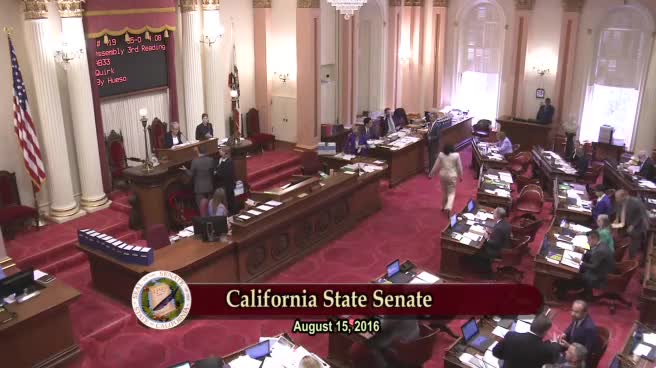
| Aug 15, 2016 | Read third time. Passed. Ordered to the Assembly. (Ayes 38. Noes 0.). |
| Aug 15, 2016 | Read third time. Passed. Ordered to the Assembly. (Ayes 38. Noes 0. Page 4969.). |
| Aug 15, 2016 | Read third time. Passed. Ordered to the Assembly. |
| Aug 3, 2016 | Read second time. Ordered to third reading. |
| Aug 2, 2016 | From committee: Do pass. (Ayes 7. Noes 0.) (August 1). |
| Jun 21, 2016 | From committee: Do pass and re-refer to Com. on APPR. (Ayes 5. Noes 0.) (June 21). Re-referred to Com. on APPR. |
| May 12, 2016 | Referred to Com. on AGRI. |
| Feb 19, 2016 | Introduced. To print. |
| May 5, 2016 | Read third time. Passed. Ordered to the Senate. |
| May 5, 2016 | In Senate. Read first time. To Com. on RLS. for assignment. |
| Apr 28, 2016 | Read second time. Ordered to Consent Calendar. |
| Apr 27, 2016 | From committee: Do pass. To Consent Calendar. (Ayes 19. Noes 0.) (April 27). |
| Apr 13, 2016 | From committee: Do pass and re-refer to Com. on APPR. (Ayes 10. Noes 0.) (April 13). Re-referred to Com. on APPR. |
| Mar 14, 2016 | Re-referred to Com. on AGRI. |
| Mar 10, 2016 | Referred to Com. on AGRI. |
| Mar 10, 2016 | From committee chair, with author's amendments: Amend, and re-refer to Com. on AGRI. Read second time and amended. |
| Feb 22, 2016 | Read first time. |
| Feb 21, 2016 | From printer. May be heard in committee March 22. |
|
Date
|
Description
|
Location
|
Votes
|
|
|---|---|---|---|---|
| Aug 15, 2016 | Assembly 3rd Reading AB2716 Dodd By Cannella | Senate Floor |
Passed |
|
| Aug 1, 2016 | Do pass | Senate Standing Committee on Appropriations |
Passed |
|
| Jun 21, 2016 | Do pass, but first be re-referred to the Committee on [Appropriations] | Senate Standing Committee on Agriculture |
Passed |
|
| May 5, 2016 | AB 2716 DODD Consent Calendar Second Day Regular Session | Assembly Floor |
Passed |
|
| Apr 27, 2016 | Do pass. To Consent Calendar. | Assembly Standing Committee on Appropriations |
Passed |
|
| Apr 13, 2016 | Do pass and be re-referred to the Committee on [Appropriations] | Assembly Standing Committee on Agriculture |
Passed |
This list shows positions taken on this bill by organizations on the date displayed, which is linked to the original source.
Positions by individuals are not included.
|
Organization
|
Position
|
Date
|
|---|---|---|
| California Cattlemen'S Association | ** Support | Aug 15, 2016 |
| California Farm Bureau Federation | ** Support | Aug 15, 2016 |
| California Poultry Association | ** Support | Aug 15, 2016 |
| California Poultry Federation | ** Support | Aug 15, 2016 |
Office of Senate Floor Analyses (916) 651-1520 Fax: (916) 327-4478 | AB |
THIRD READING
Bill No: AB 2716
:
SENATE AGRICULTURE COMMITTEE: 5-0, 6/21/16
AYES: Galgiani, Cannella, Berryhill, Pan, Wolk
SENATE APPROPRIATIONS COMMITTEE: 7-0, 8/1/16
AYES: Lara, Bates, Beall, Hill, McGuire, Mendoza, Nielsen
ASSEMBLY FLOOR: 79-0, 5/5/16 (Consent) - See last page for vote
SOURCE: California Farm Bureau Federation
DIGEST: This bill extends, until January 1, 2022, the licensing fees for livestock and poultry meat inspectors, livestock meat processing inspectors, and livestock processing facilities, slaughterhouses, and poultry plants, as specified.
Existing law:
- Authorizes the secretary of the California Department of Food and Agriculture (CDFA) to adopt rules, regulations, and standards regarding the inspection, sanitation, preparation, processing, buying, selling, transporting, storing, identifying, recordkeeping, registration, and labeling of livestock and poultry products (Food and Agricultural Code § 18650 et seq.; § 24501 et seq.).
- Requires livestock meat inspectors and processing inspectors to obtain a license and pay a $100 licensing fee and a $25 penalty late fee, if applicable.
- Requires meat processing and custom livestock slaughterhouses to obtain a license and pay a $500 licensing fee, or more depending on number of animals slaughtered, as specified.
- Prohibits the operation of a slaughterhouse that is not licensed, is not clean, does not meet building or equipment sanitary standards, violates an order of a licensed inspector, misbrands or mislabels livestock and poultry products, or disposes of condemned and inedible carcasses in a manner that violates law and/or regulations.
- Requires poultry plants to obtain a license from CDFA and pay a $500 licensing fee, or more depending on number of animals slaughtered, as specified.
- Requires poultry meat inspectors to obtain a license and pay a $100 licensing fee and a $25 penalty late fee, if applicable.
This bill:
- Extends to January 1, 2022, livestock meat inspector and processing inspector licenses and fees.
- Extends to January 1, 2022, meat processing and custom livestock slaughterhouse licenses and fees.
- Extends to January 1, 2022, poultry meat inspector and poultry plant licenses and fees.
- Deletes an obsolete provision.
Background
The California Meat and Poultry Inspection Act is designed to protect the health and welfare of consumers from unwholesome, adulterated, or misbranded meat and poultry. The inspection programs enforce requirements that are at least equal to those imposed and enforced under the Federal Meat Inspection Act and the Federal Poultry Products Inspection Act in order to comply with intrastate operations and commerce.
The Meat, Poultry and Egg Safety Branch within the CDFA is responsible for issuing licenses, training and evaluating inspectors, and inspecting meat, poultry, and egg production facilities that are exempt from United States Department of Agriculture inspection. These facilities include custom livestock slaughterhouses, meat processors, and some poultry plants, as specified.
Comments
Need for this bill. CDFA’s General Fund allocation was cut by roughly $30 million, or one-third, during the 2011-2012 State Budget reductions. Specifically, the Meat, Poultry and Egg Safety Branch General Fund support was reduced by approximately $200,000 in 2011 and $325,000 in 2012.
In response, the secretary was directed to convene meetings with agricultural stakeholders to find solutions to limit the need for state resources and improve fiscal responsibility. Some of the solutions that arose from these meetings included establishing and raising fees. In the case of livestock and poultry licenses, fees were raised with the caveat that they be reviewed every five years according to the sunset date. The increased license fees generate approximately $200,000 in annual revenue.
FISCAL EFFECT: Appropriation: Fiscal Com.: Local:
According to the Senate Appropriations Committee, this bill will not result in additional costs to the CDFA.
California Farm Bureau Federation (source)
California Cattlemen’s Association
California Poultry Federation
None received
ARGUMENTS IN SUPPORT: According to the author, “Due to general fund (GF) budget shortfalls in 2011, the Meat, Poultry and Egg Safety Branch within the California Department of Food and Agriculture (CDFA) had their GF reduced by approximately $200,000, and then by approximately $325,000 in 2012, which impacted several public health and safety programs. Through discussions with the affected industry and licensees, CDFA developed a new licensee and renewal fee structure that was adopted in a Budget Trailer Bill (AB 120; Statutes of 2011) which significantly increased the fees while CDFA streamlined the administration of these programs. These increased fees were given a five year sunset in order to have both the fees and administration of the program reviewed. The current fee structure and administrative changes have worked well and their sunsets need to be extended.”
ASSEMBLY FLOOR: 79-0, 5/5/16
AYES: Achadjian, Alejo, Travis Allen, Arambula, Atkins, Baker, Bigelow, Bloom, Bonilla, Bonta, Brough, Brown, Burke, Calderon, Campos, Chang, Chau, Chávez, Chiu, Chu, Cooley, Cooper, Dababneh, Dahle, Daly, Dodd, Eggman, Frazier, Gallagher, Cristina Garcia, Eduardo Garcia, Gatto, Gipson, Gomez, Gonzalez, Gordon, Gray, Grove, Hadley, Harper, Roger Hernández, Holden, Irwin, Jones, Jones-Sawyer, Kim, Lackey, Levine, Linder, Lopez, Low, Maienschein, Mathis, Mayes, McCarty, Medina, Melendez, Mullin, Nazarian, Obernolte, O'Donnell, Olsen, Patterson, Quirk, Ridley-Thomas, Rodriguez, Salas, Santiago, Steinorth, Mark Stone, Thurmond, Ting, Wagner, Waldron, Weber, Wilk, Williams, Wood, Rendon
NO VOTE RECORDED: Beth Gaines
8/3/16 19:11:03
**** END ****
SENATE COMMITTEE ON APPROPRIATIONS
Senator Ricardo Lara, Chair
2015 - 2016 Regular Session
AB 2716 (Dodd) - Meat processing establishment, custom livestock slaughterhouse, and poultry plants: licensing and inspectors
Version: March 10, 2016 | Policy Vote: AGRI. 5 - 0 |
Urgency: No | Mandate: No |
Hearing Date: August 1, 2016 | Consultant: Robert Ingenito |
This bill does not meet the criteria for referral to the Suspense File.
Bill Summary:
AB 2716 would extend, until January 1, 2022, the licensing fees for livestock and poultry meat inspectors, livestock meat processing inspectors, and livestock processing facilities, slaughterhouses, and poultry plants, as specified.
Fiscal Impact:
This bill would not result in additional costs to the California Department of Food and Agriculture (CDFA).
Background:
CDFA’s Meat, Poultry and Egg Safety Branch (Branch) is responsible for (1) issuing licenses, (2) training and evaluating inspectors, and (3) inspecting meat, poultry, and egg production facilities that are exempt from USDA inspection.
CDFA’s General Fund budget was reduced by about one-third (or $30 million), in 2011-12. Specifically, General Fund support for the Branch was reduced by approximately $200,000 in 2011-12 and $325,000 in 2012-13. Subsequently, CDFA was directed to convene meetings with agricultural stakeholders to produce alternatives which limit the need for state resources, including establishing and raising fees. In the case of livestock and poultry licenses, fees were raised with the caveat that they be reviewed every five years according to the sunset date. The increased license fees generate approximately $200,000 in annual revenue.
Thus, current law (1) requires livestock meat inspectors and processing inspectors to obtain a license and pay a $100 licensing fee and a $25 penalty late fee, if applicable, (2) requires meat processing and custom livestock slaughterhouses to obtain a license and pay a $500 licensing fee, or more depending on number of animals slaughtered, as specified, (3) prohibits the operation of a slaughterhouse that is not licensed, is not clean, does not meet building or equipment sanitary standards, violates an order of a licensed inspector, misbrands or mislabels livestock and poultry products, or disposes of condemned and inedible carcasses in a manner that violates law and/or regulations, (4) requires poultry plants to obtain a license from CDFA and pay a $500 licensing fee, or more depending on number of animals slaughtered, as specified, and (5) requires poultry meat inspectors to obtain a license and pay a $100 licensing fee and a $25 penalty late fee, if applicable.
CDFA’s Meat, Poultry and Egg Safety Branch is industry-funded by registration, licensing, and enforcement fees, and mill assessments on egg shipments in the State. The extension of the sunset provisions as specified in this proposal, would allow for the continued funding and operation of the program.
Proposed Law:
This bill would extend the sunset date, until January 1, 2022, for statutes authorizing the licensing and renewal of livestock meat inspectors, processing inspectors, persons operating a meat processing establishment, a custom livestock slaughterhouse, or a poultry plant, and fees charged for changes in the ownership of a custom livestock slaughterhouse, as enforced by CDFA.
Related Legislation:
AB 120 (Budget Committee, Chapter 113, Statutes of 2011) among other provisions, authorizes CDFA, until January 1, 2017, to increase the licensing fees for livestock and poultry meat inspectors, livestock meat processing inspectors, and livestock processing facilities, slaughterhouses, and poultry plants.
Staff Comments: CDFA’s Meat, Poultry and Egg Safety Branch is industry-funded by registration, licensing, and enforcement fees, and mill assessments on egg shipments in the State. The extension of the sunset provisions as specified in this proposal, would allow for the continued funding and operation of the program.
-- END --
SENATE COMMITTEE ON AGRICULTURE
Senator Cathleen Galgiani, Chair
2015 - 2016 Regular
Bill No: AB 2716 Hearing Date: 6/21/16
Author: | Dodd | ||
Version: | 3/10/16 | ||
Urgency: | No | Fiscal: | Yes |
Consultant: | Anne Megaro | ||
Subject: Meat processing establishment, custom livestock slaughterhouse, and poultry plants: licensing and inspectors
SUMMARY
:
This bill would extend, until January 1, 2022, the licensing fees for livestock and poultry meat inspectors, livestock meat processing inspectors, and livestock processing facilities, slaughterhouses, and poultry plants, as specified.
BACKGROUND AND EXISTING LAW
:
The California Meat and Poultry Inspection Act is designed to protect the health and welfare of consumers from unwholesome, adulterated, or misbranded meat and poultry. The inspection programs enforce requirements that are at least equal to those imposed and enforced under the Federal Meat Inspection Act and the Federal Poultry Products Inspection Act in order to comply with intrastate operations and commerce.
The Meat, Poultry and Egg Safety Branch within the California Department of Food and Agriculture (CDFA) is responsible for issuing licenses, training and evaluating inspectors, and inspecting meat, poultry, and egg production facilities that are exempt from USDA inspection. These facilities include custom livestock slaughterhouses, meat processors, and some poultry plants, as specified.
Existing law:
- Authorizes the secretary of CDFA to adopt rules, regulations, and standards regarding the inspection, sanitation, preparation, processing, buying, selling, transporting, storing, identifying, recordkeeping, registration, and labeling of livestock and poultry products (Food and Agricultural Code § 18650 et seq.; § 24501 et seq.).
- Requires livestock meat inspectors and processing inspectors to obtain a license and pay a $100 licensing fee and a $25 penalty late fee, if applicable.
- Requires meat processing and custom livestock slaughterhouses to obtain a license and pay a $500 licensing fee, or more depending on number of animals slaughtered, as specified.
- Prohibits the operation of a slaughterhouse that is not licensed, is not clean, does not meet building or equipment sanitary standards, violates an order of a licensed inspector, misbrands or mislabels livestock and poultry products, or disposes of condemned and inedible carcasses in a manner that violates law and/or regulations.
- Requires poultry plants to obtain a license from CDFA and pay a $500 licensing fee, or more depending on number of animals slaughtered, as specified.
- Requires poultry meat inspectors to obtain a license and pay a $100 licensing fee and a $25 penalty late fee, if applicable.
PROPOSED LAW
:
This bill:
- Extends to January 1, 2022, livestock meat inspector and processing inspector licenses and fees.
- Extends to January 1, 2022, meat processing and custom livestock slaughterhouse licenses and fees.
- Extends to January 1, 2022, poultry meat inspector and poultry plant licenses and fees.
- Deletes an obsolete provision.
ARGUMENTS IN SUPPORT:
According to the author, “Due to general fund (GF) budget shortfalls in 2011, the Meat, Poultry and Egg Safety Branch within the California Department of Food and Agriculture (CDFA) had their GF reduced by approximately $200,000, and then by approximately $325,000 in 2012, which impacted several public health and safety programs. Through discussions with the affected industry and licensees, CDFA developed a new licensee and renewal fee structure that was adopted in a Budget Trailer Bill (AB 120; Statutes of 2011) which significantly increased the fees while CDFA streamlined the administration of these programs. These increased fees were given a five year sunset in order to have both the fees and administration of the program reviewed. The current fee structure and administrative changes have worked well and their sunsets need to be extended.”
COMMENTS
:
Need for this bill. CDFA’s General Fund allocation was cut by roughly $30 million, or one-third, during the 2011-2012 state budget reductions. Specifically, the Meat, Poultry and Egg Safety Branch General Fund support was reduced by approximately $200,000 in 2011 and $325,000 in 2012.
In response, the secretary was directed to convene meetings with agricultural stakeholders to find solutions to limit the need for state resources and improve fiscal responsibility. Some of the solutions that arose from these meetings included establishing and raising fees. In the case of livestock and poultry licenses, fees were raised with the caveat that they be reviewed every five years according to the sunset date. The increased license fees generate approximately $200,000 in annual revenue.
RELATED LEGISLATION
:
AB 120 (Budget) Chapter 113, Statutes of 2011. Among other provisions, authorizes CDFA, until January 1, 2017, to increase the licensing fees for livestock and poultry meat inspectors, livestock meat processing inspectors, and livestock processing facilities, slaughterhouses, and poultry plants.
PRIOR ACTIONS
:
Assembly Floor: | 79 - 0 |
Assembly Appropriations Committee: | 19 - 0 |
Assembly Agriculture Committee: | 10 - 0 |
SUPPORT
:
California Farm Bureau Federation (Sponsor)
California Cattlemen’s Association
California Poultry Federation
OPPOSITION
:
None received
-- END --
Date of Hearing: April 27, 2016
ASSEMBLY COMMITTEE ON APPROPRIATIONS
Lorena Gonzalez, Chair
ABPCA Bill Id:AB 2716
Author:(Dodd) – As Amended Ver:March 10, 2016
Policy Committee: | Agriculture | Vote: | 10 - 0 |
|
|
Urgency: No State Mandated Local Program: No Reimbursable: No
SUMMARY:
This bill extends the sunset of fees for livestock and poultry processing programs from January 1, 2017, to January 1, 2022. Specifically, this bill extends the following fees:
- The application, renewal, and penalty fees for a livestock meat inspector’s license or a processing inspector’s license.
- The application, renewal, and penalty fees for a meat processing establishment’s license or a custom livestock slaughterhouse’s license.
- The application, renewal, and penalty fees for a poultry plant’s license and poultry plant inspector’s license.
FISCAL EFFECT:
No additional costs to the California Department of Food and Agriculture (CDFA). Absent the provisions in this bill, the Meat, Poultry, and Egg Safety Branch would see a significant drop in industry funds that support the Branch.
COMMENTS:
- Purpose and background. CDFA is responsible for licensing and overseeing livestock and poultry slaughterhouses and processing plants. As a result of General Fund (GF) budget shortfalls, the Meat, Poultry and Egg Safety Branch within CDFA had their GF reduced by approximately $200,000 and $325,000 in 2011 and 2012, respectively. This reduction had a major fiscal impact to several public health and safety programs, including the licensing inspection programs.
Through discussions with the affected industry and licensees, CDFA developed a new licensee and renewal fee structure that was adopted in a Budget Trailer Bill AB 112, (Budget), Chapter 30, Statutes of 2011, which significantly increased the licensees' fees while CDFA streamlined the administration of these programs. These increased fees were given a five year sunset in order to have both the fees and administration of the program reviewed. According to supporters of this bill, these programs have operated in a reasonable manner making continuation of the sunsets without adjustment to the fee levels a reasonable request.
- Meat, Poultry and Egg Safety Branch budget. The branch currently has a total budget of $7.6 million, consisting of approximately $3.0 million GF, $4.3 million industry funds, and $277,000 federal funds.
Analysis Prepared by: Luke Reidenbach / APPR. / (916) 319-2081
Date of Hearing: April 13, 2016
ASSEMBLY COMMITTEE ON AGRICULTURE
Bill Dodd, Chair
ABPCA Bill Id:AB 2716 (
Author:Dodd) – As Amended Ver:March 10, 2016
SUBJECT: Meat processing establishment, custom livestock slaughterhouse, and poultry plants: licensing and inspectors.
SUMMARY: Extends for five years the sunsets of three licensing and inspection programs, including fees, dealing with livestock and poultry processing. Specifically, this bill:
- Extends the Livestock Meat Inspector and Processing Inspector licenses and fees sunset from January 1, 2017 to January 1, 2022.
- Extends the Licensed Meat Processing and Custom Livestock Slaughter Establishments licenses and fees sunset from January 1, 2017 to January 1, 2022.
- Extends the Poultry and Rabbit processing plant application fees, renewal fees, meat inspector license fees, renewal, and penalty fees sunset from January 1, 2017 to January 1, 2022.
EXISTING LAW: 1) Requires, until January 1, 2017, each livestock meat inspector and processing inspector, be licensed before operating a meat processing establishment or a custom livestock slaughterhouse and sets annual license renewal fees for custom livestock slaughterhouses and meat processing establishments. Existing law, until January 1, 2017, also establishes application fees for initial and renewal of licenses for livestock meat inspectors and processing inspectors. Existing law imposes a penalty on applicants for renewal who fail to pay the license renewal fee by an expiration date of the meat processing establishment, custom livestock slaughterhouse, livestock meat inspector, or processing inspector, and provides cause for revocation of the license if the applicant fails to pay the renewal fee, plus the penalty, within 90 days of the license’s expiration.
2) Existing law provides for the regulation, inspection, and licensing of meat processing and custom livestock slaughter establishments and for the regulation and licensing of poultry and livestock meat inspectors. Existing law, until January 1, 2017, specifies the license application fees for a new, previously unlicensed poultry plant and for a license application submitted upon change of ownership of an existing, previously licensed poultry plant. Existing law, until January 1, 2017, requires that an application for renewal of a license of a poultry plant, accompanied by a specified renewal fee, be made on or before the expiration of the license.
3) Existing law, until January 1, 2017, specifies the application fee for a poultry and rabbit processing plant and meat inspector license application and the renewal fee of that licensee. Existing law, until January 1, 2017, imposes a penalty of $25 on applicants for renewal who fail to pay the renewal fee by the expiration date of the license, and provides for revocation of the license if the applicant fails to pay the renewal fee, plus the penalty, within 90 days of the license’s expiration.
FISCAL EFFECT: Unknown.
COMMENTS: The California Department of Food and Agriculture (CDFA), under the California Meat and Poultry Supplemental Inspection Act (Act), are responsible for licensing and overseeing livestock and poultry slaughterhouses and processing plants. In 2011, due to general fund (GF) budget shortfalls, the Meat, Poultry and Egg Safety Branch within CDFA had their GF reduced by approximately $200,000, and then by approximately $325,000 in 2012. This had a major fiscal impact to several public health and safety programs, with programs under the Act being part of them.
Through discussions with the affected industry and licensees, CDFA developed a new licensee and renewal fee structure that was adopted in a Budget Trailer Bill AB 112, (Budget), Chapter 30, Statutes of 2011, which significantly increased the licensees' fees while CDFA streamlined the administration of these programs. These increased fees were given a five year sunset in order to have both the fees and administration of the program reviewed.
These programs have operated in a reasonable manner making continuation of the sunsets without adjustment to the fee levels a reasonable request.
REGISTERED SUPPORT / OPPOSITION:
Support
California Farm Bureau Federation (Sponsor)
California Cattlemen's Association
California Poultry Association
Opposition
None on file.
Analysis Prepared by: Jim Collin / AGRI. / (916) 319-2084
Bill Author

Bill Co-Author(s):