AB 2741: Long-range transportation planning: California Transportation Plan.
- Session Year: 2015-2016
- House: Assembly
- Latest Version Date: 2016-09-02
Existing law requires the Department of Transportation to complete the first update of the California Transportation Plan by December 31, 2015, and to update the plan every 5 years thereafter. Existing law requires the California Transportation Commission to review the plan and make certain recommendations. Existing law requires the Governor to adopt the plan and to submit it to the Legislature and the United States Secretary of Transportation.
This bill, beginning in 2020, would require updates to the plan to be approved by the commission prior to submission to the Legislature and the Governor. The bill would require the department to submit a draft of its proposed update to the commission for its comments by June 30, 2020, and every 5 years thereafter. The bill, if the commission does not approve an updated plan, would require the department to revise its proposed update in consultation with the commission. The bill would make other conforming changes.
Existing law requires the Department of Transportation to complete the first update of the California Transportation Plan by December 31, 2015, and to update the plan every 5 years thereafter. Existing law requires the California Transportation Commission to review the plan and make certain recommendations. Existing law requires the Governor to adopt the plan and to submit it to the Legislature and the United States Secretary of Transportation.
This bill bill, beginning in 2020, would require updates to the plan to be approved by the commission. commission prior to submission to the Legislature and the Governor. The bill would require the department to submit a draft of its proposed update to the commission for its comments by June 30, 2020, and every 5 years thereafter. The bill, if the commission does not approve an updated plan, would require the department to revise its proposed update in consultation with the commission. The bill would make other conforming changes.
Existing law requires the Department of Transportation to complete the first update of the California Transportation Plan by December 31, 2015, and to update the plan every 5 years thereafter. Existing law requires the California Transportation Commission to review the plan and make certain recommendations.
This bill would require the plan to be approved by the commission.
Existing law authorizes the Department of Transportation to place and maintain appropriate signs, signals, and other traffic control devices on highways under its jurisdiction and, with the consent of local authorities, to place and maintain appropriate signs, signals, and other traffic control devices in or along city streets and county roads as may be necessary or desirable to control, or direct traffic, or to facilitate traffic flow, to or from or on state highways.
This bill would make nonsubstantive revisions to this authorization.
(a)The department shall update the California Transportation Plan every five years consistent with this chapter. The first update shall be completed by December 31, 2015.
(b)Beginning with the 2020 update, the department shall submit the updated plan to the California Transportation Commission for its approval. The department shall submit a draft of the updated plan to the commission for its comments by June 30, 2020, and every five years thereafter.
(c)If the commission does not approve an updated plan, the department shall revise its proposed update in consultation with the commission.
SEC. 2.Section 65073 of the Government Code is amended to read:65073.The department shall also consult with, coordinate its activities with, and make a draft of its proposed updated plan available to the Strategic Growth Council, the State Air Resources Board, the State Energy Resources Conservation and Development Commission, the air quality management districts, public transit operators, and the regional transportation planning agencies for review and comment. The department shall also provide an opportunity for input by the general public. Prior to approving the updated plan pursuant to Section 65071, the commission shall make a final draft available to the Legislature and Governor for review and comment. Upon approval of the updated plan by the commission, the Governor shall adopt the updated plan and submit it to the Legislature and the United States Secretary of Transportation.
(a)The department shall update the California Transportation Plan every five years consistent with this chapter. The first update shall be completed by December 31, 2015. The plan shall be approved by the California Transportation Commission and updated every five years thereafter.
(b)Beginning with the 2020 update, the department shall submit the updated plan to the California Transportation Commission for its approval. The department shall submit a draft of the updated plan to the commission for its comments by June 30, 2020, and every five years thereafter.
(c)If the commission does not approve an updated plan, the department shall revise its proposed update in consultation with the commission.
SEC. 2.Section 65073 of the Government Code is amended to read:65073.The department shall also consult with, coordinate its activities with, and make a draft of its proposed plan, and each update, updated plan available to the California Transportation Commission, the Strategic Growth Council, the State Air Resources Board, the State Energy Resources Conservation and Development Commission, the air quality management districts, public transit operators, and the regional transportation planning agencies for review and comment. The department shall also provide an opportunity for input by the general public. Prior to adopting the plan or update, the department approving the updated plan pursuant to Section 65071, the commission shall make a final draft available to the Legislature and Governor for review and comment. The commission may present the results of its review and comment to the Legislature and the Governor. The Upon approval of the updated plan by the commission, the Governor shall adopt the updated plan and submit the plan it to the Legislature and the United States Secretary of the United States Department of Transportation.
The department shall update the California Transportation Plan consistent with this chapter. The first update shall be completed by December 31, 2015. The plan shall be approved by the California Transportation Commission and updated every five years thereafter.
SECTION 1.Section 21350 of the Vehicle Code is amended to read:21350.The Department of Transportation shall place and maintain, or cause to be placed and maintained, with respect to highways under its jurisdiction, appropriate signs, signals, and other traffic control devices as required hereunder, and may place and maintain, or cause to be placed and maintained, appropriate signs, signals, or other traffic control devices as may be authorized hereunder, or as may be necessary properly to indicate and to carry out the provisions of this code, or to warn or guide traffic upon the highways. The Department of Transportation may, with the consent of the local authorities, also place and maintain, or cause to be placed and maintained, in or along city streets and county roads, appropriate signs, signals, and other traffic control devices, or may perform, or cause to be performed, other work on city streets and county roads, as may be necessary or desirable to control or direct traffic, or to facilitate traffic flow, to or from or on state highways.
The Department of Transportation shall place and maintain, or cause to be placed and maintained, with respect to highways under its jurisdiction, appropriate signs, signals, and other traffic control devices as required hereunder, and may place and maintain, or cause to be placed and maintained, such appropriate signs, signals, or other traffic control devices as may be authorized hereunder, or as may be necessary properly to indicate and to carry out the provisions of this code, or to warn or guide traffic upon the highways. The Department of Transportation may, with the consent of the local authorities, also place and maintain, or cause to be placed and maintained, in or along city streets and county roads, appropriate signs, signals, and other traffic control devices, or may perform, or cause to be performed, such other work on city streets and county roads, as may be necessary or desirable to control, control or direct traffic, or to facilitate traffic flow, to or from or on state highways.
|
Date
|
Status
|
|---|---|
| May 5, 2016 | Read third time. Passed. Ordered to the Senate. (Ayes 79. Noes 0. Page 4687.) |
| Sep 12, 2016 | Enrolled and presented to the Governor at 11:30 a.m. |
| Aug 31, 2016 | Senate amendments concurred in. To Engrossing and Enrolling. |
| Aug 30, 2016 | In Assembly. Concurrence in Senate amendments pending. |
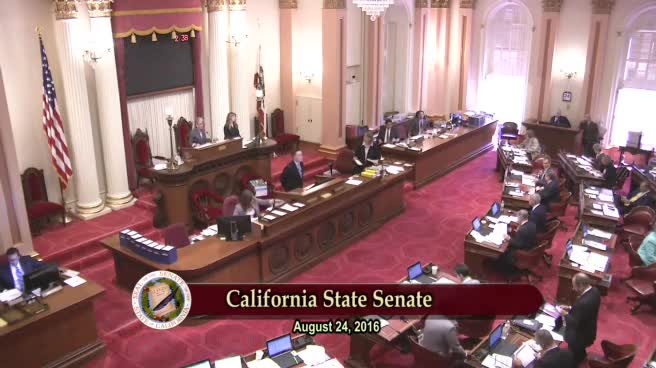
| Aug 24, 2016 | Read third time. Passed. Ordered to the Assembly. (Ayes 39. Noes 0. Page 5339.). |
| Aug 24, 2016 | Read third time. Passed. Ordered to the Assembly. |
| Aug 15, 2016 | Read second time. Ordered to third reading. |
| Aug 11, 2016 | From committee: Do pass. (Ayes 7. Noes 0.) (August 11). |
| Jun 27, 2016 | In committee: Referred to APPR. suspense file. |
| Jun 15, 2016 | From committee: Do pass and re-refer to Com. on APPR. with recommendation: To Consent Calendar. (Ayes 11. Noes 0.) (June 14). Re-referred to Com. on APPR. |
| Jun 8, 2016 | From committee chair, with author's amendments: Amend, and re-refer to committee. Read second time, amended, and re-referred to Com. on T. & H. |
| May 12, 2016 | Referred to Com. on T. & H. |
| Feb 19, 2016 | Introduced. To print. |
| May 5, 2016 | Read third time. Passed. Ordered to the Senate. |
| May 5, 2016 | In Senate. Read first time. To Com. on RLS. for assignment. |
| Apr 28, 2016 | Read second time. Ordered to Consent Calendar. |
| Apr 27, 2016 | From committee: Do pass. To Consent Calendar. (Ayes 19. Noes 0.) (April 27). |
| Apr 12, 2016 | From committee: Do pass and re-refer to Com. on APPR. with recommendation: To Consent Calendar. (Ayes 16. Noes 0.) (April 11). Re-referred to Com. on APPR. |
| Mar 28, 2016 | Re-referred to Com. on TRANS. |
| Mar 18, 2016 | From committee chair, with author's amendments: Amend, and re-refer to Com. on TRANS. Read second time and amended. |
| Mar 17, 2016 | Referred to Com. on TRANS. |
| Feb 22, 2016 | Read first time. |
| Feb 21, 2016 | From printer. May be heard in committee March 22. |
|
Date
|
Description
|
Location
|
Votes
|
|
|---|---|---|---|---|
| Aug 31, 2016 | AB 2741 SALAS Concurrence in Senate Amendments | Assembly Floor |
Passed |
|
| Aug 24, 2016 | Assembly 3rd Reading AB2741 Salas By Cannella | Senate Floor |
Passed |
|
| Aug 11, 2016 | Do pass | Senate Standing Committee on Appropriations |
Passed |
|
| Jun 27, 2016 | Placed on suspense file | Senate Standing Committee on Appropriations |
Passed |
|
| Jun 14, 2016 | Do pass, but first be re-referred to the Committee on [Appropriations] with the recommendation: To Consent Calendar | Senate Standing Committee on Transportation and Housing |
Passed |
|
| May 5, 2016 | AB 2741 SALAS Consent Calendar Second Day Regular Session | Assembly Floor |
Passed |
|
| Apr 27, 2016 | Do pass. To Consent Calendar. | Assembly Standing Committee on Appropriations |
Passed |
|
| Apr 11, 2016 | Do pass and be re-referred to the Committee on [Appropriations] with recommendation: To Consent Calendar | Assembly Standing Committee on Transportation |
Passed |
This list shows positions taken on this bill by organizations on the date displayed, which is linked to the original source.
Positions by individuals are not included.
GOVERNOR'S VETO
GV Bill Id:AB 2741
Author:(Salas)
As Enrolled Ver:September 12, 2016
2/3 vote
ASSEMBLY: | 79-0 | (May 5, 2016) | SENATE: | 39-0 | (August 24, 2016) |
ASSEMBLY: | 79-0 | (August 31, 2016) |
Original Committee Reference: TRANS.
SUMMARY: Requires the California Transportation Plan (CTP) to be approved by the California Transportation Commission (CTC).
The Senate amendments:
- Set forth the process whereby the California Department of Transportation (Caltrans) is to submit the updated CTP, beginning in 2020, to the CTC for approval.
- Should the CTC not approve the proposed update, require Caltrans to revise the proposed update to the CTP, in consultation with the CTC.
- Makes other, related changes to existing law.
FISCAL EFFECT: According to the Senate Appropriations Committee:
- Increased CTC administrative costs in the range of $75,000 to $100,000 annually for a minimum of 1/2 personnel year (PY) of staff time associated with increased ongoing coordination to actively participate in the development of the CTP.
- Estimated increased Caltrans administrative costs of up to $150,000 annually for up to one additional PY of staff time associated with the additional coordination and consultation in preparing the CTP, and making any necessary revisions.
COMMENTS: In 2014, the Legislature passed and the Governor signed SB 486 (DeSaulnier), Chapter 917, Statutes 2014. SB 486 had a number of provisions related to transportation planning and programming, chief among them were provisions that sought to align the state's overarching policy goals with its long-term transportation planning efforts and then to use these planning efforts to guide investments. Eventually, this alignment should ensure that only projects that are consistent with these policy goals, as reflected in the CTP, are funded in one of a number of different transportation programming processes.
Given the significance of the CTP, the Legislature charged the CTC with the responsibility to inform the CTP process. Specifically, commencing with the update to the CTP that is required on or before December 31, 2020, SB 486 authorized the CTC to prescribe study areas for analysis and evaluation by Caltrans and to establish guidelines for preparation of the CTP. SB 486 did not, however, vest the CTC with the responsibility to approve the CTP.
The role of the CTC in establishing guidelines to govern transportation programs is not new. The Legislature has increasingly turned to the CTC to guide and oversee implementation of transportation programs as they are created, such as the Active Transportation Program created in 2013 (SB 99 (Budget and Fiscal Review Committee), Chapter 359, Statutes of 2013), the interregional transportation strategic plan, revised by SB 486 in 2014, and the highway toll program, created last year (AB 194, (Frazier), Chapter 687, Statutes of 2015).
The author has introduced this bill in response to a "growing concern over accountability in the transportation-planning process." The author correctly points out that, while the CTC has the authority to establish long-term transportation goals, Caltrans is not required to follow the CTC's policy direction. This bill requires the CTC to approve the CTP to ensure the plan aligns with the guidelines and policy expectations set forth by the CTC and is consistent with the long-standing role the Legislature has entrusted the CTC with in helping to guide transportation policy.
I am returning Assembly Bill 2741 without my signature.
This bill shifts the responsibility to approve the state Transportation Plan from the Transportation Agency to the Transportation Commission. This would diminish my authority as chief executive, something I am not inclined to do.
Analysis Prepared by: Janet Dawson / TRANS. / (916) 319-2093 FN: 0005073
CONCURRENCE IN SENATE AMENDMENTS
CSA1 Bill Id:AB 2741
Author:(Salas)
As Amended Ver:June 8, 2016
Majority vote
ASSEMBLY: | 79-0 | (May 5, 2016) | SENATE: | 39-0 | (August 24, 2016) |
Original Committee Reference: TRANS.
SUMMARY: Requires the California Transportation Plan (CTP) to be approved by the California Transportation Commission (CTC).
The Senate amendments:
- Set forth the process whereby the California Department of Transportation (Caltrans) is to submit the updated CTP, beginning in 2020, to the CTC for approval.
- Should the CTC not approve the proposed update, require Caltrans to revise the proposed update to the CTP, in consultation with the CTC.
- Makes other, related changes to existing law.
FISCAL EFFECT: According to the Senate Appropriations Committee:
- Increased CTC administrative costs in the range of $75,000 to $100,000 annually for a minimum of 1/2 personnel year (PY) of staff time associated with increased ongoing coordination to actively participate in the development of the CTP.
- Estimated increased Caltrans administrative costs of up to $150,000 annually for up to one additional PY of staff time associated with the additional coordination and consultation in preparing the CTP, and making any necessary revisions.
COMMENTS: In 2014, the Legislature passed and the Governor signed SB 486 (DeSaulnier), Chapter 917, Statutes 2014. SB 486 had a number of provisions related to transportation planning and programming, chief among them were provisions that sought to align the state's overarching policy goals with its long-term transportation planning efforts and then to use these planning efforts to guide investments. Eventually, this alignment should ensure that only projects that are consistent with these policy goals, as reflected in the CTP, are funded in one of a number of different transportation programming processes.
Given the significance of the CTP, the Legislature charged the CTC with the responsibility to inform the CTP process. Specifically, commencing with the update to the CTP that is required on or before December 31, 2020, SB 486 authorized the CTC to prescribe study areas for analysis and evaluation by Caltrans and to establish guidelines for preparation of the CTP. SB 486 did not, however, vest the CTC with the responsibility to approve the CTP.
The role of the CTC in establishing guidelines to govern transportation programs is not new. The Legislature has increasingly turned to the CTC to guide and oversee implementation of transportation programs as they are created, such as the Active Transportation Program created in 2013 [SB 99 (Committee on Budget and Fiscal Review), Chapter 359, Statutes of 2013], the interregional transportation strategic plan, revised by SB 486 in 2014, and the highway toll program, created last year [AB 194, (Frazier), Chapter 687, Statutes of 2015].
The author has introduced this bill in response to a "growing concern over accountability in the transportation-planning process." The author correctly points out that, while the CTC has the authority to establish long-term transportation goals, Caltrans is not required to follow the CTC's policy direction. AB 2741 requires the CTC to approve the CTP to ensure the plan aligns with the guidelines and policy expectations set forth by the CTC and is consistent with the long-standing role the Legislature has entrusted the CTC with in helping to guide transportation policy.
Please see the policy committee analysis for full discussion of this bill.
Analysis Prepared by: Janet Dawson / TRANS. / (916) 319-2093 FN: 0004081
Office of Senate Floor Analyses (916) 651-1520 Fax: (916) 327-4478 | AB |
THIRD READING
Bill No: AB 2741
:
SENATE TRANS. & HOUSING COMMITTEE: 11-0, 6/14/16
AYES: Beall, Cannella, Allen, Bates, Gaines, Galgiani, Leyva, McGuire, Mendoza, Roth, Wieckowski
SENATE APPROPRIATIONS COMMITTEE: 7-0, 8/11/16
AYES: Lara, Bates, Beall, Hill, McGuire, Mendoza, Nielsen
ASSEMBLY FLOOR: 79-0, 5/5/16 (Consent) - See last page for vote
DIGEST: This bill requires the California Transportation Plan (CTP) to be approved by the California Transportation Commission (CTC), as specified.
Existing law:
- Vests CTC with the responsibility to advise and assist the Secretary of the California State Transportation Agency (CalSTA) and the Legislature in formulating and evaluating state policies and plans for California’s transportation programs.
- Finds and declares that:
- It is in the best interest of the state to have an integrated state and regional transportation planning process.
- Federal law mandates the development of state and regional long-range transportation plans as a prerequisite for receipt of federal transportation funds.
- The preparation of these plans shall be a cooperative process involving local and regional government, transit operators, congestion management agencies, and the goods movement industry.
- Requires the California Department of Transportation (Caltrans) to update the CTP by December 31, 2015, and every five years thereafter, based on consultation and review and comments by a host of state agencies and the general public.
- Requires Caltrans to make a final draft available to the Legislature and the Governor for review and comment prior to adopting the plan or update; the Governor must then adopt the plan and submit it to the Legislature and the Secretary of the United States Department of Transportation.
- Requires the CTC to review recommendations in the updated CTP and prepare specific, action-oriented, and pragmatic recommendations for transportation system improvements and to include the recommendations in its annual report to the Legislature and the Governor.
This bill:
- Requires, starting in 2020, Caltrans to submit an updated CTP to CTC and further requires CTC to approve the updated CTP, as specified.
- Requires Caltrans to revise the proposed updated CTP in consultation with CTC if the updated plan is not approved by CTC.
- Makes technical conforming changes.
Comments
- Purpose. The author asserts that this bill will “require the California Transportation Plan to be approved by the CTC to ensure it aligns with the CTC’s established guidelines and policy expectations. AB 2741 will provide accountability in the transportation-planning process and ensure Caltrans is meeting CTC’s guidelines.”
- Improving the transportation planning process. In 2014, the Legislature passed and the Governor signed SB 486 (DeSaulnier, Chapter 917, Statutes of 2014) which contained a number of provisions related to the transportation planning and programming process. Several of these provisions aimed to align the state’s overarching policy goals with its long-term transportation planning effort and then to use these planning efforts to guide investments. Eventually, this alignment intends to ensure that only projects that are consistent with the state’s overarching policy goals, as reflected in the CTP, are funded in one of a number of different transportation programming processes (e.g., State Transportation Improvement Program, State Highway Operations and Protection Program, etc.). SB 486 further authorized CTC to establish guidelines for the preparation of subsequent CTPs following the first plan completed in 2015.
- What is the CTP? The CTP provides a long-range policy framework to meet California’s future mobility needs and reduce greenhouse gas emissions. The CTP defines goals, performance-based policies, and strategies to achieve the state’s collective vision for California’s future statewide, integrated, multimodal transportation system. The CTP envisions a sustainable system that improves mobility and enhances Californian quality of life. Ultimately, the purpose of the CTP is to provide a common policy framework that will guide transportation investments and decisions by all levels of government, the private sector, and other transportation stakeholders. Caltrans is to update the CTP every five years.
- CTC’s role. The CTC’s role in establishing guidelines to govern transportation programs is not new. The Legislature has increasingly turned to the CTC to guide and oversee implementation of transportation programs as they are created, such as the Active Transportation Program created in 2013 (SB 99, Committee on Budget and Fiscal Review, Chapter 359, Statutes of 2013), the interregional transportation strategic plan revised by SB 486 in 2014, and the highway toll program, created last year (AB 194, Frazier, Chapter 687, Statutes of 2015).
SB 486 authorized the CTC to prescribe study areas for analysis and evaluation by Caltrans and to establish guidelines for preparation of the CTP. However, SB 486 did not provide the CTC with the responsibility to approve the CTP or future updates. This bill continues the abovementioned practice by authorizing the CTC to approve future updated CTPs submitted by Caltrans to ensure future plans are consistent with the guidelines set forth by CTC.
FISCAL EFFECT: Appropriation: Fiscal Com.: Local:
According to the Senate Appropriations Committee:
- Increased CTC administrative costs in the range of $75,000 to $100,000 annually for a minimum of ½ PY of staff time associated with increased ongoing coordination to actively participate in the development of the CTP. (State Highway Account)
- Estimated increased Caltrans administrative costs of up to $150,000 annually for up to one additional PY of staff time associated with the additional coordination and consultation in preparing the CTP, and making any necessary revisions. (State Highway Account)
None received
OPPOSITION: (Verified 8/11/16)
None received
ASSEMBLY FLOOR: 79-0, 5/5/16
AYES: Achadjian, Alejo, Travis Allen, Arambula, Atkins, Baker, Bigelow, Bloom, Bonilla, Bonta, Brough, Brown, Burke, Calderon, Campos, Chang, Chau, Chávez, Chiu, Chu, Cooley, Cooper, Dababneh, Dahle, Daly, Dodd, Eggman, Frazier, Gallagher, Cristina Garcia, Eduardo Garcia, Gatto, Gipson, Gomez, Gonzalez, Gordon, Gray, Grove, Hadley, Harper, Roger Hernández, Holden, Irwin, Jones, Jones-Sawyer, Kim, Lackey, Levine, Linder, Lopez, Low, Maienschein, Mathis, Mayes, McCarty, Medina, Melendez, Mullin, Nazarian, Obernolte, O'Donnell, Olsen, Patterson, Quirk, Ridley-Thomas, Rodriguez, Salas, Santiago, Steinorth, Mark Stone, Thurmond, Ting, Wagner, Waldron, Weber, Wilk, Williams, Wood, Rendon
NO VOTE RECORDED: Beth Gaines
8/15/16 20:30:04
SENATE COMMITTEE ON
Senator Ricardo Lara, Chair
2015 - 2016 Regular Session
AB 2741 (Salas) - Long-range transportation planning: California Transportation Plan
Version: | Policy Vote: |
Urgency: | Mandate: |
Hearing Date: | Consultant: |
This bill meets the criteria for referral to the Suspense File.
Bill Summary:
AB 2741 would require the California Transportation Plan (CTP), beginning in 2020, to be approved by the California Transportation Commission (CTC), and require the Department of Transportation (Caltrans) to make any necessary revisions to the plan in consultation with the CTC.
Fiscal Impact:
- Increased CTC administrative costs in the range of $75,000 to $100,000 annually for a minimum of ½ PY of staff time associated with increased ongoing coordination to actively participate in the development of the CTP. (State Highway Account)
- Estimated increased Caltrans administrative costs of up to $150,000 annually for up to one additional PY of staff time associated with the additional coordination and consultation in preparing the CTP, and making any necessary revisions. (State Highway Account)
Background:
Existing law requires Caltrans to update the CTP by December 15, 2015, and every five years thereafter, based upon consultation, coordination, and review by a number of state, local, and regional entities, as well as the general public. Existing law requires the CTP to include: (1) a policy element that describes the state’s transportation policies and system performance objectives; (2) a strategic element that incorporates the broad system concepts and strategies from adopted regional transportation plans; and (3) a recommendation element that includes economic forecasts and recommendations to the Legislature and the Governor to achieve the plan’s broad system concepts, strategies, and performance objectives. The CTP must also address how the state will achieve maximum feasible emission reductions and identify the statewide integrated multimodal transportation system necessary to achieve those results. Existing law requires the CTC to make recommendations for transportation system improvements in its annual report to the Legislature and Governor.
Existing law, as enacted by SB 486 (DeSaulnier), Chapter 917/214, authorizes the CTC to prescribe study areas for analysis and evaluation by Caltrans and to establish guidelines for the preparation of the CTP.
Proposed Law:
AB 2741 would require Caltrans to submit the CTP to the CTC for its approval beginning with the next update in 2020. Caltrans must submit a draft updated plan to the CTC by June 30, 2020, and every five years thereafter, and CTC must submit the draft plan to the Legislature and Governor for review and comment prior to final CTC approval. The bill also requires Caltrans to revise the proposed updated CTP in consultation with the CTC if the updated plan is not approved by the CTC.
Staff Comments:
The CTC currently reviews the CTP prepared by Caltrans, presents review results and comments to the Legislature and Governor, and makes recommendations for transportation improvements in its annual report. According to the CTC, this bill would require at least the equivalent of ½ PY of senior transportation planner staff time to coordinate with Caltrans and other stakeholders and take an active role in the ongoing development of the plan. Caltrans anticipates that implementation of AB 2741 could require up to a full PY of staff time as well, depending upon additional areas of study requested by the CTC, and including workload to make any necessary updates, to the extent the plan is not initially approved.
-- END --
SENATE COMMITTEE ON TRANSPORTATION AND HOUSING
Senator Jim Beall, Chair
2015 - 2016 Regular
Bill No: Hearing Date: June 14, 2016
Author: | Salas | ||
Version: | 6/8/2016 | ||
Urgency: | No | Fiscal: | Yes |
Consultant: | Manny Leon | ||
SUBJECT:
DIGEST: This bill requires the California Transportation Plan (CTP) to be approved by the California Transportation Commission (CTC), as specified.
ANALYSIS:
Existing law:
- Vests CTC with the responsibility to advise and assist the Secretary of the California State Transportation Agency (CalSTA) and the Legislature in formulating and evaluating state policies and plans for California’s transportation programs.
- Finds and declares that:
- It is in the best interest of the state to have an integrated state and regional transportation planning process
- Federal law mandates the development of state and regional long-range transportation plans as a prerequisite for receipt of federal transportation funds
- The preparation of these plans shall be a cooperative process involving local and regional government, transit operators, congestion management agencies, and the goods movement industry
- Requires the California Department of Transportation (Caltrans) to update the CTP by December 31, 2015, and every five years thereafter, based on consultation and review and comments by a host of state agencies and the general public.
- Requires Caltrans to make a final draft available to the Legislature and the Governor for review and comment prior to adopting the plan or update; the Governor must then adopt the plan and submit it to the Legislature and the Secretary of the United States Department of Transportation.
- Requires the CTP to include all of the following elements:
- A policy element that describes the state’s transportation policies and system performance objectives
- A strategic element that is to incorporate the broad system concepts and strategies synthesized from adopted regional transportation plans
- A recommendation element that includes economic forecasts and recommendations to the Legislature and the Governor to achieve the plan’s broad system concepts, strategies, and performance objectives
- Requires the CTP to consider a variety of subject areas for the movement of people and freight.
- Requires the CTP to address how the state will achieve maximum feasible emissions reductions and to identify the statewide integrated multimodal transportation system needed to achieve these results.
- Requires the CTC to review recommendations in the updated CTP and prepare specific, action-oriented, and pragmatic recommendations for transportation system improvements and to include the recommendations in its annual report to the Legislature and the Governor.
This bill:
- Requires, starting in 2020, Caltrans to submit an updated CTP to CTC and further requires CTC to approve the updated CTP, as specified
- Requires Caltrans to revise the proposed updated CTP in consultation with CTC if the updated plan is not approved by CTC
- Makes technical conforming changes
COMMENTS:
- Purpose. The author asserts that this bill will “require the California Transportation Plan to be approved by the CTC to ensure it aligns with the CTC’s established guidelines and policy expectations. AB 2741 will provide accountability in the transportation-planning process and ensure Caltrans is meeting CTC’s guidelines.”
- Improving the transportation planning process. In 2014, the Legislature passed and the Governor signed SB 486 (DeSaulnier, Chapter 917, Statutes 2014) which contained a number of provisions related to the transportation planning and programming process. Several of these provisions aimed to align the state's overarching policy goals with its long-term transportation planning effort and then to use these planning efforts to guide investments. Eventually, this alignment intends to ensure that only projects that are consistent with the state's overarching policy goals, as reflected in the CTP, are funded in one of a number of different transportation programming processes (e.g., State Transportation Improvement Program, State Highway Operations and Protection Program, etc.). SB 486 further authorized CTC to establish guidelines for the preparation of subsequent California Transportation Plans following the first plan completed in 2015.
- What is the CTP? The CTP provides a long-range policy framework to meet California’s future mobility needs and reduce greenhouse gas emissions. The CTP defines goals, performance-based policies, and strategies to achieve the state’s collective vision for California’s future statewide, integrated, multimodal transportation system. The CTP envisions a sustainable system that improves mobility and enhances Californian quality of life. Ultimately, the purpose of the CTP is to provide a common policy framework that will guide transportation investments and decisions by all levels of government, the private sector, and other transportation stakeholders. Caltrans is to update the CTP every five years.
- CTC’s role. The CTC’s role in establishing guidelines to govern transportation programs is not new. The Legislature has increasingly turned to the CTC to guide and oversee implementation of transportation programs as they are created, such as the Active Transportation Program created in 2013 (SB 99 [Committee on Budget and Fiscal Review, Chapter 359, Statutes of 2013], the interregional transportation) strategic plan, revised by SB 486 in 2014, and the highway toll program, created last year AB 194 (Frazier, Chapter 687, Statutes of 2015).
SB 486 authorized the CTC to prescribe study areas for analysis and evaluation by Caltrans and to establish guidelines for preparation of the CTP. However, SB 486 did not provide the CTC with the responsibility to approve the CTP or future updates. This bill continues the abovementioned practice by authorizing the CTC to approve future updated CTPs submitted by Caltrans to ensure future plans are consistent with the guidelines set forth by CTC.
Related Legislation:
SB 486 (DeSaulnier, Chapter 917, Statutes 2014) — modified the state’s transportation planning process to improve alignment with the regional transportation planning process and to add increased opportunity for public input in the state’s transportation plans.
FISCAL EFFECT: Appropriation: No Fiscal Com.: Yes Local: No
Assembly Votes:
Floor: 79-0
Approps: 19-0
Trans: 16-0
POSITIONS: (Communicated to the committee before noon on Wednesday,
June 8, 2016.)
SUPPORT:
None received
OPPOSITION:
None received
-- END --
Date of Hearing: April 27, 2016
ASSEMBLY COMMITTEE ON APPROPRIATIONS
Lorena Gonzalez, Chair
ABPCA Bill Id:AB 2741
Author:(Salas) – As Amended Ver:March 18, 2016
Policy Committee: | Transportation | Vote: | 16 - 0 |
|
|
Urgency: No State Mandated Local Program: No Reimbursable: No
SUMMARY:
This bill requires the California Transportation Plan (CTP) to be approved by the California Transportation Commission (CTC).
FISCAL EFFECT:
Any additional costs to Caltrans, should the department need to modify the CTP per the CTC's directions, should be minor and absorbable.
COMMENTS:
Background and Purpose. Current law required Caltrans to update the CTP by December 31, 2015, and every five years thereafter, based on consultation and review and comments by a host of state agencies and the general public. SB 486 (DeSaulnier), Chapter 917, Statutes 2014, included provisions to align the state's overarching policy goals with its long-term transportation planning efforts and then to use these planning efforts to guide investments. This is intended to ensure that only projects consistent with the state's overarching policy goals, as reflected in the CTP, are funded through one of a number of different transportation programming processes.
Commencing with the update to the CTP required by December 31, 2020, SB 486 authorized the CTC to prescribe study areas for analysis and evaluation by Caltrans and to establish guidelines for preparation of the CTP. SB 486 did not, however, vest the CTC with the responsibility to approve the CTP. According to the author, by requiring the CTC to approve the CTP, AB 2741 ensures the plan will align with the guidelines and policy expectations set forth by the commission.
Analysis Prepared by: Chuck Nicol / APPR. / (916) 319-2081
Date of Hearing: April 11, 2016
ASSEMBLY COMMITTEE ON TRANSPORTATION
Jim Frazier, Chair
ABPCA Bill Id:AB 2741 (
Author:Salas) – As Amended Ver:March 18, 2016
SUBJECT: Long-range transportation planning: California Transportation Plan
SUMMARY: Requires the California Transportation Plan (CTP) to be approved by the California Transportation Commission (CTC).
EXISTING LAW:
- Vests CTC with responsibility to advise and assist the Secretary of the California State Transportation Agency (CalSTA) and the Legislature in formulating and evaluating state policies and plans for California’s transportation programs.
- Finds and declares that:
- It is in the best interest of the state to have an integrated state and regional transportation planning process;
- Federal law mandates the development of state and regional long-range transportation plans as a prerequisite for receipt of federal transportation funds; and,
- The preparation of these plans shall be a cooperative process involving local and regional government, transit operators, congestion management agencies, and the goods movement industry.
- Requires the California Department of Transportation (Caltrans) to update the CTP by December 31, 2015, and every five years thereafter, based on consultation and review and comments by a host of state agencies and the general public.
- Requires Caltrans to make a final draft available to the Legislature and the Governor for review and comment prior to adopting the plan or update; the Governor must then adopt the plan and submit it to the Legislature and the Secretary of the United States Department of Transportation.
- Requires the CTP to include all of the following elements:
- A policy element that describes the state’s transportation policies and system performance objectives;
- A strategic element that is to incorporate the broad system concepts and strategies synthesized from adopted regional transportation plans.
- A recommendation element that includes economic forecasts and recommendations to the Legislature and the Governor to achieve the plan’s broad system concepts, strategies, and performance objectives.
- Requires the CTP to consider all of the following subject areas for the movement of people and freight:
- Mobility and accessibility;
- Integration and connectivity;
- Efficient system management and operation;
- Existing system preservation;
- Safety and security;
- Economic development, including productivity and efficiency; and
- Environmental protection and quality of life.
- Requires the CTP to address how the state will achieve maximum feasible emissions reductions and to identify the statewide integrated multimodal transportation system needed to achieve these results.
- Requires the CTC to review recommendations in the updated CTP prepared by Caltrans and prepare specific, action-oriented, and pragmatic recommendations for transportation system improvements and to include the recommendations in its annual report to the Legislature and the Governor.
FISCAL EFFECT: Unknown
COMMENTS: In 2014, the Legislature passed and the Governor signed SB 486 (DeSaulnier), Chapter 917, Statutes 2014. SB 486 had a number of provisions related to transportation planning and programming, chief among them were provisions that sought to align the state's overarching policy goals with its long-term transportation planning efforts and then to use these planning efforts to guide investments. Eventually, this alignment should ensure that only projects that are consistent with the state's overarching policy goals, as reflected in the CTP, are funded in one of a number of different transportation programming processes.
Given the significance of the CTP, the Legislature charged the CTC with the responsibility to inform the CTP process. Specifically, commencing with the update to the CTP that is required on or before December 31, 2020, SB 486 authorized the CTC to prescribe study areas for analysis and evaluation by Caltrans and to establish guidelines for preparation of the CTP. SB 486 did not, however, vest the CTC with the responsibility to approve the CTP.
The role of the CTC in establishing guidelines to govern transportation programs is not new. The Legislature has increasingly turned to the CTC to guide and oversee implementation of transportation programs as they are created, such as the Active Transportation Program created in 2013 [SB 99 (Committee on Budget and Fiscal Review), Chapter 359, Statutes of 2013], the interregional transportation strategic plan, revised by SB 486 in 2014, and the highway toll program, created last year [AB 194, (Frazier), Chapter 687, Statutes of 2015].
The author has introduced AB 2741 in response to a "growing concern over accountability in the transportation-planning process." The author correctly points out that, while the CTC has the authority to establish long-term transportation goals, Caltrans is not required to follow the CTC’s policy direction. AB 2741 requires the CTC to approve the CTP to ensure the plan aligns with the guidelines and policy expectations set forth by the CTC and is consistent with the long-standing role the Legislature has entrusted the CTC with in helping to guide transportation policy
REGISTERED SUPPORT / OPPOSITION:
Support
None on file
Opposition
None on file
Analysis Prepared by: Janet Dawson / TRANS. / (916) 319-2093
Discussed in Hearing
View Older Hearings
Bill Author

Bill Co-Author(s):