AB 2790: State Capitol Historic Region: international genocide memorial.
- Session Year: 2015-2016
- House: Assembly
- Latest Version Date: 2016-09-27
Existing law authorizes the construction of an international genocide memorial in the Capitol Historic Region and provides for the establishment of a commission in that regard. Existing law prohibits construction of the memorial until the master plan of the State Capitol Park is approved and adopted by the Joint Committee on Rules.
This bill would, in addition, authorize the department to apply to the Joint Committee on Rules for an exemption to allow siting and construction of the memorial if the master plan of the State Capitol Park is not approved or adopted on or before January 1, 2021.
This bill would declare that it is to take effect immediately as an urgency statute.
Existing law authorizes the construction of an international genocide memorial in the Capitol Historic Region and provides for the establishment of a commission in that regard. Existing law prohibits construction of the memorial until the master plan of the State Capitol Park is approved and adopted by the Joint Committee on Rules.
This bill would, in addition, authorize construction the department to apply to the Joint Committee on Rules for an exemption to allow siting and construction of the memorial to begin if the master plan of the State Capitol Park is not approved or adopted by the Joint Committee on Rules on or before December 31, 2020. January 1, 2021.
This bill would declare that it is to take effect immediately as an urgency statute.
Existing law authorizes the construction of an international genocide memorial in the Capitol Historic Region and provides for the establishment of a commission in that regard. Existing law prohibits construction of the memorial until the master plan of the State Capitol Park is approved and adopted by the Joint Committee on Rules.
This bill would, in addition, authorize construction of the memorial to begin if the master plan of the State Capitol Park is not approved or adopted by the Joint Committee on Rules on or before December 31, 2020.
Existing law requires every city or county to adopt an ordinance or resolution in regard to taxicab transportation service that includes a policy for entry into the business of providing taxicab transportation service, the establishment or registration of rates for the provision of taxicab transportation service, and a mandatory controlled substance and alcohol testing certification program, as specified.
Existing law provides for the licensure and regulation of various professions and vocations by boards and commissions within the Department of Consumer Affairs.
This bill would require the California Research Bureau to conduct a study, on or before September 1, 2017, on the necessity and feasibility of licensure for taxicab drivers.
This bill would enact the Taxicab Driver Act and create the Taxicab Commission within the Department of Consumer Affairs to license and regulate the profession of taxicab driving. The bill would require the commission to be composed of 9 members, including 5 public members and 4 licensee members, who are subject to specified terms. The bill would require the Governor to appoint 3 of the public members and the 4 licensee members. The bill would require the Senate Committee on Rules and the Speaker of the Assembly to each appoint one public member. The bill would require the initial licensee member appointments to obtain a license by an unspecified date, as provided. The bill would authorize the commission to appoint an executive officer exempt from civil service.
This bill would make it unlawful to drive a taxicab in this state unless the driver has been issued a professional license by the commission. The bill would require the commission to issue a license if the applicant meets certain requirements, including, but not limited to, paying an unspecified application fee and participating in a specified pull-notice system. The bill would also require the payment of unspecified license and renewal fees, make these licenses subject to expiration in 3 years, and require those fees to be deposited into the Taxicab Fund, which would be created by this bill. The bill would make it a crime to violate the act. The bill would make other conforming changes.
By creating a new crime, the bill would impose a state-mandated local program.
The California Constitution requires the state to reimburse local agencies and school districts for certain costs mandated by the state. Statutory provisions establish procedures for making that reimbursement.
This bill would provide that no reimbursement is required by this act for a specified reason.
Existing law requires every city or county to adopt an ordinance or resolution in regard to taxicab transportation service that includes a policy for entry into the business of providing taxicab transportation service, the establishment or registration of rates for the provision of taxicab transportation service, and a mandatory controlled substance and alcohol testing certification program, as specified.
This bill would state the intent of the Legislature to enact legislation pertaining to the regulation of taxicabs.
Existing law provides for the licensure and regulation of various professions and vocations by boards and commissions within the Department of Consumer Affairs.
This bill would enact the Taxicab Driver Act and create the Taxicab Commission within the Department of Consumer Affairs to license and regulate the profession of taxicab driving. The bill would require the commission to be composed of 9 members, including 5 public members and 4 licensee members, who are subject to specified terms. The bill would require the Governor to appoint 3 of the public members and the 4 licensee members. The bill would require the Senate Committee on Rules and the Speaker of the Assembly to each appoint one public member. The bill would require the initial licensee member appointments to obtain a license by an unspecified date, as provided. The bill would authorize the commission to appoint an executive officer exempt from civil service.
This bill would make it unlawful to drive a taxicab in this state unless the driver has been issued a professional license by the commission. The bill would require the commission to issue a license if the applicant meets certain requirements, including, but not limited to, paying an unspecified application fee and participating in a specified pull-notice system. The bill would also require the payment of unspecified license and renewal fees, make these licenses subject to expiration in 3 years, and require those fees to be deposited into the Taxicab Fund, which would be created by this bill. The bill would make it a crime to violate the act. The bill would make other conforming changes.
By creating a new crime, the bill would impose a state-mandated local program.
The California Constitution requires the state to reimburse local agencies and school districts for certain costs mandated by the state. Statutory provisions establish procedures for making that reimbursement.
This bill would provide that no reimbursement is required by this act for a specified reason.
Existing law requires every city or county to adopt an ordinance or resolution in regard to taxicab transportation service that includes a policy for entry into the business of providing taxicab transportation service, the establishment or registration of rates for the provision of taxicab transportation service, and a mandatory controlled substance and alcohol testing certification program, as specified.
This bill would state the intent of the Legislature to enact legislation pertaining to the regulation of taxicabs.
(a)The construction of a memorial to Californias genocide survivors in the Capitol Historic Region is hereby authorized. The actual construction of the memorial may not proceed without the prior approval of the Department of General Services and the Capitol Park Master Plan Group.
(b)The department shall not begin construction of the memorial until the master plan of the State Capitol Park is approved and adopted by the Joint Committee on Rules. However, if the master plan of the State Capitol Park is not approved or adopted by the Joint Committee on Rules on or before January 1, 2021, the department may apply to the Joint Committee on Rules for an exemption to allow siting and construction.
(c)Funds for the construction of the memorial shall be provided through private contributions. The commission may receive contributions for this purpose.
(d)The department, in consultation with the International Genocide Memorial Commission, shall seek to accomplish the following goals:
(1)Review the preliminary design plans to identify potential maintenance concerns.
(2)Compliance with the Americans with Disabilities Act and other safety concerns.
(3)Review and approval of proper California Environmental Quality Act documents prepared for work at the designated historic property.
(4)Review of final construction documents to ensure that all requirements are met.
(5)Preparation of the right of entry permit outlining the final area of work, final construction documents, construction plans, the contractor hired to perform the work, insurance, bonding, provisions for damage to state property, and inspection requirements.
SEC. 2.This act is an urgency statute necessary for the immediate preservation of the public peace, health, or safety within the meaning of Article IV of the Constitution and shall go into immediate effect. The facts constituting the necessity are:
In order to honor the purposes for which the memorial to Californias genocide survivors will be constructed in the Capitol Historic Region in a timely manner, it is necessary that this act take effect immediately.
(a)The construction of a memorial to Californias genocide survivors in the Capitol Historic Region is hereby authorized. The actual construction of the memorial may not proceed without the prior approval of the Department of General Services and the Capitol Park Master Plan Group.
(b)The department shall not begin construction of the memorial until the master plan of the State Capitol Park is approved and adopted by the Joint Committee on Rules. However, if the master plan of the State Capitol Park is not approved or adopted by the Joint Committee on Rules on or before December 31, 2020, January 1, 2021, the department may begin construction of the memorial. apply to the Joint Committee on Rules for an exemption to allow siting and construction.
(c)Funds for the construction of the memorial shall be provided through private contributions. The commission may receive contributions for this purpose.
(d)The department, in consultation with the International Genocide Memorial Commission, shall seek to accomplish the following goals:
(1)Review the preliminary design plans to identify potential maintenance concerns.
(2)Compliance with the Americans with Disabilities Act and other safety concerns.
(3)Review and approval of proper California Environmental Quality Act documents prepared for work at the designated historic property.
(4)Review of final construction documents to ensure that all requirements are met.
(5)Preparation of the right of entry permit outlining the final area of work, final construction documents, construction plans, the contractor hired to perform the work, insurance, bonding, provisions for damage to state property, and inspection requirements.
SEC. 2.This act is an urgency statute necessary for the immediate preservation of the public peace, health, or safety within the meaning of Article IV of the Constitution and shall go into immediate effect. The facts constituting the necessity are:
In order to honor the purposes for which the memorial to Californias genocide survivors will be constructed in the Capitol Historic Region in a timely manner, it is necessary that this act take effect immediately.
(a)The construction of a memorial to Californias genocide survivors in the Capitol Historic Region is hereby authorized. The actual construction of the memorial may not proceed without the prior approval of the Department of General Services and the Capitol Park Master Plan Group.
(b)The department shall not begin construction of the memorial until the master plan of the State Capitol Park is approved and adopted by the Joint Committee on Rules. However, if the master plan of the State Capitol Park is not approved or adopted by the Joint Committee on Rules on or before December 31, 2020, the department may begin construction of the memorial.
(c)Funds for the construction of the memorial shall be provided through private contributions. The commission may receive contributions for this purpose.
(d)The department, in consultation with the International Genocide Memorial Commission, shall seek to accomplish the following goals:
(1)Review the preliminary design plans to identify potential maintenance concerns.
(2)Compliance with the Americans with Disabilities Act and other safety concerns.
(3)Review and approval of proper California Environmental Quality Act documents prepared for work at the designated historic property.
(4)Review of final construction documents to ensure that all requirements are met.
(5)Preparation of the right of entry permit outlining the final area of work, final construction documents, construction plans, the contractor hired to perform the work, insurance, bonding, provisions for damage to state property, and inspection requirements.
SECTION 1.Chapter 3.7 (commencing with Section 5700) is added to Division 3 of the Business and Professions Code, to read:3.7.Taxicab Drivers5700.On or before September 1, 2017, the California Research Bureau shall conduct a study on the necessity and feasibility of licensure for taxicab drivers.
On or before September 1, 2017, the California Research Bureau shall conduct a study on the necessity and feasibility of licensure for taxicab drivers.
SECTION 1.Section 101 of the Business and Professions Code is amended to read:101.The department is comprised of the following:
(a)The Dental Board of California.
(b)The Medical Board of California.
(c)The State Board of Optometry.
(d)The California State Board of Pharmacy.
(e)The Veterinary Medical Board.
(f)The California Board of Accountancy.
(g)The California Architects Board.
(h)The Bureau of Barbering and Cosmetology.
(i)The Board for Professional Engineers and Land Surveyors.
(j)The Contractors State License Board.
(k)The Bureau for Private Postsecondary Education.
(l)The Bureau of Electronic and Appliance Repair, Home Furnishings, and Thermal Insulation.
(m)The Board of Registered Nursing.
(n)The Board of Behavioral Sciences.
(o)The State Athletic Commission.
(p)The Cemetery and Funeral Bureau.
(q)The State Board of Guide Dogs for the Blind.
(r)The Bureau of Security and Investigative Services.
(s)The Court Reporters Board of California.
(t)The Board of Vocational Nursing and Psychiatric Technicians.
(u)The Landscape Architects Technical Committee.
(v)The Division of Investigation.
(w)The Bureau of Automotive Repair.
(x)The Respiratory Care Board of California.
(y)The Acupuncture Board.
(z)The Board of Psychology.
(aa)The California Board of Podiatric Medicine.
(ab)The Physical Therapy Board of California.
(ac)The Arbitration Review Program.
(ad)The Physician Assistant Committee.
(ae)The Speech-Language Pathology and Audiology Board.
(af)The California Board of Occupational Therapy.
(ag)The Osteopathic Medical Board of California.
(ah)The Naturopathic Medicine Committee.
(ai)The Dental Hygiene Committee of California.
(aj)The Professional Fiduciaries Bureau.
(ak)The State Board of Chiropractic Examiners.
(al)The Bureau of Real Estate.
(am)The Bureau of Real Estate Appraisers.
(an)The Structural Pest Control Board.
(ao)The Bureau of Medical Marijuana Regulation.
(ap)The Taxicab Commission.
(aq)Any other boards, offices, or officers subject to its jurisdiction by law.
SEC. 2.Section 205 of the Business and Professions Code, as added by Chapter 510 of the Statutes of 2015, is amended to read:205.(a)There is in the State Treasury the Professions and Vocations Fund. The fund shall consist of the following special funds:
(1)Accountancy Fund.
(2)California Architects Board Fund.
(3)Athletic Commission Fund.
(4)Barbering and Cosmetology Contingent Fund.
(5)Cemetery and Funeral Fund.
(6)Contractors License Fund.
(7)State Dentistry Fund.
(8)Guide Dogs for the Blind Fund.
(9)Home Furnishings and Thermal Insulation Fund.
(10)California Architects Board-Landscape Architects Fund.
(11)Contingent Fund of the Medical Board of California.
(12)Optometry Fund.
(13)Pharmacy Board Contingent Fund.
(14)Physical Therapy Fund.
(15)Private Investigator Fund.
(16)Professional Engineers, Land Surveyors, and Geologists Fund.
(17)Consumer Affairs Fund.
(18)Behavioral Sciences Fund.
(19)Licensed Midwifery Fund.
(20)Court Reporters Fund.
(21)Veterinary Medical Board Contingent Fund.
(22)Vocational Nursing and Psychiatric Technicians Fund.
(23)Electronic and Appliance Repair Fund.
(24)Dispensing Opticians Fund.
(25)Acupuncture Fund.
(26)Physician Assistant Fund.
(27)Board of Podiatric Medicine Fund.
(28)Psychology Fund.
(29)Respiratory Care Fund.
(30)Speech-Language Pathology and Audiology and Hearing Aid Dispensers Fund.
(31)Board of Registered Nursing Fund.
(32)Animal Health Technician Examining Committee Fund.
(33)State Dental Hygiene Fund.
(34)State Dental Assistant Fund.
(35)Structural Pest Control Fund.
(36)Structural Pest Control Eradication and Enforcement Fund.
(37)Structural Pest Control Research Fund.
(38)Taxicab Fund.
(b)For accounting and recordkeeping purposes, the Professions and Vocations Fund shall be deemed to be a single special fund, and each of the several special funds therein shall constitute and be deemed to be a separate account in the Professions and Vocations Fund. Each account or fund shall be available for expenditure only for the purposes as are now or may hereafter be provided by law.
(c)This section shall become operative on July 1, 2016.
SEC. 3.Chapter 3.7 (commencing with Section 5700) is added to Division 3 of the Business and Professions Code, to read:3.7.Taxicab Drivers5700.This chapter may be cited as the Taxicab Driver Act.
5702.For the purposes of this chapter, the following definitions shall apply:
(a)Commission means the Taxicab Commission.
(b)Department means the Department of Consumer Affairs.
(c)Taxicab means a passenger vehicle designed for carrying not more than eight persons, excluding the driver, and used to carry passengers for hire. Taxicab shall not include a charter-party carrier of passengers within the meaning of Chapter 8 (commencing with Section 5351) of Division 2 of the Public Utilities Code.
5704.(a)The Taxicab Commission is hereby created within the department. The commission shall enforce and administer this chapter. The commission shall be responsible for the licensure and regulation of the profession of taxicab driving. Regulation of the business of providing taxicab transportation services shall remain under the jurisdiction of cities, counties, and cities and counties pursuant to Section 53075.5 of the Government Code.
(b)This section shall remain in effect only until January 1, 2022, and as of that date is repealed, unless a later enacted statute, that is enacted before January 1, 2022, deletes or extends that date. Notwithstanding any other provision of law, the repeal of this section renders the commission subject to review by the appropriate policy committees of the Legislature.
5706.Protection of the public shall be the highest priority for the commission in exercising its licensing, regulatory, and disciplinary functions. Whenever the protection of the public is inconsistent with other interests sought to be promoted, the protection of the public shall be paramount.
5708.(a)(1)The commission shall be composed of nine members. Five members shall be public members, and four members shall be taxicab driver licensees. The Governor shall appoint three of the public members and the four licensee members. The Senate Committee on Rules and the Speaker of the Assembly shall each appoint one public member.
(2)An initial licensee member appointment may be a person who is applying for a license pursuant to this chapter, but who currently maintains a permit in good standing as a taxicab driver in at least one city, county, or city and county in this state and who meets the other requirements of Section 53075.5 of the Government Code. An initial licensee member shall have obtained his or her license by ____.
(b)Members of the commission shall be appointed for a term of four years, except that of the initial members appointed by the Governor, two of the public members and two of the licensee members shall be appointed for an initial term of two years. No commission member may serve longer than two consecutive terms.
5710.(a)The commission may appoint an executive officer who is exempt from civil service. The executive officer shall exercise the powers and perform the duties delegated by the commission and vested in him or her by this chapter. The appointment of the executive officer is subject to the approval of the director.
(b)This section shall remain in effect only until January 1, 2022, and as of that date is repealed, unless a later enacted statute, that is enacted before January 1, 2022, deletes or extends that date.
5712.The commission may also employ examiners, inspectors, and other personnel necessary to carry out the provisions of this chapter.
5714.It shall be unlawful to drive a taxicab in this state unless the driver has been issued a license by the commission.
5716.The commission shall issue a license to a person who meets all of the following requirements:
(a)Has a valid California drivers license.
(b)Participates in a pull-notice system as described in Section 1808.1 of the Vehicle Code. Drivers with convictions for reckless driving, driving under the influence, hit-and-run, or driving with a suspended or revoked license shall not be eligible for licensure as a taxicab driver. An applicant may have a maximum of two points on his or her driving record.
(c)Participates in a mandatory controlled substance and alcohol testing certification program as adopted by the commission consistent with subparagraph (A) of paragraph (3) of subdivision (b) of Section 53075.5 of the Government Code.
5718.A person may apply for a license on a form developed by the commission. The nonrefundable application fee shall be ____ dollars ($0.00) and the amount described in paragraph (4) of subdivision (d) of Section 5716.
5720.(a)A person issued an initial license pursuant to Section 5716 shall pay a license fee to the commission in the amount of ____dollars ($0.00).
(b)A license shall expire in three years. A license may be renewed prior to expiration if the licensee completes a form developed by the board, which demonstrates continued compliance with the requirements of Section 5716, and pays a renewal fee in the amount of ____ dollars ($0.00).
5722.All fees collected pursuant to this chapter shall be deposited in the Taxicab Fund and shall be subject to appropriation by the Legislature.
5724.Any person who violates any of the provisions of this chapter shall be guilty of a misdemeanor, punishable by a fine not exceeding one thousand dollars ($1,000) or imprisonment in a county jail not exceeding six months, or by both.
5726.Nothing in this chapter shall be construed to prohibit a city, county, or city and county from imposing more stringent requirements on taxicab transportation services to the extent not consistent with this chapter.
SEC. 4.No reimbursement is required by this act pursuant to Section 6 of Article XIIIB of the California Constitution because the only costs that may be incurred by a local agency or school district will be incurred because this act creates a new crime or infraction, eliminates a crime or infraction, or changes the penalty for a crime or infraction, within the meaning of Section 17556 of the Government Code, or changes the definition of a crime within the meaning of Section 6 of Article XIIIB of the California Constitution.
The department is comprised of the following:
(a)The Dental Board of California.
(b)The Medical Board of California.
(c)The State Board of Optometry.
(d)The California State Board of Pharmacy.
(e)The Veterinary Medical Board.
(f)The California Board of Accountancy.
(g)The California Architects Board.
(h)The Bureau of Barbering and Cosmetology.
(i)The Board for Professional Engineers and Land Surveyors.
(j)The Contractors State License Board.
(k)The Bureau for Private Postsecondary Education.
(l)The Bureau of Electronic and Appliance Repair, Home Furnishings, and Thermal Insulation.
(m)The Board of Registered Nursing.
(n)The Board of Behavioral Sciences.
(o)The State Athletic Commission.
(p)The Cemetery and Funeral Bureau.
(q)The State Board of Guide Dogs for the Blind.
(r)The Bureau of Security and Investigative Services.
(s)The Court Reporters Board of California.
(t)The Board of Vocational Nursing and Psychiatric Technicians.
(u)The Landscape Architects Technical Committee.
(v)The Division of Investigation.
(w)The Bureau of Automotive Repair.
(x)The Respiratory Care Board of California.
(y)The Acupuncture Board.
(z)The Board of Psychology.
(aa)The California Board of Podiatric Medicine.
(ab)The Physical Therapy Board of California.
(ac)The Arbitration Review Program.
(ad)The Physician Assistant Committee.
(ae)The Speech-Language Pathology and Audiology Board.
(af)The California Board of Occupational Therapy.
(ag)The Osteopathic Medical Board of California.
(ah)The Naturopathic Medicine Committee.
(ai)The Dental Hygiene Committee of California.
(aj)The Professional Fiduciaries Bureau.
(ak)The State Board of Chiropractic Examiners.
(al)The Bureau of Real Estate.
(am)The Bureau of Real Estate Appraisers.
(an)The Structural Pest Control Board.
(ao)The Bureau of Medical Marijuana Regulation.
(ap)The Taxicab Commission.
(ap)
(aq)Any other boards, offices, or officers subject to its jurisdiction by law.
SEC. 2.Section 205 of the Business and Professions Code, as added by Chapter 510 of the Statutes of 2015, is amended to read:205.(a)There is in the State Treasury the Professions and Vocations Fund. The fund shall consist of the following special funds:
(1)Accountancy Fund.
(2)California Architects Board Fund.
(3)Athletic Commission Fund.
(4)Barbering and Cosmetology Contingent Fund.
(5)Cemetery and Funeral Fund.
(6)Contractors License Fund.
(7)State Dentistry Fund.
(8)Guide Dogs for the Blind Fund.
(9)Home Furnishings and Thermal Insulation Fund.
(10)California Architects Board-Landscape Architects Fund.
(11)Contingent Fund of the Medical Board of California.
(12)Optometry Fund.
(13)Pharmacy Board Contingent Fund.
(14)Physical Therapy Fund.
(15)Private Investigator Fund.
(16)Professional Engineers, Land Surveyors, and Geologists Fund.
(17)Consumer Affairs Fund.
(18)Behavioral Sciences Fund.
(19)Licensed Midwifery Fund.
(20)Court Reporters Fund.
(21)Veterinary Medical Board Contingent Fund.
(22)Vocational Nursing and Psychiatric Technicians Fund.
(23)Electronic and Appliance Repair Fund.
(24)Dispensing Opticians Fund.
(25)Acupuncture Fund.
(26)Physician Assistant Fund.
(27)Board of Podiatric Medicine Fund.
(28)Psychology Fund.
(29)Respiratory Care Fund.
(30)Speech-Language Pathology and Audiology and Hearing Aid Dispensers Fund.
(31)Board of Registered Nursing Fund.
(32)Animal Health Technician Examining Committee Fund.
(33)State Dental Hygiene Fund.
(34)State Dental Assistant Fund.
(35)Structural Pest Control Fund.
(36)Structural Pest Control Eradication and Enforcement Fund.
(37)Structural Pest Control Research Fund.
(38)Taxicab Fund.
(b)For accounting and recordkeeping purposes, the Professions and Vocations Fund shall be deemed to be a single special fund, and each of the several special funds therein shall constitute and be deemed to be a separate account in the Professions and Vocations Fund. Each account or fund shall be available for expenditure only for the purposes as are now or may hereafter be provided by law.
(c)This section shall become operative on July 1, 2016.
SEC. 3.Chapter 3.7 (commencing with Section 5700) is added to Division 3 of the Business and Professions Code, to read:3.7.Taxicab Drivers5700.This chapter may be cited as the Taxicab Driver Act.
5702.For the purposes of this chapter, the following definitions shall apply:
(a)Commission means the Taxicab Commission.
(b)Department means the Department of Consumer Affairs.
(c)Taxicab means a passenger vehicle designed for carrying not more than eight persons, excluding the driver, and used to carry passengers for hire. Taxicab shall not include a charter-party carrier of passengers within the meaning of Chapter 8 (commencing with Section 5351) of Division 2 of the Public Utilities Code.
5704.(a)The Taxicab Commission is hereby created within the department. The commission shall enforce and administer this chapter. The commission shall be responsible for the licensure and regulation of the profession of taxicab driving. Regulation of the business of providing taxicab transportation services shall remain under the jurisdiction of cities, counties, and cities and counties pursuant to Section 53075.5 of the Government Code.
(b)This section shall remain in effect only until January 1, 2022, and as of that date is repealed, unless a later enacted statute, that is enacted before January 1, 2022, deletes or extends that date. Notwithstanding any other provision of law, the repeal of this section renders the commission subject to review by the appropriate policy committees of the Legislature.
5706.Protection of the public shall be the highest priority for the commission in exercising its licensing, regulatory, and disciplinary functions. Whenever the protection of the public is inconsistent with other interests sought to be promoted, the protection of the public shall be paramount.
5708.(a)(1)The commission shall be composed of nine members. Five members shall be public members, and four members shall be taxicab driver licensees. The Governor shall appoint three of the public members and the four licensee members. The Senate Committee on Rules and the Speaker of the Assembly shall each appoint one public member.
(2)An initial licensee member appointment may be a person who is applying for a license pursuant to this chapter, but who currently maintains a permit in good standing as a taxicab driver in at least one city, county, or city and county in this state and who meets the other requirements of Section 53075.5 of the Government Code. An initial licensee member shall have obtained his or her license by ____.
(b)Members of the commission shall be appointed for a term of four years, except that of the initial members appointed by the Governor, two of the public members and two of the licensee members shall be appointed for an initial term of two years. No commission member may serve longer than two consecutive terms.
5710.(a)The commission may appoint an executive officer who is exempt from civil service. The executive officer shall exercise the powers and perform the duties delegated by the commission and vested in him or her by this chapter. The appointment of the executive officer is subject to the approval of the director.
(b)This section shall remain in effect only until January 1, 2022, and as of that date is repealed, unless a later enacted statute, that is enacted before January 1, 2022, deletes or extends that date.
5712.The commission may also employ examiners, inspectors, and other personnel necessary to carry out the provisions of this chapter.
5714.It shall be unlawful to drive a taxicab in this state unless the driver has been issued a license by the commission.
5716.The commission shall issue a license to a person who meets all of the following requirements:
(a)Has a valid California drivers license.
(b)Participates in a pull-notice system as described in Section 1808.1 of the Vehicle Code. Drivers with convictions for reckless driving, driving under the influence, hit-and-run, or driving with a suspended or revoked license shall not be eligible for licensure as a taxicab driver. An applicant may have a maximum of two points on his or her driving record.
(c)Participates in a mandatory controlled substance and alcohol testing certification program as adopted by the commission consistent with subparagraph (A) of paragraph (3) of subdivision (b) of Section 53075.5 of the Government Code.
5718.A person may apply for a license on a form developed by the commission. The nonrefundable application fee shall be ____ dollars ($0.00) and the amount described in paragraph (4) of subdivision (d) of Section 5716.
5720.(a)A person issued an initial license pursuant to Section 5716 shall pay a license fee to the commission in the amount of ____dollars ($0.00).
(b)A license shall expire in three years. A license may be renewed prior to expiration if the licensee completes a form developed by the board, which demonstrates continued compliance with the requirements of Section 5716, and pays a renewal fee in the amount of ____ dollars ($0.00).
5722.All fees collected pursuant to this chapter shall be deposited in the Taxicab Fund and shall be subject to appropriation by the Legislature.
5724.Any person who violates any of the provisions of this chapter shall be guilty of a misdemeanor, punishable by a fine not exceeding one thousand dollars ($1,000) or imprisonment in a county jail not exceeding six months, or by both.
5726.Nothing in this chapter shall be construed to prohibit a city, county, or city and county from imposing more stringent requirements on taxicab transportation services to the extent not consistent with this chapter.
SEC. 4.No reimbursement is required by this act pursuant to Section 6 of Article XIIIB of the California Constitution because the only costs that may be incurred by a local agency or school district will be incurred because this act creates a new crime or infraction, eliminates a crime or infraction, or changes the penalty for a crime or infraction, within the meaning of Section 17556 of the Government Code, or changes the definition of a crime within the meaning of Section 6 of Article XIIIB of the California Constitution.
SECTION 1.It is the intent of the Legislature to enact legislation pertaining to the regulation of taxicabs.
It is the intent of the Legislature to enact legislation pertaining to the regulation of taxicabs.
|
Date
|
Status
|
|---|---|
| Aug 17, 2016 | Read third time. Urgency clause adopted. Passed. Ordered to the Assembly. (Ayes 39. Noes 0. Page 5058.). |
| Jun 21, 2016 | From committee chair, with author's amendments: Amend, and re-refer to committee. Read second time, amended, and re-referred to Com. on RLS. |
| Jun 27, 2016 | From committee chair, with author's amendments: Amend, and re-refer to committee. Read second time, amended, and re-referred to Com. on RLS. |
| Jun 30, 2016 | Re-referred to Com. on G.O. |
| Aug 9, 2016 | From committee: Do pass and re-refer to Com. on APPR. (Ayes 13. Noes 0.) (August 9). Re-referred to Com. on APPR. |
| Aug 11, 2016 | From committee: Be placed on second reading file pursuant to Senate Rule 28.8. |
| Aug 15, 2016 | Read second time. Ordered to third reading. |
| Aug 17, 2016 | In Assembly. Concurrence in Senate amendments pending. May be considered on or after August 19 pursuant to Assembly Rule 77. |
| Aug 17, 2016 | Read third time. Urgency clause adopted. Passed. Ordered to the Assembly. |
| Jun 9, 2016 | Referred to Com. on RLS. |
| Aug 17, 2016 | Read third time. Urgency clause adopted. Passed. Ordered to the Assembly. (Ayes 39. Noes 0.). |
| Aug 18, 2016 | Re-referred to Com. on RLS. pursuant to Assembly Rule 77.2. |
| Aug 29, 2016 | From committee: That the Senate amendments be concurred in. (Ayes 10. Noes 0.) (August 29). |
| Aug 29, 2016 | From committee: That the Senate amendments be concurred in. (Ayes 10. Noes 0.) . |
| Aug 30, 2016 | Urgency clause adopted. Senate amendments concurred in. To Engrossing and Enrolling. |
| Aug 30, 2016 | Urgency clause adopted. Senate amendments concurred in. To Engrossing and Enrolling. (Ayes 79. Noes 0. Page 6462.). |
| Sep 9, 2016 | Enrolled and presented to the Governor at 2:30 p.m. |
| Apr 19, 2016 | From committee: Do pass and re-refer to Com. on APPR. (Ayes 14. Noes 0.) (April 18). Re-referred to Com. on APPR. |
| Feb 21, 2016 | From printer. May be heard in committee March 22. |
| Feb 22, 2016 | Read first time. |
| Mar 17, 2016 | Referred to Coms. on B. & P. and TRANS. |
| Mar 18, 2016 | From committee chair, with author's amendments: Amend, and re-refer to Com. on B. & P. Read second time and amended. |
| Mar 28, 2016 | Re-referred to Com. on B. & P. |
| Apr 12, 2016 | From committee: Amend, and do pass as amended and re-refer to Com. on TRANS. (Ayes 12. Noes 2.) (April 12). |
| Apr 13, 2016 | Read second time and amended. |
| Apr 14, 2016 | Re-referred to Com. on TRANS. |
| Feb 19, 2016 | Introduced. To print. |
| May 4, 2016 | In committee: Set, first hearing. Referred to APPR. suspense file. |
| May 27, 2016 | From committee: Do pass. (Ayes 18. Noes 0.) (May 27). |
| May 27, 2016 | Read second time. Ordered to third reading. |
| May 31, 2016 | Read third time. Passed. Ordered to the Senate. |
| May 31, 2016 | Read third time. Passed. Ordered to the Senate. (Ayes 73. Noes 3. Page 5044.) |
| May 31, 2016 | Read third time. Passed. Ordered to the Senate. (Ayes 73. Noes 3.) |
| Jun 1, 2016 | In Senate. Read first time. To Com. on RLS. for assignment. |
|
Date
|
Description
|
Location
|
Votes
|
|
|---|---|---|---|---|
| Aug 30, 2016 | AB 2790 NAZARIAN Concurrence - Urgency Added | Assembly Floor |
Passed |
|
| Aug 29, 2016 | With recommendation: That Senate amendments be concurred in. | Assembly Standing Committee on Rules |
Passed |
|
| Aug 17, 2016 | Assembly 3rd Reading AB2790 Nazarian By Pan Urgency Clause | Senate Floor |
Passed |
|
| Aug 9, 2016 | Do pass, but first be re-referred to the Committee on [Appropriations] | Senate Standing Committee on Governmental Organization |
Passed |
|
| May 31, 2016 | AB 2790 NAZARIAN Assembly Third Reading | Assembly Floor |
Passed |
|
| May 27, 2016 | Do pass. | Assembly Standing Committee on Appropriations |
Passed |
|
| Apr 18, 2016 | Do pass and be re-referred to the Committee on [Appropriations] | Assembly Standing Committee on Transportation |
Passed |
|
| Apr 12, 2016 | Do pass as amended and be re-referred to the Committee on [Transportation] | Assembly Standing Committee on Business and Professions |
Passed |
This list shows positions taken on this bill by organizations on the date displayed, which is linked to the original source.
Positions by individuals are not included.
CONCURRENCE IN SENATE AMENDMENTS
CSA2 Bill Id:AB 2790
Author:(Nazarian)
As Amended Ver:June 27, 2016
2/3 vote. Urgency
ASSEMBLY: | 73-3 | (May 31, 2016) | SENATE: | 39-0 | (August 17, 2016) |
COMMITTEE VOTE: | 10-0 | (August 29, 2016) | RECOMMENDATION: | concur |
RLS.
Original Committee Reference: RLS.
SUMMARY: This bill authorizes the Department of General Services (DGS) to apply to the Joint Committee on Rules for an exemption to allow siting and construction of the international genocide memorial if the master plan of the State Capitol Park is not approved or adopted on or before January 1, 2021.
The Senate amendments would authorize the department to apply to the Joint Committee on Rules for an exemption to allow siting and construction of the memorial if the master plan of the State Capitol Park is not approved or adopted on or before January 1, 2021. The amendments also add an urgency clause to the bill to take effect immediately.
AS PASSED BY THE ASSEMBLY:
- Allows DGS to apply to the Joint Committee on Rules for an exemption to allow siting and construction of the memorial if the master plan of the State Capitol Park is not approved or adopted by the Joint Committee on Rules on or before January 1, 2021.
- Provides that the bill shall go into effect immediately, as an urgency statute.
FISCAL EFFECT: Negligible state fiscal impact
COMMENTS: Purpose of the bill. According to the author, "AB 2790 establishes a reasonable timeline and process to allow the master plan to be developed and for the construction of the memorial to be possible. The bill signifies the importance of public memorials by honoring individuals and remembering significant events. A public memorial in the State Capitol Park not only recognizes historical events, but also acknowledges the suffering felt by victims and all those affected."
Initial authorization. In 2006, Governor Schwarzenegger signed AB 1210 (Levine), Chapter 849, Statutes of 2006, which established the International Genocide Memorial Commission to oversee the construction of a memorial to California's genocide survivors on the grounds of the State Capitol. The bill's legislative findings specified that "California recognizes the atrocities of all ethnic cleansing campaigns, including, among many others, the Holocaust, Kosovo, the Armenian Genocide, Rwanda, Darfur, African-American Slaves, Native Americans, and the plight of the Hmong in Southeast Asia."
The bill also prohibited construction of the memorial until the master plan of the State Capitol Park is approved and adopted by the Joint Committee on Rules. It is unclear when the master plan will be approved and adopted by the Joint Committee on Rules. AB 2790 simply authorizes DGS to apply for an exemption to this prohibition if the master plan has not been approved by January 1, 2021.
Analysis Prepared by: Nicole Willis / RLS. / (916) 319-2800 FN: 0004971
Date of Hearing: August 29, 2016
ASSEMBLY COMMITTEE ON RULES
Richard S. Gordon, Chair
ABPCA Bill Id:AB 2790
Author:(Nazarian) – As Amended Ver:June 27, 2016
SUBJECT: State Capitol Historic Region: international genocide memorial
SUMMARY: Authorizes the Department of General Services (DGS) to apply to the Joint Committee on Rules for an exemption to allow siting and construction of the international genocide memorial. Specifically, this bill:
- Allows DGS to apply to the Joint Committee on Rules for an exemption to allow siting and construction of the memorial if the master plan of the State Capitol Park is not approved or adopted by the Joint Committee on Rules on or before January 1, 2021.
- Provides that the bill shall go into effect immediately, as an urgency statute.
EXISTING LAW:
- Requires DGS to oversee the buildings and grounds of the state, including the historic State Capitol and the State Capitol Building Annex.
- Requires the Joint Committee on Rules to approve and adopt plans for memorials in the State Capitol Park and statues in the State Capitol Building Annex.
- Authorizes construction of a memorial to California’s genocide survivors in the Capitol Historic Region; and, establishes the International Genocide Memorial Commission to oversee design, construction, and dedication of the memorial.
- Requires approval of DGS and the Capitol Park Master Plan Group prior to construction of the memorial.
- Prohibits construction of the memorial by DGS until the master plan of the State Capitol Park is approved and adopted by the Joint Committee on Rules.
- Specifies that construction and maintenance of the memorial shall be provided exclusively through private contributions. No state funds shall be expended on the memorial.
FISCAL EFFECT: Unknown
COMMENTS:
- Purpose of the bill: According to the author, AB 2790 allows construction of the memorial to move forward if the master plan is not approved or adopted by the Joint Committee on Rules on or before January 1, 2021. The bill signifies the importance of public memorials by honoring individuals and remembering significant events. A memorial in Capitol Park would recognize historical events and acknowledge the suffering felt by victims and all of those affected.
- Need for the bill: AB 2790 would establish a reasonable timeline and process to allow the master plan to be developed and for the construction of the international genocide memorial to be possible. No progress has been made toward completion of the memorial as a result of construction of the memorial being contingent upon completion of the master plan.
- Prior legislation: AB 1210 (Levine, Chapter 849, Statutes of 2006) provided the initial authorization for construction of the international genocide memorial. The bill prohibited construction of the memorial until the master plan of the State Capitol Park is approved and adopted by the Joint Committee on Rules.
- Related legislation: AB 1980 (Irwin, 2016) authorizes a plan to construct modifications to the existing memorial to California firefighters, but prohibits construction of any proposed modifications until the master plan of the State Capitol Park is approved and adopted by the Joint Committee on Rules, or until January 1, 2021, whichever occurs first.
REGISTERED SUPPORT / OPPOSITION:
Support
None on file
Opposition
None on file
Analysis Prepared by: Michael Erke / RLS. / (916) 319-2800
CONCURRENCE IN SENATE AMENDMENTS
CSA1 Bill Id:AB 2790
Author:(Nazarian)
As Amended Ver:June 27, 2016
2/3 vote. Urgency
ASSEMBLY: | 73-3 | (May 31, 2016) | SENATE: | 39-0 | (August 17, 2016) |
Original Committee Reference: B.&P.
SUMMARY: This bill authorizes the Department of General Services (DGS) to apply to the Joint Committee on Rules for an exemption to allow siting and construction of the international genocide memorial if the master plan of the State Capitol Park is not approved or adopted on or before January 1, 2021.
The Senate amendments would authorize the department to apply to the Joint Committee on Rules for an exemption to allow siting and construction of the memorial if the master plan of the State Capitol Park is not approved or adopted on or before January 1, 2021. The amendments also add an urgency clause to the bill to take effect immediately.
FISCAL EFFECT: According to Senate Appropriations Committee, pursuant to Senate Rule 28.8, this bill has negligible state fiscal effect.
COMMENTS: Purpose of the bill. According to the author, "AB 2790 establishes a reasonable timeline and process to allow the master plan to be developed and for the construction of the memorial to be possible. The bill signifies the importance of public memorials by honoring individuals and remembering significant events. A public memorial in the State Capitol Park not only recognizes historical events, but also acknowledges the suffering felt by victims and all those affected."
Initial authorization. In 2006, Governor Schwarzenegger signed AB 1210 (Levine), Chapter 849, Statutes of 2006, which established the International Genocide Memorial Commission to oversee the construction of a memorial to California's genocide survivors on the grounds of the State Capitol. The bill's legislative findings specified that "California recognizes the atrocities of all ethnic cleansing campaigns, including, among many others, the Holocaust, Kosovo, the Armenian Genocide, Rwanda, Darfur, African-American Slaves, Native Americans, and the plight of the Hmong in Southeast Asia."
The bill also prohibited construction of the memorial until the master plan of the State Capitol Park is approved and adopted by the Joint Committee on Rules. It is unclear when the master plan will be approved and adopted by the Joint Committee on Rules. This bill simply authorizes DGS to apply for an exemption to this prohibition if the master plan has not been approved by January 1, 2021.
Analysis Prepared by: Nicole Willis / RLS. / (916) 319-2800 FN: 0004514
Office of Senate Floor Analyses (916) 651-1520 Fax: (916) 327-4478 | AB |
THIRD READING
Bill No: AB 2790
:
SENATE GOVERNMENTAL ORG. COMMITTEE: 13-0, 8/9/16
AYES: Hall, Berryhill, Bates, Block, Gaines, Galgiani, Glazer, Hernandez, Hill, Hueso, Lara, McGuire, Vidak
SENATE APPROPRIATIONS COMMITTEE: Senate Rule 28.8
ASSEMBLY FLOOR: 73-3, 5/31/16 - See last page for vote
DIGEST: This bill authorizes the Department of General Services (DGS) to apply to the Joint Committee on Rules for an exemption to allow siting and construction of the international genocide memorial if the master plan of the State Capitol Park is not approved or adopted on or before January 1, 2021.
ANALYSIS:
Existing law:
- Authorizes the construction of an international genocide memorial in the Capitol Historic Region.
- Specifies that construction of the memorial may not proceed without prior approval of DGS and the Capitol Park Master Plan Group.
- Specifies that construction of the memorial shall be provided through private contributions and provides that the commission may receive contributions for this purpose.
This bill authorizes DGS to apply to the Joint Committee on Rules for an exemption to allow siting and construction of the international genocide memorial if the master plan of the State Capitol Park is not approved or adopted on or before January 1, 2021.
Background
Purpose of the bill. According to the author, “AB 2790 establishes a reasonable timeline and process to allow the master plan to be developed and for the construction of the memorial to be possible. The bill signifies the importance of public memorials by honoring individuals and remembering significant events. A public memorial in the State Capitol Park not only recognizes historical events, but also acknowledges the suffering felt by victims and all those affected.”
Initial authorization. In 2006, Governor Schwarzenegger signed AB 1210 (Levine, Chapter 849, Statutes of 2006) which established the International Genocide Memorial Commission to oversee the construction of a memorial to California’s genocide survivors on the grounds of the State Capitol. The bill’s legislative findings specified that “California recognizes the atrocities of all ethnic cleansing campaigns, including, among many others, the Holocaust, Kosovo, the Armenian Genocide, Rwanda, Darfur, African-American Slaves, Native Americans, and the plight of the Hmong in Southeast Asia.”
The bill also prohibited construction of the memorial until the master plan of the State Capitol Park is approved and adopted by the Joint Committee on Rules. It is unclear when the master plan will be approved and adopted by the Joint Committee on Rules. AB 2790 simply authorizes DGS to apply for an exemption to this prohibition if the master plan has not been approved by January 1, 2021.
Related/Prior Legislation
AB 1980 (Irwin, 2016) authorizes the California Fire Foundation, in consultation with DGS, to prepare a plan to construct modifications to the existing memorial on the grounds of the State Capitol, which may include the construction of a new wall within the existing footprint of the memorial that would include the names of additional fallen firefighters. (Pending on the Senate Floor)
AB 2704 (Gipson, 2016) authorizes the placement of a bust of Mervyn M. Dymally in the Capitol Annex. (Pending on the Senate Floor)
AB 2358 (Hagman, Chapter 682, Statutes of 2012) authorized the construction of a memorial in the State Capitol Building Annex to honor former Governor and United States President, Ronald Reagan.
AB 1210 (Levine, Chapter 849, Statutes of 2006) established the International Genocide Memorial Commission to oversee the construction of a memorial to California’s genocide survivors on the grounds of the State Capitol.
FISCAL EFFECT: Appropriation: Fiscal Com.: Local:
None received
OPPOSITION: (Verified 8/11/16)
None received
ASSEMBLY FLOOR: 73-3, 5/31/16
AYES: Achadjian, Alejo, Arambula, Atkins, Baker, Bigelow, Bloom, Bonilla, Bonta, Brough, Brown, Burke, Calderon, Campos, Chang, Chau, Chávez, Chiu, Chu, Cooley, Cooper, Dababneh, Dahle, Daly, Dodd, Eggman, Frazier, Gallagher, Cristina Garcia, Eduardo Garcia, Gipson, Gomez, Gonzalez, Gordon, Gray, Grove, Roger Hernández, Holden, Irwin, Jones, Jones-Sawyer, Kim, Lackey, Levine, Linder, Lopez, Low, Maienschein, Mathis, Mayes, McCarty, Medina, Mullin, Nazarian, Obernolte, O'Donnell, Olsen, Quirk, Ridley-Thomas, Rodriguez, Salas, Santiago, Steinorth, Mark Stone, Thurmond, Ting, Wagner, Waldron, Weber, Wilk, Williams, Wood, Rendon
NOES: Travis Allen, Gatto, Hadley
NO VOTE RECORDED: Beth Gaines, Harper, Melendez, Patterson
8/15/16 19:39:58
**** END ****
SENATE COMMITTEE ON GOVERNMENTAL ORGANIZATION
Senator Isadore Hall, III
Chair
2015 - 2016 Regular
Bill No: AB Hearing Date: 8/9/16
Author: | Nazarian | ||
Version: | Amended | ||
Urgency: | Fiscal: | ||
Consultant: | |||
SUBJECT:
DIGEST: This bill authorizes the Department of General Services (DGS) to apply to the Joint Committee on Rules for an exemption to allow siting and construction of the international genocide memorial if the master plan of the State Capitol Park is not approved or adopted on or before January 1, 2021.
ANALYSIS:
Existing law:
- Authorizes the construction of an international genocide memorial in the Capitol Historic Region.
- Specifies that construction of the memorial may not proceed without prior approval of DGS and the Capitol Park Master Plan Group.
- Specifies that construction of the memorial shall be provided through private contributions and provides that the commission may receive contributions for this purpose.
This bill authorizes DGS to apply to the Joint Committee on Rules for an exemption to allow siting and construction of the international genocide memorial if the master plan of the State Capitol Park is not approved or adopted on or before January 1, 2021.
Background
Purpose of the bill. According to the author, “AB 2790 establishes a reasonable timeline and process to allow the master plan to be developed and for the construction of the memorial to be possible. The bill signifies the importance of public memorials by honoring individuals and remembering significant events. A public memorial in the State Capitol Park not only recognizes historical events, but also acknowledges the suffering felt by victims and all those affected.”
Initial authorization. In 2006, Governor Schwarzenegger signed AB 1210 (Levine, Chapter 849, Statutes of 2006) which established the International Genocide Memorial Commission to oversee the construction of a memorial to California’s genocide survivors on the grounds of the State Capitol. The bill’s legislative findings specified that “California recognizes the atrocities of all ethnic cleansing campaigns, including, among many others, the Holocaust, Kosovo, the Armenian Genocide, Rwanda, Darfur, African-American Slaves, Native Americans, and the plight of the Hmong in Southeast Asia.”
The bill also prohibited construction of the memorial until the master plan of the State Capitol Park is approved and adopted by the Joint Committee on Rules. It is unclear when the master plan will be approved and adopted by the Joint Committee on Rules. AB 2790 would simply authorize DGS to apply for an exemption to this prohibition if the master plan has not been approved by January 1, 2021.
Prior/Related Legislation
AB 1980 (Irwin, 2016) authorizes the California Fire Foundation, in consultation with DGS, to prepare a plan to construct modifications to the existing memorial on the grounds of the State Capitol, which may include the construction of a new wall within the existing footprint of the memorial that would include the names of additional fallen firefighters. (Pending on the Senate Floor)
AB 2704 (Gipson, 2016) authorizes the placement of a bust of Mervyn M. Dymally in the Capitol Annex. (Pending on the Senate Floor)
AB 2358 (Hagman, Chapter 682, Statutes of 2012) authorized the construction of a memorial in the State Capitol Building Annex to honor former Governor and United States President, Ronald Reagan.
AB 1210 (Levine, Chapter 849, Statutes of 2006) established the International Genocide Memorial Commission to oversee the construction of a memorial to California’s genocide survivors on the grounds of the State Capitol.
AB 3198 (Areias, Chapter 1217, Statutes of 1992) authorized the construction of the memorial to California firefighters on the grounds of the State Capitol.
FISCAL EFFECT: Appropriation: No Fiscal Com.: Yes Local: No
SUPPORT:
None received
OPPOSITION:
None received
ASSEMBLY THIRD READING
ATR Bill Id:AB 2790
Author:(Nazarian)
As Amended Ver:April 13, 2016
Majority vote
Committee | Votes | Ayes | Noes |
Business & Professions | 12-2 | Salas, Brough, Bloom, Campos, Chávez, Dahle, Dodd, Gomez, Holden, Mullin, Ting, Wood | Gatto, Jones |
Transportation | 14-0 | Frazier, Linder, Baker, Bloom, Brown, Chu, Daly, Dodd, Gomez, Kim, Mathis, Medina, Nazarian, O'Donnell | |
Appropriations | 18-0 | Gonzalez, Bigelow, Bloom, Bonilla, Bonta, Calderon, Chang, Daly, Eggman, Gallagher, Eduardo Garcia, Roger Hernández, Holden, Obernolte, Quirk, Santiago, Weber, Wood |
|
SUMMARY: Requires the California Research Bureau (CRB) conduct a study, on or before September 1, 2017, on the necessity and feasibility of licensure for taxicab drivers.
FISCAL EFFECT: According to the Assembly Appropriations Committee, "negligible state fiscal impact. CRB prepares reports for members of the Legislature upon request."
COMMENTS:
Purpose. This bill will require the CRB to conduct a study regarding the necessity and feasibility of licensure for taxi cab drivers. This bill is author sponsored. According to the author, "unlike other drivers and professions, taxi cab drivers face overlapping licensure requirements. Overall, [this bill] simplifies the licensure of the taxicab profession, protects consumers and ensures a competent and fair marketplace for taxicab professionals by creating the [Commission], under the [DCA]."
Taxicab Regulation and Local Control. Under current law, taxicab businesses and taxicab drivers are regulated through various local ordinances. Each local jurisdiction can and does create its own requirements for taxis to operate, unlike other models of passenger carriers, who are regulated under one statewide requirement, established by the Public Utilities Commission (PUC). Government Code Section 53075.5 requires cities and counties to protect the public health, safety, and welfare by adopting an ordinance or resolution in regard to taxicab transportation services. Each ordinance or resolution must include a policy for entry into the business of providing taxicab services, the establishment or registration of rates, and a mandatory controlled substance and alcohol testing certification program.
Local jurisdictions may include additional requirements for taxicab businesses and drivers, many of which do. The San Francisco Municipal Transportation Agency requires taxicab drivers to be a legal resident, maintain personal hygiene, be free of disease, possess a current California driver's license, be 21 years of age, speak, read and write the English language, get fingerprinted, attend and complete a taxi school training program, have an offer from a taxi company to drive and pay an application fee, among others. In the City of Los Angeles, an applicant for a taxicab driver license, must be sponsored by one of LA City's franchised taxicab companies, provide a driving history record, pass an examination, and pay a fee.
According to information obtained from the Senate Energy, Utilities, and Communications Committee and the Senate Transportation and Housing Committee background paper for their February 17, 2016 joint informational oversight hearing, Ride-hailing Disruption: Establishing a Level Playing Field in the Transportation-for-hire Market, "Taxicab Service Unlike services regulated and licensed by the [PUC], taxicab service in California is regulated by cities and counties. Taxis are the only transportation for-hire service explicitly allowed to pick up passengers via a street hail. Taxicab owners, fleets, and drivers are often subjected to extensive regulations, particularly in large cities, and generally less extensive regulations in mid-sized and smaller cities. Therefore, the range of regulations varies across jurisdictions, including among neighboring cities. In general, taxi fares are regulated. Additionally, cities often cap the number of taxis to protect against an oversupply that could result in excessive competition that undermines public safety with unsafe vehicles, drivers, and driving practices… The cities and counties restrict the number of taxis by limiting the supply of permits, or medallions (named for the metal ornament affixed to the vehicle)."
Other Vehicle Transportation Service Providers. California law regulates different modes of passenger transportation for compensation, in addition to taxi services, which are regulated at the local level; there are charter-party carriers and passenger stage corporations, and transportation network companies (TNCs). TNC's are defined as an organization, including, but not limited to, a corporation, limited liability company, partnership, sole proprietor, or any other entity, operating in California that provides prearranged transportation services for compensation using an online-enabled application or platform to connect passengers with drivers using a personal vehicle, as specified in the Public Utilities Code Section 5431(a). The license to operate ride-hailing services has been provided at the state level by the PUC, whereas taxis are permitted exclusively by individual local cities and counties.
Occupational Licensing. The issue of occupational licensing and its impacts on the ability to enter the labor market and mobility within have been raised at both the state and federal level. Currently, The Little Hoover Commission, which is a statutorily created independent agency that conducts research studies about state government operations, is currently in the process of conducting a study on occupational licensing. The study will partly explore the impact of occupational licensing on upward mobility for various groups, as well as the effect of licensing regulations on consumers and the economy. The Little Hoover Commission's study will have a broad policy perspective, and will not place emphasis on licensing testing, education, and other requirements for specific professions.
Analysis Prepared by: Elissa Silva / B. & P. / (916) 319-3301 FN: 0003162
Date of Hearing: May 4, 2016
ASSEMBLY COMMITTEE ON APPROPRIATIONS
Lorena Gonzalez, Chair
ABPCA Bill Id:AB 2790
Author:(Nazarian) – As Amended Ver:April 13, 2016
Policy Committee: | Business and Professions | Vote: | 12 - 2 |
Transportation | 14 - 0 |
Urgency: No State Mandated Local Program: No Reimbursable: No
SUMMARY:
This bill requires the California Research Bureau (CRB) to conduct a study, on or before September 1, 2017, on the necessity and feasibility of licensure for taxicab drivers.
FISCAL EFFECT:
Negligible state fiscal impact. CRB prepares reports for members of the Legislature upon request.
COMMENTS:
Purpose. According to the author, “the recent expansion of technology-enabled transportation services has questioned the way California incorporates regulatory frameworks across all sectors of the transportation industry,” including taxis.
By collecting information through a study of the necessity and feasibility of statewide licensure for taxicab drivers, the author intends to provide a basis for future Legislative action in this field.
Background. Unlike other models of passenger carriers, which are regulated under one statewide requirement, established by the Public Utilities Commission (CPUC), taxicab businesses and taxicab drivers are regulated through various local ordinances. Each ordinance or resolution must include a policy for entry into the business of providing taxicab services, the establishment or registration of rates, and a mandatory controlled substance and alcohol testing certification program. Each ordinance may include additional requirements as well.
The Bureau of Labor Statistics reports that there are just over 13,000 taxicab and chauffer drivers in California.
California Research Bureau. CRB, part of the California State Library, provides nonpartisan research services to the Governor and his staff, to both houses of the Legislature, and to other elected State officials. These services include preparation of reports and memoranda on current policy issues, which might cover topics such as the history of the issue, experiences and proposals in other states, case studies and examples, data analysis, and development of legislative proposals. This work might be confidential to the requestor, or might result in a published report. In addition, the Bureau convenes regular seminars and presentations by academic and think tank scholars doing work related to current policy issues.
Analysis Prepared by: Jennifer Swenson / APPR. / (916) 319-2081
Date of Hearing: April 18, 2016
ASSEMBLY COMMITTEE ON TRANSPORTATION
Jim Frazier, Chair
ABPCA Bill Id:AB 2790 (
Author:Nazarian) – As Amended Ver:April 13, 2016
SUBJECT: Taxicab drivers: study: licensure
SUMMARY: Requires the California Research Bureau (CRB) conduct a study, on or before September 1, 2017, on the necessity and feasibility of licensure for taxicab drivers.
EXISTING LAW:
- Requires every city or county to protect the public health, safety, and welfare by adopting an ordinance or resolution in regard to taxicab transportation service rendered in vehicles designed for carrying not more than eight persons, excluding the driver, which is operated within the jurisdiction of the city or county.
- Requires each city or county to provide for, at minimum, the following:
- A policy for entry into the business of providing taxicab transportation services, including, but not limited to:
- Employment, or an offer of employment, as a taxicab driver in the jurisdiction, including compliance with a mandatory controlled substance and alcohol testing certification program;
- The driver's permit becomes void upon termination of employment;
- The drivers permit states the name of the employer; and,
- The employer notifies the city or county upon termination of employment.
- The establishment or registration of rates for the provision of taxicab transportation services; and,
- A mandatory controlled substance and alcohol testing certification program, as specified.
- Authorizes each city or county to levy service charges, fees, or assessments in an amount sufficient to pay for the costs of carrying out an ordinance or resolution adopted in regard to taxicab transportation services.
- Permits a transportation inspector, authorized by a local government to cite any person for operating as a taxicab without a valid certificate, license or permit, required by any ordinance, to impound and retain possession of any vehicle used in violation of the ordinance.
- Requires every taxicab transportation service to include the number of its certificate, license, or permit in every written or oral advertisement of the services it offers.
- Permits a city or county to adopt additional requirements for a taxicab to operate in its jurisdiction.
- Provides for the licensure and regulation of various professions and vocations by boards and commissions within the Department of Consumer Affairs.
FISCAL EFFECT: Unknown
COMMENTS: Under current law, taxicab businesses and taxicab drivers are regulated through various local ordinances. Each local jurisdiction can and does create its own requirements for taxis to operate, unlike other models of passenger carriers, who are regulated under one statewide requirement, established by the Public Utilities Commission (CPUC). Existing law requires cities and counties to protect the public health, safety, and welfare by adopting an ordinance or resolution in regard to taxicab transportation services. Each ordinance or resolution must include a policy for entry into the business of providing taxicab services, the establishment or registration of rates, and a mandatory controlled substance and alcohol testing certification program.
Local jurisdictions may include additional requirements for taxicab businesses and drivers, many of which do. For example, the San Francisco Municipal Transportation Agency requires a taxicab driver to be a legal resident, maintain personal hygiene, be free of disease, possess a current California driver's license, be 21 years of age, speak, read and write English, get fingerprinted, attend and complete a taxi school training program, have an offer from a taxi company to drive, and pay an application fee. In the City of Los Angeles, an applicant for a taxicab driver license must be sponsored by one of the city’s franchised taxicab companies, provide a driving history record, pass an examination, and pay a fee.
Because cities regulate the number of taxis permitted in each jurisdiction, the number of taxicab drivers varies by location. The Bureau of Labor Statistics reports that there are just over 13,000 taxicab and chauffer drivers in California.
This bill would require the CRB to conduct a study, on or before September 1, 2017, on the necessity and feasibility of licensure for taxicab drivers in order to inform the Legislature on the topic of substituting statewide regulation for various local ordinances.
The author identifies other types of commercial carriers regulated by the state, including transportation network companies, limousines, and shuttles, and argues that these business models are similar to taxis, but they are licensed and regulated by CPUC and benefit from consistent and statewide operating standards, while taxis are not.
According to the author, “the recent expansion of technology-enable transportation services has questioned the way California incorporates regulatory frameworks across all sectors of the transportation industry,” including taxis.
By collecting information through a study of the necessity and feasibility of statewide licensure for taxicab drivers, the author intends to provide the basis for future Legislative action in this field.
It is unclear if legislation is necessary to request the California Research Bureau to conduct such a study.
Double referral: This bill passed out of the Assembly Business and Professions Committee on April 12, 2016, with a 12-2 vote.
REGISTERED SUPPORT / OPPOSITION:
Support
None on file
Opposition
None on file
Analysis Prepared by: Justin Behrens / TRANS. / (916) 319-2093
Date of Hearing: April 12, 2016
ASSEMBLY COMMITTEE ON BUSINESS AND PROFESSIONS
Rudy Salas, Chair
ABPCA Bill Id:AB 2790
Author:(Nazarian) – As Amended Ver:March 18, 2016
NOTE: This bill is double-referred, and if passed by this Committee, it will be referred to the Assembly Committee on Transportation.
SUBJECT: Taxicab drivers: Taxicab Commission: state licensure requirement.
SUMMARY: Establishes the Taxicab Commission (Commission) within the Department of Consumer Affairs (DCA) to license and regulate taxicab drivers.
EXISTING LAW:
- Establishes the DCA within the Business, Consumer Services and Housing Agency, which is comprised of 41 licensing boards, bureaus, committees and commission, any other board, office or officers subject to the DCA's jurisdiction. (Business and Professions Code (BPC) Sections 100 and 101)
- Specifies that the boards, bureaus, and commissions within the DCA, are established for the purpose of ensuring that those private businesses and professions deemed to engage in activities which have potential impact upon the public health, safety, and welfare are adequately regulated in order to protect the people of California; to that end, establish minimum qualifications and levels of competency and license persons desiring to engage in the occupations they regulate upon determining that such persons possess the requisite skills and qualifications necessary to provide safe and effective services to the public, as specified. (BPC Section 101)
- Specifies that if at the end of any fiscal year, an agency within the DCA, as specified, has unencumbered funds in an amount that equals or is more than the agency's operating budget for the next two fiscal years, the agency must reduce license or other fees, as specified. (BPC Section 128.5)
- Authorizes any agency within the DCA to promulgate regulations requiring licensees to include their license numbers in any advertising, soliciting, or other presentments to the public, as specified. (BPC Section 137)
- Requires certain regulatory entities, under the DCA, to require applicants to furnish a full set of fingerprints for purposes of conducting criminal history record checks. (BPC 144)
- Requires a board within the DCA to expedite and assist with, the initial licensure process for an applicant who supplies satisfactory evidence that he or she has served as an active duty member of the Armed Forces of the United States and was honorably discharged and permits the boards to adopt regulations to administer the expedited process. (BPC Section 115.5)
- States that any and all matters relating to employment, tenure, or discipline of employees of any board, agency or commission is to be initiated by that board, agency or commission, but before being referenced to the State Personnel Board, should receive approval of the appointing authority. (BPC Section 154)
- Establishes, in the state treasury, the Professions and Vocation Fund. (BPC Section 205)
- Requires every city or county to protect the public health, safety, and welfare by adopting an ordinance or resolution in regard to taxicab transportation service rendered in vehicles designed for carrying not more than eight persons, excluding the driver, which is operated within the jurisdiction of the city or county. (Government Code (GC) Section 53075.5(a))
- Requires each city or county to provide, but is not limited to, providing for the following: (GC Section 53075.5(b))
- A policy for entry into the business of providing taxicab transportation services, including, but not limited to:
- Employment, or an offer of employment, as a taxicab driver in the jurisdiction, including compliance with a mandatory controlled substance and alcohol testing certification program;
- The driver's permit becomes void upon termination of employment;
- The drivers permit states the name of the employer; and,
- The employer notifies the city or county upon termination of employment.
- The establishment or registration of rates for the provision of taxicab transportation services;
- A mandatory controlled substance and alcohol testing certification program, as specified.
- A policy for entry into the business of providing taxicab transportation services, including, but not limited to:
- Authorizes each city or county to levy service charges, fees, or assessments in an amount sufficient to pay for the costs of carrying out an ordinance or resolution adopted in regard to taxicab transportation services. (GC Section 53075.5(c))
- Permits a transportation inspector, authorized by a local government to cite any person for operating as a taxicab without a valid certificate, license or permit, required by any ordinance, to impound and retain possession of any vehicle used in violation of the ordinance. (GC Section 53075.61)
- Requires every taxicab transportation service to include the number of its certificate, license, or permit in every written or oral advertisement of the services it offers. (GC Section 53075.9)
- Permits a city or county to adopt additional requirements for a taxicab to operate in its jurisdiction. (GC Section 53075.5(c))
- Requires the development of plan for the establishment and operation of a proposed state board or new category of licensed professional to be developed by the author or sponsor of legislation, prior to consideration by the Legislature of legislation creating a new state board or creating a new category of licensed professional, as specified. (GC Section 9148.4)
THIS BILL:
- Adds the Commission under the jurisdiction of the DCA and adds the Taxicab fund to the Professions and Vocations Fund, beginning July 1, 2016 and requires the Commission to be responsible for the licensure and regulation of the profession of taxicab driving, and that regulation of the business of providing taxicab transportation services remains under the jurisdiction of cities, counties, and cities and counties, as specified in Section 53075.5 of the GC.
- Establishes the Taxicab Driver Act.
- Defines "Commission" to mean the Taxicab Commission.
- Defines "Department" to mean the Department of Consumer Affairs.
- Defines "taxicab" as a passenger vehicle designed for carrying not more than eight persons, excluding the driver, and used to carry passengers for hire, but does include a charter-party carrier of passengers, as specified.
- Specifies that the Commission is subject to review by the appropriate policy committees of the Legislature, and repeals the provisions of the Commission on January 1, 2022.
- States that protection of the public is the highest priority for the Commission in exercising it licensing, regulatory, and disciplinary functions; whenever the protection of the public is inconsistent with other interests sought to be promoted, the protection of the public is paramount.
- Specifies that the Commission is comprised of nine members, including five public members and four taxicab driver licensees; the Governor appoints three public and four licensee members and the Senate Committee on Rules and the Speaker of the Assembly each appoint one public member.
- Specifies that an initial licensee member of the Commission may be a person applying for a license, but who currently maintains a permit in good standing as a taxicab driver in at least one city, county, or city and county, who meets specified requirements and must have obtained his or her license by an unspecified date.
- Requires members of the Commission to be appointed for a term of four years, except that initial members and two of the licensee members must be appointed for an initial term of two years; no member may serve longer than two consecutive years.
- Authorizes the Commission to appoint an executive office (EO) who is exempt from civil service, who is authorized to exercise the powers and perform the duties delegated by the Commission.
- Specifies the EO is subject to approval of the director of the DCA.
- Authorizes the Commission to employ examiners, inspectors, and other personnel necessary.
- States that is unlawful to drive a taxicab unless the driver has been issued a license by the Commission.
- Requires the Commission to issue a license to a person who meets the following:
- Has a valid California driver's license;
- Participated in a pull-notice system, as specified, and prohibits drivers with convictions for reckless driving, driving under the influence, hit-and-run, or driving with a suspended or revoked license from obtaining a license, but an applicant may have a maximum of two points on his or her driving record; and,
- Participates in a mandatory controlled substance and alcohol testing certification program, as adopted by the Commission.
- Authorizes a person to apply for a license on a form developed by the Commission, and requires the person to pay an unspecified application and initial licensing fee.
- States that a license expires in three years and may be renewed prior to the expiration if the licensee completes a form developed by the Commission and demonstrates compliance with a safe driving record, and pays an unspecified renewal fee.
- Requires all fees collected to be deposited in the Taxicab fund and subject to appropriation by the Legislature.
- States that any person who violates the provisions of the Taxicab Act is guilty of a misdemeanor, punishable by a fine not exceeding $1,000 or imprisonment in a county jail not exceeding six months or both.
- States that the Taxicab Act does not prohibit a city, county, or city and county from imposing more stringent requirements on taxicab transportation services to the extent not consistent with the Taxicab Act.
FISCAL EFFECT: Unknown. This bill is keyed fiscal by the Legislative Counsel.
COMMENTS:
Purpose. This bill will establish the Commission for the licensure and regulation of taxicab drivers while leaving the regulation of taxicab businesses to the local regulatory entities who are currently charged with regulation of both the taxicab drivers and the businesses. This bill is author sponsored. According to the author, "unlike other drivers and professions, taxi cab drivers face overlapping licensure requirements. Overall, [this bill] simplifies the licensure of the taxicab profession, protects consumers and ensures a competent and fair marketplace for taxicab professionals by creating the [Commission], under the [DCA]."
Taxicab Regulation and Local Control. Under current law, taxicab businesses and taxicab drivers are regulated through various local ordinances. Each local jurisdiction can and does create its own requirements for taxis to operate, unlike other models of passenger carriers, who are regulated under one statewide requirement, established by the Public Utilities Commission (PUC). GC Section 53075.5 requires cities and counties to protect the public health, safety, and welfare by adopting an ordinance or resolution in regard to taxicab transportation services. Each ordinance or resolution must include a policy for entry into the business of providing taxicab services, the establishment or registration of rates, and a mandatory controlled substance and alcohol testing certification program.
Local jurisdictions may include additional requirements for taxicab businesses and drivers, many of which do. The San Francisco Municipal Transportation Agency requires taxicab drivers to be a legal resident, maintain personal hygiene, be free of disease, possess a current California driver's license, be 21 years of age, speak, read and write the English language, get fingerprinted, attend and complete a taxi school training program, have an offer from a taxi company to drive and pay an application fee, among others. In the City of Los Angeles, an applicant for a taxicab driver license, must be sponsored by one of LA City's franchised taxicab companies, provide a driving history record, pass an examination, and pay a fee.
According to information obtained from the Senate Committee on Energy, Utilities, and Communications and the Committee on Transportation and Housing background paper for their February 17, 2016 joint informational oversight hearing, Ride-hailing Disruption: Establishing a Level Playing Field in the Transportation-for-hire Market, "Taxicab Service Unlike services regulated and licensed by the [PUC], taxicab service in California is regulated by cities and counties. Taxis are the only transportation for-hire service explicitly allowed to pick up passengers via a street hail. Taxicab owners, fleets, and drivers are often subjected to extensive regulations, particularly in large cities, and generally less extensive regulations in mid-sized and smaller cities. Therefore, the range of regulations varies across jurisdictions, including among neighboring cities. In general, taxi fares are regulated. Additionally, cities often cap the number of taxis to protect against an oversupply that could result in excessive competition that undermines public safety with unsafe vehicles, drivers, and driving practices…The cities and counties restrict the number of taxis by limiting the supply of permits, or medallions (named for the metal ornament affixed to the vehicle).”
Because cities regulate the number of taxis permitted in each jurisdiction, the number of taxicab drivers may vary by location. At this time, it is unknown how many taxicab drivers will seek state-wide licensure. The Bureau of Labor Statistics reports that there are just over 13,000 taxicab and chauffer drivers in California.
This bill aims to create a statewide regulatory system for taxicab drivers that would alleviate the need for local governments to regulate the drivers, while still maintaining control of the profession.
Department of Consumer Affairs. This bill would require the Commission to be located within the DCA, which regulates 40 entities, including 25 boards, nine bureaus, three committees, two programs, and one commission, which combined regulate more than 250 business and professional categories. These entities establish the minimum qualifications for licensure, issue licenses, and investigate and discipline licensees. These entities are primarily funded by licensing fees.
Each year, the Senate Committee on Business, Professions and Economic Development and the Assembly Committee on Business and Professions (Committees) conduct joint sunset oversight hearings to review those regulatory entities under the DCA on a rotating basis. The sunset review process itself provides a formal opportunity and mechanism for the DCA, the Legislature, the entities, and interested parties and stakeholders to discuss the performance of the entities and make recommendations for improvements.
This has been the traditional forum for the legislature to respond to concerns about unfairness, redundancy, or inefficiency in the licensing process for various regulatory entities. As is standard with other entities regulated by the DCA, the commission would be subject to the sunset review process, providing the Legislature with the opportunity to review the performance of the commission. The provisions of this bill are scheduled to be repealed on January 1, 2022, unless the Legislature seeks to continue the operations of the commission.
Other Vehicle Transportation Service Providers. California law regulates different modes of passenger transportation for compensation, in addition to taxi services, which are regulated at the local level; there are charter-party carriers and passenger stage corporations, and transportation network companies (TNCs). TNC's are defined as an organization, including, but not limited to, a corporation, limited liability company, partnership, sole proprietor, or any other entity, operating in California that provides prearranged transportation services for compensation using an online-enabled application or platform to connect passengers with drivers using a personal vehicle, as specified in the Public Utilities Code (PUC) Section 5431(a). The license to operate ride-hailing services has been provided at the state level by the PUC whereas taxis are permitted exclusively by individual local cities and counties. This bill will not require those entities which are currently regulated under the jurisdiction of the PUC to obtain licensure under the Commission; this bill will only apply to individuals who wish to drive taxicabs.
Occupational Licensing. The issue of occupational licensing and its impacts on the ability to enter the labor market and mobility within have been raised at both the state and federal level. Currently, The Little Hoover Commission, which is a statutorily created independent agency that conducts research studies about state government operations, is currently in the process of conducting a study on occupational licensing. The study will partly explore the impact of occupational licensing on upward mobility for various groups, as well as the effect of licensing regulations on consumers and the economy. The Little Hoover Commission's study will have a broad policy perspective, and will not place emphasis on licensing testing, education, and other requirements for specific professions.
Federal Occupational Licensing Report. In addition, the White House released a report in July of 2015, titled, Occupational Licensing: A Framework for Policymakers. According to that report’s executive summary, the report addresses "the growth of licensing over the past several decades, its costs and benefits, and its impacts on workers and work arrangements. The report recommends several best practices to ensure that licensing protects consumers without placing unnecessary restrictions on employment, innovation, or access to important goods and services." This bill would create a state-based licensure program for taxicab drivers, through a newly established commission. Although, this bill is creating a new state-wide framework of licensure for taxicab drivers, the current requirements in this bill do not appear to be more burdensome than the permit requirements placed upon taxicab drivers through various local ordinances. However, the author's aim is to seek a consistent licensing or permit scheme for taxicab drivers across the state (with no variances in each district); as currently drafted this bill specifies that the regulation of the business of providing taxicab transportation services will still be at the discretion of the local authorities as specified in the GC. Further, it does not exempt drivers licensed by a city or county. This could result in duplicative licensing requirements at the state and local level, contrary to the author’s intent.
Sunrise Review Process. The Legislature uses a Sunrise process for the purpose of assessing requests for new or increased occupational regulation, pursuant to GC Section 9148.4 and policy committee rules. The process includes a questionnaire and a set of evaluative scales to be completed by the group supporting regulation. The questionnaire is an objective tool for collecting and analyzing information needed to arrive at accurate, informed, and publicly supportable decisions regarding the merits of regulatory proposals.
This process accomplishes the following: (1) places the burden of showing the necessity for new regulations on the requesting groups; (2) allows the systematic collection of opinions both pro and con; and, (3) documents the criteria used to decide upon new regulatory proposals. This helps to ensure that regulatory mechanisms are imposed only when proven to be the most effective way of protecting the public health, safety and welfare.
Central to the Sunrise process was the creation of nine Sunrise criteria developed to provide a framework for evaluating the need for regulation. These criteria are:
- Unregulated practice of the occupation in question will harm or endanger the public health, safety or welfare.
- Existing protections available to the consumer are insufficient.
- No alternatives to regulation will adequately protect the public.
- Regulation will alleviate existing problems.
- Practitioners operate independently, making decisions of consequence.
- The functions and tasks of the occupation are clearly defined.
- The occupation is clearly distinguishable from other occupations that are already regulated.
- The occupation requires knowledge, skills and abilities that are both teachable and testable.
- The economic impact of regulation is justified.
Sunrise Questionnaire for Taxicab Driver Regulations. According to information provided in the sunrise questionnaire, the author reported, "for decades there has been significant public demand for regulation. An unregulated taxi industry is harmful to everyone including consumers, drivers and operation companies. The need for regulation dates back to the 1930s. During the Great Depression, people flooded the taxicab market at the absence of stable jobs. These drivers were largely unlicensed. As a result, American cities quickly enacted laws to address safety, liability and driver rights issues. Fast forward 40 years, in the 1970s, cities decided to reduce regulation for the taxicab industry. Local governments in cities across the country enabled open-entry and removed regulations on fares, licensing and accessibility requirements. However, deregulation is these cities proved to be a failure for many reasons. In just of matter of years, almost every city re-regulated its taxi market because:
• Prices for taxi riders increased.
• Vehicle quality decreased.
• Fares became confusing and unpredictable to passengers.
• Taxi riders in low-density areas were neglected and access to 24/7 transportation became difficult.
• Taxi riders became prone to price inflation and exploitation.
• Drivers struggled to make a living wage due to an increase of new drivers and an abundance of supply vs. rider demand.
• Driver quality decreased.
• Accidents increased due to an increase of inexperienced, unlicensed (and sometimes untrained) drivers on the road.
• Operators struggled to fund business operations and maintain top quality standards because of increased competition and decreased revenue.
• Traffic in high-density areas increased due to an influx of cars on the road and more “ cruising” activity.
• Air quality decreased.
To ensure that the public is safe, cities have long-implemented basic standards for drivers and the industry."
POLICY ISSUES FOR CONSIDERATION:
This bill seeks to create a new regulatory entity under the DCA for taxicab drivers. Although the author explains the need for a new licensure program is to ensure a consistent, statewide regulatory framework for the taxicab drivers in California, as currently drafted, there are several policy and implementation issues associated with the provisions of this bill.
- Is DCA the appropriate entity to regulate this industry? As noted above, the DCA houses numerous licensing entities. Although the DCA is well suited to administer a regulatory program, given that statewide regulation of most other passenger transportation systems is currently vested within the PUC, should the statewide regulatory framework for licensing taxicab drivers be placed under a separate entity?
- Does the profession of being a taxicab driver meet the threshold for statewide licensure and regulation (the potential for serious injury or death, or severe financial harm)? When considering the establishment of a new licensure category, the standard for those seeking licensure is whether the unregulated profession poses a serious threat to the public health and safety, or can cause severe financial harm. Otherwise, licensure merely for the sake of licensure can create an unnecessary barrier to entry into the profession. In the past, some professional licensing boards have had a tendency to be driven by the interests of the profession, rather than the public interest, and the sunset review process was developed as a check against this tendency, and to periodically re-evaluate the need for licensure in the first place for every profession. At this time, it is unclear whether an additional licensing scheme for taxicab drivers is necessary for consumer protection.
- Local Control. This bill aims to create a statewide-regulatory framework for the regulation of taxicab drivers, while maintaining local control for the businesses. However, as currently drafted, this bill continues local government's authority to regulate the business of providing taxicab transportation services pursuant to GC Section 53075.5 which may include overlapping provisions for local jurisdictions to regulate both the professional (the driver) and the taxicab business. Further, it may even add additional state-level requirements if localities choose not to accept the state license.
- Licensure Requirements. As currently drafted, this bill authorizes the commission to hire examiners, inspectors, or other personnel necessary to carry out the duties of the commission; however, this bill does not contain an examination component or any specified requirements for licensure, including education or other pre-requisites other than a driving record with no more than two points, and a clean criminal history report.
- Commission vs. Board vs. Bureau? Although there may not be a significant difference between a commission and a board under the DCA in terms of operations, they are both structured as semi-autonomous bodies, have rulemaking authority, are comprised of an appointed membership, and are regulated under the DCA; however, commissions are less common under the DCA, as the more common regulatory structure is the board or bureau model. At present, the DCA only has one commission, the Athletic Commission, which is currently comprised of only public member appointees. Bureaus under the DCA are comprised of an advisory body appointed by the bureau chief rather than a statutorily mandated appointing authority such as the Governor, the Speaker of the Assembly or the Senate Speaker Pro Tempore. Given that the Commission would have four professional members, a board may be more appropriate.
- Enforcement Provisions. As currently drafted it is unclear what qualifies as unprofessional conduct for taxicab drivers. This bill does not specify activities which would violate the profession of taxicab driving other than driving a taxicab without a license issued by the commission. This bill does not specify the certain acts which would lead to a suspension, revocation, or the cause for probationary terms on a license. If there are no acts which would constitute a violation of the taxicab driver act once licensed, it raises the question about the necessity of establishing a statewide regulatory body.
IMPLEMENTATION ISSUES:
In addition to the policy concerns raised above, there are a number of implementation issues with the establishment of the commission as currently drafted including the implementation date, a need for fingerprints, establishing a funding source, licensure requirements, member composition, and the establishment of the fees for licensure, among others. In order to address the implementation issues, the author may wish to consider the following:
- Among other things, this bill would require the Commission to be operational on January 1, 2017 and would require taxicab drivers to be licensed in order to drive a taxicab on the same date. As drafted this bill does not provide a sufficient timeframe to establish a licensure program.
- In order to obtain a local permit or license to drive a taxicab, most cities or counties require a taxicab driver to comply with fingerprint and background check requirements. As drafted, this bill does not have a fingerprint requirement. In order to enhance consumer safety and ensure taxicab drivers do not have criminal records which may be substantially related to the qualifications, functions and duties of a taxicab driver, a background check may be necessary.
- As drafted, this bill does not provide a funding mechanism for the establishment of the Commission. A funding system may be necessary to implement the functions.
- This bill, according to the author, "simplifies the licensure of taxicab profession"; however, as currently drafted, this bill requires a statewide licensure scheme for taxicab drivers, including a mandatory substance and alcohol testing certification program, while still requiring local jurisdictions to include in their ordinance a policy for entry into the business of providing taxicab services including a mandatory controlled substance and alcohol testing certification program. Potentially, this bill could lead to double regulation of taxicab drivers, whereby drivers would be required to meet licensure requirements at both the state and local level. Although this bill includes a provision that states nothing in the taxicab driver act shall be construed to prohibit a city, county, or city and county from imposing more stringent requirements on taxicab transportation services to the extend not inconsistent with the act, clarification may be necessary.
- This bill establishes a new regulatory authority under the DCA; however, as currently drafted, this bill does not provide the commission with the authority to establish regulations necessary to carry out its provisions.
- This bill specifies that a person may apply for licensure on a form developed by the commission, and pay an unspecified application fee. Also, the bill requires a person who has been issued an initial license to pay a license fee to the commission in an unspecified amount. And, this bill specifies that a license is valid for three years, but can be renewed if the licensee completes a form and complies with the licensure requirements and pays a fee. However, this bill does not include a process for the commission to develop the appropriate fee.
In addition to the numerous policy and implementation issues, the need for statewide licensure as specified in this bill, opposed to the current local regulatory model is not clear. However, given GC Section states the need for cities and counties to "protect the public health, safety, and welfare" regarding taxicab transportation services, an in-depth analysis of the current regulatory system pertaining to taxicab drivers is warranted. Instead of establishing a new regulatory framework based on existing licensure requirements, the Committee may wish to request the author instead require the California Research Bureau to conduct an independent necessity and feasibility study for the statewide regulation of taxicab drivers.
AMENDMENT:
Delete the current contents of the bill and insert: On or before September 1, 2017, the California Research Bureau shall conduct a study on the necessity and feasibility of licensure for taxicab drivers.
REGISTERED SUPPORT:
None on file.
REGISTERED OPPOSITION:
None on file.
Analysis Prepared by: Elissa Silva / B. & P. / (916) 319-3301
Discussed in Hearing
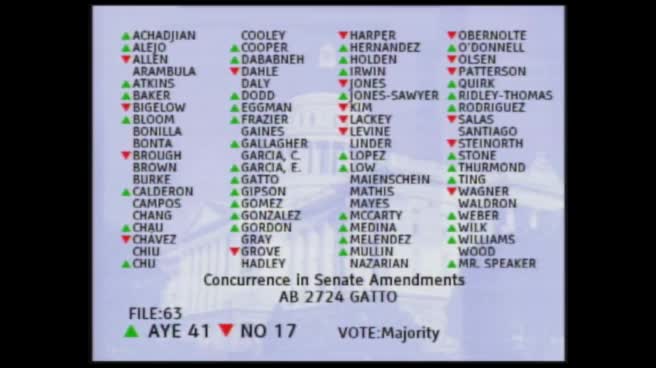 3MIN
Assembly Floor
 2MIN
Senate Floor
 2MIN
Senate Standing Committee on Governmental Organization
 45SEC
Assembly Floor
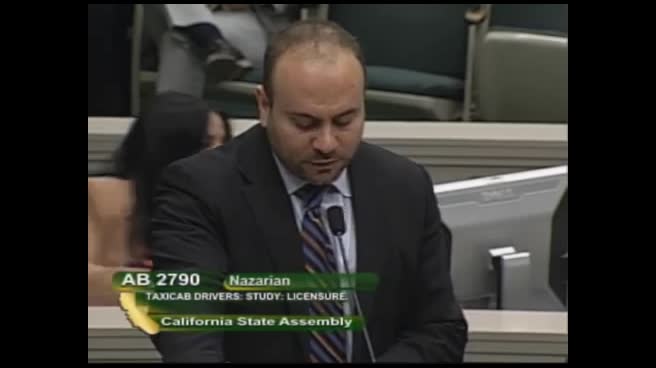 2MIN
Assembly Standing Committee on Transportation
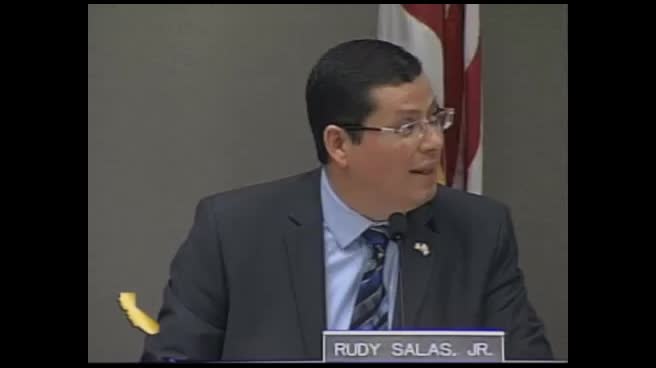 2MIN
Assembly Standing Committee on Business and Professions
Bill Author

Bill Co-Author(s):