AB 2800: Climate change: infrastructure planning.
- Session Year: 2015-2016
- House: Assembly
- Latest Version Date: 2016-09-24
Existing law requires the Natural Resources Agency, by July 1, 2017, and every 3 years thereafter, to update the states climate adaptation strategy to identify vulnerabilities to climate change by sectors and priority actions needed to reduce the risks in those sectors.
This bill, until July 1, 2020, would require state agencies to take into account the current and future impacts of climate change when planning, designing, building, operating, maintaining, and investing in state infrastructure. The bill, by July 1, 2017, and until July 1, 2020, would require the agency to establish a Climate-Safe Infrastructure Working Group for the purpose of examining how to integrate scientific data concerning projected climate change impacts into state infrastructure engineering, as prescribed. The bill would require the working group to consist of registered professional engineers with specified relevant expertise from the Department of Transportation, the Department of Water Resources, the Department of General Services, and other relevant state agencies; scientists with specified expertise from the University of California, the California State University, and other institutions; and licensed architects with specified relevant experience. The bill would require the working group, by July 1, 2018, to make specified recommendations to the Legislature and the Strategic Growth Council.
Existing law requires the Natural Resources Agency, by July 1, 2017, and every 3 years thereafter, to update the states climate adaptation strategy to identify vulnerabilities to climate change by sectors and priority actions needed to reduce the risks in those sectors.
This bill, until July 1, 2020, would require state agencies to take into account the expected current and future impacts of climate change when planning, designing, building, operating, maintaining, and investing in state infrastructure. The bill, by July 1, 2017, and until July 1, 2020, would require the agency to establish a Climate-Safe Infrastructure Working Group for the purpose of examining how to integrate scientific data concerning projected climate change impacts into state infrastructure engineering, as prescribed. The bill would require the working group to consist of registered professional engineers with specified relevant expertise from the Department of Transportation, the Department of Water Resources, the Department of General Services, and other relevant state agencies; scientists with specified expertise from the University of California, the California State University, and other institutions; and licensed architects with specified relevant experience. The bill would require the working group, by July 1, 2018, to recommend make specified recommendations to the Legislature a process for integrating scientific knowledge of projected climate change impacts into state infrastructure design and addressing information gaps in a timely manner. Legislature and the Strategic Growth Council.
Existing law requires the Natural Resources Agency, by July 1, 2017, and every 3 years thereafter, to update the states climate adaptation strategy to identify vulnerabilities to climate change by sectors and priority actions needed to reduce the risks in those sectors.
This bill bill, until July 1, 2020, would require state agencies to take into account the expected impacts of climate change when planning, designing, building, and investing in state infrastructure. The bill, by July 1, 2017, would require the agency to establish a Climate-Safe Infrastructure Working Group for the purpose of examining how to integrate scientific data concerning projected climate change impacts into state infrastructure engineering, as prescribed. The bill would require the working group to consist of registered professional engineers with specified relevant expertise from the Department of Transportation, the Department of Water Resources, the Department of General Services, and other relevant state agencies and agencies; scientists with certain specified expertise from the University of California and California, the California State University systems. University, and other institutions; and licensed architects with specified relevant experience. The bill would require the working group, by July 1, 2018, to recommend to the Legislature a process for integrating scientific knowledge of projected climate change impacts into state infrastructure design and addressing information gaps in a timely manner.
Existing law requires the Natural Resources Agency, by July 1, 2017, and every 3 years thereafter, to update the states climate adaptation strategy to identify vulnerabilities to climate change by sectors and priority actions needed to reduce the risks in those sectors.
This bill would require state agencies to take into account the expected impacts of climate change when planning, designing, building, and investing in state infrastructure. The bill, by July 1, 2017, would require the agency to establish a Climate-Safe Infrastructure Working Group for the purpose of examining how to integrate scientific data concerning projected climate change impacts into state infrastructure engineering, as prescribed. The bill would require the working group to consist of registered professional engineers with relevant expertise from the Department of Transportation, the Department of Water Resources, and the Department of General Services Services, and other relevant state agencies and scientists with certain expertise from the University of California and the California State University systems. The bill, by July 1, 2018, bill would require the working group group, by July 1, 2018, to recommend to the Legislature a process for integrating scientific knowledge of projected climate change impacts into state infrastructure design and addressing information gaps in a timely manner.
Existing law requires the Natural Resources Agency, by July 1, 2017, and every 3 years thereafter, to update the states climate adaptation strategy to identify vulnerabilities to climate change by sectors and priority actions needed to reduce the risks in those sectors.
This bill would require the Natural Resources Agency, by July 1, 2020, and every 5 years thereafter, to establish and update guidelines for effectively incorporating the effects of climate change into state infrastructure planning and investment decisions. The bill would require the agency to establish a science advisory panel with expertise in climate change impacts in California and state infrastructure engineering. state agencies to take into account the expected impacts of climate change when planning, designing, building, and investing in state infrastructure. The bill, by July 1, 2017, would require the agency to establish a Climate-Safe Infrastructure Working Group for the purpose of examining how to integrate scientific data concerning projected climate change impacts into state infrastructure engineering, as prescribed. The bill would require the working group to consist of professional engineers with relevant expertise from the Department of Transportation, the Department of Water Resources, and the Department of General Services and scientists with certain expertise from the University of California and the California State University systems. The bill, by July 1, 2018, would require the working group to recommend to the Legislature a process for integrating scientific knowledge of projected climate change impacts into state infrastructure design and addressing information gaps in a timely manner.
Existing law requires the Natural Resources Agency, by July 1, 2017, and every 3 years thereafter, to update the states climate adaptation strategy to identify vulnerabilities to climate change by sectors and priority actions needed to reduce the risks in those sectors.
This bill would require the Natural Resources Agency, by July 1, 2020, and every 5 years thereafter, to establish and update guidelines for effectively incorporating the effects of climate change into state infrastructure planning and investment decisions. The bill would require the agency to establish a science advisory panel with expertise in climate change impacts in California and state infrastructure engineering.
Existing law, the California Building Standards Law, requires the California Building Standards Commission to promulgate and publish updated building standards adopted in the California Building Standards Code every 3 years. The commission receives proposed building standards from state agencies in the course of the adoption cycle. These proposed standards are then made available for public inspection and hearings and are reviewed by technical advisory bodies appointed by the commission.
This bill would state the intent of the Legislature to enact legislation that would require the California Environmental Protection Agency, in coordination with other state agencies, to establish appropriate standards for the development, design, and construction of infrastructure projects that will withstand the effects of climate change.
The Legislature finds and declares all of the following:
(a)The impacts of climate change are already being felt in California and include record-breaking drought, wildfires, flooding, sea level rise, coastal erosion, and heat waves. These impacts are projected to worsen with a future punctuated by what are now considered extreme weather events.
(b)As the climate warms, California will need to design and maintain infrastructure, including, but not limited to, roads, bridges, buildings, and water systems, to withstand increasingly severe impacts.
(c)The scientific community is developing sound scientific understanding of projected impacts from climate change. The engineers responsible for overseeing, designing, and building state infrastructure must consider the influence of climate change impacts on siting and design standards and specifications.
(d)As California spends billions of dollars on infrastructure, expecting it to last many decades, state engineers should be provided with practicable information on projected climate change impacts that they should consider when establishing standards and planning and designing structures that are critical to Californias economy and public safety.
(e)Prolonged heat waves, extreme precipitation events, severe drought, increasing wildfires, and other potentially dangerous climate change impacts will require significant changes in designing and building projects, such as roads, bridges, buildings, and water infrastructure, and require planning for the resilience and restoration of natural systems.
(f)There is a significant body of climate science being developed and continually updated to inform decisionmakers and provide guidance on the predicted impacts. Infrastructure project planning and design must incorporate design standards and specifications for climate change impacts.
(g)Due to Executive Order B-30-15, current efforts by state agencies provide built-in resources, processes, and expertise that can be utilized to provide coordination between scientists and those responsible for designing, building, and overseeing critical state infrastructure.
SEC. 2.Section 71155 is added to the Public Resources Code, to read:71155.(a)Consistent with this part, state agencies shall take into account the current and future impacts of climate change when planning, designing, building, operating, maintaining and investing in state infrastructure.
(b)(1)By July 1, 2017, the agency shall establish a Climate-Safe Infrastructure Working Group for the purpose of examining how to integrate scientific data concerning projected climate change impacts into state infrastructure engineering, including oversight, investment, design, and construction.
(2)The working group shall consist of the following:
(A)Professional engineers registered in accordance with Chapter 7 (commencing with Section 6700) of Division 3 of the Business and Professions Code with relevant expertise in state infrastructure design from the Department of Transportation, the Department of Water Resources, the Department of General Services, and other relevant state agencies, as applicable.
(B)Scientists from the University of California, the California State University, and other institutions who have expertise in climate change projections and impacts across California.
(C)Licensed architects with relevant experience in state infrastructure design, as applicable.
(3)The two groups specified in subparagraphs (A) and (B) of paragraph (2) shall be equitably represented in the membership of the working group, to the extent reasonable and appropriate.
(4)The working group shall work in coordination with other state climate adaptation planning efforts and shall consider and build upon existing information produced by the state, including information from the most recent California Climate Change Assessment conducted pursuant to Executive Order S-3-05, the plan, and the State of California Sea-Level Rise Guidance Document completed pursuant to Executive Order S-13-08, among other resources.
(5)The working group shall work in coordination with other state agencies that advance sustainability in infrastructure, including the council and the Government Operations Agency.
(c)The working group shall consider and investigate, at a minimum, the following issues:
(1)The current informational and institutional barriers to integrating projected climate change impacts into state infrastructure design.
(2)The critical information that engineers responsible for infrastructure design and construction need to address climate change impacts.
(3)How to select an appropriate engineering design for a range of future climate scenarios as related to infrastructure planning and investment.
(d)(1)By July 1, 2018, the working group shall make recommendations to the Legislature that address the issues listed in subdivision (c), including recommendations for all of the following:
(A)Integrating scientific knowledge of projected climate change impacts into state infrastructure design.
(B)Addressing critical information gaps identified by the working group.
(C)A platform or process to facilitate communication between climate scientists and infrastructure engineers.
(2)By July 1, 2018, the recommendations submitted pursuant to paragraph (1) also shall be submitted to the council to inform its review, conducted pursuant to Section 75125, of the five-year infrastructure plan developed pursuant to Article 2 (commencing with Section 13100) of Chapter 2 of Part 3 of Division 3 of Title 2 of the Government Code.
(e)This section shall become inoperative on July 1, 2020, and, as of January 1, 2021, is repealed, unless a later enacted statute, that becomes operative on or before January 1, 2021, deletes or extends the dates on which it becomes inoperative and is repealed.
The Legislature finds and declares all of the following:
(a)The impacts of climate change are already being felt in California and include record-breaking drought, wildfires, flooding, sea level rise, coastal erosion, and heat waves. These impacts are projected to worsen with a future punctuated by what are now considered extreme weather events.
(b)As the climate warms, California will need to design and maintain infrastructure, including, but not limited to, roads, bridges, buildings, and water systems, to withstand increasingly severe impacts.
(c)The scientific community is developing sound scientific understanding of projected impacts from climate change. The engineers responsible for overseeing, designing, and building state infrastructure must consider the influence of climate change impacts on siting and design standards and specifications.
(d)As California spends billions of dollars on infrastructure, expecting it to last many decades, state engineers should be provided with practicable information on projected climate change impacts that they should consider when establishing standards and planning and designing structures that are critical to Californias economy and public safety.
(e)Prolonged heat waves, extreme precipitation events, severe drought, increasing wildfires, and other potentially dangerous climate change impacts will require significant changes in designing and building projects, such as roads, bridges, buildings, and water infrastructure, and require planning for the resilience and restoration of natural systems.
(f)There is a significant body of climate science being developed and continually updated to inform decisionmakers and provide guidance on the predicted impacts. Infrastructure project planning and design must incorporate design standards and specifications for climate change impacts.
(g)Due to Executive Order B-30-15, current efforts by state agencies provide built-in resources, processes, and expertise that can be utilized to provide coordination between scientists and those responsible for designing, building, and overseeing critical state infrastructure.
SEC. 2.Section 71155 is added to the Public Resources Code, to read:71155.(a)State Consistent with this part, state agencies shall take into account the expected current and future impacts of climate change when planning, designing, building, operating, maintaining and investing in state infrastructure.
(b)(1)By July 1, 2017, the agency shall establish a Climate-Safe Infrastructure Working Group for the purpose of examining how to integrate scientific data concerning projected climate change impacts into state infrastructure engineering, including oversight, investment, design, and construction.
(2)The working group shall consist of the following:
(A)Professional engineers registered in accordance with Chapter 7 (commencing with Section 6700) of Division 3 of the Business and Professions Code with relevant expertise in state infrastructure design from the Department of Transportation, the Department of Water Resources, the Department of General Services, and other relevant state agencies, as applicable.
(B)Scientists from the University of California, the California State University, and other institutions who have expertise in climate change projections and impacts across California.
(C)Licensed architects with relevant experience in state infrastructure design, as applicable.
(3)The two groups specified in subparagraphs (A) and (B) of paragraph (2) shall be equitably represented in the membership of the working group, to the extent reasonable and appropriate.
(4)The working group shall work in coordination with other state climate adaptation planning efforts and shall consider and build upon existing information produced by the state, including information from the most recent California Climate Change Assessment conducted pursuant to Executive Order S-3-05, the plan, and the State of California Sea-Level Rise Guidance Document completed pursuant to Executive Order S-13-08, among other resources.
(5)The working group shall work in coordination with other state agencies that advance sustainability in infrastructure, including the council and the Government Operations Agency.
(c)The working group may wish to shall consider and offer recommendations on investigate, at a minimum, the following issues:
(1)The current informational and institutional barriers to integrating projected climate change impacts into state infrastructure design.
(2)The development of practicable guidelines for planning and designing infrastructure that is more resilient to the expected impacts of climate change.
(3)
(2)The identification of gaps in the critical information that engineers responsible for infrastructure design and construction need to address climate change impacts.
(4)Consideration of the
(3)How to select an appropriate engineering design for multiple projected scenarios for future climate change. a range of future climate scenarios as related to infrastructure planning and investment.
(5)Consideration of a platform or process to facilitate communication between climate scientists and infrastructure engineers.
(d)(1)By July 1, 2018, the working group shall recommend make recommendations to the Legislature a process for integrating scientific knowledge of projected climate change impacts into state infrastructure design and for addressing the information gaps in a timely manner. that address the issues listed in subdivision (c), including recommendations for all of the following:
(A)Integrating scientific knowledge of projected climate change impacts into state infrastructure design.
(B)Addressing critical information gaps identified by the working group.
(C)A platform or process to facilitate communication between climate scientists and infrastructure engineers.
(2)By July 1, 2018, the recommendations submitted pursuant to paragraph (1) also shall be submitted to the council to inform its review, conducted pursuant to Section 75125, of the five-year infrastructure plan developed pursuant to Article 2 (commencing with Section 13100) of Chapter 2 of Part 3 of Division 3 of Title 2 of the Government Code.
(e)For the purposes of this section, infrastructure has the same meaning as defined in Section 13101 of the Government Code.
(f)
(e)This section shall become inoperative on July 1, 2020, and, as of January 1, 2021, is repealed, unless a later enacted statute, that becomes operative on or before January 1, 2021, deletes or extends the dates on which it becomes inoperative and is repealed.
The Legislature finds and declares all of the following:
(a)The impacts of climate change are already being felt in California and include record-breaking drought, wildfires, flooding, sea level rise, coastal erosion, and heat waves. These impacts are projected to worsen with a future punctuated by what are now considered extreme weather events.
(b)As the climate warms, California will need to design and maintain infrastructure, including, but not limited to, roads, bridges, buildings, and water systems, to withstand increasingly severe impacts.
(c)The scientific community is developing sound scientific understanding of projected impacts from climate change. The engineers responsible for overseeing, designing, and building state infrastructure must consider the influence of climate change impacts on siting and design standards and specifications.
(d)As California spends billions of dollars on infrastructure, expecting it to last many decades, state engineers should be provided with information on projected climate change impacts that they should consider when establishing standards and planning and designing structures that are critical to Californias economy and public safety.
(e)Prolonged heat waves, extreme precipitation events, severe drought, increasing wildfires, and other potentially dangerous climate change impacts will require significant changes in designing and building projects, such as roads, bridges, buildings, and water infrastructure, and require planning for the resilience and restoration of natural systems.
(f)There is a significant body of climate science being developed and continually updated to inform decisionmakers and provide guidance on the predicted impacts. Infrastructure project planning and design must incorporate design standards and specifications for climate change impacts.
(g)Due to Executive Order B-30-15, current efforts by state agencies provide built-in resources, processes, and expertise that can be utilized to provide coordination between scientists and those responsible for designing, building, and overseeing critical state infrastructure.
SEC. 2.Section 71155 is added to the Public Resources Code, to read:71155.(a)State agencies shall take into account the expected impacts of climate change when planning, designing, building, and investing in state infrastructure.
(b)(1)By July 1, 2017, the agency shall establish a Climate-Safe Infrastructure Working Group for the purpose of examining how to integrate scientific data concerning projected climate change impacts into state infrastructure engineering, including oversight, investment, design, and construction.
(2)The working group shall consist of the following:
(A)Professional engineers registered in accordance with Chapter 7 (commencing with Section 6700) of Division 3 of the Business and Professions Code with relevant expertise in state infrastructure design from the Department of Transportation, the Department of Water Resources, the Department of General Services, and other relevant state agencies, as applicable.
(B)Scientists from the University of California and California, the California State University systems with University, and other institutions who have expertise in climate change projections and impacts in California, including scientists who produce publicly available climate data concerning California and its regions. across California.
(3)Membership of the working group shall be reasonably and equitably distributed between the groups specified in paragraph (2).
(C)Licensed architects with relevant experience in state infrastructure design, as applicable.
(3)The two groups specified in subparagraphs (A) and (B) of paragraph (2) shall be equitably represented in the membership of the working group, to the extent reasonable and appropriate.
(4)The working group shall work in coordination with other climate adaptation planning efforts and shall consider and build upon existing information produced by the state, among other resources.
(c)The working group may wish to consider and offer recommendations on the following issues:
(1)The current barriers to integrating projected climate change impacts into state infrastructure design.
(2)The development of practicable guidelines for planning and designing infrastructure that is more resilient to the expected impacts of climate change.
(3)The identification of gaps in the critical information that engineers responsible for infrastructure design and construction need to address climate change impacts.
(4)Consideration of the appropriate engineering design for multiple projected scenarios for future climate change.
(5)Consideration of a platform or process to facilitate communication between climate scientists and infrastructure engineers.
(d)By July 1, 2018, the working group shall recommend to the Legislature a process for integrating scientific knowledge of projected climate change impacts into state infrastructure design and for addressing the information gaps in a timely manner.
(e)For the purposes of this section, infrastructure has the same meaning as defined in Section 13101 of the Government Code.
(f)This section shall become inoperative on July 1, 2020, and, as of January 1, 2021, is repealed, unless a later enacted statute, that becomes operative on or before January 1, 2021, deletes or extends the dates on which it becomes inoperative and is repealed.
The Legislature finds and declares all of the following:
(a)The impacts of climate change are already being felt in California and include record-breaking drought, wildfires, flooding, sea level rise, coastal erosion, and heat waves. These impacts are projected to worsen with a future punctuated by what are now considered extreme weather events.
(b)As the climate warms, California will need to design and maintain infrastructure, including, but not limited to, roads, bridges, buildings, and water systems, to withstand increasingly severe impacts.
(c)The scientific community is developing sound scientific understanding of projected impacts from climate change. The engineers responsible for overseeing, designing, and building state infrastructure must consider the influence of climate change impacts on siting and design standards and specifications.
(d)As California spends billions of dollars on infrastructure, expecting it to last many decades, state engineers should be provided with information on projected climate change impacts that they should consider when establishing standards and planning and designing structures that are critical to Californias economy and public safety.
(e)Prolonged heat waves, extreme precipitation events, severe drought, increasing wildfires, and other potentially dangerous climate change impacts will require significant changes in designing and building projects, such as roads, bridges, buildings, and water infrastructure, and require planning for the resilience and restoration of natural systems.
(f)There is a significant body of climate science being developed and continually updated to inform decisionmakers and provide guidance on the predicted impacts. Infrastructure project planning and design must incorporate design standards and specifications for climate change impacts.
(g)Due to Executive Order B-30-15, current efforts by state agencies provide built-in resources, processes, and expertise that can be utilized to provide coordination between scientists and those responsible for designing, building, and overseeing critical state infrastructure.
SEC. 2.Section 71155 is added to the Public Resources Code, to read:71155.(a)State agencies shall take into account the expected impacts of climate change when planning, designing, building, and investing in state infrastructure.
(b)(1)By July 1, 2017, the agency shall establish a Climate-Safe Infrastructure Working Group for the purpose of examining how to integrate scientific data concerning projected climate change impacts into state infrastructure engineering, including oversight, investment, design, and construction.
(2)The working group shall consist of the following:
(A)Professional engineers registered in accordance with Chapter 7 (commencing with Section 6700) of Division 3 of the Business and Professions Code with relevant expertise in state infrastructure design from the Department of Transportation, the Department of Water Resources, and the Department of General Services. Services, and other relevant state agencies, as applicable.
(B)Scientists from the University of California and the California State University systems with expertise in climate change impacts in California, including scientists who produce publicly available climate data concerning California and its regions.
(3)Membership of the working group shall be reasonably and equitably distributed between the groups specified in paragraph (2).
(3)
(4)The working group shall work in coordination with other climate adaptation planning efforts and shall consider and build upon existing information produced by the state, among other resources.
(c)The working group may wish to consider and offer recommendations on the following issues:
(1)The current barriers to integrating projected climate change impacts into state infrastructure design.
(2)The development of practicable guidelines for planning and designing infrastructure that is more resilient to the expected impacts of climate change.
(3)The identification of gaps in the critical information that engineers responsible for infrastructure design and construction need to address climate change impacts.
(4)Consideration of the appropriate engineering design for multiple projected scenarios for future climate change.
(5)Consideration of a platform or process to facilitate communication between climate scientists and infrastructure engineers.
(d)By July 1, 2018, the working group shall recommend to the Legislature a process for integrating scientific knowledge of projected climate change impacts into state infrastructure design and for addressing the information gaps in a timely manner.
(e)For the purposes of this section, infrastructure has the same meaning as defined in Section 13101 of the Government Code.
The Legislature finds and declares all of the following:
(a)The impacts of climate change are already being felt in California and include record-breaking drought, wildfires, flooding, sea level rise, coastal erosion, and heat waves. These impacts are projected to worsen with a future punctuated by what are now considered extreme weather events.
(b)As the climate warms, California will need to design and maintain infrastructure, including, but not limited to, roads, bridges, buildings, and water systems, to withstand increasingly severe impacts.
(c)The scientific community is developing sound scientific understanding of projected impacts from climate change. The engineers responsible for overseeing, designing, and building state infrastructure must consider the influence of climate change impacts on siting and design standards and specifications.
(d)As California spends billions of dollars on infrastructure, expecting it to last many decades, state engineers should be provided with information on projected climate change impacts that they should consider when establishing standards and planning and designing structures that are critical to Californias economy and public safety.
(e)Prolonged heat waves, extreme precipitation events, severe drought, increasing wildfires, and other potentially dangerous climate change impacts will require significant changes in designing and building projects, such as roads, bridges, buildings, and water infrastructure, and require planning for the resilience and restoration of natural systems.
(f)There is a significant body of climate science being developed and continually updated to inform decisionmakers and provide guidance on the predicted impacts. Infrastructure project planning and design must incorporate design standards and specifications for climate change impacts.
(g)Due to Executive Order B-30-15, current efforts by state agencies provide built-in resources, processes, and expertise that can be utilized to provide coordination between scientists and those responsible for designing, building, and overseeing critical state infrastructure.
SEC. 2.Section 71155 is added to the Public Resources Code, to read:71155.(a)State agencies shall take into account the expected impacts of climate change when planning, designing, building, and investing in state infrastructure.
(b)(1)By July 1, 2017, the agency shall establish a Climate-Safe Infrastructure Working Group for the purpose of examining how to integrate scientific data concerning projected climate change impacts into state infrastructure engineering, including oversight, investment, design, and construction.
(2)The working group shall consist of the following:
(A)Professional engineers with relevant expertise in state infrastructure design from the Department of Transportation, the Department of Water Resources, and the Department of General Services.
(B)Scientists from the University of California and the California State University systems with expertise in climate change impacts in California, including scientists who produce publicly available climate data concerning California and its regions.
(3)The working group shall work in coordination with other climate adaptation planning efforts and shall consider and build upon existing information produced by the state, among other resources.
(c)The working group may wish to consider and offer recommendations on the following issues:
(1)The current barriers to integrating projected climate change impacts into state infrastructure design.
(2)The development of practicable guidelines for planning and designing infrastructure that is more resilient to the expected impacts of climate change.
(3)The identification of gaps in the critical information that engineers responsible for infrastructure design and construction need to address climate change impacts.
(4)Consideration of the appropriate engineering design for multiple projected scenarios for future climate change.
(5)Consideration of a platform or process to facilitate communication between climate scientists and infrastructure engineers.
(d)By July 1, 2018, the working group shall recommend to the Legislature a process for integrating scientific knowledge of projected climate change impacts into state infrastructure design and for addressing the information gaps in a timely manner.
(e)For the purposes of this section, infrastructure has the same meaning as defined in Section 13101 of the Government Code.
SECTION 1.Section 71155 is added to the Public Resources Code, to read:71155.(a)(1)By July 1, 2020, the agency shall establish guidelines for effectively incorporating the effects of climate change into state infrastructure planning and investment decisions. The agency shall coordinate with the California Environmental Protection Agency, the Transportation Agency, the Office of Emergency Services, the Office of Planning and Research, and other relevant state agencies to develop guidelines for each sector specified in paragraph (1) of subdivision (a) of Section 71153.
(2)The agency shall update the guidelines every five years thereafter.
(b)By January 1, 2020, and every five years thereafter, the agency shall release the draft guidelines or draft updates, as appropriate. Between the release of the draft and the establishment of the guidelines or updates pursuant to subdivision (a), the agency shall hold public hearings for purposes of providing an opportunity for the public to review and provide written and oral comments on the guidelines or updates, as appropriate.
(c)In developing the guidelines and the updates, the agency shall establish a science advisory panel that, at a minimum, has expertise in climate change impacts in California and state infrastructure engineering.
(a)(1)By July 1, 2020, the agency shall establish guidelines for effectively incorporating the effects of climate change into state infrastructure planning and investment decisions. The agency shall coordinate with the California Environmental Protection Agency, the Transportation Agency, the Office of Emergency Services, the Office of Planning and Research, and other relevant state agencies to develop guidelines for each sector specified in paragraph (1) of subdivision (a) of Section 71153.
(2)The agency shall update the guidelines every five years thereafter.
(b)By January 1, 2020, and every five years thereafter, the agency shall release the draft guidelines or draft updates, as appropriate. Between the release of the draft and the establishment of the guidelines or updates pursuant to subdivision (a), the agency shall hold public hearings for purposes of providing an opportunity for the public to review and provide written and oral comments on the guidelines or updates, as appropriate.
(c)In developing the guidelines and the updates, the agency shall establish a science advisory panel that, at a minimum, has expertise in climate change impacts in California and state infrastructure engineering.
SECTION 1.Division 33 (commencing with Section 56000) is added to the Health and Safety Code, to read:33.Climate Change Building Standards56000.(a)The Legislature finds and declares that there exist throughout the state many buildings and infrastructure projects which are not capable of withstanding the effects of climate change, that adequate standards do not exist for the development, design, and construction of infrastructure projects that will withstand the effects of climate change, and that it is within the public interest to establish appropriate standards for infrastructure projects that will withstand the effects of climate change.
(b)It is, therefore, the intent of the Legislature to enact legislation that would require the California Environmental Protection Agency, in coordination with other state agencies, to establish appropriate standards for the development, design and construction of infrastructure projects that will allow these projects to withstand the effects of climate change, utilize the most up-to-date climate science, and ensure the states infrastructure is developed with an understanding of the impacts that climate change will have on proposed projects.
(a)The Legislature finds and declares that there exist throughout the state many buildings and infrastructure projects which are not capable of withstanding the effects of climate change, that adequate standards do not exist for the development, design, and construction of infrastructure projects that will withstand the effects of climate change, and that it is within the public interest to establish appropriate standards for infrastructure projects that will withstand the effects of climate change.
(b)It is, therefore, the intent of the Legislature to enact legislation that would require the California Environmental Protection Agency, in coordination with other state agencies, to establish appropriate standards for the development, design and construction of infrastructure projects that will allow these projects to withstand the effects of climate change, utilize the most up-to-date climate science, and ensure the states infrastructure is developed with an understanding of the impacts that climate change will have on proposed projects.
|
Date
|
Status
|
|---|---|
| Jun 9, 2016 | Referred to Coms. on N.R. & W. and E.Q. |
| Sep 2, 2016 | Enrolled and presented to the Governor at 12 p.m. |
| Aug 25, 2016 | Senate amendments concurred in. To Engrossing and Enrolling. (Ayes 59. Noes 19. Page 6300.). |
| Aug 25, 2016 | Senate amendments concurred in. To Engrossing and Enrolling. |
| Aug 23, 2016 | In Assembly. Concurrence in Senate amendments pending. May be considered on or after August 25 pursuant to Assembly Rule 77. |
| Aug 22, 2016 | Read third time. Passed. Ordered to the Assembly. (Ayes 32. Noes 6. Page 5252.). |
| Aug 22, 2016 | Read third time. Passed. Ordered to the Assembly. |
| Aug 18, 2016 | Read second time. Ordered to third reading. |
| Aug 17, 2016 | Read third time and amended. Ordered to second reading. |
| Aug 15, 2016 | Read second time. Ordered to third reading. |
| Aug 11, 2016 | From committee: Do pass. (Ayes 6. Noes 1.) (August 11). |
| Aug 8, 2016 | Referred to APPR. suspense file. |
| Aug 2, 2016 | Read second time and amended. Re-referred to Com. on APPR. |
| Aug 1, 2016 | From committee: Amend, and do pass as amended and re-refer to Com. on APPR. (Ayes 6. Noes 1.) (June 29). |
| Jun 16, 2016 | Read second time and amended. Re-referred to Com. on E.Q. |
| Jun 15, 2016 | From committee: Amend, and do pass as amended and re-refer to Com. on E.Q. (Ayes 7. Noes 2.) (June 14). |
| Feb 19, 2016 | Introduced. To print. |
| Jun 2, 2016 | In Senate. Read first time. To Com. on RLS. for assignment. |
| Jun 1, 2016 | Read third time. Passed. Ordered to the Senate. (Ayes 59. Noes 19.) |
| Jun 1, 2016 | Read third time. Passed. Ordered to the Senate. (Ayes 59. Noes 19. Page 5126.) |
| Jun 1, 2016 | Read third time. Passed. Ordered to the Senate. |
| May 31, 2016 | Read second time. Ordered to third reading. |
| May 27, 2016 | From committee: Do pass. (Ayes 14. Noes 6.) (May 27). |
| May 18, 2016 | In committee: Set, first hearing. Referred to APPR. suspense file. |
| Apr 19, 2016 | From committee: Do pass and re-refer to Com. on APPR. (Ayes 7. Noes 2.) (April 18). Re-referred to Com. on APPR. |
| Apr 13, 2016 | Re-referred to Com. on NAT. RES. |
| Apr 12, 2016 | From committee chair, with author's amendments: Amend, and re-refer to Com. on NAT. RES. Read second time and amended. |
| Mar 28, 2016 | Re-referred to Com. on NAT. RES. |
| Mar 18, 2016 | From committee chair, with author's amendments: Amend, and re-refer to Com. on NAT. RES. Read second time and amended. |
| Mar 17, 2016 | Referred to Com. on NAT. RES. |
| Feb 22, 2016 | Read first time. |
| Feb 21, 2016 | From printer. May be heard in committee March 22. |
|
Date
|
Description
|
Location
|
Votes
|
|
|---|---|---|---|---|
| Aug 25, 2016 | AB 2800 QUIRK Concurrence in Senate Amendments | Assembly Floor |
Passed |
|
| Aug 22, 2016 | Assembly 3rd Reading AB2800 Quirk By Hill | Senate Floor |
Passed |
|
| Aug 11, 2016 | Do pass | Senate Standing Committee on Appropriations |
Passed |
|
| Aug 8, 2016 | Placed on suspense file | Senate Standing Committee on Appropriations |
Passed |
|
| Jun 29, 2016 | Do pass as amended, but first amend, and re-refer to the Committee on [Appropriations] | Senate Standing Committee on Environmental Quality |
Passed |
|
| Jun 14, 2016 | Do pass as amended, but first amend, and re-refer to the Committee on [Environmental Quality] | Senate Standing Committee on Natural Resources and Water |
Passed |
|
| Jun 1, 2016 | AB 2800 QUIRK Assembly Third Reading | Assembly Floor |
Passed |
|
| May 27, 2016 | Do pass. | Assembly Standing Committee on Appropriations |
Passed |
|
| Apr 18, 2016 | Do pass and be re-referred to the Committee on [Appropriations] | Assembly Standing Committee on Natural Resources |
Passed |
This list shows positions taken on this bill by organizations on the date displayed, which is linked to the original source.
Positions by individuals are not included.
|
Organization
|
Position
|
Date
|
|---|---|---|
| 5 individual engineers and scientists | ** Support | Aug 22, 2016 |
| American Society of Civil Engineers, Region 9 | ** Support | Aug 22, 2016 |
| California League Of Conservation Voters | ** Support | Aug 22, 2016 |
| California Shore and Beach Preservation Association | ** Support | Aug 22, 2016 |
| Climate Resolve | ** Support | Aug 22, 2016 |
| East Bay Regional Park District | ** Support | Aug 22, 2016 |
| Environment California | ** Support | Aug 22, 2016 |
| Environmental Defense Fund | ** Support | Aug 22, 2016 |
| Local Government Commission | ** Support | Aug 22, 2016 |
| National Audubon Society | ** Support | Aug 22, 2016 |
| National Parks Conservation Association | ** Support | Aug 22, 2016 |
| Natural Resources Defense Council | ** Support | Aug 22, 2016 |
| Professional Engineers In California Government | ** Support | Aug 22, 2016 |
| Sierra Business Council | ** Support | Aug 22, 2016 |
| Sierra Club California | ** Support | Aug 22, 2016 |
| Silicon Valley Leadership Group | ** Support | Aug 22, 2016 |
| State of California | * Support | Apr 18, 2016 |
| UC Davis | * Support | Apr 18, 2016 |
| Union Of Concerned Scientists | ** Support | Aug 22, 2016 |
| University of Southern California Sea Grant Program | ** Support | Aug 22, 2016 |
| Wild Wind California | * Support | Apr 18, 2016 |
CONCURRENCE IN SENATE AMENDMENTS
CSA1 Bill Id:AB 2800
Author:(Quirk)
As Amended Ver:August 17, 2016
Majority vote
ASSEMBLY: | 59-19 | (June 1, 2016) | SENATE: | 32-6 | (August 22, 2016) |
Original Committee Reference: NAT. RES.
SUMMARY: Establishes a Climate-Safe Infrastructure Working Group (Working Group) to examine how to integrate scientific data concerning projected climate change impacts into state infrastructure engineering. Specifically, this bill:
- Requires state agencies to take into account the current and future impacts of climate change when planning, designing, building, and investing in state infrastructure.
- Requires Natural Resources Agency (NRA), by July 1, 2017, to establish the Working Group to examine how to integrate scientific data concerning projected climate change impacts into state infrastructure engineering.
- Requires the Working Group to make recommendations on how better integrate scientific knowledge of projected climate impacts into state infrastructure planning and a platform or process to facilitate communication between climate scientists and infrastructure engineers.
The Senate amendments:
- Require professional engineers serving on the Working Group to be registered with the state.
- Require professional engineers and scientists to be equally represented in the membership of the Working Group, and adds licensed architects to the Working Group.
- Require the Working Group to work in coordination with other state climate adaptation planning efforts and other state agencies that advance sustainability in infrastructure, including the Strategic Growth Council and the Government Operations Agency.
- Eliminate the authorization for the Working Group to develop practicable guidelines for planning and designing infrastructure that is more resilient to the expected impacts of climate change.
- Create a sunset date of July 1, 2020 for the Working Group.
EXISTING LAW:
- Pursuant to Executive Order B-30-15 (Brown), in addition to establishing a 40% Greenhouse Gas (GHG) emission reduction goal by 2030, requires several actions on adaptation including:
- Requires NRA to update the state's climate adaptation strategy every three years and ensure that its provisions are fully implemented. Requires the state's climate adaptation strategy to:
- Identify vulnerabilities to climate change by sector and regions, including, at a minimum, the following sectors: water, energy, transportation, public health, agriculture, emergency services, forestry, biodiversity and habitat, and ocean and coastal resources;
- Outline primary risks to residents, property, communities, and natural systems from these vulnerabilities and identify priority actions needed to reduce these risks; and,
- Identify a lead agency or group of agencies to lead adaptation efforts in each sector.
- Requires each sector lead to prepare an implementation plan by September 2015 to outline the actions that will be taken as identified in state's climate adaptation strategy, and report back on those actions to the NRA.
- Requires state agencies to take climate change into account in their planning and investment decisions, and employ full life-cycle cost accounting to evaluate and compare infrastructure investments and alternatives.
- Requires state agencies' planning and investment to be guided by the principles of climate preparedness, flexibility and adaptive approaches for uncertain climate impacts, protective of vulnerable populations, and prioritization of natural infrastructure solutions.
- Requires the state's Five-Year Infrastructure Plan to take current and future climate change impacts into account in all infrastructure projects.
- Requires Office of Planning and Research (OPR) to establish a technical advisory group to help state agencies incorporate climate change impacts into planning and investment decisions.
- Requires the state to continue its rigorous climate change research program focused on understanding the impacts of climate change and how best to prepare and adapt to such impacts.
- Requires NRA to update the state's climate adaptation strategy every three years and ensure that its provisions are fully implemented. Requires the state's climate adaptation strategy to:
- Requires the NRA to update its climate adaptation strategy, the Safeguarding California Plan (Plan), by July 1, 2017, and every three years thereafter, by coordinating adaption activities among lead state agencies in each sector.
FISCAL EFFECT: According to the Senate Appropriations Committee:
- Approximately $150,000 to the NRA (General Fund) for staff and contracting costs.
- Unknown costs, likely absorbable, for the state agency members of the Working Group (Department of Transportation, Department of Water Resources, and Department of General Services).
- Unknown costs, likely absorbable, for the California State University and University of California to participate on the Working Group.
- Absorbable costs for state agencies to account for the impacts of climate change when investing in state infrastructure. The recommendations provided by the Working Group may provide cost savings for state agencies' plans and projects.
COMMENTS: According to a report by the American Society of Civil Engineers entitled, Adapting Infrastructure and Civil Engineering Practice to a Changing Climate:
Engineers should engage in cooperative research involving scientists from across many disciplines to gain an adequate, probabilistic understanding of the magnitudes of future extremes and their consequences. Doing so will improve the relevance of modeling and observations for use in the planning, design, operation, maintenance and renewal of the built and natural environment. It is only when engineers work closely with scientists that the needs of the engineering community become fully understood, the limitations of the scientific knowledge become more transparent to engineers, and the uncertainties of the projections of future climate effects become fully recognized for engineering design purposes.
This bill would implement the approach outlined above by creating the Working Group of both engineers and scientists. This is a very different approach than past adaptation bills. Prior bills focused on a top down approach to incorporating adaptation into state and local government decisions. This bill focuses on collaboration between practitioners to drive systematic change. This bill also codifies one of points in the Governor's Executive Order B-30-15 related to state infrastructure.
Analysis Prepared by: Michael Jarred / NAT. RES. / (916) 319-2092 FN: 0004575
Office of Senate Floor Analyses (916) 651-1520 Fax: (916) 327-4478 | AB |
THIRD READING
Bill No: AB 2800
:
SENATE NATURAL RES. & WATER COMMITTEE: 7-2, 6/14/16
AYES: Pavley, Allen, Hertzberg, Hueso, Jackson, Monning, Wolk
NOES: Stone, Vidak
SENATE ENVIRONMENTAL QUALITY COMMITTEE: 6-1, 6/29/16
AYES: Wieckowski, Bates, Hill, Jackson, Leno, Pavley
NOES: Gaines
SENATE APPROPRIATIONS COMMITTEE: 6-1, 8/11/16
AYES: Lara, Bates, Beall, Hill, McGuire, Mendoza
NOES: Nielsen
ASSEMBLY FLOOR: 59-19, 6/1/16 - See last page for vote
SOURCE: Union of Concerned Scientists
DIGEST: This bill requires the California Natural Resources Agency to establish a Climate-Safe Infrastructure Working Group by July 1, 2017 to examine how to integrate data concerning projected climate change impacts into state infrastructure engineering.
Senate Floor Amendments of 8/17/16 clarify coordination between this bill’s requirements and other existing infrastructure-related climate change adaptation planning efforts underway, and make additional largely technical and clarifying changes to align the bill with current efforts.
Existing law:
- Defines infrastructure as real property, including land and improvements to the land, structures and equipment integral to the operation of structures, easements, rights-of-way and other forms of interest in property, roadways, and water conveyances.
- Establishes the Governor’s Office of Planning and Research (OPR) as the comprehensive state planning agency and requires OPR to assist state, regional, and local agencies in a variety of research and planning efforts, including climate adaptation.
- There is an advisory council to OPR comprised of members from a range of scientific and technical disciplines with expertise in the intersection of climate change and various sectors.
- The Integrated Climate Adaptation and Resiliency Program coordinates regional and local adaptation efforts with state climate adaptation strategies and programs. This includes:
- Working with and coordinating local and regional efforts for climate adaptation and resilience, and
- Coordinating and maintain the state’s clearinghouse of certain climate resources, as specified.
- Establishes the California Natural Resources Agency (CNRA) and requires it, by July 1, 2017, and every three years thereafter, to update the state’s climate adaptation strategy to identify vulnerabilities to climate change by sectors, priority actions needed to reduce the risks in those sectors and identify a lead agency or group of agencies to lead adaptation efforts in each sector. Transportation is among the specified sectors. Actions taken to implement the strategy are required to be reported to the CNRA.
- Establishes the Office of Emergency Services and directs it, as specified, to update the Adaptation Planning Guide, within one year of an updated climate adaptation strategy being released. The guide provides tools and guidance to regional and local governments and agencies in creating and implementing climate adaptation and community resiliency plans and projects.
- Requires that state agencies work to maximize, where applicable and feasible, educating the public about the consequences of climate change; ensuring there is a continuous repository for scientific data on climate change and adaptation to help identify climate change risks and facilitate educated state and local policy decisions.
- Establishes the Strategic Growth Council and requires it to identify and review activities and funding programs of state agencies that may be coordinated to address, among other goals, the strategies and priorities developed in the climate adaptation plan.
This bill establishes a Climate-Safe Infrastructure Working Group (working group) with specified tasks to address how to integrate scientific data regarding projected climate change impacts into state infrastructure engineering. Specially, this bill:
- Requires state agencies to take into account the current and future impacts of climate change when planning, designing, building, operating, maintaining and investing in state infrastructure.
- Requires, by July 1, 2017, the CNRA establish a Climate-Safe Infrastructure Working Group (working group) to determine how to integrate scientific data about projected climate change impacts into state infrastructure engineering, as specified.
- Requires the working group include the following members with relevant experience and/or expertise, as specified:
- Professional engineers from Caltrans, the Department of Water Resources, the Department of General Services and other state agencies, as applicable.
- Scientists from the University of California and California State University and other California-based institutions.
- Licensed architects.
- Specifies the working group membership be equitably distributed among the membership categories, as specified, shall, among other things, work in coordination with other planning efforts and other state agencies that advance sustainability in infrastructure and build upon existing available information such as the California Sea-Level Rise Guidance Document, as specified.
- Requires the working should investigate at least the following:
- Barriers between integrating projected climate change impacts and state infrastructure design,
- Critical information needed for infrastructure design and construction engineering,
- Appropriate infrastructure engineering design selection for different climate scenarios,
- Requires, by July 1, 2018, the working group to make recommendations to the Legislature and to the Strategic Growth Council, as specified. These recommendations shall address its investigations, as specified.
- Sunsets on July 1, 2020, as specified.
- Makes appropriate and relevant legislative findings.
Background
Administration policies regarding climate change adaptation. Executive Order S-13-08 (Schwarzenegger), among other things, requires the CNRA, through the Climate Action Team, to coordinate with local, regional, state, federal and private entities to develop a state Climate Adaptation Strategy. This strategy is required to summarize the best known science on climate change impacts to the state, assess the state’s vulnerability to these impacts and outline solutions to be implemented by or across state agencies to promote resiliency to these impacts.
Executive Order B-30-15 (Brown), in addition to establishing a 40% greenhouse gas emission reduction goal by 2030, also updated and revised the state’s strategy for climate adaptation. These include, among others, that:
- The CNRA update the state’s climate adaptation strategy every three years and ensure that its provisions are fully implemented. The state’s strategy must identify vulnerabilities to climate change by sector and regions, as specified, outline primary risks to residents, property, communities and natural systems, identify priority actions needed to reduce these risks and identify a lead agency or group of agencies to lead adaptation efforts in each designated sector.
- Each sector’s lead prepare an implementation plan by September 2015 to outline the adaptation actions taken as identified in the strategy and report back to the CNRA on these actions.
- State agencies take climate change into account in their planning and investment decisions, and use full life-cycle cost accounting to evaluate and compare infrastructure investments and alternatives. In addition, state agencies’ planning and investments shall be guided by the principles of preparedness for climate change, provide flexibility and adaptive approaches for uncertain climate impacts, be protective of vulnerable populations and prioritize natural infrastructure solutions for climate change.
- The state’s Five-Year Infrastructure Plan will take current and future climate change impacts into account for all infrastructure projects.
- The Office of Planning and Research establish a technical advisory group to help state agencies incorporate climate change impacts into planning and investment decisions.
- The state continues its climate change research program to understand the impacts of climate change and how best to prepare and adapt to these impacts.
The Legislature passed three laws, AB 1482 (Gordon, Chapter 603, Statutes of 2015), SB 246 (Wieckowski, Chapter 606, Statutes of 2015), and SB 379 (Jackson, Chapter 608, Statutes of 2015) that build on this Executive Order in various ways to strengthen and codify several climate adaptation efforts within the state.
The existing Caltrans Highway Design Manual (dated July 1, 2015) recognizes that the typical assumption for infrastructure design, which was that previously-experienced hydrology and climatology will be a good predictor of the hydrology and climatology the project experiences over its lifetime, may no longer be a valid assumption, although there is no apparent consensus on an alternative.
The state’s reports on climate adaptation strategy. Pursuant to the existing Executive Order, a California Climate Adaptation Strategy was released in 2009. The CNRA recently updated this strategy with the Safeguarding California reports. According to the CNRA’s web-site, an early 2017 update to Safeguarding California is anticipated. Information on other related state-level climate change assessments, planning tools and other activities is available on the CNRA’s web-site.
Comments
There is a role for the working group. Addressing state infrastructure-specific engineering design challenges for climate change adaptation appears to be a gap in the current statutory state planning process for climate change adaptation. The coordination requirement with other climate adaptation planning efforts should help to avoid duplication of efforts given the multiple climate adaptation planning efforts currently underway.
FISCAL EFFECT: Appropriation: No Fiscal Com.: Yes Local: No
According to the Senate Appropriations Committee:
- Approximately $150,000 to the CNRA (General Fund) for staff and contracting costs.
- Unknown costs, likely absorbable, for the state agency members of the working group (Department of Transportation, Department of Water Resources, and Department of General Services).
- Unknown costs, likely absorbable, for the California State University and University of California to participate on the working group.
- Absorbable costs for state agencies to account for the impacts of climate change when investing in state infrastructure. The recommendations provided by the working group may provide cost savings for state agencies' plans and projects.
Union of Concerned Scientists (source)
American Institute of Architects, California Council
American Society of Civil Engineers, Region 9
California League of Conservation Voters
California Shore and Beach Preservation Association
Climate Resolve
East Bay Regional Park District
Environment California
Environmental Defense Fund
Local Government Commission
National Audubon Society
National Parks Conservation Association
Natural Resources Defense Council
Professional Engineers in California Government
Sierra Business Council
Sierra Club California
Silicon Valley Leadership Group
University of Southern California Sea Grant Program
OPPOSITION: (Verified 8/16/16)
None received
ARGUMENTS IN SUPPORT: According to the author, “[w]hile California is at the cutting edge of understanding how climate change will impact our state’s population and natural systems, there is a disconnect with efforts to address these climate changes in our state’s infrastructure engineering, design, and construction.”
“Simply put, California cannot afford to spend billions of dollars on new and upgraded infrastructure that will not be able to withstand anticipated changes to California’s climate and natural systems.”
“To ensure that California’s public infrastructure can withstand the impacts of future climate change, state engineers need to engage with climate scientists to identify the gaps in practical information that are necessary to help state employees design and construct climate-resilient infrastructure. Unfortunately, no such process currently exists to bring together state engineers and climate scientists.”
“AB 2800 establishes a working group composed of state professional engineers and climate scientists to develop recommendations for integrating climate change impacts into state infrastructure design and construction. […] The working group will include state professional engineers from state agencies involved in infrastructure planning and construction, and scientists from state universities with expertise in climate change impacts.”
“AB 2800 will build on other adaptation efforts to begin to ensure that the state identifies and incorporates climate-safe specifications into state infrastructure in order to save lives, property, and investments.”
ASSEMBLY FLOOR: 59-19, 6/1/16
AYES: Achadjian, Alejo, Arambula, Atkins, Baker, Bloom, Bonilla, Bonta, Brown, Burke, Calderon, Campos, Chau, Chávez, Chiu, Chu, Cooley, Cooper, Dababneh, Daly, Dodd, Eggman, Frazier, Cristina Garcia, Eduardo Garcia, Gatto, Gipson, Gomez, Gonzalez, Gordon, Gray, Hadley, Roger Hernández, Holden, Irwin, Jones-Sawyer, Lackey, Levine, Lopez, Low, Maienschein, McCarty, Medina, Mullin, Nazarian, O'Donnell, Quirk, Ridley-Thomas, Rodriguez, Salas, Santiago, Mark Stone, Thurmond, Ting, Weber, Wilk, Williams, Wood, Rendon
NOES: Travis Allen, Bigelow, Brough, Chang, Dahle, Beth Gaines, Gallagher, Grove, Harper, Jones, Kim, Mathis, Mayes, Obernolte, Olsen, Patterson, Steinorth, Wagner, Waldron
NO VOTE RECORDED: Linder, Melendez
8/18/16 16:28:44
**** END ****
Office of Senate Floor Analyses (916) 651-1520 Fax: (916) 327-4478 | AB |
THIRD READING
Bill No: AB 2800
:
SENATE NATURAL RES. & WATER COMMITTEE: 7-2, 6/14/16
AYES: Pavley, Allen, Hertzberg, Hueso, Jackson, Monning, Wolk
NOES: Stone, Vidak
SENATE ENVIRONMENTAL QUALITY COMMITTEE: 6-1, 6/29/16
AYES: Wieckowski, Bates, Hill, Jackson, Leno, Pavley
NOES: Gaines
SENATE APPROPRIATIONS COMMITTEE: 6-1, 8/11/16
AYES: Lara, Bates, Beall, Hill, McGuire, Mendoza
NOES: Nielsen
ASSEMBLY FLOOR: 59-19, 6/1/16 - See last page for vote
SOURCE: Union of Concerned Scientists
DIGEST: This bill requires the California Natural Resources Agency to establish a Climate-Safe Infrastructure Working Group by July 1, 2017 to examine how to integrate scientific data concerning projected climate change impacts into state infrastructure engineering.
Existing law:
- Defines infrastructure as real property, including land and improvements to the land, structures and equipment integral to the operation of structures, easements, rights-of-way and other forms of interest in property, roadways, and water conveyances.
- Establishes the Governor’s Office of Planning and Research (OPR) as the comprehensive state planning agency and requires OPR to assist state, regional, and local agencies in a variety of research and planning efforts, including climate adaptation.
- There is an advisory council to OPR comprised of members from a range of scientific and technical disciplines with expertise in the intersection of climate change and various sectors.
- The Integrated Climate Adaptation and Resiliency Program coordinates regional and local adaptation efforts with state climate adaptation strategies and programs. This includes:
- Working with and coordinating local and regional efforts for climate adaptation and resilience, and
- Coordinating and maintain the state’s clearinghouse of certain climate resources, as specified.
- Establishes the California Natural Resources Agency (CNRA) and requires it, by July 1, 2017, and every three years thereafter, to update the state’s climate adaptation strategy to identify vulnerabilities to climate change by sectors, priority actions needed to reduce the risks in those sectors and identify a lead agency or group of agencies to lead adaptation efforts in each sector. Transportation is among the specified sectors. Actions taken to implement the strategy are required to be reported to the CNRA.
- Establishes the Office of Emergency Services and directs it, as specified, to update the Adaptation Planning Guide, within one year of an updated climate adaptation strategy being released. The guide provides tools and guidance to regional and local governments and agencies in creating and implementing climate adaptation and community resiliency plans and projects.
- Requires that state agencies work to maximize, where applicable and feasible, educating the public about the consequences of climate change; ensuring there is a continuous repository for scientific data on climate change and adaptation to help identify climate change risks and facilitate educated state and local policy decisions.
- Establishes the Strategic Growth Council and requires it to identify and review activities and funding programs of state agencies that may be coordinated to address, among other goals, the strategies and priorities developed in the climate adaptation plan.
This bill establishes a Climate-Safe Infrastructure Working Group (working group) with specified tasks to address how to integrate scientific data regarding projected climate change impacts into state infrastructure engineering. Specially, this bill:
- Requires state agencies to take into account the expected impacts of climate change when planning, designing, building, and investing in state infrastructure.
- Requires, by July 1, 2017, the CNRA establish a Climate-Safe Infrastructure Working Group (working group) to determine how to integrate scientific data about projected climate change impacts into state infrastructure engineering, as specified.
- Requires the working group include the following members with relevant experience and/or expertise, as specified:
- Professional engineers from Caltrans, the Department of Water Resources, the Department of General Services and other state agencies, as applicable.
- Scientists from the University of California and California State University and other California-based institutions.
- Licensed architects.
- Specifies the working group membership be equitably distributed among the membership categories, as specified, shall work in coordination with other planning efforts and build upon existing available information.
- Requires the working should consider and make recommendations on:
- Barriers between integrating projected climate change impacts and state infrastructure design,
- The development of guidelines for infrastructure planning and design that are climate-resilient,
- Identification of relevant critical information gaps,
- Appropriate engineering design for different climate scenarios,
- The facilitation of communication between climate scientists and infrastructure engineers.
- By July 1, 2018 the working group will report back to the Legislature on a process to integrate climate science and projected climate change impacts into state infrastructure design and for addressing information gaps.
- Sunsets on July 1, 2020, as specified.
- Makes appropriate and relevant legislative findings.
Background
Administration policies regarding climate change adaptation. Executive Order S-13-08 (Schwarzenegger), among other things, requires the CNRA, through the Climate Action Team, to coordinate with local, regional, state, federal and private entities to develop a state Climate Adaptation Strategy. This strategy is required to summarize the best known science on climate change impacts to the state, assess the state’s vulnerability to these impacts and outline solutions to be implemented by or across state agencies to promote resiliency to these impacts.
Executive Order B-30-15 (Brown), in addition to establishing a 40% greenhouse gas emission reduction goal by 2030, also updated and revised the state’s strategy for climate adaptation. These include, among others, that:
- The CNRA update the state’s climate adaptation strategy every three years and ensure that its provisions are fully implemented. The state’s strategy must identify vulnerabilities to climate change by sector and regions, as specified, outline primary risks to residents, property, communities and natural systems, identify priority actions needed to reduce these risks and identify a lead agency or group of agencies to lead adaptation efforts in each designated sector.
- Each sector’s lead prepare an implementation plan by September 2015 to outline the adaptation actions taken as identified in the strategy and report back to the CNRA on these actions.
- State agencies take climate change into account in their planning and investment decisions, and use full life-cycle cost accounting to evaluate and compare infrastructure investments and alternatives. In addition, state agencies’ planning and investments shall be guided by the principles of preparedness for climate change, provide flexibility and adaptive approaches for uncertain climate impacts, be protective of vulnerable populations and prioritize natural infrastructure solutions for climate change.
- The state’s Five-Year Infrastructure Plan will take current and future climate change impacts into account for all infrastructure projects.
- The Office of Planning and Research establish a technical advisory group to help state agencies incorporate climate change impacts into planning and investment decisions.
- The state continues its climate change research program to understand the impacts of climate change and how best to prepare and adapt to these impacts.
The Legislature passed three laws, AB 1482 (Gordon, Chapter 603, Statutes of 2015), SB 246 (Wieckowski, Chapter 606, Statutes of 2015), and SB 379 (Jackson, Chapter 608, Statutes of 2015) that build on this Executive Order in various ways to strengthen and codify several climate adaptation efforts within the state.
The existing Caltrans Highway Design Manual (dated July 1, 2015) recognizes that the typical assumption for infrastructure design, which was that previously-experienced hydrology and climatology will be a good predictor of the hydrology and climatology the project experiences over its lifetime, may no longer be a valid assumption, although there is no apparent consensus on an alternative.
The state’s reports on climate adaptation strategy. Pursuant to the existing Executive Order, a California Climate Adaptation Strategy was released in 2009. The CNRA recently updated this strategy with the Safeguarding California reports. According to the CNRA’s web-site, an early 2017 update to Safeguarding California is anticipated. Information on other related state-level climate change assessments, planning tools and other activities is available on the CNRA’s web-site.
Comments
There is a role for the working group. Addressing state infrastructure-specific engineering design challenges for climate change adaptation appears to be a gap in the current statutory state planning process for climate change adaptation. The coordination requirement with other climate adaptation planning efforts should help to avoid duplication of efforts given the multiple climate adaptation planning efforts currently underway.
FISCAL EFFECT: Appropriation: Fiscal Com.: Local:
According to the Senate Appropriations Committee analysis, the costs associated with this bill are as follows:
- Approximately $150,000 to the CNRA (General Fund) for staff and contracting costs.
- Unknown costs, likely absorbable, for the state agency members of the working group (Department of Transportation, Department of Water Resources, and Department of General Services).
- Unknown costs, likely absorbable, for the California State University and University of California to participate on the working group.
- Absorbable costs for state agencies to account for the impacts of climate change when investing in state infrastructure. The recommendations provided by the working group may provide cost savings for state agencies' plans and projects.
Union of Concerned Scientists (source)
American Institute of Architects, California Council
American Society of Civil Engineers, Region 9
California League of Conservation Voters
California Shore and Beach Preservation Association
Climate Resolve
Local Government Commission
National Audubon Society
National Parks Conservation Association
Professional Engineers in California Government
Silicon Valley Leadership Group
University of Southern California Sea Grant Program
OPPOSITION: (Verified 8/11/16)
None received
ARGUMENTS IN SUPPORT: According to the author, “[w]hile California is at the cutting edge of understanding how climate change will impact our state’s population and natural systems, there is a disconnect with efforts to address these climate changes in our state’s infrastructure engineering, design, and construction.”
“Simply put, California cannot afford to spend billions of dollars on new and upgraded infrastructure that will not be able to withstand anticipated changes to California’s climate and natural systems.”
“To ensure that California’s public infrastructure can withstand the impacts of future climate change, state engineers need to engage with climate scientists to identify the gaps in practical information that are necessary to help state employees design and construct climate-resilient infrastructure. Unfortunately, no such process currently exists to bring together state engineers and climate scientists.”
“AB 2800 establishes a working group composed of state professional engineers and climate scientists to develop recommendations for integrating climate change impacts into state infrastructure design and construction. […] The working group will include state professional engineers from state agencies involved in infrastructure planning and construction, and scientists from state universities with expertise in climate change impacts.”
“AB 2800 will build on other adaptation efforts to begin to ensure that the state identifies and incorporates climate-safe specifications into state infrastructure in order to save lives, property, and investments.”
ASSEMBLY FLOOR: 59-19, 6/1/16
AYES: Achadjian, Alejo, Arambula, Atkins, Baker, Bloom, Bonilla, Bonta, Brown, Burke, Calderon, Campos, Chau, Chávez, Chiu, Chu, Cooley, Cooper, Dababneh, Daly, Dodd, Eggman, Frazier, Cristina Garcia, Eduardo Garcia, Gatto, Gipson, Gomez, Gonzalez, Gordon, Gray, Hadley, Roger Hernández, Holden, Irwin, Jones-Sawyer, Lackey, Levine, Lopez, Low, Maienschein, McCarty, Medina, Mullin, Nazarian, O'Donnell, Quirk, Ridley-Thomas, Rodriguez, Salas, Santiago, Mark Stone, Thurmond, Ting, Weber, Wilk, Williams, Wood, Rendon
NOES: Travis Allen, Bigelow, Brough, Chang, Dahle, Beth Gaines, Gallagher, Grove, Harper, Jones, Kim, Mathis, Mayes, Obernolte, Olsen, Patterson, Steinorth, Wagner, Waldron
NO VOTE RECORDED: Linder, Melendez
8/15/16 19:39:59
**** END ****
Office of Senate Floor Analyses (916) 651-1520 Fax: (916) 327-4478 | AB |
THIRD READING
Bill No: AB 2800
:
SENATE NATURAL RES. & WATER COMMITTEE: 7-2, 6/14/16
AYES: Pavley, Allen, Hertzberg, Hueso, Jackson, Monning, Wolk
NOES: Stone, Vidak
SENATE ENVIRONMENTAL QUALITY COMMITTEE: 6-1, 6/29/16
AYES: Wieckowski, Bates, Hill, Jackson, Leno, Pavley
NOES: Gaines
SENATE APPROPRIATIONS COMMITTEE: 6-1, 8/11/16
AYES: Lara, Bates, Beall, Hill, McGuire, Mendoza
NOES: Nielsen
ASSEMBLY FLOOR: 59-19, 6/1/16 - See last page for vote
SOURCE: Union of Concerned Scientists
DIGEST: This bill requires the California Natural Resources Agency to establish a Climate-Safe Infrastructure Working Group by July 1, 2017 to examine how to integrate scientific data concerning projected climate change impacts into state infrastructure engineering.
Existing law:
- Defines infrastructure as real property, including land and improvements to the land, structures and equipment integral to the operation of structures, easements, rights-of-way and other forms of interest in property, roadways, and water conveyances.
- Establishes the Governor’s Office of Planning and Research (OPR) as the comprehensive state planning agency and requires OPR to assist state, regional, and local agencies in a variety of research and planning efforts, including climate adaptation.
- There is an advisory council to OPR comprised of members from a range of scientific and technical disciplines with expertise in the intersection of climate change and various sectors.
- The Integrated Climate Adaptation and Resiliency Program coordinates regional and local adaptation efforts with state climate adaptation strategies and programs. This includes:
- Working with and coordinating local and regional efforts for climate adaptation and resilience, and
- Coordinating and maintain the state’s clearinghouse of certain climate resources, as specified.
- Establishes the California Natural Resources Agency (CNRA) and requires it, by July 1, 2017, and every three years thereafter, to update the state’s climate adaptation strategy to identify vulnerabilities to climate change by sectors, priority actions needed to reduce the risks in those sectors and identify a lead agency or group of agencies to lead adaptation efforts in each sector. Transportation is among the specified sectors. Actions taken to implement the strategy are required to be reported to the CNRA.
- Establishes the Office of Emergency Services and directs it, as specified, to update the Adaptation Planning Guide, within one year of an updated climate adaptation strategy being released. The guide provides tools and guidance to regional and local governments and agencies in creating and implementing climate adaptation and community resiliency plans and projects.
- Requires that state agencies work to maximize, where applicable and feasible, educating the public about the consequences of climate change; ensuring there is a continuous repository for scientific data on climate change and adaptation to help identify climate change risks and facilitate educated state and local policy decisions.
- Establishes the Strategic Growth Council and requires it to identify and review activities and funding programs of state agencies that may be coordinated to address, among other goals, the strategies and priorities developed in the climate adaptation plan.
This bill establishes a Climate-Safe Infrastructure Working Group (working group) with specified tasks to address how to integrate scientific data regarding projected climate change impacts into state infrastructure engineering. Specially, this bill:
- Requires state agencies to take into account the expected impacts of climate change when planning, designing, building, and investing in state infrastructure.
- Requires, by July 1, 2017, the CNRA establish a Climate-Safe Infrastructure Working Group (working group) to determine how to integrate scientific data about projected climate change impacts into state infrastructure engineering, as specified.
- Requires the working group include the following members with relevant experience and/or expertise, as specified:
- Professional engineers from Caltrans, the Department of Water Resources, the Department of General Services and other state agencies, as applicable.
- Scientists from the University of California and California State University and other California-based institutions.
- Licensed architects.
- Specifies the working group membership be equitably distributed among the membership categories, as specified, shall work in coordination with other planning efforts and build upon existing available information.
- Requires the working should consider and make recommendations on:
- Barriers between integrating projected climate change impacts and state infrastructure design,
- The development of guidelines for infrastructure planning and design that are climate-resilient,
- Identification of relevant critical information gaps,
- Appropriate engineering design for different climate scenarios,
- The facilitation of communication between climate scientists and infrastructure engineers.
- By July 1, 2018 the working group will report back to the Legislature on a process to integrate climate science and projected climate change impacts into state infrastructure design and for addressing information gaps.
- Sunsets on July 1, 2020, as specified.
- Makes appropriate and relevant legislative findings.
Background
Administration policies regarding climate change adaptation. Executive Order S-13-08 (Schwarzenegger), among other things, requires the CNRA, through the Climate Action Team, to coordinate with local, regional, state, federal and private entities to develop a state Climate Adaptation Strategy. This strategy is required to summarize the best known science on climate change impacts to the state, assess the state’s vulnerability to these impacts and outline solutions to be implemented by or across state agencies to promote resiliency to these impacts.
Executive Order B-30-15 (Brown), in addition to establishing a 40% greenhouse gas emission reduction goal by 2030, also updated and revised the state’s strategy for climate adaptation. These include, among others, that:
- The CNRA update the state’s climate adaptation strategy every three years and ensure that its provisions are fully implemented. The state’s strategy must identify vulnerabilities to climate change by sector and regions, as specified, outline primary risks to residents, property, communities and natural systems, identify priority actions needed to reduce these risks and identify a lead agency or group of agencies to lead adaptation efforts in each designated sector.
- Each sector’s lead prepare an implementation plan by September 2015 to outline the adaptation actions taken as identified in the strategy and report back to the CNRA on these actions.
- State agencies take climate change into account in their planning and investment decisions, and use full life-cycle cost accounting to evaluate and compare infrastructure investments and alternatives. In addition, state agencies’ planning and investments shall be guided by the principles of preparedness for climate change, provide flexibility and adaptive approaches for uncertain climate impacts, be protective of vulnerable populations and prioritize natural infrastructure solutions for climate change.
- The state’s Five-Year Infrastructure Plan will take current and future climate change impacts into account for all infrastructure projects.
- The Office of Planning and Research establish a technical advisory group to help state agencies incorporate climate change impacts into planning and investment decisions.
- The state continues its climate change research program to understand the impacts of climate change and how best to prepare and adapt to these impacts.
The Legislature passed three laws, AB 1482 (Gordon, Chapter 603, Statutes of 2015), SB 246 (Wieckowski, Chapter 606, Statutes of 2015), and SB 379 (Jackson, Chapter 608, Statutes of 2015) that build on this Executive Order in various ways to strengthen and codify several climate adaptation efforts within the state.
The existing Caltrans Highway Design Manual (dated July 1, 2015) recognizes that the typical assumption for infrastructure design, which was that previously-experienced hydrology and climatology will be a good predictor of the hydrology and climatology the project experiences over its lifetime, may no longer be a valid assumption, although there is no apparent consensus on an alternative.
The state’s reports on climate adaptation strategy. Pursuant to the existing Executive Order, a California Climate Adaptation Strategy was released in 2009. The CNRA recently updated this strategy with the Safeguarding California reports. According to the CNRA’s web-site, an early 2017 update to Safeguarding California is anticipated. Information on other related state-level climate change assessments, planning tools and other activities is available on the CNRA’s web-site.
Comments
There is a role for the working group. Addressing state infrastructure-specific engineering design challenges for climate change adaptation appears to be a gap in the current statutory state planning process for climate change adaptation. The coordination requirement with other climate adaptation planning efforts should help to avoid duplication of efforts given the multiple climate adaptation planning efforts currently underway.
FISCAL EFFECT: Appropriation: Fiscal Com.: Local:
According to the Senate Appropriations Committee analysis, the costs associated with this bill are as follows:
- Approximately $150,000 to the CNRA (General Fund) for staff and contracting costs.
- Unknown costs, likely absorbable, for the state agency members of the working group (Department of Transportation, Department of Water Resources, and Department of General Services).
- Unknown costs, likely absorbable, for the California State University and University of California to participate on the working group.
- Absorbable costs for state agencies to account for the impacts of climate change when investing in state infrastructure. The recommendations provided by the working group may provide cost savings for state agencies' plans and projects.
Union of Concerned Scientists (source)
American Institute of Architects, California Council
American Society of Civil Engineers, Region 9
California League of Conservation Voters
California Shore and Beach Preservation Association
Climate Resolve
Environment California
Environmental Defense Fund
Local Government Commission
National Audubon Society
National Parks Conservation Association
Natural Resources Defense Council
Professional Engineers in California Government
Sierra Club California
Silicon Valley Leadership Group
University of Southern California Sea Grant Program
OPPOSITION: (Verified 8/11/16)
None received
ARGUMENTS IN SUPPORT: According to the author, “[w]hile California is at the cutting edge of understanding how climate change will impact our state’s population and natural systems, there is a disconnect with efforts to address these climate changes in our state’s infrastructure engineering, design, and construction.”
“Simply put, California cannot afford to spend billions of dollars on new and upgraded infrastructure that will not be able to withstand anticipated changes to California’s climate and natural systems.”
“To ensure that California’s public infrastructure can withstand the impacts of future climate change, state engineers need to engage with climate scientists to identify the gaps in practical information that are necessary to help state employees design and construct climate-resilient infrastructure. Unfortunately, no such process currently exists to bring together state engineers and climate scientists.”
“AB 2800 establishes a working group composed of state professional engineers and climate scientists to develop recommendations for integrating climate change impacts into state infrastructure design and construction. […] The working group will include state professional engineers from state agencies involved in infrastructure planning and construction, and scientists from state universities with expertise in climate change impacts.”
“AB 2800 will build on other adaptation efforts to begin to ensure that the state identifies and incorporates climate-safe specifications into state infrastructure in order to save lives, property, and investments.”
ASSEMBLY FLOOR: 59-19, 6/1/16
AYES: Achadjian, Alejo, Arambula, Atkins, Baker, Bloom, Bonilla, Bonta, Brown, Burke, Calderon, Campos, Chau, Chávez, Chiu, Chu, Cooley, Cooper, Dababneh, Daly, Dodd, Eggman, Frazier, Cristina Garcia, Eduardo Garcia, Gatto, Gipson, Gomez, Gonzalez, Gordon, Gray, Hadley, Roger Hernández, Holden, Irwin, Jones-Sawyer, Lackey, Levine, Lopez, Low, Maienschein, McCarty, Medina, Mullin, Nazarian, O'Donnell, Quirk, Ridley-Thomas, Rodriguez, Salas, Santiago, Mark Stone, Thurmond, Ting, Weber, Wilk, Williams, Wood, Rendon
NOES: Travis Allen, Bigelow, Brough, Chang, Dahle, Beth Gaines, Gallagher, Grove, Harper, Jones, Kim, Mathis, Mayes, Obernolte, Olsen, Patterson, Steinorth, Wagner, Waldron
NO VOTE RECORDED: Linder, Melendez
8/15/16 20:50:28
**** END ****
SENATE COMMITTEE ON APPROPRIATIONS
Senator Ricardo Lara, Chair
2015 - 2016 Regular Session
AB 2800 (Quirk) - Climate change: infrastructure planning
Version: June 16, 2016 | Policy Vote: N.R. & W. 7 - 2, E.Q. 6 - 1 |
Urgency: No | Mandate: No |
Hearing Date: August 8, 2016 | Consultant: Narisha Bonakdar |
This bill meets the criteria for referral to the Suspense File.
Bill Summary:
- AB 2800 requires the California Natural Resources Agency (CNRA) to establish a Climate-Safe Infrastructure Working Group (Working Group) by July 1, 2017 to examine how to integrate scientific data concerning projected climate change impacts into state infrastructure engineering.
Fiscal Impact:
- Approximately $150,000 to the CNRA (General Fund) for staff and contracting costs.
- Unknown costs, likely absorbable, for the state agency members of the Working Group (Department of Transportation, Department of Water Resources, and Department of General Services).
- Unknown costs, likely absorbable, for the California State University and University of California to participate on the Working Group.
- Absorbable costs for state agencies to account for the impacts of climate change when investing in state infrastructure. The recommendations provided by the Working Group may provide cost savings for state agencies' plans and projects.
Background:
Climate Adaptation. According to the United States Environmental Protection Agency, “adaptation is the adjustments that society or ecosystems make to limit negative effects of climate change. It can also include taking advantage of opportunities that a changing climate provides.” In 2009, the NRA described adaptation as a relatively new concept in California policy and stated the term means, “efforts that respond to the impacts of climate change – adjustments in natural or human systems to actual or expected climate changes to minimize harm or take advantage of beneficial opportunities.”
Climate risks in California include sea-level rise that affects our built infrastructure, natural habitats, and freshwater resources; changes in precipitation that increase the risk of both drought and flooding; and increases in temperatures that can affect air quality, public health, and natural habitat.
Administrative actions. Several administrative actions have been adopted to ensure the state is preparing for the impacts of climate change. Executive Order S-13-08 required the Natural Resources Agency (CNRA), to develop a state Climate Adaptation Strategy to summarize the best known science on climate change impacts and outline solutions that can be implemented within and across state agencies.
Executive Order B-30-15 (Brown), in addition to establishing a 40% Greenhouse Gas (GHG) emission reduction goal by 2030, requires the CNRA to update the state's climate adaptation strategy every three years and ensure that its provisions are fully implemented. This Executive Order also requires:
- State agencies to take climate change into account in their planning and investment decisions, and employ full life-cycle cost accounting to evaluate and compare infrastructure investments and alternatives.
- State agencies' planning and investment to be guided by the principles of climate preparedness, flexibility and adaptive approaches for uncertain climate impacts, protective of vulnerable populations, and prioritization of natural infrastructure solutions.
- The state's Five-Year Infrastructure Plan to take current and future climate change impacts into account in all infrastructure projects and requires Office of Planning and Research (OPR) to establish a technical advisory group to help state agencies incorporate climate change impacts into planning and investment decisions.
Additionally, existing law requires the CNRA to update its climate adaptation strategy, the Safeguarding California Plan by July 1, 2017, and every three years thereafter, by coordinating adaption activities among lead state agencies in each sector.
Proposed Law:
This bill:
- Requires state agencies to take into account the expected impacts of climate change when planning, designing, building, and investing in state infrastructure.
- Requires the CNRA to establish a Climate-Safe Infrastructure Working Group (working group) by July 1, 2017 to examine how to integrate scientific data concerning projected climate change impacts into state infrastructure engineering, as specified.
- Specifies that the working group members include a reasonable and equitable mix of the two categories:
- Certified professional engineers, as specified, with relevant expertise in state infrastructure design from the Department of Transportation, Department of Water Resources, Department of General Services, and other relevant state agencies, as applicable.
- Scientists from the University of California, the California State University system, and other institutions with expertise in climate change impacts in the state, as specified.
- Licensed architects with relevant experience.
- Requires groups (a) and (b) to be equally represented to the extent possible and appropriate.
- Requires the working group to coordinate with other climate adaptation planning efforts, and build upon existing information produced by the state.
- Suggests topics on which the working group could make recommendations, including:
- Current barriers to integrating projected climate change impacts into state infrastructure design;
- Development of practicable guidelines for planning and design of more infrastructure that is more resilient to climate change impacts;
- Identification of gaps in critical information for engineers to address climate change impacts through infrastructure design and construction;
- Consideration of engineering design for multiple projected climate scenarios; and
- Consideration of a platform or process to facilitate communication between infrastructure engineers and climate scientists.
- Requires by July 1, 2018 that the working group recommend to the Legislature a process for integrating scientific knowledge of projected climate change impacts in state infrastructure design and for addressing the information gaps in a timely manner.
- Sunsets the provisions of the bill on July 1, 2020.
Related Legislation:
SB 1217 (Leno, 2014) proposed to require the CNRA to prepare a California climate risk assessment that provides original research on regionally appropriate climate risk vulnerabilities, risk management options, and other necessary research to support California’s development of informed climate policy and actions to address climate change. The bill would have required the CNRA to update the Safeguarding California Plan every five years to reduce risks to California from the impacts of climate change. The bill also required OPR to develop Infrastructure Resilience Guidelines to integrate climate risks into capital outlay and infrastructure planning and investment, and the Strategic Growth Council to use these Guidelines to review the state’s investments, identify priority projects, and seek funding for priority projects that offer the state important protection from the impacts of climate change. SB 1217 was held on the Assembly Appropriations suspense file.
Staff Comments:
Purpose of Bill. According to the author, “Sound and reliable infrastructure is critically important to public safety, quality of life and California’s economy. While California is actively engaged in developing the most up-to-date climate change science, this information is not significantly impacting infrastructure engineering and design decisions. There is an urgent need for state infrastructure engineering to adapt to predicted impacts of climate change. Fortunately, California is already undertaking important climate adaptation work across different sectors. However, much of this work is designed to be used by state and local planners, not people who actually design and build infrastructure. As a result, there is a gap between the state’s scientific understanding of projected impacts of climate change and the nature of the information that engineers require to determine specifications on how to build.
“AB 2800 bill is a small but critical step forward to addressing the problem. It is important to bring together climate scientists and professional engineers who work directly on infrastructure with the directive to examine how to integrate climate change impacts data into infrastructure engineering. It is critical that engineers have practicable information about climate change to better inform their design specifications, and therefore a process that includes engineers in the conversation is necessary.”
-- END --
SENATE COMMITTEE ON ENVIRONMENTAL QUALITY
Senator Wieckowski, Chair
2015 - 2016 Regular
Bill No: AB 2800
Author: | Quirk | ||
Version: | 6/16/2016 | Hearing Date: | 6/29/2016 |
Urgency: | No | Fiscal: | Yes |
Consultant: | Dan Brumbaugh | ||
SUBJECT: Climate change: infrastructure planning.
ANALYSIS:
Existing law:
- Establishes the Governor’s Office of Planning and Research (OPR) as the comprehensive state planning agency and requires OPR to assist state, regional, and local agencies in a variety of research and planning efforts, including climate adaptation. (Government Code §65040)
- Establishes the Strategic Growth Council (SGC), a cabinet-level committee that is tasked with coordinating activities that support, among other goals, increasing the availability of affordable housing, improving transportation, and assisting state and local entities in the planning of sustainable communities. (Public Resources Code §75121 et seq.)
- Requires that the Natural Resources Agency (NRA) update the state's climate adaptation strategy, Safeguarding California, every three years, as specified, and ensure that its provisions are fully implemented. (PRC §71153)
- Requires that the Safeguarding California strategy:
- Identify vulnerabilities to climate change by sector and regions, including, at a minimum, the water, energy, transportation, public health, agriculture, emergency services, forestry, biodiversity and habitat, and ocean and coastal resources sectors;
- Outline primary risks to residents, property, communities and natural systems from these vulnerabilities, and identify priority actions needed to reduce these risks; and
- Identify a lead agency or group of agencies to lead adaptation efforts in each sector. Each sector lead is responsible for preparing an implementation plan to outline the actions that will be taken as identified in Safeguarding California, and reporting back to the California Natural Resources Agency on actions taken. (PRC §71153)
- Requires that state agencies work to maximize, where applicable and feasible, educating the public about the consequences of climate change; ensuring there is a continuous repository for scientific data on climate change and adaptation to help identify climate change risks and facilitate educated state and local policy decisions. (PRC §71154)
- Requires the Strategic Growth Council to identify and review activities and funding programs of state agencies that may be coordinated to address, among other goals, the strategies and priorities developed in the Safeguarding California plan. (PRC §75125)
- Establishes the Integrated Climate Adaptation and Resiliency Program (ICARP) through OPR to coordinate regional and local adaptation efforts with state climate adaptation strategies and programs. This includes working with and coordinating local and regional efforts for climate adaptation and resilience. (PRC §71354)
- Directs the ICARP to assist the Office of Emergency Services, as specified, to update the Adaptation Planning Guide to provide tools and guidance to regional and local governments and agencies in creating and implementing climate adaptation and community resiliency plans and projects. (PRC §71356).
- Directs ICARP to coordinate and maintain the state’s clearinghouse of best-available resources, including climate projections and other models, assessments of vulnerabilities to various impacts, tools for visualizations, a library of written resources, information about funding opportunities, and information on best-practice adaptation projects. (PRC §§71354 and 71360)
- Establishes an advisory council to OPR, which will be comprised of members from a range of scientific and technical disciplines and will have expertise in the intersection of climate change and various sectors. (PRC §71358)
- Defines infrastructure as real property, including land and improvements to the land, structures and equipment integral to the operation of structures, easements, rights-of-way and other forms of interest in property, roadways, and water conveyances. (Government Code §13101)
This bill:
- Makes a series of findings about climate change impacts, the need for state infrastructure to withstand these changing impacts, and the opportunity to better connect climate science to engineering guidance in the state.
- Requires state agencies to take into account the expected impacts of climate change when planning, designing, building, and investing in state infrastructure.
- Requires the NRA to establish a Climate-Safe Infrastructure Working Group (working group) by July 1, 2017 to examine how to integrate scientific data concerning projected climate change impacts into state infrastructure engineering, as specified.
- Specifies that the working group members include a reasonable and equitable mix of the two categories:
- Certified professional engineers, as specified, with relevant expertise in state infrastructure design from the Department of Transportation, Department of Water Resources, Department of General Services, and other relevant state agencies, as applicable.
- Scientists from the University of California and the California State University system with expertise in climate change impacts in the state, as specified.
- Requires the working group to coordinate with other climate adaptation planning efforts, and build upon existing information produced by the state.
- Suggests topics on which the working group could make recommendations, including:
- Current barriers to integrating projected climate change impacts into state infrastructure design;
- Development of practicable guidelines for planning and design of more infrastructure that is more resilient to climate change impacts;
- Identification of gaps in critical information for engineers to address climate change impacts through infrastructure design and construction;
- Consideration of engineering design for multiple projected climate scenarios; and
- Consideration of a platform or process to facilitate communication between infrastructure engineers and climate scientists.
- Requires by July 1, 2018 that the working group recommend to the Legislature a process for integrating scientific knowledge of projected climate change impacts in state infrastructure design and for addressing the information gaps in a timely manner.
Background
- Definition of climate adaptation. According to the United States Environmental Protection Agency, “adaptation is the adjustments that society or ecosystems make to limit negative effects of climate change. It can also include taking advantage of opportunities that a changing climate provides.” In 2009, the NRA described adaptation as a relatively new concept in California policy and stated the term means, “efforts that respond to the impacts of climate change – adjustments in natural or human systems to actual or expected climate changes to minimize harm or take advantage of beneficial opportunities.”
Climate risks in California include sea-level rise that affects our built infrastructure, natural habitats, and freshwater resources; changes in precipitation that increase the risk of both drought and flooding; and increases in temperatures that can affect air quality, public health, and natural habitat.
- Emergence of California’s climate adaptation policy. California’s adaptation efforts originate primarily with Governor Schwarzenegger’s Executive Orders S-3-05, which established the cabinet-level Climate Action Team (CAT), and S-13-08, which directed the NRA, through the CAT, to coordinate with local, regional, state, federal, public, and private entities to develop the state’s first Climate Adaptation plan. The resulting 2009 California Climate Adaptation Strategy synthesized the efforts of seven sector-specific working groups led by 12 state agencies, boards, and commissions, and numerous stakeholders. The strategy presented the best known science on climate change impacts for California, assessed California's vulnerability to the identified impacts, and outlined solutions that could be implemented within and across state agencies to promote resilience. NRA released an update to the 2009 California Climate Adaptation Strategy, Safeguarding California: Reducing Climate Risk in July 2014, followed by Safeguarding California: Implementation Action Plans in March 2016.
In addition, the Coastal Commission has been working with coastal zone local governments to update their local coastal programs to address shoreline hazards and sea-level rise. In August 2015, the Commission adopted a Sea-Level Rise Policy Guidance document that provides an overview of best available science on sea-level rise for California, and recommends steps for addressing sea-level rise in Commission planning and regulatory actions. This will help coastal local governments make planning decisions that take into account sea-level rise and identify infrastructure and property that is at risk.
In 2015, Governor Brown issued Executive Order B-30-15, which, in addition to specifying new greenhouse gas emission reduction targets, also created a Technical Advisory Group (TAG) within the OPR to further focus and enhance 1) state agency efforts in planning and investment under climate uncertainty, and 2) engagement, outreach, and coordination with local, regional, and federal partners. The Legislature also passed three laws, AB 1482 (Gordon, Chapter 603, Statutes of 2015), SB 246 (Wieckowski, Chapter 606, Statutes of 2015), and SB 379 (Jackson, Chapter 608, Statutes of 2015) that build on this Executive Order in various ways to strengthen and codify several climate adaptation efforts within the state. In addition, the Senate Environmental Quality Committee held a series of four informational hearings in 2015 to explore state-wide and regional and local climate adaptation needs, with a special focus on environmental quality and public health issues.
- Focus on infrastructure. This burst of recent policy, layered on top of its antecedents, has resulted in a suite of adaptation planning efforts occurring at and targeting different levels of government. With respect to infrastructure, the CAT’s Climate Change, Land Use and Infrastructure Working Group (CCLU-In), for example, was established as a multi-agency subcommittee charged with advising the CAT on mitigation and adaptation measures relating to land use and infrastructure. In recent years, CCLU-In has not met, but it may be revived with a narrower focus on land-use issues.
OPR’s TAG is also composed of multiple subgroups, known as sub-TAGs, which address Climate Scenarios, Metrics, Built Infrastructure, Natural and Green Infrastructure, Local and Regional Coordination, and Vulnerable Populations. The TAG and sub-TAGs are collectively developing guidance and actions for state agencies and departments on the implementation of Executive Order B-30-15.
The SGC also manages an Infrastructure Working Group, which among other things, focuses on reviewing the state’s annual Five-Year Infrastructure Plan, as directed by AB 1482, and on developing Guidance for Planning for Climate for California Capital Outlay Projects. The Built Infrastructure sub-TAG also coordinates with the Infrastructure Working Group on contributions to the Five-Year Infrastructure Plan.
OPR will also host the Integrated Climate Adaptation and Resiliency Program (ICARP), which was created by SB 246 to coordinate regional and local adaptation efforts with state climate adaptation strategies and programs. SB 246 also establishes an Advisory Council within OPR to provide scientific and technical expertise covering a broad set of sectors to help support and facilitate coordination across state, regional, and local adaptation efforts.
- Water. The Department of Water Resources’ Climate Change Technical Advisory Group (CCTAG) oversees modeling of the possible impacts on climate change on the state’s water resources. These predictions then get incorporated into updates of California’s Water Action Plan, which, in addition to overall sustainability of the state’s water supply, also addresses adaptation to extreme events like drought and flooding. The Water Quality, Supply, and Infrastructure Improvement Act of 2014 (Proposition 1), which has several pots of funding for responding to drought conditions, sea-level rise, or flooding related to climate change, provides additional support for adaptation in the state. Of the over $7 billion allocated in the bond, $3.6 billion could be spent on projects that deal in some way with adaptation.
- Tools. Several state entities have invested in the development of tools and websites intended to facilitate better planning and outreach, but there remains a need for ongoing development of tools and clearinghouse mechanisms. Cal-Adapt, managed by the California Energy Commission, is a web-based climate adaptation planning tool that was recommended in the 2009 California Climate Adaptation Strategy to “synthesize existing California climate change scenarios and climate impact research and to encourage its use in a way that is beneficial for local decision-makers.” The state’s Climate Change Portal also provides links to major climate research, mitigation initiatives and plans, investments, and news. Certain land-use resources can also be accessed through the Climate Change, Land Use, and Infrastructure Web Portal.
SB 246 directs OPR to create a new, regularly updated clearinghouse that will serve as “a centralized source of information that provides available climate data to guide decisionmakers at state, regional, and local levels when planning for and implementing climate adaptation projects to promote resiliency to climate change.”
Comments
- Purpose of Bill. According to the author, “Sound and reliable infrastructure is critically important to public safety, quality of life and California’s economy. While California is actively engaged in developing the most up-to-date climate change science, this information is not significantly impacting infrastructure engineering and design decisions. There is an urgent need for state infrastructure engineering to adapt to predicted impacts of climate change. Fortunately, California is already undertaking important climate adaptation work across different sectors. However, much of this work is designed to be used by state and local planners, not people who actually design and build infrastructure. As a result, there is a gap between the state’s scientific understanding of projected impacts of climate change and the nature of the information that engineers require to determine specifications on how to build.
“AB 2800 bill is a small but critical step forward to addressing the problem. It is important to bring together climate scientists and professional engineers who work directly on infrastructure with the directive to examine how to integrate climate change impacts data into infrastructure engineering. It is critical that engineers have practicable information about climate change to better inform their design specifications, and therefore a process that includes engineers in the conversation is necessary.”
- Filling a gap. Although there are currently a number of climate adaptation processes playing out within the state, these still largely focus on either relatively high-level planning and coordination across departments and agencies (e.g., the NRA’s Safeguarding California strategy and implementation plans), or on broader support of local and regional planning efforts (e.g., through OPR and the SGC). The narrower and deeper focus of AB 2800 – on strengthening the connections between climate scientists and on-the-ground engineers to enhance adaptation planning of state infrastructure – therefore appears to address a gap in the current state of planning.
As an illustration of this gap, the existing Caltrans Highway Design Manual (dated July 1, 2015) recognizes that the typical assumption for infrastructure design, that previously-experienced hydrological and climatological patterns are good predictors of future patterns the project will experience over its lifetime, may no longer be valid, although there is no apparent consensus on an alternative approach.
- Another planning process? Given the range of existing planning processes, and the perpetual challenge for state agencies to meet new mandates, it’s important that the working group established by AB 2800 does not just add another duplicative mandate. To avoid this outcome, coordination between the proposed Climate-Safe Infrastructure Working Group and pre-existing processes is likely to be important for maximizing complementarity, and the bill language recognizes this need: “The working group shall work in coordination with other climate adaptation planning efforts and shall consider and build upon existing information produced by the state, among other resources.”
For example, although there may be some overlap between the proposed new working group and OPR’s Built Infrastructure and Climate Scenarios sub-TAGs, new “win-wins” should be achievable through planning how the Climate-Safe group – with its narrower but deeper focus – can build on and inform the broader infrastructure discussions emanating from OPR’s TAG/sub-TAG process. Similarly, planning how Climate-Safe recommendations and other outcomes can be actively disseminated through other channels, such as via OPR’s planned Advisory Council and adaptation clearinghouse should help the Climate-Safe group amplify its impact by reaching other practitioners working at the local and regional levels.
- Home office? Given the existence of cross-agency climate adaptation initiatives in both the NRA and OPR, one could make arguments for either entity as the best host for the proposed Climate-Safe Infrastructure Working Group. Because of the working group’s focus on state infrastructure, and the state-level coordination that the NRA does through the Safeguarding California process, there is a fit there. But OPR also does state-level coordination through its TAG process, and the Climate-Safe Infrastructure Working Group seems like it may have the greatest amount of complementarity with the Built Infrastructure sub-TAG. The author and sponsor may therefore wish to further consider whether OPR represents a more appropriate host for administering the proposed working group.
- Possible outcomes? The bill leaves the specific agenda and form of the eventual recommendations for the working group’s bridging of science, design, and engineering purposely vague to allow the program the freedom to outline its direction and scope, but the committee may nevertheless wish to explore some of the potential programmatic outcomes. For example, what might be some possible recommended processes for “integrating scientific knowledge of projected climate change impacts into state infrastructure design and for addressing the information gaps”?
Because some state technical professionals, including engineers, currently lack a requirement for continuing education, new professional education programs regarding the current state of climate science and engineering may be critical. The development of cooperative extension programs between public universities and the state agencies may also offer a complementary pathway for technical assistance and professional education.
- Working Group membership. Although the CSU and UC systems play essential roles in the state’s educational and research enterprise, and professionals at these institutions are therefore natural advisors during state policy formulation, scientific membership in the Climate-Safe Infrastructure Working Group should not be restricted to current CSU and UC scientists. Instead, membership should be open to any scientists with the appropriate expertise in estimating climate change and its impacts across California.
Committee Amendment 1: Section 71155(b)(2)(B) should read “Scientists from the University of California, the California State University systems, and other institutions who have expertise in climate change projections and impacts across California.”
- Sunset. Because AB 2800 establishes the Climate-Safe Infrastructure Working Group with the goal of producing recommendations by a deadline in July 2018, the committee may wish to amend AB 2800 to add a sunset provision for the sake of cleaning up the code after the Working Group has served its original purpose. Of course, if the Working Group proves to be a useful entity for achieving ongoing benefits, a new bill could extend its authorization and provide new legislative direction to the Working Group.
Committee Amendment 2: Add a provision making the chapter inoperative on July 1, 2020, and repealed as of January 1, 2021, unless a later enacted statute becomes operative by January 1, 2021 and deletes or extends the dates on which the chapter becomes inoperative or repealed.
- Author amendments. The author would like to add licensed architects as a third category to the Working Group, with corresponding changes.
In section 71155(b)(2), provision (C) would be added stating “Licensed architects with relevant experience in state infrastructure design, as applicable.”
Section 71155(b)(3) would be modified to “The two groups specified in subparagraphs (A) and (B) of paragraph (2) shall be equitably represented in the membership of the working group, to the extent reasonable and appropriate.”
Related/Prior Legislation
AB 1482 (Gordon, Chapter 603, Statutes of 2015) codifies a portion of Executive Order B-30-15 (Brown), requires the NRA to update its climate adaptation strategy, Safeguarding California, every three years, and coordinates across state departments and agencies to identify opportunities to enhance the ability of all sectors to adapt and increase their resilience to the impacts of climate change.
AB 2516 (Gordon, Chapter 522, Statutes of 2014) requires the NRA, in collaboration with the Ocean Protection Council, to create, update biannually, and post on the internet a “Planning for Sea Level Rise Database” describing steps being taken throughout the state to prepare for, and adapt to, sea level rise.
SB 246 (Wieckowski, Chapter 606, Statutes of 2015) establishes the Integrated Climate Adaptation and Resiliency Program administered by OPR to work with and assist local and regional efforts for climate adaptation and resilience.
SB 317 (de León, 2015) proposed to, among other things, allocate $100 million to the SGC for grants to develop or implement a regional or local greenprint or climate adaptation plan, add climate adaption to a general plan, or protect agricultural and open-space resources that support sustainable communities strategies that have been adopted. SB 317 was ordered to the inactive file.
SB 379 (Jackson, Chapter 608, Statutes of 2015) requires cities and counties to do an assessment of their vulnerability to the risks posed by climate change in order to update their general plans’ safety elements.
SB 1217 (Leno, 2014) proposed to require the NRA to prepare a California climate risk assessment that provides original research on regionally appropriate climate risk vulnerabilities, risk management options, and other necessary research to support California’s development of informed climate policy and actions to address climate change. The bill would have required the NRA to update the Safeguarding California Plan every five years to reduce risks to California from the impacts of climate change. The bill also required OPR to develop Infrastructure Resilience Guidelines to integrate climate risks into capital outlay and infrastructure planning and investment, and the Strategic Growth Council to use these Guidelines to review the state’s investments, identify priority projects, and seek funding for priority projects that offer the state important protection from the impacts of climate change. SB 1217 was held on the Assembly Appropriations suspense file.
DOUBLE REFERRAL:
This measure was heard in Senate Natural Resources and Water Committee on
June 14, 2016, and passed out of committee with a vote of 7-2.
SOURCE:
Union of Concerned Scientists
SUPPORT:
American Institute of Architects, California Council
American Society of Civil Engineers, Region 9
California League of Conservation Voters
California Shore and Beach Preservation Association
Climate Resolve
Local Government Commission
National Audubon Society
National Parks Conservation Association
Professional Engineers in California Government
Silicon Valley Leadership Group
University of Southern California Sea Grant Program
5 individual engineers and scientists
OPPOSITION:
None received
-- END --
SENATE COMMITTEE ON NATURAL RESOURCES AND WATER
Senator Fran Pavley, Chair
2015 - 2016 Regular
Bill No: AB 2800 Hearing Date: June 14, 2016
Author: | |||
Version: |
| ||
Urgency: | Fiscal: | ||
Consultant: | |||
Subject: Climate change: infrastructure planning
BACKGROUND AND EXISTING LAW
- Executive Order S-13-08 (Schwarzenegger), among other things, requires the Natural Resources Agency (CNRA), through the Climate Action Team, to coordinate with local, regional, state, federal and private entities to develop a state Climate Adaptation Strategy. This strategy is required to summarize the best known science on climate change impacts to the state, assess the state’s vulnerability to these impacts and outline solutions to be implemented by or across state agencies to promote resiliency to these impacts.
- Executive Order B-30-15 (Brown), in addition to establishing a 40% greenhouse gas emission reduction goal by 2030, also updated and revised the state’s strategy for climate adaptation. These include, among others, that:
- The CNRA update the state’s climate adaptation strategy every three years and ensure that its provisions are fully implemented. The state’s strategy must identify vulnerabilities to climate change by sector and regions, as specified, outline primary risks to residents, property, communities and natural systems, identify priority actions needed to reduce these risks and identify a lead agency or group of agencies to lead adaptation efforts in each designated sector.
- Each sector’s lead prepare an implementation plan by September 2015 to outline the adaptation actions taken as identified in the strategy and report back to the CNRA on these actions.
- State agencies take climate change into account in their planning and investment decisions, and use full life-cycle cost accounting to evaluate and compare infrastructure investments and alternatives. In addition, state agencies’ planning and investments shall be guided by the principles of preparedness for climate change, provide flexibility and adaptive approaches for uncertain climate impacts, be protective of vulnerable populations and prioritize natural infrastructure solutions for climate change.
- The state’s Five-Year Infrastructure Plan will take current and future climate change impacts into account for all infrastructure projects.
- The Office of Planning and Research establish a technical advisory group to help state agencies incorporate climate change impacts into planning and investment decisions.
- The state continues its climate change research program to understand the impacts of climate change and how best to prepare and adapt to these impacts.
- The existing Caltrans Highway Design Manual (dated July 1, 2015) recognizes that the typical assumption for infrastructure design, which was that previously-experienced hydrology and climatology will be a good predictor of the hydrology and climatology the project experiences over its lifetime, may no longer be a valid assumption, although there is no apparent consensus on an alternative.
- Existing law (AB 1482, Gordon, c. 603, Statutes of 2015) requires the Natural Resources Agency (CNRA), by July 1, 2017, and every three years thereafter, to update the state’s climate adaptation strategy to identify vulnerabilities to climate change by sectors and priority actions needed to reduce the risks in those sectors. Transportation is among the specified sectors.
- Existing law (SB 246, Wieckowski, c. 606, Statutes of 2015) establishes the Integrated Climate Adaptation and Resiliency Program through the Office of Planning and Research to coordinate regional and local adaptation efforts with state climate adaptation strategies. This includes working with and coordinating local and regional efforts for climate adaptation and resilience. Additionally, within one year of an updated climate adaptation strategy being released, the Office of Emergency Services is directed, as specified, to update the Adaptation Planning Guide to provide tools and guidance to regional and local governments and agencies in creating and implementing climate adaptation and community resiliency plans and projects. (Public Resources Code section 71356).
- Existing law defines infrastructure as real property, including land and improvements to the land, structures and equipment integral to the operation of structures, easements, rights-of-way and other forms of interest in property, roadways, and water conveyances. (Government Code section 13101)
PROPOSED LAW
This bill would establish a Climate-Safe Infrastructure Working Group (working group) with specified tasks to address how to integrate scientific data regarding projected climate change impacts into state infrastructure engineering.
Specifically, this bill would:
- Require state agencies to take into account the expected impacts of climate change when planning, designing, building, and investing in state infrastructure.
- Require the CNRA to establish the working group by July 1, 2017 to examine how best to integrate scientific data regarding projected climate change impacts into state infrastructure engineering.
- Require that working group members meet one of two criteria:
- Be professional engineers with relevant expertise in state infrastructure design from the Department of Water Resources, the Department of Transportation and the Department of General Resources.
- Be scientists from the University of California and the California State University Systems with expertise in the impacts of climate change in the state.
- Require the working group to coordinate with other climate adaptation planning efforts, as specified.
- Ask the working group to consider and offer recommendations on the following issues:
- Current barriers to the integration of projected climate change impacts to state infrastructure design,
- The development of practicable guidelines for infrastructure planning and design to provide resiliency, as specified,
- The identification of gaps in needed critical engineering information, as specified,
- Consideration of design for multiple projected climate scenarios, and
- Consideration of a platform or process to facilitate communication between infrastructure engineers and climate scientists.
- Require by July 1, 2018 that the working group recommend to the Legislature a process for integrating scientific knowledge of projected climate change impacts in state infrastructure design and for addressing the information gaps in a timely manner.
- Make appropriate and relevant findings and definitions.
ARGUMENTS IN SUPPORT
According to the author, “[w]hile California is at the cutting edge of understanding how climate change will impact our state’s population and natural systems, there is a disconnect with efforts to address these climate changes in our state’s infrastructure engineering, design, and construction.”
“Simply put, California cannot afford to spend billions of dollars on new and upgraded infrastructure that will not be able to withstand anticipated changes to California’s climate and natural systems.”
“To ensure that California’s public infrastructure can withstand the impacts of future climate change, state engineers need to engage with climate scientists to identify the gaps in practical information that are necessary to help state employees design and construct climate-resilient infrastructure. Unfortunately, no such process currently exists to bring together state engineers and climate scientists.”
“AB 2800 establishes a working group composed of state professional engineers and climate scientists to develop recommendations for integrating climate change impacts into state infrastructure design and construction. […] The working group will include state professional engineers from state agencies involved in infrastructure planning and construction, and scientists from state universities with expertise in climate change impacts.”
“AB 2800 will build on other adaptation efforts to begin to ensure that the state identifies and incorporates climate-safe specifications into state infrastructure in order to save lives, property, and investments.”
ARGUMENTS IN OPPOSITION
None received
COMMENTS
This bill is double-referred to the Senate Environmental Quality Committee. Elements of the bill subject to that Committee’s jurisdiction will be discussed there.
There is a role for the working group. Addressing state infrastructure-specific engineering design challenges for climate change adaptation appears to be a gap in the current statutory state planning process for climate change adaptation. The author’s office continues to engage with stakeholders to ensure the working group is appropriately inclusive.
Technical amendments. There is some existing lack of specificity in the bill’s language that may hinder the author’s intent for this legislation. For example, while the bill’s language refers to “professional engineers,” it is unclear if that means someone employed as an engineer or an engineer holding specific technical certification. The Committee may wish to clarify this and make other similar technical and clarifying amendments regarding working group composition to the bill. [Amendment 1]
The state’s reports on climate adaptation strategy. Pursuant to the existing Executive Order, a California Climate Adaptation Strategy was released in 2009. The CNRA recently updated this strategy with the “Safeguarding California” report. According to the CNRA’s web-site, an early 2017 update to Safeguarding California is anticipated. Information on other related state-level climate change assessments, planning tools and other activities is available on the CNRA’s web-site.
SUGGESTED AMENDMENTS
AMENDMENT 1
On page 3, line 23: require that the working group’s membership be “reasonably equitably distributed” between the two identified membership categories.
On page 3, line 24: specify that “professional engineers” are those that are registered as such pursuant to Chapter 7 of Division 3 (commencing with Section 6700) of the Business and Professions Code.
On page 3, line 27: add “and other relevant state agencies, as applicable”
SUPPORT
Union of Concerned Scientists (sponsor)
American Society of Civil Engineers, Region 9
California League of Conservation Voters
California Shore and Beach Preservation Association
Climate Resolve
Local Government Commission
National Audubon Society
National Parks Conservation Association
Silicon Valley Leadership Group
University of Southern California Sea Grant Program
OPPOSITION
None Received
-- END --
ASSEMBLY THIRD READING
ATR Bill Id:AB 2800
Author:(Quirk)
As Amended Ver:April 12, 2016
Majority vote
Committee | Votes | Ayes | Noes |
Natural Resources | 7-2 | Williams, Cristina Garcia, Gomez, Hadley, McCarty, Mark Stone, Wood | Jones, Harper |
Appropriations | 14-6 | Gonzalez, Bloom, Bonilla, Bonta, Calderon, Daly, Eggman, Eduardo Garcia, Roger Hernández, Holden, Quirk, Santiago, Weber, Wood | Bigelow, Chang, Gallagher, Jones, Obernolte, Wagner |
SUMMARY: Establishes a Climate-Safe Infrastructure Working Group (Working Group) to examine how to integrate scientific data concerning projected climate change impacts into state infrastructure engineering. Specifically, this bill:
- Makes various findings related to climate change's impacts and the need to consider climate change impacts on siting and design standards and specifications.
- Requires state agencies to take into account the expected impacts of climate change when planning, designing, building, and investing in state infrastructure.
- Requires Natural Resources Agency (NRA), by July 1, 2017, to establish the Working Group to examine how to integrate scientific data concerning projected climate change impacts into state infrastructure engineering.
- Requires the Working Group to consist of the following:
- Professional engineers with relevant expertise in state infrastructure design from the Department of Transportation, the Department of Water Resources, and the Department of General Services; and,
- Scientists from the University of California and the California State University systems with expertise in climate change impacts in California.
- Requires the Working Group to consider and offer recommendations on how better integrate knowledge of climate impacts into infrastructure planning and design, including more communication between climate scientists and infrastructure engineers.
EXISTING LAW:
- Pursuant to Executive Order B-30-15 (Brown), in addition to establishing a 40% Greenhouse Gas (GHG) emission reduction goal by 2030, requires several actions on adaptation including:
- Requires NRA to update the state's climate adaptation strategy every three years and ensure that its provisions are fully implemented. Requires the state's climate adaptation strategy to:
- Identify vulnerabilities to climate change by sector and regions, including, at a minimum, the following sectors: water, energy, transportation, public health, agriculture, emergency services, forestry, biodiversity and habitat, and ocean and coastal resources;
- Outline primary risks to residents, property, communities, and natural systems from these vulnerabilities and identify priority actions needed to reduce these risks; and,
- Identify a lead agency or group of agencies to lead adaptation efforts in each sector.
- Requires each sector lead to prepare an implementation plan by September 2015 to outline the actions that will be taken as identified in state's climate adaptation strategy, and report back on those actions to the NRA.
- Requires state agencies to take climate change into account in their planning and investment decisions, and employ full life-cycle cost accounting to evaluate and compare infrastructure investments and alternatives.
- Requires state agencies' planning and investment to be guided by the principles of climate preparedness, flexibility and adaptive approaches for uncertain climate impacts, protective of vulnerable populations, and prioritization of natural infrastructure solutions.
- Requires the state's Five-Year Infrastructure Plan to take current and future climate change impacts into account in all infrastructure projects.
- Requires Office of Planning and Research (OPR) to establish a technical advisory group to help state agencies incorporate climate change impacts into planning and investment decisions.
- Requires the state to continue its rigorous climate change research program focused on understanding the impacts of climate change and how best to prepare and adapt to such impacts.
- Requires NRA to update the state's climate adaptation strategy every three years and ensure that its provisions are fully implemented. Requires the state's climate adaptation strategy to:
- Requires the NRA to update its climate adaptation strategy, the Safeguarding California Plan (Plan), by July 1, 2017, and every three years thereafter, by coordinating adaption activities among lead state agencies in each sector.
FISCAL EFFECT: According to the Assembly Appropriations Committee:
- In addition to existing resources, the NRA estimates it will take an additional staff person working three-quarter time on this project to fulfill the requirements of the bill.
- Unknown costs, likely absorbable for the state agency members of the Working Group (Department of Transportation, Department of Water Resources, Department of General Services).
- Unknown costs, likely absorbable for the California State University and University of California to participate on the Working Group.
- Absorbable costs for state agencies to account for the impacts of climate change when investing in state infrastructure. The recommendations provided by the Working Group may provide cost savings for state agencies' plans and projects.
COMMENTS: According to a report by the American Society of Civil Engineers entitled, Adapting Infrastructure and Civil Engineering Practice to a Changing Climate:
Engineers should engage in cooperative research involving scientists from across many disciplines to gain an adequate, probabilistic understanding of the magnitudes of future extremes and their consequences. Doing so will improve the relevance of modeling and observations for use in the planning, design, operation, maintenance and renewal of the built and natural environment. It is only when engineers work closely with scientists that the needs of the engineering community become fully understood, the limitations of the scientific knowledge become more transparent to engineers, and the uncertainties of the projections of future climate effects become fully recognized for engineering design purposes.
This bill would implement the approach outlined above by creating the Working Group of both engineers and scientists. This is a very different approach than past adaptation bills. Prior bills focused on a top down approach to incorporating adaptation into state and local government decisions. This bill focuses on collaboration between practitioners to drive systematic change. This bill also codifies one of points in the Governor's Executive Order B-30-15 related to state infrastructure.
Analysis Prepared by: Michael Jarred / NAT. RES. / (916) 319-2092 FN: 0003119
Date of Hearing: May 18, 2016
ASSEMBLY COMMITTEE ON APPROPRIATIONS
Lorena Gonzalez, Chair
ABPCA Bill Id:AB 2800
Author:(Quirk) – As Amended Ver:April 12, 2016
Policy Committee: | Natural Resources | Vote: | 7 - 2 |
Urgency: No State Mandated Local Program: No Reimbursable: No
SUMMARY:
This bill establishes a Climate-Safe Infrastructure Working Group (Working Group) at the Natural Resources Agency (NRA) to examine how to integrate scientific data concerning projected climate change impacts into state infrastructure engineering. Specifically, this bill:
- Requires state agencies to take into account the expected impacts of climate change when planning, designing, building, and investing in state infrastructure.
- Requires NRA, by July 1, 2017, to establish the Working Group, as specified, to examine how to integrate scientific data concerning projected climate change impacts into state infrastructure engineering.
- Requires the Working Group to make recommendations to the Legislature by July 1, 2018, on a process for integrating scientific knowledge into state infrastructure design.
FISCAL EFFECT:
- In addition to existing resources, the NRA estimates it will take an additional staff person working 3/4 time on this project to fulfill the requirements of the bill.
- Unknown costs, likely absorbable for the state agency members of the Working Group (Department of Transportation, Department of Water Resources, Department of General Services).
- Unknown costs, likely absorbable for the California State University and University of California to participate on the Working Group.
- Absorbable costs for state agencies to account for the impacts of climate change when investing in state infrastructure. The recommendations provided by the Working Group may provide cost savings for state agencies' plans and projects.
COMMENTS:
- Purpose. According to the author, the Office of Planning and Research’s current technical advisory group that is considering how to incorporate climate change into state planning and investment decisions is a valuable endeavor, but the group will not specifically address the challenge targeted by this bill. This bill brings together climate scientists and professional engineers to examine how to integrate climate change data into infrastructure engineering.
- Background. Several administrative actions have been adopted to ensure the state is preparing for the impacts of climate change. Executive Order S-13-08 required the Natural Resources Agency (NRA), to develop a state Climate Adaptation Strategy to summarize the best known science on climate change impacts and outline solutions that can be implemented within and across state agencies.
Executive Order B-30-15 (Brown), in addition to establishing a 40% Greenhouse Gas (GHG) emission reduction goal by 2030, requires the NRA to update the state's climate adaptation strategy every three years and ensure that its provisions are fully implemented. This Executive Order also requires:
- State agencies to take climate change into account in their planning and investment decisions, and employ full life-cycle cost accounting to evaluate and compare infrastructure investments and alternatives.
- State agencies' planning and investment to be guided by the principles of climate preparedness, flexibility and adaptive approaches for uncertain climate impacts, protective of vulnerable populations, and prioritization of natural infrastructure solutions.
- The state's Five-Year Infrastructure Plan to take current and future climate change impacts into account in all infrastructure projects and requires Office of Planning and Research (OPR) to establish a technical advisory group to help state agencies incorporate climate change impacts into planning and investment decisions.
Additionally, existing law requires the NRA to update its climate adaptation strategy, the Safeguarding California Plan by July 1, 2017, and every three years thereafter, by coordinating adaption activities among lead state agencies in each sector.
This bill is intended assist state agencies by bridging the gap between the state’s scientific understanding of the projected impacts of climate change and the information required by engineers to determine how best to build state infrastructure.
Analysis Prepared by: Jennifer Galehouse / APPR. / (916) 319-2081
Date of Hearing: April 18, 2016
ASSEMBLY COMMITTEE ON NATURAL RESOURCES
Das Williams, Chair
ABPCA Bill Id:AB 2800 (
Author:Quirk) – As Amended Ver:April 12, 2016
SUBJECT: Climate change: infrastructure planning
SUMMARY: Establishes a Climate-Safe Infrastructure Working Group (Working Group) to examine how to integrate scientific data concerning projected climate change impacts into state infrastructure engineering.
EXISTING LAW:
- Pursuant to Executive Order S-13-08 (Schwarzenegger), requires Natural Resources Agency (NRA), through the Climate Action Team, to coordinate with local, regional, state, federal, and private entities to develop a state Climate Adaptation Strategy. Requires the strategy to summarize the best known science on climate change impacts to California, assess California's vulnerability to the identified impacts, and outline solutions that can be implemented within and across state agencies to promote resiliency.
- Pursuant to Executive Order B-30-15 (Brown), in addition to establishing a 40% Greenhouse Gas (GHG) emission reduction goal by 2030, requires several actions on adaptation including:
- Requires NRA to update the state's climate adaptation strategy every three years and ensure that its provisions are fully implemented. Requires the state's climate adaptation strategy to:
- Identify vulnerabilities to climate change by sector and regions, including, at a minimum, the following sectors: water, energy, transportation, public health, agriculture, emergency services, forestry, biodiversity and habitat, and ocean and coastal resources;
- Outline primary risks to residents, property, communities, and natural systems from these vulnerabilities, and identify priority actions needed to reduce these risks; and,
- Identify a lead agency or group of agencies to lead adaptation efforts in each sector.
- Identify vulnerabilities to climate change by sector and regions, including, at a minimum, the following sectors: water, energy, transportation, public health, agriculture, emergency services, forestry, biodiversity and habitat, and ocean and coastal resources;
- Requires each sector lead to prepare an implementation plan by September 2015 to outline the actions that will be taken as identified in state's climate adaptation strategy, and report back on those actions to the NRA.
- Requires state agencies to take climate change into account in their planning and investment decisions, and employ full life-cycle cost accounting to evaluate and compare infrastructure investments and alternatives.
- Requires state agencies' planning and investment to be guided by the principles of climate preparedness, flexibility and adaptive approaches for uncertain climate impacts, protective of vulnerable populations, and prioritization of natural infrastructure solutions.
- Requires the state's Five-Year Infrastructure Plan to take current and future climate change impacts into account in all infrastructure projects.
- Requires Office of Planning and Research (OPR) to establish a technical advisory group to help state agencies incorporate climate change impacts into planning and investment decisions.
- Requires the state to continue its rigorous climate change research program focused on understanding the impacts of climate change and how best to prepare and adapt to such impacts.
- Requires NRA to update the state's climate adaptation strategy every three years and ensure that its provisions are fully implemented. Requires the state's climate adaptation strategy to:
- Requires the NRA to update its climate adaptation strategy, the Safeguarding California Plan (Plan), by July 1, 2017, and every three years thereafter, by coordinating adaption activities among lead state agencies in each sector.
THIS BILL:
- Makes various findings related to climate changes impacts and the need to consider climate change impacts on siting and design standards and specifications.
- Requires state agencies to take into account the expected impacts of climate change when planning, designing, building, and investing in state infrastructure.
- Requires NRA, by July 1, 2017, to establish the Working Group to examine how to integrate scientific data concerning projected climate change impacts into state infrastructure engineering.
- Requires the Working Group to consist of the following:
- Professional engineers with relevant expertise in state infrastructure design from the Department of Transportation, the Department of Water Resources, and the Department of General Services; and,
- Scientists from the University of California and the California State University systems with expertise in climate change impacts in California.
- Requires the Working Group to work in coordination with other climate adaptation planning efforts.
- Requires the Working Group to consider and offer recommendations on how better integrate knowledge of climate impacts into infrastructure planning and design, including more communication between climate scientists and infrastructure engineers.
- Requires the Working Group to make recommendations to the Legislature.
FISCAL EFFECT: Unknown
COMMENTS:
- Author’s statement:
Sound and reliable infrastructure is critically important to public safety, quality of life, and California’s economy. While California is actively engaged in developing the most up-to-date climate change science, this information is not significantly impacting infrastructure engineering and design decisions. There is an urgent need for state infrastructure engineering to adapt to predicted impacts of climate change. Fortunately, California is already undertaking important climate adaptation work across different sectors. However, much of this work is designed to be used by state and local planners, not people who actually design and build infrastructure. As a result, there is a gap between the state’s scientific understanding of projected impacts of climate change and the nature of the information that engineers require to determine specifications on how to build.
AB 2800 bill is a small but critical step forward to addressing the problem. It is important to bring together climate scientists and professional engineers who work directly on infrastructure with the directive to examine how to integrate climate change impacts data into infrastructure engineering. Office of Planning and Research’s current technical advisory group that is considering how to incorporate climate change into state planning and investment decisions is a valuable endeavor, but the group will not specifically address the challenge targeted by this bill. It is critical that engineers have practicable information about climate change to better inform their design specifications, and therefore a process that includes engineers in the conversation is necessary.
- Adaptation. In 2009, the NRA described adaptation as a relatively new concept in California policy and stated the term means, “efforts that respond to the impacts of climate change – adjustments in natural or human systems to actual or expected climate changes to minimize harm or take advantage of beneficial opportunities.”
California’s adaptation efforts can be traced back to 2008, when Governor Schwarzenegger ordered the NRA, through the Climate Action Team (CAT), to coordinate with local, regional, state, federal, public, and private entities to develop, by 2009, the state’s Climate Adaptation Strategy. Governor Schwarzenegger’s Executive Order required the strategy to summarize the best known science on climate change impacts for California, assess California's vulnerability to the identified impacts, and outline solutions that can be implemented within and across state agencies to promote resiliency. As a result, NRA drafted The 2009 California Climate Adaptation Strategy. The state’s Climate Adaptation Strategy represents the work of seven sector-specific working groups led by 12 state agencies, boards, commissions, and numerous stakeholders. The state’s Climate Adaptation Strategy proposes a comprehensive set of recommendations designed to inform and guide California decision makers as they begin to develop policies that will protect the state, its residents, and its resources from a range of climate change impacts. In July of 2014, NRA released an update to the 2009 California Climate Adaptation Strategy Safeguarding California: Reducing Climate Risk.
Climate risks in California include sea level rise, changes in precipitation that increase the risk of both drought and flooding, and increases in temperatures that can affect air quality and habitat. California is responding to these risks through various efforts, including the recently passed Water Quality, Supply, and Infrastructure Improvement Act of 2014 (Proposition 1), which has several pots of funding for responding to drought conditions or flooding brought by climate change and dealing with sea level rise. Of the over $7 billion allocated in the bond, $3.6 billion could be spent on projects that deal in some way with adaptation.
In addition, the Coastal Commission (Commission) has been working with coastal zone local governments to update their local coastal programs to address shoreline hazards and sea level rise. The Commission has also released a Draft Sea-Level Rise Policy Guidance document that provides an overview of best available science on sea-level rise for California and recommended steps for addressing sea-level rise in Commission planning and regulatory actions. This will help coastal local governments to make planning decisions that will take into account sea level rise and identify infrastructure and property that is at risk.
- Engineers and scientists. According to a report by the American Society of Civil Engineers entitled, “Adapting Infrastructure and Civil Engineering Practice to a Changing Climate”:
Engineers should engage in cooperative research involving scientists from across many disciplines to gain an adequate, probabilistic understanding of the magnitudes of future extremes and their consequences. Doing so will improve the relevance of modeling and observations for use in the planning, design, operation, maintenance and renewal of the built and natural environment. It is only when engineers work closely with scientists that the needs of the engineering community become fully understood, the limitations of the scientific knowledge become more transparent to engineers, and the uncertainties of the projections of future climate effects become fully recognized for engineering design purposes.
This bill would implement the approach outlined above by creating the Working Group of both engineers and scientists. This is a very different approach than past adaptation bills. Prior bills focused on a top down approach to incorporating adaptation into state and local government decisions. This bill focuses on collaboration between practitioners to drive systematic change. This bill also codifies one of points in the Governor’s Executive Order B-30-15 related to state infrastructure.
- Prior legislation.
SB 246 (Wieckowski), Chapter 606, Statutes of 2015, establishes the Integrated Climate Adaptation and Resiliency Program administered by OPR to work with and assist local and regional efforts for climate adaptation and resilience.
AB 1482 (Gordon), Chapter 603, Statutes of 2015, requires NRA to update its climate adaptation strategy, the Plan, by July 1, 2017, and every three years thereafter by coordinating adaption activities among lead state agencies in each sector. This bill also requires the relevant state agencies to maximize specified objectives across sectors to address vulnerabilities identified in the Plan.
REGISTERED SUPPORT / OPPOSITION:
Support
Union of Concerned Scientists (sponsor)
California League of Conservation Voters
Climate Resolve
Local Government Commission
National Audubon Society
National Parks Conservation Association
Opposition
None on file
Analysis Prepared by: Michael Jarred / NAT. RES. / (916) 319-2092
Discussed in Hearing
 1MIN
Assembly Floor
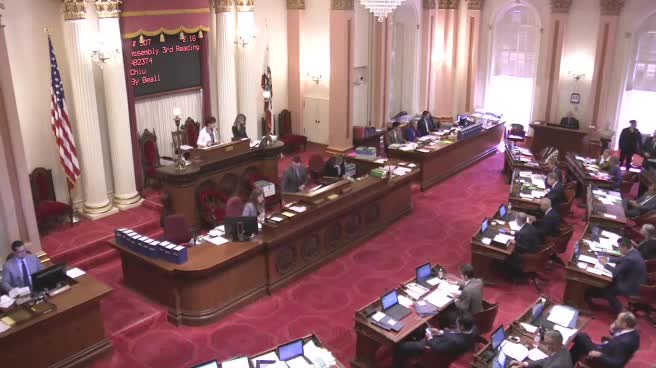 3MIN
Senate Floor
 1MIN
Assembly Floor
 9MIN
Assembly Standing Committee on Natural Resources
Bill Author

Bill Co-Author(s):