AB 2872: Children.
- Session Year: 2015-2016
- House: Assembly
- Latest Version Date: 2016-09-27
(1)Existing law establishes a procedure for a stepparent to adopt a stepchild and requires a probation officer, qualified court investigator, licensed clinical social worker, licensed marriage and family therapist, or licensed adoption agency to conduct an investigation of the proposed stepparent adoption, as specified.
This bill would provide that if the petitioner does not request that a licensed clinical social worker, therapist, or private adoption agency complete the investigation, the court may collect the investigation fee and assign a probation officer, court investigator, or, if so authorized by the county board of supervisors, the county welfare department to complete the investigation.
(2)Existing law prohibits a peace officer from taking into temporary custody, without a warrant, a minor who is in a hospital if specified conditions exist, including that the minor is a newborn who tested positive for illegal drugs or whose birth mother tested positive for illegal drugs or the minor is the subject of a proposed adoption and a Health Facility Minor Release Report has been completed by the hospital, as specified.
This bill would require the appropriate hospital personnel to complete a Health Facility Minor Release Report and provide copies to specified parties upon request by a parent.
(3)Existing law authorizes specified persons to inspect a juvenile case file, including a court-appointed investigator who is actively participating in a guardianship case involving a minor, as specified, and acting within the scope of his or her duties in that case.
This bill would additionally permit a statutorily authorized or court-appointed investigator who is conducting specified investigations relating to children, including stepparent adoptions, to inspect a juvenile case file.
(4)This bill would incorporate additional changes to Section 827 of the Welfare and Institutions Code proposed by AB 1945 that would become operative if this bill and AB 1945 are chaptered and this bill is chaptered last.
(1)Existing law establishes a procedure for a stepparent to adopt a stepchild and requires a probation officer, qualified court investigator, licensed clinical social worker, licensed marriage and family therapist, or licensed adoption agency to conduct an investigation of the proposed stepparent adoption, as specified.
This bill would provide that if the petitioner does not request that a licensed clinical social worker, therapist, or private adoption agency complete the investigation, the court may collect the investigation fee and assign a probation officer, court investigator or, if so authorized by the county board of supervisors, the county welfare department to complete the investigation.
(1)
(2)Existing law prohibits a peace officer from taking into temporary custody, without a warrant, a minor who is in a hospital if specified conditions exist, including that the minor is a newborn who tested positive for illegal drugs or whose birth mother tested positive for illegal drugs or the minor is the subject of a proposed adoption and a Health Facility Minor Release Report has been completed by the hospital, as specified.
This bill would require the appropriate hospital personnel to complete a Health Facility Minor Release Report and provide copies to specified parties upon request by a parent.
(2)
(3)Existing law authorizes specified persons to inspect a juvenile case file, including a court-appointed investigator who is actively participating in a guardianship case involving a minor, as specified, and acting within the scope of his or her duties in that case.
This bill would additionally permit a statutorily authorized or court-appointed investigator who is conducting specified investigations relating to children, including stepparent adoptions, to inspect a juvenile case file.
(4)This bill would incorporate additional changes to Section 827 of the Welfare and Institutions Code proposed by AB 1945 that would become operative if this bill and AB 1945 are chaptered and this bill is chaptered last.
(1)Existing law prohibits a peace officer from taking into temporary custody, without a warrant, a minor who is in a hospital if specified conditions exist, including that the minor is a newborn who tested positive for illegal drugs or whose birth mother tested positive for illegal drugs or the minor is the subject of a proposed adoption and a Health Facility Minor Release Report has been completed by the hospital, as specified.
This bill would require the appropriate hospital personnel to complete a Health Facility Minor Release Report and provide copies to specified parties upon request by a parent.
(2)Existing law authorizes specified persons to inspect a juvenile case file, including a court-appointed investigator who is actively participating in a guardianship case involving a minor, as specified, and acting within the scope of his or her duties in that case.
This bill would additionally permit a statutorily authorized or court-appointed investigator who is conducting specified investigations relating to children, including stepparent adoptions, to inspect a juvenile case file.
(1)Under existing law, a man is conclusively presumed to be the father of a child if he was married to and cohabiting with the childs mother, except as specified. Existing law authorizes a presumed father to waive the right to notice of any adoption proceedings by executing a form developed by the State Department of Social Services before an authorized representative of the department, among others.
This bill would, among other things, additionally authorize a presumed father to deny paternity by executing a form developed by the department and before an authorized representative of the department, among others.
(2)Existing law requires notice of adoption proceedings to be given to every person identified as the biological father or a possible biological father at least 10 days before the date of the proceeding, except notice is not required and the court shall issue an order dispensing with notice to a person under specified circumstances, including that the alleged father has been served with written notice of his alleged paternity and the proposed adoption and he has failed to bring an action.
This bill would instead not require notice if the alleged father has failed to file and personally serve notice of action, as specified, and would additionally not require notice if the child was conceived as a result of rape and the father was convicted of the rape.
(3)
(1)Existing law prohibits a peace officer from taking into temporary custody, without a warrant, a minor who is in a hospital if specified conditions exist, including that the minor is a newborn who tested positive for illegal drugs or whose birth mother tested positive for illegal drugs or the minor is the subject of a proposed adoption and a Health Facility Minor Release Report has been completed by the hospital, as specified.
This bill would instead prohibit a peace officer or child welfare agency worker from taking into temporary custody, without a warrant, a minor who is in a hospital, if among other conditions, the minor is a newborn who is or may come within the description of a dependent child of the juvenile court. The bill would require the appropriate hospital personnel to complete a Health Facility Minor Release Report and provide copies to specified parties upon request by a parent. The bill would require a child welfare agency worker who investigates the safety and well-being of a minor newborn, prior to filing a dependency petition for a minor newborn who has not yet been discharged from the hospital, to allow a parent who wishes to place the minor newborn for adoption a reasonable opportunity to do so before the minor newborn is discharged from the hospital. By creating additional duties for local officials, this bill would impose a state-mandated local program.
(4)Existing law requires a social worker to provide the parents or legal guardian, counsel for the child, and any court-appointed child advocate with a copy of the supplemental report filed with the court regarding the services provided or offered to the parent or legal guardian, as specified, at least 10 days prior to a hearing conducted by the juvenile court reviewing the status of a dependent child.
This bill would instead require the social worker to provide a copy of the report to all parties, counsel for all parties, and any court-appointed child advocate. By creating additional duties for local officials, this bill would impose a state-mandated local program.
(5)The California Constitution requires the state to reimburse local agencies and school districts for certain costs mandated by the state. Statutory provisions establish procedures for making that reimbursement.
This bill would provide that, if the Commission on State Mandates determines that the bill contains costs mandated by the state, reimbursement for those costs shall be made pursuant to these statutory provisions.
(2)Existing law authorizes specified persons to inspect a juvenile case file, including a court-appointed investigator who is actively participating in a guardianship case involving a minor, as specified, and acting within the scope of his or her duties in that case.
This bill would additionally permit a statutorily authorized or court-appointed investigator who is conducting specified investigations relating to children, including stepparent adoptions, to inspect a juvenile case file.
(1)Under existing law, a man is conclusively presumed to be the father of a child if he was married to and cohabiting with the childs mother, except as specified. Existing law authorizes a presumed father to waive the right to notice of any adoption proceedings by executing a form developed by the State Department of Social Services before an authorized representative of the department, among others.
This bill would, among other things, additionally authorize a presumed father to deny paternity by executing a form developed by the department and before an authorized representative of the department, among others.
(2)Existing law requires notice of adoption proceedings to be given to every person identified as the biological father or a possible biological father at least 10 days before the date of the proceeding, except notice is not required and the court shall issue an order dispensing with notice to a person under specified circumstances, including that the alleged father has been served with written notice of his alleged paternity and the proposed adoption and he has failed to bring an action.
This bill would instead not require notice if the alleged father has failed to file and personally serve notice of action, as specified, and would additionally not require notice if the child was conceived as a result of rape and the father was convicted of the rape.
(3)Existing law prohibits a peace officer from taking into temporary custody, without a warrant, a minor who is in a hospital if specified conditions exist, including that the minor is a newborn who tested positive for illegal drugs or whose birth mother tested positive for illegal drugs or the minor is the subject of a proposed adoption and a Health Facility Minor Release Report has been completed by the hospital, as specified.
This bill would instead prohibit a peace officer or child welfare agency worker from taking into temporary custody, without a warrant, a minor who is in a hospital, if among other conditions, the minor is a newborn who is or may come within the description of a dependent child of the juvenile court. The bill would require the appropriate hospital personnel to complete a Health Facility Minor Release Report and provide copies to specified parties upon request by a parent. The bill would require a child welfare agency worker who investigates the safety and well-being of a minor newborn, prior to filing a dependency petition for a minor newborn who has not yet been discharged from the hospital, to allow a parent who wishes to place the minor newborn for adoption a reasonable opportunity to do so before the minor newborn is discharged from the hospital. By creating additional duties for local officials, this bill would impose a state-mandated local program.
(4)Existing law requires a social worker to provide the parents or legal guardian, counsel for the child, and any court-appointed child advocate with a copy of the supplemental report filed with the court regarding the services provided or offered to the parent or legal guardian, as specified, at least 10 days prior to a hearing conducted by the juvenile court reviewing the status of a dependent child.
This bill would instead require the social worker to provide a copy of the report to all parties, counsel for all parties, and any court-appointed child advocate. By creating additional duties for local officials, this bill would impose a state-mandated local program.
(5)The California Constitution requires the state to reimburse local agencies and school districts for certain costs mandated by the state. Statutory provisions establish procedures for making that reimbursement.
This bill would provide that, if the Commission on State Mandates determines that the bill contains costs mandated by the state, reimbursement for those costs shall be made pursuant to these statutory provisions.
(a)Except as provided in Section 9000.5, before granting or denying a stepparent adoption request, the court shall review and consider a written investigative report. The report in a stepparent adoption case shall not require a home study unless so ordered by the court upon request of an investigator or interested person, or on the courts own motion. Home study as used in this section means a physical investigation of the premises where the child is residing.
(b)At the time of filing the adoption request, the petitioner shall inform the court in writing if the petitioner is electing to have the investigation and written report completed by a licensed clinical social worker, a licensed marriage and family therapist, or a private licensed adoption agency, in which cases the petitioner shall not be required to pay any investigation fee pursuant to Section 9002 at the time of filing, but shall pay these fees directly to the investigator. Absent that notification, the court may, at the time of filing, collect an investigation fee pursuant to Section 9002, and may assign one of the following to complete the investigation: a probation officer, a qualified court investigator, or the county welfare department, if so authorized by the board of supervisors of the county where the action is pending.
(c)If a private licensed adoption agency conducts the investigation, it shall assign the investigation to a licensed clinical social worker or licensed marriage and family therapist associated with the agency. Any grievance regarding the investigation shall be directed to the licensing authority of the clinical social worker or marriage and family therapist, as applicable.
(d)Nothing in this section shall be construed to require the State Department of Social Services to issue regulations for stepparent adoptions.
SEC. 2.Section 305.6 of the Welfare and Institutions Code is amended to read:305.6.(a)Any peace officer may, without a warrant, take into temporary custody a minor who is in a hospital if the release of the minor to a prospective adoptive parent or a representative of a licensed adoption agency poses an immediate danger to the minors health or safety.
(b)Notwithstanding subdivision (a) and Section 305, a peace officer shall not, without a warrant, take into temporary custody a minor who is in a hospital if all of the following conditions exist:
(1)The minor is a newborn who tested positive for illegal drugs or whose birth mother tested positive for illegal drugs.
(2)The minor is the subject of a proposed adoption and a Health Facility Minor Release Report, developed by the department, has been completed by the hospital, including the marking of the boxes applicable to an independent adoption or agency adoption planning, and signed by the placing birth parent or birth parents, as well as either the prospective adoptive parent or parents or an authorized representative of a licensed adoption agency, prior to the discharge of the birth parent or the minor from the hospital. The Health Facility Minor Release Report shall include a notice written in at least 14-point pica type, containing substantially all of the following statements:
(A)That the Health Facility Minor Release Report does not constitute consent to adoption of the minor by the prospective adoptive parent or parents, or any other person.
(B)That the Health Facility Minor Release Report does not constitute a relinquishment of parental rights for the purposes of adoption.
(C)That the birth parent or parents or any person authorized by the birth parent or parents may reclaim the minor at any time from the prospective adoptive parent or parents or any other person to whom the minor was released by the hospital, as provided in Section 8700, 8814.5, or 8815 of the Family Code.
(3)The release of the minor to a prospective adoptive parent or parents or an authorized representative of a licensed adoption agency does not pose an immediate danger to the minor.
(4)An attorney or an adoption agency has provided documentation stating that he or she, or the agency, is representing the prospective adoptive parent or parents for purposes of the adoption. In the case of an independent adoption, as defined in Section 8524 of the Family Code, the attorney or adoption agency shall provide documentation stating that the prospective adoptive parent or parents have been informed that the child may be eligible for benefits provided pursuant to the Adoption Assistance Program, as set forth in Chapter 2.1 (commencing with Section 16115) of Part 4 of Division 9, only if, at the time the adoption request is filed, the child has met the requirements to receive federal supplemental security income benefits pursuant to Subchapter XVI (commencing with Section 1381) of Chapter 7 of Title 42 of the United States Code, as determined and documented by the federal Social Security Administration.
(5)The prospective adoptive parent or parents or their representative, or an authorized representative of a licensed adoption agency, provides all of the following to the peace officer:
(A)A fully executed copy of the Health Facility Minor Release Report.
(B)A written form signed by either the prospective adoptive parent or parents or a representative of the licensed adoption agency, which shall include all of the following:
(i)A statement that the minor is the subject of a proposed adoption.
(ii)A declaration that the signer or signers will immediately notify the county child welfare agency pursuant to Section 11165.9 of the Penal Code if the adoption plan is terminated for any reason, and will not release the minor to the birth parent or parents or any designee of the birth parent or parents until the county child welfare agency or local law enforcement agency completes an investigation and determines that release of the minor to the birth parent or parents or a designee of the birth parent or parents will not create an immediate risk to the health or safety of the minor.
(iii)An agreement to provide a conformed copy of the adoption request or guardianship petition to the county child welfare agency within five business days after filing.
(iv)The names, identifying information, and contact information for the minor, for each prospective adoptive parent, and for each birth parent, to the extent that information is known. In the case of an agency adoption where no prospective adoptive parent or parents are identified at the time of the minors release from the hospital, the licensed adoption agency may provide the information as it pertains to the licensed or certified foster home into which the agency intends to place the minor.
(c)(1)In every independent adoption proceeding under this section, the prospective adoptive parent or parents shall file with the court either an adoption request within 10 working days after execution of an adoption placement agreement, or a guardianship petition within 30 calendar days after the childs discharge from the hospital, whichever is earlier.
(2)If the adoption plan for a minor who was released from the hospital pursuant to subdivision (b) is terminated for any reason, the prospective adoptive parent or parents or licensed adoption agency shall immediately notify the county child welfare agency. The prospective adoptive parent or parents or licensed adoption agency may not release the minor into the physical custody of the birth parent or parents, or any designee of the birth parent or parents, until the county child welfare agency or local law enforcement agency completes an investigation and determines that release of the minor to the birth parent or parents or a designee of the birth parent or parents will not create an immediate risk to the health or safety of the minor.
(d)Upon request by a birth parent or parents of the minor newborn, the appropriate hospital personnel shall complete a Health Facility Minor Release Report and provide copies of the report to the birth parent or parents, and the person or persons who will receive physical custody of the child upon discharge pursuant to Section 1283 of the Health and Safety Code. Hospital personnel shall not refuse to complete a Health Facility Minor Release Report for any reason, even if the minor is ineligible for release at that time. However, nothing in this section shall be construed to require hospital personnel to release a minor contrary to the directives of a child welfare agency.
(e)Nothing in this section is intended to create a duty that requires law enforcement to investigate the prospective adoptive parent or parents.
SEC. 3.Section 827 of the Welfare and Institutions Code is amended to read:827.(a)(1)Except as provided in Section 828, a case file may be inspected only by the following:
(A)Court personnel.
(B)The district attorney, a city attorney, or city prosecutor authorized to prosecute criminal or juvenile cases under state law.
(C)The minor who is the subject of the proceeding.
(D) The minors parents or guardian.
(E)The attorneys for the parties, judges, referees, other hearing officers, probation officers, and law enforcement officers who are actively participating in criminal or juvenile proceedings involving the minor.
(F)The county counsel, city attorney, or any other attorney representing the petitioning agency in a dependency action.
(G)The superintendent or designee of the school district where the minor is enrolled or attending school.
(H)Members of the child protective agencies as defined in Section 11165.9 of the Penal Code.
(I)The State Department of Social Services, to carry out its duties pursuant to Division 9 (commencing with Section 10000), and Part 5 (commencing with Section 7900) of Division 12, of the Family Code to oversee and monitor county child welfare agencies, children in foster care or receiving foster care assistance, and out-of-state placements, Section 10850.4, and paragraph (2).
(J)Authorized legal staff or special investigators who are peace officers who are employed by, or who are authorized representatives of, the State Department of Social Services, as necessary to the performance of their duties to inspect, license, and investigate community care facilities, and to ensure that the standards of care and services provided in those facilities are adequate and appropriate and to ascertain compliance with the rules and regulations to which the facilities are subject. The confidential information shall remain confidential except for purposes of inspection, licensing, or investigation pursuant to Chapter 3 (commencing with Section 1500) and Chapter 3.4 (commencing with Section 1596.70) of Division 2 of the Health and Safety Code, or a criminal, civil, or administrative proceeding in relation thereto. The confidential information may be used by the State Department of Social Services in a criminal, civil, or administrative proceeding. The confidential information shall be available only to the judge or hearing officer and to the parties to the case. Names that are confidential shall be listed in attachments separate to the general pleadings. The confidential information shall be sealed after the conclusion of the criminal, civil, or administrative hearings, and may not subsequently be released except in accordance with this subdivision. If the confidential information does not result in a criminal, civil, or administrative proceeding, it shall be sealed after the State Department of Social Services decides that no further action will be taken in the matter of suspected licensing violations. Except as otherwise provided in this subdivision, confidential information in the possession of the State Department of Social Services may not contain the name of the minor.
(K)Members of childrens multidisciplinary teams, persons, or agencies providing treatment or supervision of the minor.
(L)A judge, commissioner, or other hearing officer assigned to a family law case with issues concerning custody or visitation, or both, involving the minor, and the following persons, if actively participating in the family law case: a family court mediator assigned to a case involving the minor pursuant to Article 1 (commencing with Section 3160) of Chapter 11 of Part 2 of Division 8 of the Family Code, a court-appointed evaluator or a person conducting a court-connected child custody evaluation, investigation, or assessment pursuant to Section 3111 or 3118 of the Family Code, and counsel appointed for the minor in the family law case pursuant to Section 3150 of the Family Code. Prior to allowing counsel appointed for the minor in the family law case to inspect the file, the court clerk may require counsel to provide a certified copy of the court order appointing him or her as the minors counsel.
(M)When acting within the scope of investigative duties of an active case, a statutorily authorized or court-appointed investigator who is conducting an investigation pursuant to Section 7663, 7851, or 9001 of the Family Code, or who is actively participating in a guardianship case involving a minor pursuant to Part 2 (commencing with Section 1500) of Division 4 of the Probate Code and acting within the scope of his or her duties in that case.
(N)A local child support agency for the purpose of establishing paternity and establishing and enforcing child support orders.
(O)Juvenile justice commissions as established under Section 225. The confidentiality provisions of Section 10850 shall apply to a juvenile justice commission and its members.
(P)Any other person who may be designated by court order of the judge of the juvenile court upon filing a petition.
(2)(A)Notwithstanding any other law and subject to subparagraph (A) of paragraph (3), juvenile case files, except those relating to matters within the jurisdiction of the court pursuant to Section 601 or 602, that pertain to a deceased child who was within the jurisdiction of the juvenile court pursuant to Section 300, shall be released to the public pursuant to an order by the juvenile court after a petition has been filed and interested parties have been afforded an opportunity to file an objection. Any information relating to another child or which could identify another child, except for information about the deceased, shall be redacted from the juvenile case file prior to release, unless a specific order is made by the juvenile court to the contrary. Except as provided in this paragraph, the presiding judge of the juvenile court may issue an order prohibiting or limiting access to the juvenile case file, or any portion thereof, of a deceased child only upon a showing by a preponderance of evidence that release of the juvenile case file or any portion thereof is detrimental to the safety, protection, or physical or emotional well-being of another child who is directly or indirectly connected to the juvenile case that is the subject of the petition.
(B)This paragraph represents a presumption in favor of the release of documents when a child is deceased unless the statutory reasons for confidentiality are shown to exist.
(C)If a child whose records are sought has died, and documents are sought pursuant to this paragraph, no weighing or balancing of the interests of those other than a child is permitted.
(D)A petition filed under this paragraph shall be served on interested parties by the petitioner, if the petitioner is in possession of their identity and address, and on the custodian of records. Upon receiving a petition, the custodian of records shall serve a copy of the request upon all interested parties that have not been served by the petitioner or on the interested parties served by the petitioner if the custodian of records possesses information, such as a more recent address, indicating that the service by the petitioner may have been ineffective.
(E)The custodian of records shall serve the petition within 10 calendar days of receipt. If any interested party, including the custodian of records, objects to the petition, the party shall file and serve the objection on the petitioning party no later than 15 calendar days of service of the petition.
(F)The petitioning party shall have 10 calendar days to file any reply. The juvenile court shall set the matter for hearing no more than 60 calendar days from the date the petition is served on the custodian of records. The court shall render its decision within 30 days of the hearing. The matter shall be decided solely upon the basis of the petition and supporting exhibits and declarations, if any, the objection and any supporting exhibits or declarations, if any, and the reply and any supporting declarations or exhibits thereto, and argument at hearing. The court may solely upon its own motion order the appearance of witnesses. If no objection is filed to the petition, the court shall review the petition and issue its decision within 10 calendar days of the final day for filing the objection. Any order of the court shall be immediately reviewable by petition to the appellate court for the issuance of an extraordinary writ.
(3)Access to juvenile case files pertaining to matters within the jurisdiction of the juvenile court pursuant to Section 300 shall be limited as follows:
(A)If a juvenile case file, or any portion thereof, is privileged or confidential pursuant to any other state law or federal law or regulation, the requirements of that state law or federal law or regulation prohibiting or limiting release of the juvenile case file or any portions thereof shall prevail. Unless a person is listed in subparagraphs (A) to (O), inclusive, of paragraph (1) and is entitled to access under the other state law or federal law or regulation without a court order, all those seeking access, pursuant to other authorization, to portions of, or information relating to the contents of, juvenile case files protected under another state law or federal law or regulation, shall petition the juvenile court. The juvenile court may only release the portion of, or information relating to the contents of, juvenile case files protected by another state law or federal law or regulation if disclosure is not detrimental to the safety, protection, or physical or emotional well-being of a child who is directly or indirectly connected to the juvenile case that is the subject of the petition. This paragraph shall not be construed to limit the ability of the juvenile court to carry out its duties in conducting juvenile court proceedings.
(B)Prior to the release of the juvenile case file or any portion thereof, the court shall afford due process, including a notice of and an opportunity to file an objection to the release of the record or report to all interested parties.
(4)A juvenile case file, any portion thereof, and information relating to the content of the juvenile case file, may not be disseminated by the receiving agencies to any persons or agencies, other than those persons or agencies authorized to receive documents pursuant to this section. Further, a juvenile case file, any portion thereof, and information relating to the content of the juvenile case file, may not be made as an attachment to any other documents without the prior approval of the presiding judge of the juvenile court, unless it is used in connection with and in the course of a criminal investigation or a proceeding brought to declare a person a dependent child or ward of the juvenile court.
(5)Individuals listed in subparagraphs (A), (B), (C), (D), (E), (F), (H), and (I) of paragraph (1) may also receive copies of the case file. In these circumstances, the requirements of paragraph (4) shall continue to apply to the information received.
(b)(1)While the Legislature reaffirms its belief that juvenile court records, in general, should be confidential, it is the intent of the Legislature in enacting this subdivision to provide for a limited exception to juvenile court record confidentiality to promote more effective communication among juvenile courts, family courts, law enforcement agencies, and schools to ensure the rehabilitation of juvenile criminal offenders as well as to lessen the potential for drug use, violence, other forms of delinquency, and child abuse.
(2)(A)Notwithstanding subdivision (a), written notice that a minor enrolled in a public school, kindergarten to grade 12, inclusive, has been found by a court of competent jurisdiction to have committed any felony or any misdemeanor involving curfew, gambling, alcohol, drugs, tobacco products, carrying of weapons, a sex offense listed in Section 290 of the Penal Code, assault or battery, larceny, vandalism, or graffiti shall be provided by the court, within seven days, to the superintendent of the school district of attendance. Written notice shall include only the offense found to have been committed by the minor and the disposition of the minors case. This notice shall be expeditiously transmitted by the district superintendent to the principal at the school of attendance. The principal shall expeditiously disseminate the information to those counselors directly supervising or reporting on the behavior or progress of the minor. In addition, the principal shall disseminate the information to any teacher or administrator directly supervising or reporting on the behavior or progress of the minor whom the principal believes needs the information to work with the pupil in an appropriate fashion, to avoid being needlessly vulnerable or to protect other persons from needless vulnerability.
(B)Any information received by a teacher, counselor, or administrator under this subdivision shall be received in confidence for the limited purpose of rehabilitating the minor and protecting students and staff, and shall not be further disseminated by the teacher, counselor, or administrator, except insofar as communication with the juvenile, his or her parents or guardians, law enforcement personnel, and the juveniles probation officer is necessary to effectuate the juveniles rehabilitation or to protect students and staff.
(C)An intentional violation of the confidentiality provisions of this paragraph is a misdemeanor punishable by a fine not to exceed five hundred dollars ($500).
(3)If a minor is removed from public school as a result of the courts finding described in subdivision (b), the superintendent shall maintain the information in a confidential file and shall defer transmittal of the information received from the court until the minor is returned to public school. If the minor is returned to a school district other than the one from which the minor came, the parole or probation officer having jurisdiction over the minor shall so notify the superintendent of the last district of attendance, who shall transmit the notice received from the court to the superintendent of the new district of attendance.
(c)Each probation report filed with the court concerning a minor whose record is subject to dissemination pursuant to subdivision (b) shall include on the face sheet the school at which the minor is currently enrolled. The county superintendent shall provide the court with a listing of all of the schools within each school district, within the county, along with the name and mailing address of each district superintendent.
(d)(1)Each notice sent by the court pursuant to subdivision (b) shall be stamped with the instruction: Unlawful Dissemination Of This Information Is A Misdemeanor. Any information received from the court shall be kept in a separate confidential file at the school of attendance and shall be transferred to the minors subsequent schools of attendance and maintained until the minor graduates from high school, is released from juvenile court jurisdiction, or reaches the age of 18 years, whichever occurs first. After that time the confidential record shall be destroyed. At any time after the date by which a record required to be destroyed by this section should have been destroyed, the minor or his or her parent or guardian shall have the right to make a written request to the principal of the school that the minors school records be reviewed to ensure that the record has been destroyed. Upon completion of any requested review and no later than 30 days after the request for the review was received, the principal or his or her designee shall respond in writing to the written request and either shall confirm that the record has been destroyed or, if the record has not been destroyed, shall explain why destruction has not yet occurred.
(2)Except as provided in paragraph (2) of subdivision (b), no liability shall attach to any person who transmits or fails to transmit any notice or information required under subdivision (b).
(e)For purposes of this section, a juvenile case file means a petition filed in any juvenile court proceeding, reports of the probation officer, and all other documents filed in that case or made available to the probation officer in making his or her report, or to the judge, referee, or other hearing officer, and thereafter retained by the probation officer, judge, referee, or other hearing officer.
(f)The persons described in subparagraphs (A), (E), (F), (H), (K), (L), (M), and (N) of paragraph (1) of subdivision (a) include persons serving in a similar capacity for an Indian tribe, reservation, or tribal court when the case file involves a child who is a member of, or who is eligible for membership in, that tribe.
SEC. 3.5.Section 827 of the Welfare and Institutions Code is amended to read:827.(a)(1)Except as provided in Section 828, a case file may be inspected only by the following:
(A)Court personnel.
(B)The district attorney, a city attorney, or city prosecutor authorized to prosecute criminal or juvenile cases under state law.
(C)The minor who is the subject of the proceeding.
(D) The minors parents or guardian.
(E)The attorneys for the parties, judges, referees, other hearing officers, probation officers, and law enforcement officers who are actively participating in criminal or juvenile proceedings involving the minor.
(F)The county counsel, city attorney, or any other attorney representing the petitioning agency in a dependency action.
(G)The superintendent or designee of the school district where the minor is enrolled or attending school.
(H)Members of the child protective agencies as defined in Section 11165.9 of the Penal Code.
(I)The State Department of Social Services, to carry out its duties pursuant to Division 9 (commencing with Section 10000), and Part 5 (commencing with Section 7900) of Division 12, of the Family Code to oversee and monitor county child welfare agencies, children in foster care or receiving foster care assistance, and out-of-state placements, Section 10850.4, and paragraph (2).
(J)Authorized legal staff or special investigators who are peace officers who are employed by, or who are authorized representatives of, the State Department of Social Services, as necessary to the performance of their duties to inspect, license, and investigate community care facilities, and to ensure that the standards of care and services provided in those facilities are adequate and appropriate and to ascertain compliance with the rules and regulations to which the facilities are subject. The confidential information shall remain confidential except for purposes of inspection, licensing, or investigation pursuant to Chapter 3 (commencing with Section 1500) and Chapter 3.4 (commencing with Section 1596.70) of Division 2 of the Health and Safety Code, or a criminal, civil, or administrative proceeding in relation thereto. The confidential information may be used by the State Department of Social Services in a criminal, civil, or administrative proceeding. The confidential information shall be available only to the judge or hearing officer and to the parties to the case. Names that are confidential shall be listed in attachments separate to the general pleadings. The confidential information shall be sealed after the conclusion of the criminal, civil, or administrative hearings, and may not subsequently be released except in accordance with this subdivision. If the confidential information does not result in a criminal, civil, or administrative proceeding, it shall be sealed after the State Department of Social Services decides that no further action will be taken in the matter of suspected licensing violations. Except as otherwise provided in this subdivision, confidential information in the possession of the State Department of Social Services may not contain the name of the minor.
(K)Members of childrens multidisciplinary teams, persons, or agencies providing treatment or supervision of the minor.
(L)A judge, commissioner, or other hearing officer assigned to a family law case with issues concerning custody or visitation, or both, involving the minor, and the following persons, if actively participating in the family law case: a family court mediator assigned to a case involving the minor pursuant to Article 1 (commencing with Section 3160) of Chapter 11 of Part 2 of Division 8 of the Family Code, a court-appointed evaluator or a person conducting a court-connected child custody evaluation, investigation, or assessment pursuant to Section 3111 or 3118 of the Family Code, and counsel appointed for the minor in the family law case pursuant to Section 3150 of the Family Code. Prior to allowing counsel appointed for the minor in the family law case to inspect the file, the court clerk may require counsel to provide a certified copy of the court order appointing him or her as the minors counsel.
(M)When acting within the scope of investigative duties of an active case, a statutorily authorized or court-appointed investigator who is conducting an investigation pursuant to Section 7663, 7851, or 9001 of the Family Code, or who is actively participating in a guardianship case involving a minor pursuant to Part 2 (commencing with Section 1500) of Division 4 of the Probate Code and acting within the scope of his or her duties in that case.
(N)A local child support agency for the purpose of establishing paternity and establishing and enforcing child support orders.
(O)Juvenile justice commissions as established under Section 225. The confidentiality provisions of Section 10850 shall apply to a juvenile justice commission and its members.
(P)Any other person who may be designated by court order of the judge of the juvenile court upon filing a petition.
(2)(A)Notwithstanding any other law and subject to subparagraph (A) of paragraph (3), juvenile case files, except those relating to matters within the jurisdiction of the court pursuant to Section 601 or 602, that pertain to a deceased child who was within the jurisdiction of the juvenile court pursuant to Section 300, shall be released to the public pursuant to an order by the juvenile court after a petition has been filed and interested parties have been afforded an opportunity to file an objection. Any information relating to another child or which could identify another child, except for information about the deceased, shall be redacted from the juvenile case file prior to release, unless a specific order is made by the juvenile court to the contrary. Except as provided in this paragraph, the presiding judge of the juvenile court may issue an order prohibiting or limiting access to the juvenile case file, or any portion thereof, of a deceased child only upon a showing by a preponderance of evidence that release of the juvenile case file or any portion thereof is detrimental to the safety, protection, or physical or emotional well-being of another child who is directly or indirectly connected to the juvenile case that is the subject of the petition.
(B)This paragraph represents a presumption in favor of the release of documents when a child is deceased unless the statutory reasons for confidentiality are shown to exist.
(C)If a child whose records are sought has died, and documents are sought pursuant to this paragraph, no weighing or balancing of the interests of those other than a child is permitted.
(D)A petition filed under this paragraph shall be served on interested parties by the petitioner, if the petitioner is in possession of their identity and address, and on the custodian of records. Upon receiving a petition, the custodian of records shall serve a copy of the request upon all interested parties that have not been served by the petitioner or on the interested parties served by the petitioner if the custodian of records possesses information, such as a more recent address, indicating that the service by the petitioner may have been ineffective.
(E)The custodian of records shall serve the petition within 10 calendar days of receipt. If any interested party, including the custodian of records, objects to the petition, the party shall file and serve the objection on the petitioning party no later than 15 calendar days after service of the petition.
(F)The petitioning party shall have 10 calendar days to file any reply. The juvenile court shall set the matter for hearing no more than 60 calendar days from the date the petition is served on the custodian of records. The court shall render its decision within 30 days of the hearing. The matter shall be decided solely upon the basis of the petition and supporting exhibits and declarations, if any, the objection and any supporting exhibits or declarations, if any, and the reply and any supporting declarations or exhibits thereto, and argument at hearing. The court may solely upon its own motion order the appearance of witnesses. If no objection is filed to the petition, the court shall review the petition and issue its decision within 10 calendar days of the final day for filing the objection. Any order of the court shall be immediately reviewable by petition to the appellate court for the issuance of an extraordinary writ.
(3)Access to juvenile case files pertaining to matters within the jurisdiction of the juvenile court pursuant to Section 300 shall be limited as follows:
(A)If a juvenile case file, or any portion thereof, is privileged or confidential pursuant to any other state law or federal law or regulation, the requirements of that state law or federal law or regulation prohibiting or limiting release of the juvenile case file or any portions thereof shall prevail. Unless a person is listed in subparagraphs (A) to (O), inclusive, of paragraph (1) and is entitled to access under the other state law or federal law or regulation without a court order, all those seeking access, pursuant to other authorization, to portions of, or information relating to the contents of, juvenile case files protected under another state law or federal law or regulation, shall petition the juvenile court. The juvenile court may only release the portion of, or information relating to the contents of, juvenile case files protected by another state law or federal law or regulation if disclosure is not detrimental to the safety, protection, or physical or emotional well-being of a child who is directly or indirectly connected to the juvenile case that is the subject of the petition. This paragraph shall not be construed to limit the ability of the juvenile court to carry out its duties in conducting juvenile court proceedings.
(B)Prior to the release of the juvenile case file or any portion thereof, the court shall afford due process, including a notice of and an opportunity to file an objection to the release of the record or report to all interested parties.
(4)A juvenile case file, any portion thereof, and information relating to the content of the juvenile case file, may not be disseminated by the receiving agencies to any persons or agencies, other than those persons or agencies authorized to receive documents pursuant to this section. Further, a juvenile case file, any portion thereof, and information relating to the content of the juvenile case file, may not be made as an attachment to any other documents without the prior approval of the presiding judge of the juvenile court, unless it is used in connection with and in the course of a criminal investigation or a proceeding brought to declare a person a dependent child or ward of the juvenile court.
(5)Individuals listed in subparagraphs (A), (B), (C), (D), (E), (F), (H), and (I) of paragraph (1) may also receive copies of the case file. In these circumstances, the requirements of paragraph (4) shall continue to apply to the information received.
(b)(1)While the Legislature reaffirms its belief that juvenile court records, in general, should be confidential, it is the intent of the Legislature in enacting this subdivision to provide for a limited exception to juvenile court record confidentiality to promote more effective communication among juvenile courts, family courts, law enforcement agencies, and schools to ensure the rehabilitation of juvenile criminal offenders as well as to lessen the potential for drug use, violence, other forms of delinquency, and child abuse.
(2)(A)Notwithstanding subdivision (a), written notice that a minor enrolled in a public school, kindergarten to grade 12, inclusive, has been found by a court of competent jurisdiction to have committed any felony or any misdemeanor involving curfew, gambling, alcohol, drugs, tobacco products, carrying of weapons, a sex offense listed in Section 290 of the Penal Code, assault or battery, larceny, vandalism, or graffiti shall be provided by the court, within seven days, to the superintendent of the school district of attendance. Written notice shall include only the offense found to have been committed by the minor and the disposition of the minors case. This notice shall be expeditiously transmitted by the district superintendent to the principal at the school of attendance. The principal shall expeditiously disseminate the information to those counselors directly supervising or reporting on the behavior or progress of the minor. In addition, the principal shall disseminate the information to any teacher or administrator directly supervising or reporting on the behavior or progress of the minor whom the principal believes needs the information to work with the pupil in an appropriate fashion, to avoid being needlessly vulnerable or to protect other persons from needless vulnerability.
(B)Any information received by a teacher, counselor, or administrator under this subdivision shall be received in confidence for the limited purpose of rehabilitating the minor and protecting students and staff, and shall not be further disseminated by the teacher, counselor, or administrator, except insofar as communication with the juvenile, his or her parents or guardians, law enforcement personnel, and the juveniles probation officer is necessary to effectuate the juveniles rehabilitation or to protect students and staff.
(C)An intentional violation of the confidentiality provisions of this paragraph is a misdemeanor punishable by a fine not to exceed five hundred dollars ($500).
(3)If a minor is removed from public school as a result of the courts finding described in subdivision (b), the superintendent shall maintain the information in a confidential file and shall defer transmittal of the information received from the court until the minor is returned to public school. If the minor is returned to a school district other than the one from which the minor came, the parole or probation officer having jurisdiction over the minor shall so notify the superintendent of the last district of attendance, who shall transmit the notice received from the court to the superintendent of the new district of attendance.
(c)Each probation report filed with the court concerning a minor whose record is subject to dissemination pursuant to subdivision (b) shall include on the face sheet the school at which the minor is currently enrolled. The county superintendent shall provide the court with a listing of all of the schools within each school district, within the county, along with the name and mailing address of each district superintendent.
(d)(1)Each notice sent by the court pursuant to subdivision (b) shall be stamped with the instruction: Unlawful Dissemination Of This Information Is A Misdemeanor. Any information received from the court shall be kept in a separate confidential file at the school of attendance and shall be transferred to the minors subsequent schools of attendance and maintained until the minor graduates from high school, is released from juvenile court jurisdiction, or reaches the age of 18 years, whichever occurs first. After that time the confidential record shall be destroyed. At any time after the date by which a record required to be destroyed by this section should have been destroyed, the minor or his or her parent or guardian shall have the right to make a written request to the principal of the school that the minors school records be reviewed to ensure that the record has been destroyed. Upon completion of any requested review and no later than 30 days after the request for the review was received, the principal or his or her designee shall respond in writing to the written request and either shall confirm that the record has been destroyed or, if the record has not been destroyed, shall explain why destruction has not yet occurred.
(2)Except as provided in paragraph (2) of subdivision (b), no liability shall attach to any person who transmits or fails to transmit any notice or information required under subdivision (b).
(e)For purposes of this section, a juvenile case file means a petition filed in any juvenile court proceeding, reports of the probation officer, and all other documents filed in that case or made available to the probation officer in making his or her report, or to the judge, referee, or other hearing officer, and thereafter retained by the probation officer, judge, referee, or other hearing officer.
(f)The persons described in subparagraphs (A), (E), (F), (H), (K), (L), (M), and (N) of paragraph (1) of subdivision (a) include persons serving in a similar capacity for an Indian tribe, reservation, or tribal court when the case file involves a child who is a member of, or who is eligible for membership in, that tribe.
(g)A case file that is covered by, or included in, an order of the court sealing a record pursuant to Section 781 or 786 may not be inspected except as specified by Section 781 or 786.
SEC. 4.Section 3.5 of this bill incorporates amendments to Section 827 of the Welfare and Institutions Code proposed by both this bill and Assembly Bill 1945. It shall only become operative if (1) both bills are enacted and become effective on or before January 1, 2017, (2) each bill amends Section 827 of the Welfare and Institutions Code, and (3) this bill is enacted after Assembly Bill 1945, in which case Section 3 of this bill shall not become operative.
(a)Except as provided in Section 9000.5, before granting or denying a stepparent adoption request, the court shall review and consider a written investigative report. The report in a stepparent adoption case shall not require a home study unless so ordered by the court upon request of an investigator or interested person, or on the courts own motion. Home study as used in this section means a physical investigation of the premises where the child is residing.
(b)At the time of filing the adoption request, the petitioner shall inform the court in writing if the petitioner is electing to have the investigation and written report completed by a licensed clinical social worker, a licensed marriage and family therapist, or a private licensed adoption agency, in which cases the petitioner shall not be required to pay any investigation fee pursuant to Section 9002 at the time of filing, but shall pay these fees directly to the investigator. Absent that notification, the court may, at the time of filing, collect an investigation fee pursuant to Section 9002, and may assign one of the following to complete the investigation: a probation officer, a qualified court investigator, or the county welfare department, if so authorized by the board of supervisors of the county where the action is pending.
(c)If a private licensed adoption agency conducts the investigation, it shall assign the investigation to a licensed clinical social worker or licensed marriage and family therapist associated with the agency. Any grievance regarding the investigation shall be directed to the licensing authority of the clinical social worker or marriage and family therapist, as applicable.
(d)Nothing in this section shall be construed to require the State Department of Social Services to issue regulations for stepparent adoptions.
SEC. 2.Section 305.6 of the Welfare and Institutions Code is amended to read:305.6.(a)Any peace officer may, without a warrant, take into temporary custody a minor who is in a hospital if the release of the minor to a prospective adoptive parent or a representative of a licensed adoption agency poses an immediate danger to the minors health or safety.
(b)Notwithstanding subdivision (a) and Section 305, a peace officer shall not, without a warrant, take into temporary custody a minor who is in a hospital if all of the following conditions exist:
(1)The minor is a newborn who tested positive for illegal drugs or whose birth mother tested positive for illegal drugs.
(2)The minor is the subject of a proposed adoption and a Health Facility Minor Release Report, developed by the department, has been completed by the hospital, including the marking of the boxes applicable to an independent adoption or agency adoption planning, and signed by the placing birth parent or birth parents, as well as either the prospective adoptive parent or parents or an authorized representative of a licensed adoption agency, prior to the discharge of the birth parent or the minor from the hospital. The Health Facility Minor Release Report shall include a notice written in at least 14-point pica type, containing substantially all of the following statements:
(A)That the Health Facility Minor Release Report does not constitute consent to adoption of the minor by the prospective adoptive parent or parents, or any other person.
(B)That the Health Facility Minor Release Report does not constitute a relinquishment of parental rights for the purposes of adoption.
(C)That the birth parent or parents or any person authorized by the birth parent or parents may reclaim the minor at any time from the prospective adoptive parent or parents or any other person to whom the minor was released by the hospital, as provided in Section 8700, 8814.5, or 8815 of the Family Code.
(3)The release of the minor to a prospective adoptive parent or parents or an authorized representative of a licensed adoption agency does not pose an immediate danger to the minor.
(4)An attorney or an adoption agency has provided documentation stating that he or she, or the agency, is representing the prospective adoptive parent or parents for purposes of the adoption. In the case of an independent adoption, as defined in Section 8524 of the Family Code, the attorney or adoption agency shall provide documentation stating that the prospective adoptive parent or parents have been informed that the child may be eligible for benefits provided pursuant to the Adoption Assistance Program, as set forth in Chapter 2.1 (commencing with Section 16115) of Part 4 of Division 9, only if, at the time the adoption request is filed, the child has met the requirements to receive federal supplemental security income benefits pursuant to Subchapter XVI (commencing with Section 1381) of Chapter 7 of Title 42 of the United States Code, as determined and documented by the federal Social Security Administration.
(5)The prospective adoptive parent or parents or their representative, or an authorized representative of a licensed adoption agency, provides all of the following to the peace officer:
(A)A fully executed copy of the Health Facility Minor Release Report.
(B)A written form signed by either the prospective adoptive parent or parents or a representative of the licensed adoption agency, which shall include all of the following:
(i)A statement that the minor is the subject of a proposed adoption.
(ii)A declaration that the signer or signers will immediately notify the county child welfare agency pursuant to Section 11165.9 of the Penal Code if the adoption plan is terminated for any reason, and will not release the minor to the birth parent or parents or any designee of the birth parent or parents until the county child welfare agency or local law enforcement agency completes an investigation and determines that release of the minor to the birth parent or parents or a designee of the birth parent or parents will not create an immediate risk to the health or safety of the minor.
(iii)An agreement to provide a conformed copy of the adoption request or guardianship petition to the county child welfare agency within five business days after filing.
(iv)The names, identifying information, and contact information for the minor, for each prospective adoptive parent, and for each birth parent, to the extent that information is known. In the case of an agency adoption where no prospective adoptive parent or parents are identified at the time of the minors release from the hospital, the licensed adoption agency may provide the information as it pertains to the licensed or certified foster home into which the agency intends to place the minor.
(c)(1)In every independent adoption proceeding under this section, the prospective adoptive parent or parents shall file with the court either an adoption request within 10 working days after execution of an adoption placement agreement, or a guardianship petition within 30 calendar days after the childs discharge from the hospital, whichever is earlier.
(2)If the adoption plan for a minor who was released from the hospital pursuant to subdivision (b) is terminated for any reason, the prospective adoptive parent or parents or licensed adoption agency shall immediately notify the county child welfare agency. The prospective adoptive parent or parents or licensed adoption agency may not release the minor into the physical custody of the birth parent or parents, or any designee of the birth parent or parents, until the county child welfare agency or local law enforcement agency completes an investigation and determines that release of the minor to the birth parent or parents or a designee of the birth parent or parents will not create an immediate risk to the health or safety of the minor.
(d)Upon request by a birth parent or parents of the minor newborn, the appropriate hospital personnel shall complete a Health Facility Minor Release Report and provide copies of the report to the birth parent or parents, and the person or persons who will receive physical custody of the child upon discharge. discharge pursuant to Section 1283 of the Health and Safety Code. Hospital personnel shall not refuse to complete a Health Facility Minor Release Report for any reason, even if the minor is ineligible for release at that time. However, nothing in this section shall be construed to require hospital personnel to release a minor contrary to the directives of a child welfare agency.
(e)Nothing in this section is intended to create a duty that requires law enforcement to investigate the prospective adoptive parent or parents.
SEC. 3.Section 827 of the Welfare and Institutions Code is amended to read:827.(a)(1)Except as provided in Section 828, a case file may be inspected only by the following:
(A)Court personnel.
(B)The district attorney, a city attorney, or city prosecutor authorized to prosecute criminal or juvenile cases under state law.
(C)The minor who is the subject of the proceeding.
(D) The minors parents or guardian.
(E)The attorneys for the parties, judges, referees, other hearing officers, probation officers, and law enforcement officers who are actively participating in criminal or juvenile proceedings involving the minor.
(F)The county counsel, city attorney, or any other attorney representing the petitioning agency in a dependency action.
(G)The superintendent or designee of the school district where the minor is enrolled or attending school.
(H)Members of the child protective agencies as defined in Section 11165.9 of the Penal Code.
(I)The State Department of Social Services, to carry out its duties pursuant to Division 9 (commencing with Section 10000), and Part 5 (commencing with Section 7900) of Division 12, of the Family Code to oversee and monitor county child welfare agencies, children in foster care or receiving foster care assistance, and out-of-state placements, Section 10850.4, and paragraph (2).
(J)Authorized legal staff or special investigators who are peace officers who are employed by, or who are authorized representatives of, the State Department of Social Services, as necessary to the performance of their duties to inspect, license, and investigate community care facilities, and to ensure that the standards of care and services provided in those facilities are adequate and appropriate and to ascertain compliance with the rules and regulations to which the facilities are subject. The confidential information shall remain confidential except for purposes of inspection, licensing, or investigation pursuant to Chapter 3 (commencing with Section 1500) and Chapter 3.4 (commencing with Section 1596.70) of Division 2 of the Health and Safety Code, or a criminal, civil, or administrative proceeding in relation thereto. The confidential information may be used by the State Department of Social Services in a criminal, civil, or administrative proceeding. The confidential information shall be available only to the judge or hearing officer and to the parties to the case. Names that are confidential shall be listed in attachments separate to the general pleadings. The confidential information shall be sealed after the conclusion of the criminal, civil, or administrative hearings, and may not subsequently be released except in accordance with this subdivision. If the confidential information does not result in a criminal, civil, or administrative proceeding, it shall be sealed after the State Department of Social Services decides that no further action will be taken in the matter of suspected licensing violations. Except as otherwise provided in this subdivision, confidential information in the possession of the State Department of Social Services may not contain the name of the minor.
(K)Members of childrens multidisciplinary teams, persons, or agencies providing treatment or supervision of the minor.
(L)A judge, commissioner, or other hearing officer assigned to a family law case with issues concerning custody or visitation, or both, involving the minor, and the following persons, if actively participating in the family law case: a family court mediator assigned to a case involving the minor pursuant to Article 1 (commencing with Section 3160) of Chapter 11 of Part 2 of Division 8 of the Family Code, a court-appointed evaluator or a person conducting a court-connected child custody evaluation, investigation, or assessment pursuant to Section 3111 or 3118 of the Family Code, and counsel appointed for the minor in the family law case pursuant to Section 3150 of the Family Code. Prior to allowing counsel appointed for the minor in the family law case to inspect the file, the court clerk may require counsel to provide a certified copy of the court order appointing him or her as the minors counsel.
(M)When acting within the scope of investigative duties of an active case, a statutorily authorized or court-appointed investigator who is conducting an investigation pursuant to Section 7663, 7851, or 9001 of the Family Code, or who is actively participating in a guardianship case involving a minor pursuant to Part 2 (commencing with Section 1500) of Division 4 of the Probate Code and acting within the scope of his or her duties in that case.
(N)A local child support agency for the purpose of establishing paternity and establishing and enforcing child support orders.
(O)Juvenile justice commissions as established under Section 225. The confidentiality provisions of Section 10850 shall apply to a juvenile justice commission and its members.
(P)Any other person who may be designated by court order of the judge of the juvenile court upon filing a petition.
(2)(A)Notwithstanding any other law and subject to subparagraph (A) of paragraph (3), juvenile case files, except those relating to matters within the jurisdiction of the court pursuant to Section 601 or 602, that pertain to a deceased child who was within the jurisdiction of the juvenile court pursuant to Section 300, shall be released to the public pursuant to an order by the juvenile court after a petition has been filed and interested parties have been afforded an opportunity to file an objection. Any information relating to another child or which could identify another child, except for information about the deceased, shall be redacted from the juvenile case file prior to release, unless a specific order is made by the juvenile court to the contrary. Except as provided in this paragraph, the presiding judge of the juvenile court may issue an order prohibiting or limiting access to the juvenile case file, or any portion thereof, of a deceased child only upon a showing by a preponderance of evidence that release of the juvenile case file or any portion thereof is detrimental to the safety, protection, or physical or emotional well-being of another child who is directly or indirectly connected to the juvenile case that is the subject of the petition.
(B)This paragraph represents a presumption in favor of the release of documents when a child is deceased unless the statutory reasons for confidentiality are shown to exist.
(C)If a child whose records are sought has died, and documents are sought pursuant to this paragraph, no weighing or balancing of the interests of those other than a child is permitted.
(D)A petition filed under this paragraph shall be served on interested parties by the petitioner, if the petitioner is in possession of their identity and address, and on the custodian of records. Upon receiving a petition, the custodian of records shall serve a copy of the request upon all interested parties that have not been served by the petitioner or on the interested parties served by the petitioner if the custodian of records possesses information, such as a more recent address, indicating that the service by the petitioner may have been ineffective.
(E)The custodian of records shall serve the petition within 10 calendar days of receipt. If any interested party, including the custodian of records, objects to the petition, the party shall file and serve the objection on the petitioning party no later than 15 calendar days of service of the petition.
(F)The petitioning party shall have 10 calendar days to file any reply. The juvenile court shall set the matter for hearing no more than 60 calendar days from the date the petition is served on the custodian of records. The court shall render its decision within 30 days of the hearing. The matter shall be decided solely upon the basis of the petition and supporting exhibits and declarations, if any, the objection and any supporting exhibits or declarations, if any, and the reply and any supporting declarations or exhibits thereto, and argument at hearing. The court may solely upon its own motion order the appearance of witnesses. If no objection is filed to the petition, the court shall review the petition and issue its decision within 10 calendar days of the final day for filing the objection. Any order of the court shall be immediately reviewable by petition to the appellate court for the issuance of an extraordinary writ.
(3)Access to juvenile case files pertaining to matters within the jurisdiction of the juvenile court pursuant to Section 300 shall be limited as follows:
(A)If a juvenile case file, or any portion thereof, is privileged or confidential pursuant to any other state law or federal law or regulation, the requirements of that state law or federal law or regulation prohibiting or limiting release of the juvenile case file or any portions thereof shall prevail. Unless a person is listed in subparagraphs (A) to (O), inclusive, of paragraph (1) and is entitled to access under the other state law or federal law or regulation without a court order, all those seeking access, pursuant to other authorization, to portions of, or information relating to the contents of, juvenile case files protected under another state law or federal law or regulation, shall petition the juvenile court. The juvenile court may only release the portion of, or information relating to the contents of, juvenile case files protected by another state law or federal law or regulation if disclosure is not detrimental to the safety, protection, or physical or emotional well-being of a child who is directly or indirectly connected to the juvenile case that is the subject of the petition. This paragraph shall not be construed to limit the ability of the juvenile court to carry out its duties in conducting juvenile court proceedings.
(B)Prior to the release of the juvenile case file or any portion thereof, the court shall afford due process, including a notice of and an opportunity to file an objection to the release of the record or report to all interested parties.
(4)A juvenile case file, any portion thereof, and information relating to the content of the juvenile case file, may not be disseminated by the receiving agencies to any persons or agencies, other than those persons or agencies authorized to receive documents pursuant to this section. Further, a juvenile case file, any portion thereof, and information relating to the content of the juvenile case file, may not be made as an attachment to any other documents without the prior approval of the presiding judge of the juvenile court, unless it is used in connection with and in the course of a criminal investigation or a proceeding brought to declare a person a dependent child or ward of the juvenile court.
(5)Individuals listed in subparagraphs (A), (B), (C), (D), (E), (F), (H), and (I) of paragraph (1) may also receive copies of the case file. In these circumstances, the requirements of paragraph (4) shall continue to apply to the information received.
(b)(1)While the Legislature reaffirms its belief that juvenile court records, in general, should be confidential, it is the intent of the Legislature in enacting this subdivision to provide for a limited exception to juvenile court record confidentiality to promote more effective communication among juvenile courts, family courts, law enforcement agencies, and schools to ensure the rehabilitation of juvenile criminal offenders as well as to lessen the potential for drug use, violence, other forms of delinquency, and child abuse.
(2)(A)Notwithstanding subdivision (a), written notice that a minor enrolled in a public school, kindergarten to grade 12, inclusive, has been found by a court of competent jurisdiction to have committed any felony or any misdemeanor involving curfew, gambling, alcohol, drugs, tobacco products, carrying of weapons, a sex offense listed in Section 290 of the Penal Code, assault or battery, larceny, vandalism, or graffiti shall be provided by the court, within seven days, to the superintendent of the school district of attendance. Written notice shall include only the offense found to have been committed by the minor and the disposition of the minors case. This notice shall be expeditiously transmitted by the district superintendent to the principal at the school of attendance. The principal shall expeditiously disseminate the information to those counselors directly supervising or reporting on the behavior or progress of the minor. In addition, the principal shall disseminate the information to any teacher or administrator directly supervising or reporting on the behavior or progress of the minor whom the principal believes needs the information to work with the pupil in an appropriate fashion, to avoid being needlessly vulnerable or to protect other persons from needless vulnerability.
(B)Any information received by a teacher, counselor, or administrator under this subdivision shall be received in confidence for the limited purpose of rehabilitating the minor and protecting students and staff, and shall not be further disseminated by the teacher, counselor, or administrator, except insofar as communication with the juvenile, his or her parents or guardians, law enforcement personnel, and the juveniles probation officer is necessary to effectuate the juveniles rehabilitation or to protect students and staff.
(C)An intentional violation of the confidentiality provisions of this paragraph is a misdemeanor punishable by a fine not to exceed five hundred dollars ($500).
(3)If a minor is removed from public school as a result of the courts finding described in subdivision (b), the superintendent shall maintain the information in a confidential file and shall defer transmittal of the information received from the court until the minor is returned to public school. If the minor is returned to a school district other than the one from which the minor came, the parole or probation officer having jurisdiction over the minor shall so notify the superintendent of the last district of attendance, who shall transmit the notice received from the court to the superintendent of the new district of attendance.
(c)Each probation report filed with the court concerning a minor whose record is subject to dissemination pursuant to subdivision (b) shall include on the face sheet the school at which the minor is currently enrolled. The county superintendent shall provide the court with a listing of all of the schools within each school district, within the county, along with the name and mailing address of each district superintendent.
(d)(1)Each notice sent by the court pursuant to subdivision (b) shall be stamped with the instruction: Unlawful Dissemination Of This Information Is A Misdemeanor. Any information received from the court shall be kept in a separate confidential file at the school of attendance and shall be transferred to the minors subsequent schools of attendance and maintained until the minor graduates from high school, is released from juvenile court jurisdiction, or reaches the age of 18 years, whichever occurs first. After that time the confidential record shall be destroyed. At any time after the date by which a record required to be destroyed by this section should have been destroyed, the minor or his or her parent or guardian shall have the right to make a written request to the principal of the school that the minors school records be reviewed to ensure that the record has been destroyed. Upon completion of any requested review and no later than 30 days after the request for the review was received, the principal or his or her designee shall respond in writing to the written request and either shall confirm that the record has been destroyed or, if the record has not been destroyed, shall explain why destruction has not yet occurred.
(2)Except as provided in paragraph (2) of subdivision (b), no liability shall attach to any person who transmits or fails to transmit any notice or information required under subdivision (b).
(e)For purposes of this section, a juvenile case file means a petition filed in any juvenile court proceeding, reports of the probation officer, and all other documents filed in that case or made available to the probation officer in making his or her report, or to the judge, referee, or other hearing officer, and thereafter retained by the probation officer, judge, referee, or other hearing officer.
(f)The persons described in subparagraphs (A), (E), (F), (H), (K), (L), (M), and (N) of paragraph (1) of subdivision (a) include persons serving in a similar capacity for an Indian tribe, reservation, or tribal court when the case file involves a child who is a member of, or who is eligible for membership in, that tribe.
SEC. 3.5.Section 827 of the Welfare and Institutions Code is amended to read:827.(a)(1)Except as provided in Section 828, a case file may be inspected only by the following:
(A)Court personnel.
(B)The district attorney, a city attorney, or city prosecutor authorized to prosecute criminal or juvenile cases under state law.
(C)The minor who is the subject of the proceeding.
(D) The minors parents or guardian.
(E)The attorneys for the parties, judges, referees, other hearing officers, probation officers, and law enforcement officers who are actively participating in criminal or juvenile proceedings involving the minor.
(F)The county counsel, city attorney, or any other attorney representing the petitioning agency in a dependency action.
(G)The superintendent or designee of the school district where the minor is enrolled or attending school.
(H)Members of the child protective agencies as defined in Section 11165.9 of the Penal Code.
(I)The State Department of Social Services, to carry out its duties pursuant to Division 9 (commencing with Section 10000), and Part 5 (commencing with Section 7900) of Division 12, of the Family Code to oversee and monitor county child welfare agencies, children in foster care or receiving foster care assistance, and out-of-state placements, Section 10850.4, and paragraph (2).
(J)Authorized legal staff or special investigators who are peace officers who are employed by, or who are authorized representatives of, the State Department of Social Services, as necessary to the performance of their duties to inspect, license, and investigate community care facilities, and to ensure that the standards of care and services provided in those facilities are adequate and appropriate and to ascertain compliance with the rules and regulations to which the facilities are subject. The confidential information shall remain confidential except for purposes of inspection, licensing, or investigation pursuant to Chapter 3 (commencing with Section 1500) and Chapter 3.4 (commencing with Section 1596.70) of Division 2 of the Health and Safety Code, or a criminal, civil, or administrative proceeding in relation thereto. The confidential information may be used by the State Department of Social Services in a criminal, civil, or administrative proceeding. The confidential information shall be available only to the judge or hearing officer and to the parties to the case. Names that are confidential shall be listed in attachments separate to the general pleadings. The confidential information shall be sealed after the conclusion of the criminal, civil, or administrative hearings, and may not subsequently be released except in accordance with this subdivision. If the confidential information does not result in a criminal, civil, or administrative proceeding, it shall be sealed after the State Department of Social Services decides that no further action will be taken in the matter of suspected licensing violations. Except as otherwise provided in this subdivision, confidential information in the possession of the State Department of Social Services may not contain the name of the minor.
(K)Members of childrens multidisciplinary teams, persons, or agencies providing treatment or supervision of the minor.
(L)A judge, commissioner, or other hearing officer assigned to a family law case with issues concerning custody or visitation, or both, involving the minor, and the following persons, if actively participating in the family law case: a family court mediator assigned to a case involving the minor pursuant to Article 1 (commencing with Section 3160) of Chapter 11 of Part 2 of Division 8 of the Family Code, a court-appointed evaluator or a person conducting a court-connected child custody evaluation, investigation, or assessment pursuant to Section 3111 or 3118 of the Family Code, and counsel appointed for the minor in the family law case pursuant to Section 3150 of the Family Code. Prior to allowing counsel appointed for the minor in the family law case to inspect the file, the court clerk may require counsel to provide a certified copy of the court order appointing him or her as the minors counsel.
(M)A When acting within the scope of investigative duties of an active case, a statutorily authorized or court-appointed investigator who is conducting an investigation pursuant to Section 7663, 7851, or 9001 of the Family Code, or who is actively participating in a guardianship case involving a minor pursuant to Part 2 (commencing with Section 1500) of Division 4 of the Probate Code and acting within the scope of his or her duties in that case.
(N)A local child support agency for the purpose of establishing paternity and establishing and enforcing child support orders.
(O)Juvenile justice commissions as established under Section 225. The confidentiality provisions of Section 10850 shall apply to a juvenile justice commission and its members.
(P)Any other person who may be designated by court order of the judge of the juvenile court upon filing a petition.
(2)(A)Notwithstanding any other law and subject to subparagraph (A) of paragraph (3), juvenile case files, except those relating to matters within the jurisdiction of the court pursuant to Section 601 or 602, that pertain to a deceased child who was within the jurisdiction of the juvenile court pursuant to Section 300, shall be released to the public pursuant to an order by the juvenile court after a petition has been filed and interested parties have been afforded an opportunity to file an objection. Any information relating to another child or which could identify another child, except for information about the deceased, shall be redacted from the juvenile case file prior to release, unless a specific order is made by the juvenile court to the contrary. Except as provided in this paragraph, the presiding judge of the juvenile court may issue an order prohibiting or limiting access to the juvenile case file, or any portion thereof, of a deceased child only upon a showing by a preponderance of evidence that release of the juvenile case file or any portion thereof is detrimental to the safety, protection, or physical or emotional well-being of another child who is directly or indirectly connected to the juvenile case that is the subject of the petition.
(B)This paragraph represents a presumption in favor of the release of documents when a child is deceased unless the statutory reasons for confidentiality are shown to exist.
(C)If a child whose records are sought has died, and documents are sought pursuant to this paragraph, no weighing or balancing of the interests of those other than a child is permitted.
(D)A petition filed under this paragraph shall be served on interested parties by the petitioner, if the petitioner is in possession of their identity and address, and on the custodian of records. Upon receiving a petition, the custodian of records shall serve a copy of the request upon all interested parties that have not been served by the petitioner or on the interested parties served by the petitioner if the custodian of records possesses information, such as a more recent address, indicating that the service by the petitioner may have been ineffective.
(E)The custodian of records shall serve the petition within 10 calendar days of receipt. If any interested party, including the custodian of records, objects to the petition, the party shall file and serve the objection on the petitioning party no later than 15 calendar days of after service of the petition.
(F)The petitioning party shall have 10 calendar days to file any reply. The juvenile court shall set the matter for hearing no more than 60 calendar days from the date the petition is served on the custodian of records. The court shall render its decision within 30 days of the hearing. The matter shall be decided solely upon the basis of the petition and supporting exhibits and declarations, if any, the objection and any supporting exhibits or declarations, if any, and the reply and any supporting declarations or exhibits thereto, and argument at hearing. The court may solely upon its own motion order the appearance of witnesses. If no objection is filed to the petition, the court shall review the petition and issue its decision within 10 calendar days of the final day for filing the objection. Any order of the court shall be immediately reviewable by petition to the appellate court for the issuance of an extraordinary writ.
(3)Access to juvenile case files pertaining to matters within the jurisdiction of the juvenile court pursuant to Section 300 shall be limited as follows:
(A)If a juvenile case file, or any portion thereof, is privileged or confidential pursuant to any other state law or federal law or regulation, the requirements of that state law or federal law or regulation prohibiting or limiting release of the juvenile case file or any portions thereof shall prevail. Unless a person is listed in subparagraphs (A) to (O), inclusive, of paragraph (1) and is entitled to access under the other state law or federal law or regulation without a court order, all those seeking access, pursuant to other authorization, to portions of, or information relating to the contents of, juvenile case files protected under another state law or federal law or regulation, shall petition the juvenile court. The juvenile court may only release the portion of, or information relating to the contents of, juvenile case files protected by another state law or federal law or regulation if disclosure is not detrimental to the safety, protection, or physical or emotional well-being of a child who is directly or indirectly connected to the juvenile case that is the subject of the petition. This paragraph shall not be construed to limit the ability of the juvenile court to carry out its duties in conducting juvenile court proceedings.
(B)Prior to the release of the juvenile case file or any portion thereof, the court shall afford due process, including a notice of and an opportunity to file an objection to the release of the record or report to all interested parties.
(4)A juvenile case file, any portion thereof, and information relating to the content of the juvenile case file, may not be disseminated by the receiving agencies to any persons or agencies, other than those persons or agencies authorized to receive documents pursuant to this section. Further, a juvenile case file, any portion thereof, and information relating to the content of the juvenile case file, may not be made as an attachment to any other documents without the prior approval of the presiding judge of the juvenile court, unless it is used in connection with and in the course of a criminal investigation or a proceeding brought to declare a person a dependent child or ward of the juvenile court.
(5)Individuals listed in subparagraphs (A), (B), (C), (D), (E), (F), (H), and (I) of paragraph (1) may also receive copies of the case file. In these circumstances, the requirements of paragraph (4) shall continue to apply to the information received.
(b)(1)While the Legislature reaffirms its belief that juvenile court records, in general, should be confidential, it is the intent of the Legislature in enacting this subdivision to provide for a limited exception to juvenile court record confidentiality to promote more effective communication among juvenile courts, family courts, law enforcement agencies, and schools to ensure the rehabilitation of juvenile criminal offenders as well as to lessen the potential for drug use, violence, other forms of delinquency, and child abuse.
(2)(A)Notwithstanding subdivision (a), written notice that a minor enrolled in a public school, kindergarten to grade 12, inclusive, has been found by a court of competent jurisdiction to have committed any felony or any misdemeanor involving curfew, gambling, alcohol, drugs, tobacco products, carrying of weapons, a sex offense listed in Section 290 of the Penal Code, assault or battery, larceny, vandalism, or graffiti shall be provided by the court, within seven days, to the superintendent of the school district of attendance. Written notice shall include only the offense found to have been committed by the minor and the disposition of the minors case. This notice shall be expeditiously transmitted by the district superintendent to the principal at the school of attendance. The principal shall expeditiously disseminate the information to those counselors directly supervising or reporting on the behavior or progress of the minor. In addition, the principal shall disseminate the information to any teacher or administrator directly supervising or reporting on the behavior or progress of the minor whom the principal believes needs the information to work with the pupil in an appropriate fashion, to avoid being needlessly vulnerable or to protect other persons from needless vulnerability.
(B)Any information received by a teacher, counselor, or administrator under this subdivision shall be received in confidence for the limited purpose of rehabilitating the minor and protecting students and staff, and shall not be further disseminated by the teacher, counselor, or administrator, except insofar as communication with the juvenile, his or her parents or guardians, law enforcement personnel, and the juveniles probation officer is necessary to effectuate the juveniles rehabilitation or to protect students and staff.
(C)An intentional violation of the confidentiality provisions of this paragraph is a misdemeanor punishable by a fine not to exceed five hundred dollars ($500).
(3)If a minor is removed from public school as a result of the courts finding described in subdivision (b), the superintendent shall maintain the information in a confidential file and shall defer transmittal of the information received from the court until the minor is returned to public school. If the minor is returned to a school district other than the one from which the minor came, the parole or probation officer having jurisdiction over the minor shall so notify the superintendent of the last district of attendance, who shall transmit the notice received from the court to the superintendent of the new district of attendance.
(c)Each probation report filed with the court concerning a minor whose record is subject to dissemination pursuant to subdivision (b) shall include on the face sheet the school at which the minor is currently enrolled. The county superintendent shall provide the court with a listing of all of the schools within each school district, within the county, along with the name and mailing address of each district superintendent.
(d)(1)Each notice sent by the court pursuant to subdivision (b) shall be stamped with the instruction: Unlawful Dissemination Of This Information Is A Misdemeanor. Any information received from the court shall be kept in a separate confidential file at the school of attendance and shall be transferred to the minors subsequent schools of attendance and maintained until the minor graduates from high school, is released from juvenile court jurisdiction, or reaches the age of 18 years, whichever occurs first. After that time the confidential record shall be destroyed. At any time after the date by which a record required to be destroyed by this section should have been destroyed, the minor or his or her parent or guardian shall have the right to make a written request to the principal of the school that the minors school records be reviewed to ensure that the record has been destroyed. Upon completion of any requested review and no later than 30 days after the request for the review was received, the principal or his or her designee shall respond in writing to the written request and either shall confirm that the record has been destroyed or, if the record has not been destroyed, shall explain why destruction has not yet occurred.
(2)Except as provided in paragraph (2) of subdivision (b), no liability shall attach to any person who transmits or fails to transmit any notice or information required under subdivision (b).
(e)For purposes of this section, a juvenile case file means a petition filed in any juvenile court proceeding, reports of the probation officer, and all other documents filed in that case or made available to the probation officer in making his or her report, or to the judge, referee, or other hearing officer, and thereafter retained by the probation officer, judge, referee, or other hearing officer.
(f)The persons described in subparagraphs (A), (E), (F), (H), (K), (L), (M), and (N) of paragraph (1) of subdivision (a) include persons serving in a similar capacity for an Indian tribe, reservation, or tribal court when the case file involves a child who is a member of, or who is eligible for membership in, that tribe.
(g)A case file that is covered by, or included in, an order of the court sealing a record pursuant to Section 781 or 786 may not be inspected except as specified by Section 781 or 786.
SEC. 4.Section 3.5 of this bill incorporates amendments to Section 827 of the Welfare and Institutions Code proposed by both this bill and Assembly Bill 1945. It shall only become operative if (1) both bills are enacted and become effective on or before January 1, 2017, (2) each bill amends Section 827 of the Welfare and Institutions Code, and (3) this bill is enacted after Assembly Bill 1945, in which case Section 3 of this bill shall not become operative.
(a)Except as provided in Section 9000.5, before granting or denying a stepparent adoption request, the court shall review and consider a written investigative report. The report in a stepparent adoption case shall not require a home study unless so ordered by the court upon request of an investigator or interested person, or on the courts own motion. Home study as used in this section means a physical investigation of the premises where the child is residing.
(b)At the time of filing the adoption request, the petitioner shall inform the court in writing if the petitioner is electing to have the investigation and written report completed by a licensed clinical social worker, a licensed marriage and family therapist, or a private licensed adoption agency, in which cases the petitioner shall not be required to pay any investigation fee pursuant to Section 9002 at the time of filing, but shall pay these fees directly to the investigator. Absent that notification, the court may, at the time of filing, collect an investigation fee pursuant to Section 9002, and may assign one of the following to complete the investigation: a probation officer, a qualified court investigator, or the county welfare department, if so authorized by the board of supervisors of the county where the action is pending.
(c)If a private licensed adoption agency conducts the investigation, it shall assign the investigation to a licensed clinical social worker or licensed marriage and family therapist associated with the agency. Any grievance regarding the investigation shall be directed to the licensing authority of the clinical social worker or marriage and family therapist, as applicable.
(d)Nothing in this section shall be construed to require the State Department of Social Services to issue regulations for stepparent adoptions.
SEC. 2.Section 305.6 of the Welfare and Institutions Code is amended to read:305.6.(a)Any peace officer may, without a warrant, take into temporary custody a minor who is in a hospital if the release of the minor to a prospective adoptive parent or a representative of a licensed adoption agency poses an immediate danger to the minors health or safety.
(b)Notwithstanding subdivision (a) and Section 305, a peace officer shall not, without a warrant, take into temporary custody a minor who is in a hospital if all of the following conditions exist:
(1)The minor is a newborn who tested positive for illegal drugs or whose birth mother tested positive for illegal drugs.
(2)(A)The minor is the subject of a proposed adoption and a Health Facility Minor Release Report, developed by the department, has been completed by the hospital, including the marking of the boxes applicable to an independent adoption or agency adoption planning, and signed by the placing birth parent or birth parents, as well as either the prospective adoptive parent or parents or an authorized representative of a licensed adoption agency, prior to the discharge of the birth parent or the minor from the hospital. Prior to signing the Health Facility Minor Release Report, the birth parent or parents shall be given a The Health Facility Minor Release Report shall include a notice written in at least 14-point pica type, containing substantially all of the following statements:
(i)
(A)That the Health Facility Minor Release Report does not constitute consent to adoption of the minor by the prospective adoptive parent or parents, or any other person.
(ii)
(B)That the Health Facility Minor Release Report does not constitute a relinquishment of parental rights for the purposes of adoption.
(iii)
(C)That the birth parent or parents or any person authorized by the birth parent or parents may reclaim the minor at any time from the prospective adoptive parent or parents or any other person to whom the minor was released by the hospital, as provided in Section 8700, 8814.5, or 8815 of the Family Code.
(B)The notice shall be signed by the birth parent or parents and attached to the Health Facility Minor Release Report, a copy of which shall be provided to the birth parent or parents by hospital personnel at the time the form is completed.
(3)The release of the minor to a prospective adoptive parent or parents or an authorized representative of a licensed adoption agency does not pose an immediate danger to the minor.
(4)An attorney or an adoption agency has provided documentation stating that he or she, or the agency, is representing the prospective adoptive parent or parents for purposes of the adoption. In the case of an independent adoption, as defined in Section 8524 of the Family Code, the attorney or adoption agency shall provide documentation stating that the prospective adoptive parent or parents have been informed that the child may be eligible for benefits provided pursuant to the Adoption Assistance Program, as set forth in Chapter 2.1 (commencing with Section 16115) of Part 4 of Division 9, only if, at the time the adoption request is filed, the child has met the requirements to receive federal supplemental security income benefits pursuant to Subchapter XVI (commencing with Section 1381) of Chapter 7 of Title 42 of the United States Code, as determined and documented by the federal Social Security Administration.
(5)The prospective adoptive parent or parents or their representative, or an authorized representative of a licensed adoption agency, provides all of the following to the peace officer who seeks to take the minor into temporary custody: officer:
(A)A fully executed copy of the Health Facility Minor Release Report.
(B)A written form signed by either the prospective adoptive parent or parents or a representative of the licensed adoption agency, which shall include all of the following:
(i)A statement that the minor is the subject of a proposed adoption.
(ii)A declaration that the signer or signers will immediately notify the county child welfare agency pursuant to Section 11165.9 of the Penal Code if the adoption plan is terminated for any reason, and will not release the minor to the birth parent or parents or any designee of the birth parent or parents until the county child welfare agency or local law enforcement agency completes an investigation and determines that release of the minor to the birth parent or parents or a designee of the birth parent or parents will not create an immediate risk to the health or safety of the minor.
(iii)An agreement to provide a conformed copy of the adoption request or guardianship petition to the county child welfare agency within five business days after filing.
(iv)The names, identifying information, and contact information for the minor, for each prospective adoptive parent, and for each birth parent, to the extent that information is known. In the case of an agency adoption where no prospective adoptive parent or parents are identified at the time of the minors release from the hospital, the licensed adoption agency may provide the information as it pertains to the licensed or certified foster home into which the agency intends to place the minor.
(c)(1)In every independent adoption proceeding under this section, the prospective adoptive parent or parents shall file with the court either an adoption request within 10 working days after execution of an adoption placement agreement, or a guardianship petition within 30 calendar days after the childs discharge from the hospital, whichever is earlier.
(2)If the adoption plan for a minor who was released from the hospital pursuant to subdivision (b) is terminated for any reason, the prospective adoptive parent or parents or licensed adoption agency shall immediately notify the county child welfare agency. The prospective adoptive parent or parents or licensed adoption agency may not release the minor into the physical custody of the birth parent or parents, or any designee of the birth parent or parents, until the county child welfare agency or local law enforcement agency completes an investigation and determines that release of the minor to the birth parent or parents or a designee of the birth parent or parents will not create an immediate risk to the health or safety of the minor.
(d)Upon request by a parent by a birth parent or parents of the minor newborn, the appropriate hospital personnel shall complete a Health Facility Minor Release Report and provide copies of the report to all parties listed in subparagraph (B) of paragraph (1) of subdivision (b). the birth parent or parents, and the person or persons who will receive physical custody of the child upon discharge. Hospital personnel shall not refuse to complete a Health Facility Minor Release Report for any reason, even if the minor is ineligible for release at that time. However, nothing in this section shall be construed to require hospital personnel to release a minor contrary to the directives of a child welfare agency.
(e)Nothing in this section is intended to create a duty that requires law enforcement to investigate the prospective adoptive parent or parents.
SEC. 3.Section 827 of the Welfare and Institutions Code is amended to read:827.(a)(1)Except as provided in Section 828, a case file may be inspected only by the following:
(A)Court personnel.
(B)The district attorney, a city attorney, or city prosecutor authorized to prosecute criminal or juvenile cases under state law.
(C)The minor who is the subject of the proceeding.
(D) The minors parents or guardian.
(E)The attorneys for the parties, judges, referees, other hearing officers, probation officers, and law enforcement officers who are actively participating in criminal or juvenile proceedings involving the minor.
(F)The county counsel, city attorney, or any other attorney representing the petitioning agency in a dependency action.
(G)The superintendent or designee of the school district where the minor is enrolled or attending school.
(H)Members of the child protective agencies as defined in Section 11165.9 of the Penal Code.
(I)The State Department of Social Services, to carry out its duties pursuant to Division 9 (commencing with Section 10000), and Part 5 (commencing with Section 7900) of Division 12, of the Family Code to oversee and monitor county child welfare agencies, children in foster care or receiving foster care assistance, and out-of-state placements, Section 10850.4, and paragraph (2).
(J)Authorized legal staff or special investigators who are peace officers who are employed by, or who are authorized representatives of, the State Department of Social Services, as necessary to the performance of their duties to inspect, license, and investigate community care facilities, and to ensure that the standards of care and services provided in those facilities are adequate and appropriate and to ascertain compliance with the rules and regulations to which the facilities are subject. The confidential information shall remain confidential except for purposes of inspection, licensing, or investigation pursuant to Chapter 3 (commencing with Section 1500) and Chapter 3.4 (commencing with Section 1596.70) of Division 2 of the Health and Safety Code, or a criminal, civil, or administrative proceeding in relation thereto. The confidential information may be used by the State Department of Social Services in a criminal, civil, or administrative proceeding. The confidential information shall be available only to the judge or hearing officer and to the parties to the case. Names that are confidential shall be listed in attachments separate to the general pleadings. The confidential information shall be sealed after the conclusion of the criminal, civil, or administrative hearings, and may not subsequently be released except in accordance with this subdivision. If the confidential information does not result in a criminal, civil, or administrative proceeding, it shall be sealed after the State Department of Social Services decides that no further action will be taken in the matter of suspected licensing violations. Except as otherwise provided in this subdivision, confidential information in the possession of the State Department of Social Services may not contain the name of the minor.
(K)Members of childrens multidisciplinary teams, persons, or agencies providing treatment or supervision of the minor.
(L)A judge, commissioner, or other hearing officer assigned to a family law case with issues concerning custody or visitation, or both, involving the minor, and the following persons, if actively participating in the family law case: a family court mediator assigned to a case involving the minor pursuant to Article 1 (commencing with Section 3160) of Chapter 11 of Part 2 of Division 8 of the Family Code, a court-appointed evaluator or a person conducting a court-connected child custody evaluation, investigation, or assessment pursuant to Section 3111 or 3118 of the Family Code, and counsel appointed for the minor in the family law case pursuant to Section 3150 of the Family Code. Prior to allowing counsel appointed for the minor in the family law case to inspect the file, the court clerk may require counsel to provide a certified copy of the court order appointing him or her as the minors counsel.
(M)When acting within the scope of investigative duties of an active case, a statutorily authorized or court-appointed investigator who is conducting an investigation pursuant to Section 7663, 7851, or 9001 of the Family Code, or who is actively participating in a guardianship case involving a minor pursuant to Part 2 (commencing with Section 1500) of Division 4 of the Probate Code and acting within the scope of his or her duties in that case.
(N)A local child support agency for the purpose of establishing paternity and establishing and enforcing child support orders.
(O)Juvenile justice commissions as established under Section 225. The confidentiality provisions of Section 10850 shall apply to a juvenile justice commission and its members.
(P)Any other person who may be designated by court order of the judge of the juvenile court upon filing a petition.
(2)(A)Notwithstanding any other law and subject to subparagraph (A) of paragraph (3), juvenile case files, except those relating to matters within the jurisdiction of the court pursuant to Section 601 or 602, that pertain to a deceased child who was within the jurisdiction of the juvenile court pursuant to Section 300, shall be released to the public pursuant to an order by the juvenile court after a petition has been filed and interested parties have been afforded an opportunity to file an objection. Any information relating to another child or which could identify another child, except for information about the deceased, shall be redacted from the juvenile case file prior to release, unless a specific order is made by the juvenile court to the contrary. Except as provided in this paragraph, the presiding judge of the juvenile court may issue an order prohibiting or limiting access to the juvenile case file, or any portion thereof, of a deceased child only upon a showing by a preponderance of evidence that release of the juvenile case file or any portion thereof is detrimental to the safety, protection, or physical or emotional well-being of another child who is directly or indirectly connected to the juvenile case that is the subject of the petition.
(B)This paragraph represents a presumption in favor of the release of documents when a child is deceased unless the statutory reasons for confidentiality are shown to exist.
(C)If a child whose records are sought has died, and documents are sought pursuant to this paragraph, no weighing or balancing of the interests of those other than a child is permitted.
(D)A petition filed under this paragraph shall be served on interested parties by the petitioner, if the petitioner is in possession of their identity and address, and on the custodian of records. Upon receiving a petition, the custodian of records shall serve a copy of the request upon all interested parties that have not been served by the petitioner or on the interested parties served by the petitioner if the custodian of records possesses information, such as a more recent address, indicating that the service by the petitioner may have been ineffective.
(E)The custodian of records shall serve the petition within 10 calendar days of receipt. If any interested party, including the custodian of records, objects to the petition, the party shall file and serve the objection on the petitioning party no later than 15 calendar days of service of the petition.
(F)The petitioning party shall have 10 calendar days to file any reply. The juvenile court shall set the matter for hearing no more than 60 calendar days from the date the petition is served on the custodian of records. The court shall render its decision within 30 days of the hearing. The matter shall be decided solely upon the basis of the petition and supporting exhibits and declarations, if any, the objection and any supporting exhibits or declarations, if any, and the reply and any supporting declarations or exhibits thereto, and argument at hearing. The court may solely upon its own motion order the appearance of witnesses. If no objection is filed to the petition, the court shall review the petition and issue its decision within 10 calendar days of the final day for filing the objection. Any order of the court shall be immediately reviewable by petition to the appellate court for the issuance of an extraordinary writ.
(3)Access to juvenile case files pertaining to matters within the jurisdiction of the juvenile court pursuant to Section 300 shall be limited as follows:
(A)If a juvenile case file, or any portion thereof, is privileged or confidential pursuant to any other state law or federal law or regulation, the requirements of that state law or federal law or regulation prohibiting or limiting release of the juvenile case file or any portions thereof shall prevail. Unless a person is listed in subparagraphs (A) to (O), inclusive, of paragraph (1) and is entitled to access under the other state law or federal law or regulation without a court order, all those seeking access, pursuant to other authorization, to portions of, or information relating to the contents of, juvenile case files protected under another state law or federal law or regulation, shall petition the juvenile court. The juvenile court may only release the portion of, or information relating to the contents of, juvenile case files protected by another state law or federal law or regulation if disclosure is not detrimental to the safety, protection, or physical or emotional well-being of a child who is directly or indirectly connected to the juvenile case that is the subject of the petition. This paragraph shall not be construed to limit the ability of the juvenile court to carry out its duties in conducting juvenile court proceedings.
(B)Prior to the release of the juvenile case file or any portion thereof, the court shall afford due process, including a notice of and an opportunity to file an objection to the release of the record or report to all interested parties.
(4)A juvenile case file, any portion thereof, and information relating to the content of the juvenile case file, may not be disseminated by the receiving agencies to any persons or agencies, other than those persons or agencies authorized to receive documents pursuant to this section. Further, a juvenile case file, any portion thereof, and information relating to the content of the juvenile case file, may not be made as an attachment to any other documents without the prior approval of the presiding judge of the juvenile court, unless it is used in connection with and in the course of a criminal investigation or a proceeding brought to declare a person a dependent child or ward of the juvenile court.
(5)Individuals listed in subparagraphs (A), (B), (C), (D), (E), (F), (H), and (I) of paragraph (1) may also receive copies of the case file. In these circumstances, the requirements of paragraph (4) shall continue to apply to the information received.
(b)(1)While the Legislature reaffirms its belief that juvenile court records, in general, should be confidential, it is the intent of the Legislature in enacting this subdivision to provide for a limited exception to juvenile court record confidentiality to promote more effective communication among juvenile courts, family courts, law enforcement agencies, and schools to ensure the rehabilitation of juvenile criminal offenders as well as to lessen the potential for drug use, violence, other forms of delinquency, and child abuse.
(2)(A)Notwithstanding subdivision (a), written notice that a minor enrolled in a public school, kindergarten to grade 12, inclusive, has been found by a court of competent jurisdiction to have committed any felony or any misdemeanor involving curfew, gambling, alcohol, drugs, tobacco products, carrying of weapons, a sex offense listed in Section 290 of the Penal Code, assault or battery, larceny, vandalism, or graffiti shall be provided by the court, within seven days, to the superintendent of the school district of attendance. Written notice shall include only the offense found to have been committed by the minor and the disposition of the minors case. This notice shall be expeditiously transmitted by the district superintendent to the principal at the school of attendance. The principal shall expeditiously disseminate the information to those counselors directly supervising or reporting on the behavior or progress of the minor. In addition, the principal shall disseminate the information to any teacher or administrator directly supervising or reporting on the behavior or progress of the minor whom the principal believes needs the information to work with the pupil in an appropriate fashion, to avoid being needlessly vulnerable or to protect other persons from needless vulnerability.
(B)Any information received by a teacher, counselor, or administrator under this subdivision shall be received in confidence for the limited purpose of rehabilitating the minor and protecting students and staff, and shall not be further disseminated by the teacher, counselor, or administrator, except insofar as communication with the juvenile, his or her parents or guardians, law enforcement personnel, and the juveniles probation officer is necessary to effectuate the juveniles rehabilitation or to protect students and staff.
(C)An intentional violation of the confidentiality provisions of this paragraph is a misdemeanor punishable by a fine not to exceed five hundred dollars ($500).
(3)If a minor is removed from public school as a result of the courts finding described in subdivision (b), the superintendent shall maintain the information in a confidential file and shall defer transmittal of the information received from the court until the minor is returned to public school. If the minor is returned to a school district other than the one from which the minor came, the parole or probation officer having jurisdiction over the minor shall so notify the superintendent of the last district of attendance, who shall transmit the notice received from the court to the superintendent of the new district of attendance.
(c)Each probation report filed with the court concerning a minor whose record is subject to dissemination pursuant to subdivision (b) shall include on the face sheet the school at which the minor is currently enrolled. The county superintendent shall provide the court with a listing of all of the schools within each school district, within the county, along with the name and mailing address of each district superintendent.
(d)(1)Each notice sent by the court pursuant to subdivision (b) shall be stamped with the instruction: Unlawful Dissemination Of This Information Is A Misdemeanor. Any information received from the court shall be kept in a separate confidential file at the school of attendance and shall be transferred to the minors subsequent schools of attendance and maintained until the minor graduates from high school, is released from juvenile court jurisdiction, or reaches the age of 18 years, whichever occurs first. After that time the confidential record shall be destroyed. At any time after the date by which a record required to be destroyed by this section should have been destroyed, the minor or his or her parent or guardian shall have the right to make a written request to the principal of the school that the minors school records be reviewed to ensure that the record has been destroyed. Upon completion of any requested review and no later than 30 days after the request for the review was received, the principal or his or her designee shall respond in writing to the written request and either shall confirm that the record has been destroyed or, if the record has not been destroyed, shall explain why destruction has not yet occurred.
(2)Except as provided in paragraph (2) of subdivision (b), no liability shall attach to any person who transmits or fails to transmit any notice or information required under subdivision (b).
(e)For purposes of this section, a juvenile case file means a petition filed in any juvenile court proceeding, reports of the probation officer, and all other documents filed in that case or made available to the probation officer in making his or her report, or to the judge, referee, or other hearing officer, and thereafter retained by the probation officer, judge, referee, or other hearing officer.
(f)The persons described in subparagraphs (A), (E), (F), (H), (K), (L), (M), and (N) of paragraph (1) of subdivision (a) include persons serving in a similar capacity for an Indian tribe, reservation, or tribal court when the case file involves a child who is a member of, or who is eligible for membership in, that tribe.
Notwithstanding any other law, a presumed father may deny paternity or waive the right to notice of any adoption proceeding by executing a form developed by the department before an authorized representative of the department, an authorized representative of a licensed public or private adoption agency, or a notary public or other person authorized to perform notarial acts. The denial of paternity or waiver of notice form may be validly executed before or after the birth of the child, and once signed, no notice of, relinquishment for, or consent to, adoption of the child shall be required from the father for the adoption to proceed. This shall be a voluntary and informed denial or waiver without undue influence. If the child is an Indian child as defined under the Indian Child Welfare Act (ICWA), any waiver of consent by an Indian presumed father shall be executed in accordance with the requirements for voluntary adoptions set forth in Section 1913 of Title 25 of the United States Code. The waiver shall not affect the rights of any known federally recognized Indian tribe or tribes from which the child or the presumed father may be descended to notification of, or participation in, adoption proceedings as provided by the ICWA. Notice that the waiver has been executed shall be given to any known federally recognized Indian tribe or tribes from which the child or the presumed father may be descended, as required by the ICWA.
SEC. 2.Section 7662 of the Family Code is amended to read:7662.(a)If a mother relinquishes for or consents to, or proposes to relinquish for or consent to, the adoption of a child, or if a child otherwise becomes the subject of an adoption proceeding, the agency or person to whom the child has been or is to be relinquished, or the mother or the person having physical or legal custody of the child, or the prospective adoptive parent, shall file a petition to terminate the parental rights of the alleged father, unless notice to the alleged father of an action would not be required pursuant to subdivision (b) of Section 7666.
(b)The alleged father may validly execute a waiver or denial of paternity before or after the birth of the child, and, once signed, no notice of, relinquishment for, or consent to, adoption of the child shall be required from the alleged father for the adoption to proceed.
(c)Except as provided in this subdivision and subdivision (d), all proceedings affecting a child, including proceedings under Divisions 8 (commencing with Section 3000) to 11 (commencing with Section 6500), inclusive, Part 1 (commencing with Section 7500) to Part 3 (commencing with Section 7600), inclusive, of this division, and Part 1 (commencing with Section 1400), Part 2 (commencing with Section 1500), and Part 4 (commencing with Section 2100) of Division 4 of the Probate Code, and any motion or petition for custody or visitation filed in a proceeding under this part, shall be stayed. The petition to terminate parental rights under this section is the only matter that may be heard during the stay until the court issues a final ruling on the petition.
(d)This section does not limit the jurisdiction of the court pursuant to Part 3 (commencing with Section 6240) and Part 4 (commencing with Section 6300) of Division 10 with respect to domestic violence orders, or pursuant to Article 6 (commencing with Section 300) of Chapter 2 of Part 1 of Division 2 of the Welfare and Institutions Code with respect to dependency proceedings.
SEC. 3.Section 7666 of the Family Code is amended to read:7666.(a)Except as provided in subdivision (b), notice of the proceeding shall be given to every person identified as the biological father or a possible biological father in accordance with the Code of Civil Procedure for the service of process in a civil action in this state at least 10 days before the date of the proceeding, except that publication or posting of the notice of the proceeding is not required, and service on the parent or guardian of a biological father or possible biological father who is a minor is not required unless the minor has previously provided written authorization to serve his or her parent or guardian. Proof of giving the notice shall be filed with the court before the petition is heard.
(b)Notice to a man identified as or alleged to be the biological father shall not be required, and the court shall issue an order dispensing with notice to him, under any of the following circumstances:
(1)The relationship to the child has been previously terminated or determined not to exist by a court.
(2)The alleged father has executed a written form to waive notice, deny his paternity, relinquish the child for adoption, or consent to the adoption of the child.
(3)The whereabouts or identity of the alleged father are unknown or cannot be ascertained.
(4)The alleged father has been served with written notice of his alleged paternity and the proposed adoption, and he has failed to file and personally serve notice of action pursuant to Section 7630 within 30 days of service of the notice or the birth of the child, whichever is later.
(5)The child was conceived as a result of an act in violation of Section 261 of the Penal Code, and the father was convicted of that violation.
SEC. 4.Section 7667 of the Family Code is amended to read:7667.(a)Notwithstanding any other law, an action to terminate the parental rights of an alleged father of a child as specified in this part shall be set for hearing not more than 45 days after filing of the petition, except as provided in subdivision (c).
(b)The matter that is set shall have precedence over all other civil matters on the date set for trial, except an action to terminate parental rights pursuant to Part 4 (commencing with Section 7800).
(c)(1)The court may dispense with a hearing and issue an ex parte order terminating parental rights if the identity or whereabouts of the alleged father are unknown.
(2)The court shall dispense with a hearing and issue an ex parte order terminating parental rights in any of the following cases:
(A)The court has dispensed with notice to all possible fathers under subdivision (b) of Section 7666.
(B)The alleged father has validly executed a waiver of the right to notice or a denial of paternity.
(C)The alleged father has failed to file and personally serve notice of action pursuant to Section 7630 within 30 days of being served with written notice of his alleged paternity and the proposed adoption, or within 30 days of the birth of the child, whichever is later.
SEC. 5.Section 8619 of the Family Code is amended to read:8619.(a)The department shall adopt rules and regulations it determines are reasonably necessary to ensure that the birth parent or parents of Indian ancestry, seeking to relinquish a child for adoption, provide sufficient information to the department, county adoption agency, or licensed adoption agency so that a certificate of degree of Indian blood can be obtained from the Bureau of Indian Affairs. The department shall immediately request a certificate of degree of Indian blood from the Bureau of Indian Affairs upon obtaining the information. A copy of all documents pertaining to the degree of Indian blood and tribal enrollment, including a copy of the certificate of degree of Indian blood, shall become a permanent record in the adoption files and shall be housed in a central location and made available to authorized personnel from the Bureau of Indian Affairs when required to determine the adopted persons eligibility to receive services or benefits because of the adopted persons status as an Indian. This information shall be made available to the adopted person upon reaching the age of majority.
(b)A parent desiring to relinquish a child to an adoption agency pending determination of whether the child is an Indian child shall do either of the following:
(1)Complete the relinquishment procedure for an Indian child as set forth in Section 8606.5 after the agency has provided all notices required by Section 8620.
(2)Complete the relinquishment procedure set forth in Section 8700 for a nonIndian child, and place a hold on the relinquishment until the agency accepting the relinquishment has confirmed that the child is not an Indian child, at which time the agency shall file the relinquishment with the department. However, if the child is confirmed to be an Indian child, the agency shall void the relinquishment, provide notice to the parent, and inform the parent that if he or she still wishes to relinquish the child, the parties shall comply with all requirements for relinquishment of an Indian child.
SEC. 6.SECTION 1.Section 9001 of the Family Code is amended to read:9001.(a)Except as provided in Section 9000.5, before granting or denying a stepparent adoption request, the court shall review and consider a written investigative report. The report shall include the results of fingerprint clearance or CLETS report for the petitioner. The report in a stepparent adoption case shall not require a home study unless so ordered by the court upon request of an investigator or interested person, or on the courts own motion. Home study as used in this section means a physical investigation of the premises where the child is residing.
(b)At the time of filing the adoption request, the petitioner shall inform the court in writing if the petitioner is electing to have the investigation and written report completed by a licensed clinical social worker, a licensed marriage and family therapist, or a private licensed adoption agency, in which cases the petitioner shall not be required to pay any investigation fee pursuant to Section 9002 at the time of filing, but shall pay these fees directly to the investigator. Absent that notification, the court may, at the time of filing, collect an investigation fee pursuant to Section 9002, and may assign one of the following to complete the investigation: a probation officer, a qualified court investigator, or the county welfare department, if so authorized by the board of supervisors of the county where the action is pending.
(c)If a private licensed adoption agency conducts the investigation, it shall assign the investigation to a licensed clinical social worker or licensed marriage and family therapist associated with the agency. Any grievance regarding the investigation shall be directed to the licensing authority of the clinical social worker or marriage and family therapist, as applicable.
(d)Nothing in this section shall be construed to require the State Department of Social Services to issue regulations for stepparent adoptions.
SEC. 7.SEC. 2.Section 305.6 of the Welfare and Institutions Code is amended to read:305.6.(a)Any peace officer or child welfare agency worker may, without a warrant, take into temporary custody a minor who is in a hospital if the release of the minor to a prospective adoptive parent or a representative of a licensed adoption agency poses an immediate danger to the minors health or safety.
(b)(1)Notwithstanding subdivision (a) and Section 305, a peace officer or a child welfare agency worker shall not, without a warrant, take into temporary custody a minor who is in a hospital if all of the following conditions exist at any time before the minors discharge from the hospital or prior to the filing of a petition pursuant to Section 300, whichever is later: exist:
(A)
(1)The minor is a newborn who is or may be described by Section 300. tested positive for illegal drugs or whose birth mother tested positive for illegal drugs.
(B)
(2)(A)The minor is the subject of a proposed adoption and a Health Facility Minor Release Report, developed by the department, has been completed by the hospital, including the marking of the boxes applicable to an independent adoption or agency adoption planning, and signed by the placing birth parent or birth parents, as well as either the prospective adoptive parent or parents or an authorized representative of a licensed adoption agency, prior to the discharge of the birth parent or the minor from the hospital. Prior to signing the Health Facility Minor Release Report, the birth parent or parents shall be given a notice written in at least 14-point pica type, containing substantially all of the following statements:
(i)That the Health Facility Minor Release Report does not constitute consent to adoption of the minor by the prospective adoptive parent or parents, or any other person.
(ii)That the Health Facility Minor Release Report does not constitute a relinquishment of parental rights for the purposes of adoption.
(iii)That the birth parent or parents or any person authorized by the birth parent or parents may reclaim the minor at any time from the prospective adoptive parent or parents or any other person to whom the minor was released by the hospital, as provided in Section 8700, 8814.5, or 8815 of the Family Code.
(B)The notice shall be signed by the birth parent or parents and attached to the Health Facility Minor Release Report, a copy of which shall be provided to the birth parent or parents by hospital personnel at the time the form is completed.
(C)
(3)The release of the minor to a prospective adoptive parent or parents or an authorized representative of a licensed adoption agency does not pose an immediate danger to the minor.
(D)
(4)An attorney or an adoption agency has provided documentation stating that he or she, or the agency, is representing the prospective adoptive parent or parents for purposes of the adoption. In the case of an independent adoption, as defined in Section 8524 of the Family Code, the attorney or adoption agency shall provide documentation stating that the prospective adoptive parent or parents have been informed that the child may be eligible for benefits provided pursuant to the Adoption Assistance Program, as set forth in Chapter 2.1 (commencing with Section 16115) of Part 4 of Division 9, only if, at the time the adoption request is filed, the child has met the requirements to receive federal supplemental security income benefits pursuant to Subchapter XVI (commencing with Section 1381) of Chapter 7 of Title 42 of the United States Code, as determined and documented by the federal Social Security Administration.
(E)
(5)The prospective adoptive parent or parents or their representative, or an authorized representative of a licensed adoption agency, provides all of the following within a reasonable timeframe to the peace officer or child welfare agency worker who seeks to take the minor into temporary custody:
(i)
(A)A fully executed copy of the Health Facility Minor Release Report.
(ii)
(B)A written form signed by either the prospective adoptive parent or parents or a representative of the licensed adoption agency, which shall include all of the following:
(I)
(i)A statement that the minor is the subject of a proposed adoption.
(II)
(ii)A declaration that the signer or signers will immediately notify the county child welfare agency pursuant to Section 11165.9 of the Penal Code if the adoption plan is terminated for any reason, and will not release the minor to the birth parent or parents or any designee of the birth parent or parents until the county child welfare agency or local law enforcement agency completes an investigation and determines that release of the minor to the birth parent or parents or a designee of the birth parent or parents will not create an immediate risk to the health or safety of the minor.
(III)
(iii)An agreement to provide a conformed copy of the adoption request or guardianship petition to the county child welfare agency within five business days after filing.
(IV)
(iv)The names, identifying information, and contact information for the minor, for each prospective adoptive parent, and for each birth parent, to the extent that information is known. In the case of an agency adoption where no prospective adoptive parent or parents are identified at the time of the minors release from the hospital, the licensed adoption agency may provide the information as it pertains to the licensed or certified foster home into which the agency intends to place the minor.
(c)(1)In every independent adoption proceeding under this section, the prospective adoptive parent or parents shall file with the court either an adoption request within 10 working days after execution of an adoption placement agreement, or a guardianship petition within 30 calendar days after the childs discharge from the hospital, whichever is earlier.
(2)If the adoption plan for a minor who was released from the hospital pursuant to subdivision (b) is terminated for any reason, the prospective adoptive parent or parents or licensed adoption agency shall immediately notify the county child welfare agency. The prospective adoptive parent or parents or licensed adoption agency may not release the minor into the physical custody of the birth parent or parents, or any designee of the birth parent or parents, until the county child welfare agency or local law enforcement agency completes an investigation and determines that release of the minor to the birth parent or parents or a designee of the birth parent or parents will not create an immediate risk to the health or safety of the minor.
(d)Upon request by a parent of the minor newborn, the appropriate hospital personnel shall complete a Health Facility Minor Release Report and provide copies of the report to all parties listed in subparagraph (B) of paragraph (1) of subdivision (b). Hospital personnel shall not refuse to complete a Health Facility Minor Release Report for any reason, even if the minor is ineligible for release at that time.
(e)Prior to filing a petition under Section 300 regarding a minor newborn who has not yet been discharged from the hospital, a child welfare agency worker who investigates the safety and well-being of the minor newborn shall allow a parent who wishes to place the minor newborn for adoption a reasonable opportunity to do so, at any time before the minor newborn is discharged from the hospital. However, nothing in this section shall be construed to prevent a child welfare agency worker from implementing measures necessary to ensure the safety and well-being of the minor newborn pending adoptive placement, including, but not limited to, instructing the hospital not to discharge the minor newborn from the hospital without approval from child welfare agency personnel upon satisfaction of the requirements of this section.
(f)
(e)Nothing in this section is intended to create a duty that requires law enforcement to investigate the prospective adoptive parent or parents.
SEC. 8.Section 366.21 of the Welfare and Institutions Code is amended to read:366.21.(a)Every hearing conducted by the juvenile court reviewing the status of a dependent child shall be placed on the appearance calendar. The court shall advise all persons present at the hearing of the date of the future hearing and of their right to be present and represented by counsel.
(b)Except as provided in Sections 294 and 295, notice of the hearing shall be provided pursuant to Section 293.
(c)At least 10 calendar days prior to the hearing, the social worker shall file a supplemental report with the court regarding the services provided or offered to the parent or legal guardian to enable him or her to assume custody and the efforts made to achieve legal permanence for the child if efforts to reunify fail, including, but not limited to, efforts to maintain relationships between a child who is 10 years of age or older and has been in out-of-home placement for six months or longer and individuals who are important to the child, consistent with the childs best interests, the progress made, and, if relevant, the prognosis for return of the child to the physical custody of his or her parent or legal guardian, and the social worker shall make his or her recommendation for disposition. If the child is a member of a sibling group described in subparagraph (C) of paragraph (1) of subdivision (a) of Section 361.5, the report and recommendation may also take into account those factors described in subdivision (e) relating to the childs sibling group. If the recommendation is not to return the child to a parent or legal guardian, the report shall specify why the return of the child would be detrimental to the child. The social worker shall provide all parties, counsel for all parties, and any court-appointed child advocate with a copy of the report, including his or her recommendation for disposition, at least 10 calendar days prior to the hearing. In the case of a child removed from the physical custody of his or her parent or legal guardian, the social worker shall, at least 10 calendar days prior to the hearing, provide a summary of his or her recommendation for disposition to any foster parents, relative caregivers, and certified foster parents who have been approved for adoption by the State Department of Social Services when it is acting as an adoption agency or by a county adoption agency, community care facility, or foster family agency having the physical custody of the child. The social worker shall include a copy of the Judicial Council Caregiver Information Form (JV-290) with the summary of recommendations to the childs foster parents, relative caregivers, or foster parents approved for adoption, in the caregivers primary language when available, along with information on how to file the form with the court.
(d)Prior to any hearing involving a child in the physical custody of a community care facility or a foster family agency that may result in the return of the child to the physical custody of his or her parent or legal guardian, or in adoption or the creation of a legal guardianship, or in the case of an Indian child, in consultation with the childs tribe, tribal customary adoption, the facility or agency shall file with the court a report, or a Judicial Council Caregiver Information Form (JV-290), containing its recommendation for disposition. Prior to the hearing involving a child in the physical custody of a foster parent, a relative caregiver, or a certified foster parent who has been approved for adoption by the State Department of Social Services when it is acting as an adoption agency or by a county adoption agency, the foster parent, relative caregiver, or the certified foster parent who has been approved for adoption by the State Department of Social Services when it is acting as an adoption agency or by a county adoption agency, may file with the court a report containing his or her recommendation for disposition. The court shall consider the report and recommendation filed pursuant to this subdivision prior to determining any disposition.
(e)(1)At the review hearing held six months after the initial dispositional hearing, but no later than 12 months after the date the child entered foster care as determined in Section 361.49, whichever occurs earlier, after considering the admissible and relevant evidence, the court shall order the return of the child to the physical custody of his or her parent or legal guardian unless the court finds, by a preponderance of the evidence, that the return of the child to his or her parent or legal guardian would create a substantial risk of detriment to the safety, protection, or physical or emotional well-being of the child. The social worker shall have the burden of establishing that detriment. At the hearing, the court shall consider the criminal history, obtained pursuant to paragraph (1) of subdivision (f) of Section 16504.5, of the parent or legal guardian subsequent to the childs removal to the extent that the criminal record is substantially related to the welfare of the child or the parents or guardians ability to exercise custody and control regarding his or her child, provided the parent or legal guardian agreed to submit fingerprint images to obtain criminal history information as part of the case plan. The court shall also consider whether the child can be returned to the custody of his or her parent who is enrolled in a certified substance abuse treatment facility that allows a dependent child to reside with his or her parent. The fact that the parent is enrolled in a certified substance abuse treatment facility shall not be, for that reason alone, prima facie evidence of detriment. The failure of the parent or legal guardian to participate regularly and make substantive progress in court-ordered treatment programs shall be prima facie evidence that return would be detrimental. In making its determination, the court shall review and consider the social workers report and recommendations and the report and recommendations of any child advocate appointed pursuant to Section 356.5; and shall consider the efforts or progress, or both, demonstrated by the parent or legal guardian and the extent to which he or she availed himself or herself of services provided, taking into account the particular barriers to a minor parent or a nonminor dependent parent, or an incarcerated, institutionalized, detained, or deported parents or legal guardians access to those court-mandated services and ability to maintain contact with his or her child.
(2)Regardless of whether the child is returned to a parent or legal guardian, the court shall specify the factual basis for its conclusion that the return would be detrimental or would not be detrimental. The court also shall make appropriate findings pursuant to subdivision (a) of Section 366; and, where relevant, shall order any additional services reasonably believed to facilitate the return of the child to the custody of his or her parent or legal guardian. The court shall also inform the parent or legal guardian that if the child cannot be returned home by the 12-month permanency hearing, a proceeding pursuant to Section 366.26 may be instituted. This section does not apply in a case where, pursuant to Section 361.5, the court has ordered that reunification services shall not be provided.
(3)If the child was under three years of age on the date of the initial removal, or is a member of a sibling group described in subparagraph (C) of paragraph (1) of subdivision (a) of Section 361.5, and the court finds by clear and convincing evidence that the parent failed to participate regularly and make substantive progress in a court-ordered treatment plan, the court may schedule a hearing pursuant to Section 366.26 within 120 days. If, however, the court finds there is a substantial probability that the child, who was under three years of age on the date of initial removal or is a member of a sibling group described in subparagraph (C) of paragraph (1) of subdivision (a) of Section 361.5, may be returned to his or her parent or legal guardian within six months or that reasonable services have not been provided, the court shall continue the case to the 12-month permanency hearing.
(4)For the purpose of placing and maintaining a sibling group together in a permanent home, the court, in making its determination to schedule a hearing pursuant to Section 366.26 for some or all members of a sibling group, as described in subparagraph (C) of paragraph (1) of subdivision (a) of Section 361.5, shall review and consider the social workers report and recommendations. Factors the report shall address, and the court shall consider, may include, but need not be limited to, whether the sibling group was removed from parental care as a group, the closeness and strength of the sibling bond, the ages of the siblings, the appropriateness of maintaining the sibling group together, the detriment to the child if sibling ties are not maintained, the likelihood of finding a permanent home for the sibling group, whether the sibling group is currently placed together in a preadoptive home or has a concurrent plan goal of legal permanency in the same home, the wishes of each child whose age and physical and emotional condition permits a meaningful response, and the best interests of each child in the sibling group. The court shall specify the factual basis for its finding that it is in the best interests of each child to schedule a hearing pursuant to Section 366.26 within 120 days for some or all of the members of the sibling group.
(5)If the child was removed initially under subdivision (g) of Section 300 and the court finds by clear and convincing evidence that the whereabouts of the parent are still unknown, or the parent has failed to contact and visit the child, the court may schedule a hearing pursuant to Section 366.26 within 120 days. The court shall take into account any particular barriers to a parents ability to maintain contact with his or her child due to the parents incarceration, institutionalization, detention by the United States Department of Homeland Security, or deportation. If the court finds by clear and convincing evidence that the parent has been convicted of a felony indicating parental unfitness, the court may schedule a hearing pursuant to Section 366.26 within 120 days.
(6)If the child had been placed under court supervision with a previously noncustodial parent pursuant to Section 361.2, the court shall determine whether supervision is still necessary. The court may terminate supervision and transfer permanent custody to that parent, as provided for by paragraph (1) of subdivision (b) of Section 361.2.
(7)In all other cases, the court shall direct that any reunification services previously ordered shall continue to be offered to the parent or legal guardian pursuant to the time periods set forth in subdivision (a) of Section 361.5, provided that the court may modify the terms and conditions of those services.
(8)If the child is not returned to his or her parent or legal guardian, the court shall determine whether reasonable services that were designed to aid the parent or legal guardian in overcoming the problems that led to the initial removal and the continued custody of the child have been provided or offered to the parent or legal guardian. The court shall order that those services be initiated, continued, or terminated.
(f)(1)The permanency hearing shall be held no later than 12 months after the date the child entered foster care, as that date is determined pursuant to Section 361.49. At the permanency hearing, the court shall determine the permanent plan for the child, which shall include a determination of whether the child will be returned to the childs home and, if so, when, within the time limits of subdivision (a) of Section 361.5. After considering the relevant and admissible evidence, the court shall order the return of the child to the physical custody of his or her parent or legal guardian unless the court finds, by a preponderance of the evidence, that the return of the child to his or her parent or legal guardian would create a substantial risk of detriment to the safety, protection, or physical or emotional well-being of the child. The social worker shall have the burden of establishing that detriment.
(A)At the permanency hearing, the court shall consider the criminal history, obtained pursuant to paragraph (1) of subdivision (f) of Section 16504.5, of the parent or legal guardian subsequent to the childs removal to the extent that the criminal record is substantially related to the welfare of the child or the parents or legal guardians ability to exercise custody and control regarding his or her child, provided that the parent or legal guardian agreed to submit fingerprint images to obtain criminal history information as part of the case plan. The court shall also determine whether reasonable services that were designed to aid the parent or legal guardian to overcome the problems that led to the initial removal and continued custody of the child have been provided or offered to the parent or legal guardian.
(B)The court shall also consider whether the child can be returned to the custody of his or her parent who is enrolled in a certified substance abuse treatment facility that allows a dependent child to reside with his or her parent. The fact that the parent is enrolled in a certified substance abuse treatment facility shall not be, for that reason alone, prima facie evidence of detriment. The failure of the parent or legal guardian to participate regularly and make substantive progress in court-ordered treatment programs shall be prima facie evidence that return would be detrimental.
(C)In making its determination, the court shall review and consider the social workers report and recommendations and the report and recommendations of any child advocate appointed pursuant to Section 356.5, shall consider the efforts or progress, or both, demonstrated by the parent or legal guardian and the extent to which he or she availed himself or herself of services provided, taking into account the particular barriers to a minor parent or a nonminor dependent parent, or an incarcerated, institutionalized, detained, or deported parents or legal guardians access to those court-mandated services and ability to maintain contact with his or her child, and shall make appropriate findings pursuant to subdivision (a) of Section 366.
(D)For each youth 16 years of age and older, the court shall also determine whether services have been made available to assist him or her in making the transition from foster care to successful adulthood.
(2)Regardless of whether the child is returned to his or her parent or legal guardian, the court shall specify the factual basis for its decision. If the child is not returned to a parent or legal guardian, the court shall specify the factual basis for its conclusion that the return would be detrimental. The court also shall make a finding pursuant to subdivision (a) of Section 366. If the child is not returned to his or her parent or legal guardian, the court shall consider, and state for the record, in-state and out-of-state placement options. If the child is placed out of the state, the court shall make a determination whether the out-of-state placement continues to be appropriate and in the best interests of the child.
(g)If the time period in which the court-ordered services were provided has met or exceeded the time period set forth in subparagraph (A), (B), or (C) of paragraph (1) of subdivision (a) of Section 361.5, as appropriate, and a child is not returned to the custody of a parent or legal guardian at the permanency hearing held pursuant to subdivision (f), the court shall do one of the following:
(1)Continue the case for up to six months for a permanency review hearing, provided that the hearing shall occur within 18 months of the date the child was originally taken from the physical custody of his or her parent or legal guardian. The court shall continue the case only if it finds that there is a substantial probability that the child will be returned to the physical custody of his or her parent or legal guardian and safely maintained in the home within the extended period of time or that reasonable services have not been provided to the parent or legal guardian. For the purposes of this section, in order to find a substantial probability that the child will be returned to the physical custody of his or her parent or legal guardian and safely maintained in the home within the extended period of time, the court shall be required to find all of the following:
(A)That the parent or legal guardian has consistently and regularly contacted and visited with the child.
(B)That the parent or legal guardian has made significant progress in resolving problems that led to the childs removal from the home.
(C)The parent or legal guardian has demonstrated the capacity and ability both to complete the objectives of his or her treatment plan and to provide for the childs safety, protection, physical and emotional well-being, and special needs.
For
(i)For purposes of this subdivision, the courts decision to continue the case based on a finding or substantial probability that the child will be returned to the physical custody of his or her parent or legal guardian is a compelling reason for determining that a hearing held pursuant to Section 366.26 is not in the best interests of the child.
(ii)The court shall inform the parent or legal guardian that if the child cannot be returned home by the next permanency review hearing, a proceeding pursuant to Section 366.26 may be instituted. The court shall not order that a hearing pursuant to Section 366.26 be held unless there is clear and convincing evidence that reasonable services have been provided or offered to the parent or legal guardian.
(2)Continue the case for up to six months for a permanency review hearing, provided that the hearing shall occur within 18 months of the date the child was originally taken from the physical custody of his or her parent or legal guardian, if the parent has been arrested and issued an immigration hold, detained by the United States Department of Homeland Security, or deported to his or her country of origin, and the court determines either that there is a substantial probability that the child will be returned to the physical custody of his or her parent or legal guardian and safely maintained in the home within the extended period of time or that reasonable services have not been provided to the parent or legal guardian.
(3)For purposes of paragraph (2), in order to find a substantial probability that the child will be returned to the physical custody of his or her parent or legal guardian and safely maintained in the home within the extended period of time, the court shall find all of the following:
(A)The parent or legal guardian has consistently and regularly contacted and visited with the child, taking into account any particular barriers to a parents ability to maintain contact with his or her child due to the parents arrest and receipt of an immigration hold, detention by the United States Department of Homeland Security, or deportation.
(B)The parent or legal guardian has made significant progress in resolving the problems that led to the childs removal from the home.
(C)The parent or legal guardian has demonstrated the capacity or ability both to complete the objectives of his or her treatment plan and to provide for the childs safety, protection, physical and emotional well-being, and special needs.
(4)Order that a hearing be held within 120 days, pursuant to Section 366.26, but only if the court does not continue the case to the permanency planning review hearing and there is clear and convincing evidence that reasonable services have been provided or offered to the parents or legal guardians. On and after January 1, 2012, a hearing pursuant to Section 366.26 shall not be ordered if the child is a nonminor dependent, unless the nonminor dependent is an Indian child and tribal customary adoption is recommended as the permanent plan.
(5)Order that the child remain in foster care, but only if the court finds by clear and convincing evidence, based upon the evidence already presented to it, including a recommendation by the State Department of Social Services when it is acting as an adoption agency or by a county adoption agency, that there is a compelling reason for determining that a hearing held pursuant to Section 366.26 is not in the best interests of the child because the child is not a proper subject for adoption and has no one willing to accept legal guardianship as of the hearing date. For purposes of this section, a recommendation by the State Department of Social Services when it is acting as an adoption agency or by a county adoption agency that adoption is not in the best interests of the child shall constitute a compelling reason for the courts determination. That recommendation shall be based on the present circumstances of the child and shall not preclude a different recommendation at a later date if the childs circumstances change. On and after January 1, 2012, the nonminor dependents legal status as an adult is in and of itself a compelling reason not to hold a hearing pursuant to Section 366.26. The court may order that a nonminor dependent who otherwise is eligible pursuant to Section 11403 remain in a planned, permanent living arrangement.
(A)The court shall make factual findings identifying any barriers to achieving the permanent plan as of the hearing date. When the child is under 16 years of age, the court shall order a permanent plan of return home, adoption, tribal customary adoption in the case of an Indian child, legal guardianship, or placement with a fit and willing relative, as appropriate. When the child is 16 years of age or older, or is a nonminor dependent, and no other permanent plan is appropriate at the time of the hearing, the court may order another planned permanent living arrangement, as described in paragraph (2) of subdivision (i) of Section 16501.
(B)If the court orders that a child who is 10 years of age or older remain in foster care, the court shall determine whether the agency has made reasonable efforts to maintain the childs relationships with individuals other than the childs siblings who are important to the child, consistent with the childs best interests, and may make any appropriate order to ensure that those relationships are maintained.
(C)If the child is not returned to his or her parent or legal guardian, the court shall consider, and state for the record, in-state and out-of-state options for permanent placement. If the child is placed out of the state, the court shall make a determination whether the out-of-state placement continues to be appropriate and in the best interests of the child.
(h)In any case in which the court orders that a hearing pursuant to Section 366.26 shall be held, it shall also order the termination of reunification services to the parent or legal guardian. The court shall continue to permit the parent or legal guardian to visit the child pending the hearing unless it finds that visitation would be detrimental to the child. The court shall make any other appropriate orders to enable the child to maintain relationships with individuals, other than the childs siblings, who are important to the child, consistent with the childs best interests. When the court orders a termination of reunification services to the parent or legal guardian, it shall also order that the childs caregiver receive the childs birth certificate in accordance with Sections 16010.4 and 16010.5. Additionally, when the court orders a termination of reunification services to the parent or legal guardian, it shall order, when appropriate, that a child who is 16 years of age or older receive his or her birth certificate.
(i)(1)Whenever a court orders that a hearing pursuant to Section 366.26, including, when, in consultation with the childs tribe, tribal customary adoption is recommended, shall be held, it shall direct the agency supervising the child and the county adoption agency, or the State Department of Social Services when it is acting as an adoption agency, to prepare an assessment that shall include:
(A)Current search efforts for an absent parent or parents or legal guardians.
(B)A review of the amount of and nature of any contact between the child and his or her parents or legal guardians and other members of his or her extended family since the time of placement. Although the extended family of each child shall be reviewed on a case-by-case basis, extended family for the purpose of this subparagraph shall include, but not be limited to, the childs siblings, grandparents, aunts, and uncles.
(C)An evaluation of the childs medical, developmental, scholastic, mental, and emotional status.
(D)A preliminary assessment of the eligibility and commitment of any identified prospective adoptive parent or legal guardian, including the prospective tribal customary adoptive parent, particularly the caretaker, to include a social history including screening for criminal records and prior referrals for child abuse or neglect, the capability to meet the childs needs, and the understanding of the legal and financial rights and responsibilities of adoption and guardianship. If a proposed guardian is a relative of the minor, the assessment shall also consider, but need not be limited to, all of the factors specified in subdivision (a) of Section 361.3 and in Section 361.4.
(E)The relationship of the child to any identified prospective adoptive parent or legal guardian, the duration and character of the relationship, the degree of attachment of the child to the prospective relative guardian or adoptive parent, the relatives or adoptive parents strong commitment to caring permanently for the child, the motivation for seeking adoption or guardianship, a statement from the child concerning placement and the adoption or guardianship, and whether the child, if over 12 years of age, has been consulted about the proposed relative guardianship arrangements, unless the childs age or physical, emotional, or other condition precludes his or her meaningful response, and if so, a description of the condition.
(F)A description of efforts to be made to identify a prospective adoptive parent or legal guardian, including, but not limited to, child-specific recruitment and listing on an adoption exchange within the state or out of the state.
(G)An analysis of the likelihood that the child will be adopted if parental rights are terminated.
(H)In the case of an Indian child, in addition to subparagraphs (A) to (G), inclusive, an assessment of the likelihood that the child will be adopted, when, in consultation with the childs tribe, a tribal customary adoption, as defined in Section 366.24, is recommended. If tribal customary adoption is recommended, the assessment shall include an analysis of both of the following:
(i)Whether tribal customary adoption would or would not be detrimental to the Indian child and the reasons for reaching that conclusion.
(ii)Whether the Indian child cannot or should not be returned to the home of the Indian parent or Indian custodian and the reasons for reaching that conclusion.
(2)(A)A relative caregivers preference for legal guardianship over adoption, if it is due to circumstances that do not include an unwillingness to accept legal or financial responsibility for the child, shall not constitute the sole basis for recommending removal of the child from the relative caregiver for purposes of adoptive placement.
(B)Regardless of his or her immigration status, a relative caregiver shall be given information regarding the permanency options of guardianship and adoption, including the long-term benefits and consequences of each option, prior to establishing legal guardianship or pursuing adoption. If the proposed permanent plan is guardianship with an approved relative caregiver for a minor eligible for aid under the Kin-GAP Program, as provided for in Article 4.7 (commencing with Section 11385) of Chapter 2 of Part 3 of Division 9, the relative caregiver shall be informed about the terms and conditions of the negotiated agreement pursuant to Section 11387 and shall agree to its execution prior to the hearing held pursuant to Section 366.26. A copy of the executed negotiated agreement shall be attached to the assessment.
(j)If, at any hearing held pursuant to Section 366.26, a guardianship is established for the minor with an approved relative caregiver, and juvenile court dependency is subsequently dismissed, the minor shall be eligible for aid under the Kin-GAP Program, as provided for in Article 4.5 (commencing with Section 11360) or Article 4.7 (commencing with Section 11385), as applicable, of Chapter 2 of Part 3 of Division 9.
(k)As used in this section, relative means an adult who is related to the minor by blood, adoption, or affinity within the fifth degree of kinship, including stepparents, stepsiblings, and all relatives whose status is preceded by the words great, great-great, or grand, or the spouse of any of those persons even if the marriage was terminated by death or dissolution. If the proposed permanent plan is guardianship with an approved relative caregiver for a minor eligible for aid under the Kin-GAP Program, as provided for in Article 4.7 (commencing with Section 11385) of Chapter 2 of Part 3 of Division 9, relative as used in this section has the same meaning as relative as defined in subdivision (c) of Section 11391.
(l)For purposes of this section, evidence of any of the following circumstances shall not, in and of itself, be deemed a failure to provide or offer reasonable services:
(1)The child has been placed with a foster family that is eligible to adopt a child, or has been placed in a preadoptive home.
(2)The case plan includes services to make and finalize a permanent placement for the child if efforts to reunify fail.
(3)Services to make and finalize a permanent placement for the child, if efforts to reunify fail, are provided concurrently with services to reunify the family.
SEC. 9.SEC. 3.Section 827 of the Welfare and Institutions Code is amended to read:827.(a)(1)Except as provided in Section 828, a case file may be inspected only by the following:
(A)Court personnel.
(B)The district attorney, a city attorney, or city prosecutor authorized to prosecute criminal or juvenile cases under state law.
(C)The minor who is the subject of the proceeding.
(D) The minors parents or guardian.
(E)The attorneys for the parties, judges, referees, other hearing officers, probation officers, and law enforcement officers who are actively participating in criminal or juvenile proceedings involving the minor.
(F)The county counsel, city attorney, or any other attorney representing the petitioning agency in a dependency action.
(G)The superintendent or designee of the school district where the minor is enrolled or attending school.
(H)Members of the child protective agencies as defined in Section 11165.9 of the Penal Code.
(I)The State Department of Social Services, to carry out its duties pursuant to Division 9 (commencing with Section 10000), and Part 5 (commencing with Section 7900) of Division 12, of the Family Code to oversee and monitor county child welfare agencies, children in foster care or receiving foster care assistance, and out-of-state placements, Section 10850.4, and paragraph (2).
(J)Authorized legal staff or special investigators who are peace officers who are employed by, or who are authorized representatives of, the State Department of Social Services, as necessary to the performance of their duties to inspect, license, and investigate community care facilities, and to ensure that the standards of care and services provided in those facilities are adequate and appropriate and to ascertain compliance with the rules and regulations to which the facilities are subject. The confidential information shall remain confidential except for purposes of inspection, licensing, or investigation pursuant to Chapter 3 (commencing with Section 1500) and Chapter 3.4 (commencing with Section 1596.70) of Division 2 of the Health and Safety Code, or a criminal, civil, or administrative proceeding in relation thereto. The confidential information may be used by the State Department of Social Services in a criminal, civil, or administrative proceeding. The confidential information shall be available only to the judge or hearing officer and to the parties to the case. Names that are confidential shall be listed in attachments separate to the general pleadings. The confidential information shall be sealed after the conclusion of the criminal, civil, or administrative hearings, and may not subsequently be released except in accordance with this subdivision. If the confidential information does not result in a criminal, civil, or administrative proceeding, it shall be sealed after the State Department of Social Services decides that no further action will be taken in the matter of suspected licensing violations. Except as otherwise provided in this subdivision, confidential information in the possession of the State Department of Social Services may not contain the name of the minor.
(K)Members of childrens multidisciplinary teams, persons, or agencies providing treatment or supervision of the minor.
(L)A judge, commissioner, or other hearing officer assigned to a family law case with issues concerning custody or visitation, or both, involving the minor, and the following persons, if actively participating in the family law case: a family court mediator assigned to a case involving the minor pursuant to Article 1 (commencing with Section 3160) of Chapter 11 of Part 2 of Division 8 of the Family Code, a court-appointed evaluator or a person conducting a court-connected child custody evaluation, investigation, or assessment pursuant to Section 3111 or 3118 of the Family Code, and counsel appointed for the minor in the family law case pursuant to Section 3150 of the Family Code. Prior to allowing counsel appointed for the minor in the family law case to inspect the file, the court clerk may require counsel to provide a certified copy of the court order appointing him or her as the minors counsel.
(M)When acting within the scope of investigative duties of an active case, a statutorily authorized or court-appointed investigator who is conducting an investigation pursuant to Section 7663, 7851, or 9001 of the Family Code, or who is actively participating in a guardianship case involving a minor pursuant to Part 2 (commencing with Section 1500) of Division 4 of the Probate Code and acting within the scope of his or her duties in that case.
(N)A local child support agency for the purpose of establishing paternity and establishing and enforcing child support orders.
(O)Juvenile justice commissions as established under Section 225. The confidentiality provisions of Section 10850 shall apply to a juvenile justice commission and its members.
(P)A person who has been adjudicated as a de factor parent of the minor.
(Q)
(P)Any other person who may be designated by court order of the judge of the juvenile court upon filing a petition.
(2)(A)Notwithstanding any other law and subject to subparagraph (A) of paragraph (3), juvenile case files, except those relating to matters within the jurisdiction of the court pursuant to Section 601 or 602, that pertain to a deceased child who was within the jurisdiction of the juvenile court pursuant to Section 300, shall be released to the public pursuant to an order by the juvenile court after a petition has been filed and interested parties have been afforded an opportunity to file an objection. Any information relating to another child or which could identify another child, except for information about the deceased, shall be redacted from the juvenile case file prior to release, unless a specific order is made by the juvenile court to the contrary. Except as provided in this paragraph, the presiding judge of the juvenile court may issue an order prohibiting or limiting access to the juvenile case file, or any portion thereof, of a deceased child only upon a showing by a preponderance of evidence that release of the juvenile case file or any portion thereof is detrimental to the safety, protection, or physical or emotional well-being of another child who is directly or indirectly connected to the juvenile case that is the subject of the petition.
(B)This paragraph represents a presumption in favor of the release of documents when a child is deceased unless the statutory reasons for confidentiality are shown to exist.
(C)If a child whose records are sought has died, and documents are sought pursuant to this paragraph, no weighing or balancing of the interests of those other than a child is permitted.
(D)A petition filed under this paragraph shall be served on interested parties by the petitioner, if the petitioner is in possession of their identity and address, and on the custodian of records. Upon receiving a petition, the custodian of records shall serve a copy of the request upon all interested parties that have not been served by the petitioner or on the interested parties served by the petitioner if the custodian of records possesses information, such as a more recent address, indicating that the service by the petitioner may have been ineffective.
(E)The custodian of records shall serve the petition within 10 calendar days of receipt. If any interested party, including the custodian of records, objects to the petition, the party shall file and serve the objection on the petitioning party no later than 15 calendar days of service of the petition.
(F)The petitioning party shall have 10 calendar days to file any reply. The juvenile court shall set the matter for hearing no more than 60 calendar days from the date the petition is served on the custodian of records. The court shall render its decision within 30 days of the hearing. The matter shall be decided solely upon the basis of the petition and supporting exhibits and declarations, if any, the objection and any supporting exhibits or declarations, if any, and the reply and any supporting declarations or exhibits thereto, and argument at hearing. The court may solely upon its own motion order the appearance of witnesses. If no objection is filed to the petition, the court shall review the petition and issue its decision within 10 calendar days of the final day for filing the objection. Any order of the court shall be immediately reviewable by petition to the appellate court for the issuance of an extraordinary writ.
(3)Access to juvenile case files pertaining to matters within the jurisdiction of the juvenile court pursuant to Section 300 shall be limited as follows:
(A)If a juvenile case file, or any portion thereof, is privileged or confidential pursuant to any other state law or federal law or regulation, the requirements of that state law or federal law or regulation prohibiting or limiting release of the juvenile case file or any portions thereof shall prevail. Unless a person is listed in subparagraphs (A) to (O), inclusive, of paragraph (1) and is entitled to access under the other state law or federal law or regulation without a court order, all those seeking access, pursuant to other authorization, to portions of, or information relating to the contents of, juvenile case files protected under another state law or federal law or regulation, shall petition the juvenile court. The juvenile court may only release the portion of, or information relating to the contents of, juvenile case files protected by another state law or federal law or regulation if disclosure is not detrimental to the safety, protection, or physical or emotional well-being of a child who is directly or indirectly connected to the juvenile case that is the subject of the petition. This paragraph shall not be construed to limit the ability of the juvenile court to carry out its duties in conducting juvenile court proceedings.
(B)Prior to the release of the juvenile case file or any portion thereof, the court shall afford due process, including a notice of and an opportunity to file an objection to the release of the record or report to all interested parties.
(4)A juvenile case file, any portion thereof, and information relating to the content of the juvenile case file, may not be disseminated by the receiving agencies to any persons or agencies, other than those persons or agencies authorized to receive documents pursuant to this section. Further, a juvenile case file, any portion thereof, and information relating to the content of the juvenile case file, may not be made as an attachment to any other documents without the prior approval of the presiding judge of the juvenile court, unless it is used in connection with and in the course of a criminal investigation or a proceeding brought to declare a person a dependent child or ward of the juvenile court.
(5)Individuals listed in subparagraphs (A), (B), (C), (D), (E), (F), (H), and (I) of paragraph (1) may also receive copies of the case file. In these circumstances, the requirements of paragraph (4) shall continue to apply to the information received.
(b)(1)While the Legislature reaffirms its belief that juvenile court records, in general, should be confidential, it is the intent of the Legislature in enacting this subdivision to provide for a limited exception to juvenile court record confidentiality to promote more effective communication among juvenile courts, family courts, law enforcement agencies, and schools to ensure the rehabilitation of juvenile criminal offenders as well as to lessen the potential for drug use, violence, other forms of delinquency, and child abuse.
(2)(A)Notwithstanding subdivision (a), written notice that a minor enrolled in a public school, kindergarten to grade 12, inclusive, has been found by a court of competent jurisdiction to have committed any felony or any misdemeanor involving curfew, gambling, alcohol, drugs, tobacco products, carrying of weapons, a sex offense listed in Section 290 of the Penal Code, assault or battery, larceny, vandalism, or graffiti shall be provided by the court, within seven days, to the superintendent of the school district of attendance. Written notice shall include only the offense found to have been committed by the minor and the disposition of the minors case. This notice shall be expeditiously transmitted by the district superintendent to the principal at the school of attendance. The principal shall expeditiously disseminate the information to those counselors directly supervising or reporting on the behavior or progress of the minor. In addition, the principal shall disseminate the information to any teacher or administrator directly supervising or reporting on the behavior or progress of the minor whom the principal believes needs the information to work with the pupil in an appropriate fashion, to avoid being needlessly vulnerable or to protect other persons from needless vulnerability.
(B)Any information received by a teacher, counselor, or administrator under this subdivision shall be received in confidence for the limited purpose of rehabilitating the minor and protecting students and staff, and shall not be further disseminated by the teacher, counselor, or administrator, except insofar as communication with the juvenile, his or her parents or guardians, law enforcement personnel, and the juveniles probation officer is necessary to effectuate the juveniles rehabilitation or to protect students and staff.
(C)An intentional violation of the confidentiality provisions of this paragraph is a misdemeanor punishable by a fine not to exceed five hundred dollars ($500).
(3)If a minor is removed from public school as a result of the courts finding described in subdivision (b), the superintendent shall maintain the information in a confidential file and shall defer transmittal of the information received from the court until the minor is returned to public school. If the minor is returned to a school district other than the one from which the minor came, the parole or probation officer having jurisdiction over the minor shall so notify the superintendent of the last district of attendance, who shall transmit the notice received from the court to the superintendent of the new district of attendance.
(c)Each probation report filed with the court concerning a minor whose record is subject to dissemination pursuant to subdivision (b) shall include on the face sheet the school at which the minor is currently enrolled. The county superintendent shall provide the court with a listing of all of the schools within each school district, within the county, along with the name and mailing address of each district superintendent.
(d)(1)Each notice sent by the court pursuant to subdivision (b) shall be stamped with the instruction: Unlawful Dissemination Of This Information Is A Misdemeanor. Any information received from the court shall be kept in a separate confidential file at the school of attendance and shall be transferred to the minors subsequent schools of attendance and maintained until the minor graduates from high school, is released from juvenile court jurisdiction, or reaches the age of 18 years, whichever occurs first. After that time the confidential record shall be destroyed. At any time after the date by which a record required to be destroyed by this section should have been destroyed, the minor or his or her parent or guardian shall have the right to make a written request to the principal of the school that the minors school records be reviewed to ensure that the record has been destroyed. Upon completion of any requested review and no later than 30 days after the request for the review was received, the principal or his or her designee shall respond in writing to the written request and either shall confirm that the record has been destroyed or, if the record has not been destroyed, shall explain why destruction has not yet occurred.
(2)Except as provided in paragraph (2) of subdivision (b), no liability shall attach to any person who transmits or fails to transmit any notice or information required under subdivision (b).
(e)For purposes of this section, a juvenile case file means a petition filed in any juvenile court proceeding, reports of the probation officer, and all other documents filed in that case or made available to the probation officer in making his or her report, or to the judge, referee, or other hearing officer, and thereafter retained by the probation officer, judge, referee, or other hearing officer.
(f)The persons described in subparagraphs (A), (E), (F), (H), (K), (L), (M), and (N) of paragraph (1) of subdivision (a) include persons serving in a similar capacity for an Indian tribe, reservation, or tribal court when the case file involves a child who is a member of, or who is eligible for membership in, that tribe.
SEC. 10.If the Commission on State Mandates determines that this act contains costs mandated by the state, reimbursement to local agencies and school districts for those costs shall be made pursuant to Part 7 (commencing with Section 17500) of Division 4 of Title 2 of the Government Code.
Notwithstanding any other provision of law, a presumed father may deny paternity or waive the right to notice of any adoption proceeding by executing a form developed by the department before an authorized representative of the department, an authorized representative of a licensed public or private adoption agency, or a notary public or other person authorized to perform notarial acts. The denial of paternity or waiver of notice form may be validly executed before or after the birth of the child, and once signed signed, no notice, notice of, relinquishment for, or consent to to, adoption of the child shall be required from the father for the adoption to proceed. This shall be a voluntary and informed denial or waiver without undue influence. If the child is an Indian child as defined under the Indian Child Welfare Act (ICWA), any waiver of consent by an Indian presumed father shall be executed in accordance with the requirements for voluntary adoptions set forth in Section 1913 of Title 25 of the United States Code. The waiver shall not affect the rights of any known federally recognized Indian tribe or tribes from which the child or the presumed father may be descended to notification of, or participation in, adoption proceedings as provided by the ICWA. Notice that the waiver has been executed shall be given to any known federally recognized Indian tribe or tribes from which the child or the presumed father may be descended, as required by the ICWA.
SEC. 2.Section 7662 of the Family Code is amended to read:7662.(a)If a mother relinquishes for or consents to, or proposes to relinquish for or consent to, the adoption of a child, or if a child otherwise becomes the subject of an adoption proceeding, the agency or person to whom the child has been or is to be relinquished, or the mother or the person having physical or legal custody of the child, or the prospective adoptive parent, shall file a petition to terminate the parental rights of the alleged father, unless one of the following occurs: notice to the alleged father of an action would not be required pursuant to subdivision (b) of Section 7666.
(1)The alleged fathers relationship to the child has been previously terminated or determined not to exist by a court.
(2)The alleged father has been served as prescribed in Section 7666 with a written notice alleging that he is or could be the biological father of the child to be adopted or placed for adoption and has failed to bring an action for the purpose of declaring the existence of the father and child relationship pursuant to subdivision (c) of Section 7630 within 30 days of service of the notice or the birth of the child, whichever is later.
(3)The alleged father has executed a written form developed by the department to waive notice, to deny his paternity, relinquish the child for adoption, or consent to the adoption of the child.
(b)The alleged father may validly execute a waiver or denial of paternity before or after the birth of the child, and, once signed, no notice of, relinquishment for, or consent to to, adoption of the child shall be required from the alleged father for the adoption to proceed.
(c)Except as provided in this subdivision and subdivision (d), all proceedings affecting a child, including proceedings under Divisions 8 (commencing with Section 3000) to 11 (commencing with Section 6500), inclusive, Part 1 (commencing with Section 7500) to Part 3 (commencing with Section 7600), inclusive, of this division, and Part 1 (commencing with Section 1400), Part 2 (commencing with Section 1500), and Part 4 (commencing with Section 2100) of Division 4 of the Probate Code, and any motion or petition for custody or visitation filed in a proceeding under this part, shall be stayed. The petition to terminate parental rights under this section is the only matter that may be heard during the stay until the court issues a final ruling on the petition.
(d)This section does not limit the jurisdiction of the court pursuant to Part 3 (commencing with Section 6240) and Part 4 (commencing with Section 6300) of Division 10 with respect to domestic violence orders, or pursuant to Article 6 (commencing with Section 300) of Chapter 2 of Part 1 of Division 2 of the Welfare and Institutions Code with respect to dependency proceedings.
SEC. 3.Section 7666 of the Family Code is amended to read:7666.(a)Except as provided in subdivision (b), notice of the proceeding shall be given to every person identified as the biological father or a possible biological father in accordance with the Code of Civil Procedure for the service of process in a civil action in this state at least 10 days before the date of the proceeding, except that publication or posting of the notice of the proceeding is not required, and service on the parent or guardian of a biological father or possible biological father who is a minor is not required unless the minor has previously provided written authorization to serve his or her parent or guardian. Proof of giving the notice shall be filed with the court before the petition is heard.
(b)Notice to a man identified as or alleged to be the biological father shall not be required, and the court shall issue an order dispensing with notice to him, under any of the following circumstances:
(1)The relationship to the child has been previously terminated or determined not to exist by a court.
(2)The alleged father has executed a written form to waive notice, deny his paternity, relinquish the child for adoption, or consent to the adoption of the child.
(3)The whereabouts or identity of the alleged father are unknown or cannot be ascertained.
(4)The alleged father has been served with written notice of his alleged paternity and the proposed adoption, and he has failed to bring an action pursuant to subdivision (c) of file and personally serve notice of action pursuant to Section 7630 within 30 days of service of the notice or the birth of the child, whichever is later.
(5)The child was conceived as a result of an act in violation of Section 261 of the Penal Code, and the father was convicted of that violation.
SEC. 4.Section 7667 of the Family Code is amended to read:7667.(a)Notwithstanding any other provision of law, an action to terminate the parental rights of an alleged father of a child as specified in this part shall be set for hearing not more than 45 days after filing of the petition, except as provided in subdivision (c).
(b)The matter so that is set shall have precedence over all other civil matters on the date set for trial, except an action to terminate parental rights pursuant to Part 4 (commencing with Section 7800).
(c)(1)The court may dispense with a hearing and issue an ex parte order terminating parental rights if any of the following applies:
(1)The the identity or whereabouts of the alleged father are unknown.
(2)The court shall dispense with a hearing and issue an ex parte order terminating parental rights in any of the following cases:
(A)The court has dispensed with notice to all possible fathers under subdivision (b) of Section 7666.
(2)
(B)The alleged father has validly executed a waiver of the right to notice or a denial of paternity.
(3)
(C)The alleged father has been served with written notice of his alleged paternity and the proposed adoption, and he has failed to bring an action pursuant to subdivision (c) of failed to file and personally serve notice of action pursuant to Section 7630 within 30 days of service of the notice or being served with written notice of his alleged paternity and the proposed adoption, or within 30 days of the birth of the child, whichever is later.
SEC. 5.Section 8619 of the Family Code is amended to read:8619.(a)The department shall adopt rules and regulations it determines are reasonably necessary to ensure that the birth parent or parents of Indian ancestry, seeking to relinquish a child for adoption, provide sufficient information to the department, county adoption agency, or licensed adoption agency so that a certificate of degree of Indian blood can be obtained from the Bureau of Indian Affairs. The department shall immediately request a certificate of degree of Indian blood from the Bureau of Indian Affairs upon obtaining the information. A copy of all documents pertaining to the degree of Indian blood and tribal enrollment, including a copy of the certificate of degree of Indian blood, shall become a permanent record in the adoption files and shall be housed in a central location and made available to authorized personnel from the Bureau of Indian Affairs when required to determine the adopted persons eligibility to receive services or benefits because of the adopted persons status as an Indian. This information shall be made available to the adopted person upon reaching the age of majority.
(b)A parent desiring to relinquish a child to an adoption agency pending determination of whether the child is an Indian child shall do either of the following:
(1)Complete the relinquishment procedure for an Indian child as set forth in Section 8606.5 after the agency has provided all notices required by Section 8620.
(2)Complete the relinquishment procedure set forth in Section 8700 for a nonIndian child, and place a hold on the relinquishment until the agency accepting the relinquishment has confirmed that the child is not an Indian child, at which time the agency shall file the relinquishment with the department. However, if the child is confirmed to be an Indian child, the agency shall void the relinquishment, provide notice to the parent, and inform the parent that if he or she still wishes to relinquish the child, the parties shall comply with all requirements for relinquishment of an Indian child.
SEC. 6.Section 9001 of the Family Code is amended to read:9001.(a)Except as provided in Section 9000.5, the probation officer, qualified court investigator, licensed clinical social worker, licensed marriage family therapist, private licensed adoption agency, or, at the option of the board of supervisors, the county welfare department in the county in which the adoption proceeding is pending shall make an investigation of each case of stepparent adoption. The court may not make an order of adoption until after the probation officer, qualified court investigator, licensed clinical social worker, licensed marriage family therapist, private licensed adoption agency, or county welfare department has filed its report and recommendation and they have been considered by the court.
9001.(a)Except as provided in Section 9000.5, before granting or denying a stepparent adoption request, the court shall review and consider a written investigative report. The report shall include the results of fingerprint clearance or CLETS report for the petitioner. The report in a stepparent adoption case shall not require a home study unless so ordered by the court upon request of an investigator or interested person, or on the courts own motion. Home study as used in this section means a physical investigation of the premises where the child is residing.
(b)At the time of filing the adoption request, the petitioner shall inform the court in writing if the petitioner is electing to have the investigation and written report completed by a licensed clinical social worker, a licensed marriage and family therapist, or a private licensed adoption agency, in which cases the petitioner shall not be required to pay any investigation fee pursuant to Section 9002 at the time of filing, but shall pay these fees directly to the investigator. Absent that notification, the court may, at the time of filing, collect an investigation fee pursuant to Section 9002, and may assign one of the following to complete the investigation: a probation officer, a qualified court investigator, or the county welfare department, if so authorized by the board of supervisors of the county where the action is pending.
(b)
(c)If a private licensed adoption agency conducts the investigation, it shall assign the investigation to a licensed clinical social worker or licensed marriage and family therapist associated with the agency. Any grievance regarding the investigation shall be directed to the licensing authority of the clinical social worker or marriage and family therapist, as applicable.
(c)Unless ordered by the court, no home study may be required of the petitioners home in a stepparent adoption. The agency conducting the investigation or any interested person may request the court to order a home study or the court may order a home study on its own motion.
(d)Home study as used in this section means a physical investigation of the premises where the child is residing.
(e)
(d)Nothing in this section shall be construed to require the State Department of Social Services to issue regulations for stepparent adoptions.
SEC. 7.Section 305.6 of the Welfare and Institutions Code is amended to read:305.6.(a)Any peace officer or child welfare agency worker may, without a warrant, take into temporary custody a minor who is in a hospital if the release of the minor to a prospective adoptive parent or a representative of a licensed adoption agency poses an immediate danger to the minors health or safety.
(b)(1)Notwithstanding subdivision (a) and Section 305, a peace officer may or a child welfare agency worker shall not, without a warrant, take into temporary custody a minor who is in a hospital if all of the following conditions exist: exist at any time before the minors discharge from the hospital or prior to the filing of a petition pursuant to Section 300, whichever is later:
(A)The minor is a newborn who tested positive for illegal drugs or whose birth mother tested positive for illegal drugs. is or may be described by Section 300.
(B)The minor is the subject of a proposed adoption and a Health Facility Minor Release Report, prescribed developed by the department, has been completed by the hospital, including the marking of the boxes applicable to an independent adoption or agency adoption planning, and signed by the placing birth parent or birth parents, as well as either the prospective adoptive parent or parents or an authorized representative of a licensed adoption agency, prior to the discharge of the birth parent or the minor from the hospital. Prior to signing the Health Facility Minor Release Report, the birth parent or parents shall be given a notice written in at least 14-point pica type, containing substantially the following statements:
(i)That the Health Facility Minor Release Report does not constitute consent to adoption of the minor by the prospective adoptive parent or parents, or any other person.
(ii)That the Health Facility Minor Release Report does not constitute a relinquishment of parental rights for the purposes of adoption.
(iii)That the birth parent or parents or any person authorized by the birth parent or parents may reclaim the minor at any time from the prospective adoptive parent or parents or any other person to whom the minor was released by the hospital, as provided in Sections 8814.5, 8815, or 8700 of the Family Code.
This notice shall be signed by the birth parent or parents and attached to the Health Facility Minor Release Report, a copy of which shall be provided to the birth parent or parents by hospital personnel at the time the form is completed.
(C)The release of the minor to a prospective adoptive parent or parents or an authorized representative of a licensed adoption agency does not pose an immediate danger to the minor.
(D)An attorney or an adoption agency has provided documentation stating that he or she, or the agency, is representing the prospective adoptive parent or parents for purposes of the adoption. In the case of an independent adoption, as defined in Section 8524 of the Family Code, the attorney or adoption agency shall provide documentation stating that the prospective adoptive parent or parents have been informed that the child may be eligible for benefits provided pursuant to the Adoption Assistance Program, as set forth in Chapter 2.1 (commencing with Section 16115) of Part 4 of Division 9, only if, at the time the adoption request is filed, the child has met the requirements to receive federal supplemental security income benefits pursuant to Subchapter XVI (commencing with Section 1381) of Chapter 7 of Title 42 of the United States Code, as determined and documented by the federal Social Security Administration.
(E)The prospective adoptive parent or parents or their representative, or an authorized representative of a licensed adoption agency, provides all of the following within a reasonable timeframe to the peace officer who is at the hospital or child welfare agency worker who seeks to take the minor into temporary custody:
(i)A fully executed copy of the Health Facility Minor Release Report.
(ii)A written form, developed by the department, signed by either the prospective adoptive parent or parents or a representative of the licensed adoption agency, which shall include all of the following:
(I)A statement that the minor is the subject of a proposed adoption.
(II)A declaration that the signer or signers will immediately notify the county child welfare agency pursuant to Section 11165.9 of the Penal Code if the adoption plan is terminated for any reason, and will not release the minor to the birth parent or parents or any designee of the birth parent or parents until the county child welfare agency or local law enforcement agency completes an investigation and determines that release of the minor to the birth parent or parents or a designee of the birth parent or parents will not create an immediate risk to the health or safety of the minor.
(III)An agreement to provide a conformed copy of the adoption request or guardianship petition to the county child welfare agency within five business days after filing.
(IV)The names, identifying information, and contact information for the minor, for each prospective adoptive parent, and for each birth parent, to the extent that information is known. In the case of an agency adoption where no prospective adoptive parent or parents are identified at the time of the minors release from the hospital, the licensed adoption agency may provide the information as it pertains to the licensed or certified foster home into which the agency intends to place the minor.
(c)(1)In every independent adoption proceeding under this section, the prospective adoptive parent or parents shall file with the court either an adoption request within 10 working days after execution of an adoption placement agreement, or a guardianship petition within 30 calendar days after the childs discharge from the hospital, whichever is earlier.
(2)If the adoption plan for a minor who was released from the hospital pursuant to subdivision (b) is terminated for any reason, the prospective adoptive parent or parents or licensed adoption agency shall immediately notify the county child welfare agency. The prospective adoptive parent or parents or licensed adoption agency may not release the minor into the physical custody of the birth parent or parents, or any designee of the birth parent or parents, until the county child welfare agency or local law enforcement agency completes an investigation and determines that release of the minor to the birth parent or parents or a designee of the birth parent or parents will not create an immediate risk to the health or safety of the minor.
(d)Upon request by a parent of the minor newborn, the appropriate hospital personnel shall complete a Health Facility Minor Release Report and provide copies of the report to all parties listed in subparagraph (B) of paragraph (1) of subdivision (b). Hospital personnel shall not refuse to complete a Health Facility Minor Release Report for any reason, even if the minor is ineligible for release at that time.
(e)Prior to filing a petition under Section 300 regarding a minor newborn who has not yet been discharged from the hospital, a child welfare agency worker who investigates the safety and well-being of the minor newborn shall allow a parent who wishes to place the minor newborn for adoption a reasonable opportunity to do so, at any time before the minor newborn is discharged from the hospital. However, nothing in this section shall be construed to prevent a child welfare agency worker from implementing measures necessary to ensure the safety and well-being of the minor newborn pending adoptive placement, including, but not limited to, instructing the hospital not to discharge the minor newborn from the hospital without approval from child welfare agency personnel upon satisfaction of the requirements of this section.
(d)
(f)Nothing in this section is intended to create a duty that requires law enforcement to investigate the prospective adoptive parent or parents.
SEC. 8.Section 366.21 of the Welfare and Institutions Code is amended to read:366.21.(a)Every hearing conducted by the juvenile court reviewing the status of a dependent child shall be placed on the appearance calendar. The court shall advise all persons present at the hearing of the date of the future hearing and of their right to be present and represented by counsel.
(b)Except as provided in Sections 294 and 295, notice of the hearing shall be provided pursuant to Section 293.
(c)At least 10 calendar days prior to the hearing, the social worker shall file a supplemental report with the court regarding the services provided or offered to the parent or legal guardian to enable him or her to assume custody and the efforts made to achieve legal permanence for the child if efforts to reunify fail, including, but not limited to, efforts to maintain relationships between a child who is 10 years of age or older and has been in out-of-home placement for six months or longer and individuals who are important to the child, consistent with the childs best interests; interests, the progress made; made, and, where if relevant, the prognosis for return of the child to the physical custody of his or her parent or legal guardian; guardian, and the social worker shall make his or her recommendation for disposition. If the child is a member of a sibling group described in subparagraph (C) of paragraph (1) of subdivision (a) of Section 361.5, the report and recommendation may also take into account those factors described in subdivision (e) relating to the childs sibling group. If the recommendation is not to return the child to a parent or legal guardian, the report shall specify why the return of the child would be detrimental to the child. The social worker shall provide the parent or legal guardian, counsel for the child, all parties, counsel for all parties, and any court-appointed child advocate with a copy of the report, including his or her recommendation for disposition, at least 10 calendar days prior to the hearing. In the case of a child removed from the physical custody of his or her parent or legal guardian, the social worker shall, at least 10 calendar days prior to the hearing, provide a summary of his or her recommendation for disposition to any foster parents, relative caregivers, and certified foster parents who have been approved for adoption by the State Department of Social Services when it is acting as an adoption agency or by a county adoption agency, community care facility, or foster family agency having the physical custody of the child. The social worker shall include a copy of the Judicial Council Caregiver Information Form (JV-290) with the summary of recommendations to the childs foster parents, relative caregivers, or foster parents approved for adoption, in the caregivers primary language when available, along with information on how to file the form with the court.
(d)Prior to any hearing involving a child in the physical custody of a community care facility or a foster family agency that may result in the return of the child to the physical custody of his or her parent or legal guardian, or in adoption or the creation of a legal guardianship, or in the case of an Indian child, in consultation with the childs tribe, tribal customary adoption, the facility or agency shall file with the court a report, or a Judicial Council Caregiver Information Form (JV-290), containing its recommendation for disposition. Prior to the hearing involving a child in the physical custody of a foster parent, a relative caregiver, or a certified foster parent who has been approved for adoption by the State Department of Social Services when it is acting as an adoption agency or by a county adoption agency, the foster parent, relative caregiver, or the certified foster parent who has been approved for adoption by the State Department of Social Services when it is acting as an adoption agency or by a county adoption agency, may file with the court a report containing his or her recommendation for disposition. The court shall consider the report and recommendation filed pursuant to this subdivision prior to determining any disposition.
(e)(1)At the review hearing held six months after the initial dispositional hearing, but no later than 12 months after the date the child entered foster care as determined in Section 361.49, whichever occurs earlier, after considering the admissible and relevant evidence, the court shall order the return of the child to the physical custody of his or her parent or legal guardian unless the court finds, by a preponderance of the evidence, that the return of the child to his or her parent or legal guardian would create a substantial risk of detriment to the safety, protection, or physical or emotional well-being of the child. The social worker shall have the burden of establishing that detriment. At the hearing, the court shall consider the criminal history, obtained pursuant to paragraph (1) of subdivision (f) of Section 16504.5, of the parent or legal guardian subsequent to the childs removal to the extent that the criminal record is substantially related to the welfare of the child or the parents or guardians ability to exercise custody and control regarding his or her child, provided the parent or legal guardian agreed to submit fingerprint images to obtain criminal history information as part of the case plan. The court shall also consider whether the child can be returned to the custody of his or her parent who is enrolled in a certified substance abuse treatment facility that allows a dependent child to reside with his or her parent. The fact that the parent is enrolled in a certified substance abuse treatment facility shall not be, for that reason alone, prima facie evidence of detriment. The failure of the parent or legal guardian to participate regularly and make substantive progress in court-ordered treatment programs shall be prima facie evidence that return would be detrimental. In making its determination, the court shall review and consider the social workers report and recommendations and the report and recommendations of any child advocate appointed pursuant to Section 356.5; and shall consider the efforts or progress, or both, demonstrated by the parent or legal guardian and the extent to which he or she availed himself or herself of services provided, taking into account the particular barriers to a minor parent or a nonminor dependent parent, or an incarcerated, institutionalized, detained, or deported parents or legal guardians access to those court-mandated services and ability to maintain contact with his or her child.
(2)Regardless of whether the child is returned to a parent or legal guardian, the court shall specify the factual basis for its conclusion that the return would be detrimental or would not be detrimental. The court also shall make appropriate findings pursuant to subdivision (a) of Section 366; and, where relevant, shall order any additional services reasonably believed to facilitate the return of the child to the custody of his or her parent or legal guardian. The court shall also inform the parent or legal guardian that if the child cannot be returned home by the 12-month permanency hearing, a proceeding pursuant to Section 366.26 may be instituted. This section does not apply in a case where, pursuant to Section 361.5, the court has ordered that reunification services shall not be provided.
(3)If the child was under three years of age on the date of the initial removal, or is a member of a sibling group described in subparagraph (C) of paragraph (1) of subdivision (a) of Section 361.5, and the court finds by clear and convincing evidence that the parent failed to participate regularly and make substantive progress in a court-ordered treatment plan, the court may schedule a hearing pursuant to Section 366.26 within 120 days. If, however, the court finds there is a substantial probability that the child, who was under three years of age on the date of initial removal or is a member of a sibling group described in subparagraph (C) of paragraph (1) of subdivision (a) of Section 361.5, may be returned to his or her parent or legal guardian within six months or that reasonable services have not been provided, the court shall continue the case to the 12-month permanency hearing.
(4)For the purpose of placing and maintaining a sibling group together in a permanent home, the court, in making its determination to schedule a hearing pursuant to Section 366.26 for some or all members of a sibling group, as described in subparagraph (C) of paragraph (1) of subdivision (a) of Section 361.5, shall review and consider the social workers report and recommendations. Factors the report shall address, and the court shall consider, may include, but need not be limited to, whether the sibling group was removed from parental care as a group, the closeness and strength of the sibling bond, the ages of the siblings, the appropriateness of maintaining the sibling group together, the detriment to the child if sibling ties are not maintained, the likelihood of finding a permanent home for the sibling group, whether the sibling group is currently placed together in a preadoptive home or has a concurrent plan goal of legal permanency in the same home, the wishes of each child whose age and physical and emotional condition permits a meaningful response, and the best interests of each child in the sibling group. The court shall specify the factual basis for its finding that it is in the best interests of each child to schedule a hearing pursuant to Section 366.26 within 120 days for some or all of the members of the sibling group.
(5)If the child was removed initially under subdivision (g) of Section 300 and the court finds by clear and convincing evidence that the whereabouts of the parent are still unknown, or the parent has failed to contact and visit the child, the court may schedule a hearing pursuant to Section 366.26 within 120 days. The court shall take into account any particular barriers to a parents ability to maintain contact with his or her child due to the parents incarceration, institutionalization, detention by the United States Department of Homeland Security, or deportation. If the court finds by clear and convincing evidence that the parent has been convicted of a felony indicating parental unfitness, the court may schedule a hearing pursuant to Section 366.26 within 120 days.
(6)If the child had been placed under court supervision with a previously noncustodial parent pursuant to Section 361.2, the court shall determine whether supervision is still necessary. The court may terminate supervision and transfer permanent custody to that parent, as provided for by paragraph (1) of subdivision (b) of Section 361.2.
(7)In all other cases, the court shall direct that any reunification services previously ordered shall continue to be offered to the parent or legal guardian pursuant to the time periods set forth in subdivision (a) of Section 361.5, provided that the court may modify the terms and conditions of those services.
(8)If the child is not returned to his or her parent or legal guardian, the court shall determine whether reasonable services that were designed to aid the parent or legal guardian in overcoming the problems that led to the initial removal and the continued custody of the child have been provided or offered to the parent or legal guardian. The court shall order that those services be initiated, continued, or terminated.
(f)(1)The permanency hearing shall be held no later than 12 months after the date the child entered foster care, as that date is determined pursuant to Section 361.49. At the permanency hearing, the court shall determine the permanent plan for the child, which shall include a determination of whether the child will be returned to the childs home and, if so, when, within the time limits of subdivision (a) of Section 361.5. After considering the relevant and admissible evidence, the court shall order the return of the child to the physical custody of his or her parent or legal guardian unless the court finds, by a preponderance of the evidence, that the return of the child to his or her parent or legal guardian would create a substantial risk of detriment to the safety, protection, or physical or emotional well-being of the child. The social worker shall have the burden of establishing that detriment.
(A)At the permanency hearing, the court shall consider the criminal history, obtained pursuant to paragraph (1) of subdivision (f) of Section 16504.5, of the parent or legal guardian subsequent to the childs removal to the extent that the criminal record is substantially related to the welfare of the child or the parents or legal guardians ability to exercise custody and control regarding his or her child, provided that the parent or legal guardian agreed to submit fingerprint images to obtain criminal history information as part of the case plan. The court shall also determine whether reasonable services that were designed to aid the parent or legal guardian to overcome the problems that led to the initial removal and continued custody of the child have been provided or offered to the parent or legal guardian.
(B)The court shall also consider whether the child can be returned to the custody of his or her parent who is enrolled in a certified substance abuse treatment facility that allows a dependent child to reside with his or her parent. The fact that the parent is enrolled in a certified substance abuse treatment facility shall not be, for that reason alone, prima facie evidence of detriment. The failure of the parent or legal guardian to participate regularly and make substantive progress in court-ordered treatment programs shall be prima facie evidence that return would be detrimental.
(C)In making its determination, the court shall review and consider the social workers report and recommendations and the report and recommendations of any child advocate appointed pursuant to Section 356.5, shall consider the efforts or progress, or both, demonstrated by the parent or legal guardian and the extent to which he or she availed himself or herself of services provided, taking into account the particular barriers to a minor parent or a nonminor dependent parent, or an incarcerated, institutionalized, detained, or deported parents or legal guardians access to those court-mandated services and ability to maintain contact with his or her child, and shall make appropriate findings pursuant to subdivision (a) of Section 366.
(D)For each youth 16 years of age and older, the court shall also determine whether services have been made available to assist him or her in making the transition from foster care to successful adulthood.
(2)Regardless of whether the child is returned to his or her parent or legal guardian, the court shall specify the factual basis for its decision. If the child is not returned to a parent or legal guardian, the court shall specify the factual basis for its conclusion that the return would be detrimental. The court also shall make a finding pursuant to subdivision (a) of Section 366. If the child is not returned to his or her parent or legal guardian, the court shall consider, and state for the record, in-state and out-of-state placement options. If the child is placed out of the state, the court shall make a determination whether the out-of-state placement continues to be appropriate and in the best interests of the child.
(g)If the time period in which the court-ordered services were provided has met or exceeded the time period set forth in subparagraph (A), (B), or (C) of paragraph (1) of subdivision (a) of Section 361.5, as appropriate, and a child is not returned to the custody of a parent or legal guardian at the permanency hearing held pursuant to subdivision (f), the court shall do one of the following:
(1)Continue the case for up to six months for a permanency review hearing, provided that the hearing shall occur within 18 months of the date the child was originally taken from the physical custody of his or her parent or legal guardian. The court shall continue the case only if it finds that there is a substantial probability that the child will be returned to the physical custody of his or her parent or legal guardian and safely maintained in the home within the extended period of time or that reasonable services have not been provided to the parent or legal guardian. For the purposes of this section, in order to find a substantial probability that the child will be returned to the physical custody of his or her parent or legal guardian and safely maintained in the home within the extended period of time, the court shall be required to find all of the following:
(A)That the parent or legal guardian has consistently and regularly contacted and visited with the child.
(B)That the parent or legal guardian has made significant progress in resolving problems that led to the childs removal from the home.
(C)The parent or legal guardian has demonstrated the capacity and ability both to complete the objectives of his or her treatment plan and to provide for the childs safety, protection, physical and emotional well-being, and special needs.
For
(i)For purposes of this subdivision, the courts decision to continue the case based on a finding or substantial probability that the child will be returned to the physical custody of his or her parent or legal guardian is a compelling reason for determining that a hearing held pursuant to Section 366.26 is not in the best interests of the child.
(ii)The court shall inform the parent or legal guardian that if the child cannot be returned home by the next permanency review hearing, a proceeding pursuant to Section 366.26 may be instituted. The court shall not order that a hearing pursuant to Section 366.26 be held unless there is clear and convincing evidence that reasonable services have been provided or offered to the parent or legal guardian.
(2)Continue the case for up to six months for a permanency review hearing, provided that the hearing shall occur within 18 months of the date the child was originally taken from the physical custody of his or her parent or legal guardian, if the parent has been arrested and issued an immigration hold, detained by the United States Department of Homeland Security, or deported to his or her country of origin, and the court determines either that there is a substantial probability that the child will be returned to the physical custody of his or her parent or legal guardian and safely maintained in the home within the extended period of time or that reasonable services have not been provided to the parent or legal guardian.
(3)For purposes of paragraph (2), in order to find a substantial probability that the child will be returned to the physical custody of his or her parent or legal guardian and safely maintained in the home within the extended period of time, the court shall find all of the following:
(A)The parent or legal guardian has consistently and regularly contacted and visited with the child, taking into account any particular barriers to a parents ability to maintain contact with his or her child due to the parents arrest and receipt of an immigration hold, detention by the United States Department of Homeland Security, or deportation.
(B)The parent or legal guardian has made significant progress in resolving the problems that led to the childs removal from the home.
(C)The parent or legal guardian has demonstrated the capacity or ability both to complete the objectives of his or her treatment plan and to provide for the childs safety, protection, physical and emotional well-being, and special needs.
(4)Order that a hearing be held within 120 days, pursuant to Section 366.26, but only if the court does not continue the case to the permanency planning review hearing and there is clear and convincing evidence that reasonable services have been provided or offered to the parents or legal guardians. On and after January 1, 2012, a hearing pursuant to Section 366.26 shall not be ordered if the child is a nonminor dependent, unless the nonminor dependent is an Indian child and tribal customary adoption is recommended as the permanent plan.
(5)Order that the child remain in foster care, but only if the court finds by clear and convincing evidence, based upon the evidence already presented to it, including a recommendation by the State Department of Social Services when it is acting as an adoption agency or by a county adoption agency, that there is a compelling reason for determining that a hearing held pursuant to Section 366.26 is not in the best interests of the child because the child is not a proper subject for adoption and has no one willing to accept legal guardianship as of the hearing date. For purposes of this section, a recommendation by the State Department of Social Services when it is acting as an adoption agency or by a county adoption agency that adoption is not in the best interests of the child shall constitute a compelling reason for the courts determination. That recommendation shall be based on the present circumstances of the child and shall not preclude a different recommendation at a later date if the childs circumstances change. On and after January 1, 2012, the nonminor dependents legal status as an adult is in and of itself a compelling reason not to hold a hearing pursuant to Section 366.26. The court may order that a nonminor dependent who otherwise is eligible pursuant to Section 11403 remain in a planned, permanent living arrangement.
(A)The court shall make factual findings identifying any barriers to achieving the permanent plan as of the hearing date. When the child is under 16 years of age, the court shall order a permanent plan of return home, adoption, tribal customary adoption in the case of an Indian child, legal guardianship, or placement with a fit and willing relative, as appropriate. When the child is 16 years of age or older, or is a nonminor dependent, and no other permanent plan is appropriate at the time of the hearing, the court may order another planned permanent living arrangement, as described in paragraph (2) of subdivision (i) of Section 16501.
(B)If the court orders that a child who is 10 years of age or older remain in foster care, the court shall determine whether the agency has made reasonable efforts to maintain the childs relationships with individuals other than the childs siblings who are important to the child, consistent with the childs best interests, and may make any appropriate order to ensure that those relationships are maintained.
(C)If the child is not returned to his or her parent or legal guardian, the court shall consider, and state for the record, in-state and out-of-state options for permanent placement. If the child is placed out of the state, the court shall make a determination whether the out-of-state placement continues to be appropriate and in the best interests of the child.
(h)In any case in which the court orders that a hearing pursuant to Section 366.26 shall be held, it shall also order the termination of reunification services to the parent or legal guardian. The court shall continue to permit the parent or legal guardian to visit the child pending the hearing unless it finds that visitation would be detrimental to the child. The court shall make any other appropriate orders to enable the child to maintain relationships with individuals, other than the childs siblings, who are important to the child, consistent with the childs best interests. When the court orders a termination of reunification services to the parent or legal guardian, it shall also order that the childs caregiver receive the childs birth certificate in accordance with Sections 16010.4 and 16010.5. Additionally, when the court orders a termination of reunification services to the parent or legal guardian, it shall order, when appropriate, that a child who is 16 years of age or older receive his or her birth certificate.
(i)(1)Whenever a court orders that a hearing pursuant to Section 366.26, including, when, in consultation with the childs tribe, tribal customary adoption is recommended, shall be held, it shall direct the agency supervising the child and the county adoption agency, or the State Department of Social Services when it is acting as an adoption agency, to prepare an assessment that shall include:
(A)Current search efforts for an absent parent or parents or legal guardians.
(B)A review of the amount of and nature of any contact between the child and his or her parents or legal guardians and other members of his or her extended family since the time of placement. Although the extended family of each child shall be reviewed on a case-by-case basis, extended family for the purpose of this subparagraph shall include, but not be limited to, the childs siblings, grandparents, aunts, and uncles.
(C)An evaluation of the childs medical, developmental, scholastic, mental, and emotional status.
(D)A preliminary assessment of the eligibility and commitment of any identified prospective adoptive parent or legal guardian, including the prospective tribal customary adoptive parent, particularly the caretaker, to include a social history including screening for criminal records and prior referrals for child abuse or neglect, the capability to meet the childs needs, and the understanding of the legal and financial rights and responsibilities of adoption and guardianship. If a proposed guardian is a relative of the minor, the assessment shall also consider, but need not be limited to, all of the factors specified in subdivision (a) of Section 361.3 and in Section 361.4.
(E)The relationship of the child to any identified prospective adoptive parent or legal guardian, the duration and character of the relationship, the degree of attachment of the child to the prospective relative guardian or adoptive parent, the relatives or adoptive parents strong commitment to caring permanently for the child, the motivation for seeking adoption or guardianship, a statement from the child concerning placement and the adoption or guardianship, and whether the child, if over 12 years of age, has been consulted about the proposed relative guardianship arrangements, unless the childs age or physical, emotional, or other condition precludes his or her meaningful response, and if so, a description of the condition.
(F)A description of efforts to be made to identify a prospective adoptive parent or legal guardian, including, but not limited to, child-specific recruitment and listing on an adoption exchange within the state or out of the state.
(G)An analysis of the likelihood that the child will be adopted if parental rights are terminated.
(H)In the case of an Indian child, in addition to subparagraphs (A) to (G), inclusive, an assessment of the likelihood that the child will be adopted, when, in consultation with the childs tribe, a tribal customary adoption, as defined in Section 366.24, is recommended. If tribal customary adoption is recommended, the assessment shall include an analysis of both of the following:
(i)Whether tribal customary adoption would or would not be detrimental to the Indian child and the reasons for reaching that conclusion.
(ii)Whether the Indian child cannot or should not be returned to the home of the Indian parent or Indian custodian and the reasons for reaching that conclusion.
(2)(A)A relative caregivers preference for legal guardianship over adoption, if it is due to circumstances that do not include an unwillingness to accept legal or financial responsibility for the child, shall not constitute the sole basis for recommending removal of the child from the relative caregiver for purposes of adoptive placement.
(B)Regardless of his or her immigration status, a relative caregiver shall be given information regarding the permanency options of guardianship and adoption, including the long-term benefits and consequences of each option, prior to establishing legal guardianship or pursuing adoption. If the proposed permanent plan is guardianship with an approved relative caregiver for a minor eligible for aid under the Kin-GAP Program, as provided for in Article 4.7 (commencing with Section 11385) of Chapter 2 of Part 3 of Division 9, the relative caregiver shall be informed about the terms and conditions of the negotiated agreement pursuant to Section 11387 and shall agree to its execution prior to the hearing held pursuant to Section 366.26. A copy of the executed negotiated agreement shall be attached to the assessment.
(j)If, at any hearing held pursuant to Section 366.26, a guardianship is established for the minor with an approved relative caregiver, and juvenile court dependency is subsequently dismissed, the minor shall be eligible for aid under the Kin-GAP Program, as provided for in Article 4.5 (commencing with Section 11360) or Article 4.7 (commencing with Section 11385), as applicable, of Chapter 2 of Part 3 of Division 9.
(k)As used in this section, relative means an adult who is related to the minor by blood, adoption, or affinity within the fifth degree of kinship, including stepparents, stepsiblings, and all relatives whose status is preceded by the words great, great-great, or grand, or the spouse of any of those persons even if the marriage was terminated by death or dissolution. If the proposed permanent plan is guardianship with an approved relative caregiver for a minor eligible for aid under the Kin-GAP Program, as provided for in Article 4.7 (commencing with Section 11385) of Chapter 2 of Part 3 of Division 9, relative as used in this section has the same meaning as relative as defined in subdivision (c) of Section 11391.
(l)For purposes of this section, evidence of any of the following circumstances shall not, in and of itself, be deemed a failure to provide or offer reasonable services:
(1)The child has been placed with a foster family that is eligible to adopt a child, or has been placed in a preadoptive home.
(2)The case plan includes services to make and finalize a permanent placement for the child if efforts to reunify fail.
(3)Services to make and finalize a permanent placement for the child, if efforts to reunify fail, are provided concurrently with services to reunify the family.
SEC. 9.Section 827 of the Welfare and Institutions Code is amended to read:827.(a)(1)Except as provided in Section 828, a case file may be inspected only by the following:
(A)Court personnel.
(B)The district attorney, a city attorney, or city prosecutor authorized to prosecute criminal or juvenile cases under state law.
(C)The minor who is the subject of the proceeding.
(D) The minors parents or guardian.
(E)The attorneys for the parties, judges, referees, other hearing officers, probation officers, and law enforcement officers who are actively participating in criminal or juvenile proceedings involving the minor.
(F)The county counsel, city attorney, or any other attorney representing the petitioning agency in a dependency action.
(G)The superintendent or designee of the school district where the minor is enrolled or attending school.
(H)Members of the child protective agencies as defined in Section 11165.9 of the Penal Code.
(I)The State Department of Social Services, to carry out its duties pursuant to Division 9 (commencing with Section 10000), and Part 5 (commencing with Section 7900) of Division 12, of the Family Code to oversee and monitor county child welfare agencies, children in foster care or receiving foster care assistance, and out-of-state placements, Section 10850.4, and paragraph (2).
(J)Authorized legal staff or special investigators who are peace officers who are employed by, or who are authorized representatives of, the State Department of Social Services, as necessary to the performance of their duties to inspect, license, and investigate community care facilities, and to ensure that the standards of care and services provided in those facilities are adequate and appropriate and to ascertain compliance with the rules and regulations to which the facilities are subject. The confidential information shall remain confidential except for purposes of inspection, licensing, or investigation pursuant to Chapter 3 (commencing with Section 1500) and Chapter 3.4 (commencing with Section 1596.70) of Division 2 of the Health and Safety Code, or a criminal, civil, or administrative proceeding in relation thereto. The confidential information may be used by the State Department of Social Services in a criminal, civil, or administrative proceeding. The confidential information shall be available only to the judge or hearing officer and to the parties to the case. Names that are confidential shall be listed in attachments separate to the general pleadings. The confidential information shall be sealed after the conclusion of the criminal, civil, or administrative hearings, and may not subsequently be released except in accordance with this subdivision. If the confidential information does not result in a criminal, civil, or administrative proceeding, it shall be sealed after the State Department of Social Services decides that no further action will be taken in the matter of suspected licensing violations. Except as otherwise provided in this subdivision, confidential information in the possession of the State Department of Social Services may not contain the name of the minor.
(K)Members of childrens multidisciplinary teams, persons, or agencies providing treatment or supervision of the minor.
(L)A judge, commissioner, or other hearing officer assigned to a family law case with issues concerning custody or visitation, or both, involving the minor, and the following persons, if actively participating in the family law case: a family court mediator assigned to a case involving the minor pursuant to Article 1 (commencing with Section 3160) of Chapter 11 of Part 2 of Division 8 of the Family Code, a court-appointed evaluator or a person conducting a court-connected child custody evaluation, investigation, or assessment pursuant to Section 3111 or 3118 of the Family Code, and counsel appointed for the minor in the family law case pursuant to Section 3150 of the Family Code. Prior to allowing counsel appointed for the minor in the family law case to inspect the file, the court clerk may require counsel to provide a certified copy of the court order appointing him or her as the minors counsel.
(M)A When acting within the scope of investigative duties of an active case, a statutorily authorized or court-appointed investigator who is conducting an investigation pursuant to Section 7663, 7851, or 9001 of the Family Code, or who is actively participating in a guardianship case involving a minor pursuant to Part 2 (commencing with Section 1500) of Division 4 of the Probate Code and acting within the scope of his or her duties in that case.
(N)A local child support agency for the purpose of establishing paternity and establishing and enforcing child support orders.
(O)Juvenile justice commissions as established under Section 225. The confidentiality provisions of Section 10850 shall apply to a juvenile justice commission and its members.
(P)A person who has been adjudicated as a de factor parent of the minor.
(P)
(Q)Any other person who may be designated by court order of the judge of the juvenile court upon filing a petition.
(2)(A)Notwithstanding any other law and subject to subparagraph (A) of paragraph (3), juvenile case files, except those relating to matters within the jurisdiction of the court pursuant to Section 601 or 602, that pertain to a deceased child who was within the jurisdiction of the juvenile court pursuant to Section 300, shall be released to the public pursuant to an order by the juvenile court after a petition has been filed and interested parties have been afforded an opportunity to file an objection. Any information relating to another child or which could identify another child, except for information about the deceased, shall be redacted from the juvenile case file prior to release, unless a specific order is made by the juvenile court to the contrary. Except as provided in this paragraph, the presiding judge of the juvenile court may issue an order prohibiting or limiting access to the juvenile case file, or any portion thereof, of a deceased child only upon a showing by a preponderance of evidence that release of the juvenile case file or any portion thereof is detrimental to the safety, protection, or physical or emotional well-being of another child who is directly or indirectly connected to the juvenile case that is the subject of the petition.
(B)This paragraph represents a presumption in favor of the release of documents when a child is deceased unless the statutory reasons for confidentiality are shown to exist.
(C)If a child whose records are sought has died, and documents are sought pursuant to this paragraph, no weighing or balancing of the interests of those other than a child is permitted.
(D)A petition filed under this paragraph shall be served on interested parties by the petitioner, if the petitioner is in possession of their identity and address, and on the custodian of records. Upon receiving a petition, the custodian of records shall serve a copy of the request upon all interested parties that have not been served by the petitioner or on the interested parties served by the petitioner if the custodian of records possesses information, such as a more recent address, indicating that the service by the petitioner may have been ineffective.
(E)The custodian of records shall serve the petition within 10 calendar days of receipt. If any interested party, including the custodian of records, objects to the petition, the party shall file and serve the objection on the petitioning party no later than 15 calendar days of service of the petition.
(F)The petitioning party shall have 10 calendar days to file any reply. The juvenile court shall set the matter for hearing no more than 60 calendar days from the date the petition is served on the custodian of records. The court shall render its decision within 30 days of the hearing. The matter shall be decided solely upon the basis of the petition and supporting exhibits and declarations, if any, the objection and any supporting exhibits or declarations, if any, and the reply and any supporting declarations or exhibits thereto, and argument at hearing. The court may solely upon its own motion order the appearance of witnesses. If no objection is filed to the petition, the court shall review the petition and issue its decision within 10 calendar days of the final day for filing the objection. Any order of the court shall be immediately reviewable by petition to the appellate court for the issuance of an extraordinary writ.
(3)Access to juvenile case files pertaining to matters within the jurisdiction of the juvenile court pursuant to Section 300 shall be limited as follows:
(A)If a juvenile case file, or any portion thereof, is privileged or confidential pursuant to any other state law or federal law or regulation, the requirements of that state law or federal law or regulation prohibiting or limiting release of the juvenile case file or any portions thereof shall prevail. Unless a person is listed in subparagraphs (A) to (O), inclusive, of paragraph (1) and is entitled to access under the other state law or federal law or regulation without a court order, all those seeking access, pursuant to other authorization, to portions of, or information relating to the contents of, juvenile case files protected under another state law or federal law or regulation, shall petition the juvenile court. The juvenile court may only release the portion of, or information relating to the contents of, juvenile case files protected by another state law or federal law or regulation if disclosure is not detrimental to the safety, protection, or physical or emotional well-being of a child who is directly or indirectly connected to the juvenile case that is the subject of the petition. This paragraph shall not be construed to limit the ability of the juvenile court to carry out its duties in conducting juvenile court proceedings.
(B)Prior to the release of the juvenile case file or any portion thereof, the court shall afford due process, including a notice of and an opportunity to file an objection to the release of the record or report to all interested parties.
(4)A juvenile case file, any portion thereof, and information relating to the content of the juvenile case file, may not be disseminated by the receiving agencies to any persons or agencies, other than those persons or agencies authorized to receive documents pursuant to this section. Further, a juvenile case file, any portion thereof, and information relating to the content of the juvenile case file, may not be made as an attachment to any other documents without the prior approval of the presiding judge of the juvenile court, unless it is used in connection with and in the course of a criminal investigation or a proceeding brought to declare a person a dependent child or ward of the juvenile court.
(5)Individuals listed in subparagraphs (A), (B), (C), (D), (E), (F), (H), and (I) of paragraph (1) may also receive copies of the case file. In these circumstances, the requirements of paragraph (4) shall continue to apply to the information received.
(b)(1)While the Legislature reaffirms its belief that juvenile court records, in general, should be confidential, it is the intent of the Legislature in enacting this subdivision to provide for a limited exception to juvenile court record confidentiality to promote more effective communication among juvenile courts, family courts, law enforcement agencies, and schools to ensure the rehabilitation of juvenile criminal offenders as well as to lessen the potential for drug use, violence, other forms of delinquency, and child abuse.
(2)(A)Notwithstanding subdivision (a), written notice that a minor enrolled in a public school, kindergarten to grade 12, inclusive, has been found by a court of competent jurisdiction to have committed any felony or any misdemeanor involving curfew, gambling, alcohol, drugs, tobacco products, carrying of weapons, a sex offense listed in Section 290 of the Penal Code, assault or battery, larceny, vandalism, or graffiti shall be provided by the court, within seven days, to the superintendent of the school district of attendance. Written notice shall include only the offense found to have been committed by the minor and the disposition of the minors case. This notice shall be expeditiously transmitted by the district superintendent to the principal at the school of attendance. The principal shall expeditiously disseminate the information to those counselors directly supervising or reporting on the behavior or progress of the minor. In addition, the principal shall disseminate the information to any teacher or administrator directly supervising or reporting on the behavior or progress of the minor whom the principal believes needs the information to work with the pupil in an appropriate fashion, to avoid being needlessly vulnerable or to protect other persons from needless vulnerability.
Any
(B)Any information received by a teacher, counselor, or administrator under this subdivision shall be received in confidence for the limited purpose of rehabilitating the minor and protecting students and staff, and shall not be further disseminated by the teacher, counselor, or administrator, except insofar as communication with the juvenile, his or her parents or guardians, law enforcement personnel, and the juveniles probation officer is necessary to effectuate the juveniles rehabilitation or to protect students and staff.
An
(C)An intentional violation of the confidentiality provisions of this paragraph is a misdemeanor punishable by a fine not to exceed five hundred dollars ($500).
(3)If a minor is removed from public school as a result of the courts finding described in subdivision (b), the superintendent shall maintain the information in a confidential file and shall defer transmittal of the information received from the court until the minor is returned to public school. If the minor is returned to a school district other than the one from which the minor came, the parole or probation officer having jurisdiction over the minor shall so notify the superintendent of the last district of attendance, who shall transmit the notice received from the court to the superintendent of the new district of attendance.
(c)Each probation report filed with the court concerning a minor whose record is subject to dissemination pursuant to subdivision (b) shall include on the face sheet the school at which the minor is currently enrolled. The county superintendent shall provide the court with a listing of all of the schools within each school district, within the county, along with the name and mailing address of each district superintendent.
(d)(1)Each notice sent by the court pursuant to subdivision (b) shall be stamped with the instruction: Unlawful Dissemination Of This Information Is A Misdemeanor. Any information received from the court shall be kept in a separate confidential file at the school of attendance and shall be transferred to the minors subsequent schools of attendance and maintained until the minor graduates from high school, is released from juvenile court jurisdiction, or reaches the age of 18 years, whichever occurs first. After that time the confidential record shall be destroyed. At any time after the date by which a record required to be destroyed by this section should have been destroyed, the minor or his or her parent or guardian shall have the right to make a written request to the principal of the school that the minors school records be reviewed to ensure that the record has been destroyed. Upon completion of any requested review and no later than 30 days after the request for the review was received, the principal or his or her designee shall respond in writing to the written request and either shall confirm that the record has been destroyed or, if the record has not been destroyed, shall explain why destruction has not yet occurred.
(2)Except as provided in paragraph (2) of subdivision (b), no liability shall attach to any person who transmits or fails to transmit any notice or information required under subdivision (b).
(e)For purposes of this section, a juvenile case file means a petition filed in any juvenile court proceeding, reports of the probation officer, and all other documents filed in that case or made available to the probation officer in making his or her report, or to the judge, referee, or other hearing officer, and thereafter retained by the probation officer, judge, referee, or other hearing officer.
(f)The persons described in subparagraphs (A), (E), (F), (H), (K), (L), (M), and (N) of paragraph (1) of subdivision (a) include persons serving in a similar capacity for an Indian tribe, reservation, or tribal court when the case file involves a child who is a member of, or who is eligible for membership in, that tribe.
SEC. 10.If the Commission on State Mandates determines that this act contains costs mandated by the state, reimbursement to local agencies and school districts for those costs shall be made pursuant to Part 7 (commencing with Section 17500) of Division 4 of Title 2 of the Government Code.
|
Date
|
Status
|
|---|---|
| Jun 15, 2016 | From committee: Do pass and re-refer to Com. on JUD. with recommendation: To Consent Calendar. (Ayes 9. Noes 0.) (June 15). Re-referred to Com. on JUD. |
| Aug 29, 2016 | Enrolled and presented to the Governor at 4 p.m. |
| Aug 22, 2016 | Senate amendments concurred in. To Engrossing and Enrolling. (Ayes 78. Noes 0. Page 6046.). |
| Aug 22, 2016 | Senate amendments concurred in. To Engrossing and Enrolling. |
| Aug 16, 2016 | In Assembly. Concurrence in Senate amendments pending. May be considered on or after August 18 pursuant to Assembly Rule 77. |
| Aug 15, 2016 | Read third time. Passed. Ordered to the Assembly. (Ayes 38. Noes 0.). |
| Aug 15, 2016 | Read third time. Passed. Ordered to the Assembly. (Ayes 38. Noes 0. Page 4972.). |
| Aug 15, 2016 | Read third time. Passed. Ordered to the Assembly. |
| Aug 8, 2016 | Read second time. Ordered to third reading. |
| Aug 4, 2016 | Read third time and amended. Ordered to second reading. |
| Aug 3, 2016 | Ordered to third reading. |
| Aug 3, 2016 | From Consent Calendar. |
| Aug 2, 2016 | Read second time. Ordered to Consent Calendar. |
| Aug 1, 2016 | From committee: Be placed on second reading file pursuant to Senate Rule 28.8 and ordered to consent calendar. |
| Jun 22, 2016 | From committee: Do pass and re-refer to Com. on APPR. with recommendation: To Consent Calendar. (Ayes 7. Noes 0.) (June 21). Re-referred to Com. on APPR. |
| Feb 19, 2016 | Introduced. To print. |
| Jun 15, 2016 | From committee: Do pass and re-refer to Com. on APPR. with recommendation: To Consent Calendar. (Ayes 9. Noes 0.) (June 15). Re-referred to Com. on APPR. |
| Jun 6, 2016 | From committee chair, with author's amendments: Amend, and re-refer to committee. Read second time, amended, and re-referred to Com. on HEALTH. |
| May 12, 2016 | Referred to Coms. on HEALTH and JUD. |
| May 5, 2016 | Read third time. Passed. Ordered to the Senate. (Ayes 79. Noes 0. Page 4688.) |
| May 5, 2016 | Read third time. Passed. Ordered to the Senate. |
| May 5, 2016 | In Senate. Read first time. To Com. on RLS. for assignment. |
| Apr 28, 2016 | Read second time. Ordered to Consent Calendar. |
| Apr 27, 2016 | From committee: Do pass. To Consent Calendar. (Ayes 19. Noes 0.) (April 27). |
| Apr 12, 2016 | From committee: Do pass and re-refer to Com. on APPR. with recommendation: To Consent Calendar. (Ayes 10. Noes 0.) (April 12). Re-referred to Com. on APPR. |
| Apr 6, 2016 | Re-referred to Com. on JUD. |
| Apr 5, 2016 | From committee chair, with author's amendments: Amend, and re-refer to Com. on JUD. Read second time and amended. |
| Mar 14, 2016 | Referred to Com. on JUD. |
| Feb 22, 2016 | Read first time. |
| Feb 21, 2016 | From printer. May be heard in committee March 22. |
|
Date
|
Description
|
Location
|
Votes
|
|
|---|---|---|---|---|
| Aug 22, 2016 | AB 2872 PATTERSON Concurrence in Senate Amendments | Assembly Floor |
Passed |
|
| Aug 15, 2016 | Assembly 3rd Reading AB2872 Patterson By Cannella | Senate Floor |
Passed |
|
| Jun 21, 2016 | Do pass, but first be re-referred to the Committee on [Appropriations] with the recommendation: To Consent Calendar | Senate Standing Committee on Judiciary |
Passed |
|
| Jun 15, 2016 | Do pass, but first be re-referred to the Committee on [Judiciary] with the recommendation: To Consent Calendar | Senate Standing Committee on Health |
Passed |
|
| May 5, 2016 | AB 2872 PATTERSON Consent Calendar Second Day Regular Session | Assembly Floor |
Passed |
|
| Apr 27, 2016 | Do pass. To Consent Calendar. | Assembly Standing Committee on Appropriations |
Passed |
|
| Apr 12, 2016 | Do pass and be re-referred to the Committee on [Appropriations] with recommendation: To Consent Calendar | Assembly Standing Committee on Judiciary |
Passed |
This list shows positions taken on this bill by organizations on the date displayed, which is linked to the original source.
Positions by individuals are not included.
|
Organization
|
Position
|
Date
|
|---|---|---|
| Academy of | ** Support | Aug 15, 2016 |
| Academy of California | ** Support | Aug 15, 2016 |
| Academy of California Adoption Lawyers | ** Support | Aug 15, 2016 |
| California Family Formation Lawyers | ** Support | Aug 15, 2016 |
| Family Formation Lawyers | ** Support | Aug 15, 2016 |
CONCURRENCE IN SENATE AMENDMENTS
CSA1 Bill Id:AB 2872
Author:(Patterson)
As Amended Ver:August 4, 2016
Majority vote
ASSEMBLY: | 79-0 | (May 5, 2016) | SENATE: | 38-0 | (August 15, 2016) |
Original Committee Reference: JUD.
SUMMARY: Makes changes to adoption processes. Specifically, this bill:
- Clarifies that the investigation required as part of a stepparent adoption may be, at the request of the adoption petitioner, completed by a licensed social worker or therapist or a private adoption agency, in which case the petitioner is not required to pay any investigation fees. Provides that if the petitioner does not request that a licensed social worker or therapist or a private adoption agency complete the investigation, the court may collect an investigation fee and assign a probation officer, court investigator or, if so authorized by the county board of supervisors, the county welfare department to complete the investigation.
- Requires, at the request of a birth parent of a newborn, that appropriate hospital personnel complete a Health Facility Minor Release (HFMR) Report, which allows a hospital to release a minor to someone other than the parents, and provide copies of the report as specified. Provides that hospital personnel may not refuse to complete the report, even if the newborn is ineligible for release at that time.
- Provides that a statutorily-authorized or court-appointed investigator, who is conducting an investigation a) as part of a stepparent adoption, b) as part of a court procedure to terminate parental rights in order to identify alleged fathers and presumed parents, or c) as part of a court procedure to free a child from parental custody and control, is authorized to inspect a juvenile court case file, provided that the investigator is acting within the scope of his or her investigative duties for an active case.
- Adds chaptering out language for AB 1945 (Mark Stone) of the current legislative session.
The Senate amendments make minor, technical changes to the HFMR requirement and add chaptering out language.
EXISTING LAW:
- Provides a streamlined procedure for a stepparent to adopt a stepchild. Requires an investigation of the proposed stepparent adoption to be prepared, as specified, by particular individuals, and payment of an investigation fee, but does not require a homestudy, unless the court orders otherwise. (Family Code Section 9000 et seq.)
- Provides that a peace officer may, without warrant, take a minor who is in the hospital into temporary custody if release of the minor to a prospective adoptive parent or a representative of a licensed adoption agency poses an immediate danger to the child's health or safety. (Welfare & Institutions Code Section (WIC) 305.6 (a).)
- Notwithstanding 2) above, provides that a peace officer may not, without a warrant, take into custody a newborn who is in the hospital if, among other things, all of the following apply:
- The newborn or birth mother tested positive for illegal drugs.
- The newborn is the subject of a proposed adoption.
- An HFMR Report has been completed by the hospital and signed as required. Provides that the HFMR Report does not constitute consent to adoption or relinquishment of parental rights and that the birth parents may reclaim the child at any time, as provided.
- Release of the newborn to a prospective adoptive parent or an authorized representative of a licensed adoption agency does not pose an immediate danger to the child.
- The prospective adoptive parents or the representative of a licensed adoption agency have provided the peace officer in the hospital seeking to take custody of the newborn with, among other things, a fully executed HFMR Report. (WIC 305.6 (b).)
- Limits access to juvenile case files, as defined, to specified individuals and officials, including the child's parent or guardian, attorneys for the parties, court and state personnel, including law enforcement and child protective services, and school district officials. Allows a court-appointed investigator when acting within the scope of his or her duties in a guardianship case to inspect the juvenile court case file in that case. Prohibits any party authorized to inspect a dependency court case file from disseminating the file or its contents unless otherwise permitted. (WIC 827.)
FISCAL EFFECT: According to the Senate Appropriations Committee, pursuant to Senate Rule 28.8, negligible state costs.
COMMENTS: This is the Academy of California Adoption Lawyers' annual bill to help better facilitate adoptions in California. This bill seeks to make three changes to the law. First, it clarifies who may conduct a stepparent adoption investigation and makes clear that if the stepparent is using a private investigator, then he or she does not have to pay the court an investigation fee for a public investigator. Second, the bill helps make the process for prospective adoptive parents to take home a drug-exposed newborn easier by requiring hospitals to complete a required form. Finally the bill ensures that specified investigators, whether court-order or statutorily required and generally used during the adoption process, are able to examine the relevant child's juvenile court case file.
Analysis Prepared by: Leora Gershenzon / JUD. / (916) 319-2334 FN: 0003885
Office of Senate Floor Analyses (916) 651-1520 Fax: (916) 327-4478 | AB |
THIRD READING
Bill No: AB 2872
:
SENATE HEALTH COMMITTEE: 9-0, 6/15/16
AYES: Hernandez, Nguyen, Hall, Mitchell, Monning, Nielsen, Pan, Roth, Wolk
SENATE JUDICIARY COMMITTEE: 7-0, 6/21/16
AYES: Jackson, Moorlach, Anderson, Hertzberg, Leno, Monning, Wieckowski
SENATE APPROPRIATIONS COMMITTEE: Senate Rule 28.8
ASSEMBLY FLOOR: 79-0, 5/5/16 (Consent) - See last page for vote
SOURCE: Academy of California Adoption Lawyers/Academy of California Family Formation Lawyers
DIGEST: This bill makes technical and clarifying changes related to adoption laws, including requiring hospitals to complete a Health Facility Minor Release Report upon the request of a birth parent.
Senate Floor Amendments of 8/4/16 clarify the authority for releasing children from hospitals to non-parents and address a chaptering-out issue with AB 1945 (Stone).
Existing law:
- Provides a streamlined procedure for a stepparent to adopt a stepchild. Requires the probation officer, qualified court investigator, licensed clinical social worker (LCSW), licensed marriage and family therapist (MFT), private licensed adoption agency, or, at the option of the board of supervisors, the county welfare department in the county in which the adoption proceeding is pending, to make an investigation of each case of stepparent adoption. Prohibits the court from making an order of adoption until the person or entity making the investigation has filed its report and recommendation and the report has been considered by the court.
- Permits a peace officer, without a warrant, to take into temporary custody a minor who is in a hospital if the release of the minor to a prospective adoptive parent or a representative of a licensed adoption agency poses an immediate danger to the minor’s health or safety. However, a peace officer is prohibited from taking into temporary custody a minor who is in a hospital if all of the following conditions exist:
- The minor is a newborn who tested positive for illegal drugs or whose birth mother tested positive for illegal drugs;
- The minor is the subject of a proposed adoption and a Health Facility Minor Release Report (HFMR Report), developed by the Department of Social Services, has been completed by the hospital;
- Provides that the HFMR Report does not constitute consent to adoption or relinquishment of parental rights and that the birth parents may reclaim the child at any time, as provided;
- Release of the newborn to a prospective adoptive parent or an authorized representative of a licensed adoption agency does not pose an immediate danger to the child; and,
- The prospective adoptive parents or the representative of a licensed adoption agency have provided the peace officer in the hospital seeking to take custody of the newborn with, among other things, a fully executed HFMR Report.
- Limits access to juvenile case files, as defined, to specified individuals and officials, including the child's parent or guardian, attorneys for the parties, court and state personnel, including law enforcement and child protective services, and school district officials. Allows a court-appointed investigator when acting within the scope of his or her duties in a guardianship case to inspect the juvenile court case file in that case. Prohibits any party authorized to inspect a dependency court case file from disseminating the file or its contents unless otherwise permitted.
This bill:
- Revises the existing law requirement that a written investigation be completed prior to a court approving a stepparent adoption by specifying that the petitioner, at the time of filing the adoption request, can elect an LCSW, an MFT, or a private licensed adoption agency to perform the investigation.
- Specifies that if the petitioner chooses an LCSW, MFT, or a private licensed adoption agency to perform the investigation, the petitioner is required to pay any investigation fee directly to the investigator rather than having to pay the court an investigative fee at the time of filing.
- Requires the appropriate hospital personnel, upon request by a birth parent or parents of a newborn, to complete a HFMR Report and provide copies of the report to the birth parent or parents, and the person or persons who will receive physical custody of the child upon discharge.
- Prohibits hospital personnel from refusing to complete a HFMR Report for any reason, even if the minor is ineligible for release at that time, but specifies that nothing in this bill is to be construed to require hospital personnel to release a minor contrary to the directives of a child welfare agency.
- Eliminates a requirement that birth parents be given a notice prior to signing the HFMR Report with specified information, and instead requires all of the information in the notice to be included in the HFMR Report.
- Expands the list of investigators that are permitted to inspect a juvenile case file to include statutorily authorized or court-appointed investigators, who are conducting an active investigation pursuant to specified provisions of existing law related to the termination of parental rights and stepparent adoptions.
Comments
- Author’s statement. According to the author, this bill promotes the welfare of children, the efficiency and statewide uniformity of court processes, and the fiscal well-being of state and local public entities, by remediating the following deficiencies in law: a) eliminating the current backlog of step-parent adoptions and ensuring that these cases can be completed in a timely manner moving forward; b) affirming a birth parent’s existing right to make an adoption plan at the hospital by requiring hospital personnel to complete the necessary forms upon request; and, c) ensuring that court-appointed or statutorily authorized investigators have access to relevant information for completion of statutorily mandated reports.
- Subject. This bill address three separate issues related to child adoption law. Below is background information provided by the author on the three components of this bill:
- Use of independent investigators in stepparent adoptions. The author states that stepparent adoptions across the state are seriously backlogged, as much as 12-24 months in some counties. Existing law requires that an investigation must be completed prior to a stepparent adoption, and despite previous amendments made to this section of law that would allow petitioners to hire a LCSW, MFT, or a licensed adoption agency to complete the required investigation, many courts are interpreting the existing language to require the approval of the County Board of Supervisors before petitioners can utilize the statutory options. The changes proposed by this bill will make it clear that petitioners are allowed to use alternative professional investigators to complete the required investigation and get the case finalized.
- HFMR Report. Existing law allows the birth parent of a baby who has a positive drug screen test to make an adoption plan at the hospital, rather than having the child detained by Child Protective Services. According to the author, however, many hospitals have misinterpreted this code section and have actually prevented these voluntary placements by refusing to complete the necessary paperwork, which is the HFMR Report. The proposed change will require hospital personnel to complete the HFMR Report at the request of a birth parent, thereby ensuring that the underlying purpose of this statute is fulfilled. In addition, the existing statute includes confusing language about a separate “notice” that is actually already included in the mandated HFMR Report, so this bill deletes reference to the non-existent “notice” and just ensures that the notice language is included in the HFMR Report (which is current practice).
- Access to juvenile records by appropriate parties. Certain investigators in guardianship and termination cases are not granted access to juvenile court files, despite the clear need for them to have all information available to present to the court in their report. According to the author, unnecessary time and resources are expended to file a formal petition to ensure that the records are reviewed and the results compiled into the statutorily-required reports. This bill ensures that court-appointed or statutorily-authorized investigators have access to juvenile court files for the limited purpose of completing designated investigations on behalf of the court.
Prior Legislation
AB 973 (Strickland, Chapter 440, Statutes of 2010) revised the requirements that must be met before prospective adoptive parents may take a drug-exposed newborn into temporary custody from the hospital.
AB 2279 (La Suer, Chapter 920, Statutes of 2002) limited the ability of law enforcement to take custody of a child without a warrant when the child is in a hospital and is the subject of a prospective adoption plan.
FISCAL EFFECT: Appropriation: Fiscal Com.: Local:
Academy of California Adoption Lawyers/Academy of California Family Formation Lawyers (source)
None received
ARGUMENTS IN SUPPORT: This bill is sponsored by the Academy of California Adoption Lawyers/Academy of California Family Formation Lawyers (Academy), which states that in its role as practitioners of adoption law, it has first-hand knowledge regarding the effects of existing law and how these laws can be modified for the benefit of families and children. The Academy states that this bill addresses three distinct subjects: the use of independent investigations in stepparent adoptions, HFMR Reports, and access to juvenile records by appropriate parties. With regarding to the use of independent investigators in stepparent adoption, the Academy states that stepparent adoptions are seriously backlogged, and that a previous amendment to this section of law that should have alleviated this backlog has been misconstrued and is not currently being utilized by the courts. This bill will clarify that the petitioner can select from a range of specified professional investigators to complete the required report, so that the adoption may be finalized in a timely manner. With regard to the HFMR Report, the Academy states that existing law allows birth parents to make an adoption plan at the hospital for a baby with a positive drug screen, rather than have the child detained by Child Protective Services into an unnecessary foster care proceeding at great public cost. However, the Academy states that many hospitals have actually prevented these voluntary placements by refusing to complete the necessary paperwork, and so this bill will require hospitals to complete this paperwork at the request of a birth parent. Finally, with regard to access to juvenile records, the Academy states that existing law requires court-appointed or statutorily-authorized investigators to file petitions with the court to gain access to juvenile court files, which results in unnecessary delays and expenditures of public funds related to processing the petitions. This bill revises the law so that persons who are statutorily authorized or court appointed to complete child custody-related investigations that are to be filed with the court can obtain the necessary records without first needing to file a petition.
ASSEMBLY FLOOR: 79-0, 5/5/16
AYES: Achadjian, Alejo, Travis Allen, Arambula, Atkins, Baker, Bigelow, Bloom, Bonilla, Bonta, Brough, Brown, Burke, Calderon, Campos, Chang, Chau, Chávez, Chiu, Chu, Cooley, Cooper, Dababneh, Dahle, Daly, Dodd, Eggman, Frazier, Gallagher, Cristina Garcia, Eduardo Garcia, Gatto, Gipson, Gomez, Gonzalez, Gordon, Gray, Grove, Hadley, Harper, Roger Hernández, Holden, Irwin, Jones, Jones-Sawyer, Kim, Lackey, Levine, Linder, Lopez, Low, Maienschein, Mathis, Mayes, McCarty, Medina, Melendez, Mullin, Nazarian, Obernolte, O'Donnell, Olsen, Patterson, Quirk, Ridley-Thomas, Rodriguez, Salas, Santiago, Steinorth, Mark Stone, Thurmond, Ting, Wagner, Waldron, Weber, Wilk, Williams, Wood, Rendon
NO VOTE RECORDED: Beth Gaines
Prepared by: Nichole Rapier / JUD. / (916) 651-4113
8/10/16 15:54:59
**** END ****
Office of Senate Floor Analyses (916) 651-1520 Fax: (916) 327-4478 | AB |
THIRD READING
Bill No: AB 2872
:
SENATE HEALTH COMMITTEE: 9-0, 6/15/16
AYES: Hernandez, Nguyen, Hall, Mitchell, Monning, Nielsen, Pan, Roth, Wolk
SENATE JUDICIARY COMMITTEE: 7-0, 6/21/16
AYES: Jackson, Moorlach, Anderson, Hertzberg, Leno, Monning, Wieckowski
SENATE APPROPRIATIONS COMMITTEE: Senate Rule 28.8
ASSEMBLY FLOOR: 79-0, 5/5/16 (Consent) - See last page for vote
SOURCE: Academy of California Adoption Lawyers/Academy of California Family Formation Lawyers
DIGEST: This bill makes technical and clarifying changes related to adoption laws, including requiring hospitals to complete a Health Facility Minor Release Report upon the request of a birth parent.
Existing law:
- Provides a streamlined procedure for a stepparent to adopt a stepchild. Requires the probation officer, qualified court investigator, licensed clinical social worker (LCSW), licensed marriage and family therapist (MFT), private licensed adoption agency, or, at the option of the board of supervisors, the county welfare department in the county in which the adoption proceeding is pending, to make an investigation of each case of stepparent adoption. Prohibits the court from making an order of adoption until the person or entity making the investigation has filed its report and recommendation and the report has been considered by the court.
- Permits a peace officer, without a warrant, to take into temporary custody a minor who is in a hospital if the release of the minor to a prospective adoptive parent or a representative of a licensed adoption agency poses an immediate danger to the minor’s health or safety. However, a peace officer is prohibited from taking into temporary custody a minor who is in a hospital if all of the following conditions exist:
- The minor is a newborn who tested positive for illegal drugs or whose birth mother tested positive for illegal drugs;
- The minor is the subject of a proposed adoption and a Health Facility Minor Release Report (HFMR Report), developed by the Department of Social Services, has been completed by the hospital;
- Provides that the HFMR Report does not constitute consent to adoption or relinquishment of parental rights and that the birth parents may reclaim the child at any time, as provided;
- Release of the newborn to a prospective adoptive parent or an authorized representative of a licensed adoption agency does not pose an immediate danger to the child; and,
- The prospective adoptive parents or the representative of a licensed adoption agency have provided the peace officer in the hospital seeking to take custody of the newborn with, among other things, a fully executed HFMR Report.
- Limits access to juvenile case files, as defined, to specified individuals and officials, including the child's parent or guardian, attorneys for the parties, court and state personnel, including law enforcement and child protective services, and school district officials. Allows a court-appointed investigator when acting within the scope of his or her duties in a guardianship case to inspect the juvenile court case file in that case. Prohibits any party authorized to inspect a dependency court case file from disseminating the file or its contents unless otherwise permitted.
This bill:
- Revises the existing law requirement that a written investigation be completed prior to a court approving a stepparent adoption by specifying that the petitioner, at the time of filing the adoption request, can elect an LCSW, an MFT, or a private licensed adoption agency to perform the investigation.
- Specifies that if the petitioner chooses an LCSW, MFT, or a private licensed adoption agency to perform the investigation, the petitioner is required to pay any investigation fee directly to the investigator rather than having to pay the court an investigative fee at the time of filing.
- Requires the appropriate hospital personnel, upon request by a birth parent or parents of a newborn, to complete a HFMR Report and provide copies of the report to the birth parent or parents, and the person or persons who will receive physical custody of the child upon discharge.
- Prohibits hospital personnel from refusing to complete a HFMR Report for any reason, even if the minor is ineligible for release at that time, but specifies that nothing in this bill is to be construed to require hospital personnel to release a minor contrary to the directives of a child welfare agency.
- Eliminates a requirement that birth parents be given a notice prior to signing the HFMR Report with specified information, and instead requires all of the information in the notice to be included in the HFMR Report.
- Expands the list of investigators that are permitted to inspect a juvenile case file to include statutorily authorized or court-appointed investigators, who are conducting an active investigation pursuant to specified provisions of existing law related to the termination of parental rights and stepparent adoptions.
Comments
- Author’s statement. According to the author, this bill promotes the welfare of children, the efficiency and statewide uniformity of court processes, and the fiscal well-being of state and local public entities, by remediating the following deficiencies in law: a) eliminating the current backlog of step-parent adoptions and ensuring that these cases can be completed in a timely manner moving forward; b) affirming a birth parent’s existing right to make an adoption plan at the hospital by requiring hospital personnel to complete the necessary forms upon request; and, c) ensuring that court-appointed or statutorily authorized investigators have access to relevant information for completion of statutorily mandated reports.
- Subject. This bill address three separate issues related to child adoption law. Below is background information provided by the author on the three components of this bill:
- Use of independent investigators in stepparent adoptions. The author states that stepparent adoptions across the state are seriously backlogged, as much as 12-24 months in some counties. Existing law requires that an investigation must be completed prior to a stepparent adoption, and despite previous amendments made to this section of law that would allow petitioners to hire a LCSW, MFT, or a licensed adoption agency to complete the required investigation, many courts are interpreting the existing language to require the approval of the County Board of Supervisors before petitioners can utilize the statutory options. The changes proposed by this bill will make it clear that petitioners are allowed to use alternative professional investigators to complete the required investigation and get the case finalized.
- HFMR Report. Existing law allows the birth parent of a baby who has a positive drug screen test to make an adoption plan at the hospital, rather than having the child detained by Child Protective Services. According to the author, however, many hospitals have misinterpreted this code section and have actually prevented these voluntary placements by refusing to complete the necessary paperwork, which is the HFMR Report. The proposed change will require hospital personnel to complete the HFMR Report at the request of a birth parent, thereby ensuring that the underlying purpose of this statute is fulfilled. In addition, the existing statute includes confusing language about a separate “notice” that is actually already included in the mandated HFMR Report, so this bill deletes reference to the non-existent “notice” and just ensures that the notice language is included in the HFMR Report (which is current practice).
- Access to juvenile records by appropriate parties. Certain investigators in guardianship and termination cases are not granted access to juvenile court files, despite the clear need for them to have all information available to present to the court in their report. According to the author, unnecessary time and resources are expended to file a formal petition to ensure that the records are reviewed and the results compiled into the statutorily-required reports. This bill ensures that court-appointed or statutorily-authorized investigators have access to juvenile court files for the limited purpose of completing designated investigations on behalf of the court.
Prior Legislation
AB 973 (Strickland, Chapter 440, Statutes of 2010) revised the requirements that must be met before prospective adoptive parents may take a drug-exposed newborn into temporary custody from the hospital.
AB 2279 (La Suer, Chapter 920, Statutes of 2002) limited the ability of law enforcement to take custody of a child without a warrant when the child is in a hospital and is the subject of a prospective adoption plan.
FISCAL EFFECT: Appropriation: Fiscal Com.: Local:
Academy of California Adoption Lawyers/Academy of California Family Formation Lawyers (source)
None received
ARGUMENTS IN SUPPORT: This bill is sponsored by the Academy of California Adoption Lawyers/Academy of California Family Formation Lawyers (Academy), which states that in its role as practitioners of adoption law, it has first-hand knowledge regarding the effects of existing law and how these laws can be modified for the benefit of families and children. The Academy states that this bill addresses three distinct subjects: the use of independent investigations in stepparent adoptions, HFMR Reports, and access to juvenile records by appropriate parties. With regarding to the use of independent investigators in stepparent adoption, the Academy states that stepparent adoptions are seriously backlogged, and that a previous amendment to this section of law that should have alleviated this backlog has been misconstrued and is not currently being utilized by the courts. This bill will clarify that the petitioner can select from a range of specified professional investigators to complete the required report, so that the adoption may be finalized in a timely manner. With regard to the HFMR Report, the Academy states that existing law allows birth parents to make an adoption plan at the hospital for a baby with a positive drug screen, rather than have the child detained by Child Protective Services into an unnecessary foster care proceeding at great public cost. However, the Academy states that many hospitals have actually prevented these voluntary placements by refusing to complete the necessary paperwork, and so this bill will require hospitals to complete this paperwork at the request of a birth parent. Finally, with regard to access to juvenile records, the Academy states that existing law requires court-appointed or statutorily-authorized investigators to file petitions with the court to gain access to juvenile court files, which results in unnecessary delays and expenditures of public funds related to processing the petitions. This bill revises the law so that persons who are statutorily authorized or court appointed to complete child custody-related investigations that are to be filed with the court can obtain the necessary records without first needing to file a petition.
ASSEMBLY FLOOR: 79-0, 5/5/16
AYES: Achadjian, Alejo, Travis Allen, Arambula, Atkins, Baker, Bigelow, Bloom, Bonilla, Bonta, Brough, Brown, Burke, Calderon, Campos, Chang, Chau, Chávez, Chiu, Chu, Cooley, Cooper, Dababneh, Dahle, Daly, Dodd, Eggman, Frazier, Gallagher, Cristina Garcia, Eduardo Garcia, Gatto, Gipson, Gomez, Gonzalez, Gordon, Gray, Grove, Hadley, Harper, Roger Hernández, Holden, Irwin, Jones, Jones-Sawyer, Kim, Lackey, Levine, Linder, Lopez, Low, Maienschein, Mathis, Mayes, McCarty, Medina, Melendez, Mullin, Nazarian, Obernolte, O'Donnell, Olsen, Patterson, Quirk, Ridley-Thomas, Rodriguez, Salas, Santiago, Steinorth, Mark Stone, Thurmond, Ting, Wagner, Waldron, Weber, Wilk, Williams, Wood, Rendon
NO VOTE RECORDED: Beth Gaines
8/3/16 19:40:20
**** END ****
Senator Hannah-Beth Jackson, Chair
2015-2016 Regular Session
Bill No: AB 2872 (Author:Patterson)
Version: June 6, 2016
Hearing Date: June 21, 2016
Fiscal: Yes
Urgency: No
Consultant: NR
SUBJECT
Children
DESCRIPTION
This bill would make various changes related to adoption law including:
- clarifying who may conduct, and what fees are associated with, a stepparent adoption investigation;
- requiring hospital personnel to complete a Health Facility Minor Release Report and provide copies to specified parties upon request by a parent; and
- permitting a statutorily authorized or court-appointed investigator who is conducting specified investigations relating to children, including stepparent adoptions, to inspect a juvenile case file.
BACKGROUND
Every year, the Academy of California Adoption Lawyers (ACAL) seeks to clarify or modify provisions in the Family and related codes which they have identified as having either technical errors or as being the basis for conflicting court rulings that could potentially prolong the adoption process. Accordingly, this bill, sponsored by ACAL, would make various changes related to adoption.
CHANGES TO EXISTING LAW
- Existing law establishes a procedure for a stepparent to adopt a stepchild and requires a probation officer, qualified court investigator, licensed clinical social worker, licensed marriage and family therapist, or licensed adoption agency to conduct investigation of the proposed stepparent adoption to be prepared, as specified, but does not require a homestudy, unless the court orders otherwise. (Fam. Code Sec. 9000 et seq.)
This bill would clarify that the investigation required as part of a stepparent adoption may be at the request of the adoption petitioner, in which case the petitioner is not required to pay any investigation fees to the court.
This bill would provide that if the petitioner does not request that a licensed social worker or therapist or a private adoption agency complete the investigation, the court may collect an investigation fee and assign a probation officer, court investigator or, if so authorized by the county board of supervisors, the county welfare department to complete the investigation.
- Existing law provides that a peace officer may, without warrant, take a minor who is in the hospital into temporary custody if release of the minor to a prospective adoptive parent or a representative of a licensed adoption agency poses an immediate danger to the child’s health or safety. (Welf. & Inst. Code Sec. 305.6 (a).)
Existing law provides, that notwithstanding the provision above, that a peace officer may not, without a warrant, take into custody a newborn who is in the hospital if, among other things, all of the following apply:
- the newborn or birth mother tested positive for illegal drugs;
- the newborn is the subject of a proposed adoption;
- an Health Facility Minor Release (HFMR) Report has been completed by the hospital and signed as required. Provides that the HFMR Report does not constitute consent to adoption or relinquishment of parental rights and that the birth parents may reclaim the child at any time, as provided;
- release of the newborn to a prospective adoptive parent or an authorized representative of a licensed adoption agency does not pose an immediate danger to the child; and
- the prospective adoptive parents or the representative of a licensed adoption agency have provided the peace officer in the hospital seeking to take custody of the newborn with, among other things, a fully executed HFMR Report. (Welfare & Institutions Code Section 305.6 (b).)
This bill would require, at the request of a parent of a newborn, that appropriate hospital personnel complete a HFMR Report, which allows a hospital to release a minor to someone other than the parents, and provide copies of the report as specified. This bill would provide that hospital personnel may not refuse to complete the report, even if the newborn is ineligible for release at that time.
- Existing law limits access to juvenile case files, as defined, to specified individuals and officials, including the child’s parent or guardian, attorneys for the parties, court and state personnel, including law enforcement and child protective services, and school district officials. Existing law allows a court-appointed investigator when acting within the scope of his or her duties in a guardianship case to inspect a juvenile court case file, and prohibits any party authorized to inspect a dependency court case file from disseminating the file or its contents unless otherwise permitted. (Welf. & Inst. Code Sec. 827.)
This bill would provide that a statutorily-authorized or court-appointed investigator, who is conducting an investigation (1) as part of a stepparent adoption, (2) as part of a court procedure to terminate parental rights in order to identify alleged fathers and presumed parents, or (3) as part of a court procedure to free a child from parental custody and control, is authorized to inspect a juvenile court case file, provided that the investigator is acting within the scope of his or her investigative duties for an active case.
COMMENT
- Stated need for the bill
According to the author:
This bill promotes the welfare of children, the efficiency and statewide uniformity of court processes, and the fiscal well-being of state and local public entities, by remediating the problems set forth below.
Section 1 - Modify Section 9001 to confirm and clarify the intent and purpose of previous amendments, so that petitioners in step-parent adoptions are allowed to fully utilize the existing, authorized alternatives for completing the mandatory investigation.
Section 2 – Amend Section 305.6 to require hospital personnel to complete the necessary forms upon request. Delete references to the non-existent “notice” and add a reference to confirm the existing practice of including the notice language in the statutorily-mandated form.
Section 3 – Amend Section 827 to ensure that court-appointed or statutorily-authorized investigators have access to juvenile court files for the limited purpose of completing designated investigations on behalf of the court.
- Clarifies the stepparent adoption process
Adoption of a child by a stepparent generally is a more simple and streamlined process than that of a typical adoption. While an investigation is required, a homestudy is generally not. Specified individuals, including probation officers, court investigators, licensed clinical social workers, licensed marriage therapists, and sometimes the county welfare agency, can conduct a stepparent investigation. The court may not make an order of adoption until after a report and recommendation on the stepparent adoption has been filed and considered by the court. The investigation is intended to assure the court that the adoption is in the child’s best interest.
According to the sponsor, some counties are either requiring that a county employee do the investigation or requiring an investigative fee in all cases, even when a private investigator is used. This bill would clarify that if a petitioner instigates an investigation that is performed by a licensed clinical social worker, a licensed marriage and family therapist, or a private adoption agency, the court may not charge an investigation fee. If the petitioner does not elect to have a private entity perform the investigation, the court may then collect an investigation fee and may assign either a probation officer, a court investigator or, if so authorized by the county in which the adoption is pending, the county welfare department. This should help ensure that a fee is only charged by the court when a public entity is conducting the investigation.
- Modifies the process by which a birth parent releases her child to prospective adoptive parents
In 2002, a law was enacted to prevent child protective services agencies from unnecessarily taking drug-exposed newborns from the hospital into the foster care system when an adoption plan was in place. (AB 2279, La Suer, Ch. 920, Stats. 2002.) Several pieces of legislation, most recently AB 973 (A. Strickland, Ch. 440, Stats. 2010), tried to correct implementation difficulties with the original bill, which required that the newborn be the subject of an adoption petition, which is a document that is generally not available until after the mother and child have been discharged from the hospital. The revised process allows the newborn to be released upon completion of a Health Facility Minor Release (HFMR) Report, developed by the Department of Social Services, which must be signed by a parent and the prospective adoptive parent or representative of a licensed adoption agency. The HFMR Report includes information about adoption and child abandonment, and must be completed, in part, by hospital personnel.
According to the bill’s sponsor, hospital personnel are not always cooperative in completing the HFMR Report. If the hospital refuses to complete the Report, it may become impossible for prospective adoptive parents to take temporary custody of a baby at the hospital and keep the child out of the foster care system. Accordingly, this would require that hospital personnel complete the report, even if the newborn is not yet ready for release. This may help ensure that, when the newborn is ready for release, the prospective adoptive parent may take the child home and avoid an unnecessary placement in foster care.
- Expands the investigators who may inspect a juvenile case file.
Juvenile court case files are closed to the public and may only be inspected by a limited group of individuals, including court personnel, attorneys in the case, and the juvenile’s parents. Included in that list is a court-appointed investigator who is actively participating in guardianship cases and acting within the scope of his or her duties. This bill would expand that list to allow a statutorily-authorized or court-appointed investigator who is investigating a stepparent adoption, attempting to find a parent for purposes of adoption, or investigating matters for purposes of emancipation of a child to inspect a juvenile court case file, provided the investigator is acting within the scope of his or her investigative duties for an active case. In each of these instances, the investigator likely cannot fully complete the investigation without reviewing the juvenile court case file. This bill would allow for such review, but it is narrowly drafted to ensure that the review can only be made of the relevant case file when the investigator is acting within the scope of his or her duties relevant to that case.
Support: None Known
Opposition: None Known
HISTORY
Source: Academy of California Adoption Lawyers
Related Pending Legislation: None Known
Prior Legislation:
AB 1049 (Patterson, Ch. 91, Stats. 2015) made several changes to adoption law including that a person’s offer or refusal to sign a voluntary declaration of paternity shall not be determinative as to the issue of legal parentage.
AB 1701 (Patterson, Ch. 763, Stats. 2014) made several changes to adoption processes and adoptive placement considerations including allowing a single petition to terminate parental rights to be filed for two or more siblings, or for a child with two or more alleged fathers.
AB 848 (Patterson, Ch. 743, Stats. 2013) made several changes to adoption processes and adoptive placement considerations including clarifying when a birth parent’s waiver of the right to revoke consent to an adoption is void or able to be rescinded, and that an abbreviated home study assessment may only be used for specified individuals.
AB 687 (Fletcher, Ch. 462, Stats. 2011) streamlined the process for determining parent-child relationships, and made other technical and substantive changes to adoption laws.
AB 2020 (Fletcher, Ch. 588, Stats. 2010) among other things, streamlined the process for determining parent-child relationships and made other substantive and technical changes to adoption laws.
Prior Vote:
Assembly Floor (Ayes 79, Noes 0)
Assembly Appropriations Committee (Ayes 19, Noes 0)
Assembly Judiciary Committee (Ayes 10, Noes 0)
**************
SENATE COMMITTEE ON HEALTH
Senator Ed Hernandez, O.D., Chair
BILL NO: AB 2872
AUTHOR: | Patterson | ||
VERSION: | June 6, 2016 | ||
HEARING DATE: | June 15, 2016 | ||
CONSULTANT: | Vince Marchand | ||
SUBJECT: Children
SUMMARY:
Makes technical and clarifying changes related to adoption laws, including requiring hospitals to complete a Health Facility Minor Release Report upon the request of a birth parent.
Existing law:
- Provides a streamlined procedure for a stepparent to adopt a stepchild. Requires the probation officer, qualified court investigator, licensed clinical social worker (LCSW), licensed marriage and family therapist (MFT), private licensed adoption agency, or, at the option of the board of supervisors, the county welfare department in the county in which the adoption proceeding is pending, to make an investigation of each case of stepparent adoption. Prohibits the court from making an order of adoption until the person or entity making the investigation has filed its report and recommendation and the report has been considered by the court.
- Permits a peace officer, without a warrant, to take into temporary custody a minor who is in a hospital if the release of the minor to a prospective adoptive parent or a representative of a licensed adoption agency poses an immediate danger to the minor’s health or safety. However, a peace officer is prohibited from taking into temporary custody a minor who is in a hospital if all of the following conditions exist:
- The minor is a newborn who tested positive for illegal drugs or whose birth mother tested positive for illegal drugs;
- The minor is the subject of a proposed adoption and a Health Facility Minor Release Report (HFMR Report), developed by the Department of Social Services, has been completed by the hospital;
- Provides that the HFMR Report does not constitute consent to adoption or relinquishment of parental rights and that the birth parents may reclaim the child at any time, as provided;
- Release of the newborn to a prospective adoptive parent or an authorized representative of a licensed adoption agency does not pose an immediate danger to the child; and,
- The prospective adoptive parents or the representative of a licensed adoption agency have provided the peace officer in the hospital seeking to take custody of the newborn with, among other things, a fully executed HFMR Report.
- Limits access to juvenile case files, as defined, to specified individuals and officials, including the child's parent or guardian, attorneys for the parties, court and state personnel, including law enforcement and child protective services, and school district officials. Allows a court-appointed investigator when acting within the scope of his or her duties in a guardianship case to inspect the juvenile court case file in that case. Prohibits any party authorized to inspect a dependency court case file from disseminating the file or its contents unless otherwise permitted.
This bill:
- Revises the existing law requirement that a written investigation be completed prior to a court approving a stepparent adoption by specifying that the petitioner, at the time of filing the adoption request, can elect an LCSW, an MFT, or a private licensed adoption agency to perform the investigation.
- Specifies that if the petitioner chooses an LCSW, MFT, or a private licensed adoption agency to perform the investigation, the petitioner is required to pay any investigation fee directly to the investigator rather than having to pay the court an investigative fee at the time of filing.
- Requires the appropriate hospital personnel, upon request by a birth parent or parents of a newborn, to complete a HFMR Report and provide copies of the report to the birth parent or parents, and the person or persons who will receive physical custody of the child upon discharge.
- Prohibits hospital personnel from refusing to complete a HFMR Report for any reason, even if the minor is ineligible for release at that time, but specifies that nothing in this bill is to be construed to require hospital personnel to release a minor contrary to the directives of a child welfare agency.
- Eliminates a requirement that birth parents be given a notice prior to signing the HFMR Report with specified information, and instead requires all of the information in the notice to be included in the HFMR Report.
- Expands the list of investigators that are permitted to inspect a juvenile case file to include statutorily authorized or court-appointed investigators, who are conducting an active investigation pursuant to specified provisions of existing law related to the termination of parental rights and stepparent adoptions.
FISCAL EFFECT:
According to the Assembly Appropriations Committee, this bill would have negligible fiscal impact.
PRIOR VOTES:
Assembly Floor: | 79 - 0 |
Assembly Appropriations Committee: | 19 - 0 |
Assembly Judiciary Committee: | 10 - 0 |
COMMENTS:
- Author’s statement. According to the author, this bill promotes the welfare of children, the efficiency and statewide uniformity of court processes, and the fiscal well-being of state and local public entities, by remediating the following deficiencies in law: 1) eliminating the current backlog of step-parent adoptions and ensuring that these cases can be completed in a timely manner moving forward; 2) affirming a birth parent’s existing right to make an adoption plan at the hospital by requiring hospital personnel to complete the necessary forms upon request; and, 3) ensuring that court-appointed or statutorily authorized investigators have access to relevant information for completion of statutorily mandated reports.
- Subject. This bill address three separate issues related to child adoption law. Below is background information provided by the author on the three components of this bill:
- Use of independent investigators in stepparent adoptions.
The author states that stepparent adoptions across the state are seriously backlogged, as much as 12-24 months in some counties. Existing law requires that an investigation must be completed prior to a stepparent adoption, and despite previous amendments made to this section of law that would allow petitioners to hire a licensed clinical social worker, marriage and family therapist, or a licensed adoption agency to complete the required investigation, many courts are interpreting the existing language to require the approval of the County Board of Supervisors before petitioners can utilize the statutory options. The changes proposed by this bill will make it clear that petitioners are allowed to use alternative professional investigators to complete the required investigation and get the case finalized. - HFMR Report.
Existing law allows the birth parent of a baby who has a positive drug screen test to make an adoption plan at the hospital, rather than having the child detained by Child Protective Services. According to the author, however, many hospitals have misinterpreted this code section and have actually prevented these voluntary placements by refusing to complete the necessary paperwork, which is the HFMR Report. The proposed change will require hospital personnel to complete the HFMR Report at the request of a birth parent, thereby ensuring that the underlying purpose of this statute is fulfilled. In addition, the existing statute includes confusing language about a separate “notice” that is actually already included in the mandated HFMR Report, so this bill deletes reference to the non-existent “notice” and just ensures that the notice language is included in the HFMR Report (which is current practice). - Access to juvenile records by appropriate parties.
Certain investigators in guardianship and termination cases are not granted access to juvenile court files, despite the clear need for them to have all information available to present to the court in their report. According to the author, unnecessary time and resources are expended to file a formal petition to ensure that the records are reviewed and the results compiled into the statutorily-required reports. This bill ensures that court-appointed or statutorily-authorized investigators have access to juvenile court files for the limited purpose of completing designated investigations on behalf of the court.
- Use of independent investigators in stepparent adoptions.
- Double referral. This bill is double referred. Should it pass out of this committee, it will be referred to the Senate Judiciary Committee.
- Prior legislation. AB 973 (Strickland, Chapter 440, Statutes of 2010), revised the requirements that must be met before prospective adoptive parents may take a drug-exposed newborn into temporary custody from the hospital.
AB 2279 (La Suer, Chapter 920, Statutes of 2002), limited the ability of law enforcement to take custody of a child without a warrant when the child is in a hospital and is the subject of a prospective adoption plan. - Support. This bill is sponsored by the Academy of California Adoption Lawyers/Academy of California Family Formation Lawyers (Academy), which states that in its role as practitioners of adoption law, it has first-hand knowledge regarding the effects of existing law and how these laws can be modified for the benefit of families and children. The Academy states that this bill addresses three distinct subjects: the use of independent investigations in stepparent adoptions, HFMR Reports, and access to juvenile records by appropriate parties. With regarding to the use of independent investigators in stepparent adoption, the Academy states that stepparent adoptions are seriously backlogged, and that a previous amendment to this section of law that should have alleviated this backlog has been misconstrued and is not currently being utilized by the courts. This bill will clarify that the petitioner can select from a range of specified professional investigators to complete the required report, so that the adoption may be finalized in a timely manner. With regard to the HFMR Report, the Academy states that existing law allows birth parents to make an adoption plan at the hospital for a baby with a positive drug screen, rather than have the child detained by Child Protective Services into an unnecessary foster care proceeding at great public cost. However, the Academy states that many hospitals have actually prevented these voluntary placements by refusing to complete the necessary paperwork, and so this bill will require hospitals to complete this paperwork at the request of a birth parent. Finally, with regard to access to juvenile records, the Academy states that existing law requires court-appointed or statutorily-authorized investigators to file petitions with the court to gain access to juvenile court files, which results in unnecessary delays and expenditures of public funds related to processing the petitions. This bill would revise the law so that persons who are statutorily authorized or court appointed to complete child custody-related investigations that are to be filed with the court can obtain the necessary records without first needing to file a petition.
SUPPORT AND OPPOSITION:
Support: Academy of California Adoption Lawyers/Academy of California Family Formation Lawyers (sponsor)
Oppose: None received
-- END --
Date of Hearing: April 27, 2016
ASSEMBLY COMMITTEE ON APPROPRIATIONS
Lorena Gonzalez, Chair
ABPCA Bill Id:AB 2872
Author:(Patterson) – As Amended Ver:April 5, 2016
Policy Committee: | Judiciary | Vote: | 10 - 0 |
|
|
Urgency: No State Mandated Local Program: No Reimbursable: No
SUMMARY: The bill makes three non-controversial changes to adoption laws. Specifically, this bill:
- Clarifies that the investigation required as part of a stepparent adoption may be, at the request of the adoption petitioner, completed by a licensed social worker or therapist or a private adoption agency, in which case the petitioner is not required to pay any investigation fees.
- Makes the process for prospective adoptive parents to take home a drug-exposed newborn easier by requiring, at the request of a parent of a newborn, that appropriate hospital personnel complete a Health Facility Minor Release (HFMR) Report, which allows a hospital to release a minor to someone other than the parents.
- Ensures that specified investigators, whether court-order or statutorily required, are able to examine the relevant child's juvenile court case file.
FISCAL EFFECT:
Negligible fiscal impact.
COMMENTS:
- Purpose. This is the Academy of California Adoption Lawyers' annual bill to help better facilitate adoptions in California. The bill makes three changes to the adoption laws. There is no opposition.
- Stepparent Investigation Fees. Adoption of a child by a stepparent is generally a more simple and streamlined process than that of a typical adoption. While an investigation is required, the more time consuming homestudy is generally not required. Under current law, specified individuals, including probation officers, court investigators, licensed clinical social workers and licensed marriage therapists and the county welfare agency, if authorized by the county board of supervisors, can conduct the stepparent investigation. The court may not make an order of adoption until after a report and recommendation on the stepparent adoption has been filed and considered by the court. The investigation is intended to assure the court that the adoption is in the child's best interest.
According to the sponsor, some counties are requiring that a county employee do the investigation and are requiring an investigative fee in all cases, even when a private investigator is used. This bill clarifies that a petitioner, at his or her option, may get the investigation performed by a licensed clinical social worker, a licensed marriage and family therapist or a private adoption agency. In this case, the bill provides that the court may not charge an investigation fee.
- Drug-exposed Newborns. In order to prevent child protective services agencies from unnecessarily taking drug-exposed newborns from the hospital into the foster care system when an adoption plan was in place and an adoptive home was waiting for them, current law allows the newborn to be released from a hospital upon completion of a HFMR Report, developed by the Department of Social Services, which must be signed by a parent and the prospective adoptive parent or representative of a licensed adoption agency stating that the child is the subject of a proposed adoption. The report must be completed, in part, by hospital personnel.
According to the bill's sponsor, hospital personnel are not always cooperative in completing the required HFMR Report. If the hospital refuses to complete the report, it may become impossible for prospective adoptive parents to take temporary custody of a drug-exposed baby at the hospital and keep the child out of the foster care system. This bill seeks to correct this problem by requiring that hospital personnel complete the report, even if the newborn is not yet ready for release. This should help ensure that, when the newborn is ready for release, the prospective adoptive parent may take the child home and avoid an unnecessary placement in foster care.
- Inspecting a Juvenile Case File. Juvenile court case files -- both dependency and delinquency files -- are closed to the public and may only be inspected by a limited group of individuals, including court personnel, attorneys in the case, and the juvenile's parents. Included in that list is a court-appointed investigator who is actively participating in guardianship cases and acting within the scope of his or her duties. This bill expands that list to allow a statutorily-authorized or court-appointed investigator who is investigating a stepparent adoption, attempting to find a parent for purposes of adoption, or investigating matters for purposes of emancipation of a child to inspect a juvenile court case file, provided the investigator is acting within the scope of his or her investigative duties for an active case. Moreover, because existing law prohibits any party authorized to inspect a juvenile court case file from disseminating the file or its contents unless otherwise permitted, the information in the file is protected.
Analysis Prepared by: Jennifer Swenson / APPR. / (916) 319-2081
Date of Hearing: April 12, 2016
ASSEMBLY COMMITTEE ON JUDICIARY
Mark Stone, Chair
ABPCA Bill Id:AB 2872
Author:(Patterson) – As Amended Ver:April 5, 2016
PROPOSED CONSENT
SUBJECT: ADOPTION
KEY ISSUE: SHOULD VARIOUS LAWS BE CHANGED AND CLARIFIED TO BETTER FACILITATE ADOPTIONS IN CALIFORNIA?
SYNOPSIS
This is the Academy of California Adoption Lawyers' annual bill to help better facilitate adoptions in California. This non-controversial bill makes several changes to the adoption laws law. First, it clarifies who may conduct a stepparent adoption investigation and makes clear that if the stepparent is using a private investigator, then he or she does not have to pay the court an investigation fee for a public investigator. Second, the bill helps make the process for prospective adoptive parents to take home a drug-exposed newborn easier by requiring hospitals to complete a required form. Finally the bill ensures that specified investigators, whether court-order or statutorily required, are able to examine the relevant child's juvenile court case file. There is no opposition to this measure.
SUMMARY: Makes changes to adoption processes. Specifically, this bill:
- Clarifies that the investigation required as part of a stepparent adoption may be, at the request of the adoption petitioner, completed by a licensed social worker or therapist or a private adoption agency, in which case the petitioner is not required to pay any investigation fees. Provides that if the petitioner does not request that a licensed social worker or therapist or a private adoption agency complete the investigation, the court may collect an investigation fee and assign a probation officer, court investigator or, if so authorized by the county board of supervisors, the county welfare department to complete the investigation.
- Requires, at the request of a parent of a newborn, that appropriate hospital personnel complete a Health Facility Minor Release (HFMR) Report, which allows a hospital to release a minor to someone other than the parents, and provide copies of the report as specified. Provides that hospital personnel may not refuse to complete the report, even if the newborn is ineligible for release at that time.
- Provides that a statutorily-authorized or court-appointed investigator, who is conducting an investigation a) as part of a stepparent adoption, b) as part of a court procedure to terminate parental rights in order to identify alleged fathers and presumed parents, or c) as part of a court procedure to free a child from parental custody and control, is authorized to inspect a juvenile court case file, provided that the investigator is acting within the scope of his or her investigative duties for an active case.
EXISTING LAW:
- Provides a streamlined procedure for a stepparent to adopt a stepchild. Requires an investigation of the proposed stepparent adoption to be prepared, as specified, by particular individuals, and payment of an investigation fee, but does not require a homestudy, unless the court orders otherwise. (Family Code Section 9000 et seq.)
- Provides that a peace officer may, without warrant, take a minor who is in the hospital into temporary custody if release of the minor to a prospective adoptive parent or a representative of a licensed adoption agency poses an immediate danger to the child’s health or safety. (Welfare & Institutions Code Section 305.6 (a).)
- Notwithstanding #2), above, provides that a peace officer may not, without a warrant, take into custody a newborn who is in the hospital if, among other things, all of the following apply:
- The newborn or birth mother tested positive for illegal drugs.
- The newborn is the subject of a proposed adoption.
- An HFMR Report has been completed by the hospital and signed as required. Provides that the HFMR Report does not constitute consent to adoption or relinquishment of parental rights and that the birth parents may reclaim the child at any time, as provided.
- Release of the newborn to a prospective adoptive parent or an authorized representative of a licensed adoption agency does not pose an immediate danger to the child.
- The prospective adoptive parents or the representative of a licensed adoption agency have provided the peace officer in the hospital seeking to take custody of the newborn with, among other things, a fully executed HFMR Report. (Welfare & Institutions Code Section 305.6 (b).)
- Limits access to juvenile case files, as defined, to specified individuals and officials, including the child's parent or guardian, attorneys for the parties, court and state personnel, including law enforcement and child protective services, and school district officials. Allows a court-appointed investigator when acting within the scope of his or her duties in a guardianship case to inspect the juvenile court case file in that case. Prohibits any party authorized to inspect a dependency court case file from disseminating the file or its contents unless otherwise permitted. (Welfare and Institutions Code Section 827.)
FISCAL EFFECT: As currently in print this bill is keyed fiscal.
COMMENTS: This is the Academy of California Adoption Lawyers' annual bill to help better facilitate adoptions in California. This bill seeks to make three changes to the law. First, it clarifies who may conduct a stepparent adoption investigation and makes clear that if the stepparent is using a private investigator, then he or she does not have to pay the court an investigation fee for a public investigator. Second, the bill helps make the process for prospective adoptive parents to take home a drug-exposed newborn easier by requiring hospitals to complete a required form. Finally the bill ensures that specified investigators, whether court-order or statutorily required and generally used during the adoption process, are able to examine the relevant child's juvenile court case file.
Clarifies who may conduct a stepparent investigation. Adoption of a child by a stepparent generally is a more simple and streamlined process than that of a typical adoption. While an investigation is required, the more time consuming homestudy is generally not required. Under current law, specified individuals, including probation officers, court investigators, licensed clinical social workers and licensed marriage therapists and the county welfare agency, if authorized by the county board of supervisors, can conduct the stepparent investigation. The court may not make an order of adoption until after a report and recommendation on the stepparent adoption has been filed and considered by the court. The investigation is intended to assure the court that the adoption is in the child's best interest.
According to the sponsor, some counties are misconstruing the language and requiring that a county employee do the investigation or requiring an investigative fee in all cases, even when a private investigator is used. This bill clarifies that a petitioner, at his or her option, may get the investigation performed by a licensed clinical social worker, a licensed marriage and family therapist or a private adoption agency. In this case, the bill provides that the court may not charge an investigation fee. If the petitioner does not elect to have a private entity perform the investigation, the court may then collect an investigation fee and may assign either a probation officer, a court investigator or, if so authorized by the county in which the adoption is pending, the county welfare department. This will ensure that a fee is only charged by the court when a public entity is doing the investigation. If the petitioner elects to use a private entity to conduct the investigation, the petitioner will pay the fee for that investigation directly to the private entity.
Makes the process for prospective adoptive parents to take home a drug-exposed newborn easier. In 2002, a law was enacted to prevent child protective services agencies from unnecessarily taking drug-exposed newborns from the hospital into the foster care system when an adoption plan was in place and an adoptive home was waiting for them. (AB 2279 (La Suer), Chap. 920, Stats. 2002.) Several pieces of legislation, most recently AB 973 (A. Strickland), Chap. 440, Stats. 2010, tried to correct implementation difficulties with the original bill, which required that the newborn be the subject of an adoption petition, but that document is generally not available until after the mother and child have been discharged from the hospital. The revised process allows the newborn to be released upon completion of a HFMR Report, developed by the Department of Social Services, which must be signed by a parent and the prospective adoptive parent or representative of a licensed adoption agency stating that the child is the subject of a proposed adoption; listing the names, identifying information and contact information for the newborn, the prospective adoptive parents and each birth parent, to the extent the information is known; and stating the adoptive parents’ agreement to provide a conformed copy of the adoption request to the county child welfare agency within five days after filing. The HFMR Report includes information about adoption and child abandonment. The report must be completed, in part, by hospital personnel.
According to the bill's sponsor, hospital personnel are not always cooperative in completing the required HFMR Report. If the hospital refuses to complete the Report, it may become impossible for prospective adoptive parents to take temporary custody of a drug-exposed baby at the hospital and keep the child out of the foster care system. This bill seeks to correct this problem by requiring that hospital personnel complete the report, even if the newborn is not yet ready for release. This should help ensure that, when the newborn is ready for release, the prospective adoptive parent may take the child home and avoid an unnecessary placement in foster care.
Expands the investigators who may inspect a juvenile case file. Juvenile court case files -- both dependency and delinquency files -- are closed to the public and may only be inspected by a limited group of individuals, including court personnel, attorneys in the case, and the juvenile's parents. Included in that list is a court-appointed investigator who is actively participating in guardianship cases and acting within the scope of his or her duties. This bill expands that list to allow a statutorily-authorized or court-appointed investigator who is investigating a stepparent adoption, attempting to find a parent for purposes of adoption, or investigating matters for purposes of emancipation of a child to inspect a juvenile court case file, provided the investigator is acting within the scope of his or her investigative duties for an active case. In each of these instances, the investigator likely cannot fully complete the investigation without reviewing the juvenile court case file. This bill allows for such review, but it is narrowly drafted to ensure that the review can only be made of the relevant case file when the investigator is acting within the scope of his or her duties relevant to that case. Moreover, because existing law prohibits any party authorized to inspect a juvenile court case file from disseminating the file or its contents unless otherwise permitted, the information in the file is protected.
REGISTERED SUPPORT / OPPOSITION:
Support
Academy of California Adoption Lawyers/Academy of California Family Formation Lawyers (sponsor)
Opposition
None on file
Analysis Prepared by: Leora Gershenzon / JUD. / (916) 319-2334
Discussed in Hearing
View Older Hearings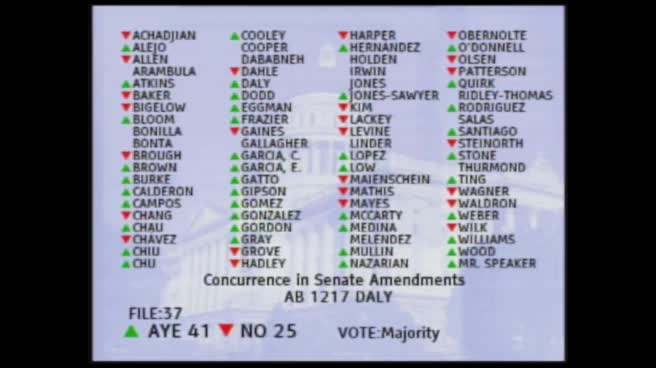
Bill Author

Bill Co-Author(s):