AB 2900: Income taxation: credits: California Competes Tax Credit Committee: GO-Biz.
- Session Year: 2015-2016
- House: Assembly
- Latest Version Date: 2016-09-24
Existing law allows a credit against the taxes imposed under the Corporation Tax Law and the Personal Income Tax Law for each taxable year beginning on or after January 1, 2014, and before January 1, 2025, in an amount as provided in a written agreement between the Governors Office of Business and Economic Development and the taxpayer, agreed upon by the California Competes Tax Credit Committee, and based on specified factors, including the number of jobs the taxpayer will create or retain in the state and the amount of investment in the state by the taxpayer. Existing law limits the aggregate amount of credit that may be allocated in a fiscal year. Existing law requires the Governors Office of Business and Economic Development to post on its Internet Web site specified information, including the name of each taxpayer allocated a credit, the estimated number of jobs created or retained and the amount of investment by the taxpayer, the amount of credit allocated to the taxpayer, and, if applicable, the amount of credit recaptured from the taxpayer.
This bill additionally would require the Governors Office of Business and Economic Development to post on its Internet Web site, the primary location where the taxpayer has committed to increasing the net number of jobs or make investments, information that identifies each tax credit award that was given a priority for being located in an area of high unemployment or poverty, and information that identifies each tax credit award that is being counted toward the amount of the credit required to be allocated to small business, as provided.
Existing law allows a credit against the taxes imposed under the Corporation Tax Law and the Personal Income Tax Law for each taxable year beginning on or after January 1, 2014, and before January 1, 2025, in an amount as provided in a written agreement between the Governors Office of Business and Economic Development and the taxpayer, agreed upon by the California Competes Tax Credit Committee, and based on specified factors, including the number of jobs the taxpayer will create or retain in the state and the amount of investment in the state by the taxpayer. Existing law limits the aggregate amount of credit that may be allocated in a fiscal year. Existing law requires the Governors Office of Business and Economic Development to post on its Internet Web site specified information, including the name of each taxpayer allocated a credit, the estimated number of jobs created or retained and the amount of investment by the taxpayer, the amount of credit allocated to the taxpayer, and, if applicable, the amount of credit recaptured from the taxpayer.
This bill additionally would require the Governors Office of Business and Economic Development to post on its Internet Web site, the primary location where the taxpayer has committed to increasing the net number of jobs or make investments, information that identifies each tax credit award that was given a priority for being located in an area of high unemployment or poverty, and information that identifies each tax credit award that is being counted toward the amount of the credit required to be allocated to small business, as provided.
Existing law, the Small Business Procurement and Contract Act, requires the Director of General Services and other state agencies that enter into contracts for the provision of goods, services, and information technology and for the construction of state facilities to establish goals for the participation of small businesses in these contracts, to provide for small business preference in the award of these contracts, to give special consideration and special assistance to small businesses, and, whenever possible, to make awards to small businesses, as specified.
This bill, for contracts awarded on or after September 1, 2017, and before December 31, 2021, would require an awarding department, as defined, to report to the Legislature by a specified date following any year that state funds are awarded to a federal small business technical assistance center, as defined. The bill would require a federal small business technical assistance center, as a condition of receiving state funds, to report certain information to the awarding department, including, but not limited to, the total number of businesses assisted.
Existing law allows a credit against the taxes imposed under the Corporation Tax Law and the Personal Income Tax Law for each taxable year beginning on or after January 1, 2014, and before January 1, 2025, in an amount as provided in a written agreement between the Governors Office of Business and Economic Development and the taxpayer, agreed upon by the California Competes Tax Credit Committee, and based on specified factors, including the number of jobs the taxpayer will create or retain in the state and the amount of investment in the state by the taxpayer. Existing law limits the aggregate amount of credit that may be allocated in a fiscal year. Existing law requires the Governors Office of Business and Economic Development to post on its Internet Web site specified information, including the name of each taxpayer allocated a credit, the estimated number of jobs created or retained and the amount of investment by the taxpayer, the amount of credit allocated to the taxpayer, and, if applicable, the amount of credit recaptured from the taxpayer.
This bill additionally would require the Governors Office of Business and Economic Development to post on its Internet Web site, the primary location where the taxpayer has committed to increasing the net number of jobs or make investments, information that identifies each tax credit award that was given a priority for being located in an area of high unemployment or poverty, and information that identifies each tax credit award that is being counted toward the amount of the credit required to be allocated to small business, as provided.
Existing law, the Small Business Procurement and Contract Act, requires the Director of General Services and other state agencies that enter into contracts for the provision of goods, services, and information technology and for the construction of state facilities to establish goals for the participation of small businesses in these contracts, to provide for small business preference in the award of these contracts, to give special consideration and special assistance to small businesses, and, whenever possible, to make awards to small businesses, as specified.
This bill, for contracts awarded on or after September 1, 2017, and before December 31, 2021, would require an awarding department, as defined, to report to the Legislature by a specified date following any year that state funds are awarded to a federal small business technical assistance center, as defined. The bill would require a federal small business technical assistance center, as a condition of receiving state funds, to report certain information to the awarding department, including, but not limited to, the total number of businesses assisted.
Existing law allows a credit against the taxes imposed under the Corporation Tax Law and the Personal Income Tax Law for each taxable year beginning on or after January 1, 2014, and before January 1, 2025, in an amount as provided in a written agreement between the Governors Office of Business and Economic Development and the taxpayer, agreed upon by the California Competes Tax Credit Committee, and based on specified factors, including the number of jobs the taxpayer will create or retain in the state and the amount of investment in the state by the taxpayer. Existing law limits the aggregate amount of credit that may be allocated in a fiscal year. Existing law requires the Governors Office of Business and Economic Development to post on its Internet Web site specified information, including the name of each taxpayer allocated a credit, the estimated number of jobs created or retained and the amount of investment by the taxpayer, the amount of credit allocated to the taxpayer, and, if applicable, the amount of credit recaptured from the taxpayer.
This bill additionally would require the Governors Office of Business and Economic Development to post on its Internet Web site, the primary location where the taxpayer has committed to increasing the net number of jobs or make investments, information that identifies each tax credit award that was given a priority for being located in an area of high unemployment or poverty, and information that identifies each tax credit award that is being counted toward the amount of the credit required to be allocated to small business, as provided.
Existing law, the Small Business Procurement and Contract Act, requires the Director of General Services and other state agencies that enter into contracts for the provision of goods, services, and information technology and for the construction of state facilities to establish goals for the participation of small businesses in these contracts, to provide for small business preference in the award of these contracts, to give special consideration and special assistance to small businesses, and, whenever possible, to make awards to small businesses, as specified.
This bill bill, for contracts awarded on or after September 1, 2017, and before December 31, 2021, would require an awarding department, as defined, to report to the Legislature by a specified date following any year that state funds are awarded to a federal small business technical assistance center, as defined. The bill would require a federal small business technical assistance center, as a condition of receiving state funds, to report certain information to the awarding department, including, but not limited to, the total number of businesses assisted.
Existing law, the Small Business Procurement and Contract Act, requires the Director of General Services and other state agencies that enter into contracts for the provision of goods, services, and information technology and for the construction of state facilities to establish goals for the participation of small businesses in these contracts, to provide for small business preference in the award of these contracts, to give special consideration and special assistance to small businesses, and, whenever possible, to make awards to small businesses, as specified.
This bill would require an awarding department, as defined, to report to the Legislature by a specified date following any year that state funds are awarded to a federal small business technical assistance center, as defined. The bill would require a federal small business technical assistance center, as a condition of receiving state funds, to report certain information to the awarding department, including, but not limited to, the number of businesses assisted.
Existing law, the Small Business Procurement and Contract Act, requires the Director of General Services and other state agencies that enter into contracts for the provision of goods, services, and information technology and for the construction of state facilities to establish goals for the participation of small businesses in these contracts, to provide for small business preference in the award of these contracts, to give special consideration and special assistance to small businesses, and, whenever possible, to make awards to small businesses, as specified.
This bill would require an awarding department, as defined, to report to the Legislature by a specified date following any year that state funds are awarded to a federal small business technical assistance center, as defined. The bill would require a federal small business technical assistance center, as a condition of receiving state funds, to report certain information to the awarding department, including, but not limited to, the number of businesses assisted.
(a)(1)For each taxable year beginning on and after January 1, 2014, and before January 1, 2025, there shall be allowed as a credit against the net tax, as defined in Section 17039, an amount as determined by the committee pursuant to paragraph (2) and approved pursuant to Section 18410.2.
(2)The credit under this section shall be allocated by GO-Biz with respect to the 201314 fiscal year through and including the 201718 fiscal year. The amount of credit allocated to a taxpayer with respect to a fiscal year pursuant to this section shall be as set forth in a written agreement between GO-Biz and the taxpayer and shall be based on the following factors:
(A)The number of jobs the taxpayer will create or retain in this state.
(B)The compensation paid or proposed to be paid by the taxpayer to its employees, including wages and fringe benefits.
(C)The amount of investment in this state by the taxpayer.
(D)The extent of unemployment or poverty in the area according to the United States Census in which the taxpayers project or business is proposed or located.
(E)The incentives available to the taxpayer in this state, including incentives from the state, local government, and other entities.
(F)The incentives available to the taxpayer in other states.
(G)The duration of the proposed project and the duration the taxpayer commits to remain in this state.
(H)The overall economic impact in this state of the taxpayers project or business.
(I)The strategic importance of the taxpayers project or business to the state, region, or locality.
(J)The opportunity for future growth and expansion in this state by the taxpayers business.
(K)The extent to which the anticipated benefit to the state exceeds the projected benefit to the taxpayer from the tax credit.
(3)The written agreement entered into pursuant to paragraph (2) shall include:
(A)Terms and conditions that include the taxable year or years for which the credit allocated shall be allowed, a minimum compensation level, and a minimum job retention period.
(B)Provisions indicating whether the credit is to be allocated in full upon approval or in increments based on mutually agreed upon milestones when satisfactorily met by the taxpayer.
(C)Provisions that allow the committee to recapture the credit, in whole or in part, if the taxpayer fails to fulfill the terms and conditions of the written agreement.
(b)For purposes of this section:
(1)Committee means the California Competes Tax Credit Committee established pursuant to Section 18410.2.
(2)GO-Biz means the Governors Office of Business and Economic Development.
(c)For purposes of this section, GO-Biz shall do the following:
(1)Give priority to a taxpayer whose project or business is located or proposed to be located in an area of high unemployment or poverty.
(2)Negotiate with a taxpayer the terms and conditions of proposed written agreements that provide the credit allowed pursuant to this section to a taxpayer.
(3)Provide the negotiated written agreement to the committee for its approval pursuant to Section 18410.2.
(4)Inform the Franchise Tax Board of the terms and conditions of the written agreement upon approval of the written agreement by the committee.
(5)Inform the Franchise Tax Board of any recapture, in whole or in part, of a previously allocated credit upon approval of the recapture by the committee.
(6)Post on its Internet Web site all of the following:
(A)The name of each taxpayer allocated a credit pursuant to this section.
(B)The estimated amount of the investment by each taxpayer.
(C)The estimated number of jobs created or retained.
(D)The amount of the credit allocated to the taxpayer.
(E)The amount of the credit recaptured from the taxpayer, if applicable.
(F)The primary location where the taxpayer has committed to increasing the net number of jobs or make investments. The primary location shall be listed by city or, in the case of unincorporated areas, by county.
(G)Information that identifies each tax credit award that was given a priority for being located in a high unemployment or poverty area, pursuant to paragraph (1).
(H)Information that identifies each tax credit award that is being counted toward the requirement of paragraph (3) of subdivision (g).
(7)When determining whether to enter into a written agreement with a taxpayer pursuant to this section, GO-Biz may consider other factors, including, but not limited to, the following:
(A)The financial solvency of the taxpayer and the taxpayers ability to finance its proposed expansion.
(B)The taxpayers current and prior compliance with federal and state laws.
(C)Current and prior litigation involving the taxpayer.
(D)The reasonableness of the fee arrangement between the taxpayer and any third party providing any services related to the credit allowed pursuant to this section.
(E)Any other factors GO-Biz deems necessary to ensure that the administration of the credit allowed pursuant to this section is a model of accountability and transparency and that the effective use of the limited amount of credit available is maximized.
(d)For purposes of this section, the Franchise Tax Board shall do all of the following:
(1)(A)Except as provided in subparagraph (B), review the books and records of all taxpayers allocated a credit pursuant to this section to ensure compliance with the terms and conditions of the written agreement between the taxpayer and GO-Biz.
(B)In the case of a taxpayer that is a small business, as defined in Section 17053.73, review the books and records of the taxpayer allocated a credit pursuant to this section to ensure compliance with the terms and conditions of the written agreement between the taxpayer and GO-Biz when, in the sole discretion of the Franchise Tax Board, a review of those books and records is appropriate or necessary in the best interests of the state.
(2)Notwithstanding Section 19542:
(A)Notify GO-Biz of a possible breach of the written agreement by a taxpayer and provide detailed information regarding the basis for that determination.
(B)Provide information to GO-Biz with respect to whether a taxpayer is a small business, as defined in Section 17053.73.
(e)In the case where the credit allowed under this section exceeds the net tax, as defined in Section 17039, for a taxable year, the excess credit may be carried over to reduce the net tax in the following taxable year, and succeeding five taxable years, if necessary, until the credit has been exhausted.
(f)Any recapture, in whole or in part, of a credit approved by the committee pursuant to Section 18410.2 shall be treated as a mathematical error appearing on the return. Any amount of tax resulting from that recapture shall be assessed by the Franchise Tax Board in the same manner as provided by Section 19051. The amount of tax resulting from the recapture shall be added to the tax otherwise due by the taxpayer for the taxable year in which the committees recapture determination occurred.
(g)(1)The aggregate amount of credit that may be allocated in any fiscal year pursuant to this section and Section 23689 shall be an amount equal to the sum of subparagraphs (A), (B), and (C), less the amount specified in subparagraphs (D) and (E):
(A)Thirty million dollars ($30,000,000) for the 201314 fiscal year, one hundred fifty million dollars ($150,000,000) for the 201415 fiscal year, and two hundred million dollars ($200,000,000) for each fiscal year from 201516 to 201718, inclusive.
(B)The unallocated credit amount, if any, from the preceding fiscal year.
(C)The amount of any previously allocated credits that have been recaptured.
(D)The amount estimated by the Director of Finance, in consultation with the Franchise Tax Board and the State Board of Equalization, to be necessary to limit the aggregation of the estimated amount of exemptions claimed pursuant to Section 6377.1 and of the amounts estimated to be claimed pursuant to this section and Sections 17053.73, 23626, and 23689 to no more than seven hundred fifty million dollars ($750,000,000) for either the current fiscal year or the next fiscal year.
(i)The Director of Finance shall notify the Chairperson of the Joint Legislative Budget Committee of the estimated annual allocation authorized by this paragraph. Any allocation pursuant to these provisions shall be made no sooner than 30 days after written notification has been provided to the Chairperson of the Joint Legislative Budget Committee and the chairpersons of the committees of each house of the Legislature that consider appropriations, or not sooner than whatever lesser time the Chairperson of the Joint Legislative Budget Committee, or his or her designee, may determine.
(ii)In no event shall the amount estimated in this subparagraph be less than zero dollars ($0).
(E)(i)For the 201516 fiscal year and each fiscal year thereafter, the amount of credit estimated by the Director of Finance to be allowed to all qualified taxpayers for that fiscal year pursuant to subparagraph (A) or subparagraph (B) of paragraph (1) of subdivision (c) of Section 23636.
(ii)If the amount available per fiscal year pursuant to this section and Section 23689 is less than the aggregate amount of credit estimated by the Director of Finance to be allowed to qualified taxpayers pursuant to subparagraph (A) or subparagraph (B) of paragraph (1) of subdivision (c) of Section 23636, the aggregate amount allowed pursuant to Section 23636 shall not be reduced and, in addition to the reduction required by clause (i), the aggregate amount of credit that may be allocated pursuant to this section and Section 23689 for the next fiscal year shall be reduced by the amount of that deficit.
(iii)It is the intent of the Legislature that the reductions specified in this subparagraph of the aggregate amount of credit that may be allocated pursuant to this section and Section 23689 shall continue if the repeal dates of the credits allowed by this section and Section 23689 are removed or extended.
(2)(A)In addition to the other amounts determined pursuant to paragraph (1), the Director of Finance may increase the aggregate amount of credit that may be allocated pursuant to this section and Section 23689 by up to twenty-five million dollars ($25,000,000) per fiscal year through the 201718 fiscal year. The amount of any increase made pursuant to this paragraph, when combined with any increase made pursuant to paragraph (2) of subdivision (g) of Section 23689, shall not exceed twenty-five million dollars ($25,000,000) per fiscal year through the 201718 fiscal year.
(B)It is the intent of the Legislature that the Director of Finance increase the aggregate amount under subparagraph (A) in order to mitigate the reduction of the amount available due to the credit allowed to all qualified taxpayers pursuant to subparagraph (A) or (B) of paragraph (1) of subdivision (c) of Section 23636.
(3)Each fiscal year, 25 percent of the aggregate amount of the credit that may be allocated pursuant to this section and Section 23689 shall be reserved for small business, as defined in Section 17053.73 or 23626.
(4)Each fiscal year, no more than 20 percent of the aggregate amount of the credit that may be allocated pursuant to this section shall be allocated to any one taxpayer.
(h)GO-Biz may prescribe rules and regulations as necessary to carry out the purposes of this section. Any rule or regulation prescribed pursuant to this section may be by adoption of an emergency regulation in accordance with Chapter 3.5 (commencing with Section 11340) of Part 1 of Division 3 of Title 2 of the Government Code.
(i)A written agreement between GO-Biz and a taxpayer with respect to the credit authorized by this section shall comply with existing law on the date the agreement is executed.
(j)(1)Upon the effective date of this section, the Department of Finance shall estimate the total dollar amount of credits that will be claimed under this section with respect to each fiscal year from the 201314 fiscal year to the 202425 fiscal year, inclusive.
(2)The Franchise Tax Board shall annually provide to the Joint Legislative Budget Committee, by no later than March 1, a report of the total dollar amount of the credits claimed under this section with respect to the relevant fiscal year. The report shall compare the total dollar amount of credits claimed under this section with respect to that fiscal year with the departments estimate with respect to that same fiscal year. If the total dollar amount of credits claimed for the fiscal year is less than the estimate for that fiscal year, the report shall identify options for increasing annual claims of the credit so as to meet estimated amounts.
(k)This section is repealed on December 1, 2025.
SEC. 2.Section 23689 of the Revenue and Taxation Code is amended to read:23689.(a)(1)For each taxable year beginning on and after January 1, 2014, and before January 1, 2025, there shall be allowed as a credit against the tax, as defined in Section 23036, an amount as determined by the committee pursuant to paragraph (2) and approved pursuant to Section 18410.2.
(2)The credit under this section shall be allocated by GO-Biz with respect to the 201314 fiscal year through and including the 201718 fiscal year. The amount of credit allocated to a taxpayer with respect to a fiscal year pursuant to this section shall be as set forth in a written agreement between GO-Biz and the taxpayer and shall be based on the following factors:
(A)The number of jobs the taxpayer will create or retain in this state.
(B)The compensation paid or proposed to be paid by the taxpayer to its employees, including wages and fringe benefits.
(C)The amount of investment in this state by the taxpayer.
(D)The extent of unemployment or poverty in the area according to the United States Census in which the taxpayers project or business is proposed or located.
(E)The incentives available to the taxpayer in this state, including incentives from the state, local government, and other entities.
(F)The incentives available to the taxpayer in other states.
(G)The duration of the proposed project and the duration the taxpayer commits to remain in this state.
(H)The overall economic impact in this state of the taxpayers project or business.
(I)The strategic importance of the taxpayers project or business to the state, region, or locality.
(J)The opportunity for future growth and expansion in this state by the taxpayers business.
(K)The extent to which the anticipated benefit to the state exceeds the projected benefit to the taxpayer from the tax credit.
(3)The written agreement entered into pursuant to paragraph (2) shall include:
(A)Terms and conditions that include the taxable year or years for which the credit allocated shall be allowed, a minimum compensation level, and a minimum job retention period.
(B)Provisions indicating whether the credit is to be allocated in full upon approval or in increments based on mutually agreed upon milestones when satisfactorily met by the taxpayer.
(C)Provisions that allow the committee to recapture the credit, in whole or in part, if the taxpayer fails to fulfill the terms and conditions of the written agreement.
(b)For purposes of this section:
(1)Committee means the California Competes Tax Credit Committee established pursuant to Section 18410.2.
(2)GO-Biz means the Governors Office of Business and Economic Development.
(c)For purposes of this section, GO-Biz shall do the following:
(1)Give priority to a taxpayer whose project or business is located or proposed to be located in an area of high unemployment or poverty.
(2)Negotiate with a taxpayer the terms and conditions of proposed written agreements that provide the credit allowed pursuant to this section to a taxpayer.
(3)Provide the negotiated written agreement to the committee for its approval pursuant to Section 18410.2.
(4)Inform the Franchise Tax Board of the terms and conditions of the written agreement upon approval of the written agreement by the committee.
(5)Inform the Franchise Tax Board of any recapture, in whole or in part, of a previously allocated credit upon approval of the recapture by the committee.
(6)Post on its Internet Web site all of the following:
(A)The name of each taxpayer allocated a credit pursuant to this section.
(B)The estimated amount of the investment by each taxpayer.
(C)The estimated number of jobs created or retained.
(D)The amount of the credit allocated to the taxpayer.
(E)The amount of the credit recaptured from the taxpayer, if applicable.
(F)The primary location where the taxpayer has committed to increasing the net number of jobs or make investments. The primary location shall be listed by city or, in the case of unincorporated areas, by county.
(G)Information that identifies each tax credit award that was given a priority for being located in a high unemployment or poverty area, pursuant to paragraph (1).
(H)Information that identifies each tax credit award that is being counted toward the requirement of paragraph (3) of subdivision (g).
(7)When determining whether to enter into a written agreement with a taxpayer pursuant to this section, GO-Biz may consider other factors, including, but not limited to, the following:
(A)The financial solvency of the taxpayer and the taxpayers ability to finance its proposed expansion.
(B)The taxpayers current and prior compliance with federal and state laws.
(C)Current and prior litigation involving the taxpayer.
(D)The reasonableness of the fee arrangement between the taxpayer and any third party providing any services related to the credit allowed pursuant to this section.
(E)Any other factors GO-Biz deems necessary to ensure that the administration of the credit allowed pursuant to this section is a model of accountability and transparency and that the effective use of the limited amount of credit available is maximized.
(d)For purposes of this section, the Franchise Tax Board shall do all of the following:
(1)(A)Except as provided in subparagraph (B), review the books and records of all taxpayers allocated a credit pursuant to this section to ensure compliance with the terms and conditions of the written agreement between the taxpayer and GO-Biz.
(B)In the case of a taxpayer that is a small business, as defined in Section 23626, review the books and records of the taxpayer allocated a credit pursuant to this section to ensure compliance with the terms and conditions of the written agreement between the taxpayer and GO-Biz when, in the sole discretion of the Franchise Tax Board, a review of those books and records is appropriate or necessary in the best interests of the state.
(2)Notwithstanding Section 19542:
(A)Notify GO-Biz of a possible breach of the written agreement by a taxpayer and provide detailed information regarding the basis for that determination.
(B)Provide information to GO-Biz with respect to whether a taxpayer is a small business, as defined in Section 23626.
(e)In the case where the credit allowed under this section exceeds the tax, as defined in Section 23036, for a taxable year, the excess credit may be carried over to reduce the tax in the following taxable year, and succeeding five taxable years, if necessary, until the credit has been exhausted.
(f)Any recapture, in whole or in part, of a credit approved by the committee pursuant to Section 18410.2 shall be treated as a mathematical error appearing on the return. Any amount of tax resulting from that recapture shall be assessed by the Franchise Tax Board in the same manner as provided by Section 19051. The amount of tax resulting from the recapture shall be added to the tax otherwise due by the taxpayer for the taxable year in which the committees recapture determination occurred.
(g)(1)The aggregate amount of credit that may be allocated in any fiscal year pursuant to this section and Section 17059.2 shall be an amount equal to the sum of subparagraphs (A), (B), and (C), less the amount specified in subparagraphs (D) and (E):
(A)Thirty million dollars ($30,000,000) for the 201314 fiscal year, one hundred fifty million dollars ($150,000,000) for the 201415 fiscal year, and two hundred million dollars ($200,000,000) for each fiscal year from 201516 to 201718, inclusive.
(B)The unallocated credit amount, if any, from the preceding fiscal year.
(C)The amount of any previously allocated credits that have been recaptured.
(D)The amount estimated by the Director of Finance, in consultation with the Franchise Tax Board and the State Board of Equalization, to be necessary to limit the aggregation of the estimated amount of exemptions claimed pursuant to Section 6377.1 and of the amounts estimated to be claimed pursuant to this section and Sections 17053.73, 17059.2, and 23626 to no more than seven hundred fifty million dollars ($750,000,000) for either the current fiscal year or the next fiscal year.
(i)The Director of Finance shall notify the Chairperson of the Joint Legislative Budget Committee of the estimated annual allocation authorized by this paragraph. Any allocation pursuant to these provisions shall be made no sooner than 30 days after written notification has been provided to the Chairperson of the Joint Legislative Budget Committee and the chairpersons of the committees of each house of the Legislature that consider appropriations, or not sooner than whatever lesser time the Chairperson of the Joint Legislative Budget Committee, or his or her designee, may determine.
(ii)In no event shall the amount estimated in this subparagraph be less than zero dollars ($0).
(E)(i)For the 201516 fiscal year and each fiscal year thereafter, the amount of credit estimated by the Director of Finance to be allowed to all qualified taxpayers for that fiscal year pursuant to subparagraph (A) or subparagraph (B) of paragraph (1) of subdivision (c) of Section 23636.
(ii)If the amount available per fiscal year pursuant to this section and Section 17059.2 is less than the aggregate amount of credit estimated by the Director of Finance to be allowed to qualified taxpayers pursuant to subparagraph (A) or subparagraph (B) of paragraph (1) of subdivision (c) of Section 23636, the aggregate amount allowed pursuant to Section 23636 shall not be reduced and, in addition to the reduction required by clause (i), the aggregate amount of credit that may be allocated pursuant to this section and Section 17059.2 for the next fiscal year shall be reduced by the amount of that deficit.
(iii)It is the intent of the Legislature that the reductions specified in this subparagraph of the aggregate amount of credit that may be allocated pursuant to this section and Section 17059.2 shall continue if the repeal dates of the credits allowed by this section and Section 17059.2 are removed or extended.
(2)(A)In addition to the other amounts determined pursuant to paragraph (1), the Director of Finance may increase the aggregate amount of credit that may be allocated pursuant to this section and Section 17059.2 by up to twenty-five million dollars ($25,000,000) per fiscal year through the 201718 fiscal year. The amount of any increase made pursuant to this paragraph, when combined with any increase made pursuant to paragraph (2) of subdivision (g) of Section 17059.2, shall not exceed twenty-five million dollars ($25,000,000) per fiscal year through the 201718 fiscal year.
(B)It is the intent of the Legislature that the Director of Finance increase the aggregate amount under subparagraph (A) in order to mitigate the reduction of the amount available due to the credit allowed to all qualified taxpayers pursuant to subparagraph (A) or (B) of paragraph (1) of subdivision (c) of Section 23636.
(3)Each fiscal year, 25 percent of the aggregate amount of the credit that may be allocated pursuant to this section and Section 17059.2 shall be reserved for small business, as defined in Section 17053.73 or 23626.
(4)Each fiscal year, no more than 20 percent of the aggregate amount of the credit that may be allocated pursuant to this section shall be allocated to any one taxpayer.
(h)GO-Biz may prescribe rules and regulations as necessary to carry out the purposes of this section. Any rule or regulation prescribed pursuant to this section may be by adoption of an emergency regulation in accordance with Chapter 3.5 (commencing with Section 11340) of Part 1 of Division 3 of Title 2 of the Government Code.
(i)(1)A written agreement between GO-Biz and a taxpayer with respect to the credit authorized by this section shall not restrict, broaden, or otherwise alter the ability of the taxpayer to assign that credit or any portion thereof in accordance with Section 23663.
(2)A written agreement between GO-Biz and a taxpayer with respect to the credit authorized by this section must comply with existing law on the date the agreement is executed.
(j)(1)Upon the effective date of this section, the Department of Finance shall estimate the total dollar amount of credits that will be claimed under this section with respect to each fiscal year from the 201314 fiscal year to the 202425 fiscal year, inclusive.
(2)The Franchise Tax Board shall annually provide to the Joint Legislative Budget Committee, by no later than March 1, a report of the total dollar amount of the credits claimed under this section with respect to the relevant fiscal year. The report shall compare the total dollar amount of credits claimed under this section with respect to that fiscal year with the departments estimate with respect to that same fiscal year. If the total dollar amount of credits claimed for the fiscal year is less than the estimate for that fiscal year, the report shall identify options for increasing annual claims of the credit so as to meet estimated amounts.
(k)This section is repealed on December 1, 2025.
(a)(1)For each taxable year beginning on and after January 1, 2014, and before January 1, 2025, there shall be allowed as a credit against the net tax, as defined in Section 17039, an amount as determined by the committee pursuant to paragraph (2) and approved pursuant to Section 18410.2.
(2)The credit under this section shall be allocated by GO-Biz with respect to the 201314 fiscal year through and including the 201718 fiscal year. The amount of credit allocated to a taxpayer with respect to a fiscal year pursuant to this section shall be as set forth in a written agreement between GO-Biz and the taxpayer and shall be based on the following factors:
(A)The number of jobs the taxpayer will create or retain in this state.
(B)The compensation paid or proposed to be paid by the taxpayer to its employees, including wages and fringe benefits.
(C)The amount of investment in this state by the taxpayer.
(D)The extent of unemployment or poverty in the area according to the United States Census in which the taxpayers project or business is proposed or located.
(E)The incentives available to the taxpayer in this state, including incentives from the state, local government, and other entities.
(F)The incentives available to the taxpayer in other states.
(G)The duration of the proposed project and the duration the taxpayer commits to remain in this state.
(H)The overall economic impact in this state of the taxpayers project or business.
(I)The strategic importance of the taxpayers project or business to the state, region, or locality.
(J)The opportunity for future growth and expansion in this state by the taxpayers business.
(K)The extent to which the anticipated benefit to the state exceeds the projected benefit to the taxpayer from the tax credit.
(3)The written agreement entered into pursuant to paragraph (2) shall include:
(A)Terms and conditions that include the taxable year or years for which the credit allocated shall be allowed, a minimum compensation level, and a minimum job retention period.
(B)Provisions indicating whether the credit is to be allocated in full upon approval or in increments based on mutually agreed upon milestones when satisfactorily met by the taxpayer.
(C)Provisions that allow the committee to recapture the credit, in whole or in part, if the taxpayer fails to fulfill the terms and conditions of the written agreement.
(b)For purposes of this section:
(1)Committee means the California Competes Tax Credit Committee established pursuant to Section 18410.2.
(2)GO-Biz means the Governors Office of Business and Economic Development.
(c)For purposes of this section, GO-Biz shall do the following:
(1)Give priority to a taxpayer whose project or business is located or proposed to be located in an area of high unemployment or poverty.
(2)Negotiate with a taxpayer the terms and conditions of proposed written agreements that provide the credit allowed pursuant to this section to a taxpayer.
(3)Provide the negotiated written agreement to the committee for its approval pursuant to Section 18410.2.
(4)Inform the Franchise Tax Board of the terms and conditions of the written agreement upon approval of the written agreement by the committee.
(5)Inform the Franchise Tax Board of any recapture, in whole or in part, of a previously allocated credit upon approval of the recapture by the committee.
(6)Post on its Internet Web site all of the following:
(A)The name of each taxpayer allocated a credit pursuant to this section.
(B)The estimated amount of the investment by each taxpayer.
(C)The estimated number of jobs created or retained.
(D)The amount of the credit allocated to the taxpayer.
(E)The amount of the credit recaptured from the taxpayer, if applicable.
(F)The primary location where the taxpayer has committed to increasing the net number of jobs or make investments. The primary location shall be listed by city or, in the case of unincorporated areas, by county.
(G)Information that identifies each tax credit award that was given a priority for being located in a high unemployment or poverty area, pursuant to paragraph (1).
(H)Information that identifies each tax credit award that is being counted toward the requirement of paragraph (3) of subdivision (g).
(7)When determining whether to enter into a written agreement with a taxpayer pursuant to this section, GO-Biz may consider other factors, including, but not limited to, the following:
(A)The financial solvency of the taxpayer and the taxpayers ability to finance its proposed expansion.
(B)The taxpayers current and prior compliance with federal and state laws.
(C)Current and prior litigation involving the taxpayer.
(D)The reasonableness of the fee arrangement between the taxpayer and any third party providing any services related to the credit allowed pursuant to this section.
(E)Any other factors GO-Biz deems necessary to ensure that the administration of the credit allowed pursuant to this section is a model of accountability and transparency and that the effective use of the limited amount of credit available is maximized.
(d)For purposes of this section, the Franchise Tax Board shall do all of the following:
(1)(A)Except as provided in subparagraph (B), review the books and records of all taxpayers allocated a credit pursuant to this section to ensure compliance with the terms and conditions of the written agreement between the taxpayer and GO-Biz.
(B)In the case of a taxpayer that is a small business, as defined in Section 17053.73, review the books and records of the taxpayer allocated a credit pursuant to this section to ensure compliance with the terms and conditions of the written agreement between the taxpayer and GO-Biz when, in the sole discretion of the Franchise Tax Board, a review of those books and records is appropriate or necessary in the best interests of the state.
(2)Notwithstanding Section 19542:
(A)Notify GO-Biz of a possible breach of the written agreement by a taxpayer and provide detailed information regarding the basis for that determination.
(B)Provide information to GO-Biz with respect to whether a taxpayer is a small business, as defined in Section 17053.73.
(e)In the case where the credit allowed under this section exceeds the net tax, as defined in Section 17039, for a taxable year, the excess credit may be carried over to reduce the net tax in the following taxable year, and succeeding five taxable years, if necessary, until the credit has been exhausted.
(f)Any recapture, in whole or in part, of a credit approved by the committee pursuant to Section 18410.2 shall be treated as a mathematical error appearing on the return. Any amount of tax resulting from that recapture shall be assessed by the Franchise Tax Board in the same manner as provided by Section 19051. The amount of tax resulting from the recapture shall be added to the tax otherwise due by the taxpayer for the taxable year in which the committees recapture determination occurred.
(g)(1)The aggregate amount of credit that may be allocated in any fiscal year pursuant to this section and Section 23689 shall be an amount equal to the sum of subparagraphs (A), (B), and (C), less the amount specified in subparagraphs (D) and (E):
(A)Thirty million dollars ($30,000,000) for the 201314 fiscal year, one hundred fifty million dollars ($150,000,000) for the 201415 fiscal year, and two hundred million dollars ($200,000,000) for each fiscal year from 201516 to 201718, inclusive.
(B)The unallocated credit amount, if any, from the preceding fiscal year.
(C)The amount of any previously allocated credits that have been recaptured.
(D)The amount estimated by the Director of Finance, in consultation with the Franchise Tax Board and the State Board of Equalization, to be necessary to limit the aggregation of the estimated amount of exemptions claimed pursuant to Section 6377.1 and of the amounts estimated to be claimed pursuant to this section and Sections 17053.73, 23626, and 23689 to no more than seven hundred fifty million dollars ($750,000,000) for either the current fiscal year or the next fiscal year.
(i)The Director of Finance shall notify the Chairperson of the Joint Legislative Budget Committee of the estimated annual allocation authorized by this paragraph. Any allocation pursuant to these provisions shall be made no sooner than 30 days after written notification has been provided to the Chairperson of the Joint Legislative Budget Committee and the chairpersons of the committees of each house of the Legislature that consider appropriations, or not sooner than whatever lesser time the Chairperson of the Joint Legislative Budget Committee, or his or her designee, may determine.
(ii)In no event shall the amount estimated in this subparagraph be less than zero dollars ($0).
(E)(i)For the 201516 fiscal year and each fiscal year thereafter, the amount of credit estimated by the Director of Finance to be allowed to all qualified taxpayers for that fiscal year pursuant to subparagraph (A) or subparagraph (B) of paragraph (1) of subdivision (c) of Section 23636.
(ii)If the amount available per fiscal year pursuant to this section and Section 23689 is less than the aggregate amount of credit estimated by the Director of Finance to be allowed to qualified taxpayers pursuant to subparagraph (A) or subparagraph (B) of paragraph (1) of subdivision (c) of Section 23636, the aggregate amount allowed pursuant to Section 23636 shall not be reduced and, in addition to the reduction required by clause (i), the aggregate amount of credit that may be allocated pursuant to this section and Section 23689 for the next fiscal year shall be reduced by the amount of that deficit.
(iii)It is the intent of the Legislature that the reductions specified in this subparagraph of the aggregate amount of credit that may be allocated pursuant to this section and Section 23689 shall continue if the repeal dates of the credits allowed by this section and Section 23689 are removed or extended.
(2)(A)In addition to the other amounts determined pursuant to paragraph (1), the Director of Finance may increase the aggregate amount of credit that may be allocated pursuant to this section and Section 23689 by up to twenty-five million dollars ($25,000,000) per fiscal year through the 201718 fiscal year. The amount of any increase made pursuant to this paragraph, when combined with any increase made pursuant to paragraph (2) of subdivision (g) of Section 23689, shall not exceed twenty-five million dollars ($25,000,000) per fiscal year through the 201718 fiscal year.
(B)It is the intent of the Legislature that the Director of Finance increase the aggregate amount under subparagraph (A) in order to mitigate the reduction of the amount available due to the credit allowed to all qualified taxpayers pursuant to subparagraph (A) or (B) of paragraph (1) of subdivision (c) of Section 23636.
(3)Each fiscal year, 25 percent of the aggregate amount of the credit that may be allocated pursuant to this section and Section 23689 shall be reserved for small business, as defined in Section 17053.73 or 23626.
(4)Each fiscal year, no more than 20 percent of the aggregate amount of the credit that may be allocated pursuant to this section shall be allocated to any one taxpayer.
(h)GO-Biz may prescribe rules and regulations as necessary to carry out the purposes of this section. Any rule or regulation prescribed pursuant to this section may be by adoption of an emergency regulation in accordance with Chapter 3.5 (commencing with Section 11340) of Part 1 of Division 3 of Title 2 of the Government Code.
(i)A written agreement between GO-Biz and a taxpayer with respect to the credit authorized by this section shall comply with existing law on the date the agreement is executed.
(j)(1)Upon the effective date of this section, the Department of Finance shall estimate the total dollar amount of credits that will be claimed under this section with respect to each fiscal year from the 201314 fiscal year to the 202425 fiscal year, inclusive.
(2)The Franchise Tax Board shall annually provide to the Joint Legislative Budget Committee, by no later than March 1, a report of the total dollar amount of the credits claimed under this section with respect to the relevant fiscal year. The report shall compare the total dollar amount of credits claimed under this section with respect to that fiscal year with the departments estimate with respect to that same fiscal year. If the total dollar amount of credits claimed for the fiscal year is less than the estimate for that fiscal year, the report shall identify options for increasing annual claims of the credit so as to meet estimated amounts.
(k)This section is repealed on December 1, 2025.
SEC. 2.Section 23689 of the Revenue and Taxation Code is amended to read:23689.(a)(1)For each taxable year beginning on and after January 1, 2014, and before January 1, 2025, there shall be allowed as a credit against the tax, as defined in Section 23036, an amount as determined by the committee pursuant to paragraph (2) and approved pursuant to Section 18410.2.
(2)The credit under this section shall be allocated by GO-Biz with respect to the 201314 fiscal year through and including the 201718 fiscal year. The amount of credit allocated to a taxpayer with respect to a fiscal year pursuant to this section shall be as set forth in a written agreement between GO-Biz and the taxpayer and shall be based on the following factors:
(A)The number of jobs the taxpayer will create or retain in this state.
(B)The compensation paid or proposed to be paid by the taxpayer to its employees, including wages and fringe benefits.
(C)The amount of investment in this state by the taxpayer.
(D)The extent of unemployment or poverty in the area according to the United States Census in which the taxpayers project or business is proposed or located.
(E)The incentives available to the taxpayer in this state, including incentives from the state, local government, and other entities.
(F)The incentives available to the taxpayer in other states.
(G)The duration of the proposed project and the duration the taxpayer commits to remain in this state.
(H)The overall economic impact in this state of the taxpayers project or business.
(I)The strategic importance of the taxpayers project or business to the state, region, or locality.
(J)The opportunity for future growth and expansion in this state by the taxpayers business.
(K)The extent to which the anticipated benefit to the state exceeds the projected benefit to the taxpayer from the tax credit.
(3)The written agreement entered into pursuant to paragraph (2) shall include:
(A)Terms and conditions that include the taxable year or years for which the credit allocated shall be allowed, a minimum compensation level, and a minimum job retention period.
(B)Provisions indicating whether the credit is to be allocated in full upon approval or in increments based on mutually agreed upon milestones when satisfactorily met by the taxpayer.
(C)Provisions that allow the committee to recapture the credit, in whole or in part, if the taxpayer fails to fulfill the terms and conditions of the written agreement.
(b)For purposes of this section:
(1)Committee means the California Competes Tax Credit Committee established pursuant to Section 18410.2.
(2)GO-Biz means the Governors Office of Business and Economic Development.
(c)For purposes of this section, GO-Biz shall do the following:
(1)Give priority to a taxpayer whose project or business is located or proposed to be located in an area of high unemployment or poverty.
(2)Negotiate with a taxpayer the terms and conditions of proposed written agreements that provide the credit allowed pursuant to this section to a taxpayer.
(3)Provide the negotiated written agreement to the committee for its approval pursuant to Section 18410.2.
(4)Inform the Franchise Tax Board of the terms and conditions of the written agreement upon approval of the written agreement by the committee.
(5)Inform the Franchise Tax Board of any recapture, in whole or in part, of a previously allocated credit upon approval of the recapture by the committee.
(6)Post on its Internet Web site all of the following:
(A)The name of each taxpayer allocated a credit pursuant to this section.
(B)The estimated amount of the investment by each taxpayer.
(C)The estimated number of jobs created or retained.
(D)The amount of the credit allocated to the taxpayer.
(E)The amount of the credit recaptured from the taxpayer, if applicable.
(F)The primary location where the taxpayer has committed to increasing the net number of jobs or make investments. The primary location shall be listed by city or, in the case of unincorporated areas, by county.
(G)Information that identifies each tax credit award that was given a priority for being located in a high unemployment or poverty area, pursuant to paragraph (1).
(H)Information that identifies each tax credit award that is being counted toward the requirement of paragraph (3) of subdivision (g).
(7)When determining whether to enter into a written agreement with a taxpayer pursuant to this section, GO-Biz may consider other factors, including, but not limited to, the following:
(A)The financial solvency of the taxpayer and the taxpayers ability to finance its proposed expansion.
(B)The taxpayers current and prior compliance with federal and state laws.
(C)Current and prior litigation involving the taxpayer.
(D)The reasonableness of the fee arrangement between the taxpayer and any third party providing any services related to the credit allowed pursuant to this section.
(E)Any other factors GO-Biz deems necessary to ensure that the administration of the credit allowed pursuant to this section is a model of accountability and transparency and that the effective use of the limited amount of credit available is maximized.
(d)For purposes of this section, the Franchise Tax Board shall do all of the following:
(1)(A)Except as provided in subparagraph (B), review the books and records of all taxpayers allocated a credit pursuant to this section to ensure compliance with the terms and conditions of the written agreement between the taxpayer and GO-Biz.
(B)In the case of a taxpayer that is a small business, as defined in Section 23626, review the books and records of the taxpayer allocated a credit pursuant to this section to ensure compliance with the terms and conditions of the written agreement between the taxpayer and GO-Biz when, in the sole discretion of the Franchise Tax Board, a review of those books and records is appropriate or necessary in the best interests of the state.
(2)Notwithstanding Section 19542:
(A)Notify GO-Biz of a possible breach of the written agreement by a taxpayer and provide detailed information regarding the basis for that determination.
(B)Provide information to GO-Biz with respect to whether a taxpayer is a small business, as defined in Section 23626.
(e)In the case where the credit allowed under this section exceeds the tax, as defined in Section 23036, for a taxable year, the excess credit may be carried over to reduce the tax in the following taxable year, and succeeding five taxable years, if necessary, until the credit has been exhausted.
(f)Any recapture, in whole or in part, of a credit approved by the committee pursuant to Section 18410.2 shall be treated as a mathematical error appearing on the return. Any amount of tax resulting from that recapture shall be assessed by the Franchise Tax Board in the same manner as provided by Section 19051. The amount of tax resulting from the recapture shall be added to the tax otherwise due by the taxpayer for the taxable year in which the committees recapture determination occurred.
(g)(1)The aggregate amount of credit that may be allocated in any fiscal year pursuant to this section and Section 17059.2 shall be an amount equal to the sum of subparagraphs (A), (B), and (C), less the amount specified in subparagraphs (D) and (E):
(A)Thirty million dollars ($30,000,000) for the 201314 fiscal year, one hundred fifty million dollars ($150,000,000) for the 201415 fiscal year, and two hundred million dollars ($200,000,000) for each fiscal year from 201516 to 201718, inclusive.
(B)The unallocated credit amount, if any, from the preceding fiscal year.
(C)The amount of any previously allocated credits that have been recaptured.
(D)The amount estimated by the Director of Finance, in consultation with the Franchise Tax Board and the State Board of Equalization, to be necessary to limit the aggregation of the estimated amount of exemptions claimed pursuant to Section 6377.1 and of the amounts estimated to be claimed pursuant to this section and Sections 17053.73, 17059.2, and 23626 to no more than seven hundred fifty million dollars ($750,000,000) for either the current fiscal year or the next fiscal year.
(i)The Director of Finance shall notify the Chairperson of the Joint Legislative Budget Committee of the estimated annual allocation authorized by this paragraph. Any allocation pursuant to these provisions shall be made no sooner than 30 days after written notification has been provided to the Chairperson of the Joint Legislative Budget Committee and the chairpersons of the committees of each house of the Legislature that consider appropriations, or not sooner than whatever lesser time the Chairperson of the Joint Legislative Budget Committee, or his or her designee, may determine.
(ii)In no event shall the amount estimated in this subparagraph be less than zero dollars ($0).
(E)(i)For the 201516 fiscal year and each fiscal year thereafter, the amount of credit estimated by the Director of Finance to be allowed to all qualified taxpayers for that fiscal year pursuant to subparagraph (A) or subparagraph (B) of paragraph (1) of subdivision (c) of Section 23636.
(ii)If the amount available per fiscal year pursuant to this section and Section 17059.2 is less than the aggregate amount of credit estimated by the Director of Finance to be allowed to qualified taxpayers pursuant to subparagraph (A) or subparagraph (B) of paragraph (1) of subdivision (c) of Section 23636, the aggregate amount allowed pursuant to Section 23636 shall not be reduced and, in addition to the reduction required by clause (i), the aggregate amount of credit that may be allocated pursuant to this section and Section 17059.2 for the next fiscal year shall be reduced by the amount of that deficit.
(iii)It is the intent of the Legislature that the reductions specified in this subparagraph of the aggregate amount of credit that may be allocated pursuant to this section and Section 17059.2 shall continue if the repeal dates of the credits allowed by this section and Section 17059.2 are removed or extended.
(2)(A)In addition to the other amounts determined pursuant to paragraph (1), the Director of Finance may increase the aggregate amount of credit that may be allocated pursuant to this section and Section 17059.2 by up to twenty-five million dollars ($25,000,000) per fiscal year through the 201718 fiscal year. The amount of any increase made pursuant to this paragraph, when combined with any increase made pursuant to paragraph (2) of subdivision (g) of Section 17059.2, shall not exceed twenty-five million dollars ($25,000,000) per fiscal year through the 201718 fiscal year.
(B)It is the intent of the Legislature that the Director of Finance increase the aggregate amount under subparagraph (A) in order to mitigate the reduction of the amount available due to the credit allowed to all qualified taxpayers pursuant to subparagraph (A) or (B) of paragraph (1) of subdivision (c) of Section 23636.
(3)Each fiscal year, 25 percent of the aggregate amount of the credit that may be allocated pursuant to this section and Section 17059.2 shall be reserved for small business, as defined in Section 17053.73 or 23626.
(4)Each fiscal year, no more than 20 percent of the aggregate amount of the credit that may be allocated pursuant to this section shall be allocated to any one taxpayer.
(h)GO-Biz may prescribe rules and regulations as necessary to carry out the purposes of this section. Any rule or regulation prescribed pursuant to this section may be by adoption of an emergency regulation in accordance with Chapter 3.5 (commencing with Section 11340) of Part 1 of Division 3 of Title 2 of the Government Code.
(i)(1)A written agreement between GO-Biz and a taxpayer with respect to the credit authorized by this section shall not restrict, broaden, or otherwise alter the ability of the taxpayer to assign that credit or any portion thereof in accordance with Section 23663.
(2)A written agreement between GO-Biz and a taxpayer with respect to the credit authorized by this section must comply with existing law on the date the agreement is executed.
(j)(1)Upon the effective date of this section, the Department of Finance shall estimate the total dollar amount of credits that will be claimed under this section with respect to each fiscal year from the 201314 fiscal year to the 202425 fiscal year, inclusive.
(2)The Franchise Tax Board shall annually provide to the Joint Legislative Budget Committee, by no later than March 1, a report of the total dollar amount of the credits claimed under this section with respect to the relevant fiscal year. The report shall compare the total dollar amount of credits claimed under this section with respect to that fiscal year with the departments estimate with respect to that same fiscal year. If the total dollar amount of credits claimed for the fiscal year is less than the estimate for that fiscal year, the report shall identify options for increasing annual claims of the credit so as to meet estimated amounts.
(k)This section is repealed on December 1, 2025.
(a)Following any year that state funds are awarded by an awarding department to a federal small business technical assistance center, the awarding department shall provide a report to the Legislature that includes, at a minimum:
(1)The purpose of the contract and contract metrics.
(2)The amount of state funds awarded and expended during the report year.
(3)The information required by subdivision (c).
(b)The information in the report to the Legislature described in paragraph (3) of subdivision (a) shall be based on information provided by the federal small business development center pursuant to subdivision (c).
(c)As a condition of being awarded state funds, a federal small business technical assistance center shall report to the awarding department all of the following:
(1)The total number of businesses assisted.
(2)The number of businesses assisted by industry sector, as reported by the businesses.
(3)The number of businesses assisted by city and county. If the population of the county is less than 250,000, only the name of the county is required to be reported.
(4)The number of businesses assisted based on the following categories: no employees, five or fewer employees, 25 or fewer employees, 100 or fewer employees, and between 101 and 500 employees, as reported by the businesses.
(5)If job creation is one of the purposes of the program, the total number of jobs created and the total number of jobs retained, as reported by the business.
(d)For the purposes of this section, the following terms shall have the following meanings:
(1)An awarding department means a department, board, agency, or authority of the state, or an officer, agent, or other authorized representative of such a state entity awarding a contract for services, including technical assistance to small businesses.
(2)A federal small business technical assistance center means a Small Business Development Center, a Womens Business Center, a Veteran Business Outreach Center, or a Procurement Technical Assistance Center operating in California under a federal contract.
(3)A Procurement Technical Assistance Center means the entity and individual, physical location, recognized by the United States Department of Defense where a small business owner can receive free training on a variety of state and federal procurement issues, that is operated by the Department of Defense pursuant to Chapter 142 (commencing with Section 2411) of Part IV of Subtitle A of Title 10 of the United States Code.
(4)A Small Business Development Center means the entity and individual, physical location, recognized by the federal Small Business Administration where a small business owner or an aspiring entrepreneur can receive free one-on-one consulting and low at-cost training on a variety of topics including starting, operating, and expanding a small business, that is operated by the Small Business Administration and is authorized by The Small Business Development Center Act of 1980 (Public Law 96-302).
(5)A Veteran Business Outreach Center means the entity and individual, physical location, recognized by the federal Small Business Administration where a small business veteran owner or an aspiring veteran entrepreneur can receive free one-on-one consulting and low at-cost training on a variety of topics including starting, operating, and expanding a small business, that is operated by the Small Business Administration pursuant to Section 657b of Title 15 of the United States Code.
(6)A Womens Business Center means the entity and individual, physical location, recognized by the federal Small Business Administration where a small business owner or an aspiring entrepreneur can receive free one-on-one consulting and low at-cost training on a variety of topics including starting, operating, and expanding a small business, that is operated by the Small Business Administration and is authorized by the Womens Business Ownership Act of 1988 (Public Law 100-533).
(e)The report to the Legislature, required pursuant to subdivision (a), shall be submitted in compliance with Section 9795 of the Government Code, and shall be posted on the Internet Web site of the awarding department.
(f)To the extent that any provision of this chapter conflicts with a federal regulation or law, the provision shall be inoperable.
(g)As an alternative to submitting the information pursuant to subdivision (e), an awarding department may include the same information in another annual report of the awarding department and, in doing so, the report date in subdivision (a) may be modified up to three months.
(h)(1)This chapter applies to contracts awarded on or after September 1, 2017, and before December 31, 2021.
(2)Notwithstanding Section 10231.5 of the Government Code, this chapter shall become inoperative on January 1, 2022.
SEC. 2.SECTION 1.Section 17059.2 of the Revenue and Taxation Code is amended to read:17059.2.(a)(1)For each taxable year beginning on and after January 1, 2014, and before January 1, 2025, there shall be allowed as a credit against the net tax, as defined in Section 17039, an amount as determined by the committee pursuant to paragraph (2) and approved pursuant to Section 18410.2.
(2)The credit under this section shall be allocated by GO-Biz with respect to the 201314 fiscal year through and including the 201718 fiscal year. The amount of credit allocated to a taxpayer with respect to a fiscal year pursuant to this section shall be as set forth in a written agreement between GO-Biz and the taxpayer and shall be based on the following factors:
(A)The number of jobs the taxpayer will create or retain in this state.
(B)The compensation paid or proposed to be paid by the taxpayer to its employees, including wages and fringe benefits.
(C)The amount of investment in this state by the taxpayer.
(D)The extent of unemployment or poverty in the area according to the United States Census in which the taxpayers project or business is proposed or located.
(E)The incentives available to the taxpayer in this state, including incentives from the state, local government, and other entities.
(F)The incentives available to the taxpayer in other states.
(G)The duration of the proposed project and the duration the taxpayer commits to remain in this state.
(H)The overall economic impact in this state of the taxpayers project or business.
(I)The strategic importance of the taxpayers project or business to the state, region, or locality.
(J)The opportunity for future growth and expansion in this state by the taxpayers business.
(K)The extent to which the anticipated benefit to the state exceeds the projected benefit to the taxpayer from the tax credit.
(3)The written agreement entered into pursuant to paragraph (2) shall include:
(A)Terms and conditions that include the taxable year or years for which the credit allocated shall be allowed, a minimum compensation level, and a minimum job retention period.
(B)Provisions indicating whether the credit is to be allocated in full upon approval or in increments based on mutually agreed upon milestones when satisfactorily met by the taxpayer.
(C)Provisions that allow the committee to recapture the credit, in whole or in part, if the taxpayer fails to fulfill the terms and conditions of the written agreement.
(b)For purposes of this section:
(1)Committee means the California Competes Tax Credit Committee established pursuant to Section 18410.2.
(2)GO-Biz means the Governors Office of Business and Economic Development.
(c)For purposes of this section, GO-Biz shall do the following:
(1)Give priority to a taxpayer whose project or business is located or proposed to be located in an area of high unemployment or poverty.
(2)Negotiate with a taxpayer the terms and conditions of proposed written agreements that provide the credit allowed pursuant to this section to a taxpayer.
(3)Provide the negotiated written agreement to the committee for its approval pursuant to Section 18410.2.
(4)Inform the Franchise Tax Board of the terms and conditions of the written agreement upon approval of the written agreement by the committee.
(5)Inform the Franchise Tax Board of any recapture, in whole or in part, of a previously allocated credit upon approval of the recapture by the committee.
(6)Post on its Internet Web site all of the following:
(A)The name of each taxpayer allocated a credit pursuant to this section.
(B)The estimated amount of the investment by each taxpayer.
(C)The estimated number of jobs created or retained.
(D)The amount of the credit allocated to the taxpayer.
(E)The amount of the credit recaptured from the taxpayer, if applicable.
(F)The primary location where the taxpayer has committed to increasing the net number of jobs or make investments. The primary location shall be listed by city or, in the case of unincorporated areas, by county.
(G)Information that identifies each tax credit award that was given a priority for being located in a high unemployment or poverty area, pursuant to paragraph (1).
(H)Information that identifies each tax credit award that is being counted toward the requirement of paragraph (3) of subdivision (g).
(7)When determining whether to enter into a written agreement with a taxpayer pursuant to this section, GO-Biz may consider other factors, including, but not limited to, the following:
(A)The financial solvency of the taxpayer and the taxpayers ability to finance its proposed expansion.
(B)The taxpayers current and prior compliance with federal and state laws.
(C)Current and prior litigation involving the taxpayer.
(D)The reasonableness of the fee arrangement between the taxpayer and any third party providing any services related to the credit allowed pursuant to this section.
(E)Any other factors GO-Biz deems necessary to ensure that the administration of the credit allowed pursuant to this section is a model of accountability and transparency and that the effective use of the limited amount of credit available is maximized.
(d)For purposes of this section, the Franchise Tax Board shall do all of the following:
(1)(A)Except as provided in subparagraph (B), review the books and records of all taxpayers allocated a credit pursuant to this section to ensure compliance with the terms and conditions of the written agreement between the taxpayer and GO-Biz.
(B)In the case of a taxpayer that is a small business, as defined in Section 17053.73, review the books and records of the taxpayer allocated a credit pursuant to this section to ensure compliance with the terms and conditions of the written agreement between the taxpayer and GO-Biz when, in the sole discretion of the Franchise Tax Board, a review of those books and records is appropriate or necessary in the best interests of the state.
(2)Notwithstanding Section 19542:
(A)Notify GO-Biz of a possible breach of the written agreement by a taxpayer and provide detailed information regarding the basis for that determination.
(B)Provide information to GO-Biz with respect to whether a taxpayer is a small business, as defined in Section 17053.73.
(e)In the case where the credit allowed under this section exceeds the net tax, as defined in Section 17039, for a taxable year, the excess credit may be carried over to reduce the net tax in the following taxable year, and succeeding five taxable years, if necessary, until the credit has been exhausted.
(f)Any recapture, in whole or in part, of a credit approved by the committee pursuant to Section 18410.2 shall be treated as a mathematical error appearing on the return. Any amount of tax resulting from that recapture shall be assessed by the Franchise Tax Board in the same manner as provided by Section 19051. The amount of tax resulting from the recapture shall be added to the tax otherwise due by the taxpayer for the taxable year in which the committees recapture determination occurred.
(g)(1)The aggregate amount of credit that may be allocated in any fiscal year pursuant to this section and Section 23689 shall be an amount equal to the sum of subparagraphs (A), (B), and (C), less the amount specified in subparagraphs (D) and (E):
(A)Thirty million dollars ($30,000,000) for the 201314 fiscal year, one hundred fifty million dollars ($150,000,000) for the 201415 fiscal year, and two hundred million dollars ($200,000,000) for each fiscal year from 201516 to 201718, inclusive.
(B)The unallocated credit amount, if any, from the preceding fiscal year.
(C)The amount of any previously allocated credits that have been recaptured.
(D)The amount estimated by the Director of Finance, in consultation with the Franchise Tax Board and the State Board of Equalization, to be necessary to limit the aggregation of the estimated amount of exemptions claimed pursuant to Section 6377.1 and of the amounts estimated to be claimed pursuant to this section and Sections 17053.73, 23626, and 23689 to no more than seven hundred fifty million dollars ($750,000,000) for either the current fiscal year or the next fiscal year.
(i)The Director of Finance shall notify the Chairperson of the Joint Legislative Budget Committee of the estimated annual allocation authorized by this paragraph. Any allocation pursuant to these provisions shall be made no sooner than 30 days after written notification has been provided to the Chairperson of the Joint Legislative Budget Committee and the chairpersons of the committees of each house of the Legislature that consider appropriations, or not sooner than whatever lesser time the Chairperson of the Joint Legislative Budget Committee, or his or her designee, may determine.
(ii)In no event shall the amount estimated in this subparagraph be less than zero dollars ($0).
(E)(i)For the 201516 fiscal year and each fiscal year thereafter, the amount of credit estimated by the Director of Finance to be allowed to all qualified taxpayers for that fiscal year pursuant to subparagraph (A) or subparagraph (B) of paragraph (1) of subdivision (c) of Section 23636.
(ii)If the amount available per fiscal year pursuant to this section and Section 23689 is less than the aggregate amount of credit estimated by the Director of Finance to be allowed to qualified taxpayers pursuant to subparagraph (A) or subparagraph (B) of paragraph (1) of subdivision (c) of Section 23636, the aggregate amount allowed pursuant to Section 23636 shall not be reduced and, in addition to the reduction required by clause (i), the aggregate amount of credit that may be allocated pursuant to this section and Section 23689 for the next fiscal year shall be reduced by the amount of that deficit.
(iii)It is the intent of the Legislature that the reductions specified in this subparagraph of the aggregate amount of credit that may be allocated pursuant to this section and Section 23689 shall continue if the repeal dates of the credits allowed by this section and Section 23689 are removed or extended.
(2)(A)In addition to the other amounts determined pursuant to paragraph (1), the Director of Finance may increase the aggregate amount of credit that may be allocated pursuant to this section and Section 23689 by up to twenty-five million dollars ($25,000,000) per fiscal year through the 201718 fiscal year. The amount of any increase made pursuant to this paragraph, when combined with any increase made pursuant to paragraph (2) of subdivision (g) of Section 23689, shall not exceed twenty-five million dollars ($25,000,000) per fiscal year through the 201718 fiscal year.
(B)It is the intent of the Legislature that the Director of Finance increase the aggregate amount under subparagraph (A) in order to mitigate the reduction of the amount available due to the credit allowed to all qualified taxpayers pursuant to subparagraph (A) or (B) of paragraph (1) of subdivision (c) of Section 23636.
(3)Each fiscal year, 25 percent of the aggregate amount of the credit that may be allocated pursuant to this section and Section 23689 shall be reserved for small business, as defined in Section 17053.73 or 23626.
(4)Each fiscal year, no more than 20 percent of the aggregate amount of the credit that may be allocated pursuant to this section shall be allocated to any one taxpayer.
(h)GO-Biz may prescribe rules and regulations as necessary to carry out the purposes of this section. Any rule or regulation prescribed pursuant to this section may be by adoption of an emergency regulation in accordance with Chapter 3.5 (commencing with Section 11340) of Part 1 of Division 3 of Title 2 of the Government Code.
(i)A written agreement between GO-Biz and a taxpayer with respect to the credit authorized by this section shall comply with existing law on the date the agreement is executed.
(j)(1)Upon the effective date of this section, the Department of Finance shall estimate the total dollar amount of credits that will be claimed under this section with respect to each fiscal year from the 201314 fiscal year to the 202425 fiscal year, inclusive.
(2)The Franchise Tax Board shall annually provide to the Joint Legislative Budget Committee, by no later than March 1, a report of the total dollar amount of the credits claimed under this section with respect to the relevant fiscal year. The report shall compare the total dollar amount of credits claimed under this section with respect to that fiscal year with the departments estimate with respect to that same fiscal year. If the total dollar amount of credits claimed for the fiscal year is less than the estimate for that fiscal year, the report shall identify options for increasing annual claims of the credit so as to meet estimated amounts.
(k)This section is repealed on December 1, 2025.
SEC. 3.SEC. 2.Section 23689 of the Revenue and Taxation Code is amended to read:23689.(a)(1)For each taxable year beginning on and after January 1, 2014, and before January 1, 2025, there shall be allowed as a credit against the tax, as defined in Section 23036, an amount as determined by the committee pursuant to paragraph (2) and approved pursuant to Section 18410.2.
(2)The credit under this section shall be allocated by GO-Biz with respect to the 201314 fiscal year through and including the 201718 fiscal year. The amount of credit allocated to a taxpayer with respect to a fiscal year pursuant to this section shall be as set forth in a written agreement between GO-Biz and the taxpayer and shall be based on the following factors:
(A)The number of jobs the taxpayer will create or retain in this state.
(B)The compensation paid or proposed to be paid by the taxpayer to its employees, including wages and fringe benefits.
(C)The amount of investment in this state by the taxpayer.
(D)The extent of unemployment or poverty in the area according to the United States Census in which the taxpayers project or business is proposed or located.
(E)The incentives available to the taxpayer in this state, including incentives from the state, local government, and other entities.
(F)The incentives available to the taxpayer in other states.
(G)The duration of the proposed project and the duration the taxpayer commits to remain in this state.
(H)The overall economic impact in this state of the taxpayers project or business.
(I)The strategic importance of the taxpayers project or business to the state, region, or locality.
(J)The opportunity for future growth and expansion in this state by the taxpayers business.
(K)The extent to which the anticipated benefit to the state exceeds the projected benefit to the taxpayer from the tax credit.
(3)The written agreement entered into pursuant to paragraph (2) shall include:
(A)Terms and conditions that include the taxable year or years for which the credit allocated shall be allowed, a minimum compensation level, and a minimum job retention period.
(B)Provisions indicating whether the credit is to be allocated in full upon approval or in increments based on mutually agreed upon milestones when satisfactorily met by the taxpayer.
(C)Provisions that allow the committee to recapture the credit, in whole or in part, if the taxpayer fails to fulfill the terms and conditions of the written agreement.
(b)For purposes of this section:
(1)Committee means the California Competes Tax Credit Committee established pursuant to Section 18410.2.
(2)GO-Biz means the Governors Office of Business and Economic Development.
(c)For purposes of this section, GO-Biz shall do the following:
(1)Give priority to a taxpayer whose project or business is located or proposed to be located in an area of high unemployment or poverty.
(2)Negotiate with a taxpayer the terms and conditions of proposed written agreements that provide the credit allowed pursuant to this section to a taxpayer.
(3)Provide the negotiated written agreement to the committee for its approval pursuant to Section 18410.2.
(4)Inform the Franchise Tax Board of the terms and conditions of the written agreement upon approval of the written agreement by the committee.
(5)Inform the Franchise Tax Board of any recapture, in whole or in part, of a previously allocated credit upon approval of the recapture by the committee.
(6)Post on its Internet Web site all of the following:
(A)The name of each taxpayer allocated a credit pursuant to this section.
(B)The estimated amount of the investment by each taxpayer.
(C)The estimated number of jobs created or retained.
(D)The amount of the credit allocated to the taxpayer.
(E)The amount of the credit recaptured from the taxpayer, if applicable.
(F)The primary location where the taxpayer has committed to increasing the net number of jobs or make investments. The primary location shall be listed by city or, in the case of unincorporated areas, by county.
(G)Information that identifies each tax credit award that was given a priority for being located in a high unemployment or poverty area, pursuant to paragraph (1).
(H)Information that identifies each tax credit award that is being counted toward the requirement of paragraph (3) of subdivision (g).
(7)When determining whether to enter into a written agreement with a taxpayer pursuant to this section, GO-Biz may consider other factors, including, but not limited to, the following:
(A)The financial solvency of the taxpayer and the taxpayers ability to finance its proposed expansion.
(B)The taxpayers current and prior compliance with federal and state laws.
(C)Current and prior litigation involving the taxpayer.
(D)The reasonableness of the fee arrangement between the taxpayer and any third party providing any services related to the credit allowed pursuant to this section.
(E)Any other factors GO-Biz deems necessary to ensure that the administration of the credit allowed pursuant to this section is a model of accountability and transparency and that the effective use of the limited amount of credit available is maximized.
(d)For purposes of this section, the Franchise Tax Board shall do all of the following:
(1)(A)Except as provided in subparagraph (B), review the books and records of all taxpayers allocated a credit pursuant to this section to ensure compliance with the terms and conditions of the written agreement between the taxpayer and GO-Biz.
(B)In the case of a taxpayer that is a small business, as defined in Section 23626, review the books and records of the taxpayer allocated a credit pursuant to this section to ensure compliance with the terms and conditions of the written agreement between the taxpayer and GO-Biz when, in the sole discretion of the Franchise Tax Board, a review of those books and records is appropriate or necessary in the best interests of the state.
(2)Notwithstanding Section 19542:
(A)Notify GO-Biz of a possible breach of the written agreement by a taxpayer and provide detailed information regarding the basis for that determination.
(B)Provide information to GO-Biz with respect to whether a taxpayer is a small business, as defined in Section 23626.
(e)In the case where the credit allowed under this section exceeds the tax, as defined in Section 23036, for a taxable year, the excess credit may be carried over to reduce the tax in the following taxable year, and succeeding five taxable years, if necessary, until the credit has been exhausted.
(f)Any recapture, in whole or in part, of a credit approved by the committee pursuant to Section 18410.2 shall be treated as a mathematical error appearing on the return. Any amount of tax resulting from that recapture shall be assessed by the Franchise Tax Board in the same manner as provided by Section 19051. The amount of tax resulting from the recapture shall be added to the tax otherwise due by the taxpayer for the taxable year in which the committees recapture determination occurred.
(g)(1)The aggregate amount of credit that may be allocated in any fiscal year pursuant to this section and Section 17059.2 shall be an amount equal to the sum of subparagraphs (A), (B), and (C), less the amount specified in subparagraphs (D) and (E):
(A)Thirty million dollars ($30,000,000) for the 201314 fiscal year, one hundred fifty million dollars ($150,000,000) for the 201415 fiscal year, and two hundred million dollars ($200,000,000) for each fiscal year from 201516 to 201718, inclusive.
(B)The unallocated credit amount, if any, from the preceding fiscal year.
(C)The amount of any previously allocated credits that have been recaptured.
(D)The amount estimated by the Director of Finance, in consultation with the Franchise Tax Board and the State Board of Equalization, to be necessary to limit the aggregation of the estimated amount of exemptions claimed pursuant to Section 6377.1 and of the amounts estimated to be claimed pursuant to this section and Sections 17053.73, 17059.2, and 23626 to no more than seven hundred fifty million dollars ($750,000,000) for either the current fiscal year or the next fiscal year.
(i)The Director of Finance shall notify the Chairperson of the Joint Legislative Budget Committee of the estimated annual allocation authorized by this paragraph. Any allocation pursuant to these provisions shall be made no sooner than 30 days after written notification has been provided to the Chairperson of the Joint Legislative Budget Committee and the chairpersons of the committees of each house of the Legislature that consider appropriations, or not sooner than whatever lesser time the Chairperson of the Joint Legislative Budget Committee, or his or her designee, may determine.
(ii)In no event shall the amount estimated in this subparagraph be less than zero dollars ($0).
(E)(i)For the 201516 fiscal year and each fiscal year thereafter, the amount of credit estimated by the Director of Finance to be allowed to all qualified taxpayers for that fiscal year pursuant to subparagraph (A) or subparagraph (B) of paragraph (1) of subdivision (c) of Section 23636.
(ii)If the amount available per fiscal year pursuant to this section and Section 17059.2 is less than the aggregate amount of credit estimated by the Director of Finance to be allowed to qualified taxpayers pursuant to subparagraph (A) or subparagraph (B) of paragraph (1) of subdivision (c) of Section 23636, the aggregate amount allowed pursuant to Section 23636 shall not be reduced and, in addition to the reduction required by clause (i), the aggregate amount of credit that may be allocated pursuant to this section and Section 17059.2 for the next fiscal year shall be reduced by the amount of that deficit.
(iii)It is the intent of the Legislature that the reductions specified in this subparagraph of the aggregate amount of credit that may be allocated pursuant to this section and Section 17059.2 shall continue if the repeal dates of the credits allowed by this section and Section 17059.2 are removed or extended.
(2)(A)In addition to the other amounts determined pursuant to paragraph (1), the Director of Finance may increase the aggregate amount of credit that may be allocated pursuant to this section and Section 17059.2 by up to twenty-five million dollars ($25,000,000) per fiscal year through the 201718 fiscal year. The amount of any increase made pursuant to this paragraph, when combined with any increase made pursuant to paragraph (2) of subdivision (g) of Section 17059.2, shall not exceed twenty-five million dollars ($25,000,000) per fiscal year through the 201718 fiscal year.
(B)It is the intent of the Legislature that the Director of Finance increase the aggregate amount under subparagraph (A) in order to mitigate the reduction of the amount available due to the credit allowed to all qualified taxpayers pursuant to subparagraph (A) or (B) of paragraph (1) of subdivision (c) of Section 23636.
(3)Each fiscal year, 25 percent of the aggregate amount of the credit that may be allocated pursuant to this section and Section 17059.2 shall be reserved for small business, as defined in Section 17053.73 or 23626.
(4)Each fiscal year, no more than 20 percent of the aggregate amount of the credit that may be allocated pursuant to this section shall be allocated to any one taxpayer.
(h)GO-Biz may prescribe rules and regulations as necessary to carry out the purposes of this section. Any rule or regulation prescribed pursuant to this section may be by adoption of an emergency regulation in accordance with Chapter 3.5 (commencing with Section 11340) of Part 1 of Division 3 of Title 2 of the Government Code.
(i)(1)A written agreement between GO-Biz and a taxpayer with respect to the credit authorized by this section shall not restrict, broaden, or otherwise alter the ability of the taxpayer to assign that credit or any portion thereof in accordance with Section 23663.
(2)A written agreement between GO-Biz and a taxpayer with respect to the credit authorized by this section must comply with existing law on the date the agreement is executed.
(j)(1)Upon the effective date of this section, the Department of Finance shall estimate the total dollar amount of credits that will be claimed under this section with respect to each fiscal year from the 201314 fiscal year to the 202425 fiscal year, inclusive.
(2)The Franchise Tax Board shall annually provide to the Joint Legislative Budget Committee, by no later than March 1, a report of the total dollar amount of the credits claimed under this section with respect to the relevant fiscal year. The report shall compare the total dollar amount of credits claimed under this section with respect to that fiscal year with the departments estimate with respect to that same fiscal year. If the total dollar amount of credits claimed for the fiscal year is less than the estimate for that fiscal year, the report shall identify options for increasing annual claims of the credit so as to meet estimated amounts.
(k)This section is repealed on December 1, 2025.
(a)Following any year that state funds are awarded by an awarding department to a federal small business technical assistance center, the awarding department shall provide a report to the Legislature that includes, at a minimum:
(1)The purpose of the contract and contract metrics.
(2)The amount of state funds awarded and expended during the report year.
(3)The information required by subdivision (c).
(b)The information in the report to the Legislature described in paragraph (3) of subdivision (a) shall be based on information provided by the federal small business development center pursuant to subdivision (c).
(c)As a condition of being awarded state funds, a federal small business technical assistance center shall report to the awarding department all of the following:
(1)The amount of federal funds drawn down as a result of funding through the state contract, if any.
(2)
(1)The total number of businesses assisted.
(3)
(2)The number of businesses assisted by industry sector, as reported by the businesses.
(4)
(3)The number of businesses assisted by city and county. If the population of the county is less than 250,000, only the name of the county is required to be reported.
(5)
(4)The number of businesses assisted based on the following categories: no employees, five or fewer employees, 25 or fewer employees, 100 or fewer employees, and between 101 and 500 employees, as reported by the businesses.
(6)
(5)If job creation is one of the purposes of the program, the total number of jobs created and the total number of jobs retained, as reported by the business.
(7)Other program outcomes related to the purpose of the program and contract measurements and metrics, as determined by the awarding department.
(d)For the purposes of this section, the following terms shall have the following meanings:
(1)An awarding department means a department, board, agency, or authority of the state, or an officer, agent, or other authorized representative of such a state entity awarding a contract for services, including technical assistance to small businesses.
(2)A federal small business technical assistance center means a Small Business Development Center, a Womens Business Center, a Veteran Business Outreach Center, or a Procurement Technical Assistance Center operating in California under a federal contract.
(3)A Procurement Technical Assistance Center means the entity and individual, physical location, recognized by the United States Department of Defense where a small business owner can receive free training on a variety of state and federal procurement issues, that is operated by the Department of Defense pursuant to Chapter 142 (commencing with Section 2411) of Part IV of Subtitle A of Title 10 of the United States Code.
(4)A Small Business Development Center means the entity and individual, physical location, recognized by the federal Small Business Administration where a small business owner or an aspiring entrepreneur can receive free one-on-one consulting and low at-cost training on a variety of topics including starting, operating, and expanding a small business, that is operated by the Small Business Administration and is authorized by The Small Business Development Center Act of 1980 (Public Law 96-302).
(5)A Veteran Business Outreach Center means the entity and individual, physical location, recognized by the federal Small Business Administration where a small business veteran owner or an aspiring veteran entrepreneur can receive free one-on-one consulting and low at-cost training on a variety of topics including starting, operating, and expanding a small business, that is operated by the Small Business Administration pursuant to Section 657b of Title 15 of the United States Code.
(6)A Womens Business Center means the entity and individual, physical location, recognized by the federal Small Business Administration where a small business owner or an aspiring entrepreneur can receive free one-on-one consulting and low at-cost training on a variety of topics including starting, operating, and expanding a small business, that is operated by the Small Business Administration and is authorized by the Womens Business Ownership Act of 1988 (Public Law 100-533).
(e)The report to the Legislature, required pursuant to subdivision (a), shall be submitted in compliance with Section 9795 of the Government Code, and shall be posted on the Internet Web site of the awarding department.
(f)To the extent that any provision of this chapter conflicts with a federal regulation or law, the provision shall be inoperable.
(g)As an alternative to submitting the information pursuant to subdivision (e), an awarding department may include the same information in another annual report of the awarding department and, in doing so, the report date in subdivision (a) may be modified up to three months.
(h)(1)This chapter applies to contracts awarded on or after September 1, 2017, and before December 31, 2021.
(2)Notwithstanding Section 10231.5 of the Government Code, this chapter shall become inoperative on January 1, 2022.
SEC. 2.Section 17059.2 of the Revenue and Taxation Code is amended to read:17059.2.(a)(1)For each taxable year beginning on and after January 1, 2014, and before January 1, 2025, there shall be allowed as a credit against the net tax, as defined in Section 17039, an amount as determined by the committee pursuant to paragraph (2) and approved pursuant to Section 18410.2.
(2)The credit under this section shall be allocated by GO-Biz with respect to the 201314 fiscal year through and including the 201718 fiscal year. The amount of credit allocated to a taxpayer with respect to a fiscal year pursuant to this section shall be as set forth in a written agreement between GO-Biz and the taxpayer and shall be based on the following factors:
(A)The number of jobs the taxpayer will create or retain in this state.
(B)The compensation paid or proposed to be paid by the taxpayer to its employees, including wages and fringe benefits.
(C)The amount of investment in this state by the taxpayer.
(D)The extent of unemployment or poverty in the area according to the United States Census in which the taxpayers project or business is proposed or located.
(E)The incentives available to the taxpayer in this state, including incentives from the state, local government, and other entities.
(F)The incentives available to the taxpayer in other states.
(G)The duration of the proposed project and the duration the taxpayer commits to remain in this state.
(H)The overall economic impact in this state of the taxpayers project or business.
(I)The strategic importance of the taxpayers project or business to the state, region, or locality.
(J)The opportunity for future growth and expansion in this state by the taxpayers business.
(K)The extent to which the anticipated benefit to the state exceeds the projected benefit to the taxpayer from the tax credit.
(3)The written agreement entered into pursuant to paragraph (2) shall include:
(A)Terms and conditions that include the taxable year or years for which the credit allocated shall be allowed, a minimum compensation level, and a minimum job retention period.
(B)Provisions indicating whether the credit is to be allocated in full upon approval or in increments based on mutually agreed upon milestones when satisfactorily met by the taxpayer.
(C)Provisions that allow the committee to recapture the credit, in whole or in part, if the taxpayer fails to fulfill the terms and conditions of the written agreement.
(b)For purposes of this section:
(1)Committee means the California Competes Tax Credit Committee established pursuant to Section 18410.2.
(2)GO-Biz means the Governors Office of Business and Economic Development.
(c)For purposes of this section, GO-Biz shall do the following:
(1)Give priority to a taxpayer whose project or business is located or proposed to be located in an area of high unemployment or poverty.
(2)Negotiate with a taxpayer the terms and conditions of proposed written agreements that provide the credit allowed pursuant to this section to a taxpayer.
(3)Provide the negotiated written agreement to the committee for its approval pursuant to Section 18410.2.
(4)Inform the Franchise Tax Board of the terms and conditions of the written agreement upon approval of the written agreement by the committee.
(5)Inform the Franchise Tax Board of any recapture, in whole or in part, of a previously allocated credit upon approval of the recapture by the committee.
(6)Post on its Internet Web site all of the following:
(A)The name of each taxpayer allocated a credit pursuant to this section.
(B)The estimated amount of the investment by each taxpayer.
(C)The estimated number of jobs created or retained.
(D)The amount of the credit allocated to the taxpayer.
(E)The amount of the credit recaptured from the taxpayer, if applicable.
(F)The primary location where the taxpayer has committed to increasing the net number of jobs or make investments. The primary location shall be listed by city or, in the case of unincorporated areas, by county.
(G)Information that identifies each tax credit award that was given a priority for being located in a high unemployment or poverty area, pursuant to paragraph (1).
(H)Information that identifies each tax credit award that is being counted toward the requirement of paragraph (3) of subdivision (g).
(7)When determining whether to enter into a written agreement with a taxpayer pursuant to this section, GO-Biz may consider other factors, including, but not limited to, the following:
(A)The financial solvency of the taxpayer and the taxpayers ability to finance its proposed expansion.
(B)The taxpayers current and prior compliance with federal and state laws.
(C)Current and prior litigation involving the taxpayer.
(D)The reasonableness of the fee arrangement between the taxpayer and any third party providing any services related to the credit allowed pursuant to this section.
(E)Any other factors GO-Biz deems necessary to ensure that the administration of the credit allowed pursuant to this section is a model of accountability and transparency and that the effective use of the limited amount of credit available is maximized.
(d)For purposes of this section, the Franchise Tax Board shall do all of the following:
(1)(A)Except as provided in subparagraph (B), review the books and records of all taxpayers allocated a credit pursuant to this section to ensure compliance with the terms and conditions of the written agreement between the taxpayer and GO-Biz.
(B)In the case of a taxpayer that is a small business, as defined in Section 17053.73, review the books and records of the taxpayer allocated a credit pursuant to this section to ensure compliance with the terms and conditions of the written agreement between the taxpayer and GO-Biz when, in the sole discretion of the Franchise Tax Board, a review of those books and records is appropriate or necessary in the best interests of the state.
(2)Notwithstanding Section 19542:
(A)Notify GO-Biz of a possible breach of the written agreement by a taxpayer and provide detailed information regarding the basis for that determination.
(B)Provide information to GO-Biz with respect to whether a taxpayer is a small business, as defined in Section 17053.73.
(e)In the case where the credit allowed under this section exceeds the net tax, as defined in Section 17039, for a taxable year, the excess credit may be carried over to reduce the net tax in the following taxable year, and succeeding five taxable years, if necessary, until the credit has been exhausted.
(f)Any recapture, in whole or in part, of a credit approved by the committee pursuant to Section 18410.2 shall be treated as a mathematical error appearing on the return. Any amount of tax resulting from that recapture shall be assessed by the Franchise Tax Board in the same manner as provided by Section 19051. The amount of tax resulting from the recapture shall be added to the tax otherwise due by the taxpayer for the taxable year in which the committees recapture determination occurred.
(g)(1)The aggregate amount of credit that may be allocated in any fiscal year pursuant to this section and Section 23689 shall be an amount equal to the sum of subparagraphs (A), (B), and (C), less the amount specified in subparagraphs (D) and (E):
(A)Thirty million dollars ($30,000,000) for the 201314 fiscal year, one hundred fifty million dollars ($150,000,000) for the 201415 fiscal year, and two hundred million dollars ($200,000,000) for each fiscal year from 201516 to 201718, inclusive.
(B)The unallocated credit amount, if any, from the preceding fiscal year.
(C)The amount of any previously allocated credits that have been recaptured.
(D)The amount estimated by the Director of Finance, in consultation with the Franchise Tax Board and the State Board of Equalization, to be necessary to limit the aggregation of the estimated amount of exemptions claimed pursuant to Section 6377.1 and of the amounts estimated to be claimed pursuant to this section and Sections 17053.73, 23626, and 23689 to no more than seven hundred fifty million dollars ($750,000,000) for either the current fiscal year or the next fiscal year.
(i)The Director of Finance shall notify the Chairperson of the Joint Legislative Budget Committee of the estimated annual allocation authorized by this paragraph. Any allocation pursuant to these provisions shall be made no sooner than 30 days after written notification has been provided to the Chairperson of the Joint Legislative Budget Committee and the chairpersons of the committees of each house of the Legislature that consider appropriation, appropriations, or not sooner than whatever lesser time the Chairperson of the Joint Legislative Budget Committee, or his or her designee, may determine.
(ii)In no event shall the amount estimated in this subparagraph be less than zero dollars ($0).
(E)(i)For the 201516 fiscal year and each fiscal year thereafter, the amount of credit estimated by the Director of Finance to be allowed to all qualified taxpayers for that fiscal year pursuant to subparagraph (A) or subparagraph (B) of paragraph (1) of subdivision (c) of Section 23636.
(ii)If the amount available per fiscal year pursuant to this section and Section 23689 is less than the aggregate amount of credit estimated by the Director of Finance to be allowed to qualified taxpayers pursuant to subparagraph (A) or subparagraph (B) of paragraph (1) of subdivision (c) of Section 23636, the aggregate amount allowed pursuant to Section 23636 shall not be reduced and, in addition to the reduction required by clause (i), the aggregate amount of credit that may be allocated pursuant to this section and Section 23689 for the next fiscal year shall be reduced by the amount of that deficit.
(iii)It is the intent of the Legislature that the reductions specified in this subparagraph of the aggregate amount of credit that may be allocated pursuant to this section and Section 23689 shall continue if the repeal dates of the credits allowed by this section and Section 23689 are removed or extended.
(2)(A)In addition to the other amounts determined pursuant to paragraph (1), the Director of Finance may increase the aggregate amount of credit that may be allocated pursuant to this section and Section 23689 by up to twenty-five million dollars ($25,000,000) per fiscal year through the 201718 fiscal year. The amount of any increase made pursuant to this paragraph, when combined with any increase made pursuant to paragraph (2) of subdivision (g) of Section 23689, shall not exceed twenty-five million dollars ($25,000,000) per fiscal year through the 201718 fiscal year.
(B)It is the intent of the Legislature that the Director of Finance increase the aggregate amount under subparagraph (A) in order to mitigate the reduction of the amount available due to the credit allowed to all qualified taxpayers pursuant to subparagraph (A) or (B) of paragraph (1) of subdivision (c) of Section 23636.
(3)Each fiscal year, 25 percent of the aggregate amount of the credit that may be allocated pursuant to this section and Section 23689 shall be reserved for small business, as defined in Section 17053.73 or 23626.
(4)Each fiscal year, no more than 20 percent of the aggregate amount of the credit that may be allocated pursuant to this section shall be allocated to any one taxpayer.
(h)GO-Biz may prescribe rules and regulations as necessary to carry out the purposes of this section. Any rule or regulation prescribed pursuant to this section may be by adoption of an emergency regulation in accordance with Chapter 3.5 (commencing with Section 11340) of Part 1 of Division 3 of Title 2 of the Government Code.
(i)A written agreement between GO-Biz and a taxpayer with respect to the credit authorized by this section shall comply with existing law on the date the agreement is executed.
(j)(1)Upon the effective date of this section, the Department of Finance shall estimate the total dollar amount of credits that will be claimed under this section with respect to each fiscal year from the 201314 fiscal year to the 202425 fiscal year, inclusive.
(2)The Franchise Tax Board shall annually provide to the Joint Legislative Budget Committee, by no later than March 1, a report of the total dollar amount of the credits claimed under this section with respect to the relevant fiscal year. The report shall compare the total dollar amount of credits claimed under this section with respect to that fiscal year with the departments estimate with respect to that same fiscal year. If the total dollar amount of credits claimed for the fiscal year is less than the estimate for that fiscal year, the report shall identify options for increasing annual claims of the credit so as to meet estimated amounts.
(k)This section is repealed on December 1, 2025.
SEC. 3.Section 23689 of the Revenue and Taxation Code is amended to read:23689.(a)(1)For each taxable year beginning on and after January 1, 2014, and before January 1, 2025, there shall be allowed as a credit against the tax, as defined in Section 23036, an amount as determined by the committee pursuant to paragraph (2) and approved pursuant to Section 18410.2.
(2)The credit under this section shall be allocated by GO-Biz with respect to the 201314 fiscal year through and including the 201718 fiscal year. The amount of credit allocated to a taxpayer with respect to a fiscal year pursuant to this section shall be as set forth in a written agreement between GO-Biz and the taxpayer and shall be based on the following factors:
(A)The number of jobs the taxpayer will create or retain in this state.
(B)The compensation paid or proposed to be paid by the taxpayer to its employees, including wages and fringe benefits.
(C)The amount of investment in this state by the taxpayer.
(D)The extent of unemployment or poverty in the area according to the United States Census in which the taxpayers project or business is proposed or located.
(E)The incentives available to the taxpayer in this state, including incentives from the state, local government, and other entities.
(F)The incentives available to the taxpayer in other states.
(G)The duration of the proposed project and the duration the taxpayer commits to remain in this state.
(H)The overall economic impact in this state of the taxpayers project or business.
(I)The strategic importance of the taxpayers project or business to the state, region, or locality.
(J)The opportunity for future growth and expansion in this state by the taxpayers business.
(K)The extent to which the anticipated benefit to the state exceeds the projected benefit to the taxpayer from the tax credit.
(3)The written agreement entered into pursuant to paragraph (2) shall include:
(A)Terms and conditions that include the taxable year or years for which the credit allocated shall be allowed, a minimum compensation level, and a minimum job retention period.
(B)Provisions indicating whether the credit is to be allocated in full upon approval or in increments based on mutually agreed upon milestones when satisfactorily met by the taxpayer.
(C)Provisions that allow the committee to recapture the credit, in whole or in part, if the taxpayer fails to fulfill the terms and conditions of the written agreement.
(b)For purposes of this section:
(1)Committee means the California Competes Tax Credit Committee established pursuant to Section 18410.2.
(2)GO-Biz means the Governors Office of Business and Economic Development.
(c)For purposes of this section, GO-Biz shall do the following:
(1)Give priority to a taxpayer whose project or business is located or proposed to be located in an area of high unemployment or poverty.
(2)Negotiate with a taxpayer the terms and conditions of proposed written agreements that provide the credit allowed pursuant to this section to a taxpayer.
(3)Provide the negotiated written agreement to the committee for its approval pursuant to Section 18410.2.
(4)Inform the Franchise Tax Board of the terms and conditions of the written agreement upon approval of the written agreement by the committee.
(5)Inform the Franchise Tax Board of any recapture, in whole or in part, of a previously allocated credit upon approval of the recapture by the committee.
(6)Post on its Internet Web site all of the following:
(A)The name of each taxpayer allocated a credit pursuant to this section.
(B)The estimated amount of the investment by each taxpayer.
(C)The estimated number of jobs created or retained.
(D)The amount of the credit allocated to the taxpayer.
(E)The amount of the credit recaptured from the taxpayer, if applicable.
(F)The primary location where the taxpayer has committed to increasing the net number of jobs or make investments. The primary location shall be listed by city or, in the case of unincorporated areas, by county.
(G)Information that identifies each tax credit award that was given a priority for being located in a high unemployment or poverty area, pursuant to paragraph (1).
(H)Information that identifies each tax credit award that is being counted toward the requirement of paragraph (3) of subdivision (g).
(7)When determining whether to enter into a written agreement with a taxpayer pursuant to this section, GO-Biz may consider other factors, including, but not limited to, the following:
(A)The financial solvency of the taxpayer and the taxpayers ability to finance its proposed expansion.
(B)The taxpayers current and prior compliance with federal and state laws.
(C)Current and prior litigation involving the taxpayer.
(D)The reasonableness of the fee arrangement between the taxpayer and any third party providing any services related to the credit allowed pursuant to this section.
(E)Any other factors GO-Biz deems necessary to ensure that the administration of the credit allowed pursuant to this section is a model of accountability and transparency and that the effective use of the limited amount of credit available is maximized.
(d)For purposes of this section, the Franchise Tax Board shall do all of the following:
(1)(A)Except as provided in subparagraph (B), review the books and records of all taxpayers allocated a credit pursuant to this section to ensure compliance with the terms and conditions of the written agreement between the taxpayer and GO-Biz.
(B)In the case of a taxpayer that is a small business, as defined in Section 23626, review the books and records of the taxpayer allocated a credit pursuant to this section to ensure compliance with the terms and conditions of the written agreement between the taxpayer and GO-Biz when, in the sole discretion of the Franchise Tax Board, a review of those books and records is appropriate or necessary in the best interests of the state.
(2)Notwithstanding Section 19542:
(A)Notify GO-Biz of a possible breach of the written agreement by a taxpayer and provide detailed information regarding the basis for that determination.
(B)Provide information to GO-Biz with respect to whether a taxpayer is a small business, as defined in Section 23626.
(e)In the case where the credit allowed under this section exceeds the tax, as defined in Section 23036, for a taxable year, the excess credit may be carried over to reduce the tax in the following taxable year, and succeeding five taxable years, if necessary, until the credit has been exhausted.
(f)Any recapture, in whole or in part, of a credit approved by the committee pursuant to Section 18410.2 shall be treated as a mathematical error appearing on the return. Any amount of tax resulting from that recapture shall be assessed by the Franchise Tax Board in the same manner as provided by Section 19051. The amount of tax resulting from the recapture shall be added to the tax otherwise due by the taxpayer for the taxable year in which the committees recapture determination occurred.
(g)(1)The aggregate amount of credit that may be allocated in any fiscal year pursuant to this section and Section 17059.2 shall be an amount equal to the sum of subparagraphs (A), (B), and (C), less the amount specified in subparagraphs (D) and (E):
(A)Thirty million dollars ($30,000,000) for the 201314 fiscal year, one hundred fifty million dollars ($150,000,000) for the 201415 fiscal year, and two hundred million dollars ($200,000,000) for each fiscal year from 201516 to 201718, inclusive.
(B)The unallocated credit amount, if any, from the preceding fiscal year.
(C)The amount of any previously allocated credits that have been recaptured.
(D)The amount estimated by the Director of Finance, in consultation with the Franchise Tax Board and the State Board of Equalization, to be necessary to limit the aggregation of the estimated amount of exemptions claimed pursuant to Section 6377.1 and of the amounts estimated to be claimed pursuant to this section and Sections 17053.73, 17059.2, and 23626 to no more than seven hundred fifty million dollars ($750,000,000) for either the current fiscal year or the next fiscal year.
(i)The Director of Finance shall notify the Chairperson of the Joint Legislative Budget Committee of the estimated annual allocation authorized by this paragraph. Any allocation pursuant to these provisions shall be made no sooner than 30 days after written notification has been provided to the Chairperson of the Joint Legislative Budget Committee and the chairpersons of the committees of each house of the Legislature that consider appropriation, appropriations, or not sooner than whatever lesser time the Chairperson of the Joint Legislative Budget Committee, or his or her designee, may determine.
(ii)In no event shall the amount estimated in this subparagraph be less than zero dollars ($0).
(E)(i)For the 201516 fiscal year and each fiscal year thereafter, the amount of credit estimated by the Director of Finance to be allowed to all qualified taxpayers for that fiscal year pursuant to subparagraph (A) or subparagraph (B) of paragraph (1) of subdivision (c) of Section 23636.
(ii)If the amount available per fiscal year pursuant to this section and Section 17059.2 is less than the aggregate amount of credit estimated by the Director of Finance to be allowed to qualified taxpayers pursuant to subparagraph (A) or subparagraph (B) of paragraph (1) of subdivision (c) of Section 23636, the aggregate amount allowed pursuant to Section 23636 shall not be reduced and, in addition to the reduction required by clause (i), the aggregate amount of credit that may be allocated pursuant to this section and Section 17059.2 for the next fiscal year shall be reduced by the amount of that deficit.
(iii)It is the intent of the Legislature that the reductions specified in this subparagraph of the aggregate amount of credit that may be allocated pursuant to this section and Section 17059.2 shall continue if the repeal dates of the credits allowed by this section and Section 17059.2 are removed or extended.
(2)(A)In addition to the other amounts determined pursuant to paragraph (1), the Director of Finance may increase the aggregate amount of credit that may be allocated pursuant to this section and Section 17059.2 by up to twenty-five million dollars ($25,000,000) per fiscal year through the 201718 fiscal year. The amount of any increase made pursuant to this paragraph, when combined with any increase made pursuant to paragraph (2) of subdivision (g) of Section 17059.2, shall not exceed twenty-five million dollars ($25,000,000) per fiscal year through the 201718 fiscal year.
(B)It is the intent of the Legislature that the Director of Finance increase the aggregate amount under subparagraph (A) in order to mitigate the reduction of the amount available due to the credit allowed to all qualified taxpayers pursuant to subparagraph (A) or (B) of paragraph (1) of subdivision (c) of Section 23636.
(3)Each fiscal year, 25 percent of the aggregate amount of the credit that may be allocated pursuant to this section and Section 17059.2 shall be reserved for small business, as defined in Section 17053.73 or 23626.
(4)Each fiscal year, no more than 20 percent of the aggregate amount of the credit that may be allocated pursuant to this section shall be allocated to any one taxpayer.
(h)GO-Biz may prescribe rules and regulations as necessary to carry out the purposes of this section. Any rule or regulation prescribed pursuant to this section may be by adoption of an emergency regulation in accordance with Chapter 3.5 (commencing with Section 11340) of Part 1 of Division 3 of Title 2 of the Government Code.
(i)(1)A written agreement between GO-Biz and a taxpayer with respect to the credit authorized by this section shall not restrict, broaden, or otherwise alter the ability of the taxpayer to assign that credit or any portion thereof in accordance with Section 23663.
(2)A written agreement between GO-Biz and a taxpayer with respect to the credit authorized by this section must comply with existing law on the date the agreement is executed.
(j)(1)Upon the effective date of this section, the Department of Finance shall estimate the total dollar amount of credits that will be claimed under this section with respect to each fiscal year from the 201314 fiscal year to the 202425 fiscal year, inclusive.
(2)The Franchise Tax Board shall annually provide to the Joint Legislative Budget Committee, by no later than March 1, a report of the total dollar amount of the credits claimed under this section with respect to the relevant fiscal year. The report shall compare the total dollar amount of credits claimed under this section with respect to that fiscal year with the departments estimate with respect to that same fiscal year. If the total dollar amount of credits claimed for the fiscal year is less than the estimate for that fiscal year, the report shall identify options for increasing annual claims of the credit so as to meet estimated amounts.
(k)This section is repealed on December 1, 2025.
(a)Beginning on September 30, 2018, and following Following any year that state funds are awarded by a state an awarding department to a federal small business technical assistance center, the awarding department shall provide a report to the Legislature that includes, at a minimum:
(1)The purpose of the contract and contract metrics.
(2)The amount of state funds awarded and expended during the report year.
(3)The information required by subdivision (c).
(b)The information in the report to the Legislature described in paragraph (3) of subdivision (a) shall be based on information provided by the federal small business development center pursuant to subdivision (c).
(c)As a condition of being awarded state funds, a federal small business technical assistance center shall report to the awarding department all of the following:
(1)The amount of federal funds drawn down as a result of funding through the state contract. contract, if any.
(2)The total number of businesses assisted.
(3)The industry sectors of the businesses assisted, number of businesses assisted by industry sector, as reported by the businesses.
(4)The city, county, and small business technical assistance center jurisdiction in which the businesses are located. number of businesses assisted by city and county. If the population of the county is less than 250,000, only the name of the county is required to be reported.
(5)The number of total employees employed by those businesses at the time those businesses were businesses assisted based on the following categories: no employees, five or less employees, 20 or less employees, under 50 employees, under 100 employees, and under fewer employees, 25 or fewer employees, 100 or fewer employees, and between 101 and 500 employees, as reported by the businesses.
(6)The number of jobs created, as reported by the businesses.
(7)The number of jobs retained, as reported by the businesses.
(6)If job creation is one of the purposes of the program, the total number of jobs created and the total number of jobs retained, as reported by the business.
(8)
(7)Other program outcomes related to the purpose of the program and contract metrics. measurements and metrics, as determined by the awarding department.
(d)For the purposes of this section, the following terms shall have the following meanings:
(1)An awarding department means a department, board, agency, or authority of the state, or an officer, agent, or other authorized representative of such a state entity awarding a contract for services, including technical assistance to small businesses.
(2)A federal small business technical assistance center means a Small Business Development Center, a Womens Business Center, a Veteran Business Outreach Center, a Service Corps of Retired Executives (SCORE) center, a Hollings Manufacturing Extension Partnership center, or a Procurement Technical Assistance Center operating in California under a federal contract.
(3)A Hollings Manufacturing Extension Partnership Center means the two California contractors recognized by the federal National Institute of Standards and Technology pursuant to the Omnibus Trade and Competitiveness Act of 1988 where small manufacturers can obtain information and assistance on new technology acceleration, supply chain management, lean processing, export development, sustainable manufacturing practices, and other issues related to innovation.
(4)
(3)A Procurement Technical Assistance Center means the entity and individual, physical location, recognized by the United States Department of Defense where a small business owner can receive free training on a variety of state and federal procurement issues, that is operated by the Department of Defense pursuant to Chapter 142 (commencing with Section 2411) of Part IV of Subtitle A of Title 10 of the United States Code.
(5)A Service Corps of Retired Executives (SCORE) center means the entity and individual, physical location, recognized by the federal Small Business Administration where a small business owner or an aspiring entrepreneur can receive free mentoring and attend workshops on a variety of topics including starting, operating, and expanding a small business, that is operated by the Small Business Administration pursuant to Section 637 of Title 15 of the United States Code.
(6)
(4)A Small Business Development Center means the entity and individual, physical location, recognized by the federal Small Business Administration where a small business owner or an aspiring entrepreneur can receive free one-on-one consulting and low at-cost training on a variety of topics including starting, operating, and expanding a small business, that is operated by the Small Business Administration and is authorized by The Small Business Development Center Act of 1980 (Public Law 96-302).
(7)
(5)A Veteran Business Outreach Center means the entity and individual, physical location, recognized by the federal Small Business Administration where a small business veteran owner or an aspiring veteran entrepreneur can receive free one-on-one consulting and low at-cost training on a variety of topics including starting, operating, and expanding a small business, that is operated by the Small Business Administration pursuant to Section 657b of Title 15 of the United States Code.
(8)
(6)A Womens Business Center means the entity and individual, physical location, recognized by the federal Small Business Administration where a small business owner or an aspiring entrepreneur can receive free one-on-one consulting and low at-cost training on a variety of topics including starting, operating, and expanding a small business, that is operated by the Small Business Administration and is authorized by the Womens Business Ownership Act of 1988 (Public Law 100-533).
(e)The report to the Legislature, required pursuant to subdivision (a), shall be submitted in compliance with Section 9795 of the Government Code, and shall be posted on the Internet Web site of the awarding department.
(f)To the extent that any provision of this chapter conflicts with a federal regulation or law, the provision shall be inoperable.
(g)As an alternative to submitting the information pursuant to subdivision (e), an awarding department may include the same information in another annual report of the awarding department and, in doing so, the report date in subdivision (a) may be modified up to three months.
(h)(1)This chapter applies to contracts awarded on or after September 1, 2017, and before December 31, 2021.
(h)
(2)Notwithstanding Section 10231.5 of the Government Code, this chapter shall become inoperative on January 1, 2022.
(a)On or before September 30 Beginning on September 30, 2018, and following any year that state funds are awarded by a state department to a federal small business technical assistance center, the awarding department shall provide a report to the Legislature that includes, at a minimum:
(1)The purpose of the contract and contract metrics.
(2)The amount of state funds awarded and expended during the report year.
(3)The information required by subdivision (c).
(b)The information in the report to the Legislature described in paragraph (3) of subdivision (a) shall be based on information provided by the federal small business development center pursuant to subdivision (c).
(c)As a condition of being awarded state funds, a federal small business technical assistance center shall report to the awarding department all of the following:
(1)The amount of federal funds drawn down as a result of funding through the state contract.
(2)The number of businesses assisted.
(3)The industry sectors of the businesses assisted. assisted, as reported by the businesses.
(4)The county city, county, and small business technical assistance center jurisdiction in which the businesses are located. If the population of the county is less than 250,000, only the name of the county is required to be reported.
(5)The number of total employees employed by those businesses at the time those businesses were assisted based on the following categories: no employees, five or less employees, 20 or less employees, under 50 employees, under 100 employees, and under 500 employees. employees, as reported by the businesses.
(6)The number of jobs created. created, as reported by the businesses.
(7)The number of jobs retained. retained, as reported by the businesses.
(8)The estimated amount of state tax dollars generated from those businesses during the report year.
(9)The estimated amount of increase in sales reported by businesses as a result of the assistance in the report year.
(10)The amount of capital infusion, in both debt and equity, obtained by assisted businesses.
(11)The total amount of federal funds allocated to the region during the reporting period.
(8)Other program outcomes related to the purpose of the program and contract metrics.
(d)For the purposes of this section, the following terms shall have the following meanings:
(1)An awarding department means a department, board, agency, or authority of the state, or an officer, agent, or other authorized representative of such a state entity awarding a contract for services, including technical assistance to small businesses.
(2)A federal small business technical assistance center means a Small Business Development Center, a Womens Business Center, a Veteran Business Outreach Center, a Service Corps of Retired Executives (SCORE) center, a Hollings Manufacturing Extension Partnership center, or a Procurement Technical Assistance Center operating in California under a federal contract.
(3)A Hollings Manufacturing Extension Partnership Center means the two California contractors recognized by the federal National Institute of Standards and Technology pursuant to the Omnibus Trade and Competitiveness Act of 1988 where small manufacturers can obtain information and assistance on new technology acceleration, supply chain management, lean processing, export development, sustainable manufacturing practices, and other issues related to innovation.
(4)A Procurement Technical Assistance Center means the entity and individual, physical location, recognized by the United States Department of Defense where a small business owner can receive free training on a variety of state and federal procurement issues, that is operated by the Department of Defense pursuant to Chapter 142 (commencing with Section 2411) of Part IV of Subtitle A of Title 10 of the United States Code.
(5)A Service Corps of Retired Executives (SCORE) center means the entity and individual, physical location, recognized by the federal Small Business Administration where a small business owner or an aspiring entrepreneur can receive free mentoring and attend workshops on a variety of topics including starting, operating, and expanding a small business, that is operated by the Small Business Administration pursuant to Section 637 of Title 15 of the United States Code.
(6)A Small Business Development Center means the entity and individual, physical location, recognized by the federal Small Business Administration where a small business owner or an aspiring entrepreneur can receive free one-on-one consulting and low at-cost training on a variety of topics including starting, operating, and expanding a small business, that is operated by the Small Business Administration and is authorized by The Small Business Development Center Act of 1980 (Public Law 96-302).
(7)A Veteran Business Outreach Center means the entity and individual, physical location, recognized by the federal Small Business Administration where a small business veteran owner or an aspiring veteran entrepreneur can receive free one-on-one consulting and low at-cost training on a variety of topics including starting, operating, and expanding a small business, that is operated by the Small Business Administration pursuant to Section 657b of Title 15 of the United States Code.
(8)A Womens Business Center means the entity and individual, physical location, recognized by the federal Small Business Administration where a small business owner or an aspiring entrepreneur can receive free one-on-one consulting and low at-cost training on a variety of topics including starting, operating, and expanding a small business, that is operated by the Small Business Administration and is authorized by the Womens Business Ownership Act of 1988 (Public Law 100-533).
(e)The report to the Legislature, required pursuant to subdivision (a), shall be submitted in compliance with Section 9795 of the Government Code, and shall be posted on the Internet Web site of the awarding department.
(f)This chapter shall become inoperative on January 1, 2020, pursuant to Section 10231.5 of the Government Code.
(f)To the extent that any provision of this chapter conflicts with a federal regulation or law, the provision shall be inoperable.
(g)As an alternative to submitting the information pursuant to subdivision (e), an awarding department may include the same information in another annual report of the awarding department and, in doing so, the report date in subdivision (a) may be modified up to three months.
(h)Notwithstanding Section 10231.5 of the Government Code, this chapter shall become inoperative on January 1, 2022.
(a)On or before September 30 following any year that state funds are awarded to a federal small business technical assistance center, the awarding department shall provide a report to the Legislature that includes, at a minimum:
(1)The purpose of the contract and contract metrics.
(2)The amount of state funds awarded and expended during the report year.
(3)The information required by subdivision (c).
(b)The information in the report to the Legislature described in paragraph (3) of subdivision (a) shall be based on information provided by the federal small business development center pursuant to subdivision (c).
(c)As a condition of being awarded state funds, a federal small business technical assistance center shall report to the awarding department all of the following:
(1)The amount of federal funds drawn down as a result of funding through the state contract.
(2)The number of businesses assisted.
(3)The industry sectors of the businesses assisted.
(4)The county and small business technical assistance center jurisdiction in which the businesses are located.
(5)The number of total employees employed by those businesses at the time those businesses were assisted based on the following categories: no employees, five or less employees, 20 or less employees, under 50 employees, under 100 employees, and under 500 employees.
(6)The number of jobs created.
(7)The number of jobs retained.
(8)The estimated amount of state tax dollars generated from those businesses during the report year.
(9)The estimated amount of increase in sales reported by businesses as a result of the assistance in the report year.
(10)The amount of capital infusion, in both debt and equity, obtained by assisted businesses.
(11)The total amount of federal funds allocated to the region during the reporting period.
(d)For the purposes of this section, the following terms shall have the following meanings:
(1)An awarding department means a department, board, agency, or authority of the state, or an officer, agent, or other authorized representative of such a state entity awarding a contract for services, including technical assistance to small businesses.
(2)A federal small business technical assistance center means a Small Business Development Center, a Womens Business Center, a Veteran Business Outreach Center, a Service Corps of Retired Executives (SCORE) center, a Hollings Manufacturing Extension Partnership center, or a Procurement Technical Assistance Center operating in California under a federal contract.
(e)The report to the Legislature, required pursuant to subdivision (a), shall be submitted in compliance with Section 9795 of the Government Code, and shall be posted on the Internet Web site of the awarding department.
(f)This chapter shall become inoperative on January 1, 2020, pursuant to Section 10231.5 of the Government Code.
|
Date
|
Status
|
|---|---|
| Jun 21, 2016 | From committee: Do pass and re-refer to Com. on APPR. with recommendation: To Consent Calendar. (Ayes 9. Noes 0.) (June 20). Re-referred to Com. on APPR. |
| Sep 12, 2016 | Enrolled and presented to the Governor at 11:30 a.m. |
| Aug 31, 2016 | Senate amendments concurred in. To Engrossing and Enrolling. |
| Aug 30, 2016 | From committee: That the Senate amendments be concurred in. (Ayes 9. Noes 0.) (August 29). |
| Aug 29, 2016 | Re-referred to Com. on J., E.D., & E. pursuant to Assembly Rule 77.2. |
| Aug 29, 2016 | Joint Rule 62(a), file notice suspended. (Page 6328.) |
| Aug 29, 2016 | Joint Rule 62(a), file notice suspended. |
| Aug 25, 2016 | In Assembly. Concurrence in Senate amendments pending. May be considered on or after August 28 pursuant to Assembly Rule 77. |
| Aug 24, 2016 | Read third time. Passed. Ordered to the Assembly. (Ayes 39. Noes 0. Page 5345.). |
| Aug 24, 2016 | Read third time. Passed. Ordered to the Assembly. |
| Aug 22, 2016 | Read second time. Ordered to third reading. |
| Aug 19, 2016 | Read third time and amended. Ordered to second reading. |
| Aug 15, 2016 | Read second time and amended. Ordered to third reading. |
| Aug 11, 2016 | From committee: Amend, and do pass as amended. (Ayes 7. Noes 0.) (August 11). |
| Aug 1, 2016 | In committee: Referred to APPR. suspense file. |
| Mar 3, 2016 | Read first time. To print. |
| Jun 9, 2016 | Referred to Com. on B., P. & E.D. |
| Jun 2, 2016 | In Senate. Read first time. To Com. on RLS. for assignment. |
| Jun 1, 2016 | Read third time. Passed. Ordered to the Senate. (Ayes 79. Noes 0.) |
| Jun 1, 2016 | Read third time. Passed. Ordered to the Senate. (Ayes 79. Noes 0. Page 5111.) |
| Jun 1, 2016 | Read third time. Passed. Ordered to the Senate. |
| May 31, 2016 | Read second time. Ordered to third reading. |
| May 27, 2016 | Read second time and amended. Ordered returned to second reading. |
| May 27, 2016 | From committee: Amend, and do pass as amended. (Ayes 20. Noes 0.) (May 27). |
| May 11, 2016 | In committee: Set, first hearing. Referred to APPR. suspense file. |
| Apr 19, 2016 | From committee: Do pass and re-refer to Com. on APPR. with recommendation: To Consent Calendar. (Ayes 9. Noes 0.) (April 19). Re-referred to Com. on APPR. |
| Apr 13, 2016 | Re-referred to Com. on J., E.D., & E. |
| Apr 12, 2016 | From committee chair, with author's amendments: Amend, and re-refer to Com. on J., E.D., & E. Read second time and amended. |
| Mar 28, 2016 | Referred to Com. on J., E.D., & E. |
| Mar 4, 2016 | From printer. May be heard in committee April 3. |
|
Date
|
Description
|
Location
|
Votes
|
|
|---|---|---|---|---|
| Aug 31, 2016 | AB 2900 J., E.D. & E. Concurrence in Senate Amendments By GARCIA, E. | Assembly Floor |
Passed |
|
| Aug 29, 2016 | With recommendation: That Senate amendments be concurred in. | Assembly Standing Committee on Jobs, Economic Development, and the Economy |
Passed |
|
| Aug 24, 2016 | Assembly 3rd Reading AB2900 Committee On J., E.D., & E. (Garcia, E.) By Hill | Senate Floor |
Passed |
|
| Aug 11, 2016 | Do pass as amended | Senate Standing Committee on Appropriations |
Passed |
|
| Aug 1, 2016 | Placed on suspense file | Senate Standing Committee on Appropriations |
Passed |
|
| Jun 20, 2016 | Do pass, but first be re-referred to the Committee on [Appropriations] with the recommendation: To Consent Calendar | Senate Standing Committee on Business, Professions and Economic Development |
Passed |
|
| Jun 1, 2016 | AB 2900 J., E.D. & E. Assembly Third Reading By GARCIA, E. | Assembly Floor |
Passed |
|
| May 27, 2016 | Do pass as amended. | Assembly Standing Committee on Appropriations |
Passed |
|
| Apr 19, 2016 | Do pass and be re-referred to the Committee on [Appropriations] with recommendation: To Consent Calendar | Assembly Standing Committee on Jobs, Economic Development, and the Economy |
Passed |
This list shows positions taken on this bill by organizations on the date displayed, which is linked to the original source.
Positions by individuals are not included.
|
Organization
|
Position
|
Date
|
|---|---|---|
| Los Angeles Area Chamber Of Commerce | ** Support | Aug 24, 2016 |
CONCURRENCE IN SENATE AMENDMENTS
CSA2 Bill Id:AB 2900
Author:(Committee on Jobs, Economic Development, and the Economy)
As Amended Ver:August 19, 2016
Majority vote
ASSEMBLY: | 79-0 | (June 1, 2016) | SENATE: | 39-0 | (August 24, 2016) |
COMMITTEE VOTE: | 9-0 | (August 29, 2016) | RECOMMENDATION: | concur |
(J., E.D., & E.)
Original Committee Reference: J., E.D., & E.
SUMMARY: Expands the reporting requirements of the California Competes tax Credit Program, which is administered through the Governor's Office of Business and Economic Development, to include the following information:
- The primary location of the facility(s) for which the taxpayer is applying for credits. The primary location shall be listed by city or, in the case of unincorporated areas, by county;
- Information that identifies each tax credit award that was given a priority for being located in a high unemployment or poverty area, as specified; and
Information that identifies each tax credit award that is being counted toward the requirement that each fiscal year, 25% of the aggregate amount of credits allocated are required to be reserved for small business, as defined.
The Senate amendments remove the provisions relating to state contracts and add reporting requirements to the California Competes Tax Credit Program. These provisions are substantially similar to AB 2901 (Jobs, Economic Development, and the Economy Committee), which was vetoed by the Governor for technical reasons. This bill contains the technical corrections to address the Governor's concerns.
EXISTING LAW establishes the California Competes Tax Credit for the purpose of awarding $780 million in individually negotiated tax credits to businesses that operate in California. Tax credits are authorized to be awarded beginning in tax year 2014 through 2017.
FISCAL EFFECT: The current language in the bill was contained in AB 2901, which passed through Senate Appropriations pursuant to 28.8.
COMMENTS: In March 2015, the Assembly Committee on Jobs, Economic Development, and the Economy held the first in a series of program reviews of GO-Biz programs. A second hearing is planned in the future to hear about the California Competes Tax Credit program. The content of this bill was developed as part of the JEDE Committee's research for that hearing. This measure codifies the reporting of key elements of the tax credit program, including the identification of business or project location, credits awarded to small businesses, and credit awards that received priority consideration.
Each of these new reporting requirements represents a key element of the tax credit program and is essential to providing appropriate oversight and program transparency. These elements include information to identify: areas that are not currently being served; whether the requirements of the small business set aside are being met; and which areas of the state are benefiting from the priority application requirements for high unemployment and high poverty. The policy committee analysis includes further background on the California Competes Tax Credit Program.
Background on Creation of the Program: The California Competes Tax Credit was established in 2013. It was part of a package of bills that eliminated the California Enterprise Zones Program and its related tax credits, including the New Hire Credit and the Sales and Use Tax Credit, among others. The approximately $750 million in tax incentives associated with those defunct programs was redirected to the California Competes Tax Credit, a more limited New Hire Credit, and a broader Sales and Use Tax-based incentive. Since inception, $303 million tax credits have been awarded to businesses who committed to investing $10 billion in California and adding 51,721 net new jobs.
Public Reporting: Statute requires GO-Biz to post information on its Internet Web site relating to each tax credit award, including the taxpayer's name, estimated amount of each taxpayer's investment, estimated number of jobs created or retained, the amount of the credit allocated to the taxpayer, and the amount of any recaptured credit. When meeting this statutory requirement, GO-Biz has chosen to also include the city and industry sector. AB 2901 codifies the practice of reporting on the general geographic location of a credit award.
Poverty Alleviation: The only statutory priority for the California Competes Tax Credit Programs is for applications which come from taxpayers with projects or businesses located in areas of high unemployment or poverty. GO-Biz defines high poverty as the taxpayer location being in an area with an income level at or above the federal poverty rate or at or above the state unemployment rate. GO-Biz does not currently report on these projects. Given the significance of the priority, it is important that the public and the Legislature have access to this information. AB 2901 requires reporting on this priority.
Small Business Mandate: At least 25% of the tax credits are required to be reserved for small businesses on an annual basis. A small business is defined as having gross receipts (less returns and allowances) of greater than $0 but less than $2 million in the prior tax year. Franchise Tax Board is responsible for providing GO-Biz with the information as to whether a taxpayer qualifies as a "small business." Since inception, GO-Biz has awarded 22.0% of the tax credits to small businesses. Relative to the number of taxpayers receiving credits, 35.2% were small businesses. AB 2901 codifies posting this information on the GO-Biz website.
Source of Tax Credit Provisions: The reporting requirements for the California Competes Tax Credit are identical to those in AB 2901 (Jobs, Economic Development, and the Economy Committee), which was vetoed by the Governor in July 2016 due to technical issue. The issue has been corrected and the provisions are being returned to the Governor for his further consideration. AB 2901 passed both Houses of the Legislature without receiving any "no" votes. Its fiscal impact was determined to be not significant and AB 2901 moved from the Senate Appropriations Committee to the Senate Floor pursuant to Senate Rule 28.8.
Analysis Prepared by: Toni Symonds / J., E.D., & E. / (916) 319-2090 FN: 0004986
CONCURRENCE IN SENATE AMENDMENTS
CSA1 Bill Id:AB 2900
Author:(Committee on Jobs, et al.)
As Amended Ver:August 19, 2016
Majority vote
ASSEMBLY: | 79-0 | (June 1, 2016) | SENATE: | 39-0 | (August 24, 2016) |
Original Committee Reference: J., E.D., & E.
SUMMARY: Expands the reporting requirements of the California Competes tax Credit Program, which is administered through the Governor's Office of Business and Economic Development, to include the following information:
- The primary location of the facility(s) for which the taxpayer is applying for credits. The primary location shall be listed by city or, in the case of unincorporated areas, by county;
- Information that identifies each tax credit award that was given a priority for being located in a high unemployment or poverty area, as specified; and
Information that identifies each tax credit award that is being counted toward the requirement that each fiscal year, 25% of the aggregate amount of credits allocated are required to be reserved for small business, as defined.
The Senate amendments remove the provisions relating to state contracts and add reporting requirements to the California Competes Tax Credit Program. These provisions are substantially similar to AB 2901 (Jobs, Economic Development and the Economy Committee) of the current legislative session, which was vetoed by the Governor for technical reasons. This bill contains the technical corrections to address the Governor's concerns.
EXISTING LAW establishes the California Competes Tax Credit for the purpose of awarding $780 million in individually negotiated tax credits to businesses that operate in California. Tax credits are authorized to be awarded beginning in tax year 2014 through 2017.
FISCAL EFFECT: The current language in the bill was contained in AB 2901, which passed through Senate Appropriations pursuant to 28.8.
COMMENTS: In March 2015, the Assembly Committee on Jobs, Economic Development, and the Economy (JEDE) held the first in a series of program reviews of the Governor's Office of Business and Economic Development (GO-Biz) programs. A second hearing is planned in the future to hear about the California Competes Tax Credit program. The content of this bill was developed as part of the JEDE Committee's research for that hearing. This measure codifies the reporting of key elements of the tax credit program, including the identification of business or project location, credits awarded to small businesses, and credit awards that received priority consideration.
Each of these new reporting requirements represents a key element of the tax credit program and is essential to providing appropriate oversight and program transparency. These elements include information to identify: areas that are not currently being served; whether the requirements of the small business set aside are being met; and which areas of the state are benefiting from the priority application requirements for high unemployment and high poverty. The policy committee analysis includes further background on the California Competes Tax Credit Program.
Background on Creation of the Program: The California Competes Tax Credit was established in 2013. It was part of a package of bills that eliminated the California Enterprise Zones Program and its related tax credits, including the New Hire Credit and the Sales and Use Tax Credit, among others. The approximately $750 million in tax incentives associated with those defunct programs was redirected to the California Competes Tax Credit, a more limited New Hire Credit, and a broader Sales and Use Tax-based incentive. Since inception, $303 million tax credits have been awarded to businesses who committed to investing $10 billion in California and adding 51,721 net new jobs.
Public Reporting: Statute requires GO-Biz to post information on its Internet Web site relating to each tax credit award, including the taxpayer's name, estimated amount of each taxpayer's investment, estimated number of jobs created or retained, the amount of the credit allocated to the taxpayer, and the amount of any recaptured credit. When meeting this statutory requirement, GO-Biz has chosen to also include the city and industry sector. AB 2901 codifies the practice of reporting on the general geographic location of a credit award.
Poverty Alleviation: The only statutory priority for the California Competes Tax Credit Programs is for applications which come from taxpayers with projects or businesses located in areas of high unemployment or poverty. GO-Biz defines high poverty as the taxpayer location being in an area with an income level at or above the federal poverty rate or at or above the state unemployment rate. GO-Biz does not currently report on these projects. Given the significance of the priority, it is important that the public and the Legislature have access to this information. AB 2901 requires reporting on this priority.
Small Business Mandate: At least 25% of the tax credits are required to be reserved for small businesses on an annual basis. A small business is defined as having gross receipts (less returns and allowances) of greater than $0 but less than $2 million in the prior tax year. The Franchise Tax Board is responsible for providing GO-Biz with the information as to whether a taxpayer qualifies as a "small business." Since inception, GO-Biz has awarded 22.0% of the tax credits to small businesses. Relative to the number of taxpayers receiving credits, 35.2% were small businesses. AB 2901 codifies posting this information on the GO-Biz Web site.
Source of Tax Credit Provisions: The reporting requirements for the California Competes Tax Credit are identical to those in AB 2901, which was vetoed by the Governor in July 2016 due to technical issue. The issue has been corrected and the provisions are being returned to the Governor for his further consideration. AB 2901 passed both Houses of the Legislature without receiving any "no" votes. Its fiscal impact was determined to be not significant and AB 2901 moved from the Senate Appropriations Committee to the Senate Floor pursuant to Senate Rule 28.8.
Analysis Prepared by: Toni Symonds / J., E.D., & E. / (916) 319-2090 FN: 0004811
Office of Senate Floor Analyses (916) 651-1520 Fax: (916) 327-4478 | AB |
THIRD READING
Bill No: AB 2900
:
SENATE BUS., PROF. & ECON. DEV. COMMITTEE: 9-0, 6/20/16
AYES: Hill, Bates, Block, Gaines, Galgiani, Hernandez, Jackson, Mendoza, Wieckowski
SENATE APPROPRIATIONS COMMITTEE: 7-0, 8/11/16
AYES: Lara, Bates, Beall, Hill, McGuire, Mendoza, Nielsen
ASSEMBLY FLOOR: 79-0, 6/1/16 - See last page for vote
DIGEST: This bill creates three additional disclosure requirements for the California Competes Tax Credit Program (CCTC Program) under the Governor’s Office of Business and Economic Development (GO-Biz).
Senate Floor Amendments of 8/19/16 delete provisions that require a state department that awards state funds to a federal small business technical assistance center to report annually on the outcomes of those contracts.
Existing law:
- Establishes GO-Biz to serve as the lead state entity for economic strategy and marketing of California on issues relating to business development, private sector investment, and economic growth. (Government Code (GC) §§ 12096 – 12098.5)
- Establishes the Office of Small Business Advocate (OSBA) within the GO-Biz to advocate the causes of small business and to provide small businesses with the information necessary to survive in the marketplace. (GC §§ 12098 – 12098.9)
- Requires GO-Biz to post information on its website relating to the CCTC Program including: (Revenue and Taxation Code (RTC) § 17059.2 and § 23689)
- The name of each taxpayer allocated a credit pursuant to this section
- The estimated amount of the investment by each taxpayer;
- The estimated number of jobs created or retained;
- The amount of the credit allocated to the taxpayer; and
- The amount of the credit recaptured from the taxpayer, if applicable.
- Requires that priority for the CCTC Program be given to applications from taxpayers with projects or businesses located in high unemployment or high poverty areas. (RTC § 17059.2(c)(1) and § 23689(c)(1))
- Requires that at least 25 percent of the CCTC Program’s tax credits be awarded to small businesses annually. (RTC § 17059.2(g)(2)(3) and § 23689(g)(2)(3))
This bill expands the reporting requirements of the CCTC Program to include, on its Web site, the following information:
- The primary location of the facility(s) for which the taxpayer is applying for credits listed by city or, in the case of unincorporated areas, by county;
- Information that identifies each tax credit award that was given a priority for being located in a high unemployment or poverty area, as specified; and
- Information that identifies each tax credit award that is being counted toward the requirement that, each fiscal year, 25 percent of the aggregate amount of credits allocated are required to be reserved for small business, as defined.
Background
The Assembly Committee on Jobs, Economic Development, and the Economy (JEDE) is the Author and sponsor of this bill. According to the JEDE, the bill would “codify the reporting of key elements of the tax credit program, including the identification of business or project location, credits awarded to small businesses, and credit awards that received priority consideration. Each of these new reporting requirements represents a key element of the tax credit program and is essential to providing appropriate oversight and program transparency. These elements include information to identify: areas that are not currently being served; whether the requirements of the small business set aside are being met; and which areas of the state are benefiting from the priority application requirements for high unemployment and high poverty.”
FISCAL EFFECT: Appropriation: Fiscal Com.: Local:
A Senate Committee on Appropriations analysis dated August 11, 2016 indicated that the total fiscal impact of this bill is unknown, but could exceed $150,000 annually. However, the amendments taken on August 19, 2016 removed the provisions in the bill that were estimated to result in significant administrative costs. The analysis also indicated that the provisions that are now the remainder of the bill would be “minor and absorbable” to GO-Biz.
None received
OPPOSITION: (Verified 8/22/16)
None received
ASSEMBLY FLOOR: 79-0, 6/1/16
AYES: Achadjian, Alejo, Travis Allen, Arambula, Atkins, Baker, Bigelow, Bloom, Bonilla, Bonta, Brough, Brown, Burke, Calderon, Campos, Chang, Chau, Chávez, Chiu, Chu, Cooley, Dababneh, Dahle, Daly, Dodd, Eggman, Frazier, Beth Gaines, Gallagher, Cristina Garcia, Eduardo Garcia, Gatto, Gipson, Gomez, Gonzalez, Gordon, Gray, Grove, Hadley, Harper, Roger Hernández, Holden, Irwin, Jones, Jones-Sawyer, Kim, Lackey, Levine, Linder, Lopez, Low, Maienschein, Mathis, Mayes, McCarty, Medina, Melendez, Mullin, Nazarian, Obernolte, O'Donnell, Olsen, Patterson, Quirk, Ridley-Thomas, Rodriguez, Salas, Santiago, Steinorth, Mark Stone, Thurmond, Ting, Wagner, Waldron, Weber, Wilk, Williams, Wood, Rendon
NO VOTE RECORDED: Cooper
8/22/16 20:38:01
**** END ****
Office of Senate Floor Analyses (916) 651-1520 Fax: (916) 327-4478 | AB |
THIRD READING
Bill No: AB 2900
: 8/15/16
SENATE BUS., PROF. & ECON. DEV. COMMITTEE: 9-0, 6/20/16
AYES: Hill, Bates, Block, Gaines, Galgiani, Hernandez, Jackson, Mendoza, Wieckowski
SENATE APPROPRIATIONS COMMITTEE: 7-0, 8/11/16
AYES: Lara, Bates, Beall, Hill, McGuire, Mendoza, Nielsen
ASSEMBLY FLOOR: 79-0, 6/1/16 - See last page for vote
DIGEST: This bill requires a state department that awards state funds to a federal small business technical assistance center to report annually on the outcomes of those contracts. The bill also creates three additional disclosure requirements for the California Competes Tax Credit Program (CCTC Program) under the Governor’s Office of Business and Economic Development (GO-Biz).
Existing law:
- Establishes GO-Biz to serve as the lead state entity for economic strategy and marketing of California on issues relating to business development, private sector investment, and economic growth. (Government Code (GC) §§ 12096 – 12098.5)
- Establishes the Office of Small Business Advocate (OSBA) within the GO-Biz to advocate the causes of small business and to provide small businesses with the information necessary to survive in the marketplace. (GC §§ 12098 – 12098.9)
- Requires GO-Biz to post information on its website relating to the CCTC Program including: (Revenue and Taxation Code (RTC) § 17059.2 and § 23689)
- The name of each taxpayer allocated a credit pursuant to this section
- The estimated amount of the investment by each taxpayer;
- The estimated number of jobs created or retained;
- The amount of the credit allocated to the taxpayer; and
- The amount of the credit recaptured from the taxpayer, if applicable.
- Requires that priority for the CCTC Program be given to applications from taxpayers with projects or businesses located in high unemployment or high poverty areas. (RTC § 17059.2(c)(1) and § 23689(c)(1))
- Requires that at least 25 percent of the CCTC Program’s tax credits be awarded to small businesses annually. (RTC § 17059.2(g)(2)(3) and § 23689(g)(2)(3))
This bill:
- Requires a state department that awards state funds to a federal small business technical assistance center to report annually on the outcomes of the those contracts, including:
- The purpose of the contract and contract metrics;
- The amount of state funds awarded and expended during the report year; and
- Specific information about the businesses served and the outcomes from that assistance provided by the federal small business technical assistance center, including:
- The total number of businesses assisted.
- The industry sectors of the businesses assisted, number of businesses assisted by industry sector, as reported by the businesses.
- The number of businesses assisted by city and county. If the population of the county is less than 250,000, only the name of the county is required to be reported.
- The number of businesses assisted based on the following categories: no employees, five or fewer employees, 25 or fewer employees, 100 or fewer employees, and between 101 and 500 employees, as reported by the businesses.
- If job creation is one of the purposes of the program, the total number of jobs created and the total number of jobs retained, as reported by the business.
- Defines an "awarding department" as a department, board, agency, or authority of the state, or an officer, agent, or other authorized representative of such a state entity awarding a contract for services, including technical assistance to small businesses.
- Defines a "federal small business technical assistance center" to mean a Small Business Development Center (SBDC), a Women’s Business Center, a Veteran Business Outreach Center, or a Procurement Technical Assistance Center operating in California under a federal contract.
- Requires the report to the Legislature be submitted in compliance with state reporting and that a copy of the report be posted on the Internet Web site of the awarding department.
- Authorizes a department to include these reporting requirements as part of any other annual report as an alternative to submitting a separate report. If the agency chooses to include the information within a separate report, deadline for submission may be modified for up to three months.
- Specifies that this chapter applies to contracts awarded on or after September 1, 2017 and before December 31, 2021.
- Sunsets these reporting requirements on January 1, 2022.
- Expands the reporting requirements of the CCTC Program to include, on its Web site, the following information:
- The primary location of the facility(s) for which the taxpayer is applying for credits listed by city or, in the case of unincorporated areas, by county;
- Information that identifies each tax credit award that was given a priority for being located in a high unemployment or poverty area, as specified; and
- Information that identifies each tax credit award that is being counted toward the requirement that, each fiscal year, 25 percent of the aggregate amount of credits allocated are required to be reserved for small business, as defined.
Background
The Assembly Committee on Jobs, Economic Development, and the Economy (JEDE) is the Author and sponsor of this bill. According to the JEDE, “The federal small business technical assistance centers are an important resource for California entrepreneurs. A growing number of state agencies are contracting with these centers to provide valuable assistance in helping small businesses become ready to compete for state contracts and comply with new state laws. This measure ensures consistent reporting across agencies and greater transparency as to which areas of the state are being provided services.”
Originally, only the provisions relating to the small business technical assistance centers were included in this bill; the provisions relating to the CCTC Program were housed in a separate measure. However, that measure was vetoed by the Governor because of chaptering conflicts with a budget trailer bill. After resolving the chaptering conflicts, AB 2900 was amended in Senate Appropriations to include the CCTC Program revisions. According to the JEDE, these provisions “codify the reporting of key elements of the tax credit program, including the identification of business or project location, credits awarded to small businesses, and credit awards that received priority consideration. Each of these new reporting requirements represents a key element of the tax credit program and is essential to providing appropriate oversight and program transparency. These elements include information to identify: areas that are not currently being served; whether the requirements of the small business set aside are being met; and which areas of the state are benefiting from the priority application requirements for high unemployment and high poverty.”
FISCAL EFFECT: Appropriation: Fiscal Com.: Local:
According to the Senate Appropriations Committee analysis dated August 11, 2016, “The total fiscal impact of this bill is unknown, but could exceed $150,000 annually (General Fund and/or special funds). Administrative costs would likely total in the low tens of thousands of dollars per contract for agencies to report outcomes of state funds provided to federal small business technical assistance centers. Actual costs would depend on the existing ability of these federal centers to track data. GO-Biz indicates that the reporting requirements included in the proposed amendments would be minor and absorbable. According to GO-Biz, information identifying the primary location of facilities is available in the full awardee list and small businesses are listed in meeting agenda’s which are posted online.”
Los Angeles Area Chamber of Commerce
OPPOSITION: (Verified 8/11/16)
None received
ARGUMENTS IN SUPPORT: The Los Angeles Area Chamber of Commerce supports the bill. They state, “This bill ensures consistent reporting across agencies and greater transparency, making the government more responsible to small business.”
ASSEMBLY FLOOR: 79-0, 6/1/16
AYES: Achadjian, Alejo, Travis Allen, Arambula, Atkins, Baker, Bigelow, Bloom, Bonilla, Bonta, Brough, Brown, Burke, Calderon, Campos, Chang, Chau, Chávez, Chiu, Chu, Cooley, Dababneh, Dahle, Daly, Dodd, Eggman, Frazier, Beth Gaines, Gallagher, Cristina Garcia, Eduardo Garcia, Gatto, Gipson, Gomez, Gonzalez, Gordon, Gray, Grove, Hadley, Harper, Roger Hernández, Holden, Irwin, Jones, Jones-Sawyer, Kim, Lackey, Levine, Linder, Lopez, Low, Maienschein, Mathis, Mayes, McCarty, Medina, Melendez, Mullin, Nazarian, Obernolte, O'Donnell, Olsen, Patterson, Quirk, Ridley-Thomas, Rodriguez, Salas, Santiago, Steinorth, Mark Stone, Thurmond, Ting, Wagner, Waldron, Weber, Wilk, Williams, Wood, Rendon
NO VOTE RECORDED: Cooper
8/16/16 9:30:48
SENATE COMMITTEE ON APPROPRIATIONS
Senator Ricardo Lara, Chair
2015 - 2016 Regular Session
AB 2900 (Committee on Jobs, Economic Development, and the Economy) - Small business technical assistance centers
Version: May 27, 2016 | Policy Vote: B., P. & E.D. 9 - 0 |
Urgency: No | Mandate: No |
Hearing Date: August 11, 2016 | Consultant: Robert Ingenito |
*********** ANALYSIS ADDENDUM – SUSPENSE FILE ***********
The following information is revised to reflect amendments
adopted by the committee on August 11, 2016
Bill Summary:
AB 2900 would, for contracts awarded between September 1, 2017, and December 31, 2021, require a state department that awards state funds to a federal small business technical assistance center to report annually on the outcomes of those contracts.
Fiscal Impact:
- The total fiscal impact of this bill is unknown, but could exceed $150,000 annually (General Fund and/or special funds). Administrative costs would likely total in the low tens of thousands of dollars per contract for agencies to report outcomes of state funds provided to federal small business technical assistance centers. Actual costs would depend on the existing ability of these federal centers to track data.
- The Governor’s Office of Business and Economic Development (GO-Biz) indicates that the reporting requirements included in the proposed amendments would be minor and absorbable. According to GO-Biz, information identifying the primary location of facilities is available in the full awardee list and small businesses are listed in meeting agenda’s which are posted online.
Author Amendments:
Narrow the bill’s reporting requirements and create three additional disclosure requirements for the California Competes Tax Credit Program (Program) under GO-Biz.
-- END --
SENATE COMMITTEE ON APPROPRIATIONS
Senator Ricardo Lara, Chair
2015 - 2016 Regular Session
AB 2900 (Committee on Jobs, Economic Development, and the Economy) - Small business technical assistance centers
Version: May 27, 2016 | Policy Vote: B., P. & E.D. 9 - 0 |
Urgency: No | Mandate: No |
Hearing Date: August 1, 2016 | Consultant: Robert Ingenito |
This bill meets the criteria for referral to the Suspense File.
Bill Summary:
AB 2900 would, for contracts awarded between September 1, 2017, and December 31, 2021, require a state department that awards state funds to a federal small business technical assistance center to report annually on the outcomes of those contracts.
Fiscal Impact:
The total fiscal impact of this bill is unknown, but could exceed $150,000 annually (General Fund and/or special funds). Administrative costs would likely total in the tens of thousands of dollars per contract for agencies to report outcomes of state funds provided to federal small business technical assistance centers. Actual costs would depend on the existing ability of these federal centers to track data.
Background:
The Small Business Development Center (SBDC) program is sponsored by the United States Small Business Administration (SBA) and functions as a cooperative effort of the private sector, the educational community, and federal, state, and local governments. Formal management of the partnership is provided through the six Administrative Lead Centers that are designated by and responsible to the SBA. Each Administrative Lead Center serves a specific geographic area compromised of several SBDCs. The California SBDC network serves businesses throughout California with over 40 permanent and satellite offices.
The SBDCs facilitate the creation, expansion, and retention of businesses. Each SBDC provides one-on-one counseling, workshops, advisory services, and referrals to prospective and existing business owners. The SBDCs assist with financing, government contracting, business planning and management, marketing, international trade, energy efficiency and sustainability, disaster preparedness, and other business issues. Each Administrative Lead Center has its own resources and maintains links with other public and private small business service providers in the region, such as financial institutions, local workforce investment boards, economic development corporations, as well as federal, state, and local government entities.
There are also SBDCs which specialize in assisting technology-based companies with advice and training on angel and venture capital presentation preparation, funding strategies, product positioning, market launch strategies, applications for federal grants, technology transfers with research universities, intellectual property issues, and strategic partnerships.
In 2014, the California SBDC network reported that they had advised more than 60,000 clients and helped these small businesses raised over $500 million in capital through its core small business advising and training program, as well as through its array of specialty programs.
Proposed Law:
This bill would, among other things, do the following:
- Require a state department that awards state funds, as defined, to a federal small business technical assistance center to report annually on the outcomes of the those contracts, including (1) the purpose of the contract and contract metrics, (2) the amount of state funds awarded and expended during the report year, and (3) specified information about the businesses served and the outcomes from that assistance provided by the federal small business technical assistance center, as defined, including:
- The amount of federal funds drawn down as a result of funding through the state contract.
- The total number of businesses assisted.
- The number of businesses assisted by industry sector, as reported by the businesses.
- The number of businesses assisted by city and county. If the population of the county is less than 250,000, only the name of the county is required to be reported.
- The number of businesses assisted based on the following categories: no employees, five or fewer employees, 25 or fewer employees, 100 or fewer employees, and between 101 and 500 employees, as reported by the businesses.
- If job creation is one of the purposes of the program, the total number of jobs created and the total number of jobs retained, as reported by the business.
- Other program outcomes related to the purpose of the program and contract metrics, as determined by the reporting department.
- Require the report to the Legislature be submitted in compliance with state reporting and that a copy of the report be posted on the Internet Web site of the awarding department.
- Provide that to the extent that any provision of this bill conflicts with a federal regulation or law, the provision in this bill will be inoperable.
- Authorize a department to include these reporting requirements as part of any other annual report as an alternative to submitting a separate report. If the agency chooses to include the information within a separate report, deadline for submission may be modified for up to three months.
- Specify that (1) this chapter applies to contracts awarded on or after September 1, 2017 and before December 31, 2021, and (2) sunsets these reporting requirements on January 1, 2022.
Related Legislation:
- AB 184 (E. Garcia) of 2015 proposed to enact the Small Business Technical Assistance Act of 2015, within the I-Bank under the direction of GO-Biz to, among other things, serve as the lead state entity for overseeing the state’s participation with the federal California Small Business Development Center (SBDC) Program, the Women’s Business Center program, the Veteran Business Outreach Center program, the Service Corps of Retired Executives (SCORE), and the Procurement Technical Assistance Cooperative Agreement program. The bill was held under submission on the Suspense File of the Assembly Appropriations Committee.
- .AB 2670 (E.Garcia) of 2014 designated the Governor's Office of Business and Economic Development (GO-Biz) to serve as the lead state entity for overseeing California's participation in the federal California Small Business Development Center Program, the Women’s Business Center program, the Veteran Business Outreach Center program, the Service Corps of Retired Executives (SCORE), and the Procurement Technical Assistance Cooperative Agreement program. The bill was held under submission on the Suspense File of the Assembly Appropriations Committee.
Staff Comments:
Funding for the program is provided through a federal SBA population-based grant. In order to draw down these funds, each Administrative Lead Center must provide a dollar-for-dollar match. The federal government sets aside approximately $13 million for California SBDCs annually, which represents slightly more than 11 percent of the national program. Since the demise of the Technology, Trade, and Commerce Agency in 2003, California has only received the full amount of eligible federal funds once (FY 2010-11 after the passage of the budget in AB 1632 [Assembly Committee on Budget, Chapter 731, Statutes of 2010] which included $6 million in state monies for the SBDCs).
The 2014-15 and the 2015-16 state budgets included $2 million in General Fund assistance for contracts with the SBDCs to assist small businesses in accessing capital. Grant agreements were awarded to 34 SBDCs in September 2014, covering activities beginning October 1, 2014 through September 30, 2015. In the first year of the program, the Capital Infusion Program resulted in $202,645,464 in documented capital infusion, exceeding the capital infusion goal for the program by more than 50 percent. The program served 9,702 small business owners across the state.
This bill would require more in-depth reporting on geographic regions being served by the program, intended to capture information that could, for example, allow a member of the Legislature and the public to see whether businesses in a certain part of the state were being served under the state contract.
Departments and agencies that may be subject to requirements of this bill include: the Employment Development Department, High Speed Rail, CalTrans, Department of General Services and GO-Biz. The total amount of contracts and agencies subject to this reporting requirement is unknown. However, assuming one contract per agency, total costs across all departments could be in the low hundreds of thousands of dollars annually.
-- END --
SENATE COMMITTEE ON
BUSINESS, PROFESSIONS AND ECONOMIC DEVELOPMENT
Senator Jerry Hill, Chair
2015 - 2016 Regular
Bill No: Hearing Date: June 20, 2016
Author: | |||
Version: | May 27, 2016 | ||
Urgency: | No | Fiscal: | Yes |
Consultant: | Nicole Billington | ||
Subject:
SUMMARY:
Requires a state department that awards state funds to a federal small business technical assistance center to report annually on the outcomes of those contracts.
Existing law:
- Establishes the Office of Small Business Advocate (OSBA) within the Governor’s Office of Business and Economic Development (GO-Biz) to advocate the causes of small business and to provide small businesses with the information necessary to survive in the marketplace. (Government Code (GC) §§ 12098 – 12098.9)
This bill:
- Requires a state department that awards state funds to a federal small business technical assistance center to report annually on the outcomes of the those contracts, including:
- The purpose of the contract and contract metrics;
- The amount of state funds awarded and expended during the report year; and
- Specific information about the businesses served and the outcomes from that assistance provided by the federal small business technical assistance center, including:
- The amount of federal funds drawn down as a result of funding through the state contract.
- The total number of businesses assisted.
- The number of businesses assisted by industry sector, as reported by the businesses.
- The number of businesses assisted by city and county. If the population of the county is less than 250,000, only the name of the county is required to be reported.
- The number of businesses assisted based on the following categories: no employees, five or fewer employees, 25 or fewer employees, 100 or fewer employees, and between 101 and 500 employees, as reported by the businesses.
- If job creation is one of the purposes of the program, the total number of jobs created and the total number of jobs retained, as reported by the business.
- Other program outcomes related to the purpose of the program and contract metrics, as determined by the reporting department.
- Defines an "awarding department" as a department, board, agency, or authority of the state, or an officer, agent, or other authorized representative of such a state entity awarding a contract for services, including technical assistance to small businesses.
- Defines a "federal small business technical assistance center" to mean a Small Business Development Center (SBDC), a Women’s Business Center, a Veteran Business Outreach Center, or a Procurement Technical Assistance Center operating in California under a federal contract.
- Defines a “Procurement Technical Assistance Center” as the entity and individual, physical location, recognized by the United States Department of Defense where a small business owner can receive free training on a variety of state and federal procurement issues, that is operated by the Department of Defense pursuant to Chapter 142 (commencing with Section 2411) of Part IV of Subtitle A of Title 10 of the United States Code.
- Defines a “Small Business Development Center” as the entity and individual, physical location, recognized by the federal Small Business Administration where a small business owner or an aspiring entrepreneur can receive free one-on-one consulting and low at-cost training on a variety of topics including starting, operating, and expanding a small business, that is operated by the Small Business Administration and is authorized by “The Small Business Development Center Act of 1980” (Public Law 96-302).
- Defines a “Veteran Business Outreach Center” as the entity and individual, physical location, recognized by the federal Small Business Administration where a small business veteran owner or an aspiring veteran entrepreneur can receive free one-on-one consulting and low at-cost training on a variety of topics including starting, operating, and expanding a small business, that is operated by the Small Business Administration pursuant to Section 657b of Title 15 of the United States Code.
- Defines a “Women’s Business Center” as the entity and individual, physical location, recognized by the federal Small Business Administration where a small business owner or an aspiring entrepreneur can receive free one-on-one consulting and low at-cost training on a variety of topics including starting, operating, and expanding a small business, that is operated by the Small Business Administration and is authorized by the “Women’s Business Ownership Act of 1988” (Public Law 100-533).
- Requires the report to the Legislature be submitted in compliance with state reporting and that a copy of the report be posted on the Internet Web site of the awarding department.
- Provides, that to the extent that any provision of this bill conflicts with a federal regulation or law, the provision in this bill will be inoperable.
- Authorizes a department to include these reporting requirements as part of any other annual report as an alternative to submitting a separate report. If the agency chooses to include the information within a separate report, deadline for submission may be modified for up to three months.
- Specifies that this chapter applies to contracts awarded on or after September 1, 2017 and before December 31, 2021.
- Sunsets these reporting requirements on January 1, 2022.
FISCAL EFFECT:
According to an Assembly Appropriations Committee analysis dated May 11, 2016, this bill will result in administrative costs, ranging from minor to $40,000 per contract, for each agency to report outcomes of state funds provided to federal small business technical assistance centers. The analysis notes that costs will depend on the existing ability of these federal centers to track data and states that departments and agencies that may be subject to requirements of this bill include: High Speed Rail, CalTrans, the Employment Development Department, Department of General Services, and GO-Biz. The analysis states that the total amount of contracts and agencies subject to this reporting requirement is unknown but assuming one contract per agency, total costs across all departments could be in the low hundreds of thousands.
COMMENTS:
- Purpose. The Assembly Committee on Jobs, Economic Development, and the Economy is the Author and sponsor of this measure. According to the Author, “The federal small business technical assistance centers are an important resource for California entrepreneurs. A growing number of state agencies are contracting with these centers to provide valuable assistance in helping small businesses become ready to compete for state contracts and comply with new state laws. This measure ensures consistent reporting across agencies and greater transparency as to which areas of the state are being provided services.”
- Role of Small Business within the California Economy. California's dominance in many economic areas is based, in part, on the significant role small businesses play in the state's $2.2 trillion economy. Among other advantages, small businesses are crucial to the state's international competitiveness and are an important means for dispersing the positive economic impacts of trade within the California economy.
According to a 2015 U.S. Small Business Administration report, California has more than 3.6 million small businesses, over 1.2 million more than any other state. The report also noted that California’s small businesses employed half of the state’s private workforce in 2012 (6.5 million employees). According to the U.S. Census Bureau, small businesses made up 99.2 percent of all employers in the state for the same year.
In difficult economic times, smaller size businesses often function as economic engines. The trend continued in the recession with the number of non-employer firms increasing from 2.6 million firms ($137 billion in revenues) in 2008 to 2.8 million firms ($138 billion in revenues) in 2010. In the post-recession economy, small businesses are expected to become increasingly important due to their ability to be more flexible and better suited to meet niche market needs. Their small size, however, results in certain challenges in meeting regulatory requirements, accessing capital, and marketing their goods and services. California's network of technical assistance providers assist businesses with a range of services, including access to quality training, one-on-one counseling, mentoring, marketing data, and other business development resources.
- Small Business Development Center Program. The SBDC program is sponsored by the United States Small Business Administration (SBA) and functions as a cooperative effort of the private sector, the educational community, and federal, state, and local governments. Formal management of the partnership is provided through the six Administrative Lead Centers that are designated by and responsible to the SBA. Each Administrative Lead Center serves a specific geographic area compromised of several SBDCs. The California SBDC network serves businesses throughout California with over 40 permanent and satellite offices.
The SBDCs facilitate the creation, expansion, and retention of businesses. Each SBDC provides one-on-one counseling, workshops, advisory services, and referrals to prospective and existing business owners. The SBDCs assist with financing, government contracting, business planning and management, marketing, international trade, energy efficiency and sustainability, disaster preparedness, and other business issues. Each Administrative Lead Center has its own resources and maintains links with other public and private small business service providers in the region, such as financial institutions, local workforce investment boards, economic development corporations, as well as federal, state, and local government entities.
There are also SBDCs which specialize in assisting technology-based companies with advice and training on angel and venture capital presentation preparation, funding strategies, product positioning, market launch strategies, applications for federal grants, technology transfers with research universities, intellectual property issues, and strategic partnerships.
In 2014, the California SBDC network reported that they had advised more than 60,000 clients and helped these small businesses raised over $500 million in capital through its core small business advising and training program, as well as through its array of specialty programs.
California SBDC Performance in 2015 | |||
Impact Category | 2015 | Impact Category | 2015 |
Counseling Hours | 93,412 | Capital Infusion | $ 633,756,877 |
Clients Counseled | 16,958 | Debt Financing | $ 169,480,856 |
Extended Engagement | 6,453 | Equity Financing | $ 464,276,020 |
Long Term Clients | 5,720 | Jobs Created | 5,464 |
Training Events | 1,893 | Jobs Retained | 2,998 |
Attendees Trained | 29,935 | Change in Sales | $ 271,781,435 |
Business Startups | 1,039 | ||
Funding for the program is provided through a federal SBA population-based grant. In order to draw down these funds, each Administrative Lead Center must provide a dollar-for-dollar match. The federal government sets aside approximately
$13 million for California SBDCs annually, which represents slightly more than 11 percent of the national program. Since the demise of the Technology, Trade, and Commerce Agency in 2003, California has only received the full amount of eligible federal funds once (FY 2010-11 after the passage of the budget in AB 1632 [Assembly Committee on Budget, Chapter 731, Statutes of 2010] which included $6 million in state monies for the SBDCs). That year, the fully funded California SDBCs consulted with 50,000 business including 50 percent women, 48 percent minorities, and 12 percent veterans, in addition to:
- Creating and retaining 7,944 jobs, a 38 percent increase over the prior year;
- Assisting in the startup of 740 businesses a 23 percent increase over the prior year;
- Helping small business clients increase sales by $220,000, a 71 percent increase over the prior year; and
- Helping small business clients raise $176 million in new capital, a 22 percent increase over the prior year.
The 2014-15 and the 2015-16 state budgets included $2 million in General Fund assistance for contracts with the SBDCs to assist small businesses in accessing capital. Grant agreements were awarded to 34 SBDCs in September 2014, covering activities beginning October 1, 2014 through September 30, 2015. In the first year of the program, the Capital Infusion Program resulted in $202,645,464 in documented capital infusion, exceeding the capital infusion goal for the program by more than 50 percent. The program served 9,702 small business owners across the state.
First Year Reported Outcomes from Capital Infusion Program | ||||
Regional Administrative Lead Center | Funding Received | Capital Infusion | Clients Served | |
Northern CA SBDC | $382,124 | $30,128,694 | 2,312 | |
Northeastern CA SBDC | $192,708 | $17,731,645 | 569 | |
UC Merced SBDC (Central CA) | $208,795 | $12,536,699 | 1,141 | |
Los Angeles SBDC | $540,000 | $33,933,198 | 3,147 | |
Orange County/Inland Empire SBDC | $393,665 | $101,257,667 | 1,003 | |
San Diego/Imperial Valley SBDC | $198,000 | $4,304,862 | 1,051 | |
Pasadena City College SBDC | $54,708 | $2,477,700 | 344 | |
University of La Verne SBDC | $30,000 | $275,000 | 135 | |
Total | $2,000,000 | $202,645,465 | 9,702 | |
GO-Biz, March 2016 | ||||
AB 2900 requires more in-depth reporting on geographic regions being served by the program, intended to capture information that could, for example, allow a member of the Legislature and the public to see whether businesses in a certain part of the state were being served under the state contract.
- Women's Business Center Program. The Women’s Business Center program is sponsored by the federal SBA and was established to provide in-depth, substantive, outcome-oriented business services to women entrepreneurs, both emerging and established businesses, including a representative number of which are socially and economically disadvantaged. The Women’s Business Center program is administered through a regional network of 11 nonprofit organizations that are required to assist businesses in making a substantial economic impact in their communities, as measured by successful business startups, job creation and retention, and increased company revenues.
In federal FY 2014, assistance from the Women's Business Centers resulted in the creation of 63 new jobs, and the retention of 80 retained jobs in California. The Women's Business Centers assisted 80 business start-ups, and helped clients access over $1 million in capital, which included $67, 625 in SBA loans, $729,400 in non-SBA loans, and $238,240 in equity.
- Veteran Business Outreach Center Program. The Veteran Business Outreach Center program in California is one of only four in the U.S. The Veteran Business Outreach Center program is designed to play a significant role in meeting the unique needs of veterans in starting and operating businesses. The program is funded by the federal SBA. The Veteran Business Outreach Center program provides statewide small business consulting and workshops for veteran owners of small businesses, and veterans wishing to start a small business.
According to information on its website, the Veteran Business Outreach Center program offers outreach through its network of related nonprofit veteran service centers in the California Cities of Santa Rosa, Eureka, Menlo Park, and Redding, and in Reno, Nevada. Below are 2014 outcomes for all four Veteran Business Outreach Centers.
Activities at all Veteran Business Outreach Centers | 1/1/2014 to 12/31/2014 |
(1) Number of Clients Counseled | 2,395 |
(a) Small Businesses Counseled | 1,636 |
(b) Large Businesses Counseled | 759 |
(2) Number of Initial/Follow-up Counseling Sessions | 5,433 |
(a) Small Business Sessions | 3,482 |
(b) Large Business Sessions | 1,951 |
(3) Number of Training Events | 201 |
(a) Sponsored Training Events | 198 |
(b) Non-sponsored Training Events | 3 |
(4) Number of Training Event Attendees | 10672 |
(a) Sponsored Training Event Attendees | 10656 |
(b) Non-sponsored Training Event Attendees | 16 |
(5) Number of Awards (Fed+DoD+State) | 13 |
(a) Small Business Awards (Fed+DoD+State) | 13 |
(b) Large Business Awards (Fed+DoD+State) | 0 |
(6) Dollar Value of Awards (Fed+DoD+State) | $38,782.69 |
(a) Small Business Dollars (Fed+DoD+State) | $38,782.69 |
(b) Large Business Dollars (Fed+DoD+State) | $0.00 |
(7) Number of Prime Contract Awards (Fed+DoD+State) | 11 |
(a) Small Business Prime Contracts (Fed+DoD+State) | 11 |
(b) Large Business Prime Contracts (Fed+DoD+State) | 0 |
(8) Dollar Value of Prime Contract Awards (Fed+DoD+State) | $22,455.00 |
(a) Small Business Prime Contract Dollars (Fed+DoD+State) | $22,455.00 |
(b) Large Business Prime Contract Dollars (Fed+DoD+State) | $0.00 |
(9) Number of Sub-Contract Awards (Fed+DoD+State) | 2 |
(a) Small Business Sub-Contracts (Fed+DoD+State) | 2 |
(b) Large Business Sub-Contracts (Fed+DoD+State) | 0 |
(10) Dollar Value of Sub-Contract Awards (Fed+DoD+State) | $16,327.69 |
(a) Small Business Sub-Contract Dollars (Fed+DoD+State) | $16,327.69 |
(b) Large Business Sub-Contract Dollars (Fed+DoD+State) | $0.00 |
Source: SBA tracking system, 2014 | |
- Procurement Technical Assistance Cooperative Agreement. The Procurement Technical Assistance Cooperative Agreement program is administered by the Department of Defense for the purpose of helping small businesses access public contracts at the federal, state, and local levels. The program provides matching funds through cooperative agreements with state and local governments and nonprofit organizations for the establishment of procurement technical assistance centers.
Some procurement technical assistance centers are administered directly by state governments; others partner with universities, community colleges, local economic development corporations, or other local institutions. Some operate within Bureau of Indian Affairs areas and serve exclusively Native American-owned businesses. Many are affiliated in some way with small business development centers and other small business programs.
Procurement technical assistance centers are staffed with counselors experienced in government contracting and provide a wide range of services including classes and seminars, individual counseling, and easy access to bid opportunities, contract specifications, procurement histories, and other information necessary to successfully compete for government contracts.
There are 98 procurement technical assistance centers in the U.S. including all 50 states, Washington D.C., Puerto Rico, and Guam. Total funding for the program was $63.5 million in federal FY 2014 (federal and nonfederal funds combined). California’s centers operate under contract by California Capital CDFI (Sacramento), Los Angeles Office of Small Business (Los Angeles), Monterey County Business Council (Seaside), Northern California Small Business Development Center (Arcata), Riverside Community College District (Corona), and San Diego County (San Diego). The American Indian Chamber of Commerce has a contract that serves Native Americans throughout the state.
Centers are funded based on, among other things, the service area’s level of distress including having a median income at or below 80 percent of the statewide average, an unemployment rate higher than the national average for the most recent 24 months, or serving Native American Indian reservations.
- Prior Related Legislation. AB 184 (E. Garcia) of 2015 would have designated GO-Biz as the lead state entity for overseeing the state's participation and collaboration with the federal small business technical assistance programs. (Status: The measure was held in the Assembly Committee on Appropriations.)
AB 837 (Campos) of 2014 would have required annual reporting to GO-Biz from the Small Business Development Center Leadership Council on its activities in any year that the state contributes funds. Amendments taken in the Senate deleted the content of the bill and added language relating to CalPERS with Assemblymember Wieckowski as the author. (Status: The measure was vetoed by Governor Brown who stated in his veto message that “This measure creates an exemption to the California Public Employees' Pension Reform Act of 2013. I am unwilling to begin chipping away at these reforms.")
AB 2670 (Medina) of 2014 would have designated GO-Biz as the lead state entity for overseeing the state's participation and collaboration with the federal small business technical assistance programs. As a result of this bill and AB 2717, $2 million dollars was provided in the budget to the SBDCs for assisting small businesses access capital. (Status: The measure was held in the Assembly Committee on Appropriations.)
AB 2717 (Bonta) of 2014 would have appropriated $6 million for the purpose of assisting SBDC Administrative Lead Centers to provide the mandatory match to draw down federal funds. As a result of this bill and AB 2670, $2 million dollars was provided in the budget to the SBDCs for assisting small businesses access capital. (Status: The measure was held in the Assembly Committee on Appropriations.)
AB 1632 (Assembly Committee on Budget, Chapter 731, Statutes of 2010) provided $32.35 million in funds for small business finance and technical assistance, which leveraged $174 million in federal and in-kind funding. The $32.35 million was allocated as follows: $20 million was appropriated for use within the state Small Business Loan Guarantee Program; $6 million to provide a federal match for California SBDCs to draw-down federal dollars; $6 million for the California Capital Access Program for loss reserve programs; and $350,000 to the Federal Technology Program to draw-down federal dollars.
AB 2206 (Price) of 2008 would have re-established the California Small Business Development Center Program through the auspices of the Business, Transportation and Housing Agency. (Status: The measure was held in the Assembly Committee on Appropriations.)
SUPPORT AND OPPOSITION:
Support:
None on file as of June 14, 2016.
Opposition:
None on file as of June 14, 2016.
-- END --
ASSEMBLY THIRD READING
ATR Bill Id:AB 2900
Author:(Committee on Jobs, et al.)
As Amended Ver:May 27, 2016
Majority vote
Committee | Votes | Ayes | Noes |
Jobs | 9-0 | Eduardo Garcia, Kim, Achadjian, Brough, Brown, Chau, Chu, Gipson, Irwin | |
Appropriations | 20-0 | Gonzalez, Bigelow, Bloom, Bonilla, Bonta, Calderon, Chang, Daly, Eggman, Gallagher, Eduardo Garcia, Roger Hernández, Holden, Jones, Obernolte, Quirk, Santiago, Wagner, Weber, Wood |
|
SUMMARY: Establishes reporting requirements for state contracts with federal small business technical assistance centers, as defined, including information on the number and types of businesses served. Specifically, this bill:
- Requires a state department that awards state funds to a federal small business technical assistance center to report annually on the outcomes of the those contracts, including:
- The purpose of the contract and contract metrics;
- The amount of state funds awarded and expended during the report year; and
- Specific information about the businesses served and the outcomes from that assistance. The information reported to the Legislature is required to be provided by the federal small business technical assistance center. The information includes:
- The amount of federal funds drawn down as a result of funding through the state contract.
- The number of businesses assisted.
- The industry sectors of the businesses assisted, as specified.
- The number of businesses assisted by city and county, as specified.
- The number of businesses assisted with five or fewer employees, 25 or fewer employees, under 100 employees, and between 101 and 500 employees, as specified.
- The number of jobs created and retained, as specified.
- Other program outcomes related to the purpose of the program and contract metrics.
- Defines an "awarding department" as a department, board, agency, or authority of the state, or an officer, agent, or other authorized representative of such a state entity awarding a contract for services, including technical assistance to small businesses.
- Defines a "federal small business technical assistance center" to mean a Small Business Development Center, a Women's Business Center, a Veteran Business Outreach Center, or a Procurement Technical Assistance Center operating in California under a federal contract. Each of these federal contractors is defined in the bill.
- Requires the report to the Legislature be submitted in compliance with state reporting and that a copy of the report be posted on the Internet Web site of the awarding department.
- Provides, that to the extent that any provision of this bill conflicts with a federal regulation or law, the provision in this bill will be inoperable.
- Authorizes a department to include these reporting requirements as part of any other annual report as an alternative to submitting a separate report. If the agency chooses to include the information within a separate report, deadline for submission may be modified for up to three months.
- Specifies that the reporting requirements in this bill apply to contracts awarded on or after September 1, 2017, and December 31, 2021.
FISCAL EFFECT: According to the Assembly Appropriations Committee, implementation of this measure will result in administrative costs, ranging from minor to $40,000 per contract, for each agency to report outcomes of state funds provided to federal small business technical assistance centers. Costs will depend on the existing ability of these federal centers to track data. Departments and agencies that may be subject to requirements of this bill include: High Speed Rail, CalTrans, the Employment Development Department, Department of General Services and GO-Biz. The total amount of contracts and agencies subject to this reporting requirement is unknown. Assuming one contract per agency, total costs across all departments could be in the low hundreds of thousands.
COMMENTS: The federal small business technical assistance centers are an important resource for California entrepreneurs. A growing number of state agencies are contracting with these centers to provide valuable assistance in helping small businesses become ready to compete for state contracts and comply with new state laws. This measure ensures consistent reporting across agencies and greater transparency as to which areas of the state are being provided services.
The policy committee analysis includes background on each of the federal technical assistance programs and the reporting currently available without this bill.
Analysis Prepared by: Toni Symonds / J., E.D., & E. / (916) 319-2090 FN: 0003195
Date of Hearing: May 11, 2016
ASSEMBLY COMMITTEE ON APPROPRIATIONS
Lorena Gonzalez, Chair
ABPCA Bill Id:AB 2900
Author:(Committee on Jobs, Economic Development, and the Economy) – As Amended Ver:April 12, 2016
Policy Committee: | Jobs, Economic Development, and the Economy | Vote: | 9 - 0 |
|
| ||
|
|
Urgency: No State Mandated Local Program: No Reimbursable: No
SUMMARY:
This bill requires, starting September 30, 2018, and any following year in which state funds are awarded by a state department to a federal small business technical assistance center, the awarding department to report certain outcomes to the Legislature. Specifically, this bill:
- Requires the report to include the following: the purpose of the contract, the amount of state funds awarded and expended during the report year, the amount of federal funds drawn down as a result of the state contract, the number and types of businesses assisted, the number of employees employed by those businesses, and the number of jobs created and retained.
- Defines an "awarding department" as a department, board, agency, or authority of the state, or an officer, agent, or other authorized representative of such a state entity awarding a contract for services, including technical assistance to small businesses.
- Defines “federal small business technical assistance center” as a Small Business Development Center, a Women’s Business Center, a Veteran Business Outreach Center, a Service Corps of Retired Executives (SCORE) center, a Hollings Manufacturing Extension Partnership center, or a Procurement Technical Assistance Center operating in California under a federal contract. The bill also codifies the federal definition of each of these centers.
- Authorizes, as an alternative to submitting the information in a separate report, the awarding department may include the same information in another annual report, as specified.
- Sunsets the provisions of this bill on January 1, 2022.
FISCAL EFFECT:
Administrative costs, ranging from minor to $40,000 per contract, for each agency to report outcomes of state funds provided to federal small business technical assistance centers. Costs will depend on the existing ability of these federal centers to track data. Departments and agencies that may be subject to requirements of this bill include: High Speed Rail, CalTrans, the Employment Development Department, Department of General Services and GO-Biz. The total amount of contracts and agencies subject to this reporting requirement is unknown. Assuming one contract per agency, total costs across all departments could be in the low hundreds of thousands.
COMMENTS:
- Purpose. According to the author, the federal small business technical assistance centers are an important resource for California entrepreneurs. State agencies contract with these centers to provide assistance in helping small businesses become ready to compete for state contracts and comply with new state laws. This bill ensures consistent reporting across agencies and greater transparency.
- Prior legislation.
- AB 2670 (E.Garcia) of 2014 designated the Governor's Office of Business and Economic Development (GO-Biz) to serve as the lead state entity for overseeing California's participation in the federal California Small Business Development Center Program, the Women’s Business Center program, the Veteran Business Outreach Center program, the Service Corps of Retired Executives (SCORE), and the Procurement Technical Assistance Cooperative Agreement program. This bill was held on this Committee’s Suspense file.
- AB 184 (E. Garcia) of 2015 proposed to enact the Small Business Technical Assistance Act of 2015, within the I-Bank under the direction of GO-Biz to, among other things, serve as the lead state entity for overseeing the state’s participation with the federal California Small Business Development Center (SBDC) Program, the Women’s Business Center program, the Veteran Business Outreach Center program, the Service Corps of Retired Executives (SCORE), and the Procurement Technical Assistance Cooperative Agreement program. This bill was held on this Committee’s Suspense file.
Analysis Prepared by: Misty Feusahrens / APPR. / (916) 319-2081
Date of Hearing: April 19, 2016
ASSEMBLY COMMITTEE ON JOBS, ECONOMIC DEVELOPMENT, AND THE ECONOMY
Eduardo Garcia, Chair
ABPCA Bill Id:AB 2900 (
Author:Committee on Jobs, Economic Development, and the Economy) – As Amended Ver:April 12, 2016
SUBJECT: State contracting with federal small business technical assistance centers
SUMMARY: Establishes reporting requirements for state contracts with federal small business technical assistance centers, including information on the number and types of businesses served. Specifically, this bill:
- Requires a state department that awards state funds to a federal small business technical assistance center to report annually on the outcomes of the those contracts, including:
- The purpose of the contract and contract metrics;
- The amount of state funds awarded and expended during the report year; and
- Specific information about the businesses served and the outcomes from that assistance. The information reported to the Legislature is required to be provided by the federal small business technical assistance center. The information includes:
- The amount of federal funds drawn down as a result of funding through the state contract.
- The number of businesses assisted.
- The industry sectors of the businesses assisted, as reported by the business.
- The city, county, and small business technical assistance center jurisdiction in which the businesses are located. If the population of the county is less than 250,000, only the name of the county is required to be reported.
- The number of total employees employed by those businesses at the time those businesses were assisted based on the following categories: no employees, five or less employees, 20 or less employees, under 50 employees, under 100 employees, and under 500 employees, as reported by the business.
- The number of jobs created and retained, as reported by the business.
- Other program outcomes related to the purpose of the program and contract metrics.
- Defines an "awarding department" as a department, board, agency, or authority of the state, or an officer, agent, or other authorized representative of such a state entity awarding a contract for services, including technical assistance to small businesses.
- Defines a "federal small business technical assistance center" to mean a Small Business Development Center, a Women's Business Center, a Veteran Business Outreach Center, a Service Corps of Retired Executives (SCORE) center, a Hollings Manufacturing Extension Partnership center, or a Procurement Technical Assistance Center operating in California under a federal contract. Each of these federal contractors is defined in the bill.
- Requires the report to the Legislature be submitted in compliance with state reporting and that a copy of the report be posted on the Internet Web site of the awarding department.
- Provides, that to the extent that any provision of this bill conflicts with a federal regulation or law, the provision in this bill will be inoperable.
- Authorizes a department to include these reporting requirements as part of any other annual report as an alternative to submitting a separate report. If the agency chooses to include the information within a separate report, deadline for submission may be modified for up to three months.
- Sunsets these reporting requirements on January 1, 2022.
FISCAL EFFECT: Unknown
POLICY ISSUE FRAME
The federal small business technical assistance centers are an important resource for California entrepreneurs. A growing number of state agencies are contracting with these centers to provide valuable assistance in helping small businesses become ready to compete for state contracts and comply with new state laws. This measure ensures consistent reporting across agencies and greater transparency as to which areas are the state of being provided services.
The analysis includes background on each of the federal technical assistance programs and the reporting currently available without this bill.
COMMENTS:
- The Role of Small Businesses within the California Economy: California's dominance in many economic areas is based, in part, on the significant role small businesses play in the state's $2.3 trillion economy. Two separate studies, one by the U.S. Census Bureau and another by the Kaufman Foundation, found that net job growth was strongest among businesses with less than 20 employees. Among other advantages, small businesses are crucial in the state's international competitiveness and are an important means for dispersing the positive economic impacts of trade within the California economy.
Nonemployer firms make up the single largest component of businesses in California, 2.9 million out of an estimated 3.6 million firms in 2012, representing over $149 billion in revenues with the highest number of businesses in the professional, scientific, and technical services industry sector. As these non-employer businesses grow, they continue to serve as an important component of California's dynamic economy. Excluding nonemployer firms, businesses with less than 20 employees comprise nearly 90% of all businesses and employ approximately 18% of all workers. These non-employer and small employer firms create jobs, generate taxes, and revitalize communities.
In hard economic times, smaller size businesses often function as economic engines. In this most recent recession the trend continued, with the number of nonemployer firms increasing from 2.6 million firms ($137 billion in revenues) for 2008 to 2.8 million firms ($138 billion in revenues) for 2010. In the post-recession economy, small businesses are expected to become increasingly important due to their ability to be more flexible and better suited to meet niche market needs. Their small size, however, results in certain challenges in meeting regulatory requirements, accessing capital, competing for large-size contracts and marketing their goods and services.
- Small Business Development Center Program: The SBDC program is sponsored by the federal Small Business Administration (SBA) and functions as a cooperative effort of the private sector, the educational community, and federal, state, and local governments. In California, SBDCs are administered through a partnership between the California State Universities at Chico, Humboldt, and Fullerton; the University of California at Merced; Long Beach City College; and Southwestern Community College, Chula Vista.
Formal management of the partnership is provided through the six Administrative Lead Centers that are designated by, and responsible to, the SBA. Each Administrative Lead Center serves a specific geographic area compromised of several SBDCs. The California SBDC network serves businesses throughout California with over 40 permanent and satellite offices.
The SBDCs facilitate the creation, expansion, and retention of businesses. Each SBDC provides one-on-one counseling, workshops, advisory services, and referrals to prospective and existing business owners. The SBDCs assist with financing, government contracting, business planning and management, marketing, international trade, energy efficiency and sustainability, disaster preparedness, and other business issues. Each Administrative Lead Center has its own resources and maintains links with other public and private small business service providers in the region, such as financial institutions, local workforce investment boards, economic development corporations, and federal, state, and local government entities.
There are also SBDCs which specialize in assisting technology-based companies with advice and training on angel and venture capital presentation preparation, funding strategies, product positioning, market launch strategies, applications for federal grants, technology transfers with research universities, intellectual property issues, and strategic partnerships.
In 2014, the California SBDC network reported that they had advised more than 60,000 clients and helped these small businesses raise over $500 million in capital through its core small business advising and training program, as well as through its array of specialty programs.
California SBDC Performance in 2015 | |||
Impact Category | 2015 | Impact Category | 2015 |
Counseling Hours | 93,412 | Capital Infusion | $ 633,756,877 |
Clients Counseled | 16,958 | -Debt Financing | $ 169,480,856 |
Extended Engagement | 6,453 | -Equity Financing | $ 464,276,020 |
Long Term Clients | 5,720 | Jobs Created | 5,464 |
Training Events | 1,893 | Jobs Retained | 2,998 |
Attendees Trained | 29,935 | Change in Sales | $ 271,781,435 |
Business Startups | 1,039 | ||
Funding for the program is provided through a federal SBA population-based grant. In order to draw down these funds, each Administrative Lead Center must provide a dollar-for-dollar match. The federal government sets aside approximately $13 million for California SBDCs annually, which represents slightly more than 11% of the national program. Since the demise of the Technology, Trade, and Commerce Agency in 2003, California has only received the full amount of eligible federal funds once.
In 2010, Speaker John A. Pérez negotiated $6 million for the SBDCs as part of the final budget negotiations with the Governor. [AB 1632 (Assembly Budget Committee) Chapter 731, Statutes of 2010] In 2010-11 federal fiscal year, the for-once fully funded California SDBCs consulted with 50,000 business including 50% women, 48% minorities, and 12% veterans. In addition, the SBDCs:
- Created and retained 7,944 jobs, which was a 38% increase over the prior year;
- Assisted in 740 business startups, which was a 23% increase over the prior year;
- Helped small business clients to increase sales by $220,000, which was a 71% increase over the prior year; and
- Helped small business clients raise $176 million in new capital, which was a 22% increase over the prior year.
The 2014-15 and the 2015-16 Budget Acts included $2 million in General Fund assistance for contracts with the SBDCs to assist small businesses in accessing capital. Grant agreements were awarded to 34 SBDCs in September 2014, covering activities beginning October 1, 2014 through September 30, 2015. In the first year of the program, the Capital Infusion Program resulted in $202,645,464 in documented capital infusion, exceeding the capital infusion goal for the program by more than 50%. The program served 9,702 small business owners across the state. The chart below shows information provided by GO-Biz at the special request of the JEDE Committee.
First Year Reported Outcomes from Capital Infusion Program | ||||
Regional Administrative Lead Center | Funding Received | Capital Infusion | Clients Served | |
Northern CA SBDC | $382,124 | $30,128,694 | 2,312 | |
Northeastern CA SBDC | $192,708 | $17,731,645 | 569 | |
UC Merced SBDC (Central CA) | $208,795 | $12,536,699 | 1,141 | |
Los Angeles SBDC | $540,000 | $33,933,198 | 3,147 | |
Orange County/Inland Empire SBDC | $393,665 | $101,257,667 | 1,003 | |
San Diego/Imperial Valley SBDC | $198,000 | $4,304,862 | 1,051 | |
Pasadena City College SBDC | $54,708 | $2,477,700 | 344 | |
University of La Verne SBDC | $30,000 | $275,000 | 135 | |
Total | $2,000,000 | $202,645,465 | 9,702 | |
GO-Biz, March 2016 | ||||
AB 2900 would require more in-depth reporting on geographic regions being served by the program. This would allow a Member of the Legislature and the public to see whether businesses in the City of Indio or the County of Ventura were being served under the state contract.
- Women's Business Center Program: The Women’s Business Center program is sponsored by the federal SBA and was established to provide in-depth, substantive, outcome-oriented business services to women entrepreneurs, both nascent and established businesses, including a representative number of which are socially and economically disadvantaged.
The Women’s Business Center program is administered through a regional network of 11 nonprofit organizations who are required to assist businesses in making a substantial economic impact in their communities, as measured by successful business startups, job creation and retention, and increased company revenues.
California’s network of women’s business centers include: Anew America Women’s Business Center/Anew America Community Corporation (Berkeley); Mendocino Women’s Business Center West Company (Fort Bragg); Asian Pacific Islander Small Business Program WBC/LTSC Community Development Corp. (Los Angeles); PACE Women’s Business Center/Pacific Asian Consortium Employment (Los Angeles); University Enterprises Corporation at CSUSB (Coachella Valley); California Capital Financial Development Corporation (Sacramento); Inland Empire Women’s Business Center University Enterprise Corp. at California State University, San Bernardino (San Bernardino); Renaissance Entrepreneurship Center (San Francisco); Women Business Partners Program; Mission Community Services Corp. (San Luis Obispo); Women’s Economic Ventures (Santa Barbara); and Valley Economic Development Center (Sherman Oaks).
In federal fiscal year 2014, assistance from the Women's Business Centers resulted in the creation of 63 new jobs, and the retention of 80 retained jobs in California. The Women's Business Centers assisted 80 business start-ups, and helped clients access over $1 million in capital, which included $67, 625 in SBA loans, $729,400 in non-SBA loans, and $238,240 in equity.
- The Veteran Business Outreach Center program: The Veteran Business Outreach Center program in California is one of only four in the U.S. The Veteran Business Outreach Center program is designed to play a significant role in meeting the unique needs of veterans in starting and operating businesses. The program is funded by the federal SBA. The Veteran Business Outreach Center program provides statewide small business consulting and workshops for veteran owners of small businesses, and veterans wishing to start a small business.
According to information on its website, the Veteran Business Outreach Center program offers outreach through its network of related nonprofit veteran service centers in the California Cities of Santa Rosa, Eureka, Menlo Park, and Redding, and in Reno, Nevada. Below are 2014 outcomes for all four Veteran Business Outreach Centers.
Activities at all Veteran Business Outreach Centers | 1/1/2014 to 12/31/2014 |
(1) Number of Clients Counseled | 2,395 |
(a) Small Businesses Counseled | 1,636 |
(b) Large Businesses Counseled | 759 |
(2) Number of Initial/Follow-up Counseling Sessions | 5,433 |
(a) Small Business Sessions | 3,482 |
(b) Large Business Sessions | 1,951 |
(3) Number of Training Events | 201 |
(a) Sponsored Training Events | 198 |
(b) Non-sponsored Training Events | 3 |
(4) Number of Training Event Attendees | 10672 |
(a) Sponsored Training Event Attendees | 10656 |
(b) Non-sponsored Training Event Attendees | 16 |
(5) Number of Awards (Fed+DoD+State) | 13 |
(a) Small Business Awards (Fed+DoD+State) | 13 |
(b) Large Business Awards (Fed+DoD+State) | 0 |
(6) Dollar Value of Awards (Fed+DoD+State) | $38,782.69 |
(a) Small Business Dollars (Fed+DoD+State) | $38,782.69 |
(b) Large Business Dollars (Fed+DoD+State) | $0.00 |
(7) Number of Prime Contract Awards (Fed+DoD+State) | 11 |
(a) Small Business Prime Contracts (Fed+DoD+State) | 11 |
(b) Large Business Prime Contracts (Fed+DoD+State) | 0 |
(8) Dollar Value of Prime Contract Awards (Fed+DoD+State) | $22,455.00 |
(a) Small Business Prime Contract Dollars (Fed+DoD+State) | $22,455.00 |
(b) Large Business Prime Contract Dollars (Fed+DoD+State) | $0.00 |
(9) Number of Sub-Contract Awards (Fed+DoD+State) | 2 |
(a) Small Business Sub-Contracts (Fed+DoD+State) | 2 |
(b) Large Business Sub-Contracts (Fed+DoD+State) | 0 |
(10) Dollar Value of Sub-Contract Awards (Fed+DoD+State) | $16,327.69 |
(a) Small Business Sub-Contract Dollars (Fed+DoD+State) | $16,327.69 |
(b) Large Business Sub-Contract Dollars (Fed+DoD+State) | $0.00 |
Source: SBA tracking system, 2014 | |
- The Service Corps of Retired Executives (SCORE): The Service Corps of Retired Executives (SCORE) is managed by the SCORE Association “Counselors to America’s Small Business” and is organized as a nonprofit association comprised of over 13,000 volunteer business counselors working in 348 SCORE chapters throughout the U.S. and its territories. SCORE members are trained to serve as counselors, advisors, and mentors to aspiring entrepreneurs and business owners. Services are offered at no fee, as a community service. SCORE was formed in 1964 and nearly 10 million Americans have utilized SCORE services.
SCORE is considered a resource partner with the SBA, which administers a congressional grant that provides SCORE funding. SCORE volunteers work with the Small Business Administration and small business development centers to provide small business mentoring and training to entrepreneurs through the Small Business Administration and small business development center offices. There are 19 SCORE offices in California, as well as a range of online services.
In federal fiscal year 2014, SCORE counseled 15,698 clients and provided a range of training workshops where 37,913 small business owners attended.
- The Procurement Technical Assistance Cooperative Agreement: The Procurement Technical Assistance Cooperative Agreement program is administered by the Department of Defense for the purpose of helping small businesses access public contracts at the federal, state, and local levels. The program provides matching funds through cooperative agreements with state and local governments and nonprofit organizations for the establishment of procurement technical assistance centers
Some procurement technical assistance centers are administered directly by state governments; others partner with universities, community colleges, local economic development corporations, or other local institutions. Some procurement technical assistance centers operate within Bureau of Indian Affairs areas and serve exclusively Native American-owned businesses. Many are affiliated in some way with small business development centers and other small business programs.
Procurement technical assistance centers are staffed with counselors experienced in government contracting and provide a wide range of services including classes and seminars, individual counseling, and easy access to bid opportunities, contract specifications, procurement histories, and other information necessary to successfully compete for government contracts.
There are 98 procurement technical assistance centers in the U.S. including all 50 states, Washington D.C., Puerto Rico, and Guam. Total funding for the program was $63.5 million in federal fiscal year 2014 (federal and nonfederal funds combined). California 6 centers operated under contract by California Capital CDFI (Sacramento), Los Angeles Office of Small Business (Los Angeles), Monterey County Business Council (Seaside), Northern California Small Business Development Center (Arcata), Riverside Community College District (Corona), and San Diego County (San Diego). The American Indian Chamber of Commerce has a contract that serves Native Americans throughout the state.
Centers are funded based on, among other things, the service areas level of distress including having a median income at or below 80% of the statewide average, an unemployment rate 1% higher than the national average for the most recent 24 months, or serving Native American Indian reservations. Proposed new annual reporting will include: number of clients served, number of new clients; amount of counseling time; and number events the procurement technical assistance center participated in during the report year.
- Accountability and Transparency: Public accountability of state expenditures is very important, as is having clear strategic objectives and measurable outcomes. The reporting requirements in AB 2900 represent best practices and ensures, according to the author, that the state will receive key information on the impact of state funding, including data on the number of businesses assisted, jobs created/retained, and industry sectors served.
While top level oversight remains in Washington D.C. for these small business technical assistance programs, the six SBA district directors actively participate with the SBDC Lead Centers, SCORE, the Women's Business Centers, and the Veteran Outreach Center on both program and administrative issues. The federal programs are also independently reviewed to ensure management and accounting methods are accurate.
While prior legislation proposed to codify and make the SBDC program a state program, AB 2900 takes a different approach. This bill establishes a method for tracking the state's activities through the federal small business technical assistance programs.
- Related Legislation: Below is a list of the related bills.
- AB 184 (E. Garcia) Small Business Technical Assistance Act of 2015: This bill would have designated the Governor's Office of Business and Economic Development as the lead state entity for overseeing the state's participation and collaboration with the federal small business technical assistance programs. Status: Held on Suspense in the Assembly Committee on Appropriations, 2015.
- AB 837 (Campos) Economic Development Program Reporting: As passed by JEDE, this bill would have required annual reporting to GO-Biz from the Small Business Development Center Leadership Council on its activities in any year that the state contributes funds. Amendments taken in the Senate deleted the content of the bill and added language relating to CalPERS with Assemblymember Wieckowski as the author. Status: Vetoed by the Governor, 2014. The veto message reads: "This measure creates an exemption to the California Public Employees' Pension Reform Act of 2013. I am unwilling to begin chipping away at these reforms."
- AB 1632 (Assembly Budget Committee) Financing and Technical Assistance Funds for Small Businesses: This bill provided $32.35 million in funds for small business finance and technical assistance, which leveraged $174 million in federal and in-kind funding. The $32.35 million was allocated as follows: $20 million was appropriated for use within the state Small Business Loan Guarantee Program; $6 million to provide a federal match for California SBDCs to draw-down federal dollars; $6 million for the California Capital Access Program for loss reserve programs; and $350,000 to the Federal Technology Program to draw-down federal dollars. Status: Signed by the Governor, Chapter 731, Statutes of 2010.
- AB 2206 (Price) Small Business Development Centers: This bill would have re-established the California Small Business Development Center Program through the auspices of the Business, Transportation, and Housing Agency. Status: Held in Assembly Committee on Appropriations, 2008.
- AB 2670 (Medina) Small Business Technical Assistance Centers: This bill would have designated the Governor's Office of Business and Economic Development as the lead state entity for overseeing the state's participation and collaboration with the federal small business technical assistance programs. Status: Held on the Suspense File in the Assembly Committee on Appropriations, 2014. As a result of this bill and AB 2717, $2 million dollars was provided in the budget to the SBDCs for assisting small businesses access capital.
- AB 2717 (Bonta) Funding for Small Business Development Centers: This bill would have appropriated $6 million for the purpose of assisting SBDC Administrative Lead Centers to provide the mandatory match to draw down federal funds. Status: Held on the Suspense File in the Assembly Committee on Appropriations, 2014. As a result of this bill and AB 2670, $2 million dollars was provided in the budget to the SBDCs for assisting small businesses access capital.
REGISTERED SUPPORT / OPPOSITION:
Support – None Received Opposition - None Received
Analysis Prepared by: Toni Symonds / J., E.D., & E. / (916) 319-2090
Discussed in Hearing
View Older Hearings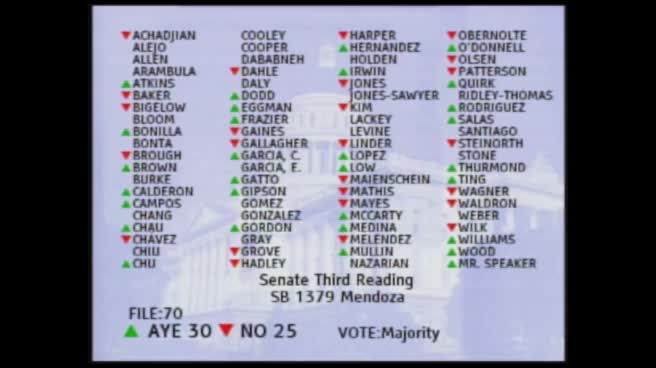
Bill Author
Bill Co-Author(s):