AB 465: Contracts against public policy.
- Session Year: 2015-2016
- House: Assembly
- Latest Version Date: 2015-08-31
Existing law declares that negotiation of terms and conditions of labor should result from voluntary agreement between employer and employee. Existing law provides that any person who coerces or compels any other person to enter into an agreement, written or verbal, not to join or become a member of any labor organization, as a condition of securing employment or continuing in employment, is guilty of a misdemeanor.
This bill would prohibit any person from requiring another person, as a condition of employment, to agree to the waiver of any legal right, penalty, forum, or procedure for any employment law violations. The bill would prohibit a person from threatening, retaliating against, or discriminating against another person based on a refusal to agree to such waiver, and would provide that any such waiver required from an employee or potential employee as a condition of employment or continued employment is unconscionable, against public policy, and unenforceable. The bill would require that any waiver of a persons employment rights, not prohibited by state or federal law, be knowing and voluntary and in writing, and expressly not made as a condition of employment. The bill would provide that a person seeking to enforce a waiver has the burden of proof to show that the waiver was knowing and voluntary. The bill would apply to any waiver agreement entered into on or after January 1, 2016, and would authorize an award of reasonable attorneys fees to the prevailing claimant. The bill would except specified self-regulatory organizations and specified employees from the application of its provisions. The bill would provide that its provisions are severable.
Existing law declares that negotiation of terms and conditions of labor should result from voluntary agreement between employer and employee. Existing law provides that any person who coerces or compels any other person to enter into an agreement, written or verbal, not to join or become a member of any labor organization, as a condition of securing employment or continuing in employment, is guilty of a misdemeanor.
This bill would prohibit any person from requiring another person, as a condition of employment, to agree to the waiver of any legal right, penalty, forum, or procedure for any employment law violations. The bill would prohibit a person from threatening, retaliating against, or discriminating against another person based on a refusal to agree to such waiver, and would provide that any such waiver required from an employee or potential employee as a condition of employment or continued employment is unconscionable, against public policy, and unenforceable. The bill would require that any waiver of a persons employment rights, not prohibited by state or federal law, be knowing and voluntary and in writing, and expressly not made as a condition of employment. The bill would provide that a person seeking to enforce a waiver has the burden of proof to show that the waiver was knowing and voluntary. The bill would apply to any waiver agreement entered into on or after January 1, 2016, and would impose a $10,000 penalty against the employer for each violation of its provisions, with the penalty moneys and authorize award of reasonable attorneys fees awarded to the prevailing claimant. The bill would except specified self-regulatory organizations and specified employees from the application of its provisions. The bill would provide that its provisions are severable.
Existing law declares that negotiation of terms and conditions of labor should result from voluntary agreement between employer and employee. Existing law provides that any person who coerces or compels any other person to enter into an agreement, written or verbal, not to join or become a member of any labor organization, as a condition of securing employment or continuing in employment, is guilty of a misdemeanor.
This bill would prohibit any person from requiring another person, as a condition of employment, to agree to the waiver of any legal right, penalty, forum, or procedure for any employment law violations. The bill would prohibit a person from threatening, retaliating against, or discriminating against another person based on a refusal to agree to such waiver, and would provide that any such waiver required from an employee or potential employee as a condition of employment or continued employment is unconscionable, against public policy, and unenforceable. The bill would require that any waiver of a persons employment rights rights, not prohibited by state or federal law, be knowing and voluntary and in writing, and expressly not made as a condition of employment. The bill would provide that a person seeking to enforce a waiver has the burden of proof to show that the waiver was knowing and voluntary. The bill would apply to any waiver agreement entered into on or after January 1, 2016, and would impose a $10,000 penalty against the employer for each violation of its provisions, with the penalty moneys and reasonable attorneys fees awarded to the prevailing claimant.
Existing law declares that negotiation of terms and conditions of labor should result from voluntary agreement between employer and employee. Existing law provides that any person who coerces or compels any other person to enter into an agreement, written or verbal, not to join or become a member of any labor organization, as a condition of securing employment or continuing in employment, is guilty of a misdemeanor.
This bill would require prohibit any person from requiring another person, as a condition of employment, to agree to the waiver of any legal right, penalty, forum, or procedure for specified any employment law violations to be knowing, voluntary, and in writing. violations. The bill would prohibit such a waiver from being made as a condition of employment a person from threatening, retaliating against, or discriminating against another person based on a refusal to agree to such waiver, and would provide that any such waiver required from an employee or potential employee as a condition of employment or continued employment is unconscionable, against public policy, and unenforceable. The bill would require that any waiver of a persons employment rights be knowing and voluntary and in writing, and expressly not made as a condition of employment. The bill would provide that a person seeking to enforce a waiver has the burden of proof to show that the waiver was knowing and voluntary. The bill would apply to any waiver agreement entered into on or after January 1, 2016, and would impose a $10,000 penalty against the employer for each violation of its provisions, with the penalty moneys and reasonable attorneys fees awarded to the prevailing claimant.
Existing law declares that negotiation of terms and conditions of labor should result from voluntary agreement between employer and employee. Existing law provides that any person who coerces or compels any other person to enter into an agreement, written or verbal, not to join or become a member of any labor organization, as a condition of securing employment or continuing in employment, is guilty of a misdemeanor.
This bill would require the waiver of any legal right, penalty, forum, or procedure for specified employment law violations to be knowing, voluntary, and in writing. The bill would prohibit such a waiver from being made as a condition of employment and would provide that any such waiver required from an employee or potential employee as a condition of employment or continued employment is unconscionable, against public policy, and unenforceable.
Existing law provides that an individual can bring an action for the collection of wages due and unpaid regardless of whether there is a private agreement to arbitrate in place, except in a case regarding the interpretation or application of a collective bargaining agreement containing an arbitration agreement.
This bill would make technical, nonsubstantive changes to this provision.
(a)The Legislature finds and declares that it is the policy of the State of California to ensure that all persons have the full benefit of the rights, penalties, remedies, forums, and procedures established in the Labor Code, and that individuals not be deprived of those rights, penalties, remedies, forums, or procedures through the use of involuntary or coerced waivers.
(b)It is the purpose of this act to ensure that a contract to waive any of the rights, penalties, remedies, forums, or procedures under the Labor Code, including any provision that has the effect of limiting the full application or enforcement of any right, remedy, forum, or procedure available under the Labor Code, is a matter of voluntary consent, not coercion.
SEC. 2.Section 925 is added to the Labor Code, to read:925.(a)A person shall not require another person to waive any legal right, penalty, remedy, forum, or procedure for a violation of any provision of this code, as a condition of employment, including the right to file and pursue a civil action or complaint with, or otherwise notify, the Labor Commissioner, state agency, other public prosecutor, law enforcement agency, or any court or other governmental entity.
(b)A person shall not threaten, retaliate, or discriminate against another person on the basis that the other person refuses to waive any legal right, penalty, remedy, forum, or procedure for a violation of this code, including the right to file and pursue a civil action or complaint with, or otherwise notify, the Labor Commissioner, state agency, other public prosecutor, law enforcement agency, or any court or other governmental entity.
(c)Except for any legal right, penalty, forum, or procedure that state or federal law prohibits from being waived, any waiver of any legal right, penalty, remedy, forum, or procedure for a violation of this code, including the right to file and pursue a civil action or complaint with, or otherwise notify, the Labor Commissioner, state agency, other public prosecutor, law enforcement agency, or any court or other governmental entity shall be knowing and voluntary and in writing, and expressly not made as a condition of employment.
(d)Any waiver of any legal right, penalty, remedy, forum, or procedure for a violation of this code that is required as a condition of employment shall be deemed involuntary, unconscionable, against public policy, and unenforceable. Nothing in this subdivision shall affect the enforceability or validity of any other provision of the contract.
(e)Any person who seeks to enforce a waiver of any legal right, penalty, remedy, forum, or procedure for a violation of this code shall have the burden of proving that the waiver was knowing and voluntary and not made as a condition of employment.
(f)This section shall apply to any agreement to waive any legal right, penalty, remedy, forum, or procedure for a violation of this code, including an agreement to accept private arbitration, entered into, altered, modified, renewed, or extended on or after January 1, 2016.
(g)In addition to injunctive relief and any other remedies available, a court may award a plaintiff enforcing his or her rights under this section reasonable attorneys fees.
(h)This section does not apply to a person registered with a self-regulatory organization as defined by the Securities Exchange Act of 1934 (15 U.S.C. Sec. 78c) or regulations adopted under that act pertaining to any requirement of a self-regulatory organization that a person arbitrate disputes that arise between the person and his or her employer or any other person as specified by the rules of the self-regulatory organization.
(i)This section shall not apply to an employee who is individually represented by legal counsel in negotiating the terms of an agreement to waive any legal right, penalty, remedy, forum, or procedure for a violation of this code.
(j)The provisions of this section are severable. If any provision of this section or its application is held invalid, that invalidity shall not affect other provisions or applications that can be given effect without the invalid provision or application.
(a)The Legislature finds and declares that it is the policy of the State of California to ensure that all persons have the full benefit of the rights, penalties, remedies, forums, and procedures established in the Labor Code, and that individuals not be deprived of those rights, penalties, remedies, forums, or procedures through the use of involuntary or coerced waivers.
(b)It is the purpose of this act to ensure that a contract to waive any of the rights, penalties, remedies, forums, or procedures under the Labor Code, including any provision that has the effect of limiting the full application or enforcement of any right, remedy, forum, or procedure available under the Labor Code, is a matter of voluntary consent, not coercion.
SEC. 2.Section 925 is added to the Labor Code, to read:925.(a)A person shall not require another person to waive any legal right, penalty, remedy, forum, or procedure for a violation of any provision of this code, as a condition of employment, including the right to file and pursue a civil action or complaint with, or otherwise notify, the Labor Commissioner, state agency, other public prosecutor, law enforcement agency, or any court or other governmental entity.
(b)A person shall not threaten, retaliate, or discriminate against another person on the basis that the other person refuses to waive any legal right, penalty, remedy, forum, or procedure for a violation of this code, including the right to file and pursue a civil action or complaint with, or otherwise notify, the Labor Commissioner, state agency, other public prosecutor, law enforcement agency, or any court or other governmental entity.
(c)Except for any legal right, penalty, forum, or procedure that state or federal law prohibits from being waived, any waiver of any legal right, penalty, remedy, forum, or procedure for a violation of this code, including the right to file and pursue a civil action or complaint with, or otherwise notify, the Labor Commissioner, state agency, other public prosecutor, law enforcement agency, or any court or other governmental entity shall be knowing and voluntary and in writing, and expressly not made as a condition of employment.
(d)Any waiver of any legal right, penalty, remedy, forum, or procedure for a violation of this code that is required as a condition of employment shall be deemed involuntary, unconscionable, against public policy, and unenforceable. Nothing in this subdivision shall affect the enforceability or validity of any other provision of the contract.
(e)Any person who seeks to enforce a waiver of any legal right, penalty, remedy, forum, or procedure for a violation of this code shall have the burden of proving that the waiver was knowing and voluntary and not made as a condition of employment.
(f)This section shall apply to any agreement to waive any legal right, penalty, remedy, forum, or procedure for a violation of this code, including an agreement to accept private arbitration, entered into, altered, modified, renewed, or extended on or after January 1, 2016.
(g)In addition to injunctive relief and any other remedies available, a person who violates this section is liable for a civil penalty not exceeding ten thousand dollars ($10,000) per individual for each violation of this section and court may award a plaintiff enforcing his or her rights under this section reasonable attorneys fees.
(h)This section does not apply to a person registered with a self-regulatory organization as defined by the Securities Exchange Act of 1934 (15 U.S.C. Sec. 78c) or regulations adopted under that act pertaining to any requirement of a self-regulatory organization that a person arbitrate disputes that arise between the person and his or her employer or any other person as specified by the rules of the self-regulatory organization.
(i)This section shall not apply to an employee who is individually represented by legal counsel in negotiating the terms of an agreement to waive any legal right, penalty, remedy, forum, or procedure for a violation of this code.
(j)The provisions of this section are severable. If any provision of this section or its application is held invalid, that invalidity shall not affect other provisions or applications that can be given effect without the invalid provision or application.
(a)The Legislature finds and declares that it is the policy of the State of California to ensure that all persons have the full benefit of the rights, penalties, remedies, forums, and procedures established in the Labor Code, and that individuals not be deprived of those rights, penalties, remedies, forums, or procedures through the use of involuntary or coerced waivers.
(b)It is the purpose of this act to ensure that a contract to waive any of the rights, penalties, remedies, forums, or procedures under the Labor Code, including any provision that has the effect of limiting the full application or enforcement of any right, remedy, forum, or procedure available under the Labor Code, is a matter of voluntary consent, not coercion.
SEC. 2.Section 925 is added to the Labor Code, to read:925.(a)A person shall not require another person to waive any legal right, penalty, remedy, forum, or procedure for a violation of any provision of this code, as a condition of employment, including the right to file and pursue a civil action or complaint with, or otherwise notify, the Labor Commissioner, state agency, other public prosecutor, law enforcement agency, or any court or other governmental entity.
(b)A person shall not threaten, retaliate, or discriminate against another person on the basis that the other person refuses to waive any legal right, penalty, remedy, forum, or procedure for a violation of this code, including the right to file and pursue a civil action or complaint with, or otherwise notify, the Labor Commissioner, state agency, other public prosecutor, law enforcement agency, or any court or other governmental entity.
(c)Any Except for any legal right, penalty, forum, or procedure that state or federal law prohibits from being waived, any waiver of any legal right, penalty, remedy, forum, or procedure for a violation of this code, including the right to file and pursue a civil action or complaint with, or otherwise notify, the Labor Commissioner, state agency, other public prosecutor, law enforcement agency, or any court or other governmental entity shall be knowing and voluntary and in writing, and expressly not made as a condition of employment.
(d)Any waiver of any legal right, penalty, remedy, forum, or procedure for a violation of this code that is required as a condition of employment shall be deemed involuntary, unconscionable, against public policy, and unenforceable. Nothing in this subdivision shall affect the enforceability or validity of any other provision of the contract.
(e)Any person who seeks to enforce a waiver of any legal right, penalty, remedy, forum, or procedure for a violation of this code shall have the burden of proving that the waiver was knowing and voluntary and not made as a condition of employment.
(f)This section shall apply to any agreement to waive any legal right, penalty, remedy, forum, or procedure for a violation of this code, including an agreement to accept private arbitration, entered into, altered, modified, renewed, or extended on or after January 1, 2016.
(g)In addition to any other remedies available, a person who violates this section is liable for a civil penalty not exceeding ten thousand dollars ($10,000) per individual for each violation of this section and reasonable attorneys fees.
(a)The Legislature finds and declares that it is the policy of the State of California to ensure that all persons have the full benefit of the rights, penalties, remedies, forums, and procedures established in the Labor Code, and that individuals not be deprived of those rights, penalties, remedies, forums, or procedures through the use of involuntary or coerced waivers.
(b)It is the purpose of this act to ensure that a contract to waive any of the rights, penalties, remedies, forums, or procedures under the Labor Code, including any provision that has the effect of limiting the full application or enforcement of any right, remedy, forum, or procedure available under the Labor Code, is a matter of voluntary consent, not coercion.
SEC. 2.Section 925 is added to the Labor Code, to read:925.(a)A person shall not require another person to waive any legal right, penalty, remedy, forum, or procedure for a violation of any provision of this code, as a condition of employment, including the right to file and pursue a civil action or complaint with, or otherwise notify, the Labor Commissioner, state agency, other public prosecutor, law enforcement agency, or any court or other governmental entity.
(b)A person shall not threaten, retaliate, or discriminate against another person on the basis that the other person refuses to waive any legal right, penalty, remedy, forum, or procedure for a violation of this code, including the right to file and pursue a civil action or complaint with, or otherwise notify, the Labor Commissioner, state agency, other public prosecutor, law enforcement agency, or any court or other governmental entity.
(c)Any waiver of any legal right, penalty, remedy, forum, or procedure for a violation of this code, including the right to file and pursue a civil action or complaint with, or otherwise notify, the Labor Commissioner, state agency, other public prosecutor, law enforcement agency, or any court or other governmental entity shall be knowing and voluntary and in writing, and expressly not made as a condition of employment.
(d)Any waiver of any legal right, penalty, remedy, forum, or procedure for a violation of this code that is required as a condition of employment shall be deemed involuntary, unconscionable, against public policy, and unenforceable. Nothing in this subdivision shall affect the enforceability or validity of any other provision of the contract.
(e)Any person who seeks to enforce a waiver of any legal right, penalty, remedy, forum, or procedure for a violation of this code shall have the burden of proving that the waiver was knowing and voluntary and not made as a condition of employment.
(f)This section shall apply to any agreement to waive any legal right, penalty, remedy, forum, or procedure for a violation of this code, including an agreement to accept private arbitration, entered into, altered, modified, renewed, or extended on or after January 1, 2016.
(g)In addition to any other remedies available, a person who violates this section is liable for a civil penalty not exceeding ten thousand dollars ($10,000) per individual for each violation of this section and reasonable attorneys fees.
SECTION 1.Section 925 is added to the Labor Code, to read:925.(a)Any waiver of any legal right, penalty, forum, or procedure for a violation of any provision of this code shall be knowing, voluntary, and in writing. A waiver shall not expressly be made as a condition of employment.
(b)Any waiver of any legal right, penalty, forum, or procedure for a violation of any provision of this code that is required for an employee or potential employee as a condition of employment or continued employment shall be deemed involuntary, unconscionable, against public policy, and unenforceable.
(a)Any waiver of any legal right, penalty, forum, or procedure for a violation of any provision of this code shall be knowing, voluntary, and in writing. A waiver shall not expressly be made as a condition of employment.
(b)Any waiver of any legal right, penalty, forum, or procedure for a violation of any provision of this code that is required for an employee or potential employee as a condition of employment or continued employment shall be deemed involuntary, unconscionable, against public policy, and unenforceable.
SECTION 1.Section 229 of the Labor Code is amended to read:229.An action to enforce the provisions of this article for the collection of due and unpaid wages claimed by an individual may be maintained without regard to the existence of any private agreement to arbitrate. This section shall not apply to claims involving any dispute concerning the interpretation or application of a collective bargaining agreement containing such an arbitration agreement.
Actions An action to enforce the provisions of this article for the collection of due and unpaid wages claimed by an individual may be maintained without regard to the existence of any private agreement to arbitrate. This section shall not apply to claims involving any dispute concerning the interpretation or application of any a collective bargaining agreement containing such an arbitration agreement.
|
Date
|
Status
|
|---|---|
| Jun 24, 2015 | From committee: Do pass. (Ayes 5. Noes 2.) (June 23). |
| Apr 21, 2016 | Last day to consider Governor's veto pursuant to Joint Rule 58.5. |
| Oct 11, 2015 | Vetoed by Governor. |
| Sep 3, 2015 | Enrolled and presented to the Governor at 4 p.m. |
| Aug 27, 2015 | Senate amendments concurred in. To Engrossing and Enrolling. (Ayes 46. Noes 31.). |
| Aug 27, 2015 | Senate amendments concurred in. To Engrossing and Enrolling. (Ayes 46. Noes 31. Page 2611.). |
| Aug 25, 2015 | In Assembly. Concurrence in Senate amendments pending. May be considered on or after August 27 pursuant to Assembly Rule 77. |
| Aug 24, 2015 | Read third time. Passed. Ordered to the Assembly. (Ayes 22. Noes 15. Page 2155.). |
| Aug 24, 2015 | Read third time. Passed. Ordered to the Assembly. |
| Aug 20, 2015 | Read second time. Ordered to third reading. |
| Aug 19, 2015 | Read third time and amended. Ordered to second reading. |
| Jul 6, 2015 | Read second time. Ordered to third reading. |
| Jul 2, 2015 | Read third time and amended. Ordered to second reading. |
| Jun 25, 2015 | Read second time. Ordered to third reading. |
| Feb 23, 2015 | Read first time. To print. |
| Jun 10, 2015 | From committee: Do pass and re-refer to Com. on JUD. (Ayes 4. Noes 1.) (June 10). Re-referred to Com. on JUD. |
| May 28, 2015 | Referred to Coms. on L. & I.R. and JUD. |
| May 14, 2015 | Read third time. Passed. Ordered to the Senate. (Ayes 45. Noes 30. Page 1444.) |
| May 14, 2015 | Read third time. Passed. Ordered to the Senate. |
| May 14, 2015 | In Senate. Read first time. To Com. on RLS. for assignment. |
| May 11, 2015 | Read second time. Ordered to third reading. |
| May 7, 2015 | From committee: Do pass. (Ayes 5. Noes 2.) (May 6). |
| May 4, 2015 | Re-referred to Com. on L. & E. |
| Apr 30, 2015 | From committee chair, with author's amendments: Amend, and re-refer to Com. on L. & E. Read second time and amended. |
| Apr 6, 2015 | Re-referred to Com. on L. & E. |
| Mar 26, 2015 | Referred to Com. on L. & E. |
| Mar 26, 2015 | From committee chair, with author's amendments: Amend, and re-refer to Com. on L. & E. Read second time and amended. |
| Feb 24, 2015 | From printer. May be heard in committee March 26. |
|
Date
|
Description
|
Location
|
Votes
|
|
|---|---|---|---|---|
| Aug 27, 2015 | AB 465 HERNÁNDEZ Concurrence in Senate Amendments | Assembly Floor |
Passed |
|
| Aug 24, 2015 | Assembly 3rd Reading AB465 Roger Hernández By Leyva | Senate Floor |
Passed |
|
| Jun 23, 2015 | Do pass | Senate Standing Committee on Judiciary |
Passed |
|
| Jun 10, 2015 | Do pass, but first be re-referred to the Committee on [Judiciary] | Senate Standing Committee on Labor and Industrial Relations |
Passed |
|
| May 14, 2015 | AB 465 HERNÁNDEZ Assembly Third Reading | Assembly Floor |
Passed |
|
| May 6, 2015 | Do pass. | Assembly Standing Committee on Labor and Employment |
Passed |
This list shows positions taken on this bill by organizations on the date displayed, which is linked to the original source.
Positions by individuals are not included.
|
Organization
|
Position
|
Date
|
|---|---|---|
| Air Conditioning Trade Association | ** Against | Aug 24, 2015 |
| American Civil Liberties Union of California | ** Support | Aug 24, 2015 |
| American Federation of State, County and Municipal Employees | ** Support | Aug 24, 2015 |
| Associated Builders And Contractors Of California | ** Against | Aug 24, 2015 |
| Associated General Contractors | ** Against | Aug 24, 2015 |
| Association Of California Insurance Companies | ** Against | Aug 24, 2015 |
| Brayden Oparowski | * Indeterminate | Jun 10, 2015 |
| California Alliance For Retired Americans | ** Support | Aug 24, 2015 |
| California Apartment Association | ** Against | Aug 24, 2015 |
| California Association For Health Services At Home | ** Against | Aug 24, 2015 |
| California Association Of Health Facilities | ** Against | Aug 24, 2015 |
| California Association Of Realtors | ** Against | Aug 24, 2015 |
| California Bankers Association | ** Against | Aug 24, 2015 |
| California Building Industry Association | ** Against | Aug 24, 2015 |
| California Business Properties Association | ** Against | Aug 24, 2015 |
| California Chamber Of Commerce | ** Against | Aug 24, 2015 |
| California Citizens Against Lawsuit Abuse | ** Against | Aug 24, 2015 |
| California Conference Board Of The Amalgamated Transit Union | ** Support | Aug 24, 2015 |
| California Conference Of Machinists | ** Support | Aug 24, 2015 |
| California Employment Law Council | ** Against | Aug 24, 2015 |
| California Employment Lawyers Association | ** Support | Aug 24, 2015 |
| California Farm Bureau Federation | ** Against | Aug 24, 2015 |
| California Grocers Association | ** Against | Aug 24, 2015 |
| California Hospital Association | ** Against | Aug 24, 2015 |
| California Hotel and Lodging Association | ** Against | Aug 24, 2015 |
| California Immigrant Policy Center | ** Support | Aug 24, 2015 |
| California Labor Federation, Afl-Cio | ** Support | Aug 24, 2015 |
| California League of Food Processors | ** Against | Aug 24, 2015 |
| California Manufacturers And Technology Association | ** Against | Aug 24, 2015 |
| California New Car Dealers Association | ** Against | Aug 24, 2015 |
| California Newspaper Publishers Association | ** Against | Aug 24, 2015 |
| California Nurses Association | ** Support | Aug 24, 2015 |
| California Professional Firefighters | ** Support | Aug 24, 2015 |
| California Restaurant Association | ** Against | Aug 24, 2015 |
| California Retailers Association | ** Against | Aug 24, 2015 |
| California Rural Legal Assistance Foundation, Inc. | ** Support | Aug 24, 2015 |
| California School Employees Association | ** Support | Aug 24, 2015 |
| California State Council Of Laborers | ** Support | Aug 24, 2015 |
| California State Firefighters' Association | ** Support | Aug 24, 2015 |
| California Teamsters Public Affairs Council | ** Support | Aug 24, 2015 |
| California Trucking Association | ** Against | Aug 24, 2015 |
| Civil Justice Association Of California | ** Against | Aug 24, 2015 |
| CLEAN Carwash Campaign | ** Support | Aug 24, 2015 |
| Congress of California Seniors | ** Support | Aug 24, 2015 |
| Consumer Attorneys Of California | ** Support | Aug 24, 2015 |
| Consumer Federation Of California | ** Support | Aug 24, 2015 |
| Cooperative of American Physicians | ** Against | Aug 24, 2015 |
| Engineers and Scientists of California, IFPTE Local 20 | ** Support | Aug 24, 2015 |
| Entertainment Union Coalition | ** Support | Aug 24, 2015 |
| Equal Rights Advocates | ** Support | Aug 24, 2015 |
| IATSE Local 80 | ** Support | Aug 24, 2015 |
| International Association of Boilermakers | ** Support | Aug 24, 2015 |
| International Association of Iron Workers | ** Support | Aug 24, 2015 |
| International Association of Sheet Metal Workers | ** Support | Aug 24, 2015 |
| International Brotherhood Of Electrical Workers | ** Support | Aug 24, 2015 |
| International Longshore and Warehouse Union | ** Support | Aug 24, 2015 |
| International Union of Operating Engineers | ** Support | Aug 24, 2015 |
| Koreatown Immigrant Workers Alliance | ** Support | May 14, 2015 |
| Maintenance Cooperation Trust Fund | ** Support | Aug 24, 2015 |
| Motion Picture Association Of America | ** Against | Aug 24, 2015 |
| National Federation Of Independent Business | ** Against | Aug 24, 2015 |
| Oxnard Chamber of Commerce | ** Against | Aug 24, 2015 |
| Page W | ** Support | May 14, 2015 |
| Page X | ** Support | May 14, 2015 |
| Painters and Allied Trades International Union | ** Support | Aug 24, 2015 |
| Personal Insurance Association of California | ** Against | Aug 24, 2015 |
| Professional and Technical Engineers, IFPTE Local 21 | ** Support | Aug 24, 2015 |
| Rancho Cordova Chamber of Commerce | ** Against | Aug 24, 2015 |
| Redondo Beach Chamber of Commerce & Visitors Bureau | ** Against | Aug 24, 2015 |
| San Diego Regional Chamber Of Commerce | ** Against | Aug 24, 2015 |
| San Jose Silicon Valley Chamber of Commerce | ** Against | Aug 24, 2015 |
| Securities Industry And Financial Markets Association | ** Against | Aug 24, 2015 |
| Service Employees International Union, California | ** Support | Aug 24, 2015 |
| South Bay Association of Chambers of Commerce | ** Against | Aug 24, 2015 |
| Southwest California Legislative Council | ** Against | Aug 24, 2015 |
| Torrance Area Chamber of Commerce | ** Against | Aug 24, 2015 |
| UNITE-HERE | ** Support | Aug 24, 2015 |
| United Union of Roofers and Allied Workers | ** Support | Aug 24, 2015 |
| Utility Workers Union of America | ** Support | Aug 24, 2015 |
| West Coast Lumber & Building Materials Association | ** Against | Aug 24, 2015 |
| Western Electrical Contractors Association | ** Against | Aug 24, 2015 |
| Western Growers Association | ** Against | Aug 24, 2015 |
| Wine Institute | ** Against | Aug 24, 2015 |
GOVERNOR'S VETO
AB 465
(Roger Hernández)
As Enrolled August 31, 2015
2/3 vote
ASSEMBLY: |
45-30 |
(May 14, 2015) |
SENATE: |
22-15 |
(August 24, 2015) |
ASSEMBLY: |
46-31 |
(August 27, 2015) |
|
|
|
Original Committee Reference: L. & E.
SUMMARY: Imposes specified restrictions on contractual waivers of rights and procedures under the Labor Code.
The Senate amendments:
Eliminate a $10,000 civil penalty for violations of this bill.
Provide for injunctive relief.
Provide that this bill does not apply to persons registered with a self-regulatory organization as defined by the federal Securities Exchange Act of 1934 with respect to any requirement that that individual arbitrate disputes that arise with their employer as specified under the rules of the self-regulatory organization.
Provide that this bill does not apply to an employee who is individually represented by legal counsel in negotiating the terms of an agreement to waive any legal right, penalty, remedy, forum, or procedure for a violation of the Labor Code.
Add a severability clause.
Make other clarifying changes.
FISCAL EFFECT: None. This bill is keyed non-fiscal by the Legislative Counsel.
COMMENTS: According to the author and the sponsor, the goal of this bill is to protect workers from being coerced into signing contracts to waive the right to take labor violations to the Labor Commissioner or to court and submit all claims to the employer's arbitrator. Therefore, this bill is designed to ensure that waivers of important employment rights and procedures arising under California law are made voluntarily and with the consent of the employee.
This bill largely tracks the provisions of AB 2617 (Weber), Chapter 910, Statutes of 2014, legislation introduced last year and signed into law by Governor Brown, which imposed specified restrictions on future contractual waivers of rights under the Ralph Civil Rights Act and Bane Civil Rights Act.
This bill is sponsored by the California Labor Federation, American Federation of Labor and Congress of Industrial Organizations (AFL-CIO). They state that there are very few remedies available to most low-wage workers when their rights are violated. They can file a claim to the Labor Commissioner or they can find access to counsel through a collective legal action. Yet employers have found a way to circumvent these avenues. Increasingly, companies are requiring workers to sign waivers of the right to take claims to the Labor Commissioner or to court and instead requiring them to take any claims to the employer's private arbitrator. They argue that this bill would provide some basic protections to these workers. It would require that these agreements be voluntary and not required as a condition of employment. It would require that a waiver of rights be voluntary. Lastly, it would prohibit employers from threatening, retaliating, or discriminating against workers for refusing to sign such a waiver. These are core tenets of contract law and are consistent with the Supreme Court's direction that such contracts should not be entered into under coercion.
Opponents argue that this bill directly conflicts with prior and recent rulings from both the California and United States Supreme Courts, which have consistently stated any state law that interferes with the Federal Arbitration Act is preempted. Opponents also argue that adequate protections already exist for mandatory, pre-dispute employee arbitration agreements. Opponents contend that arbitration provides an effective and efficient means to resolve employment-related claims and that this bill will send disputes into the overburdened and underfunded judicial system.
Assembly Bill 465 would outlaw the use of mandatory arbitration agreements as a condition of employment, making California the only state in the country to have this particular prohibition.
I have reviewed in depth the arguments from both sides about the fairness and utility of mandatory arbitration agreements. While most evidence shows that arbitration is quicker and more cost-effective than litigation, there is significant debate about whether arbitration is less fair to employees. The evidence on actual outcomes in arbitration versus litigation is conflicting and unclear, with some studies showing employees receive more in arbitration while other studies show the opposite.
While I am concerned about ensuring fairness in employment disputes, I am not prepared to take the far-reaching step proposed by this bill for a number of reasons.
California courts have addressed the issue of unfairness by insisting that employment arbitration agreements must include numerous protections to be enforceable, including neutrality of the arbitrator, adequate discovery, no limitation on damages or remedies, a written decision that permits some judicial review, and limitations on the costs of arbitration. See, e.g., Armendariz v. Foundation Health Psychcare Services, Inc. 24 Cal. 4th 83 (2000). If abuses remain, they should be specified and solved by targeted legislation, not a blanket prohibition.
In addition, a blanket ban on mandatory arbitration agreements is a far-reaching approach that has been consistently struck down in other states as violating the Federal Arbitration Act ("FAA"). Recent decisions by both the California and United States Supreme Courts have found that state policies which unduly impede arbitration are invalid. Indeed, the U.S. Supreme Court is currently considering two more cases arising out of California courts involving preemption of state arbitration policies under the FAA. Before enacting a law as broad as this, and one that will surely result in years of costly litigation and legal uncertainty, I would prefer to see the outcome of those cases.
For these reasons, I am returning AB 465 without my signature.
Analysis Prepared by: Ben Ebbink / L. & E. / (916) 319-2091 FN: 0002490
AB 465
Page 2
CONCURRENCE IN SENATE AMENDMENTS
AB 465
(Roger Hernández)
As Amended August 19, 2015
Majority vote
ASSEMBLY: |
45-30 |
(May 14, 2015) |
SENATE: |
22-15 |
(August 24, 2015) |
Original Committee Reference: L. & E.
SUMMARY: Imposes specified restrictions on contractual waivers of rights and procedures under the Labor Code.
The Senate amendments:
Eliminate a $10,000 civil penalty for violations of this bill.
Provide for injunctive relief.
Provide that this bill does not apply to persons registered with a self-regulatory organization as defined by the federal Securities Exchange Act of 1934 with respect to any requirement that that individual arbitrate disputes that arise with their employer as specified under the rules of the self-regulatory organization.
Provide that this bill does not apply to an employee who is individually represented by legal counsel in negotiating the terms of an agreement to waive any legal right, penalty, remedy, forum, or procedure for a violation of the Labor Code.
Add a severability clause.
Make other clarifying changes.
FISCAL EFFECT: None. This bill is keyed non-fiscal by the Legislative Counsel.
COMMENTS: According to the author and the sponsor, the goal of this bill is to protect workers from being coerced into signing contracts to waive the right to take labor violations to the Labor Commissioner or to court and submit all claims to the employer's arbitrator. Therefore, this bill is designed to ensure that waivers of important employment rights and procedures arising under California law are made voluntarily and with the consent of the employee.
This bill largely tracks the provisions of AB 2617 (Weber), Chapter 910, Statutes of 2014, legislation introduced last year and signed into law by Governor Brown, which imposed specified restrictions on future contractual waivers of rights under the Ralph Civil Rights Act and Bane Civil Rights Act.
This bill is sponsored by the California Labor Federation, American Federation of Labor and Congress of Industrial Organizations (AFL-CIO). They state that there are very few remedies available to most low-wage workers when their rights are violated. They can file a claim to the Labor Commissioner or they can find access to counsel through a collective legal action. Yet employers have found a way to circumvent these avenues. Increasingly, companies are requiring workers to sign waivers of the right to take claims to the Labor Commissioner or to court and instead requiring them to take any claims to the employer's private arbitrator. They argue that this bill would provide some basic protections to these workers. It would require that these agreements be voluntary and not required as a condition of employment. It would require that a waiver of rights be voluntary. Lastly, it would prohibit employers from threatening, retaliating, or discriminating against workers for refusing to sign such a waiver. These are core tenets of contract law and are consistent with the Supreme Court's direction that such contracts should not be entered into under coercion.
Opponents argue that this bill directly conflicts with prior and recent rulings from both the California and United States Supreme Courts, which have consistently stated any state law that interferes with the Federal Arbitration Act is preempted. Opponents also argue that adequate protections already exist for mandatory, pre-dispute employee arbitration agreements. Opponents contend that arbitration provides an effective and efficient means to resolve employment-related claims and that this bill will send disputes into the overburdened and underfunded judicial system.
Analysis Prepared by: Ben Ebbink / L. & E. / (916) 319-2091 FN: 0001435
AB 465
Page 9
|
Office of Senate Floor Analyses (916) 651-1520 Fax: (916) 327-4478 |
THIRD READING
Bill No: AB 465
Amended: 8/19/15 in Senate
SENATE LABOR & IND. REL. COMMITTEE: 4-1, 6/10/15
AYES: Mendoza, Jackson, Leno, Mitchell
NOES: Stone
SENATE JUDICIARY COMMITTEE: 5-2, 6/23/15
AYES: Jackson, Hertzberg, Leno, Monning, Wieckowski
NOES: Moorlach, Anderson
ASSEMBLY FLOOR: 45-30, 5/14/15 - See last page for vote
SUBJECT: Contracts against public policy
SOURCE: California Labor Federation, AFL-CIO
DIGEST: This bill prohibits any person from requiring another person, with some exemptions, as a condition of employment, to agree to the waiver of any legal right, penalty, forum, or procedure for any employment law violations. This bill prohibits threats, retaliation, or discrimination for refusing to agree to such waiver. This bill requires that any waiver be knowing and voluntary and in writing, and expressly not made as a condition of employment.
Senate Floor Amendments of 8/19/15 (1) delete a $10,000 civil penalty that would have been imposed on violators of the provisions and instead provides for injunctive relief in addition to the reasonable attorney’s fees; (2) exempt from the provisions of the bill, a person registered with a self-regulatory organization in the securities industry, as specified, and an employee who is individually represented by legal counsel in negotiating the terms of an agreement; and (3) add a severability clause to the provisions of the bill.
Senate Floor Amendments of 7/2/15 specify that an employer cannot require an employee to waive any legal right, penalty, forum or procedure that state or federal law prohibits from being waived.
Existing law:
Specifies that negotiation of terms and conditions of labor should result from voluntary agreement between employer and employees. Further, existing law grants employees full freedom of association, self-organization, and designation of representatives of his own choosing to negotiate the terms and conditions of his employment.
Provides that any person or agent or officer thereof who coerces or compels any person to enter into an agreement, written or verbal, not to join or become a member of any labor organization, as a condition of securing employment or continuing in the employment of any such person is guilty of a misdemeanor.
Establishes the California Arbitration Act (CAA) and the Federal Arbitration Act (FAA) which provide that agreements to arbitrate shall be valid, irrevocable, and enforceable, except such grounds as exist at law or in equity for the revocation of any contract.
This bill:
Prohibits a person from requiring another person to waive any legal right, penalty, remedy, forum, or procedure for a violation of any provision of Labor Code, as a condition of employment, including the right to file and pursue a civil action or complaint with, or otherwise notify, the Labor Commissioner, state agency, other public prosecutor, law enforcement agency, or any court or other governmental entity.
Prohibits a person from threatening, retaliating, or discriminating against another person for refusing to waive any legal right, penalty, remedy, forum, or procedure for violations.
Provides that except for any legal right, penalty, forum, or procedure that state or federal law prohibits from being waived, any waiver of any legal right, penalty, remedy, forum, or procedure for a violation of the Labor Code shall be knowing and voluntary and in writing, and expressly not made as a condition of employment.
Specifies that any waiver of any legal right, penalty, remedy, forum, or procedure for a violation of the Labor Code that is required as a condition of employment shall be deemed involuntary, unconscionable, against public policy, and unenforceable.
Specifies that any person seeking to enforce a waiver of any legal right, penalty, remedy, forum, or procedure for a violation of the Labor Code shall have the burden of proving that the waiver was knowing and voluntary and not made as a condition of employment.
Applies to any agreement to waive any legal right, penalty, remedy, forum, or procedure for a violation of the Labor Code, including an agreement to accept private arbitration, entered into, altered, modified, renewed, or extended on or after January 1, 2016.
Provides that in addition to injunctive relief and any other remedies available, a court may award a plaintiff with reasonable attorney’s fees.
Exempts from the provisions of this bill, the following:
A person registered with a self-regulatory organization as defined by the Securities Exchange Act of 1934 or regulations adopted under that act pertaining to any arbitration requirement of the self-regulating organization.
An employee who is individually represented by legal counsel in negotiating the terms of an agreement to waive any legal right, penalty, remedy, forum, or procedure for a violation of labor code.
Specifies that the provisions of this bill are severable and if any provision or its application is held invalid, that invalidity shall not affect other provisions or applications that can be given effect without the invalid provision or application.
Makes related legislative findings and declarations regarding rights under the Labor Code.
Background
Federal preemption and court decisions on the matter. Arbitration is a form of alternative dispute resolution outside of the judicial court system where a third party reviews the evidence in the case and imposes a decision that is legally binding on both sides and enforceable in the courts. The FAA (9 U.S.C. Sec. 2), originally enacted in 1925 and then reenacted and codified in 1947, states that: “[a] written provision in any maritime transaction or a contract evidencing a transaction involving commerce to settle by arbitration a controversy thereafter arising out of such contract or transaction … shall be valid, irrevocable, and enforceable, save upon such grounds as exist at law or in equity for the revocation of any contract.” In other words, an arbitration agreement may only be invalidated for the same reasons as other contracts. Additionally, CAA reinforces the federal provisions by clearly stating that agreements to arbitrate shall be valid, irrevocable, and enforceable, except such grounds as exist at law or in equity for the revocation of any contract. In interpreting the FAA and the CAA, the U.S. Supreme Court has declared that by agreeing to arbitrate a statutory claim, a party does not forgo the rights afforded by statute, it simply submits to their resolution in an arbitral, rather than a judicial forum. (Gilmer v. Interstate/Johnson Lane Corp., 500U.S.20(1991))
In ensuring that any such agreement is legal and fair, the Court has stated that any lawfully mandated employment arbitration agreement must (Armendariz v. Foundation Health Psychcare Services, Inc. (2000) 24 Cal.4th 83):
Provide for neutral arbitrators;
Provide for more than minimal discovery;
Require a written award;
Provide for all of the types of relief that would otherwise be available in court; and
Does not require employees to pay either unreasonable costs or any arbitrators’ fees or expenses as a condition of access to the arbitration forum.
States are permitted to set standards around fair contracting, as well as to protect workers from retaliation to ensure that contracts are agreed to voluntarily. In fact, in 2014, the Legislature passed and the Governor signed AB 2617 (Weber, Chapter 910, Statutes of 2014), enacting these same protections against mandatory waivers of civil rights protections.
Controversy over arbitration agreements. The use of mandatory arbitration to settle employment claims has steadily risen since the early 1990s. In 1991, the United States Supreme Court decided Gilmer v. Interstate Johnson/Lane, Corp., 500 U.S. 20 (1991), a case that involved a suit brought by an employee alleging age discrimination by the employer in which the employer moved to compel arbitration on the basis of a pre-dispute agreement to arbitrate. In Gilmer, the Court noted that parties may agree to arbitrate statutory claims via an enforceable agreement, thereby explicitly holding that pre-dispute agreements to arbitrate were both legitimate and enforceable. However, some are critical of arbitration agreements which are forced and required as a condition of attaining or keeping employment. Critics argue that forced waivers of workplace claims eliminate important procedural guarantees of fairness and due process that are hallmarks of our judicial system.
Below is a discussion of some of the criticisms and responses to the use of arbitration (for a more in depth discussion on these, please refer to the Senate Labor and Industrial Relations Committee analysis):
Arbitration and its limitations. Supporters of mandatory arbitration assert that it is a more efficient and less costly manner of resolving legal disputes because they are able set their own rules for presenting evidence, schedule proceedings at their own convenience, and select the third party who will decide their cases. However, critics have argued that private arbitration agreements differ sharply from the rights and obligations under the Labor Code.
The process of arbitration is unregulated and biased. Critics of private arbitration argue that it is an unregulated industry, which is often costly and unreceptive to consumers. Consumer advocates view mandatory arbitration as putting consumers and businesses employees on an uneven playing field that creates an inclination by arbitrators to decide cases in favor of businesses. Among other things, they state that:
One party (the employer) unilaterally picks its preferred private arbitration company who writes the rules by which the arbitration will be conducted.
The pre-selected arbitration company likewise chooses the arbitrators who are made available for the parties to select from.
Private arbitrators need not be judges nor are they required to issue written opinions justifying their decisions.
Prior Legislation
AB 2617 (Weber, Chapter 910, Statutes of 2014) provides that a person shall not
require another person to waive any legal right, penalty, remedy, forum, or
procedure for violation of the Ralph Civil Rights Act or the Bane Civil Rights Act
as a condition of entering into a contract for the provision of goods and services.
FISCAL EFFECT: Appropriation: No Fiscal Com.: No Local: No
California Labor Federation, AFL-CIO (source)
American Civil Liberties Union of California
American Federation of State, County and Municipal Employees
California Alliance for Retired Americans
California Conference Board of the Amalgamated Transit Union
California Conference of Machinists
California Employment Lawyers Association
California Immigrant Policy Center
California Nurses Association
California Professional Firefighters
California Rural Legal Assistance Foundation, Inc.
California School Employees Association
California State Council of Laborers
California State Firefighters’ Association
California Teamsters Public Affairs Council
CLEAN Carwash Campaign
Congress of California Seniors
Consumer Attorneys of California
Consumer Federation of California
Consumers for Auto Reliability and Safety
Engineers and Scientists of California, IFPTE Local 20
Entertainment Union Coalition
Equal Rights Advocates
IATSE Local 80
International Association of Boilermakers
International Association of Heat and Frost Insulators and Allied Workers
International Association of Iron Workers
International Association of Sheet Metal Workers
International Brotherhood of Electrical Workers
International Longshore and Warehouse Union
International Union of Operating Engineers
Maintenance Cooperation Trust Fund
Painters and Allied Trades International Union
Professional and Technical Engineers, IFPTE Local 21
Service Employees International Union, California
State Building and Construction Trades Council
The Wage Justice Center
United Association Union of Plumbers, Fitters, Welders, & Service techs
United Union of Roofers and Allied Workers
UNITE-HERE
Utility Workers Union of America
OPPOSITION: (Verified 8/20/15)
Air Conditioning Trade Association
Associated Builders and Contractors of California
Associated General Contractors
Association of California Insurance Companies
California Apartment Association
California Association for Health Services at Home
California Association of Health Facilities
California Association of Realtors
California Bankers Association
California Building Industry Association
California Business Properties Association
California Citizens Against Lawsuit Abuse
California Chamber of Commerce
California Employment Law Council
California Farm Bureau Federation
California Grocers Association
California Hospital Association
California Hotel and Lodging Association
California League of Food Processors
California Manufacturers and Technology Association
California New Car Dealers Association
California Newspaper Publishers Association
California Restaurant Association
California Retailers Association
California Trucking Association
Civil Justice Association of California
Cooperative of American Physicians
Motion Picture Association of America
National Federation of Independent Business
Oxnard Chamber of Commerce
Personal Insurance Association of California
Rancho Cordova Chamber of Commerce
Redondo Beach Chamber of Commerce & Visitors Bureau
San Diego Regional Chamber of Commerce
San Jose Silicon Valley Chamber of Commerce
Securities Industry and Financial Markets Association
South Bay Association of Chambers of Commerce
Southwest California Legislative Council
Torrance Area Chamber of Commerce
Valley Industry & Commerce Association
West Coast Lumber & Building Materials Association
Western Electrical Contractors Association
Western Growers Association
Wine Institute
ARGUMENTS IN SUPPORT: According to the author and the sponsor, the goal of this bill is to protect workers from being coerced into signing contracts to waive the right to take labor violations to the Labor Commissioner or to court and instead submit all claims to the employer’s arbitrator. The author argues that forced waivers (including mandatory arbitration) of workplace claims are fundamentally inferior and employers often require them as a condition of employment, which means employees will be fired or not hired if they do not give up their rights to resolve employment claims in a court of law.
Further, proponents claim that employers craft the terms of the forced arbitration provisions and typically select the arbitration services providers for the dispute which creates a “repeat player advantage.” Proponents also argue that many times these clauses are buried in the fine print of employment applications, employee handbooks and manuals and as a result, it is nearly impossible for an employee to evaluate and make an informed choice about the appropriateness of a resolution mechanism prior to the existence of an actual employment dispute. Additionally, as these become more common, they are increasingly seeing them in low-wage workplaces where immigrant workers who may not even speak the language used in the contract are required to sign as a condition of employment.
ARGUMENTS IN OPPOSITION: Opponents believe that the FAA and the CAA evidence strong preference for enforcement of arbitration agreements, so long as the underlying contract is fair. According to opponents, the prohibition sought with this bill directly conflicts with rulings from both the California Supreme Court and the U.S. Supreme Court and, if signed into law, they believe it will be challenged and ultimately found to be preempted as well. They argue that this bill will only serve to drive up litigation costs increasing individual claims, representative actions and class action lawsuits against employers of all sizes until such legislation can work through the judicial process to be challenged.
Opponents argue that adequate protections already exist for mandatory, pre-dispute employee arbitration agreements and that it provides an effective and efficient means to resolve employment-related claims. They cite a 2003 article in the New York University School of Law legal journal regarding employment arbitration which found that arbitration was resolved within a year while litigation usually lasted over two years.
ASSEMBLY FLOOR: 45-30, 5/14/15
AYES: Alejo, Bloom, Bonilla, Bonta, Burke, Calderon, Campos, Chau, Chiu, Chu, Cooper, Dababneh, Dodd, Eggman, Frazier, Cristina Garcia, Eduardo Garcia, Gatto, Gipson, Gomez, Gonzalez, Gordon, Roger Hernández, Holden, Jones-Sawyer, Levine, Lopez, Low, McCarty, Medina, Mullin, Nazarian, O'Donnell, Perea, Quirk, Rendon, Ridley-Thomas, Santiago, Mark Stone, Thurmond, Ting, Weber, Williams, Wood, Atkins
NOES: Achadjian, Travis Allen, Baker, Bigelow, Brough, Chang, Chávez, Dahle, Beth Gaines, Gallagher, Gray, Grove, Hadley, Harper, Irwin, Jones, Kim, Lackey, Linder, Maienschein, Mathis, Mayes, Melendez, Obernolte, Olsen, Patterson, Steinorth, Wagner, Waldron, Wilk
NO VOTE RECORDED: Brown, Cooley, Daly, Rodriguez, Salas
Prepared by: Alma Perez / L. & I.R. / (916) 651-1556
8/21/15 13:58:58
**** END ****
AB 465
Page 10
|
Office of Senate Floor Analyses (916) 651-1520 Fax: (916) 327-4478 |
THIRD READING
Bill No: AB 465
Amended: 7/2/15 in Senate
SENATE LABOR & IND. REL. COMMITTEE: 4-1, 6/10/15
AYES: Mendoza, Jackson, Leno, Mitchell
NOES: Stone
SENATE JUDICIARY COMMITTEE: 5-2, 6/23/15
AYES: Jackson, Hertzberg, Leno, Monning, Wieckowski
NOES: Moorlach, Anderson
ASSEMBLY FLOOR: 45-30, 5/14/15 - See last page for vote
SUBJECT: Contracts against public policy
SOURCE: California Labor Federation, AFL-CIO
DIGEST: This bill prohibits any person from requiring another person, as a condition of employment, to agree to the waiver of any legal right, penalty, forum, or procedure for any employment law violations. This bill prohibits a person from threatening, retaliating against, or discriminating against another person based on a refusal to agree to such waiver. This bill requires that any waiver of a person’s employment rights be knowing and voluntary and in writing, and expressly not made as a condition of employment. This bill imposes a $10,000 penalty against the employer for each violation of its provisions, with the penalty moneys and reasonable attorney’s fees awarded to the prevailing claimant.
Senate Floor Amendments of 7/2/15 specify that an employer cannot require an employee to waive any legal right, penalty, forum or procedure that state or federal law prohibits from being waived.
Existing law:
Specifies that negotiation of terms and conditions of labor should result from voluntary agreement between employer and employees. Further, existing law grants employees full freedom of association, self-organization, and designation of representatives of his own choosing to negotiate the terms and conditions of his employment.
Provides that any person or agent or officer thereof who coerces or compels any person to enter into an agreement, written or verbal, not to join or become a member of any labor organization, as a condition of securing employment or continuing in the employment of any such person is guilty of a misdemeanor.
Establishes the California Arbitration Act (CAA) and the Federal Arbitration Act (FAA) which provide that agreements to arbitrate shall be valid, irrevocable, and enforceable, except such grounds as exist at law or in equity for the revocation of any contract.
This bill:
Prohibits a person from requiring another person to waive any legal right, penalty, remedy, forum, or procedure for a violation of any provision of Labor Code, as a condition of employment, including the right to file and pursue a civil action or complaint with, or otherwise notify, the Labor Commissioner, state agency, other public prosecutor, law enforcement agency, or any court or other governmental entity.
Prohibits a person from threatening, retaliating, or discriminating against another person for refusing to waive any legal right, penalty, remedy, forum, or procedure for violations.
Provides that except for any legal right, penalty, forum, or procedure that state or federal law prohibits from being waived, any waiver of any legal right, penalty, remedy, forum, or procedure for a violation of the Labor Code shall be knowing and voluntary and in writing, and expressly not made as a condition of employment.
Specifies that any waiver of any legal right, penalty, remedy, forum, or procedure for a violation of the Labor Code that is required as a condition of employment shall be deemed involuntary, unconscionable, against public policy, and unenforceable.
Specifies that any person seeking to enforce a waiver of any legal right, penalty, remedy, forum, or procedure for a violation of the Labor Code shall have the burden of proving that the waiver was knowing and voluntary and not made as a condition of employment.
Applies to any agreement to waive any legal right, penalty, remedy, forum, or procedure for a violation of the Labor Code, including an agreement to accept private arbitration, entered into, altered, modified, renewed, or extended on or after January 1, 2016.
Provides that in addition to any other remedies available, a person who violates these provisions is liable for a civil penalty not exceeding $10,000 per individual for each violation of these provisions and reasonable attorney’s fees.
Makes related legislative findings and declarations regarding rights under the Labor Code.
Background
Federal preemption and court decisions on the matter. Arbitration is a form of alternative dispute resolution outside of the judicial court system where a third party reviews the evidence in the case and imposes a decision that is legally binding on both sides and enforceable in the courts. The FAA (9 U.S.C. Sec. 2), originally enacted in 1925 and then reenacted and codified in 1947, states that: “[a] written provision in any maritime transaction or a contract evidencing a transaction involving commerce to settle by arbitration a controversy thereafter arising out of such contract or transaction … shall be valid, irrevocable, and enforceable, save upon such grounds as exist at law or in equity for the revocation of any contract.” In other words, an arbitration agreement may only be invalidated for the same reasons as other contracts. Additionally, CAA reinforces the federal provisions by clearly stating that agreements to arbitrate shall be valid, irrevocable, and enforceable, except such grounds as exist at law or in equity for the revocation of any contract. In interpreting the FAA and the CAA, the U.S. Supreme Court has declared that by agreeing to arbitrate a statutory claim, a party does not forgo the rights afforded by statute, it simply submits to their resolution in an arbitral, rather than a judicial forum. (Gilmer v. Interstate/Johnson Lane Corp., 500U.S.20(1991))
In ensuring that any such agreement is legal and fair, the Court has stated that any lawfully mandated employment arbitration agreement must (Armendariz v. Foundation Health Psychcare Services, Inc. (2000) 24 Cal.4th 83):
Provide for neutral arbitrators;
Provide for more than minimal discovery;
Require a written award;
Provide for all of the types of relief that would otherwise be available in court; and
Does not require employees to pay either unreasonable costs or any arbitrators’ fees or expenses as a condition of access to the arbitration forum.
States are permitted to set standards around fair contracting, as well as to protect workers from retaliation to ensure that contracts are agreed to voluntarily. In fact, in 2014, the Legislature passed and the Governor signed AB 2617 (Weber, Chapter 910), enacting these same protections against mandatory waivers of civil rights protections.
Controversy over arbitration agreements. The use of mandatory arbitration to settle employment claims has steadily risen since the early 1990s. In 1991, the United States Supreme Court decided Gilmer v. Interstate Johnson/Lane, Corp., 500 U.S. 20 (1991), a case that involved a suit brought by an employee alleging age discrimination by the employer in which the employer moved to compel arbitration on the basis of a pre-dispute agreement to arbitrate. In Gilmer, the Court noted that parties may agree to arbitrate statutory claims via an enforceable agreement, thereby explicitly holding that pre-dispute agreements to arbitrate were both legitimate and enforceable. However, some are critical of arbitration agreements which are forced and required as a condition of attaining or keeping employment. Critics argue that forced waivers of workplace claims eliminate important procedural guarantees of fairness and due process that are hallmarks of our judicial system.
Below is a discussion of some of the criticisms and responses to the use of arbitration:
Arbitration and its limitations. Supporters of mandatory arbitration assert that it is a more efficient and less costly manner of resolving legal disputes because they are able set their own rules for presenting evidence, schedule proceedings at their own convenience, and select the third party who will decide their cases. However, critics have argued that private arbitration agreements differ sharply from the rights and obligations under the Labor Code and point to some of the following limitations of existing law:
Allows private arbitrators to issue binding decisions that are legally enforceable but essentially not reviewable by a court; there is no appeal from an arbitrator’s decision to a public court unless the arbitration agreement expressly provides for judicial review. (Crowell v. Downey Community Hospital Foundation (2002) 95 Cal. App. 4th 730; Cable Connection, Inc. v. DIRECTV, Inc., 44 Cal. 4th 1334 (2008).)
Permits enforcement of private arbitration agreements that preclude not only access to the courts but also access to other governmental bodies responsible for enforcing state laws, such as administrative complaint procedures regarding employment laws. (Sonic-Calabasas A, Inc. v. Moreno, 174 Cal. App. 4th 546 (2009), rev. granted, 99 Cal. Rptr. 3d 866 (2009).)
Permits arbitrations to be conducted in private with no public scrutiny. (Ting v. AT&T (2002) 182 F.Supp. 2d 902 (N.D. Cal.), affirmed, 319 F.3d 1126 (9th Cir 2003))
Allows arbitrators substantial if not absolute immunity from civil liability for acts relating to their decisions, even in the case of bias, fraud, corruption or other violation of law. (Baar v. Tigerman (1983) 140 Cal. App. 3d 979.)
The process of arbitration is unregulated and biased. Critics of private arbitration also argue that it is an unregulated industry, which is often costly and unreceptive to consumers. Consumer advocates view mandatory arbitration as putting consumers and businesses employees on an uneven playing field that creates an inclination by arbitrators to decide cases in favor of businesses. Among other things, they state that:
One party (the employer) unilaterally picks its preferred private arbitration company who writes the rules by which the arbitration will be conducted.
The pre-selected arbitration company likewise chooses the arbitrators who are made available for the parties to select from.
Private arbitrators need not be judges nor are they required to issue written opinions justifying their decisions.
Prior Legislation
AB 2617 (Weber, Chapter 910, Statutes of 2014) provides that a person shall not
require another person to waive any legal right, penalty, remedy, forum, or
procedure for violation of the Ralph Civil Rights Act or the Bane Civil Rights Act
as a condition of entering into a contract for the provision of goods and services.
FISCAL EFFECT: Appropriation: No Fiscal Com.: No Local: No
California Labor Federation, AFL-CIO (source)
American Civil Liberties Union of California
American Federation of State, County and Municipal Employees
California Conference Board of the Amalgamated Transit Union
California Conference of Machinists
California Employment Lawyers Association
California Immigrant Policy Center
California Nurses Association
California Professional Firefighters
California Rural Legal Assistance Foundation, Inc.
California School Employees Association
California State Council of Laborers
California State Firefighters’ Association
California Teamsters Public Affairs Council
CLEAN Carwash Campaign
Congress of California Seniors
Consumer Attorneys of California
Consumer Federation of California
Consumers for Auto Reliability and Safety
Engineers and Scientists of California, IFPTE Local 20
Equal Rights Advocates
International Association of Boilermakers
International Association of Heat and Frost Insulators and Allied Workers
International Association of Iron Workers
International Association of Sheet Metal Workers
International Brotherhood of Electrical Workers
International Longshore and Warehouse Union
International Union of Operating Engineers
Maintenance Cooperation Trust Fund
Painters and Allied Trades International Union
Professional and Technical Engineers, IFPTE Local 21
Service Employees International Union, California
State Building and Construction Trades Council
The Wage Justice Center
United Association Union of Plumbers, Fitters, Welders, & Service techs
United Union of Roofers and Allied Workers
UNITE-HERE
Utility Workers Union of America
Air Conditioning Trade Association
Associated Builders and Contractors of California
Associated General Contractors
Association of California Insurance Companies
California Apartment Association
California Association for Health Services at Home
California Association of Health Facilities
California Association of Realtors
California Bankers Association
California Building Industry Association
California Business Properties Association
California Citizens Against Lawsuit Abuse
California Chamber of Commerce
California Employment Law Council
California Farm Bureau Federation
California Grocers Association
California Hospital Association
California Hotel and Lodging Association
California League of Food Processors
California Manufacturers and Technology Association
California New Car Dealers Association
California Newspaper Publishers Association
California Restaurant Association
California Retailers Association
California Trucking Association
Civil Justice Association of California
Cooperative of American Physicians
National Federation of Independent Business
Oxnard Chamber of Commerce
Personal Insurance Association of California
Rancho Cordova Chamber of Commerce
Redondo Beach Chamber of Commerce & Visitors Bureau
San Diego Regional Chamber of Commerce
San Jose Silicon Valley Chamber of Commerce
Securities Industry and Financial Markets Association
South Bay Association of Chambers of Commerce
Southwest California Legislative Council
Torrance Area Chamber of Commerce
West Coast Lumber & Building Materials Association
Western Electrical Contractors Association
Western Growers Association
Wine Institute
ARGUMENTS IN SUPPORT: According to the author and the sponsor, the goal of this bill is to protect workers from being coerced into signing contracts to waive the right to take labor violations to the Labor Commissioner or to court and instead submit all claims to the employer’s arbitrator. The sponsors argue that there are very few remedies available to most low-wage workers when their rights are violated. Unfortunately, some employers, they argue, have found a way to circumvent these avenues by requiring workers to sign waivers of the right to take claims to the Labor Commissioner or to court and instead require them to take any claims to the employer’s private arbitrator.
The author argues that forced waivers (including mandatory arbitration) of workplace claims are fundamentally inferior and employers often require them as a condition of employment, which means employees will be fired or not hired if they do not give up their rights to resolve employment claims in a court of law. Further, proponents claim that employers craft the terms of the forced arbitration provisions and typically select the arbitration services providers for the dispute which creates a “repeat player advantage.” Proponents also argue that many times these clauses are buried in the fine print of employment applications, employee handbooks and manuals and as a result, it is nearly impossible for an employee to evaluate and make an informed choice about the appropriateness of a resolution mechanism prior to the existence of an actual employment dispute. Additionally, as these become more common, they are increasingly seeing them in low-wage workplaces where immigrant workers who may not even speak the language used in the contract are required to sign as a condition of employment.
ARGUMENTS IN OPPOSITION: Opponents have raised concerns that the restrictions on waivers in this bill may be preempted by federal law. They believe that the FAA and the CAA evidence strong preference for enforcement of arbitration agreements, so long as the underlying contract is fair. According to opponents, the prohibition sought with this bill directly conflicts with rulings from both the California Supreme Court and the U.S. Supreme Court and, if signed into law, they believe it will be challenged and ultimately found to be preempted as well. They argue that this bill will only serve to drive up litigation costs increasing individual claims, representative actions and class action lawsuits against employers of all sizes until such legislation can work through the judicial process to be challenged.
Opponents argue that adequate protections already exist for mandatory, pre-dispute employee arbitration agreements and that it provides an effective and efficient means to resolve employment-related claims. They cite data from the U.S. District Court Judicial Caseload Profiler which shows that there were 29,312 civil cases filed in California in 2014. As of June 2014, approximately 2,132 cases had been pending in federal court in California for over three years and the median time from filing of a civil complaint to trial in Northern California was 31 months. Comparatively, they note, a 2003 article in the New York University School of Law legal journal regarding employment arbitration found that arbitration was resolved within a year while litigation usually lasted over two years.
ASSEMBLY FLOOR: 45-30, 5/14/15
AYES: Alejo, Bloom, Bonilla, Bonta, Burke, Calderon, Campos, Chau, Chiu, Chu, Cooper, Dababneh, Dodd, Eggman, Frazier, Cristina Garcia, Eduardo Garcia, Gatto, Gipson, Gomez, Gonzalez, Gordon, Roger Hernández, Holden, Jones-Sawyer, Levine, Lopez, Low, McCarty, Medina, Mullin, Nazarian, O’Donnell, Perea, Quirk, Rendon, Ridley-Thomas, Santiago, Mark Stone, Thurmond, Ting, Weber, Williams, Wood, Atkins
NOES: Achadjian, Travis Allen, Baker, Bigelow, Brough, Chang, Chávez, Dahle, Beth Gaines, Gallagher, Gray, Grove, Hadley, Harper, Irwin, Jones, Kim, Lackey, Linder, Maienschein, Mathis, Mayes, Melendez, Obernolte, Olsen, Patterson, Steinorth, Wagner, Waldron, Wilk
NO VOTE RECORDED: Brown, Cooley, Daly, Rodriguez, Salas
Prepared by: Alma Perez / L. & I.R. / (916) 651-1556
7/8/15 12:06:37
**** END ****
AB 465
Page 10
|
Office of Senate Floor Analyses (916) 651-1520 Fax: (916) 327-4478 |
THIRD READING
Bill No: AB 465
Amended: 7/2/15 in Senate
SENATE LABOR & IND. REL. COMMITTEE: 4-1, 6/10/15
AYES: Mendoza, Jackson, Leno, Mitchell
NOES: Stone
SENATE JUDICIARY COMMITTEE: 5-2, 6/23/15
AYES: Jackson, Hertzberg, Leno, Monning, Wieckowski
NOES: Moorlach, Anderson
ASSEMBLY FLOOR: 45-30, 5/14/15 - See last page for vote
SUBJECT: Contracts against public policy
SOURCE: California Labor Federation, AFL-CIO
DIGEST: This bill prohibits any person from requiring another person, as a condition of employment, to agree to the waiver of any legal right, penalty, forum, or procedure for any employment law violations. This bill prohibits a person from threatening, retaliating against, or discriminating against another person based on a refusal to agree to such waiver. This bill requires that any waiver of a person’s employment rights be knowing and voluntary and in writing, and expressly not made as a condition of employment. This bill imposes a $10,000 penalty against the employer for each violation of its provisions, with the penalty moneys and reasonable attorney’s fees awarded to the prevailing claimant.
Senate Floor Amendments of 7/2/15 specify that an employer cannot require an employee to waive any legal right, penalty, forum or procedure that state or federal law prohibits from being waived.
Existing law:
Specifies that negotiation of terms and conditions of labor should result from voluntary agreement between employer and employees. Further, existing law grants employees full freedom of association, self-organization, and designation of representatives of his own choosing to negotiate the terms and conditions of his employment.
Provides that any person or agent or officer thereof who coerces or compels any person to enter into an agreement, written or verbal, not to join or become a member of any labor organization, as a condition of securing employment or continuing in the employment of any such person is guilty of a misdemeanor.
Establishes the California Arbitration Act (CAA) and the Federal Arbitration Act (FAA) which provide that agreements to arbitrate shall be valid, irrevocable, and enforceable, except such grounds as exist at law or in equity for the revocation of any contract.
This bill:
Prohibits a person from requiring another person to waive any legal right, penalty, remedy, forum, or procedure for a violation of any provision of Labor Code, as a condition of employment, including the right to file and pursue a civil action or complaint with, or otherwise notify, the Labor Commissioner, state agency, other public prosecutor, law enforcement agency, or any court or other governmental entity.
Prohibits a person from threatening, retaliating, or discriminating against another person for refusing to waive any legal right, penalty, remedy, forum, or procedure for violations.
Provides that except for any legal right, penalty, forum, or procedure that state or federal law prohibits from being waived, any waiver of any legal right, penalty, remedy, forum, or procedure for a violation of the Labor Code shall be knowing and voluntary and in writing, and expressly not made as a condition of employment.
Specifies that any waiver of any legal right, penalty, remedy, forum, or procedure for a violation of the Labor Code that is required as a condition of employment shall be deemed involuntary, unconscionable, against public policy, and unenforceable.
Specifies that any person seeking to enforce a waiver of any legal right, penalty, remedy, forum, or procedure for a violation of the Labor Code shall have the burden of proving that the waiver was knowing and voluntary and not made as a condition of employment.
Applies to any agreement to waive any legal right, penalty, remedy, forum, or procedure for a violation of the Labor Code, including an agreement to accept private arbitration, entered into, altered, modified, renewed, or extended on or after January 1, 2016.
Provides that in addition to any other remedies available, a person who violates these provisions is liable for a civil penalty not exceeding $10,000 per individual for each violation of these provisions and reasonable attorney’s fees.
Makes related legislative findings and declarations regarding rights under the Labor Code.
Background
Federal preemption and court decisions on the matter. Arbitration is a form of alternative dispute resolution outside of the judicial court system where a third party reviews the evidence in the case and imposes a decision that is legally binding on both sides and enforceable in the courts. The FAA (9 U.S.C. Sec. 2), originally enacted in 1925 and then reenacted and codified in 1947, states that: “[a] written provision in any maritime transaction or a contract evidencing a transaction involving commerce to settle by arbitration a controversy thereafter arising out of such contract or transaction … shall be valid, irrevocable, and enforceable, save upon such grounds as exist at law or in equity for the revocation of any contract.” In other words, an arbitration agreement may only be invalidated for the same reasons as other contracts. Additionally, CAA reinforces the federal provisions by clearly stating that agreements to arbitrate shall be valid, irrevocable, and enforceable, except such grounds as exist at law or in equity for the revocation of any contract. In interpreting the FAA and the CAA, the U.S. Supreme Court has declared that by agreeing to arbitrate a statutory claim, a party does not forgo the rights afforded by statute, it simply submits to their resolution in an arbitral, rather than a judicial forum. (Gilmer v. Interstate/Johnson Lane Corp., 500U.S.20(1991))
In ensuring that any such agreement is legal and fair, the Court has stated that any lawfully mandated employment arbitration agreement must (Armendariz v. Foundation Health Psychcare Services, Inc. (2000) 24 Cal.4th 83):
Provide for neutral arbitrators;
Provide for more than minimal discovery;
Require a written award;
Provide for all of the types of relief that would otherwise be available in court; and
Does not require employees to pay either unreasonable costs or any arbitrators’ fees or expenses as a condition of access to the arbitration forum.
States are permitted to set standards around fair contracting, as well as to protect workers from retaliation to ensure that contracts are agreed to voluntarily. In fact, in 2014, the Legislature passed and the Governor signed AB 2617 (Weber, Chapter 910), enacting these same protections against mandatory waivers of civil rights protections.
Controversy over arbitration agreements. The use of mandatory arbitration to settle employment claims has steadily risen since the early 1990s. In 1991, the United States Supreme Court decided Gilmer v. Interstate Johnson/Lane, Corp., 500 U.S. 20 (1991), a case that involved a suit brought by an employee alleging age discrimination by the employer in which the employer moved to compel arbitration on the basis of a pre-dispute agreement to arbitrate. In Gilmer, the Court noted that parties may agree to arbitrate statutory claims via an enforceable agreement, thereby explicitly holding that pre-dispute agreements to arbitrate were both legitimate and enforceable. However, some are critical of arbitration agreements which are forced and required as a condition of attaining or keeping employment. Critics argue that forced waivers of workplace claims eliminate important procedural guarantees of fairness and due process that are hallmarks of our judicial system.
Below is a discussion of some of the criticisms and responses to the use of arbitration:
Arbitration and its limitations. Supporters of mandatory arbitration assert that it is a more efficient and less costly manner of resolving legal disputes because they are able set their own rules for presenting evidence, schedule proceedings at their own convenience, and select the third party who will decide their cases. However, critics have argued that private arbitration agreements differ sharply from the rights and obligations under the Labor Code and point to some of the following limitations of existing law:
Allows private arbitrators to issue binding decisions that are legally enforceable but essentially not reviewable by a court; there is no appeal from an arbitrator’s decision to a public court unless the arbitration agreement expressly provides for judicial review. (Crowell v. Downey Community Hospital Foundation (2002) 95 Cal. App. 4th 730; Cable Connection, Inc. v. DIRECTV, Inc., 44 Cal. 4th 1334 (2008).)
Permits enforcement of private arbitration agreements that preclude not only access to the courts but also access to other governmental bodies responsible for enforcing state laws, such as administrative complaint procedures regarding employment laws. (Sonic-Calabasas A, Inc. v. Moreno, 174 Cal. App. 4th 546 (2009), rev. granted, 99 Cal. Rptr. 3d 866 (2009).)
Permits arbitrations to be conducted in private with no public scrutiny. (Ting v. AT&T (2002) 182 F.Supp. 2d 902 (N.D. Cal.), affirmed, 319 F.3d 1126 (9th Cir 2003))
Allows arbitrators substantial if not absolute immunity from civil liability for acts relating to their decisions, even in the case of bias, fraud, corruption or other violation of law. (Baar v. Tigerman (1983) 140 Cal. App. 3d 979.)
The process of arbitration is unregulated and biased. Critics of private arbitration also argue that it is an unregulated industry, which is often costly and unreceptive to consumers. Consumer advocates view mandatory arbitration as putting consumers and businesses employees on an uneven playing field that creates an inclination by arbitrators to decide cases in favor of businesses. Among other things, they state that:
One party (the employer) unilaterally picks its preferred private arbitration company who writes the rules by which the arbitration will be conducted.
The pre-selected arbitration company likewise chooses the arbitrators who are made available for the parties to select from.
Private arbitrators need not be judges nor are they required to issue written opinions justifying their decisions.
Prior Legislation
AB 2617 (Weber, Chapter 910, Statutes of 2014) provides that a person shall not
require another person to waive any legal right, penalty, remedy, forum, or
procedure for violation of the Ralph Civil Rights Act or the Bane Civil Rights Act
as a condition of entering into a contract for the provision of goods and services.
FISCAL EFFECT: Appropriation: No Fiscal Com.: No Local: No
California Labor Federation, AFL-CIO (source)
American Civil Liberties Union of California
American Federation of State, County and Municipal Employees
California Conference Board of the Amalgamated Transit Union
California Conference of Machinists
California Employment Lawyers Association
California Immigrant Policy Center
California Nurses Association
California Professional Firefighters
California Rural Legal Assistance Foundation, Inc.
California School Employees Association
California State Council of Laborers
California State Firefighters’ Association
California Teamsters Public Affairs Council
CLEAN Carwash Campaign
Congress of California Seniors
Consumer Attorneys of California
Consumer Federation of California
Consumers for Auto Reliability and Safety
Engineers and Scientists of California, IFPTE Local 20
Equal Rights Advocates
International Association of Boilermakers
International Association of Heat and Frost Insulators and Allied Workers
International Association of Iron Workers
International Association of Sheet Metal Workers
International Brotherhood of Electrical Workers
International Longshore and Warehouse Union
International Union of Operating Engineers
Maintenance Cooperation Trust Fund
Painters and Allied Trades International Union
Professional and Technical Engineers, IFPTE Local 21
Service Employees International Union, California
State Building and Construction Trades Council
The Wage Justice Center
United Association Union of Plumbers, Fitters, Welders, & Service techs
United Union of Roofers and Allied Workers
UNITE-HERE
Utility Workers Union of America
Air Conditioning Trade Association
Associated Builders and Contractors of California
Associated General Contractors
Association of California Insurance Companies
California Apartment Association
California Association for Health Services at Home
California Association of Health Facilities
California Association of Realtors
California Bankers Association
California Building Industry Association
California Business Properties Association
California Citizens Against Lawsuit Abuse
California Chamber of Commerce
California Employment Law Council
California Farm Bureau Federation
California Grocers Association
California Hospital Association
California Hotel and Lodging Association
California League of Food Processors
California Manufacturers and Technology Association
California New Car Dealers Association
California Newspaper Publishers Association
California Restaurant Association
California Retailers Association
California Trucking Association
Civil Justice Association of California
Cooperative of American Physicians
National Federation of Independent Business
Oxnard Chamber of Commerce
Personal Insurance Association of California
Rancho Cordova Chamber of Commerce
Redondo Beach Chamber of Commerce & Visitors Bureau
San Diego Regional Chamber of Commerce
San Jose Silicon Valley Chamber of Commerce
South Bay Association of Chambers of Commerce
Southwest California Legislative Council
Torrance Area Chamber of Commerce
West Coast Lumber & Building Materials Association
Western Electrical Contractors Association
Western Growers Association
Wine Institute
ARGUMENTS IN SUPPORT: According to the author and the sponsor, the goal of this bill is to protect workers from being coerced into signing contracts to waive the right to take labor violations to the Labor Commissioner or to court and instead submit all claims to the employer’s arbitrator. The sponsors argue that there are very few remedies available to most low-wage workers when their rights are violated. Unfortunately, some employers, they argue, have found a way to circumvent these avenues by requiring workers to sign waivers of the right to take claims to the Labor Commissioner or to court and instead require them to take any claims to the employer’s private arbitrator.
The author argues that forced waivers (including mandatory arbitration) of workplace claims are fundamentally inferior and employers often require them as a condition of employment, which means employees will be fired or not hired if they do not give up their rights to resolve employment claims in a court of law. Further, proponents claim that employers craft the terms of the forced arbitration provisions and typically select the arbitration services providers for the dispute which creates a “repeat player advantage.” Proponents also argue that many times these clauses are buried in the fine print of employment applications, employee handbooks and manuals and as a result, it is nearly impossible for an employee to evaluate and make an informed choice about the appropriateness of a resolution mechanism prior to the existence of an actual employment dispute. Additionally, as these become more common, they are increasingly seeing them in low-wage workplaces where immigrant workers who may not even speak the language used in the contract are required to sign as a condition of employment.
ARGUMENTS IN OPPOSITION: Opponents have raised concerns that the restrictions on waivers in this bill may be preempted by federal law. They believe that the FAA and the CAA evidence strong preference for enforcement of arbitration agreements, so long as the underlying contract is fair. According to opponents, the prohibition sought with this bill directly conflicts with rulings from both the California Supreme Court and the U.S. Supreme Court and, if signed into law, they believe it will be challenged and ultimately found to be preempted as well. They argue that this bill will only serve to drive up litigation costs increasing individual claims, representative actions and class action lawsuits against employers of all sizes until such legislation can work through the judicial process to be challenged.
Opponents argue that adequate protections already exist for mandatory, pre-dispute employee arbitration agreements and that it provides an effective and efficient means to resolve employment-related claims. They cite data from the U.S. District Court Judicial Caseload Profiler which shows that there were 29,312 civil cases filed in California in 2014. As of June 2014, approximately 2,132 cases had been pending in federal court in California for over three years and the median time from filing of a civil complaint to trial in Northern California was 31 months. Comparatively, they note, a 2003 article in the New York University School of Law legal journal regarding employment arbitration found that arbitration was resolved within a year while litigation usually lasted over two years.
ASSEMBLY FLOOR: 45-30, 5/14/15
AYES: Alejo, Bloom, Bonilla, Bonta, Burke, Calderon, Campos, Chau, Chiu, Chu, Cooper, Dababneh, Dodd, Eggman, Frazier, Cristina Garcia, Eduardo Garcia, Gatto, Gipson, Gomez, Gonzalez, Gordon, Roger Hernández, Holden, Jones-Sawyer, Levine, Lopez, Low, McCarty, Medina, Mullin, Nazarian, O’Donnell, Perea, Quirk, Rendon, Ridley-Thomas, Santiago, Mark Stone, Thurmond, Ting, Weber, Williams, Wood, Atkins
NOES: Achadjian, Travis Allen, Baker, Bigelow, Brough, Chang, Chávez, Dahle, Beth Gaines, Gallagher, Gray, Grove, Hadley, Harper, Irwin, Jones, Kim, Lackey, Linder, Maienschein, Mathis, Mayes, Melendez, Obernolte, Olsen, Patterson, Steinorth, Wagner, Waldron, Wilk
NO VOTE RECORDED: Brown, Cooley, Daly, Rodriguez, Salas
Prepared by: Alma Perez / L. & I.R. / (916) 651-1556
7/7/15 17:19:28
**** END ****
AB 465
Page 9
|
Office of Senate Floor Analyses (916) 651-1520 Fax: (916) 327-4478 |
THIRD READING
Bill No: AB 465
Amended: 4/30/15 in Assembly
SENATE LABOR & IND. REL. COMMITTEE: 4-1, 6/10/15
AYES: Mendoza, Jackson, Leno, Mitchell
NOES: Stone
SENATE JUDICIARY COMMITTEE: 5-2, 6/23/15
AYES: Jackson, Hertzberg, Leno, Monning, Wieckowski
NOES: Moorlach, Anderson
ASSEMBLY FLOOR: 45-30, 5/14/15 - See last page for vote
SUBJECT: Contracts against public policy
SOURCE: California Labor Federation, AFL-CIO
DIGEST: This bill prohibits any person from requiring another person, as a condition of employment, to agree to the waiver of any legal right, penalty, forum, or procedure for any employment law violations. This bill prohibits a person from threatening, retaliating against, or discriminating against another person based on a refusal to agree to such waiver. This bill requires that any waiver of a person’s employment rights be knowing and voluntary and in writing, and expressly not made as a condition of employment. This bill imposes a $10,000 penalty against the employer for each violation of its provisions, with the penalty moneys and reasonable attorney’s fees awarded to the prevailing claimant.
Existing law:
Specifies that negotiation of terms and conditions of labor should result from voluntary agreement between employer and employees. Further, existing law grants employees full freedom of association, self-organization, and designation of representatives of his own choosing to negotiate the terms and conditions of his employment.
Provides that any person or agent or officer thereof who coerces or compels any person to enter into an agreement, written or verbal, not to join or become a member of any labor organization, as a condition of securing employment or continuing in the employment of any such person is guilty of a misdemeanor.
Establishes the California Arbitration Act (CAA) which provides that agreements to arbitrate shall be valid, irrevocable, and enforceable, except such grounds as exist at law or in equity for the revocation of any contract.
Establishes the Federal Arbitration Act (FAA) which provides that agreements to arbitrate shall be valid, irrevocable, and enforceable, except such grounds as exist at law or in equity for the revocation of any contract.
This bill:
Prohibits a person from requiring another person to waive any legal right, penalty, remedy, forum, or procedure for a violation of any provision of Labor Code, as a condition of employment, including the right to file and pursue a civil action or complaint with, or otherwise notify, the Labor Commissioner, state agency, other public prosecutor, law enforcement agency, or any court or other governmental entity.
Prohibits a person from threatening, retaliating, or discriminating against another person for refusing to waive any legal right, penalty, remedy, forum, or procedure for violations.
Provides that any waiver of any legal right, penalty, remedy, forum, or procedure for a violation of the Labor Code shall be knowing and voluntary and in writing, and expressly not made as a condition of employment.
Specifies that any waiver of any legal right, penalty, remedy, forum, or procedure for a violation of the Labor Code that is required as a condition of employment shall be deemed involuntary, unconscionable, against public policy, and unenforceable.
Specifies that any person seeking to enforce a waiver of any legal right, penalty, remedy, forum, or procedure for a violation of the Labor Code shall have the burden of proving that the waiver was knowing and voluntary and not made as a condition of employment.
Applies to any agreement to waive any legal right, penalty, remedy, forum, or procedure for a violation of the Labor Code, including an agreement to accept private arbitration, entered into, altered, modified, renewed, or extended on or after January 1, 2016.
Provides that in addition to any other remedies available, a person who violates these provisions is liable for a civil penalty not exceeding $10,000 per individual for each violation of these provisions and reasonable attorney’s fees.
Makes related legislative findings and declarations regarding rights under the Labor Code.
Background
Federal preemption and court decisions on the matter. Arbitration is a form of alternative dispute resolution outside of the judicial court system where a third party reviews the evidence in the case and imposes a decision that is legally binding on both sides and enforceable in the courts. The FAA (9 U.S.C. Sec. 2), originally enacted in 1925 and then reenacted and codified in 1947, states that: "[a] written provision in any maritime transaction or a contract evidencing a transaction involving commerce to settle by arbitration a controversy thereafter arising out of such contract or transaction … shall be valid, irrevocable, and enforceable, save upon such grounds as exist at law or in equity for the revocation of any contract.” In other words, an arbitration agreement may only be invalidated for the same reasons as other contracts. Additionally, CAA reinforces the federal provisions by clearly stating that agreements to arbitrate shall be valid, irrevocable, and enforceable, except such grounds as exist at law or in equity for the revocation of any contract. In interpreting the FAA and the CAA, the U.S. Supreme Court has declared that by agreeing to arbitrate a statutory claim, a party does not forgo the rights afforded by statute, it simply submits to their resolution in an arbitral, rather than a judicial forum. (Gilmer v. Interstate/Johnson Lane Corp., 500U.S.20(1991))
In ensuring that any such agreement is legal and fair, the Court has stated that any lawfully mandated employment arbitration agreement must (Armendariz v. Foundation Health Psychcare Services, Inc. (2000) 24 Cal.4th 83):
Provide for neutral arbitrators;
Provide for more than minimal discovery;
Require a written award;
Provide for all of the types of relief that would otherwise be available in court; and
Does not require employees to pay either unreasonable costs or any arbitrators’ fees or expenses as a condition of access to the arbitration forum.
States are permitted to set standards around fair contracting, as well as to protect workers from retaliation to ensure that contracts are agreed to voluntarily. In fact, in 2014, the Legislature passed and the Governor signed AB 2617 (Weber, Chapter 910), enacting these same protections against mandatory waivers of civil rights protections.
Controversy over arbitration agreements. The use of mandatory arbitration to settle employment claims has steadily risen since the early 1990s. In 1991, the United States Supreme Court decided Gilmer v. Interstate Johnson/Lane, Corp., 500 U.S. 20 (1991), a case that involved a suit brought by an employee alleging age discrimination by the employer in which the employer moved to compel arbitration on the basis of a pre-dispute agreement to arbitrate. In Gilmer, the Court noted that parties may agree to arbitrate statutory claims via an enforceable agreement, thereby explicitly holding that pre-dispute agreements to arbitrate were both legitimate and enforceable. However, some are critical of arbitration agreements which are forced and required as a condition of attaining or keeping employment. Critics argue that forced waivers of workplace claims eliminate important procedural guarantees of fairness and due process that are hallmarks of our judicial system.
Below is a discussion of some of the criticisms and responses to the use of arbitration:
Arbitration and its limitations. Supporters of mandatory arbitration assert that it is a more efficient and less costly manner of resolving legal disputes because they are able set their own rules for presenting evidence, schedule proceedings at their own convenience, and select the third party who will decide their cases. However, critics have argued that private arbitration agreements differ sharply from the rights and obligations under the Labor Code and point to some of the following limitations of existing law:
Allows private arbitrators to issue binding decisions that are legally enforceable but essentially not reviewable by a court; there is no appeal from an arbitrator's decision to a public court unless the arbitration agreement expressly provides for judicial review. (Crowell v. Downey Community Hospital Foundation (2002) 95 Cal. App. 4th 730; Cable Connection, Inc. v. DIRECTV, Inc., 44 Cal. 4th 1334 (2008).)
Permits enforcement of private arbitration agreements that preclude not only access to the courts but also access to other governmental bodies responsible for enforcing state laws, such as administrative complaint procedures regarding employment laws. (Sonic-Calabasas A, Inc. v. Moreno, 174 Cal. App. 4th 546 (2009), rev. granted, 99 Cal. Rptr. 3d 866 (2009).)
Permits arbitrations to be conducted in private with no public scrutiny. (Ting v. AT&T (2002) 182 F.Supp. 2d 902 (N.D. Cal.), affirmed, 319 F.3d 1126 (9th Cir 2003))
Allows arbitrators substantial if not absolute immunity from civil liability for acts relating to their decisions, even in the case of bias, fraud, corruption or other violation of law. (Baar v. Tigerman (1983) 140 Cal. App. 3d 979.)
The process of arbitration is unregulated and biased. Critics of private arbitration also argue that it is an unregulated industry, which is often costly and unreceptive to consumers. Consumer advocates view mandatory arbitration as putting consumers and businesses employees on an uneven playing field that creates an inclination by arbitrators to decide cases in favor of businesses. Among other things, they state that:
One party (the employer) unilaterally picks its preferred private arbitration company who writes the rules by which the arbitration will be conducted.
The pre-selected arbitration company likewise chooses the arbitrators who are made available for the parties to select from.
Private arbitrators need not be judges nor are they required to issue written opinions justifying their decisions.
Prior Legislation
AB 2617 (Weber, Chapter 910, Statutes of 2014) provides that a person shall not require another person to waive any legal right, penalty, remedy, forum, or procedure for violation of the Ralph Civil Rights Act or the Bane Civil Rights Act as a condition of entering into a contract for the provision of goods and services.
FISCAL EFFECT: Appropriation: No Fiscal Com.: No Local: No
California Labor Federation, AFL-CIO (source)
American Civil Liberties Union of California
American Federation of State, County and Municipal Employees
California Conference Board of the Amalgamated Transit Union
California Conference of Machinists
California Employment Lawyers Association
California Immigrant Policy Center
California Nurses Association
California Professional Firefighters
California Rural Legal Assistance Foundation, Inc.
California School Employees Association
California State Council of Laborers
California State Firefighters' Association
California Teamsters Public Affairs Council
CLEAN Carwash Campaign
Congress of California Seniors
Consumer Attorneys of California
Consumer Federation of California
Consumers for Auto Reliability and Safety
Engineers and Scientists of California, IFPTE Local 20
Equal Rights Advocates
International Association of Boilermakers
International Association of Heat and Frost Insulators and Allied Workers
International Association of Iron Workers
International Association of Sheet Metal Workers
International Brotherhood of Electrical Workers
International Longshore and Warehouse Union
International Union of Operating Engineers
Maintenance Cooperation Trust Fund
Painters and Allied Trades International Union
Professional and Technical Engineers, IFPTE Local 21
Service Employees International Union, California
State Building and Construction Trades Council
The Wage Justice Center
United Association Union of Plumbers, Fitters, Welders, & Service techs
United Union of Roofers and Allied Workers
UNITE-HERE
Utility Workers Union of America
OPPOSITION: (Verified 6/10/15)
Air Conditioning Trade Association
Associated Builders and Contractors of California
Associated General Contractors
Association of California Insurance Companies
California Apartment Association
California Association for Health Services at Home
California Association of Health Facilities
California Association of Realtors
California Bankers Association
California Building Industry Association
California Business Properties Association
California Citizens Against Lawsuit Abuse
California Chamber of Commerce
California Employment Law Council
California Farm Bureau Federation
California Grocers Association
California Hospital Association
California Hotel and Lodging Association
California League of Food Processors
California Manufacturers and Technology Association
California New Car Dealers Association
California Newspaper Publishers Association
California Restaurant Association
California Retailers Association
California Trucking Association
Civil Justice Association of California
Cooperative of American Physicians
National Federation of Independent Business
Oxnard Chamber of Commerce
Personal Insurance Association of California
Rancho Cordova Chamber of Commerce
Redondo Beach Chamber of Commerce & Visitors Bureau
San Diego Regional Chamber of Commerce
San Jose Silicon Valley Chamber of Commerce
South Bay Association of Chambers of Commerce
Southwest California Legislative Council
Torrance Area Chamber of Commerce
West Coast Lumber & Building Materials Association
Western Electrical Contractors Association
Western Growers Association
Wine Institute
ARGUMENTS IN SUPPORT: According to the author and the sponsor, California Labor Federation, the goal of this bill is to protect workers from being coerced into signing contracts to waive the right to take labor violations to the Labor Commissioner or to court and instead submit all claims to the employer’s arbitrator. The sponsors argue that there are very few remedies available to most low-wage workers when their rights are violated. Unfortunately, some employers, they argue, have found a way to circumvent these avenues by requiring workers to sign waivers of the right to take claims to the Labor Commissioner or to court and instead require them to take any claims to the employer’s private arbitrator.
The author argues that forced waivers (including mandatory arbitration) of workplace claims are fundamentally inferior and employers often require them as a condition of employment, which means employees will be fired or not hired if they do not give up their rights to resolve employment claims in a court of law. Further, proponents claim that employers craft the terms of the forced arbitration provisions and typically select the arbitration services providers for the dispute which creates a "repeat player advantage." Proponents also argue that many times these clauses are buried in the fine print of employment applications, employee handbooks and manuals and as a result, it is nearly impossible for an employee to evaluate and make an informed choice about the appropriateness of a resolution mechanism prior to the existence of an actual employment dispute. Additionally, as these become more common, they are increasingly seeing them in low-wage workplaces where immigrant workers who may not even speak the language used in the contract are required to sign as a condition of employment.
ARGUMENTS IN OPPOSITION: Opponents have raised concerns that the restrictions on waivers in this bill may be preempted by federal law. They believe that the FAA and the CAA evidence strong preference for enforcement of arbitration agreements, so long as the underlying contract is fair. According to opponents, the prohibition sought with this bill directly conflicts with rulings from both the California Supreme Court and the U.S. Supreme Court and, if signed into law, they believe it will be challenged and ultimately found to be preempted as well. They argue that this bill will only serve to drive up litigation costs increasing individual claims, representative actions and class action lawsuits against employers of all sizes until such legislation can work through the judicial process to be challenged.
Opponents argue that adequate protections already exist for mandatory, pre-dispute employee arbitration agreements and that it provides an effective and efficient means to resolve employment-related claims. They cite data from the U.S. District Court Judicial Caseload Profiler which shows that there were 29,312 civil cases filed in California in 2014. As of June 2014, approximately 2,132 cases had been pending in federal court in California for over three years and the median time from filing of a civil complaint to trial in Northern California was 31 months. Comparatively, they note, a 2003 article in the New York University School of Law legal journal regarding employment arbitration found that arbitration was resolved within a year while litigation usually lasted over two years.
ASSEMBLY FLOOR: 45-30, 5/14/15
AYES: Alejo, Bloom, Bonilla, Bonta, Burke, Calderon, Campos, Chau, Chiu, Chu, Cooper, Dababneh, Dodd, Eggman, Frazier, Cristina Garcia, Eduardo Garcia, Gatto, Gipson, Gomez, Gonzalez, Gordon, Roger Hernández, Holden, Jones-Sawyer, Levine, Lopez, Low, McCarty, Medina, Mullin, Nazarian, O'Donnell, Perea, Quirk, Rendon, Ridley-Thomas, Santiago, Mark Stone, Thurmond, Ting, Weber, Williams, Wood, Atkins
NOES: Achadjian, Travis Allen, Baker, Bigelow, Brough, Chang, Chávez, Dahle, Beth Gaines, Gallagher, Gray, Grove, Hadley, Harper, Irwin, Jones, Kim, Lackey, Linder, Maienschein, Mathis, Mayes, Melendez, Obernolte, Olsen, Patterson, Steinorth, Wagner, Waldron, Wilk
NO VOTE RECORDED: Brown, Cooley, Daly, Rodriguez, Salas
Prepared by: Alma Perez / L. & I.R. / (916) 651-1556
7/2/15 8:44:43
AB 465 (Roger Hernández)
Page 17 of 17
Senator Hannah-Beth Jackson, Chair
2015-2016 Regular Session
AB 465 (Roger Hernández)
Version: April 30, 2015
Hearing Date: June 23, 2015
Fiscal: No
Urgency: No
TMW
SUBJECT
Contracts against public policy
DESCRIPTION
This bill would prohibit a person from threatening, retaliating, or discriminating against another person on the basis that the other person refuses to waive any legal right, penalty, remedy, forum, or procedure for a violation of the Labor Code, including the right to file and pursue a civil action or complaint with, or otherwise notify, the Labor Commissioner, state agency, other public prosecutor, law enforcement agency, or any court or other governmental entity, and would require any waiver to be knowing and voluntary and in writing, and expressly not made as a condition of employment.
BACKGROUND
Arbitration is an alternative method of resolving disputes in which two parties present their individual sides of a complaint to an arbitrator or panel of arbitrators. The arbitrator decides the rules, weighs the facts and arguments of both parties, and then decides the dispute. Arbitration may be voluntary or mandatory.
In voluntary arbitration, both sides in the dispute voluntarily agree to submit their disagreement to arbitration after it arises, and they have an opportunity to investigate their best options for resolving their claim. In mandatory arbitration, a company can require a consumer or employee to submit any dispute that may arise to binding arbitration as a condition of employment or buying a product or service. The employee or consumer is required to waive his or her right to sue, to participate in a class action lawsuit, or to appeal. The arbitrator’s decision is binding, and the results are not public.
Since Moncharsh v. Heily & Blase (1992) 3 Cal.4th 1, the controversy regarding the merits and flaws of mandatory private arbitration has raged unabated in the Legislature, with at least one or more measure each session attempting to address concerns about the impact of mandatory arbitration.
In Moncharsh, the court held that a private arbitrator’s award may be enforced by a court even if the decision is legally and factually erroneous. (See also Crowell v. Downey Community Hospital Foundation (2002) 95 Cal.App.4th 730 (allows private arbitrators to issue binding decisions that are legally enforceable but essentially unreviewable by a court even if the arbitration agreement expressly provides for judicial review).) Thus, under Moncharsh, a consumer forced into arbitration instead of court will not only lose his or her right to a jury trial, he or she may also lose his or her right to justice because of the lack of ability to appeal an erroneous arbitration award that disregarded the law or the evidence.
In its notice Number 915.002, dated July 10, 1997, the United States Equal Employment Opportunity Commission (EEOC) announced its policy position against agreements that require binding arbitration of discrimination claims as a condition of employment. In that notice, the EEOC stated: “The use of unilaterally imposed agreements mandating binding arbitration of employment discrimination disputes as a condition of employment harms both the individual civil rights claimant and the public interest in eradicating discrimination. Those whom the law seeks to regulate should not be permitted to exempt themselves from federal enforcement of civil rights laws. Nor should they be permitted to deprive civil rights claimants of the choice to vindicate their statutory rights in the courts.”
On January 15, 2002, the United States Supreme Court, in Equal Opportunity Commission v. Waffle House, Inc. (2002) 122 S.Ct. 754, held that an agreement between an employer and an employee to arbitrate employment-related disputes did not bar the EEOC from pursuing victim-specific relief in a judicial proceeding because the EEOC was not a party to the arbitration agreement.
In the 20 years since the Moncharsh decision, more and more employers are requiring workers to sign employment documents, before, during, or upon termination of employment, that contain inconspicuous terms, including mandatory arbitration clauses, waiving or releasing liability of the employer for any and all employment claims. In exchange for signing these documents, the employer may offer bonuses, raises, or continued employment to those workers. Current law invalidates waivers of employment rights under Labor Code statutes that are enacted as a matter of public policy, but there is no express limitation on the ability to waive claims for penalties, remedies, forum, or procedures under the Labor Code.
To address that issue, this bill contains similar limitations on waivers of Fair Employment and Housing Act (FEHA) claims as were proposed by AB 1715 (Committee on Judiciary, 2003). That bill would have provided that any waiver of rights or procedures under FEHA must be knowing, voluntary, and not made as a condition of employment or continued employment. AB 1715 also would have invalidated arbitration agreements between employers and employees that relate to employment practices covered by FEHA that are required as a condition of employment or continued employment. AB 1715 was vetoed because Governor Davis was concerned about adversely affecting the ability of California business to cost efficiently resolve disputes. Similar limitations on waivers of FEHA claims were also contained in SB 1407 (Jackson, 2014), which died on the Assembly Floor Inactive File.
This bill also contains provisions substantially similar to AB 2617 (Weber, Chapter 910, Statutes of 2014), which prohibited waivers of any legal right, penalty, remedy, forum, or procedure for a violation of the Ralph Civil Rights Act and the Tom Bane Civil Rights Act. Similarly, this bill would impose specified restrictions on the future contractual waivers of rights under the Labor Code.
This bill was heard by the Senate Labor and Industrial Relations Committee on June 10, 2015, and was approved by a vote of 4-1.
CHANGES TO EXISTING LAW
Existing law generally regulates the formation of contracts and provides that anyone may waive the advantage of a law intended solely for his benefit but specifies that a law established for a public reason cannot be waived by a private agreement. (Civ. Code Sec. 3513.)
Existing law authorizes a court, if it finds as a matter of law that the contract or any clause of the contract was unconscionable at the time it was made, to refuse to enforce the contract, or it may enforce the remainder of the contract without the unconscionable clause, or it may so limit the application of any unconscionable clause as to avoid any unconscionable result. (Civ. Code Sec. 1670.5(a).)
Existing law provides that a general release does not extend to claims which the creditor does not know or suspect to exist in his or her favor at the time of executing the release, which if known by him or her must have materially affected his or her settlement with the debtor. (Civ. Code Sec. 1542.)
Existing law, the California Arbitration Act, generally provides that written agreements to submit to arbitration an existing controversy or a controversy thereafter arising is valid, enforceable and irrevocable, except upon such grounds as exist for the revocation of any contract. (Code Civ. Proc. Sec. 1281.)
Existing law provides that no statutory right provided for general occupations under Article 1, Sections 200 through 244 of the Labor Code, can in any way be contravened or set aside by a private agreement, whether written, oral, or implied. (Lab. Code Sec. 219.)
Existing law prohibits an employer from requiring the execution of a release of a claim or right on account of wages due, or to become due, or made as an advance on wages to be earned, unless payment of those wages has been made. A release made in violation of this provision shall be null and void and a violation of this provision by the employer is a misdemeanor. (Lab. Code Sec. 206.5.)
Existing law provides that any contract or agreement, express or implied, made by any employee to waive the benefits of the obligations of the employer provided under Article 2, Sections 2800 through 2810.5, of the Labor Code, or any part thereof, is null and void, but those provisions do not deprive any employee or his personal representative of any right or remedy to which he is entitled under the laws of this State. (Lab. Code Sec. 2804.)
Existing law prohibits any contract, rule, or regulation from exempting the employer from liability for worker’s compensation and insurance claims provided under Division 4, Statutes 3200 through 6002 of the Labor Code, but those provisions do not impair the rights of the parties interested to compromise any liability which is claimed to exist on account of injury or death, or confer upon the dependents of any injured employee any interest which the employee may not release by compromise or for which he (or her), or his (or her) estate in the event of such compromise by him (or her) accountable to dependents. (Lab. Code Sec. 5000.) Further, no release of liability or compromise agreement is valid unless it is approved by the Workers’ Compensation Appeals Board or referee. (Lab. Code Sec. 5001.)
This bill would prohibit a person from requiring another person to waive any legal right, penalty, remedy, forum, or procedure for a violation of any provision of the Labor Code, as a condition of employment, including the right to file and pursue a civil action or complaint with, or otherwise notify, the Labor Commissioner, state agency, other public prosecutor, law enforcement agency, or any court or other governmental entity.
This bill would prohibit a person from threatening, retaliating, or discriminating against another person on the basis that the other person refuses to waive any legal right, penalty, remedy, forum, or procedure for a violation of the Labor Code, including the right to file and pursue a civil action or complaint with, or otherwise notify, the Labor Commissioner, state agency, other public prosecutor, law enforcement agency, or any court or other governmental entity.
This bill would require any waiver of any legal right, penalty, remedy, forum, or procedure for a violation of the Labor Code, including the right to file and pursue a civil action or complaint with, or otherwise notify, the Labor Commissioner, state agency, other public prosecutor, law enforcement agency, or any court or other governmental entity to be knowing and voluntary and in writing, and expressly not made as a condition of employment.
This bill would provide that any waiver of any legal right, penalty, remedy, forum, or procedure for a violation of the Labor Code that is required as a condition of employment shall be deemed involuntary, unconscionable, against public policy, and unenforceable. This bill would also specify that would not affect the enforceability or validity of any other provision of the contract.
This bill would provide that any person who seeks to enforce a waiver of any legal right, penalty, remedy, forum, or procedure for a violation of the Labor Code would have the burden of proving that the waiver was knowing and voluntary and not made as a condition of employment.
This bill would apply to any agreement to waive any legal right, penalty, remedy, forum, or procedure for a violation of the Labor Code, including an agreement to accept private arbitration, entered into, altered, modified, renewed, or extended on or after January 1, 2016.
This bill, in addition to any other remedies available, would provide that a person who violates this section is liable for a civil penalty not exceeding $10,000 per individual for each violation and reasonable attorney’s fees.
This bill would make various related legislative findings and declarations as follows:
it is the policy of the State of California to ensure that all persons have the full benefit of the rights, penalties, remedies, forums, and procedures established in the Labor Code, and that individuals shall not be deprived of those rights, penalties, remedies, forums, or procedures through the use of involuntary or coerced waivers; and
it is the purpose of this act to ensure that a contract to waive any of the rights, penalties, remedies, forums, or procedures under the Labor Code, including any provision that has the effect of limiting the full application or enforcement of any right, remedy, forum, or procedure available under the Labor Code, is a matter of voluntary consent, not coercion.
COMMENT
1. Stated need for the bill
The author writes:
Forced waivers (including mandatory arbitration) of workplace claims are anathema to our public justice system because they eliminate important procedural guarantees of fairness and due process that are hallmarks of our judicial system.
AB 465 will ensure that waivers of important employment rights and procedures arising under California law are made voluntarily and with the consent of the employee.
The California Labor Federation, AFL-CIO (CLF), sponsor, writes:
California’s economy increasingly depends on low-wage workers. Sixty percent of California workers earn less than $15 per hour, locking their families into poverty. Nearly all of these workers are at will employees, meaning that they have no guarantee of work and can be terminated any time without cause. In addition, one-third of California workers are immigrants and one in ten are undocumented.
A recent study by the National Employment Law Project, entitled ”Workers’ Rights on ICE: How Immigration Reform can Stop Retaliation and Advance Labor Rights,” found widespread and pervasive abuses against immigrant workers. [Seventy-six percent] of undocumented workers surveyed worked off the clock without pay; 85 [percent] did not receive overtime. [Twenty-nine percent] of California workers killed in industrial accidents are immigrants.
Wage theft and other labor abuses are particularly egregious for immigrant workers, but are widespread across industries for so many low-wage workers. Workers are often required to work off the clock, are paid only in tips, or are misclassified as independent contractors and not even paid for all the hours worked. Pervasive labor law violations serve to exacerbate inequality and prevent workers from ever getting ahead.
There are very few remedies available to most low-wage workers when their rights are violated. They can file a claim to the Labor Commissioner or they can find access to counsel through a collective legal action. Yet employers have found a way to circumvent these avenues. Increasingly companies are requiring workers to sign waivers of the right to take claims to the Labor Commissioner or to court and instead requiring them to take any claims to the employer’s private arbitrator.
…
AB 465 will provide some basic protections to these workers. It will require that these agreements be voluntary and not required as a condition of employment. It will require that a waiver of rights be voluntary. Lastly, it will prohibit employers from threatening, retaliating, or discriminating against workers for refusing to sign such a waiver. These are core tenets of contract law and are consistent with the Supreme Court’s direction that such contracts should not be entered into under coercion.
2. Prohibiting waivers of employment rights, penalties, remedies, forum, and procedures
This bill would prohibit a waiver of any legal right, penalty, remedy, forum, or procedure under the Labor Code unless the waiver by the claimant was knowing and voluntary. This bill would further provide that no person shall threaten, retaliate, or discriminate against another person on the basis that the person refuses to waive his or her rights. Any waiver of legal rights, penalty, remedy, forum, or procedure for a violation of the Labor Code, including the right to file and pursue a civil action or complaint with, or otherwise notify, the Labor Commissioner, or any court or other governmental entity, that is required as a condition of employment would be deemed to be involuntary, unconscionable, against public policy, and unenforceable.
This bill would also require any person seeking to enforce a waiver of rights under this bill would have the burden of proving that the waiver was made knowingly and voluntarily, and not made as a condition of employment. This bill would apply to any agreement, including an agreement to accept mandatory private arbitration, entered into, altered, modified, renewed, or extended on or after January 1, 2016.
According to CLF, “[t]he use of mandatory arbitration agreements is increasing dramatically. A recent article in the Wall Street Journal reported that the number of companies that use such agreements has risen sharply from 16 [percent] in 2012 to 43 [percent] in 2014. As they become more common, we are increasingly seeing them in low-wage workplaces, where immigrant workers who may not even speak the language used in the contract are required to sign as a condition of employment. From port truck drivers to retail workers to car wash workers to janitors, workers across the low-wage economy are being required to sign away their right to engage in collect[ive] action or even just rely on state agencies for help without even knowing they have done so.”
Consumer Attorneys of California (CAOC), in support, provide the following examples of common waivers that workers are forced to sign to get or keep a job:
BY SIGNING THIS AGREEMENT, THE PARTIES AGREE THAT EACH MAY BRING CLAIMS AGAINST THE OTHER ONLY IN THEIR INDIVIDUAL CAPACITY AND NOT AS A PLAINTIFF OR CLASS MEMBER IN ANY PURPORTED CLASS AND/OR COLLECTIVE PROCEEDING.
FURTHERMORE, BY SIGNING THIS AGREEMENT, THE PARTIES AGREE THAT EACH MAY BRING CLAIMS AGAINST THE OTHER ONLY IN THEIR INDIVIDUAL CAPACITY AND NOT IN ANY REPRESENATIVE PROCEEDING UNDER ANY PRIVATE ATTORNEY GENERAL STATUTE (“PAGA CLAIM”), UNLESS APPLICABLE LAW REQUIRES OTHERWISE. IF THE PRECEDING SENTENCE IS DETERMINED TO BE UNENFORCEABLE, THEN THE PAGA CLAIM SHALL BE LITIGATED IN A CIVIL COURT OF COMPETENT JURISDICTION AND ALL REMAINING CLAIMS WILL PROCEED IN ARBITRATION.
Employee agrees that any dispute that may arise between employee and employer relating to the termination of your employment, including, without limitation: (a) any claim(s) based on common law, contract, state or federal statutes, Title VII of the Civil Rights Act of 1964, as amended, and the Age Discrimination in Employment Act; (b) any claim under the California Fair Employment and Housing Act, any statute or provision relating to employment discrimination and/or employment rights, the federal or any state constitution and/or public; (c) any claim that you were not paid properly, including, without limitation, any claim based on contract, or any claim arising under the Fair Labor Standards Act, the California Labor Code, or any state or federal wage and hour law; (d) any claim alleging a violation of California Business & Professions Code section 17200, et seq., or any similar state or federal statute; and (e) any claim the employer may have against you arising out of the employment relationship shall be submitted to final and binding arbitration before a neutral arbitrator.
CAOC argues that these examples of arbitration clauses, containing dense legal jargon, are confusing, difficult for many employees to understand, assuming the employee identifies these clauses within the multi-page employment contract, and may not be written in the first language spoken by the employee, but are required for employees to agree to in order to be hired or maintain their employment. CAOC further notes that employers often place these waivers in employee handbooks and present them to the employee after the employment commences, later claiming the employee is bound by a contract in which the employee waived his or her legal rights. This bill seeks to prohibit an employee from being threatened, retaliated, or discriminated against by an employer for the employee’s refusal to waive his or her legal rights, remedies, and procedures otherwise provided under the Labor Code, unless that waiver is entered into by the employee knowing and voluntary and in writing, and not made as a condition of employment.
3. Federal Arbitration Act
The Federal Arbitration Act (FAA) (9 U.S.C. Sec. 2) provides that an arbitration agreement shall be valid, irrevocable, and enforceable, except on such grounds as exist at law or in equity for the revocation of any contract. Opponents have raised concerns that the restrictions on waivers in this bill may be preempted by federal law. In a coalition letter, they write:
The [FAA] and the California Arbitration Act (CAA) evidence a strong preference for enforcement of arbitration agreements, so long as the underlying contract is fair. [See Armendariz v. Foundation Health Psychcare Services, Inc. 24 Cal.4th 83 (2000) (“California law, like federal law, favors enforcement of valid arbitration agreements.”); AT&T Mobility LLC v. Concepcion, 131 S.Ct. 1740 (2011) (holding that the FAA prohibits states from conditioning the enforceability of an arbitration agreement on the availability of class wide arbitration procedures, as such a requirement would be inconsistent with the intent of the FAA); and Sonic-Calabasas A, Inc. v. Moreno, 57 Cal.4th 1109 (2013) (agreeing that FAA preempts state law that seeks to limit the waiver of administrative hearing in an arbitration agreement, as it interferes with arbitration goals of providing “‘streamlined proceedings and expeditious results’”).]
AB 465 directly conflicts with these prior and recent rulings from both the California and United States Supreme Courts, which have consistently stated any state law that interferes with the [FAA] is preempted. . . . However, the time, cost and uncertainty created for all California employers while any legal challenge to AB 465 is pending in the judicial system would be detrimental to businesses and unnecessary.
In response, the author argues that “[i]n order to be valid, even under federal law, [arbitration] agreements must be voluntary and entered into with the consent of the employee. ‘Arbitration is favored in this state as a voluntary means of resolving disputes, and this voluntariness has been its bedrock justification.’ Armendariz, 24 Cal. 4th 83, 115 [emphasis added].” The author further states that this bill simply allows an employee to make the choice to enter into an arbitration agreement knowingly and voluntarily.
Staff notes that this bill generally applies to all waivers of legal rights, penalties, remedies, forums, or procedures under the Labor Code, not just specifically to arbitration agreements. This bill also relies on the general contract law principle of unconscionability to invalidate waivers that are required as a condition of employment. Unconscionability is routinely applied by the courts to invalidate contracts, including arbitration agreements. It would be difficult to imagine a scenario where a required waiver of rights, especially those established for a public policy, under the Labor Code as a condition of employment is not unconscionable. Finally, this bill does not completely bar all waivers of legal rights under the Labor Code, or agreements to arbitrate such claims. Instead, this bill requires that waivers be knowing and voluntary.
4. Controversy surrounding mandatory arbitration
In recent years, there have been frequent discussions as to the merits and benefits of mandatory private arbitration as an alternative forum to the civil justice system. Supporters of mandatory arbitration generally assert that it is a more efficient and less costly manner of resolving legal disputes because they are able to limit discovery, set their own rules for presenting evidence, schedule proceedings at their own convenience, and select the third party who will decide their cases. However, critics of private arbitration contend that it is an unregulated industry, which is often costly and unreceptive to consumers.
Consumer advocates view mandatory arbitration as putting consumers and businesses on an uneven playing field that creates an inclination by arbitrators to decide cases in favor of businesses. They further view arbitration as an expensive process which also puts consumers at a disadvantage by imposing procedural limitations on their ability to pursue their legal claims. This is especially true in cases where the business has pre-selected the company in the contract who will arbitrate the claim. Critics contend that arbitrators have far less incentive to be fair to both sides when they owe their engagement to the business that will repeatedly appear before them, unlike the consumer party who did not choose the arbitration company and is not likely to be the source of future work for the arbitrator.
These concerns are compounded by the fact that there are little, if any, regulations or legal standards imposed on arbitrators or their decisions. Regardless of the level or type of mistake, or even misconduct, by the arbitrator, the grounds on which a court will allow judicial review of an arbitrator’s decision are extremely narrow. (See Moncharsh v. Heily & Blase (1992) 3 Cal.4th 1 (holding that a court is not permitted to vacate an arbitration award based on errors of law by the arbitrator, except for certain narrow exceptions).) Courts have recently begun to make some exceptions to Moncharsh, and allowed for more expanded judicial review of arbitral awards in certain circumstances. (See Pearson Dental Supplies Inc. v. Superior Court (2010) 48 Cal.4th 665 (holding that error of law was sufficient grounds to vacate the arbitral award because an arbitrator whose legal error barred an employee subject to a mandatory arbitration agreement from obtaining a hearing on the merits of a discrimination claim under the Fair Employment and Housing Act (or other claims based on unwaivable statutory rights) exceeded his or her legal powers).) Although the Pearson decision does provide some recourse for individuals who were compelled to arbitrate claims of unwaivable statutory rights, and effectively denied a hearing on the merits for their claim, the general rule providing for limited judicial review of arbitral awards is still controlling.
5. Mandatory arbitration may infringe upon meaningful enforcement of unwaivable labor rights laws
While arbitration may be appropriate where parties have relatively equal bargaining power and have mutually agreed upon the forum, it arguably is not appropriate when the contract is one of adhesion that a person has been forced to sign without the right to negotiate. This is particularly true in instances where an individual signs arbitration agreements that encompass unwaivable statutory rights.
While a party is free to waive the advantage of a law intended solely for his or her benefit, a law established for a public reason cannot be waived by private agreement. (Civ. Code Sec. 3513.) The Labor Code provides multiple statutes prohibiting agreements to waive employment rights and claims (i.e., Lab. Code Secs. 206.5 and 219 (payment of wages), 1194 (payment of minimum wages), 2804 (obligations of employer), 5000 and 5001 (workers’ compensation and insurance benefits)), and provides for enforcement by the Labor Commissioner, in addition to various private rights of action for equitable relief, civil penalties, and damages. These statutes reflect their purpose in not only vindicating individual rights, but also to provide a mechanism to redress the harms that labor violations causes to the larger community.
As discussed above, there are many problematic aspects of private arbitration which arguably indicates that a waiver of the right to have employment claims resolved by the court does essentially equate with a complete waiver of rights. For example, in Moncharsh v. Heily & Blasé (1992) 2 Cal.4th 1, 10-11, the court stated that “[a]rbitrators, unless specifically required to act in conformity with rules of law, may base their decisions upon broad principles of justice and equity, and in doing so may expressly or impliedly reject a claim that a party might successfully have asserted in a judicial action.” Thus, there are ample policy reasons for which to conclude that claims rooted in unwaivable employment rights are not appropriate for private arbitration, particularly mandatory private arbitration.
However, this bill would provide that an individual may knowingly and voluntarily waive a legal right, remedy, forum, or procedure for violations of the Acts, which could arguably be interpreted as authorizing a complete waiver of all rights. This would be contrary to the longstanding public policy that civil rights established by the state for a public reason cannot be contravened by a private agreement. (Civ. Code Sec. 3513; see also Civ. Code Sec. 1668 (stating that all contracts which have for their object, directly or indirectly, to exempt anyone from responsibility for his own fraud, or willful injury to the person or property of another, or violation of law, whether willful or negligent, are against the policy of the law) and Civ. Code Sec. 1953 (stating that any provision of a lease or rental agreement of a dwelling by which the lessee agrees to modify or waive specified rights shall be void as contrary to public policy).)
As it is not the author’s intent to allow individuals to completely waive otherwise unwaivable rights by contract, this bill should be amended to also provide that its provisions shall not be construed to authorize the knowing and voluntary waiver of such rights that currently are unwaivable.
6. Other opposition arguments
The opposition coalition to this bill raises not only federal preemption under the California and Federal Arbitration Acts (see Comment 3 above), but it also makes several other arguments. The opposition argues that California contract law already requires all employment arbitration agreements to be freely and mutually executed. The opposition contends that: “[A]n arbitration agreement cannot be enforced if the employee has not freely consented to the agreement. However, simply because an arbitration agreement is an adhesion contract, which is made as a condition of employment, does not mean the employee has not freely consented. Numerous decisions issued by the California and United States Supreme Courts have determined that, like other adhesion contracts that are integrated into consumer product sales, an employee freely consents to the agreement.” The opposition cites to Lagatree v. Luce, Forward, Hamilton & Scripps (1999) 74 Cal.App.4th 1105; see also Armendariz v. Foundation Health Psychcare Services, Inc. (2000) 24 Cal.4th 83; AT&T Mobility LLC v. Concepcion (2011) 131 S.Ct. 1740; Sonic-Calabasas A, Inc. v. Moreno (2013) 57 Cal.4th 1109.
The opposition argues that courts already provide adequate protection for arbitration agreements. For example, the coalition cites Armendariz v. Foundation Health Psychcare Services, Inc. (2000) 24 Cal.4th 83, where “the California Supreme Court held that predispute employment arbitration agreements upon which employment is conditioned that encompass unwaivable statutory rights are valid and enforceable as long as the following contractual protections are included: (1) provide for a neutral arbitrator; (2) no limitation of remedies; (3) adequate opportunity to conduct discovery; (4) written arbitration award and judicial review of the award; and, (5) no requirement for the employee to pay unreasonable costs that they would not incur in litigation or arbitration fees.” The opposition also cites several other recent cases, including Wherry v. Award, Inc. (2011) 192 Cal.App.4th 1242, where “a court deemed an independent contractor arbitration agreement unconscionable where it expanded the right to attorney’s fees for [Fair Employment and Housing Act (FEHA)] violations to the company, and reduced the time to file a FEHA claim from one year to 180 days;” Ajamian v. CantorCO2e, L.P. (2012) 203 Cal.App.4th 771, where the court denied arbitration “where terms that required a California independent contractor to pay upfront costs, arbitrate in New York, and waived statutory rights was substantively unconscionable;” and Trivedi v. Curexo Technology Corp. (2010) 189 Cal.App.4th 387, where the court refused “to enforce [an] arbitration agreement that provided a prevailing party an attorney’s fee award without imposing limitation of recovery under FEHA.”
The opposition also contends that arbitration does not favor employers under the “repeat player” theory as claimed by proponents of this bill. According to the opposition:
First, employers are mandated to pay for all arbitration costs. Specifically, the California Supreme Court stated in Armendariz, supra, that an employment arbitration agreement could not require an employee to pay for any fees or costs in arbitration that the employee would not have to pay for in court (i.e., the cost of an arbitrator). Accordingly, the employer has no choice but to pay for the arbitration.
Second, although an employer may have a contract with one of the major arbitrator providers, such as AAA or JAMS, the employer does not necessarily have a specific contract or financial relationship with the arbitrator who decides the case. Moreover, California law requires an arbitrator to disclose to all parties prior to the arbitration the following information: (1) familial relationships with any of the parties or lawyers involved; (2) personal relationships with any of the parties or lawyers involved; (3) service as an arbitrator for one of the parties or attorneys involved within the last five years, including all of the case information and the results of each case; (4) any other professional relationships with the parties or attorneys involved in the case; (5) any financial relationships with the parties or attorneys involved in the case; and, (6) any other matter which might create doubt as to whether the arbitrator can be impartial.
This obligation to disclose is ongoing and an arbitrator has an ethical duty to disqualify himself or herself at any time during the arbitration if impartiality is compromised.
Third, an employee has an equal opportunity to pick the arbitrator from a panel of proposed arbitrators. For example, under AAA’s rules of employment arbitration, Rule 12, it sets forth the manner in which an arbitrator is determined, including that both sides receive an identical list of proposed arbitrators which they can select from for the forthcoming arbitration.
Fourth, the Supreme Court specifically mandated that an employment arbitration agreement provide for a “neutral arbitrator.” Accordingly, an agreement that did anything to jeopardize this requirement would be unenforceable.
Fifth, as identified in the study by Eisenberg and Hill referenced below, employees have a higher success rate in arbitration than court, so any “repeat player” favoritism is not supported by the actual results.
The opposition argues that arbitration provides an effective and efficient means to resolve claims, compared to the courts:
According to the U.S. District Court Judicial Caseload Profiler, there were 29,312 civil cases filed in California in 2014. As of June 2014, approximately 2,132 cases had been pending in federal court in California for over three years and the median time from filing of a civil complaint to trial in Northern California was 31 months. Comparatively, a 2003 article in the New York University School of Law legal journal authorized by Theodore Eisenberg and Elizabeth Hill regarding employment arbitration found that arbitration was resolved within a year while litigation usually lasted over two years.
The opposition cites a study that analyzed data from California that “found that consumers prevail in arbitration 65.5 [percent] of the time, as compared to 61 [percent] of the time in court. [Further, in] their article, Eisenberg and Hill also found that, aside from civil rights disputes, higher paid employees’ success rate in arbitration was basically the same as in litigation, with equivalent awards.” The opposition also notes a 2011 presentation to the George Washington University Law School in which the presenter “agreed that the national data and evidence available demonstrate that consumers do the same if not better in arbitration than litigation, as one of the largest arbitration providers documented at least 45 [percent] of consumer arbitrations result in a damages award, while over 70 [percent] of consumer-initiated securities arbitrations result in a recovery to the consumer.” The opposition also notes findings in a 2013 Heritage Foundation report that “supported these findings by Fellows, concluding that ‘[a]rbitration is generally faster, cheaper, and more effective than the litigation system. It is not affected by cutbacks in judicial budgets or the increases in court dockets that significantly delay justice.’”
The opposition asserts that, although proponents suggest that AB 465 is the same as AB 2617, that comparison is flawed because AB 2617 only applied to arbitration agreements for the resolution of hate crimes under the Unruh Civil Rights Act, while “AB 465 seeks to ban all pre-dispute arbitration agreements made as a condition of employment for any and all claims arising during the employment relationship. This proposed ban includes all claims under the Labor Code, Fair Employment and Housing Act, tort claims, Unfair Competition claims, Misappropriation of Trade Secrets, Title VII, and the Fair Labor and Standards Act.”
The opposition also argues that this bill would send low-wage employees with employment disputes into the overburdened and underfunded judicial system, even though “[a]rbitration is a valuable alternative method to resolve disputes in an efficient manner and should be encouraged.” The opposition further argues that this bill would create a worse litigation environment and lack of job creation, noting California’s second-place ranking on a tort reform association’s watch list for worst litigation environment, and claim that this bill will drive up employer’s litigation costs.
In response to these arguments, the sponsor states that this bill is modeled on AB 2617 (Weber), passed in 2014 and signed into law, which provided the same protections for these types of waivers involving civil rights. The sponsor further notes that nothing in this bill undermines the ability of employers or workers to voluntarily enter into arbitration agreements, and only applies to a legal right, penalty, remedy, forum, or procedure for a violation of the Labor Code. The sponsor states that this bill simply provides a minimal level of protection to keep workers from being coerced into waiving basic rights.
Support: American Civil Liberties Union of California; American Federation of State, County and Municipal Employees, AFL-CIO; California Conference Board of the Amalgamated Transit Union; California Conference of Machinists; California Employment Lawyers Association; California Immigrant Policy Center; California Nurses Association; California Professional Firefighters; California Rural Legal Assistance Foundation, Inc.; California School Employees Association, AFL-CIO; California State Council of Laborers; California State Firefighters’ Association; California Teachers Association; California Teamsters Public Affairs Council; CLEAN Carwash Campaign; Congress of California Seniors; Consumer Attorneys of California; Consumer Federation of California; Consumers for Auto Reliability and Safety; Engineers and Scientists of California, IFPTE Local 20, AFL-CIO; Equal Rights Advocates; International Association of Bridge, Structural, Ornamental and Reinforcing Iron Workers; International Association of Heat and Frost Insulators and Allied Workers; International Association of Sheet Metal Workers; International Brotherhood of Boilermakers, Iron Ship Builders, Blacksmiths, Forgers and Helpers; International Brotherhood of Electrical Workers; International Longshore and Warehouse Union; International Union of Operating Engineers; Koreatown Immigrant Workers Alliance; Maintenance Cooperation Trust Fund; Painters and Allied Trades International Union; Professional and Technical Engineers, IFPTE Local 21, AFL-CIO; Service Employees International Union, California; State Building and Construction Trades Council; United Union of Roofers, Waterproofers and Allied Workers; UNITE-HERE, AFL-CIO; Utility Workers Union of America; The Wage Justice Center
Opposition: Air Conditioning Trade Association; Associated Builders and Contractors of California; Associated General Contractors; Association of California Insurance Companies; California Apartment Association; California Association for Health Services at Home; California Association of Health Facilities; California Association of Realtors; California Bankers Association; California Building Industry Association; California Business Properties Association; California Chamber of Commerce; California Citizens Against Lawsuit Abuse; California Employment Law Council; California Farm Bureau Federation; California Grocers Association; California Hospital Association; California Hotel and Lodging Association; California League of Food Processors; California Manufacturers and Technology Association; California New Car Dealers Association; California Newspaper Publishers Association; California Retailers Association; California Trucking Association; Civil Justice Association of California; National Federation of Independent Business; Oxnard Chamber of Commerce; Personal Insurance Association of California; Rancho Cordova Chamber of Commerce; Redondo Beach Chamber of Commerce & Visitors Bureau; San Diego Regional Chamber of Commerce; San Jose Silicon Valley Chamber of Commerce; South Bay Association of Chambers of Commerce; Southwest California Legislative Council; Torrance Area Chamber of Commerce; West Coast Lumber & Building Materials Association; Western Electrical Contractors Association; Western Growers Association; Wine Institute
HISTORY
Source: California Labor Federation, AFL-CIO
Related Pending Legislation: None Known
Prior Legislation:
AB 2617 (Weber, Chapter 910, Statutes of 2014) See Background; Comment 6.
SB 1407 (Jackson, 2014) See Background.
AB 1715 (Committee on Judiciary, 2003) See Background.
SB 1538 (Burton, 2002) was substantively similar to AB 1715 and would have prohibited employee waivers of Fair Employment and Housing Act rights, but was vetoed by Governor Davis because, in those difficult economic times, he was not prepared to place additional burdens on employers by preventing them from requiring alternative dispute resolution of employment claims.
Prior Vote:
Senate Labor and Industrial Relations Committee (Ayes 4, Noes 1)
Assembly Floor (Ayes 45, Noes 30)
Assembly Labor and Employment Committee (Ayes 5, Noes 2)
**************
AB 465 (Roger Hernández) Page 9 of 9
SENATE COMMITTEE ON LABOR AND INDUSTRIAL RELATIONS
Senator Tony Mendoza, Chair
2015 - 2016 Regular
Bill No: AB 465 Hearing Date: June 10, 2015
Author: |
Roger Hernández |
||
Version: |
April 30, 2015 |
||
Urgency: |
No |
Fiscal: |
No |
Consultant: |
Alma Perez-Schwab |
||
Subject: Contracts against public policy.
KEY ISSUES
Should the Legislature prohibit a person from requiring another to waive any legal right, penalty, remedy, forum, or procedure for a violation of any provision of Labor Code as a condition of employment?
Should any such waiver of a legal right, penalty, remedy, forum, or procedure be knowing and voluntary and in writing to ensure that workers are not being coerced into signing contracts to waive their right to take violations to the Labor Commissioner or to court and instead submit all claims to the employer’s arbitrator?
Should a person who violates these requirements, in addition to any other remedies available, be liable for a civil penalty of ten thousand dollars ($10,000) per individual for each violation as well as reasonable attorney’s fees?
ANALYSIS
Existing law specifies that negotiation of terms and conditions of labor should result from voluntary agreement between employer and employees. Further, existing law grants employees full freedom of association, self-organization, and designation of representatives of his own choosing to negotiate the terms and conditions of his employment. Any person or agent or officer thereof who coerces or compels any person to enter into an agreement, written or verbal, not to join or become a member of any labor organization, as a condition of securing employment or continuing in the employment of any such person is guilty of a misdemeanor. (Labor Code §922-923)
Existing law establishes the California Arbitration Act which provides that agreements to arbitrate shall be valid, irrevocable, and enforceable, except such grounds as exist at law or in equity for the revocation of any contract. (Code of Civil Procedure section 1280 et seq.)
Existing federal law similarly establishes the Federal Arbitration Act (FAA) which provides that agreements to arbitrate shall be valid, irrevocable, and enforceable, except such grounds as exist at law or in equity for the revocation of any contract. (9 USC Section 1 et seq.)
This Bill would prohibit a person from requiring another person to waive any legal right, penalty, remedy, forum, or procedure for a violation of any provision of Labor Code, as a condition of employment, including the right to file and pursue a civil action or complaint with, or otherwise notify, the Labor Commissioner, state agency, other public prosecutor, law enforcement agency, or any court or other governmental entity.
Additionally, this bill would:
Prohibit a person from threatening, retaliating, or discriminating against another person for refusing to waive any legal right, penalty, remedy, forum, or procedure for violations.
Provide that any waiver of any legal right, penalty, remedy, forum, or procedure for a violation of this code shall be knowing and voluntary and in writing, and expressly not made as a condition of employment.
Specify that any waiver of any legal right, penalty, remedy, forum, or procedure for a violation of this code that is required as a condition of employment shall be deemed involuntary, unconscionable, against public policy, and unenforceable.
Specify that any person seeking to enforce a waiver of any legal right, penalty, remedy, forum, or procedure for a violation of this code shall have the burden of proving that the waiver was knowing and voluntary and not made as a condition of employment.
Apply to any agreement to waive any legal right, penalty, remedy, forum, or procedure for a violation of this code, including an agreement to accept private arbitration, entered into, altered, modified, renewed, or extended on or after January 1, 2016.
Provide that in addition to any other remedies available, a person who violates this section is liable for a civil penalty not exceeding ten thousand dollars ($10,000) per individual for each violation of this section and reasonable attorney’s fees.
Make related legislative findings and declarations regarding rights under the Labor Code.
COMMENTS
1. Federal Preemption and Court Decisions on the Matter:
Arbitration is a form of alternative dispute resolution outside of the judicial court system where a third party reviews the evidence in the case and imposes a decision that is legally binding on both sides and enforceable in the courts. The Federal Arbitration Act (FAA) [9 U.S.C. Sec. 2], originally enacted in 1925 and then reenacted and codified in 1947, states that: "[a] written provision in any maritime transaction or a contract evidencing a transaction involving commerce to settle by arbitration a controversy thereafter arising out of such contract or transaction … shall be valid, irrevocable, and enforceable, save upon such grounds as exist at law or in equity for the revocation of any contract.” In other words, an arbitration agreement may only be invalidated for the same reasons as other contracts. Additionally, California’s Arbitration Act reinforces the federal provisions by clearly stating that agreements to arbitrate shall be valid, irrevocable, and enforceable, except such grounds as exist at law or in equity for the revocation of any contract. In interpreting the FAA and the CAA, the U.S. Supreme Court has declared that by agreeing to arbitrate a statutory claim, a party does not forgo the rights afforded by statute, it simply submits to their resolution in an arbitral, rather than a judicial forum. [Gilmer v. Interstate/Johnson Lane Corp., 500 U.S. 20 (1991)]
In ensuring that any such agreement is legal and fair, the court has stated that any lawfully mandated employment arbitration agreement must (Armendariz v. Foundation Health Psychcare Services, Inc. (2000) 24 Cal.4th 83):
Provide for neutral arbitrators;
Provide for more than minimal discovery;
Require a written award;
Provide for all of the types of relief that would otherwise be available in court; and
Does not require employees to pay either unreasonable costs or any arbitrators’ fees or expenses as a condition of access to the arbitration forum.
Additionally, also in the Armendariz case, the CA Supreme Court stated that, “There is, of course, one major difference between the FAA and the CAA. The former generally preempts state legislation that would restrict the enforcement of arbitration agreements … while the CAA obviously does not prevent our Legislature from selectively prohibiting arbitration in certain areas.” States are permitted to set standards around fair contracting, as well as to protect workers from retaliation to ensure that contracts are agreed to voluntarily. In fact, in 2014, this legislature passed and the governor signed AB 2617 (Weber), enacting these same protections against mandatory waivers of civil rights protections.
2. Controversy over Arbitration Agreements:
The use of mandatory arbitration to settle employment claims has steadily risen since the early 1990s. In 1991, the United States Supreme Court decided Gilmer v. Interstate Johnson/Lane, Corp., 500 U.S. 20 (1991), a case that involved a suit brought by an employee alleging age discrimination by the employer in which the employer moved to compel arbitration on the basis of a pre-dispute agreement to arbitrate. In Gilmer, the Court noted that parties may agree to arbitrate statutory claims via an enforceable agreement, thereby explicitly holding that pre-dispute agreements to arbitrate were both legitimate and enforceable. However, some are critical of arbitration agreements which are forced and required as a condition of attaining or keeping employment. Critics argue that forced waivers of workplace claims eliminate important procedural guarantees of fairness and due process that are hallmarks of our judicial system.
Below is a discussion of some of the criticisms and responses to the use of arbitration:
Arbitration and its limitations: Supporters of mandatory arbitration assert that it is a more efficient and less costly manner of resolving legal disputes because they are able set their own rules for presenting evidence, schedule proceedings at their own convenience, and select the third party who will decide their cases. However, critics have argued that private arbitration agreements differ sharply from the rights and obligations under the Labor Code and point to some of the following limitations of existing law:
Existing law permits arbitrators to disregard the law and/or the evidence in rendering their decisions. Awards may be enforced by the court, even if they are legally and factually erroneous. (Moncharsh v. Heily & Blase et al (1992) 3 Cal.4th 1.)
Existing law allows private arbitrators to issue binding decisions that are legally enforceable but essentially not reviewable by a court; there is no appeal from an arbitrator's decision to a public court unless the arbitration agreement expressly provides for judicial review. (Crowell v. Downey Community Hospital Foundation (2002) 95 Cal. App. 4th 730; Cable Connection, Inc. v. DIRECTV, Inc., 44 Cal. 4th 1334 (2008).)
Existing law permits enforcement of private arbitration agreements that preclude not only access to the courts but also access to other governmental bodies responsible for enforcing state laws, such as administrative complaint procedures regarding employment laws. (Sonic-Calabasas A, Inc. v. Moreno, 174 Cal. App. 4th 546 (2009), rev. granted, 99 Cal. Rptr. 3d 866 (2009).)
Existing law allows arbitrators to conduct arbitrations without allowing for discovery, complying with the rules of evidence, or explaining their decisions in written opinions. (Code of Civil Procedure Sections 1283.1, 1282.2, 1283.4.)
Existing law permits arbitrations to be conducted in private with no public scrutiny. [Ting v. AT&T (2002) 182 F.Supp. 2d 902 (N.D. Cal.), affirmed, 319 F.3d 1126 (9th Cir 2003)]
Existing law allows arbitrators substantial if not absolute immunity from civil liability for acts relating to their decisions, even in the case of bias, fraud, corruption or other violation of law. (Baar v. Tigerman (1983) 140 Cal. App. 3d 979.)
The process of Arbitration is unregulated and biased: Critics of private arbitration also argue that it is an unregulated industry, which is often costly and unreceptive to consumers. Consumer advocates view mandatory arbitration as putting consumers and businesses employees on an uneven playing field that creates an inclination by arbitrators to decide cases in favor of businesses. Among other things, they state that:
One party (the employer) unilaterally picks its preferred private arbitration company who writes the rules by which the arbitration will be conducted.
The pre-selected arbitration company likewise chooses the arbitrators who are made available for the parties to select from.
Private arbitrators need not be judges nor are they required to issue written opinions justifying their decisions.
3. Need for this bill?
Arbitration can be a legitimate form of conflict resolution as long as all parties involved are fully informed on how arbitration works and agree to the terms voluntarily. Recent trends show a practice of making mandatory arbitration a condition of employment, a practice that could put the employee, or potential employee, at a disadvantage. Their options are either to sign the mandatory arbitration agreement and risk any future outcome on a dispute or refuse to sign the mandatory arbitration agreement and not take the job. In recent years, the use of arbitration agreements in employment cases has seen a dramatic rise. According to a March 2015 Wall Street Journal Article, titled More Companies Block Employees from Filing Suits, “The percentage of companies using arbitration clauses to preclude class-action claims from employees soared to 43% last year from 16% in 2012.” Because of this trend, there have been many discussions as to the merits and benefits of using mandatory private arbitration as an alternative forum to the civil justice system.
According to the Senate Judiciary Committee’s analysis of AB 2617 (Weber) [legislation introduced last year and signed into law by Governor Brown, which provides that a person shall not require another person to waive any legal right, penalty, remedy, forum, or procedure for violation of the Ralph Civil Rights Act or the Bane Civil Rights Act as a condition of entering into a contract for the provision of goods and services]:
“While arbitration may be appropriate where parties have relatively equal bargaining power and have mutually agreed upon the forum, it arguably is not appropriate when the contract is one of adhesion in that a person has been forced to sign without the right to negotiation. This is particularly true in instances where an individual signs arbitration agreements that encompass unwaivable statutory rights.”
Existing state and federal law allows for these types of agreements as long as they are fair and mutually agreed to. This bill [AB 465] largely tracks the provisions found in AB 2617 which would prohibit a person from requiring another to waive any legal right, penalty, remedy, forum, or procedure [not just specifically to arbitration agreements] for a violation of any provision of the Labor Code as a condition of employment. It will require that these agreements be voluntary and not required as a condition of employment. This bill would also prohibit employers from threatening, retaliating, or discriminating against workers for refusing to sign such a waiver. While this bill does not completely bar waivers of legal rights in these cases, the bill would ensure that all waivers are made knowingly and voluntarily.
4. Proponent Arguments:
According to the author and the sponsor, the goal of this bill is to protect workers from being coerced into signing contracts to waive the right to take labor violations to the Labor Commissioner or to court and instead submit all claims to the employer’s arbitrator. The sponsors argue that there are very few remedies available to most low-wage workers when their rights are violated. They can file a claim with the Labor Commissioner or they can find access to counsel through a collective legal action. Unfortunately, some employers, they argue, have found a way to circumvent these avenues by requiring workers to sign waivers of the right to take claims to the Labor Commissioner or to court and instead require them to take any claims to the employer’s private arbitrator.
The author argues that forced waivers (including mandatory arbitration) of workplace claims are anathema to our public justice system because they eliminate important procedural guarantees of fairness and due process that are hallmarks of our judicial system. They are also fundamentally inferior, argues the author, and employers often require them as a condition of employment, which means employees will be fired or not hired if they do not give up their rights to resolve employment claims in a court of law. Further, proponents claim that employers craft the terms of the forced arbitration provisions and typically select the arbitration services providers for the dispute which creates a "repeat player advantage" that favors employers utilizing the same provider to resolve their employment disputes and disadvantages individual employees who are one-time participants in the process.
Proponents also argue that many times these clauses are buried in the fine print of employment applications, employee handbooks and manuals and as a result, it is nearly impossible for an employee to evaluate and make an informed choice about the appropriateness of a resolution mechanism prior to the existence of an actual employment dispute. Additionally, as these become more common, they are increasingly seeing them in low-wage workplaces where immigrant workers who may not even speak the language used in the contract are required to sign as a condition of employment.
For these reasons, proponents argue the importance of this bill and state that it is designed to ensure that waivers of important employment rights and procedures arising under California law are made voluntarily and with the consent of the employee. With regards to FAA preemption, proponents argue that preemption would occur only in cases in which FAA applies. They argue that the FAA does not apply to all cases; for example, there are many cases that do not implicate interstate commerce and to which, as a result, the FAA is inapplicable. Further, they argue that there are other cases in which the parties’ choice of law clause is written in a way that makes the FAA inapplicable. In either of these circumstances, California law, including this bill, would govern. Lastly, proponents state that nothing in the bill undermines the ability of employers or workers to voluntarily enter into arbitration agreements; the bill simply provides a minimal level of protection to keep workers from being coerced into waiving basic rights.
5. Opponent Arguments:
Opponents have raised concerns that the restrictions on waivers in this bill may be preempted by federal law. They believe that the FAA and the CAA evidence strong preference for enforcement of arbitration agreements, so long as the underlying contract is fair. According to opponents, the prohibition sought with this bill directly conflicts with rulings from both the CA Supreme Court and the U.S. Supreme Court and, if signed into law, they believe it will be challenged and ultimately found to be preempted as well. They argue that this bill will only serve to drive up litigation costs increasing individual claims, representative actions and class action lawsuits against employers of all sizes until such legislation can work through the judicial process to be challenged.
Opponents argue that adequate protections already exist for mandatory, pre-dispute employee arbitration agreements and cite the Armendariz v. Foundation Health CA Supreme Court case which held that pre-dispute employment arbitration agreements upon which employment is conditioned that encompass unwaivable statutory rights are valid and enforceable as long as the following contractual protections are included: (1) provide for a neutral arbitrator; (2) no limitation of remedies; (3) adequate opportunity to conduct discovery; (4) written arbitration award and judicial review of the award; and, (5) no requirement for the employee to pay unreasonable costs that they would not incur in litigation or arbitration. They argue that arbitration agreements that have not included these mandatory provisions have regularly been struck down as unconscionable.
Additionally, opponents contend that arbitration provides an effective and efficient means to resolve employment-related claims. They cite data from the U.S. District Court Judicial Caseload Profiler which shows that there were 29,312 civil cases filed in California in 2014. As of June 2014, approximately 2,132 cases had been pending in federal court in California for over three years and the median time from filing of a civil complaint to trial in Northern California was 31 months. Comparatively, they note, a 2003 article in the New York University School of Law legal journal regarding employment arbitration found that arbitration was resolved within a year while litigation usually lasted over two years. Opponents also cite a 2006 study by Mark Fellows, Legal Counsel at the National Arbitration Forum, titled "The Same Result as in Court, More Efficiently: Comparing Arbitration and Court Litigation Outcomes," which concluded that consumers and employees actually fare better in arbitration than in court. Fellows specifically analyzed data from California and found that consumers prevail in arbitration 65.5% of the time, as compared to 61% of the time in court.
They argue that arbitration is a valuable alternative method to resolve disputes in an efficient manner and should be encouraged. Instead, they argue that this bill will force more employment disputes into the already overburdened judicial system, thereby delaying any recovery of potential wages for an employee even longer by essentially banning any predispute, mandatory employment arbitration agreements.
6. Double Referral:
This bill has been double referred to this Committee and the Senate Judiciary Committee. Should the bill be approved today, it will be sent to Senate Judiciary for a hearing.
7. Prior Legislation:
AB 2617 (Weber) of 2014: Chaptered
This bill largely tracks the provisions of AB 2617 (Weber), legislation introduced last year and signed into law by Governor Brown, which provides that a person shall not require another person to waive any legal right, penalty, remedy, forum, or procedure for violation of the Ralph Civil Rights Act or the Bane Civil Rights Act as a condition of entering into a contract for the provision of goods and services.
AB 1715 (Assembly Judiciary Committee) of 2003: Vetoed
AB 1715 would have, among other things, made it an unlawful employment practice for a covered employer to require an employee to waive any rights or procedures under the Fair Employment and Housing Act (FEHA) as a condition of employment. This bill was vetoed by Governor Gray Davis.
SB 1538 (Burton) of 2002: Vetoed
SB 1538 would have, among other things, made it an unlawful employment practice to require an employee to waive any rights or procedures under FEHA, and would have made any pre-dispute arbitration agreement between an employer and employee that violated this prohibition unenforceable. This bill was vetoed by Governor Gray Davis.
SUPPORT
California Labor Federation, AFL-CIO (Sponsor)
American Civil Liberties Union of CA
American Federation of State, County and Municipal Employees
CA Conference Board of the Amalgamated Transit Union
CA Conference of Machinists
California Employment Lawyers Association
California Immigrant Policy Center
California Nurses Association
California Professional Firefighters
California Rural Legal Assistance Foundation, Inc.
California School Employees Association
California State Council of Laborers
California State Firefighters' Association
California Teamsters Public Affairs Council
CLEAN Carwash Campaign
Congress of California Seniors
Consumer Attorneys of California
Consumer Federation of California
Consumers for Auto Reliability and Safety
Engineers and Scientists of CA, IFPTE Local 20
Equal Rights Advocates
International Association of Boilermakers
International Association of Heat and Frost Insulators and Allied Workers
International Association of Iron Workers
International Association of Sheet Metal Workers
International Brotherhood of Electrical Workers
International Longshore and Warehouse Union
International Union of Operating Engineers
Maintenance Cooperation Trust Fund
Painters and Allied Trades International Union
Professional and Technical Engineers, IFPTE Local 21
Service Employees International Union, California
State Building and Construction Trades Council
The Wage Justice Center
United Association Union of Plumbers, Fitters, Welders, & Service techs
United Union of Roofers and Allied Workers
UNITE-HERE
Utility Workers Union of America
OPPOSITION
Air Conditioning Trade Association
Associated Builders and Contractors of California
Associated General Contractors
Association of California Insurance Companies
California Apartment Association
California Association for Health Services at Home
California Association of Health Facilities
California Association of Realtors
California Bankers Association
California Building Industry Association
California Business Properties Association
California Citizens Against Lawsuit Abuse
California Chamber of Commerce
California Employment Law Council
California Farm Bureau Federation
California Grocers Association
California Hospital Association
California Hotel and Lodging Association
California League of Food Processors
California Manufacturers and Technology Association
California New Car Dealers Association
California Newspaper Publishers Association
California Retailers Association
California Trucking Association
Civil Justice Association of California
National Federation of Independent Business
Oxnard Chamber of Commerce
Personal Insurance Association of California
Rancho Cordova Chamber of Commerce
Redondo Beach Chamber of Commerce & Visitors Bureau
San Diego Regional Chamber of Commerce
San Jose Silicon Valley Chamber of Commerce
South Bay Association of Chambers of Commerce
Southwest California Legislative Council
Torrance Area Chamber of Commerce
West Coast Lumber & Building Materials Association
Western Electrical Contractors Association
Western Growers Association
Wine Institute
-- END –
AB 465
Page 2
ASSEMBLY THIRD READING
AB 465
(Roger Hernández)
As Amended April 30, 2015
Majority vote
Committee |
Votes |
Ayes |
Noes |
Labor |
5-2 |
Roger Hernández, Chu, Low, McCarty, Thurmond |
Harper, Patterson |
SUMMARY: Imposes specified restrictions on contractual waivers of rights and procedures under the Labor Code. Specifically, this bill:
Provides that a person shall not require another person to waive any legal right, penalty, remedy, forum, or procedure for a violation of any provision of the Labor Code, as a condition of employment, including the right to file and pursue a civil action or complaint with, or otherwise notify, the Labor Commissioner, state agency, other public prosecutor, law enforcement agency, or any court or other governmental entity.
Provides that a person shall not threaten, retaliate, or discriminate against another person on the basis that the other person refuses to waive any legal right, penalty, remedy, forum, or procedure for a violation of the Labor Code, including the right to file and pursue a civil action or complaint with, or otherwise notify, the Labor Commissioner, state agency, other public prosecutor, law enforcement agency, or any court or other governmental entity.
Provides that any waiver of any legal right, penalty, remedy, forum, or procedure for a violation of the Labor Code, including the right to file and pursue a civil action or complaint with, or otherwise notify, the Labor Commissioner, state agency, other public prosecutor, law enforcement agency, or any court or other governmental entity shall be knowing and voluntary and in writing, and expressly not made as a condition of employment.
Provides that any waiver of any legal right, penalty, remedy, forum, or procedure for a violation of the Labor Code that is required as a condition of employment shall be deemed involuntary, unconscionable, against public policy, and unenforceable. Nothing in this subdivision shall affect the enforceability or validity of any other provision of the contract.
Provides that any person who seeks to enforce a waiver of any legal right, penalty, remedy, forum, or procedure for a violation of the Labor Code shall have the burden of proving that the waiver was knowing and voluntary and not made as a condition of employment.
Specifies that this bill shall apply to any agreement to waive any legal right, penalty, remedy, forum, or procedure for a violation of the Labor Code, including an agreement to accept private arbitration, entered into, altered, modified, renewed, or extended on or after January 1, 2016.
Provides that in addition to any other remedies available, a person who violates this section is liable for a civil penalty not exceeding $10,000 per individual for each violation of this bill and reasonable attorney’s fees.
Makes related legislative findings and declarations
FISCAL EFFECT: None. This bill is keyed non-fiscal by the Legislative Counsel.
COMMENTS: According to the author and the sponsor, the goal of this bill is to protect workers from being coerced into signing contracts to waive the right to take labor violations to the Labor Commissioner or to court and submit all claims to the employer’s arbitrator. Therefore, this bill is designed to ensure that waivers of important employment rights and procedures arising under California law are made voluntarily and with the consent of the employee.
This bill largely tracks the provisions of AB 2617 (Weber), Chapter 910, Statutes of 2014, legislation introduced last year and signed into law by Governor Brown, which imposed specified restrictions on future contractual waivers of rights under the Ralph Civil Rights Act and Bane Civil Rights Act.
This bill is sponsored by the California Labor Federation, AFL-CIO. They state that there are very few remedies available to most low-wage workers when their rights are violated. They can file a claim to the Labor Commissioner or they can find access to counsel through a collective legal action. Yet employers have found a way to circumvent these avenues. Increasingly, companies are requiring workers to sign waivers of the right to take claims to the Labor Commissioner or to court and instead requiring them to take any claims to the employer’s private arbitrator. They argue that this bill would provide some basic protections to these workers. It would require that these agreements be voluntary and not required as a condition of employment. It would require that a waiver of rights be voluntary. Lastly, it would prohibit employers from threatening, retaliating, or discriminating against workers for refusing to sign such a waiver. These are core tenets of contract law and are consistent with the Supreme Court’s direction that such contracts should not be entered into under coercion.
Opponents argue that this bill directly conflicts with prior and recent rulings from both the California and United States Supreme Courts, which have consistently stated any state law that interferes with the Federal Arbitration Act is preempted. Opponents also argue that adequate protections already exist for mandatory, pre-dispute employee arbitration agreements. Opponents contend that arbitration provides an effective and efficient means to resolve employment-related claims and that this bill will send disputes into the overburdened and underfunded judicial system.
Analysis Prepared by: Ben Ebbink / L. & E. / (916) 319-2091 FN: 0000329
AB 465
Page 12
Date of Hearing: May 6, 2015
ASSEMBLY COMMITTEE ON LABOR AND EMPLOYMENT
Roger Hernández, Chair
AB 465
(Roger Hernández) – As Amended April 30, 2015
SUBJECT: Contracts against public policy
SUMMARY: Imposes specified restrictions on contractual waivers of rights and procedures under the Labor Code. Specifically, this bill:
Provides that a person shall not require another person to waive any legal right, penalty, remedy, forum, or procedure for a violation of any provision of the Labor Code, as a condition of employment, including the right to file and pursue a civil action or complaint with, or otherwise notify, the Labor Commissioner, state agency, other public prosecutor, law enforcement agency, or any court or other governmental entity.
Provides that a person shall not threaten, retaliate, or discriminate against another person on the basis that the other person refuses to waive any legal right, penalty, remedy, forum, or procedure for a violation of the Labor Code, including the right to file and pursue a civil action or complaint with, or otherwise notify, the Labor Commissioner, state agency, other public prosecutor, law enforcement agency, or any court or other governmental entity.
Provides that any waiver of any legal right, penalty, remedy, forum, or procedure for a violation of the Labor Code, including the right to file and pursue a civil action or complaint with, or otherwise notify, the Labor Commissioner, state agency, other public prosecutor, law enforcement agency, or any court or other governmental entity shall be knowing and voluntary and in writing, and expressly not made as a condition of employment.
Provides that any waiver of any legal right, penalty, remedy, forum, or procedure for a violation of the Labor Code that is required as a condition of employment shall be deemed involuntary, unconscionable, against public policy, and unenforceable. Nothing in this subdivision shall affect the enforceability or validity of any other provision of the contract.
Provides that any person who seeks to enforce a waiver of any legal right, penalty, remedy, forum, or procedure for a violation of the Labor Code shall have the burden of proving that the waiver was knowing and voluntary and not made as a condition of employment.
Specifies that this bill shall apply to any agreement to waive any legal right, penalty, remedy, forum, or procedure for a violation of the Labor Code, including an agreement to accept private arbitration, entered into, altered, modified, renewed, or extended on or after January 1, 2016.
Provides that in addition to any other remedies available, a person who violates this section is liable for a civil penalty not exceeding ten thousand dollars ($10,000) per individual for each violation of this bill and reasonable attorney’s fees.
Makes related legislative findings and declarations
EXISTING LAW:
Establishes the California Arbitration Act which provides that agreements to arbitrate shall be valid, irrevocable, and enforceable, except such grounds as exist at law or in equity for the revocation of any contract. (Code of Civil Procedure section 1280 et seq.)
Similarly establishes the Federal Arbitration Act (FAA) which provides that agreements to arbitrate shall be valid, irrevocable, and enforceable, except such grounds as exist at law or in equity for the revocation of any contract. (9 USC Section 1 et seq.)
FISCAL EFFECT: None. This bill is keyed non-fiscal by the Legislative Counsel.
COMMENTS: According to the author and the sponsor, the goal of this bill is to protect workers from being coerced into signing contracts to waive the right to take labor violations to the Labor Commissioner or to court and submit all claims to the employer’s arbitrator. As one of the legislative findings and declarations contained in the bill states:
"It is the purpose of this act to ensure that a contract to waive any of the rights, penalties, remedies, forums, or procedures under the Labor Code, including any provision that has the effect of limiting the full application or enforcement of any right, remedy, forum, or procedure available under the Labor Code, is a matter of voluntary consent, not coercion."
Therefore, this bill is designed to ensure that waivers of important employment rights and procedures arising under California law are made voluntarily and with the consent of the employee.
This bill largely tracks the provisions of AB 2617 (Weber), legislation introduced last year and signed into law by Governor Brown, which imposed specified restrictions on future contractual waivers of rights under the Ralph Civil Rights Act and Bane Civil Rights Act.
Criticism of Mandatory Arbitration as Essentially Unregulated and Highly Controversial
In recent years, there have been frequent discussions as to the merits and benefits of mandatory private arbitration as an alternative forum to the civil justice system. Supporters of mandatory arbitration generally assert that it is a more efficient and less costly manner of resolving legal disputes because they are able to limit discovery, set their own rules for presenting evidence, schedule proceedings at their own convenience, and select the third party who will decide their cases.
However, critics of private arbitration have argued that it is a mostly anything-goes private justice industry which can be costly and is allegedly unreceptive to consumers. There is little if any regulation, oversight or legal accountability to the parties or the public.
As a committee analysis of AB 2617 last year described the situation:
"Surprisingly to some, arbitrators are not regulated in any fashion; they need not be trained in the law, or even apply the law in a particular dispute, or render a decision consistent with the evidence presented to them. What evidence is presented may, in fact, be incomplete because parties in arbitration have no legal right to obtain evidence in support of their claims or defenses, or the claims or defenses of the other party, contrary to the longstanding discovery practice in public courts. Indeed, unlike judges, arbitrators need not explain or defend the rationale for their decisions. There is no need to justify his or her decision because the law and the evidence need not be followed and because there is no right for any party to appeal or obtain an independent review of the arbitrator's ruling unless the contract expressly so provides. Regardless of the level or type of mistake, or even misconduct, by the arbitrator, the most relief a court may grant to a party in arbitration is to vacate the award and return the parties to further arbitration, perhaps with the same arbitrator or arbitration company. The grounds on which an arbitrator's decision may be vacated, however, are extremely narrow and the standards for vacatur are stringent. Neither may the parties generally obtain any remedy against the arbitrator for misconduct because arbitrators are afforded substantial if not absolute immunity from civil liability for acts relating to their decisions, even in the case of bias, fraud, corruption or other violation of law."
In particular, critics of mandatory arbitration point to the following reported limitations of existing law:
Existing law provides that trial by jury is an inviolate right and shall be secured to all. (Cal. Const. Article 1, Section 16.)
Existing law permits arbitrators to disregard the law and/or the evidence in rendering their decisions. Awards may be enforced by the court, even if they are legally and factually erroneous. (Moncharsh v. Heily & Blase et al (1992) 3 Cal.4th 1.)
Existing law allows private arbitrators to issue binding decisions that are legally enforceable but essentially not reviewable by a court; there is no appeal from an arbitrator's decision to a public court unless the arbitration agreement expressly provides for judicial review. (Crowell v. Downey Community Hospital Foundation (2002) 95 Cal. App. 4th 730; Cable Connection, Inc. v. DIRECTV, Inc., 44 Cal. 4th 1334 (2008).)
Existing law permits enforcement of private arbitration agreements that preclude not only access to the courts but also access to other governmental bodies responsible for enforcing state laws, such as administrative complaint procedures regarding employment laws. (Sonic-Calabasas A, Inc. v. Moreno, 174 Cal. App. 4th 546 (2009), rev. granted, 99 Cal. Rptr. 3d 866 (2009).)
Existing law allows arbitrators to conduct arbitrations without allowing for discovery, complying with the rules of evidence, or explaining their decisions in written opinions. (Code of Civil Procedure Sections 1283.1, 1282.2, 1283.4.)
Existing law permits arbitrations to be conducted in private with no public scrutiny. (Ting v. AT&T (2002) 182 F.Supp. 2d 902 (N.D. Cal.), affirmed, 319 F.3d 1126 (9th Cir 2003).)
Existing law allows arbitrators substantial if not absolute immunity from civil liability for acts relating to their decisions, even in the case of bias, fraud, corruption or other violation of law. (Baar v. Tigerman (1983) 140 Cal. App. 3d 979.)
Existing law limits the relief that a court may grant to a party in arbitration, no matter what misconduct has taken place in the arbitration, to potential vacatur of the award and returning the parties to further arbitration, perhaps with the same arbitrator or arbitration company. The grounds on which an arbitrator's decision may be vacated are narrow and the standards for vacatur are high. (Code of Civil Procedure Section 1282.6.)
"Take It Or Leave It" – Mandatory Arbitration in the Employment Context
The use of mandatory arbitration to settle employment claims has steadily risen since the early 1990s. In 1991, the United States Supreme Court decided Gilmer v. Interstate Johnson/Lane, Corp., 500 U.S. 20 (1991). That case involved a suit brought by an employee alleging age discrimination by the employer in which the employer moved to compel arbitration on the basis of a pre-dispute agreement to arbitrate. In Gilmer, the Court noted that parties may agree to arbitrate statutory claims via an enforceable agreement, thereby explicitly holding that pre-dispute agreements to arbitrate were both legitimate and enforceable.
Most commentators point to the Gilmer decision as "opening the floodgates" to the use of mandatory pre-dispute arbitration clauses in employment. In 2010, 27 percent of U.S. employers reported that they required arbitration of employment disputes – covering over 36 million employees. This percentage is likely even higher today.
Critics contend that forced waivers (including mandatory arbitration) of workplace claims are anathema to our public justice system because they eliminate important procedural guarantees of fairness and due process that are hallmarks of our judicial system. These clauses are often buried in the fine print of employment applications, employee handbooks and manuals. As a result, it is nearly impossible for an employee to evaluate and make an informed choice about the appropriateness of a resolution mechanism prior to the existence of an actual employment dispute.
Moreover, mandatory arbitration is generally imposed or required as a condition of employment. Employers often condition an employee's ability to obtain or keep a job on their "agreement" to submit claims which otherwise could have been presented in the civil court system to arbitration. In mandatory arbitration situations, an employee's job may depend on accepting such a provision – the only other choice is generally not to take the job.
Even employees who refuse to sign such clauses face almost an impossible situation. As one case involving an employee in Alabama has been described:
"[Fonza] Luke, a mother of four and a grandmother, started working as a licensed nurse practitioner for Baptist Health Systems (BHS) at its Medical Center in 1971. In November 1997, she was told she must sign a form agreeing to the company’s new “Dispute Resolution Program,” which relegated employees to arbitration to seek redress for legal claims. Luke did not want to forfeit her rights. Despite twice being told that she would be fired if she did not sign the agreement, she refused to sign it. Three years later, Luke was fired for “insubordination” after almost 30 years of working for BHS with high performance ratings. As a 59-year-old African-American woman, Luke believed she was fired due to her race and age, so she filed claims with the U.S. Equal Employment Opportunity Commission (EEOC) and then in federal court. Even though she had never signed an agreement calling for her to settle disputes in arbitration, BHS asked the federal court to dismiss her court case on the basis of the company’s arbitration policy. The federal court said that BHS could force her to arbitrate because she remained in her job after company officials presented the arbitration agreement to her. A federal appeals court ordered her into arbitration. According to her lawyer, it was impossible for Luke to get an unbiased arbitrator. As a result, her claims of discrimination and retaliation were denied, and she got no relief whatsoever."1
The issue has also been highlighted in a recent well-publicized case involving allegations of sexual harassment at American Apparel. As a recent New York Times story2 stated:
"The real lesson from the ouster of Dov Charney at American Apparel is the danger of arbitration clauses.
That may not seem obvious given the bitter battle for control of the retailer and the accusations of sexual harassment.
But if American Apparel hadn’t been able to use arbitration and confidentiality clauses to keep investors and the public in the dark over those accusations, Mr. Charney would most likely have been shown the exit some years earlier…
…But had the board not been so aggressive in using arbitration clauses to American Apparel’s advantage, it would have been forced to act years sooner.
The company required that all employees sign agreements requiring them to arbitrate any disputes, including sexual harassment claims.
The purpose of these clauses was clear: to ensure that any dispute was kept quiet and protect the company from excessive damages. It certainly didn’t appear to benefit employees.
American Apparel required that the entire proceeding — including the outcome — be kept confidential. Employees were also contractually barred from disparaging or otherwise say anything bad about Mr. Charney or American Apparel. As if this were not enough, employees also were required to agree not to speak to the news media without the approval of American Apparel…
…American Apparel’s conduct in quieting its sexual harassment problem raises the bigger issue with these clauses. Companies in the United States are rushing to force employees into arbitration over all disputes, particularly those as salacious as sexual harassment. Corporate America has been ably aided by the Supreme Court, which has repeatedly upheld the right of companies to enforce arbitration agreements.
It would seem to be a big win for companies because they get to easily dispose of frivolous lawsuits and keep quiet more damaging ones. The American Apparel experience shows the consequences — not just for employees, but the companies themselves and their investors."
The "Repeat-Player" Problem
Another common criticism is that not only is private arbitration effectively unregulated, it is a revenue-driven system where, opponents contend, "repeat players" have unfair advantages when they are involved in mandatory arbitration against "one-shot" users, such as individual consumers. In the employment context, employers craft the terms of the forced arbitration provisions and typically select the arbitration services providers for the dispute. This creates a "repeat player advantage" that favors employers utilizing the same provider to resolve their employment disputes and disadvantages individual employees who are one-time participants in the process.
Questions of Federal Preemption Under the Federal Arbitration Act
The Federal Arbitration Act (FAA) (9 U.S.C. Sec. 2) provides that an arbitration agreement shall be valid, irrevocable, and enforceable, except on such grounds as exist at law or in equity for the revocation of any contract. Opponents have raised concerns that the restrictions on waivers in this bill may be preempted by federal law. In a coalition letter, they write:
"The Federal Arbitration Act (FAA) and the California Arbitration Act (CAA) evidence a strong preference for enforcement of arbitration agreements, so long as the underlying contract is fair…
…In 2011, the U.S. Supreme Court in AT&T Mobility LLC v. Concepcion, 131 S.Ct. 1740 (2011) held that the Federal Arbitration Act prohibits states from conditioning the enforceability of an arbitration agreement on the availability of class wide arbitration procedures as such a requirement would be inconsistent with the intent of the FAA. While the arbitration agreement at issue was included in a sales contract, the ruling has been applied to employment agreements in California.
Specifically, in 2013, the California Supreme Court reversed its initial ruling in Sonic-Calabasas A, Inc. v. Moreno, 57 Cal.4th 1109, and held an arbitration agreement that requires an employee to waive his or her administrative “Berman hearing” before the Labor Commissioner is not per se unconscionable and precluding such a waiver would frustrate the intent of the FAA. Specifically, the Court stated "[i]n light of Concepcion, we conclude that because compelling the parties to undergo a Berman hearing would impose significant delays in the commencement of arbitration, the approach we took in Sonic I is inconsistent with the FAA. Accordingly, we now hold, contrary to Sonic I, that the FAA preempts our state-law rule categorically prohibiting waiver of a Berman hearing in a predispute arbitration agreement imposed on an employee as a condition of employment." Id. at 1124. “[T]he fact that arbitration supplants an administrative hearing cannot be a basis for finding an arbitration agreement unconscionable.” Id. at 1146 (emphasis added).
[This bill] directly conflicts with these prior and recent rulings from both the California and United States Supreme Courts, which have consistently stated any state law that interferes with the Federal Arbitration Act is preempted. We believe [this bill] would ultimately be found to be preempted as well. However, the time, cost and uncertainty created for all California employers while any legal challenge to [this bill] is pending in the judicial system would be detrimental to businesses and unnecessary."
Proponents respond that this bill is not arbitration-specific because it applies to any waiver of legal rights or procedures under the Labor Code, regardless of how that waiver is effected. Moreover, supporters note, the bill does not single-out arbitration or other waiver agreements for special encumbrances, but simply recognizes the application of a general contract law principle of unconscionability, just as courts routinely apply this same principle to invalidate some arbitration or other waiver agreements. In addition, supporters argue, this bill does not bar arbitration or other waiver agreements; it simply makes it unlawful to seek an unknowing and involuntary waiver of rights or procedures regarding labor laws prior to a dispute arising. Proponents point out that there is no state or federal policy favoring involuntary waiver or arbitration agreements. If this bill is pre-empted, it would seem that the FAA would logically also then pre-empt courts from applying unconscionability principles to any arbitration or other waiver agreement.
ARGUMENTS IN SUPPORT
This bill is sponsored by the California Labor Federation, AFL-CIO, which states:
"Wage theft and other labor abuses are particularly egregious for immigrant workers but are widespread across industries for so many low-wage workers. Workers are often required to work off the clock, are paid only in tips, or are misclassified as independent contractors and not even paid for all the hours worked. Pervasive labor law violations serve to exacerbate economic inequality and prevent workers from ever getting ahead.
There are very few remedies available to most low-wage workers when their rights are violated. They can file a claim to the Labor Commissioner or they can find access to counsel through a collective legal action. Yet employers have found a way to circumvent these avenues. Increasingly companies are requiring workers to sign waivers of the right to take claims to the Labor Commissioner or to court and instead requiring them to take any claims to the employer’s private arbitrator.
The use of mandatory arbitration agreements is increasing dramatically. A recent article in the Wall Street Journal reported that the number of companies that use such agreements has risen sharply from 16% in 2012 to 43% in 2014. As they become more common, we are increasingly seeing them in low-wage workplaces, where immigrant workers who may not even speak the language used in the contract are required to sign as a condition of employment. From port truck drivers to retail workers to car wash workers to janitors, workers across the low-wage economy are being required to sign away their right to engage in collect action or even just rely on state agencies for help without even knowing they have done so.
[This bill] would provide some basic protections to these workers. It would require that these agreements be voluntary and not required as a condition of employment. It would require that a waiver of rights be voluntary. Lastly, it would prohibit employers from threatening, retaliating, or discriminating against workers for refusing to sign such a waiver. These are core tenets of contract law and are consistent with the Supreme Court’s direction that such contracts should not be entered into under coercion.
[This bill] is modeled on AB 2617 (Weber), passed in 2014 and signed into law, which provided the same protections for these types of waivers involving civil rights. Nothing in this bill undermines the ability of employers or workers to voluntarily enter into arbitration agreements. This bill simply provides a minimal level of protection to keep workers from being coerced into waiving basic rights."
Similarly, the Consumer Attorney of California states the following in support of this bill:
"These forced waiver of rights clauses, sometimes referred to as arbitration clauses, should not protect individuals violating our labor laws by shielding their bad acts from the public and subjecting the employees to forced, private and secret proceedings. Unfortunately, this is exactly what happens when civil claims are settled behind closed doors and then confidentially swept under the rug, leaving not a shred of case law behind for the next victim to utilize when seeking justice. As stated by Justice Brandeis, “Publicity is justly commended as a remedy for social and industrial diseases. Sunlight is said to be the best of disinfectants"…
…Individuals, especially low and middle income wage earners, who sign these clauses most often, do not know the implications of their waiver. These clauses bar an employee from ever going to court if they have a disagreement with an employer that can't be resolved. Instead, you have to plead your case to an arbitrator that the company usually selects, using rules the company creates. Recent studies have found evidence of arbitrator bias in favor of the employer. One study found that employers often strategically repeat employer-arbitrator parings in order to obtain successful outcomes, which has resulted in a disproportionately low employee win rate. Nonetheless, such agreements are being forced on individuals with increased frequency without any direction from lawmakers on where to draw the line…
..The Supreme Court has recognized private civil lawsuits are often necessary to supplement statutory regulation. These suits have served to alert the legislature to problems that otherwise would go unnoticed, prompted reform in health and safety standards, and led to increased disclosure requirements regarding dangerous products and services. The right to maintain such suits, especially within the context of the rights of employees, should be protected…
[This bill] will ensure that a contract to waive any of the rights or procedures under the Labor Code is a matter of voluntary consent, not coercion. This is not a sweeping bill, but rather a narrow and specific measure aimed at protecting the employment rights of all Californians."
Finally, the California Employment Lawyers Association (CELA) states:
"CELA strongly supports arbitration when it is voluntarily and knowingly agreed upon by the employee post-dispute or pursuant to a collective bargaining agreement negotiated between employers and unions. However, most arbitration agreements today are imposed by employers on employees—it is not voluntary and there is no informed consent by the employee. Moreover, it is virtually impossible for an employee to evaluate and make an educated choice about the appropriateness of a resolution mechanism prior to the existence of an actual employment dispute.
Forced arbitration of workplace claims is anathema to our public justice system because it occurs in secret, private tribunals in the absence of accompanying legal safeguards, such as a written record of the arbitration proceedings, the right to appeal the arbitrator's decision if the law is not applied correctly, or other guarantees that ensure a fair process that exist in a court of law.
The practice is widespread, affecting every segment of the workforce from minimum wage workers to our nation's service members to highly compensated professionals who are compelled to give up their right to go to court when they believe they have been illegally treated in the workplace in order to get or keep a job.
In 2010, 27 percent of U.S. employers reported that they required forced arbitration of employment disputes—covering over 36 million employees, or one-third of the non-union workforce. This percentage is likely higher today and continues to grow in the wake of court rulings that have misinterpreted the Federal Arbitration Act (FAA), which was enacted in 1925 to regulate voluntary arbitration agreements between commercial parties with equal bargaining power.
Arbitration is an appropriate way to resolve disputes when it is knowingly and voluntarily agreed to by the parties after a dispute arises. [This bill] tries to level the playing field so that workers are not forced into a pre-dispute binding arbitration agreement, when the “agreement” was not, in fact, voluntary."
ARGUMENTS IN OPPOSITION
In addition to the arguments regarding preemption under the Federal Arbitration Act discussed above, opponents make a number of other arguments against this bill.
First, they state that adequate protections already exist for mandatory, pre-dispute employee arbitration agreements:
"Specifically, in Armanderiz v. Foundation Health Psychcare Services, Inc. 24 Cal.4th 83 (2000), the California Supreme Court held that pre-dispute employment arbitration agreements upon which employment is conditioned that encompass unwaivable statutory rights are valid and enforceable as long as the following contractual protections are included: (1) provide for a neutral arbitrator; (2) no limitation of remedies; (3) adequate opportunity to conduct discovery; (4) written arbitration award and judicial review of the award; and, (5) no requirement for the employee to pay unreasonable costs that they would not incur in litigation or arbitration…
…Arbitration agreements that have not included these mandatory provisions have regularly been struck down as unconscionable. See Wherry v. Award, Inc., 192 Cal.App.4th 1242 (2011), a court deemed an independent contractor arbitration agreement unconscionable where it expanded the right to attorney's fees for FEHA violations to the company and reduced the time to file a FEHA claim from one year to 180 days. See also Ajamian v. CantorCO2e, L.P., 203 Cal.App.4th 771 (2012) (denying arbitration where terms that required a California independent contractor to pay upfront costs, arbitrate in New York, and waive statutory rights was substantively unconscionable); and Trivedi v. Curexo Technology Corp., 189 Cal.App.4th 387 (2010) (refusing to enforce arbitration agreement that provided a prevailing party an attorney's fee award without imposing limitation of recovery under FEHA). Accordingly, adequate protections already exist in pre-dispute, mandatory employment arbitration agreements."
Second, opponents contend that arbitration provides an effective and efficient means to resolve employment-related claims:
"According to the U.S. District Court Judicial Caseload Profiler, there were 29,312 civil cases filed in California in 2014. As of June 2014, approximately 2,132 cases had been pending in federal court in California for over three years and the median time from filing of a civil complaint to trial in Northern California was 31 months. Comparatively, a 2003 article in the New York University School of Law legal journal authored by Theodore Eisenberg and Elizabeth Hill regarding employment arbitration found that arbitration was resolved within a year while litigation usually lasted over two years.
A 2006 study by Mark Fellows, Legal Counsel at the National Arbitration Forum, titled "The Same Result as in Court, More Efficiently: Comparing Arbitration and Court Litigation Outcomes," concluded that consumers and employees actually fare better in arbitration than in court. Fellows specifically analyzed data from California and found that consumers prevail in arbitration 65.5% of the time, as compared to 61% of the time in court. In their article, Eisenberg and Hill also found that, aside from civil rights disputes, higher-paid employees’ success rate in arbitration was basically the same as in litigation, with equivalent awards.
In a presentation to the George Washington University Law School in March 2011, attorney Andrew Pincus also agreed that the national data and evidence available demonstrate that consumers do the same if not better in arbitration than litigation, as one of the largest arbitration providers documented at least 45% of consumer arbitrations result in a damages award, while over 70% of consumer-initiated securities arbitrations result in a recovery to the consumer. Finally, a recent report in July 2013 published by the Heritage Foundation titled "The Unfair Attack on Arbitration: Harming Consumers by Eliminating a Proven Dispute Resolution System," supported these findings by Fellows, concluding that “[a]rbitration is generally faster, cheaper, and more effective than the litigation system. It is not affected by cutbacks in judicial budgets or the increases in court dockets that significantly delay justice."
Therefore, opponents conclude that this bill will send disputes into the overburdened and underfunded judicial system:
"In March 2015, in the State of the Judiciary address, Chief Justice Tani G. Cantil-Sakauye commented that the judicial system is still falling short in its necessary funding, which has resulted in closed courthouses, reduced hours of service, and reduced number of employees. This funding shortage has significantly increased the length of time to resolve civil lawsuits. Arbitration is a valuable alternative method to resolve disputes in an efficient manner and should be encouraged. Instead, [this bill] will force more employment disputes into the already overburdened judicial system, thereby delaying any recovery of potential wages for an employee even longer by essentially banning any predispute, mandatory employment arbitration agreements."
REGISTERED SUPPORT / OPPOSITION:
Support
American Civil Liberties Union of CA
American Federation of State, County and Municipal Employees
CA Conference Board of the Amalgamated Transit Union
CA Conference of Machinists
California Employment Lawyers Association
California Labor Federation, AFL-CIO (sponsor)
California Nurses Association
California Professional Firefighters
California Rural Legal Assistance Foundation, Inc.
California School Employees Association
California State Firefighters' Association
California Teamsters Public Affairs Council
CLEAN Carwash Campaign
Congress of California Seniors
Consumer Attorneys of California
Consumer Federation of California
Consumers for Auto Reliability and Safety
Engineers and Scientists of CA, IFPTE Local 20
International Longshore and Warehouse Union
Koreatown Immigrant Workers Alliance
Professional and Technical Engineers, IFPTE Local 21
Service Employees International Union, California
UNITE-HERE
Utility Workers Union of America
Opposition
Associated Builders and Contractors of California
California Apartment Association
California Association of Health Facilities
California Association of Realtors
California Building Industry Association
California Business Properties Association
California Chamber of Commerce
California Employment Law Council
California Farm Bureau Federation
California Hotel and Lodging Association
California League of Food Processors
California Manufacturers and Technology Association
California Newspaper Publishers Association
California Retailers Association
California Trucking Association
Civil Justice Association of California
National Federation of Independent Business
Personal Insurance Association of California
West Coast Lumber & Building Materials Association
Western Growers Association
Wine Institute
Analysis Prepared by: Ben Ebbink / L. & E. / (916) 319-2091
1 http://www.fairarbitrationnow.org/issues/employment-arbitration/
2 http://dealbook.nytimes.com/2014/07/15/arbitration-clauses-let-american-apparel-hide-misconduct/?_r=1
Discussed in Hearing
 15MIN
Assembly Floor
 6MIN
Senate Floor
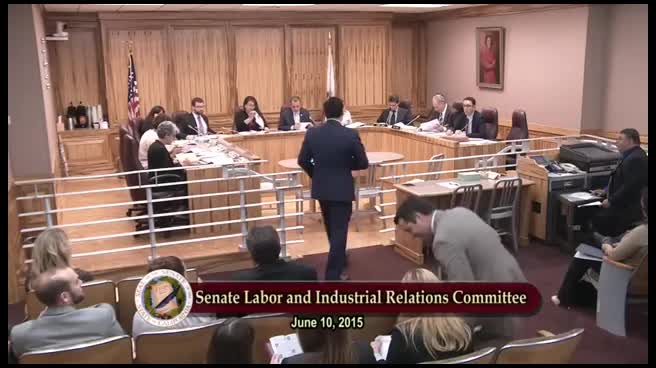 43MIN
Senate Standing Committee on Labor and Industrial Relations
 12MIN
Assembly Floor
Bill Author

Bill Co-Author(s):