AB 571: Property taxation: property statement: change in ownership statement: penalty.
- Session Year: 2015-2016
- House: Assembly
- Latest Version Date: 2015-10-05
Existing law authorizes the county board of equalization or the assessment appeals board to order the penalty abated for failure to file a specified property statement or change in ownership statement, if the assessee establishes to the satisfaction of the county board of equalization or the assessment appeals board that the failure to file the property statement or change in ownership statement within the specified time required was due to reasonable cause and not due to willful neglect and the assessee has filed a written application for abatement of the penalty, as provided.
This bill would instead authorize the penalty to be abated if the assessee establishes that the failure to file the property statement or change in ownership statement within the specified time period was due to reasonable cause and circumstances beyond the assessees control, and occurred notwithstanding the exercise of ordinary care in the absence of willful neglect.
Existing law authorizes the county board of equalization or the assessment appeals board to order the penalty abated for failure to file a specified property statement or change in ownership statement, if the assessee establishes to the satisfaction of the county board of equalization or the assessment appeals board that the failure to file the property statement or change in ownership statement within the specified time required was due to reasonable cause and not due to willful neglect and the assessee has filed a written application for abatement of the penalty, as provided.
This bill would instead authorize the penalty to be abated if the assessee establishes that the failure to file the property statement or change in ownership statement within the specified time period was due to reasonable cause and circumstances beyond the assessee’s control, and occurred notwithstanding the exercise of ordinary care in the absence of willful neglect.
The California Constitution and existing property tax law authorize persons over the age of 55 and persons who are severely and permanently disabled, as specified, to transfer the base year value, as defined, of property to replacement property, if certain conditions are met.
This bill would additionally authorize the transfer of the base year value of property to replacement property for persons who have a severely and permanently disabled child. This bill would apply this property tax relief to replacement dwellings that are purchased or newly constructed on or after January 1, 2016.
Existing law authorizes the county board of equalization or the assessment appeals board to order the penalty abated for failure to file a specified property statement or change in ownership statement, if the assessee establishes to the satisfaction of the county board of equalization or the assessment appeals board that the failure to file the property statement or change in ownership statement within the specified time required was due to reasonable cause and not due to willful neglect and the assessee has filed a written application for abatement of the penalty, as provided.
This bill would instead authorize the penalty to be abated if the assessee establishes that the failure to file the property statement or change in ownership statement within the specified time period was due to reasonable cause and circumstances beyond the assessees control, and occurred notwithstanding the exercise of ordinary care in the absence of willful neglect.
By imposing new duties upon local county officials with respect to the implementation of the property tax relief described above, this bill would impose a state-mandated local program.
The California Constitution requires the state to reimburse local agencies and school districts for certain costs mandated by the state. Statutory provisions establish procedures for making that reimbursement.
This bill would provide that, if the Commission on State Mandates determines that the bill contains costs mandated by the state, reimbursement for those costs shall be made pursuant to these statutory provisions.
Section 2229 of the Revenue and Taxation Code requires the Legislature to reimburse local agencies annually for certain property tax revenues lost as a result of any exemption or classification of property for purposes of ad valorem property taxation.
This bill would provide that, notwithstanding Section 2229 of the Revenue and Taxation Code, no appropriation is made and the state shall not reimburse local agencies for property tax revenues lost by them pursuant to the bill.
(a)If any person who is required by law or is requested by the assessor to make an annual property statement fails to file an annual property statement within the time limit specified by Section 441 or make and subscribe the affidavit respecting his or her name and place of residence, a penalty of 10 percent of the assessed value of the unreported taxable tangible property of that person placed on the current roll shall be added to the assessment made on the current roll.
(b)Notice of any penalty added to the secured roll pursuant to this section shall be mailed by the assessor to the assessee at his or her address as contained in the official records of the county assessor.
(c)If the assessee establishes to the satisfaction of the county board of equalization or the assessment appeals board that the failure to file the property statement within the time required by Section 441 was due to reasonable cause and circumstances beyond the assessees control, and occurred notwithstanding the exercise of ordinary care in the absence of willful neglect, it may order the penalty abated, provided the assessee has filed with the county board written application for abatement of the penalty within the time prescribed by law for the filing of applications for assessment reductions.
(d)If the penalty is abated it shall be canceled or refunded in the same manner as an amount of tax erroneously charged or collected.
SEC. 2.Section 483 of the Revenue and Taxation Code is amended to read:483.(a)If the assessee establishes to the satisfaction of the county board of equalization or the assessment appeals board that the failure to file the change in ownership statement within the time required by subdivision (a) of Section 482 was due to reasonable cause and circumstances beyond the assessees control, and occurred notwithstanding the exercise of ordinary care in the absence of willful neglect, and has filed the statement with the assessor, the county board of equalization or the assessment appeals board may order the penalty abated, provided the assessee has filed with the county board of equalization or the assessment appeals board a written application for abatement of the penalty no later than 60 days after the date on which the assessee was notified of the penalty.
If the penalty is abated it shall be canceled or refunded in the same manner as an amount of tax erroneously charged or collected.
(b)The provisions of subdivision (a) shall not apply in any county in which the board of supervisors adopts a resolution to that effect. In that county the penalty provided for in subdivision (a) of Section 482 shall be abated if the assessee files the change of ownership statement with the assessor no later than 60 days after the date on which the assessee was notified of the penalty.
If the penalty is abated it shall be canceled or refunded in the same manner as an amount of tax erroneously charged or collected.
(c)(1)If a person or legal entity establishes to the satisfaction of the county board of equalization or the assessment appeals board that the failure to file the change in ownership statement within the time required by subdivision (b) of Section 482 was due to reasonable cause and circumstances beyond the assessees control, and occurred notwithstanding the exercise of ordinary care in the absence of willful neglect, and has filed the statement with the State Board of Equalization, the county board of equalization or the assessment appeals board may order the penalty be abated, provided the person or legal entity has filed with the county board of equalization or the assessment appeals board a written application for abatement of the penalty no later than 60 days after the date on which the person or legal entity was notified of the penalty by the assessor.
(2)If a written request to file a change in ownership statement, including a written request to file a complete change in ownership statement, is mailed by the State Board of Equalization to a person or legal entity as specified in subdivision (b) of Section 482, and the assessor determines that the written request was based on erroneous information in the possession of the board provided by any person or entity, including, but not limited to, the Franchise Tax Board, a county assessor, or board staff, the assessor shall abate the penalty if the person or legal entity required to comply with the written request notifies both the board and the county assessor responsible for assessing the penalty of the error no later than 60 days after the date on which the person or legal entity is notified of the penalty.
(3)If the penalty is abated, it shall be canceled or refunded in the same manner as an amount of tax erroneously charged or collected.
(a)If any person who is required by law or is requested by the assessor to make an annual property statement fails to file an annual property statement within the time limit specified by Section 441 or make and subscribe the affidavit respecting his or her name and place of residence, a penalty of 10 percent of the assessed value of the unreported taxable tangible property of that person placed on the current roll shall be added to the assessment made on the current roll.
(b)Notice of any penalty added to the secured roll pursuant to this section shall be mailed by the assessor to the assessee at his or her address as contained in the official records of the county assessor.
(c)If the assessee establishes to the satisfaction of the county board of equalization or the assessment appeals board that the failure to file the property statement within the time required by Section 441 was due to reasonable cause and circumstances beyond the assessees control, and occurred notwithstanding the exercise of ordinary care in the absence of willful neglect, it may order the penalty abated, provided the assessee has filed with the county board written application for abatement of the penalty within the time prescribed by law for the filing of applications for assessment reductions.
(d)If the penalty is abated it shall be canceled or refunded in the same manner as an amount of tax erroneously charged or collected.
SEC. 2.Section 483 of the Revenue and Taxation Code is amended to read:483.(a)If the assessee establishes to the satisfaction of the county board of equalization or the assessment appeals board that the failure to file the change in ownership statement within the time required by subdivision (a) of Section 482 was due to reasonable cause and not due to circumstances beyond the assessees control, and occurred notwithstanding the exercise of ordinary care in the absence of willful neglect, and has filed the statement with the assessor, the county board of equalization or the assessment appeals board may order the penalty abated, provided the assessee has filed with the county board of equalization or the assessment appeals board a written application for abatement of the penalty no later than 60 days after the date on which the assessee was notified of the penalty.
If the penalty is abated it shall be canceled or refunded in the same manner as an amount of tax erroneously charged or collected.
(b)The provisions of subdivision (a) shall not apply in any county in which the board of supervisors adopts a resolution to that effect. In that county the penalty provided for in subdivision (a) of Section 482 shall be abated if the assessee files the change of ownership statement with the assessor no later than 60 days after the date on which the assessee was notified of the penalty.
If the penalty is abated it shall be canceled or refunded in the same manner as an amount of tax erroneously charged or collected.
(c)(1)If a person or legal entity establishes to the satisfaction of the county board of equalization or the assessment appeals board that the failure to file the change in ownership statement within the time required by subdivision (b) of Section 482 was due to reasonable cause and circumstances beyond the assessees control, and occurred notwithstanding the exercise of ordinary care in the absence of willful neglect, and has filed the statement with the State Board of Equalization, the county board of equalization or the assessment appeals board may order the penalty be abated, provided the person or legal entity has filed with the county board of equalization or the assessment appeals board a written application for abatement of the penalty no later than 60 days after the date on which the person or legal entity was notified of the penalty by the assessor.
(2)If a written request to file a change in ownership statement, including a written request to file a complete change in ownership statement, is mailed by the State Board of Equalization to a person or legal entity as specified in subdivision (b) of Section 482, and the assessor determines that the written request was based on erroneous information in the possession of the board provided by any person or entity, including, but not limited to, the Franchise Tax Board, a county assessor, or board staff, the assessor shall abate the penalty if the person or legal entity required to comply with the written request notifies both the board and the county assessor responsible for assessing the penalty of the error no later than 60 days after the date on which the person or legal entity is notified of the penalty.
(3)If the penalty is abated, it shall be canceled or refunded in the same manner as an amount of tax erroneously charged or collected.
(a)If any person who is required by law or is requested by the assessor to make an annual property statement fails to file an annual property statement within the time limit specified by Section 441 or make and subscribe the affidavit respecting his or her name and place of residence, a penalty of 10 percent of the assessed value of the unreported taxable tangible property of that person placed on the current roll shall be added to the assessment made on the current roll.
(b)Notice of any penalty added to the secured roll pursuant to this section shall be mailed by the assessor to the assessee at his or her address as contained in the official records of the county assessor.
(c)If the assessee establishes to the satisfaction of the county board of equalization or the assessment appeals board that the failure to file the property statement within the time required by Section 441 was due to reasonable cause and circumstances beyond the assessee’s control, and occurred notwithstanding the exercise of ordinary care in the absence of willful neglect, it may order the penalty abated, provided the assessee has filed with the county board written application for abatement of the penalty within the time prescribed by law for the filing of applications for assessment reductions.
(d)If the penalty is abated it shall be canceled or refunded in the same manner as an amount of tax erroneously charged or collected.
SEC. 2.Section 483 of the Revenue and Taxation Code is amended to read:483.(a)If the assessee establishes to the satisfaction of the county board of equalization or the assessment appeals board that the failure to file the change in ownership statement within the time required by subdivision (a) of Section 482 was due to reasonable cause and not due to willful neglect, and has filed the statement with the assessor, the county board of equalization or the assessment appeals board may order the penalty abated, provided the assessee has filed with the county board of equalization or the assessment appeals board a written application for abatement of the penalty no later than 60 days after the date on which the assessee was notified of the penalty.
If the penalty is abated it shall be canceled or refunded in the same manner as an amount of tax erroneously charged or collected.
(b)The provisions of subdivision (a) shall not apply in any county in which the board of supervisors adopts a resolution to that effect. In that county the penalty provided for in subdivision (a) of Section 482 shall be abated if the assessee files the change of ownership statement with the assessor no later than 60 days after the date on which the assessee was notified of the penalty.
If the penalty is abated it shall be canceled or refunded in the same manner as an amount of tax erroneously charged or collected.
(c)(1)If a person or legal entity establishes to the satisfaction of the county board of equalization or the assessment appeals board that the failure to file the change in ownership statement within the time required by subdivision (b) of Section 482 was due to reasonable cause and circumstances beyond the assessee’s control, and occurred notwithstanding the exercise of ordinary care in the absence of willful neglect, and has filed the statement with the State Board of Equalization, the county board of equalization or the assessment appeals board may order the penalty be abated, provided the person or legal entity has filed with the county board of equalization or the assessment appeals board a written application for abatement of the penalty no later than 60 days after the date on which the person or legal entity was notified of the penalty by the assessor.
(2)If a written request to file a change in ownership statement, including a written request to file a complete change in ownership statement, is mailed by the State Board of Equalization to a person or legal entity as specified in subdivision (b) of Section 482, and the assessor determines that the written request was based on erroneous information in the possession of the board provided by any person or entity, including, but not limited to, the Franchise Tax Board, a county assessor, or board staff, the assessor shall abate the penalty if the person or legal entity required to comply with the written request notifies both the board and the county assessor responsible for assessing the penalty of the error no later than 60 days after the date on which the person or legal entity is notified of the penalty.
(3)If the penalty is abated, it shall be canceled or refunded in the same manner as an amount of tax erroneously charged or collected.
(a)(1)Notwithstanding any other law, pursuant to subdivision (a) of Section 2 of Article XIIIA of the California Constitution, any person over the age of 55 years, any severely and permanently disabled person, or any person with a severely and permanently disabled child, who resides in property that is eligible for the homeowners exemption under subdivision (k) of Section 3 of Article XIII of the California Constitution and Section 218 may transfer, subject to the conditions and limitations provided in this section, the base year value of that property to any replacement dwelling of equal or lesser value that is located within the same county and is purchased or newly constructed by that person as his or her principal residence within two years of the sale by that person of the original property, provided that the base year value of the original property shall not be transferred to the replacement dwelling until the original property is sold.
(2)Notwithstanding the limitation in paragraph (1) requiring that the original property and the replacement dwelling be located in the same county, this limitation shall not apply in any county in which the county board of supervisors, after consultation with local affected agencies within the boundaries of the county, adopts an ordinance making the provisions of paragraph (1) also applicable to situations in which replacement dwellings are located in that county and the original properties are located in another county within this state. The authorization contained in this paragraph shall be applicable in a county only if the ordinance adopted by the board of supervisors complies with all of the following requirements:
(A)It is adopted only after consultation between the board of supervisors and all other local affected agencies within the countys boundaries.
(B)It requires that all claims for transfers of base year value from original property located in another county be granted if the claims meet the applicable requirements of both subdivision (a) of Section 2 of Article XIIIA of the California Constitution and this section.
(C)It requires that all base year valuations of original property located in another county and determined by its assessor be accepted in connection with the granting of claims for transfers of base year value.
(D)It provides that its provisions are operative for a period of not less than five years.
(E)The ordinance specifies the date on and after which its provisions shall be applicable. However, the date specified shall not be earlier than November 9, 1988. The specified applicable date may be a date earlier than the date the county adopts the ordinance.
(b)In addition to meeting the requirements of subdivision (a), any person claiming the property tax relief provided by this section shall be eligible for that relief only if the following conditions are met:
(1)The claimant is an owner and a resident of the original property either at the time of its sale, or at the time when the original property was substantially damaged or destroyed by misfortune or calamity, or within two years of the purchase or new construction of the replacement dwelling.
(2)The original property is eligible for the homeowners exemption, as the result of the claimants ownership and occupation of the property as his or her principal residence, either at the time of its sale, or at the time when the original property was substantially damaged or destroyed by misfortune or calamity, or within two years of the purchase or new construction of the replacement dwelling.
(3)At the time of the sale of the original property, the claimant or the claimants spouse who resides with the claimant is at least 55 years of age, is severely and permanently disabled, or has a severely and permanently disabled child.
(4)At the time of claiming the property tax relief provided by subdivision (a), the claimant is an owner of a replacement dwelling and occupies it as his or her principal place of residence and, as a result thereof, the property is currently eligible for the homeowners exemption or would be eligible for the exemption except that the property is already receiving the exemption because of an exemption claim filed by the previous owner.
(5)The original property of the claimant is sold by him or her within two years of the purchase or new construction of the replacement dwelling. For purposes of this paragraph, the purchase or new construction of the replacement dwelling includes the purchase of that portion of land on which the replacement building, structure, or other shelter constituting a place of abode of the claimant will be situated and that, pursuant to paragraph (3) of subdivision (g), constitutes a part of the replacement dwelling.
(6)Except as otherwise provided in paragraph (2) of subdivision (a), the replacement dwelling, including that portion of land on which it is situated that is specified in paragraph (5), is located entirely within the same county as the claimants original property.
(7)The claimant has not previously been granted, as a claimant, the property tax relief provided by this section, except that this paragraph shall not apply to any person who becomes severely and permanently disabled subsequent to being granted, as a claimant, the property tax relief provided by this section for any person over the age of 55 years. In order to prevent duplication of claims under this section within this state, county assessors shall report quarterly to the State Board of Equalization that information from claims filed in accordance with subdivision (f) and from county records as is specified by the board necessary to identify fully all claims under this section allowed by assessors and all claimants who have thereby received relief. The board may specify that the information include all or a part of the names and social security numbers of claimants and their spouses and the identity and location of the replacement dwelling to which the claim applies. The information may be required in the form of data processing media or other media and in a format that is compatible with the recordkeeping processes of the counties and the auditing procedures of the state.
(c)The property tax relief provided by this section shall be available if the original property or the replacement dwelling, or both, of the claimant includes, but is not limited to, either of the following:
(1)A unit or lot within a cooperative housing corporation, a community apartment project, a condominium project, or a planned unit development. If the unit or lot constitutes the original property of the claimant, the assessor shall transfer to the claimants replacement dwelling only the base year value of the claimants unit or lot and his or her share in any common area reserved as an appurtenance of that unit or lot. If the unit or lot constitutes the replacement dwelling of the claimant, the assessor shall transfer the base year value of the claimants original property only to the unit or lot of the claimant and any share of the claimant in any common area reserved as an appurtenance of that unit or lot.
(2)A manufactured home or a manufactured home and any land owned by the claimant on which the manufactured home is situated. For purposes of this paragraph, land owned by the claimant includes a pro rata interest in a resident-owned mobilehome park that is assessed pursuant to subdivision (b) of Section 62.1.
(A)If the manufactured home or the manufactured home and the land on which it is situated constitutes the claimants original property, the assessor shall transfer to the claimants replacement dwelling either the base year value of the manufactured home or the base year value of the manufactured home and the land on which it is situated, as appropriate. If the manufactured home dwelling that constitutes the original property of the claimant includes an interest in a resident-owned mobilehome park, the assessor shall transfer to the claimants replacement dwelling the base year value of the claimants manufactured home and his or her pro rata portion of the real property of the park. No transfer of base year value shall be made by the assessor of that portion of land that does not constitute a part of the original property, as provided in paragraph (4) of subdivision (g).
(B)If the manufactured home or the manufactured home and the land on which it is situated constitutes the claimants replacement dwelling, the assessor shall transfer the base year value of the claimants original property either to the manufactured home or the manufactured home and the land on which it is situated, as appropriate. If the manufactured home dwelling that constitutes the replacement dwelling of the claimant includes an interest in a resident-owned mobilehome park, the assessor shall transfer the base year value of the claimants original property to the manufactured home of the claimant and his or her pro rata portion of the park. No transfer of base year value shall be made by the assessor to that portion of land that does not constitute a part of the replacement dwelling, as provided in paragraph (3) of subdivision (g).
This subdivision shall be subject to the limitations specified in subdivision (d).
(d)The property tax relief provided by this section shall be available to a claimant who is the coowner of the original property, as a joint tenant, a tenant in common, a community property owner, or a present beneficiary of a trust subject to the following limitations:
(1)If a single replacement dwelling is purchased or newly constructed by all of the coowners and each coowner retains an interest in the replacement dwelling, the claimant shall be eligible under this section whether or not any or all of the remaining coowners would otherwise be eligible claimants.
(2)If two or more replacement dwellings are separately purchased or newly constructed by two or more coowners and more than one coowner would otherwise be an eligible claimant, only one coowner shall be eligible under this section. These coowners shall determine by mutual agreement which one of them shall be deemed eligible.
(3)If two or more replacement dwellings are separately purchased or newly constructed by two coowners who held the original property as community property, only the coowner who has attained the age of 55 years, is severely and permanently disabled, or has a severely and permanently disabled child, shall be eligible under this section. If both spouses are over 55 years of age, they shall determine by mutual agreement which one of them is eligible.
In the case of coowners whose original property is a multiunit dwelling, the limitations imposed by paragraphs (2) and (3) shall only apply to coowners who occupied the same dwelling unit within the original property at the time specified in paragraph (2) of subdivision (b).
(e)Upon the sale of original property, the assessor shall determine a new base year value for that property in accordance with subdivision (a) of Section 2 of Article XIIIA of the California Constitution and Section 110.1, whether or not a replacement dwelling is subsequently purchased or newly constructed by the former owner or owners of the original property.
This section shall not apply unless the transfer of the original property is a change in ownership that either (1) subjects that property to reappraisal at its current fair market value in accordance with Section 110.1 or 5803 or (2) results in a base year value determined in accordance with this section, Section 69, or Section 69.3 because the property qualifies under this section, Section 69, or Section 69.3 as a replacement dwelling or property.
(f)(1)A claimant shall not be eligible for the property tax relief provided by this section unless the claimant provides to the assessor, on a form that shall be designed by the State Board of Equalization and that the assessor shall make available upon request, the following information:
(A)The name and social security number of each claimant and of any spouse of the claimant who is a record owner of the replacement dwelling.
(B)Proof that the claimant or the claimants spouse who resided on the original property with the claimant was, at the time of its sale, at least 55 years of age, severely and permanently disabled, or had a permanently and disabled child. Proof of severe and permanent disability shall be considered a certification, signed by a licensed physician and surgeon of appropriate specialty, attesting to the claimants severely and permanently disabled or a childs severely and permanently disabled condition. In the absence of available proof that a person is over 55 years of age, the claimant shall certify under penalty of perjury that the age requirement is met. In the case of a severely and permanently disabled claimant or a severely and permanently disabled child either of the following shall be submitted:
(i)A certification, signed by a licensed physician or surgeon of appropriate specialty that identifies specific reasons why the disability necessitates a move to the replacement dwelling and the disability-related requirements, including any locational requirements, of a replacement dwelling. The claimant shall substantiate that the replacement dwelling meets disability-related requirements so identified and that the primary reason for the move to the replacement dwelling is to satisfy those requirements. If the claimant, or the claimants spouse or guardian, so declares under penalty of perjury, it shall be rebuttably presumed that the primary purpose of the move to the replacement dwelling is to satisfy identified disability-related requirements.
(ii)The claimants substantiation that the primary purpose of the move to the replacement dwelling is to alleviate financial burdens caused by the disability. If the claimant, or the claimants spouse or guardian, so declares under penalty of perjury, it shall be rebuttably presumed that the primary purpose of the move is to alleviate the financial burdens caused by the disability.
(C)The address and, if known, the assessors parcel number of the original property.
(D)The date of the claimants sale of the original property and the date of the claimants purchase or new construction of a replacement dwelling.
(E)A statement by the claimant that he or she occupied the replacement dwelling as his or her principal place of residence on the date of the filing of his or her claim.
(F)Any claim under this section shall be filed within three years of the date the replacement dwelling was purchased or the new construction of the replacement dwelling was completed subject to subdivision (k) or (m).
(2)A claim for transfer of base year value under this section that is filed after the expiration of the filing period set forth in subparagraph (F) of paragraph (1) shall be considered by the assessor, subject to all of the following conditions:
(A)Any base year value transfer granted pursuant to that claim shall apply commencing with the lien date of the assessment year in which the claim is filed.
(B)The full cash value of the replacement property in the assessment year described in subparagraph (A) shall be the base year value of the real property in the assessment year in which the base year value was transferred, factored to the assessment year described in subparagraph (A) for both of the following:
(i)Inflation as annually determined in accordance with paragraph (1) of subdivision (a) of Section 51.
(ii)Any subsequent new construction occurring with respect to the subject real property that does not qualify for property tax relief pursuant to the criteria set forth in subparagraphs (A) and (B) of paragraph (4) of subdivision (h).
(g)For purposes of this section:
(1)Person over the age of 55 years means any person or the spouse of any person who has attained the age of 55 years or older at the time of the sale of the original property.
(2)Base year value of the original property means its base year value, as determined in accordance with Section 110.1, with the adjustments permitted by subdivision (b) of Section 2 of Article XIIIA of the California Constitution and subdivision (f) of Section 110.1, determined as of the date immediately prior to the date that the original property is sold by the claimant, or in the case where the original property has been substantially damaged or destroyed by misfortune or calamity and the owner does not rebuild on the original property, determined as of the date immediately prior to the misfortune or calamity.
If the replacement dwelling is purchased or newly constructed after the transfer of the original property, base year value of the original property also includes any inflation factor adjustments permitted by subdivision (f) of Section 110.1 for the period subsequent to the sale of the original property. The base year or years used to compute the base year value of the original property shall be deemed to be the base year or years of any property to which that base year value is transferred pursuant to this section.
(3)Replacement dwelling means a building, structure, or other shelter constituting a place of abode, whether real property or personal property, that is owned and occupied by a claimant as his or her principal place of residence, and any land owned by the claimant on which the building, structure, or other shelter is situated. For purposes of this paragraph, land constituting a part of a replacement dwelling includes only that area of reasonable size that is used as a site for a residence, and land owned by the claimant includes land for which the claimant either holds a leasehold interest described in subdivision (c) of Section 61 or a land purchase contract. Each unit of a multiunit dwelling shall be considered a separate replacement dwelling. For purposes of this paragraph, area of reasonable size that is used as a site for a residence includes all land if any nonresidential uses of the property are only incidental to the use of the property as a residential site. For purposes of this paragraph, land owned by the claimant includes an ownership interest in a resident-owned mobilehome park that is assessed pursuant to subdivision (b) of Section 62.1.
(4)Original property means a building, structure, or other shelter constituting a place of abode, whether real property or personal property, that is owned and occupied by a claimant as his or her principal place of residence, and any land owned by the claimant on which the building, structure, or other shelter is situated. For purposes of this paragraph, land constituting a part of the original property includes only that area of reasonable size that is used as a site for a residence, and land owned by the claimant includes land for which the claimant either holds a leasehold interest described in subdivision (c) of Section 61 or a land purchase contract. Each unit of a multiunit dwelling shall be considered a separate original property. For purposes of this paragraph, area of reasonable size that is used as a site for a residence includes all land if any nonresidential uses of the property are only incidental to the use of the property as a residential site. For purposes of this paragraph, land owned by the claimant includes an ownership interest in a resident-owned mobilehome park that is assessed pursuant to subdivision (b) of Section 62.1.
(5)Equal or lesser value means that the amount of the full cash value of a replacement dwelling does not exceed one of the following:
(A)One hundred percent of the amount of the full cash value of the original property if the replacement dwelling is purchased or newly constructed prior to the date of the sale of the original property.
(B)One hundred and five percent of the amount of the full cash value of the original property if the replacement dwelling is purchased or newly constructed within the first year following the date of the sale of the original property.
(C)One hundred and ten percent of the amount of the full cash value of the original property if the replacement dwelling is purchased or newly constructed within the second year following the date of the sale of the original property.
For the purposes of this paragraph, except as otherwise provided in paragraph (4) of subdivision (h), if the replacement dwelling is, in part, purchased and, in part, newly constructed, the date the replacement dwelling is purchased or newly constructed is the date of purchase or the date of completion of construction, whichever is later.
(6)Full cash value of the replacement dwelling means its full cash value, determined in accordance with Section 110.1, as of the date on which it was purchased or new construction was completed, and after the purchase or the completion of new construction.
(7)Full cash value of the original property means, either:
(A)Its new base year value, determined in accordance with subdivision (e), without the application of subdivision (h) of Section 2 of Article XIIIA of the California Constitution, plus the adjustments permitted by subdivision (b) of Section 2 of Article XIIIA and subdivision (f) of Section 110.1 for the period from the date of its sale by the claimant to the date on which the replacement property was purchased or new construction was completed.
(B)In the case where the original property has been substantially damaged or destroyed by misfortune or calamity and the owner does not rebuild on the original property, its full cash value, as determined in accordance with Section 110, immediately prior to its substantial damage or destruction by misfortune or calamity, as determined by the county assessor of the county in which the property is located, without the application of subdivision (h) of Section 2 of Article XIIIA of the California Constitution, plus the adjustments permitted by subdivision (b) of Section 2 of Article XIIIA of the California Constitution and subdivision (f) of Section 110.1, for the period from the date of its sale by the claimant to the date on which the replacement property was purchased or new construction was completed.
(8)Sale means any change in ownership of the original property for consideration.
(9)Claimant means any person claiming the property tax relief provided by this section. If a spouse of that person is a record owner of the replacement dwelling, the spouse is also a claimant for purposes of determining whether in any future claim filed by the spouse under this section the condition of eligibility specified in paragraph (7) of subdivision (b) has been met.
(10)Property that is eligible for the homeowners exemption includes property that is the principal place of residence of its owner and is entitled to exemption pursuant to Section 205.5.
(11)Person means any individual, but does not include any firm, partnership, association, corporation, company, or other legal entity or organization of any kind. Person includes an individual who is the present beneficiary of a trust.
(12)Severely and permanently disabled means any person described in subdivision (b) of Section 74.3.
(13)For the purposes of this section, property is substantially damaged or destroyed by misfortune or calamity if either the land or the improvements sustain physical damage amounting to more than 50 percent of either the lands or the improvements full cash value immediately prior to the misfortune or calamity. Damage includes a diminution in the value of property as a result of restricted access to the property where the restricted access was caused by the misfortune or calamity and is permanent in nature.
(h)(1)Upon the timely filing of a claim described in subparagraph (F) of paragraph (1) of subdivision (f), the assessor shall adjust the new base year value of the replacement dwelling in conformity with this section. This adjustment shall be made as of the latest of the following dates:
(A)The date the original property is sold.
(B)The date the replacement dwelling is purchased.
(C)The date the new construction of the replacement dwelling is completed.
(2)Any taxes that were levied on the replacement dwelling prior to the filing of the claim on the basis of the replacement dwellings new base year value, and any allowable annual adjustments thereto, shall be canceled or refunded to the claimant to the extent that the taxes exceed the amount that would be due when determined on the basis of the adjusted new base year value.
(3)Notwithstanding Section 75.10, Chapter 3.5 (commencing with Section 75) shall be utilized for purposes of implementing this subdivision, including adjustments of the new base year value of replacement dwellings acquired prior to the sale of the original property.
(4)In the case where a claim under this section has been timely filed and granted, and new construction is performed upon the replacement dwelling subsequent to the transfer of base year value, the property tax relief provided by this section also shall apply to the replacement dwelling, as improved, and thus there shall be no reassessment upon completion of the new construction if both of the following conditions are met:
(A)The new construction is completed within two years of the date of the sale of the original property and the owner notifies the assessor in writing of completion of the new construction within six months after completion.
(B)The fair market value of the new construction on the date of completion, plus the full cash value of the replacement dwelling on the date of acquisition, is not more than the full cash value of the original property as determined pursuant to paragraph (7) of subdivision (g) for purposes of granting the original claim.
(i)Any claimant may rescind a claim for the property tax relief provided by this section and shall not be considered to have received that relief for purposes of paragraph (7) of subdivision (b), and the assessor shall grant the rescission, if a written notice of rescission is delivered to the office of the assessor as follows:
(1)A written notice of rescission signed by the original filing claimant or claimants is delivered to the office of the assessor in which the original claim was filed.
(2)(A)Except as otherwise provided in this paragraph, the notice of rescission is delivered to the office of the assessor before the date that the county first issues, as a result of relief granted under this section, a refund check for property taxes imposed upon the replacement dwelling. If granting relief will not result in a refund of property taxes, then the notice shall be delivered before payment is first made of any property taxes, or any portion thereof, imposed upon the replacement dwelling consistent with relief granted under this section. If payment of the taxes is not made, then notice shall be delivered before the first date that those property taxes, or any portion thereof, imposed upon the replacement dwelling, consistent with relief granted under this section, are delinquent.
(B)Notwithstanding any other provision in this division, any time the notice of rescission is delivered to the office of the assessor within six years after relief was granted, provided that the replacement property has been vacated as the claimants principal place of residence within 90 days after the original claim was filed, regardless of whether the property continues to receive the homeowners exemption. If the rescission increases the base year value of a property, or the homeowners exemption has been incorrectly allowed, appropriate escape assessments or supplemental assessments, including interest as provided in Section 506, shall be imposed. The limitations periods for any escape assessments or supplemental assessments shall not commence until July 1 of the assessment year in which the notice of rescission is delivered to the office of the assessor.
(3)The notice is accompanied by the payment of a fee as the assessor may require, provided that the fee shall not exceed an amount reasonably related to the estimated cost of processing a rescission claim, including both direct costs and developmental and indirect costs, such as costs for overhead, personnel, supplies, materials, office space, and computers.
(j)(1)With respect to the transfer of base year value of original properties to replacement dwellings located in the same county, this section, except as provided in paragraph (3) or (4), shall apply to any replacement dwelling that is purchased or newly constructed on or after November 6, 1986.
(2)With respect to the transfer of base year value of original properties to replacement dwellings located in different counties, except as provided in paragraph (4), this section shall apply to any replacement dwelling that is purchased or newly constructed on or after the date specified in accordance with subparagraph (E) of paragraph (2) of subdivision (a) in the ordinance of the county in which the replacement dwelling is located, but shall not apply to any replacement dwelling which was purchased or newly constructed before November 9, 1988.
(3)With respect to the transfer of base year value by a severely and permanently disabled person, this section shall apply only to replacement dwellings that are purchased or newly constructed on or after June 6, 1990.
(4)The amendments made to subdivision (e) by the act adding this paragraph shall apply only to replacement dwellings under Section 69 that are acquired or newly constructed on or after October 20, 1991, and shall apply commencing with the 199192 fiscal year.
(k)(1)In the case in which a county adopts an ordinance pursuant to paragraph (2) of subdivision (a) that establishes an applicable date which is more than three years prior to the date of adoption of the ordinance, those potential claimants who purchased or constructed replacement dwellings more than three years prior to the date of adoption of the ordinance and who would, therefore, be precluded from filing a timely claim, shall be deemed to have timely filed a claim if the claim is filed within three years after the date that the ordinance is adopted. This paragraph may not be construed as a waiver of any other requirement of this section.
(2)In the case in which a county assessor corrects a base year value to reflect a pro rata change in ownership of a resident-owned mobilehome park that occurred between January 1, 1989, and January 1, 2002, pursuant to paragraph (4) of subdivision (b) of Section 62.1, those claimants who purchased or constructed replacement dwellings more than three years prior to the correction and who would, therefore, be precluded from filing a timely claim, shall be deemed to have timely filed a claim if the claim is filed within three years of the date of notice of the correction of the base year value to reflect the pro rata change in ownership. This paragraph may not be construed as a waiver of any other requirement of this section.
(3)This subdivision does not apply to a claimant who has transferred his or her replacement dwelling prior to filing a claim.
(4)The property tax relief provided by this section, but filed under this subdivision, shall apply prospectively only, commencing with the lien date of the assessment year in which the claim is filed. There shall be no refund or cancellation of taxes prior to the date that the claim is filed.
(l)No escape assessment may be levied if a transfer of base year value under this section has been erroneously granted by the assessor pursuant to an expired ordinance authorizing intercounty transfers of base year value.
(m)(1)The amendments made to subdivisions (b) and (g) of this section by Chapter 613 of the Statutes of 2001 shall apply:
(A)With respect to the transfer of base year value of original properties to replacement dwellings located in the same county, to any replacement dwelling that is purchased or newly constructed on or after November 6, 1986.
(B)With respect to the transfer of base year value of original properties to replacement dwellings located in different counties, to any replacement dwelling that is purchased or newly constructed on or after the date specified in accordance with subparagraph (E) of paragraph (2) of subdivision (a) in the ordinance of the county in which the replacement dwelling is located, but not to any replacement dwelling that was purchased or newly constructed before November 9, 1988.
(C)With respect to the transfer of base year value by a severely and permanently disabled person, to replacement dwellings that are purchased or newly constructed on or after June 6, 1990.
(2)The property tax relief provided by this section in accordance with this subdivision shall apply prospectively only commencing with the lien date of the assessment year in which the claim is filed. There shall be no refund or cancellation of taxes prior to the date that the claim is filed.
(n)A claim filed under this section is not a public document and is not subject to public inspection, except that a claim shall be available for inspection by the claimant or the claimants spouse, the claimants or the claimants spouses legal representative, the trustee of a trust in which the claimant or the claimants spouse is a present beneficiary, and the executor or administrator of the claimants or the claimants spouses estate.
(o)The amendments made to this section by the act adding this subdivision shall apply commencing with the lien date for the 201213 fiscal year.
(p)With respect to the transfer of base year value by a person with a severely and permanently disabled child, this section shall only apply to replacement dwellings that are purchased or newly constructed on or afer January 1, 2016.
SEC. 2.SECTION 1.Section 463 of the Revenue and Taxation Code is amended to read:463.(a)If any person who is required by law or is requested by the assessor to make an annual property statement fails to file an annual property statement within the time limit specified by Section 441 or make and subscribe the affidavit respecting his or her name and place of residence, a penalty of 10 percent of the assessed value of the unreported taxable tangible property of that person placed on the current roll shall be added to the assessment made on the current roll.
(b)Notice of any penalty added to the secured roll pursuant to this section shall be mailed by the assessor to the assessee at his or her address as contained in the official records of the county assessor.
(c)If the assessee establishes to the satisfaction of the county board of equalization or the assessment appeals board that the failure to file the property statement within the time required by Section 441 was due to reasonable cause and circumstances beyond the assessees control, and occurred notwithstanding the exercise of ordinary care in the absence of willful neglect, it may order the penalty abated, provided the assessee has filed with the county board written application for abatement of the penalty within the time prescribed by law for the filing of applications for assessment reductions.
(d)If the penalty is abated it shall be canceled or refunded in the same manner as an amount of tax erroneously charged or collected.
SEC. 3.SEC. 2.Section 483 of the Revenue and Taxation Code is amended to read:483.(a)If the assessee establishes to the satisfaction of the county board of equalization or the assessment appeals board that the failure to file the change in ownership statement within the time required by subdivision (a) of Section 482 was due to reasonable cause and not due to willful neglect, and has filed the statement with the assessor, the county board of equalization or the assessment appeals board may order the penalty abated, provided the assessee has filed with the county board of equalization or the assessment appeals board a written application for abatement of the penalty no later than 60 days after the date on which the assessee was notified of the penalty.
If the penalty is abated it shall be canceled or refunded in the same manner as an amount of tax erroneously charged or collected.
(b)The provisions of subdivision (a) shall not apply in any county in which the board of supervisors adopts a resolution to that effect. In that county the penalty provided for in subdivision (a) of Section 482 shall be abated if the assessee files the change of ownership statement with the assessor no later than 60 days after the date on which the assessee was notified of the penalty.
If the penalty is abated it shall be canceled or refunded in the same manner as an amount of tax erroneously charged or collected.
(c)(1)If a person or legal entity establishes to the satisfaction of the county board of equalization or the assessment appeals board that the failure to file the change in ownership statement within the time required by subdivision (b) of Section 482 was due to reasonable cause and circumstances beyond the assessees control, and occurred notwithstanding the exercise of ordinary care in the absence of willful neglect, and has filed the statement with the State Board of Equalization, the county board of equalization or the assessment appeals board may order the penalty be abated, provided the person or legal entity has filed with the county board of equalization or the assessment appeals board a written application for abatement of the penalty no later than 60 days after the date on which the person or legal entity was notified of the penalty by the assessor.
(2)If a written request to file a change in ownership statement, including a written request to file a complete change in ownership statement, is mailed by the State Board of Equalization to a person or legal entity as specified in subdivision (b) of Section 482, and the assessor determines that the written request was based on erroneous information in the possession of the board provided by any person or entity, including, but not limited to, the Franchise Tax Board, a county assessor, or board staff, the assessor shall abate the penalty if the person or legal entity required to comply with the written request notifies both the board and the county assessor responsible for assessing the penalty of the error no later than 60 days after the date on which the person or legal entity is notified of the penalty.
(3)If the penalty is abated, it shall be canceled or refunded in the same manner as an amount of tax erroneously charged or collected.
SEC. 4.If the Commission on State Mandates determines that this act contains costs mandated by the state, reimbursement to local agencies and school districts for those costs shall be made pursuant to Part 7 (commencing with Section 17500) of Division 4 of Title 2 of the Government Code.
SEC. 5.Notwithstanding Section 2229 of the Revenue and Taxation Code, no appropriation is made by this act and the state shall not reimburse any local agency for any property tax revenues lost by it pursuant to this act.
(a)(1)Notwithstanding any other provision of law, pursuant to subdivision (a) of Section 2 of Article XIIIA of the California Constitution, any person over the age of 55 years, or any severely and permanently disabled person, or any person with a severely and permanently disabled child, who resides in property that is eligible for the homeowners exemption under subdivision (k) of Section 3 of Article XIII of the California Constitution and Section 218 may transfer, subject to the conditions and limitations provided in this section, the base year value of that property to any replacement dwelling of equal or lesser value that is located within the same county and is purchased or newly constructed by that person as his or her principal residence within two years of the sale by that person of the original property, provided that the base year value of the original property shall not be transferred to the replacement dwelling until the original property is sold.
(2)Notwithstanding the limitation in paragraph (1) requiring that the original property and the replacement dwelling be located in the same county, this limitation shall not apply in any county in which the county board of supervisors, after consultation with local affected agencies within the boundaries of the county, adopts an ordinance making the provisions of paragraph (1) also applicable to situations in which replacement dwellings are located in that county and the original properties are located in another county within this state. The authorization contained in this paragraph shall be applicable in a county only if the ordinance adopted by the board of supervisors complies with all of the following requirements:
(A)It is adopted only after consultation between the board of supervisors and all other local affected agencies within the countys boundaries.
(B)It requires that all claims for transfers of base year value from original property located in another county be granted if the claims meet the applicable requirements of both subdivision (a) of Section 2 of Article XIIIA of the California Constitution and this section.
(C)It requires that all base year valuations of original property located in another county and determined by its assessor be accepted in connection with the granting of claims for transfers of base year value.
(D)It provides that its provisions are operative for a period of not less than five years.
(E)The ordinance specifies the date on and after which its provisions shall be applicable. However, the date specified shall not be earlier than November 9, 1988. The specified applicable date may be a date earlier than the date the county adopts the ordinance.
(b)In addition to meeting the requirements of subdivision (a), any person claiming the property tax relief provided by this section shall be eligible for that relief only if the following conditions are met:
(1)The claimant is an owner and a resident of the original property either at the time of its sale, or at the time when the original property was substantially damaged or destroyed by misfortune or calamity, or within two years of the purchase or new construction of the replacement dwelling.
(2)The original property is eligible for the homeowners exemption, as the result of the claimants ownership and occupation of the property as his or her principal residence, either at the time of its sale, or at the time when the original property was substantially damaged or destroyed by misfortune or calamity, or within two years of the purchase or new construction of the replacement dwelling.
(3)At the time of the sale of the original property, the claimant or the claimants spouse who resides with the claimant is at least 55 years of age, or is severely and permanently disabled disabled, or has a severely and permanently disabled child.
(4)At the time of claiming the property tax relief provided by subdivision (a), the claimant is an owner of a replacement dwelling and occupies it as his or her principal place of residence and, as a result thereof, the property is currently eligible for the homeowners exemption or would be eligible for the exemption except that the property is already receiving the exemption because of an exemption claim filed by the previous owner.
(5)The original property of the claimant is sold by him or her within two years of the purchase or new construction of the replacement dwelling. For purposes of this paragraph, the purchase or new construction of the replacement dwelling includes the purchase of that portion of land on which the replacement building, structure, or other shelter constituting a place of abode of the claimant will be situated and that, pursuant to paragraph (3) of subdivision (g), constitutes a part of the replacement dwelling.
(6)Except as otherwise provided in paragraph (2) of subdivision (a), the replacement dwelling, including that portion of land on which it is situated that is specified in paragraph (5), is located entirely within the same county as the claimants original property.
(7)The claimant has not previously been granted, as a claimant, the property tax relief provided by this section, except that this paragraph shall not apply to any person who becomes severely and permanently disabled subsequent to being granted, as a claimant, the property tax relief provided by this section for any person over the age of 55 years. In order to prevent duplication of claims under this section within this state, county assessors shall report quarterly to the State Board of Equalization that information from claims filed in accordance with subdivision (f) and from county records as is specified by the board necessary to identify fully all claims under this section allowed by assessors and all claimants who have thereby received relief. The board may specify that the information include all or a part of the names and social security numbers of claimants and their spouses and the identity and location of the replacement dwelling to which the claim applies. The information may be required in the form of data processing media or other media and in a format that is compatible with the recordkeeping processes of the counties and the auditing procedures of the state.
(c)The property tax relief provided by this section shall be available if the original property or the replacement dwelling, or both, of the claimant includes, but is not limited to, either of the following:
(1)A unit or lot within a cooperative housing corporation, a community apartment project, a condominium project, or a planned unit development. If the unit or lot constitutes the original property of the claimant, the assessor shall transfer to the claimants replacement dwelling only the base year value of the claimants unit or lot and his or her share in any common area reserved as an appurtenance of that unit or lot. If the unit or lot constitutes the replacement dwelling of the claimant, the assessor shall transfer the base year value of the claimants original property only to the unit or lot of the claimant and any share of the claimant in any common area reserved as an appurtenance of that unit or lot.
(2)A manufactured home or a manufactured home and any land owned by the claimant on which the manufactured home is situated. For purposes of this paragraph, land owned by the claimant includes a pro rata interest in a resident-owned mobilehome park that is assessed pursuant to subdivision (b) of Section 62.1.
(A)If the manufactured home or the manufactured home and the land on which it is situated constitutes the claimants original property, the assessor shall transfer to the claimants replacement dwelling either the base year value of the manufactured home or the base year value of the manufactured home and the land on which it is situated, as appropriate. If the manufactured home dwelling that constitutes the original property of the claimant includes an interest in a resident-owned mobilehome park, the assessor shall transfer to the claimants replacement dwelling the base year value of the claimants manufactured home and his or her pro rata portion of the real property of the park. No transfer of base year value shall be made by the assessor of that portion of land that does not constitute a part of the original property, as provided in paragraph (4) of subdivision (g).
(B)If the manufactured home or the manufactured home and the land on which it is situated constitutes the claimants replacement dwelling, the assessor shall transfer the base year value of the claimants original property either to the manufactured home or the manufactured home and the land on which it is situated, as appropriate. If the manufactured home dwelling that constitutes the replacement dwelling of the claimant includes an interest in a resident-owned mobilehome park, the assessor shall transfer the base year value of the claimants original property to the manufactured home of the claimant and his or her pro rata portion of the park. No transfer of base year value shall be made by the assessor to that portion of land that does not constitute a part of the replacement dwelling, as provided in paragraph (3) of subdivision (g).
This subdivision shall be subject to the limitations specified in subdivision (d).
(d)The property tax relief provided by this section shall be available to a claimant who is the coowner of the original property, as a joint tenant, a tenant in common, a community property owner, or a present beneficiary of a trust subject to the following limitations:
(1)If a single replacement dwelling is purchased or newly constructed by all of the coowners and each coowner retains an interest in the replacement dwelling, the claimant shall be eligible under this section whether or not any or all of the remaining coowners would otherwise be eligible claimants.
(2)If two or more replacement dwellings are separately purchased or newly constructed by two or more coowners and more than one coowner would otherwise be an eligible claimant, only one coowner shall be eligible under this section. These coowners shall determine by mutual agreement which one of them shall be deemed eligible.
(3)If two or more replacement dwellings are separately purchased or newly constructed by two coowners who held the original property as community property, only the coowner who has attained the age of 55 years, or is severely and permanently disabled, or has a severely and permanently disabled child, shall be eligible under this section. If both spouses are over 55 years of age, they shall determine by mutual agreement which one of them is eligible.
In the case of coowners whose original property is a multiunit dwelling, the limitations imposed by paragraphs (2) and (3) shall only apply to coowners who occupied the same dwelling unit within the original property at the time specified in paragraph (2) of subdivision (b).
(e)Upon the sale of original property, the assessor shall determine a new base year value for that property in accordance with subdivision (a) of Section 2 of Article XIIIA of the California Constitution and Section 110.1, whether or not a replacement dwelling is subsequently purchased or newly constructed by the former owner or owners of the original property.
This section shall not apply unless the transfer of the original property is a change in ownership that either (1) subjects that property to reappraisal at its current fair market value in accordance with Section 110.1 or 5803 or (2) results in a base year value determined in accordance with this section, Section 69, or Section 69.3 because the property qualifies under this section, Section 69, or Section 69.3 as a replacement dwelling or property.
(f)(1)A claimant shall not be eligible for the property tax relief provided by this section unless the claimant provides to the assessor, on a form that shall be designed by the State Board of Equalization and that the assessor shall make available upon request, the following information:
(A)The name and social security number of each claimant and of any spouse of the claimant who is a record owner of the replacement dwelling.
(B)Proof that the claimant or the claimants spouse who resided on the original property with the claimant was, at the time of its sale, at least 55 years of age, or severely and permanently disabled. disabled, or had a permanently and disabled child. Proof of severe and permanent disability shall be considered a certification, signed by a licensed physician and surgeon of appropriate specialty, attesting to the claimants severely and permanently disabled condition. or a childs severely and permanently disabled condition. In the absence of available proof that a person is over 55 years of age, the claimant shall certify under penalty of perjury that the age requirement is met. In the case of a severely and permanently disabled claimant or a severely and permanently disabled child either of the following shall be submitted:
(i)A certification, signed by a licensed physician or surgeon of appropriate specialty that identifies specific reasons why the disability necessitates a move to the replacement dwelling and the disability-related requirements, including any locational requirements, of a replacement dwelling. The claimant shall substantiate that the replacement dwelling meets disability-related requirements so identified and that the primary reason for the move to the replacement dwelling is to satisfy those requirements. If the claimant, or the claimants spouse or guardian, so declares under penalty of perjury, it shall be rebuttably presumed that the primary purpose of the move to the replacement dwelling is to satisfy identified disability-related requirements.
(ii)The claimants substantiation that the primary purpose of the move to the replacement dwelling is to alleviate financial burdens caused by the disability. If the claimant, or the claimants spouse or guardian, so declares under penalty of perjury, it shall be rebuttably presumed that the primary purpose of the move is to alleviate the financial burdens caused by the disability.
(C)The address and, if known, the assessors parcel number of the original property.
(D)The date of the claimants sale of the original property and the date of the claimants purchase or new construction of a replacement dwelling.
(E)A statement by the claimant that he or she occupied the replacement dwelling as his or her principal place of residence on the date of the filing of his or her claim.
(F)Any claim under this section shall be filed within three years of the date the replacement dwelling was purchased or the new construction of the replacement dwelling was completed subject to subdivision (k) or (m).
(2)A claim for transfer of base year value under this section that is filed after the expiration of the filing period set forth in subparagraph (F) of paragraph (1) shall be considered by the assessor, subject to all of the following conditions:
(A)Any base year value transfer granted pursuant to that claim shall apply commencing with the lien date of the assessment year in which the claim is filed.
(B)The full cash value of the replacement property in the assessment year described in subparagraph (A) shall be the base year value of the real property in the assessment year in which the base year value was transferred, factored to the assessment year described in subparagraph (A) for both of the following:
(i)Inflation as annually determined in accordance with paragraph (1) of subdivision (a) of Section 51.
(ii)Any subsequent new construction occurring with respect to the subject real property that does not qualify for property tax relief pursuant to the criteria set forth in subparagraphs (A) and (B) of paragraph (4) of subdivision (h).
(g)For purposes of this section:
(1)Person over the age of 55 years means any person or the spouse of any person who has attained the age of 55 years or older at the time of the sale of the original property.
(2)Base year value of the original property means its base year value, as determined in accordance with Section 110.1, with the adjustments permitted by subdivision (b) of Section 2 of Article XIIIA of the California Constitution and subdivision (f) of Section 110.1, determined as of the date immediately prior to the date that the original property is sold by the claimant, or in the case where the original property has been substantially damaged or destroyed by misfortune or calamity and the owner does not rebuild on the original property, determined as of the date immediately prior to the misfortune or calamity.
If the replacement dwelling is purchased or newly constructed after the transfer of the original property, base year value of the original property also includes any inflation factor adjustments permitted by subdivision (f) of Section 110.1 for the period subsequent to the sale of the original property. The base year or years used to compute the base year value of the original property shall be deemed to be the base year or years of any property to which that base year value is transferred pursuant to this section.
(3)Replacement dwelling means a building, structure, or other shelter constituting a place of abode, whether real property or personal property, that is owned and occupied by a claimant as his or her principal place of residence, and any land owned by the claimant on which the building, structure, or other shelter is situated. For purposes of this paragraph, land constituting a part of a replacement dwelling includes only that area of reasonable size that is used as a site for a residence, and land owned by the claimant includes land for which the claimant either holds a leasehold interest described in subdivision (c) of Section 61 or a land purchase contract. Each unit of a multiunit dwelling shall be considered a separate replacement dwelling. For purposes of this paragraph, area of reasonable size that is used as a site for a residence includes all land if any nonresidential uses of the property are only incidental to the use of the property as a residential site. For purposes of this paragraph, land owned by the claimant includes an ownership interest in a resident-owned mobilehome park that is assessed pursuant to subdivision (b) of Section 62.1.
(4)Original property means a building, structure, or other shelter constituting a place of abode, whether real property or personal property, that is owned and occupied by a claimant as his or her principal place of residence, and any land owned by the claimant on which the building, structure, or other shelter is situated. For purposes of this paragraph, land constituting a part of the original property includes only that area of reasonable size that is used as a site for a residence, and land owned by the claimant includes land for which the claimant either holds a leasehold interest described in subdivision (c) of Section 61 or a land purchase contract. Each unit of a multiunit dwelling shall be considered a separate original property. For purposes of this paragraph, area of reasonable size that is used as a site for a residence includes all land if any nonresidential uses of the property are only incidental to the use of the property as a residential site. For purposes of this paragraph, land owned by the claimant includes an ownership interest in a resident-owned mobilehome park that is assessed pursuant to subdivision (b) of Section 62.1.
(5)Equal or lesser value means that the amount of the full cash value of a replacement dwelling does not exceed one of the following:
(A)One hundred percent of the amount of the full cash value of the original property if the replacement dwelling is purchased or newly constructed prior to the date of the sale of the original property.
(B)One hundred and five percent of the amount of the full cash value of the original property if the replacement dwelling is purchased or newly constructed within the first year following the date of the sale of the original property.
(C)One hundred and ten percent of the amount of the full cash value of the original property if the replacement dwelling is purchased or newly constructed within the second year following the date of the sale of the original property.
For the purposes of this paragraph, except as otherwise provided in paragraph (4) of subdivision (h), if the replacement dwelling is, in part, purchased and, in part, newly constructed, the date the replacement dwelling is purchased or newly constructed is the date of purchase or the date of completion of construction, whichever is later.
(6)Full cash value of the replacement dwelling means its full cash value, determined in accordance with Section 110.1, as of the date on which it was purchased or new construction was completed, and after the purchase or the completion of new construction.
(7)Full cash value of the original property means, either:
(A)Its new base year value, determined in accordance with subdivision (e), without the application of subdivision (h) of Section 2 of Article XIIIA of the California Constitution, plus the adjustments permitted by subdivision (b) of Section 2 of Article XIIIA and subdivision (f) of Section 110.1 for the period from the date of its sale by the claimant to the date on which the replacement property was purchased or new construction was completed.
(B)In the case where the original property has been substantially damaged or destroyed by misfortune or calamity and the owner does not rebuild on the original property, its full cash value, as determined in accordance with Section 110, immediately prior to its substantial damage or destruction by misfortune or calamity, as determined by the county assessor of the county in which the property is located, without the application of subdivision (h) of Section 2 of Article XIIIA of the California Constitution, plus the adjustments permitted by subdivision (b) of Section 2 of Article XIIIA of the California Constitution and subdivision (f) of Section 110.1, for the period from the date of its sale by the claimant to the date on which the replacement property was purchased or new construction was completed.
(8)Sale means any change in ownership of the original property for consideration.
(9)Claimant means any person claiming the property tax relief provided by this section. If a spouse of that person is a record owner of the replacement dwelling, the spouse is also a claimant for purposes of determining whether in any future claim filed by the spouse under this section the condition of eligibility specified in paragraph (7) of subdivision (b) has been met.
(10)Property that is eligible for the homeowners exemption includes property that is the principal place of residence of its owner and is entitled to exemption pursuant to Section 205.5.
(11)Person means any individual, but does not include any firm, partnership, association, corporation, company, or other legal entity or organization of any kind. Person includes an individual who is the present beneficiary of a trust.
(12)Severely and permanently disabled means any person described in subdivision (b) of Section 74.3.
(13)For the purposes of this section, property is substantially damaged or destroyed by misfortune or calamity if either the land or the improvements sustain physical damage amounting to more than 50 percent of either the lands or the improvements full cash value immediately prior to the misfortune or calamity. Damage includes a diminution in the value of property as a result of restricted access to the property where the restricted access was caused by the misfortune or calamity and is permanent in nature.
(h)(1)Upon the timely filing of a claim described in subparagraph (F) of paragraph (1) of subdivision (f), the assessor shall adjust the new base year value of the replacement dwelling in conformity with this section. This adjustment shall be made as of the latest of the following dates:
(A)The date the original property is sold.
(B)The date the replacement dwelling is purchased.
(C)The date the new construction of the replacement dwelling is completed.
(2)Any taxes that were levied on the replacement dwelling prior to the filing of the claim on the basis of the replacement dwellings new base year value, and any allowable annual adjustments thereto, shall be canceled or refunded to the claimant to the extent that the taxes exceed the amount that would be due when determined on the basis of the adjusted new base year value.
(3)Notwithstanding Section 75.10, Chapter 3.5 (commencing with Section 75) shall be utilized for purposes of implementing this subdivision, including adjustments of the new base year value of replacement dwellings acquired prior to the sale of the original property.
(4)In the case where a claim under this section has been timely filed and granted, and new construction is performed upon the replacement dwelling subsequent to the transfer of base year value, the property tax relief provided by this section also shall apply to the replacement dwelling, as improved, and thus there shall be no reassessment upon completion of the new construction if both of the following conditions are met:
(A)The new construction is completed within two years of the date of the sale of the original property and the owner notifies the assessor in writing of completion of the new construction within six months after completion.
(B)The fair market value of the new construction on the date of completion, plus the full cash value of the replacement dwelling on the date of acquisition, is not more than the full cash value of the original property as determined pursuant to paragraph (7) of subdivision (g) for purposes of granting the original claim.
(i)Any claimant may rescind a claim for the property tax relief provided by this section and shall not be considered to have received that relief for purposes of paragraph (7) of subdivision (b), and the assessor shall grant the rescission, if a written notice of rescission is delivered to the office of the assessor as follows:
(1)A written notice of rescission signed by the original filing claimant or claimants is delivered to the office of the assessor in which the original claim was filed.
(2)(A)Except as otherwise provided in this paragraph, the notice of rescission is delivered to the office of the assessor before the date that the county first issues, as a result of relief granted under this section, a refund check for property taxes imposed upon the replacement dwelling. If granting relief will not result in a refund of property taxes, then the notice shall be delivered before payment is first made of any property taxes, or any portion thereof, imposed upon the replacement dwelling consistent with relief granted under this section. If payment of the taxes is not made, then notice shall be delivered before the first date that those property taxes, or any portion thereof, imposed upon the replacement dwelling, consistent with relief granted under this section, are delinquent.
(B)Notwithstanding any other provision in this division, any time the notice of rescission is delivered to the office of the assessor within six years after relief was granted, provided that the replacement property has been vacated as the claimants principal place of residence within 90 days after the original claim was filed, regardless of whether the property continues to receive the homeowners exemption. If the rescission increases the base year value of a property, or the homeowners exemption has been incorrectly allowed, appropriate escape assessments or supplemental assessments, including interest as provided in Section 506, shall be imposed. The limitations periods for any escape assessments or supplemental assessments shall not commence until July 1 of the assessment year in which the notice of rescission is delivered to the office of the assessor.
(3)The notice is accompanied by the payment of a fee as the assessor may require, provided that the fee shall not exceed an amount reasonably related to the estimated cost of processing a rescission claim, including both direct costs and developmental and indirect costs, such as costs for overhead, personnel, supplies, materials, office space, and computers.
(j)(1)With respect to the transfer of base year value of original properties to replacement dwellings located in the same county, this section, except as provided in paragraph (3) or (4), shall apply to any replacement dwelling that is purchased or newly constructed on or after November 6, 1986.
(2)With respect to the transfer of base year value of original properties to replacement dwellings located in different counties, except as provided in paragraph (4), this section shall apply to any replacement dwelling that is purchased or newly constructed on or after the date specified in accordance with subparagraph (E) of paragraph (2) of subdivision (a) in the ordinance of the county in which the replacement dwelling is located, but shall not apply to any replacement dwelling which was purchased or newly constructed before November 9, 1988.
(3)With respect to the transfer of base year value by a severely and permanently disabled person, this section shall apply only to replacement dwellings that are purchased or newly constructed on or after June 6, 1990.
(4)The amendments made to subdivision (e) by the act adding this paragraph shall apply only to replacement dwellings under Section 69 that are acquired or newly constructed on or after October 20, 1991, and shall apply commencing with the 199192 fiscal year.
(k)(1)In the case in which a county adopts an ordinance pursuant to paragraph (2) of subdivision (a) that establishes an applicable date which is more than three years prior to the date of adoption of the ordinance, those potential claimants who purchased or constructed replacement dwellings more than three years prior to the date of adoption of the ordinance and who would, therefore, be precluded from filing a timely claim, shall be deemed to have timely filed a claim if the claim is filed within three years after the date that the ordinance is adopted. This paragraph may not be construed as a waiver of any other requirement of this section.
(2)In the case in which a county assessor corrects a base year value to reflect a pro rata change in ownership of a resident-owned mobilehome park that occurred between January 1, 1989, and January 1, 2002, pursuant to paragraph (4) of subdivision (b) of Section 62.1, those claimants who purchased or constructed replacement dwellings more than three years prior to the correction and who would, therefore, be precluded from filing a timely claim, shall be deemed to have timely filed a claim if the claim is filed within three years of the date of notice of the correction of the base year value to reflect the pro rata change in ownership. This paragraph may not be construed as a waiver of any other requirement of this section.
(3)This subdivision does not apply to a claimant who has transferred his or her replacement dwelling prior to filing a claim.
(4)The property tax relief provided by this section, but filed under this subdivision, shall apply prospectively only, commencing with the lien date of the assessment year in which the claim is filed. There shall be no refund or cancellation of taxes prior to the date that the claim is filed.
(l)No escape assessment may be levied if a transfer of base year value under this section has been erroneously granted by the assessor pursuant to an expired ordinance authorizing intercounty transfers of base year value.
(m)(1)The amendments made to subdivisions (b) and (g) of this section by Chapter 613 of the Statutes of 2001 shall apply:
(A)With respect to the transfer of base year value of original properties to replacement dwellings located in the same county, to any replacement dwelling that is purchased or newly constructed on or after November 6, 1986.
(B)With respect to the transfer of base year value of original properties to replacement dwellings located in different counties, to any replacement dwelling that is purchased or newly constructed on or after the date specified in accordance with subparagraph (E) of paragraph (2) of subdivision (a) in the ordinance of the county in which the replacement dwelling is located, but not to any replacement dwelling that was purchased or newly constructed before November 9, 1988.
(C)With respect to the transfer of base year value by a severely and permanently disabled person, to replacement dwellings that are purchased or newly constructed on or after June 6, 1990.
(2)The property tax relief provided by this section in accordance with this subdivision shall apply prospectively only commencing with the lien date of the assessment year in which the claim is filed. There shall be no refund or cancellation of taxes prior to the date that the claim is filed.
(n)A claim filed under this section is not a public document and is not subject to public inspection, except that a claim shall be available for inspection by the claimant or the claimants spouse, the claimants or the claimants spouses legal representative, the trustee of a trust in which the claimant or the claimants spouse is a present beneficiary, and the executor or administrator of the claimants or the claimants spouses estate.
(o)The amendments made to this section by the act adding this subdivision shall apply commencing with the lien date for the 201213 fiscal year.
(p)With respect to the transfer of base year value by a person with a severely and permanently disabled child, this section shall only apply to replacement dwellings that are purchased or newly constructed on or afer January 1, 2016.
SEC. 2.Section 463 of the Revenue and Taxation Code is amended to read:463.(a)If any person who is required by law or is requested by the assessor to make an annual property statement fails to file an annual property statement within the time limit specified by Section 441 or make and subscribe the affidavit respecting his or her name and place of residence, a penalty of 10 percent of the assessed value of the unreported taxable tangible property of that person placed on the current roll shall be added to the assessment made on the current roll.
Notice
(b)Notice of any penalty added to the secured roll pursuant to this section shall be mailed by the assessor to the assessee at his or her address as contained in the official records of the county assessor.
If
(c)If the assessee establishes to the satisfaction of the county board of equalization or the assessment appeals board that the failure to file the property statement within the time required by Section 441 was due to reasonable cause and not due to circumstances beyond the assessees control, and occurred notwithstanding the exercise of ordinary care in the absence of willful neglect, it may order the penalty abated, provided the assessee has filed with the county board written application for abatement of the penalty within the time prescribed by law for the filing of applications for assessment reductions.
If
(d)If the penalty is abated it shall be canceled or refunded in the same manner as an amount of tax erroneously charged or collected.
SEC. 3.Section 483 of the Revenue and Taxation Code is amended to read:483.(a)If the assessee establishes to the satisfaction of the county board of equalization or the assessment appeals board that the failure to file the change in ownership statement within the time required by subdivision (a) of Section 482 was due to reasonable cause and not due to willful neglect, and has filed the statement with the assessor, the county board of equalization or the assessment appeals board may order the penalty abated, provided the assessee has filed with the county board of equalization or the assessment appeals board a written application for abatement of the penalty no later than 60 days after the date on which the assessee was notified of the penalty.
If the penalty is abated it shall be canceled or refunded in the same manner as an amount of tax erroneously charged or collected.
(b)The provisions of subdivision (a) shall not apply in any county in which the board of supervisors adopts a resolution to that effect. In that county the penalty provided for in subdivision (a) of Section 482 shall be abated if the assessee files the change of ownership statement with the assessor no later than 60 days after the date on which the assessee was notified of the penalty.
If the penalty is abated it shall be canceled or refunded in the same manner as an amount of tax erroneously charged or collected.
(c)(1)If a person or legal entity establishes to the satisfaction of the county board of equalization or the assessment appeals board that the failure to file the change in ownership statement within the time required by subdivision (b) of Section 482 was due to reasonable cause and not due to circumstances beyond the assessees control, and occurred notwithstanding the exercise of ordinary care in the absence of willful neglect, and has filed the statement with the State Board of Equalization, the county board of equalization or the assessment appeals board may order the penalty be abated, provided the person or legal entity has filed with the county board of equalization or the assessment appeals board a written application for abatement of the penalty no later than 60 days after the date on which the person or legal entity was notified of the penalty by the assessor.
(2)If a written request to file a change in ownership statement, including a written request to file a complete change in ownership statement, is mailed by the State Board of Equalization to a person or legal entity as specified in subdivision (b) of Section 482, and the assessor determines that the written request was based on erroneous information in the possession of the board provided by any person or entity, including, but not limited to, the Franchise Tax Board, a county assessor, or board staff, the assessor shall abate the penalty if the person or legal entity required to comply with the written request notifies both the board and the county assessor responsible for assessing the penalty of the error no later than 60 days after the date on which the person or legal entity is notified of the penalty.
(3)If the penalty is abated, it shall be canceled or refunded in the same manner as an amount of tax erroneously charged or collected.
SEC. 4.If the Commission on State Mandates determines that this act contains costs mandated by the state, reimbursement to local agencies and school districts for those costs shall be made pursuant to Part 7 (commencing with Section 17500) of Division 4 of Title 2 of the Government Code.
SEC. 5.Notwithstanding Section 2229 of the Revenue and Taxation Code, no appropriation is made by this act and the state shall not reimburse any local agency for any property tax revenues lost by it pursuant to this act.
|
Date
|
Status
|
|---|---|
| Sep 3, 2015 | Read third time. Passed. Ordered to the Assembly. |
| Jul 16, 2015 | Read third time. Passed. Ordered to the Assembly. (Ayes 38. Noes 0. Page 1987.). |
| Aug 17, 2015 | In Senate. Held at Desk. |
| Aug 17, 2015 | Ordered to the Senate. |
| Aug 17, 2015 | Withdrawn from Engrossing and Enrolling. |
| Sep 1, 2015 | Action rescinded whereby the bill was read third time, passed, and to Assembly. |
| Sep 1, 2015 | Ordered to third reading. |
| Sep 1, 2015 | Read third time and amended. Ordered to second reading. |
| Sep 2, 2015 | Read second time. Ordered to third reading. |
| Sep 3, 2015 | In Assembly. Concurrence in Senate amendments pending. May be considered on or after September 5 pursuant to Assembly Rule 77. |
| Jul 16, 2015 | Read third time. Passed. Ordered to the Assembly. |
| Sep 3, 2015 | Read third time. Passed. Ordered to the Assembly. (Ayes 40. Noes 0. Page 2484.). |
| Sep 4, 2015 | Assembly Rule 77 suspended. |
| Sep 4, 2015 | Assembly Rule 77 suspended. (Page 2915.) |
| Sep 4, 2015 | Senate amendments concurred in. To Engrossing and Enrolling. |
| Sep 4, 2015 | Senate amendments concurred in. To Engrossing and Enrolling. (Ayes 80. Noes 0. Page 2916.). |
| Sep 4, 2015 | Senate amendments concurred in. To Engrossing and Enrolling. (Ayes 80. Noes 0.). |
| Sep 16, 2015 | Enrolled and presented to the Governor at 4 p.m. |
| Oct 5, 2015 | Approved by the Governor. |
| Oct 5, 2015 | Chaptered by Secretary of State - Chapter 501, Statutes of 2015. |
| May 22, 2015 | From Consent Calendar. |
| Feb 25, 2015 | From printer. May be heard in committee March 27. |
| Mar 9, 2015 | Referred to Com. on REV. & TAX. |
| Apr 13, 2015 | In committee: Hearing postponed by committee. |
| Apr 27, 2015 | In committee: Set, first hearing. Referred to REV. & TAX. suspense file. |
| Apr 30, 2015 | From committee: Amend, and do pass as amended and re-refer to Com. on APPR. (Ayes 9. Noes 0.) (April 27). |
| May 4, 2015 | Read second time and amended. |
| May 5, 2015 | Re-referred to Com. on APPR. |
| May 13, 2015 | From committee: Do pass. To Consent Calendar. (Ayes 17. Noes 0.) (May 13). |
| May 14, 2015 | Read second time. Ordered to Consent Calendar. |
| Feb 24, 2015 | Read first time. To print. |
| May 22, 2015 | Ordered to third reading. |
| May 28, 2015 | In Senate. Read first time. To Com. on RLS. for assignment. |
| May 28, 2015 | Read third time. Passed. Ordered to the Senate. (Ayes 77. Noes 0. Page 1631.) |
| May 28, 2015 | Read third time. Passed. Ordered to the Senate. (Ayes 77. Noes 0.) |
| Jun 11, 2015 | Referred to Com. on GOV. & F. |
| Jul 1, 2015 | From committee: Do pass. (Ayes 7. Noes 0.) (July 1). |
| Jul 2, 2015 | Read second time. Ordered to third reading. |
| Jul 13, 2015 | Ordered to special consent calendar. |
| Jul 16, 2015 | In Assembly. Ordered to Engrossing and Enrolling. |
|
Date
|
Description
|
Location
|
Votes
|
|
|---|---|---|---|---|
| Sep 4, 2015 | AB 571 BROWN Concurrence in Senate Amendments | Assembly Floor |
Passed |
|
| Sep 3, 2015 | Assembly 3rd Reading AB571 Brown By Cannella | Senate Floor |
Passed |
|
| Jul 16, 2015 | Special Consent #5 AB571 Brown | Senate Floor |
Passed |
|
| Jul 1, 2015 | Do pass | Senate Standing Committee on Governance and Finance |
Passed |
|
| May 28, 2015 | AB 571 BROWN Assembly Third Reading | Assembly Floor |
Passed |
|
| May 13, 2015 | Do pass. To Consent Calendar. | Assembly Standing Committee on Appropriations |
Passed |
|
| Apr 27, 2015 | Do pass as amended and be re-referred to the Committee on [Appropriations] | Assembly Standing Committee on Revenue and Taxation |
Passed |
This list shows positions taken on this bill by organizations on the date displayed, which is linked to the original source.
Positions by individuals are not included.
|
Organization
|
Position
|
Date
|
|---|---|---|
| California Assessors' Association | ** Support | Sep 3, 2015 |
| Diane L. Harkey, Member, State Board of Equalization | ** Support | May 28, 2015 |
| Howard Jarvis Taxpayers Association | ** Support | Sep 3, 2015 |
AB 571
Page 3
CONCURRENCE IN SENATE AMENDMENTS
AB 571
(Brown)
As Amended September 1, 2015
Majority vote
ASSEMBLY: |
77-0 |
(May 28, 2015) |
SENATE: |
40-0 |
(September 3, 2015) |
Original Committee Reference: REV. & TAX.
SUMMARY: Revises the "reasonable cause" standard for abating penalties related to late-filed "change in ownership" (CIO) statements and property statements.
The Senate amendments specify that the revised "reasonable cause" standard for abating penalty would also apply to late-filed or incomplete CIO statements for transfers of real property or manufactured homes.
EXISTING LAW:
Provides that all property is taxable, unless otherwise provided by the California Constitution or federal laws [California Constitution Article XIII, Section 1(a)]. Limits ad valorem taxes on real property to 1% of the full cash value of that property [California Constitution Article XIII A, Section 1(a) (Proposition 13 of 1978)]. Requires real property to be reassessed to its current fair market value whenever a "change in ownership" occurs. (California Constitution Article XIII A, Section 2; Revenue and Taxation Code Sections 60 to 69.5).
Requires new owners of real property and certain legal entities to submit a change-in-ownership or a change-in-control statement, either with the county recorder or assessor, at the time of recording or, if the transfer is not recorded, within 90 days of the date of the CIO, except as provided.
Imposes a penalty for failure to file any of the following statements within the prescribed time period:
A change-in-ownership statement required to be filed by a new property owner for real property transfers that must be reported to the local county assessor;
A Legal Entity Ownership Program (LEOP) change-in-ownership or a change-in-control statement required to be mailed by a legal entity to the State Board of Equalization (BOE);
A response to a BOE written request for a legal entity to file a LEOP change-in- ownership statement or change-in-control statement.
Allows the county board of equalization or the assessment appeals board, whichever is applicable, to abate the penalty if the assessee, among other things, establishes to the satisfaction of the board that the failure to file the change-in-ownership statement or change-in-control statement, as required, was due to reasonable cause and not due to willful neglect.
Requires any person owning taxable personal property having an aggregate cost of $100,000 or more for any assessment year to file a signed property statement with the county assessor. Imposes a penalty of 10% of the assessed value of unreported taxable tangible property if the annual statement has not been filed within the prescribed time limit. Allows the county board of equalization or the assessment appeals board to abate the penalty for failure to file an annual business property statement if the assessee establishes that the failure was due to reasonable cause and not due to willful neglect.
AS PASSED BY THE ASSEMBLY, this bill revised the "reasonable cause" standard for abating penalties imposed for failure to timely file a CIO statement or business property statement to require the assessee to establish, in addition to reasonable cause and absence of willful neglect, that the failure to file the statement:
Was due to circumstances beyond the assessee's control; and,
Occurred notwithstanding the exercise of ordinary care in the absence of willful neglect.
FISCAL EFFECT: None
COMMENTS:
Proposition 13. Much of the law pertaining to property taxation is prescribed by Articles XIII and XIII A (commonly known as "Proposition 13") of the California Constitution. Proposition 13 was added to the California Constitution in June 1978 and was most recently amended by Proposition 26 in 2010. Proposition 13 was designed to provide real property tax relief by imposing a set of interlocking limitations upon the assessment and taxing powers of state and local governments.
Section 1 of Article XIII A states that, as a general rule, the maximum amount of any ad valorem tax on real property may not exceed one percent of the property's full cash value, as adjusted for the lesser of inflation or 2% per year. The term "full cash value" means the "county assessor's valuation of real property as shown on the 1975-1976 tax bill" or, thereafter, "the appraised value of real property when purchased, newly constructed, or a change in ownership has occurred after the 1975 assessment" (emphasis added) [California Constitution Article XIII A, Sections 1 and 2]. In other words, the California Constitution requires that real property be reassessed to its current fair market value whenever a "change in ownership" occurs. The definition of a "change in ownership" was not included in Proposition 13, but was left to implementing legislation.
Legal Entities: Change in Ownership: Transfers of Real Property. Generally, county assessors discover a CIO via grant deeds or other documents that are recorded with the county recorder. In addition, the county recorder must provide the assessor with a copy of the transfer of ownership document as soon as possible. However, ordinarily the transfer of ownership interests in a legal entity does not involve a recorded deed even if a property reassessment is called for under existing law.
The Legislature has attempted to reduce the volume of unreported business property ownership transfer transactions. The most significant accomplishment was the creation of the Legal Entity Ownership Program (LEOP). Under this program, the BOE gathers, and subsequently disseminates to county assessors, information regarding changes in control and ownership of legal entities that own or lease an interest in real property located in California. The purpose of the program is to assist county assessors in discovering changes in control or changes in ownership that have not been captured by a county's own discovery systems.
Thus, similarly to the filing requirements applicable to buyers of real property, a person or legal entity that acquires control of another legal entity is responsible for filing a LEOP change-in-ownership statement within 90 days of the event that triggers a change-in-control or CIO of a legal entity, where the entity or any subsidiary owned or held California real property at the time of the change. A legal entity must also file a CIO statement within 90 days of the BOE's written request. If a legal entity fails to report and the failure is discovered later on, then an escape assessment will be made for every tax year that the entity failed to file the CIO statement. There is no statute of limitations applicable to these escape assessments. The penalty for failure to file is 10% of the taxes applicable to the new base-year value of the real property (e.g., land, improvements, and fixtures) if a change in control or CIO has occurred or 10% of the current year's taxes on the real property if a change in control or CIO has not occurred. However, the penalty is limited to $5,000 in the case of the property eligible for the homeowners' exemption and to $20,000 in the case of other types of property, provided that the failure to file was not willful.
Abatement of Penalties. The purpose of imposing a penalty for failure to file a change-in- ownership or a change-in-control statement is to ensure that property owners have an incentive to report required information to the county assessor or respond to the assessor's inquiry, so that assessors may accurately assess properties after a CIO. The penalty, however, may be abated if the property owner establishes to the satisfaction of either the county board of equalization or the assessment appeals board, whichever is applicable, that the failure to file a statement is due to reasonable cause and not due to willful neglect. Similarly, a penalty imposed for failure to timely file an annual property statement may also be abated under the same "reasonable cause and not due to willful neglect" standard.
The county assessment appeals boards have the authority to abate penalties for reasonable cause for numerous violations of property tax law. However, different standards for abatement apply to different penalties. This bill proposes to align various property tax provisions to create identical standards for abatement of property tax related penalties. The proposed language mirrors the "reasonable cause" standard employed in many other provisions of the property tax law and provides that penalties may be waived if a taxpayer demonstrates that the failure to file was due to reasonable cause and circumstances beyond their control and occurred notwithstanding the exercise of ordinary care.
Analysis Prepared by: Oksana Jaffe / REV. & TAX. / (916) 319-2098 FN: 0002079
AB 571
Page 4
|
Office of Senate Floor Analyses (916) 651-1520 Fax: (916) 327-4478 |
THIRD READING
Bill No: AB 571
Amended: 9/1/15 in Senate
SENATE GOVERNANCE & FIN. COMMITTEE: 7-0, 7/1/15
AYES: Hertzberg, Nguyen, Beall, Hernandez, Lara, Moorlach, Pavley
ASSEMBLY FLOOR: 77-0, 5/28/15 - See last page for vote
SUBJECT: Property taxation: property statement: change in ownership statement: penalty
DIGEST: This bill changes the standard used by assessment appeals board when determining whether to abate three property tax penalties.
Senate Floor Amendments of 9/1/15 apply this bill’s standard to change in ownership statements (COSs) for transfers of real property.
Existing law:
Provides that all property is taxable unless explicitly exempted by the Constitution or federal law.
Precludes assessors from revaluing real property for tax purposes unless a property is newly constructed, or changes ownership.
Charges each County Board of Supervisors, or an assessment appeals board of its own creation, with fairly and impartially conducting hearings between taxpayers and the assessor, including requesting penalty abatement.
Requires the new owner to file a COS with the assessor when ownership changes.
Imposes the following penalties for failing to file a COS:
For real property eligible for the homeowners’ exemption, $100, or 10% of the taxes applicable to the new value up to $5,000, whichever is greater.
For real property not eligible for the homeowners’ exemption, $100 or 10% of the taxes applicable to the new value up to $20,000, whichever is greater.
For legal entities, 10% of the taxes applicable to the new value if a change occurred, or if not, 10% of the taxes based on the current value.
Requires assessors to revalue personal property annually.
Directs taxpayers to list taxable personal property on the business personal property statements, and submit them annually to the assessor after the January 1st lien date but before April 1st each year; however, taxpayers can submit the statement without penalty by May 7.
Requires assessors to impose a penalty of 10% of the value of the unreported property for filing late.
Allows assessment appeals board can abate penalties attributable to the failure to file a COS or business personal property statement if the taxpayer can establish that the failure to file the statement was due “to reasonable cause and not willful neglect.”
This bill amends the standard used by assessment appeals boards for penalties for failing to file a business property statement, COS for real property, or COS for legal entities to allow abatement upon “reasonable cause and circumstances beyond the assessee’s control, and occurred notwithstanding the exercise of ordinary care in the absence of willful neglect.”
Comments
The Board of Equalization states that the standard that AB 571 applies for failing to file business property statements and COS appears in 56 of 76 relevant sections of property tax law. Ultimately, assessment appeals boards in 58 counties will determine how to apply AB 571’s standard when they adjudicate specific cases, but legislators may want to consider whether AB 571’s consistency is worth the potential effect of limiting abatement for successors who inherit control of property or legal entities.
FISCAL EFFECT: Appropriation: No Fiscal Com.: No Local: No
California Assessors Association
Executive Committee of the Trusts and Estates Section of the State Bar of California
ARGUMENTS IN SUPPORT: According to the author, “AB 571 aligns existing penalty forgiveness provisions in Revenue & Taxation Code Sections 463 and 483 to mirror the language used in Section 4985.2. The consistent standard will provide individuals with an opportunity to have their penalty waived if they are able to demonstrate that the failure to file was due to circumstances beyond their control and occurred notwithstanding the exercise of ordinary care. Clarification of this discrepancy will benefit taxpayers qualifying for penalty forgiveness. AB 571’s standard has been in place for 35 years, and ample case law exists to interpret it. Assessors add that cases interpreting the standard require that the standard of ordinary care increase in direct proportion to the sophistication of the taxpayer.”
ARGUMENTS IN OPPOSITION: According to the Executive Committee of the Trusts and Estates Section of the State Bar of California (TEXCOM), “this bill’s effort to make penalty abatement consistent may make abatement more difficult for taxpayers to obtain. TEXCOM argues that the current standard is well established in law, and sufficient to establish grounds to abate a penalty that accounts for unusual circumstances that a surviving spouse, child or other personal representative can face after the death of a property owner. TEXCOM also asserts that requiring abatement only on circumstances beyond the assessee’s control, doesn’t fit in the particular circumstances of the successors of an entity coping with a property owner’s death, where successor property owners are trying to establish control of potentially valuable property or a legal entity shortly after death.”
ASSEMBLY FLOOR: 77-0, 5/28/15
AYES: Alejo, Travis Allen, Baker, Bigelow, Bonilla, Bonta, Brough, Brown, Burke, Calderon, Campos, Chang, Chau, Chávez, Chiu, Chu, Cooley, Cooper, Dababneh, Dahle, Daly, Dodd, Eggman, Frazier, Beth Gaines, Gallagher, Cristina Garcia, Eduardo Garcia, Gatto, Gipson, Gomez, Gonzalez, Gordon, Gray, Hadley, Harper, Roger Hernández, Holden, Irwin, Jones, Jones-Sawyer, Kim, Lackey, Levine, Linder, Lopez, Low, Maienschein, Mathis, Mayes, McCarty, Medina, Melendez, Mullin, Nazarian, Obernolte, O'Donnell, Olsen, Patterson, Perea, Quirk, Rendon, Ridley-Thomas, Rodriguez, Salas, Santiago, Steinorth, Mark Stone, Thurmond, Ting, Wagner, Waldron, Weber, Wilk, Williams, Wood, Atkins
NO VOTE RECORDED: Achadjian, Bloom, Grove
Prepared by: Colin Grinnell / GOV. & F. / (916) 651-4119
9/2/15 18:05:27
**** END ****
AB 571
Page 4
|
Office of Senate Floor Analyses (916) 651-1520 Fax: (916) 327-4478 |
THIRD READING
Bill No: AB 571
Amended: 5/4/15 in Assembly
SENATE GOVERNANCE & FIN. COMMITTEE: 7-0, 7/1/15
AYES: Hertzberg, Nguyen, Beall, Hernandez, Lara, Moorlach, Pavley
ASSEMBLY FLOOR: 77-0, 5/28/15 - See last page for vote
SUBJECT: Property taxation: property statement: change in ownership statement: penalty
SOURCE: California Assessors’ Association
DIGEST: This bill changes the standard used by assessment appeals board when determining whether to abate two property tax penalties.
Existing law:
Provides that all property is taxable unless explicitly exempted by the Constitution or federal law.
Precludes assessors from revaluing real property for tax purposes unless a property is newly constructed, or changes ownership.
Charges each County Board of Supervisors, or an assessment appeals board of its own creation, with fairly and impartially conducting hearings between taxpayers and the assessor, including requesting penalty abatement.
Requires the new owner to file a Change in Ownership Statement (COS) with the assessor when ownership changes.
Imposes the following penalties for failing to file a COS:
For real property eligible for the homeowners’ exemption, $100, or 10% of the taxes applicable to the new value up to $5,000, whichever is greater.
For real property not eligible for the homeowners’ exemption, $100 or 10% of the taxes applicable to the new value up to $20,000, whichever is greater.
Requires assessors to revalue personal property annually.
Directs taxpayers to list taxable personal property on the business personal property statements, and submit them annually to the assessor after the January 1st lien date but before April 1st each year; however, taxpayers can submit the statement without penalty by May 7.
Requires assessors to impose a penalty of 10% of the value of the unreported property for filing late.
Allows assessment appeals board can abate penalties attributable to the failure to file a COS or business personal property statement if the taxpayer can establish that the failure to file the statement was due “to reasonable cause and not willful neglect.”
This bill amends the standard used by assessment appeals boards for penalties for failing to file a business property statement or COS for real property to allow abatement upon “reasonable cause and circumstances beyond the assessee’s control, and occurred notwithstanding the exercise of ordinary care in the absence of willful neglect.”
Comments
The Board of Equalization states that the standard that AB 571 applies for failing to file business property statements and COS appears in 56 of 76 relevant sections of property tax law. Ultimately, assessment appeals boards in 58 counties will determine how to apply AB 571’s standard when they adjudicate specific cases, but legislators may want to consider whether AB 571’s consistency is worth the potential effect of limiting abatement for successors who inherit control of property or legal entities.
FISCAL EFFECT: Appropriation: No Fiscal Com.: No Local: No
California Assessors’ Association (source)
Howard Jarvis Taxpayers Association
The Executive Committee of the Trusts and Estates Section of the State Bar of California
ARGUMENTS IN SUPPORT: According to the author, “AB 571 aligns existing penalty forgiveness provisions in Revenue & Taxation Code Sections 463 and 483 to mirror the language used in Section 4985.2. The consistent standard will provide individuals with an opportunity to have their penalty waived if they are able to demonstrate that the failure to file was due to circumstances beyond their control and occurred notwithstanding the exercise of ordinary care. Clarification of this discrepancy will benefit taxpayers qualifying for penalty forgiveness. AB 571’s standard has been in place for 35 years, and ample case law exists to interpret it. Assessors add that cases interpreting the standard require that the standard of ordinary care increase in direct proportion to the sophistication of the taxpayer.”
ARGUMENTS IN OPPOSITION: The Executive Committee of the Trusts and Estates Section of the State Bar of California (TEXCOM) oppose AB 571, stating that this bill’s effort to make penalty abatement consistent may make abatement more difficult for taxpayers to obtain. TEXCOM argues that the current standard is well established in law, and sufficient to establish grounds to abate a penalty that accounts for unusual circumstances that a surviving spouse, child or other personal representative can face after the death of a property owner. TEXCOM also asserts that requiring abatement only on circumstances beyond the assessee’s control, doesn’t fit in the particular circumstances of the successors of an entity coping with a property owner’s death, where successor property owners are trying to establish control of potentially valuable property or a legal entity shortly after death.
ASSEMBLY FLOOR: 77-0, 5/28/15
AYES: Alejo, Travis Allen, Baker, Bigelow, Bonilla, Bonta, Brough, Brown, Burke, Calderon, Campos, Chang, Chau, Chávez, Chiu, Chu, Cooley, Cooper, Dababneh, Dahle, Daly, Dodd, Eggman, Frazier, Beth Gaines, Gallagher, Cristina Garcia, Eduardo Garcia, Gatto, Gipson, Gomez, Gonzalez, Gordon, Gray, Hadley, Harper, Roger Hernández, Holden, Irwin, Jones, Jones-Sawyer, Kim, Lackey, Levine, Linder, Lopez, Low, Maienschein, Mathis, Mayes, McCarty, Medina, Melendez, Mullin, Nazarian, Obernolte, O'Donnell, Olsen, Patterson, Perea, Quirk, Rendon, Ridley-Thomas, Rodriguez, Salas, Santiago, Steinorth, Mark Stone, Thurmond, Ting, Wagner, Waldron, Weber, Wilk, Williams, Wood, Atkins
NO VOTE RECORDED: Achadjian, Bloom, Grove
Prepared by: Colin Grinnell / GOV. & F. / (916) 651-4119
7/2/15 13:38:52
**** END ****
AB 571 (Brown) 5/4/15 Page 3 of 3
SENATE COMMITTEE ON GOVERNANCE AND FINANCE
Senator Robert M. Hertzberg, Chair
2015 - 2016 Regular
Bill No: |
AB 571 |
Hearing Date: |
7/1/15 |
Author: |
Brown |
Tax Levy: |
No |
Version: |
5/4/15 |
Fiscal: |
No |
Consultant: |
Grinnell |
||
PROPERTY TAXATION: PROPERTY STATEMENT: CHANGE IN OWNERSHIP STATEMENT: PENALTY
Changes the standard used by assessment appeals board when determining whether to abate two property tax penalties.
Background and Existing Law
Section 1 of Article XIII of the California Constitution provides that all property is taxable unless explicitly exempted by the Constitution or federal law Proposition 13 (1978) amended Article XIIIA of the California Constitution to preclude assessors from revaluing real property for tax purposes unless a property is newly constructed, or changes ownership. Assessors revalue property at current, full market value for property tax purposes whenever either of these two events occurs.
Each
County Board of Supervisors, or an assessment appeals board of its
own creation, constitutes the county board of equalization, which
equalizes the values of all property on the assessment roll by
adjusting individual assessments. Currently, 19 California county
boards of supervisors perform this duty. Counties may have up to
five of these boards to hear and adjudicate assessment appeals,
constituted of members selected by the presiding judge of the
superior court and nominated by the County Board of Supervisors, or
selected directly by the Board. These boards are charged with fairly
and impartially conducting hearings between taxpayers and the
assessor, including requesting penalty abatement.
Whenever ownership changes, state law requires the new owner to file a Change in Ownership Statement (COS). Alternatively, the new owner may file a Preliminary Change in Ownership Report, which is nearly identical to the COS, at the time the deed for change in ownership is recorded, thereby generally satisfying the requirement for filing the Change in Ownership Statement. If a taxpayer must submit a change in ownership statement, and the Board of Equalization (for legal entities) or the assessor (for real property) sends one, and the taxpayer fails to file the statement within 90 days of the request, the following penalties apply:
For real property eligible for the homeowners’ exemption, $100, or 10% of the taxes applicable to the new value up to $5,000, whichever is greater.
For real property not eligible for the homeowners’ exemption, $100 or 10% of the taxes applicable to the new value up to $20,000, whichever is greater.
For changes in legal entities, a penalty of 10% of the taxes applicable to the new value if a change of ownership occurred, or 10% of the taxes applicable to the current value if no change of ownership took place, provided the violation was not willful (SB 507, DeSaulnier, 2011).
While the Constitution limits the maximum amount of any ad valorem tax on real property at 1% of full cash value, and precludes reassessment unless the property is newly constructed or changes ownership, assessors value personal property each year. Each year, taxpayers with more than $100,000 in value of business personal property complete business personal property statements, which list the value of each item of business equipment the taxpayer owns, which the assessor uses when determining the total value of property subject to tax. Taxpayers must submit the statement to the assessor after the January 1st lien date but before April 1st each year; however, taxpayers can submit the statement without penalty by May 7th. Assessors must impose a penalty of 10% of the value of the unreported property.
An assessment appeals board can abate penalties attributable to the failure to file a change in ownership statement or business personal property statement if the taxpayer can establish that the failure to file the statement was due” to reasonable cause and not willful neglect.” However, state law allows assessment appeals boards to abate penalties under other property tax laws according to a slightly different standard, that of “reasonable cause and circumstances beyond the assessee’s control, and occurred notwithstanding the exercise of ordinary care in the absence of willful neglect.” Assessors want to conform the standard assessment appeals board apply to abating penalties for failing to timely file business personal property statements and change of ownership statements.
Proposed Law
Assembly Bill 571 amends the standard used by assessment appeals boards for penalties for failing to file a business property statement or change in ownership statement for real property. Instead of allowing abatement based upon “reasonable cause and not willful neglect,” AB 571 allows as for abatement based upon” reasonable cause and circumstances beyond the assessee’s control, and occurred notwithstanding the exercise of ordinary care in the absence of willful neglect.”
State Revenue Impact
BOE estimates minimal revenue impact.
Comments
1. Purpose of the bill. According to the author, “AB 571 aligns existing penalty forgiveness provisions in Revenue & Taxation Code Sections 463 and 483 to mirror the language used in Section 4985.2. The consistent standard will provide individuals with an opportunity to have their penalty waived if they are able to demonstrate that the failure to file was due to circumstances beyond their control and occurred notwithstanding the exercise of ordinary care. Clarification of this discrepancy will benefit taxpayers qualifying for penalty forgiveness.”
2. Hobgoblins. The Executive Committee of the Trusts and Estates Section of the State Bar of California (TEXCOM) oppose AB 571, stating that the measure’s effort to make penalty abatement consistent may make abatement more difficult for taxpayers to obtain. TEXCOM argues that the current standard is well established in law, and sufficient to establish grounds to abate a penalty that accounts for unusual circumstances that a surviving spouse, child or other personal representative can face after the death of a property owner. TEXCOM also asserts that requiring abatement only on circumstances beyond the assessee’s control, doesn’t fit in the particular circumstances of the successors of an entity coping with a property owner’s death, where successor property owners are trying to establish control of potentially valuable property or a legal entity shortly after death. However, the California Assessors’ Association states that AB 571’s standard has been in place for 35 years, and ample case law exists to interpret it. Assessors add that cases interpreting the standard require that the standard of ordinary care increase in direct proportion to the sophistication of the taxpayer. Ultimately, assessment appeals boards in 58 counties will determine how to apply the measure’s standard when they adjudicate specific cases, but the Committee may wish to consider whether AB 571’s consistency is worth the potential effect of limiting abatement for successors who inherit control of property or legal entities.
3. Dos mas. BOE states that the standard that AB 571 would apply for failing to file business property statements and change in ownership statements appears in 56 of 76 relevant sections of property tax law. To ensure further consistency, BOE also recommends making conforming changes to two sections of law for aircraft business property statements identical to the bill’s current change.
Assembly Actions
Assembly
Floor 77-0
Assembly Appropriations 17-0
Assembly
Revenue and Taxation 9-0
Support and Opposition
(6/25/15)
Support: California Assessors’ Association, Howard Jarvis Taxpayers Association.
Opposition: Executive Committee of the Trusts and Estates Section of the State Bar of California.
-- END --
AB 571
Page 3
ASSEMBLY THIRD READING
AB 571
(Brown)
As Amended May 4, 2015
Majority vote
Committee |
Votes |
Ayes |
Noes |
Revenue & Taxation |
9-0 |
Ting, Brough, Dababneh, Gipson, Roger Hernández, Mullin, Patterson, Quirk, Wagner |
|
Appropriations |
17-0 |
Gomez, Bigelow, Bloom, Bonta, Calderon, Chang, Daly, Eggman, Gallagher, Eduardo Garcia, Holden, Jones, Quirk, Rendon, Wagner, Weber, Wood |
|
SUMMARY: Revises the "reasonable cause" standard for abating penalties related to late-filed "change in ownership" (CIO) statements and property statements. Specifically, this bill:
Revises the "reasonable cause" standard for abating penalties imposed for failure to timely file a CIO statement or business property statement to require the assessee to establish, in addition to reasonable cause and absence of willful neglect, that the failure to file the statement:
Was due to circumstances beyond the assessee's control; and,
Occurred notwithstanding the exercise of ordinary care in the absence of willful neglect.
EXISTING LAW:
Provides that all property is taxable, unless otherwise provided by the California Constitution or federal laws [California Constitution Article XIII, Section 1(a)]. Limits ad valorem taxes on real property to 1% of the full cash value of that property [California Constitution Article XIII A, Section 1(a) (Proposition 13 of 1978)]. Requires real property to be reassessed to its current fair market value whenever a "change in ownership" occurs. (California Constitution, Article XIII A, Section 2; Revenue and Taxation Code (R&TC) Sections 60 to 69.5).
Requires new owners of real property and certain legal entities to submit a CIO or a change-in-control statement, either with the county recorder or assessor, at the time of recording or, if the transfer is not recorded, within 90 days of the date of the CIO, except as provided.
Imposes a penalty for failure to file any of the following statements within the prescribed time period:
A CIO statement required to be filed by a new property owner for real property transfers that must be reported to the local county assessor;
A Legal Entity Ownership Program (LEOP) CIO or a change-in-control statement required to be mailed by a legal entity to the State Board of Equalization (BOE).
A response to a BOE written request for a legal entity to file a LEOP CIO statement or change-in-control statement.
Allows the county board of equalization or the assessment appeals board, whichever is applicable, to abate the penalty if the assessee, among other things, establishes to the satisfaction of the board that the failure to file the CIO statement or change-in-control statement, as required, was due to reasonable cause and not due to willful neglect.
Requires any person owning taxable personal property having an aggregate cost of $100,000 or more for any assessment year to file a signed property statement with the county assessor. Imposes a penalty of 10% of the assessed value of unreported taxable tangible property if the annual statement has not been filed within the prescribed time limit. Allows the county board of equalization or the assessment appeals board to abate the penalty for failure to file an annual business property statement if the assessee establishes that the failure was due to reasonable cause and not due to willful neglect.
FISCAL EFFECT: None
COMMENTS:
Proposition 13. Much of the law pertaining to property taxation is prescribed by (commonly known as "Proposition 13") California Constitution Articles XIII and XIII A. Proposition 13 was added to the California Constitution in June 1978 and was most recently amended by Proposition 26 in 2010. Proposition 13 was designed to provide real property tax relief by imposing a set of interlocking limitations upon the assessment and taxing powers of state and local governments.
California Constitution Article XIII A, Section 1 states that, as a general rule, the maximum amount of any ad valorem tax on real property may not exceed one percent of the property's full cash value, as adjusted for the lesser of inflation or 2% per year. The term "full cash value" means the "county assessor's valuation of real property as shown on the 1975-1976 tax bill" or, thereafter, "the appraised value of real property when purchased, newly constructed, or a change in ownership has occurred after the 1975 assessment" (emphasis added) [California Constitution, Article XIII A, Sections 1 and 2]. In other words, the California Constitution requires that real property be reassessed to its current fair market value whenever a "change in ownership" occurs. The definition of a "change in ownership" was not included in Proposition 13, but was left to implementing legislation.
Legal Entities: Change in Ownership: Transfers of Real Property. Generally, county assessors discover a CIO via grant deeds or other documents that are recorded with the county recorder. In addition, the county recorder must provide the assessor with a copy of the transfer of ownership document as soon as possible. However, ordinarily the transfer of ownership interests in a legal entity does not involve a recorded deed even if a property reassessment is called for under existing law.
The Legislature has attempted to reduce the volume of unreported business property ownership transfer transactions. The most significant accomplishment was the creation of the Legal Entity Ownership Program (LEOP). Under this program, the BOE gathers, and subsequently disseminates to county assessors, information regarding changes in control and ownership of legal entities that own or lease an interest in real property located in California. The purpose of the program is to assist county assessors in discovering changes in control or changes in ownership that have not been captured by a county's own discovery systems.
Thus, similarly to the filing requirements applicable to buyers of real property, a person or legal entity that acquires control of another legal entity is responsible for filing a LEOP CIO statement within 90 days of the event that triggers a change-in-control or CIO of a legal entity, where the entity or any subsidiary owned or held California real property at the time of the change. A legal entity must also file a CIO statement within 90 days of the BOE's written request. If a legal entity fails to report and the failure is discovered later on, then an escape assessment will be made for every tax year that the entity failed to file the CIO statement. There is no statute of limitations applicable to these escape assessments. The penalty for failure to file is 10% of the taxes applicable to the new base-year value of the real property (e.g., land, improvements, and fixtures) if a change in control or CIO has occurred or 10% of the current year's taxes on the real property if a change in control or CIO has not occurred. However, the penalty is limited to $5,000 in the case of the property eligible for the homeowners' exemption and to $20,000 in the case of other types of property, provided that the failure to file was not willful.
Abatement of Penalties. The purpose of imposing a penalty for failure to file a CIO or a change-in-control statement is to ensure that property owners have an incentive to report required information to the county assessor or respond to the assessor's inquiry, so that assessors may accurately assess properties after a CIO. The penalty, however, may be abated if the property owner establishes to the satisfaction of either the county board of equalization or the assessment appeals board, whichever is applicable, that the failure to file a statement is due to reasonable cause and not due to willful neglect. Similarly, a penalty imposed for failure to timely file an annual property statement may also be abated under the same "reasonable cause and not due to willful neglect" standard.
The county assessment appeals boards have the authority to abate penalties for reasonable cause for numerous violations of property tax law. However, different standards for abatement apply to different penalties. This bill proposes to align various property tax provisions to create identical standards for abatement of property tax related penalties. The proposed language mirrors the "reasonable cause" standard employed in many other provisions of the property tax law and provides that penalties may be waived if a taxpayer demonstrates that the failure to file was due to reasonable cause and circumstances beyond their control and occurred notwithstanding the exercise of ordinary care.
Analysis Prepared by: Oksana Jaffe / REV. & TAX. / (916) 319-2098 FN: 0000513
AB 571
Page 1
Date of Hearing: May 13, 2015
ASSEMBLY COMMITTEE ON APPROPRIATIONS
Jimmy Gomez, Chair
AB 571
(Brown) – As Amended May 4, 2015
Policy Committee: |
Revenue and Taxation |
Vote: |
9 - 0 |
Urgency: No State Mandated Local Program: No Reimbursable: >
SUMMARY:
This bill conforms the "reasonable cause" standard for abating penalties related to failure to timely file a change in ownership statement or business property statement to other property tax law penalty abatement provisions, requiring the assessee to establish the failure was due to reasonable cause, the circumstances were beyond the assessee's control, and the failure occurred notwithstanding the exercise of ordinary care in the absence of willful neglect.
FISCAL EFFECT:
Minor and absorbable administrative costs to the Board of Equalization (BOE); minimal revenue impact.
COMMENTS:
1) Purpose. According to the author, this bill eliminates confusion over the legal standard for abating penalties for failure to file a change in ownership. The bill changes the standard from one of reasonable cause and not willful neglect to the standard used in other property tax law abatement provisions.
2) Property Tax Penalty Abatement. Penalties are assessed against those who fail to file, in a timely manner, change in ownership, or change in control, statements to ensure assessors are informed. The penalty may be abated if the owner establishes to the satisfaction of BOE or the county assessment appeals board that a failure to file was due to reasonable cause and not willful neglect. County assessment appeals boards have the authority to abate penalties for a number of violations of the property tax law, however, and this bill aligns the reasonable cause standard with that used in other abatement provisions.
Analysis Prepared by: Joel Tashjian / APPR. / (916) 319-2081
AB 571
Page 7
Date of Hearing: April 27, 2015
ASSEMBLY COMMITTEE ON REVENUE AND TAXATION
Philip Ting, Chair
AB 571
(Brown) – As Introduced February 24, 2015
Majority vote. Fiscal committee.
SUBJECT: Property taxation
SUMMARY:
Expands the existing property tax relief provision that allows an
eligible person to transfer the base-year value of his/her principal
residence to a replacement dwelling, as provided, to include a person
who has a severely and permanently disabled child. Revises the
"reasonable cause" standard for abating penalties related
to late-filed "change in ownership" (CIO) statements and
property statements. Specifically, this bill:
Provides that any person with a severely and permanently disabled child residing in property eligible for the homeowners' exemption, as defined, may transfer, as specified, the base-year value of that property to any replacement dwelling of equal or lesser value that:
Is located within the same county or a county that allows an out-of-county transfer; and,
Is purchased or newly constructed by that same person as his/her principal residence within 2 years of the sale of the original property.
Applies, with respect to the transfer of base-year value by a person with a severely and permanently disabled child, to replacement dwelling that are purchased or newly constructed on or after January 1, 2016.
Requires a person who claims the base-year transfer relief under this measure to provide to the assessor, in addition to other information, proof that she/he or his/her spouse, who resided in the original property with the person, had a permanently disabled child, as provided.
Revises the "reasonable cause" standard for abating penalties imposed for failure to timely file a CIO statement or business property statement to require the assessee to establish, in addition to reasonable cause and absence of willful neglect, both of the following:
That the circumstances were beyond the assessee's control; and,
That the circumstances occurred notwithstanding the exercise of ordinary care in the absence of willful neglect.
EXISTING LAW:
Provides that all property is taxable, unless otherwise provided by the California Constitution or federal laws [Section 1(a), Article XIII, California Constitution]. Limits ad valorem taxes on real property to 1% of the full cash value of that property [Section 1(a), Article XIII A, California Constitution (Proposition 13)]. Requires real property to be reassessed to its current fair market value whenever a "change in ownership" occurs. (California Constitution, Article XIII A, Section 2; R&TC Sections 60 – 69.5).
Allows property owners over 55 years of age and disabled persons once-in-a-lifetime opportunity to transfer the base-year value of their principle residence, within two years from the sale of the original residence, to a replacement home of equal or lesser value within the same county (Proposition 60, 1988), or to a replacement home in counties that have adopted ordinances allowing the transfer (Proposition 90, 1990), provided certain conditions are met and the county assessor is properly notified. Currently, Alameda, El Dorado, Los Angeles, Orange, Riverside, San Bernardino, San Diego, San Mateo, Santa Clara, and Ventura Counties allow these out-of-county transfers. Base-year transfers allow taxpayers to continue to pay property taxes at the amount and rate of growth of their previous home and prevent reassessments of their newly purchased homes to full market value.
Provides that, if the replacement dwelling is purchased before the original property is sold, the taxpayer may transfer the base-year value only if the replacement property is 100% or less of the original property’s value. If the replacement dwelling is purchased within the first year after the sale, then the taxpayer may transfer the base year if the replacement property is within 105% of the original property’s value. And, if the replacement dwelling is purchased within the second year after the sale, then the taxpayer may transfer the base year if the replacement property is within 110% of the original property’s value.
Allows a homeowner, who has been granted a base-year value transfer, to perform new construction on the replacement property subsequent to the transfer and exempts the new construction from assessment. The new construction must be completed within two years of the sale of the original property and its value may not exceed the sales price of the original property.
Requires new owners of real property and certain legal entities to submit a change-in-ownership or a change-in-control statement, either with the county recorder or assessor, at the time of recording or, if the transfer is not recorded, within 90 days of the date of the CIO, except as provided.
Imposes a penalty for failure to file any of the following statements within the prescribed time period:
A change-in-ownership statement required to be filed by a new property owner for real property transfers that must be reported to the local county assessor;
A Legal Entity Ownership Program (LEOP) change-in-ownership or a change-in-control statement required to be mailed by a legal entity to the State Board of Equalization (BOE); or
A response to a BOE written request for a legal entity to file a LEOP change-in- ownership statement or change-in-control statement.
Allows the county board of equalization or the assessment appeals board, whichever is applicable, to abate the penalty if the assessee, among other things, establishes to the satisfaction of the board that the failure to file the change-in-ownership statement or change-in-control statement, as required, was due to reasonable cause and not due to willful neglect.
Requires any person owning taxable personal property having an aggregate cost of $100,000 or more for any assessment year to file a signed property statement with the county assessor. Imposes a penalty of 10% of the assessed value of unreported taxable tangible property if the annual statement has not been filed within the prescribed time limit. Allows the county board of equalization or the assessment appeals board to abate the penalty for failure to file an annual business property statement if the assessee establishes that the failure was due to reasonable cause and not due to willful neglect.
FISCAL EFFECT: According to the BOE staff, this bill would reduce property tax revenues at the basic 1% tax rate by $1,400 per claim granted. This amount however could grow over time if assessed value differences also grow in relation to real estate market values.
COMMENTS:
Author's Statement. The author has provided the following statement in support of this bill:
"First, the bill would allow the transfer of Proposition 13 base year value on residential property to assist those families caring for children who are permanently and severely disabled. Current law, Proposition 60, allows a Proposition 13 base year transfer for persons over the age of 55 and to persons who are severely and permanently disabled. The bill arises from a situation in San Diego County where permanently disabled veterans are returning from military action and returning to their parents' home, a house that is not accessible to permanently disabled inhabitants. Allowing base year transfers under these limited circumstances maintains the spirit of Proposition 60 and can easily be administered by the County Assessor's office.
"'Second, Assembly Bill 571 eliminates confusion regarding the standard for the forgiveness of the application of a penalty for the lack of filing a change of ownership. Today, a County Assessor or the State Board of Equalization may request information regarding a change of ownership. A penalty may be assessed if the taxpayer does not respond in the required time. This penalty may be waived if the taxpayer demonstrates that the failure to file a response was due to circumstances beyond his or her control and occurred notwithstanding the exercise of ordinary care. The authority to waive the penalty occurs in Sections 463 and 483 of the Revenue and Taxation Code and in Section 4985.2 of the Revenue and Taxation Code. Clarification of the Revenue and Taxation Code will provide consistency and eliminate confusion."
Arguments in Support. The proponents state that in order "to qualify for the disability based exemption under current law, the disabled individual must be on the title of the property" – a potentially "costly and complicated process if the only reason to do so would be to qualify for the exemption." The proponents also note that, "[o]ver the years, numerous parents have had to contend with the hardship of what occurs when a minor child becomes suddenly and severely disabled." The proponents argue that this bill is a "common sense measure to help homeowner" and it "maintains the spirit of Revenue and Tax Code 69.5 while also helping those who have serious needs."
Proposition 13. Much of the law pertaining to property taxation is prescribed by Articles XIII and XIII A (commonly known as "Proposition 13") of the California Constitution. Proposition 13 was added to the California Constitution in June 1978 and was most recently amended by Proposition 26 in 2010. Proposition 13 was designed to provide real property tax relief by imposing a set of interlocking limitations upon the assessment and taxing powers of state and local governments.1
Section 1 of Article XIII A states that, as a general rule, the
maximum amount of any ad valorem tax on real property may not
exceed one percent of the property's full cash value, as adjusted for
the lesser of inflation or 2% per year. The term "full cash
value" means the "county assessor's valuation of real
property as shown on the 1975-1976 tax bill" or, thereafter,
"the appraised value of real property when purchased, newly
constructed, or a change in ownership has occurred after the
1975 assessment" (emphasis added) [California
Constitution, Article XIII A, Sections 1 and 2]. In other words, the
California Constitution requires that real property be reassessed to
its current fair market value whenever a "change in ownership"
occurs. The definition of a "change in ownership" was not
included in Proposition 13, but was left to implementing
legislation.
Base-Year Value Transfers. Proposition 13 contains provisions allowing a homeowner over the age of 552 or a homeowner who is a disabled person3 a once-in-a-lifetime opportunity to transfer the base-year values in his/her principal residence, within two years from the sale of the original residence, to a replacement home of equal or lesser value within the same county or to a replacement home in counties that have adopted ordinances allowing the transfer4, provided certain conditions are met and the county assessor is properly notified. Base-year transfers allow homeowners to continue paying property taxes at the amount and rate of growth of their previous homes and prevent reassessments of their newly purchased or constructed homes to full market value.
Thus, subject to certain conditions, the Constitution and
implementing statute allow a severely and permanently disabled
homeowner to sell his/her home, buy or build a new one, and transfer
the base-year value to a replacement dwelling. To qualify, the move
must be necessary to meet disability requirements and the new home
must be of equal or lesser value and located in the same county or
another county that offers this property tax benefit. In addition,
the claimant must provide certain information to the assessor,
including proof of severe and permanent disability.
Disabled Children. It is unclear if the definition of a "severely disabled homeowner" includes a child who resides in his/her parents' home but has no legal right as a homeowner. According to a BOE annotation5, a minor may obtain the benefit of a base-year value transfer indirectly if a guardianship or trust is created for the minor and the minor has received the title to both the original and replacement homes. A minor may not convey or make contracts relating to real property, even though he/she may own real property or an interest therein. Nonetheless, if a guardian or trustee is appointed to sell real property owned by a minor, the benefits of a base-year value transfer may be obtained indirectly through a guardianship or trust. In other words, a disabled child must qualify as a claimant and must be on title in order to transfer the base-year value. The act of adding the minor child on title to the original property can be excluded from CIO under the parent-child exclusion. However, adding a minor child to a home's legal title may be a lengthy, complicated and costly legal process.
This bill would extend the benefit of a base-year value transfer to
any person with a severely and permanently disabled child who resides
in the home. The intent of this bill is to assist a family caring for
a child who is severely and permanently disabled by allowing the
family to sell their home and build or buy a new one to accommodate
their child's needs. To that end, this bill allows a parent to claim
directly the benefit of the base-year value transfer without adding
the child's name to title.
BOE's Implementation Concerns. In its analysis, the BOE staff noted that this bill does not appear to require that the child reside in the home with the parent. To clarify the intent of the author and minimize any future implementation issues, the BOE staff recommends amending R&TC Section 69.5(g)(12). Furthermore, under the language of this bill, any person, such as a caregiver, a relative or friend, and not just a parent, with a severely and permanently disabled child would qualify for the base-year value transfer relief. The Committee may wish to consider amendments that would clarify the intent of the bill.
Related Legislation: Contingency. ACA 6 (Brown), a companion measure to AB 571, would authorize the Legislature to provide for a transfer of base-year value of property to a replacement dwelling for persons who have a severely disabled child. The author intends to amend this bill to specify that the provisions relating to the expansion of the base-year value transfer relief would be operative only if ACA 6 is approved by the voters and would only apply to replacement dwellings that are purchased or newly constructed on or after the effective date of ACA 6. Because the base-year value transfer relief was created by constitutional amendments, a new constitutional amendment is required to expand the scope of the relief to include disabled children.
Legal Entities: Change in Ownership: Transfers of Real Property. Generally, county assessors discover a CIO via grant deeds or other documents that are recorded with the county recorder. In addition, the county recorder must provide the assessor with a copy of the transfer of ownership document as soon as possible. However, ordinarily the transfer of ownership interests in a legal entity does not involve a recorded deed even if a property reassessment is called for under existing law.
The Legislature has attempted to reduce the volume of unreported business property ownership transfer transactions. The most significant accomplishment was the creation of the Legal Entity Ownership Program (LEOP). Under this program, the BOE gathers, and subsequently disseminates to county assessors, information regarding changes in control and ownership of legal entities that own or lease an interest in real property located in California. The purpose of the program is to assist county assessors in discovering changes in control or changes in ownership that have not been captured by a county's own discovery systems.
Thus, similarly to the filing requirements applicable to buyers of
real property, a person or legal entity that acquires control of
another legal entity is responsible for filing a LEOP
change-in-ownership statement within 90 days of the event that
triggers a change-in-control or CIO of a legal entity, where the
entity or any subsidiary owned or held California real property at
the time of the change. A legal entity must also file a CIO
statement within 90 days of the BOE's written request. If a legal
entity fails to report and the failure is discovered later on, then
an escape assessment will be made for every tax year that the entity
failed to file the CIO statement. There is no statute of limitations
applicable to these escape assessments. The penalty for failure to
file is 10% of the taxes applicable to the new base-year value of the
real property (e.g., land, improvements, and fixtures) if a change in
control or CIO has occurred or 10% of the current year's taxes
on the real property if a change in control or CIO has not
occurred. However, the penalty is limited to $5,000 in the case of
the property eligible for the homeowners' exemption and to $20,000 in
the case of other types of property, provided that the failure to
file was not willful.
Abatement of Penalties. The purpose of imposing a penalty for failure to file a change-in- ownership or a change-in-control statement is to ensure that property owners have an incentive to report required information to the county assessor or respond to the assessor's inquiry, so that assessors may accurately assess properties after a CIO. The penalty, however, may be abated if the property owner establishes to the satisfaction of either the county board of equalization or the assessment appeals board, whichever is applicable, that the failure to file a statement is due to reasonable cause and not due to willful neglect. Similarly, a penalty imposed for failure to timely file an annual property statement may also be abated under the same "reasonable cause and not due to willful neglect" standard.
The county assessment appeals boards have the authority to abate penalties for reasonable cause for numerous violations of property tax law. However, different standards for abatement apply to different penalties. This bill proposes to align various property tax provisions to create identical standards for abatement of property tax related penalties. The proposed language mirrors the "reasonable cause" standard employed in many other provisions of the property tax law and provides that penalties may be waived if a taxpayer demonstrates that the failure to file was due to reasonable cause and circumstances beyond their control and occurred notwithstanding the exercise of ordinary care.
REGISTERED SUPPORT / OPPOSITION:
Support
Diane L. Harkey, Member, State Board of Equalization
Howard Jarvis Taxpayers Association
Opposition
None on file
Analysis Prepared by: Oksana Jaffe / REV. & TAX. / (916) 319-2098
1 Since any tax savings resulting from the real property tax limitations provided in Sections 1 and 2 of Article XIII A could be effectively eliminated through the imposition of additional state and local taxes, Sections 3 and 4 place additional restrictions upon the imposition of any such taxes. See Amador Valley Joint Union High Sch. Dist. v. State Bd. of Equalization, (1978) 22 Cal.3d 208.
2 In 1986, the voters passed Proposition 60 that amended the Constitution to allow persons over the age of 55 to sell a principal residence and transfer its base-year value to a replacement principal residence within the same county.
3 In 1990, the voters passed Proposition 110 that amended the Constitution to extend these provisions to any severely and permanently disabled person regardless of age.
4 In 1988, Proposition 90 was passed by the voters. It amended the Constitution to extend the base-year value transfer provisions to a replacement residence located in another county on a county-optional basis.
5 Property Tax Annotation 200.0076, State Board of Equalization.
Discussed in Hearing
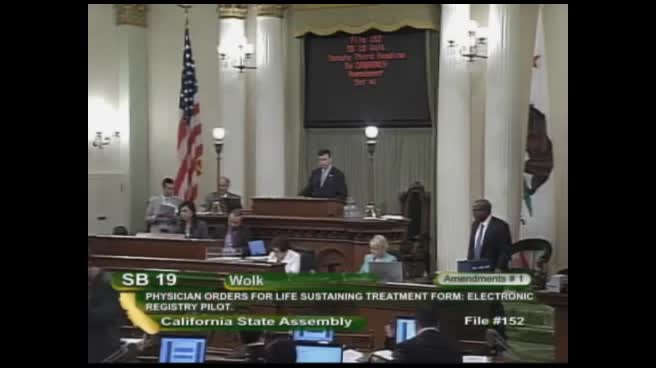 59SEC
Assembly Floor
 1MIN
Senate Floor
 2MIN
Senate Standing Committee on Governance and Finance
 1MIN
Assembly Floor
Bill Author

Bill Co-Author(s):