AB 627: Pharmacy benefit managers: contracting pharmacies.
- Session Year: 2015-2016
- House: Assembly
- Latest Version Date: 2015-07-13
Existing law imposes specified requirements on an audit of pharmacy services provided to beneficiaries of a health benefit plan, and defines certain terms for its purposes, including, among others, pharmacy benefit manager.
This bill would exempt certain contracts governing the medicines and medical supplies that are required to be provided to injured employees in workers compensation cases from these requirements. The bill would also require a pharmacy benefit manager that reimburses a contracting pharmacy for a drug on a maximum allowable cost basis to include in a contract, initially entered into, or renewed on its scheduled renewal date, on or after January 1, 2016, information identifying any national drug pricing compendia or other data sources used to determine the maximum allowable cost for the drugs on a maximum allowable cost list and to provide for an appeal process for the contracting pharmacy, as specified. The bill would also require a pharmacy benefit manager to make available to a contracting pharmacy, upon request, the most up-to-date maximum allowable cost list or lists used by the pharmacy benefit manager for patients served by the pharmacy in a readily accessible, secure, and usable Web-based format or other comparable format. The bill would prohibit a drug from being included on a maximum allowable cost list or from being reimbursed on a maximum allowable cost basis unless certain requirements are met, including, but not limited to, that the drug is not obsolete.
Existing law imposes specified requirements on an audit of pharmacy services provided to beneficiaries of a health benefit plan, and defines certain terms for its purposes, including, among others, pharmacy benefit manager.
The
This bill would exempt certain contracts governing the medicines and medical supplies that are required to be provided to injured employees in workers compensation cases from these requirements. The bill would also require a pharmacy benefit manager that reimburses a contracting pharmacy for a drug on a maximum allowable cost basis to include in a contract, initially entered into, or renewed on its scheduled renewal date, on or after January 1, 2016, information identifying any national drug pricing compendia or other data sources used to determine the maximum allowable cost for the drugs on a maximum allowable cost list and to provide for an appeal process for the contracting pharmacy, as specified. The bill would also require a pharmacy benefit manager to make available to a contracting pharmacy, upon request, the most up-to-date maximum allowable cost list or lists used by the pharmacy benefit manager for patients served by the pharmacy in a readily accessible, secure, and usable Web-based format or other comparable format. The bill would prohibit a drug from being included on a maximum allowable cost list or from being reimbursed on a maximum allowable cost basis unless certain requirements are met, including, but not limited to, that the drug is not obsolete.
Existing law imposes specified requirements on an audit of pharmacy services provided to beneficiaries of a health benefit plan, and defines certain terms for its purposes, including, among others, pharmacy benefit manager.
The bill would require a pharmacy benefit manager that reimburses a contracting pharmacy for a drug on a maximum allowable cost basis to include in a contract, initially entered into, or renewed on its scheduled renewal date, on or after January 1, 2016, information identifying any national drug pricing compendia or other data sources used to determine the maximum allowable cost for the drugs on a maximum allowable cost list and to provide for an appeal process for the contracting pharmacy, as specified. The bill would also require a pharmacy benefit manager to make available to a contracting pharmacy, upon request, the most up-to-date maximum allowable cost list or lists used by the pharmacy benefit manager for patients served by the pharmacy in a readily accessible, secure, and usable Web-based format or other comparable format. The bill would prohibit a drug from being included on a maximum allowable cost list or from being reimbursed on a maximum allowable cost basis unless certain requirements are met, including, but not limited to, that the drug is not obsolete.
Existing law imposes specified requirements on an audit of pharmacy services provided to beneficiaries of a health benefit plan, and defines certain terms for its purposes, including, among others, pharmacy benefit manager.
The bill would require a pharmacy benefit manager that reimburses a contracting pharmacy for a drug on a maximum allowable cost basis to include in a contract, renewed on or after January 1, 2016, information identifying any national drug pricing compendia or other data sources used to determine the maximum allowable cost for the drugs on a maximum allowable cost list and to provide for an appeal process for the contracting pharmacy, as specified. The bill would also require a pharmacy benefit manager to make available to a contracting pharmacy, upon request, the most up-to-date maximum allowable cost list or lists used by the pharmacy benefit manager for patients served by the pharmacy in a readily accessible, secure, and usable Web-based format or other comparable format. The bill would prohibit a drug from being included on a maximum allowable cost list or from being reimbursed on a maximum allowable cost basis unless certain requirements are met, including, but not limited to, that the drug is not obsolete.
Existing law imposes specified requirements on an audit of pharmacy services provided to beneficiaries of a health benefit plan. Existing law provides that those requirements do not apply to an audit conducted because a pharmacy benefit manager, carrier, health benefit plan sponsor, or other 3rd-party payer has indications that support a reasonable suspicion that criminal wrongdoing, willful misrepresentation, fraud, or abuse has occurred, or to an audit conducted by, or at the direction of, the California State Board of Pharmacy, the State Department of Health Care Services, the State Department of Public Health, or the Medicare program.
This bill would make nonsubstantive changes to that provision.
For purposes of this chapter, the following definitions shall apply:
(a)Carrier means a health care service plan, as defined in Section 1345 of the Health and Safety Code, or a health insurer that issues policies of health insurance, as defined in Section 106 of the Insurance Code.
(b)Clerical or recordkeeping error includes a typographical error, scriveners error, or computer error in a required document or record.
(c)Extrapolation means the practice of inferring a frequency or dollar amount of overpayments, underpayments, nonvalid claims, or other errors on any portion of claims submitted, based on the frequency or dollar amount of overpayments, underpayments, nonvalid claims, or other errors actually measured in a sample of claims.
(d)Health benefit plan means any plan or program that provides, arranges, pays for, or reimburses the cost of health benefits. Health benefit plan includes, but is not limited to, a health care service plan contract issued by a health care service plan, as defined in Section 1345 of the Health and Safety Code, and a policy of health insurance, as defined in Section 106 of the Insurance Code, issued by a health insurer.
(e)Maximum allowable cost means the maximum amount that a pharmacy benefit manager will reimburse a pharmacy for the cost of a drug.
(f)Maximum allowable cost list means a list of drugs for which a maximum allowable cost has been established by a pharmacy benefit manager.
(g)Obsolete means a drug that may be listed in national drug pricing compendia but is no longer available to be dispensed based on the expiration date of the last lot manufactured.
(h)Pharmacy has the same meaning as provided in Section 4037.
(i)Pharmacy audit means an audit, either onsite or remotely, of any records of a pharmacy conducted by or on behalf of a carrier or a pharmacy benefits manager, or a representative thereof, for prescription drugs that were dispensed by that pharmacy to beneficiaries of a health benefit plan pursuant to a contract with the health benefit plan or the issuer or administrator thereof. Pharmacy audit does not include a concurrent review or desk audit that occurs within three business days of transmission of a claim, or a concurrent review or desk audit where no chargeback or recoupment is demanded.
(j)Pharmacy benefit manager means a person, business, or other entity that, pursuant to a contract or under an employment relationship with a carrier, health benefit plan sponsor, or other third-party payer, either directly or through an intermediary, manages the prescription drug coverage provided by the carrier, plan sponsor, or other third-party payer, including, but not limited to, the processing and payment of claims for prescription drugs, the performance of drug utilization review, the processing of drug prior authorization requests, the adjudication of appeals or grievances related to prescription drug coverage, contracting with network pharmacies, and controlling the cost of covered prescription drugs.
SEC. 2.Section 4432 of the Business and Professions Code is amended to read:4432.Notwithstanding any other law, a contract that is issued, amended, or renewed on or after January 1, 2013, between a pharmacy and a carrier or a pharmacy benefit manager to provide pharmacy services to beneficiaries of a health benefit plan shall comply with the provisions of this chapter. This chapter shall not apply to contracts authorized by Section 4600.2 of the Labor Code.
SEC. 3.Section 4440 is added to the Business and Professions Code, immediately following Section 4439, to read:4440.(a)A pharmacy benefit manager that reimburses a contracting pharmacy for a drug on a maximum allowable cost basis shall comply with this section.
(b)A pharmacy benefit manager shall include in a contract, initially entered into, or renewed on its scheduled renewal date, on or after January 1, 2016, with the contracting pharmacy information identifying any national drug pricing compendia or other data sources used to determine the maximum allowable cost for the drugs on a maximum allowable cost list.
(c)A pharmacy benefit manager shall make available to a contracting pharmacy, upon request, the most up-to-date maximum allowable cost list or lists used by the pharmacy benefit manager for patients served by that pharmacy in a readily accessible, secure, and usable Web-based format or other comparable format.
(d)A drug shall not be included on a maximum allowable cost list or reimbursed on a maximum allowable cost basis unless all of the following apply:
(1)The drug is listed as A or B rated in the most recent version of the federal Food and Drug Administrations approved drug products with therapeutic equivalent evaluations, also known as the Orange Book, or has an NA, NR, or Z rating or a similar rating by a nationally recognized pricing reference, such as Medi-Span or First DataBank.
(2)The drug is generally available for purchase in the state from a national or regional wholesaler.
(3)The drug is not obsolete.
(e)For contracts initially entered into, or renewed on the scheduled renewal date, on or after January 1, 2016, a pharmacy benefit manager shall review and shall make necessary adjustments to the maximum allowable cost of each drug on a maximum allowable cost list using the most recent data sources available at least once every seven days.
(f)For contracts initially entered into, or renewed on the scheduled renewal date, on or after January 1, 2016, a pharmacy benefit manager shall have a clearly defined process for a contracting pharmacy to appeal the maximum allowable cost for a drug on a maximum allowable cost list that includes all of the following:
(1)A contracting pharmacy may base its appeal on either of the following:
(A)The maximum allowable cost for a drug is below the cost at which the drug is available for purchase by similarly situated pharmacies in the state from a national or regional wholesaler.
(B)The drug does not meet the requirements of subdivision (d).
(2)A contracting pharmacy shall be provided no less than 14 business days following receipt of payment for the claim upon which the appeal is based to file an appeal with a pharmacy benefit manager. The pharmacy benefit manager shall make a final determination regarding a contracting pharmacys appeal within seven business days of the pharmacy benefit managers receipt of the appeal.
(3)If an appeal is denied by a pharmacy benefit manager, the pharmacy benefit manager shall provide to the contracting pharmacy the reason for the denial and the national drug code (NDC) of an equivalent drug that may be purchased by a similarly situated pharmacy at the price that is equal to or less than the maximum allowable cost of the appealed drug.
(4)If an appeal is upheld by a pharmacy benefit manager, the pharmacy benefit manager shall adjust the maximum allowable cost of the appealed drug for the appealing contracting pharmacy and all similarly situated contracting pharmacies in the state within one calendar day of the date of determination. The pharmacy benefit manager shall permit the appealing pharmacy to reverse and resubmit the claim upon which the appeal was based in order to receive the corrected reimbursement.
(g)A contracting pharmacy shall not disclose to any third party the maximum allowable cost list and any related information it receives either directly from a pharmacy benefit manager or through a pharmacy services administrative organization or similar entity with which the contracting pharmacy has a contract to provide administrative services for that pharmacy.
For purposes of this chapter, the following definitions shall apply:
(a)Carrier means a health care service plan, as defined in Section 1345 of the Health and Safety Code, or a health insurer that issues policies of health insurance, as defined in Section 106 of the Insurance Code.
(b)Clerical or recordkeeping error includes a typographical error, scriveners error, or computer error in a required document or record.
(c)Extrapolation means the practice of inferring a frequency or dollar amount of overpayments, underpayments, nonvalid claims, or other errors on any portion of claims submitted, based on the frequency or dollar amount of overpayments, underpayments, nonvalid claims, or other errors actually measured in a sample of claims.
(d)Health benefit plan means any plan or program that provides, arranges, pays for, or reimburses the cost of health benefits. Health benefit plan includes, but is not limited to, a health care service plan contract issued by a health care service plan, as defined in Section 1345 of the Health and Safety Code, and a policy of health insurance, as defined in Section 106 of the Insurance Code, issued by a health insurer.
(e)Maximum allowable cost means the maximum amount that a pharmacy benefit manager will reimburse a pharmacy for the cost of a drug.
(f)Maximum allowable cost list means a list of drugs for which a maximum allowable cost has been established by a pharmacy benefit manager.
(g)Obsolete means a drug that may be listed in national drug pricing compendia but is no longer available to be dispensed based on the expiration date of the last lot manufactured.
(h)Pharmacy has the same meaning as provided in Section 4037.
(i)Pharmacy audit means an audit, either onsite or remotely, of any records of a pharmacy conducted by or on behalf of a carrier or a pharmacy benefits manager, or a representative thereof, for prescription drugs that were dispensed by that pharmacy to beneficiaries of a health benefit plan pursuant to a contract with the health benefit plan or the issuer or administrator thereof. Pharmacy audit does not include a concurrent review or desk audit that occurs within three business days of transmission of a claim, or a concurrent review or desk audit where no chargeback or recoupment is demanded.
(j)Pharmacy benefit manager means a person, business, or other entity that, pursuant to a contract or under an employment relationship with a carrier, health benefit plan sponsor, or other third-party payer, either directly or through an intermediary, manages the prescription drug coverage provided by the carrier, plan sponsor, or other third-party payer, including, but not limited to, the processing and payment of claims for prescription drugs, the performance of drug utilization review, the processing of drug prior authorization requests, the adjudication of appeals or grievances related to prescription drug coverage, contracting with network pharmacies, and controlling the cost of covered prescription drugs.
SEC. 2.Section 4432 of the Business and Professions Code is amended to read:4432.Notwithstanding any other law, a contract that is issued, amended, or renewed on or after January 1, 2013, between a pharmacy and a carrier or a pharmacy benefit manager to provide pharmacy services to beneficiaries of a health benefit plan shall comply with the provisions of this chapter. This chapter shall not apply to contracts authorized by Section 4600.2 of the Labor Code.
SEC. 2.SEC. 3.Section 4440 is added to the Business and Professions Code, immediately following Section 4439, to read:4440.(a)A pharmacy benefit manager that reimburses a contracting pharmacy for a drug on a maximum allowable cost basis shall comply with this section.
(b)A pharmacy benefit manager shall include in a contract, initially entered into, or renewed on its scheduled renewal date, on or after January 1, 2016, with the contracting pharmacy information identifying any national drug pricing compendia or other data sources used to determine the maximum allowable cost for the drugs on a maximum allowable cost list.
(c)A pharmacy benefit manager shall make available to a contracting pharmacy, upon request, the most up-to-date maximum allowable cost list or lists used by the pharmacy benefit manager for patients served by that pharmacy in a readily accessible, secure, and usable Web-based format or other comparable format.
(d)A drug shall not be included on a maximum allowable cost list or reimbursed on a maximum allowable cost basis unless all of the following apply:
(1)The drug is listed as A or B rated in the most recent version of the federal Food and Drug Administrations (FDA) approved drug products with therapeutic equivalent evaluations, also known as the Orange Book, or has an NA, NR, or Z rating or a similar rating by a nationally recognized pricing reference, such as Medi-Span or First DataBank.
(2)The drug is generally available for purchase in the state from a national or regional wholesaler.
(3)The drug is not obsolete.
(e)For contracts initially entered into, or renewed on the scheduled renewal date, on or after January 1, 2016, a pharmacy benefit manager shall review and shall make necessary adjustments to the maximum allowable cost of each drug on a maximum allowable cost list using the most recent data sources available at least once every seven days.
(f)For contracts initially entered into, or renewed on the scheduled renewal date, on or after January 1, 2016, a pharmacy benefit manager shall have a clearly defined process for a contracting pharmacy to appeal the maximum allowable cost for a drug on a maximum allowable cost list that includes all of the following:
(1)A contracting pharmacy may base its appeal on either of the following:
(A)The maximum allowable cost for a drug is below the cost at which the drug is available for purchase by similarly situated pharmacies in the state from a national or regional wholesaler.
(B)The drug does not meet the requirements of subdivision (d).
(2)A contracting pharmacy shall be provided no less than 14 business days following receipt of payment for the claim upon which the appeal is based to file an appeal with a pharmacy benefit manager. The pharmacy benefit manager shall make a final determination regarding a contracting pharmacys appeal within seven business days of the pharmacy benefit managers receipt of the appeal.
(3)If an appeal is denied by a pharmacy benefit manager, the pharmacy benefit manager shall provide to the contracting pharmacy the reason for the denial and the national drug code (NDC) of an equivalent drug that may be purchased by a similarly situated pharmacy at the price that is equal to or less than the maximum allowable cost of the appealed drug.
(4)If an appeal is upheld by a pharmacy benefit manager, the pharmacy benefit manager shall adjust the maximum allowable cost of the appealed drug for the appealing contracting pharmacy and all similarly situated contracting pharmacies in the state within one calendar day of the date of determination. The pharmacy benefit manager shall permit the appealing pharmacy to reverse and resubmit the claim upon which the appeal was based in order to receive the corrected reimbursement.
(g)A contracting pharmacy shall not disclose to any third party the maximum allowable cost list and any related information it receives either directly from a pharmacy benefit manager or through a pharmacy services administrative organization or similar entity with which the contracting pharmacy has a contract to provide administrative services for that pharmacy.
For purposes of this chapter, the following definitions shall apply:
(a)Carrier means a health care service plan, as defined in Section 1345 of the Health and Safety Code, or a health insurer that issues policies of health insurance, as defined in Section 106 of the Insurance Code.
(b)Clerical or recordkeeping error includes a typographical error, scriveners error, or computer error in a required document or record.
(c)Extrapolation means the practice of inferring a frequency or dollar amount of overpayments, underpayments, nonvalid claims, or other errors on any portion of claims submitted, based on the frequency or dollar amount of overpayments, underpayments, nonvalid claims, or other errors actually measured in a sample of claims.
(d)Health benefit plan means any plan or program that provides, arranges, pays for, or reimburses the cost of health benefits. Health benefit plan includes, but is not limited to, a health care service plan contract issued by a health care service plan, as defined in Section 1345 of the Health and Safety Code, and a policy of health insurance, as defined in Section 106 of the Insurance Code, issued by a health insurer.
(e)Maximum allowable cost means the maximum amount that a pharmacy benefit manager will reimburse a pharmacy for the cost of a drug.
(f)Maximum allowable cost list means a list of drugs for which a maximum allowable cost has been established by a pharmacy benefit manager.
(g)Obsolete means a drug that may be listed in national drug pricing compendia but is no longer available to be dispensed based on the expiration date of the last lot manufactured.
(h)Pharmacy has the same meaning as provided in Section 4037.
(i)Pharmacy audit means an audit, either onsite or remotely, of any records of a pharmacy conducted by or on behalf of a carrier or a pharmacy benefits manager, or a representative thereof, for prescription drugs that were dispensed by that pharmacy to beneficiaries of a health benefit plan pursuant to a contract with the health benefit plan or the issuer or administrator thereof. Pharmacy audit does not include a concurrent review or desk audit that occurs within three business days of transmission of a claim, or a concurrent review or desk audit where no chargeback or recoupment is demanded.
(j)Pharmacy benefit manager means a person, business, or other entity that, pursuant to a contract or under an employment relationship with a carrier, health benefit plan sponsor, or other third-party payer, either directly or through an intermediary, manages the prescription drug coverage provided by the carrier, plan sponsor, or other third-party payer, including, but not limited to, the processing and payment of claims for prescription drugs, the performance of drug utilization review, the processing of drug prior authorization requests, the adjudication of appeals or grievances related to prescription drug coverage, contracting with network pharmacies, and controlling the cost of covered prescription drugs.
SEC. 2.Section 4440 is added to the Business and Professions Code, immediately following Section 4439, to read:4440.(a)A pharmacy benefit manager that reimburses a contracting pharmacy for a drug on a maximum allowable cost basis shall comply with this section.
(b)A pharmacy benefit manager shall include in a contract, entered into initially entered into, or renewed on its scheduled renewal date, on or after January 1, 2016, with the contracting pharmacy information identifying any national drug pricing compendia or other data sources used to determine the maximum allowable cost for the drugs on a maximum allowable cost list.
(c)A pharmacy benefit manager shall make available to a contracting pharmacy, upon request, the most up-to-date maximum allowable cost list or lists used by the pharmacy benefit manager for patients served by that pharmacy in a readily accessible, secure, and usable Web-based format or other comparable format.
(d)A drug shall not be included on a maximum allowable cost list or reimbursed on a maximum allowable cost basis unless all of the following apply:
(1)The drug is listed as A or B rated in the most recent version of the federal Food and Drug Administrations (FDA) approved drug products with therapeutic equivalent evaluations, also known as the Orange Book Book, or has an NA or NR NA, NR, or Z rating or a similar rating by a nationally recognized pricing reference, such as Medi-Span or First DataBank.
(2)The drug is generally available for purchase in the state from a national or regional wholesaler.
(3)The drug is not obsolete.
(e)For contracts entered into initially entered into, or renewed on the scheduled renewal date, on or after January 1, 2016, a pharmacy benefit manager shall review and shall make necessary adjustments to the maximum allowable cost of each drug on a maximum allowable cost list using the most recent data sources available at least once every seven days.
(f)For contracts entered into initially entered into, or renewed on the scheduled renewal date, on or after January 1, 2016, a pharmacy benefit manager shall have a clearly defined process for a contracting pharmacy to appeal the maximum allowable cost for a drug on a maximum allowable cost list that includes all of the following:
(1)A contracting pharmacy may base its appeal on either of the following:
(A)The maximum allowable cost for a drug is below the cost at which the drug is available for purchase by similarly situated pharmacies in the state from a national or regional wholesaler.
(B)The drug does not meet the requirements of subdivision (d).
(2)A contracting pharmacy shall be provided no less than 14 business days following receipt of payment for the claim upon which the appeal is based to file an appeal with a pharmacy benefit manager. The pharmacy benefit manager shall make a final determination regarding a contracting pharmacys appeal within seven business days of the pharmacy benefit managers receipt of the appeal.
(3)If an appeal is denied by a pharmacy benefit manager, the pharmacy benefit manager shall provide to the contracting pharmacy the reason for the denial and the national drug code (NDC) of an equivalent drug that may be purchased by a similarly situated pharmacy at the price that is equal to or less than the maximum allowable cost of the appealed drug.
(4)If an appeal is upheld by a pharmacy benefit manager, the pharmacy benefit manager shall adjust the maximum allowable cost of the appealed drug for the appealing contracting pharmacy and all similarly situated contracting pharmacies in the state within one calendar day of the date of determination. The pharmacy benefit manager shall permit the appealing pharmacy to reverse and resubmit the claim upon which the appeal was based in order to receive the corrected reimbursement.
(g)A contracting pharmacy shall not disclose to any third party the maximum allowable cost list and any related information it receives either directly from a pharmacy benefit manager or through a pharmacy services administrative organization or similar entity with which the contracting pharmacy has a contract to provide administrative services for that pharmacy.
For purposes of this chapter, the following definitions shall apply:
(a)Carrier means a health care service plan, as defined in Section 1345 of the Health and Safety Code, or a health insurer that issues policies of health insurance, as defined in Section 106 of the Insurance Code.
(b)Clerical or recordkeeping error includes a typographical error, scriveners error, or computer error in a required document or record.
(c)Extrapolation means the practice of inferring a frequency or dollar amount of overpayments, underpayments, nonvalid claims, or other errors on any portion of claims submitted, based on the frequency or dollar amount of overpayments, underpayments, nonvalid claims, or other errors actually measured in a sample of claims.
(d)Health benefit plan means any plan or program that provides, arranges, pays for, or reimburses the cost of health benefits. Health benefit plan includes, but is not limited to, a health care service plan contract issued by a health care service plan, as defined in Section 1345 of the Health and Safety Code, and a policy of health insurance, as defined in Section 106 of the Insurance Code, issued by a health insurer.
(e)Maximum allowable cost means the maximum amount that a pharmacy benefit manager will reimburse a pharmacy for the cost of a drug.
(f)Maximum allowable cost list means a list of drugs for which a maximum allowable cost has been established by a pharmacy benefit manager.
(g)Obsolete means a drug that may be listed in national drug pricing compendia but is no longer available to be dispensed based on the expiration date of the last lot manufactured.
(e)
(h)Pharmacy has the same meaning as provided in Section 4037.
(f)
(i)Pharmacy audit means an audit, either onsite or remotely, of any records of a pharmacy conducted by or on behalf of a carrier or a pharmacy benefits manager, or a representative thereof, for prescription drugs that were dispensed by that pharmacy to beneficiaries of a health benefit plan pursuant to a contract with the health benefit plan or the issuer or administrator thereof. Pharmacy audit does not include a concurrent review or desk audit that occurs within three business days of transmission of a claim, or a concurrent review or desk audit where no chargeback or recoupment is demanded.
(g)
(j)Pharmacy benefit manager means a person, business, or other entity that, pursuant to a contract or under an employment relationship with a carrier, health benefit plan sponsor, or other third-party payer, either directly or through an intermediary, manages the prescription drug coverage provided by the carrier, plan sponsor, or other third-party payer, including, but not limited to, the processing and payment of claims for prescription drugs, the performance of drug utilization review, the processing of drug prior authorization requests, the adjudication of appeals or grievances related to prescription drug coverage, contracting with network pharmacies, and controlling the cost of covered prescription drugs.
SEC. 2.Section 4440 is added to the Business and Professions Code, immediately following Section 4439, to read:4440.(a)A pharmacy benefit manager that reimburses a contracting pharmacy for a drug on a maximum allowable cost basis shall comply with this section.
(b)A pharmacy benefit manager shall include in a contract, entered into or renewed on or after January 1, 2016, with the contracting pharmacy information identifying any national drug pricing compendia or other data sources used to determine the maximum allowable cost for the drugs on a maximum allowable cost list.
(c)A pharmacy benefit manager shall make available to a contracting pharmacy, upon request, the most up-to-date maximum allowable cost list or lists used by the pharmacy benefit manager for patients served by that pharmacy in a readily accessible, secure, and usable Web-based format or other comparable format.
(d)A drug shall not be included on a maximum allowable cost list or reimbursed on a maximum allowable cost basis unless all of the following apply:
(1)The drug is listed as A or B rated in the most recent version of the federal Food and Drug Administrations (FDA) approved drug products with therapeutic equivalent evaluations, also known as the Orange Book or has an NA or NR rating or a similar rating by a nationally recognized pricing reference, such as Medi-Span or First DataBank.
(2)The drug is generally available for purchase in the state from a national or regional wholesaler.
(3)The drug is not obsolete.
(e)For contracts entered into or renewed on or after January 1, 2016, a pharmacy benefit manager shall review and shall make necessary adjustments to the maximum allowable cost of each drug on a maximum allowable cost list using the most recent data sources available at least once every seven days.
(f)For contracts entered into or renewed on or after January 1, 2016, a pharmacy benefit manager shall have a clearly defined process for a contracting pharmacy to appeal the maximum allowable cost for a drug on a maximum allowable cost list that includes all of the following:
(1)A contracting pharmacy may base its appeal on either of the following:
(A)The maximum allowable cost for a drug is below the cost at which the drug is available for purchase by similarly situated pharmacies in the state from a national or regional wholesaler.
(B)The drug does not meet the requirements of subdivision (d).
(2)A contracting pharmacy shall be provided no less than 14 business days following receipt of payment for the claim upon which the appeal is based to file an appeal with a pharmacy benefit manager. The pharmacy benefit manager shall make a final determination regarding a contracting pharmacys appeal within seven business days of the pharmacy benefit managers receipt of the appeal.
(3)If an appeal is denied by a pharmacy benefit manager, the pharmacy benefit manager shall provide to the contracting pharmacy the reason for the denial and the national drug code (NDC) of an equivalent drug that may be purchased by a similarly situated pharmacy at the price that is equal to or less than the maximum allowable cost of the appealed drug.
(4)If an appeal is upheld by a pharmacy benefit manager, the pharmacy benefit manager shall adjust the maximum allowable cost of the appealed drug for the appealing contracting pharmacy and all similarly situated contracting pharmacies in the state within one calendar day of the date of determination. The pharmacy benefit manager shall permit the appealing pharmacy to reverse and resubmit the claim upon which the appeal was based in order to receive the corrected reimbursement.
(g)A contracting pharmacy shall not disclose to any third party the maximum allowable cost list and any related information it receives either directly from a pharmacy benefit manager or through a pharmacy services administrative organization or similar entity with which the contracting pharmacy has a contract to provide administrative services for that pharmacy.
SECTION 1.Section 4431 of the Business and Professions Code is amended to read:4431.(a)This chapter shall not apply to an audit conducted because a pharmacy benefit manager, carrier, health benefit plan sponsor, or other third-party payer has indications that support a reasonable suspicion that criminal wrongdoing, willful misrepresentation, fraud, or abuse has occurred.
(b)This chapter shall not apply to an audit conducted by, or at the direction of, the California State Board of Pharmacy, the State Department of Health Care Services, the State Department of Public Health, or the Medicare program.
(a)Nothing in this This chapter shall not apply to an audit conducted because a pharmacy benefit manager, carrier, health benefit plan sponsor, or other third-party payer has indications that support a reasonable suspicion that criminal wrongdoing, willful misrepresentation, fraud, or abuse has occurred.
(b)Nothing in this This chapter shall not apply to an audit conducted by, or at the direction of, the California State Board of Pharmacy, the State Department of Health Care Services, the State Department of Public Health, or the Medicare program.
|
Date
|
Status
|
|---|---|
| May 27, 2015 | From committee chair, with author's amendments: Amend, and re-refer to committee. Read second time, amended, and re-referred to Com. on B., P. & E.D. |
| Jul 13, 2015 | Chaptered by Secretary of State - Chapter 74, Statutes of 2015. |
| Jul 13, 2015 | Approved by the Governor. |
| Jul 1, 2015 | Enrolled and presented to the Governor at 2:30 p.m. |
| Jun 25, 2015 | Senate amendments concurred in. To Engrossing and Enrolling. (Ayes 80. Noes 0.). |
| Jun 25, 2015 | Senate amendments concurred in. To Engrossing and Enrolling. (Ayes 80. Noes 0. Page 2140.). |
| Jun 23, 2015 | In Assembly. Concurrence in Senate amendments pending. May be considered on or after June 25 pursuant to Assembly Rule 77. |
| Jun 22, 2015 | Read third time. Passed. Ordered to the Assembly. (Ayes 37. Noes 0. Page 1549.). |
| Jun 22, 2015 | Read third time. Passed. Ordered to the Assembly. |
| Jun 17, 2015 | Ordered to special consent calendar. |
| Jun 16, 2015 | Read second time and amended. Ordered to third reading. |
| Jun 15, 2015 | From committee: Amend, and do pass as amended. (Ayes 9. Noes 0.) (June 15). |
| Jun 2, 2015 | In committee: Set, first hearing. Hearing canceled at the request of author. |
| Feb 24, 2015 | Read first time. To print. |
| May 21, 2015 | Referred to Com. on B., P. & E.D. |
| May 7, 2015 | Read third time. Passed. Ordered to the Senate. (Ayes 77. Noes 0. Page 1343.) |
| May 7, 2015 | Read third time. Passed. Ordered to the Senate. |
| May 7, 2015 | In Senate. Read first time. To Com. on RLS. for assignment. |
| May 6, 2015 | Read second time. Ordered to third reading. |
| May 5, 2015 | From committee: Do pass. (Ayes 14. Noes 0.) (May 5). |
| Apr 15, 2015 | From committee: Do pass and re-refer to Com. on B. & P. (Ayes 16. Noes 0.) (April 14). Re-referred to Com. on B. & P. |
| Apr 6, 2015 | Re-referred to Com. on HEALTH. |
| Mar 26, 2015 | Referred to Coms. on HEALTH and B. & P. |
| Mar 26, 2015 | From committee chair, with author's amendments: Amend, and re-refer to Com. on HEALTH. Read second time and amended. |
| Feb 25, 2015 | From printer. May be heard in committee March 27. |
|
Date
|
Description
|
Location
|
Votes
|
|
|---|---|---|---|---|
| Jun 25, 2015 | AB 627 GOMEZ Concurrence in Senate Amendments | Assembly Floor |
Passed |
|
| Jun 22, 2015 | Special Consent #3 AB627 Gomez | Senate Floor |
Passed |
|
| Jun 15, 2015 | Do pass as amended | Senate Standing Committee on Business, Professions and Economic Development |
Passed |
|
| May 7, 2015 | AB 627 GOMEZ Assembly Third Reading | Assembly Floor |
Passed |
|
| May 5, 2015 | Do pass. | Assembly Standing Committee on Business and Professions |
Passed |
|
| Apr 14, 2015 | Do pass and be re-referred to the Committee on [Business and Professions] | Assembly Standing Committee on Health |
Passed |
This list shows positions taken on this bill by organizations on the date displayed, which is linked to the original source.
Positions by individuals are not included.
|
Organization
|
Position
|
Date
|
|---|---|---|
| California Pharmacists Association | ** Support | Jun 25, 2015 |
AB 627
Page 2
CONCURRENCE IN SENATE AMENDMENTS
AB 627
(Gomez)
As Amended June 16, 2015
Majority vote
ASSEMBLY: |
77-0 |
(May 7, 2015) |
SENATE: |
37-0 |
(June 22, 2015) |
Original Committee Reference: HEALTH
SUMMARY: Requires a pharmacy benefit manager (PBM) that reimburses a contracting pharmacy for a drug on a maximum allowable cost basis to: 1) include in a contract, renewed on or after January 1, 2016, information identifying the data sources used to determine the maximum allowable cost (MAC) for the drugs on a MAC list, and 2) provide for an appeal process for the contracting pharmacy, make available to a contracting pharmacy, upon request, the most up-to-date MAC lists used by the PBM for patients served by the pharmacy. This bill also prohibits a drug from being included on a MAC list or from being reimbursed on a MAC basis unless certain requirements are met. Specifically, this bill:
Requires a PBM to make available to a contracting pharmacy, upon request, the most up-to-date MAC list or lists used by the PBM for patients served by that pharmacy in a readily accessible, secure, and usable Web-based format or other comparable format.
States that a drug shall not be included on a MAC list or reimbursed on a MAC basis unless the drug meets specified criteria
Requires contracts entered into or renewed on or after January 1, 2016, to state that a PBM shall review and shall make necessary adjustments to the maximum allowable cost of each drug on a MAC list using the most recent data sources available at least once every seven days.
Requires contracts entered into or renewed on or after January 1, 2016, to state that a PBM shall have a clearly defined process for a contracting pharmacy to appeal the MAC for a drug on a MAC list.
The Senate amendments state that the provisions of this bill do not apply to certain contracts governing the medicines and medical supplies that are required to be provided to injured employees in workers' compensation cases. Make other technical changes.
FISCAL EFFECT: None
COMMENTS: This bill is sponsored by the California Pharmacists Association. According to the author, "[This bill] will bring fair standards and transparency to [MAC] pharmacy reimbursements. The bill requires MAC lists to be transparent, accessible, and updated weekly to the current market price for pharmacies. It also establishes standards for appeals of MAC prices, ensuring that these appeals are resolved quickly. This will both enable pharmacists to spend more time helping their patients and help thousands of independent pharmacies across California."
Background. PBMs engage in many activities to manage their clients' prescription drug insurance coverage. PBMs assemble networks of retail pharmacies so that a plan sponsor's members can fill prescriptions easily and in multiple locations by just paying a copayment amount. PBMs consult with plan sponsors to decide for which drugs a plan sponsor will provide insurance coverage to treat each medical condition (e.g., hypertension, high cholesterol, etc.). The PBM manages this list of preferred drug products (the formulary) for each of its plan sponsor clients.
Consumers with insurance coverage are then provided incentives, such as low copayments, to use formulary drugs. Because formulary listing will affect a drug's sales, pharmaceutical manufacturers compete to ensure that their products are included on these formularies. They do so by paying PBMs "formulary payments" to obtain formulary status and "market-share payments" to encourage PBMs to dispense their drugs. The payments are based on the quantity of drugs dispensed under the plans administered by the PBM.
Drug Pricing and Mac Lists. According to the author, "Pharmacies generally purchase prescription drugs and pay for them up front. When a patient with health coverage is prescribed a covered drug that is dispensed by a contracted pharmacy, the health plan or insurer (or a contracted PBM) reimburses the pharmacy for 1) the cost of the drug dispensed and 2) a preset professional dispensing fee. Most health plans and PBMs reimburse pharmacies for name brand drugs based on national pricing lists (i.e., Average Wholesale Price) and for generic drugs based on proprietary MAC lists. PBMs establish these MAC lists based on national and regional drug pricing data in an attempt to reimburse pharmacies as close as possible to the current market rate for drugs. "
Other States. At this time, 17 other states have passed similar legislation. There are also 15 other states with pending legislation.
Support. The California Pharmacist Association (sponsor) writes in support, "AB 627 brings reasonable standards to the pharmacy reimbursement model known as Maximum Allowable Cost (MAC). Under MAC-based reimbursement, pharmacies receive payment for generic medications they dispense to patients based on proprietary price lists managed by health plans and pharmacy benefit managers. These price lists need frequent updates to ensure they reflect the current market prices that pharmacies pay to acquire medications. When the price lists are not appropriately updated, pharmacies lose money by dispensing medications to patients. Pharmacies also need a defined process for appealing MAC list prices that are below the current market price."
Opposition. None on file.
Analysis Prepared by: Dharia McGrew / HEALTH / (916) 319-2097 FN: 0001059
AB 627
Page 5
|
Office of Senate Floor Analyses (916) 651-1520 Fax: (916) 327-4478 |
THIRD READING
Bill No: AB 627
Amended: 6/16/15 in Senate
SENATE BUS, PROF. & ECON. DEV. COMMITTEE: 9-0, 6/15/15
AYES: Hill, Bates, Berryhill, Block, Galgiani, Hernandez, Jackson, Mendoza, Wieckowski
ASSEMBLY FLOOR: 77-0, 5/7/15 - See last page for vote
SUBJECT: Pharmacy benefit managers: contracting pharmacies
DIGEST: This bill updates the Pharmacy Law related to reimbursement to pharmacies by pharmacy benefit managers for prescription medication dispensed to patients.
Existing law:
Provides, under the Pharmacy Law, for the licensure and regulation of pharmacies, pharmacists and wholesalers of dangerous drugs or devices by the Board of Pharmacy within the Department of Consumer Affairs. (Business and Professions Code (BPC) § 4000 et seq.)
Defines “pharmacy benefit manager” (PBM) as a person, business, or other entity that, pursuant to a contract or under an employment relationship with a carrier, health benefit plan sponsor, or other third-party payer, either directly or through an intermediary, manages the prescription drug coverage provided by the carrier, plan sponsor, or other third-party payer, including the processing and payment of claims for prescription drugs, the performance of drug utilization review, the processing of drug prior authorization requests, the adjudication of appeals or grievances related to prescription drug coverage, contracting with network pharmacies, and controlling the cost of covered prescription drugs. (BPC § 4430(g))
This
bill:
Requires a PBM to include information identifying any national drug pricing compendia or other data sources used to determine the maximum allowable cost (MAC) for the drugs on a MAC List in a contract entered into or renewed on or after January 1, 2016, with a contracting pharmacy. Requires a PBM to make available to a contracting pharmacy, upon request, the most up-to-date MAC List or lists used by the PBM for patients served by that pharmacy in a readily accessible, secure, and usable Web-based format or other comparable format.
Prohibits a drug from being included on a MAC List or reimbursed on a MAC basis unless all of the following apply:
The drug is listed as “A” or “B” rated in the most recent version of the federal Food and Drug Administration’s approved drug products with therapeutic equivalent evaluations, also known as the Orange Book or has an “NA” or “NR” rating or a similar rating by a nationally recognized pricing reference, such as Medi-Span or First DataBank.
The drug is generally available for purchase in the state from a national or regional wholesaler.
The drug is not obsolete.
Requires a PBM, for contracts entered into or renewed on or after January 1, 2016, to review and make necessary adjustments to the MAC of each drug on a MAC List using the most recent data sources available at least once every seven days and requires a PBM to have a clearly defined process for a contracting pharmacy to appeal the MAC for a drug on a MAC List.
Provides that if a PBM denies an appeal, the PBM must provide the reason for the denial and the national drug code of an equivalent drug that may be purchased by a similarly situated pharmacy at the price that is equal to or less than the MAC of the appealed drug to the contracting pharmacy. Provides that if an appeal is upheld by a PBM, the PBM must adjust the MAC of the appealed drug for the appealing contracting pharmacy and all similarly situated contracting pharmacies in the state within one calendar day of the date of determination. Requires the PBM to allow the appealing pharmacy to reverse and resubmit the claim upon which the appeal was based in order to receive the corrected reimbursement.
Prohibits a contracting pharmacy from disclosing the MAC List and any information it receives from a PBM, or through a pharmacy services administrative organization, to a third party.
Clarifies that the bill does not apply to PBM contract standards for pharmacy networks set by the Division of Workers’ Compensation.
Background
Pharmacies generally purchase prescription drugs and pay for them up front. When a patient with health coverage is prescribed a covered drug that is dispensed by a contracted pharmacy, the health plan or insurer (or a contracted PBM) reimburses the pharmacy for the cost of the drug dispensed as well as a pre-set professional dispensing fee. Most health plans and PBMs reimburse pharmacies for name brand drugs based on national pricing lists and for generic drugs based on proprietary MAC Lists which PBMs establish based on national and regional drug pricing data in an attempt to reimburse pharmacies as close as possible to the current market rate for drugs.
According to the author, drug prices fluctuate frequently and if the price of a drug increases, the pharmacy pays that higher price. The author adds that if a PBM does not update its MAC List regularly, the pharmacy may be reimbursed far less for a drug than they paid to acquire it, incurring a financial loss. Through this bill, the author wishes to prevent pharmacies from potentially stopping purchasing a drug altogether in instances where the acquisition cost of the drug and the MAC List rate is significantly different, thus ensuring that patients can obtain prescription drugs and pharmacies do not suffer unnecessary financial losses.
Pharmacy benefit managers. According to a 2005 Federal Trade Commission report on PBMs and mail-order pharmacies, many health plan sponsors offer their members prescription drug insurance and hire PBMs to manage these pharmacy benefits on their behalf. As part of the management of these benefits, PBMs assemble networks of retail and mail-order pharmacies so that the plan sponsor’s members can fill prescriptions easily and in multiple locations. When a consumer fills a prescription at a local pharmacy, the pharmacist usually asks whether the consumer has insurance to cover the prescription’s cost. If there is coverage, the consumer provides the insurance card to the pharmacist. While the pharmacist fills the prescription, sophisticated computer interactions between the pharmacy and the PBM ensure that the prescription is filled according to the insurance coverage provided by the plan sponsor. According to the report, the consumer usually is unaware of these processing interactions, and the consumer’s only additional responsibility is to pick up the filled prescription and pay the retail pharmacy the copayment that is due.
Legislation similar to this bill has passed in 17 states since 2013 and 15 states currently have pending legislation to address appeals and transparency in MAC-based pharmacy reimbursement.
FISCAL EFFECT: Appropriation: No Fiscal Com.: No Local: No
California Pharmacists Association
OPPOSITION: (Verified 6/17/15)
None received
ARGUMENTS IN SUPPORT: The California Pharmacists Association (CPhA) notes that it will establish fair standards for reimbursement to pharmacies and enacts important transparency and accuracy requirements that will help independent community pharmacies continue to provide care to California patients. CPhA writes that “Like all healthcare providers, pharmacies cannot care for patients when they are forced to continually do so at a loss. This bill sets fair standards that ensure pharmacies can continue serving patients while also allowing health plans and PBMs to control costs through the use of fair MAC-based reimbursement.”
AYES: Achadjian, Alejo, Travis Allen, Baker, Bigelow, Bloom, Bonilla, Bonta, Brough, Brown, Burke, Calderon, Chang, Chau, Chávez, Chiu, Chu, Cooley, Cooper, Dababneh, Dahle, Daly, Dodd, Eggman, Frazier, Beth Gaines, Gallagher, Cristina Garcia, Eduardo Garcia, Gatto, Gipson, Gomez, Gonzalez, Gordon, Gray, Grove, Hadley, Harper, Holden, Irwin, Jones, Jones-Sawyer, Kim, Lackey, Levine, Linder, Lopez, Low, Maienschein, Mathis, Mayes, McCarty, Medina, Melendez, Mullin, Nazarian, Obernolte, O'Donnell, Olsen, Patterson, Perea, Quirk, Rendon, Ridley-Thomas, Rodriguez, Salas, Santiago, Mark Stone, Thurmond, Ting, Wagner, Waldron, Weber, Wilk, Williams, Wood, Atkins
NO VOTE RECORDED: Campos, Roger Hernández, Steinorth
Prepared by: Sarah Mason / B., P. & E.D. / (916) 651-4104
6/17/15 13:57:35
**** END ****
AB 627 (Gomez) Page 5 of 5
SENATE COMMITTEE ON
BUSINESS, PROFESSIONS AND ECONOMIC DEVELOPMENT
Senator Jerry Hill, Chair
2015 - 2016 Regular
Bill No: AB 627 Hearing Date: June 15, 2015
Author: |
Gomez |
||
Version: |
May 27, 2015 |
||
Urgency: |
No |
Fiscal: |
No |
Consultant: |
Sarah Mason |
||
Subject: Pharmacy benefit managers: contracting pharmacies.
SUMMARY:
Updates Pharmacy Law related to reimbursement to pharmacies by pharmacy benefit managers for prescription medication dispensed to patients.
Existing law:
Under the Pharmacy Law, provides for the licensure and regulation of pharmacies, pharmacists and wholesalers of dangerous drugs or devices by the Board within the Department of Consumer Affairs (DCA). (Business and Professions Code (BPC) § 4000 et seq.)
Establishes requirements for audits of pharmacy benefits. (BPC §§ 4430 - 4439)
Defines “Pharmacy audit” as an audit, either onsite or remotely, of any records of a pharmacy conducted by or on behalf of a carrier or a pharmacy benefit manager (PBM), or a representative thereof, for prescription drugs that were dispensed by that pharmacy to beneficiaries of a health benefit plan pursuant to a contract with the health benefit plan or the issuer or administrator thereof. "Pharmacy audit" does not include a concurrent review or desk audit that occurs within three business days of transmission of a claim, or a concurrent review or desk audit where no chargeback or recoupment is demanded. (BPC § 4430(f))
Defines “pharmacy benefit manager” (PBM) as a person, business, or other entity that, pursuant to a contract or under an employment relationship with a carrier, health benefit plan sponsor, or other third-party payer, either directly or through an intermediary, manages the prescription drug coverage provided by the carrier, plan sponsor, or other third-party payer, including the processing and payment of claims for prescription drugs, the performance of drug utilization review, the processing of drug prior authorization requests, the adjudication of appeals or grievances related to prescription drug coverage, contracting with network pharmacies, and controlling the cost of covered prescription drugs. (BPC § 4430(g))
Defines “carrier” as a health care service plan, as defined in Section 1345 of the Health and Safety Code, or a health insurer that issues policies of health insurance, as defined in Section 106 of the Insurance Code. (BPC § 4430(a))
Defines “health benefit plan” as any plan or program that provides, arranges, pays for, or reimburses the cost of health benefits. “Health benefit plan” includes, but is not limited to, a health care service plan contract issued by a health care service plan, as defined in Section 1345 of the Health and Safety Code, and a policy of health insurance, as defined in Section 106 of the Insurance Code, issued by a health insurer. (BPC § 4430(d))
Provides that notwithstanding any other law, a contract that is issued, amended or renewed on or after January 1, 2013 between a pharmacy and a carrier or a PBM to provide pharmacy services to beneficiaries of a health benefit plan shall comply with the provisions of this chapter. (BPC § 4432)
This
bill:
Adds the following definitions to Pharmacy Law related to audits of pharmacy benefits:
“Maximum allowable cost” (MAC) means the maximum amount that a PBM will reimburse a pharmacy for the cost of a drug.
“Maximum allowable cost list” (MAC List) means a list of drugs for which a maximum allowable cost has been established by a PBM.
“Obsolete” means a drug that may be listed in national drug pricing compendia but is no longer available to be dispensed based on the expiration date of the last lot manufactured.
Requires a PBM that reimburses a contracting pharmacy for a drug on a MAC basis to comply with this section.
Requires a PBM to include information identifying any national drug pricing compendia or other data sources used to determine the MAC for the drugs on a MAC List in a contract entered into or renewed on or after January 1, 2016 with a contracting pharmacy.
Requires a PBM to make available to a contracting pharmacy, upon request, the most up-to-date MAC List or lists used by the PBM for patients served by that pharmacy in a readily accessible, secure, and usable Web-based format or other comparable format.
Prohibits a drug from being included on a MAC list or reimbursed on a MAC basis unless all of the following apply:
The drug is listed as “A” or “B” rated in the most recent version of the federal Food and Drug Administration’s (FDA) approved drug products with therapeutic equivalent evaluations, also known as the Orange Book or has an “NA” or “NR” rating or a similar rating by a nationally recognized pricing reference, such as Medi-Span or First DataBank.
The drug is generally available for purchase in the state from a national or regional wholesaler.
The drug is not obsolete.
Requires a PBM, for contracts entered into or renewed on or after January 1, 2016, to review and make necessary adjustments to the MAC of each drug on a MAC List using the most recent data sources available at least once every seven days and requires a PBM to have a clearly defined process for a contracting pharmacy to appeal the MAC for a drug on a MAC List. Requires the appeal to be based on either the fact that the MAC for a drug is below the cost at which the drug is available for purchase by similarly situated pharmacies in the state from a national or regional wholesaler or the drug did not meet the requirements to be included on a MAC list. Provides a contracting pharmacy no less than 14 business days following receipt of payment for the claim upon which the appeal is based to file an appeal with a PBM. Requires a PBM to make a final determination regarding a contracting pharmacy’s appeal within seven business days of the PBM receiving the appeal.
Provides that if a PBM denies an appeal, the PBM must provide the reason for the denial and the national drug code (NDC) of an equivalent drug that may be purchased by a similarly situated pharmacy at the price that is equal to or less than the MAC of the appealed drug to the contracting pharmacy.
Provides that if an appeal is upheld by a PBM, the PBM must adjust the MAC of the appealed drug for the appealing contracting pharmacy and all similarly situated contracting pharmacies in the state within one calendar day of the date of determination. Requires the PBM to allow the appealing pharmacy to reverse and resubmit the claim upon which the appeal was based in order to receive the corrected reimbursement.
Prohibits a contracting pharmacy from disclosing the MAC list and any information it receives from a PBM or through a pharmacy services administrative organization to a third party.
FISCAL EFFECT: None. This bill has been keyed “nonfiscal” by Legislative Counsel.
COMMENTS:
Purpose. The California Pharmacists Association is the Sponsor of this measure. According to the Author, pharmacies generally purchase prescription drugs and pay for them up front. When a patient with health coverage is prescribed a covered drug that is dispensed by a contracted pharmacy, the health plan or insurer (or a contracted pharmacy benefit manager (PBM)) reimburses the pharmacy for the cost of the drug dispensed as well as a pre-set professional dispensing fee. According to the Author, most health plans and PBMs reimburse pharmacies for name brand drugs based on national pricing lists and for generic drugs based on proprietary maximum allowable cost (MAC) lists which PBMs establish based on national and regional drug pricing data in an attempt to reimburse pharmacies as close as possible to the current market rate for drugs.
According to the Author, drug prices fluctuate frequently and if the price of a drug increases, the pharmacy pays that higher price. The Author adds that if a PBM does not update its MAC list regularly, the pharmacy may be reimbursed far less for a drug than they paid to acquire it, incurring a financial loss. The Author states that the percentage of generic drugs dispensed at a loss to pharmacies has increased significantly in recent years due to frequent price increases in generic drug prices. While pharmacies can appeal these rates to a health plan, insurer, or PBM, the Author notes that they frequently receive no response for several months, all the while receiving negative reimbursement for subsequent dispensing of the drug in question. Through this bill, the Author wishes to prevent pharmacies from potentially stopping purchasing a drug altogether in instances where the acquisition cost of the drug and the MAC list rate is significantly different, thus ensuring that patients can obtain prescription drugs and pharmacies do not suffer unnecessary financial losses.
Pharmacy Benefit Managers (PBMs). According to a 2005 Federal Trade Commission report on Pharmacy Benefit Managers (PBMs) and mail-order pharmacies, many health plan sponsors offer their members prescription drug insurance and hire PBMs to manage these pharmacy benefits on their behalf. As part of the management of these benefits, PBMs assemble networks of retail and mail-order pharmacies so that the plan sponsor’s members can fill prescriptions easily and in multiple locations. When a consumer fills a prescription at a local pharmacy, the pharmacist usually asks whether the consumer has insurance to cover the prescription’s cost. If there is coverage, the consumer provides the insurance card to the pharmacist. While the pharmacist fills the prescription, sophisticated computer interactions between the pharmacy and the PBM ensure that the prescription is filled according to the insurance coverage provided by the plan sponsor. According to the report, the consumer usually is unaware of these processing interactions, and the consumer’s only additional responsibility is to pick up the filled prescription and pay the retail pharmacy the copayment that is due.
According to the Sponsor, legislation similar to this bill has passed in seventeen states since 2013 and fifteen states currently have pending legislation to address appeals and transparency in MAC-based pharmacy reimbursement.
Arguments in Support. The California Pharmacists Association (CPhA) notes that it will establish fair standards for reimbursement to pharmacies and enacts important transparency and accuracy requirements that will help independent community pharmacies continue to provide care to California patients. CPhA writes that “Like all healthcare providers, pharmacies cannot care for patients when they are forced to continually do so at a loss. This bill sets fair standards that ensure pharmacies can continue serving patients while also allowing health plans and PBMs to control costs through the use of fair MAC-based reimbursement.
Suggested Author’s Amendment. The provisions of this bill and chapter in Pharmacy Law for audits of pharmacy benefits apply to PBMs offering services as part of a Department of Managed Health Care licensed health plan or Department of Insurance licensed health insurer. However, CompPharma (PBMs who operate in the workers’ compensation market) is concerned that this bill lacks clarity about whether the provisions would in fact apply to contract standards for pharmacy networks set by the Division of Workers’ Compensation (DWC), and thus subject PBMs like CompPharma members to the requirements set forth in the bill. Under the Labor Code, DWC has the authority to set contract standards for pharmacy networks. The Labor Code also establishes maximum reimbursement fees for pharmacy services provided to injured workers, and DWC has established an independent bill review process for claim disputes.
In order to remove any possible confusion about whether workers’ compensation PBMs would be subject to the requirements of this bill, given the fact that DWC has authority over their contracts, the Committee suggests that the Author amend BPC Section 4432 to ensure contracts are not those for workers’ compensation PBMs.
On page 3, between lines 27 and 28, insert:
SEC. 2. Section 4432 of the Business and Professions Code is amended to read:
4432. Notwithstanding any other law, a contract that is issued, amended, or renewed on or after January 1, 2013, between a pharmacy and a carrier or a pharmacy benefit manager to provide pharmacy services to beneficiaries of a health benefit plan shall comply with the provisions of this chapter. This chapter shall not apply to contracts authorized by Section 4600.2 of the Labor Code.
On page 3, in line 28, strike “SEC.
2.” and replace with “SEC.3.”
SUPPORT AND OPPOSITION:
Support:
California Pharmacists Association (Sponsor)
Opposition:
None on file as of June 9, 2015.
-- END --
AB 627
Page 3
ASSEMBLY THIRD READING
AB 627
(Gomez)
As Amended March 26, 2015
Majority vote
Committee |
Votes |
Ayes |
Noes |
Health |
16-0 |
Bonta, Maienschein, Burke, Chávez, Chiu, Gomez, Gonzalez, Lackey, Nazarian, Patterson, Ridley-Thomas, Rodriguez, Santiago, Thurmond, Waldron, Wood |
|
Business & Professions |
14-0 |
Bonilla, Jones, Baker, Bloom, Burke, Chang, Dodd, Eggman, Gatto, Holden, Mullin, Ting, Wilk, Wood |
|
SUMMARY: Requires a pharmacy benefit manager (PBM) that reimburses a contracting pharmacy for a drug on a maximum allowable cost basis to: 1) include in a contract, renewed on or after January 1, 2016, information identifying the data sources used to determine the maximum allowable cost (MAC) for the drugs on a MAC list, and 2) provide for an appeal process for the contracting pharmacy, make available to a contracting pharmacy, upon request, the most up-to-date MAC lists used by the PBM for patients served by the pharmacy. This bill also prohibits a drug from being included on a MAC list or from being reimbursed on a MAC basis unless certain requirements are met. Specifically, this bill:
Defines "maximum allowable cost" as the maximum amount that a pharmacy benefit manager will reimburse a pharmacy for the cost of a drug.
Defines "maximum allowable cost list" as a list of drugs for which a MAC has been established by a PBM.
Defines "obsolete" as a drug that may be listed in national drug pricing compendia but is no longer available to be dispensed based on the expiration date of the last lot manufactured.
Applies to a PBM that reimburses a contracting pharmacy for a drug on a maximum allowable cost basis.
Requires that a PBM shall include in a contract, entered into or renewed on or after January 1, 2016, with the contracting pharmacy information identifying any national drug pricing compendia or other data sources used to determine the MAC for the drugs on a maximum allowable cost list.
Requires a PBM to make available to a contracting pharmacy, upon request, the most up-to-date MAC list or lists used by the PBM for patients served by that pharmacy in a readily accessible, secure, and usable Web-based format or other comparable format.
States that a drug shall not be included on a MAC list or reimbursed on a MAC basis unless the following apply:
The drug is listed as "A" or "B" rated in the most recent version of the federal Food and Drug Administration’s (FDA) approved drug products with therapeutic equivalent evaluations, also known as the Orange Book or has an "NA" or "NR" rating or a similar rating by a nationally recognized pricing reference, such as Medi-Span or First DataBank;
The drug is generally available for purchase in the state from a national or regional wholesaler; and,
The drug is not obsolete.
Requires contracts entered into or renewed on or after January 1, 2016, to state that a PBM shall review and shall make necessary adjustments to the maximum allowable cost of each drug on a MAC list using the most recent data sources available at least once every seven days.
Requires contracts entered into or renewed on or after January 1, 2016, to state that a PBM shall have a clearly defined process for a contracting pharmacy to appeal the MAC for a drug on a MAC list.
FISCAL EFFECT: None. This bill is keyed non-fiscal by the Legislative Counsel.
COMMENTS:
Purpose. This bill is sponsored by the California Pharmacists Association. According to the author, "[This bill] will bring fair standards and transparency to [MAC] pharmacy reimbursements. The bill requires MAC lists to be transparent, accessible, and updated weekly to the current market price for pharmacies. It also establishes standards for appeals of MAC prices, ensuring that these appeals are resolved quickly. This will both enable pharmacists to spend more time helping their patients and help thousands of independent pharmacies across California."
Background. According to a 2005 Federal Trade Commission report on PBMs, private sector entities that offer medical insurance (plan sponsors), such as employers, labor unions, and managed care companies, also offer prescription drug insurance coverage. Plan sponsors often hire PBMs to manage the prescription drug insurance benefits.
PBMs engage in many activities to manage their clients' prescription drug insurance coverage. PBMs assemble networks of retail pharmacies so that a plan sponsor's members can fill prescriptions easily and in multiple locations by just paying a copayment amount. PBMs consult with plan sponsors to decide for which drugs a plan sponsor will provide insurance coverage to treat each medical condition (e.g., hypertension, high cholesterol, etc.). The PBM manages this list of preferred drug products (the formulary) for each of its plan sponsor clients.
Consumers with insurance coverage are then provided incentives, such as low copayments, to use formulary drugs. Because formulary listing will affect a drug's sales, pharmaceutical manufacturers compete to ensure that their products are included on these formularies. They do so by paying PBMs "formulary payments" to obtain formulary status and "market-share payments" to encourage PBMs to dispense their drugs. The payments are based on the quantity of drugs dispensed under the plans administered by the PBM.
Drug Pricing and Mac Lists. According to the author, "Pharmacies generally purchase prescription drugs and pay for them up front. When a patient with health coverage is prescribed a covered drug that is dispensed by a contracted pharmacy, the health plan or insurer (or a contracted PBM) reimburses the pharmacy for 1) the cost of the drug dispensed and 2) a preset professional dispensing fee. Most health plans and PBMs reimburse pharmacies for name brand drugs based on national pricing lists (i.e., Average Wholesale Price) and for generic drugs based on proprietary MAC lists. PBMs establish these MAC lists based on national and regional drug pricing data in an attempt to reimburse pharmacies as close as possible to the current market rate for drugs. "
The author also notes, "Drug prices fluctuate frequently; if the price of a drug increases, the pharmacy pays that higher price. However, if a PBM does not update its MAC list regularly, the pharmacy may be reimbursed far less for a drug than they paid to acquire it, incurring a financial loss. The percentage of generic drugs dispensed at a loss to pharmacies has increased significantly in recent years due to frequent price increases in generic drug prices. Pharmacies that appeal these rates to a health plan, insurer, or PBM frequently receive no response for several months all the while receiving negative reimbursement for subsequent dispensing of the drug in question."
"When the discrepancy between the acquisition cost of a drug and the MAC list rate is significant enough, pharmacies have in some instances stopped purchasing the drug altogether. This protects the pharmacy from suffering financial losses but makes it difficult for patients to obtain certain prescription drugs."
Other States. At this time, 17 other states have passed similar legislation. There are also 15 other states with pending legislation.
Arguments in Support:
The California Pharmacist Association (sponsor) writes in support, "AB 627 brings reasonable standards to the pharmacy reimbursement model known as Maximum Allowable Cost (MAC). Under MAC-based reimbursement, pharmacies receive payment for generic medications they dispense to patients based on proprietary price lists managed by health plans and pharmacy benefit managers. These price lists need frequent updates to ensure they reflect the current market prices that pharmacies pay to acquire medications. When the price lists are not appropriately updated, pharmacies lose money by dispensing medications to patients. Pharmacies also need a defined process for appealing MAC list prices that are below the current market price.
Like all healthcare providers, pharmacies cannot care for patients when they are forced to continually do so at a loss. This bill sets fair standards that ensure pharmacies can continue serving patients while also allowing health plans and PBMs to control costs through the use of fair MAC-based reimbursement."
Arguments in Opposition:
None on file.
Analysis Prepared by: Vincent Chee / B. & P. / (916) 319-3301 FN: 0000282
AB 627
Page 6
Date of Hearing: May 5, 2015
ASSEMBLY COMMITTEE ON BUSINESS AND PROFESSIONS
Susan Bonilla, Chair
AB 627
(Gomez) – As Amended March 26, 2015
SUBJECT: Pharmacy benefit managers: contracting pharmacies.
SUMMARY: Requires a pharmacy benefit manager (PBM) that reimburses a contracting pharmacy for a drug on a maximum allowable cost basis to: (1) include in a contract, renewed on or after January 1, 2016, information identifying the data sources used to determine the maximum allowable cost (MAC) for the drugs on a MAC list, and (2) provide for an appeal process for the contracting pharmacy, make available to a contracting pharmacy, upon request, the most up-to-date MAC lists used by the PBM for patients served by the pharmacy. This bill also prohibits a drug from being included on a MAC list or from being reimbursed on a MAC basis unless certain requirements are met.
EXISTING LAW:
Establishes requirements for audits of pharmacy benefits. (Business and Professions Code (BPC) §§ 4430 – 4439)
Defines “Pharmacy audit” as an audit, either onsite or remotely, of any records of a pharmacy conducted by or on behalf of a carrier or a PBM, or a representative thereof, for prescription drugs that were dispensed by that pharmacy to beneficiaries of a health benefit plan pursuant to a contract with the health benefit plan or the issuer or administrator thereof. “Pharmacy audit” does not include a concurrent review or desk audit that occurs within three business days of transmission of a claim, or a concurrent review or desk audit where no chargeback or recoupment is demanded. (BPC § 4430(f))
Defines “pharmacy benefit manager” as a person, business, or other entity that, pursuant to a contract or under an employment relationship with a carrier, health benefit plan sponsor, or other third-party payer, either directly or through an intermediary, manages the prescription drug coverage provided by the carrier, plan sponsor, or other third-party payer, including the processing and payment of claims for prescription drugs, the performance of drug utilization review, the processing of drug prior authorization requests, the adjudication of appeals or grievances related to prescription drug coverage, contracting with network pharmacies, and controlling the cost of covered prescription drugs. (BPC § 4430(g))
Defines “carrier” as a health care service plan, as defined in Section 1345 of the Health and Safety Code, or a health insurer that issues policies of health insurance, as defined in Section 106 of the Insurance Code. (BPC § 4430(a))
Defines “health benefit plan” as any plan or program that provides, arranges, pays for, or reimburses the cost of health benefits. “Health benefit plan” includes, but is not limited to, a health care service plan contract issued by a health care service plan, as defined in Section 1345 of the Health and Safety Code, and a policy of health insurance, as defined in Section 106 of the Insurance Code, issued by a health insurer. (BPC § 4430(d))
THIS BILL:
Defines “maximum allowable cost” as the maximum amount that a pharmacy benefit manager will reimburse a pharmacy for the cost of a drug.
Defines “maximum allowable cost list” as a list of drugs for which a MAC has been established by a PBM.
Defines “obsolete” as a drug that may be listed in national drug pricing compendia but is no longer available to be dispensed based on the expiration date of the last lot manufactured.
Applies to a PBM that reimburses a contracting pharmacy for a drug on a maximum allowable cost basis.
Requires that a PBM shall include in a contract, entered into or renewed on or after January 1, 2016, with the contracting pharmacy information identifying any national drug pricing compendia or other data sources used to determine the MAC for the drugs on a maximum allowable cost list.
Requires a PBM to make available to a contracting pharmacy, upon request, the most up-to-date MAC list or lists used by the PBM for patients served by that pharmacy in a readily accessible, secure, and usable Web-based format or other comparable format.
States that a drug shall not be included on a MAC list or reimbursed on a MAC basis unless all of the following apply:
The drug is listed as “A” or “B” rated in the most recent version of the federal Food and Drug Administration’s (FDA) approved drug products with therapeutic equivalent evaluations, also known as the Orange Book or has an “NA” or “NR” rating or a similar rating by a nationally recognized pricing reference, such as Medi-Span or First DataBank;
The drug is generally available for purchase in the state from a national or regional wholesaler; and,
The drug is not obsolete.
Requires contracts entered into or renewed on or after January 1, 2016, to state that a PBM shall review and shall make necessary adjustments to the maximum allowable cost of each drug on a MAC list using the most recent data sources available at least once every seven days.
Requires contracts entered into or renewed on or after January 1, 2016, to state that a PBM shall have a clearly defined process for a contracting pharmacy to appeal the MAC for a drug on a MAC list that includes all of the following:
A contracting pharmacy may base its appeal on either of the following:
The MAC for a drug is below the cost at which the drug is available for purchase by similarly situated pharmacies in the state from a national or regional wholesaler; or,
The drug does not meet the requirements of subdivision (d).
A contracting pharmacy shall be provided no less than 14 business days following receipt of payment for the claim upon which the appeal is based to file an appeal with a pharmacy benefit manager. The PBM shall make a final determination regarding a contracting pharmacy’s appeal within seven business days of PBM’s receipt of the appeal;
If an appeal is denied by a PBM, the PBM shall provide to the contracting pharmacy the reason for the denial and the national drug code (NDC) of an equivalent drug that may be purchased by a similarly situated pharmacy at the price that is equal to or less than the MAC of the appealed drug;
If an appeal is upheld by a PBM, the PBM shall adjust the MAC of the appealed drug for the appealing contracting pharmacy and all similarly situated contracting pharmacies in the state within one calendar day of the date of determination. The PBM shall permit the appealing pharmacy to reverse and resubmit the claim upon which the appeal was based in order to receive the corrected reimbursement; and,
A contracting pharmacy shall not disclose to any third party the MAC list and any related information it receives either directly from a PBM or through a pharmacy services administrative organization or similar entity with which the contracting pharmacy has a contract to provide administrative services for that pharmacy.
FISCAL EFFECT: None. This bill is keyed non-fiscal by the Legislative Counsel.
COMMENTS:
Purpose. This bill is sponsored by the California Pharmacists Association. According to the author, “[This bill] will bring fair standards and transparency to [MAC] pharmacy reimbursements. The bill requires MAC lists to be transparent, accessible, and updated weekly to the current market price for pharmacies. It also establishes standards for appeals of MAC prices, ensuring that these appeals are resolved quickly. This will both enable pharmacists to spend more time helping their patients and help thousands of independent pharmacies across California.”
Background. According to a 2005 Federal Trade Commission (FTC) report on PBMs, private sector entities that offer medical insurance (plan sponsors), such as employers, labor unions, and managed care companies, also offer prescription drug insurance coverage. Plan sponsors often hire PBMs to manage the prescription drug insurance benefits.
PBMs engage in many activities to manage their clients’ prescription drug insurance coverage. PBMs assemble networks of retail pharmacies so that a plan sponsor’s members can fill prescriptions easily and in multiple locations by just paying a copayment amount. PBMs consult with plan sponsors to decide for which drugs a plan sponsor will provide insurance coverage to treat each medical condition (e.g., hypertension, high cholesterol, etc.). The PBM manages this list of preferred drug products (the “formulary”) for each of its plan sponsor clients.
Consumers with insurance coverage are then provided incentives, such as low copayments, to use formulary drugs. Because formulary listing will affect a drug’s sales, pharmaceutical manufacturers compete to ensure that their products are included on these formularies. They do so by paying PBMs “formulary payments” to obtain formulary status and “market-share payments” to encourage PBMs to dispense their drugs. The payments are based on the quantity of drugs dispensed under the plans administered by the PBM.
Drug Pricing and Mac Lists. According to the author, “Pharmacies generally purchase prescription drugs and pay for them up front. When a patient with health coverage is prescribed a covered drug that is dispensed by a contracted pharmacy, the health plan or insurer (or a contracted PBM) reimburses the pharmacy for (1) the cost of the drug dispensed and (2) a preset professional dispensing fee. Most health plans and PBMs reimburse pharmacies for name brand drugs based on national pricing lists (i.e., Average Wholesale Price) and for generic drugs based on proprietary MAC lists. PBMs establish these MAC lists based on national and regional drug pricing data in an attempt to reimburse pharmacies as close as possible to the current market rate for drugs.”
The author also notes, “Drug prices fluctuate frequently; if the price of a drug increases, the pharmacy pays that higher price. However, if a PBM does not update its MAC list regularly, the pharmacy may be reimbursed far less for a drug than they paid to acquire it, incurring a financial loss. The percentage of generic drugs dispensed at a loss to pharmacies has increased significantly in recent years due to frequent price increases in generic drug prices. Pharmacies that appeal these rates to a health plan, insurer, or PBM frequently receive no response for several months all the while receiving negative reimbursement for subsequent dispensing of the drug in question.”
“When the discrepancy between the acquisition cost of a drug and the MAC list rate is significant enough, pharmacies have in some instances stopped purchasing the drug altogether. This protects the pharmacy from suffering financial losses but makes it difficult for patients to obtain certain prescription drugs.”
PBM Retail Networks. According to a 2005 FTC letter to North Dakota Senator Richard L. Brown, regarding HB 1332, which would have regulated the contractual relationships between PBMs and covered entities, such as health plans and pharmacies, “PBMs also enter into contracts with retail pharmacies to create a retail network. The contract generally specifies the amount the PBM will reimburse the pharmacy for dispensing a prescribed pharmaceutical, expressed as a discount from a reference price plus a dispensing fee. By forming an exclusive network, a PBM is able to guide a covered entity’s participants to certain pharmacies. The promise of increased customer volume creates an incentive for pharmacies to bid aggressively with lower drug prices in exchange for membership in a network. Pharmacies will be willing to compete more vigorously for inclusion in a network as the exclusivity of the network and the number of pharmacies in the relevant market increases.” At this time, it is unclear what effect, if any, a transparent MAC list will have on market competition and bidding for inclusion in PBM retail networks. The sponsors note that the definitions in this bill exclude any proprietary information.
Pricing Transparency. At the federal level, Medicare Part D has a similar requirement for Part D plans (42 Code of Federal Regulations (CFR) § 423.505(21)). In explaining the issue of price transparency at the pharmacy level, the Centers for Medicare and Medicare Services (CMS) noted, “When the source of a prescription drug pricing standard is published publicly, such as with [average wholesale price] or [wholesale acquisition price], pharmacies can determine their reimbursement for all drugs at any given time and can monitor these sources to ensure they are being reimbursed correctly. However, when a prescription drug pricing standard is not published publicly, network pharmacies are unable to promptly determine whether their reimbursement is consistent with their contractual arrangements. This, in turn, presents risks to the Medicare Part D program in a number of ways. For example, disclosure of the source used to determine drug prices is necessary for pharmacies to ensure accurate payment of their claims, which is necessary for accuracy in the costs submitted to CMS by Part D sponsors on [prescription drug event records] without unnecessary later adjustments that are disruptive to the operation of the Part D program.”
Other States. At this time, 17 other states have passed similar legislation. There are also 15 other states with pending legislation.
Prior Related Legislation. SB 1195 (Price), Chapter 706, Statutes of 2012, imposed specified requirements on an audit of pharmacy services provided to beneficiaries of a health benefit plan. Among other things, it also prohibited the entity conducting the audit from receiving payment on any basis tied to the amount claimed or recovered from the pharmacy.
AB 1960 (Pavley, Chu, Frommer, Ridley-Thomas, Cha, Koretz, Kuehl), of 2004, would have required a PBM to make specified disclosures to its purchasers and prospective purchasers, including information about the pharmacy benefit manager’s revenues and its drug formularies, and to make disclosures to the public upon request. The bill would have also established standards and requirements with regard to pharmacy benefits management contracts. NOTE: This bill was vetoed by Governor Schwarzenegger for being anti-competitive and possibly increasing health care costs.
ARGUMENTS IN SUPPORT:
The California Pharmacist Association (sponsor) writes in support, “AB 627 brings reasonable standards to the pharmacy reimbursement model known as Maximum Allowable Cost (MAC). Under MAC-based reimbursement, pharmacies receive payment for generic medications they dispense to patients based on proprietary price lists managed by health plans and pharmacy benefit managers. These price lists need frequent updates to ensure they reflect the current market prices that pharmacies pay to acquire medications. When the price lists are not appropriately updated, pharmacies lose money by dispensing medications to patients. Pharmacies also need a defined process for appealing MAC list prices that are below the current market price.
Like all healthcare providers, pharmacies cannot care for patients when they are forced to continually do so at a loss. This bill sets fair standards that ensure pharmacies can continue serving patients while also allowing health plans and PBMs to control costs through the use of fair MAC-based reimbursement.”
ARGUMENTS IN OPPOSITION:
None on file.
REGISTERED SUPPORT:
California Pharmacist Association (sponsor)
REGISTERED OPPOSITION:
None on file.
Analysis Prepared by: Vincent Chee / B. & P. / (916) 319-3301
AB 627
Page 3
Date of Hearing: April 14, 2015
ASSEMBLY COMMITTEE ON HEALTH
Rob Bonta, Chair
AB 627
(Gomez) – As Amended March 26, 2015
SUBJECT: Pharmacy benefit managers: contracting pharmacies
SUMMARY: Requires a pharmacy benefit manager (PBM) that reimburses a contracting pharmacy for a drug on a maximum allowable costs (MAC) basis to update the MAC list every seven days, make the MAC list available upon request by the pharmacy, and to have a standardized appeals process for a pharmacy to appeal disputes on MAC pricing. Specifically, this bill:
Requires a PBM that reimburses a contracting pharmacy for a drug on a MAC basis to:
Include in a contract started or renewed January 1, 2016, information identifying any national drug pricing compendia or other data sources used to determine the MAC for the drugs on a maximum allowable cost list; and,
Make available to a contracting pharmacy, upon request, the most up-to-date MAC list or lists used by the PBM for patients served by that pharmacy in a readily accessible, secure, and usable Web-based format or other comparable format.
Prohibits a drug from being reimbursed on a MAC basis unless the drug is a multi-source drug (generic), is available for sale from a national or regional wholesaler, and is not obsolete.
Requires a PBM, for contracts starting or renewed January 1, 2016, to update the MAC list at least every seven days.
Requires a PBM, for contracts starting or renewed January 1, 2016, to create a clearly defined appeals process that includes the following provisions:
The pharmacy may appeal if the MAC for a drug is below the cost at which the drug is available for purchase by similarly situated pharmacies in the state from a national or regional wholesaler or the drug should not be allowed on a MAC list based on 2) above;
The pharmacy must appeal within 14 business days of the payment being contested; the PBM must make a final determination regarding the appeal within seven business days of receipt of the appeal;
If an appeal is denied, the PBM is required to provide to the pharmacy the reason for the denial and the national drug code of an equivalent drug that may be purchased by a similarly situated pharmacy at the price that is equal to or less than the MAC of the appealed drug; and,
If an appeal is upheld, the PBM is required to adjust the MAC of the appealed drug for the appealing contracting pharmacy and all similarly situated contracting pharmacies in the state within one calendar day of the date of determination. The PBM is required to permit the appealing pharmacy to reverse and resubmit the claim upon which the appeal was based in order to receive the corrected reimbursement.
Prohibits a contracting pharmacy from disclosing to any third party the MAC list and related information it receives either directly from a PBM or through a pharmacy services administrative organization or similar entity.
EXISTING LAW:
Establishes the California State Board of Pharmacy to regulate the pharmacists.
Requires health care service plans to be regulated by the Department of Managed Health Care and health insurers to be regulated by the California Department of Insurance.
Requires health care service plan contracts and health insurance policies to provide coverage for specified benefits and requires contracts between plans or insurers and providers to contain provisions requiring a fast, fair, and cost-effective dispute resolution mechanism.
FISCAL EFFECT: None
COMMENTS:
PURPOSE OF THIS BILL. According to the author, this bill is necessary to bring fair standards and transparency to MAC-based pharmacy reimbursements. Under MAC-based reimbursement, pharmacies buy generic drugs up front, and then receive reimbursement for medications they dispense to patients based on proprietary price lists managed by pharmacy benefit managers. The market prices of drugs fluctuate frequently; therefore these price lists need frequent updates to ensure they reflect the accurate prices that pharmacies pay to acquire medications. When the price lists are not appropriately updated, pharmacies lose money by dispensing medications to patients. Pharmacies are then forced to spend time filing and tracking appeals, thereby limiting the time they have to care for patients. The author states that this would be addressed by requiring MAC lists to be transparent, accessible, and updated weekly to the current market price for pharmacies. It also establishes standards for appeals of MAC prices below the current market price, ensuring that these appeals are resolved quickly and transparently.
According to the California Pharmacists Association, sponsors of the bill, this language was developed through negotiations with stakeholders. The sponsors worked with multiple PBMs and health plans to arrive at mutually agreed upon standards to address pharmacists’ concerns in a way that is acceptable to the legitimate needs of the PBMs and health plans. The provisions in this bill closely mirror those of bills in other states that PBMs have also agreed to.
BACKGROUND. In general, pharmacies purchase prescription drugs and pay for them up front. When a patient with health coverage is prescribed a covered drug that is dispensed by a contracted pharmacy, the health plan or insurer (or a contracted PBM) reimburses the pharmacy for: a) the cost of the drug dispensed; and, b) a pre-set professional dispensing fee. Most health plans and PBMs reimburse pharmacies for name brand drugs based on national, publicly available pricing lists (such as Average Wholesale Price) and for generic drugs based on proprietary MAC lists. PBMs establish the MAC lists based on national and regional drug pricing data in an attempt to standardize reimbursement as close to possible to the current market rate for the drug.
PBMs. According to the Federal Trade Commission, many health plan sponsors offer their members prescription drug insurance and hire PBMs to manage these pharmacy benefits on their behalf. As part of the management of these benefits, PBMs assemble networks of retail and mail-order pharmacies so that the plan's sponsor's members can fill prescriptions easily and in multiple locations. PBMs contract with employers, labor unions, insurance companies, states, Medicaid and Medicare managed care plans, and managed care companies (collectively, “plan sponsors”) to manage pharmacy benefits. There are large PBMs (Express Scripts/Medco, CVS Caremark), small and insurer-owned PBMs (Aetna, Cigna Corporation, Wellpoint Health Networks), retailer-owned (Eckerd Health Systems, PharmaCare Management Services, Walgreens Health Initiative), or stand-alone retail pharmacies (Rite Aid Corporation, Walgreen, Wal-Mart Stores, Inc.).
Other states. Recent legislation in a number of other states has addressed appeals and transparency in MAC-based pharmacy reimbursement. According to the California Pharmacy Association, seventeen states have passed similar legislation since 2013, and fifteen states have pending legislation.
SUPPORT. The California Pharmacists Association (CPhA), sponsor of the bill, asserts that like all healthcare providers, pharmacies cannot care for patients when they are forced to continually do so at a loss. This bill sets fair standards that ensure pharmacies can continue serving patients while also allowing health plans and PBMs to control costs through the use of fair MAC-based reimbursement. CPhA supports this bill to enact important transparency and accuracy requirements that will help independent community pharmacies continue to provide care to California patients.
PREVIOUS LEGISLATION. SB 1195 (Price), Chapter 706, Statutes of 2012, requires a contract between a pharmacy and a carrier or a PBM to provide pharmacy services to beneficiaries of a health benefit plan to comply with standards and audit requirements.
DOUBLE REFERRED. This bill is double referred, upon passage of this Committee it will be referred to the Assembly Committee on Business and Professions.
REGISTERED SUPPORT / OPPOSITION:
Support
California Pharmacists Association (sponsor)
Opposition
None on file.
Analysis Prepared by: Dharia McGrew / HEALTH / (916) 319-2097
Discussed in Hearing
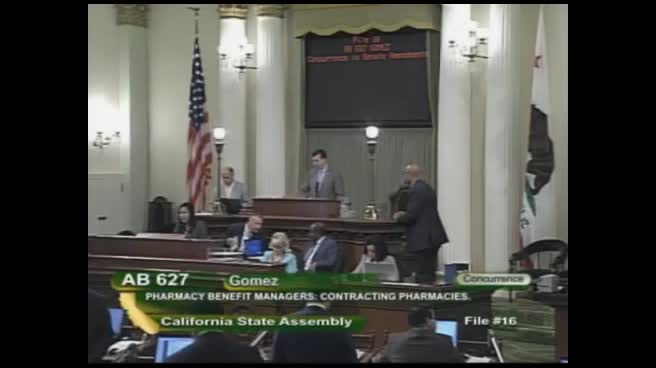 1MIN
Assembly Floor
 1MIN
Assembly Floor
 1MIN
Assembly Standing Committee on Health
Bill Author

Bill Co-Author(s):
