AB 653: Postsecondary education: community college contracting practices.
- Session Year: 2015-2016
- House: Assembly
- Latest Version Date: 2015-09-30
(1)Existing law establishes the California State University, the University of California, and the California Community Colleges as the 3 segments of public postsecondary education in this state.
Existing law requires the governing board of a community college district to publish a notice calling for bids or proposals in a newspaper of general circulation. Existing law requires this notice to state the work proposed to be done or the materials or supplies to be furnished and the time when, and the place where, bids or proposals will be opened.
This bill would also authorize the governing board of a community college district to post the notice described above on its Web site or through an electronic portal.
(2)Existing law declares that nothing in the Public Contract Code precludes the governing board of a community college district from purchasing materials, equipment, or supplies through the Department of General Services, as specified.
This bill would declare that nothing in either the Education Code or the Public Contract Code would preclude a community college district from purchasing materials, equipment, supplies, or services under the same terms and conditions as are specified in a contract lawfully awarded by the University of California or the California State University.
(1)Existing law establishes the California State University, the University of California, and the California Community Colleges as the 3 segments of public postsecondary education in this state.
Existing law requires the governing board of a community college district to publish a notice calling for bids or proposals in a newspaper of general circulation. Existing law requires this notice to state the work proposed to be done or the materials or supplies to be furnished and the time when, and the place where, bids or proposals will be opened.
This bill would also authorize the governing board of a community college district to alternatively post the notice described above on its Internet Web site or its bidding platform, as defined. site or through an electronic portal.
(2)Existing law provides that continuing contracts for work to be done or services to be performed for, or for apparatus or equipment to be furnished, sold, built, installed, or repaired for, a community college district, may be made for a period not to exceed 5 years, and that contracts for materials and supplies to be furnished or sold to a district may be made for a period not to exceed 3 years.
This bill would provide that the contracts for work, services, apparatus or equipment, and materials and supplies for a community college district, as referenced above, may be made for a period not to exceed 7 years.
(3)
(2)Existing law declares that nothing in the Public Contract Code precludes the governing board of a community college district from purchasing materials, equipment, or supplies through the Department of General Services pursuant to a specified statute. Services, as specified.
This bill would declare that nothing in either the Education Code or the Public Contract Code would preclude a community college district from purchasing materials, equipment, supplies, or services under the same terms and conditions as are specified in a contract lawfully awarded by the University of California or the California State University.
Existing
(1)Existing law establishes the California State University, the University of California, and the California Community Colleges as the 3 segments of public postsecondary education in this state. The missions and functions of these segments are set forth, among other things, in the Donahoe Higher Education Act. Provisions of the Donahoe Higher Education Act apply to the University of California only to the extent that the regents act, by resolution, to make them applicable.
Existing law requires the governing board of a community college district to publish a notice calling for bids or proposals in a newspaper of general circulation. Existing law requires this notice to state the work proposed to be done or the materials or supplies to be furnished and the time when, and the place where, bids or proposals will be opened.
This bill would express the intent of the Legislature that the segments of public higher education coordinate their efforts to invest state resources in technologies that are useful to multiple segments or campuses. The bill would add a provision to the Donahoe Higher Education Act requiring the Chancellor of the California Community Colleges and the Chancellor of the California State University, and requesting the President of the University of California, to coordinate the efforts of their respective segments when procuring systemwide information technology and software for the purposes of enhancing student achievement. The bill would specify that the coordination it requires would apply only to large-scale information technology and software purchases that benefit the 3 segments of public postsecondary education and for which coordination by these segments would reduce costs and increase efficiency. The bill would further provide that, as the public segments of higher education invest in, and upgrade, infrastructure and software for data storage and analysis, these segments shall develop procedures to coordinate the collection of, and to share, student performance data in a manner that is consistent with state and federal privacy law. authorize the governing board of a community college district to alternatively post the notice described above on its Internet Web site or its bidding platform, as defined.
Because these provisions would be added to the Donahoe Higher Education Act, they would apply to the University of California only to the extent that the regents act, by resolution, to make them applicable.
(2)Existing law provides that continuing contracts for work to be done or services to be performed for, or for apparatus or equipment to be furnished, sold, built, installed, or repaired for, a community college district, may be made for a period not to exceed 5 years, and that contracts for materials and supplies to be furnished or sold to a district may be made for a period not to exceed 3 years.
This bill would provide that the contracts for work, services, apparatus or equipment, and materials and supplies for a community college district, as referenced above, may be made for a period not to exceed 7 years.
(3)Existing law declares that nothing in the Public Contract Code precludes the governing board of a community college district from purchasing materials, equipment, or supplies through the Department of General Services pursuant to a specified statute.
This bill would declare that nothing in either the Education Code or the Public Contract Code would preclude a community college district from purchasing materials, equipment, supplies, or services under the same terms and conditions as are specified in a contract lawfully awarded by the University of California or the California State University.
Existing law establishes the California State University, the University of California, and the California Community Colleges as the 3 segments of public postsecondary education in this state. The missions and functions of these segments are set forth, among other things, in the Donahoe Higher Education Act. Provisions of the Donahoe Higher Education Act apply to the University of California only to the extent that the regents act, by resolution, to make them applicable.
This bill would express the intent of the Legislature that the segments of public higher education coordinate their efforts to invest state resources in technologies that are useful to multiple segments or campuses. The bill would add a provision to the Donahoe Higher Education Act requiring the Chancellor of the California Community Colleges and the Chancellor of the California State University, and requesting the President of the University of California, to coordinate the efforts of their respective segments when procuring systemwide information technology and software for the purposes of enhancing student achievement. The bill would specify that the coordination it requires would apply only to large-scale information technology and software purchases that benefit the 3 segments of public postsecondary education and for which coordination by these segments would reduce costs and increase efficiency. The bill would further provide that, as the public segments of higher education invest in, and upgrade, infrastructure and software for data storage and analysis, these segments shall develop procedures to coordinate the collection of, and to share, student performance data in a manner that is consistent with state and federal privacy law.
Because these provisions would be added to the Donahoe Higher Education Act, they would apply to the University of California only to the extent that the regents act, by resolution, to make them applicable.
For the purpose of securing bids or proposals, the governing board of the community college district shall publish at least once a week for two weeks in some newspaper of general circulation published in the district, or if there is no such paper, then in some newspaper of general circulation, circulated in the county, and may post on the districts Web site or through an electronic portal, a notice calling for bids or proposals, stating the work to be done or materials or supplies to be furnished and the time when and the place where bids or proposals will be opened. Whether or not bids or proposals are opened exactly at the time fixed in the public notice for opening bids or proposals, a bid or proposal shall not be received after that time.
SEC. 2.Section 81646 is added to the Education Code, to read:81646.Nothing in this code shall preclude the governing board of a community college district from purchasing materials, equipment, supplies, or services under the same terms and conditions as are specified in a contract lawfully awarded by the University of California or the California State University.
SEC. 3.Section 20653.5 is added to the Public Contract Code, to read:20653.5.Nothing in this code shall preclude the governing board of a community college district from purchasing materials, equipment, supplies, or services under the same terms and conditions as are specified in a contract lawfully awarded by the University of California or the California State University.
(a)For the purpose of securing bids or proposals, the governing board of the community college district shall post on its Internet Web site or bidding platform, or publish at least once a week for two weeks in some newspaper of general circulation published in the district, or if there is no such paper, then in some newspaper of general circulation, circulated in the county, and may post on the districts Web site or through an electronic portal, a notice calling for bids or proposals, stating the work to be done or materials or supplies to be furnished and the time when and the place where bids or proposals will be opened. Whether or not bids or proposals are opened exactly at the time fixed in the public notice for opening bids or proposals, a bid or proposal shall not be received after that time.
(b)As used in this section, a bidding platform is an online environment that allows users to bid for the provision of goods or services.
SEC. 2.Section 81644 of the Education Code is amended to read:81644.Continuing contracts for work to be done, services to be performed, or for apparatus or equipment to be furnished, sold, built, installed, or repaired for the district, or for materials or supplies to be furnished or sold to the district, may be made with an accepted vendor for a period not to exceed seven years.
SEC. 3.SEC. 2.Section 81646 is added to the Education Code, to read:81646.Nothing in this code shall preclude the governing board of a community college district from purchasing materials, equipment, supplies, or services under the same terms and conditions as are specified in a contract lawfully awarded by the University of California or the California State University.
SEC. 4.SEC. 3.Section 20653.5 is added to the Public Contract Code, to read:20653.5.Nothing in this code shall preclude the governing board of a community college district from purchasing materials, equipment, supplies, or services under the same terms and conditions as are specified in a contract lawfully awarded by the University of California or the California State University.
(a)For the purpose of securing bids or proposals proposals, the governing board of the community college board district shall post on its Internet Web site or bidding platform, or publish at least once a week for two weeks in some newspaper of general circulation published in the district, or if there is no such paper, then in some newspaper of general circulation, circulated in the county county, a notice calling for bids or proposals, stating the work to be done or materials or supplies to be furnished and the time when and the place where bids or proposals will be opened. Whether or not bids or proposals are opened exactly at the time fixed in the public notice for opening bids or proposals, a bid or proposal shall not be received after that time.
(b)As used in this section, a bidding platform is an online environment that allows users to bid for the provision of goods or services.
SEC. 2.Section 81644 of the Education Code is amended to read:81644.Continuing contracts for work to be done, services to be performed, or for apparatus or equipment to be furnished, sold, built, installed, or repaired for the district, or for materials or supplies to be furnished or sold to the district district, may be made with an accepted vendor as follows: for work or services, or for apparatus or equipment, not to exceed five years; for materials or supplies, for a period not to exceed three seven years.
SEC. 3.Section 81646 is added to the Education Code, to read:81646.Nothing in this code shall preclude the governing board of a community college district from purchasing materials, equipment, supplies, or services under the same terms and conditions as are specified in a contract lawfully awarded by the University of California or the California State University.
SEC. 4.Section 20653.5 is added to the Public Contract Code, to read:20653.5.Nothing in this code shall preclude the governing board of a community college district from purchasing materials, equipment, supplies, or services under the same terms and conditions as are specified in a contract lawfully awarded by the University of California or the California State University.
SECTION 1.It is the intent of the Legislature that all of the following occur:
(a)That the segments of public higher education coordinate their efforts to invest state resources in technologies that are useful to multiple segments or campuses.
(b)That, as these segments invest in new technologies, the public segments jointly leverage their combined purchasing power.
(c)That investments in new technology made by these segments prioritize the ability to coordinate with other segments of higher education.
(d)That these segments ease the student transfer process between systems through increased coordination in the purchasing of new technology platforms.
SEC. 2.Article 3.9 (commencing with Section 66029) is added to Chapter 2 of Part 40 of Division 5 of Title 3 of the Education Code, to read:3.9.Intersegmental Coordination in Governance66029.(a)The Chancellor of the California Community Colleges and the Chancellor of the California State University shall, and the President of the University of California is requested to, coordinate the efforts of their respective segments when procuring systemwide information technology and software for the purposes of enhancing student achievement.
(b)The coordination required by this section shall only apply to large-scale information technology and software purchases that benefit the three segments of public postsecondary education and for which coordination by these segments would reduce costs and increase efficiency.
66029.3.As the segments of public postsecondary education invest in, and upgrade, infrastructure and software for data storage and analysis, these segments shall develop procedures to coordinate the collection of, and to share, student performance data in a manner that is consistent with state and federal privacy law.
It is the intent of the Legislature that all of the following occur:
(a)That the segments of public higher education coordinate their efforts to invest state resources in technologies that are useful to multiple segments or campuses.
(b)That, as these segments invest in new technologies, the public segments jointly leverage their combined purchasing power.
(c)That investments in new technology made by these segments prioritize the ability to coordinate with other segments of higher education.
(d)That these segments ease the student transfer process between systems through increased coordination in the purchasing of new technology platforms.
SEC. 2.Article 3.9 (commencing with Section 66029) is added to Chapter 2 of Part 40 of Division 5 of Title 3 of the Education Code, to read:3.9.Intersegmental Coordination in Governance66029.(a)The Chancellor of the California Community Colleges and the Chancellor of the California State University shall, and the President of the University of California is requested to, coordinate the efforts of their respective segments when procuring systemwide information technology and software for the purposes of enhancing student achievement.
(b)The coordination required by this section shall only apply to large-scale information technology and software purchases that benefit the three segments of public postsecondary education and for which coordination by these segments would reduce costs and increase efficiency.
66029.3.As the segments of public postsecondary education invest in, and upgrade, infrastructure and software for data storage and analysis, these segments shall develop procedures to coordinate the collection of, and to share, student performance data in a manner that is consistent with state and federal privacy law.
|
Date
|
Status
|
|---|---|
| Jun 29, 2015 | From committee: Amend, and do pass as amended and re-refer to Com. on APPR. (Ayes 8. Noes 0.) (June 24). |
| Sep 30, 2015 | Chaptered by Secretary of State - Chapter 366, Statutes of 2015. |
| Sep 30, 2015 | Approved by the Governor. |
| Sep 3, 2015 | Enrolled and presented to the Governor at 4 p.m. |
| Aug 27, 2015 | Senate amendments concurred in. To Engrossing and Enrolling. (Ayes 78. Noes 0.). |
| Aug 27, 2015 | Senate amendments concurred in. To Engrossing and Enrolling. (Ayes 78. Noes 0. Page 2609.). |
| Aug 25, 2015 | In Assembly. Concurrence in Senate amendments pending. May be considered on or after August 27 pursuant to Assembly Rule 77. |
| Aug 24, 2015 | Read third time. Passed. Ordered to the Assembly. (Ayes 40. Noes 0. Page 2146.). |
| Aug 24, 2015 | Read third time. Passed. Ordered to the Assembly. |
| Jul 14, 2015 | Read second time. Ordered to third reading. |
| Jul 13, 2015 | From committee: Be placed on second reading file pursuant to Senate Rule 28.8. |
| Jun 30, 2015 | Read second time and amended. Re-referred to Com. on APPR. |
| Feb 24, 2015 | Read first time. To print. |
| Jun 15, 2015 | From committee chair, with author's amendments: Amend, and re-refer to committee. Read second time, amended, and re-referred to Com. on ED. |
| Jun 3, 2015 | In committee: Set, first hearing. Hearing canceled at the request of author. |
| May 7, 2015 | Referred to Com. on ED. |
| Apr 27, 2015 | Read third time. Passed. Ordered to the Senate. (Ayes 77. Noes 0. Page 1142.) |
| Apr 27, 2015 | In Senate. Read first time. To Com. on RLS. for assignment. |
| Apr 23, 2015 | Read second time. Ordered to third reading. |
| Apr 22, 2015 | From committee: Do pass. (Ayes 17. Noes 0.) (April 22). |
| Apr 8, 2015 | From committee: Do pass and re-refer to Com. on APPR. (Ayes 12. Noes 0.) (April 7). Re-referred to Com. on APPR. |
| Mar 12, 2015 | Referred to Com. on HIGHER ED. |
| Feb 25, 2015 | From printer. May be heard in committee March 27. |
|
Date
|
Description
|
Location
|
Votes
|
|
|---|---|---|---|---|
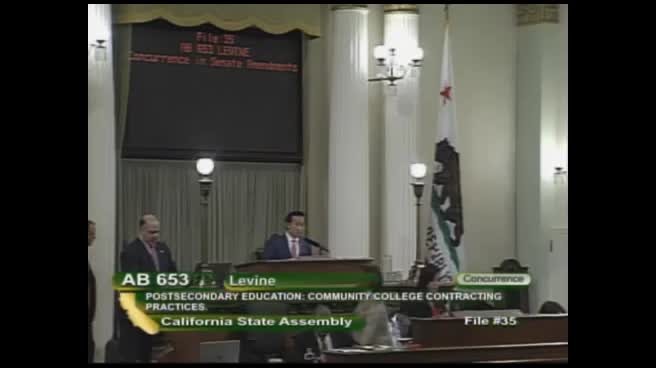
| Aug 27, 2015 | AB 653 LEVINE Concurrence in Senate Amendments | Assembly Floor |
Passed |
|
| Aug 24, 2015 | Assembly 3rd Reading AB653 Levine By Block | Senate Floor |
Passed |
|
| Jun 24, 2015 | Do pass as amended, but first amend, and re-refer to the Committee on [Appropriations] | Senate Standing Committee on Education |
Passed |
|
| Apr 27, 2015 | AB 653 LEVINE Assembly Third Reading | Assembly Floor |
Passed |
|
| Apr 22, 2015 | Do pass. | Assembly Standing Committee on Appropriations |
Passed |
|
| Apr 7, 2015 | Do pass and be re-referred to the Committee on [Appropriations] | Assembly Standing Committee on Higher Education |
Passed |
This list shows positions taken on this bill by organizations on the date displayed, which is linked to the original source.
Positions by individuals are not included.
|
Organization
|
Position
|
Date
|
|---|---|---|
| Board of Governors, California Community Colleges | ** Support | Aug 27, 2015 |
| California State University | * Support | Jun 24, 2015 |
| Chancellor's Office, Community Colleges | * Support | Jun 24, 2015 |
| College Of Marin | * Support | Jun 24, 2015 |
| Community College League of California | * Indeterminate | Jun 24, 2015 |
| Kern Community College District | ** Support | Aug 27, 2015 |
| Los Rios Community College District | ** Support | Aug 27, 2015 |
| Pasadena Community College District | ** Support | Aug 27, 2015 |
| San Bernardino Community College District | ** Support | Aug 27, 2015 |
| San Diego Community College District | ** Support | Aug 27, 2015 |
| San Joaquin Delta College | * Support | Jun 24, 2015 |
| South Orange County Community College District | ** Support | Aug 27, 2015 |
| u None received. | ** Against | Jun 24, 2015 |
| University of California | * Indeterminate | Apr 7, 2015 |
| Yuba Community College District | ** Support | Aug 27, 2015 |
AB 653
Page 2
CONCURRENCE IN SENATE AMENDMENTS
AB 653
(Levine)
As Amended June 30, 2015
Majority vote
ASSEMBLY: |
77-0 |
(April 27, 2015) |
SENATE: |
40-0 |
(August 24, 2015) |
Original Committee Reference: HIGHER ED.
SUMMARY: Expands the means by which a California Community College (CCC) district may secure contract bids to include posting a notice on its Internet Web site or through an electronic portal; and, clarifies that existing Education Code and Public Contract Code provisions do not preclude the governing board of a community college district from purchasing materials, equipment, supplies, or services under the same conditions as those specified in a contract lawfully awarded by the University of California (UC) or the California State University (CSU).
The Senate amendments delete the Assembly version of this bill, and instead:
Expand the means by which a community college district may secure contract bids by authorizing a community college district to post the notice for bids on its Internet Web site or through an electronic portal.
Clarify that the contracting provisions applicable to the CCC in the Education Code do not preclude the governing board of a district from purchasing materials, equipment, supplies, or services under the same conditions as those specified in a contract lawfully awarded by the UC or the CSU and makes a parallel change making the same clarification in the Public Contract Code.
EXISTING LAW:
Requires, for the purpose of securing bids, a community college board to publish at least once a week for two weeks in some newspaper of general circulation published in the district, or if there is no such paper, then in some newspaper of general circulation, circulated in the county, a notice calling for bids or proposals, stating the work to be done or materials or supplies to be furnished and the time when and the place where bids or proposals will be opened (Education Code Section 81641).
Limits the term of continuing contracts for work to be done with an accepted vendor for services to be performed, or for apparatus or equipment to be furnished, sold, built, installed, or repaired for the district, to no more than five years. Continuing contracts for materials or supplies to be furnished or sold to the district may not exceed three years (Education Code Section 81644).
FISCAL EFFECT: According to the Senate Appropriations Committee, pursuant to Senate Rule 28.8, negligible state costs.
COMMENTS: Purpose of this bill. According to the author, the purpose of this bill is to create efficiencies by making it easier for community college districts, the UC and the CSU to share contracts with each other. The author contends that, while the UC and CSU have coordinated in sharing contracts negotiated by one segment with another, existing statutes governing the community colleges have made it difficult for them to participate in these shared contracts.
Analysis Prepared by: Jeanice Warden / HIGHER ED. / (916) 319-3960 FN: 0001277
AB 653
Page 4
|
Office of Senate Floor Analyses (916) 651-1520 Fax: (916) 327-4478 |
THIRD READING
Bill No: AB 653
Amended: 6/30/15 in Senate
SENATE EDUCATION COMMITTEE: 8-0, 6/24/15
AYES: Liu, Block, Hancock, Leyva, Mendoza, Monning, Pan, Vidak
NO VOTE RECORDED: Runner
SENATE APPROPRIATIONS COMMITTEE: Senate Rule 28.8
ASSEMBLY FLOOR: 77-0, 4/27/15 - See last page for vote
SUBJECT: Postsecondary education: community college contracting practices
DIGEST: This bill expands the means by which a community college district may secure contract bids to include posting a notice on its internet website or through an electronic portal, and clarifies that existing Education Code and Public Contract Code provisions do not preclude the governing board of a community college district from purchasing materials, equipment, supplies, or services under the same conditions as those specified in a contract lawfully awarded by the University of California (UC) or the California State University (CSU).
Existing law:
Requires, for the purpose of securing bids, a community college board to publish at least once a week for two weeks in some newspaper of general circulation published in the district, or if there is no such paper, then in some newspaper of general circulation, circulated in the county a notice calling for bids or proposals, stating the work to be done or materials or supplies to be furnished and the time when and the place where bids or proposals will be opened. (Education Code § 81641)
Limits the term of continuing contracts for work to be done with an accepted vendor for services to be performed, or for apparatus or equipment to be furnished, sold, built, installed, or repaired for the district, to no more than five years. Continuing contracts for materials or supplies to be furnished or sold to the district may not exceed three years. (EC § 81644)
This bill:
Expands the means by which a community college district may secure contract bids by authorizing a community college district to post the notice for bids on its internet website or through an electronic portal.
Clarifies that Education Code contracting provisions applicable to the community colleges do not preclude the governing board of a district from purchasing materials, equipment, supplies, or services under the same conditions as those specified in a contract lawfully awarded by the University of California (UC) or the California State University (CSU) and makes a parallel change making the same clarification in the Public Contract Code.
Comments
Need for the bill. According to the author, the purpose of this bill is to create efficiencies by making it easier for community college districts, the UC and the CSU to share contracts with each other. While the UC and CSU have coordinated in sharing contracts negotiated by one segment with another, existing statutes governing the community colleges have made it difficult for them to participate in these shared contracts.
Shared contracting. According to the author, shared contracting is the practice of making a procurement contract negotiated by one campus available to another campus. The CSU and UC have already coordinated in sharing between campuses at a regional level to meet their procurement needs. This bill seeks to facilitate the ongoing collaboration between the segments by making it clear that the community colleges are able to participate in the practice of shared contracting.
Current collaboration of segments. During the March 26, 2014, CSU Board of Trustees meeting, CSU Chancellor Timothy P. White, UC President Janet Napolitano, and the California Community Colleges (CCC) Chancellor Brice W. Harris gave a joint presentation about collaboration among the three systems. The three leaders highlighted a number of efforts that are leading to extended collaboration among the systems including, but not limited to, streamlining student transfer pathways, shared administrative services, and contracts.
More recently, leadership at the CSU, CCC and UC in an effort to identify opportunities to find synergies and to encourage working smarter, and have launched http://www.uknowledgeshare.com, an online collaborative site created to encourage the sharing of information, ideas and high-impact practices in support of improved administrative performance, service and outcomes.
FISCAL EFFECT: Appropriation: No Fiscal Com.: Yes Local: No
Board of Governors, California Community Colleges
Kern Community College District
Los Rios Community College District
Pasadena Community College District
San Bernardino Community College District
San Diego Community College District
South Orange County Community College District
Yuba Community College District
OPPOSITION: (Verified 7/14/15)
None received
AYES: Achadjian, Alejo, Travis Allen, Baker, Bigelow, Bloom, Bonilla, Bonta, Brown, Burke, Calderon, Chang, Chau, Chávez, Chiu, Chu, Cooley, Cooper, Dababneh, Dahle, Daly, Dodd, Eggman, Frazier, Beth Gaines, Gallagher, Cristina Garcia, Eduardo Garcia, Gatto, Gipson, Gomez, Gonzalez, Gordon, Gray, Grove, Hadley, Harper, Roger Hernández, Holden, Irwin, Jones, Jones-Sawyer, Kim, Lackey, Levine, Linder, Lopez, Low, Maienschein, Mathis, McCarty, Medina, Melendez, Mullin, Nazarian, Obernolte, O'Donnell, Olsen, Patterson, Perea, Quirk, Rendon, Ridley-Thomas, Rodriguez, Salas, Santiago, Steinorth, Mark Stone, Thurmond, Ting, Wagner, Waldron, Weber, Wilk, Williams, Wood, Atkins
NO VOTE RECORDED: Brough, Campos, Mayes
Prepared by: Kathleen Chavira / ED. / (916) 651-4105
7/14/15 16:58:46
**** END ****
AB 653 (Levine) Page 4 of 4
SENATE COMMITTEE ON EDUCATION
Senator Carol Liu, Chair
2015 - 2016 Regular
Bill No: AB 653
Author: |
Levine |
||
Version: |
June 15, 2015 Hearing Date: June 24, 2015 |
||
Urgency: |
No |
Fiscal: |
Yes |
Consultant: |
Kathleen Chavira |
||
NOTE: This bill has been amended to replace its contents and this is the first time the bill is being heard in its current form.
Subject: Postsecondary education: community college contracting practices
SUMMARY
This bill authorizes a district to secure bids by posting the notice for bids on its internet website or bidding platform; as defined, expands the allowable term for continuing contracts to seven years, and clarified that existing Education Code and Contract Code provisions do not preclude the governing board of a district from purchasing materials, equipment, supplies, or services under the same conditions as those specified in a contract lawfully awarded by the University of California (UC) or the California State University (CSU).
BACKGROUND
Existing law, for the purpose of securing bids, requires a community college board to publish at least once a week for two weeks in some newspaper of general circulation published in the district, or if there is no such paper, then in some newspaper of general circulation, circulated in the county a notice calling for bids or proposals, stating the work to be done or materials or supplies to be furnished and the time when and the place where bids or proposals will be opened. (Education Code § 81641)
Existing law limits the term of continuing contracts for work to be done with an accepted vendor for services to be performed, or for apparatus or equipment to be furnished, sold, built, installed, or repaired for the district, to no more than five years. Continuing contracts for materials or supplies to be furnished or sold to the district may not exceed three years. (EC § 81644)
ANALYSIS
This bill:
Expands the means by which a community college district can meet the requirements for securing bids for contracts by authorizing the posting of the notice for bids on its internet website or bidding platform.
Defines “bidding platform” as an online environment that allows users to bid for the provision of goods or services.
Deletes the current continuing contract term restrictions for vendors to and authorizes all contracts not to exceed seven years.
Clarifies that Education Code contracting provisions applicable to the community colleges do not preclude the governing board of a district from purchasing materials, equipment, supplies, or services under the same conditions as those specified in a contract lawfully awarded by the University of California (UC) or the California State University (CSU) and makes a parallel change making the same clarification in the Public Contract Code.
STAFF
COMMENTS
Need for the bill. According to the author, the purpose of this bill is to create efficiencies by making it easier for community college districts, the UC and the CSU to share contracts with each other. While the UC and CSU have coordinated in sharing contracts negotiated by one segment with another, existing statutes governing the community colleges have made it difficult for them to participate in these shared contracts.
Shared contracting. According to the author, shared contracting is the practice of making a procurement contract negotiated by one campus available to another campus. The CSU and UC have already coordinated in sharing between campuses at a regional level to meet their procurement needs. This bill seeks to facilitate the ongoing collaboration between the segments by making it clear that the community colleges are able to participate in the practice of shared contracting.
Recent gut and amend. This bill was recently gutted and amended. As heard and passed in the Assembly, this bill required the public segments of higher education to coordinate the efforts of their respective segments when procuring systemwide information technology. The recently added provisions in Sections 3 and 4 of the bill would apply to contracts for purposes beyond just technology, but modify current law to facilitate the coordination envisioned and appear consistent with the policy which was heard in the Assembly. According to the Chancellor’s Office, shared contracts could allow the segments to leverage a better price on major purchases such as data systems, network equipment, office supplies, furniture, and the accompanying services for these commodities.
The remaining provisions, however, go farther than simply facilitating coordination. These provisions make changes to contracting requirements and restrictions which would be applicable whether or not the community college district participated in a shared contract. This is the first time these provisions have been reviewed by a policy committee.
California Community Colleges (CCC) contracting requirements. Community colleges, like school districts, are required to secure bid proposals by posting notice of such in a local newspaper. While K-12 districts are authorized to publish in newspapers and may also secure electronic bids/notice, this authority is in addition to, not in place of, newspaper notices.
Section 1 of this bill would authorize a community college district to meet its public notice requirements by posting such notice on its internet website/bidding platform or by publishing notice in a newspaper. While some districts might continue to use newspapers to notice and secure bids, they would not be required to do so. Contractors have argued that newspaper notices are the only way to ensure broad public notice of the opportunity to bid for public works projects to existing and new contractors.
Staff recommends that Section 1 of the bill be amended to parallel the authority extended to K-12 districts.
Section 2 of the bill authorizes a community college to enter into continuing contracts for work, services, materials, or supplies for up to seven years, whereas current law would restrict the term to five years for work or services and 3 years for materials or supplies. While the University of California (UC) and the California State University (CSU) have no similar restrictions, the UC reports that it generally enters into 3 year contracts that incorporate renewal provisions that typically allow for extension of the contract for 5-7 years, depending upon the contractor’s performance.
The UC and the CSU both have centralized procurement systems which allow a state level entity to ensure open and competitive bid processes to secure favorable contracts for campuses throughout the state. Community college districts are run by a locally elected board, with much greater discretion over its purchasing and contracting decisions. Arguably, the continuing contract restrictions in current law balance this autonomy to ensure open and competitive bid practices at the local level.
Finally, this bill would not require community colleges to participate in shared contracts but would incentivize such by allowing districts to participate in contracts lawfully entered into by the UC and CSU regardless of the existing restrictions on community college contracting. Would the elimination of these constraints in the community college contracting provisions act as a disincentive for districts to “share” contracts with UC and CSU?
Staff recommends the bill be amended to delete Section 2 of the bill.
Current collaboration of segments. During the March 26, 2014, CSU Board of Trustees meeting, CSU Chancellor Timothy P. White, UC President Janet Napolitano, and the California Community Colleges (CCC) Chancellor Brice W. Harris gave a joint presentation about collaboration among the three systems. The three leaders highlighted a number of efforts that are leading to extended collaboration among the systems including, but not limited to, streamlining student transfer pathways, shared administrative services, and contracts.
More recently, leadership at the CSU, CCC and UC in an effort to identify opportunities to find synergies and to encourage working smarter, and have launched http://www.uknowledgeshare.com, an online collaborative site created to encourage the sharing of information, ideas and high-impact practices in support of improved administrative performance, service and outcomes.
SUPPORT
None received.
OPPOSITION
None received.
-- END --
AB 653
Page 2
ASSEMBLY THIRD READING
AB 653
(Levine)
As Introduced February 24, 2015
Majority vote
Committee |
Votes |
Ayes |
Noes |
Higher Education |
12-0 |
Medina, Baker, Bloom, Harper, Irwin, Jones-Sawyer, Levine, Linder, Low, Santiago, Weber, Williams |
|
Appropriations |
17-0 |
Gomez, Bigelow, Bloom, Bonta, Calderon, Chang, Daly, Eggman, Gallagher, Eduardo Garcia, Holden, Jones, Quirk, Rendon, Wagner, Weber, Wood |
|
SUMMARY: Requires the Chancellor of the California State University (CSU) and the Chancellor of the California Community Colleges (CCC), and requests the President of the University of California (UC) to coordinate the efforts of their respective segments when procuring technology and software for the purposes of enhancing student achievement; specifies the segments should develop procedures to coordinate the collection of, and to share, student performance data, as specified; and expresses the intent of the Legislature that, among other things, the segments of public higher education coordinate their efforts to invest state resources in technologies that are useful to multiple segments or campuses. Specifically, this bill:
Declares that the Legislature intends that all of the following occur:
That the segments of public higher education coordinate their efforts to invest state resources in technologies that are useful to multiple segments or campuses;
That, as these segments invest in new technologies, the public segments jointly leverage their combined purchasing power;
That investments in new technology made by these segments prioritize the ability to coordinate with other segments of higher education; and,
That these segments ease the student transfer process between systems through increased coordination in the purchasing of new technology platforms.
Requires the CSU Chancellor and the CCC Chancellor, and requests the UC President to, coordinate their efforts when procuring technology and software for the purposes of enhancing student achievement.
Specifies that the coordination required shall only apply to large-scale information technology and software purchases that benefit the three segments (UC, CSU, and CCC) of public higher education for which coordination by these segments would reduce costs and increase efficiency.
Stipulates that as the segments of public postsecondary education invest in, and upgrade, infrastructure and software for data storage and analysis, these segments shall develop procedures to coordinate the collection of, and to share, student performance data in a manner that is consistent with state and federal privacy law.
FISCAL EFFECT: According to the Assembly Appropriations Committee, costs for this measure would be minor and absorbable to the segments (UC, CSU, and CCC).
COMMENTS:
Purpose of this bill. According to the author, this measure endeavors to continue the work of the UC, CSU, and CCC in the coordination of their efforts when purchasing systemwide information technology. The author states, "In the past services and resources across and within the three segments have developed in silos. That has resulted in both duplicative work and posed challenges for information to be shared." The author contends that the existing coordination currently taking place between the three segments is because of the innovation of the present segment leaders. The author argues that, "Nothing in current law states that the ongoing coordination must continue past the tenure of current leadership. This bill seeks to ensure that existing collaboration between the segments continues and will ensure that the doors that have been opened for coordination remain open."
Current collaboration of segments. During the March 26, 2014, CSU Board of Trustees meeting, CSU Chancellor Timothy P. White, UC President Janet Napolitano, and CCC Chancellor Brice W. Harris gave a joint presentation about collaboration among the three systems. The three leaders highlighted a number of efforts that are leading to extended collaboration among the systems including, but not limited to, streamlining student transfer pathways, shared administrative services, and contracts.
The segments have also launched http://www.uknowledgeshare.com, which is the CSU, CCC and UC's online collaborative site created to encourage the sharing of information, ideas and high-impact practices.
Additionally, the three segments co-fund and co-manage http://www.assist.org, an online tool that helps students find community college courses that are transferable to a UC or CSU campus and how those transferable courses might be used to satisfy subject matter requirements for specific majors or general education requirements. ASSIST also provides information about majors offered at UC and CSU campuses.
Lastly, the three segments all participate in the Corporation for Education Network Initiatives in California, in order to obtain cost-effective, high-bandwidth networking to support their missions and respond to the needs of their faculty, staff, and students.
Previous legislation. Assembly Bill 1969 (Levine) of 2014, which was vetoed by the Governor, was similar in nature to this measure. The Governor's veto message stated, "When viable, the University of California, California State University and California Community Colleges have coordinated on major information technology projects. I prefer to maintain the current flexibility that allows the segments to identify and pursue opportunities for joint projects when it makes programmatic and fiscal sense."
Analysis Prepared by: Jeanice Warden / HIGHER ED. / (916) 319-3960 FN: 0000203
AB 653
Page 2
Date of Hearing: April 22, 2015
ASSEMBLY COMMITTEE ON APPROPRIATIONS
Jimmy Gomez, Chair
AB 653
(Levine) – As Introduced February 24, 2015
Policy Committee: |
Higher Education |
Vote: |
12 - 0 |
|
|
|
|
|
|
|
|
Urgency: No State Mandated Local Program: No Reimbursable: No
SUMMARY:
This bill:
Requires the Chancellors of the California State University (CSU) and the California Community Colleges (CCC), and requests the University of California (UC) President, to coordinate their efforts regarding large-scale information technology and software purchases, for the purposes of enhancing student achievement, when such coordination would reduce costs and increase efficiency.
Stipulates that, as three segments of public postsecondary education invest in and upgrade infrastructure and software for data storage and analysis, they shall develop procedures to coordinate the collection and sharing of student performance data in a manner consistent with state and federal privacy law.
FISCAL EFFECT:
Any costs to the segments will be minor and absorbable.
COMMENTS:
Purpose. According to the author, "In the past services and resources across and within the three segments have developed in silos. That has resulted in both duplicative work and posed challenges for information to be shared." The author contends that the existing coordination currently taking place between the three segments is due to the innovation of the current segment leaders. The author argues that, "Nothing in current law states that the ongoing coordination must continue past the tenure of current leadership. This bill seeks to ensure that existing collaboration between the segments continues and will ensure that the doors that have been opened for coordination remain open."
Prior Legislation. Last year, AB 1969 (Levine), which was similar to this bill, was vetoed. The Governor's veto message stated, "When viable, the University of California, California State University and California Community Colleges have coordinated on major information technology projects. I prefer to maintain the current flexibility that allows the segments to identify and pursue opportunities for joint projects when it makes programmatic and fiscal sense."
Analysis Prepared by: Chuck Nicol / APPR. / (916) 319-2081
AB 653
Page 3
Date of Hearing: April 7, 2015
ASSEMBLY COMMITTEE ON HIGHER EDUCATION
Jose Medina, Chair
AB 653
(Levine) – As Introduced February 24, 2015
SUBJECT: Postsecondary education: intersegmental coordination in governance
SUMMARY: Requires the Chancellor of the California State University (CSU) and the Chancellor of the California Community Colleges (CCC), and requests the President of the University of California (UC) to coordinate the efforts of their respective segments when procuring technology and software for the purposes of enhancing student achievement; specifies the segments should develop procedures to coordinate the collection of, and to share, student performance data, as specified; and expresses the intent of the Legislature that, among other things, the segments of public higher education coordinate their efforts to invest state resources in technologies that are useful to multiple segments or campuses. Specifically, this bill:
Declares that the Legislature intends that all of the following occur:
That the segments of public higher education coordinate their efforts to invest state resources in technologies that are useful to multiple segments or campuses;
That, as these segments invest in new technologies, the public segments jointly leverage their combined purchasing power;
That investments in new technology made by these segments prioritize the ability to coordinate with other segments of higher education; and,
That these segments ease the student transfer process between systems through increased coordination in the purchasing of new technology platforms.
Requires the CSU Chancellor and the CCC Chancellor, and requests the UC President to, coordinate their efforts when procuring technology and software for the purposes of enhancing student achievement.
Specifies that the coordination required shall only apply to large-scale information technology and software purchases that benefit the three segments (UC, CSU, and CCC) of public higher education for which coordination by these segments would reduce costs and increase efficiency.
Stipulates that as the segments of public postsecondary education invest in, and upgrade, infrastructure and software for data storage and analysis, these segments shall develop procedures to coordinate the collection of, and to share, student performance data in a manner that is consistent with state and federal privacy law.
FISCAL EFFECT: Unknown
COMMENTS: Purpose of this bill. According to the author, this measure endeavors to continue the work of the UC, CSU, and CCC in the coordination of their efforts when purchasing systemwide information technology. The author states, "In the past services and resources across and within the three segments have developed in silos. That has resulted in both duplicative work and posed challenges for information to be shared." The author contends that the existing coordination currently taking place between the three segments is because of the innovation of the present segment leaders. The author argues that, "Nothing in current law states that the ongoing coordination must continue past the tenure of current leadership. This bill seeks to ensure that existing collaboration between the segments continues and will ensure that the doors that have been opened for coordination remain open."
Current collaboration of segments. During the March 26, 2014, CSU Board of Trustees meeting, CSU Chancellor Timothy P. White, UC President Janet Napolitano, and CCC Chancellor Brice W. Harris gave a joint presentation about collaboration among the three systems. The three leaders highlighted a number of efforts that are leading to extended collaboration among the systems including, but not limited to, streamlining student transfer pathways, shared administrative services, and contracts.
The segments have also launched http://www.uknowledgeshare.com, which is the CSU, CCC and UC's online collaborative site created to encourage the sharing of information, ideas and high-impact practices.
Additionally, the three segments co-fund and co-manage ASSIST.org, an online tool that helps students find community college courses that are transferable to a UC or CSU campus and how those transferable courses might be used to satisfy subject matter requirements for specific majors or general education requirements. ASSIST also provides information about majors offered at UC and CSU campuses.
Lastly, the three segments all participate in the Corporation for Education Network Initiatives in California (CENIC), in order to obtain cost-effective, high-bandwidth networking to support their missions and respond to the needs of their faculty, staff, and students.
Previous legislation. Assembly Bill 1969 (Levine) of 2014, which was vetoed by the Governor, was similar in nature to this measure. The Governor's veto message stated, "When viable, the University of California, California State University and California Community Colleges have coordinated on major information technology projects. I prefer to maintain the current flexibility that allows the segments to identify and pursue opportunities for joint projects when it makes programmatic and fiscal sense."
REGISTERED SUPPORT / OPPOSITION:
Support
None on file.
Opposition
None on file.
Analysis Prepared by: Jeanice Warden / HIGHER ED. / (916) 319-3960
Bill Author

Bill Co-Author(s):