AB 656: Joint powers agreements: mutual water companies.
- Session Year: 2015-2016
- House: Assembly
- Latest Version Date: 2015-09-03
The Joint Exercise of Powers Act authorizes 2 or more public agencies, as defined, if authorized by their governing bodies, by agreement to jointly exercise any power common to the contracting parties, and specifically authorizes a mutual water company to enter into a joint powers agreement with a public agency for these purposes. Existing law authorizes local public entities, as defined, to enter into a joint powers agreement for the purposes of providing risk-pooling, as specified.
This bill would specifically authorize a mutual water company and a public agency to participate in joint powers agreement for the provision of insurance and risk-pooling, technical support, and other similar services for the purpose of reducing risk liability, as specified.
The Joint Exercise of Powers Act authorizes 2 or more public agencies, as defined, if authorized by their governing bodies, by agreement to jointly exercise any power common to the contracting parties, and specifically authorizes a mutual water company to enter into a joint powers agreement with a public agency for these purposes. Existing law authorizes local public entities, as defined, to enter into a joint powers agreement for the purposes of providing risk-pooling, as specified.
This bill would specifically authorize a mutual water company and a public agency to participate in joint powers agreement for the provision of insurance and risk-pooling, technical support, and other similar services for the purpose of reducing risk liability. liability, as specified.
The Joint Exercise of Powers Act authorizes 2 or more public agencies, as defined, if authorized by their governing bodies, by agreement to jointly exercise any power common to the contracting parties, and specifically authorizes a mutual water company to enter into a joint powers agreement with a public agency for these purposes. Existing law authorizes local public entities, as defined, to enter into a joint powers agreement for the purposes of providing risk-pooling, as specified.
This bill would specifically authorize 2 or more mutual water companies, or 2 or more a mutual water companies company and one or more public agencies that operate a public water system, a public agency to participate in joint powers agreement for the provision of insurance and risk-pooling, technical support, and other similar services for the purpose of reducing risk liability.
The Joint Exercise of Powers Act authorizes 2 or more public agencies, as defined, if authorized by their governing bodies, by agreement to jointly exercise any power common to the contracting parties, and specifically authorizes a mutual water company to enter into a joint powers agreement with a public agency for these purposes. Existing law authorizes local public entities, as defined, to enter into a joint powers agreement for the purposes of providing risk-pooling, as specified.
This bill would specifically authorize 2 or more mutual water companies, or 2 or more mutual water companies and one or more public agencies that operate a public water system, to participate in joint powers agreement for risk-pooling, technical support, and other similar services.
(a)Two or more local public entities, or a mutual water company and a public agency, as authorized under subdivision (b) of Section 6525, by a joint powers agreement made pursuant to Article 1 (commencing with Section 6500) of Chapter 5 of Division 7, may provide insurance authorized by this part or for any other purpose by any one or more of the methods specified in Section 990.4. Where two or more hospital districts have joined together to pool their self-insurance claims or losses, any nonprofit corporation created pursuant to subdivision (p) of Section 32121 of the Health and Safety Code, and affiliated with a hospital district which is a party to the pool may participate in the pool.
(b)Two or more local public entities having the same governing board, or a mutual water company and a public agency, as authorized under subdivision (b) of Section 6525, may be coinsured under a master policy and the total premium may be prorated among those entities.
(c)The pooling of self-insured claims or losses among entities as authorized in subdivision (a) of Section 990.4 shall not be considered insurance nor be subject to regulation under the Insurance Code.
(d)Any liability or loss under a joint powers agreement for the pooling of self-insured claims or losses authorized by this part and provided pursuant to this section may, notwithstanding Section 620 of the Insurance Code or any other provision of law, be reinsured to the same extent and the same manner as insurance provided by an insurer.
(e)Where a joint powers agreement authorized by this part or authorized pursuant to Section 6516 provides for the pooling of self-insured claims or losses among entities, if any peril insured or covered under contract has existed, and the joint powers authority or other parties to the pool have been liable for any period, however short, the agreement may provide that the party insured or covered under contract is not entitled to the return of premiums, contributions, payments, or advances so far as that particular risk is concerned.
(f)For purposes of this section, mutual water company has the same meaning as the term does in Section 14300 of the Corporations Code.
SEC. 2.Section 6525 of the Government Code is amended to read:6525.(a)Notwithstanding any other provision of this chapter, a mutual water company may enter into a joint powers agreement with any public agency for the purpose of jointly exercising any power common to the contracting parties.
(b)(1)Notwithstanding any other provisions of this chapter, a mutual water company and a public agency may enter into a joint powers agreement for the purpose of risk-pooling in accordance with Section 990.8, provided that the agreement shall ensure that no participating public agency becomes responsible for the underlying debts or liabilities of the joint powers agency, and shall indemnify any participating public agency against those debts and liabilities.
(2)A joint powers agency established pursuant to this subdivision shall solely utilize any revenues it generates through the insurance provided to its members under this section for its necessary operating expenses, and to provide technical support, continuing education, safety engineering, operational and managerial advisory assistance to its members for the purpose of reducing risk liabilities and furthering the technical managerial and financial capacity of those members.
(c)For purposes of this section, mutual water company has the same meaning as the term does in Section 14300 of the Corporations Code.
(a)Two or more local public entities, or a mutual water company and a public agency, as authorized under subdivision (b) of Section 6525, by a joint powers agreement made pursuant to Article 1 (commencing with Section 6500) of Chapter 5 of Division 7, may provide insurance authorized by this part or for any other purpose by any one or more of the methods specified in Section 990.4. Where two or more hospital districts have joined together to pool their self-insurance claims or losses, any nonprofit corporation created pursuant to subdivision (p) of Section 32121 of the Health and Safety Code, and affiliated with a hospital district which is a party to the pool may participate in the pool.
(b)Two or more local public entities having the same governing board, or a mutual water company and a public agency, as authorized under subdivision (b) of Section 6525, may be coinsured under a master policy and the total premium may be prorated among those entities.
(c)The pooling of self-insured claims or losses among entities as authorized in subdivision (a) of Section 990.4 shall not be considered insurance nor be subject to regulation under the Insurance Code.
(d)Any liability or loss under a joint powers agreement for the pooling of self-insured claims or losses authorized by this part and provided pursuant to this section may, notwithstanding Section 620 of the Insurance Code or any other provision of law, be reinsured to the same extent and the same manner as insurance provided by an insurer.
(e)Where a joint powers agreement authorized by this part or authorized pursuant to Section 6516 provides for the pooling of self-insured claims or losses among entities, if any peril insured or covered under contract has existed, and the joint powers authority or other parties to the pool have been liable for any period, however short, the agreement may provide that the party insured or covered under contract is not entitled to the return of premiums, contributions, payments, or advances so far as that particular risk is concerned.
(f)For purposes of this section, mutual water company has the same meaning as the term does in Section 14300 of the Corporations Code.
SEC. 2.Section 6525 of the Government Code is amended to read:6525.(a)Notwithstanding any other provision of this chapter, a mutual water company may enter into a joint powers agreement with any public agency for the purpose of jointly exercising any power common to the contracting parties.
(b)(1)Notwithstanding any other provisions of this chapter, a mutual water company and a public agency may enter into a joint powers agreement for the purpose of risk-pooling and the provision of technical in accordance with Section 990.8, provided that the agreement shall ensure that no participating public agency becomes responsible for the underlying debts or liabilities of the joint powers agency, and shall indemnify any participating public agency against those debts and liabilities.
(2)A joint powers agency established pursuant to this subdivision shall solely utilize any revenues it generates through the insurance provided to its members under this section for its necessary operating expenses, and to provide technical support, continuing education, safety engineering, operational and managerial advisory assistance to be provided to the members of that joint powers agency to its members for the purpose of reducing risk liabilities and furthering the technical managerial and financial capacity of those members.
(c)For purposes of this section, mutual water company has the same meaning as the term does in Section 14300 of the Corporations Code.
(a)Two or more local public entities, two or more mutual water companies, or two or more mutual water companies and one or more public agencies that operate a public water system, or a mutual water company and a public agency, as authorized under subdivision (b) of Section 6525, by a joint powers agreement made pursuant to Article 1 (commencing with Section 6500) of Chapter 5 of Division 7 7, may provide insurance authorized by this part or for any other purpose by any one or more of the methods specified in Section 990.4. Where two or more hospital districts have joined together to pool their self-insurance claims or losses, any nonprofit corporation created pursuant to subdivision (p) of Section 32121 of the Health and Safety Code, and affiliated with a hospital district which is a party to the pool may participate in the pool.
(b)Two or more local public entities having the same governing board, two or more mutual water companies, or two or more mutual water companies and one or more public agencies that operate a public water system, or a mutual water company and a public agency, as authorized under subdivision (b) of Section 6525, may be coinsured under a master policy and the total premium may be prorated among those entities.
(c)The pooling of self-insured claims or losses among entities as authorized in subdivision (a) of Section 990.4 shall not be considered insurance nor be subject to regulation under the Insurance Code.
(d)Any liability or loss under a joint powers agreement for the pooling of self-insured claims or losses authorized by this part and provided pursuant to this section may, notwithstanding Section 620 of the Insurance Code or any other provision of law, be reinsured to the same extent and the same manner as insurance provided by an insurer.
(e)Where a joint powers agreement authorized by this part or authorized pursuant to Section 6516 provides for the pooling of self-insured claims or losses among entities, if any peril insured or covered under contract has existed, and the joint powers authority or other parties to the pool have been liable for any period, however short, the agreement may provide that the party insured or covered under contract is not entitled to the return of premiums, contributions, payments, or advances so far as that particular risk is concerned.
(f)For purposes of this section, mutual water company has the same meaning as the term does in Section 14300 of the Corporations Code.
SEC. 2.Section 6525 of the Government Code is amended to read:6525.(a)Notwithstanding any other provision of this chapter, a mutual water company may enter into a joint powers agreement with any public agency for the purpose of jointly exercising any power common to the contracting parties.
(b)Notwithstanding any other provisions of this chapter, two or more mutual water companies, or two or more mutual water companies and one or more public agencies that operate a public water system may enter into a joint powers agreement for a mutual water company and a public agency may enter into a joint powers agreement for the purpose of risk-pooling and the provision of technical support, continuing education, safety engineering, operational and managerial advisory assistance to be provided to the members of that joint powers agency. agency for the purpose of reducing risk liabilities.
(c)For purposes of this section, mutual water company has the same meaning as the term does in Section 14300 of the Corporations Code.
(a)Two or more local public entities, two or more mutual water companies, or two or more mutual water companies and one or more public agencies that operate a public water system, as authorized under subdivision (b) of Section 6525, by a joint powers agreement made pursuant to Article 1 (commencing with Section 6500) of Chapter 5 of Division 7, may provide insurance authorized by this part or for any other purpose by any one or more of the methods specified in Section 990.4. Where two or more hospital districts have joined together to pool their self-insurance claims or losses, any nonprofit corporation created pursuant to subdivision (p) of Section 32121 of the Health and Safety Code, and affiliated with a hospital district which is a party to the pool may participate in the pool.
(b)Two or more local public entities having the same governing board, two or more mutual water companies, or two or more mutual water companies and one or more public agencies that operate a public water system, as authorized under subdivision (b) of Section 6525, may be coinsured under a master policy and the total premium may be prorated among those entities.
(c)The pooling of self-insured claims or losses among entities as authorized in subdivision (a) of Section 990.4 shall not be considered insurance nor be subject to regulation under the Insurance Code.
(d)Any liability or loss under a joint powers agreement for the pooling of self-insured claims or losses authorized by this part and provided pursuant to this section may, notwithstanding Section 620 of the Insurance Code or any other provision of law, be reinsured to the same extent and the same manner as insurance provided by an insurer.
(e)Where a joint powers agreement authorized by this part or authorized pursuant to Section 6516 provides for the pooling of self-insured claims or losses among entities, if any peril insured or covered under contract has existed, and the joint powers authority or other parties to the pool have been liable for any period, however short, the agreement may provide that the party insured or covered under contract is not entitled to the return of premiums, contributions, payments, or advances so far as that particular risk is concerned.
(f)For purposes of this section, mutual water company has the same meaning as the term does in Section 14300 of the Corporations Code.
SEC. 2.Section 6525 of the Government Code is amended to read:6525.(a)Notwithstanding any other provision of this chapter, a mutual water company may enter into a joint powers agreement with any public agency for the purpose of jointly exercising any power common to the contracting parties.
(b)Notwithstanding any other provisions of this chapter, two or more mutual water companies, or two or more mutual water companies and one or more public agencies that operate a public water system may enter into a joint powers agreement for risk-pooling and the provision of technical support, continuing education, safety engineering, operational and managerial advisory assistance to be provided to the members of that joint powers agency.
(c)For purposes of this section, mutual water company has the same meaning as the term does in Section 14300 of the Corporations Code.
|
Date
|
Status
|
|---|---|
| Jun 4, 2015 | Referred to Com. on GOV. & F. |
| Sep 3, 2015 | Chaptered by Secretary of State - Chapter 250, Statutes of 2015. |
| Sep 3, 2015 | Approved by the Governor. |
| Aug 27, 2015 | Enrolled and presented to the Governor at 3:30 p.m. |
| Aug 20, 2015 | Senate amendments concurred in. To Engrossing and Enrolling. (Ayes 77. Noes 1. Page 2523.). |
| Aug 20, 2015 | Senate amendments concurred in. To Engrossing and Enrolling. |
| Aug 18, 2015 | In Assembly. Concurrence in Senate amendments pending. May be considered on or after August 20 pursuant to Assembly Rule 77. |
| Aug 17, 2015 | Read third time. Passed. Ordered to the Assembly. (Ayes 37. Noes 0. Page 2052.). |
| Aug 17, 2015 | Read third time. Passed. Ordered to the Assembly. |
| Jul 7, 2015 | Read second time. Ordered to third reading. |
| Jul 6, 2015 | From committee: Be placed on second reading file pursuant to Senate Rule 28.8. |
| Jun 22, 2015 | Read second time and amended. Re-referred to Com. on APPR. |
| Jun 19, 2015 | From committee: Amend, and do pass as amended and re-refer to Com. on APPR. (Ayes 7. Noes 0.) (June 17). |
| Feb 24, 2015 | Read first time. To print. |
| May 22, 2015 | Read third time. Passed. Ordered to the Senate. (Ayes 68. Noes 1. Page 1557.) |
| May 22, 2015 | Read third time. Passed. Ordered to the Senate. |
| May 22, 2015 | In Senate. Read first time. To Com. on RLS. for assignment. |
| May 21, 2015 | Read second time. Ordered to third reading. |
| May 20, 2015 | From committee: Do pass. (Ayes 14. Noes 1.) (May 20). |
| May 5, 2015 | Re-referred to Com. on APPR. |
| May 4, 2015 | Read second time and amended. |
| Apr 30, 2015 | From committee: Amend, and do pass as amended and re-refer to Com. on APPR. (Ayes 9. Noes 0.) (April 29). |
| Apr 22, 2015 | In committee: Set, first hearing. Hearing canceled at the request of author. |
| Mar 9, 2015 | Referred to Com. on L. GOV. |
| Feb 25, 2015 | From printer. May be heard in committee March 27. |
|
Date
|
Description
|
Location
|
Votes
|
|
|---|---|---|---|---|
| Aug 20, 2015 | AB 656 GARCIA, C. Concurrence in Senate Amendments | Assembly Floor |
Passed |
|
| Aug 17, 2015 | Assembly 3rd Reading AB656 Cristina Garcia By Hertzberg | Senate Floor |
Passed |
|
| Jun 17, 2015 | Do pass as amended, but first amend, and re-refer to the Committee on [Appropriations] | Senate Standing Committee on Governance and Finance |
Passed |
|
| May 22, 2015 | AB 656 GARCIA, C. Assembly Third Reading | Assembly Floor |
Passed |
|
| May 20, 2015 | Do pass. | Assembly Standing Committee on Appropriations |
Passed |
|
| Apr 29, 2015 | Do pass as amended and be re-referred to the Committee on [Appropriations] | Assembly Standing Committee on Local Government |
Passed |
This list shows positions taken on this bill by organizations on the date displayed, which is linked to the original source.
Positions by individuals are not included.
|
Organization
|
Position
|
Date
|
|---|---|---|
| 5th Avenue Insurance Services | ** Support | Aug 17, 2015 |
| Amarillo Mutual Water Company | ** Support | Aug 17, 2015 |
| Atascadero Mutual Water Company | ** Support | Aug 17, 2015 |
| Bellflower-Somerset Mutual Water Company | ** Support | Aug 17, 2015 |
| Big Rock Mutual Water Company | ** Support | Aug 17, 2015 |
| Bleich Flat Mutual Water Company | ** Support | Aug 17, 2015 |
| California Association Of Mutual Water Companies | ** Support | Aug 17, 2015 |
| California Association of Mutual Water Companies [SPONSOR] | ** Support | May 20, 2015 |
| California Domestic Water Company | ** Support | Aug 17, 2015 |
| California State Firefighters' Association | ** Support | Aug 17, 2015 |
| Canyon Crest Mutual Benefit Water Company | ** Support | Aug 17, 2015 |
| Covina Irrigating Company | ** Support | Aug 17, 2015 |
| DiBuduo & DeFendis Insurance Brokers, LLC | ** Support | Aug 17, 2015 |
| Flanigan-Leavitt Insurance Agency | ** Support | Aug 17, 2015 |
| Fluetsch & Busby Insurance | ** Support | Aug 17, 2015 |
| Glenhaven Mutual Water Company | ** Support | Aug 17, 2015 |
| Green Acres Mutual Water Company | ** Support | Aug 17, 2015 |
| Green Valley Mutual Water Company | ** Support | Aug 17, 2015 |
| Inland Counties Insurance Services | ** Support | Aug 17, 2015 |
| Insurance Solutions from A to Z | ** Support | Aug 17, 2015 |
| Lakeview Mutual Water Company | ** Support | Aug 17, 2015 |
| Lincoln Avenue Water Company | ** Support | Aug 17, 2015 |
| Llano Mutual Water Company | ** Support | Aug 17, 2015 |
| Maywood Mutual Water Company #1 | ** Support | Aug 17, 2015 |
| Maywood Mutual Water Company #2 | ** Support | Aug 17, 2015 |
| Midway City Mutual | ** Support | Aug 17, 2015 |
| Montebello Land & Water Company | ** Support | Aug 17, 2015 |
| Murphy Slough Association | ** Support | Aug 17, 2015 |
| Oildale Mutual Water Company | ** Support | Aug 17, 2015 |
| Raineri Mutual Water Company | ** Support | Aug 17, 2015 |
| Rancho Pauma Mutual Water Company | ** Support | Aug 17, 2015 |
| Reed Ditch Company | ** Support | Aug 17, 2015 |
| Rocky Comfort Mutual Water Company | ** Support | Aug 17, 2015 |
| Rowland Water District | ** Support | Aug 17, 2015 |
| Rubio Caxf1on Land and Water Association | ** Support | Aug 17, 2015 |
| San Antonio Water Company | ** Support | Aug 17, 2015 |
| San Gabriel Valley Water Association | ** Support | Aug 17, 2015 |
| Shaver Lake Point #2 Mutual Water Company | ** Support | Aug 17, 2015 |
| South Mesa Water Company | ** Support | Aug 17, 2015 |
| Strawberry Tract Mutual Water Company | ** Support | Aug 17, 2015 |
| Sundale Mutual Water Company | ** Support | Aug 17, 2015 |
| SunnySlope Water | ** Support | Aug 17, 2015 |
| Tucker Acres Water Company | ** Support | Aug 17, 2015 |
| Valencia Heights Water Company | ** Support | Aug 17, 2015 |
| Valley Ag Water Coalition | ** Support | Aug 17, 2015 |
| Valley Water Company | ** Support | Aug 17, 2015 |
| Vinsa Insurance Associates | ** Support | Aug 17, 2015 |
| Walnut Valley Water District | ** Support | Aug 17, 2015 |
| Windflower Point Mutual Water Company | ** Support | Aug 17, 2015 |
| Wutchumna Water Company | ** Support | Aug 17, 2015 |
AB 656
Page 5
CONCURRENCE IN SENATE AMENDMENTS
AB 656
(Cristina Garcia)
As Amended June 22, 2015
Majority vote
ASSEMBLY: |
68-1 |
(May 22, 2015) |
SENATE: |
37-0 |
(August 17, 2015) |
Original Committee Reference: L. GOV.
SUMMARY: Allows a mutual water company and a public agency to enter into a joint powers agreement (JPA) for the provision of insurance and risk-pooling.
The Senate amendments:
Specify that the authority granted pursuant to this bill is in accordance with existing law that allows two or more local public entities, by a JPA, to provide insurance coverage or self-insurance, or to obtain insurance coverage by means of a reciprocal or inter-insurance exchange.
Require the agreement authorized pursuant to this bill to ensure that no participating public agency becomes responsible for the underlying debts or liabilities of the joint powers agency, and shall indemnify any participating public agency against those debts and liabilities.
Require a JPA established pursuant to this bill to solely utilize any revenues it generates through the insurance provided to its members under this bill for its necessary operating expenses, and to provide technical support, continuing education, safety engineering, operational and managerial advisory assistance to its members for the purpose of reducing risk liabilities and furthering the technical managerial and financial capacity of those members.
AS PASSED BY THE ASSEMBLY, this bill:
Allowed a mutual water company and a public agency to enter into a joint powers agreement for the purpose of risk-pooling and the provision of technical support, continuing education, safety engineering, and operational and managerial advisory assistance to be provided to the members of that JPA for the purpose of reducing risk liabilities.
Allowed a mutual water company and a public agency to form a JPA to provide insurance by any or all of the following methods:
Self-insurance, which may be, but is not required to be, funded by appropriations to establish or maintain reserves for self-insurance purposes;
Insurance in any insurer authorized to transact such insurance in this state; and,
Insurance secured in accordance with existing law governing surplus line brokers.
Allowed a mutual water company and a public agency to be coinsured under a master policy and allows the total premium to be prorated among those entities.
Specified that, for the purposes of this bill, "mutual water company" has the same meaning as the term does in existing law governing mutual water companies.
FISCAL EFFECT: According to the Senate Appropriations Committee, pursuant to Senate Rule 28.8, negligible state costs.
COMMENTS:
Bill Summary. This bill allows a mutual water company and a public agency to:
Form a JPA to provide insurance, as specified;
Be coinsured under a master policy and to prorate the total premium among themselves; and,
Form a JPA for the purpose of risk-pooling in accordance with existing law, which allows two or more local public entities, by a JPA, to provide insurance coverage or self-insurance, or to obtain insurance coverage by means of a reciprocal or inter-insurance exchange.
This bill requires the agreement authorized pursuant to this bill to: ensure that no participating public agency becomes responsible for the underlying debts or liabilities of the JPA; and, indemnify any participating public agency against those debts and liabilities.
A JPA established pursuant to this bill must solely utilize any revenues it generates through the insurance provided to its members under this bill for its necessary operating expenses, and to provide technical support, continuing education, safety engineering, operational and managerial advisory assistance to its members for the purpose of reducing risk liabilities and furthering the technical managerial and financial capacity of those members.
This bill is sponsored by the California Association of Mutual Water Companies.
Author's Statement. According to the author, "Over 400 mutual water companies in California were once eligible for insurance coverage provided by the Association of California Water Agencies Joint Powers Insurance Authority (ACWA-JPIA). This structure afforded mutual water companies relatively inexpensive insurance, as well as resources through ACWA that were made possible by residuals of revenue that are exempt from taxes, and that would have otherwise been assessed through regular market-based insurance. Due to IRS regulations, several years ago, the ACWA-JPIA determined that mutual water companies were no longer eligible to participate in ACWA-JPIA's insurance programs, and thus mutual water companies were excluded from the coverage and benefits they once enjoyed.
"Mutual water companies are not-for-profit public water systems organized under the state Corporations Code. The vast majority of mutual water companies in California are small, with many serving less than 3,000 connections and/or less than 3,000 residents. Many mutual water companies serve 'economically disadvantaged' areas and do not have access to low cost insurance and other services, such as those available to special districts under ACWA-JPIA or other joint powers agency insurance programs. Today, mutual water companies must purchase higher cost insurance in the open market, and many are not provided the opportunity to easily obtain other services that could assist them in building operational and managerial capacity."
Background. Public water systems that deliver domestic water generally fall into three categories:
Local agencies (cities and special districts). Local Agency Formation Commissions (LAFCOs) control the cities and special districts' boundaries and local officials are responsible to their voters for their water rates;
Investor-owned public utilities. The California Public Utilities Commission (PUC) controls the companies' service areas and their water rates; or,
Mutual water companies. These private entities, formed under statutes governing corporations, respond to their shareholders, usually the landowners who receive water service. Neither LAFCOs nor the PUC regulate mutual water companies.
The State Department of Public Health and some county health departments monitor the quality of drinking water delivered to most households, regardless of the type of public water system that delivers the water.
Most mutual water companies are organized pursuant to the General Corporation Law or the Nonprofit Mutual Benefit Corporation Law. Shareholders in a mutual water company hold a right to purchase water from the company. Stock in a company is usually linked to the ownership of a parcel served by the company and transfers with the land when the parcel is sold to successive owners. This type of corporate structure allows landowners to establish, essentially, a customer-owned water provider to serve their properties.
Governance of a mutual water company is generally limited to shareholders, or members, of the company. While the details of any particular company's governing structure are determined by its articles and bylaws, most mutual water companies allow only shareholders and members to vote on organizational matters and serve on the company's governing board.
Joint Exercise of Powers Act (Act). JPAs have existed in California for nearly 100 years, and were originally created to allow multiple local governments in a region to pool resources to meet common needs. The Act authorizes federal, state and local agencies to create and use a JPA, which is a legal document that allows the contracting parties to exercise powers that are common to all of the contracting parties. A JPA can be administered by one of the contracting agencies, or it can be carried out by a new, separate public entity called a joint powers authority.
JPAs are an attractive tool for local governments because they facilitate more efficient service provision through collaboration, and they allow local entities to issue bonds without voter ratification. Public officials have created about 700 JPAs statewide. There are a few, limited instances in JPA law allowing non-governmental entities (private hospitals or tribes) to join a JPA with a public agency partner. There are no instances of JPAs with only private entities as members.
JPAs and Mutual Water Companies. Existing law allows a mutual water company to enter into a JPA with any public agency for the purpose of jointly exercising any power common to the contracting parties. This authority was established by AB 2014 (Cortese), Chapter 250, Statutes of 1994. According to the Assembly concurrence analysis, "The (bill is) sponsored by the Association of California Water Agencies. The Association [of California Water Agencies] feels this authority will facilitate arrangements among water entities to improve the management of the state's water resources, such as groundwater management, development of water conservation or reclamation programs, or compliance with water quality regulatory requirements."
At that time, the proposal was considered unusual. According to an analysis of AB 2014 by the Senate Agriculture and Water Committee, "The proposed joint powers agreements between public and private entities appear to be without substantial precedent and may raise uncertain issues regarding access to public moneys by private companies and the applicability of open meeting laws which, in general, do not apply to private concerns."
Nonetheless, AB 2014 became law, and mutual water companies have the authority to form a JPA with any public agency for the purpose of jointly exercising any power common to the contracting parties.
Insurance/Risk-Pooling, JPAs and Local Agencies. Existing law allows two or more local public entities, by a JPA, to provide insurance coverage or self-insurance, or to obtain insurance coverage by means of a reciprocal or inter-insurance exchange (risk-pooling). JPAs offer self-insurance coverage on a pooled basis for a variety of purposes, including liability (malpractice and officers and directors coverage), workers' compensation, health insurance and property coverage.
The law also allows a nonprofit hospital corporation affiliated with a hospital district to participate in a self-insurance pool formed by two or more hospital districts to pool their self-insurance claims or losses. In addition, two or more local public entities having the same governing board may be coinsured under a master policy, with the total premium to be prorated among those entities.
Any liability or loss under a JPA for the pooling of self-insured claims or losses can be reinsured to the same extent and the same manner as insurance provided by an insurer. When a JPA provides for the pooling of self-insured claims or losses, if any peril insured or covered under contract has existed, and the JPA or other parties to the pool have been liable for any period, the agreement may provide that the party insured or covered under contract is not entitled to the return of premiums, contributions, payments, or advances so far as that particular risk is concerned.
Pooling of self-insured claims or losses among local public entities is not considered insurance and is not subject to regulation under the Insurance Code.
This bill asks for the same authority for mutual water companies with a public agency partner. According to the sponsor, a JPA is not subject to insurance regulations or premium taxes so it can set more competitive premiums and offer expanded coverage. Funds that would otherwise pay for insurance regulatory compliance and taxes would remain as "residuals" to be used for support services for the JPA's members.
Recent Legislative History: Mutual Water Companies. In response to concerns that some mutual water companies lacked capital to pay for needed water quality improvements and the managerial capacity to operate successful public water systems, the Legislature passed AB 54 (Solorio), Chapter 512, Statutes 2011. AB 54 established training requirements for mutual water districts' board members regarding the duties of board members, made mutual water companies liable for specified fines and penalties for violating the California Safe Drinking Water Act, and expanded LAFCOs' authority to review matters related to mutual water companies.
More recently, AB 240 (Rendon), Chapter 633, Statutes of 2013, increased transparency requirements for mutual water companies by enacting the Mutual Water Company Open Meeting Act. AB 240 also allowed mutual water companies to impose liens to collect unpaid charges. While AB 240's requirements opened the meetings of mutual water companies to "eligible persons," these requirements are far more limited than the requirements of the Ralph M. Brown Act (Brown Act).
Related Legislation. AB 1077 (Holden) of the current legislative session, makes a number of changes to the Mutual Water Company Open Meeting Act. AB 1077 is pending in on the Senate Floor.
AB 617 (Perea) of the current legislative session, modifies portions of last year's Sustainable Groundwater Management Act (SGMA), including, among other things, provisions that allow mutual water companies to join Groundwater Sustainability Agencies (GSA) formed by one or more public agencies pursuant to a JPA, and to exercise all of the GSA powers provided by SGMA. AB 617 is pending in the Senate Natural Resources and Water Committee.
Arguments in Support. The California Association of Mutual Water Companies, the sponsor of this bill, states, "Under the proposed legislation… the liability protection product would not be considered 'insurance' and, thus, would not be subject to taxation. The residuals from sales of that product would then revert to the (JPA) to be put to use in providing management, technical and operational assistance, including grant writing, legal compliance and financial management training, to the participating mutual water companies. While we are grateful for greater levels of public aid for small water systems that have been provided recently, this is a novel measure that will further help mutual water companies use our own resources to help each other."
Arguments in Opposition. None on file.
Analysis Prepared by: Angela Mapp / L. GOV. / (916) 319-3958 FN: 0001172
AB 656
Page 5
|
Office of Senate Floor Analyses (916) 651-1520 Fax: (916) 327-4478 |
THIRD READING
Bill No: AB 656
Author: Cristina Garcia (D), et al.
Amended: 6/22/15 in Senate
SENATE GOVERNANCE & FIN. COMMITTEE: 7-0, 6/17/15
AYES: Hertzberg, Nguyen, Beall, Hernandez, Lara, Moorlach, Pavley
SENATE APPROPRIATIONS COMMITTEE: Senate Rule 28.8
ASSEMBLY FLOOR: 68-1, 5/22/15 - See last page for vote
SUBJECT: Joint powers agreements: mutual water companies
DIGEST: This bill allows a mutual water company and a public agency to form a joint powers authority (JPA) to provide risk-pooling and insurance for the JPA’s members.
Existing law:
Allows, pursuant to the Joint Exercise of Powers Act, two or more public agencies to enter an agreement to jointly exercise any power held in common by the parties to the agreement. Each public agency must independently possess the authority to perform the activity that is to be performed jointly pursuant to a joint powers agreement. Sometimes an agreement creates a new, separate government called a joint powers authority.
Includes the power to insure against specified liabilities among the common powers that public agencies can exercise jointly through a JPA.
Allows a mutual water company to enter into a joint powers agreement with any public agency for the purpose of jointly exercising any power common to the contracting parties (AB 2014, Cortese, Chapter 250, Statutes of 1994).
This bill:
Allows a mutual water company and a public agency to:
Form a JPA for risk-pooling provided that the agreement must ensure that no participating public agency becomes responsible for the underlying debts or liabilities of the joint powers agency, and must indemnify any participating public agency against those debts and liabilities.
Form a JPA to provide insurance by methods specified in state law.
Be coinsured under a master policy and to prorate the total premium among JPA members.
Requires that a JPA established pursuant to this bill’s provisions must solely utilize any revenues it generates through the insurance provided to its members for its necessary operating expenses, and to provide technical support, continuing education, safety engineering, operational and managerial advisory assistance to its members for the purpose of reducing risk liabilities and furthering the technical managerial and financial capacity of those members.
Background
Public water systems that deliver domestic water generally fall into three categories:
Local agencies (cities and special districts). Local agency formation commissions (LAFCOs) control the cities and special districts’ boundaries and local officials are responsible to their voters for their water rates.
Investor owned public utilities. The California Public Utilities Commission (PUC) controls the companies’ service areas and their water rates.
Mutual water companies. These private entities, formed under statutes governing corporations, respond to their shareholders, usually the landowners who receive water service. Neither LAFCOs nor the PUC regulate mutual water companies.
The State Department of Public Health and some county health departments monitor the quality of drinking water delivered to most households, regardless of what type of public water system delivers the water.
Most mutual water companies are organized pursuant to the General Corporation Law or the Nonprofit Mutual Benefit Corporation Law. Shareholders in a mutual water company hold a right to purchase water from the company. Stock in a company is usually linked to the ownership of a parcel served by the company and transfers with the land when the parcel is sold to successive owners. This type of corporate structure allows landowners to establish, essentially, a customer-owned water provider to serve their properties. State law exempts a mutual water company from state regulation if it is organized to deliver water to its stockholders and members, with specified exceptions.
In response to concerns that that some mutual water companies lacked capital to pay for needed water quality improvements and the managerial capacity to operate successful public water systems, the Legislature passed AB 54 (Solorio, Chapter 512, Statutes of 2011). That bill established training requirements for mutual water companies’ board members, made mutual water companies liable for specified fines and penalties for violating the California Safe Drinking Water Act, and expanded LAFCOs’ authority to review matters related to mutual water companies.
Despite these recent changes to state law, some mutual water companies continue to struggle with funding shortages, lack of access to technological expertise, and other operational and managerial challenges. Although state and local policymakers recognize the problems associated with some water systems operated by mutual water companies, some companies either can’t or won’t seek public funding and assistance to help improve their systems. In response, some mutual water company stakeholders want to find ways to make better use of the resources that are currently available to mutual water companies. They want the Legislature to allow mutual water companies to become members of a JPA for the purpose of providing insurance to the JPA’s members. Some of the savings that are realized through the JPA’s risk pooling and reinsurance transactions could then be used to provide capital for water system improvements and pay for services to build capacity at struggling mutual water companies.
FISCAL EFFECT: Appropriation: No Fiscal Com.: Yes Local: No
5th Avenue Insurance Services
Amarillo Mutual Water Company
Atascadero Mutual Water Company
Bellflower-Somerset Mutual Water Company
Big Rock Mutual Water Company
Bleich Flat Mutual Water Company
California Association of Mutual Water Companies
California Domestic Water Company
California State Firefighters’ Association
Canyon Crest Mutual Benefit Water Company
Covina Irrigating Company
DiBuduo & DeFendis Insurance Brokers, LLC
Flanigan-Leavitt Insurance Agency
Fluetsch & Busby Insurance
Glenhaven Mutual Water Company
Green Acres Mutual Water Company
Green Valley Mutual Water Company
Inland Counties Insurance Services
Insurance Solutions from A to Z
InterWest Insurance Services
Lakeview Mutual Water Company
Lincoln Avenue Water Company
Llano Mutual Water Company
Maywood Mutual Water Company #1
Maywood Mutual Water Company #2
Midway City Mutual
Montebello Land & Water Company
Murphy Slough Association
Oildale Mutual Water Company
Raineri Mutual Water Company
Rancho Pauma Mutual Water Company
Reed Ditch Company
Rocky Comfort Mutual Water Company
Rowland Water District
Rubio Cañon Land and Water Association
San Antonio Water Company
San Gabriel Valley Water Association
Shaver Lake Point #2 Mutual Water Company
South Mesa Water Company
Strawberry Tract Mutual Water Company
Sundale Mutual Water Company
SunnySlope Water
The Farm Mutual Water Company
Tucker Acres Water Company
Valencia Heights Water Company
Valley Ag Water Coalition
Valley Water Company
Vinsa Insurance Associates
Walnut Valley Water District
Windflower Point Mutual Water Company
Wutchumna Water Company
None received
AYES: Achadjian, Travis Allen, Baker, Bigelow, Bloom, Bonilla, Bonta, Brown, Burke, Calderon, Campos, Chang, Chau, Chávez, Chiu, Chu, Cooley, Dababneh, Dahle, Daly, Dodd, Eggman, Frazier, Cristina Garcia, Eduardo Garcia, Gatto, Gipson, Gomez, Gonzalez, Gordon, Gray, Grove, Hadley, Roger Hernández, Holden, Irwin, Jones, Jones-Sawyer, Kim, Lackey, Levine, Linder, Lopez, Low, Maienschein, Mathis, Mayes, McCarty, Medina, Melendez, Mullin, Nazarian, Obernolte, Perea, Quirk, Rendon, Rodriguez, Salas, Santiago, Steinorth, Mark Stone, Thurmond, Ting, Wagner, Wilk, Williams, Wood, Atkins
NOES: Harper
NO VOTE RECORDED: Alejo, Brough, Cooper, Beth Gaines, Gallagher, O’Donnell, Olsen, Patterson, Ridley-Thomas, Waldron, Weber
Prepared by: Brian Weinberger / GOV. & F. / (916) 651-4119
7/7/15 17:16:13
**** END ****
AB 656 (Cristina Garcia) 5/4/15 Page 4 of 4
SENATE COMMITTEE ON GOVERNANCE AND FINANCE
Senator Robert M. Hertzberg, Chair
2015 - 2016 Regular
Bill No: |
AB 656 |
Hearing Date: |
6/17/15 |
Author: |
Cristina Garcia |
Tax Levy: |
No |
Version: |
5/4/15 |
Fiscal: |
Yes |
Consultant: |
Weinberger |
||
JOINT POWERS AGREEMENTS AND MUTUAL WATER COMPANIES
Allows a mutual water company and a public agency to form a joint powers authority to provide risk-pooling and insurance for the JPA’s members.
Background and Existing Law
Public water systems that deliver domestic water generally fall into three categories:
Local agencies (cities and special districts). Local agency formation commissions (LAFCOs) control the cities and special districts' boundaries and local officials are responsible to their voters for their water rates.
Investor owned public utilities. The California Public Utilities Commission (PUC) controls the companies' service areas and their water rates.
Mutual water companies. These private entities, formed under statutes governing corporations, respond to their shareholders, usually the landowners who receive water service. Neither LAFCOs nor the PUC regulate mutual water companies.
The State Department of Public Health and some county health departments monitor the quality of drinking water delivered to most households, regardless of what type of public water system delivers the water.
Most mutual water companies are organized pursuant to the General Corporation Law or the Nonprofit Mutual Benefit Corporation Law. Shareholders in a mutual water company hold a right to purchase water from the company. Stock in a company is usually linked to the ownership of a parcel served by the company and transfers with the land when the parcel is sold to successive owners. This type of corporate structure allows landowners to establish, essentially, a customer-owned water provider to serve their properties. State law exempts a mutual water company from state regulation if it is organized to deliver water to its stockholders and members, with specified exceptions.
The Joint Exercise of Powers Act allows two or more public agencies to enter an agreement to jointly exercise any power held in common by the parties to the agreement. Each public agency must independently possess the authority to perform the activity that is to be performed jointly pursuant to a joint powers agreement. Sometimes an agreement creates a new, separate government called a joint powers authority (JPA). Among the common powers that public agencies can exercise jointly through a JPA is the power to insure against specified liabilities. State law allows two or more local public entities, by a joint powers agreement, to provide insurance authorized by specified statutes.
As a general rule, only public entities may form a JPA. However, despite the fact that a mutual water company is not a public entity but rather is a private corporation or association, state law allows a mutual water company to enter into a joint powers agreement with any public agency for the purpose of jointly exercising any power common to the contracting parties (AB 2014, Cortese, 1994).
In response to concerns that that some mutual water companies lacked capital to pay for needed water quality improvements and the managerial capacity to operate successful public water systems, the Legislature passed AB 54 (Solorio, 2011). That bill established training requirements for mutual water companies' board members, made mutual water companies liable for specified fines and penalties for violating the California Safe Drinking Water Act, and expanded LAFCOs' authority to review matters related to mutual water companies.
Despite these recent changes to state law, some mutual water companies continue to struggle with funding shortages, lack of access to technological expertise, and other operational and managerial challenges. Although state and local policymakers recognize the problems associated with some water systems operated by mutual water companies, some companies either can’t or won’t seek public funding and assistance to help improve their systems. In response, some mutual water company stakeholders want to find ways to make better use of the resources that are currently available to mutual water companies. They want the Legislature to allow mutual water companies to become members of a JPA for the purpose of providing insurance to the JPA’s members. Some of the savings that are realized through the JPA’s risk pooling and reinsurance transactions could then be used to provide capital for water system improvements and pay for services to build capacity at struggling mutual water companies.
Proposed Law
Assembly Bill 656 allows a mutual water company and a public agency to:
Form a JPA for risk-pooling and providing technical support, continuing education, safety engineering, and operational and managerial advisory assistance to JPA members for the purpose of reducing risk liabilities.
Form a JPA to provide insurance by methods specified in state law.
Be coinsured under a master policy and to prorate the total premium among JPA members.
State Revenue Impact
No estimate.
Comments
1. Purpose of the bill. The majority of mutual water companies in California are small, with many serving fewer than 3,000 connections. Many mutual water companies serve economically disadvantaged areas and do not have access to low cost insurance and other services, such as those available to special districts under the Association of California Water Agencies’ Joint Powers Insurance Authority, or other joint powers agency insurance programs. Instead, mutual water companies must purchase higher cost insurance in the open market, and many are not provided the opportunity to easily obtain other services that could assist them in building operational and managerial capacity. Because the pooling of self-insured claims or losses among entities participating in a JPA is not subject to regulation under the Insurance Code and is not subject to premium taxes, the JPA can set lower premiums and offer broader coverage than would be available through the private marketplace. By allowing mutual water companies to realize some of these savings through membership in a mutual water company insurance JPA, AB 656 would make residual funding available to help mutual water companies strengthen accounting, operational, and technical capacity to better prepare them to improve their delivery of safe drinking water, as well as apply for state grants and loans.
2. Public agency member. Although current law already allows mutual water companies to enter into joint powers agreements to exercise powers they hold in common with public entities, they cannot rely on this existing statutory authority because they lack the independent power to offer insurance coverage. As a result, AB 656 must specifically allow them to join with a public agency to create a JPA that can pool risk and provide insurance. To clarify the purpose of this provision, the Committee may wish to consider amending AB 656 to:
Specify that the insurance JPA can consist of one or more public agencies and one or more mutual water companies.
Require that all public agencies and mutual water companies participating in the JPA must possess common powers relating to providing retail water services.
Specify that any public agency’s participation in the JPA is for the purpose of allowing mutual water companies to access risk-pooling and insurance through a JPA and should not expose a public agency additional risk, liability, or fiscal obligations as a result of its participation in the JPA.
3. Use of residual funds. AB 656’s proponents suggest that one purpose of granting mutual water companies access to insurance coverage through a JPA is to use some of the residual savings to fund much-needed water system improvements and improve technical, operational, and managerial capacity. However, the bill does not specifically address this use of funds by the JPA. Without any specific statutory guidance, it is unclear whether a JPA formed to provide insurance to mutual water companies will, in fact, retain any residual savings or use the retained funds for the intended purposes. The Committee may wish to consider amending AB 656 to specify that the special JPA authorized by the bill must use residual funds generated from savings on mutual water companies’ insurance coverage only for the purpose of funding specific types of infrastructure improvements or services that benefit mutual water agencies.
Assembly Actions
Assembly Local Government Committee: 9-0
Assembly Appropriations Committee: 14-1
Assembly Floor: 68-1
Support and Opposition
(6/11/15)
Support: California Association of Mutual Water Companies; Amarillo Mutual Water Company; Atascadero Mutual Water Company; Bellflower-Somerset Mutual Water Company; Big Rock Mutual Water Company; Bleich Flat Mutual Water Company; California Domestic Water Company; California State Firefighters' Association; Canyon Crest Mutual Benefit Water Company; Covina Irrigating Company; DiBuduo & DeFendis Insurance Brokers, LLC; 5th Avenue Insurance Services; Flanigan-Leavitt Insurance Agency; Fluetsch & Busby Insurance; Glenhaven Mutual Water Company; Green Acres Mutual Water Company; Green Valley Mutual Water Company; Inland Counties Insurance Services; Insurance Solutions from A to Z; InterWest Insurance Services; Lakeview Mutual Water Company; Lincoln Avenue Water Company; Llano Mutual Water Company; Maywood Mutual Water Company #1; Maywood Mutual Water Company #2; Midway City Mutual; Montebello Land & Water Company; Oildale Mutual Water Company; Murphy Slough Association; Raineri Mutual Water Company; Rancho Pauma Mutual Water Company; Reed Ditch Company; Rocky Comfort Mutual Water Company; Rowland Water District; Rubio Cañon Land and Water Association; San Antonio Water Company; San Gabriel Valley Water Association; Shaver Lake Point #2 Mutual Water Company; South Mesa Water Company; Strawberry Tract Mutual Water Company; Sundale Mutual Water Company; SunnySlope Water; The Farm Mutual Water Company; Tucker Acres Water Company; Valencia Heights Water Company; Valley Ag Water Coalition; Valley Water Company; Vinsa Insurance Associates; Walnut Valley Water District; Windflower Point Mutual Water Company; Wutchumna Water Company..
Opposition: Unknown.
-- END --
AB 656
Page 7
ASSEMBLY THIRD READING
AB 656
(Cristina Garcia)
As Amended May 4, 2015
Majority vote
Committee |
Votes |
Ayes |
Noes |
Local Government |
9-0 |
Maienschein, Gonzalez, Alejo, Chiu, Cooley, Gordon, Holden, Linder, Waldron |
|
Appropriations |
14-1 |
Gomez, Bigelow, Bloom, Bonta, Calderon, Chang, Eggman, Eduardo Garcia, Holden, Quirk, Rendon, Wagner, Weber, Wood |
Gallagher |
SUMMARY: Allows a mutual water company and a public agency to enter into a joint powers agreement for the provision of insurance and risk-pooling. Specifically, this bill:
Allows a mutual water company and a public agency to enter into a joint powers agreement (JPA) for the purpose of risk-pooling and the provision of technical support, continuing education, safety engineering, and operational and managerial advisory assistance to be provided to the members of that JPA for the purpose of reducing risk liabilities.
Allows a mutual water company and a public agency to form a JPA to provide insurance by any or all of the following methods:
Self-insurance, which may be, but is not required to be, funded by appropriations to establish or maintain reserves for self-insurance purposes;
Insurance in any insurer authorized to transact such insurance in this state; and,
Insurance secured in accordance with existing law governing surplus line brokers.
Allows a mutual water company and a public agency to be coinsured under a master policy and allows the total premium to be prorated among those entities.
Specifies that, for the purposes of this bill, "mutual water company" has the same meaning as the term does in existing law governing mutual water companies.
EXISTING LAW:
Specifies that any corporation organized for or engaged in the business of selling, distributing, supplying, or delivering water for irrigation purposes or for domestic use must be known as a mutual water company.
Defines a "public water system" to mean a system for the provision of water for human consumption through pipes or other constructed conveyances that has 15 or more service connections or regularly serves at least 25 individuals daily at least 60 days out of the year. A public water system includes the following:
Any collection, treatment, storage, and distribution facilities under control of the operator of the system that are used primarily in connection with the system;
Any collection or pretreatment storage facilities not under the control of the operator that are used primarily in connection with the system; and,
Any water system that treats water on behalf of one or more public water systems for the purpose of rendering it safe for human consumption.
Requires each mutual water company operating as a public water system to, no later than December 31, 2012, submit to the Secretary of State and the local agency formation commission (LAFCO) a map depicting the boundaries of the property that the company serves.
Requires a mutual water company that operates a public water system, if the LAFCO or a county department requests information, to provide within 45 days of a request all reasonably available, non-confidential information and explain, in writing, why any requested information is not reasonably available.
Requires a mutual water company that operates a public water system to maintain a financial reserve fund to be used for repairs and replacements to its water productions, transmission and distribution facilities at a level sufficient for continuous operation of facilities in compliance with the federal Safe Drinking Water Act.
Authorizes a LAFCO to approve with or without amendment, wholly, partially, or conditionally or disapprove the annexation of territory served by a mutual water company operating as a public water system to a city or special district.
Authorizes a LAFCO, in conducting a service review, to include a review of whether the agencies under review, including any public water system, are in compliance with the California Safe Drinking Water Act (SDWA).
Authorizes a LAFCO to request information, as part of a service review, from identified public or private entities that provide wholesale or retail supply of drinking water, including mutual water companies and private utilities.
Requires each board member of a mutual water company operating as a public water system to complete a four-hour course regarding the duties of board members within six months of taking office, as specified.
Authorizes fines pursuant to the SDWA to be imposed on directors of a mutual water company if the mutual water company has received notice of a violation, as specified.
Establishes, pursuant to the Mutual Water Company Open Meeting Act, increased transparency requirements for mutual water companies that operate a public water system, and allows mutual water companies to impose liens to collect unpaid charges.
Allows, pursuant to the Joint Exercise of Powers Act (JPA Act), two or more public agencies by agreement to jointly exercise any power common to the contracting parties, as specified, if authorized by their legislative or other governing bodies.
Defines, for purposes of the JPA Act, public agency to mean "the federal government or any federal department or agency, this state, another state or any state department or agency, a county, county board of education, county superintendent of schools, city, public corporation, public district, regional transportation commission of this state or another state, a federally recognized Indian tribe, or any joint powers authority formed pursuant to the JPA Act by any of these agencies."
Allows a mutual water company to enter into a JPA with any public agency for the purpose of jointly exercising any power common to the contracting parties.
Allows two or more local public entities, by a JPA, to provide insurance coverage or self-insurance, or to obtain insurance coverage by means of a reciprocal or inter-insurance exchange. JPAs offer self-insurance coverage on a pooled basis for a variety of purposes, including liability (malpractice and officers and directors coverage), workers' compensation, health insurance and property coverage.
Allows a nonprofit hospital corporation affiliated with a hospital district to participate in a self-insurance pool formed by two or more hospital districts to pool their self-insurance claims or losses.
Allows two or more local public entities having the same governing board to be coinsured under a master policy and allows the total premium to be prorated among those entities.
Provides that the pooling of self-insured claims or losses among local public entities shall not be considered insurance nor be subject to regulation under the Insurance Code.
Allows any liability or loss under a JPA for the pooling of self-insured claims or losses to be reinsured to the same extent and the same manner as insurance provided by an insurer.
Provides that, where a JPA provides for the pooling of self-insured claims or losses among entities, if any peril insured or covered under contract has existed, and the JPA or other parties to the pool have been liable for any period, however short, the agreement may provide that the party insured or covered under contract is not entitled to the return of premiums, contributions, payments, or advances so far as that particular risk is concerned.
FISCAL EFFECT: According to the Assembly Appropriations Committee, no state costs. Costs to local agencies to form JPAs are not reimbursable.
COMMENTS:
Bill Summary. This bill allows a mutual water company and a public agency to:
Form a JPA for risk-pooling and the provision of technical support, continuing education, safety engineering, operational and managerial advisory assistance for the purpose of reducing risk liabilities;
Form a JPA to provide insurance, as specified, and;
Be coinsured under a master policy and to prorate the total premium among themselves.
This bill is sponsored by the California Association of Mutual Water Companies.
Author's Statement. According to the author, "Over 400 mutual water companies in California were once eligible for insurance coverage provided by the Association of California Water Agencies Joint Powers Insurance Authority (ACWA-JPIA). This structure afforded mutual water companies relatively inexpensive insurance, as well as resources through ACWA that were made possible by residuals of revenue that are exempt from taxes, and that would have otherwise been assessed through regular market-based insurance. Due to IRS regulations, several years ago, the ACWA-JPIA determined that mutual water companies were no longer eligible to participate in ACWA-JPIA’s insurance programs, and thus mutual water companies were excluded from the coverage and benefits they once enjoyed.
"Mutual water companies are not-for-profit public water systems organized under the state Corporations Code. The vast majority of mutual water companies in California are small, with many serving less than 3,000 connections and/or less than 3,000 residents. Many mutual water companies serve 'economically disadvantaged' areas and do not have access to low cost insurance and other services, such as those available to special districts under ACWA-JPIA or other joint powers agency insurance programs. Today, mutual water companies must purchase higher cost insurance in the open market, and many are not provided the opportunity to easily obtain other services that could assist them in building operational and managerial capacity."
Background. Public water systems that deliver domestic water generally fall into three categories:
Local agencies (cities and special districts). LAFCOs control the cities and special districts’ boundaries and local officials are responsible to their voters for their water rates;
Investor-owned public utilities. The California Public Utilities Commission (PUC) controls the companies’ service areas and their water rates; or,
Mutual water companies. These private entities, formed under statutes governing corporations, respond to their shareholders, usually the landowners who receive water service. Neither LAFCOs nor the PUC regulate mutual water companies.
The State Department of Public Health and some county health departments monitor the quality of drinking water delivered to most households, regardless of the type of public water system that delivers the water.
Most mutual water companies are organized pursuant to the General Corporation Law or the Nonprofit Mutual Benefit Corporation Law. Shareholders in a mutual water company hold a right to purchase water from the company. Stock in a company is usually linked to the ownership of a parcel served by the company and transfers with the land when the parcel is sold to successive owners. This type of corporate structure allows landowners to establish, essentially, a customer-owned water provider to serve their properties.
Governance of a mutual water company is generally limited to shareholders, or members, of the company. While the details of any particular company’s governing structure are determined by its articles and bylaws, most mutual water companies allow only shareholders and members to vote on organizational matters and serve on the company’s governing board.
Joint Exercise of Powers Act. JPAs have existed in California for nearly 100 years, and were originally created to allow multiple local governments in a region to pool resources to meet common needs. The Act authorizes federal, state and local agencies to create and use a JPA, which is a legal document that allows the contracting parties to exercise powers that are common to all of the contracting parties. A JPA can be administered by one of the contracting agencies, or it can be carried out by a new, separate public entity called a joint powers authority (JPA).
JPAs are an attractive tool for local governments because they facilitate more efficient service provision through collaboration, and they allow local entities to issue bonds without voter ratification. Public officials have created about 700 JPAs statewide. There are a few, limited instances in JPA law allowing non-governmental entities (private hospitals or tribes) to join a JPA with a public agency partner. There are no instances of JPAs with only private entities as members.
JPAs and Mutual Water Companies. Existing law allows a mutual water company to enter into a JPA with any public agency for the purpose of jointly exercising any power common to the contracting parties. This authority was established by AB 2014 (Cortese), Chapter 250, Statutes of 1994. According to the Assembly concurrence analysis, "The (bill is) sponsored by the Association of California Water Agencies. The Association feels this authority will facilitate arrangements among water entities to improve the management of the state's water resources, such as groundwater management, development of water conservation or reclamation programs, or compliance with water quality regulatory requirements."
At that time, the proposal was considered unusual. According to an analysis of AB 2014 by the Senate Agriculture and Water Committee, "The proposed joint powers agreements between public and private entities appear to be without substantial precedent and may raise uncertain issues regarding access to public moneys by private companies and the applicability of open meeting laws which, in general, do not apply to private concerns."
Nonetheless, AB 2014 became law, and mutual water companies have the authority to form a JPA with any public agency for the purpose of jointly exercising any power common to the contracting parties.
Insurance/Risk-Pooling, JPAs and Local Agencies. Existing law allows two or more local public entities, by a JPA, to provide insurance coverage or self-insurance, or to obtain insurance coverage by means of a reciprocal or inter-insurance exchange (risk-pooling). JPAs offer self-insurance coverage on a pooled basis for a variety of purposes, including liability (malpractice and officers and directors coverage), workers' compensation, health insurance and property coverage.
The law also allows a nonprofit hospital corporation affiliated with a hospital district to participate in a self-insurance pool formed by two or more hospital districts to pool their self-insurance claims or losses. In addition, two or more local public entities having the same governing board may be coinsured under a master policy, with the total premium to be prorated among those entities.
Any liability or loss under a JPA for the pooling of self-insured claims or losses can be reinsured to the same extent and the same manner as insurance provided by an insurer. When a JPA provides for the pooling of self-insured claims or losses, if any peril insured or covered under contract has existed, and the JPA or other parties to the pool have been liable for any period, the agreement may provide that the party insured or covered under contract is not entitled to the return of premiums, contributions, payments, or advances so far as that particular risk is concerned.
Pooling of self-insured claims or losses among local public entities is not considered insurance and is not subject to regulation under the Insurance Code.
This bill asks for the same authority for mutual water companies with a public agency partner. According to the sponsor, a JPA is not subject to insurance regulations or premium taxes so it can set more competitive premiums and offer expanded coverage. Funds that would otherwise pay for insurance regulatory compliance and taxes would remain as "residuals" to be used for support services for the JPA's members.
Recent Legislative History: Mutual Water Companies. In response to concerns that some mutual water companies lacked capital to pay for needed water quality improvements and the managerial capacity to operate successful public water systems, the Legislature passed AB 54 (Solorio), Chapter 512, Statutes 2011. AB 54 established training requirements for mutual water districts’ board members regarding the duties of board members, made mutual water companies liable for specified fines and penalties for violating the California Safe Drinking Water Act, and expanded LAFCOs’ authority to review matters related to mutual water companies.
More recently, AB 240 (Rendon), Chapter 633, Statutes of 2013, increased transparency requirements for mutual water companies by enacting the Mutual Water Company Open Meeting Act. AB 240 also allowed mutual water companies to impose liens to collect unpaid charges. While AB 240’s requirements opened the meetings of mutual water companies to "eligible persons," these requirements are far more limited than the requirements of the Ralph M. Brown Act (Brown Act).
Recent Legislative History: JPAs. AB 2046 (Gomez) of 2014 would have authorized a JPA to issue bonds and enter into loan agreements for the financing or refinancing of a private project located outside of the state under specified conditions, until January 1, 2021. This bill raised a number of concerns regarding the appropriate purposes and activities of JPAs, such as allowing the issuance of tax-exempt bonds for private projects outside of the state, severing the geographical nexus between a bond-issuing JPA and the jurisdiction in which a local agency project is located, and others. AB 2046 was held in the Senate Appropriations Committee.
Policy Considerations. The Legislature may wish to consider the following:
Insurance Services. This bill allows mutual water companies to get into the business of insurance, without regulation under the Insurance Code. The Legislature may wish to consider whether this is an appropriate activity for mutual water companies.
Necessity. Existing law allows mutual water companies to form a JPA with any public agency for the purpose of jointly exercising any power common to the contracting parties. It is not clear that this authority is insufficient to allow mutual water companies to achieve the purposes of this bill. In addition, as private corporations, mutual water companies can already join together and pool their resources and expertise to effect whatever legal purposes they devise. The Legislature may wish to consider whether this bill is necessary.
Related Legislation. AB 1077 (Holden) of the current legislative session pending in the Assembly, makes a number of changes to the Mutual Water Company Open Meeting Act.
AB 617 (Perea) of the current legislative session, pending in the Assembly, modifies portions of last year's Sustainable Groundwater Management Act (SGMA), including, among other things, provisions that allow mutual water companies to join Groundwater Sustainability Agencies (GSA) formed by one or more public agencies pursuant to a JPA, and to exercise all of the GSA powers provided by SGMA.
Arguments in Support. The California Association of Mutual Water Companies, the sponsor of this bill, states, "Under the proposed legislation…the liability protection product would not be considered 'insurance' and, thus, would not be subject to taxation. The residuals from sales of that product would then revert to the (JPA) to be put to use in providing management, technical and operational assistance, including grant writing, legal compliance and financial management training, to the participating mutual water companies. While we are grateful for greater levels of public aid for small water systems that have been provided recently, this is a novel measure that will further help mutual water companies use our own resources to help each other."
Arguments in Opposition. None on file.
Analysis Prepared by: Angela Mapp / L. GOV. / (916) 319-3958 FN: 0000469
AB 656
Page 2
Date of Hearing: May 20, 2015
ASSEMBLY COMMITTEE ON APPROPRIATIONS
Jimmy Gomez, Chair
AB 656
(Cristina Garcia) – As Amended May 4, 2015
Policy Committee: |
Local Government |
Vote: |
9 - 0 |
|
|
|
|
|
|
|
|
Urgency: No State Mandated Local Program: No Reimbursable: No
SUMMARY:
This bill allows a mutual water company and a public agency to enter into a joint powers agreement for the provision of insurance and risk-pooling, technical support, continuing education, safety engineering, and operational and managerial advisory assistance for the purpose of reducing risk liabilities.
FISCAL EFFECT:
No state costs. Costs to local agencies to form JPAs are not reimbursable.
COMMENTS:
Purpose. According to the author, "The vast majority of mutual water companies in California are small, with many serving less than 3,000 connections and/or less than 3,000 residents. Many mutual water companies serve 'economically disadvantaged' areas and do not have access to low cost insurance and other services, such as those available to special districts under ACWA-JPIA or other joint powers agency insurance programs. Today, mutual water companies must purchase higher cost insurance in the open market, and many are not provided the opportunity to easily obtain other services that could assist them in building operational and managerial capacity."
Background. JPAs were originally created to allow multiple local governments in a region to pool resources to meet common needs. The Act authorizes federal, state and local agencies to create and use a joint powers agreement, which is a legal document that allows the contracting parties to exercise powers that are common to all of the contracting parties. Joint powers agreements are an attractive tool for local governments because they facilitate more efficient service provision through collaboration, and they allow local entities to issue bonds without voter ratification. Public officials have created about 700 JPAs statewide. There are a few, limited instances in JPA law allowing non-governmental entities (private hospitals or tribes) to join a JPA with a public agency partner.
Mutual water companies are private entities, formed under statutes governing corporations. They respond to their shareholders, usually the landowners who receive water service. Unlike local water districts and investor-owned public utilities, neither LAFCOs nor the PUC regulate mutual water companies.
Existing law allows a mutual water company to enter into a JPA with any public agency for the purpose of jointly exercising any power common to the contracting parties. Existing law allows two or more local public entities, by a JPA, to provide insurance coverage or self-insurance, or to obtain insurance coverage by means of a reciprocal or inter-insurance exchange (risk-pooling). This bill seeks to allow mutual water companies to partner with a local agency for this purpose.
Related Legislation.
AB 1077 (Holden), pending on the Assembly Floor, makes a number of changes to the Mutual Water Company Open Meeting Act.
AB 617 (Perea), pending in this Committee, modifies portions of last year's Sustainable Groundwater Management Act (SGMA), including, among other things, provisions that allow mutual water companies to join Groundwater Sustainability Agencies (GSA) formed by one or more public agencies pursuant to a JPA, and to exercise all of the GSA powers provided by SGMA.
AB 1260 (Thurmond), pending in this Committee, would authorize the University of California and the City of Richmond, and any other public agency to enter into a JPA for purposes of collaboration on the development of a Berkeley Global Campus at Richmond Bay, located in the City of Richmond.
Prior Legislation. AB 2046 (Gomez) of 2014 would have authorized a JPA to issue bonds and enter into loan agreements for the financing or refinancing of a private project located outside of the state under specified conditions, until January 1, 2021. This bill was held on the Senate Appropriations Committee’s Suspense File.
Analysis Prepared by: Jennifer Swenson / APPR. / (916) 319-2081
AB 656
Page 9
Date of Hearing: April 29, 2015
ASSEMBLY COMMITTEE ON LOCAL GOVERNMENT
Brian Maienschein, Chair
AB 656
(Cristina Garcia) – As Introduced February 24, 2015
SUBJECT: Joint powers agreements: mutual water companies.
SUMMARY: Allows two or more mutual water companies, or two or more mutual water companies and one or more public agencies that operate a public water system, to enter into a joint powers agreement for risk-pooling and the provision of technical support, continuing education, safety engineering, and operational and managerial advisory assistance. Specifically, this bill:
Allows two or more mutual water companies, or two or more mutual water companies and one or more public agencies that operate a public water system, to enter into a joint powers agreement (JPA) for risk-pooling and the provision of technical support, continuing education, safety engineering, and operational and managerial advisory assistance to be provided to the members of that JPA.
Allows two or more mutual water companies, or two or more mutual water companies and one or more public agencies that operate a public water system, to form a JPA to provide insurance by any of the following methods:
Self-insurance, which may be, but is not required to be, funded by appropriations to establish or maintain reserves for self-insurance purposes;
Insurance in any insurer authorized to transact such insurance in this state; and,
Insurance secured in accordance with existing law governing surplus line brokers.
Allows two or more mutual water companies, or two or more mutual water companies and one or more public agencies that operate a public water system, to be coinsured under a master policy and allows the total premium to be prorated among those entities.
Specifies that, for the purposes of this bill, “mutual water company” has the same meaning as the term does in existing law governing mutual water companies.
EXISTING LAW:
Specifies that any corporation organized for or engaged in the business of selling, distributing, supplying, or delivering water for irrigation purposes or for domestic use must be known as a mutual water company.
Defines a “public water system” to mean a system for the provision of water for human consumption through pipes or other constructed conveyances that has 15 or more service connections or regularly serves at least 25 individuals daily at least 60 days out of the year. A public water system includes the following:
Any collection, treatment, storage, and distribution facilities under control of the operator of the system that are used primarily in connection with the system;
Any collection or pretreatment storage facilities not under the control of the operator that are used primarily in connection with the system; and,
Any water system that treats water on behalf of one or more public water systems for the purpose of rendering it safe for human consumption.
Requires each mutual water company operating as a public water system to, no later than December 31, 2012, submit to the Secretary of State and the local agency formation commission (LAFCO) a map depicting the boundaries of the property that the company serves.
Requires a mutual water company that operates a public water system, if the LAFCO or a county department requests information, to provide within 45 days of a request all reasonably available, non-confidential information and explain, in writing, why any requested information is not reasonably available.
Requires a mutual water company that operates a public water system to maintain a financial reserve fund to be used for repairs and replacements to its water productions, transmission and distribution facilities at a level sufficient for continuous operation of facilities in compliance with the federal Safe Drinking Water Act.
Authorizes a LAFCO to approve with or without amendment, wholly, partially, or conditionally or disapprove the annexation of territory served by a mutual water company operating as a public water system to a city or special district.
Authorizes a LAFCO, in conducting a service review, to include a review of whether the agencies under review, including any public water system, are in compliance with the California Safe Drinking Water Act (SDWA).
Authorizes a LAFCO to request information, as part of a service review, from identified public or private entities that provide wholesale or retail supply of drinking water, including mutual water companies and private utilities.
Requires each board member of a mutual water company operating as a public water system to complete a four-hour course regarding the duties of board members within six months of taking office, as specified.
Authorizes fines pursuant to the SDWA to be imposed on directors of a mutual water company if the mutual water company has received notice of a violation, as specified.
Establishes, pursuant to the Mutual Water Company Open Meeting Act, increased transparency requirements for mutual water companies that operate a public water system, and allows mutual water companies to impose liens to collect unpaid charges.
Allows, pursuant to the Joint Exercise of Powers Act (JPA Act), two or more public agencies by agreement to jointly exercise any power common to the contracting parties, as specified,
if authorized by their legislative or other governing bodies.
Defines, for purposes of the JPA Act, public agency to mean "the federal government or any federal department or agency, this state, another state or any state department or agency, a county, county board of education, county superintendent of schools, city, public corporation, public district, regional transportation commission of this state or another state, a federally recognized Indian tribe, or any joint powers authority formed pursuant to the JPA Act by any of these agencies."
Allows a mutual water company to enter into a JPA with any public agency for the purpose of jointly exercising any power common to the contracting parties.
Allows two or more local public entities, by a JPA, to provide insurance coverage or self-insurance, or to obtain insurance coverage by means of a reciprocal or inter-insurance exchange. JPAs offer self-insurance coverage on a pooled basis for a variety of purposes, including liability (malpractice and officers and directors coverage), workers' compensation, health insurance and property coverage.
Allows a nonprofit hospital corporation affiliated with a hospital district to participate in a self-insurance pool formed by two or more hospital districts to pool their self-insurance claims or losses.
Allows two or more local public entities having the same governing board to be coinsured under a master policy and allows the total premium to be prorated among those entities.
Provides that the pooling of self-insured claims or losses among local public entities shall not be considered insurance nor be subject to regulation under the Insurance Code.
Allows any liability or loss under a JPA for the pooling of self-insured claims or losses to be reinsured to the same extent and the same manner as insurance provided by an insurer.
Provides that, where a JPA provides for the pooling of self-insured claims or losses among entities, if any peril insured or covered under contract has existed, and the JPA or other parties to the pool have been liable for any period, however short, the agreement may provide that the party insured or covered under contract is not entitled to the return of premiums, contributions, payments, or advances so far as that particular risk is concerned.
FISCAL EFFECT: This bill is keyed fiscal.
COMMENTS:
Bill Summary. This bill allows two or more mutual water companies, or two or more mutual water companies and one or more public agencies that operate a public water system, to:
Form a JPA for risk-pooling and the provision of technical support, continuing education, safety engineering, operational and managerial advisory assistance;
Form a JPA to provide insurance, as specified, and;
Be coinsured under a master policy and to prorate the total premium among themselves.
This bill is sponsored by the California Association of Mutual Water Companies.
Author's Statement. According to the author, "Over 400 mutual water companies in California were once eligible for insurance coverage provided by the Association of California Water Agencies Joint Powers Insurance Authority (ACWA-JPIA). This structure afforded mutual water companies relatively inexpensive insurance, as well as resources through ACWA that were made possible by residuals of revenue that are exempt from taxes, and that would have otherwise been assessed through regular market-based insurance. Due to IRS regulations, several years ago, the ACWA-JPIA determined that mutual water companies were no longer eligible to participate in ACWA-JPIA’s insurance programs, and thus mutual water companies were excluded from the coverage and benefits they once enjoyed.
"Mutual water companies are not-for-profit public water systems organized under the state Corporations Code. The vast majority of mutual water companies in California are small, with many serving less than 3,000 connections and/or less than 3,000 residents. Many mutual water companies serve 'economically disadvantaged' areas and do not have access to low cost insurance and other services, such as those available to special districts under ACWA-JPIA or other joint powers agency insurance programs. Today, mutual water companies must purchase higher cost insurance in the open market, and many are not provided the opportunity to easily obtain other services that could assist them in building operational and managerial capacity."
Background. Public water systems that deliver domestic water generally fall into three categories:
Local agencies (cities and special districts). LAFCOs control the cities and special districts’ boundaries and local officials are responsible to their voters for their water rates;
Investor-owned public utilities. The California Public Utilities Commission (PUC) controls the companies’ service areas and their water rates; or,
Mutual water companies. These private entities, formed under statutes governing corporations, respond to their shareholders, usually the landowners who receive water service. Neither LAFCOs nor the PUC regulate mutual water companies.
The State Department of Public Health and some county health departments monitor the quality of drinking water delivered to most households, regardless of the type of public water system that delivers the water.
Most mutual water companies are organized pursuant to the General Corporation Law or the Nonprofit Mutual Benefit Corporation Law. Shareholders in a mutual water company hold a right to purchase water from the company. Stock in a company is usually linked to the ownership of a parcel served by the company and transfers with the land when the parcel is sold to successive owners. This type of corporate structure allows landowners to establish, essentially, a customer-owned water provider to serve their properties.
Governance of a mutual water company is generally limited to
shareholders, or members,
of the company. While the details of
any particular company’s governing structure are determined by its
articles and bylaws, most mutual water companies allow only
shareholders and members to vote on organizational matters and serve
on the company’s governing board.
Joint Exercise of Powers Act. JPAs have existed in California for nearly 100 years, and were originally created to allow multiple local governments in a region to pool resources to meet common needs. The Act authorizes federal, state and local agencies to create and use a joint powers agreement, which is a legal document that allows the contracting parties to exercise powers that are common to all of the contracting parties. A joint powers agreement can be administered by one of the contracting agencies, or it can be carried out by a new, separate public entity called a joint powers authority (JPA).
Joint powers agreements are an attractive tool for local governments because they facilitate more efficient service provision through collaboration, and they allow local entities to issue bonds without voter ratification. Public officials have created about 700 JPAs statewide. There are a few, limited instances in JPA law allowing non-governmental entities (private hospitals or tribes) to join a JPA with a public agency partner. There are no instances of JPAs with only private entities as members.
JPAs and Mutual Water Companies. Existing law allows a mutual water company to enter into a JPA with any public agency for the purpose of jointly exercising any power common to the contracting parties. This authority was established by AB 2014 (Cortese), Chapter 250, Statutes of 1994. According to the Assembly concurrence analysis, "The (bill is) sponsored by the Association of California Water Agencies. The Association feels this authority will facilitate arrangements among water entities to improve the management of the state's water resources, such as groundwater management, development of water conservation or reclamation programs, or compliance with water quality regulatory requirements."
At that time, the proposal was considered unusual. According to an analysis of the bill by the Senate Committee on Agriculture and Water, “The proposed joint powers agreements between public and private entities appear to be without substantial precedent and may raise uncertain issues regarding access to public moneys by private companies and the applicability of open meeting laws which, in general, do not apply to private concerns.”
Nonetheless, the bill became law, and mutual water companies have the authority to form a JPA with any public agency for the purpose of jointly exercising any power common to the contracting parties.
Insurance/Risk-Pooling, JPAs and Local Agencies. Existing law allows two or more local public entities, by a JPA, to provide insurance coverage or self-insurance, or to obtain insurance coverage by means of a reciprocal or inter-insurance exchange (risk-pooling). JPAs offer self-insurance coverage on a pooled basis for a variety of purposes, including liability (malpractice and officers and directors coverage), workers' compensation, health insurance and property coverage.
The law also allows a nonprofit hospital corporation affiliated with a hospital district to participate in a self-insurance pool formed by two or more hospital districts to pool their self-insurance claims or losses. In addition, two or more local public entities having the same governing board may be coinsured under a master policy, with the total premium to be prorated among those entities.
Any liability or loss under a JPA for the pooling of self-insured claims or losses can be reinsured to the same extent and the same manner as insurance provided by an insurer. When a JPA provides for the pooling of self-insured claims or losses, if any peril insured or covered under contract has existed, and the JPA or other parties to the pool have been liable for any period, the agreement may provide that the party insured or covered under contract is not entitled to the return of premiums, contributions, payments, or advances so far as that particular risk is concerned.
Pooling of self-insured claims or losses among local public entities is not considered insurance and is not subject to regulation under the Insurance Code.
This bill asks for the same authority for mutual water companies, whether or not they have a public agency partner in their JPA. According to the sponsor, a JPA is not subject to insurance regulations or premium taxes so it can set more competitive premiums and offer expanded coverage. Funds that would otherwise pay for insurance regulatory compliance and taxes would remain as "residuals" to be used for support services for the JPA's members.
Recent Legislative History: Mutual Water Companies. In response to concerns that some mutual water companies lacked capital to pay for needed water quality improvements and the managerial capacity to operate successful public water systems, the Legislature passed
AB 54 (Solorio), Chapter 512, Statutes 2011. AB 54 established training requirements for mutual water districts’ board members regarding the duties of board members, made mutual water companies liable for specified fines and penalties for violating the California Safe Drinking Water Act, and expanded LAFCOs’ authority to review matters related to mutual water companies.
More recently, AB 240 (Rendon), Chapter 633, Statutes of 2013, increased transparency requirements for mutual water companies by enacting the Mutual Water Company Open Meeting Act. The bill also allowed mutual water companies to impose liens to collect unpaid charges. While the bill's requirements opened the meetings of mutual water companies to "eligible persons," these requirements are far more limited than the requirements of the Ralph M. Brown Act (Brown Act).
Recent Legislative History: JPAs. AB 2046 (Gomez) of 2014 would have authorized a JPA to issue bonds and enter into loan agreements for the financing or refinancing of a private project located outside of the state under specified conditions, until January 1, 2021. This bill raised a number of concerns regarding the appropriate purposes and activities of JPAs, such as allowing the issuance of tax-exempt bonds for private projects outside of the state, severing the geographical nexus between a bond-issuing JPA and the jurisdiction in which a local agency project is located, and others. AB 2046 was held in the Senate Appropriations Committee.
Policy Considerations. The Committee may wish to consider the following:
Private Corporations Only. This bill allows two or more mutual water companies to form a JPA for the purposes outlined in the bill. There is no other provision in JPA law allowing private corporations to form a JPA without a public agency partner. The Committee may wish to consider the implications of this precedent.
Access to Public Agency Benefits. This bill seeks to grant mutual water companies the authority to form a JPA without any public agency partner. If mutual water companies want the benefits of JPA status, which historically have been reserved for public agencies, the Committee may wish to consider applying public agency transparency and accountability laws – such as the Brown Act, the Public Records Act, conflict-of-interest requirements pursuant to Government Code 1090 et al., and the Political Reform Act, including Form 700 filing requirements – to mutual water companies that seek to exercise this bill's authority.
Broad Purposes of the JPA. This bill allows mutual water companies to form a JPA to provide risk-pooling and technical support, continuing education, safety engineering, and operational and managerial advisory assistance to the members of that JPA (emphasis added). These terms are not defined in the bill, and could encompass any number of activities. The Committee may wish to consider whether these terms should be defined, or whether the bill should be narrowed to risk-pooling only.
Insurance Services. This bill allows mutual water companies to get into the business
of insurance, without regulation under the Insurance Code. The Committee may wish to consider whether this is an appropriate activity for mutual water companies.
Necessity. Existing law allows mutual water companies to form a JPA with any public agency for the purpose of jointly exercising any power common to the contracting parties. It is not clear that this authority is insufficient to allow mutual water companies to achieve the purposes of this bill. In addition, as private corporations, mutual water companies can already join together and pool their resources and expertise to effect whatever legal purposes they devise. The Committee may wish to ask the author to explain why current law is deficient.
Related Legislation. AB 1077 (Holden), pending in this Committee, makes a number of changes to the Mutual Water Company Open Meeting Act.
AB 617 (Perea), pending in the Assembly Water, Parks and Wildlife Committee, modifies portions of last year's Sustainable Groundwater Management Act (SGMA), including, among other things, provisions that allow mutual water companies to join Groundwater Sustainability Agencies (GSA) formed by one or more public agencies pursuant to a JPA, and to exercise all of the GSA powers provided by SGMA.
Arguments in Support. The California Association of Mutual Water Companies, the sponsor of this measure, states, "Under the proposed legislation…the liability protection product would not be considered 'insurance' and, thus, would not be subject to taxation. The residuals from sales of that product would then revert to the (JPA) to be put to use in providing management, technical and operational assistance, including grant writing, legal compliance and financial management training, to the participating mutual water companies. While we are grateful for greater levels of public aid for small water systems that have been provided recently, this is a novel measure that will further help mutual water companies use our own resources to help each other."
Arguments in Opposition. None on file.
REGISTERED SUPPORT / OPPOSITION:
Support
California Association of Mutual Water Companies [SPONSOR]
Amarillo Mutual Water Company
Atascadero Mutual Water Company
Bellflower-Somerset Mutual Water Company
Canyon Crest Mutual Benefit Water Company
California Domestic Water Company
California State Firefighters' Association
Covina Irrigating Company
DiBuduo & DeFendis Insurance Brokers, LLC
5th Avenue Insurance Services
Fluetsch & Busby Insurance
Glenhaven Mutual Water Company
Green Acres Mutual Water Company
Green Valley Mutual Water Company
Insurance Solutions from A to Z
Lakeview Mutual Water Company
Lincoln Avenue Water Company
Maywood Mutual Water Company #1
Maywood Mutual Water Company #2
Midway City Mutual
Montebello Land & Water Company
Oildale Mutual Water Company
Murphy Slough Association
Raineri Mutual Water Company
Rancho Pauma Mutual Water Company
Reed Ditch Company
Rocky Comfort Mutual Water Company
Rubio Cañon Land and Water Association
San Antonio Water Company
San Gabriel Valley Water Association
Shaver Lake Point #2 Mutual Water Company
South Mesa Water Company
Support (continued)
Strawberry Tract Mutual Water Company
Sundale Mutual Water
Company
SunnySlope Water
The Farm Mutual Water Company
Tucker Acres Water Company
Valencia Heights Water Company
Valley Ag Water Coalition
Valley Water Company
Vinsa Insurance Associates
Walnut Valley Water District
Windflower Point Mutual Water Company
Wutchumna Water Company
Opposition
None on file
Analysis Prepared by: Angela Mapp / L. GOV. / (916) 319-3958
AB 656
Page 9
Date of Hearing: April 22, 2015
ASSEMBLY COMMITTEE ON LOCAL GOVERNMENT
Brian Maienschein, Chair
AB 656
(Cristina Garcia) – As Introduced February 24, 2015
SUBJECT: Joint powers agreements: mutual water companies.
SUMMARY: Allows two or more mutual water companies, or two or more mutual water companies and one or more public agencies that operate a public water system, to enter into a joint powers agreement for risk-pooling and the provision of technical support, continuing education, safety engineering, and operational and managerial advisory assistance. Specifically, this bill:
Allows two or more mutual water companies, or two or more mutual water companies and one or more public agencies that operate a public water system, to enter into a joint powers agreement (JPA) for risk-pooling and the provision of technical support, continuing education, safety engineering, and operational and managerial advisory assistance to be provided to the members of that JPA.
Allows two or more mutual water companies, or two or more mutual water companies and one or more public agencies that operate a public water system, to form a JPA to provide insurance by any of the following methods:
Self-insurance, which may be, but is not required to be, funded by appropriations to establish or maintain reserves for self-insurance purposes;
Insurance in any insurer authorized to transact such insurance in this state; and,
Insurance secured in accordance with existing law governing surplus line brokers.
Allows two or more mutual water companies, or two or more mutual water companies and one or more public agencies that operate a public water system, to be coinsured under a master policy and allows the total premium to be prorated among those entities.
Specifies that, for the purposes of this bill, “mutual water company” has the same meaning as the term does in existing law governing mutual water companies.
EXISTING LAW:
Specifies that any corporation organized for or engaged in the business of selling, distributing, supplying, or delivering water for irrigation purposes or for domestic use must be known as a mutual water company.
Defines a “public water system” to mean a system for the provision of water for human consumption through pipes or other constructed conveyances that has 15 or more service connections or regularly serves at least 25 individuals daily at least 60 days out of the year. A public water system includes the following:
Any collection, treatment, storage, and distribution facilities under control of the operator of the system that are used primarily in connection with the system;
Any collection or pretreatment storage facilities not under the control of the operator that are used primarily in connection with the system; and,
Any water system that treats water on behalf of one or more public water systems for the purpose of rendering it safe for human consumption.
Requires each mutual water company operating as a public water system to, no later than December 31, 2012, submit to the Secretary of State and the local agency formation commission (LAFCO) a map depicting the boundaries of the property that the company serves.
Requires a mutual water company that operates a public water system, if the LAFCO or a county department requests information, to provide within 45 days of a request all reasonably available, non-confidential information and explain, in writing, why any requested information is not reasonably available.
Requires a mutual water company that operates a public water system to maintain a financial reserve fund to be used for repairs and replacements to its water productions, transmission and distribution facilities at a level sufficient for continuous operation of facilities in compliance with the federal Safe Drinking Water Act.
Authorizes a LAFCO to approve with or without amendment, wholly, partially, or conditionally or disapprove the annexation of territory served by a mutual water company operating as a public water system to a city or special district.
Authorizes a LAFCO, in conducting a service review, to include a review of whether the agencies under review, including any public water system, are in compliance with the California Safe Drinking Water Act (SDWA).
Authorizes a LAFCO to request information, as part of a service review, from identified public or private entities that provide wholesale or retail supply of drinking water, including mutual water companies and private utilities.
Requires each board member of a mutual water company operating as a public water system to complete a four-hour course regarding the duties of board members within six months of taking office, as specified.
Authorizes fines pursuant to the SDWA to be imposed on directors of a mutual water company if the mutual water company has received notice of a violation, as specified.
Establishes, pursuant to the Mutual Water Company Open Meeting Act, increased transparency requirements for mutual water companies that operate a public water system, and allows mutual water companies to impose liens to collect unpaid charges.
Allows, pursuant to the Joint Exercise of Powers Act (JPA Act), two or more public agencies by agreement to jointly exercise any power common to the contracting parties, as specified,
if authorized by their legislative or other governing bodies.
Defines, for purposes of the JPA Act, public agency to mean "the federal government or any federal department or agency, this state, another state or any state department or agency, a county, county board of education, county superintendent of schools, city, public corporation, public district, regional transportation commission of this state or another state, a federally recognized Indian tribe, or any joint powers authority formed pursuant to the JPA Act by any of these agencies."
Allows a mutual water company to enter into a JPA with any public agency for the purpose of jointly exercising any power common to the contracting parties.
Allows two or more local public entities, by a JPA, to provide insurance coverage or self-insurance, or to obtain insurance coverage by means of a reciprocal or inter-insurance exchange. JPAs offer self-insurance coverage on a pooled basis for a variety of purposes, including liability (malpractice and officers and directors coverage), workers' compensation, health insurance and property coverage.
Allows a nonprofit hospital corporation affiliated with a hospital district to participate in a self-insurance pool formed by two or more hospital districts to pool their self-insurance claims or losses.
Allows two or more local public entities having the same governing board to be coinsured under a master policy and allows the total premium to be prorated among those entities.
Provides that the pooling of self-insured claims or losses among local public entities shall not be considered insurance nor be subject to regulation under the Insurance Code.
Allows any liability or loss under a JPA for the pooling of self-insured claims or losses to be reinsured to the same extent and the same manner as insurance provided by an insurer.
Provides that, where a JPA provides for the pooling of self-insured claims or losses among entities, if any peril insured or covered under contract has existed, and the JPA or other parties to the pool have been liable for any period, however short, the agreement may provide that the party insured or covered under contract is not entitled to the return of premiums, contributions, payments, or advances so far as that particular risk is concerned.
FISCAL EFFECT: This bill is keyed fiscal.
COMMENTS:
Bill Summary. This bill allows two or more mutual water companies, or two or more mutual water companies and one or more public agencies that operate a public water system, to:
Form a JPA for risk-pooling and the provision of technical support, continuing education, safety engineering, operational and managerial advisory assistance;
Form a JPA to provide insurance, as specified, and;
Be coinsured under a master policy and to prorate the total premium among themselves.
This bill is sponsored by the California Association of Mutual Water Companies.
Author's Statement. According to the author, "Over 400 mutual water companies in California were once eligible for insurance coverage provided by the Association of California Water Agencies Joint Powers Insurance Authority (ACWA-JPIA). This structure afforded mutual water companies relatively inexpensive insurance, as well as resources through ACWA that were made possible by residuals of revenue that are exempt from taxes, and that would have otherwise been assessed through regular market-based insurance. Due to IRS regulations, several years ago, the ACWA-JPIA determined that mutual water companies were no longer eligible to participate in ACWA-JPIA’s insurance programs, and thus mutual water companies were excluded from the coverage and benefits they once enjoyed.
"Mutual water companies are not-for-profit public water systems organized under the state Corporations Code. The vast majority of mutual water companies in California are small, with many serving less than 3,000 connections and/or less than 3,000 residents. Many mutual water companies serve 'economically disadvantaged' areas and do not have access to low cost insurance and other services, such as those available to special districts under ACWA-JPIA or other joint powers agency insurance programs. Today, mutual water companies must purchase higher cost insurance in the open market, and many are not provided the opportunity to easily obtain other services that could assist them in building operational and managerial capacity."
Background. Public water systems that deliver domestic water generally fall into three categories:
Local agencies (cities and special districts). LAFCOs control the cities and special districts’ boundaries and local officials are responsible to their voters for their water rates;
Investor-owned public utilities. The California Public Utilities Commission (PUC) controls the companies’ service areas and their water rates; or,
Mutual water companies. These private entities, formed under statutes governing corporations, respond to their shareholders, usually the landowners who receive water service. Neither LAFCOs nor the PUC regulate mutual water companies.
The State Department of Public Health and some county health departments monitor the quality of drinking water delivered to most households, regardless of the type of public water system that delivers the water.
Most mutual water companies are organized pursuant to the General Corporation Law or the Nonprofit Mutual Benefit Corporation Law. Shareholders in a mutual water company hold a right to purchase water from the company. Stock in a company is usually linked to the ownership of a parcel served by the company and transfers with the land when the parcel is sold to successive owners. This type of corporate structure allows landowners to establish, essentially, a customer-owned water provider to serve their properties.
Governance of a mutual water company is generally limited to
shareholders, or members,
of the company. While the details of
any particular company’s governing structure are determined by its
articles and bylaws, most mutual water companies allow only
shareholders and members to vote on organizational matters and serve
on the company’s governing board.
Joint Exercise of Powers Act. JPAs have existed in California for nearly 100 years, and were originally created to allow multiple local governments in a region to pool resources to meet common needs. The Act authorizes federal, state and local agencies to create and use a joint powers agreement, which is a legal document that allows the contracting parties to exercise powers that are common to all of the contracting parties. A joint powers agreement can be administered by one of the contracting agencies, or it can be carried out by a new, separate public entity called a joint powers authority (JPA).
Joint powers agreements are an attractive tool for local governments because they facilitate more efficient service provision through collaboration, and they allow local entities to issue bonds without voter ratification. Public officials have created about 700 JPAs statewide. There are a few, limited instances in JPA law allowing non-governmental entities (private hospitals or tribes) to join a JPA with a public agency partner. There are no instances of JPAs with only private entities as members.
JPAs and Mutual Water Companies. Existing law allows a mutual water company to enter into a JPA with any public agency for the purpose of jointly exercising any power common to the contracting parties. This authority was established by AB 2014 (Cortese), Chapter 250, Statutes of 1994. According to the Assembly concurrence analysis, "The (bill is) sponsored by the Association of California Water Agencies. The Association feels this authority will facilitate arrangements among water entities to improve the management of the state's water resources, such as groundwater management, development of water conservation or reclamation programs, or compliance with water quality regulatory requirements."
At that time, the proposal was considered unusual. According to an analysis of the bill by the Senate Committee on Agriculture and Water, “The proposed joint powers agreements between public and private entities appear to be without substantial precedent and may raise uncertain issues regarding access to public moneys by private companies and the applicability of open meeting laws which, in general, do not apply to private concerns.”
Nonetheless, the bill became law, and mutual water companies have the authority to form a JPA with any public agency for the purpose of jointly exercising any power common to the contracting parties.
Insurance/Risk-Pooling, JPAs and Local Agencies. Existing law allows two or more local public entities, by a JPA, to provide insurance coverage or self-insurance, or to obtain insurance coverage by means of a reciprocal or inter-insurance exchange (risk-pooling). JPAs offer self-insurance coverage on a pooled basis for a variety of purposes, including liability (malpractice and officers and directors coverage), workers' compensation, health insurance and property coverage.
The law also allows a nonprofit hospital corporation affiliated with a hospital district to participate in a self-insurance pool formed by two or more hospital districts to pool their self-insurance claims or losses. In addition, two or more local public entities having the same governing board may be coinsured under a master policy, with the total premium to be prorated among those entities.
Any liability or loss under a JPA for the pooling of self-insured claims or losses can be reinsured to the same extent and the same manner as insurance provided by an insurer. When a JPA provides for the pooling of self-insured claims or losses, if any peril insured or covered under contract has existed, and the JPA or other parties to the pool have been liable for any period, the agreement may provide that the party insured or covered under contract is not entitled to the return of premiums, contributions, payments, or advances so far as that particular risk is concerned.
Pooling of self-insured claims or losses among local public entities is not considered insurance and is not subject to regulation under the Insurance Code.
This bill asks for the same authority for mutual water companies, whether or not they have a public agency partner in their JPA. According to the sponsor, a JPA is not subject to insurance regulations or premium taxes so it can set more competitive premiums and offer expanded coverage. Funds that would otherwise pay for insurance regulatory compliance and taxes would remain as "residuals" to be used for support services for the JPA's members.
Recent Legislative History: Mutual Water Companies. In response to concerns that some mutual water companies lacked capital to pay for needed water quality improvements and the managerial capacity to operate successful public water systems, the Legislature passed
AB 54 (Solorio), Chapter 512, Statutes 2011. AB 54 established training requirements for mutual water districts’ board members regarding the duties of board members, made mutual water companies liable for specified fines and penalties for violating the California Safe Drinking Water Act, and expanded LAFCOs’ authority to review matters related to mutual water companies.
More recently, AB 240 (Rendon), Chapter 633, Statutes of 2013, increased transparency requirements for mutual water companies by enacting the Mutual Water Company Open Meeting Act. The bill also allowed mutual water companies to impose liens to collect unpaid charges. While the bill's requirements opened the meetings of mutual water companies to "eligible persons," these requirements are far more limited than the requirements of the Ralph M. Brown Act (Brown Act).
Recent Legislative History: JPAs. AB 2046 (Gomez) of 2014 would have authorized a JPA to issue bonds and enter into loan agreements for the financing or refinancing of a private project located outside of the state under specified conditions, until January 1, 2021. This bill raised a number of concerns regarding the appropriate purposes and activities of JPAs, such as allowing the issuance of tax-exempt bonds for private projects outside of the state, severing the geographical nexus between a bond-issuing JPA and the jurisdiction in which a local agency project is located, and others. AB 2046 was held in the Senate Appropriations Committee.
Policy Considerations. The Committee may wish to consider the following:
Private Corporations Only. This bill allows two or more mutual water companies to form a JPA for the purposes outlined in the bill. There is no other provision in JPA law allowing private corporations to form a JPA without a public agency partner. The Committee may wish to consider the implications of this precedent.
Access to Public Agency Benefits. This bill seeks to grant mutual water companies the authority to form a JPA without any public agency partner. If mutual water companies want the benefits of JPA status, which historically have been reserved for public agencies, the Committee may wish to consider applying public agency transparency and accountability laws – such as the Brown Act, the Public Records Act, conflict-of-interest requirements pursuant to Government Code 1090 et al., and the Political Reform Act, including Form 700 filing requirements – to mutual water companies that seek to exercise this bill's authority.
Broad Purposes of the JPA. This bill allows mutual water companies to form a JPA to provide risk-pooling and technical support, continuing education, safety engineering, and operational and managerial advisory assistance to the members of that JPA (emphasis added). These terms are not defined in the bill, and could encompass any number of activities. The Committee may wish to consider whether these terms should be defined, or whether the bill should be narrowed to risk-pooling only.
Insurance Services. This bill allows mutual water companies to get into the business
of insurance, without regulation under the Insurance Code. The Committee may wish to consider whether this is an appropriate activity for mutual water companies.
Necessity. Existing law allows mutual water companies to form a JPA with any public agency for the purpose of jointly exercising any power common to the contracting parties. It is not clear that this authority is insufficient to allow mutual water companies to achieve the purposes of this bill. In addition, as private corporations, mutual water companies can already join together and pool their resources and expertise to effect whatever legal purposes they devise. The Committee may wish to ask the author to explain why current law is deficient.
Related Legislation. AB 1077 (Holden), pending in this Committee, makes a number of changes to the Mutual Water Company Open Meeting Act.
AB 617 (Perea), pending in the Assembly Water, Parks and Wildlife Committee, modifies portions of last year's Sustainable Groundwater Management Act (SGMA), including, among other things, provisions that allow mutual water companies to join Groundwater Sustainability Agencies (GSA) formed by one or more public agencies pursuant to a JPA, and to exercise all of the GSA powers provided by SGMA.
Arguments in Support. The California Association of Mutual Water Companies, the sponsor of this measure, states, "Under the proposed legislation…the liability protection product would not be considered 'insurance' and, thus, would not be subject to taxation. The residuals from sales of that product would then revert to the (JPA) to be put to use in providing management, technical and operational assistance, including grant writing, legal compliance and financial management training, to the participating mutual water companies. While we are grateful for greater levels of public aid for small water systems that have been provided recently, this is a novel measure that will further help mutual water companies use our own resources to help each other."
Arguments in Opposition. None on file.
REGISTERED SUPPORT / OPPOSITION:
Support
California Association of Mutual Water Companies [SPONSOR]
Amarillo Mutual Water Company
Atascadero Mutual Water Company
Bellflower-Somerset Mutual Water Company
Canyon Crest Mutual Benefit Water Company
California Domestic Water Company
California State Firefighters' Association
Covina Irrigating Company
DiBuduo & DeFendis Insurance Brokers, LLC
5th Avenue Insurance Services
Fluetsch & Busby Insurance
Glenhaven Mutual Water Company
Green Acres Mutual Water Company
Green Valley Mutual Water Company
Insurance Solutions from A to Z
Lakeview Mutual Water Company
Lincoln Avenue Water Company
Maywood Mutual Water Company #1
Maywood Mutual Water Company #2
Midway City Mutual
Montebello Land & Water Company
Oildale Mutual Water Company
Murphy Slough Association
Raineri Mutual Water Company
Rancho Pauma Mutual Water Company
Reed Ditch Company
Rocky Comfort Mutual Water Company
Rubio Cañon Land and Water Association
San Antonio Water Company
San Gabriel Valley Water Association
Shaver Lake Point #2 Mutual Water Company
South Mesa Water Company
Support (continued)
Strawberry Tract Mutual Water Company
Sundale Mutual Water
Company
SunnySlope Water
The Farm Mutual Water Company
Tucker Acres Water Company
Valencia Heights Water Company
Valley Ag Water Coalition
Valley Water Company
Vinsa Insurance Associates
Windflower Point Mutual Water Company
Wutchumna Water Company
Opposition
None on file
Analysis Prepared by: Angela Mapp / L. GOV. / (916) 319-3958, Misa Lennox / L. GOV. / (916) 319-3958
Discussed in Hearing
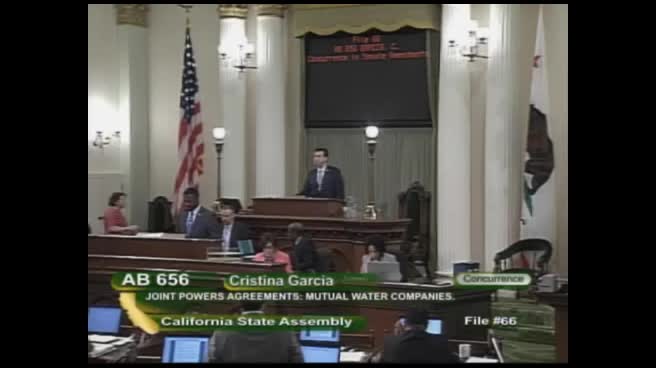 1MIN
Assembly Floor
 2MIN
Senate Floor
 54SEC
Assembly Floor
 1MIN
Assembly Standing Committee on Appropriations
Bill Author

Bill Co-Author(s):
