AB 735: Postsecondary education: Student Athlete Bill of Rights.
- Session Year: 2015-2016
- House: Assembly
- Latest Version Date: 2016-08-29
Existing law provides for a system of postsecondary education in this state. This system includes the University of California, administered by the Regents of the University of California, the California State University, administered by the Trustees of the California State University, the California Community Colleges, administered by the Board of Governors of the California Community Colleges, and independent institutions of higher education. Existing law establishes a Student Athlete Bill of Rights, which, among other things, provides for the protection of athletic scholarships for student athletes and requires certain institutions of higher education to pay the premiums for specified student athletes for insurance claims resulting from their participation in those institutions athletic programs. Existing law repeals the provisions granting these rights to student athletes on January 1, 2021.
This bill would delete the repeal date for these provisions, thereby extending the operation of these rights for student athletes indefinitely.
Existing law provides for a system of postsecondary education in this state. This system includes the University of California, administered by the Regents of the University of California, the California State University, administered by the Trustees of the California State University, the California Community Colleges, administered by the Board of Governors of the California Community Colleges, and independent institutions of higher education. Existing law establishes a Student Athlete Bill of Rights, which, among other things, provides for the protection of athletic scholarships for student athletes and requires certain institutions of higher education to pay the premiums for specified student athletes for insurance claims resulting from their participation in those institutions athletic programs. Existing law repeals the provisions granting these rights to student athletes on January 1, 2021.
This bill would instead grant these rights to student athletes who initially enrolled in institutions of higher education before January 1, 2021. delete the repeal date for these provisions, thereby extending the operation of these rights for student athletes indefinitely.
Existing law provides for a system of postsecondary education in this state. This system includes the University of California, administered by the Regents of the University of California, the California State University, administered by the Trustees of the California State University, the California Community Colleges, administered by the Board of Governors of the California Community Colleges, and independent institutions of higher education. Existing law establishes a Student Athlete Bill of Rights, which, among other things, provides for the protection of athletic scholarships for student athletes and requires certain institutions of higher education to pay the premiums for specified student athletes for insurance claims resulting from their participation in those institutions athletic programs. Existing law repeals the provisions granting these rights to student athletes on January 1, 2021.
This bill would instead grant these rights to student athletes who initially enrolled in institutions of higher education before January 1, 2021.
This part shall become inoperative on January 1, 2021.
SECTION 1.Section 67454 of the Education Code is amended to read:67454.This part shall only apply to student athletes who initially enrolled in institutions of higher education before January 1, 2021.
This part shall become inoperative on only apply to student athletes who initially enrolled in institutions of higher education before January 1, 2021.
|
Date
|
Status
|
|---|---|
| Jan 27, 2016 | Read third time. Passed. Ordered to the Senate. (Ayes 78. Noes 0. Page 3508.) |
| Aug 29, 2016 | Chaptered by Secretary of State - Chapter 220, Statutes of 2016. |
| Aug 29, 2016 | Approved by the Governor. |
| Aug 15, 2016 | Enrolled and presented to the Governor at 3:30 p.m. |
| Aug 11, 2016 | Read third time. Passed. Ordered to the Assembly. (Ayes 37. Noes 0. Page 4872.). |
| Aug 11, 2016 | Read third time. Passed. Ordered to the Assembly. |
| Aug 11, 2016 | In Assembly. Ordered to Engrossing and Enrolling. |
| Aug 2, 2016 | Read second time. Ordered to Consent Calendar. |
| Aug 1, 2016 | From committee: Be placed on second reading file pursuant to Senate Rule 28.8 and ordered to consent calendar. |
| Jun 29, 2016 | From committee: Do pass and re-refer to Com. on APPR. with recommendation: To Consent Calendar. (Ayes 9. Noes 0.) (June 29). Re-referred to Com. on APPR. |
| Feb 4, 2016 | Referred to Com. on ED. |
| Feb 25, 2015 | Read first time. To print. |
| Jan 27, 2016 | In Senate. Read first time. To Com. on RLS. for assignment. |
| Jan 21, 2016 | Read second time. Ordered to Consent Calendar. |
| Jan 21, 2016 | From committee: Do pass. To Consent Calendar. (Ayes 17. Noes 0.) (January 21). |
| Jan 12, 2016 | From committee: Do pass and re-refer to Com. on APPR. (Ayes 12. Noes 0.) (January 12). Re-referred to Com. on APPR. |
| Jan 5, 2016 | From committee: Do pass and re-refer to Com. on HIGHER ED. (Ayes 6. Noes 0.) (January 5). Re-referred to Com. on HIGHER ED. |
| Jan 4, 2016 | Re-referred to Com. on A.,E.,S.,T., & I.M. |
| Jan 4, 2016 | From committee chair, with author's amendments: Amend, and re-refer to Com. on A.,E.,S.,T., & I.M. Read second time and amended. |
| Mar 12, 2015 | Referred to Coms. on A.,E.,S.,T., & I.M. and HIGHER ED. |
| Feb 26, 2015 | From printer. May be heard in committee March 28. |
|
Date
|
Description
|
Location
|
Votes
|
|
|---|---|---|---|---|
| Aug 11, 2016 | Consent Calendar 2nd AB735 Ridley-Thomas | Senate Floor |
Passed |
|
| Jun 29, 2016 | Do pass, but first be re-referred to the Committee on [Appropriations] with the recommendation: To Consent Calendar | Senate Standing Committee on Education |
Passed |
|
| Jan 27, 2016 | AB 735 RIDLEY-THOMAS Consent Calendar Second Day Regular Session | Assembly Floor |
Passed |
|
| Jan 21, 2016 | Do pass. To Consent Calendar. | Assembly Standing Committee on Appropriations |
Passed |
|
| Jan 12, 2016 | Do pass and be re-referred to the Committee on [Appropriations] | Assembly Standing Committee on Higher Education |
Passed |
|
| Jan 5, 2016 | Do pass and be re-referred to the Committee on [Higher Education] | Assembly Standing Committee on Arts, Entertainment, Sports, Tourism, and Internet Media |
Passed |
This list shows positions taken on this bill by organizations on the date displayed, which is linked to the original source.
Positions by individuals are not included.
|
Organization
|
Position
|
Date
|
|---|---|---|
| There is no support on file. | ** Support | Jan 5, 2016 |
Office of Senate Floor Analyses (916) 651-1520 Fax: (916) 327-4478 | AB 735 |
CONSENT
Bill No: AB 735
Amended: 1/4/16 in Assembly
SENATE EDUCATION COMMITTEE: 9-0, 6/29/16
AYES: Liu, Block, Hancock, Huff, Leyva, Mendoza, Monning, Pan, Vidak
SENATE APPROPRIATIONS COMMITTEE: Senate Rule 28.8
ASSEMBLY FLOOR: 78-0, 1/27/16 (Consent) - See last page for vote
SUBJECT: Postsecondary education: Student Athlete Bill of Rights
DIGEST: This bill eliminates the January 1, 2021 sunset on the Student Athlete Bill of Rights.
Existing law:
- Prohibits any person from giving, offering, promising or attempting to give money or other item of value to a student athlete or member of the athlete's immediate family to induce, encourage or reward a student athlete's application, enrollment or attendance at a public or private institution of higher education (IHE) to participate in intercollegiate sporting activities. (Education Code § 67360)
- Requires California postsecondary educational institutions that offer athletic scholarships to provide specific information on its Web site, such as the costs of attendance that are prohibited from inclusion in a full grant-in-aid athletic scholarship, National Collegiate Athletic Association policy on scholarship duration, the most recent cost of attendance, the institution’s policy on athletically related medical expenses, and athletic release information. (EC § 67365)
Student Athlete Bill of Rights
- Applies the following to an IHE that receives, as an average, at least $10 million in annual income from media rights for intercollegiate athletics. (EC § 67452)
- Requires an IHE, if an athletic program does not renew an athletic scholarship of a student athlete who suffers an incapacitating injury or illness resulting from participating in the athletic program and is determined to be medically ineligible, to provide an equivalent scholarship, as specified. (EC § 67452)
- Requires an athletic program to provide an equivalent scholarship to a student athlete who was on an athletic scholarship and is in good standing but has exhausted his or her athletic eligibility, for up to one year. (EC § 67452)
- Requires each athletic program to be responsible for paying the premiums of each of its student athletes whose household has an income and asset level at or below the level for Cal Grant A recipients for insurance covering claims resulting from their participation in the athletic program. (EC § 67453)
- Requires an athletic program to be responsible for paying the insurance deductible for a claim of any student athlete who suffers an injury resulting from participation in the athletic program. (EC § 67453)
- Requires an athletic program, if a student suffers an injury resulting from participation in the athletic program that requires ongoing medical treatment, to provide for at least two years following the student’s graduation or separation from the IHE either the necessary medical treatment or health insurance that covers the injury and resulting deductibles. (EC § 67453)
This bill eliminates the January 1, 2021 sunset on the Student Athlete Bill of Rights, thereby extending these rights indefinitely.
Comments
Only affects four universities. Based on annual revenues from media rights, the Student Athlete Bill of Rights currently only applies to four IHEs: the University of California at Berkeley and Los Angeles, Stanford University, and the University of Southern California. None of these institutions have expressed opposition to removing the sunset and making the Student Athlete Bill of Rights permanent.
FISCAL EFFECT: Appropriation: No Fiscal Com.: Yes Local: No
None received
None received
ASSEMBLY FLOOR: 78-0, 1/27/16
AYES: Achadjian, Alejo, Travis Allen, Baker, Bigelow, Bloom, Bonilla, Bonta, Brough, Brown, Burke, Calderon, Campos, Chang, Chau, Chávez, Chiu, Chu, Cooley, Cooper, Dababneh, Dahle, Daly, Dodd, Eggman, Frazier, Beth Gaines, Gallagher, Cristina Garcia, Eduardo Garcia, Gatto, Gipson, Gomez, Gonzalez, Gordon, Gray, Grove, Hadley, Harper, Roger Hernández, Holden, Irwin, Jones, Jones-Sawyer, Kim, Lackey, Levine, Linder, Lopez, Low, Maienschein, Mayes, McCarty, Medina, Melendez, Mullin, Nazarian, Obernolte, O'Donnell, Olsen, Patterson, Quirk, Rendon, Ridley-Thomas, Rodriguez, Salas, Santiago, Steinorth, Mark Stone, Thurmond, Ting, Wagner, Waldron, Weber, Wilk, Williams, Wood, Atkins
NO VOTE RECORDED: Mathis
Prepared by: Lynn Lorber / ED. / (916) 651-4105
8/3/16 18:43:12
**** END ****
SENATE COMMITTEE ON EDUCATION
Senator Carol Liu, Chair
2015 - 2016 Regular
Bill No: AB 735
Author: | |||
Version: | January 4, 2016 Hearing Date: June 29, 2016 | ||
Urgency: | No | Fiscal: | Yes |
Consultant: | Lynn Lorber | ||
Subject: Postsecondary education: Student Athlete Bill of Rights
SUMMARY
This bill eliminates the January 1, 2021, sunset on the Student Athlete Bill of Rights.
BACKGROUND
Existing law:
- Prohibits any person from giving, offering, promising or attempting to give money or other item of value to a student athlete or member of the athlete's immediate family to induce, encourage or reward a student athlete's application, enrollment or attendance at a public or private institution of higher education (IHE) to participate in intercollegiate sporting activities. (Education Code § 67360)
- Requires California postsecondary educational institutions that offer athletic scholarships to provide specific information on its Web site, such as the costs of attendance that are prohibited from inclusion in a full grant-in-aid athletic scholarship, National Collegiate Athletic Association policy on scholarship duration, the most recent cost of attendance, the institution’s policy on athletically related medical expenses, and athletic release information. (EC § 67365)
Student Athlete Bill of Rights
- Applies the following to an IHE that receives, as an average, at least $10 million in annual income from media rights for intercollegiate athletics. (EC § 67452)
- Requires an IHE, if an athletic program does not renew an athletic scholarship of a student athlete who suffers an incapacitating injury or illness resulting from participating in the athletic program and is determined to be medically ineligible, to provide an equivalent scholarship as specified. (EC § 67452)
- Requires an athletic program to provide an equivalent scholarship to a student athlete who was on an athletic scholarship and is in good standing but has exhausted his or her athletic eligibility, for up to one year. (EC § 67452)
- Requires each athletic program to be responsible for paying the premiums of each of its student athletes whose household has an income and asset level at or
below the level for Cal Grant A recipients for insurance covering claims resulting from their participation in the athletic program. (EC § 67453)
- Requires an athletic program to be responsible for paying the insurance deductible for a claim of any student athlete who suffers an injury resulting from participation in the athletic program. (EC § 67453)
- Requires an athletic program, if a student suffers an injury resulting from participation in the athletic program that requires ongoing medical treatment, to provide for at least two years following the student’s graduation or separation from the institution of higher education (IHE) either the necessary medical treatment or health insurance that covers the injury and resulting deductibles. (EC § 67453)
ANALYSIS
This bill eliminates the January 1, 2021 sunset on the Student Athlete Bill of Rights, thereby extending these rights indefinitely.
STAFF COMMENTS
- Need for the bill. According to the author, “The Student Athlete Bill of Rights will become inoperative on January 1, 2021. Any benefits provided pursuant to this act would cease on that date in the middle of the academic year. Thus, student athletes who enroll in school in 2017 and later will lack the certainties of the protections of the Student Athlete Bill of Rights being available to them throughout their entire collegiate experience. Because of the success of the Student Athlete Bill of Rights, it is unnecessary to wait any longer to repeal the sunset date and to place undue stress on our student athletes and to not extend common sense protections indefinitely.”
- Only affects four universities. Based on annual revenues from media rights, the Student Athlete Bill of Rights currently only applies to four institutions of higher education: the University of California at Berkeley and Los Angeles, Stanford University, and the University of Southern California. None of these institutions have expressed opposition to removing the sunset and making the Student Athlete Bill of Rights permanent.
- National Collegiate Athletic Association and Pac-12 Conference rules. According to the National Collegiate Athletic Association’s (NCAA) Web site, “NCAA full scholarships cover tuition and fees, room, board and course-related books. Most student-athletes who receive athletic scholarships receive an amount covering a portion of these costs. Division I schools may provide student-athletes with multiyear scholarships. Additionally, Division I schools may pay for student-athletes to finish their bachelor's or master's degrees after they finish playing NCAA sports. If a school plans to reduce or not renew a student-athlete’s aid, the school must notify the student-athlete in writing by July 1 and provide an opportunity to appeal. In most cases, coaches decide who receives a scholarship, the scholarship amount and whether it will be renewed.”
“NCAA bylaws require that member institutions verify student-athletes have insurance coverage for athletically related injuries, with limits up to the deductible of the National Collegiate Athletic Association (NCAA) Catastrophic Injury Insurance Program (currently $90,000), before they can practice or play. Members are permitted to provide that coverage, but they are not required to do so. Coverage can be provided through the school, a parent/guardian policy or a policy student-athletes have on their own. If coverage by some source is not in place, the student-athlete cannot practice or play. The NCAA provides all student-athletes at all active member institutions coverage under the catastrophic program. This program provides $20 million in lifetime benefits to student-athletes who become totally disabled while practicing or playing. These benefits include medical expenses as well as disability benefits. An injured student-athlete is eligible to receive medical benefits after the policy deductible (currently $90,000) is met.”
According to the Pac-12 Conference’s Web site, rules adopted in 2014, which apply to all Pac-12 student-athletes across all sports, include:
- Athletic scholarships are guaranteed for four years for student-athletes in all sports.
- Student-athletes who leave school before graduating can use the remainder of their educational expenses later to earn their degrees.
- Medical expenses for student-athletes who are injured during their college athletic careers are covered for up to four years after a student-athlete leaves the institution.
- Student-athletes who transfer between Pac-12 institutions are able to receive athletic scholarships immediately.
- Student-athletes are represented in the Conference governance structure.
- Status. There is no requirement for affected institutions to provide progress reports, data or an evaluation relating to implementation of the Student Athlete Bill of Rights. The Student Athlete Bill of Rights has been in place for three academic years, and is scheduled to sunset on January 1, 2021.
Should the Legislature have data relative to the implementation of the Student Athlete Bill of Rights before extending its provisions indefinitely?
Should the sunset be repealed four years before the scheduled inoperative date? - Fiscal impact. According to the Assembly Appropriations Committee, this bill has no state costs for the impacted public institutions to continue compliance with the Student Athlete Bill of Rights. The Student Athlete Bill of Rights requires institutions to rely exclusively on revenue from media rights to cover the costs of compliance.
SUPPORT
None received.
OPPOSITION
None received.
-- END --
Date of Hearing: January 21, 2016
ASSEMBLY COMMITTEE ON APPROPRIATIONS
Jimmy Gomez, Chair
ABPCA Bill Id:AB 735
Author:(Ridley-Thomas) – As Amended Ver:January 4, 2016
Policy Committee: | Arts, Entertainment, Sports, Tourism, and Internet Media | Vote: | 6 - 0 |
Higher Education | 12 - 0 | ||
|
|
Urgency: No State Mandated Local Program: No Reimbursable: >
SUMMARY:
This bill eliminates the January 1, 2012 sunset date on the Student Athlete Bill of Rights, which places specified requirements on collegiate athletic programs at those California higher education institutions that receive income of more than $10 million annually through media rights (contracts with television networks).
FISCAL EFFECT:
No state costs for the impacted public institutions to continue compliance with the Student Athlete Bill of Rights. Based on their annual revenue from media rights, the bill of rights applies only to four schools—the University of California's (UC's) Berkeley and Los Angeles campuses, Stanford University, and the University of Southern California. The bill of rights requires these institutions to rely exclusively on this revenue to cover the costs of compliance.
According to UC, in the past 18 months, the Pac-12 Conference, which includes the four institutions subject to this bill, have obtained autonomy from NCAA and have adopted reforms in support of student athlete welfare and academic success that go beyond the provisions in Student Athlete Bill of Rights.
COMMENTS:
- Purpose. According to the author, "Because of the success of the Student Athlete Bill of Rights, it is unnecessary to wait any longer to repeal the sunset date and to place undue stress on our student athletes and to not extend common sense protections indefinitely." The author contends that, given the January 2021 sunset date, student athletes enrolling in school in 2017 and thereafter, will lack the certainties of the protections of the bill of rights being available to them throughout their entire collegiate experience.
- Background. SB 1525 (Padilla), Chapter 625, Statutes of 2012, enacted the Student Athlete Bill of Rights, which in part:
- Requires the postsecondary education institution, if a student athlete's athletic scholarship is not renewed due to incapacitating injury or illness result from participation in the athletic program, to provide an equivalent scholarship, that when combined with the previous athletic scholarship, provides the student with up to five academic years or until the student completes his academic degree, whichever comes first.
- Requires an athletic program with a six-year graduation success rate, disaggregated by team, of less than 60%, to provide a student athlete in good standing who has exhausted their athletic scholarship with an equivalent scholarship for up to one year.
- Requires each athletic program to conduct a financial and life skills workshop, as specified, for all first-year and third-year student athletes.
- Requires an athletic program to respond within seven business days to a student athlete's written request to transfer.
- Stipulates that an athletic program, unless the student athlete declines, is responsible for paying the health insurance premiums of a student athlete whose household income does not exceed the level of Cal Grant A recipients, for insurance covering claims resulting from the student's participation in the athletic program.
- Stipulates that an athletic program is responsible for paying the insurance deductible amount applicable to a student who suffers an injury resulting from participation in the athletic program, and if the student requires ongoing medical treatment, the program is to provide, for at least two years after the student's graduation or separate from the institution, either necessary medical treatment or health insurance covering the injury and resulting deductibles.
Analysis Prepared by: Chuck Nicol / APPR. / (916) 319-2081
Date of Hearing: January 12, 2016
ASSEMBLY COMMITTEE ON HIGHER EDUCATION
Jose Medina, Chair
ABPCA Bill Id:AB 735 (
Author:Ridley-Thomas) – As Amended Ver:January 4, 2016
[Note: This bill is doubled referred to the Assembly Arts, Entertainment, Sports, Tourism and Internet Media Committee and was heard on January 5, 2016, in said Committee, as it relates to issues under its jurisdiction.]
SUBJECT: Postsecondary education: Student Athlete Bill of Rights
SUMMARY: Eliminates the sunset of the Student Athlete Bill of Rights.
EXISTING LAW:
- Prohibits any person from giving, offering, promising or attempting to give money or other item of value to a student athlete or member of the athlete's immediate family to induce, encourage or reward a student athlete's application, enrollment or attendance at a public or private institution of higher education (IHE) to participate in intercollegiate sporting activities. Some exceptions may be granted in accordance with National Collegiate Athletic Association (NCAA) rules. A person who violates these rules is subject to a civil penalty of up to $10,000, or three times the amount given, offered or promised, whichever is greater (Education Code Section 67360).
- Prohibits student athletes and members of their immediate family from soliciting or accepting money or other item of value as an inducement, encouragement or reward, subject to the same exceptions and penalty listed above (EC Section 67361).
- Requires California postsecondary educational institutions that offer athletic scholarships to provide specific information on its website, such as NCAA policy on scholarship duration, the most recent cost of attendance, and their policy on athletically related medical expenses (EC Section 67365).
- Defines the following: “athletic association” to mean any organization that is responsible for governing intercollegiate athletic programs; “athletic program” to mean an intercollegiate athletic program at any IHE; “graduation success rate” to mean the percentage of student athletes who graduate from that IHE within six years of their initial enrollment, excluding outgoing transfers in good academic standing with athletic eligibility remaining, and including incoming transfers. The rate is to be calculated by combining the rates of the four most recent classes that are available in the exact manner as the rate is calculated under NCAA rules; “IHE” to mean any campus of the University of California or the California State University, or any four-year private university located in California, that maintains an intercollegiate athletic program; “media rights” means the rights to media coverage of intercollegiate athletics included in contracts that are entered into by intercollegiate athletic conferences and television networks and that generate monetary payments to individual IHEs; and, “student athlete” to mean any college student who participates in an intercollegiate athletic program of an IHE, and includes student athletes who participate in basketball, football, and other intercollegiate sports (EC Section 67451).
- Specifies the following: a) unless a student athlete declines the payment of premiums, an athletic program shall be responsible for paying the premiums of each of its student athletes whose household has an income and asset level that does not exceed the level for Cal Grant A recipients set forth in EC Section 69432.7 for insurance covering claims resulting from their participation in the athletic program; b) an athletic program shall be responsible for paying the insurance deductible amount applicable to the claim of any student athlete who suffers an injury resulting from his or her participation in the athletic program and makes a claim relating to that injury; c) if a student athlete suffers an injury resulting from his or her participation in the athletic program that requires ongoing medical treatment, the athletic program shall provide, for a minimum of two years following the student athlete’s graduation or separation from the IHE, one of the following: i) the necessary medical treatment and ii) health insurance that covers the injury and the resulting deductible amounts; d) Letter "C" "i" and "ii" shall not apply to preexisting medical conditions that predate the student athlete’s participation in the athletic program; e) an athletic program shall adopt and implement guidelines to prevent, assess, and treat sports-related concussions and dehydration. Additionally, an athletic program shall adopt and implement exercise and supervision guidelines for any student athlete identified with potentially life-threatening health conditions who participates in an athletic program; f) an IHE that receives, as an average, less than ten million dollars in annual income derived from media rights for intercollegiate athletics shall not be subject to the requirements of this section; and, g) an IHE to which this section applies shall rely exclusively on revenue derived from media rights for intercollegiate athletics to defray any costs accrued under this section (EC Section 67452).
- Mandates that athletic programs shall comply with all of the following: a) if an athletic program does not renew an athletic scholarship of a student athlete who suffers an incapacitating injury or illness resulting from his or her participation in the athletic program, and the IHE medical staff determines that he or she is medically ineligible to participate in intercollegiate athletics, the IHE shall provide an equivalent scholarship that, combined with the total duration of any previous athletic scholarship or scholarships received by the student athlete, will be provided for a total of up to five academic years or until the student athlete completes his or her undergraduate degree, whichever period is shorter. Additional years may be provided at the discretion of the IHE; b) if a student athlete takes a temporary leave of absence from an IHE, the duration of that leave of absence shall not count against the five-year limit on eligibility for an equivalent scholarship as determined; c) an athletic program shall provide an equivalent scholarship to a student athlete who was on an athletic scholarship and is in good standing, but has exhausted his or her athletic eligibility, for up to one year or until the student athlete completes his or her primary undergraduate degree, whichever is shorter, except that an athletic program with a graduation success rate that is above 60 percent, disaggregated by team, shall not be subject to the requirements; d) a student athlete whose athletic scholarship is not renewed for cause by an athletic program shall receive no benefits under this part, but may appeal this decision within the IHE attended by the student or within the athletic conference or association of which that IHE is a member, as appropriate; e) each athletic program shall conduct a financial and life skills workshop for all of its first-year and third-year student athletes at the beginning of the academic year. This workshop shall include, but not be limited to, information concerning financial aid, debt management, and a recommended budget for full- and partial-scholarship student athletes living on or off campus during the academic year and the summer term based on the current academic year’s cost of attendance. The workshop shall also include information on time management skills necessary for success as a student athlete, and academic resources available on campus; f) an IHE shall grant a student athlete the same rights as other students with regard to any and all matters related to possible adverse or disciplinary actions, including, but not necessarily limited to, actions involving athletically related financial aid; g) an athletic program shall respond within seven business days with an answer to a student athlete’s written request to transfer to another IHE; h) an IHE that receives, as an average, less than ten million dollars in annual income derived from media rights for intercollegiate athletics shall not be subject to the requirements of this section of law; and, i) an IHE to which this section of law applies shall rely exclusively on revenue derived from media rights for intercollegiate athletics to defray any costs accrued under this section (EC Section 67453)
FISCAL EFFECT: Unknown
COMMENTS: Need for the measure. According to the author, "Because of the success of the Student Athlete Bill of Rights, it is unnecessary to wait any longer to repeal the sunset date and to place undue stress on our student athletes and to not extend common sense protections indefinitely." The author contends that student athletes who enroll in school in 2017 and thereafter, will lack the certainties of the protections of the Student Athlete Bill of Rights being available to them throughout their entire collegiate experience.
Background. SB 1525 (Padilla, Chapter 625, Statutes of 2012) enacted a Student Athlete Bill of Rights (see "Existing Law" section of this analysis) and placed specified requirements on collegiate athletic programs, including, but not limited to, providing financial and life skills workshops for all of its first-year and third-year student athletes at the beginning of the academic year; and, ensuring that a student athlete is granted the same rights as other students with regard to any and all matters related to possible adverse or disciplinary actions, commencing with the 2013-14 academic year and ending January 1, 2021.
Over the course of several months in 2012, this measure was amended five times; the chaptered version of the measure changed significantly from the original version of the measure. Prior versions of SB 1525 included guaranteed scholarships for five years for student-athletes and removed transfer restrictions for student athletes. These provisions were negotiated out of SB 1525 for various reasons. The signed version of SB 1525 codified into law practices that support student-athletes welfare and minimize the disadvantages to student-athletes.
To note, SB 1525 did not require the institutions of higher learning that must implement the provisions of said measure to report to the Legislature and other interested stakeholders, the outcomes of the measure. Therefore, no initial reports as to the successes or failures are known at this time.
Policy implications. SB 1525 did not require the institutions of higher learning that must implement the provisions of said measure to report to the Legislature and other pertinent stakeholders on the outcomes of the measure. Therefore, no progress reports as to the successes or failures are known at this time. Anecdotally, in the first year and a half of the implementation of the Student Athlete Bill of Rights, student athletes have been receiving necessary rights.
Without empirical data proving the successes and within less than two years into the implementation of the Student Athlete Bill of Rights, is it prudent to remove the sunset? Moving forward, the author may want to consider if it is prudent to add a reporting requirement to the Student Athlete Bill of Rights prior to removing the sunset.
REGISTERED SUPPORT / OPPOSITION:
Support
None on file.
Opposition
None on file.
Analysis Prepared by: Jeanice Warden / HIGHER ED. / (916) 319-3960
Date of Hearing: January 5, 2016
ASSEMBLY COMMITTEE ON ARTS, ENTERTAINMENT, SPORTS, TOURISM, AND INTERNET MEDIA
Ian Charles Calderon, Chair
ABPCA Bill Id:AB 735 (
Author:Ridley-Thomas) – As Amended Ver:January 4, 2016
SUBJECT: Postsecondary education: Student Athlete Bill of Rights.
SUMMARY: This bill would strike the sunset date from the Student Athlete Bill of Rights (SABR), pursuant to which intercollegiate athletic programs at 4-year institutions of higher education in the state, as defined, are required to comply with prescribed requirements with regard to their student athletes. Specifically, this bill: removes the sunset date of January 1, 2021 from the SABR, thereby extending the operation of these rights for student athletes indefinitely.
EXISTING LAW:
- Establishes the SABR, which applies all of the following requirements only to a higher education institution receiving income of more than $10 million annually through media rights (contracts with television networks), and requires the institution to rely exclusively on this revenue to cover the costs of these requirements.
- Requires the postsecondary education institution, if a student athlete's athletic scholarship is not renewed due to incapacitating injury or illness resulting from participation in the athletic program, to provide an equivalent scholarship, that when combined with the previous athletic scholarship, provides the student with up to five academic years or until the student completes his academic degree, whichever comes first. A student's temporary leave of absence shall not count against the five-year limit.
- Requires an athletic program with a six-year graduation success rate, disaggregated by team, of less than 60%, to provide a student athlete in good standing who has exhausted their athletic scholarship with an equivalent scholarship for up to one year.
- Requires each athletic program to conduct a financial and life skills workshop, as specified, for all first-year and third-year student athletes.
- Requires an athletic program to respond within seven business days to a student athlete's written request to transfer.
- Stipulates that an athletic program, unless the student athlete declines, is responsible for paying the health insurance premiums of a student athlete whose household income does not exceed the level of Cal Grant A recipients, for insurance covering claims resulting from the student's participation in the athletic program.
- Stipulates that an athletic program is responsible for paying the insurance deductible amount applicable to a student who suffers injury resulting from participation in the athletic program, and if the student requires ongoing medical treatment, the program is to provide, for at least two years after the student's graduation or separation from the institution, either necessary medical treatment or health insurance covering the injury and resulting deductibles.
- Requires the athletic program to adopt and implement guidelines to prevent, assess and treat sports-related concussions and dehydration.
- Declares that these provisions will become inoperative on January 1, 2021.
FISCAL EFFECT: None known.
COMMENTS:
- Author's statement of need for legislation: According to the author, this legislation is needed to ensure that student athletes continue to benefit from the SABR by force of law, rather than simply through voluntary compliance through their athletic conference or NCAA membership.
- Scope of SABR and neutral position of impacted California Institutions of Higher Education: Based on their annual revenue from media rights, this bill will initially only apply to four schools-the University of California's Berkeley and Los Angeles campuses, Stanford University, and the University of Southern California. There will be no additional costs to UC, as the university indicates this bill's requirements are consistent with current policies and practices. The California State University indicates that its San Diego campus will meet the media revenue threshold for this bill sometime in the near future. They anticipate absorbable costs of compliance at that time coming from non-state sources.
Regarding the proposal to remove the sunset date on the SABR, the Committee has heard from Stanford University, the University of California, and the California State University system on AB 735, each of whom express neutrality so long as the bill only removes the sunset. The University of Southern California is also neutral, but questions the need for legislation six years prior to the expiration of the existing sunset date.
- SABR requirements were largely adopted by the NCAA and PAC 12 Conference: According to information supplied by the University of California, the Pac-12 Conference rules adopted in 2014, which apply to all Pac-12 student-athletes across all sports, include:
- Athletic scholarships are guaranteed for four years for student-athletes in all sports.
- Student-athletes who leave school before graduating can use the remainder of their educational expenses later to earn their degrees.
- Medical expenses for student-athletes who are injured during their college athletic careers are covered for up to four years after a student-athlete leaves the institution.
- Student-athletes who transfer between Pac-12 institutions are able to receive athletic scholarships immediately.
- Student-athletes are represented in the Conference governance structure.
In addition to the above, the Pac-12 presidents and chancellors also reaffirmed their support for incorporating the full cost of attendance for Pac-12 scholarship student-athletes, which the NCAA subsequently adopted.
The PAC-12 includes the University of California-Berkeley, the University of California at Los Angeles (UCLA), Stanford University and the University of Southern California.
4) Prior related legislation:
- SB 1525 (Padilla), Chapter 625, Statutes of 2012, created the original SABR discussed as "Existing Law" above.
- AB 1743 (Campos), Chapter 16, Statutes of 2012, clarified that the online scholarship disclosures required of a California postsecondary educational institution only apply to institutions that offer athletic scholarships to "student athletes".
- AB 2079 (Torlakson-Davis), Chapter 592, Statutes of 2010 provided that all California postsecondary educational institutions that offer athletic scholarships are required to provide specified scholarship information on their websites.
- AB 95 (Torlakson), of 2008-09, would have required athletic recruiters to provide student athletes with specified information relating to the college athletic program within one week of initiating personal contact with the student athlete for purposes of athletic recruiting. Status: Filed with the Chief Clerk pursuant to Joint Rule 56. Died pursuant to Art. IV, Sec.10(c) of the Constitution.
- SB 193 (Murray), of 2002-03, would have prohibited California institutions of higher education from participating in any organizations that regulates student athletic scholarships, including the NCAA. Status: Held in the Assembly Higher Education Committee.
5) Double-referral: Should this bill pass out of this committee, it will be re-referred to the Assembly Committee on Higher Education.
REGISTERED SUPPORT / OPPOSITION:
Support
There is no support on file.
Opposition
There is no opposition on file.
Analysis Prepared by: Dana Mitchell / A.,E.,S.,T., & I.M. / (916) 319-3450
Discussed in Hearing
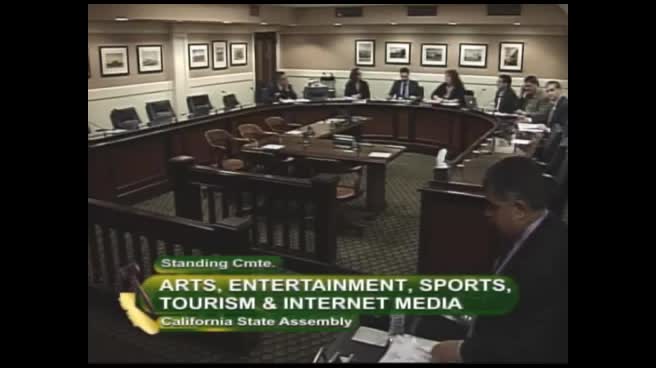 3MIN
Assembly Standing Committee on Arts, Entertainment, Sports, Tourism, and Internet Media
Bill Author

Bill Co-Author(s):