AB 736: State teachers' retirement: executive positions.
- Session Year: 2015-2016
- House: Assembly
- Latest Version Date: 2016-09-24
The Teachers Retirement Law creates the State Teachers Retirement System and State Teachers Retirement Plan for the purpose of providing teachers and other specified employees with financially sound retirement plans. The law provides for the administration of the system and the plan by the Teachers Retirement Board and authorizes the board to appoint employees as necessary for those purposes. The law requires the board to fix the compensation of specified executive and managerial positions, including chief executive officer, chief investment officer, and general counsel.
This bill would provide the duty to fix the compensation of specified executive and managerial positions, described above, applies to a single position in the various job categories. The bill would additionally require the board to fix the compensation of a chief operating officer and a chief financial officer. The bill would impose specified limits on the annual percentage increase in salary paid to a person who served in either of those positions on January 1, 2016, and who does not separate from service in that position prior to the date on which the increase is applied.
Existing law prohibits, among others, a chief of staff, deputy chief executive officer, or an equivalent senior management position, for a period of 2 years after leaving that position, from appearing before or communicating with the board for the purpose of influencing actions or proceedings, for compensation, as specified.
This bill would remove that restriction from the positions listed above and instead apply the restriction to the chief operating officer and individuals who held career executive assignment positions that reported directly to either the chief executive officer or the chief operating officer.
The Teachers Retirement Law creates the State Teachers Retirement System and State Teachers Retirement Plan for the purpose of providing teachers and other specified employees with financially sound retirement plans. The law provides for the administration of the system and the plan by the Teachers Retirement Board and authorizes the board to appoint employees as necessary for those purposes. The law requires the board to fix the compensation of specified executive and managerial positions, including chief executive officer, chief investment officer, and general counsel.
This bill would provide the duty to fix the compensation of specified executive and managerial positions, described above, applies to a single position in the various job categories. The bill would additionally require the board to fix the compensation of the a chief operating officer and one a chief financial officer. The bill would impose specified limits on the annual percentage increase in salary paid to a person who served in either of those positions on January 1, 2016, and who does not separate from service in that position prior to the date on which the increase is applied.
Existing law prohibits, among others, a chief of staff, deputy chief executive officer, or an equivalent senior management position, for a period of 2 years after leaving that position, from appearing before or communicating with the board for the purpose of influencing actions or proceedings, for compensation, as specified.
This bill would remove that restriction from the positions listed above and instead apply the restriction to the chief operating officer and individuals who held career executive assignment positions that reported directly to either the chief executive officer or the chief operating officer.
The Teachers Retirement Law creates the State Teachers Retirement System and State Teachers Retirement Plan for the purpose of providing teachers and other specified employees with financially sound retirement plans. The law provides for the administration of the system and the plan by the Teachers Retirement Board and authorizes the board to appoint employees as necessary for those purposes. The law requires the board to fix the compensation of specified executive and managerial positions, including chief executive officer, chief investment officer, and general counsel.
This bill would additionally require the board to fix the compensation of the chief operating officer and one chief financial officer. The bill would impose specified limits on the annual percentage increase in salary paid to a person who served in either of those positions on January 1, 2016, and who does not separate from service in that position prior to the date on which the increase is applied.
Existing law prohibits, among others, a chief of staff, deputy chief executive officer, or an equivalent senior management position, for a period of 2 years after leaving that position, from appearing before or communicating with the board for the purpose of influencing actions or proceedings, for compensation, as specified.
This bill would remove that restriction from the positions listed above and instead apply the restriction to the chief operating officer and individuals who held career executive assignment positions that reported directly to either the chief executive officer or the chief operating officer.
The Teachers Retirement Law creates the State Teachers Retirement System and State Teachers Retirement Plan for the purpose of providing teachers and other specified employees with financially sound retirement plans. The law provides for the administration of the system and the plan by the Teachers Retirement Board and authorizes the board to appoint employees as necessary for those purposes. The law requires the board to fix the compensation of specified executive and managerial positions, including chief executive officer, chief investment officer, and general counsel.
This bill would additionally require the board to fix the compensation of the chief operating officer and chief financial officer.
Existing law prohibits, among others, a chief of staff, deputy chief executive officer, or an equivalent senior management position, for a period of 2 years after leaving that position, from appearing before or communicating with the board for the purpose of influencing actions or proceedings, for compensation, as specified.
This bill would remove that restriction from the positions listed above and instead apply the restriction to the chief operating officer and individuals who held career executive assignment positions that reported directly to either the chief executive officer or the chief operating officer.
(a)Except as otherwise provided in subdivision (d), this section shall apply to the following positions in the system: a chief executive officer, a chief operating officer, a chief financial officer, a system actuary, a general counsel, a chief investment officer, and other investment officers and portfolio managers whose positions are designated managerial pursuant to Section 18801.1 of the Government Code.
(b)Notwithstanding Sections 19825, 19826, 19829, and 19832 of the Government Code, the board shall fix the compensation for the positions specified in subdivision (a). In so doing, the board shall be guided by the principles contained in Sections 19826 and 19829 of the Government Code, consistent with its fiduciary responsibility to its members to recruit and retain highly qualified and effective employees for these positions. The annual percentage increase in salary that may be paid pursuant to this section to a person who served as chief financial officer or as chief operating officer on January 1, 2016, and who does not separate from service in that position prior to the date on which the increase is applied, shall not exceed either of the following:
(1)Ten percent for the 201718 fiscal year.
(2)Five percent for any fiscal year subsequent to 201718.
(c)When a position specified in subdivision (a) is filled through a general civil service appointment, it shall be filled from an eligible list based on an examination that was held on an open basis, and tenure in those positions shall be subject to the provisions of Article 2 (commencing with Section 19590) of Chapter 7 of Part 2 of Division 5 of Title 2 of the Government Code. In addition to the causes for action specified in that article, the board may take action under the article for causes related to its fiduciary responsibility to its members, including the employees failure to meet specified performance objectives.
(d)An individual who held a position designated in subdivision (a), was a member of the board, or was in a career executive assignment position that reported directly to either the chief executive officer or the chief operating officer, shall not, for a period of two years after leaving that position, for compensation, act as agent or attorney for, or otherwise represent, any other person, except the state, by making any formal or informal appearance before or by making any oral or written communication to the board, or any officer or employee thereof, if the appearance or communication is made for the purpose of influencing administrative or legislative action or any action or proceeding involving the issuance, amendment, awarding, or revocation of a permit, license, grant, contract, or sale or purchase of goods or property.
(a)Except as otherwise provided in subdivision (d), this section shall apply to the following positions in the system: a chief executive officer, one a chief operating officer, a chief financial officer, a system actuary, a general counsel, a chief investment officer, and other investment officers and portfolio managers whose positions are designated managerial pursuant to Section 18801.1 of the Government Code.
(b)Notwithstanding Sections 19825, 19826, 19829, and 19832 of the Government Code, the board shall fix the compensation for the positions specified in subdivision (a). In so doing, the board shall be guided by the principles contained in Sections 19826 and 19829 of the Government Code, consistent with its fiduciary responsibility to its members to recruit and retain highly qualified and effective employees for these positions. The annual percentage increase in salary that may be paid pursuant to this section to a person who served as chief financial officer or as chief operating officer on January 1, 2016, and who does not separate from service in that position prior to the date on which the increase is applied, shall not exceed either of the following:
(1)Ten percent for the 201718 fiscal year.
(2)Five percent for any fiscal year subsequent to 201718.
(c)When a position specified in subdivision (a) is filled through a general civil service appointment, it shall be filled from an eligible list based on an examination that was held on an open basis, and tenure in those positions shall be subject to the provisions of Article 2 (commencing with Section 19590) of Chapter 7 of Part 2 of Division 5 of Title 2 of the Government Code. In addition to the causes for action specified in that article, the board may take action under the article for causes related to its fiduciary responsibility to its members, including the employees failure to meet specified performance objectives.
(d)An individual who held a position designated in subdivision (a), was a member of the board, or was in a career executive assignment position that reported directly to either the chief executive officer or the chief operating officer, shall not, for a period of two years after leaving that position, for compensation, act as agent or attorney for, or otherwise represent, any other person, except the state, by making any formal or informal appearance before or by making any oral or written communication to the board, or any officer or employee thereof, if the appearance or communication is made for the purpose of influencing administrative or legislative action or any action or proceeding involving the issuance, amendment, awarding, or revocation of a permit, license, grant, contract, or sale or purchase of goods or property.
(a)Except as otherwise provided in subdivision (d), this section shall apply to the following positions in the system: chief executive officer, one chief operating officer, chief financial officer, system actuary, general counsel, chief investment officer, and other investment officers and portfolio managers whose positions are designated managerial pursuant to Section 18801.1 of the Government Code.
(b)Notwithstanding Sections 19825, 19826, 19829, and 19832 of the Government Code, the board shall fix the compensation for the positions specified in subdivision (a). In so doing, the board shall be guided by the principles contained in Sections 19826 and 19829 of the Government Code, consistent with its fiduciary responsibility to its members to recruit and retain highly qualified and effective employees for these positions. The annual percentage increase in salary that may be paid pursuant to this section to a person who served as chief financial officer or as chief operating officer on January 1, 2016, and who does not separate from service in that position prior to the date on which the increase is applied, shall not exceed either of the following:
(1)Ten percent for the 201718 fiscal year.
(2)Five percent for any fiscal year subsequent to 201718.
(c)When a position specified in subdivision (a) is filled through a general civil service appointment, it shall be filled from an eligible list based on an examination that was held on an open basis, and tenure in those positions shall be subject to the provisions of Article 2 (commencing with Section 19590) of Chapter 7 of Part 2 of Division 5 of Title 2 of the Government Code. In addition to the causes for action specified in that article, the board may take action under the article for causes related to its fiduciary responsibility to its members, including the employees failure to meet specified performance objectives.
(d)An individual who held a position designated in subdivision (a), was a member of the board, or was in a career executive assignment position that reported directly to either the chief executive officer or the chief operating officer, shall not, for a period of two years after leaving that position, for compensation, act as agent or attorney for, or otherwise represent, any other person, except the state, by making any formal or informal appearance before or by making any oral or written communication to the board, or any officer or employee thereof, if the appearance or communication is made for the purpose of influencing administrative or legislative action or any action or proceeding involving the issuance, amendment, awarding, or revocation of a permit, license, grant, contract, or sale or purchase of goods or property.
(a)Except as otherwise provided in subdivision (d), this section shall apply to the following positions in the system: chief executive officer, chief operating officer, chief financial officer, system actuary, general counsel, chief investment officer, and other investment officers and portfolio managers whose positions are designated managerial pursuant to Section 18801.1 of the Government Code.
(b)Notwithstanding Sections 19816, 19825, 19826, 19829, and 19832 of the Government Code, the board shall fix the compensation for the positions specified in subdivision (a). In so doing, the board shall be guided by the principles contained in Sections 19826 and 19829 of the Government Code, consistent with its fiduciary responsibility to its members to recruit and retain highly qualified and effective employees for these positions.
(c)When a position specified in subdivision (a) is filled through a general civil service appointment, it shall be filled from an eligible list based on an examination that was held on an open basis, and tenure in those positions shall be subject to the provisions of Article 2 (commencing with Section 19590) of Chapter 7 of Part 2 of Division 5 of Title 2 of the Government Code. In addition to the causes for action specified in that article, the board may take action under the article for causes related to its fiduciary responsibility to its members, including the employees failure to meet specified performance objectives.
(d)An individual who held a position designated in subdivision (a), or was a member of the board, a chief of staff, a deputy chief executive officer, chief financial officer, or was in an equivalent senior management position, or was in a career executive assignment position that reported directly to either the chief executive officer or the chief operating officer, shall not, for a period of two years after leaving that position, for compensation, act as agent or attorney for, or otherwise represent, any other person, except the state, by making any formal or informal appearance before or by making any oral or written communication to the board, or any officer or employee thereof, if the appearance or communication is made for the purpose of influencing administrative or legislative action or any action or proceeding involving the issuance, amendment, awarding, or revocation of a permit, license, grant, contract, or sale or purchase of goods or property.
|
Date
|
Status
|
|---|---|
| May 10, 2016 | From committee chair, with author's amendments: Amend, and re-refer to committee. Read second time, amended, and re-referred to Com. on P.E. & R. |
| Sep 8, 2016 | Enrolled and presented to the Governor at 4 p.m. |
| Aug 30, 2016 | Senate amendments concurred in. To Engrossing and Enrolling. (Ayes 80. Noes 0. Page 6464.). |
| Aug 30, 2016 | Senate amendments concurred in. To Engrossing and Enrolling. |
| Aug 29, 2016 | In Assembly. Concurrence in Senate amendments pending. |
| Aug 24, 2016 | Read third time. Passed. Ordered to the Assembly. (Ayes 39. Noes 0. Page 5369.). |
| Aug 24, 2016 | Read third time. Passed. Ordered to the Assembly. |
| Aug 22, 2016 | Read second time. Ordered to third reading. |
| Aug 19, 2016 | Read third time and amended. Ordered to second reading. |
| Aug 15, 2016 | Read second time. Ordered to third reading. |
| Aug 11, 2016 | From committee: Do pass. (Ayes 6. Noes 1.) (August 11). |
| Jun 27, 2016 | In committee: Referred to APPR. suspense file. |
| Jun 13, 2016 | From committee: Do pass and re-refer to Com. on APPR. (Ayes 5. Noes 0.) (June 13). Re-referred to Com. on APPR. |
| Feb 25, 2015 | Read first time. To print. |
| Jul 8, 2015 | In committee: Hearing postponed by committee. |
| Jun 11, 2015 | Referred to Com. on P.E. & R. |
| Jun 1, 2015 | Read third time. Passed. Ordered to the Senate. (Ayes 80. Noes 0. Page 1716.) |
| Jun 1, 2015 | Read third time. Passed. Ordered to the Senate. |
| Jun 1, 2015 | In Senate. Read first time. To Com. on RLS. for assignment. |
| May 28, 2015 | Read second time. Ordered to third reading. |
| May 28, 2015 | From committee: Do pass. (Ayes 17. Noes 0.) (May 28). |
| Apr 15, 2015 | In committee: Set, first hearing. Referred to suspense file. |
| Apr 8, 2015 | From committee: Do pass and re-refer to Com. on APPR. with recommendation: To Consent Calendar. (Ayes 6. Noes 0.) (April 8). Re-referred to Com. on APPR. |
| Mar 12, 2015 | Referred to Com. on P.E., R., & S.S. |
| Feb 26, 2015 | From printer. May be heard in committee March 28. |
|
Date
|
Description
|
Location
|
Votes
|
|
|---|---|---|---|---|
| Aug 30, 2016 | AB 736 COOLEY Concurrence in Senate Amendments | Assembly Floor |
Passed |
|
| Aug 24, 2016 | Assembly 3rd Reading AB736 Cooley By Morrell | Senate Floor |
Passed |
|
| Aug 11, 2016 | Do pass | Senate Standing Committee on Appropriations |
Passed |
|
| Jun 27, 2016 | Placed on suspense file | Senate Standing Committee on Appropriations |
Passed |
|
| Jun 13, 2016 | Do pass, but first be re-referred to the Committee on [Appropriations] | Senate Standing Committee on Public Employment and Retirement |
Passed |
|
| Jun 1, 2015 | AB 736 COOLEY Assembly Third Reading | Assembly Floor |
Passed |
|
| May 28, 2015 | Do pass. | Assembly Standing Committee on Appropriations |
Passed |
|
| Apr 8, 2015 | Do pass and be re-referred to the Committee on [Appropriations] with recommendation: To Consent Calendar | Assembly Standing Committee on Public Employees, Retirement, and Social Security |
Passed |
This list shows positions taken on this bill by organizations on the date displayed, which is linked to the original source.
Positions by individuals are not included.
|
Organization
|
Position
|
Date
|
|---|---|---|
| California Retired Teachers Association | ** Support | Aug 24, 2016 |
| California State Teacher's Retirement System | ** Support | Aug 24, 2016 |
| California Teachers Association | ** Support | Aug 24, 2016 |
CONCURRENCE IN SENATE AMENDMENTS
CSA1 Bill Id:AB 736
Author:(Cooley)
As Amended Ver:August 19, 2016
Majority vote
ASSEMBLY: | 80-0 | (June 1, 2015) | SENATE: | 39-0 | (August 24, 2016) |
Original Committee Reference: P.E.,R., & S.S.
SUMMARY: Expands the list of positions for which the Teachers' Retirement Board (TRB) has the authority to set the compensation and terms and conditions of employment to include a chief operating officer (COO) and a chief financial officer (CFO), as specified. Specifically, this bill:
- Adds a COO and a CFO to the list of positions for which the TRB has the authority to set the compensation and terms and conditions of employment and clarify that the TRB's authority to set the compensation and terms and conditions of employment for specified executive and managerial positions applies to a single position in the various job categories.
- Limits the annual percentage increase in salary authorized by this bill to 10% for the 2017-18 fiscal year and 5% for any fiscal year thereafter for a person who served as COO or CFO on January 1, 2016, and who does not separate from service in that position prior to the date on which the increase is applied.
- Makes technical changes to the list of key employees who are prohibited for two years from working for private interests to influence the TRB after leaving employment with the California State Teachers' Retirement System (CalSTRS).
The Senate amendments:
- Impose limits on annual salary increases paid to a person who served as COO or CFO on January 1, 2016, and who does not separate from service prior to the increase.
- Clarify that the authority to set the compensation and terms and conditions of employment for specified executive and managerial positions applies to a single position in the various job categories.
EXISTING LAW:
- Requires the TRB to establish compensation for the system's executive officer, chief actuary, general counsel, chief investment officer, and other investment officers and portfolio managers whose positions are designated managerial.
- States that the compensation level for these positions is to be comparable to other public retirement systems and financial services companies and, when these positions are filled through a general civil service appointment, that the candidates be selected from an eligible list based on an open examination.
- States that except for the executive officers of both systems, these positions are subject to a modified civil service selection process, and the boards are able to take action against these personnel for causes related to their fiduciary duty, including the failure to meet specified performance objectives.
- Prohibits individuals employed in these positions from being paid to influence the actions of the retirement system, or decisions of its governing board for two years following the end of their employment with the retirement system.
FISCAL EFFECT: According to the Senate Appropriations Committee, this bill would result in increased annual salary costs to CalSTRS of up to $189,300, excluding cost of living adjustments. The actual amount of the increase would depend on future hiring decisions by TRB.
COMMENTS: According to the sponsor, CalSTRS, "This bill seeks to improve CalSTRS ability to attract and retain a COO and CFO, key positions that require specialized expertise to manage the increasingly complex financial and operational components of the largest teacher pension fund in the world. Although CalSTRS has been fortunate to develop a strong executive management team, to proactively plan for the succession of these vulnerable top-level executive positions, prudent business practices and fiduciary obligations dictate that the board positions the organization to attract and recruit from among the best and the brightest in the industry. The most qualified candidates are likely to be found outside civil service in similarly large financial institutions in the private sector, endowments or other large public pension systems."
This bill is similar to the introduced version of AB 125 (Wieckowski) of the 2013-14 Regular Session, which would have expanded the list of positions for which the TRB has the authority to set the compensation and terms and conditions of employment to include the COO and CFO and would have prohibited the salary for the COO and CFO from exceeding 110% of the maximum salary payable to an investment director of the retirement system. AB 125 was amended in the Senate to delete these provisions and to change the author.
This bill is also similar to AB 1735 (Wieckowski) of 2012, which would have expanded the list of positions for which TRB has the authority to set the compensation and terms and conditions of employment to include the COO and the CFO and would have prohibited the salary for the COO and CFO from exceeding 150% of the Governor's salary. AB 1735 was held in the Senate Appropriations Committee.
AB 1042 (Allen), Chapter 688, Statutes of 2011, authorized the CalPERS Board of Administration to appoint and set the compensation of a chief financial officer.
SB 269 (Soto), Chapter 856, Statutes of 2003, allowed the CalPERS Board of Administration and the TRB to set compensation and terms and conditions of employment of certain key positions.
AB 1317 (Mullin), Chapter 333, Statutes of 2007, expanded the list of positions to include the general counsel.
Analysis Prepared by: Karon Green / P.E.,R., & S.S. / (916) 319-3957 FN: 0004777
Office of Senate Floor Analyses (916) 651-1520 Fax: (916) 327-4478 | AB |
THIRD READING
Bill No: AB 736
:
SENATE PUBLIC EMP. & RET. COMMITTEE: 5-0, 6/13/16
AYES: Pan, Morrell, Beall, Hall, Moorlach
SENATE APPROPRIATIONS COMMITTEE: 6-1, 8/11/16
AYES: Lara, Beall, Hill, McGuire, Mendoza, Nielsen
NOES: Bates
ASSEMBLY FLOOR: 80-0, 6/1/15 - See last page for vote
SOURCE: California State Teachers’ Retirement System
DIGEST: This bill adds two positions to the list of key executive and investment positions which are exempt from civil service rules, as specified, and for which the California State Teachers’ Retirement System ( CalSTRS) board may set compensation and terms and conditions of employment. The two positions are a chief operating officer (COO) and a chief financial officer (CFO). This bill also changes the list of key employees who may not represent private interests before TRB for two years after leaving CalSTRS employment.
Senate Floor Amendments of 8/19/16 are minor, technical amendments to clarify that the CalSTRS board’s authority to determine the compensation of key executive employees, as specified, is intended to apply to only one position in each of the specified classifications or position titles.
ANALYSIS:
Existing law:
- Authorizes the board to establish compensation for CalSTRS’ executive officer, system actuary, general counsel, chief investment officer, and other investment officers and portfolio managers whose positions are designated managerial.
- Requires that the compensation level for these positions be comparable to other public retirement systems and financial services companies and, when these positions are filled through a general civil service appointment, that the candidates be selected from an eligible list based on an open examination.
- States that, except for the chief executive officer who serves at the pleasure of the board, these positions are subject to a modified civil service selection process, and the board may take action against these personnel for causes related to their fiduciary duty, including the failure to meet specified performance objectives.
- Prohibits board members and individuals employed in key executive positions and in positions such as chief of staff, deputy chief executive officer, chief financial officer, or persons in an equivalent senior management position, upon separation from employment, from being paid by a subsequent employer to influence the actions of the retirement system or decisions of its governing board for two years following the end of employment with the retirement system.
This bill:
1) Adds the indefinite article “a” in front of the list of CalSTRS’ key executive positions exempt from general civil service rules to clarify that the CalSTRS board’s authority to determine the compensation of key executive employees, as specified, is intended to apply to only one position in each of the specified classifications or position titles listed but more than one position in the investment officer or portfolio manager classifications, as specified. This restrictive language conforms with similar language in the government code applying to the California Public Employees’ Retirement System (CalPERS).
2) Expands the list of positions for which the board has the authority to set the compensation and terms and conditions of employment to include a Chief Operating Officer and a Chief Financial Officer.
3) Limits the annual percentage increase in salary authorized by this bill to ten percent for the 2017–18 fiscal year and five percent for any fiscal year thereafter for a person who served as COO or CFO on January 1, 2016, and who does not separate from service in that position prior to the date on which the increase is applied.
4) Changes the restriction on the employees who are prohibited for two years from working for private interests to influence the board after leaving employment with CalSTRS. Aside from board members, and key executives, as specified, only those persons serving in a career executive assignment position that have a direct reporting relationship to the CEO or COO are subject to the restriction.
Related/Prior Legislation
AB 125 (Wieckowski, 2013) would have expanded the list of positions for which the TRB has the authority to set the compensation and terms and conditions of employment to include the COO and CFO and would have prohibited the salary for the COO and CFO from exceeding 110% of the maximum salary payable to an investment director of the retirement system. The bill was amended in the Senate to delete these provisions and to change the author.
AB 1735 (Wieckowski, 2012) would have expanded the list of positions for which TRB has the authority to set the compensation and terms and conditions of employment to include the COO and the CFO and would have prohibited the salary for the COO and CFO from exceeding 150% of the Governor's salary. AB 1735 died in the Senate Appropriations Committee.
AB 1042 (Allen, Chapter 688, Statutes of 2011) authorized the CalPERS board to appoint and set the compensation of a chief financial officer.
AB 1317 (Mullin, Chapter 333, Statutes of 2007) expanded the list of key positions for which the CalPERS board and TRB could set compensation and terms of employment to include the general counsel.
SB 269 (Soto, Chapter 856, Statutes of 2003) authorized the CalPERS board and TRB to set compensation and terms and conditions of employment of certain key positions.
FISCAL EFFECT: Appropriation: Fiscal Com.: Local:
According to Senate Appropriations Committee this bill would result in increased annual salary costs to CalSTRS of up to $189,300, excluding cost of living adjustments. The actual amount of the increase would depend on future hiring decisions by TRB.
California State Teachers’ Retirement System (source)
California Teachers Association
California Retired Teachers Association
OPPOSITION: (Verified 8/22/16)
None received
ARGUMENTS IN SUPPORT: According to the sponsor, CalSTRS, "This bill seeks to improve CalSTRS’ ability to attract and retain a COO and CFO, key positions that require specialized expertise to manage the increasingly complex financial and operational components of the largest teacher pension fund in the world. Although CalSTRS has been fortunate to develop a strong executive management team, to proactively plan for the succession of these vulnerable top-level executive positions, prudent business practices and fiduciary obligations dictate that the board positions the organization to attract and recruit from among the best and the brightest in the industry. The most qualified candidates are likely to be found outside civil service in similarly large financial institutions in the private sector, endowments or other large public pension systems."
ASSEMBLY FLOOR: 80-0, 6/1/15
AYES: Achadjian, Alejo, Travis Allen, Baker, Bigelow, Bloom, Bonilla, Bonta, Brough, Brown, Burke, Calderon, Campos, Chang, Chau, Chávez, Chiu, Chu, Cooley, Cooper, Dababneh, Dahle, Daly, Dodd, Eggman, Frazier, Beth Gaines, Gallagher, Cristina Garcia, Eduardo Garcia, Gatto, Gipson, Gomez, Gonzalez, Gordon, Gray, Grove, Hadley, Harper, Roger Hernández, Holden, Irwin, Jones, Jones-Sawyer, Kim, Lackey, Levine, Linder, Lopez, Low, Maienschein, Mathis, Mayes, McCarty, Medina, Melendez, Mullin, Nazarian, Obernolte, O'Donnell, Olsen, Patterson, Perea, Quirk, Rendon, Ridley-Thomas, Rodriguez, Salas, Santiago, Steinorth, Mark Stone, Thurmond, Ting, Wagner, Waldron, Weber, Wilk, Williams, Wood, Atkins
8/22/16 20:38:09
**** END ****
Office of Senate Floor Analyses (916) 651-1520 Fax: (916) 327-4478 | AB |
THIRD READING
Bill No: AB 736
:
SENATE PUBLIC EMP. & RET. COMMITTEE: 5-0, 6/13/16
AYES: Pan, Morrell, Beall, Hall, Moorlach
SENATE APPROPRIATIONS COMMITTEE: 6-1, 8/11/16
AYES: Lara, Beall, Hill, McGuire, Mendoza, Nielsen
NOES: Bates
ASSEMBLY FLOOR: 80-0, 6/1/15 - See last page for vote
SOURCE: California State Teachers’ Retirement System
DIGEST: This bill authorizes the Teachers' Retirement Board (TRB) to set the compensation and terms and conditions of employment for one chief operating officer (COO) and the chief financial officer (CFO) of the California State Teachers' Retirement System’s (CalSTRS) by exempting those positions from statutory civil service provisions, as specified. This bill also changes the list of key employees who may not represent private interests before TRB for two years after leaving CalSTRS employment.
ANALYSIS:
Existing law:
- Requires the TRB to establish compensation for CalSTRS’ executive officer, chief actuary, general counsel, chief investment officer, and other investment officers and portfolio managers whose positions are designated managerial.
- Requires that the compensation level for these positions be comparable to other public retirement systems and financial services companies and, when these positions are filled through a general civil service appointment, that the candidates be selected from an eligible list based on an open examination.
- States that, except for the chief executive officer who serves at the pleasure of the board, these positions are subject to a modified civil service selection process, and the board may take action against these personnel for causes related to their fiduciary duty, including the failure to meet specified performance objectives.
- Prohibits individuals employed in these positions, upon separation from employment, from being paid by a subsequent employer to influence the actions of the retirement system or decisions of its governing board for two years following the end of employment with the retirement system.
This bill:
1) Expands the list of positions for which the TRB has the authority to set the compensation and terms and conditions of employment to include one COO and the CFO.
2) Limits the annual percentage increase in salary authorized by this bill to ten percent for the 2017–18 fiscal year and five percent for any fiscal year thereafter for a person who served as COO or CFO on January 1, 2016, and who does not separate from service in that position prior to the date on which the increase is applied.
3) Makes technical changes to the list of key employees who are prohibited for two years from working for private interests to influence the TRB after leaving employment with CalSTRS.
Related/Prior Legislation
AB 125 (Wieckowski, 2013) would have expanded the list of positions for which the TRB has the authority to set the compensation and terms and conditions of employment to include the COO and CFO and would have prohibited the salary for the COO and CFO from exceeding 110% of the maximum salary payable to an investment director of the retirement system. The bill was amended in the Senate to delete these provisions and to change the author.
AB 1735 (Wieckowski, 2012) would have expanded the list of positions for which TRB has the authority to set the compensation and terms and conditions of employment to include the COO and the CFO and would have prohibited the salary for the COO and CFO from exceeding 150% of the Governor's salary. AB 1735 died in the Senate Appropriations Committee.
AB 1042 (Allen, Chapter 688, Statutes of 2011) authorized the CalPERS board to appoint and set the compensation of a chief financial officer.
AB 1317 (Mullin, Chapter 333, Statutes of 2007) expanded the list of key positions for which the CalPERS board and TRB could set compensation and terms of employment to include the general counsel.
SB 269 (Soto, Chapter 856, Statutes of 2003) authorized the CalPERS board and TRB to set compensation and terms and conditions of employment of certain key positions.
FISCAL EFFECT: Appropriation: Fiscal Com.: Local:
According to Senate Appropriations Committee this bill would result in increased annual salary costs to CalSTRS of up to $189,300, excluding cost of living adjustments. The actual amount of the increase would depend on future hiring decisions by TRB.
California State Teachers’ Retirement System (source)
California Teachers Association
California Retired Teachers Association
OPPOSITION: (Verified 8/11/16)
None received
ARGUMENTS IN SUPPORT: According to the sponsor, CalSTRS, "This bill seeks to improve CalSTRS’ ability to attract and retain a COO and CFO, key positions that require specialized expertise to manage the increasingly complex financial and operational components of the largest teacher pension fund in the world. Although CalSTRS has been fortunate to develop a strong executive management team, to proactively plan for the succession of these vulnerable top-level executive positions, prudent business practices and fiduciary obligations dictate that the board positions the organization to attract and recruit from among the best and the brightest in the industry. The most qualified candidates are likely to be found outside civil service in similarly large financial institutions in the private sector, endowments or other large public pension systems."
ASSEMBLY FLOOR: 80-0, 6/1/15
AYES: Achadjian, Alejo, Travis Allen, Baker, Bigelow, Bloom, Bonilla, Bonta, Brough, Brown, Burke, Calderon, Campos, Chang, Chau, Chávez, Chiu, Chu, Cooley, Cooper, Dababneh, Dahle, Daly, Dodd, Eggman, Frazier, Beth Gaines, Gallagher, Cristina Garcia, Eduardo Garcia, Gatto, Gipson, Gomez, Gonzalez, Gordon, Gray, Grove, Hadley, Harper, Roger Hernández, Holden, Irwin, Jones, Jones-Sawyer, Kim, Lackey, Levine, Linder, Lopez, Low, Maienschein, Mathis, Mayes, McCarty, Medina, Melendez, Mullin, Nazarian, Obernolte, O'Donnell, Olsen, Patterson, Perea, Quirk, Rendon, Ridley-Thomas, Rodriguez, Salas, Santiago, Steinorth, Mark Stone, Thurmond, Ting, Wagner, Waldron, Weber, Wilk, Williams, Wood, Atkins
8/15/16 20:01:57
**** END ****
SENATE COMMITTEE ON APPROPRIATIONS
Senator Ricardo Lara, Chair
2015 - 2016 Regular Session
AB 736 (Cooley) - State teachers’ retirement: executive positions
Version: May 10, 2016 | Policy Vote: P.E. & R. 5 - 0 |
Urgency: No | Mandate: No |
Hearing Date: June 27, 2016 | Consultant: Robert Ingenito |
This bill meets the criteria for referral to the Suspense File.
Bill Summary:
AB 736 would (1) authorize the Teachers' Retirement Board (TRB) to set the compensation, terms and conditions of employment for one chief operating officer (COO) and the chief financial officer (CFO) of the California State Teachers' Retirement System’s (CalSTRS) by exempting those positions from statutory civil service provisions, as specified, and (2) modify the list of key employees who may not represent private interests before TRB for two years after leaving CalSTRS employment.
Fiscal Impact:
This bill would result in increased annual salary costs to CalSTRS of up to $189,300, excluding cost of living adjustments (See Staff Comments). The actual amount of the increase would depend on future hiring decisions by TRB.
Background:
Under current law, the Department of Human Resources sets salary ranges for Career Executive Assignment (CEA) positions. However, the current ranges are set at lower levels than what qualified COO and CFO candidates can obtain from other similar financial institutions, thereby constraining CalSTRS’ ability to recruit, hire and retain the most qualified individuals for those two positions.
In response, the Legislature has provided both CalSTRS and the California Public Employees’ Retirement System authority over several key positions, including the Chief Executive Officer (CEO), System Actuary, Chief Investment Officer (CIO), General Counsel and designated managerial investment officers and portfolio managers. More recently, the Legislature has (1) expanded CalPERS’ authority over its CFO position, and (2) granted similar authority to the State Compensation Insurance Fund (SCIF) and the California Health Benefit Exchange with respect to several of their executives, including their COO- and CFO-level positions.
Proposed Law:
This bill would do all of the following:
- Expand the list of positions for which the Teachers' Retirement Board (TRB) has the authority to set the compensation and terms and conditions of employment to include one COO and the CFO.
- Limit the annual percentage increase in salary authorized by this bill to ten percent for 2017–18 and five percent for any fiscal year thereafter for a person who served as COO or CFO on January 1, 2016, and who does not separate from service in that position prior to the date on which the increase is applied.
- Make technical changes to the list of key employees who are prohibited for two years from working for private interests to influence the TRB after leaving employment with CalSTRS.
Related Legislation:
- AB 125 (Wieckowski, 2013) would have (1) expanded the list of positions for which TRB has the authority to set the compensation and terms and conditions of employment to include the COO and CFO, and (2) prohibited the salary for the COO and CFO from exceeding 110 percent of the maximum salary payable to an investment director of the retirement system. The bill was ultimately amended in the Senate to delete these provisions.
- AB 1735 (Wieckowski, 2012) would have (1) expanded the list of positions for which TRB has the authority to set the compensation and terms and conditions of employment to include the COO and the CFO, and (2) prohibited the salary for the COO and CFO from exceeding 150 percent of the Governor's salary. The bill was held under submission on the Suspense File of this Committee.
Staff Comments:
CalSTRS biannually reviews the level of compensation for executive management and investment staff positions for which TRB has authority. Specifically, the agency conducts a comprehensive market pay analysis using data from third party sources. The analysis uses a blend of private and public sector organizations against which CalSTRS competes for professional talent with similar skills. The minimum and maximum salary range for these positions is recommended based on a benchmark resulting from the market pay analysis. The minimum and maximum salary range for non-investment positions is based on a peer group weighted with two-thirds public sector funds and one-third private sector firms.
As noted previously, the fiscal impact of this bill depends upon the hiring decisions made by TRB. In the near term, hiring the incumbent candidates (who served in the two capacities on January 1, 2016) would be less costly than hiring external candidates, though the opposite could be true if the incumbent candidates held the positions for several years, subsequently receiving repeated five percent annual salary increases.
As a near-term example, the incumbents’ current-law salary is $172,900. If both were selected by TRB, the 2017-18 salary for each would be $190,190, an increase of $17,290 (or ten percent) over the prior year. Thus, under this scenario, the 2017-18 salary increase resulting from the bill for both (relative to current law) would be $34,580.
If, however, TRB elects to hire individuals from outside of CalSTRS, its current third-party market analysis indicates that the salary costs would be within the range of $187,900 to $268,500 for the CFO and $201,200 to $266,600 for the COO. CalSTRS indicates that TRB would target the middle of the range for both positions. Relative to their current salaries, doing so would result in increased first-year salary costs of $116,300. However, if the two individuals were hired at the top of the respective ranges, first-year salary costs would increase by $189,300.
-- END --
SENATE COMMITTEE ON
PUBLIC EMPLOYMENT AND RETIREMENT
Dr. Richard Pan, Chair
2015 - 2016 Regular
Bill No: AB 736 Hearing Date: 6/13/16
Author: | Cooley | ||
Version: | 5/10/16 As amended | ||
Urgency: | No | Fiscal: | Yes |
Consultant: | Glenn Miles | ||
Subject: State teachers’ retirement: executive positions.
SOURCE: California State Teachers’ Retirement System
ASSEMBLY VOTES:
Assembly Floor: | 80 - 0 |
Assembly Appropriations Committee: | 17 - 0 |
Assembly Public Employees, Retirement/Soc Sec Committee: | 6 - 0 |
DIGEST: This bill authorizes the Teachers' Retirement Board (TRB) to set the compensation and terms and conditions of employment for one chief operating officer (COO) and the chief financial officer (CFO) of the California State Teachers' Retirement System’s (CalSTRS) by exempting those positions from statutory civil service provisions, as specified. The bill also changes the list of key employees who may not represent private interests before TRB for two years after leaving CalSTRS employment.
ANALYSIS:
Existing law:
- Requires the TRB to establish compensation for CalSTRS’ executive officer, chief actuary, general counsel, chief investment officer, and other investment officers and portfolio managers whose positions are designated managerial.
- Requires that the compensation level for these positions be comparable to other public retirement systems and financial services companies and, when these positions are filled through a general civil service appointment, that the candidates be selected from an eligible list based on an open examination.
- States that, except for the chief executive officer who serves at the pleasure of the board, these positions are subject to a modified civil service selection process, and the board may take action against these personnel for causes related to their fiduciary duty, including the failure to meet specified performance objectives.
- Prohibits individuals employed in these positions, upon separation from employment, from being paid by a subsequent employer to influence the actions of the retirement system or decisions of its governing board for two years following the end of employment with the retirement system.
This bill:
1) Expands the list of positions for which the Teachers' Retirement Board (TRB) has the authority to set the compensation and terms and conditions of employment to include one COO and the CFO.
2) Limits the annual percentage increase in salary authorized by this bill to ten percent for the 2017–18 fiscal year and five percent for any fiscal year thereafter for a person who served as COO or CFO on January 1, 2016, and who does not separate from service in that position prior to the date on which the increase is applied.
3) Makes technical changes to the list of key employees who are prohibited for two years from working for private interests to influence the TRB after leaving employment with CalSTRS.
Prior/Related Legislation
AB 125 (Wieckowski, 2013) would have expanded the list of positions for which the TRB has the authority to set the compensation and terms and conditions of employment to include the COO and CFO and would have prohibited the salary for the COO and CFO from exceeding 110% of the maximum salary payable to an investment director of the retirement system. The bill was amended in the Senate to delete these provisions and to change the author.
AB 1735 (Wieckowski, 2012) would have expanded the list of positions for which TRB has the authority to set the compensation and terms and conditions of employment to include the COO and the CFO and would have prohibited the salary for the COO and CFO from exceeding 150% of the Governor's salary. AB 1735 died in the Senate Appropriations Committee.
AB 1042 (Allen, Chapter 688, Statutes of 2011) authorized the CalPERS board to appoint and set the compensation of a chief financial officer.
AB 1317 (Mullin, Chapter 333, Statutes of 2007) expanded the list of key positions for which the CalPERS board and TRB could set compensation and terms of employment to include the general counsel.
SB 269 (Soto, Chapter 856, Statutes of 2003) authorized the CalPERS board and TRB to set compensation and terms and conditions of employment of certain key positions.
FISCAL EFFECT: Appropriation: No Fiscal Com.: Yes Local: No
According to the Assembly Appropriations Committee, this bill will result in “annual increased salary costs to CalSTRS in the range of $125,000 to $250,000, depending on the market for COO and CFO pay and terms of employment.”
SUPPORT:
California State Teachers’ Retirement System (source)
California Retired Teachers Association
OPPOSITION:
None received
ARGUMENTS IN SUPPORT: According to the sponsor, CalSTRS, "This bill seeks to improve CalSTRS’ ability to attract and retain a COO and CFO, key positions that require specialized expertise to manage the increasingly complex financial and operational components of the largest teacher pension fund in the world. Although CalSTRS has been fortunate to develop a strong executive management team, to proactively plan for the succession of these vulnerable top-level executive positions, prudent business practices and fiduciary obligations dictate that the board positions the organization to attract and recruit from among the best and the brightest in the industry. The most qualified candidates are likely to be found outside civil service in similarly large financial institutions in the private sector, endowments or other large public pension systems."
AB 736
Page 2
ASSEMBLY THIRD READING
AB 736
(Cooley)
As Introduced February 25, 2015
Majority vote
Committee |
Votes |
Ayes |
Noes |
Public Employees |
6-0 |
Bonta, Waldron, Cooley, Jones-Sawyer, O'Donnell, Rendon |
|
Appropriations |
17-0 |
Gomez, Bigelow, Bonta, Calderon, Chang, Daly, Eggman, Gallagher, Eduardo Garcia, Gordon, Holden, Jones, Quirk, Rendon, Wagner, Weber, Wood |
|
SUMMARY: Expands the list of positions for which the Teachers' Retirement Board (TRB) has the authority to set the compensation and terms and conditions of employment to include the chief operating officer (COO) and chief financial officer (CFO), as specified. Specifically, this bill:
Adds the COO and CFO to the list of positions for which the TRB has the authority to set the compensation and terms and conditions of employment.
Makes technical changes to the list of key employees who are prohibited for two years from working for private interests to influence the TRB after leaving employment with the California State Teachers' Retirement System (CalSTRS).
EXISTING LAW:
Requires the TRB to establish compensation for the system's executive officer, chief actuary, general counsel, chief investment officer, and other investment officers and portfolio managers whose positions are designated managerial.
States that the compensation level for these positions is to be comparable to other public retirement systems and financial services companies and, when these positions are filled through a general civil service appointment, that the candidates be selected from an eligible list based on an open examination.
States that except for the executive officers of both systems, these positions are subject to a modified civil service selection process, and the boards are able to take action against these personnel for causes related to their fiduciary duty, including the failure to meet specified performance objectives.
Prohibits individuals employed in these positions from being paid to influence the actions of the retirement system, or decisions of its governing board for two years following the end of their employment with the retirement system.
FISCAL EFFECT: According to the Assembly Appropriations Committee, annual increased salary costs to CalSTRS in the range of $125,000 to $250,000, depending on the market for COO and CFO pay and terms of employment.
COMMENTS: According to the sponsor, CalSTRS, "This bill seeks to improve CalSTRS ability to attract and retain a COO and CFO, key positions that require specialized expertise to manage the increasingly complex financial and operational components of the largest teacher pension fund in the world. Although CalSTRS has been fortunate to develop a strong executive management team, to proactively plan for the succession of these vulnerable top-level executive positions, prudent business practices and fiduciary obligations dictate that the board positions the organization to attract and recruit from among the best and the brightest in the industry. The most qualified candidates are likely to be found outside civil service in similarly large financial institutions in the private sector, endowments or other large public pension systems."
This bill is similar to the introduced version of AB 125 (Wieckowski) of the 2013-14 Regular Session, which would have expanded the list of positions for which the TRB has the authority to set the compensation and terms and conditions of employment to include the COO and CFO and would have prohibited the salary for the COO and CFO from exceeding 110% of the maximum salary payable to an investment director of the retirement system. AB 125 was amended in the Senate to delete these provisions and to change the author.
This bill is also similar to AB 1735 (Wieckowski) of 2012, which would have expanded the list of positions for which TRB has the authority to set the compensation and terms and conditions of employment to include the COO and the CFO and would have prohibited the salary for the COO and CFO from exceeding 150% of the Governor's salary. AB 1735 was held in the Senate Appropriations Committee.
AB 1042 (Allen), Chapter 688, Statutes of 2011, authorized the CalPERS Board of Administration to appoint and set the compensation of a chief financial officer.
SB 269 (Soto), Chapter 856, Statutes of 2003, allowed the CalPERS Board of Administration and the TRB to set compensation and terms and conditions of employment of certain key positions.
AB 1317 (Mullin), Chapter 333, Statutes of 2007, expanded the list of positions to include the general counsel.
Analysis Prepared by: Karon Green / P.E.,R., & S.S. / (916) 319-3957 FN: 0000589
AB 736
Page 2
Date of Hearing: April 15, 2015
ASSEMBLY COMMITTEE ON APPROPRIATIONS
Jimmy Gomez, Chair
AB 736
(Cooley) – As Introduced February 25, 2015
Policy Committee: |
PERSS |
Vote: |
6-0 |
Urgency: No State Mandated Local Program: No Reimbursable: No
SUMMARY:
This bill (i) expands the list of positions for which the Teachers' Retirement Board (TRB) has the authority to set the compensation and terms and conditions of employment to include the chief operating officer (COO) and chief financial officer (CFO) and (ii) amends the list of key employees who are prohibited from working for private interests to influence the TRB for two years after leaving the California State Teachers' Retirement System (CalSTRS) to include any career executive position that reports to the chief executive officer or COO.
FISCAL EFFECT:
Annual increased salary costs to CalSTRS in the range of $125,000 to $250,000, depending on the market for COO and CFO pay and terms of employment.
COMMENTS:
1) Purpose. According to CalSTRS, this bill will improve its ability to attract and retain a COO and CFO, key positions that require specialized expertise to manage the increasingly complex financial and operational components of the fund. Prudent fund management practices and fiduciary obligations require the CalSTRS board to recruit from among the best and brightest in the financial industry, however current law limits these roles to current and former state employees. The board contends the most qualified candidates are likely to be found outside civil service in large financial institutions in the private sector, endowments, or other public pension systems, and it must be able to offer market compensation and terms in order to attract this talent.
2) Competitive Global Market. According to the 2013 year-end report by Towers Watson, the CalSTRS fund is the 13th largest pension and investment fund in the world. CalSTRS competes with other public and private pension funds, sovereign wealth funds, and corporate funds for talent, and must be competitive in this market in order to recruit key executives. The California Public Employees' Retirement System, 6th on the Towers Watson list, has the same executive compensation flexibility CalSTRS seeks in this bill.
With increasing pressure on California's public pensions to deliver greater investment returns, recruiting the best management will become increasingly important for CalSTRS. As at February 28, 2015, CalSTRS had approximately $191 billion in total investment assets. Even a very modest improvement in fund performance would yield a significant gain, more than offsetting any increase in executive compensation costs to the fund.
Analysis Prepared by: Joel Tashjian / APPR. / (916) 319-2081
Discussed in Hearing
View Older Hearings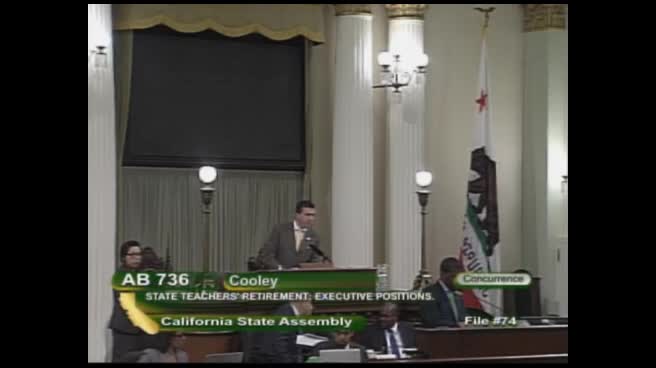

Bill Author

Bill Co-Author(s):