AB 776: Alcoholic beverage control.
- Session Year: 2015-2016
- House: Assembly
- Latest Version Date: 2015-10-06
(1)The Alcoholic Beverage Control Act regulates the application for, the issuance of, the suspension of, and the conditions imposed upon, various alcoholic beverage licenses pursuant to which the licensees may exercise specified privileges in the state.
This bill would authorize licensees to sponsor or otherwise participate in an event conducted by, and for the benefit of, a nonprofit organization subject to specified conditions, including that a nonretail or retail licensee may choose to participate in any level of sponsorship.
(2)The Alcoholic Beverage Control Act authorizes a licensed winegrower to apply to the Department of Alcoholic Beverage Control for a wine sales event permit that allows the sale of bottled wine produced by that winegrower at specified events approved by the department. The act prohibits a wine sales event permit from being used more than 2 times a month at a particular location, and requires the winegrower to pay a fee of $50 for the permit. The act provides that moneys collected as fees pursuant to the act are to be deposited in the Alcohol Beverage Control Fund. These moneys are generally allocated to the Department of Alcoholic Beverage Control upon appropriation by the Legislature.
This bill would authorize a licensed beer manufacturer to apply to the department for a brewery event permit that allows the sale of beer produced by that beer manufacturer for consumption on property contiguous and adjacent to the licensed premises of the manufacturer, as provided. The bill would authorize a fee for a brewery event permit of $110 for the 2016 calendar year, and thereafter as provided, and an event authorization fee of not more than $25 for each approved event. The bill would allow up to 4 authorized events each calendar year.
(3)Existing law, known as tied-house restrictions, generally prohibits a manufacturer, winegrower, manufacturers agent, rectifier, California winegrowers agent, distiller, bottler, importer, and wholesaler, and any officer, director, or agent of any of those persons, from having specified relationships with an on-sale alcoholic beverage licensee, with limited exceptions. Existing law specifies that the Alcoholic Beverage Control Act does not prohibit holders of retail on-sale or off-sale licenses from purchasing advertising in any publication by specified alcoholic beverage licensees.
This bill would specify that the act does not prohibit purchasing advertising in a publication published by a nonretail licensee, as defined, and would include Internet Web sites and social media feeds as types of publications for these purposes.
(4)The Alcoholic Beverage Control Act authorizes specified licensees to purchase alcoholic beverages for resale under specified circumstances. The act provides that a person convicted of a violation of its provisions is guilty of a misdemeanor unless another penalty or punishment is specifically provided.
This bill would prohibit a retail licensee from purchasing beer from any beer manufacturer for the purpose of selling or offering to sell that beer under specified circumstances, including where the beer container contains the statement or is marked Not Packaged for Resale.
By expanding the scope of a crime, this bill would impose a state-mandated local program.
The California Constitution requires the state to reimburse local agencies and school districts for certain costs mandated by the state. Statutory provisions establish procedures for making that reimbursement.
This bill would provide that no reimbursement is required by this act for a specified reason.
(5)Existing law requires the Department of Alcoholic Beverage Control, in any hearing on an accusation charging a licensee with a violation of specified provisions relating to minors, to produce the alleged minor for examination at the hearing unless he or she is unavailable as a witness because he or she is dead or unable to attend the hearing because of a then-existing physical or mental illness or infirmity, or unless the licensee has waived, in writing, the appearance of the minor. Existing law provides that when a minor is absent because of a then-existing physical or mental illness or infirmity, a reasonable continuance shall be granted to allow for the appearance of the minor if the administrative law judge finds that it is reasonably likely that the minor can be produced within a reasonable amount of time.
This bill would state that the above provisions are not intended to preclude the continuance of a hearing because of the unavailability of a minor for any other reason pursuant to a specified provision.
(1)The Alcoholic Beverage Control Act regulates the application for, the issuance of, the suspension of, and the conditions imposed upon, various alcoholic beverage licenses pursuant to which the licensees may exercise specified privileges in the state.
This bill would authorize licensees to sponsor or otherwise participate in an event conducted by, and for the benefit of, a nonprofit organization that has acquired a specified alcoholic beverages license, subject to specified conditions, including that sponsorship or participation opportunities for the event be made available to any retail or nonretail licensee. a nonretail or retail licensee may choose to participate in any level of sponsorship.
(2)The Alcoholic Beverage Control Act authorizes a licensed winegrower to apply to the Department of Alcoholic Beverage Control for a wine sales event permit that allows the sale of bottled wine produced by that winegrower at specified events approved by the department. The act prohibits a wine sales event permit from being used more than 2 times a month at a particular location, and requires the winegrower to pay a fee of $50 for the permit. The act provides that moneys collected as fees pursuant to the act are to be deposited in the Alcohol Beverage Control Fund. These moneys are generally allocated to the Department of Alcoholic Beverage Control upon appropriation by the Legislature.
This bill would authorize a licensed beer manufacturer to apply to the department for a brewery event permit that allows the sale of beer produced by that beer manufacturer for consumption on property contiguous and adjacent to the licensed premises of the manufacturer, as provided. The bill would authorize a fee for a brewery event permit of $110 for the 2016 calendar year, and thereafter as provided, and an event authorization fee of not more than $25 for each approved event. The bill would allow up to 4 authorized events each calendar year.
(3)Existing law, known as tied-house restrictions, generally prohibits a manufacturer, winegrower, manufacturers agent, rectifier, California winegrowers agent, distiller, bottler, importer, and wholesaler, and any officer, director, or agent of any of those persons, from having specified relationships with an on-sale alcoholic beverage licensee, with limited exceptions. Existing law specifies that the Alcoholic Beverage Control Act does not prohibit holders of retail on-sale or off-sale licenses from purchasing advertising in any publication by specified alcoholic beverage licensees.
This bill would specify that the act does not prohibit purchasing advertising in a publication published by a nonretail licensee, as defined, and would include Internet Web sites and social media feeds as types of publications for these purposes.
(4)The Alcoholic Beverage Control Act authorizes specified licensees to purchase alcoholic beverages for resale under specified circumstances. The act provides that a person convicted of a violation of its provisions is guilty of a misdemeanor unless another penalty or punishment is specifically provided.
This bill would prohibit a retail licensee from purchasing beer from any beer manufacturer for the purpose of selling or offering to sell that beer under specified circumstances, including where the beer container contains the statement or is marked Not Packaged for Resale.
By expanding the scope of a crime, this bill would impose a state-mandated local program.
The California Constitution requires the state to reimburse local agencies and school districts for certain costs mandated by the state. Statutory provisions establish procedures for making that reimbursement.
This bill would provide that no reimbursement is required by this act for a specified reason.
(5)Existing law requires the Department of Alcoholic Beverage Control, in any hearing on an accusation charging a licensee with a violation of specified provisions relating to minors, to produce the alleged minor for examination at the hearing unless he or she is unavailable as a witness because he or she is dead or unable to attend the hearing because of a then-existing physical or mental illness or infirmity, or unless the licensee has waived, in writing, the appearance of the minor. Existing law provides that when a minor is absent because of a then-existing physical or mental illness or infirmity, a reasonable continuance shall be granted to allow for the appearance of the minor if the administrative law judge finds that it is reasonably likely that the minor can be produced within a reasonable amount of time.
This bill would state that the above provisions are not intended to preclude the continuance of a hearing because of the unavailability of a minor for any other reason pursuant to a specified provision.
(1)The Alcoholic Beverage Control Act regulates the application for, the issuance of, the suspension of, and the conditions imposed upon, various alcoholic beverage licenses pursuant to which the licensees may exercise specified privileges in the state.
This bill would authorize licensees to sponsor or otherwise participate in an event conducted by, and for the benefit of, a nonprofit organization that has acquired a specified alcoholic beverages license, subject to specified conditions, including that sponsorship or participation opportunities for the event be made available to any retail or nonretail licensee.
The
(2)The Alcoholic Beverage Control Act authorizes a licensed winegrower to apply to the Department of Alcoholic Beverage Control for a wine sales event permit that allows the sale of bottled wine produced by that winegrower at specified events approved by the department. The act prohibits a wine sales event permit from being used more than 2 times a month at a particular location, and requires the winegrower to pay a fee of $50 for the permit. The act provides that moneys collected as fees pursuant to the act are to be deposited in the Alcohol Beverage Control Fund. These moneys are generally allocated to the Department of Alcoholic Beverage Control upon appropriation by the Legislature.
This bill would authorize a licensed beer manufacturer to apply to the department for a brewery event permit that allows the sale of beer produced by that beer manufacturer for consumption on property contiguous and adjacent to the licensed premises of the manufacturer, as provided. The bill would authorize a fee for a brewery event permit of $110 and an event authorization fee of not more than $25 for each approved event. The bill would allow up to 4 authorized events each calendar year.
(3)Existing law, known as tied-house restrictions, generally prohibits a manufacturer, winegrower, manufacturers agent, rectifier, California winegrowers agent, distiller, bottler, importer, and wholesaler, and any officer, director, or agent of any of those persons, from having specified relationships with an on-sale alcoholic beverage licensee, with limited exceptions. Existing law specifies that the Alcoholic Beverage Control Act does not prohibit holders of retail on-sale or off-sale licenses from purchasing advertising in any publication by specified alcoholic beverage licensees.
This bill would specify that the act does not prohibit purchasing advertising in a publication published by a nonretail licensee, as defined, and would include Internet Web sites and social media feeds as types of publications for these purposes.
The Alcoholic Beverage Control Act authorizes a licensed winegrower to apply to the Department of Alcoholic Beverage Control for a wine sales event permit that allows the sale of bottled wine produced by that winegrower at specified events approved by the department. The act prohibits a wine sales event permit from being used more than 2 times a month at a particular location, and requires the winegrower to pay a fee of $50 for the permit. The act provides that moneys collected as fees pursuant to the act are to be deposited in the Alcohol Beverage Control Fund. These moneys are generally allocated to the Department of Alcoholic Beverage Control upon appropriation by the Legislature.
This bill would authorize a licensed beer manufacturer to apply to the department for a brewery event permit that allows the sale of beer produced by that beer manufacturer for consumption on property contiguous and adjacent to the licensed premises of the manufacturer, as provided. The bill would authorize a fee for a brewery event permit of $110 and an event authorization fee of not more than $25 for each approved event. The bill would allow up to 4 authorized events each calendar year.
Existing law establishes the Department of Alcoholic Beverage Control within the Business, Consumer Services, and Housing Agency to administer and enforce the Alcoholic Beverage Control Act. Existing law authorizes the department to seize alcoholic beverages under specified circumstances. Existing law provides that the total retail value of alcoholic beverages subject to seizure may not exceed $100.
This bill would eliminate the provision that limits the retail value of the alcoholic beverages that are subject to seizure.
(a)A licensee may sponsor or otherwise participate in an event conducted by, and for the benefit of, a nonprofit organization in which retail and nonretail licensees are involved as sponsors or participants, subject to all of the following conditions:
(1)Except as otherwise provided in this section, any payment of money or other consideration for sponsorship or participation in the event shall be made only to the nonprofit organization conducting the event.
(2)Except as otherwise provided in this section, a nonretail licensee shall not, directly or indirectly, pay money or provide any other thing of value to a permanent retail licensee that is also a sponsor of, or participant in, the event.
(3)A nonretail licensee may donate alcoholic beverages to a nonprofit only as otherwise authorized by Section 25503.9.
(4)Except as otherwise provided by this division, a retail licensee shall not give, sell, or furnish any alcoholic beverages to the temporary licensee.
(5)A nonretail or retail licensee may choose to participate in any level of sponsorship, including at the name or principal sponsor level. A nonprofit organization may choose to have one, or multiple, name or principal sponsors.
(6)(A)A nonretail licensee may advertise or communicate sponsorship or participation in the event. This advertising or communication may include, but is not limited to, initiating, sharing, reposting, or otherwise forwarding a social media post by a permanent retail licensee or a nonretail licensee if the advertisement or communication does not contain the retail price of any alcoholic beverage or otherwise promotes a retail licensee beyond its sponsorship or participation in the event.
(B)A nonretail licensee shall not pay or reimburse a permanent licensee, directly or indirectly, for any advertising services, including by way of social media. Except as otherwise permitted by this section, a permanent retail licensee shall not accept any payment or reimbursement, directly or indirectly, for any advertising services offered by a nonretail licensee.
(C)For the purposes of this subdivision, social media means a service, platform, application, or site where users communicate and share media, such as pictures, videos, music, and blogs, with other users.
(7)A nonretail licensee shall not require, directly or indirectly, as a condition of sponsorship or participation in any event under this section, that its products be sold or served exclusively at the event. A retail licensee shall not receive, directly or indirectly, any advertising, sale, or promotional benefit from any permanent retail licensee in connection with the sponsorship or participation. A permanent retail licensee shall not offer or provide a nonretail licensee any advertising, sale, or promotional benefit in connection with the sponsorship or participation.
(b)This section does not authorize a nonretail licensee to pay, in whole or in part, any costs, including the cost of sponsorship, of any retail licensee that is sponsoring or participating in a nonprofit event.
(c)A licensee that sponsors or participates in a nonprofit event under this section shall keep detailed records of its sponsorship or participation and shall maintain those records for a period of at least three years. These records shall be provided to the department upon request.
(d)Nothing in this section shall be deemed to exempt the nonprofit organization from obtaining any licenses or permits as may be required to conduct the event.
SEC. 2.Section 23399.65 is added to the Business and Professions Code, to read:23399.65.(a)A licensed beer manufacturer may apply to the department for a brewery event permit. A brewery event permit shall authorize the sale of beer produced by the licensee pursuant to Section 23357 for consumption on property contiguous and adjacent to the licensed premises owned or under the control of the licensee. The property shall be secured and controlled by the licensee.
(b)(1)The fee for a brewery event permit for a licensed beer manufacturer shall be one hundred ten dollars ($110) for a permit issued during the 2016 calendar year, and for a permit issued during the years thereafter, the annual fee shall be calculated pursuant to subdivisions (b) and (c) of Section 23320. The permit may be renewed annually at the same time as the licensees license. A brewery event permit shall be transferable as a part of the license.
(2)For each brewery event, consent for the sale of beer pursuant to subdivision (a) at the brewery event shall be first obtained by the licensee from the department in the form of an event authorization issued by the department. An event authorization shall be subject to approval by the appropriate local law enforcement agency. The fee for each event authorization shall not exceed twenty-five dollars ($25). The number of events authorized by a brewery event permit shall not exceed four in any calendar year.
(3)All moneys collected as fees pursuant to this subdivision shall be deposited in the Alcohol Beverage Control Fund, as described in Section 25761, for allocation, upon appropriation by the Legislature, as provided in subdivision (d) of that section.
(c)At all approved events, the licensee may exercise only those privileges authorized by the licensees license and shall comply with all provisions of the act pertaining to the conduct of on-sale premises, and violation of those provisions may be grounds for suspension or revocation of the licensees license or permit, or both, as though the violation occurred on the licensed premises.
(d)The department may adopt any regulations it determines to be necessary for the administration of this section.
SEC. 3.Section 23402.5 is added to the Business and Professions Code, to read:23402.5.(a)A retail licensee shall not sell or offer for sale any beer that is purchased from a beer manufacturer at the beer manufacturers licensed premises under any of the following circumstances:
(1)The beer manufacturer from which the beer is purchased has not filed a price schedule pursuant to Chapter 12 (commencing with Section 25000) for the sale of that beer in the county in which the retail licensees premises at which the beer is being sold or offered for sale is located.
(2)The price at which the retailer purchases the beer is different from the price in the price schedule filed by the beer manufacturer pursuant to Chapter 12 (commencing with Section 25000) from which the beer is purchased.
(3)The beer container contains the statement or is marked Not Packaged for Resale.
(b)Nothing in this section creates any exception to the requirements of Chapter 12 (commencing with Section 25000).
SEC. 4.Section 25500 of the Business and Professions Code is amended to read:25500.(a)No manufacturer, winegrower, manufacturers agent, rectifier, California winegrowers agent, distiller, bottler, importer, or wholesaler, or any officer, director, or agent of any such person shall:
(1)Hold the ownership, directly or indirectly, of any interest in any on-sale license.
(2)Furnish, give, or lend any money or other thing of value, directly or indirectly, to, or guarantee the repayment of any loan or the fulfillment of any financial obligation of, any person engaged in operating, owning, or maintaining any on-sale premises where alcoholic beverages are sold for consumption on the premises.
(3)Own any interest, directly or indirectly, in the business, furniture, fixtures, refrigeration equipment, signs, except signs for interior use mentioned in subdivision (g) of Section 25503, or lease in or of any premises operated or maintained under any on-sale license for the sale of alcoholic beverages for consumption on the premises where sold; or own any interest, directly or indirectly, in realty acquired after June 13, 1935, upon which on-sale premises are maintained unless the holding of the interest is permitted in accordance with rules of the department.
(b)This section does not apply to the holding by one person of a wholesalers license and an on-sale license in counties not to exceed 15,000 population.
(c)This section does not apply to the financial or representative relationship between a manufacturer, winegrower, manufacturers agent, rectifier, California winegrowers agent, distiller, bottler, importer, or wholesaler, or any officer, director, or agent of such person, and a person holding only one of the following types of licenses:
(1)On-sale general license for a bona fide club.
(2)Club license issued under Article 4 (commencing with Section 23425) of Chapter 3.
(3)Veterans club license issued under Article 5 (commencing with Section 23450) of Chapter 3.
(4)On-sale license for boats, trains, sleeping cars, or airplanes where the alcoholic beverages produced or sold by the manufacturer, winegrower, manufacturers agent, rectifier, California winegrowers agent, bottler, importer, or wholesaler or any officer, director, or agent of the person are not sold, furnished, or given, directly or indirectly to the on-sale licensee.
(d)This section does not apply to an employee of a licensee referred to in subdivision (a) who is a nonadministrative and nonsupervisorial employee.
(e)Notwithstanding any other provision of this division or regulation of the department, this section does not apply to an employee of a licensee referred to in subdivision (a) who is the spouse of an on-sale licensee, so long as the on-sale licensee does not purchase, offer for sale, or promote, regardless of source, any of the brands of alcoholic beverages that are produced, bottled, processed, imported, rectified, distributed, represented, or sold by any licensee referred to in subdivision (a) that employs the spouse of the on-sale licensee.
(f)(1)Nothing in this division prohibits the holder of any retail on-sale or off-sale license from purchasing advertising in any publication published by a nonretail licensee.
(2)For purposes of this subdivision:
(A)Nonretail licensee means any manufacturer, winegrower, manufacturers agent, rectifier, California winegrowers agent, distiller, bottler, importer, or wholesaler, or any person who does not directly or indirectly hold the ownership of any interest in a retail license.
(B)Publication published by a nonretail licensee includes Internet Web sites and social media feeds operated and maintained by or for a nonretail licensee under an account or Internet Web site address owned by the nonretail licensee.
SEC. 5.Section 25666 of the Business and Professions Code is amended to read:25666.(a)In any hearing on an accusation charging a licensee with a violation of Sections 25658, 25663, and 25665, the department shall produce the alleged minor for examination at the hearing unless he or she is unavailable as a witness because he or she is dead or unable to attend the hearing because of a then-existing physical or mental illness or infirmity, or unless the licensee has waived, in writing, the appearance of the minor. When a minor is absent because of a then-existing physical or mental illness or infirmity, a reasonable continuance shall be granted to allow for the appearance of the minor if the administrative law judge finds that it is reasonably likely that the minor can be produced within a reasonable amount of time.
(b)(1)Nothing in this section shall prevent the department from taking testimony of the minor as provided in Section 11511 of the Government Code.
(2)This section is not intended to preclude the continuance of a hearing because of the unavailability of a minor for any other reason pursuant to Section 11524 of the Government Code.
SEC. 6.No reimbursement is required by this act pursuant to Section 6 of Article XIIIB of the California Constitution because the only costs that may be incurred by a local agency or school district will be incurred because this act creates a new crime or infraction, eliminates a crime or infraction, or changes the penalty for a crime or infraction, within the meaning of Section 17556 of the Government Code, or changes the definition of a crime within the meaning of Section 6 of Article XIIIB of the California Constitution.
(a)A licensee may sponsor or otherwise participate in an event conducted by, and for the benefit of, a nonprofit organization that has obtained a temporary daily on-sale license or a temporary daily off-sale license under this division, in which retail or and nonretail licensees are involved as sponsors or participants, subject to all of the following conditions:
(1)Sponsorship or participation shall be pursuant to a written agreement.
(2)
(1)Except as otherwise provided, provided in this section, any payment of money or other consideration for sponsorship or participation in the event shall be as moneys paid made only to the nonprofit organization holding the temporary license. conducting the event.
(2)Except as otherwise provided in this section, a nonretail licensee shall not, directly or indirectly, pay money or provide any other thing of value to a permanent retail licensee that is also a sponsor of, or participant in, the event.
(3)A nonretail licensee may donate alcoholic beverages to a nonprofit only as otherwise authorized by Section 25503.9.
(4)Except as otherwise provided by this division, a retail licensee shall not give, sell, or furnish any alcoholic beverages to the temporary licensee.
(5)This subdivision shall not prohibit the establishment by the temporary daily licensee of different levels of sponsorship, where each sponsorship level provides different promotional benefits to a sponsor. All sponsorship agreements for the event shall be on identical terms. A nonretail or retail licensee may choose to participate in any level of sponsorship, including at the name or principal sponsor level. A nonprofit organization may choose to have one, or multiple, name or principal sponsors. Sponsorship or participation opportunities shall be made available to any retail and nonretail licensee wishing to sponsor or participate.
(6)(A)Except as otherwise specified in this subdivision, any advertising or promotion of the event by the temporary daily licensee shall identify all sponsors. Sponsorship levels may specify how prominent the identification of each sponsor shall be, provided that all sponsors within each level are treated equally in the advertising or promotion.
(B)
(6)(A)A nonretail licensee may communicate sponsorship, or participation, and share, repost, or otherwise forward a social media post by a retail licensee or nonretail licensee if the communication, sharing, reposting, or forwarding of the social media post advertise or communicate sponsorship or participation in the event. This advertising or communication may include, but is not limited to, initiating, sharing, reposting, or otherwise forwarding a social media post by a permanent retail licensee or a nonretail licensee if the advertisement or communication does not contain the retail price of any alcoholic beverage. A nonretail licensee shall not pay or reimburse a retail licensee, directly or indirectly, for any social media advertising services. A retail licensee shall not accept any payment or reimbursement, directly or indirectly, for any social media advertising services offered by a nonretail licensee. For the purposes of this paragraph, social media means a service, platform, or site where users communicate with one another and share media, such as pictures, videos, music, and blogs, with other users free of charge. beverage or otherwise promotes a retail licensee beyond its sponsorship or participation in the event.
(7)A retail licensee shall conspicuously offer for sale alcoholic beverages other than the products produced, distributed, bottled, or otherwise offered for sale by any of the sponsors of the event. The retail licensee shall serve other brands of alcoholic beverages distributed by a competing wholesaler in addition to the brands manufactured or marketed by the nonretail licensee sponsoring or participating in the event.
(B)A nonretail licensee shall not pay or reimburse a permanent licensee, directly or indirectly, for any advertising services, including by way of social media. Except as otherwise permitted by this section, a permanent retail licensee shall not accept any payment or reimbursement, directly or indirectly, for any advertising services offered by a nonretail licensee.
(C)For the purposes of this subdivision, social media means a service, platform, application, or site where users communicate and share media, such as pictures, videos, music, and blogs, with other users.
(7)A nonretail licensee shall not require, directly or indirectly, as a condition of sponsorship or participation in any event under this section, that its products be sold or served exclusively at the event. A retail licensee shall not receive, directly or indirectly, any advertising, sale, or promotional benefit from any permanent retail licensee in connection with the sponsorship or participation. A permanent retail licensee shall not offer or provide a nonretail licensee any advertising, sale, or promotional benefit in connection with the sponsorship or participation.
(b)The This section does not authorize a nonretail licensee to pay, in whole or in part, any costs, including the cost of sponsorship, of any retail licensee that is sponsoring or participating in a nonprofit event.
(c)A licensee that sponsors or participates in a nonprofit event under this section shall keep detailed records of its sponsorship or participation and shall maintain those records for a period of at least three years. These records shall be provided to the department upon request.
(d)Nothing in this section shall be deemed to exempt the nonprofit organization from obtaining any licenses or permits as may be required to conduct the event.
SEC. 2.Section 23399.65 is added to the Business and Professions Code, to read:23399.65.(a)A licensed beer manufacturer may apply to the department for a brewery event permit. A brewery event permit shall authorize the sale of beer produced by the licensee pursuant to Section 23357 for consumption on property contiguous and adjacent to the licensed premises owned or under the control of the licensee. The property shall be secured and controlled by the licensee.
(b)(1)The fee for a brewery event permit for a licensed beer manufacturer shall be one hundred ten dollars ($110) for a permit issued during the 2016 calendar year, and for a permit issued during the years thereafter, the annual fee shall be calculated pursuant to subdivisions (b) and (c) of Section 23320. The permit may be renewed annually at the same time as the licensees license. A brewery event permit shall be transferable as a part of the license.
(2)For each brewery event, consent for the sale of beer pursuant to subdivision (a) at the brewery event shall be first obtained by the licensee from the department in the form of an event authorization issued by the department. An event authorization shall be subject to approval by the appropriate local law enforcement agency. The fee for each event authorization shall not exceed twenty-five dollars ($25). The number of events authorized by a brewery event permit shall not exceed four in any calendar year.
(3)All moneys collected as fees pursuant to this subdivision shall be deposited in the Alcohol Beverage Control Fund, as described in Section 25761, for allocation, upon appropriation by the Legislature, as provided in subdivision (d) of that section.
(c)At all approved events, the licensee may exercise only those privileges authorized by the licensees license and shall comply with all provisions of the act pertaining to the conduct of on-sale premises premises, and violation of those provisions may be grounds for suspension or revocation of the licensees license or permit, or both, as though the violation occurred on the licensed premises.
(d)The department may adopt any regulations it determines to be necessary for the administration of this section.
SEC. 3.Section 23402.5 is added to the Business and Professions Code, to read:23402.5.(a)A retail licensee shall not sell or offer for sale any beer that is purchased from a beer manufacturer at the beer manufacturers licensed premises under any of the following circumstances:
(1)The beer manufacturer from which the beer is purchased has not filed a price schedule pursuant to Chapter 12 (commencing with Section 25000) for the sale of that beer in the county in which the retail licensees premises at which the beer is being sold or offered for sale is located.
(2)The price at which the retailer purchases the beer is different from the price in the price schedule filed by the beer manufacturer pursuant to Chapter 12 (commencing with Section 25000) from which the beer is purchased.
(3)The beer container contains the statement or is marked Not Packaged for Resale.
(b)Nothing in this section creates any exception to the requirements of Chapter 12 (commencing with Section 25000).
SEC. 3.SEC. 4.Section 25500 of the Business and Professions Code is amended to read:25500.(a)No manufacturer, winegrower, manufacturers agent, rectifier, California winegrowers agent, distiller, bottler, importer, or wholesaler, or any officer, director, or agent of any such person shall:
(1)Hold the ownership, directly or indirectly, of any interest in any on-sale license.
(2)Furnish, give, or lend any money or other thing of value, directly or indirectly, to, or guarantee the repayment of any loan or the fulfillment of any financial obligation of, any person engaged in operating, owning, or maintaining any on-sale premises where alcoholic beverages are sold for consumption on the premises.
(3)Own any interest, directly or indirectly, in the business, furniture, fixtures, refrigeration equipment, signs, except signs for interior use mentioned in subdivision (g) of Section 25503, or lease in or of any premises operated or maintained under any on-sale license for the sale of alcoholic beverages for consumption on the premises where sold; or own any interest, directly or indirectly, in realty acquired after June 13, 1935, upon which on-sale premises are maintained unless the holding of the interest is permitted in accordance with rules of the department.
(b)This section does not apply to the holding by one person of a wholesalers license and an on-sale license in counties not to exceed 15,000 population.
(c)This section does not apply to the financial or representative relationship between a manufacturer, winegrower, manufacturers agent, rectifier, California winegrowers agent, distiller, bottler, importer, or wholesaler, or any officer, director, or agent of such person, and a person holding only one of the following types of licenses:
(1)On-sale general license for a bona fide club.
(2)Club license issued under Article 4 (commencing with Section 23425) of Chapter 3.
(3)Veterans club license issued under Article 5 (commencing with Section 23450) of Chapter 3.
(4)On-sale license for boats, trains, sleeping cars, or airplanes where the alcoholic beverages produced or sold by the manufacturer, winegrower, manufacturers agent, rectifier, California winegrowers agent, bottler, importer, or wholesaler or any officer, director, or agent of the person are not sold, furnished, or given, directly or indirectly to the on-sale licensee.
(d)This section does not apply to an employee of a licensee referred to in subdivision (a) who is a nonadministrative and nonsupervisorial employee.
(e)Notwithstanding any other provision of this division or regulation of the department, this section does not apply to an employee of a licensee referred to in subdivision (a) who is the spouse of an on-sale licensee, so long as the on-sale licensee does not purchase, offer for sale, or promote, regardless of source, any of the brands of alcoholic beverages that are produced, bottled, processed, imported, rectified, distributed, represented, or sold by any licensee referred to in subdivision (a) that employs the spouse of the on-sale licensee.
(f)(1)Nothing in this division prohibits the holder of any retail on-sale or off-sale license from purchasing advertising in any publication published by a nonretail licensee.
(2)For purposes of this subdivision:
(A)Nonretail licensee means any manufacturer, winegrower, manufacturers agent, rectifier, California winegrowers agent, distiller, bottler, importer, or wholesaler, or any person who does not directly or indirectly hold the ownership of any interest in a retail license.
(B)Publication published by a nonretail licensee includes Internet Web sites and social media feeds operated and maintained by or for a nonretail licensee under an account or Internet Web site address owned by the nonretail licensee.
SEC. 5.Section 25666 of the Business and Professions Code is amended to read:25666.(a)In any hearing on an accusation charging a licensee with a violation of Sections 25658, 25663, and 25665, the department shall produce the alleged minor for examination at the hearing unless he or she is unavailable as a witness because he or she is dead or unable to attend the hearing because of a then-existing physical or mental illness or infirmity, or unless the licensee has waived, in writing, the appearance of the minor. When a minor is absent because of a then-existing physical or mental illness or infirmity, a reasonable continuance shall be granted to allow for the appearance of the minor if the administrative law judge finds that it is reasonably likely that the minor can be produced within a reasonable amount of time. Nothing in this section shall prevent the department from taking testimony of the minor as provided in Section 11511 of the Government Code.
(b)(1)Nothing in this section shall prevent the department from taking testimony of the minor as provided in Section 11511 of the Government Code.
(2)This section is not intended to preclude the continuance of a hearing because of the unavailability of a minor for any other reason pursuant to Section 11524 of the Government Code.
SEC. 6.No reimbursement is required by this act pursuant to Section 6 of Article XIIIB of the California Constitution because the only costs that may be incurred by a local agency or school district will be incurred because this act creates a new crime or infraction, eliminates a crime or infraction, or changes the penalty for a crime or infraction, within the meaning of Section 17556 of the Government Code, or changes the definition of a crime within the meaning of Section 6 of Article XIIIB of the California Constitution.
(a)A licensee may sponsor or otherwise participate in an event conducted by, and for the benefit of, a nonprofit organization that has obtained a temporary daily on-sale license or a temporary daily off-sale license under this division, in which retail or nonretail licensees are involved as sponsors or participants, subject to all of the following conditions:
(1)Sponsorship or participation shall be pursuant to a written agreement.
(2)Except as otherwise provided, any payment for sponsorship or participation shall be as moneys paid only to the nonprofit organization holding the temporary license.
(3)A nonretail licensee may donate alcoholic beverages to a nonprofit only as otherwise authorized by Section 25503.9.
(4)Except as otherwise provided by this division, a retail licensee shall not give, sell, or furnish any alcoholic beverages to the temporary licensee.
(5)This subdivision shall not prohibit the establishment by the temporary daily licensee of different levels of sponsorship, where each sponsorship level provides different promotional benefits to a sponsor. All sponsorship agreements for the event shall be on identical terms. A nonretail or retail licensee may choose to participate in any level of sponsorship, including at the name or principal sponsor level. A nonprofit organization may choose to have one, or multiple, name or principal sponsors. Sponsorship or participation opportunities shall be made available to any retail and nonretail licensee wishing to sponsor or participate.
(6)(A)Except as otherwise specified in this subdivision, any advertising or promotion of the event by the temporary daily licensee shall identify all sponsors. Sponsorship levels may specify how prominent the identification of each sponsor shall be, provided that all sponsors within each level are treated equally in the advertising or promotion.
(B)A nonretail licensee may communicate sponsorship, or participation, and share, repost, or otherwise forward a social media post by a retail licensee or nonretail licensee if the communication, sharing, reposting, or forwarding of the social media post does not contain the retail price of any alcoholic beverage. A nonretail licensee shall not pay or reimburse a retail licensee, directly or indirectly, for any social media advertising services. A retail licensee shall not accept any payment or reimbursement, directly or indirectly, for any social media advertising services offered by a nonretail licensee. For the purposes of this paragraph, social media means a service, platform, or site where users communicate with one another and share media, such as pictures, videos, music, and blogs, with other users free of charge.
(7)A retail licensee shall conspicuously offer for sale alcoholic beverages other than the products produced, distributed, bottled, or otherwise offered for sale by any of the sponsors of the event. The retail licensee shall serve other brands of alcoholic beverages distributed by a competing wholesaler in addition to the brands manufactured or marketed by the nonretail licensee sponsoring or participating in the event.
(b)The section does not authorize a nonretail licensee to pay, in whole or in part, any costs, including the cost of sponsorship, of any retail licensee that is sponsoring or participating in a nonprofit event.
(c)A licensee that sponsors or participates in a nonprofit event under this section shall keep detailed records of its sponsorship or participation and shall maintain those records for a period of at least three years. These records shall be provided to the department upon request.
SECTION 1.SEC. 2.Section 23399.65 is added to the Business and Professions Code, to read:23399.65.(a)A licensed beer manufacturer may apply to the department for a brewery event permit. A brewery event permit shall authorize the sale of beer produced by the licensee pursuant to Section 23357 for consumption on property contiguous and adjacent to the licensed premises owned or under the control of the licensee. The property shall be secured and controlled by the licensee.
(b)(1)The fee for a brewery event permit for a licensed beer manufacturer shall be one hundred ten dollars ($110) for a permit issued during the 2016 calendar year, and for a permit issued during the years thereafter, the annual fee shall be calculated pursuant to subdivisions (b) and (c) of Section 23320. The permit may be renewed annually at the same time as the licensees license. A brewery event permit shall be transferable as a part of the license.
(2)For each brewery event, consent for the sale of beer pursuant to subdivision (a) at the brewery event shall be first obtained by the licensee from the department in the form of an event authorization issued by the department. An event authorization shall be subject to approval by the appropriate local law enforcement agency. The fee for each event authorization shall not to exceed twenty-five dollars ($25). The number of events authorized by a brewery event permit shall not exceed four in any calendar year.
(3)All money moneys collected as fees pursuant to this subdivision shall be deposited in the Alcohol Beverage Control Fund, as described in Section 25761, for allocation, upon appropriation by the Legislature, as provided in subdivision (d) of that section.
(c)At all approved events, the licensee may exercise only those privileges authorized by the licensees license and shall comply with all provisions of the act pertaining to the conduct of on-sale premises and violation of those provisions may be grounds for suspension or revocation of the licensees license or permit, or both, as though the violation occurred on the licensed premises.
(d)The department may adopt any regulations it determines to be necessary for the administration of this section.
SEC. 3.Section 25500 of the Business and Professions Code is amended to read:25500.(a)No manufacturer, winegrower, manufacturers agent, rectifier, California winegrowers agent, distiller, bottler, importer, or wholesaler, or any officer, director, or agent of any such person shall:
(1)Hold the ownership, directly or indirectly, of any interest in any on-sale license.
(2)Furnish, give, or lend any money or other thing of value, directly or indirectly, to, or guarantee the repayment of any loan or the fulfillment of any financial obligation of, any person engaged in operating, owning, or maintaining any on-sale premises where alcoholic beverages are sold for consumption on the premises.
(3)Own any interest, directly or indirectly, in the business, furniture, fixtures, refrigeration equipment, signs, except signs for interior use mentioned in subdivision (g) of Section 25503, or lease in or of any premises operated or maintained under any on-sale license for the sale of alcoholic beverages for consumption on the premises where sold; or own any interest, directly or indirectly, in realty acquired after June 13, 1935, upon which on-sale premises are maintained unless the holding of the interest is permitted in accordance with rules of the department.
(b)This section does not apply to the holding by one person of a wholesalers license and an on-sale license in counties not to exceed 15,000 population.
(c)This section does not apply to the financial or representative relationship between a manufacturer, winegrower, manufacturers agent, rectifier, California winegrowers agent, distiller, bottler, importer, or wholesaler, or any officer, director, or agent of such person, and a person holding only one of the following types of licenses:
(1)On-sale general license for a bona fide club.
(2)Club license issued under Article 4 (commencing with Section 23425) of Chapter 3.
(3)Veterans club license issued under Article 5 (commencing with Section 23450) of Chapter 3.
(4)On-sale license for boats, trains, sleeping cars, or airplanes where the alcoholic beverages produced or sold by the manufacturer, winegrower, manufacturers agent, rectifier, California winegrowers agent, bottler, importer, or wholesaler or any officer, director, or agent of the person are not sold, furnished, or given, directly or indirectly to the on-sale licensee.
(d)This section does not apply to an employee of a licensee referred to in subdivision (a) who is a nonadministrative and nonsupervisorial employee.
(e)Notwithstanding any other provision of this division or regulation of the department, this section does not apply to an employee of a licensee referred to in subdivision (a) who is the spouse of an on-sale licensee, so long as the on-sale licensee does not purchase, offer for sale, or promote, regardless of source, any of the brands of alcoholic beverages that are produced, bottled, processed, imported, rectified, distributed, represented, or sold by any licensee referred to in subdivision (a) that employs the spouse of the on-sale licensee.
(f)(1)Nothing in this division prohibits the holder of any retail on-sale or off-sale license from purchasing, for fair consideration, purchasing advertising in any publication published by any manufacturer, winegrower, manufacturers agent, rectifier, California winegrowers agent, distiller, bottler, importer, or wholesaler, or any person who directly or indirectly holds the ownership of any interest in the premises of the retail licensee. a nonretail licensee.
(2)For purposes of this subdivision:
(A)Nonretail licensee means any manufacturer, winegrower, manufacturers agent, rectifier, California winegrowers agent, distiller, bottler, importer, or wholesaler, or any person who does not directly or indirectly hold the ownership of any interest in a retail license.
(B)Publication published by a nonretail licensee includes Internet Web sites and social media feeds operated and maintained by or for a nonretail licensee under an account or Internet Web site address owned by the nonretail licensee.
(a)A licensed beer manufacturer may apply to the department for a brewery event permit. A brewery event permit shall authorize the sale of beer produced by the licensee pursuant to Section 23357 for consumption on property contiguous and adjacent to the licensed premises owned or under the control of the licensee. The property shall be secured and controlled by the licensee.
(b)(1)The fee for a brewery event permit for a licensed beer manufacturer shall be one hundred ten dollars ($110) for a permit issued during the 2016 calendar year, and for a permit issued during the years thereafter, the annual fee shall be calculated pursuant to subdivisions (b) and (c) of Section 23320. The permit may be renewed annually at the same time as the licensees license. A brewery event permit shall be transferable as a part of the license.
(2)For each brewery event, consent for the sale of beer pursuant to subdivision (a) at the brewery event shall be first obtained by the licensee from the department in the form of an event authorization issued by the department. An event authorization shall be subject to approval by the appropriate local law enforcement agency. The fee for each event authorization shall not to exceed twenty-five dollars ($25). The number of events authorized by a brewery event permit shall not exceed 4 in any calendar year.
(3)All money collected as fees pursuant to this subdivision shall be deposited in the Alcohol Beverage Control Fund, as described in Section 25761, for allocation, upon appropriation by the Legislature, as provided in subdivision (d) of that section.
(c)At all approved events, the licensee may exercise only those privileges authorized by the licensees license and shall comply with all provisions of the act pertaining to the conduct of on-sale premises and violation of those provisions may be grounds for suspension or revocation of the licensees license or permit, or both, as though the violation occurred on the licensed premises.
(d)The department may adopt any regulations it determines to be necessary for the administration of this section.
SECTION 1.Section 25350 of the Business and Professions Code is amended to read:25350.The department may seize the following alcoholic beverages:
(a)Alcoholic beverages manufactured or produced in this state by any person other than licensed manufacturer or wine grower, regardless of where found.
(b)Beer and wine upon the sale of which the excise tax imposed by Part 14 (commencing with Section 32001) of Division 2 of the Revenue and Taxation Code has not been paid, regardless of where found.
(c)Distilled spirits except (1)distilled spirits located upon premises for which licenses authorizing the sale of the distilled spirits have been issued; (2)distilled spirits consigned to and in the course of transportation to a licensee holding licenses authorizing the sale of the distilled spirits or for delivery without this state; (3)distilled spirits upon the sale of which the excise tax imposed by Part 14 (commencing with Section 32001) of Division 2 of the Revenue and Taxation Code has been paid; (4)alcohol or distilled spirits in the possession of a person who has lawfully purchased it for use in the trades, professions, or industries and not for beverage use.
(d)Any alcoholic beverage possessed, kept, stored, or owned with the intent to sell it without a license in violation of this division.
(e)Notwithstanding any other provision of this section, a seizure of any alcoholic beverage acquired, exchanged, purchased, sold, delivered, or possessed in violation of Sections 23104.2, 23104.3, 23394, 23402, or Chapter 12 (commencing with Section 25000) shall be limited to the actual package or case of alcoholic beverage acquired, exchanged, purchased, sold, delivered, or possessed in violation of the foregoing provisions.
The department may seize the following alcoholic beverages:
(a)Alcoholic beverages manufactured or produced in this State state by any person other than licensed manufacturer or wine grower, regardless of where found.
(b)Beer and wine upon the sale of which the excise tax imposed by Part 14 (commencing with Section 32001) of Division 2 of the Revenue and Taxation Code has not been paid, regardless of where found.
(c)Distilled spirits except (1)distilled spirits located upon premises for which licenses authorizing the sale of the distilled spirits have been issued; (2)distilled spirits consigned to and in the course of transportation to a licensee holding licenses authorizing the sale of the distilled spirits or for delivery without this State; state; (3)distilled spirits upon the sale of which the excise tax imposed by Part 14 (commencing with Section 32001) of Division 2 of the Revenue and Taxation Code has been paid; (4)alcohol or distilled spirits in the possession of a person who has lawfully purchased it for use in the trades, professions, or industries and not for beverage use.
(d)Any alcoholic beverage possessed, kept, stored, or owned with the intent to sell it without a license in violation of this division.
(e)Notwithstanding any other provision of this section, a seizure of any alcoholic beverage acquired, exchanged, purchased, sold, delivered, or possessed in violation of Sections 23104.2, 23104.3, 23394, 23402, or 24879, or Chapter 10 (commencing with Section 24749), 11 (commencing with Section 24850), or Chapter 12 (commencing with Section 25000) of this division, except that seizures under this subdivision shall be limited to the actual package or case of alcoholic beverage acquired, exchanged, purchased, sold, delivered, or possessed in violation of the foregoing provisions. Any seizure under this subdivision shall not exceed one hundred dollars ($100) of alcoholic beverages atretail price.
|
Date
|
Status
|
|---|---|
| Sep 11, 2015 | Joint Rule 62(a), file notice suspended. (Page 3133.) |
| Sep 8, 2015 | Read second time. Ordered to third reading. |
| Sep 10, 2015 | In Assembly. Concurrence in Senate amendments pending. |
| Sep 10, 2015 | Read third time. Passed. Ordered to the Assembly. |
| Sep 10, 2015 | Read third time. Passed. Ordered to the Assembly. (Ayes 39. Noes 1. Page 2712.). |
| Sep 11, 2015 | Assembly Rule 63 suspended. |
| Sep 11, 2015 | Assembly Rule 63 suspended. (Page 3156.) |
| Sep 11, 2015 | From committee: That the Senate amendments be concurred in. (Ayes 19. Noes 0.) (September 11). |
| Sep 11, 2015 | Joint Rule 62(a), file notice suspended. |
| Sep 4, 2015 | Read third time and amended. Ordered to second reading. |
| Sep 11, 2015 | Re-referred to Com. on G.O. pursuant to Assembly Rule 77.2. |
| Sep 11, 2015 | Senate amendments concurred in. To Engrossing and Enrolling. |
| Sep 11, 2015 | Senate amendments concurred in. To Engrossing and Enrolling. (Ayes 76. Noes 0. Page 3164.). |
| Sep 11, 2015 | Senate amendments concurred in. To Engrossing and Enrolling. (Ayes 76. Noes 0.). |
| Sep 23, 2015 | Enrolled and presented to the Governor at 4 p.m. |
| Oct 6, 2015 | Approved by the Governor. |
| Oct 6, 2015 | Chaptered by Secretary of State - Chapter 519, Statutes of 2015. |
| May 26, 2015 | In Senate. Read first time. To Com. on RLS. for assignment. |
| Feb 26, 2015 | From printer. May be heard in committee March 28. |
| Mar 12, 2015 | Referred to Com. on G.O. |
| Apr 8, 2015 | In committee: Hearing postponed by committee. |
| Apr 15, 2015 | From committee chair, with author's amendments: Amend, and re-refer to Com. on G.O. Read second time and amended. |
| Apr 16, 2015 | Re-referred to Com. on G.O. |
| Apr 28, 2015 | From committee: Do pass and re-refer to Com. on APPR. (Ayes 20. Noes 0.) (April 27). Re-referred to Com. on APPR. |
| May 20, 2015 | From committee: Do pass. To Consent Calendar. (Ayes 15. Noes 0.) (May 20). |
| May 21, 2015 | Read second time. Ordered to Consent Calendar. |
| Feb 25, 2015 | Read first time. To print. |
| May 26, 2015 | Read third time. Passed. Ordered to the Senate. |
| May 26, 2015 | Read third time. Passed. Ordered to the Senate. (Ayes 76. Noes 0. Page 1594.) |
| Jun 4, 2015 | Referred to Com. on G.O. |
| Jul 14, 2015 | From committee: Do pass and re-refer to Com. on APPR. (Ayes 13. Noes 0.) (July 14). Re-referred to Com. on APPR. |
| Aug 17, 2015 | From committee chair, with author's amendments: Amend, and re-refer to committee. Read second time, amended, and re-referred to Com. on APPR. |
| Aug 17, 2015 | From committee: Be placed on second reading file pursuant to Senate Rule 28.8. |
| Aug 18, 2015 | Read second time. Ordered to third reading. |
|
Date
|
Description
|
Location
|
Votes
|
|
|---|---|---|---|---|
| Sep 11, 2015 | AB 776 COOPER Concurrence in Senate Amendments | Assembly Floor |
Passed |
|
| Sep 11, 2015 | With recommendation: That Senate amendments be concurred in. | Assembly Standing Committee on Governmental Organization |
Passed |
|
| Sep 10, 2015 | Assembly 3rd Reading AB776 Cooper By Hall | Senate Floor |
Passed |
|
| Jul 14, 2015 | Do pass, but first be re-referred to the Committee on [Appropriations] | Senate Standing Committee on Governmental Organization |
Passed |
|
| May 26, 2015 | AB 776 COOPER Consent Calendar Second Day Regular Session | Assembly Floor |
Passed |
|
| May 20, 2015 | Do pass. To Consent Calendar. | Assembly Standing Committee on Appropriations |
Passed |
|
| Apr 27, 2015 | Do pass and be re-referred to the Committee on [Appropriations] | Assembly Standing Committee on Governmental Organization |
Passed |
This list shows positions taken on this bill by organizations on the date displayed, which is linked to the original source.
Positions by individuals are not included.
|
Organization
|
Position
|
Date
|
|---|---|---|
| Anheuser-Busch | ** Support | Sep 10, 2015 |
| California Craft Brewers Association | ** Support | Sep 10, 2015 |
| Family Winemakers Of California | ** Support | Sep 10, 2015 |
AB 776
Page 5
(Without Reference to File)
CONCURRENCE IN SENATE AMENDMENTS
AB 776
(Cooper)
As Amended September 4, 2015
Majority vote
ASSEMBLY: |
76-0 |
(May 26, 2015) |
SENATE: |
39-1 |
(September 10, 2015) |
COMMITTEE VOTE: |
19-0 |
(September 11, 2015) |
RECOMMENDATION: |
concur |
(G.O.)
Original Committee Reference: G.O.
SUMMARY: Allows a licensed beer manufacturer to apply to the Department of Alcoholic Beverage Control (ABC) for a brewery event permit that grants the licensee the privilege of selling beer it produces for consumption on property contiguous and adjacent to its licensed premises for special events (up to four such events in a calendar year). This bill also authorizes licensed alcoholic beverage manufacturers and retailers to participate together in sponsoring and promoting events conducted by, and for the benefit of, nonprofit organizations, subject to certain conditions. Additionally, this bill adds a new provision to the ABC Act (Act) that prohibits a retail licensee from purchasing beer at the beer manufacturer's licensed premises and then re-retailing the beer product at their own licensed premise. Specifically, this bill:
Allows a licensed beer manufacturer to apply to ABC for a brewery event permit that will allow the sale of beer produced by the licensee for consumption on property contiguous and adjacent to the licensed premises owned or under the control of the licensee.
Limits the number of events authorized by a brewery event permit to no more than four in any calendar year and stipulates that the fee for a brewery event permit issued during the 2016 calendar year shall be $110, and for a permit issued during the years thereafter, the annual fee shall be calculated, as specified. The permit may be renewed annually at the same time as the licensee’s license and shall be transferable as a part of the license.
Specifies that for each brewery event, the licensee must obtain consent for the sale of beer from ABC in the form of an event authorization issued by the department. Also, provides that an event authorization shall be subject to approval by the appropriate local law enforcement agency and limits the fee for each event authorization to no more than $25.
Provides that all money collected as fees shall be deposited in the ABC Fund for allocation, upon appropriation by the Legislature.
Makes it explicit that at all approved events, the licensee may exercise only those privileges authorized by the licensee's license and requires the licensee to comply with all provisions of the Act pertaining to the conduct of on-sale premises. Any violation of those provisions may be grounds for suspension or revocation of the licensee's license or permit, or both, as though the violation occurred on the licensed premises.
Authorizes a licensee to sponsor or otherwise participate in an event conducted by, and for the benefit of, a nonprofit organization in which retail or nonretail licensees are involved as sponsors or participants, provided that all of the following conditions are met:
Except as otherwise provided in this bill, any payment of money or other consideration for sponsorship or participation in the event shall be made only to the nonprofit organization conducting the event;
Except as otherwise provided in this bill, a nonretail licensee shall not, directly or indirectly, pay money or provide any other thing of value to a permanent retail licensee that is also a sponsor of, or participant in, the event;
A nonretail licensee may donate alcoholic beverages to a nonprofit only as otherwise authorized by the Act;
Except as otherwise provided by the Act, a retail licensee shall not give, sell, or furnish alcoholic beverages to the temporary licensee;
A nonretail or retail licensee may choose to participate in any level of sponsorship, including at the name or principal sponsor level. Also, permits a nonprofit organization to choose to have one, or multiple, name or principal sponsors;
A nonretail licensee may advertise or communicate sponsorship or participation in the event. This advertising or communication may include, but is not limited to, initiating, sharing, reposting, or otherwise forwarding a social media post by a permanent retail licensee or a nonretail licensee if the advertisement or communication does not contain the retail price of any alcoholic beverage or otherwise promotes a retail licensee beyond its sponsorship or participation in the event. In addition, a nonretail licensee shall not pay or reimburse a retail licensee, directly or indirectly, for any social media advertising services. And, a permanent retail licensee shall not accept any payment or reimbursement, directly or indirectly, for any advertising services offered by a nonretail licensee;
A nonretail licensee shall not require, directly or indirectly, as a condition of sponsorship or participation in any event that its products be sold or served exclusively at the event. In addition, a retail licensee shall not receive, directly or indirectly, any advertising, sale, or promotional benefit from any permanent retail licensee in connection with the sponsorship or participation. In addition, a permanent retail licensee shall not offer or provide a nonretail licensee any advertising, sale, or promotional benefit in connection with the sponsorship or participation. Additionally, requires a licensee that sponsors or participates in a nonprofit event to keep detailed records for a period of at least three years.
Adds a new provision to the Act that prohibits a retail licensee from re-retailing any beer that is purchased from a beer manufacturer at the beer manufacturer’s licensed premises under specified circumstances.
Modifies the terms for which an administrative hearing involving the sale of alcohol to a minor may be delayed, to include reasonable situations where the minor is generally unavailable.
Specifies that ABC may adopt any regulations necessary for the administration of this bill.
The Senate amendments:
Authorize licensed alcoholic beverage manufacturers and retailers to sponsor or otherwise participate in an event conducted by, and for the benefit of, a nonprofit organization that has acquired a specified alcoholic beverages license, subject to specified conditions, including that a nonretail or retail licensee may choose to participate in any level of sponsorship, as specified.
Specify the Act does not prohibit purchasing advertising in a publication published by a nonretail licensee, as defined, and would include Internet Web sites and social media feeds as types of publications for these purposes.
Prohibit a retail licensee from purchasing beer from any beer manufacturer for the purpose of selling or offering to sell that beer under specified circumstances, including where the beer container contains the statement or is marked "Not Packaged for Resale".
Modifies the terms for which an administrative hearing involving the sale of alcohol to a minor may be delayed, to include reasonable situations where the minor is generally unavailable
Make relating technical and clarifying changes.
EXISTING LAW:
Establishes ABC and grants it exclusive authority to regulate the licensing, enforcement, and administration of the alcoholic beverage control laws.
Authorizes a beer manufacturer to sell or serve all beer, wines, and brandy, regardless of source, to guests during private events held on the licensed beer manufacturer's premises, as specified.
Authorizes a licensed winegrower to apply to ABC for a wine sales event permit that allows the sale of bottled wine produced by that winegrower at specified events approved by ABC. The law prohibits a wine sales event permit from being used more than two times a month at a particular location and requires the winegrower to pay a fee of $50 for the permit.
Separates the alcoholic beverage industry into three component parts, or tiers (referred to as the "tied-house" law or "three-tier" system), of manufacturer (including breweries, wineries and distilleries), wholesaler, and retailer (both on-sale and off-sale). The original policy rationale for this body of law was to: a) promote the state’s interest in an orderly market; b) prohibit the vertical integration and dominance by a single producer in the market place; c) prohibit commercial bribery and to protect the public from predatory marketing practices; and, d) discourage and/or prevent the intemperate use of alcoholic beverages. Generally, other than exceptions granted by the Legislature, the holder of one type of license is not permitted to do business as another type of licensee within the "three-tier" system.
Prohibits, in general, an alcohol manufacturer, wholesaler, or any officer, director, or agent of any such person from owning, directly, or indirectly, any interest in any on-sale license, or from providing anything of value to retailers, be it free goods, services, or advertising.
Specifies that the Act does not prohibit holders of retail on-sale or off-sale licenses from purchasing advertising in any publication by specified alcoholic beverage licensees.
Defines an "on-sale" license as authorizing the sale of all types of alcoholic beverages: namely, beer, wine and distilled spirits, for consumption on the premises (such as at a restaurant or bar). An "off-sale" license authorizes the sale of all types of alcoholic beverages for consumption off the premises in original, sealed containers.
Authorizes specified licensees to purchase alcoholic beverages for resale under specified conditions.
Requires ABC, in any hearing on an accusation charging a licensee with a violation of specified provisions relating to minors, to produce the alleged minor for examination at the hearing unless he or she is unavailable as a witness because he or she is dead or unable to attend the hearing because of a then-existing physical or mental illness or infirmity, or unless the licensee has waived, in writing, the appearance of the minor. The law also provides that when a minor is absent because of a then-existing physical or mental illness or infirmity, a reasonable continuance shall be granted to allow for the appearance of the minor if the administrative law judge finds that it is reasonably likely that the minor can be produced within a reasonable amount of time.
FISCAL EFFECT: According to the Senate Appropriations Committee, pursuant to Senate Rule 28.8, negligible state costs.
COMMENTS: This bill was substantially amended in the Senate and is inconsistent with Assembly actions.
Purpose of this bill: According to the author's office, this bill is intended to address four significant issues. First, it provides for the creation of a brewery event permit intended to allow brewery owners to apply to ABC for a temporary expansion of their permitted brewery premises for special events. The temporary permit for premises expansion will be limited to only the property that is immediately adjacent to, or contiguous to, the existing brewery premises. This bill will enable breweries to hold special anniversary celebrations, new release parties, or other special events where the expected crowd could not be accommodated in the public areas of the brewery. The author's office points out that current law authorizes wineries to apply for a similar temporary permit for special events – this bill simply extends that privilege to breweries.
Additionally, this bill addresses concerns with current law that led to the cancellation of a major food and wine festival in Sacramento. Specifically, the Act prohibits the involvement of alcoholic beverage manufacturers in events that benefit any permanent retail licensee or otherwise provide anything of value to a retail license. In 2014, the Sacramento Convention and Visitors Bureau, a nonprofit organization, held its annual "Grape Escape" food and wine event. A number of wineries and breweries donated alcoholic beverages and participated in the event. However, a large chain retailer sponsored the event as the name sponsor and the event was branded the "Save Mart Grape Escape." As a result, the involvement of manufacturers and their promotion of the event by various methods, including social media, violated the law.
The author's office states that this bill will allow licensed alcoholic beverage manufacturers and retailers to participate together in sponsoring and promoting nonprofit fundraising events. By restructuring several sections of the Act, pertaining to non-profit events, suppliers and retailers will be able to sponsor and participate in such events and promote their products in a socially responsible manner. The author's office emphasizes that in addition to allowing suppliers and retailers to participate together, these new provisions also allow for communication of sponsorship or participation in these events through social media.
Furthermore, the author's office points out that this bill is intended to address a growing problem involving licensed retailers who are purchasing beer from craft breweries at retail prices and then re-selling those products at their own licensed locations. Such practice violates existing price posting laws and places the brewery license and employees in legal jeopardy.
Lastly, this bill seeks to remedy a problem related to administrative hearings involving the sale of alcoholic beverages to minors. The author's office states that violations by licensees involving the sale of alcoholic beverages to minors are among the highest public safety priority of ABC. ABC is required to produce the minor at any hearing held on an appeal of the disciplinary action. However, quite often, the minor is unavailable to attend the scheduled hearing due to changes in life circumstances, such as moving out of state to attend college or enlisting in the military, or due to last minute situations such as transportation problems or forgetful scheduling by the minor. The author's office contends that the changes incorporated in Business and Professions Code Section 25666 will guarantee fairness in the administration of justice by allowing all witnesses to be heard.
Analysis Prepared by: Eric Johnson / G.O. / (916) 319-2531 FN: 0002421
AB 776
Page 5
CONCURRENCE IN SENATE AMENDMENTS
AB 776
(Cooper)
As Amended September 4, 2015
Majority vote
ASSEMBLY: |
76-0 |
(May 26, 2015) |
SENATE: |
39-1 |
(September 10, 2015) |
Original Committee Reference: G.O.
SUMMARY: Allows a licensed beer manufacturer to apply to the Department of Alcoholic Beverage Control (ABC) for a brewery event permit that grants the licensee the privilege of selling beer it produces for consumption on property contiguous and adjacent to its licensed premises for special events (up to four such events in a calendar year). This bill also authorizes licensed alcoholic beverage manufacturers and retailers to participate together in sponsoring and promoting events conducted by, and for the benefit of, nonprofit organizations, subject to certain conditions. Additionally, this bill adds a new provision to the ABC Act (Act) that prohibits a retail licensee from purchasing beer at the beer manufacturer's licensed premises and then re-retailing the beer product at their own licensed premise. Specifically, this bill:
Allows a licensed beer manufacturer to apply to ABC for a brewery event permit that will allow the sale of beer produced by the licensee for consumption on property contiguous and adjacent to the licensed premises owned or under the control of the licensee.
Limits the number of events authorized by a brewery event permit to no more than four in any calendar year and stipulates that the fee for a brewery event permit issued during the 2016 calendar year shall be $110, and for a permit issued during the years thereafter, the annual fee shall be calculated, as specified. The permit may be renewed annually at the same time as the licensee’s license and shall be transferable as a part of the license.
Specifies that for each brewery event, the licensee must obtain consent for the sale of beer from ABC in the form of an event authorization issued by the department. Also, provides that an event authorization shall be subject to approval by the appropriate local law enforcement agency and limits the fee for each event authorization to no more than $25.
Provides that all money collected as fees shall be deposited in the ABC Fund for allocation, upon appropriation by the Legislature.
Makes it explicit that at all approved events, the licensee may exercise only those privileges authorized by the licensee's license and requires the licensee to comply with all provisions of the Act pertaining to the conduct of on-sale premises. Any violation of those provisions may be grounds for suspension or revocation of the licensee's license or permit, or both, as though the violation occurred on the licensed premises.
Authorizes a licensee to sponsor or otherwise participate in an event conducted by, and for the benefit of, a nonprofit organization in which retail or nonretail licensees are involved as sponsors or participants, provided that all of the following conditions are met:
Except as otherwise provided in this bill, any payment of money or other consideration for sponsorship or participation in the event shall be made only to the nonprofit organization conducting the event;
Except as otherwise provided in this bill, a nonretail licensee shall not, directly or indirectly, pay money or provide any other thing of value to a permanent retail licensee that is also a sponsor of, or participant in, the event;
A nonretail licensee may donate alcoholic beverages to a nonprofit only as otherwise authorized by the Act;
Except as otherwise provided by the Act, a retail licensee shall not give, sell, or furnish alcoholic beverages to the temporary licensee;
A nonretail or retail licensee may choose to participate in any level of sponsorship, including at the name or principal sponsor level. Also, permits a nonprofit organization to choose to have one, or multiple, name or principal sponsors;
A nonretail licensee may advertise or communicate sponsorship or participation in the event. This advertising or communication may include, but is not limited to, initiating, sharing, reposting, or otherwise forwarding a social media post by a permanent retail licensee or a nonretail licensee if the advertisement or communication does not contain the retail price of any alcoholic beverage or otherwise promotes a retail licensee beyond its sponsorship or participation in the event. In addition, a nonretail licensee shall not pay or reimburse a retail licensee, directly or indirectly, for any social media advertising services. And, a permanent retail licensee shall not accept any payment or reimbursement, directly or indirectly, for any advertising services offered by a nonretail licensee;
A nonretail licensee shall not require, directly or indirectly, as a condition of sponsorship or participation in any event that its products be sold or served exclusively at the event. In addition, a retail licensee shall not receive, directly or indirectly, any advertising, sale, or promotional benefit from any permanent retail licensee in connection with the sponsorship or participation. In addition, a permanent retail licensee shall not offer or provide a nonretail licensee any advertising, sale, or promotional benefit in connection with the sponsorship or participation. Additionally, requires a licensee that sponsors or participates in a nonprofit event to keep detailed records for a period of at least three years.
Adds a new provision to the Act that prohibits a retail licensee from re-retailing any beer that is purchased from a beer manufacturer at the beer manufacturer’s licensed premises under specified circumstances.
Modifies the terms for which an administrative hearing involving the sale of alcohol to a minor may be delayed, to include reasonable situations where the minor is generally unavailable.
Specifies that ABC may adopt any regulations necessary for the administration of this bill.
The Senate amendments:
Authorize licensed alcoholic beverage manufacturers and retailers to sponsor or otherwise participate in an event conducted by, and for the benefit of, a nonprofit organization that has acquired a specified alcoholic beverages license, subject to specified conditions, including that a nonretail or retail licensee may choose to participate in any level of sponsorship, as specified.
Specify the Act does not prohibit purchasing advertising in a publication published by a nonretail licensee, as defined, and would include Internet Web sites and social media feeds as types of publications for these purposes.
Prohibit a retail licensee from purchasing beer from any beer manufacturer for the purpose of selling or offering to sell that beer under specified circumstances, including where the beer container contains the statement or is marked "Not Packaged for Resale".
Modifies the terms for which an administrative hearing involving the sale of alcohol to a minor may be delayed, to include reasonable situations where the minor is generally unavailable
Make relating technical and clarifying changes.
EXISTING LAW:
Establishes ABC and grants it exclusive authority to regulate the licensing, enforcement, and administration of the alcoholic beverage control laws.
Authorizes a beer manufacturer to sell or serve all beer, wines, and brandy, regardless of source, to guests during private events held on the licensed beer manufacturer's premises, as specified.
Authorizes a licensed winegrower to apply to ABC for a wine sales event permit that allows the sale of bottled wine produced by that winegrower at specified events approved by ABC. The law prohibits a wine sales event permit from being used more than two times a month at a particular location and requires the winegrower to pay a fee of $50 for the permit.
Separates the alcoholic beverage industry into three component parts, or tiers (referred to as the "tied-house" law or "three-tier" system), of manufacturer (including breweries, wineries and distilleries), wholesaler, and retailer (both on-sale and off-sale). The original policy rationale for this body of law was to: a) promote the state’s interest in an orderly market; b) prohibit the vertical integration and dominance by a single producer in the market place; c) prohibit commercial bribery and to protect the public from predatory marketing practices; and, d) discourage and/or prevent the intemperate use of alcoholic beverages. Generally, other than exceptions granted by the Legislature, the holder of one type of license is not permitted to do business as another type of licensee within the "three-tier" system.
Prohibits, in general, an alcohol manufacturer, wholesaler, or any officer, director, or agent of any such person from owning, directly, or indirectly, any interest in any on-sale license, or from providing anything of value to retailers, be it free goods, services, or advertising.
Specifies that the Act does not prohibit holders of retail on-sale or off-sale licenses from purchasing advertising in any publication by specified alcoholic beverage licensees.
Defines an "on-sale" license as authorizing the sale of all types of alcoholic beverages: namely, beer, wine and distilled spirits, for consumption on the premises (such as at a restaurant or bar). An "off-sale" license authorizes the sale of all types of alcoholic beverages for consumption off the premises in original, sealed containers.
Authorizes specified licensees to purchase alcoholic beverages for resale under specified conditions.
Requires ABC, in any hearing on an accusation charging a licensee with a violation of specified provisions relating to minors, to produce the alleged minor for examination at the hearing unless he or she is unavailable as a witness because he or she is dead or unable to attend the hearing because of a then-existing physical or mental illness or infirmity, or unless the licensee has waived, in writing, the appearance of the minor. The law also provides that when a minor is absent because of a then-existing physical or mental illness or infirmity, a reasonable continuance shall be granted to allow for the appearance of the minor if the administrative law judge finds that it is reasonably likely that the minor can be produced within a reasonable amount of time.
FISCAL EFFECT: According to the Senate Appropriations Committee, pursuant to Senate Rule 28.8, negligible state costs.
COMMENTS: This bill was substantially amended in the Senate and is inconsistent with Assembly actions.
Purpose of this bill: According to the author's office, this bill is intended to address four significant issues. First, it provides for the creation of a brewery event permit intended to allow brewery owners to apply to ABC for a temporary expansion of their permitted brewery premises for special events. The temporary permit for premises expansion will be limited to only the property that is immediately adjacent to, or contiguous to, the existing brewery premises. This bill will enable breweries to hold special anniversary celebrations, new release parties, or other special events where the expected crowd could not be accommodated in the public areas of the brewery. The author's office points out that current law authorizes wineries to apply for a similar temporary permit for special events – this bill simply extends that privilege to breweries.
Additionally, this bill addresses concerns with current law that led to the cancellation of a major food and wine festival in Sacramento. Specifically, the Act prohibits the involvement of alcoholic beverage manufacturers in events that benefit any permanent retail licensee or otherwise provide anything of value to a retail license. In 2014, the Sacramento Convention and Visitors Bureau, a nonprofit organization, held its annual "Grape Escape" food and wine event. A number of wineries and breweries donated alcoholic beverages and participated in the event. However, a large chain retailer sponsored the event as the name sponsor and the event was branded the "Save Mart Grape Escape." As a result, the involvement of manufacturers and their promotion of the event by various methods, including social media, violated the law.
The author's office states that this bill will allow licensed alcoholic beverage manufacturers and retailers to participate together in sponsoring and promoting nonprofit fundraising events. By restructuring several sections of the Act, pertaining to non-profit events, suppliers and retailers will be able to sponsor and participate in such events and promote their products in a socially responsible manner. The author's office emphasizes that in addition to allowing suppliers and retailers to participate together, these new provisions also allow for communication of sponsorship or participation in these events through social media.
Furthermore, the author's office points out that this bill is intended to address a growing problem involving licensed retailers who are purchasing beer from craft breweries at retail prices and then re-selling those products at their own licensed locations. Such practice violates existing price posting laws and places the brewery license and employees in legal jeopardy.
Lastly, this bill seeks to remedy a problem related to administrative hearings involving the sale of alcoholic beverages to minors. The author's office states that violations by licensees involving the sale of alcoholic beverages to minors are among the highest public safety priority of ABC. ABC is required to produce the minor at any hearing held on an appeal of the disciplinary action. However, quite often, the minor is unavailable to attend the scheduled hearing due to changes in life circumstances, such as moving out of state to attend college or enlisting in the military, or due to last minute situations such as transportation problems or forgetful scheduling by the minor. The author's office contends that the changes incorporated in Business and Professions Code Section 25666will guarantee fairness in the administration of justice by allowing all witnesses to be heard.
Analysis Prepared by: Eric Johnson / G.O. / (916) 319-2531 FN: 0002313
AB 776
Page 7
|
Office of Senate Floor Analyses (916) 651-1520 Fax: (916) 327-4478 |
THIRD READING
Bill No: AB 776
Amended: 9/4/15 in Senate
SENATE GOVERNMENTAL ORG. COMMITTEE: 13-0, 7/14/15
AYES: Hall, Berryhill, Block, Gaines, Galgiani, Glazer, Hernandez, Hill, Hueso, Lara, McGuire, Runner, Vidak
SENATE APPROPRIATIONS COMMITTEE: Senate Rule 28.8
ASSEMBLY FLOOR: 76-0, 5/26/15 (Consent) - See last page for vote
SUBJECT: Alcoholic beverage control
SOURCE: California Craft Brewers Association
DIGEST: This bill enables a licensed beer manufacturer to apply to the Department of Alcoholic Beverage Control (ABC) for a brewery event permit which grants the licensee the privilege of selling beer it produces for consumption on property contiguous and adjacent to its licensed premises for special events (up to four such events in a calendar year). This bill also authorizes licensed alcoholic beverage manufacturers and retailers to participate together in sponsoring and promoting events conducted by, and for the benefit of, nonprofit organizations, subject to certain conditions. Additionally, this bill adds a new provision to the ABC Act that prohibits a retail licensee from purchasing beer at the beer manufacturer’s licensed premises and then re-retailing the beer product at their own licensed premise.
Senate Floor Amendments of 9/4/15 add a provision to prevent retail licensees from re-retailing beer purchased from a beer manufacturer; add language modifying the terms for which an administrative hearing involving the sale of alcohol to a minor may be delayed, to include reasonable situations where the minor is generally unavailable; and rewrite, as specified, the requirements under which manufacturers and retailers may participate in sponsoring promotional events for the benefit of nonprofit organizations.
ANALYSIS:
Existing law:
Establishes the Department of ABC and grants it exclusive authority to regulate the licensing, enforcement, and administration of the alcoholic beverage control laws.
Authorizes a beer manufacturer to sell or serve all beer, wines, and brandy, regardless of source, to guests during private events held on the licensed beer manufacturer’s premises, as specified.
Authorizes a licensed winegrower to apply to the Department of ABC for a wine sales event permit that allows the sale of bottled wine produced by that winegrower at specified events approved by the Department of ABC. The law prohibits a wine sales event permit from being used more than two times a month at a particular location and requires the winegrower to pay a fee of $50 for the permit.
Separates the alcoholic beverage industry into three component parts, or tiers (referred to as the “tied-house” law or “three-tier” system), of manufacturer (including breweries, wineries and distilleries), wholesaler, and retailer (both on-sale and off-sale). The original policy rationale for this body of law was to: (a) promote the state’s interest in an orderly market; (b) prohibit the vertical integration and dominance by a single producer in the market place; (c) prohibit commercial bribery and to protect the public from predatory marketing practices; and, (d) discourage and/or prevent the intemperate use of alcoholic beverages. Generally, other than exceptions granted by the Legislature, the holder of one type of license is not permitted to do business as another type of licensee within the “three-tier” system.
Prohibits, in general, an alcohol manufacturer, wholesaler, or any officer, director, or agent of any such person from owning, directly, or indirectly, any interest in any on-sale license, or from providing anything of value to retailers, be it free goods, services, or advertising.
Specifies that the ABC Act does not prohibit holders of retail on-sale or off-sale licenses from purchasing advertising in any publication by specified alcoholic beverage licensees.
Defines an “on-sale” license as authorizing the sale of all types of alcoholic beverages: namely, beer, wine and distilled spirits, for consumption on the premises (such as at a restaurant or bar). An “off-sale” license authorizes the sale of all types of alcoholic beverages for consumption off the premises in original, sealed containers.
Authorizes specified licensees to purchase alcoholic beverages for resale under specified conditions.
Requires the Department of ABC, in any hearing on an accusation charging a licensee with a violation of specified provisions relating to minors, to produce the alleged minor for examination at the hearing unless he or she is unavailable as a witness because he or she is dead or unable to attend the hearing because of a then-existing physical or mental illness or infirmity, or unless the licensee has waived, in writing, the appearance of the minor. The law also provides that when a minor is absent because of a then-existing physical or mental illness or infirmity, a reasonable continuance shall be granted to allow for the appearance of the minor if the administrative law judge finds that it is reasonably likely that the minor can be produced within a reasonable amount of time.
This bill:
Allows a licensed beer manufacturer to apply to the Department of ABC for a brewery event permit which will allow the sale of beer produced by the licensee for consumption on property contiguous and adjacent to the licensed premises owned or under the control of the licensee.
Limits the number of events authorized by a brewery event permit to no more than four in any calendar year and stipulates that the fee for a brewery event permit issued during the 2016 calendar year shall be one hundred ten dollars ($110), and for a permit issued during the years thereafter, the annual fee shall be calculated, as specified. The permit may be renewed annually at the same time as the licensee’s license and shall be transferable as a part of the license.
Specifies that for each brewery event, consent for the sale of beer must be obtained by the licensee from the Department of ABC in the form of an event authorization issued by the Department. Also, provides that an event authorization shall be subject to approval by the appropriate local law enforcement agency and limits the fee for each event authorization to no more than twenty-five dollars ($25).
Provides that all money collected as fees shall be deposited in the ABC Fund for allocation, upon appropriation by the Legislature.
Makes it explicit that at all approved events, the licensee may exercise only those privileges authorized by the licensee’s license and requires the licensee to comply with all provisions of the ABC Act pertaining to the conduct of on-sale premises. Any violation of those provisions may be grounds for suspension or revocation of the licensee’s license or permit, or both, as though the violation occurred on the licensed premises.
Authorizes a licensee to sponsor or otherwise participate in an event conducted by, and for the benefit of, a nonprofit organization in which retail or nonretail licensees are involved as sponsors or participants, provided that all of the following conditions are met:
Except as otherwise provided in this bill, any payment of money or other consideration for sponsorship or participation in the event shall be made only to the nonprofit organization conducting the event;
Except as otherwise provided in this bill, a nonretail licensee shall not, directly or indirectly, pay money or provide any other thing of value to a permanent retail licensee that is also a sponsor of, or participant in, the event;
A nonretail licensee may donate alcoholic beverages to a nonprofit only as otherwise authorized by the ABC Act;
Except as otherwise provided by the ABC Act, a retail licensee shall not give, sell, or furnish alcoholic beverages to the temporary licensee;
A nonretail or retail licensee may choose to participate in any level of sponsorship, including at the name or principal sponsor level. Also, permits a nonprofit organization to choose to have one, or multiple, name or principal sponsors;
A nonretail licensee may advertise or communicate sponsorship or participation in the event. This advertising or communication may include, but is not limited to, initiating, sharing, reposting, or otherwise forwarding a social media post by a permanent retail licensee or a nonretail licensee if the advertisement or communication does not contain the retail price of any alcoholic beverage or otherwise promotes a retail licensee beyond its sponsorship or participation in the event. Also, a nonretail licensee shall not pay or reimburse a retail licensee, directly or indirectly, for any social media advertising services. And, a permanent retail licensee shall not accept any payment or reimbursement, directly or indirectly, for any advertising services offered by a nonretail licensee;
A nonretail licensee shall not require, directly or indirectly, as a condition of sponsorship or participation in any event that its products be sold or served exclusively at the event. Also, a retail licensee shall not receive, directly or indirectly, any advertising, sale, or promotional benefit from any permanent retail licensee in connection with the sponsorship or participation. In addition, a permanent retail licensee shall not offer or provide a nonretail licensee any advertising, sale, or promotional benefit in connection with the sponsorship or participation. Additionally, requires a licensee that sponsors or participates in a nonprofit event to keep detailed records for a period of at least three years.
Adds a new provision to the ABC Act that prohibits a retail licensee from re-retailing any beer that is purchased from a beer manufacturer at the beer manufacturer’s licensed premises under specified circumstances.
Modifies the terms for which an administrative hearing involving the sale of alcohol to a minor may be delayed, to include reasonable situations where the minor is generally unavailable.
Specifies that the Department of ABC may adopt any regulations necessary for the administration of this bill.
Background
Purpose of AB 776. According to the author’s office, this bill is intended to address four significant issues. First of all, it provides for the creation of a brewery event permit intended to allow brewery owners to apply to the Department of ABC for a temporary expansion of their permitted brewery premises for special events. The temporary permit for premises expansion will be limited to only the property that is immediately adjacent to, or contiguous to, the existing brewery premises. This bill will enable breweries to hold special anniversary celebrations, new release parties, or other special events where the expected crowd could not be accommodated in the public areas of the brewery. The author’s office points out that current law authorizes wineries to apply for a similar temporary permit for special events – this bill simply extends that privilege to breweries.
Additionally, this bill addresses concerns with current law that led to the cancellation of a major food and wine festival in Sacramento. Specifically, the ABC Act prohibits the involvement of alcoholic beverage manufacturers in events that benefit any permanent retail licensee or otherwise provide anything of value to a retail license. In 2014, the Sacramento Convention and Visitors Bureau, a nonprofit organization, held its annual “Grape Escape” food and wine event. A number of wineries and breweries donated alcoholic beverages and participated in the event. However, a large chain retailer sponsored the event as the name sponsor and the event was branded the “Save Mart Grape Escape.” As a result, the involvement of manufacturers and their promotion of the event by various methods, including social media, violated the law.
The author’s office states that this bill will allow licensed alcoholic beverage manufacturers and retailers to participate together in sponsoring and promoting nonprofit fundraising events. By restructuring several sections of the ABC Act pertaining to non-profit events, suppliers and retailers will be able to sponsor and participate in such events and promote their products in a socially responsible manner. The author’s office emphasizes that in addition to allowing suppliers and retailers to participate together, these new provisions also allow for communication of sponsorship or participation in these events through social media.
Furthermore, the author’s office points out that this bill is intended to address a growing problem involving licensed retailers who are purchasing beer from craft breweries at retail prices and then re-selling those products at their own licensed locations. Such practice violates existing price posting laws and places the brewery license and employees in legal jeopardy.
Finally, this bill seeks to remedy a problem related to administrative hearings involving the sale of alcoholic beverages to minors. The author’s office states that violations by licensees involving the sale of alcoholic beverages to minors are among the highest public safety priority of the Department of ABC. The Department is required to produce the minor at any hearing held on an appeal of the disciplinary action. However, quite often, the minor is unavailable to attend the scheduled hearing due to changes in life circumstances, such as moving out of state to attend college or enlisting in the military, or due to last minute situations such as transportation problems or forgetful scheduling by the minor. The author’s office contends that the changes incorporated in Section 25666 of the B & P Code will guarantee fairness in the administration of justice by allowing all witnesses to be heard.
FISCAL EFFECT: Appropriation: No Fiscal Com.: Yes Local: Yes
SUPPORT: (Verified 9/8/15)
California Craft Brewers Association (source)
Anheuser-Busch
Family Winemakers of California
OPPOSITION: (Verified 9/8/15)
None received
ASSEMBLY FLOOR: 76-0, 5/26/15
AYES: Achadjian, Alejo, Travis Allen, Baker, Bigelow, Bonilla, Bonta, Brough, Brown, Burke, Calderon, Campos, Chang, Chau, Chiu, Chu, Cooley, Cooper, Dababneh, Dahle, Daly, Dodd, Eggman, Frazier, Beth Gaines, Gallagher, Cristina Garcia, Eduardo Garcia, Gatto, Gipson, Gomez, Gonzalez, Gordon, Gray, Grove, Hadley, Roger Hernández, Holden, Irwin, Jones, Jones-Sawyer, Kim, Lackey, Levine, Linder, Lopez, Low, Maienschein, Mayes, McCarty, Medina, Melendez, Mullin, Nazarian, Obernolte, O'Donnell, Olsen, Patterson, Perea, Quirk, Rendon, Ridley-Thomas, Rodriguez, Salas, Santiago, Steinorth, Mark Stone, Thurmond, Ting, Wagner, Waldron, Weber, Wilk, Williams, Wood, Atkins
NO VOTE RECORDED: Bloom, Chávez, Harper, Mathis
Prepared by: Arthur Terzakis / G.O. / (916) 651-1530
9/8/15 14:42:02
**** END ****
AB 776
Page 6
|
Office of Senate Floor Analyses (916) 651-1520 Fax: (916) 327-4478 |
THIRD READING
Bill No: AB 776
Amended: 8/17/15 in Senate
SENATE GOVERNMENTAL ORG. COMMITTEE: 13-0, 7/14/15
AYES: Hall, Berryhill, Block, Gaines, Galgiani, Glazer, Hernandez, Hill, Hueso, Lara, McGuire, Runner, Vidak
SENATE APPROPRIATIONS COMMITTEE: Senate Rule 28.8
ASSEMBLY FLOOR: 76-0, 5/26/15 (Consent) - See last page for vote
SUBJECT: Alcoholic beverage control: licenses and tied-house restrictions
SOURCE: California Craft Brewers Association
DIGEST: This bill enables a licensed beer manufacturer to apply to the Department of Alcoholic Beverage Control (ABC) for a brewery event permit which grants the licensee the privilege of selling beer it produces for consumption on property contiguous and adjacent to its licensed premises for special events (up to four such events in a calendar year). This bill also authorizes licensed alcoholic beverage manufacturers and retailers to participate together in sponsoring and promoting events conducted by, and for the benefit of, nonprofit organizations, subject to certain conditions.
ANALYSIS:
Existing law:
Establishes the Department of ABC and grants it exclusive authority to regulate the licensing, enforcement, and administration of the alcoholic beverage control laws.
Authorizes a beer manufacturer to sell or serve all beer, wines, and brandy, regardless of source, to guests during private events held on the licensed beer manufacturer’s premises, as specified.
Authorizes a licensed winegrower to apply to the Department of ABC for a wine sales event permit that allows the sale of bottled wine produced by that winegrower at specified events approved by the Department of ABC. The law prohibits a wine sales event permit from being used more than two times a month at a particular location and requires the winegrower to pay a fee of $50 for the permit.
Separates the alcoholic beverage industry into three component parts, or tiers (referred to as the “tied-house” law or “three-tier” system), of manufacturer (including breweries, wineries and distilleries), wholesaler, and retailer (both on-sale and off-sale). The original policy rationale for this body of law was to: (a) promote the state’s interest in an orderly market; (b) prohibit the vertical integration and dominance by a single producer in the market place; (c) prohibit commercial bribery and to protect the public from predatory marketing practices; and, (d) discourage and/or prevent the intemperate use of alcoholic beverages. Generally, other than exceptions granted by the Legislature, the holder of one type of license is not permitted to do business as another type of licensee within the “three-tier” system.
Prohibits, in general, an alcohol manufacturer, wholesaler, or any officer, director, or agent of any such person from owning, directly, or indirectly, any interest in any on-sale license, or from providing anything of value to retailers, be it free goods, services, or advertising.
Specifies that the ABC Act does not prohibit holders of retail on-sale or off-sale licenses from purchasing advertising in any publication by specified alcoholic beverage licensees.
Defines an “on-sale” license as authorizing the sale of all types of alcoholic beverages: namely, beer, wine and distilled spirits, for consumption on the premises (such as at a restaurant or bar). An “off-sale” license authorizes the sale of all types of alcoholic beverages for consumption off the premises in original, sealed containers.
This bill:
Allows a licensed beer manufacturer to apply to the Department of ABC for a brewery event permit which would allow the sale of beer produced by the licensee for consumption on property contiguous and adjacent to the licensed premises owned or under the control of the licensee.
Limits the number of events authorized by a brewery event permit to no more than four in any calendar year.
Stipulates that the fee for a brewery event permit issued during the 2016 calendar year shall be one hundred ten dollars ($110), and for a permit issued during the years thereafter, the annual fee shall be calculated, as specified. The permit may be renewed annually at the same time as the licensee’s license and shall be transferable as a part of the license.
Specifies that for each brewery event, consent for the sale of beer must be obtained by the licensee from the Department of ABC in the form of an event authorization issued by the Department. Also, provides that an event authorization shall be subject to approval by the appropriate local law enforcement agency and limits the fee for each event authorization to no more than twenty-five dollars ($25).
Provides that all money collected as fees shall be deposited in the ABC Fund for allocation, upon appropriation by the Legislature.
Makes it explicit that at all approved events, the licensee may exercise only those privileges authorized by the licensee’s license and requires the licensee to comply with all provisions of the ABC Act pertaining to the conduct of on-sale premises. Any violation of those provisions may be grounds for suspension or revocation of the licensee’s license or permit, or both, as though the violation occurred on the licensed premises.
Authorizes a licensee to sponsor or otherwise participate in an event conducted by, and for the benefit of, a nonprofit organization that has obtained a temporary daily on-sale or off-sale license from the Department of ABC, in which retail or nonretail licensees are involved as sponsors or participants, provided that all of the following conditions are met:
Sponsorship or participation must be pursuant to a written agreement;
Except as otherwise provided, any payment for sponsorship or participation shall be as moneys paid only to the nonprofit organization holding the temporary license;
A nonretail licensee may donate alcoholic beverages to a nonprofit only as otherwise authorized by the ABC Act;
Except as otherwise provided by this bill, a retail licensee shall not give, sell, or furnish alcoholic beverages to the temporary licensee;
All sponsorship agreements for the event shall be on identical terms and sponsorship or participation opportunities shall be made available to any retail and nonretail licensee wishing to sponsor or participate. Also, permits the temporary daily licensee to establish different levels of sponsorship, as specified. Additionally, provides that any advertising or promotion of the event by the temporary daily licensee must identify all sponsors;
A nonretail licensee may communicate sponsorship, or participation, and share, repost, or otherwise forward a social media post by a retail licensee or nonretail licensee if the communication, sharing, reposting, or forwarding of the social media post does not contain the retail price of any alcoholic beverage. Also, a nonretail licensee shall not pay or reimburse a retail licensee, directly or indirectly, for any social media advertising services. And, a retail licensee shall not accept any payment or reimbursement, directly or indirectly, for any social media advertising services offered by a nonretail licensee;
The temporary retail licensee must conspicuously offer for sale alcoholic beverages other than the products produced, distributed, bottled, or otherwise offered for sale by any of the sponsors of the event. Also, the temporary retail licensee must serve other brands of alcoholic beverages distributed by a competing wholesaler in addition to the brands manufactured or marketed by the nonretail licensee sponsoring or participating in the event. Additionally, requires a licensee that sponsors or participates in a nonprofit event to keep detailed records for a period of at least three years.
Specifies that the ABC Act does not prohibit purchasing advertising in a publication published by a nonretail licensee, as defined, and includes Internet Web sites and social media feeds as types of publications for these purposes.
Specifies that the Department of ABC may adopt any regulations necessary for the administration of this bill.
Background
Purpose of AB 776. According to the author’s office, this bill does two things. First, it provides for the creation of a brewery event permit intended to allow brewery owners to apply to the Department of ABC for a temporary expansion of their permitted brewery premises for special events. The temporary permit for premises expansion would be limited to only the property that is immediately adjacent to, or contiguous to, the existing brewery premises. This bill will enable breweries to hold special anniversary celebrations, new release parties, or other special events where the expected crowd could not be accommodated in the public areas of the brewery. The author’s office points out that current law authorizes wineries to apply for a similar temporary permit for special events – this bill simply extends that privilege to breweries.
Secondly, this bill addresses concerns with current law that led to the cancellation of a major food and wine festival in Sacramento. Specifically, the ABC Act prohibits the involvement of alcoholic beverage manufacturers in events that benefit any permanent retail licensee or otherwise provide anything of value to a retail license. In 2014, the Sacramento Convention and Visitors Bureau, a nonprofit organization, held its annual “Grape Escape” food and wine event. A number of wineries and breweries donated alcoholic beverages and participated in the event. However, a large chain retailer sponsored the event as the name sponsor and the event was branded the “Save Mart Grape Escape.” As a result, the involvement of manufacturers and their promotion of the event by various methods, including social media, violated the law.
The author’s office states that this bill will allow licensed alcoholic beverage manufacturers and retailers to participate together in sponsoring and promoting nonprofit fundraising events. By restructuring several sections of the ABC Act pertaining to non-profit events, suppliers and retailers will be able to sponsor and participate in such events and promote their products in a socially responsible manner. The author’s office emphasizes that in addition to allowing suppliers and retailers to participate together, these new provisions also allow for communication of sponsorship or participation in these events through social media.
FISCAL EFFECT: Appropriation: No Fiscal Com.: Yes Local: No
SUPPORT: (Verified 8/18/15)
California Craft Brewers Association (source)
OPPOSITION: (Verified 8/18/15)
None received
AYES: Achadjian, Alejo, Travis Allen, Baker, Bigelow, Bonilla, Bonta, Brough, Brown, Burke, Calderon, Campos, Chang, Chau, Chiu, Chu, Cooley, Cooper, Dababneh, Dahle, Daly, Dodd, Eggman, Frazier, Beth Gaines, Gallagher, Cristina Garcia, Eduardo Garcia, Gatto, Gipson, Gomez, Gonzalez, Gordon, Gray, Grove, Hadley, Roger Hernández, Holden, Irwin, Jones, Jones-Sawyer, Kim, Lackey, Levine, Linder, Lopez, Low, Maienschein, Mayes, McCarty, Medina, Melendez, Mullin, Nazarian, Obernolte, O'Donnell, Olsen, Patterson, Perea, Quirk, Rendon, Ridley-Thomas, Rodriguez, Salas, Santiago, Steinorth, Mark Stone, Thurmond, Ting, Wagner, Waldron, Weber, Wilk, Williams, Wood, Atkins
NO VOTE RECORDED: Bloom, Chávez, Harper, Mathis
Prepared by: Arthur Terzakis / G.O. / (916) 651-1530
8/20/15 16:41:06
**** END ****
AB 776 (Cooper) Page 4 of 4
SENATE COMMITTEE ON GOVERNMENTAL ORGANIZATION
Senator Isadore Hall, III
Chair
2015 - 2016 Regular
Bill No: AB 776 Hearing Date: 7/14/2015
Author: |
Cooper |
||
Version: |
4/15/2015 Amended |
||
Urgency: |
No |
Fiscal: |
Yes |
Consultant: |
Arthur Terzakis |
||
SUBJECT: Alcoholic beverage control: beer manufacturer: brewery event
DIGEST: This bill adds a new provision to the Alcoholic Beverage Control (ABC) Act that enables a licensed beer manufacturer to apply to the Department of ABC for a brewery event permit which would grant the licensee the privilege of selling beer it produces for consumption on property contiguous and adjacent to its licensed premises for special events (up to four such events in a calendar year).
ANALYSIS:
Existing law:
Establishes the Department of ABC and grants it exclusive authority to regulate the licensing, enforcement, and administration of the alcoholic beverage control laws.
Authorizes a beer manufacturer to sell or serve all beer, wines, and brandy, regardless of source, to guests during private events held on the licensed beer manufacturer’s premises, as specified.
Authorizes a licensed winegrower to apply to the Department of ABC for a wine sales event permit that allows the sale of bottled wine produced by that winegrower at specified events approved by the Department of ABC. The law prohibits a wine sales event permit from being used more than two times a month at a particular location and requires the winegrower to pay a fee of $50 for the permit.
This bill:
Allows a licensed beer manufacturer to apply to the Department of ABC for a brewery event permit which would allow the sale of beer produced by the licensee for consumption on property contiguous and adjacent to the licensed premises owned or under the control of the licensee.
Limits the number of events authorized by a brewery event permit to no more than four in any calendar year.
Stipulates that the fee for a brewery event permit issued during the 2016 calendar year shall be one hundred ten dollars ($110), and for a permit issued during the years thereafter, the annual fee shall be calculated, as specified. The permit may be renewed annually at the same time as the licensee’s license and shall be transferable as a part of the license.
Specifies that for each brewery event, consent for the sale of beer must be obtained by the licensee from the Department of ABC in the form of an event authorization issued by the Department. Also, provides that an event authorization shall be subject to approval by the appropriate local law enforcement agency and limits the fee for each event authorization to no more than twenty-five dollars ($25).
Provides that all money collected as fees shall be deposited in the ABC Fund for allocation, upon appropriation by the Legislature.
Makes it explicit that at all approved events, the licensee may exercise only those privileges authorized by the licensee’s license and requires the licensee to comply with all provisions of the ABC Act pertaining to the conduct of on-sale premises. Any violation of those provisions may be grounds for suspension or revocation of the licensee’s license or permit, or both, as though the violation occurred on the licensed premises.
Specifies that the Department of ABC may adopt any regulations necessary for the administration of this bill.
Background
Purpose of AB 776. According to the author’s office, this bill is intended to allow brewery owners to apply to the Department of ABC for a temporary expansion of their permitted brewery premises for special events. The temporary permit for premises expansion would be limited to only the property that is immediately adjacent to, or contiguous to, the existing brewery premises. The author’s office states that this bill will enable breweries to hold special anniversary celebrations, new release parties, or other special events where the expected crowd could not be accommodated in the public areas of the brewery. The author’s office points out that current law authorizes wineries to apply for a similar temporary permit for special events – this bill simply extends that privilege to breweries.
Beer-Lovers Revolution. According to the California Craft Brewers Association, the craft brewing industry in California is growing rapidly, supporting 50,000 jobs with an annual impact of $6.5 billion to the state economy. California's craft brewers have won national and international acclaim, and beer enthusiasts are eager to visit their favorite California craft breweries for special events and product release days. For example, a recent survey conducted in Sonoma County around the Russian River Brewing Company's release of "Pliny the Younger" in 2013 found the event generated $2.4 million in economic activity in the Santa Rosa region with about $1.4 million in direct expenditures related to the event.
Nationally, production of craft beer increased 18% during the first six months of 2014, with a new craft brewery opening every 16 hours in the United States according to the Brewers Association. Given craft beer's popularity in California, this state's industry growth is likely even faster than that – today, California has over 480 craft brewers, the most of any state.
Prior/Related Legislation
AB 774 (Levine, 2015) allows a licensed beer manufacturer that holds a certified farmers’ market beer sales permit to provide limited instructional tastings for consumers at a certified farmers’ market, under specified conditions.
AB 2488 (Levine, Chapter 98, Statutes of 2014) expanded an existing privilege in the ABC Act relating to the sale of wine by a licensed winegrower at certified farmers’ markets to also allow a licensed winegrower the privilege of conducting limited wine tastings for consumers at farmers' markets under certain circumstances.
AB 2004 (Chesbro, Chapter 806, Statutes of 2014), among other things, authorized a licensed beer manufacturer to apply to the Department of ABC for a “certified farmers’ market beer sales permit” for the purpose of allowing the licensee to sell packaged beer at a farmers’ market, including any area outside the footprint of the farmers’ market, under specified conditions.
ACR 116 (Chesbro, Resolution Chapter 43, Statutes of 2014) proclaimed the month of April 2014 as California Craft Brewery Month.
AB 2134 (Chesbro, Chapter 149, Statutes of 2010) created a new tied-house exception in the ABC Act that allows licensed brewers to conduct and participate in events called “Beer Maker Dinners” for consumers held at an on-sale retail licensed premises.
SB 1548 (Murray, Chapter 670, Statutes of 2006) authorized beer manufacturers and wholesalers to offer beer samples (not to exceed eight ounces per person, per day) to individuals of legal drinking age at on-sale retail licensed premises under specified conditions.
FISCAL EFFECT: Appropriation: No Fiscal Com.: Yes Local: No
SUPPORT:
California Craft Brewers Association
OPPOSITION:
None received
AB 776
Page 1
Date of Hearing: May 20, 2015
ASSEMBLY COMMITTEE ON APPROPRIATIONS
Jimmy Gomez, Chair
AB 776
(Cooper) – As Amended April 15, 2015
Policy Committee: |
Governmental Organization |
Vote: |
20 - 0 |
Urgency: No State Mandated Local Program: No Reimbursable: No
SUMMARY:
This bill allows a licensed beer manufacturer to apply to the Department of Alcoholic Beverage Control (ABC) for a brewery event permit, which would permit the sale of beer produced by that beer manufacturer for consumption on property contiguous and adjacent to the licensed premises of the manufacturer. The bill establishes a $110 annual fee for the brewery event permit in 2016, and indexes the annual fee to inflation thereafter. The bill limits permit holders to 4 events per year, and further authorizes ABC to charge a fee per event of up to $25.
FISCAL EFFECT:
Minor and absorbable costs to ABC, supported at least in part by fee revenue.
COMMENTS:
1) Purpose. According to the author, current law does not permit breweries that lease their facilities from holding events in the adjacent area to the brewery premises. This bill allows those breweries to apply for event permits, which would enable them to hold special anniversary celebrations, new release parties, or other special events where the expected crowd could not be accommodated in the public areas of the brewery. The author notes current law permits wineries to apply for a similar temporary permit for special events, and this bill simply extends that privilege to breweries.
2) Craft Beer Bonanza. The author asserts California's craft brewing industry is growing rapidly, supporting 44,000 jobs and contributing $5.5 billion of economic activity in 2013. Supporters, led by the California Craft Brewers Association, contend California's craft brewers have won national and international acclaim, and beer enthusiasts are eager to visit their favorite California craft breweries for special events and product release days. For example, a recent survey conducted in Sonoma County around the Russian River Brewing Company's release of "Pliny the Younger" in 2013 found the event generated $2.4 million in economic activity in the Santa Rosa region.
Nationally, production of craft beer increased 18% during the first six months of 2014, with a new craft brewery opening every 16 hours in the US according to the Brewers Association. Given craft beer's popularity in California, this state's industry growth is likely even faster than that. Today, California has over 480 craft brewers, the most of any state.
Analysis Prepared by: Joel Tashjian / APPR. / (916) 319-2081
AB 776
Page 4
Date of Hearing: April 27, 2015
ASSEMBLY COMMITTEE ON GOVERNMENTAL ORGANIZATION
Adam Gray, Chair
AB 776
(Cooper) – As Amended April 15, 2015
SUBJECT: Alcoholic beverage control: beer manufacturer: brewery event
SUMMARY: Authorizes a licensed beer manufacturer to apply to the Department of Alcoholic Beverage Control (ABC) for a brewery event permit that allows the sale of beer produced by that beer manufacturer for consumption on property contiguous and adjacent to the licensed premises of the manufacturer, as provided. Would allow up to 4 authorized events each calendar year. Specifically, this bill:
1) Provides that a licensed beer manufacturer may apply to ABC for a brewery event permit. A brewery event permit shall authorize the sale of beer produced by the licensee for consumption on property contiguous and adjacent to the licensed premises owned or under the control of the licensee. The property shall be secured and controlled by the licensee.
2) Provides that the fee for a brewery event permit for a licensed beer manufacturer shall be one hundred ten dollars ($110) for a permit issued during the 2016 calendar year, and for a permit issued during the years thereafter, the annual fee shall be calculated, as defined. The permit may be renewed annually at the same time as the licensee’s license. A brewery event permit shall be transferable as a part of the license.
3) Specifies that for each brewery event, consent for the sale of beer at the brewery event shall be first obtained by the licensee from ABC in the form of an event authorization issued by the department. An event authorization shall be subject to approval by the appropriate local law enforcement agency. The fee for each event authorization shall not to exceed twenty-five dollars ($25). The number of events authorized by a brewery event permit shall not exceed 4 in any calendar year.
4) Provides that all money collected as fees shall be deposited in the ABC Fund for allocation, upon appropriation by the Legislature, as defined.
5) Provides that at all approved events, the licensee may exercise only those privileges authorized by the licensee’s license and shall comply with all provisions of the Alcoholic Beverage Control Act (Act) pertaining to the conduct of on-sale premises and violation of those provisions may be grounds for suspension or revocation of the licensee’s license or permit, or both, as though the violation occurred on the licensed premises.
6) Provides ABC may adopt any regulations it determines to be necessary for the administration of this bill.
EXISTING LAW:
1) Establishes ABC and grants it exclusive authority to administer the provisions of the Act in accordance with laws enacted by the Legislature. This involves licensing individuals and businesses associated with the manufacture, importation and sale of alcoholic beverages in this state and the collection of license fees or occupation taxes for this purpose.
2) Existing law, known as the "Tied-house law," separates the alcoholic beverage industry into three component parts, or tiers, of manufacturer (including breweries, wineries and distilleries), wholesaler, and retailer (both on-sale and off-sale).
3) Allows a licensed winegrower to apply to the ABC for a wine sales event permit that allows the sale of bottled wine produced by that winegrower at specified events approved by the department. Prohibits a wine sales event permit from being used more than 2 times a month at a particular location, and requires the winegrower to pay a fee of $50 for the permit.
4) Authorizes a licensed beer manufacturer, at the licensed premises of production, to sell to consumers for consumption off the premises beer that is produced and bottled by, or produced and packaged for, that manufacturer.
5) Authorizes a licensed beer manufacturer to apply to ABC for a certified farmers' market beer sales permit that allows the licensee to sell packaged beer at a farmers' market, including any area outside the footprint of the farmers' market, under specified conditions.
6) Allows beer manufacturers and wholesalers to offer beer samples (not to exceed eight ounces per person, per day) to individuals of legal drinking age at on-sale retail licensed premises under specified conditions.
FISCAL EFFECT: Unknown.
COMMENTS:
Purpose of the bill: According to the author, the purpose of this measure is to authorize ABC and local law enforcement to review and consider approval of applications by beer manufacturers for a “Brewery Event” permit to allow sales of their beer to consumers for consumption on property that is contiguous and adjacent to an existing licensed brewery premise.
Current law does not allow breweries who lease their facilities from holding events in the adjacent area to brewery premises. This bill is intended to allow for anniversary celebrations and/or new beer release days where the crowd cannot be fully accommodated in the public area, if any, of the licensed brewery premises.
The author states California’s craft brewing industry is rapidly growing and contributing to this state’s vibrant economy. In 2013, the craft brewing industry contributed over $5.5 billion to our state’s economy and supported more than 44,000 in-state jobs.
Currently, wineries are allowed to apply to the ABC for a temporary permit for premise expansion for special events. This bill merely allows breweries to have the same privilege. The extension would be limited to only the property that is immediately adjacent to, or contiguous to, the existing brewery premise including customer parking spaces. Craft breweries would like to be able to accommodate all of their customers for designated special events.
In support: The California Craft Brewers Association writes, "California craft brewers continue to win national and global beer contests and remain at the cutting edge of brewing. Similar to wine tourism, beer enthusiasts worldwide are eager to visit their favorite California craft breweries for special events such as anniversaries or special product release days.
Beer tourism is an established phenomenon resulting in economic benefits to our state's hospitality and consumer services sectors. For example, a 2013 survey by the Sonoma County Economic Development Board found that Russian River Brewing Company's release of Pliny the Younger brought $2.4 million in economic activity to the Santa Rosa area with about $1.4 million in direct expenditures related to the event.
This measure would help to address and promote beer tourism by establishing a limited and conditional permit for "Brewery Events" to help accommodate special events up to four times a year. The bill would authorize ABC and local law enforcement to review and consider approval of applications by beer manufacturers for a permit to allow sales of beer to consumers for consumption on property controlled by the brewery that is contiguous and adjacent to an existing licensed brewery premise. This permit is subject to conditions established by ABC and local law enforcement.
Related legislation: AB 774 (Levine) of 2015, would allow a permitted licensed beer manufacturer to conduct instructional tastings on the subject of beer at a CFM, under specified conditions. (Pending in Assembly Appropriations Committee)
Prior legislation: AB 2004 (Chesbro), Chapter 806, Statutes of 2014. Authorized a licensed beer manufacturer to apply to ABC for a certified farmers' market beer sales permit, which allows the licensee to sell packaged beer at a farmers' market, including any specified area, under certain conditions. The bill also allowed a beer manufacturer to sell beer and wine on their own premises during private events.
AB 2134 (Chesbro), Chapter 149, Statutes of 2010. Allowed licensed brewers to conduct and participates in events called "Beer Maker Dinners" for consumers held at an on-sale retail licensed premise.
AB 605 (Portantino), Chapter 230, Statutes of 2010. Among other things, authorized ABC to issue to the holder of an "off-sale" retail license an "instructional tasting license" for the purpose of furnishing tastings of alcoholic beverages to consumers, subject to certain limitations.
SB 1548 (Murray), Chapter 670, Statutes of 2006. Authorized beer manufacturers and wholesalers to offer beer samples (not to exceed 8 ounces per person, per day) to individuals of legal drinking age at on-sale retail licensed premises under specified conditions.
AB 1407 (Wesson), Chapter 699, Statutes of 1999. Modifies the ABC Act relating to wine auction sales, event permits, and the manner by which a manufacturer or distributor may stock or rotate their products at off-sale establishments.
AB 81 (Wright), Chapter 103, Statutes of 1997. Enabled licensees with "on-sale" general licenses to apply to ABC for an event permit which would authorize the licensee to sell beer, wine or other distilled spirits for consumption on property adjacent to the licensed premises or property owned or controlled by the licensee once per quarter or up to four times per year. Requires that any event authorization by ABC will be subject to approval by the appropriate local law enforcement agency.
REGISTERED SUPPORT / OPPOSITION:
Support
California Craft Brewers Association
Opposition
None on file
Analysis Prepared by: Eric Johnson / G.O. / (916) 319-2531
Discussed in Hearing
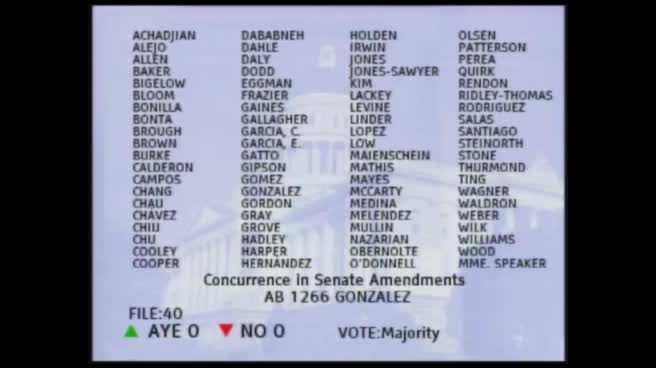 1MIN
Assembly Floor
 2MIN
Senate Floor
 2MIN
Senate Standing Committee on Governmental Organization
Bill Author

Bill Co-Author(s):