AB 833: Child care and development services: individualized county child care subsidy plan: County of Alameda.
- Session Year: 2015-2016
- House: Assembly
- Latest Version Date: 2015-10-07
The Child Care and Development Services Act has a purpose of providing a comprehensive, coordinated, and cost-effective system of child care and development services for children from infancy to 13 years of age and their parents, including a full range of supervision, health, and support services through full- and part-time programs. Existing law requires the Superintendent of Public Instruction to develop standards for the implementation of quality child care programs. Existing law authorizes the County of San Mateo, as a pilot project, to develop an individualized county child care subsidy plan, as provided.
This bill would authorize, until January 1, 2021, the County of Alameda to develop an individualized county child care subsidy plan, as specified. The bill would require the plan to be submitted to the local planning council and the Alameda County Board of Supervisors for approval, as specified. The bill would require the Early Education and Support Division of the State Department of Education to review and approve or disapprove the plan and any subsequent modifications to the plan. The bill would require the County of Alameda to annually prepare and submit to the Legislature, the State Department of Social Services, and the State Department of Education a report that contains specified information relating to the success of the countys plan.
This bill would make legislative findings and declarations as to the necessity of a special statute for the County of Alameda.
The Child Care and Development Services Act has a purpose of providing a comprehensive, coordinated, and cost-effective system of child care and development services for children from infancy to 13 years of age and their parents, including a full range of supervision, health, and support services through full- and part-time programs. Existing law requires the Superintendent of Public Instruction to develop standards for the implementation of quality child care programs. Existing law authorizes the County of San Mateo, as a pilot project, to develop an individualized county child care subsidy plan, as provided.
This bill would authorize, until January 1, 2021, the County of Alameda to develop an individualized county child care subsidy plan, as specified. The bill would require the plan to be submitted to the local planning council and the Alameda County Board of Supervisors for approval, as specified. The bill would require the Child Development Division Early Education and Support Division of the State Department of Education to review and approve or disapprove the plan and any subsequent modifications to the plan. The bill would require the County of Alameda to annually prepare and submit to the Legislature, the State Department of Social Services, and the State Department of Education a report that contains specified information relating to the success of the countys plan.
This bill would make legislative findings and declarations as to the necessity of a special statute for the County of Alameda.
The Child Care and Development Services Act has a purpose of providing a comprehensive, coordinated, and cost-effective system of child care and development services for children from infancy to 13 years of age and their parents, including a full range of supervision, health, and support services through full- and part-time programs. Existing law requires the Superintendent of Public Instruction to develop standards for the implementation of quality child care programs. Existing law authorizes the County of San Mateo, as a pilot project, to develop an individualized county child care subsidy plan, as provided.
This bill would require the Superintendent, on or before an unspecified date, to establish a statewide centralized eligibility list to consolidate child care waiting lists and a statewide quality rating and improvement system to improve the quality of early learning, as provided.
This bill would authorize, until January 1, 2021, the County of Alameda to develop an individualized county child care subsidy plan, as specified. The bill would require the Child Development Division of the State Department of Education to review and approve or disapprove modifications to the plan. The bill would require the County of Alameda to annually prepare and submit to the Legislature, the State Department of Social Services, and the State Department of Education a report that contains specified information relating to the success of the countys plan.
This bill would make legislative findings and declarations as to the necessity of a special statute for the County of Alameda.
The Child Care and Development Services Act has a purpose of providing a comprehensive, coordinated, and cost-effective system of child care and development services for children from infancy to 13 years of age and their parents, including a full range of supervision, health, and support services through full- and part-time programs. Existing law requires the Superintendent of Public Instruction to develop standards for the implementation of quality child care programs.
This bill would state that it is the intent of the Legislature to enact legislation that would improve early childhood education and development.
This bill would require the Superintendent, on or before an unspecified date, to establish a statewide centralized eligibility list to consolidate child care waiting lists and a statewide quality rating and improvement system to improve the quality of early learning, as provided.
The Child Care and Development Services Act has a purpose of providing a comprehensive, coordinated, and cost-effective system of child care and development services for children from infancy to 13 years of age and their parents, including a full range of supervision, health, and support services through full- and part-time programs. Existing law requires the Superintendent of Public Instruction to develop standards for the implementation of quality child care programs.
This bill would state that it is the intent of the Legislature to enact legislation that would improve early childhood education and development.
It is the intent of the Legislature to build a stable, comprehensive, and adequately funded high-quality early learning and educational support system for children from birth to five years of age, inclusive, with alignment and integration into the K12 education system by strategically using state and federal funds, and engaging all early care and education stakeholders, including K12 education stakeholders, in an effort to provide access to affordable, high-quality services supported by adequate rates, integrated data systems, and a strong infrastructure that supports children and the educators that serve them.
SEC. 2.Article 15.3 (commencing with Section 8340) is added to Chapter 2 of Part 6 of Division 1 of Title 1 of the Education Code, to read:15.3.Individualized County of Alameda Child Care Subsidy Plan8340.The County of Alameda may, as a pilot project, develop and implement an individualized county child care subsidy plan. The plan shall ensure that child care subsidies received by the County of Alameda are used to address local needs, conditions, and priorities of working families in the community.
8340.1.For purposes of this article, county means the County of Alameda.
8340.2.(a)For purposes of this article, plan means an individualized county child care subsidy plan developed and approved under the pilot project described in Section 8340, which includes all of the following:
(1)An assessment to identify the countys goal for its subsidized child care system. The assessment shall examine whether the current structure of subsidized child care funding adequately supports working families in the county and whether the countys child care goals coincide with the states requirements for funding, eligibility, priority, and reimbursement. The assessment shall also identify barriers in the states child care subsidy system that inhibit the county from meeting its child care goals. In conducting the assessment, the county shall consider all of the following:
(A)The general demographics of families who are in need of child care, including employment, income, language, ethnic, and family composition.
(B)The current supply of available subsidized child care.
(C)The level of need for various types of subsidized child care services, including, but not limited to, infant care, after-hours care, and care for children with exceptional needs.
(D)The countys self-sufficiency income level.
(E)Income eligibility levels for subsidized child care.
(F)Family fees.
(G)The cost of providing child care.
(H)The regional market rates, as established by the department, for different types of child care.
(I)The standard reimbursement rate or state per diem for centers operating under contracts with the department.
(J)Trends in the countys unemployment rate and housing affordability index.
(2)(A)Development of a local policy to eliminate state-imposed regulatory barriers to the countys achievement of its desired outcomes for subsidized child care.
(B)The local policy shall do all of the following:
(i)Prioritize lowest income families first.
(ii)Follow the family fee schedule established pursuant to Section 8273 for those families that are income eligible, as defined by Section 8263.1.
(iii)Meet local goals that are consistent with the states child care goals.
(iv)Identify existing policies that would be affected by the countys plan.
(v)(I)Authorize an agency that provides child care and development services in the county through a contract with the department and either provides direct services or contracts with licensed providers or centers to apply to the department to amend existing contracts in order to benefit from the local policy.
(II)The department shall approve an application to amend an existing contract if the plan is modified pursuant to Section 8340.3.
(III)The contract of a department contractor who does not elect to request an amendment to its contract remains operative and enforceable.
(C)The local policy may supersede state law concerning child care subsidy programs with regard only to the following factors:
(i)Eligibility criteria, including, but not limited to, age, family size, time limits, income level, inclusion of former and current CalWORKs participants, and special needs considerations, except that the local policy shall not deny or reduce eligibility of a family that qualifies for child care pursuant to Section 8353. Under the local policy, a family that qualifies for child care pursuant to Section 8354 shall be treated for purposes of eligibility and fees in the same manner as a family that qualifies for subsidized child care on another basis pursuant to the local policy.
(ii)Fees, including, but not limited to, family fees, sliding scale fees, and copayments for those families that are not income eligible, as defined by Section 8263.1.
(iii)Reimbursement rates.
(iv)Methods of maximizing the efficient use of subsidy funds, including, but not limited to, multiyear contracting with the department for center-based child care, and interagency agreements that allow for flexible and temporary transfer of funds among agencies.
(3)Recognition that all funding sources utilized by direct service contractors that provide child care and development services in the county and contractors that contract with licensed providers and centers are eligible to be included in the countys plan.
(4)Establishment of measurable outcomes to evaluate the success of the plan to achieve the countys child care goals, and to overcome any barriers identified in the states child care subsidy system.
(b)Nothing in this section shall be construed to permit the county to change the regional market rate survey results for the county.
8340.3.(a)The plan shall be submitted to the local planning council, as defined in subdivision (g) of Section 8499, for approval. Upon approval of the plan by the local planning council, the Board of Supervisors of the County of Alameda shall hold at least one public hearing on the plan. Following the hearing, if the board votes in favor of the plan, the plan shall be submitted to the Early Education and Support Division of the department for review.
(b)Within 30 days of receiving the plan, the Early Education and Support Division shall review and either approve or disapprove the plan.
(c)Within 30 days of receiving a modification to the plan, the Early Education and Support Division shall review and either approve or disapprove that modification to the plan.
(d)The Early Education and Support Division may disapprove only those portions of modifications to the plan that are not in conformance with this article or that are in conflict with federal law.
8340.4.The county shall, by the end of the first fiscal year of operation under the approved child care subsidy plan, demonstrate, in the report required pursuant to Section 8340.5, an increase in the aggregate days a child is enrolled in child care in the county as compared to the enrollment in the final quarter of the 20142015 fiscal year.
8340.5.(a)The county shall annually prepare and submit to the Legislature, the State Department of Social Services, and the department a report that summarizes the success of the countys plan, and the countys ability to maximize the use of funds and to improve and stabilize child care in the county.
(b)A report to be submitted pursuant to subdivision (a) shall be submitted in compliance with Section 9795 of the Government Code.
8340.6.A participating contractor shall receive an increase or decrease in funding that the contractor would have received if the contractor had not participated in the plan.
8340.7.This article shall remain in effect only until January 1, 2021, and as of that date is repealed, unless a later enacted statute, that is enacted before January 1, 2021, deletes or extends that date.
SEC. 3.The Legislature finds and declares that a special law is necessary and that a general law cannot be made applicable within the meaning of Section 16 of Article IV of the California Constitution because of the unique circumstances in the County of Alameda. Existing law does not reflect the fiscal reality of living in the County of Alameda, a high-cost county where the cost of living is well beyond the state median level, resulting in reduced access to quality child care. In recognition of the unintended consequences of living in a high-cost county, this act is necessary to provide children and families in the County of Alameda proper access to child care through an individualized county child care subsidy plan.
It is the intent of the Legislature to build a stable, comprehensive, and adequately funded high-quality early learning and educational support system for children from birth to five years of age, inclusive, with alignment and integration into the K12 education system by strategically using state and federal funds, and engaging all early care and education stakeholders, including K12 education stakeholders, in an effort to provide access to affordable, high-quality services supported by adequate rates, integrated data systems, and a strong infrastructure that supports children and the educators that serve them.
SEC. 2.Article 15.3 (commencing with Section 8340) is added to Chapter 2 of Part 6 of Division 1 of Title 1 of the Education Code, to read:15.3.Individualized County of Alameda Child Care Subsidy Plan8340.The County of Alameda may, as a pilot project, develop and implement an individualized county child care subsidy plan. The plan shall ensure that child care subsidies received by the County of Alameda are used to address local needs, conditions, and priorities of working families in the community.
8340.1.For purposes of this article, county means the County of Alameda.
8340.2.(a)For purposes of this article, plan means an individualized county child care subsidy plan developed and approved under the pilot project described in Section 8340, which includes all of the following:
(a)
(1)An assessment to identify the countys goal for its subsidized child care system. The assessment shall examine whether the current structure of subsidized child care funding adequately supports working families in the county and whether the countys child care goals coincide with the states requirements for funding, eligibility, priority, and reimbursement. The assessment shall also identify barriers in the states child care subsidy system that inhibit the county from meeting its child care goals. In conducting the assessment, the county shall consider all of the following:
(1)
(A)The general demographics of families who are in need of child care, including employment, income, language, ethnic, and family composition.
(2)
(B)The current supply of available subsidized child care.
(3)
(C)The level of need for various types of subsidized child care services, including, but not limited to, infant care, after-hours care, and care for children with exceptional needs.
(4)
(D)The countys self-sufficiency income level.
(5)
(E)Income eligibility levels for subsidized child care.
(6)
(F)Family fees.
(7)
(G)The cost of providing child care.
(8)
(H)The regional market rates, as established by the department, for different types of child care.
(9)
(I)The standard reimbursement rate or state per diem for centers operating under contracts with the department.
(10)
(J)Trends in the countys unemployment rate and housing affordability index.
(b)(1)
(2)(A)Development of a local policy to eliminate state-imposed regulatory barriers to the countys achievement of its desired outcomes for subsidized child care.
(2)
(B)The local policy shall do all of the following:
(A)
(i)Prioritize lowest income families first.
(B)
(ii)Follow the family fee schedule established pursuant to Section 8273 for those families that are income eligible, as defined by Section 8263.1.
(C)
(iii)Meet local goals that are consistent with the states child care goals.
(D)
(iv)Identify existing policies that would be affected by the countys plan.
(E)(i)
(v)(I)Authorize an agency that provides child care and development services in the county through a contract with the department and either provides direct services or contracts with licensed providers or centers to apply to the department to amend existing contracts in order to benefit from the local policy.
(ii)
(II)The department shall approve an application to amend an existing contract if the plan is modified pursuant to Section 8340.3.
(iii)
(III)The contract of a department contractor who does not elect to request an amendment to its contract remains operative and enforceable.
(3)
(C)The local policy may supersede state law concerning child care subsidy programs with regard only to the following factors:
(A)
(i)Eligibility criteria, including, but not limited to, age, family size, time limits, income level, inclusion of former and current CalWORKs participants, and special needs considerations, except that the local policy shall not deny or reduce eligibility of a family that qualifies for child care pursuant to Section 8353. Under the local policy, a family that qualifies for child care pursuant to Section 8354 shall be treated for purposes of eligibility and fees in the same manner as a family that qualifies for subsidized child care on another basis pursuant to the local policy.
(B)
(ii)Fees, including, but not limited to, family fees, sliding scale fees, and copayments for those families that are not income eligible, as defined by Section 8263.1.
(C)
(iii)Reimbursement rates.
(D)
(iv)Methods of maximizing the efficient use of subsidy funds, including, but not limited to, multiyear contracting with the department for center-based child care, and interagency agreements that allow for flexible and temporary transfer of funds among agencies.
(c)
(3)Recognition that all funding sources utilized by direct service contractors that provide child care and development services in the county and contractors that contract with licensed providers and centers are eligible to be included in the countys plan.
(d)
(4)Establishment of measurable outcomes to evaluate the success of the plan to achieve the countys child care goals, and to overcome any barriers identified in the states child care subsidy system.
(b)Nothing in this section shall be construed to permit the county to change the regional market rate survey results for the county.
8340.3.(a)The plan shall be submitted to the local planning council, as defined in subdivision (g) of Section 8499, for approval. Upon approval of the plan by the local planning council, the Board of Supervisors of the County of Alameda shall hold at least one public hearing on the plan. Following the hearing, if the board votes in favor of the plan, the plan shall be submitted to the Early Education and Support Division of the department for review.
(b)Within 30 days of receiving the plan, the Early Education and Support Division shall review and either approve or disapprove the plan.
(c)Within 30 days of receiving a modification to the plan, the Early Education and Support Division shall review and either approve or disapprove that modification to the plan.
(d)The Early Education and Support Division may disapprove only those portions of modifications to the plan that are not in conformance with this article or that are in conflict with federal law.
8340.4.The county shall, by the end of the first fiscal year of operation under the approved child care subsidy plan, demonstrate, in the report required pursuant to Section 8340.5, an increase in the aggregate days a child is enrolled in child care in the county as compared to the enrollment in the final quarter of the 20142015 fiscal year.
8340.5.(a)The county shall annually prepare and submit to the Legislature, the State Department of Social Services, and the department a report that summarizes the success of the countys plan, and the countys ability to maximize the use of funds and to improve and stabilize child care in the county.
(b)A report to be submitted pursuant to subdivision (a) shall be submitted in compliance with Section 9795 of the Government Code.
8340.6.A participating contractor shall receive an increase or decrease in funding that the contractor would have received if the contractor had not participated in the plan.
8340.7.This article shall remain in effect only until January 1, 2021, and as of that date is repealed, unless a later enacted statute, that is enacted before January 1, 2021, deletes or extends that date.
SEC. 3.The Legislature finds and declares that a special law is necessary and that a general law cannot be made applicable within the meaning of Section 16 of Article IV of the California Constitution because of the unique circumstances in the County of Alameda. Existing law does not reflect the fiscal reality of living in the County of Alameda, a high-cost county where the cost of living is well beyond the state median level, resulting in reduced access to quality child care. In recognition of the unintended consequences of living in a high-cost county, this act is necessary to provide children and families in the County of Alameda proper access to child care through an individualized county child care subsidy plan.
It is the intent of the Legislature to build a stable, comprehensive, and adequately funded high-quality early learning and educational support system for children from birth to five years of age, inclusive, with alignment and integration into the K12 education system by strategically using state and federal funds, and engaging all early care and education stakeholders, including K12 education stakeholders, in an effort to provide access to affordable, high-quality services supported by adequate rates, integrated data systems, and a strong infrastructure that supports children and the educators that serve them.
SEC. 2.Article 15.3 (commencing with Section 8340) is added to Chapter 2 of Part 6 of Division 1 of Title 1 of the Education Code, to read:15.3.Individualized County of Alameda Child Care Subsidy Plan8340.The County of Alameda may, as a pilot project, develop and implement an individualized county child care subsidy plan. The plan shall ensure that child care subsidies received by the County of Alameda are used to address local needs, conditions, and priorities of working families in the community.
8340.1.For purposes of this article, county means the County of Alameda.
8340.2.For purposes of this article, plan means an individualized county child care subsidy plan developed and approved under the pilot project described in Section 8340, which includes all of the following:
(a)An assessment to identify the countys goal for its subsidized child care system. The assessment shall examine whether the current structure of subsidized child care funding adequately supports working families in the county and whether the countys child care goals coincide with the states requirements for funding, eligibility, priority, and reimbursement. The assessment shall also identify barriers in the states child care subsidy system that inhibit the county from meeting its child care goals. In conducting the assessment, the county shall consider all of the following:
(1)The general demographics of families who are in need of child care, including employment, income, language, ethnic, and family composition.
(2)The current supply of available subsidized child care.
(3)The level of need for various types of subsidized child care services, including, but not limited to, infant care, after-hours care, and care for children with exceptional needs.
(4)The countys self-sufficiency income level.
(5)Income eligibility levels for subsidized child care.
(6)Family fees.
(7)The cost of providing child care.
(8)The regional market rates, as established by the department, for different types of child care.
(9)The standard reimbursement rate or state per diem for centers operating under contracts with the department.
(10)Trends in the countys unemployment rate and housing affordability index.
(b)(1)Development of a local policy to eliminate state-imposed regulatory barriers to the countys achievement of its desired outcomes for subsidized child care.
(2)The local policy shall do all of the following:
(A)Prioritize lowest income families first.
(B)Follow the family fee schedule established pursuant to Section 8273 for those families that are income eligible, as defined by Section 8263.1.
(C)Meet local goals that are consistent with the states child care goals.
(D)Identify existing policies that would be affected by the countys plan.
(E)(i)Authorize any an agency that provides child care and development services in the county through a contract with the department to apply to the department to amend existing contracts in order to benefit from the local policy.
(ii)The department shall approve an application to amend an existing contract if the plan is modified pursuant to Section 8340.3.
(iii)The contract of a department contractor who does not elect to request an amendment to its contract remains operative and enforceable.
(3)The local policy may supersede state law concerning child care subsidy programs with regard only to the following factors:
(A)Eligibility criteria, including, but not limited to, age, family size, time limits, income level, inclusion of former and current CalWORKs participants, and special needs considerations, except that the local policy may shall not deny or reduce eligibility of a family that qualifies for child care pursuant to Section 8353. Under the local policy, a family that qualifies for child care pursuant to Section 8354 shall be treated for purposes of eligibility and fees in the same manner as a family that qualifies for subsidized child care on another basis pursuant to the local policy.
(B)Fees, including, but not limited to, family fees, sliding scale fees, and copayments for those families that are not income eligible, as defined by Section 8263.1.
(C)Reimbursement rates.
(D)Methods of maximizing the efficient use of subsidy funds, including, but not limited to, multiyear contracting with the department for center-based child care, and interagency agreements that allow for flexible and temporary transfer of funds among agencies.
(c)Recognition that all funding sources utilized by direct service contractors that provide child care and development services in the county are eligible to be included in the countys plan.
(d)Establishment of measurable outcomes to evaluate the success of the plan to achieve the countys child care goals, and to overcome any barriers identified in the states child care subsidy system.
8340.3.(a)Within The plan shall be submitted to the local planning council, as defined in subdivision (g) of Section 8499, for approval. Upon approval of the plan by the local planning council, the Board of Supervisors of the County of Alameda shall hold at least one public hearing on the plan. Following the hearing, if the board votes in favor of the plan, the plan shall be submitted to the Early Education and Support Division of the department for review.
(b)Within 30 days of receiving the plan, the Early Education and Support Division shall review and either approve or disapprove the plan.
(c)Within 30 days of receiving any a modification to the plan, the Child Development Division Early Education and Support Division shall review and either approve or disapprove that modification to the plan.
(b)
(d)The Child Development Division Early Education and Support Division may disapprove only those portions of modifications to the plan that are not in conformance with this article or that are in conflict with federal law.
8340.4.The county shall, by the end of the first fiscal year of operation under the approved child care subsidy plan, demonstrate, in the report required pursuant to Section 8340.5, an increase in the aggregate days a child is enrolled in child care in the county as compared to the enrollment in the final quarter of the 20142015 fiscal year.
8340.4.8340.5.(a)The county shall annually prepare and submit to the Legislature, the State Department of Social Services, and the department a report that summarizes the success of the countys plan, and the countys ability to maximize the use of funds and to improve and stabilize child care in the county.
(b)A report to be submitted pursuant to subdivision (a) shall be submitted in compliance with Section 9795 of the Government Code.
8340.5.8340.6.A participating contractor shall receive any an increase or decrease in funding that the contractor would have received if the contractor had not participated in the plan.
8340.6.8340.7.This article shall remain in effect only until January 1, 2021, and as of that date is repealed, unless a later enacted statute, that is enacted before January 1, 2021, deletes or extends that date.
SEC. 3.The Legislature finds and declares that a special law is necessary and that a general law cannot be made applicable within the meaning of Section 16 of Article IV of the California Constitution because of the unique circumstances in the County of Alameda. Existing law does not reflect the fiscal reality of living in the County of Alameda, a high-cost county where the cost of living is well beyond the state median level, resulting in reduced access to quality child care. In recognition of the unintended consequences of living in a high-cost county, this act is necessary to provide children and families in the County of Alameda proper access to child care through an individualized county child care subsidy plan.
It is the intent of the Legislature to build a stable, comprehensive, and adequately funded high-quality early learning and educational support system for children from birth to five years of age, inclusive, with alignment and integration into the K12 education system by strategically using state and federal funds, and engaging all early care and education stakeholders, including K12 education stakeholders, in an effort to provide access to affordable, high-quality services supported by adequate rates, integrated data systems, and a strong infrastructure that supports children and the educators that serve them.
SEC. 2.Section 8203.2 is added to the Education Code, to read:8203.2.On or before ____, and notwithstanding Section 8227, the Superintendent shall establish a statewide centralized eligibility list to consolidate child care waiting lists.
SEC. 3.Section 8203.25 is added to the Education Code, immediately following Section 8203.2, to read:8203.25.On or before ____, and notwithstanding Section 8203.1, the Superintendent shall establish a statewide quality rating and improvement system to improve the quality of early learning and increase the number of low-income children in high-quality preschool programs that prepare those children for success in school and life.
SEC. 2.Article 15.3 (commencing with Section 8340) is added to Chapter 2 of Part 6 of Division 1 of Title 1 of the Education Code, to read:15.3.Individualized County of Alameda Child Care Subsidy Plan8340.The County of Alameda may, as a pilot project, develop and implement an individualized county child care subsidy plan. The plan shall ensure that child care subsidies received by the County of Alameda are used to address local needs, conditions, and priorities of working families in the community.
8340.1.For purposes of this article, county means the County of Alameda.
8340.2.For purposes of this article, plan means an individualized county child care subsidy plan developed and approved under the pilot project described in Section 8340, which includes all of the following:
(a)An assessment to identify the countys goal for its subsidized child care system. The assessment shall examine whether the current structure of subsidized child care funding adequately supports working families in the county and whether the countys child care goals coincide with the states requirements for funding, eligibility, priority, and reimbursement. The assessment shall also identify barriers in the states child care subsidy system that inhibit the county from meeting its child care goals. In conducting the assessment, the county shall consider all of the following:
(1)The general demographics of families who are in need of child care, including employment, income, language, ethnic, and family composition.
(2)The current supply of available subsidized child care.
(3)The level of need for various types of subsidized child care services, including, but not limited to, infant care, after-hours care, and care for children with exceptional needs.
(4)The countys self-sufficiency income level.
(5)Income eligibility levels for subsidized child care.
(6)Family fees.
(7)The cost of providing child care.
(8)The regional market rates, as established by the department, for different types of child care.
(9)The standard reimbursement rate or state per diem for centers operating under contracts with the department.
(10)Trends in the countys unemployment rate and housing affordability index.
(b)(1)Development of a local policy to eliminate state-imposed regulatory barriers to the countys achievement of its desired outcomes for subsidized child care.
(2)The local policy shall do all of the following:
(A)Prioritize lowest income families first.
(B)Follow the family fee schedule established pursuant to Section 8273 for those families that are income eligible, as defined by Section 8263.1.
(C)Meet local goals that are consistent with the states child care goals.
(D)Identify existing policies that would be affected by the countys plan.
(E)(i)Authorize any agency that provides child care and development services in the county through a contract with the department to apply to the department to amend existing contracts in order to benefit from the local policy.
(ii)The department shall approve an application to amend an existing contract if the plan is modified pursuant to Section 8340.3.
(iii)The contract of a department contractor who does not elect to request an amendment to its contract remains operative and enforceable.
(3)The local policy may supersede state law concerning child care subsidy programs with regard only to the following factors:
(A)Eligibility criteria, including, but not limited to, age, family size, time limits, income level, inclusion of former and current CalWORKs participants, and special needs considerations, except that the local policy may not deny or reduce eligibility of a family that qualifies for child care pursuant to Section 8353. Under the local policy, a family that qualifies for child care pursuant to Section 8354 shall be treated for purposes of eligibility and fees in the same manner as a family that qualifies for subsidized child care on another basis pursuant to the local policy.
(B)Fees, including, but not limited to, family fees, sliding scale fees, and copayments for those families that are not income eligible, as defined by Section 8263.1.
(C)Reimbursement rates.
(D)Methods of maximizing the efficient use of subsidy funds, including, but not limited to, multiyear contracting with the department for center-based child care, and interagency agreements that allow for flexible and temporary transfer of funds among agencies.
(c)Recognition that all funding sources utilized by direct service contractors that provide child care and development services in the county are eligible to be included in the countys plan.
(d)Establishment of measurable outcomes to evaluate the success of the plan to achieve the countys child care goals, and to overcome any barriers identified in the states child care subsidy system.
8340.3.(a)Within 30 days of receiving any modification to the plan, the Child Development Division shall review and either approve or disapprove that modification to the plan.
(b)The Child Development Division may disapprove only those portions of modifications to the plan that are not in conformance with this article or that are in conflict with federal law.
8340.4.(a)The county shall annually prepare and submit to the Legislature, the State Department of Social Services, and the department a report that summarizes the success of the countys plan, and the countys ability to maximize the use of funds and to improve and stabilize child care in the county.
(b)A report to be submitted pursuant to subdivision (a) shall be submitted in compliance with Section 9795 of the Government Code.
8340.5.A participating contractor shall receive any increase or decrease in funding that the contractor would have received if the contractor had not participated in the plan.
8340.6.This article shall remain in effect only until January 1, 2021, and as of that date is repealed, unless a later enacted statute, that is enacted before January 1, 2021, deletes or extends that date.
SEC. 3.The Legislature finds and declares that a special law is necessary and that a general law cannot be made applicable within the meaning of Section 16 of Article IV of the California Constitution because of the unique circumstances in the County of Alameda. Existing law does not reflect the fiscal reality of living in the County of Alameda, a high-cost county where the cost of living is well beyond the state median level, resulting in reduced access to quality child care. In recognition of the unintended consequences of living in a high-cost county, this act is necessary to provide children and families in the County of Alameda proper access to child care through an individualized county child care subsidy plan.
It is the intent of the Legislature to build a stable, comprehensive, and adequately funded high-quality early learning and educational support system for children from birth to five years of age, inclusive, with alignment and integration into the K12 education system by strategically using state and federal funds, and engaging all early care and education stakeholders, including K12 education stakeholders, in an effort to provide access to affordable, high-quality services supported by adequate rates, integrated data systems, and a strong infrastructure that supports children and the educators that serve them.
SEC. 2.Section 8203.2 is added to the Education Code, to read:8203.2.On or before ____, and notwithstanding Section 8227, the Superintendent shall establish a statewide centralized eligibility list to consolidate child care waiting lists.
SEC. 3.Section 8203.25 is added to the Education Code, immediately following Section 8203.2, to read:8203.25.On or before ____, and notwithstanding Section 8203.1, the Superintendent shall establish a statewide quality rating and improvement system to improve the quality of early learning and increase the number of low-income children in high-quality preschool programs that prepare those children for success in school and life.
SECTION 1.It is the intent of the Legislature to enact legislation that would improve early childhood education and development.
It is the intent of the Legislature to enact legislation that would improve early childhood education and development.
|
Date
|
Status
|
|---|---|
| Jun 16, 2015 | From committee chair, with author's amendments: Amend, and re-refer to committee. Read second time, amended, and re-referred to Com. on ED. |
| Oct 7, 2015 | Chaptered by Secretary of State - Chapter 563, Statutes of 2015. |
| Oct 7, 2015 | Approved by the Governor. |
| Sep 18, 2015 | Enrolled and presented to the Governor at 4 p.m. |
| Sep 10, 2015 | Senate amendments concurred in. To Engrossing and Enrolling. (Ayes 80. Noes 0.). |
| Sep 10, 2015 | Senate amendments concurred in. To Engrossing and Enrolling. (Ayes 80. Noes 0. Page 3062.). |
| Sep 10, 2015 | Senate amendments concurred in. To Engrossing and Enrolling. |
| Sep 9, 2015 | Read third time. Passed. Ordered to the Assembly. (Ayes 40. Noes 0. Page 2633.). |
| Sep 9, 2015 | Read third time. Passed. Ordered to the Assembly. |
| Sep 9, 2015 | In Assembly. Concurrence in Senate amendments pending. |
| Sep 8, 2015 | Read second time. Ordered to third reading. |
| Sep 4, 2015 | Read third time and amended. Ordered to second reading. |
| Aug 31, 2015 | Read second time. Ordered to third reading. |
| Aug 27, 2015 | From committee: Do pass. (Ayes 7. Noes 0.) (August 27). |
| Jul 6, 2015 | In committee: Referred to APPR. suspense file. |
| Jun 24, 2015 | From committee: Do pass and re-refer to Com. on APPR. (Ayes 9. Noes 0.) (June 24). Re-referred to Com. on APPR. |
| Feb 26, 2015 | Read first time. To print. |
| Jun 11, 2015 | Referred to Com. on ED. |
| Jun 1, 2015 | Read third time. Passed. Ordered to the Senate. (Ayes 80. Noes 0. Page 1718.) |
| Jun 1, 2015 | Read third time. Passed. Ordered to the Senate. |
| Jun 1, 2015 | In Senate. Read first time. To Com. on RLS. for assignment. |
| May 28, 2015 | Read second time. Ordered to third reading. |
| May 28, 2015 | From committee: Do pass. (Ayes 17. Noes 0.) (May 28). |
| May 13, 2015 | In committee: Set, first hearing. Referred to APPR. suspense file. |
| Apr 29, 2015 | From committee: Do pass and re-refer to Com. on APPR. (Ayes 7. Noes 0.) (April 28). Re-referred to Com. on APPR. |
| Apr 23, 2015 | Re-referred to Com. on HUM. S. |
| Apr 22, 2015 | From committee chair, with author's amendments: Amend, and re-refer to Com. on HUM. S. Read second time and amended. |
| Apr 6, 2015 | Re-referred to Com. on HUM. S. |
| Mar 26, 2015 | Referred to Com. on HUM. S. |
| Mar 26, 2015 | From committee chair, with author's amendments: Amend, and re-refer to Com. on HUM. S. Read second time and amended. |
| Feb 27, 2015 | From printer. May be heard in committee March 29. |
|
Date
|
Description
|
Location
|
Votes
|
|
|---|---|---|---|---|
| Sep 10, 2015 | AB 833 BONTA Concurrence in Senate Amendments | Assembly Floor |
Passed |
|
| Sep 9, 2015 | Assembly 3rd Reading AB833 Bonta By Hancock | Senate Floor |
Passed |
|
| Aug 27, 2015 | Do pass | Senate Standing Committee on Appropriations |
Passed |
|
| Jul 6, 2015 | Placed on suspense file | Senate Standing Committee on Appropriations |
Passed |
|
| Jun 24, 2015 | Do pass, but first be re-referred to the Committee on [Appropriations] | Senate Standing Committee on Education |
Passed |
|
| Jun 1, 2015 | AB 833 BONTA Assembly Third Reading | Assembly Floor |
Passed |
|
| May 28, 2015 | Do pass. | Assembly Standing Committee on Appropriations |
Passed |
|
| Apr 28, 2015 | Do pass and be re-referred to the Committee on [Appropriations] | Assembly Standing Committee on Human Services |
Passed |
This list shows positions taken on this bill by organizations on the date displayed, which is linked to the original source.
Positions by individuals are not included.
|
Organization
|
Position
|
Date
|
|---|---|---|
| 3)Related Legislation. | ** Support | Jun 24, 2015 |
| According to the Senate Appropriations Committee: | ** Support | Sep 9, 2015 |
| Alameda Conty Early Care and Education Planning Council | * Support | Jun 24, 2015 |
| Alameda County Board of Supervisors | * Support | Jul 6, 2015 |
| American Federation of State, County and Municipal Employees | ** Support | Sep 9, 2015 |
| BANANAS | ** Support | Sep 9, 2015 |
| Bay Area Council | ** Support | Sep 9, 2015 |
| California School Employees Association | ** Support | Sep 9, 2015 |
| Davis Street | ** Support | Jun 1, 2015 |
| Early Edge California | ** Support | Sep 9, 2015 |
| Early Head Start Programs | ** Support | Jun 1, 2015 |
| East Bay Association for Education of Young Children | ** Support | Jun 24, 2015 |
| East Bay Community Foundation | ** Support | Sep 9, 2015 |
| Ephesian children's Center | ** Support | Jun 1, 2015 |
| First 5 Alameda County | ** Support | Sep 9, 2015 |
| First Five Alameda County | ** Support | Jun 1, 2015 |
| Frist 5 Alameda County | ** Support | Jun 24, 2015 |
| Kidango, Inc. | ** Support | Sep 9, 2015 |
| National Association of Social Workers | ** Support | Sep 9, 2015 |
| STAFF COMMENTS | ** Support | Jun 24, 2015 |
| The Unity Council Head Start | ** Support | Jun 1, 2015 |
| u None received. | ** Against | Jun 24, 2015 |
| u SUPPORT | ** Support | Jun 24, 2015 |
| Via Nova Children's School | ** Support | Sep 9, 2015 |
AB 833
Page 4
CONCURRENCE IN SENATE AMENDMENTS
AB 833
(Bonta)
As Amended September 4, 2015
Majority vote
ASSEMBLY: |
80-0 |
(June 1, 2015) |
SENATE: |
40-0 |
(September 9, 2015) |
Original Committee Reference: HUM. S.
SUMMARY: Establishes a subsidized child care pilot program in Alameda County. Specifically, this bill:
States legislative intent to build a stable, comprehensive, and adequately funded high-quality early learning and educational support system.
Permits Alameda County to develop and implement an individualized county child care subsidy plan, as specified, to include the following:
An assessment to identify the county's goal for its subsidized child care system, as specified;
Development of a local policy to eliminate state-imposed regulatory barriers to the county's achievement of its desired outcomes for subsidized child care, as specified;
Recognition that all funding sources utilized by direct child care service contractors in the county and contractors that contract with licensed providers and centers are eligible to be included in the county's plan; and
Establishment of measurable outcomes to evaluate the success of the plan to achieve the county's child care goals and to overcome any barriers identified in the state's child care subsidy plan.
States that the plan, and requirements regarding it, shall not be construed to permit the county to change the regional market rate survey results for the county.
Requires the plan to be submitted to the local planning council, as specified, for approval and, upon approval, requires the Alameda County Board of Supervisors to hold at least one public hearing on the plan. Should the board vote in favor of the plan after this hearing, requires the plan to be submitted to the California Department of Education's (CDE's) Early Education and Support Division to review the plan and, within 30 days of receiving it, to approve or disapprove it.
Requires the Early Education and Support Division to review and either approve or disapprove any modification of the plan within 30 days of receiving it. Further specifies that the Early Education and Support Division may only disapprove those portions of the plan that are not in conformance with the provisions of this bill or that are in conflict with federal law.
Requires the county, by the end of the first fiscal year of operation under the approved child care subsidy plan, to demonstrate an increase in the aggregate days a child is enrolled in child care as compared to the enrollment in the final quarter of the 2014-15 Fiscal Year.
Requires the county to prepare and submit a report summarizing the success of the county's plan, as specified, to the Legislature, the Department of Social Services (DSS), and CDE each year.
Requires a participating contractor to receive an increase or decrease in funding that the contractor would have received had the contractor not participated in the plan.
Repeals the provisions of this bill as of January 1, 2021.
Declares legislative findings that a special law is necessary and that a general law cannot be made applicable because of the unique circumstances in Alameda County, as specified.
The Senate amendments:
Clarify that all funding sources utilized by contractors that contract with licensed providers and centers are eligible to be included in the county's plan.
Clarify that the plan, and requirements regarding it, shall not be construed to permit the county to change its regional market rate survey results.
Require the plan to be submitted to the local planning council, as specified, for approval and, upon approval, require the Alameda County Board of Supervisors to hold at least one public hearing on the plan. Should the board vote in favor of the plan after this hearing, require the plan to be submitted to the CDE's Early Education and Support Division to review the plan and, within 30 days of receiving it, to approve or disapprove it.
Require the county, by the end of the first fiscal year of operation under the approved child care subsidy plan, to demonstrate an increase in the aggregate days a child is enrolled in child care as compared to the enrollment in the final quarter of the 2014-15 fiscal year.
Make other technical changes.
EXISTING LAW establishes the San Mateo County and San Francisco individualized county child care subsidy plan pilot projects and provides for them to sunset in 2016 and 2018, respectively. (Education Code (EDC) Sections 8347 and 8335)
FISCAL EFFECT: According the Senate Appropriations Committee, this bill may result in the following costs:
Alameda County individualized subsidy plan: Potential loss of savings in the low millions to the extent the plan allows more of the county’s funding allocation to be expended.
CDE indicates minor and absorbable costs to review and approve contract amendments and other related activities.
COMMENTS:
Child care in Alameda County: As of April 2015, approximately 14,000 children were served by subsidized child care programs in Alameda County (note that these data do not include the number of children in CalWORKs Stage 1 child care). While Alameda County does not have a centralized eligibility list that provides an exact number of children wait-listed for subsidized child care, the Alameda County Early Care and Education Planning Council polled a number of providers in the county earlier this year and found that there were over 9,750 children on their waitlists. This indicates that there are likely well over 10,000 children in the county who are eligible for, but unable to access slots in, local subsidized child care programs. One study found that, during the period of 2011-12 to 2013-14, Alameda County lost 22% of its subsidized child care contractors.
San Mateo County and San Francisco pilot programs: AB 1326 (Simitian), Chapter 691, Statutes of 2003, established the San Mateo County individualized county child care subsidy plan pilot project and SB 701 (Migden), Chapter 725, Statutes of 2005, established the San Francisco individualized county child care subsidy plan pilot project. Both pilots were developed to address two significant issues facing subsidized child care in high-cost counties: 1) that low-income families earning just enough to afford housing in a high-cost area may be deemed to earn too much to qualify for assistance with child care by statewide eligibility standards, and 2) that the statewide SRR paid to contracted child care centers and family child care homes is often not sufficient to cover program costs and overhead, particularly in high-cost areas. Both counties would see a portion of their child care subsidy funds go unused as low-income families failed to qualify for eligibility by uniform statewide criteria, and as provider reimbursement rates made offering subsidized care untenable for some providers.
San Mateo County's and San Francisco's pilot programs, still in operation today, offer them the limited local flexibility to revise eligibility rules and adjust provider rates and family fees within the context of local evaluation and assessment and heightened state oversight. Thus, the counties are able to reinvest otherwise-unused funds through increased reimbursement rates. Both San Mateo County and San Francisco are also allowed flexibility regarding eligibility rules.
Evaluation results for both counties have indicated a number of successes, including increases in the number of aggregate days of enrollment in subsidized child care and decreases in the amount of unspent child care funds returned to the state.
Need for this bill: With high numbers of children waitlisted for subsidized child care, and difficulties retaining contractors, Alameda County may be a good candidate for an individualized county child care subsidy plan like those seen in San Mateo County and San Francisco.
According to the author:
In Alameda County, many children and families are unable to access quality child care in part by the unintended consequences of living in a high cost county. Since many families are deemed ineligible due to the high cost of living and provider reimbursement rates are insufficient to cover the cost of care, child care subsidy funds allocated to Alameda County are not fully expended.
[This bill] provides Alameda County limited local flexibility with increased state oversight to address the fiscal reality of high-cost counties, where the cost of living and doing business is well beyond the state median. With the ability to revise their eligibility and need determinations, adjust their reimbursement rates and family fees based upon a local evaluation and assessment, and modify their funding requirements, Alameda County will be able to maximize allocated funding and efficiently use child care subsidy funds to meet local conditions. As a result, more children can be served with quality child care.
Analysis Prepared by: Daphne Hunt / HUM. S. / (916) 319-2089 FN: 0002343
AB 833
Page 6
|
Office of Senate Floor Analyses (916) 651-1520 Fax: (916) 327-4478 |
THIRD READING
Bill No: AB 833
Amended: 9/4/15 in Senate
SENATE EDUCATION COMMITTEE: 9-0, 6/24/15
AYES: Liu, Runner, Block, Hancock, Leyva, Mendoza, Monning, Pan, Vidak
SENATE APPROPRIATIONS COMMITTEE: 7-0, 8/27/15
AYES: Lara, Bates, Beall, Hill, Leyva, Mendoza, Nielsen
ASSEMBLY FLOOR: 80-0, 6/1/15 - See last page for vote
SUBJECT: Child care and development services: individualized county child care subsidy plan: County of Alameda
DIGEST: This bill authorizes the County of Alameda to establish a 5-year pilot program for purposes of developing and implementing an individualized county child care subsidy plan. It requires that the plan ensure that child care subsidies received by the county are used to address local needs, conditions, and priorities of working families in the community.
Senate Floor Amendments of 9/4/15 make technical changes and clarify the type of child care provider that may benefit from local policy developed and approved under the County of Alameda pilot project.
ANALYSIS:
Existing law:
Establishes the Child Care and Developmental Services Act to provide child care and development services as part of a coordinated, comprehensive, and cost-effective system serving children from birth to 13 years old and their parents including a full range of supervision, health, and support services through full- and part-time programs. (Education Code § 8200, et seq.)
States legislative intent that all families have access to child care and development services, regardless of demographic background or special needs, that families are provided the opportunity to attain financial stability through employment, while maximizing growth and development of their children, and enhancing their parenting skills through participation in child care and development programs, among other things. (EC § 8202)
Establishes several programs providing subsidized child care and development services that service low-income families who are working, seeking work, in training, or providing community service. These programs are administered by the California Department of Education (CDE) and require the Superintendent of Public Instruction (SPI) to adopt rules and regulations on eligibility, enrollment, family fees, provider rates, and priority services. (EC § 8235 and 8263)
Authorizes a pilot project in San Mateo County (since 2004) and San Francisco City and County (since 2006) that allows the counties to develop and implement an individualized county child care subsidy plan in recognition of the high-cost of living in those counties. (EC § 8235 and 8263)
This bill:
Authorizes the County of Alameda to establish a 5-year pilot program for purposes of developing and implementing an individualized county child care subsidy plan that meets the particular needs of families in the county, as specified, to include the following:
An assessment to identify the county’s goal for its subsidized child care system, as specified.
A local policy to eliminate state-imposed regulatory barriers that constrain the county from meeting its desired outcomes for subsidized child care, as specified. The CDE is required to approve an application to amend an existing contract if the plan is modified.
The local policy may supersede state law concerning child care subsidy programs only for the following areas: eligibility criteria, fees, reimbursement rates, and methods of maximizing the efficient use of subsidy funds.
Recognition that funding sources utilized by direct child care service contractors and contractors that contract with licensed providers in the county are eligible to be included in the county’s plan.
Measurable outcomes to evaluate the success of the plan in achieving county and state child care goals.
Requires the plan to be submitted to the specified local planning council, and upon approval the county board of supervisors shall do all of the following:
Hold at least one public hearing before voting on the plan.
Submit an approved plan to Early Education and Support Division (EESD) for review provided that board votes in its favor.
Requires the CDE’s EESD to review and either approve or disapprove any modification of the plan within 30 days of receiving it. Specifies that the EESD may only disapprove those portions of the plan that are not in conformance with the provisions of this bill or that are in conflict with federal law.
Requires the county to prepare and submit a report summarizing the success of the county’s plan, as specified, to the Legislature, the Department of Social Services (DSS), and the CDE each year.
Requires a participating contractor to receive any increases or decrease in funding that the contractor would have received had the contractor not participated in the plan.
Makes various legislative findings and declarations related to the unique circumstances in the County of Alameda that condition a special law including the high-cost of living.
Defines county to mean County of Alameda for the purposes of this bill.
Comments
Need for bill? According to the author, families seeking quality child care are adversely affected by the high cost of living in Alameda County. The author further notes that families who earn just enough to meet housing costs are deemed ineligible for subsidized child care, at the same time agencies receiving insufficient state reimbursement rates are unable to cover programing and operational costs. As a result, child care subsidy funds allocated to the county are not fully expended thereby reducing access to quality child care. This bill seeks to maximize and efficiently use child care subsidy funds allocated by the state to meet local conditions.
Provider Reimbursement Rates. California has established two methodologies for determining the reimbursement rates for child care and development services:
The Regional Market Rate (RMR) is determined by the RMR survey and varies depending on the geographical location of the provider. The RMR is based on a survey of licensed centers and family child care homes measuring child care rates of similar socio-economic conditions. Rate ceilings are established for each county according to estimates of the 85th percentile of rates for the various types of child care settings. The county rate ceilings are differentiated by the age of the child (infant, preschool, school age), full-day or part-day care, and frequency of care (days per week). Families may choose a child care provider that charges a rate above the RMR, but the provider would only be reimbursed at the RMR. Current law requires the RMR survey to be updated every two years. The Budget Act of 2014 based the RMR on the 2009 survey, thereby providing a lower rate than if based on the most recent survey.
Standard Reimbursement Rate (SRR). Child care and development providers that contract directly with the California Department of Education (CDE) must meet Title 5 requirements in addition to those of Title 22 (have units in Early Childhood Education, provide an educational component to child care). Title 5 providers are reimbursed using the SRR, which is a specific rate established in statute. The SRR is $36.10 per child per day for full-day care and $21.22 per child per day for part-day care, or a maximum of $9,025 per year based on 250 days of operation.
Why Alameda County? According to the author, provider reimbursement rates do not cover a reasonable amount of the actual cost of care. Child care costs vary based on the age of a child, with infant care representing the highest amount. In Alameda, the average cost for full-time infant care in a child care center is $13,330 per year. The cost of living in Alameda is reported to be well above the state median. A family of three in Alameda County would need more than $67,000 for minimal housing, child care, food, transportation and health care compared to state median of about $42,000 per year for a family of three. Subsequently, to be eligible for subsidized child care and development services state regulations require a family's adjusted monthly income to be at or below 75% of the state median income. The author asserts that this pilot project will help to address the unintended consequences that impact families living in a high cost county. As such, this bill seeks to provide Alameda County limited local flexibility to assess and address local conditions of working families in the county through a child care subsidy pilot plan.
To note, current law has authorized two other Bay Area pilot projects in recognition of the high-cost of living in those counties. This pilot project seeks similar recognition with the increased state oversight, as specified in the bill.
Unspent Allocation. According to the Assembly Appropriations Fiscal Effect, “this bill would allow Alameda County to retain unspent child care funds that otherwise would revert to the General Fund. Between 2011-12 and 2013-14, The County was unable to spend approximately 5% of its contracted amounts each year, and returned over $10 million in unspent child care funding to the state. That funding is a combination of GF, Prop 98 funding and federal funds. Historically, such reversions have been redistributed for child care purposes in subsequent budget years.”
Related Legislation
SB 311 (Beall, 2015) authorizes a pilot project at Alum Rock Union Elementary School District, located in Santa Clara County that allows the district to create a part-day pre-school subsidy plan until January 1, 2022. SB 311 was approved by the Senate, and is currently in the Assembly Education Committee.
FISCAL EFFECT: Appropriation: No Fiscal Com.: Yes Local: No
According to the Senate Appropriations Committee:
Alameda County individualized subsidy plan: Potential loss of savings in the low millions to the extent the plan allows more of the county’s funding allocation to be expended.
State Department of Education indicates minor and absorbable costs to review and approve contract amendments and other related activities.
American Federation of State, County and Municipal Employees
BANANAS
Bay Area Council
California School Employees Association
Early Edge California
East Bay Association for the Education of Young Children
East Bay Community Foundation
First 5 Alameda County
Kidango
National Association of Social Workers
Via Nova Children’s School
None received
ASSEMBLY FLOOR: 80-0, 6/1/15
AYES: Achadjian, Alejo, Travis Allen, Baker, Bigelow, Bloom, Bonilla, Bonta, Brough, Brown, Burke, Calderon, Campos, Chang, Chau, Chávez, Chiu, Chu, Cooley, Cooper, Dababneh, Dahle, Daly, Dodd, Eggman, Frazier, Beth Gaines, Gallagher, Cristina Garcia, Eduardo Garcia, Gatto, Gipson, Gomez, Gonzalez, Gordon, Gray, Grove, Hadley, Harper, Roger Hernández, Holden, Irwin, Jones, Jones-Sawyer, Kim, Lackey, Levine, Linder, Lopez, Low, Maienschein, Mathis, Mayes, McCarty, Medina, Melendez, Mullin, Nazarian, Obernolte, O'Donnell, Olsen, Patterson, Perea, Quirk, Rendon, Ridley-Thomas, Rodriguez, Salas, Santiago, Steinorth, Mark Stone, Thurmond, Ting, Wagner, Waldron, Weber, Wilk, Williams, Wood, Atkins
Prepared by: Olgalilia Ramirez / ED. / (916) 651-4105
9/9/15 10:20:57
**** END ****
AB 833
Page 6
|
Office of Senate Floor Analyses (916) 651-1520 Fax: (916) 327-4478 |
THIRD READING
Bill No: AB 833
Amended: 6/16/15 in Senate
SENATE EDUCATION COMMITTEE: 9-0, 6/24/15
AYES: Liu, Runner, Block, Hancock, Leyva, Mendoza, Monning, Pan, Vidak
SENATE APPROPRIATIONS COMMITTEE: 7-0, 8/27/15
AYES: Lara, Bates, Beall, Hill, Leyva, Mendoza, Nielsen
ASSEMBLY FLOOR: 80-0, 6/1/15 - See last page for vote
SUBJECT: Child care and development services: individualized county child care subsidy plan: County of Alameda
DIGEST: This bill authorizes the County of Alameda to establish a pilot program for purposes of developing and implementing an individualized county child care subsidy plan that meets the particular needs of families in the community until January 1, 2021.
Existing law:
Establishes the Child Care and Developmental Services Act to provide child care and development services as part of a coordinated, comprehensive, and cost-effective system serving children from birth to 13 years old and their parents including a full range of supervision, health, and support services through full- and part-time programs. (Education Code § 8200, et seq.)
States legislative intent that all families have access to child care and development services, regardless of demographic background or special needs, that families are provided the opportunity to attain financial stability through employment, while maximizing growth and development of their children, and enhancing their parenting skills through participation in child care and development programs, among other things. (EC § 8202)
Establishes several programs providing subsidized child care and development services that service low-income families who are working, seeking work, in training, or providing community service. These programs are administered by the California Department of Education (CDE) and require the Superintendent of Public Instruction (SPI) to adopt rules and regulations on eligibility, enrollment, family fees, provider rates, and priority services. (EC § 8235 and 8263)
Authorizes a pilot project in San Mateo County (since 2004) and San Francisco City and County (since 2006) that allows the counties to develop and implement an individualized county child care subsidy plan in recognition of the high-cost of living in those counties. (EC § 8235 and 8263)
This bill:
Authorizes the County of Alameda to establish a 5-year pilot program for purposes of developing and implementing an individualized county child care subsidy plan that meets the particular needs of families in the county, as specified, to include the following:
An assessment to identify the county’s goal for its subsidized child care system, as specified.
A local policy to eliminate state-imposed regulatory barriers that constrain the county from meeting its desired outcomes for subsidized child care, as specified.
Recognition that funding sources utilized by direct child care service contractors in the county are eligible to be included in the county’s plan.
Measurable outcomes to evaluate the success of the plan in achieving county and state child care goals.
Requires the plan to be submitted to the specified local planning council, and upon approval the county board of supervisors shall do all of the following:
Hold at least one public hearing before voting on the plan.
Submit an approved plan to Early Education and Support Division (EESD) for review provided that board votes in its favor.
Requires the CDE’s EESD to review and either approve or disapprove any modification of the plan within 30 days of receiving it. Specifies that the EESD may only disapprove those portions of the plan that are not in conformance with the provisions of this bill or that are in conflict with federal law.
Requires the county to prepare and submit a report summarizing the success of the county’s plan, as specified, to the Legislature, the Department of Social Services (DSS), and the CDE each year.
Requires a participating contractor to receive any increases or decrease in funding that the contractor would have received had the contractor not participated in the plan.
Makes various legislative findings and declarations related to the unique circumstances in the County of Alameda that condition a special law including the high-cost of living.
Defines county to mean County of Alameda for the purposes of this bill.
Comments
Need for bill? According to the author, families seeking quality child care are adversely affected by the high cost of living in Alameda County. The author further notes that families who earn just enough to meet housing costs are deemed ineligible for subsidized child care, at the same time agencies receiving insufficient state reimbursement rates are unable to cover programing and operational costs. As a result, child care subsidy funds allocated to the county are not fully expended thereby reducing access to quality child care. This bill seeks to maximize state allocated funding and efficiently use child care subsidy funds to meet local conditions.
Provider Reimbursement Rates. California has established two methodologies for determining the reimbursement rates for child care and development services:
The Regional Market Rate (RMR) is determined by the RMR survey and varies depending on the geographical location of the provider. The RMR is based on a survey of licensed centers and family child care homes measuring child care rates of similar socio-economic conditions. Rate ceilings are established for each county according to estimates of the 85th percentile of rates for the various types of child care settings. The county rate ceilings are differentiated by the age of the child (infant, preschool, school age), full-day or part-day care, and frequency of care (days per week). Families may choose a child care provider that charges a rate above the RMR, but the provider would only be reimbursed at the RMR. Current law requires the RMR survey to be updated every two years. The Budget Act of 2014 based the RMR on the 2009 survey, thereby providing a lower rate than if based on the most recent survey.
Standard Reimbursement Rate (SRR). Child care and development providers that contract directly with the California Department of Education (CDE) must meet Title 5 requirements in addition to those of Title 22 (have units in Early Childhood Education, provide an educational component to child care). Title 5 providers are reimbursed using the SRR, which is a specific rate established in statute. The SRR is $36.10 per child per day for full-day care and $21.22 per child per day for part-day care, or a maximum of $9,025 per year based on 250 days of operation.
Why Alameda County? According to the author, provider reimbursement rates do not cover a reasonable amount of the actual cost of care. Child care costs vary based on the age of a child, with infant care representing the highest amount. In Alameda, the average cost for full-time infant care in a child care center is $13,330 per year. The cost of living in Alameda is reported to be well above the state median. A family of three in Alameda County would need more than $67,000 for minimal housing, child care, food, transportation and health care compared to state median of about $42,000 per year for a family of three. Subsequently, to be eligible for subsidized child care and development services state regulations require a family's adjusted monthly income to be at or below 75% of the state median income. The author asserts that this pilot project will help to address the unintended consequences that impact families living in a high cost county. As such, this bill seeks to provide Alameda County limited local flexibility to assess and address local conditions of working families in the county through a child care subsidy pilot plan.
To note, current law has authorized two other Bay Area pilot projects in recognition of the high-cost of living in those counties. This pilot project seeks similar recognition with the increased state oversight, as specified in the bill.
Unspent Allocation. According to the Assembly Appropriations Fiscal Effect, “this bill would allow Alameda County to retain unspent child care funds that otherwise would revert to the General Fund. Between 2011-12 and 2013-14, The County was unable to spend approximately 5% of its contracted amounts each year, and returned over $10 million in unspent child care funding to the state. That funding is a combination of GF, Prop 98 funding and federal funds. Historically, such reversions have been redistributed for child care purposes in subsequent budget years.”
Related Legislation
SB 311 (Beall, 2015) authorizes a pilot project at Alum Rock Union Elementary School District, located in Santa Clara County that allows the district to create a part-day pre-school subsidy plan until January 1, 2022. SB 311 was approved by the Senate, and is currently in the Assembly Education Committee.
FISCAL EFFECT: Appropriation: No Fiscal Com.: Yes Local: No
According to the Senate Appropriations Committee, this bill would have the following fiscal impact:
Alameda County individualized subsidy plan: Potential loss of savings in the low millions to the extent the plan allows more of the county’s funding allocation to be expended.
State Department of Education indicates minor and absorbable costs to review and approve contract amendments and other related activities.
American Federation of State, County and Municipal Employees
BANANAS
Bay Area Council
California School Employees Association
Early Edge California
East Bay Association for the Education of Young Children
East Bay Community Foundation
First 5 Alameda County
Kidango
National Association of Social Workers
Via Nova Children’s School
OPPOSITION: (Verified 8/27/15)
None received
ASSEMBLY FLOOR: 80-0, 6/1/15
AYES: Achadjian, Alejo, Travis Allen, Baker, Bigelow, Bloom, Bonilla, Bonta, Brough, Brown, Burke, Calderon, Campos, Chang, Chau, Chávez, Chiu, Chu, Cooley, Cooper, Dababneh, Dahle, Daly, Dodd, Eggman, Frazier, Beth Gaines, Gallagher, Cristina Garcia, Eduardo Garcia, Gatto, Gipson, Gomez, Gonzalez, Gordon, Gray, Grove, Hadley, Harper, Roger Hernández, Holden, Irwin, Jones, Jones-Sawyer, Kim, Lackey, Levine, Linder, Lopez, Low, Maienschein, Mathis, Mayes, McCarty, Medina, Melendez, Mullin, Nazarian, Obernolte, O'Donnell, Olsen, Patterson, Perea, Quirk, Rendon, Ridley-Thomas, Rodriguez, Salas, Santiago, Steinorth, Mark Stone, Thurmond, Ting, Wagner, Waldron, Weber, Wilk, Williams, Wood, Atkins
Prepared by: Olgalilia Ramirez / ED. / (916) 651-4105
8/31/15 10:15:17
**** END ****
AB 833 (Bonta) Page 3 of 3
SENATE COMMITTEE ON APPROPRIATIONS
Senator Ricardo Lara, Chair
2015 - 2016 Regular Session
AB 833 (Bonta) - Child care and development services: individualized county child care subsidy plan: County of Alameda.
|
|
Version: June 16, 2015 |
Policy Vote: ED. 9 - 0 |
Urgency: No |
Mandate: No |
Hearing Date: July 6, 2015 |
Consultant: Jillian Kissee |
This bill meets the criteria for referral to the Suspense File.
Bill Summary:
This bill authorizes the County of Alameda to establish a five-year pilot program for purposes of developing and implementing an individualized county child care subsidy plan that meets the particular needs of families in the community.
Fiscal Impact:
Alameda County individualized subsidy plan: Potential loss of savings in the low millions to the extent the plan allows more of the county’s funding allocation to be expended.
State Department of Education indicates minor and absorbable costs to review and approve contract amendments and other related activities.
Background:
Existing law:
Establishes the Child Care and Developmental Services Act to provide child care and development services as part of a coordinated, comprehensive, and cost-effective system serving children from birth to 13 years old and their parents including a full range of supervision, health, and support services through full- and part-time programs. (Education Code § 8200, et seq.)
States legislative intent that all families have access to child care and development services, regardless of demographic background or special needs, that families are provided the opportunity to attain financial stability through employment, while maximizing growth and development of their children, and enhancing their parenting skills through participation in child care and development programs, among other things. (EC § 8202)
Establishes several programs providing subsidized child care and development services that service low-income families who are working, seeking work, in training, or providing community service. These programs are administered by the State Department of Education (SDE) and require the Superintendent of Public Instruction (SPI) to adopt rules and regulations on eligibility, enrollment, family fees, provider rates, and priority services. (EC § 8235 and 8263)
Authorizes a pilot project in San Mateo County (since 2004) and San Francisco City and County (since 2006) that allows the counties to develop and implement an individualized county child care subsidy plan in recognition of the high-cost of living in those counties. (EC § 8235 and 8263)
Proposed Law:
This bill authorizes Alameda County, as a pilot project, to develop and implement an individualized county child care subsidy plan. It requires that the plan ensure that child care subsidies received by the county are used to address local needs, conditions, and priorities of working families in the community.
This bill requires that the plan include all of the following:
An assessment to identify the county’s goal for its subsidized child care system, including whether the current structure of subsidized child care funding adequately supports working families, and whether the county’s child care goals coincide with the state’s requirements for funding, eligibility, priority, and reimbursement. It must also identify barriers in the state’s child care subsidy system that inhibit the county from meeting its child care goals.
Development of a local policy to eliminate state-imposed regulatory barriers to the county’s achievement of its desired outcomes for subsidized child care, as specified. The SDE is required to approve an application to amend an existing contract if the plan is modified.
The local policy may supersede state law concerning child care subsidy programs only for the following areas: eligibility criteria, fees, reimbursement rates, and methods of maximizing the efficient use of subsidy funds.
Recognition that all funding sources utilized by direct service contractors that provide child care and development services in the county are eligible to be included in the county’s plan.
Establishment of measurable outcomes to evaluate the success of the plan to achieve the county’s child care goals and to overcome any barriers identified in the state’s child care subsidy system.
This also bill requires the county to submit an annual report to the Legislature, State Department of Social Services, and SDE summarizing the success of the county’s plan, and the ability to maximize the use of funds and to improve and stabilize child care in the county, including demonstration of an increase in the aggregate days a child is enrolled in child care in the county, as specified.
Related Legislation:
AB 260 (Gordon, Ch. 731, 2013) extends the individualized county child care subsidy pilot plans for San Mateo County to July 1, 2018 and San Francisco County to July 1, 2016.
AB 1326 (Simitian, Ch. 691, 2003) created a five-year child care subsidy pilot program in San Mateo County that permitted the county to revise its local child care system to meet the particular needs of San Mateo County residents.
Staff Comments:
According to
the author’s office, this bill is modeled after the individualized
subsidy pilot plans in San Mateo and San Francisco counties, both of
which implemented plans to address the unintended consequences for
families living in a high cost county.
The individualized
child care subsidy pilot program in San Mateo and San Francisco
counties was established to increase subsidized child care access and
options in two counties with a high cost of living. Under the pilot
program, both counties’ local policies approved by the SDE allowed
them the flexibility to provide subsidized child care to families
whose income levels would have made them ineligible in other parts of
the state, to pay increased reimbursement rates to child care
providers, and to temporarily reallocate funds among providers when
one provider was not going to be able to fully expend the funding in
its contract to maximize county-level use of
the contract dollars and services. The pilot program did not
provide the counties additional funding for subsidized child care; it
simply made it easier for the two counties to spend the funding they
were allocated annually. As intended, the pilot resulted in more
subsidized child care money being spent on subsidized child care in
those counties, and less reverting back to the state General Fund.
In 2002-03, the year before the pilot began, San Mateo County was unable to spend 15 percent of its allocation, and returned that money to the General Fund. By contrast, in 2011-12, it was unable to spend only 3.6 percent of its allocation, and returned $652,580 to the state. San Francisco County returned $1,134,639 – 2.3 percent of its allocation, in 2011-12.
According to the SDE, Alameda County returned 5 percent, 4 percent, and 8 percent of its contracted child care dollars to the state in 2011-12, 2012-13, and 2013-14, respectively. If the outcomes of this pilot are similar to those in San Mateo County and San Francisco County, Alameda County could potentially retain this funding to provide additional services, which averages over the three years to be about $3.3 million.
-- END --
AB 833 (Bonta) Page 4 of 4
SENATE COMMITTEE ON EDUCATION
Senator Carol Liu, Chair
2015 - 2016 Regular
Bill No: AB 833
Author: |
Bonta |
||
Version: |
June 16, 2015 Hearing Date: June 24, 2015 |
||
Urgency: |
No |
Fiscal: |
Yes |
Consultant: |
Olgalilia Ramirez |
||
Subject: Child care and development services: individualized county child care subsidy plan: County of Alameda
SUMMARY
This bill authorizes the County of Alameda to establish a pilot program for purposes of developing and implementing an individualized county child care subsidy plan that meets the particular needs of families in the community until January 1, 2021.
BACKGROUND
Existing law establishes the Child Care and Developmental Services Act to provide child care and development services as part of a coordinated, comprehensive, and cost-effective system serving children from birth to 13 years old and their parents including a full range of supervision, health, and support services through full- and part-time programs. (Education Code § 8200, et seq.)
Existing law states legislative intent that all families have access to child care and development services, regardless of demographic background or special needs, that families are provided the opportunity to attain financial stability through employment, while maximizing growth and development of their children, and enhancing their parenting skills through participation in child care and development programs, among other things. (EC § 8202)
Existing law establishes several programs providing subsidized child care and development services that service low-income families who are working, seeking work, in training, or providing community service. These programs are administered by the California Department of Education (CDE) and require the Superintendent of Public Instruction (SPI) to adopt rules and regulations on eligibility, enrollment, family fees, provider rates, and priority services. (EC § 8235 and 8263)
Existing law authorizes a pilot project in San Mateo County (since 2004) and San Francisco City and County (since 2006) that allows the counties to develop and implement an individualized county child care subsidy plan in recognition of the high-cost of living in those counties. (EC § 8235 and 8263)
ANALYSIS
This bill:
Authorizes the County of Alameda to establish a 5-year pilot program for purposes of developing and implementing an individualized county child care subsidy plan that meets the particular needs of families in the county, as specified, to include the following:
An assessment to identify the county’s goal for its subsidized child care system, as specified.
A local policy to eliminate state-imposed regulatory barriers that constrain the county from meeting its desired outcomes for subsidized child care, as specified.
Recognition that funding sources utilized by direct child care service contractors in the county are eligible to be included in the county’s plan.
Measurable outcomes to evaluate the success of the plan in achieving county and state child care goals.
Requires the plan to be submitted to the specified local planning council, and upon approval the county board of supervisors shall do all of the following:
Hold at least one public hearing before voting on the plan.
Submit an approved plan to Early Education and Support Division (EESD) for review provided that board votes in its favor.
Requires the California Department of Education’s (CDE) Early Education and Support Division (EESD) to review and either approve or disapprove any modification of the plan within 30 days of receiving it. Specifies that the EESD may only disapprove those portions of the plan that are not in conformance with the provisions of this bill or that are in conflict with federal law.
Requires the county to prepare and submit a report summarizing the success of the county’s plan, as specified, to the Legislature, the Department of Social Services (DSS), and the CDE each year.
Requires a participating contractor to receive any increases or decrease in funding that the contractor would have received had the contractor not participated in the plan.
Makes various legislative findings and declarations related to the unique circumstances in the County of Alameda that condition a special law including the high-cost of living.
Defines county to mean County of Alameda for the purposes of this bill.
STAFF
COMMENTS
Need for bill. According to the author, families seeking quality child care are adversely affected by the high cost of living in Alameda County. The author further notes that families who earn just enough to meet housing costs are deemed ineligible for subsidized child care, at the same time agencies receiving insufficient state reimbursement rates are unable to cover programing and operational costs. As a result, child care subsidy funds allocated to the county are not fully expended thereby reducing access to quality child care. This bill seeks to maximize state allocated funding and efficiently use child care subsidy funds to meet local conditions.
Provider Reimbursement Rates. California has established two methodologies for determining the reimbursement rates for child care and development services:
The Regional Market Rate (RMR) is determined by the RMR survey and varies depending on the geographical location of the provider. The RMR is based on a survey of licensed centers and family child care homes measuring child care rates of similar socio-economic conditions. Rate ceilings are established for each county according to estimates of the 85th percentile of rates for the various types of child care settings. The county rate ceilings are differentiated by the age of the child (infant, preschool, school age), full-day or part-day care, and frequency of care (days per week). Families may choose a child care provider that charges a rate above the RMR, but the provider would only be reimbursed at the RMR. Current law requires the RMR survey to be updated every two years. The Budget Act of 2014 based the RMR on the 2009 survey, thereby providing a lower rate than if based on the most recent survey.
Standard Reimbursement Rate (SRR). Child care and development providers that contract directly with the California Department of Education (CDE) must meet Title 5 requirements in addition to those of Title 22 (have units in Early Childhood Education, provide an educational component to child care). Title 5 providers are reimbursed using the SRR, which is a specific rate established in statute. The SRR is $36.10 per child per day for full-day care and $21.22 per child per day for part-day care, or a maximum of $9,025 per year based on 250 days of operation.
Why Alameda County? According to the author, provider reimbursement rates do not cover a reasonable amount of the actual cost of care. Child care costs vary based on the age of a child, with infant care representing the highest amount. In Alameda, the average cost for full-time infant care in a child care center is $13,330 per year. The cost of living in Alameda is reported to be well above the state median. A family of three in Alameda County would need more than $67,000 for minimal housing, child care, food, transportation and health care compared to state median of about $42,000 per year for a family of three. Subsequently, to be eligible for subsidized child care and development services state regulations require a family's adjusted monthly income to be at or below 75% of the state median income. The author assert this pilot project will address the unintended consequences that impact families living in a high cost county. As such, this bill seeks to provide Alameda County limited local flexibility to assess and address local conditions of working families in the county through a child care subsidy pilot plan.
Current law has authorized two other Bay Area pilot projects in recognition of the high-cost of living in those counties. This pilot project seeks similar recognition with the increased state oversight, as specified in the bill.
Unspent Allocation. According to the Assembly Appropriations Fiscal Effect, “this bill would allow Alameda County to retain unspent child care funds that otherwise would revert to the General Fund. Between 2011-12 and 2013-14, The County was unable to spend approximately 5% of its contracted amounts each year, and returned over $10 million in unspent child care funding to the state. That funding is a combination of GF, Prop 98 funding and federal funds. Historically, such reversions have been redistributed for child care purposes in subsequent budget years.”
Related Legislation.
SB 311 (Beall, 2015) authorizes a pilot project at Alum Rock Union Elementary School District, located in Santa Clara County that allows the district to create a part-day pre-school subsidy plan until January 1, 2022. SB 311 was approved by this Committee 8-0, and is currently in the Assembly Education Committee.
SUPPORT
American Federation of State, County and Municipal Employees (AFSCME)
BANANAS
California School Employees Association
Early Edge California
East Bay Association for Education of Young Children
East Bay Community Foundation
Frist 5 Alameda County
Kidango
National Association of Social Workers
The Bay Area Council
Via Nova Children’s School
OPPOSITION
None received.
-- END --
AB 833
Page 4
ASSEMBLY THIRD READING
AB 833
(Bonta)
As Amended April 22, 2015
Majority vote
Committee |
Votes |
Ayes |
Noes |
Human Services |
7-0 |
Chu, Mayes, Calderon, Lopez, Maienschein, Mark Stone, Thurmond |
|
Appropriations |
17-0 |
Gomez, Bigelow, Bonta, Calderon, Chang, Daly, Eggman, Gallagher, Eduardo Garcia, Gordon, Holden, Jones, Quirk, Rendon, Wagner, Weber, Wood |
|
SUMMARY: Establishes a subsidized child care pilot program in Alameda County. Specifically, this bill:
States Legislative intent to build a stable, comprehensive, and adequately funded high-quality early learning and educational support system.
Permits Alameda County to develop and implement an individualized county child care subsidy plan, as specified, to include the following:
An assessment to identify the county's goal for its subsidized child care system, as specified;
Development of a local policy to eliminate state-imposed regulatory barriers to the county's achievement of its desired outcomes for subsidized child care, as specified;
Recognition that all funding sources utilized by direct child care service contractors in the county are eligible to be included in the county's plan; and
Establishment of measurable outcomes to evaluate the success of the plan to achieve the county's child care goals and to overcome any barriers identified in the state's child care subsidy plan.
Requires the California Department of Education's (CDE) Child Development Division (CDD) to review and either approve or disapprove any modification of the plan within 30 days of receiving it. Further specifies that CDD may only disapprove those portions of the plan that are not in conformance with the provisions of this bill or that are in conflict with federal law.
Requires the county to prepare and submit a report summarizing the success of the county’s plan, as specified, to the Legislature, the Department of Social Services (DSS), and CDE each year.
Requires a participating contractor to receive any increase or decrease in funding that the contractor would have received had the contractor not participated in the plan.
Repeals the provisions of this bill as of January 1, 2021.
Declares legislative findings that a special law is necessary and that a general law cannot be made applicable because of the unique circumstances in Alameda County, as specified.
EXISTING LAW:
Establishes the Child Care and Development Services Act to provide child care and development services as part of a coordinated, comprehensive, and cost-effective system serving children from birth to 13 years old and their parents, and including a full range of supervision, health, and support services through full- and part-time programs. (Education Code (EDC) Section 8200 et seq.)
States the intent of the Legislature that all families have access to child care and development services, through resource and referral where appropriate, and regardless of demographic background or special needs, and that families are provided the opportunity to attain financial stability through employment, while maximizing growth and development of their children, and enhancing their parenting skills through participation in child care and development programs. (EDC Section 8202)
Requires the Superintendent of Public Instruction to adopt rules and regulations regarding eligibility, enrollment, and priority of services. (EDC Section 8263)
Requires the Superintendent to adopt rules, regulations, and guidelines to facilitate funding and reimbursement procedures for subsidized child care. (EDC Section 8269)
Requires the Superintendent to establish a family fee schedule for subsidized child care, as specified, contingent on income and subject to a cap. (EDC Section 8273)
Establishes the San Mateo County and San Francisco individualized county child care subsidy plan pilot projects and provides for them to sunset in 2016 and 2018, respectively. (EDC Sections 8347 and 8335)
FISCAL EFFECT: According to the Assembly Appropriations Committee, this bill will allow Alameda County to retain unspent child care funds that otherwise would revert to the General Fund (GF). Between 2011-12 and 2013-14, the County was unable to spend approximately 5% of its contracted amounts each year, and returned over $10 million in unspent child care funding to the State. That funding is a combination of GF, Proposition 98 (1988) funding and federal funds. Historically, such reversions have been redistributed for child care purposes in subsequent budget years.
COMMENTS:
Subsidized child care: California offers subsidized child care to parents participating in CalWORKs and to families transitioning off of and no longer receiving aid. CDE also administers non-CalWORKs child care. The largest programs are: General Child Care, which includes contracted centers and family child care homes; the California State Preschool Program, which includes contracted centers and family child care homes for three- and four-year olds; and Alternative Payment Programs (APPs), which provide vouchers that can be used to obtain child care in a center, family child care home, or from a license-exempt provider. Waitlists for non-CalWORKs child care are common. Across the various subsidized child care programs, there are estimated to be over 205,000 slots (not including State Preschool). State Preschool contains close to 150,000 additional slots.
Contracted providers are funded through the receipt of the Standard Reimbursement Rate (SRR) based on the number of children enrolled and the hours of care provided. Families may also be required to pay a family fee if they earn above a certain threshold income for their family size. The current SRR is $36.10 per child for a full day of care. Adjustment factors are applied to the SRR in some instances to reflect the increased cost of care for the different ages and needs of children.
The Regional Market Rate survey calculates the market rates for child care in each of California's 58 counties and uses these to establish maximum child care reimbursement rates for child care services for families in various APP or other voucher child care programs. States are required to conduct a market rate survey every two years, but are not required to use the most recent survey to set rates. Reimbursement rates for licensed providers accepting vouchers are currently set at the 85th percentile of the 2009 RMR survey less 10.11%. License-exempt providers are reimbursed at 60% of the Family Child Care Home ceilings. In Santa Clara County, for example, the full-time daily RMR for a preschool-age child in a child care center is $66.77. For that same child in a family child care home, the RMR is $55.39, and with a license-exempt provider, the RMR is $33.23.
Families are typically eligible for subsidized child care if their income is less than 70% of the 2007-08 State Median Income (about $42,000 per year for a family of 3), if the parents have a need related to work, training, or education, and if the children are up to 12 years old (or 21 years old for youth with exceptional needs).
Child care in Alameda County: 14,206 children are served by subsidized child care programs in Alameda County (note that these data do not include the number of children in CalWORKs Stage 1 child care). While Alameda County does not have a centralized eligibility list that provides an exact number of children wait-listed for subsidized child care, the Alameda County Early Care and Education Planning Council has polled a number of providers in the county and found that there are over 9,750 children on their waitlists. This indicates that there are likely well over 10,000 children in the county who are eligible for, but unable to access slots in, local subsidized child care programs. One study found that, during the period of 2011-12 to 2013-14, Alameda County lost 22% of its subsidized child care contractors.
San Mateo County and San Francisco pilot programs: AB 1326 (Simitian), Chapter 691, Statutes of 2003, established the San Mateo County individualized county child care subsidy plan pilot project and SB 701 (Migden), Chapter 725, Statutes of 2005, established the San Francisco individualized county child care subsidy plan pilot project. Both pilots were developed to address two significant issues facing subsidized child care in high-cost counties: 1) that low-income families earning just enough to afford housing in a high-cost area may be deemed to earn too much to qualify for assistance with child care by statewide eligibility standards, and 2) that the statewide SRR paid to contracted child care centers and family child care homes is often not sufficient to cover program costs and overhead, particularly in high-cost areas. Both counties would see a portion of their child care subsidy funds go unused as low-income families failed to qualify for eligibility by uniform statewide criteria, and as provider reimbursement rates made offering subsidized care untenable for some providers.
San Mateo County's and San Francisco's pilot programs, still in operation today, offer them the limited local flexibility to revise eligibility rules and adjust provider rates and family fees within the context of local evaluation and assessment and heightened state oversight. Thus, the counties are able to reinvest otherwise-unused funds through increased reimbursement rates. Both San Mateo County and San Francisco are also allowed flexibility regarding eligibility rules. San Mateo County and San Francisco currently set their eligibility income thresholds at 80% of the current State Median Income, compared to 70% as the state does.
Evaluation results for both counties have indicated a number of successes, including increases in the number of aggregate days of enrollment in subsidized child care and decreases in the amount of unspent child care funds returned to the state.
Need for this bill: With close to 10,000 children waitlisted for subsidized child care, and difficulties retaining contractors, Alameda County may be a good candidate for an individualized county child care subsidy plan like those seen in San Mateo County and San Francisco.
According to the author:
In Alameda County, many children and families are unable to access quality child care in part by the unintended consequences of living in a high cost county. Since many families are deemed ineligible due to the high cost of living and provider reimbursement rates are insufficient to cover the cost of care, child care subsidy funds allocated to Alameda County are not fully expended.
[This bill] provides Alameda County limited local flexibility with increased state oversight to address the fiscal reality of high-cost counties, where the cost of living and doing business is well beyond the state median. With the ability to revise their eligibility and need determinations, adjust their reimbursement rates and family fees based upon a local evaluation and assessment, and modify their funding requirements, Alameda County will be able to maximize allocated funding and efficiently use child care subsidy funds to meet local conditions. As a result, more children can be served with quality child care.
Analysis Prepared by: Daphne Hunt / HUM. S. / (916) 319-2089 FN: 0000609
AB 833
Page 3
Date of Hearing: May 13, 2015
ASSEMBLY COMMITTEE ON APPROPRIATIONS
Jimmy Gomez, Chair
AB 833
(Bonta) – As Amended April 22, 2015
Policy Committee: |
Human Services |
Vote: |
7 - 0 |
|
|
|
|
|
|
|
|
Urgency: No State Mandated Local Program: No Reimbursable: No
SUMMARY: This bill establishes a 5-year subsidized child care pilot program in Alameda County. Specifically, this bill:
Permits Alameda County to develop and implement an individualized county child care subsidy plan, as specified.
Requires the California Department of Education’s (CDE) Child Development Division (CDD) to review and either approve or disapprove any modification of the plan within 30 days of receiving it. Specifies that CDD may only disapprove those portions of the plan that are not in conformance with the provisions of this bill or that are in conflict with federal law.
Requires the county to prepare and submit a report summarizing the success of the county’s plan, as specified, to the Legislature, the Department of Social Services (DSS), and CDE each year.
Requires a participating contractor to receive any increase or decrease in funding that the contractor would have received had the contractor not participated in the plan.
FISCAL EFFECT:
This bill would allow Alameda County to retain unspent child care funds that otherwise would revert to the General Fund. Between 2011-12 and 2013-14, the County was unable to spend approximately 5% of its contracted amounts each year, and returned over $10 million in unspent child care funding to the State. That funding is a combination of GF, Prop 98 funding and federal funds. Historically, such reversions have been redistributed for child care purposes in subsequent budget years.
COMMENTS:
Purpose. According to the author, “In Alameda County, many children and families are unable to access quality child care in part by the unintended consequences of living in a high cost county. Since many families are deemed ineligible due to the high cost of living and provider reimbursement rates are insufficient to cover the cost of care, child care subsidy funds allocated to Alameda County are not fully expended. [This bill] provides Alameda County limited local flexibility with increased state oversight to address the fiscal reality of high-cost counties, where the cost of living and doing business is well beyond the state median.” This bill would enable Alameda County to maximize allocated funding and efficiently use child care subsidy funds by creating an individualized county child care subsidy plan in Alameda County like those used in San Mateo and San Francisco Counties.
Background: California offers subsidized child care to parents participating in CalWORKs and to families transitioning off of and no longer receiving aid. This child care is offered in three “stages.” DSS administers Stage 1, and CDE administers Stages 2 and 3. CDE also administers non-CalWORKs child care. The largest programs are: General Child Care, which includes contracted centers and family child care homes; the California State Preschool Program for three- and four-year olds; and APPs, which provide vouchers to obtain child care in a center, family child care home, or from a license-exempt provider. Waitlists for non-CalWORKs child care are common.
Families are typically eligible for subsidized child care if their income is less than 70% of the 2007-08 State Median Income (about $42,000 per year for a family of 3), if the parents have a need related to work, training, or education, and if the children are up to 12 years old (or 21 years old for youth with exceptional needs).
In Alameda County, 14,206 children are served by subsidized child care programs, not including those in CalWORKs Stage 1 child care. Alameda County does not have a centralized eligibility list that provides an exact number of children wait-listed for subsidized child care, but the Alameda County Early Care and Education Planning Council polled providers in the county and found that there are over 9,750 children on their waitlists.
Pilot Programs. The individualize county child care pilot programs in San Mateo and San Francisco Counties were created to address issues similar to those faced by Alameda County today. Both counties were seeing a portion of their child care subsidy funds go unused as low-income families in these high-cost counties failed to qualify under statewide criteria, and provider reimbursement rates were insufficient to cover program costs and overhead. These pilot projects, still in use today, offer limited local flexibility to revise eligibility rules and adjust provider rates to meet local needs. As a result, these counties have been able to reinvest otherwise-unused funds back into their programs.
Prior Legislation:
AB 260 (Gordon), Chapter 731, Statutes of 2013, extended the sunset dates of the San Francisco and San Mateo County individualized county child care subsidy plans to 2016 and 2018, respectively.
The sunset date of the San Francisco plan has been extended three times as follows: AB 86 (Committee on Budget), Chapter 48, Statutes of 2013, SB 1016 (Committee on Budget and Fiscal Review), Chapter 38, Statutes of 2012, AB 1610 (Committee on Budget), Chapter 724, Statutes of 2010,
SB 1225 (Yee), 2010, would have extended the sunset date of the San Francisco individualized county child care subsidy plan to 2016. It was held in the Senate Appropriations Committee.
AB 1304 (Simitian), Chapter 61, Statutes of 2008, extended the sunset data of the San Mateo County individualized county child care subsidy plan to 2014.
SB 701 (Migden), Chapter 725, Statutes of 2005, established the San Francisco individualized county child care subsidy plan pilot project, to sunset in 2011.
AB 1326 (Simitian), Chapter 691, Statutes of 2003, established the San Mateo County individualized county child care subsidy plan pilot project, to sunset in 2009.
Analysis Prepared by: Jennifer Swenson / APPR. / (916) 319-2081
AB 833
Page 7
Date of Hearing: April 28, 2015
ASSEMBLY COMMITTEE ON HUMAN SERVICES
Kansen Chu, Chair
AB 833
(Bonta) – As Amended April 22, 2015
SUBJECT: Early childhood education
SUMMARY: Establishes a subsidized child care pilot program in Alameda County.
Specifically, this bill:
States Legislative intent to build a stable, comprehensive, and adequately funded high-quality early learning and educational support system.
Permits Alameda County to develop and implement an individualized county child care subsidy plan, as specified, to include the following:
An assessment to identify the county’s goal for its subsidized child care system, as specified;
Development of a local policy to eliminate state-imposed regulatory barriers to the county’s achievement of its desired outcomes for subsidized child care, as specified;
Recognition that all funding sources utilized by direct child care service contractors in the county are eligible to be included in the county’s plan; and
Establishment of measurable outcomes to evaluate the success of the plan to achieve the county’s child care goals and to overcome any barriers identified in the state’s child care subsidy plan.
Requires the California Department of Education’s (CDE) Child Development Division (CDD) to review and either approve or disapprove any modification of the plan within 30 days of receiving it. Further specifies that CDD may only disapprove those portions of the plan that are not in conformance with the provisions of this bill or that are in conflict with federal law.
Requires the county to prepare and submit a report summarizing the success of the county’s plan, as specified, to the Legislature, the Department of Social Services (DSS), and CDE each year.
Requires a participating contractor to receive any increase or decrease in funding that the contractor would have received had the contractor not participated in the plan.
Repeals the provisions of this bill as of January 1, 2021.
Declares legislative findings that a special law is necessary and that a general law cannot be made applicable because of the unique circumstances in Alameda County, as specified.
EXISTING LAW:
Establishes the Child Care and Development Services Act to provide child care and development services as part of a coordinated, comprehensive, and cost-effective system serving children from birth to 13 years old and their parents, and including a full range of supervision, health, and support services through full- and part-time programs. (EDC 8200 et seq.)
Defines “child care and development services” to mean services designed to meet a wide variety of children’s and families’ needs while parents and guardians are working, in training, seeking employment, incapacitated, or in need of respite. (EDC 8208)
States the intent of the Legislature that all families have access to child care and development services, through resource and referral where appropriate, and regardless of demographic background or special needs, and that families are provided the opportunity to attain financial stability through employment, while maximizing growth and development of their children, and enhancing their parenting skills through participation in child care and development programs. (EDC 8202)
Requires the Superintendent of Public Instruction to administer general child care and development programs to include, among other things as specified, age- and developmentally-appropriate activities, supervision, parenting education and involvement, and nutrition. Further allows such programs to be designed to meet child-related needs identified by parents or guardians, as specified. (EDC 8240 and 8241)
To allow for maximum parental choice, authorizes the operation of Alternative Payment Programs (APPs) and provision of alternative payments and support services to parents and child care providers by local government agencies or non-profit organizations that contract with CDE. (EDC 8220)
Establishes rules and requirements for APPs and providers, as contracted agencies with CDE, to observe, including but not limited to accounting and auditing requirements, attendance monitoring requirements, referral requirements where applicable, and reimbursement and payment procedures. (EDC 8220 et seq.)
Requires the Superintendent of Public Instruction to adopt rules and regulations regarding eligibility, enrollment, and priority of services. (EDC 8263)
Requires the Superintendent to adopt rules, regulations, and guidelines to facilitate funding and reimbursement procedures for subsidized child care. (EDC 8269)
Requires the Superintendent to establish a family fee schedule for subsidized child care, as specified, contingent on income and subject to a cap. (EDC 8273)
Establishes the San Mateo County and San Francisco individualized county child care subsidy plan pilot projects and provides for them to sunset in 2016 and 2018, respectively. (EDC 8347 and 8335)
FISCAL EFFECT: Unknown
COMMENTS:
Subsidized child care: Subsidized child care may be available to low-income families through a number of programs. Additionally, California offers State Preschool Programs to eligible three-and four-year-olds.
California offers subsidized child care to parents participating in CalWORKs and to families transitioning off of and no longer receiving aid. This child care is offered in three “stages”; DSS administers Stage 1, and CDE administers Stages 2 and 3. CDE also administers non-CalWORKs child care. The largest programs are: General Child Care, which includes contracted centers and family child care homes; the California State Preschool Program, which includes contracted centers and family child care homes for three- and four-year olds; and APPs, which provide vouchers that can be used to obtain child care in a center, family child care home, or from a license-exempt provider. Waitlists for non-CalWORKs child care are common.
Contracted providers are funded through the receipt of the Standard Reimbursement Rate (SRR) based on the number of children enrolled and the hours of care provided. Families may also be required to pay a family fee if they earn above a certain threshold income for their family size. The current SRR is $36.10 per child for a full day of care. Adjustment factors are applied to the SRR in some instances to reflect the increased cost of care for the different ages and needs of children.
The Regional Market Rate survey calculates the market rates for child care in each of California’s 58 counties and uses these to establish maximum child care reimbursement rates for child care services for families in various APP or other voucher child care programs. States are required to conduct a market rate survey every two years, but are not required to use the most recent survey to set rates. Reimbursement rates for licensed providers accepting vouchers are currently set at the 85th percentile of the 2009 RMR survey less 10.11%. License-exempt providers are reimbursed at 60% of the Family Child Care Home ceilings. In Santa Clara County, for example, the full-time daily RMR for a preschool-age child in a child care center is $66.77. For that same child in a family child care home, the RMR is $55.39, and with a license-exempt provider, the RMR is $33.23.
Families are typically eligible for subsidized child care if their income is less than 70% of the 2007-08 State Median Income (about $42,000 per year for a family of 3), if the parents have a need related to work, training, or education, and if the children are up to 12 years old (or 21 years old for youth with exceptional needs).
Across the various subsidized child care programs, there are estimated to be over 205,000 slots (not including State Preschool). State Preschool contains close to 150,000 additional slots.
Child care in Alameda County: 14,206 children are served by subsidized child care programs in Alameda County (note that these data do not include the number of children in CalWORKs Stage 1 child care). The following shows enrollment across programs (there is some duplication and therefore, these numbers total to more than 14,206):
Alternative Payment Programs: 1,270
CalWORKs Stage 2: 1,722
CalWORKs Stage 3: 1,778
General Child Care: 2,507
For children with severe disabilities: 73
State Preschool: 7,763
While Alameda County does not have a centralized eligibility list that provides an exact number of children wait-listed for subsidized child care, the Alameda County Early Care and Education Planning Council has polled a number of providers in the county and found that there are over 9,750 children on their waitlists. This indicates that there are likely well over 10,000 children in the county who are eligible for, but unable to access slots in, local subsidized child care programs.
An evaluation of the San Francisco pilot program found that, during the period of 2011-12 to 2013-14, Alameda County lost 22% of its subsidized child care contractors. (The San Francisco pilot, by comparison, lost 10%.)
San Mateo County and San Francisco pilot programs: AB 1326 (Simitian), Chapter 691, Statutes of 2003, established the San Mateo County individualized county child care subsidy plan pilot project and SB 701 (Migden), Chapter 725, Statutes of 2005, established the San Francisco individualized county child care subsidy plan pilot project. Both pilots were developed to address two significant issues facing subsidized child care in high-cost counties: 1) that low-income families earning just enough to afford housing in a high-cost area may be deemed to earn too much to qualify for assistance with child care by statewide eligibility standards, and 2) that the statewide SRR paid to contracted child care centers and family child care homes is often not sufficient to cover program costs and overhead, particularly in high-cost areas. Both counties would see a portion of their child care subsidy funds go unused as low-income families failed to qualify for eligibility by uniform statewide criteria, and as provider reimbursement rates made offering subsidized care untenable for some providers.
San Mateo County’s and San Francisco’s pilot programs, still in operation today, offer them the limited local flexibility to revise eligibility rules and adjust provider rates and family fees within the context of local evaluation and assessment and heightened state oversight. Thus, the counties are able to reinvest otherwise-unused funds through increased reimbursement rates. A December 2014 memo regarding the San Francisco pilot stated that, “In June 2014, Governor Jerry Brown signed the Budget Act of 2014 that included an increase in the SRR from $34.38 to $36.10 per day beginning on July 2014. Accordingly, the SRR Pilot in San Francisco increased from $36.63 to $38.46 per day. Despite this increase, the SRR is far below the San Francisco market (e.g., $76.76 per day for preschool).”
Both San Mateo County and San Francisco are also allowed flexibility regarding eligibility rules. San Mateo County and San Francisco currently set their eligibility income thresholds at 80% of the current State Median Income, compared to 70% as the state does.
Evaluation of the pilot programs: In its most recent annual report, which is for 2012-13, San Mateo County reports that “Overall, we see that San Mateo’s pilot project has shown success in meeting several of the goals presented in the pilot plan.” These include:
Increasing the retention of center-based child care and development services contractors;
Increasing the aggregate child days of enrollment in subsidized child care;
Increasing the ability of low-income families to move toward self-sufficiency through higher earnings;
Increasing the stability of child care placements for children whose families would otherwise become income-ineligible for child care subsidies; and
Maximizing the take-up of San Mateo County’s child care and child development subsidy allocations: San Mateo County reports that the share of funds returned to the state has fallen from 15% in 2002-03 to 2% in 2012-13.
San Francisco has met with a few more challenges in the implementation of its pilot. Some of this difficulty may be attributed to the fact the San Francisco’s pilot initially mirrored that of San Mateo County, and thus was not designed to address the unique challenges facing San Francisco’s subsidized child care system. In the first six years of the pilot, San Francisco saw its contract earnings decrease, rather than increase, from 98% to 93%.
Consequently, San Francisco and CDE conducted a review of the pilot program and made adjustments for fiscal year 2011-12, implementing a “Pilot 2.0,” which included a number of revised elements. An evaluation of results from the first three years of Pilot 2.0 (2011-12 through 2013-14) found the following:
San Francisco has lost the smallest share of subsidized child care contractors compared to neighboring counties;
Pilot 2.0 has served almost 1,200 children who would otherwise not be eligible for subsidized child care because their families increased their earnings into a range above what is eligible in other counties;
Pilot 2.0 returned less than 5% of contract dollars each year from 2011-12 through 2013-14, compared to between 6% and 8% in the three previous years;
Pilot 2.0 has achieved, on average, a 3% increase in child days of enrollment; and
Since the beginning of San Francisco’s first pilot program in 2005, it has continued to serve an increasing share of the neediest children (those whose families earn incomes below 50% of the State Median Income).
Need for this legislation: With close to 10,000 children waitlisted for subsidized child care, and difficulties retaining contractors, Alameda County may be a good candidate for an individualized county child care subsidy plan like those seen in San Mateo County and San Francisco.
According to the author:
“In Alameda County, many children and families are unable to access quality child care in part by the unintended consequences of living in a high cost county. Since many families are deemed ineligible due to the high cost of living and provider reimbursement rates are insufficient to cover the cost of care, child care subsidy funds allocated to Alameda County are not fully expended.
[This bill] provides Alameda County limited local flexibility with increased state oversight to address the fiscal reality of high-cost counties, where the cost of living and doing business is well beyond the state median. With the ability to revise their eligibility and need determinations, adjust their reimbursement rates and family fees based upon a local evaluation and assessment, and modify their funding requirements, Alameda County will be able to maximize allocated funding and efficiently use child care subsidy funds to meet local conditions. As a result, more children can be served with quality child care.”
Staff comments: The results from the San Mateo County pilot and the San Francisco Pilot 2.0 are encouraging and may point the way towards more comprehensive reform of subsidized child care throughout the state. While the adoption of a third pilot program for Alameda County may indeed be warranted, there are a number of other high-cost counties in the state that also face similar situations. In coming years, the state may wish to consider a more comprehensive approach to addressing the subsidized child care needs of high-cost areas.
Furthermore, the experience of San Francisco highlights the role that responsiveness to unique local needs and continuous assessment and refinement can play in adjusting and improving pilot program performance to meet the needs of children and families. Information-sharing among the counties with pilots, and comprehensive data collection and analysis, may help to further each of those counties’ programs, as well provide valuable information for any larger statewide initiatives to follow.
PRIOR LEGISLATION:
AB 260 (Gordon), Chapter 731, Statutes of 2013, extended the sunset dates of the San Francisco and San Mateo County individualized county child care subsidy plans to 2016 and 2018, respectively.
AB 86 (Committee on Budget), Chapter 48, Statutes of 2013, extended the sunset data of the San Francisco individualized county child care subsidy plan to 2015.
SB 1016 (Committee on Budget and Fiscal Review), Chapter 38, Statutes of 2012, extended the sunset date of the San Francisco individualized county child care subsidy plan to 2014.
AB 1610 (Committee on Budget), Chapter 724, Statutes of 2010, extended the sunset date of the San Francisco individualized county child care subsidy plan to 2013.
SB 1225 (Yee), 2010, would have extended the sunset date of the San Francisco individualized county child care subsidy plan to 2016. It died in the Senate Appropriations Committee.
AB 1304 (Simitian), Chapter 61, Statutes of 2008, extended the sunset data of the San Mateo County individualized county child care subsidy plan to 2014.
SB 701 (Migden), Chapter 725, Statutes of 2005, established the San Francisco individualized county child care subsidy plan pilot project, to sunset in 2011.
AB 1326 (Simitian), Chapter 691, Statutes of 2003, established the San Mateo County individualized county child care subsidy plan pilot project, to sunset in 2009.
REGISTERED SUPPORT / OPPOSITION:
Support
Alameda County Board of Supervisors
BANANAS
Bay Area Council
Davis Street
Early Edge California
Ephesian children’s Center
First Five Alameda County
The Unity Council Head Start/Early Head Start Programs
Via Nova Children’s School
Opposition
None on file.
Analysis Prepared by: Daphne Hunt / HUM. S. / (916) 319-2089
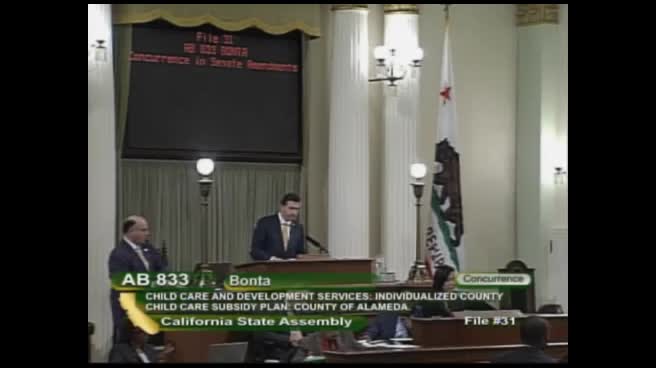
Bill Author

Bill Co-Author(s):