AB 858: Medi-Cal: federally qualified health centers and rural health clinics.
- Session Year: 2015-2016
- House: Assembly
- Latest Version Date: 2015-09-14
Existing law provides for the Medi-Cal program, which is administered by the State Department of Health Care Services, pursuant to which medical benefits are provided to public assistance recipients and certain other low-income persons. Existing law provides that federally qualified health center (FQHC) services and rural health clinic (RHC) services, as defined, are covered benefits under the Medi-Cal program, to be reimbursed, to the extent that federal financial participation is obtained, to providers on a per-visit basis. Visit is defined as a face-to-face encounter between a patient of an FQHC or RHC and specified health care professionals. Existing law allows an FQHC or RHC to apply for an adjustment to its per-visit rate based on a change in the scope of services it provides.
This bill would also include a marriage and family therapist within those health care professionals covered under the definition of visit. The bill would require an FQHC or RHC that currently includes the cost of services of a marriage and family therapist for the purposes of establishing its FQHC or RHC rate to apply to the department for an adjustment to its per-visit rate, and, after the rate adjustment has been approved by the department, would require the FQHC or RHC to bill these services as a separate visit, as specified. The bill would require an FQHC or RHC that does not provide the services of a marriage and family therapist, and later elects to add these services, to process the addition of these services as a change in scope of service.
This bill would incorporate additional changes to Section 14132.100 of the Welfare and Institutions Code made by this bill and SB 610 to take effect if both bills are enacted and this bill is enacted last.
Existing law provides for the Medi-Cal program, which is administered by the State Department of Health Care Services, pursuant to which medical benefits are provided to public assistance recipients and certain other low-income persons. Existing law provides that federally qualified health center (FQHC) services and rural health clinic (RHC) services, as defined, are covered benefits under the Medi-Cal program, to be reimbursed, to the extent that federal financial participation is obtained, to providers on a per-visit basis. Visit is defined as a face-to-face encounter between a patient of an FQHC or RHC and specified health care professionals. Existing law allows an FQHC or RHC to apply for an adjustment to its per-visit rate based on a change in the scope of services it provides.
This bill would also include a marriage and family therapist within those health care professionals covered under the definition of visit. The bill would require an FQHC or RHC that currently includes the cost of services of a marriage and family therapist for the purposes of establishing its FQHC or RHC rate to apply to the department for an adjustment to its per-visit rate, and, after the rate adjustment has been approved by the department, would require the FQHC or RHC to bill these services as a separate visit, as specified. The bill would require an FQHC or RHC that does not provide the services of a marriage and family therapist, and later elects to add these services, to process the addition of these services as a change in scope of service.
This bill would incorporate additional changes to Section 14132.100 of the Welfare and Institutions Code made by this bill and SB 610 to take effect if both bills are enacted and this bill is enacted last.
Existing law provides for the Medi-Cal program, which is administered by the State Department of Health Care Services, pursuant to which medical benefits are provided to public assistance recipients and certain other low-income persons. Existing law provides that federally qualified health center (FQHC) services and rural health clinic (RHC) services, as defined, are covered benefits under the Medi-Cal program, to be reimbursed, to the extent that federal financial participation is obtained, to providers on a per-visit basis. Visit is defined as a face-to-face encounter between a patient of an FQHC or RHC and specified health care professionals. Existing law allows an FQHC or RHC to apply for an adjustment to its per-visit rate based on a change in the scope of services it provides.
This bill would also include a marriage and family therapist within those health care professionals covered under the definition of visit. The bill would require an FQHC or RHC that currently includes the cost of services of a marriage and family therapist for the purposes of establishing its FQHC or RHC rate to apply to the department for an adjustment to its per-visit rate, and, after the rate adjustment has been approved by the department, would require the FQHC or RHC to bill these services as a separate visit. visit, as specified. The bill would require an FQHC or RHC that does not provide the services of a marriage and family therapist, and later elects to add these services, to process the addition of these services as a change in scope of service.
Existing law provides for the Medi-Cal program, which is administered by the State Department of Health Care Services, pursuant to which medical benefits are provided to public assistance recipients and certain other low-income persons. Existing law provides that federally qualified health center (FQHC) services and rural health clinic (RHC) services, as defined, are covered benefits under the Medi-Cal program, to be reimbursed, to the extent that federal financial participation is obtained, to providers on a per-visit basis. Visit is defined as a face-to-face encounter between a patient of an FQHC or RHC and specified health care professionals. Existing law allows an FQHC or RHC to apply for an adjustment to its per-visit rate based on a change in the scope of services it provides.
This bill would provide that a maximum of 2 visits, as defined, taking place on the same day at a single location shall be reimbursed when either after the first visit the patient suffers illness or injury requiring additional diagnosis or treatment or the patient has a medical visit, as defined, and another health visit, as defined, or both. The bill would require an FQHC or RHC that currently includes the cost of encounters with more than one health professional that take place on the same day at a single location as constituting a single visit for purposes of establishing its FQHC or RHC rate to, by January 1, 2017, apply for an adjustment to its per-visit rate, and, after the rate adjustment has been approved by the department, require the FQHC or RHC to bill a medical visit and another health visit that take place on the same day at a single location as separate visits. The bill would make other conforming changes.
This bill would require the department, no later than March 30, 2016, to seek all necessary federal approvals to implement the changes described above.
This bill would also include a marriage and family therapist within those health care professionals covered under the definition of visit. The bill would require an FHQH FQHC or RHC that currently includes the cost of services of a marriage and family therapist for the purposes of establishing its FQHC or RHC rate to apply to the department for an adjustment to its per-visit rate, and, after the rate adjustment has been approved by the department, would require the FQHC or RHC to bill these services as a separate visit. The bill would require an FQHC or RHC that does not provide the services of a marriage and family therapist, and later elects to add these services, to process the addition of these services as a change in scope of service.
Existing law provides for the Medi-Cal program, which is administered by the State Department of Health Care Services, pursuant to which medical benefits are provided to public assistance recipients and certain other low-income persons. Existing law provides that federally qualified health center (FQHC) services and rural health clinic (RHC) services, as defined, are covered benefits under the Medi-Cal program, to be reimbursed, to the extent that federal financial participation is obtained, to providers on a per-visit basis. Visit is defined as a face-to-face encounter between a patient of an FQHC or RHC and specified health care professionals. Existing law allows an FQHC or RHC to apply for an adjustment to its per-visit rate based on a change in the scope of services it provides.
This bill would provide that a maximum of 2 visits, as defined, taking place on the same day at a single location shall be reimbursed when either after the first visit the patient suffers illness or injury requiring additional diagnosis or treatment or the patient has a medical visit, as defined, and another health visit, as defined, or both. The bill would require an FQHC or RHC that currently includes the cost of encounters with more than one health professional that take place on the same day at a single location as constituting a single visit for purposes of establishing its FQHC or RHC rate to, by January 1, 2017, apply for an adjustment to its per-visit rate, and, after the rate adjustment has been approved by the department, require the FQHC or RHC to bill a medical visit and another health visit that take place on the same day at a single location as separate visits. The bill would make other conforming changes.
This bill would require the department, no later than March 30, 2016, to seek all necessary federal approvals to implement the changes described above.
This bill would also include a marriage and family therapist within those health care professionals covered under the definition of visit. The bill would require an FHQH or RHC that currently includes the cost of services of a marriage and family therapist for the purposes of establishing its FQHC or RHC rate to apply to the department for an adjustment to its per-visit rate, and, after the rate adjustment has been approved by the department, would require the FQHC or RHC to bill these services as a separate visit. The bill would require an FQHC or RHC that does not provide the services of a marriage and family therapist, and later elects to add these services, to process the addition of these services as a change in scope of service.
Existing law provides for the Medi-Cal program, which is administered by the State Department of Health Care Services, pursuant to which medical benefits are provided to public assistance recipients and certain other low-income persons. Existing law provides that federally qualified health center (FQHC) services and rural health clinic (RHC) services, as defined, are covered benefits under the Medi-Cal program, to be reimbursed, to the extent that federal financial participation is obtained, to providers on a per-visit basis. Visit is defined as a face-to-face encounter between a patient of an FQHC or RHC and specified health care professionals. Existing law allows an FQHC or RHC to apply for an adjustment to its per-visit rate based on a change in the scope of services it provides.
This bill would provide that a maximum of 2 visits, as defined, taking place on the same day at a single location shall be reimbursed when either after the first visit the patient suffers illness or injury requiring additional diagnosis or treatment or the patient has a medical visit, as defined, and another health visit, as defined, or both. The bill would require an FQHC or RHC that currently includes the cost of encounters with more than one health professional that take place on the same day at a single location as constituting a single visit for purposes of establishing its FQHC or RHC rate to, by January 1, 2017, apply for an adjustment to its per-visit rate, and, after the rate adjustment has been approved by the department, require the FQHC or RHC to bill a medical visit and another health visit that take place on the same day at a single location as separate visits. The bill would make other conforming changes.
This bill would require the department, by January 15, 2016, to submit a state plan amendment to the federal Centers for Medicare and Medicaid Services reflecting the changes described above. no later than March 30, 2016, to seek all necessary federal approvals to implement the changes described above.Existing law provides for the Medi-Cal program, which is administered by the State Department of Health Care Services pursuant to which medical benefits are provided to public assistance recipients and certain other low-income persons. Existing law provides that federally qualified health center (FQHC) services and rural health clinic (RHC) services, as defined, are covered benefits under the Medi-Cal program, to be reimbursed, to the extent that federal financial participation is obtained, to providers on a per-visit basis. Visit is defined as a face-to-face encounter between a patient of an FQHC or RHC and specified health care professionals. Existing law allows an FQHC or RHC to apply for an adjustment to its per-visit rate based on a change in the scope of services it provides.
This bill would provide that a maximum of 2 visits, as defined, taking place on the same day at a single location shall be reimbursed when either after the first visit the patient suffers illness or injury requiring additional diagnosis or treatment or the patient has a medical visit, as defined, and another health visit, as defined, or both. The bill would require an FQHC or RHC that currently includes the cost of encounters with more than one health professional that take place on the same day at a single location as constituting a single visit for purposes of establishing its FQHC or RHC rate to, by January 1, 2017, apply for an adjustment to its per-visit rate, and, after the rate adjustment has been approved by the department, require the FQHC or RHC to bill a medical visit and another health visit that take place on the same day at a single location as separate visits. The bill would make other conforming changes.
This bill would require the department, by January 15, 2016, to submit a state plan amendment to the federal Centers for Medicare and Medicaid Services reflecting the changes described above.
(a)The federally qualified health center services described in Section 1396d(a)(2)(C) of Title 42 of the United States Code are covered benefits.
(b)The rural health clinic services described in Section 1396d(a)(2)(B) of Title 42 of the United States Code are covered benefits.
(c)Federally qualified health center services and rural health clinic services shall be reimbursed on a per-visit basis in accordance with the definition of visit set forth in subdivision (g).
(d)Effective October 1, 2004, and on each October 1, thereafter, until no longer required by federal law, federally qualified health center (FQHC) and rural health clinic (RHC) per-visit rates shall be increased by the Medicare Economic Index applicable to primary care services in the manner provided for in Section 1396a(bb)(3)(A) of Title 42 of the United States Code. Prior to January 1, 2004, FQHC and RHC per-visit rates shall be adjusted by the Medicare Economic Index in accordance with the methodology set forth in the state plan in effect on October 1, 2001.
(e)(1)An FQHC or RHC may apply for an adjustment to its per-visit rate based on a change in the scope of services provided by the FQHC or RHC. Rate changes based on a change in the scope of services provided by an FQHC or RHC shall be evaluated in accordance with Medicare reasonable cost principles, as set forth in Part 413 (commencing with Section 413.1) of Title 42 of the Code of Federal Regulations, or its successor.
(2)Subject to the conditions set forth in subparagraphs (A) to (D), inclusive, of paragraph (3), a change in scope of service means any of the following:
(A)The addition of a new FQHC or RHC service that is not incorporated in the baseline prospective payment system (PPS) rate, or a deletion of an FQHC or RHC service that is incorporated in the baseline PPS rate.
(B)A change in service due to amended regulatory requirements or rules.
(C)A change in service resulting from relocating or remodeling an FQHC or RHC.
(D)A change in types of services due to a change in applicable technology and medical practice utilized by the center or clinic.
(E)An increase in service intensity attributable to changes in the types of patients served, including, but not limited to, populations with HIV or AIDS, or other chronic diseases, or homeless, elderly, migrant, or other special populations.
(F)Any changes in any of the services described in subdivision (a) or (b), or in the provider mix of an FQHC or RHC or one of its sites.
(G)Changes in operating costs attributable to capital expenditures associated with a modification of the scope of any of the services described in subdivision (a) or (b), including new or expanded service facilities, regulatory compliance, or changes in technology or medical practices at the center or clinic.
(H)Indirect medical education adjustments and a direct graduate medical education payment that reflects the costs of providing teaching services to interns and residents.
(I)Any changes in the scope of a project approved by the federal Health Resources and Services Administration (HRSA).
(3)No change in costs shall, in and of itself, be considered a scope-of-service change unless all of the following apply:
(A)The increase or decrease in cost is attributable to an increase or decrease in the scope of services defined in subdivisions (a) and (b), as applicable.
(B)The cost is allowable under Medicare reasonable cost principles set forth in Part 413 (commencing with Section 413) of Subchapter B of Chapter 4 of Title 42 of the Code of Federal Regulations, or its successor.
(C)The change in the scope of services is a change in the type, intensity, duration, or amount of services, or any combination thereof.
(D)The net change in the FQHCs or RHCs rate equals or exceeds 1.75 percent for the affected FQHC or RHC site. For FQHCs and RHCs that filed consolidated cost reports for multiple sites to establish the initial prospective payment reimbursement rate, the 1.75-percent threshold shall be applied to the average per-visit rate of all sites for the purposes of calculating the cost associated with a scope-of-service change. Net change means the per-visit rate change attributable to the cumulative effect of all increases and decreases for a particular fiscal year.
(4)An FQHC or RHC may submit requests for scope-of-service changes once per fiscal year, only within 90 days following the beginning of the FQHCs or RHCs fiscal year. Any approved increase or decrease in the providers rate shall be retroactive to the beginning of the FQHCs or RHCs fiscal year in which the request is submitted.
(5)An FQHC or RHC shall submit a scope-of-service rate change request within 90 days of the beginning of any FQHC or RHC fiscal year occurring after the effective date of this section, if, during the FQHCs or RHCs prior fiscal year, the FQHC or RHC experienced a decrease in the scope of services provided that the FQHC or RHC either knew or should have known would have resulted in a significantly lower per-visit rate. If an FQHC or RHC discontinues providing onsite pharmacy or dental services, it shall submit a scope-of-service rate change request within 90 days of the beginning of the following fiscal year. The rate change shall be effective as provided for in paragraph (4). As used in this paragraph, significantly lower means an average per-visit rate decrease in excess of 2.5 percent.
(6)Notwithstanding paragraph (4), if the approved scope-of-service change or changes were initially implemented on or after the first day of an FQHCs or RHCs fiscal year ending in calendar year 2001, but before the adoption and issuance of written instructions for applying for a scope-of-service change, the adjusted reimbursement rate for that scope-of-service change shall be made retroactive to the date the scope-of-service change was initially implemented. Scope-of-service changes under this paragraph shall be required to be submitted within the later of 150 days after the adoption and issuance of the written instructions by the department, or 150 days after the end of the FQHCs or RHCs fiscal year ending in 2003.
(7)All references in this subdivision to fiscal year shall be construed to be references to the fiscal year of the individual FQHC or RHC, as the case may be.
(f)(1)An FQHC or RHC may request a supplemental payment if extraordinary circumstances beyond the control of the FQHC or RHC occur after December 31, 2001, and PPS payments are insufficient due to these extraordinary circumstances. Supplemental payments arising from extraordinary circumstances under this subdivision shall be solely and exclusively within the discretion of the department and shall not be subject to subdivision (l). These supplemental payments shall be determined separately from the scope-of-service adjustments described in subdivision (e). Extraordinary circumstances include, but are not limited to, acts of nature, changes in applicable requirements in the Health and Safety Code, changes in applicable licensure requirements, and changes in applicable rules or regulations. Mere inflation of costs alone, absent extraordinary circumstances, shall not be grounds for supplemental payment. If an FQHCs or RHCs PPS rate is sufficient to cover its overall costs, including those associated with the extraordinary circumstances, then a supplemental payment is not warranted.
(2)The department shall accept requests for supplemental payment at any time throughout the prospective payment rate year.
(3)Requests for supplemental payments shall be submitted in writing to the department and shall set forth the reasons for the request. Each request shall be accompanied by sufficient documentation to enable the department to act upon the request. Documentation shall include the data necessary to demonstrate that the circumstances for which supplemental payment is requested meet the requirements set forth in this section. Documentation shall include all of the following:
(A)A presentation of data to demonstrate reasons for the FQHCs or RHCs request for a supplemental payment.
(B)Documentation showing the cost implications. The cost impact shall be material and significant, two hundred thousand dollars ($200,000) or 1 percent of a facilitys total costs, whichever is less.
(4)A request shall be submitted for each affected year.
(5)Amounts granted for supplemental payment requests shall be paid as lump-sum amounts for those years and not as revised PPS rates, and shall be repaid by the FQHC or RHC to the extent that it is not expended for the specified purposes.
(6)The department shall notify the provider of the departments discretionary decision in writing.
(g)(1)An FQHC or RHC visit means a face-to-face encounter between an FQHC or RHC patient and a physician, physician assistant, nurse practitioner, certified nurse-midwife, clinical psychologist, licensed clinical social worker, or a visiting nurse. For purposes of this section, physician shall be interpreted in a manner consistent with the Centers for Medicare and Medicaid Services Medicare Rural Health Clinic and Federally Qualified Health Center Manual (Publication 27), or its successor, only to the extent that it defines the professionals whose services are reimbursable on a per-visit basis and not as to the types of services that these professionals may render during these visits and shall include a medical doctor, osteopath, podiatrist, dentist, optometrist, and chiropractor. A visit shall also include a face-to-face encounter between an FQHC or RHC patient and a comprehensive perinatal practitioner, as defined in Section 51179.7 of Title 22 of the California Code of Regulations, providing comprehensive perinatal services, a four-hour day of attendance at an adult day health care center, and any other provider identified in the state plans definition of an FQHC or RHC visit.
(2)(A)A visit shall also include a face-to-face encounter between an FQHC or RHC patient and a dental hygienist, a dental hygienist in alternative practice, or a marriage and family therapist.
(B)Notwithstanding subdivision (e), an FQHC or RHC that currently includes the cost of the services of a dental hygienist in alternative practice, or a marriage and family therapist, for the purposes of establishing its FQHC or RHC rate shall apply for an adjustment to its per-visit rate, and, after the rate adjustment has been approved by the department, shall bill these services as a separate visit. However, multiple encounters with dental professionals or marriage and family therapists that take place on the same day shall constitute a single visit. The department shall develop the appropriate forms to determine which FQHCs or RHCs rates shall be adjusted and to facilitate the calculation of the adjusted rates. An FQHCs or RHCs application for, or the departments approval of, a rate adjustment pursuant to this subparagraph shall not constitute a change in scope of service within the meaning of subdivision (e). An FQHC or RHC that applies for an adjustment to its rate pursuant to this subparagraph may continue to bill for all other FQHC or RHC visits at its existing per-visit rate, subject to reconciliation, until the rate adjustment for visits between an FQHC or RHC patient and a dental hygienist, a dental hygienist in alternative practice, or a marriage and family therapist has been approved. Any approved increase or decrease in the providers rate shall be made within six months after the date of receipt of the departments rate adjustment forms pursuant to this subparagraph and shall be retroactive to the beginning of the fiscal year in which the FQHC or RHC submits the request, but in no case shall the effective date be earlier than January 1, 2008.
(C)An FQHC or RHC that does not provide dental hygienist, dental hygienist in alternative practice, or marriage and family therapist services, and later elects to add these services, shall process the addition of these services as a change in scope of service pursuant to subdivision (e).
(h)If FQHC or RHC services are partially reimbursed by a third-party payer, such as a managed care entity (as defined in Section 1396u-2(a)(1)(B) of Title 42 of the United States Code), the Medicare program, or the Child Health and Disability Prevention (CHDP) program, the department shall reimburse an FQHC or RHC for the difference between its per-visit PPS rate and receipts from other plans or programs on a contract-by-contract basis and not in the aggregate, and may not include managed care financial incentive payments that are required by federal law to be excluded from the calculation.
(i)(1)An entity that first qualifies as an FQHC or RHC in the year 2001 or later, a newly licensed facility at a new location added to an existing FQHC or RHC, and any entity that is an existing FQHC or RHC that is relocated to a new site shall each have its reimbursement rate established in accordance with one of the following methods, as selected by the FQHC or RHC:
(A)The rate may be calculated on a per-visit basis in an amount that is equal to the average of the per-visit rates of three comparable FQHCs or RHCs located in the same or adjacent area with a similar caseload.
(B)In the absence of three comparable FQHCs or RHCs with a similar caseload, the rate may be calculated on a per-visit basis in an amount that is equal to the average of the per-visit rates of three comparable FQHCs or RHCs located in the same or an adjacent service area, or in a reasonably similar geographic area with respect to relevant social, health care, and economic characteristics.
(C)At a new entitys one-time election, the department shall establish a reimbursement rate, calculated on a per-visit basis, that is equal to 100 percent of the projected allowable costs to the FQHC or RHC of furnishing FQHC or RHC services during the first 12 months of operation as an FQHC or RHC. After the first 12-month period, the projected per-visit rate shall be increased by the Medicare Economic Index then in effect. The projected allowable costs for the first 12 months shall be cost settled and the prospective payment reimbursement rate shall be adjusted based on actual and allowable cost per visit.
(D)The department may adopt any further and additional methods of setting reimbursement rates for newly qualified FQHCs or RHCs as are consistent with Section 1396a(bb)(4) of Title 42 of the United States Code.
(2)In order for an FQHC or RHC to establish the comparability of its caseload for purposes of subparagraph (A) or (B) of paragraph (1), the department shall require that the FQHC or RHC submit its most recent annual utilization report as submitted to the Office of Statewide Health Planning and Development, unless the FQHC or RHC was not required to file an annual utilization report. FQHCs or RHCs that have experienced changes in their services or caseload subsequent to the filing of the annual utilization report may submit to the department a completed report in the format applicable to the prior calendar year. FQHCs or RHCs that have not previously submitted an annual utilization report shall submit to the department a completed report in the format applicable to the prior calendar year. The FQHC or RHC shall not be required to submit the annual utilization report for the comparable FQHCs or RHCs to the department, but shall be required to identify the comparable FQHCs or RHCs.
(3)The rate for any newly qualified entity set forth under this subdivision shall be effective retroactively to the later of the date that the entity was first qualified by the applicable federal agency as an FQHC or RHC, the date a new facility at a new location was added to an existing FQHC or RHC, or the date on which an existing FQHC or RHC was relocated to a new site. The FQHC or RHC shall be permitted to continue billing for Medi-Cal covered benefits on a fee-for-service basis under its existing provider number until it is informed of its FQHC or RHC enrollment approval, and the department shall reconcile the difference between the fee-for-service payments and the FQHCs or RHCs prospective payment rate at that time.
(j)Visits occurring at an intermittent clinic site, as defined in subdivision (h) of Section 1206 of the Health and Safety Code, of an existing FQHC or RHC, or in a mobile unit as defined by paragraph (2) of subdivision (b) of Section 1765.105 of the Health and Safety Code, shall be billed by and reimbursed at the same rate as the FQHC or RHC establishing the intermittent clinic site or the mobile unit, subject to the right of the FQHC or RHC to request a scope-of-service adjustment to the rate.
(k)An FQHC or RHC may elect to have pharmacy or dental services reimbursed on a fee-for-service basis, utilizing the current fee schedules established for those services. These costs shall be adjusted out of the FQHCs or RHCs clinic base rate as scope-of-service changes. An FQHC or RHC that reverses its election under this subdivision shall revert to its prior rate, subject to an increase to account for all Medicare Economic Index increases occurring during the intervening time period, and subject to any increase or decrease associated with applicable scope-of-service adjustments as provided in subdivision (e).
(l)FQHCs and RHCs may appeal a grievance or complaint concerning ratesetting, scope-of-service changes, and settlement of cost report audits, in the manner prescribed by Section 14171. The rights and remedies provided under this subdivision are cumulative to the rights and remedies available under all other provisions of law of this state.
(m)The department shall, no later than March 30, 2008, promptly seek all necessary federal approvals in order to implement this section, including any amendments to the state plan. To the extent that any element or requirement of this section is not approved, the department shall submit a request to the federal Centers for Medicare and Medicaid Services for any waivers that would be necessary to implement this section.
(n)The department shall implement this section only to the extent that federal financial participation is obtained.
SEC. 1.5.Section 14132.100 of the Welfare and Institutions Code is amended to read:14132.100.(a)The federally qualified health center services described in Section 1396d(a)(2)(C) of Title 42 of the United States Code are covered benefits.
(b)The rural health clinic services described in Section 1396d(a)(2)(B) of Title 42 of the United States Code are covered benefits.
(c)Federally qualified health center services and rural health clinic services shall be reimbursed on a per-visit basis in accordance with the definition of visit set forth in subdivision (g).
(d)Effective October 1, 2004, and on each October 1 thereafter, until no longer required by federal law, federally qualified health center (FQHC) and rural health clinic (RHC) per-visit rates shall be increased by the Medicare Economic Index applicable to primary care services in the manner provided for in Section 1396a(bb)(3)(A) of Title 42 of the United States Code. Prior to January 1, 2004, FQHC and RHC per-visit rates shall be adjusted by the Medicare Economic Index in accordance with the methodology set forth in the state plan in effect on October 1, 2001.
(e)(1)An FQHC or RHC may apply for an adjustment to its per-visit rate based on a change in the scope of services provided by the FQHC or RHC. Rate changes based on a change in the scope of services provided by an FQHC or RHC shall be evaluated in accordance with Medicare reasonable cost principles, as set forth in Part 413 (commencing with Section 413.1) of Title 42 of the Code of Federal Regulations, or its successor.
(2)Subject to the conditions set forth in subparagraphs (A) to (D), inclusive, of paragraph (3), a change in scope of service means any of the following:
(A)The addition of a new FQHC or RHC service that is not incorporated in the baseline prospective payment system (PPS) rate, or a deletion of an FQHC or RHC service that is incorporated in the baseline PPS rate.
(B)A change in service due to amended regulatory requirements or rules.
(C)A change in service resulting from relocating or remodeling an FQHC or RHC.
(D)A change in types of services due to a change in applicable technology and medical practice utilized by the center or clinic.
(E)An increase in service intensity attributable to changes in the types of patients served, including, but not limited to, populations with HIV or AIDS, or other chronic diseases, or homeless, elderly, migrant, or other special populations.
(F)Any changes in any of the services described in subdivision (a) or (b), or in the provider mix of an FQHC or RHC or one of its sites.
(G)Changes in operating costs attributable to capital expenditures associated with a modification of the scope of any of the services described in subdivision (a) or (b), including new or expanded service facilities, regulatory compliance, or changes in technology or medical practices at the center or clinic.
(H)Indirect medical education adjustments and a direct graduate medical education payment that reflects the costs of providing teaching services to interns and residents.
(I)Any changes in the scope of a project approved by the federal Health Resources and Services Administration (HRSA).
(3)No change in costs shall, in and of itself, be considered a scope-of-service change unless all of the following apply:
(A)The increase or decrease in cost is attributable to an increase or decrease in the scope of services defined in subdivisions (a) and (b), as applicable.
(B)The cost is allowable under Medicare reasonable cost principles set forth in Part 413 (commencing with Section 413) of Subchapter B of Chapter 4 of Title 42 of the Code of Federal Regulations, or its successor.
(C)The change in the scope of services is a change in the type, intensity, duration, or amount of services, or any combination thereof.
(D)The net change in the FQHCs or RHCs rate equals or exceeds 1.75 percent for the affected FQHC or RHC site. For FQHCs and RHCs that filed consolidated cost reports for multiple sites to establish the initial prospective payment reimbursement rate, the 1.75-percent threshold shall be applied to the average per-visit rate of all sites for the purposes of calculating the cost associated with a scope-of-service change. Net change means the per-visit rate change attributable to the cumulative effect of all increases and decreases for a particular fiscal year.
(4)An FQHC or RHC may submit requests for scope-of-service changes once per fiscal year, only within 90 days following the beginning of the FQHCs or RHCs fiscal year. Any approved increase or decrease in the providers rate shall be retroactive to the beginning of the FQHCs or RHCs fiscal year in which the request is submitted.
(5)An FQHC or RHC shall submit a scope-of-service rate change request within 90 days after the beginning of any FQHC or RHC fiscal year occurring after the effective date of this section, if, during the FQHCs or RHCs prior fiscal year, the FQHC or RHC experienced a decrease in the scope of services provided that the FQHC or RHC either knew or should have known would have resulted in a significantly lower per-visit rate. If an FQHC or RHC discontinues providing onsite pharmacy or dental services, it shall submit a scope-of-service rate change request within 90 days after the beginning of the following fiscal year. The rate change shall be effective as provided for in paragraph (4). As used in this paragraph, significantly lower means an average per-visit rate decrease in excess of 2.5 percent.
(6)(A)The department shall conduct an initial review of a scope-of-service rate change request within 30 days after submission by an FQHC or RHC.
(B)If the department determines that additional information is necessary to finalize a new rate, the department shall notify the FQHC or RHC, no later than the 31st day after submission. The notification shall state the reason or reasons the submitted information is insufficient and shall request submission of supplemental information from the FQHC or RHC.
(C)Within one year after receiving a submission that it determines to be complete, the department shall finalize the FQHCs or RHCs rate and shall update the provider master file within 10 business days.
(7)Notwithstanding paragraph (4), if the approved scope-of-service change or changes were initially implemented on or after the first day of an FQHCs or RHCs fiscal year ending in calendar year 2001, but before the adoption and issuance of written instructions for applying for a scope-of-service change, the adjusted reimbursement rate for that scope-of-service change shall be made retroactive to the date the scope-of-service change was initially implemented. Scope-of-service changes under this paragraph shall be required to be submitted within the later of 150 days after the adoption and issuance of the written instructions by the department, or 150 days after the end of the FQHCs or RHCs fiscal year ending in 2003.
(8)All references in this subdivision to fiscal year shall be construed to be references to the fiscal year of the individual FQHC or RHC, as the case may be.
(f)(1)An FQHC or RHC may request a supplemental payment if extraordinary circumstances beyond the control of the FQHC or RHC occur after December 31, 2001, and PPS payments are insufficient due to these extraordinary circumstances. Supplemental payments arising from extraordinary circumstances under this subdivision shall be solely and exclusively within the discretion of the department and shall not be subject to subdivision (l). These supplemental payments shall be determined separately from the scope-of-service adjustments described in subdivision (e). Extraordinary circumstances include, but are not limited to, acts of nature, changes in applicable requirements in the Health and Safety Code, changes in applicable licensure requirements, and changes in applicable rules or regulations. Mere inflation of costs alone, absent extraordinary circumstances, shall not be grounds for supplemental payment. If an FQHCs or RHCs PPS rate is sufficient to cover its overall costs, including those associated with the extraordinary circumstances, then a supplemental payment is not warranted.
(2)The department shall accept requests for supplemental payment at any time throughout the prospective payment rate year.
(3)Requests for supplemental payments shall be submitted in writing to the department and shall set forth the reasons for the request. Each request shall be accompanied by sufficient documentation to enable the department to act upon the request. Documentation shall include the data necessary to demonstrate that the circumstances for which supplemental payment is requested meet the requirements set forth in this section. Documentation shall include all of the following:
(A)A presentation of data to demonstrate reasons for the FQHCs or RHCs request for a supplemental payment.
(B)Documentation showing the cost implications. The cost impact shall be material and significant, two hundred thousand dollars ($200,000) or 1 percent of a facilitys total costs, whichever is less.
(4)A request shall be submitted for each affected year.
(5)Amounts granted for supplemental payment requests shall be paid as lump-sum amounts for those years and not as revised PPS rates, and shall be repaid by the FQHC or RHC to the extent that it is not expended for the specified purposes.
(6)The department shall notify the provider of the departments discretionary decision in writing.
(g)(1)An FQHC or RHC visit means a face-to-face encounter between an FQHC or RHC patient and a physician, physician assistant, nurse practitioner, certified nurse-midwife, clinical psychologist, licensed clinical social worker, or a visiting nurse. For purposes of this section, physician shall be interpreted in a manner consistent with the federal Centers for Medicare and Medicaid Services Medicare Rural Health Clinic and Federally Qualified Health Center Manual (Publication 27), or its successor, only to the extent that it defines the professionals whose services are reimbursable on a per-visit basis and not as to the types of services that these professionals may render during these visits and shall include a medical doctor, osteopath, podiatrist, dentist, optometrist, and chiropractor. A visit shall also include a face-to-face encounter between an FQHC or RHC patient and a comprehensive perinatal practitioner, as defined in Section 51179.7 of Title 22 of the California Code of Regulations, providing comprehensive perinatal services, a four-hour day of attendance at an adult day health care center, and any other provider identified in the state plans definition of an FQHC or RHC visit.
(2)(A)A visit shall also include a face-to-face encounter between an FQHC or RHC patient and a dental hygienist, a dental hygienist in alternative practice, or a marriage and family therapist.
(B)Notwithstanding subdivision (e), an FQHC or RHC that currently includes the cost of the services of a dental hygienist in alternative practice, or a marriage and family therapist for the purposes of establishing its FQHC or RHC rate shall apply for an adjustment to its per-visit rate, and, after the rate adjustment has been approved by the department, shall bill these services as a separate visit. However, multiple encounters with dental professionals or marriage and family therapists that take place on the same day shall constitute a single visit. The department shall develop the appropriate forms to determine which FQHCs or RHCs rates shall be adjusted and to facilitate the calculation of the adjusted rates. An FQHCs or RHCs application for, or the departments approval of, a rate adjustment pursuant to this subparagraph shall not constitute a change in scope of service within the meaning of subdivision (e). An FQHC or RHC that applies for an adjustment to its rate pursuant to this subparagraph may continue to bill for all other FQHC or RHC visits at its existing per-visit rate, subject to reconciliation, until the rate adjustment for visits between an FQHC or RHC patient and a dental hygienist, a dental hygienist in alternative practice, or a marriage and family therapist has been approved. Any approved increase or decrease in the providers rate shall be made within six months after the date of receipt of the departments rate adjustment forms pursuant to this subparagraph and shall be retroactive to the beginning of the fiscal year in which the FQHC or RHC submits the request, but in no case shall the effective date be earlier than January 1, 2008.
(C)An FQHC or RHC that does not provide dental hygienist, dental hygienist in alternative practice, or marriage and family therapist services, and later elects to add these services, shall process the addition of these services as a change in scope of service pursuant to subdivision (e).
(h)If FQHC or RHC services are partially reimbursed by a third-party payer, such as a managed care entity (as defined in Section 1396u-2(a)(1)(B) of Title 42 of the United States Code), the Medicare program, or the Child Health and Disability Prevention (CHDP) program, the department shall reimburse an FQHC or RHC for the difference between its per-visit PPS rate and receipts from other plans or programs on a contract-by-contract basis and not in the aggregate, and may not include managed care financial incentive payments that are required by federal law to be excluded from the calculation.
(i)(1)An entity that first qualifies as an FQHC or RHC in the year 2001 or later, a newly licensed facility at a new location added to an existing FQHC or RHC, and any entity that is an existing FQHC or RHC that is relocated to a new site shall each have its reimbursement rate established in accordance with one of the following methods, as selected by the FQHC or RHC:
(A)The rate may be calculated on a per-visit basis in an amount that is equal to the average of the per-visit rates of three comparable FQHCs or RHCs located in the same or adjacent area with a similar caseload.
(B)In the absence of three comparable FQHCs or RHCs with a similar caseload, the rate may be calculated on a per-visit basis in an amount that is equal to the average of the per-visit rates of three comparable FQHCs or RHCs located in the same or an adjacent service area, or in a reasonably similar geographic area with respect to relevant social, health care, and economic characteristics.
(C)At a new entitys one-time election, the department shall establish a reimbursement rate, calculated on a per-visit basis, that is equal to 100 percent of the projected allowable costs to the FQHC or RHC of furnishing FQHC or RHC services during the first 12 months of operation as an FQHC or RHC. After the first 12-month period, the projected per-visit rate shall be increased by the Medicare Economic Index (MEI) then in effect. The projected allowable costs for the first 12 months shall be cost settled and the prospective payment reimbursement rate shall be adjusted based on actual and allowable cost per visit. The department shall finalize a new rate within one year after the submission of the actual cost report from the first full 12 months of operation and shall update the department provider master file within 10 business days after finalizing the rate.
(D)The department may adopt any further and additional methods of setting reimbursement rates for newly qualified FQHCs or RHCs as are consistent with Section 1396a(bb)(4) of Title 42 of the United States Code.
(2)(A)In order for an FQHC or RHC to establish the comparability of its caseload, the department shall require that the FQHC or RHC submit its most recent annual utilization report as submitted to the Office of Statewide Health Planning and Development, unless the FQHC or RHC was not required to file an annual utilization report. FQHCs or RHCs that have experienced changes in their services or caseload subsequent to the filing of the annual utilization report may submit to the department a completed report in the format applicable to the prior calendar year. FQHCs or RHCs that have not previously submitted an annual utilization report shall submit to the department a completed report in the format applicable to the prior calendar year. The FQHC or RHC shall not be required to submit the annual utilization report for the comparable FQHCs or RHCs to the department, but shall be required to identify the comparable FQHCs or RHCs. This paragraph shall apply only to a facility that selects the comparability approach described in subparagraph (A) or (B) of paragraph (1).
(B)The department shall conduct an initial review of the three FQHCs or RHCs for the purpose of determining comparability within 30 days after submission by the new entity. If the department determines one or more of the submitted centers or clinics do not meet the comparability threshold, the department shall notify the new entity no later than the 31st day after submission.
(C)The notification shall state the reason or reasons for the finding of noncomparability and shall request a supplemental submission from the new entity. The request shall clearly state whether the new entity shall submit data from one, two, or three FQHCs or RHCs to meet the comparability threshold. Once the new entity submits its supplemental information, the initial review process described in subparagraph (B) shall apply.
(D)Within one year after receiving a submission determined by the department to be comparable, the department shall finalize the new entitys rate and shall update the provider master file within 10 business days.
(3)The rate for any newly qualified entity set forth under this subdivision shall be effective retroactively to the later of the date that the entity was first qualified by the applicable federal agency as an FQHC or RHC, the date a new facility at a new location was added to an existing FQHC or RHC, or the date on which an existing FQHC or RHC was relocated to a new site. The FQHC or RHC shall be permitted to continue billing for Medi-Cal covered benefits on a fee-for-service basis under its existing provider number, until it is informed of its FQHC or RHC enrollment approval, and the department shall reconcile the difference between the fee-for-service payments and the FQHCs or RHCs prospective payment rate at that time.
(j)Visits occurring at an intermittent clinic site, as defined in subdivision (h) of Section 1206 of the Health and Safety Code, of an existing FQHC or RHC, or in a mobile unit as defined by paragraph (2) of subdivision (b) of Section 1765.105 of the Health and Safety Code, shall be billed by and reimbursed at the same rate as the FQHC or RHC establishing the intermittent clinic site or the mobile unit, subject to the right of the FQHC or RHC to request a scope-of-service adjustment to the rate.
(k)An FQHC or RHC may elect to have pharmacy or dental services reimbursed on a fee-for-service basis, utilizing the current fee schedules established for those services. These costs shall be adjusted out of the FQHCs or RHCs clinic base rate as scope-of-service changes. An FQHC or RHC that reverses its election under this subdivision shall revert to its prior rate, subject to an increase to account for all Medicare Economic Index increases occurring during the intervening time period, and subject to any increase or decrease associated with applicable scope-of-service adjustments as provided in subdivision (e).
(l)FQHCs and RHCs may appeal a grievance or complaint concerning ratesetting, scope-of-service changes, and settlement of cost report audits, in the manner prescribed by Section 14171. The rights and remedies provided under this subdivision are cumulative to the rights and remedies available under all other provisions of law of this state.
(m)The department shall, no later than March 30, 2008, promptly seek all necessary federal approvals in order to implement this section, including any amendments to the state plan. To the extent that any element or requirement of this section is not approved, the department shall submit a request to the federal Centers for Medicare and Medicaid Services for any waivers that would be necessary to implement this section.
(n)The department shall implement this section only to the extent that federal financial participation is obtained.
(o)The department shall correct erroneous payments at least quarterly to reprocess past claims and ensure all claims are reimbursed at the finalized new rate determined pursuant to either subdivision (e) or (i).
SEC. 2.Section 1.5 of this bill incorporates amendments to Section 14132.100 of the Welfare and Institutions Code proposed by both this bill and Senate Bill 610. It shall only become operative if (1) both bills are enacted and become effective on or before January 1, 2016, (2) each bill amends Section 14132.100 of the Welfare and Institutions Code, and (3) this bill is enacted after Senate Bill 610, in which case Section 1 of this bill shall not become operative.
(a)The federally qualified health center services described in Section 1396d(a)(2)(C) of Title 42 of the United States Code are covered benefits.
(b)The rural health clinic services described in Section 1396d(a)(2)(B) of Title 42 of the United States Code are covered benefits.
(c)Federally qualified health center services and rural health clinic services shall be reimbursed on a per-visit basis in accordance with the definition of visit set forth in subdivision (g).
(d)Effective October 1, 2004, and on each October 1, thereafter, until no longer required by federal law, federally qualified health center (FQHC) and rural health clinic (RHC) per-visit rates shall be increased by the Medicare Economic Index applicable to primary care services in the manner provided for in Section 1396a(bb)(3)(A) of Title 42 of the United States Code. Prior to January 1, 2004, FQHC and RHC per-visit rates shall be adjusted by the Medicare Economic Index in accordance with the methodology set forth in the state plan in effect on October 1, 2001.
(e)(1)An FQHC or RHC may apply for an adjustment to its per-visit rate based on a change in the scope of services provided by the FQHC or RHC. Rate changes based on a change in the scope of services provided by an FQHC or RHC shall be evaluated in accordance with Medicare reasonable cost principles, as set forth in Part 413 (commencing with Section 413.1) of Title 42 of the Code of Federal Regulations, or its successor.
(2)Subject to the conditions set forth in subparagraphs (A) to (D), inclusive, of paragraph (3), a change in scope of service means any of the following:
(A)The addition of a new FQHC or RHC service that is not incorporated in the baseline prospective payment system (PPS) rate, or a deletion of an FQHC or RHC service that is incorporated in the baseline PPS rate.
(B)A change in service due to amended regulatory requirements or rules.
(C)A change in service resulting from relocating or remodeling an FQHC or RHC.
(D)A change in types of services due to a change in applicable technology and medical practice utilized by the center or clinic.
(E)An increase in service intensity attributable to changes in the types of patients served, including, but not limited to, populations with HIV or AIDS, or other chronic diseases, or homeless, elderly, migrant, or other special populations.
(F)Any changes in any of the services described in subdivision (a) or (b), or in the provider mix of an FQHC or RHC or one of its sites.
(G)Changes in operating costs attributable to capital expenditures associated with a modification of the scope of any of the services described in subdivision (a) or (b), including new or expanded service facilities, regulatory compliance, or changes in technology or medical practices at the center or clinic.
(H)Indirect medical education adjustments and a direct graduate medical education payment that reflects the costs of providing teaching services to interns and residents.
(I)Any changes in the scope of a project approved by the federal Health Resources and Services Administration (HRSA).
(3)No change in costs shall, in and of itself, be considered a scope-of-service change unless all of the following apply:
(A)The increase or decrease in cost is attributable to an increase or decrease in the scope of services defined in subdivisions (a) and (b), as applicable.
(B)The cost is allowable under Medicare reasonable cost principles set forth in Part 413 (commencing with Section 413) of Subchapter B of Chapter 4 of Title 42 of the Code of Federal Regulations, or its successor.
(C)The change in the scope of services is a change in the type, intensity, duration, or amount of services, or any combination thereof.
(D)The net change in the FQHCs or RHCs rate equals or exceeds 1.75 percent for the affected FQHC or RHC site. For FQHCs and RHCs that filed consolidated cost reports for multiple sites to establish the initial prospective payment reimbursement rate, the 1.75-percent threshold shall be applied to the average per-visit rate of all sites for the purposes of calculating the cost associated with a scope-of-service change. Net change means the per-visit rate change attributable to the cumulative effect of all increases and decreases for a particular fiscal year.
(4)An FQHC or RHC may submit requests for scope-of-service changes once per fiscal year, only within 90 days following the beginning of the FQHCs or RHCs fiscal year. Any approved increase or decrease in the providers rate shall be retroactive to the beginning of the FQHCs or RHCs fiscal year in which the request is submitted.
(5)An FQHC or RHC shall submit a scope-of-service rate change request within 90 days of the beginning of any FQHC or RHC fiscal year occurring after the effective date of this section, if, during the FQHCs or RHCs prior fiscal year, the FQHC or RHC experienced a decrease in the scope of services provided that the FQHC or RHC either knew or should have known would have resulted in a significantly lower per-visit rate. If an FQHC or RHC discontinues providing onsite pharmacy or dental services, it shall submit a scope-of-service rate change request within 90 days of the beginning of the following fiscal year. The rate change shall be effective as provided for in paragraph (4). As used in this paragraph, significantly lower means an average per-visit rate decrease in excess of 2.5 percent.
(6)Notwithstanding paragraph (4), if the approved scope-of-service change or changes were initially implemented on or after the first day of an FQHCs or RHCs fiscal year ending in calendar year 2001, but before the adoption and issuance of written instructions for applying for a scope-of-service change, the adjusted reimbursement rate for that scope-of-service change shall be made retroactive to the date the scope-of-service change was initially implemented. Scope-of-service changes under this paragraph shall be required to be submitted within the later of 150 days after the adoption and issuance of the written instructions by the department, or 150 days after the end of the FQHCs or RHCs fiscal year ending in 2003.
(7)All references in this subdivision to fiscal year shall be construed to be references to the fiscal year of the individual FQHC or RHC, as the case may be.
(f)(1)An FQHC or RHC may request a supplemental payment if extraordinary circumstances beyond the control of the FQHC or RHC occur after December 31, 2001, and PPS payments are insufficient due to these extraordinary circumstances. Supplemental payments arising from extraordinary circumstances under this subdivision shall be solely and exclusively within the discretion of the department and shall not be subject to subdivision (l). These supplemental payments shall be determined separately from the scope-of-service adjustments described in subdivision (e). Extraordinary circumstances include, but are not limited to, acts of nature, changes in applicable requirements in the Health and Safety Code, changes in applicable licensure requirements, and changes in applicable rules or regulations. Mere inflation of costs alone, absent extraordinary circumstances, shall not be grounds for supplemental payment. If an FQHCs or RHCs PPS rate is sufficient to cover its overall costs, including those associated with the extraordinary circumstances, then a supplemental payment is not warranted.
(2)The department shall accept requests for supplemental payment at any time throughout the prospective payment rate year.
(3)Requests for supplemental payments shall be submitted in writing to the department and shall set forth the reasons for the request. Each request shall be accompanied by sufficient documentation to enable the department to act upon the request. Documentation shall include the data necessary to demonstrate that the circumstances for which supplemental payment is requested meet the requirements set forth in this section. Documentation shall include all of the following:
(A)A presentation of data to demonstrate reasons for the FQHCs or RHCs request for a supplemental payment.
(B)Documentation showing the cost implications. The cost impact shall be material and significant, two hundred thousand dollars ($200,000) or 1 percent of a facilitys total costs, whichever is less.
(4)A request shall be submitted for each affected year.
(5)Amounts granted for supplemental payment requests shall be paid as lump-sum amounts for those years and not as revised PPS rates, and shall be repaid by the FQHC or RHC to the extent that it is not expended for the specified purposes.
(6)The department shall notify the provider of the departments discretionary decision in writing.
(g)(1)An FQHC or RHC visit means a face-to-face encounter between an FQHC or RHC patient and a physician, physician assistant, nurse practitioner, certified nurse-midwife, clinical psychologist, licensed clinical social worker, or a visiting nurse. For purposes of this section, physician shall be interpreted in a manner consistent with the Centers for Medicare and Medicaid Services Medicare Rural Health Clinic and Federally Qualified Health Center Manual (Publication 27), or its successor, only to the extent that it defines the professionals whose services are reimbursable on a per-visit basis and not as to the types of services that these professionals may render during these visits and shall include a medical doctor, osteopath, podiatrist, dentist, optometrist, and chiropractor. A visit shall also include a face-to-face encounter between an FQHC or RHC patient and a comprehensive perinatal practitioner, as defined in Section 51179.7 of Title 22 of the California Code of Regulations, providing comprehensive perinatal services, a four-hour day of attendance at an adult day health care center, and any other provider identified in the state plans definition of an FQHC or RHC visit.
(2)(A)A visit shall also include a face-to-face encounter between an FQHC or RHC patient and a dental hygienist, a dental hygienist in alternative practice, or a marriage and family therapist.
(B)Notwithstanding subdivision (e), an FQHC or RHC that currently includes the cost of the services of a dental hygienist in alternative practice, or a marriage and family therapist, for the purposes of establishing its FQHC or RHC rate shall apply for an adjustment to its per-visit rate, and, after the rate adjustment has been approved by the department, shall bill these services as a separate visit. However, multiple encounters with dental professionals or marriage and family therapists that take place on the same day shall constitute a single visit. The department shall develop the appropriate forms to determine which FQHCs or RHCs rates shall be adjusted and to facilitate the calculation of the adjusted rates. An FQHCs or RHCs application for, or the departments approval of, a rate adjustment pursuant to this subparagraph shall not constitute a change in scope of service within the meaning of subdivision (e). An FQHC or RHC that applies for an adjustment to its rate pursuant to this subparagraph may continue to bill for all other FQHC or RHC visits at its existing per-visit rate, subject to reconciliation, until the rate adjustment for visits between an FQHC or RHC patient and a dental hygienist, a dental hygienist in alternative practice, or a marriage and family therapist has been approved. Any approved increase or decrease in the providers rate shall be made within six months after the date of receipt of the departments rate adjustment forms pursuant to this subparagraph and shall be retroactive to the beginning of the fiscal year in which the FQHC or RHC submits the request, but in no case shall the effective date be earlier than January 1, 2008.
(C)An FQHC or RHC that does not provide dental hygienist, dental hygienist in alternative practice, or marriage and family therapist services, and later elects to add these services, shall process the addition of these services as a change in scope of service pursuant to subdivision (e).
(h)If FQHC or RHC services are partially reimbursed by a third-party payer, such as a managed care entity (as defined in Section 1396u-2(a)(1)(B) of Title 42 of the United States Code), the Medicare program, or the Child Health and Disability Prevention (CHDP) program, the department shall reimburse an FQHC or RHC for the difference between its per-visit PPS rate and receipts from other plans or programs on a contract-by-contract basis and not in the aggregate, and may not include managed care financial incentive payments that are required by federal law to be excluded from the calculation.
(i)(1)An entity that first qualifies as an FQHC or RHC in the year 2001 or later, a newly licensed facility at a new location added to an existing FQHC or RHC, and any entity that is an existing FQHC or RHC that is relocated to a new site shall each have its reimbursement rate established in accordance with one of the following methods, as selected by the FQHC or RHC:
(A)The rate may be calculated on a per-visit basis in an amount that is equal to the average of the per-visit rates of three comparable FQHCs or RHCs located in the same or adjacent area with a similar caseload.
(B)In the absence of three comparable FQHCs or RHCs with a similar caseload, the rate may be calculated on a per-visit basis in an amount that is equal to the average of the per-visit rates of three comparable FQHCs or RHCs located in the same or an adjacent service area, or in a reasonably similar geographic area with respect to relevant social, health care, and economic characteristics.
(C)At a new entitys one-time election, the department shall establish a reimbursement rate, calculated on a per-visit basis, that is equal to 100 percent of the projected allowable costs to the FQHC or RHC of furnishing FQHC or RHC services during the first 12 months of operation as an FQHC or RHC. After the first 12-month period, the projected per-visit rate shall be increased by the Medicare Economic Index then in effect. The projected allowable costs for the first 12 months shall be cost settled and the prospective payment reimbursement rate shall be adjusted based on actual and allowable cost per visit.
(D)The department may adopt any further and additional methods of setting reimbursement rates for newly qualified FQHCs or RHCs as are consistent with Section 1396a(bb)(4) of Title 42 of the United States Code.
(2)In order for an FQHC or RHC to establish the comparability of its caseload for purposes of subparagraph (A) or (B) of paragraph (1), the department shall require that the FQHC or RHC submit its most recent annual utilization report as submitted to the Office of Statewide Health Planning and Development, unless the FQHC or RHC was not required to file an annual utilization report. FQHCs or RHCs that have experienced changes in their services or caseload subsequent to the filing of the annual utilization report may submit to the department a completed report in the format applicable to the prior calendar year. FQHCs or RHCs that have not previously submitted an annual utilization report shall submit to the department a completed report in the format applicable to the prior calendar year. The FQHC or RHC shall not be required to submit the annual utilization report for the comparable FQHCs or RHCs to the department, but shall be required to identify the comparable FQHCs or RHCs.
(3)The rate for any newly qualified entity set forth under this subdivision shall be effective retroactively to the later of the date that the entity was first qualified by the applicable federal agency as an FQHC or RHC, the date a new facility at a new location was added to an existing FQHC or RHC, or the date on which an existing FQHC or RHC was relocated to a new site. The FQHC or RHC shall be permitted to continue billing for Medi-Cal covered benefits on a fee-for-service basis under its existing provider number until it is informed of its FQHC or RHC enrollment approval, and the department shall reconcile the difference between the fee-for-service payments and the FQHCs or RHCs prospective payment rate at that time.
(j)Visits occurring at an intermittent clinic site, as defined in subdivision (h) of Section 1206 of the Health and Safety Code, of an existing FQHC or RHC, or in a mobile unit as defined by paragraph (2) of subdivision (b) of Section 1765.105 of the Health and Safety Code, shall be billed by and reimbursed at the same rate as the FQHC or RHC establishing the intermittent clinic site or the mobile unit, subject to the right of the FQHC or RHC to request a scope-of-service adjustment to the rate.
(k)An FQHC or RHC may elect to have pharmacy or dental services reimbursed on a fee-for-service basis, utilizing the current fee schedules established for those services. These costs shall be adjusted out of the FQHCs or RHCs clinic base rate as scope-of-service changes. An FQHC or RHC that reverses its election under this subdivision shall revert to its prior rate, subject to an increase to account for all Medicare Economic Index increases occurring during the intervening time period, and subject to any increase or decrease associated with applicable scope-of-service adjustments as provided in subdivision (e).
(l)FQHCs and RHCs may appeal a grievance or complaint concerning ratesetting, scope-of-service changes, and settlement of cost report audits, in the manner prescribed by Section 14171. The rights and remedies provided under this subdivision are cumulative to the rights and remedies available under all other provisions of law of this state.
(m)The department shall, no later than March 30, 2008, promptly seek all necessary federal approvals in order to implement this section, including any amendments to the state plan. To the extent that any element or requirement of this section is not approved, the department shall submit a request to the federal Centers for Medicare and Medicaid Services for any waivers that would be necessary to implement this section.
(n)The department shall implement this section only to the extent that federal financial participation is obtained.
SEC. 1.5.Section 14132.100 of the Welfare and Institutions Code is amended to read:14132.100.(a)The federally qualified health center services described in Section 1396d(a)(2)(C) of Title 42 of the United States Code are covered benefits.
(b)The rural health clinic services described in Section 1396d(a)(2)(B) of Title 42 of the United States Code are covered benefits.
(c)Federally qualified health center services and rural health clinic services shall be reimbursed on a per-visit basis in accordance with the definition of visit set forth in subdivision (g).
(d)Effective October 1, 2004, and on each October 1, 1 thereafter, until no longer required by federal law, federally qualified health center (FQHC) and rural health clinic (RHC) per-visit rates shall be increased by the Medicare Economic Index applicable to primary care services in the manner provided for in Section 1396a(bb)(3)(A) of Title 42 of the United States Code. Prior to January 1, 2004, FQHC and RHC per-visit rates shall be adjusted by the Medicare Economic Index in accordance with the methodology set forth in the state plan in effect on October 1, 2001.
(e)(1)An FQHC or RHC may apply for an adjustment to its per-visit rate based on a change in the scope of services provided by the FQHC or RHC. Rate changes based on a change in the scope of services provided by an FQHC or RHC shall be evaluated in accordance with Medicare reasonable cost principles, as set forth in Part 413 (commencing with Section 413.1) of Title 42 of the Code of Federal Regulations, or its successor.
(2)Subject to the conditions set forth in subparagraphs (A) to (D), inclusive, of paragraph (3), a change in scope of service means any of the following:
(A)The addition of a new FQHC or RHC service that is not incorporated in the baseline prospective payment system (PPS) rate, or a deletion of an FQHC or RHC service that is incorporated in the baseline PPS rate.
(B)A change in service due to amended regulatory requirements or rules.
(C)A change in service resulting from relocating or remodeling an FQHC or RHC.
(D)A change in types of services due to a change in applicable technology and medical practice utilized by the center or clinic.
(E)An increase in service intensity attributable to changes in the types of patients served, including, but not limited to, populations with HIV or AIDS, or other chronic diseases, or homeless, elderly, migrant, or other special populations.
(F)Any changes in any of the services described in subdivision (a) or (b), or in the provider mix of an FQHC or RHC or one of its sites.
(G)Changes in operating costs attributable to capital expenditures associated with a modification of the scope of any of the services described in subdivision (a) or (b), including new or expanded service facilities, regulatory compliance, or changes in technology or medical practices at the center or clinic.
(H)Indirect medical education adjustments and a direct graduate medical education payment that reflects the costs of providing teaching services to interns and residents.
(I)Any changes in the scope of a project approved by the federal Health Resources and Service Services Administration (HRSA).
(3)No change in costs shall, in and of itself, be considered a scope-of-service change unless all of the following apply:
(A)The increase or decrease in cost is attributable to an increase or decrease in the scope of services defined in subdivisions (a) and (b), as applicable.
(B)The cost is allowable under Medicare reasonable cost principles set forth in Part 413 (commencing with Section 413) of Subchapter B of Chapter 4 of Title 42 of the Code of Federal Regulations, or its successor.
(C)The change in the scope of services is a change in the type, intensity, duration, or amount of services, or any combination thereof.
(D)The net change in the FQHCs or RHCs rate equals or exceeds 1.75 percent for the affected FQHC or RHC site. For FQHCs and RHCs that filed consolidated cost reports for multiple sites to establish the initial prospective payment reimbursement rate, the 1.75-percent threshold shall be applied to the average per-visit rate of all sites for the purposes of calculating the cost associated with a scope-of-service change. Net change means the per-visit rate change attributable to the cumulative effect of all increases and decreases for a particular fiscal year.
(4)An FQHC or RHC may submit requests for scope-of-service changes once per fiscal year, only within 90 days following the beginning of the FQHCs or RHCs fiscal year. Any approved increase or decrease in the providers rate shall be retroactive to the beginning of the FQHCs or RHCs fiscal year in which the request is submitted.
(5)An FQHC or RHC shall submit a scope-of-service rate change request within 90 days of after the beginning of any FQHC or RHC fiscal year occurring after the effective date of this section, if, during the FQHCs or RHCs prior fiscal year, the FQHC or RHC experienced a decrease in the scope of services provided that the FQHC or RHC either knew or should have known would have resulted in a significantly lower per-visit rate. If an FQHC or RHC discontinues providing onsite pharmacy or dental services, it shall submit a scope-of-service rate change request within 90 days of after the beginning of the following fiscal year. The rate change shall be effective as provided for in paragraph (4). As used in this paragraph, significantly lower means an average per-visit rate decrease in excess of 2.5 percent.
(6)(A)The department shall conduct an initial review of a scope-of-service rate change request within 30 days after submission by an FQHC or RHC.
(B)If the department determines that additional information is necessary to finalize a new rate, the department shall notify the FQHC or RHC, no later than the 31st day after submission. The notification shall state the reason or reasons the submitted information is insufficient and shall request submission of supplemental information from the FQHC or RHC.
(C)Within one year after receiving a submission that it determines to be complete, the department shall finalize the FQHCs or RHCs rate and shall update the provider master file within 10 business days.
(6)
(7)Notwithstanding paragraph (4), if the approved scope-of-service change or changes were initially implemented on or after the first day of an FQHCs or RHCs fiscal year ending in calendar year 2001, but before the adoption and issuance of written instructions for applying for a scope-of-service change, the adjusted reimbursement rate for that scope-of-service change shall be made retroactive to the date the scope-of-service change was initially implemented. Scope-of-service changes under this paragraph shall be required to be submitted within the later of 150 days after the adoption and issuance of the written instructions by the department, or 150 days after the end of the FQHCs or RHCs fiscal year ending in 2003.
(7)
(8)All references in this subdivision to fiscal year shall be construed to be references to the fiscal year of the individual FQHC or RHC, as the case may be.
(f)(1)An FQHC or RHC may request a supplemental payment if extraordinary circumstances beyond the control of the FQHC or RHC occur after December 31, 2001, and PPS payments are insufficient due to these extraordinary circumstances. Supplemental payments arising from extraordinary circumstances under this subdivision shall be solely and exclusively within the discretion of the department and shall not be subject to subdivision (l). (l). These supplemental payments shall be determined separately from the scope-of-service adjustments described in subdivision (e). Extraordinary circumstances include, but are not limited to, acts of nature, changes in applicable requirements in the Health and Safety Code, changes in applicable licensure requirements, and changes in applicable rules or regulations. Mere inflation of costs alone, absent extraordinary circumstances, shall not be grounds for supplemental payment. If an FQHCs or RHCs PPS rate is sufficient to cover its overall costs, including those associated with the extraordinary circumstances, then a supplemental payment is not warranted.
(2)The department shall accept requests for supplemental payment at any time throughout the prospective payment rate year.
(3)Requests for supplemental payments shall be submitted in writing to the department and shall set forth the reasons for the request. Each request shall be accompanied by sufficient documentation to enable the department to act upon the request. Documentation shall include the data necessary to demonstrate that the circumstances for which supplemental payment is requested meet the requirements set forth in this section. Documentation shall include all of the following:
(A)A presentation of data to demonstrate reasons for the FQHCs or RHCs request for a supplemental payment.
(B)Documentation showing the cost implications. The cost impact shall be material and significant, two hundred thousand dollars ($200,000) or 1 percent of a facilitys total costs, whichever is less.
(4)A request shall be submitted for each affected year.
(5)Amounts granted for supplemental payment requests shall be paid as lump-sum amounts for those years and not as revised PPS rates, and shall be repaid by the FQHC or RHC to the extent that it is not expended for the specified purposes.
(6)The department shall notify the provider of the departments discretionary decision in writing.
(g)(1)An FQHC or RHC visit means a face-to-face encounter between an FQHC or RHC patient and a physician, physician assistant, nurse practitioner, certified nurse-midwife, clinical psychologist, licensed clinical social worker, or a visiting nurse. For purposes of this section, physician shall be interpreted in a manner consistent with the federal Centers for Medicare and Medicaid Services Medicare Rural Health Clinic and Federally Qualified Health Center Manual (Publication 27), or its successor, only to the extent that it defines the professionals whose services are reimbursable on a per-visit basis and not as to the types of services that these professionals may render during these visits and shall include a physician and surgeon, medical doctor, osteopath, podiatrist, dentist, optometrist, and chiropractor. A visit shall also include a face-to-face encounter between an FQHC or RHC patient and a comprehensive perinatal services practitioner, as defined in Section 51179.1 51179.7 of Title 22 of the California Code of Regulations, providing comprehensive perinatal services, a four-hour day of attendance at an adult day health care center, and any other provider identified in the state plans definition of an FQHC or RHC visit.
(2)(A)A visit shall also include a face-to-face encounter between an FQHC or RHC patient and a dental hygienist or hygienist, a dental hygienist in alternative practice. practice, or a marriage and family therapist.
(B)Notwithstanding subdivision (e), an FQHC or RHC that currently includes the cost of the services of a dental hygienist in alternative practice practice, or a marriage and family therapist for the purposes of establishing its FQHC or RHC rate shall apply for an adjustment to its per-visit rate, and, after the rate adjustment has been approved by the department, shall bill these services as a separate visit. However, multiple encounters with dental professionals or marriage and family therapists that take place on the same day shall constitute a single visit. The department shall develop the appropriate forms to determine which FQHCs or RHC RHCs rates shall be adjusted and to facilitate the calculation of the adjusted rates. An FQHCs or RHCs application for, or the departments approval of, a rate adjustment pursuant to this subparagraph shall not constitute a change in scope of service within the meaning of subdivision (e). An FQHC or RHC that applies for an adjustment to its rate pursuant to this subparagraph may continue to bill for all other FQHC or RHC visits at its existing per-visit rate, subject to reconciliation, until the rate adjustment for visits between an FQHC or RHC patient and a dental hygienist or hygienist, a dental hygienist in alternative practice practice, or a marriage and family therapist has been approved. Any approved increase or decrease in the providers rate shall be made within six months after the date of receipt of the departments rate adjustment forms pursuant to this subparagraph and shall be retroactive to the beginning of the fiscal year in which the FQHC or RHC submits the request, but in no case shall the effective date be earlier than January 1, 2008.
(C)An FQHC or RHC that does not provide dental hygienist or hygienist, dental hygienist in alternative practice practice, or marriage and family therapist services, and later elects to add these services, shall process the addition of these services as a change in scope of service pursuant to subdivision (e).
(h)If FQHC or RHC services are partially reimbursed by a third-party payer, such as a managed care entity (as defined in Section 1396u-2(a)(1)(B) of Title 42 of the United States Code), the Medicare Program, program, or the Child Health and Disability Prevention (CHDP) program, the department shall reimburse an FQHC or RHC for the difference between its per-visit PPS rate and receipts from other plans or programs on a contract-by-contract basis and not in the aggregate, and may not include managed care financial incentive payments that are required by federal law to be excluded from the calculation.
(i)(1)An entity that first qualifies as an FQHC or RHC in the year 2001 or later, a newly licensed facility at a new location added to an existing FQHC or RHC, and any entity that is an existing FQHC or RHC that is relocated to a new site shall each have its reimbursement rate established in accordance with one of the following methods, as selected by the FQHC or RHC:
(A)The rate may be calculated on a per-visit basis in an amount that is equal to the average of the per-visit rates of three comparable FQHCs or RHCs located in the same or adjacent area with a similar caseload.
(B)In the absence of three comparable FQHCs or RHCs with a similar caseload, the rate may be calculated on a per-visit basis in an amount that is equal to the average of the per-visit rates of three comparable FQHCs or RHCs located in the same or an adjacent service area, or in a reasonably similar geographic area with respect to relevant social, health care, and economic characteristics.
(C)At a new entitys one-time election, the department shall establish a reimbursement rate, calculated on a per-visit basis, that is equal to 100 percent of the projected allowable costs to the FQHC or RHC of furnishing FQHC or RHC services during the first 12 months of operation as an FQHC or RHC. After the first 12-month period, the projected per-visit rate shall be increased by the Medicare Economic Index (MEI) then in effect. The projected allowable costs for the first 12 months shall be cost settled and the prospective payment reimbursement rate shall be adjusted based on actual and allowable cost per visit. The department shall finalize a new rate within one year after the submission of the actual cost report from the first full 12 months of operation and shall update the department provider master file within 10 business days after finalizing the rate.
(D)The department may adopt any further and additional methods of setting reimbursement rates for newly qualified FQHCs or RHCs as are consistent with Section 1396a(bb)(4) of Title 42 of the United States Code.
(2)(A)In order for an FQHC or RHC to establish the comparability of its caseload for purposes of subparagraph (A) or (B) of paragraph (1), caseload, the department shall require that the FQHC or RHC submit its most recent annual utilization report as submitted to the Office of Statewide Health Planning and Development, unless the FQHC or RHC was not required to file an annual utilization report. FQHCs or RHCs that have experienced changes in their services or caseload subsequent to the filing of the annual utilization report may submit to the department a completed report in the format applicable to the prior calendar year. FQHCs or RHCs that have not previously submitted an annual utilization report shall submit to the department a completed report in the format applicable to the prior calendar year. The FQHC or RHC shall not be required to submit the annual utilization report for the comparable FQHCs or RHCs to the department, but shall be required to identify the comparable FQHCs or RHCs. This paragraph shall apply only to a facility that selects the comparability approach described in subparagraph (A) or (B) of paragraph (1).
(B)The department shall conduct an initial review of the three FQHCs or RHCs for the purpose of determining comparability within 30 days after submission by the new entity. If the department determines one or more of the submitted centers or clinics do not meet the comparability threshold, the department shall notify the new entity no later than the 31st day after submission.
(C)The notification shall state the reason or reasons for the finding of noncomparability and shall request a supplemental submission from the new entity. The request shall clearly state whether the new entity shall submit data from one, two, or three FQHCs or RHCs to meet the comparability threshold. Once the new entity submits its supplemental information, the initial review process described in subparagraph (B) shall apply.
(D)Within one year after receiving a submission determined by the department to be comparable, the department shall finalize the new entitys rate and shall update the provider master file within 10 business days.
(3)The rate for any newly qualified entity set forth under this subdivision shall be effective retroactively to the later of the date that the entity was first qualified by the applicable federal agency as an FQHC or RHC, the date a new facility at a new location was added to an existing FQHC or RHC, or the date on which an existing FQHC or RHC was relocated to a new site. The FQHC or RHC shall be permitted to continue billing for Medi-Cal covered benefits on a fee-for-service basis under its existing provider number, until it is informed of its enrollment as an FQHC or RHC, RHC enrollment approval, and the department shall reconcile the difference between the fee-for-service payments and the FQHCs or RHCs prospective payment rate at that time.
(j)Visits occurring at an intermittent clinic site, as defined in subdivision (h) of Section 1206 of the Health and Safety Code, of an existing FQHC or RHC, or in a mobile unit as defined by paragraph (2) of subdivision (b) of Section 1765.105 of the Health and Safety Code, shall be billed by and reimbursed at the same rate as the FQHC or RHC establishing the intermittent clinic site or the mobile unit, subject to the right of the FQHC or RHC to request a scope-of-service adjustment to the rate.
(k)An FQHC or RHC may elect to have pharmacy or dental services reimbursed on a fee-for-service basis, utilizing the current fee schedules established for those services. These costs shall be adjusted out of the FQHCs or RHCs clinic base rate as scope-of-service changes. An FQHC or RHC that reverses its election under this subdivision shall revert to its prior rate, subject to an increase to account for all MEI Medicare Economic Index increases occurring during the intervening time period, and subject to any increase or decrease associated with applicable scope-of-services scope-of-service adjustments as provided in subdivision (e).
(l)
(l)FQHCs and RHCs may appeal a grievance or complaint concerning ratesetting, scope-of-service changes, and settlement of cost report audits, in the manner prescribed by Section 14171. The rights and remedies provided under this subdivision are cumulative to the rights and remedies available under all other provisions of law of this state.
(m)The department shall, by no later than March 30, 2008, promptly seek all necessary federal approvals in order to implement this section, including any amendments to the state plan. To the extent that any element or requirement of this section is not approved, the department shall submit a request to the federal Centers for Medicare and Medicaid Services for any waivers that would be necessary to implement this section.
(n)The department shall implement this section only to the extent that federal financial participation is obtained.
(o)The department shall correct erroneous payments at least quarterly to reprocess past claims and ensure all claims are reimbursed at the finalized new rate determined pursuant to either subdivision (e) or (i).
SEC. 2.Section 1.5 of this bill incorporates amendments to Section 14132.100 of the Welfare and Institutions Code proposed by both this bill and Senate Bill 610. It shall only become operative if (1) both bills are enacted and become effective on or before January 1, 2016, (2) each bill amends Section 14132.100 of the Welfare and Institutions Code, and (3) this bill is enacted after Senate Bill 610, in which case Section 1 of this bill shall not become operative.
(a)The federally qualified health center services described in Section 1396d(a)(2)(C) of Title 42 of the United States Code are covered benefits.
(b)The rural health clinic services described in Section 1396d(a)(2)(B) of Title 42 of the United States Code are covered benefits.
(c)Federally qualified health center services and rural health clinic services shall be reimbursed on a per-visit basis in accordance with the definition of visit set forth in subdivision (g).
(d)Effective October 1, 2004, and on each October 1, thereafter, until no longer required by federal law, federally qualified health center (FQHC) and rural health clinic (RHC) per-visit rates shall be increased by the Medicare Economic Index applicable to primary care services in the manner provided for in Section 1396a(bb)(3)(A) of Title 42 of the United States Code. Prior to January 1, 2004, FQHC and RHC per-visit rates shall be adjusted by the Medicare Economic Index in accordance with the methodology set forth in the state plan in effect on October 1, 2001.
(e)(1)An FQHC or RHC may apply for an adjustment to its per-visit rate based on a change in the scope of services provided by the FQHC or RHC. Rate changes based on a change in the scope of services provided by an FQHC or RHC shall be evaluated in accordance with Medicare reasonable cost principles, as set forth in Part 413 (commencing with Section 413.1) of Title 42 of the Code of Federal Regulations, or its successor.
(2)Subject to the conditions set forth in subparagraphs (A) to (D), inclusive, of paragraph (3), a change in scope of service means any of the following:
(A)The addition of a new FQHC or RHC service that is not incorporated in the baseline prospective payment system (PPS) rate, or a deletion of an FQHC or RHC service that is incorporated in the baseline PPS rate.
(B)A change in service due to amended regulatory requirements or rules.
(C)A change in service resulting from relocating or remodeling an FQHC or RHC.
(D)A change in types of services due to a change in applicable technology and medical practice utilized by the center or clinic.
(E)An increase in service intensity attributable to changes in the types of patients served, including, but not limited to, populations with HIV or AIDS, or other chronic diseases, or homeless, elderly, migrant, or other special populations.
(F)Any changes in any of the services described in subdivision (a) or (b), or in the provider mix of an FQHC or RHC or one of its sites.
(G)Changes in operating costs attributable to capital expenditures associated with a modification of the scope of any of the services described in subdivision (a) or (b), including new or expanded service facilities, regulatory compliance, or changes in technology or medical practices at the center or clinic.
(H)Indirect medical education adjustments and a direct graduate medical education payment that reflects the costs of providing teaching services to interns and residents.
(I)Any changes in the scope of a project approved by the federal Health Resources and Services Administration (HRSA).
(3)No change in costs shall, in and of itself, be considered a scope-of-service change unless all of the following apply:
(A)The increase or decrease in cost is attributable to an increase or decrease in the scope of services defined in subdivisions (a) and (b), as applicable.
(B)The cost is allowable under Medicare reasonable cost principles set forth in Part 413 (commencing with Section 413) of Subchapter B of Chapter 4 of Title 42 of the Code of Federal Regulations, or its successor.
(C)The change in the scope of services is a change in the type, intensity, duration, or amount of services, or any combination thereof.
(D)The net change in the FQHCs or RHCs rate equals or exceeds 1.75 percent for the affected FQHC or RHC site. For FQHCs and RHCs that filed consolidated cost reports for multiple sites to establish the initial prospective payment reimbursement rate, the 1.75-percent threshold shall be applied to the average per-visit rate of all sites for the purposes of calculating the cost associated with a scope-of-service change. Net change means the per-visit rate change attributable to the cumulative effect of all increases and decreases for a particular fiscal year.
(4)An FQHC or RHC may submit requests for scope-of-service changes once per fiscal year, only within 90 days following the beginning of the FQHCs or RHCs fiscal year. Any approved increase or decrease in the providers rate shall be retroactive to the beginning of the FQHCs or RHCs fiscal year in which the request is submitted.
(5)An FQHC or RHC shall submit a scope-of-service rate change request within 90 days of the beginning of any FQHC or RHC fiscal year occurring after the effective date of this section, if, during the FQHCs or RHCs prior fiscal year, the FQHC or RHC experienced a decrease in the scope of services provided that the FQHC or RHC either knew or should have known would have resulted in a significantly lower per-visit rate. If an FQHC or RHC discontinues providing onsite pharmacy or dental services, it shall submit a scope-of-service rate change request within 90 days of the beginning of the following fiscal year. The rate change shall be effective as provided for in paragraph (4). As used in this paragraph, significantly lower means an average per-visit rate decrease in excess of 2.5 percent.
(6)Notwithstanding paragraph (4), if the approved scope-of-service change or changes were initially implemented on or after the first day of an FQHCs or RHCs fiscal year ending in calendar year 2001, but before the adoption and issuance of written instructions for applying for a scope-of-service change, the adjusted reimbursement rate for that scope-of-service change shall be made retroactive to the date the scope-of-service change was initially implemented. Scope-of-service changes under this paragraph shall be required to be submitted within the later of 150 days after the adoption and issuance of the written instructions by the department, or 150 days after the end of the FQHCs or RHCs fiscal year ending in 2003.
(7)All references in this subdivision to fiscal year shall be construed to be references to the fiscal year of the individual FQHC or RHC, as the case may be.
(f)(1)An FQHC or RHC may request a supplemental payment if extraordinary circumstances beyond the control of the FQHC or RHC occur after December 31, 2001, and PPS payments are insufficient due to these extraordinary circumstances. Supplemental payments arising from extraordinary circumstances under this subdivision shall be solely and exclusively within the discretion of the department and shall not be subject to subdivision (l). These supplemental payments shall be determined separately from the scope-of-service adjustments described in subdivision (e). Extraordinary circumstances include, but are not limited to, acts of nature, changes in applicable requirements in the Health and Safety Code, changes in applicable licensure requirements, and changes in applicable rules or regulations. Mere inflation of costs alone, absent extraordinary circumstances, shall not be grounds for supplemental payment. If an FQHCs or RHCs PPS rate is sufficient to cover its overall costs, including those associated with the extraordinary circumstances, then a supplemental payment is not warranted.
(2)The department shall accept requests for supplemental payment at any time throughout the prospective payment rate year.
(3)Requests for supplemental payments shall be submitted in writing to the department and shall set forth the reasons for the request. Each request shall be accompanied by sufficient documentation to enable the department to act upon the request. Documentation shall include the data necessary to demonstrate that the circumstances for which supplemental payment is requested meet the requirements set forth in this section. Documentation shall include all of the following:
(A)A presentation of data to demonstrate reasons for the FQHCs or RHCs request for a supplemental payment.
(B)Documentation showing the cost implications. The cost impact shall be material and significant, two hundred thousand dollars ($200,000) or 1 percent of a facilitys total costs, whichever is less.
(4)A request shall be submitted for each affected year.
(5)Amounts granted for supplemental payment requests shall be paid as lump-sum amounts for those years and not as revised PPS rates, and shall be repaid by the FQHC or RHC to the extent that it is not expended for the specified purposes.
(6)The department shall notify the provider of the departments discretionary decision in writing.
(g)(1)An FQHC or RHC visit means a face-to-face encounter between an FQHC or RHC patient and a physician, physician assistant, nurse practitioner, certified nurse-midwife, clinical psychologist, licensed clinical social worker, marriage and family therapist, or a visiting nurse. For purposes of this section, physician shall be interpreted in a manner consistent with the Centers for Medicare and Medicaid Services Medicare Rural Health Clinic and Federally Qualified Health Center Manual (Publication 27), or its successor, only to the extent that it defines the professionals whose services are reimbursable on a per-visit basis and not as to the types of services that these professionals may render during these visits and shall include a medical doctor, osteopath, podiatrist, dentist, optometrist, and chiropractor. A visit shall also include a face-to-face encounter between an FQHC or RHC patient and a comprehensive perinatal practitioner, as defined in Section 51179.7 of Title 22 of the California Code of Regulations, providing comprehensive perinatal services, a four-hour day of attendance at an adult day health care center, and any other provider identified in the state plans definition of an FQHC or RHC visit.
(2)(A)A visit shall also include a face-to-face encounter between an FQHC or RHC patient and a dental hygienist or hygienist, a dental hygienist in alternative practice. practice, or a marriage and family therapist.
(B)Notwithstanding subdivision (e), an FQHC or RHC that currently includes the cost of the services of a dental hygienist in alternative practice practice, or a marriage and family therapist, for the purposes of establishing its FQHC or RHC rate shall apply for an adjustment to its per-visit rate, and, after the rate adjustment has been approved by the department, shall bill these services as a separate visit. However, multiple encounters with dental professionals or marriage and family therapists that take place on the same day shall constitute a single visit. The department shall develop the appropriate forms to determine which FQHCs or RHCs rates shall be adjusted and to facilitate the calculation of the adjusted rates. An FQHCs or RHCs application for, or the departments approval of, a rate adjustment pursuant to this subparagraph shall not constitute a change in scope of service within the meaning of subdivision (e). An FQHC or RHC that applies for an adjustment to its rate pursuant to this subparagraph may continue to bill for all other FQHC or RHC visits at its existing per-visit rate, subject to reconciliation, until the rate adjustment for visits between an FQHC or RHC patient and a dental hygienist or hygienist, a dental hygienist in alternative practice practice, or a marriage and family therapist has been approved. Any approved increase or decrease in the providers rate shall be made within six months after the date of receipt of the departments rate adjustment forms pursuant to this subparagraph and shall be retroactive to the beginning of the fiscal year in which the FQHC or RHC submits the request, but in no case shall the effective date be earlier than January 1, 2008.
(C)An FQHC or RHC that does not provide dental hygienist or hygienist, dental hygienist in alternative practice practice, or marriage and family therapist services, and later elects to add these services, shall process the addition of these services as a change in scope of service pursuant to subdivision (e).
(3)(A)Notwithstanding subdivision (e), an FQHC or RHC that currently includes the cost of services of a marriage and family therapist for the purposes of establishing its FQHC or RHC rate shall apply for an adjustment to its per-visit rate, and, after the rate adjustment has been approved by the department, shall bill these services as a separate visit.
(B)An FQHC or RHC that does not provide the services of a marriage and family therapist, and later elects to add these services, shall process the addition of these services as a change in scope of service pursuant to subdivision (e).
(h)If FQHC or RHC services are partially reimbursed by a third-party payer, such as a managed care entity (as defined in Section 1396u-2(a)(1)(B) of Title 42 of the United States Code), the Medicare program, or the Child Health and Disability Prevention (CHDP) program, the department shall reimburse an FQHC or RHC for the difference between its per-visit PPS rate and receipts from other plans or programs on a contract-by-contract basis and not in the aggregate, and may not include managed care financial incentive payments that are required by federal law to be excluded from the calculation.
(i)(1)An entity that first qualifies as an FQHC or RHC in the year 2001 or later, a newly licensed facility at a new location added to an existing FQHC or RHC, and any entity that is an existing FQHC or RHC that is relocated to a new site shall each have its reimbursement rate established in accordance with one of the following methods, as selected by the FQHC or RHC:
(A)The rate may be calculated on a per-visit basis in an amount that is equal to the average of the per-visit rates of three comparable FQHCs or RHCs located in the same or adjacent area with a similar caseload.
(B)In the absence of three comparable FQHCs or RHCs with a similar caseload, the rate may be calculated on a per-visit basis in an amount that is equal to the average of the per-visit rates of three comparable FQHCs or RHCs located in the same or an adjacent service area, or in a reasonably similar geographic area with respect to relevant social, health care, and economic characteristics.
(C)At a new entitys one-time election, the department shall establish a reimbursement rate, calculated on a per-visit basis, that is equal to 100 percent of the projected allowable costs to the FQHC or RHC of furnishing FQHC or RHC services during the first 12 months of operation as an FQHC or RHC. After the first 12-month period, the projected per-visit rate shall be increased by the Medicare Economic Index then in effect. The projected allowable costs for the first 12 months shall be cost settled and the prospective payment reimbursement rate shall be adjusted based on actual and allowable cost per visit.
(D)The department may adopt any further and additional methods of setting reimbursement rates for newly qualified FQHCs or RHCs as are consistent with Section 1396a(bb)(4) of Title 42 of the United States Code.
(2)In order for an FQHC or RHC to establish the comparability of its caseload for purposes of subparagraph (A) or (B) of paragraph (1), the department shall require that the FQHC or RHC submit its most recent annual utilization report as submitted to the Office of Statewide Health Planning and Development, unless the FQHC or RHC was not required to file an annual utilization report. FQHCs or RHCs that have experienced changes in their services or caseload subsequent to the filing of the annual utilization report may submit to the department a completed report in the format applicable to the prior calendar year. FQHCs or RHCs that have not previously submitted an annual utilization report shall submit to the department a completed report in the format applicable to the prior calendar year. The FQHC or RHC shall not be required to submit the annual utilization report for the comparable FQHCs or RHCs to the department, but shall be required to identify the comparable FQHCs or RHCs.
(3)The rate for any newly qualified entity set forth under this subdivision shall be effective retroactively to the later of the date that the entity was first qualified by the applicable federal agency as an FQHC or RHC, the date a new facility at a new location was added to an existing FQHC or RHC, or the date on which an existing FQHC or RHC was relocated to a new site. The FQHC or RHC shall be permitted to continue billing for Medi-Cal covered benefits on a fee-for-service basis under its existing provider number until it is informed of its new FQHC or RHC provider number, enrollment approval, and the department shall reconcile the difference between the fee-for-service payments and the FQHCs or RHCs prospective payment rate at that time.
(j)Visits occurring at an intermittent clinic site, as defined in subdivision (h) of Section 1206 of the Health and Safety Code, of an existing FQHC or RHC, or in a mobile unit as defined by paragraph (2) of subdivision (b) of Section 1765.105 of the Health and Safety Code, shall be billed by and reimbursed at the same rate as the FQHC or RHC establishing the intermittent clinic site or the mobile unit, subject to the right of the FQHC or RHC to request a scope-of-service adjustment to the rate.
(k)An FQHC or RHC may elect to have pharmacy or dental services reimbursed on a fee-for-service basis, utilizing the current fee schedules established for those services. These costs shall be adjusted out of the FQHCs or RHCs clinic base rate as scope-of-service changes. An FQHC or RHC that reverses its election under this subdivision shall revert to its prior rate, subject to an increase to account for all Medicare Economic Index increases occurring during the intervening time period, and subject to any increase or decrease associated with applicable scope-of-service adjustments as provided in subdivision (e).
(l)FQHCs and RHCs may appeal a grievance or complaint concerning ratesetting, scope-of-service changes, and settlement of cost report audits, in the manner prescribed by Section 14171. The rights and remedies provided under this subdivision are cumulative to the rights and remedies available under all other provisions of law of this state.
(m)The department shall, no later than March 30, 2008, promptly seek all necessary federal approvals in order to implement this section, including any amendments to the state plan. To the extent that any element or requirement of this section is not approved, the department shall submit a request to the federal Centers for Medicare and Medicaid Services for any waivers that would be necessary to implement this section.
(n)The department shall implement this section only to the extent that federal financial participation is obtained.
(a)The federally qualified health center services described in Section 1396d(a)(2)(C) of Title 42 of the United States Code are covered benefits.
(b)The rural health clinic services described in Section 1396d(a)(2)(B) of Title 42 of the United States Code are covered benefits.
(c)Federally qualified health center services and rural health clinic services shall be reimbursed on a per-visit basis in accordance with the definition of visit set forth in subdivision (g).
(d)Effective October 1, 2004, and on each October 1, thereafter, until no longer required by federal law, federally qualified health center (FQHC) and rural health clinic (RHC) per-visit rates shall be increased by the Medicare Economic Index applicable to primary care services in the manner provided for in Section 1396a(bb)(3)(A) of Title 42 of the United States Code. Prior to January 1, 2004, FQHC and RHC per-visit rates shall be adjusted by the Medicare Economic Index in accordance with the methodology set forth in the state plan in effect on October 1, 2001.
(e)(1)An FQHC or RHC may apply for an adjustment to its per-visit rate based on a change in the scope of services provided by the FQHC or RHC. Rate changes based on a change in the scope of services provided by an FQHC or RHC shall be evaluated in accordance with Medicare reasonable cost principles, as set forth in Part 413 (commencing with Section 413.1) of Title 42 of the Code of Federal Regulations, or its successor.
(2)Subject to the conditions set forth in subparagraphs (A) to (D), inclusive, of paragraph (3), a change in scope of service means any of the following:
(A)The addition of a new FQHC or RHC service that is not incorporated in the baseline prospective payment system (PPS) rate, or a deletion of an FQHC or RHC service that is incorporated in the baseline PPS rate.
(B)A change in service due to amended regulatory requirements or rules.
(C)A change in service resulting from relocating or remodeling an FQHC or RHC.
(D)A change in types of services due to a change in applicable technology and medical practice utilized by the center or clinic.
(E)An increase in service intensity attributable to changes in the types of patients served, including, but not limited to, populations with HIV or AIDS, or other chronic diseases, or homeless, elderly, migrant, or other special populations.
(F)Any changes in any of the services described in subdivision (a) or (b), or in the provider mix of an FQHC or RHC or one of its sites.
(G)Changes in operating costs attributable to capital expenditures associated with a modification of the scope of any of the services described in subdivision (a) or (b), including new or expanded service facilities, regulatory compliance, or changes in technology or medical practices at the center or clinic.
(H)Indirect medical education adjustments and a direct graduate medical education payment that reflects the costs of providing teaching services to interns and residents.
(I)Any changes in the scope of a project approved by the federal Health Resources and Services Administration (HRSA).
(3)No change in costs shall, in and of itself, be considered a scope-of-service change unless all of the following apply:
(A)The increase or decrease in cost is attributable to an increase or decrease in the scope of services defined in subdivisions (a) and (b), as applicable.
(B)The cost is allowable under Medicare reasonable cost principles set forth in Part 413 (commencing with Section 413) of Subchapter B of Chapter 4 of Title 42 of the Code of Federal Regulations, or its successor.
(C)The change in the scope of services is a change in the type, intensity, duration, or amount of services, or any combination thereof.
(D)The net change in the FQHCs or RHCs rate equals or exceeds 1.75 percent for the affected FQHC or RHC site. For FQHCs and RHCs that filed consolidated cost reports for multiple sites to establish the initial prospective payment reimbursement rate, the 1.75-percent threshold shall be applied to the average per-visit rate of all sites for the purposes of calculating the cost associated with a scope-of-service change. Net change means the per-visit rate change attributable to the cumulative effect of all increases and decreases for a particular fiscal year.
(4)An FQHC or RHC may submit requests for scope-of-service changes once per fiscal year, only within 90 days following the beginning of the FQHCs or RHCs fiscal year. Any approved increase or decrease in the providers rate shall be retroactive to the beginning of the FQHCs or RHCs fiscal year in which the request is submitted.
(5)An FQHC or RHC shall submit a scope-of-service rate change request within 90 days of the beginning of any FQHC or RHC fiscal year occurring after the effective date of this section, if, during the FQHCs or RHCs prior fiscal year, the FQHC or RHC experienced a decrease in the scope of services provided that the FQHC or RHC either knew or should have known would have resulted in a significantly lower per-visit rate. If an FQHC or RHC discontinues providing onsite pharmacy or dental services, it shall submit a scope-of-service rate change request within 90 days of the beginning of the following fiscal year. The rate change shall be effective as provided for in paragraph (4). As used in this paragraph, significantly lower means an average per-visit rate decrease in excess of 2.5 percent.
(6)Notwithstanding paragraph (4), if the approved scope-of-service change or changes were initially implemented on or after the first day of an FQHCs or RHCs fiscal year ending in calendar year 2001, but before the adoption and issuance of written instructions for applying for a scope-of-service change, the adjusted reimbursement rate for that scope-of-service change shall be made retroactive to the date the scope-of-service change was initially implemented. Scope-of-service changes under this paragraph shall be required to be submitted within the later of 150 days after the adoption and issuance of the written instructions by the department, or 150 days after the end of the FQHCs or RHCs fiscal year ending in 2003.
(7)All references in this subdivision to fiscal year shall be construed to be references to the fiscal year of the individual FQHC or RHC, as the case may be.
(f)(1)An FQHC or RHC may request a supplemental payment if extraordinary circumstances beyond the control of the FQHC or RHC occur after December 31, 2001, and PPS payments are insufficient due to these extraordinary circumstances. Supplemental payments arising from extraordinary circumstances under this subdivision shall be solely and exclusively within the discretion of the department and shall not be subject to subdivision (m). (l). These supplemental payments shall be determined separately from the scope-of-service adjustments described in subdivision (e). Extraordinary circumstances include, but are not limited to, acts of nature, changes in applicable requirements in the Health and Safety Code, changes in applicable licensure requirements, and changes in applicable rules or regulations. Mere inflation of costs alone, absent extraordinary circumstances, shall not be grounds for supplemental payment. If an FQHCs or RHCs PPS rate is sufficient to cover its overall costs, including those associated with the extraordinary circumstances, then a supplemental payment is not warranted.
(2)The department shall accept requests for supplemental payment at any time throughout the prospective payment rate year.
(3)Requests for supplemental payments shall be submitted in writing to the department and shall set forth the reasons for the request. Each request shall be accompanied by sufficient documentation to enable the department to act upon the request. Documentation shall include the data necessary to demonstrate that the circumstances for which supplemental payment is requested meet the requirements set forth in this section. Documentation shall include all of the following:
(A)A presentation of data to demonstrate reasons for the FQHCs or RHCs request for a supplemental payment.
(B)Documentation showing the cost implications. The cost impact shall be material and significant, two hundred thousand dollars ($200,000) or 1 percent of a facilitys total costs, whichever is less.
(4)A request shall be submitted for each affected year.
(5)Amounts granted for supplemental payment requests shall be paid as lump-sum amounts for those years and not as revised PPS rates, and shall be repaid by the FQHC or RHC to the extent that it is not expended for the specified purposes.
(6)The department shall notify the provider of the departments discretionary decision in writing.
(g)(1)An FQHC or RHC visit means a face-to-face encounter between an FQHC or RHC patient and a physician, physician assistant, nurse practitioner, certified nurse-midwife, clinical psychologist, licensed clinical social worker, marriage and family therapist, or a visiting nurse. For purposes of this section, physician shall be interpreted in a manner consistent with the Centers for Medicare and Medicaid Services Medicare Rural Health Clinic and Federally Qualified Health Center Manual (Publication 27), or its successor, only to the extent that it defines the professionals whose services are reimbursable on a per-visit basis and not as to the types of services that these professionals may render during these visits and shall include a medical doctor, osteopath, podiatrist, dentist, optometrist, and chiropractor. A visit shall also include a face-to-face encounter between an FQHC or RHC patient and a comprehensive perinatal practitioner, as defined in Section 51179.7 of Title 22 of the California Code of Regulations, providing comprehensive perinatal services, a four-hour day of attendance at an adult day health care center, and any other provider identified in the state plans definition of an FQHC or RHC visit.
(2)(A)A visit shall also include a face-to-face encounter between an FQHC or RHC patient and a dental hygienist or a dental hygienist in alternative practice.
(B)Notwithstanding subdivision (e), an FQHC or RHC that currently includes the cost of the services of a dental hygienist in alternative practice for the purposes of establishing its FQHC or RHC rate shall apply for an adjustment to its per-visit rate, and, after the rate adjustment has been approved by the department, shall bill these services as a separate visit. However, multiple encounters with dental professionals that take place on the same day shall constitute a single visit. The department shall develop the appropriate forms to determine which FQHCs or RHCs rates shall be adjusted and to facilitate the calculation of the adjusted rates. An FQHCs or RHCs application for, or the departments approval of, a rate adjustment pursuant to this subparagraph shall not constitute a change in scope of service within the meaning of subdivision (e). An FQHC or RHC that applies for an adjustment to its rate pursuant to this subparagraph may continue to bill for all other FQHC or RHC visits at its existing per-visit rate, subject to reconciliation, until the rate adjustment for visits between an FQHC or RHC patient and a dental hygienist or a dental hygienist in alternative practice has been approved. Any approved increase or decrease in the providers rate shall be made within six months after the date of receipt of the departments rate adjustment forms pursuant to this subparagraph and shall be retroactive to the beginning of the fiscal year in which the FQHC or RHC submits the request, but in no case shall the effective date be earlier than January 1, 2008.
(C)An FQHC or RHC that does not provide dental hygienist or dental hygienist in alternative practice services, and later elects to add these services, shall process the addition of these services as a change in scope of service pursuant to subdivision (e).
(3)(A)Notwithstanding subdivision (e), an FQHC or RHC that currently includes the cost of services of a marriage and family therapist for the purposes of establishing its FQHC or RHC rate shall apply for an adjustment to its per-visit rate, and, after the rate adjustment has been approved by the department, shall bill these services as a separate visit.
(B)An FQHC or RHC that does not provide the services of a marriage and family therapist, and later elects to add these services, shall process the addition of these services as a change in scope of service pursuant to subdivision (e).
(h)If FQHC or RHC services are partially reimbursed by a third-party payer, such as a managed care entity (as defined in Section 1396u-2(a)(1)(B) of Title 42 of the United States Code), the Medicare program, or the Child Health and Disability Prevention (CHDP) program, the department shall reimburse an FQHC or RHC for the difference between its per-visit PPS rate and receipts from other plans or programs on a contract-by-contract basis and not in the aggregate, and may not include managed care financial incentive payments that are required by federal law to be excluded from the calculation.
(i)(1)An entity that first qualifies as an FQHC or RHC in the year 2001 or later, a newly licensed facility at a new location added to an existing FQHC or RHC, and any entity that is an existing FQHC or RHC that is relocated to a new site shall each have its reimbursement rate established in accordance with one of the following methods, as selected by the FQHC or RHC:
(A)The rate may be calculated on a per-visit basis in an amount that is equal to the average of the per-visit rates of three comparable FQHCs or RHCs located in the same or adjacent area with a similar caseload.
(B)In the absence of three comparable FQHCs or RHCs with a similar caseload, the rate may be calculated on a per-visit basis in an amount that is equal to the average of the per-visit rates of three comparable FQHCs or RHCs located in the same or an adjacent service area, or in a reasonably similar geographic area with respect to relevant social, health care, and economic characteristics.
(C)At a new entitys one-time election, the department shall establish a reimbursement rate, calculated on a per-visit basis, that is equal to 100 percent of the projected allowable costs to the FQHC or RHC of furnishing FQHC or RHC services during the first 12 months of operation as an FQHC or RHC. After the first 12-month period, the projected per-visit rate shall be increased by the Medicare Economic Index then in effect. The projected allowable costs for the first 12 months shall be cost settled and the prospective payment reimbursement rate shall be adjusted based on actual and allowable cost per visit.
(D)The department may adopt any further and additional methods of setting reimbursement rates for newly qualified FQHCs or RHCs as are consistent with Section 1396a(bb)(4) of Title 42 of the United States Code.
(2)In order for an FQHC or RHC to establish the comparability of its caseload for purposes of subparagraph (A) or (B) of paragraph (1), the department shall require that the FQHC or RHC submit its most recent annual utilization report as submitted to the Office of Statewide Health Planning and Development, unless the FQHC or RHC was not required to file an annual utilization report. FQHCs or RHCs that have experienced changes in their services or caseload subsequent to the filing of the annual utilization report may submit to the department a completed report in the format applicable to the prior calendar year. FQHCs or RHCs that have not previously submitted an annual utilization report shall submit to the department a completed report in the format applicable to the prior calendar year. The FQHC or RHC shall not be required to submit the annual utilization report for the comparable FQHCs or RHCs to the department, but shall be required to identify the comparable FQHCs or RHCs.
(3)The rate for any newly qualified entity set forth under this subdivision shall be effective retroactively to the later of the date that the entity was first qualified by the applicable federal agency as an FQHC or RHC, the date a new facility at a new location was added to an existing FQHC or RHC, or the date on which an existing FQHC or RHC was relocated to a new site. The FQHC or RHC shall be permitted to continue billing for Medi-Cal covered benefits on a fee-for-service basis under its existing provider number until it is informed of its new FQHC or RHC provider number, and the department shall reconcile the difference between the fee-for-service payments and the FQHCs or RHCs prospective payment rate at that time.
(j)Visits occurring at an intermittent clinic site, as defined in subdivision (h) of Section 1206 of the Health and Safety Code, of an existing FQHC or RHC, or in a mobile unit as defined by paragraph (2) of subdivision (b) of Section 1765.105 of the Health and Safety Code, shall be billed by and reimbursed at the same rate as the FQHC or RHC establishing the intermittent clinic site or the mobile unit, subject to the right of the FQHC or RHC to request a scope-of-service adjustment to the rate.
(k)An FQHC or RHC may elect to have pharmacy or dental services reimbursed on a fee-for-service basis, utilizing the current fee schedules established for those services. These costs shall be adjusted out of the FQHCs or RHCs clinic base rate as scope-of-service changes. An FQHC or RHC that reverses its election under this subdivision shall revert to its prior rate, subject to an increase to account for all Medicare Economic Index increases occurring during the intervening time period, and subject to any increase or decrease associated with applicable scope-of-service adjustments as provided in subdivision (e).
(l)(1)For purposes of this subdivision, the following definitions shall apply:
(A)Another health visit means a face-to-face encounter between an FQHC or RHC patient and a clinical psychologist, licensed clinical social worker, marriage and family therapist, dentist, dental hygienist, or registered dental hygienist in alternative practice.
(B)Medical visit means a face-to-face encounter between an FQHC or RHC patient and a physician, physician assistant, nurse practitioner, certified nurse-midwife, visiting nurse, or a comprehensive perinatal practitioner, as defined in Section 51179.7 of Title 22 of the California Code of Regulations, providing comprehensive perinatal services.
(2)A maximum of two visits, as defined in subdivision (g), taking place on the same day at a single location shall be reimbursed when one or more of the following conditions exist:
(A)After the first visit the patient suffers illness or injury requiring additional diagnosis or treatment.
(B)The patient has a medical visit and another health visit.
(3)(A)Notwithstanding subdivision (e), an FQHC or RHC that currently includes the cost of encounters with more than one health professional that take place on the same day at a single location as constituting a single visit for purposes of establishing its FQHC or RHC rate shall, by January 1, 2017, apply for an adjustment to its per-visit rate, and, after the rate adjustment has been approved by the department, the FQHC or RHC shall bill a medical visit and another health visit that take place on the same day at a single location as separate visits.
(B)The department shall, by July 1, 2016, develop and adjust all appropriate forms to determine which FQHCs or RHCs rates shall be adjusted and to facilitate the calculation of the adjusted rates.
(C)An FQHCs or RHCs application for, or the departments approval of, a rate adjustment pursuant to this paragraph shall not constitute a change in scope of service within the meaning of subdivision (e).
(D)An FQHC or RHC that applies for an adjustment to its rate pursuant to this paragraph may continue to bill for all other FQHC or RHC visits at its existing per-visit rate, and shall be reimbursed on a per-visit basis in accordance with the definition of visit set forth in subdivision (g), subject to reconciliation, until the rate adjustment has been approved.
(m)
(l)FQHCs and RHCs may appeal a grievance or complaint concerning ratesetting, scope-of-service changes, and settlement of cost report audits, in the manner prescribed by Section 14171. The rights and remedies provided under this subdivision are cumulative to the rights and remedies available under all other provisions of law of this state.
(n)(1)The department shall, no later than March 30, 2008, promptly seek all necessary federal approvals in order to implement this section, including any amendments to the state plan.
(2)The department, no later than March 30, 2016, shall promptly seek all necessary federal approvals in order to implement subdivision (l), including any necessary amendments to the state plan.
(3)
(m)The department shall, no later than March 30, 2008, promptly seek all necessary federal approvals in order to implement this section, including any amendments to the state plan. To the extent that any element or requirement of this section is not approved, the department shall submit a request to the federal Centers for Medicare and Medicaid Services for any waivers that would be necessary to implement this section.
(o)
(n)The department shall implement this section only to the extent that federal financial participation is obtained.
(a)The federally qualified health center services described in Section 1396d(a)(2)(C) of Title 42 of the United States Code are covered benefits.
(b)The rural health clinic services described in Section 1396d(a)(2)(B) of Title 42 of the United States Code are covered benefits.
(c)Federally qualified health center services and rural health clinic services shall be reimbursed on a per-visit basis in accordance with the definition of visit set forth in subdivision (g).
(d)Effective October 1, 2004, and on each October 1, thereafter, until no longer required by federal law, federally qualified health center (FQHC) and rural health clinic (RHC) per-visit rates shall be increased by the Medicare Economic Index applicable to primary care services in the manner provided for in Section 1396a(bb)(3)(A) of Title 42 of the United States Code. Prior to January 1, 2004, FQHC and RHC per-visit rates shall be adjusted by the Medicare Economic Index in accordance with the methodology set forth in the state plan in effect on October 1, 2001.
(e)(1)An FQHC or RHC may apply for an adjustment to its per-visit rate based on a change in the scope of services provided by the FQHC or RHC. Rate changes based on a change in the scope of services provided by an FQHC or RHC shall be evaluated in accordance with Medicare reasonable cost principles, as set forth in Part 413 (commencing with Section 413.1) of Title 42 of the Code of Federal Regulations, or its successor.
(2)Subject to the conditions set forth in subparagraphs (A) to (D), inclusive, of paragraph (3), a change in scope of service means any of the following:
(A)The addition of a new FQHC or RHC service that is not incorporated in the baseline prospective payment system (PPS) rate, or a deletion of an FQHC or RHC service that is incorporated in the baseline PPS rate.
(B)A change in service due to amended regulatory requirements or rules.
(C)A change in service resulting from relocating or remodeling an FQHC or RHC.
(D)A change in types of services due to a change in applicable technology and medical practice utilized by the center or clinic.
(E)An increase in service intensity attributable to changes in the types of patients served, including, but not limited to, populations with HIV or AIDS, or other chronic diseases, or homeless, elderly, migrant, or other special populations.
(F)Any changes in any of the services described in subdivision (a) or (b), or in the provider mix of an FQHC or RHC or one of its sites.
(G)Changes in operating costs attributable to capital expenditures associated with a modification of the scope of any of the services described in subdivision (a) or (b), including new or expanded service facilities, regulatory compliance, or changes in technology or medical practices at the center or clinic.
(H)Indirect medical education adjustments and a direct graduate medical education payment that reflects the costs of providing teaching services to interns and residents.
(I)Any changes in the scope of a project approved by the federal Health Resources and Service Services Administration (HRSA).
(3)No change in costs shall, in and of itself, be considered a scope-of-service change unless all of the following apply:
(A)The increase or decrease in cost is attributable to an increase or decrease in the scope of services defined in subdivisions (a) and (b), as applicable.
(B)The cost is allowable under Medicare reasonable cost principles set forth in Part 413 (commencing with Section 413) of Subchapter B of Chapter 4 of Title 42 of the Code of Federal Regulations, or its successor.
(C)The change in the scope of services is a change in the type, intensity, duration, or amount of services, or any combination thereof.
(D)The net change in the FQHCs or RHCs rate equals or exceeds 1.75 percent for the affected FQHC or RHC site. For FQHCs and RHCs that filed consolidated cost reports for multiple sites to establish the initial prospective payment reimbursement rate, the 1.75-percent threshold shall be applied to the average per-visit rate of all sites for the purposes of calculating the cost associated with a scope-of-service change. Net change means the per-visit rate change attributable to the cumulative effect of all increases and decreases for a particular fiscal year.
(4)An FQHC or RHC may submit requests for scope-of-service changes once per fiscal year, only within 90 days following the beginning of the FQHCs or RHCs fiscal year. Any approved increase or decrease in the providers rate shall be retroactive to the beginning of the FQHCs or RHCs fiscal year in which the request is submitted.
(5)An FQHC or RHC shall submit a scope-of-service rate change request within 90 days of the beginning of any FQHC or RHC fiscal year occurring after the effective date of this section, if, during the FQHCs or RHCs prior fiscal year, the FQHC or RHC experienced a decrease in the scope of services provided that the FQHC or RHC either knew or should have known would have resulted in a significantly lower per-visit rate. If an FQHC or RHC discontinues providing onsite pharmacy or dental services, it shall submit a scope-of-service rate change request within 90 days of the beginning of the following fiscal year. The rate change shall be effective as provided for in paragraph (4). As used in this paragraph, significantly lower means an average per-visit rate decrease in excess of 2.5 percent.
(6)Notwithstanding paragraph (4), if the approved scope-of-service change or changes were initially implemented on or after the first day of an FQHCs or RHCs fiscal year ending in calendar year 2001, but before the adoption and issuance of written instructions for applying for a scope-of-service change, the adjusted reimbursement rate for that scope-of-service change shall be made retroactive to the date the scope-of-service change was initially implemented. Scope-of-service changes under this paragraph shall be required to be submitted within the later of 150 days after the adoption and issuance of the written instructions by the department, or 150 days after the end of the FQHCs or RHCs fiscal year ending in 2003.
(7)All references in this subdivision to fiscal year shall be construed to be references to the fiscal year of the individual FQHC or RHC, as the case may be.
(f)(1)An FQHC or RHC may request a supplemental payment if extraordinary circumstances beyond the control of the FQHC or RHC occur after December 31, 2001, and PPS payments are insufficient due to these extraordinary circumstances. Supplemental payments arising from extraordinary circumstances under this subdivision shall be solely and exclusively within the discretion of the department and shall not be subject to subdivision (m). These supplemental payments shall be determined separately from the scope-of-service adjustments described in subdivision (e). Extraordinary circumstances include, but are not limited to, acts of nature, changes in applicable requirements in the Health and Safety Code, changes in applicable licensure requirements, and changes in applicable rules or regulations. Mere inflation of costs alone, absent extraordinary circumstances, shall not be grounds for supplemental payment. If an FQHCs or RHCs PPS rate is sufficient to cover its overall costs, including those associated with the extraordinary circumstances, then a supplemental payment is not warranted.
(2)The department shall accept requests for supplemental payment at any time throughout the prospective payment rate year.
(3)Requests for supplemental payments shall be submitted in writing to the department and shall set forth the reasons for the request. Each request shall be accompanied by sufficient documentation to enable the department to act upon the request. Documentation shall include the data necessary to demonstrate that the circumstances for which supplemental payment is requested meet the requirements set forth in this section. Documentation shall include all of the following:
(A)A presentation of data to demonstrate reasons for the FQHCs or RHCs request for a supplemental payment.
(B)Documentation showing the cost implications. The cost impact shall be material and significant, two hundred thousand dollars ($200,000) or 1 percent of a facilitys total costs, whichever is less.
(4)A request shall be submitted for each affected year.
(5)Amounts granted for supplemental payment requests shall be paid as lump-sum amounts for those years and not as revised PPS rates, and shall be repaid by the FQHC or RHC to the extent that it is not expended for the specified purposes.
(6)The department shall notify the provider of the departments discretionary decision in writing.
(g)(1)An FQHC or RHC visit means a face-to-face encounter between an FQHC or RHC patient and a physician, physician assistant, nurse practitioner, certified nurse-midwife, clinical psychologist, licensed clinical social worker, marriage and family therapist, or a visiting nurse. For purposes of this section, physician shall be interpreted in a manner consistent with the Centers for Medicare and Medicaid Services Medicare Rural Health Clinic and Federally Qualified Health Center Manual (Publication 27), or its successor, only to the extent that it defines the professionals whose services are reimbursable on a per-visit basis and not as to the types of services that these professionals may render during these visits and shall include a medical doctor, osteopath, podiatrist, dentist, optometrist, and chiropractor. A visit shall also include a face-to-face encounter between an FQHC or RHC patient and a comprehensive perinatal practitioner, as defined in Section 51179.7 of Title 22 of the California Code of Regulations, providing comprehensive perinatal services, a four-hour day of attendance at an adult day health care center, and any other provider identified in the state plans definition of an FQHC or RHC visit.
(2)(A)A visit shall also include a face-to-face encounter between an FQHC or RHC patient and a dental hygienist or a dental hygienist in alternative practice.
(B)Notwithstanding subdivision (e), an FQHC or RHC that currently includes the cost of the services of a dental hygienist in alternative practice for the purposes of establishing its FQHC or RHC rate shall apply for an adjustment to its per-visit rate, and, after the rate adjustment has been approved by the department, shall bill these services as a separate visit. However, multiple encounters with dental professionals that take place on the same day shall constitute a single visit. The department shall develop the appropriate forms to determine which FQHCs or RHCs rates shall be adjusted and to facilitate the calculation of the adjusted rates. An FQHCs or RHCs application for, or the departments approval of, a rate adjustment pursuant to this subparagraph shall not constitute a change in scope of service within the meaning of subdivision (e). An FQHC or RHC that applies for an adjustment to its rate pursuant to this subparagraph may continue to bill for all other FQHC or RHC visits at its existing per-visit rate, subject to reconciliation, until the rate adjustment for visits between an FQHC or RHC patient and a dental hygienist or a dental hygienist in alternative practice has been approved. Any approved increase or decrease in the providers rate shall be made within six months after the date of receipt of the departments rate adjustment forms pursuant to this subparagraph and shall be retroactive to the beginning of the fiscal year in which the FQHC or RHC submits the request, but in no case shall the effective date be earlier than January 1, 2008.
(C)An FQHC or RHC that does not provide dental hygienist or dental hygienist in alternative practice services, and later elects to add these services, shall process the addition of these services as a change in scope of service pursuant to subdivision (e).
(3)(A)Notwithstanding subdivision (e), an FQHC or RHC that currently includes the cost of services of a marriage and family therapist for the purposes of establishing its FQHC or RHC rate shall apply for an adjustment to its per-visit rate, and, after the rate adjustment has been approved by the department, shall bill these services as a separate visit.
(B)An FQHC or RHC that does not provide the services of a marriage and family therapist, and later elects to add these services, shall process the addition of these services as a change in scope of service pursuant to subdivision (e).
(h)If FQHC or RHC services are partially reimbursed by a third-party payer, such as a managed care entity (as defined in Section 1396u-2(a)(1)(B) of Title 42 of the United States Code), the Medicare program, or the Child Health and Disability Prevention (CHDP) program, the department shall reimburse an FQHC or RHC for the difference between its per-visit PPS rate and receipts from other plans or programs on a contract-by-contract basis and not in the aggregate, and may not include managed care financial incentive payments that are required by federal law to be excluded from the calculation.
(i)(1)An entity that first qualifies as an FQHC or RHC in the year 2001 or later, a newly licensed facility at a new location added to an existing FQHC or RHC, and any entity that is an existing FQHC or RHC that is relocated to a new site shall each have its reimbursement rate established in accordance with one of the following methods, as selected by the FQHC or RHC:
(A)The rate may be calculated on a per-visit basis in an amount that is equal to the average of the per-visit rates of three comparable FQHCs or RHCs located in the same or adjacent area with a similar caseload.
(B)In the absence of three comparable FQHCs or RHCs with a similar caseload, the rate may be calculated on a per-visit basis in an amount that is equal to the average of the per-visit rates of three comparable FQHCs or RHCs located in the same or an adjacent service area, or in a reasonably similar geographic area with respect to relevant social, health care, and economic characteristics.
(C)At a new entitys one-time election, the department shall establish a reimbursement rate, calculated on a per-visit basis, that is equal to 100 percent of the projected allowable costs to the FQHC or RHC of furnishing FQHC or RHC services during the first 12 months of operation as an FQHC or RHC. After the first 12-month period, the projected per-visit rate shall be increased by the Medicare Economic Index then in effect. The projected allowable costs for the first 12 months shall be cost settled and the prospective payment reimbursement rate shall be adjusted based on actual and allowable cost per visit.
(D)The department may adopt any further and additional methods of setting reimbursement rates for newly qualified FQHCs or RHCs as are consistent with Section 1396a(bb)(4) of Title 42 of the United States Code.
(2)In order for an FQHC or RHC to establish the comparability of its caseload for purposes of subparagraph (A) or (B) of paragraph (1), the department shall require that the FQHC or RHC submit its most recent annual utilization report as submitted to the Office of Statewide Health Planning and Development, unless the FQHC or RHC was not required to file an annual utilization report. FQHCs or RHCs that have experienced changes in their services or caseload subsequent to the filing of the annual utilization report may submit to the department a completed report in the format applicable to the prior calendar year. FQHCs or RHCs that have not previously submitted an annual utilization report shall submit to the department a completed report in the format applicable to the prior calendar year. The FQHC or RHC shall not be required to submit the annual utilization report for the comparable FQHCs or RHCs to the department, but shall be required to identify the comparable FQHCs or RHCs.
(3)The rate for any newly qualified entity set forth under this subdivision shall be effective retroactively to the later of the date that the entity was first qualified by the applicable federal agency as an FQHC or RHC, the date a new facility at a new location was added to an existing FQHC or RHC, or the date on which an existing FQHC or RHC was relocated to a new site. The FQHC or RHC shall be permitted to continue billing for Medi-Cal covered benefits on a fee-for-service basis under its existing provider number until it is informed of its new FQHC or RHC provider number, and the department shall reconcile the difference between the fee-for-service payments and the FQHCs or RHCs prospective payment rate at that time.
(j)Visits occurring at an intermittent clinic site, as defined in subdivision (h) of Section 1206 of the Health and Safety Code, of an existing FQHC or RHC, or in a mobile unit as defined by paragraph (2) of subdivision (b) of Section 1765.105 of the Health and Safety Code, shall be billed by and reimbursed at the same rate as the FQHC or RHC establishing the intermittent clinic site or the mobile unit, subject to the right of the FQHC or RHC to request a scope-of-service adjustment to the rate.
(k)An FQHC or RHC may elect to have pharmacy or dental services reimbursed on a fee-for-service basis, utilizing the current fee schedules established for those services. These costs shall be adjusted out of the FQHCs or RHCs clinic base rate as scope-of-service changes. An FQHC or RHC that reverses its election under this subdivision shall revert to its prior rate, subject to an increase to account for all Medicare Economic Index increases occurring during the intervening time period, and subject to any increase or decrease associated with applicable scope-of-service adjustments as provided in subdivision (e).
(l)(1)For purposes of this subdivision, the following definitions shall apply:
(A)Another health visit means a face-to-face encounter between an FQHC or RHC patient and a clinical psychologist, licensed clinical social worker, marriage and family therapist, dentist, dental hygienist, or registered dental hygienist in alternative practice.
(B)Medical visit means a face-to-face encounter between an FQHC or RHC patient and a physician, physician assistant, nurse practitioner, certified nurse-midwife, visiting nurse, or a comprehensive perinatal practitioner, as defined in Section 51179.7 of Title 22 of the California Code of Regulations, providing comprehensive perinatal services.
(2)A maximum of two visits, as defined in subdivision (g), taking place on the same day at a single location shall be reimbursed when one or more of the following conditions exist:
(A)After the first visit the patient suffers illness or injury requiring additional diagnosis or treatment.
(B)The patient has a medical visit and another health visit.
(3)(A)Notwithstanding subdivision (e), an FQHC or RHC that currently includes the cost of encounters with more than one health professional that take place on the same day at a single location as constituting a single visit for purposes of establishing its FQHC or RHC rate shall, by January 1, 2017, apply for an adjustment to its per-visit rate, and, after the rate adjustment has been approved by the department, the FQHC or RHC shall bill a medical visit and another health visit that take place on the same day at a single location as separate visits.
(B)The department shall, by July 1, 2016, develop and adjust all appropriate forms to determine which FQHCs or RHCs rates shall be adjusted and to facilitate the calculation of the adjusted rates.
(C)An FQHCs or RHCs application for, or the departments approval of, a rate adjustment pursuant to this paragraph shall not constitute a change in scope of service within the meaning of subdivision (e).
(D)An FQHC or RHC that applies for an adjustment to its rate pursuant to this paragraph may continue to bill for all other FQHC or RHC visits at its existing per-visit rate, and shall be reimbursed on a per-visit basis in accordance with the definition of visit set forth in subdivision (g), subject to reconciliation, until the rate adjustment has been approved.
(m)FQHCs and RHCs may appeal a grievance or complaint concerning ratesetting, scope-of-service changes, and settlement of cost report audits, in the manner prescribed by Section 14171. The rights and remedies provided under this subdivision are cumulative to the rights and remedies available under all other provisions of law of this state.
(n)(1)The department shall, no later than March 30, 2008, promptly seek all necessary federal approvals in order to implement this section, including any amendments to the state plan.
(2)The department, no later than March 30, 2016, shall promptly seek all necessary federal approvals in order to implement subdivision (l), including any necessary amendments to the state plan.
(3)To the extent that any element or requirement of this section is not approved, the department shall submit a request to the federal Centers for Medicare and Medicaid Services for any waivers that would be necessary to implement this section.
(o)The department shall implement this section only to the extent that federal financial participation is obtained.
(a)The federally qualified health center services described in Section 1396d(a)(2)(C) of Title 42 of the United States Code are covered benefits.
(b)The rural health clinic services described in Section 1396d(a)(2)(B) of Title 42 of the United States Code are covered benefits.
(c)Federally qualified health center services and rural health clinic services shall be reimbursed on a per-visit basis in accordance with the definition of visit set forth in subdivision (g).
(d)Effective October 1, 2004, and on each October 1, thereafter, until no longer required by federal law, federally qualified health center (FQHC) and rural health clinic (RHC) per-visit rates shall be increased by the Medicare Economic Index applicable to primary care services in the manner provided for in Section 1396a(bb)(3)(A) of Title 42 of the United States Code. Prior to January 1, 2004, FQHC and RHC per-visit rates shall be adjusted by the Medicare Economic Index in accordance with the methodology set forth in the state plan in effect on October 1, 2001.
(e)(1)An FQHC or RHC may apply for an adjustment to its per-visit rate based on a change in the scope of services provided by the FQHC or RHC. Rate changes based on a change in the scope of services provided by an FQHC or RHC shall be evaluated in accordance with Medicare reasonable cost principles, as set forth in Part 413 (commencing with Section 413.1) of Title 42 of the Code of Federal Regulations, or its successor.
(2)Subject to the conditions set forth in subparagraphs (A) to (D), inclusive, of paragraph (3), a change in scope of service means any of the following:
(A)The addition of a new FQHC or RHC service that is not incorporated in the baseline prospective payment system (PPS) rate, or a deletion of an FQHC or RHC service that is incorporated in the baseline PPS rate.
(B)A change in service due to amended regulatory requirements or rules.
(C)A change in service resulting from relocating or remodeling an FQHC or RHC.
(D)A change in types of services due to a change in applicable technology and medical practice utilized by the center or clinic.
(E)An increase in service intensity attributable to changes in the types of patients served, including, but not limited to, populations with HIV or AIDS, or other chronic diseases, or homeless, elderly, migrant, or other special populations.
(F)Any changes in any of the services described in subdivision (a) or (b), or in the provider mix of an FQHC or RHC or one of its sites.
(G)Changes in operating costs attributable to capital expenditures associated with a modification of the scope of any of the services described in subdivision (a) or (b), including new or expanded service facilities, regulatory compliance, or changes in technology or medical practices at the center or clinic.
(H)Indirect medical education adjustments and a direct graduate medical education payment that reflects the costs of providing teaching services to interns and residents.
(I)Any changes in the scope of a project approved by the federal Health Resources and Service Administration (HRSA).
(3)No change in costs shall, in and of itself, be considered a scope-of-service change unless all of the following apply:
(A)The increase or decrease in cost is attributable to an increase or decrease in the scope of services defined in subdivisions (a) and (b), as applicable.
(B)The cost is allowable under Medicare reasonable cost principles set forth in Part 413 (commencing with Section 413) of Subchapter B of Chapter 4 of Title 42 of the Code of Federal Regulations, or its successor.
(C)The change in the scope of services is a change in the type, intensity, duration, or amount of services, or any combination thereof.
(D)The net change in the FQHCs or RHCs rate equals or exceeds 1.75 percent for the affected FQHC or RHC site. For FQHCs and RHCs that filed consolidated cost reports for multiple sites to establish the initial prospective payment reimbursement rate, the 1.75-percent threshold shall be applied to the average per-visit rate of all sites for the purposes of calculating the cost associated with a scope-of-service change. Net change means the per-visit rate change attributable to the cumulative effect of all increases and decreases for a particular fiscal year.
(4)An FQHC or RHC may submit requests for scope-of-service changes once per fiscal year, only within 90 days following the beginning of the FQHCs or RHCs fiscal year. Any approved increase or decrease in the providers rate shall be retroactive to the beginning of the FQHCs or RHCs fiscal year in which the request is submitted.
(5)An FQHC or RHC shall submit a scope-of-service rate change request within 90 days of the beginning of any FQHC or RHC fiscal year occurring after the effective date of this section, if, during the FQHCs or RHCs prior fiscal year, the FQHC or RHC experienced a decrease in the scope of services provided that the FQHC or RHC either knew or should have known would have resulted in a significantly lower per-visit rate. If an FQHC or RHC discontinues providing onsite pharmacy or dental services, it shall submit a scope-of-service rate change request within 90 days of the beginning of the following fiscal year. The rate change shall be effective as provided for in paragraph (4). As used in this paragraph, significantly lower means an average per-visit rate decrease in excess of 2.5 percent.
(6)Notwithstanding paragraph (4), if the approved scope-of-service change or changes were initially implemented on or after the first day of an FQHCs or RHCs fiscal year ending in calendar year 2001, but before the adoption and issuance of written instructions for applying for a scope-of-service change, the adjusted reimbursement rate for that scope-of-service change shall be made retroactive to the date the scope-of-service change was initially implemented. Scope-of-service changes under this paragraph shall be required to be submitted within the later of 150 days after the adoption and issuance of the written instructions by the department, or 150 days after the end of the FQHCs or RHCs fiscal year ending in 2003.
(7)All references in this subdivision to fiscal year shall be construed to be references to the fiscal year of the individual FQHC or RHC, as the case may be.
(f)(1)An FQHC or RHC may request a supplemental payment if extraordinary circumstances beyond the control of the FQHC or RHC occur after December 31, 2001, and PPS payments are insufficient due to these extraordinary circumstances. Supplemental payments arising from extraordinary circumstances under this subdivision shall be solely and exclusively within the discretion of the department and shall not be subject to subdivision (m). These supplemental payments shall be determined separately from the scope-of-service adjustments described in subdivision (e). Extraordinary circumstances include, but are not limited to, acts of nature, changes in applicable requirements in the Health and Safety Code, changes in applicable licensure requirements, and changes in applicable rules or regulations. Mere inflation of costs alone, absent extraordinary circumstances, shall not be grounds for supplemental payment. If an FQHCs or RHCs PPS rate is sufficient to cover its overall costs, including those associated with the extraordinary circumstances, then a supplemental payment is not warranted.
(2)The department shall accept requests for supplemental payment at any time throughout the prospective payment rate year.
(3)Requests for supplemental payments shall be submitted in writing to the department and shall set forth the reasons for the request. Each request shall be accompanied by sufficient documentation to enable the department to act upon the request. Documentation shall include the data necessary to demonstrate that the circumstances for which supplemental payment is requested meet the requirements set forth in this section. Documentation shall include all of the following:
(A)A presentation of data to demonstrate reasons for the FQHCs or RHCs request for a supplemental payment.
(B)Documentation showing the cost implications. The cost impact shall be material and significant, two hundred thousand dollars ($200,000) or 1 percent of a facilitys total costs, whichever is less.
(4)A request shall be submitted for each affected year.
(5)Amounts granted for supplemental payment requests shall be paid as lump-sum amounts for those years and not as revised PPS rates, and shall be repaid by the FQHC or RHC to the extent that it is not expended for the specified purposes.
(6)The department shall notify the provider of the departments discretionary decision in writing.
(g)(1)An FQHC or RHC visit means a face-to-face encounter between an FQHC or RHC patient and a physician, physician assistant, nurse practitioner, certified nurse-midwife, clinical psychologist, licensed clinical social worker, or a visiting nurse. For purposes of this section, physician shall be interpreted in a manner consistent with the Centers for Medicare and Medicaid Services Medicare Rural Health Clinic and Federally Qualified Health Center Manual (Publication 27), or its successor, only to the extent that it defines the professionals whose services are reimbursable on a per-visit basis and not as to the types of services that these professionals may render during these visits and shall include a medical doctor, osteopath, podiatrist, dentist, optometrist, and chiropractor. A visit shall also include a face-to-face encounter between an FQHC or RHC patient and a comprehensive perinatal practitioner, as defined in Section 51179.7 of Title 22 of the California Code of Regulations, providing comprehensive perinatal services, a four-hour day of attendance at an adult day health care center, and any other provider identified in the state plans definition of an FQHC or RHC visit.
(2)(A)A visit shall also include a face-to-face encounter between an FQHC or RHC patient and a dental hygienist or a dental hygienist in alternative practice.
(B)Notwithstanding subdivision (e), an FQHC or RHC that currently includes the cost of the services of a dental hygienist in alternative practice for the purposes of establishing its FQHC or RHC rate shall apply for an adjustment to its per-visit rate, and, after the rate adjustment has been approved by the department, shall bill these services as a separate visit. However, multiple encounters with dental professionals that take place on the same day shall constitute a single visit. The department shall develop the appropriate forms to determine which FQHCs or RHCs rates shall be adjusted and to facilitate the calculation of the adjusted rates. An FQHCs or RHCs application for, or the departments approval of, a rate adjustment pursuant to this subparagraph shall not constitute a change in scope of service within the meaning of subdivision (e). An FQHC or RHC that applies for an adjustment to its rate pursuant to this subparagraph may continue to bill for all other FQHC or RHC visits at its existing per-visit rate, subject to reconciliation, until the rate adjustment for visits between an FQHC or RHC patient and a dental hygienist or a dental hygienist in alternative practice has been approved. Any approved increase or decrease in the providers rate shall be made within six months after the date of receipt of the departments rate adjustment forms pursuant to this subparagraph and shall be retroactive to the beginning of the fiscal year in which the FQHC or RHC submits the request, but in no case shall the effective date be earlier than January 1, 2008.
(C)An FQHC or RHC that does not provide dental hygienist or dental hygienist in alternative practice services, and later elects to add these services, shall process the addition of these services as a change in scope of service pursuant to subdivision (e).
(h)If FQHC or RHC services are partially reimbursed by a third-party payer, such as a managed care entity (as defined in Section 1396u-2(a)(1)(B) of Title 42 of the United States Code), the Medicare program, or the Child Health and Disability Prevention (CHDP) program, the department shall reimburse an FQHC or RHC for the difference between its per-visit PPS rate and receipts from other plans or programs on a contract-by-contract basis and not in the aggregate, and may not include managed care financial incentive payments that are required by federal law to be excluded from the calculation.
(i)(1)An entity that first qualifies as an FQHC or RHC in the year 2001 or later, a newly licensed facility at a new location added to an existing FQHC or RHC, and any entity that is an existing FQHC or RHC that is relocated to a new site shall each have its reimbursement rate established in accordance with one of the following methods, as selected by the FQHC or RHC:
(A)The rate may be calculated on a per-visit basis in an amount that is equal to the average of the per-visit rates of three comparable FQHCs or RHCs located in the same or adjacent area with a similar caseload.
(B)In the absence of three comparable FQHCs or RHCs with a similar caseload, the rate may be calculated on a per-visit basis in an amount that is equal to the average of the per-visit rates of three comparable FQHCs or RHCs located in the same or an adjacent service area, or in a reasonably similar geographic area with respect to relevant social, health care, and economic characteristics.
(C)At a new entitys one-time election, the department shall establish a reimbursement rate, calculated on a per-visit basis, that is equal to 100 percent of the projected allowable costs to the FQHC or RHC of furnishing FQHC or RHC services during the first 12 months of operation as an FQHC or RHC. After the first 12-month period, the projected per-visit rate shall be increased by the Medicare Economic Index then in effect. The projected allowable costs for the first 12 months shall be cost settled and the prospective payment reimbursement rate shall be adjusted based on actual and allowable cost per visit.
(D)The department may adopt any further and additional methods of setting reimbursement rates for newly qualified FQHCs or RHCs as are consistent with Section 1396a(bb)(4) of Title 42 of the United States Code.
(2)In order for an FQHC or RHC to establish the comparability of its caseload for purposes of subparagraph (A) or (B) of paragraph (1), the department shall require that the FQHC or RHC submit its most recent annual utilization report as submitted to the Office of Statewide Health Planning and Development, unless the FQHC or RHC was not required to file an annual utilization report. FQHCs or RHCs that have experienced changes in their services or caseload subsequent to the filing of the annual utilization report may submit to the department a completed report in the format applicable to the prior calendar year. FQHCs or RHCs that have not previously submitted an annual utilization report shall submit to the department a completed report in the format applicable to the prior calendar year. The FQHC or RHC shall not be required to submit the annual utilization report for the comparable FQHCs or RHCs to the department, but shall be required to identify the comparable FQHCs or RHCs.
(3)The rate for any newly qualified entity set forth under this subdivision shall be effective retroactively to the later of the date that the entity was first qualified by the applicable federal agency as an FQHC or RHC, the date a new facility at a new location was added to an existing FQHC or RHC, or the date on which an existing FQHC or RHC was relocated to a new site. The FQHC or RHC shall be permitted to continue billing for Medi-Cal covered benefits on a fee-for-service basis under its existing provider number until it is informed of its new FQHC or RHC provider number, and the department shall reconcile the difference between the fee-for-service payments and the FQHCs or RHCs prospective payment rate at that time.
(j)Visits occurring at an intermittent clinic site, as defined in subdivision (h) of Section 1206 of the Health and Safety Code, of an existing FQHC or RHC, or in a mobile unit as defined by paragraph (2) of subdivision (b) of Section 1765.105 of the Health and Safety Code, shall be billed by and reimbursed at the same rate as the FQHC or RHC establishing the intermittent clinic site or the mobile unit, subject to the right of the FQHC or RHC to request a scope-of-service adjustment to the rate.
(k)An FQHC or RHC may elect to have pharmacy or dental services reimbursed on a fee-for-service basis, utilizing the current fee schedules established for those services. These costs shall be adjusted out of the FQHCs or RHCs clinic base rate as scope-of-service changes. An FQHC or RHC that reverses its election under this subdivision shall revert to its prior rate, subject to an increase to account for all Medicare Economic Index increases occurring during the intervening time period, and subject to any increase or decrease associated with applicable scope-of-service adjustments as provided in subdivision (e).
(l)(1)For purposes of this subdivision, the following definitions shall apply:
(A)Another health visit means a face-to-face encounter between an FQHC or RHC patient and a clinical psychologist, licensed clinical social worker, dentist, dental hygienist, or registered dental hygienist in alternative practice.
(B)Medical visit means a face-to-face encounter between an FQHC or RHC patient and a physician, physician assistant, nurse practitioner, certified nurse-midwife, visiting nurse, or a comprehensive perinatal practitioner, as defined in Section 51179.7 of Title 22 of the California Code of Regulations, providing comprehensive perinatal services.
(2)A maximum of two visits, as defined in subdivision (g), taking place on the same day at a single location shall be reimbursed when one or more of the following conditions exist:
(A)After the first visit the patient suffers illness or injury requiring additional diagnosis or treatment.
(B)The patient has a medical visit and another health visit.
(3)(A)Notwithstanding subdivision (e), an FQHC or RHC that currently includes the cost of encounters with more than one health professional that take place on the same day at a single location as constituting a single visit for purposes of establishing its FQHC or RHC rate shall, by January 1, 2017, apply for an adjustment to its per-visit rate, and, after the rate adjustment has been approved by the department, the FQHC or RHC shall bill a medical visit and another health visit that take place on the same day at a single location as separate visits.
(B)The department shall, by July 1, 2016, develop and adjust all appropriate forms to determine which FQHCs or RHCs rates shall be adjusted and to facilitate the calculation of the adjusted rates.
(C)An FQHCs or RHCs application for, or the departments approval of, a rate adjustment pursuant to this paragraph shall not constitute a change in scope of service within the meaning of subdivision (e).
(D)An FQHC or RHC that applies for an adjustment to its rate pursuant to this paragraph may continue to bill for all other FQHC or RHC visits at its existing per-visit rate, subject to reconciliation, until the rate adjustment has been approved.
(4)The department shall, by January 15, 2016, submit a state plan amendment to the federal Centers for Medicare and Medicaid Services reflecting the changes described in this subdivision.
(m)FQHCs and RHCs may appeal a grievance or complaint concerning ratesetting, scope-of-service changes, and settlement of cost report audits, in the manner prescribed by Section 14171. The rights and remedies provided under this subdivision are cumulative to the rights and remedies available under all other provisions of law of this state.
(n)(1)The department shall, by no later than March 30, 2008, promptly seek all necessary federal approvals in order to implement this section, including any amendments to the state plan.
(2)The department, no later than March 30, 2016, shall promptly seek all necessary federal approvals in order to implement subdivision (l), including any necessary amendments to the state plan.
(3)To the extent that any element or requirement of this section is not approved, the department shall submit a request to the federal Centers for Medicare and Medicaid Services for any waivers that would be necessary to implement this section.
(o)The department shall implement this section only to the extent that federal financial participation is obtained.
(a)The federally qualified health center services described in Section 1396d(a)(2)(C) of Title 42 of the United States Code are covered benefits.
(b)The rural health clinic services described in Section 1396d(a)(2)(B) of Title 42 of the United States Code are covered benefits.
(c)Federally qualified health center services and rural health clinic services shall be reimbursed on a per-visit basis in accordance with the definition of visit set forth in subdivision (g).
(d)Effective October 1, 2004, and on each October 1, thereafter, until no longer required by federal law, federally qualified health center (FQHC) and rural health clinic (RHC) per-visit rates shall be increased by the Medicare Economic Index applicable to primary care services in the manner provided for in Section 1396a(bb)(3)(A) of Title 42 of the United States Code. Prior to January 1, 2004, FQHC and RHC per-visit rates shall be adjusted by the Medicare Economic Index in accordance with the methodology set forth in the state plan in effect on October 1, 2001.
(e)(1)An FQHC or RHC may apply for an adjustment to its per-visit rate based on a change in the scope of services provided by the FQHC or RHC. Rate changes based on a change in the scope of services provided by an FQHC or RHC shall be evaluated in accordance with Medicare reasonable cost principles, as set forth in Part 413 (commencing with Section 413.1) of Title 42 of the Code of Federal Regulations, or its successor.
(2)Subject to the conditions set forth in subparagraphs (A) to (D), inclusive, of paragraph (3), a change in scope of service means any of the following:
(A)The addition of a new FQHC or RHC service that is not incorporated in the baseline prospective payment system (PPS) rate, or a deletion of an FQHC or RHC service that is incorporated in the baseline PPS rate.
(B)A change in service due to amended regulatory requirements or rules.
(C)A change in service resulting from relocating or remodeling an FQHC or RHC.
(D)A change in types of services due to a change in applicable technology and medical practice utilized by the center or clinic.
(E)An increase in service intensity attributable to changes in the types of patients served, including, but not limited to, populations with HIV or AIDS, or other chronic diseases, or homeless, elderly, migrant, or other special populations.
(F)Any changes in any of the services described in subdivision (a) or (b), or in the provider mix of an FQHC or RHC or one of its sites.
(G)Changes in operating costs attributable to capital expenditures associated with a modification of the scope of any of the services described in subdivision (a) or (b), including new or expanded service facilities, regulatory compliance, or changes in technology or medical practices at the center or clinic.
(H)Indirect medical education adjustments and a direct graduate medical education payment that reflects the costs of providing teaching services to interns and residents.
(I)Any changes in the scope of a project approved by the federal Health Resources and Service Administration (HRSA).
(3)No change in costs shall, in and of itself, be considered a scope-of-service change unless all of the following apply:
(A)The increase or decrease in cost is attributable to an increase or decrease in the scope of services defined in subdivisions (a) and (b), as applicable.
(B)The cost is allowable under Medicare reasonable cost principles set forth in Part 413 (commencing with Section 413) of Subchapter B of Chapter 4 of Title 42 of the Code of Federal Regulations, or its successor.
(C)The change in the scope of services is a change in the type, intensity, duration, or amount of services, or any combination thereof.
(D)The net change in the FQHCs or RHCs rate equals or exceeds 1.75 percent for the affected FQHC or RHC site. For FQHCs and RHCs that filed consolidated cost reports for multiple sites to establish the initial prospective payment reimbursement rate, the 1.75-percent threshold shall be applied to the average per-visit rate of all sites for the purposes of calculating the cost associated with a scope-of-service change. Net change means the per-visit rate change attributable to the cumulative effect of all increases and decreases for a particular fiscal year.
(4)An FQHC or RHC may submit requests for scope-of-service changes once per fiscal year, only within 90 days following the beginning of the FQHCs or RHCs fiscal year. Any approved increase or decrease in the providers rate shall be retroactive to the beginning of the FQHCs or RHCs fiscal year in which the request is submitted.
(5)An FQHC or RHC shall submit a scope-of-service rate change request within 90 days of the beginning of any FQHC or RHC fiscal year occurring after the effective date of this section, if, during the FQHCs or RHCs prior fiscal year, the FQHC or RHC experienced a decrease in the scope of services provided that the FQHC or RHC either knew or should have known would have resulted in a significantly lower per-visit rate. If an FQHC or RHC discontinues providing onsite pharmacy or dental services, it shall submit a scope-of-service rate change request within 90 days of the beginning of the following fiscal year. The rate change shall be effective as provided for in paragraph (4). As used in this paragraph, significantly lower means an average per-visit rate decrease in excess of 2.5 percent.
(6)Notwithstanding paragraph (4), if the approved scope-of-service change or changes were initially implemented on or after the first day of an FQHCs or RHCs fiscal year ending in calendar year 2001, but before the adoption and issuance of written instructions for applying for a scope-of-service change, the adjusted reimbursement rate for that scope-of-service change shall be made retroactive to the date the scope-of-service change was initially implemented. Scope-of-service changes under this paragraph shall be required to be submitted within the later of 150 days after the adoption and issuance of the written instructions by the department, or 150 days after the end of the FQHCs or RHCs fiscal year ending in 2003.
(7)All references in this subdivision to fiscal year shall be construed to be references to the fiscal year of the individual FQHC or RHC, as the case may be.
(f)(1)An FQHC or RHC may request a supplemental payment if extraordinary circumstances beyond the control of the FQHC or RHC occur after December 31, 2001, and PPS payments are insufficient due to these extraordinary circumstances. Supplemental payments arising from extraordinary circumstances under this subdivision shall be solely and exclusively within the discretion of the department and shall not be subject to subdivision (l). (m). These supplemental payments shall be determined separately from the scope-of-service adjustments described in subdivision (e). Extraordinary circumstances include, but are not limited to, acts of nature, changes in applicable requirements in the Health and Safety Code, changes in applicable licensure requirements, and changes in applicable rules or regulations. Mere inflation of costs alone, absent extraordinary circumstances, shall not be grounds for supplemental payment. If an FQHCs or RHCs PPS rate is sufficient to cover its overall costs, including those associated with the extraordinary circumstances, then a supplemental payment is not warranted.
(2)The department shall accept requests for supplemental payment at any time throughout the prospective payment rate year.
(3)Requests for supplemental payments shall be submitted in writing to the department and shall set forth the reasons for the request. Each request shall be accompanied by sufficient documentation to enable the department to act upon the request. Documentation shall include the data necessary to demonstrate that the circumstances for which supplemental payment is requested meet the requirements set forth in this section. Documentation shall include all of the following:
(A)A presentation of data to demonstrate reasons for the FQHCs or RHCs request for a supplemental payment.
(B)Documentation showing the cost implications. The cost impact shall be material and significant, two hundred thousand dollars ($200,000) or 1 percent of a facilitys total costs, whichever is less.
(4)A request shall be submitted for each affected year.
(5)Amounts granted for supplemental payment requests shall be paid as lump-sum amounts for those years and not as revised PPS rates, and shall be repaid by the FQHC or RHC to the extent that it is not expended for the specified purposes.
(6)The department shall notify the provider of the departments discretionary decision in writing.
(g)(1)An FQHC or RHC visit means a face-to-face encounter between an FQHC or RHC patient and a physician, physician assistant, nurse practitioner, certified nurse-midwife, clinical psychologist, licensed clinical social worker, or a visiting nurse. For purposes of this section, physician shall be interpreted in a manner consistent with the Centers for Medicare and Medicaid Services Medicare Rural Health Clinic and Federally Qualified Health Center Manual (Publication 27), or its successor, only to the extent that it defines the professionals whose services are reimbursable on a per-visit basis and not as to the types of services that these professionals may render during these visits and shall include a physician and surgeon, medical doctor, osteopath, podiatrist, dentist, optometrist, and chiropractor. A visit shall also include a face-to-face encounter between an FQHC or RHC patient and a comprehensive perinatal services practitioner, as defined in Section 51179.1 51179.7 of Title 22 of the California Code of Regulations, providing comprehensive perinatal services, a four-hour day of attendance at an adult day health care center, and any other provider identified in the state plans definition of an FQHC or RHC visit.
(2)(A)A visit shall also include a face-to-face encounter between an FQHC or RHC patient and a dental hygienist or a dental hygienist in alternative practice.
(B)Notwithstanding subdivision (e), an FQHC or RHC that currently includes the cost of the services of a dental hygienist in alternative practice for the purposes of establishing its FQHC or RHC rate shall apply for an adjustment to its per-visit rate, and, after the rate adjustment has been approved by the department, shall bill these services as a separate visit. However, multiple encounters with dental professionals that take place on the same day shall constitute a single visit. The department shall develop the appropriate forms to determine which FQHCs or RHC RHCs rates shall be adjusted and to facilitate the calculation of the adjusted rates. An FQHCs or RHCs application for, or the departments approval of, a rate adjustment pursuant to this subparagraph shall not constitute a change in scope of service within the meaning of subdivision (e). An FQHC or RHC that applies for an adjustment to its rate pursuant to this subparagraph may continue to bill for all other FQHC or RHC visits at its existing per-visit rate, subject to reconciliation, until the rate adjustment for visits between an FQHC or RHC patient and a dental hygienist or a dental hygienist in alternative practice has been approved. Any approved increase or decrease in the providers rate shall be made within six months after the date of receipt of the departments rate adjustment forms pursuant to this subparagraph and shall be retroactive to the beginning of the fiscal year in which the FQHC or RHC submits the request, but in no case shall the effective date be earlier than January 1, 2008.
(C)An FQHC or RHC that does not provide dental hygienist or dental hygienist in alternative practice services, and later elects to add these services, shall process the addition of these services as a change in scope of service pursuant to subdivision (e).
(h)If FQHC or RHC services are partially reimbursed by a third-party payer, such as a managed care entity (as defined in Section 1396u-2(a)(1)(B) of Title 42 of the United States Code), the Medicare Program, program, or the Child Health and Disability Prevention (CHDP) program, the department shall reimburse an FQHC or RHC for the difference between its per-visit PPS rate and receipts from other plans or programs on a contract-by-contract basis and not in the aggregate, and may not include managed care financial incentive payments that are required by federal law to be excluded from the calculation.
(i)(1)An entity that first qualifies as an FQHC or RHC in the year 2001 or later, a newly licensed facility at a new location added to an existing FQHC or RHC, and any entity that is an existing FQHC or RHC that is relocated to a new site shall each have its reimbursement rate established in accordance with one of the following methods, as selected by the FQHC or RHC:
(A)The rate may be calculated on a per-visit basis in an amount that is equal to the average of the per-visit rates of three comparable FQHCs or RHCs located in the same or adjacent area with a similar caseload.
(B)In the absence of three comparable FQHCs or RHCs with a similar caseload, the rate may be calculated on a per-visit basis in an amount that is equal to the average of the per-visit rates of three comparable FQHCs or RHCs located in the same or an adjacent service area, or in a reasonably similar geographic area with respect to relevant social, health care, and economic characteristics.
(C)At a new entitys one-time election, the department shall establish a reimbursement rate, calculated on a per-visit basis, that is equal to 100 percent of the projected allowable costs to the FQHC or RHC of furnishing FQHC or RHC services during the first 12 months of operation as an FQHC or RHC. After the first 12-month period, the projected per-visit rate shall be increased by the Medicare Economic Index then in effect. The projected allowable costs for the first 12 months shall be cost settled and the prospective payment reimbursement rate shall be adjusted based on actual and allowable cost per visit.
(D)The department may adopt any further and additional methods of setting reimbursement rates for newly qualified FQHCs or RHCs as are consistent with Section 1396a(bb)(4) of Title 42 of the United States Code.
(2)In order for an FQHC or RHC to establish the comparability of its caseload for purposes of subparagraph (A) or (B) of paragraph (1), the department shall require that the FQHC or RHC submit its most recent annual utilization report as submitted to the Office of Statewide Health Planning and Development, unless the FQHC or RHC was not required to file an annual utilization report. FQHCs or RHCs that have experienced changes in their services or caseload subsequent to the filing of the annual utilization report may submit to the department a completed report in the format applicable to the prior calendar year. FQHCs or RHCs that have not previously submitted an annual utilization report shall submit to the department a completed report in the format applicable to the prior calendar year. The FQHC or RHC shall not be required to submit the annual utilization report for the comparable FQHCs or RHCs to the department, but shall be required to identify the comparable FQHCs or RHCs.
(3)The rate for any newly qualified entity set forth under this subdivision shall be effective retroactively to the later of the date that the entity was first qualified by the applicable federal agency as an FQHC or RHC, the date a new facility at a new location was added to an existing FQHC or RHC, or the date on which an existing FQHC or RHC was relocated to a new site. The FQHC or RHC shall be permitted to continue billing for Medi-Cal covered benefits on a fee-for-service basis under its existing provider number until it is informed of its enrollment as an new FQHC or RHC, RHC provider number, and the department shall reconcile the difference between the fee-for-service payments and the FQHCs or RHCs prospective payment rate at that time.
(j)Visits occurring at an intermittent clinic site, as defined in subdivision (h) of Section 1206 of the Health and Safety Code, of an existing FQHC or RHC, or in a mobile unit as defined by paragraph (2) of subdivision (b) of Section 1765.105 of the Health and Safety Code, shall be billed by and reimbursed at the same rate as the FQHC or RHC establishing the intermittent clinic site or the mobile unit, subject to the right of the FQHC or RHC to request a scope-of-service adjustment to the rate.
(k)An FQHC or RHC may elect to have pharmacy or dental services reimbursed on a fee-for-service basis, utilizing the current fee schedules established for those services. These costs shall be adjusted out of the FQHCs or RHCs clinic base rate as scope-of-service changes. An FQHC or RHC that reverses its election under this subdivision shall revert to its prior rate, subject to an increase to account for all MEI Medicare Economic Index increases occurring during the intervening time period, and subject to any increase or decrease associated with applicable scope-of-services scope-of-service adjustments as provided in subdivision (e).
(l)(1)For purposes of this subdivision, the following definitions shall apply:
(A)Another health visit means a face-to-face encounter between an FQHC or RHC patient and a clinical psychologist, licensed clinical social worker, dentist, dental hygienist, or registered dental hygienist in alternative practice.
(B)Medical visit means a face-to-face encounter between an FQHC or RHC patient and a physician, physician assistant, nurse practitioner, certified nurse-midwife, visiting nurse, or a comprehensive perinatal practitioner, as defined in Section 51179.7 of Title 22 of the California Code of Regulations, providing comprehensive perinatal services.
(2)A maximum of two visits, as defined in subdivision (g), taking place on the same day at a single location shall be reimbursed when one or more of the following conditions exist:
(A)After the first visit the patient suffers illness or injury requiring additional diagnosis or treatment.
(B)The patient has a medical visit and another health visit.
(3)(A)Notwithstanding subdivision (e), an FQHC or RHC that currently includes the cost of encounters with more than one health professional that take place on the same day at a single location as constituting a single visit for purposes of establishing its FQHC or RHC rate shall, by January 1, 2017, apply for an adjustment to its per-visit rate, and, after the rate adjustment has been approved by the department, the FQHC or RHC shall bill a medical visit and another health visit that take place on the same day at a single location as separate visits.
(B)The department shall, by July 1, 2016, develop and adjust all appropriate forms to determine which FQHCs or RHCs rates shall be adjusted and to facilitate the calculation of the adjusted rates.
(C)An FQHCs or RHCs application for, or the departments approval of, a rate adjustment pursuant to this paragraph shall not constitute a change in scope of service within the meaning of subdivision (e).
(D)An FQHC or RHC that applies for an adjustment to its rate pursuant to this paragraph may continue to bill for all other FQHC or RHC visits at its existing per-visit rate, subject to reconciliation, until the rate adjustment has been approved.
(4)The department shall, by January 15, 2016, submit a state plan amendment to the federal Centers for Medicare and Medicaid Services reflecting the changes described in this subdivision.
(l)
(m)FQHCs and RHCs may appeal a grievance or complaint concerning ratesetting, scope-of-service changes, and settlement of cost report audits, in the manner prescribed by Section 14171. The rights and remedies provided under this subdivision are cumulative to the rights and remedies available under all other provisions of law of this state.
(m)
(n)(1)The department shall, by no later than March 30, 2008, promptly seek all necessary federal approvals in order to implement this section, including any amendments to the state plan. To
(2)The department, no later than March 30, 2016, shall promptly seek all necessary federal approvals in order to implement subdivision (l), including any necessary amendments to the state plan.
(3)To the extent that any element or requirement of this section is not approved, the department shall submit a request to the federal Centers for Medicare and Medicaid Services for any waivers that would be necessary to implement this section.
(n)
(o)The department shall implement this section only to the extent that federal financial participation is obtained.
|
Date
|
Status
|
|---|---|
| Jul 1, 2015 | From committee chair, with author's amendments: Amend, and re-refer to committee. Read second time, amended, and re-referred to Com. on APPR. |
| Jan 15, 2016 | Consideration of Governor's veto stricken from file. |
| Oct 10, 2015 | Vetoed by Governor. |
| Sep 18, 2015 | Enrolled and presented to the Governor at 4 p.m. |
| Sep 10, 2015 | Senate amendments concurred in. To Engrossing and Enrolling. (Ayes 80. Noes 0.). |
| Sep 10, 2015 | Senate amendments concurred in. To Engrossing and Enrolling. (Ayes 80. Noes 0. Page 3062.). |
| Sep 10, 2015 | Senate amendments concurred in. To Engrossing and Enrolling. |
| Sep 9, 2015 | Read third time. Passed. Ordered to the Assembly. (Ayes 40. Noes 0. Page 2643.). |
| Sep 9, 2015 | Read third time. Passed. Ordered to the Assembly. |
| Sep 9, 2015 | In Assembly. Concurrence in Senate amendments pending. |
| Sep 8, 2015 | Read second time. Ordered to third reading. |
| Sep 4, 2015 | Read third time and amended. Ordered to second reading. |
| Aug 31, 2015 | Read second time and amended. Ordered to third reading. |
| Aug 27, 2015 | From committee: Amend, and do pass as amended. (Ayes 7. Noes 0.) (August 27). |
| Jul 6, 2015 | In committee: Referred to APPR. suspense file. |
| Feb 26, 2015 | Read first time. To print. |
| Jun 18, 2015 | From committee: Do pass and re-refer to Com. on APPR. (Ayes 9. Noes 0.) (June 17). Re-referred to Com. on APPR. |
| Jun 11, 2015 | Referred to Com. on HEALTH. |
| Jun 2, 2015 | Read third time. Passed. Ordered to the Senate. (Ayes 76. Noes 0. Page 1810.) |
| Jun 2, 2015 | Read third time. Passed. Ordered to the Senate. |
| Jun 2, 2015 | In Senate. Read first time. To Com. on RLS. for assignment. |
| Jun 1, 2015 | Read second time. Ordered to third reading. |
| May 28, 2015 | Read second time and amended. Ordered returned to second reading. |
| May 28, 2015 | From committee: Amend, and do pass as amended. (Ayes 17. Noes 0.) (May 28). |
| Apr 29, 2015 | In committee: Set, first hearing. Referred to APPR. suspense file. |
| Apr 22, 2015 | Re-referred to Com. on APPR. |
| Apr 21, 2015 | Read second time and amended. |
| Apr 20, 2015 | From committee: Amend, and do pass as amended and re-refer to Com. on APPR. (Ayes 16. Noes 0.) (April 14). |
| Mar 16, 2015 | Referred to Com. on HEALTH. |
| Feb 27, 2015 | From printer. May be heard in committee March 29. |
|
Date
|
Description
|
Location
|
Votes
|
|
|---|---|---|---|---|
| Sep 10, 2015 | AB 858 WOOD Concurrence in Senate Amendments | Assembly Floor |
Passed |
|
| Sep 9, 2015 | Assembly 3rd Reading AB858 Wood By Pan | Senate Floor |
Passed |
|
| Aug 27, 2015 | Do pass as amended | Senate Standing Committee on Appropriations |
Passed |
|
| Jul 6, 2015 | Placed on suspense file | Senate Standing Committee on Appropriations |
Passed |
|
| Jun 17, 2015 | Do pass, but first be re-referred to the Committee on [Appropriations] | Senate Standing Committee on Health |
Passed |
|
| Jun 2, 2015 | AB 858 WOOD Assembly Third Reading | Assembly Floor |
Passed |
|
| May 28, 2015 | Do pass as amended. | Assembly Standing Committee on Appropriations |
Passed |
|
| Apr 14, 2015 | Do pass as amended and be re-referred to the Committee on [Appropriations] | Assembly Standing Committee on Health |
Passed |
This list shows positions taken on this bill by organizations on the date displayed, which is linked to the original source.
Positions by individuals are not included.
|
Organization
|
Position
|
Date
|
|---|---|---|
| AIDS Project Los Angeles Health and Wellness | ** Support | Sep 9, 2015 |
| Alameda Health Consortium | ** Support | Sep 9, 2015 |
| Alliance for Rural Community Health | ** Support | Sep 9, 2015 |
| AltaMed Health Services | ** Support | Sep 9, 2015 |
| Arroyo Vista Family Health Center | ** Support | Sep 9, 2015 |
| Asian Pacific Health Care Venture, Inc. | ** Support | Sep 9, 2015 |
| Association of California Healthcare Districts | ** Support | Sep 9, 2015 |
| Association Of California Healthcare Districts (Achd) | * Indeterminate | Jun 17, 2015 |
| Avenal Community Health Center | ** Support | Sep 9, 2015 |
| Behavioral Health for Clinicas De Salud | * Indeterminate | Jun 17, 2015 |
| California Academy Of Family Physicians | ** Support | Sep 9, 2015 |
| California Association Of Marriage And Family Therapists | ** Support | Sep 9, 2015 |
| California Association of Rural Health Clinics | ** Support | Sep 9, 2015 |
| California Chapter of the American College of Emergency Physicians | ** Support | Sep 9, 2015 |
| California Children'S Hospital Association | ** Support | Sep 9, 2015 |
| California Chronic Care Coalition | * Indeterminate | Jun 17, 2015 |
| California Consortium for Urban Indian Health | ** Support | Sep 9, 2015 |
| California Division of the American Association for Marriage and Family Therapy | ** Support | Sep 9, 2015 |
| California Medical Association, Inc. | ** Support | Sep 9, 2015 |
| California Primary Care Association | ** Support | Sep 9, 2015 |
| California Primary Case Association | ** Support | Apr 14, 2015 |
| California Psychological Association | ** Support | Apr 14, 2015 |
| California School-Based Health Alliance | ** Support | Sep 9, 2015 |
| California State Association Of Counties | ** Support | Sep 9, 2015 |
| Central Valley Health Network | * Indeterminate | Apr 14, 2015 |
| Chapcare | ** Support | Sep 9, 2015 |
| Chinatown Service Center | ** Support | Sep 9, 2015 |
| Clinica Sierra Vista | ** Support | Sep 9, 2015 |
| Clinica Sierra Vista - Elm Community Health Center | ** Support | Sep 9, 2015 |
| Coalition of Orange County Community Health Centers | ** Support | Sep 9, 2015 |
| Community Clinic Association of Los Angeles County | ** Support | Sep 9, 2015 |
| Community Clinic Consortium | ** Support | Sep 9, 2015 |
| Community Health Partnership | ** Support | Sep 9, 2015 |
| Council of Community Clinics | ** Support | Apr 14, 2015 |
| County Behavioral Health Directors Association | ** Support | Sep 9, 2015 |
| Family Health Centers of San Diego | ** Support | Sep 9, 2015 |
| Harbor Community Clinic | ** Support | Sep 9, 2015 |
| Health Alliance of Northern California | ** Support | Sep 9, 2015 |
| Health Officers Association Of California | ** Support | Sep 9, 2015 |
| Hill Country Community Clinic | ** Support | Sep 9, 2015 |
| Imperial Beach Community Clinic | ** Support | Sep 9, 2015 |
| Inland Behavioral and Health Services, Inc. | ** Support | Sep 9, 2015 |
| Kheir Center | ** Support | Sep 9, 2015 |
| L.A. Care Health Plan | ** Support | Sep 9, 2015 |
| LA Care | * Indeterminate | Jun 17, 2015 |
| Los Angeles LGBT Center | ** Support | Sep 9, 2015 |
| Marin City Health and Wellness Clinic | ** Support | Sep 9, 2015 |
| Mission Neighborhood Health Center | ** Support | Sep 9, 2015 |
| Mountain Valleys Health Centers | ** Support | Sep 9, 2015 |
| National Association Of Social Workers, California Chapter | * Indeterminate | Jun 17, 2015 |
| Neighborhood Healthcare | ** Support | Sep 9, 2015 |
| North Coast Clinics Network | ** Support | Sep 9, 2015 |
| North County Health Services | ** Support | Sep 9, 2015 |
| North East Medical Services | ** Support | Sep 9, 2015 |
| North Orange County Regional Health Foundation | ** Support | Sep 9, 2015 |
| Northeast Valley Health Corporation | ** Support | Sep 9, 2015 |
| Omni Family Health | ** Support | Sep 9, 2015 |
| Pomona Community Health Center | ** Support | Sep 9, 2015 |
| Redwood Community Health Coalition | ** Support | Sep 9, 2015 |
| Saban Community Clinic | ** Support | Sep 9, 2015 |
| San Diego American Indian Health Center | ** Support | Sep 9, 2015 |
| San Francisco Community Clinic Consortium | ** Support | Sep 9, 2015 |
| San Ysidro Health Center | ** Support | Sep 9, 2015 |
| Santa Clara County Board of Supervisors | ** Support | Sep 9, 2015 |
| Santa Cruz Community Health Centers | ** Support | Sep 9, 2015 |
| Santa Rosa Community Health Centers | ** Support | Sep 9, 2015 |
| Shasta Community Health Center | ** Support | Sep 9, 2015 |
| South of Market Health Center | ** Support | Sep 9, 2015 |
| T.H.E. Health and Wellness Center | ** Support | Sep 9, 2015 |
| The Children's Clinic | ** Support | Sep 9, 2015 |
| The Glide Foundation | ** Support | Sep 9, 2015 |
| Tiburcio Vasquez Health Center | ** Support | Sep 9, 2015 |
| UMMA Community Clinic | ** Support | Sep 9, 2015 |
| Valley Community Healthcare | ** Support | Sep 9, 2015 |
| Venice Family Clinic | ** Support | Sep 9, 2015 |
| Watts Healthcare Corporation | ** Support | Sep 9, 2015 |
| Western Sierra Medical Clinic | ** Support | Sep 9, 2015 |
| White Memorial Community Health Center | ** Support | Sep 9, 2015 |
GOVERNOR'S VETO
AB 858
(Wood)
As Enrolled September 14, 2015
2/3 vote
ASSEMBLY: |
76-0 |
(June 2, 2015) |
SENATE: |
40-0 |
(September 9, 2015) |
ASSEMBLY: |
80-0 |
(September 10, 2015) |
|
|
|
Original Committee Reference: HEALTH
SUMMARY: Allows federally qualified health centers (FQHCs) and Rural Health Center (RHCs) to be reimbursed a per visit Medi-Cal payment under the prospective payment system (PPS), for multiple visits by a patient with a single or different health care professional on the same day at a single location and add marriage and family therapist (MFT) to the list of health care providers that qualify for a face-to-face encounter with a patient at a FQHC or RHC for purposes of a per visit Medi-Cal payment under PPS.
The Senate amendments clarify reimbursements for marriage and family therapist services and include chaptering-out amendments, to ensure that the provisions of this bill, and the provisions of SB 610 (Pan) of the current legislative session, in the case that both bills are signed into law, do not chapter each other out.
FISCAL EFFECT: According to the Senate Appropriations Committee, one-time costs, likely in the low millions to recalculate the PPS rate for clinics that are providing marriage and family therapist services or wish to add those services.
COMMENTS: According to the author, one in seven Californians are served by clinics and with the increased number of Californians eligible for Medi-Cal, this number is likely to increase. The author cites research showing that within a primary care setting, up to 26% of patients have some mental disorder and that adults with mental health needs are 1.5 times more likely to have a chronic condition such as high blood pressure, heart disease, or asthma. Yet currently clinics cannot be reimbursed for a mental health visit on the same day that they are reimbursed for a medical visit.
The author adds that by adding MFT to the list of PPS billable providers, this bill brings parity throughout the delivery system in the ability to utilize all qualified mental health providers regardless of how or where you are receiving treatment. The author notes that as of February 2012, there were 19,009 licensed clinical social workers and 16,228 licensed psychologists; as well as 31,865 MFTs in California. Allowing full access to the entire population of qualified mental health providers for all aspects of the health care delivery system will help to meet the increased demands of the Medi-Cal population.
FQHCs and RHCs serve a significant portion of the uninsured and underinsured in California. They are open-door providers that treat patients on a sliding fee scale basis and make their services available regardless of a patient's ability to pay. Currently, there are approximately 600 FQHCs and 350 RHCs in California. All FQHCs, and a majority of the RHCs, either are non-profit community clinics or government entities. Because clinics are safety net providers, their continued survival depends heavily on the stability and adequacy of revenues from the Medi-Cal program. FQHCs and RHCs are paid by Medi-Cal on a "per visit" basis in an amount equal to the clinic's cost of delivering services. Essentially, DHCS calculates the annual cost of care provided by each clinic and divides the total by the number of visits to determine a per visit rate.
The California Primary Care Association (CPCA), the sponsor, states that clinics have been working to integrate behavioral health services and were recognized as leaders in this effort. However, they note the current Medi-Cal rules frustrate their efforts. Medi-Cal will not reimburse a patient's visit to a primary care provider and a visit to a mental health provider on the same day. The rule against reimbursing for two visits in one day requires many vulnerable patients to navigate the complexities of two separate systems of care. CPCA states that same day reimbursement is allowed for medical and dental services, but mental health services are excluded, as the state has not adopted this option, even though federal law allows reimbursement for same day visits. This year, CPCA sponsored a bill, AB 690 (Wood) of the current legislative session, that contained the provisions regarding MFTs that were subsequently amended into this bill. AB 690 was held on the Assembly Appropriations Suspense File. CPCA argues by adding MFTs to the list of PPS billable providers will help solve existing gaps in workforce capacity by providing FQHCs and RHCs with an adequate source of funding for their employment and will help to meet the demand for mental health services in the public health setting.
The National Association of Social Workers-California Chapter (NASW-CA) opposes provisions of this bill that were previously in AB 690. They oppose adding MFTs because they believe there is a sufficient workforce of social workers and only social workers have the training and skills necessary to treat this community. NASW-CA maintains these clinics serve a population that is very diverse and in poverty and while both MFT's and social workers have mental health training, only social workers are properly trained to provide a full range of services to this community.
I am returning the following six bills without my signature;
Assembly Bill 50
Assembly Bill 858
Assembly Bill 1162
Assembly Bill 1231
Assembly Bill 1261
Senate Bill 610
These bills unnecessarily codify certain existing health care benefits or require the expansion or development of new benefits and procedures in the Medi-Cal program.
Taken together, these bills would require new spending at a time when there is considerable uncertainty in the funding of this program. Until the fiscal outlook for Medi-Cal is stabilized, I cannot support any of these measures.
Analysis Prepared by: Roger Dunstan / HEALTH / (916) 319-2097 FN: 0002491
AB 858
Page 2
CONCURRENCE IN SENATE AMENDMENTS
AB 858
(Wood)
As Amended September 4, 2015
Majority vote
ASSEMBLY: |
76-0 |
(June 2, 2015) |
SENATE: |
40-0 |
(September 9, 2015) |
Original Committee Reference: HEALTH
SUMMARY: Allows federally qualified health centers (FQHCs) and Rural Health Center (RHCs) to be reimbursed a per visit Medi-Cal payment under the prospective payment system (PPS), for multiple visits by a patient with a single or different health care professional on the same day at a single location and add marriage and family therapist (MFT) to the list of health care providers that qualify for a face-to-face encounter with a patient at a FQHC or RHC for purposes of a per visit Medi-Cal payment under PPS.
The Senate amendments clarify reimbursements for marriage and family therapist services and include chaptering-out amendments, to ensure that the provisions of this bill, and the provisions of SB 610 (Pan) of the current legislative session, in the case that both bills are signed into law, do not chapter each other out.
FISCAL EFFECT: According to the Senate Appropriations Committee, one-time costs, likely in the low millions to recalculate the PPS rate for clinics that are providing marriage and family therapist services or wish to add those services.
COMMENTS: According to the author, one in seven Californians are served by clinics and with the increased number of Californians eligible for Medi-Cal, this number is likely to increase. The author cites research showing that within a primary care setting, up to 26% of patients have some mental disorder and that adults with mental health needs are 1.5 times more likely to have a chronic condition such as high blood pressure, heart disease, or asthma. Yet currently clinics cannot be reimbursed for a mental health visit on the same day that they are reimbursed for a medical visit.
The author adds that by adding MFT to the list of PPS billable providers, this bill brings parity throughout the delivery system in the ability to utilize all qualified mental health providers regardless of how or where you are receiving treatment. The author notes that as of February 2012, there were 19,009 licensed clinical social workers and 16,228 licensed psychologists; as well as 31,865 MFTs in California. Allowing full access to the entire population of qualified mental health providers for all aspects of the health care delivery system will help to meet the increased demands of the Medi-Cal population.
FQHCs and RHCs serve a significant portion of the uninsured and underinsured in California. They are open-door providers that treat patients on a sliding fee scale basis and make their services available regardless of a patient's ability to pay. Currently, there are approximately 600 FQHCs and 350 RHCs in California. All FQHCs, and a majority of the RHCs, either are non-profit community clinics or government entities. Because clinics are safety net providers, their continued survival depends heavily on the stability and adequacy of revenues from the Medi-Cal program. FQHCs and RHCs are paid by Medi-Cal on a "per visit" basis in an amount equal to the clinic's cost of delivering services. Essentially, DHCS calculates the annual cost of care provided by each clinic and divides the total by the number of visits to determine a per visit rate.
The California Primary Care Association (CPCA), the sponsor, states that clinics have been working to integrate behavioral health services and were recognized as leaders in this effort. However, they note the current Medi-Cal rules frustrate their efforts. Medi-Cal will not reimburse a patient's visit to a primary care provider and a visit to a mental health provider on the same day. The rule against reimbursing for two visits in one day requires many vulnerable patients to navigate the complexities of two separate systems of care. CPCA states that same day reimbursement is allowed for medical and dental services, but mental health services are excluded, as the state has not adopted this option, even though federal law allows reimbursement for same day visits. This year, CPCA sponsored a bill, AB 690 (Wood) of the current legislative session, that contained the provisions regarding MFTs that were subsequently amended into this bill. AB 690 was held on the Assembly Appropriations Suspense File. CPCA argues by adding MFTs to the list of PPS billable providers will help solve existing gaps in workforce capacity by providing FQHCs and RHCs with an adequate source of funding for their employment and will help to meet the demand for mental health services in the public health setting.
The National Association of Social Workers-California Chapter (NASW-CA) opposes provisions of this bill that were previously in AB 690. They oppose adding MFTs because they believe there is a sufficient workforce of social workers and only social workers have the training and skills necessary to treat this community. NASW-CA maintains these clinics serve a population that is very diverse and in poverty and while both MFT's and social workers have mental health training, only social workers are properly trained to provide a full range of services to this community.
Analysis Prepared by: Roger Dunstan / HEALTH / (916) 319-2097 FN: 0002304
AB 858
Page 8
|
Office of Senate Floor Analyses (916) 651-1520 Fax: (916) 327-4478 |
THIRD READING
Bill No: AB 858
Amended: 9/4/15 in Senate
SENATE HEALTH COMMITTEE: 9-0, 6/17/15
AYES: Hernandez, Nguyen, Hall, Mitchell, Monning, Nielsen, Pan, Roth, Wolk
SENATE APPROPRIATIONS COMMITTEE: 7-0, 8/27/15
AYES: Lara, Bates, Beall, Hill, Leyva, Mendoza, Nielsen
ASSEMBLY FLOOR: 76-0, 6/2/15 - See last page for vote
SUBJECT: Medi-Cal: federally qualified health centers and rural health clinics
SOURCE: California Primary Care Association
California Association of Marriage and Family Therapists
DIGEST: This bill adds marriage and family therapists to the list of health care providers that qualify for a face-to-face encounter with a patient at a Federally Qualified Health Center (FQHC) or Rural Health Clinic (RHC) for purposes of the per visit Medi-Cal payment billed by FQHCs and RHCs.
Senate Floor Amendments of 9/4/15 are “chaptering-out” amendments, to ensure that the provisions of this bill, and the provisions of SB 610 (Pan), in the case that both bills are signed into law, do not chapter each other out.
Existing law:
Establishes the Medi-Cal program as California’s Medicaid program, administered by the Department of Health Care Services (DHCS), which provides comprehensive health care coverage for low-income individuals. FQHC and RHC services are covered benefits under the Medi-Cal program.
Requires FQHCs and RHCs to be reimbursed on a per-visit basis. Defines a “visit” as a face-to-face encounter between an FQHC or RHC patient and the following health care providers: a physician, physician assistant, nurse practitioner, certified nurse midwife, clinical psychologist, licensed clinical social worker, visiting nurse, podiatrist, dentist, optometrist, chiropractor, comprehensive perinatal services practitioner providing comprehensive perinatal services, a four-hour day of attendance at an Adult Day Health Care Center; and, any other provider identified in the state plan’s definition of an FQHC or RHC visit.
Requires FQHC and RHC per-visit rates to be increased by the Medicare Economic Index applicable to primary care services in the manner provided for in federal law.
Permits FQHC or RHC to apply for an adjustment to its per-visit rate based on a change in the scope of services provided by the FQHC or RHC. Requires rate changes based on a change in the scope of services provided by an FQHC or RHC to be evaluated in accordance with Medicare reasonable cost principles.
This bill:
Adds marriage and family Therapists (MFTs) to the list of health care providers that qualify for a face-to-face encounter with a patient at a FQHC or RHC for purposes of a per visit Medi-Cal payment under the prospective payment system (PPS).
Requires an FQHC or RHC that currently includes the cost of services of a MFT for the purposes of establishing its FQHC or RHC rate to apply for an adjustment to its per-visit rate, and, after the rate adjustment has been approved by DHCS, to bill these services as a separate visit.
Requires multiple encounters with an MFT on the same day to constitute a single visit.
Permits an FQHC or RHC that applies for a rate adjustment to bill at its existing per visit rate until the rate adjustment has been approved.
Requires an FQHC or RHC that does not provide the services of a MFT, and later elects to add these services, to process the addition of these services as a change in scope of service.
Comments
Author’s statement. According to the author, currently one in seven Californians receive care at a FQHC or a RHC. With the increased number of Californians eligible for Medi-Cal, this number is likely to increase. Within a primary care setting, up to 26 percent of patients have some mental health disorder (Kessler and Stafford, 2008, Primary Care is the De Facto Mental Health System) and according to a 2010 Behavior Risk Factor Survey, a higher proportion of rural residents self-declare a mental health issue compared to urban county residents.
Further complicating the care environment is the fact that while chronic conditions, such as heart disease and diabetes are common among the adult population, adults with mental health needs have an even higher incidence of chronic disease. Adults with mental health needs are 1.5 times more likely to have high blood pressure, heart disease or asthma. There is clearly a connection between chronic medical conditions and a patient’s mental health. All of these factors reinforce the value of integrating mental health services into the primary care settings and point to a growing need for qualified mental health professionals. Continuing to treat various aspects of health care as if they exist in silos does a disservice to patients who should be treated in a more integrated, holistic manner. Community clinics are designed to provide this type of integrated care. The ability to maximize needed care in one visit alleviates transportation and other barriers that may prevent people from seeking the care they need.”
Background on FQHCs and RHCs. FQHCs and RHCs are federal designated clinics that are required to serve medically underserved populations that provide primary care services. FQHCs and RHCs provided over 10.5 million Medi-Cal visits in 2013. Demand for Medi-Cal services is expected to increase as an estimated 1.4 million individuals will be newly Medi-Cal eligible as a result of the Medicaid expansion under the federal Affordable Care Act.
Medi-Cal reimbursement to FQHCs and RHCs is governed by state and federal law. FQHCs and RHCs are reimbursed by Medi-Cal on a per-visit rate which is known as the PPS. For Medi-Cal managed care plan patients, DHCS reimburses FQHCs and RHCs for the difference between its per-visit PPS rate and the payment made by the plan. This payment is known as a “wrap around” payment. The Medi-Cal managed care wrap-around rate was established to reimburse providers for the difference between their PPS rate and their Medi-Cal managed care reimbursement rate.
FQHCs and Rural Health Clinics (RHCs) are both reimbursed under the PPS system. The average ($178.14) and median ($157.24) PPS rate paid to an FQHC and RHC in 2014-15 is considerably higher than the most common primary care visit reimbursement rates in Medi-Cal, but it also includes additional services not included in a primary care visit. The rationale for the enhanced reimbursement is to ensure that FQHCs and RHCs do not use federal grant funds intended for uninsured and special needs populations to back-fill for potentially below-cost Medicare or Medi-Cal rates. Because FQHCs are required to receive an MEI adjustment to their rates under federal law, and because of their role in providing primary care access to the Medi-Cal population, FQHCs have been exempted from the Medi-Cal rate reductions enacted in prior budget years.
Recent Changes in Medi-Cal Coverage for Mental Health and Substance Use Services. Mental health and substance use disorder services in Medi-Cal have been significantly changed since the implementation of the Affordable Care Act.
SB X1 1 (Hernandez and Steinberg, Chapter 4, Statutes of 2013) required Medi-Cal to cover the additional mental and substance use disorder benefits for both the newly eligible expansion population and the current Medi-Cal population. SB X1 1 requires mental health services included in the essential health benefit (EHB) package adopted by the state (the Legislature adopted the Kaiser Small Group Product [Kaiser Product] as the state’s EHB for the individual and small group health insurance market last session) to be covered under Medi-Cal, to the extent those services are not covered Medi-Cal benefits now. The additional mental health benefits required to be provided include group therapy and psychology (for non-specialty mental health program qualifying individuals). In addition, SB X1 1 required Medi-Cal to provide coverage for additional substance abuse disorder services included in the EHB adopted by the state. The additional substance use disorder services provided include:
Intensive Outpatient Treatment (Day Care Rehabilitation) - For non-pregnant/postpartum beneficiaries (only pregnant women were eligible for this service under Drug Medi-Cal prior to this change);
Residential Substance Use Disorder Services - For non-pregnant/postpartum beneficiaries (only pregnant women were eligible for this service under Drug Medi-Cal prior to this change); and,
Elective Inpatient Detox – This benefit was made broadly available (prior to this change, individuals had to have an underlying physical medical condition in order to receive inpatient detoxification services).
SB X1 1 also required Medi-Cal managed care plans to provide coverage
for “mild to moderate” mental health benefits covered in the
state plan, except for those benefits provided by county mental
health plans under the Specialty Mental Health Services Waiver. Under
the previous system, Medi-Cal managed care plans covered mental
health services within the scope of practice of a primary care
physician under their contracts with DHCS, while county specialty
mental health plans provided mental health services to individuals
with severe mental illness, and Medi-Cal fee-for-service provided
services to individuals who fell between those two plans. SB X1 1
effectively provided mid-level mental health services through the
Medi-Cal managed care plan, instead of in fee-for-services, resulting
in more coordinated care and better access to services.
In
2014, DHCS received federal approval of State Plan Amendment 14-012,
which allowed MFTs to be providers of psychology services under
Medi-Cal. In addition, registered MFT interns, registered associate
clinical social workers and psychology assistants were added as
providers of psychology services under the direction of a licensed
mental health professional within their scope of services. The SPA
was approved May 2, 2014 with an effective date of January 1, 2014.
FISCAL EFFECT: Appropriation: No Fiscal Com.: Yes Local: No
According to the Senate Appropriations Committee:
One-time costs, likely in the low millions to recalculate the prospective payment system (PPS) rate for clinics that are providing MFT services or wish to add those services (General Fund and federal funds). The bill requires clinics that are currently including MFT services in the costs used to calculate their PPS rate to seek a recalculation of the rate to allow the clinic to bill for face-to-face visits. The process for recalculating a PPS rate requires a detailed review of utilization and expenditures by clinics. For example, assuming that the cost of performing such a review is about $10,000 and that 500 clinics seek a recalculation, the administrative costs to DHCS would be about $5 million.
No significant increase in costs is expected for MFT services in eligible clinics. Under the current system for calculating the PPS rate paid by Medi-Cal to FQHC and RHCs, the total amount of eligible services (including mental health services) provided to Medi-Cal beneficiaries is divided by the number of eligible face-to-face visits (e.g. a visit with a physician or clinical psychologist). Because the bill requires a recalculation of the PPS to account for the fact that MFTs would be eligible for face-to-face billing before a clinic can bill for such an encounter, the Medi-Cal program is not expected to pay more for services currently being provided. (In other words, a clinic employing MFTs would be able to bill for more face-to-face encounters, but the PPS rate would be lower to account for those visits.)
AIDS Project Los Angeles Health and Wellness
Alameda Health Consortium
Alliance for Rural Community Health
AltaMed Health Services
Arroyo Vista Family Health Center
Asian Pacific Health Care Venture, Inc.
Association of California Healthcare Districts
Avenal Community Health Center
California Academy of Family Physicians
California Association of Rural Health Clinics
California Chapter of the American College of Emergency Physicians
California Children’s Hospital Association
California Consortium for Urban Indian Health
California Division of the American Association for Marriage and Family Therapy
California Medical Association
California School-Based Health Alliance
California State Association of Counties
Chapcare
Chinatown Service Center
Clinica Sierra Vista
Clinica Sierra Vista – Elm Community Health Center
Clinicas De Salud Del Pueblo
Coalition of Orange County Community Health Centers
Community Clinic Association of Los Angeles County
Community Clinic Consortium
Community Health Partnership
County Behavioral Health Directors Association
Family Health Centers of San Diego
Harbor Community Clinic
Health Alliance of Northern California
Health Officers Association of California
Hill Country Community Clinic
Imperial Beach Community Clinic
Inland Behavioral and Health Services, Inc.
Kheir Center
L.A. Care Health Plan
Los Angeles LGBT Center
Marin City Health and Wellness Clinic
Mendocino Coast Clinics, Inc.
Mission Neighborhood Health Center
Mountain Valleys Health Centers
Neighborhood Healthcare
North Coast Clinics Network
North County Health Services
North East Medical Services
North Orange County Regional Health Foundation
Northeast Valley Health Corporation
Omni Family Health
Pomona Community Health Center
Redwood Community Health Coalition
Saban Community Clinic
Sacramento Native American Health Center
San Diego American Indian Health Center
San Francisco Community Clinic Consortium
San Ysidro Health Center
Santa Clara County Board of Supervisors
Santa Cruz Community Health Centers
Santa Rosa Community Health Centers
Shasta Community Health Center
South of Market Health Center
St. John’s Well Child and Family Center
T.H.E. Health and Wellness Center
The Children’s Clinic
The Glide Foundation
Tiburcio Vasquez Health Center, Inc.
UMMA Community Clinic
Valley Community Healthcare
Venice Family Clinic
Watts Healthcare Corporation
Western Sierra Medical Clinic
White Memorial Community Health Center
California Chapter of the National Association of Social Workers
ARGUMENTS IN SUPPORT: This bill is sponsored by the California Primary Care Association (CPCA), which writes that this bill will help FQHCs and RHCs better provide integrated behavioral health services to patients by adding MFTs to the list of billable providers will solve existing gaps in workforce capacity by providing FQHCs with an adequate source of funding for their employment, and would help to meet the demand for mental health services in the public health care setting.
ARGUMENTS IN OPPOSITION: The National Association of Social Workers-California Chapter (NASW-CA) writes in opposition that this bill is unnecessary as there are sufficient numbers of unemployed social workers that can fill these positions and California schools of social work graduate approximately 10,000 bachelors and master’s degree social workers each year. In addition, NASW-CA maintains these clinics serve a population that is very diverse and in poverty, and while both MFT's and social workers have mental health training, only social workers are properly trained to provide a full range of services to this community. Finally, NASW-CA argues this bill could be very costly for each FQHC to recalculate their PPS rate and it believes this bill is costly, unnecessary and ill-timed as DHCS and other interested parties have proposed a different payment methodology for clinics.
ASSEMBLY FLOOR: 76-0, 6/2/15
AYES: Achadjian, Alejo, Travis Allen, Baker, Bigelow, Bloom, Bonilla, Bonta, Brough, Brown, Burke, Calderon, Campos, Chang, Chau, Chiu, Chu, Cooley, Cooper, Dababneh, Dahle, Daly, Dodd, Frazier, Beth Gaines, Gallagher, Cristina Garcia, Gatto, Gipson, Gomez, Gonzalez, Gordon, Gray, Hadley, Harper, Roger Hernández, Holden, Irwin, Jones, Jones-Sawyer, Kim, Lackey, Levine, Linder, Lopez, Low, Maienschein, Mathis, Mayes, McCarty, Medina, Melendez, Mullin, Nazarian, Obernolte, O'Donnell, Olsen, Patterson, Perea, Quirk, Rendon, Ridley-Thomas, Rodriguez, Salas, Santiago, Steinorth, Mark Stone, Thurmond, Ting, Wagner, Waldron, Weber, Wilk, Williams, Wood, Atkins
NO VOTE RECORDED: Chávez, Eggman, Eduardo Garcia, Grove
Prepared by: Scott Bain / HEALTH /
9/8/15 17:19:43
AB 858
Page 8
|
Office of Senate Floor Analyses (916) 651-1520 Fax: (916) 327-4478 |
THIRD READING
Bill No: AB 858
Amended: 8/31/15 in Senate
SENATE HEALTH COMMITTEE: 9-0, 6/17/15
AYES: Hernandez, Nguyen, Hall, Mitchell, Monning, Nielsen, Pan, Roth, Wolk
SENATE APPROPRIATIONS COMMITTEE: 7-0, 8/28/15
AYES:
Lara, Bates, Beall, Hill, Leyva, Mendoza, Nielsen
ASSEMBLY FLOOR: 76-0, 6/2/15 - See last page for vote
SUBJECT: Medi-Cal: federally qualified health centers and rural health clinics
SOURCE: California Primary Care Association
California Association of Marriage and Family Therapists
DIGEST: This bill adds marriage and family therapists to the list of health care providers that qualify for a face-to-face encounter with a patient at a Federally Qualified Health Center (FQHC) or Rural Health Clinic (RHC) for purposes of the per visit Medi-Cal payment billed by FQHCs and RHCs.
Existing law:
Establishes the Medi-Cal program as California’s Medicaid program, administered by the Department of Health Care Services (DHCS), which provides comprehensive health care coverage for low-income individuals. FQHC and RHC services are covered benefits under the Medi-Cal program.
Requires FQHCs and RHCs to be reimbursed on a per-visit basis. Defines a “visit” as a face-to-face encounter between an FQHC or RHC patient and the following health care providers: a physician, physician assistant, nurse practitioner, certified nurse midwife, clinical psychologist, licensed clinical social worker, visiting nurse, podiatrist, dentist, optometrist, chiropractor, comprehensive perinatal services practitioner providing comprehensive perinatal services, a four-hour day of attendance at an Adult Day Health Care Center; and, any other provider identified in the state plan’s definition of an FQHC or RHC visit.
Requires FQHC and RHC per-visit rates to be increased by the Medicare Economic Index applicable to primary care services in the manner provided for in federal law.
Permits FQHC or RHC to apply for an adjustment to its per-visit rate based on a change in the scope of services provided by the FQHC or RHC. Requires rate changes based on a change in the scope of services provided by an FQHC or RHC to be evaluated in accordance with Medicare reasonable cost principles.
This bill:
Adds marriage and family Therapists (MFTs) to the list of health care providers that qualify for a face-to-face encounter with a patient at a FQHC or RHC for purposes of a per visit Medi-Cal payment under the prospective payment system (PPS).
Requires an FQHC or RHC that currently includes the cost of services of a MFT for the purposes of establishing its FQHC or RHC rate to apply for an adjustment to its per-visit rate, and, after the rate adjustment has been approved by DHCS, to bill these services as a separate visit.
Requires multiple encounters with an MFT on the same day to constitute a single visit.
Permits an FQHC or RHC that applies for a rate adjustment to bill at its existing per visit rate until the rate adjustment has been approved.
Requires an FQHC or RHC that does not provide the services of a MFT, and later elects to add these services, to process the addition of these services as a change in scope of service.
Comments
Author’s statement. According to the author, currently one in seven Californians receive care at a FQHC or a RHC. With the increased number of Californians eligible for Medi-Cal, this number is likely to increase. Within a primary care setting, up to 26 percent of patients have some mental health disorder (Kessler and Stafford, 2008, Primary Care is the De Facto Mental Health System) and according to a 2010 Behavior Risk Factor Survey, a higher proportion of rural residents self-declare a mental health issue compared to urban county residents.
Further complicating the care environment is the fact that while chronic conditions, such as heart disease and diabetes are common among the adult population, adults with mental health needs have an even higher incidence of chronic disease. Adults with mental health needs are 1.5 times more likely to have high blood pressure, heart disease or asthma. There is clearly a connection between chronic medical conditions and a patient’s mental health. All of these factors reinforce the value of integrating mental health services into the primary care settings and point to a growing need for qualified mental health professionals. Continuing to treat various aspects of health care as if they exist in silos does a disservice to patients who should be treated in a more integrated, holistic manner. Community clinics are designed to provide this type of integrated care. The ability to maximize needed care in one visit alleviates transportation and other barriers that may prevent people from seeking the care they need.”
Background on FQHCs and RHCs. FQHCs and RHCs are federal designated clinics that are required to serve medically underserved populations that provide primary care services. FQHCs and RHCs provided over 10.5 million Medi-Cal visits in 2013. Demand for Medi-Cal services is expected to increase as an estimated 1.4 million individuals will be newly Medi-Cal eligible as a result of the Medicaid expansion under the federal Affordable Care Act.
Medi-Cal reimbursement to FQHCs and RHCs is governed by state and federal law. FQHCs and RHCs are reimbursed by Medi-Cal on a per-visit rate which is known as the PPS. For Medi-Cal managed care plan patients, DHCS reimburses FQHCs and RHCs for the difference between its per-visit PPS rate and the payment made by the plan. This payment is known as a “wrap around” payment. The Medi-Cal managed care wrap-around rate was established to reimburse providers for the difference between their PPS rate and their Medi-Cal managed care reimbursement rate.
FQHCs and Rural Health Clinics (RHCs) are both reimbursed under the PPS system. The average ($178.14) and median ($157.24) PPS rate paid to an FQHC and RHC in 2014-15 is considerably higher than the most common primary care visit reimbursement rates in Medi-Cal, but it also includes additional services not included in a primary care visit. The rationale for the enhanced reimbursement is to ensure that FQHCs and RHCs do not use federal grant funds intended for uninsured and special needs populations to back-fill for potentially below-cost Medicare or Medi-Cal rates. Because FQHCs are required to receive an MEI adjustment to their rates under federal law, and because of their role in providing primary care access to the Medi-Cal population, FQHCs have been exempted from the Medi-Cal rate reductions enacted in prior budget years.
Recent Changes in Medi-Cal Coverage for Mental Health and Substance Use Services. Mental health and substance use disorder services in Medi-Cal have been significantly changed since the implementation of the Affordable Care Act.
SB X1 1 (Hernandez and Steinberg, Chapter 4, Statutes of 2013) required Medi-Cal to cover the additional mental and substance use disorder benefits for both the newly eligible expansion population and the current Medi-Cal population. SB X1 1 requires mental health services included in the essential health benefit (EHB) package adopted by the state (the Legislature adopted the Kaiser Small Group Product [Kaiser Product] as the state’s EHB for the individual and small group health insurance market last session) to be covered under Medi-Cal, to the extent those services are not covered Medi-Cal benefits now. The additional mental health benefits required to be provided include group therapy and psychology (for non-specialty mental health program qualifying individuals). In addition, SB X1 1 required Medi-Cal to provide coverage for additional substance abuse disorder services included in the EHB adopted by the state. The additional substance use disorder services provided include:
Intensive Outpatient Treatment (Day Care Rehabilitation) - For non-pregnant/postpartum beneficiaries (only pregnant women were eligible for this service under Drug Medi-Cal prior to this change);
Residential Substance Use Disorder Services - For non-pregnant/postpartum beneficiaries (only pregnant women were eligible for this service under Drug Medi-Cal prior to this change); and,
Elective Inpatient Detox – This benefit was made broadly available (prior to this change, individuals had to have an underlying physical medical condition in order to receive inpatient detoxification services).
SB X1 1 also required Medi-Cal managed care plans to provide
coverage for “mild to moderate” mental health benefits covered in
the state plan, except for those benefits provided by county mental
health plans under the Specialty Mental Health Services Waiver. Under
the previous system, Medi-Cal managed care plans covered mental
health services within the scope of practice of a primary care
physician under their contracts with DHCS, while county specialty
mental health plans provided mental health services to individuals
with severe mental illness, and Medi-Cal fee-for-service provided
services to individuals who fell between those two plans. SB X1 1
effectively provided mid-level mental health services through the
Medi-Cal managed care plan, instead of in fee-for-services, resulting
in more coordinated care and better access to services.
In
2014, DHCS received federal approval of State Plan Amendment 14-012,
which allowed MFTs to be providers of psychology services under
Medi-Cal. In addition, registered MFT interns, registered associate
clinical social workers and psychology assistants were added as
providers of psychology services under the direction of a licensed
mental health professional within their scope of services. The SPA
was approved May 2, 2014 with an effective date of January 1, 2014.
FISCAL EFFECT: Appropriation: No Fiscal Com.: Yes Local: No
According to the Senate Appropriations Committee:
One-time costs, likely in the low millions to recalculate the prospective payment system (PPS) rate for clinics that are providing MFT services or wish to add those services (General Fund and federal funds). The bill requires clinics that are currently including MFT services in the costs used to calculate their PPS rate to seek a recalculation of the rate to allow the clinic to bill for face-to-face visits. The process for recalculating a PPS rate requires a detailed review of utilization and expenditures by clinics. For example, assuming that the cost of performing such a review is about $10,000 and that 500 clinics seek a recalculation, the administrative costs to DHCS would be about $5 million.
No significant increase in costs is expected for MFT services in eligible clinics. Under the current system for calculating the PPS rate paid by Medi-Cal to FQHC and RHCs, the total amount of eligible services (including mental health services) provided to Medi-Cal beneficiaries is divided by the number of eligible face-to-face visits (e.g. a visit with a physician or clinical psychologist). Because the bill requires a recalculation of the PPS to account for the fact that MFTs would be eligible for face-to-face billing before a clinic can bill for such an encounter, the Medi-Cal program is not expected to pay more for services currently being provided. (In other words, a clinic employing MFTs would be able to bill for more face-to-face encounters, but the PPS rate would be lower to account for those visits.)
California Primary Care Association (co-source)
California Association of Marriage and Family Therapists (co-source)
AIDS Project Los Angeles Health and Wellness
Alameda Health Consortium
Alliance for Rural Community Health
AltaMed Health Services
Arroyo Vista Family Health Center
Asian Pacific Health Care Venture, Inc.
Association of California Healthcare Districts
Avenal Community Health Center
California Academy of Family Physicians
California Association of Rural Health Clinics
California Chapter of the American College of Emergency Physicians
California Children’s Hospital Association
California Consortium for Urban Indian Health
California Division of the American Association for Marriage and Family Therapy
California Medical Association
California School-Based Health Alliance
California State Association of Counties
Chapcare
Chinatown Service Center
Clinica Sierra Vista
Clinica Sierra Vista – Elm Community Health Center
Clinicas De Salud Del Pueblo
Coalition of Orange County Community Health Centers
Community Clinic Association of Los Angeles County
Community Clinic Consortium
Community Health Partnership
County Behavioral Health Directors Association
Family Health Centers of San Diego
Harbor Community Clinic
Health Alliance of Northern California
Health Officers Association of California
Hill Country Community Clinic
Imperial Beach Community Clinic
Inland Behavioral and Health Services, Inc.
Kheir Center
L.A. Care Health Plan
Los Angeles LGBT Center
Marin City Health and Wellness Clinic
Mendocino Coast Clinics, Inc.
Mission Neighborhood Health Center
Mountain Valleys Health Centers
Neighborhood Healthcare
North Coast Clinics Network
North County Health Services
North East Medical Services
North Orange County Regional Health Foundation
Northeast Valley Health Corporation
Omni Family Health
Pomona Community Health Center
Redwood Community Health Coalition
Saban Community Clinic
Sacramento Native American Health Center
San Diego American Indian Health Center
San Francisco Community Clinic Consortium
San Ysidro Health Center
Santa Clara County Board of Supervisors
Santa Cruz Community Health Centers
Santa Rosa Community Health Centers
Shasta Community Health Center
South of Market Health Center
St. John’s Well Child and Family Center
T.H.E. Health and Wellness Center
The Children’s Clinic
The Glide Foundation
Tiburcio Vasquez Health Center, Inc.
UMMA Community Clinic
Valley Community Healthcare
Venice Family Clinic
Watts Healthcare Corporation
Western Sierra Medical Clinic
White Memorial Community Health Center
OPPOSITION: (Verified 8/28/15)
California Chapter of the National Association of Social Workers
ARGUMENTS IN SUPPORT: This bill is sponsored by the California Primary Care Association (CPCA), which writes that this bill will help FQHCs and RHCs better provide integrated behavioral health services to patients by adding MFTs to the list of billable providers will solve existing gaps in workforce capacity by providing FQHCs with an adequate source of funding for their employment, and would help to meet the demand for mental health services in the public health care setting.
ARGUMENTS IN OPPOSITION: The National Association of Social Workers-California Chapter (NASW-CA) writes in opposition that this bill is unnecessary as there are sufficient numbers of unemployed social workers that can fill these positions and California schools of social work graduate approximately 10,000 bachelors and master’s degree social workers each year. In addition, NASW-CA maintains these clinics serve a population that is very diverse and in poverty, and while both MFT's and social workers have mental health training, only social workers are properly trained to provide a full range of services to this community. Finally, NASW-CA argues this bill could be very costly for each FQHC to recalculate their PPS rate and it believes this bill is costly, unnecessary and ill-timed as DHCS and other interested parties have proposed a different payment methodology for clinics.
ASSEMBLY FLOOR: 76-0, 6/2/15
AYES: Achadjian, Alejo, Travis Allen, Baker, Bigelow, Bloom, Bonilla, Bonta, Brough, Brown, Burke, Calderon, Campos, Chang, Chau, Chiu, Chu, Cooley, Cooper, Dababneh, Dahle, Daly, Dodd, Frazier, Beth Gaines, Gallagher, Cristina Garcia, Gatto, Gipson, Gomez, Gonzalez, Gordon, Gray, Hadley, Harper, Roger Hernández, Holden, Irwin, Jones, Jones-Sawyer, Kim, Lackey, Levine, Linder, Lopez, Low, Maienschein, Mathis, Mayes, McCarty, Medina, Melendez, Mullin, Nazarian, Obernolte, O'Donnell, Olsen, Patterson, Perea, Quirk, Rendon, Ridley-Thomas, Rodriguez, Salas, Santiago, Steinorth, Mark Stone, Thurmond, Ting, Wagner, Waldron, Weber, Wilk, Williams, Wood, Atkins
NO VOTE RECORDED: Chávez, Eggman, Eduardo Garcia, Grove
Prepared by: Scott Bain / HEALTH /
8/31/15 16:36:00
**** END ****
AB 858 (Wood) Page 2 of 2
SENATE COMMITTEE ON APPROPRIATIONS
Senator Ricardo Lara, Chair
2015 - 2016 Regular Session
AB 858 (Wood) - Medi-Cal: federally qualified health centers and rural health clinics
|
|
Version: July 1, 2015 |
Policy Vote: HEALTH 9 - 0 |
Urgency: No |
Mandate: No |
Hearing Date: August 27, 2015 |
Consultant: Brendan McCarthy |
*********** ANALYSIS ADDENDUM – SUSPENSE FILE ***********
The following information is revised to reflect amendments
adopted by the committee on August 27, 2015
Bill Summary:
AB 858 would add marriage and family therapists (MFTs) to the list of health care providers that qualify for face-to-face encounter payments from the Medi-Cal program to federally qualified health centers and rural health clinics.
Fiscal Impact:
One-time costs, likely in the low millions to recalculate the prospective payment system (PPS) rate for clinics that are providing marriage and family therapist services or wish to add those services (General Fund and federal funds). The bill requires clinics that are currently including marriage and family therapist services in the costs used to calculate their PPS rate to seek a recalculation of the rate to allow the clinic to bill for face-to-face visits. The process for recalculating a PPS rate requires a detailed review of utilization and expenditures by clinics. For example, assuming that the cost of performing such a review is about $10,000 and that 500 clinics seek a recalculation, the administrative costs to the Department of Health Care Services would be about $5 million.
No significant increase in costs is expected for MFT services in eligible clinics. Under the current system for calculating the PPS rate paid by Medi-Cal to federally qualified health centers and rural health clinics, the total amount of eligible services (including mental health services) provided to Medi-Cal beneficiaries is divided by the number of eligible face-to-face visits (e.g. a visit with a physician or clinical psychologist). Because the bill requires a recalculation of the PPS to account for the fact that MFTs would be eligible for face-to-face billing before a clinic can bill for such an encounter, the Medi-Cal program is not expected to pay more for services currently being provided. (In other words, a clinic employing MFTs would be able to bill for more face-to-face encounters, but the PPS rate would be lower to account for those visits.)
Author Amendments:
Would make a technical correction.
-- END --
AB 858 (Wood) Page 3 of 3
SENATE COMMITTEE ON APPROPRIATIONS
Senator Ricardo Lara, Chair
2015 - 2016 Regular Session
AB 858 (Wood) - Medi-Cal: federally qualified health centers and rural health clinics
|
|
Version: July 1, 2015 |
Policy Vote: HEALTH 9 - 0 |
Urgency: No |
Mandate: No |
Hearing Date: July 6, 2015 |
Consultant: Brendan McCarthy |
This bill meets the criteria for referral to the Suspense File.
Bill Summary:
AB 858 would add marriage and family therapists (MFTs) to the list of health care providers that qualify for face-to-face encounter payments from the Medi-Cal program to federally qualified health centers and rural health clinics.
Fiscal Impact:
One-time costs, likely in the low millions to recalculate the prospective payment system (PPS) rate for clinics that are providing marriage and family therapist services or wish to add those services (General Fund and federal funds). The bill requires clinics that are currently including marriage and family therapist services in the costs used to calculate their PPS rate to seek a recalculation of the rate to allow the clinic to bill for face-to-face visits. The process for recalculating a PPS rate requires a detailed review of utilization and expenditures by clinics. For example, assuming that the cost of performing such a review is about $10,000 and that 500 clinics seek a recalculation, the administrative costs to the Department of Health Care Services would be about $5 million.
No significant increase in costs is expected for MFT services in eligible clinics. Under the current system for calculating the PPS rate paid by Medi-Cal to federally qualified health centers and rural health clinics, the total amount of eligible services (including mental health services) provided to Medi-Cal beneficiaries is divided by the number of eligible face-to-face visits (e.g. a visit with a physician or clinical psychologist). Because the bill requires a recalculation of the PPS to account for the fact that MFTs would be eligible for face-to-face billing before a clinic can bill for such an encounter, the Medi-Cal program is not expected to pay more for services currently being provided. (In other words, a clinic employing MFTs would be able to bill for more face-to-face encounters, but the PPS rate would be lower to account for those visits.)
Background:
Under current law, the Medi-Cal program provides health care coverage for certain low income and disabled individuals.
In the Medi-Cal fee-for-service system, federally qualified health centers and rural health clinics are paid a per-visit payment known as the prospective payment system (PPS). The PPS rate is based on a baseline rate that reflects a federally qualified health center’s costs to provide services to in 1999-2000, adjusted for inflation. Those costs include the costs of eligible face-to-face visits (e.g. with a physician) and other services provided to Medi-Cal beneficiaries that are not eligible for billing as a face-to-face visit (e.g. visits with a registered nurse). When a Medi-Cal beneficiary in the managed care system receives care from a federally qualified health center, the managed care plan makes a per-visit payment to the center. Because the rates paid by managed care plans are significantly below the PPS rate, the state makes a supplemental “wrap-around” payment to the federally qualified health center to bring the total payment up to the PPS rate.
Under current law, clinics may bill Medi-Cal for face-to-face visits with several categories of health professionals, including physicians, nurse practitioners, clinical social workers, and others. Clinics cannot bill for face-to-face visits with MFTs. However, the cost to provide services to Medi-Cal beneficiaries by MFTs can be included in the calculation of the PPS rate. (MFTs were added as eligible providers of psychology services in the Medi-Cal program beginning in 2014.)
Proposed Law:
AB 858 would add marriage and family therapists (MFTs) to the list of health care providers that qualify for face-to-face encounter payments from the Medi-Cal program to federally qualified health centers and rural health clinics.
The bill would require a federally qualified health center or a rural health clinic that currently includes the cost of MFT services in its PPS rate to seek a recalculation of the PPS rate by the Department of Health Care Services. Once the rate adjustment has been approved, the bill would authorize an eligible clinic to bill for those services as a separate visit.
The bill would require a federally qualified health center or a rural health clinic that does not currently provide services by MFTs that wants to add such services to do so by making a change in scope of service (which requires a recalculation of the PPS rate).
Related Legislation:
AB 690 (Wood) was substantially similar to this bill in its current form. The provisions of that bill were amended into this bill and AB 690 was held on the Assembly Appropriations Committee’s Suspense File.
SB 147 (Hernandez) would authorize a pilot project under which participating federally qualified health centers and rural health clinics would be paid a capitated, per member per month payment rather than encounter based PPS rate payments. That bill is pending in the Assembly.
Staff Comments:
This bill formerly included provisions authorizing a federally qualified health center or a rural health clinic to bill for a mental health visit on the same day as another visit. Those provisions of the bill were removed in the recently adopted amendments.
-- END --
AB 858 (Wood) Page 8 of 8
SENATE COMMITTEE ON HEALTH
Senator Ed Hernandez, O.D., Chair
BILL NO: AB 858
AUTHOR: |
Wood |
||
VERSION: |
May 28, 2015 |
||
HEARING DATE: |
June 17, 2015 |
|
|
CONSULTANT: |
Scott Bain |
||
SUBJECT: Medi-Cal: federally qualified health centers and rural health clinics.
SUMMARY: Requires Medi-Cal reimbursement to Federally Qualified Health Centers (FQHC) and Rural Health Clinics (RHC) for two visits taking place on the same day at a single location when the patient suffers illness or injury requiring additional diagnosis or treatment after the first visit, or when the patient has a medical visit and another health visit with a mental health provider or dental provider. Adds marriage and family therapists to the list of health care providers that qualify for a face-to-face encounter with a patient at a FQHC or RHC for purposes of the per visit Medi-Cal payment billed by FQHCs and RHCs.
Existing law:
Establishes the Medi-Cal program as California’s Medicaid program, administered by the Department of Health Care Services (DHCS), which provides comprehensive health care coverage for low-income individuals. Federally Qualified Health Center (FQHC) and Rural Health Clinic (RHC) services are covered benefits under the Medi-Cal program.
Requires FQHCs and RHCs to be reimbursed on a per-visit basis. Defines a “visit” as a face-to-face encounter between an FQHC or RHC patient and the following health care providers: a physician, physician assistant, nurse practitioner, certified nurse midwife, clinical psychologist, licensed clinical social worker, visiting nurse, podiatrist, dentist, optometrist, chiropractor, comprehensive perinatal services practitioner providing comprehensive perinatal services, a four-hour day of attendance at an Adult Day Health Care Center; and, any other provider identified in the state plan’s definition of an FQHC or RHC visit.
Requires FQHC and RHC per-visit rates to be increased by the Medicare Economic Index applicable to primary care services in the manner provided for in federal law.
Permits FQHC or RHC to apply for an adjustment to its per-visit rate based on a change in the scope of services provided by the FQHC or RHC. Requires rate changes based on a change in the scope of services provided by an FQHC or RHC to be evaluated in accordance with Medicare reasonable cost principles.
This bill:
Adds marriage and family Therapists (MFTs) to the list of health care providers that qualify for a face-to-face encounter with a patient at a FQHC or RHC for purposes of a per visit Medi-Cal payment under the prospective payment system (PPS).
Requires an FQHC or RHC that currently includes the cost of services of a MFT for the purposes of establishing its FQHC or RHC rate to apply for an adjustment to its per-visit rate, and, after the rate adjustment has been approved by DHCS, to bill these services as a separate visit.
Requires an FQHC or RHC that does not provide the services of a MFT, and later elects to add these services, to process the addition of these services as a change in scope of service.
Requires a maximum of two visits taking place on the same day at a single location to be reimbursed when one or more of the following conditions exist:
After the first visit the patient suffers illness or injury requiring additional diagnosis or treatment; or,
The patient has a medical visit and another health visit.
Defines a “medical visit” as a face-to-face encounter between an FQHC or RHC patient and a physician, physician assistant, nurse practitioner, certified nurse-midwife, visiting nurse, or a comprehensive perinatal practitioner providing comprehensive perinatal services.
Defines “another health visit” as a face-to-face encounter between an FQHC or RHC patient and a clinical psychologist, licensed clinical social worker, marriage and family therapist, dentist, dental hygienist, or registered dental hygienist in alternative practice.
Requires an FQHC or RHC that currently includes the cost of encounters with more than one health professional that take place on the same day at a single location as constituting a single visit for purposes of establishing its FQHC or RHC rate, by January 1, 2017, to apply for an adjustment to its per-visit rate. Requires an FQHC or RHC, after the rate adjustment has been approved by the DHCS, to bill a medical visit and another health visit that take place on the same day at a single location as separate visits.
Requires DHCS, by July 1, 2016, to develop and adjust all appropriate forms to determine which FQHC’s or RHC’s rates must be adjusted and to facilitate the calculation of the adjusted rates.
Prohibits an FQHC’s or RHC’s application for a rate from constituting a change in scope of service.
Permits an FQHC or RHC that applies for an adjustment to its rate pursuant to continue to bill for all other FQHC or RHC visits at its existing per-visit rate, and requires the FQHC or RHC to be reimbursed on a per-visit basis in accordance with the definition of “visit,” subject to reconciliation, until the rate adjustment has been approved.
Requires DHCS, no later than March 30, 2016, to promptly seek all necessary federal approvals in order to implement the same day visit provisions of this bill, including any necessary amendments to the state plan.
FISCAL EFFECT:
According to the Assembly Appropriations Committee:
If this bill increases access to mental health services in Medi-Cal by incentivizing clinics to provide more mental health visits, it could result in cost pressure to Medi-Cal to fund additional visits, potentially in the millions of dollars (General Fund (GF)/federal funds).
If 1,000 clinics submit for a recalculation of their rate, it would take DHCS about $10 million (GF /federal funds) in staff time to process the requests, likely over a period exceeding a year or two. The average cost to do a rate recalculation is $10,000. Currently, clinics can submit on a voluntary basis if the cost or scope of services they offer changes significantly.
Overall, there should not be a Medi-Cal cost impact to allowing same-day mental health visits or visits with an MFT to be separately billed, if rates are recalculated as envisioned in this bill. However, the recalculation could have unknown overall cost impacts on Medi-Cal, since additional, unrelated factors may have changed from the last PPS rate calculation.
PRIOR VOTES:
Assembly Floor: |
76 - 0 |
Assembly Appropriations Committee: |
17 - 0 |
Assembly Health Committee: |
16 - 0 |
COMMENTS:
Author’s statement. According to the author, currently one in seven Californians receive care at a FQHC or a RHC. With the increased number of Californians eligible for Medi-Cal, this number is likely to increase. Within a primary care setting, up to 26 percent of patients have some mental health disorder (Kessler and Stafford, 2008, Primary Care is the De Facto Mental Health System) and according to a 2010 Behavior Risk Factor Survey, a higher proportion of rural residents self-declare a mental health issue compared to urban county residents.
Further complicating the care environment is the fact that while chronic conditions, such as heart disease and diabetes are common among the adult population, adults with mental health needs have an even higher incidence of chronic disease. Adults with mental health needs are 1.5 times more likely to have high blood pressure, heart disease or asthma. There is clearly a connection between chronic medical conditions and a patient’s mental health. All of these factors reinforce the value of integrating mental health services into the primary care settings and point to a growing need for qualified mental health professionals.
California has recognized oral health services as a critical part of overall health and has acknowledged this by adopting a payment policy in clinics that allows for a dental visit to be reimbursed in the same day as a medical visit. Given the connection between physical health and mental health, a similar payment policy should be adopted. Continuing to treat various aspects of health care as if they exist in silos does a disservice to patients who should be treated in a more integrated, holistic manner. Community clinics are designed to provide this type of integrated care. The ability to maximize needed care in one visit alleviates transportation and other barriers that may prevent people from seeking the care they need.”
Background on FQHCs and RHCs. FQHCs and RHCs are federal designated clinics that are required to serve medically underserved populations that provide primary care services. FQHCs and RHCs provided over 10.5 million Medi-Cal visits in 2013. Demand for Medi-Cal services is expected to increase as an estimated 1.4 million individuals will be newly Medi-Cal eligible as a result of the Medicaid expansion under the federal Affordable Care Act.
Medi-Cal reimbursement to FQHCs and RHCs is governed by state and federal law. FQHCs and RHCs are reimbursed by Medi-Cal on a per-visit rate which is known as the PPS. For Medi-Cal managed care plan patients, DHCS reimburses FQHCs and RHCs for the difference between its per-visit PPS rate and the payment made by the plan. This payment is known as a “wrap around” payment. The Medi-Cal managed care wrap-around rate was established to reimburse providers for the difference between their PPS rate and their Medi-Cal managed care reimbursement rate.
FQHCs and Rural Health Clinics (RHCs) are both reimbursed under the PPS system. The average ($178.14) and median ($157.24) PPS rate paid to an FQHC and RHC in 2014-15 is considerably higher than the most common primary care visit reimbursement rates in Medi-Cal, but it also includes additional services not included in a primary care visit. The rationale for the enhanced reimbursement is to ensure that FQHCs and RHCs do not use federal grant funds intended for uninsured and special needs populations to back-fill for potentially below-cost Medicare or Medi-Cal rates. Because FQHCs are required to receive an MEI adjustment to their rates under federal law, and because of their role in providing primary care access to the Medi-Cal population, FQHCs have been exempted from the Medi-Cal rate reductions enacted in prior budget years.
Billing for same day visits. DHCS policy in its State Plan Amendment on same day visits at FQHCs and RHCs is that encounters with more than one health professional and/or multiple encounters with the same health professional, which take place on the same day and at a single FQHC or RHC location, constitute a single visit, except that more than one visit may be counted on the same day:
When the clinic patient, after the first visit, suffers illness or injury requiring another diagnosis or treatment; or,
When the clinic patient has a face-to-face encounter with a dentist or dental hygienist and then also has a face-to-facet encounter with another health professional or comprehensive perinatal services practitioner on the same date.
Mental health visits are treated
for Medi-Cal billing purposes as a visit, and separate billing on the
same day for a medical visits and a mental health visit is not
allowed.
Recent Changes in Medi-Cal Coverage for Mental Health and Substance Use Services. Mental health and substance use disorder services in Medi-Cal have been significantly changed since the implementation of the Affordable Care Act.
SB X1 1 (Hernandez and Steinberg, Chapter 4, Statutes of 2013) required Medi-Cal to cover the additional mental and substance use disorder benefits for both the newly eligible expansion population and the current Medi-Cal population. SB X1 1 requires mental health services included in the essential health benefit (EHB) package adopted by the state (the Legislature adopted the Kaiser Small Group Product [Kaiser Product] as the state’s EHB for the individual and small group health insurance market last session) to be covered under Medi-Cal, to the extent those services are not covered Medi-Cal benefits now. The additional mental health benefits required to be provided include group therapy and psychology (for non-specialty mental health program qualifying individuals). In addition, SB X1 1 required Medi-Cal to provide coverage for additional substance abuse disorder services included in the EHB adopted by the state. The additional substance use disorder services provided include:
Intensive Outpatient Treatment (Day Care Rehabilitation) - For non-pregnant/postpartum beneficiaries (only pregnant women were eligible for this service under Drug Medi-Cal prior to this change);
Residential Substance Use Disorder Services - For non-pregnant/postpartum beneficiaries (only pregnant women were eligible for this service under Drug Medi-Cal prior to this change); and,
Elective Inpatient Detox – This benefit was made broadly available (prior to this change, individuals had to have an underlying physical medical condition in order to receive inpatient detoxification services).
SB X1 1 also required
Medi-Cal managed care plans to provide coverage for “mild to
moderate” mental health benefits covered in the state plan, except
for those benefits provided by county mental health plans under the
Specialty Mental Health Services Waiver. Under the previous system,
Medi-Cal managed care plans covered mental health services within the
scope of practice of a primary care physician under their contracts
with DHCS, while county specialty mental health plans provided mental
health services to individuals with severe mental illness, and
Medi-Cal fee-for-service provided services to individuals who fell
between those two plans. SB X1 1 effectively provided mid-level
mental health services through the Medi-Cal managed care plan,
instead of in fee-for-services, resulting in more coordinated care
and better access to services.
In 2014,
DHCS received federal approval of State Plan Amendment 14-012, which
allowed MFTs to be providers of psychology services under Medi-Cal.
In addition, registered MFT interns, registered associate clinical
social workers and psychology assistants were added as providers of
psychology services under the direction of a licensed mental health
professional within their scope of services. The SPA was approved May
2, 2014 with an effective date of January 1, 2014.
Governor’s Budget proposal in 2012-13. DHCS proposed, as part of last year’s Governor’s Budget, to change the Medi-Cal payment methodology for FQHCs and RHCs. Under DHCS’ proposal, payments made to FQHCs and RHCs participating in Medi-Cal managed care plan contracts would have changed from a cost and volume-based payment to a fixed payment to provide a broad range of services to its enrollees. A waiver of current operating restrictions would allow FQHCs and RHCs to provide group visits, telehealth, and telephonic disease management. The waiver would also allow clinics to perform multiple services on the same day. DHCS assumed an efficiency savings of ten percent due to using the prospective payment reform and would be removed from the funding provided to the plans. This proposal was rejected by the Legislature.
Related legislation. AB 690 (Wood), would have added MFTs to the list of health care providers whose services are reimbursed through Medi-Cal on a per-visit basis by FQHCs and RHCs. AB 690 was held on the Assembly Appropriations suspense file and its provisions were amended into this bill when it was amended off the Assembly Appropriations Committee suspense file.
SB 147 (Hernandez), would require
DHCS to authorize a three-year payment reform pilot project for FQHCs
using an alternative payment methodology (APM) authorized under
federal Medicaid law. Requires a FQHC participating in the pilot to
receive a per member per month wrap-cap payment for each of its APM
enrollees from a Medi-Cal managed care health plan, instead of the
wrap around payment FQHCs currently receive from DHCS. SB
147 is awaiting hearing in the Assembly Health Committee.
Prior legislation. SB 1081 (Hernandez, 2014), would have required DHCS to authorize a 3-year APM pilot project for FQHCs that would be implemented in any county and FQHC willing to participate. Under the APM pilot project, participating FQHCs would receive capitated monthly payments for each Medi-Cal managed care enrollee assigned to the FQHC in place of the wrap-around, fee-for-service per-visit payments made by DHCS. SB 1081 was held on the Senate Appropriations suspense file.
SB 1150 (Hueso & Correa, 2014), would have required Medi-Cal reimbursement to FQHC and RHCs for two visits taking place on the same day at a single location when the patient suffers illness or injury requiring additional diagnosis or treatment after the first visit, or when the patient has a medical visit and another health visit with a mental health provider or dental provider. SB 1150 was held on the Senate Appropriations suspense file.
AB
1445 (Chesbro, 2009-10), was substantially similar to SB 1150. AB
1445 was held on the Senate Appropriations suspense file.
SB
260 (Steinberg, 2007), was also similar to this bill. SB
260 was vetoed by Governor Schwarzenegger. In his veto message,
Governor Schwarzenegger argued the bill will increase General Fund
pressure at a time of continuing budget challenges, and that allowing
separate billing for mental health services would lead to increased
costs that our state could not afford.
SB 36 (Chesbro, Chapter 527, Statutes of 2003), established a statutory structure for Medi-Cal payments for services provided by FQHCs and RHCs in compliance with federal law, changing from fee-for-service to a per-visit basis.
AB 1785 (Lowenthal, 2012), would have added MFTs to the list of health care providers whose services are reimbursed through Medi-Cal on a per-visit basis by FQHCs and RHCs. AB 1785 was held on the Assembly Appropriations suspense file.
Support. This bill is sponsored by the California Primary Care Association (CPCA), which writes that this bill will help FQHCs and RHCs better provide integrated behavioral health services to patients by allowing reimbursement for mental health services provided on the same day as medical services. CPCA states that, while California’s State Plan and Medi-Cal Provider Manual will permit FQHCs and RHCs to be reimbursed for same-day medical and dental services, mental health services are excluded. Federal Medicare law permits reimbursement for same-day medical and mental health visits and for federal matching funds to be provided for states that choose to allow same-day visits. California, however, does not take advantage of these federal funds. Changing the state reimbursement system to allow for payment for same day medical and mental health visits will increase the ability of FQHCs and RHCs to provide the most effective services to patients. CPCA argues that adding MFTs to the list of billable providers will solve existing gaps in workforce capacity by providing FQHCs with an adequate source of funding for their employment, and would help to meet the demand for mental health services in the public health care setting.
Support if amended. The National Association of Social Workers-California Chapter (NASW-CA) writes it would support this bill if it were amended as it opposes adding MFTs within the list of billable providers. NASW-CA maintains these clinics serve a population that is very diverse and in poverty and while both MFT's and social workers have mental health training, only social workers are properly trained to provide a full range of services to this community. In addition, NASW-CA argues this change is unnecessary as there is a sufficient workforce of unemployed social workers and LCSWs that can fill positions if they become available, and through existing new graduates of schools of social work. Finally, NASW-CA argues this bill could be very costly for each FQHC to recalculate their PPS rate and it believes this bill is costly, unnecessary and ill-timed as DHCS and other interested parties have proposed a different payment methodology for clinics.
SUPPORT AND OPPOSITION:
Support: California Primary Care Association (sponsor)
AIDS Project Los Angeles Health and Wellness
Alameda Health Consortium
AltaMed Health Services
Arroyo Vista Family Health Center
Asian Pacific Health Care Venture, Inc.
Association of California Healthcare Districts
California Association of Marriage and Family Therapists
California Association of Rural Health Clinics
California Chapter of the American College of Emergency Physicians
California Children’s Hospital Association
California Consortium for Urban Indian Health
California Medical Association
California School-Based Health Alliance
California State Association of Counties
Clinica Sierra Vista
Clinica Sierra Vista – Elm Community Health Center
Coalition of Orange County Community Health Centers
Community Clinic Association of Los Angeles County
Community Clinic Consortium
Community Health Partnership
County Behavioral Health Directors Association
Family Health Centers of San Diego
Health Alliance of Northern California
Health Officers Association of California
Hill Country Community Clinic
Inland Behavioral and Health Services, Inc.
Kheir Center
L.A. Care Health Plan
Los Angeles LGBT Center
Mendocino Coast Clinics, Inc.
Mission Neighborhood Health Center
Mountain Valleys Health Centers
North County Health Services
North East Medical Services
North Orange County Regional Health Foundation
Northeast Valley Health Corporation
Omni Family Health
Pomona Community Health Center
Redwood Community Health Coalition
Saban Community Clinic
San Francisco Community Clinic Consortium
San Ysidro Health Center
Santa Clara County Board of Supervisors
Santa Cruz Community Health Centers
Shasta Community Health Center
T.H.E. Health and Wellness Center
The Children’s Clinic
The Glide Foundation
Tiburcio Vasquez Health Center, Inc.
Valley Community Healthcare
Watts Healthcare Corporation
Western Sierra Medical Clinic
White Memorial Community Health Center
Oppose: None received.
-- END --
AB 858
Page 2
ASSEMBLY THIRD READING
AB 858
(Wood)
As Amended May 28, 2015
Majority vote
Committee |
Votes |
Ayes |
Noes |
Health |
16-0 |
Bonta, Maienschein, Burke, Chávez, Chiu, Gomez, Gonzalez, Lackey, Nazarian, Patterson, Ridley-Thomas, Rodriguez, Santiago, Thurmond, Waldron, Wood |
|
Appropriations |
17-0 |
Gomez, Bigelow, Bonta, Calderon, Chang, Daly, Eggman, Gallagher, Eduardo Garcia, Gordon, Holden, Jones, Quirk, Rendon, Wagner, Weber, Wood |
|
SUMMARY: Allows federally qualified health centers (FQHCs) and Rural Health Center (RHCs) to be reimbursed a per visit Medi-Cal payment under the prospective payment system (PPS), for multiple visits by a patient with a single or different health care professional on the same day at a single location and add marriage and family therapist (MFT) to the list of health care providers that qualify for a face-to-face encounter with a patient at a FQHC or RHC for purposes of a per visit Medi-Cal payment under PPS.
FISCAL EFFECT: According to the Assembly Appropriations Committee:
If this bill increases access to mental health services in Medi-Cal by incentivizing clinics to provide more mental health visits, it could result in cost pressure to Medi-Cal to fund additional visits, potentially in the millions of dollars (General Fund (GF)/federal funds).
If 1,000 clinics submit for a recalculation of their rate, it would take DHCS about $10 million (GF /federal funds) in staff time to process the requests, likely over a period exceeding a year or two. The average cost to do a rate recalculation is $10,000. Currently, clinics can submit on a voluntary basis if the cost or scope of services they offer changes significantly.
Overall, there should not be a Medi-Cal cost impact to allowing same-day mental health visits or visits with an MFT to be separately billed, if rates are recalculated as envisioned in this bill. However, the recalculation could have unknown overall cost impacts on Medi-Cal, since additional, unrelated factors may have changed from the last PPS rate calculation.
COMMENTS: According to the author, one in seven Californians are served by clinics and with the increased number of Californians eligible for Medi-Cal, this number is likely to increase. The author cites research showing that within a primary care setting, up to 26% of patients have some mental disorder and that adults with mental health needs are 1.5 times more likely to have a chronic condition such as high blood pressure, heart disease, or asthma. Yet currently clinics cannot be reimbursed for a mental health visit on the same day that they are reimbursed for a medical visit. The author adds that by adding MFT to the list of PPS billable providers, this bill brings parity throughout the delivery system in the ability to utilize all qualified mental health providers regardless of how or where you are receiving treatment. The author notes that as of February 2012, there were 19,009 licensed clinical social workers and 16,228 licensed psychologists; as well as 31,865 MFTs in California. Allowing full access to the entire population of qualified mental health providers for all aspects of the health care delivery system will help to meet the increased demands of the Medi-Cal population.
FQHCs and RHCs serve a significant portion of the uninsured and underinsured in California. They are open-door providers that treat patients on a sliding fee scale basis and make their services available regardless of a patient's ability to pay. Currently, there are approximately 600 FQHCs and 350 RHCs in California. All FQHCs, and a majority of the RHCs, either are non-profit community clinics or government entities. Because clinics are safety net providers, their continued survival depends heavily on the stability and adequacy of revenues from the Medi-Cal program. FQHCs and RHCs are paid by Medi-Cal on a "per visit" basis in an amount equal to the clinic's cost of delivering services. Essentially, DHCS calculates the annual cost of care provided by each clinic and divides the total by the number of visits to determine a per visit rate.
Support. The California Primary Care Association (CPCA), the sponsor, states that clinics have been working to integrate behavioral health services and were recognized as leaders in this effort. However, they note the current Medi-Cal rules frustrate their efforts. Medi-Cal will not reimburse a patient’s visit to a primary care provider and a visit to a mental health provider on the same day. The rule against reimbursing for two visits in one day requires many vulnerable patients to navigate the complexities of two separate systems of care. CPCA states that same day reimbursement is allowed for medical and dental services, but mental health services are excluded, as the state has not adopted this option, even though federal law allows reimbursement for same day visits. The CPCA sponsored a bill, AB 690 (Wood) of the current legislative session, that contained the provisions regarding MFTs that were subsequently amended into this bill. AB 690 was held on the Assembly Appropriations Suspense File. CPCA argues by adding MFTs to the list of PPS billable providers will help solve existing gaps in workforce capacity by providing FQHCs and RHCs with an adequate source of funding for their employment and will help to meet the demand for mental health services in the public health setting.
Opposition. The National Association of Social Workers-California Chapter (NASW-CA) opposes provisions of this bill that were previously in AB 690. They oppose adding MFTs because they believe there is a sufficient workforce of social workers and only social workers have the training and skills necessary to treat this community. NASW-CA maintains these clinics serve a population that is very diverse and in poverty and while both MFT's and social workers have mental health training, only social workers are properly trained to provide a full range of services to this community.
Analysis Prepared by: Roger Dunstan / HEALTH / (916) 319-2097 FN: 0000820
AB 858
Page 4
Date of Hearing: April 29, 2015
ASSEMBLY COMMITTEE ON APPROPRIATIONS
Jimmy Gomez, Chair
AB 858
(Wood) – As Amended April 21, 2015
Policy Committee: |
Health |
Vote: |
16 - 0 |
|
|
|
|
|
|
|
|
Urgency: No State Mandated Local Program: No Reimbursable: No
SUMMARY:
This bill allows community clinics to be reimbursed by Medi-Cal for two visits in a single day, which currently is prohibited. Specifically, this bill:
Allows clinics to obtain reimbursement for two visits in the same day when a patient has a medical visit and a mental health or dental visit on the same day (currently dental same-day appointments are reimbursed).
Allows clinics to obtain reimbursement for two visits in the same day when a patient has had an illness or injury requiring additional diagnosis or treatment.
Requires certain clinics, those that currently include the cost of encounters with more than one health professional that (take place on the same day at a single location) as constituting a single visit for purposes of establishing their prospective payment system (PPS) rate, to apply to the Department of Health Care Services (DHCS) for an adjustment of their PPS rate by January 1, 2017.
Allows a clinic that applies for an adjustment to its rate as described in (3) to continue to bill for "all other […] visits" at its existing per-visit rate, subject to reconciliation, until the rate adjustment has been approved.
FISCAL EFFECT:
If this bill increases access to mental health services in Medi-Cal by incentivizing clinics to provide more mental health visits, it could result in cost pressure to Medi-Cal to fund additional visits, potentially in the millions of dollars (GF/federal).
If 1,000 clinics submit for a recalculation of their rate, it would take DHCS about $10 million (GF/federal) in staff time to process the requests, likely over a period exceeding a year or two. The average cost to do a rate recalculation is $10,000. Currently, clinics can submit on a voluntary basis if the cost or scope of services they offer changes significantly.
Overall, there should not be a Medi-Cal cost impact to allowing same-day mental health visits to be separately billed, if rates are recalculated as envisioned in this bill. However, the recalculation could have unknown overall cost impacts on Medi-Cal, since additional, unrelated factors may have changed from the last PPS rate calculation.
Potential increased costs on a short-term basis stemming from language that appears to allow clinics to bill at their current rates for more than one visit in a single day, prior to rates being recalculated to account for the inclusion of mental health billable visits (discussed further in Staff Comments, below). Unless this language is clarified, this provision could have significant costs over the next two to three years, prior to recalculations being completed. Because of how a clinic's PPS rate is constructed, allowing clinics to receive reimbursement for two visits in a single day prior to the rate recalculation is essentially "double-dipping" or, from a state perspective, paying twice.
COMMENTS:
Purpose. The author argues this bill will incentivize clinics to offer more, integrated mental health services. Currently, physicians can refer patients for a same-day mental health visit, which provides quality patient care, but the clinic cannot be reimbursed for separate visits. The author notes Medi-Cal reimburses for certain dental visit to be reimbursed when provided on the same day as a medical visit. The author concludes that given the statistics on the connection between physical health and mental health, we need to adopt a similar policy for mental health visits. This bill is sponsored by the California Primary Care Association (CPCA).
Clinic Reimbursement. Because of their unique role in providing health care to underserved communities and the uninsured, policymakers have historically attempted to ensure that community clinics (Federally Qualified Health Centers (FQHC) and Rural Health Centers (RHC)) remain financially viable. Federal law requires federally funded health programs, including Medicaid and Children's Health Insurance Program (CHIP), to pay clinics using a special reimbursement structure commonly called a prospective payment system (PPS). According to DHCS Form 3090, the Freestanding FQHC Cost Report Form, PPS rates are a clinic-specific per-visit rate, and are calculated by dividing costs for Medi-Cal-reimbursable services by Medi-Cal reimbursable visits. PPS rates are also adjusted by a growth rate to account for inflation. In addition, clinics can request a recalculation of their PPS rates based on a change in their scope of services. All clinics must provide at least a defined scope of primary care and mental health services, but may provide additional services as well. If clinics are paid by managed care plans in amounts less than their PPS rates, there is a reconciliation performed to ensure clinics get paid the full PPS rate through a wrap-around payment paid by DCHS. For Medi-Cal, current PPS rates vary from around $80 to over $650 per visit, depending on the mix of services provided at each clinic.
According to the Centers for Medicare and Medicaid Services (CMS), in October 2014, Medicare also began paying FQHCs a national visit-based PPS rate of $158.85, with some adjustments. FQHCs also are able to bill Medicare for separate visits when a mental health visit occurs on the same day as a medical visit.
Costs for Mental Health Services May Already Be Reflected in Base PPS Rate. Under current state law, an FQHC or RHC “visit” means a face-to-face encounter between a patient and certain type of health care provider defined in state law. A visit must be documented in order for a clinic to be reimbursed. According to DHCS, for clinics that provide mental health services within their approved scope of service, mental health services are included in the all-inclusive calculation of the PPS rate, but are not separately billable if they constitute the second visit of the day. In that way, the costs of mental health and other non-billable ancillary services are built in to the rate.
One-Visit Rule. Under current law, clinics are limited to reimbursement for one visit per day, unless the second visit is dental-related. This so-called "one-visit rule" has caused difficulty in integrating behavioral with physical health services at clinics, since clinics contend they are either forced to absorb the cost of a mental health visit or direct a patient to return the next day, which often results in missed appointments and lack of care. The one-visit rule is often cited as the most significant impediment to providing mental health services on the same day.
FQHC Payment Reform. The PPS system has been criticized as encouraging a higher volume of services rather than rewarding quality and efficiency, as well as limiting innovation by restricting provider types and care delivery settings that are reimbursable. DHCS and the California Primary Care Association (of community clinics) have been discussing reforming the PPS methodology for several years.
DHCS proposed to seek federal approval for a different payment methodology for clinics beginning in 2012-13. Instead of paying clinics per-visit PPS rates, the department proposed to integrate all FQHC/RHC costs into managed care capitated rates and reduce rates by a percentage. Under this proposal, payments made to FQHCs and RHCs would be in the form of a capitated payment to provide a broad range of services for Medi-Cal managed care beneficiaries who have selected, or been assigned to, their clinic. The Legislature rejected this proposal during budget deliberations, though there appears to be broad agreement that some payment reforms are worth pursuing. On April 24, 2014, DHCS proposed an alternative payment model for urban FQHCs that provided for capitated payments and increased flexibility. The California Primary Care Association and DHCS are in discussion about alternative payment models. If it were to occur, a wholesale transformation of the way FQHCs are paid would likely obviate the need for this bill. However, such a transformation does not appear imminent, at least on a statewide basis.
Related Legislation.
SB 147 (Hernandez), pending in Senate Appropriations, requires DHCS to authorize a three-year payment reform pilot project for FQHCs using an alternative payment methodology.
AB 690 (Wood), pending on the Suspense File of this Committee, allows visits with a marriage and family therapist to be reimbursed at PPS rates.
Previous Legislation. SB 260 (Steinberg) of 2007 was substantially similar to this bill. SB 260 was vetoed by Governor Schwarzenegger who cited concerns about the fiscal impact of the bill.
Staff Comments. Allowing reimbursement for mental health visits may encourage more of these services to be provided. Enhancing incentives for clinics provide mental health care has the potential to improve care.
The language allowing "all other FQHC or RHC visits" to be billed at the existing per-visit rate until a rate adjustment has been approved is unclear. Does this mean clinics can bill for two visits at the existing PPS rate until the rate adjustment is approved? If so, this would result in increased costs to the state. This should be clarified to state clinics can bill for two visits in a single day only after the recalculation is performed.
Analysis Prepared by: Lisa Murawski / APPR. / (916) 319-2081
AB 858
Page 3
Date of Hearing: April 14, 2015
ASSEMBLY COMMITTEE ON HEALTH
Rob Bonta, Chair
AB 858
(Wood) – As Introduced February 26, 2015
SUBJECT: Medi-Cal: federally qualified health centers and rural health clinics.
SUMMARY: Allows federally qualified health centers (FQHCs) and Rural Health Center (RHCs) to be reimbursed a per visit Medi-Cal payment under the prospective payment system (PPS), for multiple visits by a patient with a single or different health care professional on the same day at a single location. Specifically, this bill:
Allows clinics to obtain reimbursement for two visits in the same day when a patient has a medical visit, as defined, and another health visit on the same day. Defines “another health visit” is a face-to-face encounter between a clinic patient and a clinical psychologist, licensed clinical social worker, dentist, dental hygienist, or registered dental hygienist in alternative practice.
Allows clinics to obtain reimbursement for two visits in the same day when a patient has had an illness or injury requiring additional diagnosis or treatment.
Requires FQHCs and RHCs to apply to the Department of Health Care Services (DHCS) for an adjustment of their PPS rate by January 1, 2017.
Requires DHCS to submit a state plan amendment to the federal Centers for Medicare and Medicaid Services (CMS) for approval of the changes contained in this bill.
EXISTING LAW:
Establishes the Medi-Cal program to provide comprehensive health benefits to low-income persons.
Establishes a statutory structure for Medi-Cal payments being made under the PPS. These payments are for services provided by FQHCs and RHCs on a per-visit basis with rates determined prospectively. Federal law requires states to use a PPS system to pay clinics.
Identifies those services that may be reimbursed as services identified in federal law as covered benefits for FQHCs and RHCs and requires FQHCs and RHCs to be reimbursed on a per-visit basis with rates determined prospectively.
Defines visit as a face to face encounter with a physicians, physician assistant, nurse practitioner, certified nurse midwife, clinical psychologist, licensed clinical social worker, visiting nurse, osteopath, podiatrist, dentist, dental hygienists, optometrist, chiropractor, comprehensive perinatal services practitioner, or adult day health care center. Authorizes other providers if identified in the state plan.
5) Allows only one visit per day to be reimbursed by Medi-Cal, except for a subsequent visit by a patient to a dental provider
FISCAL EFFECT: This bill has not been analyzed by a fiscal committee.
COMMENTS:
PURPOSE OF THIS BILL. According to the author, one in seven Californians are served by clinics and with the increased number of Californians eligible for Medi-Cal, this number is likely to increase. The author cites research showing that within a primary care setting, up to 26% of patients have some mental disorder and that adults with mental health needs are 1.5 times more likely to have a chronic condition such as high blood pressure, heart disease, or asthma. Yet currently clinics cannot be reimbursed for a mental health visit on the same day that they are reimbursed for a medical visit.
The author argues that we need to adopt policies that encourage integrated care and invest in the long-term health of Californians and continuing to view various aspects of health care in silos does a disservice to patients who should be treated in a more holistic manner. California has recognized that oral health services are a critical part of overall health and has acknowledged that fact by adopting a payment policy in clinics that allows for a dental visit to be reimbursed when on the same day as a medical visit. The author concludes that given the statistics on the connection between physical health and mental health, we need to adopt a similar policy in this area.BACKGROUND. FQHCs and RHCs serve a significant portion of the uninsured and underinsured in California. They are open-door providers that treat patients on a sliding fee scale basis and make their services available regardless of a patient's ability to pay. Currently, there are approximately 600 FQHCs and 350 RHCs in California. All FQHCs, and a majority of the RHCs, either are non-profit community clinics or government entities. Because clinics are safety net providers, their continued survival depends heavily on the stability and adequacy of revenues from the Medi-Cal program. FQHCs and RHCs are paid by Medi-Cal on a "per visit" basis in an amount equal to the clinic's cost of delivering services. Essentially, DHCS calculates the annual cost of care provided by each clinic and divides the total by the number of visits to determine a per visit rate.
Community clinics and health centers provide health care to 14% Californians. This figure is even higher in rural or remote areas that struggle to attract and retain health care providers. Mental health and substance abuse services are part of the essential health care benefits under the Patient Protection and Affordable Care Act. As such they are a part of Medi-Cal. Along with the expansion of these benefits, the expansion of the Medi-Cal program overall has increased the number of beneficiaries to over 12 million placing even greater demands on Medi-Cal providers.SUPPORT. The California Primary Care Association (CPCA), the sponsor, states that clinics have been working to integrate behavioral health services and were recognized as leaders in this effort. However, they note the results from a University of California, Los Angeles (UCLA) study which suggests that the current Medi-Cal rules frustrate their efforts. Medi-Cal will not reimburse a patient’s visit to a primary care provider and a visit to a mental health provider on the same day. CPCA explains the results of a UCLA study which found that 70% of behavioral health conditions are first diagnosed in the primary care setting. The rule against reimbursing for two visits in one day requires many vulnerable patients to navigate the complexities of two separate systems of care. CPCA states that same day reimbursement is allowed for medical and dental services, but mental health services are excluded, as the state has not adopted this option, even though federal law allows reimbursement for same day visits. Supporters argue that there is a high correlation between serious mental illness and high rates of physical health problems which creates a need for integrated care on the same day.
RELATED LEGISLATION. AB 690 (Wood) adds marriage and family therapist to the list of health care providers that qualify for a face-to-face encounter with a patient at a FQHC or RHC for purposes of a per visit Medi-Cal payment PPS. AB 690 passed this committee on April 7 2015, by an 18-0 vote and is now pending hearing in the Assembly Appropriation Committee.
PREVIOUS LEGISLATION. SB 260 (Steinberg) of 2007 was substantially similar to this bill. SB 260 was vetoed by Governor Schwarzenegger who cited concerns about the fiscal impact of the bill.
COMMITTEE AMENDMENTS. The bill contains conflicting provisions on when the department should seek approval from CMS. The following should be deleted as the date falls too soon after enactment for DHCS to be able to meet, leaving a required date of March 30, 2016 for DHCS to have sought all necessary federal approvals.
Page 10, beginning line 34:
(4) The department shall, by January 15, 2016, submit a state
plan amendment to the federal Centers for Medicare and Medicaid
Services reflecting the changes described in this subdivision.
REGISTERED SUPPORT / OPPOSITION:
Support
California Primary Case Association (sponsor)
Association of California Healthcare Districts
California Chapter, American College of Emergency Physicians
California Medical Association
California Psychological Association
Council of Community Clinics
Opposition
None on file.
Analysis Prepared by: Roger Dunstan / HEALTH / (916) 319-2097
Discussed in Hearing
 1MIN
Assembly Floor
 1MIN
Senate Floor
 36SEC
Senate Standing Committee on Appropriations
 9MIN
Senate Standing Committee on Health
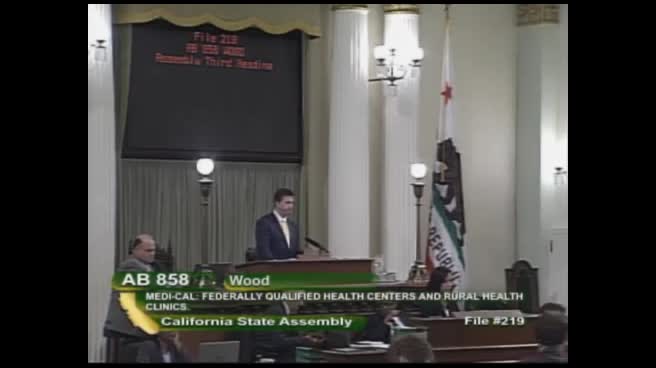 2MIN
Assembly Floor
 2MIN
Assembly Standing Committee on Health
Bill Author

Bill Co-Author(s):