AB 892: Unsafe handguns: peace officer’s state-issued handguns: transfer to spouse.
- Session Year: 2015-2016
- House: Assembly
- Latest Version Date: 2015-08-13
Existing law makes it a crime for any person in this state to manufacture, import into the state, keep for sale, offer or expose for sale, give, or lend any unsafe handgun. Existing law allows the spouse or domestic partner of a peace officer who died in the line of duty to buy his or her state-issued handgun.
This bill would exempt from that prohibition the purchase of a state-issued handgun by the spouse or domestic partner of a peace officer who died in the line of duty.
(a)A person in this state who manufactures or causes to be manufactured, imports into the state for sale, keeps for sale, offers or exposes for sale, gives, or lends an unsafe handgun shall be punished by imprisonment in a county jail not exceeding one year.
(b)This section shall not apply to any of the following:
(1)The manufacture in this state, or importation into this state, of a prototype handgun when the manufacture or importation is for the sole purpose of allowing an independent laboratory certified by the Department of Justice pursuant to Section 32010 to conduct an independent test to determine whether that handgun is prohibited by Sections 31900 to 32110, inclusive, and, if not, allowing the department to add the firearm to the roster of handguns that may be sold in this state pursuant to Section 32015.
(2)The importation or lending of a handgun by employees or authorized agents of entities determining whether the weapon is prohibited by this section.
(3)Firearms listed as curios or relics, as defined in Section 478.11 of Title 27 of the Code of Federal Regulations.
(4)The sale or purchase of a handgun, if the handgun is sold to, or purchased by, the Department of Justice, a police department, a sheriffs official, a marshals office, the Department of Corrections and Rehabilitation, the California Highway Patrol, any district attorneys office, any federal law enforcement agency, or the military or naval forces of this state or of the United States for use in the discharge of their official duties. This section does not prohibit the sale to, or purchase by, sworn members of these agencies of a handgun.
(5)The sale, purchase, or delivery of a handgun, if the sale, purchase, or delivery of the handgun is made pursuant to subdivision (d) of Section 10334 of the Public Contract Code.
(c)Violations of subdivision (a) are cumulative with respect to each handgun and shall not be construed as restricting the application of any other law. However, an act or omission punishable in different ways by this section and other provisions of law shall not be punished under more than one provision, but the penalty to be imposed shall be determined as set forth in Section 654.
(a)Commencing January 1, 2001, any A person in this state who manufactures or causes to be manufactured, imports into the state for sale, keeps for sale, offers or exposes for sale, gives, or lends any an unsafe handgun shall be punished by imprisonment in a county jail not exceeding one year.
(b)This section shall not apply to any of the following:
(1)The manufacture in this state, or importation into this state, of a prototype handgun when the manufacture or importation is for the sole purpose of allowing an independent laboratory certified by the Department of Justice pursuant to Section 32010 to conduct an independent test to determine whether that handgun is prohibited by Sections 31900 to 32110, inclusive, and, if not, allowing the department to add the firearm to the roster of handguns that may be sold in this state pursuant to Section 32015.
(2)The importation or lending of a handgun by employees or authorized agents of entities determining whether the weapon is prohibited by this section.
(3)Firearms listed as curios or relics, as defined in Section 478.11 of Title 27 of the Code of Federal Regulations.
(4)The sale or purchase of a handgun, if the handgun is sold to, or purchased by, the Department of Justice, a police department, a sheriffs official, a marshals office, the Department of Corrections and Rehabilitation, the California Highway Patrol, any district attorneys office, any federal law enforcement agency, or the military or naval forces of this state or of the United States for use in the discharge of their official duties. This section does not prohibit the sale to, or purchase by, sworn members of these agencies of a handgun.
(5)The sale, purchase, or delivery of a handgun, if the sale, purchase, or delivery of the handgun is made pursuant to subdivision (d) of Section 10334 of the Public Contract Code.
(c)Violations of subdivision (a) are cumulative with respect to each handgun and shall not be construed as restricting the application of any other law. However, an act or omission punishable in different ways by this section and other provisions of law shall not be punished under more than one provision, but the penalty to be imposed shall be determined as set forth in Section 654.
|
Date
|
Status
|
|---|---|
| Jun 9, 2015 | From committee: Do pass. (Ayes 7. Noes 0.) (June 9). |
| Aug 13, 2015 | Chaptered by Secretary of State - Chapter 203, Statutes of 2015. |
| Aug 13, 2015 | Approved by the Governor. |
| Aug 3, 2015 | Enrolled and presented to the Governor at 3 p.m. |
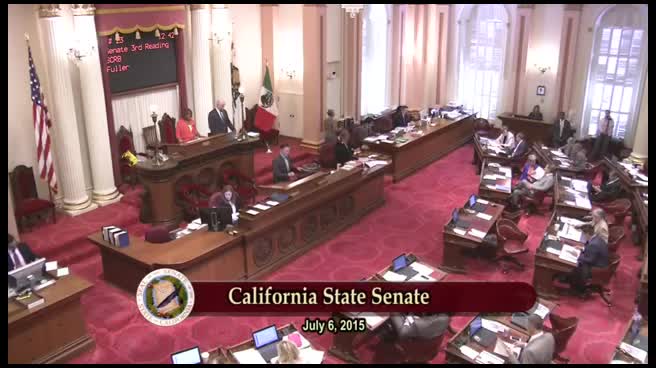
| Jul 6, 2015 | Read third time. Passed. Ordered to the Assembly. (Ayes 37. Noes 0. Page 1785.). |
| Jul 6, 2015 | Read third time. Passed. Ordered to the Assembly. |
| Jul 6, 2015 | In Assembly. Ordered to Engrossing and Enrolling. |
| Jun 18, 2015 | Ordered to third reading. |
| Jun 17, 2015 | Ordered to special consent calendar. |
| Jun 10, 2015 | Read second time. Ordered to third reading. |
| Feb 26, 2015 | Read first time. To print. |
| May 7, 2015 | Referred to Com. on PUB. S. |
| Apr 16, 2015 | Read third time. Passed. Ordered to the Senate. (Ayes 79. Noes 0. Page 977.) |
| Apr 16, 2015 | Read third time. Passed. Ordered to the Senate. |
| Apr 16, 2015 | In Senate. Read first time. To Com. on RLS. for assignment. |
| Apr 9, 2015 | Read second time. Ordered to consent calendar. |
| Apr 8, 2015 | From committee: Do pass. To Consent Calendar. (Ayes 7. Noes 0.) (April 7). |
| Apr 8, 2015 | From committee: Do pass. Ordered to Consent Calendar. (Ayes 7. Noes 0.) (April 7). |
| Mar 16, 2015 | Referred to Com. on PUB. S. |
| Feb 27, 2015 | From printer. May be heard in committee March 29. |
|
Date
|
Description
|
Location
|
Votes
|
|
|---|---|---|---|---|
| Jul 6, 2015 | Assembly 3rd Reading AB892 Achadjian By Anderson | Senate Floor |
Passed |
|
| Jun 9, 2015 | Do pass | Senate Standing Committee on Public Safety |
Passed |
|
| Apr 16, 2015 | AB 892 ACHADJIAN Consent Calendar Second Day Regular Session | Assembly Floor |
Passed |
|
| Apr 7, 2015 | Do pass. To Consent Calendar. | Assembly Standing Committee on Public Safety |
Passed |
This list shows positions taken on this bill by organizations on the date displayed, which is linked to the original source.
Positions by individuals are not included.
|
Organization
|
Position
|
Date
|
|---|---|---|
| California Association Of Highway Patrolmen | ** Support | Jul 6, 2015 |
| California Police Chiefs Association | ** Support | Jul 6, 2015 |
| Gun Owners of California | ** Support | Jul 6, 2015 |
| Los Angeles Deputy Sheriffs | ** Support | Jul 6, 2015 |
| Los Angeles Police Protective League | ** Support | Jul 6, 2015 |
| Riverside Sheriffs | ** Support | Jul 6, 2015 |
AB 892
Page 5
|
Office of Senate Floor Analyses (916) 651-1520 Fax: (916) 327-4478 |
THIRD READING
Bill No: AB 892
Introduced: 2/26/15
SENATE PUBLIC SAFETY COMMITTEE: 7-0, 6/9/15
AYES: Hancock, Anderson, Glazer, Leno, Liu, Monning, Stone
ASSEMBLY FLOOR: 79-0, 4/16/15 (Consent) - See last page for vote
SUBJECT: Unsafe handguns: peace officer’s state-issued handguns: transfer to spouse
SOURCE: California Association of Highway Patrolmen
DIGEST: This bill exempts the purchase of a state-issued handgun by the spouse or domestic partner of a peace officer who died in the line of duty from the prohibition on unsafe handguns.
Existing law:
Provides that commencing January 1, 2001, no “unsafe handgun” may be manufactured or sold in California by a licensed dealer, except as specified, and requires that the Department of Justice (DOJ) prepare and maintain a roster of handguns which are determined not to be unsafe handguns. Private party sales (used or previously owned) and transfers of handguns through a licensed dealer are exempted from those restrictions. (Penal Code §§ 27545, 32000, et seq., § 32110.)
Provides that any person in California who manufactures or causes to be manufactured, imports into the state for sale, keeps for sale, offers or exposes for sale, gives, or lends any unsafe handgun shall be punished by imprisonment in a county jail not exceeding one year. (Penal Code § 32000(a).)
Specifies, in Penal Code section 32000(b), that this prohibition does not apply to:
The manufacture in California, or importation into this state, of any prototype pistol, revolver, or other firearm capable of being concealed upon the person when the manufacture or importation is for the sole purpose of allowing an independent laboratory certified by the DOJ to conduct an independent test to determine whether that pistol, revolver, or other firearm capable of being concealed upon the person is prohibited, inclusive, and, if not, allowing the DOJ to add the firearm to the roster of pistols, revolvers, and other firearms capable of being concealed upon the person that may be sold in this state.
The importation or lending of a pistol, revolver, or other firearm capable of being concealed upon the person by employees or authorized agents of entities determining whether the weapon is prohibited by this section.
Firearms listed as curios or relics, as defined in federal law.
The sale or purchase of any pistol, revolver, or other firearm capable of being concealed upon the person, if the pistol, revolver, or other firearm is sold to, or purchased by, the DOJ, any police department, any sheriff's official, any marshal's office, the Youth and Adult Correctional Agency, the California Highway Patrol, any district attorney's office, or the military or naval forces of this state or of the United States for use in the discharge of their official duties. Nor shall anything in this section prohibit the sale to, or purchase by, sworn members of these agencies of any pistol, revolver, or other firearm capable of being concealed upon the person.
Contains numerous additional exemptions to the safe handgun requirements, including an exemption for any transfer that is not required to be made through a licensed dealer. This exemption alone includes within it another approximately 25 exemptions. (Penal Code §§ 32110, 27850, et seq.)
This bill
exempts the sale, purchase, or delivery of a handgun, if the sale is
of a state-issued handgun to the spouse or domestic partner of a
peace officer who died in the line of duty.
Background
SB 15 (Polanco, Chapter 248, Statutes of 1999), made it a misdemeanor for any person in California to manufacture, import for sale, offer for sale, give, or lend any unsafe handgun, as defined, with certain specific exceptions. SB 15 defined an “unsafe handgun” as follows: (a) does not have a requisite safety device; (b) does not meet specified firing tests; and, (c) does not meet a specified drop safety test.
SB 489 (Scott, Chapter 500, Statutes of 2003), added to the unsafe handgun law requirements for semiautomatic pistols that became effective in 2006 and 2007. The legislation requires that for a new semiautomatic center-fire pistol firearm to be added to the roster it has to be equipped with a chamber load indicator (a device that plainly indicates that a cartridge is in the firing chamber) and a magazine disconnect (a mechanism that prevents a semiautomatic pistol from operating when a detachable magazine is not inserted in the semiautomatic pistol). The legislation also requires that all semiautomatic rimfire pistols, with a detachable magazine, have a magazine disconnect. All firearms that were on the not unsafe handgun list prior to the effective dates were essentially grandfathered in.
AB 1471 (Feuer, Chapter 572, Statutes of 2007), added “microstamping” as a requirement for a firearm to be placed on the not unsafe handgun roster beginning January 1, 2010, “provided that the Department of Justice certifies that the technology used to create the imprint is available to more than one manufacturer unencumbered by any patent restrictions.” The Department of Justice issued the certification on May 17, 2013. Like the other provisions, the “microstamping” requirement did not apply to firearms already on the roster.
A number of peace officers are exempt from roster requirements and, according to the California Association of Highway Patrolmen, “many of the state-issued handguns to law enforcement are included on the list of unsafe handguns, a transfer of such firearm is prohibited to the spouse and/or domestic partner.” This legislation would create an exception to the not unsafe firearms laws by allowing the sale of a state-issued handgun to the spouse or domestic partner of a peace officer who died in the line of duty.
FISCAL EFFECT: Appropriation: No Fiscal Com.: No Local: No
California Association of Highway Patrolmen (source)
California Police Chiefs Association
Gun Owners of California
Los Angeles Deputy Sheriffs
Los Angeles Police Protective League
Riverside Sheriffs
None received
ARGUMENTS IN SUPPORT:
According to the California Association of Highway Patrolmen (CAHP):
AB 892, closes a loophole in existing law related to the transfer of a state-issued handgun to the spouse or domestic partner of a peace officer that was killed in the line of duty.
Existing law allows the department head to authorize the transfer of a state-issued handgun to the widow or domestic partner of a peace officer who was killed in the line of duty. However, the Department of Justice maintains a list of “unsafe handguns” and prohibits the manufacture, import, sale and possession of such handgun. A violation constitutes imprisonment in a county jail for no more than one year. Since many of the state-issued handguns to law enforcement are included on the list of unsafe handguns, a transfer of such firearm is prohibited to the spouse and/or domestic partner.
AB 892 adds an exemption for the spouse or domestic partner of a peace officer who was killed in the line of duty, which will essentially allow them to receive their spouse or domestic partner’s state-issued service weapon, regardless of whether it has been deemed unsafe by the Department of Justice.
In closing, we thank you again for authoring this legislation, and we look forward to its successful passage.
AYES: Achadjian, Alejo, Travis Allen, Baker, Bigelow, Bloom, Bonilla, Bonta, Brough, Brown, Burke, Calderon, Campos, Chang, Chau, Chávez, Chiu, Chu, Cooley, Cooper, Dababneh, Dahle, Daly, Dodd, Eggman, Frazier, Beth Gaines, Gallagher, Cristina Garcia, Eduardo Garcia, Gatto, Gipson, Gomez, Gonzalez, Gordon, Gray, Grove, Hadley, Harper, Roger Hernández, Holden, Irwin, Jones, Jones-Sawyer, Kim, Lackey, Levine, Linder, Lopez, Low, Maienschein, Mathis, Mayes, McCarty, Medina, Melendez, Mullin, Nazarian, Obernolte, O'Donnell, Olsen, Patterson, Perea, Rendon, Ridley-Thomas, Rodriguez, Salas, Santiago, Steinorth, Mark Stone, Thurmond, Ting, Wagner, Waldron, Weber, Wilk, Williams, Wood, Atkins
NO VOTE RECORDED: Quirk
Prepared by: Jessica Devencenzi / PUB. S. /
6/18/15 19:00:39
**** END ****
AB 892 (Achadjian ) Page 4 of 4
SENATE COMMITTEE ON PUBLIC SAFETY
Senator Loni Hancock, Chair
2015 - 2016 Regular
Bill No: AB 892 Hearing Date: June 9, 2015
Author: |
Achadjian |
||
Version: |
February 26, 2015 |
||
Urgency: |
No |
Fiscal: |
No |
Consultant: |
JRD |
||
Subject: Unsafe Handguns: Peace Officer’s State-Issued Handguns: Transfer to Spouse
HISTORY
Source: California Association of Highway Patrolmen
Prior Legislation: AB 685 (Achadjian) – Chapter 16, Statutes of 2013
Support: California Police Chiefs Association; Los Angeles Deputy Sheriffs; Los Angeles Police Protective League, Riverside Sheriffs
Opposition: None known
Assembly Floor Vote: 79 - 0
PURPOSE
The purpose of this legislation is to exempt the purchase of a state-issued handgun by the spouse or domestic partner of a peace officer who died in the line of duty from the prohibition on unsafe handguns.
Existing law provides that commencing January 1, 2001, no “unsafe handgun” may be manufactured or sold in California by a licensed dealer, except as specified, and requires that the Department of Justice (DOJ) prepare and maintain a roster of handguns which are determined not to be unsafe handguns. Private party sales (used or previously owned) and transfers of handguns through a licensed dealer are exempted from those restrictions. (Penal Code §§ 27545, 32000, et seq., § 32110.)
Existing law provides that any person in California who manufactures or causes to be manufactured, imports into the state for sale, keeps for sale, offers or exposes for sale, gives, or lends any unsafe handgun shall be punished by imprisonment in a county jail not exceeding one year. (Penal Code § 32000(a).)
Existing
law specifies that
this prohibition does not apply to:
The manufacture in California, or importation into this state, of any prototype pistol, revolver, or other firearm capable of being concealed upon the person when the manufacture or importation is for the sole purpose of allowing an independent laboratory certified by the DOJ to conduct an independent test to determine whether that pistol, revolver, or other firearm capable of being concealed upon the person is prohibited, inclusive, and, if not, allowing the department to add the firearm to the roster of pistols, revolvers, and other firearms capable of being concealed upon the person that may be sold in this.
The importation or lending of a pistol, revolver, or other firearm capable of being concealed upon the person by employees or authorized agents of entities determining whether the weapon is prohibited by this section.
Firearms listed as curios or relics, as defined in federal law.
The sale or purchase of any pistol, revolver, or other firearm capable of being concealed upon the person, if the pistol, revolver, or other firearm is sold to, or purchased by, the Department of Justice, any police department, any sheriff's official, any marshal's office, the Youth and Adult Correctional Agency, the California Highway Patrol, any district attorney's office, or the military or naval forces of this state or of the United States for use in the discharge of their official duties. Nor shall anything in this section prohibit the sale to, or purchase by, sworn members of these agencies of any pistol, revolver, or other firearm capable of being concealed upon the person.
(Penal Code § 32000(b).)
Existing law contains numerous additional exemptions to the safe handgun requirements, including an exemption for any transfer that is not required to be made through a licensed dealer. This exemption alone includes within it another approximately 25 exemptions. (Penal Code §§ 32110, 27850, et seq.)
This
bill would exempt the
sale, purchase, or delivery of a handgun, if the sale is of a
state-issued handgun to the spouse or domestic partner of a peace
officer who died in the line of duty.
RECEIVERSHIP/OVERCROWDING CRISIS AGGRAVATION
For the past eight years, this Committee has scrutinized legislation referred to its jurisdiction for any potential impact on prison overcrowding. Mindful of the United States Supreme Court ruling and federal court orders relating to the state’s ability to provide a constitutional level of health care to its inmate population and the related issue of prison overcrowding, this Committee has applied its “ROCA” policy as a content-neutral, provisional measure necessary to ensure that the Legislature does not erode progress in reducing prison overcrowding.
On February 10, 2014, the federal court ordered California to reduce its in-state adult institution population to 137.5% of design capacity by February 28, 2016, as follows:
143% of design bed capacity by June 30, 2014;
141.5% of design bed capacity by February 28, 2015; and,
137.5% of design bed capacity by February 28, 2016.
In February of this year the administration reported that as “of February 11, 2015, 112,993 inmates were housed in the State’s 34 adult institutions, which amounts to 136.6% of design bed capacity, and 8,828 inmates were housed in out-of-state facilities. This current population is now below the court-ordered reduction to 137.5% of design bed capacity.”( Defendants’ February 2015 Status Report In Response To February 10, 2014 Order, 2:90-cv-00520 KJM DAD PC, 3-Judge Court, Coleman v. Brown, Plata v. Brown (fn. omitted).
While significant gains have been made in reducing the prison population, the state now must stabilize these advances and demonstrate to the federal court that California has in place the “durable solution” to prison overcrowding “consistently demanded” by the court. (Opinion Re: Order Granting in Part and Denying in Part Defendants’ Request For Extension of December 31, 2013 Deadline, NO. 2:90-cv-0520 LKK DAD (PC), 3-Judge Court, Coleman v. Brown, Plata v. Brown (2-10-14). The Committee’s consideration of bills that may impact the prison population therefore will be informed by the following questions:
Whether a proposal erodes a measure which has contributed to reducing the prison population;
Whether a proposal addresses a major area of public safety or criminal activity for which there is no other reasonable, appropriate remedy;
Whether a proposal addresses a crime which is directly dangerous to the physical safety of others for which there is no other reasonably appropriate sanction;
Whether a proposal corrects a constitutional problem or legislative drafting error; and
Whether a proposal proposes penalties which are proportionate, and cannot be achieved through any other reasonably appropriate remedy.
COMMENTS
1. Need for This Bill
According to the author:
Currently, The Department of Justice maintains a list of “unsafe handguns” and prohibits the manufacture, import, sale and possession of such handguns. A violation constitutes imprisonment in a county jail for no more than one year.
Since many of the state-issued handguns to law enforcement are listed on the DOJs list of unsafe handguns, a transfer of such firearm is prohibited to the spouse and/or domestic partner.
2. “Not Unsafe” Handgun Law and the Effect of This Bill
SB 15 (Polanco), Chapter 248, Statutes of 1999, made it a misdemeanor for any person in California to manufacture, import for sale, offer for sale, give, or lend any unsafe handgun, as
defined, with certain specific exceptions. SB 15 defined an “unsafe handgun” as follows: (a) does not have a requisite safety device; (b) does not meet specified firing tests; and, (c) does not meet a specified drop safety test.
SB 489 (Scott), Chapter 500, Statutes of 2003, added to the unsafe handgun law requirements for semiautomatic pistols that became effective in 2006 and 2007. The legislation requires that for a new semiautomatic center-fire pistol firearm to be added to the roster it has to be equipped with a chamber load indicator1 and a magazine disconnect2 (if it has a detachable magazine). The legislation also requires that all semiautomatic rimfire pistols, with a detachable magazine, have a magazine disconnect. All firearms that were on the not unsafe handgun list prior to the effective dates were essentially grandfathered in.
AB 1471 (Feuer), Chapter 572, Statutes of 2007, added “microstamping” as a requirement for a firearm to be placed on the not unsafe handgun roster beginning January 1, 2010, “provided that the Department of Justice certifies that the technology used to create the imprint is available to more than one manufacturer unencumbered by any patent restrictions.” The Department of Justice issued the certification on May 17, 2013. Like the other provisions, the “microstamping” requirement did not apply to firearms already on the roster.
A number of peace officers are exempt from roster requirements and, according to the California Association of Highway Patrolmen, “many of the state-issued handguns to law enforcement are included on the list of unsafe handguns, a transfer of such firearm is prohibited to the spouse and/or domestic partner.” This legislation would create an exception to the not unsafe firearms laws by allowing the sale of a state-issued handgun to the spouse or domestic partner of a peace officer who died in the line of duty.
-- END –
1 A chamber load indicator is a device that plainly indicates that a cartridge is in the firing chamber. (Penal Code § 16380.)
2 A magazine disconnect is a mechanism that prevents a semiautomatic pistol from operating when a detachable magazine is not inserted in the semiautomatic pistol. (Penal Code § 16900.)
AB 892
Page 3
Date of Hearing: April 7, 2015
Counsel: Gabriel Caswell
ASSEMBLY COMMITTEE ON PUBLIC SAFETY
Bill Quirk, Chair
AB 892
(Achadjian) – As Introduced February 26, 2015
SUMMARY:
Exempts from the prohibition on unsafe handguns the purchase of a state-issued handgun by the spouse or domestic partner of a peace officer who died in the line of duty.
EXISTING LAW:
Provides that any person in California who manufactures or causes to be manufactured, imports into the state for sale, keeps for sale, offers or exposes for sale, gives, or lends any unsafe handgun shall be punished by imprisonment in a county jail not exceeding one year. (Pen. Code, § 32000, subd. (a).)
Specifies that this section shall not apply to any of the following (Pen. Code, § 32000, subd. (b).):
The manufacture in California, or importation into this state, of any prototype pistol, revolver, or other firearm capable of being concealed upon the person when the manufacture or importation is for the sole purpose of allowing an independent laboratory certified by the Department of Justice (DOJ) to conduct an independent test to determine whether that pistol, revolver, or other firearm capable of being concealed upon the person is prohibited, inclusive, and, if not, allowing the department to add the firearm to the roster of pistols, revolvers, and other firearms capable of being concealed upon the person that may be sold in this.
The importation or lending of a pistol, revolver, or other firearm capable of being concealed upon the person by employees or authorized agents of entities determining whether the weapon is prohibited by this section.
Firearms listed as curios or relics, as defined in federal law.
The sale or purchase of any pistol, revolver, or other firearm capable of being concealed upon the person, if the pistol, revolver, or other firearm is sold to, or purchased by, the Department of Justice, any police department, any sheriff's official, any marshal's office, the Youth and Adult Correctional Agency, the California Highway Patrol, any district attorney's office, or the military or naval forces of this state or of the United States for use in the discharge of their official duties. Nor shall anything in this section prohibit the sale to, or purchase by, sworn members of these agencies of any pistol, revolver, or other firearm capable of being concealed upon the person.
Specifies that violations of the unsafe handgun provisions are cumulative with respect to each handgun and shall not be construed as restricting the application of any other law. (Pen. Code, § 32000, subd. (c).)
FISCAL EFFECT:
Unknown
COMMENTS:
Author's Statement: According to the author, "Assembly Bill 892 would add an exemption for the spouse of domestic partner of a peace officer who was killed in the line of duty, which would allow them to receive their spouse or domestic partner's state-issued service weapon, regardless of whether it has been deemed unsafe by the Department of Justice."
Safe Handgun Law: SB 15 (Polanco), Chapter 248, Statutes of 1999, made it a misdemeanor for any person in California to manufacture, import for sale, offer for sale, give, or lend any unsafe handgun, as defined, with certain specific exceptions. SB 15 defined an "unsafe handgun" as follows: (a) does not have a requisite safety device, (b) does not meet specified firing tests, and (c) does not meet a specified drop safety test.
Required Safety Device: The Safe Handgun Law requires a revolver to have a safety device that, either automatically in the case of a double-action firing mechanism or by manual operation in the case of a single-action firing mechanism, causes the hammer to retract to a point where the firing pin does not rest upon the primer of the cartridge or in the case of a pistol have a positive manually operated safety device.
Firing Test: In order to meet the "firing requirements" under the Safe Handgun Law, the manufacturer must submit three unaltered handguns, of the make and model for which certification is sought, to an independent laboratory certified by the Attorney General. The laboratory shall fire 600 rounds from each gun under certain conditions. A handgun shall pass the test if each of the three test guns fires the first 20 rounds without a malfunction, and fires the full 600 rounds without more than six malfunctions and without any crack or breakage of an operating part of the handgun that increases the risk of injury to the user. "Malfunction" is defined as a failure to properly feed, fire or eject a round; failure of a pistol to accept or reject a manufacturer-approved magazine; or failure of a pistol's slide to remain open after a manufacturer approved magazine has been expended.
Drop Test: The Safe Handgun Law provides that at the conclusion of the firing test, the same three manufacturer's handguns must undergo and pass a "drop safety requirement" test. The three handguns are dropped a specified number of times, in specified ways, with a primed case (no powder or projectile) inserted into the handgun, and the primer is examined for indentations after each drop. The handgun passes the test if each of the three test guns does not fire the primer.
Failure to Pay a Fee may Result in a Weapon Being Deemed Unsafe: The Department of Justice deems some weapons to be “unsafe” because a particular gun manufacturer has not paid the appropriate fees and/or submitted the proper paperwork. The weapons themselves may be "safe" under the standards listed above, but they are deemed "unsafe" for purposes of categorization. Law enforcement agencies may still use these weapons. Some of these weapons may be used on duty by officers who have died. The spouse or domestic partners of a deceased officer may wish to purchase these weapons for sentimental reasons.
Argument in Support: According to the California Association of Highway Patrolmen (CAHP), "AB 892, closes a loophole in existing law related to the transfer of a state-issued handgun to the spouse or domestic partner of a peace officer that was killed in the line of duty.
"Existing law allows the department head to authorize the transfer of a state-issued handgun to the widow or domestic partner of a peace officer who was killed in the line of duty. However, the Department of Justice maintains a list of “unsafe handguns” and prohibits the manufacture, import, sale and possession of such handgun. A violation constitutes imprisonment in a county jail for no more than one year. Since many of the state-issued handguns to law enforcement are included on the list of unsafe handguns, a transfer of such firearm is prohibited to the spouse and/or domestic partner.
"AB 892 adds an exemption for the spouse or domestic partner of a peace officer who was killed in the line of duty, which will essentially allow them to receive their spouse or domestic partner’s state-issued service weapon, regardless of whether it has been deemed unsafe by the Department of Justice.
"In closing, we thank you again for authoring this legislation, and we look forward to its successful passage."
REGISTERED SUPPORT / OPPOSITION:
Support
California Association of Highway Patrolmen
Opposition
None
Analysis Prepared by:
Gabriel Caswell / PUB. S. / (916) 319-3744
Bill Author

Bill Co-Author(s):