AB 935: Water projects.
- Session Year: 2015-2016
- House: Assembly
- Latest Version Date: 2016-09-25
Existing law establishes in the Natural Resources Agency the Department of Water Resources, which manages and undertakes planning with regard to water resources in the state.
This bill would require, upon appropriation by the Legislature, the department to provide funding for a certain project provided that certain conditions are met.
Existing law establishes in the Natural Resources Agency the Department of Water Resources, which manages and undertakes planning with regard to water resources in the state.
This bill would require, upon appropriation by the Legislature, the department to provide funding for a certain projects, project provided that certain conditions are met.
Existing law establishes in the Natural Resources Agency the Department of Water Resources, which manages and undertakes planning with regard to water resources in the state.
This bill would require, upon appropriation by the Legislature, the department to provide funding for certain projects. projects, provided that certain conditions are met.
Existing law establishes in the Natural Resources Agency the Department of Water Resources, which manages and undertakes planning with regard to water resources in the state.
This bill would require, upon appropriation by the Legislature, the department to provide funding for certain projects.
Existing law, the Integrated Regional Water Management Planning Act, authorizes a regional water management group to prepare and adopt an integrated regional water management plan with specified components relating to water supply and water quality. Existing law authorizes the Department of Water Resources to award grants to eligible projects consistent with an adopted integrated regional water management plan.
This bill would require the department to provide grants and expenditures, consistent with an integrated regional water management plan, for the planning, design, and construction of local and regional conveyance projects that support regional and interregional connectivity and water management and provide certain benefits. The bill would require a regional management group that is awarded a grant pursuant to these provisions to provide a cost share of not less than 50% of the total project costs from nonstate resources and would authorize the department to waive or reduce this requirement for projects that directly benefit a disadvantaged community or an economically distressed area. The bill would authorize the department to adopt regulations to implement these provisions. The bill would require the department, pursuant these provisions, to provide grant funding for certain projects, as specified.
This bill would make legislative findings and declarations as to the necessity of a special statute for the specified projects.
Existing law, the Integrated Regional Water Management Planning Act, authorizes a regional water management group to prepare and adopt an integrated regional water management plan with specified components relating to water supply and water quality. Existing law authorizes the Department of Water Resources to award grants to eligible projects consistent with an adopted integrated regional water management plan.
This bill would declare the intent of the Legislature to enact future legislation that would require the department to provide grants and expenditures, consistent with an integrated regional water management plan, for the planning, design, and construction of local and regional conveyance projects that support regional and interregional connectivity and water management and provide certain benefits. The bill would require a regional management group that is awarded a grant pursuant to these provisions to provide a cost share of not less than 50% of the total project costs from nonstate resources and would authorize the department to waive or reduce this requirement for projects that directly benefit a disadvantaged community or an economically distressed area. The bill would authorize the department to adopt regulations to implement these provisions.
Existing law, the Integrated Regional Water Management Planning Act, authorizes a regional water management group to prepare and adopt an integrated regional water management plan with specified components relating to water supply and water quality. Existing law authorizes the Department of Water Resources to award grants to eligible projects consistent with an adopted integrated regional water management plan.
This bill would declare the intent of the Legislature to enact future legislation that would require the department to provide grants and expenditures, consistent with an integrated regional water management plan, for the planning, design, and construction of local and regional conveyance projects that support regional and interregional connectivity and water management and provide certain benefits.
(a)Upon appropriation by the Legislature, which shall not exceed seven million dollars ($7,000,000), the department shall provide funding for a project that substantially conforms to the project description for the Reverse Flow Pump-back Facilities on the Friant-Kern Canal Restoration Project set forth by the draft investment strategy released by the San Joaquin River Restoration Program in December 2014 if the project satisfies the conditions described in subdivision (c).
(b)Funding pursuant to this section shall not exceed 80 percent of the total cost of the project.
(c)The project identified in this section shall not be eligible for funding pursuant to subdivision (a) until all of the following requirements are met:
(1)All feasibility studies are complete and draft environmental impact reports are available for public review.
(2)The director receives commitments for not less than 75 percent of the nonstate cost-share requirement of the project.
(d)A project funded pursuant to this section shall comply with any other applicable provisions of state and federal law.
(a)Upon appropriation by the Legislature, which shall not exceed seventy-five seven million dollars ($75,000,000) total, ($7,000,000), the department shall provide funding for the following projects a project that substantially conforms to the project description for the Reverse Flow Pump-back Facilities on the Friant-Kern Canal Restoration Project set forth by the draft investment strategy released by the San Joaquin River Restoration Program in December 2014 if the project satisfies the conditions described in subdivision (c): (c).
(1)A project that substantially conforms to the project description for the Reverse Flow Pump-back Facilities on the Friant-Kern Canal Restoration Project set forth by the draft investment strategy released by the San Joaquin River Restoration Program in December 2014.
(2)A project that substantially conforms to the project description for the San Joaquin River Recapture at Patterson Irrigation District Conveyed through Delta-Mendota Canal to San Luis Reservoir Project set forth by the draft investment strategy released by the San Joaquin River Restoration Program in December 2014.
(b)Funding pursuant to this section shall not exceed 80 percent of the total cost of the project.
(c)The projects project identified in this section shall not be eligible for funding pursuant to subdivision (a) until all of the following requirements are met:
(1)All feasibility studies are complete and draft environmental impact reports are available for public review.
(2)The director receives commitments for not less than 75 percent of the nonstate cost share cost-share requirement of the project.
(d)A project funded pursuant to this section shall be subject to all of the following: comply with any other applicable provisions of state and federal law.
(1)The project shall comply with the requirements of Title X of Public Law 111-11.
(2)The project shall comply with any other applicable provisions of state and federal law.
(3)To the extent the project is used in furtherance of paragraph (4) of subdivision (a) of Section 10004 of Title X of Public Law 111-11, that use shall be made proportionally available to all entities subject to subdivision (a) of Section 10010 of Public Law 111-11.
(4)The project shall not result in any additional regulation of the State Water Projects Bank Pumping Plant or the federal Central Valley Projects Jones Pumping Plant, as compared to operation before the implementation of Title X of Public law 111-11.
(a)Upon appropriation by the Legislature, which shall not exceed seventy-five million dollars ($75,000,000) total, the department shall provide funding for the following projects: projects if the project satisfies the conditions described in subdivision (c):
(a)
(1)A project that substantially conforms to the project description for the Reverse Flow Pump-back Facilities on the Friant-Kern Canal Restoration Project set forth by the draft investment strategy released by the San Joaquin River Restoration Program in December 2014.
(b)
(2)A project that substantially conforms to the project description for the San Joaquin River Recapture at Patterson Irrigation District Conveyed through Delta-Mendota Canal to San Luis Reservoir Project set forth by the draft investment strategy released by the San Joaquin River Restoration Program in December 2014.
(b)Funding pursuant to this section shall not exceed 80 percent of the total cost of the project.
(c)The projects identified in this section shall not be eligible for funding pursuant to subdivision (a) until all of the following requirements are met:
(1)All feasibility studies are complete and draft environmental impact reports are available for public review.
(2)The director receives commitments for not less than 75 percent of the nonstate cost share requirement of the project.
(d)A project funded pursuant to this section shall be subject to all of the following:
(1)The project shall comply with the requirements of Title X of Public Law 111-11.
(2)The project shall comply with any other applicable provisions of state and federal law.
(3)To the extent the project is used in furtherance of paragraph (4) of subdivision (a) of Section 10004 of Title X of Public Law 111-11, that use shall be made proportionally available to all entities subject to subdivision (a) of Section 10010 of Public Law 111-11.
(4)The project shall not result in any additional regulation of the State Water Projects Bank Pumping Plant or the federal Central Valley Projects Jones Pumping Plant, as compared to operation before the implementation of Title X of Public law 111-11.
Upon appropriation by the Legislature, the department shall provide funding for the following projects:
(a)A project that substantially conforms to the project description for the Reverse Flow Pump-back Facilities on the Friant-Kern Canal Restoration Project set forth by the draft investment strategy released by the San Joaquin River Restoration Program in December 2014.
(b)A project that substantially conforms to the project description for the San Joaquin River Recapture at Patterson Irrigation District Conveyed through Delta-Mendota Canal to San Luis Reservoir Project set forth by the draft investment strategy released by the San Joaquin River Restoration Program in December 2014.
SECTION 1.Section 10547.5 is added to the Water Code, to read:10547.5.(a)The department shall provide grants and expenditures, consistent with an adopted integrated regional water management plan, for the planning, design, and construction of local and regional conveyance projects that do both of the following:
(1)Support regional and interregional connectivity and water management.
(2)Provide one or more of the following benefits:
(A)Improved regional or interregional water supply and water supply reliability.
(B)Mitigation of conditions of groundwater overdraft, saline water intrusion, water quality degradation, or subsidence.
(C)Adaption to the impacts of hydrologic changes.
(D)Improved water security from drought, natural disasters, or other events that could interrupt imported water supplies.
(E)Provision of safe drinking water for disadvantaged communities and economically distressed areas.
(b)A regional water management group that is awarded a grant pursuant to subdivision (a) shall provide a cost share of not less than 50 percent of the total project costs from nonstate resources. The department may waive or reduce this cost share requirement for projects that directly benefit a disadvantaged community or an economically distressed area.
(c)The department may adopt regulations to implement the provisions of this section in accordance with Chapter 3.5 (commencing with Section 11340) of Part 1 of Division 3 of Title 2 of the Government Code.
SEC. 2.(a)Pursuant to Section 10547.5 of the Water Code, the Department of Water Resources, using moneys appropriated to the department for these purposes, shall provide grant funding for the following projects:
(1)A project that substantially conforms to the project description for the Reverse Flow Pump-back Facilities on the Friant-Kern Canal Restoration Project set forth by the draft investment strategy released by the San Joaquin River Restoration Program in December 2014.
(2)A project that substantially conforms to the project description for the San Joaquin River Recapture at Patterson Irrigation District Conveyed through Delta-Mendota Canal to San Luis Reservoir Project set forth by the draft investment strategy released by the San Joaquin River Restoration Program in December 2014.
(b)Moneys provided pursuant to this section shall, in combination with moneys provided pursuant to the 50-percent cost share requirement of subdivision (b) of Section 10547.5 of the Water Code, fund the entirety of the projects described in subdivision (a).
SEC. 3.The Legislature finds and declares that a special law is necessary and that a general law cannot be made applicable within the meaning of Section 16 of Article IV of the California Constitution because of Californias four-year drought that has wreaked havoc on communities, businesses, and agriculture on the eastern side of the San Joaquin Valley. The interconnector projects described in this act will allow water to be better managed, providing relief to the eastern San Joaquin Valley and other areas of the state.
(a)The department shall provide grants and expenditures, consistent with an adopted integrated regional water management plan, for the planning, design, and construction of local and regional conveyance projects that do both of the following:
(1)Support regional and interregional connectivity and water management.
(2)Provide one or more of the following benefits:
(A)Improved regional or interregional water supply and water supply reliability.
(B)Mitigation of conditions of groundwater overdraft, saline water intrusion, water quality degradation, or subsidence.
(C)Adaption to the impacts of hydrologic changes.
(D)Improved water security from drought, natural disasters, or other events that could interrupt imported water supplies.
(E)Provision of safe drinking water for disadvantaged communities and economically distressed areas.
(b)A regional water management group that is awarded a grant pursuant to subdivision (a) shall provide a cost share of not less than 50 percent of the total project costs from nonstate resources. The department may waive or reduce this cost share requirement for projects that directly benefit a disadvantaged community or an economically distressed area.
(c)The department may adopt regulations to implement the provisions of this section in accordance with Chapter 3.5 (commencing with Section 11340) of Part 1 of Division 3 of Title 2 of the Government Code.
SECTION 1.Section 10531.7 is added to the Water Code, to read:10531.7.It is the intent of the Legislature to enact future legislation that would do all of the following:
(a)Require the Department of Water Resources to provide grants and expenditures, consistent with an adopted integrated regional water management plan, for the planning, design, and construction of local and regional conveyance projects that support regional and interregional connectivity and water management and that provide one or more of the following benefits:
(1)Improved regional or interregional water supply and water supply reliability.
(2)Mitigation of conditions of groundwater overdraft, saline water intrusion, water quality degradation, or subsidence.
(3)Adaptation to the impacts of hydrologic changes.
(4)Improved water security from drought, natural disasters, or other events that could interrupt imported water supplies.
(5)Provision of safe drinking water for disadvantaged communities and economically distressed areas.
(b)Require a cost share of not less than 50 percent of the total project costs from nonstate sources and authorize the department to waive or reduce the cost share requirement for projects that directly benefit a disadvantaged community or an economically distressed area.
It is the intent of the Legislature to enact future legislation that would do all of the following:
(a)Require the Department of Water Resources to provide grants and expenditures, consistent with an adopted integrated regional water management plan, for the planning, design, and construction of local and regional conveyance projects that support regional and interregional connectivity and water management and that provide one or more of the following benefits:
(1)Improved regional or interregional water supply and water supply reliability.
(2)Mitigation of conditions of groundwater overdraft, saline water intrusion, water quality degradation, or subsidence.
(3)Adaptation to the impacts of hydrologic changes.
(4)Improved water security from drought, natural disasters, or other events that could interrupt imported water supplies.
(5)Provision of safe drinking water for disadvantaged communities and economically distressed areas.
(b)Require a cost share of not less than 50 percent of the total project costs from nonstate sources and authorize the department to waive or reduce the cost share requirement for projects that directly benefit a disadvantaged community or an economically distressed area.
|
Date
|
Status
|
|---|---|
| Aug 22, 2016 | Read third time. Passed. Ordered to the Assembly. |
| Sep 1, 2015 | Read second time. Ordered to third reading. |
| Sep 4, 2015 | Read third time and amended. Ordered to second reading. |
| Sep 8, 2015 | Read second time. Ordered to third reading. |
| Sep 10, 2015 | Ordered to inactive file at the request of Senator Galgiani. |
| Aug 16, 2016 | From inactive file. |
| Aug 16, 2016 | Ordered to second reading. |
| Aug 17, 2016 | Read second time. Ordered to third reading. |
| Aug 17, 2016 | Read third time and amended. Ordered to second reading. |
| Aug 18, 2016 | Read second time. Ordered to third reading. |
| Aug 31, 2015 | From committee: Do pass. (Ayes 7. Noes 0.) (August 27). |
| Aug 22, 2016 | Read third time. Passed. Ordered to the Assembly. (Ayes 30. Noes 3. Page 5229.). |
| Aug 23, 2016 | In Assembly. Concurrence in Senate amendments pending. May be considered on or after August 25 pursuant to Assembly Rule 77. |
| Aug 24, 2016 | Joint Rule 62(a), file notice suspended. |
| Aug 24, 2016 | Joint Rule 62(a), file notice suspended. (Page 6225.) |
| Aug 24, 2016 | Re-referred to Com. on W., P., & W. pursuant to Assembly Rule 77.2. |
| Aug 25, 2016 | From committee: That the Senate amendments be concurred in. (Ayes 12. Noes 0.) (August 25). |
| Aug 30, 2016 | Senate amendments concurred in. To Engrossing and Enrolling. |
| Aug 30, 2016 | Senate amendments concurred in. To Engrossing and Enrolling. (Ayes 75. Noes 4. Page 6427.). |
| Sep 8, 2016 | Enrolled and presented to the Governor at 4 p.m. |
| Jun 3, 2015 | Read third time. Passed. Ordered to the Senate. |
| Feb 27, 2015 | From printer. May be heard in committee March 29. |
| Mar 26, 2015 | From committee chair, with author's amendments: Amend, and re-refer to Com. on W., P., & W. Read second time and amended. |
| Mar 26, 2015 | Referred to Com. on W., P., & W. |
| Apr 6, 2015 | Re-referred to Com. on W., P., & W. |
| Apr 28, 2015 | From committee: Do pass and re-refer to Com. on APPR. with recommendation: To Consent Calendar. (Ayes 15. Noes 0.) (April 28). Re-referred to Com. on APPR. |
| May 6, 2015 | In committee: Set, first hearing. Referred to APPR. suspense file. |
| May 28, 2015 | From committee: Do pass. (Ayes 17. Noes 0.) (May 28). |
| May 28, 2015 | Read second time. Ordered to third reading. |
| Jun 3, 2015 | In Senate. Read first time. To Com. on RLS. for assignment. |
| Feb 26, 2015 | Read first time. To print. |
| Jun 3, 2015 | Read third time. Passed. Ordered to the Senate. (Ayes 80. Noes 0. Page 1850.) |
| Jun 18, 2015 | Referred to Coms. on E.Q. and N.R. & W. |
| Jun 23, 2015 | From committee chair, with author's amendments: Amend, and re-refer to committee. Read second time, amended, and re-referred to Com. on E.Q. |
| Jun 24, 2015 | Re-referred to Com. on N.R. & W. |
| Jun 24, 2015 | Withdrawn from committee. |
| Jul 16, 2015 | From committee: Amend, and do pass as amended and re-refer to Com. on APPR. (Ayes 9. Noes 0.) (July 14). |
| Jul 16, 2015 | Read second time and amended. Re-referred to Com. on APPR. |
| Aug 17, 2015 | In committee: Referred to APPR. suspense file. |
|
Date
|
Description
|
Location
|
Votes
|
|
|---|---|---|---|---|
| Aug 30, 2016 | AB 935 SALAS Concurrence in Senate Amendments | Assembly Floor |
Passed |
|
| Aug 25, 2016 | With recommendation: That Senate amendments be concurred in. | Assembly Standing Committee on Water, Parks, and Wildlife |
Passed |
|
| Aug 22, 2016 | Assembly 3rd Reading AB935 Salas By Galgiani | Senate Floor |
Passed |
|
| Aug 27, 2015 | Do pass | Senate Standing Committee on Appropriations |
Passed |
|
| Aug 17, 2015 | Placed on suspense file | Senate Standing Committee on Appropriations |
Passed |
|
| Jul 14, 2015 | Do pass as amended, but first amend, and re-refer to the Committee on [Appropriations] | Senate Standing Committee on Natural Resources and Water |
Passed |
|
| Jun 3, 2015 | AB 935 SALAS Assembly Third Reading | Assembly Floor |
Passed |
|
| May 28, 2015 | Do pass. | Assembly Standing Committee on Appropriations |
Passed |
|
| Apr 28, 2015 | Do pass and be re-referred to the Committee on [Appropriations] with recommendation: To Consent Calendar | Assembly Standing Committee on Water, Parks, and Wildlife |
Passed |
This list shows positions taken on this bill by organizations on the date displayed, which is linked to the original source.
Positions by individuals are not included.
|
Organization
|
Position
|
Date
|
|---|---|---|
| California Citrus Mutual | ** Support | Aug 30, 2016 |
| Castaic Lake Water Agency | ** Against | Aug 22, 2016 |
| City Of Clovis | ** Against | Aug 22, 2016 |
| City of Fresno | ** Against | Aug 22, 2016 |
| City Of Selma | ** Against | Aug 22, 2016 |
| Coachella Valley Water District | ** Against | Aug 22, 2016 |
| Consolidated Irrigation District | ** Against | Aug 22, 2016 |
| Delano-Earlimart Irrigation District | ** Support | Aug 30, 2016 |
| Desert Water Agency | ** Support | Aug 22, 2016 |
| Fresno Irrigation District | ** Against | Aug 22, 2016 |
| Kaweah Delta Water Conservation District | ** Against | Aug 22, 2016 |
| Kern-Tulare Water District | ** Support | Aug 22, 2016 |
| Kings River Conservation District | ** Against | Aug 22, 2016 |
| Kings River Water Association | ** Against | Aug 22, 2016 |
| Lower Tule River Irrigation District | ** Support | Aug 30, 2016 |
| Modesto Irrigation District | ** Against | Aug 22, 2016 |
| Patterson | * Indeterminate | Jul 14, 2015 |
| Pixley Irrigation District | ** Support | Aug 30, 2016 |
| Raisin City Water District | ** Against | Aug 22, 2016 |
| South Valley Water Association | ** Support | Aug 22, 2016 |
| Tea Pot Dome Water District | ** Support | Aug 30, 2016 |
| Tulare County Farm Bureau | ** Support | Aug 22, 2016 |
| Turlock Irrigation District | ** Against | Aug 22, 2016 |
CONCURRENCE IN SENATE AMENDMENTS
CSA2 Bill Id:AB 935
Author:(Salas)
As Amended Ver:August 17, 2016
Majority vote
ASSEMBLY: | 80-0 | (June 3, 2015) | SENATE: | 30-3 | (August 22, 2016) |
COMMITTEE VOTE: | 12-0 | (August 25, 2016) | RECOMMENDATION: | concur |
(W., P., & W.)
Original Committee Reference: W., P., & W.
SUMMARY: This bill requires the Department of Water Resources (DWR), upon appropriation by the Legislature, to fund a reverse flow pump-back project on the Friant-Kern Canal that substantially conforms to the project description set forth by the draft investment strategy released by the San Joaquin River Restoration Program (SJRRP) in December 2014. Specifically, this bill:
- Requires the DWR, upon appropriation by the Legislature, to grant up to $7 million for the Reverse Flow Pump-back Facilities on the Friant-Kern Canal Restoration Project (Project).
- Limits the DWR's funding share of the Project to up to 80% of the total.
- Establishes prerequisites to funding, including:
- All feasibility studies are complete and draft environmental impact reports (EIRs) required pursuant to the California Environmental Quality Act (CEQA) are available for public review.
- Financial commitments to the DWR director are equal to or greater than 75% of the non-state cost share of the project.
- Requires the Project, if funded, to comply with any applicable provisions of state and federal law.
EXISTING LAW:
- Establishes the DWR within the Natural Resources Agency, which manages and undertakes planning with regard to water resources in the state.
- Prohibits a public agency, under CEQA, from making a discretionary decision to approve a project, including funding a project, if there are potentially significant impacts on the environment that could be reduced by feasible alternatives or feasible mitigation measures.
FISCAL EFFECT: Unknown.
COMMENTS: The Assembly version of this bill contained a general requirement for the DWR to fund local and regional conveyance projects. The Senate version of this bill deletes the general requirement and instead, specifies funding of a project that would help minimize water supply impacts to Friant Division Long-Term Contractors from actions to help implement the SJRRP.
According to the author this bill would provide funding for the planning, design, and construction of a Sustainable Water Conveyance Project that would support regional and interregional connectivity and deliver water to and from the California Aqueduct. We need to develop and improve conveyance facilities in order to optimize inter-regional water supplies, facilitate the movement of water from east to west, and make additional water available to places of need. This project would help increase water availability and enable deliveries of surplus water in wet years to recharge groundwater and banking facilities.
The San Joaquin River is the second longest river in California and historically supported large runs of salmon and other cold-water fish. After Friant Dam was constructed by the United States (U.S.) Department of Interior, Bureau of Reclamation (Reclamation), parts of the San Joaquin River went completely dry in most years. Environmental groups then brought litigation citing, among other claims, the requirements in California law that the owner of any dam must allow sufficient water to pass through to keep fish in good condition below the dam. In 2006, after 18 years of litigation, a federal court approved a settlement between the federal government, the environmental plaintiffs, and the Friant Water Users Authority. The SJRRP settlement had two objectives: a restoration program that would provide the river with continuous flows to the Sacramento-San Joaquin River Delta and support naturally reproducing populations of Chinook salmon, and a water management goal of minimizing water supply impacts to San Joaquin River water users.
Thereafter, Reclamation initiated an investment strategy in support of the SJRRP water management goal in order to identify projects that, in conjunction with other activities, could cost-effectively reduce or avoid water supply impacts to the Friant Contractors. Reclamation, in collaboration with the Friant Contractors, identified, screened, developed, evaluated, and ranked over 500 project concepts to form a list of approximately 60 projects. Of these, 21 projects were further evaluated as ready-to-implement priority projects. The results were presented in a March 2015 report titled Water Management Goal Investment Strategy Final Report (Final Report). The Reverse Flow Pump-Back Facilities on the Friant-Kern Canal project that would be funded through this bill was fourth among the 21 projects evaluated in the Final Report.
Friant Dam on the San Joaquin River near Fresno, southward to various Friant Contractors along the east side of the San Joaquin Valley, terminating at the Kern River near Bakersfield. Currently, the Friant-Kern Canal has limited pump-back operational capacity which is used occasionally to deliver water north from the Cross Valley Canal or water extracted from water banks on the Kern River fan. This project would install permanent pump-back facilities with higher capacities along the southern portion of the Friant-Kern Canal. The Project would allow water that was released for restoration flows on the San Joaquin River, captured downstream, and conveyed via the Cross Valley Canal, to be pumped back up the Friant-Kern Canal to a number of Friant Contractors. The Final Report ranked this project 4th of 21, with an estimated cost of $7.6 million that included planning and environmental review, and a little over two years to complete. The project has been estimated to convey approximately 15,000-30,000 acre-feet annually and is expected to avoid 2,750 metric tons of carbon emissions over the life of the project.
It is not clear what the source of funding will be for the Project. This bill does not make an appropriation. If and when there is an appropriation the source of funds for that appropriation would be determined by the Legislature and the Governor.
Analysis Prepared by: Ryan Ojakian / W., P., & W. / (916) 319-2096 FN: 0004926
Date of Hearing: August , 2016
ASSEMBLY COMMITTEE ON WATER, PARKS, AND WILDLIFE
Marc Levine, Chair
ABPCA Bill Id:AB 935 (
Author:Salas) – As Amended Ver:August 17, 2016
SUBJECT: Water projects
SUMMARY: This bill requires the Department of Water Resources (DWR), upon appropriation by the Legislature, to fund a reverse flow pump-back project on the Friant-Kern Canal that substantially conforms to the project description set forth by the draft investment strategy released by the San Joaquin River Restoration Program (SJRRP) in December 2014. Specifically, this bill:
- Requires the DWR, upon appropriation by the Legislature, to grant up to $7 million for the Reverse Flow Pump-back Facilities on the Friant-Kern Canal Restoration Project (Project).
- Limits the DWR's funding share of the Project to up to 80% of the total.
- Establishes prerequisites to funding, including:
- All feasibility studies are complete and draft environmental impact reports (EIRs) required pursuant to the California Environmental Quality Act (CEQA) are available for public review.
- Financial commitments to the DWR director are equal to or greater than 75% of the non-state cost share of the project.
- Requires the Project, if funded, to comply with any applicable provisions of state and federal law.
EXISTING LAW:
- Establishes the DWR within the Natural Resources Agency, which manages and undertakes planning with regard to water resources in the state.
- Prohibits a public agency, under CEQA, from making a discretionary decision to approve a project, including funding a project, if there are potentially significant impacts on the environment that could be reduced by feasible alternatives or feasible mitigation measures.
FISCAL EFFECT: Unknown.
COMMENTS: This bill requires the DWR, upon appropriation by the Legislature, to grant up to $7 million for the Reverse Flow Pump-back Facilities on the Friant-Kern Canal Restoration Project.
- Assembly Version: The Assembly version of this bill contained a general requirement for the DWR to fund local and regional conveyance projects. The Senate version of this bill deletes the general requirement and instead, specifies funding of a project that would help minimize water supply impacts to Friant Division Long-Term Contractors from actions to help implement the San Joaquin River Restoration Program (SJRRP).
- Author’s Statement: This bill would provide funding for the planning, design, and construction of a Sustainable Water Conveyance Project that would support regional and interregional connectivity and deliver water to and from the California Aqueduct. We need to develop and improve conveyance facilities in order to optimize inter-regional water supplies, facilitate the movement of water from east to the west, and make additional water available to places of need. This project would help increase water availability and enable deliveries of surplus water in wet years to recharge groundwater and banking facilities.
- San Joaquin River Restoration Program: The San Joaquin River is the second longest river in California and historically supported large runs of salmon and other cold-water fish. After Friant Dam was constructed by the U.S. Department of Interior, Bureau of Reclamation (Reclamation), parts of the San Joaquin River went completely dry in most years. Environmental groups then brought litigation citing, among other claims, the requirements in California law that the owner of any dam must allow sufficient water to pass through to keep fish in good condition below the dam. In 2006, after 18 years of litigation, a federal court approved a settlement between the federal government, the environmental plaintiffs, and the Friant Water Users Authority. The SJRRP settlement had two objectives: a restoration program that would provide the river with continuous flows to the Sacramento-San Joaquin River Delta and support naturally reproducing populations of Chinook salmon, and a water management goal of minimizing water supply impacts to San Joaquin River water users.
Thereafter, Reclamation initiated an investment strategy in support of the SJRRP water management goal in order to identify projects that, in conjunction with other activities, could cost-effectively reduce or avoid water supply impacts to the Friant Contractors. Reclamation, in collaboration with the Friant Contractors, identified, screened, developed, evaluated, and ranked over 500 project concepts to form a list of approximately 60 projects. Of these, 21 projects were further evaluated as ready-to-implement priority projects. The results were presented in a March 2015 report titled Water Management Goal Investment Strategy Final Report (Final Report). The Reverse Flow Pump-Back Facilities on the Friant-Kern Canal project that would be funded through this bill was fourth among the 21 projects evaluated in the Final Report.
- Reverse Flow Pump-back Facilities on the Friant-Kern Canal Restoration Project: The Friant-Kern Canal is a Federal Central Valley Project canal that conveys water from Friant Dam on the San Joaquin River near Fresno, southward to various Friant Contractors along the east side of the San Joaquin Valley, terminating at the Kern River near Bakersfield. Currently, the Friant-Kern Canal has limited pump-back operational capacity which is used occasionally to deliver water north from the Cross Valley Canal or water extracted from water banks on the Kern River fan. This project would install permanent pump-back facilities with higher capacities along the southern portion of the Friant-Kern Canal. The Project would allow water that was released for restoration flows on the San Joaquin River, captured downstream, and conveyed via the Cross Valley Canal, to be pumped back up the Friant-Kern Canal to a number of Friant Contractors. The Final Report ranked this project 4th of 21, with an estimated cost of $7.6 million that included planning and environmental review, and a little over 2 years to complete. The project has been estimated to convey approximately 15,000-30,000 acre-feet annually and is expected to avoid 2,750 metric tons of carbon emissions over the life of the project.
- Source of Funding: It is not clear what the source of funding will be for the Project. This bill does not make an appropriation. If and when there is an appropriation the source of funds for that appropriation would be determined by the Legislature and the Governor.
- Support Arguments: The Reverse Flow Pump-back Facilities on the Friant –Kern Canal Restoration Project is an important water conveyance project in the San Joaquin Valley that will greatly enhance the state’s ability to manage water. This bill will provide a means to better circulate water in the south valley, will ensure greater flexibility in our complicated water system, and where appropriate create more water for the citizens, communities, and businesses of the South San Joaquin Valley.
REGISTERED SUPPORT / OPPOSITION:
Support
California Citrus Mutual
Delano-Earlimart Irrigation District
Lower Tule River Irrigation District
Pixley Irrigation District
Tea Pot Dome Water District
Opposition
None on file
Analysis Prepared by: Ryan Ojakian / W., P., & W. / (916) 319-2096
CONCURRENCE IN SENATE AMENDMENTS
CSA1 Bill Id:AB 935
Author:(Salas)
As Amended Ver:August 17, 2016
Majority vote
ASSEMBLY: | 80-0 | (June 3, 2016) | SENATE: | 30-3 | (August 22, 2016) |
Original Committee Reference: W., P., & W.
SUMMARY: This bill requires the Department of Water Resources (DWR), upon appropriation by the Legislature, to fund a reverse flow pump-back project on the Friant-Kern Canal that substantially conforms to the project description set forth by the draft investment strategy released by the San Joaquin River Restoration Program in December 2014.
The Senate amendments delete the Assembly version of the bill, and instead:
- Requires the DWR, upon appropriation by the Legislature, to grant up to $7 million for the Reverse Flow Pump-back Facilities on the Friant-Kern Canal Restoration Project (Project).
- Limit the DWR's funding share of the Project to up to 80% of the total.
- Establish prerequisites to funding, including:
- All feasibility studies are complete and draft environmental impact reports (EIRs) required pursuant to the California Environmental Quality Act (CEQA) are available for public review.
- Financial commitments to the DWR director are equal to or greater than 75% of the non-state cost share of the project.
- Requires the Project, if funded, to comply with any applicable provisions of state and federal law.
EXISTING LAW:
- Establishes the DWR within the Natural Resources Agency, which manages and undertakes planning with regard to water resources in the state.
- Prohibits a public agency, under CEQA, from making a discretionary decision to approve a project, including funding a project, if there are potentially significant impacts on the environment that could be reduced by feasible alternatives or feasible mitigation measures.
FISCAL EFFECT: Unknown
COMMENTS: The Assembly version of this bill contained a general requirement for the DWR to fund local and regional conveyance projects. The Senate version of this bill deletes the general requirement and instead, specifies a project that would help minimize water supply impacts to Friant Division long-term contractors from actions to help implement the San Joaquin River Restoration Program (SJRRP).
The San Joaquin River is the second longest river in California and historically supported large runs of salmon and other cold-water fish. After Friant Dam was constructed by the United States Department of Interior, Bureau of Reclamation (Reclamation), parts of the San Joaquin River went completely dry in most years. Environmental groups then brought litigation citing, among other claims, the requirements in California law that the owner of any dam must allow sufficient water to pass through to keep fish in good condition below the dam. In 2006, after 18 years of litigation, a federal court approved a settlement between the federal government, the environmental plaintiffs, and the Friant Water Users Authority. The SJRRP settlement had two objectives: a restoration program that would provide the river with continuous flows to the Sacramento-San Joaquin River Delta and support naturally reproducing populations of Chinook salmon, and a water management goal of minimizing water supply impacts to San Joaquin River water users.
Thereafter, Reclamation initiated an investment strategy in support of the SJRRP water management goal in order to identify projects that, in conjunction with other activities, could cost-effectively reduce or avoid water supply impacts to the Friant Contractors. Reclamation, in collaboration with the Friant Contractors, identified, screened, developed, evaluated, and ranked over 500 project concepts to form a list of approximately 60 projects. Of these, 21 projects were further evaluated as ready-to-implement priority projects. The results were presented in a March 2015 report titled Water Management Goal Investment Strategy Final Report (Final Report).
The Reverse Flow Pump-Back Facilities on the Friant-Kern Canal project that would be funded through this bill is among the 21 projects evaluated in the Final Report.
The Friant-Kern Canal is a Federal Central Valley Project canal that conveys water from Friant Dam on the San Joaquin River near Fresno, southward to various Friant Contractors along the east side of the San Joaquin Valley, terminating at the Kern River near Bakersfield. Currently, the Friant-Kern Canal has limited pump-back operational capacity which is used occasionally to deliver north the water from the Cross Valley Canal or water extracted from water banks on the Kern River fan. This project would install permanent pump-back facilities with higher capacities along the southern portion of the Friant-Kern Canal. The project would allow water that was released for restoration flows on the San Joaquin River, captured downstream, and conveyed via the Cross Valley Canal, to be pumped back up the Friant-Kern Canal to a number of Friant Contractors. The Final Report ranked this project 4th of 21, with an estimated cost of $7.6 million that included planning and environmental review, and a little over two years to complete. The project has been estimated to convey approximately 15,000-30,000 acre-feet annually and is expected to avoid 2,750 metric tons of carbon emissions over the life of the project.
Analysis Prepared by: Ryan Ojakian / W., P., & W. / (916) 319-2096 FN: 0004764
Office of Senate Floor Analyses (916) 651-1520 Fax: (916) 327-4478 | AB |
THIRD READING
Bill No: AB 935
:
SENATE NATURAL RES. & WATER COMMITTEE: 9-0, 7/14/15
AYES: Pavley, Stone, Allen, Hertzberg, Hueso, Jackson, Monning, Vidak, Wolk
SENATE APPROPRIATIONS COMMITTEE: 7-0, 8/27/15
AYES: Lara, Bates, Beall, Hill, Leyva, Mendoza, Nielsen
ASSEMBLY FLOOR: 80-0, 6/3/15 - See last page for vote
DIGEST: This bill requires, upon appropriation of the Legislature, the Department of Water Resources (DWR) to provide up to $7 million to fund the Reverse Flow Pump-Back Facilities on the Friant-Kern Canal.
Senate Floor Amendments of 8/17/16 delete provisions requiring funding of the San Joaquin River Recapture at Patterson Irrigation District project.
Existing law establishes in the Natural Resources Agency the Department of Water Resources (DWR), which manages and undertakes planning with regard to water resources in the state.
This bill:
- Requires the DWR, upon appropriation by the Legislature, to fund the Reverse Flow Pump-back Facilities on the Friant-Kern Canal Restoration Project.
- Caps the state funding for the project at $7 million and requires a minimum 20 percent non-state cost share.
- Requires the project to meet the following requirements as a condition for state funding:
- All feasibility studies are complete and draft environmental impact reports are available for public review.
- The director of DWR receives commitments for not less than 75 percent of the nonstate cost share requirement of the project.
Comments
San Joaquin River Restoration Program. In September 2006, the US Department of Interior and Commerce, the Natural Resources Defense Council, and the Friant Water Users Authority entered into a settlement that ended an 18-year lawsuit to provide sufficient fish habitat in the San Joaquin River below Friant Dam near Fresno. The settlement resulted in the San Joaquin River Restoration Program (SJRRP) which has two goals and objectives: (1) a restored river with continuous flows to the Sacramento-San Joaquin River Delta and naturally reproducing populations of Chinook salmon; and (2) a river management program to minimize water supply impacts to San Joaquin River water users.
The U.S. Bureau of Reclamation (USBR) initiated an investment strategy in support of the SJRRP water management goal. The purpose was to identify projects that, in conjunction with other activities, could cost-effectively reduce or avoid water supply impacts to the Friant Division long-term contractors. USBR, in collaboration with the Friant Contractors, identified, screened, developed, evaluated, and ranked over 500 project concepts to form a list of approximately 60 projects. Of these, 21 projects were further evaluated as ready-to-implement priority projects. The results were presented in a March 2015 report titled Water Management Goal Investment Strategy: Final Report.
Among other things, the Final Report presented a list of priority projects evaluated at an appraisal level that supports the water management goal of the SJRRP. The project that would be funded through this bill is among the 21 projects evaluated in the Final Report.
Reverse Flow Pump-Back Facilities on the Friant-Kern Canal. The Friant-Kern Canal is Federal Central Valley Project (CVP) canal that conveys water from Friant Dam on the San Joaquin River near Fresno, southward to various Friant Contractors along the east side of the San Joaquin Valley, terminating at the Kern River near Bakersfield. Currently, the Friant-Kern Canal has limited pump-back operational capacity, which is used occasionally to deliver north the water from the Cross Valley Canal or water extracted from water banks on the Kern River fan. This project would install permanent pump-back facilities with higher capacities along the southern portion of the Friant-Kern Canal. The project would allow water that was released for restoration flows on the San Joaquin River that was then recaptured downstream to be conveyed via the Cross Valley Canal to be pumped back up the Friant-Kern Canal to a number of Friant Contractors.
The Final Report ranked this project 4th of 21, with an estimated cost of $7.6 million, and, including planning and environmental review, a little over 2 years to complete the project.
Why This Project? It is not entirely clear why the author selected this project over the other 20. There are higher rated projects.
Should State Fund SJRRP Water Management Projects? These projects are designed to mitigate the water supply impact on Friant Contractors of restoring flows on the San Joaquin River. These flows are necessary for the USBR to comply with state law regarding keeping in good condition fish that may be below a dam. The state has already committed to helping restore the San Joaquin River itself. It is not clear why the state should also fund projects to offset the impact of restoration flows on the Friant Contractors.
With What Funds? It is not clear what funds DWR could use to provide the grants required by this bill. Proposition 1 included a provision stating that the Legislature cannot appropriate Prop 1 funds for a specific project.
Camel’s Nose? Through most of the 1990s, the usual practice for funding water resource projects was for the legislature to determine which specific projects to appropriate bond funds to; either through the drafting of the bond measure or through individual appropriation bills. Consequently, the investments occasionally reflected political priorities more than policy priorities. Beginning in the late 1990, the legislature began drafting bond measures emphasizing competitive processes instead of political process. Indeed, Proposition 1 included a provision banning the legislature from appropriating funds for specific projects. Should this bill be enacted, it might tempt other members to attempt to direct funds to specific projects as well.
FISCAL EFFECT: Appropriation: Fiscal Com.: Local:
Prior Senate Appropriations Committee cost estimates are not relevant with recent amendments.
Relevant Appropriations Committee Staff Comments on previous version of this bill:
- “This bill does not specify a funding source and it is unclear whether there are bond monies available for these projects. DWR is on pace to awarding all of its remaining Proposition 84 funds by the end of this year and Proposition 1 included a provision stating that the Legislature cannot appropriate Proposition 1 funds for a specified project. In the absence of a fund source being specified, staff assumes the cost would be borne by the General Fund.
- “Staff notes that while the state has made a commitment to helping restore the San Joaquin River itself, the state was not a party to the settlement. Thus the projects are solely the responsibility of the federal government.”
California Citrus Mutual
Delano-Earlimart Irrigation District
Kern-Tulare Water District
South Valley Water Association
Tulare County Farm Bureau
OPPOSITION: (Verified 8/18/16)
Castaic Lake Water Agency
City of Clovis
City of Reedley
City of Selma
Coachella Valley Water District
Consolidated Irrigation District
Fresno Irrigation District
Kaweah Delta Water Conservation District
Kings River Conservation District
Kings River Water Association
Modesto Irrigation District
Raisin City Water District
Turlock Irrigation District
ARGUMENTS IN SUPPORT: According to the author, “We need to develop and improve conveyance facilities in order to optimize inter-regional water supplies, facilitate the movement of water from the east side to the west side, and make additional water available to be distributed to places of need.”
ARGUMENTS IN OPPOSITION: Opponents to the previous version of this bill raised concerns about the apparent earmarking of funds for this project.
ASSEMBLY FLOOR: 80-0, 6/3/15
AYES: Achadjian, Alejo, Travis Allen, Baker, Bigelow, Bloom, Bonilla, Bonta, Brough, Brown, Burke, Calderon, Campos, Chang, Chau, Chávez, Chiu, Chu, Cooley, Cooper, Dababneh, Dahle, Daly, Dodd, Eggman, Frazier, Beth Gaines, Gallagher, Cristina Garcia, Eduardo Garcia, Gatto, Gipson, Gomez, Gonzalez, Gordon, Gray, Grove, Hadley, Harper, Roger Hernández, Holden, Irwin, Jones, Jones-Sawyer, Kim, Lackey, Levine, Linder, Lopez, Low, Maienschein, Mathis, Mayes, McCarty, Medina, Melendez, Mullin, Nazarian, Obernolte, O'Donnell, Olsen, Patterson, Perea, Quirk, Rendon, Ridley-Thomas, Rodriguez, Salas, Santiago, Steinorth, Mark Stone, Thurmond, Ting, Wagner, Waldron, Weber, Wilk, Williams, Wood, Atkins
8/18/16 17:10:05
**** END ****
AB 935
Page 5
|
Office of Senate Floor Analyses (916) 651-1520 Fax: (916) 327-4478 |
THIRD READING
Bill No: AB 935
Amended: 9/4/15 in Senate
SENATE NATURAL RES. & WATER COMMITTEE: 9-0, 7/14/15
AYES: Pavley, Stone, Allen, Hertzberg, Hueso, Jackson, Monning, Vidak, Wolk
SENATE APPROPRIATIONS COMMITTEE: 7-0, 8/27/15
AYES: Lara, Bates, Beall, Hill, Leyva, Mendoza, Nielsen
ASSEMBLY FLOOR: 80-0, 6/3/15 - See last page for vote
DIGEST: This bill requires the Department of Water Resources (DWR) to fund the Reverse Flow Pump-Back Facilities on the Friant-Kern Canal and the San Joaquin River Recapture at Patterson Irrigation District Conveyed Through Delta-Mendota Canal to San Luis Reservoir, upon appropriation of the Legislature.
Senate Floor Amendments of 9/4/15 add additional conditions for state funding of the two projects authorized by this bill.
ANALYSIS: Existing law establishes in the Natural Resources Agency the Department of Water Resources (DWR), which manages and undertakes planning with regard to water resources in the state.
This bill:
Requires the DWR, upon appropriation by the Legislature, to fund two projects:
The Reverse Flow Pump-back Facilities on the Friant-Kern Canal Restoration Project, and
The San Joaquin River Recapture at Patterson Irrigation District.
Caps the state funding for these projects a $75 million and requires a minimum 20 percent non-state cost share.
Requires the projects to meet the following requirements as a condition for state funding:
All feasibility studies are complete and draft environmental impact reports are available for public review.
The director of DWR receives commitments for not less than 75 percent of the nonstate cost share requirement of the project.
Background
San Joaquin River Restoration Program. In September 2006, the US Department of Interior and Commerce, the Natural Resources Defense Council, and the Friant Water Users Authority entered into a settlement that ended an 18-year lawsuit to provide sufficient fish habitat in the San Joaquin River below Friant Dam near Fresno. The settlement resulted in the San Joaquin River Restoration Program (SJRRP) which has two goals and objectives: (1) a restored river with continuous flows to the Sacramento-San Joaquin River Delta and naturally reproducing populations of Chinook salmon; and (2) a river management program to minimize water supply impacts to San Joaquin River water users.
The U.S. Bureau of Reclamation (USBR) initiated an investment strategy in support of the SJRRP water management goal. The purpose was to identify projects that, in conjunction with other activities, could cost-effectively reduce or avoid water supply impacts to the Friant Division long-term contractors. USBR, in collaboration with the Friant Contractors, identified, screened, developed, evaluated, and ranked over 500 project concepts to form a list of approximately 60 projects. Of these, 21 projects were further evaluated as ready-to-implement priority projects. The results were presented in a March 2015 report titled Water Management Goal Investment Strategy: Final Report.
Among other things, the Final Report presented a list of priority projects evaluated at an appraisal level that support the water management goal of the SJRRP. The two projects that would be funded through this bill are among the 21 projects evaluated in the Final Report.
Reverse Flow Pump-Back Facilities on the Friant-Kern Canal. The Friant-Kern Canal is Federal Central Valley Project (CVP) canal that conveys water from Friant Dam on the San Joaquin River near Fresno, southward to various Friant Contractors along the east side of the San Joaquin Valley, terminating at the Kern River near Bakersfield. Currently, the Friant-Kern Canal has limited pump-back operational capacity, which is used occasionally to deliver north the water from the Cross Valley Canal or water extracted from water banks on the Kern River fan. This project would install permanent pump-back facilities with higher capacities along the southern portion of the Friant-Kern Canal. The project would allow water that was released for restoration flows on the San Joaquin River that was then recaptured downstream to be conveyed via the Cross Valley Canal to be pumped back up the Friant-Kern Canal to a number of Friant Contractors.
The Final Report ranked this project 4th of 21, with an estimated cost of $7.6 million, and, including planning and environmental review, a little over 2 years to complete the project.
San Joaquin River Recapture at Patterson Irrigation District Conveyed Through Delta-Mendota Canal to San Luis Reservoir. Patterson Irrigation District (ID) is located just downstream from the San Joaquin River and Merced River confluence. Patterson ID has senior San Joaquin River water rights, and it is the first district downstream of the SJRRP Restoration Area capable of recapturing restoration flows. With this project, USBR and Friant Contractors propose to 1) assist Patterson ID modernize and expand the capacity of its cross district conveyance facilities and 2) to facilitate water conveyance or exchange agreements between Friant Contractors and Patterson ID so that recaptured restoration flows can be stored via the Delta-Mendota Canal in San Luis Reservoir for future direct delivery and/or exchange to benefit Friant Contractors. This project provides a method to recapture restoration flows before it enters the Delta.
The Final Report ranked this project 12th of 21, with an estimated cost of $53.6 million, and, including planning and environmental review, a little over 4 ½ years to complete the project.
FISCAL EFFECT: Appropriation: No Fiscal Com.: Yes Local: No
According to the Senate Appropriations Committee, cost pressure of $61.2 million to the General Fund for DWR to fund the specified projects.
Appropriations Committee Staff Comments:
“This bill does not specify a funding source and it is unclear whether there are bond monies available for these projects. DWR is on pace to awarding all of its remaining Proposition 84 funds by the end of this year and Proposition 1 included a provision stating that the Legislature cannot appropriate Proposition 1 funds for a specified project. In the absence of a fund source being specified, staff assumes the cost would be borne by the General Fund.
“Staff notes that while the state has made a commitment to helping restore the San Joaquin River itself, the state was not a party to the settlement. Thus the projects are solely the responsibility of the federal government.”
California Citrus Mutual
Delano-Earlimart Irrigation District
Desert Water Agency
Kern-Tulare Water District
South Valley Water Association
Tulare County Farm Bureau
City of Clovis
City of Fresno
City of Reedley
City of Selma
Consolidated Irrigation District
Fresno Irrigation District
Kaweah Delta Water Conservation District
Kings River Conservation District
Kings River Water Association
Raisin City Water District
ARGUMENTS IN SUPPORT: According to the author, “We need to develop and improve conveyance facilities in order to optimize inter-regional water supplies, facilitate the movement of water from the east side to the west side, and make additional water available to be distributed to places of need.”
ARGUMENTS IN OPPOSITION: A coalition of irrigation districts and other water suppliers “are concerned with the ‘shall fund’ directive to the California Department of Water Resources (DWR), particularly as valley water agencies are forced to compete for limited funding for projects developed through regional integrated water management planning. AB 935 must be amended to clarify that funds appropriated from voter-approved General Obligation bonds may not be used to support these projects unless they are awarded under the competitive processes administered by DWR.”
ASSEMBLY FLOOR: 80-0, 6/3/15
AYES: Achadjian, Alejo, Travis Allen, Baker, Bigelow, Bloom, Bonilla, Bonta, Brough, Brown, Burke, Calderon, Campos, Chang, Chau, Chávez, Chiu, Chu, Cooley, Cooper, Dababneh, Dahle, Daly, Dodd, Eggman, Frazier, Beth Gaines, Gallagher, Cristina Garcia, Eduardo Garcia, Gatto, Gipson, Gomez, Gonzalez, Gordon, Gray, Grove, Hadley, Harper, Roger Hernández, Holden, Irwin, Jones, Jones-Sawyer, Kim, Lackey, Levine, Linder, Lopez, Low, Maienschein, Mathis, Mayes, McCarty, Medina, Melendez, Mullin, Nazarian, Obernolte, O'Donnell, Olsen, Patterson, Perea, Quirk, Rendon, Ridley-Thomas, Rodriguez, Salas, Santiago, Steinorth, Mark Stone, Thurmond, Ting, Wagner, Waldron, Weber, Wilk, Williams, Wood, Atkins
Prepared by: Dennis O'Connor / N.R. & W. / (916) 651-4116
9/8/15 16:19:35
**** END ****
AB 935
Page 5
|
Office of Senate Floor Analyses (916) 651-1520 Fax: (916) 327-4478 |
THIRD READING
Bill No: AB 935
Amended: 7/16/15 in Senate
SENATE NATURAL RES. & WATER COMMITTEE: 9-0, 7/14/15
AYES: Pavley, Stone, Allen, Hertzberg, Hueso, Jackson, Monning, Vidak, Wolk
SENATE APPROPRIATIONS COMMITTEE: 7-0, 8/27/15
AYES: Lara, Bates, Beall, Hill, Leyva, Mendoza, Nielsen
ASSEMBLY FLOOR: 80-0, 6/3/15 - See last page for vote
DIGEST: This bill requires the Department of Water Resources (DWR) to fund the Reverse Flow Pump-Back Facilities on the Friant-Kern Canal and the San Joaquin River Recapture at Patterson Irrigation District Conveyed Through Delta-Mendota Canal to San Luis Reservoir, upon appropriation of the Legislature.
ANALYSIS: Existing law establishes in the Natural Resources Agency the Department of Water Resources (DWR), which manages and undertakes planning with regard to water resources in the state.
This bill requires the DWR, upon appropriation by the Legislature, to fund two projects:
The Reverse Flow Pump-back Facilities on the Friant-Kern Canal Restoration Project, and
The San Joaquin River Recapture at Patterson Irrigation District.
Background
In September 2006, the US Department of Interior and Commerce, the Natural Resources Defense Council, and the Friant Water Users Authority entered into a settlement that ended an 18-year lawsuit to provide sufficient fish habitat in the San Joaquin River below Friant Dam near Fresno. The settlement resulted in the San Joaquin River Restoration Program (SJRRP) which has two goals and objectives: (1) a restored river with continuous flows to the Sacramento-San Joaquin River Delta and naturally reproducing populations of Chinook salmon; and (2) a river management program to minimize water supply impacts to San Joaquin River water users.
The U.S. Bureau of Reclamation (USBR) initiated an investment strategy in support of the SJRRP water management goal. The purpose was to identify projects that, in conjunction with other activities, could cost-effectively reduce or avoid water supply impacts to the Friant Division long-term contractors. USBR, in collaboration with the Friant Contractors, identified, screened, developed, evaluated, and ranked over 500 project concepts to form a list of approximately 60 projects. Of these, 21 projects were further evaluated as ready-to-implement priority projects. The results were presented in a March 2015 report titled Water Management Goal Investment Strategy: Final Report.
Among other things, the Final Report presented a list of priority projects evaluated at an appraisal level that support the water management goal of the SJRRP. The two projects that would be funded through this bill are among the 21 projects evaluated in the Final Report.
Reverse Flow Pump-Back Facilities on the Friant-Kern Canal. The Friant-Kern Canal is Federal Central Valley Project (CVP) canal that conveys water from Friant Dam on the San Joaquin River near Fresno, southward to various Friant Contractors along the east side of the San Joaquin Valley, terminating at the Kern River near Bakersfield. Currently, the Friant-Kern Canal has limited pump-back operational capacity, which is used occasionally to deliver north the water from the Cross Valley Canal or water extracted from water banks on the Kern River fan. This project would install permanent pump-back facilities with higher capacities along the southern portion of the Friant-Kern Canal. The project would allow water that was released for restoration flows on the San Joaquin River that was then recaptured downstream to be conveyed via the Cross Valley Canal to be pumped back up the Friant-Kern Canal to a number of Friant Contractors.
The Final Report ranked this project 4th of 21, with an estimated cost of $7.6 million, and, including planning and environmental review, a little over 2 years to complete the project.
San Joaquin River Recapture at Patterson Irrigation District Conveyed Through Delta-Mendota Canal to San Luis Reservoir. Patterson Irrigation District (ID) is located just downstream from the San Joaquin River and Merced River confluence. Patterson ID has senior San Joaquin River water rights, and it is the first district downstream of the SJRRP Restoration Area capable of recapturing restoration flows. With this project, USBR and Friant Contractors propose to 1) assist Patterson ID modernize and expand the capacity of its cross district conveyance facilities and 2) to facilitate water conveyance or exchange agreements between Friant Contractors and Patterson ID so that recaptured restoration flows can be stored via the Delta-Mendota Canal in San Luis Reservoir for future direct delivery and/or exchange to benefit Friant Contractors. This project provides a method to recapture restoration flows before it enters the Delta.
The Final Report ranked this project 12th of 21, with an estimated cost of $53.6 million, and, including planning and environmental review, a little over 4 ½ years to complete the project.
FISCAL EFFECT: Appropriation: No Fiscal Com.: Yes Local: No
According to the Senate Appropriations Committee, cost pressure of $61.2 million to the General Fund for DWR to fund the specified projects.
Appropriations Committee staff further commented: “This bill would require DWR to provide up to 100% of the funding of the two specified projects for a total of $61.2 million. As this bill does not actually make an appropriation, these costs are technically cost pressures. This bill does not specify a funding source and it is unclear whether there are bond monies available for these projects. DWR is on pace to awarding all of its remaining Proposition 84 funds by the end of this year and Proposition 1 included a provision stating that the Legislature cannot appropriate Proposition 1 funds for a specified project. In the absence of a fund source being specified, staff assumes the cost would be borne by the General Fund.
“Staff notes that while the state has made a commitment to helping restore the San Joaquin River itself, the state was not a party to the settlement. Thus the projects are solely the responsibility of the federal government.”
California Citrus Mutual
Delano-Earlimart Irrigation District
Desert Water Agency
Kern-Tulare Water District
South Valley Water Association
Tulare County Farm Bureau
OPPOSITION: (Verified 8/28/15)
City of Clovis
City of Fresno
City of Reedley
City of Selma
Consolidated Irrigation District
Fresno Irrigation District
Kaweah Delta Water Conservation District
Kings River Conservation District
Kings River Water Association
Raisin City Water District
ARGUMENTS IN SUPPORT: According to the author, “We need to develop and improve conveyance facilities in order to optimize inter-regional water supplies, facilitate the movement of water from the east side to the west side, and make additional water available to be distributed to places of need.”
ARGUMENTS IN OPPOSITION: A coalition of irrigation districts and other water suppliers “are concerned with the ‘shall fund’ directive to the California Department of Water Resources (DWR), particularly as valley water agencies are forced to compete for limited funding for projects developed through regional integrated water management planning. AB 935 must be amended to clarify that funds appropriated from voter-approved General Obligation bonds may not be used to support these projects unless they are awarded under the competitive processes administered by DWR.”
ASSEMBLY FLOOR: 80-0, 6/3/15
AYES: Achadjian, Alejo, Travis Allen, Baker, Bigelow, Bloom, Bonilla, Bonta, Brough, Brown, Burke, Calderon, Campos, Chang, Chau, Chávez, Chiu, Chu, Cooley, Cooper, Dababneh, Dahle, Daly, Dodd, Eggman, Frazier, Beth Gaines, Gallagher, Cristina Garcia, Eduardo Garcia, Gatto, Gipson, Gomez, Gonzalez, Gordon, Gray, Grove, Hadley, Harper, Roger Hernández, Holden, Irwin, Jones, Jones-Sawyer, Kim, Lackey, Levine, Linder, Lopez, Low, Maienschein, Mathis, Mayes, McCarty, Medina, Melendez, Mullin, Nazarian, Obernolte, O'Donnell, Olsen, Patterson, Perea, Quirk, Rendon, Ridley-Thomas, Rodriguez, Salas, Santiago, Steinorth, Mark Stone, Thurmond, Ting, Wagner, Waldron, Weber, Wilk, Williams, Wood, Atkins
Prepared by: Dennis O'Connor / N.R. & W. / (916) 651-4116
8/30/15 19:13:07
**** END ****
AB 935 (Salas) Page 3 of 3
SENATE COMMITTEE ON APPROPRIATIONS
Senator Ricardo Lara, Chair
2015 - 2016 Regular Session
AB 935 (Salas) - Water projects.
|
|
Version: July 16, 2015 |
Policy Vote: N.R. & W. 9 - 0 |
Urgency: No |
Mandate: No |
Hearing Date: August 17, 2015 |
Consultant: Marie Liu |
This bill meets the criteria for referral to the Suspense File.
Bill Summary:
AB 935 would require the Department of Water Resources (DWR) to fund two projects: (1) the Reverse Flow Pump-back Facilities on the Friant-Kern Canal Restoration Project and (2) the San Joaquin River Recapture at Patterson Irrigation District.
Fiscal Impact:
Cost pressure of $61.2 million to the General Fund for DWR to fund the specified projects.
Background:
In September 2006, the US Department of Interior and Commerce, the Natural Resources Defense Council, and the Friant Water Users Authority entered into a settlement that ended an 18-year lawsuit to provide sufficient fish habitat in the San Joaquin River below Friant Dam near Fresno. The settlement resulted in the San Joaquin River Restoration Program (SJRRP) which has two goals and objectives: (1) a restored river with continuous flows to the Sacramento-San Joaquin River Delta and naturally reproducing populations of Chinook salmon; and (2) a river management program to minimize water supply impacts to San Joaquin River water users.
The U.S. Bureau of Reclamation (USBR) initiated an investment strategy in support of the SJRRP water management goal. The purpose was to identify projects that, in conjunction with other activities, could cost-effectively reduce or avoid water supply impacts to the Friant Division long-term contractors. USBR, in collaboration with the Friant Contractors, identified, screened, developed, evaluated, and ranked over 500 project concepts to form a list of approximately 60 projects. Of these, 21 projects were further evaluated as ready-to-implement priority projects. The results were presented in a March 2015 report titled Water Management Goal Investment Strategy: Final Report.
Among other things, the Final Report presented a list of priority projects evaluated at an appraisal level that support the water management goal of the SJRRP. The two projects that would be funded through this bill are among the 21 projects evaluated in the Final Report.
Reverse Flow Pump-Back Facilities on the Friant-Kern Canal. The Friant-Kern Canal is Federal Central Valley Project (CVP) canal that conveys water from Friant Dam on the San Joaquin River near Fresno, southward to various Friant Contractors along the east side of the San Joaquin Valley, terminating at the Kern River near Bakersfield. Currently, the Friant-Kern Canal has limited pump-back operational capacity, which is used occasionally to deliver north the water from the Cross Valley Canal or water extracted from water banks on the Kern River fan. This project would install permanent pump-back facilities with higher capacities along the southern portion of the Friant-Kern Canal. The project would allow water that was released for restoration flows on the San Joaquin River that was then recaptured downstream to be conveyed via the Cross Valley Canal to be pumped back up the Friant-Kern Canal to a number of Friant Contractors.
The Final Report ranked this project 4th of 21, with an estimated cost of $7.6 million, and, including planning and environmental review, a little over 2 years to complete the project.
San Joaquin River Recapture at Patterson Irrigation District Conveyed Through Delta-Mendota Canal to San Luis Reservoir. Patterson Irrigation District (ID) is located just downstream from the San Joaquin River and Merced River confluence. Patterson ID has senior San Joaquin River water rights, and it is the first district downstream of the SJRRP Restoration Area capable of recapturing restoration flows. With this project, USBR and Friant Contractors propose to 1) assist Patterson ID modernize and expand the capacity of its cross district conveyance facilities and 2) to facilitate water conveyance or exchange agreements between Friant Contractors and Patterson ID so that recaptured restoration flows can be stored via the Delta-Mendota Canal in San Luis Reservoir for future direct delivery and/or exchange to benefit Friant Contractors. This project provides a method to recapture restoration flows before it enters the Delta.
The Final Report ranked this project 12thof 21, with an estimated cost of $53.6 million, and, including planning and environmental review, a little over 4 ½ years to complete the project.
Proposed Law:
This bill would require DWR to fund the Reverse Flow Pump-Back Facilities on the Friant-Kern Canal and the San Joaquin River Recapture at Patterson Irrigation District Conveyed Through Delta-Mendota Canal to San Luis Reservoir, upon appropriation of the Legislature.
Staff Comments:
This bill would require DWR to provide up to 100% of the funding of the two specified projects for a total of $61.2 million. As this bill does not actually make an appropriation, these costs are technically cost pressures. This bill does not specify a funding source and it is unclear whether there are bond monies available for these projects. DWR is on pace to awarding all of its remaining Proposition 84 funds by the end of this year and Proposition 1 included a provision stating that the Legislature cannot appropriate Proposition 1 funds for a specified project. In the absence of a fund source being specified, staff assumes the cost would be borne by the General Fund.
Staff notes that while the state has made a commitment to helping restore the San Joaquin River itself, the state was not a party to the settlement. Thus the projects are solely the responsibility of the federal government.
-- END --
AB 935 (Salas) Page 5 of 5
SENATE COMMITTEE ON NATURAL RESOURCES AND WATER
Senator Fran Pavley, Chair
2015 - 2016 Regular
Bill No: AB 935 Hearing Date: July 14, 2015
Author: |
Salas |
|
|
Version: |
June 23, 2015 Amended |
||
Urgency: |
No |
Fiscal: |
Yes |
Consultant: |
Dennis O'Connor |
||
Subject: Integrated Regional Water Management Plans: conveyance projects: grants and expenditures.
BACKGROUND AND EXISTING LAW
Under the Integrated Regional Water Management Planning Act of 2002, a regional water management group is authorized, but not required, to prepare and adopt an integrated regional water management plan (IRWMP).
IRWMPs can include regional projects or programs that accomplish any of the following:
Reduce water demand through agricultural and urban water use efficiency.
Increase water supplies through, groundwater storage and conjunctive water management, desalination, precipitation enhancement, water recycling, regional and local surface storage, water-use efficiency, and stormwater management.
Improve operational efficiency and water supply reliability, through conveyance facilities, system reoperation, and water transfers.
Improve water quality, through improved drinking water treatment and distribution, groundwater and aquifer remediation, matching water quality to water use, wastewater treatment, water pollution prevention, and management of urban and agricultural runoff.
Improve resource stewardship, through agricultural lands stewardship, ecosystem restoration, flood plain management, recharge area protection, urban land use management, groundwater management, water-dependent recreation, fishery restoration, including fish passage improvement, and watershed management.
Improve flood management through structural and nonstructural means, or by any other means.
Propositions 50, 84, and 1 all required that projects and programs be included in an IRWMP in order to be fundable from the bonds’ Integrated Regional Water Management programs.
In November 2014, the voters ratified The Water Quality, Supply, and Infrastructure Improvement Act of 2014 (Proposition 1). Proposition 1 authorizes $7.545 billion in general obligation bonds to fund ecosystems and watershed protection and restoration, water supply infrastructure projects, including surface and groundwater storage, and drinking water protection.
Among other things, Proposition 1 provides $475 M to the Natural Resources Agency to fulfill obligations of the state in complying with the terms of any of the following a number of settlement agreements and interstate compacts. This includes obligations of the state in complying with the San Joaquin River Restoration Settlement Act.
Proposition 1 also provided $510 M for expenditures of and competitive grants and loans for projects that are included in and implemented in an adopted integrated regional water management plan.
Proposition 1 also included a provision (§79714) which states that “Funding made available by this [bond] shall not be appropriated by the Legislature to specific projects.”
PROPOSED LAW
This bill would:
Require DWR to provide grants and expenditures, consistent with an adopted IRWMP, for the planning, design, and construction of local and regional conveyance projects that would do both of the following:
Support regional and interregional connectivity and water management.
Provide one or more of the following benefits:
Improve regional or interregional water supply and water supply reliability.
Mitigate conditions of groundwater overdraft, saline water intrusion, water quality degradation, or subsidence.
Adapt to the impacts of hydrologic changes.
Improve water security from drought, natural disasters, or other events that could interrupt imported water supplies.
Provide safe drinking water for disadvantaged communities and economically distressed areas.
A regional water management group that receives such a grant would be required to provide a cost share of not less than 50 percent of the total project costs from nonstate resources.
DWR would be authorized to waive or reduce the cost share for projects that directly benefit a disadvantaged community or an economically distressed area.
DWR would be authorized to adopt regulations to implement these provisions.
Require DWR, using moneys appropriated to the department for these purposes, to provide grant funding for the following projects:
A project that substantially conforms to the project description for the Reverse Flow Pump-back Facilities on the Friant-Kern Canal Restoration Project set forth by the draft investment strategy released by the San Joaquin River Restoration Program (SJRRP) in December 2014.
A project that substantially conforms to the project description for the San Joaquin River Recapture at Patterson Irrigation District Conveyed through Delta-Mendota Canal to San Luis Reservoir Project set forth by the draft investment strategy released by the SJRRP in December 2014.
The moneys provided by this bill, in combination with moneys provided pursuant to the 50-percent cost share, would fully fund the two projects.
Find and declare that a special law is necessary and that a general law cannot be made applicable because California’s four-year drought has wreaked havoc on communities, businesses, and agriculture on the eastern side of the San Joaquin Valley. The two interconnector projects would allow water to be better managed, providing relief to the eastern San Joaquin Valley and other areas of the state.
ARGUMENTS IN SUPPORT
According to the author, “We need to develop and improve conveyance facilities in order to optimize inter-regional water supplies, facilitate the movement of water from the east side to the west side, and make additional water available to be distributed to places of need.”
ARGUMENTS IN OPPOSITION
None Received
COMMENTS
What is the San Joaquin River Restoration Program? The SJRRP is the result of a stipulation of settlement in September 2006 of an 18-year lawsuit to provide sufficient fish habitat in the San Joaquin River below Friant Dam near Fresno. The parties to the settlement were:
The U.S. Departments of Interior and Commerce.
The Natural Resources Defense Council.
The Friant Water Users Authority.
The settlement agreement was based on two goals and objectives:
A restored river with continuous flows to the Sacramento-San Joaquin River Delta and naturally reproducing populations of Chinook salmon.
A water management program to minimize water supply impacts to San Joaquin River water users.
What Are The Projects? The U.S. Bureau of Reclamation (USBR) initiated an investment strategy in support of the SJRRP water management goal. The purpose was to identify projects that, in conjunction with other activities, could cost-effectively reduce or avoid water supply impacts to the Friant Division long-term contractors as a result of releasing Restoration Flows. The objective of the strategy was to develop, evaluate, and prepare a prioritized set of implementable projects that could help achieve this goal.
USBR, in collaboration with the Friant Contractors, identified, screened, developed, evaluated, and ranked over 500 project concepts to form a list of approximately 60 projects. Of these, 21 projects were further evaluated as ready-to-implement priority projects. The results were presented in a March 2015 report titled Water Management Goal Investment Strategy: Final Report. Among other things, the Final Report presented a list of Priority Projects evaluated at an appraisal level that support the Water Management Goal of the SJRRP. The two projects that would be funded through this bill are among the 21 projects evaluated in the Final Report.
Reverse Flow Pump-Back Facilities on the Friant-Kern Canal. The Friant-Kern Canal is Federal Central Valley Project (CVP) canal that conveys water from Friant Dam on the San Joaquin River near Fresno, southward to various Friant Contractors along the east side of the San Joaquin Valley, terminating at the Kern River near Bakersfield. Currently, the Friant-Kern Canal has limited pump-back operational capacity, which is used occasionally to deliver north the water from the Cross Valley Canal or water extracted from water banks on the Kern River fan. This project would install permanent pump-back facilities with higher capacities along the southern portion of the Friant-Kern Canal. The project would allow water that was released for restoration flows on the San Joaquin River that was then recaptured downstream to be conveyed via the Cross Valley Canal to be pumped back up the Friant-Kern Canal to a number of Friant Contractors.
The Final Report ranked this project 4th of 21, with an estimated cost of $7.6 million, and, including planning and environmental review, a little over 2 years to complete the project.
San Joaquin River Recapture at Patterson Irrigation District Conveyed Through Delta-Mendota Canal to San Luis Reservoir. Patterson Irrigation District (ID) is located just downstream from the San Joaquin River and Merced River confluence and has existing facilities that can convey limited water between the San Joaquin River and the Delta-Mendota Canal. Patterson ID has senior San Joaquin River water rights, and it is the first district downstream of the SJRRP Restoration Area capable of recapturing restoration flows. With this project, USBR and Friant Contractors propose to 1) assist Patterson ID modernize and expand the capacity of its cross district conveyance facilities and 2) to facilitate water conveyance or exchange agreements between Friant Contractors and Patterson ID so that recaptured restoration flows can be stored via the Delta-Mendota Canal in San Luis Reservoir for future direct delivery and/or exchange to benefit Friant Contractors. This project provides a method to recapture restoration flows before it enters the Delta.
The Final Report ranked this project 12thof 21, with an estimated cost of $53.6 million, and, including planning and environmental review, a little over 4 ½ years to complete the project.
How Are They Funded? The final report assumed 50 percent federal funding, with the balance made up of non-federal sources.
Why These Projects? It is not entirely clear why the author selected these two projects over the other 19. There are higher rated projects, especially compared to the San Joaquin River Recapture at Patterson project.
Should State Fund SJRRP Water Management Projects? These projects are designed to mitigate the water supply impact on Friant Contractors of restoring flows on the San Joaquin River. These flows are necessary for the USBR to comply with state law regarding keeping in good condition fish that may be below a dam. The state has already committed to helping restore the San Joaquin River itself. It is not clear why the state should also fund projects to offset the impact of restoration flows on the Friant Contractors.
With What Funds? It is not clear what funds DWR could use to provide the grants required by this bill. DWR is on pace to awarding all of its remaining Proposition 84 funds by the end of this year. Proposition 1 included a provision stating that the legislature cannot appropriate Prop 1 funds for a specific project. While this bill does not directly appropriate funds, by directing DWR to use previously appropriated moneys to fund these two projects, the effect would be the same.
Which IRWMPs? It is not clear which, if any, adopted IRWMPs include these projects.
Subverting The Regional Prioritization Process. DWR has a fairly extensive process to ensure that it funds IRWMP projects that reflect the priorities of the regions. This bill essentially says that regardless of what the region’s priorities are, these projects go first.
Camel’s Nose? Through most of the 1990s, the usual practice for funding water resource projects was for the legislature to determine which specific projects to appropriate bond funds to; either through the drafting of the bond measure or through individual appropriation bills. Consequently, the investments occasionally reflected political priorities more that policy priorities. Beginning in the late 1990, the legislature began drafting bond measures emphasizing competitive processes instead of political process. Indeed, Proposition 1 included a provision banning the legislature from appropriating funds for specific projects. Should this bill be enacted, it might tempt other members to attempt to direct funds to specific projects as well. (See Amendment 1)
Require IRWMP Funding? Most of the IRWMP Act is permissive, regional management groups may decide which problems it wants to solve, which types of projects it wants to have funded, etc. This bill requires, instead of authorizes, DWR to fund conveyance projects. (See Amendment 2)
SUGGESTED AMENDMENTS
AMENDMENT 1
Delete Sections 2 & 3
AMENDMENT 2
On page 2, line 3, strike out “shall” and insert “may”
SUPPORT
California Citrus Mutual
Desert Water Agency
OPPOSITION
None Received
-- END --
AB 935
Page 3
ASSEMBLY THIRD READING
AB 935
(Salas)
As Amended March 26, 2015
Majority vote
Committee |
Votes |
Ayes |
Noes |
Water |
15-0 |
Levine, Bigelow, Dababneh, Dahle, Dodd, Beth Gaines, Cristina Garcia, Gomez, Harper, Lopez, Mathis, Medina, Rendon, Salas, Williams |
|
Appropriations |
17-0 |
Gomez, Bigelow, Bonta, Calderon, Chang, Daly, Eggman, Gallagher, Eduardo Garcia, Gordon, Holden, Jones, Quirk, Rendon, Wagner, Weber, Wood |
|
SUMMARY: Requires the Department of Water Resources (DWR) to provide grants and expenditures for the planning, design, and construction of local and regional conveyance projects that support regional and interregional connectivity and other listed benefits. Specifically, this bill:
Requires DWR to provide grants and expenditures for local and regional conveyance projects that are consistent with an adopted integrated regional water management plan (IRWM) and also provide one or more of the following:
Improve regional or interregional water supply reliability.
Mitigate conditions of groundwater overdraft, groundwater quality, or land subsidence.
Adapt to the impacts of hydrologic changes.
Improve water security from drought, natural disasters, and other events that interrupt water supplies.
Provide safe drinking water for disadvantaged communities and economically distressed areas.
Requires a local cost-share of not less than 50% unless the area is a disadvantaged community or an economically distressed area.
Authorizes DWR to adopt regulations to implement the regional conveyance grant and expenditure program.
EXISTING LAW:
Authorizes $7.545 billion in general obligation funding for water-related projects and programs in Proposition 1, the Safe Drinking Water, Quality, and Infrastructure Act of 2014 (Proposition 1) including, among other funding:
$2.7 billion for surface and groundwater storage projects, continuously appropriated to the California Water Commission; and,
$810 million for IRWM projects with $100 million of that amount directed at water conservation and $200 million of that amount dedicated to stormwater management.
Proposition 1 defines a disadvantaged community as a community with an annual median household income that is less than 80 % of the statewide annual median household income.
Proposition 1 defines an economically distressed area as an area that meets the following:
A municipality with a population of 20,000 persons or less, a rural county, or a reasonably isolated and divisible segment of a larger municipality where the segment of the population is 20,000 persons or less;
The area has an annual median household income that is less than 85% of the statewide median household income; and,
DWR finds the area has one or more of the following conditions: is in financial hardship; unemployed at a rate that is 2% higher than the statewide average; or, has a low population density.
FISCAL EFFECT: According to the Assembly Appropriations Committee, unknown, potentially significant, funding shifts from other water management activities to local and regional conveyance projects (IRWMP bond funding). Also, increased costs to DWR of $250,000 to $350,000 to develop regulations (IRWMP bond funding).
COMMENTS: This bill would require DWR to fund conveyance projects, as specified. The Assembly Appropriations Committee analysis notes that approximately $375 million for planning and implementation grants within the IRWM funding category could be used to fund this bill. That figure is based on the $510 million of Proposition 1 IRWM funds that are eligible to fund conveyance projects less bond issuance costs, audit costs, and funds dedicated to addressing the needs of disadvantaged communities.
The author states that conveyance is necessary in order to fully realize the benefits of virtually every type of local water management, such as desalination, recycling, use efficiency, and storage projects. The author notes that the recently-passed Proposition 1 has money allocated in it for surface water storage and groundwater storage projects and that, in order to create the greatest possible statewide benefit, it will be necessary to have adequate connections between both.
Other supporters state that this bill could help benefit agencies in terms of the study, design, and construction of a physical connection to the State Water Project and that this bill would provide for up to a 50% state match for the total project costs.
There is no known opposition to this bill.
Analysis Prepared by: Tina Leahy / W., P., & W. / (916) 319-2096 FN: 0000767
AB 935
Page 2
Date of Hearing: May 6, 2015
ASSEMBLY COMMITTEE ON APPROPRIATIONS
Jimmy Gomez, Chair
AB 935
(Salas) – As Amended March 26, 2015
Policy Committee: |
Water, Parks and Wildlife |
Vote: |
15 - 0 |
|
|
|
|
|
|
|
|
Urgency: No State Mandated Local Program: No Reimbursable: No
SUMMARY:
This bill requires the Department of Water Resources (DWR) to provide grants and expenditures for the planning, design, and construction of local and regional conveyance projects as specified. Specifically, this bill:
Requires grants and expenditures to be consistent with an adopted integrated regional water management plan (IRWM) and achieve one or more of the following benefits:
Improved regional or interregional water supply reliability.
Mitigation of conditions of groundwater overdraft and subsidence, and improved groundwater quality.
Adaptation to the impacts of hydrologic changes.
Improved water security from drought, natural disasters, and other events that interrupt water supplies.
Providing safe drinking water for disadvantaged communities and economically distressed areas.
Requires a local cost-share of not less than 50% unless the area is a disadvantaged community or an economically distressed area.
Authorizes DWR to adopt regulations to the implement the regional conveyance grant and expenditure program.
FISCAL EFFECT:
Unknown, potentially significant, funding shifts from other water management activities to local and regional conveyance projects (IRWMP bond funding).
Increased costs of $250,000 to $350,000 for DWR to develop regulations (IRWMP bond funding).
COMMENTS:
Purpose. According to the author, conveyance is necessary to fully realize the benefits of virtually every type of local water management project, such as desalination, recycling, water use efficiency, and storage projects.
The author further contends that the recently passed water bond, Proposition 1 (AB 1471, Chapter 188, Statutes of 2014), provides funding for surface water storage and groundwater storage projects , however, in order to create the greatest possible statewide benefit, it will be necessary to have adequate connections between both.
Proposition 1 IRWMP funding. Proposition 1, the Safe Drinking Water, Quality, and Infrastructure Act of 2014, authorizes $7.545 billion in general obligation funding for water-related projects and programs. Proposition 1 includes $510 million for the IRWM program and specifically carves out at least $51 million for direct expenditure or non-competitive grants to ensure the involvement of disadvantaged communities in the IRWM process. Proposition 1 also requires at least another $51 million be expended within the IRWM regions on projects that benefit disadvantaged communities.
Bond issuance and audit costs are approximately 7%, so this bill would be funded from the remaining approximately $375 million for planning and implementation grants within the IRWM funding category.
3) Disadvantaged Communities and Economically Distressed Areas. Proposition 1 defines a disadvantaged community as a community with an annual median household income that is less than 80 % of the statewide annual median household income. Proposition 1 defines an economically distressed area as the following:
A municipality with a population of 20,000 persons or less or a rural county, or a reasonably isolated and divisible segment of a larger municipality where the segment of the population is 20,000 persons or less.
The area has an annual median household income that is less than 85% of the statewide median household income.
An area DWR finds to be in financial hardship, an area with unemployed at a rate that is 2% higher than the statewide average; or, an area with a low population density.
Analysis Prepared by: Jennifer Galehouse / APPR. / (916) 319-2081
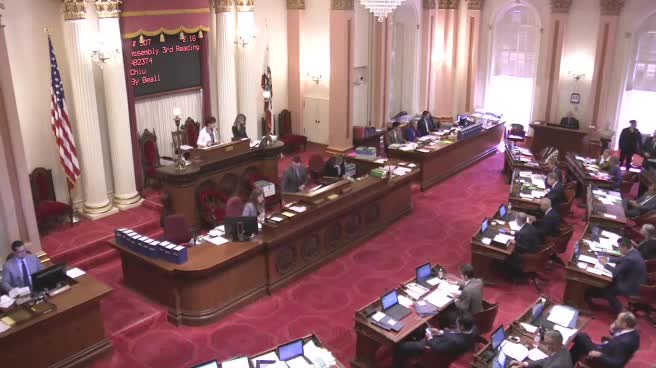
Bill Author