AB 987: Employment discrimination: unlawful employment practices.
- Session Year: 2015-2016
- House: Assembly
- Latest Version Date: 2015-07-16
Existing law, the California Fair Employment and Housing Act, protects and safeguards the right and opportunity of all persons to seek, obtain, and hold employment without discrimination, abridgment, or harassment on account of race, religious creed, color, national origin, ancestry, physical disability, mental disability, medical condition, genetic information, marital status, sex, gender, gender identity, gender expression, age, sexual orientation, or military and veteran status.
Existing law requires an employer or other entity covered by the act to provide reasonable accommodation of, among other things, a persons disability and religious beliefs and prohibits discrimination against any person because the person has opposed any practices forbidden under the act or because the person has filed a complaint.
This bill would, in addition, prohibit an employer or other covered entity from retaliating or otherwise discriminating against a person for requesting accommodation of his or her disability or religious beliefs, regardless of whether the accommodation request was granted. The bill would make related findings and declarations.
Existing law, the California Fair Employment and Housing Act, protects and safeguards the right and opportunity of all persons to seek, obtain, and hold employment without discrimination, abridgment, or harassment on account of race, religious creed, color, national origin, ancestry, physical disability, mental disability, medical condition, genetic information, marital status, sex, gender, gender identity, gender expression, age, sexual orientation, or military and veteran status.
Existing law, law requires an employer or other entity covered by the act to provide reasonable accommodation of, among other things, a persons disability and religious beliefs and prohibits discrimination against any person because the person has opposed any practices forbidden under the act or because the person has filed a complaint.
This bill would, in addition, prohibit an employer or other covered entity from retaliating or otherwise discriminating against a person for requesting accommodation of his or her disability or religious beliefs, regardless of whether the accommodation request was granted. The bill would make related findings and declarations.
Existing law, the California Fair Employment and Housing Act, protects and safeguards the right and opportunity of all persons to seek, obtain, and hold employment without discrimination, abridgment, or harassment on account of race, religious creed, color, national origin, ancestry, physical disability, mental disability, medical condition, genetic information, marital status, sex, gender, gender identity, gender expression, age, sexual orientation, or military and veteran status.
Existing law, requires an employer or other entity covered by the act to provide reasonable accommodation of, among other things, a persons disability and religious beliefs and prohibits discrimination against any person because the person has opposed any practices forbidden under the act or because the person has filed a complaint.
This bill would, in addition, prohibit an employer or other covered entity from retaliating or otherwise discriminating against a person for requesting accommodation of his or her disability or religious beliefs, regardless of whether the accommodation request was granted. The bill would make related findings and declarations.
The Legislature finds and declares the following:
(a)A request for reasonable accommodation based on religion or disability constitutes protected activity under Section 12940 of the Government Code, such that when a person makes such a request, he or she is protected against retaliation for making the request.
(b)The Legislature recognizes that federal law affords similar protection to a person making such a request, as articulated by the Equal Employment Opportunity Commission in its interpretative guidance of the Americans with Disabilities Act of 1990 (Public Law 101-336) and Title VII of the Civil Rights Act of 1964 (Public Law 88-352, as amended). The Legislature affirms that the federal acts provide a floor of protection and that this states law has always exceeded in the protections afforded.
(c)The law of this state contains similar protections for a person making a request for reasonable accommodation under the Pregnancy Disability Leave Law (Section 12945 of the Government Code) and the California Family Rights Act (Sections 12945.2 and 19702.3 of the Government Code). It is the intent of the Legislature for the protections afforded a person making a request for accommodation on the basis of religion or disability to be consistent with the provisions of the Fair Employment and Housing Act (Part 2.8 (commencing with Section 12900) of Division 3 of Title 2 of the Government Code).
(d)Notwithstanding any interpretation of this issue in Rope v. Auto-Chlor Sys. of Washington, Inc., (2013) 220 Cal. App. 4th 635, the Legislature intends (1) to make clear that a request for reasonable accommodation on the basis of religion or disability is a protected activity, and (2) by enacting paragraph (2) of subdivision (m) and paragraph (4) of subdivision (l) of Section 12940, to provide protection against retaliation when an individual makes a request for reasonable accommodation under these sections, regardless of whether the request was granted. With the exception of its holding on this issue, Rope v. Auto-Chlor Sys. of Washington, Inc., (2013) 220 Cal. App. 4th 635 remains good law.
SEC. 2.Section 12940 of the Government Code is amended to read:12940.It is an unlawful employment practice, unless based upon a bona fide occupational qualification, or, except where based upon applicable security regulations established by the United States or the State of California:
(a)For an employer, because of the race, religious creed, color, national origin, ancestry, physical disability, mental disability, medical condition, genetic information, marital status, sex, gender, gender identity, gender expression, age, sexual orientation, or military and veteran status of any person, to refuse to hire or employ the person or to refuse to select the person for a training program leading to employment, or to bar or to discharge the person from employment or from a training program leading to employment, or to discriminate against the person in compensation or in terms, conditions, or privileges of employment.
(1)This part does not prohibit an employer from refusing to hire or discharging an employee with a physical or mental disability, or subject an employer to any legal liability resulting from the refusal to employ or the discharge of an employee with a physical or mental disability, where the employee, because of his or her physical or mental disability, is unable to perform his or her essential duties even with reasonable accommodations, or cannot perform those duties in a manner that would not endanger his or her health or safety or the health or safety of others even with reasonable accommodations.
(2)This part does not prohibit an employer from refusing to hire or discharging an employee who, because of the employees medical condition, is unable to perform his or her essential duties even with reasonable accommodations, or cannot perform those duties in a manner that would not endanger the employees health or safety or the health or safety of others even with reasonable accommodations. Nothing in this part shall subject an employer to any legal liability resulting from the refusal to employ or the discharge of an employee who, because of the employees medical condition, is unable to perform his or her essential duties, or cannot perform those duties in a manner that would not endanger the employees health or safety or the health or safety of others even with reasonable accommodations.
(3)Nothing in this part relating to discrimination on account of marital status shall do either of the following:
(A)Affect the right of an employer to reasonably regulate, for reasons of supervision, safety, security, or morale, the working of spouses in the same department, division, or facility, consistent with the rules and regulations adopted by the commission.
(B)Prohibit bona fide health plans from providing additional or greater benefits to employees with dependents than to those employees without or with fewer dependents.
(4)Nothing in this part relating to discrimination on account of sex shall affect the right of an employer to use veteran status as a factor in employee selection or to give special consideration to Vietnam-era veterans.
(5)(A)This part does not prohibit an employer from refusing to employ an individual because of his or her age if the law compels or provides for that refusal. Promotions within the existing staff, hiring or promotion on the basis of experience and training, rehiring on the basis of seniority and prior service with the employer, or hiring under an established recruiting program from high schools, colleges, universities, or trade schools do not, in and of themselves, constitute unlawful employment practices.
(B)The provisions of this part relating to discrimination on the basis of age do not prohibit an employer from providing health benefits or health care reimbursement plans to retired persons that are altered, reduced, or eliminated when the person becomes eligible for Medicare health benefits. This subparagraph applies to all retiree health benefit plans and contractual provisions or practices concerning retiree health benefits and health care reimbursement plans in effect on or after January 1, 2011.
(b)For a labor organization, because of the race, religious creed, color, national origin, ancestry, physical disability, mental disability, medical condition, genetic information, marital status, sex, gender, gender identity, gender expression, age, sexual orientation, or military and veteran status of any person, to exclude, expel, or restrict from its membership the person, or to provide only second-class or segregated membership or to discriminate against any person because of the race, religious creed, color, national origin, ancestry, physical disability, mental disability, medical condition, genetic information, marital status, sex, gender, gender identity, gender expression, age, sexual orientation, or military and veteran status of the person in the election of officers of the labor organization or in the selection of the labor organizations staff or to discriminate in any way against any of its members or against any employer or against any person employed by an employer.
(c)For any person to discriminate against any person in the selection, termination, training, or other terms or treatment of that person in any apprenticeship training program, any other training program leading to employment, an unpaid internship, or another limited duration program to provide unpaid work experience for that person because of the race, religious creed, color, national origin, ancestry, physical disability, mental disability, medical condition, genetic information, marital status, sex, gender, gender identity, gender expression, age, sexual orientation, or military and veteran status of the person discriminated against.
(d)For any employer or employment agency to print or circulate or cause to be printed or circulated any publication, or to make any nonjob-related inquiry of an employee or applicant, either verbal or through use of an application form, that expresses, directly or indirectly, any limitation, specification, or discrimination as to race, religious creed, color, national origin, ancestry, physical disability, mental disability, medical condition, genetic information, marital status, sex, gender, gender identity, gender expression, age, sexual orientation, or military and veteran status, or any intent to make any such limitation, specification, or discrimination. This part does not prohibit an employer or employment agency from inquiring into the age of an applicant, or from specifying age limitations, where the law compels or provides for that action.
(e)(1)Except as provided in paragraph (2) or (3), for any employer or employment agency to require any medical or psychological examination of an applicant, to make any medical or psychological inquiry of an applicant, to make any inquiry whether an applicant has a mental disability or physical disability or medical condition, or to make any inquiry regarding the nature or severity of a physical disability, mental disability, or medical condition.
(2)Notwithstanding paragraph (1), an employer or employment agency may inquire into the ability of an applicant to perform job-related functions and may respond to an applicants request for reasonable accommodation.
(3)Notwithstanding paragraph (1), an employer or employment agency may require a medical or psychological examination or make a medical or psychological inquiry of a job applicant after an employment offer has been made but prior to the commencement of employment duties, provided that the examination or inquiry is job related and consistent with business necessity and that all entering employees in the same job classification are subject to the same examination or inquiry.
(f)(1)Except as provided in paragraph (2), for any employer or employment agency to require any medical or psychological examination of an employee, to make any medical or psychological inquiry of an employee, to make any inquiry whether an employee has a mental disability, physical disability, or medical condition, or to make any inquiry regarding the nature or severity of a physical disability, mental disability, or medical condition.
(2)Notwithstanding paragraph (1), an employer or employment agency may require any examinations or inquiries that it can show to be job related and consistent with business necessity. An employer or employment agency may conduct voluntary medical examinations, including voluntary medical histories, which are part of an employee health program available to employees at that worksite.
(g)For any employer, labor organization, or employment agency to harass, discharge, expel, or otherwise discriminate against any person because the person has made a report pursuant to Section 11161.8 of the Penal Code that prohibits retaliation against hospital employees who report suspected patient abuse by health facilities or community care facilities.
(h)For any employer, labor organization, employment agency, or person to discharge, expel, or otherwise discriminate against any person because the person has opposed any practices forbidden under this part or because the person has filed a complaint, testified, or assisted in any proceeding under this part.
(i)For any person to aid, abet, incite, compel, or coerce the doing of any of the acts forbidden under this part, or to attempt to do so.
(j)(1)For an employer, labor organization, employment agency, apprenticeship training program or any training program leading to employment, or any other person, because of race, religious creed, color, national origin, ancestry, physical disability, mental disability, medical condition, genetic information, marital status, sex, gender, gender identity, gender expression, age, sexual orientation, or military and veteran status, to harass an employee, an applicant, an unpaid intern or volunteer, or a person providing services pursuant to a contract. Harassment of an employee, an applicant, an unpaid intern or volunteer, or a person providing services pursuant to a contract by an employee, other than an agent or supervisor, shall be unlawful if the entity, or its agents or supervisors, knows or should have known of this conduct and fails to take immediate and appropriate corrective action. An employer may also be responsible for the acts of nonemployees, with respect to sexual harassment of employees, applicants, unpaid interns or volunteers, or persons providing services pursuant to a contract in the workplace, where the employer, or its agents or supervisors, knows or should have known of the conduct and fails to take immediate and appropriate corrective action. In reviewing cases involving the acts of nonemployees, the extent of the employers control and any other legal responsibility that the employer may have with respect to the conduct of those nonemployees shall be considered. An entity shall take all reasonable steps to prevent harassment from occurring. Loss of tangible job benefits shall not be necessary in order to establish harassment.
(2)The provisions of this subdivision are declaratory of existing law, except for the new duties imposed on employers with regard to harassment.
(3)An employee of an entity subject to this subdivision is personally liable for any harassment prohibited by this section that is perpetrated by the employee, regardless of whether the employer or covered entity knows or should have known of the conduct and fails to take immediate and appropriate corrective action.
(4)(A)For purposes of this subdivision only, employer means any person regularly employing one or more persons or regularly receiving the services of one or more persons providing services pursuant to a contract, or any person acting as an agent of an employer, directly or indirectly, the state, or any political or civil subdivision of the state, and cities. The definition of employer in subdivision (d) of Section 12926 applies to all provisions of this section other than this subdivision.
(B)Notwithstanding subparagraph (A), for purposes of this subdivision, employer does not include a religious association or corporation not organized for private profit, except as provided in Section 12926.2.
(C)For purposes of this subdivision, harassment because of sex includes sexual harassment, gender harassment, and harassment based on pregnancy, childbirth, or related medical conditions. Sexually harassing conduct need not be motivated by sexual desire.
(5)For purposes of this subdivision, a person providing services pursuant to a contract means a person who meets all of the following criteria:
(A)The person has the right to control the performance of the contract for services and discretion as to the manner of performance.
(B)The person is customarily engaged in an independently established business.
(C)The person has control over the time and place the work is performed, supplies the tools and instruments used in the work, and performs work that requires a particular skill not ordinarily used in the course of the employers work.
(k)For an employer, labor organization, employment agency, apprenticeship training program, or any training program leading to employment, to fail to take all reasonable steps necessary to prevent discrimination and harassment from occurring.
(l)(1)For an employer or other entity covered by this part to refuse to hire or employ a person or to refuse to select a person for a training program leading to employment or to bar or to discharge a person from employment or from a training program leading to employment, or to discriminate against a person in compensation or in terms, conditions, or privileges of employment because of a conflict between the persons religious belief or observance and any employment requirement, unless the employer or other entity covered by this part demonstrates that it has explored any available reasonable alternative means of accommodating the religious belief or observance, including the possibilities of excusing the person from those duties that conflict with his or her religious belief or observance or permitting those duties to be performed at another time or by another person, but is unable to reasonably accommodate the religious belief or observance without undue hardship, as defined in subdivision (u) of Section 12926, on the conduct of the business of the employer or other entity covered by this part. Religious belief or observance, as used in this section, includes, but is not limited to, observance of a Sabbath or other religious holy day or days, reasonable time necessary for travel prior and subsequent to a religious observance, and religious dress practice and religious grooming practice as described in subdivision (q) of Section 12926. This subdivision shall also apply to an apprenticeship training program, an unpaid internship, and any other program to provide unpaid experience for a person in the workplace or industry.
(2)An accommodation of an individuals religious dress practice or religious grooming practice is not reasonable if the accommodation requires segregation of the individual from other employees or the public.
(3)An accommodation is not required under this subdivision if it would result in a violation of this part or any other law prohibiting discrimination or protecting civil rights, including subdivision (b) of Section 51 of the Civil Code and Section 11135 of this code.
(4)For an employer or other entity covered by this part to, in addition to the employee protections provided pursuant to subdivision (h), retaliate or otherwise discriminate against a person for requesting accommodation under this subdivision, regardless of whether the request was granted.
(m)(1)For an employer or other entity covered by this part to fail to make reasonable accommodation for the known physical or mental disability of an applicant or employee. Nothing in this subdivision or in paragraph (1) or (2) of subdivision (a) shall be construed to require an accommodation that is demonstrated by the employer or other covered entity to produce undue hardship, as defined in subdivision (u) of Section 12926, to its operation.
(2)For an employer or other entity covered by this part to, in addition to the employee protections provided pursuant to subdivision (h), retaliate or otherwise discriminate against a person for requesting accommodation under this subdivision, regardless of whether the request was granted.
(n)For an employer or other entity covered by this part to fail to engage in a timely, good faith, interactive process with the employee or applicant to determine effective reasonable accommodations, if any, in response to a request for reasonable accommodation by an employee or applicant with a known physical or mental disability or known medical condition.
(o)For an employer or other entity covered by this part, to subject, directly or indirectly, any employee, applicant, or other person to a test for the presence of a genetic characteristic.
(p)Nothing in this section shall be interpreted as preventing the ability of employers to identify members of the military or veterans for purposes of awarding a veterans preference as permitted by law.
The Legislature finds and declares the following:
(a)A request for reasonable accommodation based on religion or disability constitutes protected activity under Government Code Section 12940, 12940 of the Government Code, such that when a person makes such a request, he or she is protected against retaliation for making the request.
(b)The Legislature recognizes that federal law affords similar protection to a person making such a request, as articulated by the Equal Employment Opportunity Commission in its interpretative guidance of the Americans with Disability Disabilities Act of 1990 (Public Law 101-336) and Title VII of the Civil Rights Act of 1964 (Public Law 88-352, as amended). The Legislature affirms that the federal acts provide a floor of protection and that this states law has always exceeded in the protections afforded.
(c)The law of this state contains similar protections for a person making a request for reasonable accommodation under the Pregnancy Disability Leave Law (Section 12945 of the Government Code) and the California Family Rights Act (Sections 12945.2 and 19702.3 of the Government Code). It is the intent of the Legislature for the protections afforded a person making a request for accommodation on the basis of religion or disability to be consistent with the provisions of the Fair Employment and Housing Act (Part 2.8 Commencing (commencing with Section 12900) of Division 3 of Title 2 of the Government Code. Code).
(d)Notwithstanding any interpretation of this issue in Rope v. Auto-Chlor Sys. of Washington, Inc., (2013) 220 Cal. App. 4th 635, the Legislature intends (1) to make clear that a request for reasonable accommodation on the basis of religion or disability is a protected activity, and (2) by enacting paragraph (2) of subdivision (m) and paragraph (4) of subdivision (l) of Section 12940, to provide protection against retaliation when an individual makes a request for reasonable accommodation under these sections, regardless of whether the request was granted. With the exception of its holding on this issue, Rope v. Auto-Chlor Sys. of Washington, Inc., (2013) 220 Cal. App. 4th 635 remains good law.
SEC. 2.Section 12940 of the Government Code is amended to read:12940.It is an unlawful employment practice, unless based upon a bona fide occupational qualification, or, except where based upon applicable security regulations established by the United States or the State of California:
(a)For an employer, because of the race, religious creed, color, national origin, ancestry, physical disability, mental disability, medical condition, genetic information, marital status, sex, gender, gender identity, gender expression, age, sexual orientation, or military and veteran status of any person, to refuse to hire or employ the person or to refuse to select the person for a training program leading to employment, or to bar or to discharge the person from employment or from a training program leading to employment, or to discriminate against the person in compensation or in terms, conditions, or privileges of employment.
(1)This part does not prohibit an employer from refusing to hire or discharging an employee with a physical or mental disability, or subject an employer to any legal liability resulting from the refusal to employ or the discharge of an employee with a physical or mental disability, where the employee, because of his or her physical or mental disability, is unable to perform his or her essential duties even with reasonable accommodations, or cannot perform those duties in a manner that would not endanger his or her health or safety or the health or safety of others even with reasonable accommodations.
(2)This part does not prohibit an employer from refusing to hire or discharging an employee who, because of the employees medical condition, is unable to perform his or her essential duties even with reasonable accommodations, or cannot perform those duties in a manner that would not endanger the employees health or safety or the health or safety of others even with reasonable accommodations. Nothing in this part shall subject an employer to any legal liability resulting from the refusal to employ or the discharge of an employee who, because of the employees medical condition, is unable to perform his or her essential duties, or cannot perform those duties in a manner that would not endanger the employees health or safety or the health or safety of others even with reasonable accommodations.
(3)Nothing in this part relating to discrimination on account of marital status shall do either of the following:
(A)Affect the right of an employer to reasonably regulate, for reasons of supervision, safety, security, or morale, the working of spouses in the same department, division, or facility, consistent with the rules and regulations adopted by the commission.
(B)Prohibit bona fide health plans from providing additional or greater benefits to employees with dependents than to those employees without or with fewer dependents.
(4)Nothing in this part relating to discrimination on account of sex shall affect the right of an employer to use veteran status as a factor in employee selection or to give special consideration to Vietnam-era veterans.
(5)(A)This part does not prohibit an employer from refusing to employ an individual because of his or her age if the law compels or provides for that refusal. Promotions within the existing staff, hiring or promotion on the basis of experience and training, rehiring on the basis of seniority and prior service with the employer, or hiring under an established recruiting program from high schools, colleges, universities, or trade schools do not, in and of themselves, constitute unlawful employment practices.
(B)The provisions of this part relating to discrimination on the basis of age do not prohibit an employer from providing health benefits or health care reimbursement plans to retired persons that are altered, reduced, or eliminated when the person becomes eligible for Medicare health benefits. This subparagraph applies to all retiree health benefit plans and contractual provisions or practices concerning retiree health benefits and health care reimbursement plans in effect on or after January 1, 2011.
(b)For a labor organization, because of the race, religious creed, color, national origin, ancestry, physical disability, mental disability, medical condition, genetic information, marital status, sex, gender, gender identity, gender expression, age, sexual orientation, or military and veteran status of any person, to exclude, expel, or restrict from its membership the person, or to provide only second-class or segregated membership or to discriminate against any person because of the race, religious creed, color, national origin, ancestry, physical disability, mental disability, medical condition, genetic information, marital status, sex, gender, gender identity, gender expression, age, sexual orientation, or military and veteran status of the person in the election of officers of the labor organization or in the selection of the labor organizations staff or to discriminate in any way against any of its members or against any employer or against any person employed by an employer.
(c)For any person to discriminate against any person in the selection, termination, training, or other terms or treatment of that person in any apprenticeship training program, any other training program leading to employment, an unpaid internship, or another limited duration program to provide unpaid work experience for that person because of the race, religious creed, color, national origin, ancestry, physical disability, mental disability, medical condition, genetic information, marital status, sex, gender, gender identity, gender expression, age, sexual orientation, or military and veteran status of the person discriminated against.
(d)For any employer or employment agency to print or circulate or cause to be printed or circulated any publication, or to make any nonjob-related inquiry of an employee or applicant, either verbal or through use of an application form, that expresses, directly or indirectly, any limitation, specification, or discrimination as to race, religious creed, color, national origin, ancestry, physical disability, mental disability, medical condition, genetic information, marital status, sex, gender, gender identity, gender expression, age, sexual orientation, or military and veteran status, or any intent to make any such limitation, specification, or discrimination. This part does not prohibit an employer or employment agency from inquiring into the age of an applicant, or from specifying age limitations, where the law compels or provides for that action.
(e)(1)Except as provided in paragraph (2) or (3), for any employer or employment agency to require any medical or psychological examination of an applicant, to make any medical or psychological inquiry of an applicant, to make any inquiry whether an applicant has a mental disability or physical disability or medical condition, or to make any inquiry regarding the nature or severity of a physical disability, mental disability, or medical condition.
(2)Notwithstanding paragraph (1), an employer or employment agency may inquire into the ability of an applicant to perform job-related functions and may respond to an applicants request for reasonable accommodation.
(3)Notwithstanding paragraph (1), an employer or employment agency may require a medical or psychological examination or make a medical or psychological inquiry of a job applicant after an employment offer has been made but prior to the commencement of employment duties, provided that the examination or inquiry is job related and consistent with business necessity and that all entering employees in the same job classification are subject to the same examination or inquiry.
(f)(1)Except as provided in paragraph (2), for any employer or employment agency to require any medical or psychological examination of an employee, to make any medical or psychological inquiry of an employee, to make any inquiry whether an employee has a mental disability, physical disability, or medical condition, or to make any inquiry regarding the nature or severity of a physical disability, mental disability, or medical condition.
(2)Notwithstanding paragraph (1), an employer or employment agency may require any examinations or inquiries that it can show to be job related and consistent with business necessity. An employer or employment agency may conduct voluntary medical examinations, including voluntary medical histories, which are part of an employee health program available to employees at that worksite.
(g)For any employer, labor organization, or employment agency to harass, discharge, expel, or otherwise discriminate against any person because the person has made a report pursuant to Section 11161.8 of the Penal Code that prohibits retaliation against hospital employees who report suspected patient abuse by health facilities or community care facilities.
(h)For any employer, labor organization, employment agency, or person to discharge, expel, or otherwise discriminate against any person because the person has opposed any practices forbidden under this part or because the person has filed a complaint, testified, or assisted in any proceeding under this part.
(i)For any person to aid, abet, incite, compel, or coerce the doing of any of the acts forbidden under this part, or to attempt to do so.
(j)(1)For an employer, labor organization, employment agency, apprenticeship training program or any training program leading to employment, or any other person, because of race, religious creed, color, national origin, ancestry, physical disability, mental disability, medical condition, genetic information, marital status, sex, gender, gender identity, gender expression, age, sexual orientation, or military and veteran status, to harass an employee, an applicant, an unpaid intern or volunteer, or a person providing services pursuant to a contract. Harassment of an employee, an applicant, an unpaid intern or volunteer, or a person providing services pursuant to a contract by an employee, other than an agent or supervisor, shall be unlawful if the entity, or its agents or supervisors, knows or should have known of this conduct and fails to take immediate and appropriate corrective action. An employer may also be responsible for the acts of nonemployees, with respect to sexual harassment of employees, applicants, unpaid interns or volunteers, or persons providing services pursuant to a contract in the workplace, where the employer, or its agents or supervisors, knows or should have known of the conduct and fails to take immediate and appropriate corrective action. In reviewing cases involving the acts of nonemployees, the extent of the employers control and any other legal responsibility that the employer may have with respect to the conduct of those nonemployees shall be considered. An entity shall take all reasonable steps to prevent harassment from occurring. Loss of tangible job benefits shall not be necessary in order to establish harassment.
(2)The provisions of this subdivision are declaratory of existing law, except for the new duties imposed on employers with regard to harassment.
(3)An employee of an entity subject to this subdivision is personally liable for any harassment prohibited by this section that is perpetrated by the employee, regardless of whether the employer or covered entity knows or should have known of the conduct and fails to take immediate and appropriate corrective action.
(4)(A)For purposes of this subdivision only, employer means any person regularly employing one or more persons or regularly receiving the services of one or more persons providing services pursuant to a contract, or any person acting as an agent of an employer, directly or indirectly, the state, or any political or civil subdivision of the state, and cities. The definition of employer in subdivision (d) of Section 12926 applies to all provisions of this section other than this subdivision.
(B)Notwithstanding subparagraph (A), for purposes of this subdivision, employer does not include a religious association or corporation not organized for private profit, except as provided in Section 12926.2.
(C)For purposes of this subdivision, harassment because of sex includes sexual harassment, gender harassment, and harassment based on pregnancy, childbirth, or related medical conditions. Sexually harassing conduct need not be motivated by sexual desire.
(5)For purposes of this subdivision, a person providing services pursuant to a contract means a person who meets all of the following criteria:
(A)The person has the right to control the performance of the contract for services and discretion as to the manner of performance.
(B)The person is customarily engaged in an independently established business.
(C)The person has control over the time and place the work is performed, supplies the tools and instruments used in the work, and performs work that requires a particular skill not ordinarily used in the course of the employers work.
(k)For an employer, labor organization, employment agency, apprenticeship training program, or any training program leading to employment, to fail to take all reasonable steps necessary to prevent discrimination and harassment from occurring.
(l)(1)For an employer or other entity covered by this part to refuse to hire or employ a person or to refuse to select a person for a training program leading to employment or to bar or to discharge a person from employment or from a training program leading to employment, or to discriminate against a person in compensation or in terms, conditions, or privileges of employment because of a conflict between the persons religious belief or observance and any employment requirement, unless the employer or other entity covered by this part demonstrates that it has explored any available reasonable alternative means of accommodating the religious belief or observance, including the possibilities of excusing the person from those duties that conflict with his or her religious belief or observance or permitting those duties to be performed at another time or by another person, but is unable to reasonably accommodate the religious belief or observance without undue hardship, as defined in subdivision (u) of Section 12926, on the conduct of the business of the employer or other entity covered by this part. Religious belief or observance, as used in this section, includes, but is not limited to, observance of a Sabbath or other religious holy day or days, reasonable time necessary for travel prior and subsequent to a religious observance, and religious dress practice and religious grooming practice as described in subdivision (q) of Section 12926. This subdivision shall also apply to an apprenticeship training program, an unpaid internship, and any other program to provide unpaid experience for a person in the workplace or industry.
(2)An accommodation of an individuals religious dress practice or religious grooming practice is not reasonable if the accommodation requires segregation of the individual from other employees or the public.
(3)An accommodation is not required under this subdivision if it would result in a violation of this part or any other law prohibiting discrimination or protecting civil rights, including subdivision (b) of Section 51 of the Civil Code and Section 11135 of this code.
(4)For an employer or other entity covered by this part to, in addition to the employee protections provided pursuant to subdivision (h), retaliate or otherwise discriminate against a person for requesting accommodation under this subdivision, regardless of whether the request was granted.
(m)(1)For an employer or other entity covered by this part to fail to make reasonable accommodation for the known physical or mental disability of an applicant or employee. Nothing in this subdivision or in paragraph (1) or (2) of subdivision (a) shall be construed to require an accommodation that is demonstrated by the employer or other covered entity to produce undue hardship, as defined in subdivision (u) of Section 12926, to its operation.
(2)For an employer or other entity covered by this part to, in addition to the employee protections provided pursuant to subdivision (h), retaliate or otherwise discriminate against a person for requesting accommodation under this subdivision, regardless of whether the request was granted.
(n)For an employer or other entity covered by this part to fail to engage in a timely, good faith, interactive process with the employee or applicant to determine effective reasonable accommodations, if any, in response to a request for reasonable accommodation by an employee or applicant with a known physical or mental disability or known medical condition.
(o)For an employer or other entity covered by this part, to subject, directly or indirectly, any employee, applicant, or other person to a test for the presence of a genetic characteristic.
(p)Nothing in this section shall be interpreted as preventing the ability of employers to identify members of the military or veterans for purposes of awarding a veterans preference as permitted by law.
The Legislature finds and declares the following:
(a)A request for reasonable accommodation based on religion or disability constitutes protected activity under Government Code Section 12940, such that when a person makes such a request, he or she is protected against retaliation for making the request.
(b)The Legislature recognizes that federal law affords similar protection to a person making such a request, as articulated by the Equal Employment Opportunity Commission in its interpretative guidance of the Americans with Disability Act of 1990 (Public Law 101-336) and Title VII of the Civil Rights Act of 1964 (Public Law 88-352, as amended). The Legislature affirms that the federal acts provide a floor of protection and that this states law has always exceeded in the protections afforded.
(c)The law of this state contains similar protections for a person making a request for reasonable accommodation under the Pregnancy Disability Leave Law (Section 12945 of the Government Code) and the California Family Rights Act (Sections 12945.2 and 19702.3 of the Government Code). It is the intent of the Legislature for the protections afforded a person making a request for accommodation on the basis of religion or disability to be consistent with the provisions of the Fair Employment and Housing Act (Part 2.8 Commencing with Section 12900) of Division 3 of Title 2 of the Government Code.
(d)Notwithstanding any interpretation of this issue in Rope v. Auto-Chlor Sys. of Washington, Inc., (2013) 220 Cal. App. 4th 635, the Legislature intends (1) to make clear that a request for reasonable accommodation on the basis of religion or disability is a protected activity, and (2) by enacting paragraph (2) of subdivision (m) and paragraph (4) of subdivision (l) of Section 12940, to provide protection against retaliation when an individual makes a request for reasonable accommodation under these sections, regardless of whether the request was granted. With the exception of its holding on this issue, Rope v. Auto-Chlor Sys. of Washington, Inc., (2013) 220 Cal. App. 4th 635 remains good law.
SEC. 2.Section 12940 of the Government Code is amended to read:12940.It is an unlawful employment practice, unless based upon a bona fide occupational qualification, or, except where based upon applicable security regulations established by the United States or the State of California:
(a)For an employer, because of the race, religious creed, color, national origin, ancestry, physical disability, mental disability, medical condition, genetic information, marital status, sex, gender, gender identity, gender expression, age, sexual orientation, or military and veteran status of any person, to refuse to hire or employ the person or to refuse to select the person for a training program leading to employment, or to bar or to discharge the person from employment or from a training program leading to employment, or to discriminate against the person in compensation or in terms, conditions, or privileges of employment.
(1)This part does not prohibit an employer from refusing to hire or discharging an employee with a physical or mental disability, or subject an employer to any legal liability resulting from the refusal to employ or the discharge of an employee with a physical or mental disability, where the employee, because of his or her physical or mental disability, is unable to perform his or her essential duties even with reasonable accommodations, or cannot perform those duties in a manner that would not endanger his or her health or safety or the health or safety of others even with reasonable accommodations.
(2)This part does not prohibit an employer from refusing to hire or discharging an employee who, because of the employees medical condition, is unable to perform his or her essential duties even with reasonable accommodations, or cannot perform those duties in a manner that would not endanger the employees health or safety or the health or safety of others even with reasonable accommodations. Nothing in this part shall subject an employer to any legal liability resulting from the refusal to employ or the discharge of an employee who, because of the employees medical condition, is unable to perform his or her essential duties, or cannot perform those duties in a manner that would not endanger the employees health or safety or the health or safety of others even with reasonable accommodations.
(3)Nothing in this part relating to discrimination on account of marital status shall do either of the following:
(A)Affect the right of an employer to reasonably regulate, for reasons of supervision, safety, security, or morale, the working of spouses in the same department, division, or facility, consistent with the rules and regulations adopted by the commission.
(B)Prohibit bona fide health plans from providing additional or greater benefits to employees with dependents than to those employees without or with fewer dependents.
(4)Nothing in this part relating to discrimination on account of sex shall affect the right of an employer to use veteran status as a factor in employee selection or to give special consideration to Vietnam-era veterans.
(5)(A)This part does not prohibit an employer from refusing to employ an individual because of his or her age if the law compels or provides for that refusal. Promotions within the existing staff, hiring or promotion on the basis of experience and training, rehiring on the basis of seniority and prior service with the employer, or hiring under an established recruiting program from high schools, colleges, universities, or trade schools do not, in and of themselves, constitute unlawful employment practices.
(B)The provisions of this part relating to discrimination on the basis of age do not prohibit an employer from providing health benefits or health care reimbursement plans to retired persons that are altered, reduced, or eliminated when the person becomes eligible for Medicare health benefits. This subparagraph applies to all retiree health benefit plans and contractual provisions or practices concerning retiree health benefits and health care reimbursement plans in effect on or after January 1, 2011.
(b)For a labor organization, because of the race, religious creed, color, national origin, ancestry, physical disability, mental disability, medical condition, genetic information, marital status, sex, gender, gender identity, gender expression, age, sexual orientation, or military and veteran status of any person, to exclude, expel, or restrict from its membership the person, or to provide only second-class or segregated membership or to discriminate against any person because of the race, religious creed, color, national origin, ancestry, physical disability, mental disability, medical condition, genetic information, marital status, sex, gender, gender identity, gender expression, age, sexual orientation, or military and veteran status of the person in the election of officers of the labor organization or in the selection of the labor organizations staff or to discriminate in any way against any of its members or against any employer or against any person employed by an employer.
(c)For any person to discriminate against any person in the selection, termination, training, or other terms or treatment of that person in any apprenticeship training program, any other training program leading to employment, an unpaid internship, or another limited duration program to provide unpaid work experience for that person because of the race, religious creed, color, national origin, ancestry, physical disability, mental disability, medical condition, genetic information, marital status, sex, gender, gender identity, gender expression, age, sexual orientation, or military and veteran status of the person discriminated against.
(d)For any employer or employment agency to print or circulate or cause to be printed or circulated any publication, or to make any nonjob-related inquiry of an employee or applicant, either verbal or through use of an application form, that expresses, directly or indirectly, any limitation, specification, or discrimination as to race, religious creed, color, national origin, ancestry, physical disability, mental disability, medical condition, genetic information, marital status, sex, gender, gender identity, gender expression, age, sexual orientation, or military and veteran status, or any intent to make any such limitation, specification, or discrimination. This part does not prohibit an employer or employment agency from inquiring into the age of an applicant, or from specifying age limitations, where the law compels or provides for that action.
(e)(1)Except as provided in paragraph (2) or (3), for any employer or employment agency to require any medical or psychological examination of an applicant, to make any medical or psychological inquiry of an applicant, to make any inquiry whether an applicant has a mental disability or physical disability or medical condition, or to make any inquiry regarding the nature or severity of a physical disability, mental disability, or medical condition.
(2)Notwithstanding paragraph (1), an employer or employment agency may inquire into the ability of an applicant to perform job-related functions and may respond to an applicants request for reasonable accommodation.
(3)Notwithstanding paragraph (1), an employer or employment agency may require a medical or psychological examination or make a medical or psychological inquiry of a job applicant after an employment offer has been made but prior to the commencement of employment duties, provided that the examination or inquiry is job related and consistent with business necessity and that all entering employees in the same job classification are subject to the same examination or inquiry.
(f)(1)Except as provided in paragraph (2), for any employer or employment agency to require any medical or psychological examination of an employee, to make any medical or psychological inquiry of an employee, to make any inquiry whether an employee has a mental disability, physical disability, or medical condition, or to make any inquiry regarding the nature or severity of a physical disability, mental disability, or medical condition.
(2)Notwithstanding paragraph (1), an employer or employment agency may require any examinations or inquiries that it can show to be job related and consistent with business necessity. An employer or employment agency may conduct voluntary medical examinations, including voluntary medical histories, which are part of an employee health program available to employees at that worksite.
(g)For any employer, labor organization, or employment agency to harass, discharge, expel, or otherwise discriminate against any person because the person has made a report pursuant to Section 11161.8 of the Penal Code that prohibits retaliation against hospital employees who report suspected patient abuse by health facilities or community care facilities.
(h)For any employer, labor organization, employment agency, or person to discharge, expel, or otherwise discriminate against any person because the person has opposed any practices forbidden under this part or because the person has filed a complaint, testified, or assisted in any proceeding under this part.
(i)For any person to aid, abet, incite, compel, or coerce the doing of any of the acts forbidden under this part, or to attempt to do so.
(j)(1)For an employer, labor organization, employment agency, apprenticeship training program or any training program leading to employment, or any other person, because of race, religious creed, color, national origin, ancestry, physical disability, mental disability, medical condition, genetic information, marital status, sex, gender, gender identity, gender expression, age, sexual orientation, or military and veteran status, to harass an employee, an applicant, an unpaid intern or volunteer, or a person providing services pursuant to a contract. Harassment of an employee, an applicant, an unpaid intern or volunteer, or a person providing services pursuant to a contract by an employee, other than an agent or supervisor, shall be unlawful if the entity, or its agents or supervisors, knows or should have known of this conduct and fails to take immediate and appropriate corrective action. An employer may also be responsible for the acts of nonemployees, with respect to sexual harassment of employees, applicants, unpaid interns or volunteers, or persons providing services pursuant to a contract in the workplace, where the employer, or its agents or supervisors, knows or should have known of the conduct and fails to take immediate and appropriate corrective action. In reviewing cases involving the acts of nonemployees, the extent of the employers control and any other legal responsibility that the employer may have with respect to the conduct of those nonemployees shall be considered. An entity shall take all reasonable steps to prevent harassment from occurring. Loss of tangible job benefits shall not be necessary in order to establish harassment.
(2)The provisions of this subdivision are declaratory of existing law, except for the new duties imposed on employers with regard to harassment.
(3)An employee of an entity subject to this subdivision is personally liable for any harassment prohibited by this section that is perpetrated by the employee, regardless of whether the employer or covered entity knows or should have known of the conduct and fails to take immediate and appropriate corrective action.
(4)(A)For purposes of this subdivision only, employer means any person regularly employing one or more persons or regularly receiving the services of one or more persons providing services pursuant to a contract, or any person acting as an agent of an employer, directly or indirectly, the state, or any political or civil subdivision of the state, and cities. The definition of employer in subdivision (d) of Section 12926 applies to all provisions of this section other than this subdivision.
(B)Notwithstanding subparagraph (A), for purposes of this subdivision, employer does not include a religious association or corporation not organized for private profit, except as provided in Section 12926.2.
(C)For purposes of this subdivision, harassment because of sex includes sexual harassment, gender harassment, and harassment based on pregnancy, childbirth, or related medical conditions. Sexually harassing conduct need not be motivated by sexual desire.
(5)For purposes of this subdivision, a person providing services pursuant to a contract means a person who meets all of the following criteria:
(A)The person has the right to control the performance of the contract for services and discretion as to the manner of performance.
(B)The person is customarily engaged in an independently established business.
(C)The person has control over the time and place the work is performed, supplies the tools and instruments used in the work, and performs work that requires a particular skill not ordinarily used in the course of the employers work.
(k)For an employer, labor organization, employment agency, apprenticeship training program, or any training program leading to employment, to fail to take all reasonable steps necessary to prevent discrimination and harassment from occurring.
(l)(1)For an employer or other entity covered by this part to refuse to hire or employ a person or to refuse to select a person for a training program leading to employment or to bar or to discharge a person from employment or from a training program leading to employment, or to discriminate against a person in compensation or in terms, conditions, or privileges of employment because of a conflict between the persons religious belief or observance and any employment requirement, unless the employer or other entity covered by this part demonstrates that it has explored any available reasonable alternative means of accommodating the religious belief or observance, including the possibilities of excusing the person from those duties that conflict with his or her religious belief or observance or permitting those duties to be performed at another time or by another person, but is unable to reasonably accommodate the religious belief or observance without undue hardship, as defined in subdivision (u) of Section 12926, on the conduct of the business of the employer or other entity covered by this part. Religious belief or observance, as used in this section, includes, but is not limited to, observance of a Sabbath or other religious holy day or days, reasonable time necessary for travel prior and subsequent to a religious observance, and religious dress practice and religious grooming practice as described in subdivision (q) of Section 12926. This subdivision shall also apply to an apprenticeship training program, an unpaid internship, and any other program to provide unpaid experience for a person in the workplace or industry.
(2)An accommodation of an individuals religious dress practice or religious grooming practice is not reasonable if the accommodation requires segregation of the individual from other employees or the public.
(3)An accommodation is not required under this subdivision if it would result in a violation of this part or any other law prohibiting discrimination or protecting civil rights, including subdivision (b) of Section 51 of the Civil Code and Section 11135 of this code.
(4)For an employer or other entity covered by this part to, in addition to the employee protections provided pursuant to subdivision (h), retaliate or otherwise discriminate against a person for requesting accommodation under this subdivision, regardless of whether the request was granted.
(m)(1)For an employer or other entity covered by this part to fail to make reasonable accommodation for the known physical or mental disability of an applicant or employee. Nothing in this subdivision or in paragraph (1) or (2) of subdivision (a) shall be construed to require an accommodation that is demonstrated by the employer or other covered entity to produce undue hardship, as defined in subdivision (u) of Section 12926, to its operation.
(2)For an employer or other entity covered by this part to, in addition to the employee protections provided pursuant to subdivision (h), retaliate or otherwise discriminate against a person for requesting accommodation under this subdivision, regardless of whether the request was granted.
(n)For an employer or other entity covered by this part to fail to engage in a timely, good faith, interactive process with the employee or applicant to determine effective reasonable accommodations, if any, in response to a request for reasonable accommodation by an employee or applicant with a known physical or mental disability or known medical condition.
(o)For an employer or other entity covered by this part, to subject, directly or indirectly, any employee, applicant, or other person to a test for the presence of a genetic characteristic.
(p)Nothing in this section shall be interpreted as preventing the ability of employers to identify members of the military or veterans for purposes of awarding a veterans preference as permitted by law.
|
Date
|
Status
|
|---|---|
| Jun 10, 2015 | From committee: Do pass and re-refer to Com. on APPR. (Ayes 7. Noes 0.) (June 9). Re-referred to Com. on APPR. |
| Jul 16, 2015 | Chaptered by Secretary of State - Chapter 122, Statutes of 2015. |
| Jul 16, 2015 | Approved by the Governor. |
| Jul 9, 2015 | Enrolled and presented to the Governor at 2 p.m. |
| Jul 2, 2015 | Senate amendments concurred in. To Engrossing and Enrolling. (Ayes 74. Noes 0. Page 2228.). |
| Jul 2, 2015 | Senate amendments concurred in. To Engrossing and Enrolling. |
| Jun 29, 2015 | Read third time. Passed. Ordered to the Assembly. (Ayes 39. Noes 0. Page 1663.). |
| Jun 29, 2015 | Read third time. Passed. Ordered to the Assembly. |
| Jun 29, 2015 | In Assembly. Concurrence in Senate amendments pending. May be considered on or after July 1 pursuant to Assembly Rule 77. |
| Jun 23, 2015 | Read second time. Ordered to third reading. |
| Jun 22, 2015 | From committee: Be placed on second reading file pursuant to Senate Rule 28.8. |
| Feb 26, 2015 | Read first time. To print. |
| May 27, 2015 | From committee chair, with author's amendments: Amend, and re-refer to committee. Read second time, amended, and re-referred to Com. on JUD. |
| May 7, 2015 | Referred to Com. on JUD. |
| Apr 27, 2015 | Read third time. Passed. Ordered to the Senate. (Ayes 76. Noes 0. Page 1144.) |
| Apr 27, 2015 | Read third time. Passed. Ordered to the Senate. |
| Apr 27, 2015 | In Senate. Read first time. To Com. on RLS. for assignment. |
| Apr 23, 2015 | Read second time. Ordered to third reading. |
| Apr 22, 2015 | From committee: Do pass. (Ayes 17. Noes 0.) (April 22). |
| Apr 9, 2015 | From committee: Do pass and re-refer to Com. on APPR. (Ayes 6. Noes 0.) (April 8). Re-referred to Com. on APPR. |
| Mar 16, 2015 | Referred to Com. on L. & E. |
| Feb 27, 2015 | From printer. May be heard in committee March 29. |
|
Date
|
Description
|
Location
|
Votes
|
|
|---|---|---|---|---|
| Jul 2, 2015 | AB 987 LEVINE Concurrence in Senate Amendments | Assembly Floor |
Passed |
|
| Jun 29, 2015 | Assembly 3rd Reading AB987 Levine By Moorlach | Senate Floor |
Passed |
|
| Jun 9, 2015 | Do pass, but first be re-referred to the Committee on [Appropriations] | Senate Standing Committee on Judiciary |
Passed |
|
| Apr 27, 2015 | AB 987 LEVINE Assembly Third Reading | Assembly Floor |
Passed |
|
| Apr 22, 2015 | Do pass. | Assembly Standing Committee on Appropriations |
Passed |
|
| Apr 8, 2015 | Do pass and be re-referred to the Committee on [Appropriations] | Assembly Standing Committee on Labor and Employment |
Passed |
This list shows positions taken on this bill by organizations on the date displayed, which is linked to the original source.
Positions by individuals are not included.
|
Organization
|
Position
|
Date
|
|---|---|---|
| 7th Day Adventist Church | * Support | Jun 9, 2015 |
| Agudath Israel Of California | ** Support | Jun 29, 2015 |
| Association Of Regional Center Agencies | ** Support | Jun 29, 2015 |
| California Association of Electrical Workers | * Support | Jun 26, 2018 |
| California Employment Lawyers Association | ** Support | Jun 29, 2015 |
| California Rural Legal Assistance Foundation, Inc. | ** Support | Jun 29, 2015 |
| California State Council Of Laborers | * Support | Jun 26, 2018 |
| California State Pipe Trades Council | * Support | Jun 26, 2018 |
| California Teachers Association | ** Support | Jun 29, 2015 |
| California Teamsters | * Support | Jun 26, 2018 |
| Chatten-Brown & Carstens | * Against | Jun 26, 2018 |
| Church State Council | ** Support | Jun 29, 2015 |
| City of Englewood | * Support | Jun 20, 2018 |
| City Of Inglewood | * Support | Jun 26, 2018 |
| Coblentz Patch Duffy & Bass | * Indeterminate | Jun 26, 2018 |
| Consumer Attorneys Of California | ** Support | Jun 29, 2015 |
| Counsel on American Islamic Relations California Chapter | * Support | Jun 9, 2015 |
| Disability Rights California | ** Support | Jun 29, 2015 |
| Disability Rights Education and Defense Fund | ** Support | Jun 29, 2015 |
| District Council 16 International Union Of Painters And Allied Trades | * Support | Jun 26, 2018 |
| Elevator Constructors Union | * Support | Jun 26, 2018 |
| Esquire | * Support | Jun 9, 2015 |
| Glendale City Employees Association | ** Support | Jun 29, 2015 |
| Inglewood Chamber of Commerce | * Support | Jun 26, 2018 |
| Keller Williams Realty | * Support | Jun 26, 2018 |
| Latham & Watkins | * Against | Jun 26, 2018 |
| Legal Aid Society - Employment Law Center | ** Support | Jun 29, 2015 |
| Morongo Band Of Mission Indians | * Support | Jun 20, 2018 |
| Murphy Bowl LLC | * Indeterminate | Jun 26, 2018 |
| National Association of Social Workers | * Support | Jun 9, 2015 |
| National Association Of Social Workers, California Chapter | ** Support | Jun 29, 2015 |
| Natural Resource Defense Council | * Against | Jun 26, 2018 |
| One For All | * Support | Jun 26, 2018 |
| One For All | * Support | Jun 26, 2018 |
| Organization Of Smud Employees | ** Support | Jun 29, 2015 |
| Planning And Conservation League | * Against | Jun 20, 2018 |
| Public Counsel | * Against | Jun 20, 2018 |
| Rotary Club of Inglewood | * Support | Jun 26, 2018 |
| San Bernardino Public Employees Association | ** Support | Jun 29, 2015 |
| San Diego County Court Employees Association | ** Support | Jun 29, 2015 |
| San Luis Obispo County Employees Association | ** Support | Jun 29, 2015 |
| Sierra Club California | * Against | Jun 26, 2018 |
| Social Justice Learning Institute | * Support | Jun 20, 2018 |
| The Arc and United Cerebral Palsy California Collaboration | ** Support | Jun 29, 2015 |
| Uplift Inglewood | * Against | Jun 26, 2018 |
| Western State Council of Sheet Metal Workers | * Support | Jun 26, 2018 |
AB 987
Page 1
CONCURRENCE IN SENATE AMENDMENTS
AB 987
(Levine)
As Amended May 27, 2015
Majority vote
ASSEMBLY: |
76-0 |
(April 27, 2015) |
SENATE: |
39-0 |
(June 29, 2015) |
Original Committee Reference: L. & E.
SUMMARY: Revises provisions of the Fair Employment and Housing Act (FEHA) related to employee requests for accommodation. Specifically, this bill:
Makes it an unlawful employment practice for an employer or other covered entity to retaliate or otherwise discriminate against a person for "requesting" an accommodation for physical or mental disability or religious belief or observance, regardless of whether the request was granted.
Makes related legislative findings and declarations.
The Senate amendments add a co-author and make technical changes.
FISCAL EFFECT: According to the Senate Appropriations Committee, pursuant to Senate Rule 28.8, negligible state costs.
COMMENTS: This legislation is in response to a recent California Court of Appeal decision in Rope v. Auto-Clor System of Washington, Inc., 220 Cal. App. 4th 635 (2013). This bill is sponsored by the California Employment Lawyers Association (CELA), who argues that it will clarify that an employee cannot be retaliated against for requesting a reasonable accommodation for a disability or religion. CELA states that, as a result of the Rope decision, courts have dismissed cases where an employee was fired or otherwise discriminated against in retaliation for simply making a request for reasonable accommodation for a disability or religion.
Without clarification, an employer can simply terminate an employee who requests a reasonable accommodation, and the employee will have no legal recourse to claim retaliation.
The sponsor and the author point to a number of recent cases in which courts have relied on Rope in holding that a request for accommodation is not protected activity for purposes of the retaliation provisions of FEHA. This bill is needed to clarify the law to ensure that workers' rights are not being violated.
Analysis Prepared by: Ben Ebbink / L. & E. / (916) 319-2091 FN: 0001095
AB 987
Page 6
|
Office of Senate Floor Analyses (916) 651-1520 Fax: (916) 327-4478 |
THIRD READING
Bill No: AB 987
Amended: 5/27/15 in Senate
SENATE JUDICIARY COMMITTEE: 7-0, 6/9/15
AYES: Jackson, Moorlach, Anderson, Hertzberg, Leno, Monning, Wieckowski
SENATE APPROPRIATIONS COMMITTEE: Senate Rule 28.8
ASSEMBLY FLOOR: 76-0, 4/27/15 - See last page for vote
SUBJECT: Employment discrimination: unlawful employment practices
SOURCE: California Employment Lawyers Association
DIGEST: This bill makes it an unlawful employment practice under the Fair Employment and Housing Act (FEHA) or an employer or other covered entity to retaliate or otherwise discriminate against a person who requests an accommodation for the person’s religious belief or observance or for the person’s known physical or mental disability, regardless of whether the request was granted.
Existing law:
Prohibits, under Title VII of the Civil Rights Act, discrimination and harassment of employees.
Prohibits, under FEHA, as a matter of public policy, discrimination and harassment in employment on the basis of race, religious creed, color, national origin, ancestry, physical disability, mental disability, medical condition, genetic information, marital status, sex, gender, gender identity, gender expression, age, sexual orientation, or military and veteran status.
Prohibits, unless based upon a bona fide occupational qualification, or, except where based upon applicable security regulations, as specified, an employer from refusing to hire or employ a person or refusing to select a person for a training program leading to employment or barring or discharging a person from employment or from a training program leading to employment, or discriminating against a person in compensation or in terms, conditions, or privileges of employment because of a conflict between the person’s religious belief or observance and any employment requirement.
Defines religious belief or observance to include observance of a Sabbath or other religious holy day or days, reasonable time necessary for travel prior and subsequent to a religious observance, and religious dress practice and religious grooming practice.
Provides that an accommodation of an individual’s religious dress practice or religious grooming practice is not reasonable if the accommodation requires segregation of the individual from other employees or the public, and an accommodation is not required if it would result in a violation of FEHA or any other law prohibiting discrimination or protective civil rights.
Prohibits an employer or other entity from failing to make reasonable accommodation for the known physical or mental disability of an applicant or employee; however, an employer is not required to provide accommodation that is demonstrated by the employer or other covered entity to produce undue hardship, as defined.
This bill:
Prohibits an employer or other entity from retaliating or otherwise discriminating against a person for requesting accommodation for a person’s religious belief or observance or for a person’s known physical or mental disability, regardless of whether the request was granted.
Makes various related legislative findings and declarations.
Background
Various statutes, such as FEHA and the Unruh Civil Rights Act, prohibit discrimination in employment, housing, public accommodation and services provided by business establishments on the basis of specified personal characteristics such as sex, race, color, national origin, religion, and disability. Over time, these statutes have been amended to include other characteristics such as medical conditions, marital status, and sexual orientation. Also over time, other statutes were amended to reflect the state’s public policy against discrimination in all forms.
Under FEHA, an employee is protected from retaliation by the employer if the employee has opposed any of the employer’s discriminatory practices or because the employee has filed a complaint, testified, or assisted in a FEHA proceeding against the employer. Although courts construe protected activity broadly, to include complaints made to employers, courts require that the employee communicate to the employer sufficiently to convey the employee’s reasonable concerns that the employer is acting in an unlawful discriminatory manner. (See Pratt v. Delta Air Lines Inc. et al. (2015) U.S. Dist. LEXIS 60101, p. 40, citing Yanowitz v. L’Oreal USA, Inc. (2005) 36 Cal.4th 1028, 1047.) However, courts have held that a mere request for accommodation is not an activity protected from employer retaliation. (See Kelley v. Corrections Corp. of America (2010) 750 F.Supp.2d 1132, 1144; Rope v. Auto-Chlor System of Washington, Inc. (2013) 220 Cal.App.4th 635, 652.)
To address that issue, this bill seeks to provide employees with protection from retaliation for requesting accommodation related to the person’s religious belief or observance or physical or medical disability.
Comments
The author writes:
Federal and state laws make it illegal to discriminate against a job applicant or an employee because of the person’s race, color, religion, sex, national origin, age, disability (including pregnancy), or genetic information. Existing law also requires an employer to provide reasonable accommodations because of a person’s disability and[/]or religious beliefs. Existing law prohibits discrimination against any person because the person has opposed any practices forbidden under [FEHA] or because the person has filed a complaint.
Federal law under the Americans with Disabilities Act (ADA) protects employees’ rights to request reasonable accommodations. A person making a request without “opposing” discrimination or “participating” in the administrative or judicial complaint process is protected against retaliation for making the request.
In October of 2013, the appellate court in Rope v. Auto-Chlor held that an employee request for reasonable accommodation is not protected from employer retaliation. The court held that the FEHA retaliation provision only makes it unlawful: “For any employer, labor organization, employment agency, or person to discharge, expel, or otherwise discriminate against any person because the person has opposed any practices forbidden under this part or because the person has filed a complaint, testified, or assisted in any proceeding under this part.” (Government Code Section 12940(h) … [emphasis added][.)]
Because of this decision, courts are now dismissing cases where an employee was fired or discriminated against for making a request for reasonable accommodation. The court’s interpretation is not in line with existing law.
This bill amends the FEHA under the religious and disability protections to clarify that an employer is prohibited from retaliating or discriminating against an employee for requesting a reasonable accommodation, regardless of whether the accommodation was granted. This protects employees who request an accommodation and are granted the request, but are subsequently retaliated against because of that request.
Related/Prior Legislation
AB 1383 (Jones, 2015) establishes the “Voluntary Veterans’ Preference Employment Policy Act,” and, among other things, provides, under FEHA, that an employer may use veteran status as a factor in hiring decisions if the employer maintains a veterans’ preference employment policy, as specified. AB 1383 is currently in the Senate Judiciary Committee.
AB 1964 (Yamada, Chapter 287, Statutes of 2012) expanded the definition of “religious creed” in FEHA to include religious dress or grooming practices, as defined.
AB 1286 (Vasconcellos, Chapter 912, Statutes of 1992) changed the term “physical handicap” to “physical disability” as a protected class under FEHA.
AB 1077 (Bronzan, et al., Chapter 913, Statutes of 1992), enacted with AB 1286, substituted “physical disability, mental disability” for “physical handicap, medical condition”.
AB 1180 (Hayden, Chapter 1151, Statutes of 1985) made it an unlawful employment practice for an employer to discriminate against an applicant or employee because of his or her religious observance unless the employer demonstrates that it has explored all available means of accommodating the religious observance without causing undue hardship on the conduct of business.
FISCAL EFFECT: Appropriation: No Fiscal Com.: Yes Local: No
California Employment Lawyers Association (source)
Agudath Israel of California
American Civil Liberties Union
Association of Regional Center Agencies
California Rural Legal Assistance Foundation
California Teachers Association
Church State Council
Consumer Attorneys of California
Disability Rights California
Disability Rights Education and Defense Fund
Glendale City Employees Association
Legal Aid Society – Employment Law Center
National Association of Social Workers, California Chapter
Organization of SMUD Employees
San Bernardino Public Employees Association
San Diego County Court Employees Association
San Luis Obispo County Employees Association
Service Employees International Union
The Arc and United Cerebral Palsy California Collaboration
OPPOSITION: (Verified 6/22/15)
None received
ASSEMBLY FLOOR: 76-0, 4/27/15
AYES: Achadjian, Alejo, Travis Allen, Baker, Bigelow, Bloom, Bonilla, Bonta, Brown, Burke, Calderon, Chang, Chau, Chávez, Chiu, Chu, Cooley, Cooper, Dababneh, Dahle, Daly, Dodd, Eggman, Frazier, Gallagher, Cristina Garcia, Eduardo Garcia, Gatto, Gipson, Gomez, Gonzalez, Gordon, Gray, Grove, Hadley, Harper, Roger Hernández, Holden, Irwin, Jones, Jones-Sawyer, Kim, Lackey, Levine, Linder, Lopez, Low, Maienschein, Mathis, Mayes, McCarty, Medina, Melendez, Mullin, Nazarian, O'Donnell, Olsen, Patterson, Perea, Quirk, Rendon, Ridley-Thomas, Rodriguez, Salas, Santiago, Steinorth, Mark Stone, Thurmond, Ting, Wagner, Waldron, Weber, Wilk, Williams, Wood, Atkins
NO VOTE RECORDED: Brough, Campos, Beth Gaines, Obernolte
Prepared by: Tara Welch / JUD. / (916) 651-4113
6/23/15 10:32:28
**** END ****
AB 987 (Levine)
Page 7 of 7
Senator Hannah-Beth Jackson, Chair
2015-2016 Regular Session
AB 987 (Levine)
Version: May 27, 2015
Hearing Date: June 9, 2015
Fiscal: Yes
Urgency: No
TMW
SUBJECT
Employment discrimination: unlawful employment practices
DESCRIPTION
This bill would make it an unlawful employment practice under the Fair Employment and Housing Act for an employer or other covered entity to retaliate or otherwise discriminate against a person who requests an accommodation for the person’s religious belief or observance or for the person’s known physical or mental disability, regardless of whether the request was granted.
BACKGROUND
Various statutes, such as the Fair Employment and Housing Act (FEHA) and the Unruh Civil Rights Act, prohibit discrimination in employment, housing, public accommodation and services provided by business establishments on the basis of specified personal characteristics such as sex, race, color, national origin, religion, and disability. Over time, these statutes have been amended to include other characteristics such as medical conditions, marital status, and sexual orientation. Also over time, other statutes were amended to reflect the state’s public policy against discrimination in all forms.
Under FEHA, an employee is protected from retaliation by the employer if the employee has opposed any of the employer’s discriminatory practices or because the employee has filed a complaint, testified, or assisted in a FEHA proceeding against the employer. Although courts construe protected activity broadly, to include complaints made to employers, courts require that the employee communicate to the employer sufficiently to convey the employee’s reasonable concerns that the employer is acting in an unlawful discriminatory manner. (See Pratt v. Delta Air Lines Inc. et al. (2015) U.S. Dist. LEXIS 60101, p. 40, citing Yanowitz v. L’Oreal USA, Inc. (2005) 36 Cal.4th 1028, 1047.) However, courts have held that a mere request for accommodation is not an activity protected from employer retaliation. (See Kelley v. Corrections Corp. of America (2010) 750 F.Supp.2d 1132, 1144; Rope v. Auto-Chlor System of Washington, Inc. (2013) 220 Cal.App.4th 635, 652.)
To address that issue, this bill seeks to provide employees with protection from retaliation for requesting accommodation related to the person’s religious belief or observance or physical or medical disability.
CHANGES TO EXISTING LAW
Existing federal law, Title VII of the Civil Rights Act, prohibits discrimination and harassment of employees. (42 U.S.C. Sec. 2000e et seq.)
Existing law, the Fair Employment and Housing Act (FEHA), prohibits, as a matter of public policy, discrimination and harassment in employment on the basis of race, religious creed, color, national origin, ancestry, physical disability, mental disability, medical condition, genetic information, marital status, sex, gender, gender identity, gender expression, age, sexual orientation, or military and veteran status. (Gov. Code Sec. 12940 et seq.)
Existing law prohibits, unless based upon a bona fide occupational qualification, or, except where based upon applicable security regulations, as specified, an employer to refuse to hire or employ a person or to refuse to select a person for a training program leading to employment or to bar or to discharge a person from employment or from a training program leading to employment, or to discriminate against a person in compensation or in terms, conditions, or privileges of employment because of a conflict between the person’s religious belief or observance and any employment requirement. (Gov. Code Sec. 12940(l)(1).) Existing law defines religious belief or observance to include observance of a Sabbath or other religious holy day or days, reasonable time necessary for travel prior and subsequent to a religious observance, and religious dress practice and religious grooming practice. (Id.)
Existing law provides that an accommodation of an individual’s religious dress practice or religious grooming practice is not reasonable if the accommodation requires segregation of the individual from other employees or the public, and an accommodation is not required if it would result in a violation of FEHA or any other law prohibiting discrimination or protective civil rights. (Gov. Code Sec. 12940(l)(2)-(3).)
Existing law prohibits an employer or other entity to fail to make reasonable accommodation for the known physical or mental disability of an applicant or employee; however, an employer is not required to provide accommodation that is demonstrated by the employer or other covered entity to produce undue hardship, as defined. (Gov. Code Sec. 12940(m).)
This bill would prohibit an employer or other entity from retaliating or otherwise discriminating against a person for requesting accommodation for a person’s religious belief or observance or for a person’s known physical or mental disability, regardless of whether the request was granted.
This bill would make various related legislative findings and declarations.
COMMENT
1. Stated need for the bill
The author writes:
Federal and state laws make it illegal to discriminate against a job applicant or an employee because of the person’s race, color, religion, sex, national origin, age, disability (including pregnancy), or genetic information. Existing law also requires an employer to provide reasonable accommodations because of a person’s disability and[/]or religious beliefs. Existing law prohibits discrimination against any person because the person has opposed any practices forbidden under the Fair Employment and Housing Act (FEHA) or because the person has filed a complaint.
Federal law under the Americans with Disabilities Act (ADA) protects employees’ rights to request reasonable accommodations. A person making a request without “opposing” discrimination or “participating” in the administrative or judicial complaint process is protected against retaliation for making the request.
In October of 2013, the appellate court in Rope v. Auto-Chlor held that an employee request for reasonable accommodation is not protected from employer retaliation. The court held that the FEHA retaliation provision only makes it unlawful: “For any employer, labor organization, employment agency, or person to discharge, expel, or otherwise discriminate against any person because the person has opposed any practices forbidden under this part or because the person has filed a complaint, testified, or assisted in any proceeding under this part.” (Government Code Section 12940(h) … [emphasis added][.)]
Because of this decision, courts are now dismissing cases where an employee was fired or discriminated against for making a request for reasonable accommodation. The court’s interpretation is not in line with existing law.
This bill amends the FEHA under the religious and disability protections to clarify that an employer is prohibited from retaliating or discriminating against an employee for requesting a reasonable accommodation, regardless of whether the accommodation was granted. This protects employees who request an accommodation and are granted the request, but are subsequently retaliated against because of that request.
2. Providing retaliation protection for accommodation requests
The Fair Employment and Housing Act (FEHA) prohibits discrimination against an employee or employment applicant on the basis of, among other things, religious creed and physical or mental disability. (Gov. Code Sec. 12940(a).) FEHA also requires an employer to provide reasonable religious and disability accommodations to an employee. (Gov. Code Sec. 12940(l), (m).) FEHA provides retaliation protection for an employee who opposes any discriminatory practices of the employer or who files a complaint, testifies, or assists in a FEHA action. (Gov. Code Sec. 12940(h).) This bill would further provide retaliation protection for an employee who requests a religious or physical or mental disability accommodation.
In order to establish a FEHA complaint for retaliation, courts have held that the plaintiff must show that: (1) he or she engaged in a protected activity; (2) the employer subjected the employee to an adverse employment action; and (3) a causal link existed between the protected activity and the employer’s action. (Yanowitz v. L’Oreal USA, Inc. (2005) 36 Cal.4th 1028, 1042.) This test is also used for retaliation complaints made under the federal Americans with Disabilities Act (ADA), and courts have held that a request for an accommodation is a protected activity. In Shellenberger v. Summit Bancorp, Inc. (2003) 318 F.3d 183, 191, the court stated “[t]he right to request an accommodation in good faith is no less a guarantee under the ADA than the right to file a complaint with the EEOC, and we have already explained that the ADA protects one who engages in the latter activity without regard to whether the complainant is ‘disabled.’ As the court noted in Soileau v. Guilford of Maine, Inc., 105 F.3d 12, 16 (1st Cir. 1997), ‘it would seem anomalous . . . to think Congress intended no retaliation protection for employees who request a reasonable accommodation unless they also file a formal charge. This would leave employees unprotected if an employer granted the accommodation and shortly thereafter terminated the employee in retaliation.’”
However, under FEHA, case law has held that, in order for the employee to successfully prove retaliation by the employer, the employee has to show more than just his or her request for an accommodation. In Kelley v. Corrections Corporation of America (2010) 750 F.Supp.2d 1132, 1143-1144, the court, quoting Yanowitz, held that “’[t]he statutory language of section 12940(h) indicates that protected conduct can take many forms . . . .’ While the range of protected activities is wide for purposes of Subdivision (h), there is no case the court can find to support the proposition that a mere request for accommodation is a protected activity. In every case the court has reviewed, ‘protected activity’ for purposes of Subdivision (h) involves some level of opposition to the employer’s actions based on the employee’s reasonable belief that some act or practice of the employer is unlawful. Further, there must be some evidence that the employer knew that the employee was engaged in activities in opposition to the employer at the time of the claimed retaliatory act.” The Kelley court further held that the plaintiff employee’s reliance upon the proposition that requesting an accommodation is a protected activity was an interpretation of FEHA that “would significantly blur and perhaps obliterate the distinction between an action for failure to accommodate or engage in the interactive process and retaliation.” (Id. at p. 1144.) This holding requiring a plaintiff employee to show more than a request for an accommodation to qualify for retaliation protection under FEHA has been upheld in subsequent cases.
In Rope v. Auto-Chlor System of Washington, Inc. (2013) 220 Cal.App.4th 635, 653, the plaintiff employee made several requests to his employer for a paid leave accommodation to recuperate from surgery to donate a kidney to his disabled sister. The court held that the employee’s requests for an accommodation were insufficient to prove retaliation by the employer who terminated the employee after the requests for leave. The Rope holding was subsequently used in Pratt v. Delta Air Lines Inc., et al. (2015) U.S. Dist. LEXIS 60101, pp. 39-40 to examine whether, in that case, an employee’s absences were accommodations that were protected from retaliation under FEHA. The Pratt court held that the absences did not constitute protected activity because, “[a]s explained in Rope, the case law and FEHA’s implementing regulations make clear that to be considered protected under section 12940(h), the employee’s activity must ‘demonstrate some degree of opposition [] or protest.’ There is nothing in the record to suggest that plaintiff’s absences were a form of opposition or protest.”
Disability Rights California, in support, argues that the Rope decision “conflicts with longstanding federal disability and religious accommodation laws, which protect an employee’s right to request reasonable accommodation. Without clarification, employees have no legal recourse if they are retaliated against for exercising their right to request a reasonable accommodation.” This bill seeks to clarify that FEHA provides retaliation protection for requesting a mental or physical disability or religious accommodation. This clarification would bring FEHA protections in line with the retaliation protections provided under the ADA and the Shellenberger holding. Further, existing law requires employers to provide mental and physical disability and religious accommodations; without retaliation protection for requesting an accommodation, FEHA would fail to fully protect the individuals it was enacted to protect. Arguably, providing clear retaliation protection for accommodation requests furthers the purpose of FEHA.
Support: Agudath Israel of California; American Civil Liberties Union; Association of Regional Center Agencies; California Rural Legal Assistance Foundation; California Teachers Association; Church State Council; Consumer Attorneys of California; Disability Rights California; Disability Rights Education and Defense Fund; Glendale City Employees Association; Legal Aid Society – Employment Law Center; National Association of Social Workers, California Chapter; Organization of SMUD Employees; San Bernardino Public Employees Association; San Diego County Court Employees Association; San Luis Obispo County Employees Association; Service Employees International Union; The Arc and United Cerebral Palsy California Collaboration
Opposition: None Known
HISTORY
Source: California Employment Lawyers Association
Related Pending Legislation: AB 1383 (Jones, 2015) would establish the
“Voluntary Veterans’ Preference Employment Policy Act,” and, among other things, would provide, under the Fair Employment and Housing Act (FEHA), that an employer may use veteran status as a factor in hiring decisions if the employer maintains a veterans’ preference employment policy, as specified. AB 1383 is currently pending referral in the Senate Rules Committee.
Prior Legislation:
AB 1964 (Yamada, Chapter 287, Statutes of 2012) expanded the definition of “religious creed” in FEHA to include religious dress or grooming practices, as defined.
AB 1286 (Vasconcellos, Chapter 912, Statutes of 1992) changed the term “physical handicap” to “physical disability” as a protected class under FEHA.
AB 1077 (Bronzan, et al., Chapter 913, Statutes of 1992), enacted with AB 1286, substituted “physical disability, mental disability” for “physical handicap, medical condition”.
AB 1180 (Hayden, Chapter 1151, Statutes of 1985) made it an unlawful employment practice for an employer to discriminate against an applicant or employee because of his or her religious observance unless the employer demonstrates that it has explored all available means of accommodating the religious observance without causing undue hardship on the conduct of business.
Prior Vote:
Assembly Floor (Ayes 76, Noes 0)
Assembly Appropriations Committee (Ayes 17, Noes 0)
Assembly Labor and Employment Committee (Ayes 6, Noes 0)
**************
AB 987
Page 2
ASSEMBLY THIRD READING
AB 987
(Levine)
As Introduced February 26, 2015
Majority vote
Committee |
Votes |
Ayes |
Noes |
Labor |
6-0 |
Roger Hernández, Chu, Low, McCarty, Patterson, Thurmond
|
|
Appropriations |
17-0 |
Gomez, Bigelow, Bloom, Bonta, Calderon, Chang, Daly, Eggman, Gallagher, Eduardo Garcia, Holden, Jones, Quirk, Rendon, Wagner, Weber, Wood |
|
SUMMARY: Revises provisions of the Fair Employment and Housing Act (FEHA) related to employee requests for accommodation. Specifically, this bill:
Makes it an unlawful employment practice for an employer or other covered entity to retaliate or otherwise discriminate against a person for "requesting" an accommodation for physical or mental disability or religious belief or observance, regardless of whether the request was granted.
Makes related legislative findings and declarations.
EXISTING LAW:
Prohibits employment discrimination on account of race, religious creed, color, national origin, ancestry, physical disability, mental disability, medical condition, genetic information, marital status, sex, gender, gender identity, gender expression, age, sexual orientation, or military or veteran status.
Prohibits an employer or other covered entity to discharge, expel, or otherwise discriminate against any person because the person has opposed any practices forbidden under FEHA or because the person has filed a complaint, testified, or assisted in any proceeding under this part.
FISCAL EFFECT: According to the Assembly Appropriations Committee, this bill will result in minor and absorbable costs to the Department of Fair Employment and Housing (DFEH).
COMMENTS: This legislation is in response to a recent California Court of Appeal decision in Rope v. Auto-Clor System of Washington, Inc., 220 Cal. App. 4th 635 (2013). The bill is sponsored by the California Employment Lawyers Association (CELA), who argues that it will clarify that an employee cannot be retaliated against for requesting a reasonable accommodation for a disability or religion. CELA states that, as a result of the Rope decision, courts have dismissed cases where an employee was fired or otherwise discriminated against in retaliation for simply making a request for reasonable accommodation for a disability or religion.
Without clarification, an employer can simply terminate an employee who requests a reasonable accommodation, and the employee will have no legal recourse to claim retaliation.
The sponsor and the author point to a number of recent cases in which courts have relied on Rope in holding that a request for accommodation is not protected activity for purposes of the retaliation provisions of FEHA. This bill is needed to clarify the law to ensure that workers' rights are not being violated.
Analysis Prepared by: Ben Ebbink / L. & E. / (916) 319-2091 FN: 0000193
AB 987
Page 2
Date of Hearing: April 22, 2015
ASSEMBLY COMMITTEE ON APPROPRIATIONS
Jimmy Gomez, Chair
AB 987
(Levine) – As Introduced February 26, 2015
Policy Committee: |
Labor and Employment |
Vote: |
6 - 0 |
|
|
|
|
|
|
|
|
Urgency: No State Mandated Local Program: No Reimbursable: No
SUMMARY: This bill revises provisions of the Fair Employment and Housing Act (FEHA) to make it an unlawful for an employer or other covered entity to retaliate or otherwise discriminate against a person for requesting an accommodation for physical or mental disability or religious belief or observance, regardless of whether the request was granted.
FISCAL EFFECT: Minor/absorbable costs to the Department of Fair Employment and Housing (DFEH) to investigate claims based solely on retaliation. According to DFEH, this bill likely would result in very few new cases that would not have otherwise been accepted and investigated by DFEH.
COMMENTS:
Purpose. Federal and state laws make it illegal to discriminate against a job applicant or an employee because of the person's race, color, religion, sex (including pregnancy), national origin, age, disability or genetic information. The Equal Employment Opportunity Commission (EEOC) and the FEHA explicitly prohibit retaliation by an employer because an individual engaged in protected activity. This bill, sponsored by the California Employment Lawyers Association (CELA), clarifies an employee cannot be retaliated against for requesting a reasonable accommodation for a disability or religion.
Background. In October of 2013, the appellate court in Rope v. Auto-Chlor held that an employee's request for a reasonable accommodation is not protected from employer retaliation.
The plaintiff in the case informed his employer at the time of hiring (September 2010) that he planned to donate a kidney to his disabled sister in February 2011. On January 1, 2011, the Michelle Maykin Memorial Donation Protection Act went into effect, which provides employees paid, job-protected leave for organ and bone-marrow donation. However, two days before the law went into effect, the plaintiff was terminated by the employer.
The plaintiff filed suit and the Court held that he had pleaded sufficient facts to support a claim for associational-based disability discrimination, however, the Court dismissed a number of his other claims, including retaliation under FEHA. Specifically, the court found "no support in the regulations or case law for the proposition that a mere request – or even repeated requests- for an accommodation, without more, constitutes a protected activity sufficient to support a claim for retaliation in violation of FEHA."
According to the sponsor, without clarification of FEHA, an employer can terminate an employee who requests a reasonable accommodation, and the employee will have no legal recourse to claim retaliation.
Analysis Prepared by: Misty Feusahrens / APPR. / (916) 319-2081
AB 987
Page 3
Date of Hearing: April 8, 2015
ASSEMBLY COMMITTEE ON LABOR AND EMPLOYMENT
Roger Hernández, Chair
AB 987
(Levine) – As Introduced February 26, 2015
SUBJECT: Employment discrimination, unlawful employment practices
SUMMARY: Revises provisions of the Fair Employment and Housing Act (FEHA) related to employee requests for accommodation. Specifically, this bill:
Makes it an unlawful employment practice for an employer or other covered entity to retaliate or otherwise discriminate against a person for "requesting" an accommodation for physical or mental disability or religious belief or observance, regardless of whether the request was granted.
Makes related legislative findings and declarations.
EXISTING LAW:
Prohibits employment discrimination on account of race, religious creed, color, national origin, ancestry, physical disability, mental disability, medical condition, genetic information, marital status, sex, gender, gender identity, gender expression, age, sexual orientation, or military or veteran status.
Prohibits an employer or other covered entity to discharge, expel, or otherwise discriminate against any person because the person has opposed any practices forbidden under FEHA or because the person has filed a complaint, testified, or assisted in any proceeding under this part.
FISCAL EFFECT: Unknown
COMMENTS: This legislation is in response to a recent California Court of Appeal decision in Rope v. Auto-Clor System of Washington, Inc., 220 Cal. App. 4th 635 (2013).
In that case, the plaintiff was hired by the employer in September 2010. At the time of his hiring, he informed the employer that he planned in February 2011 to donate a kidney to his physically disabled sister. On January 1, 2011, the Michelle Maykin Memorial Donation Protection Act went into effect, which provides employees paid, job-protected leave for organ and bone-marrow donation. However, two days before the law went into effect, the plaintiff was terminated by the employer.
The plaintiff filed suit, alleging a number of violations of California law. While the Court held that he had pleaded sufficient facts to support a claim for associational-based disability discrimination, it dismissed a number of his other claims, including retaliation under FEHA.
With respect to the FEHA retaliation claim, the plaintiff alleged that he suffered retaliation for requesting leave for his sister's disability or medical condition. However, the Court noted that the FEHA retaliation provision only makes it unlawful:
"For any employer, labor organization, employment agency, or person to discharge, expel, or otherwise discriminate against any person because the person has opposed any practices forbidden under this part or because the person has filed a complaint, testified, or assisted in any proceeding under this part." (Government Code Section 12940(h)0[Emphasis provided].
The Court found that plaintiff did not claim to have "opposed" any unlawful conduct on the part of the employer and therefore could not support a claim for retaliation. "Nevertheless, we find no support in the regulations or case law for the proposition that a mere request – or even repeated requests- for an accommodation, without more, constitutes a protected activity sufficient to support a claim for retaliation in violation of FEHA."
Federal case law has concluded that even though the Americans with Disabilities Act (ADA) does not expressly prohibit retaliation based upon requesting an accommodation, Congress must have intended the Act to cover such conduct. These cases have stated that in order to establish a prima facie case of retaliation for requesting an accommodation, the employee must allege the following: (1) he/she was engaged in protected activity (request for accommodation); (2) an adverse employment action was taken; and (3) there is a causal connection between the request for accommodation and the adverse employment action. Soileau v. Guildford of Maine, Inc., 105 F.3d 12, 16 (1st Cir. 1997); Wright v. CompUSA, Inc., 352 F.3d 472, 478 (2003). There has not been any federal case under the ADA in which a denial of an accommodation, by itself, has been considered an adverse employment action for purposes of retaliation. The elements of a prima facie case of retaliation indicate there must be a separate adverse employment action that occurs following the denial of an accommodation. See Wright, 352 F.3d at 478 (employee was terminated following request for an accommodation); and Soileau, 105 F.3d at 17 (employee was terminated following request for an accommodation). A denial of an accommodation, however, can be considered in the totality of circumstances of whether an adverse employment action occurred. See e.g., Yanowitz v. L'Oreal USA, Inc. (2005) 36 Cal.4th 1028, 1139, fn.11 (no requirement that an employer's retaliatory acts constitute one swift blow, rather than a series of subtle, yet damaging, injuries).
ARGUMENTS IN SUPPORT:
This bill is sponsored by the California Employment Lawyers Association (CELA), who argues that it will clarify that an employee cannot be retaliated against for requesting a reasonable accommodation for a disability or religion. CELA states that, as a result of the Rope decision, courts have dismissed cases where an employee was fired or otherwise discriminated against in retaliation for simply making a request for reasonable accommodation for a disability or religion.
Without clarification, an employer can simply terminate an employee who requests a reasonable accommodation, and the employee will have no legal recourse to claim retaliation.
In addition, CELA states:
"The Rope decision stands in direct conflict with longstanding federal disability and religious discrimination laws, which do protect an employee’s right to request reasonable accommodation. Title VII of the Civil Rights Act of 1964 prohibits retaliation by an employer, employment agency, or labor organization because an individual has engaged in protected activity. Protected activity consists of (1) opposing a practice the employee reasonably believes is made unlawful by one of the employment discrimination statutes or (2) filing a charge, testifying, assisting, or participating in any manner in an investigation, proceeding, or hearing under the statute. The EEOC explicitly has taken the position that requesting religious accommodation is protected activity.
Similarly, the Americans with Disabilities Act (ADA) protects an employee’s right to request reasonable accommodation. The EEOC Enforcement Manual provides that “although a person making such a request might not literally "oppose" discrimination or "participate" in the administrative or judicial complaint process, s/he is protected against retaliation for making the request.” In Shellenberger v. Summit Bancorp, Inc., 318 F.3d 183 (3d Cir. 2003), the court stated, “It would seem anomalous . . . to think Congress intended no retaliation protection for employees who request a reasonable accommodation unless they also file a formal charge. This would leave employees unprotected if an employer granted the accommodation and shortly thereafter terminated the employee in retaliation.”
Further, the State’s Pregnancy Disability Leave laws and the California Family Rights Act under the Fair Employment and Housing Act explicitly protect workers who exercise their right to request a pregnancy accommodation or medical leave, respectively. See Gov. Code § 12945(a)(4) and Gov. Code § 12945.2(l)(1) and Gov. Code § 12945.2(t)."
The sponsor and the
author point to a number of recent cases in which courts have relied
on Rope in holding that a request for accommodation is not
protected activity for purposes of the retaliation provisions of
FEHA. This bill is needed to clarify the law to ensure that workers'
rights are not being violated.
REGISTERED SUPPORT / OPPOSITION:
Support
Agudath Israel of California
American Civil Liberties Union
Association of Regional Center Agencies
California Employment Lawyers Association (Sponsor)
California Rural Legal Assistance Foundation
Church State Council
Consumer Attorneys of California
Disability Rights California
Disability Rights Education and Defense Fund
Glendale City Employees Association
Legal Aid Society-Employment Law Center
National Association of Social Workers, CA Chapter
Organization of SMUD Employees
San Bernardino Public Employees Association
San Diego County Court Employees Association
San Luis Obispo County Employees Association
Opposition
None on file.
Analysis Prepared by: Ben Ebbink / L. & E. / (916) 319-2091
Discussed in Hearing
 1H
Senate Standing Committee on Judiciary
 1H
Senate Standing Committee on Environmental Quality
 49SEC
Assembly Floor
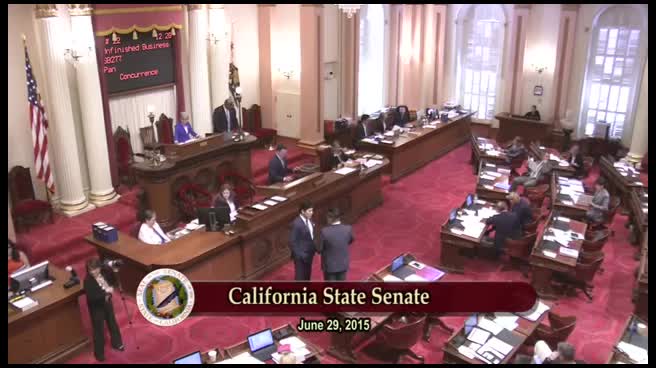 3MIN
Senate Floor
 8MIN
Senate Standing Committee on Judiciary
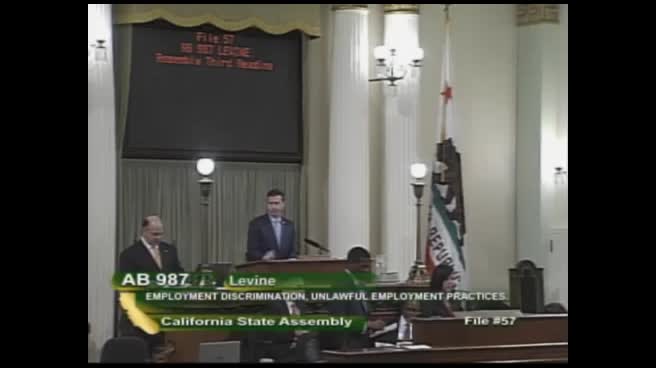 1MIN
Assembly Floor
 1MIN
Assembly Standing Committee on Appropriations
 12MIN
Assembly Standing Committee on Labor and Employment
Bill Author

Bill Co-Author(s):
