AB 99: Personal income taxes: income exclusion: mortgage debt forgiveness.
- Session Year: 2015-2016
- House: Assembly
- Latest Version Date: 2015-09-03
The Personal Income Tax Law provides for modified conformity to specified provisions of federal income tax law relating to the exclusion of the discharge of qualified principal residence indebtedness, as defined, from an individuals income if that debt is discharged after January 1, 2007, and before January 1, 2014, as provided. The federal Tax Increase Prevention Act of 2014 extended the operation of those provisions to debt that is discharged before January 1, 2015.
This bill would conform to that federal extension, discharge indebtedness for related penalties and interest, and make legislative findings and declarations regarding the public purpose served by the bill.
This bill would declare that it is to take effect immediately as an urgency statute.
The Personal Income Tax Law provides for modified conformity to specified provisions of federal income tax law relating to the exclusion of the discharge of qualified principal residence indebtedness, as defined, from an individuals income if that debt is discharged after January 1, 2007, and before January 1, 2014, as provided. The federal Tax Increase Prevention Act of 2014 extended the operation of those provisions to debt that is discharged before January 1, 2015.
This bill would conform to the that federal extension, discharge indebtedness for related penalties and interest, and make legislative findings and declarations regarding the public purpose served by the bill.
This bill would declare that it is to take effect immediately as an urgency statute.
The Personal Income Tax Law provides for modified conformity to specified provisions of federal income tax law relating to the exclusion of the discharge of qualified principal residence indebtedness, as defined, from an individuals income if that debt is discharged after January 1, 2007, and before January 1, 2014, as provided. The federal Tax Increase Prevention Act of 2014 extended the operation of those provisions to debt that is discharged before January 1, 2015.
This bill would extend the operation of those provisions to qualified principal residence indebtedness that is discharged before January 1, 2015, thereby no longer conforming to federal income tax law. The bill would also discharge indebtedness for related penalties and interest and would make legislative findings and declarations regarding the public purpose served by the bill.
This bill would conform to the federal extension, discharge indebtedness for related penalties and interest, and make legislative findings and declarations regarding the public purpose served by the bill.
This bill would declare that it is to take effect immediately as an urgency statute.
The Personal Income Tax Law provides for modified conformity to specified provisions of federal income tax law relating to the exclusion of the discharge of qualified principal residence indebtedness, as defined, from an individuals income if that debt is discharged after January 1, 2007, and before January 1, 2014, as provided.
This bill would extend the operation of those provisions to qualified principal residence indebtedness that is discharged before January 1, 2015, thereby no longer conforming to federal income tax law. The bill would also discharge indebtedness for related penalties and interest and would make legislative findings and declarations regarding the public purpose served by the bill.
This bill would declare that it is to take effect immediately as an urgency statute.
(a)Section 108(a)(1)(E) of the Internal Revenue Code, is modified to provide that the amount excluded from gross income shall not exceed $500,000 ($250,000 in the case of a married individual filing a separate return).
(b)Section 108(h)(2) of the Internal Revenue Code, is modified by substituting the phrase (within the meaning of section 163(h)(3)(B), applied by substituting $800,000 ($400,000 for $1,000,000 ($500,000 in clause (ii) thereof) for the phrase (within the meaning of section 163(h)(3)(B), applied by substituting $2,000,000 ($1,000,000 for $1,000,000 ($500,000 in clause (ii) thereof) contained therein.
(c)This section shall apply to discharges of indebtedness occurring on or after January 1, 2007, and, notwithstanding any other law to the contrary, no penalties or interest shall be due with respect to the discharge of qualified principal residence indebtedness during the 2007 or 2009 taxable year regardless of whether or not the taxpayer reports the discharge on his or her return for the 2007 or 2009 taxable year.
(d)(1)The amendments made by Section 202 of the American Taxpayer Relief Act of 2012 (Public Law 112-240) to Section 108 of the Internal Revenue Code shall apply.
(2)The changes made to this section by Chapter 152 of the Statutes of 2014 shall apply to discharges of indebtedness that occur on or after January 1, 2013, and before January 1, 2014, and, notwithstanding any other law, no penalties or interest shall be due with respect to the discharge of qualified principal residence indebtedness during the 2013 taxable year, regardless of whether the taxpayer reports the discharge on his or her income tax return for the 2013 taxable year.
(e)(1)The amendments made by Section 102 of the Tax Increase Prevention Act of 2014 (Public Law 113-295) to Section 108 of the Internal Revenue Code shall apply.
(2)The changes made to this section by the act adding this paragraph shall apply to discharges of indebtedness that occur on or after January 1, 2014, and before January 1, 2015, and, notwithstanding any other law, no penalties or interest shall be due with respect to the discharge of qualified principal residence indebtedness during the 2014 taxable year, regardless of whether the taxpayer reports the discharge on his or her income tax return for the 2014 taxable year.
SEC. 2.The amendments made by this act that conform to the amendments made by Section 102 of the Tax Increase Prevention Act of 2014 (Public Law 113-295) to Section 108 of the Internal Revenue Code, apply to qualified principal residence indebtedness that is discharged on and after January 1, 2014, and before January 1, 2015. The Legislature finds and declares that the amendments made by this act and the retroactive application contained in the preceding sentence are necessary for the public purpose of conforming state law to the amendments to the Internal Revenue Code as made by the Tax Increase Prevention Act of 2014 (Public Law 113-295), thereby preventing undue hardship to taxpayers whose qualified principal residence indebtedness was discharged on and after January 1, 2014, and before January 1, 2015, and do not constitute a gift of public funds within the meaning of Section 6 of Article XVI of the California Constitution.
SEC. 3.This act is an urgency statute necessary for the immediate preservation of the public peace, health, or safety within the meaning of Article IV of the Constitution and shall go into immediate effect. The facts constituting the necessity are:
In order to provide tax relief to distressed homeowners at the earliest possible time, it is necessary that this act take effect immediately.
(a)Section 108(a)(1)(E) of the Internal Revenue Code, is modified to provide that the amount excluded from gross income shall not exceed $500,000 ($250,000 in the case of a married individual filing a separate return).
(b)Section 108(h)(2) of the Internal Revenue Code, is modified by substituting the phrase (within the meaning of section 163(h)(3)(B), applied by substituting $800,000 ($400,000 for $1,000,000 ($500,000 in clause (ii) thereof) for the phrase (within the meaning of section 163(h)(3)(B), applied by substituting $2,000,000 ($1,000,000 for $1,000,000 ($500,000 in clause (ii) thereof) contained therein.
(c)This section shall apply to discharges of indebtedness occurring on or after January 1, 2007, and, notwithstanding any other law to the contrary, no penalties or interest shall be due with respect to the discharge of qualified principal residence indebtedness during the 2007 or 2009 taxable year regardless of whether or not the taxpayer reports the discharge on his or her return for the 2007 or 2009 taxable year.
(d)(1)The amendments made by Section 202 of the American Taxpayer Relief Act of 2012 (Public Law 112-240) to Section 108 of the Internal Revenue Code shall apply.
(2)The changes made to this section by Chapter 152 of the Statutes of 2014 shall apply to discharges of indebtedness that occur on or after January 1, 2013, and before January 1, 2014, and, notwithstanding any other law, no penalties or interest shall be due with respect to the discharge of qualified principal residence indebtedness during the 2013 taxable year, regardless of whether the taxpayer reports the discharge on his or her income tax return for the 2013 taxable year.
(e)(1)The amendments made by Section 102 of the Tax Increase Prevention Act of 2014 (Public Law 113-295) to Section 108 of the Internal Revenue Code shall apply.
(2)The changes made to this section by the act adding this paragraph shall apply to discharges of indebtedness that occur on or after January 1, 2014, and before January 1, 2015, and, notwithstanding any other law, no penalties or interest shall be due with respect to the discharge of qualified principal residence indebtedness during the 2014 taxable year, regardless of whether the taxpayer reports the discharge on his or her income tax return for the 2014 taxable year.
SEC. 2.The amendments made by this act that conform to the amendments made by Section 102 of the Tax Increase Prevention Act of 2014 (Public Law 113-295) to Section 108 of the Internal Revenue Code, apply to qualified principal residence indebtedness that is discharged on and after January 1, 2014, and before January 1, 2015. The Legislature finds and declares that the amendments made by this act and the retroactive application contained in the preceding sentence are necessary for the public purpose of conforming state law to the amendments to the Internal Revenue Code as made by the Tax Increase Prevention Act of 2014 (Public Law 113-295) 113-295), thereby preventing undue hardship to taxpayers whose qualified principal residence indebtedness was discharged on and after January 1, 2014, and before January 1, 2015, and do not constitute a gift of public funds within the meaning of Section 6 of Article XVI of the California Constitution.
SEC. 3.This act is an urgency statute necessary for the immediate preservation of the public peace, health, or safety within the meaning of Article IV of the Constitution and shall go into immediate effect. The facts constituting the necessity are:
In order to provide tax relief to distressed homeowners at the earliest possible time, it is necessary that this act take effect immediately.
(a)Section 108(a)(1)(E) of the Internal Revenue Code, is modified as follows:
(1)By providing to provide that the amount excluded from gross income shall not exceed $500,000 ($250,000 in the case of a married individual filing a separate return).
(2)By substituting January 1, 2014 for January 1, 2015.
(b)Section 108(h)(2) of the Internal Revenue Code, is modified by substituting the phrase (within the meaning of section 163(h)(3)(B), applied by substituting $800,000 ($400,000 for $1,000,000 ($500,000 in clause (ii) thereof) for the phrase (within the meaning of section 163(h)(3)(B), applied by substituting $2,000,000 ($1,000,000 for $1,000,000 ($500,000 in clause (ii) thereof) contained therein.
(c)This section shall apply to discharges of indebtedness occurring on or after January 1, 2007, and, notwithstanding any other law to the contrary, no penalties or interest shall be due with respect to the discharge of qualified principal residence indebtedness during the 2007 or 2009 taxable year regardless of whether or not the taxpayer reports the discharge on his or her return for the 2007 or 2009 taxable year.
(d)(1)The amendments made by Section 202 of the American Taxpayer Relief Act of 2012 (Public Law 112-240) to Section 108 of the Internal Revenue Code shall apply.
(e)
(2)The changes made to this section by Chapter 152 of the Statutes of 2014 shall apply to discharges of indebtedness that occur on or after January 1, 2013, and before January 1, 2014, and, notwithstanding any other law, no penalties or interest shall be due with respect to the discharge of qualified principal residence indebtedness during the 2013 taxable year, regardless of whether the taxpayer reports the discharge on his or her income tax return for the 2013 taxable year.
(e)(1)The amendments made by Section 102 of the Tax Increase Prevention Act of 2014 (Public Law 113-295) to Section 108 of the Internal Revenue Code shall apply.
(f)
(2)The changes made to this section by the act adding this subdivision paragraph shall apply to discharges of indebtedness that occur on or after January 1, 2014, and before January 1, 2015, and, notwithstanding any other law, no penalties or interest shall be due with respect to the discharge of qualified principal residence indebtedness during the 2014 taxable year, regardless of whether the taxpayer reports the discharge on his or her income tax return for the 2014 taxable year.
SEC. 2.The amendments made by this act that extend the operation of conform to the amendments made by Section 202 of the American Taxpayer Relief Act of 2012 (Public Law 112-240) Section 102 of the Tax Increase Prevention Act of 2014 (Public Law 113-295) to Section 108 of the Internal Revenue Code, apply to qualified principal residence indebtedness that is discharged on and after January 1, 2014, and before January 1, 2015. The Legislature finds and declares that the amendments made by this act and the retroactive application contained in the preceding sentence are necessary for the public purpose of extending for an additional year, conforming state law to the amendments to the Internal Revenue Code as made by the American Taxpayer Relief Act of 2012 (Public Law 112-240), Tax Increase Prevention Act of 2014 (Public Law 113-295) thereby preventing undue hardship to taxpayers whose qualified principal residence indebtedness was discharged on and after January 1, 2014, and before January 1, 2015, and do not constitute a gift of public funds within the meaning of Section 6 of Article XVI of the California Constitution.
SEC. 3.This act is an urgency statute necessary for the immediate preservation of the public peace, health, or safety within the meaning of Article IV of the Constitution and shall go into immediate effect. The facts constituting the necessity are:
In order to provide tax relief to distressed homeowners at the earliest possible time, it is necessary that this act take effect immediately.
(a)Section 108(a)(1)(E) of the Internal Revenue Code, is modified to provide as follows:
(1)By providing that the amount excluded from gross income shall not exceed $500,000 ($250,000 in the case of a married individual filing a separate return).
(2)By substituting January 1, 2014 for January 1, 2015.
(b)Section 108(h)(2) of the Internal Revenue Code, is modified by substituting the phrase (within the meaning of section 163(h)(3)(B), applied by substituting $800,000 ($400,000 for $1,000,000 ($500,000 in clause (ii) thereof) for the phrase (within the meaning of section 163(h)(3)(B), applied by substituting $2,000,000 ($1,000,000 for $1,000,000 ($500,000 in clause (ii) thereof) contained therein.
(c)This section shall apply to discharges of indebtedness occurring on or after January 1, 2007, and, notwithstanding any other law to the contrary, no penalties or interest shall be due with respect to the discharge of qualified principal residence indebtedness during the 2007 or 2009 taxable year regardless of whether or not the taxpayer reports the discharge on his or her return for the 2007 or 2009 taxable year.
(d)The amendments made by Section 202 of the American Taxpayer Relief Act of 2012 (Public Law 112-240) to Section 108 of the Internal Revenue Code shall apply.
(e)The changes made to this section by the act adding this subdivision Chapter 152 of the Statutes of 2014 shall apply to discharges of indebtedness that occur on or after January 1, 2013, and before January 1, 2014, and, notwithstanding any other law, no penalties or interest shall be due with respect to the discharge of qualified principal residence indebtedness during the 2013 taxable year, regardless of whether the taxpayer reports the discharge on his or her income tax return for the 2013 taxable year.
(f)The changes made to this section by the act adding this subdivision shall apply to discharges of indebtedness that occur on or after January 1, 2014, and before January 1, 2015, and, notwithstanding any other law, no penalties or interest shall be due with respect to the discharge of qualified principal residence indebtedness during the 2014 taxable year, regardless of whether the taxpayer reports the discharge on his or her income tax return for the 2014 taxable year.
SEC. 2.The amendments made by this act that extend the operation of the amendments made by Section 202 of the American Taxpayer Relief Act of 2012 (Public Law 112-240) to Section 108 of the Internal Revenue Code, apply to qualified principal residence indebtedness that is discharged on and after January 1, 2014, and before January 1, 2015. The Legislature finds and declares that the amendments made by this act and the retroactive application contained in the preceding sentence are necessary for the public purpose of extending for an additional year, the amendments to the Internal Revenue Code as made by the American Taxpayer Relief Act of 2012 (Public Law 112-240), thereby preventing undue hardship to taxpayers whose qualified principal residence indebtedness was discharged on and after January 1, 2014, and before January 1, 2015, and do not constitute a gift of public funds within the meaning of Section 6 of Article XVI of the California Constitution.
SEC. 3.This act is an urgency statute necessary for the immediate preservation of the public peace, health, or safety within the meaning of Article IV of the Constitution and shall go into immediate effect. The facts constituting the necessity are:
In order to provide tax relief to distressed homeowners at the earliest possible time, it is necessary that this act take effect immediately.
|
Date
|
Status
|
|---|---|
| Jun 1, 2015 | In Senate. Read first time. To Com. on RLS. for assignment. |
| Jan 15, 2016 | Consideration of Governor's veto stricken from file. |
| Oct 10, 2015 | Vetoed by Governor. |
| Sep 9, 2015 | Enrolled and presented to the Governor at 4 p.m. |
| Sep 1, 2015 | Read third time. Urgency clause adopted. Passed. Ordered to the Assembly. (Ayes 40. Noes 0. Page 2343.). |
| Sep 1, 2015 | Read third time. Urgency clause adopted. Passed. Ordered to the Assembly. |
| Sep 1, 2015 | In Assembly. Ordered to Engrossing and Enrolling. |
| Aug 31, 2015 | Read second time. Ordered to third reading. |
| Aug 27, 2015 | From committee: Do pass. (Ayes 7. Noes 0.) (August 27). |
| Jun 29, 2015 | In committee: Referred to APPR. suspense file. |
| Jun 17, 2015 | From committee: Do pass and re-refer to Com. on APPR. (Ayes 7. Noes 0.) (June 17). Re-referred to Com. on APPR. |
| Jun 11, 2015 | Referred to Com. on GOV. & F. |
| Jun 1, 2015 | Read third time. Urgency clause adopted. Passed. Ordered to the Senate. (Ayes 80. Noes 0. Page 1699.). |
| Jun 1, 2015 | Read third time. Urgency clause adopted. Passed. Ordered to the Senate. |
| Jan 8, 2015 | Read first time. To print. |
| May 28, 2015 | Read second time. Ordered to third reading. |
| May 28, 2015 | Joint Rule 62(a), file notice suspended. (Page 1613.) |
| May 28, 2015 | From committee: Do pass. (Ayes 17. Noes 0.) (May 28). |
| May 27, 2015 | In committee: Set, first hearing. Referred to APPR. suspense file. |
| May 21, 2015 | Re-referred to Com. on APPR. |
| May 20, 2015 | From committee chair, with author's amendments: Amend, and re-refer to Com. on APPR. Read second time and amended. |
| May 19, 2015 | From committee: Do pass and re-refer to Com. on APPR. (Ayes 9. Noes 0.) (May 18). Re-referred to Com. on APPR. |
| Mar 23, 2015 | In committee: Set, first hearing. Referred to suspense file. |
| Feb 19, 2015 | Re-referred to Com. on REV. & TAX. |
| Feb 18, 2015 | From committee chair, with author's amendments: Amend, and re-refer to Com. on REV. & TAX. Read second time and amended. |
| Jan 26, 2015 | Referred to Com. on REV. & TAX. |
| Jan 9, 2015 | From printer. May be heard in committee February 8. |
|
Date
|
Description
|
Location
|
Votes
|
|
|---|---|---|---|---|
| Sep 1, 2015 | Assembly 3rd Reading AB99 Perea By Cannella Urgency Clause | Senate Floor |
Passed |
|
| Aug 27, 2015 | Do pass | Senate Standing Committee on Appropriations |
Passed |
|
| Jun 29, 2015 | Placed on suspense file | Senate Standing Committee on Appropriations |
Passed |
|
| Jun 17, 2015 | Do pass, but first be re-referred to the Committee on [Appropriations] | Senate Standing Committee on Governance and Finance |
Passed |
|
| Jun 1, 2015 | AB 99 PEREA Third Reading Urgency | Assembly Floor |
Passed |
|
| May 28, 2015 | Do pass. | Assembly Standing Committee on Appropriations |
Passed |
|
| May 18, 2015 | Do pass and be re-referred to the Committee on [Appropriations] | Assembly Standing Committee on Revenue and Taxation |
Passed |
This list shows positions taken on this bill by organizations on the date displayed, which is linked to the original source.
Positions by individuals are not included.
|
Organization
|
Position
|
Date
|
|---|---|---|
| Attorney General Kamala Harris | ** Support | Sep 1, 2015 |
| Attorney General's Office | ** Support | Jun 1, 2015 |
| Board of Equalization Member George Runner | ** Support | Sep 1, 2015 |
| California Association Of Realtors | ** Support | Sep 1, 2015 |
| California Bankers Association | ** Support | Sep 1, 2015 |
| California Credit Union League | ** Support | Sep 1, 2015 |
| California Independent Bankers | ** Support | Sep 1, 2015 |
| California Mortgage Bankers Association | ** Support | Sep 1, 2015 |
| California Society Of Enrolled Agents | ** Support | Sep 1, 2015 |
| California Taxpayers' Association | ** Support | Sep 1, 2015 |
| One individual | ** Support | Sep 1, 2015 |
| One private individual | ** Support | Jun 1, 2015 |
| Page M | ** Against | Jun 1, 2015 |
| Page M | ** Support | Jun 1, 2015 |
GOVERNOR'S VETO
AB 99
(Perea)
As Enrolled September 3, 2015
2/3 vote
Committee |
Votes |
Ayes |
Noes |
Revenue & Taxation |
9-0 |
Ting, Brough, Dababneh, Gipson, Roger Hernández, Mullin, Patterson, Quirk, Wagner |
|
Appropriations |
17-0 |
Gomez, Bigelow, Bonta, Calderon, Chang, Daly, Eggman, Gallagher, Eduardo Garcia, Gordon, Holden, Jones, Quirk, Rendon, Wagner, Weber, Wood |
|
ASSEMBLY: |
80-0 |
(June 1, 2015) |
SENATE: |
40-0 |
(September 1, 2015) |
SUMMARY: Extends for one additional taxable year, in modified conformity to the recently enacted federal law, the tax relief for income generated from the discharge of qualified principal residence indebtedness (QPRI). Specifically, this bill:
Provides that Internal Revenue Code (IRC) Section 108, relating to income from discharge of QPRI, as amended by Tax Increase Prevention Act of 2014 Section 102, shall apply, except as otherwise provided.
Applies discharges to QPRI occurring on or after January 1, 2014, and before January 1, 2015.
Provides that, notwithstanding any other law, no penalties or interest shall apply be due to the discharge of QPRI for the 2014 taxable year, regardless of whether or not a taxpayer reports the discharge during the 2014 taxable year.
Makes findings and declarations stating that the retroactive application of this bill is necessary for the public purpose of conforming to federal law, and thereby preventing undue hardship to taxpayers whose QPRI was discharged on and after January 1, 2014, and before January 1, 2015, and does not constitute a gift of public funds.
Provides that this is an urgency statute necessary for the immediate preservation of the public peace, health, or safety.
FISCAL EFFECT: According to the Assembly Appropriations Committee:
1) Minor and absorbable administrative costs to the Franchise Tax Board.
2) Estimated General Fund revenue decreases of $47 million and $5 million in Fiscal Year 2014-15 and Fiscal Year 2015-16, respectively. No estimated revenue impact thereafter.
COMMENTS:
Author's Statement: The author provided the following statement in support of this bill:
AB 99 would extend the tax relief on forgiveness of mortgage debt by conforming California law to federal law. After a loan modification or short sale of a home, a bank can cancel or forgive thousands of dollars of an individual's mortgage debt. Federal and State income tax laws generally define cancelled debt as a form of income. Without additional legislation to exclude cancelled debt, many Californians may be taxed on "phantom" income they never received.
Arguments in Support: Proponents of this bill state that "when debt is forgiven by a lender as part of an agreement with a borrower using the short sale process or a principal reduction, the borrower should not be penalized on their state income taxes. Many borrowers who faced foreclosure last year and successfully negotiated a loan modification may well find themselves once again unable to make their mortgage payment if they are saddled with a tax burden resulting from forgiven debt."
Arguments in Opposition: None submitted.
Mortgage Debt Forgiveness: Background. SB 1055 (Machado), Chapter 282, Statues of 2008, provided modified conformity to the Mortgage Forgiveness Debt Relief Act (MFDRA) for discharge of mortgage indebtedness in 2007 and 2008 tax years. SB 401 (Wolk), Chapter 14, Statues of 2010, provided homeowners even greater assistance. SB 401 not only extended the mortgage debt forgiveness provision until January 1, 2013, but also increased the amount of forgiven mortgage indebtedness excludable from taxpayer's gross income from $250,000 ($125,000 in case of married individual/registered domestic partners (RDP) filing separate return) to $500,000 ($250,000 in case of married individual/RDP filing a separate return). On January 2, 2013, the Federal Government enacted the Federal American Taxpayer Relief Act (FATRA) as part of the "fiscal cliff" deal. FATRA extended the exclusion from gross income for cancellation of indebtedness (COD) generated from the discharge of QPRI, as provided for by the MFDRA, for one additional taxable year, beginning on or after January 1, 2013, and before January 1, 2014. On December 19, 2014, the Federal Government enacted the Tax Increase Prevention Act and again extended, for one additional year, the exclusion from gross income for COD generated from the discharge of QPRI occurring on or after January 1, 2014, and before January 1, 2015.
Why is COD Taxable? Most individuals find the idea of taxing debt cancellation counter intuitive, but the practice reflects sound tax policy because it recognizes the fact that an individual's net worth has increased by the cancellation of debt. According to Commissioner v. Glenshaw, the Court defined income as an accession to wealth, that is clearly realized, and over which the taxpayer has complete dominion1. When debt is cancelled, money that would have been used to pay that loan is now free to be used on whatever the taxpayer wants. Therefore, because certain assets have been freed, the taxpayer has experienced an accession to wealth. Additionally, under the rule of symmetry, a loan is not considered income to the borrower nor is it a deduction to the lender. A borrower's increased wealth when the loan is taken out is also offset by the obligation to pay the same amount. If the debt is cancelled, the symmetry is destroyed. The borrower is in a much better position after the debt is cancelled. Additionally, as noted by Debora A. Grier, Professor of Law of Cleveland State University, in her statement before the United State Senate Committee on Finance, without this tax rule "the borrower will have received permanently tax-free cash in the year of the original receipt," i.e. the year in which the borrower received the loan. Even understanding the economic and legal policy for taxing COD, most individuals still find the taxation of cancelled home mortgage debt odd and even unfair.
Non-Recourse Debt: Non-recourse debt is a loan that is secured by the pledge of collateral. If the borrower defaults, the lender can seize the collateral, but the recovery is limited to the collateral. In California, indebtedness incurred in purchasing a home is deemed to be non-recourse debt (Code of Civil Procedure Section 580b) and, thus, generally first mortgages are considered to be non-recourse debt. Property that is foreclosed upon is not considered COD, even if the amount of the loan exceeds the fair market value (FMV) of the property. However, if a lender agrees to decrease the amount of the original debt to reflect the current value of the property secured by the debt, the transaction will be considered COD and subject to tax – the cancellation of non-recourse debt without a transfer of property creates COD income for the taxpayer in an amount equal to the amount cancelled by the lender. California law provides relief to a solvent homeowner who refinanced the first mortgage or took out a home equity loan or a home equity line of credit. California law provides relief to a solvent homeowner who benefited from a reduction of his/her outstanding debt in a "workout" situation with the lender where the homeowner retained the ownership of the home and the lender, instead of foreclosing on the home, reduced the outstanding debt to reflect the home's current value.
Insolvency: COD is not included in income to the extent the taxpayer is insolvent immediately before the debt is cancelled. A taxpayer is insolvent immediately before the COD to the extent that the amount of total liabilities exceeds the FMV of all assets immediately before the cancellation. This provision may be used in lieu of the QPRI exclusion. It is important to remember, however, that the exclusion applies only to the extent of insolvency. As an example, assume a taxpayer has discharged debt of $5,000. Before the cancellation of debt, the taxpayer had $10,000 in liabilities and the FMV of all assets was $7,000, meaning that before the cancellation, the taxpayer was insolvent to the extent of $3,000 (total liabilities minus FMV assets). Therefore, the taxpayer may exclude $3,000 from income and include $2,000 as income of the discharged debt.
Why exclude COD from Gross Income? Despite the economics of taxing COD, the rationale for excluding cancelled mortgage from gross income has focused on minimizing hardship for households in distress. Individuals who are in danger of losing their homes, due in part to the economic downturn, should not be forced to incur the additional hardship of paying taxes on COD. The exclusion of COD from gross income also reduces the burden on a borrower who may be attempting to write-down the loan with his or her lender or a short sale. On a macroeconomic level, economists have argued that excluding cancelled mortgage from gross income may help maintain consumer spending, which may help prevent a recession.
As noted earlier, one of rationales for excluding mortgage forgiveness from income is to help taxpayers remain in their homes. In some instances, a lender may be able to reduce the loan amount to the home's current FMV and allow the taxpayer to retain ownership of the home. For example, a taxpayer may owe $250,000 of residential debt and after a modification the lender reduces the loan to $200,000 and forgives $50,000. Without an exclusion of the mortgage cancellation, the $50,000 would be subject to taxation. If the taxpayer is subject to a 25% tax rate, the tax liability would be $12,500. Assuming the reduction in loan was done because the taxpayer was facing financial difficulty, incurring a tax obligation on COD may prevent the taxpayer from successfully remaining in the home. [See, Congressional Research Service's report (CRS report), Analysis of the Proposed Tax Exclusion for Cancelled Mortgage Debt Income, January 8, 2008, 2 -8.]
The recession and drop in housing values are the main factors that led to the original exclusion of COD from gross income. However, over the last few years, the unemployment rate has steadily declined and home values have substantially increased. As of November 2014, California's unemployment rate stood at 7.2%, five percentage points lower than its post-recession peak of 12.4%, but 2.4% higher than its pre-recession low of 4.8%. (Public Policy Institute of California, The California Economy: Unemployment Update, December 2014.) Additionally, the number of seriously "underwater" homes went from a peak of 12.8 million in 2012 to just over seven million in the fourth quarter of 2014. The reduction in underwater homes has primarily been triggered by a 35% increase in the national median home value since bottoming out in 2012. (RealtyTrac, Seriously Underwater Properties Decrease by 2.2 Million in 2014, Down 5.8 Million From Peak Negative Equity in Q2 2012, January 21, 2015.) In light of substantial improvements to the economy, the Committee may wish to consider whether an extension of the exclusion for COD generated from the discharge of QPRI is warranted.
QPRI Includes Secondary Loans: The exclusion for COD income realized by the taxpayer from the COD applies as long as the discharged debt was secured by a personal residence and was incurred to acquire, construct, or substantially improve the home, as well as debt that was used to refinance such debt. Debt on second homes, rental property, business property, credit cards, or car loans does not qualify for the tax-relief provision. However, the definition of QPRI includes second mortgages, home equity loans, and home equity lines of credit used to improve the residence. Yet, home equity lines of credit could have also been used to finance consumption. Thus, existing law provides a financial incentive for taxpayers to claim the COD income exclusion for secondary loans even if the proceeds of those loans were used for personal consumption.
I am returning the following nine bills without my signature:
Assembly Bill 35
Assembly Bill 88
Assembly Bill 99
Assembly Bill 428
Assembly Bill 437
Assembly Bill 515
Assembly Bill 931
Senate Bill 251
Senate Bill 377
Each of these bills creates a new tax credit or expands an existing tax credit.
Despite strong revenue performance over the past few years, the state's budget has remained precariously balanced due to unexpected costs and the provision of new services. Now, without the extension of the managed care organization tax that I called for in special session, next year's budget faces the prospect of over $1 billion in cuts.
Given these financial uncertainties, I cannot support providing additional tax credits that will make balancing the state's budget even more difficult. Tax credits, like new spending on programs, need to be considered comprehensively as part of the budget deliberations.
Analysis Prepared by: Carlos Anguiano / REV. & TAX. / (916) 319-2098 FN: 0002534
1 Commissioner v. Glenshaw Glass Co., 348 U.S. 426, 431 (1955).
AB 99
Page 5
|
Office of Senate Floor Analyses (916) 651-1520 Fax: (916) 327-4478 |
THIRD READING
Bill No: AB 99
Amended: 5/20/15 in Assembly
SENATE GOVERNANCE & FIN. COMMITTEE: 7-0, 6/17/15
AYES: Hertzberg, Nguyen, Beall, Hernandez, Lara, Moorlach, Pavley
SENATE APPROPRIATIONS COMMITTEE: 7-0, 8/27/15
AYES: Lara, Bates, Beall, Hill, Leyva, Mendoza, Nielsen
ASSEMBLY FLOOR: 80-0, 6/1/15 - See last page for vote
SUBJECT: Personal income taxes: income exclusion: mortgage debt forgiveness
DIGEST: This bill extends conformity to federal law’s income exclusion for discharges of qualified principal residence indebtedness.
Existing law:
Conforms to the Mortgage Forgiveness Debt Relief Act of 2007 (MFDRA) for debt discharged on or before January 1, 2014, and provides that no penalties or interest applies for discharge of qualified principal residence indebtedness, regardless of whether the taxpayer reports the discharge on his or her income tax return (SB 1055, Machado, Chapter 282, Statutes of 2008; SB 401, Wolk, Chapter 14, Statutes of 2010; and AB 1393, Perea, Chapter 152, Statutes of 2014).
Contains slightly different limits for mortgage debt forgiveness than federal law:
Taxpayers may only exclude up to $250,000 single/$500,000 joint of cancelled debt from income, but can exclude an unlimited amount of cancelled income for federal purposes.
Taxpayers may only exclude indebtedness on loans up to $400,000 single/$800,000 joint of qualified principal residence indebtedness, instead of $1 million/$2 million for federal. The taxpayer must first reduce any amount excluded for state tax purposes by any debt forgiven on loan amounts above $400,000/$800,000.
This bill:
Extends California’s modified conformity to MFDRA for discharges of qualified principal residence indebtedness until January 1, 2015.
Makes legislative findings and declarations stating that its retroactive application does not constitute a gift of public funds.
Background
California law does not automatically conform to changes to federal tax law, except for specific retirement provisions. Instead, the Legislature must affirmatively conform to federal changes.
When a lender cancels a borrower’s debt, federal and state law generally treat the amount of debt cancelled as income taxable to the borrower. Taxpayers do not include borrowed funds in income in the year he or she receives loan proceeds because of the obligation to repay the loan; the taxpayer is financially no better off because the loan must be repaid. When lenders reduce the repayable amount, the taxpayer realizes a gain in his or her financial situation because a portion of the loan proceeds that have already been received and not previously taxed need not be repaid. In U.S .v. Kirby Lumber Co., 284 US 1 (1931), the United States Supreme Court held that a company that had issued $12 million in bonds and later repurchased some of them at less than their face amount made a clear gain which should be treated as income to the taxpayer. Congress subsequently deemed cancelled debt as income, with exceptions for debts discharged in bankruptcy, when the taxpayer is insolvent, certain farm debts, and debt discharge resulting from a non-recourse loan in foreclosure.
Many Californians experienced rapid declines in the market values of their homes in recent years, so much so that the value was less than the amount of debt they incurred to buy it. Some homeowners have sufficient income, equity, and home value to refinance, but others cannot, and instead attempt to sell their home for less than they are obligated to repay their lender, which is known as a “short-sale.” Instead of a simple transaction between buyer and seller, a short sale requires a third party - the seller’s lender - to agree to cancel the borrower’s debt in an amount equal to the difference between the new sales price of the home and the original amount of the debt issued to the borrower to buy it, plus any additional debt secured by the property. For example, a lender must cancel $150,000 in debt for a borrower who purchased a home in 2005 for $400,000, but wants to short sell it this year for $250,000. The lender must assess the current housing market, the borrower’s ability to repay the loan, and federal and state incentives when considering whether to accept this loss. While lenders can claim principal forgiven as a deductible business loss, the borrower faces a significant tax bill in addition to the loss of any equity in the home at the time of sale absent legislation. Additionally, any loan modification where the lender forgives principal as part of a loan modification, such as a deed-in-lieu of foreclosure or a foreclosure, usually results in taxable income for the borrower
In 2007, Congress enacted MFDRA, which provides that taxpayers may exclude from income qualified principal residence indebtedness cancelled after January 1, 2007 but before January 1, 2010. Married taxpayers may exclude up to $2 million in qualified principal residence indebtedness, while married persons filing separately or single persons may exclude up to $1 million. Taxpayers may only exclude indebtedness incurred to purchase, construct, or improve the taxpayer’s principal residence, defined as the residence that the taxpayer owns and uses as his or her principal residence for at least two out of the last five years. The Emergency Economic Stabilization Act of 2008 extended the exclusion until January 1, 2013. On January 2, 2013, Congress enacted the American Taxpayer Relief Act of 2012, which extended the exclusion for the 2013 taxable year. In 2014, Congress again extended mortgage debt forgiveness through the 2014 taxable year when it enacted the Tax Increase Prevention Act.
California first conformed to MFDRA in 2008, and again in 2010, for debt discharged on or before December 31, 2012, and additionally provided that no penalties or interest applies for discharge of qualified principal residence indebtedness, regardless of whether the taxpayer reports the discharge on his or her income tax return. The Legislature extended these provisions until January 1, 2014, last year (AB 1393, Perea, Chapter 152), but remains out of conformity for discharges that occurred last year, meaning that affected taxpayers have to include cancelled debt as income in the 2014 taxable year.
Comments
Federal and state tax law consistently prefers debt over equity: taxpayers can deduct mortgage interest from income and interest payments on debt incurred for a business, but cannot deduct any returns to equity or saved cash. Taxpayers will more often incur debt instead of using equity because taxpayers can use interest expense deductions to reduce other income subject to tax. Tax incentives for individuals and firms to incur debt may not directly cause social and economic problems, but they have surely contributed to the almost $13.5 trillion in U.S. household debt, and $12 trillion in non-financial business debt. AB 99 furthers this preference. This bill cancels for state purposes income received by individuals who incurred debt to purchase a home but sell it for a lesser amount, while taxpayers who did the same with homes purchased with cash cannot deduct any losses.
Mortgage debt relief only applies to recourse loans, not non-recourse ones. A loan is non-recourse when the lender can only repossess the asset that secures the loan to satisfy delinquent debt; a recourse loan allows a lender to petition a court for a personal deficiency judgment against a delinquent borrower, a public record that allows the lender to collect the delinquent amount from the borrower in a variety of ways. In California, all original loans to purchase homes in the state must be nonrecourse, but the status often changes to recourse when the home is refinanced, or the borrower takes out a second mortgage or a home equity line of credit. In 2010, the Legislature prohibited a lender from obtaining a deficiency judgment for any first mortgage deficiency after a short sale of a residence (SB 931, Ducheny, Chapter 701, Statutes of 2010). In 2011, the Legislature extended that treatment for all residential mortgages, including second mortgages after a short sale (SB 458, Corbett, Chapter 58, Statutes of 2011).
FISCAL EFFECT: Appropriation: No Fiscal Com.: Yes Local: No
According to the Senate Appropriations Committee, AB 99 results in revenue losses of $47 million in 2014-15 and $5.2 million in 2015-16. The Franchise Tax Board would incur minor administration expenses.
Attorney General Kamala Harris
Board of Equalization Member George Runner
California Association of Realtors
California Bankers Association
California Credit Union League
California Independent Bankers
California Mortgage Bankers Association
California Society of Enrolled Agents
California Taxpayers Association
One individual
OPPOSITION: (Verified 8/28/15)
None received
ARGUMENTS IN SUPPORT: According to the author, “AB 99 would extend the tax relief on forgiveness of mortgage debt by conforming California law to federal law. After a loan modification or short sale of a home, a bank can cancel or forgive thousands of dollars of an individual's mortgage debt. Federal and State income tax laws generally define cancelled debt as a form of income. Without additional legislation to exclude cancelled debt, many Californians may be taxed on ‘phantom’ income they never received. This bill would provide much-needed state-level relief to homeowners facing financial hardship because of the mortgage crisis, and better allow them to afford and retain homeownership.”
ASSEMBLY FLOOR: 80-0, 6/1/15
AYES: Achadjian, Alejo, Travis Allen, Baker, Bigelow, Bloom, Bonilla, Bonta, Brough, Brown, Burke, Calderon, Campos, Chang, Chau, Chávez, Chiu, Chu, Cooley, Cooper, Dababneh, Dahle, Daly, Dodd, Eggman, Frazier, Beth Gaines, Gallagher, Cristina Garcia, Eduardo Garcia, Gatto, Gipson, Gomez, Gonzalez, Gordon, Gray, Grove, Hadley, Harper, Roger Hernández, Holden, Irwin, Jones, Jones-Sawyer, Kim, Lackey, Levine, Linder, Lopez, Low, Maienschein, Mathis, Mayes, McCarty, Medina, Melendez, Mullin, Nazarian, Obernolte, O'Donnell, Olsen, Patterson, Perea, Quirk, Rendon, Ridley-Thomas, Rodriguez, Salas, Santiago, Steinorth, Mark Stone, Thurmond, Ting, Wagner, Waldron, Weber, Wilk, Williams, Wood, Atkins
Prepared by: Colin Grinnell / GOV. & F. / (916) 651-4119
8/30/15 19:49:03
AB 99 (Perea) Page 2 of 2
SENATE COMMITTEE ON APPROPRIATIONS
Senator Ricardo Lara, Chair
2015 - 2016 Regular Session
AB 99 (Perea) - Personal income taxes: income exclusion: mortgage debt forgiveness.
|
|
Version: May 20, 2015 |
Policy Vote: GOV. & F. 7 - 0 |
Urgency: Yes |
Mandate: No |
Hearing Date: June 29, 2015 |
Consultant: Robert Ingenito |
This bill meets the criteria for referral to the Suspense File.
Bill Summary: AB 99 would extend the state exclusion of mortgage forgiveness debt relief for one additional year, through taxable year 2014.
Fiscal Impact: The Franchise Tax Board (FTB) estimates that the bill would result in General Fund revenue losses of $47 million in 2014-15 and $5.2 million in 2015-16. FTB would incur minor administration expenses.
Background: Debt that is forgiven or cancelled by a lender is generally treated as income on a tax return, and is thus taxable. Current law generally requires a taxpayer to include a cancellation of debt as taxable income in the year in which the “discharge of indebtedness” occurs, with specified exceptions. Existing federal law, the Mortgage Forgiveness Debt Relief Act of 2007 (MFDRA), initially excluded qualified principal residence indebtedness that is discharged from January 1, 2007 through December 31, 2009 from federal taxable income. The exclusion was subsequently extended, such that it is currently effective through the end of taxable year 2014. Married taxpayers filing jointly may exclude up to $2 million in qualified principal residence indebtedness that is forgiven by a lender, while married persons filing separate or single taxpayers may exclude up to $1 million. California law has provided a partial exclusion until January 1, 2014, with the following exceptions:
Taxpayers may only exclude from their income up to $250,000 (single filers)/$500,000 (joint filers) of cancelled debt.
Taxpayers may only exclude indebtedness on loans up to $400,000 (single filers)/$800,000 (joint filers). Taxpayers must first reduce any amount excluded for state tax purposes by any debt forgiven on loan amounts above these thresholds.
Proposed Law: This bill would continue the State’s modified conformity to MRDFA for discharges of qualified principal residence indebtedness until January 1, 2015.
Related Legislation: AB 1393 (Perea, Chapter 152, Statutes of 2014), conformed California law to the one-year federal extension of mortgage forgiveness debt relief provided in the American Taxpayer Relief Act of 2012 (i.e., for discharges that occurred in 2013), with prior state-law modifications.
Staff Comments: This bill would provide income tax relief to distressed homeowners by allowing borrowers who have negotiated a cancellation of debt by a lender as a result of restructuring a mortgage loan or a short sale on a principal residence to exclude the amount of forgiven debt from income for state tax purposes. The exclusion applies to the forgiveness of debt incurred to purchase, construct or improve a principal residence, as defined.
The FTB’s estimate of revenue loss employs a “top-down” methodology that begins with the exclusion’s estimated revenue loss nationally (prepared by the Joint Committee on Taxation) and then applies “California factors” to determine the amount of the estimated loss that would occur in California.
-- END --
AB 99 (Perea) 5/20/15 Page 5 of 5
SENATE COMMITTEE ON GOVERNANCE AND FINANCE
Senator Robert M. Hertzberg, Chair
2015 - 2016 Regular
Bill No: |
AB 99 |
Hearing Date: |
6/17/15 |
Author: |
Perea |
Tax Levy: |
No |
Version: |
5/20/15 |
Fiscal: |
Yes |
Consultant: |
Grinnell |
||
Personal income taxes: income exclusion: mortgage debt forgiveness
Extends California’s modified conformity to federal law relating to mortgage debt forgiveness.
Background and Existing Law
California law does not automatically conform to changes to federal tax law, except for specific retirement provisions. Instead, the Legislature must affirmatively conform to federal changes. Conformity legislation is introduced either as individual tax bills to conform to specific federal changes, like the Regulated Investment Company Modernization Act (AB 1423, Perea, 2011), or as one omnibus bill that provides that state law conforms to federal law as of a specified date, currently January 1, 2009 (SB 401, Wolk, 2010).
When a lender cancels a borrower’s debt, federal and state law generally treat the amount of debt cancelled as income taxable to the borrower. Taxpayers do not include borrowed funds in income in the year, he or she receives loan proceeds because of the obligation to repay the loan; the taxpayer is financially no better off because the loan must be repaid. When lenders reduce the repayable amount, the taxpayer realizes a gain in his or her financial situation because a portion of the loan proceeds that have already been received and not previously taxed need not be repaid. In U.S .v. Kirby Lumber Co., 284 US 1 (1931), the United States Supreme Court held that a company that had issued $12 million in bonds and later repurchased some of them at less than their face amount made a clear gain which should be treated as income to the taxpayer. Congress subsequently deemed cancelled debt as income, with exceptions for:
Debts discharged in bankruptcy
When the taxpayer is insolvent, debt discharge is excluded up to the amount of the insolvency, but triggers specified basis adjustments,
Certain farm debts, and
Debt discharge resulting from a non-recourse loan in foreclosure.
Many Californians experienced rapid declines in the market values of their homes in recent years, so much so that the value was less than the amount of debt they incurred to buy it. Some homeowners have sufficient income, equity, and home value to refinance, but others cannot, and instead attempt to sell their home for less than they are obligated to repay their lender, which is known as a “short-sale.” Instead of a simple transaction between buyer and seller, a short sale requires a third party - the seller’s lender - to agree to cancel the borrower’s debt in an amount equal to the difference between the new sales price of the home and the original amount of the debt issued to the borrower to buy it, plus any additional debt secured by the property. For example, a lender must cancel $150,000 in debt for a borrower who purchased a home in 2005 for $400,000, but wants to short sell it this year for $250,000. The lender must assess the current housing market, the borrower’s ability to repay the loan, and federal and state incentives when considering whether to accept this loss. While lenders can claim principal forgiven as a deductible business loss, the borrower faces a significant tax bill in addition to the loss of any equity in the home at the time of sale absent legislation. Additionally, any loan modification where the lender forgives principal as part of a loan modification, a deed-in-lieu of foreclosure or a foreclosure usually results in taxable income for the borrower
In
2007, Congress enacted the Mortgage Forgiveness Debt Relief Act of
2007 (MFDRA), which provides that taxpayers may exclude from income
qualified principal residence indebtedness cancelled after January 1,
2007 but before January 1, 2010. Married taxpayers may exclude up to
$2 million in qualified principal residence indebtedness, while
married persons filing separately or single persons may exclude up to
$1 million. Taxpayers may only exclude indebtedness incurred to
purchase, construct, or improve the taxpayer’s principal residence,
defined as the residence that the taxpayer owns and uses as his or
her principal residence for at least two out of the last five years.
The Emergency Economic Stabilization Act of 2008 extended the
exclusion until January 1, 2013. On January 2, 2013, Congress
enacted the American Taxpayer Relief Act of 2012, which extended the
exclusion for the 2013 taxable year. In 2014, Congress again
extended mortgage debt forgiveness through the 2014 taxable year when
it enacted the Tax Increase Prevention Act.
California first conformed to MFDRA in 2008, and again in 2010, for debt discharged on or before December 31, 2012, and additionally provided that no penalties or interest applies for discharge of qualified principal residence indebtedness, regardless of whether the taxpayer reports the discharge on his or her income tax return (SB 1055, Machado, 2008, and SB 401, Wolk, 2010). However, those bills applied slightly different limits than federal law:
Taxpayers may only exclude up to $250,000 single/ $500,000 joint of cancelled debt from income.
Taxpayers may only exclude indebtedness on loans up to $400,000 single/$800,000 joint of qualified principal residence indebtedness. The taxpayer must first reduce any amount excluded for state tax purposes by any debt forgiven on loan amounts above $400,000/$800,000.
The Legislature extended mortgage debt relief for discharges of indebtedness until January 1, 2014, last year (AB 1393, Perea), but remains out of conformity for discharges that occurred last year, meaning that affected taxpayers have to include cancelled debt as income in the 2014 taxable year. The author wants to extend forgiveness for discharges of indebtedness that occurred last year by extending the income exclusion.
Proposed Law
Assembly Bill 99 extends California’s modified conformity to the Mortgage Forgiveness Debt Relief Act for discharges of qualified principal residence indebtedness until January 1, 2015.
The bill states legislative findings and declarations stating that its retroactive application does not constitute a gift of public funds.
State Revenue Impact
According to the Franchise Tax Board, AB 99 results in revenue losses of $47 million in 2014-15, and $5.2 million in 2015-16.
Comments
1. Purpose of the bill. According to the author, “AB 99 would extend the tax relief on forgiveness of mortgage debt by conforming California law to federal law. After a loan modification or short sale of a home, a bank can cancel or forgive thousands of dollars of an individual's mortgage debt. Federal and State income tax laws generally define cancelled debt as a form of income. Without additional legislation to exclude cancelled debt, many Californians may be taxed on "phantom" income they never received. This bill would provide much-needed state-level relief to homeowners facing financial hardship because of the mortgage crisis, and better allow them to afford and retain homeownership.”
2.
Debt and Equity.
Federal and state tax law consistently prefers debt over equity:
taxpayers can deduct mortgage interest from income and interest
payments on debt incurred for a business, but cannot deduct any
returns to equity or saved cash. Taxpayers will more often incur
debt instead of using equity because taxpayers can use interest
expense deductions to reduce other income subject to tax. Tax
incentives for individuals and firms to incur debt may not directly
cause social and economic problems, but they have surely contributed
to the almost $13.5 trillion in U.S. household debt, and $12 trillion
in non-financial business debt. AB 99 furthers this preference. The
measure cancels for state purposes income received by individuals who
incurred debt to purchase a home but sell it for a lesser amount,
while taxpayers who did the same with homes purchased with cash
cannot deduct any losses. Is this treatment fair for taxpayers who
pay for homes by saving money instead of borrowing it, and if not,
does this treatment create a moral hazard? Borrowers who know no tax
consequence exists for default may be less responsible about
incurring and paying debt, potentially leading to over-borrowing and
defaults. Legislators should consider the potential risks of the tax
code’s existing preference for debt.
3.
One, but not the same.
Mortgage debt relief only applies to recourse loans, not
non-recourse ones. A loan is non-recourse when the lender can only
repossess the asset that secures the loan to satisfy delinquent debt;
a recourse loan allows a lender to petition a court for a personal
deficiency judgment against a delinquent borrower, a public record
that allows the lender to collect the delinquent amount from the
borrower in a variety of ways. In California, all original loans to
purchase homes in the state must be nonrecourse, but the status often
changes to recourse when the home is refinanced, or the borrower
takes out a second mortgage or a home equity line of credit. In
2010, the Legislature prohibited a lender from obtaining a deficiency
judgment for any first mortgage deficiency after a short sale of a
residence (SB 931, Ducheny). In 2011, the Legislature extended that
treatment for all residential mortgages, including second mortgages
after a short sale (SB 458, Corbett).
4. How does this work? AB 99 doesn’t apply to all short sales or principal reductions, and doesn’t forgive all kinds of debt secured by a home. Additionally, AB 99 does not perfectly conform to federal law, so some taxpayers may not be able to exclude income for California purposes that they can for federal tax. Important considerations for taxpayers include:
First, AB 99 only applies to recourse loans, not non-recourse ones, as discussed above.
Second, AB 99 only applies to the taxpayer’s principal place of residence, defined as the home that the taxpayer owns and uses as a principal residence for at least two out of the last five years. AB 99 does not forgive cancelled debt incurred on investment or business property, or second homes.
Third, AB 99 only forgives debt incurred by the taxpayer to build, purchase, or substantially improve the home. If the taxpayer incurred debt secured by the home, but spent the proceeds on non-home improvement purposes, any debt cancelled by the lender will still result in taxable income for the borrower.
Fourth, AB 99 applies the “ordering rule” that differentiates indebtedness used to acquire and improve the house and indebtedness used for something else. For example, a taxpayer has an $800,000 loan, of which $200,000 is not qualified personal residence indebtedness (such as a home equity loan to send a child to college). The property is sold for $500,000. The $300,000 difference between the loan amount ($800,000), and the sales price ($500,000), must be reduced by the $200,000 in non-qualified personal residence indebtedness, meaning that $100,000 in cancelled debt is excluded for tax purposes, but $200,000 must be included as income. Both federal and state laws apply this rule.
Lastly, California has never fully conformed to MFDRA, instead differing in two key respects that AB 99 retains. First, the maximum amount of cancelled debt that can be excluded from income is $250,000 (single)/$500,000 (joint) in California, but unlimited for federal income tax – SB 401 doubled these limits initially enacted by AB 1055. Second, the taxpayer cannot exclude cancelled debt on loans above $400,000 (single)/$800,000 (joint), but $1 million (single)/$2 million (joint) for federal tax. On loans above those amounts, the taxpayer reduces his or her cancelled debt exclusion by the amount of the loan that exceeds the threshold. For example, a taxpayer filing jointly with $200,000 in cancelled debt on a $900,000 loan, includes $100,000 in cancelled debt as income, and excludes $100,000 [$200,000 – ($900,000 - $800,000)].
5. A fine mess. California’s lack of conformity with federal law for debt forgiven in the 2014 taxable year, for debt forgiveness has caused a significant degree of taxpayer hardship. Taxpayers with debt forgiveness income, were bound by current law’s lack of conformity in the 2014 taxable year, and had to include the income in their returns filed before the April 15th due date, or pay 90% of approximate tax amount when filing an extension or face penalties. While AB 99 would address the income exclusion, it does so after the typical filing deadline of April 15th. As such, taxpayers will have to file amended returns with a claim for refund of state taxes paid based on including debt forgiveness income that weren’t included for federal taxes even if the Legislature enacts this measure.
6. Fitting in. The Legislature last enacted an omnibus tax conformity bill in 2010, which conforms state tax law to the Internal Revenue Code as of January 1, 2009. After many years out of conformity, the Assembly recently approved AB 154 (Ting), which would change California’s conformity date to January 1, 2015. The Committee will likely hear the bill later this year.
7. Urgency. AB 99 is an urgency statute, and must be approved by 2/3 vote of each house of the Legislature.
Assembly Actions
Assembly
Floor 80-0
Assembly Appropriations 17-0
Assembly
Revenue and Taxation 9-0
Support and Opposition
(6/11/15)
Support: Attorney General Kamal Harris, BOE Member George Runner, California Association of Realtors, California Bankers Association, California Credit Union League, California Independent Bankers, California Mortgage Bankers Association, California Society of Enrolled Agents, California Taxpayers Association, and one individual.
Opposition: Unknown.
-- END --
AB 99
Page 4
ASSEMBLY THIRD READING
AB 99
(Perea)
As Amended May 20, 2015
2/3 vote. Urgency
Committee |
Votes |
Ayes |
Noes |
Revenue & Taxation |
9-0 |
Ting, Brough, Dababneh, Gipson, Roger Hernández, Mullin, Patterson, Quirk, Wagner |
|
Appropriations |
17-0 |
Gomez, Bigelow, Bonta, Calderon, Chang, Daly, Eggman, Gallagher, Eduardo Garcia, Gordon, Holden, Jones, Quirk, Rendon, Wagner, Weber, Wood |
|
SUMMARY: Extends for one additional taxable year, in modified conformity to the recently enacted federal law, the tax relief for income generated from the discharge of qualified principal residence indebtedness (QPRI). Specifically, this bill:
Provides that Internal Revenue Code (IRC) Section 108, relating to income from discharge of QPRI, as amended by Tax Increase Prevention Act of 2014 Section 102, shall apply, except as otherwise provided.
Applies discharges to QPRI occurring on or after January 1, 2014, and before January 1, 2015.
Provides that, notwithstanding any other law, no penalties or interest shall apply be due to the discharge of QPRI for the 2014 taxable year, regardless of whether or not a taxpayer reports the discharge during the 2014 taxable year.
Makes findings and declarations stating that the retroactive application of this bill is necessary for the public purpose of conforming to federal law, and thereby preventing undue hardship to taxpayers whose QPRI was discharged on and after January 1, 2014, and before January 1, 2015, and does not constitute a gift of public funds.
Provide that this is an urgency statute necessary for the immediate preservation of the public peace, health, or safety.
FISCAL EFFECT: According to the Assembly Appropriations Committee:
1) Minor and absorbable administrative costs to the Franchise Tax Board.
2) Estimated General Fund revenue decreases of $47 million and $5 million in Fiscal Year 2014-15 and Fiscal Year 2015-16, respectively. No estimated revenue impact thereafter.
COMMENTS:
Author's Statement: The author provided the following statement in support of this bill:
AB 99 would extend the tax relief on forgiveness of mortgage debt by conforming California law to federal law. After a loan modification or short sale of a home, a bank can cancel or forgive thousands of dollars of an individual's mortgage debt. Federal and State income tax laws generally define cancelled debt as a form of income. Without additional legislation to exclude cancelled debt, many Californians may be taxed on "phantom" income they never received.
Arguments in Support: Proponents of this bill state that "when debt is forgiven by a lender as part of an agreement with a borrower using the short sale process or a principal reduction, the borrower should not be penalized on their state income taxes. Many borrowers who faced foreclosure last year and successfully negotiated a loan modification may well find themselves once again unable to make their mortgage payment if they are saddled with a tax burden resulting from forgiven debt."
Arguments in Opposition: None submitted.
Mortgage Debt Forgiveness: Background. SB 1055 (Machado), Chapter 282, Statues of 2008, provided modified conformity to the Mortgage Forgiveness Debt Relief Act (MFDRA) for discharge of mortgage indebtedness in 2007 and 2008 tax years. SB 401 (Wolk), Chapter 14, Statues of 2010, provided homeowners even greater assistance. SB 401 not only extended the mortgage debt forgiveness provision until January 1, 2013, but also increased the amount of forgiven mortgage indebtedness excludable from taxpayer's gross income from $250,000 ($125,000 in case of married individual/registered domestic partners (RDP) filing separate return) to $500,000 ($250,000 in case of married individual/RDP filing a separate return). On January 2, 2013, the Federal Government enacted the Federal American Taxpayer Relief Act (FATRA) as part of the "fiscal cliff" deal. FATRA extended the exclusion from gross income for cancellation of indebtedness (COD) generated from the discharge of QPRI, as provided for by the MFDRA, for one additional taxable year, beginning on or after January 1, 2013, and before January 1, 2014. On December 19, 2014, the Federal Government enacted the Tax Increase Prevention Act and again extended, for one additional year, the exclusion from gross income for COD generated from the discharge of QPRI occurring on or after January 1, 2014, and before January 1, 2015.
Why is COD Taxable? Most individuals find the idea of taxing debt cancellation counter intuitive, but the practice reflects sound tax policy because it recognizes the fact that an individual's net worth has increased by the cancellation of debt. According to Commissioner v. Glenshaw, the Court defined income as an accession to wealth, that is clearly realized, and over which the taxpayer has complete dominion1. When debt is cancelled, money that would have been used to pay that loan is now free to be used on whatever the taxpayer wants. Therefore, because certain assets have been freed, the taxpayer has experienced an accession to wealth. Additionally, under the rule of symmetry, a loan is not considered income to the borrower nor is it a deduction to the lender. A borrower's increased wealth when the loan is taken out is also offset by the obligation to pay the same amount. If the debt is cancelled, the symmetry is destroyed. The borrower is in a much better position after the debt is cancelled. Additionally, as noted by Debora A. Grier, Professor of Law of Cleveland State University, in her statement before the United State Senate Committee on Finance, without this tax rule "the borrower will have received permanently tax-free cash in the year of the original receipt," i.e. the year in which the borrower received the loan. Even understanding the economic and legal policy for taxing COD, most individuals still find the taxation of cancelled home mortgage debt odd and even unfair.
Non-Recourse Debt: Non-recourse debt is a loan that is secured by the pledge of collateral. If the borrower defaults, the lender can seize the collateral, but the recovery is limited to the collateral. In California, indebtedness incurred in purchasing a home is deemed to be non-recourse debt (Code of Civil Procedure Section 580b) and, thus, generally first mortgages are considered to be non-recourse debt. Property that is foreclosed upon is not considered COD, even if the amount of the loan exceeds the fair market value (FMV) of the property. However, if a lender agrees to decrease the amount of the original debt to reflect the current value of the property secured by the debt, the transaction will be considered COD and subject to tax – the cancellation of non-recourse debt without a transfer of property creates COD income for the taxpayer in an amount equal to the amount cancelled by the lender. California law provides relief to a solvent homeowner who refinanced the first mortgage or took out a home equity loan or a home equity line of credit. California law provides relief to a solvent homeowner who benefited from a reduction of his/her outstanding debt in a "workout" situation with the lender where the homeowner retained the ownership of the home and the lender, instead of foreclosing on the home, reduced the outstanding debt to reflect the home's current value.
Insolvency: COD is not included in income to the extent the taxpayer is insolvent immediately before the debt is cancelled. A taxpayer is insolvent immediately before the COD to the extent that the amount of total liabilities exceeds the FMV of all assets immediately before the cancellation. This provision may be used in lieu of the QPRI exclusion. It is important to remember, however, that the exclusion applies only to the extent of insolvency. As an example, assume a taxpayer has discharged debt of $5,000. Before the cancellation of debt, the taxpayer had $10,000 in liabilities and the FMV of all assets was $7,000, meaning that before the cancellation, the taxpayer was insolvent to the extent of $3,000 (total liabilities minus FMV assets). Therefore, the taxpayer may exclude $3,000 from income and include $2,000 as income of the discharged debt.
Why exclude COD from Gross Income? Despite the economics of taxing COD, the rationale for excluding cancelled mortgage from gross income has focused on minimizing hardship for households in distress. Individuals who are in danger of losing their homes, due in part to the economic downturn, should not be forced to incur the additional hardship of paying taxes on COD. The exclusion of COD from gross income also reduces the burden on a borrower who may be attempting to write-down the loan with his or her lender or a short sale. On a macroeconomic level, economists have argued that excluding cancelled mortgage from gross income may help maintain consumer spending, which may help prevent a recession.
As noted earlier, one of rationales for excluding mortgage forgiveness from income is to help taxpayers remain in their homes. In some instances, a lender may be able to reduce the loan amount to the home's current FMV and allow the taxpayer to retain ownership of the home. For example, a taxpayer may owe $250,000 of residential debt and after a modification the lender reduces the loan to $200,000 and forgives $50,000. Without an exclusion of the mortgage cancellation, the $50,000 would be subject to taxation. If the taxpayer is subject to a 25% tax rate, the tax liability would be $12,500. Assuming the reduction in loan was done because the taxpayer was facing financial difficulty, incurring a tax obligation on COD may prevent the taxpayer from successfully remaining in the home. [See, Congressional Research Service's report (CRS report), Analysis of the Proposed Tax Exclusion for Cancelled Mortgage Debt Income, January 8, 2008, 2 -8.]
The recession and drop in housing values are the main factors that led to the original exclusion of COD from gross income. However, over the last few years, the unemployment rate has steadily declined and home values have substantially increased. As of November 2014, California's unemployment rate stood at 7.2%, five percentage points lower than its post-recession peak of 12.4%, but 2.4% higher than its pre-recession low of 4.8%. (Public Policy Institute of California, The California Economy: Unemployment Update, December 2014.) Additionally, the number of seriously "underwater" homes went from a peak of 12.8 million in 2012 to just over seven million in the fourth quarter of 2014. The reduction in underwater homes has primarily been triggered by a 35% increase in the national median home value since bottoming out in 2012. (RealtyTrac, Seriously Underwater Properties Decrease by 2.2 Million in 2014, Down 5.8 Million From Peak Negative Equity in Q2 2012, January 21, 2015.) In light of substantial improvements to the economy, the Committee may wish to consider whether an extension of the exclusion for COD generated from the discharge of QPRI is warranted.
QPRI Includes Secondary Loans: The exclusion for COD income realized by the taxpayer from the COD applies as long as the discharged debt was secured by a personal residence and was incurred to acquire, construct, or substantially improve the home, as well as debt that was used to refinance such debt. Debt on second homes, rental property, business property, credit cards, or car loans does not qualify for the tax-relief provision. However, the definition of QPRI includes second mortgages, home equity loans, and home equity lines of credit used to improve the residence. Yet, home equity lines of credit could have also been used to finance consumption. Thus, existing law provides a financial incentive for taxpayers to claim the COD income exclusion for secondary loans even if the proceeds of those loans were used for personal consumption.
Analysis Prepared by: Carlos Anguiano / REV. & TAX. / (916) 319-2098 FN: 0000638
1 Commissioner v. Glenshaw Glass Co., 348 U.S. 426, 431 (1955).
AB 99
Page 2
Date of Hearing: May 27, 2015
ASSEMBLY COMMITTEE ON APPROPRIATIONS
Jimmy Gomez, Chair
AB 99
(Perea) – As Amended May 20, 2015
Policy Committee: |
Revenue and Taxation |
Vote: |
9 - 0 |
Urgency: Yes State Mandated Local Program: No Reimbursable: No
SUMMARY:
This bill extends, for one additional taxable year, in modified conformity to recently-enacted federal law, tax relief for income generated from the discharge of qualified personal residence indebtedness occurring on or after January 1, 2014, and before January 1, 2015.
California currently limits the amount of discharge of indebtedness excludable from income to $250,000 for single filers and $500,000 for joint filers, and limits qualifying loans from which exclusion can be made to $400,000 for single filers and $800,000 for joint filers.
FISCAL EFFECT:
1) Minor and absorbable administrative costs to the Franchise Tax Board (FTB).
2) Estimated GF revenue decreases of $47 million and $5 million in FY 2014-15 and FY 2015-16, respectively. No estimated revenue impact thereafter.
COMMENTS:
1) Purpose. According to the author, this bill extends tax relief on forgiveness of mortgage debt by conforming California to the recently-enacted extension under federal law. Discharge of indebtedness income most often results from a bank cancelling or forgiving a portion of mortgage debt following loan modifications or short sale of a property. Without excluding the value of cancelled debt, many taxpayers will be taxed on that income. Proponents argue borrowers who negotiated loan modifications will find themselves unable to make mortgage payments if they must pay tax on their discharge of indebtedness income.
2) Real Income, But Can It Be Collected? Qualifying principal residence indebtedness is defined under federal law as the acquisition indebtedness or indebtedness incurred for substantial improvement to the residence. Current federal law allows taxpayers to exclude income up to $1 million for individuals and $2 million for married couples for discharge of the qualifying principal residence indebtedness. Current California law limits the total amount of qualifying indebtedness to $400,000 for individuals or $800,000 for married couples, and allows taxpayers to exclude income up to $250,000 for individuals and $500,000 for married couples from the discharge of the qualifying indebtedness, though that exclusion expires for income incurred after January 1, 2014.
Income from the cancellation of indebtedness is normally taxable because the individual's net worth has been increased as a result of the debt cancellation, just as any other income increases an individual's net worth. Under California caselaw, income is generally defined as accession to wealth, that is clearly realized, over which the taxpayer has complete dominion. When debt is cancelled, money that was given to the taxpayer as loan is freed from future obligation, allowing the taxpayer to use it in the same manner as any other income. Without this fundamental rule, cancelled debt becomes simply a tax-free receipt of cash.
Problems can arise, however, with the collection of such tax owed because the circumstances that often gave rise to the debt cancellation reflect the inability of the borrower to pay. This is particularly true for mortgage debt, where the loan received was spent entirely on a property and is not available as a liquid asset to the borrower. Cancellation of a portion of this debt may occur in order to restructure the financial position of the borrower, and may be preferable to lenders over foreclosure. However, because the borrower realizes the value of the cancelled debt through a restructured mortgage, the borrower often does not have sufficient cash to pay the tax that results. The estimated decrease in revenues resulting from this bill reflect the lost income tax that ought to be paid on this debt cancellation, but whether FTB could successfully collect this tax without considerable effort may be debatable.
Analysis Prepared by: Joel Tashjian / APPR. / (916) 319-2081
AB 99
Page 7
Date of Hearing: May 18, 2015
ASSEMBLY COMMITTEE ON REVENUE AND TAXATION
Philip Ting, Chair
AB 99 (
Perea) – As Amended February 18, 2015
SUSPENSE
2/3 vote. Urgency. Fiscal committee.
SUBJECT: Personal income taxes: income exclusion: mortgage debt forgiveness.
SUMMARY: Extends for one additional taxable year, in modified conformity to the recently enacted federal law, the tax relief for income generated from the discharge of qualified principal residence indebtedness (QPRI). Specifically, this bill:
Provides that Internal Revenue Code (IRC) Section 108, relating to income from discharge of QPRI, as amended by Section 102 of the Tax Increase Prevention Act of 2014, shall apply, except as otherwise provided.
Applies discharges to QPRI occurring on or after January 1, 2014, and before January 1, 2015.
Provides that, notwithstanding any other law, no penalties or interest shall apply be due to the discharge of QPRI for the 2014 taxable year, regardless of whether or not a taxpayer reports the discharge during the 2014 taxable year.
Makes findings and declarations stating that the retroactive application of this bill is necessary for the public purpose of conforming to federal law, and thereby preventing undue hardship to taxpayers whose QPRI was discharged on and after January 1, 2014, and before January 1, 2015, and does not constitute a gift of public funds.
Provide that this is an urgency statute necessary for the immediate preservation of the public peace, health, or safety.
EXISTING FEDERAL LAW:
Includes in the gross income of a taxpayer an amount of debt that is discharged by the lender, except for any of the following:
Debts discharged in bankruptcy;
Some or all of the discharged debts of an insolvent taxpayer. A taxpayer is insolvent when the amount of the taxpayer's total debt exceeds the fair market value of the taxpayer's total assets;
Certain farm debts and student loans; or,
Debt discharged resulting from a non-recourse loan in foreclosure. A non-recourse loan is a loan for which the lender's only remedy in case of default is to repossess the property being financed or used as collateral. (IRC Section 108.)
Requires a taxpayer to reduce certain tax attributes by the amount of the discharged indebtedness in the case where the indebtedness is excluded from the taxpayer's gross income. (IRC Section 108.)
Excludes from a taxpayer's gross income cancellation of indebtedness (COD) income that resulted from the discharge of QPRI occurring on or after January 1, 2007, and before January 1, 2015.
Defines "QPRI" as acquisition indebtedness within the meaning of IRC Section 163(h)(3)(B), which generally means indebtedness incurred in the acquisition, construction or substantial improvement of the principal residence of the individual and secured by the residence. "QPRI" also includes refinancing of such debt to the extent that the amount of the refinancing does not exceed the amount of the indebtedness being refinanced.
Allows married taxpayers to exclude from gross income up to $2 million in QPRI (married persons filing separately may exclude up to $1 million of the amount of that indebtedness). For all taxpayers, the amount of discharge of indebtedness generally is equal to the difference between the adjusted issue price of the debt being cancelled and the amount used to satisfy the debt. For example, if a creditor forecloses on a home owned by a solvent taxpayer and sells it for $180,000 but the house was subject to a $200,000 mortgage debt, then the taxpayer would have $20,000 of income from the COD.
Specifies that if, immediately before the discharge, only a portion of a discharged indebtedness is QPRI, then the exclusion applies only to so much of the amount discharged as it exceeds the port of the debt that is not QPRI. For example, a taxpayer's principal residence is secured by an indebtedness of $1 million, of which only $800,000 is QPRI. If the residence is sold for $700,000 and $300,000 debt is forgiven by the lender, then only $100,000 of the COD income may be excluded under IRC Section 108.
Defines the term "principal residence" pursuant to IRC Section 121 and the applicable regulations.
Excludes from tax a gain from the sale or exchange of the taxpayer's principal residence if, during the five-year period ending on the date of the sale or exchange, the property has been owned and used by the taxpayer as his/her principal residence for periods aggregating two year or more. The amount of gain eligible for the exclusion is $250,000 (taxpayers filing single) or a $500,000 (for married taxpayers filing a joint return).
Requires a taxpayer to reduce the basis in the principal residence by the amount of the excluded COD income.
EXISTING STATE LAW:
Conforms to the federal income tax law relating to the exclusion of the discharged QPRI from the taxpayer's gross income, with the following modifications:
Applies to the discharge of indebtedness occurring on or after January 1, 2007 and before January 1, 2014.
The maximum amount of QPRI is limited to $800,000 ($400,000 for married/RDP filing separate).
For discharges occurring in 2007 or 2008, the total amount of non-taxable COD income is limited to $250,000 ($125,000 in the case of a married /RDP individual filing a separate return).
For discharges occurring on or after January 1, 2009, and before January 1, 2014, the maximum cancellation of debt income exclusion is $500,000 ($250,000 for married/RDP filing separate).
Requires individual taxpayers to pay their estimated California income tax in four installments over the taxable year. Imposes a penalty for the underpayment of estimated tax, which is the difference between the amount of tax shown on the return for the taxable year and the amount of estimated tax paid. However, no underpayment penalty or interest is assessed for the 2007, 2009, and 2013 taxable year.
FISCAL EFFECT: The Franchise Tax Board (FTB) estimates an annual revenue loss of $42 million in fiscal year (FY) 2014-2015, and $5.2 million in FY 2015-16.
COMMENTS:
Author's Statement: The author provided the following statement in support of this bill:
AB 99 would extend the tax relief on forgiveness of mortgage debt by conforming California law to federal law. After a loan modification or short sale of a home, a bank can cancel or forgive thousands of dollars of an individual's mortgage debt. Federal and State income tax laws generally define cancelled debt as a form of income. Without additional legislation to exclude cancelled debt, many Californians may be taxed on "phantom" income they never received.
Arguments in Support: Proponents of this bill state that "when debt is forgiven by a lender as part of an agreement with a borrower using the short sale process or a principal reduction, the borrower should not be penalized on their state income taxes. Many borrowers who faced foreclosure last year and successfully negotiated a loan modification may well find themselves once again unable to make their mortgage payment if they are saddled with a tax burden resulting from forgiven debt."
Mortgage Debt Forgiveness: Background. SB 1055 (Machado), Chapter 282, Statues of 2008, provided modified conformity to the Mortgage Forgiveness Debt Relief Act (MFDRA) for discharge of mortgage indebtedness in 2007 and 2008 tax years. SB 401 (Wolk), Chapter 14, Statues of 2010, provided homeowners even greater assistance. SB 401 not only extended the mortgage debt forgiveness provision until January 1, 2013, but also increased the amount of forgiven mortgage indebtedness excludable from taxpayer's gross income from $250,000 ($125,000 in case of married individual/RDP filing separate return) to $500,000 ($250,000 in case of married individual/RDP filing a separate return). On January 2, 2013, the Federal Government enacted the Federal American Taxpayer Relief Act (FATRA) as part of the "fiscal cliff" deal. FATRA extended the exclusion from gross income for COD generated from the discharge of QPRI, as provided for by the MFDRA, for one additional taxable year, beginning on or after January 1, 2013 and before January 1, 2014. On December 19, 2014, the Federal Government enacted the Tax Increase Prevention Act and again extended, for one additional year, the exclusion from gross income for COD generated from the discharge of QPRI occurring on or after January 1, 2014 and before January 1, 2015.
Why is COD Taxable? Most individuals find the idea of taxing debt cancellation counter intuitive, but the practice reflects sound tax policy because it recognizes the fact that an individual's net worth has increased by the cancellation of debt. According to Commissioner v. Glenshaw, the Court defined income as an accession to wealth, that is clearly realized, and over which the taxpayer has complete dominion1. When debt is cancelled, money that would have been used to pay that loan is now free to be used on whatever the taxpayer wants. Therefore, because certain assets have been freed, the taxpayer has experienced an accession to wealth. Additionally, under the rule of symmetry, a loan is not considered income to the borrower nor is it a deduction to the lender. A borrower's increased wealth when the loan is taken out is also offset by the obligation to pay the same amount. If the debt is cancelled, the symmetry is destroyed. The borrower is in a much better position after the debt is cancelled. Additionally, as noted by Debora A. Grier, Professor of Law of Cleveland State University, in her statement before the United State Senate Committee on Finance, without this tax rule "the borrower will have received permanently tax-free cash in the year of the original receipt," i.e. the year in which the borrower received the loan. Even understanding the economic and legal policy for taxing COD, most individuals still find the taxation of cancelled home mortgage debt odd and even unfair.
Non-Recourse Debt: Non-recourse debt is a loan that is secured by the pledge of collateral. If the borrower defaults, the lender can seize the collateral, but the recovery is limited to the collateral. In California, indebtedness incurred in purchasing a home is deemed to be non-recourse debt (Code of Civil Procedure Section 580b) and, thus, generally first mortgages are considered to be non-recourse debt. Property that is foreclosed upon is not considered COD, even if the amount of the loan exceeds the fair market value (FMV) of the property. However, if a lender agrees to decrease the amount of the original debt to reflect the current value of the property secured by the debt, the transaction will be considered COD and subject to tax - the cancellation of non-recourse debt without a transfer of property creates COD income for the taxpayer in an amount equal to the amount cancelled by the lender. California law provides relief to a solvent homeowner who refinanced the first mortgage or took out a home equity loan or a home equity line of credit. California law provides relief to a solvent homeowner who benefited from a reduction of his/her outstanding debt in a "workout" situation with the lender where the homeowner retained the ownership of the home and the lender, instead of foreclosing on the home, reduced the outstanding debt to reflect the home's current value.
Insolvency: COD is not included in income to the extent the taxpayer is insolvent immediately before the debt is cancelled. A taxpayer is insolvent immediately before the COD to the extent that the amount of total liabilities exceeds the FMV of all assets immediately before the cancellation. This provision may be used in lieu of the QPRI exclusion. It is important to remember, however, that the exclusion applies only to the extent of insolvency. As an example, assume a taxpayer has discharged debt of $5,000. Before the cancellation of debt, the taxpayer had $10,000 in liabilities and the FMV of all assets was $7,000, meaning that before the cancellation, the taxpayer was insolvent to the extent of $3,000 (total liabilities minus FMV assets). Therefore, the taxpayer may exclude $3,000 from income and include $2,000 as income of the discharged debt.
Why exclude COD from Gross Income? Despite the economics of taxing COD, the rationale for excluding cancelled mortgage from gross income has focused on minimizing hardship for households in distress. Individuals who are in danger of losing their homes, due in part to the economic downturn, should not be forced to incur the additional hardship of paying taxes on COD. The exclusion of COD from gross income also reduces the burden on a borrower who may be attempting to write-down the loan with his or her lender or a short sale. On a macroeconomic level, economists have argued that excluding cancelled mortgage from gross income may help maintain consumer spending, which may help prevent a recession.
As noted earlier, one of rationales for excluding mortgage forgiveness from income is to help taxpayers remain in their homes. In some instances, a lender may be able to reduce the loan amount to the home's current FMV and allow the taxpayer to retain ownership of the home. For example, a taxpayer may owe $250,000 of residential debt and after a modification the lender reduces the loan to $200,000 and forgives $50,000. Without an exclusion of the mortgage cancellation, the $50,000 would be subject to taxation. If the taxpayer is subject to a 25% tax rate, the tax liability would be $12,500. Assuming the reduction in loan was done because the taxpayer was facing financial difficulty, incurring a tax obligation on COD may prevent the taxpayer from successfully remaining in the home. [See, Congressional Research Service's report (CRS report), Analysis of the Proposed Tax Exclusion for Cancelled Mortgage Debt Income, January 8, 2008, 2 -8.]
The recession and drop in housing values are the main factors that led to the original exclusion of COD from gross income. However, over the last few years, the unemployment rate has steadily declined and home values have substantially increased. As of November 2014, California's unemployment rate stood at 7.2%, five percentage points lower than its post-recession peak of 12.4%, but 2.4% higher than its pre-recession low of 4.8%. (Public Policy Institute of California, The California Economy: Unemployment Update, December 2014.) Additionally, the number of seriously "underwater" homes went from a peak of 12.8 million in 2012 to just over 7 million in the fourth quarter of 2014. The reduction in underwater homes has primarily been triggered by a 35% increase in the national median home value since bottoming out in 2012. (RealtyTrac, Seriously Underwater Properties Decrease by 2.2 Million in 2014, Down 5.8 Million From Peak Negative Equity in Q2 2012, January 21, 2015.) In light of substantial improvements to the economy, the Committee may wish to consider whether an extension of the exclusion for COD generated from the discharge of QPRI is warranted.
QPRI Includes Secondary Loans: The exclusion for COD income realized by the taxpayer from the COD applies as long as the discharged debt was secured by a personal residence and was incurred to acquire, construct, or substantially improve the home, as well as debt that was used to refinance such debt. Debt on second homes, rental property, business property, credit cards, or car loans does not qualify for the tax-relief provision. However, the definition of QPRI includes second mortgages, home equity loans, and home equity lines of credit used to improve the residence. Yet, home equity lines of credit could have also been used to finance consumption. Thus, existing law provides a financial incentive for taxpayers to claim the COD income exclusion for secondary loans even if the proceeds of those loans were used for personal consumption.
Prior Legislation:
AB 1393 (Perea), Chapter 152, Statute of 2014, extended California’s modified conformity to the Mortgage Forgiveness Debt Relief Act for discharges of QPRI until January 1, 2014.
AB 42 (Perea), of the 2013-14 Legislative Session, would have extended, for one additional taxable year, in modified conformity to federal law, the tax relief generated from the discharge of QPRI. AB 42 was held by the Assembly Appropriations Committee.
SB 30 (Calderon), of the 2013-14 Legislative Session, would have extended for one additional taxable year, in modified conformity to federal law, the tax relief generated from the discharge of QPRI. SB 30 was held by the Assembly Appropriations Committee.
AB 856 (Jeffries), of the 2011-12 Legislative Session, would have conformed fully to the Mortgage Forgiveness Debt Relief Act as extended by the Emergency Economic Stabilization Act to discharged debt occurring on or after January 1, 2010, and before January 1, 2013. AB 856 was held by this Committee.
AB 111 (Niello), of the 2009-10 Legislative Session, would have provided the same exclusion from gross income for mortgage forgiveness debt relief that is allowed under federal law for discharges occurring on or after January 1, 2007, and before January 1, 2013. AB 111 was held by this Committee.
SB 401 (Wolk), Chapter 14, Statutes of 2010, amended the PIT Law to conform to the federal extension of mortgage forgiveness debt relief provided in the Emergency Economic Stability Act, with the following modifications: (i) it applies to discharges occurring in 2009, 2010, 2011, and 2012 tax years; (ii) the total amount of QPRI is limited to $800,000 ($400,000 in the case of a married individual or domestic registered partner filing a separate return; (iii) the total amount excludable is limited to $500,000 ($250,000 in the case of a married individual or domestic registered partner filing a separate return); and, (iv) interest and penalties are not imposed with respect to discharges that occurred in the 2009 taxable year.
AB 1580 (Calderon), of the 2009-10 Legislative Session, was similar to SB 401 (Wolk). AB 1580 was vetoed.
SB 97 (Calderon), of the 2009-10 Legislative Session, would have extended the provisions of PIT Law to allow a taxpayer to exclude from his/her gross income the COD income generated from the discharge of QPRI in 2009, 2010, 2011, or 2012 tax year. SB 97 was held on the Senate Revenue and Taxation Committee's Suspense File.
SB 1055 (Machado), Chapter 282, Statutes of 2008, amended the PIT Law to conform to the federal Act of 2007, except that it imposed certain limitations on the amount of QPRI and COD income eligible for the exclusion. SB 1055 specified that the exclusion applied to a discharge of QPRI that occurred in the 2007 and 2008 taxable years.
AB 1918 (Niello), of the 2007-08 Legislative Session, was similar to SB 1055. AB 1918 modified federal law to allow the exclusion for up to $1 million/$500,000 of QPRI and did not impose any limitations on the amount of COD income. AB 1918 was held by this Committee.
REGISTERED SUPPORT / OPPOSITION:
Support
Attorney General's Office
Board of Equalization Member George Runner
California Association of Realtors
California Bankers Association
California Credit Union League
California Independent Bankers
California Mortgage Bankers Association
California Society of Enrolled Agents
California Taxpayer Association
One private individual
Opposition
None on file
Analysis Prepared by: Carlos Anguiano / REV. & TAX. / (916) 319-2098
1 Commissioner v. Glenshaw Glass Co., 348 U.S. 426, 431 (1955).
AB 99
Page 7
Date of Hearing: March 23, 2015
ASSEMBLY COMMITTEE ON REVENUE AND TAXATION
Philip Ting, Chair
AB 99
(Perea) – As Amended February 18, 2015
2/3 vote. Urgency. Fiscal committee.
SUBJECT: Personal income taxes: income exclusion: mortgage debt forgiveness
SUMMARY: Extends for one additional taxable year, in modified conformity to the recently enacted federal law, the tax relief for income generated from the discharge of qualified principal residence indebtedness (QPRI). Specifically, this bill:
Provides that Internal Revenue Code (IRC) Section 108, relating to income from discharge of QPRI, as amended by Section 102 of the Tax Increase Prevention Act of 2014, shall apply, except as otherwise provided.
Applies discharges to QPRI occurring on or after January 1, 2014, and before January 1, 2015.
Provides that, notwithstanding any other law, no penalties or interest shall apply be due to the discharge of QPRI for the 2014 taxable year, regardless of whether or not a taxpayer reports the discharge during the 2014 taxable year.
Makes findings and declarations stating that the retroactive application of this bill is necessary for the public purpose of conforming to federal law, and thereby preventing undue hardship to taxpayers whose QPRI was discharged on and after January 1, 2014, and before January 1, 2015, and does not constitute a gift of public funds.
Provide that this is an urgency statute necessary for the immediate preservation of the public peace, health, or safety.
EXISTING FEDERAL LAW:
Includes in the gross income of a taxpayer an amount of debt that is discharged by the lender, except for any of the following:
Debts discharged in bankruptcy;
Some or all of the discharged debts of an insolvent taxpayer. A taxpayer is insolvent when the amount of the taxpayer's total debt exceeds the fair market value of the taxpayer's total assets;
Certain farm debts and student loans; or,
Debt discharged resulting from a non-recourse loan in foreclosure. A non-recourse loan is a loan for which the lender's only remedy in case of default is to repossess the property being financed or used as collateral. (IRC Section 108.)
Requires a taxpayer to reduce certain tax attributes by the amount of the discharged indebtedness in the case where the indebtedness is excluded from the taxpayer's gross income. (IRC Section 108.)
Excludes from a taxpayer's gross income cancellation of indebtedness (COD) income that resulted from the discharge of QPRI occurring on or after January 1, 2007, and before January 1, 2015.
Defines "QPRI" as acquisition indebtedness within the meaning of IRC Section 163(h)(3)(B), which generally means indebtedness incurred in the acquisition, construction or substantial improvement of the principal residence of the individual and secured by the residence. "QPRI" also includes refinancing of such debt to the extent that the amount of the refinancing does not exceed the amount of the indebtedness being refinanced.
Allows married taxpayers to exclude from gross income up to $2 million in QPRI (married persons filing separately may exclude up to $1 million of the amount of that indebtedness). For all taxpayers, the amount of discharge of indebtedness generally is equal to the difference between the adjusted issue price of the debt being cancelled and the amount used to satisfy the debt. For example, if a creditor forecloses on a home owned by a solvent taxpayer and sells it for $180,000 but the house was subject to a $200,000 mortgage debt, then the taxpayer would have $20,000 of income from the COD.
Specifies that if, immediately before the discharge, only a portion of a discharged indebtedness is QPRI, then the exclusion applies only to so much of the amount discharged as it exceeds the port of the debt that is not QPRI. For example, a taxpayer's principal residence is secured by an indebtedness of $1 million, of which only $800,000 is QPRI. If the residence is sold for $700,000 and $300,000 debt is forgiven by the lender, then only $100,000 of the COD income may be excluded under IRC Section 108.
Defines the term "principal residence" pursuant to IRC Section 121 and the applicable regulations.
Excludes from tax a gain from the sale or exchange of the taxpayer's principal residence if, during the five-year period ending on the date of the sale or exchange, the property has been owned and used by the taxpayer as his/her principal residence for periods aggregating two year or more. The amount of gain eligible for the exclusion is $250,000 (taxpayers filing single) or a $500,000 (for married taxpayers filing a joint return).
Requires a taxpayer to reduce the basis in the principal residence by the amount of the excluded COD income.
EXISTING STATE LAW:
Conforms to the federal income tax law relating to the exclusion of the discharged QPRI from the taxpayer's gross income, with the following modifications:
Applies to the discharge of indebtedness occurring on or after January 1, 2007 and before January 1, 2014.
The maximum amount of QPRI is limited to $800,000 ($400,000 for married/RDP filing separate).
For discharges occurring in 2007 or 2008, the total amount of non-taxable COD income is limited to $250,000 ($125,000 in the case of a married /RDP individual filing a separate return).
For discharges occurring on or after January 1, 2009, and before January 1, 2014, the maximum cancellation of debt income exclusion is $500,000 ($250,000 for married/RDP filing separate).
Requires individual taxpayers to pay their estimated California income tax in four installments over the taxable year. Imposes a penalty for the underpayment of estimated tax, which is the difference between the amount of tax shown on the return for the taxable year and the amount of estimated tax paid. However, no underpayment penalty or interest is assessed for the 2007, 2009, and 2013 taxable year.
FISCAL EFFECT: The Franchise Tax Board (FTB) estimates an annual revenue loss of $42 million in fiscal year (FY) 2014-2015, and $5.2 million in FY 2015-16.
COMMENTS:
Author's Statement: The author provided the following statement in support of this bill:
AB 99 would extend the tax relief on forgiveness of mortgage debt by conforming California law to federal law. After a loan modification or short sale of a home, a bank can cancel or forgive thousands of dollars of an individual's mortgage debt. Federal and State income tax laws generally define cancelled debt as a form of income. Without additional legislation to exclude cancelled debt, many Californians may be taxed on "phantom" income they never received.
Arguments in Support: Proponents of this bill state that "when debt is forgiven by a lender as part of an agreement with a borrower using the short sale process or a principal reduction, the borrower should not be penalized on their state income taxes. Many borrowers who faced foreclosure last year and successfully negotiated a loan modification may well find themselves once again unable to make their mortgage payment if they are saddled with a tax burden resulting from forgiven debt."
Mortgage Debt Forgiveness: Background. SB 1055 (Machado), Chapter 282, Statues of 2008, provided modified conformity to the Mortgage Forgiveness Debt Relief Act (MFDRA) for discharge of mortgage indebtedness in 2007 and 2008 tax years. SB 401 (Wolk), Chapter 14, Statues of 2010, provided homeowners even greater assistance. SB 401 not only extended the mortgage debt forgiveness provision until January 1, 2013, but also increased the amount of forgiven mortgage indebtedness excludable from taxpayer's gross income from $250,000 ($125,000 in case of married individual/RDP filing separate return) to $500,000 ($250,000 in case of married individual/RDP filing a separate return). On January 2, 2013, the Federal Government enacted the Federal American Taxpayer Relief Act (FATRA) as part of the "fiscal cliff" deal. FATRA extended the exclusion from gross income for COD generated from the discharge of QPRI, as provided for by the MFDRA, for one additional taxable year, beginning on or after January 1, 2013 and before January 1, 2014. On December 19, 2014, the Federal Government enacted the Tax Increase Prevention Act and again extended, for one additional year, the exclusion from gross income for COD generated from the discharge of QPRI occurring on or after January 1, 2014 and before January 1, 2015.
Why is COD Taxable? Most individuals find the idea of taxing debt cancellation counter intuitive, but the practice reflects sound tax policy because it recognizes the fact that an individual's net worth has increased by the cancellation of debt. According to Commissioner v. Glenshaw, the Court defined income as an accession to wealth, that is clearly realized, and over which the taxpayer has complete dominion1. When debt is cancelled, money that would have been used to pay that loan is now free to be used on whatever the taxpayer wants. Therefore, because certain assets have been freed, the taxpayer has experienced an accession to wealth. Additionally, under the rule of symmetry, a loan is not considered income to the borrower nor is it a deduction to the lender. A borrower's increased wealth when the loan is taken out is also offset by the obligation to pay the same amount. If the debt is cancelled, the symmetry is destroyed. The borrower is in a much better position after the debt is cancelled. Additionally, as noted by Debora A. Grier, Professor of Law of Cleveland State University, in her statement before the United State Senate Committee on Finance, without this tax rule "the borrower will have received permanently tax-free cash in the year of the original receipt," i.e. the year in which the borrower received the loan. Even understanding the economic and legal policy for taxing COD, most individuals still find the taxation of cancelled home mortgage debt odd and even unfair.
Non-Recourse Debt: Non-recourse debt is a loan that is secured by the pledge of collateral. If the borrower defaults, the lender can seize the collateral, but the recovery is limited to the collateral. In California, indebtedness incurred in purchasing a home is deemed to be non-recourse debt (Code of Civil Procedure Section 580b) and, thus, generally first mortgages are considered to be non-recourse debt. Property that is foreclosed upon is not considered COD, even if the amount of the loan exceeds the fair market value (FMV) of the property. However, if a lender agrees to decrease the amount of the original debt to reflect the current value of the property secured by the debt, the transaction will be considered COD and subject to tax - the cancellation of non-recourse debt without a transfer of property creates COD income for the taxpayer in an amount equal to the amount cancelled by the lender. California law provides relief to a solvent homeowner who refinanced the first mortgage or took out a home equity loan or a home equity line of credit. California law provides relief to a solvent homeowner who benefited from a reduction of his/her outstanding debt in a "workout" situation with the lender where the homeowner retained the ownership of the home and the lender, instead of foreclosing on the home, reduced the outstanding debt to reflect the home's current value.
Insolvency: COD is not included in income to the extent the taxpayer is insolvent immediately before the debt is cancelled. A taxpayer is insolvent immediately before the COD to the extent that the amount of total liabilities exceeds the FMV of all assets immediately before the cancellation. This provision may be used in lieu of the QPRI exclusion. It is important to remember, however, that the exclusion applies only to the extent of insolvency. As an example, assume a taxpayer has discharged debt of $5,000. Before the cancellation of debt, the taxpayer had $10,000 in liabilities and the FMV of all assets was $7,000, meaning that before the cancellation, the taxpayer was insolvent to the extent of $3,000 (total liabilities minus FMV assets). Therefore, the taxpayer may exclude $3,000 from income and include $2,000 as income of the discharged debt.
Why exclude COD from Gross Income? Despite the economics of taxing COD, the rationale for excluding cancelled mortgage from gross income has focused on minimizing hardship for households in distress. Individuals who are in danger of losing their homes, due in part to the economic downturn, should not be forced to incur the additional hardship of paying taxes on COD. The exclusion of COD from gross income also reduces the burden on a borrower who may be attempting to write-down the loan with his or her lender or a short sale. On a macroeconomic level, economists have argued that excluding cancelled mortgage from gross income may help maintain consumer spending, which may help prevent a recession.
As noted earlier, one of rationales for excluding mortgage forgiveness from income is to help taxpayers remain in their homes. In some instances, a lender may be able to reduce the loan amount to the home's current FMV and allow the taxpayer to retain ownership of the home. For example, a taxpayer may owe $250,000 of residential debt and after a modification the lender reduces the loan to $200,000 and forgives $50,000. Without an exclusion of the mortgage cancellation, the $50,000 would be subject to taxation. If the taxpayer is subject to a 25% tax rate, the tax liability would be $12,500. Assuming the reduction in loan was done because the taxpayer was facing financial difficulty, incurring a tax obligation on COD may prevent the taxpayer from successfully remaining in the home. [See, Congressional Research Service's report (CRS report), Analysis of the Proposed Tax Exclusion for Cancelled Mortgage Debt Income, January 8, 2008, 2 -8.]
The recession and drop in housing values are the main factors that led to the original exclusion of COD from gross income. However, over the last few years, the unemployment rate has steadily declined and home values have substantially increased. As of November 2014, California's unemployment rate stood at 7.2%, five percentage points lower than its post-recession peak of 12.4%, but 2.4% higher than its pre-recession low of 4.8%. (Public Policy Institute of California, The California Economy: Unemployment Update, December 2014.) Additionally, the number of seriously "underwater" homes went from a peak of 12.8 million in 2012 to just over 7 million in the fourth quarter of 2014. The reduction in underwater homes has primarily been triggered by a 35% increase in the national median home value since bottoming out in 2012. (RealtyTrac, Seriously Underwater Properties Decrease by 2.2 Million in 2014, Down 5.8 Million From Peak Negative Equity in Q2 2012, January 21, 2015.) In light of substantial improvements to the economy, the Committee may wish to consider whether an extension of the exclusion for COD generated from the discharge of QPRI is warranted.
QPRI Includes Secondary Loans: The exclusion for COD income realized by the taxpayer from the COD applies as long as the discharged debt was secured by a personal residence and was incurred to acquire, construct, or substantially improve the home, as well as debt that was used to refinance such debt. Debt on second homes, rental property, business property, credit cards, or car loans does not qualify for the tax-relief provision. However, the definition of QPRI includes second mortgages, home equity loans, and home equity lines of credit used to improve the residence. Yet, home equity lines of credit could have also been used to finance consumption. Thus, existing law provides a financial incentive for taxpayers to claim the COD income exclusion for secondary loans even if the proceeds of those loans were used for personal consumption.
Prior Legislation:
AB 1393 (Perea), Chapter 152, Statute of 2014, extended California’s modified conformity to the Mortgage Forgiveness Debt Relief Act for discharges of QPRI until January 1, 2014.
AB 42 (Perea), of the 2013-14 Legislative Session, would have extended, for one additional taxable year, in modified conformity to federal law, the tax relief generated from the discharge of QPRI. AB 42 was held by the Assembly Appropriations Committee.
SB 30 (Calderon), of the 2013-14 Legislative Session, would have extended for one additional taxable year, in modified conformity to federal law, the tax relief generated from the discharge of QPRI. SB 30 was held by the Assembly Appropriations Committee.
AB 856 (Jeffries), of the 2011-12 Legislative Session, would have conformed fully to the Mortgage Forgiveness Debt Relief Act as extended by the Emergency Economic Stabilization Act to discharged debt occurring on or after January 1, 2010, and before January 1, 2013. AB 856 was held by this Committee.
AB 111 (Niello), of the 2009-10 Legislative Session, would have provided the same exclusion from gross income for mortgage forgiveness debt relief that is allowed under federal law for discharges occurring on or after January 1, 2007, and before January 1, 2013. AB 111 was held by this Committee.
SB 401 (Wolk), Chapter 14, Statutes of 2010, amended the PIT Law to conform to the federal extension of mortgage forgiveness debt relief provided in the Emergency Economic Stability Act, with the following modifications: (i) it applies to discharges occurring in 2009, 2010, 2011, and 2012 tax years; (ii) the total amount of QPRI is limited to $800,000 ($400,000 in the case of a married individual or domestic registered partner filing a separate return; (iii) the total amount excludable is limited to $500,000 ($250,000 in the case of a married individual or domestic registered partner filing a separate return); and, (iv) interest and penalties are not imposed with respect to discharges that occurred in the 2009 taxable year.
AB 1580 (Calderon), of the 2009-10 Legislative Session, was similar to SB 401 (Wolk). AB 1580 was vetoed.
SB 97 (Calderon), of the 2009-10 Legislative Session, would have extended the provisions of PIT Law to allow a taxpayer to exclude from his/her gross income the COD income generated from the discharge of QPRI in 2009, 2010, 2011, or 2012 tax year. SB 97 was held on the Senate Revenue and Taxation Committee's Suspense File.
SB 1055 (Machado), Chapter 282, Statutes of 2008, amended the PIT Law to conform to the federal Act of 2007, except that it imposed certain limitations on the amount of QPRI and COD income eligible for the exclusion. SB 1055 specified that the exclusion applied to a discharge of QPRI that occurred in the 2007 and 2008 taxable years.
AB 1918 (Niello), of the 2007-08 Legislative Session, was similar to SB 1055. AB 1918 modified federal law to allow the exclusion for up to $1 million/$500,000 of QPRI and did not impose any limitations on the amount of COD income. AB 1918 was held by this Committee.
REGISTERED SUPPORT / OPPOSITION:
Support
Board of Equalization Member George Runner
California Association of Realtors
California Bankers Association
California Credit Union League
California Mortgage Bankers Association
California Society of Enrolled Agents
California Taxpayer Association
1 individual
Opposition
None on file
Analysis Prepared by: Carlos Anguiano / REV. & TAX. / (916) 319-2098
1 Commissioner v. Glenshaw Glass Co., 348 U.S. 426, 431 (1955).
Discussed in Hearing
 3MIN
Senate Floor
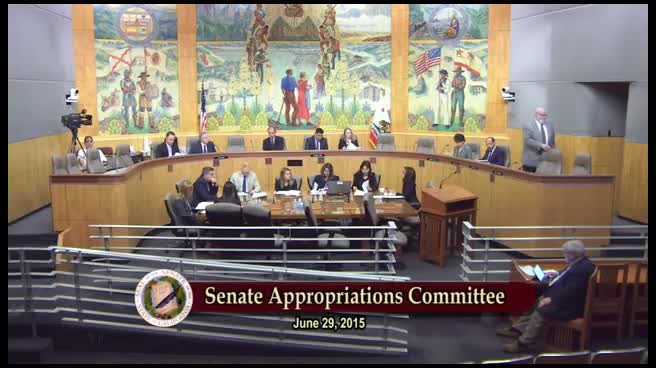 25SEC
Senate Standing Committee on Appropriations
 1MIN
Assembly Floor
Bill Author

Bill Co-Author(s):