AB 991: State teachers’ retirement.
- Session Year: 2015-2016
- House: Assembly
- Latest Version Date: 2015-07-16
Existing law, the Teachers Retirement Law, establishes the State Teachers Retirement System (STRS) and creates the Defined Benefit Program of the State Teachers Retirement Plan, which provides a defined benefit to members of the program, based on final compensation, credited service, and age at retirement, subject to certain variations. STRS is governed by the Teachers Retirement Board. Existing law defines credited service for these purposes as service from which required contributions have been paid. Existing law permits the board to amend the plan to dispense with payment for amounts less than $10. Existing law permits specified employers participating in STRS, if it is in the best interests of the school district or office of education, to grant an additional 2 years of service credit in order to encourage retirement, if specified conditions are met. Existing law authorizes specified payments made pursuant to the Teachers Retirement Law, including disability retirement benefits and compensation for postretirement activities, to be reduced if they are in excess of specified limits. Existing law permits members retired for disability or service from STRS to perform member activities without reinstatement into the system if certain conditions are met. Existing law prescribes different retirement allowance formulations for members who retire after reinstating from retirement depending on the circumstances of their service after reinstatement, and whether they return to employment subject to the Defined Benefit Program, among other factors.
This bill would revise the definition of credited service for purposes of STRS to include service for which required contributions would have been made in absence of specified federal limits. The bill would define leave of absence as a period of leave to which a member is entitled that is expressly authorized or required pursuant to specified provisions. The bill would revise the provisions authorizing the board to dispense with the payment for amounts less than $10 to be more specific in regard to the types of payments and to include adjustments to those payments. The bill would require, in regard to the grant of additional service credit to encourage retirement, that necessary documentation be provided to the retirement system within a specified time.
This bill would also make various technical changes to accurately cross-reference current law regarding contributions to fund the system. The bill would specify how reductions in payments are to be made in connection with the amount received in a particular month. The bill would provide that the election of membership in the Defined Benefit Program by certain people, including substitute teachers, is not terminated until the person receives a refund of contributions. The bill would make various technical, conforming, and correctional changes to provisions relating to retirement allowance formulations for members who reinstate after retiring, and who retire after receiving a disability allowance, including changing the members age at retirement to refer to the members age on the last day of the month the allowance will begin. The bill would make other technical, conforming changes, and corrections.
Existing law establishes the Cash Balance Benefit Program, administered by the Teachers Retirement Board, as a separate benefit program within the State Teachers Retirement Plan in order to provide a retirement plan for persons employed to perform creditable service for less than 50% of full-time service. Existing law states legislative findings and declarations regarding the purpose of the Cash Balance Plan offered pursuant to the program. Existing law defines a participant for these purposes and prescribes the circumstances pursuant to which a person is permitted to participate in the program and how participation may be terminated and service may be subject to the Defined Benefit Program offered by STRS. Existing law provides that the normal form of retirement benefit under the Cash Balance Benefit Program is a lump-sum payment.
This bill would revise the statement of legislative findings regarding the Cash Balance Benefit Program to specify that it applies to a person working for an employer, except a community college district, that offers the plan, a person who is employed on temporary basis, as specified, by a community college district offering the plan, or a person employed as a substitute employee. The bill would revise the definition of a participant in the plan to require that he or she has not received a lump-sum retirement benefit, as specified. The bill would define the systems headquarters office for purposes of the program. The bill would revise the circumstances pursuant to which a person providing creditable service would be eligible to participate in the plan with reference to whether a person has elected an alternative retirement program, whether a participants employment with a community college district precludes continued participation in the plan, and how a substitute employee may become and remain a member of the plan. The bill would authorize a member of the Defined Benefit Program employed to perform creditable service as a substitute to elect to have that service covered under the Cash Balance Benefit Program, subject to certain conditions.
This bill would also prohibit payment of a lump-sum retirement benefit before 180 days have elapsed following termination of employment and would require automatic termination of an application for the retirement benefit based on the participant performing creditable service with 180 days of terminating employment, except as specified. The bill would specify how reductions in payments under the Cash Balance Benefit Program are to be made in connection with the amount received in a particular month. The bill would require, with regard to a participant retired for service, that the retired participant application for the retirement benefit be canceled automatically if he or she is anticipated to receive the retirement in a lump-sum payment and earns compensation for performing creditable service with 180 days after termination of employment. The bill would make other technical, conforming changes, and corrections in the Cash Balance Benefit Program.
Existing law, the Teachers Retirement Law, establishes the State Teachers Retirement System (STRS) and creates the Defined Benefit Program of the State Teachers Retirement Plan, which provides a defined benefit to members of the program, based on final compensation, credited service, and age at retirement, subject to certain variations. STRS is governed by the Teachers Retirement Board. Existing law defines credited service for these purposes as service from which required contributions have been paid. Existing law permits the board to amend the plan to dispense with payment for amounts less than $10. Existing law permits specified employers participating in STRS, if it is in the best interests of the school district or office of education, to grant an additional 2 years of service credit in order to encourage retirement, if specified conditions are met. Existing law authorizes specified payments made pursuant to the Teachers Retirement Law, including disability retirement benefits and compensation for postretirement activities, to be reduced if they are in excess of specified limits. Existing law permits members retired for disability or service from STRS to perform member activities without reinstatement into the system if certain conditions are met. Existing law prescribes different retirement allowance formulations for members who retire after reinstating from retirement depending on the circumstances of their service after reinstatement, and whether they return to employment subject to the Defined Benefit Program, among other factors.
This bill would revise the definition of credited service for purposes of STRS to include service for which required contributions would have been made in absence of specified federal limits. The bill would define leave of absence as a period of leave to which a member is entitled that is expressly authorized or required pursuant to specified provisions. The bill would revise the provisions authorizing the board to dispense with the payment for amounts less than $10 to be more specific in regard to the types of payments and to include adjustments to those payments. The bill would require, in regard to the grant of additional service credit to encourage retirement, to require as a condition of that grant that necessary documentation be provided to the retirement system within a specified time. The
This bill would also make various technical changes to accurately cross-reference current law regarding contributions to fund the system. The bill would specify how reductions in payments are to be made in connection with the amount received in a particular month. The bill would provide that the election of membership in the Defined Benefit Program by certain people, including substitute teachers, is not terminated until the person receives a refund of contributions. The bill would make various technical, conforming, and correctional changes to provisions relating to retirement allowance formulations for members who reinstate after retiring, and who retire after receiving a disability allowance, including changing the members age at retirement to refer to the members age on the last day of the month the allowance will begin. The bill would make other technical, conforming changes, and corrections.
Existing law establishes the Cash Balance Benefit Program, administered by the Teachers Retirement Board, as a separate benefit program within the State Teachers Retirement Plan in order to provide a retirement plan for persons employed to perform creditable service for less than 50% of full-time service. Existing law states legislative findings and declarations regarding the purpose of the Cash Balance Plan offered pursuant to the program. Existing law defines a participant for these purposes and prescribes the circumstances pursuant to which a person is permitted to participate in the program and how participation may be terminated and service may be subject to the Defined Benefit Program offered by STRS. Existing law provides that the normal form of retirement benefit under the Cash Balance Benefit Program is a lump-sum payment.
This bill would revise the statement of legislative findings regarding the Cash Balance Benefit Program to specify that it applies to a person working for an employer, except a community college district, that offers the plan, a person who is employed on temporary basis, as specified, by a community college district offering the plan, or a person employed as a substitute employee. The bill would revise the definition of a participant in the plan to require that he or she has not received a lump-sum retirement benefit, as specified. The bill would define the systems headquarters office for purposes of the program. The bill would revise the circumstances pursuant to which a person providing creditable service would be eligible to participate in the plan with reference to whether a person has elected an alternative retirement program, whether a participants employment with a community college district precludes continued participation in the plan, and how a substitute employee may become and remain a member of the plan. The bill would authorize a member of the Defined Benefit Program employed to perform creditable service as a substitute to elect to have that service covered under the Cash Balance Benefit Program, subject to certain conditions.
This bill would also prohibit payment of a lump-sum retirement benefit before 180 days have elapsed following termination of employment and would require automatic termination of an application for the retirement benefit based on the participant performing creditable service with 180 days of terminating employment, except as specified. The bill would specify how reductions in payments under the Cash Balance Benefit Program are to be made in connection with the amount received in a particular month. The bill would require, with regard to a participant retired for service, that the retired participant application for the retirement benefit be canceled automatically if he or she is anticipated to receive the retirement in a lump-sum payment and earns compensation for performing creditable service with 180 days after termination of employment. The bill would make other technical, conforming changes, and corrections in the Cash Balance Benefit Program.
Existing law, the Teachers Retirement Law, establishes the State Teachers Retirement System (STRS) and creates the Defined Benefit Program of the State Teachers Retirement Plan, which provides a defined benefit to members of the program, based on final compensation, credited service, and age at retirement, subject to certain variations. STRS is governed by the Teachers Retirement Board. Existing law defines credited service for these purposes as service from which required contributions have been paid. Existing law permits the board to amend the plan to dispense with payment for amounts less than $10. Existing law permits specified employers participating in STRS, if it is in the best interests of the school district or office of education, to grant an additional 2 years of service credit in order to encourage retirement, if specified conditions are met. Existing law authorizes specified payments made pursuant to the Teachers Retirement Law, including disability retirement benefits and compensation for postretirement activities, to be reduced if they are in excess of specified limits. Existing law permits members retired for disability or service from STRS to perform member activities without reinstatement into the system if certain conditions are met.
This bill would revise the definition of credited service for purposes of STRS to include service for which required contributions would have been made in absence of specified federal limits. The bill would revise the provisions authorizing the board to dispense with the payment for amounts less than $10 to be more specific in regard to the types of payments and to include adjustments to those payments. The bill would require, in regard to the grant of additional service credit to encourage retirement, to require as a condition of that grant that necessary documentation be provided to the retirement system within a specified time. The bill would make various technical changes to accurately cross-reference current law regarding contributions to fund the system. The bill would specify how reductions in payments are to be made in connection with the amount received in a particular month. The bill would make other technical, conforming changes, and corrections.
Existing law establishes the Cash Balance Benefit Program, administered by the Teachers Retirement Board, as a separate benefit program within the State Teachers Retirement Plan in order to provide a retirement plan for persons employed to perform creditable service for less than 50% of full-time service. Existing law states legislative findings and declarations regarding the purpose of the Cash Balance Plan offered pursuant to the program. Existing law defines a participant for these purposes and prescribes the circumstances pursuant to which a person is permitted to participate in the program and how participation may be terminated and service be subject to the Defined Benefit Program offered by STRS. Existing law provides that the normal form of retirement benefit under the Cash Balance Benefit Program is a lump-sum payment.
This bill would revise the statement of legislative findings regarding the Cash Balance Benefit Program to specify that it applies to a person working for an employer, except a community college district, that offers the plan, a person who is employed on temporary basis, as specified, by a community college district offering the plan, or a person employed as a substitute employee. The bill would revise the definition of a participant in the plan to require that he or she has not received a lump-sum retirement benefit, as specified. The bill would define the systems headquarters office for purposes of the program. The bill would revise the circumstances pursuant to which a person providing creditable service would be eligible to participate in the plan with reference to whether a person has elected an alternative retirement program, whether a participants employment with a community college district precludes continued participation in the plan, and how a substitute employee may become and remain a member of the plan. The bill would prohibit payment of a lump-sum retirement benefit before 180 days have elapsed following termination of employment and would require automatic termination of an application for the retirement benefit based on the participant performing creditable service with 180 days of terminating employment, except as specified. The bill would specify how reductions in payments under the Cash Balance Benefit Program are to be made in connection with the amount received in a particular month. The bill would require, with regard to a participant retired for service, that the retired participant application for the retirement benefit be canceled automatically if he or she is anticipated to receive the retirement in a lump-sum payment and earns compensation for performing creditable service with 180 days after termination of employment. The bill would make other technical, conforming changes, and corrections in the Cash Balance Benefit Program.
The Legislature hereby finds and declares that on July 1, 1996, the State Teachers Retirement System Cash Balance Plan was created and established to provide a retirement plan for persons employed by an employer offering the Cash Balance Plan, excluding community college districts, to perform creditable service for less than 50 percent of the full-time equivalent for the position or employed by a community college district offering the Cash Balance Plan to perform creditable service on a temporary basis pursuant to Section 87474, 87478, 87480, 87481, 87482, or 87482.5, or employed by an employer offering the Cash Balance Plan to perform creditable service as a substitute employee. The persons eligible for the Cash Balance Plan were excluded from mandatory membership in the State Teachers Retirement System Defined Benefit Plan. Both plans are administered by the Teachers Retirement Board. Prior to the creation and establishment of the Cash Balance Plan, the State Teachers Retirement System Defined Benefit Plan had been identified simply as the State Teachers Retirement System. As a result, the system was identified as both the administrative body and the retirement plan. The State Teachers Retirement Law was amended to identify the retirement plan as the State Teachers Retirement System Defined Benefit Plan in order to distinguish that plan from the Cash Balance Plan. Because both plans were intended to provide for the retirement of teachers and other persons employed in connection with public schools of this state and schools supported by this state, a merger of these two plans is now hereby made for the purpose of establishing a single retirement plan that shall be known and may be cited as the State Teachers Retirement Plan consisting of the different benefit programs set forth in this part and Part 14 (commencing with Section 26000). This plan shall be administered by the Teachers Retirement Board as set forth in this part and Part 14 (commencing with Section 26000). This part, together with Part 14 (commencing with Section 26000) shall be known and may be cited as the Teachers Retirement Law.
SEC. 2.Section 22119.2 of the Education Code is amended to read:22119.2.(a)Creditable compensation means remuneration that is paid in cash by an employer to all persons in the same class of employees for performing creditable service in that position. Creditable compensation shall include:
(1)Salary or wages paid in accordance with a publicly available written contractual agreement, including, but not limited to, a salary schedule or employment agreement.
(2)Remuneration that is paid in addition to salary or wages, provided it is paid to all persons who are in the same class of employees in the same dollar amount, the same percentage of salary or wages, or the same percentage of the amount being distributed.
(3)Remuneration that is paid for the use of sick leave, vacation leave, or an employer-approved compensated leave of absence, except as provided in paragraph (4) of subdivision (c).
(4)Member contributions that are picked up by an employer pursuant to Section 22903 or 22904.
(5)Amounts that are deducted from a members remuneration, including, but not limited to, deductions for participation in a deferred compensation plan; deductions to purchase an annuity contract, tax-deferred retirement plan, or insurance program; and contributions to a plan that meets the requirements of Section 125, 401(a), 401(k), 403(b), 457(b), or 457(f) of Title 26 of the United States Code.
(6)Any other payments the board determines to be creditable compensation.
(b)Any creditable compensation determined by the system to have been paid to enhance a members benefits shall not be credited under the Defined Benefit Program. Contributions on that compensation shall be credited to the Defined Benefit Supplement Program. A presumption by the system that creditable compensation was paid to enhance a members benefits may be rebutted by the member or by the employer on behalf of the member. Upon receipt of sufficient evidence to the contrary, a presumption by the system that creditable compensation was paid to enhance the members benefits may be reversed.
(c)Creditable compensation does not mean and shall not include:
(1)Remuneration that is not paid in cash or is not paid to all persons who are in the same class of employees.
(2)Remuneration that is paid for service that is not creditable service pursuant to Section 22119.5.
(3)Remuneration that is paid in addition to salary or wages if it is not paid to all persons in the same class of employees in the same dollar amount, the same percentage of salary or wages, or the same percentage of the amount being distributed pursuant to paragraph (2) of subdivision (a).
(4)Remuneration that is paid in exchange for the relinquishment of unused accumulated leave.
(5)Payments, including, but not limited to, those for participation in a deferred compensation plan; to purchase an annuity contract, tax-deferred retirement plan, or insurance program; and for contributions to a plan that meets the requirements of Section 125, 401(a), 401(k), 403(b), 457(b), or 457(f) of Title 26 of the United States Code when the cost is covered by an employer and is not deducted from the members salary.
(6)Fringe benefits provided by an employer.
(7)Expenses paid or reimbursed by an employer.
(8)Severance pay, including lump-sum and installment payments, or money paid in excess of salary or wages to a member as compensatory damages or as a compromise settlement.
(9)Any other payments the board determines not to be creditable compensation.
(d)An employer or individual who knowingly or willfully reports compensation in a manner inconsistent with subdivision (a) or (c) may be subject to prosecution for fraud, theft, or embezzlement in accordance with the Penal Code. The system may establish procedures to ensure that compensation reported by an employer is in compliance with this section.
(e)For purposes of this section, remuneration shall be considered paid if distributed to any person in the same class of employees who meets the qualifications or requirements specified in a publicly available written contractual agreement, including, but not limited to, a collective bargaining agreement or an employment agreement, as a condition of receiving the remuneration.
(f)This definition of creditable compensation reflects sound principles that support the integrity of the retirement fund. Those principles include, but are not limited to, consistent treatment of compensation throughout a members career, consistent treatment of compensation among an entire class of employees, consistent treatment of compensation for the position, preventing adverse selection, and excluding from compensation earnable remuneration that is paid to enhance a members benefits. The system shall determine the appropriate crediting of contributions between the Defined Benefit Program and the Defined Benefit Supplement Program according to these principles, to the extent not otherwise specified pursuant to this part.
(g)The section shall become operative on July 1, 2002.
(h)This section shall not apply to a member subject to the California Public Employees Pension Reform Act of 2013.
SEC. 3.Section 22119.3 of the Education Code is amended to read:22119.3.(a)Creditable compensation for members who are subject to the California Public Employees Pension Reform Act of 2013 means remuneration that is paid each pay period in which creditable service is performed for that position. Creditable compensation shall be paid in cash by an employer to all persons in the same class of employees in accordance with a publicly available written contractual agreement, including, but not limited to, a salary schedule or employment agreement. Creditable compensation shall include:
(1)Remuneration that is paid for the use of sick leave, vacation leave, or an employer-approved compensated leave of absence, except as provided in paragraph (4) of subdivision (b).
(2)Member contributions that are picked up by an employer pursuant to Section 22903 or 22904.
(3)Amounts that are deducted from a members remuneration, including, but not limited to, deductions for participation in a deferred compensation plan; deductions to purchase an annuity contract, tax-deferred retirement plan, or insurance program; and contributions to a plan that meets the requirements of Section 125, 401(a), 401(k), 403(b), 457(b), or 457(f) of Title 26 of the United States Code.
(4)Notwithstanding paragraphs (6) and (8) of subdivision (c) of Section 7522.34 of the Government Code, remuneration that is paid for creditable service that exceeds one year in a school year.
(b)Creditable compensation does not mean and shall not include:
(1)Remuneration that is not paid in cash or is not paid to all persons who are in the same class of employees.
(2)Remuneration that is paid for service that is not creditable service pursuant to Section 22119.5.
(3)Remuneration that is not paid each pay period in which creditable service is performed for that position.
(4)Remuneration that is paid in exchange for the relinquishment of unused accumulated leave.
(5)Payments, including, but not limited to, those for participation in a deferred compensation plan; to purchase an annuity contract, tax-deferred retirement plan, or insurance program; and for contributions to a plan that meets the requirements of Section 125, 401(a), 401(k), 403(b), 457(b), or 457(f) of Title 26 of the United States Code when the cost is covered by an employer.
(6)Fringe benefits provided by an employer.
(7)Expenses paid or reimbursed by an employer.
(8)Severance pay, including lump sum and installment payments, or money paid in excess of salary or wages to a member as compensatory damages or as a compromise settlement.
(9)Creditable compensation determined by the system to have been paid to enhance a members benefit.
(10)Compensation paid to the member in lieu of benefits provided to the member by the employer or paid directly by the employer to a third party other than the system for the benefit of the member.
(11)Any one-time or ad hoc payments made to a member.
(12)Any employer-provided allowance, reimbursement, or payment, including, but not limited to, one made for housing, vehicle, or uniform.
(13)Any bonus paid in addition to compensation described in subdivision (a).
(14)Any other payments the board determines not to be creditable compensation.
(c)(1)Except for purposes of calculating credited service in the Defined Benefit Program and for reporting compensation earnable on or after January 1, 2013, creditable compensation in any fiscal year shall not exceed:
(A)One hundred twenty percent of the contribution and benefit base, as determined under Section 430(b) of the Social Security Act (42 U.S.C. Sec. 430(b)), on January 1, 2013, for a member whose service is not included in the federal system.
(B)One hundred percent of the contribution and benefit base, as determined under Section 430(b) of the Social Security Act (42 U.S.C. Sec. 430(b)), on January 1, 2013, for a member whose service is included in the federal system pursuant to any changes in state or federal law enacted on or after January 1, 2013.
(2)The system shall adjust the limit based on the annual changes to the Consumer Price Index for All Urban Consumers: U.S. City Average, calculated by dividing the Consumer Price Index for All Urban Consumers: U.S. City Average for the month of February in the fiscal year preceding the adjustment by the Consumer Price Index for All Urban Consumers: U.S. City Average for the month of February of the previous year rounded to the nearest thousandth. Notwithstanding paragraph (1) of subdivision (d) of Section 7522.10 of the Government Code, the adjustment shall be effective annually on July 1, beginning July 1, 2014.
(3)The Legislature reserves the right to modify the requirements of this subdivision with regard to all members subject to this subdivision, except that the Legislature may not modify these provisions in a manner that would result in a decrease in benefits accrued prior to the effective date of the modification.
(4)This subdivision shall apply to compensation paid during the 201314 fiscal year and each fiscal year thereafter.
(d)An employer or individual who knowingly or willfully reports compensation in a manner inconsistent with subdivision (a) or (b) may be subject to prosecution for fraud, theft, or embezzlement in accordance with the Penal Code. The system may establish procedures to ensure that compensation reported by an employer is in compliance with this section.
(e)For purposes of this section, remuneration shall be considered paid if distributed to any person in the same class of employees who meets the qualifications or requirements specified in a publicly available written contractual agreement, including, but not limited to, a collective bargaining agreement or an employment agreement, as a condition of receiving the remuneration.
(f)This definition of creditable compensation reflects sound principles that support the integrity of the retirement fund. Those principles include, but are not limited to, consistent treatment of compensation throughout a members career, consistent treatment of compensation among an entire class of employees, consistent treatment of compensation for the position, preventing adverse selection, and excluding from creditable compensation remuneration that is paid to enhance a members benefits. The system shall determine the appropriate crediting of contributions according to these principles, to the extent not otherwise specified pursuant to this part. A presumption by the system that creditable compensation was paid to enhance the members benefits may be rebutted by the member or by the employer on behalf of the member. Upon receipt of sufficient evidence to the contrary, a presumption by the system that creditable compensation was paid to enhance the members benefits may be reversed.
SEC. 4.Section 22121 of the Education Code is amended to read:22121.(a)Credited service means service for which the required contributions have been paid and service for which required contributions would have been paid in absence of the limit prescribed by Section 401(a)(17) of Title 26 of the United States Code as described in Section 22317.5.
(b)Credited service for members who are subject to the California Public Employees Pension Reform Act of 2013 means service for which required contributions have been paid and service for which required contributions would have been paid in absence of the limit established by subdivision (c) of Section 22119.3.
(c)Credited service for the limited purpose of determining eligibility for benefits pursuant to Section 22134.5, 24203.5, or 24203.6 also includes up to two-tenths of one year of service granted pursuant to Section 22717.
SEC. 5.Section 22141 of the Education Code is amended to read:22141.(a) Notwithstanding Section 22140, improvement factor means an increase of 2 percent in benefits provided under Sections 24408 and 24409 for each year commencing September 1, 1981, and under Section 24410.5 for each year commencing September 1, 2001, and under Sections 24410.6 and 24410.7 for each year commencing September 1, 2002. The improvement factor shall not be compounded nor shall it be applicable to annuities payable from the accumulated annuity deposit contributions or the accumulated tax-sheltered annuity contributions. The Legislature reserves the right to adjust the amount of the improvement factor up or down as the economic conditions dictate. No adjustments of the improvement factor shall reduce the monthly retirement allowance or benefit below that which would be payable to the recipient under this part had this section not been enacted.
(b)Beginning July 1, 2014, the improvement factor shall vest for an active member in any calendar year in which active members paid increased member contributions pursuant to Section 22901.7.
(c)If, for any reason, the increased employee contribution referenced in subdivision (b), and as required by subdivisions (a) and (b) of Section 22901.7, ceases to be legally required to be made pursuant to the act that added this subdivision, then the Legislature reserves the right to adjust the amount of the improvement factor up or down as the economic conditions dictate for all members who retire on or after January 1, 2014. No adjustments of the improvement factor shall reduce the monthly retirement allowance or benefit below that which would be payable to the recipient under this part had this section not been enacted.
(d)For members who retired before the calendar year in which Section 22901.7 was added, the Legislature reserves the right to adjust the amount of the improvement factor up or down as the economic conditions dictate. No adjustments of the improvement factor shall reduce the monthly retirement allowance or benefit below that which would be payable to the recipient under this part had this section not been enacted.
SEC. 6.Section 22144.3 is added to the Education Code, to read:22144.3.Leave of absence means a period of leave to which a member is entitled that is expressly authorized or required by Chapter 4 (commencing with Section 44800) of Part 25 of Division 3 of Title 2, or Chapter 1 (commencing with Section 87000) or Chapter 3 (commencing with Section 87400) of Part 51 of Division 7 of Title 3.
SEC. 7.Section 22404 of the Education Code is amended to read:22404.(a)Notwithstanding any other provision of this part or Part 14 (commencing with Section 26000) to the contrary, the board may establish by plan amendment a specified amount or amounts, not to exceed ten dollars ($10), below which the system may dispense with:
(1)The processing of a benefit payment, an annuity payment, or any other payment, including adjustments to those payments, payable to a member, participant, or beneficiary.
(2)The collection of a benefit overpayment, annuity overpayment, or any other overpayments paid to a member, participant, or beneficiary.
(b)When the cumulative dollar amount associated with one or more benefit payments or overpayments, annuity payments or overpayments, or other payments or overpayments equals or exceeds the amount described in subdivision (a), that amount shall be paid to, or collected from, the member, participant, or beneficiary. That cumulative amount paid or collected shall not be credited with interest.
SEC. 8.Section 22509 of the Education Code is amended to read:22509.(a)Within 10 working days of the date of hire of an employee who has the right to make an election pursuant to Section 22508 or 22508.5, the employer shall inform the employee of the right to make an election and shall make available to the employee written information provided by each retirement system concerning the benefits provided under that retirement system to assist the employee in making an election.
(b)Any election made pursuant to subdivision (a) of Section 22508 or subdivision (a) of Section 22508.5 shall be filed with the office of the State Teachers Retirement System and a copy of the election shall be filed with the other public retirement system. Any election made pursuant to subdivision (c) of Section 22508 or subdivision (b) of Section 22508.5 shall be filed with the office of the Public Employees Retirement System and a copy of the election shall be filed with the office of this system.
(c)Any election made pursuant to Section 22508 or Section 22508.5 shall become effective as of the first day of employment in the position that qualified the employee to make an election.
SEC. 9.Section 22515 of the Education Code is amended to read:22515.Persons excluded from membership pursuant to Sections 22601.5, 22602, and 22604 may elect membership in the Defined Benefit Program at any time while employed to perform creditable service subject to coverage under that program. The election shall be in writing on a form prescribed by this system and shall be filed in the office of this system prior to submission of contributions. The election is irrevocable and shall remain in effect until the member terminates employment and receives a refund of accumulated retirement contributions. The amendments to this section enacted during the 199596 Regular Session shall be deemed to have become operative on July 1, 1996.
SEC. 10.Section 22711 of the Education Code is amended to read:22711.(a)A member under this part shall be granted service credit for time during which the member serves as an elected officer of an employee organization while on a compensated leave of absence pursuant to Section 44987 or 87768.5, if all of the following conditions are met:
(1)The member was employed and performed creditable service subject to coverage under this Defined Benefit Program in the month prior to commencement of the leave of absence.
(2)The member makes contributions to the Teachers Retirement Fund in the amount that the member would have contributed had the member performed creditable service on a full-time basis during the period the member served as an elected officer of the employee organization.
(3)The members employer contributes to the Teachers Retirement Fund at a rate adopted by the board as a plan amendment with respect to the Defined Benefit Program an amount based upon the creditable compensation that would have been paid to the member had the member performed creditable service on a full-time basis during the period the member served as an elected officer of the employee organization.
(b)The maximum service credit a member may receive pursuant to this section shall not exceed 12 years.
SEC. 11.Section 22714 of the Education Code is amended to read:22714.(a)Whenever the governing board of a school district or a community college district or a county office of education, by formal action, determines pursuant to Section 44929 or 87488 that, because of impending curtailment of, or changes in, the manner of performing services, the best interests of the district or county office of education would be served by encouraging certificated employees or academic employees to retire for service and that the retirement will result in a net savings to the district or county office of education, an additional two years of service credit shall be granted under this part to a member of the Defined Benefit Program if all of the following conditions exist:
(1)The member is credited with five or more years of service credit and retires for service under Chapter 27 (commencing with Section 24201) during a period of not more than 120 days or less than 60 days, commencing no sooner than the effective date of the formal action of the employer that shall specify the period.
(2)The documentation required by this section is received by the system no later than 30 calendar days after the last day of the window period established in paragraph (1).
(3)(A)The employer transfers to the retirement fund an amount determined by the Teachers Retirement Board to equal the actuarial equivalent of the difference between the allowance the member receives after receipt of service credit pursuant to this section and the amount the member would have received without the service credit and an amount determined by the Teachers Retirement Board to equal the actuarial equivalent of the difference between the purchasing power protection supplemental payment the member receives after receipt of service credit pursuant to this section and the amount the member would have received without the service credit. The payment for purchasing power shall be deposited in the Supplemental Benefit Maintenance Account established by Section 22400 and shall be subject to Section 24415. The transfer to the retirement fund shall be made in a manner and a time period, not to exceed eight years, that is acceptable to the Teachers Retirement Board. The employer shall transfer the required amount for all eligible employees who retire pursuant to this section.
(B)Regular interest shall be charged on the unpaid balance if the employer makes the transfer to the retirement fund in installments.
(4)The employer transmits to the retirement fund the administrative costs incurred by the system in implementing this section, as determined by the Teachers Retirement Board.
(5)The employer has considered the availability of teachers or academic employees to fill the positions that would be vacated pursuant to this section.
(b)(1)The school district shall demonstrate and certify to the county superintendent that the formal action taken would result in a net savings to the district.
(2)The county superintendent shall certify to the Teachers Retirement Board that the result specified in paragraph (1) can be demonstrated. The certification shall include, but not be limited to, the information specified in subdivision (c) of Section 14502.1.
(3)The school district shall reimburse the county superintendent for all costs to the county superintendent that result from the certification.
(c)(1)The county office of education shall demonstrate and certify to the Superintendent of Public Instruction that the formal action taken would result in a net savings to the county office of education.
(2)The Superintendent of Public Instruction shall certify to the Teachers Retirement Board that the result specified in paragraph (1) can be demonstrated. The certification shall include, but not be limited to, the information specified in subdivision (c) of Section 14502.1.
(3)The Superintendent of Public Instruction may request reimbursement from the county office of education for all administrative costs that result from the certification.
(d)(1)The community college district shall demonstrate and certify to the chancellors office that the formal action taken would result in a net savings to the district.
(2)The chancellor shall certify to the Teachers Retirement Board that the result specified in paragraph (1) can be demonstrated. The certification shall include, but not be limited to, the information specified in subdivision (c) of Section 84040.5.
(3)The chancellor may request reimbursement from the community college district for all administrative costs that result from the certification.
(e)The opportunity to be granted service credit pursuant to this section shall be available to all members employed by the school district, community college district, or county office of education who meet the conditions set forth in this section.
(f)The amount of service credit shall be two years.
(g)Any member of the Defined Benefit Program who retires under this part for service under Chapter 27 (commencing with Section 24201) with service credit granted under this section and who subsequently reinstates shall forfeit the service credit granted under this section.
(h)Any member of the Defined Benefit Program who retires under this part for service under Chapter 27 (commencing with Section 24201) with service credit granted under this section and who takes any job with the school district, community college district, or county office of education that granted the member the service credit less than five years after receiving the credit shall forfeit the ongoing benefit he or she receives from the additional service credit granted under this section.
(i)This section does not apply to any member otherwise eligible if the member receives any unemployment insurance payments arising out of employment with an employer subject to this part within one year following the effective date of the formal action under subdivision (a), or if the member is not otherwise eligible to retire for service.
SEC. 12.Section 22717 of the Education Code is amended to read:22717.(a)A member shall be granted credit at service retirement for each day of accumulated and unused sick leave days for which full salary is allowed to which the member was entitled on the members final day of employment with the employer or employers subject to coverage by the Defined Benefit Program during the last school year in which he or she earned creditable compensation pursuant to Section 22119.2 or 22119.3. The system shall accept certification from each employer with which the member has accumulated sick leave days for that period, provided this leave has not been transferred to another employer.
(b)The amount of service credit to be granted shall be determined by dividing the number of days of accumulated and unused sick leave days by the number of days of service the employer requires the members class of employees to perform in a school year during the members final year of creditable service subject to coverage by the Defined Benefit Program, which shall not be less than the minimum standard specified in Section 22138.5. The number of days shall not include school and legal holidays. In no event shall the divisor be less than 175. For members employed less than full time, the standards identified in Section 22138.5 shall be considered as the minimum full-time equivalent. For those standards identified in Section 22138.5 that are applicable to teachers or instructors and that are expressed only in terms of hours or instructional hours, the number of hours or instructional hours shall be divided by six to determine the number of days.
(c)When the member has made application for service retirement under this part, the employer shall certify to the board, within 30 days following the effective date of the members service retirement or the date the application for retirement is received by the systems headquarters office, whichever is later, the number of days of accumulated and unused sick leave days that the member was entitled to on the final day of employment. The board may assess a penalty on delinquent reports.
(d)This section shall be applicable to any person who retires on or after January 1, 1999.
SEC. 13.Section 22900 of the Education Code is amended to read:22900.By accepting employment to perform creditable service, a person consents to make contributions pursuant to Sections 22901 and 22901.7 for service and compensation credited under this part.
SEC. 14.Section 22903 of the Education Code is amended to read:22903.Notwithstanding Sections 22901, 22901.3, 22901.7, 22956, and 23000, the state and each school district, community college district, county board of education, and county superintendent of schools, may pick up, for the sole purpose of deferring taxes, as authorized by Section 414(h)(2) of the Internal Revenue Code of 1986 (26 U.S.C. Sec. 414(h)(2)) and Section 17501 of the Revenue and Taxation Code, all of the contributions required to be paid under this part by a member of the Defined Benefit Program, provided that the contributions are deducted from the creditable compensation of the member.
SEC. 15.Section 22950 of the Education Code is amended to read:22950.(a)Employers shall contribute monthly to the system 8 percent of the creditable compensation upon which members contributions under this part are based.
(b)From the contributions required under subdivision (a), there shall be deposited in the Teachers Retirement Fund an amount, determined by the board, that is not less than the amount, determined in an actuarial valuation of the Defined Benefit Program pursuant to Section 22311.5, necessary to finance the liabilities associated with the benefits of the Defined Benefit Program over the funding period adopted by the board, after taking into account the contributions made pursuant to Sections 22901, 22901.7, 22950.5, 22951, 22955, and 22955.1.
(c)The amount of contributions required under subdivision (a) that is not deposited in the Teachers Retirement Fund pursuant to subdivision (b) shall be deposited directly into the Teachers Health Benefits Fund, as established in Section 25930, and shall not be deposited into or transferred from the Teachers Retirement Fund.
(d)(1)Notwithstanding subdivisions (b) and (c), there may be deposited into the Teachers Retirement Program Development Fund, as established in Section 22307.5, from the contributions required under subdivision (a), an amount determined by the board, not to exceed the limit specified in paragraph (2).
(2)The balance of deposits into the Teachers Retirement Program Development Fund, minus the subsequent transfer of funds, with interest, into the Teachers Retirement Fund pursuant to subdivision (e) of Section 22307.5, shall not exceed 0.01 percent of the total of the creditable compensation of the fiscal year ending in the immediately preceding calendar year upon which members contributions to the Defined Benefit Program are based.
(3)The deposits described in this subdivision shall not be deposited into, or transferred from, the Teachers Retirement Fund.
SEC. 16.Section 23001 of the Education Code is amended to read:23001.Each county superintendent, district superintendent, chancellor of a community college district, or other employing agency that reports directly to the system shall draw requisitions for contributions required by Sections 22901, 22901.7, 22950, and 22950.5 in favor of the State Teachers Retirement System, and the requisitions, when allowed and signed by the county auditor, shall constitute a warrant against the county treasury. The county superintendent, district superintendent, chancellor of a community college district, or other employing agency thereupon shall forward the warrants to the board in the systems headquarters office. The amounts received shall be deposited immediately in the State Treasury to the Teachers Retirement Fund.
SEC. 17.Section 24114 of the Education Code is amended to read:24114.(a)A member receiving a disability retirement benefit under this part may be employed or self-employed in any capacity, notwithstanding Section 22132, but may not make contributions to the retirement fund with respect to the Defined Benefit Program or accrue service credit under this part based on earnings from any employment.
(b)A member receiving a disability retirement benefit under this part may earn in any one calendar year up to the limitation specified in subdivision (c) without a reduction in his or her disability retirement allowance.
(c)The limitation that shall apply to the earnings of a member receiving a disability retirement benefit under this part shall be fifteen thousand dollars ($15,000), in any one calendar year, adjusted annually by the board effective each January 1 by the amount of increase in the All Urban California Consumer Price Index using December 1989 as the base.
(d)If a member receiving a disability retirement benefit under this part earns in excess of the limitation specified in subdivision (c) from all employment in any calendar year, notwithstanding Section 22132, his or her retirement allowance shall be reduced by the amount of the excess earnings. The amount of the reduction in an individual month shall be no more than the monthly allowance payable in that month, and the total amount of the reduction shall not exceed the amount of the annual allowance payable under this part for the calendar year in which the excess compensation was earned.
(e)The earnings limitation specified in this section does not apply to a member receiving a disability retirement benefit under this part who is participating in an approved rehabilitation program pursuant to Section 24111.
(f)This section does not apply to a member receiving a disability retirement benefit under this part who began receiving a disability retirement allowance prior to October 16, 1992.
SEC. 18.Section 24209 of the Education Code is amended to read:24209.(a)Upon retirement for service following reinstatement, the member shall receive a service retirement allowance equal to the sum of both of the following:
(1)An amount equal to the monthly allowance the member was eligible to receive immediately preceding the most recent reinstatement, exclusive of any amounts payable pursuant to Section 22714 or 22715, increased by the improvement factor that would have been applied to the allowance if the member had not reinstated.
(2)An amount calculated pursuant to Section 24202, 24202.5, 24202.6, 24203, 24203.5, or 24206 based on credited service accrued, including any service granted pursuant to Section 22717 or 22717.5, subsequent to the most recent reinstatement, the members age on the last day of the month in which the retirement allowance begins to accrue, and final compensation.
(b)If the total amount of credited service accrued, other than that accrued pursuant to Sections 22714, 22715, 22717, 22717.5, and 22826, is equal to or greater than 30 years, the amounts identified in paragraphs (1), for members who initially retired on or after January 1, 1999, and (2) of subdivision (a) shall be calculated pursuant to Section 24203.5.
(c)If the total amount of credited service accrued, other than that accrued pursuant to Sections 22714, 22715, 22717, 22717.5, and 22826, is equal to or greater than 30 years, upon retirement for service following reinstatement, a member who retired pursuant to Section 24213, and received the terminated disability allowance for the prior retirement, shall receive a service retirement allowance equal to the sum of the following:
(1)An amount based on the credited service accrued, including any service granted pursuant to Section 22717 or 22717.5, prior to the effective date of the disability allowance, the members age at the prior retirement increased by the factor provided in Section 24203.5, and projected final compensation.
(2)An amount calculated pursuant to Section 24202, 24202.5, 24202.6, 24203.5, or 24206 based on credited service accrued, including any service granted pursuant to Section 22717 or 22717.5, subsequent to the reinstatement, the members age on the last day of the month in which the retirement allowance begins to accrue, and final compensation using compensation earnable, or projected final compensation, or a combination of both.
(d)For purposes of this section, final compensation shall not be based on a determination of compensation earnable as described in subdivision (e) of Section 22115.
SEC. 19.Section 24209.3 of the Education Code is amended to read:24209.3.(a)Notwithstanding subdivision (a) of Section 24209, and exclusive of any amounts payable during the prior retirement for service pursuant to Section 22714, or 22715:
(1)A member who retired, other than pursuant to Section 24210, 24211, 24212, or 24213, and who reinstates and performs creditable service, as defined in Section 22119.5, after the most recent reinstatement, in an amount equal to two or more years of credited service, shall, upon retirement for service on or after the effective date of this section, receive a service retirement allowance equal to the sum of the following:
(A)An amount calculated pursuant to this chapter based on credited service accrued, including any service granted pursuant to Section 22717 or 22717.5, prior to the most recent reinstatement, using the members age at the subsequent service retirement, from which age shall be deducted the total time during which the member was retired for service, and final compensation.
(B)An amount calculated pursuant to this chapter based on credited service accrued, including any service granted pursuant to Section 22717 or 22717.5, subsequent to the most recent reinstatement, using the members age on the last day of the month in which the retirement allowance begins to accrue, and final compensation.
(2)A member who retired pursuant to Section 24210 and who reinstates and performs creditable service, as defined in Section 22119.5, after the most recent reinstatement, in an amount equal to two or more years of credited service, shall, upon retirement for service on or after the effective date of this section, receive a service retirement allowance equal to the sum of the following:
(A)An amount calculated pursuant to this chapter based on credited service accrued, including any service granted pursuant to Section 22717 or 22717.5, prior to the effective date of the disability retirement, using the members age at the subsequent service retirement, from which age shall be deducted the total time during which the member was retired for service, and indexed final compensation to the effective date of the initial service retirement.
(B)An amount calculated pursuant to this chapter based on the credited service accrued, including any service granted pursuant to Section 22717 or 22717.5, after termination of the disability retirement, excluding credited service accrued or granted subsequent to the most recent reinstatement, using the members age at the subsequent service retirement, from which age shall be deducted the total time during which the member was retired for service, and final compensation.
(C)An amount calculated pursuant to this chapter based on credited service accrued, including any service granted pursuant to Section 22717 or 22717.5, subsequent to the most recent reinstatement, using the members age on the last day of the month in which the retirement allowance begins to accrue, and final compensation.
(3)A member who retired pursuant to Section 24211 and who reinstates and performs creditable service, as defined in Section 22119.5, after the most recent reinstatement, in an amount equal to two or more years of credited service, shall, upon retirement for service on or after the effective date of this section, receive a service retirement allowance equal to the sum of the following:
(A)The greater of (i) the disability allowance the member was eligible to receive immediately prior to termination of that allowance, excluding the childrens portion, or (ii) an amount calculated pursuant to this chapter based on credited service accrued prior to the effective date of the disability allowance, excluding credited service accrued or granted pursuant to Section 22717 or 22717.5 or Chapter 14 (commencing with Section 22800) or Chapter 14.2 (commencing with Section 22820) or Chapter 19 (commencing with Section 23200), using the members age at the subsequent service retirement, from which age shall be deducted the total time during which the member was retired for service, and final compensation using compensation earnable, or projected final compensation earnable, or a combination of both.
(B)An amount equal to either of the following:
(i)For a member who was receiving a benefit pursuant to subdivision (a) of Section 24211, an amount calculated pursuant to this chapter based on credited service accrued at the time of the retirement pursuant to Section 24211, excluding credited service accrued or granted prior to the effective date of the disability allowance or pursuant to Section 22717 or 22717.5 or Chapter 14 (commencing with Section 22800) or Chapter 14.2 (commencing with Section 22820) or Chapter 19 (commencing with Section 23200), the members age at the subsequent service retirement, from which age shall be deducted the total time during which the member was retired for service, and final compensation using compensation earnable, or projected final compensation, or a combination of both.
(ii)For a member who was receiving a benefit pursuant to subdivision (b) of Section 24211, an amount calculated pursuant to this chapter based on projected service at the time of the retirement pursuant to Section 24211, excluding credited service accrued or granted prior to the effective date of the disability allowance or pursuant to Section 22717 or 22717.5 or Chapter 14 (commencing with Section 22800) or Chapter 14.2 (commencing with Section 22820) or Chapter 19 (commencing with Section 23200), the members age at the subsequent service retirement, from which age shall be deducted the total time during which the member was retired for service, and final compensation using compensation earnable, or projected final compensation, or a combination of both.
(C)An amount based on any credited service accrued or granted pursuant to Section 22717 or 22717.5 or Chapter 14 (commencing with Section 22800) or Chapter 14.2 (commencing with Section 22820) or Chapter 19 (commencing with Section 23200), at the time of the retirement pursuant to Section 24211, using the members age at the subsequent service retirement, from which age shall be deducted the total time during which the member was retired for service, and final compensation using compensation earnable, or projected final compensation, or a combination of both.
(D)An amount calculated pursuant to this chapter based on credited service accrued subsequent to the most recent reinstatement, including credited service accrued or granted pursuant to Section 22714, 22715, 22717, or 22717.5 or Chapter 14 (commencing with Section 22800) or Chapter 14.2 (commencing with Section 22820) or Chapter 19 (commencing with Section 23200), using the members age on the last day of the month in which the retirement allowance begins to accrue, and final compensation using compensation earnable, or projected final compensation, or a combination of both.
(4)A member who retired pursuant to Section 24212 or 24213 and who reinstates and performs creditable service, as defined in Section 22119.5, after the most recent reinstatement, in an amount equal to two or more years of credited service, shall, upon retirement for service on or after the effective date of this section, receive a service retirement allowance equal to the sum of the following:
(A)An amount calculated pursuant to this chapter based on the members projected service at the time of the retirement pursuant to Section 24212 or 24213, including credited service accrued or granted pursuant to Section 22717 or 22717.5 or Chapter 14 (commencing with Section 22800) or Chapter 14.2 (commencing with Section 22820) or Chapter 19 (commencing with Section 23200), using the members age at the subsequent service retirement, from which age shall be deducted the total time during which the member was retired for service, and final compensation using compensation earnable, or projected final compensation, or a combination of both.
(B)An amount calculated pursuant to this chapter based on credited service accrued subsequent to the most recent reinstatement, including credited service accrued or granted pursuant to Section 22714, 22715, 22717, or 22717.5 or Chapter 14 (commencing with Section 22800) or Chapter 14.2 (commencing with Section 22820) or Chapter 19 (commencing with Section 23200), using the members age on the last day of the month in which the retirement allowance begins to accrue, and final compensation using compensation earnable, or projected final compensation, or a combination of both.
(b)If the total amount of credited service, other than projected service, or service that accrued or was granted pursuant to Sections 22714, 22715, 22717, 22717.5, and 22826, is equal to or greater than the number of years required to be eligible for an increased allowance pursuant to this chapter or Section 22134.5, the amounts identified in this section shall be calculated pursuant to the section authorizing the increased benefit.
(c)For members receiving an allowance pursuant to Section 24410.5 or 24410.6, the amount payable pursuant to this section shall not be less than the amount payable to the member as of the effective date of reinstatement.
(d)The amount payable pursuant to this section shall not be less than the amount that would be payable to the member pursuant to Section 24209.
(e)For purposes of determining an allowance increase pursuant to Sections 24415 and 24417, the calendar year of retirement shall be the year of the subsequent retirement if the final compensation used to calculate the allowance pursuant to this section is higher than the final compensation used to calculate the allowance for the prior retirement.
(f)The allowance paid pursuant to this section to a member receiving a lump-sum payment pursuant to Section 24221 shall be actuarially reduced to reflect that lump-sum payment.
(g)For purposes of this section, final compensation shall not be based on a determination of compensation earnable as described in subdivision (e) of Section 22115.
SEC. 20.Section 24210 of the Education Code is amended to read:24210.Upon retirement for service following a prior disability retirement granted pursuant to Chapter 26 (commencing with Section 24100) that was terminated, the member shall receive a service retirement allowance calculated pursuant to Section 24202, 24202.5, 24202.6, 24203, 24203.5, 24203.6, or 24206 and equal to the sum of both of the following:
(a)An amount based on credited service accrued, including any service granted pursuant to Section 22717 or 22717.5, prior to the effective date of the disability retirement, the members age on the last day of the month in which the retirement allowance begins to accrue, and indexed final compensation to the effective date of the service retirement.
(b)An amount based on the credited service accrued, including any service granted pursuant to Section 22717 or 22717.5, after termination of the disability retirement, the members age on the last day of the month in which the retirement allowance begins to accrue, and final compensation.
SEC. 21.Section 24211 of the Education Code is amended to read:24211.When a member who has been granted a disability allowance under this part after June 30, 1972, returns to employment subject to coverage under the Defined Benefit Program and performs:
(a)Less than three years of creditable service after termination of the most recent disability allowance, the member shall receive a retirement allowance which is the sum of the allowance calculated on credited service accrued after the termination date of the disability allowance, excluding credited service accrued or granted pursuant to Section 22717 or 22717.5 or Chapter 14 (commencing with Section 22800) or Chapter 14.2 (commencing with Section 22820) or Chapter 19 (commencing with Section 23200), the age of the member on the last day of the month in which the retirement allowance begins to accrue, and final compensation using compensation earnable or projected final compensation, or a combination of both, plus the greater of either of the following:
(1)A service retirement allowance calculated on credited service accrued as of the effective date of the disability allowance, excluding credited service accrued or granted pursuant to Section 22717 or 22717.5 or Chapter 14 (commencing with Section 22800) or Chapter 14.2 (commencing with Section 22820) or Chapter 19 (commencing with Section 23200), the members age on the last day of the month in which the retirement allowance begins to accrue, and projected final compensation to the termination date of the disability allowance.
(2)The disability allowance the member was eligible to receive immediately prior to termination of the most recent disability allowance, excluding childrens portions.
(b)Three or more years of creditable service after termination of the most recent disability allowance, the member shall receive a retirement allowance that is the greater of the following:
(1)A service retirement allowance calculated on all actual and projected service, excluding credited service accrued or granted pursuant to Section 22717 or 22717.5 or Chapter 14 (commencing with Section 22800) or Chapter 14.2 (commencing with Section 22820) or Chapter 19 (commencing with Section 23200), the members age on the last day of the month in which the retirement allowance begins to accrue, and final compensation using compensation earnable, or projected final compensation, or a combination of both.
(2)The disability allowance the member was eligible to receive immediately prior to termination of the most recent disability allowance, excluding childrens portions.
(c)The allowance shall be increased by an amount based on any credited service accrued or granted pursuant to Section 22714, 22715, 22717, or 22717.5 or Chapter 14 (commencing with Section 22800) or Chapter 14.2 (commencing with Section 22820) or Chapter 19 (commencing with Section 23200), the members age on the last day of the month in which the retirement allowance begins to accrue, and final compensation using compensation earnable, or projected final compensation, or a combination of both.
(d)If the total amount of credited service, other than projected service or credited service that accrued or was granted pursuant to Sections 22714, 22715, 22717, 22717.5, and 22826, is equal to or greater than 30 years, the amounts identified in subdivisions (a) to (c), inclusive, shall be calculated pursuant to Sections 24203.5 and 24203.6.
(e)For purposes of this section, final compensation shall not be based on a determination of compensation earnable as described in subdivision (e) of Section 22115.
(f)Upon retirement, the member may elect to modify the service retirement allowance payable in accordance with any option provided under this part.
SEC. 22.Section 24212 of the Education Code is amended to read:24212.(a)If a disability allowance granted under this part after June 30, 1972, is terminated for reasons other than those specified in Section 24213 and the member does not return to employment subject to coverage under the Defined Benefit Program, the members service retirement allowance, when payable, shall be based on projected service, excluding credited service accrued or granted pursuant to Section 22717 or 22717.5 or Chapter 14 (commencing with Section 22800) or Chapter 14.2 (commencing with Section 22820), or Chapter 19 (commencing with Section 23200), projected final compensation, and the members age on the last day of the month in which the retirement allowance begins to accrue. The allowance payable under this section, excluding annuities payable from accumulated annuity deposit contributions, shall not be greater than the disability allowance the member was eligible to receive immediately prior to the earlier of the termination of that allowance or at normal retirement age, excluding childrens portions.
(b)The allowance shall be increased by an amount based on any credited service accrued or granted pursuant to Section 22717 or 22717.5 or Chapter 14 (commencing with Section 22800) or Chapter 14.2 (commencing with Section 22820) or Chapter 19 (commencing with Section 23200), the members age on the last day of the month in which the retirement allowance begins to accrue, and final compensation using compensation earnable, or projected final compensation, or a combination of both.
(c)If the total amount of credited service, other than projected service or credited service that accrued or was granted pursuant to Sections 22717, 22717.5, and 22826, is equal to or greater than 30 years, the amounts identified in subdivisions (a) and (b) shall be calculated pursuant to Sections 24203.5 and 24203.6.
(d)Upon retirement, the member may elect to modify the service retirement allowance payable in accordance with any option provided under this part.
SEC. 23.Section 24213 of the Education Code is amended to read:24213.(a)When a member who has been granted a disability allowance under this part after June 30, 1972, attains normal retirement age, or at a later date when there is no dependent child, the disability allowance shall be terminated and the member shall be eligible for service retirement. The retirement allowance shall be calculated on the projected final compensation and projected service to normal retirement age, excluding credited service accrued or granted pursuant to Section 22717 or 22717.5 or Chapter 14 (commencing with Section 22800) or Chapter 14.2 (commencing with Section 22820) or Chapter 19 (commencing with Section 23200), and the members age on the last day of the month in which the retirement allowance begins to accrue. The allowance payable under this section, excluding annuities payable from accumulated annuity deposit contributions, shall not be greater than the disability allowance the member was eligible to receive immediately prior to normal retirement age, excluding childrens portions.
(b)The allowance shall be increased by an amount based on any credited service accrued or granted pursuant to Section 22717 or 22717.5 or Chapter 14 (commencing with Section 22800) or Chapter 14.2 (commencing with Section 22820) or Chapter 19 (commencing with Section 23200), the members age on the last day of the month in which the retirement allowance begins to accrue, and projected final compensation to normal retirement age.
(c)If the total amount of credited service accrued, other than projected service or credited service that accrued or was granted pursuant to Sections 22717, 22717.5, and 22826, is equal to or greater than 30 years, the amounts identified in subdivisions (a) and (b) shall be calculated pursuant to Sections 24203.5 and 24203.6.
(d)Upon retirement, the member may elect to modify the service retirement allowance payable in accordance with any option provided under this part.
SEC. 24.Section 24214 of the Education Code, as amended by Section 21 of Chapter 32 of the Statutes of 2014, is amended to read:24214.(a)A member retired for service under this part may perform retired member activities, but the member shall not make contributions to the retirement fund or accrue service credit based on compensation earned from that service. The employer shall maintain accurate records of the earnings of the retired member and report those earnings monthly to the system and retired member as described in Section 22461.
(b)If a member is retired for service under this part, the annualized rate of pay for retired member activities, performed by that member shall not be less than the minimum, nor exceed the maximum, paid by the employer to other employees performing comparable duties.
(c)A member retired for service under this part shall not be required to reinstate for performing retired member activities.
(d)A member retired for service under this part may earn compensation for performing retired member activities in any one school year up to the limitation specified in subdivision (f) without a reduction in his or her retirement allowance.
(e)The postretirement compensation limitation provisions set forth in this section are not applicable to compensation earned for the performance of retired member activities that are not wholly or in part supported by state, local, or federal funds.
(f)(1)The limitation that shall apply to the compensation paid in cash to the retired member for performance of retired member activities, excluding reimbursements paid by an employer for expenses incurred by the member in which payment of the expenses by the member is substantiated, shall, in any one school year, be an amount calculated by the system each July 1 equal to one-half of the median final compensation of all members who retired for service during the fiscal year ending in the previous calendar year.
(2)For written agreements pertaining to the performance of retired member activities entered into, extended, renewed, or amended on or after January 1, 2014, the limitation in paragraph (1) shall also apply to payments made for the performance of retired member activities, including, but not limited to, those for participation in a deferred compensation plan; to purchase an annuity contract, tax-deferred retirement plan, or insurance program; and for contributions to a plan that meets the requirements of Section 125, 401(a), 401(k), 403(b), 457(b), or 457(f) of Title 26 of the United States Code when the cost is covered by an employer.
(g)If a member retired for service under this part earns compensation for performing retired member activities, in excess of the limitation specified in subdivision (f), and if that compensation is not exempt from that limitation under subdivision (e) or (h) or any other law, the members retirement allowance shall be reduced by the amount of the excess compensation. The amount of the reduction in an individual month shall be no more than the monthly allowance payable in that month, and the total amount of the reduction shall not exceed the amount of the annual allowance payable under this part for the fiscal year in which the excess compensation was earned after any reduction made in accordance with subdivision (h) of Section 24214.5.
(h)The limitation specified in this section is not applicable to compensation paid to a member retired for service under this part who has returned to work after the date of retirement:
(1)As a trustee appointed by the Superintendent pursuant to Section 41320.1.
(2)As a fiscal adviser or fiscal expert appointed by a county superintendent of schools pursuant to Article 2 (commencing with Section 42122) of Chapter 6 of Part 24 of Division 3 of Title 2.
(3)As a receiver or trustee appointed by the state board pursuant to Article 3.1 (commencing with Section 52055.57) of Chapter 6.1 of Part 28 of Division 4 of Title 2.
(4)As a special trustee appointed by the Board of Governors of the California Community Colleges pursuant to Section 84040.
(i)The Superintendent, the Executive Director of the State Board of Education, the Chancellor of the California Community Colleges, or the county superintendent of schools exercising the exemption pursuant to subdivision (h) shall submit all documentation required by the system to substantiate the eligibility of the retired member for the exemption, including compliance with subdivisions (j) and (k). The documentation shall be received by the system prior to the retired members performance of retired member activities.
(j)Subdivision (h) shall not apply to a retired member who has not attained normal retirement age at the time the compensation is earned by the member, received additional service credit pursuant to Section 22714 or 22715, or received from any public employer any financial inducement to retire in the previous six months. For purposes of this section and Section 24214.5, financial inducement to retire includes, but is not limited to, any form of compensation or other payment that is paid directly or indirectly by a public employer to the member, even if not in cash, either before or after retirement, if the member retires for service on or before a specific date or specific range of dates established by the public employer on or before the date the inducement is offered. The system shall liberally interpret this subdivision to further the Legislatures intent to make subdivision (h) inapplicable to members if the member received a financial incentive from any public employer to retire or otherwise terminate employment with the public employer.
(k)The documentation required for subdivision (i) shall include certification of the following:
(1)The position was first advertised for appointment to current active or inactive members of the program with the necessary qualifications to perform the requirements of the position and no qualified current active or inactive member was available to be appointed.
(2)The appointing authority made a good faith effort to hire a retired member who reinstated to active membership for the position at the same salary that was offered as first advertised pursuant to paragraph (1).
(3)The appointing authority, having tried and failed to hire a current active or inactive member or a reinstated retired member, hired a retired member and the salary offered to the retired member subject to this paragraph does not exceed the salary that was offered as first advertised pursuant to paragraph (1).
(4)The salary paid shall be no greater than the salary offered to current active members for the appointed position.
(l)The amendments to this section enacted during the 199596 Regular Session shall be deemed to have become operative on July 1, 1996.
(m)The amendments to this section enacted during the second year of the 201112 Regular Session shall apply to compensation paid during the 201213 and 201314 fiscal years.
(n)The amendments to this section enacted during the first year of the 201314 Regular Session shall apply to compensation paid on or after January 1, 2014.
(o)This section shall become inoperative on July 1, 2017, and, as of January 1, 2018, is repealed, unless a later enacted statute, that becomes operative on or before January 1, 2018, deletes or extends the dates on which it becomes inoperative and is repealed.
SEC. 25.Section 24214 of the Education Code, as amended by Section 22 of Chapter 32 of the Statutes of 2014, is amended to read:24214.(a)A member retired for service under this part may perform retired member activities, but the member shall not make contributions to the retirement fund or accrue service credit based on compensation earned from that service. The employer shall maintain accurate records of the earnings of the retired member and report those earnings monthly to the system and retired member as described in Section 22461.
(b)If a member is retired for service under this part, the annualized rate of pay for retired member activities performed by that member shall not be less than the minimum, nor exceed the maximum, paid by the employer to other employees performing comparable duties.
(c)A member retired for service under this part shall not be required to reinstate for performing retired member activities.
(d)A member retired for service under this part may earn compensation for performing retired member activities in any one school year up to the limitation specified in subdivision (f) without a reduction in his or her retirement allowance.
(e)The postretirement compensation limitation provisions set forth in this section are not applicable to compensation earned for the performance of retired member activities that are not wholly or in part supported by state, local, or federal funds.
(f)(1)The limitation that shall apply to the compensation paid in cash to the retired member for performance of retired member activities, excluding reimbursements paid by an employer for expenses incurred by the member in which payment of the expenses by the member is substantiated, shall, in any one school year, be an amount calculated by the system each July 1 equal to one-half of the median final compensation of all members who retired for service during the fiscal year ending in the previous calendar year.
(2)For written agreements pertaining to the performance of retired member activities entered into, extended, renewed, or amended on or after January 1, 2014, the limitation in paragraph (1) shall also apply to payments made for the performance of retired member activities, including, but not limited to, those for participation in a deferred compensation plan; to purchase an annuity contract, tax-deferred retirement plan, or insurance program; and for contributions to a plan that meets the requirements of Section 125, 401(a), 401(k), 403(b), 457(b), or 457(f) of Title 26 of the United States Code when the cost is covered by an employer.
(g)If a member retired for service under this part earns compensation for performing retired member activities, in excess of the limitation specified in subdivision (f), the members retirement allowance shall be reduced by the amount of the excess compensation. The amount of the reduction in an individual month shall be no more than the monthly allowance payable in that month, and the total amount of the reduction shall not exceed the amount of the annual allowance payable under this part for the fiscal year in which the excess compensation was earned after any reduction made in accordance with subdivision (h) of Section 24214.5.
(h)The language of this section derived from the amendments to the section of this number added by Chapter 394 of the Statutes of 1995, enacted during the 199596 Regular Session, is deemed to have become operative on July 1, 1996.
(i)This section shall become operative on July 1, 2017.
SEC. 26.Section 24214.5 of the Education Code is amended to read:24214.5.(a)(1)Notwithstanding subdivision (f) of Section 24214, the postretirement compensation limitation that shall apply to the compensation paid in cash to the retired member for performance of retired member activities, excluding reimbursements paid by an employer for expenses incurred by the member in which payment of the expenses by the member is substantiated, shall be zero dollars ($0) during the first 180 calendar days after the most recent retirement of a member retired for service under this part.
(2)For written agreements pertaining to the performance of retired member activities entered into, extended, renewed, or amended on or after January 1, 2014, the limitation in paragraph (1) shall also apply to payments made for the performance of retired member activities, including, but not limited to, those for participation in a deferred compensation plan; to purchase an annuity contract, tax-deferred retirement plan, or insurance program; and for contributions to a plan that meets the requirements of Section 125, 401(a), 401(k), 403(b), 457(b), or 457(f) of Title 26 of the United States Code when the cost is covered by an employer.
(b)If the retired member has attained normal retirement age at the time the compensation is earned, subdivision (a) shall not apply and Section 24214 shall apply if the appointment has been approved by the governing body of the employer in a public meeting, as reflected in a resolution adopted by the governing body of the employer prior to the performance of retired member activities, expressing its intent to seek an exemption from the limitation specified in subdivision (a). Approval of the appointment may not be placed on a consent calendar. Notwithstanding any other provision of Article 3.5 (commencing with Section 6250) of Division 7 of Title 1 of the Government Code or any state or federal law incorporated by subdivision (k) of Section 6254 of the Government Code, the resolution shall be subject to disclosure by the entity adopting the resolution and the system. The resolution shall include the following specific information and findings:
(1)The nature of the employment.
(2)A finding that the appointment is necessary to fill a critically needed position before 180 calendar days have passed.
(3)A finding that the member is not ineligible for application of this subdivision pursuant to subdivision (d).
(4)A finding that the termination of employment of the retired member with the employer is not the basis for the need to acquire the services of the member.
(c)Subdivision (b) shall not apply to a retired member whose termination of employment with the employer is the basis for the need to acquire the services of the member.
(d)Subdivision (b) shall not apply if the retired member received additional service credit pursuant to Section 22714 or 22715 or received from any public employer any financial inducement to retire. For purposes of this section, financial inducement to retire includes, but is not limited to, any form of compensation or other payment that is paid directly or indirectly by a public employer to the member, even if not in cash, either before or after retirement, if the participant retires for service on or before a specific date or specific range of dates established by a public employer on or before the date the inducement is offered. The system shall liberally interpret this subdivision to further the Legislatures intent to make subdivision (b) inapplicable to members if the member received a financial incentive from any public employer to retire or otherwise terminate employment with a public employer.
(e)The Superintendent, the county superintendent of schools, or the chief executive officer of a community college shall submit all documentation required by the system to substantiate the eligibility of the retired member for application of subdivision (b), including, but not limited to, the resolution adopted pursuant to that subdivision.
(f)The documentation required by this section shall be received by the system prior to the retired members performance of retired member activities.
(g)Within 30 calendar days after the receipt of all documentation required by the system pursuant to this section, the system shall inform the entity seeking application of the exemption specified in subdivision (b), and the retired member whether the compensation paid to the member will be subject to the limitation specified in subdivision (a).
(h)If a member retired for service under this part earns compensation for performing retired member activities in excess of the limitation specified in subdivision (a), the members retirement allowance shall be reduced by the amount of the excess compensation. The amount of the reduction in an individual month shall be no more than the monthly allowance payable in that month, and the total amount of the reduction shall not exceed the amount of the allowance payable during the first 180 calendar days, after a member retired for service under this part.
(i)The amendments to this section enacted during the first year of the 201314 Regular Session shall apply to compensation paid on or after January 1, 2014.
SEC. 27.Section 26000 of the Education Code is amended to read:26000.The Legislature hereby finds and declares that the State Teachers Retirement System Cash Balance Plan was created and established on July 1, 1996, to provide a retirement plan for persons employed by an employer offering the Cash Balance Plan, excluding a community college district, to perform creditable service for less than 50 percent of the full-time equivalent for the position, or employed by a community college district offering the Cash Balance Plan to perform creditable service on a temporary basis pursuant to Section 87474, 87478, 87480, 87481, 87482, or 87482.5, or employed by an employer offering the Cash Balance Plan to perform creditable service as a substitute employee. The persons eligible for the Cash Balance Plan were excluded from mandatory membership in the State Teachers Retirement System Defined Benefit Plan. Both plans are administered by the Teachers Retirement Board. Because both plans were intended to provide for the retirement of teachers and other persons employed in connection with the public schools of this state and schools supported by this state, a merger of these two plans is now hereby made for the purpose of establishing a single retirement plan that shall be known and may be cited as the State Teachers Retirement Plan consisting of the different benefit programs set forth in this part and Part 13 (commencing with Section 22000). The plan shall be administered by the Teachers Retirement Board as set forth in this part and Part 13 (commencing with Section 22000). As a result of this merger, a Cash Balance Benefit Program will be provided under the State Teachers Retirement Plan and that program is set forth in this part.
The governing board of a school district, community college district, or county office of education may, by formal action, elect to provide the benefits of the Cash Balance Benefit Program under this part for their employees.
SEC. 28.Section 26002.5 of the Education Code is amended to read:26002.5.Except as excluded in subdivision (d) of Section 26807.5 or subdivision (c) of Section 26906.5, a person who is the registered domestic partner of a member, as established pursuant to Section 297 or 299.2 of the Family Code, shall be treated in the same manner as a spouse, as defined in Section 26140.
SEC. 29.Section 26132 of the Education Code is amended to read:26132.Participant means a person who has performed creditable service subject to coverage by the Cash Balance Benefit Program and who has contributions credited under the Cash Balance Benefit Program or is receiving an annuity under the Cash Balance Benefit Program by reason of creditable service or has not yet met the conditions of subdivision (b) of Section 26806.
SEC. 30.Section 26139.5 of the Education Code is amended to read:26139.5.(a)Salary, for participants subject to the California Public Employees Pension Reform Act of 2013, means remuneration paid each pay period in cash by an employer to a participant for creditable service performed in that position subject to coverage under the Cash Balance Benefit Program in accordance with a publicly available written contractual agreement, including, but not limited to, a salary schedule or employment agreement, based on years of training and years of experience as specified in Section 45028. Salary shall include:
(1)Money paid for the participants absence from performance of creditable service as approved by an employer, except as provided in paragraph (5) of subdivision (b).
(2)Employee contributions picked up by an employer pursuant to Section 26502.
(3)Amounts deducted by an employer from the participants salary, including, but not limited to, deductions for participation in a deferred compensation plan; deductions for the purchase of an annuity contract, tax-deferred retirement plan, or other insurance program; and deductions for participation in a plan that meets the requirements of Section 125, 401(a), 401(k), 403(b), 457(b), or 457(f) of Title 26 of the United States Code.
(4)Any other payments the board determines by plan amendment to be salary.
(b)Salary does not mean and shall not include:
(1)Money paid for service that is not creditable service.
(2)Money not paid each pay period in which creditable service is performed for that position.
(3)Fringe benefits provided by an employer.
(4)Expenses paid or reimbursed by an employer.
(5)Money paid in exchange for the relinquishment of unused accumulated leave.
(6)Severance pay, including lump-sum and installment payments, or money paid in excess of salary to a participant as compensatory damages or as a compromise settlement.
(7)Payments, including, but not limited to, those for participation in a deferred compensation plan; to purchase an annuity contract, tax-deferred retirement program, or other insurance program; and for participation in a plan that meets the requirements of Section 125, 401(a), 401(k), 403(b), 457(b), or 457(f) of Title 26 of the United States Code that are purchased by an employer for a participant.
(8)Any payments determined by the system to have been made by an employer to enhance a participants benefits under the plan.
(9)Money paid to the participant in lieu of benefits provided to the participant by the employer or paid directly by the employer to a third party other than the system for the benefit of the participant.
(10)Any one-time or ad hoc payments made to a participant.
(11)Any employer-provided allowance, reimbursement, or payment, including, but not limited to, one made for housing, vehicle, or uniform.
(12)Any bonus paid in addition to compensation described in subdivision (a).
(13)Any other payments the board determines by plan amendment not to be salary.
(c)(1)Salary in any fiscal year shall not exceed:
(A) One hundred twenty percent of the contribution and benefit base, as determined under Section 430(b) of the Social Security Act (42 U.S.C. Sec. 430(b)), on January 1, 2013, for a participant whose service is not included in the federal system.
(B)One hundred percent of the contribution and benefit base, as determined under Section 430(b) of the Social Security Act (42 U.S.C. Sec. 430(b)), on January 1, 2013, for a participant whose service is included in the federal system pursuant to any changes in state or federal law enacted on or after January 1, 2013.
(2)The system shall adjust the limit based on the annual changes to the Consumer Price Index for All Urban Consumers: U.S. City Average, calculated by dividing the Consumer Price Index for All Urban Consumers: U.S. City Average for the month of February in the fiscal year preceding the adjustment by the Consumer Price Index for All Urban Consumers: U.S. City Average for the month of February of the previous year rounded to the nearest thousandth. Notwithstanding paragraph (1) of subdivision (d) of Section 7522.10 of the Government Code, the adjustment shall be effective annually on July 1, beginning July 1, 2014.
(3)The Legislature reserves the right to modify the requirements of this subdivision with regard to all participants subject to this subdivision, except that the Legislature may not modify these provisions in a manner that would result in a decrease in benefits accrued prior to the effective date of the modification.
(d)Any employer or person who knowingly or willfully reports salary in a manner inconsistent with the provisions of subdivisions (a) or (b) may be subject to prosecution for fraud, theft, or embezzlement in accordance with provisions of the Penal Code. The system may establish procedures to ensure that salary reported by an employer is in compliance with this section.
(e)For purposes of this section, remuneration shall be considered paid if distributed to any person in the same class of employees who meets the qualifications or requirements specified in a publicly available written contractual agreement, including, but not limited to, a collective bargaining agreement or an employment agreement, as a condition of receiving the remuneration.
SEC. 31.Section 26142.5 is added to the Education Code, to read:26142.5.Systems headquarters office means the office building established as the permanent headquarters facility for the system, pursuant to Section 22375.
SEC. 32.Section 26400 of the Education Code is amended to read:26400.(a)(1)A person employed on a part-time basis by an employer, excluding community college districts, to perform creditable service for less than 50 percent of each full-time position shall become a participant on the later of the first day that creditable service is performed for an employer that provides the Cash Balance Benefit Program or the effective date of the employers governing boards action to provide the Cash Balance Benefit Program, provided that creditable service is not performed for the same employer with whom the person is subject to mandatory membership in the Defined Benefit Program, and that the person has not made an election pursuant to subdivision (d).
(2)If the participants basis of employment with an employer, excluding community college districts, that provides the Cash Balance Benefit Program changes to employment to perform creditable service for 50 percent or more of the full-time position during one school year with the same employer, creditable service performed for that employer shall no longer be covered under the Cash Balance Benefit Program as of the last day of the pay period in which the change in the participants basis of employment occurred. Creditable service performed for that employer shall be subject to coverage by the Defined Benefit Program as of the first day of the pay period following the change in the participants basis of employment.
(b)(1)A person employed on a temporary basis pursuant to Section 87474, 87478, 87480, 87481, 87482, or 87482.5 by a community college district, who is not subject to mandatory membership in the Defined Benefit Program pursuant to Section 22501, 22502, 22503, or 22504 for each position with the same employer, shall become a participant on the later of the first day that creditable service is performed for an employer that provides the Cash Balance Benefit Program or the effective date of the employers governing boards action to provide the Cash Balance Benefit Program, provided that the person has not made an election pursuant to subdivision (d).
(2)If the participants basis of employment with a community college district changes to employment that is subject to mandatory membership in the Defined Benefit Program pursuant to Section 22501, 22502, 22503, or 22504 during one school year with the same employer, creditable service performed for that employer shall no longer be covered under the Cash Balance Benefit Program as of the last day of the pay period in which the change in the participants basis of employment occurred. Creditable service performed for that employer shall be subject to coverage by the Defined Benefit Program as of the first day of the pay period following the change in the participants basis of employment.
(c)(1)Any person employed to perform creditable service as a substitute employee for an employer shall become a participant on the later of the first day that creditable service is performed for an employer that provides the Cash Balance Benefit Program or the effective date of the employers governing boards action to provide the Cash Balance Benefit Program, provided that creditable service is not performed for the same employer with whom the person is subject to mandatory membership in the Defined Benefit Program, and that the person has not made an election pursuant to subdivision (d).
(2)If the participants basis of employment as a substitute employee for an employer changes to employment that is subject to mandatory membership in the Defined Benefit Program pursuant to Section 22501, 22502, 22503, or 22504 during one school year with the same employer, creditable service performed for that employer shall no longer be covered under the Cash Balance Benefit Program as of the last day of the pay period in which the change in the participants basis of employment occurred. Creditable service performed for that employer shall be subject to coverage under the Defined Benefit Program as of the first day of the pay period following the change in the participants basis of employment.
(d)If the employers governing boards action to provide the Cash Balance Benefit Program gives employees the right to elect coverage under the federal Social Security Act or an alternative retirement plan offered by the employer in addition to the Cash Balance Benefit Program, the employee may elect within 60 calendar days of the latest of the first day that creditable service is performed, the date of the employers governing boards action to provide the Cash Balance Benefit Program, or the effective date of the employers governing boards action to provide the Cash Balance Benefit Program to be covered by the federal Social Security Act or to participate in the alternative retirement plan in lieu of participating in the Cash Balance Benefit Program. An election shall not preclude an employee from participating in the Cash Balance Benefit Program at a later date so long as the Cash Balance Benefit Program is provided by the employer and the employee is eligible to participate in the Cash Balance Benefit Program.
(e)If subdivision (d) is applicable, the employer shall inform employees pursuant to subdivision (c) of Section 26300 of their right to make an election and the election shall be made on a properly executed form provided by the system and filed with the employer. The employer shall retain a copy of the employees signed election form and mail the original election form to the systems headquarters office. The election shall become effective on the later of the first day that creditable service is performed or the effective date of the employers governing boards action to provide the Cash Balance Benefit Program.
(f)If the governing board of an employer subsequently provides, in addition to the Cash Balance Benefit Program, federal Social Security Act coverage, a participant covered by the Cash Balance Benefit Program who is performing creditable service for that employer may elect to be covered by the federal Social Security Act in lieu of the Cash Balance Benefit Program. That participants election shall be made within 60 calendar days of the date the governing board acted to provide coverage under the federal Social Security Act or the effective date of the governing boards action to provide federal Social Security Act coverage, whichever is later. An election under this subdivision may not preclude an employee from participating in the Cash Balance Benefit Program at a later date if the employee is eligible to participate in the Cash Balance Benefit Program and the employer provides the Cash Balance Benefit Program.
(g)If the governing board of an employer provided federal Social Security Act coverage with an effective date prior to January 1, 2007, and the employer offered the Cash Balance Benefit Program as of the effective date of the governing boards action to provide federal Social Security Act coverage, a participant who was performing creditable service for that employer may elect to be covered by the federal Social Security Act in lieu of the Cash Balance Benefit Program. The participants election shall be made on or after March 1, 2008, and on or before May 1, 2008. The election to participate in the federal Social Security Act shall be effective on July 1, 2008. An election under this subdivision may not preclude an employee from participating in the Cash Balance Benefit Program at a later date if the employee is eligible to participate in the Cash Balance Benefit Program and the employer provides the Cash Balance Benefit Program.
(h)An election by an employee to terminate his or her participation in the Cash Balance Benefit Program as described in subdivision (f) or (g) shall be made on a properly executed form provided by the system and filed with the employer. The employer shall retain a copy of the employees signed election form and mail the original election form to the systems headquarters office.
SEC. 33.Section 26401 of the Education Code is amended to read:26401.(a)A member of the Defined Benefit Program who is employed to perform creditable service on a part-time basis for less than 50 percent of each full-time position by an employer, excluding a community college district, that provides the Cash Balance Benefit Program may elect to become a participant for creditable service subject to coverage under the Cash Balance Benefit Program for that employer, provided that the creditable service is not performed for the same employer with whom the member is also subject to mandatory membership in the Defined Benefit Program.
(b)A member of the Defined Benefit Program who is employed pursuant to Section 87474, 87478, 87480, 87481, 87482, or 87482.5 by a community college district that provides the Cash Balance Benefit Program may elect to become a participant for creditable service subject to coverage under the Cash Balance Benefit Program for that employer, provided that the creditable service is not performed for the same employer with whom the member is also subject to mandatory membership in the Defined Benefit Program.
(c)A member of the Defined Benefit Program who is employed to perform creditable service as a substitute employee by an employer that provides the Cash Balance Benefit Program may elect to become a participant for creditable service subject to coverage under the Cash Balance Benefit Program for that employer, provided that the creditable service is not performed for the same employer with whom the member is also subject to mandatory membership in the Defined Benefit Program.
(d)The election shall be made on a properly executed form provided by the system and shall be filed with the employer within 60 calendar days of the later of the first day of employment with an employer that provides the Cash Balance Benefit Program, the date of the employers governing boards action to provide the Cash Balance Benefit Program, or the effective date of the employers governing boards action to provide the Cash Balance Benefit Program.
(e)Employers shall make available to employees specified in subdivisions (a) and (b) information and forms provided by the system for making an election regarding participation. The employer shall retain a copy of the employees signed election form and mail the original signed election form to the systems headquarters office. The election shall become effective on the first day of the pay period following the pay period in which the election is made.
(f)If an election is made pursuant to subdivision (a) and the participants basis of employment with that employer changes to employment to perform creditable service for 50 percent or more of the full-time position during one school year with the same employer, creditable service performed for that employer shall no longer be covered under the Cash Balance Benefit Program as of the last day of the pay period in which the change in the participants basis of employment occurred. Creditable service performed for that employer shall be subject to coverage under the Defined Benefit Program as of the first day of the pay period following the change in the participants basis of employment.
(g)If an election is made pursuant to subdivision (b) and the participants basis of employment with the community college district changes to employment that is subject to mandatory membership in the Defined Benefit Program pursuant to Section 22501, 22502, 22503, or 22504 during one school year with the same employer, creditable service performed for that employer shall no longer be covered under the Cash Balance Benefit Program as of the last day of the pay period in which the change in the participants basis of employment occurred. Creditable service performed for that employer shall be subject to coverage under the Defined Benefit Program as of the first day of the pay period following the change in the participants basis of employment.
(h)If an election is made pursuant to subdivision (c) and the participants basis of employment with that employer changes to employment that is subject to mandatory membership in the Defined Benefit Program pursuant to Section 22501, 22502, 22503, or 22504 during one school year with the same employer, creditable service performed for that employer shall no longer be covered under the Cash Balance Benefit Program as of the last day of the pay period in which the change in the participants basis of employment occurred. Creditable service performed for that employer shall be subject to coverage under the Defined Benefit Program as of the first day of the pay period following the change in the participants basis of employment.
(i)(1)If an employee was excluded from participation in the Cash Balance Benefit Program pursuant to Section 26401.5, as that section read on December 31, 2000, for the same service, the employee may elect to become a participant for creditable service subject to coverage under the Cash Balance Benefit Program for that employer, provided all of the following conditions are met:
(A)The employment is pursuant to Section 87474, 87478, 87480, 87481, 87482, or 87482.5.
(B)The employer offers the Cash Balance Benefit Program.
(C)The creditable service is not also subject to mandatory membership in the Defined Benefit Program.
(2)Employers shall, on or before May 1, 2007, make available to employees described in this subdivision, information and forms provided by the system for making an election regarding participation. The employee shall submit the form to the employer within a 60-day election period designated by the employer. The employer shall retain a copy of the employees signed election form and mail the original signed election form to the systems headquarters office. The election shall become effective on the first day of the pay period following the pay period in which the election is made.
SEC. 34.Section 26506 of the Education Code is amended to read:26506.(a)Except as provided in subdivision (b), participants shall not make voluntary pretax or post-tax contributions into the Cash Balance Benefit Program, nor shall participants redeposit amounts previously distributed from employee accounts or employer accounts.
(b)Pursuant to terms and conditions established by the board, participants may be permitted to transfer funds from eligible retirement plans into the Cash Balance Benefit Program to the extent that the transfers are allowable under and are completed in a manner prescribed by applicable federal and state laws, and any related regulations.
(c)Funds deposited with the Cash Balance Benefit Program by a participant pursuant to subdivision (b) shall be credited to the participant and identified separately from credits in the participants employee and employer accounts. Funds so deposited shall be treated as credits to the participants employee account for all other purposes under this part.
SEC. 35.Section 26806 of the Education Code is amended to read:26806.(a)The normal form of retirement benefit under this part is a lump-sum payment. Upon distribution of the lump-sum payment to the participant, no further benefits shall be payable from the plan with respect to the Cash Balance Benefit Program.
(b)The lump-sum payment in subdivision (a) shall not be payable before 180 calendar days have elapsed following the date of termination of employment.
(c)Except as provided in subdivision (d) or subdivision (e) of Section 26812, the application for the retirement benefit in the form of a lump-sum payment shall be automatically canceled if the participant performs creditable service within 180 calendar days following the date of termination of employment.
(d)Subdivision (c) does not apply if the participant has reached that age at which the Internal Revenue Code of 1986 requires a distribution of benefits. A participant who has reached this age shall receive a distribution commencing on the earlier of the date that the participant has met the conditions of subdivision (b) or the conditions of subdivision (c) of Section 26004.
SEC. 36.Section 26807.6 of the Education Code is amended to read:26807.6.(a)A participant who retired and elected an annuity pursuant to Section 26807 may elect to change annuities, subject to all of the following:
(1)A participant who elected a single life annuity with or without a cash refund feature or a period certain annuity may not change his or her annuity.
(2)A participant who elected an annuity under paragraph (3) or (4) of subdivision (b) of Section 26807 may elect an annuity under paragraph (3) of subdivision (a) of Section 26807.5.
(3)The election of the participant under this section is made on or after January 1, 2007, and prior to July 1, 2007.
(4)The participant designates the same annuity beneficiary that was designated under the prior annuity elected by the participant, if the annuity and annuity designation were effective on December 31, 2006.
(5)The annuity beneficiary is not afflicted with a known terminal illness and the participant declares, under penalty of perjury under the laws of this state, that to the best of his or her knowledge, the annuity beneficiary is not afflicted with a known terminal illness.
(6)The annuity beneficiary has not predeceased the participant as of the effective date of the change in the annuity by the participant.
(b)The change in the annuity by the participant shall be effective on the date the election is signed, provided that the election is on a properly executed form provided by the system and that election is received at the systems headquarters office within 30 days after the date the election is signed.
(c)After receipt of a participants election document, the system shall mail an acknowledgment notice to the participant that sets forth the new annuity elected by the participant.
(d)If the participant and the annuity beneficiary are alive and not afflicted with a known terminal illness, a participant may cancel the election to change annuities and elect to receive the benefit according to the preexisting annuity election. After cancellation, the participant may elect to make a one-time change from the preexisting annuity to any other annuity provided by and subject to the restrictions of paragraph (1), (2), (3), or (4) of subdivision (a). The cancellation or the cancellation and one-time change shall be made on a properly executed form provided by the system and shall be received at the systems headquarters office no later than 30 calendar days following the date of mailing of the acknowledgment notice. If the participant elects to make the one-time change provided by this subdivision, the change shall be effective as of the participants signature date on the initial election to change.
(e)If the system is unable to mail an acknowledgment notice to the participant on or before June 1, 2007, or prior to the end of the election period, provided that the participant and the annuity beneficiary are alive and not afflicted with a known terminal illness, the system shall allow a participant to cancel the election to change annuities and elect to receive the benefit according to the preexisting annuity election. After cancellation, the participant may elect to make a one-time change from the preexisting annuity to any other annuity provided by and subject to the restrictions of paragraph (1), (2), (3), or (4) of subdivision (a). The cancellation or the cancellation and one-time change may be made after the end of the election period if it is made on a properly executed form provided by the system and is received at the systems headquarters office no later than 30 calendar days following the date of mailing of the acknowledgment notice. If the participant elects to make the one-time change provided by this subdivision, the change shall be effective as of the participants signature date on the initial election to change.
(f)If the participant elects to change his or her annuity as described in subdivision (a) or (d), the participants annuity shall be modified in a manner determined by the board to prevent any additional liability to the plan.
(g)References to a participant in paragraph (1) of subdivision (a) shall apply to the nonmember spouse.
(h)The participant shall not change annuities in derogation of a spouses or former spouses community property rights as specified in a court order.
SEC. 37.Section 26812 of the Education Code is amended to read:26812.(a)A participant retired for service under this part may perform retired participant activities, but the participant shall not make contributions to the plan or accrue service credit under the Defined Benefit Program based on compensation earned from that service. The employer shall maintain accurate records of the earnings of the retired participant and report those earnings monthly to the system and retired participant.
(b)If a participant is retired for service under this part, the annualized rate of pay for retired participant activities performed by that participant shall not be less than the minimum, nor exceed the maximum, paid by the employer to other employees performing comparable duties.
(c)A participant retired for service under this part shall not be required to reinstate for performing retired participant activities.
(d)(1)If all of the following apply to a participant retired for service under this part, the participants annuity shall be reduced by the amount of the compensation:
(A)The participant is receiving an annuity under the Cash Balance Benefit Program.
(B)The participant is below normal retirement age or retired on or after January 1, 2014.
(C)The participant earns compensation paid in cash for performing retired participant activities, excluding reimbursements paid by an employer for expenses incurred by the participant in which payment of the expenses by the participant is substantiated.
(2)The reduction in paragraph (1) shall only be made for compensation paid in cash during the first 180 calendar days after a participant retired for service under this part. The amount of the reduction in an individual month shall be no more than the monthly annuity payable in that month, and the total amount of the reduction shall not exceed the amount of the annuity payable during the first 180 calendar days after a participant retired for service under this part. For written agreements pertaining to the performance of retired participant activities entered into, extended, renewed, or amended on or after January 1, 2014, the reduction in paragraph (1) shall also be made for payments made for the performance of retired participant activities, including, but not limited to, those for participation in a deferred compensation plan; to purchase an annuity contract, tax-deferred retirement plan, or insurance program; and for contributions to a plan that meets the requirements of Section 125, 401(a), 401(k), 403(b), 457(b), or 457(f) of Title 26 of the United States Code when the cost is covered by an employer.
(3)Subject to the limitation described in paragraph (4), if all of the following apply to a participant retired for service under this part, the participants application for the retirement benefit shall automatically be canceled:
(A)The participant is anticipated to receive the retirement benefit in the form of a lump-sum payment.
(B)The participant earns compensation for performing creditable service within 180 calendar days following the date of termination of employment.
(4)Paragraph (3) does not apply if the participant has reached that age at which the Internal Revenue Code of 1986 requires a distribution of benefits. A participant who has reached that age shall receive a distribution commencing on the earlier of the date that the participant has met the conditions of subdivision (b) of Section 26806 or the conditions of subdivision (c) of Section 26004.
(e)If the participant has attained normal retirement age at the time the compensation is earned, subdivision (d) shall not apply if the appointment has been approved by the governing body of the employer in a public meeting, as reflected in a resolution adopted by the governing body of the employer prior to the performance of retired participant activities, expressing its intent to seek an exemption from the limitation specified in subdivision (d). Approval of the appointment shall not be placed on a consent calendar. Notwithstanding any other provision of Article 3.5 (commencing with Section 6250) of Division 7 of Title 1 of the Government Code or any state or federal law incorporated by subdivision (k) of Section 6254 of the Government Code, the resolution shall be subject to disclosure by the entity adopting the resolution and the system. The resolution shall include the following specific information and findings:
(1)The nature of the employment.
(2)A finding that the appointment is necessary to fill a critically needed position before 180 calendar days have passed.
(3)A finding that the participant is not ineligible for application of this subdivision pursuant to subdivision (g).
(4)A finding that the termination of employment of the retired participant with the employer is not the basis for the need to acquire the services of the participant.
(f)Subdivision (e) shall not apply to a retired participant whose termination of employment with the employer is the basis for the need to acquire the services of the participant.
(g)Subdivision (e) shall not apply if the participant received additional service credit pursuant to Section 22714 or 22715 or received from any public employer any financial inducement to retire. For purposes of this section, financial inducement to retire includes, but is not limited to, any form of compensation or other payment that is paid directly or indirectly by a public employer to the participant, even if not in cash, either before or after retirement, if the participant retires for service on or before a specific date or specific range of dates established by a public employer on or before the date the inducement is offered. The system shall liberally interpret this subdivision to further the Legislatures intent to make subdivision (e) inapplicable to participants if the participant received a financial incentive from any public employer to retire or otherwise terminate employment with a public employer.
(h)The superintendent, the county superintendent of schools, or the chief executive officer of a community college shall submit all documentation required by the system to substantiate the eligibility of the retired participant for application of subdivision (e), including, but not limited to, the resolution adopted pursuant to that subdivision.
(i)The documentation required by this section shall be received by the system prior to the retired participants performance of retired participant activities.
(j)Within 30 calendar days of the receipt of all documentation required by the system pursuant to this section, the system shall inform the entity seeking application of the exemption specified in subdivision (e) and the retired participant whether the compensation paid to the participant will be subject to the limitation specified in subdivision (d).
SEC. 38.Section 26906.6 of the Education Code is amended to read:26906.6.(a)A participant who is disabled and elected an annuity pursuant to Section 26906 may elect to change annuities, subject to all of the following:
(1)A participant who elected a single life annuity with or without a cash refund feature or a period certain annuity may not change his or her annuity.
(2)A participant who elected an annuity under paragraph (3) or (4) of subdivision (b) of Section 26906 may elect an annuity under paragraph (3) of subdivision (a) of Section 26906.5.
(3)The election by the participant under this section is made on or after January 1, 2007, and prior to July 1, 2007.
(4)The participant designates the same annuity beneficiary that was designated under the prior annuity elected by the participant, if the annuity and the annuity beneficiary designation were effective on December 31, 2006.
(5)The annuity beneficiary is not afflicted with a known terminal illness and the participant declares, under penalty of perjury under the laws of this state, that to the best of his or her knowledge, the annuity beneficiary is not afflicted with a known terminal illness.
(6)The annuity beneficiary has not predeceased the participant as of the effective date of the change in the annuity by the participant.
(b)The change in the annuity by the participant shall be effective on the date the election is signed, provided that the election is on a properly executed form provided by the system and that election is received at the systems headquarters office within 30 days after the date the election is signed.
(c)After receipt of a participants election document, the system shall mail an acknowledgment notice to the participant that sets forth the new annuity elected by the participant.
(d)If the participant and the annuity beneficiary are alive and not afflicted with a known terminal illness, a participant may cancel the election to change annuities and elect to receive the benefit according to the preexisting annuity election. After cancellation, the participant may elect to make a one-time change from the preexisting annuity to any other annuity provided by and subject to the restrictions of paragraph (1), (2), (3), or (4) of subdivision (a). The cancellation or the cancellation and one-time change shall be made on a properly executed form provided by the system and shall be received at the systems headquarters office no later than 30 calendar days following the date of mailing of the acknowledgment notice. If the participant elects to make the one-time change provided by this subdivision, the change shall be effective as of the participants signature date on the initial election to change.
(e)If the system is unable to mail an acknowledgment notice to the participant on or before June 1, 2007, or prior to the end of the election period, provided that the participant and the annuity beneficiary are alive and not afflicted with a known terminal illness, the system shall allow a participant to cancel the election to change annuities and elect to receive the benefit according to the preexisting annuity election. After cancellation, the participant may elect to make a one-time change from the preexisting annuity to any other annuity provided by and subject to the restrictions of paragraph (1), (2), (3), or (4) of subdivision (a). The cancellation or the cancellation and one-time change may be made after the end of the election period if it is made on a properly executed form provided by the system and is received at the systems headquarters office no later than 30 calendar days following the date of mailing of the acknowledgment notice. If the participant elects to make the one-time change provided by this subdivision, the change shall be effective as of the participants signature date on the initial election to change.
(f)If the participant elects to change his or her annuity as described in subdivision (a) or (d), the participants annuity shall be modified in a manner determined by the board to prevent any additional liability to the plan.
(g)The participant shall not change annuities in derogation of a spouses or former spouses community property rights as specified in a court order.
SEC. 39.Section 27100 of the Education Code is amended to read:27100.A participant may at any time designate or change the designation of one or more primary beneficiaries and one or more contingent beneficiaries to receive any lump-sum death benefit that may be payable under the plan. The beneficiary for the lump-sum death benefit under this part may be a person, trust, or the estate of the participant. The beneficiary shall be designated on a form prescribed by the system that is received in the systems headquarters office before the participants death.
SEC. 40.Section 44987 of the Education Code is amended to read:44987.(a)The governing board of a school district shall grant to any employee, upon request, a leave of absence without loss of compensation for the purpose of enabling the employee to serve as an elected officer of any local school district public employee organization, or any statewide or national public employee organization with which the local organization is affiliated.
The leave shall include, but is not limited to, absence for purposes of attendance by the employee at periodic, stated, special, or regular meetings of the body of the organization on which the employee serves as an officer. Compensation during the leave shall include retirement fund contributions required of the school district as employer. The required employer contribution rate shall be the rate adopted by the Teachers Retirement Board as a plan amendment with respect to the Defined Benefit Program as provided in Section 22711. The employee shall earn full service credit during the leave of absence and shall pay member contributions as prescribed by Section 22711. The maximum amount of the service credit earned may not exceed twelve years. Any employee who serves as a full-time officer of a public employee organization is not eligible for disability benefits under the State Teachers Retirement Plan while on the leave of absence.
Following the school districts payment of the employee for the leave of absence, the school district shall be reimbursed by the employee organization of which the employee is an elected officer for all compensation paid the employee on account of the leave. Reimbursement by the employee organization shall be made within 10 days after its receipt of the school districts certification of payment of compensation to the employee.
The leave of absence without loss of compensation provided for by this section is in addition to the released time without loss of compensation granted to representatives of an exclusive representative by subdivision (c) of Section 3543.1 of the Government Code.
For purposes of this section, school district also means county superintendent of schools.
(b)An employee who after August 31, 1978, was absent on account of elected-officer service, shall receive full service credit in the State Teachers Retirement Plan; provided that, not later than April 30, 1981: (1) the employee makes a written request to the employer for a leave of absence for the period of the elected-officer service, and (2) the employee organization of which the employee is an elected officer pays to the employees school district an amount equal to the required State Teachers Retirement Plan member and employer retirement contributions, as prescribed by this section.
The school district, following this written request and payment, shall transmit the amount received to the State Teachers Retirement System, informing it of the period of the employees leave of absence. The State Teachers Retirement System shall credit the employee with all service credit earned for the period of the elected-officer leave of absence.
If the employee has been compensated by the school district for the period of the service, then, as a condition to the employees entitlement to service credit for this period, the school district shall be reimbursed by the employee organization for the amount of the compensation.
The provisions of this subdivision shall apply retroactively to all service as an elective officer in a public employee organization occurring after August 31, 1978.
SEC. 41.Section 87768.5 of the Education Code is amended to read:87768.5.The governing board of a community college district shall grant to any employee, upon request, a leave of absence without loss of compensation for the purpose of enabling the employee to serve as an elected officer of any local community college district public employee organization, or of any statewide or national public employee organization with which the local organization is affiliated.
The leave shall include, but is not limited to, absence for purposes of attendance by the employee at periodic, stated, special, or regular meetings of the body of the organization on which the employee serves as an officer. Compensation during the leave shall include retirement fund contributions required of the community college district as employer. Required retirement contributions shall include the amount necessary to pay any unfunded liability cost for the retirement plan. The employee shall earn full service credit during the leave of absence and shall pay member contributions as prescribed by Section 22901. The maximum amount of the service credit earned shall not exceed 12 years. Any employee who serves as a full-time officer of a public employee organization shall not be eligible for disability benefits under the State Teachers Retirement System while on the leave of absence.
Following the community college districts payment of the employee for the leave of absence, the community college district shall be reimbursed by the employee organization of which the employee is an elected officer for all compensation paid the employee on account of the leave. Reimbursement by the employee organization shall be made within 10 days after its receipt of the community college districts certification of payment of compensation to the employee.
The leave of absence without loss of compensation provided for by this section is in addition to the released time without loss of compensation granted to representatives of an exclusive representative by subdivision (c) of Section 3543.1 of the Government Code.
SEC. 42.Any section of any other act enacted by the Legislature during the 2015 calendar year that takes effect on or before January 1, 2016, and that amends, amends and renumbers, adds, repeals and adds, or repeals a section that is amended, amended and renumbered, added, repealed and added, or repealed by this act, shall prevail over this act, whether that act is enacted prior to or subsequent to the enactment of this act. The repeal, or repeal and addition, of any article, chapter, part, title, or division of any code by this act shall not become operative if any section of any other act that is enacted by the Legislature during the 2015 calendar year and takes effect on or before January 1, 2016, amends, amends and renumbers, adds, repeals and adds, or repeals any section contained in that article, chapter, part, title, or division.
The Legislature hereby finds and declares that on July 1, 1996, the State Teachers Retirement System Cash Balance Plan was created and established to provide a retirement plan for persons employed by an employer offering the Cash Balance Plan, excluding community college districts, to perform creditable service for less than 50 percent of the full-time equivalent for the position or employed by a community college district offering the Cash Balance Plan to perform creditable service on a temporary basis pursuant to Section 87474, 87478, 87480, 87481, 87482, or 87482.5, or employed by an employer offering the Cash Balance Plan to perform creditable service as a substitute employee. The persons eligible for the Cash Balance Plan were excluded from mandatory membership in the State Teachers Retirement System Defined Benefit Plan. Both plans are administered by the Teachers Retirement Board. Prior to the creation and establishment of the Cash Balance Plan, the State Teachers Retirement System Defined Benefit Plan had been identified simply as the State Teachers Retirement System. As a result, the system was identified as both the administrative body and the retirement plan. The State Teachers Retirement Law was amended to identify the retirement plan as the State Teachers Retirement System Defined Benefit Plan in order to distinguish that plan from the Cash Balance Plan. Because both plans were intended to provide for the retirement of teachers and other persons employed in connection with public schools of this state and schools supported by this state, a merger of these two plans is now hereby made for the purpose of establishing a single retirement plan that shall be known and may be cited as the State Teachers Retirement Plan consisting of the different benefit programs set forth in this part and Part 14 (commencing with Section 26000). This plan shall be administered by the Teachers Retirement Board as set forth in this part and Part 14 (commencing with Section 26000). This part, together with Part 14 (commencing with Section 26000) shall be known and may be cited as the Teachers Retirement Law.
SEC. 2.Section 22119.2 of the Education Code is amended to read:22119.2.(a)Creditable compensation means remuneration that is paid in cash by an employer to all persons in the same class of employees for performing creditable service in that position. Creditable compensation shall include:
(1)Salary or wages paid in accordance with a publicly available written contractual agreement, including, but not limited to, a salary schedule or employment agreement.
(2)Remuneration that is paid in addition to salary or wages, provided it is paid to all persons who are in the same class of employees in the same dollar amount, the same percentage of salary or wages, or the same percentage of the amount being distributed.
(3)Remuneration that is paid for the use of sick leave, vacation, and other vacation leave, or an employer-approved leave, compensated leave of absence, except as provided in paragraph (4) of subdivision (c).
(4)Member contributions that are picked up by an employer pursuant to Section 22903 or 22904.
(5)Amounts that are deducted from a members remuneration, including, but not limited to, deductions for participation in a deferred compensation plan; deductions to purchase an annuity contract, tax-deferred retirement plan, or insurance program; and contributions to a plan that meets the requirements of Section 125, 401(a), 401(k), 403(b), 457(b), or 457(f) of Title 26 of the United States Code.
(6)Any other payments the board determines to be creditable compensation.
(b)Any creditable compensation determined by the system to have been paid to enhance a members benefits shall not be credited under the Defined Benefit Program. Contributions on that compensation shall be credited to the Defined Benefit Supplement Program. A presumption by the system that creditable compensation was paid to enhance a members benefits may be rebutted by the member or by the employer on behalf of the member. Upon receipt of sufficient evidence to the contrary, a presumption by the system that creditable compensation was paid to enhance the members benefits may be reversed.
(c)Creditable compensation does not mean and shall not include:
(1)Remuneration that is not paid in cash or is not paid to all persons who are in the same class of employees.
(2)Remuneration that is paid for service that is not creditable service pursuant to Section 22119.5.
(3)Remuneration that is paid in addition to salary or wages if it is not paid to all persons in the same class of employees in the same dollar amount, the same percentage of salary or wages, or the same percentage of the amount being distributed pursuant to paragraph (2) of subdivision (a).
(4)Remuneration that is paid in exchange for the relinquishment of unused accumulated leave.
(5)Payments, including, but not limited to, those for participation in a deferred compensation plan; to purchase an annuity contract, tax-deferred retirement plan, or insurance program; and for contributions to a plan that meets the requirements of Section 125, 401(a), 401(k), 403(b), 457(b), or 457(f) of Title 26 of the United States Code when the cost is covered by an employer and is not deducted from the members salary.
(6)Fringe benefits provided by an employer.
(7)Expenses paid or reimbursed by an employer.
(8)Severance pay, including lump-sum and installment payments, or money paid in excess of salary or wages to a member as compensatory damages or as a compromise settlement.
(9)Any other payments the board determines not to be creditable compensation.
(d)An employer or individual who knowingly or willfully reports compensation in a manner inconsistent with subdivision (a) or (c) may be subject to prosecution for fraud, theft, or embezzlement in accordance with the Penal Code. The system may establish procedures to ensure that compensation reported by an employer is in compliance with this section.
(e)For purposes of this section, remuneration shall be considered paid if distributed to any person in the same class of employees who meets the qualifications or requirements specified in a publicly available written contractual agreement, including, but not limited to, a collective bargaining agreement or an employment agreement, as a condition of receiving the remuneration.
(f)This definition of creditable compensation reflects sound principles that support the integrity of the retirement fund. Those principles include, but are not limited to, consistent treatment of compensation throughout a members career, consistent treatment of compensation among an entire class of employees, consistent treatment of compensation for the position, preventing adverse selection, and excluding from compensation earnable remuneration that is paid to enhance a members benefits. The system shall determine the appropriate crediting of contributions between the Defined Benefit Program and the Defined Benefit Supplement Program according to these principles, to the extent not otherwise specified pursuant to this part.
(g)The section shall become operative on July 1, 2002.
(h)This section shall not apply to a member subject to the California Public Employees Pension Reform Act of 2013.
SEC. 3.Section 22119.3 of the Education Code is amended to read:22119.3.(a)Creditable compensation for members who are subject to the California Public Employees Pension Reform Act of 2013 means remuneration that is paid each pay period in which creditable service is performed for that position. Creditable compensation shall be paid in cash by an employer to all persons in the same class of employees in accordance with a publicly available written contractual agreement, including, but not limited to, a salary schedule or employment agreement. Creditable compensation shall include:
(1)Remuneration that is paid for the use of sick leave, vacation, and other vacation leave, or an employer-approved leave, compensated leave of absence, except as provided in paragraph (4) of subdivision (b).
(2)Member contributions that are picked up by an employer pursuant to Section 22903 or 22904.
(3)Amounts that are deducted from a members remuneration, including, but not limited to, deductions for participation in a deferred compensation plan; deductions to purchase an annuity contract, tax-deferred retirement plan, or insurance program; and contributions to a plan that meets the requirements of Section 125, 401(a), 401(k), 403(b), 457(b), or 457(f) of Title 26 of the United States Code.
(4)Notwithstanding paragraphs (6) and (8) of subdivision (c) of Section 7522.34 of the Government Code, remuneration that is paid for creditable service that exceeds one year in a school year.
(b)Creditable compensation does not mean and shall not include:
(1)Remuneration that is not paid in cash or is not paid to all persons who are in the same class of employees.
(2)Remuneration that is paid for service that is not creditable service pursuant to Section 22119.5.
(3)Remuneration that is not paid each pay period in which creditable service is performed for that position.
(4)Remuneration that is paid in exchange for the relinquishment of unused accumulated leave.
(5)Payments, including, but not limited to, those for participation in a deferred compensation plan; to purchase an annuity contract, tax-deferred retirement plan, or insurance program; and for contributions to a plan that meets the requirements of Section 125, 401(a), 401(k), 403(b), 457(b), or 457(f) of Title 26 of the United States Code when the cost is covered by an employer.
(6)Fringe benefits provided by an employer.
(7)Expenses paid or reimbursed by an employer.
(8)Severance pay, including lump sum and installment payments, or money paid in excess of salary or wages to a member as compensatory damages or as a compromise settlement.
(9)Creditable compensation determined by the system to have been paid to enhance a members benefit.
(10)Compensation paid to the member in lieu of benefits provided to the member by the employer or paid directly by the employer to a third party other than the system for the benefit of the member.
(11)Any one-time or ad hoc payments made to a member.
(12)Any employer-provided allowance, reimbursement, or payment, including, but not limited to, one made for housing, vehicle, or uniform.
(13)Any bonus paid in addition to compensation described in subdivision (a).
(14)Any other payments the board determines not to be creditable compensation.
(c)(1)Except for purposes of calculating credited service in the Defined Benefit Program and for reporting compensation earnable on or after January 1, 2013, creditable compensation in any fiscal year shall not exceed:
(A)One hundred twenty percent of the contribution and benefit base, as determined under Section 430(b) of the Social Security Act (42 U.S.C. Sec. 430(b)), on January 1, 2013, for a member whose service is not included in the federal system.
(B)One hundred percent of the contribution and benefit base, as determined under Section 430(b) of the Social Security Act (42 U.S.C. Sec. 430(b)), on January 1, 2013, for a member whose service is included in the federal system pursuant to any changes in state or federal law enacted on or after January 1, 2013.
(2)The system shall adjust the limit based on the annual changes to the Consumer Price Index for All Urban Consumers: U.S. City Average, calculated by dividing the Consumer Price Index for All Urban Consumers: U.S. City Average for the month of February in the fiscal year preceding the adjustment by the Consumer Price Index for All Urban Consumers: U.S. City Average for the month of February of the previous year rounded to the nearest thousandth. Notwithstanding paragraph (1) of subdivision (d) of Section 7522.10 of the Government Code, the adjustment shall be effective annually on July 1, beginning July 1, 2014.
(3)The Legislature reserves the right to modify the requirements of this subdivision with regard to all members subject to this subdivision, except that the Legislature may not modify these provisions in a manner that would result in a decrease in benefits accrued prior to the effective date of the modification.
(4)This subdivision shall apply to compensation paid during the 201314 fiscal year and each fiscal year thereafter.
(d)An employer or individual who knowingly or willfully reports compensation in a manner inconsistent with subdivision (a) or (b) may be subject to prosecution for fraud, theft, or embezzlement in accordance with the Penal Code. The system may establish procedures to ensure that compensation reported by an employer is in compliance with this section.
(e)For purposes of this section, remuneration shall be considered paid if distributed to any person in the same class of employees who meets the qualifications or requirements specified in a publicly available written contractual agreement, including, but not limited to, a collective bargaining agreement or an employment agreement, as a condition of receiving the remuneration.
(f)This definition of creditable compensation reflects sound principles that support the integrity of the retirement fund. Those principles include, but are not limited to, consistent treatment of compensation throughout a members career, consistent treatment of compensation among an entire class of employees, consistent treatment of compensation for the position, preventing adverse selection, and excluding from creditable compensation remuneration that is paid to enhance a members benefits. The system shall determine the appropriate crediting of contributions according to these principles, to the extent not otherwise specified pursuant to this part. A presumption by the system that creditable compensation was paid to enhance the members benefits may be rebutted by the member or by the employer on behalf of the member. Upon receipt of sufficient evidence to the contrary, a presumption by the system that creditable compensation was paid to enhance the members benefits may be reversed.
SEC. 2.SEC. 4.Section 22121 of the Education Code is amended to read:22121.(a)Credited service means service for which the required contributions have been paid and service for which required contributions would have been paid in absence of the limit prescribed by Section 401(a)(17) of Title 26 of the United States Code as described in Section 22317.5.
(b)Credited service for members who are subject to the California Public Employees Pension Reform Act of 2013 means service for which required contributions have been paid and service for which required contributions would have been paid in absence of the limit established by subdivision (c) of Section 22119.3.
(c)Credited service for the limited purpose of determining eligibility for benefits pursuant to Section 22134.5, 24203.5, or 24203.6 also includes up to two-tenths of one year of service granted pursuant to Section 22717.
SEC. 3.SEC. 5.Section 22141 of the Education Code is amended to read:22141.(a) Notwithstanding Section 22140, improvement factor means an increase of 2 percent in benefits provided under Sections 24408 and 24409 for each year commencing on September 1, 1981, and under Section 24410.5 for each year commencing September 1, 2001, and under Sections 24410.6 and 24410.7 for each year commencing September 1, 2002. The improvement factor shall not be compounded nor shall it be applicable to annuities payable from the accumulated annuity deposit contributions or the accumulated tax-sheltered annuity contributions. The Legislature reserves the right to adjust the amount of the improvement factor up or down as the economic conditions dictate. No adjustments of the improvement factor shall reduce the monthly retirement allowance or benefit below that which would be payable to the recipient under this part had this section not been enacted.
(b)Beginning July 1, 2014, the improvement factor shall vest for an active member in any calendar year in which active members paid increased member contributions pursuant to Section 22901.7.
(c)If, for any reason, the increased employee contribution referenced in subdivision (b), and as required by subdivisions (a) and (b) of Section 22901.7, ceases to be legally required to be made pursuant to the act that added this subdivision, then the Legislature reserves the right to adjust the amount of the improvement factor up or down as the economic conditions dictate for all members who retire on or after January 1, 2014. No adjustments of the improvement factor shall reduce the monthly retirement allowance or benefit below that which would be payable to the recipient under this part had this section not been enacted.
(d)For members who retired before the calendar year in which Section 22901.7 was added, the Legislature reserves the right to adjust the amount of the improvement factor up or down as the economic conditions dictate. No adjustments of the improvement factor shall reduce the monthly retirement allowance or benefit below that which would be payable to the recipient under this part had this section not been enacted.
SEC. 6.Section 22144.3 is added to the Education Code, to read:22144.3.Leave of absence means a period of leave to which a member is entitled that is expressly authorized or required by Chapter 4 (commencing with Section 44800) of Part 25 of Division 3 of Title 2, or Chapter 1 (commencing with Section 87000) or Chapter 3 (commencing with Section 87400) of Part 51 of Division 7 of Title 3.
SEC. 4.SEC. 7.Section 22404 of the Education Code is amended to read:22404.(a)Notwithstanding any other provision of this part or Part 14 (commencing with Section 26000) to the contrary, the board may establish by plan amendment a specified amount or amounts, not to exceed ten dollars ($10), below which the system may dispense with:
(1)The processing of a benefit payment, an annuity payment, or any other payment, including adjustments to those payments, payable to a member, participant, or beneficiary.
(2)The collection of a benefit overpayment, annuity overpayment, or any other overpayments paid to a member, participant, or beneficiary.
(b)When the cumulative dollar amount associated with one or more benefit payments or overpayments, annuity payments or overpayments, or other payments or overpayments equals or exceeds the amount described in subdivision (a), that amount shall be paid to, or collected from, the member, participant, or beneficiary. That cumulative amount paid or collected shall not be credited with interest.
SEC. 5.SEC. 8.Section 22509 of the Education Code is amended to read:22509.(a)Within 10 working days of the date of hire of an employee who has the right to make an election pursuant to Section 22508 or 22508.5, the employer shall inform the employee of the right to make an election and shall make available to the employee written information provided by each retirement system concerning the benefits provided under that retirement system to assist the employee in making an election.
(b)Any election made pursuant to subdivision (a) of Section 22508 or subdivision (a) of Section 22508.5 shall be filed with the office of the State Teachers Retirement System and a copy of the election shall be filed with the other public retirement system. Any election made pursuant to subdivision (c) of Section 22508 or subdivision (b) of Section 22508.5 shall be filed with the office of the Public Employees Retirement System and a copy of the election shall be filed with the office of this system.
(c)Any election made pursuant to Section 22508 or Section 22508.5 shall become effective as of the first day of employment in the position that qualified the employee to make an election.
SEC. 9.Section 22515 of the Education Code is amended to read:22515.Persons excluded from membership pursuant to Sections 22601.5, 22602, and 22604 may elect membership in the Defined Benefit Program at any time while employed to perform creditable service subject to coverage under that program. The election shall be in writing on a form prescribed by this system and shall be filed in the office of this system prior to submission of contributions. The election is irrevocable and shall remain in effect until the member terminates employment. employment and receives a refund of accumulated retirement contributions. The amendments to this section enacted during the 199596 Regular Session shall be deemed to have become operative on July 1, 1996.
SEC. 10.Section 22711 of the Education Code is amended to read:22711.(a)A member under this part shall be granted service credit for time during which the member serves as an elected officer of an employee organization while on a compensated leave of absence pursuant to Section 44987 or 87768.5, if all of the following conditions are met:
(1)The member was employed and performed creditable service subject to coverage under this Defined Benefit Program in the month prior to commencement of the leave of absence.
(2)The member makes contributions to the Teachers Retirement Fund in the amount that the member would have contributed had the member performed creditable service on a full-time basis during the period the member served as an elected officer of the employee organization.
(3)The members employer contributes to the Teachers Retirement Fund at a rate adopted by the board as a plan amendment with respect to the Defined Benefit Program an amount based upon the creditable compensation that would have been paid to the member had the member performed creditable service on a full-time basis during the period the member served as an elected officer of the employee organization.
(b)The maximum period of time during which a member may serve as an elected officer and receive service credit a member may receive pursuant to this section shall not exceed 12 calendar years.
SEC. 6.SEC. 11.Section 22714 of the Education Code is amended to read:22714.(a)Whenever the governing board of a school district or a community college district or a county office of education, by formal action, determines pursuant to Section 44929 or 87488 that, because of impending curtailment of, or changes in, the manner of performing services, the best interests of the district or county office of education would be served by encouraging certificated employees or academic employees to retire for service and that the retirement will result in a net savings to the district or county office of education, an additional two years of service credit shall be granted under this part to a member of the Defined Benefit Program if all of the following conditions exist:
(1)The member is credited with five or more years of service credit and retires for service under Chapter 27 (commencing with Section 24201) during a period of not more than 120 days or less than 60 days, commencing no sooner than the effective date of the formal action of the employer that shall specify the period.
(2)The documentation required by this section is received by the system no later than 30 calendar days after the last day of the window period established in paragraph (1).
(3)(A)The employer transfers to the retirement fund an amount determined by the Teachers Retirement Board to equal the actuarial equivalent of the difference between the allowance the member receives after receipt of service credit pursuant to this section and the amount the member would have received without the service credit and an amount determined by the Teachers Retirement Board to equal the actuarial equivalent of the difference between the purchasing power protection supplemental payment the member receives after receipt of service credit pursuant to this section and the amount the member would have received without the service credit. The payment for purchasing power shall be deposited in the Supplemental Benefit Maintenance Account established by Section 22400 and shall be subject to Section 24415. The transfer to the retirement fund shall be made in a manner and a time period, not to exceed eight years, that is acceptable to the Teachers Retirement Board. The employer shall transfer the required amount for all eligible employees who retire pursuant to this section.
(B)Regular interest shall be charged on the unpaid balance if the employer makes the transfer to the retirement fund in installments.
(4)The employer transmits to the retirement fund the administrative costs incurred by the system in implementing this section, as determined by the Teachers Retirement Board.
(5)The employer has considered the availability of teachers or academic employees to fill the positions that would be vacated pursuant to this section.
(b)(1)The school district shall demonstrate and certify to the county superintendent that the formal action taken would result in a net savings to the district.
(2)The county superintendent shall certify to the Teachers Retirement Board that the result specified in paragraph (1) can be demonstrated. The certification shall include, but not be limited to, the information specified in subdivision (c) of Section 14502.1.
(3)The school district shall reimburse the county superintendent for all costs to the county superintendent that result from the certification.
(c)(1)The county office of education shall demonstrate and certify to the Superintendent of Public Instruction that the formal action taken would result in a net savings to the county office of education.
(2)The Superintendent of Public Instruction shall certify to the Teachers Retirement Board that the result specified in paragraph (1) can be demonstrated. The certification shall include, but not be limited to, the information specified in subdivision (c) of Section 14502.1.
(3)The Superintendent of Public Instruction may request reimbursement from the county office of education for all administrative costs that result from the certification.
(d)(1)The community college district shall demonstrate and certify to the chancellors office that the formal action taken would result in a net savings to the district.
(2)The chancellor shall certify to the Teachers Retirement Board that the result specified in paragraph (1) can be demonstrated. The certification shall include, but not be limited to, the information specified in subdivision (c) of Section 84040.5.
(3)The chancellor may request reimbursement from the community college district for all administrative costs that result from the certification.
(e)The opportunity to be granted service credit pursuant to this section shall be available to all members employed by the school district, community college district, or county office of education who meet the conditions set forth in this section.
(f)The amount of service credit shall be two years.
(g)Any member of the Defined Benefit Program who retires under this part for service under Chapter 27 (commencing with Section 24201) with service credit granted under this section and who subsequently reinstates shall forfeit the service credit granted under this section.
(h)Any member of the Defined Benefit Program who retires under this part for service under Chapter 27 (commencing with Section 24201) with service credit granted under this section and who takes any job with the school district, community college district, or county office of education that granted the member the service credit less than five years after receiving the credit shall forfeit the ongoing benefit he or she receives from the additional service credit granted under this section.
(i)This section does not apply to any member otherwise eligible if the member receives any unemployment insurance payments arising out of employment with an employer subject to this part within one year following the effective date of the formal action under subdivision (a), or if the member is not otherwise eligible to retire for service.
SEC. 12.Section 22717 of the Education Code is amended to read:22717.(a)A member shall be granted credit at service retirement for each day of accumulated and unused sick leave days for which full salary is allowed to which the member was entitled on the members final day of employment with the employer or employers subject to coverage by the Defined Benefit Program during the last school year in which he or she performed creditable service. earned creditable compensation pursuant to Section 22119.2 or 22119.3. The system shall accept certification from each employer with which the member has accumulated sick leave days for that period, provided this leave has not been transferred to another employer.
(b)The amount of service credit to be granted shall be determined by dividing the number of days of accumulated and unused sick leave days by the number of days of service the employer requires the members class of employees to perform in a school year during the members final year of creditable service subject to coverage by the Defined Benefit Program, which shall not be less than the minimum standard specified in Section 22138.5. The number of days shall not include school and legal holidays. In no event shall the divisor be less than 175. For members employed less than full time, the standards identified in Section 22138.5 shall be considered as the minimum full-time equivalent. For those standards identified in Section 22138.5 that are applicable to teachers or instructors and that are expressed only in terms of hours or instructional hours, the number of hours or instructional hours shall be divided by six to determine the number of days.
(c)When the member has made application for service retirement under this part, the employer shall certify to the board, within 30 days following the effective date of the members service retirement or the date the application for retirement is received by the systems headquarters office, whichever is later, the number of days of accumulated and unused sick leave days that the member was entitled to on the final day of employment. The board may assess a penalty on delinquent reports.
(d)This section shall be applicable to any person who retires on or after January 1, 1999.
SEC. 7.SEC. 13.Section 22900 of the Education Code is amended to read:22900.By accepting employment to perform creditable service, a person consents to make contributions pursuant to Sections 22901 and 22901.7 for service and compensation credited under this part.
SEC. 8.SEC. 14.Section 22903 of the Education Code is amended to read:22903.Notwithstanding Sections 22901, 22901.3, 22901.7, 22956, and 23000, the state and each school district, community college district, county board of education, and county superintendent of schools, may pick up, for the sole purpose of deferring taxes, as authorized by Section 414(h)(2) of the Internal Revenue Code of 1986 (26 U.S.C.A. U.S.C. Sec. 414(h)(2)) and Section 17501 of the Revenue and Taxation Code, all of the contributions required to be paid under this part by a member of the Defined Benefit Program, provided that the contributions are deducted from the creditable compensation of the member.
SEC. 9.SEC. 15.Section 22950 of the Education Code is amended to read:22950.(a)Employers shall contribute monthly to the system 8 percent of the creditable compensation upon which members contributions under this part are based.
(b)From the contributions required under subdivision (a), there shall be deposited in the Teachers Retirement Fund an amount, determined by the board, that is not less than the amount, determined in an actuarial valuation of the Defined Benefit Program pursuant to Section 22311.5, necessary to finance the liabilities associated with the benefits of the Defined Benefit Program over the funding period adopted by the board, after taking into account the contributions made pursuant to Sections 22901, 22901.7, 22950.5, 22951, 22955, and 22955.1.
(c)The amount of contributions required under subdivision (a) that is not deposited in the Teachers Retirement Fund pursuant to subdivision (b) shall be deposited directly into the Teachers Health Benefits Fund, as established in Section 25930, and shall not be deposited into or transferred from the Teachers Retirement Fund.
(d)(1)Notwithstanding subdivisions (b) and (c), there may be deposited into the Teachers Retirement Program Development Fund, as established in Section 22307.5, from the contributions required under subdivision (a), an amount determined by the board, not to exceed the limit specified in paragraph (2).
(2)The balance of deposits into the Teachers Retirement Program Development Fund, minus the subsequent transfer of funds, with interest, into the Teachers Retirement Fund pursuant to subdivision (e) of Section 22307.5, shall not exceed 0.01 percent of the total of the creditable compensation of the fiscal year ending in the immediately preceding calendar year upon which members contributions to the Defined Benefit Program are based.
(3)The deposits described in this subdivision shall not be deposited into, or transferred from, the Teachers Retirement Fund.
SEC. 10.SEC. 16.Section 23001 of the Education Code is amended to read:23001.Each county superintendent, district superintendent, chancellor of a community college district, or other employing agency that reports directly to the system shall draw requisitions for contributions required by Sections 22901, 22901.7, 22950, and 22950.5 in favor of the State Teachers Retirement System, and the requisitions, when allowed and signed by the county auditor, shall constitute a warrant against the county treasury. The county superintendent, district superintendent, chancellor of a community college district, or other employing agency thereupon shall forward the warrants to the board in the systems headquarters office. The amounts received shall be deposited immediately in the State Treasury to the Teachers Retirement Fund.
SEC. 11.SEC. 17.Section 24114 of the Education Code is amended to read:24114.(a)A member receiving a disability retirement benefit under this part may be employed or self-employed in any capacity, notwithstanding Section 22132, but may not make contributions to the retirement fund with respect to the Defined Benefit Program or accrue service credit under this part based on earnings from any employment.
(b)A member receiving a disability retirement benefit under this part may earn in any one calendar year up to the limitation specified in subdivision (c) without a reduction in his or her disability retirement allowance.
(c)The limitation that shall apply to the earnings of a member receiving a disability retirement benefit under this part shall be fifteen thousand dollars ($15,000), in any one calendar year, adjusted annually by the board effective each January 1 by the amount of increase in the All Urban California Consumer Price Index using December 1989 as the base.
(d)If a member receiving a disability retirement benefit under this part earns in excess of the limitation specified in subdivision (c) from all employment in any calendar year, notwithstanding Section 22132, his or her retirement allowance shall be reduced by the amount of the excess earnings. The amount of the reduction in an individual month shall be no more than the monthly allowance payable in that month, and the total amount of the reduction shall not exceed the amount of the annual allowance payable under this part for the calendar year in which the excess compensation was earned.
(e)The earnings limitation specified in this section does not apply to a member receiving a disability retirement benefit under this part who is participating in an approved rehabilitation program pursuant to Section 24111.
(f)This section does not apply to a member receiving a disability retirement benefit under this part who began receiving a disability retirement allowance prior to October 16, 1992.
SEC. 18.Section 24209 of the Education Code is amended to read:24209.(a)Upon retirement for service following reinstatement, the member shall receive a service retirement allowance equal to the sum of both of the following:
(1)An amount equal to the monthly allowance the member was eligible to receive immediately preceding the most recent reinstatement, exclusive of any amounts payable pursuant to Section 22714 or 22715, increased by the improvement factor that would have been applied to the allowance if the member had not reinstated.
(2)An amount calculated pursuant to Section 24202, 24202.5, 24202.6, 24203, 24203.5, or 24206 on service credited based on credited service accrued, including any service granted pursuant to Section 22717 or 22717.5, subsequent to the most recent reinstatement, the members age at retirement, on the last day of the month in which the retirement allowance begins to accrue, and final compensation.
(b)If the total amount of credited service, service accrued, other than that accrued pursuant to Sections 22714, 22715, 22717, 22717.5, and 22826, is equal to or greater than 30 years, the amounts identified in paragraphs (1), for members who initially retired on or after January 1, 1999, and (2) of subdivision (a) shall be calculated pursuant to Section 24203.5.
(c)If the total amount of credited service, service accrued, other than that accrued pursuant to Sections 22714, 22715, 22717, 22717.5, and 22826, is equal to or greater than 30 years, upon retirement for service following reinstatement, a member who retired pursuant to Section 24213, and received the terminated disability allowance for the prior retirement, shall receive a service retirement allowance equal to the sum of the following:
(1)An amount based on the service credit accrued credited service accrued, including any service granted pursuant to Section 22717 or 22717.5, prior to the effective date of the disability allowance, the members age at the prior retirement increased by the factor provided in Section 24203.5, and projected final compensation.
(2)An amount calculated pursuant to Section 24202, 24202.5, 24202.6, 24203.5, or 24206 on service credited based on credited service accrued, including any service granted pursuant to Section 22717 or 22717.5, subsequent to the reinstatement, the members age at retirement, on the last day of the month in which the retirement allowance begins to accrue, and final compensation. compensation using compensation earnable, or projected final compensation, or a combination of both.
(d)For purposes of this section, final compensation shall not be based on a determination of compensation earnable as described in subdivision (e) of Section 22115.
SEC. 19.Section 24209.3 of the Education Code is amended to read:24209.3.(a)Notwithstanding subdivision (a) of Section 24209, and exclusive of any amounts payable during the prior retirement for service pursuant to Section 22714, or 22715:
(1)A member who retired, other than pursuant to Section 24210, 24211, 24212, or 24213, and who reinstates and performs creditable service, as defined in Section 22119.5, after the most recent reinstatement, in an amount equal to two or more years of credited service, shall, upon retirement for service on or after the effective date of this section, receive a service retirement allowance equal to the sum of the following:
(A)An amount calculated pursuant to this chapter based on credited service performed accrued, including any service granted pursuant to Section 22717 or 22717.5, prior to the most recent reinstatement, using the members age at the subsequent service retirement, from which age shall be deducted the total time during which the member was retired for service, and final compensation.
(B)An amount calculated pursuant to this chapter based on credited service performed accrued, including any service granted pursuant to Section 22717 or 22717.5, subsequent to the most recent reinstatement, using the members age at the subsequent service retirement, on the last day of the month in which the retirement allowance begins to accrue, and final compensation.
(2)A member who retired pursuant to Section 24210 and who reinstates and performs creditable service, as defined in Section 22119.5, after the most recent reinstatement, in an amount equal to two or more years of credited service, shall, upon retirement for service on or after the effective date of this section, receive a service retirement allowance equal to the sum of the following:
(A)An amount calculated pursuant to this chapter based on service credit accrued credited service accrued, including any service granted pursuant to Section 22717 or 22717.5, prior to the effective date of the disability retirement, using the members age at the subsequent service retirement, from which age shall be deducted the total time during which the member was retired for service, and indexed final compensation to the effective date of the initial service retirement.
(B)An amount calculated pursuant to this chapter based on the service credit accrued credited service accrued, including any service granted pursuant to Section 22717 or 22717.5, after termination of the disability retirement, excluding credited service accrued or granted subsequent to the most recent reinstatement, using the members age at the subsequent service retirement, from which age shall be deducted the total time during which the member was retired for service, and final compensation.
(C)An amount calculated pursuant to this chapter based on credited service performed accrued, including any service granted pursuant to Section 22717 or 22717.5, subsequent to the most recent reinstatement, using the members age at the subsequent service retirement, on the last day of the month in which the retirement allowance begins to accrue, and final compensation.
(3)A member who retired pursuant to Section 24211 and who reinstates and performs creditable service, as defined in Section 22119.5, after the most recent reinstatement, in an amount equal to two or more years of credited service, shall, upon retirement for service on or after the effective date of this section, receive a service retirement allowance equal to the sum of the following:
(A)The greater of (i) the disability allowance the member was receiving eligible to receive immediately prior to termination of that allowance, excluding the childrens portion, or (ii) an amount calculated pursuant to this chapter based on credited service credit accrued prior to the effective date of the disability allowance, excluding credited service accrued or granted pursuant to Section 22717 or 22717.5 or Chapter 14 (commencing with Section 22800) or Chapter 14.2 (commencing with Section 22820) or Chapter 19 (commencing with Section 23200), using the members age at the subsequent service retirement, from which age shall be deducted the total time during which the member was retired for service, and final compensation using compensation earnable earnable, or projected final compensation earnable, or a combination of both.
(B)An amount equal to either of the following:
(i)For a member who was receiving a benefit pursuant to subdivision (a) of Section 24211, the members credited service an amount calculated pursuant to this chapter based on credited service accrued at the time of the retirement pursuant to Section 24211, excluding service credited service accrued or granted prior to the effective date of the disability allowance or pursuant to Section 22717 or 22717.5 or Chapter 14 (commencing with Section 22800) or Chapter 14.2 (commencing with Section 22820) or Chapter 19 (commencing with Section 23200). 23200), the members age at the subsequent service retirement, from which age shall be deducted the total time during which the member was retired for service, and final compensation using compensation earnable, or projected final compensation, or a combination of both.
(ii)For a member who was receiving a benefit pursuant to subdivision (b) of Section 24211, the members projected service, excluding service credited an amount calculated pursuant to this chapter based on projected service at the time of the retirement pursuant to Section 24211, excluding credited service accrued or granted prior to the effective date of the disability allowance or pursuant to Section 22717 or 22717.5 or Chapter 14 (commencing with Section 22800) or Chapter 14.2 (commencing with Section 22820) or Chapter 19 (commencing with Section 23200). 23200), the members age at the subsequent service retirement, from which age shall be deducted the total time during which the member was retired for service, and final compensation using compensation earnable, or projected final compensation, or a combination of both.
(C)An amount calculated pursuant to this chapter based on credited service performed subsequent to the most recent reinstatement, using the members age at the subsequent service retirement, and final compensation using compensation earnable or projected final compensation or a combination of both.
(D)An amount based on any service credited pursuant to Chapter 14 (commencing with Section 22800) or Chapter 14.2 (commencing with Section 22820) or Chapter 19 (commencing with Section 23200) or, for credited service performed during the most recent reinstatement, Section 22714, 22715, 22717, or 22717.5, using the members age at the subsequent service retirement, from which age shall be deducted the total time during which the member was retired for service, and final compensation using compensation earnable, or projected final compensation, or a combination of both.
(C)An amount based on any credited service accrued or granted pursuant to Section 22717 or 22717.5 or Chapter 14 (commencing with Section 22800) or Chapter 14.2 (commencing with Section 22820) or Chapter 19 (commencing with Section 23200), at the time of the retirement pursuant to Section 24211, using the members age at the subsequent service retirement, from which age shall be deducted the total time during which the member was retired for service, and final compensation using compensation earnable, or projected final compensation, or a combination of both.
(D)An amount calculated pursuant to this chapter based on credited service accrued subsequent to the most recent reinstatement, including credited service accrued or granted pursuant to Section 22714, 22715, 22717, or 22717.5 or Chapter 14 (commencing with Section 22800) or Chapter 14.2 (commencing with Section 22820) or Chapter 19 (commencing with Section 23200), using the members age on the last day of the month in which the retirement allowance begins to accrue, and final compensation using compensation earnable, or projected final compensation, or a combination of both.
(4)A member who retired pursuant to Section 24212 or 24213 and who reinstates and performs creditable service, as defined in Section 22119.5, after the most recent reinstatement, in an amount equal to two or more years of credited service, shall, upon retirement for service on or after the effective date of this section, receive a service retirement allowance equal to the sum of the following:
(A)An amount calculated pursuant to this chapter based on the members projected service credit, excluding service credited pursuant to Section 22717, 22717.5, at the time of the retirement pursuant to Section 24212 or 24213, including credited service accrued or granted pursuant to Section 22717 or 22717.5 or Chapter 14 (commencing with Section 22800) or Chapter 14.2 (commencing with Section 22820) or Chapter 19 (commencing with Section 23200), using the members age at the subsequent service retirement, from which age shall be deducted the total time during which the member was retired for service, and final compensation using compensation earnable earnable, or projected final compensation compensation, or a combination of both.
(B)An amount calculated pursuant to this chapter based on credited service performed subsequent to the most recent reinstatement, using the members age at the subsequent service retirement, and final compensation, using compensation earnable or projected final compensation or a combination of both. accrued subsequent to the most recent reinstatement, including credited service accrued or granted pursuant to Section 22714, 22715, 22717, or 22717.5 or Chapter 14 (commencing with Section 22800) or Chapter 14.2 (commencing with Section 22820) or Chapter 19 (commencing with Section 23200), using the members age on the last day of the month in which the retirement allowance begins to accrue, and final compensation using compensation earnable, or projected final compensation, or a combination of both.
(C)An amount based on any service credited pursuant to Chapter 14 (commencing with Section 22800) or Chapter 14.2 (commencing with Section 22820) or Chapter 19 (commencing with Section 23200) or, for credited service performed during the most recent reinstatement, Section 22714, 22715, 22717, or 22717.5, using the members age at the subsequent service retirement, from which age shall be deducted the total time during which the member was retired for service, and final compensation using compensation earnable, or projected final compensation, or a combination of both.
(b)If the total amount of credited service, other than projected service, or service that accrued or was granted pursuant to Sections 22714, 22715, 22717, 22717.5, and 22826, is equal to or greater than the number of years required to be eligible for an increased allowance pursuant to this chapter or Section 22134.5, the amounts identified in this section shall be calculated pursuant to the section authorizing the increased benefit.
(c)For members receiving an allowance pursuant to Section 24410.5 or 24410.6, the amount payable pursuant to this section shall not be less than the amount payable to the member as of the effective date of reinstatement.
(d)The amount payable pursuant to this section shall not be less than the amount that would be payable to the member pursuant to Section 24209.
(e)For purposes of determining an allowance increase pursuant to Sections 24415 and 24417, the calendar year of retirement shall be the year of the subsequent retirement if the final compensation used to calculate the allowance pursuant to this section is higher than the final compensation used to calculate the allowance for the prior retirement.
(f)The allowance paid pursuant to this section to a member receiving a lump-sum payment pursuant to Section 24221 shall be actuarially reduced to reflect that lump-sum payment.
(g)For purposes of this section, final compensation shall not be based on a determination of compensation earnable as described in subdivision (e) of Section 22115.
SEC. 20.Section 24210 of the Education Code is amended to read:24210.Upon retirement for service following a prior disability retirement granted pursuant to Chapter 26 (commencing with Section 24100) that was terminated, the member shall receive a service retirement allowance calculated pursuant to Section 24202, 24202.5, 24202.6, 24203, 24203.5, 24203.6, or 24206 and equal to the sum of both of the following:
(a)An amount based on service credit accrued credited service accrued, including any service granted pursuant to Section 22717 or 22717.5, prior to the effective date of the disability retirement, the members age as of the effective date of the service retirement, on the last day of the month in which the retirement allowance begins to accrue, and indexed final compensation to the effective date of the service retirement.
(b)An amount based on the service credit accrued credited service accrued, including any service granted pursuant to Section 22717 or 22717.5, after termination of the disability retirement, the members age as of the effective date of service retirement, on the last day of the month in which the retirement allowance begins to accrue, and final compensation.
SEC. 21.Section 24211 of the Education Code is amended to read:24211.When a member who has been granted a disability allowance under this part after June 30, 1972, returns to employment subject to coverage under the Defined Benefit Program and performs:
(a)Less than three years of creditable service after termination of the most recent disability allowance, the member shall receive a retirement allowance which is the sum of the allowance calculated on credited service credit accrued after the termination date of the disability allowance, excluding credited service credited accrued or granted pursuant to Sections Section 22717 and or 22717.5 or Chapter 14 (commencing with Section 22800) or Chapter 14.2 (commencing with Section 22820) or Chapter 19 (commencing with Section 23200), the age of the member on the last day of the month in which the retirement allowance begins to accrue, and final compensation using compensation earnable or projected final compensation, or a combination of both, plus the greater of either of the following:
(1)A service retirement allowance calculated on credited service credit accrued as of the effective date of the disability allowance, excluding credited service credited accrued or granted pursuant to Sections Section 22717 and or 22717.5 or Chapter 14 (commencing with Section 22800) or Chapter 14.2 (commencing with Section 22820) or Chapter 19 (commencing with Section 23200), the age of the member members age on the last day of the month in which the retirement allowance begins to accrue, and projected final compensation to the termination date of the disability allowance.
(2)The disability allowance the member was eligible to receive immediately prior to termination of that the most recent disability allowance, excluding childrens portions.
(b)Three or more years of creditable service after termination of the most recent disability allowance, the member shall receive a retirement allowance that is the greater of the following:
(1)A service retirement allowance calculated on all actual and projected service service, excluding credited service credited accrued or granted pursuant to Sections Section 22717 and or 22717.5 or Chapter 14 (commencing with Section 22800) or Chapter 14.2 (commencing with Section 22820) or Chapter 19 (commencing with Section 23200), the age of the member members age on the last day of the month in which the retirement allowance begins to accrue, and final compensation using compensation earnable, or projected final compensation, or a combination of both.
(2)The disability allowance the member was receiving eligible to receive immediately prior to termination of that the most recent disability allowance, excluding childrens portions.
(c)The allowance shall be increased by an amount based on any credited service credited accrued or granted pursuant to Sections Section 22714, 22715, 22717, and or 22717.5 or Chapter 14 (commencing with Section 22800) or Chapter 14.2 (commencing with Section 22820) or Chapter 19 (commencing with Section 23200), the members age on the last day of the month in which the retirement allowance begins to accrue, and final compensation using compensation earnable, or projected final compensation, or a combination of both.
(d)If the total amount of credited service, other than projected service or credited service that accrued or was granted pursuant to Sections 22714, 22715, 22717, 22717.5, and 22826, is equal to or greater than 30 years, the amounts identified in subdivisions (a) and (b) (a) to (c), inclusive, shall be calculated pursuant to Sections 24203.5 and 24203.6.
(e)For purposes of this section, final compensation shall not be based on a determination of compensation earnable as described in subdivision (e) of Section 22115.
(f)Upon retirement, the member may elect to modify the service retirement allowance payable in accordance with any option provided under this part.
SEC. 22.Section 24212 of the Education Code is amended to read:24212.(a)If a disability allowance granted under this part after June 30, 1972, is terminated for reasons other than those specified in Section 24213 and the member does not return to employment subject to coverage under the Defined Benefit Program, the members service retirement allowance, when payable, shall be based on projected service, excluding credited service credited accrued or granted pursuant to Sections Section 22717 and or 22717.5 or Chapter 14 (commencing with Section 22800) or Chapter 14.2 (commencing with Section 22820), or Chapter 19 (commencing with Section 23200), projected final compensation, and the age of the member members age on the last day of the month in which the retirement allowance begins to accrue. The allowance payable under this section, excluding annuities payable from accumulated annuity deposit contributions, shall not be greater than the terminated disability allowance the member was eligible to receive immediately prior to the earlier of the termination of that allowance or at normal retirement age, excluding childrens portions.
(b)The allowance shall be increased by an amount based on any credited service credited accrued or granted pursuant to Sections 22714, 22715, 22717, and Section 22717 or 22717.5 or Chapter 14 (commencing with Section 22800) or Chapter 14.2 (commencing with Section 22820) or Chapter 19 (commencing with Section 23200) 23200), the members age on the last day of the month in which the retirement allowance begins to accrue, and final compensation using compensation earnable, or projected final compensation, or a combination of both.
(c)If the total amount of credited service, other than projected service or credited service that accrued or was granted pursuant to Sections 22714, 22715, 22717, 22717.5, and 22826, is equal to or greater than 30 years, the amounts identified in subdivisions (a) and (b) shall be calculated pursuant to Sections 24203.5 and 24203.6.
(d)Upon retirement, the member may elect to modify the service retirement allowance payable in accordance with any option provided under this part.
SEC. 23.Section 24213 of the Education Code is amended to read:24213.(a)When a member who has been granted a disability allowance under this part after June 30, 1972, attains normal retirement age, or at a later date when there is no dependent child, the disability allowance shall be terminated and the member shall be eligible for service retirement. The retirement allowance shall be calculated on the projected final compensation and projected service to normal retirement age, excluding credited service credited accrued or granted pursuant to Sections Section 22717 and 22717.5, or 22717.5 or Chapter 14 (commencing with Section 22800) or Chapter 14.2 (commencing with Section 22820), 22820) or Chapter 19 (commencing with Section 23200), and the age of the member members age on the last day of the month in which the retirement allowance begins to accrue. The allowance payable under this section, excluding annuities payable from accumulated annuity deposit contributions, shall not be greater than the terminated disability allowance, allowance the member was eligible to receive immediately prior to normal retirement age, excluding childrens portions.
(b)The allowance shall be increased by an amount based on any credited service credited accrued or granted pursuant to Section 22714, 22715, 22717, or 22717.5, 22717 or 22717.5 or Chapter 14 (commencing with Section 22800), 22800) or Chapter 14.2 (commencing with Section 22820), 22820) or Chapter 19 (commencing with Section 23200) 23200), the members age on the last day of the month in which the retirement allowance begins to accrue, and projected final compensation to normal retirement age.
(c)If the total amount of credited service, service accrued, other than projected service or credited service that accrued or was granted pursuant to Sections 22714, 22715, 22717, 22717.5, and 22826, is equal to or greater than 30 years, the amounts identified in subdivisions (a) and (b) shall be calculated pursuant to Sections 24203.5 and 24203.6.
(d)Upon retirement, the member may elect to modify the service retirement allowance payable in accordance with any option provided under this part.
SEC. 12.SEC. 24.Section 24214 of the Education Code, as amended by Section 21 of Chapter 32 of the Statutes of 2014, is amended to read:24214.(a)A member retired for service under this part may perform retired member activities, but the member shall not make contributions to the retirement fund or accrue service credit based on compensation earned from that service. The employer shall maintain accurate records of the earnings of the retired member and report those earnings monthly to the system and retired member as described in Section 22461.
(b)If a member is retired for service under this part, the annualized rate of pay for retired member activities, performed by that member shall not be less than the minimum, nor exceed the maximum, paid by the employer to other employees performing comparable duties.
(c)A member retired for service under this part shall not be required to reinstate for performing retired member activities.
(d)A member retired for service under this part may earn compensation for performing retired member activities in any one school year up to the limitation specified in subdivision (f) without a reduction in his or her retirement allowance.
(e)The postretirement compensation limitation provisions set forth in this section are not applicable to compensation earned for the performance of retired member activities that are not wholly or in part supported by state, local, or federal funds.
(f)(1)The limitation that shall apply to the compensation paid in cash to the retired member for performance of retired member activities, excluding reimbursements paid by an employer for expenses incurred by the member in which payment of the expenses by the member is substantiated, shall, in any one school year, be an amount calculated by the system each July 1 equal to one-half of the median final compensation of all members who retired for service during the fiscal year ending in the previous calendar year.
(2)For written agreements pertaining to the performance of retired member activities entered into, extended, renewed, or amended on or after January 1, 2014, the limitation in paragraph (1) shall also apply to payments made for the performance of retired member activities, including, but not limited to, those for participation in a deferred compensation plan; to purchase an annuity contract, tax-deferred retirement plan, or insurance program; and for contributions to a plan that meets the requirements of Section 125, 401(a), 401(k), 403(b), 457(b), or 457(f) of Title 26 of the United States Code when the cost is covered by an employer.
(g)If a member retired for service under this part earns compensation for performing retired member activities, in excess of the limitation specified in subdivision (f), and if that compensation is not exempt from that limitation under subdivision (e) or (h) or any other law, the members retirement allowance shall be reduced by the amount of the excess compensation. The amount of the reduction in an individual month shall be no more than the monthly allowance payable in that month, and the total amount of the reduction shall not exceed the amount of the annual allowance payable under this part for the fiscal year in which the excess compensation was earned after any reduction made in accordance with subdivision (h) of Section 24214.5.
(h)The limitation specified in this section is not applicable to compensation paid to a member retired for service under this part who has returned to work after the date of retirement:
(1)As a trustee appointed by the Superintendent pursuant to Section 41320.1.
(2)As a fiscal adviser or fiscal expert appointed by a county superintendent of schools pursuant to Article 2 (commencing with Section 42122) of Chapter 6 of Part 24 of Division 3 of Title 2.
(3)As a receiver or trustee appointed by the state board pursuant to Article 3.1 (commencing with Section 52055.57) of Chapter 6.1 of Part 28 of Division 4 of Title 2.
(4)As a special trustee appointed by the Board of Governors of the California Community Colleges pursuant to Section 84040.
(i)The Superintendent, the Executive Director of the State Board of Education, the Chancellor of the California Community Colleges, or the county superintendent of schools exercising the exemption pursuant to subdivision (h) shall submit all documentation required by the system to substantiate the eligibility of the retired member for the exemption, including compliance with subdivisions (j) and (k). The documentation shall be received by the system prior to the retired members performance of retired member activities.
(j)Subdivision (h) shall not apply to a retired member who has not attained normal retirement age at the time the compensation is earned by the member, received additional service credit pursuant to Section 22714 or 22715, or received from any public employer any financial inducement to retire in the previous six months. For purposes of this section and Section 24214.5, financial inducement to retire includes, but is not limited to, any form of compensation or other payment that is paid directly or indirectly by a public employer to the member, even if not in cash, either before or after retirement, if the member retires for service on or before a specific date or specific range of dates established by the public employer on or before the date the inducement is offered. The system shall liberally interpret this subdivision to further the Legislatures intent to make subdivision (h) inapplicable to members if the member received a financial incentive from any public employer to retire or otherwise terminate employment with the public employer.
(k)The documentation required for subdivision (i) shall include certification of the following:
(1)The position was first advertised for appointment to current active or inactive members of the program with the necessary qualifications to perform the requirements of the position and no qualified current active or inactive member was available to be appointed.
(2)The appointing authority made a good faith effort to hire a retired member who reinstated to active membership for the position at the same salary that was offered as first advertised pursuant to paragraph (1).
(3)The appointing authority, having tried and failed to hire a current active or inactive member or a reinstated retired member, hired a retired member and the salary offered to the retired member subject to this paragraph does not exceed the salary that was offered as first advertised pursuant to paragraph (1).
(4)The salary paid shall be no greater than the salary offered to current active members for the appointed position.
(l)The amendments to this section enacted during the 199596 Regular Session shall be deemed to have become operative on July 1, 1996.
(m)The amendments to this section enacted during the second year of the 201112 Regular Session shall apply to compensation paid during the 201213 and 201314 fiscal years.
(n)The amendments to this section enacted during the first year of the 201314 Regular Session shall apply to compensation paid on or after January 1, 2014.
(o)This section shall become inoperative on July 1, 2017, and, as of January 1, 2018, is repealed, unless a later enacted statute, that becomes operative on or before January 1, 2018, deletes or extends the dates on which it becomes inoperative and is repealed.
SEC. 13.SEC. 25.Section 24214 of the Education Code, as amended by Section 22 of Chapter 32 of the Statutes of 2014, is amended to read:24214.(a)A member retired for service under this part may perform retired member activities, but the member shall not make contributions to the retirement fund or accrue service credit based on compensation earned from that service. The employer shall maintain accurate records of the earnings of the retired member and report those earnings monthly to the system and retired member as described in Section 22461.
(b)If a member is retired for service under this part, the annualized rate of pay for retired member activities performed by that member shall not be less than the minimum, nor exceed the maximum, paid by the employer to other employees performing comparable duties.
(c)A member retired for service under this part shall not be required to reinstate for performing retired member activities.
(d)A member retired for service under this part may earn compensation for performing retired member activities in any one school year up to the limitation specified in subdivision (f) without a reduction in his or her retirement allowance.
(e)The postretirement compensation limitation provisions set forth in this section are not applicable to compensation earned for the performance of retired member activities that are not wholly or in part supported by state, local, or federal funds.
(f)(1)The limitation that shall apply to the compensation paid in cash to the retired member for performance of retired member activities, excluding reimbursements paid by an employer for expenses incurred by the member in which payment of the expenses by the member is substantiated, shall, in any one school year, be an amount calculated by the system each July 1 equal to one-half of the median final compensation of all members who retired for service during the fiscal year ending in the previous calendar year.
(2)For written agreements pertaining to the performance of retired member activities entered into, extended, renewed, or amended on or after January 1, 2014, the limitation in paragraph (1) shall also apply to payments made for the performance of retired member activities, including, but not limited to, those for participation in a deferred compensation plan; to purchase an annuity contract, tax-deferred retirement plan, or insurance program; and for contributions to a plan that meets the requirements of Section 125, 401(a), 401(k), 403(b), 457(b), or 457(f) of Title 26 of the United States Code when the cost is covered by an employer.
(g)If a member retired for service under this part earns compensation for performing retired member activities, in excess of the limitation specified in subdivision (f), the members retirement allowance shall be reduced by the amount of the excess compensation. The amount of the reduction in an individual month shall be no more than the monthly allowance payable in that month, and the total amount of the reduction shall not exceed the amount of the annual allowance payable under this part for the fiscal year in which the excess compensation was earned after any reduction made in accordance with subdivision (h) of Section 24214.5.
(h)The language of this section derived from the amendments to the section of this number added by Chapter 394 of the Statutes of 1995, enacted during the 199596 Regular Session, is deemed to have become operative on July 1, 1996.
(i)This section shall become operative on July 1, 2017.
SEC. 14.SEC. 26.Section 24214.5 of the Education Code is amended to read:24214.5.(a)(1)Notwithstanding subdivision (f) of Section 24214, the postretirement compensation limitation that shall apply to the compensation paid in cash to the retired member for performance of retired member activities, excluding reimbursements paid by an employer for expenses incurred by the member in which payment of the expenses by the member is substantiated, shall be zero dollars ($0) during the first 180 calendar days after the most recent retirement of a member retired for service under this part.
(2)For written agreements pertaining to the performance of retired member activities entered into, extended, renewed, or amended on or after January 1, 2014, the limitation in paragraph (1) shall also apply to payments made for the performance of retired member activities, including, but not limited to, those for participation in a deferred compensation plan; to purchase an annuity contract, tax-deferred retirement plan, or insurance program; and for contributions to a plan that meets the requirements of Section 125, 401(a), 401(k), 403(b), 457(b), or 457(f) of Title 26 of the United States Code when the cost is covered by an employer.
(b)If the retired member has attained normal retirement age at the time the compensation is earned, subdivision (a) shall not apply and Section 24214 shall apply if the appointment has been approved by the governing body of the employer in a public meeting, as reflected in a resolution adopted by the governing body of the employer prior to the performance of retired member activities, expressing its intent to seek an exemption from the limitation specified in subdivision (a). Approval of the appointment may not be placed on a consent calendar. Notwithstanding any other provision of Article 3.5 (commencing with Section 6250) of Division 7 of Title 1 of the Government Code or any state or federal law incorporated by subdivision (k) of Section 6254 of the Government Code, the resolution shall be subject to disclosure by the entity adopting the resolution and the system. The resolution shall include the following specific information and findings:
(1)The nature of the employment.
(2)A finding that the appointment is necessary to fill a critically needed position before 180 calendar days have passed.
(3)A finding that the member is not ineligible for application of this subdivision pursuant to subdivision (d).
(4)A finding that the termination of employment of the retired member with the employer is not the basis for the need to acquire the services of the member.
(c)Subdivision (b) shall not apply to a retired member whose termination of employment with the employer is the basis for the need to acquire the services of the member.
(d)Subdivision (b) shall not apply if the retired member received additional service credit pursuant to Section 22714 or 22715 or received from any public employer any financial inducement to retire. For purposes of this section, financial inducement to retire includes, but is not limited to, any form of compensation or other payment that is paid directly or indirectly by a public employer to the member, even if not in cash, either before or after retirement, if the participant retires for service on or before a specific date or specific range of dates established by a public employer on or before the date the inducement is offered. The system shall liberally interpret this subdivision to further the Legislatures intent to make subdivision (b) inapplicable to members if the member received a financial incentive from any public employer to retire or otherwise terminate employment with a public employer.
(e)The Superintendent, the county superintendent of schools, or the chief executive officer of a community college shall submit all documentation required by the system to substantiate the eligibility of the retired member for application of subdivision (b), including, but not limited to, the resolution adopted pursuant to that subdivision.
(f)The documentation required by this section shall be received by the system prior to the retired members performance of retired member activities.
(g)Within 30 calendar days after the receipt of all documentation required by the system pursuant to this section, the system shall inform the entity seeking application of the exemption specified in subdivision (b), and the retired member whether the compensation paid to the member will be subject to the limitation specified in subdivision (a).
(h)If a member retired for service under this part earns compensation for performing retired member activities in excess of the limitation specified in subdivision (a), the members retirement allowance shall be reduced by the amount of the excess compensation. The amount of the reduction in an individual month shall be no more than the monthly allowance payable in that month month, and the total amount of the reduction shall not exceed the amount of the allowance payable during the first 180 calendar days, after a member retired for service under this part.
(i)The amendments to this section enacted during the first year of the 201314 Regular Session shall apply to compensation paid on or after January 1, 2014.
SEC. 15.SEC. 27.Section 26000 of the Education Code is amended to read:26000.The Legislature hereby finds and declares that the State Teachers Retirement System Cash Balance Plan was created and established on July 1, 1996, to provide a retirement plan for persons employed by an employer offering the Cash Balance Plan, excluding a community college district, to perform creditable service for less than 50 percent of the full-time equivalent for the position, or employed by a community college district offering the Cash Balance Plan to perform creditable service on a temporary basis pursuant to Section 87474, 87478, 87480, 87481, 87482, or 87482.5, or employed by an employer offering the Cash Balance Plan to perform creditable service as a substitute employee. The persons eligible for the Cash Balance Plan were excluded from mandatory membership in the State Teachers Retirement System Defined Benefit Plan. Both plans are administered by the Teachers Retirement Board. Because both plans were intended to provide for the retirement of teachers and other persons employed in connection with the public schools of this state and schools supported by this state, a merger of these two plans is now hereby made for the purpose of establishing a single retirement plan that shall be known and may be cited as the State Teachers Retirement Plan consisting of the different benefit programs set forth in this part and Part 13 (commencing with Section 22000). The plan shall be administered by the Teachers Retirement Board as set forth in this part and Part 13 (commencing with Section 22000). As a result of this merger, a Cash Balance Benefit Program will be provided under the State Teachers Retirement Plan and that program is set forth in this part.
The governing board of a school district, community college district, or county office of education may, by formal action, elect to provide the benefits of the Cash Balance Benefit Program under this part for their employees.
SEC. 16.SEC. 28.Section 26002.5 of the Education Code is amended to read:26002.5.Except as excluded in subdivision (d) of Section 26807.5 or subdivision (c) of Section 26906.5, a person who is the registered domestic partner of a member, as established pursuant to Section 297 or 299.2 of the Family Code, shall be treated in the same manner as a spouse, as defined in Section 26140.
SEC. 17.SEC. 29.Section 26132 of the Education Code is amended to read:26132.Participant means a person who has performed creditable service subject to coverage by the Cash Balance Benefit Program and who has contributions credited under the Cash Balance Benefit Program or is receiving an annuity under the Cash Balance Benefit Program by reason of creditable service or has not yet met the conditions of subdivision (b) of Section 26806.
SEC. 30.Section 26139.5 of the Education Code is amended to read:26139.5.(a)Salary, for participants subject to the California Public Employees Pension Reform Act of 2013, means remuneration paid each pay period in cash by an employer to a participant for creditable service performed in that position subject to coverage under the Cash Balance Benefit Program in accordance with a publicly available written contractual agreement, including, but not limited to, a salary schedule or employment agreement, based on years of training and years of experience as specified in Section 45028. Salary shall include:
(1)Money paid for the participants absence from performance of creditable service as approved by an employer, except as provided in paragraph (5) of subdivision (b).
(2)Employee contributions picked up by an employer pursuant to Section 26502.
(3)Amounts deducted by an employer from the participants salary, including, but not limited to, deductions for participation in a deferred compensation plan; deductions for the purchase of an annuity contract, tax-deferred retirement plan, or other insurance program; and deductions for participation in a plan that meets the requirements of Section 125, 401(a), 401(k), 403(b), 457(b), or 457(f) of Title 26 of the United States Code.
(4)Any other payments the board determines by plan amendment to be salary.
(b)Salary does not mean and shall not include:
(1)Money paid for service that is not creditable service.
(2)Money not paid each pay period in which creditable service is performed for that position.
(3)Fringe benefits provided by an employer.
(4)Expenses paid or reimbursed by an employer.
(5)Money paid in exchange for the relinquishment of unused accumulated leave.
(6)Severance pay, including lump-sum and installment payments, or money paid in excess of salary to a participant as compensatory damages or as a compromise settlement.
(7)Payments, including, but not limited to, those for participation in a deferred compensation plan; to purchase an annuity contract, tax-deferred retirement program, or other insurance program; and for participation in a plan that meets the requirements of Section 125, 401(a), 401(k), 403(b), 457(b), or 457(f) of Title 26 of the United States Code that are purchased by an employer for a participant.
(8)Any payments determined by the system to have been made by an employer to enhance a participants benefits under the plan.
(9)Money paid to the participant in lieu of benefits provided to the participant by the employer or paid directly by the employer to a third party other than the system for the benefit of the participant.
(10)Any one-time or ad hoc payments made to a participant.
(11)Any employer-provided allowance, reimbursement, or payment, including, but not limited to, one made for housing, vehicle, or uniform.
(12)Any bonus paid in addition to compensation described in subdivision (a).
(13)Any other payments the board determines by plan amendment not to be salary.
(c)(1)Salary in any fiscal year shall not exceed:
(A) One hundred twenty percent of the contribution and benefit base, as determined under Section 430(b) of the Social Security Act (42 U.S.C. Sec. 430(b)), on January 1, 2013, for a participant whose service is not included in the federal system.
(B)One hundred percent of the contribution and benefit base, as determined under Section 430(b) of the Social Security Act (42 U.S.C. Sec. 430(b)), on January 1, 2013, for a participant whose service is included in the federal system pursuant to any changes in state or federal law enacted on or after January 1, 2013.
(2)The system shall adjust the limit in paragraph (1) based on the annual changes to the Consumer Price Index for All Urban Consumers: U.S. City Average, calculated by dividing the Consumer Price Index for All Urban Consumers: U.S. City Average for the month of February in the fiscal year preceding the adjustment by the Consumer Price Index for All Urban Consumers: U.S. City Average for the month of February of the previous year rounded to the nearest thousandth. Notwithstanding paragraph (1) of subdivision (d) of Section 7522.10 of the Government Code, the adjustment shall be effective annually on July 1, beginning July 1, 2014.
(3)The Legislature reserves the right to modify the requirements of this subdivision with regard to all participants subject to this subdivision, except that the Legislature may not modify these provisions in a manner that would result in a decrease in benefits accrued prior to the effective date of the modification.
(d)Any employer or person who knowingly or willfully reports salary in a manner inconsistent with the provisions of subdivisions (a) or (b) may be subject to prosecution for fraud, theft, or embezzlement in accordance with provisions of the Penal Code. The system may establish procedures to ensure that salary reported by an employer is in compliance with this section.
(e)For purposes of this section, remuneration shall be considered paid if distributed to any person in the same class of employees who meets the qualifications or requirements specified in a publicly available written contractual agreement, including, but not limited to, a collective bargaining agreement or an employment agreement, as a condition of receiving the remuneration.
SEC. 18.SEC. 31.Section 26142.5 is added to the Education Code, to read:26142.5.Systems headquarters office means the office building established as the permanent headquarters facility for the system, pursuant to Section 22375.
SEC. 19.SEC. 32.Section 26400 of the Education Code is amended to read:26400.(a)(1)A person employed on a part-time basis by an employer, excluding community college districts, to perform creditable service for less than 50 percent of each full-time position shall become a participant on the later of the first day that creditable service is performed for an employer that provides the Cash Balance Benefit Program or the effective date of the employers governing boards action to provide the Cash Balance Benefit Program, provided that creditable service is not performed for the same employer with whom the person is subject to mandatory membership in the Defined Benefit Program, and that the person has not made an election pursuant to subdivision (d).
(2)If the participants basis of employment with an employer, excluding community college districts, that provides the Cash Balance Benefit Program changes to employment to perform creditable service for 50 percent or more of the full-time position during one school year with the same employer, creditable service performed for that employer shall no longer be covered under the Cash Balance Benefit Program as of the last day of the pay period in which the change in the participants basis of employment occurred. Creditable service performed for that employer shall be subject to coverage by the Defined Benefit Program as of the first day of the pay period following the change in the participants basis of employment.
(b)(1)A person employed on a temporary basis pursuant to Section 87474, 87478, 87480, 87481, 87482, or 87482.5 by a community college district, who is not subject to mandatory membership in the Defined Benefit Program pursuant to Section 22501, 22502 22502, 22503, or 22504 for each position with the same employer, shall become a participant on the later of the first day that creditable service is performed for an employer that provides the Cash Balance Benefit Program or the effective date of the employers governing boards action to provide the Cash Balance Benefit Program, provided that the person has not made an election pursuant to subdivision (d).
(2)If the participants basis of employment with a community college district changes to employment that is subject to mandatory membership in the Defined Benefit Program pursuant to Section 22501, 22502, 22503, or 22504 during one school year with the same employer, creditable service performed for that employer shall no longer be covered under the Cash Balance Benefit Program as of the last day of the pay period in which the change in the participants basis of employment occurred. Creditable service performed for that employer shall be subject to coverage by the Defined Benefit Program as of the first day of the pay period following the change in the participants basis of employment.
(c)(1)Any person employed to perform creditable service as a substitute employee for an employer shall become a participant on the later of the first day that creditable service is performed for an employer that provides the Cash Balance Benefit Program or the effective date of the employers governing boards action to provide the Cash Balance Benefit Program, provided that creditable service is not performed for the same employer with whom the person is subject to mandatory membership in the Defined Benefit Program, and that the person has not made an election pursuant to subdivision (d).
(2)If the participants basis of employment as a substitute employee for an employer changes to employment that is subject to mandatory membership in the Defined Benefit Program pursuant to Section 22501, 22502, 22503, or 22504 during one school year with the same employer, creditable service performed for that employer shall no longer be covered under the Cash Balance Benefit Program as of the last day of the pay period in which the change in the participants basis of employment occurred. Creditable service performed for that employer shall be subject to coverage under the Defined Benefit Program as of the first day of the pay period following the change in the participants basis of employment.
(d)If the employers governing boards action to provide the Cash Balance Benefit Program gives employees the right to elect coverage under the federal Social Security Act or an alternative retirement plan offered by the employer in addition to the Cash Balance Benefit Program, the employee may elect within 60 calendar days of the latest of the first day that creditable service is performed, the date of the employers governing boards action to provide the Cash Balance Benefit Program, or the effective date of the employers governing boards action to provide the Cash Balance Benefit Program to be covered by the federal Social Security Act or to participate in the alternative retirement plan in lieu of participating in the Cash Balance Benefit Program. An election may shall not preclude an employee from participating in the Cash Balance Benefit Program at a later date so long as the Cash Balance Benefit Program is provided by the employer and the employee is eligible to participate in the Cash Balance Benefit Program.
(e)If subdivision (d) is applicable, the employer shall inform employees pursuant to subdivision (c) of Section 26300 of their right to make an election and the election shall be made on a properly executed form provided by the system and filed with the employer. The employer shall retain a copy of the employees signed election form and mail the original election form to the systems headquarters office. The election shall become effective on the later of the first day that creditable service is performed or the effective date of the employers governing boards action to provide the Cash Balance Benefit Program.
(f)If the governing board of an employer subsequently provides, in addition to the Cash Balance Benefit Program, federal Social Security Act coverage, a participant covered by the Cash Balance Benefit Program who is performing creditable service for that employer may elect to be covered by the federal Social Security Act in lieu of the Cash Balance Benefit Program. That participants election shall be made within 60 calendar days of the date the governing board acted to provide coverage under the federal Social Security Act or the effective date of the governing boards action to provide federal Social Security Act coverage, whichever is later. An election under this subdivision may not preclude an employee from participating in the Cash Balance Benefit Program at a later date if the employee is eligible to participate in the Cash Balance Benefit Program and the employer provides the Cash Balance Benefit Program.
(g)If the governing board of an employer provided federal Social Security Act coverage with an effective date prior to January 1, 2007, and the employer offered the Cash Balance Benefit Program as of the effective date of the governing boards action to provide federal Social Security Act coverage, a participant who was performing creditable service for that employer may elect to be covered by the federal Social Security Act in lieu of the Cash Balance Benefit Program. The participants election shall be made on or after March 1, 2008, and on or before May 1, 2008. The election to participate in the federal Social Security Act shall be effective on July 1, 2008. An election under this subdivision may not preclude an employee from participating in the Cash Balance Benefit Program at a later date if the employee is eligible to participate in the Cash Balance Benefit Program and the employer provides the Cash Balance Benefit Program.
(h)An election by an employee to terminate his or her participation in the Cash Balance Benefit Program as described in subdivision (f) or (g) shall be made on a properly executed form provided by the system and filed with the employer. The employer shall retain a copy of the employees signed election form and mail the original election form to the systems headquarters office of the system. office.
SEC. 33.Section 26401 of the Education Code is amended to read:26401.(a)A member of the Defined Benefit Program who is employed to perform creditable service on a part-time basis for less than 50 percent of each full-time position by a school district or county office of education an employer, excluding a community college district, that provides the Cash Balance Benefit Program may elect to become a participant for creditable service subject to coverage under the Cash Balance Benefit Program for that employer, provided that the creditable service is not performed for the same employer with whom the member is also subject to mandatory membership in the Defined Benefit Program.
(b)A member of the Defined Benefit Program who is employed pursuant to Section 87474, 87478, 87480, 87481, 87482, or 87482.5 by a community college district that provides the Cash Balance Benefit Program may elect to become a participant for creditable service subject to coverage under the Cash Balance Benefit Program for that employer, provided that the creditable service is not performed for the same employer with whom the member is also subject to mandatory membership in the Defined Benefit Program.
(c)A member of the Defined Benefit Program who is employed to perform creditable service as a substitute employee by an employer that provides the Cash Balance Benefit Program may elect to become a participant for creditable service subject to coverage under the Cash Balance Benefit Program for that employer, provided that the creditable service is not performed for the same employer with whom the member is also subject to mandatory membership in the Defined Benefit Program.
(c)
(d)The election shall be made on a properly executed form provided by the system and shall be filed with the employer within 60 calendar days of the later of the first day of employment with an employer that provides the Cash Balance Benefit Program, the date of the employers governing boards action to provide the Cash Balance Benefit Program, or the effective date of the employers governing boards action to provide the Cash Balance Benefit Program.
(d)
(e)Employers shall make available to employees specified in subdivisions (a) and (b) information and forms provided by the system for making an election regarding participation. The employer shall retain a copy of the employees signed election form and mail the original signed election form to the headquarters office of the system as described in Section 22375. systems headquarters office. The election shall become effective on the first day of the pay period following the pay period in which the election is made.
(e)
(f)If an election is made pursuant to subdivision (a) and the participants basis of employment with that employer changes to employment to perform creditable service for 50 percent or more of the full-time position during one school year with the same employer, creditable service performed for that employer shall no longer be covered under the Cash Balance Benefit Program. Program as of the last day of the pay period in which the change in the participants basis of employment occurred. Creditable service performed for that employer shall be subject to coverage under the Defined Benefit Program as of the first day of the pay period following the change in the participants basis of employment.
(f)
(g)If an election is made pursuant to subdivision (b) and the participants basis of employment with the community college district changes to employment that is subject to mandatory membership in the Defined Benefit Program pursuant to Section 22501, 22502, 22503, or 22504 during one school year with the same employer, creditable service performed for that employer shall no longer be covered under the Cash Balance Benefit Program. Program as of the last day of the pay period in which the change in the participants basis of employment occurred. Creditable service performed for that employer shall be subject to coverage under the Defined Benefit Program as of the first day of the pay period following the change in the participants basis of employment.
(h)If an election is made pursuant to subdivision (c) and the participants basis of employment with that employer changes to employment that is subject to mandatory membership in the Defined Benefit Program pursuant to Section 22501, 22502, 22503, or 22504 during one school year with the same employer, creditable service performed for that employer shall no longer be covered under the Cash Balance Benefit Program as of the last day of the pay period in which the change in the participants basis of employment occurred. Creditable service performed for that employer shall be subject to coverage under the Defined Benefit Program as of the first day of the pay period following the change in the participants basis of employment.
(g)
(i)(1)If an employee was excluded from participation in the Cash Balance Benefit Program pursuant to Section 26401.5, as that section read on December 31, 2000, for the same service, the employee may elect to become a participant for creditable service subject to coverage under the Cash Balance Benefit Program for that employer, provided all of the following conditions are met:
(A)The employment is pursuant to Section 87474, 87478, 87480, 87481, 87482, or 87482.5.
(B)The employer offers the Cash Balance Benefit Program.
(C)The creditable service is not also subject to mandatory membership in the Defined Benefit Program.
(2)Employers shall, on or before May 1, 2007, make available to employees described in this subdivision, information and forms provided by the system for making an election regarding participation. The employee shall submit the form to the employer within a 60-day election period designated by the employer. The employer shall retain a copy of the employees signed election form and mail the original signed election form to the headquarters office of the system as described in Section 22375. systems headquarters office. The election shall become effective on the first day of the pay period following the pay period in which the election is made.
SEC. 20.SEC. 34.Section 26506 of the Education Code is amended to read:26506.(a)Except as provided in subdivision (b), participants shall not make voluntary pretax or post-tax contributions into the Cash Balance Benefit Program, nor shall participants redeposit amounts previously distributed from employee accounts or employer accounts.
(b)Pursuant to terms and conditions established by the board, participants may be permitted to transfer funds from eligible retirement plans into the Cash Balance Benefit Program to the extent that the transfers are allowable under and are completed in a manner prescribed by applicable federal and state laws, and any related regulations.
(c)Funds deposited with the Cash Balance Benefit Program by a participant pursuant to subdivision (b) shall be credited to the participant and identified separately from credits in the participants employee and employer accounts. Funds so deposited shall be treated as credits to the participants employee account for all other purposes under this part.
SEC. 21.SEC. 35.Section 26806 of the Education Code is amended to read:26806.(a)The normal form of retirement benefit under this part is a lump-sum payment. Upon distribution of the lump-sum payment to the participant, no further benefits shall be payable from the plan with respect to the Cash Balance Benefit Program.
(b)The lump-sum payment in subdivision (a) shall not be payable before 180 calendar days have elapsed following the date of termination of employment.
(c)Except as provided in subdivision (d) or subdivision (e) of Section 26812, the application for the retirement benefit in the form of a lump-sum payment shall be automatically canceled if the participant performs creditable service within 180 calendar days following the date of termination of employment.
(d)Subdivision (c) does not apply if the participant has reached that age at which the Internal Revenue Code of 1986 requires a distribution of benefits. A participant who has reached this age shall receive a distribution commencing on the earlier of the date that the participant has met the conditions of subdivision (b) or the conditions of subdivision (c) of Section 26004.
SEC. 22.SEC. 36.Section 26807.6 of the Education Code is amended to read:26807.6.(a)A participant who retired and elected an annuity pursuant to Section 26807 may elect to change annuities, subject to all of the following:
(1)A participant who elected a single life annuity with or without a cash refund feature or a period certain annuity may not change his or her annuity.
(2)A participant who elected an annuity under paragraph (3) or (4) of subdivision (b) of Section 26807 may elect an annuity under paragraph (3) of subdivision (a) of Section 26807.5.
(3)The election of the participant under this section is made on or after January 1, 2007, and prior to July 1, 2007.
(4)The participant designates the same annuity beneficiary that was designated under the prior annuity elected by the participant, if the annuity and annuity designation were effective on December 31, 2006.
(5)The annuity beneficiary is not afflicted with a known terminal illness and the participant declares, under penalty of perjury under the laws of this state, that to the best of his or her knowledge, the annuity beneficiary is not afflicted with a known terminal illness.
(6)The annuity beneficiary has not predeceased the participant as of the effective date of the change in the annuity by the participant.
(b)The change in the annuity by the participant shall be effective on the date the election is signed, provided that the election is on a properly executed form provided by the system and that election is received at the systems headquarters office within 30 days after the date the election is signed.
(c)After receipt of a participants election document, the system shall mail an acknowledgment notice to the participant that sets forth the new annuity elected by the participant.
(d)If the participant and the annuity beneficiary are alive and not afflicted with a known terminal illness, a participant may cancel the election to change annuities and elect to receive the benefit according to the preexisting annuity election. After cancellation, the participant may elect to make a one-time change from the preexisting annuity to any other annuity provided by and subject to the restrictions of paragraph (1), (2), (3), or (4) of subdivision (a). The cancellation or the cancellation and one-time change shall be made on a properly executed form provided by the system and shall be received at the systems headquarters office no later than 30 calendar days following the date of mailing of the acknowledgment notice. If the participant elects to make the one-time change provided by this subdivision, the change shall be effective as of the participants signature date on the initial election to change.
(e)If the system is unable to mail an acknowledgment notice to the participant on or before June 1, 2007, or prior to the end of the election period, provided that the participant and the annuity beneficiary are alive and not afflicted with a known terminal illness, the system shall allow a participant to cancel the election to change annuities and elect to receive the benefit according to the preexisting annuity election. After cancellation, the participant may elect to make a one-time change from the preexisting annuity to any other annuity provided by and subject to the restrictions of paragraph (1), (2), (3), or (4) of subdivision (a). The cancellation or the cancellation and one-time change may be made after the end of the election period if it is made on a properly executed form provided by the system and is received at the systems headquarters office no later than 30 calendar days following the date of mailing of the acknowledgment notice. If the participant elects to make the one-time change provided by this subdivision, the change shall be effective as of the participants signature date on the initial election to change.
(f)If the participant elects to change his or her annuity as described in subdivision (a) or (d), the participants annuity shall be modified in a manner determined by the board to prevent any additional liability to the plan.
(g)References to a participant in paragraph (1) of subdivision (a) shall apply to the nonmember spouse.
(h)The participant shall not change annuities in derogation of a spouses or former spouses community property rights as specified in a court order.
SEC. 23.SEC. 37.Section 26812 of the Education Code is amended to read:26812.(a)A participant retired for service under this part may perform retired participant activities, but the participant shall not make contributions to the plan or accrue service credit under the Defined Benefit Program based on compensation earned from that service. The employer shall maintain accurate records of the earnings of the retired participant and report those earnings monthly to the system and retired participant.
(b)If a participant is retired for service under this part, the annualized rate of pay for retired participant activities performed by that participant shall not be less than the minimum, nor exceed the maximum, paid by the employer to other employees performing comparable duties.
(c)A participant retired for service under this part shall not be required to reinstate for performing retired participant activities.
(d)(1)If all of the following apply to a participant retired for service under this part, the participants annuity shall be reduced by the amount of the compensation:
(A)The participant is receiving an annuity under the Cash Balance Benefit Program.
(B)The participant is below normal retirement age or retired on or after January 1, 2014.
(C)The participant earns compensation paid in cash for performing retired participant activities, excluding reimbursements paid by an employer for expenses incurred by the participant in which payment of the expenses by the participant is substantiated.
(2)The reduction in paragraph (1) shall only be made for compensation paid in cash during the first 180 calendar days after a participant retired for service under this part. The amount of the reduction in an individual month shall be no more than the monthly annuity payable in that month month, and the total amount of the reduction shall not exceed the amount of the annuity payable during the first 180 calendar days after a participant retired for service under this part. For written agreements pertaining to the performance of retired participant activities entered into, extended, renewed, or amended on or after January 1, 2014, the reduction in paragraph (1) shall also be made for payments made for the performance of retired participant activities, including, but not limited to, those for participation in a deferred compensation plan; to purchase an annuity contract, tax-deferred retirement plan, or insurance program; and for contributions to a plan that meets the requirements of Section 125, 401(a), 401(k), 403(b), 457(b), or 457(f) of Title 26 of the United States Code when the cost is covered by an employer.
(3)Subject to the limitation described in paragraph (4), if all of the following apply to a participant retired for service under this part, the participants application for the retirement benefit shall automatically be canceled:
(A)The participant is anticipated to receive the retirement benefit in the form of a lump-sum payment.
(B)The participant earns compensation for performing creditable service within 180 calendar days following the date of termination of employment.
(4)Paragraph (3) does not apply if the participant has reached that age at which the Internal Revenue Code of 1986 requires a distribution of benefits. A participant who has reached that age shall receive a distribution commencing on the earlier of the date that the participant has met the conditions of subdivision (b) of Section 26806 or the conditions of subdivision (c) of Section 26004.
(e)If the participant has attained normal retirement age at the time the compensation is earned, subdivision (d) shall not apply if the appointment has been approved by the governing body of the employer in a public meeting, as reflected in a resolution adopted by the governing body of the employer prior to the performance of retired participant activities, expressing its intent to seek an exemption from the limitation specified in subdivision (d). Approval of the appointment shall not be placed on a consent calendar. Notwithstanding any other provision of Article 3.5 (commencing with Section 6250) of Division 7 of Title 1 of the Government Code or any state or federal law incorporated by subdivision (k) of Section 6254 of the Government Code, the resolution shall be subject to disclosure by the entity adopting the resolution and the system. The resolution shall include the following specific information and findings:
(1)The nature of the employment.
(2)A finding that the appointment is necessary to fill a critically needed position before 180 calendar days has have passed.
(3)A finding that the participant is not ineligible for application of this subdivision pursuant to subdivision (g).
(4)A finding that the termination of employment of the retired participant with the employer is not the basis for the need to acquire the services of the participant.
(f)Subdivision (e) shall not apply to a retired participant whose termination of employment with the employer is the basis for the need to acquire the services of the participant.
(g)Subdivision (e) shall not apply if the participant received additional service credit pursuant to Sections Section 22714 or 22715 or received from any public employer any financial inducement to retire. For purposes of this section, financial inducement to retire includes, but is not limited to, any form of compensation or other payment that is paid directly or indirectly by a public employer to the participant, even if not in cash, either before or after retirement, if the participant retires for service on or before a specific date or specific range of dates established by a public employer on or before the date the inducement is offered. The system shall liberally interpret this subdivision to further the Legislatures intent to make subdivision (e) inapplicable to participants if the participant received a financial incentive from any public employer to retire or otherwise terminate employment with a public employer.
(h)The superintendent, the county superintendent of schools, or the chief executive officer of a community college shall submit all documentation required by the system to substantiate the eligibility of the retired participant for application of subdivision (e), including, but not limited to, the resolution adopted pursuant to that subdivision.
(i)The documentation required by this section shall be received by the system prior to the retired participants performance of retired participant activities.
(j)Within 30 calendar days of the receipt of all documentation required by the system pursuant to this section, the system shall inform the entity seeking application of the exemption specified in subdivision (e) and the retired participant whether the compensation paid to the participant will be subject to the limitation specified in subdivision (d).
SEC. 24.SEC. 38.Section 26906.6 of the Education Code is amended to read:26906.6.(a)A participant who is disabled and elected an annuity pursuant to Section 26906 may elect to change annuities, subject to all of the following:
(1)A participant who elected a single life annuity with or without a cash refund feature or a period certain annuity may not change his or her annuity.
(2)A participant who elected an annuity under paragraph (3) or (4) of subdivision (b) of Section 26906 may elect an annuity under paragraph (3) of subdivision (a) of Section 26906.5.
(3)The election by the participant under this section is made on or after January 1, 2007, and prior to July 1, 2007.
(4)The participant designates the same annuity beneficiary that was designated under the prior annuity elected by the participant, if the annuity and the annuity beneficiary designation were effective on December 31, 2006.
(5)The annuity beneficiary is not afflicted with a known terminal illness and the participant declares, under penalty of perjury under the laws of this state, that to the best of his or her knowledge, the annuity beneficiary is not afflicted with a known terminal illness.
(6)The annuity beneficiary has not predeceased the participant as of the effective date of the change in the annuity by the participant.
(b)The change in the annuity by the participant shall be effective on the date the election is signed, provided that the election is on a properly executed form provided by the system and that election is received at the systems headquarters office within 30 days after the date the election is signed.
(c)After receipt of a participants election document, the system shall mail an acknowledgment notice to the participant that sets forth the new annuity elected by the participant.
(d)If the participant and the annuity beneficiary are alive and not afflicted with a known terminal illness, a participant may cancel the election to change annuities and elect to receive the benefit according to the preexisting annuity election. After cancellation, the participant may elect to make a one-time change from the preexisting annuity to any other annuity provided by and subject to the restrictions of paragraph (1), (2), (3), or (4) of subdivision (a). The cancellation or the cancellation and one-time change shall be made on a properly executed form provided by the system and shall be received at the systems headquarters office no later than 30 calendar days following the date of mailing of the acknowledgment notice. If the participant elects to make the one-time change provided by this subdivision, the change shall be effective as of the participants signature date on the initial election to change.
(e)If the system is unable to mail an acknowledgment notice to the participant on or before June 1, 2007, or prior to the end of the election period, provided that the participant and the annuity beneficiary are alive and not afflicted with a known terminal illness, the system shall allow a participant to cancel the election to change annuities and elect to receive the benefit according to the preexisting annuity election. After cancellation, the participant may elect to make a one-time change from the preexisting annuity to any other annuity provided by and subject to the restrictions of paragraph (1), (2), (3), or (4) of subdivision (a). The cancellation or the cancellation and one-time change may be made after the end of the election period if it is made on a properly executed form provided by the system and is received at the systems headquarters office no later than 30 calendar days following the date of mailing of the acknowledgment notice. If the participant elects to make the one-time change provided by this subdivision, the change shall be effective as of the participants signature date on the initial election to change.
(f)If the participant elects to change his or her annuity as described in subdivision (a) or (d), the participants annuity shall be modified in a manner determined by the board to prevent any additional liability to the plan.
(g)The participant shall not change annuities in derogation of a spouses or former spouses community property rights as specified in a court order.
SEC. 25.SEC. 39.Section 27100 of the Education Code is amended to read:27100.A participant may at any time designate or change the designation of one or more primary beneficiaries and one or more contingent beneficiaries to receive any lump-sum death benefit that may be payable under the plan. The beneficiary for the lump-sum death benefit under this part may be a person, trust, or the estate of the participant. The beneficiary shall be designated on a form prescribed by the system that is received in the systems headquarters office before the participants death.
SEC. 40.Section 44987 of the Education Code is amended to read:44987.(a)The governing board of a school district shall grant to any employee, upon request, a leave of absence without loss of compensation for the purpose of enabling the employee to serve as an elected officer of any local school district public employee organization, or any statewide or national public employee organization with which the local organization is affiliated.
The leave shall include, but is not limited to, absence for purposes of attendance by the employee at periodic, stated, special, or regular meetings of the body of the organization on which the employee serves as an officer. Compensation during the leave shall include retirement fund contributions required of the school district as employer. The required employer contribution rate shall be the rate adopted by the Teachers Retirement Board as a plan amendment with respect to the Defined Benefit Program as provided in Section 22711. The employee shall earn full service credit during the leave of absence and shall pay member contributions as prescribed by Section 22711. The maximum amount of the service credit earned may not exceed twelve calendar years. Any employee who serves as a full-time officer of a public employee organization is not eligible for disability benefits under the State Teachers Retirement Plan while on the leave of absence.
Following the school districts payment of the employee for the leave of absence, the school district shall be reimbursed by the employee organization of which the employee is an elected officer for all compensation paid the employee on account of the leave. Reimbursement by the employee organization shall be made within 10 days after its receipt of the school districts certification of payment of compensation to the employee.
The leave of absence without loss of compensation provided for by this section is in addition to the released time without loss of compensation granted to representatives of an exclusive representative by subdivision (c) of Section 3543.1 of the Government Code.
For purposes of this section, school district also means county superintendent of schools.
(b)An employee who after August 31, 1978, was absent on account of elected-officer service, shall receive full service credit in the State Teachers Retirement Plan; provided that, not later than April 30, 1981: (1) the employee makes a written request to the employer for a leave of absence for the period of the elected-officer service, and (2) the employee organization of which the employee is an elected officer pays to the employees school district an amount equal to the required State Teachers Retirement Plan member and employer retirement contributions, as prescribed by this section.
The school district, following this written request and payment, shall transmit the amount received to the State Teachers Retirement System, informing it of the period of the employees leave of absence. The State Teachers Retirement System shall credit the employee with all service credit earned for the period of the elected-officer leave of absence.
If the employee has been compensated by the school district for the period of the service, then, as a condition to the employees entitlement to service credit for this period, the school district shall be reimbursed by the employee organization for the amount of the compensation.
The provisions of this subdivision shall apply retroactively to all service as an elective officer in a public employee organization occurring after August 31, 1978.
SEC. 41.Section 87768.5 of the Education Code is amended to read:87768.5.The governing board of a community college district shall grant to any employee, upon request, a leave of absence without loss of compensation for the purpose of enabling the employee to serve as an elected officer of any local community college district public employee organization, or of any statewide or national public employee organization with which the local organization is affiliated.
The leave shall include, but is not limited to, absence for purposes of attendance by the employee at periodic, stated, special, or regular meetings of the body of the organization on which the employee serves as an officer. Compensation during the leave shall include retirement fund contributions required of the community college district as employer. Required retirement contributions shall include the amount necessary to pay any unfunded liability cost for the retirement plan. The employee shall earn full service credit during the leave of absence and shall pay member contributions as prescribed by Section 22901. The maximum amount of the service credit earned shall not exceed 12 calendar years. Any employee who serves as a full-time officer of a public employee organization shall not be eligible for disability benefits under the State Teachers Retirement System while on the leave of absence.
Following the community college districts payment of the employee for the leave of absence, the community college district shall be reimbursed by the employee organization of which the employee is an elected officer for all compensation paid the employee on account of the leave. Reimbursement by the employee organization shall be made within 10 days after its receipt of the community college districts certification of payment of compensation to the employee.
The leave of absence without loss of compensation provided for by this section is in addition to the released time without loss of compensation granted to representatives of an exclusive representative by subdivision (c) of Section 3543.1 of the Government Code.
SEC. 42.Any section of any other act enacted by the Legislature during the 2015 calendar year that takes effect on or before January 1, 2016, and that amends, amends and renumbers, adds, repeals and adds, or repeals a section that is amended, amended and renumbered, added, repealed and added, or repealed by this act, shall prevail over this act, whether that act is enacted prior to or subsequent to the enactment of this act. The repeal, or repeal and addition, of any article, chapter, part, title, or division of any code by this act shall not become operative if any section of any other act that is enacted by the Legislature during the 2015 calendar year and takes effect on or before January 1, 2016, amends, amends and renumbers, adds, repeals and adds, or repeals any section contained in that article, chapter, part, title, or division.
The Legislature hereby finds and declares that on July 1, 1996, the State Teachers Retirement System Cash Balance Plan was created and established to provide a retirement plan for persons employed by an employer offering the Cash Balance Plan, excluding community college districts, to perform creditable service for less than 50 percent of the full-time equivalent for the position or employed by a community college district offering the Cash Balance Plan to perform creditable service on a temporary basis pursuant to Section 87474, 87478, 87480, 87481, 87482, or 87482.5, or employed by an employer offering the Cash Balance Plan to perform creditable service as a substitute employee. The persons eligible for the Cash Balance Plan were excluded from mandatory membership in the State Teachers Retirement System Defined Benefit Plan. Both plans are administered by the Teachers Retirement Board. Prior to the creation and establishment of the Cash Balance Plan, the State Teachers Retirement System Defined Benefit Plan had been identified simply as the State Teachers Retirement System. As a result, the system was identified as both the administrative body and the retirement plan. The State Teachers Retirement Law was amended to identify the retirement plan as the State Teachers Retirement System Defined Benefit Plan in order to distinguish that plan from the Cash Balance Plan. Because both plans were intended to provide for the retirement of teachers and other persons employed in connection with public schools of this state and schools supported by this state, a merger of these two plans is now hereby made for the purpose of establishing a single retirement plan that shall be known and may be cited as the State Teachers Retirement Plan consisting of the different benefit programs set forth in this part and Part 14 (commencing with Section 26000). This plan shall be administered by the Teachers Retirement Board as set forth in this part and Part 14 (commencing with Section 26000). This part, together with Part 14 (commencing with Section 26000) shall be known and may be cited as the Teachers Retirement Law.
SEC. 2.Section 22121 of the Education Code is amended to read:22121.(a)Credited service means service for which the required contributions have been paid and service for which required contributions would have been paid in absence of the limit prescribed by Section 401(a)(17) of Title 26 of the United States Code as described in Section 22317.5.
(b)Credited service for members who are subject to the California Public Employees Pension Reform Act of 2013 means service for which required contributions have been paid and service for which required contributions would have been paid in absence of the limit established by subdivision (c) of Section 22119.3.
(c)Credited service for the limited purpose of determining eligibility for benefits pursuant to Section 22134.5, 24203.5, or 24203.6 also includes up to two-tenths of one year of service granted pursuant to Section 22717.
SEC. 3.Section 22141 of the Education Code is amended to read:22141.(a) Notwithstanding Section 22140, improvement factor means an increase of 2 percent in benefits provided under Sections 24408 and 24409 for each year commencing on September 1, 1981, and under Section 24410.5 for each year commencing September 1, 2001, and under Sections 24410.6 and 24110.7 24410.7 for each year commencing September 1, 2002. The improvement factor shall not be compounded nor shall it be applicable to annuities payable from the accumulated annuity deposit contributions or the accumulated tax-sheltered annuity contributions. The Legislature reserves the right to adjust the amount of the improvement factor up or down as the economic conditions dictate. No adjustments of the improvement factor shall reduce the monthly retirement allowance or benefit below that which would be payable to the recipient under this part had this section not been enacted.
(b)Beginning July 1, 2014, the improvement factor shall vest for an active member in any calendar year in which active members paid increased member contributions pursuant to Section 22901.7.
(c)If, for any reason, the increased employee contribution referenced in subdivision (b), and as required by subdivisions (a) and (b) of Section 22901.7, ceases to be legally required to be made pursuant to the act that added this subdivision, then the Legislature reserves the right to adjust the amount of the improvement factor up or down as the economic conditions dictate for all members who retire on or after January 1, 2014. No adjustments of the improvement factor shall reduce the monthly retirement allowance or benefit below that which would be payable to the recipient under this part had this section not been enacted.
(d)For members who retired before the calendar year in which Section 22901.7 was added, the Legislature reserves the right to adjust the amount of the improvement factor up or down as the economic conditions dictate. No adjustments of the improvement factor shall reduce the monthly retirement allowance or benefit below that which would be payable to the recipient under this part had this section not been enacted.
SEC. 4.Section 22404 of the Education Code is amended to read:22404.(a)Notwithstanding any other provision of this part or Part 14 (commencing with Section 26000) to the contrary, the board may establish by plan amendment a specified amount or amounts, not to exceed ten dollars ($10), below which the system may dispense with the with:
(1)The processing of benefit or other payments or a benefit payment, an annuity payment, or any other payment, including adjustments to those payments, payable to a member, participant, or beneficiary.
(2)The collection of benefit or other overpayments that result from adjustments made to the benefit or other amount a benefit overpayment, annuity overpayment, or any other overpayments paid to a member, participant, or beneficiary.
(b)When the cumulative dollar amount associated with one or more benefit or other adjustments benefit payments or overpayments, annuity payments or overpayments, or other payments or overpayments equals or exceeds the amount described in subdivision (a), that amount shall be paid to, or collected from, the member, participant, or beneficiary. That cumulative amount paid or collected shall not be credited with interest.
SEC. 5.Section 22509 of the Education Code is amended to read:22509.(a)Within 10 working days of the date of hire of an employee who has the right to make an election pursuant to Section 22508 or 22508.5, the employer shall inform the employee of the right to make an election and shall make available to the employee written information provided by each retirement system concerning the benefits provided under that retirement system to assist the employee in making an election.
(b)Any election made pursuant to subdivision (a) of Section 22508 or subdivision (a) of Section 22508.5 shall be filed with the office of the State Teachers Retirement System and a copy of the election shall be filed with the other public retirement system. Any election made pursuant to subdivision (b) (c) of Section 22508 or subdivision (b) of Section 22508.5 shall be filed with the office of the Public Employees Retirement System and a copy of the election shall be filed with the office of this system.
(c)Any election made pursuant to Section 22508 or Section 22508.5 shall become effective as of the first day of employment in the position that qualified the employee to make an election.
SEC. 6.Section 22714 of the Education Code is amended to read:22714.(a)Whenever the governing board of a school district or a community college district or a county office of education, by formal action, determines pursuant to Section 44929 or 87488 that, because of impending curtailment of, or changes in, the manner of performing services, the best interests of the district or county office of education would be served by encouraging certificated employees or academic employees to retire for service and that the retirement will result in a net savings to the district or county office of education, an additional two years of service credit shall be granted under this part to a member of the Defined Benefit Program if all of the following conditions exist:
(1)The member is credited with five or more years of service credit and retires for service under Chapter 27 (commencing with Section 24201) during a period of not more than 120 days or less than 60 days, commencing no sooner than the effective date of the formal action of the employer that shall specify the period.
(2)The documentation required by this section is received by the system no later than 30 calendar days after the last day of the window period established in paragraph (1).
(2)
(3)(A)The employer transfers to the retirement fund an amount determined by the Teachers Retirement Board to equal the actuarial equivalent of the difference between the allowance the member receives after receipt of service credit pursuant to this section and the amount the member would have received without the service credit and an amount determined by the Teachers Retirement Board to equal the actuarial equivalent of the difference between the purchasing power protection supplemental payment the member receives after receipt of service credit pursuant to this section and the amount the member would have received without the service credit. The payment for purchasing power shall be deposited in the Supplemental Benefit Maintenance Account established by Section 22400 and shall be subject to Section 24415. The transfer to the retirement fund shall be made in a manner and a time period, not to exceed eight years, that is acceptable to the Teachers Retirement Board. The employer shall transfer the required amount for all eligible employees who retire pursuant to this section.
(B)Regular interest shall be charged on the unpaid balance if the employer makes the transfer to the retirement fund in installments.
(3)
(4)The employer transmits to the retirement fund the administrative costs incurred by the system in implementing this section, as determined by the Teachers Retirement Board.
(4)
(5)The employer has considered the availability of teachers or academic employees to fill the positions that would be vacated pursuant to this section.
(b)(1)The school district shall demonstrate and certify to the county superintendent that the formal action taken would result in a net savings to the district.
(2)The county superintendent shall certify to the Teachers Retirement Board that the result specified in paragraph (1) can be demonstrated. The certification shall include, but not be limited to, the information specified in subdivision (c) of Section 14502.1.
(3)The school district shall reimburse the county superintendent for all costs to the county superintendent that result from the certification.
(c)(1)The county office of education shall demonstrate and certify to the Superintendent of Public Instruction that the formal action taken would result in a net savings to the county office of education.
(2)The Superintendent of Public Instruction shall certify to the Teachers Retirement Board that the result specified in paragraph (1) can be demonstrated. The certification shall include, but not be limited to, the information specified in subdivision (c) of Section 14502.1.
(3)The Superintendent of Public Instruction may request reimbursement from the county office of education for all administrative costs that result from the certification.
(d)(1)The community college district shall demonstrate and certify to the chancellors office that the formal action taken would result in a net savings to the district.
(2)The chancellor shall certify to the Teachers Retirement Board that the result specified in paragraph (1) can be demonstrated. The certification shall include, but not be limited to, the information specified in subdivision (c) of Section 84040.5.
(3)The chancellor may request reimbursement from the community college district for all administrative costs that result from the certification.
(e)The opportunity to be granted service credit pursuant to this section shall be available to all members employed by the school district, community college district, or county office of education who meet the conditions set forth in this section.
(f)The amount of service credit shall be two years.
(g)Any member of the Defined Benefit Program who retires under this part for service under Chapter 27 (commencing with Section 24201) with service credit granted under this section and who subsequently reinstates shall forfeit the service credit granted under this section.
(h)Any member of the Defined Benefit Program who retires under this part for service under Chapter 27 (commencing with Section 24201) with service credit granted under this section and who takes any job with the school district, community college district, or county office of education that granted the member the service credit less than five years after receiving the credit shall forfeit the ongoing benefit he or she receives from the additional service credit granted under this section.
(i)This section does not apply to any member otherwise eligible if the member receives any unemployment insurance payments arising out of employment with an employer subject to this part within one year following the effective date of the formal action under subdivision (a), or if the member is not otherwise eligible to retire for service.
SEC. 7.Section 22900 of the Education Code is amended to read:22900.By accepting employment to perform creditable service, a person consents to make contributions pursuant to Section 22901 Sections 22901 and 22901.7 for service and compensation credited under this part.
SEC. 8.Section 22903 of the Education Code is amended to read:22903.Notwithstanding Sections 22901, 22901.3, 22901.7, 22956, and 23000, the state and each school district, community college district, county board of education, and county superintendent of schools, may pick up, for the sole purpose of deferring taxes, as authorized by Section 414(h)(2) of the Internal Revenue Code of 1986 (26 U.S.C.A. Sec. 414(h)(2)) and Section 17501 of the Revenue and Taxation Code, all of the contributions required to be paid under this part by a member of the Defined Benefit Program, provided that the contributions are deducted from the creditable compensation of the member.
SEC. 9.Section 22950 of the Education Code is amended to read:22950.(a)Employers shall contribute monthly to the system 8 percent of the creditable compensation upon which members contributions under this part are based.
(b)From the contributions required under subdivision (a), there shall be deposited in the Teachers Retirement Fund an amount, determined by the board, that is not less than the amount, determined in an actuarial valuation of the Defined Benefit Program pursuant to Section 22311.5, necessary to finance the liabilities associated with the benefits of the Defined Benefit Program over the funding period adopted by the board, after taking into account the contributions made pursuant to Sections 22901, 22951, and 22955. 22901.7, 22950.5, 22951, 22955, and 22955.1.
(c)The amount of contributions required under subdivision (a) that is not deposited in the Teachers Retirement Fund pursuant to subdivision (b) shall be deposited directly into the Teachers Health Benefits Fund, as established in Section 25930, and shall not be deposited into or transferred from the Teachers Retirement Fund.
(d)(1)Notwithstanding subdivisions (b) and (c), there may be deposited into the Teachers Retirement Program Development Fund, as established in Section 22307.5, from the contributions required under subdivision (a), an amount determined by the board, not to exceed the limit specified in paragraph (2).
(2)The balance of deposits into the Teachers Retirement Program Development Fund, minus the subsequent transfer of funds, with interest, into the Teachers Retirement Fund pursuant to subdivision (e) of Section 22307.5, shall not exceed 0.01 percent of the total of the creditable compensation of the fiscal year ending in the immediately preceding calendar year upon which members contributions to the Defined Benefit Program are based.
(3)The deposits described in this subdivision shall not be deposited into, or transferred from, the Teachers Retirement Fund.
SEC. 10.Section 23001 of the Education Code is amended to read:23001.Each county superintendent, district superintendent, chancellor of a community college district, or other employing agency that reports directly to the system shall draw requisitions for contributions required by Sections 22901 and 22950 22901, 22901.7, 22950, and 22950.5 in favor of the State Teachers Retirement System, and the requisitions, when allowed and signed by the county auditor, shall constitute a warrant against the county treasury. The county superintendent, district superintendent, chancellor of a community college district, or other employing agency thereupon shall forward the warrants to the board in the systems headquarters office. The amounts received shall be deposited immediately in the State Treasury to the Teachers Retirement Fund.
SEC. 11.Section 24114 of the Education Code is amended to read:24114.(a)A member receiving a disability retirement benefit under this part may be employed or self-employed in any capacity, notwithstanding Section 22132, but may not make contributions to the retirement fund with respect to the Defined Benefit Program or accrue service credit under this part based on earnings from any employment.
(b)A member receiving a disability retirement benefit under this part may earn in any one calendar year up to the limitation specified in subdivision (c) without a reduction in his or her disability retirement allowance.
(c)The limitation that shall apply to the earnings of a member receiving a disability retirement benefit under this part shall be fifteen thousand dollars ($15,000), in any one calendar year, adjusted annually by the board effective each January 1 by the amount of increase in the All Urban California Consumer Price Index using December 1989 as the base.
(d)If a member receiving a disability retirement benefit under this part earns in excess of the limitation specified in subdivision (c) from all employment in any calendar year, notwithstanding Section 22132, his or her retirement allowance shall be reduced by the amount of the excess earnings. The amount of the reduction may be equal to in an individual month shall be no more than the monthly allowance payable but may in that month, and the total amount of the reduction shall not exceed the amount of the annual allowance payable under this part for the calendar year in which the excess compensation was earned.
(e)The earnings limitation specified in this section does not apply to a member receiving a disability retirement benefit under this part who is participating in an approved rehabilitation program pursuant to Section 24111.
(f)This section does not apply to a member receiving a disability retirement benefit under this part who began receiving a disability retirement allowance prior to October 16, 1992.
SEC. 12.Section 24214 of the Education Code, as amended by Section 21 of Chapter 32 of the Statutes of 2014, is amended to read:24214.(a)A member retired for service under this part may perform retired member activities, but the member shall not make contributions to the retirement fund or accrue service credit based on compensation earned from that service. The employer shall maintain accurate records of the earnings of the retired member and report those earnings monthly to the system and retired member as described in Section 22461.
(b)If a member is retired for service under this part, the annualized rate of pay for retired member activities, performed by that member shall not be less than the minimum, nor exceed the maximum, paid by the employer to other employees performing comparable duties.
(c)A member retired for service under this part shall not be required to reinstate for performing retired member activities.
(d)A member retired for service under this part may earn compensation for performing retired member activities in any one school year up to the limitation specified in subdivision (f) without a reduction in his or her retirement allowance.
(e)The postretirement compensation limitation provisions set forth in this section are not applicable to compensation earned for the performance of retired member activities that are not wholly or in part supported by state, local, or federal funds.
(f)(1)The limitation that shall apply to the compensation paid in cash to the retired member for performance of retired member activities, excluding reimbursements paid by an employer for expenses incurred by the member in which payment of the expenses by the member is substantiated, shall, in any one school year, be an amount calculated by the system each July 1 equal to one-half of the median final compensation of all members who retired for service during the fiscal year ending in the previous calendar year.
(2)For written agreements pertaining to the performance of retired member activities entered into, extended, renewed, or amended on or after January 1, 2014, the limitation in paragraph (1) shall also apply to payments made for the performance of retired member activities, including, but not limited to, those for participation in a deferred compensation plan; to purchase an annuity contract, tax-deferred retirement plan, or insurance program; and for contributions to a plan that meets the requirements of Section 125, 401(a), 401(k), 403(b), 457(b), or 457(f) of Title 26 of the United States Code when the cost is covered by an employer.
(g)If a member retired for service under this part earns compensation for performing retired member activities, in excess of the limitation specified in subdivision (f), and if that compensation is not exempt from that limitation under subdivision (e) or (h) or any other law, the members retirement allowance shall be reduced by the amount of the excess compensation. The amount of the reduction may be equal to in an individual month shall be no more than the monthly allowance payable but payable in that month, and the total amount of the reduction shall not exceed the amount of the annual allowance payable under this part for the fiscal year in which the excess compensation was earned after any reduction made in accordance with subdivision (h) of Section 24214.5.
(h)The limitation specified in this section is not applicable to compensation paid to a member retired for service under this part who has returned to work after the date of retirement:
(1)As a trustee appointed by the Superintendent pursuant to Section 41320.1.
(2)As a fiscal adviser or fiscal expert appointed by a county superintendent of schools pursuant to Article 2 (commencing with Section 42122) of Chapter 6 of Part 24 of Division 3 of Title 2.
(3)As a receiver or trustee appointed by the state board pursuant to Article 3.1 (commencing with Section 52055.57) of Chapter 6.1 of Part 28 of Division 4 of Title 2.
(4)As a special trustee appointed by the Board of Governors of the California Community Colleges pursuant to Section 84040.
(i)The Superintendent, the Executive Director of the State Board of Education, the Chancellor of the California Community Colleges, or the county superintendent of schools exercising the exemption pursuant to subdivision (h) shall submit all documentation required by the system to substantiate the eligibility of the retired member for the exemption, including compliance with subdivisions (j) and (k). The documentation shall be received by the system prior to the retired members performance of retired member activities.
(j)Subdivision (h) shall not apply to a retired member who has not attained normal retirement age at the time the compensation is earned by the member, received additional service credit pursuant to Section 22714 or 22715, or received from any public employer any financial inducement to retire in the previous six months. For purposes of this section and Section 24214.5, financial inducement to retire includes, but is not limited to, any form of compensation or other payment that is paid directly or indirectly by a public employer to the member, even if not in cash, either before or after retirement, if the member retires for service on or before a specific date or specific range of dates established by the public employer on or before the date the inducement is offered. The system shall liberally interpret this subdivision to further the Legislatures intent to make subdivision (h) inapplicable to members if the member received a financial incentive from any public employer to retire or otherwise terminate employment with the public employer.
(k)The documentation required for subdivision (i) shall include certification of the following:
(1)The position was first advertised for appointment to current active or inactive members of the program with the necessary qualifications to perform the requirements of the position and no qualified current active or inactive member was available to be appointed.
(2)The appointing authority made a good faith effort to hire a retired member who reinstated to active membership for the position at the same salary that was offered as first advertised pursuant to paragraph (1).
(3)The appointing authority, having tried and failed to hire a current active or inactive member or a reinstated retired member, hired a retired member and the salary offered to the retired member subject to this paragraph does not exceed the salary that was offered as first advertised pursuant to paragraph (1).
(4)The salary paid shall be no greater than the salary offered to current active members for the appointed position.
(l)The amendments to this section enacted during the 199596 Regular Session shall be deemed to have become operative on July 1, 1996.
(m)The amendments to this section enacted during the second year of the 201112 Regular Session shall apply to compensation paid during the 201213 and 201314 fiscal years.
(n)The amendments to this section enacted during the first year of the 201314 Regular Session shall apply to compensation paid on or after January 1, 2014.
(o)This section shall become inoperative on July 1, 2017, and, as of January 1, 2018, is repealed, unless a later enacted statute, that becomes operative on or before January 1, 2018, deletes or extends the dates on which it becomes inoperative and is repealed.
SEC. 13.Section 24214 of the Education Code, as amended by Section 22 of Chapter 32 of the Statutes of 2014, is amended to read:24214.(a)A member retired for service under this part may perform retired member activities, but the member shall not make contributions to the retirement fund or accrue service credit based on compensation earned from that service. The employer shall maintain accurate records of the earnings of the retired member and report those earnings monthly to the system and retired member as described in Section 22461.
(b)If a member is retired for service under this part, the annualized rate of pay for retired member activities performed by that member shall not be less than the minimum, nor exceed the maximum, paid by the employer to other employees performing comparable duties.
(c)A member retired for service under this part shall not be required to reinstate for performing retired member activities.
(d)A member retired for service under this part may earn compensation for performing retired member activities in any one school year up to the limitation specified in subdivision (f) without a reduction in his or her retirement allowance.
(e)The postretirement compensation limitation provisions set forth in this section are not applicable to compensation earned for the performance of retired member activities that are not wholly or in part supported by state, local, or federal funds.
(f)(1)The limitation that shall apply to the compensation paid in cash to the retired member for performance of retired member activities, excluding reimbursements paid by an employer for expenses incurred by the member in which payment of the expenses by the member is substantiated, shall, in any one school year, be an amount calculated by the system each July 1 equal to one-half of the median final compensation of all members who retired for service during the fiscal year ending in the previous calendar year.
(2)For written agreements pertaining to the performance of retired member activities entered into, extended, renewed, or amended on or after January 1, 2014, the limitation in paragraph (1) shall also apply to payments made for the performance of retired member activities, including, but not limited to, those for participation in a deferred compensation plan; to purchase an annuity contract, tax-deferred retirement plan, or insurance program; and for contributions to a plan that meets the requirements of Section 125, 401(a), 401(k), 403(b), 457(b), or 457(f) of Title 26 of the United States Code when the cost is covered by an employer.
(g)If a member retired for service under this part earns compensation for performing retired member activities, in excess of the limitation specified in subdivision (f), the members retirement allowance shall be reduced by the amount of the excess compensation. The amount of the reduction may be equal to in an individual month shall be no more than the monthly allowance payable but may in that month, and the total amount of the reduction shall not exceed the amount of the annual allowance payable under this part for the fiscal year in which the excess compensation was earned after any reduction made in accordance with subdivision (h) of Section 24214.5.
(h)The language of this section derived from the amendments to the section of this number added by Chapter 394 of the Statutes of 1995, enacted during the 199596 Regular Session, is deemed to have become operative on July 1, 1996.
(i)This section shall become operative on July 1, 2017.
SEC. 14.Section 24214.5 of the Education Code is amended to read:24214.5.(a)(1)Notwithstanding subdivision (f) of Section 24214, the postretirement compensation limitation that shall apply to the compensation paid in cash to the retired member for performance of retired member activities, excluding reimbursements paid by an employer for expenses incurred by the member in which payment of the expenses by the member is substantiated, shall be zero dollars ($0) during the first 180 calendar days after the most recent retirement of a member retired for service under this part.
(2)For written agreements pertaining to the performance of retired member activities entered into, extended, renewed, or amended on or after January 1, 2014, the limitation in paragraph (1) shall also apply to payments made for the performance of retired member activities, including, but not limited to, those for participation in a deferred compensation plan; to purchase an annuity contract, tax-deferred retirement plan, or insurance program; and for contributions to a plan that meets the requirements of Section 125, 401(a), 401(k), 403(b), 457(b), or 457(f) of Title 26 of the United States Code when the cost is covered by an employer.
(b)If the retired member has attained normal retirement age at the time the compensation is earned, subdivision (a) shall not apply and Section 24214 shall apply if the appointment has been approved by the governing body of the employer in a public meeting, as reflected in a resolution adopted by the governing body of the employer prior to the performance of retired member activities, expressing its intent to seek an exemption from the limitation specified in subdivision (a). Approval of the appointment may not be placed on a consent calendar. Notwithstanding any other provision of Article 3.5 (commencing with Section 6250) of Division 7 of Title 1 of the Government Code or any state or federal law incorporated by subdivision (k) of Section 6254 of the Government Code, the resolution shall be subject to disclosure by the entity adopting the resolution and the system. The resolution shall include the following specific information and findings:
(1)The nature of the employment.
(2)A finding that the appointment is necessary to fill a critically needed position before 180 calendar days have passed.
(3)A finding that the member is not ineligible for application of this subdivision pursuant to subdivision (d).
(4)A finding that the termination of employment of the retired member with the employer is not the basis for the need to acquire the services of the member.
(c)Subdivision (b) shall not apply to a retired member whose termination of employment with the employer is the basis for the need to acquire the services of the member.
(d)Subdivision (b) shall not apply if the retired member received additional service credit pursuant to Section 22714 or 22715 or received from any public employer any financial inducement to retire. For purposes of this section, financial inducement to retire includes, but is not limited to, any form of compensation or other payment that is paid directly or indirectly by a public employer to the member, even if not in cash, either before or after retirement, if the participant retires for service on or before a specific date or specific range of dates established by a public employer on or before the date the inducement is offered. The system shall liberally interpret this subdivision to further the Legislatures intent to make subdivision (b) inapplicable to members if the member received a financial incentive from any public employer to retire or otherwise terminate employment with a public employer.
(e)The Superintendent, the county superintendent of schools, or the chief executive officer of a community college shall submit all documentation required by the system to substantiate the eligibility of the retired member for application of subdivision (b), including, but not limited to, the resolution adopted pursuant to that subdivision.
(f)The documentation required by this section shall be received by the system prior to the retired members performance of retired member activities.
(g)Within 30 calendar days after the receipt of all documentation required by the system pursuant to this section, the system shall inform the entity seeking application of the exemption specified in subdivision (b), and the retired member whether the compensation paid to the member will be subject to the limitation specified in subdivision (a).
(h)If a member retired for service under this part earns compensation for performing retired member activities in excess of the limitation specified in subdivision (a), the members retirement allowance shall be reduced by the amount of the excess compensation. The amount of the reduction may be equal to in an individual month shall be no more than the monthly allowance payable but may payable in that month and the total amount of the reduction shall not exceed the amount of the allowance payable during the first 180 calendar days, after a member retired for service under this part.
(i)The amendments to this section enacted during the first year of the 201314 Regular Session shall apply to compensation paid on or after January 1, 2014.
SEC. 15.Section 26000 of the Education Code is amended to read:26000.The Legislature hereby finds and declares that the State Teachers Retirement System Cash Balance Plan was created and established on July 1, 1996, to provide a retirement plan for persons employed by an employer offering the Cash Balance Plan, excluding a community college district, to perform creditable service for less than 50 percent of the full-time equivalent for the position, or employed by a community college district offering the Cash Balance Plan to perform creditable service on a temporary basis pursuant to Section 87474, 87478, 87480, 87481, 87482, or 87482.5, or employed by an employer offering the Cash Balance Plan to perform creditable service as a substitute employee. The persons eligible for the Cash Balance Plan were excluded from mandatory membership in the State Teachers Retirement System Defined Benefit Plan. Both plans are administered by the Teachers Retirement Board. Because both plans were intended to provide for the retirement of teachers and other persons employed in connection with the public schools of this state and schools supported by this state, a merger of these two plans is now hereby made for the purpose of establishing a single retirement plan that shall be known and may be cited as the State Teachers Retirement Plan consisting of the different benefit programs set forth in this part and Part 13 (commencing with Section 22000). The plan shall be administered by the Teachers Retirement Board as set forth in this part and Part 13 (commencing with Section 22000). As a result of this merger, a Cash Balance Benefit Program will be provided under the State Teachers Retirement Plan and that program is set forth in this part.
The governing board of a school district, community college district, or county office of education may, by formal action, elect to provide the benefits of the Cash Balance Benefit Program under this part for their employees.
SEC. 16.Section 26002.5 of the Education Code is amended to read:26002.5.Except as excluded in subdivision (d) of Section 26807.5 or subdivision (d) (c) of Section 26906.5, a person who is the registered domestic partner of a member, as established pursuant to Section 297 or 299.2 of the Family Code, shall be treated in the same manner as a spouse, as defined in Section 26140.
SEC. 17.Section 26132 of the Education Code is amended to read:26132.Participant means a person who has performed creditable service subject to coverage by the Cash Balance Benefit Program, Program and who has contributions credited under the Cash Balance Benefit Program or is receiving an annuity under the Cash Balance Benefit Program by reason of creditable service or has not yet met the conditions of subdivision (b) of Section 26806.
SEC. 18.Section 26142.5 is added to the Education Code, to read:26142.5.Systems headquarters office means the office building established as the permanent headquarters facility for the system, pursuant to Section 22375.
SEC. 19.Section 26400 of the Education Code is amended to read:26400.(a)(1)A person employed on a part-time basis by a school district or county office of education an employer, excluding community college districts, to perform creditable service for less than 50 percent of each full-time position shall become a participant on the later of the first day that creditable service is performed for an employer that provides the Cash Balance Benefit Program or the effective date of the employers governing boards action to provide the Cash Balance Benefit Program, provided that creditable service is not performed for the same employer with whom the person is subject to mandatory membership in the Defined Benefit Program. Program, and that the person has not made an election pursuant to subdivision (d).
(2)If the participants basis of employment with an employer, excluding community college districts, that provides the Cash Balance Benefit Program changes to employment to perform creditable service for 50 percent or more of the full-time position during one school year with the same employer, creditable service performed for that employer shall no longer be covered under the Cash Balance Benefit Program as of the last day of the pay period in which the change in the participants basis of employment occurred. Creditable service performed for that employer shall be subject to coverage by the Defined Benefit Program as of the first day of the pay period following the change in the participants basis of employment.
(b)(1)A person employed on a temporary basis pursuant to Section 87474, 87478, 87480, 87481, 87482, or 87482.5 by a community college district, who is not subject to mandatory membership in the Defined Benefit Program pursuant to Section 22501, 22502 or 22504 for each position with the same employer, shall become a participant on the later of the first day that creditable service is performed for an employer that provides the Cash Balance Benefit Program or the effective date of the employers governing boards action to provide the Cash Balance Benefit Program, provided that the person has not made an election pursuant to subdivision (d).
(2)If the participants basis of employment with a community college district changes to employment that is subject to mandatory membership in the Defined Benefit Program pursuant to Section 22501, 22502, or 22504 during one school year with the same employer, creditable service performed for that employer shall no longer be covered under the Cash Balance Benefit Program as of the last day of the pay period in which the change in the participants basis of employment occurred. Creditable service performed for that employer shall be subject to coverage by the Defined Benefit Program as of the first day of the pay period following the change in the participants basis of employment.
(c)(1)Any person employed to perform creditable service as a substitute employee for an employer shall become a participant on the later of the first day that creditable service is performed for an employer that provides the Cash Balance Benefit Program or the effective date of the employers governing boards action to provide the Cash Balance Benefit Program, provided that creditable service is not performed for the same employer with whom the person is subject to mandatory membership in the Defined Benefit Program, and that the person has not made an election pursuant to subdivision (d).
(2)If the participants basis of employment as a substitute employee for an employer changes to employment that is subject to mandatory membership in the Defined Benefit Program pursuant to Section 22501, 22502, or 22504 during one school year with the same employer, creditable service performed for that employer shall no longer be covered under the Cash Balance Benefit Program as of the last day of the pay period in which the change in the participants basis of employment occurred. Creditable service performed for that employer shall be subject to coverage under the Defined Benefit Program as of the first day of the pay period following the change in the participants basis of employment.
(c)
(d)If the employers governing boards action to provide the Cash Balance Benefit Program gives employees the right to elect coverage under social security the federal Social Security Act or an alternative retirement plan offered by the employer in addition to the Cash Balance Benefit Program, the employee may elect within 60 calendar days of the latest of the first day that creditable service is performed, the date of the employers governing boards action to provide the Cash Balance Benefit Program, or the effective date of the employers governing boards action to provide the Cash Balance Benefit Program to be covered by social security the federal Social Security Act or to participate in the alternative retirement plan in lieu of participating in the Cash Balance Benefit Program. An election may not preclude an employee from participating in the Cash Balance Benefit Program at a later date so long as the Cash Balance Benefit Program is provided by the employer and the employee is eligible to participate in the Cash Balance Benefit Program.
(d)
(e)If subdivision (c) (d) is applicable, the employer shall inform employees pursuant to subdivision (c) of Section 26300 of their right to make an election and the election shall be made on a properly executed form provided by the system and filed with the employer. The employer shall retain a copy of the employees signed election form and mail the original election form to the systems headquarters office of the system as described in Section 22375. office. The election shall become effective on the later of the first day that creditable service is performed or the effective date of the employers governing boards action to provide the Cash Balance Benefit Program.
(e)If the participants basis of employment with a school district or county office of education that provides the Cash Balance Benefit Program changes to employment to perform creditable service for 50 percent or more of the full-time position during one school year with the same employer, creditable service performed for that employer shall no longer be covered under the Cash Balance Benefit Program. Creditable service performed for that employer shall be subject to coverage by the Defined Benefit Program as of the first day of the pay period following the change in the participants basis of employment.
(f)If the participants basis of employment with a community college district changes to employment that is subject to mandatory membership in the Defined Benefit Program pursuant to Section 22501, 22502, or 22504 during one school year with the same employer, creditable service performed for that employer shall no longer be covered under the Cash Balance Benefit Program. Creditable service performed for that employer shall be subject to coverage by the Defined Benefit Program as of the first day of the pay period following the change in the participants basis of employment.
(g)
(f)If the governing board of an employer subsequently provides, in addition to the Cash Balance Benefit Program, social security federal Social Security Act coverage, a participant covered by the Cash Balance Benefit Program who is performing creditable service for that employer may elect to be covered by social security the federal Social Security Act in lieu of the Cash Balance Benefit Program. That participants election shall be made within 60 calendar days of the date the governing board acted to provide coverage under social security the federal Social Security Act or the effective date of the governing boards action to provide federal Social Security Act coverage, whichever is later. An election under this subdivision may not preclude an employee from participating in the Cash Balance Benefit Program at a later date if the employee is eligible to participate in the Cash Balance Benefit Program and the employer provides the Cash Balance Benefit Program.
(h)
(g)If the governing board of an employer provided social security federal Social Security Act coverage with an effective date prior to January 1, 2007, and the employer offered the Cash Balance Benefit Program as of the effective date of the governing boards action to provide social security federal Social Security Act coverage, a participant who was performing creditable service for that employer may elect to be covered by social security the federal Social Security Act in lieu of the Cash Balance Benefit Program. The participants election shall be made on or after March 1, 2008, and on or before May 1, 2008. The election to participate in social security the federal Social Security Act shall be effective on July 1, 2008. An election under this subdivision may not preclude an employee from participating in the Cash Balance Benefit Program at a later date if the employee is eligible to participate in the Cash Balance Benefit Program and the employer provides the Cash Balance Benefit Program.
(i)
(h)An election by an employee to terminate his or her participation in the Cash Balance Benefit Program as described in subdivision (g) or (h) (f) or (g) shall be made on a properly executed form provided by the system and filed with the employer. The employer shall retain a copy of the employees signed election form and mail the original election form to the headquarters office of the system, as described in Section 22375. system.
SEC. 20.Section 26506 of the Education Code is amended to read:26506.(a)Except as provided in subdivision (b), participants shall not make voluntary pretax or post-tax contributions into the Cash Balance Benefit Program, nor shall participants redeposit amounts previously distributed from employee accounts or employer accounts.
(b)Pursuant to terms and conditions established by the board, participants may be permitted to transfer funds from eligible retirement plans into the Cash Balance Benefit Program to the extent that the transfers are allowable under and are completed in a manner prescribed by applicable federal and state laws, and any related regulations.
(c)Funds deposited with the Cash Balance Benefit Program by a participant pursuant to subdivision (b) shall be credited to the participant and identified separately from credits in the participants employee and employer accounts. Funds so deposited shall be credited with interest pursuant to Section 26604. treated as credits to the participants employee account for all other purposes under this part.
SEC. 21.Section 26806 of the Education Code is amended to read:26806.(a)The normal form of retirement benefit under this part is a lump-sum payment. Upon distribution of the lump-sum payment to the participant, no further benefits shall be payable from the plan with respect to the Cash Balance Benefit Program.
(b)The lump-sum payment in subdivision (a) shall not be payable before 180 calendar days have elapsed following the date of termination of employment.
(c)Except as provided in subdivision (d) or subdivision (e) of Section 26812, the application for the retirement benefit in the form of a lump-sum payment shall be automatically canceled if the participant performs creditable service within 180 calendar days following the date of termination of employment.
(d)Subdivision (c) does not apply if the participant has reached that age at which the Internal Revenue Code of 1986 requires a distribution of benefits. A participant who has reached this age shall receive a distribution commencing on the earlier of the date that the participant has met the conditions of subdivision (b) or the conditions of subdivision (c) of Section 26004.
SEC. 22.Section 26807.6 of the Education Code is amended to read:26807.6.(a)A participant who retired and elected an annuity pursuant to Section 26807 may elect to change annuities, subject to all of the following:
(1)A participant who elected a single life annuity with or without a cash refund feature or a period certain annuity may not change his or her annuity.
(2)A participant who elected an annuity under paragraph (3) or (4) of subdivision (b) of Section 26807 may elect an annuity under paragraph (3) of subdivision (a) of Section 26807.5.
(3)The election of the participant under this section is made on or after January 1, 2007, and prior to July 1, 2007.
(4)The participant designates the same annuity beneficiary that was designated under the prior annuity elected by the participant, if the annuity and annuity designation were effective on December 31, 2006.
(5)The annuity beneficiary is not afflicted with a known terminal illness and the participant declares, under penalty of perjury under the laws of this state, that to the best of his or her knowledge, the annuity beneficiary is not afflicted with a known terminal illness.
(6)The annuity beneficiary has not predeceased the participant as of the effective date of the change in the annuity by the participant.
(b)The change in the annuity by the participant shall be effective on the date the election is signed, provided that the election is on a properly executed form provided by the system and that election is received at the systems headquarters office as described in Section 22375 within 30 days after the date the election is signed.
(c)After receipt of a participants election document, the system shall mail an acknowledgment notice to the participant that sets forth the new annuity elected by the participant.
(d)If the participant and the annuity beneficiary are alive and not afflicted with a known terminal illness, a participant may cancel the election to change annuities and elect to receive the benefit according to the preexisting annuity election. After cancellation, the participant may elect to make a one-time change from the preexisting annuity to any other annuity provided by and subject to the restrictions of paragraph (1), (2), (3), or (4) of subdivision (a). The cancellation or the cancellation and one-time change shall be made on a properly executed form provided by the system and shall be received at the systems headquarters office as described in Section 22375 no later than 30 calendar days following the date of mailing of the acknowledgment notice. If the participant elects to make the one-time change provided by this subdivision, the change shall be effective as of the participants signature date on the initial election to change.
(e)If the system is unable to mail an acknowledgment notice to the participant on or before June 1, 2007, or prior to the end of the election period, provided that the participant and the annuity beneficiary are alive and not afflicted with a known terminal illness, the system shall allow a participant to cancel the election to change annuities and elect to receive the benefit according to the preexisting annuity election. After cancellation, the participant may elect to make a one-time change from the preexisting annuity to any other annuity provided by and subject to the restrictions of paragraph (1), (2), (3), or (4) of subdivision (a). The cancellation or the cancellation and one-time change may be made after the end of the election period if it is made on a properly executed form provided by the system and is received at the systems headquarters office as described in Section 22375 no later than 30 calendar days following the date of mailing of the acknowledgment notice. If the participant elects to make the one-time change provided by this subdivision, the change shall be effective as of the participants signature date on the initial election to change.
(f)If the participant elects to change his or her annuity as described in subdivision (a) or (d), the participants annuity shall be modified in a manner determined by the board to prevent any additional liability to the plan.
(g)References to a participant in paragraph (1) of subdivision (a) shall apply to the nonmember spouse.
(h)The participant shall not change annuities in derogation of a spouses or former spouses community property rights as specified in a court order.
SEC. 23.Section 26812 of the Education Code is amended to read:26812.(a)A participant retired for service under this part may perform retired participant activities, but the participant shall not make contributions to the plan or accrue service credit under the Defined Benefit Program based on compensation earned from that service. The employer shall maintain accurate records of the earnings of the retired participant and report those earnings monthly to the system and retired participant.
(b)If a participant is retired for service under this part, the annualized rate of pay for retired participant activities performed by that participant shall not be less than the minimum, nor exceed the maximum, paid by the employer to other employees performing comparable duties.
(c)A participant retired for service under this part shall not be required to reinstate for performing retired participant activities.
(d)(1)If all of the following apply to a participant retired for service under this part, the participants annuity shall be reduced by the amount of the compensation:
(A)The participant is receiving an annuity under the Cash Balance Benefit Program.
(B)The participant is below normal retirement age or retired on or after January 1, 2014.
(C)The participant earns compensation paid in cash for performing retired participant activities, excluding reimbursements paid by an employer for expenses incurred by the participant in which payment of the expenses by the participant is substantiated.
(2)The reduction in paragraph (1) shall only be made for compensation paid in cash during the first 180 calendar days after a participant retired for service under this part. The amount of the reduction may be equal to in an individual month shall be no more than the monthly annuity payable but in that month and the total amount of the reduction shall not exceed the amount of the annuity payable during the first 180 calendar days after a participant retired for service under this part. For written agreements pertaining to the performance of retired participant activities entered into, extended, renewed, or amended on or after January 1, 2014, the reduction in paragraph (1) shall also be made for payments made for the performance of retired participant activities, including, but not limited to, those for participation in a deferred compensation plan; to purchase an annuity contract, tax-deferred retirement plan, or insurance program; and for contributions to a plan that meets the requirements of Section 125, 401(a), 401(k), 403(b), 457(b), or 457(f) of Title 26 of the United States Code when the cost is covered by an employer.
(3)Subject to the limitation described in paragraph (4), if all of the following apply to a participant retired for service under this part, the participants application for the retirement benefit shall automatically be canceled:
(A)The participant is anticipated to receive the retirement benefit in the form of a lump-sum payment.
(B)The participant earns compensation for performing creditable service within 180 calendar days following the date of termination of employment.
(4)Paragraph (3) does not apply if the participant has reached that age at which the Internal Revenue Code of 1986 requires a distribution of benefits. A participant who has reached that age shall receive a distribution commencing on the earlier of the date that the participant has met the conditions of subdivision (b) of Section 26806 or the conditions of subdivision (c) of Section 26004.
(e)If the participant has attained normal retirement age at the time the compensation is earned, subdivision (d) shall not apply if the appointment has been approved by the governing body of the employer in a public meeting, as reflected in a resolution adopted by the governing body of the employer prior to the performance of retired participant activities, expressing its intent to seek an exemption from the limitation specified in subdivision (d). Approval of the appointment shall not be placed on a consent calendar. Notwithstanding any other provision of Article 3.5 (commencing with Section 6250) of Division 7 of Title 1 of the Government Code or any state or federal law incorporated by subdivision (k) of Section 6254 of the Government Code, the resolution shall be subject to disclosure by the entity adopting the resolution and the system. The resolution shall include the following specific information and findings:
(1)The nature of the employment.
(2)A finding that the appointment is necessary to fill a critically needed position before 180 calendar days has passed.
(3)A finding that the participant is not ineligible for application of this subdivision pursuant to subdivision (g).
(4)A finding that the termination of employment of the retired participant with the employer is not the basis for the need to acquire the services of the participant.
(f)Subdivision (e) shall not apply to a retired participant whose termination of employment with the employer is the basis for the need to acquire the services of the participant.
(g)Subdivision (e) shall not apply if the participant received additional service credit pursuant to Sections 22714 or 22715 or received from any public employer any financial inducement to retire. For purposes of this section, financial inducement to retire includes, but is not limited to, any form of compensation or other payment that is paid directly or indirectly by a public employer to the participant, even if not in cash, either before or after retirement, if the participant retires for service on or before a specific date or specific range of dates established by a public employer on or before the date the inducement is offered. The system shall liberally interpret this subdivision to further the Legislatures intent to make subdivision (e) inapplicable to participants if the participant received a financial incentive from any public employer to retire or otherwise terminate employment with a public employer.
(h)The superintendent, the county superintendent of schools, or the chief executive officer of a community college shall submit all documentation required by the system to substantiate the eligibility of the retired participant for application of subdivision (e), including, but not limited to, the resolution adopted pursuant to that subdivision.
(i)The documentation required by this section shall be received by the system prior to the retired participants performance of retired participant activities.
(j)Within 30 calendar days of the receipt of all documentation required by the system pursuant to this section, the system shall inform the entity seeking application of the exemption specified in subdivision (e) and the retired participant whether the compensation paid to the participant will be subject to the limitation specified in subdivision (d).
SEC. 24.Section 26906.6 of the Education Code is amended to read:26906.6.(a)A participant who is disabled and elected an annuity pursuant to Section 26906 may elect to change annuities, subject to all of the following:
(1)A participant who elected a single life annuity with or without a cash refund feature or a period certain annuity may not change his or her annuity.
(2)A participant who elected an annuity under paragraph (3) or (4) of subdivision (b) of Section 26906 may elect an annuity under paragraph (3) of subdivision (a) of Section 26906.5.
(3)The election by the participant under this section is made on or after January 1, 2007, and prior to July 1, 2007.
(4)The participant designates the same annuity beneficiary that was designated under the prior annuity elected by the participant, if the annuity and the annuity beneficiary designation were effective on December 31, 2006.
(5)The annuity beneficiary is not afflicted with a known terminal illness and the participant declares, under penalty of perjury under the laws of this state, that to the best of his or her knowledge, the annuity beneficiary is not afflicted with a known terminal illness.
(6)The annuity beneficiary has not predeceased the participant as of the effective date of the change in the annuity by the participant.
(b)The change in the annuity by the participant shall be effective on the date the election is signed, provided that the election is on a properly executed form provided by the system and that election is received at the systems headquarters office as described in Section 22375 within 30 days after the date the election is signed.
(c)After receipt of a participants election document, the system shall mail an acknowledgment notice to the participant that sets forth the new annuity elected by the participant.
(d)If the participant and the annuity beneficiary are alive and not afflicted with a known terminal illness, a participant may cancel the election to change annuities and elect to receive the benefit according to the preexisting annuity election. After cancellation, the participant may elect to make a one-time change from the preexisting annuity to any other annuity provided by and subject to the restrictions of paragraph (1), (2), (3), or (4) of subdivision (a). The cancellation or the cancellation and one-time change shall be made on a properly executed form provided by the system and shall be received at the systems headquarters office as described in Section 22375 no later than 30 calendar days following the date of mailing of the acknowledgment notice. If the participant elects to make the one-time change provided by this subdivision, the change shall be effective as of the participants signature date on the initial election to change.
(e)If the system is unable to mail an acknowledgment notice to the participant on or before June 1, 2007, or prior to the end of the election period, provided that the participant and the annuity beneficiary are alive and not afflicted with a known terminal illness, the system shall allow a participant to cancel the election to change annuities and elect to receive the benefit according to the preexisting annuity election. After cancellation, the participant may elect to make a one-time change from the preexisting annuity to any other annuity provided by and subject to the restrictions of paragraph (1), (2), (3), or (4) of subdivision (a). The cancellation or the cancellation and one-time change may be made after the end of the election period if it is made on a properly executed form provided by the system and is received at the systems headquarters office as described in Section 22375 no later than 30 calendar days following the date of mailing of the acknowledgment notice. If the participant elects to make the one-time change provided by this subdivision, the change shall be effective as of the participants signature date on the initial election to change.
(f)If the participant elects to change his or her annuity as described in subdivision (a) or (d), the participants annuity shall be modified in a manner determined by the board to prevent any additional liability to the plan.
(g)The participant shall not change annuities in derogation of a spouses or former spouses community property rights as specified in a court order.
SEC. 25.Section 27100 of the Education Code is amended to read:27100.A participant may at any time designate or change the designation of one or more primary beneficiaries and one or more contingent beneficiaries to receive any lump-sum death benefit that may be payable under the plan. The beneficiary for the lump-sum death benefit under this part may be a person, trust, or the estate of the participant. The beneficiary shall be designated on a form prescribed by the system that is received in the systems headquarters office, as established pursuant to Section 22375, office before the participants death.
|
Date
|
Status
|
|---|---|
| Jun 1, 2015 | From committee chair, with author's amendments: Amend, and re-refer to committee. Read second time, amended, and re-referred to Com. on P.E. & R. |
| Jul 16, 2015 | Chaptered by Secretary of State - Chapter 123, Statutes of 2015. |
| Jul 16, 2015 | Approved by the Governor. |
| Jul 9, 2015 | Enrolled and presented to the Governor at 2 p.m. |
| Jul 2, 2015 | Senate amendments concurred in. To Engrossing and Enrolling. (Ayes 77. Noes 0. Page 2226.). |
| Jul 2, 2015 | Senate amendments concurred in. To Engrossing and Enrolling. |
| Jun 29, 2015 | Read third time. Passed. Ordered to the Assembly. (Ayes 39. Noes 0. Page 1664.). |
| Jun 29, 2015 | Read third time. Passed. Ordered to the Assembly. |
| Jun 29, 2015 | In Assembly. Concurrence in Senate amendments pending. May be considered on or after July 1 pursuant to Assembly Rule 77. |
| Jun 23, 2015 | Read second time. Ordered to third reading. |
| Jun 22, 2015 | From committee: Do pass. (Ayes 5. Noes 0.) (June 22). |
| Jun 9, 2015 | From committee: Do pass and re-refer to Com. on APPR. (Ayes 4. Noes 0.) (June 8). Re-referred to Com. on APPR. |
| Feb 26, 2015 | Read first time. To print. |
| May 7, 2015 | Referred to Com. on P.E. & R. |
| Apr 23, 2015 | Read third time. Passed. Ordered to the Senate. (Ayes 78. Noes 0.) |
| Apr 23, 2015 | Read third time. Passed. Ordered to the Senate. (Ayes 78. Noes 0. Page 1109.) |
| Apr 23, 2015 | In Senate. Read first time. To Com. on RLS. for assignment. |
| Apr 16, 2015 | Read second time. Ordered to consent calendar. |
| Apr 15, 2015 | From committee: Do pass. To Consent Calendar. (Ayes 16. Noes 0.) (April 15). |
| Apr 15, 2015 | From committee: Do pass. Ordered to Consent Calendar. (Ayes 16. Noes 0.) (April 15). |
| Apr 8, 2015 | From committee: Do pass and re-refer to Com. on APPR. with recommendation: To Consent Calendar. (Ayes 6. Noes 0.) (April 8). Re-referred to Com. on APPR. |
| Mar 16, 2015 | Referred to Com. on P.E., R., & S.S. |
| Feb 27, 2015 | From printer. May be heard in committee March 29. |
|
Date
|
Description
|
Location
|
Votes
|
|
|---|---|---|---|---|
| Jul 2, 2015 | AB 991 P.E., R. & S.S. Concurrence in Senate Amendments By BONTA | Assembly Floor |
Passed |
|
| Jun 29, 2015 | Assembly 3rd Reading AB991 Committee on Public Employees, Retirement, and Social Security | Senate Floor |
Passed |
|
| Jun 22, 2015 | Do pass | Senate Standing Committee on Appropriations |
Passed |
|
| Jun 8, 2015 | Do pass, but first be re-referred to the Committee on [Appropriations] | Senate Standing Committee on Public Employment and Retirement |
Passed |
|
| Apr 23, 2015 | AB 991 P.E., R. & S.S. Consent Calendar Second Day Regular Session | Assembly Floor |
Passed |
|
| Apr 15, 2015 | Do pass. To Consent Calendar. | Assembly Standing Committee on Appropriations |
Passed |
|
| Apr 8, 2015 | Do pass and be re-referred to the Committee on [Appropriations] with recommendation: To Consent Calendar | Assembly Standing Committee on Public Employees, Retirement, and Social Security |
Passed |
This list shows positions taken on this bill by organizations on the date displayed, which is linked to the original source.
Positions by individuals are not included.
|
Organization
|
Position
|
Date
|
|---|---|---|
| California State Teacher's Retirement System | ** Support | Jun 29, 2015 |
| CalSTRS Governmental Affairs and Program Analysis | * Support | Jun 8, 2015 |
AB 991
Page 6
CONCURRENCE IN SENATE AMENDMENTS
AB 991
(Committee on Public Employees, Retirement, and Social Security)
As Amended June 1, 2015
Majority vote
ASSEMBLY: |
78-0 |
(April 23, 2015) |
SENATE: |
39-0 |
(June 29, 2015) |
Original Committee Reference: P.E., R., & S.S.
SUMMARY: Makes various technical and conforming changes to the Teachers' Retirement Law (TRL) necessary for continued effective administration of the California State Teachers' Retirement System (CalSTRS). Specifically, this bill:
Clarifies the Cash Balance (CB) Benefit Program is for persons employed:
By an employer, excluding a community college district, for less than 50% of a full-time position.
On a temporary basis by a community college district.
As a substitute employee.
Conforms state law to federal law by prohibiting a CB Benefit Program participant who receives a lump-sum retirement benefit payment from performing creditable service during the first 180 calendar days following his or her retirement effective date in order to conform to requirements set forth in the Internal Revenue Code by:
Not distributing the lump-sum payment until 180 calendar days have elapsed following the retirement effective date.
Automatically cancelling the retirement application if creditable service is performed, unless the participant has reached the age at which a distribution of benefits is required.
Clarifies the types of compensated leaves of absence for which compensation is creditable.
Defines "credited service" so that service for which compensation is in excess of the Internal Revenue Code Section 401(a)(17) limit, and no contributions are paid, is deemed to be credited service.
Corrects a typographical error in the statute that provides an increase of 2% to the minimum guaranteed allowance for retired members to read "24410.7," rather than "24110.7" and adds the term "improvement" to consistently use "improvement factor."
Broadens the types of payments and overpayments eligible for dispensation when the amounts are below a specified threshold.
Corrects a reference in the statute that requires a member's election of a retirement system to be filed with the appropriate system to correctly refer to Education Code Section 22508 (c).
Clarifies that a person's election of membership into the Defined Benefit (DB) Program is irrevocable until the member receives a refund of accumulated retirement contributions, in addition to terminating employment.
Clarifies that members may receive up to 12 years of service credit for service as an elected officer of an employee organization while on a compensated leave of absence.
Specifies that Retirement Incentive Program documentation is required to be submitted by the employer within 30 calendar days after the last day of the window period for retirement established by the employer for incentive eligibility.
Clarifies that CalSTRS may grant service credit for unused sick leave reported by employers during the last school year in which the member earns creditable compensation.
Adds references to code sections regarding the CalSTRS full-funding plan where they are necessary.
For benefit reductions due to compensation earned in excess of the applicable earnings limit:
Clarifies that, for retired members, annuitants and members receiving a disability retirement benefit, the amount shall not exceed the monthly allowance payable in that month.
Clarifies that, for members receiving a disability retirement benefit, the total amount shall not exceed the annual allowance payable for the calendar year in which the compensation was earned.
Clarifies that, for retired members and annuitants, the total amount shall not exceed either, as applicable:
The annual allowance payable for the fiscal year in which the compensation was earned following any reduction made under the zero-dollar earnings limit, or
The amount of the allowance payable during the first 180 calendar days from the effective date of the benefit.
Makes various changes to specify and clarify service retirement calculations for members with multiple retirements.
Clarifies that only compensation, including employer-provided health benefit coverage, earned for the performance of retired member or participant activities is subject to the applicable postretirement earnings limit.
Corrects an incorrect reference relating to exceptions for provisions in state law conflicting with federal law for registered domestic partners.
Clarifies that the calculation for the annual adjustment to the compensation cap does not require using the initial compensation cap set by the Public Employees' Pension Reform Act of 2013 (PEPRA) in 2013 for years after 2014.
Defines "system’s headquarters office" and removes unnecessary references to Section 22375 in Part 14 of the TRL.
Clarifies that although CalSTRS is required to identify credits resulting from rollovers to the CB Benefit Program separately from credits in employee and employer accounts, it will otherwise treat rollover credits as if they are credits to the participant employee and employer accounts.
The Senate amendments make additional clarifying, technical and conforming changes to the TRL.
EXISTING LAW:
Establishes the CB Benefit Program which is a hybrid retirement plan that has attributes of both a defined benefit and defined contribution plan, including employee and employer contributions and annuities. It was established to provide an alternative retirement program for employees who do not mandate into the DB Program and is optional for employers to offer. Requirements for mandatory membership into the DB Program depend on the type of employer (preK-12 or community college district) and if that employer offers the CB Benefit Program or if they are a DB-only employer. The CB Benefit Program is for employees of public schools who are hired to perform creditable service by any of the following:
School district or county office of education:
On an hourly or daily basis; or
In a contract position for less than 50% of a full-time position.
Community college district:
On a part-time or temporary basis not subject to mandatory membership in the DB Program; or
For not more than 67% of a full-time position.
Governing body of a school district or community college district as a trustee.
Defines "creditable compensation" and includes remuneration that is paid for the use of sick leave, vacation, and other employer approved leave in creditable compensation, but is unclear on what qualifies as "employer approved leave."
Defines "credited service" as service for which the required contributions have been paid. However, there is a limit established by Internal Revenue Code Section 401(a)(17) on compensation that counts toward the pension of a public employee who first becomes a member on or after July 1, 1996, and no contributions are paid to CalSTRS on compensation in excess of the limit. The limit is increased based on cost-of-living increases.
Provides an increase of 2% to the minimum guaranteed allowance payable to retired members, their option beneficiaries and surviving spouses. AB 429 (Correa), Chapter 1027, Statutes of 2000, added Section 24410.7 to the Education Code and amended Section 22141 to include Section 24410.7 in the 2% increase. However, the reference to Section 24410.7 within Section 22141 is inadvertently written as Section 24110.7. In addition, the term "improvement factor" is not used consistently throughout Section 22141.
Allows the Teachers' Retirement Board to establish a threshold of up to $10 for the processing of a payment or the collection of an overpayment resulting from an adjustment to a benefit or other amount paid to a member, participant or beneficiary. If the amount of the payment or collection is below the threshold, then CalSTRS is not required to issue the payment or collect the overpayment until the amount equals or exceeds the threshold. This allows CalSTRS to avoid the expense of issuing a payment or collecting an overpayment when the amount is relatively small. However, there are payments or collections that are not subject to the threshold, requiring CalSTRS to process a payment or collection for small amounts.
Allows a member of the California Public Employees' Retirement System (CalPERS) to elect to retain coverage in CalPERS if the member performs service subject to coverage by the DB Program. However, this option is available only if the service he or she performs requires membership in CalSTRS. Education Code Section 22508 (c) describes the circumstances under which an eligible CalPERS member can elect to retain CalPERS coverage. Section 22509 requires elections to be filed with the appropriate retirement system and contains an incorrect reference to Education Code Section 22508 (b).
Allows substitute teachers and part-time employees otherwise excluded from mandatory membership to elect membership in the DB Program at any time while employed to perform creditable service. As currently worded, the law specifies that the election is irrevocable and is to remain in effect until the member terminates employment. This had led some employers and members to incorrectly interpret the law to mean that an individual may make a new election if he or she terminates employment with on employer and begins employment with another.
Authorizes up to 12 years of service credit for specified time on compensated leave as an elected officer of an employee organization.
Establishes the Retirement Incentive Program but does not specify the time period during which an employer is required to submit documentation to participate in the Retirement Incentive Program. Without a specific deadline, there is an impact on CalSTRS' ability to correctly calculate member benefits in a timely manner. A delay in receiving the documentation also delays CalSTRS' ability to notify members of the postretirement employment restrictions associated with the incentive in a timely manner.
Grants service credit for unused sick leave reported by all employers during the last school year in which the member performed creditable service. Also under existing law, employers report creditable compensation earned not creditable service performed. Thus, CalSTRS cannot distinguish between a member who is on a compensated leave but not performing creditable service in the member's final school year and a member who is working in the last school year performing creditable service since both members would be reported by their employers as having earned creditable compensation.
Establishes, through AB 1469 (Bonta), Chapter 47, Statutes of 2014, the CalSTRS full-funding plan which made several changes to the sections of the Education Code concerning member, employer and state contributions to the Teachers' Retirement Fund. Several code references were inadvertently left out of the legislation.
Specifies when compensation is earned for the performance of retired member or participant activities as an employee, independent contractor or an employee of a third party, the amount of the annuity or retirement benefit is reduced dollar for dollar by the amount earned in excess of the earnings limit, including amounts for contributions to tax-sheltered annuities and other tax-favored products. Under the separation-from-service requirement, annuitants of the CB Benefit Program and retired members of the DB Program are subject to the zero-dollar earnings limit during the first 180 calendar days following the most recent effective date of their retirement benefit. Retired members of the DB Program are also subject to a postretirement earnings limit in which the retired member's benefit amount is reduced by the amount earned in excess of the limit. Member's receiving a disability retirement benefit may be employed or self-employed in any capacity but are subject to a limit on earnings from any such employment.
Prohibits DB and CB members from any postretirement employment, as specified, during the first 180 days following retirement and, thereafter, authorizes members to engage in limited postretirement employment subject to specified earnings limitations. Existing law also requires CalSTRS to offset a retired member's retirement allowance, dollar for dollar, if the member exceeds the earnings limitation.
Authorizes a member who retires for service or for disability to reinstate into service and receive additional credited service or re-retire for service. Thus, a member may have multiple retirement dates and periods of service. Existing law also requires unused sick leave to be included in determining creditable service, as specified.
Limits the compensation a retired member or participant may earn for performing retired member or participant activities. A retired member or participant may receive employer-assisted healthcare as a continuation of the employer-provided health benefit coverage he or she received for the performance of creditable service as an employee during active membership. As currently written, existing law could be inadvertently interpreted to mean that employer-provided benefit coverage is compensation that is subject to the earnings limit. However, the intent of existing law is to capture only compensation earned for the performance of retired member or participant activities and not employer-provided healthcare benefits by virtue of the person’s retirement.
Permits establishing a registered domestic partnership by filing a Declaration of Domestic Partnership with the Secretary of State. Existing law also confers on registered domestic partners rights and responsibilities that are the same as those conferred on married couples, including the filing of joint state income tax returns. However, there are specific exceptions for provisions of state law that are inconsistent with provisions of federal law with respect to domestic partnerships, and there is an incorrect reference in Education Code Section 26002.5 concerning those exceptions.
Defines "salary" for participants in the CB subject to PEPRA, as specified, and limits salary to 120% of the federal Social Security contribution and benefit base on January 1, 2013, for participants who do not pay into the federal Social Security system and 100% for participants who do pay into Social Security. Existing law also requires CalSTRS to adjust the salary cap annually based on increases in the Consumer Price Index, as specified.
Authorizes CalSTRS, pursuant to Education Code Section 22375, to select, purchase or acquire an office building in the greater metropolitan Sacramento area for the purposes of establishing a permanent headquarters facility for the system. In 2009, when construction of the current headquarters building was completed, CalSTRS staff moved into the new headquarters. Many sections of law continue to refer to Education Code Section 22375. AB 1379 (Public Employees, Retirement, and Social Security Committee), Chapter 558, Statutes of 2013, defined "system’s headquarters office" in Part 13 of the TRL and removed references to Section 22375 in multiple sections of law. However, the removal of the reference was not provided for in Part 14 of the TRL.
Provides CB Benefit Program participants with the ability to roll over qualified funds into the program. CalSTRS is required to account for the resulting credits separately from the credits that are held in the employee and employer accounts. However, the rollover credits are otherwise treated the same as other credits to the participant’s employee account.
FISCAL EFFECT: According to the Senate Appropriations Committee, one-time costs of $90,000 to $100,000 to CalSTRS (Special Fund). CalSTRS indicates one-time costs for database changes associated with broadening the types of payments and collection of overpayments eligible for dispensation.
COMMENTS: According to CalSTRS, "This bill is necessary to permit continued effective administration of CalSTRS. Administrative costs associated with this bill are estimated to range from $90,000 to $100,000 for changes to the CalSTRS database system to broaden the types of payments and collection of overpayments eligible for dispensation. However, there would be ongoing savings related to eliminating payments or collection efforts for amounts subject to dispensation. There are no program costs resulting from this bill."
Analysis Prepared by: Karon Green / P.E., R., & S.S. / (916) 319-3957 FN: 0001060
AB 991
Page 8
|
Office of Senate Floor Analyses (916) 651-1520 Fax: (916) 327-4478 |
THIRD READING
Bill No: AB 991
Author: Committee on Public Employees, Retirement, and Social Security
Amended: 6/1/15 in Senate
SENATE PUBLIC EMP. & RET. COMMITTEE: 4-0, 6/8/15
AYES: Pan, Morrell, Beall, Hall
NO VOTE RECORDED: Fuller
SENATE APPROPRIATIONS COMMITTEE: 5-0, 6/22/15
AYES: Lara, Beall, Hill, Leyva, Mendoza
NO VOTE RECORDED: Bates, Nielsen
ASSEMBLY FLOOR: 78-0, 4/23/15 (Consent) - See last page for vote
SUBJECT: State teachers’ retirement
SOURCE: California State Teachers’ Retirement System
DIGEST: This bill makes various technical and conforming changes to the Teachers' Retirement Law (TRL) necessary for continued effective administration of the California State Teachers' Retirement System (CalSTRS).
ANALYSIS:
Existing law:
Establishes CalSTRS to provide retirement benefits for school employees, as defined, through the Defined Benefit Program (DB), the Defined Benefit Supplement Contribution Program (DBS), and the Cash Balance Benefit Program (CB).
Requires school employers, as specified, to enroll their employees into mandatory membership into the DB depending on the type of employer (preK-12 or community college district) and whether that employer offers the CB or if they are a DB-only employer.
Establishes the CB to provide an alternative retirement program for employees, primarily part-time or temporary employees as defined, who are not mandated into the DB. The CB is optional for employers to offer and is a hybrid retirement plan that has attributes of both a defined benefit and defined contribution plan, including employee and employer contributions and annuities.
Defines “creditable compensation” and includes remuneration that is paid for the use of sick leave, vacation, and other employer approved leave in creditable compensation, but is unclear on what qualifies as “employer approved leave.”
Defines “credited service” as service for which the required contributions have been paid. Also, existing federal law IRC 401(a)(17) establishes a limit on compensation upon which a qualified plan may base allocations or benefit accruals for a plan participant. No contributions above that amount are made into the CalSTRS plan.
Contains erroneous or obsolete statutory references for provisions related to the following: 1) the annual “improvement factor” increase of 2 percent to the minimum guaranteed retirement allowance; 2) a member’s right to elect to continue membership in CalPERS rather than join CalSTRS; 3) the exclusion of Domestic Partners from specified annuity beneficiary options; and 4) references to the CalSTRS headquarters building.
Authorizes CalSTRS to establish a threshold of up to $10.00 for processing specified payments or collections of overpayments resulting from benefit or other payment adjustments.
Authorizes substitute teachers and part-time employees who are excluded from the DB to elect membership in the DB at any time they become employed to perform creditable service and become eligible for DB membership.
Existing law authorizes up to 12 years of service credit for specified time on compensated leave as an elected officer of an employee organization.
Authorizes CalSTRS to grant two years of service credited to affected DB members when the governing board of a school district, county office of education, or community college district determines that a retirement incentive program is necessary and would result in net savings, as specified.
Grants service credit for unused sick leave reported by all employers during the last school year in which the member performed creditable service. Also under existing law, employers report creditable compensation earned not creditable service performed. Thus, CalSTRS cannot distinguish between a member who is on a compensated leave but not performing creditable service in the member’s final school year and a member who is working in the last school year performing creditable service since both members would be reported by their employers as having earned creditable compensation.
Creates a long-term plan to address full funding for CalSTRS by increasing stakeholder contributions, as specified.
Prohibits DB and CB members from any postretirement employment, as specified, during the first 180 days following retirement and, thereafter, authorizes members to engage in limited postretirement employment subject to specified earnings limitations. Existing law also requires CalSTRS to offset a retired member’s retirement allowance, dollar for dollar, if the member exceeds the earnings limitation.
Authorizes a member who retires for service or for disability to reinstate into service and receive additional credited service or re-retire for service. Thus, a member may have multiple retirement dates and periods of service. Existing law also requires unused sick leave to be included in determining creditable service, as specified.
Limits the compensation a retired member can earn for postretirement employment, as specified, and includes as compensation certain employer payments for benefits such as participation in a deferred compensation plan, purchase of an annuity contract, a tax-deferred plan, or an insurance program.
Defines a CB “participant” as a person who has performed creditable service subject to coverage by the CB and who has 1) contributions credited under the CB or 2) is receiving an annuity under the CB.
Defines “salary” for participants in the CB subject to PEPRA, as specified, and limits salary to 120 percent of the federal Social Security contribution and benefit base on January 1, 2013, for participants who do not pay into the federal Social Security system and 100 percent for participants who do pay into Social Security. Existing law also requires CalSTRS to adjust the salary cap annually based on increases in the Consumer Price Index, as specified.
Prohibits CB participants from making voluntary pretax or post-tax contributions or redeposits to the CB, but does permit participants to roll over funds from other tax qualified retirement plans, as specified, into the CB. Existing law also requires CalSTRS to credit the rollover funds to the participant and separately identify the rollover funds from the participant’s CB employee and employer credits.
Authorizes a CB participant retired for service who receives an annuity to engage in postretirement employment, as specified, but requires that any compensation from the postretirement employment earned in the first 180 days after the participant’s retirement date be offset by a reduction in the participant’s annuity allowance if the participant is below normal retirement age or retired on or after January 1, 2014.
Provides that where two or more legislative bills amend the same code section, the section in the last bill chaptered shall prevail.
This bill:
Clarifies the Cash Balance program (CB) is for persons employed 1) for less than 50 percent of a full-time position by a public school employer, as defined, other than a community college district; 2) on a temporary basis, as defined, by a community college district; or 3) as a substitute employee. Sections affected: 22001.5, 26000, 26132, 26400, 26401, 26806, 26812
Defines “leave of absence,” as specified, and provides that a leave of absence must be employer approved and compensated for leave-related remuneration to be included in the member’s creditable compensation. Sections affected: 22119.2, 22119.3, 22144.3
Clarifies that service attributable to compensation for which no contributions to CalSTRS are paid because of the 401(a)(17) limit is nevertheless included in creditable service. Thus, a member does receive creditable service for time worked during the year when contributions were suspended to avoid violating the federal 401(a)(17) limit on compensation. Section affected: 22121
Corrects or eliminates erroneous or obsolete statutory references in the provisions noted in existing law #6 above. Sections affected: 22141, 22509, 26602.5, 26142.5, 26400, 26401, 26807.6, 26906.6, 27100
Clarifies CalSTRS’s authority to not issue payments or collect overpayments that are de minimus (less than $10.00) until the cumulative amount owed reaches an established threshold. Section affected: 22404
Clarifies that a person’s election of membership into the DB is irrevocable until the member both terminates employment and receives a refund of accumulated retirement contributions. Section affected: 22515
Clarifies that eligible members on compensated leave as an elected officer of an employee organization as referenced in existing law #9 above are eligible for a full year of service credit, not a fraction of a year, for each 12-month period served, up to 12 years. Sections affected: 22711, 44987, 87768.5
Provides that an employer who offers a retirement incentive program to its employees shall submit documentation, as specified, to CalSTRS within 30 calendar days after the last day of the program’s eligibility window period. Section affected: 22714
Adds to existing law conforming code sections to reference pension contributions required under the CalSTRS full-funding plan of 2014. Sections affected: 22900, 22903, 22950, 23001
Clarifies that a member shall be credited for unused sick leave in his or her last school year of employment based on creditable compensation earned rather than creditable service performed to clarify that a member on paid leave in the last year of service also receives credit for his or her unused sick leave. Section affected: 22717
Clarifies how CalSTRS shall apply benefit reductions to retired members’ allowances to offset compensation earned in excess of the postretirement earnings limitations and ensures that the offset for the excess postretirement compensation is no more than the retirement allowance received by the retiree, as specified. Sections affected: 24114, 24214, 24214.5, 26812
Clarifies service retirement calculations for members who retire from service after reinstating from a previous service or disability retirement, or both, and specifies how unused sick leave will or will not be applied to different service periods prior to and after reinstatement and the subsequent retirement. Sections affected: 24209, 24209.3, 24210, 24211, 24212, 24213
Clarifies that employer payments for health care coverage are not included in the postretirement compensation limitations as described in existing law #15 above. Sections affected: 24214, 24214.5, 26812
Clarifies that the definition of “participant” for purposes of the CB includes a member who has terminated covered employment but has not yet received a lump sum distribution of his or her CB retirement benefit and is still within the 180 days following the member’s retirement date. Section affected: 26132
Clarifies that the annual CPI adjustment to the PEPRA compensation cap is applied to the previous year’s adjusted compensation cap. Section affected: 26139.5
Clarifies that CalSTRS shall treat a member’s rollover funds as credits to the participant’s employee account for all other purposes in the CB. Section affected: 26506
Automatically cancels a CB participant’s retirement application if the participant is going to receive a lump sum distribution instead of an annuity and the participant earns compensation from creditable service within 180 calendar days following the termination of employment unless the participant has reached the age at which the IRS requires a distribution of benefits. This provision is necessary to avoid triggering federal law prohibitions against early distributions from tax qualified plans. Section affected: 26812
Provides that any section enacted by any other bill in 2015 shall prevail over this bill.
Background
CalSTRS sponsors a bill annually to make technical and noncontroversial housekeeping changes to the Teachers’ Retirement Law to facilitate efficient administration of the State Teachers’ Retirement Plan, which includes the Defined Benefit Program, the Defined Benefit Supplement Program, and the Cash Balance Benefit Program.
Prior/Related Legislation
SB 1220 (Torres, Chapter 755, Statutes of 2014) made various technical, conforming, or non-controversial changes to the Teachers' Retirement Law to facilitate efficient administration of the State Teachers' Retirement Plan, which includes the DB, the DBS, and the CB.
AB 1381 (Assembly Public Employees, Retirement and Social Security Committee, Chapter 559, Statutes of 2013) made technical and conforming changes to align the Teachers’ Retirement Law with the Public Employees’ Pension Reform Act of 2013 as enacted by AB 340 (Furtani), Chapter 296, Statutes of 2012.
FISCAL EFFECT: Appropriation: No Fiscal Com.: Yes Local: No
According to the Senate Appropriations Committee, this bill would result in one-time costs of $90,000-$100,000 to CalSTRS (Special Fund) for database changes associated with broadening the types of payments and collection of overpayments eligible for dispensation.
California State Teachers’ Retirement System (source)
OPPOSITION: (Verified 6/23/15)
None received
ARGUMENTS IN SUPPORT: According to this bill’s sponsor, CalSTRS, AB 991 will help ensure continued effective and efficient plan administration for CalSTRS internal and external customers.
ASSEMBLY FLOOR: 78-0, 4/23/15
AYES: Achadjian, Alejo, Travis Allen, Baker, Bigelow, Bloom, Bonilla, Bonta, Brough, Brown, Burke, Calderon, Chang, Chau, Chávez, Chiu, Chu, Cooley, Cooper, Dababneh, Dahle, Daly, Dodd, Eggman, Frazier, Beth Gaines, Gallagher, Cristina Garcia, Eduardo Garcia, Gatto, Gipson, Gomez, Gonzalez, Gordon, Gray, Grove, Hadley, Harper, Roger Hernández, Holden, Irwin, Jones, Jones-Sawyer, Kim, Lackey, Levine, Linder, Lopez, Low, Maienschein, Mathis, Mayes, McCarty, Medina, Melendez, Mullin, Nazarian, Obernolte, O'Donnell, Olsen, Patterson, Perea, Quirk, Rendon, Ridley-Thomas, Rodriguez, Santiago, Steinorth, Mark Stone, Thurmond, Ting, Wagner, Waldron, Weber, Wilk, Williams, Wood, Atkins
NO VOTE RECORDED: Campos, Salas
Prepared by: Glenn Miles / P.E. & R. / (916) 651-1519
6/23/15 16:34:12
**** END ****
AB 991 (Committee on Public Employees, Retirement, and Social Security) Page 3 of 3
SENATE COMMITTEE ON APPROPRIATIONS
Senator Ricardo Lara, Chair
2015 - 2016 Regular Session
AB 991 (Committee on Public Employees, Retirement, and Social Security) - State teachers’ retirement
|
|
Version: June 1, 2015 |
Policy Vote: PE&R 4-0 |
Urgency: No |
Mandate: No |
Hearing Date: June 22, 2015 |
Consultant: Maureen Ortiz |
This bill does not meet the criteria for referral to the Suspense File.
Bill Summary:
AB 991 makes various technical and conforming changes to the Teachers’ Retirement Law.
Fiscal Impact:
One-time costs of $90,000-$100,000 to CalSTRS (Special Fund)
CalSTRS indicates one-time costs for database changes associated with broadening the types of payments and collection of overpayments eligible for dispensation.
Background:
The Cash Balance Benefit Program (CB) is a hybrid retirement plan that has attributes of both a defined benefit (DB) and defined contribution plan, including employee and employer contributions and annuities. It was established to provide an alternative retirement program for employees who do not mandate into the DB Program and is optional for employers to offer. Requirements for mandatory membership into the DB Program depend on the type of employer (preK-12 or community college district) and if that employer offers the CB Benefit Program or if they are a DB-only employer. The CB Benefit Program is for certain employees of public schools.
Existing law defines “credited service” as service for which the required contributions have been paid. However, there is a limit established by Section 401(a)(17) of the Internal Revenue Code on compensation that counts toward the pension of a public employee who first becomes a member on or after July 1, 1996, and no contributions are paid to CalSTRS on compensation in excess of the limit. The limit is increased based on cost-of-living increases.
The Teachers’ Retirement Board is allowed to establish a threshold of up to $10 for the processing of a payment or the collection of an overpayment resulting from an adjustment to a benefit or other amount paid to a member, participant or beneficiary. If the amount of the payment or collection is below the threshold, then CalSTRS is not required to issue the payment or collect the overpayment until the amount equals or exceeds the threshold. This allows CalSTRS to avoid the expense of issuing a payment or collecting an overpayment when the amount is relatively small. However, there are payments or collections that are not subject to the threshold, requiring CalSTRS to process a payment or collection for small amounts.
Proposed Law:
AB 991 makes numerous technical and conforming changes to the Teachers’ Retirement Law including the following provisions:
Clarifications governing membership in the Defined Benefit Program and eligibility to participate in the Cash Balance Benefit Program.
Clarifies the types of compensated leave for which compensation is creditable for CalSTRS by adding a definition of “leave of absence” and adding pay for the use of an employer-approved compensated leave of absence to the definition of “creditable compensation.”
This measure defines “credited service” so that service for which compensation is in excess of the 401(a)(17) limit, and no contributions are paid, is deemed to be credited service.
Reduces the number of payments or collections for relatively small amounts by broadening the types of payments and overpayments eligible for dispensation when the amounts are below the threshold.
Clarifies that a person’s election of membership into the DB Program is irrevocable until the member receives a refund of accumulated retirement contributions, in addition to terminating employment.
Allows CalSTRS to grant service credit for unused sick leave reported by employers during the last school year in which the member earns creditable compensation.
Makes clarifications with respect to retired members, annuitants and members receiving a disability retirement benefit, and the amount of the reduction due to compensation earned in excess of the earnings limit.
Makes various changes to specify and clarify service retirement calculations for members with multiple retirements.
Clarifies that only the compensation earned for the performance of retired member or participant activities is subject to the applicable postretirement earnings limits (not employer provided health benefits).
Clarifies the salary cap for members who are subject to PEPRA.
Makes numerous clarifications, typographical corrections, inadvertent code references, and technical changes.
Staff Comments:
CalSTRS sponsors a bill annually to make technical and noncontroversial housekeeping changes to the Teachers’ Retirement Law to facilitate efficient administration of the State Teachers’ Retirement Plan, which includes the Defined Benefit Program, the Defined Benefit Supplement Program, and the Cash Balance Benefit Program.
-- END --
AB 991 (Committee on Public Employees, Retirement, and Social Security) Page 7 of 7
SENATE COMMITTEE ON
PUBLIC EMPLOYMENT AND RETIREMENT
Dr. Richard Pan, Chair
2015 - 2016 Regular
Bill No: AB 991 Hearing Date: 6/08/15
Author: |
Committee on Public Employees, Retirement, and Social Security |
||
Version: |
6/01/15 As amended |
||
Urgency: |
No |
Fiscal: |
Yes |
Consultant: |
Glenn Miles |
||
Subject: State Teachers’ Retirement
SOURCE: California State Teachers’ Retirement System
ASSEMBLY VOTES:
Assembly Floor: |
78 - 0 |
Assembly Appropriations Committee: |
16 - 0 |
Assembly Public Employees, Retirement/Soc Sec Committee: |
6 - 0 |
DIGEST: This bill makes various technical and conforming changes to the Teachers' Retirement Law (TRL) necessary for continued effective administration of the California State Teachers' Retirement System (CalSTRS).
ANALYSIS:
Existing law:
Establishes CalSTRS to provide retirement benefits for school employees, as defined, through the Defined Benefit Program (DB), the Defined Benefit Supplement Contribution Program (DBS), and the Cash Balance Benefit Program (CB).
Requires school employers, as specified, to enroll their employees into mandatory membership into the DB depending on the type of employer (preK-12 or community college district) and whether that employer offers the CB or if they are a DB-only employer.
Establishes the CB to provide an alternative retirement program for employees, primarily part-time or temporary employees as defined, who are not mandated into the DB. The CB is optional for employers to offer and is a hybrid retirement plan that has attributes of both a defined benefit and defined contribution plan, including employee and employer contributions and annuities.
This bill clarifies the CB is for 1) persons employed for less than 50 percent of a full-time position by a public school employer, as defined, other than a community college district; 2) on a temporary basis, as defined, by a community college district; or 3) as a substitute employee.
Sections affected: 22001.5, 26000, 26132, 26400, 26401, 26806, 26812
Defines “creditable compensation” and includes remuneration that is paid for the use of sick leave, vacation, and other employer approved leave in creditable compensation, but is unclear on what qualifies as “employer approved leave.”
This bill defines “leave of absence,” as specified, and provides that a leave of absence must be employer approved and compensated for leave-related remuneration to be included in the member’s creditable compensation.
Sections affected: 22119.2, 22119.3, 22144.3
Defines “credited service” as service for which the required contributions have been paid. Also, existing federal law IRC 401(a)(17) establishes a limit on compensation upon which a qualified plan may base allocations or benefit accruals for a plan participant. No contributions above that amount are made into the CalSTRS plan.
This bill clarifies that service attributable to compensation for which no contributions to CalSTRS are paid because of the 401(a)(17) limit is nevertheless included in creditable service. Thus, a member does receive creditable service for time worked during the year when contributions were suspended to avoid violating the federal 401(a)(17) limit on compensation.
Section affected: 22121
Contains erroneous or obsolete statutory references for provisions related to the following: 1) the annual “improvement factor” increase of 2 percent to the minimum guaranteed retirement allowance; 2) a member’s right to elect to continue membership in CalPERS rather than join CalSTRS; 3) the exclusion of Domestic Partners from specified annuity beneficiary options; and 4) references to the CalSTRS headquarters building.
This bill corrects or eliminates erroneous or obsolete statutory references in the provisions noted above.
Sections affected: 22141, 22509, 26602.5, 26142.5, 26400, 26401, 26807.6, 26906.6, 27100
Authorizes CalSTRS to establish a threshold of up to $10.00 for processing specified payments or collections of overpayments resulting from benefit or other payment adjustments.
This bill clarifies CalSTRS’s authority to not issue payments or collect overpayments that are de minimus (less than $10.00) until the cumulative amount owed reaches an established threshold.
Section affected: 22404
Authorizes substitute teachers and part-time employees who are excluded from the DB to elect membership in the DB at any time they become employed to perform creditable service and become eligible for DB membership.
This bill clarifies that a person’s election of membership into the DB is irrevocable until the member both terminates employment and receives a refund of accumulated retirement contributions.
Section affected: 22515
Existing law authorizes up to 12 years of service credit for specified time on compensated leave as an elected officer of an employee organization.
This bill clarifies that eligible members are eligible for a full year of service credit, not a fraction of a year, for each 12-month period served, up to 12 years.
Sections affected: 22711, 44987, 87768.5
Authorizes CalSTRS to grant two years of service credited to affected DB members when the governing board of a school district, county office of education, or community college district determines that a retirement incentive program (RIP) is necessary and would result in net savings, as specified.
This bill provides that an employer who offers a RIP to its employees shall submit documentation, as specified, to CalSTRS within 30 calendar days after the last day of the RIP eligibility window period.
Section affected: 22714
Grants service credit for unused sick leave reported by all employers during the last school year in which the member performed creditable service. Also under existing law, employers report creditable compensation earned not creditable service performed. Thus, CalSTRS cannot distinguish between a member who is on a compensated leave but not performing creditable service in the member’s final school year and a member who is working in the last school year performing creditable service since both members would be reported by their employers as having earned creditable compensation.
This bill clarifies that a member shall be credited for unused sick leave in his or her last school year of employment based on creditable compensation earned rather than creditable service performed to clarify that a member on paid leave in the last year of service also receives credit for his or her unused sick leave.
Section affected: 22717
Creates a long-term plan to address full funding for CalSTRS by increasing stakeholder contributions, as specified.
This bill adds conforming codes sections to reference contributions to CalSTRS required under the CalSTRS full-funding plan of 2014.
Sections affected: 22900, 22903, 22950, 23001
Prohibits DB and CB members from any postretirement employment, as specified, during the first 180 days following retirement and, thereafter, authorizes members to engage in limited postretirement employment subject to specified earnings limitations. Existing law also requires CalSTRS to offset a retired member’s retirement allowance, dollar for dollar, if the member exceeds the earnings limitation.
This bill clarifies how CalSTRS shall apply benefit reductions to retired members’ allowances to offset compensation earned in excess of the postretirement earnings limitations and ensures that the offset for the excess postretirement compensation is no more than the retirement allowance received by the retiree, as specified.
Sections affected: 24114, 24214, 24214.5, 26812
Authorizes a member who retires for service or for disability to reinstate into service and receive additional credited service or re-retire for service. Thus, a member may have multiple retirement dates and periods of service. Existing law also requires unused sick leave to be included in determining creditable service, as specified.
This bill clarifies service retirement calculations for members who retire from service after reinstating from a previous service or disability retirement, or both, and specifies how unused sick leave will or will not be applied to different service periods prior to and after reinstatement and the subsequent retirement.
Sections affected: 24209, 24209.3, 24210, 24211, 24212, 24213
Limits the compensation a retired member can earn for postretirement employment, as specified, and includes as compensation certain employer payments for benefits such as participation in a deferred compensation plan, purchase of an annuity contract, a tax-deferred plan, or an insurance program.
This bill clarifies that employer payments for health care coverage are not included in the postretirement compensation limitations.
Sections affected: 24214, 24214.5, 26812
Defines a CB “participant” as a person who has performed creditable service subject to coverage by the CB and who has 1) contributions credited under the CB or 2) is receiving an annuity under the CB.
This bill clarifies that the definition of “participant” for purposes of the CB includes a member who has terminated covered employment but has not yet received a lump sum distribution of his or her CB retirement benefit and is still within the 180 days following the member’s retirement date.
Section affected: 26132
Defines “salary” for participants in the CB subject to PEPRA, as specified, and limits salary to 120 percent of the federal Social Security contribution and benefit base on January 1, 2013, for participants who do not pay into the federal Social Security system and 100 percent for participants who do pay into Social Security. Existing law also requires CalSTRS to adjust the salary cap annually based on increases in the Consumer Price Index, as specified.
This bill clarifies that the annual CPI adjustment to the PEPRA compensation cap is applied to the previous year’s adjusted compensation cap.
Section affected: 26139.5
Prohibits CB participants from making voluntary pretax or post-tax contributions or redeposits to the CB, but does permit participants to roll over funds from other tax qualified retirement plans, as specified, into the CB. Existing law also requires CalSTRS to credit the rollover funds to the participant and separately identify the rollover funds from the participant’s CB employee and employer credits.
This bill clarifies that CalSTRS shall treat a member’s rollover funds as credits to the participant’s employee account for all other purposes in the CB.
Section affected: 26506
Authorizes a CB participant retired for service who receives an annuity to engage in postretirement employment, as specified, but requires that any compensation from the postretirement employment earned in the first 180 days after the participant’s retirement date be offset by a reduction in the participant’s annuity allowance if the participant is below normal retirement age or retired on or after January 1, 2014.
This bill automatically cancels a CB participant’s retirement application if the participant is going to receive a lump sum distribution instead of an annuity and the participant earns compensation from creditable service within 180 calendar days following the termination of employment unless the participant has reached the age at which the IRS requires a distribution of benefits. This provision is necessary to avoid triggering federal law prohibitions against early distributions from tax qualified plans.
Section affected: 26812
Provides that where two or more legislative bills amend the same code section, the section in the last bill chaptered shall prevail.
This bill provides that any section enacted by any other bill in 2015 shall prevail over this bill.
Background
CalSTRS sponsors a bill annually to make technical and noncontroversial housekeeping changes to the Teachers’ Retirement Law to facilitate efficient administration of the State Teachers’ Retirement Plan, which includes the Defined Benefit Program, the Defined Benefit Supplement Program, and the Cash Balance Benefit Program.
Prior/Related Legislation
SB 1220 (Torres, Chapter 755, Statutes of 2014) made various technical, conforming, or non-controversial changes to the Teachers' Retirement Law to facilitate efficient administration of the State Teachers' Retirement Plan, which includes the DB, the DBS, and the CB.
AB 1381 (Assembly PER&SS Committee, Chapter 559, Statutes of 2013) made technical and conforming changes to align the Teachers’ Retirement Law with the Public Employees’ Pension Reform Act of 2013 as enacted by AB 340 (Furtani), Chapter 296, Statutes of 2012.
FISCAL EFFECT: Appropriation: No Fiscal Com.: Yes Local: No
According to the Assembly Appropriations Committee, this bill would result in “one-time special fund costs to CalSTRS of $90,000 to $100,000 to update systems; minor and absorbable ongoing program costs; ongoing savings from eliminating certain payments and collection efforts.”
SUPPORT:
California State Teachers’ Retirement System (source)
OPPOSITION:
None received
ARGUMENTS IN SUPPORT: According to this bill’s sponsor, CalSTRS, AB 991 will help ensure continued effective and efficient plan administration for CalSTRS internal and external customers.
AB 991
Page 1
Date of Hearing: April 15, 2015
ASSEMBLY COMMITTEE ON APPROPRIATIONS
Jimmy Gomez, Chair
AB 991
(PERSS Committee) – As Introduced February 26, 2015
Policy Committee: |
PERSS |
Vote: |
6-0 |
Urgency: No State Mandated Local Program: No Reimbursable: No
SUMMARY:
This bill makes various technical, conforming, and minor changes to the Teachers Retirement Law and administration of the California State Teachers Retirement System (CalSTRS) Plan.
FISCAL EFFECT:
One-time special fund costs to CalSTRS of $90,000 to $100,000 to update systems; minor and absorbable ongoing program costs; ongoing savings from eliminating certain payments and collection efforts.
COMMENTS:
Purpose. According to the sponsor, CalSTRS, this bill will help ensure continued effective and efficient plan administration for CalSTRS internal and external customers.
Analysis Prepared by: Joel Tashjian / APPR. / (916) 319-2081
Discussed in Hearing
 1MIN
Assembly Floor
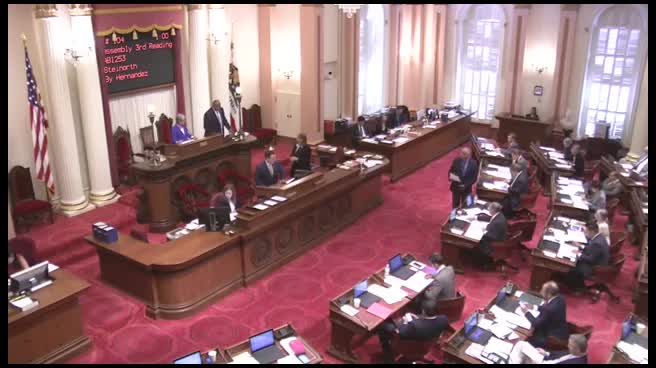 2MIN
Senate Floor
 1MIN
Senate Standing Committee on Appropriations
 2MIN
Senate Standing Committee on Public Employment and Retirement
Bill Author
Bill Co-Author(s):