ACR 46: Arts Council: funding.
- Session Year: 2015-2016
- House: Assembly
- Latest Version Date: 2015-09-03
This measure would declare the importance of the arts to the state and the essential role of the Arts Council in promoting the arts throughout the state, and urge a unified effort between the Legislature and the Governor to provide a substantial increase in the General Fund appropriation to the California Arts Council in the 201516 Budget Act.
This measure would declare the importance of the arts to the state and the essential role of the Arts Council in promoting the arts throughout the state, and urge a unified effort between the Legislature and the Governor to provide a substantial increase in the General Fund appropriation to the California Arts Council in the 201516 Budget Act.
This measure would declare the importance of the arts to the state and the essential role of the Arts Council in promoting the arts throughout the state, and urge a unified effort between the Legislature and the Governor to provide a substantial increase in the General Fund appropriation to the California Arts Council in the 201516 Budget Act.
This measure would declare the importance of the arts to the state and the essential role of the Arts Council in promoting the arts throughout the state, and urge a unified effort between the Legislature and the Governor to provide a substantial increase in the General Fund appropriation to the California Arts Council in the 201516 Budget Act.
WHEREAS, Since the 1970s, the Arts Council, also known as the California Arts Council, has served the state by strategically promoting increased access to the arts for all Californians, particularly for residents living in communities that lack sufficient and convenient opportunities to experience the benefits of the arts in their lives; and
WHEREAS, In the past, the state appropriated funds that could meaningfully support the programs of the Arts Council. However, beginning in 2003, the annual funding of the Arts Council from the General Fund drastically dropped, and since that time, the funding has remained essentially flat at a $1,000,000 annual appropriation, making California one of the lowest ranked states to invest in the arts on per capita basis. The programs of the Arts Council that once reached rural towns, underserved urban neighborhoods, prisons, and schools have either been depleted or discontinued entirely; and
WHEREAS, The arts invigorate the state and national economies. The creative sector has become one of the states most important drivers of economic growth. The 2013 OTIS Report on the Creative Economy, analyzing the economic impact of the creative economy in the state, concluded that 9.7 percent of jobs in the state are connected, directly or indirectly, to the creative industries. A recent report by the U.S. Bureau of Economic Analysis concluded that the arts and culture sector represent 3.2 percent of the nations gross domestic product in 2011; and
WHEREAS, The arts bolster small and large businesses and the nonprofit sector. Local merchants directly benefit when people attend art events in their community because attendees make purchases related to the event, including, among other things, meals and parking. Nationally, in 2011, exports outside the United States of art-related goods, including, but not limited to, movies, paintings, and jewelry, substantially increased and resulted in a trade surplus within the arts industry. The national nonprofit arts industry annually generates billions in economic activity and provides millions of jobs; and
WHEREAS, The arts increase tourism and travel. Arts travelers are ideal tourists, staying longer and spending more to seek out authentic cultural experiences than other types of travelers. Reports show that the percentage of international travelers visiting museums and attending concerts and theater performances has steadily grown since 2003; and
WHEREAS, The arts spark creativity and innovation in the workforce. Creativity is recognized as one of the top five applied employee skills sought by business leaders. Nobel laureates in the sciences are 17 times more likely to be actively engaged in the arts than other scientists; and
WHEREAS, The arts enhance our society. A recent study demonstrated that a high concentration of the arts in a city leads to higher civic engagement, more social cohesion, higher child welfare, and lower poverty rates. A vibrant arts community ensures that young people are not left to experience their society through a pop culture and tabloid marketplace; and
WHEREAS, The arts improve healthcare. Nearly one-half of the nations healthcare institutions provide arts programming for patients, families, and staff on the basis that art programs promote healing in patients, resulting in shorter hospital stays, better pain management, and less medication; and
WHEREAS, The arts are fundamental to our human experience. The arts inspire us to see our human potential by fostering creativity, goodness, and beauty. The arts help us express our values, build bridges between cultures, and bring people together, regardless of perceived differences in ethnicity, religion, or age. As a well-known idiom reminds us, [w]hen times are tough, art is salve for the ache; and
WHEREAS, The arts improve academic performance. Students with an education rich in the arts have higher grades and standardized test scores and lower rates of dropping out of school. Students with four years of arts or music in high school average 100 more points on their SAT scores than students with just one-half of a year of arts or music. While art education is mandated by state law, California is failing to provide a sufficient arts education. For the past 30 years arts education in schools has been disappearing at an alarming rate. Between 1999 and 2004, student enrollment in music education declined by almost half. The states recent fiscal crisis has resulted in still more dramatic cuts to visual and performing arts education programs for students throughout the state; and
WHEREAS, The Governors currently proposed funding for the Arts Council in the 201516 Budget Act is a total of $5,000,000, a combination of $1,000,000 from the General Fund, $1,000,000 matching federal funds, and the remainder consisting of revenues from a specialty license plate supporting the arts; and
WHEREAS, By increasing the states investment in the arts through funding the programs of the Arts Council in the 201516 Budget Act, the Legislature and the Governor would strengthen the ability of the Arts Council to invigorate the state and national economies, including businesses of all sizes and the nonprofit sector, foster creativity in the lives of people in their workplace and communities, secure a more solid cultural and educational experience for our children, and cultivate healthy human lives, both physically and emotionally; therefore, be it
Resolved by the Assembly of the State of California, the Senate thereof concurring, That the Legislature declares the importance of the arts to the state and the essential role of the Arts Council promoting the arts throughout the state; and be it further
Resolved, That the Legislature urges a unified effort between the Legislature and the Governor to provide a substantial increase in the General Fund appropriation to the California Arts Council in the 201516 Budget Act; and be it further
Resolved, That the Chief Clerk of the Assembly transmit sufficient copies of this resolution to the author for appropriate distribution.
|
Date
|
Status
|
|---|---|
| Mar 17, 2015 | Introduced. To print. |
| Mar 18, 2015 | From printer. |
| Mar 23, 2015 | Referred to Com. on A.,E.,S.,T., & I.M. |
| Apr 7, 2015 | From committee: Be adopted. Ordered to Third Reading. (Ayes 6. Noes 0.) (April 7). |
| Apr 20, 2015 | Amended, adopted, and to Senate. (Page 1011.) |
| Apr 21, 2015 | In Senate. To Com. on RLS. |
| Apr 27, 2015 | Re-referred to Com. on APPR. |
| May 4, 2015 | In committee: Hearing postponed by committee. |
| Jul 13, 2015 | From committee: Be placed on second reading file pursuant to Senate Rule 28.8. |
| Jul 14, 2015 | Read second time. Ordered to third reading. |
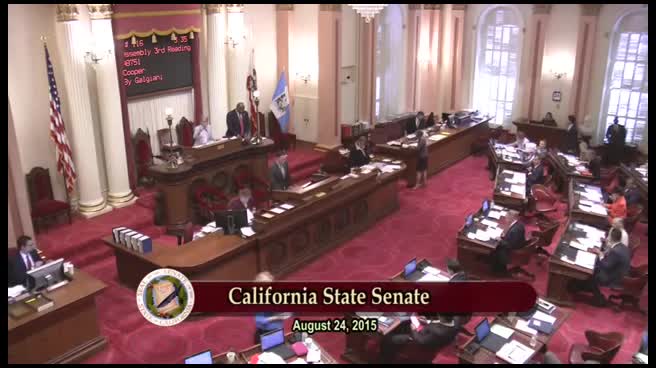
| Aug 24, 2015 | Adopted and to Assembly. |
| Aug 24, 2015 | Adopted and to Assembly. (Ayes 40. Noes 0. Page 2149.) |
| Aug 25, 2015 | In Assembly. Ordered to Engrossing and Enrolling. |
| Sep 3, 2015 | Chaptered by Secretary of State - Res. Chapter 152, Statutes of 2015. |
| Sep 3, 2015 | Enrolled and filed with the Secretary of State at 3 p.m. |
|
Date
|
Description
|
Location
|
Votes
|
|
|---|---|---|---|---|
| Aug 24, 2015 | Assembly 3rd Reading ACR46 Calderon By Nielsen | Senate Floor |
Passed |
|
| Apr 7, 2015 | Be adopted. To third reading. | Assembly Standing Committee on Arts, Entertainment, Sports, Tourism, and Internet Media |
Passed |
This list shows positions taken on this bill by organizations on the date displayed, which is linked to the original source.
Positions by individuals are not included.
|
Organization
|
Position
|
Date
|
|---|---|---|
| Arts for LA | ** Support | Aug 24, 2015 |
| ARTS Obispo | * Support | Apr 7, 2015 |
| Arts Orange County | ** Support | Aug 24, 2015 |
| California Alliance For Arts Education | ** Support | Aug 24, 2015 |
| California Arts Advocates | ** Support | Aug 24, 2015 |
| California Association Of Museums | ** Support | Aug 24, 2015 |
| California Center for the Arts | ** Support | Aug 24, 2015 |
| California State PTA | ** Support | Aug 24, 2015 |
| Californians for the Arts | ** Support | Aug 24, 2015 |
| Department of Cultural Affairs | * Support | Apr 7, 2015 |
| Luna Dance Institute | * Support | Apr 7, 2015 |
| Pasadena Playhouse | * Support | Apr 7, 2015 |
| The Center for the Arts | ** Support | Apr 7, 2015 |
| Theatre West | ** Support | Aug 24, 2015 |
ACR 46
Page 4
|
Office of Senate Floor Analyses (916) 651-1520 Fax: (916) 327-4478 |
THIRD READING
Bill No: ACR 46
Amended: 4/20/15 in Assembly
SENATE APPROPRIATIONS COMMITTEE: Senate Rule 28.8
ASSEMBLY FLOOR: Read and adopted, 4/20/15
SUBJECT: Arts Council: funding
DIGEST: This resolution declares the importance of the arts to the state and the essential role of the Arts Council in promoting the arts throughout the state, and urges a unified effort between the Legislature and the Governor to provide a substantial increase in the General Fund appropriation to the California Arts Council (CAC).
ANALYSIS: This resolution makes the following legislative findings:
Since the 1970s, the Arts Council, also known as the CAC, has served the state by strategically promoting increased access to the arts for all Californians, particularly for residents living in communities that lack sufficient and convenient opportunities to experience the benefits of the arts in their lives.
In the past, the state appropriated funds that could meaningfully support the programs of the CAC. However, beginning in 2003, the annual funding of the CAC from the General Fund drastically dropped, and since that time, the funding has remained essentially flat at a $1 million annual appropriation, making California one of the lowest ranked states to invest in the arts on a per capita basis. The programs of the CAC that once reached rural towns, underserved urban neighborhoods, prisons, and schools have either been depleted or discontinued entirely.
The arts invigorate the state and national economies. The creative sector has become one of the state’s most important drivers of economic growth. The 2013 Otis Report on the Creative Economy, analyzing the economic impact of the creative economy in the state, concluded that 9.7% of jobs in the state are connected, directly or indirectly, to the creative industries. A recent report by the United States Bureau of Economic Analysis concluded that the arts and culture sector represent 3.2% of the nation’s gross domestic product in 2011.
The arts bolster small and large businesses and the nonprofit sector. Local merchants directly benefit when people attend art events in their community because attendees make purchases related to the event, including, among other things, meals and parking. Nationally, in 2011, exports outside the United States of art-related goods, including, but not limited to, movies, paintings, and jewelry, substantially increased and resulted in a trade surplus within the arts industry. The national nonprofit arts industry annually generates billions in economic activity and provides millions of jobs.
The arts spark creativity and innovation in the workforce. Creativity is recognized as one of the top five applied employee skills sought by business leaders. Nobel laureates in the sciences are 17 times more likely to be actively engaged in the arts than other scientists.
The arts enhance our society. A recent study demonstrated that a high concentration of the arts in a city leads to higher civic engagement, more social cohesion, higher child welfare, and lower poverty rates. A vibrant arts community ensures that young people are not left to experience their society through a pop culture and tabloid marketplace.
The arts improve healthcare. Nearly one-half of the nation’s healthcare institutions provide arts programming for patients, families, and staff on the basis that art programs promote healing in patients, resulting in shorter hospital stays, better pain management, and less medication.
The arts improve academic performance. Students with an education rich in the arts have higher grades and standardized test scores and lower rates of dropping out of school. Students with four years of arts or music in high school average 100 more points on their SAT scores than students with just one-half of a year of arts or music. While art education is mandated by state law, California is failing to provide a sufficient arts education. For the past 30 years arts education in schools has been disappearing at an alarming rate. Between 1999 and 2004, student enrollment in music education declined by almost half. The state’s recent fiscal crisis has resulted in still more dramatic cuts to visual and performing arts education programs for students throughout the state.
By increasing the state’s investment in the arts through funding the programs of the CAC in the 2015–16 Budget Act, the Legislature and the Governor would strengthen the ability of the CAC to invigorate the state and national economies, including businesses of all sizes and the nonprofit sector, foster creativity in the lives of people in their workplaces and communities, secure a more solid cultural and educational experience for our children, and cultivate healthy human lives, both physically and emotionally.
This resolution declares the importance of the arts to the state and the essential role of the CAC in promoting the arts throughout the state, and urges a unified effort between the Legislature and the Governor to provide a substantial increase in the General Fund appropriation to the CAC.
Prior/Related Legislation
AB 1662 (Calderon, 2013-14) would have created an annual continuous appropriation from the General Fund (GF) to the CAC in an unspecified amount, and made various legislative findings and declarations. AB 1662 was held in the Assembly Appropriations Committee on Suspense.
AB 580 (Nazarian, 2013-14) was substantially similar to AB 1662, but contained an appropriation of $75 million dollars for CAC. AB 580 was held in the Assembly Appropriations Committee on Suspense.
SB 1432 (Lieu), of 2013-14, also substantially similar to AB 1662, but with a $25 million dollar continuous appropriation for CAC. SB 1432 was held in Senate Appropriations Committee.
SB 571 (Price, Chapter 430, Statues of 2013) allowed taxpayers to once again make voluntary contributions to the California Arts Council Fund on their state personal income tax returns.
SB 1076 (Price, Chapter 319, Statutes of 2010) allowed taxpayers to make voluntary contributions to the California Arts Council Fund on their state personal income tax returns. This act sunset due to failure of the CAC to reach the statutory threshold of $250,000 in tax donations.
FISCAL EFFECT: Appropriation: No Fiscal Com.: No Local: No
Arts for LA
Arts Orange County
California Alliance for Arts Education
California Arts Advocates
California Association of Museums
California Center for the Arts
California State PTA
Californians for the ARTS
Theatre West
OPPOSITION: (Verified 7/13/15)
None received
Prepared by: Jonas Austin / SFA / (916) 651-1520
7/14/15 12:19:51
**** END ****
ACR 46
Page 3
ASSEMBLY THIRD READING
ACR 46
(Calderon and Nazarian)
As Introduced March 17, 2015
Majority vote
Committee |
Votes |
Ayes |
Noes |
Arts |
6-0 |
Calderon, Obernolte, Chu, Hadley, Levine, Nazarian |
|
SUMMARY: Declares the importance of the arts to the state and the essential role of the Arts Council in promoting the arts throughout the state, and urges a unified effort between the Legislature and the Governor to provide a substantial increase in the General Fund appropriation to the California Arts Council (CAC). Specifically, this resolution makes the following findings:
Since the 1970s, the Arts Council, also known as the CAC, has served the state by strategically promoting increased access to the arts for all Californians, particularly for residents living in communities that lack sufficient and convenient opportunities to experience the benefits of the arts in their lives.
In the past, the state appropriated funds that could meaningfully support the programs of the CAC. However, beginning in 2003, the annual funding of the CAC from the General Fund drastically dropped, and since that time, the funding has remained essentially flat at a $1 million annual appropriation, making California one of the lowest ranked states to invest in the arts on a per capita basis. The programs of the CAC that once reached rural towns, underserved urban neighborhoods, prisons, and schools have either been depleted or discontinued entirely.
The arts invigorate the state and national economies. The creative sector has become one of the state’s most important drivers of economic growth. The 2013 Otis Report on the Creative Economy, analyzing the economic impact of the creative economy in the state, concluded that 9.7% of jobs in the state are connected, directly or indirectly, to the creative industries. A recent report by the United States Bureau of Economic Analysis concluded that the arts and culture sector represent 3.2% of the nation’s gross domestic product in 2011.
The arts bolster small and large businesses and the nonprofit sector. Local merchants directly benefit when people attend art events in their community because attendees make purchases related to the event, including, among other things, meals and parking. Nationally, in 2011, exports outside the United States of art-related goods, including, but not limited to, movies, paintings, and jewelry, substantially increased and resulted in a trade surplus within the arts industry. The national nonprofit arts industry annually generates billions in economic activity and provides millions of jobs.
The arts increase tourism and travel. Arts travelers are ideal tourists, staying longer and spending more to seek out authentic cultural experiences than other types of travelers. Reports show that the percentage of international travelers visiting museums and attending concerts and theater performances has steadily grown since 2003.
The arts spark creativity and innovation in the workforce. Creativity is recognized as one of the top five applied employee skills sought by business leaders. Nobel laureates in the sciences are 17 times more likely to be actively engaged in the arts than other scientists.
The arts enhance our society. A recent study demonstrated that a high concentration of the arts in a city leads to higher civic engagement, more social cohesion, higher child welfare, and lower poverty rates. A vibrant arts community ensures that young people are not left to experience their society through a pop culture and tabloid marketplace.
The arts improve healthcare. Nearly one-half of the nation’s healthcare institutions provide arts programming for patients, families, and staff on the basis that art programs promote healing in patients, resulting in shorter hospital stays, better pain management, and less medication.
The arts are fundamental to our human experience. The arts inspire us to see our human potential by fostering creativity, goodness, and beauty. The arts help us express our values, build bridges between cultures, and bring people together, regardless of perceived differences in ethnicity, religion, or age. As a well-known idiom reminds us, “[w]hen times are tough, art is salve for the ache."
The arts improve academic performance. Students with an education rich in the arts have higher grades and standardized test scores and lower rates of dropping out of school. Students with four years of arts or music in high school average 100 more points on their SAT scores than students with just one-half of a year of arts or music. While art education is mandated by state law, California is failing to provide a sufficient arts education. For the past 30 years arts education in schools has been disappearing at an alarming rate. Between 1999 and 2004, student enrollment in music education declined by almost half. The state’s recent fiscal crisis has resulted in still more dramatic cuts to visual and performing arts education programs for students throughout the state.
The Governor’s currently proposed funding for the CAC in the 2015–16 Budget Act is a total of $5 million, a combination of $1 million from the General Fund, $1 million matching federal funds, and the remainder consisting of revenues from a specialty license plate supporting the arts.
By increasing the state’s investment in the arts through funding the programs of the CACl in the 2015–16 Budget Act, the Legislature and the Governor would strengthen the ability of the CAC to invigorate the state and national economies, including businesses of all sizes and the nonprofit sector, foster creativity in the lives of people in their workplaces and communities, secure a more solid cultural and educational experience for our children, and cultivate healthy human lives, both physically and emotionally.
FISCAL EFFECT: Unknown. This bill is keyed fiscal by the Legislative Counsel.
COMMENTS: According to the author, "Despite their strong contribution to the state, with the single exception of 2014, California has ranked last among all the states in per capita investment in the arts - allocating just $1 million from the general fund annually - since 2003. This adds up to a mere three cents per person annually. Last year was a bright spot and we hoped the beginning of moving back toward our rightful place as the leader among states in support for the arts, when the Assembly approved $10 million dollars in our budget proposal, and the Governor signed the Conference Committee compromise amount of $6 million into the budget. This forward progress must be maintained; the Governor's proposal to revert back to $1 million for the CAC is simply not acceptable."
Assembly Member Nazarian, joint author and strong supporter of CAC, adds, "I am confident that if arts advocates in and out of the Legislature keep pressing for higher funding during this year's budget proceedings, the result ultimately should be a spending plan that builds on the 2014 increase." He concludes by saying, "This is something we need to speak up on until it gets to the point that governors automatically include the previous year's arts appropriation as a starting point for the next round of budgeting."
Please see the policy committee analysis for a full discussion of the resolution.
Analysis Prepared by: Dana Mitchell / A.,E.,S.,T., & I.M. / (916) 319-3450 FN: 0000103
ACR 46
Page 7
Date of Hearing: April 7, 2015
ASSEMBLY COMMITTEE ON ARTS, ENTERTAINMENT, SPORTS, TOURISM, AND INTERNET MEDIA
Ian Charles Calderon, Chair
ACR 46
(Calderon) – As Introduced March 17, 2015
SUBJECT: Arts Council: funding.
SUMMARY: Would declare the importance of the arts to the state and the essential role of the Arts Council in promoting the arts throughout the state, and urge a unified effort between the Legislature and the Governor to provide a substantial increase in the General Fund appropriation to the California Arts Council (CAC). Specifically, this Resolution makes the following findings:
Since the 1970s, the Arts Council, also known as the California Arts Council, has served the state by strategically promoting increased access to the arts for all Californians, particularly for residents living in communities that lack sufficient and convenient opportunities to experience the benefits of the arts in their lives.
In the past, the state appropriated funds that could meaningfully support the programs of the Arts Council. However, beginning in 2003, the annual funding of the Arts Council from the General Fund drastically dropped, and since that time, the funding has remained essentially flat at a $1,000,000 annual appropriation, making California one of the lowest ranked states to invest in the arts on a per capita basis. The programs of the Arts Council that once reached rural towns, underserved urban neighborhoods, prisons, and schools have either been depleted or discontinued entirely.
The arts invigorate the state and national economies. The creative sector has become one of the state’s most important drivers of economic growth. The 2013 OTIS Report on the Creative Economy, analyzing the economic impact of the creative economy in the state, concluded that 9.7 percent of jobs in the state are connected, directly or indirectly, to the creative industries. A recent report by the U.S. Bureau of Economic Analysis concluded that the arts and culture sector represent 3.2 percent of the nation’s gross domestic product in 2011.
The arts bolster small and large businesses and the nonprofit sector. Local merchants directly benefit when people attend art events in their community because attendees make purchases related to the event, including, among other things, meals and parking. Nationally, in 2011, exports outside the United States of art-related goods, including, but not limited to, movies, paintings, and jewelry, substantially increased and resulted in a trade surplus within the arts industry. The national nonprofit arts industry annually generates billions in economic activity and provides millions of jobs.
The arts increase tourism and travel. Arts travelers are ideal tourists, staying longer and spending more to seek out authentic cultural experiences than other types of travelers. Reports show that the percentage of international travelers visiting museums and attending concerts and theater performances have steadily grown since 2003.
The arts spark creativity and innovation in the workforce. Creativity is recognized as one of the top five applied employee skills sought by business leaders. Nobel laureates in the sciences are 17 times more likely to be actively engaged in the arts than other scientists.
The arts enhance our society. A recent study demonstrated that a high concentration of the arts in a city leads to higher civic engagement, more social cohesion, higher child welfare, and lower poverty rates. A vibrant arts community ensures that young people are not left to experience their society through a pop culture and tabloid marketplace.
The arts improve healthcare. Nearly one-half of the nation’s healthcare institutions provide arts programming for patients, families, and staff on the basis that art programs promote healing in patients, resulting in shorter hospital stays, better pain management, and less medication.
The arts are fundamental to our human experience. The arts inspire us to see our human potential by fostering creativity, goodness, and beauty. The arts help us express our values, build bridges between cultures, and bring people together, regardless of perceived differences in ethnicity, religion, or age. As a well-known idiom reminds us, “[w]hen times are tough, art is salve for the ache."
The arts improve academic performance. Students with an education rich in the arts have higher grades and standardized test scores and lower rates of dropping out of school. Students with four years of arts or music in high school average 100 more points on their SAT scores than students with just one-half of a year of arts or music. While art education is mandated by state law, California is failing to provide a sufficient arts education. For the past 30 years arts education in schools has been disappearing at an alarming rate. Between 1999 and 2004, student enrollment in music education declined by almost half. The state’s recent fiscal crisis has resulted in still more dramatic cuts to visual and performing arts education programs for students throughout the state.
The Governor’s currently proposed funding for the Arts Council in the 2015–16 Budget Act is a total of $5,000,000, a combination of $1,000,000 from the General Fund, $1,000,000 matching federal funds, and the remainder consisting of revenues from a specialty license plate supporting the arts.
By increasing the state’s investment in the arts through funding the programs of the Arts Council in the 2015–16 Budget Act, the Legislature and the Governor would strengthen the ability of the Arts Council to invigorate the state and national economies, including businesses of all sizes and the nonprofit sector, foster creativity in the lives of people in their workplace and communities, secure a more solid cultural and educational experience for our children, and cultivate healthy human lives, both physically and emotionally.
FISCAL EFFECT: Unknown
COMMENTS:
Author's statement and support.
According to the lead author Assemblymember Calderon, "ACR 46 encourages continuing the forward trend of increased funding for the arts as an investment in a proven and powerful catalyst for spurring local economies and for preparing California’s workforce to prosper in the global creative economy." He adds, "California’s cultural enterprises provide more than 1.4 million jobs for Californians or 7.8% of total employment; in addition California’s non-profit arts specifically contribute more than $13 billion to the state’s economy. The arts are a key partner to the creative industries, encourage creativity, help prepare students and workers to compete in the 21st Century global economy, attract creative workers and industries of all kinds, stimulate the economy, engage residents, provide a sense of community, celebrating diversity and building bridges, understanding, and draw tourists and visitors.
"Despite their strong contribution to the state, with the single exception of 2014, California has ranked last among all the states in per capita investment in the arts - allocating just $1 million from the general fund annually - since 2003. This adds up to a mere three cents per person annually. Last year was a bright spot and we hoped the beginning of moving back toward our rightful place as the leader among states in support for the arts, when the Assembly approved $10 million dollars in our budget proposal, and the Governor signed the Conference Committee compromise amount of $6 million into the budget. This forward progress must be maintained; the Governor's proposal to revert back to $1 million for the CAC is simply not acceptable."
Assemblymember Nazarian, Joint Author and strong supporter of CAC, adds, "I am confident that if arts advocates in and out of the Legislature keep pressing for higher funding during this year's budget proceedings, the result ultimately should be a spending plan that builds on the 2014 increase." He concludes by saying, "This is something we need to speak up on until it gets to the point that governors automatically include the previous year's arts appropriation as a starting point for the next round of budgeting."
Arts Orange County writes the committee to say, "Arts Orange County wishes to express its strong support a significant increase in general fund appropriations for the California Arts Council. Orange County-and indeed much of our state-depends upon creativity range from The Boeing Company to Disneyland, from Blizzard Entertainment to Hurley, from Red Digital Cameras to medical device companies like Allergan. Having a healthy ecology provides the right kind of environment for these companies to thrive and to contribute to California's contributing role as the world's incubator of great ideas."
Background: funding for the arts.
The CAC was created in 1975 under then Governor Jerry Brown to increase access to the arts for all Californians. The CAC budget had grown from its first full year of funding in fiscal year 1976-77 at $1,917,000 to $32,224,000 in fiscal year 2001-02, when 1,590 grants were awarded to non-profit arts organizations. In 2003, appropriations to the CAC were cut by 97%, and GF appropriation from the Legislature has remained essentially flat at $1,000,000 over the past decade. Since 2003, with the exception of last year, California has ranked last or next to last among the states in terms of per capita investment in the arts. However, the last two budget cycles have seen an uptick in spending:
Funding levels for CAC in the fiscal year 2012-13 were just over $5,000,000 broken down by source as follows:
General Fund $1,019,865
Graphic Design License Plate Account $2,782,555
National Endowment for the Arts (NEA) $1,085,687
Special Deposit: Donations $70,000
Tax Check off $324,933
Total $5,309,540
Funding levels for CAC in the fiscal year 2013-14 were almost $8,000,000 broken down by source as follows:
General Fund $1,082,000
Graphic Design License Plate Account $2,815,000
National Endowment for the Arts (NEA) $1,035,000
Reimbursements ($2 million from Assembly) $3,026,000
Total $7,958,000
Current funding levels for CAC in the fiscal year 2014-15 were just over $10,000,000 broken down by source as follows:
General Fund $6,137,000
Graphic Design License Plate Account $2,889,000
National Endowment for the Arts (NEA) $1,095,000
Reimbursements $1,697,000
Tax Check off $250,000
Total $12,068,000
Spending the additional money.
Recent funding discussions for the CAC have ranged in amounts from the current base of $1million general fund contained in the Governor's proposed budget, to $75million contained in AB 580 (Nazarian), Legis. of 2014, discussed below. One of the major concerns is whether the agency would have sufficient staff and programmatic capacity to effectively spend any substantial new influx of funding. When this question was posed to the CAC by committee staff they responded in the affirmative, and offered as proof their use of the addition $5 million dollars allocated last year:
According to the CAC, "On June 20, 2014, the Governor signed a state budget that includes a one-time $5 million increase in General Fund support for the California Arts Council. This is the first time in over ten years the arts have seen an increase of General Fund monies, after the support for the Council was cut by 94 percent in 2003. The $5 million investment from last year’s budget will build on programs from 2013-14 and add new ones. The following is a list of the programs that will be funded with the investment from last year:
Creative California Communities, transforming communities through the arts and economic development ($1,467,000);
Local Impact, revitalizing California’s underserved and rural communities through the arts ($1,345,000);
State-Local Partnership, fostering arts and cultural development through local leadership ($400,000);
Statewide Networks, supporting multicultural, and discipline-based arts networks ($375,000);
Poetry Out Loud, helping students master public speaking skills and build self-confidence ($50,000);
JUMPstArts, supporting arts education programs for youth in juvenile justice system ($200,000);
Arts on the Air, supporting original public media content about the arts in California ($150,000);
Veterans Initiative, opportunities to enrich the lives of veterans through arts programming that is sensitive and responsive to their unique experiences ($150,000);
Professional Development and Consulting, provides opportunities for arts organizations to grow and thrive through professional development and practical services ($100,000);
Creativity at the Core, placing arts at the forefront of Common Core State Standards implementation ($150,000);
Turnaround Schools, utilizing arts education strategies to significantly improve CA’s lowest performing schools ($300,000);
Student Voices, digital media training and empowerment for students ($48,000);
Statewide Creative Economy Report, the Otis Report illustrates the impact and influence of the creative sector on the state’s economy ($60,000);
Statewide Creative Economy Convening, engagement and action around creative economy issues ($50,000);
China Cultural Exchange Convening, a statewide conference devoted to state cultural exchange with China ($50,000);
City of San Jose: Building Public Will Initiative, pilot research project ($5,000), and;
OE&E: Panel Costs, personnel/consulting services, travel ($100,000).
Prior and Related Legislation.
AB 1662 (Calderon), of 2013-14 would have created an annual continuous appropriation from the General Fund (GF) to the California Arts Council (CAC) in an unspecified amount, and made various legislative findings and declarations. AB 1662 was heard and passed out of this committee but was held in the Assembly Committee on Appropriations on Suspense.
AB 580 (Nazarian), of 2013-14, substantially similar to AB 1662, but contained an appropriation of $75 million dollars for CAC. AB 580 was heard and passed out of this committee but was held in the Assembly Committee on Appropriations on Suspense.
SB 1432 (Lieu), of 2013-14, also substantially similar to AB 1662, but with a $25 million dollar continuous appropriation for CAC. SB 1432 held in Senate Appropriations.
SB 571 (Price), Chapter 430, Statues of 2013, allowed taxpayers to once again make voluntary contributions to the California Arts Council Fund on their state personal income tax returns.
SB 1076 (Price), Chapter 319, Statutes of 2010, allowed taxpayers to make voluntary contributions to the California Arts Council Fund on their state personal income tax returns. This act sunset due to failure of the CAC to reach the statutory threshold of $250,000 in tax donations.
AB 700 (Krekorian), of 2009-10, would have established the Creative Industries and Community Economic Revitalization Fund in the State Treasury, and required that 20% of all revenues derived from the payment of sales and use taxes that are remitted to the State Board of Equalization by the taxpayers engaged in specified lines of business, as provided, be deposited in the fund. The CAC would be authorized to expend the moneys in the fund, upon appropriation by the Legislature, to issue grants pursuant to the act, as specified. AB 700 was held in the Assembly Committee on Appropriations on Suspense.
AB 2728 (Karnette), of 2007-08, would have required 20% of state sales and use tax revenues derived from the sales of specified art-related goods be deposited in the State Treasury for allocation to the CAC once the GF achieves structural balance. AB 2728 was held in Assembly Appropriations Committee.
AB 1365 (Karnette), of 2007-08, was a substantially similar measure to AB 2728, without the balanced budget trigger requirement. AB 1365 was held in Assembly Appropriations Committee.
AB 655 (Leno), of 2005-06, proposed a 1% surcharge on the price of admission to specified arts and entertainment venues. AB 655 was held in this committee.
REGISTERED SUPPORT / OPPOSITION:
Support
Arts for LA
Arts Orange County
California Alliance for Arts Education
California Arts Advocates
Californians for the Arts
The Center for the Arts
Theatre West
Opposition
There is no opposition on file.
Analysis Prepared by: Dana Mitchell / A.,E.,S.,T., & I.M. / (916) 319-3450
Discussed in Hearing
 4MIN
Senate Floor
 2MIN
Assembly Floor
 22MIN
Assembly Standing Committee on Arts, Entertainment, Sports, Tourism, and Internet Media


Bill Co-Author(s):