ACR 60: Education: students with disabilities.
- Session Year: 2015-2016
- House: Assembly
- Latest Version Date: 2015-07-21
This measure would recognize the necessity of a more respectful and humanistic view of students with disabilities, and would affirm that state policies and procedures should use People First Language to the greatest extent possible.
This measure would recognize the necessity of a more respectful and humanistic view of students with disabilities, and would affirm that state policies and procedures should use People First Language to the greatest extent possible.
This measure would recognize the necessity of a more respectful and humanistic view of students with disabilities, and would affirm that state policies and procedures should use People First Language to the greatest extent possible.
This measure would recognize the necessity of a more respectful and humanistic view of students with disabilities, and would affirm that state policies and procedures should use People First Language to the greatest extent possible.
WHEREAS, All students deserve to be treated with dignity and respect; and
WHEREAS, More than 700,000 students with disabilities receive special education services in California, comprising more than 10 percent of the states public school enrollment; and
WHEREAS, Students with disabilities are sons, daughters, sisters, brothers, friends, and neighbors; and
WHEREAS, The contributions of students with disabilities enrich our communities as they live, learn, and share their lives; and
WHEREAS, The language used to refer to students with disabilities has a profound impact in shaping beliefs and attitudes about these students, driving policies and laws, influencing our feelings and decisions, and affecting students daily lives; and
WHEREAS, Old, inaccurate, and inappropriate descriptors about students with disabilities perpetuate negative stereotypes and attitudinal barriers; and
WHEREAS, When we identify or describe students with disabilities primarily in terms of their disability or medical diagnosis, we undervalue and stigmatize them; and
WHEREAS, Using thoughtful terminology can foster positive attitudes about students with disabilities; and
WHEREAS, One of the major improvements in communicating verbally or in writing with or about students with disabilities is People First Language, which places the person ahead of his or her disability; and
WHEREAS, People First Language is an objective form of communication that eliminates generalizations and stereotypes by focusing on the person rather than the disability; and
WHEREAS, For example, we do not refer to a child with cancer as a cancerous child, and similarly, we should not refer to a child with autism as an autistic child or a child with epilepsy as an epileptic child; and
WHEREAS, A recent report of Californias Statewide Task Force on Special Education entitled, One System: Reforming Education to Serve All Students, called for a unified, inclusive educational system that supports all students based on individual needs; and
WHEREAS, The manner in which written and verbal policies and communications refer to students with disabilities can further this important state educational goal; and
WHEREAS, The California Legislature recognizes the necessity of a more respectful and humanistic view of students with disabilities; now, therefore, be it
Resolved by the Assembly of the State of California, the Senate thereof concurring, That the Legislature affirms that state policies and procedures should use People First Language to the greatest extent possible, especially those used by state and local educational agencies; and be it further
Resolved, That the Chief Clerk of the Assembly transmit copies of this resolution to the author for appropriate distribution.
WHEREAS, All students deserve to be treated with dignity and respect; and
WHEREAS, About 686,000 More than 700,000 students with disabilities receive special education services in California, comprising about more than 10 percent of the states public school enrollment; and
WHEREAS, Students with disabilities are sons, daughters, sisters, brothers, friends, and neighbors; and
WHEREAS, The contributions of students with disabilities enrich our communities as they live, learn, and share their lives; and
WHEREAS, The language used to refer to students with disabilities has a profound impact in shaping beliefs and attitudes about these students, driving policies and laws, influencing our feelings and decisions, and affecting students daily lives; and
WHEREAS, Old, inaccurate, and inappropriate descriptors about students with disabilities perpetuate negative stereotypes and attitudinal barriers; and
WHEREAS, When we identify or describe students with disabilities primarily in terms of their disability or medical diagnosis, we undervalue and stigmatize them; and
WHEREAS, Using thoughtful terminology can foster positive attitudes about students with disabilities; and
WHEREAS, One of the major improvements in communicating verbally or in writing with or about students with disabilities is People First Language, which places the person ahead of his or her disability; and
WHEREAS, People First Language is an objective form of communication that eliminates generalizations and stereotypes by focusing on the person rather than the disability; and
WHEREAS, We For example, we do not refer to a child with cancer as a cancerous child, and similarly, we should not refer to a child with autism as an autistic child or a child with epilepsy as an epileptic child; and
WHEREAS, A recent report of Californias Statewide Task Force on Special Education entitled, One System: Reforming Education to Serve All Students, called for a unified, inclusive educational system that supports all students based on individual needs; and
WHEREAS, The manner in which written and verbal policies and communications refer to students with disabilities can further this important state educational goal; and
WHEREAS, The California Legislature recognizes the necessity of a more respectful and humanistic view of students with disabilities; now, therefore, be it
Resolved by the Assembly of the State of California, the Senate thereof concurring, That the Legislature affirms that state policies and procedures should utilize use People First Language to the greatest extent possible, especially those utilized used by state and local educational agencies; and be it further
Resolved, That the Chief Clerk of the Assembly transmit copies of this resolution to the author for appropriate distribution.
WHEREAS, All students deserve to be treated with dignity and respect; and
WHEREAS, About 686,000 students with disabilities receive special education services in California, comprising about 10 percent of the states public school enrollment; and
WHEREAS, Students with disabilities are sons, daughters, sisters, brothers, friends, and neighbors; and
WHEREAS, The contributions of students with disabilities enrich our communities as they live, learn, and share their lives; and
WHEREAS, The language used to refer to students with disabilities has a profound impact in shaping beliefs and attitudes about these students, driving policies and laws, influencing our feelings and decisions, and affecting students daily lives; and
WHEREAS, Old, inaccurate, and inappropriate descriptors about students with disabilities perpetuate negative stereotypes and attitudinal barriers; and
WHEREAS, When we identify or describe students with disabilities primarily in terms of their disability or medical diagnosis, we undervalue and stigmatize them; and
WHEREAS, Using thoughtful terminology can foster positive attitudes about students with disabilities; and
WHEREAS, One of the major improvements in communicating verbally or in writing with or about students with disabilities is People First Language, which places the person ahead of his or her disability; and
WHEREAS, People First Language is an objective form of communication that eliminates generalizations and stereotypes by focusing on the person rather than the disability; and
WHEREAS, We do not refer to a child with cancer as a cancerous child, and similarly, we should not refer to a child with autism as an autistic child or a child with epilepsy as an epileptic child; and
WHEREAS, A recent report of Californias Statewide Task Force on Special Education entitled, One System: Reforming Education to Serve All Students, called for a unified, inclusive educational system that supports all students based on individual needs; and
WHEREAS, The manner in which written and verbal policies and communications refer to students with disabilities can further this important state educational goal; and
WHEREAS, The California Legislature recognizes the necessity of a more respectful and humanistic view of students with disabilities; now, therefore, be it
Resolved by the Assembly of the State of California, the Senate thereof concurring, That the Legislature affirms that state policies and procedures should utilize People First Language to the greatest extent possible, especially those utilized by state and local educational agencies; and be it further
Resolved, That the Chief Clerk of the Assembly transmit copies of this resolution to the author for appropriate distribution.
|
Date
|
Status
|
|---|---|
| Jun 17, 2015 | From committee: Be adopted. To Consent Calendar. (Ayes 8. Noes 0.) (June 17). |
| Jul 21, 2015 | Enrolled and filed with the Secretary of State at 2 p.m. |
| Jul 21, 2015 | Chaptered by Secretary of State - Res. Chapter 116, Statutes of 2015. |
| Jul 6, 2015 | In Assembly. Ordered to Engrossing and Enrolling. |
| Jul 6, 2015 | Adopted and to Assembly. (Ayes 39. Noes 0. Page 1789.) |
| Jul 6, 2015 | Adopted and to Assembly. |
| Jun 22, 2015 | Ordered to third reading. |
| Jun 22, 2015 | From Consent Calendar. |
| Jun 18, 2015 | Read second time. Ordered to Consent Calendar. |
| Apr 28, 2015 | Introduced. To print. |
| Jun 4, 2015 | Re-referred to Com. on ED. |
| May 22, 2015 | In Senate. To Com. on RLS. |
| May 22, 2015 | Adopted and to Senate. (Ayes 74. Noes 0. Page 1565.) |
| May 22, 2015 | Adopted and to Senate. |
| May 20, 2015 | Amended. Ordered to Consent Calendar. |
| May 19, 2015 | From committee: Amend, and be adopted as amended. To Consent Calendar. (Ayes 7. Noes 0.) (May 13). |
| May 4, 2015 | Referred to Com. on ED. |
| Apr 29, 2015 | From printer. |
|
Date
|
Description
|
Location
|
Votes
|
|
|---|---|---|---|---|
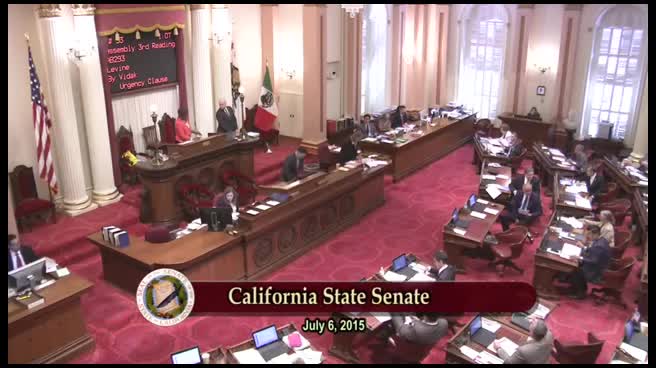
| Jul 6, 2015 | Assembly 3rd Reading ACR60 Santiago By Pan | Senate Floor |
Passed |
|
| Jun 17, 2015 | Be adopted and be ordered to the Consent Calendar | Senate Standing Committee on Education |
Passed |
|
| May 22, 2015 | ACR 60 SANTIAGO Consent Calendar Second Day Regular Session | Assembly Floor |
Passed |
|
| May 13, 2015 | Be adopted as amended. To Consent Calendar. | Assembly Standing Committee on Education |
Passed |
This list shows positions taken on this bill by organizations on the date displayed, which is linked to the original source.
Positions by individuals are not included.
|
Organization
|
Position
|
Date
|
|---|---|---|
| AFSCME Local 3930 | ** Support | Jul 6, 2015 |
| Association Of Regional Center Agencies | ** Support | Jul 6, 2015 |
| Municipal Employees Local 3930 | ** Support | Jul 6, 2015 |
| SELPA Administrators of California | ** Support | Jul 6, 2015 |
| u None received. | ** Against | Jul 6, 2015 |
| United Domestic Workers of America, AFSCME Local 3930 | ** Support | Jul 6, 2015 |
ACR 60
Page 3
|
Office of Senate Floor Analyses (916) 651-1520 Fax: (916) 327-4478 |
CONSENT
Bill No: ACR 60
Amended: 5/20/15 in Assembly
SENATE EDUCATION COMMITTEE: 8-0, 6/17/15
AYES: Liu, Runner, Block, Hancock, Leyva, Monning, Pan, Vidak
NO VOTE RECORDED: Mendoza
ASSEMBLY FLOOR: 74-0, 5/22/15 (Consent) - See last page for vote
SUBJECT: Education: students with disabilities
DIGEST: This resolution resolves that the Legislature affirms that state policies and procedures should use People First Language to the greatest extent possible.
ANALYSIS: Existing federal and state law require that every student with exceptional needs be provided a free appropriate public education in the least restrictive environment. (United States Code, Title 20, § 1400 et seq. and Education Code § 56000 et seq.)
This
resolution resolves that:
The language used to refer to students with disabilities has a profound impact in shaping beliefs and attitudes about these students, driving policies and laws, influencing our feelings and decisions, and affecting students’ daily lives.
Old, inaccurate, and inappropriate descriptors about students with disabilities perpetuate negative stereotypes and attitudinal barriers.
When we identify or describe students with disabilities primarily in terms of their disability or medical diagnosis, we undervalue and stigmatize them.
People First Language is an objective form of communication that eliminates generalizations and stereotypes by focusing on the person rather than the disability.
The Legislature affirms that state policies and procedures should use People First Language to the greatest extent possible, especially those used by state and local educational agencies.
Comments
Existing efforts to use People First Language. The California Strategic Plan on Reducing Mental Health Stigma and Discrimination was adopted by the Mental Health Services Oversight and Accountability Commission on June 25, 2009. This plan supports the use of non-stigmatizing terms, such as People First Language.
Members of the Advisory Commission on Special Education received orientation and information on the use of People First Language at their August 13, 2014 meeting.
Several areas of state statutes have been amended in recent years to update terminology, using People First Language, including:
AB 1847 (Chesbro, Chapter 144, Statutes of 2014), among other things, changed references from “incompetent person” to “person lacking legal capacity to make decisions,” and from “the mentally ill, mentally defective or epileptic“ to “persons with developmental disabilities or mental health disorders.”
SB 364 (Steinberg, Chapter 567, Statutes of 2013), among other things, changed references from “mentally disordered persons” to “persons with mental health disorders,” and from “developmentally disabled persons” to “persons with developmental disabilities.”
SB 1381 (Pavley, Chapter 457, Statutes of 2012), among other things, changed references from “mentally retarded persons” to “persons with intellectual disabilities.”
AB 2662 (Committee on Education, Chapter 589, Statutes of 2012), among other things, changed references from “mentally retarded pupils” to “pupils with intellectual disabilities.”
FISCAL EFFECT: Appropriation: No Fiscal Com.: No Local: No
United Domestic Workers of America, AFSCME Local 3930
OPPOSITION: (Verified 6/18/15)
None received
ARGUMENTS IN SUPPORT: According to the United Domestic Workers of America, AFSCME Local 3930, “when writing or speaking about people with disabilities, it is important to put the person first because when we identify or describe students with disabilities in terms of their disability, we devalue and stigmatize them.”
ASSEMBLY FLOOR: 74-0, 5/22/15
AYES: Achadjian, Travis Allen, Baker, Bigelow, Bloom, Bonilla, Bonta, Brough, Brown, Burke, Calderon, Campos, Chang, Chau, Chávez, Chiu, Chu, Cooley, Cooper, Dababneh, Dahle, Daly, Dodd, Eggman, Frazier, Beth Gaines, Gallagher, Cristina Garcia, Eduardo Garcia, Gatto, Gipson, Gomez, Gonzalez, Gordon, Gray, Grove, Hadley, Harper, Roger Hernández, Holden, Irwin, Jones-Sawyer, Kim, Lackey, Levine, Linder, Lopez, Low, Maienschein, Mathis, Mayes, McCarty, Medina, Melendez, Mullin, Nazarian, Obernolte, Patterson, Perea, Quirk, Rendon, Ridley-Thomas, Rodriguez, Salas, Santiago, Steinorth, Mark Stone, Thurmond, Ting, Wagner, Wilk, Williams, Wood, Atkins
NO VOTE RECORDED: Alejo, Jones, O'Donnell, Olsen, Waldron, Weber
Prepared by: Lynn Lorber / ED. / (916) 651-4105
6/18/15 14:30:12
**** END ****
ACR 60 (Santiago) Page 2 of 2
SENATE COMMITTEE ON EDUCATION
Senator Carol Liu, Chair
2015 - 2016 Regular
Bill No: ACR 60
Author: |
Santiago |
||
Version: |
May 20, 2015 Hearing Date: June 17, 2015 |
||
Urgency: |
No |
Fiscal: |
No |
Consultant: |
Lynn Lorber |
||
Subject: Education: students with disabilities
SUMMARY
This resolution resolves that the Legislature affirms that state policies and procedures should use People First Language to the greatest extent possible.
BACKGROUND
Existing federal and state law require that every pupil with exceptional needs be provided a free appropriate public education in the least restrictive environment. (United States Code, Title 20, § 1400 et seq. and Education Code § 56000 et seq.)
ANALYSIS
This
resolution resolves that the Legislature affirms that state policies
and procedures should use People First Language to the greatest
extent possible, especially those used by State and local educational
agencies. Specifically, this resolution:
States that:
The language used to refer to students with disabilities has a profound impact in shaping beliefs and attitudes about these students, driving policies and laws, influencing our feelings and decisions, and affecting students’ daily lives.
Old, inaccurate, and inappropriate descriptors about students with disabilities perpetuate negative stereotypes and attitudinal barriers.
When we identify or describe students with disabilities primarily in terms of their disability or medical diagnosis, we undervalue and stigmatize them.
People First Language is an objective form of communication that eliminates generalizations and stereotypes by focusing on the person rather than the disability.
Resolves that the Legislature affirms that state policies and procedures should use People First Language to the greatest extent possible, especially those used by state and local educational agencies.
STAFF COMMENTS
Need for the bill. According to the author, “Using thoughtful terminology can foster positive attitudes about students with disabilities. One of the major improvements in communicating verbally or in writing with or about students with disabilities is People First Language, which places the person ahead of his or her disability. ACR 60 will encourage greater respect for children with special needs.”
Existing efforts to use People First Language. The California Strategic Plan on Reducing Mental Health Stigma and Discrimination was adopted by the Mental Health Services Oversight and Accountability Commission on June 25, 2009. This plan supports the use of non-stigmatizing terms, such as People First Language.
Members of the Advisory Commission on Special Education received orientation and information on the use of People First Language at their August 13, 2014 meeting.
Several areas of State statutes have been amended in recent years to update terminology, using People First Language (see Comment # 4).
Fiscal impact. This resolution is keyed as non-fiscal.
Prior legislation. AB 1847 (Chesbro, Ch. 144, 2014) among other things, changed references from “incompetent person” to “person lacking legal capacity to make decisions,” and from “the mentally ill, mentally defective or epileptic“ to “persons with developmental disabilities or mental health disorders.”
SB 364 (Steinberg, Ch. 567, 2013) among other things, changed references from “mentally disordered persons” to “persons with mental health disorders,” and from “developmentally disabled persons” to “persons with developmental disabilities.”
SB 1381 (Pavley, Ch. 457, 2012) among other things, changed references from “mentally retarded persons” to “persons with intellectual disabilities.”
AB 2662 (Committee on Education, Ch. 589, 2012) among other things, changed references from “mentally retarded pupils” to “pupils with intellectual disabilities.”
SUPPORT
United Domestic Workers of America – American Federation of State, County and
Municipal Employees Local 3930
OPPOSITION
None received.
-- END --
ACR 60
Page 2
Date of Hearing: May 13, 2015
ASSEMBLY COMMITTEE ON EDUCATION
Patrick O'Donnell, Chair
ACR 60 (
Santiago) – As Introduced April 28, 2015
SUBJECT: Education: students with disabilities.
SUMMARY: Resolves that the Legislature affirms that state policies and procedures should utilize People First Language to the greatest extent possible when referring to students with disabilities. Specifically, this resolution:
Makes findings and declarations relative to the importance of using “People First Language,” which places the person ahead of his or her disability
Makes findings and declarations regarding the impact that language has on beliefs and attitudes about students with disabilities
Resolves that the Legislature affirms that state policies and procedures should utilize People First Language to the greatest extent possible, especially those utilized by state and local educational agencies
EXISTING LAW:
Establishes, through federal and state law, a system of special education, implemented through the California Master Plan for Special Education.
Requires, through federal and state law, that all students who are eligible for special education must be provided with a free appropriate public education in the least restrictive environment.
FISCAL EFFECT: This bill has been keyed non-fiscal by the Office of Legislative Counsel.
COMMENTS:
Need for the resolution. The author’s office states, “The language used to refer to students with disabilities has a profound impact in shaping beliefs and attitudes about these students, driving policies and laws, influencing our feelings and decisions, and affecting students’ daily lives. Old, inaccurate, and inappropriate descriptors about students with disabilities perpetuate negative stereotypes and attitudinal barriers. When we identify or describe students with disabilities primarily in terms of their disability or medical diagnosis, we devalue and stigmatize them. Using thoughtful terminology can foster positive attitudes about students with disabilities.
One of the major improvements in communicating verbally or in writing with or about students with disabilities is People First Language, which places the person ahead of his or her disability. People First Language is an objective form of communication that eliminates generalizations and stereotypes by focusing on the person rather than the disability.”
People First Language. People First Language refers to a means of identifying people first as a person and then by their condition. An example: “a person with disability” vs. “a disabled person.” According to the author, this language reduces generalizations and stereotypes by focusing on the person rather than the disability.
A number of public agencies use and promote People First Language. The California Mental Health Services Authority’s Stigma and Discrimination Reduction Initiative endorses People First language as a means of reducing institutional stigma for people with mental health challenges. The federal Centers for Disease Control and Prevention (CDC) promotes the use of People First Language, and it is endorsed in various ways by California school districts and other states. In the 1980’s a similar movement occurred related to HIV and AIDS, in which advocates worked to change terms such as “AIDS victims” and “AIDS patients” to “people with AIDS.”
Prior legislation. Several bills in recent years have updated language used in the areas of mental health and developmental disabilities. These bills have used People First constructions to describe people in the revised statutes. For example, AB 1847 (Chesbro, Chapter 144, Statutes of 2014) replaced references to “mentally disordered persons” and other such terms throughout 14 California codes with references to “persons with a mental health disorder.” Similarly, AB 2370 (Mansoor, Chapter 448, Statutes of 2012) and SB 1381 (Pavley, Chapter 457, Statutes of 2012) removed references to “mentally retarded persons” and replaced them with “persons with an intellectual disability.”
Technical amendments. Staff recommends the following amendments, consistent with the author’s intent:
Page 1, line 3, delete "About 686,000" and insert "More than 700,000"
Page 1, lines 4: delete “about” and insert “more than”
Page 16, after “Whereas” insert “For example,”
REGISTERED SUPPORT / OPPOSITION:
Support
SELPA Administrators of California (sponsor)
Association of Regional Center Agencies
UDW/AFSCME Local 3930
Opposition
None on file
Analysis Prepared by: Tanya Lieberman / ED. / (916) 319-2087
Bill Author

Bill Co-Author(s):