AJR 19: Military service.
- Session Year: 2015-2016
- House: Assembly
- Latest Version Date: 2015-08-25
This measure would urge the Congress of the United States to enact legislation allowing immigrants to serve in the military if they are eligible under the Presidents Executive Order for Deferred Action for Childhood Arrivals or Executive Order for Deferred Action for Parents of Americans and Lawful Permanent Residents.
This measure would urge the Congress of the United States to enact legislation allowing immigrants to serve in the military if they are eligible under the Presidents Executive Order for Deferred Action for Childhood Arrivals or Executive Order for Deferred Action for Parents of Americans and Lawful Permanent Residents.
This measure would urge the Congress of the United States to enact legislation allowing immigrants to serve in the military if they are eligible under the Presidents Executive Order for Deferred Action for Childhood Arrivals or Executive Order for Deferred Action for Parents of Americans and Lawful Permanent Residents.
This measure would urge the Congress of the United States to enact legislation allowing immigrants to serve in the military if they are eligible under the Presidents Executive Order for Deferred Action for Childhood Arrivals or Executive Order for Deferred Action for Parents of Americans and Lawful Permanent Residents.
WHEREAS, Since the end of the last United States military draft in 1973, Americans have not been obligated to enlist, and currently less than one percent of the United States population serves in the armed forces. During World War II, up to twelve percent of the population served in the armed forces; and
WHEREAS, Thousands of immigrants have served and continue serving in vital military roles, including intelligence, information operations such as foreign language translators, interpreters, and cultural experts, making them an essential resource to our national defense; and
WHEREAS, The United States Army has recently expanded its Military Accessions Vital to the National Interest (MAVNI) program to allow immigrants with certain skills that are in demand to join the Army in exchange for expedited United States citizenship; and
WHEREAS, Since 2009, over 14,500 United States military personnel on active duty serving in our armed forces are immigrants that are not United States citizens; and
WHEREAS, Since the September 11th attacks, more than 53,000 immigrants have enlisted in the United States military and have received wartime military naturalization; and
WHEREAS, One of the first casualties of the United States intervention in Iraq was an undocumented immigrant from Guatemala, Lance Cpl. Jose Gutierrez, who was granted American citizenship posthumously. Subsequently, more than 100 immigrant soldiers have been granted posthumous citizenship after dying in defense of the United States during combat in Iraq and Afghanistan; and
WHEREAS, As of 2008, the highest percentage of foreign-born United States military personnel was from Latin America and the Caribbean, with 38.7 percent (23,926) originating from Latin America and 35.9 percent (22,226) from Asia; and
WHEREAS, Over 5 million immigrants in the United States and over 1.5 million immigrants in California are eligible under the Presidents Executive Order for Deferred Action for Childhood Arrivals (DACA) program and Executive Order for Deferred Action for Parents of Americans and Lawful Permanent Residents (DAPA) program and could, at the appropriate age, join the military in defense of their nation; and
WHEREAS, Currently, an amendment to the National Defense Authorization Act (NDAA) that would allow some young immigrants with DACA status to serve in the military was passed out of the House Armed Services Committee with bipartisan support; now, therefore, be it
Resolved by the Assembly and the Senate of the State of California, jointly, That the Legislature urges the Congress of the United States to enact legislation allowing immigrants to serve in the military if they are eligible under the Presidents Executive Order for Deferred Action for Childhood Arrivals or Executive Order for Deferred Action for Parents of Americans and Lawful Permanent Residents; and be it further
Resolved, That the Chief Clerk of the Assembly transmit copies of this resolution to the President and Vice President of the United States, to the Speaker of the House of Representatives, to the Minority Leader of the House of Representatives, to the Majority Leader of the Senate, the Minority Leader of the Senate, and to each Senator and Representative from California in the Congress of the United States.
|
Date
|
Status
|
|---|---|
| May 27, 2015 | Introduced. To print. |
| May 28, 2015 | From printer. |
| Jun 4, 2015 | Referred to Com. on JUD. |
| Jun 23, 2015 | From committee: Be adopted. Ordered to Third Reading. (Ayes 9. Noes 1.) (June 23). |
| Jun 25, 2015 | Amended, adopted, and to Senate. (Ayes 70. Noes 2. Page 2146.) |
| Jun 25, 2015 | Amended, adopted, and to Senate. (Ayes 70. Noes 2.) |
| Jun 29, 2015 | In Senate. To Com. on RLS. |
| Jul 1, 2015 | From committee: Ordered to third reading. |
| Aug 20, 2015 | Adopted and to Assembly. |
| Aug 20, 2015 | Adopted and to Assembly. (Ayes 37. Noes 0. Page 2110.) |
| Aug 20, 2015 | In Assembly. Ordered to Engrossing and Enrolling. |
| Aug 25, 2015 | Chaptered by Secretary of State - Res. Chapter 138, Statutes of 2015. |
| Aug 25, 2015 | Enrolled and filed with the Secretary of State at 3:45 p.m. |
|
Date
|
Description
|
Location
|
Votes
|
|
|---|---|---|---|---|
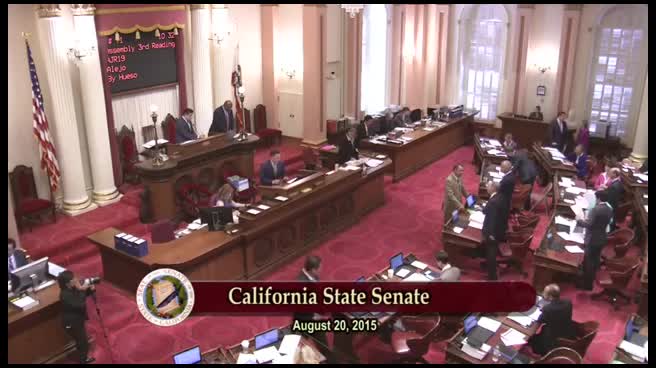
| Aug 20, 2015 | Assembly 3rd Reading AJR19 Alejo By Hueso | Senate Floor |
Passed |
|
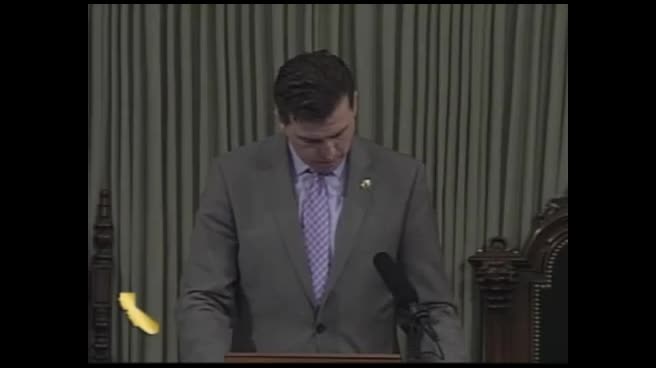
| Jun 25, 2015 | AJR 19 ALEJO Assembly Third Reading | Assembly Floor |
Passed |
|
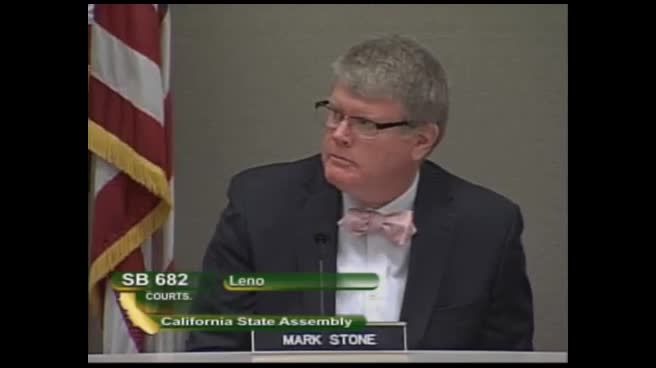
| Jun 23, 2015 | Be adopted. To third reading. | Assembly Standing Committee on Judiciary |
Passed |
This list shows positions taken on this bill by organizations on the date displayed, which is linked to the original source.
Positions by individuals are not included.
AJR 19
Page 5
|
Office of Senate Floor Analyses (916) 651-1520 Fax: (916) 327-4478 |
THIRD READING
Bill No: AJR 19
Amended: 6/25/15 in Assembly
ASSEMBLY FLOOR: 70-2, 6/25/15 - See last page for vote
DIGEST: This resolution urges the Congress of the United States to enact legislation allowing immigrants to serve in the military if they are eligible under the President’s Executive Order for Deferred Action for Childhood Arrivals or Executive Order for Deferred Action for Parents of Americans and Lawful Permanent Residents.
ANALYSIS: This resolution makes the following legislative findings:
Since the end of the last United States military draft in 1973, Americans have not been obligated to enlist, and currently less than 1% of the United States population serves in the armed forces. During World War II, up to 12% of the population served in the armed forces.
Thousands of immigrants have served and continue serving in vital military roles, including intelligence, information operations such as foreign language translators, interpreters, and cultural experts, making them an essential resource to our national defense.
The United States Army has recently expanded its Military Accessions Vital to the National Interest program to allow immigrants with certain skills that are in demand to join the Army in exchange for expedited United States citizenship.
Over five million immigrants in the United States and over 1.5 million immigrants in California are eligible under the President’s Executive Order for Deferred Action for Childhood Arrivals (DACA) program and Executive Order for Deferred Action for Parents of Americans and Lawful Permanent Residents program and could, at the appropriate age, join the military in defense of their nation.
Currently, an amendment to the National Defense Authorization Act that would allow some young immigrants with DACA status to serve in the military was passed out of the House Armed Services Committee with bipartisan support.
This resolution urges the Congress of the United States to enact legislation allowing immigrants to serve in the military if they are eligible under the President’s Executive Order for Deferred Action for Childhood Arrivals or Executive Order for Deferred Action for Parents of Americans and Lawful Permanent Residents.
Background
The history of immigrants serving in the United States Military. To most people who have some knowledge of U.S. history, it is a known fact that foreigners have fought in the American military since French and Polish-born soldiers assisted George Washington in winning the Revolutionary War. Accordingly, a 2009 report by Retired Lieutenant Colonel Margaret Stock, Essential to the Fight: Immigrants in the Military Eight Years After 9/11, states that ever since the Revolutionary War, immigrants have been eligible to enlist in the U.S. military and have done so with great distinction. Many immigrants have gone on to win this nation’s highest military decoration, the Congressional Medal of Honor. Two examples of immigrants who have served in the U.S. military and achieved great honors in the process are Alfred Rascon, an undocumented immigrant from Mexico, and John Shalikashvili, who came to the U.S. from Poland shortly after World War II. These two men are exemplary examples of the contributions immigrants can make to the U.S. both during and after serving in the U.S. military. Alfred Rascon won the Medal of Honor during the Vietnam War and eventually became the Director of the Selective Service. John Shalikashvili eventually served as the Chairman of the Joint Chiefs of Staff. (Margaret D. Stock, Essential to the Fight: Immigrants in the Military Eight Years After 9/11, Immigrant Policy Center Special Report, November 2009.)
The Military Accessions Vital to the National Interest (MAVNI) program is limited in the number of immigrants it can help attain citizenship. In September 2014, the Pentagon publicly announced that the MAVNI program would accept applications from undocumented immigrants, if they qualified as “Dreamers.” Dreamers are young people who entered this country illegally, have lived most of their lives in America, have graduated from high school or earned a GED, and have maintained a clean legal record. Enlistment in the MAVNI program has been limited to 1,500 recruits annually. However in April 2015, the Army announced plans to double its enlistments in the MAVNI program from 1,500 to 3,000 recruits by the end of fiscal year 2015; and to 5,000 recruits in fiscal year 2016.
The current MAVNI program criteria requires that an applicant, at the time of his or her enlistment: 1) must qualify under one of 19 non-immigrant categories, have Asylee, refugee, or temporary protected status, or be eligible under DACA; 2) must legally reside in the U.S. for at least two years prior to joining the Army (excluding DACA applicants); 3) must have a high school diploma; 4) must have a qualifying score on the Armed Forces Qualification Test; and 5) must have a proficiency in his or her native language. The in-demand skills currently being sought for applicants to the MAVNI program include proficiency in more than one language or specific medical specialties. The program is currently recruiting applicants with proficiency in at least two of 49 languages, including such rare languages as Cebuano, Igbo, and Uzbek. The MAVNI program is also recruiting in a number of medical specialties, including rare specialties such as otolaryngologist, entomologist, and prosthodontist. (http://www.goarmy.com/benefits/additional-incentives/mavni.html.)
Pending federal legislation encourages military eligibility for persons eligible under DACA. Arizona Rep. Ruben Gallego serves on the House Armed Services Committee and has successfully pushed for amendment language to be included in the 2015 National Defense Authorization Act (NDAA). This amendment requires the Secretary of Defense to review 10 U.S.C. Section 504(b)(1) for the purposes of making a determination and authorization whether or not to allow the enlistment of persons with employment authorization under the DACA program, into the Armed Forces. The amendment passed out of the House Armed Services Committee with bipartisan support, but final approval is far from guaranteed. More than two dozen House Republicans, led by Alabama Rep. Mo Brooks, have threatened to oppose the $612 billion defense authorization bill if the immigration provision is not stripped from the bill. On June 18, 2015, the U.S. Senate passed its version of NDAA, without an immigration provision. Both versions of NDAA must be reconciled by Congress before the final version can proceed to the president's desk for signature or veto.
Comments
According to the Assembly Judiciary Committee, since the September 11th attacks, more than 53,000 immigrants have enlisted in the U.S. military and have received wartime military naturalization. Federal legislation is necessary to grant undocumented immigrants the opportunity to serve the country in which they live, by enlisting and serving in the U.S. Armed Forces.
FISCAL EFFECT: Appropriation: No Fiscal Com.: No Local: No
None received
None received
ARGUMENTS IN SUPPORT: According to the author:
Currently, undocumented immigrants are not allowed to enlist in our U.S. Armed Forces. Over 5 million immigrants in the United States and over 1.5 million immigrants in California are eligible under the President’s Executive Orders for Deferred Action for Childhood Arrivals program and Deferred Action for Parents of Americans and Lawful Permanent Residents program and could, at the appropriate age, join the military in defense of their nation.
The majority of immigrants covered by the President’s Executive Orders . . . are Americans for all intents and purposes, and all this resolution requests is that Congress give them the opportunity to serve their country in the Armed Forces.
AYES: Achadjian, Alejo, Baker, Bloom, Bonilla, Bonta, Brough, Brown, Burke, Calderon, Campos, Chang, Chau, Chávez, Chiu, Chu, Cooley, Cooper, Dababneh, Dahle, Daly, Dodd, Eggman, Frazier, Cristina Garcia, Eduardo Garcia, Gatto, Gipson, Gomez, Gonzalez, Gordon, Gray, Grove, Hadley, Roger Hernández, Holden, Irwin, Jones-Sawyer, Kim, Lackey, Levine, Linder, Lopez, Low, Maienschein, Mathis, Mayes, McCarty, Medina, Mullin, Nazarian, O'Donnell, Olsen, Perea, Quirk, Rendon, Ridley-Thomas, Rodriguez, Salas, Santiago, Steinorth, Mark Stone, Thurmond, Ting, Wagner, Weber, Wilk, Williams, Wood, Atkins
NOES: Gallagher, Harper
NO VOTE RECORDED: Travis Allen, Bigelow, Beth Gaines, Jones, Melendez, Obernolte, Patterson, Waldron
Prepared by: Karen Chow / SFA / (916) 651-1520
7/1/15 16:51:32
AJR 19
Page 3
ASSEMBLY THIRD READING
AJR 19
(Alejo)
As Introduced May 27, 2015
Majority vote
Committee |
Votes |
Ayes |
Noes |
Judiciary |
9-1 |
Mark Stone, Wagner, Alejo, Chau, Chiu, Cristina Garcia, Holden, Maienschein, O'Donnell |
Gallagher |
SUMMARY: Urges Congress to allow immigrants who are eligible under the Deferred Action for Childhood Arrivals (DACA) and Deferred Action for Parents of Americans and Lawful Permanent Residents (DAPA) to serve in the military. Specifically, this resolution makes the following findings:
Since the end of the last draft in 1973, Americans have not been obligated to enlist in the United States (U.S.) armed services. During World War II up to 12% of the population served in the armed forces, but currently less than 1% of the U.S. population serves in the armed forces.
Thousands of immigrants have served and continue serving in vital military roles, including intelligence, information operations such as foreign language translators, interpreters and cultural experts, making them an essential resource to our national defense.
The U.S. Army has recently expanded its Military Accessions Vital to the National Interest (MAVNI) program to allow immigrants with certain in-demand skills to enlist in exchange for expedited U.S. citizenship.
Since 2009, over 14,500 U.S. military personnel on active duty in our armed forces are immigrants who are not U.S. citizens; and since the September 11th attacks, more than 53,000 immigrants have enlisted in the U.S. military and have received wartime military naturalization.
One of the first casualties of the U.S. intervention in Iraq was an immigrant from Guatemala who had a green card, Lance Corporal. Jose Gutierrez, who was granted American citizenship posthumously. Subsequently, more than 100 immigrant soldiers have been granted posthumous citizenship after dying in defense of the U.S. during combat in Iraq and Afghanistan.
As of 2008, the highest percentage of foreign-born U.S. military personnel was from Latin America and the Caribbean, with 39% originating from Latin America and 36% from Asia.
Over 5 million immigrants in the U.S. and over 1.5 million immigrants in California are eligible under the President’s Executive Orders for DACA and DAPA programs and could, at the appropriate age, join the military in defense of their nation.
Recently, an amendment to the National Defense Authorization Act (NDAA) that would allow some young immigrants with DACA status to serve in the military was passed out of the House Armed Services Committee with bipartisan support.
EXISTING LAW:
Provides that a person may be enlisted in the armed forces only if the person is one of the following:
A national of the United States, as defined in the Immigration and Nationality Act.
An alien who is lawfully admitted for permanent residence, as defined in the Immigration and Nationality Act.
The Secretary of the Defense may authorize the enlistment of a person not described in 1) above, if the Secretary determines that such enlistment is vital to the national interest.
FISCAL EFFECT: None
COMMENTS: According to the author:
Currently, undocumented immigrants are not allowed to enlist in our U.S. Armed Forces. Over 5 million immigrants in the United States and over 1.5 million immigrants in California are eligible under the President's Executive Orders for Deferred Action for Childhood Arrivals program and Deferred Action for Parents of Americans and Lawful Permanent Residents program and could, at the appropriate age, join the military in defense of their nation.
The majority of immigrants covered by the President’s Executive Orders... are Americans for all intents and purposes, and all this resolution requests is that Congress give them the opportunity to serve their country in the Armed Forces.
The History of Immigrants Serving in the United States Military. To most people who have some knowledge of U.S. history, it is a known fact that foreigners have fought in the American military since French and Polish-born soldiers assisted George Washington in winning the Revolutionary War. Accordingly, a 2009 report by Retired Lieutenant Colonel Margaret Stock, Essential to the Fight: Immigrants in the Military Eight Years After 9/11, states that ever since the Revolutionary War, immigrants have been eligible to enlist in the U.S. military and have done so with great distinction. Many immigrants have gone on to win this nation’s highest military decoration, the Congressional Medal of Honor. Two examples of immigrants who have served in the U.S. military and achieved great honors in the process are Alfred Rascon, an undocumented immigrant from Mexico, and John Shalikashvili, who came to the U.S. from Poland shortly after World War II. These two men are exemplary examples of the contributions immigrants can make to the U.S. both during and after serving in the U.S. military. Alfred Rascon won the Medal of Honor during the Vietnam War and eventually became the Director of the Selective Service. John Shalikashvili eventually served as the Chairman of the Joint Chiefs of Staff. (Margaret D. Stock, Essential to the Fight: Immigrants in the Military Eight Years After 9/11, Immigrant Policy Center Special Report, November 2009.)
The Military Accessions Vital to the National Interest Program is Limited in the Number of Immigrants it can Help Attain Citizenship. In September 2014, the Pentagon publicly announced that the MAVNI program would accept applications from undocumented immigrants, if they qualified as "Dreamers." Dreamers are young people who entered this country illegally, have lived most of their lives in America, have graduated from high school or earned a General Educational Development (GED), and have maintained a clean legal record. Enlistment in the MAVNI program has been limited to 1,500 recruits annually. However in April 2015, the Army announced plans to double its enlistments in the MAVNI program from 1,500 to 3,000 recruits by the end of Fiscal Year 2015; and to 5,000 recruits in Fiscal Year 2016.
The current MAVNI program criteria requires that an applicant, at the time of his or her enlistment: 1) must qualify under one of 19 non-immigrant categories, have Asylee, refugee, or temporary protected status (TPS), or be eligible under DACA; 2) must legally reside in the U.S. for at least two years prior to joining the Army (excluding DACA applicants); 3) must have a high school diploma; 4) must have a qualifying score on the Armed Forces Qualification Test; and 5) must have a proficiency in his or her native language. The in-demand skills currently being sought for applicants to the MAVNI program include proficiency in more than one language or specific medical specialties. (http://www.goarmy.com/benefits/additional-incentives/mavni.html.)
Pending Federal Legislation Encourages Military Eligibility for Persons Eligible Under DACA. Arizona Representative Ruben Gallego serves on the House Armed Services Committee and has successfully pushed for amendment language to be included in the 2015 National Defense Authorization Act (NDAA). This amendment requires the Secretary of Defense to review 10 United States Code Section 504(b)(1) for the purposes of making a determination and authorization whether or not to allow the enlistment of persons with employment authorization under the DACA program, into the Armed Forces. The amendment passed out of the House Armed Services Committee with bipartisan support, but final approval is far from guaranteed. More than two dozen House Republicans, led by Alabama Representative Mo Brooks, have threatened to oppose the $612 billion defense authorization bill if the immigration provision is not stripped from the bill. On June 18, 2015, the U.S. Senate passed its version of NDAA, without an immigration provision. Both versions of NDAA must be reconciled by Congress before the final version can proceed to the president's desk for signature or veto.
The U.S. Military Has Granted Citizenship to Soldiers Posthumously. There are many soldiers who have died in military service to our country, even though they had not been granted U.S. citizenship before their deaths. In 2002, President George W. Bush proclaimed in an Executive Order that all immigrants who have served honorable on active duty in the armed forces after September 11, 2001, would be eligible to apply for expedited U.S. citizenship. (Executive Order No. 13269, 67 FR 45287 (July 8, 2002).) As a result, more than 53,000 immigrants have taken advantage of this expedited citizen provision to become U.S. citizens as of October 2009. As a result of this executive order, more U.S. citizenships were granted under Immigration and Nationality Act Section 329A, 8 United States Code Section 1440-1, the federal statute that allows citizenship to be granted to immigrants who die on active duty during periods of conflict.
Analysis Prepared by: Khadijah Hargett / JUD. / (916) 319-2334 FN: 0001056
AJR 19
Page 4
Date of Hearing: June 23, 2015
ASSEMBLY COMMITTEE ON JUDICIARY
Mark Stone, Chair
AJR 19
(Alejo) – As Introduced May 27, 2015
SUBJECT: MILITARY SERVICE
KEY ISSUE: SHOULD THE LEGISLATURE URGE CONGRESS TO ALLOW IMMIGRANTS WHO ARE ELIGIBLE UNDER THE PRESIDENT’S EXECUTIVE ORDERS FOR DEFERRED ACTION FOR CHILDHOOD ARRIVALS OR DEFFERRED ACTION FOR PARENTS OF AMERICANS AND LAWFUL PERMANENT RESIDENTS TO SERVE IN THE U.S. MILITARY?
SYNOPSIS
Since the September 11th attacks, more than 53,000 immigrants have enlisted in the U.S. military and have received wartime military naturalization. Federal legislation is necessary to grant undocumented immigrants the opportunity to serve the country in which they live, by enlisting and serving in the U.S. armed forces. In this resolution, the Legislature urges Congress to allow immigrants who are eligible under the President's Executive Orders for Deferred Action for Childhood Arrivals (DACA) and Deferred Action for Parents of Americans and Lawful Permanent Residents (DAPA) programs to serve in the U.S. military. There is no known opposition to this resolution.
SUMMARY: Urges Congress to allow immigrants who are eligible under the Deferred Action for Childhood Arrivals (DACA) and Deferred Action for Parents of Americans and Lawful Permanent Residents (DAPA) to serve in the military. Specifically, this measure makes the following findings:
Since the end of the last draft in 1973, Americans have not been obligated to enlist in the U.S. armed services. During World War II up to twelve percent of the population served in the armed forces, but currently less than one percent of the U.S. population serves in the armed forces.
Thousands of immigrants have served and continue serving in vital military roles, including intelligence, information operations such as foreign language translators, interpreters and cultural experts, making them an essential resource to our national defense.
The U.S. Army has recently expanded its Military Accessions Vital to the National Interest (MAVNI) program to allow immigrants with certain in-demand skills to enlist in exchange for expedited U.S. citizenship.
Since 2009, over 14,500 U.S. military personnel on active duty in our armed forces are immigrants who are not U.S. citizens; and since the September 11th attacks, more than 53,000 immigrants have enlisted in the U.S. military and have received wartime military naturalization.
One of the first casualties of the U.S. intervention in Iraq was an immigrant from Guatemala who had a green card, Lance Cpl. Jose Gutierrez, who was granted American citizenship posthumously. Subsequently, more than 100 immigrant soldiers have been granted posthumous citizenship after dying in defense of the U.S. during combat in Iraq and Afghanistan.
As of 2008, the highest percentage of foreign-born U.S. military personnel was from Latin America and the Caribbean, with 39 percent originating from Latin America and 36 percent from Asia.
Over 5 million immigrants in the U.S. and over 1.5 million immigrants in California are eligible under the President’s Executive Orders for DACA and DAPA programs and could, at the appropriate age, join the military in defense of their nation.
Recently, an amendment to the National Defense Authorization Act (NDAA) that would allow some young immigrants with DACA status to serve in the military was passed out of the House Armed Services Committee with bipartisan support.
EXISTING LAW:
Provides that a person may be enlisted in the armed force only if the person is one of the following:
A national of the United States, as defined in the Immigration and Nationality Act.
An alien who is lawfully admitted for permanent residence, as defined in the Immigration and Nationality Act. (10 U.S.C. Section 504(b)(1).)
The Secretary of the Defense may authorize the enlistment of a person not described in # 1), above, if the Secretary determines that such enlistment is vital to the national interest. (10 U.S.C. Section 504(b)(2).)
FISCAL EFFECT: As currently in print this measure is keyed non-fiscal.
COMMENTS: According to the author:
Currently, undocumented immigrants are not allowed to enlist in our U.S. Armed Forces. Over 5 million immigrants in the United States and over 1.5 million immigrants in California are eligible under the President’s Executive Orders for Deferred Action for Childhood Arrivals program and Deferred Action for Parents of Americans and Lawful Permanent Residents program and could, at the appropriate age, join the military in defense of their nation.
The majority of immigrants covered by the President’s Executive Orders . . . are Americans for all intents and purposes, and all this resolution requests is that Congress give them the opportunity to serve their country in the Armed Forces.
The History of Immigrants Serving in the United States Military. To most people who have some knowledge of U.S. history, it is a known fact that foreigners have fought in the American military since French and Polish-born soldiers assisted George Washington in winning the Revolutionary War. Accordingly, a 2009 report by Retired Lieutenant Colonel Margaret Stock, Essential to the Fight: Immigrants in the Military Eight Years After 9/11, states that ever since the Revolutionary War, immigrants have been eligible to enlist in the U.S. military and have done so with great distinction. Many immigrants have gone on to win this nation’s highest military decoration, the Congressional Medal of Honor. Two examples of immigrants who have served in the U.S. military and achieved great honors in the process are Alfred Rascon, an undocumented immigrant from Mexico, and John Shalikashvili, who came to the U.S. from Poland shortly after World War II. These two men are exemplary examples of the contributions immigrants can make to the U.S. both during and after serving in the U.S. military. Alfred Rascon won the Medal of Honor during the Vietnam War and eventually became the Director of the Selective Service. John Shalikashvili eventually served as the Chairman of the Joint Chiefs of Staff. (Margaret D. Stock, Essential to the Fight: Immigrants in the Military Eight Years After 9/11, Immigrant Policy Center Special Report, November 2009.)
The Military Accessions Vital to the National Interest Program is Limited in the Number of Immigrants it can Help Attain Citizenship. In September 2014, the Pentagon publicly announced that the MAVNI program would accept applications from undocumented immigrants, if they qualified as “Dreamers.” Dreamers are young people who entered this country illegally, have lived most of their lives in America, have graduated from high school or earned a GED, and have maintained a clean legal record. Enlistment in the MAVNI program has been limited to 1500 recruits annually. However in April 2015, the Army announced plans to double its enlistments in the MAVNI program from 1500 to 3000 recruits by the end of fiscal year 2015; and to 5000 recruits in fiscal year 2016.
The current MAVNI program criteria requires that an applicant, at the time of his or her enlistment: 1) must qualify under one of 19 non-immigrant categories, have Asylee, refugee, or temporary protected status (TPS), or be eligible under DACA; 2) must legally reside in the U.S. for at least two years prior to joining the Army (excluding DACA applicants); 3) must have a high school diploma; 4) must have a qualifying score on the Armed Forces Qualification Test; and 5) must have a proficiency in his or her native language. The in-demand skills currently being sought for applicants to the MAVNI program include proficiency in more than one language or specific medical specialties. The program is currently recruiting applicants with proficiency in at least two of 49 languages, including such rare languages as Cebuano, Igbo, and Uzbek. The MAVNI program is also recruiting in a number of medical specialties, including rare specialties such as otolaryngologist, entomologist, and prosthodontist. (http://www.goarmy.com/benefits/additional-incentives/mavni.html.)
Pending Federal Legislation Encourages Military Eligibility for Persons Eligible Under DACA. Arizona Rep. Ruben Gallego serves on the House Armed Services Committee and has successfully pushed for amendment language to be included in the 2015 National Defense Authorization Act (NDAA). This amendment requires the Secretary of Defense to review 10 U.S.C. Section 504(b)(1) for the purposes of making a determination and authorization whether or not to allow the enlistment of persons with employment authorization under the DACA program, into the Armed Forces. The amendment passed out of the House Armed Services Committee with bipartisan support, but final approval is far from guaranteed. More than two dozen House Republicans, led by Alabama Rep. Mo Brooks, have threatened to oppose the $612 billion defense authorization bill if the immigration provision is not stripped from the bill. On June 18, 2015, the U.S. Senate passed its version of NDAA, without an immigration provision. Both versions of NDAA must be reconciled by Congress before the final version can proceed to the president's desk for signature or veto.
The U.S. Military Has Granted Citizenship to Soldiers Posthumously. There are many soldiers who have died in military service to our country, even though they had not been granted U.S. citizenship before their deaths. In 2002, President George W. Bush proclaimed in an Executive Order that all immigrants who have served honorable on active duty in the armed forces after September 11, 2001, would be eligible to apply for expedited U.S. citizenship. (Executive Order No. 13269, 67 FR 45287 (July 8, 2002).) As a result, more than 53,000 immigrants have taken advantage of this expedited citizen provision to become U.S. citizens as of October 2009. As a result of this executive order, more U.S. citizenships were granted under INA Section 329A, 8 U.S.C. Section 1440-1, the federal statute that allows citizenship to be granted to immigrants who die on active duty during periods of conflict.
One of the most well-known soldiers to die in military service without attaining U.S. citizenship is Lance Cpl. Jose Gutierrez, who was one of the first service members to die during Operation Iraqi Freedom on March 21, 2003. His life story was broadcast internationally after his death because of the fact that he was killed while fighting for the U.S. military, but had never been granted U.S. citizenship (he immigrated illegally from Guatemala at the age of 22, but was able to secure a green card). He is now regarded as a national hero who symbolizes the heroism and sacrifice of non-citizens who are willing to give their lives in service to a country that they love even if they are not citizens. He was granted American citizenship posthumously. (www.cbsnews.com/news/the-death-of-lance-cpl-gutierrez.)
According to an Immigration Policy Center fact sheet, as of “mid-2009, more than 119 immigrant military members had earned their citizenship posthumously after dying in combat in Afghanistan and Iraq.” (Immigration Policy Center America’s Voice Education Fund, Immigration and the Military, September 2010.)
Previous Related Legislation. SJR 13 (Florez), Res. Ch. 19, Stats. of 2003 urged the President and Congress to amend federal selective service and immigration laws to grant the right of citizenship to any and all immigrants who honorably serve in the military.
REGISTERED SUPPORT / OPPOSITION:
Support
None on file
Opposition
None on file
Analysis Prepared by: Khadijah Hargett / JUD. / (916) 319-2334
Discussed in Hearing
 4MIN
Senate Floor
 6MIN
Assembly Floor
 15MIN
Assembly Standing Committee on Judiciary
Bill Author
Bill Co-Author(s):