AJR 42: Transport by rail of flammable and combustible liquids.
- Session Year: 2015-2016
- House: Assembly
- Latest Version Date: 2016-08-30
This measure would urge the United States Department of Transportation, Department of Energy, and the Office of Management and Budget to expedite the rulemaking and implementation processes for federal safety regulations governing the transport by rail of flammable and combustible liquids, including crude oil, and would also urge the President and the Congress of the United States to pass specified federal legislation mandating public safety measures regulating the transport by rail of those liquids.
This measure would urge the United States Department of Transportation, Department of Energy, and the Office of Management and Budget to expedite the rulemaking and implementation processes for federal safety regulations governing the transport by rail of flammable and combustible liquids, including crude oil, and would also urge the President and the Congress of the United States to pass specified federal legislation mandating public safety measures regulating the transport by rail of those liquids.
This measure would urge the United States Department of Transportation, Department of Energy, and the Office of Management and Budget to expedite the rulemaking and implementation processes for federal safety regulations governing the transport by rail of flammable and combustible liquids, including crude oil, and would also urge the President and the Congress of the United States to pass specified federal legislation mandating critical public safety improvements for measures regulating the transport by rail of those liquids.
This measure would urge the United States Department of Transportation, Department of Energy, and the Office of Management and Budget to expedite the rulemaking and implementation processes for federal safety regulations governing the transport by rail of flammable and combustible liquids, including crude oil, and would also urge the President and the Congress of the United States to pass specified federal legislation mandating critical public safety improvements for the transport by rail of those liquids.
This measure would urge the United States Department of Transportation, Department of Energy, and the Office of Management and Budget to expedite the rulemaking and implementation processes for federal safety regulations governing the transport by rail of flammable and combustible liquids, including crude oil, and would also urge the President and the Congress of the United States to pass specified federal legislation mandating critical public safety improvements for the transport by rail of those liquids.
WHEREAS, In the past decade, there has been an unprecedented increase in the transport of crude oil in oil-by-rail cars due to the North American oil boom, which, in combination with absent or inadequate line infrastructure, has compromised the safety and well-being of over 16 million Americans who live alongside oil-by-rail shipping lines; and
WHEREAS, Transportation of crude oil and petroleum products by rail has more than doubled nationally since the beginning of 2011, thereby requiring increased infrastructure to load and unload tank cars transporting crude oil; and
WHEREAS, There are currently several pending plans by refining companies in California, including one to ship up to 70,000 barrels of crude oil per day through northern California passing through Roseville, downtown Sacramento, and Davis to a plant on Suisun Bay, on the outskirts of Benicia; and
WHEREAS, The Sacramento Area Council of Governments has identified the Counties of Sutter, Yuba, Placer, El Dorado, Sacramento, and Yolo as Potential Derailment Risk Zones for freight cars transporting oil to and from this refinery, and there are many more areas that will be potentially at risk; and
WHEREAS, An environmental impact report conducted in northern California concluded that those trains will present significant and unavoidable risks of oil spill, environmental damage, and potential loss of human life if any of them were to derail while en route to the refinery; and
WHEREAS, In the Federal Railroad Safety Act (FRSA) (49 U.S.C. Sec. 20101 et seq.), the United States Congress directed the Secretary of Transportation to prescribe and issue orders for every area of railroad safety, whereby this federal power granted to railroad companies preempts local and regional authority; and
WHEREAS, This preemption of state and local laws is one of the biggest hurdles for communities that want better and stronger safeguards for crude-by-rail shipments that will pass through their neighborhoods; and
WHEREAS, Serious train incidents involving the transport of crude oil are occurring on average once every seven weeks, and a Department of Transportation report predicts that trains hauling crude oil or ethanol will derail an average of 10 times per year over the next two decades; and
WHEREAS, Different kinds of crude oil have different health and safety risks, as some can be nearly impossible to clean up in the event of a spill and others have proved exceptionally explosive, and it is likely that the crude oil coming to a northern California refinery could consist of different types of crude oil; and
WHEREAS, Most crude oil transported by rail in the United States is currently carried in tank cars, known as DOT-111 tank cars, which have been designated as substandard for shipping highly flammable liquids; and
WHEREAS, Federal law, the Fixing Americas Surface Transportation (FAST) Act (Pub. L. No. 114-94) requires that all DOT-111 cars used to transport crude oil must be retrofitted to meet new safety standards by March 2018 or be phased out; now, therefore, be it
Resolved by the Assembly and the Senate of the State of California, jointly, That the Legislature respectfully urges the United States Department of Transportation, the Department of Energy, and the Office of Management and Budget to expedite the rulemaking and implementation processes for federal safety regulations governing the transport by rail of flammable and combustible liquids, including, but not limited to, the following: (1) the enforcement of rail industry compliance with United States Department of Transportation regulations requiring that state and local emergency officials be notified of large crude oil-by-rail shipments; (2) the development by rail companies of more robust emergency response plans, and removal by producers of volatile elements, including flammable natural gas liquids that may be present in Bakken crude oil before it is loaded onto rail cars; (3) the rapid phase-out of United States Department of Transportation DOT-111 tank cars from crude oil-by-rail service; and (4) the installation of the system known as Positive Train Control on all routes used to transport lighter crude oils such as Bakken; and be it further
Resolved, That the Legislature urges the President and Congress to pass federal legislation this year mandating the critical public safety measures described in the federal Crude-By-Rail Safety Act (H.R. 1804) cosponsored by Congressman Mike Thompson, and the Bakken Crude Stabilization Act of 2015 (H.R. 1679) sponsored by Congressman John Garamendi, that were not addressed in the Fast Act, including (1) the establishment of maximum volatility standards for crude oil transported by rail; (2) the imposition of increased fines for violation of those standards; and (3) the adoption of regulations by the United States Department of Transportation requiring rail carriers to develop a confidential close-call reporting system; and be it further
Resolved, That the Chief Clerk of the Assembly transmit copies of this resolution to the President of the United States, to the Speaker of the House of Representatives, to the Minority Leader of the House of Representatives, to the Majority Leader of the Senate, to the Minority Leader of the Senate, and to each Senator and Representative from California in the Congress of the United States.
WHEREAS, In the past decade, there has been an unprecedented increase in transportation the transport of crude oil in oil-by-rail cars due to the North American oil boom, which, in combination with absent or inadequate line infrastructure, has compromised the safety and well-being of over 16 million Americans who live alongside oil-by-rail shipping lines; and
WHEREAS, Transportation of crude oil and petroleum products by rail has more than doubled nationally since the beginning of 2011, thereby requiring increased infrastructure to load and unload tank cars transporting crude oil; and
WHEREAS, There are currently several pending plans by refining companies in California, including one to ship up to 70,000 barrels of crude oil per day through northern California passing through Roseville, downtown Sacramento, and Davis to a plant on Suisun Bay, on the outskirts of Benicia; and
WHEREAS, The Sacramento Area Council of Governments has identified the Counties of Sutter, Yuba, Placer, El Dorado, Sacramento, and Yolo as Potential Derailment Risk Zones for freight cars transporting oil to and from this refinery, and there are many more areas that will be potentially at risk; and
WHEREAS, An environmental impact report conducted in northern California concluded that those trains will present significant and unavoidable risks of oil spill, environmental damage, and potential loss of human life if any of them were to derail while en route to the refinery; and
WHEREAS, In the Federal Railroad Safety Act (FRSA) (49 U.S.C. Sec. 20101 et seq.), the United States Congress directed the Secretary of Transportation to prescribe and issue orders for every area of railroad safety, whereby this federal power granted to railroad companies preempts local and regional authority; and
WHEREAS, This preemption of state and local laws is one of the biggest hurdles for communities that want better and stronger safeguards for crude-by-rail shipments that will pass through their neighborhoods; and
WHEREAS, Serious train incidents involving the transport of crude oil are occurring on average once every seven weeks, and a Department of Transportation report predicts that trains hauling crude oil or ethanol will derail an average of 10 times per year over the next two decades; and
WHEREAS, Different kinds of crude oil have different health and safety risks, as some can be nearly impossible to clean up in the event of a spill and others have proved exceptionally explosive, and it is likely that the crude oil coming to a northern California refinery could consist of different types of crude oil; and
WHEREAS, Most crude oil transported by rail in the United States is currently carried in tank cars, known as DOT-111 tank cars, which have been designated as substandard for shipping highly flammable liquids; and
WHEREAS, Federal law, the Fixing Americas Surface Transportation (FAST) Act (Pub. L. No. 114-94) requires that all DOT-111 cars used to transport crude oil must be retrofitted to meet new safety standards by March 2018 or be phased out; now, therefore, be it
Resolved by the Assembly and the Senate of the State of California, jointly, That the Legislature respectfully urges the United States Department of Transportation, the Department of Energy, and the Office of Management and Budget to expedite the rulemaking and implementation processes for federal safety regulations governing the transport by rail of flammable and combustible liquids, including, but not limited to, safety measures that require the following: (1) the monitoring enforcement of rail industry compliance with United States Department of Transportation emergency orders specifying regulations requiring that state and local emergency officials be notified of large crude oil-by-rail shipments; (2) the stripping development by rail companies of more robust emergency response plans, and removal by producers of volatile elements, including flammable natural gas liquids that may be present in Bakken crude oil before it is loaded onto rail cars; (3) the rapid phase-out of United States Department of Transportation DOT-111 tank cars from crude oil-by-rail service; and (4) the installation of the system known as Positive Train Control on all routes used to transport lighter crude oils such as Bakken; and be it further
Resolved, That the Legislature urges the President and Congress to pass federal legislation this year mandating the critical public safety improvements, including those described measures described in the federal Crude-By-Rail Safety Act (H.R. 1804), which was (H.R. 1804) cosponsored by Congressman Mike Thompson, and H.R. 1679, which was sponsored by Congressman John Garamendi; the Bakken Crude Stabilization Act of 2015 (H.R. 1679) sponsored by Congressman John Garamendi, that were not addressed in the Fast Act, including (1) the establishment of maximum volatility standards for crude oil transported by rail; (2) the imposition of increased fines for violation of those standards; and (3) the adoption of regulations by the United States Department of Transportation requiring rail carriers to develop a confidential close-call reporting system; and be it further
Resolved, That the Chief Clerk of the Assembly transmit copies of this resolution to the President of the United States, to the Speaker of the House of Representatives, to the Minority Leader of the House of Representatives, to the Majority Leader of the Senate, to the Minority Leader of the Senate, and to each Senator and Representative from California in the Congress of the United States.
WHEREAS, In the past decade, there has been an unprecedented increase in transportation of crude oil in oil-by-rail cars due to the North American oil boom, which, in combination with absent or inadequate line infrastructure, has compromised the safety and well-being of over 16 million Americans who live alongside oil-by-rail shipping lines; and
WHEREAS, Transportation of crude oil and petroleum products by rail has more than doubled nationally since the beginning of 2011, thereby requiring increased infrastructure to load and unload tank cars transporting crude oil; and
WHEREAS, There are currently several pending plans by refining companies in California, including one to ship up to 70,000 barrels of crude oil per day through northern California passing through Roseville, downtown Sacramento, and Davis to a plant on Suisun Bay, on the outskirts of Benicia; and
WHEREAS, The Sacramento Area Council of Governments has identified the Counties of Sutter, Yuba, Placer, El Dorado, Sacramento, and Yolo as Potential Derailment Risk Zones for freight cars transporting oil to and from this refinery, and there are many more areas that will be potentially at risk; and
WHEREAS, An environmental impact report conducted in northern California concluded that those trains will present significant and unavoidable risks of oil spill, environmental damage, and potential loss of human life if any of them were to derail while en route to the refinery; and
WHEREAS, In the Federal Railroad Safety Act (FRSA) (49 U.S.C. Sec. 20101 et seq.), the United States Congress directed the Secretary of Transportation to prescribe and issue orders for every area of railroad safety, whereby this federal power granted to railroad companies preempts local and regional authority; and
WHEREAS, This preemption of state and local laws is one of the biggest hurdles for communities that want better and stronger safeguards for crude-by-rail shipments that will pass through their neighborhoods; and
WHEREAS, Serious train incidents involving the transport of crude oil are occurring on average once every seven weeks, and a Department of Transportation report predicts that trains hauling crude oil or ethanol will derail an average of 10 times per year over the next two decades; and
WHEREAS, Different kinds of crude oil have different health and safety risks, as some can be nearly impossible to clean up in the event of a spill and others have proved exceptionally explosive, and it is likely that the crude oil coming to a northern California refinery could consist of different types of crude oil; and
WHEREAS, Rail tank cars, known as DOT-111 tank cars, comprise our federal fleet of rail cars, and retrofitting is currently in progress to make these cars safer; and
WHEREAS, There is a remote deadline by which these DOT-111 rail cars must be upgraded, even though the cars that are currently being used to transport crude oil have been designated as substandard for shipping highly flammable liquids; now, therefore, be it
Resolved by the Assembly and the Senate of the State of California, jointly, That the Legislature respectfully urges the United States Department of Transportation, the Department of Energy, and the Office of Management and Budget to expedite the rulemaking and implementation processes for federal safety regulations governing the transport by rail of flammable and combustible liquids, including, but not limited to, safety measures that require the following: (1) the monitoring of rail industry compliance with United States Department of Transportation emergency orders specifying that state and local emergency officials be notified of large crude oil-by-rail shipments; (2) the stripping by producers of volatile elements, including flammable natural gas liquids that may be present in Bakken crude oil before it is loaded onto rail cars; (3) the rapid phase-out of United States Department of Transportation DOT-111 tank cars from crude oil-by-rail service; and (4) the installation of the system known as Positive Train Control on all routes used to transport lighter crude oils such as Bakken; and be it further
Resolved, That the Legislature urges the President and Congress to pass federal legislation this year mandating critical public safety improvements, including those described in the federal Crude-By-Rail Safety Act (H.R. 1804), which was cosponsored by Congressman Mike Thompson, and H.R. 1679, which was sponsored by Congressman John Garamendi; and be it further
Resolved, That the Chief Clerk of the Assembly transmit copies of this resolution to the President of the United States, to the Speaker of the House of Representatives, to the Minority Leader of the House of Representatives, to the Majority Leader of the Senate, to the Minority Leader of the Senate, and to each Senator and Representative from California in the Congress of the United States.
|
Date
|
Status
|
|---|---|
| Aug 4, 2016 | Ordered to third reading. |
| Aug 30, 2016 | Enrolled and filed with the Secretary of State at 11 a.m. |
| Aug 30, 2016 | Chaptered by Secretary of State - Res. Chapter 152, Statutes of 2016. |
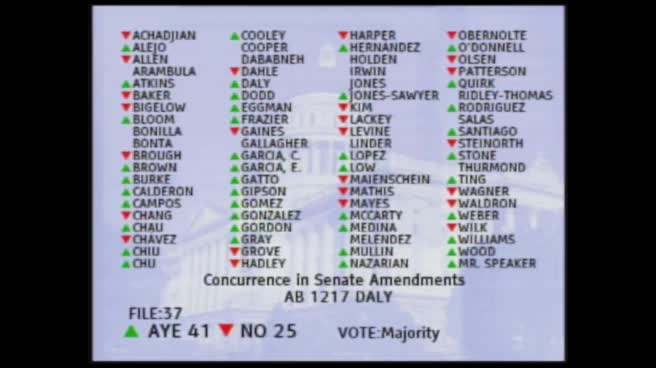
| Aug 22, 2016 | Senate amendments concurred in. To Engrossing and Enrolling. (Ayes 77. Noes 0. Page 6050.). |
| Aug 22, 2016 | Senate amendments concurred in. To Engrossing and Enrolling. |
| Aug 16, 2016 | In Assembly. Concurrence in Senate amendments pending. |
| Aug 15, 2016 | Adopted and to Assembly. (Ayes 38. Noes 0.) |
| Aug 15, 2016 | Adopted and to Assembly. (Ayes 38. Noes 0. Page 4977.) |
| Aug 15, 2016 | Adopted and to Assembly. |
| Aug 9, 2016 | Read second time. Ordered to third reading. |
| Aug 8, 2016 | Read third time and amended. Ordered to second reading. |
| Jun 1, 2016 | Introduced. To print. |
| Aug 4, 2016 | From Consent Calendar. |
| Aug 3, 2016 | Ordered to special consent calendar. |
| Aug 1, 2016 | In Senate. To Com. on RLS. |
| Aug 1, 2016 | From committee: Ordered to third reading. |
| Jun 30, 2016 | Amended, adopted, and to Senate. (Ayes 78. Noes 0.) |
| Jun 30, 2016 | Amended, adopted, and to Senate. (Ayes 78. Noes 0. Page 5584.) |
| Jun 30, 2016 | Amended, adopted, and to Senate. |
| Jun 28, 2016 | From committee: Be adopted. Ordered to Third Reading. (Ayes 14. Noes 0.) (June 27). |
| Jun 20, 2016 | In committee: Hearing postponed by committee. |
| Jun 9, 2016 | Referred to Com. on TRANS. |
|
Date
|
Description
|
Location
|
Votes
|
|
|---|---|---|---|---|
| Aug 22, 2016 | AJR 42 DODD Concurrence in Senate Amendments | Assembly Floor |
Passed |
|
| Aug 15, 2016 | Assembly 3rd Reading AJR42 Dodd By Wolk | Senate Floor |
Passed |
|
| Jun 30, 2016 | AJR 42 DODD Assembly Third Reading | Assembly Floor |
Passed |
|
| Jun 27, 2016 | Be adopted. To third reading. | Assembly Standing Committee on Transportation |
Passed |
This list shows positions taken on this bill by organizations on the date displayed, which is linked to the original source.
Positions by individuals are not included.
|
Organization
|
Position
|
Date
|
|---|---|---|
| City of Benicia | ** Support | Aug 15, 2016 |
| City of Davis | ** Support | Aug 15, 2016 |
| City of Suisun City | ** Support | Aug 15, 2016 |
| Congressman John Garamendi | ** Support | Aug 15, 2016 |
| Congressman Mike Thompson | ** Support | Aug 15, 2016 |
| Congresswoman Doris Matsui | ** Support | Aug 15, 2016 |
| County Of Placer | ** Support | Aug 15, 2016 |
| County of Yolo | ** Support | Aug 15, 2016 |
| Fairfield, City Of | ** Support | Aug 15, 2016 |
| Linda Seifert, Supervisor, Solano County | ** Support | Aug 15, 2016 |
| Sacramento Area Council Of Governments | ** Support | Aug 15, 2016 |
| Solano County Board of Supervisors | * Support | Jun 27, 2016 |
CONCURRENCE IN SENATE AMENDMENTS
CSA1 Bill Id:AJR 42
Author:(Dodd)
As Amended Ver:August 8, 2016
Majority vote
ASSEMBLY: | 78-0 | (June 30, 2016) | SENATE: | 38-0 | (August 15, 2016) |
Original Committee Reference: TRANS.
SUMMARY: Urges the President of the United States, Congress, and certain federal agencies to expedite rulemaking and to enact federal laws related to safe rail transport of flammable and combustible liquids.
The Senate amendments are technical and clarifying.
EXISTING LAW:
- Requires, pursuant to federal law, that each state establish a commission to coordinate and supervise federal programs related to hazardous material emergencies.
- Regulates, pursuant to federal law, hazardous materials transportation and requires inspection of shipments by rail under regulations developed by the federal Pipeline and Hazardous Materials Safety Administration.
- Requires the Office of Emergency Services to assist local governments in their emergency preparedness, response, recovery, and hazard mitigation efforts.
- Requires all rail operators to provide a risk assessment to the California Public Utilities Commission, the Director of Homeland Security, and the California Emergency Management Agency that describes the locations, types, and frequency of hazardous cargo movement across rail facilities as well as to develop training and emergency response procedures.
AS PASSED BY THE ASSEMBLY, this resolution:
- Made declarations regarding the increase in oil production and the associated risks of its transport in North America.
- Urged the President of the United States, United States Department of Transportation (USDOT), United States Department of Energy, and the Office of Management and the Budget to expedite rulemaking and to implement a process to establish federal safety regulations governing the transport of flammable and combustible liquids by rail.
- Urged the President and Congress to pass federal legislation mandating critical public safety improvements included in the Crude-By-Rail Safety Act [House Resolution (HR) 1804 Rep. McDermott (WA-7)].
- Urged the President and Congress to pass federal legislation mandating critical public safety improvements included in HR 1679 [Rep. Garamendi (CA-3)] that would authorize Bakken crude oil to be transported by rail only if it has a specified vapor pressure.
FISCAL EFFECT: None. This resolution is keyed non-fiscal by the Legislative Counsel.
COMMENTS: According to the author, it is imperative that federal agencies expedite rulemaking and implementation of federal safety regulations governing transport of volatile liquids by rail, including crude oil. The author points out that because federal preemptions prevent states and local jurisdictions from taking action to require specific rail safety protocols, states are relying on swift action by the federal government to ensure that these materials are transported safely. He notes that rail safety provisions have been passed at the federal level specifically require the retrofitting of certain types of rail cars; however, the timeline set in federal statute to complete the retrofit has been protracted and meanwhile, communities along rail corridors are left vulnerable.
To address this concern, the author has introduced this resolution that petitions Congress to expedite the implementation of various safety regulations and to pass and ultimately enact HR 1804, the Crude-By-Rail Safety Act, authored by Representative Jim McDermott and co-sponsored by Congressman Mike Thompson (CA-5), and HR 1679, the Bakken Crude Stabilization Act of 2015, introduced by Representative John Garamendi.
HR 1804 would establish a maximum volatility standard for crude oil, prohibit the use certain outdated rail tank cars, require comprehensive oil spill response planning and studies, increase fines for violating volatility and hazmat transport standards, require disclosure of train move-ments through communities and corresponding emergency response plans, and require railroads to implement a confidential close-call reporting system. HR 1679 would reduce the volatility of oil transported by rail thereby improving safe transport and reducing risk of explosion.
Analysis Prepared by: Victoria Alvarez / TRANS. / (916) 319-2093 FN: 0004045
Office of Senate Floor Analyses (916) 651-1520 Fax: (916) 327-4478 | AJR |
THIRD READING
Bill No: AJR 42
:
ASSEMBLY FLOOR: 78-0, 6/30/16 - See last page for vote
DIGEST: This resolution urges the President, Congress, and certain federal agencies to expedite rulemaking and to enact federal laws related to safe rail transport of flammable and combustible liquids, such as crude oil.
Senate Floor Amendments of 8/8/16 add a reference to federal legislation and make several minor and technical changes.
ANALYSIS: Existing federal law governs most major aspects of rail transport and pre-empts most state regulation. The principal agency responsible for promulgating and enforcing the safety of rail shipments of crude oil is the U.S. Department of Transportation (DOT); specifically, the Federal Railroad Administration and the Pipeline and Hazardous Materials Safety Administration (PHMSA) within DOT. At the state level, the California Public Utilities Commission shares authority with the federal government to enforce federal rail safety requirements, as well as enforcing state rail safety rules.
This resolution:
- Urges the President, DOT, the U.S. Department of Energy, and the Office of Management and Budget to expedite the rulemaking and implementation processes governing the transport of flammable and combustible liquids by rail.
- Urges the President and Congress to pass House Resolution (HR) 1804, which would set new safety and security standards to address the risks of transporting crude oil by rail.
- Urges the President and Congress to pass HR 1679, which would authorize Bakken crude oil to be transported by rail only if it has a specified vapor pressure.
Background
The transportation of oil by rail has increased significantly in the past few years. In 2012, about 70% of oil imported by California refineries came through marine terminals and only about 3% arrived by rail. The following year, crude oil imports by rail jumped approximately 500%, or about 1% of total imports. This trend is similar to oil-by-rail shipments nationally, particularly in response to increases in production of oil from the Bakken shale formation.
Bakken oil is high-quality, light, sweet crude, making it more valuable and economically competitive than some of the other domestic crude oils. It is precisely because this crude oil is so energy-dense that it is both valuable and hazardous. Its light nature and high density, under the right circumstances, makes it volatile, highly flammable, and toxic. While transporting oil by rail costs about twice as much as transporting it by pipeline, oil-by-rail is faster and offers greater flexibility, allowing companies to take advantage of price differentials across the country.
As oil-by-rail transport has increased in recent years, accidents involving these trains have increased dramatically. According to a June 2014 report by the California Interagency Rail Safety Working Group, more crude oil by volume was spilled in rail incidents in 2013 than was spilled in the nearly four decades prior. In addition, incidents involving oil-by-rail in California increased from three in 2011 to 25 in 2013. Most reported incidents involved a relatively small volume of oil released, but the potential for high-consequences incidents will increase as more oil is transported by rail. The largest and most tragic accident to date occurred in July 2013 in Lac-Megantic, Quebec, where 63 tank cars of crude oil exploded, killing 47 people. In 2013 and 2014, there were eight major accidents in North America; about a half dozen more have occurred since then, including a derailment in Oregon’s Columbia River Gorge in June 2016. The causes of these accidents vary, but have included track failures, inadequate rail car equipment, and human error.
In California, trains transporting crude oil are expected to travel via the Feather River or Donner Pass to the Bay Area, the Tehachapi Pass to Bakersfield, or into Los Angeles — thus traveling through both heavily populated areas and sensitive ecosystems.
Comments
- Purpose. The author states that in the past decade, there has been a tremendous increase in the transportation of crude oil by rail cars which, in combination with inadequate line infrastructure, has compromised the safety of millions of Americans who live near these rail lines. According to the author, refining companies in California plan to increase oil-by-rail shipping even more, including one plan to ship up to 70,000 barrels of crude oil per day through Northern California. The author states that a recent environmental impact report conducted in Northern California concluded that such trains will present significant risks of oil spill, environmental damage, and potential loss of human life if any of these trains were to derail while traveling to the refinery.
- Federal actions. In May 2015, the PHMSA promulgated new regulations that establish a new tank-car standard and a retrofit schedule for older tank cars carrying crude oil and ethanol; require a new braking standard for certain trains; designate new operational protocols for trains transporting large volumes of flammable liquids, such as routing requirements, speed restrictions, and information for local government agencies; and provide new sampling and testing requirements to improve classification of energy products placed into transport.
The federal Fixing America’s Surface Transportation (FAST) Act, signed into law in December 2015, codifies the schedule for the retrofit/phase-out of tank cars used to transport crude oil and other hazardous materials. The FAST Act also codifies portions of the regulations requiring all new and retrofitted tank cars meeting the new specifications to be equipped with “thermal blankets” (insulation technology designed to better contain fires), protection for top fittings (to prevent spills in the event of a crash), and pressure relief valves (to reduce the risk of explosion). In addition, the FAST Act requires DOT to issue regulations by the end of 2016 to provide state emergency response officials with specified information regarding the transport of hazardous materials.
- Federal legislation. This resolution urges the President and Congress to enact two federal bills: HR 1804, the Crude-Oil-By-Rail Safety Act, authored by Representative Jim McDermott and co-sponsored by Congressman Mike Thompson (CA-5), and HR 1679, the Bakken Crude Stabilization Act of 2015, authored by Representative John Garamendi (CA-3). Portions of these bills were included in the FAST Act, but outstanding provisions include establishing maximum volatility standards for transporting crude oil by rail; increasing fines for violating these standards; and requiring DOT to establish regulations requiring rail carriers to establish a confidential close-call reporting system.
- The crux of the problem: DOT-111s. DOT-111 tank cars, which have been in service for several decades, were originally designed to carry liquids such as corn syrup. These tank cars are now commonly used to transport crude oil, including Bakken crude. DOT-111s are prone to puncture and spill their contents; when they are involved in accidents while carrying volatile liquids such as crude oil, they have a high tendency to spill and explode. In response to repeated findings by U.S. and Canadian regulators regarding the lack of safety of the DOT-111s, the rail industry voluntarily adopted a more robust standard (CPC-1232) for all new tank cars built after October 2011. This new standard, however, has not proven to protect sufficiently against the risks of crude oil. Thus, the May 2015 regulations require retrofit or phase-out of both the DOT-111s and CPC-1232s, albeit on different schedules; the FAST Act codifies the schedules. The final retrofit/phase-out deadline for DOT-111s transporting crude oil is March 1, 2018. This resolution urges the federal government to move this deadline up even further.
According to DOT, there are currently about 270,000 DOT-111s in service, of which nearly two-thirds are used to transport hazardous material; about 38,000 are used to transport crude oil. Assuming an average modification cost of $88,700 per tank car, the modification for cars in flammable liquid service would total approximately $9 billion. The rail industry estimates that it has the capacity to retrofit all DOT-111s and CPC-1232s in crude oil service in about four years.
FISCAL EFFECT: Appropriation: No Fiscal Com.: Local: No
City of Benicia
City of Davis
City of Fairfield
City of Suisun City
Congressman John Garamendi
Congressman Mike Thompson
Congresswoman Doris Matsui
County of Placer
County of Yolo
Sacramento Area Council of Governments
Linda Seifert, Supervisor, Solano County
None received
AYES: Achadjian, Alejo, Travis Allen, Arambula, Atkins, Baker, Bigelow, Bloom, Bonilla, Bonta, Brough, Brown, Burke, Calderon, Campos, Chang, Chau, Chávez, Chiu, Chu, Cooley, Cooper, Dababneh, Dahle, Daly, Dodd, Eggman, Frazier, Beth Gaines, Gallagher, Cristina Garcia, Eduardo Garcia, Gatto, Gipson, Gomez, Gonzalez, Gordon, Gray, Grove, Hadley, Harper, Roger Hernández, Holden, Irwin, Jones, Jones-Sawyer, Kim, Lackey, Levine, Linder, Lopez, Low, Maienschein, Mayes, McCarty, Medina, Melendez, Mullin, Nazarian, Obernolte, O'Donnell, Olsen, Patterson, Quirk, Ridley-Thomas, Rodriguez, Salas, Steinorth, Mark Stone, Thurmond, Ting, Wagner, Waldron, Weber, Wilk, Williams, Wood, Rendon
NO VOTE RECORDED: Mathis, Santiago
8/10/16 15:57:23
**** END ****
Office of Senate Floor Analyses (916) 651-1520 Fax: (916) 327-4478 | AJR |
THIRD READING
Bill No: AJR 42
:
ASSEMBLY FLOOR: 78-0, 6/30/16 - See last page for vote
DIGEST: This resolution urges the President, Congress, and certain federal agencies to expedite rulemaking and to enact federal laws related to safe rail transport of flammable and combustible liquids, such as crude oil.
ANALYSIS: Existing federal law governs most major aspects of rail transport and pre-empts most state regulation. The principal agency responsible for promulgating and enforcing the safety of rail shipments of crude oil is the U.S. Department of Transportation (DOT); specifically, the Federal Railroad Administration and the Pipeline and Hazardous Materials Safety Administration (PHMSA) within DOT. At the state level, the California Public Utilities Commission shares authority with the federal government to enforce federal rail safety requirements, as well as enforcing state rail safety rules.
This resolution:
- Urges the President, DOT, the U.S. Department of Energy, and the Office of Management and Budget to expedite the rulemaking and implementation processes governing the transport of flammable and combustible liquids by rail.
- Urges the President and Congress to pass House Resolution (HR) 1804, which would set new safety and security standards to address the risks of transporting crude oil by rail.
- Urges the President and Congress to pass HR 1679, which would authorize Bakken crude oil to be transported by rail only if it has a specified vapor pressure.
Background
The transportation of oil by rail has increased significantly in the past few years. In 2012, about 70% of oil imported by California refineries came through marine terminals and only about 3% arrived by rail. The following year, crude oil imports by rail jumped approximately 500%, or about 1% of total imports. This trend is similar to oil-by-rail shipments nationally, particularly in response to increases in production of oil from the Bakken shale formation.
Bakken oil is high-quality, light, sweet, crude, making it more valuable and economically competitive than some of the other domestic crude oils. It is precisely because this crude oil is so energy-dense that it is both valuable and hazardous. Its light nature and high density, under the right circumstances, makes it volatile, highly flammable, and toxic. While transporting oil by rail costs about twice as much as transporting it by pipeline, oil-by-rail is faster and offers greater flexibility, allowing companies to take advantage of price differentials across the country.
As oil-by-rail transport has increased in recent years, accidents involving these trains have increased dramatically. According to a June 2014 report by the California Interagency Rail Safety Working Group, more crude oil by volume was spilled in rail incidents in 2013 than was spilled in the nearly four decades prior. In addition, incidents involving oil-by-rail in California increased from three in 2011 to 25 in 2013. Most reported incidents involved a relatively small volume of oil released, but the potential for high-consequences incidents will increase as more oil is transported by rail. The largest and most tragic accident to date occurred in July 2013 in Lac-Megantic, Quebec, where 63 tank cars of crude oil exploded, killing 47 people. In 2013 and 2014, there were eight major accidents in North America; about a half dozen more have occurred since then, including a derailment in Oregon’s Columbia River Gorge in June 2016. The causes of these accidents vary, but have included track failures, inadequate rail car equipment, and human error.
In California, trains transporting crude oil are expected to travel via the Feather River or Donner Pass to the Bay Area, the Tehachapi Pass to Bakersfield, or into Los Angeles — thus traveling through both heavily populated areas and sensitive ecosystems.
Comments
- Purpose. The author states that in the past decade, there has been a tremendous increase in the transportation of crude oil by rail cars which, in combination with inadequate line infrastructure, has compromised the safety of millions of Americans who live near these rail lines. According to the author, refining companies in California plan to increase oil-by-rail shipping even more, including one plan to ship up to 70,000 barrels of crude oil per day through Northern California. The author states that a recent environmental impact report conducted in Northern California concluded that such trains will present significant risks of oil spill, environmental damage, and potential loss of human life if any of these trains were to derail while traveling to the refinery.
- Federal actions. In May 2015, the PHMSA promulgated new regulations that establish a new tank-car standard and a retrofit schedule for older tank cars carrying crude oil and ethanol; require a new braking standard for certain trains; designate new operational protocols for trains transporting large volumes of flammable liquids, such as routing requirements, speed restrictions, and information for local government agencies; and provide new sampling and testing requirements to improve classification of energy products placed into transport.
The federal Fixing America’s Surface Transportation (FAST) Act, signed into law in December 2015, codifies the schedule for the retrofit/phase-out of tank cars used to transport crude oil and other hazardous materials. The FAST Act also codifies portions of the regulations requiring all new and retrofitted tank cars meeting the new specifications to be equipped with “thermal blankets” (insulation technology designed to better contain fires), protection for top fittings (to prevent spills in the event of a crash), and pressure relief valves (to reduce the risk of explosion). In addition, the FAST Act requires DOT to issue regulations by the end of 2016 to provide state emergency response officials with specified information regarding the transport of hazardous materials.
- Federal legislation. This resolution urges the President and Congress to enact two federal bills: HR 1804, the Crude-Oil-By-Rail Safety Act, authored by Representative Jim McDermott and co-sponsored by Congressman Mike Thompson (CA-5), and HR 1679, the Bakken Crude Stabilization Act of 2015, authored by Representative John Garamendi (CA-3). Portions of these bills were included in the FAST Act, but outstanding provisions include establishing maximum volatility standards for transporting crude oil by rail; increasing fines for violating these standards; and requiring DOT to establish regulations requiring rail carriers to establish a confidential close-call reporting system.
- The crux of the problem: DOT-111s. DOT-111 tank cars, which have been in service for several decades, were originally designed to carry liquids such as corn syrup. These tank cars are now commonly used to transport crude oil, including Bakken crude. DOT-111s are prone to puncture and spill their contents; when they are involved in accidents while carrying volatile liquids such as crude oil, they have a high tendency to spill and explode. In response to repeated findings by U.S. and Canadian regulators regarding the lack of safety of the DOT-111s, the rail industry voluntarily adopted a more robust standard (CPC-1232) for all new tank cars built after October 2011. This new standard, however, has not proven to protect sufficiently against the risks of crude oil. Thus, the May 2015 regulations require retrofit or phase-out of both the DOT-111s and CPC-1232s, albeit on different schedules; the FAST Act codifies the schedules. The final retrofit/phase-out deadline for DOT-111s transporting crude oil is March 1, 2018. This resolution urges the federal government to move this deadline up even further.
According to DOT, there are currently about 270,000 DOT-111s in service, of which nearly two-thirds are used to transport hazardous material; about 38,000 are used to transport crude oil. Assuming an average modification cost of $88,700 per tank car, the modification for cars in flammable liquid service would total approximately $9 billion. The rail industry estimates that it has capacity to retrofit all DOT-111s and CPC-1232s in crude oil service in about four years.
FISCAL EFFECT: Appropriation: No Fiscal Com.: No Local: No
City of Benicia
City of Davis
City of Fairfield
City of Suisun City
Congressman John Garamendi
Congressman Mike Thompson
Congresswoman Doris Matsui
County of Placer
County of Yolo
Sacramento Area Council of Governments
Linda Seifert, Supervisor, Solano County
None received
ASSEMBLY FLOOR: 78-0, 6/30/16
AYES: Achadjian, Alejo, Travis Allen, Arambula, Atkins, Baker, Bigelow, Bloom, Bonilla, Bonta, Brough, Brown, Burke, Calderon, Campos, Chang, Chau, Chávez, Chiu, Chu, Cooley, Cooper, Dababneh, Dahle, Daly, Dodd, Eggman, Frazier, Beth Gaines, Gallagher, Cristina Garcia, Eduardo Garcia, Gatto, Gipson, Gomez, Gonzalez, Gordon, Gray, Grove, Hadley, Harper, Roger Hernández, Holden, Irwin, Jones, Jones-Sawyer, Kim, Lackey, Levine, Linder, Lopez, Low, Maienschein, Mayes, McCarty, Medina, Melendez, Mullin, Nazarian, Obernolte, O'Donnell, Olsen, Patterson, Quirk, Ridley-Thomas, Rodriguez, Salas, Steinorth, Mark Stone, Thurmond, Ting, Wagner, Waldron, Weber, Wilk, Williams, Wood, Rendon
NO VOTE RECORDED: Mathis, Santiago
8/3/16 19:14:35
**** END ****
ASSEMBLY THIRD READING
ATR Bill Id:
Author:(Dodd)
As Introduced Ver:June 1, 2016
Majority vote
Committee | Votes | Ayes | Noes |
Transportation | 14-0 | Frazier, Linder, Baker, Bloom, Brown, Chu, Daly, Dodd, Eduardo Garcia, Gomez, Kim, Melendez, Nazarian, O'Donnell |
SUMMARY: Urges the President of the United States, Congress, and certain federal agencies to expedite rulemaking and to enact federal laws related to safe rail transport of flammable and combustible liquids. Specifically, this resolution:
- Makes declarations regarding the increase in oil production and the associated risks of its transport in North America.
- Urges the President of the United States, United States Department of Transportation (USDOT), United States Department of Energy, and the Office of Management and the Budget to expedite rulemaking and to implement a process to establish federal safety regulations governing the transport of flammable and combustible liquids by rail.
- Urges the President and Congress to pass federal legislation mandating critical public safety improvements included in the Crude-By-Rail Safety Act [House Resolution (HR) 1804 Rep. McDermott (WA-7)].
- Urges the President and Congress to pass federal legislation mandating critical public safety improvements included in HR 1679 [Rep. Garamendi (CA-3)] that would authorize Bakken crude oil to be transported by rail only if it has a specified vapor pressure.
EXISTING LAW:
- Requires, pursuant to federal law, that each state establish a commission to coordinate and supervise federal programs related to hazardous material emergencies.
- Regulates, pursuant to federal law, hazardous materials transportation and requires inspection of shipments by rail under regulations developed by the federal Pipeline and Hazardous Materials Safety Administration.
- Requires the Office of Emergency Services to assist local governments in their emergency preparedness, response, recovery, and hazard mitigation efforts.
- Requires all rail operators to provide a risk assessment to the California Public Utilities Commission, the Director of Homeland Security, and the California Emergency Management Agency that describes the locations, types, and frequency of hazardous cargo movement across rail facilities as well as to develop training and emergency response procedures.
FISCAL EFFECT: None. This resolution is keyed non-fiscal by the Legislative Counsel.
COMMENTS: According to the author, it is imperative that federal agencies expedite rulemaking and implementation of federal safety regulations governing transport of volatile liquids by rail, including crude oil. The author points out that because federal preemptions prevent states and local jurisdictions from taking action to require specific rail safety protocols, states are relying on swift action by the federal government to ensure that these materials are transported safely. He notes that rail safety provisions have been passed at the federal level specifically require the retrofitting of certain types of rail cars; however, the timeline set in federal statute to complete the retrofit has been protracted and meanwhile, communities along rail corridors are left vulnerable.
To address this concern, the author has introduced this resolution that petitions Congress to expedite the implementation of various safety regulations and to pass and ultimately enact HR 1804, the Crude-By-Rail Safety Act, authored by Representative Jim McDermott and co-sponsored by Congressman Mike Thompson (CA-5), and HR 1679, the Bakken Crude Stabilization Act of 2015, introduced by Representative John Garamendi.
HR 1804 would establish a maximum volatility standard for crude oil, prohibit the use certain outdated rail tank cars, require comprehensive oil spill response planning and studies, increase fines for violating volatility and hazmat transport standards, require disclosure of train move-ments through communities and corresponding emergency response plans, and require railroads to implement a confidential close-call reporting system. HR 1679 would reduce the volatility of oil transported by rail thereby improving safe transport and reducing risk of explosion.
Analysis Prepared by: Victoria Alvarez / TRANS. / (916) 319-2093 FN: 0003539
Date of Hearing: June 20, 2016
ASSEMBLY COMMITTEE ON TRANSPORTATION
Jim Frazier, Chair
ABPCA Bill Id:AJR 42 (
Author:Dodd) – As Introduced Ver:June 1, 2016
SUBJECT: Transport by rail of flammable and combustible liquids
SUMMARY: Urges the President of the United States, Congress, and certain federal agencies to expedite rulemaking and to enact federal laws related to safe rail transport of flammable and combustible liquids. Specifically, this resolution:
- Makes declarations regarding the increase in oil production and the associated risks of its transport in North America.
- Urges the President of the United States, United States Department of Transportation (USDOT), United States Department of Energy, and the Office of Management and the Budget to expedite rulemaking and to implement a process to establish federal safety regulations governing the transport of flammable and combustible liquids by rail.
- Urges the President and Congress to pass federal legislation mandating critical public safety improvements included in the Crude-By-Rail Safety Act [House Resolution (HR) 1804 Rep. McDermott (WA-7)].
- Urges the President and Congress to pass federal legislation mandating critical public safety improvements included in HR 1679 [Rep. Garamendi (CA-3)] that would authorize Bakken crude oil to be transported by rail only if it has a specified vapor pressure.
EXISTING LAW:
- Requires, pursuant to federal law, that each state establish a commission to coordinate and supervise federal programs related to hazardous material emergencies.
- Regulates, pursuant to federal law, hazardous materials transportation and requires inspection of shipments by rail under regulations developed by the federal Pipeline and Hazardous Materials Safety Administration.
- Requires the Office of Emergency Services to assist local governments in their emergency preparedness, response, recovery, and hazard mitigation efforts.
- Requires all rail operators to provide a risk assessment to the California Public Utilities Commission, the Director of Homeland Security, and the California Emergency Management Agency that describes the locations, types, and frequency of hazardous cargo movement across rail facilities as well as to develop training and emergency response procedures.
FISCAL EFFECT: This resolution has been keyed non-fiscal by the Legislative Counsel.
COMMENTS: According to the author, it is imperative that federal agencies expedite rulemaking and implementation of federal safety regulations governing transport of volatile liquids by rail, including crude oil. The author points out that because federal preemptions prevent states and local jurisdictions from taking action to require specific rail safety protocols, states are relying on swift action by the federal government to ensure that these materials are transported safely. He notes that rail safety provisions have been passed at the federal level specifically require the retrofitting of certain types of rail cars; however, the timeline set in federal statute to complete the retrofit has been protracted and meanwhile, communities along rail corridors are left vulnerable.
To address this concern, the author has introduced this resolution that petitions Congress to expedite the implementation of various safety regulations and to pass and ultimately enact
HR 1804, the Crude-By-Rail Safety Act, authored by Representative Jim McDermott and co-sponsored by Congressman Mike Thompson (CA-5), and HR 1679, the Bakken Crude Stabilization Act of 2015, introduced by Representative John Garamendi.
HR 1804 would establish a maximum volatility standard for crude oil, prohibit the use certain outdated rail tank cars, require comprehensive oil spill response planning and studies, increase fines for violating volatility and hazmat transport standards, require disclosure of train move-ments through communities and corresponding emergency response plans, and require railroads to implement a confidential close-call reporting system. HR 1679 would reduce the volatility of oil transported by rail thereby improving safe transport and reducing risk of explosion.
Previous legislation: SB 730 (Wolk), Chapter 283, Statutes of 2015, prohibits a freight train from being operated in California unless it has a crew consisting of at least two individuals.
SJR 27 (Padilla), Chapter 114, Statutes of 2014, urged USDOT, and other relevant federal agencies, as it relates to the rail transport of crude oil, to safeguard communities and environmentally sensitive areas from rail accidents, prioritize safety over cost-effectiveness, mandate best practices, and improve tank car design and standards.
SB 506 (Hill) of 2014, would have, among other things, imposed a fee on owners of hazardous materials at the time the hazardous material is transported on rail by a tank car in the state and that the monies are used to pay for planning, development, and maintenance of emergency response to railroad accidents involving tank cars carrying hazardous materials. SB 506 was pulled by the author and was not heard by this committee.
SB 380 (Dickenson), Chapter 533, Statutes of 2014, required rail carriers to submit specified information regarding the transport of hazardous materials and Bakken oil to the Office of Emergency Services for the purposes of emergency response planning.
REGISTERED SUPPORT / OPPOSITION:
Support
None on file
Opposition
None on file
Analysis Prepared by: Victoria Alvarez / TRANS. / (916) 319-2093
Discussed in Hearing
 56SEC
Assembly Floor
 1MIN
Senate Floor
 4MIN
Assembly Floor
 7MIN
Assembly Standing Committee on Transportation
Bill Author

Bill Co-Author(s):