SB 1017: Public Utilities Commission: public availability of utility supplied documents: judicial review.
- Session Year: 2015-2016
- House: Senate
- Latest Version Date: 2016-08-19
The California Constitution establishes the Public Utilities Commission with certain general authority over all public utilities, including the authority to establish rules for all public utilities, subject to control by the Legislature. The Public Utilities Act prohibits the commission or an officer or employee of the commission from disclosing any information furnished to the commission by a public utility, a subsidiary, an affiliate, or a corporation holding a controlling interest in a public utility, unless the information is specifically required to be open to public inspection under the act, except on order of the commission or a commissioner in the course of a hearing or proceeding. Existing law provides that any officer or employee of the commission who divulges any such information is guilty of a misdemeanor.
This bill would replace the provision that makes divulging this information a misdemeanor, to instead provide, subject to certain exceptions, that any present or former officer or employee of the commission who divulges this information or information that is prohibited from being released by any other state law or by federal law, for monetary gain, for employment gain or advance, to place a public utility that furnished the information at a competitive disadvantage, or to provide a competitive advantage to another is guilty of a misdemeanor. The bill would authorize the commission to adopt rules providing for the disclosure of information furnished to the commission by a public utility, a subsidiary, an affiliate, or a corporation holding a controlling interest in a public utility. The bill would require the commission to develop rules consistent with the California Public Records Act for the expeditious disclosure, without the necessity of an order of the commission or a commissioner in the course of a hearing or proceeding, of information related to (1) public health and safety emergencies, (2) public, employee, and contractor safety, and (3) environmental degradation caused by loss of operational control by a public utility. The bill would prohibit any document that is prohibited from being released by any other state law or by federal law from being made open to the public or being publicly released.
This bill would prohibit the commission or an officer or employee of the commission from disclosing any information furnished to the commission by a public utility, a subsidiary, an affiliate, or a corporation holding a controlling interest in a public utility, unless the information is specifically required to be open to public inspection by any provision of state or federal law, rather than only by the Public Utilities Act, except on order of the commission or a commissioner in the course of a hearing or proceeding. The bill would require the commission to provide a party furnishing information to the commission with notice and an opportunity to comment prior to the information being made available for inspection or being made public pursuant to this provision. The bill would require the commission, by July 1, 2018, to adopt a written process for the disclosure or publication of information furnished to the commission pursuant to the Public Utilities Act. The bill would make a present or former officer or employee of the commission guilty of a misdemeanor for divulging information contrary to these provisions only if the officer or employee knowingly and willfully makes the disclosure with the knowledge that the information is not publicly disclosable, or with the knowledge that a substantive provision of law required that the information be kept confidential.
The California Constitution grants the Legislature plenary authority, unlimited by the other provisions of the Constitution, to establish the manner and scope of review of commission action in a court of record. The Public Utilities Act provides that no court of the state, except the Supreme Court and the court of appeal, has jurisdiction to review, reverse, correct, or annul any order or decision of the commission or to suspend or delay the execution or operation thereof, or to enjoin, restrain, or interfere with the commission in the performance of its official duties.
This bill would authorize an action against the commission arising under the California Public Records Act to be brought in the superior court.
The California Constitution establishes the Public Utilities Commission with certain general authority over all public utilities, including the authority to establish rules for all public utilities, subject to control by the Legislature. The Public Utilities Act prohibits the commission or an officer or employee of the commission from disclosing any information furnished to the commission by a public utility, a subsidiary, an affiliate, or a corporation holding a controlling interest in a public utility, unless the information is specifically required to be open to public inspection under the act, except on order of the commission or a commissioner in the course of a hearing or proceeding. Existing law provides that any officer or employee of the commission who divulges any such information is guilty of a misdemeanor.
This bill would repeal replace the provision that makes divulging this information a misdemeanor, to instead provide, subject to certain exceptions, that any present or former officer or employee of the commission who divulges this information or information that is prohibited from being released by any other state law or by federal law, for monetary gain, for employment gain or advance, to place a public utility that furnished the information at a competitive disadvantage, or to provide a competitive advantage to another is guilty of a misdemeanor. The bill would authorize the commission to adopt rules providing for the disclosure of information furnished to the commission by a public utility, a subsidiary, an affiliate, or a corporation holding a controlling interest in a public utility. The bill would require the commission to develop rules consistent with the California Public Records Act for the expeditious disclosure, without the necessity of an order of the commission or a commissioner in the course of a hearing or proceeding, of information related to (1) public health and safety emergencies, (2) public, employee, and contractor safety, and (3) environmental degradation caused by loss of operational control by a public utility. The bill would prohibit any document that is prohibited from being released by any other state law or by federal law from being made open to the public or being publicly released.
The California Constitution establishes the Public Utilities Commission with certain general authority over all public utilities, including the authority to establish rules for all public utilities, subject to control by the Legislature. The Public Utilities Act prohibits the commission or an officer or employee of the commission from disclosing any information furnished to the commission by a public utility, a subsidiary, an affiliate, or a corporation holding a controlling interest in a public utility, unless the information is specifically required to be open to public inspection under the act, except on order of the commission or a commissioner in the course of a hearing or proceeding. Existing law provides that any officer or employee of the commission who divulges any such information is guilty of a misdemeanor.
This bill would repeal the provision that makes divulging this information a misdemeanor. The bill would authorize the commission to adopt rules providing for the disclosure of information furnished to the commission by a public utility, a subsidiary, an affiliate, or a corporation holding a controlling interest in a public utility. The bill would require the commission to develop rules consistent with the California Public Records Act for the expeditious disclosure, without the necessity of an order of the commission or a commissioner in the course of a hearing or proceeding, of information related to (1) public health and safety emergencies, (2) public, employee, and contractor safety, and (3) environmental degradation caused by loss of operational control by a public utility.
The California Constitution establishes the Public Utilities Commission with certain general authority over all public utilities, including the authority to establish rules for all public utilities, subject to control by the Legislature. The Public Utilities Act prohibits the commission or an officer or employee of the commission from disclosing any information furnished to the commission by a public utility, a subsidiary, an affiliate, or a corporation holding a controlling interest in a public utility, unless the information is specifically required to be open to public inspection under the act, except on order of the commission or a commissioner in the course of a hearing or proceeding.
This bill would authorize the commission to adopt rules providing for the disclosure of information furnished to the commission by a public utility, a subsidiary, an affiliate, or a corporation holding a controlling interest in a public utility.
The Legislature finds and declares that, pursuant to Section 3 of Article I of the California Constitution, the public should have access to all public records of state entities and this right should extend to public records of the Public Utilities Commission.
SEC. 2.Section 583 of the Public Utilities Code is amended to read:583.(a)(1)No information furnished to the commission by a public utility, or any business which is a subsidiary or affiliate of a public utility, or a corporation which holds a controlling interest in a public utility, except those matters specifically required to be open to public inspection by this part, shall be open to public inspection or made public except on order or rule of the commission, or by the commission or a commissioner in the course of a hearing or proceeding.
(2)No document shall be made open to the public or publicly released that is prohibited from being released by any other state law or by federal law.
(b)(1)Any present or former officer or employee of the commission who, for monetary gain, for employment gain or advance, to place a public utility that furnished the information at a competitive disadvantage, or to provide a competitive advantage to another, divulges any information that is prohibited from being released pursuant to subdivision (a) is guilty of a misdemeanor.
(2)It is not a crime to divulge information that is prohibited from being publicly released pursuant to subdivision (a) to the Bureau of State Audits as information relevant to a whistleblower complaint or to share information with a state entity under a memorandum of understanding that protects the confidentiality of the information.
(b)The commission shall provide the party furnishing information to the commission with notice and an opportunity to comment prior to the information being made available for inspection or being made public pursuant to subdivision (a).
(c)By July 1, 2018, the commission shall adopt a written process for the disclosure or publication of information furnished to the commission pursuant to this part.
(d)Any present or former officer or employee of the commission who divulges information contrary to this section is guilty of a misdemeanor, if the officer or employee knowingly and willfully makes the disclosure with the knowledge that the information is not publicly disclosable, or with the knowledge that a substantive provision of law requires that the information be kept confidential.
SEC. 3.Section 583.1 is added to the Public Utilities Code, to read:583.1.(a)The commission shall develop rules consistent with the California Public Records Act (Article 1 (commencing with Section 6250) of Chapter 3.5 of Division 7 of Title 1 of the Government Code) for the expeditious disclosure of information related to all of the following:
(1)Public health and safety emergencies.
(2)Public, employee, and contractor safety.
(3)Environmental degradation caused by loss of operational control by a public utility.
(b)Nothing in this part requires the commission to disclose documents when the public interest served by not disclosing the records clearly outweighs the public interest served by disclosure of the records.
(c)Nothing in this part requires the commission to disclose documents regarding utility employees, contract employees, or individuals who generally have an objectively reasonable expectation of privacy in which disclosure would constitute an unwarranted invasion of personal privacy.
SEC. 3.Section 1759 of the Public Utilities Code is amended to read:1759.(a)No court of this state, except the Supreme Court and the court of appeal, to the extent specified in this article, shall have jurisdiction to review, reverse, correct, or annul any order or decision of the commission or to suspend or delay the execution or operation thereof, or to enjoin, restrain, or interfere with the commission in the performance of its official duties, as provided by law and the rules of court.
(b)The writ of mandamus shall lie from the Supreme Court and from the court of appeal to the commission in all proper cases as prescribed in Section 1085 of the Code of Civil Procedure.
(c)This section does not apply to an action arising from the California Public Records Act (Chapter 3.5 (commencing with Section 6250) of Division 7 of Title 1 of the Government Code). Such an action may be brought in the superior court.
The Legislature finds and declares that, pursuant to Section 3 of Article I of the California Constitution, the public should have access to all public records of state entities and this right should extend to public records of the Public Utilities Commission.
SEC. 2.Section 583 of the Public Utilities Code is amended to read:583.(a)(1)No information furnished to the commission by a public utility, or any business which is a subsidiary or affiliate of a public utility, or a corporation which holds a controlling interest in a public utility, except those matters specifically required to be open to public inspection by this part, shall be open to public inspection or made public except on order or rule of the commission, or by the commission or a commissioner in the course of a hearing or proceeding.
(2)No document shall be made open to the public or publicly released that is prohibited from being released by any other state law or by federal law.
(b)(1)Any present or former officer or employee of the commission who, for monetary gain, for employment gain or advance, to place a public utility that furnished the information at a competitive disadvantage, or to provide a competitive advantage to another, divulges any information that is prohibited from being released pursuant to subdivision (a) is guilty of a misdemeanor.
(2)It is not a crime to divulge information that is prohibited from being publicly released pursuant to subdivision (a) to the Bureau of State Audits as information relevant to a whistleblower complaint or to share information with a state entity under a memorandum of understanding that protects the confidentiality of the information.
SEC. 3.Section 583.1 is added to the Public Utilities Code, to read:583.1.(a)The commission shall develop rules consistent with the California Public Records Act (Article 1 (commencing with Section 6250) of Chapter 3.5 of Division 7 of Title 1 of the Government Code) for the expeditious disclosure of information related to all of the following:
(1)Public health and safety emergencies.
(2)Public, employee, and contractor safety.
(3)Environmental degradation caused by loss of operational control by a public utility.
(b)Nothing in this part requires the commission to disclose documents when the public interest served by not disclosing the records clearly outweighs the public interest served by disclosure of the records.
(c)Nothing in this part requires the commission to disclose documents regarding utility employees, contract employees, or individuals who generally have an objectively reasonable expectation of privacy in which disclosure would constitute an unwarranted invasion of personal privacy.
The Legislature finds and declares that, pursuant to Section 3 of Article I of the California Constitution, the public should have access to all public records of state entities and this right should extend to public records of the Public Utilities Commission.
SEC. 2.Section 583 of the Public Utilities Code is amended to read:583.No information furnished to the commission by a public utility, or any business which is a subsidiary or affiliate of a public utility, or a corporation which holds a controlling interest in a public utility, except those matters specifically required to be open to public inspection by this part, shall be open to public inspection or made public except on order or rule of the commission, or by the commission or a commissioner in the course of a hearing or proceeding. Any present or former officer or employee of the commission who divulges any such information is guilty of a misdemeanor.
|
Date
|
Status
|
|---|---|
| May 23, 2016 | In Assembly. Read first time. Held at Desk. |
| Aug 19, 2016 | Read third time and amended. (Ayes 73. Noes 0. Page 5954.) |
| Aug 19, 2016 | Read third time and amended. |
| Aug 19, 2016 | Ordered to third reading. |
| Aug 11, 2016 | Read second time. Ordered to third reading. |
| Aug 10, 2016 | From committee: Do pass. (Ayes 12. Noes 5.) (August 10). |
| Aug 1, 2016 | Read second time and amended. Re-referred to Com. on APPR. |
| Jun 30, 2016 | From committee: Do pass as amended and re-refer to Com. on APPR. (Ayes 9. Noes 5.) (June 29). |
| Jun 20, 2016 | From committee with author's amendments. Read second time and amended. Re-referred to Com. on U. & C. |
| Jun 1, 2016 | Referred to Com. on U. & C. |
| May 23, 2016 | Read third time. Passed. (Ayes 21. Noes 8.) Ordered to the Assembly. |
| May 23, 2016 | Read third time. Passed. (Ayes 21. Noes 8. Page 3929.) Ordered to the Assembly. |
| Feb 11, 2016 | Introduced. Read first time. To Com. on RLS. for assignment. To print. |
| May 3, 2016 | Read second time. Ordered to third reading. |
| May 2, 2016 | From committee: Be ordered to second reading pursuant to Senate Rule 28.8. |
| Apr 22, 2016 | Set for hearing May 2. |
| Apr 20, 2016 | From committee: Do pass and re-refer to Com. on APPR. (Ayes 5. Noes 1.) (April 19). Re-referred to Com. on APPR. |
| Apr 20, 2016 | From committee: Do pass and re-refer to Com. on APPR. (Ayes 5. Noes 1. Page 3610.) (April 19). Re-referred to Com. on APPR. |
| Apr 7, 2016 | Set for hearing April 19. |
| Mar 29, 2016 | From committee: Do pass and re-refer to Com. on JUD. (Ayes 6. Noes 0.) (March 29). Re-referred to Com. on JUD. |
| Mar 29, 2016 | From committee: Do pass and re-refer to Com. on JUD. (Ayes 6. Noes 0. Page 3311.) (March 29). Re-referred to Com. on JUD. |
| Mar 9, 2016 | Set for hearing March 29. |
| Feb 25, 2016 | Referred to Coms. on E., U., & C. and JUD. |
| Feb 12, 2016 | From printer. May be acted upon on or after March 13. |
|
Date
|
Description
|
Location
|
Votes
|
|
|---|---|---|---|---|
| Aug 19, 2016 | SB 1017 Hill Senate Third Reading Amendment Set #1 | Assembly Floor |
Passed |
|
| Aug 10, 2016 | Do pass. | Assembly Standing Committee on Appropriations |
Passed |
|
| Jun 29, 2016 | Do pass as amended and be re-referred to the Committee on [Appropriations] | Assembly Standing Committee on Utilities and Commerce |
Passed |
|
| May 23, 2016 | Senate 3rd Reading SB1017 Hill Motions | Senate Floor |
Passed |
|
| Apr 19, 2016 | Do pass, but first be re-referred to the Committee on [Appropriations] | Senate Standing Committee on Judiciary |
Passed |
|
| Mar 29, 2016 | Do pass, but first be re-referred to the Committee on [Judiciary] | Senate Standing Committee on Energy, Utilities and Communications |
Passed |
This list shows positions taken on this bill by organizations on the date displayed, which is linked to the original source.
Positions by individuals are not included.
|
Organization
|
Position
|
Date
|
|---|---|---|
| Alliance for Nuclear Responsibility | ** Support | Jun 29, 2016 |
| At&T | * Against Unless Amend | Aug 10, 2016 |
| CalCom | * Against | Jun 29, 2016 |
| California Association Of Competitive Telecommunication Companies (Caltel) | * Against | Jun 29, 2016 |
| California Association of Competitive Telecommunications Companies | * Against | Jun 29, 2016 |
| California Attorneys, Administrative Law Judges and Hearing Officers in State Employment | ** Support | Jun 29, 2016 |
| California Cable and Telecommunications Association | ** Against | Jun 29, 2016 |
| California Fisheries And Seafood Institute | * Against | Jun 26, 2018 |
| California Newspaper Publishers Association | * Support | Jun 29, 2016 |
| California railroad industry | * Against | Aug 10, 2016 |
| Center For Biological Diversity Inc | * Support | Jun 26, 2018 |
| Coastal Conservation Association | * Support | Jun 26, 2018 |
| Consolidated Communications | * Against Unless Amend | Aug 10, 2016 |
| Ctia - The Wireless Association | * Against | Aug 10, 2016 |
| Defenders Of Wildlife | * Support | Jun 26, 2018 |
| Edison International & Affiliates Southern California Edison | * Against | Jun 29, 2016 |
| Engineers and Scientists of California | ** Support | Jun 29, 2016 |
| Frontier | ** Against | Jun 29, 2016 |
| Frontier Communications | ** Against | May 23, 2016 |
| Heal The Bay | * Support | Jun 26, 2018 |
| Humane Society Of The United States, The | * Support | Jun 26, 2018 |
| Oceana | * Support | Jun 26, 2018 |
| Office of Ratepayer Advocates | ** Support | Jun 29, 2016 |
| Pew Charitable Trusts; The | * Support | Jun 26, 2018 |
| Sea Turtle Society | * Support | Jun 26, 2018 |
| Sea World | * Support | Jun 26, 2018 |
| Sierra Club California | * Support | Jun 26, 2018 |
| Social Compassion In Legislation | * Support | Jun 26, 2018 |
| Southern California Edison | * Against | Jun 29, 2016 |
| Sprint | * Against | Jun 29, 2016 |
| Sprint Communications Company, L.P. | * Against | Jun 29, 2016 |
| State Employees International Union | ** Support | Jun 29, 2016 |
| T-Mobile Usa, Inc | * Against | Jun 29, 2016 |
| Technet | ** Against | May 23, 2016 |
| The Utility Reform Network | ** Support | Jun 29, 2016 |
| Turtle Island Restoration Network | * Support | Jun 26, 2018 |
| Utility Workers Union | * Support | Jun 29, 2016 |
| Utility Workers Union of America | * Support | Jun 29, 2016 |
| Verizon Communications, Inc | * Against | Jun 29, 2016 |
SENATE THIRD READING
STR Bill Id:SB 1017
Author:(Hill)
As Amended Ver:August 19, 2016
Majority vote
SENATE VOTE: 21-8
Committee | Votes | Ayes | Noes |
Utilities | 9-5 | Gatto, Burke, Eggman, Cristina Garcia, Roger Hernández, Quirk, Santiago, Ting, Williams | Patterson, Chávez, Dahle, Hadley, Obernolte |
Appropriations | 12-5 | Gonzalez, Bloom, Bonilla, Bonta, Calderon, Eggman, Holden, Quirk, Santiago, Weber, Wood, Chu | Bigelow, Gallagher, Jones, Obernolte, Wagner |
SUMMARY: Modifies statutes that limit public access to utility supplied documents at the California Public Utilities Commission (CPUC). Specifically, this bill:
- Requires the CPUC to develop rules consistent with the California Public Records Act (PRA) for the expeditious disclosure, of information related to all of the following:
- Public health and safety emergencies;
- Public, employee, and contractor safety; and
- Environmental degradation caused by loss of operational control by a public utility.
- Exempts specified personal employee information and information for which the public interest would best be served by nondisclosure from the CPUC rule requirement.
- Specifies that documents prohibited from public release by state or federal law may not be released by the CPUC.
- Modifies the conditions under which a present or former officer or employee is guilty of a misdemeanor for providing prohibited documents to the public for specified purposes and clarifies misdemeanor provisions applicable to officers and employees of the CPUC for knowingly and willfully disclosing confidential information.
- Specifies it is not a crime to release prohibited documents to the Bureau of State Audits or to another state agency under a confidentiality agreement.
- Establishes a process for notifying a provider of confidential information that a request has been made for that information and provides an opportunity to that provider to comment prior to the information being made public.
- Specifies an action arising from the PRA may be brought before the Superior Court instead of the Supreme Court.
FISCAL EFFECT: According to the Assembly Appropriations Committee, additional costs are absorbable.
COMMENTS:
- Purpose: According to the author, an antiquated law put in place before the PRA makes it very difficult for the public to get public records from the CPUC. The author notes existing law requires the full CPUC to vote to release documents that have been designated by a utility as confidential. According to the author, while there is no penalty for a utility to designate clearly public information as confidential, CPUC staff is subject to a misdemeanor for release of this information regardless of whether the utility's claim of confidentiality has any validity. This bill requires the CPUC to establish public records policies consistent with the PRA.
- Background: The California Constitution and the PRA require that most government records be available to the public and, as such, allow agencies, including the CPUC, wide latitude to establish policies for public access to their records.
However, unique among other agencies, the CPUC is also governed by statute which states that no information furnished to the CPUC by a public utility except those matters specifically required to be open to public inspection by this part, shall be open to public inspection or made public except on order of the CPUC, or by the CPUC or a Commissioner in the course of a hearing or proceeding. Any present or former officer or employee of the CPUC who divulges any such information is guilty of a misdemeanor.
As a result, the CPUC rules provide that regulated entities can stamp their documents and information as confidential and place the burden on the CPUC to determine whether the claims of confidentiality are justified.
According to the CPUC, utilities have claimed confidentiality on records including information filed publicly with other agencies, a customer service manual that is distributed to customers, newspaper advertisements, and hearing exhibits that are contained in public testimony.
- Due Process: Concerns have been raised about due process, in the event of a disagreement between a provider of confidential information and whether this information should or should not be held confidential. In the event of a request for release of confidential information this bill specifies the provider of the confidential information has the ability to comment on the release of such information prior to its release.
Analysis Prepared by: Sue Kateley / U. & C. / (916) 319-2083 FN: 0004720
SENATE THIRD READING
STR Bill Id:SB 1017
Author:(Hill)
As Amended Ver:August 1, 2016
Majority vote
SENATE VOTE: 21-8
Committee | Votes | Ayes | Noes |
Utilities | 9-5 | Gatto, Burke, Eggman, Cristina Garcia, Roger Hernández, Quirk, Santiago, Ting, Williams | Patterson, Chávez, Dahle, Hadley, Obernolte |
Appropriations | 12-5 | Gonzalez, Bloom, Bonilla, Bonta, Calderon, Eggman, Holden, Quirk, Santiago, Weber, Wood, Chu | Bigelow, Gallagher, Jones, Obernolte, Wagner |
SUMMARY: Modifies statutes that limit public access to utility supplied documents at the California Public Utilities Commission (CPUC). Specifically, this bill:
- Requires the CPUC to develop rules consistent with the California Public Records Act (PRA) for the expeditious disclosure, of information related to all of the following:
- Public health and safety emergencies;
- Public, employee, and contractor safety; and
- Environmental degradation caused by loss of operational control by a public utility.
- Exempts specified personal employee information and information for which the public interest would best be served by nondisclosure from the CPUC rule requirement.
- Specifies that documents prohibited from public release by state or federal law may not be released by the CPUC.
- Modifies the conditions under which a present or former officer or employee is guilty of a misdemeanor for providing prohibited documents to the public for specified purposes.
- Specifies it is not a crime to release prohibited documents to the Bureau of State Audits or to another state agency under a confidentiality agreement.
FISCAL EFFECT: According to the Assembly Appropriations Committee, additional costs are absorbable.
COMMENTS:
- Purpose: According to the author, an antiquated law put in place before the PRA makes it very difficult for the public to get public records from the CPUC. The author notes existing law requires the full CPUC to vote to release documents that have been designated by a utility as confidential. According to the author, while there is no penalty for a utility to designate clearly public information as confidential, CPUC staff is subject to a misdemeanor for release of this information regardless of whether the utility's claim of confidentiality has any validity. This bill requires the CPUC to establish public records policies consistent with the PRA.
- Background: The California Constitution and the PRA require that most government records be available to the public and, as such, allow agencies, including the CPUC, wide latitude to establish policies for public access to their records.
However, unique among other agencies, the CPUC is also governed by statute which states that no information furnished to the CPUC by a public utility except those matters specifically required to be open to public inspection by this part, shall be open to public inspection or made public except on order of the CPUC, or by the CPUC or a Commissioner in the course of a hearing or proceeding. Any present or former officer or employee of the CPUC who divulges any such information is guilty of a misdemeanor.
As a result, the CPUC rules provide that regulated entities can stamp their documents and information as confidential and place the burden on the CPUC to determine whether the claims of confidentiality are justified.
According to the CPUC, utilities have claimed confidentiality on records including information filed publicly with other agencies, a customer service manual that is distributed to customers, newspaper advertisements, and hearing exhibits that are contained in public testimony.
Analysis Prepared by: Sue Kateley / U. & C. / (916) 319-2083 FN: 0003971
Date of Hearing: August 10, 2016
ASSEMBLY COMMITTEE ON APPROPRIATIONS
Lorena Gonzalez, Chair
SBPCA Bill Id:SB 1017
Author:(Hill) – As Amended Ver:August 1, 2018
Policy Committee: | Utilities and Commerce | Vote: | 9 - 5 |
Urgency: No State Mandated Local Program: No Reimbursable: No
SUMMARY:
This bill modifies statutes that limit public access to utility supplied documents at the California Public Utilities Commission (PUC). Specifically, this bill:
- Requires the PUC to develop rules consistent with the California Public Records Act (PRA) for the expeditious disclosure, of information related to all of the following:
- Public health and safety emergencies;
- Public, employee, and contractor safety; and
- Environmental degradation caused by loss of operational control by a public utility.
- Exempts specified personal employee information and information for which the public interest would best be served by nondisclosure from the PUC rule requirement.
- Specifies that documents prohibited from public release by state or federal law may not be released by the PUC.
- Modifies the conditions under which a present or former officer or employee is guilty of a misdemeanor for providing prohibited documents to the public for specified purposes.
- Specifies it is not a crime to release prohibited documents to the Bureau of State Audits or to another state agency under a confidentiality agreement.
FISCAL EFFECT:
Any additional costs are absorbable.
COMMENTS:
- Purpose. According to the author, an antiquated law put in place before the PRA makes it very difficult for the public to get public records from the PUC. The author notes existing law requires the full Commission to vote to release documents that have been designated by a utility as confidential. According to the author, while there is no penalty for a utility to designate clearly public information as confidential, PUC staff is subject to a misdemeanor for release of this information regardless of whether the utility’s claim of confidentiality has any validity. This bill requires the PUC to establish public records policies consistent with the PRA.
- Background. The California Constitution and the PRA require that most government records be available to the public and, as such, allow agencies, including the CPUC, wide latitude to establish policies for public access to their records.
However, unique among other agencies, the PUC is also governed by statute which states that no information furnished to the PUC by a public utility except those matters specifically required to be open to public inspection by this part, shall be open to public inspection or made public except on order of the PUC, or by the PUC or a Commissioner in the course of a hearing or proceeding. Any present or former officer or employee of the PUC who divulges any such information is guilty of a misdemeanor.
As a result, the PUC rules provide that regulated entities can stamp their documents and information as confidential (which they routinely do) and place the burden on the PUC to determine whether the claims of confidentiality are justified.
According to the PUC, utilities have claimed confidentiality on records including information filed publicly with other agencies, a customer service manual that is distributed to customers, newspaper advertisements, and hearing exhibits that are contained in public testimony.
Analysis Prepared by: Jennifer Galehouse / APPR. / (916) 319-2081
Date of Hearing: June 29, 2016
ASSEMBLY COMMITTEE ON UTILITIES AND COMMERCE
Mike Gatto, Chair
SBPCA Bill Id:SB 1017
Author:(Hill) – As Introduced Ver:June 20, 2016
SENATE VOTE: 21-8
SUBJECT: Public Utilities Commission: public availability of utility supplied documents
SUMMARY: Modifies statutes that limit public access to utility supplied documents at the California Public Utilities Commission (CPUC). Specifically, this bill:
- Authorizes the CPUC to adopt rules providing for the disclosure of information furnished to the commission by a public utility, a subsidiary, an affiliate, or a corporation holding a controlling interest in a public utility.
- Requires the CPUC to develop rules consistent with the California Public Records Act for the expeditious disclosure, of information related to:
- Public health and safety emergencies;
- Public, employee, and contractor safety; and
- Environmental degradation caused by loss of operational control by a public utility.
- Repeals a provision that makes divulging this information a misdemeanor.
EXISTING LAW:
- Establishes the public has a right of access to information concerning the conduct of the people's business, and, therefore, the meetings of public bodies and the writings of public officials and agencies shall be open to public scrutiny. (California Constitution, Article I Section 3 (b) (1))
- Requires every public utility to provide information to the CPUC including specific answers to all questions posed by the CPUC. (Public Utilities Code Section 581)
- Requires every public utility to deliver copies of any or all maps, profiles, contracts, agreements, franchises, reports, books, accounts, papers, and records in its possession or in any way relating to its property or affecting its business, and also a complete inventory of all its property. (Public Utilities Code Section 582)
- Provides that no information provided to the CPUC by a public utility or its subsidiary or affiliate shall be open to the public except on the order of the CPUC or a commissioner in the course of a hearing or proceeding. Also provides that any present or former officer or employee of the CPUC who divulges information is guilty of a misdemeanor. (Public Utilities Code Section 583)
- Requires public utilities to furnish reports periodically, special, or both concerning any matter about which the CPUC is authorized to inquire to keep itself informed or which it is required to enforce. (Public Utilities Code Section 584)
- Requires the public utilities to provide access to all computer models used by the public utility, in any rate proceeding or a proceeding that may influence a rate, to the CPUC. (Public Utilities Code Section 585)
- Finds and declares that access to information concerning the conduct of the people's business is a fundamental and necessary right of every person in this state and establishes the California Public Records Act (CPRA). (Government Code Section 6250, et seq.)
- Provides that agencies shall justify withholding any record by demonstrating that the record in question is exempt under express provisions of the CPRA or that on the facts of the particular case the public interest service by not disclosing the record clearly outweighs the public interest served by the disclosure of the record. (Government Code Section 6255)
FISCAL EFFECT: Unknown.
COMMENTS:
- Author's Statement: "An antiquated law put in place before the Public Records Act (PRA) makes it very difficult for the public to get public records from the CPUC. Public Utilities Code [Section] 583 requires the full Commission vote to release documents that have been designated by a utility as 'confidential.'
"While there is no penalty for a utility to designate clearly public information as 'confidential,' CPUC staff is subject to a misdemeanor for release of this information—regardless of whether the utility’s claim of confidentiality has any validity.
"The CPUC has reported that utilities have claimed confidentiality on records that are clearly not confidential, including:
- Information filed publicly with other agencies
- Entire responses to data requests, even when most of the information is not confidential
- A customer service manual that is distributed to customers
- Newspaper advertisements
- Scripts read to customers by customer service representatives
- The number of customer complaints logged against a company
- Hearing exhibits that are contained in public testimony
- Redaction of entire tables when only a few numbers are confidential
"Utilities have used this as a shield to prevent the public from access to safety information. In one case in 2005, Southern California Gas Company was able to drag out a PRA request from KNBC (Los Angeles) for information about gas pipeline accidents, claiming that the station had not identified any 'legitimate reason' for receiving 'safety-related' reports, and that it should not be allowed to 'create undue public alarm' to 'boost its own ratings and revenues.' More recently, the non-utility underground gas storage providers wrote to the CPUC stating that it believed that methane leak reports should be confidential because 'a report showing a leak of any size may attract a curious public.'"
Governor Brown has identified this as a needed area of CPUC reform.
- Principles of CPUC Reform: On Monday, June 27, 2016, Governor Brown and Assemblymember Gatto, Chair of the Assembly Utilities and Commerce Committee announced an agreement on Principles for Reforms of the CPUC. This bill including:
- Clarifying that the CPUC may develop regulations to permit streamlined public access to safety-related information without requiring a vote of the commissioners to release public records.
- Striking the criminal misdemeanor provision for release of documents submitted by a public utility without a vote of the Commission or released by a commissioner in the process of a hearing.
- Requiring the CPUC to develop procedures for expedited disclosure of public information related to: a) public health and safety emergencies; b) public, employee, or contractor safety; or c) environmental degradation caused by the loss of operational control by a public utility.
SB 512 (Hill), SB 661 (Hill) and SB 215 (Leno) of 2016 include other elements of the principles.
- Background: In vetoing all of the CPUC reform bills passed by the Legislature in the fall of 2015, the Governor included his desire to reform Public Utilities Code Section 583 in veto messages for SB 18 (Hill), SB 48 (Hill) and AB 825 (Rendon). In response to proposals in the bills to allow parties to bring lawsuits in Superior Court against the CPUC related to compliance with Open Meetings Act and California Public Records Act (CPRA), the governor stated: "amending Section 583 of the Public Utilities Code to require more information to be publicly available is a much better way to ensure that the public is provided with this information." The Governor's interest to reform Public Utilities Code Section 583 was further acknowledged in the Governor's Office recent release, CPUC Principles for Reform document which states: Public Utilities Code Section 583 should be revised to better enable the CPUC to respond in a full, complete, and timely manner to CPRA requests and to make documents in proceedings available to the public in a timely and complete fashion.
This bill strikes the misdemeanor penalty applicable to commissioners and staff who release confidential information. The author may wish to consider retaining the misdemeanor penalty and limit its applicability to release of information for economic gain, create a competitive disadvantage against a utility, or to create a competitive advantage and specify that information provided to the State Auditor as a result of a whistleblower complaint or to another state agency with a memorandum of understanding that protects confidential information is not subject to the misdemeanor provisions.
This bill would also allow the CPUC to establish confidentiality procedures by rule in addition to by order. The author may wish to clarify that documents that are to be held confidential pursuant to federal or state law may not be made publicly available.
Concerns have been raised on an earlier version of this bill about due process, in the event of a disagreement between a provider of confidential information and whether this information should or should not be held confidential. In the event of a request for release of confidential information this bill does not specify whether the provider of the confidential information has the ability to challenge the release of such information before the CPUC.
- Proposed Amendments:The author may wish to consider an amendment to: a) specify that documents whose release is prohibited by federal or state law shall not be made publicly available; b) retain the current language subjecting commissioners and staff to misdemeanor penalties for divulging confidential information and to limit that provision to those circumstances where a commissioner or staff divulges information for monetary gain or employment or to place a public utility at a competitive disadvantage to another; and c) to state that information provided to the Bureau of State Audits if relevant to a whistleblower complaint or shared with another state agency pursuant to a confidentiality agreement.
SECTION 1. The Legislature finds and declares that, pursuant to Section 3 of Article I of the California Constitution, the public should have access to all public records of state entities and this right should extend to public records of the Public Utilities Commission.
SEC. 2. Section 583 of the Public Utilities Code is amended to read:
583. No information furnished to the commission by a public utility, or any business which is a subsidiary or affiliate of a public utility, or a corporation which holds a controlling interest in a public utility, except those matters specifically required to be open to public inspection by this part, shall be open to public inspection or made public except on order or rule of the commission, or by the commission or a commissioner in the course of a hearing or proceeding but no document whose release is prohibited by federal or state law shall be made open to the public or released publicly. Any present or former officer or employee of the commission who divulges any such information for monetary gain, employment, or to place a public utility, who furnished the information at a competitive disadvantage, or to provide a competitive advantage to another, is guilty of a misdemeanor. The penalty provisions of this section shall not apply when such information is divulged to the Bureau of State Audits as information relevant to a whistleblower complaint or shared with a state agency under a memorandum of understanding that protects the confidentiality of the information.
SEC. 3. Section 583.1 is added to the Public Utilities Code, to read: 583.1.
(a) The commission shall develop rules consistent with the California Public Records Act (Article 1 (commencing with Section 6250) of Chapter 3.5 of Division 7 of Title 1 of the Government Code) for the expeditious disclosure of information related to all of the following:
(1) Public health and safety emergencies.
(2) Public, employee, and contractor safety.
(3) Environmental degradation caused by loss of operational control by a public utility.
(b) Nothing in this part requires the commission to disclose documents when the public interest served by not disclosing the records clearly outweighs the public interest served by disclosure of the records.
(c) Nothing in this part requires the commission to disclose documents regarding utility employees, contract employees, or individuals who generally have an objectively reasonable expectation of privacy in which disclosure would constitute an unwarranted invasion of personal privacy.
- Support and Opposition: Supporters state that this bill addresses a continuing challenge of transparency of utility practices and that current limits imposed by this section of the Public Utilities Code dramatically slows the release of public information. In addition, supporters believe that the CPUC commissioners need not vote on every request to release information.
Opponents express concern that, as written, this bill could lead to release of highly sensitive and confidential information. They state that if passed it would hamper the free flow of information that currently exists between communication companies and the CPUC. Others suggest that the language removes due process rights that would provide an opportunity to be heard before the deprivation of a public interest and lacks a process to raise disagreements with staff interpretations of confidential documents before is released.
- Prior Legislation:
AB 825 (Rendon) of 2015: Proposed a suite of reforms to make the CPUC more accessible and transparent to the public, including requiring a public utility to file a public version of a document that has been claimed to contain confidential information. Vetoed by the Governor.
AB 1541 (Dickinson) of 2012: Added, among many of the provisions of the bill, to the list of records that the CPUC may exempt from disclosure, as well as, required disclosure of CPUC orders or recommendations regarding an accident unless the CPUC determined it is proprietary, security-related, market-sensitive information, or personally identifiable information. Held in the Senate Appropriations Committee.
SB 1000 (Yee) of 2012: Required the CPUC to revise its guidelines, resolutions, and general orders for the disclosure of public records and required the CPUC investigation orders, recommendations, and accident reports to be made publicly available pursuant to the CPRA. Died in the Assembly Utilities and Commerce Committee.
SB 1488 (Bowen), Chapters 690, Statutes of 2004: Requires the CPUC to provide public access to public utility information received by the CPUC, as specified. SB 1488 was subsequently amended to require the CPUC to examine its public disclosure practices to provide for meaningful public participation and open decision-making.
REGISTERED SUPPORT / OPPOSITION:
Support
Alliance for Nuclear Responsibility
California Attorneys, Administrative Law Judges and Hearing Officers in State Employment (CASE)
Engineers and Scientists of California
Utility Workers Union of America
Office of Ratepayer Advocates
State Employees International Union
Sierra Club
The Utility Reform Network (TURN)
Opposition
AT&T
CalCom
California Association of Competitive Telecommunications Companies
CTIA
California Cable and Telecommunications Association
Consolidated Communications
Frontier
Southern California Edison
Sprint
T-Mobile
TechNet
Verizon
Analysis Prepared by: Sue Kateley / U. & C. / (916) 319-2083
Office of Senate Floor Analyses (916) 651-1520 Fax: (916) 327-4478 | SB |
THIRD READING
Bill No: SB 1017
:
SENATE ENERGY, U. & C. COMMITTEE: 6-0, 3/29/16
AYES: Hueso, Hill, Lara, Leyva, McGuire, Wolk
NO VOTE RECORDED: Morrell, Cannella, Gaines, Hertzberg, Pavley
SENATE JUDICIARY COMMITTEE: 5-1, 4/19/16
AYES: Jackson, Hertzberg, Leno, Monning, Wieckowski
NOES: Anderson
NO VOTE RECORDED: Moorlach
SENATE APPROPRIATIONS COMMITTEE: Senate Rule 28.8
DIGEST: This bill authorizes the California Public Utilities Commission (CPUC) to adopt rules providing for the disclosure of information furnished to the agency by a CPUC-regulated utility or corporation and not require a vote of the CPUC or order of a commissioner for every disclosure of matters marked as confidential by the utility.
Existing law:
- Establishes that the public has a right of access to information concerning the conduct of the people’s business, and, therefore, the meetings of public bodies and the writings of public officials and agencies shall be open to public scrutiny. (Article I of the California Constitution, §3 (b) (1))
- Requires every public utility to provide information to the CPUC. (Public Utilities Code §581)
- Requires every public utility to deliver copies of all maps, profiles, contracts, agreements, franchises, reports, books, accounts, papers, and records relating to its property or affecting its business. (Public Utilities Code §582)
- Provides that no information provided to the CPUC by a public utility shall be open to the public except on the order of the CPUC or a commissioner and provides that any present or former officer or employee of the CPUC who divulges information is guilty of a misdemeanor. (Public Utilities Code §583)
- Requires public utilities to furnish reports concerning any matter about which the CPUC is authorized to inquire or enforce. (Public Utilities Code §584)
- Requires public utilities to provide access to all computer models used by the public utility in any rate proceeding to the CPUC. (Public Utilities Code §585)
- Finds and declares that access to information concerning the conduct of the people’s business is a fundamental right of every person and establishes the California Public Records Act (CPRA). (Government Code §6250, et seq.)
- Provides that agencies shall justify withholding any record by demonstrating that the record in question is exempt under express provisions of the CPRA or that on the facts of the particular case the public interest service by not disclosing the record clearly outweighs the public interest served by the disclosure of the record. (Government Code §6255)
This bill authorizes the CPUC to adopt rules providing for the disclosure of information furnished to the CPUC by a public utility, a subsidiary, an affiliate, or a corporation holding a controlling interest in a public utility.
Background
CPRA and the CPUC. The California Constitution and the CPRA require that most government records be available to the public and, as such, allow agencies, including the CPUC, wide latitude to establish policies for public access to their records. However, unique among other agencies, the CPUC is also governed by statute, specifically Section 583 of the Public Utilities Code, which states that no information furnished to the CPUC by a public utility “except those matters specifically required to be open to public inspection by this part, shall be open to public inspection or made public except on order of the CPUC, or by the CPUC or a commissioner in the course of a hearing or proceeding. Any present or former officer or employee of the CPUC who divulges any such information is guilty of a misdemeanor.” General Order (GO) 66-C governs disclosure of CPUC records. GO 66-C is a five-page document which largely restates existing statutory authority. These rules have mostly remained the same since 1974, when they were first adopted, with some amendments in 1982. Among the rules in GO 66-C is section (2.2(a)) that identifies as confidential “records of investigations and audits made by the CPUC, except to the extent disclosed at a hearing or by formal CPUC action.” GO 66-C also exempts from disclosure personnel records. Regulated utilities and companies have routinely marked many of their documents “confidential subject to Section 583 and GO 66” and placed the burden on the CPUC to determine whether the claims of confidentiality are justified. Due to the risk of criminal liability inherent in Section 583, release of information in investigations and audits is generally handled on a case-by-case basis by a vote of the CPUC, or decisions by the assigned commissioner or administrative law judge (ALJ). As a result, the agency’s efforts to satisfy public records requests in a prompt manner have been slowed and challenged.
San Bruno Pipeline Explosion. In the aftermath of the 2010 PG&E San Bruno Pipeline explosion which killed eight residents and decimated an entire neighborhood, the CPUC experienced a marked increase in public records requests, including requests from the City of San Bruno, which overwhelmed the agency’s ability to respond. In light of these and other frustrations with the agency’s response, legislative bills were introduced in 2012 to attempt to help streamline the process for disclosure. However, the bills stalled in the Legislature. In March of the same year, the CPUC embarked on an effort to streamline the procedures for disclosing some information to the public with a priority on safety-related records.
Current CPUC efforts. In February 2013, the CPUC adopted resolution (L-436) which established disclosure procedures for categories of routine safety-related records, after any appropriate redactions, without requiring a vote of the CPUC or an ALJ ruling. The CPUC created a safety information portal on its Web site to host the documents and future records. The resolution also stated the CPUC’s intent to open formal rulemaking proceeding to address “improving the public’s access to records that are not exempt under the CPRA or other state or federal law, and the CPUC’s ability to process records requests and requests for confidential treatment in an efficient, well-reasoned, and consistent manner.”
Rulemaking opened. As part of the settlement agreement between the CPUC and the City of San Bruno related to public records requests for emails between CPUC and PG&E, the CPUC agreed to open a rulemaking by December 31, 2014, to modify GO 66-C and improve public access to public records. On November 6, 2014, the CPUC opened an order instituting a rulemaking to improve public access to public records pursuant to the CPRA and address proposed changes to GO 66-C. As of this analysis, the rulemaking remains open with active participation from several parties. The CPUC held a public workshop on the issue on February 2, 2016. In the meantime, the CPUC continues to receive additional requests for public records, including over 400 CPRA requests for information in 2015 and currently on pace to receive more in 2016.
Governor’s message. In vetoing all of the CPUC reform bills passed by the Legislature last fall, the Governor included his desire to reform Section 583 in veto messages for SB 18 (Hill), SB 48 (Hill), and AB 825 (Rendon). In response to proposals in the bills to allow parties to bring lawsuits in Superior Court against the CPUC related to compliance with Open Meetings Act and CPRA, the Governor stated: “amending Section 583 of the Public Utilities Code to require more information to be publicly available is a much better way to ensure that the public is provided with this information.” The Governor’s interest to reform the Section 583 was further acknowledged in the 2016 document CPUC Principles for Reform which states: Public Utilities Code section 583 should be revised to better enable the CPUC to respond in a full, complete, and timely manner to CPRA requests and to make documents in proceedings available to the public in a timely and complete fashion.
“Or Rule.” The main distinction between an order and a rule is the decision maker and the process. The coalition of companies and associations opposed to this bill suggest that the current system is “balanced” and “has worked perfectly for decades.” They are concerned that the current practice and understanding of having information designated as “confidential” until a dispute arises would be undermined by the addition of “or rule.” The coalition argues that a CPUC “rule” could simply attempt to delegate the decision-making process to staff without notice to the regulated companies or the opportunity to be heard. The author argues that language proposed in this bill is consistent with the CPUC’s current powers and its proposal in the current, yet to be finalized, rulemaking, reflective of this consistency.
FISCAL EFFECT: Appropriation: Fiscal Com.: Local:
None received
AT&T
CTIA
Consolidated Communications
Frontier Communications
Sprint
T - Mobile
TechNet
Verizon
ARGUMENTS IN SUPPORT: According to the author, this bill clarifies that the CPUC may develop regulations to permit streamlined public access to safety-related information without requiring a vote of the commissioners to release public records. These regulations allow CPUC staff to produce public records to requestors without fear of utilities pressing for criminal charges against them. The author argues that Section 583 results in a strict prohibition against release of utility-furnished documents without a vote of the CPUC – under pain of misdemeanor – and that this is inconsistent with the CPRA (and California Constitution) presumption that documents used by public officials to make decisions be available to the public. The author further states, much information furnished by the CPUC-regulated utilities and other service providers should be withheld from the public – such as information that would disrupt competitive markets or would expose critical infrastructure to security threats – but the CPUC needs to be able to more quickly provide records not exempt from the CPRA to the public and be overburdened by indulging every unconsidered utility wish for confidential treatment with a full vote of the CPUC to deny it. The solution is to ensure the CPUC has sufficient discretion to release public records that do not merit confidential treatment without a CPUC vote.
ARGUMENTS IN OPPOSITION: The communications companies and trade associations opposed to this bill express concern that the proposed changes to Section 583 “could readily lead to the improper and unlawful public disclosure of highly sensitive and confidential information, without notice and an opportunity to be heard.” They explicitly raise concerns about “delegating the CPUC decision-making process to staff, rather than the current due process protections that are included in the procedures that are necessary predicates to an order.”
5/4/16 14:57:59
**** END ****
Senator Hannah-Beth Jackson, Chair
2015-2016 Regular Session
Bill No: SB 1017 (Author:Hill)
Version: February 11, 2016
Hearing Date: April 19, 2016
Fiscal: Yes
Urgency: No
Consultant: NR
SUBJECT
Public Utilities Commission: public availability of utility supplied documents
DESCRIPTION
This bill would authorize the Public Utilities Commission to adopt rules providing for the disclosure of information furnished to the Commission by a public utility, a subsidiary, an affiliate, or a corporation holding a controlling interest in a public utility.
BACKGROUND
Unlike other state agencies, whose records are generally open for public inspection, the California Public Utilities Commission (CPUC) operates under a statute creates a presumption against public inspection. Specifically, that statute affords the public access to its records only when specifically permitted by the CPUC. (Pub. Util. Code Sec. 583.) Despite the “open government” reforms in California, such as the California Public Records Act (CPRA) (enacted in 1968), the statutory standard for public access to utility filings with the CPUC has not fundamentally changed since it was enacted in 1915.
The CPRA gives every person the right to inspect and obtain copies of all state and local government documents not exempt from disclosure. (Gov. Code Sec. 6253.) Exemptions include corporate financial records and corporate proprietary information, including trade secrets. (Gov. Code Secs. 6254, 6254(k), 6254.15.) The CPRA also specifically provides that information held by the CPUC which is deemed confidential under Public Utilities Code Section 583 is not required to be disclosed. (Gov. Code Secs. 6276, 6276.36.) In November 2004, the voters passed Proposition 59, which provides the public with a constitutional right of access to records and public meetings of government officials and agencies. Proposition 59 did not, however, nullify or repeal any confidentiality law existing at that time that created an exception to the right of access to public records. Accordingly, confidentiality statutes applicable to the CPUC were not affected by the passage of Proposition 59 and remained intact.
In September of 2010, eight people were killed when a natural gas pipeline exploded in the San Francisco suburb of San Bruno, which focused the public’s attention on the CPUC and its oversight of the utility companies.
Shock waves from the San Bruno disaster shook the foundations of PG&E and the California Public Utilities Commission, the state agency charged with regulating the company. The blast exposed the utility’s haphazard system of record keeping for its tens of thousands of miles of gas pipelines and its sometimes shoddy construction and inspection practices. The catastrophe prompted questions about whether the company was actually carrying out pipeline safety improvements that ratepayers had been charged for.” (Bowe and Pickoff-White, Five Years After Deadly San Bruno Explosion: Are We Safer;The California Report, (2015) <http://ww2.kqed.org/ news/2015/09/08/five-years-after-deadly-san-bruno-explosion-are-we-safer> [as of April 8, 2016].)
As part of the settlement agreement between the CPUC and the City of San Bruno, the CPUC agreed to undergo rulemaking to improve public access to public records by December of 2014, which, at the time of this writing, is still in process. This bill, seeking to increase transparency and the public’s ability to inspect documents, would expressly authorize the CPUC to release public utility records by rule, thereby reducing the time and CPUC effort required to comply with the CPRA.
CHANGES TO EXISTING LAW
Existing law, the California Constitution, declares the people’s right to transparency in government. Specifically, the California Constitution provides that “the people have the right of access to information concerning the conduct of the people’s business, and therefore, the meetings of public bodies and the writings of public officials and agencies shall be open to public scrutiny....” (Cal. Const., art. I, Sec. 3.)
Existing law, the California Public Records Act (CPRA), governs the disclosure of information collected and maintained by public agencies. (Gov. Code Sec. 6250 et seq.) Generally, all public records are accessible to the public upon request, unless the record requested is exempt from public disclosure. There are 30 general categories of documents or information that are exempt from disclosure, essentially due to the character of the information, and unless it is shown that the public’s interest in disclosure outweighs the public’s interest in non-disclosure of the information, the exempt information may be withheld by the public agency with custody of the information. (Gov. Code Sec. 6254.)
Existing law defines state agency, for purposes of the CPRA, to include every state officer, department, division, bureau, board, and commission or other state body or agency, except for the Legislature and the Judiciary. (Gov. Code Sec. 6252.)
Existing law, the CPRA, requires the California Public Utilities Commission (CPUC) to establish written guidelines for accessibility of records; the guidelines and regulations adopted shall be consistent with other sections of the CPRA and reflect the intention of the Legislature to make the records accessible to the public. (Gov. Code Sec. 6253.4.)
Existing law requires the CPUC to investigate the cause of all accidents occurring in California on the property of any public utility accident resulting in the loss of life or injury to person or property; the CPUC is authorized to make any order or recommendation regarding the accident investigation. (Pub. Util. Code Sec. 315.)
Existing law requires every public utility to file with the CPUC, under such rules as the CPUC prescribes, a report of each public utility accident. (Pub. Util. Code Sec. 315.)
Existing law provides that no information furnished to the CPUC by a public utility, business that is a subsidiary or affiliate of a public utility, or corporation that holds a controlling interest in a public utility shall be publicly available except on order of the commission, or by the CPUC, as specified, in the course of a proceeding or hearing. (Pub. Util. Code Sec. 583.)
Existing law provides that any present or former employee of the CPUC who divulges any confidential public utility information provided to the CPUC is guilty of a misdemeanor. (Pub. Util. Code Sec. 583.)
This bill would additionally allow the CPUC to make information publicly available by rule of the CPUC.
COMMENT
- Stated need for the bill
According to the author:
Public Utilities Sec. 583 prevents CPUC staff from releasing utility-furnished documents except by vote of the commission, or by a commissioner during the course of a hearing. This provision has been almost unchanged since the original Public Utilities Act went into effect in 1912—more than 50 years before the CPRA went into effect in 1968. The strict prohibition against release of utility-furnished documents without a vote of the commission—under pain of misdemeanor—is inconsistent with the CPRA’s (and California Constitution’s) presumption that documents used by public officials to make decisions be available to the public. Much information furnished by CPUC-regulated utilities and other service providers should be withheld from the public—such as information that would disrupt competitive markets or would expose critical infrastructure to security threats—but the CPUC needs to be able to more quickly provide records not exempt from the CPRA to the public and be overburdened by indulging every unconsidered utility wish for confidential treatment with a full vote of the commission to deny it. The solution is to ensure the CPUC has sufficient discretion to release public records that do not merit confidential treatment without a Commission vote.
- Significance of “order” versus “rule”
Existing law permits the CPUC to release utility-provided documents pursuant to a CPRA request only by order, which requires a vote by the Commission. This bill would instead allow the CPUC to release, both by order and documents that the utilities have provided to the CPUC by rule, in addition to by order. The main distinction between an “order” and a “rule” is the process. Under existing law, when an individual requests a record marked “confidential” by a utility, the CPUC must initially deny the request and then inform the requestor that staff considers the request as an appeal which will be voted on by the full Commission. Of this process, the author writes:
In addition to the burden placed on CPUC staff, the requestor is guaranteed not to get the public record for at least 30 days after the draft resolution has been prepared, as the Commission cannot vote on proposed decisions or draft resolutions until they have been circulated for 30 days (see Public Utilities Code Sec. 311(g)). [The] unthinking over-marking of confidentiality on the part of a utility can make documents that it could release almost immediately take more than a month to release to the requestor—which is inconsistent with the CPRA’s requirement that records be made “promptly available”—and considerable CPUC staff time.
However, if the CPUC were to make a “rule” allowing the release of these documents, (instead of holding a vote), the rule could provide a process and guidelines for staff to follow in releasing documents.
The California Communications Association writes that they are concerned that “by adding ‘or rule’ to this process, SB 1017 would allow the CPUC to skirt the current requirements, which provide notice and due process for utilities, and delegate decisions related to the public release of utility information to staff utilizing broad and imperfect guidelines.”
In response, the author writes that he “recognizes this concern but notes that the only entities currently seeking communications provider records are other communications providers. There is no reason that these providers cannot effectively guide the CPUC in crafting rules responsive to their needs—rules which may include a requirement that communications records requests still would need a vote of the full Commission. As the communications industry is rapidly evolving—those participating in it will say so themselves—this is an issue that shouldn’t be carved in statute, but should be handled by the CPUC. Additionally, as the concern is primarily one of different parts of this competitive industry attempting to gain advantage over the other and very much separate from the PRA requests that the CPUC receives, the industry should be able to craft its own suggested standards for CPUC adoption and not handcuff the CPUC in the commission of its responsibilities under the Public Records Act.”
- Increasing transparency with regard to public utilities
Last year the Governor vetoed three bills relating to the CPUC and transparency (SB 18 (Hill), SB 48 (Hill) and AB 825 (Rendon)) and, in his veto message, indicated a more appropriate path for the Legislature to take with regard to increasing transparency:
These bills include various provisions to increase transparency and accessibility to the Public Utilities Commission. I support the intent of these bills and many of their proposed reforms, however some additional work is needed to ensure that they achieve their intended purposes and can be effectively implemented.
Allowing Bagley-Keene and Public Records Act lawsuits to be brought against the Commission by any interested party in Superior Court, rather than exclusively in the Courts of Appeal and the California Supreme Court, will only result in increased litigation and likely delay Commission decision-making. It will not improve public access to critical information about the actions of regulated entities. Amending Section 583 of the Public Utilities Code to require more information to be publicly available is a much better way to ensure that the public is provided with this information.
In direct response, this bill would amend Section 583 of the Public Utilities Code to allow information to be more expediently available as intended by the CPRA. In opposition, a coalition of communications companies argue that the current system, whereby information designated as “confidential” is treated as confidential until a dispute arises, has worked perfectly for decades, and that allowing the CPUC to issue regulations for the public availability of documents will “chill the industry’s willingness to share information with the [C]PUC going forward.”
However, the communications companies are currently participating in the CPUC proceeding addressing these very issues. The coalition writes, “the initial rule proposed by the Commission in that proceeding permitted its staff to make determinations of confidentiality without notice to the utilities or an opportunity to be heard. The communications companies strongly opposed that initial proposal, citing Pub. Util. Code Sec. 583. The initial proposed rule has undergone substantial change since then. The parties to the proceeding are currently engaged in Commission workshops, with the goal of creating a process for evaluating the confidentiality of information submitted by communications companies.”
Staff notes that, like the process of issuing an order which the opposition claims provides notice and due process for the utilities, the process of “rulemaking” also provides notice, a hearing, and an opportunity for any party to present arguments in front of the Commission. (See Pub. Util. Code Sec. 1701.4.) The main difference between the two processes, that in the case of issuing a rule, this notice and opportunity to testify happens only once, and not for every single CPRA request. To this point, the author notes, “it is in the CPUC’s best interest during the rulemaking process to develop rules that do not allow the release of market sensitive, critical infrastructure, or other legitimately confidential information—rules that allow the CPUC to withhold records in the cases where the public interest served by non-disclosure outweighs the public interest served by disclosure. In [my] (painfully long) experience with the CPUC, the agency has never indicated a disposition to do otherwise.”
Support: None Known
Opposition: AT&T; California Communications Association; CTIA; Consolidated Communications, Inc.; Frontier Communications; Southern California Edison (late); Sprint; T-Mobile; TechNet; Verizon
HISTORY
Source: Author
Related Pending Legislation: None Known
Prior Legislation:
AB 825 (Rendon and Stone, 2015) proposed a suite of reforms of the CPUC, largely directed at increased transparency of the activities of the agency, including requiring the California State Auditor’s Office to appoint an Inspector General within its office for the CPUC, expanding the roles and responsibilities of the CPUC public advisor, specifying additional requirements of commissioners, and increased transparency of electric utilities’ procurement, among others. This bill was vetoed by the Governor.
AB 1541 (Dickinson, 2012), among other things, would have required CPUC accident investigation orders or recommendations and all information furnished to the CPUC, unless exempt as specified, to be subject to public disclosure under the CPRA. This bill was held on the Senate Suspense File.
SB 1000 (Yee, 2012) would have eliminated the presumption of confidentiality for utility-furnished CPUC documents and allowed CPUC staff to release utility-furnished records pursuant to the CPRA and without a Commission vote. This bill died in the Assembly Utilities & Commerce Committee.
SB 1488 (Bowen, Ch. 690, Stats. 2004) See Background.
Prior Vote: Senate Energy, Utilities and Communications Committee (Ayes 6, Noes 0)
**************
SENATE COMMITTEE ON ENERGY, UTILITIES AND COMMUNICATIONS
Senator Ben Hueso, Chair
2015 - 2016 Regular
Bill No: SB 1017 Hearing Date: 3/29/2016
Author: | Hill | ||
Version: | 2/11/2016 As Introduced | ||
Urgency: | No | Fiscal: | Yes |
Consultant: | Nidia Bautista | ||
SUBJECT: Public Utilities Commission: public availability of utility supplied documents
DIGEST: This bill would authorize the California Public Utilities Commission (CPUC) to adopt rules providing for the disclosure of information furnished to the commission by a CPUC-regulated utility or corporation and not require a vote of the CPUC or order of a commissioner for every disclosure of matters marked as confidential by the utility.
ANALYSIS:
Existing law:
- Establishes the public has a right of access to information concerning the conduct of the people’s business, and, therefore, the meetings of public bodies and the writings of public officials and agencies shall be open to public scrutiny. (Article I of the California Constitution, § 3 (b) (1))
- Requires every public utility to provide information to the CPUC including specific answers to all questions posed by the CPUC. (Public Utilities Code § 581)
- Requires every public utility to deliver copies of any or all maps, profiles, contracts, agreements, franchises, reports, books, accounts, papers, and records in its possession or in any way relating to its property or affecting its business, and also a complete inventory of all its property. (Public Utilities Code § 582)
- Provides that no information provided to the CPUC by a public utility or its subsidiary or affiliate shall be open to the public except on the order of the CPUC or a commissioner in the course of a hearing or proceeding. Also provides that any present or former officer or employee of the CPUC who divulges information is guilty of a misdemeanor. (Public Utilities Code § 583)
- Requires public utilities to furnish reports periodically, special, or both concerning any matter about which the CPUC is authorized to inquire to keep itself informed or which it is required to enforce. (Public Utilities Code § 584)
- Requires the public utilities to provide access to all computer models used by the public utility, in any rate proceeding or proceeding that may influence a rate, to the CPUC. (Public Utilities Code § 585)
- Finds and declares that access to information concerning the conduct of the people’s business is a fundamental and necessary right of every person in this state and establishes the California Public Records Act (CPRA). (Government Code § 6250, et seq)
- Provides that agencies shall justify withholding any record by demonstrating that the record in question is exempt under express provisions of the CPRA or that on the facts of the particular case the public interest service by not disclosing the record clearly outweighs the public interest served by the disclosure of the record. (Government Code § 6255)
This bill authorizes the CPUC to adopt rules providing for the disclosure of information furnished to the CPUC by a public utility, a subsidiary, an affiliate, or a corporation holding a controlling interest in a public utility.
Background
California Public Records Act and the CPUC. The California Constitution and the CPRA require that most government records be available to the public and, as such, allow agencies, including the CPUC, wide latitude to establish policies for public access to their records. However, unique among other agencies, the CPUC is also governed by statute nearly as old as the agency itself, Section 583 of the Public Utilities Code, which states that no information furnished to the CPUC by a public utility “except those matters specifically required to be open to public inspection by this part, shall be open to public inspection or made public except on order of the CPUC, or by the CPUC or a commissioner in the course of a hearing or proceeding. Any present or former officer or employee of the CPUC who divulges any such information is guilty of a misdemeanor.” As a result, the CPUC rules provide that regulated entities can stamp their documents and information as confidential (which they routinely do) and place the burden on the CPUC to determine whether the claims of confidentiality are justified. General Order (GO) 66-C governs disclosure of CPUC records. GO 66-C is a five-page document which largely restates existing statutory authority. These rules have mostly remained the same since 1974, when they were first adopted, with some amendments in 1982. Among the rules in GO 66-C is section (2.2(a)) that identifies as confidential “records of investigations and audits made by the CPUC, except to the extent disclosed at a hearing or by formal CPUC action.” GO 66-C also exempts from disclosure personnel records, other than job classification, job specification, or salary range.
Efforts to streamline. As a result of the threat of criminal liability inherent in Section 583, release of information in investigations and audits is generally handled on a case-by-case basis by a vote of the CPUC, or decisions by the assigned commissioner or administrative law judge (ALJ). Regulated utilities and companies have routinely marked many of their documents “confidential subject to Section 583 and GO 66” which has generally slowed the ability of the agency to satisfy public records requests in a prompt manner. Over the years, often prompted by tragedy, the CPUC has considered streamlining the process to disclose information. In the late 1990s, after a homeowner was injured from coming into contact with an overhead electrical line, the CPUC stated its intent to streamline the procedures for release of accident reports and records of investigations. In 2004, legislation was introduced by Senator Bowen to attempt to reverse the presumption from the CPUC to utilities by stating that all records furnished would be considered public in the absence of a CPUC order. The bill was ultimately amended to require the CPUC to examine its procedures related to Section 583 confidentiality requirements and energy procurement processes. As part of the effort, the CPUC stated its intention to review changes to GO 66-C. However, the effort was abandoned within a year after several of the stakeholders expressed concerns and opposition to changes.
San Bruno Pipeline Explosion. In the aftermath of the 2010 PG&E San Bruno Pipeline explosion which killed eight residents and decimated an entire neighborhood, the CPUC experienced a marked increase in public records requests. Inundated with public records requests stemming from the explosion, including requests from the City of San Bruno, the CPUC struggled to satisfy the requests in a timely and efficient manner. In light of these and other frustrations with the agency’s response, legislative bills were introduced in 2012 to attempt to help streamline the process for disclosure. However, the bills stalled in the Legislature. In March of the same year, the CPUC embarked on an effort to streamline the procedures for disclosing some information to the public with a priority on safety-related records. According to the CPUC, in the past, the application of GO 66-C Section 2.2(a) has “unnecessarily delayed disclosure of records of completed safety investigations and audits.”
Current CPUC efforts. In February 2013, the CPUC adopted resolution (L-436) which established disclosure procedures for categories of routine safety-related records, after any appropriate redactions, without requiring a vote of the CPUC or an ALJ ruling. Specifically, these categories of documents include: (1) CPUC-generated reports, summaries, and correspondence regarding completed CPUC safety-related inspections, audits, and investigations; and (2) annual reports that gas operators file with the United States Department of Transportation Pipeline and Hazardous Materials Safety Administration (PHMSA). The CPUC created a safety information portal on its website to host the documents and future records. The resolution also stated the CPUC’s intent to open formal rulemaking proceeding to address “improving the public’s access to records that are not exempt under the CPRA or other state or federal law, and the CPUC’s ability to process records requests and requests for confidential treatment in an efficient, well-reasoned, and consistent manner.” The CPUC directed their staff to hold workshops to discuss additional safety-related disclosures that should be considered.
Rulemaking opened. As part of the settlement agreement between the CPUC and the City of San Bruno related to public records requests for emails between CPUC and PG&E, the CPUC agreed to open a rulemaking by December 31, 2014 to modify GO 66-C and improve public access to public records. On November 6, 2014, the CPUC opened an order instituting a rulemaking to improve public access to public records pursuant to the CPRA and address proposed changes to GO 66-C. As of this analysis, the rulemaking remains open with active participation from several parties. The CPUC held a public workshop on the issue on February 2, 2016. In the meantime the CPUC continues to receive additional requests for public records, receiving over 400 CPRA requests for information in 2015 and currently on pace to receive more in 2016.
Governor’s message. In vetoing all of the CPUC reform bills passed by the Legislature last fall, the governor included his desire to reform Section 583 in veto messages for SB 18, SB 48 and AB 825. In response to proposals in the bills to allow parties to bring lawsuits in Superior Court against the CPUC related to compliance with Open Meetings Act and CPRA, the governor stated: “amending Section 583 of the Public Utilities Code to require more information to be publicly available is a much better way to ensure that the public is provided with this information.” The governor’s interest to reform the Section 583 was further acknowledged in the Governor’s Office recent release, CPUC Principles for Reform document which states: Public Utilities Code section 583 should be revised to better enable the CPUC to respond in a full, complete, and timely manner to CPRA requests and to make documents in proceedings available to the public in a timely and complete fashion.
“Or Rule.” The main distinction between an order versus a rule is the decisionmakers and the process. The communications and trade associations opposing the bill cite their concern that commissioners may delegate to staff decisions regarding what is considered confidential and without the benefit of public notice and the opportunity to have their perspectives heard. The coalition of companies and associations opposed to the bill suggest that the current system is “balanced” and “has worked perfectly for decades.” They are concerned that the current practice and understanding of having information designated as “confidential” until a dispute arises would be undermined by the addition of “or rule.” The coalition argues that a CPUC “rule” could simply attempt to delegate the decision-making process to staff without notice to the regulated companies or the opportunity to be heard. The author argues that language proposed in this bill is consistent with the CPUC’s current powers and its proposal in the current, yet to be finalized, rulemaking, reflective of this consistency.
Double-referred. Should this bill be approved by this committee, it will be referred to the Senate Committee on Judiciary.
Prior/Related Legislation
AB 825 (Rendon, 2015) would have proposed a suite of reforms to make the CPUC more accessible and transparent to the public, including requiring a public utility to file a public version of a document that has been claimed to contain confidential information. The bill was vetoed by the governor.
AB 1541 (Dickinson, 2012) among many of the provisions of the bill, it would have added to the list of records that the CPUC may exempt from disclosure, as well as, required disclosure of CPUC orders or recommendations regarding an accident unless the CPUC determined it is proprietary, security-related, market-sensitive information, or personally identifiable information. The bill was held in Senate Committee on Appropriations.
SB 1000 (Yee, 2012) would have required the CPUC to revise its guidelines, resolutions, and general orders for the disclosure of public records and required the CPUC investigation orders, recommendations, and accident reports to be made publicly available pursuant to the CPRA. The bill died in Assembly Committee on Utilities and Commerce.
SB 1488 (Bowen, Chapters 690, Statutes of 2004) required the CPUC to provide public access to public utility information received by the CPUC, as specified. SB 1488 was subsequently amended to require the CPUC to examine its public disclosure practices to provide for meaningful public participation and open decision-making.
FISCAL EFFECT: Appropriation: No Fiscal Com.: Yes Local: No
SUPPORT:
None received.
OPPOSITION (unless amended):
AT&T
CTIA
Consolidated Communications
Frontier Communications
Sprint
T - Mobile
TechNet
Verizon
ARGUMENTS IN SUPPORT: According to the author, AB 1017 would clarify that the CPUC may develop regulations to permit streamlined public access to safety-related information without requiring a vote of the commissioners to release public records. These regulations allow CPUC staff to produce public records to requestors without fear of utilities pressing for criminal charges against them. The author argues that Section 583 results in a strict prohibition against release of utility-furnished documents without a vote of the CPUC – under pain of misdemeanor – and that this is inconsistent with the CPRA (and California Constitution) presumption that documents used by public officials to make decisions be available to the public. The author further states, much information furnished by the CPUC-regulated utilities and other service providers should be withheld from the public – such as information that would disrupt competitive markets or would expose critical infrastructure to security threats – but the CPUC needs to be able to more quickly provide records not exempt from the CPRA to the public and be overburdened by indulging every unconsidered utility wish for confidential treatment with a full vote of the CPUC to deny it. The solution is to ensure the CPUC has sufficient discretion to release public records that do not merit confidential treatment without a CPUC vote.
ARGUMENTS IN OPPOSITION: The communications companies and trade associations opposed to this bill express concern that the proposed changes to Section 583 “could readily lead to the improper and unlawful public disclosure of highly sensitive and confidential information, without notice and an opportunity to be heard.” They explicitly raise concerns about “delegating the CPUC decision-making process to staff, rather than the current due process protections that are included in the procedures that are necessary predicates to an order.”
-- END --
Discussed in Hearing
 37MIN
Assembly Standing Committee on Water, Parks, and Wildlife
 6MIN
Assembly Standing Committee on Appropriations
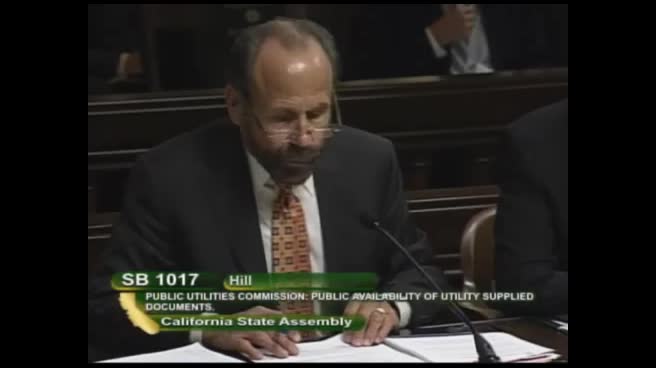 29MIN
Assembly Standing Committee on Utilities and Commerce
 4MIN
Senate Floor
 10MIN
Senate Standing Committee on Judiciary
Bill Author

Bill Co-Author(s):