SB 1065: Dismissal or denial of petitions to compel arbitration: appeals: Elder and Dependent Adult Civil Protection Act.
- Session Year: 2015-2016
- House: Senate
- Latest Version Date: 2016-09-25
Existing law, the Elder and Dependent Adult Civil Protection Act, establishes various procedures for the reporting, investigation, and prosecution of elder and dependent adult abuse, and it sets forth specific provisions governing civil actions arising from the abuse of elderly or dependent adults. Existing law permits a party to a civil action who is over 70 years of age to petition the court for preference under certain circumstances. Under existing law, an aggrieved party may appeal certain orders and judgments, including an order dismissing or denying a petition to compel arbitration. Existing law specifies the time in which specified actions must occur during an appeal.
This bill would require the court of appeal, in an appeal of an order dismissing or denying a petition to compel arbitration involving a claim under the Elder and Dependent Adult Civil Protection Act in which a party has been granted a court preference, to issue its decision no later than 100 days after the notice of appeal is filed, except as specified. This bill would require the Judicial Council, no later than July 1, 2017, to adopt rules implementing this provision and shortening the time within which a party may file a notice of appeal in these cases.
Existing law, the Elder and Dependent Adult Civil Protection Act, establishes various procedures for the reporting, investigation, and prosecution of elder and dependent adult abuse, and it sets forth specific provisions governing civil actions arising from the abuse of elderly or dependent adults. Existing law permits a party to a civil action who is over 70 years of age to petition the court for preference under certain circumstances. Under existing law, an aggrieved party may appeal certain orders and judgments, including an order dismissing or denying a petition to compel arbitration. Existing law specifies the time in which specified actions must occur during an appeal.
This bill would establish an expedited process by which a party, who has filed a claim pursuant to the Elder and Dependent Adult Civil Protection Act and has been granted a preference may appeal an order dismissing or denying a petition to compel arbitration. This bill would shorten the time in which specified actions in the appeal must occur, but would authorize the parties or the court of appeal to extend or waive these time limitations, as specified.
This bill would require the court of appeal, in an appeal of an order dismissing or denying a petition to compel arbitration involving a claim under the Elder and Dependent Adult Civil Protection Act in which a party has been granted a court preference, to issue its decision no later than 100 days after the notice of appeal is filed, except as specified. This bill would require the Judicial Council, no later than July 1, 2017, to adopt rules implementing this provision and shortening the time within which a party may file a notice of appeal in these cases.
Existing law, the Elder and Dependent Adult Civil Protection Act, establishes various procedures for the reporting, investigation, and prosecution of elder and dependent adult abuse, and it sets forth specific provisions governing civil actions arising from the abuse of elderly or dependent adults. Existing law permits a party to a civil action who is over 70 years of age to petition the court for preference under certain circumstances. Under existing law, an aggrieved party may appeal certain orders and judgments, including an order dismissing or denying a petition to compel arbitration. Existing law specifies the time in which specified actions must occur during an appeal.
This bill would provide that if a party establish an expedited process by which a party, who has filed a claim pursuant to the Elder and Dependent Adult Civil Protection Act and has been granted a preference, no preference may appeal may be taken by an opposing party from an order dismissing or denying a petition to compel arbitration. This bill would shorten the time in which specified actions in the appeal must occur, but would authorize the parties or the court of appeal to extend or waive these time limitations, as specified.
Existing law, the Elder and Dependent Adult Civil Protection Act, establishes various procedures for the reporting, investigation, and prosecution of elder and dependent adult abuse, and sets forth specific provisions governing civil actions arising from the abuse of elderly or dependent adults. Existing law permits a party to a civil action who is over 70 years of age to petition the court for preference under certain circumstances. Under existing law, an aggrieved party may appeal certain orders and judgments, including an order dismissing or denying a petition to compel arbitration.
This bill would provide that if a party has filed a claim pursuant to the Elder and Dependent Adult Civil Protection Act and has been granted a preference, no appeal may be taken by an opposing party from an order dismissing or denying a petition to compel arbitration.
Existing law establishes standards for arbitration, and it requires the court to vacate an arbitration award if it makes certain findings.
This bill would make a technical, nonsubstantive change to that provision.
Existing law establishes standards for arbitration, and it requires the court to vacate an arbitration award if it makes certain findings.
This bill would make a technical, nonsubstantive change to that provision.
The Legislature finds and declares all of the following:
(a)Elders and dependent adults are vulnerable to abuse, neglect, or abandonment and this state has a responsibility to protect these persons.
(b)This state has enacted special protections for elderly persons, including the Elder and Dependent Adult Civil Protection Act (Chapter 11 (commencing with Section 15600) of Part 3 of Division 9 of the Welfare and Institutions Code).
(c)This state has also enacted Section 36 of the Code of Civil Procedure, under which a party to a civil action who is over 70 years of age may petition the court for a preference.
(d)The Legislature, therefore, consistent with the joint goals of the Elder and Dependent Adult Civil Protection Act and Section 36 of the Code of Civil Procedure, wishes to enact a limited expedited appeal process for a person filing a claim arising under the Elder and Dependent Adult Civil Protection Act who has received a court preference to expedite the claim.
SEC. 2.Section 1294.4 is added to the Code of Civil Procedure, to read:1294.4.(a)Except as provided in subdivision (b), in an appeal filed pursuant to subdivision (a) of Section 1294 involving a claim under the Elder and Dependent Adult Civil Protection Act (Chapter 11 (commencing with Section 15600) of Part 3 of Division 9 of the Welfare and Institutions Code) in which a party has been granted a preference pursuant to Section 36 of this code, the court of appeal shall issue its decision no later than 100 days after the notice of appeal is filed.
(b)The court of appeal may grant an extension of time in the appeal only if good cause is shown and the extension will promote the interests of justice.
(c)The Judicial Council shall, on or before July 1, 2017, adopt rules of court to do both of the following:
(1)Implement subdivisions (a) and (b).
(2)Establish a shortened notice of appeal period for the cases described in subdivision (a).
The Legislature finds and declares all of the following:
(a)Elders and dependent adults are vulnerable to abuse, neglect, or abandonment and this state has a responsibility to protect these persons.
(b)This state has enacted special protections for elderly persons, including the enactment of the Elder and Dependent Adult Civil Protection Act (Chapter 11 (commencing with Section 15600) of Part 3 of Division 9 of the Welfare and Institutions Code).
(c)This state has also enacted Section 36 of the Code of Civil Procedure, under which a party to a civil action who is over 70 years of age may petition the court for a preference.
(d)The Legislature, therefore, consistent with the joint goals of the Elder and Dependent Adult Civil Protection Act and Section 36 of the Code of Civil Procedure, wishes to enact a limited expedited appeal process for those persons a person filing claims a claim arising under the Elder and Dependent Adult Civil Protection Act who have who has received preferences in court in order a court preference to expedite these claims. the claim.
SEC. 2.Section 1294.4 is added to the Code of Civil Procedure, to read:1294.4.(a)Except as provided in subdivision (b), in an appeal filed pursuant to subdivision (a) of Section 1294 involving a claim under the Elder and Dependent Adult Civil Protection Act (Chapter 11 (commencing with Section 15600) of Part 3 of Division 9 of the Welfare and Institutions Code) in which a party has been granted a preference pursuant to Section 36 of this code, the court of appeal shall issue its decision no later than 100 days after the notice of appeal is filed.
(b)The court of appeal may grant an extension of time in the appeal only if good cause is shown and the extension will promote the interests of justice.
(c)The Judicial Council shall, on or before July 1, 2017, adopt rules of court to do both of the following:
(1)Implement subdivisions (a) and (b).
(2)Establish a shortened notice of appeal period for the cases described in subdivision (a).
SEC. 2.Section 1294.4 is added to the Code of Civil Procedure, to read:1294.4.(a)Except as provided in subdivision (b), in an appeal filed pursuant to subdivision (a) of Section 1294 in which a party filed the underlying claim pursuant to the Elder and Dependent Adult Civil Protection Act (Chapter 11 (commencing with Section 15600) of Part 3 of Division 9 of the Welfare and Institutions Code) and was granted a preference pursuant to Section 36 of this code, all of the following shall apply:
(1)No later than 15 days after service of a notice of entry of the judgment, the appellant shall file the notice of appeal and the notice designating the record on appeal.
(2)(A)No later than 10 days after receipt of a notice designating the record on appeal that requests the clerks transcript, the clerk of the trial court shall prepare and file the clerks transcript pursuant to Rule 8.832 of the California Rules of Court. The clerk shall send the transcription by the most expedited means available, including by email.
(B)In lieu of the clerks transcript filed by the clerk, a party may elect to use an appendix to file and serve the notice designating the record on appeal pursuant to Rule 8.124 of the California Rules of Court.
(3)(A)Immediately upon receipt of a notice designating the record on appeal that requests the reporters transcript, the clerk of the trial court shall provide the notice to the reporter by the most expedited means available, including by email. No later than 10 days after receipt of the notice from the clerk, the reporter shall prepare, certify, and file in the trial court the reporters transcript pursuant to Rule 8.834 of the California Rules of Court. Immediately after filing the reporters transcript, the reporter shall notify all parties to the appeal by the most expedited means available, including by email, that the transcript is complete.
(B)In lieu of this reporters transcript filed by the reporter, the appellant may elect to file certified copies of previously prepared transcripts with his or her opening brief, provided that he or she indicated that in his or her notice designating the record on appeal.
(4)(A)No later than 20 days after filing a complete and accurate record of the trial court proceedings in the court of appeal, or, if the appellant elects to file transcripts pursuant to clause (A) of paragraph (2) and clause (A) of paragraph (3), no later than 40 days after filing the notice of appeal, the appellant shall file and serve his or her opening brief, which shall be filed and served by the most expedited means available, including by email. At the time he or she files the opening brief, the appellant shall either expressly request or waive oral argument.
(B)No later than 20 days after the opening brief is filed and served, the respondent shall file and serve his or her brief, which shall be filed and served by the most expedited means available, including by email. At the time he or she files the brief, the respondent shall either expressly request or waive oral argument.
(C)No later than 20 days after the respondents brief is filed and served, the appellant may file and serve his or her reply brief, which shall be filed and served by the most expedited means available, including by email.
(5)If either party requests oral argument, the court of appeal shall set oral argument to be held no later than 30 days after the reply brief is filed and served or, if a reply brief is not filed and served, no later than 20 days after the respondents brief is filed and served.
(6)No later than 15 days after the submission of the matter to the court of appeal for decision, the court of appeal shall issue its decision.
(b)(1)The parties to the appeal may, by stipulation, extend or waive any time limitation set forth in this section by filing a written agreement signed by all parties with the trial court if extending or waiving the time limitation for filing the notice of appeal or with the court of appeal if extending or waiving any other time limitation in this section. The parties shall not extend any time limitation in this section to be longer than the time limitation set forth in statute or the California Rules of Court for all other appeals filed pursuant to subdivision (a) of Section 1294.
(2)The court of appeal may extend any time limitation set forth in this section upon a showing of extraordinary good cause.
The Legislature finds and declares all of the following:
(a)Elders and dependent adults are vulnerable to abuse, neglect, or abandonment and this state has a responsibility to protect these persons.
(b)This state has enacted special protections for elderly persons, including the enactment of the Elder and Dependent Adult Civil Protection Act (Chapter 11 (commencing with Section 15600) of Part 3 of Division 9 of the Welfare and Institutions Code).
(c)This state has also enacted Section 36 of the Code of Civil Procedure, under which a party to a civil action who is over 70 years of age may petition the court for a preference.
(d)The Legislature, therefore, consistent with the joint goals of the Elder and Dependent Adult Civil Protection Act and Section 36 of the Code of Civil Procedure, wishes to enact a limited expedited appeal process for those persons filing claims under the Elder and Dependent Adult Civil Protection Act who have received preferences in court in order to expedite these claims.
SEC. 2.Section 1294.4 is added to the Code of Civil Procedure, to read:1294.4.(a)Except as provided in subdivision (b), in an appeal filed pursuant to subdivision (a) of Section 1294 in which a party filed the underlying claim pursuant to the Elder and Dependent Adult Civil Protection Act (Chapter 11 (commencing with Section 15600) of Part 3 of Division 9 of the Welfare and Institutions Code) and was granted a preference pursuant to Section 36 of this code, all of the following shall apply:
(1)No later than 15 days after service of a notice of entry of the judgment, the appellant shall file the notice of appeal and the notice designating the record on appeal.
(2)(A)No later than 10 days after receipt of a notice designating the record on appeal that requests the clerks transcript, the clerk of the trial court shall prepare and file the clerks transcript pursuant to Rule 8.832 of the California Rules of Court. The clerk shall send the transcription by the most expedited means available, including by email.
(B)In lieu of the clerks transcript filed by the clerk, a party may elect to use an appendix to file and serve the notice designating the record on appeal pursuant to Rule 8.124 of the California Rules of Court.
(3)(A)Immediately upon receipt of a notice designating the record on appeal that requests the reporters transcript, the clerk of the trial court shall provide the notice to the reporter by the most expedited means available, including by email. No later than 10 days after receipt of the notice from the clerk, the reporter shall prepare, certify, and file in the trial court the reporters transcript pursuant to Rule 8.834 of the California Rules of Court. Immediately after filing the reporters transcript, the reporter shall notify all parties to the appeal by the most expedited means available, including by email, that the transcript is complete.
(B)In lieu of this reporters transcript filed by the reporter, the appellant may elect to file certified copies of previously prepared transcripts with his or her opening brief, provided that he or she indicated that in his or her notice designating the record on appeal.
(4)(A)No later than 20 days after filing a complete and accurate record of the trial court proceedings in the court of appeal, or, if the appellant elects to file transcripts pursuant to clause (A) of paragraph (2) and clause (A) of paragraph (3), no later than 40 days after filing the notice of appeal, the appellant shall file and serve his or her opening brief, which shall be filed and served by the most expedited means available, including by email. At the time he or she files the opening brief, the appellant shall either expressly request or waive oral argument.
(B)No later than 20 days after the opening brief is filed and served, the respondent shall file and serve his or her brief, which shall be filed and served by the most expedited means available, including by email. At the time he or she files the brief, the respondent shall either expressly request or waive oral argument.
(C)No later than 20 days after the respondents brief is filed and served, the appellant may file and serve his or her reply brief, which shall be filed and served by the most expedited means available, including by email.
(5)If either party requests oral argument, the court of appeal shall set oral argument to be held no later than 30 days after the reply brief is filed and served or, if a reply brief is not filed and served, no later than 20 days after the respondents brief is filed and served.
(6)No later than 15 days after the submission of the matter to the court of appeal for decision, the court of appeal shall issue its decision.
(b)(1)The parties to the appeal may, by stipulation, extend or waive any time limitation set forth in this section by filing a written agreement signed by all parties with the trial court if extending or waiving the time limitation for filing the notice of appeal or with the court of appeal if extending or waiving any other time limitation in this section. The parties shall not extend any time limitation in this section to be longer than the time limitation set forth in statute or the California Rules of Court for all other appeals filed pursuant to subdivision (a) of Section 1294.
(2)The court of appeal may extend any time limitation set forth in this section upon a showing of extraordinary good cause.
SECTION 1.Section 36 of the Code of Civil Procedure is amended to read:36.(a)A party to a civil action who is over 70 years of age may petition the court for a preference, which the court shall grant if the court makes both of the following findings:
(1)The party has a substantial interest in the action as a whole.
(2)The health of the party is such that a preference is necessary to prevent prejudicing the partys interest in the litigation.
(b)A civil action to recover damages for wrongful death or personal injury shall be entitled to preference upon the motion of any party to the action who is under 14 years of age unless the court finds that the party does not have a substantial interest in the case as a whole. A civil action subject to subdivision (a) shall be given preference over a case subject to this subdivision.
(c)Unless the court otherwise orders:
(1)A party may file and serve a motion for preference supported by a declaration of the moving party that all essential parties have been served with process or have appeared.
(2)At any time during the pendency of the action, a party who reaches 70 years of age may file and serve a motion for preference.
(d)In its discretion, the court may also grant a motion for preference that is accompanied by clear and convincing medical documentation that concludes that one of the parties suffers from an illness or condition raising substantial medical doubt of survival of that party beyond six months, and that satisfies the court that the interests of justice will be served by granting the preference.
(e)Notwithstanding any other provision of law, the court may in its discretion grant a motion for preference that is supported by a showing that satisfies the court that the interests of justice will be served by granting this preference.
(f)Upon the granting of such a motion for preference, the court shall set the matter for trial not more than 120 days from that date and there shall be no continuance beyond 120 days from the granting of the motion for preference except for physical disability of a party or a partys attorney, or upon a showing of good cause stated in the record. Any continuance shall be for no more than 15 days and no more than one continuance for physical disability may be granted to any party.
(g)Upon the granting of a motion for preference pursuant to subdivision (b), a party in an action based upon a health providers alleged professional negligence, as defined in Section 364, shall receive a trial date not sooner than six months and not later than nine months from the date that the motion is granted.
(h)If a party has filed a claim pursuant to the Elder and Dependent Adult Civil Protection Act (Chapter 11 (commencing with Section 15600) of Part 3 of Division 9 of the Welfare and Institutions Code) and has been granted a preference pursuant to this section, an opposing party shall not appeal from an order dismissing or denying a petition to compel arbitration pursuant to subdivision (a) of Section 1294 arising from that claim.
SEC. 2.Section 1294 of the Code of Civil Procedure is amended to read:1294.Except as provided in subdivision (h) of Section 36, an aggrieved party may appeal from:
(a)An order dismissing or denying a petition to compel arbitration.
(b)An order dismissing a petition to confirm, correct or vacate an award.
(c)An order vacating an award unless a rehearing in arbitration is ordered.
(d)A judgment entered pursuant to this title.
(e)A special order after final judgment.
(a)A party to a civil action who is over 70 years of age may petition the court for a preference, which the court shall grant if the court makes both of the following findings:
(1)The party has a substantial interest in the action as a whole.
(2)The health of the party is such that a preference is necessary to prevent prejudicing the partys interest in the litigation.
(b)A civil action to recover damages for wrongful death or personal injury shall be entitled to preference upon the motion of any party to the action who is under 14 years of age unless the court finds that the party does not have a substantial interest in the case as a whole. A civil action subject to subdivision (a) shall be given preference over a case subject to this subdivision.
(c)Unless the court otherwise orders:
(1)A party may file and serve a motion for preference supported by a declaration of the moving party that all essential parties have been served with process or have appeared.
(2)At any time during the pendency of the action, a party who reaches 70 years of age may file and serve a motion for preference.
(d)In its discretion, the court may also grant a motion for preference that is accompanied by clear and convincing medical documentation that concludes that one of the parties suffers from an illness or condition raising substantial medical doubt of survival of that party beyond six months, and that satisfies the court that the interests of justice will be served by granting the preference.
(e)Notwithstanding any other provision of law, the court may in its discretion grant a motion for preference that is supported by a showing that satisfies the court that the interests of justice will be served by granting this preference.
(f)Upon the granting of such a motion for preference, the court shall set the matter for trial not more than 120 days from that date and there shall be no continuance beyond 120 days from the granting of the motion for preference except for physical disability of a party or a partys attorney, or upon a showing of good cause stated in the record. Any continuance shall be for no more than 15 days and no more than one continuance for physical disability may be granted to any party.
(g)Upon the granting of a motion for preference pursuant to subdivision (b), a party in an action based upon a health providers alleged professional negligence, as defined in Section 364, shall receive a trial date not sooner than six months and not later than nine months from the date that the motion is granted.
(h)If a party has filed a claim pursuant to the Elder and Dependent Adult Civil Protection Act (Chapter 11 (commencing with Section 15600) of Part 3 of Division 9 of the Welfare and Institutions Code) and has been granted a preference pursuant to this section, an opposing party shall not appeal from an order dismissing or denying a petition to compel arbitration pursuant to subdivision (a) of Section 1294 arising from that claim.
SEC. 2.Section 1294 of the Code of Civil Procedure is amended to read:1294.An Except as provided in subdivision (h) of Section 36, an aggrieved party may appeal from:
(a)An order dismissing or denying a petition to compel arbitration.
(b)An order dismissing a petition to confirm, correct or vacate an award.
(c)An order vacating an award unless a rehearing in arbitration is ordered.
(d)A judgment entered pursuant to this title.
(e)A special order after final judgment.
SECTION 1.Section 1286.2 of the Code of Civil Procedure is amended to read:1286.2.(a)Subject to Section 1286.4, the court shall vacate the award if the court determines any of the following:
(1)The award was procured by fraud, corruption, or other undue means.
(2)There was corruption in any of the arbitrators.
(3)The rights of the party were substantially prejudiced by misconduct of a neutral arbitrator.
(4)The arbitrators exceeded their powers and the award cannot be corrected without affecting the merits of the decision upon the controversy submitted.
(5)The rights of the party were substantially prejudiced by the refusal of the arbitrators to postpone the hearing upon sufficient cause being shown therefor or by the refusal of the arbitrators to hear evidence material to the controversy or by other conduct of the arbitrators contrary to the provisions of this title.
(6)An arbitrator making the award either: (A) failed to disclose within the time required for disclosure a ground for disqualification of which the arbitrator was then aware; or (B) was subject to disqualification upon grounds specified in Section 1281.91 but failed upon receipt of timely demand to disqualify himself or herself as required by that provision. However, this subdivision does not apply to arbitration proceedings conducted under a collective bargaining agreement between employers and employees or between their respective representatives.
(b)Petitions to vacate an arbitration award pursuant to Section 1285 are subject to the provisions of Section 128.7.
(a)Subject to Section 1286.4, the court shall vacate the award if the court determines any of the following:
(1)The award was procured by corruption, fraud fraud, corruption, or other undue means.
(2)There was corruption in any of the arbitrators.
(3)The rights of the party were substantially prejudiced by misconduct of a neutral arbitrator.
(4)The arbitrators exceeded their powers and the award cannot be corrected without affecting the merits of the decision upon the controversy submitted.
(5)The rights of the party were substantially prejudiced by the refusal of the arbitrators to postpone the hearing upon sufficient cause being shown therefor or by the refusal of the arbitrators to hear evidence material to the controversy or by other conduct of the arbitrators contrary to the provisions of this title.
(6)An arbitrator making the award either: (A) failed to disclose within the time required for disclosure a ground for disqualification of which the arbitrator was then aware; or (B) was subject to disqualification upon grounds specified in Section 1281.91 but failed upon receipt of timely demand to disqualify himself or herself as required by that provision. However, this subdivision does not apply to arbitration proceedings conducted under a collective bargaining agreement between employers and employees or between their respective representatives.
(b)Petitions to vacate an arbitration award pursuant to Section 1285 are subject to the provisions of Section 128.7.
|
Date
|
Status
|
|---|---|
| Jun 29, 2016 | From committee: Do pass as amended. (Ayes 10. Noes 0.) (June 28). |
| Sep 1, 2016 | Enrolled and presented to the Governor at 5 p.m. |
| Aug 26, 2016 | Assembly amendments concurred in. (Ayes 39. Noes 0.) Ordered to engrossing and enrolling. |
| Aug 26, 2016 | Assembly amendments concurred in. (Ayes 39. Noes 0. Page 5447.) Ordered to engrossing and enrolling. |
| Aug 25, 2016 | In Senate. Concurrence in Assembly amendments pending. |
| Aug 24, 2016 | Read third time. Passed. Ordered to the Senate. |
| Aug 18, 2016 | Ordered to third reading. |
| Aug 18, 2016 | From consent calendar on motion of Assembly Member Waldron. |
| Aug 11, 2016 | Read second time. Ordered to consent calendar. |
| Aug 10, 2016 | From committee: Do pass. Ordered to consent calendar. (Ayes 19. Noes 0.) (August 10). |
| Aug 1, 2016 | Read second time. Ordered to third reading. |
| Aug 1, 2016 | Re-referred to Com. on APPR. pursuant to Joint Rule 10.5. |
| Aug 1, 2016 | From committee with author's amendments. Read second time and amended. Re-referred to Com. on APPR. |
| Jun 30, 2016 | Read second time and amended. Ordered to second reading. |
| Feb 16, 2016 | Introduced. Read first time. To Com. on RLS. for assignment. To print. |
| Jun 21, 2016 | June 21 set for first hearing canceled at the request of author. |
| May 12, 2016 | Referred to Com. on JUD. |
| May 3, 2016 | In Assembly. Read first time. Held at Desk. |
| May 2, 2016 | Read third time. Passed. (Ayes 26. Noes 9.) Ordered to the Assembly. |
| May 2, 2016 | Read third time. Passed. (Ayes 26. Noes 9. Page 3738.) Ordered to the Assembly. |
| Apr 28, 2016 | Read second time. Ordered to third reading. |
| Apr 27, 2016 | From committee: Do pass. (Ayes 6. Noes 1.) (April 26). |
| Apr 27, 2016 | From committee: Do pass. (Ayes 6. Noes 1. Page 3700.) (April 26). |
| Apr 19, 2016 | Set for hearing April 26. |
| Mar 31, 2016 | Re-referred to Com. on JUD. |
| Mar 28, 2016 | From committee with author's amendments. Read second time and amended. Re-referred to Com. on RLS. |
| Feb 25, 2016 | Referred to Com. on RLS. |
| Feb 17, 2016 | From printer. May be acted upon on or after March 18. |
|
Date
|
Description
|
Location
|
Votes
|
|
|---|---|---|---|---|
| Aug 26, 2016 | Unfinished Business SB1065 Monning Concurrence | Senate Floor |
Passed |
|
| Aug 24, 2016 | SB 1065 Monning Senate Third Reading By CHIU | Assembly Floor |
Passed |
|
| Aug 10, 2016 | Do pass. To Consent Calendar. | Assembly Standing Committee on Appropriations |
Passed |
|
| Jun 28, 2016 | Do pass as amended. | Assembly Standing Committee on Judiciary |
Passed |
|
| May 2, 2016 | Senate 3rd Reading SB1065 Monning | Senate Floor |
Passed |
|
| Apr 26, 2016 | Do pass | Senate Standing Committee on Judiciary |
Passed |
This list shows positions taken on this bill by organizations on the date displayed, which is linked to the original source.
Positions by individuals are not included.
|
Organization
|
Position
|
Date
|
|---|---|---|
| California Advocates for Nursing Home Reform | ** Support | Aug 26, 2016 |
| California Alliance For Retired Americans | ** Support | Aug 26, 2016 |
| California Assisted Living Association | ** Against | Aug 24, 2016 |
| California Association Of Health Facilities | ** Against | Aug 24, 2016 |
| California Association Of Physician Groups | ** Against | Aug 24, 2016 |
| Civil Justice Association Of California | ** Against | May 2, 2016 |
| Congress of California Seniors | ** Support | Aug 26, 2016 |
| Consumer Attorneys Of California | ** Support | Aug 26, 2016 |
| Consumer Federation Of California | ** Support | Aug 26, 2016 |
| Foundation Aiding the Elderly | * Support | Apr 26, 2016 |
| Judicial Council | ** Against | Aug 26, 2016 |
Office of Senate Floor Analyses (916) 651-1520 Fax: (916) 327-4478 | SB |
UNFINISHED BUSINESS
Bill No: SB 1065
:
SENATE JUDICIARY COMMITTEE: 6-1, 4/26/16
AYES: Jackson, Moorlach, Hertzberg, Leno, Monning, Wieckowski
NOES: Anderson
SENATE FLOOR: 26-9, 5/2/16
AYES: Allen, Beall, Block, De León, Galgiani, Glazer, Hall, Hancock, Hernandez, Hill, Hueso, Jackson, Lara, Leno, Leyva, Liu, McGuire, Mendoza, Mitchell, Monning, Moorlach, Nielsen, Pavley, Roth, Wieckowski, Wolk
NOES: Anderson, Berryhill, Fuller, Gaines, Huff, Morrell, Nguyen, Stone, Vidak
NO VOTE RECORDED: Bates, Cannella, Hertzberg, Pan, Runner
ASSEMBLY FLOOR: 79-0, 8/24/16 - See last page for vote
SOURCE: California Advocates for Nursing Home Reform
California Alliance for Retired Americans
Congress of California Seniors
Consumer Attorneys of California
DIGEST: This bill generally provides that in an appeal from an order dismissing or denying a petition to compel arbitration, the court of appeal must issue its decision within 100 days after the notice of appeal is filed if the appeal involves a claim under the Elder and Dependent Adult Civil Protection Act (EADACPA) and a party has been granted a trial preference, as specified. This bill also provides an exception allowing the court to grant an extension of time, only if good cause is shown and the extension will promote the interests of justice.
Assembly Amendments narrow the bill, which previously would have precluded a party from taking an immediate appeal of an order dismissing or denying a petition to compel arbitration if the opposing party has both filed an EADACPA claim and been granted a trial preference, to, instead, provide for an expedited trial date of such an appeal under the same circumstances (i.e. the appeal involves an EADACPA claim and a party has been granted a trial preference.)
Existing law:
- Governs arbitrations in California under the California Arbitration Act (CAA), including the enforcement of arbitration agreements, rules for neutral arbitrators, the conduct of arbitration proceedings, and the enforcement of arbitration awards.
- Provides that a written agreement to submit to arbitration an existing controversy or a controversy thereafter arising is valid, enforceable and irrevocable, save upon such grounds as exist for the revocation of any contract.
- Provides that on a petition of a party to an arbitration agreement alleging the existence of a written agreement to arbitrate a controversy, if a party thereto refuses to arbitrate such controversy, the court shall order arbitration of the controversy if it determines that an agreement to arbitrate the controversy exists, unless it determines any of the following:
- The right to compel arbitration has been waived by the petitioner;
- Grounds exist for the revocation of the agreement; or
- A party to the arbitration agreement is also a party to a pending court action or special proceeding with a third party, arising out of the same transaction or series of related transactions and there is a possibility of conflicting rulings on a common issue of law or fact.
- Provides that an aggrieved party may appeal from the following:
- An order dismissing or denying a petition to compel arbitration;
- An order dismissing a petition to conform, correct or vacate an award;
- An order vacating an award unless a rehearing in arbitration is ordered;
- A judgment entered pursuant to this title; or
- A special order after final judgment.
- Provides that a writ of mandate may be issued by any court to an inferior tribunal, corporation, board, or person, to compel the performance of an act which the law specially enjoins, as a duty resulting from an office, trust, or station, or to compel the admission of a party to the use and enjoyment of a right or office to which the party is entitled, and from which the party is unlawfully precluded by that inferior tribunal, corporation, board, or person.
- Provides that a party may not appeal an order compelling arbitration until after final judgment, but may, under extraordinary circumstances, seek a writ of mandate to request review of the ruling by the court of appeal in advance of the arbitration hearing. (Laufman v. Hall-Mack Co. (1963) 215 Cal.App.2d 87; United Firefighters of Los Angeles v. City of Los Angeles (1991) 231 Cal.App. 3d 1576; Mid-Wilshire Associates v. O’Leary (1992) 7 Cal.App.4th 1450.)
- Provides, under Section 36 of the Code of Civil Procedure, that a party to a civil action who is over 70 years of age may petition the court for a (trial) preference, which the court shall grant if the court makes both of the following findings:
- The party has a substantial interest in the action as a whole; and
- The health of the party is such that a preference is necessary to prevent prejudicing the party’s interest in the litigation.
- Provides that the court, in its discretion, may also grant a motion for preference that is accompanied by clear and convincing medical documentation that concludes that one of the parties suffers from an illness or condition raising substantial medical doubt of survival of that party beyond six months, and that satisfies the court that the interests of justice will be served by granting the preference. Further provides that, notwithstanding any other provision of law, the court may in its discretion grant a motion for preference that is supported by a showing that satisfies the court that the interests of justice will be served by granting this preference.
- Provides that upon the granting of such a motion for preference, the court shall set the matter for trial not more than 120 days from that date and there shall be no continuance beyond 120 days from the granting of the motion for preference except for physical disability of a party or a party’s attorney, or upon a showing of good cause. Any continuance shall be for no more than 15 days and no more than one continuance for physical disability may be granted to any party.
- Provides, generally, under the Elder Abuse and Dependent Adult Civil Protection Act (EADACPA), civil protections and remedies for victims of elder and dependent adult abuse and neglect.
This bill:
- Provides that, except as provided below, in an appeal from an order dismissing or denying a petition to compel arbitration filed pursuant to existing law, involving a claim under EADACPA in which a party has been granted a preference pursuant to Section 36 (item #7 above), the court of appeal shall issue its decision no later than 100 days after the notice of appeal is filed.
- Permits the court of appeal to grant an extension of time in the appeal only if good cause is shown and the extension will promote the interests of justice.
- Requires the Judicial Council to adopt rules to implement this bill and to establish a shortened notice of appeal period for these purposes, as specified.
- Provides various legislative findings and declarations, including, among other things, that the Legislature, consistent with the joint goals of EADACPA and Section 36 of the Code of Civil Procedure, wishes to enact a limited expedited appeal process for a person filing a claim arising under EADACPA who has received a court preference to expedite the claim.
Background
As a general matter, arbitrations provide an alternative method of dispute resolution, outside of the courts, wherein a neutral third party, known as the arbitrator, renders a decision after a hearing to which both parties have had an opportunity to be heard. Under California law, there are two distinguishable types of arbitration: judicial arbitration (also known as court-annexed arbitration, governed under Code Civ. Proc. Secs. 1141.10 -1141.31) and private arbitrations (also commonly known as “contractual,” “voluntary,” or “nonjudicial” arbitrations; governed under the CAA, Code Civ. Proc. Sec. 1280 et seq.).
On March 1, 2016, the Senate Judiciary Committee held an informational hearing on the topic of private or contractual arbitration agreements, entitled The Federal Arbitration Act, the U.S. Supreme Court, and the Impact of Mandatory Arbitration on California Consumers and Employees. In that hearing, many issues facing consumers and employees who are subject to arbitration clauses contained in standardized, take-it-or-leave-it, or “adhesive” contracts were brought to light. That hearing also brought to light the various difficulties facing the State in addressing some of the underlying, fundamental harms faced by consumers and employees as a result of federal preemption and U.S. Supreme Court precedent interpreting the Federal Arbitration Act. A package of arbitration bills, of which this bill is one, arose out of the hearing, seeking to address various fairness issues surrounding the rules that govern the conduct and operation of arbitrators and arbitrations in this state.
Of particular relevance to this bill, California law provides that, as a general rule, appeals may only be taken from such judgments or orders as are made appealable by statute. In turn, Section 904.1 of the Code of Civil Procedure, governing the right to appeal in a civil action, generally provides that the right of appeal exists only upon a judgment, except there may be an appeal from an interlocutory judgment that is made final and conclusive. A “judgment,” as referenced here, is the final determination of the rights of the parties in an action or proceeding. (Code Civ. Proc. Sec. 577.) Accordingly, this “final judgment rule” seeks to limit the number of appeals possible in light of the court’s interests in expediency, efficiency, and economy.
Appeals in arbitration matters, however, are specifically governed under a provision of the CAA, and the CAA diverges from the above final judgment rule with respect to the appealability of orders dismissing or denying a petition to compel arbitration. Under the CAA, if a party to a contractual arbitration agreement seeks instead to file suit in court or refuses to submit the dispute to arbitration, disputing either the validity or applicability of the arbitration agreement, the other party to the arbitration agreement may seek to enforce the arbitration by way of a motion to compel arbitration. Generally, the court must order the parties to arbitration unless: (1) grounds exist for the revocation of the agreement; (2) the right to compel arbitration has been waived by the petitioner; or (3) a party to the arbitration agreement is also a party to a pending court action or special proceeding with a third party, arising out of the same transaction or series of related transactions and there is a possibility of conflicting rulings on a common issue of law or fact. (Code Civ. Proc. Sec. 1281.2.) If, however, the court does ultimately deny the motion to compel arbitration, the CAA provides for a statutory right to immediately appeal that decision by the party seeking to force arbitration (usually the defendant), thus staying the trial until the appeal of the order denying or dismissing the arbitration can be heard and decided. (Code Civ. Proc. Sec. 1294(a).) The CAA does not provide a similar right of immediate appeal to a plaintiff if the court grants the defendant’s motion to compel arbitration.
This bill generally requires that a court of appeal hear an appeal of an order dismissing or denying a motion to compel arbitration within 100 days after the notice of appeal has been filed if: (1) the case involves a claim under EADACPA; and (2) the senior has received a trial preference under existing law due to age and health. This bill authorizes the court to provide for an extension of time if good cause is shown and the extension will promote the interests of justice.
Comments
As stated by the author:
California’s elder abuse statute, the Elder Abuse and Dependent Adult Civil Protection Act (EADACPA), was enacted to protect elderly and dependent adults from abuse. [ . . . ] It defines civil elder abuse to mean physical abuse, neglect, financial abuse, abandonment, isolation, abduction, or other treatment resulting in physical harm or pain or mental suffering. (Welf. & Inst. Code [Sec.] 15610.07). Other than financial elder abuse, these claims all require the higher standard of “clear and convincing” proof and are thus difficult to pursue.
Under current law, trial courts may grant victims of elder abuse a speedy trial in light of their age and failing health. (Code Civ. Proc. Sec. 36(a).) [ . . . ] Although the exact number of [Section] 36 preferences granted to victims of elder abuse each year is unknown, practitioners report that the number is small as not many elders meet the onerous requirements of Section 36.
Additionally, under current law, [ . . . if] the court denies [a defendant’s] motion to compel the case to arbitration because the arbitration agreement is found to be unconscionable, [Code of Civil Procedure] Section 1294(c) gives the defendant the automatic right to appeal that decision, even if the elderly plaintiff has already been granted the right to a speedy trial under Section 36(a).
Therefore, [ . . .] a defendant who tries (and fails) to force these elderly victims into arbitration can nonetheless override the court’s order for a preferential trial date and delay the elder’s trial another 1-3 years by filing an appeal. The elderly victims have no similar rights—if a defendant succeeds in forcing them into arbitration, the victims may not delay and must proceed straight to arbitration.
The author asserts that “[t]he delay caused by the appeal is done in the hope that the elder will not survive long enough for the appeal to be decided, thereby reducing the defendant’s liability if the victim dies before trial” and provides several examples of appeals that successfully delayed the trial by over a year. In one case, the author cites, a 90-year-old stroke victim brought an elder abuse action against the defendant nursing home after she was sexually assaulted at the facility and contracted a sexually transmitted disease. The victim succeeded both in obtaining a trial preference and in challenging the defendant’s motion to compel arbitration, but the nursing home appealed the denial. The Sixth Circuit Court of Appeal ultimately heard and ruled 3-0 for the victim, finding that the arbitration agreement could not be enforced against her. (Young v. Horizon West, Inc. (2013) 220 Cal.App.4th 1122). Ultimately, the appeal “took almost a year and a half, and that was even an expedited process (after the court of appeal granted preference). Fortunately, Mrs. Young outlived this tactic, and was able to get her case resolved. Many others in her position do not live to see a resolution of the case.” The author cites another case, Bush v. Horizon West (2012) 205 Cal.App.4th 924, where “the victim did not survive the nearly 2 years it took to get the favorable appellate opinion allowing the case to get back on the Court’s trial calendar.”
As such, the author writes, “SB 1065 will ensure speedy access to justice for victims of elder abuse who have proven to the court they are elderly and dying and have been granted a trial court preference, meaning they obtain an early court date. The bill expedites the time frame that the appeal must be heard. This is similar to other proceedings that have been deemed important to hear on an expedited process (such as child dependency appeals). [Specifically,] SB 1065 attempts to expedite the current 2-3 year appeal process for these particular cases by requiring that appeals be heard within 100 days.”
FISCAL EFFECT: Appropriation: Fiscal Com.: Local:
According to the Assembly Appropriations Committee, minor absorbable costs for the Judicial Council to adopt the Rule of Court.
California Advocates for Nursing Home Reform (co-source)
California Alliance for Retired Americans (co-source)
Congress of California Seniors (co-source)
Consumer Attorneys of California (co-source)
Consumer Federation of California
OPPOSITION: (Verified 8/24/16)
Judicial Council
ARGUMENTS IN SUPPORT: The Consumer Federation of California writes:
California’s elder abuse statute, the Elder Abuse and Dependent Adult Civil Protection Act, was enacted to protect elderly and dependent adults from abuse. Unfortunately, current law creates an incentive for delay by permitting a defendant who unsuccessfully tries to force an elder abuse victim into arbitration to file an appeal and delay the hearing another one to three years. It is routine for defendant nursing homes who want to avoid a jury trial to file a motion to enforce an arbitration provision, which the facility drafted and then coerced the victim into signing at enrollment. This delay often has the effect of denying the abused person his or her day in court. [ . . . ]
As our society ages, it is crucial that legislative policy address and protect the rights of our seniors who are subject to abuse.
ARGUMENTS IN OPPOSITION: In opposition, the Judicial Council writes that it has “a long history of opposition to legislation that creates statutory calendar preferences. [ . . . ] Like other types of calendar preferences, setting an extremely tight timeline for deciding these cases has the practical effect of pushing other cases on the dockets of the Courts of Appeal to the back of the line. This means that other cases, including cases that have statutorily mandated calendar preferences, such as juvenile cases, criminal cases, and even civil cases other than those involving a claim of elder abuse in which a party is also at risk of dying, will take longer to decide. Moreover, delays in the administration of justice that would likely result from this expedited judicial review approach would be even more pronounced in light of the ongoing fiscal limitations faced by the judicial branch.”
ASSEMBLY FLOOR: 79-0, 8/24/16
AYES: Achadjian, Alejo, Travis Allen, Arambula, Atkins, Baker, Bigelow, Bloom, Bonilla, Bonta, Brough, Brown, Burke, Calderon, Campos, Chang, Chau, Chávez, Chiu, Chu, Cooley, Cooper, Dababneh, Dahle, Dodd, Eggman, Frazier, Beth Gaines, Gallagher, Cristina Garcia, Eduardo Garcia, Gatto, Gipson, Gomez, Gonzalez, Gordon, Gray, Grove, Hadley, Harper, Roger Hernández, Holden, Irwin, Jones, Jones-Sawyer, Kim, Lackey, Levine, Linder, Lopez, Low, Maienschein, Mathis, Mayes, McCarty, Medina, Melendez, Mullin, Nazarian, Obernolte, O'Donnell, Olsen, Patterson, Quirk, Ridley-Thomas, Rodriguez, Salas, Santiago, Steinorth, Mark Stone, Thurmond, Ting, Wagner, Waldron, Weber, Wilk, Williams, Wood, Rendon
NO VOTE RECORDED: Daly
8/26/16 8:46:48
**** END ****
SENATE THIRD READING
STR Bill Id:SB 1065
Author:(Monning)
As Amended Ver:August 1, 2016
Majority vote
SENATE VOTE: 26-9
Committee | Votes | Ayes | Noes |
Judiciary | 10-0 | Mark Stone, Wagner, Alejo, Chau, Chiu, Gallagher, Cristina Garcia, Holden, Maienschein, Ting |
|
Appropriations | 19-0 | Gonzalez, Bigelow, Bloom, Bonilla, Bonta, Calderon, Daly, Eggman, Gallagher, Eduardo Garcia, Holden, Jones, Obernolte, Quirk, Santiago, Wagner, Weber, Wood, Chu |
|
SUMMARY: Establishes an expedited appellate process for the review of an order dismissing or denying a petition to compel arbitration in matters where the plaintiff has filed specified elder abuse claims, and where the plaintiff has been granted a trial preference because of poor or failing health. Specifically, this bill:
- Requires a court of appeal to issue its decision no later than 100 days after the notice of appeal is filed in an appeal of an order dismissing or denying a petition to compel arbitration, involving a claim under the Elder and Dependent Adult Civil Protection Act, where a party has been granted a trial preference.
- Provides that a court of appeal may grant an extension of time in the above-described appeal only if good cause is shown and the extension will promote the interests of justice.
- Requires the Judicial Council to adopt rules of court to implement this act, and to also establish a shortened notice of appeal period in the above-described cases.
- Makes various legislative declarations and findings.
EXISTING LAW:
- Provides that an appeal may be taken from a judgment except an interlocutory judgment unless provided otherwise. (Code of Civil Procedure Section (CCP) 904.1 (a)(1). Unless otherwise stated, all further statutory references are to the Code of Civil Procedure.)
- Provides that when a court denies a petition to compel arbitration, the aggrieved party has the right to immediately appeal the order denying the petition. (CCP 1294.)
- Provides that when a court grants a petition to compel arbitration, the aggrieved party does not have the right to immediately appeal the order granting the petition. (Ibid.)
- Provides that an aggrieved party may appeal from the following:
- An order dismissing or denying a petition to compel arbitration.
- An order dismissing a petition to confirm, correct or vacate an award.
- An order vacating an award unless a rehearing in arbitration is ordered.
- A judgment entered pursuant to this title.
- A special order after final judgment. (Ibid.)
- Provides that a party seeking review of an order either denying or granting a petition to compel arbitration may file a writ of mandate with the court of appeal. (CCP 1085.)
- Provides on petition of a party to an arbitration agreement alleging the existence of a written agreement to arbitrate a controversy and that a party thereto refuses to arbitrate such controversy, the court shall order the petitioner and the respondent to arbitrate the controversy if it determines that an agreement to arbitrate the controversy exists, unless it determines that:
- The right to compel arbitration has been waived by the petitioner;
- Grounds exist for the revocation of the agreement; or
- A party to the arbitration agreement is also a party to a pending court action or special proceeding with a third party, arising out of the same transaction or series of related transactions and there is a possibility of conflicting rulings on common issue of law or fact. (CCP 1281.2.)
- Provides that specified civil parties may petition a court to grant a trial preference, which upon granting, requires the court to set the matter for trial not more than 120 days from that date from the granting of the motion. (CCP 36 et seq.)
- Establishes the Elder Abuse and Dependent Adult Civil Protection Act (EADACPA), which provides civil protections and remedies for victims of elder and dependent adult abuse and neglect. (Welfare and Institutions Code Section 15600 et seq.)
- Provides that in any action for injury against a health care provider based on professional negligence, the injured plaintiff shall be entitled to recover noneconomic losses to compensate for pain, suffering, inconvenience, physical impairment, disfigurement and other nonpecuniary damage. Provides that in no action shall the amount of damages for noneconomic losses exceed two hundred fifty thousand dollars. (Civil Code Section 3333.2.)
FISCAL EFFECT: According to the Assembly Appropriations analysis, minor absorbable costs for the Judicial Council to adopt the Rule of Court.
COMMENTS: When there is a disagreement between parties in a lawsuit about whether or not the parties ever agreed to arbitration, a court resolves the dispute by examining the original agreement and applies contract law principles. Because the resolution of that question does not resolve the merits of the case-in-chief, the court's decision is issued through an interlocutory order. This is significant because there is generally no right to appeal an interlocutory order, which may be issued throughout a particular case. Generally, the right to appeal attaches upon a final judgment.
Current statute creates a one-sided interlocutory appellate right. Despite the general rule requiring finality prior to appeal, current law creates a one-sided interlocutory appeal in the arbitration context. Currently, parties can appeal an interlocutory order denying (a petition to compel) arbitration, but parties may not appeal an interlocutory order compelling arbitration. In other words, if a court orders the parties to go to arbitration, the parties cannot appeal that decision; if a court denies arbitration and orders the parties go to trial, the injured parties can appeal.
The bill provides an expedited appeal process for the review of an order dismissing or denying a petition to compel arbitration in matters where the plaintiff has filed a claim under the Elder and Dependent Adult Civil Protection Act, and the plaintiff has been granted a trial preference because of poor or failing health.
The Elder and Dependent Adult Civil Protection Act (EADACPA) was enacted to protect elder and dependent adults from abuse and exploitation. EADACPA recognizes that elders and dependent adults may have disabilities and cognitive impairments, such as Alzheimer's disease and other dementia disorders, which often leave elders incapable of seeking help and protection from others. These elders and dependent adults suffer from physical impairments and poor health, which places them in a dependent and vulnerable position. In enacting EADACPA, the Legislature found that criminal cases of elder and dependent adult abuse are seldom prosecuted, and that civil cases brought in connection with this abuse face problems of proof, court delays, and the lack of incentives to litigate these suits. EADACPA was enacted to expand and enhance the remedies available to elders, their families, and their advocates to encourage the civil prosecution of elder abuse cases. For example, under EADACPA, a defendant who is found liable for physical elder abuse may also be liable for damages for pain, suffering, and disfigurement. If a defendant is found liable for elder abuse and engaged in recklessness, oppression, fraud, or malice in the commission of the abuse, EADACPA mandates attorney's fees and costs. But if the elder passes away before the claim is resolved, the elder obviously cannot obtain any of these EADACPA damages. Nor can the deceased elder's surviving family members.
In civil litigation, shortly after the parties have filed their pleadings, the court holds an initial case management conference to schedule the timeline for the litigation, which includes setting a trial date. Because the trial date largely controls the pace of the litigation proceedings, some parties seek to have expedited proceedings by obtaining a trial preference. Generally, a court will grant a trial preference if the trial preference serves the interests of justice. Existing law also specifically authorizes a court to grant a trial preference in certain instances and requires trial preference in other instances. The purpose behind trial preference for elders is to acknowledge that older litigants should have the right to go to trial, and obtain a full measure of damages during the litigant's lifetime. (Rice v. Superior Court (1982) 136 Cal.App.3d 81.) For parties over seventy, the court must grant a trial preference if the court finds that the health of the party makes it necessary for the court to grant a trial preference. Another instance of when the court may grant a trial preference is when there is clear and convincing medical documentation that one of the parties suffers from an illness or condition that raises substantial medical doubt about the survival of that party beyond six months. If a party obtains a trial preference, the court must set that matter for trial within six months, which may be postponed (or continued) for a date no later than six months. Essentially, a party granted a trial preference is expected to have their dispute resolved in six months to one year.
According to the author and sponsors, the current Rules of Court do not provide adequate relief to victims. Currently, parties may seek expedited appeal under current Rules of Court, but this process can take up to over a year. However, many victims of elder abuse who have been granted a trial preference do not survive longer than 6 months. Thus, it would seem that legislation is necessary and appropriate to shorten the timeline for resolving an appeal in limited elder abuse cases.
According to the Judicial Council, the statewide average to process a civil appeal is 498 days – nearly one year and a half – while the statewide average to process a civil appeal of 90% of cases is 807 days – a little over two years. This bill would require an appellate case – reviewing an interlocutory order denying a petition to compel arbitration in EADACPA claims where the elder has been granted a trial preference – to be completed in less than 100 days, unless the court grants an extension upon the showing of good cause and that the extension promotes the interests of justice. Given the short timeframe under this bill, Judicial Council has raised concerns about whether the requirements of this bill would be workable – especially considering the court's existing resources. Although the Judicial Council raises legitimate concerns, this bill would significantly help a very small number of very vulnerable plaintiffs. On the one hand, the role of our appellate courts is to render decisions thoughtfully and methodically and to serve as a backstop for trial error; thus, forcing a Court of Appeal to issue a decision quickly would potentially jeopardize these principles by rushing judgment and potentially harming all parties involved. However, given the limited number of plaintiffs who would benefit from this procedure and the desperation of their circumstances, it seems that the burden on the court and the risk of harm would be limited and justified. Furthermore, the Legislature has enacted a number of measures aimed at ensuring that victims of elder abuse have their day in court – a policy that is promoted by this bill.
Analysis Prepared by: Eric Dang / JUD. / (916) 319-2334 FN: 0004523
Date of Hearing: August 10, 2016
ASSEMBLY COMMITTEE ON APPROPRIATIONS
Lorena Gonzalez, Chair
SBPCA Bill Id:SB 1065
Author:(Monning) – As Amended Ver:August 1, 2016
Policy Committee: | Judiciary | Vote: | 10 - 0 |
Urgency: No State Mandated Local Program: No Reimbursable: No
SUMMARY:
This bill establishes a time-limited appeal process for a plaintiff for an order denying a motion to compel arbitration in matters where the plaintiff has made a claim of elder abuse and has been granted an expedited trial. Specifically, this bill:
- Provides that, in a case where a plaintiff has filed a claim pursuant to the Elder and Dependent Adult Civil Protection Act (EADACPA), and the court has dismissed or denied a petition to instead compel arbitration, thus granting the plaintiff a trial, any appeal of the court's decision must be decided within 100 days of filing, unless the court of appeal grants an extension for good cause and in the interests of justice.
- Requires the Judicial Council to adopt of Rule of Court to implement the above.
FISCAL EFFECT:
Minor absorbable costs for the Judicial Council to adopt the Rule of Court.
COMMENTS:
- Background. Current law provides that persons over the age 70 may petition a court to grant a trial preference, which upon granting, requires the court to set the matter for trial not more than 120 days from that date the motion was granted. According to the author, when there is an allegation of elder abuse in a nursing home and the elder abuse victim is granted a speedy trial preference, it is routine for a defendant nursing home to file a motion to compel arbitration as a way to avoid jury trial or to stall litigation proceedings. Because appeals take anywhere from one to two years, the victim of elder abuse may very likely die while awaiting for the court of appeal to render a decision, which in most cases, will be to uphold the trial court’s decision and send the case back to trial.
When a victim of elder abuse passes away, the defendant’s damages are reduced, as the elder’s surviving family members do not have the right to collect damages under EADACPA nor, obviously, does the victim. Under existing law, if a court orders parties to go to arbitration, the parties cannot appeal that decision, but if a court denies arbitration and orders the parties go to trial, the injured parties can appeal.
- Purpose. AB 1065 provides an expedited appeal process with a fixed outer limit of 100 days to resolve the appeal of an order denying a petition to compel arbitration in matters where the plaintiff has filed a claim under the EADACPA, and the plaintiff has been granted a trial preference because of poor or failing health.
- Opposition. The Judicial Council sites its longstanding opposition to statutory calendar preferences for certain cases and the potential adverse impact on other cases.
Analysis Prepared by: Chuck Nicol / APPR. / (916) 319-2081
Date of Hearing: June 28, 2016
ASSEMBLY COMMITTEE ON JUDICIARY
Mark Stone, Chair
SBPCA Bill Id:SB 1065
Author:(Monning) – As Amended Ver:March 28, 2016
As Proposed to be Amended
SENATE VOTE: 26-9
SUBJECT: PETITIONS TO COMPEL ARBITRATION: APPEALS
KEY ISSUE: IN ORDER TO ALLOW VICTIMS OF ELDER ABUSE TO VINDICATE THEIR RIGHTS IN COURT, SHOULD AN APPEAL OF AN INTERLOCTUTORY ORDER DENYING A PETITION TO COMPEL ARBITRATION BE EXPEDITED IN CASES WHERE THERE ARE CLAIMS OF ELDER ABUSE AND WHERE THE ELDER HAS BEEN GRANTED A TRIAL PREFERENCE BECAUSE OF FAILING HEALTH?
SYNOPSIS
According to the author, when there is an allegation of elder abuse in a nursing home and the elder abuse victim is granted a speedy trial preference, it is routine for a defendant nursing home to file a motion to compel arbitration as a way to avoid jury trial or to stall litigation proceedings. Because appeals take anywhere from one to two years, the victim of elder abuse may very likely die while awaiting for the court of appeal to render a decision, which in most cases, will be to uphold the trial court’s decision and send the case back to trial. When a victim of elder abuse passes away, the defendant’s damages are reduced. The elder’s surviving family members do not have the right to collect damages under the Elder and Dependent Adult Civil Protection Act (EADACPA). Nor, obviously, does the victim. Under existing law, the ability to appeal an interlocutory order relating to arbitration is only available for orders denying a petition to compel, but not available for orders granting appeal – which seems particularly unfair if the appeal right is being used by a defendant as a litigation tactic to reduce a defendant’s damages.
As currently in print, this bill prohibits a party from appealing an interlocutory court order that denies a petition to compel arbitration if a party has filed a claim under the Elder and Dependent Adult Civil Protection Act, and the party has been granted a trial preference because of poor or failing health. The bill in print is sponsored by California Advocates for Nursing Home Reform, California Alliance for Retired Americans, Congress of California Seniors, Consumer Attorneys of California, and is supported by SEIU California. The bill in print is opposed by a coalition led by the California Association of Health Facilities, and is opposed by doctors, hospitals, and nursing homes.
As proposed to be amended by the author, the bill will provide an expedited appeal process for an order dismissing or denying a petition to compel arbitration in matters where the plaintiff has filed a claim under the Elder and Dependent Adult Civil Protection Act, and the plaintiff has been granted a trial preference because of poor or failing health. Based on these proposed amendments, the original opponents have removed their opposition. Although the proposed amendments now raises concerns among Judicial Council staff, the author has signaled to this Committee that it will continue to work with the Judicial Council to address their concerns.
SUMMARY: Creates an expedited appeal process for a plaintiff for an order denying a motion to compel arbitration in matters where the plaintiff has made a claim of elder abuse and where the plaintiff has been granted an expedited trial preference. Specifically, this bill:
- Provides that in a case where a plaintiff has filed a claim pursuant to the Elder and Dependent Adult Civil Protection Act, and the plaintiff has been granted a trial preference, an appeal dismissing or denying a petition to compel arbitration shall be scheduled according to the following timeline:
- The notice of appeal and designation of the record must be filed within 15 days of the service of a notice of entry of the order or judgment subject to appeal.
- The clerk of the superior court shall prepare and file the requested clerk’s transcript within 10 days of the filing of the notice of appeal and immediately give notice to the parties of such filing by the most expedited means available, including electronic mail. Consistent with California Rule of Court 8.124, a party may elect to provide the clerk’s transcript by way of an appendix filed with the briefs.
- Upon the filing of the notice of appeal and designation of the record, the clerk of the superior court shall immediately give notice by the most expedited means available (including electronic mail) to the designated reporters, requiring preparation and filing of the certified reporter’s transcript with the appellate court within 10 days of the filing of the notice of appeal upon the filing of the transcript, the clerk shall immediately give notice to the parties of such filing by the most expedited means available, including electronic mail.
- In lieu of a reporter’s transcript filed by the reporter as set forth in the notice of designation of the record, the appellant may elect to file certified copies of previously-prepared transcripts with the Opening Brief; such election must be indicated in the notice of the designation of the record.
- The opening brief of an appellant must be filed and served by the most expedited means available, including electronic mail within 20 days of the filing of the complete and accurate record of the superior court proceedings in the court of appeal or within 40 days of the filing of the notice of appeal if the provisions as specified are invoked. At the time of the filing of the opening brief, an appellant must either expressly request or waive oral argument.
- The brief of a respondent must be filed and served by the most expedited means available, including electronic mail within 20 days of the filing of the opening brief. At the time of the filing of the brief of a respondent, a respondent must either expressly request or waive oral argument.
- The reply brief of an appellant, if any, must be filed and served by the most expedited means available, including electronic mail within 20 days of the filing of the brief of an respondent.
- If requested by either party, oral argument must be set within 30 days of the date of the filing of the reply brief or the date the reply brief is otherwise due.
- The decision of the appellate court must be issued no later than 15 days after the submission of the case for decision, i.e., at the end of oral argument or after the filing of the reply brief or the date the reply brief is otherwise due if no oral argument is requested.
- Provides that the timelines established in the act, including the time for filing a notice of appeal, may be extended by stipulation of the parties filed with the appellate court or may be waived, in whole or in part, by the plaintiff in writing filed with the trial court, with respect to the timely filing of the notice of appeal, or with the appellate court with respect to all other matters.
- Provides that any stipulated extension of time or written waiver of the plaintiff to extend any of the time limitations may not exceed the normal and usual maximum times otherwise established for appeals under any statute or rule of court.
- Provides that the timelines established in the act may be extended if there is a showing of extraordinary good cause.
- Establishes that the terms used in the act are defined as the terms used in the appellate rules established in the Rules of Court.
- Makes various legislative declarations and findings.
EXISTING LAW:
- Provides that an appeal may be taken from a judgment except an interlocutory judgment unless provided otherwise. (Code of Civil Procedure Section 904.1 (a)(1). Unless otherwise stated, all further statutory references are to the Code of Civil Procedure.)
- Provides that when a court denies a petition to compel arbitration, the aggrieved party has the right to immediately appeal the order denying the petition. (Section 1294.)
- Provides that when a court grants a petition to compel arbitration, the aggrieved party does not have the right to immediately appeal the order granting the petition. (Ibid.)
- Provides that an aggrieved party may appeal from the following:
- An order dismissing or denying a petition to compel arbitration.
- An order dismissing a petition to confirm, correct or vacate an award.
- An order vacating an award unless a rehearing in arbitration is ordered.
- A judgment entered pursuant to this title.
- A special order after final judgment. (Ibid.)
- Provides that a party seeking review of an order either denying or granting a petition to compel arbitration may file a writ of mandate with the court of appeal. (Section 1085.)
- Establishes the California Arbitration Act which provides that agreements to arbitrate shall be valid, irrevocable, and enforceable, except such grounds as exist at law or in equity for the revocation of any contract. (Section 1280 et seq.)
- Similarly establishes the Federal Arbitration Act (FAA) which provides that agreements to arbitrate shall be valid, irrevocable, and enforceable, except such grounds as exist at law or in equity for the revocation of any contract. (9 U.S.C. Section 1 et seq.)
- Provides on petition of a party to an arbitration agreement alleging the existence of a written agreement to arbitrate a controversy and that a party thereto refuses to arbitrate such controversy, the court shall order the petitioner and the respondent to arbitrate the controversy if it determines that an agreement to arbitrate the controversy exists, unless it determines that:
- The right to compel arbitration has been waived by the petitioner;
- Grounds exist for the revocation of the agreement; or
- A party to the arbitration agreement is also a party to a pending court action or special proceeding with a third party, arising out of the same transaction or series of related transactions and there is a possibility of conflicting rulings on common issue of law or fact. (Section 1281.2.)
- Provides that specified civil parties may petition a court to grant a trial preference, which upon granting, requires the court to set the matter for trial not more than 120 days from that date from the granting of the motion. (Section 36 et seq.)
- Provides that in a hearing and decision in the Court of Appeal, a party seeking calendar preference must promptly serve and file a motion for preference in the reviewing court. “Calendar preference” means an expedited appeal schedule, which may include expedited briefing and preference in setting the date of oral argument. (Rule of Court 8.240.)
- Establishes the Elder Abuse and Dependent Adult Civil Protection Act (EADACPA), which provides civil protections and remedies for victims of elder and dependent adult abuse and neglect. (Welfare and Institutions Code Section 15600 et seq.)
- Provides that in any action for injury against a health care provider based on professional negligence, the injured plaintiff shall be entitled to recover noneconomic losses to compensate for pain, suffering, inconvenience, physical impairment, disfigurement and other nonpecuniary damage. Provides that in no action shall the amount of damages for noneconomic losses exceed two hundred fifty thousand dollars. (Civil Code Section 3333.2.)
- Provides that a party seeking calendar preference must promptly serve and file a motion for preference in the reviewing court. (California Rules of Court 8.240.)
FISCAL EFFECT: As currently in print this bill is keyed non-fiscal.
COMMENTS: Justice Brennan once said that, “courts are the central dispute-setting institutions of our society. They are bound to do equal justice under the law, to rich and poor alike.” It comes as no surprise then that the phrase, “Equal Justice Under Law,” is engraved above the entrance to our nation’s highest court. And so it seems, we put a great deal of faith in our courts – but would we expect any less? We anticipate our courts to apply the law in a fair, neutral, and open manner. We hold judges to high standards, and ask that they avoid even the appearance of impropriety. We count on our judiciary to advance the law, issue orders, and render written opinions. And yet, we acknowledge that our system isn’t perfect and that despite their best efforts, courts sometimes get it wrong. Acknowledging the imperfection of our justice system is undoubtedly one reason why it has safeguards. We remember that decisions of courts are reviewed by appellate courts and indeed, reviewed by our elected branches. In order to facilitate the right to appeal, we provide a record of the proceedings, in criminal matters at least. And so, when our families, friends, and neighbors are injured, wronged, or have a dispute, we rely upon that faith that our courts—the institution we trust upon to promote fairness—will deliver equal justice under the law.
As this Committee is well-aware, arbitration is a form of alternative dispute resolution held outside of courts where a third-party (rather than a judge) makes a binding (and rarely appealable) award. Because most arbitration is created by entering into a contract (usually a contract that is adhesive or take-it-or-leave-it), the arbitration agreement will lay-out the procedures that will be followed during the arbitration hearing. For example, the terms of the arbitration agreement may stipulate that the award need not be written or justified (unlike in court), and that the entire process be kept in secret (rather than in public view). Arbitrators do not need to be lawyers, nor do they need to be trained in the law. Arbitrators who issue favorable awards to a particular company can be repeatedly-hired by that same company to serve as the arbitration-neutral without ever notifying the public about that award-history. It’s easy to predict the calls if you can hire the umpire.
Last year, the New York Times issued a three-part series titled, “Beware the Fine Print” – a special report examining how arbitration clauses buried in contracts deprives Americans of their fundamental constitutional rights:
Over the last 10 years, thousands of businesses across the country – from big corporations to storefront shops – have used arbitration to create an alternate system of justice. There, rules tend to favor businesses, and judges and juries have been replaced by arbitrators who commonly consider the companies their clients. The change has been swift and virtually unnoticed, even though it has meant that tens of millions of Americans have lost a fundamental right: their day in court. (Silver-Greenberg & Corkery, In Arbitration, a Privatization of the Justice System, N.Y. Times (Nov. 1, 2015).)
In fact, some legal scholars have stated that, arbitration “amounts to the whole-scale privatization of the justice system.” (Ibid.) In an effort to protect consumers and workers, this Legislature has worked on legislation aimed at leveling the playing field, a turf that has been used by corporate interests to evade public scrutiny, and even, avoid the law. This is because arbitrators do not need to be trained in the law, or even apply the law, or render a decision consistent with the evidence presented to them. What evidence is presented may, in fact, be incomplete because parties in arbitration have no legal right to obtain evidence in support of their claims or defenses, or the claims or defenses of the other party, contrary to the longstanding discovery practice in public courts. Advocates continue to debate about the benefits and harms of mandatory arbitration. Proponents of arbitration say that arbitration produces quicker results and reduces litigation costs. Opponents argue that arbitration harms consumers and workers because arbitration proceedings render unfair awards.
A brief review of recent court decisions on arbitration. Given the preemptive issues surrounding the Federal Arbitration Act (FAA) and the U.S. Supreme Court’s interpretation of the FAA, the ability to legislate around the issue of arbitration is difficult. In 2005, the California Supreme Court held that in certain adhesive take-it-or-leave-it consumer contracts, a contractual provision requiring the consumer to waive class-action is unconscionable and void. This is known as the Discovery Bank rule (herein the Rule). (36 Cal. 4th 148, 159.) In the well-known Concepcion decision, the U.S. Supreme Court struck down the Rule. (AT&T Mobility LLC v. Concepcion (2011) 563 U.S. 333, 344-47.) In that case, Vincent and Liza Concepcion entered into a cellphone contract that required claims to be brought in an “individual capacity, and not as a plaintiff or class member in any purported class or representative proceeding.” (Id. at 336.) Relying on Discovery Bank, the Concepcions challenged the class-action waiver as an unconscionable contract provision. (Id. at 338.) In abrogating the Rule, the Court held that the Rule stood “as an obstacle to the accomplishment and execution of the full purposes and objectives of Congress” because it “interferes with fundamental attributes of arbitration.” (Id. at 344-47.) Although the Supreme Court has not defined a “fundamental attribute of arbitration,” the Court did say that there were potential advantages of arbitration: lower costs, greater efficiency and speed, and the ability to choose expert adjudicators to resolve specialized disputes. (Id. at 348.) Indeed, the Court analogized to several examples on the kinds of rules or laws that would amount to “interference” with the “fundamental attribute of arbitration.” For example, a rule to require arbitration agreements and proceedings to provide judicially-monitored discovery, or to follow the Federal Rules of Evidence would clearly violate the FAA. (Id. at 342.) In those instances, those additional protections and procedures—admirable as they are—would increase costs, reduce efficiency and speed, and prevent an arbitrator from applying the rules he or she wants to apply; accordingly, states and courts are limited in crafting certain rules.
Despite what some may say, California may regulate issues that affect arbitration. Relying on these principles in Concepcion, some argue that anything that interferes with arbitration is preempted by the FAA, as interpreted under Concepcion; however, this argument is mistaken. Federal law does not preempt states from enacting basic protections around the principles of contract law. While federal preemption is broad, states are permitted to set rules that are consistent with certain contract law principles. Additionally, states may establish specific arbitration rules in their states. As the Supreme Court has stated, “parties are generally free to structure their arbitration agreements as they see fit…[Where] parties have agreed to abide by state rules of arbitration, enforcing those rules according to the terms of the agreement is fully consistent with the goals of the FAA.” (Volt Information Sciences, Inc. v. Board of Trustees of Leland Stanford Junior Univ. (1989) 489 U.S. 468, 479.) Accordingly, states can enact legislation that affects arbitration without offending the FAA.
How do courts settle a dispute over whether there is a valid arbitration clause? When there is a disagreement between parties about whether the parties agreed to arbitration, a court resolves the dispute by examining whether there was an agreement by applying contract law principles. Because the resolution of that question does not resolve the merits of the case-in-chief, the court’s decision is issued through an interlocutory order. This is significant because there is generally no right to appeal interlocutory orders, which are often issued throughout a case. Generally, the right to appeal attaches upon a final judgment. According to one California court, there are sound reasons for the final judgment rule:
Interlocutory appeals burden the courts and impede the judicial process in a number of ways: (1) They tend to clog the appellate courts with a multiplicity of appeals; (2) Early resort to the appellate courts tends to produce uncertainty and delay in the trial court; (3) Until a final judgment is rendered the trial court may completely obviate an appeal by altering the rulings from which an appeal would otherwise have been taken; (4) Later actions by the trial court may provide a more complete record which dispels the appearance of error or establishes that it was harmless; (5) Having the benefit of a complete adjudication will assist the reviewing court to remedy error (if any) by giving specific directions rather than remanding for another round of open-ended proceedings. (Vivid Video, Inc. v. Playboy Entertainment Group, Inc. (2007) 147 Cal.App.4th 434, 442-444 [citations omitted].)
Current statute creates a one-sided interlocutory appellate right. Despite the general rule requiring finality prior to appeal, current law creates a one-sided interlocutory appeal in the arbitration context. Currently, parties can appeal an interlocutory order denying (a petition to compel) arbitration, but parties may not appeal an interlocutory order compelling arbitration. In other words, if a court orders the parties to go to arbitration, the parties cannot appeal that decision; if a court denies arbitration and orders the parties go to trial, the injured parties can appeal. Indeed, in an attempt to equalize the appellate rights for all parties contesting the validity of an arbitration clause, this Committee previous considered AB 1062 (Dickinson, 2001), which would have eliminated the interlocutory appeal for arbitration orders altogether. Although this Committee passed AB 1062 (Dickinson) out of the Committee, the bill was held on the Assembly Floor.
Author’s statement: In explaining the need for this bill, as proposed to be amended, the author writes:
When there is an allegation of elder abuse in a nursing home and the elder abuse victim is granted a speedy trial preference, it is routine for the defendant nursing home to file a motion to enforce arbitration as a way to avoid jury trial or to stall litigation proceedings. This is because the nursing facility drafts the arbitration provisions and coerces the victim into signing the arbitration clause during enrollment.
If the trial court finds that the agreement’s terms are unconscionable and unreasonably one-sided, it may deny the defendant’s motion to compel arbitration, allowing the elder to proceed to a jury trial in regular court. Under current law, a nursing care facility – who has lost in court – will delay an elder’s speedy trial by filing an unnecessary appeal.
This appeal causes a delay in the matter for another 1-3 years. The delay caused by the appeal is done in the hope that the elder will not survive long enough for the appeal to be decided, thereby reducing the defendant’s liability if the victim dies before trial.
SB 1065 helps seniors get a more timely trial in Elder Abuse Act claims by maintaining current appellate rights, but expediting the time frame that the appeal must be heard. This bill will help victims of elder abuse who are old and dying and who need a speedy resolution of the elder abuse case. Victims should be able to proceed to the speedy hearing that was originally ordered by the court, but under current law, they cannot. SB 1065 fixes that injustice by establishing an expedited appeal process for this narrow yet very deserving class of elder abuse victims.
Summary of the bill as proposed to be amended: The bill, as proposed to be amended, will provide an expedited appeal process for reviewing an order dismissing or denying a petition to compel arbitration in matters where the plaintiff has filed a claim under the Elder and Dependent Adult Civil Protection Act, and the plaintiff has been granted a trial preference because of poor or failing health.
Examples of violations under the Elder and Dependent Adult Civil Protection Act. The Elder and Dependent Adult Civil Protection Act (EADACPA) was enacted to protect elder and dependent adults from abuse and exploitation. EADACPA recognizes that elders and dependent adults may have disabilities and cognitive impairments, such as Alzheimer's disease and other dementia disorders, which often leave elders incapable of seeking help and protection from others. These elders and dependent adults suffer from physical impairments and poor health, which places them in a dependent and vulnerable position. In enacting EADACPA, the Legislature found that criminal cases of elder and dependent adult abuse are seldom prosecuted, and that civil cases brought in connection with this abuse face problems of proof, court delays, and the lack of incentives to litigate these suits. EADACPA was enacted to expand and enhance the remedies available to elders, their families, and their advocates to encourage the civil prosecution of elder abuse cases. For example, under EADACPA, a defendant who is found liable for physical elder abuse may also be liable for damages for pain, suffering, and disfigurement. If a defendant is found liable for elder abuse and engaged in recklessness, oppression, fraud, or malice in the commission of the abuse, EADACPA mandates attorney’s fees and costs. But if the elder passes away before the claim is resolved, the elder obviously cannot obtain any of these EADACPA damages. Nor can the deceased elder’s surviving family members.
Certain parties may obtain a trial preference. In civil litigation, shortly after the parties have filed their pleadings, the court holds an initial case management conference to schedule the timeline for the litigation, which includes setting a trial date. Because the trial date largely controls the pace of the litigation proceedings, some parties seek to have expedited proceedings by obtaining a trial preference. Generally, a court will grant a trial preference if the trial preference serves the interests of justice. Existing law also specifically authorizes a court to grant a trial preference in certain instances and requires trial preference in other instances. The purpose behind trial preference for elders is to acknowledge that older litigants should have the right to go to trial, and obtain a full measure of damages during the litigant’s lifetime. (Rice v. Superior Court (1982) 136 Cal.App.3d 81.) For parties over seventy, the court must grant a trial preference if the court finds that the health of the party makes it necessary for the court to grant a trial preference. Another instance of when the court may grant a trial preference is when there is clear and convincing medical documentation that one of the parties suffers from an illness or condition that raises substantial medical doubt about the survival of that party beyond six months. If a party obtains a trial preference, the court must set that matter for trial within six months, which may be postponed (or continued) for a date no later than six months. Essentially, a party granted a trial preference is expected to have their dispute resolved in six months to one year.
It is not unprecedented to provide parties before the Courts of Appeal with an expedited appeal. Under California Rules of Court, a party seeking an expedited appeal schedule may serve and file a motion for preference in a reviewing court. (Rules of Court 8.240.) Generally, an expedited appeal includes expedited briefing and preference in setting the date of oral argument. Parties who are granted a trial preference – such as parties over the age of seventy and who are in poor health – may obtain an expedited appeal. Additionally, in 2011, the Legislature enacted AB 900 (Buchanan, Chap. 354, Stats. of 2011), which requires Courts of Appeal to issue a decision in specified cases under the California Environmental Quality Act (CEQA) within 175 days of the filing of the petition.
According to the author, existing Rules of Court relating to expedite appellate review are inadequate to ensure that victims of elder abuse have their day in court. According to the author and sponsors, an expedited appeal under current Rules of Court can still take up to over a year. Given the concern that many victims of elder abuse who have been granted a trial preference because of poor health may not survive longer than 6 months, the current Rules of Court does not provide adequate relief to those victims. Thus, it would seem that legislation is necessary and appropriate to shorten the timelines for resolving an appeal in limited elder abuse cases.
Given that most cases are pending in a court of appeal for more than 800 days – a little over two years--Judicial Council staff has raised several legitimate concerns about a requirement to resolve appeals in a fraction of that time. According to the Judicial Council, the statewide average to process a civil appeal is 498 days – nearly one year and a half – while the statewide average to process a civil appeal of 90% of cases is 807 days – a little over two years. As proposed to be amended, this bill would require an appellate case—reviewing an interlocutory order denying a petition to compel arbitration in EADACPA claims where the elder has been granted a trial preference—to be completed in as few as 100 days, unless parties stipulate to specified extensions. Given the short timeframe under this bill, Judicial Council staff has raised significant concerns about whether the requirements of this bill would be workable – especially considering the court’s existing resources. Judicial Council staff point out that when the Legislature has previously considered measures to expedite judicial review, some of those bills included a 175 day timeline (e.g., AB 900 (Buchanan, Chap. 354, Stats. of 2011)), which has been difficult for the court to implement. Additionally, Judicial Council staff asserts that even if the timeline under this bill were workable, statutory timelines are disfavored and that a better approach would be to address this issue through a Rule of Court.
In response to the arguments raised by the Judicial Council, the author asserts the following:
This proposal is not intended to add extra burdens to the appellate courts as very few people will qualify for the expedited appeal. First, most elder abuse victims die and the bill covers only live victims. Second, for those live victims, in order to qualify for the expedited process, the victim must prove to the court she qualifies for a trial court preference, meaning she is over 70 and in ill health. Although there are no state statistics on the number of elder abuse plaintiffs, we believe a very small number (under 20) would qualify and therefore the impact on the appellate courts should be very small. Third, it is within the purview of the legislature to set timeframes and deadlines for the court. Fourth, it is important that when the Legislature has enacted specific laws to assist a vulnerable population (in this case elder abuse victims) that it also ensures that the laws are adjudicated in a timely manner.
Although the Judicial Council raises legitimate concerns, this bill would significantly help a very small number of very vulnerable plaintiffs. The Committee staff acknowledges that the role of our appellate courts is to render decisions thoughtfully and methodically, and to serve as a backstop for trial error. It would seem that forcing a Court of Appeal to issue a decision quickly would potentially jeopardize these principles by rushing judgment and potentially harming all parties involved. However, given the limited number of plaintiffs who would benefit from this procedure and the desperation of their circumstances, it seems that the burden on the court and the risk of harm would be limited and justified. Additionally, the Legislature has enacted a number of measures aimed at ensuring that victims of elder abuse have their day in court – a policy that is promoted by this bill. With that said, the author is encouraged to continue working with the Judicial Council to resolve the Council’s concerns about this bill should the bill move forward. Given that the ultimate goal is to allow elder abuse victim plaintiffs to have their day in court by reducing the appellate timeframe in limited cases without disrupting the calendars of Courts of Appeal, the author may wish to consider amendments that require the Judicial Council to promulgate a Rule of Court consistent with the timeframe provided under this bill, rather than specifying an exact timing schedule.
REGISTERED SUPPORT / OPPOSITION:
Support (of the bill in print)
California Advocates for Nursing Home Reform (co-sponsor)
California Alliance for Retired Americans (co-sponsor)
Congress of California Seniors (co-sponsor)
Consumer Attorneys of California (co-sponsor)
SEIU California
Opposition
None on file
Analysis Prepared by: Eric Dang / JUD. / (916) 319-2334
Date of Hearing: June 21, 2016
ASSEMBLY COMMITTEE ON JUDICIARY
Mark Stone, Chair
SBPCA Bill Id:SB 1065
Author:(Monning) – As Amended Ver:March 28, 2016
SENATE VOTE: 26-9
SUBJECT: PETITIONS TO COMPEL ARBITRATION: APPEALS
KEY ISSUE: IN ORDER TO ALLOW VICTIMs OF ELDER ABUSE TO VINDICATE tHEiR RIGHTS IN COURT, SHOULD the ONE-SIDED STATUTORY RIGHT TO appeal AN INTERLOCTORY COURT ORDER, DENYING A PETITION TO COMPEL ARBITRATION, BE LIMITED IN CASES WHERE THERE is a CLAIM OF ELDER ABUSE AND WHERE THE ELDER HAS BEEN GRANTED A trial PREFERENCE BECAUSE of FAILING health?
SYNOPSIS
According to the author, when there is an allegation of elder abuse in a nursing home and the elder abuse victim is granted a speedy trial preference, it is routine for a defendant nursing home to file a motion to compel arbitration as a way to avoid jury trial or to stall litigation proceedings. Because appeals take anywhere from one to two years, the victim of elder abuse may very likely die while awaiting for the court of appeal to render a decision, which in most cases, will be to uphold the trial court’s decision and send the case back to trial. When a victim of elder abuse passes away, the defendant’s damages are reduced. The elder’s surviving family members do not have the right to collect damages under EADACPA. Nor, obviously, does the victim. Under existing law, the ability to appeal an interlocutory order relating to arbitration is only available for orders denying a petition to compel, but not available for orders granting appeal – which seems particularly unfair if the appeal right is being used by a defendant as a litigation tactic to reduce a defendant’s damages.
This narrow bill prohibits a party from appealing an interlocutory court order denying a petition to compel arbitration in a case involving a claim under the Elder and Dependent Adult Civil Protection Act where the claimant has been granted a trial preference because of poor or failing health. The bill is sponsored by California Advocates for Nursing Home Reform, California Alliance for Retired Americans, Congress of California Seniors, Consumer Attorneys of California, and is supported by SEIU California.
The coalition of opponents, led by California Association of Health Facilities, raises several arguments against this bill. The opponents of the bill raises a series of arguments, contending that this bill frustrates arbitration, California’s Medical Injury Compensation Reform Act (MICRA), and will increase the cost of insurance premiums for doctors, hospitals and nursing homes. The other opponents include the California Assisted Living Association, California Association of Physician Groups, California Dental Association, California Hospital Association, California Medical Association, Californians Allied for Patient Protection, Civil Justice Association of California, LeadingAge California, and The Doctors Company.
SUMMARY: Prohibits an opposing party from appealing an interlocutory order that denies the validity of an arbitration clause when a party has filed certain elder abuse claims and has been granted expedited trial preference. Specifically, this bill provides that if a party has filed a claim pursuant to the Elder and Dependent Adult Civil Protection Act and has been granted a trial preference, an opposing party may not appeal an order dismissing or denying a petition to compel arbitration.
EXISTING LAW:
- Provides that an appeal may be taken from a judgment except an interlocutory judgment unless provided otherwise. (Code of Civil Procedure Section 904.1 (a)(1). Unless otherwise stated, all further statutory references are to the Code of Civil Procedure.)
- Provides that when a court denies a petition to compel arbitration, the aggrieved party has the right to immediately appeal the order denying the petition. (Section 1294.)
- Provides that when a court grants a petition to compel arbitration, the aggrieved party does not have the right to immediately appeal the order granting the petition. (Ibid.)
- Provides that an aggrieved party may appeal from the following:
- An order dismissing or denying a petition to compel arbitration.
- An order dismissing a petition to confirm, correct or vacate an award.
- An order vacating an award unless a rehearing in arbitration is ordered.
- A judgment entered pursuant to this title.
- A special order after final judgment. (Ibid.)
- Provides that a party seeking review of an order either denying or granting a petition to compel arbitration may file a writ of mandate with the court of appeal. (Section 1085.)
- Establishes the California Arbitration Act which provides that agreements to arbitrate shall be valid, irrevocable, and enforceable, except such grounds as exist at law or in equity for the revocation of any contract. (Section 1280 et seq.)
- Similarly establishes the Federal Arbitration Act (FAA) which provides that agreements to arbitrate shall be valid, irrevocable, and enforceable, except such grounds as exist at law or in equity for the revocation of any contract. (9 U.S.C. Section 1 et seq.)
- Provides on petition of a party to an arbitration agreement alleging the existence of a written agreement to arbitrate a controversy and that a party thereto refuses to arbitrate such controversy, the court shall order the petitioner and the respondent to arbitrate the controversy if it determines that an agreement to arbitrate the controversy exists, unless it determines that:
- The right to compel arbitration has been waived by the petitioner;
- Grounds exist for the revocation of the agreement; or
- A party to the arbitration agreement is also a party to a pending court action or special proceeding with a third party, arising out of the same transaction or series of related transactions and there is a possibility of conflicting rulings on common issue of law or fact. (Section 1281.2.)
- Provides that specified civil parties may petition a court to grant a trial preference, which upon granting, requires the court to set the matter for trial not more than 120 days from that date from the granting of the motion. (Section 36 et seq.)
- Provides that in a hearing and decision in the Court of Appeal, a party seeking calendar preference must promptly serve and file a motion for preference in the reviewing court. “Calendar preference” means an expedited appeal schedule, which may include expedited briefing and preference in setting the date of oral argument. (Rule of Court 8.240.)
- Establishes the Elder Abuse and Dependent Adult Civil Protection Act (EADACPA), which provides civil protections and remedies for victims of elder and dependent adult abuse and neglect. (Welfare and Institutions Code Section 15600 et seq.)
- Provides that in any action for injury against a health care provider based on professional negligence, the injured plaintiff shall be entitled to recover noneconomic losses to compensate for pain, suffering, inconvenience, physical impairment, disfigurement and other nonpecuniary damage. Provides that in no action shall the amount of damages for noneconomic losses exceed two hundred fifty thousand dollars. (Civil Code Section 3333.2.)
FISCAL EFFECT: As currently in print this bill is keyed non-fiscal.
COMMENTS: Justice Brennan once said that, “courts are the central dispute-setting institutions of our society. They are bound to do equal justice under the law, to rich and poor alike.” It comes as no surprise then that the phrase, “Equal Justice Under Law,” is engraved above the entrance to our nation’s highest court. And so it seems, we put a great deal of faith in our courts – but would we expect any less? We anticipate our courts to apply the law in a fair, neutral, and open manner. We hold judges to high standards, and ask that they avoid even the appearance of impropriety. We count on our judiciary to advance the law, issue orders, and render written opinions. And yet, we acknowledge that our system isn’t perfect and that despite their best efforts, courts sometimes get it wrong. Acknowledging the imperfection of our justice system is undoubtedly one reason why it has safeguards. We remember that decisions of courts are reviewed by appellate courts and indeed, reviewed by our elected branches. In order to facilitate the right to appeal, we provide a record of the proceedings, in criminal matters at least. And so, when our families, friends, and neighbors are injured, wronged, or have a dispute, we rely upon that faith that our courts—the institution we trust upon to promote fairness—will deliver equal justice under the law.
As this Committee is well-aware, arbitration is a form of alternative dispute resolution held outside of courts where a third-party (rather than a judge) makes a binding (and rarely appealable) award. Because most arbitration is created by entering into a contract (usually a contract that is adhesive or take-it-or-leave-it), the arbitration agreement will lay-out the procedures that will be followed during the arbitration hearing. For example, the terms of the arbitration agreement may stipulate that the award need not be written or justified (unlike in court), and that the entire process be kept in secret (rather than in public view). Arbitrators do not need to be lawyers, nor do they need to be trained in the law. Arbitrators who issue favorable awards to a particular company can be repeatedly-hired by that same company to serve as the arbitration-neutral without ever notifying the public about that award-history. It’s easy to predict the calls if you can hire the umpire.
Last year, the New York Times issued a three-part series titled, “Beware the Fine Print” – a special report examining how arbitration clauses buried in contracts deprives Americans of their fundamental constitutional rights:
Over the last 10 years, thousands of businesses across the country – from big corporations to storefront shops – have used arbitration to create an alternate system of justice. There, rules tend to favor businesses, and judges and juries have been replaced by arbitrators who commonly consider the companies their clients. The change has been swift and virtually unnoticed, even though it has meant that tens of millions of Americans have lost a fundamental right: their day in court. (Silver-Greenberg & Corkery, In Arbitration, a Privatization of the Justice System, N.Y. Times (Nov. 1, 2015).)
In fact, some legal scholars have stated that, arbitration “amounts to the whole-scale privatization of the justice system.” (Ibid.) In an effort to protect consumers and workers, this Legislature has worked on legislation aimed at leveling the playing field, a turf that has been used by corporate interests to evade public scrutiny, and even, avoid the law. This is because arbitrators do not need to be trained in the law, or even apply the law, or render a decision consistent with the evidence presented to them. What evidence is presented may, in fact, be incomplete because parties in arbitration have no legal right to obtain evidence in support of their claims or defenses, or the claims or defenses of the other party, contrary to the longstanding discovery practice in public courts. Advocates continue to debate about the benefits and harms of mandatory-arbitration. Proponents of arbitration say that arbitration produces quicker results and reduces litigation costs. Opponents argue that arbitration harms consumers and workers because arbitration proceedings render unfair awards.
A brief review of recent court decisions on arbitration. Given the preemptive issues surrounding the Federal Arbitration Act (FAA) and the U.S. Supreme Court’s interpretation of the FAA, the ability to legislate around the issue of arbitration is difficult. In 2005, the California Supreme Court held that in certain adhesive take-it-or-leave-it consumer contracts, a contractual provision requiring the consumer to waive class-action is unconscionable and void. This is known as the Discovery Bank rule (herein the Rule). (36 Cal. 4th 148, 159.) In the well-known Concepcion decision, the U.S. Supreme Court struck down the Rule. (AT&T Mobility LLC v. Concepcion (2011) 563 U.S. 333, 344-47.) In that case, Vincent and Liza Concepcion entered into a cellphone contract that required claims to be brought in an “individual capacity, and not as a plaintiff or class member in any purported class or representative proceeding.” (Id. at 336.) Relying on Discovery Bank, the Concepcions challenged the class-action waiver as an unconscionable contract provision. (Id. at 338.) In abrogating the Rule, the Court held that the Rule stood “as an obstacle to the accomplishment and execution of the full purposes and objectives of Congress” because it “interferes with fundamental attributes of arbitration.” (Id. at 344-47.) Although the Supreme Court has not defined a “fundamental attribute of arbitration,” the Court did say that there were potential advantages of arbitration: lower costs, greater efficiency and speed, and the ability to choose expert adjudicators to resolve specialized disputes. (Id. at 348.) Indeed, the Court analogized to several examples on the kinds of rules or laws that would amount to “interference” with the “fundamental attribute of arbitration.” For example, a rule to require arbitration agreements and proceedings to provide judicially-monitored discovery, or to follow the Federal Rules of Evidence would clearly violate the FAA. (Id. at 342.) In those instances, those additional protections and procedures—admirable as they are—would increase costs, reduce efficiency and speed, and prevent an arbitrator from applying the rules he or she wants to apply; accordingly, states and courts are limited in crafting certain rules.
Despite what some may say, California may regulate issues that affect arbitration. Relying on these principles in Concepcion, some argue that anything that interferes with arbitration is preempted by the FAA, as interpreted under Concepcion; however, this argument is mistaken. Federal law does not preempt states from enacting basic protections around the principles of contract law. While federal preemption is broad, states are permitted to set rules that are consistent with certain contract law principles. Additionally, states may establish specific arbitration rules in their states. As the Supreme Court has stated, “parties are generally free to structure their arbitration agreements as they see fit…[Where] parties have agreed to abide by state rules of arbitration, enforcing those rules according to the terms of the agreement is fully consistent with the goals of the FAA.” (Volt Information Sciences, Inc. v. Board of Trustees of Leland Stanford Junior Univ. (1989) 489 U.S. 468, 479.) Accordingly, states can enact legislation that affects arbitration without offending the FAA.
How do courts settle a dispute over whether there is a valid arbitration clause? When there is a disagreement between parties about whether the parties agreed to arbitration, a court resolves the dispute by examining whether there was an agreement by applying contract law principles. Because the resolution of that question does not resolve the merits of the case-in-chief, the court’s decision is issued through an interlocutory order. This is significant because there is generally no right to appeal interlocutory orders, which are often issued throughout a case. Generally, the right to appeal attaches upon a final judgment. According to one California court, there are sound reasons for the final judgment rule:
Interlocutory appeals burden the courts and impede the judicial process in a number of ways: (1) They tend to clog the appellate courts with a multiplicity of appeals; (2) Early resort to the appellate courts tends to produce uncertainty and delay in the trial court; (3) Until a final judgment is rendered the trial court may completely obviate an appeal by altering the rulings from which an appeal would otherwise have been taken; (4) Later actions by the trial court may provide a more complete record which dispels the appearance of error or establishes that it was harmless; (5) Having the benefit of a complete adjudication will assist the reviewing court to remedy error (if any) by giving specific directions rather than remanding for another round of open-ended proceedings. (Vivid Video, Inc. v. Playboy Entertainment Group, Inc. (2007) 147 Cal.App.4th 434, 442-444 [citations omitted].)
Current statute creates a one-sided interlocutory appellate right. Despite the general rule requiring finality prior to appeal, current law creates a one-sided interlocutory appeal in the arbitration context. Currently, parties can appeal an interlocutory order denying (a petition to compel) arbitration, but parties may not appeal an interlocutory order compelling arbitration. In other words, if a court orders the parties to go to arbitration, the parties cannot appeal that decision; if a court denies arbitration and orders the parties go to trial, the injured parties can appeal. Indeed, in an attempt to equalize the appellate rights for all parties contesting the validity of an arbitration clause, this Committee previously considered and approved AB 1062 (Dickinson, 2001), which would have eliminated the interlocutory appeal for arbitration orders altogether. Although this Committee passed AB 1062 (Dickinson) out of the Committee, the bill was held on the Assembly Floor.
Author’s statement: In explaining the need for this bill, the author writes:
When there is an allegation of elder abuse in a nursing home and the elder abuse victim is granted a speedy trial preference, it is routine for the defendant nursing home to file a motion to enforce arbitration as a way to avoid jury trial or to stall litigation proceedings. This is because the nursing facility drafts the arbitration provisions and coerces the victim into signing the arbitration clause during enrollment.
If the trial court finds that the agreement’s terms are unconscionable and unreasonably one-sided, it may deny the defendant’s motion to compel arbitration, allowing the elder to proceed to a jury trial in regular court. Under current law, a nursing care facility – who has lost in court – will delay an elder’s speedy trial by filing an unnecessary appeal.
This appeal causes a delay in the matter for another 1-3 years. The delay caused by the appeal is done in the hope that the elder will not survive long enough for the appeal to be decided, thereby reducing the defendant’s liability if the victim dies before trial.
SB 1065 helps seniors get a more timely trial in Elder Abuse Act claims by stating that if seniors obtain a legal preference for court because they are sick and dying, they can continue to trial without waiting for an appeal, and it gives both plaintiffs and defendants equal appellate rights. This bill will help victims of elder abuse who are old and dying and who need a speedy resolution of the elder abuse case. Victims should be able to proceed to the speedy hearing that was originally ordered by the court, but under current law, they cannot. SB 1065 fixes that injustice by eliminating that automatic right to appeal after a judge has found the contract illegal.
Summary of the bill: In comparison to AB 1062, this bill takes a far more narrow approach. In summary, this bill prohibits a party from appealing an interlocutory court order that denies a petition to compel arbitration only if (1) the party has filed a claim under the Elder and Dependent Adult Civil Protection Act, and (2) the party has been granted a trial preference.
Examples of violations under the Elder and Dependent Adult Civil Protection Act. As mentioned, this bill limits a party from filing an interlocutory appeal in instances when the plaintiff has asserted violations under the Elder and Dependent Adult Civil Protection Act (EADACPA). EADACPA was enacted to protect elder and dependent adults from abuse and exploitation. EADACPA recognizes that elders and dependent adults may have disabilities and cognitive impairments, such as Alzheimer's disease and other dementia disorders, which often leave elders incapable of seeking help and protection from others. These elders and dependent adults suffer from physical impairments and poor health, which places them in a dependent and vulnerable position. In enacting EADACPA, the Legislature found that criminal cases of elder and dependent adult abuse are seldom prosecuted, and that civil cases brought in connection with this abuse face problems of proof, court delays, and the lack of incentives to litigate these suits. EADACPA was enacted to expand and enhance the remedies available to elders, their families, and their advocates to encourage the civil prosecution of elder abuse cases. For example, under EADACPA, a defendant who is found liable for physical elder abuse may also be liable for damages for pain, suffering, and disfigurement. If a defendant is found liable for elder abuse and engaged in recklessness, oppression, fraud, or malice in the commission of the abuse, EADACPA mandates attorney’s fees and costs. But if the elder passes away before the claim is resolved, the elder obviously cannot any of these EADACPA damages. Nor can the deceased elder’s surviving family members.
Certain parties may obtain a trial preference. In civil litigation, shortly after the parties have filed their pleadings, the court holds an initial case management conference to schedule the timeline for the litigation, which includes setting a trial date. Because the trial date largely controls the pace of the litigation proceedings, some parties seek to have expedited proceedings by obtaining a trial preference. Generally, a court will grant a trial preference if the trial preference serves the interests of justice. Existing law also specifically authorizes a court to grant a trial preference in certain instances and requires trial preference in other instances. The purpose behind trial preference for elders is to acknowledge that older litigants should have the right to go to trial, and obtain a full measure of damages during the litigant’s lifetime. (Rice v. Superior Court (1982) 136 Cal.App.3d 81.) For parties over seventy, the court must grant a trial preference if the court finds that the health of the party makes it necessary for the court to grant a trial preference. Another instance of when the court may grant a trial preference is when there is clear and convincing medical documentation that one of the parties suffers from an illness or condition that raises substantial medical doubt about the survival of that party beyond six months. If a party obtains a trial preference, the court must set that matter for trial within six months, which may be postponed (or continued) for a date no later than six months. Essentially, a party granted a trial preference is expected to have their dispute resolved in six months to one year.
Although this bill is far narrower than other similar bills passed out of this Committee, this bill promotes the public policy of curbing elder abuse and ensures that elder litigants have their day in court. Given that this Committee has previously passed out a broader bill – AB 1062 (Dickinson)—the scope of this bill appears quite reasonable. Indeed, this bill only prevents an interlocutory appeal of an order denying a motion to compel arbitration when there are claims of elder abuse (EADACPA) and when the party is granted a trial preference. In response to an inquiry from this Committee about why this bill does not include other plaintiffs or other causes of action, the author and sponsors believe that this narrowly-tailored bill is aimed at addressing the most egregious cases where parties file meritless appeals as a litigation tactic in order to reduce their damages from the death of a victim of elder abuse. Furthermore, this bill is consistent with the public policy of allowing elders to have their day in court. When balancing the interests of arbitration and the interest of elders, one court has stated that “the competing interests of the arbitration statute must yield in order to ensure older litigants have their day in court.” (Vinokur v. Superior Court (1988) 198 Cal.App.3d 503.)
Arguments raised by the opponents. The coalition of opponents, led by California Association of Health Facilities, raises several arguments against this bill. In summary, the opponents of the bill contend that this bill (1) eliminates a “due process right” [of a party seeking to compel arbitration] and frustrates the goals of arbitration; (2) increases the cost of insurance premiums for doctors, hospitals and nursing homes; (3) sends more cases to overburdened courts; (4) weakens one of the main tenets of California’s Medical Injury Compensation Reform Act; and (5) ignores the existing law that allows elders a priority in court. This Committee addresses each of the arguments in turn.
This bill does not eliminate a due process right nor does this bill appear to frustrate the goals of arbitration. As previously stated in this analysis, the right to appeal an interlocutory order is purely statutory, and is not a constitutionally-based due process right. In a 1948 case, the California Supreme Court noted that interlocutory orders relating to arbitration are not appealable:
California cases hold that neither an order directing arbitration nor an order refusing to stay trial pending arbitration is appealable…An appeal is allowed if the order is a final judgment against a party in a collateral proceeding growing out of the action. It is not sufficient that the order determine finally for the purposes of further proceedings in the trial court some distinct issue in the case; it must direct the payment of money by appellant or the performance of an act by or against him….If appellants have a right to arbitration they may assert it on the appeal from the final judgment in the contract action. Thus no greater hardship will result than in any case where a party is forced to stand trial because of an erroneous ruling of the trial court." (Sjoberg v. Hastorf (1948) 33 Cal. 2d 116, 118-119 [citations omitted].)
Consistent with this rule, California courts have found that the state’s procedural rules relating to appeals of arbitration orders are not preempted by the FAA. Although Section 16 of the FAA allows parties to appeal an interlocutory order that denies a motion to compel arbitration, a California court found that California’s appellate rules could be different:
At issue is not a federal substantive right to appeal, but only the procedural matter of ‘the timing of the exercise of the right of appeal from an order compelling arbitration…The timing of the appeal of the order compelling arbitration does not stand as an obstacle to the accomplishment and execution of the full purposes and objectives of Congress. The object that Congress sought to achieve by enacting section 16 of the FAA is simply that the aggrieved party has a right to appeal at some time. [A party] will have the opportunity to challenge the order compelling arbitration on appeal from the judgment entered on the arbitration award.” (Muao v. Grosvenor Properties (2002) (99 Cal.App.4th 1085, 1092.)
While this bill does indeed limit the right to appeal an interlocutory order in certain matters, this bill does nothing to affect the appellate rights of either party after a court has entered a final judgment. If anything appears unfair, it is the current statutory framework that allows parties the right to appeal an interlocutory order denying a petition to compel, while, conversely, not allowing the same right to appeal an interlocutory order granting a petition to compel. As previously stated, it seems that it would probably be more equitable if this statutory right was eliminated altogether, similar to the approach adopted under AB 1062 (Dickinson, 2011). However, as stated, this bill does not go that far and is quite narrow in scope because it only limits the appeal right in instances where an elder has alleged an EADACPA claim, and the elder has been granted a trial preference.
Furthermore, this bill does not appear to affect arbitration when it is validly agreed to by all parties to the contract. As stated, it is well-settled that the Federal Arbitration Act does not require parties to arbitrate when they have not agreed to do so. (Volt, supra, 489 U.S. at 478.) If there is disagreement between parties about whether there was ever an agreement to arbitrate, a court will analyze the terms of the contract. If a valid agreement to arbitrate exists, the court must compel arbitration; generally, however, if there is no valid agreement, the court will deny the petition to compel which may give rise to an interlocutory appeal, which this bill seeks to limit. Accordingly, if the goal of the opposition is to ensure that parties go to arbitration, the solution is to ensure that its contracting parties voluntarily and knowingly agree to arbitration in the first instance.
The bill does not appear to support the opponent’s contention that it will increase the cost of insurance premiums. Opponents argue that this bill will increase medical liability costs by undermining the enforcement of valid arbitration agreements. Specifically, the opponents argue that this bill allows an individual, who voluntarily signed an agreement to arbitrate future disputes, to sue regardless of the agreement they signed, and would prohibit the other party from appealing a court’s decision to allow that decision to proceed. Therefore, it will increase insurance costs. Proponents of the bill argue that this bill simply provides expedited relief for a very small group of plaintiffs who are age seventy years or older and who are sick or dying. Additionally, the proponents argue that Medi-Cal pass-through rates for liability insurance are limited by the aggregate payment caps built into the Medi-Cal rate system for skilled nursing facilities, and this bill has no impact on Medi-Cal rates. The rates on substandard skilled nursing facilities could increase regardless of this bill if those facilities continue to provide poor care that injures residents.
Based on the arguments above, the Committee’s staff is not convinced that this bill undermines the enforcement of valid arbitration agreements – especially, those that are voluntarily signed by individuals. As previously discussed, when there is a disagreement between parties about whether there was ever an agreement to arbitrate, a court will analyze the terms of the contract. It is well-settled that the FAA does not require parties to arbitrate when they have not agreed to do so. (Volt, supra, 489 U.S. at 478.) However, if a valid agreement to arbitrate exists, the court must compel arbitration. In fact, as troubling as this is, courts have held that when there is doubt about whether an arbitration clause applies, the dispute is resolved in favor of sending parties to arbitration. (Engineers & Architects Assn. v. Community Development Dept. (1994) 30 Cal.App.4th 644, 652.) So, if what the opponents are saying is true, it would seem to imply that courts—when presented with a valid arbitration agreement that is voluntarily signed by all the parties—are nonetheless denying arbitration, and thus violating principles of well-established law. And yet, the opponents have not presented any evidence that trial courts are applying the law incorrectly (indeed, this Committee has no reason to believe that trial courts are getting it wrong). Furthermore, even if trial courts are getting it wrong, the opponents have not presented any evidence that; 1) Courts of Appeal are also getting it wrong, or that 2) Courts of Appeal are significantly reversing lower court decisions – evidence that could be easily ascertained since appellate decisions are publicly available. Accordingly, if we safely assume that trial courts are getting it right, and that upon appeal (which are costly to file), courts of appeal are agreeing with lower courts and sending parties back to trial to litigate (which this bill seeks to do), it seems curious that the opponents would argue that this bill increases medical liability costs.
Will this bill send more cases to court? Opponents of the bill contend that since this bill limits appeals, this bill will send more cases to court. While this argument may be true, it is important to put this into perspective. It is certainly true that this bill – by limiting the appeal to certain elder abuse cases – will likely result in more cases being reviewed in court at trial. However, this is true because those cases probably should have gone to trial in the first place (rather than to appeal). As previously stated, if a trial court issues an order denying a motion to compel arbitration, the parties proceed to trial. If the interlocutory order is appealed, and an appellate court upholds a lower court’s order denying a petition to compel arbitration, the parties continue where they left off, and proceed to trial. Evidently, if the party seeking an appeal wants to avoid trial, it seems that there is little risk (and potentially, a lot to gain) for the party to appeal an interlocutory order.
According to the Judicial Council, the statewide average to process a civil appeal is 498 days – nearly one year and a half – while the statewide average to process a civil appeal of 90% of cases is 807 days – a little over two years. When a court grants an elder a trial preference, it is because the health of the elder is in question. Indeed, for most other parties seeking trial preference, a court will grant a trial preference if there is clear and convincing evidence of substantial medical doubt that the party won’t survive beyond six months. Could it be that defendants alleged with elder abuse file a civil appeal after an interlocutory order denying arbitration – with the hope that the plaintiff will die during the appellate process, and thus, face potentially less damages? Possibly. Thus, the appropriate question is not whether this bill will send more cases to trial, but whether defendants of elder abuse should be able to use a litigation tactic, while waiting for the impending death of the elder abuse victim, so that defendants potentially face less civil damages?
The opposition has not provided sufficient evidence to show how this bill weakens (or is even related to) MICRA. California’s Medical Injury Compensation Reform Act (MICRA) restricts litigation against health care providers and places caps on damages and attorney’s fees that may be awarded. The opponents argue that this bill will weaken one of the main tenets of MICRA, which, according to the opposition, is intended “to ensure that injured patients receive fair compensation while preserving access to health care by keeping doctors, nurses and health care providers in practice and keeping hospitals and clinics open.” In response, proponents of the bill write that “the MICRA cap on non-economic damages set forth under Civil Code Section 3333.2 specifically applies to claims for injury resulting only from acts of ‘professional negligence’ and would be entirely inapplicable under circumstances where there is a finding that an elder’s injury or death occurred as a result of acts which constitute elder abuse/neglect” as defined under certain provisions of EADACPA.
Although the opposition has not proffered evidence to this Committee about how this bill actually weakens or even affects MICRA, the California Supreme Court has made clear that claims alleged under EADACPA are separate and distinct from acts of elder abuse and neglect. In 1999, the California Supreme Court held that a licensed health care provider who engages in reckless abuse or neglect against an elder within the meaning of EADACPA is liable to a plaintiff for enhanced remedies under EADACPA. (Delaney v. Baker (1999) 20 Cal.4th 23, 41-42.) The Court also stated that although MICRA applies to professional negligence causes of action, the professional negligence defined under EADACPA is different. (Ibid.) Accordingly, Committee staff is still unclear about how this bill affects MICRA. Be that as it may, the author may wish to consider, in an abundance of caution, to accept a clarifying amendment to specify that nothing in this bill should be construed to affect an action against a health care provider based on professional negligence, provided under Civil Code Section 3333.2.
Contrary to the opponent’s contention, this bill does appear to create a more expeditious process for parties to resolve their disputes. The opponents of the bill contend that this bill ignores the expeditious procedures available under existing law. California Association of Health Facilities, in opposition, writes:
SB 1065 ignores provisions in law that already allow elderly litigants to seek priority on appeal. There is a process already in place that allows a petitioner to seek preference on appeal if they are entitled to preference in the trial court pursuant to the California Rules of Court Section 8.240. Additionally, California Code of Civil Procedure Section 1291.5 provides that arbitration matters are entitled to preference over other civil actions or proceedings in setting the matter for hearing and determination.
To avoid the issues outlined above and to help ensure that there is a speedy resolution to these complaints and disputes, CAHF and other have offered amendments that would directly address the sponsor’s concerns, without completely dismantling the arbitration.
During discussions with the author and the sponsors, the opposition has offered two different proposals in lieu of this bill. The first proposal would essentially provide parties seeking an appeal to an interlocutory order a preference before the court of appeal:
Amend Section 36 of the Code of Civil Procedure to read:
(h) If a party has filed a claim pursuant to the Elder and Dependent Adult Civil Protection Act (Chapter 11 (commencing with Section 15600) of Part 3 of Division 9 of the Welfare and Institutions Code) and has been granted a preference pursuant to this section, any appeal made by an opposing party from an order dismissing or denying a petition to compel arbitration pursuant to subdivision (a) of Section 1294 arising from that claim shall be given preference in hearing in the courts of appeal and placed on the calendar in the order of their date of issue, next after cases in which the people of the state are parties. Such calendar preferences shall include those elements provided for in California Rule of Court 8.240, including expedited briefing and preferences is setting the date for oral argument.
In response to the first proposal, the Consumer Attorneys of California write:
The opposition is recommending codification of existing law, found in California Rule of Court 8.240, which states that the court may grant a preference on the appellate court level if the person is over seventy and in ill-health. However, codifying current law does nothing for the elder abuse victim since the appellate courts currently take about one to two years even to hear appeals that have received a preference, assuming there are no extensions granted for briefings. The trial court’s initial determination that the case should be heard within four months should take precedent. Even with priority, appeals will take over a year…The CAHF “compromise” is just more delay.
The second proposal (which was provided to this Committee after its submission deadline) would essentially require courts of appeal to issue an appellate decision within 180 days following the appellant’s notice of appeal. According to Judicial Council staff, a 180-day turn-around is unworkable and would likely cause the courts significant concern. As previously mentioned, data from the Judicial Council notes that the statewide average to process a civil appeal is 498 days – nearly one year and half – while the statewide average to process a civil appeal of 90% of cases is 807 days – a little over two years.
While Committee staff appreciates the opposition’s attempt to come to a resolution with the proponents, Committee staff tends to agree that neither solution resolves the author’s and supporters’ valid concerns. As for the first solution, a party given a trial preference does not necessarily result in significant savings in time. Indeed, existing law provides calendar preferences to various matters – however, if many cases are given a preference, no case really has one. As for the second solution, requiring an appellate court to render a decision within a certain time frame is unreasonable and would set an untenable precedent. In either solution, the consideration should be the role of our appellate courts, which is to render decisions thoughtfully and methodically and may not have the resources to do so in a more expeditious manner. It would seem then that any solution that would violate these principles by rushing judgment would ultimately harm parties – both plaintiffs and defendants.
ARGUMENTS IN SUPPORT: California Alliance for Retired Americans supports this bill because it stops a nursing home facility from filing an appeal to avoid a jury trial:
In cases where there is elder abuse by a nursing home or elder care facility, and an ill or dying elder abuse victim is granted a speedy trial preference, it is very common for the defendant nursing home who wants to avoid a jury trial to file a motion to enforce an arbitration provision which the facility drafted and then coerced the victim into signing this upon entering the facility – basically waiving their rights to a speedy trial if one becomes necessary. SB 1065 helps seniors get to trial more quickly in an Elder Abuse Act claim by stating that if the senior obtains a legal preference for court because she is sick and dying, she can continue to court without waiting years for an appeal in the middle of the case. In sum, it gives both plaintiffs and defendants equal appellate rights.
ARGUMENTS IN OPPOSITION: Civil Justice Association of California opposes this bill, arguing that the bill is contrary to California’s public policy favoring arbitration and is also largely unnecessary. In opposition, CJAC writes:
This bill is “contrary to California’s strong public policy favoring arbitration and the enforcement of valid arbitration agreements. It is also unnecessary to expedite resolution of the complaint. California Rules of Court Rule 8.240 allows a party to seek an expedited appeal schedule on the same grounds that satisfy Code of Civil Procedure § 36. If a litigant has been granted a preference by the trial court, she should have no difficulty obtaining calendar preference from the appeals court.
REGISTERED SUPPORT / OPPOSITION:
Support
California Advocates for Nursing Home Reform (co-sponsor)
California Alliance for Retired Americans (co-sponsor)
Congress of California Seniors (co-sponsor)
Consumer Attorneys of California (co-sponsor)
SEIU California
Opposition
California Assisted Living Association
California Association of Health Facilities
California Association of Physician Groups
California Dental Association
California Hospital Association
California Medical Association
Californians Allied for Patient Protection
Civil Justice Association of California
LeadingAge California
The Doctors Company
Analysis Prepared by: Eric Dang / JUD. / (916) 319-2334
Office of Senate Floor Analyses (916) 651-1520 Fax: (916) 327-4478 | SB |
THIRD READING
Bill No: SB 1065
:
SENATE JUDICIARY COMMITTEE: 6-1, 4/26/16
AYES: Jackson, Moorlach, Hertzberg, Leno, Monning, Wieckowski
NOES: Anderson
SOURCE: California Advocates for Nursing Home Reform
Congress of California Seniors
Consumer Attorneys of California
DIGEST: This bill precludes a party from taking an immediate appeal from an order dismissing or denying a petition to compel arbitration if the opposing party has filed a claim pursuant to the Elder and Dependent Adult Civil Protection Act and that opposing party has been granted a trial preference pursuant to existing law, as specified.
Existing law:
- Governs arbitrations in California under the California Arbitration Act (CAA), including the enforcement of arbitration agreements, rules for neutral arbitrators, the conduct of arbitration proceedings, and the enforcement of arbitration awards.
- Provides that a written agreement to submit to arbitration an existing controversy or a controversy thereafter arising is valid, enforceable and irrevocable, save upon such grounds as exist for the revocation of any contract.
- Provides that on a petition of a party to an arbitration agreement alleging the existence of a written agreement to arbitrate a controversy, if a party thereto refuses to arbitrate such controversy, the court shall order arbitration of the controversy if it determines that an agreement to arbitrate the controversy exists, unless it determines any of the following:
- The right to compel arbitration has been waived by the petitioner;
- Grounds exist for the revocation of the agreement; or
- A party to the arbitration agreement is also a party to a pending court action or special proceeding with a third party, arising out of the same transaction or series of related transactions and there is a possibility of conflicting rulings on a common issue of law or fact.
- Provides that an aggrieved party may appeal from the following:
- An order dismissing or denying a petition to compel arbitration;
- An order dismissing a petition to conform, correct or vacate an award;
- An order vacating an award unless a rehearing in arbitration is ordered;
- A judgment entered pursuant to this title; or
- A special order after final judgment.
- Provides that a writ of mandate may be issued by any court to an inferior tribunal, corporation, board, or person, to compel the performance of an act which the law specially enjoins, as a duty resulting from an office, trust, or station, or to compel the admission of a party to the use and enjoyment of a right or office to which the party is entitled, and from which the party is unlawfully precluded by that inferior tribunal, corporation, board, or person.
- Provides that a party may not appeal an order compelling arbitration until after final judgment, but may, under extraordinary circumstances, seek a writ of mandate to request review of the ruling by the court of appeal in advance of the arbitration hearing. (Laufman v. Hall-Mack Co. (1963) 215 Cal.App.2d 87; United Firefighters of Los Angeles v. City of Los Angeles (1991) 231 Cal.App.3d 1576; Mid-Wilshire Associates v. O’Leary (1992) 7 Cal.App.4th 1450.)
- Provides, under Section 36 of the Code of Civil Procedure, that a party to a civil action who is over 70 years of age may petition the court for a (trial) preference, which the court shall grant if the court makes both of the following findings:
- The party has a substantial interest in the action as a whole; and
- The health of the party is such that a preference is necessary to prevent prejudicing the party’s interest in the litigation.
- Provides that the court, in its discretion, may also grant a motion for preference that is accompanied by clear and convincing medical documentation that concludes that one of the parties suffers from an illness or condition raising substantial medical doubt of survival of that party beyond six months, and that satisfies the court that the interests of justice will be served by granting the preference. Furthermore, existing law provides that, notwithstanding any other provision of law, the court may in its discretion grant a motion for preference that is supported by a showing that satisfies the court that the interests of justice will be served by granting this preference.
- Provides that upon the granting of such a motion for preference, the court shall set the matter for trial not more than 120 days from that date and there shall be no continuance beyond 120 days from the granting of the motion for preference except for physical disability of a party or a party’s attorney, or upon a showing of good cause. Any continuance shall be for no more than 15 days and no more than one continuance for physical disability may be granted to any party.
- Provides, generally, under the Elder Abuse and Dependent Adult Civil Protection Act (EADACPA), civil protections and remedies for victims of elder and dependent adult abuse and neglect.
This bill provides that if a party has filed a claim pursuant to the EADACPA and has been granted a preference pursuant to this statute, an opposing party shall not appeal from an order dismissing or denying a petition to compel arbitration pursuant to Section 1294, above, arising from that claim. This bill creates a limited exception to Section 1294’s immediate right of appeal from the denial of a motion to compel arbitration for these purposes.
Background
As a general matter, arbitrations provide an alternative method of dispute resolution, outside of the courts, wherein a neutral third party, known as the arbitrator, renders a decision after a hearing to which both parties have had an opportunity to be heard. Under California law, there are two distinguishable types of arbitration: judicial arbitration (also known as court-annexed arbitration, governed under Code of Civil Procedure Sections 1141.10 -1141.31) and private arbitrations (also commonly known as “contractual,” “voluntary,” or “nonjudicial” arbitrations; governed under the CAA, Code of Civil Procedure Section 1280 et seq.).
On March 1, 2016, the Senate Judiciary Committee held an informational hearing on the topic of private or contractual arbitration agreements, entitled The Federal Arbitration Act, the U.S. Supreme Court, and the Impact of Mandatory Arbitration on California Consumers and Employees. In that hearing, many issues facing consumers and employees who are subject to arbitration clauses contained in standardized, take-it-or-leave-it, or “adhesive” contracts were brought to light. That hearing also brought to light the various difficulties facing the State in addressing some of the underlying, fundamental harms faced by consumers and employees as a result of federal preemption and U.S. Supreme Court precedent interpreting the Federal Arbitration Act. A package of arbitration bills, of which this bill is one, arose out of the hearing, seeking to address various fairness issues surrounding the rules that govern the conduct and operation of arbitrators and arbitrations in this state.
Of particular relevance to this bill, California law provides that, as a general rule, appeals may only be taken from such judgments or orders as are made appealable by statute. In turn, Section 904.1 of the Code of Civil Procedure, governing the right to appeal in a civil action, generally provides that the right of appeal exists only upon a judgment, except there may be an appeal from an interlocutory judgment that is made final and conclusive. A “judgment,” as referenced here, is the final determination of the rights of the parties in an action or proceeding. (Code Civ. Proc. Sec. 577.) Accordingly, this “final judgment rule” seeks to limit the number of appeals possible in light of the court’s interests in expediency, efficiency, and economy.
Appeals in arbitration matters, however, are specifically governed under a provision of the CAA, and the CAA diverges from the above final judgment rule with respect to the appealability of orders dismissing or denying a petition to compel arbitration. Under the CAA, if a party to a contractual arbitration agreement seeks instead to file suit in court or refuses to submit the dispute to arbitration, disputing either the validity or applicability of the arbitration agreement, the other party to the arbitration agreement may seek to enforce the arbitration by way of a motion to compel arbitration. Generally, the court must order the parties to arbitration unless: (1) grounds exist for the revocation of the agreement; (2) the right to compel arbitration has been waived by the petitioner; or (3) a party to the arbitration agreement is also a party to a pending court action or special proceeding with a third party, arising out of the same transaction or series of related transactions and there is a possibility of conflicting rulings on a common issue of law or fact. (Code Civ. Proc. Sec. 1281.2.) If, however, the court does ultimately deny the motion to compel arbitration, the CAA provides for a statutory right to immediately appeal that decision by the party seeking to force arbitration (usually the defendant), thus staying the trial until the appeal of the order denying or dismissing the arbitration can be heard and decided. (Code Civ. Proc. Sec. 1294(a).) The CAA does not provide a similar right of immediate appeal to a plaintiff if the court grants the defendant’s motion to compel arbitration.
This bill precludes a party from taking an immediate right of appeal when a motion to compel arbitration has been denied, if: (1) the case involves a claim under the EADACPA; and (2) the senior has received a trial preference under existing law due to age and health.
Comments
As stated by the author:
SB 1065 eliminates the automatic right of appeal that a defendant has when it loses a motion to compel arbitration, but only (1) in Elder Abuse and Dependent Adult Civil Protection Act cases and (2) only where the senior has received a trial preference under [Code of Civil Procedure Section] 36 due to age and health.
California’s elder abuse statute, the Elder Abuse and Dependent Adult Civil Protection Act (EADACPA), was enacted to protect elderly and dependent adults from abuse. [ . . . ] It defines civil elder abuse to mean physical abuse, neglect, financial abuse, abandonment, isolation, abduction, or other treatment resulting in physical harm or pain or mental suffering. (Welfare & Institutions Code [Sec.] 15610.07). Other than financial elder abuse, these claims all require the higher standard of “clear and convincing” proof and are thus difficult to pursue.
Under current law, trial courts may grant victims of elder abuse a speedy trial in light of their age and failing health. (Code Civ. Proc. Sec. 36(a).) [ . . . ] Although the exact number of [Section] 36 preferences granted to victims of elder abuse each year is unknown, practitioners report that the number is small as not many elders meet the onerous requirements of Section 36.
Additionally, under current law, [ . . . if] the court denies [a defendant’s] motion to compel the case to arbitration because the arbitration agreement is found to be unconscionable, [Code of Civil Procedure] Section 1294(c) gives the defendant the automatic right to appeal that decision, even if the elderly plaintiff has already been granted the right to a speedy trial under [Code of Civil Procedure] Section 36(a).
Therefore, under the current law, a defendant who tries (and fails) to force these elderly victims into arbitration can nonetheless override the court’s order for a preferential trial date and delay the elder’s trial another 1-3 years by filing an appeal. The elderly victims have no similar rights—if a defendant succeeds in forcing them into arbitration, the victims may not delay and must proceed straight to arbitration.
The author asserts that “[t]he delay caused by the appeal is done in the hope that the elder will not survive long enough for the appeal to be decided, thereby reducing the defendant’s liability if the victim dies before trial” and provides several examples of appeals that successfully delayed the trial by over a year. In one case, the author cites, a 90-year-old stroke victim brought an elder abuse action against the defendant nursing home after she was sexually assaulted at the facility and contracted a sexually transmitted disease. The victim succeeded both in obtaining a trial preference and in challenging the defendant’s motion to compel arbitration, but the nursing home appealed the denial. The Sixth Circuit Court of Appeal ultimately heard and ruled 3-0 for the victim, finding that the arbitration agreement could not be enforced against her. (Young v. Horizon West, Inc. (2013) 220 Cal.App.4th 1122). The author notes that the appeal “took almost a year and a half, and that was even an expedited process (after the court of appeal granted preference). Fortunately, Mrs. Young outlived this tactic, and was able to get her case resolved. Many others in her position do not live to see a resolution of the case.” The author cites another case, Bush v. Horizon West (2012) 205 Cal.App.4th 924, where “the victim did not survive the nearly 2 years it took to get the favorable appellate opinion allowing the case to get back on the Court’s trial calendar.”
FISCAL EFFECT: Appropriation: Fiscal Com.: Local:
California Advocates for Nursing Home Reform (co-source)
Congress of California Seniors (co-source)
Consumer Attorneys of California (co-source)
California Alliance for Retired Americans
Consumer Federation of California
OPPOSITION: (Verified 4/28/16)
California Association of Health Facilities
Civil Justice Association of California
ARGUMENTS IN SUPPORT: The Consumer Federation of California writes in support:
California’s elder abuse statute, the Elder Abuse and Dependent Adult Civil Protection Act, was enacted to protect elderly and dependent adults from abuse. Unfortunately, current law creates an incentive for delay by permitting a defendant who unsuccessfully tries to force an elder abuse victim into arbitration to file an appeal and delay the hearing another one to three years. It is routine for defendant nursing homes who want to avoid a jury trial to file a motion to enforce an arbitration provision, which the facility drafted and then coerced the victim into signing at enrollment. This delay often has the effect of denying the abused person his or her day in court.
SB 1065 fixes this procedural delay by stating that if a senior has received a trial court preference because she is over 70 and in ill health, she has a right to continue to court instead of waiting years for the alleged abuser to game the system by filing an automatic appeal.
As our society ages, it is crucial that legislative policy address and protect the rights of our seniors who are subject to abuse.
The California Alliance for Retired Americans also argues in support that:
Elders who are sign and dying who have an elder abuse case pending should not be delayed in getting their case heard in court. The average appellate process of three years or more to hear these cases is totally unacceptable.
In cases where there is elder abuse by a nursing home or elder care facility, and an ill or dying elder abuse victim is granted a speedy trial preference, it is very common for the defendant nursing home who wants to avoid a jury trial to file a motion to enforce an arbitration provision which the facility drafted and then coerce the victim into signing this upon entering the facility – basically waiving their rights to a speedy trial if one become necessary.
SB 1065 helps seniors get to trial more quickly in an Elder Abuse Act claim by stating that if the senior obtains a legal preference for court because she is sick and dying, she can continue to court without waiting years for an appeal in the middle of the case. In sum, it gives both plaintiffs and defendants equal appellate rights.
ARGUMENTS IN OPPOSITION: The Civil Justice Association of California (CJAC) writes in opposition to the bill that SB 1065 “is contrary to California’s strong public policy favoring arbitration and the enforcement of valid arbitration agreements. It is also unnecessary to expedite resolution of the complaint. California Rules of Court Rule 8.240 allows a party to seek an expedited appeal schedule on the same grounds that satisfy Code of Civil Procedure [Section] 36. If a litigant has been granted a preference by the trial court, she should have no difficulty obtaining calendar preference from the appeals court.” CJAC also writes:
In Louise Laswell v. AG Seal Beach LLC., 189 Cal.App.4th 1399, California’s Second District Court of Appeal heard an appeal of a trial court order denying a petition to compel arbitration in a case involving allegations of elder abuse and other misconduct. The court held that the patient’s trial preference due to age and terminal illness did not support denial of arbitration. One of the reasons cited for the trial court’s denial of the petition to compel arbitration was that she had been granted a trial preference and the case would proceed just as expeditiously in court as in arbitration. In overturning the trial court’s decision, the appeals court wrote that the patient’s age and trial court preference had no relevance as to whether the agreement to arbitrate was enforceable, but that her advanced age should be considered by the trial court, the parties and the arbitrator in scheduling proceedings on remand.
Arbitration is a faster, more cost-effective means of resolving disputes than litigation in court, and is supported by statutes requiring the enforcement of valid arbitration agreements. An order denying enforcement of such an agreement is appealable under current law and should remain so, even for litigants who have been granted priority under Code of Civil Procedure [Section] 36.
4/29/16 12:39:23
Senator Hannah-Beth Jackson, Chair
2015-2016 Regular Session
Bill No: SB 1065 (Author:Monning)
Version: March 28, 2016
Hearing Date: April 26, 2016
Fiscal: No
Urgency: No
Consultant: RD
SUBJECT
Dismissal or denial of petitions to compel arbitration: appeals
DESCRIPTION
Existing law provides that an appeal may be taken from an order dismissing or denying a petition to compel arbitration.
This bill would create an exception to the above to prevent a party from taking an immediate appeal from an order dismissing or denying a petition to compel arbitration if the opposing party has filed a claim pursuant to the Elder and Dependent Adult Civil Protection Act and that opposing party has been granted a trial preference pursuant to existing law, as specified.
BACKGROUND
As a general matter, arbitrations provide an alternative method of dispute resolution, outside of the courts, wherein a neutral third party, known as the arbitrator, renders a decision after a hearing to which both parties have had an opportunity to be heard. Under California law, there are two distinguishable types of arbitration: judicial arbitration (also known as court-annexed arbitration, governed under Code of Civil Procedure Sections 1141.10 -1141.31) and private arbitrations (also commonly known as “contractual,” “voluntary,” or “nonjudicial” arbitrations; governed under the California Arbitration Act, Code of Civil Procedure Section 1280 et seq.).
On March 1, 2016, the Senate Judiciary Committee held an informational hearing on the topic of private or contractual arbitration agreements, entitled The Federal Arbitration Act, the U.S. Supreme Court, and the Impact of Mandatory Arbitration on California Consumers and Employees. In that hearing, many issues facing consumers and employees who are subject to arbitration clauses contained in standardized, take-it-or-leave-it, or “adhesive” contracts were brought to light. That hearing also brought to light the various difficulties facing the State in addressing some of the underlying, fundamental harms faced by consumers and employees as a result of federal preemption and U.S. Supreme Court precedent interpreting the Federal Arbitration Act. A package of arbitration bills, of which this bill is one, arose out of the hearing, seeking to address various fairness issues surrounding the rules that govern the conduct and operation of arbitrators and arbitrations in this state.
Of particular relevance to this bill, California law provides that, as a general rule, appeals may only be taken from such judgments or orders as are made appealable by statute. In turn, Section 904.1 of the Code of Civil Procedure, governing the right to appeal in a civil action, generally provides that the right of appeal exists only upon a judgment, except there may be an appeal from an interlocutory judgment that is made final and conclusive. A “judgment,” as referenced here, is the final determination of the rights of the parties in an action or proceeding. (Code Civ. Proc. Sec. 577.) Accordingly, this “final judgment rule” seeks to limit the number of appeals possible in light of the court’s interests in expediency, efficiency, and economy.
Appeals in arbitration matters, however, are specifically governed under a provision of the California Arbitration Act, and the CAA diverges from the above final judgment rule with respect to the appealability of orders dismissing or denying a petition to compel arbitration. Under the CAA, if a party to a contractual arbitration agreement seeks instead to file suit in court or refuses to submit the dispute to arbitration, disputing either the validity or applicability of the arbitration agreement, the other party to the arbitration agreement may seek to enforce the arbitration by way of a motion to compel arbitration. Generally, the court must order the parties to arbitration unless: (1) grounds exist for the revocation of the agreement; (2) the right to compel arbitration has been waived by the petitioner; or (3) a party to the arbitration agreement is also a party to a pending court action or special proceeding with a third party, arising out of the same transaction or series of related transactions and there is a possibility of conflicting rulings on a common issue of law or fact. (Code Civ. Proc. Sec. 1281.2.) If, however, the court does ultimately deny the motion to compel arbitration, the CAA provides for a statutory right to immediately appeal that decision by the party seeking to force arbitration, thus staying the trial until the appeal of the order denying or dismissing the arbitration can be heard and decided. (Code of Civ. Proc. Sec. 1294(a).)
This bill would preclude a party from taking an immediate right of appeal when a motion to compel arbitration has been denied, if the case involves a claim under the Elder Abuse and Dependent Adult Civil Protection Act and the senior has received a trial preference under existing law due to age and health.
CHANGES TO EXISTING LAW
Existing law, the California Arbitration Act, governs arbitrations in California, including the enforcement of arbitration agreements, rules for neutral arbitrators, the conduct of arbitration proceedings, and the enforcement of arbitration awards. (Code Civ. Proc. Sec. 1280 et. seq.)
Existing law provides that a written agreement to submit to arbitration an existing controversy or a controversy thereafter arising is valid, enforceable and irrevocable, save upon such grounds as exist for the revocation of any contract. (Code Civ. Proc. Sec. 1281; see also Federal Arbitration Act, 9 U.S.C. Sec. 2.)
Existing law provides that on a petition of a party to an arbitration agreement alleging the existence of a written agreement to arbitrate a controversy, if a party thereto refuses to arbitrate such controversy, the court shall order arbitration of the controversy if it determines that an agreement to arbitrate the controversy exists, unless it determines any of the following:
- the right to compel arbitration has been waived by the petitioner;
- grounds exist for the revocation of the agreement; or
- a party to the arbitration agreement is also a party to a pending court action or special proceeding with a third party, arising out of the same transaction or series of related transactions and there is a possibility of conflicting rulings on a common issue of law or fact. (Code Civ. Proc. Sec. 1281.2(a)-(c).)
Existing law provides that an aggrieved party may appeal from the following:
- an order dismissing or denying a petition to compel arbitration;
- an order dismissing a petition to conform, correct or vacate an award;
- an order vacating an award unless a rehearing in arbitration is ordered;
- a judgment entered pursuant to this title; or
- a special order after final judgment. (Code Civ. Proc. Sec. 1294(a)-(e).)
Existing law provides that a writ of mandate may be issued by any court to any
inferior tribunal, corporation, board, or person, to compel the performance of an act which the law specially enjoins, as a duty resulting from an office, trust, or station, or to compel the admission of a party to the use and enjoyment of a right or office to which the party is entitled, and from which the party is unlawfully precluded by that inferior tribunal, corporation, board, or person. (Code Civ. Proc. Sec. 1085(a).)
Existing law provides that a party may not appeal an order compelling arbitration until after final judgment, but may, under extraordinary circumstances, seek a writ of mandate to request review of the ruling by the court of appeal in advance of the arbitration hearing. (Laufman v. Hall-Mack Co. (1963) 215 Cal.App.2d 87; United Firefighters of Los Angeles v. City of Los Angeles (1991) 231 Cal.App.3d 1576; Mid-Wilshire Associates v. O’Leary (1992) 7 Cal.App.4th 1450.)
Existing law, Section 36 of the Code of Civil Procedure, provides that a party to a civil action who is over 70 years of age may petition the court for a (trial) preference, which the court shall grant if the court makes both of the following findings:
- the party has a substantial interest in the action as a whole; and
- the health of the party is such that a preference is necessary to prevent prejudicing the party’s interest in the litigation. (Code Civ. Proc. Sec. 36(a).)
Existing law provides that the court, in its discretion, may also grant a motion for preference that is accompanied by clear and convincing medical documentation that concludes that one of the parties suffers from an illness or condition raising substantial medical doubt of survival of that party beyond six months, and that satisfies the court that the interests of justice will be served by granting the preference. Furthermore, existing law provides that, notwithstanding any other provision of law, the court may in its discretion grant a motion for preference that is supported by a showing that satisfies the court that the interests of justice will be served by granting this preference. (Code Civ. Proc. Sec. 36(d), (e).)
Existing law provides that upon the granting of such a motion for preference, the court shall set the matter for trial not more than 120 days from that date and there shall be no continuance beyond 120 days from the granting of the motion for preference except for physical disability of a party or a party’s attorney, or upon a showing of good cause. Any continuance shall be for no more than 15 days and no more than one continuance for physical disability may be granted to any party. (Code Civ. Proc. Sec. 36(f).)
Existing law, the Elder Abuse and Dependent Adult Civil Protection Act (EADACPA), generally provides civil protections and remedies for victims of elder and dependent adult abuse and neglect. (Welf. & Inst. Code Sec. 15600 et seq.)
This bill would provide that if a party has filed a claim pursuant to the EADACPA and has been granted a preference pursuant to this statute, an opposing party shall not appeal from an order dismissing or denying a petition to compel arbitration pursuant to Section 1294, above, arising from that claim. This bill would create a limited exception to Section 1294’s immediate right of appeal from the denial of a motion to compel arbitration for these purposes.
COMMENT
1. Stated need for the bill
As stated by the author:
SB 1065 eliminates the automatic right of appeal that a defendant has when it loses a motion to compel arbitration, but only (1) in Elder Abuse and Dependent Adult Civil Protection Act cases and (2) only where the senior has received a trial preference under [Code of Civil Procedure Section] 36 due to age and health.
California’s elder abuse statute, the Elder Abuse and Dependent Adult Civil Protection Act (EADACPA), was enacted to protect elderly and dependent adults from abuse. [ . . . ] It defines civil elder abuse to mean physical abuse, neglect, financial abuse, abandonment, isolation, abduction, or other treatment resulting in physical harm or pain or mental suffering. (Welfare & Institutions Code [Sec.] 15610.07). Other than financial elder abuse, these claims all require the higher standard of “clear and convincing” proof and are thus difficult to pursue.
Under current law, trial courts may grant victims of elder abuse a speedy trial in light of their age and failing health. (Code Civ. Proc. Sec. 36(a).) [ . . . ] Although the exact number of [Section] 36 preferences granted to victims of elder abuse each year is unknown, practitioners report that the number is small as not many elders meet the onerous requirements of Section 36.
Additionally, under current law, [ . . . if] the court denies [a defendant’s] motion to compel the case to arbitration because the arbitration agreement is found to be unconscionable, [Code of Civil Procedure] Section 1294(c) gives the defendant the automatic right to appeal that decision, even if the elderly plaintiff has already been granted the right to a speedy trial under [Code of Civil Procedure] Section 36(a).
Therefore, under the current law, a defendant who tries (and fails) to force these elderly victims into arbitration can nonetheless override the court’s order for a preferential trial date and delay the elder’s trial another 1-3 years by filing an appeal. The elderly victims have no similar rights—if a defendant succeeds in forcing them into arbitration, the victims may not delay and must proceed straight to arbitration.
The author asserts that “[t]he delay caused by the appeal is done in the hope that the elder will not survive long enough for the appeal to be decided, thereby reducing the defendant’s liability if the victim dies before trial” and provides several examples of appeals that successfully delayed the trial by over a year. In one case, the author cites, a 90-year-old stroke victim brought an elder abuse action against the defendant nursing home after she was sexually assaulted at the facility and contracted a sexually transmitted disease. The victim succeeded both in obtaining a trial preference and in challenging the defendant’s motion to compel arbitration, but the nursing home appealed the denial. The Sixth Circuit Court of Appeal ultimately heard and ruled 3-0 for the victim, finding that the arbitration agreement could not be enforced against her. (Young v. Horizon West, Inc. (2013) 220 Cal.App.4th 1122). The author notes that the appeal “took almost a year and a half, and that was even an expedited process (after the court of appeal granted preference). Fortunately, Mrs. Young outlived this tactic, and was able to get her case resolved. Many others in her position do not live to see a resolution of the case.” The author cites another case, Bush v. Horizon West (2012) 205 Cal.App.4th 924, where “the victim did not survive the nearly 2 years it took to get the favorable appellate opinion allowing the case to get back on the Court’s trial calendar.”
2. The immediate right of appeal of a motion to compel arbitration under existing law only applies to the party who is denied the order to compel arbitration
Prior to 1961, California courts widely held that neither an order compelling arbitration, nor an order denying a petition to compel arbitration is an appealable order. These cases relied on U.S. Supreme Court cases that held a ruling as to the right to arbitration is interlocutory and not appealable as a final judgment, and the fact that such orders were not enumerated among those made appealable under then-Section 1293, the precursor to today’s Section 1294. (Sjoberg v. Hastrof (1948) 33 Cal.2d 116, 118-119, citing Shanferoke Co. v. Westchester Co. (1935) 239 U.S. 449 and Schoenamsgruber v. Hamburg Line (1935) 294 U.S. 454; Jardine-Matheson Co., Ltd. v. Pacific Orient Co. (1929) 100 Cal.App. 572; Fischer v. Superior Court (1930) 105 Cal.App. 466.) As a result, whether or not the court granted or denied a party’s petition to compel arbitration, parties on both sides of the issue were limited to appealing the order after judgment – either from the award made in arbitration, or from the judgment entered from the trial.
The Legislature changed the law in 1961, based on the recommendations of a California Law Revision Commission (CLRC) report examining California laws on arbitration. The CLRC recommended that California law provide for an appeal of an order denying a motion to compel arbitration in order to “be in conformity with the present spirit of the statute and with the similar provision in Section 19 of the Uniform Arbitration Act.” The resulting law, Section 1294 of the Code of Civil Procedure, currently provides for a statutory right to immediately appeal the dismissal or denial of a petition to compel arbitration. It does not, however, provide for a parallel right of immediate appeal if motion to compel has been granted. (Code Civ. Proc. Sec. 1294(a).)
In other words, under existing law, when a plaintiff files an action in court and the defendant’s petition to compel arbitration is denied or dismissed, the defendant has the ability to immediately appeal the order as a matter of right and does not have to await final judgment in the matter. In contrast, the plaintiff who opposes the validity or the applicability of the arbitration agreement in that dispute and who wishes to proceed to trial is not allowed to immediately appeal an order compelling arbitration and must wait until after arbitration is complete to appeal from the final judgment. At best, the plaintiff, under extraordinary circumstances, may seek a writ of mandate to obtain interlocutory appellate review of the matter before proceeding to arbitration pursuant to the court order. A writ of mandate, unlike an appeal that is a matter of right, is discretionary; a court has the discretionary power to issue a writ only in those exceptional circumstances that warrant such interlocutory review.
In 2011, AB 1062 (Dickinson, 2011) would have addressed this uneven playing field between defendants and plaintiffs by largely reducing the ability to appeal a dismissal or denial of petition to compel arbitration on an interlocutory basis. That bill would have generally required both parties to await final judgment to appeal the motion. This bill takes a much narrower approach by addressing only the specific harm that arises for elderly individuals who have been granted a trial preference under other applicable law, and who bring claims under the Elder and Dependent Adult Civil Protection Act.
3. Bill narrows right of immediate appeal of an order denying a motion to compel arbitration for elder abuse victims who have otherwise received a trial preference
California law, the Elder Abuse and Dependent Adult Civil Protection Act (EADACPA), generally provides civil protections and remedies for victims of elder and dependent adult abuse and neglect. (Welf. & Inst. Code Sec. 15600 et seq.) State law also provides certain individuals with a trial preference, allowing them to have their case heard in a more expedient fashion. Specifically, this trial preference statute, Section 36 of the Code of Civil Procedure, provides that a party to a civil action who is over 70 years of age may petition the court for a trial preference, which the court shall grant if the court finds both: (1) that the health of the party is such that a preference is necessary to prevent prejudicing the party’s interest in the litigation; and (2) that the party has a substantial interest in the trial as a whole. The court may also, in its discretion, grant a motion for preference that is accompanied by clear and convincing medical documentation that concludes that one of the parties suffers from an illness or condition raising substantial medical doubt of survival of that party beyond six months, and that satisfies the court that the interests of justice will be served by granting the preference. Under this trial preference statute, the court is required to set the matter for trial not more than 120 days from that date and there shall be no continuance beyond 120 days from the granting of the motion for preference except for physical disability of a party or a party’s attorney, or upon a showing of good cause stated in the record. (Code Civ. Proc. Sec. 36(a), (d), (f).)
Currently, California law presents an interesting dilemma when an elder victim has obtained a trial preference but is otherwise potentially subject to an arbitration agreement. During the informational hearing on the topic of arbitration in March, this Committee heard testimony that all nursing home contracts in the state of California have an arbitration clause, and, as a matter of course, those clauses are inserted half way into a lengthy contract which an elder or his or her family member is anticipated to sign upon arrival at the nursing home, often under stressful circumstances. These contracts are take-it-or-leave-it contracts, and as reported at that hearing, families often have no practical option but to take it. According to the author, in cases brought under EADACPA, “[w]here there is elder abuse by a nursing home or elder facility and an elder abuse victim is granted a speedy trial preference, it is routine for a defendant nursing home who wants to avoid a jury trial or to stall the proceedings to file a motion to enforce an arbitration provision, which the facility drafted and then coerced the victim into signing at enrollment.” The nursing home is able to stall, by way of the arguably inequitable immediate right of appeal, discussed in Comment 2 above.
Notably, the instances in which an elder victim challenging a motion to compel arbitration is successful are presumably few and far between. Under the Federal Arbitration Act, and as affirmed by the U.S. Supreme Court interpreting that act, valid contractual arbitration agreements generally have to be enforced by their terms, unless contract defenses exist at law or in equity for the revocation of the contract. Such defenses can include, for example, duress, fraud, or unconscionability. That the agreement was buried halfway through a multi-page contract signed by the senior or his or her family member at the time that the senior was admitted into a facility is not, in and of itself, enough for the courts to invalidate an agreement for reasons of unconscionability, as unconscionability requires both substantive and procedural unconscionability, and such circumstances while proof of some procedural unconscionability is not dispositive of the issue.
Nonetheless, as explained by the author, “[i]f the trial court finds that the agreement’s terms are unconscionable and unreasonably one-sided, it may deny the defendant’s motion to compel arbitration, allowing the elder to proceed to a jury trial in regular court. [ . . . ] At this point, ONLY after showing [that] the senior is entitled to trial preference and [upon proving] to the court that the arbitration provision was unconscionable, the senior should be able to proceed to the speedy court hearing that was originally ordered by the court. But under the current archaic law, the abuse victim cannot.”
This bill would not completely remove appellate rights for the party seeking to compel arbitration. Instead, it would limit the party’s interlocutory rights to the same rights available to the opposing party when the motion to compel arbitration is granted: a writ of mandamus. As a matter of public policy, this bill would arguably enhance fairness in arbitrations as it places parties in these most dire of cases on equal footing with respect to their right to appeal an order granting or denying a motion to compel arbitration.
4. Opposition arguments
The Civil Justice Association of California writes in opposition to the bill that SB 1065 “is contrary to California’s strong public policy favoring arbitration and the enforcement of valid arbitration agreements. It is also unnecessary to expedite resolution of the complaint. California Rules of Court Rule 8.240 allows a party to seek an expedited appeal schedule on the same grounds that satisfy Code of Civil Procedure [Section] 36. If a litigant has been granted a preference by the trial court, she should have no difficulty obtaining calendar preference from the appeals court.” CJAC also writes:
In Louise Laswell v. AG Seal Beach LLC., 189 Cal.App.4th 1399, California’s Second District Court of Appeal heard an appeal of a trial court order denying a petition to compel arbitration in a case involving allegations of elder abuse and other misconduct. The court held that the patient’s trial preference due to age and terminal illness did not support denial of arbitration. One of the reasons cited for the trial court’s denial of the petition to compel arbitration was that she had been granted a trial preference and the case would proceed just as expeditiously in court as in arbitration. In overturning the trial court’s decision, the appeals court wrote that the patient’s age and trial court preference had no relevance as to whether the agreement to arbitrate was enforceable, but that her advanced age should be considered by the trial court, the parties and the arbitrator in scheduling proceedings on remand.
Arbitration is a faster, more cost-effective means of resolving disputes than litigation in court, and is supported by statutes requiring the enforcement of valid arbitration agreements. An order denying enforcement of such an agreement is appealable under current law and should remain so, even for litigants who have been granted priority under Code of Civil Procedure [Section] 36.
In response, the author and co-sponsor CAOC argue that CJAC’s claim that the bill is contrary to California’s strong public policy favoring arbitration and the enforcement of valid arbitration agreements, “ignores that California also has a strong public policy interest in protecting its elders, a public policy that is embodied in the enactment of the elder abuse statute, the Elder and Dependent Adult Civil Protection Act. Thus, the bill is not, as CJAC claims, simply ‘contrary’ to California’s public policy on arbitration but[, instead,] the bill seeks to fairly balance the competing public policy interests of favoring arbitration and protecting against elder abuse.” The author and sponsor also reject the claim that a litigant should have no difficulty obtaining calendar preference from the appellate court for two reasons: “(1) That litigants ‘should’ get calendar preference does not mean that they will [ . . . ] and (2) Even if the appellate court does grant preference, even an expedited appeal will take about a year or more.”
Lastly, the author and sponsor refute the assertion that arbitration is a “faster, more cost-effective means of resolving disputes than litigation in court.” Nonetheless, they assert that those same goals are supported by SB 1065 because the minimum appeal time of a year will be avoided, litigants can move swiftly toward a trial, and the parties will not have unnecessarily expended any resources in appealing order that is likely to be affirmed. Lastly, the author and sponsor emphasize that this bill does not affect all cases wherein a party refuses to submit to a motion to compel arbitration; rather “[t]his bill affects only those cases where a judge has already determined that there is not a valid arbitration agreement or that the agreement is unenforceable.”
Support: California Alliance for Retired Americans; Consumer Federation of California
Opposition: Civil Justice Association of California
HISTORY
Source: California Advocates for Nursing Home Reform; Consumer Attorneys of California (CAOC); Congress of California Seniors
Related Pending Legislation:
SB 1241 (Wieckowski, 2016) would provide that any contract provisions that require a consumer or employee to litigate or arbitrate in a different state or that require a different state’s law to govern a dispute that arose in California, as specified, are voidable by the consumer or employee.
SB 1078 (Jackson, 2016) would add specified rules relating to marketing activities of private arbitration companies and relating to the ability of arbitrators to enter into future arrangements with one party to a pending arbitration. This bill would also allow parties to recoup fees where an award has been vacated or the arbitrator has been removed during an arbitration for violations of ethical rules or disclosure requirements.
SB 1007 (Wieckowski, 2016) would establish the right of a party to an arbitration to have a certified shorthand reporter transcribe any deposition, proceeding, or hearing, at the expense of the party requesting the transcript, except as specified, and would provide that the transcript shall be the official record of the deposition, proceeding, or hearing. The refusal of this right would be a ground for vacatur of the arbitration award.
Prior Legislation: AB 1062 (Dickinson, 2011), See Comment 2. AB 1062 was eventually gutted and amended into a different topic.
**************
Discussed in Hearing
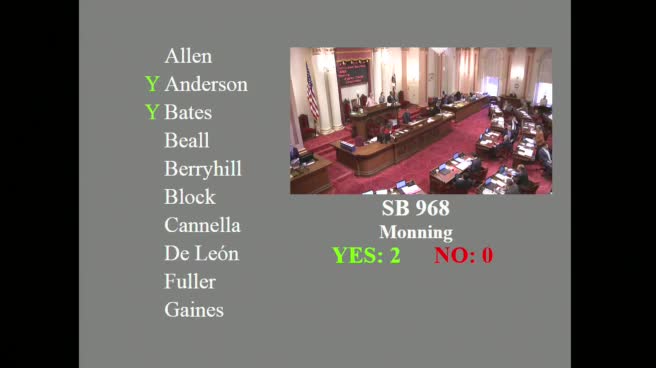 2MIN
Senate Floor
 1MIN
Assembly Floor
 4MIN
Senate Floor
 24MIN
Senate Standing Committee on Judiciary
Bill Author

Bill Co-Author(s):