SB 110: Threats: schools.
- Session Year: 2015-2016
- House: Senate
- Latest Version Date: 2015-08-27
Existing law makes it a crime to willfully threaten to commit a crime that will result in death or great bodily injury to another person, with the specific intent that the statement is to be taken as a threat and which, on its face and under the circumstances in which it is made, is so unequivocal, unconditional, immediate, and specific as to convey to the person threatened a gravity of purpose and an immediate prospect of execution of the threat, and thereby causes that person reasonably to be in sustained fear for his or her own safety or for his or her immediate familys safety. Under existing law, this crime is punishable by imprisonment in a county jail for no more than one year for a misdemeanor, or by imprisonment in state prison for a felony.
This bill would make a person who, by any means, including, but not limited to, by means of an electronic act, willfully threatens unlawful violence to another person to occur upon the grounds of a school, as defined, with specific intent and under certain circumstances, and that threat creates a disruption at the school, guilty of a misdemeanor or felony punishable by imprisonment in a county jail for a specified term. By creating a new crime, this bill would impose a state-mandated local program.
The California Constitution requires the state to reimburse local agencies and school districts for certain costs mandated by the state. Statutory provisions establish procedures for making that reimbursement.
This bill would provide that no reimbursement is required by this act for a specified reason.
Existing law makes it a crime to willfully threaten to commit a crime that will result in death or great bodily injury to another person, with the specific intent that the statement is to be taken as a threat and which, on its face and under the circumstances in which it is made, is so unequivocal, unconditional, immediate, and specific as to convey to the person threatened a gravity of purpose and an immediate prospect of execution of the threat, and thereby causes that person reasonably to be in sustained fear for his or her own safety or for his or her immediate familys safety. Under existing law, this crime is punishable by imprisonment in a county jail for no more than one year for a misdemeanor, or by imprisonment in state prison for a felony.
This bill would make a person who, by any means, including, but not limited to, by means of an electronic act, willfully threatens unlawful violence to occur upon the grounds of a school school, as defined, with specific intent and under certain circumstances circumstances, and that threat creates a disruption at the school, guilty of a misdemeanor, misdemeanor or felony punishable by imprisonment in a county jail for a term not exceeding one year, by a fine of $1,000, or by both that imprisonment and that fine. The bill would also make a person convicted of violating this provision, or adjudged a ward of the juvenile court based upon a violation of this provisions, liable to a public agency for any reasonable costs of that public agencys emergency response to the persons threat. specified term. By creating a new crime, this bill would impose a state-mandated local program.
The California Constitution requires the state to reimburse local agencies and school districts for certain costs mandated by the state. Statutory provisions establish procedures for making that reimbursement.
This bill would provide that no reimbursement is required by this act for a specified reason.
Existing law makes it a crime to willfully threaten to commit a crime that will result in death or great bodily injury to another person, with the specific intent that the statement is to be taken as a threat and which, on its face and under the circumstances in which it is made, is so unequivocal, unconditional, immediate, and specific as to convey to the person threatened a gravity of purpose and an immediate prospect of execution of the threat, and thereby causes that person reasonably to be in sustained fear for his or her own safety or for his or her immediate familys safety.
This bill would also provide that make a person who, by any means, including, but not limited to, by means of an electronic act, threatens unlawful violence to occur upon the grounds of a school under certain circumstances and that threat creates a disruption at the school, shall be punished guilty of a misdemeanor, punishable by imprisonment in a county jail for a term not exceeding one year. year, by a fine of $1,000, or by both that imprisonment and that fine. The bill would also make a person convicted of violating this provision, or adjudged a ward of the juvenile court based upon a violation of this provisions, liable to a public agency for any reasonable costs of that public agencys emergency response to the persons threat. By creating a new crime, this bill would impose a state-mandated local program.
The California Constitution requires the state to reimburse local agencies and school districts for certain costs mandated by the state. Statutory provisions establish procedures for making that reimbursement.
This bill would provide that no reimbursement is required by this act for a specified reason.
Existing law makes it a crime to willfully threaten to commit a crime that will result in death or great bodily injury to another person, with the specific intent that the statement is to be taken as a threat and which, on its face and under the circumstances in which it is made, is so unequivocal, unconditional, immediate, and specific as to convey to the person threatened a gravity of purpose and an immediate prospect of execution of the threat, and thereby causes that person reasonably to be in sustained fear for his or her own safety or for his or her immediate familys safety.
This bill would also provide that a person who, by any means, including, but not limited to, by means of an electronic act, threatens unlawful violence to occur upon the grounds of a school and that threat creates a disruption at the school, shall be punished by imprisonment in the a county jail for a term not exceeding one year. By creating a new crime, this bill would impose a state-mandated local program.
The California Constitution requires the state to reimburse local agencies and school districts for certain costs mandated by the state. Statutory provisions establish procedures for making that reimbursement.
This bill would provide that no reimbursement is required by this act for a specified reason.
Existing law makes it a crime to willfully threaten to commit a crime that will result in death or great bodily injury to another person, with the specific intent that the statement is to be taken as a threat and which, on its face and under the circumstances in which it is made, is so unequivocal, unconditional, immediate, and specific as to convey to the person threatened a gravity of purpose and an immediate prospect of execution of the threat, and thereby causes that person reasonably to be in sustained fear for his or her own safety or for his or her immediate familys safety.
This bill would also provide that a person who, by means of an electronic act, threatens unlawful violence to occur upon the grounds of a school and that threat creates a disruption at the school, shall be punished by imprisonment in the county jail for a term not exceeding one year. By creating a new crime, this bill would impose a state-mandated local program.
The California Constitution requires the state to reimburse local agencies and school districts for certain costs mandated by the state. Statutory provisions establish procedures for making that reimbursement.
This bill would provide that no reimbursement is required by this act for a specified reason.
(a)A person who, by any means, including, but not limited to, by means of an electronic act, willfully threatens unlawful violence to another person that will result in death or great bodily injury to occur upon the grounds of a school, with the specific intent that the statement is to be taken as a threat, even if there is no intent of carrying it out, and where the threat, on its face and under the circumstances in which it is made, is so unequivocal, unconditional, immediate, and specific as to convey a gravity of purpose and an immediate prospect of execution of the threat, and that threat creates a disruption at the school, shall be punished by imprisonment in a county jail for a term not exceeding one year, or by imprisonment pursuant to subdivision (h) of Section 1170.
(b)This section does not preclude or prohibit prosecution under any other law, except that a person shall not be convicted for the same threat under both this section and Section 422.
(c)For purposes of this section, the following terms have the following meanings:
(1)Disruption means interference with peaceful activities of the campus or facility.
(2)Electronic act has the same meaning as in paragraph (2) of subdivision (r) of Section 48900 of the Education Code.
(3)School means a state preschool, a private or public elementary, middle, vocational, junior high, or high school, a community college, a public or private university, or a location where a school-sponsored event is or will be taking place and the threat is related to both the school-sponsored event and to the time period during which the school-sponsored event will occur.
SEC. 2.No reimbursement is required by this act pursuant to Section 6 of Article XIIIB of the California Constitution because the only costs that may be incurred by a local agency or school district will be incurred because this act creates a new crime or infraction, eliminates a crime or infraction, or changes the penalty for a crime or infraction, within the meaning of Section 17556 of the Government Code, or changes the definition of a crime within the meaning of Section 6 of Article XIIIB of the California Constitution.
(a)A person who, by any means, including, but not limited to, by means of an electronic act, willfully threatens unlawful violence to another person that will result in death or great bodily injury to occur upon the grounds of a school, with the specific intent that the statement is to be taken as a threat, even if there is no intent of carrying it out, and where the threat, on its face and under the circumstances in which it is made, is so unequivocal, uncondi tional, unconditional, immediate, and specific as to convey a gravity of purpose and an immediate prospect of execution of the threat, and that threat creates a disruption at the school, shall be punished by imprisonment in a county jail for a term not exceeding one year, or by imprisonment pursuant to subdivision (h) of Section 1170.
(b)This section does not preclude or prohibit prosecution under any other law. law, except that a person shall not be convicted for the same threat under both this section and Section 422.
(c)For purposes of this section, the following terms have the following meanings:
(1)Disruption means interference with peaceful activities of the campus or facility.
(2)Electronic act has the same meaning as in paragraph (2) of subdivision (r) of Section 48900 of the Education Code.
(3)School means a state preschool, a private or public elementary, middle, vocational, junior high, or high school, a community college, a public or private university, or a location where a school-sponsored event is or will be taking place. place and the threat is related to both the school-sponsored event and to the time period during which the school-sponsored event will occur.
SEC. 2.No reimbursement is required by this act pursuant to Section 6 of Article XIIIB of the California Constitution because the only costs that may be incurred by a local agency or school district will be incurred because this act creates a new crime or infraction, eliminates a crime or infraction, or changes the penalty for a crime or infraction, within the meaning of Section 17556 of the Government Code, or changes the definition of a crime within the meaning of Section 6 of Article XIIIB of the California Constitution.
(a)Any A person who, by any means, including, but not limited to, by means of an electronic act, willfully threatens unlawful violence that will result in death or great bodily injury to occur upon the grounds of a school under circumstances where the threat would reasonably be understood as true and the person making the threat knows or should know that the threat would be understood as true, school, with the specific intent that the statement is to be taken as a threat, even if there is no intent of carrying it out, and where the threat, on its face and under the circumstances in which it is made, is so unequivocal, uncondi tional, immediate, and specific as to convey a gravity of purpose and an immediate prospect of execution of the threat, and that threat creates a disruption at the school, is guilty of a misdemeanor, punishable shall be punished by imprisonment in a county jail for a term not exceeding one year, a fine of one thousand dollars ($1,000), or by both that imprisonment and fine. pursuant to subdivision (h) of Section 1170.
(b)A person convicted of violating this section, or adjudged a ward of the juvenile court pursuant to Section 602 of the Welfare and Institutions Code based upon a violation of this section, is liable to a public agency for any reasonable costs of that public agencys emergency response to the persons threat.
(c)
(b)This section does not preclude or prohibit prosecution under any other law.
(d)
(c)For purposes of this section, the following terms have the following meanings:
(1)Disruption means interference with peaceful activities of the campus or facility.
(2)Electronic act has the same meaning as in paragraph (2) of subdivision (r) of Section 48900 of the Education Code.
(3)School means a state preschool or preschool, a private or public elementary, middle, vocational, junior high, or high school. school, a community college, a public or private university, or a location where a school-sponsored event is or will be taking place.
SEC. 2.No reimbursement is required by this act pursuant to Section 6 of Article XIIIB of the California Constitution because the only costs that may be incurred by a local agency or school district will be incurred because this act creates a new crime or infraction, eliminates a crime or infraction, or changes the penalty for a crime or infraction, within the meaning of Section 17556 of the Government Code, or changes the definition of a crime within the meaning of Section 6 of Article XIIIB of the California Constitution.
(a)Each Any person who, by any means, including, but not limited to, by means of an electronic act, threatens unlawful violence to occur upon the grounds of a school under circumstances where the threat would reasonably be understood as true and the person making the threat knows or should know that the threat would be understood as true, and that threat creates a disruption at the school, shall be punished is guilty of a misdemeanor, punishable by imprisonment in a county jail for a term not exceeding one year. year, a fine of one thousand dollars ($1,000), or by both that imprisonment and fine.
(b)A person convicted of violating this section, or adjudged a ward of the juvenile court pursuant to Section 602 of the Welfare and Institutions Code based upon a violation of this section, is liable to a public agency for any reasonable costs of that public agencys emergency response to the persons threat.
(c)This section does not preclude or prohibit prosecution under any other law.
(b)
(d)For purposes of this section, the following terms have the following meanings:
(1)Electronic act has the same meaning as in paragraph (2) of subdivision (r) of Section 48900 of the Education Code.
(2)
(1)Disruption means an act likely to interfere interference with peaceful activities of the campus or facility.
(c)This section does not preclude or prohibit prosecution under any other law.
(2)Electronic act has the same meaning as in paragraph (2) of subdivision (r) of Section 48900 of the Education Code.
(3)School means a state preschool or a private or public elementary, middle, vocational, junior high, or high school.
SEC. 2.No reimbursement is required by this act pursuant to Section 6 of Article XIIIB of the California Constitution because the only costs that may be incurred by a local agency or school district will be incurred because this act creates a new crime or infraction, eliminates a crime or infraction, or changes the penalty for a crime or infraction, within the meaning of Section 17556 of the Government Code, or changes the definition of a crime within the meaning of Section 6 of Article XIIIB of the California Constitution.
(a)Each person who, by any means, including, but not limited to, by means of an electronic act, threatens unlawful violence to occur upon the grounds of a school and that threat creates a disruption at the school, shall be punished by imprisonment in the a county jail for a term not exceeding one year.
(b)For purposes of this section, the following terms have the following meanings:
(1)Electronic act has the same meaning as in paragraph (2) of subdivision (r) of Section 48900 of the Education Code.
(2)Disruption means an act likely to interfere with peaceful activities of the campus or facility.
(c)This section does not preclude or prohibit prosecution under any other law.
SEC. 2.No reimbursement is required by this act pursuant to Section 6 of Article XIIIB of the California Constitution because the only costs that may be incurred by a local agency or school district will be incurred because this act creates a new crime or infraction, eliminates a crime or infraction, or changes the penalty for a crime or infraction, within the meaning of Section 17556 of the Government Code, or changes the definition of a crime within the meaning of Section 6 of Article XIIIB of the California Constitution.
(a)Each person who, by means of an electronic act, threatens unlawful violence to occur upon the grounds of a school and that threat creates a disruption at the school, shall be punished by imprisonment in the county jail for a term not exceeding one year.
(b)For purposes of this section, the following terms have the following meanings:
(1)Electronic act has the same meaning as in paragraph (2) of subdivision (r) of Section 48900 of the Education Code.
(2)Disruption means an act likely to interfere with peaceful activities of the campus or facility.
SEC. 2.No reimbursement is required by this act pursuant to Section 6 of Article XIIIB of the California Constitution because the only costs that may be incurred by a local agency or school district will be incurred because this act creates a new crime or infraction, eliminates a crime or infraction, or changes the penalty for a crime or infraction, within the meaning of Section 17556 of the Government Code, or changes the definition of a crime within the meaning of Section 6 of Article XIIIB of the California Constitution.
|
Date
|
Status
|
|---|---|
| Aug 25, 2015 | Ordered to special consent calendar. |
| Jul 9, 2015 | Read second time. Ordered to consent calendar. |
| Jul 16, 2015 | From consent calendar by Assembly Member Waldron. |
| Jul 16, 2015 | Ordered to third reading. |
| Aug 17, 2015 | Ordered to third reading. |
| Aug 17, 2015 | Read third time and amended. |
| Aug 20, 2015 | In Senate. Concurrence in Assembly amendments pending. |
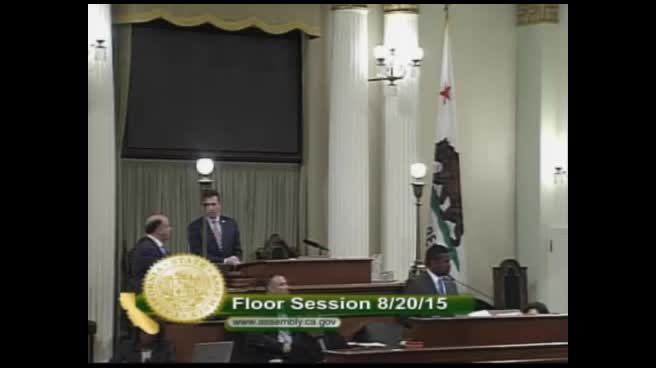
| Aug 20, 2015 | Read third time. Passed. Ordered to the Senate. |
| Aug 20, 2015 | Read third time. Passed. (Ayes 75. Noes 3. Page 2528.) Ordered to the Senate. |
| Jul 8, 2015 | From committee: Do pass. Ordered to consent calendar. (Ayes 14. Noes 0.) (July 8). |
| Aug 27, 2015 | Assembly amendments concurred in. (Ayes 40. Noes 0. Page 2205.) Ordered to engrossing and enrolling. |
| Aug 27, 2015 | Assembly amendments concurred in. (Ayes 40. Noes 0.) Ordered to engrossing and enrolling. |
| Aug 28, 2015 | Enrolled and presented to the Governor at 3:45 p.m. |
| Sep 8, 2015 | In Senate. Consideration of Governor's veto pending. |
| Sep 8, 2015 | Vetoed by the Governor. |
| Sep 9, 2015 | In Senate. Consideration of Governor's veto pending. |
| Apr 19, 2016 | Last day to consider Governors veto pursuant to Joint Rule 58.5. |
| Apr 19, 2016 | Last day to consider Governor’s veto pursuant to Joint Rule 58.5. |
| May 1, 2015 | Set for hearing May 11. |
| Jan 12, 2015 | From printer. May be acted upon on or after February 11. |
| Jan 12, 2015 | Read first time. |
| Feb 5, 2015 | Referred to Com. on PUB. S. |
| Feb 18, 2015 | From committee with author's amendments. Read second time and amended. Re-referred to Com. on PUB. S. |
| Mar 11, 2015 | Set for hearing April 14. |
| Apr 22, 2015 | From committee: Do pass as amended and re-refer to Com. on APPR. (Ayes 6. Noes 0. Page 594.) (April 14). |
| Apr 22, 2015 | From committee: Do pass as amended and re-refer to Com. on APPR. (Ayes 6. Noes 0.) (April 14). |
| Apr 23, 2015 | Read second time and amended. Re-referred to Com. on APPR. |
| Jan 9, 2015 | Introduced. To Com. on RLS. for assignment. To print. |
| May 11, 2015 | From committee: Be ordered to second reading pursuant to Senate Rule 28.8. |
| May 12, 2015 | Read second time. Ordered to third reading. |
| May 18, 2015 | In Assembly. Read first time. Held at Desk. |
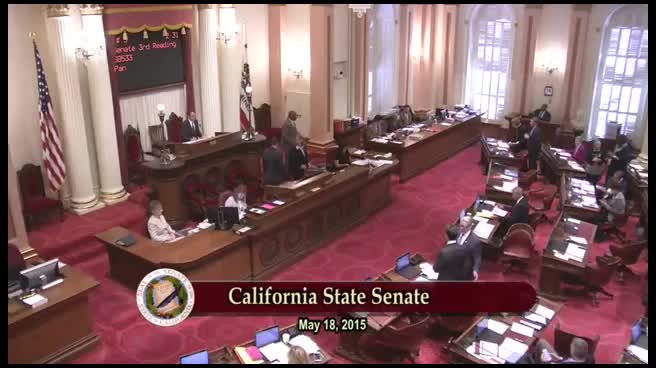
| May 18, 2015 | Read third time. Passed. (Ayes 36. Noes 0. Page 1020.) Ordered to the Assembly. |
| May 18, 2015 | Read third time. Passed. (Ayes 36. Noes 0.) Ordered to the Assembly. |
| May 28, 2015 | Referred to Com. on PUB. S. |
| Jun 23, 2015 | From committee with author's amendments. Read second time and amended. Re-referred to Com. on PUB. S. |
| Jul 1, 2015 | From committee: Do pass and re-refer to Com. on APPR. (Ayes 7. Noes 0.) (June 30). Re-referred to Com. on APPR. |
|
Date
|
Description
|
Location
|
Votes
|
|
|---|---|---|---|---|
| Aug 27, 2015 | Special Consent #7 SB110 Fuller | Senate Floor |
Passed |
|
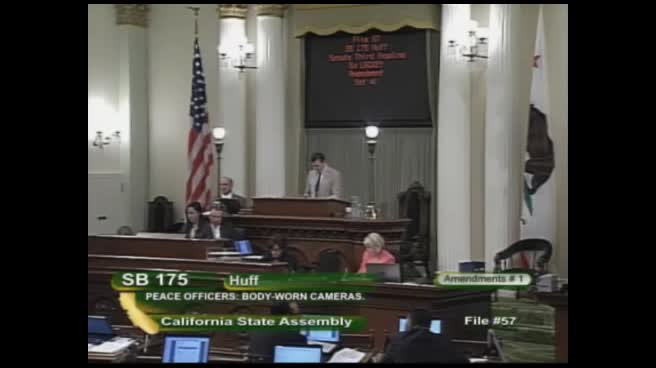
| Aug 20, 2015 | SB 110 Fuller Senate Third Reading By WALDRON | Assembly Floor |
Passed |
|
| Jul 8, 2015 | Do pass. To Consent Calendar. | Assembly Standing Committee on Appropriations |
Passed |
|
| Jun 30, 2015 | Do pass and be re-referred to the Committee on [Appropriations] | Assembly Standing Committee on Public Safety |
Passed |
|
| May 18, 2015 | Senate 3rd Reading SB110 Fuller | Senate Floor |
Passed |
|
| Apr 14, 2015 | Do pass as amended, but first amend, and re-refer to the Committee on [Appropriations] | Senate Standing Committee on Public Safety |
Passed |
This list shows positions taken on this bill by organizations on the date displayed, which is linked to the original source.
Positions by individuals are not included.
|
Organization
|
Position
|
Date
|
|---|---|---|
| American Civil Liberties Union of California | ** Against | Aug 17, 2015 |
| Bakersfield Police Department | ** Support | May 18, 2015 |
| California State Sheriffs' Association | ** Support | Aug 17, 2015 |
| Crime Victims Action Alliance | ** Support | Aug 17, 2015 |
| Kern County District Attorney's Office | ** Support | May 18, 2015 |
| Kern County Office of the District Attorney | ** Support | Aug 17, 2015 |
| Los Angeles Unified School District | ** Support | Aug 17, 2015 |
| Police Chief, City of Bakersfield | ** Support | Aug 17, 2015 |
SB 110
Page 6
|
Office of Senate Floor Analyses (916) 651-1520 Fax: (916) 327-4478 |
SB 110 |
VETO
Bill No: SB 110
Amended: 8/17/15
SENATE PUBLIC SAFETY COMMITTEE: 6-0, 4/14/15
AYES: Hancock, Anderson, Leno, McGuire, Monning, Stone
NO VOTE RECORDED: Liu
SENATE APPROPRIATIONS COMMITTEE: Senate Rule 28.8
SENATE FLOOR: 36-0, 5/18/15
AYES: Allen, Anderson, Bates, Beall, Block, Cannella, De León, Fuller, Gaines, Galgiani, Hancock, Hernandez, Hertzberg, Hill, Hueso, Huff, Jackson, Lara, Leno, Leyva, Liu, McGuire, Mendoza, Mitchell, Monning, Moorlach, Morrell, Nguyen, Nielsen, Pan, Roth, Runner, Stone, Vidak, Wieckowski, Wolk
NO VOTE RECORDED: Berryhill, Hall, Pavley
SENATE FLOOR: 40-0, 8/27/15
AYES: Allen, Anderson, Bates, Beall, Berryhill, Block, Cannella, De León, Fuller, Gaines, Galgiani, Glazer, Hall, Hancock, Hernandez, Hertzberg, Hill, Hueso, Huff, Jackson, Lara, Leno, Leyva, Liu, McGuire, Mendoza, Mitchell, Monning, Moorlach, Morrell, Nguyen, Nielsen, Pan, Pavley, Roth, Runner, Stone, Vidak, Wieckowski, Wolk
ASSEMBLY FLOOR: 75-3, 8/20/15 - See last page for vote
SOURCE: Bakersfield Police Department
DIGEST: This bill enacts a new misdemeanor for threatening unlawful violence to another person on a school campus or at a school-sponsored event, as specified.
Existing law:
Provides that “any person who willfully threatens to commit a crime which will result in death or great bodily injury to another person, with the specific intent that the statement, made verbally, in writing, or by means of an electronic communication device, is to be taken as a threat, even if there is no intent of actually carrying it out, which, on its face and under the circumstances in which it is made, is so unequivocal, unconditional, immediate, and specific as to convey to the person threatened, a gravity of purpose and an immediate prospect of execution of the threat, and thereby causes that person reasonably to be in sustained fear for his or her own safety or for his or her immediate family’s safety, shall be punished by imprisonment in the county jail not to exceed one year, or by imprisonment in the state prison.” (Penal Code § 422).
Provides that every student or employee who, after a hearing, has been suspended or dismissed from a school and who willfully and knowingly enters upon the campus or facility to which he or she has been denied access is guilty of a misdemeanor. (Penal Code § 626.2)
This bill:
Enacts a new crime to provide that anyone who willfully threatens unlawful violence to another person by any means, including through an electronic act, to occur upon school grounds or a location where a school-sponsored event is or will be taking place and the threat is related both to the school-sponsored event and to the time period in which the school-sponsored event will be taking place, with the specific intent that the statement is to be taken as a threat, even if there is no intent of carrying it out, and where the threat, on its face and under the circumstances in which it is made, is so unequivocal, unconditional, immediate, and specific as to convey a gravity of purpose and an immediate prospect of execution of the threat, shall be punished by imprisonment in a county jail for a period not exceeding one year, or by imprisonment, as specified.
Defines “disruption” to mean an act likely to interfere with peaceful activities of the campus or facility.
Defines “school” to mean a state preschool, a private or public elementary, middle, vocational, junior high, or high school, a community college, a public or private university, or a location where a school-sponsored event is or will be taking place.
Provides that its provisions not preclude or prohibit prosecution under any other law, except that a person shall not be convicted for the same threat under Section 422.2 and Section 422 of the Penal Code
Background
Recent media reports have described numerous incidents involving school threats. For example, in San Diego:
…[T]here were 5 percent more suspensions and expulsions in San Diego County related to making terrorist threats in the 2013-14 school year than in the previous school year, and 35 percent more than in the 2011-12 school year. Threats typically surface on social media or are made via phone or email. Once school officials learn of it, police are called in to investigate, and a school might get locked down, with everyone on campus kept behind locked doors until the coast is clear. That could take hours.
Students from high school campuses in Oceanside, San Diego, El Cajon and San Marcos, have been arrested on suspicion of using the app to threaten schools.
The CEO, Jonathan Lucas, said recent changes to the app make it “very clear” that threats of violence and bullying won’t be tolerated. He said users are asked to carefully consider the contents of their posts and are even shown their IP addresses. He said the company has been cooperating with all law enforcement investigations and has a quick process in place to help investigators locate users who commit crimes. (Winkley, Lyndsay, and Pat Maio. “Online Schools Threats Up; Officials Crack down.” U-T San Diego. N.p., 22 Mar. 2015. Web. 07 Apr. 2015.)
Similarly, in Los Angeles, an 11th grade student was arrested for making threats through the social media app, Burnbook, against a Los Angeles County high school. Investigators were informed that the student had published the threat online and was taken into custody the following day. He was charged with making criminal threats after he confessed to threatening to bring a weapon to school. The student told deputies that he was making jokes. (“Student Arrested after Social Media Threats against School.” Student Arrested following Threats on Social Media against Los Angeles County School. The Associated Press, 12 Mar. 2015. Web. 07 Apr. 2015.)
This
bill has been narrowed through the process to address 1st Amendment
concerns. Constitutional principles required to impose crime
penalties for a threat, are that it must be with “specific intent
that the statement is to be taken as a threat, even if there is no
intent of carrying it out, and where the threat, on its face and
under the circumstances in which it is made, is so unequivocal,
unconditional, immediate, and specific as to convey a gravity of
purpose and an immediate prospect of execution of the threat.”
FISCAL EFFECT: Appropriation: No Fiscal Com.: Yes Local: Yes
SUPPORT: (Verified 10/26/15)
Bakersfield Police Department (source)
California State Sheriffs’ Association
City of Bakersfield Office of the Chief of Police
Kern County District Attorney’s Office
Kern County Superintendent of Schools
OPPOSITION: (Verified 10/26/15)
American Civil Liberties Union
Legal Services for Prisoners with Children
National Center for Youth Law
Public Counsel
Youth Law Center
ARGUMENTS IN SUPPORT: The author writes:
The threat of violence in California schools and colleges through social media or other electronic communication is a problem. These threats not only instill fear and force the cancellation of classes and building closures, but they can cost school districts considerable funds. This includes the cost to investigate and prosecute perpetrators, to hire additional safety personnel to observe student activities and websites, and to purchase surveillance equipment to monitor non-classroom areas. The impact expands beyond the incidence, and hinders the learning environment.
Roughly 30% of violent threats made against schools were delivered through social media, email, text messaging and other electronic means from August 2013 to January 2014. It is believed this percentage has increased and will continue to rise. These electronic threats include school bomb threats, shooting threats, hoaxes, and acts of violence.
ARGUMENTS IN OPPOSITION: Opponents argue generally that minors should be disciplined through community-based services as an alternative to incarceration. Youth exposure to the criminal justice system heightens the likelihood that youth offenders will recidivate in adulthood. Additionally Penal Code Section 422 addresses threat crimes which include those made through electronic means.
GOVERNOR'S VETO MESSAGE:
I am returning Senate Bill 110 without my signature.
No one could be anything but intolerant of threats to cause great bodily injury, especially on school grounds. Certainly not legislators, who voted nearly unanimously for this bill.
While I'm sympathetic and utterly committed to ensuring maximum safety for California's school children, the offensive conduct covered by this bill is already illegal.
In recent decades, California has created an unprecedented number of new and detailed criminal laws. Before we keep enacting more, I think we should pause and reflect on the fact that our bulging criminal code now contains in excess of 5,000 separate provisions, covering almost every conceivable form of human misbehavior.
ASSEMBLY FLOOR: 75-3, 8/20/15
AYES: Achadjian, Alejo, Travis Allen, Baker, Bigelow, Bloom, Bonilla, Bonta, Brough, Brown, Burke, Calderon, Campos, Chang, Chau, Chávez, Chiu, Cooley, Cooper, Dababneh, Dahle, Daly, Dodd, Eggman, Frazier, Beth Gaines, Gallagher, Cristina Garcia, Eduardo Garcia, Gatto, Gipson, Gomez, Gordon, Gray, Grove, Hadley, Harper, Roger Hernández, Holden, Irwin, Jones, Jones-Sawyer, Kim, Lackey, Levine, Linder, Lopez, Low, Maienschein, Mathis, Mayes, McCarty, Medina, Melendez, Mullin, Nazarian, Obernolte, O'Donnell, Olsen, Patterson, Perea, Quirk, Ridley-Thomas, Rodriguez, Salas, Santiago, Steinorth, Thurmond, Wagner, Waldron, Weber, Wilk, Williams, Wood, Atkins
NOES: Gonzalez, Mark Stone, Ting
NO VOTE RECORDED: Chu, Rendon
Prepared by: Linda Tenerowicz / PUB. S. /
11/4/15 13:34:21
**** END ****
SB 110
Page 5
|
Office of Senate Floor Analyses (916) 651-1520 Fax: (916) 327-4478 |
UNFINISHED BUSINESS
Bill No: SB 110
Amended: 8/17/15
SENATE PUBLIC SAFETY COMMITTEE: 6-0, 4/14/15
AYES: Hancock, Anderson, Leno, McGuire, Monning, Stone
NO VOTE RECORDED: Liu
SENATE APPROPRIATIONS COMMITTEE: Senate Rule 28.8
SENATE FLOOR: 36-0, 5/18/15
AYES: Allen, Anderson, Bates, Beall, Block, Cannella, De León, Fuller, Gaines, Galgiani, Hancock, Hernandez, Hertzberg, Hill, Hueso, Huff, Jackson, Lara, Leno, Leyva, Liu, McGuire, Mendoza, Mitchell, Monning, Moorlach, Morrell, Nguyen, Nielsen, Pan, Roth, Runner, Stone, Vidak, Wieckowski, Wolk
NO VOTE RECORDED: Berryhill, Hall, Pavley
ASSEMBLY FLOOR: 75-3, 8/20/15 - See last page for vote
SOURCE: Bakersfield Police Department
DIGEST: This bill enacts a new misdemeanor for threatening unlawful violence to another person on a school campus or at a school-sponsored event, as specified.
Assembly Amendments (1) specify that no person shall be convicted for the same threat under both Sections 422 and 422.2 of the Penal Code and that a threat made at a school-sponsored event must be related to both the school-sponsored event and to the time period in which the school-sponsored event will occur; and (2) make technical changes.
Existing law:
Provides that “any person who willfully threatens to commit a crime which will result in death or great bodily injury to another person, with the specific intent that the statement, made verbally, in writing, or by means of an electronic communication device, is to be taken as a threat, even if there is no intent of actually carrying it out, which, on its face and under the circumstances in which it is made, is so unequivocal, unconditional, immediate, and specific as to convey to the person threatened, a gravity of purpose and an immediate prospect of execution of the threat, and thereby causes that person reasonably to be in sustained fear for his or her own safety or for his or her immediate family’s safety, shall be punished by imprisonment in the county jail not to exceed one year, or by imprisonment in the state prison.” (Penal Code § 422).
Provides that every student or employee who, after a hearing, has been suspended or dismissed from a school and who willfully and knowingly enters upon the campus or facility to which he or she has been denied access is guilty of a misdemeanor. (Penal Code § 626.2)
This bill:
Enacts a new crime to provide that anyone who willfully threatens unlawful violence to another person by any means, including through an electronic act, to occur upon school grounds or a location where a school-sponsored event is or will be taking place and the threat is related both to the school-sponsored event and to the time period in which the school-sponsored event will be taking place, with the specific intent that the statement is to be taken as a threat, even if there is no intent of carrying it out, and where the threat, on its face and under the circumstances in which it is made, is so unequivocal, unconditional, immediate, and specific as to convey a gravity of purpose and an immediate prospect of execution of the threat, shall be punished by imprisonment in a county jail for a period not exceeding one year, or by imprisonment, as specified.
Defines “disruption” to mean an act likely to interfere with peaceful activities of the campus or facility.
Defines “school” to mean a state preschool, a private or public elementary, middle, vocational, junior high, or high school, a community college, a public or private university, or a location where a school-sponsored event is or will be taking place.
Provides that its provisions not preclude or prohibit prosecution under any other law, except that a person shall not be convicted for the same threat under Section 422.2 and Section 422 of the Penal Code.
Background
Recent media reports have described numerous incidents involving school threats. For example, in San Diego:
…[T]here were 5 percent more suspensions and expulsions in San Diego County related to making terrorist threats in the 2013-14 school year than in the previous school year, and 35 percent more than in the 2011-12 school year. Threats typically surface on social media or are made via phone or email. Once school officials learn of it, police are called in to investigate, and a school might get locked down, with everyone on campus kept behind locked doors until the coast is clear. That could take hours.
Students from high school campuses in Oceanside, San Diego, El Cajon and San Marcos, have been arrested on suspicion of using the app to threaten schools.
The CEO, Jonathan Lucas, said recent changes to the app make it “very clear” that threats of violence and bullying won’t be tolerated. He said users are asked to carefully consider the contents of their posts and are even shown their IP addresses. He said the company has been cooperating with all law enforcement investigations and has a quick process in place to help investigators locate users who commit crimes. (Winkley, Lyndsay, and Pat Maio. “Online Schools Threats Up; Officials Crack down.” U-T San Diego. N.p., 22 Mar. 2015. Web. 07 Apr. 2015.)
Similarly, in Los Angeles, an 11th grade student was arrested for making threats through the social media app, Burnbook, against a Los Angeles County high school. Investigators were informed that the student had published the threat online and was taken into custody the following day. He was charged with making criminal threats after he confessed to threatening to bring a weapon to school. The student told deputies that he was making jokes. (“Student Arrested after Social Media Threats against School.” Student Arrested following Threats on Social Media against Los Angeles County School. The Associated Press, 12 Mar. 2015. Web. 07 Apr. 2015.)
This
bill has been narrowed through the process to address 1st Amendment
concerns. Constitutional principles required to impose crime
penalties for a threat, are that it must be with “specific intent
that the statement is to be taken as a threat, even if there is no
intent of carrying it out, and where the threat, on its face and
under the circumstances in which it is made, is so unequivocal,
unconditional, immediate, and specific as to convey a gravity of
purpose and an immediate prospect of execution of the threat.”
FISCAL EFFECT: Appropriation: No Fiscal Com.: Yes Local: Yes
Bakersfield Police Department (source)
California State Sheriffs’ Association
City of Bakersfield Office of the Chief of Police
Kern County District Attorney’s Office
Kern County Superintendent of Schools
OPPOSITION: (Verified 8/20/15)
American Civil Liberties Union
Legal Services for Prisoners with Children
National Center for Youth Law
Youth Law Center
ARGUMENTS IN SUPPORT: The author writes:
The threat of violence in California schools and colleges through social media or other electronic communication is a problem. These threats not only instill fear and force the cancellation of classes and building closures, but they can cost school districts considerable funds. This includes the cost to investigate and prosecute perpetrators, to hire additional safety personnel to observe student activities and websites, and to purchase surveillance equipment to monitor non-classroom areas. The impact expands beyond the incidence, and hinders the learning environment.
Roughly 30% of violent threats made against schools were delivered through social media, email, text messaging and other electronic means from August 2013 to January 2014. It is believed this percentage has increased and will continue to rise. These electronic threats include school bomb threats, shooting threats, hoaxes, and acts of violence.
ARGUMENTS IN OPPOSITION: Opponents argue generally that minors should be disciplined through community-based services as an alternative to incarceration. Youth exposure to the criminal justice system heightens the likelihood that youth offenders will recidivate in adulthood. Additionally Penal Code Section 422 addresses threat crimes which include those made through electronic means.
ASSEMBLY FLOOR: 75-3, 8/20/15
AYES: Achadjian, Alejo, Travis Allen, Baker, Bigelow, Bloom, Bonilla, Bonta, Brough, Brown, Burke, Calderon, Campos, Chang, Chau, Chávez, Chiu, Cooley, Cooper, Dababneh, Dahle, Daly, Dodd, Eggman, Frazier, Beth Gaines, Gallagher, Cristina Garcia, Eduardo Garcia, Gatto, Gipson, Gomez, Gordon, Gray, Grove, Hadley, Harper, Roger Hernández, Holden, Irwin, Jones, Jones-Sawyer, Kim, Lackey, Levine, Linder, Lopez, Low, Maienschein, Mathis, Mayes, McCarty, Medina, Melendez, Mullin, Nazarian, Obernolte, O'Donnell, Olsen, Patterson, Perea, Quirk, Ridley-Thomas, Rodriguez, Salas, Santiago, Steinorth, Thurmond, Wagner, Waldron, Weber, Wilk, Williams, Wood, Atkins
NOES: Gonzalez, Mark Stone, Ting
NO VOTE RECORDED: Chu, Rendon
Prepared by: Linda Tenerowicz / PUB. S. /
8/21/15 14:02:32
**** END ****
SB 110
Page 3
SENATE THIRD READING
SB 110
(Fuller)
As Amended August 17, 2015
Majority vote
SENATE VOTE: 36-0
Committee |
Votes |
Ayes |
Noes |
Public Safety |
7-0 |
Quirk, Melendez, Jones-Sawyer, Lackey, Lopez, Low, Santiago |
|
Appropriations |
14-0 |
Gomez, Bigelow, Bloom, Bonta, Calderon, Chang, Eggman, Gallagher, Eduardo Garcia, Jones, Quirk, Rendon, Weber, Wood |
|
SUMMARY: Makes it an alternate felony-misdemeanor offense for any person to willfully threaten unlawful violence that will result in death or great bodily injury to occur on the grounds of a school, as defined, where the threat creates a disruption at the school. Specifically, this bill:
Provides that any person who, by any means, including, but not limited to, by means of an electronic act, willfully threatens unlawful violence to another person that will result in death or great bodily injury to occur upon the grounds of a school with the specific intent that the statement be taken as a threat, even if there is no intent of carrying it out, and where the threat, on its face and under the circumstances in which it is made, is so unequivocal, unconditional, immediate, and specific as to convey a gravity of purpose and an immediate prospect of execution of the threat, and that threat creates a disruption at the school, is guilty of a misdemeanor or a county-jail eligible felony.
Specifies that this bill does not preclude or prohibit prosecution under any other law, except that a person shall not be convicted for the same threat under both the provisions in this bill and the existing section that prohibits criminal threats.
Defines "disruption" as an interference with peaceful activities of the campus or facility.
Provides that "electronic act" has the same meaning as is found in relevant sections of the Education Code.
Defines "school" to mean a state preschool, a private or public elementary, middle, vocational, junior high, or high school, a community college, a public or private university, or a location where a school-sponsored event is or will be taking place and the threat is related to both the school-sponsored event and to the time period during which the school-sponsored event will occur.
EXISTING LAW:
States that any person who willfully threatens to commit a crime which will result in death or great bodily injury to another person, with the specific intent that the statement, made verbally, in writing, or by means of an electronic communication device, is to be taken as a threat, even if there is no intent of actually carrying it out, which, on its face and under the circumstances in which it is made, is so unequivocal, unconditional, immediate, and specific as to convey to the person threatened, a gravity of purpose and an immediate prospect of execution of the threat, and thereby causes that person reasonably to be in sustained fear for his or her own safety or for his or her immediate family's safety, shall be punished by imprisonment in the county jail not to exceed one year, or by imprisonment in the state prison.
States that any person who knowingly and willingly threatens the life of, or threatens serious bodily harm to, any elected public official, as specified, or the staff or immediate family of any of the specified elected public officials, with the specific intent that the statement is to be taken as a threat, and the apparent ability to carry out that threat by any means, is guilty of a public offense, punishable as either a misdemeanor or felony, as specified.
Provides that any person who knowingly threatens to use a weapon of mass destruction with the specific intent that the statement as defined or a statement made by means of an electronic communication device, is to be taken as a threat, even if there is no intent of actually carrying it out, which on its face and under the circumstances in which it is made, is so unequivocal, immediate, and specific as to convey to the person threatened, a gravity of purpose and an immediate prospect of execution of the threat, and thereby causes that person reasonably to be in sustained fear for his or her own safety shall be punished by either a misdemeanor or felony, as specified.
FISCAL EFFECT: According to the Assembly Appropriations Committee:
Likely minor General Fund costs for increased state prison commitments for persons with a current or prior violent felony conviction who are convicted for a felony under the provisions of this bill. The universe of these individuals is expected to be very small. Assuming the annual contracted bed rate of $29,000 per inmate, the annual General Fund costs would be $29,000 per each additional year served under such conviction.
Moderate nonreimbursable local costs for incarceration for misdemeanor convictions or for felony convictions of individuals without a current or prior violent felony.
COMMENTS: According to the author, "The threat of violence in California schools and colleges through social media or other electronic communication is a problem. These threats not only instill fear and force the cancellation of classes and building closures, but they can cost school districts considerable funds. This includes the cost to investigate and prosecute perpetrators, to hire additional safety personnel to observe student activities and websites, and to purchase surveillance equipment to monitor non-classroom areas. The impact expands beyond the incidence, and hinders the learning environment.
"Roughly 30% of violent threats made against schools were delivered through social media, email, text messaging and other electronic means from August 2013 to January 2014. It is believed this percentage has increased and will continue to rise. These electronic threats include school bomb threats, shooting threats, hoaxes, and acts of violence.
"SB 110 simply assists law enforcement and the courts by holding those accountable who make violent threats against a school by an electronic act, when those threats interfere with the activities of the campus or facility.
"SB 110 is needed to address a new trend and to update our Penal Code to reflect modern technology. SB 110 will protect our children and hold individuals accountable who have stricken fear and confusion into our classrooms."
Analysis Prepared by: Stella Choe / PUB. S. / (916) 319-3744 FN: 0001322
SB 110
Page 3
SENATE THIRD READING
SB 110
(Fuller)
As Amended June 23, 2015
Majority vote
SENATE VOTE: 36-0
Committee |
Votes |
Ayes |
Noes |
Public Safety |
7-0 |
Quirk, Melendez, Jones-Sawyer, Lackey, Lopez, Low, Santiago |
|
Appropriations |
14-0 |
Gomez, Bigelow, Bloom, Bonta, Calderon, Chang, Eggman, Gallagher, Eduardo Garcia, Jones, Quirk, Rendon, Weber, Wood |
|
SUMMARY: Makes it an alternate felony-misdemeanor offense for any person to willfully threaten unlawful violence that will result in death or great bodily injury to occur on the grounds of a school, as defined, where the threat creates a disruption at the school. Specifically, this bill:
Provides that any person who, by any means, including, but not limited to, by means of an electronic act, willfully threatens unlawful violence that will result in death or great bodily injury to occur upon the grounds of a school with the specific intent that the statement be taken as a threat, even if there is no intent of carrying it out, and where the threat, on its face and under the circumstances in which it is made, is so unequivocal, unconditional, immediate, and specific as to convey a gravity of purpose and an immediate prospect of execution of the threat, and that threat creates a disruption at the school, is guilty of a misdemeanor or a county-jail eligible felony.
Specifies that this bill does not preclude or prohibit prosecution under any other law.
Defines "disruption" as an interference with peaceful activities of the campus or facility.
Provides that "electronic act" has the same meaning as is found in relevant sections of the Education Code.
Defines "school" to mean a state preschool, a private or public elementary, middle, vocational, junior high, or high school, a community college, a public or private university, or a location where a school-sponsored event is or will be taking place.
EXISTING LAW:
States that any person who willfully threatens to commit a crime which will result in death or great bodily injury to another person, with the specific intent that the statement, made verbally, in writing, or by means of an electronic communication device, is to be taken as a threat, even if there is no intent of actually carrying it out, which, on its face and under the circumstances in which it is made, is so unequivocal, unconditional, immediate, and specific as to convey to the person threatened, a gravity of purpose and an immediate prospect of execution of the threat, and thereby causes that person reasonably to be in sustained fear for his or her own safety or for his or her immediate family's safety, shall be punished by imprisonment in the county jail not to exceed one year, or by imprisonment in the state prison.
States that any person who knowingly and willingly threatens the life of, or threatens serious bodily harm to, any elected public official, as specified, or the staff or immediate family of any of the specified elected public officials, with the specific intent that the statement is to be taken as a threat, and the apparent ability to carry out that threat by any means, is guilty of a public offense, punishable as either a misdemeanor or felony, as specified.
Provides that any person who knowingly threatens to use a weapon of mass destruction with the specific intent that the statement as defined or a statement made by means of an electronic communication device, is to be taken as a threat, even if there is no intent of actually carrying it out, which on its face and under the circumstances in which it is made, is so unequivocal, immediate, and specific as to convey to the person threatened, a gravity of purpose and an immediate prospect of execution of the threat, and thereby causes that person reasonably to be in sustained fear for his or her own safety shall be punished by either a misdemeanor or felony, as specified.
FISCAL EFFECT: According to the Assembly Appropriations Committee:
Likely minor General Fund costs for increased state prison commitments for persons with a current or prior violent felony conviction who are convicted for a felony under the provisions of this bill. The universe of these individuals is expected to be very small. Assuming the annual contracted bed rate of $29,000 per inmate, the annual General Fund costs would be $29,000 per each additional year served under such conviction.
Moderate nonreimbursable local costs for incarceration for misdemeanor convictions or for felony convictions of individuals without a current or prior violent felony.
COMMENTS: According to the author, "The threat of violence in California schools and colleges through social media or other electronic communication is a problem. These threats not only instill fear and force the cancellation of classes and building closures, but they can cost school districts considerable funds. This includes the cost to investigate and prosecute perpetrators, to hire additional safety personnel to observe student activities and Web sites, and to purchase surveillance equipment to monitor non-classroom areas. The impact expands beyond the incidence, and hinders the learning environment.
"Roughly 30% of violent threats made against schools were delivered through social media, email, text messaging and other electronic means from August 2013 to January 2014. It is believed this percentage has increased and will continue to rise. These electronic threats include school bomb threats, shooting threats, hoaxes, and acts of violence.
"SB 110 simply assists law enforcement and the courts by holding those accountable who make violent threats against a school by an electronic act, when those threats interfere with the activities of the campus or facility.
"SB 110 is needed to address a new trend and to update our Penal Code to reflect modern technology. SB 110 will protect our children and hold individuals accountable who have stricken fear and confusion into our classrooms."
Analysis Prepared by: Stella Choe / PUB. S. / (916) 319-3744 FN: 0001266
Date of Hearing: July 8, 2015
ASSEMBLY COMMITTEE ON APPROPRIATIONS
Jimmy Gomez, Chair
SB 110
(Fuller) – As Amended June 23, 2015
Policy Committee: |
Public Safety |
Vote: |
7 - 0 |
|
|
|
|
|
|
|
|
Urgency: No State Mandated Local Program: Yes Reimbursable: No
SUMMARY:
This bill makes it an alternate felony-misdemeanor, punishable by up to one year in county jail, or prison if the individual has a prior qualifying felony, for any person to willfully threaten unlawful violence that will result in death or great bodily injury on the grounds of a school, as defined, where the threat creates a disruption at the school.
FISCAL EFFECT:
Likely minor GF costs for increased state prison commitments for persons with a current or prior violent felony conviction who are convicted for a felony under the provisions of this bill. The universe of these individuals is expected to be very small. Assuming the annual contracted bed rate of $29,000 per inmate, the annual General Fund costs would be $29,000 per each additional year served under such conviction.
Moderate nonreimbursable local costs for incarceration for misdemeanor convictions or for felony convictions of individuals without a current or prior violent felony.
COMMENTS:
Purpose. According to the author, "The threat of violence in California schools and colleges through social media or other electronic communication is a problem. These threats not only instill fear and force the cancellation of classes and building closures, but they can cost school districts considerable funds. This includes the cost to investigate and prosecute perpetrators, to hire additional safety personnel to observe student activities and websites, and to purchase surveillance equipment to monitor non-classroom areas. The impact expands beyond the incidence, and hinders the learning environment.
"Roughly 30% of violent threats made against schools were delivered through social media, email, text messaging and other electronic means from August 2013 to January 2014. It is believed this percentage has increased and will continue to rise. These electronic threats include school bomb threats, shooting threats, hoaxes, and acts of violence.
"SB 110 simply assists law enforcement and the courts by holding those accountable who make violent threats against a school by an electronic act, when those threats interfere with the activities of the campus or facility.
"SB 110 is needed to address a new trend and to update our Penal Code to reflect modern technology. SB 110 will protect our children and hold individuals accountable who have stricken fear and confusion into our classrooms."
Background. Under current law, any person who willfully threatens to commit a crime that will result in death or great bodily injury to another person, with the specific intent that the statement, made verbally, in writing, or by means of an electronic communication device, is to be taken as a threat, even if there is no intent of actually carrying it out, which, on its face and under the circumstances in which it is made, is so unequivocal, unconditional, immediate, and specific as to convey to the person threatened, a gravity of purpose and an immediate prospect of execution of the threat, and thereby causes that person reasonably to be in sustained fear for his or her own safety or for his or her immediate family’s safety, shall be punished by imprisonment in the county jail not to exceed one year, or by imprisonment in the state prison.
This bill provides that any person who, by any means, including, but
not limited to, by means of an electronic act, willfully threatens
unlawful violence to occur upon the grounds of a school, as defined,
with the specific intent that the statement be taken as a
threat, even if there is no intent of carrying it out, and where the
threat, on its face and under the circumstances in which it is made,
is so unequivocal, unconditional, immediate, and specific as to
convey a gravity of purpose and an immediate prospect of execution of
the threat, and that threat creates a disruption at the school, is
guilty of a misdemeanor or a county-jail eligible felony, or a state
prison incarceration if the individual has a current or prior violent
felony conviction.
Argument in Support: According to the Kern County Office of the District Attorney, "Over the last year, the Juvenile Division of the Kern County District Attorney's Office reviewed several instances of electronically transmitted threats. Many of these threats were communication from suspects directly to victims via text messages or Facebook. These types of threats could typically be addressed utilizing the provisions of the Penal Code section 422. However, our office has also reviewed a new category of electronic threats that are communicated from suspects to a broad audience via social media. These communications typically threaten mass school violence. Unfortunately, there is currently no statute on the books that specifically addresses this type of behavior. We believe that as technology evolves, it is important for the law enforcement community to evolve along with it, in order to ensure that every reasonable effort is expended to safeguard our communities."
Argument in Opposition: According to the Pacific Juvenile Defender Center, "Instead of arresting them and placing them in the juvenile justice system, we can better serve youth by investing in alternative programs that hold them accountable and also have been shown to increase school safety. "
Related Legislation: SB 456 (Block), also on today's agenda, enacts a new alternate felony-misdemeanor for a threat to discharge a firearm on the grounds of a school or when a school event is taking place, punishable by up to one year in county jail, or prison if the individual has a prior qualifying felony.
Analysis Prepared by: Pedro R. Reyes / APPR. / (916) 319-2081
SB 110
Page 6
Date of Hearing: June 30, 2015
Counsel: Stella Choe
ASSEMBLY COMMITTEE ON PUBLIC SAFETY
Bill Quirk, Chair
SB 110
(Fuller) – As Amended June 23, 2015
SUMMARY: Makes it an alternate felony-misdemeanor offense for any person to willfully threaten unlawful violence that will result in death or great bodily injury to occur on the grounds of a school, as defined, where the threat creates a disruption at the school. Specifically, this bill:
Provides that any person who, by any means, including, but not limited to, by means of an electronic act, willfully threatens unlawful violence that will result in death or great bodily injury to occur upon the grounds of a school with the specific intent that the statement be taken as a threat, even if there is no intent of carrying it out, and where the threat, on its face and under the circumstances in which it is made, is so unequivocal, unconditional, immediate, and specific as to convey a gravity of purpose and an immediate prospect of execution of the threat, and that threat creates a disruption at the school, is guilty of a misdemeanor or a county-jail eligible felony.
Specifies that this bill does not preclude or prohibit prosecution under any other law.
Defines "disruption" as an interference with peaceful activities of the campus or facility.
Provides that "electronic act" has the same meaning as is found in relevant sections of the Education Code.
Defines "school" to mean a state preschool, a private or public elementary, middle, vocational, junior high, or high school, a community college, a public or private university, or a location where a school-sponsored event is or will be taking place.
EXISTING LAW:
States that any person who willfully threatens to commit a crime which will result in death or great bodily injury to another person, with the specific intent that the statement, made verbally, in writing, or by means of an electronic communication device, is to be taken as a threat, even if there is no intent of actually carrying it out, which, on its face and under the circumstances in which it is made, is so unequivocal, unconditional, immediate, and specific as to convey to the person threatened, a gravity of purpose and an immediate prospect of execution of the threat, and thereby causes that person reasonably to be in sustained fear for his or her own safety or for his or her immediate family’s safety, shall be punished by imprisonment in the county jail not to exceed one year, or by imprisonment in the state prison. (Pen. Code, § 422.)
States that any person who knowingly and willingly threatens the life of, or threatens serious bodily harm to, any elected public official, as specified, or the staff or immediate family of any of the specified elected public officials, with the specific intent that the statement is to be taken as a threat, and the apparent ability to carry out that threat by any means, is guilty of a public offense, punishable as either a misdemeanor or felony, as specified. (Pen. Code, § 76.)
Provides that any person who knowingly threatens to use a weapon of mass destruction with the specific intent that the statement as defined or a statement made by means of an electronic communication device, is to be taken as a threat, even if there is no intent of actually carrying it out, which on its face and under the circumstances in which it is made, is so unequivocal, immediate, and specific as to convey to the person threatened, a gravity of purpose and an immediate prospect of execution of the threat, and thereby causes that person reasonably to be in sustained fear for his or her own safety shall be punished by either a misdemeanor or felony, as specified. (Pen. Code, § 11418.5, subd. (a).)
FISCAL EFFECT: Unknown.
COMMENTS:
Author's Statement: According to the author, "The threat of violence in California schools and colleges through social media or other electronic communication is a problem. These threats not only instill fear and force the cancellation of classes and building closures, but they can cost school districts considerable funds. This includes the cost to investigate and prosecute perpetrators, to hire additional safety personnel to observe student activities and websites, and to purchase surveillance equipment to monitor non-classroom areas. The impact expands beyond the incidence, and hinders the learning environment.
"Roughly 30% of violent threats made against schools were delivered through social media, email, text messaging and other electronic means from August 2013 to January 2014. It is believed this percentage has increased and will continue to rise. These electronic threats include school bomb threats, shooting threats, hoaxes, and acts of violence.
"SB 110 simply assists law enforcement and the courts by holding those accountable who make violent threats against a school by an electronic act, when those threats interfere with the activities of the campus or facility.
"SB 110 is needed to address a new trend and to update our Penal
Code to reflect modern technology. SB 110 will protect our children
and hold individuals accountable who have stricken fear and confusion
into our classrooms."
First Amendment: Restrictions on Threatening Speech: The First Amendment to the United States Constitution states: "Congress shall make no law . . . abridging the freedom of speech . . . ." This fundamental right is applicable to the states through the due process clause of the Fourteenth Amendment. (Aguilar v. Avis Rent A Car System, Inc. (1999) 21 Cal. 4th 121, 133-134, citing Gitlow v. People of New York (1925) 268 U.S. 652, 666.) Article I, section 2, subdivision (a) of the California Constitution provides that: "Every person may freely speak, write and publish his or her sentiments on all subjects, being responsible for the abuse of this right. A law may not restrain or abridge liberty of speech or press."
While these guarantees are stated in broad terms, "the right to free speech is not absolute." (Aguilar v. Avis Rent A Car System, Inc., supra, 21 Cal. 4th at p. 134, citing Near v. Minnesota (1931) 283 U.S. 697, 708; and Stromberg v. California (1931) 283 U.S. 359.) As the United States Supreme Court has acknowledged: "Many crimes can consist solely of spoken words, such as soliciting a bribe (Pen. Code, § 653f), perjury (Pen. Code, § 118), or making a terrorist threat (Pen. Code, § 422)." In In re M.S. (1995) 10 Cal. 4th 698, 710, the court held that "the state may penalize threats, even those consisting of pure speech, provided the relevant statute singles out for punishment threats falling outside the scope of First Amendment protection." Nonetheless, statutes criminalizing threats must be narrowly directed against only those threats that truly pose a danger to society. (People v. Mirmirani (1981) 30 Cal. 3d 375, 388, fn. 10.)
The First Amendment permits states to ban a true threat. (Watts v. United States (1969) 394 U.S. 705, 708.) True threats are "statements where the speaker means to communicate a serious expression of an intent to commit an act of unlawful violence to a particular individual or group of individuals." (Virginia v. Black (2003) 538 U.S. 343, 359, citing Watts v. United States, supra, 394 U.S. at 708.)
Recently, the Supreme Court again reviewed criminal threats and the mental state required. (Elonis v. United States, No. 13-983, 2015 U.S. LEXIS 3719 (2015).) Elonis was convicted of making criminal threats against his soon-to-be ex-wife and others after he posted several rap lyrics that included graphically violent language and imagery on his Facebook page. There were added disclaimers that the lyrics were "fictitious" and his writings were "therapeutic" and helped him "deal with the pain." (Id. at *6-7.) At trial, the court instructed the jury that Elonis could be found guilty if a reasonable person would foresee that his statements would be interpreted as a threat. (Id. at *1.) The prosecution's closing argument also emphasized that it was irrelevant whether Elonis intended the Facebook postings to be threats. (Id. at *13.) The appellate court held that the prosecution only had to show that Elonis intentionally made the communication, not that he intended to make a threat. The Supreme Court reversed that decision and overturned Elonis' conviction finding that the prosecution failed to make a showing of Elonis' subjective intent.
Elonis' conviction was based on how his Facebook posts would be understood by a reasonable person, rather than his subjective intent. The Court rejected the use of this standard, asserting that "[h]aving liability turn on whether a 'reasonable person' regards the communication as a threat—regardless of what the defendant thinks— 'reduces culpability on the all-important element of the crime to negligence,' and we 'have long been reluctant to infer that a negligence standard was intended in criminal statutes.' Under these principles, 'what [Elonis] thinks' does matter." (Elonis v. United States, 2015 U.S. LEXIS 3719, at *22-23.)
This bill requires a showing of specific intent on the part of the person communicating the threat, rather than negligence or even recklessness. This is the highest level of culpability required for a crime, which satisfies the Supreme Court's ruling in both Elonis v. United States, supra, and Virginia v. Black, supra. Additionally, this bill requires that the threat on its face and under the circumstances in which it is made, is so unequivocal, unconditional, immediate, and specific as to convey to the person threatened, a gravity of purpose and an immediate prospect of execution of the threat. This language is contained in current statutes punishing true threats and has been accepted by the California Supreme Court. (People v. Mirmirani, supra, 30 Cal. 3d at p. 388, fn. 10, quoting United States v. Kelner, (1976 2nd Cir.) 534 F.2d 1020.) Thus, it appears that the provisions in this bill would likely pass constitutional muster.
Threats Made by Electronic Communications May be Prosecuted Under Existing Law: This bill creates a new alternate felony-misdemeanor offense for any person, by any means, including by means of an electronic act, to threaten unlawful violence to occur upon the grounds of a school where the threat creates a disruption at the school. However, this conduct may already be prosecuted either as a misdemeanor or a felony under existing Penal Code Section 422. That section specifies that the threat may be made "verbally, in writing, or by means of an electronic communication device." (Pen. Code, § 422, subd. (a).) "Electronic communication" is defined broadly to include "any transfer of signs, signals, writing, images, sounds, data, or intelligence of any nature transmitted in whole or in part by a wire, radio, electromagnetic, photoelectronic or photooptical system that affects interstate or foreign commerce" with a few limited exceptions. (Pen. Code, § 422, subd. (c), referencing 18 U.S.C. § 2510.)
An example illustrating the existing law's application to threats of violence on school grounds made by means of an electronic act, such as social media, can be found in an appellate court's recent ruling. (In re L.F. (June 3, 2015, A142296) [nonpub. opn.]; Egelko, Smiling Emojis Aside, Student's Threats Were Serious, Court Says, San Francisco Chronicle, (June 4, 2015) <http://www.sfgate.com/crime/article/Smiling-emojis-aside-student-s-threats-were-6307626.php> [as of June 8, 2015].) The adjudged minor was a Fairfield High School student who posted on her Twitter account that she planned to bring a gun to school and shoot people. While she did note specified areas of the school and one of the campus monitors by name in some of her posts, her Tweets were generally targeted at all of the students and staff at the school. The petition filed against the minor alleged that the minor had made criminal threats against "Fairfield High School students and staff" instead of listing specific persons. (Id. at p. 4.)
The appellate court affirmed the juvenile court's ruling that the minor had violated Penal Code Section 422, and found that the minor intended her comments to be taken as threats, even though she contended that she was only joking. (In re L.F., supra, A142296. at p. 8.)
This bill creates a specific statute where it appears that the
general statute already applies. As illustrated by the case above,
the current law already applies to criminal threats made through
electronic acts, such as Twitter or Facebook, to occur on school
campuses.
Argument in Support: According to the Kern County Office of the District Attorney, "Over the last year, the Juvenile Division of the Kern County District Attorney's Office reviewed several instances of electronically transmitted threats. Many of these threats were communication from suspects directly to victims via text messages or Facebook. These types of threats could typically be addressed utilizing the provisions of the Penal Code section 422. However, our office has also reviewed a new category of electronic threats that are communicated from suspects to a broad audience via social media. These communications typically threaten mass school violence. Unfortunately, there is currently no statute on the books that specifically addresses this type of behavior. We believe that as technology evolves, it is important for the law enforcement community to evolve along with it, in order to ensure that every reasonable effort is expended to safeguard our communities."
Argument in Opposition: According to the Pacific Juvenile Defender Center, "Instead of arresting them and placing them in the juvenile justice system, we can better serve youth by investing in alternative programs that hold them accountable and also have been shown to increase school safety. For example, schools, including those within our state, have achieved great success in using Restorative Justice, an alternative framework for handling student misbehaviors, conflicts or victim-offender incidents in schools that addresses root causes of student misbehavior through listening, accountability, and healing. Restorative Justice demands that the offenders 'make right' the harm they have caused by accepting responsibility for their actions and making restitution for the losses incurred by the victims, school, and community. When Restorative Justice was implemented at a middle school in West Oakland, violence and expulsions were eliminated and the suspension rate was reduced by more than 75%. Further, a district-wide study in Oakland found that ninth grade reading levels more than doubled in high schools using restorative justice, compared to an increase of just 11% in other high schools. Research also shows that Restorative Justice is significantly more effective at reducing repeat offending than conventional criminal justice approaches. [Footnotes omitted.]
"SB 110 also presents serious First Amendment free
speech concerns. '[U]nder the First Amendment the State can punish
threatening expression … only if the "speaker means to
communicate a serious expression of an intent to communicate an act
of unlawful violence to a particular individual or group of
individuals."' United States v. Bagdasarian, 652 F.3d
1113, 1116 (9th Cir. 2008) (quoting Virginia v. Black, 538
U.S. 343, 359 (2003)); see also United States v. Havelock, 664
F.3d 1284, 1305 (9th Cir. 2011) (en banc) (Reinhardt, J., concurring)
(stating that the relevant document did not contain a threat because
it does not 'identif[y] any particular individual or group of
individuals as the intended objects of a threat'). Contrary to these
principles, SB 110 seeks to criminalize general statements that do
not specifically target any particular individuals or group of
individuals.
"Further, SB 110 as written is overly
broad and vague. The bill criminalizes threats that 'creates a
disruption at [] school,' and clarifies only that disruption is
'interference with peaceful activities of the campus or facility.'
This definition does not provide meaningful guidance or notice of the
prohibited conduct. Further, although the bill’s impetus is to
address threats made through social media or other electronic
communications, it instead broadly encompasses actions taken through
'any means, including but not limited to, by means of an electronic
act."
Related Legislation: SB 456 (Block) provides that any person who threatens to discharge a firearm on the campus of a school, as defined, or location where a school-sponsored event is or will be taking place, is guilty of an alternate felony-misdemeanor. SB 456 is pending hearing by the Assembly Committee on Appropriations.
Prior Legislation:
AB 2355 (Aghazarian), of the 2007-2008 Legislative Session, would have removed the requirement that a threat made against a public official must cause the person who is the target of the threat to reasonably fear for his or her safety or the safety of his or her immediate family. AB 2355 was held in the Committee on Appropriations' suspense file.
AB 140 (Hertzberg), Chapter 563, Statutes of 1999, among other provisions related to terrorism, made it a crime for any person to knowingly threaten to use a weapon of mass destruction, as specified, and resulting in an isolation, quarantine, or decontamination effort.
REGISTERED SUPPORT / OPPOSITION:
Support
California State
Sheriffs' Association
Crime Victims Action Alliance
Kern County Office
of the District Attorney
Kern County Superintendent of Schools
Los Angeles Unified School District
Police Chief, City of Bakersfield
Opposition
American Civil
Liberties Union of California
Black Parallel School Board
California Attorneys
for Criminal Justice
California Gay-Straight Alliance
California Public Defenders Association
Legal Services for Prisoners with Children
National Center for Youth Law
Pacific Juvenile
Defender Center
Public Advocates
Public Counsel
Youth Law Center
Analysis Prepared by: Stella Choe / PUB. S. / (916) 319-3744
SB 110
Page 4
|
Office of Senate Floor Analyses (916) 651-1520 Fax: (916) 327-4478 |
THIRD READING
Bill No: SB 110
Amended: 4/23/15
SENATE PUBLIC SAFETY COMMITTEE: 6-0, 4/14/15
AYES: Hancock, Anderson, Leno, McGuire, Monning, Stone
NO VOTE RECORDED: Liu
SENATE APPROPRIATIONS COMMITTEE: Senate Rule 28.8
SOURCE: Bakersfield Police Department
DIGEST: This bill enacts a new crime for a threat of unlawful violence, made by any means, upon the grounds of a school to be punishable as a misdemeanor.
Existing law:
1) Provides that willfully threatening to commit a crime that results in death or great bodily injury shall be punishable by imprisonment in the county jail not to exceed one year, or by imprisonment in the state prison. (Penal Code § 422)
2) Provides that every student or employee who, after a hearing, has been suspended or dismissed from a school and who willfully and knowingly enters upon the campus or facility to which he or she has been denied access is guilty of a misdemeanor. (Penal Code § 626.2)
This bill:
Enacts a new crime to provide that anyone who threatens unlawful violence by any means, and that threat would reasonably be understood as true and the person making the threat knows or should know that the threat would be understood as true, including through an electronic act, to occur upon school grounds creating a disruption at the school, shall be punished by imprisonment in a county jail for a term of no more than one year, a fine of $1,000, or both imprisonment and a fine.
Defines “disruption” to mean an act likely to interfere with peaceful activities of the campus or facility.
Does not preclude or prohibit prosecution under any other law.
Provides that a person, or someone adjudged a ward of the juvenile court, convicted for violating this provision is liable to the public agency that responded to the threat for any reasonable costs incurred in that emergency response.
Background
Recent media reports have described numerous incidents involving school threats. For example, in San Diego:
…there were 5 percent more suspensions and expulsions in San Diego County related to making terrorist threats in the 2013-14 school year than in the previous school year, and 35 percent more than in the 2011-12 school year. Threats typically surface on social media or are made via phone or email. Once school officials learn of it, police are called in to investigate, and a school might get locked down, with everyone on campus kept behind locked doors until the coast is clear. That could take hours.
Students from high school campuses in Oceanside, San Diego, El Cajon and San Marcos, have been arrested on suspicion of using the app to threaten schools.
The CEO, Jonathan Lucas, said recent changes to the app make it “very clear” that threats of violence and bullying won’t be tolerated. He said users are asked to carefully consider the contents of their posts and are even shown their IP addresses. He said the company has been cooperating with all law enforcement
investigations and has a quick process in place to help investigators locate users who commit crimes. (Winkley, Lyndsay, and Pat Maio. "Online Schools Threats Up; Officials Crack down." U-T San Diego. N.p., 22 Mar. 2015. Web. 07 Apr. 2015.)
Similarly,
in Los Angeles, an 11th grade student was arrested for making threats
through the social media app, Burnbook, against a Los Angeles County
high school. Investigators were informed that the student had
published the threat online and was taken into custody the following
day. He was charged with making criminal threats after he confessed
to threatening to bring a weapon to school. The student told
deputies that he was making jokes. (“Student Arrested after Social
Media Threats against School.” Student Arrested following
Threats on Social Media against Los Angeles County School. The
Associated Press, 12 Mar. 2015. Web. 07 Apr. 2015.)
FISCAL EFFECT: Appropriation: No Fiscal Com.: Yes Local: Yes
Bakersfield Police Department (source)
California State Sheriffs’ Association
City of Bakersfield Office of the Chief of Police
Kern County District Attorney’s Office
Kern County Superintendent of Schools
OPPOSITION: (Verified 5/11/15)
American Civil Liberties Union
Legal Services for Prisoners with Children
National Center for Youth Law
Youth Law Center
ARGUMENTS IN SUPPORT: The author writes:
The threat of violence in California schools and colleges through social media or other electronic communication is a problem. These threats not only instill fear and force the cancellation of classes and building closures, but they can cost school districts considerable funds. This includes the cost to investigate and prosecute perpetrators, to hire additional safety personnel to observe student activities and websites, and to purchase surveillance equipment to monitor non-classroom areas. The impact expands beyond the incidence, and hinders the learning environment.
Roughly 30% of violent threats made against schools were delivered through social media, email, text messaging and other electronic means from August 2013 to January 2014. It is believed this percentage has increased and will continue to rise. These electronic threats include school bomb threats, shooting threats, hoaxes, and acts of violence.
ARGUMENTS IN OPPOSITION: Opponents argue generally that minors should be disciplined through community-based services as an alternative to incarceration. Youth exposure to the criminal justice system heightens the likelihood that youth offenders will recidivate in adulthood. Additionally Penal Code Sections 422 and 635m address threat crimes which include those made through electronic means.
Prepared by: Linda Tenerowicz / PUB. S. /
5/13/15 16:45:37
**** END ****
SB 110 (Fuller ) Page 5 of 5
SENATE COMMITTEE ON PUBLIC SAFETY
Senator Loni Hancock, Chair
2015 - 2016 Regular
Bill No: SB 110 Hearing Date: April 14, 2015
Author: |
Fuller |
||
Version: |
February 18, 2015 |
||
Urgency: |
No |
Fiscal: |
Yes |
Consultant: |
LT |
||
Subject: Threats: Schools
HISTORY
Source: Bakersfield Police Department
Prior Legislation: None known
Support: Kern County District Attorney’s Office; Kern County Superintendent of Schools; California State Sheriffs’ Association; Bakersfield Police Department
Opposition: Legal Services for Prisoners with Children; Public Counsel; American Civil Liberties Union of California
PURPOSE
The purpose of this bill is to enact a new misdemeanor for threatening unlawful violence on a school campus which creates disruption at that school, as specified..
Existing law provides that “any person who willfully threatens to commit a crime which will result in death or great bodily injury to another person, with the specific intent that the statement, made verbally, in writing, or by means of an electronic communication device, is to be taken as a threat, even if there is no intent of actually carrying it out, which, on its face and under the circumstances in which it is made, is so unequivocal, unconditional, immediate, and specific as to convey to the person threatened, a gravity of purpose and an immediate prospect of execution of the threat, and thereby causes that person reasonably to be in sustained fear for his or her own safety or for his or her immediate family’s safety, shall be punished by imprisonment in the county jail not to exceed one year, or by imprisonment in the state prison.” (Penal Code § 422).
Existing law generally provides that every student or employee who, after a hearing, has been suspended or dismissed from a school as specified, and who willfully and knowingly enters upon the campus or facility to which he or she has been denied access is guilty of a misdemeanor. (Penal Code § 626.2)
This bill would enact a new crime to provide that “each person who, by any means, including, but not limited to, by means of an electronic act, as specified, threatens unlawful violence to occur upon the grounds of a school and that threat creates a disruption at the school, shall be punished by imprisonment in a county jail for a term not exceeding one year.”
This bill would define “disruption” to mean an act likely to interfere with peaceful activities of the campus or facility.”
This bill would provide that its provisions “not preclude or prohibit prosecution under any other law.”
RECEIVERSHIP/OVERCROWDING CRISIS AGGRAVATION
For the past eight years, this Committee has scrutinized legislation referred to its jurisdiction for any potential impact on prison overcrowding. Mindful of the United States Supreme Court ruling and federal court orders relating to the state’s ability to provide a constitutional level of health care to its inmate population and the related issue of prison overcrowding, this Committee has applied its “ROCA” policy as a content-neutral, provisional measure necessary to ensure that the Legislature does not erode progress in reducing prison overcrowding.
On February 10, 2014, the federal court ordered California to reduce its in-state adult institution population to 137.5% of design capacity by February 28, 2016, as follows:
143% of design bed capacity by June 30, 2014;
141.5% of design bed capacity by February 28, 2015; and,
137.5% of design bed capacity by February 28, 2016.
In February of this year the administration reported that as “of February 11, 2015, 112,993 inmates were housed in the State’s 34 adult institutions, which amounts to 136.6% of design bed capacity, and 8,828 inmates were housed in out-of-state facilities. This current population is now below the court-ordered reduction to 137.5% of design bed capacity.”( Defendants’ February 2015 Status Report In Response To February 10, 2014 Order, 2:90-cv-00520 KJM DAD PC, 3-Judge Court, Coleman v. Brown, Plata v. Brown (fn. omitted).
While significant gains have been made in reducing the prison population, the state now must stabilize these advances and demonstrate to the federal court that California has in place the “durable solution” to prison overcrowding “consistently demanded” by the court. (Opinion Re: Order Granting in Part and Denying in Part Defendants’ Request For Extension of December 31, 2013 Deadline, NO. 2:90-cv-0520 LKK DAD (PC), 3-Judge Court, Coleman v. Brown, Plata v. Brown (2-10-14). The Committee’s consideration of bills that may impact the prison population therefore will be informed by the following questions:
Whether a proposal erodes a measure which has contributed to reducing the prison population;
Whether a proposal addresses a major area of public safety or criminal activity for which there is no other reasonable, appropriate remedy;
Whether a proposal addresses a crime which is directly dangerous to the physical safety of others for which there is no other reasonably appropriate sanction;
Whether a proposal corrects a constitutional problem or legislative drafting error; and
Whether a proposal proposes penalties which are proportionate, and cannot be achieved through any other reasonably appropriate remedy.
COMMENTS
1. Stated Need for This Bill
The author states:
The threat of violence in California schools and colleges through social media or other electronic communication is a problem. These threats not only instill fear and force the cancellation of classes and building closures, but they can cost school districts considerable funds. This includes the cost to investigate and prosecute perpetrators, to hire additional safety personnel to observe student activities and websites, and to purchase surveillance equipment to monitor non-classroom areas. The impact expands beyond the incidence, and hinders the learning environment.
Roughly 30% of violent threats made against schools were delivered through social media, email, text messaging and other electronic means from August 2013 to January 2014. It is believed this percentage has increased and will continue to rise. These electronic threats include school bomb threats, shooting threats, hoaxes, and acts of violence.
…
There was a death threat made via a social media site towards Liberty High School [Bakersfield] on October 7, 2014 from a student. This threat resulted in nearly 1,000 students either leaving early or not reporting to school. The police department followed their normal investigative process, located the student, and obtained a search warrant for the home, but when it came time to arrest the student they were only able to hold him on a public nuisance charge. The reality is that the Penal Code only allows for a charge to be leveled if the threat is made on the school campus grounds.
2. Background: School Threats
Recent media reports have described numerous incidents involving school threats. For example, in San Diego:
…there were 5 percent more suspensions and expulsions in San Diego County related to making terrorist threats in the 2013-14 school year than in the previous school year, and 35 percent more than in the 2011-12 school year. Threats typically surface on social media or are made via phone or email. Once school officials learn of it, police are called in to investigate, and a school might get locked down, with everyone on campus kept behind locked doors until the coast is clear. That could take hours.
Students from high school campuses in Oceanside, San Diego, El Cajon and San Marcos, have been arrested on suspicion of using the app to threaten schools.
The CEO, Jonathan Lucas, said recent changes to the app make it “very clear” that threats of violence and bullying won’t be tolerated. He said users are asked to carefully consider the contents of their posts and are even shown their IP addresses. He said the company has been cooperating with all law enforcement
investigations and has a quick process in place to help investigators locate users who commit crimes. (Winkley, Lyndsay, and Pat Maio. "Online Schools Threats Up; Officials Crack down." U-T San Diego. N.p., 22 Mar. 2015. Web. 07 Apr. 2015.)
Similarly, in Los Angeles, an 11th grade student was arrested for making threats through the social media app, Burnbook, against a Los Angeles county high school. Investigators were informed that the student had published the threat online and was taken into custody the following day. He was charged with making criminal threats after he confessed to threatening to bring a weapon to school. The student told deputies that he was making jokes. ("Student Arrested after Social Media Threats against School." Student Arrested following Threats on Social Media against Los Angeles County School. The Associated Press, 12 Mar. 2015. Web. 07 Apr. 2015.)
Based on these reports, it appears current law already addresses these kinds of threats. Members may wish to discuss why current law is not adequate, and how this bill would enhance campus safety against credible threats.
3. First Amendment Issues—Free Speech and Limits on Threatening Speech
Courts have long held that speech concerning public issues is entitled to great protection under the First Amendment. (Burson v. Freeman (1992) 504 U.S. 191.) The California Constitution also protects free speech. (Cal. Const. Art. I, § 2.) The First Amendment protects the free trade in ideas. “[T]he government may not prohibit the expression of an idea simply because society finds the idea itself offensive or disagreeable.” (Texas v. Johnson (1989) 491 U.S. 397, 414.)
The First Amendment is not absolute. “There are certain well-defined and narrowly limited classes of speech, the prevention and punishment of which has never been thought to raise any Constitutional problem.” (Chaplinsky v. New Hampshire (1942) 315 U.S. 568, 571-572.) The First Amendment permits “restrictions upon the content of speech in a few limited areas, which are ‘of such slight social value as a step to truth that any benefit that may be derived from them is clearly outweighed by the social interest in order and morality’.” (R. A. V. v. City of St. Paul (1992) 505 U.S. 377, 382-383. quoting Chaplinsky at p. 572). In particular, expressive conduct intended to intimidate is not protected by the First Amendment. (Virginia v. Black (2003) 538 U.S. 343.)
A specific form of unprotected, intimidating speech is called “true threats” in First Amendment jurisprudence. “A threat is an expression of an intention to inflict evil, injury or damage on another. Alleged threats should be considered in light of their entire factual context, including the surrounding events and reactions of the listeners. … A true threat, that is one where a reasonable person would foresee that the listener will believe he will be subjected top physical violence upon his person, is unprotected by the First Amendment.” (Planned Parenthood of the Columbia/Willamette v. American Coalition of Life Activists (2002) 290 F.3rd 1058, 1077.)
WOULD THIS BILL BE CONSTITUTIONAL?
4. Related Bill
SB 456 (Block), also scheduled to be heard on the same hearing date as this bill, similarly addresses school threats (pertaining to gun violence specifically) and raises concerns about 1st Amendment rights. The author of SB 456 is proposing amendments in Committee to tighten that bill’s language with respect to what would constitute a criminal threat.
The author and Committee members may wish to discuss whether the “true threat” language being amended into SB 456 might be appropriate for this bill.
In addition, members may wish to discuss how the provisions of this bill, which would apply to any threat of unlawful violence, would relate to SB 456, which applies to a more narrow threat, and how these measures could be harmonized.
5. Opposition
Public Counsel, which opposes this bill, states in part:
… SB 110 as written is overly broad and vague. The bill criminalizes threats that “creates a disruption at school,” and clarifies only that disruption is “an act likely to interfere with peaceful activities of the campus or facility.” This definition does not provide meaningful guidance or notice of the prohibited conduct, and does not require that there have been any actual interference with school activities, only that such a result is “likely.” Further, although the bill’s impetus is to address threats made through social media or other electronic communications, it instead broadly encompasses actions taken through, “any means, including but not limited to, by means of an electronic act.”
-- END –
Discussed in Hearing
View Older Hearings