SB 1221: Firefighters: interaction with persons with mental disabilities.
- Session Year: 2015-2016
- House: Senate
- Latest Version Date: 2016-09-14
Existing law requires the Commission on Peace Officer Standards and Training to establish a continuing education classroom training course related to law enforcement interaction with mentally disabled persons and to make the course available to law enforcement agencies in California.
This bill would require that the course be shared with the State Fire Marshal and would authorize him or her to revise the course, as specified. The bill would delete an obsolete reporting requirement and make a conforming change.
Existing law requires the Commission on Peace Officer Standards and Training to establish a continuing education classroom training course related to law enforcement interaction with mentally disabled persons and to make the course available to law enforcement agencies in California.
This bill would authorize the commission to make the course available to the State Fire Marshal. The bill would delete an obsolete reporting requirement and make a conforming change.
Existing law requires the Commission on Peace Officer Standards and Training to establish a continuing education classroom training course related to law enforcement interaction with mentally disabled persons and to make the course available to law enforcement agencies in California.
This bill would authorize the commission to make the course available to firefighters and fire departments in California. the State Fire Marshal. The bill would delete an obsolete reporting requirement and make a conforming change.
Existing law requires the Commission on Peace Officer Standards and Training to establish a continuing education classroom training course related to law enforcement interaction with mentally disabled persons and to make the course available to law enforcement agencies in California.
This bill would authorize the commission to make the course available to firefighters and fire departments in California. The bill would delete an obsolete reporting requirement and make a conforming change.
(a)The Commission on Peace Officer Standards and Training shall establish and keep updated a continuing education classroom training course relating to law enforcement interaction with persons with mental disabilities. The training course shall be developed by the commission in consultation with appropriate community, local, and state organizations and agencies that have expertise in the area of mental illness and developmental disability, and with appropriate consumer and family advocate groups. In developing the course, the commission shall also examine existing courses certified by the commission that relate to persons with mental disabilities. The commission shall make the course available to law enforcement agencies in California.
(b)The course described in subdivision (a) shall consist of classroom instruction and shall utilize interactive training methods to ensure that the training is as realistic as possible. The course shall include, at a minimum, core instruction in all of the following:
(1)The cause and nature of mental illnesses and developmental disabilities.
(2)How to identify indicators of mental disability and how to respond appropriately in a variety of common situations.
(3)Conflict resolution and de-escalation techniques for potentially dangerous situations involving a person with a mental disability.
(4)Appropriate language usage when interacting with a person with a mental disability.
(5)Alternatives to lethal force when interacting with potentially dangerous persons with mental disabilities.
(6)Community and state resources available to serve persons with mental disabilities and how these resources can be best utilized by law enforcement to benefit the mentally disabled community.
(7)The fact that a crime committed in whole or in part because of an actual or perceived disability of the victim is a hate crime punishable under Title 11.6 (commencing with Section 422.55) of Part 1.
(c)The course described in subdivision (a) shall be shared with the State Fire Marshal, who may revise the course as appropriate to the firefighter training environment.
(d)The Legislature encourages law enforcement agencies to include the course created in this section, and any other course certified by the commission relating to persons with mental disabilities, as part of their advanced officer training program.
(e)It is the intent of the Legislature to reevaluate the extent to which law enforcement officers are receiving adequate training in how to interact with persons with mental disabilities.
(a)The Commission on Peace Officer Standards and Training shall establish and keep updated a continuing education classroom training course relating to law enforcement interaction with mentally disabled persons. persons with mental disabilities. The training course shall be developed by the commission in consultation with appropriate community, local, and state organizations and agencies that have expertise in the area of mental illness and developmental disability, and with appropriate consumer and family advocate groups. In developing the course, the commission shall also examine existing courses certified by the commission that relate to mentally disabled persons. persons with mental disabilities. The commission shall make the course available to law enforcement agencies in California.
(b)The course described in subdivision (a) shall consist of classroom instruction and shall utilize interactive training methods to ensure that the training is as realistic as possible. The course shall include, at a minimum, core instruction in all of the following:
(1)The cause and nature of mental illnesses and developmental disabilities.
(2)How to identify indicators of mental disability and how to respond appropriately in a variety of common situations.
(3)Conflict resolution and de-escalation techniques for potentially dangerous situations involving mentally disabled persons. a person with a mental disability.
(4)Appropriate language usage when interacting with mentally disabled persons. a person with a mental disability.
(5)Alternatives to lethal force when interacting with potentially dangerous mentally disabled persons. persons with mental disabilities.
(6)Community and state resources available to serve mentally disabled persons with mental disabilities and how these resources can be best utilized by law enforcement to benefit the mentally disabled community.
(7)The fact that a crime committed in whole or in part because of an actual or perceived disability of the victim is a hate crime punishable under Title 11.6 (commencing with Section 422.55) of Part 1.
(c)The course described in subdivision (a) shall be shared with the State Fire Marshal, who may revise the course as appropriate to the firefighter training environment.
(d)The Legislature encourages law enforcement agencies to include the course created in this section, and any other course certified by the commission relating to mentally disabled persons, persons with mental disabilities, as part of their advanced officer training program.
(e)It is the intent of the Legislature to reevaluate the extent to which law enforcement officers are receiving adequate training in how to interact with mentally disabled persons. persons with mental disabilities.
(a)The Commission on Peace Officer Standards and Training shall establish and keep updated a continuing education classroom training course relating to law enforcement interaction with mentally disabled persons. The training course shall be developed by the commission in consultation with appropriate community, local, and state organizations and agencies that have expertise in the area of mental illness and developmental disability, and with appropriate consumer and family advocate groups. In developing the course, the commission shall also examine existing courses certified by the commission that relate to mentally disabled persons. The commission shall make the course available to law enforcement agencies in California, and may make the course available to firefighters and fire departments in California.
(b)The course described in subdivision (a) shall consist of classroom instruction and shall utilize interactive training methods to ensure that the training is as realistic as possible. The course shall include, at a minimum, core instruction in all of the following:
(1)The cause and nature of mental illnesses and developmental disabilities.
(2)How to identify indicators of mental disability and how to respond appropriately in a variety of common situations.
(3)Conflict resolution and de-escalation techniques for potentially dangerous situations involving mentally disabled persons.
(4)Appropriate language usage when interacting with mentally disabled persons.
(5)Alternatives to lethal force when interacting with potentially dangerous mentally disabled persons.
(6)Community and state resources available to serve mentally disabled persons and how these resources can be best utilized by law enforcement to benefit the mentally disabled community.
(7)The fact that a crime committed in whole or in part because of an actual or perceived disability of the victim is a hate crime punishable under Title 11.6 (commencing with Section 422.55) of Part 1.
(c)The course described in subdivision (a) shall be shared with the State Fire Marshal, who may revise the course as appropriate to the firefighter training environment.
(c)
(d)The Legislature encourages law enforcement agencies to include the course created in this section, and any other course certified by the commission relating to mentally disabled persons, as part of their advanced officer training program.
(d)
(e)It is the intent of the Legislature to reevaluate the extent to which law enforcement officers are receiving adequate training in how to interact with mentally disabled persons.
(a)By July 1, 2006, the The Commission on Peace Officer Standards and Training shall establish and keep updated a continuing education classroom training course relating to law enforcement interaction with mentally disabled persons. The training course shall be developed by the commission in consultation with appropriate community, local, and state organizations and agencies that have expertise in the area of mental illness and developmental disability, and with appropriate consumer and family advocate groups. In developing the course, the commission shall also examine existing courses certified by the commission that relate to mentally disabled persons. The commission shall make the course available to law enforcement agencies in California. California, and may make the course available to firefighters and fire departments in California.
(b)The course described in subdivision (a) shall consist of classroom instruction and shall utilize interactive training methods to ensure that the training is as realistic as possible. The course shall include, at a minimum, core instruction in all of the following:
(1)The cause and nature of mental illnesses and developmental disabilities.
(2)How to identify indicators of mental disability and how to respond appropriately in a variety of common situations.
(3)Conflict resolution and de-escalation techniques for potentially dangerous situations involving mentally disabled persons.
(4)Appropriate language usage when interacting with mentally disabled persons.
(5)Alternatives to lethal force when interacting with potentially dangerous mentally disabled persons.
(6)Community and state resources available to serve mentally disabled persons and how these resources can be best utilized by law enforcement to benefit the mentally disabled community.
(7)The fact that a crime committed in whole or in part because of an actual or perceived disability of the victim is a hate crime punishable under Title 11.6 (commencing with Section 422.55) of Part 1.
(c)The commission shall submit a report to the Legislature by October 1, 2004, that shall include all of the following:
(1)A description of the process by which the course was established, including a list of the agencies and groups that were consulted.
(2)Information on the number of law enforcement agencies that utilized, and the number of officers that attended, the course or other courses certified by the commission relating to mentally disabled persons from July 1, 2001, to July 1, 2003, inclusive.
(3)Information on the number of law enforcement agencies that utilized, and the number of officers that attended, courses certified by the commission relating to mentally disabled persons from July 1, 2000, to July 1, 2001, inclusive.
(4)An analysis of the Police Crisis Intervention Training (CIT) Program used by the San Francisco and San Jose Police Departments, to assess the training used in these programs and compare it with existing courses offered by the commission in order to evaluate the adequacy of mental disability training available to local law enforcement officers.
(d)
(c)The Legislature encourages law enforcement agencies to include the course created in this section, and any other course certified by the commission relating to mentally disabled persons, as part of their advanced officer training program.
(e)
(d)It is the intent of the Legislature to reevaluate, on the basis of its review of the report required in subdivision (c), reevaluate the extent to which law enforcement officers are receiving adequate training in how to interact with mentally disabled persons.
|
Date
|
Status
|
|---|---|
| Jun 15, 2016 | From committee: Do pass and re-refer to Com. on APPR. with recommendation: To consent calendar. (Ayes 7. Noes 0.) (June 14). Re-referred to Com. on APPR. |
| Sep 14, 2016 | Chaptered by Secretary of State. Chapter 367, Statutes of 2016. |
| Sep 14, 2016 | Approved by the Governor. |
| Sep 8, 2016 | Enrolled and presented to the Governor at 5 p.m. |
| Aug 29, 2016 | Assembly amendments concurred in. (Ayes 39. Noes 0.) Ordered to engrossing and enrolling. |
| Aug 29, 2016 | Assembly amendments concurred in. (Ayes 39. Noes 0. Page 5496.) Ordered to engrossing and enrolling. |
| Aug 24, 2016 | Ordered to special consent calendar. |
| Aug 22, 2016 | Read third time. Passed. (Ayes 79. Noes 0. Page 6018.) Ordered to the Senate. |
| Aug 22, 2016 | Read third time. Passed. Ordered to the Senate. |
| Aug 22, 2016 | In Senate. Concurrence in Assembly amendments pending. |
| Aug 4, 2016 | Ordered to third reading. |
| Aug 4, 2016 | From consent calendar on motion of Assembly Member Calderon. |
| Jun 30, 2016 | Read second time. Ordered to consent calendar. |
| Jun 29, 2016 | From committee: Do pass. Ordered to consent calendar. (Ayes 18. Noes 0.) (June 29). |
| Feb 18, 2016 | Introduced. Read first time. To Com. on RLS. for assignment. To print. |
| Jun 8, 2016 | From committee with author's amendments. Read second time and amended. Re-referred to Com. on PUB. S. |
| May 12, 2016 | Referred to Com. on PUB. S. |
| Apr 28, 2016 | Read third time. Passed. (Ayes 37. Noes 0.) Ordered to the Assembly. |
| Apr 28, 2016 | Read third time. Passed. (Ayes 37. Noes 0. Page 3713.) Ordered to the Assembly. |
| Apr 28, 2016 | In Assembly. Read first time. Held at Desk. |
| Apr 26, 2016 | Read second time and amended. Ordered to consent calendar. |
| Apr 25, 2016 | From committee: Be ordered to second reading pursuant to Senate Rule 28.8, be amended, and ordered to consent calendar. |
| Apr 15, 2016 | Set for hearing April 25. |
| Apr 13, 2016 | From committee: Do pass and re-refer to Com. on APPR. with recommendation: To consent calendar. (Ayes 6. Noes 0.) (April 12). Re-referred to Com. on APPR. |
| Apr 13, 2016 | From committee: Do pass and re-refer to Com. on APPR. with recommendation: To consent calendar. (Ayes 6. Noes 0. Page 3522.) (April 12). Re-referred to Com. on APPR. |
| Mar 16, 2016 | Set for hearing April 12. |
| Mar 3, 2016 | Referred to Com. on PUB. S. |
| Feb 19, 2016 | From printer. May be acted upon on or after March 20. |
|
Date
|
Description
|
Location
|
Votes
|
|
|---|---|---|---|---|
| Aug 29, 2016 | Special Consent SB1221 Hertzberg | Senate Floor |
Passed |
|
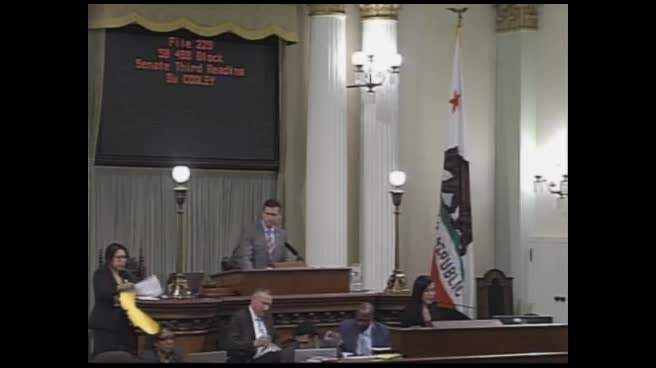
| Aug 22, 2016 | SB 1221 Hertzberg Senate Third Reading By MAIENSCHEIN | Assembly Floor |
Passed |
|
| Jun 29, 2016 | Do pass. To Consent Calendar. | Assembly Standing Committee on Appropriations |
Passed |
|
| Jun 14, 2016 | Do pass and be re-referred to the Committee on [Appropriations] with recommendation: To Consent Calendar | Assembly Standing Committee on Public Safety |
Passed |
|
| Apr 28, 2016 | Consent Calendar 2nd SB1221 Hertzberg | Senate Floor |
Passed |
|
| Apr 12, 2016 | Do pass, but first be re-referred to the Committee on [Appropriations] with the recommendation: To Consent Calendar | Senate Standing Committee on Public Safety |
Passed |
This list shows positions taken on this bill by organizations on the date displayed, which is linked to the original source.
Positions by individuals are not included.
|
Organization
|
Position
|
Date
|
|---|---|---|
| Arc Of California; The | ** Support | Aug 22, 2016 |
| Association Of Regional Center Agencies | ** Support | Aug 22, 2016 |
| California Council Of Community Behavioral Health Agencies | ** Support | Aug 22, 2016 |
| California Fire Chiefs Association | ** Support | Aug 22, 2016 |
| California Public Defenders Association | ** Support | Aug 22, 2016 |
| California State Council on Development Disabilities | ** Support | Aug 22, 2016 |
| California State Sheriffs' Association | ** Support | Aug 22, 2016 |
| Disability Rights California | ** Support | Aug 22, 2016 |
| Fire Districts Association Of California | ** Support | Aug 22, 2016 |
| League Of California Cities | ** Support | Aug 22, 2016 |
| Los Angeles County Sheriff'S Department | ** Support | Aug 22, 2016 |
| Los Angeles County Sheriff's Office | ** Support | Aug 22, 2016 |
| Mental Health America of California | ** Support | Aug 22, 2016 |
| National Association of Social Workers - California Chapter | ** Support | Aug 22, 2016 |
| National Association Of Social Workers, California Chapter | ** Support | Aug 22, 2016 |
| North Los Angeles County Regional Center | ** Support | Aug 22, 2016 |
| Office of the Sheriff County of Los Angeles | ** Support | Aug 22, 2016 |
| State Council on Developmental Disabilities | ** Support | Aug 22, 2016 |
Office of Senate Floor Analyses (916) 651-1520 Fax: (916) 327-4478 | SB |
UNFINISHED BUSINESS
Bill No: SB 1221
:
SENATE PUBLIC SAFETY COMMITTEE: 6-0, 4/12/16
AYES: Hancock, Glazer, Leno, Liu, Monning, Stone
NO VOTE RECORDED: Anderson
SENATE APPROPRIATIONS COMMITTEE: Senate Rule 28.8
SENATE FLOOR: 37-0, 4/28/16 (Consent)
AYES: Allen, Anderson, Bates, Beall, Berryhill, Block, Cannella, De León, Fuller, Gaines, Galgiani, Glazer, Hall, Hancock, Hertzberg, Hill, Hueso, Huff, Jackson, Lara, Leno, Leyva, Liu, McGuire, Mendoza, Mitchell, Monning, Moorlach, Morrell, Nguyen, Nielsen, Pan, Pavley, Roth, Stone, Wieckowski, Wolk
NO VOTE RECORDED: Hernandez, Runner, Vidak
ASSEMBLY FLOOR: 79-0, 8/22/16 - See last page for vote
SOURCE: Los Angeles County Sheriff’s Department
DIGEST: This bill directs the Commission on Peace Officers Standards and Training (POST) to make the existing continuing education classroom training course related to law enforcement interaction with persons with mental disabilities available to the State Fire Marshal, who may revise the course as appropriate for firefighters.
Assembly Amendments delete the phrase “mentally disabled persons” and insert “persons with mental disabilities” where applicable.
Existing law:
- Establishes the Commission on Peace Officer Training and Standards. (Pen. Code, § 13500.)
- Requires all peace officers to complete an introductory course of training prescribed by POST, demonstrated by passage of an appropriate examination developed by POST. (Pen. Code, § 832, subd. (a).)
- Empowers POST to develop and implement programs to increase the effectiveness of law enforcement. (Pen. Code, §13503.)
- Authorizes POST, for the purpose of raising the level of competence of local law enforcement officers, to adopt rules establishing minimum standards related to physical, mental and moral fitness and training that shall govern the recruitment of any peace officers in California. (Pen. Code, § 13510, subd. (a).)
- States that POST shall include in the basic training course for law enforcement officers, adequate instruction in the handling of persons with developmental disabilities or mental illness, or both. In addition to providing instruction on the handling of these persons, the course must also include information on the cause and nature of developmental disabilities and mental illness, as well as the community resources available to serve these persons. (Pen. Code, § 13519.2)
- Requires POST to establish and keep updated a continuing education classroom training course relating to law enforcement interaction with mentally disabled persons. (Pen.Code, § 13515.25.)
- Requires the training course to be developed in consultation with appropriate community, local, and state organizations and agencies that have expertise in the area of mental illness and developmental disability, and with appropriate consumer and family advocate groups. (Pen.Code, § 13515.25.)
- Directs POST to make the course available to law enforcement agencies in California. This course must consist of classroom instruction and utilize interactive training methods to ensure that the training is as realistic as possible and the course must include, at a minimum, core instruction in the following:
- The cause and nature of mental illnesses and developmental disabilities; (Pen.Code, § 13515.25.)
- How to identify indicators of mental disability and how to respond appropriately in a variety of common situations; (Pen.Code, § 13515.25.)
- Conflict resolution and de-escalation techniques for potentially dangerous situations involving mentally disabled persons; (Pen.Code, § 13515.25.)
- Appropriate language usage when interacting with mentally disabled persons; (Pen.Code, § 13515.25.)
- Alternatives to lethal force when interacting with potentially dangerous mentally disabled persons; (Pen.Code, § 13515.25.)
- Community and state resources available to serve mentally disabled persons and how these resources can be best utilized by law enforcement to benefit the mentally disabled community; and, (Pen.Code, § 13515.25.)
- The fact that a crime committed in whole or in part because of an actual or perceived disability of the victim is a hate crime. (Pen.Code, § 13515.25.)
- The cause and nature of mental illnesses and developmental disabilities; (Pen.Code, § 13515.25.)
This bill authorizes POST to make available this educational training to the State Fire Marshall, who may revise the course as appropriate to the firefighter training environment. This bill also makes additional purely technical amendments to this section.
Background
This legislation would extend POST’s current training program to prepare law enforcement officers for interactions with both developmentally and mentally disabled persons to firefighters. The POST training for law enforcement website highlights some examples of such disabilities and its common occurrences that the training would target: one out of 17 adults suffer from schizophrenia, bi-polar disorder or major depression, 46% of the homeless have a mental illness and/or substance abuse disorder, and one out of 68 children is diagnosed with Autism Spectrum Disorder.
Currently, law enforcement training provides a minimum of 664 training hours in its Regular Basic Course, which is divided into 42 individual law enforcement topics called Learning Domains (LD). LD37 focuses on People with Disabilities and requires a minimum of 15 hours of instruction, learning activities, a written exam and resolving a “high stakes” scenario involving a person with a mental or developmental disability. The training is designed to:
Introduce the laws that protect people with disabilities, enhance the recognition of behaviors that are indicative of disability or mental illness, provide de-escalation skills, teach situation-appropriate responses and referrals to the individual and community, and reduce the stigma associated with mental illness and disabilities.
FISCAL EFFECT: Appropriation: Fiscal Com.: Local:
Los Angeles County Sheriff’s Department (source)
The Arc of California
Association of Regional Center Agencies
California Fire Chiefs Association
California Public Defenders Association
California State Council on Development Disabilities
California State Sheriffs’ Association
Disability Rights California
Fire Districts Association of California
League of California Cities
National Association of Social Workers – California Chapter
Office of the Sheriff County of Los Angeles
United Cerebral Palsy California Collaboration
OPPOSITION: (Verified 8/22/16)
None received
ASSEMBLY FLOOR: 79-0, 8/22/16
AYES: Achadjian, Alejo, Travis Allen, Arambula, Atkins, Baker, Bigelow, Bloom, Bonilla, Bonta, Brough, Brown, Burke, Calderon, Campos, Chang, Chau, Chávez, Chiu, Chu, Cooley, Cooper, Dababneh, Dahle, Daly, Dodd, Eggman, Frazier, Beth Gaines, Gallagher, Cristina Garcia, Eduardo Garcia, Gatto, Gipson, Gomez, Gonzalez, Gordon, Gray, Grove, Hadley, Harper, Roger Hernández, Holden, Irwin, Jones, Jones-Sawyer, Kim, Lackey, Levine, Linder, Lopez, Low, Maienschein, Mathis, Mayes, McCarty, Medina, Mullin, Nazarian, Obernolte, O'Donnell, Olsen, Patterson, Quirk, Ridley-Thomas, Rodriguez, Salas, Santiago, Steinorth, Mark Stone, Thurmond, Ting, Wagner, Waldron, Weber, Wilk, Williams, Wood, Rendon
NO VOTE RECORDED: Melendez
8/22/16 21:33:55
SENATE THIRD READING
STR Bill Id:SB 1221
Author:(Hertzberg)
As Amended Ver:June 8, 2016
Majority vote
SENATE VOTE: 37-0
Committee | Votes | Ayes | Noes |
Public Safety | 7-0 | Jones-Sawyer, Melendez, Lackey, Lopez, Low, Quirk, Santiago | |
Appropriations | 18-0 | Gonzalez, Bigelow, Bloom, Bonta, Calderon, Chang, Daly, Eggman, Gallagher, Roger Hernández, Holden, Jones, Obernolte, Quirk, Santiago, Wagner, Weber, Wood |
SUMMARY: Directs the Commission on Peace Officers Standards and Training (POST) to make the existing continuing education classroom training course related to law enforcement interaction with mentally disabled persons available to the State Fire Marshal, who may revise the course as appropriate for firefighters.
EXISTING LAW:
- Establishes the Commission on Peace Officer Training and Standards.
- Requires all peace officers to complete an introductory course of training prescribed by POST, demonstrated by passage of an appropriate examination developed by POST.
- Empowers POST to develop and implement programs to increase the effectiveness of law enforcement.
- Authorizes POST, for the purpose of raising the level of competence of local law enforcement officers, to adopt rules establishing minimum standards related to physical, mental and moral fitness and training that shall govern the recruitment of any peace officers in California.
- States that POST shall include in the basic training course for law enforcement officers, adequate instruction in the handling of persons with developmental disabilities or mental illness, or both. In addition to providing instruction on the handling of these persons, the course must also include information on the cause and nature of developmental disabilities and mental illness, as well as the community resources available to serve these persons.
- Requires POST to establish and keep updated a continuing education classroom training course relating to law enforcement interaction with mentally disabled persons.
- Requires the training course to be developed in consultation with appropriate community, local, and state organizations and agencies that have expertise in the area of mental illness and developmental disability, and with appropriate consumer and family advocate groups.
- Directs POST to make the course available to law enforcement agencies in California. This course must consist of classroom instruction and utilize interactive training methods to ensure that the training is as realistic as possible and the course must include, at a minimum, core instruction in the following:
- The cause and nature of mental illnesses and developmental disabilities;
- How to identify indicators of mental disability and how to respond appropriately in a variety of common situations;
- Conflict resolution and de-escalation techniques for potentially dangerous situations involving mentally disabled persons;
- Appropriate language usage when interacting with mentally disabled persons;
- Alternatives to lethal force when interacting with potentially dangerous mentally disabled persons;
- Community and state resources available to serve mentally disabled persons and how these resources can be best utilized by law enforcement to benefit the mentally disabled community; and,
- The fact that a crime committed in whole or in part because of an actual or perceived disability of the victim is a hate crime.
FISCAL EFFECT: According to the Assembly Committee on Appropriations, no cost to POST, and minor absorbable to the State Fire Marshal.
COMMENTS: According to the author, "SB 1221 authorizes POST to share their course on interaction with mentally disabled persons, with the State Fire Marshal.
"Making the course available to the State Fire Marshal allows training on topics such as stigmatization and de-escalation tactics, to be specifically tailored for firefighters. Many times firefighters, not law enforcement, are the first responders to an emergency scene and this training will ensure that firefighters can respond to mental health emergencies appropriately.
"Treating a mental health emergency solely as a criminal issue can have serious unintended consequences. SB 1221 protects the safety of mentally-ill individuals and firefighters."
Please see the policy committee analysis for a full discussion of this bill.
Analysis Prepared by: David Billingsley / PUB. S. / (916) 319-3744 FN: 0003807
Date of Hearing: June 29, 2016
ASSEMBLY COMMITTEE ON APPROPRIATIONS
Lorena Gonzalez, Chair
SBPCA Bill Id:SB 1221
Author:(Hertzberg) – As Amended Ver:June 8, 2016
Policy Committee: | Public Safety | Vote: | 7 - 0 |
Urgency: No State Mandated Local Program: No Reimbursable: No
SUMMARY:
This bill directs the Commission on Peace Officers Standards and Training (POST) to make the existing continuing education classroom training course related to law enforcement interaction with mentally disabled persons available to the State Fire Marshal, who may revise the course as appropriate for firefighters.
FISCAL EFFECT:
No cost to POST, and minor absorbable to the State Fire Marshal.
COMMENTS:
- Background/Purpose. POST currently provides a continuing education course on interacting with individuals with developmental disabilities or mental health issues. Students are instructed on conflict resolution and de-escalation techniques for potentially dangerous situations involving mentally disabled persons and appropriate language use when interacting with mentally disabled persons. Individuals receiving instruction are also told about community and state resources available to serve mentally disabled persons.
SB 1221 authorizes POST to share their course on interaction with mentally disabled persons with the State Fire Marshal.
Many times firefighters, not law enforcement, are the first responders to an emergency scene. To the extent firefighters have a better understanding of mental health issues, those contacts are going to result in better outcomes. This training will ensure that firefighters can respond to mental health emergencies appropriately, and will help protect the safety of mentally-ill individuals and firefighters.
- Related Legislation:
- SB 29 (Beall), Chapter 469, Statutes of 2015, requires law enforcement field training officers to have at least 8 hours of crisis intervention behavioral health training.
- SB 11 (Beall), Chapter 468, Statutes of 2015, requires POST to update its basic training course related to law enforcement interaction with persons with mental illness to include at least 15 hours.
- Prior Legislation: AB 1718 (Hertzberg), Chapter 95, Statutes of 2000, required that POST establish and keep updated a continuing education classroom training course relating to law enforcement intervention with developmentally disabled and mentally ill persons and that the course be developed in consultation with specified groups and entities.
Analysis Prepared by: Pedro Reyes / APPR. / (916) 319-2081
Date of Hearing: June 14, 2016
Counsel: David Billingsley
ASSEMBLY COMMITTEE ON PUBLIC SAFETY
Reginald Byron Jones-Sawyer, Sr., Chair
SBPCA Bill Id:SB 1221
Author:(Hertzberg) – As Amended Ver:April 26, 2016
SUMMARY: Directs the Commission on Peace Officers Standards and Training (POST) to make the existing continuing education classroom training course related to law enforcement interaction with mentally disabled persons available to the State Fire Marshal, who may revise the course as appropriate for firefighters.
EXISTING LAW:
- Establishes the Commission on Peace Officer Training and Standards. (Pen. Code, § 13500.)
- Requires all peace officers to complete an introductory course of training prescribed by POST, demonstrated by passage of an appropriate examination developed by POST. (Pen. Code, § 832, subd. (a).)
- Empowers POST to develop and implement programs to increase the effectiveness of law enforcement. (Pen. Code, §13503.)
- Authorizes POST, for the purpose of raising the level of competence of local law enforcement officers, to adopt rules establishing minimum standards related to physical, mental and moral fitness and training that shall govern the recruitment of any peace officers in California. (Pen. Code, § 13510, subd. (a).)
- States that POST shall include in the basic training course for law enforcement officers, adequate instruction in the handling of persons with developmental disabilities or mental illness, or both. In addition to providing instruction on the handling of these persons, the course must also include information on the cause and nature of developmental disabilities and mental illness, as well as the community resources available to serve these persons. (Pen. Code, § 13519.2)
- Requires POST to establish and keep updated a continuing education classroom training course relating to law enforcement interaction with mentally disabled persons. (Pen.Code, § 13515.25.)
- Requires the training course to be developed in consultation with appropriate community, local, and state organizations and agencies that have expertise in the area of mental illness and developmental disability, and with appropriate consumer and family advocate groups. (Pen.Code, § 13515.25.)
- Directs POST to make the course available to law enforcement agencies in California. This course must consist of classroom instruction and utilize interactive training methods to ensure that the training is as realistic as possible and the course must include, at a minimum, core instruction in the following:
- The cause and nature of mental illnesses and developmental disabilities; (Pen.Code, § 13515.25.)
- How to identify indicators of mental disability and how to respond appropriately in a variety of common situations; (Pen.Code, § 13515.25.)
- Conflict resolution and de-escalation techniques for potentially dangerous situations involving mentally disabled persons; (Pen.Code, § 13515.25.)
- Appropriate language usage when interacting with mentally disabled persons; (Pen.Code, § 13515.25.)
- Alternatives to lethal force when interacting with potentially dangerous mentally disabled persons; (Pen.Code, § 13515.25.)
- Community and state resources available to serve mentally disabled persons and how these resources can be best utilized by law enforcement to benefit the mentally disabled community; and, (Pen.Code, § 13515.25.)
- The fact that a crime committed in whole or in part because of an actual or perceived disability of the victim is a hate crime. (Pen.Code, § 13515.25.)
- The cause and nature of mental illnesses and developmental disabilities; (Pen.Code, § 13515.25.)
FISCAL EFFECT: Unknown
COMMENTS:
- Author's Statement: According to the author, "SB 1221 authorizes POST to share their course on interaction with mentally disabled persons, with the State Fire Marshal.
“Making the course available to the State Fire Marshal allows training on topics such as stigmatization and de-escalation tactics, to be specifically tailored for firefighters. Many times firefighters, not law enforcement, are the first responders to an emergency scene and this training will ensure that firefighters can respond to mental health emergencies appropriately.
“Treating a mental health emergency solely as a criminal issue can have serious unintended consequences. SB 1221 protects the safety of mentally-ill individuals and firefighters.”
- POST Continuing Education Course on Developmental Disabilities and Mental Health Issues: POST currently provides a continuing education course on interacting with individuals with developmental disabilities or mental health issues. This bill would make that training program available to firefighters.
The POST training course consists of classroom instruction and interactive training methods to ensure that the training is as realistic as possible. The course includes topics such as the cause and nature or mental illnesses and developmental disabilities and how to identify indicators of mental disability and how to respond appropriately in a variety of common situations.
Students are instructed on conflict resolution and de-escalation techniques for potentially dangerous situations involving mentally disabled persons and appropriate language use when interacting with mentally disabled persons. Individuals receiving instruction are also told about community and state resources available to serve mentally disabled persons. - Frequency of Law Enforcement Contacts Involving Mental Health Issues: Law enforcement officers are often the first responders to mental health crisis calls; they respond to 911 calls ranging from suicide attempts to individuals potentially endangering themselves or others. Studies confirm that the volume of calls to law enforcement involving crisis mental health concerns have been increasing in the past decade. Mental health crisis calls also take more officer time to resolve. More than eighty percent of the agencies that Disability Rights California surveyed report that officers spend more time on these calls. Nearly 4 out of 10 agencies estimated that officers spend two hours or more on mental health calls. This means that on a typical day, officers can spend 1/3 of their time in interactions which would necessitate skills in crisis intervention and de-escalation. Beyond crisis calls, officers routinely respond to calls where they are required to determine whether a person meets the criteria for involuntary detention for psychiatric assessment and treatment (otherwise known as 5150). Even standard crime scene calls require officers to use skills to de-escalate potentially volatile situations when interacting with members of the public. (An Ounce of Prevention: Law Enforcement Training Mental Health Crisis Intervention, (2014) Disability Rights California, p. 37.)
Many law enforcement agencies throughout the state have augmented their training programs to provide officers with additional training after the academy in responding to people with mental health disabilities in crisis. Augmented training varies widely but generally includes information on recognizing the symptoms of a psychiatric disability and methods for how to interact with an individual in crisis, including specific de-escalation techniques. Topics covered in a typical Crisis Intervention Training (CIT) program are not otherwise mandated in California or required at any level of officer training. Police chiefs and senior officers consistently report that their personnel are better equipped at handling mental health crisis calls after participating in a CIT program. Furthermore, jurisdictions in which officers receive CIT report fewer injuries, fewer incidents requiring use of force, and better outcomes for their officers and community members. (An Ounce of Prevention: Law Enforcement Training Mental Health Crisis Intervention, (2014) Disability Rights California, p. 38-39.) - Firefighter Contact with Individuals with Mental Health Issues: As first responders, firefighters are dealing with emergency situations which extend beyond putting out fires.
“In 1980, according to the National Fire Protection Association, the nation's 30,000 fire departments responded to 10.8 million emergency calls. About 3 million were classified as fires. By 2013, total calls had nearly tripled to 31.6 million, while fire calls had plummeted to 1.24 million, of which just 500,000 of were actual structure fires. For America's 1.14 million career and volunteer firefighters, that works out to an average of just one structure fire every other year.” http://www.governing.com/columns/smart-mgmt/col-fire-departments-rethink-delivery-emergency-medical-services.html
As first responders, firefighters are dealing with a wide range of situations. Firefighters are likely to interact with individuals with mental health issues at a similar rate as law enforcement officers. To the extent firefighters have a better understanding of mental health issues, those contacts are going to result in better outcomes. - Argument in Support: According to The Los Angeles County Office of the Sheriff, ”Existing law requires the Commission on Peace Officer Standards and Training to establish a continuing education classroom course related to law enforcement interaction with mentally disabled persons and to make the course available to law enforcement agencies in California. Firefighters, being first responders come into contact with mentally disabled persons as frequently as law enforcement officers. However, the amount of training firefighters receive is minimal, if any at all.
“This bill would authorize the commission to make the course available to the State Fire Marshal. Making the course available to the Fire Marshal allows training on topics such as stigmatization and de-escalation tactics to be specifically tailored for firefighters.
“Very often, firefighters, not law enforcement, are the first responders to any emergency scene and this training will ensure that firefighters can respond to mental health emergencies appropriately. Treating a mental health emergency solely as a criminal issue can have serious unintended consequences and we must ensure that firefighters are equipped to handle a range of emergencies.” - Related Legislation:
- AB 1227 (Cooper), of the 2015-16 Legislative Session, would have required POST to study and submit a report to the Legislature, on or before December 31, 2017, that assessed the statuses of specified training courses on mental health issues. AB 1227 was held in Assembly Appropriations.
- SB 29 (Beall), Chapter 469, Statutes of 2015, requires law enforcement field training officers to have at least 8 hours of crisis intervention behavioral health training.
- SB 11 (Beall), Chapter 468, Statutes of 2015, requires POST to update its basic training course related to law enforcement interaction with persons with mental illness to include at least 15 hours.
- AB 1227 (Cooper), of the 2015-16 Legislative Session, would have required POST to study and submit a report to the Legislature, on or before December 31, 2017, that assessed the statuses of specified training courses on mental health issues. AB 1227 was held in Assembly Appropriations.
- Prior Legislation: AB 1718 (Hertzberg), Chapter 95, Statutes of 2000, Required that POST establish and keep updated a continuing education classroom training course relating to law enforcement intervention with developmentally disabled and mentally ill persons and that the course be developed in consultation with specified groups and entities.
REGISTERED SUPPORT / OPPOSITION:
Support
Los Angeles County Sheriff’s Office (Sponsor)
Arc and United Cerebral Palsy California Collaboration
Association of Regional Center Agencies
California Council of Community Behavioral Health Agencies
California Fire Chiefs Association
California Public Defenders Association
California State Sheriffs’ Association
Disability Rights California
Fire Districts Association of California
League of California Cities
Mental Health America of California
National Association of Social Workers, California Chapter
North Los Angeles County Regional Center
State Council on Developmental Disabilities
Opposition
None
Analysis Prepared by: David Billingsley / PUB. S. / (916) 319-3744
Office of Senate Floor Analyses (916) 651-1520 Fax: (916) 327-4478 | SB |
CONSENT
Bill No: SB 1221
Amended: 4/26/16
SENATE PUBLIC SAFETY COMMITTEE: 6-0, 4/12/16
AYES: Hancock, Glazer, Leno, Liu, Monning, Stone
NO VOTE RECORDED: Anderson
SENATE APPROPRIATIONS COMMITTEE: Senate Rule 28.8
DIGEST: This bill makes the POST training course relating to interactions with the mentally disabled available to the State Fire Marshall.
Existing law requires the Commission on Peace Officer Standards and Training (POST) “to establish and keep updated a continuing education classroom training course relating to law enforcement interaction with the mentally disabled” and to make the course available to law enforcement agencies in California. (Penal Code §13515.25.)
This bill:
- Authorizes POST to make available this educational training to the State Fire Marshall, who may revise the course as appropriate to the firefighter training environment.
- Makes additional purely technical amendments to this section.
Background
This legislation extends POST’s current training program to prepare law enforcement officers for interactions with both developmentally and mentally disabled persons to firefighters. The POST training for law enforcement website highlights some examples of such disabilities and its common occurrences that the training would target: one out of 17 adults suffer from schizophrenia, bi-polar disorder or major depression, 46% of the homeless have a mental illness and/or substance abuse disorder, and one out of 68 children is diagnosed with Autism Spectrum Disorder. (www.post.ca.gov/did-you-know-mental-health.aspx)
Currently, law enforcement training provides a minimum of 664 training hours in its Regular Basic Course, which is divided into 42 individual law enforcement topics called Learning Domains (LD). LD37 focuses on People with Disabilities and requires a minimum of 15 hours of instruction, learning activities, a written exam and resolving a “high stakes” scenario involving a person with a mental or developmental disability. The training is designed to:
Introduce the laws that protect people with disabilities, enhance the recognition of behaviors that are indicative of disability or mental illness, provide de-escalation skills, teach situation-appropriate responses and referrals to the individual and community, and reduce the stigma associated with mental illness and disabilities. (www.post.ca.gov/mental-health-training-in-the-regualr-basic-course.aspx)
FISCAL EFFECT: Appropriation: Fiscal Com.: Local:
Association of Regional Center Agencies
California Fire Chiefs Association
California Public Defenders Association
California State Council on Development Disabilities
California State Sheriffs’ Association
Disability Rights California
Fire Districts Association of California
League of California Cities
National Association of Social Workers – California Chapter
Office of the Sheriff County of Los Angeles
OPPOSITION: (Verified 4/25/16)
None received
4/27/16 15:57:27
**** END ****
SENATE COMMITTEE ON PUBLIC SAFETY
Senator Loni Hancock, Chair
2015 - 2016 Regular
Bill No: SB 1221 Hearing Date: April 12, 2016
Author: | Hertzberg | ||
Version: | February 18, 2016 | ||
Urgency: | No | Fiscal: | Yes |
Consultant: | ML | ||
Subject: Firefighters: Interaction with Mentally Disabled Persons
HISTORY
Source: Los Angeles County Sheriff’s Department
Prior Legislation: AB 1227 (Cooper) – introduced in 2015, held in Senate Appropriations (2016)
SB 11 (Beall) – Chapter 468, Stats. 2015
SB 29 (Beall) – Chapter 2015, Stats. 2015
Support: Association of Regional Center Agencies; California Fire Chiefs Association; California Public Defenders Association; California State Council on Development Disabilities; California State Sheriffs’ Association; California Public Defenders Association; Disability Rights California; Fire Districts Association of California; League of California Cities
Opposition: Unknown
PURPOSE
The purpose of this bill is to make the POST training course relating to interactions with the mentally disabled available to firefighters and fire departments.
Existing law requires the Commission on Peace Officer Standards and Training (POST) “to establish and keep updated a continuing education classroom training course relating to law enforcement interaction with the mentally disabled” and to make the course available to law enforcement agencies in California. (Penal Code §13515.25.)
This bill authorizes POST to make available this educational training to firefighters and fire departments.
This bill makes additional purely technical amendments to this section.
RECEIVERSHIP/OVERCROWDING CRISIS AGGRAVATION
For the past several years this Committee has scrutinized legislation referred to its jurisdiction for any potential impact on prison overcrowding. Mindful of the United States Supreme Court ruling and federal court orders relating to the state’s ability to provide a constitutional level of health care to its inmate population and the related issue of prison overcrowding, this Committee has applied its “ROCA” policy as a content-neutral, provisional measure necessary to ensure that the Legislature does not erode progress in reducing prison overcrowding.
On February 10, 2014, the federal court ordered California to reduce its in-state adult institution population to 137.5% of design capacity by February 28, 2016, as follows:
- 143% of design bed capacity by June 30, 2014;
- 141.5% of design bed capacity by February 28, 2015; and,
- 137.5% of design bed capacity by February 28, 2016.
In December of 2015 the administration reported that as “of December 9, 2015, 112,510 inmates were housed in the State’s 34 adult institutions, which amounts to 136.0% of design bed capacity, and 5,264 inmates were housed in out-of-state facilities. The current population is 1,212 inmates below the final court-ordered population benchmark of 137.5% of design bed capacity, and has been under that benchmark since February 2015.” (Defendants’ December 2015 Status Report in Response to February 10, 2014 Order, 2:90-cv-00520 KJM DAD PC, 3-Judge Court, Coleman v. Brown, Plata v. Brown (fn. omitted).) One year ago, 115,826 inmates were housed in the State’s 34 adult institutions, which amounted to 140.0% of design bed capacity, and 8,864 inmates were housed in out-of-state facilities. (Defendants’ December 2014 Status Report in Response to February 10, 2014 Order, 2:90-cv-00520 KJM DAD PC, 3-Judge Court, Coleman v. Brown, Plata v. Brown (fn. omitted).)
While significant gains have been made in reducing the prison population, the state must stabilize these advances and demonstrate to the federal court that California has in place the “durable solution” to prison overcrowding “consistently demanded” by the court. (Opinion Re: Order Granting in Part and Denying in Part Defendants’ Request For Extension of December 31, 2013 Deadline, NO. 2:90-cv-0520 LKK DAD (PC), 3-Judge Court, Coleman v. Brown, Plata v. Brown (2-10-14). The Committee’s consideration of bills that may impact the prison population therefore will be informed by the following questions:
- Whether a proposal erodes a measure which has contributed to reducing the prison population;
- Whether a proposal addresses a major area of public safety or criminal activity for which there is no other reasonable, appropriate remedy;
- Whether a proposal addresses a crime which is directly dangerous to the physical safety of others for which there is no other reasonably appropriate sanction;
- Whether a proposal corrects a constitutional problem or legislative drafting error; and
- Whether a proposal proposes penalties which are proportionate, and cannot be achieved through any other reasonably appropriate remedy.
COMMENTS
1. Need for This Bill
According to the author:
Researchers at the UCLA Center for Health Policy Research found that nearly one in five adults in the state — about 4.9 million people — said they needed help for a mental or emotional health problem.
Frequently, police officers respond to mental health related calls and incidents, many of which can be time consuming. The Federal Bureau of Justice Affairs reported that “behaviors resulting in mental illness are a factor in 3 to 7 percent of all law enforcement calls for service.”
Existing law requires POST to establish a continuing education classroom training course related to law enforcement interaction with mentally disabled persons and to make the course available to law enforcement agencies in California. Firefighters, being first responders, come into contact with mentally disabled persons as frequently as law enforcement officers.
Fire and Emergency Medical Services are trained on the medical side, but mental health emergencies can mimic medical ones and it is important for all personnel responding to these emergencies to be aware of the implications of that.
2. Effect of Legislation; Background
This legislation would extend POST’s current training program to prepare law enforcement officers for interactions with both developmentally and mentally disabled persons to firefighters. The POST training for law enforcement website highlights some examples of such disabilities and its common occurrences that the training would target: one out of 17 adults suffer from schizophrenia, bi-polar disorder or major depression, 46% of the homeless have a mental illness and/or substance abuse disorder, and one out of 68 children is diagnosed with Autism Spectrum Disorder.[1]
Currently, law enforcement training provides a minimum of 664 training hours in its Regular Basic Course, which is divided into 42 individual law enforcement topics called Learning Domains (LD). LD37 focuses on People with Disabilities and requires a minimum of 15 hours of instruction, learning activities, a written exam and resolving a “high stakes” scenario involving a person with a mental or developmental disability. The training is designed to:
Introduce the laws that protect people with disabilities, enhance the recognition of behaviors that are indicative of disability or mental illness, provide de-escalation
skills, teach situation-appropriate responses and referrals to the individual and community, and reduce the stigma associated with mental illness and disabilities.[2]
-- END --
Bill Author




