SB 1363: Ocean Protection Council: Ocean Acidification and Hypoxia Reduction Program.
- Session Year: 2015-2016
- House: Senate
- Latest Version Date: 2016-09-29
The California Ocean Protection Act establishes the Ocean Protection Council and requires the council, among other things, to coordinate activities of state agencies that are related to the protection and conservation of coastal waters and ocean ecosystems, and to establish policies to coordinate the collection and sharing of scientific data related to coastal and ocean resources among agencies. The act creates the California Ocean Protection Trust Fund in the State Treasury and authorizes moneys deposited in the fund, upon appropriation by the Legislature, to be expended by the council for projects and activities authorized by the council consistent with the purposes of the act.
This bill would require the council, in consultation with the State Coastal Conservancy and other relevant entities, to establish and administer the Ocean Acidification and Hypoxia Reduction Program for the purposes of achieving specified goals. The bill would authorize moneys in the trust fund to be expended for grants or loans for projects or activities that further public purposes consistent with the Ocean Acidification and Hypoxia Reduction Program.
The California Ocean Protection Act law establishes the Ocean Protection Council and requires the council, among other things, to coordinate activities of state agencies that are related to the protection and conservation of coastal waters and ocean ecosystems, and to establish policies to coordinate the collection and sharing of scientific data related to coastal and ocean resources among agencies. The act creates the California Ocean Protection Trust Fund in the State Treasury and authorizes moneys deposited in the fund, upon appropriation by the Legislature, to be expended by the council for projects and activities authorized by the council consistent with the purposes of the act.
This bill would require the council, in coordination consultation with the State Coastal Conservancy, Conservancy and other relevant entities, to establish and administer the Ocean Acidification and Hypoxia Reduction Program for the purposes of achieving specified goals. The bill would authorize moneys in the trust fund to be expended for grants or loans for projects or activities that further public purposes consistent with the Ocean Acidification and Hypoxia Reduction Program.
Existing law
The California Ocean Protection Act law establishes the Ocean Protection Council and requires the council, among other things, to coordinate activities of state agencies that are related to the protection and conservation of coastal waters and ocean ecosystems, and to establish policies to coordinate the collection and sharing of scientific data related to coastal and ocean resources among agencies. The act creates the California Ocean Protection Trust Fund in the State Treasury and authorizes moneys deposited in the fund, upon appropriation by the Legislature, to be expended by the council for projects and activities authorized by the council consistent with the purposes of the act.
This bill would state the intent of the Legislature to enact legislation to promote restoration of eelgrass habitat in Californias coastal environments, bays, and estuaries, based on scientific- and evidence-based approaches. require the council, in coordination with the State Coastal Conservancy, to establish and administer the Ocean Acidification and Hypoxia Reduction Program for the purposes of achieving specified goals. The bill would authorize moneys in the trust fund to be expended for grants or loans for projects or activities that further public purposes consistent with the Ocean Acidification and Hypoxia Reduction Program.
Existing law establishes the Ocean Protection Council and requires the council, among other things, to coordinate activities of state agencies that are related to the protection and conservation of coastal waters and ocean ecosystems, and to establish policies to coordinate the collection and sharing of scientific data related to coastal and ocean resources among agencies.
This bill would state the intent of the Legislature to enact legislation to promote restoration of eelgrass habitat in Californias coastal environments, bays, and estuaries, based on scientific- and evidence-based approaches.
The Legislature finds and declares all of the following:
(a)Ocean acidification and hypoxia, an abnormal deficiency of oxygen in marine environments, are two major threats to ocean and coastal ecosystems globally, and west coast states are particularly vulnerable, according to the April 2016 findings of the West Coast Ocean Acidification and Hypoxia Science Panel.
(b)The West Coast Ocean Acidification and Hypoxia Science Panel was a binational collaboration of leading scientists from California, Oregon, Washington, and British Columbia that was convened at the request of the council and the California Ocean Science Trust. The West Coast Ocean Acidification and Hypoxia Science Panels executive summary report outlines findings, recommendations, and actions to address ocean acidification and hypoxia.
(c)Ocean acidification is caused primarily by global carbon dioxide emissions. Local carbon dioxide emissions and local nutrient inputs can intensify the effects of ocean acidification.
(d)The West Coast Ocean Acidification and Hypoxia Science Panel recommends that California and other west coast states actively employ strategies that address local factors that can reduce ocean acidification and hypoxia exposure, including protecting and restoring critical coastal and aquatic habitats.
(e)Eelgrass ecosystems are among the most diverse and productive ecosystems in the world, with particular importance to farmed shellfish aquaculture and other forms of sustainable aquaculture and to commercially and recreationally valuable species, including shellfish, crabs, finfish, waterfowl, and shorebirds.
(f)Eelgrass protection and restoration efforts help promote a healthier ocean for ecosystems and industry.
(g)Since the 1850s, 90 percent of Californias eelgrass acreage has been destroyed, and the remaining 10 percent is continuously exposed to multiple stressors and threats.
(h)Scientific research has shown that eelgrass habitat provides multiple benefits, including the following:
(1)Providing essential habitat for salmon, groundfish, and Pacific herring, providing Dungeness crab nurseries, and supporting commercial fisheries important to Californias coastal economy.
(2)Improving water quality by filtering polluted runoff and by absorbing excess nutrients.
(3)Helping to mitigate hypoxia.
(4)Sequestering carbon in the underlying sediments.
(5)Protecting the shoreline from erosion by absorbing wave energy and helping to mitigate the impacts of sea level rise.
(i)Advancing the protection and restoration of eelgrass beds in Californias coastal environments, based on scientific and evidence-based approaches, is a critical strategy in enhancing Californias ability to cope with ocean acidification and hypoxia.
35632.(a)To the extent funds are available from bonds or other sources, the council, in consultation with the State Coastal Conservancy and other relevant entities, shall establish and administer the Ocean Acidification and Hypoxia Reduction Program for the purpose of achieving the following goals:
(1)Developing demonstration projects to research how important environmental and ecological factors interact across space and time to influence how geographically dispersed eelgrass beds function for carbon dioxide removal and hypoxia reduction.
(2)Generating an inventory of locations where conservation or restoration of aquatic habitats, including eelgrass, can be successfully applied to mitigate ocean acidification and hypoxia.
(3)Incorporating consideration of carbon dioxide removal for eelgrass restoration projects during the habitat restoration planning process in order to fully account for the benefits of long-term carbon storage of habitat restoration in addition to the habitat value.
(4)Supporting science, monitoring, and coordination to ensure that ocean and coastal policy and management in California reflect best readily available science on strategies to reduce ocean acidification and hypoxia to implement this section.
(b)In advancing approaches in the program to remove carbon dioxide from seawater, the council shall consider approaches that provide multiple cobenefits, including, but not limited to, providing essential fish and bird habitat, improving water quality, and mitigating the impacts of sea level rise.
SEC. 2.Section 35650 of the Public Resources Code is amended to read:35650.(a)The California Ocean Protection Trust Fund is established in the State Treasury.
(b)Moneys deposited in the fund may be expended, upon appropriation by the Legislature, for both of the following:
(1)Projects and activities authorized by the council consistent with Chapter 3 (commencing with Section 35600).
(2)Upon authorization by the council, for grants or loans to public agencies, nonprofit corporations, or private entities for, or direct expenditures on, projects or activities that do one or more of the following:
(A)Eliminate or reduce threats to coastal and ocean ecosystems, habitats, and species.
(B)Improve the management of fisheries through grants or loans for the development and implementation of fishery management plans pursuant to Part 1.7 (commencing with Section 7050) of Division 6 of the Fish and Game Code, a part of the Marine Life Management Act of 1998, that promote long-term stewardship and collaboration with fishery participants to develop strategies that increase environmental and economic sustainability. Eligible projects and activities include, but are not limited to, innovative community-based or cooperative management and allocation strategies that create incentives for ecosystem improvement. Eligible expenditures include, but are not limited to, costs related to activities identified in subdivisions (a), (b), and (d) of Section 7075 of the Fish and Game Code, fishery research, monitoring, data collection and analysis to support adaptive management, and other costs related to the development and implementation of a fishery management plan developed pursuant to this subparagraph.
(C)Foster sustainable fisheries, including grants or loans for one or more of the following:
(i)Projects that encourage the development and use of more selective fishing gear.
(ii)The design of community-based or cooperative management mechanisms that promote long-term stewardship and collaboration with fishery participants to develop strategies that increase environmental and economic sustainability.
(iii)Collaborative research and demonstration projects between fishery participants, scientists, and other interested parties.
(iv)Promotion of value-added wild fisheries to offset economic losses attributable to reduced fishing opportunities.
(v)The creation of revolving loan programs for the purpose of implementing sustainable fishery projects.
(D)Improve coastal water quality.
(E)Allow for increased public access to, and enjoyment of, ocean and coastal resources, consistent with sustainable, long-term protection and conservation of those resources.
(F)Improve management, conservation, and protection of coastal waters and ocean ecosystems.
(G)Provide monitoring and scientific data to improve state efforts to protect and conserve ocean resources.
(H)Protect, conserve, and restore coastal waters and ocean ecosystems, including any of the following:
(i)Acquisition, installation, and initiation of monitoring and enforcement systems.
(ii)Acquisition from willing sellers of vessels, equipment, licenses, harvest rights, permits, and other rights and property, to reduce threats to ocean ecosystems and resources.
(I)Address coastal water contamination from biological pathogens, including collaborative projects and activities to identify the sources of pathogens and develop detection systems and treatment methods.
(J)(i)Provide funding for adaptive management, planning, coordination, monitoring, research, and other necessary activities to minimize the adverse impacts of climate change on Californias ocean ecosystem, including, but not limited to, the effects of sea level rise, changes in ocean productivity, and ocean acidification on coastal and ocean habitat, wildlife, fisheries, chemistry, and other key attributes of ocean ecosystems and to increase the states understanding of the oceans role in carbon sequestration. Adaptive management strategies, planning, research, monitoring, or other activities shall be designed to improve the management of coastal and ocean resources or aid the state to adapt to climate change impacts.
(ii)Information or activities developed under clause (i), to the extent appropriate, shall provide guidance to the State Air Resources Board for the adoption of early action measures for the elimination or reduction of emissions from sources or categories of sources pursuant to the California Global Warming Solutions Act of 2006 (Division 25.5 (commencing with Section 38500) of the Health and Safety Code).
(c)Grants or loans may be made to a private entity pursuant to this section only for projects or activities that further public purposes consistent with Sections 35510, 35515, 35617, and 35632.
(d)Consistent with the purposes specified in Section 35515, and in furtherance of the findings in Sections 7059 and 7060 of the Fish and Game Code, the council, in authorizing grants or loans for projects or expenditures pursuant to this section, shall promote coordination of state programs and activities that protect and conserve ocean resources to avoid redundancy and conflicts to ensure that the states programs and activities are complementary.
The Legislature finds and declares all of the following:
(a)Ocean acidification and hypoxia, an abnormal deficiency of oxygen in marine environments, are two major threats to ocean and coastal ecosystems globally, and west coast states are particularly vulnerable, according to the April 2016 findings of the West Coast Ocean Acidification and Hypoxia Science Panel.
(b)Ocean acidification is caused primarily by global carbon dioxide emissions. Local carbon dioxide emissions and local nutrient inputs can intensify the effects of ocean acidification.
(c)The West Coast Ocean Acidification and Hypoxia Science Panel recommends that California and other west coast states actively employ strategies that address local factors that can reduce ocean acidification and hypoxia exposure, including protecting and restoring critical coastal and aquatic habitats.
(d)Eelgrass ecosystems are among the most diverse and productive ecosystems in the world, with particular importance to farmed shellfish aquaculture and other forms of sustainable aquaculture and to commercially and recreationally valuable species, including shellfish, crabs, finfish, waterfowl, and shorebirds.
(e)Eelgrass protection and restoration efforts help promote a healthier ocean for ecosystems and industry.
(f)Since the 1850s, 90 percent of Californias eelgrass acreage has been destroyed, and the remaining 10 percent is continuously exposed to multiple stressors and threats.
(g)Scientific research has shown that eelgrass habitat provides multiple benefits, including the following:
(1)Providing essential fish habitat for salmon, groundfish, and Pacific herring, providing Dungeness crab nurseries, and supporting commercial fisheries important to Californias coastal economy.
(2)Improving water quality by filtering polluted runoff and by absorbing excess nutrients.
(3)Helping to mitigate hypoxia.
(4)Sequestering carbon in the underlying sediments.
(5)Protecting the shoreline from erosion by absorbing wave energy and helping to mitigate the impacts of sea level rise.
(h)Advancing the protection and restoration of eelgrass beds in Californias coastal environments, based on scientific and evidence-based approaches, is a critical strategy in enhancing Californias ability to cope with ocean acidification and hypoxia.
SEC. 2.Section 35631 is added to the Public Resources Code, to read:35631.(a)To the extent funds are available from bonds or other sources, the council, in consultation with the State Coastal Conservancy and other relevant entities, shall establish and administer the Ocean Acidification and Hypoxia Reduction Program for the purposes of achieving the following goals:
(1)Developing demonstration projects to research how important environmental and ecological factors interact across space and time to influence how geographically dispersed eelgrass beds function for carbon dioxide removal and hypoxia reduction.
(2)Generating an inventory of locations where conservation or restoration of aquatic habitats, including eelgrass, can be successfully applied to mitigate ocean acidification and hypoxia.
(3)Incorporating consideration of carbon dioxide removal for eelgrass restoration projects during the habitat restoration planning process in order to fully account for the benefits of long-term carbon storage of habitat restoration in addition to the habitat value.
(4)Supporting science, monitoring, and coordination to ensure that ocean and coastal policy and management in California reflect best readily available science on strategies to reduce ocean acidification and hypoxia.
(b)In advancing approaches in the program to remove carbon dioxide from seawater, the council shall consider approaches that provide multiple cobenefits, including, but not limited to, providing essential fish and bird habitat, improving water quality, and mitigating sea level rise.
SECTION 1.Chapter 3.1 (commencing with Section 35630) is added to Division 26.5 of the Public Resources Code, to read:3.1.Ocean Acidification and Hypoxia Mitigation35630.The Legislature finds and declares all of the following:
(a)Ocean acidification and hypoxia, an abnormal deficiency of oxygen in marine environments, are two major threats to ocean and coastal ecosystems globally, and west coast states are particularly vulnerable, according to the April 2016 findings of the West Coast Ocean Acidification and Hypoxia Science Panel.
(b)The West Coast Ocean Acidification and Hypoxia Science Panel was a binational collaboration of leading scientists from California, Oregon, Washington, and British Columbia that was convened at the request of the council and the California Ocean Science Trust. The West Coast Ocean Acidification and Hypoxia Science Panels executive summary report outlines findings, recommendations, and actions to address ocean acidification and hypoxia.
(c)Ocean acidification is caused primarily by global carbon dioxide emissions. Local carbon dioxide emissions and local nutrient inputs can intensify the effects of ocean acidification.
(d)The West Coast Ocean Acidification and Hypoxia Science Panel recommends that California and other west coast states actively employ strategies that address local factors that can reduce ocean acidification and hypoxia exposure, including protecting and restoring critical coastal and aquatic habitats.
(e)Eelgrass ecosystems are among the most diverse and productive ecosystems in the world, with particular importance to farmed shellfish aquaculture and other forms of sustainable aquaculture and to commercially and recreationally valuable species, including shellfish, crabs, finfish, waterfowl, and shorebirds.
(f)Eelgrass protection and restoration efforts help promote a healthier ocean for ecosystems and industry.
(g)Since the 1850s, 90 percent of Californias eelgrass acreage has been destroyed, and the remaining 10 percent is continuously exposed to multiple stressors and threats.
(h)Scientific research has shown that eelgrass habitat provides multiple benefits, including the following:
(1)Providing essential habitat for salmon, groundfish, and Pacific herring, providing Dungeness crab nurseries, and supporting commercial fisheries important to Californias coastal economy.
(2)Improving water quality by filtering polluted runoff and by absorbing excess nutrients.
(3)Helping to mitigate hypoxia.
(4)Sequestering carbon in the underlying sediments.
(5)Protecting the shoreline from erosion by absorbing wave energy and helping to mitigate the impacts of sea level rise.
(i)Advancing the protection and restoration of eelgrass beds in Californias coastal environments, based on scientific and evidence-based approaches, is a critical strategy in enhancing Californias ability to cope with ocean acidification and hypoxia.
35632.(a)To the extent funds are available from bonds or other sources, the council, in consultation with the State Coastal Conservancy and other relevant entities, shall establish and administer the Ocean Acidification and Hypoxia Reduction Program for the purpose of achieving the following goals:
(1)Developing demonstration projects to research how important environmental and ecological factors interact across space and time to influence how geographically dispersed eelgrass beds function for carbon dioxide removal and hypoxia reduction.
(2)Generating an inventory of locations where conservation or restoration of aquatic habitats, including eelgrass, can be successfully applied to mitigate ocean acidification and hypoxia.
(3)Incorporating consideration of carbon dioxide removal for eelgrass restoration projects during the habitat restoration planning process in order to fully account for the benefits of long-term carbon storage of habitat restoration in addition to the habitat value.
(4)Supporting science, monitoring, and coordination to ensure that ocean and coastal policy and management in California reflect best readily available science on strategies to reduce ocean acidification and hypoxia to implement this section.
(b)In advancing approaches in the program to remove carbon dioxide from seawater, the council shall consider approaches that provide multiple cobenefits, including, but not limited to, providing essential fish and bird habitat, improving water quality, and mitigating the impacts of sea level rise.
SEC. 3.SEC. 2.Section 35650 of the Public Resources Code is amended to read:35650.(a)The California Ocean Protection Trust Fund is established in the State Treasury.
(b)Moneys deposited in the fund may be expended, upon appropriation by the Legislature, for both of the following:
(1)Projects and activities authorized by the council consistent with Chapter 3 (commencing with Section 35600).
(2)Upon authorization by the council, for grants or loans to public agencies, nonprofit corporations, or private entities for, or direct expenditures on, projects or activities that do one or more of the following:
(A)Eliminate or reduce threats to coastal and ocean ecosystems, habitats, and species.
(B)Improve the management of fisheries through grants or loans for the development and implementation of fishery management plans pursuant to Part 1.7 (commencing with Section 7050) of Division 6 of the Fish and Game Code, a part of the Marine Life Management Act of 1998, that promote long-term stewardship and collaboration with fishery participants to develop strategies that increase environmental and economic sustainability. Eligible projects and activities include, but are not limited to, innovative community-based or cooperative management and allocation strategies that create incentives for ecosystem improvement. Eligible expenditures include, but are not limited to, costs related to activities identified in subdivisions (a), (b), and (d) of Section 7075 of the Fish and Game Code, fishery research, monitoring, data collection and analysis to support adaptive management, and other costs related to the development and implementation of a fishery management plan developed pursuant to this subparagraph.
(C)Foster sustainable fisheries, including grants or loans for one or more of the following:
(i)Projects that encourage the development and use of more selective fishing gear.
(ii)The design of community-based or cooperative management mechanisms that promote long-term stewardship and collaboration with fishery participants to develop strategies that increase environmental and economic sustainability.
(iii)Collaborative research and demonstration projects between fishery participants, scientists, and other interested parties.
(iv)Promotion of value-added wild fisheries to offset economic losses attributable to reduced fishing opportunities.
(v)The creation of revolving loan programs for the purpose of implementing sustainable fishery projects.
(D)Improve coastal water quality.
(E)Allow for increased public access to, and enjoyment of, ocean and coastal resources, consistent with sustainable, long-term protection and conservation of those resources.
(F)Improve management, conservation, and protection of coastal waters and ocean ecosystems.
(G)Provide monitoring and scientific data to improve state efforts to protect and conserve ocean resources.
(H)Protect, conserve, and restore coastal waters and ocean ecosystems, including any of the following:
(i)Acquisition, installation, and initiation of monitoring and enforcement systems.
(ii)Acquisition from willing sellers of vessels, equipment, licenses, harvest rights, permits, and other rights and property, to reduce threats to ocean ecosystems and resources.
(I)Address coastal water contamination from biological pathogens, including collaborative projects and activities to identify the sources of pathogens and develop detection systems and treatment methods.
(J)(i)Provide funding for adaptive management, planning, coordination, monitoring, research, and other necessary activities to minimize the adverse impacts of climate change on Californias ocean ecosystem, including, but not limited to, the effects of sea level rise, changes in ocean productivity, and ocean acidification on coastal and ocean habitat, wildlife, fisheries, chemistry, and other key attributes of ocean ecosystems and to increase the states understanding of the oceans role in carbon sequestration. Adaptive management strategies, planning, research, monitoring, or other activities shall be designed to improve the management of coastal and ocean resources or aid the state to adapt to climate change impacts.
(ii)Information or activities developed under clause (i), to the extent appropriate, shall provide guidance to the State Air Resources Board for the adoption of early action measures for the elimination or reduction of emissions from sources or categories of sources pursuant to the California Global Warming Solutions Act of 2006 (Division 25.5 (commencing with Section 38500) of the Health and Safety Code).
(c)Grants or loans may be made to a private entity pursuant to this section only for projects or activities that further public purposes consistent with Sections 35510, 35515, 35617, and 35631. 35632.
(d)Consistent with the purposes specified in Section 35515, and in furtherance of the findings in Sections 7059 and 7060 of the Fish and Game Code, the council, in authorizing grants or loans for projects or expenditures pursuant to this section, shall promote coordination of state programs and activities that protect and conserve ocean resources to avoid redundancy and conflicts to ensure that the states programs and activities are complementary.
The Legislature finds and declares all of the following:
(a)Ocean acidification and hypoxia, an abnormal deficiency of oxygen in marine environments, are two major threats to ocean and coastal ecosystems globally, and west coast states are particularly vulnerable, according to the April 2016 findings of the West Coast Ocean Acidification and Hypoxia Science Panel.
(b)Ocean acidification is caused primarily by global carbon dioxide emissions. Local carbon dioxide emissions and local nutrient inputs can intensify the effects of ocean acidification.
(c)The West Coast Ocean Acidification and Hypoxia Science Panel recommends that California and other west coast states actively employ strategies that address local factors that can reduce ocean acidification and hypoxia exposure, including protecting and restoring critical coastal and aquatic habitats.
(d)Eelgrass ecosystems are among the most diverse and productive ecosystems in the world, with particular importance to farmed shellfish aquaculture and other forms of sustainable aquaculture and to commercially and recreationally valuable species, including shellfish, crabs, finfish, waterfowl, and shorebirds.
(e)Eelgrass protection and restoration efforts help promote a healthier ocean for ecosystems and industry.
(f)Since the 1850s, 90 percent of Californias eelgrass acreage has been destroyed, and the remaining 10 percent is continuously exposed to multiple stressors and threats.
(g)Scientific research has shown that eelgrass habitat provides multiple benefits, including the following:
(1)Providing essential fish habitat for salmon, groundfish, and Pacific herring, providing Dungeness crab nurseries, and supporting commercial fisheries important to Californias coastal economy.
(2)Improving water quality by filtering polluted runoff and by absorbing excess nutrients.
(3)Helping to mitigate hypoxia.
(4)Sequestering carbon in the underlying sediments.
(5)Protecting the shoreline from erosion by absorbing wave energy and helping to mitigate the impacts of sea level rise.
(h)Advancing the protection and restoration of eelgrass beds in Californias coastal environments, based on scientific and evidence-based approaches, is a critical strategy in enhancing Californias ability to cope with ocean acidification and hypoxia.
SEC. 2.Section 35631 is added to the Public Resources Code, to read:35631.(a)To the extent funds are available from bonds or other sources, the council, in consultation with the State Coastal Conservancy and other relevant entities, shall establish and administer the Ocean Acidification and Hypoxia Reduction Program for the purposes of achieving the following goals:
(1)Developing demonstration projects to research how important environmental and ecological factors interact across space and time to influence how geographically dispersed eelgrass beds function for carbon dioxide removal and hypoxia reduction.
(2)Generating an inventory of locations where conservation or restoration of aquatic habitats, including eelgrass, can be successfully applied to mitigate ocean acidification and hypoxia.
(3)Incorporating consideration of carbon dioxide removal for eelgrass restoration projects during the habitat restoration planning process in order to fully account for the benefits of long-term carbon storage of habitat restoration in addition to the habitat value.
(4)Supporting science, monitoring, and coordination to ensure that ocean and coastal policy and management in California reflect best readily available science on strategies to reduce ocean acidification and hypoxia.
(b)In advancing approaches in the program to remove carbon dioxide from seawater, the council shall consider approaches that provide multiple cobenefits, including, but not limited to, providing essential fish and bird habitat, improving water quality, and mitigating sea level rise.
SEC. 3.Section 35650 of the Public Resources Code is amended to read:35650.(a)The California Ocean Protection Trust Fund is established in the State Treasury.
(b)Moneys deposited in the fund may be expended, upon appropriation by the Legislature, for both of the following:
(1)Projects and activities authorized by the council consistent with Chapter 3 (commencing with Section 35600).
(2)Upon authorization by the council, for grants or loans to public agencies, nonprofit corporations, or private entities for, or direct expenditures on, projects or activities that do one or more of the following:
(A)Eliminate or reduce threats to coastal and ocean ecosystems, habitats, and species.
(B)Improve the management of fisheries through grants or loans for the development and implementation of fishery management plans pursuant to Part 1.7 (commencing with Section 7050) of Division 6 of the Fish and Game Code, a part of the Marine Life Management Act of 1998, that promote long-term stewardship and collaboration with fishery participants to develop strategies that increase environmental and economic sustainability. Eligible projects and activities include, but are not limited to, innovative community-based or cooperative management and allocation strategies that create incentives for ecosystem improvement. Eligible expenditures include, but are not limited to, costs related to activities identified in subdivisions (a), (b), and (d) of Section 7075 of the Fish and Game Code, fishery research, monitoring, data collection and analysis to support adaptive management, and other costs related to the development and implementation of a fishery management plan developed pursuant to this subparagraph.
(C)Foster sustainable fisheries, including grants or loans for one or more of the following:
(i)Projects that encourage the development and use of more selective fishing gear.
(ii)The design of community-based or cooperative management mechanisms that promote long-term stewardship and collaboration with fishery participants to develop strategies that increase environmental and economic sustainability.
(iii)Collaborative research and demonstration projects between fishery participants, scientists, and other interested parties.
(iv)Promotion of value-added wild fisheries to offset economic losses attributable to reduced fishing opportunities.
(v)The creation of revolving loan programs for the purpose of implementing sustainable fishery projects.
(D)Improve coastal water quality.
(E)Allow for increased public access to, and enjoyment of, ocean and coastal resources, consistent with sustainable, long-term protection and conservation of those resources.
(F)Improve management, conservation, and protection of coastal waters and ocean ecosystems.
(G)Provide monitoring and scientific data to improve state efforts to protect and conserve ocean resources.
(H)Protect, conserve, and restore coastal waters and ocean ecosystems, including any of the following:
(i)Acquisition, installation, and initiation of monitoring and enforcement systems.
(ii)Acquisition from willing sellers of vessels, equipment, licenses, harvest rights, permits, and other rights and property, to reduce threats to ocean ecosystems and resources.
(I)Address coastal water contamination from biological pathogens, including collaborative projects and activities to identify the sources of pathogens and develop detection systems and treatment methods.
(J)(i)Provide funding for adaptive management, planning, coordination, monitoring, research, and other necessary activities to minimize the adverse impacts of climate change on Californias ocean ecosystem, including, but not limited to, the effects of sea level rise, changes in ocean productivity, and ocean acidification on coastal and ocean habitat, wildlife, fisheries, chemistry, and other key attributes of ocean ecosystems and to increase the states understanding of the oceans role in carbon sequestration. Adaptive management strategies, planning, research, monitoring, or other activities shall be designed to improve the management of coastal and ocean resources or aid the state to adapt to climate change impacts.
(ii)Information or activities developed under clause (i), to the extent appropriate, shall provide guidance to the State Air Resources Board for the adoption of early action measures for the elimination or reduction of emissions from sources or categories of sources pursuant to the California Global Warming Solutions Act of 2006 (Division 25.5 (commencing with Section 38500) of the Health and Safety Code).
(c)Grants or loans may be made to a private entity pursuant to this section only for projects or activities that further public purposes consistent with Sections 35510, 35515, 35617, 35630, and 35631.
(d)Consistent with the purposes specified in Section 35515, and in furtherance of the findings in Sections 7059 and 7060 of the Fish and Game Code, the council, in authorizing grants or loans for projects or expenditures pursuant to this section, shall promote coordination of state programs and activities that protect and conserve ocean resources to avoid redundancy and conflicts to ensure that the states programs and activities are complementary.
The Legislature finds and declares all of the following:
(a)Ocean acidification and hypoxia, an abnormal deficiency of oxygen in marine environments, are two major threats to ocean and coastal ecosystems globally, and west coast states are particularly vulnerable, according to the April 2016 findings of the West Coast Ocean Acidification and Hypoxia Science Panel.
(b)Ocean acidification is caused primarily by global carbon dioxide emissions. Local carbon dioxide emissions and local nutrient inputs can intensify the effects of ocean acidification.
(c)The West Coast Ocean Acidification and Hypoxia Science Panel recommends that California and other west coast states actively employ strategies that address local factors that can reduce ocean acidification and hypoxia exposure, including protecting and restoring critical coastal and aquatic habitats.
(a)
(d)Eelgrass ecosystems are among the most diverse and productive ecosystems in the world, with particular importance to farmed shellfish aquaculture and other forms of sustainable aquaculture and to commercially and recreationally valuable species species, including shellfish, crabs, finfish, waterfowl, and shorebirds.
(e)Eelgrass protection and restoration efforts help promote a healthier ocean for ecosystems and industry.
(b)
(f)Since the 1850s, 90 percent of Californias eelgrass acreage has been destroyed, and the remaining 10 percent is continuously exposed to multiple stressors and threats.
(c)
(g)Scientific research has shown that eelgrass habitat provides multiple benefits, including the following:
(1)Providing essential fish habitat for salmon, groundfish, and Pacific herring, providing Dungeness crab nurseries, and supporting commercial fisheries important to Californias coastal economy.
(2)Improving water quality by filtering polluted runoff and by absorbing excess nutrients.
(3)Helping to mitigate hypoxia, an abnormal deficiency of oxygen in marine environments. hypoxia.
(4)Sequestering carbon in the underlying sediments.
(5)Protecting the shoreline from erosion by absorbing wave energy and helping to mitigate the impacts of sea level rise.
(h)Advancing the protection and restoration of eelgrass beds in Californias coastal environments, based on scientific and evidence-based approaches, is a critical strategy in enhancing Californias ability to cope with ocean acidification and hypoxia.
SEC. 2.Section 35631 is added to the Public Resources Code, to read:35631.(a)To the extent funds are available from bonds or other sources, the council, in consultation with the State Coastal Conservancy and other relevant entities, shall establish and administer the Ocean Acidification and Hypoxia Reduction Program for the purposes of achieving the following goals:
(1)Developing demonstration projects to research how important environmental and ecological factors interact across space and time to influence how geographically dispersed eelgrass beds function for carbon dioxide removal and hypoxia reduction.
(2)Generating an inventory of locations where conservation or restoration of aquatic habitats, including eelgrass, can be successfully applied to mitigate ocean acidification and hypoxia.
(3)Incorporating consideration of carbon dioxide removal during the habitat restoration planning process in order to fully account for the benefits of long-term carbon storage of habitat restoration in addition to the habitat value.
(4)Supporting science, monitoring, and coordination to ensure that ocean and coastal policy and management in California reflect best readily available science on strategies to reduce ocean acidification and hypoxia.
(b)In advancing approaches in the program to remove carbon dioxide from seawater, the council shall consider approaches that provide multiple cobenefits, including, but not limited to, providing essential fish and bird habitat, improving water quality, and mitigating sea level rise.
SEC. 3.Section 35650 of the Public Resources Code is amended to read:35650.(a)The California Ocean Protection Trust Fund is established in the State Treasury.
(b)Moneys deposited in the fund may be expended, upon appropriation by the Legislature, for both of the following:
(1)Projects and activities authorized by the council consistent with Chapter 3 (commencing with Section 35600).
(2)Upon authorization by the council, for grants or loans to public agencies, nonprofit corporations, or private entities for, or direct expenditures on, projects or activities that do one or more of the following:
(A)Eliminate or reduce threats to coastal and ocean ecosystems, habitats, and species.
(B)Improve the management of fisheries through grants or loans for the development and implementation of fishery management plans pursuant to Part 1.7 (commencing with Section 7050) of Division 6 of the Fish and Game Code, a part of the Marine Life Management Act of 1998, that promote long-term stewardship and collaboration with fishery participants to develop strategies that increase environmental and economic sustainability. Eligible projects and activities include, but are not limited to, innovative community-based or cooperative management and allocation strategies that create incentives for ecosystem improvement. Eligible expenditures include, but are not limited to, costs related to activities identified in subdivisions (a), (b), and (d) of Section 7075 of the Fish and Game Code, fishery research, monitoring, data collection and analysis to support adaptive management, and other costs related to the development and implementation of a fishery management plan developed pursuant to this subparagraph.
(C)Foster sustainable fisheries, including grants or loans for one or more of the following:
(i)Projects that encourage the development and use of more selective fishing gear.
(ii)The design of community-based or cooperative management mechanisms that promote long-term stewardship and collaboration with fishery participants to develop strategies that increase environmental and economic sustainability.
(iii)Collaborative research and demonstration projects between fishery participants, scientists, and other interested parties.
(iv)Promotion of value-added wild fisheries to offset economic losses attributable to reduced fishing opportunities.
(v)The creation of revolving loan programs for the purpose of implementing sustainable fishery projects.
(D)Improve coastal water quality.
(E)Allow for increased public access to, and enjoyment of, ocean and coastal resources, consistent with sustainable, long-term protection and conservation of those resources.
(F)Improve management, conservation, and protection of coastal waters and ocean ecosystems.
(G)Provide monitoring and scientific data to improve state efforts to protect and conserve ocean resources.
(H)Protect, conserve, and restore coastal waters and ocean ecosystems, including any of the following:
(i)Acquisition, installation, and initiation of monitoring and enforcement systems.
(ii)Acquisition from willing sellers of vessels, equipment, licenses, harvest rights, permits, and other rights and property, to reduce threats to ocean ecosystems and resources.
(I)Address coastal water contamination from biological pathogens, including collaborative projects and activities to identify the sources of pathogens and develop detection systems and treatment methods.
(J)(i)Provide funding for adaptive management, planning, coordination, monitoring, research, and other necessary activities to minimize the adverse impacts of climate change on Californias ocean ecosystem, including, but not limited to, the effects of sea level rise, changes in ocean productivity, and ocean acidification on coastal and ocean habitat, wildlife, fisheries, chemistry, and other key attributes of ocean ecosystems and to increase the states understanding of the oceans role in carbon sequestration. Adaptive management strategies, planning, research, monitoring, or other activities shall be designed to improve the management of coastal and ocean resources or aid the state to adapt to climate change impacts.
(ii)Information or activities developed under clause (i), to the extent appropriate, shall provide guidance to the State Air Resources Board for the adoption of early action measures for the elimination or reduction of emissions from sources or categories of sources pursuant to the California Global Warming Solutions Act of 2006 (Division 25.5 (commencing with Section 38500) of the Health and Safety Code).
(c)Grants or loans may be made to a private entity pursuant to this section only for projects or activities that further public purposes consistent with Sections 35510, 35515, 35617, 35630, and 35631.
(d)Consistent with the purposes specified in Section 35515, and in furtherance of the findings in Sections 7059 and 7060 of the Fish and Game Code, the council, in authorizing grants or loans for projects or expenditures pursuant to this section, shall promote coordination of state programs and activities that protect and conserve ocean resources to avoid redundancy and conflicts to ensure that the states programs and activities are complementary.
The Legislature finds and declares all of the following:
(a)Eelgrass ecosystems are among the most diverse and productive ecosystems in the world, with particular importance to commercially and recreationally valuable species including shellfish, crabs, finfish, waterfowl, and shorebirds.
(b)Since the 1850s, 90 percent of Californias eelgrass acreage has been destroyed, and the remaining 10 percent is continuously exposed to multiple stressors and threats.
(c)Scientific research has shown that eelgrass habitat provides multiple benefits, including the following:
(1)Providing essential fish habitat for salmon, groundfish, and Pacific herring, providing Dungeness crab nurseries, and supporting commercial fisheries important to Californias coastal economy.
(2)Improving water quality by filtering polluted runoff and by absorbing excess nutrients.
(3)Helping to mitigate hypoxia, an abnormal deficiency of oxygen in marine environments.
(4)Sequestering carbon in the underlying sediments.
(5)Protecting the shoreline from erosion by absorbing wave energy and helping to mitigate the impacts of sea level rise.
SEC. 2.Section 35631 is added to the Public Resources Code, to read:35631.(a)To the extent funds are available from bonds or other sources, the council, in coordination consultation with the State Coastal Conservancy, Conservancy and other relevant entities, shall establish and administer the Ocean Acidification and Hypoxia Reduction Program for the purposes of achieving the following goals:
(1)Developing demonstration projects to evaluate the best locations that are optimal for implementing carbon dioxide removal strategies, including the protection and restoration of eelgrass beds. research how important environmental and ecological factors interact across space and time to influence how geographically dispersed eelgrass beds function for carbon dioxide removal and hypoxia reduction.
(2)Generating an inventory of locations where conservation or restoration of aquatic habitats, including eelgrass, can be successfully applied to mitigate ocean acidification and hypoxia.
(3)Incorporating consideration of carbon dioxide removal during the habitat restoration planning process in order to fully account for the benefits of long-term carbon storage of habitat restoration in addition to the habitat value.
(b)In advancing approaches in the program to remove carbon dioxide from seawater, the council shall consider approaches that provide multiple cobenefits, including, but not limited to, providing essential fish and bird habitat, improving water quality, and mitigating sea level rise.
SEC. 3.Section 35650 of the Public Resources Code is amended to read:35650.(a)The California Ocean Protection Trust Fund is established in the State Treasury.
(b)Moneys deposited in the fund may be expended, upon appropriation by the Legislature, for both of the following:
(1)Projects and activities authorized by the council consistent with Chapter 3 (commencing with Section 35600).
(2)Upon authorization by the council, for grants or loans to public agencies, nonprofit corporations, or private entities for, or direct expenditures on, projects or activities that do one or more of the following:
(A)Eliminate or reduce threats to coastal and ocean ecosystems, habitats, and species.
(B)Improve the management of fisheries through grants or loans for the development and implementation of fishery management plans pursuant to Part 1.7 (commencing with Section 7050) of Division 6 of the Fish and Game Code, a part of the Marine Life Management Act of 1998, that promote long-term stewardship and collaboration with fishery participants to develop strategies that increase environmental and economic sustainability. Eligible projects and activities include, but are not limited to, innovative community-based or cooperative management and allocation strategies that create incentives for ecosystem improvement. Eligible expenditures include, but are not limited to, costs related to activities identified in subdivisions (a), (b), and (d) of Section 7075 of the Fish and Game Code, fishery research, monitoring, data collection and analysis to support adaptive management, and other costs related to the development and implementation of a fishery management plan developed pursuant to this subparagraph.
(C)Foster sustainable fisheries, including grants or loans for one or more of the following:
(i)Projects that encourage the development and use of more selective fishing gear.
(ii)The design of community-based or cooperative management mechanisms that promote long-term stewardship and collaboration with fishery participants to develop strategies that increase environmental and economic sustainability.
(iii)Collaborative research and demonstration projects between fishery participants, scientists, and other interested parties.
(iv)Promotion of value-added wild fisheries to offset economic losses attributable to reduced fishing opportunities.
(v)The creation of revolving loan programs for the purpose of implementing sustainable fishery projects.
(D)Improve coastal water quality.
(E)Allow for increased public access to, and enjoyment of, ocean and coastal resources, consistent with sustainable, long-term protection and conservation of those resources.
(F)Improve management, conservation, and protection of coastal waters and ocean ecosystems.
(G)Provide monitoring and scientific data to improve state efforts to protect and conserve ocean resources.
(H)Protect, conserve, and restore coastal waters and ocean ecosystems, including any of the following:
(i)Acquisition, installation, and initiation of monitoring and enforcement systems.
(ii)Acquisition from willing sellers of vessels, equipment, licenses, harvest rights, permits, and other rights and property, to reduce threats to ocean ecosystems and resources.
(I)Address coastal water contamination from biological pathogens, including collaborative projects and activities to identify the sources of pathogens and develop detection systems and treatment methods.
(J)(i)Provide funding for adaptive management, planning, coordination, monitoring, research, and other necessary activities to minimize the adverse impacts of climate change on Californias ocean ecosystem, including, but not limited to, the effects of sea level rise, changes in ocean productivity, and ocean acidification on coastal and ocean habitat, wildlife, fisheries, chemistry, and other key attributes of ocean ecosystems and to increase the states understanding of the oceans role in carbon sequestration. Adaptive management strategies, planning, research, monitoring, or other activities shall be designed to improve the management of coastal and ocean resources or aid the state to adapt to climate change impacts.
(ii)Information or activities developed under clause (i), to the extent appropriate, shall provide guidance to the State Air Resources Board for the adoption of early action measures for the elimination or reduction of emissions from sources or categories of sources pursuant to the California Global Warming Solutions Act (Division 25.5 (commencing with Section 38500) of the Health and Safety Code).
(c)Grants or loans may be made to a private entity pursuant to this section only for projects or activities that further public purposes consistent with Sections 35510, 35515, 35617, 35630, and 35631.
(d)Consistent with the purposes specified in Section 35515, and in furtherance of the findings in Sections 7059 and 7060 of the Fish and Game Code, the council, in authorizing grants or loans for projects or expenditures pursuant to this section, shall promote coordination of state programs and activities that protect and conserve ocean resources to avoid redundancy and conflicts to ensure that the states programs and activities are complementary.
The Legislature finds and declares all of the following:
(a)Eelgrass ecosystems are among the most diverse and productive ecosystems in the world, with particular importance to commercially and recreationally valuable species like including shellfish, crabs, finfish, waterfowl, and migratory birds. shorebirds.
(b)Since the 1850s, 90 percent of Californias eelgrass acreage has been destroyed, and the remaining 10 percent is continuously exposed to multiple stressors and threats.
(c)Scientific research has shown that eelgrass habitat provides multiple benefits benefits, including the following:
(1)Providing essential fish habitat for recovering salmon populations salmon, groundfish, and Pacific herring, providing Dungeness crab nurseries, and supporting commercial fisheries important to Californias coastal economy.
(2)Improving water clarity quality by filtering polluted runoff and by absorbing excess nutrients.
(3)Helping to mitigate hypoxia, an abnormal deficiency of oxygen in marine environments.
(4)Sequestering carbon in the underlying sediments.
(5)Protecting the shoreline from erosion by absorbing wave energy and helping to mitigate sea level rise.
SEC. 2.Section 35631 is added to the Public Resources Code, to read:35631.It is the intent of the Legislature to enact legislation to promote restoration of eelgrass habitat in Californias coastal environments, bays, and estuaries, based on scientific- and evidence-based approaches.
SEC. 2.Section 35631 is added to the Public Resources Code, to read:35631.(a)To the extent funds are available from bonds or other sources, the council, in coordination with the State Coastal Conservancy, shall establish and administer the Ocean Acidification and Hypoxia Reduction Program for the purposes of achieving the following goals:
(1)Developing demonstration projects to evaluate the best locations that are optimal for implementing carbon dioxide removal strategies, including the protection and restoration of eelgrass beds.
(2)Generating an inventory of locations where conservation or restoration of aquatic habitats, including eelgrass, can be successfully applied to mitigate ocean acidification and hypoxia.
(3)Incorporating consideration of carbon dioxide removal during the habitat restoration planning process in order to fully account for the benefits of long-term carbon storage of habitat restoration in addition to the habitat value.
(b)In advancing approaches in the program to remove carbon dioxide from seawater, the council shall consider approaches that provide multiple cobenefits, including, but not limited to, providing essential fish and bird habitat, improving water quality, and mitigating sea level rise.
SEC. 3.Section 35650 of the Public Resources Code is amended to read:35650.(a)The California Ocean Protection Trust Fund is established in the State Treasury.
(b)Moneys deposited in the fund may be expended, upon appropriation by the Legislature, for both of the following:
(1)Projects and activities authorized by the council consistent with Chapter 3 (commencing with Section 35600).
(2)Upon authorization by the council, for grants or loans to public agencies, nonprofit corporations, or private entities for, or direct expenditures on, projects or activities that do one or more of the following:
(A)Eliminate or reduce threats to coastal and ocean ecosystems, habitats, and species.
(B)Improve the management of fisheries through grants or loans for the development and implementation of fishery management plans pursuant to Part 1.7 (commencing with Section 7050) of Division 6 of the Fish and Game Code, a part of the Marine Life Management Act of 1998, that promote long-term stewardship and collaboration with fishery participants to develop strategies that increase environmental and economic sustainability. Eligible projects and activities include, but are not limited to, innovative community-based or cooperative management and allocation strategies that create incentives for ecosystem improvement. Eligible expenditures include, but are not limited to, costs related to activities identified in subdivisions (a), (b), and (d) of Section 7075 of the Fish and Game Code, fishery research, monitoring, data collection and analysis to support adaptive management, and other costs related to the development and implementation of a fishery management plan developed pursuant to this subparagraph.
(C)Foster sustainable fisheries, including grants or loans for one or more of the following:
(i)Projects that encourage the development and use of more selective fishing gear.
(ii)The design of community-based or cooperative management mechanisms that promote long-term stewardship and collaboration with fishery participants to develop strategies that increase environmental and economic sustainability.
(iii)Collaborative research and demonstration projects between fishery participants, scientists, and other interested parties.
(iv)Promotion of value-added wild fisheries to offset economic losses attributable to reduced fishing opportunities.
(v)The creation of revolving loan programs for the purpose of implementing sustainable fishery projects.
(D)Improve coastal water quality.
(E)Allow for increased public access to, and enjoyment of, ocean and coastal resources, consistent with sustainable, long-term protection and conservation of those resources.
(F)Improve management, conservation, and protection of coastal waters and ocean ecosystems.
(G)Provide monitoring and scientific data to improve state efforts to protect and conserve ocean resources.
(H)Protect, conserve, and restore coastal waters and ocean ecosystems, including any of the following:
(i)Acquisition, installation, and initiation of monitoring and enforcement systems.
(ii)Acquisition from willing sellers of vessels, equipment, licenses, harvest rights, permits, and other rights and property, to reduce threats to ocean ecosystems and resources.
(I)Address coastal water contamination from biological pathogens, including collaborative projects and activities to identify the sources of pathogens and develop detection systems and treatment methods.
(J)(i)Provide funding for adaptive management, planning, coordination, monitoring, research, and other necessary activities to minimize the adverse impacts of climate change on Californias ocean ecosystem, including, but not limited to, the effects of sea level rise, changes in ocean productivity, and ocean acidification on coastal and ocean habitat, wildlife, fisheries, chemistry, and other key attributes of ocean ecosystems and to increase the states understanding of the oceans role in carbon sequestration. Adaptive management strategies, planning, research, monitoring, or other activities shall be designed to improve the management of coastal and ocean resources or aid the state to adapt to climate change impacts.
(ii)Information or activities developed under clause (i), to the extent appropriate, shall provide guidance to the State Air Resources Board for the adoption of early action measures for the elimination or reduction of emissions from sources or categories of sources pursuant to the California Global Warming Solutions Act (Division 25.5 (commencing with Section 38500) of the Health and Safety Code).
(c)Grants or loans may be made to a private entity pursuant to this section only for projects or activities that further public purposes consistent with Sections 35510, 35515, and 35617. 35617, 35630, and 35631.
(d)Consistent with the purposes specified in Section 35515, and in furtherance of the findings in Sections 7059 and 7060 of the Fish and Game Code, the council, in authorizing grants or loans for projects or expenditures pursuant to this section, shall promote coordination of state programs and activities that protect and conserve ocean resources to avoid redundancy and conflicts to ensure that the states programs and activities are complementary.
The Legislature finds and declares all of the following:
(a)Eelgrass ecosystems are among the most diverse and productive ecosystems in the world, with particular importance to commercially and recreationally valuable species like shellfish, crabs, finfish, waterfowl, and migratory birds.
(b)Since the 1850s, 90 percent of Californias eelgrass acreage has been destroyed, and the remaining 10 percent is continuously exposed to multiple stressors and threats.
(c)Scientific research has shown that eelgrass habitat provides multiple benefits including the following:
(1)Providing essential fish habitat for recovering salmon populations and supporting commercial fisheries important to Californias coastal economy.
(2)Improving water clarity by filtering polluted runoff and by absorbing excess nutrients.
(3)Helping to mitigate hypoxia, an abnormal deficiency of oxygen in marine environments.
(4)Sequestering carbon in the underlying sediments.
(5)Protecting the shoreline from erosion by absorbing wave energy and helping to mitigate sea level rise.
SEC. 2.Section 35631 is added to the Public Resources Code, to read:35631.It is the intent of the Legislature to enact legislation to promote restoration of eelgrass habitat in Californias coastal environments, bays, and estuaries, based on scientific- and evidence-based approaches.
|
Date
|
Status
|
|---|---|
| Aug 12, 2016 | From committee: Do pass as amended. (Ayes 11. Noes 2.) (August 11). |
| May 31, 2016 | Read second time and amended. Ordered to third reading. |
| Jun 2, 2016 | In Assembly. Read first time. Held at Desk. |
| Jun 2, 2016 | Read third time. Passed. (Ayes 27. Noes 12. Page 4123.) Ordered to the Assembly. |
| Jun 2, 2016 | Read third time. Passed. (Ayes 27. Noes 12.) Ordered to the Assembly. |
| Jun 9, 2016 | Referred to Com. on NAT. RES. |
| Jun 28, 2016 | From committee: Do pass as amended and re-refer to Com. on APPR. (Ayes 8. Noes 0.) (June 27). |
| Jun 29, 2016 | Read second time and amended. Re-referred to Com. on APPR. |
| Aug 3, 2016 | August 3 set for first hearing. Placed on APPR. suspense file. |
| May 27, 2016 | From committee: Do pass as amended. (Ayes 5. Noes 2.) (May 27). |
| Aug 15, 2016 | Read second time and amended. Ordered to second reading. |
| Aug 16, 2016 | Read second time. Ordered to third reading. |
| Aug 18, 2016 | Read third time. Passed. Ordered to the Senate. |
| Aug 18, 2016 | Read third time. Passed. (Ayes 60. Noes 15. Page 5923.) Ordered to the Senate. |
| Aug 19, 2016 | In Senate. Concurrence in Assembly amendments pending. |
| Aug 24, 2016 | Assembly amendments concurred in. (Ayes 26. Noes 11.) Ordered to engrossing and enrolling. |
| Aug 30, 2016 | Enrolled and presented to the Governor at 1:30 p.m. |
| Apr 14, 2016 | Set for hearing April 20. |
| Feb 22, 2016 | From printer. May be acted upon on or after March 23. |
| Feb 22, 2016 | Read first time. |
| Mar 3, 2016 | Referred to Com. on RLS. |
| Mar 28, 2016 | From committee with author's amendments. Read second time and amended. Re-referred to Com. on RLS. |
| Mar 31, 2016 | Re-referred to Coms. on N.R. & W. and E.Q. |
| Apr 5, 2016 | Set for hearing April 12. |
| Apr 12, 2016 | From committee: Do pass and re-refer to Com. on E.Q. (Ayes 7. Noes 2. Page 3496.) (April 12). Re-referred to Com. on E.Q. |
| Apr 12, 2016 | From committee: Do pass and re-refer to Com. on E.Q. (Ayes 7. Noes 2.) (April 12). Re-referred to Com. on E.Q. |
| Feb 19, 2016 | Introduced. To Com. on RLS. for assignment. To print. |
| Apr 25, 2016 | From committee: Do pass as amended and re-refer to Com. on APPR. (Ayes 5. Noes 2. Page 3644.) (April 20). |
| Apr 25, 2016 | From committee: Do pass as amended and re-refer to Com. on APPR. (Ayes 5. Noes 2.) (April 20). |
| Apr 26, 2016 | Read second time and amended. Re-referred to Com. on APPR. |
| May 6, 2016 | Set for hearing May 16. |
| May 16, 2016 | May 16 hearing: Placed on APPR. suspense file. (Ayes 7. Noes 0.) |
| May 20, 2016 | Set for hearing May 27. |
| May 27, 2016 | From committee: Do pass as amended. (Ayes 5. Noes 2. Page 4009.) (May 27). |
|
Date
|
Description
|
Location
|
Votes
|
|
|---|---|---|---|---|
| Aug 24, 2016 | Unfinished Business SB1363 Monning Concurrence | Senate Floor |
Passed |
|
| Aug 18, 2016 | SB 1363 Monning Senate Third Reading By WILLIAMS | Assembly Floor |
Passed |
|
| Aug 11, 2016 | Do pass as amended. | Assembly Standing Committee on Appropriations |
Passed |
|
| Jun 27, 2016 | Do pass as amended and be re-referred to the Committee on [Appropriations] | Assembly Standing Committee on Natural Resources |
Passed |
|
| Jun 2, 2016 | Senate 3rd Reading SB1363 Monning | Senate Floor |
Passed |
|
| May 27, 2016 | Do pass as amended | Senate Standing Committee on Appropriations |
Passed |
|
| May 16, 2016 | Placed on suspense file | Senate Standing Committee on Appropriations |
Passed |
|
| Apr 20, 2016 | Do pass as amended, but first amend, and re-refer to the Committee on [Appropriations] | Senate Standing Committee on Environmental Quality |
Passed |
|
| Apr 12, 2016 | Do pass, but first be re-referred to the Committee on [Environmental Quality] | Senate Standing Committee on Natural Resources and Water |
Passed |
This list shows positions taken on this bill by organizations on the date displayed, which is linked to the original source.
Positions by individuals are not included.
|
Organization
|
Position
|
Date
|
|---|---|---|
| Audubon California | ** Support | Aug 24, 2016 |
| Autobahn California | * Support | May 16, 2016 |
| Azul | ** Support | Aug 24, 2016 |
| Big Sur Land Trust | ** Support | Aug 24, 2016 |
| California Coastal Protection Network | ** Support | Aug 24, 2016 |
| California League Of Conservation Voters | ** Support | Aug 24, 2016 |
| California Waterfowl Association | ** Support | Aug 24, 2016 |
| Clean Water Action | ** Support | Aug 24, 2016 |
| Defenders Of Wildlife | ** Support | Aug 24, 2016 |
| Monterey Bay Aquarium | ** Support | Aug 24, 2016 |
| Morro Bay Oyster Company | ** Support | Aug 18, 2016 |
| Ocean Protection Council | * Indeterminate | Apr 12, 2016 |
| One individual | ** Support | Aug 18, 2016 |
| Pacific Coast Shellfish Growers Association | ** Support | Aug 18, 2016 |
| Peninsula Open Space Trust | ** Support | Aug 24, 2016 |
| Sierra Club California | ** Support | Aug 24, 2016 |
| Sonoma County Ag Preservation and Open Space District | * Support | Jun 27, 2016 |
| Sonoma County Agricultural Preservation And Open Space District | ** Support | Aug 24, 2016 |
| Surfrider Foundation | ** Support | May 16, 2016 |
| The Ocean Conservancy | ** Support | Aug 24, 2016 |
Office of Senate Floor Analyses (916) 651-1520 Fax: (916) 327-4478 | SB |
UNFINISHED BUSINESS
Bill No: SB 1363
:
SENATE NATURAL RES. & WATER COMMITTEE: 7-2, 4/12/16
AYES: Pavley, Allen, Hertzberg, Hueso, Jackson, Monning, Wolk
NOES: Stone, Vidak
SENATE ENVIRONMENTAL QUALITY COMMITTEE: 5-2, 4/20/16
AYES: Wieckowski, Hill, Jackson, Leno, Pavley
NOES: Gaines, Bates
SENATE APPROPRIATIONS COMMITTEE: 5-2, 5/27/16
AYES: Lara, Beall, Hill, McGuire, Mendoza
NOES: Bates, Nielsen
SENATE FLOOR: 27-12, 6/2/16
AYES: Allen, Beall, Block, Cannella, De León, Galgiani, Glazer, Hall, Hancock, Hernandez, Hertzberg, Hill, Hueso, Jackson, Lara, Leno, Leyva, Liu, McGuire, Mendoza, Mitchell, Monning, Pan, Pavley, Roth, Wieckowski, Wolk
NOES: Anderson, Bates, Berryhill, Fuller, Gaines, Huff, Moorlach, Morrell, Nguyen, Nielsen, Stone, Vidak
NO VOTE RECORDED: Runner
ASSEMBLY FLOOR: 60-15, 8/18/16 - See last page for vote
DIGEST: This bill requires, to the extent that funding is available, the Ocean Protection Council (OPC), in consultation with the State Coastal Conservancy (conservancy) and other relevant entities, to establish and administer the Ocean Acidification and Hypoxia Reduction Program, and specifies approaches that must be considered.
Assembly Amendments move the contents of the bill to a different section and add a finding describing the West Coast Ocean Acidification and Hypoxia Science Panel and the Panel’s report.
Existing law:
- Establishes the California Ocean Protection Council (OPC) to coordinate activities of ocean-related state agencies and establish policies to coordinate the collection and sharing of scientific data related to the coast and ocean resources between agencies.
- Establishes the Ocean Protection Trust Fund in the State Treasury and administered by OPC, to make grants or loans to public agencies, non-profit corporations or private entities for projects that, among other objectives, improve management, conservation, and protection of coastal waters and ocean ecosystems; provide monitoring and scientific data to improve state efforts to protect and conserve ocean resources; and provide funding for adaptive management, planning, coordination, and other necessary activities to minimize the adverse impacts of climate change, including the effects of ocean acidification.
- Created the California State Coastal Conservancy in 1976 to protect and improve natural lands and waterways, to help people get to and enjoy the outdoors, and to sustain local economies along California’s coast. The Conservancy is a non-regulatory agency that supports projects to protect coastal resources and increase opportunities for the public to enjoy the coast
This bill:
- Makes findings and declarations about the threat posed by ocean acidification and hypoxia (OAH) to ocean ecosystems, the causes of OAH, and the emerging scientific evidence of important ecosystem services provided by eelgrass ecosystems, including hypoxia mitigation, carbon sequestration, and mitigation against sea level rise.
- Requires OPC, in consultation with the conservancy and other relevant entities, to establish and administer the Ocean Acidification and Hypoxia Reduction Program.
- States that the program is intended to achieve the following goals:
- Developing demonstration projects to research how important environmental and ecological factors interact across space and time to influence how geographically dispersed eelgrass beds function for carbon dioxide removal and hypoxia reduction.
- Generating an inventory of locations where conservation or restoration of aquatic habitats, including eelgrass, can be successfully applied to mitigate OAH.
- Incorporating consideration of carbon dioxide removal during the habitat restoration planning process in order to fully account for the benefits of long-term carbon storage of habitat restoration.
- Supporting science, monitoring, and coordination to ensure ocean and coastal policy and management reflect best available science on strategies to reduce OAH.
- Requires OPC to consider approaches in the program to remove carbon dioxide from seawater that provide multiple co-benefits, including, but not limited to, providing essential fish and bird habitat, improving water quality, and mitigating sea level rise.
Background
Ocean acidification is caused by a series of chemical reactions that occur as the surface waters of the ocean absorb excess carbon dioxide (CO2) produced by human activities and emitted into the atmosphere. Approximately one-third of all anthropogenic carbon dioxide emissions have been absorbed by the world’s oceans. These chemical reactions decrease seawater pH (a process called acidification) and reduce the concentration of dissolved carbonate ions that many marine organisms use to grow their shells and skeletons.
The effects of ocean acidification are further compounded by the intensification and expansion of low dissolved oxygen – or hypoxic – zones in the ocean. These regions form in part from runoff that carries nutrients and organic carbon into the ocean. The low levels of dissolved oxygen can result in “dead zones” where mass die-offs of fish and shellfish occur.
In an effort to develop the scientific foundation necessary for coastal managers and other stakeholders to take informed action, the California OPC asked the California Ocean Science Trust to establish and coordinate a scientific advisory panel in collaboration with counterparts in Oregon, Washington, and British Columbia. The resulting West Coast Ocean Acidification and Hypoxia Science Panel (panel) was charged with summarizing the current state of knowledge and developing scientific consensus about available management options. On April 4, 2016, the multi-year, multi-state panel released an extensive report summarizing the major findings, recommendations and actions.
According to the report, because of oceanographic circulation dynamics in the North Pacific, California’s coastal ecosystems are particularly exposed to impacts of ocean acidification and hypoxia (OAH). And as with other mitigation and adaptation aspects of carbon emissions, when it comes to addressing OAH, there is a cost to management inaction. This is because OAH impacts, and the difficulties of addressing them, will only get worse in the foreseeable future.
In the report, restoring coastal areas with eelgrass was identified as one possible strategy to reduce carbon dioxide in seawater and lessen the effects of ocean acidification and hypoxia. According to NOAA Fisheries “California Eelgrass Mitigation Policy and Implementing Guidelines” (October 2014), the state supports dynamic eelgrass habitats that range in extent from less than 11,000 acres to possibly as much as 15,000 acres statewide. This includes estimates for poorly documented beds in smaller coastal systems as well as open coastal and insular areas. While among the most productive of habitats, the overall low statewide abundance makes eelgrass one of the rarest habitats in California. Collectively, just five systems – Humboldt Bay, San Francisco Bay, San Diego Bay, Mission Bay, and Tomales Bay – support over 80 percent of the known eelgrass in the state. The uneven distribution of eelgrass resources increases the risk to this habitat, and the narrow depth range within which eelgrass can occur further places this habitat at risk in the face of global climate change and sea level rise predictions.
Due to recognition of cumulative threats to the extent and quality of eelgrass beds, and their ecological importance as foundational species that provide food and habitat structure to many other species within sheltered bay and estuarine communities, eelgrass is a species of conservation concern. Therefore, there are many examples of where eelgrass beds have been inventoried and mapped at fine geographic scales as parts of environmental impact assessments and mitigation plans for coastal developments. There are also many small-scale eelgrass restoration efforts underway as part of local, state, federal, and international projects, often in partnership with non-profit organizations. Variable degrees of success have resulted from these efforts in California and around the world.
Ecological research on seagrasses, including their responses to changing ocean conditions, their ability to capture sediment and sequester carbon, and their ability to modify local water chemistry through photosynthesis and respiration, is still growing, but the evidence to date suggests that some of these ecological functions can vary substantially from place to place, and over time. Further research is necessary to determine the extent to which such complexity can be routinely understood enough to be reasonably predictable.
FISCAL EFFECT: Appropriation: Fiscal Com.: Local:
According to the Assembly Appropriations Committee:
- Unknown, significant cost pressures, likely in the tens of millions of dollars or more, to fund the goals of the program and provide grants or loans to private entities (General Fund (GF) or special fund).
- Unknown, potentially significant costs for OPC to develop and administer the program (GF or special fund.) However, OPC is only required to develop and administer the program to the extent funds are available.
- Minor costs to the Conservancy (special fund) for consultation.
Audubon California
AZUL
Big Sur Land Trust
Black Brant Group
Bolsa Chica Land Trust
California Coastal Protection Network
California League of Conservation Voters
California Waterfowl Association
Clean Water Action
Defenders of Wildlife
Monterey Bay Aquarium
Ocean Conservancy
Peninsula Open Space Trust
Sierra Club California
Sonoma County Agricultural Preservation and Open Space District
OPPOSITION: (Verified 8/19/16)
None received
ARGUMENTS IN SUPPORT: According to the author, the “April 2016 report by the West Coast Ocean Acidification and Hypoxia Science Panel and the Ocean Science Trust, in collaboration with the Ocean Protection Council entitled The West Coast Ocean Acidification and Hypoxia Science Panel: Major Findings, recommendations, and Action, although ocean acidification is a global issue, California’s coast will experience some of the most severe and earliest changes in ocean carbon chemistry. Key recommendations of the report, however, tell us that there are actions that can be taken now in California.”
The author went further saying, “By investing in the restoration of eelgrass bed on California’s coast, SB 1363 leverages the co-benefits of ocean acidification mitigation, sea-level rise mitigation, carbon sequestration, water quality benefits, and providing essential fish habitat, while also supporting the state’s coastal economy.”
Numerous supporters pointed out the growing threat posed by ocean acidification and hypoxia on fisheries and, more broadly, California’s economy.
ASSEMBLY FLOOR: 60-15, 8/18/16
AYES: Achadjian, Alejo, Travis Allen, Arambula, Atkins, Baker, Bloom, Bonilla, Bonta, Brown, Burke, Calderon, Campos, Chau, Chávez, Chiu, Chu, Cooley, Cooper, Daly, Dodd, Eggman, Frazier, Cristina Garcia, Eduardo Garcia, Gatto, Gipson, Gomez, Gonzalez, Gordon, Gray, Hadley, Holden, Irwin, Jones-Sawyer, Lackey, Levine, Linder, Lopez, Low, Maienschein, McCarty, Medina, Mullin, Nazarian, O'Donnell, Quirk, Ridley-Thomas, Rodriguez, Salas, Santiago, Mark Stone, Thurmond, Ting, Waldron, Weber, Wilk, Williams, Wood, Rendon
NOES: Bigelow, Chang, Dahle, Beth Gaines, Grove, Harper, Jones, Mathis, Mayes, Melendez, Obernolte, Olsen, Patterson, Steinorth, Wagner
NO VOTE RECORDED: Brough, Dababneh, Gallagher, Roger Hernández, Kim
8/19/16 19:54:00
SENATE THIRD READING
STR Bill Id:SB 1363
Author:(Monning)
As Amended Ver:August 15, 2016
Majority vote
SENATE VOTE: 27-12
Committee | Votes | Ayes | Noes |
Natural Resources | 8-0 | Williams, Cristina Garcia, Gomez, Hadley, Harper, McCarty, Mark Stone, Wood | |
Appropriations | 11-2 | Gonzalez, Bloom, Bonilla, Bonta, Eggman, Eduardo Garcia, Quirk, Santiago, Weber, Wood, McCarty | Chang, Obernolte |
SUMMARY: Requires, to the extent funds are available, the Ocean Protection Council (OPC), in consultation with the Coastal Conservancy (Conservancy), to establish and administer the Ocean Acidification and Hypoxia Reduction Program (Program). Specifically, this bill:
- Establishes various findings about ocean acidification, hypoxia, and the benefits of eelgrass.
- Requires, to the extent funds are available, the Program to achieve the following goals:
- Developing demonstration projects to research how important environmental and ecological factors interact across space and time to influence how geographically dispersed eelgrass beds remove carbon dioxide (CO2) and reduce hypoxia.
- Generating an inventory of locations where conservation or restoration of aquatic habitats, including eelgrass, can mitigate ocean acidification and hypoxia.
- Incorporating consideration of CO2 removal during for eelgrass restoration projects during the habitat restoration planning process.
- Supporting science, monitoring, and coordination to ensure that ocean and coastal policy and management reflects the best science on ocean acidification and hypoxia.
- Authorizes OPC to provide grants or loans to be made to private entities for projects that further public purposes consistent with the Program.
EXISTING LAW:
- Establishes OPC, which consists of the Secretary of Natural Resources Agency (NRA), the Secretary for Environmental Protection, the Chair of the State Lands Commission, and two members of the public appointed by the Governor.
- Requires OPC to support state agencies' use and sharing of scientific and geospatial information for coastal- and ocean-relevant decision making relating to coastal and ocean ecosystems, including the effects of climate change.
- Requires the Natural Resource Agency to update its climate adaptation strategy, the Safeguarding California Plan (Plan), by July 1, 2017, and every three years thereafter by coordinating adaption activities among lead state agencies in each sector.
FISCAL EFFECT: According to the Assembly Appropriations Committee:
- Unknown, significant cost pressures, likely in the tens of millions of dollars or more, to fund the goals of the program and provide grants or loans to private entities (General Fund (GF) or special fund).
- Unknown, potentially significant costs for OPC to develop and administer the program (GF or special fund.) However, OPC is only required to develop and administer the program to the extent funds are available.
- Minor costs to the Conservancy (special fund) for consultation.
COMMENTS: The ocean absorbs about one-third of the CO2 that is released into the atmosphere each year from the burning of fossil fuels and other human activities. As the CO2 levels in the atmosphere increase, so do the levels in the ocean. This changes the chemistry of the water and threatens marine ecosystems and coastal communities dependent on the health of the sea. Ocean acidification is the lowering of the pH of the ocean and changing of the ocean's chemistry, which can lead to low dissolved oxygen water (hypoxia) in ocean ecosystems. Ocean acidification will likely have major impacts on the fisheries and aquaculture industries in California. It could also have a profound effect on marine ecosystems leading to large-scale die-offs and over the long term reduced biodiversity. Record hot temperatures in the Pacific Ocean caused by global warming and a powerful El Niño have fueled the worst coral bleaching event ever seen in portions of Australia's famed Great Barrier Reef. Australia's National Coral Bleaching Task Force has surveyed 911 coral reefs by air, and found at least some bleaching on 93% of them.
The Plan includes a sector on Oceans and Coastal Resources and Ecosystems. That sector released a sector plan that discusses ocean acidification, but there are no specific recommendations for legislative or executive action. On April 4, 2016, the West Coast Ocean Acidification and Hypoxia Science Panel (Panel) released a synthesis of the current state of scientific knowledge about ocean acidification and hypoxia in California, Oregon, Washington, and British Columbia. The Panel's final report included what management options might be used to address ocean acidification on the west coast. In the Panel's final report, it stated, "Seagrass beds, kelps and other macrophytes remove CO2 from seawater and convert it into living tissue. This CO2 uptake can occur at sufficiently rapid rates to significantly improve water quality for organisms sensitive to carbon chemistry changes."
Analysis Prepared by: Michael Jarred / NAT. RES. / (916) 319-2092 FN: 0004084
Date of Hearing: August 3, 2016
ASSEMBLY COMMITTEE ON APPROPRIATIONS
Lorena Gonzalez, Chair
SBPCA Bill Id:SB 1363
Author:(Monning) – As Amended Ver:June 29, 2016
Policy Committee: | Natural Resources | Vote: | 8 - 0 |
Urgency: No State Mandated Local Program: No Reimbursable: No
SUMMARY:
This bill requires Ocean Protection Council (OPC), in consultation with the Coastal Conservancy (Conservancy), to establish and administer the Ocean Acidification and Hypoxia Reduction Program (Program). Specifically, this bill:
- To the extent funds are available, requires the OPC, in consultation with the Conservancy and other relevant entities, to establish and administer the Program to achieve the following goals:
- Developing demonstration projects to research how important environmental and ecological factors interact across space and time to influence how geographically dispersed eelgrass beds remove carbon dioxide (CO2) and reduce hypoxia.
- Generating an inventory of locations where conservation or restoration of aquatic habitats, including eelgrass, can mitigate ocean acidification and hypoxia.
- Incorporating consideration of CO2 removal for eel grass restoration projects during the habitat restoration planning process.
- Supporting science, monitoring, and coordination to ensure that ocean and coastal policy and management reflect the best science on ocean acidification and hypoxia.
- Authorizes OPC to provide grants or loans to private entities for projects that further public purposes consistent with the findings in this bill or the Program.
FISCAL EFFECT:
- Unknown, significant cost pressures, likely in the tens of millions of dollars or more, to fund the goals of the program and provide grants or loans to private entities (GF or special fund).
- Unknown, potentially significant costs for OPC to develop and administer the program (GF or special fund.) However, OPC is only required to develop and administer the program to the extent funds are available.
- Minor costs to the Conservancy (special fund) for consultation.
COMMENTS:
- Purpose. The April 2016 report by the West Coast Ocean Acidification and Hypoxia Science Panel and the Ocean Science Trust, in collaboration with the OPC, “The West Coast Ocean Acidification and Hypoxia Science Panel: Major Findings, recommendations, and Action,” indicates that although ocean acidification is a global issue, the California’s coast will experience some of the most severe and earliest changes in ocean carbon chemistry.
According to the author, by investing in the restoration of eelgrass habitat on California’s coast, this bill provides the co-benefits of ocean acidification mitigation, sea-level rise mitigation, carbon sequestration, water quality improvement, and fish habitat, while also supporting the state’s coastal economy.
- Ocean Acidification. The ocean absorbs about one-third of the CO2 that is released into the atmosphere each year from the burning of fossil fuels and other human activities. As the CO2 levels in the atmosphere increase, so do the levels in the ocean. This changes the chemistry of the water and threatens marine ecosystems and coastal communities dependent on the health of the sea.
Ocean acidification is the lowering of the pH of the ocean and changing of the ocean’s chemistry, which can lead to low dissolved oxygen water (hypoxia) in ocean ecosystems. Ocean acidification will likely have major impacts on the fisheries and aquaculture industries in California. It could also have a profound effect on marine ecosystems leading to reduced biodiversity.
- The Ocean Protection Council. The California Ocean Protection Act of 2004 created the OPC. The OPC is tasked with: 1) coordinating activities of ocean-related state agencies to improve the effectiveness of state efforts to protect ocean resources within existing fiscal limitations; 2) establishing policies to coordinate the collection and sharing of scientific data related to coast and ocean resources between agencies; and 3) identifying and recommending changes in state and federal law and policy.
- Related Legislation. AB 2139 (Williams, 2016) authorizes the OPC to develop an ocean acidification and hypoxia science task force to ensure council decision making is supported by the best available science. This bill is currently pending in the Senate Appropriations Committee.
Analysis Prepared by: Jennifer Galehouse / APPR. / (916) 319-2081
Date of Hearing: June 27, 2016
ASSEMBLY COMMITTEE ON NATURAL RESOURCES
Das Williams, Chair
SBPCA Bill Id:SB 1363
Author:(Monning) – As Amended Ver:May 31, 2016
SENATE VOTE: 27-12
SUBJECT: Ocean Protection Council: Ocean Acidification and Hypoxia Reduction Program
SUMMARY: Requires, to the extent funds are available, Ocean Protection Council (OPC), in consultation with the Coastal Conservancy (Conservancy), to establish and administer the Ocean Acidification and Hypoxia Reduction Program (Program).
EXISTING LAW:
- Establishes OPC, which consists of the Secretary of Natural Resources Agency (NRA), the Secretary for Environmental Protection, the Chair of the State Lands Commission, and two members of the public appointed by the Governor.
- Requires OPC to support state agencies’ use and sharing of scientific and geospatial information for coastal- and ocean-relevant decision making relating to coastal and ocean ecosystems, including the effects of climate change.
- Pursuant to Executive Order S-13-08 (Schwarzenegger), requires NRA, through the Climate Action Team, to coordinate with local, regional, state, federal, and private entities to develop a state Climate Adaptation Strategy (Strategy). Requires the Strategy to summarize the best known science on climate change impacts to California, assess California's vulnerability to the identified impacts, and outline solutions that can be implemented within and across state agencies to promote resiliency.
- Pursuant to Executive Order B-30-15 (Brown), in addition to establishing a 40% Greenhouse Gas (GHG) emission reduction goal by 2030, requires several actions on adaptation, including:
- Requires NRA to update the Strategy every three years and ensure that its provisions are fully implemented. Requires the Strategy to:
- Identify vulnerabilities to climate change by sector and region, including, at a minimum, the following sectors: water, energy, transportation, public health, agriculture, emergency services, forestry, biodiversity and habitat, and ocean and coastal resources;
- Outline primary risks to residents, property, communities, and natural systems from these vulnerabilities, and identify priority actions needed to reduce these risks; and,
- Identify a lead agency or group of agencies to lead adaptation efforts in each sector.
- Identify vulnerabilities to climate change by sector and region, including, at a minimum, the following sectors: water, energy, transportation, public health, agriculture, emergency services, forestry, biodiversity and habitat, and ocean and coastal resources;
- Requires each sector lead to prepare an implementation plan by September 2015 to outline the actions that will be taken as identified in the Strategy, and report back on those actions to the NRA.
- Requires state agencies to take climate change into account in their planning and investment decisions and employ full life-cycle cost accounting to evaluate and compare infrastructure investments and alternatives.
- Requires state agencies' planning and investment to be guided by the principles of climate preparedness for uncertain climate impacts, protective of vulnerable populations, and prioritization of natural infrastructure solutions.
- Requires the state's Five-Year Infrastructure Plan to take current and future climate change impacts into account in all infrastructure projects.
- Requires OPR to establish a technical advisory group to help state agencies incorporate climate change impacts into planning and investment decisions.
- Requires the state to continue its rigorous climate change research program focused on understanding the impacts of climate change and how best to prepare and adapt to such impacts.
- Requires NRA to update the Strategy every three years and ensure that its provisions are fully implemented. Requires the Strategy to:
- Requires the NRA to update its climate adaptation strategy, the Safeguarding California Plan (Plan), by July 1, 2017, and every three years thereafter by coordinating adaption activities among lead state agencies in each sector.
THIS BILL:
- Establishes various findings about ocean acidification, hypoxia, and the benefits of eelgrass.
- Requires, to the extent funds are available, OPC, in consultation with the Conservancy, to establish and administer the Program to achieve the following goals:
- Developing demonstration projects to research how important environmental and ecological factors interact across space and time to influence how geographically dispersed eelgrass beds remove carbon dioxide (CO2) and reduce hypoxia.
- Generating an inventory of locations where conservation or restoration of aquatic habitats, including eelgrass, can mitigate ocean acidification and hypoxia.
- Incorporating consideration of CO2 removal during the habitat restoration planning process.
- Supporting science, monitoring, and coordination to ensure that ocean and coastal policy and management reflects the best science on ocean acidification and hypoxia.
- Authorizes OPC to provide grants or loans to be made to private entities for projects that further public purposes consistent with the findings in this bill or the Program.
FISCAL EFFECT: According to the Senate Appropriations Committee, if funding is made available, this bill will result in the following costs:
- Unknown, but significant costs (special fund) to OPC, to develop and administer the program.
- Minor costs (special fund) to the Conservancy for consultation.
COMMENTS:
- Ocean Acidification. The ocean absorbs about one-third of the CO2 that is released into the atmosphere each year from the burning of fossil fuels and other human activities. As the CO2 levels in the atmosphere increase, so do the levels in the ocean. This changes the chemistry of the water and threatens marine ecosystems and coastal communities dependent on the health of the sea. Ocean acidification is the lowering of the pH of the ocean and changing of the ocean’s chemistry, which can lead to low dissolved oxygen water (hypoxia) in ocean ecosystems. Ocean acidification will likely have major impacts on the fisheries and aquaculture industries in California. It could also have a profound effect on marine ecosystems leading to large-scale die-offs and over the long term reduced biodiversity. Record hot temperatures in the Pacific Ocean caused by global warming and a powerful El Niño have fueled the worst coral bleaching event ever seen in portions of Australia’s famed Great Barrier Reef. Australia’s National Coral Bleaching Task Force has surveyed 911 coral reefs by air, and found at least some bleaching on 93 percent of them
The Plan includes a sector on Oceans and Coastal Resources and Ecosystems. That sector released a sector plan that discusses ocean acidification, but there are no specific recommendations for legislative or executive action. On April 4, 2016, the West Coast Ocean Acidification and Hypoxia Science Panel (Panel) released a synthesis of the current state of scientific knowledge about ocean acidification and hypoxia in California, Oregon, Washington, and British Columbia. The Panel’s final report included what management options might be used to address ocean acidification on the west coast. In the Panel’s final report, it stated, “Seagrass beds, kelps and other macrophytes remove CO2 from seawater and convert it into living tissue. This CO2 uptake can occur at sufficiently rapid rates to significantly improve water quality for organisms sensitive to carbon chemistry changes.”
This bill attempts to create demonstration projects for eelgrass beds to provide a better understanding of their ability to reduce CO2 and mitigate ocean acidification and hypoxia. Both this bill and AB 2139 (Williams, 2016) task OPC with ocean acidification responsibilities. Some of those responsibilities overlap. The authors have agreed to work together to address those overlaps.
- Amendments. This bill authorizes OPC to provide grants for projects that are consistent with the findings of the bill. However, legislative findings are not designed to determine eligibility for funding. The author and committee may wish to consider amendments to remove the authorization of funding for projects consistent with the findings and instead solely provide that authorization for projects consistent with the Program. The author and committee may wish to also consider clarifying which habitat restoration planning processes should incorporate CO2 reduction.
REGISTERED SUPPORT / OPPOSITION:
Support
Audubon California
Azul
Big Sur Land Trust
Black Brant Group
Bolsa Chica Land Trust
California Coastal Protection Network
California League of Conservation Voters
California Waterfowl
Clean Water Action
Defenders of Wildlife
Monterey Bay Aquarium
Morro Bay Oyster Company
Pacific Coast Shellfish Growers Association
Peninsula Open Space Trust
Ocean Conservancy
Sierra Club California
Sonoma County Agricultural Preservation and Open Space District
One individual
Opposition
None on file
Analysis Prepared by: Michael Jarred / NAT. RES. / (916) 319-2092
Office of Senate Floor Analyses (916) 651-1520 Fax: (916) 327-4478 | SB |
THIRD READING
Bill No: SB 1363
: 5/31/16
SENATE NATURAL RES. & WATER COMMITTEE: 7-2, 4/12/16
AYES: Pavley, Allen, Hertzberg, Hueso, Jackson, Monning, Wolk
NOES: Stone, Vidak
SENATE ENVIRONMENTAL QUALITY COMMITTEE: 5-2, 4/20/16
AYES: Wieckowski, Hill, Jackson, Leno, Pavley
NOES: Gaines, Bates
SENATE APPROPRIATIONS COMMITTEE: 5-2, 5/27/16
AYES: Lara, Beall, Hill, McGuire, Mendoza
NOES: Bates, Nielsen
DIGEST: This bill requires, to the extent that funding is available, the Ocean Protection Council (OPC), in consultation with the State Coastal Conservancy (conservancy) and other relevant entities, to establish and administer the Ocean Acidification and Hypoxia Reduction Program, and specifies approaches that must be considered.
Existing law:
- Establishes the OPC to coordinate activities of ocean-related state agencies and establish policies to coordinate the collection and sharing of scientific data related to the coast and ocean resources between agencies.
- Establishes the Ocean Protection Trust Fund in the State Treasury and administered by OPC, to make grants or loans to public agencies, non-profit corporations or private entities for projects that, among other objectives, improve management, conservation, and protection of coastal waters and ocean ecosystems; provide monitoring and scientific data to improve state efforts to protect and conserve ocean resources; and provide funding for adaptive management, planning, coordination, and other necessary activities to minimize the adverse impacts of climate change, including the effects of ocean acidification.
- Creates the California State Coastal Conservancy to protect and improve natural lands and waterways, to help people get to and enjoy the outdoors, and to sustain local economies along California’s coast. The Conservancy, created in 1976, is a non-regulatory agency that supports projects to protect coastal resources and increase opportunities for the public to enjoy the coast.
This bill:
- Makes findings and declarations about the threat posed by ocean acidification and hypoxia (OAH) to ocean ecosystems, the causes of OAH, and the emerging scientific evidence of important ecosystem services provided by eelgrass ecosystems, including hypoxia mitigation, carbon sequestration, and mitigation against sea level rise.
- Requires OPC, in consultation with the conservancy and other relevant entities, to establish and administer the Ocean Acidification and Hypoxia Reduction Program.
- States that the program is intended to achieve the following goals:
- Developing demonstration projects to research how important environmental and ecological factors interact across space and time to influence how geographically dispersed eelgrass beds function for carbon dioxide removal and hypoxia reduction.
- Generating an inventory of locations where conservation or restoration of aquatic habitats, including eelgrass, can be successfully applied to mitigate OAH.
- Incorporating consideration of carbon dioxide removal during the habitat restoration planning process in order to fully account for the benefits of long-term carbon storage of habitat restoration.
- Supporting science, monitoring, and coordination to ensure ocean and coastal policy and management reflect best available science on strategies to reduce OAH.
- Requires OPC to consider approaches in the program to remove carbon dioxide from seawater that provide multiple co-benefits, including, but not limited to, providing essential fish and bird habitat, improving water quality, and mitigating sea level rise.
Background
Ocean acidification is caused by a series of chemical reactions that occur as the surface waters of the ocean absorb excess carbon dioxide (CO2) produced by human activities and emitted into the atmosphere. Approximately one-third of all anthropogenic carbon dioxide emissions have been absorbed by the world’s oceans. These chemical reactions decrease seawater pH (a process called acidification) and reduce the concentration of dissolved carbonate ions that many marine organisms use to grow their shells and skeletons.
The effects of ocean acidification are further compounded by the intensification and expansion of low dissolved oxygen – or hypoxic – zones in the ocean. These regions form in part from runoff that carries nutrients and organic carbon into the ocean. The low levels of dissolved oxygen can result in “dead zones” where mass die-offs of fish and shellfish occur.
In an effort to develop the scientific foundation necessary for coastal managers and other stakeholders to take informed action, the OPC asked the California Ocean Science Trust to establish and coordinate a scientific advisory panel in collaboration with counterparts in Oregon, Washington, and British Columbia. The resulting West Coast Ocean Acidification and Hypoxia Science Panel (panel) was charged with summarizing the current state of knowledge and developing scientific consensus about available management options. On April 4, 2016, the multi-year, multi-state panel released an extensive report summarizing the major findings, recommendations and actions.
According to the report, because of oceanographic circulation dynamics in the North Pacific, California’s coastal ecosystems are particularly exposed to impacts of OAH. And as with other mitigation and adaptation aspects of carbon emissions, when it comes to addressing OAH, there is a cost to management inaction. This is because OAH impacts, and the difficulties of addressing them, will only get worse in the foreseeable future.
In the report, restoring coastal areas with eelgrass was identified as one possible strategy to reduce carbon dioxide in seawater and lessen the effects of ocean acidification and hypoxia. According to NOAA Fisheries “California Eelgrass Mitigation Policy and Implementing Guidelines” (October 2014), the state supports dynamic eelgrass habitats that range in extent from less than 11,000 acres to possibly as much as 15,000 acres statewide. This includes estimates for poorly documented beds in smaller coastal systems as well as open coastal and insular areas. While among the most productive of habitats, the overall low statewide abundance makes eelgrass one of the rarest habitats in California. Collectively, just five systems – Humboldt Bay, San Francisco Bay, San Diego Bay, Mission Bay, and Tomales Bay – support over 80 percent of the known eelgrass in the state. The uneven distribution of eelgrass resources increases the risk to this habitat, and the narrow depth range within which eelgrass can occur further places this habitat at risk in the face of global climate change and sea level rise predictions.
Due to recognition of cumulative threats to the extent and quality of eelgrass beds, and their ecological importance as foundational species that provide food and habitat structure to many other species within sheltered bay and estuarine communities, eelgrass is a species of conservation concern. Therefore, there are many examples of where eelgrass beds have been inventoried and mapped at fine geographic scales as parts of environmental impact assessments and mitigation plans for coastal developments. There are also many small-scale eelgrass restoration efforts underway as part of local, state, federal, and international projects, often in partnership with non-profit organizations. Variable degrees of success have resulted from these efforts in California and around the world.
Ecological research on seagrasses, including their responses to changing ocean conditions, their ability to capture sediment and sequester carbon, and their ability to modify local water chemistry through photosynthesis and respiration, is still growing, but the evidence to date suggests that some of these ecological functions can vary substantially from place to place, and over time. Further research is necessary to determine the extent to which such complexity can be routinely understood enough to be reasonably predictable.
Comments
Source of funding for the proposed program: SB 1363, as an unfunded mandate, will require new, unspecified funding to the Ocean Protection Trust Fund for full OPC implementation. By the time SB 1363 comes into effect, current funding for OPC programs through the Proposition 84 bond will have expired. The question therefore arises as to the source of funding for this program.
Related/Prior Legislation
AB 2139 (Williams, 2016) requires the Ocean Protection Council to facilitate research and compile data on the causes and effects of ocean acidification and, no later than January 1, 2018, and to adopt recommendations for further legislative and executive actions to address ocean acidification. AB 2139 was amended in the Assembly Appropriations Committee and is currently on the Assembly Floor.
FISCAL EFFECT: Appropriation: Fiscal Com.: Local:
According to the Senate Appropriations Committee:
If funding is made available, this bill will result in the following costs:
- Unknown, but significant costs (special fund) to OPC, to develop and administer the program.
- Minor costs (special fund) to the conservancy for consultation.
Audubon California
AZUL
Big Sur Land Trust
Bolsa Chica Land Trust
California Coastal Protection Network
California League of Conservation Voters
California Waterfowl Association
Clean Water Action
Monterey Bay Aquarium
Ocean Conservancy
Peninsula Open Space Trust
Sonoma County Agricultural Preservation and Open Space District
OPPOSITION: (Verified 5/31/16)
None received
ARGUMENTS IN SUPPORT: According to the author, the “April 2016 report by the West Coast Ocean Acidification and Hypoxia Science Panel and the Ocean Science Trust, in collaboration with the Ocean Protection Council entitled The West Coast Ocean Acidification and Hypoxia Science Panel: Major Findings, recommendations, and Action, although ocean acidification is a global issue, California’s coast will experience some of the most severe and earliest changes in ocean carbon chemistry. Key recommendations of the report, however, tell us that there are actions that can be taken now in California.”
The author went further saying, “By investing in the restoration of eelgrass bed on California’s coast, SB 1363 leverages the co-benefits of ocean acidification mitigation, sea-level rise mitigation, carbon sequestration, water quality benefits, and providing essential fish habitat, while also supporting the state’s coastal economy.”
Numerous supporters pointed out the growing threat posed by ocean acidification and hypoxia on fisheries and, more broadly, California’s economy.
5/31/16 20:45:35
**** END ****
SENATE COMMITTEE ON
Senator Ricardo Lara, Chair
2015 - 2016 Regular Session
SB 1363 (Monning) - Ocean Protection Council: Ocean Acidification and Hypoxia Reduction Program
Version: | Policy Vote: |
Urgency: | Mandate: |
Hearing Date: | Consultant: |
Bill Summary:
SB 1363 requires, to the extent that funding is available, the Ocean Protection Council (OPC), in consultation with the State Coastal Conservancy (conservancy) and other relevant entities, to establish and administer the Ocean Acidification and Hypoxia Reduction Program, and specifies approaches that must be considered.
*********** ANALYSIS ADDENDUM – SUSPENSE FILE ***********
The following information is revised to reflect amendments
adopted by the committee on May 27, 2016
Fiscal Impact:
If funding is made available, this bill will result in the following costs:
- Unknown, but significant costs (special fund) to OPC, to develop and administer the program.
- Minor costs (special fund) to the conservancy for consultation.
Author Amendments:
- Makes findings and declarations to clarify program intent.
-- END --
SENATE COMMITTEE ON APPROPRIATIONS
Senator Ricardo Lara, Chair
2015 - 2016 Regular Session
SB 1363 (Monning) - Ocean Protection Council: Ocean Acidification and Hypoxia Reduction Program
Version: April 26, 2016 | Policy Vote: N.R. & W. 7 - 2, E.Q. 5 - 2 |
Urgency: No | Mandate: No |
Hearing Date: May 16, 2016 | Consultant: Narisha Bonakdar |
This bill meets the criteria for referral to the Suspense File.
Bill Summary:
SB 1363 requires, to the extent that funding is available, the Ocean Protection Council (OPC), in consultation with the State Coastal Conservancy (conservancy) and other relevant entities, to establish and administer the Ocean Acidification and Hypoxia Reduction Program, and specifies approaches that must be considered.
Fiscal Impact:
If funding is made available, this bill will result in the following costs:
- Unknown, but significant costs (special fund) to OPC, to develop and administer the program.
- Minor costs (special fund) to the conservancy for consultation.
Background:
- Ocean acidification is caused by a series of chemical reactions that occur as the surface waters of the ocean absorb a portion (about a third) of the extra carbon dioxide (CO2) produced by human activities and emitted into the atmosphere. These reactions result in seawater that is more corrosive, with a lower pH (“acidification”) and a lower concentration of dissolved carbonate ions that many marine organisms use to grow their shells and skeletons.
Ocean acidification and California. In January 2016, the Senate Natural Resources and Water Committee convened an Informational Hearing where scientists discussed aspects of the emerging science of OA. In April 2016, the multi-year, multi-state West Coast Ocean Acidification and Hypoxia Science Panel (OAH Panel) released an extensive report that summarizes current knowledge of the science (which is still in its infancy), research priorities, and recommendations for actions that can nevertheless be taken by management now.
According to the report, because of oceanographic circulation dynamics in the North Pacific, California’s coastal ecosystems are particularly exposed to impacts of OA. And as with other mitigation and adaptation aspects of carbon emissions, when it comes to addressing OA, there is a cost to management inaction. This is because OA impacts, and the difficulties of addressing them, will only get worse in the foreseeable future.
Eelgrass refers to species of temperate seagrasses, which are a group of flowering plants that grow submerged in marine, brackish, and freshwaters. Two species, Zostera marina L. and Z. pacifica S. Watson, are native to California, and a third, introduced species, Z. japonica, is considered invasive and a threat to tidelands where some commercial clam farms and recreational clamming occur. Hereafter, “eelgrass” refers only to the native species.
According to NOAA Fisheries “California Eelgrass Mitigation Policy and Implementing Guidelines” (October 2014), the state supports dynamic eelgrass habitats that range in extent from less than 11,000 acres to possibly as much as 15,000 acres statewide. This includes estimates for poorly documented beds in smaller coastal systems as well as open coastal and insular areas. While among the most productive of habitats, the overall low statewide abundance makes eelgrass one of the rarest habitats in California. Collectively, just five systems – Humboldt Bay, San Francisco Bay, San Diego Bay, Mission Bay, and Tomales Bay – support over 80% of the known eelgrass in the state. The uneven distribution of eelgrass resources increases the risk to this habitat, and the narrow depth range within which eelgrass can occur further places this habitat at risk in the face of global climate change and sea level rise predictions.
Due to recognition of cumulative threats to the extent and quality of eelgrass beds, and their ecological importance as foundational species that provide food and habitat structure to many other species within sheltered bay and estuarine communities, eelgrass is a species of conservation concern. Therefore, there are many examples of where eelgrass beds have been inventoried and mapped at fine geographic scales as parts of environmental impact assessments and mitigation plans for coastal developments. There are also many small-scale eelgrass restoration efforts underway as part of local, state, federal, and international projects, often in partnership with non-profit organizations. Variable degrees of success have resulted from these efforts in California and around the world.
Ecological research on seagrasses, including their responses to changing ocean conditions, their ability to capture sediment and sequester carbon, and their ability to modify local water chemistry through photosynthesis and respiration, is still growing, but the evidence to date suggests that some of these ecological functions can vary substantially from place to place, and over time. Further research is necessary to determine the extent to which such complexity can be routinely understood enough to be reasonably predictable.
Proposed Law:
This bill:
- Makes findings and declarations about the productivity of eelgrass ecosystems; the numerous ecosystem services provided by eelgrass, including hypoxia mitigation, carbon sequestration, and mitigation against sea level rise.
- Requires OPC, in consultation with the conservancy and other relevant entities, to establish and administer the Ocean Acidification and Hypoxia Reduction Program.
- States that the program is intended to achieve the following goals:
- Developing demonstration projects to research how important environmental and ecological factors interact across space and time to influence how geographically dispersed eelgrass beds function for carbon dioxide removal and hypoxia reduction.
- Generating an inventory of locations where conservation or restoration of aquatic habitats, including eelgrass, can be successfully applied to mitigate ocean acidification and hypoxia.
- Incorporating consideration of carbon dioxide removal during the habitat restoration planning process in order to fully account for the benefits of long-term carbon storage of habitat restoration in addition to the habitat value.
- Requires OPC to consider approaches in the program to remove carbon dioxide from seawater that provide multiple cobenefits, including, but not limited to, providing essential fish and bird habitat, improving water quality, and mitigating sea level rise.
Related Legislation:
AB 2139 (Williams, 2016) requires the Ocean Protection Council to facilitate research and compile data on the causes and effects of ocean acidification and, no later than January 1, 2018, and to adopt recommendations for further legislative and executive actions to address ocean acidification. AB 2139 is currently in the Assembly Appropriations Committee.
Staff Comments:
- SB 1363, as an unfunded mandate, will require new, unspecified funding to the Ocean Protection Trust Fund for full OPC implementation. By the time SB 1363 comes into effect, current funding for OPC programs through the Proposition 84 bond will have expired. The question therefore arises as to the source of funding for this program.
-- END --
SENATE COMMITTEE ON ENVIRONMENTAL QUALITY
Senator Wieckowski, Chair
2015 - 2016 Regular
Bill No: SB 1363
Author: | Monning | ||
Version: | 3/28/2016 | Hearing Date: | 4/20/2016 |
Urgency: | No | Fiscal: | Yes |
Consultant: | Dan Brumbaugh | ||
SUBJECT: Ocean Protection Council: Ocean Acidification and Hypoxia Reduction Program
ANALYSIS:
Existing law:
- Under federal law, pursuant to the Magnuson-Stevens Fishery Conservation and Management Act (1976) and subsequent revisions and reauthorizations in 1996 and 2007, designates eelgrass beds as an Essential Fish Habitat (EFH) habitat area of particular concern (HAPC) for various federally-managed fish species within the Pacific Coast Groundfish Fishery Management Plan, developed by the Pacific Fisheries Management Council in 2008. EFH is defined as the waters and substrate necessary for fish for spawning, breeding, feeding, or growth to maturity, and an HAPC is a subset of EFH that is rare, particularly susceptible to human-induced degradation, especially ecologically important, and/or located in an environmentally stressed area. HAPC designations are used to provide additional focus for conservation efforts (16 USC §1855).
- Considers vegetated shallows that support eelgrass as special aquatic sites under the 404(b)(1) guidelines of the Clean Water Act (40 CFR §230.43).
- Under state law, pursuant to the McAteer-Petris Act (Government Code §66600 et seq.) and the California Coastal Act (Public Resources Code §30000 et seq.), mandates protection and restoration of submerged marine habitats.
- Created the California State Coastal Conservancy in 1976 to protect and improve natural lands and waterways, to help people get to and enjoy the outdoors, and to sustain local economies along California’s coast. The Conservancy is a non-regulatory agency that supports projects to protect coastal resources and increase opportunities for the public to enjoy the coast. (Chapter 1441, Statutes of 1976; PRC §31000 et seq.)
- Establishes the California Ocean Protection Council (OPC) and the California Ocean Protection Trust Fund (OPTF) through SB 1319 (Burton, Alpert, Chapter 719, Statutes of 2004) to coordinate, streamline, and improve the effectiveness of the state’s oversight of its ocean resources; designate ocean and marine ecosystems as a public trust; and promote ocean protection policies based on sound science. The OPC administers the OPTF to carry out its duties, and to make grants or loans to public agencies, non-profits or private entities for projects that protect and enhance ocean resources, as specified, including the development of monitoring and scientific data to improve state efforts to protect and conserve ocean resources. (PRC §35600 et seq.)
- Through Proposition 84, also known as the “Safe Drinking Water, Water Quality and Supply, Flood Control, River and Coastal Protection Bond Act of 2006” (Chapter 7, Statutes of 2006), provides $90 million dollars over the course of 10 years to the OPTF to fund priority OPC projects. (PRC §75060(g))
This bill:
- Makes a series of findings and declarations regarding eelgrass ecosystems, as specified.
- Requires the OPC, in coordination with the State Coastal Conservancy and to the extent that funds are available from bonds or other sources, to establish and administer the Ocean Acidification and Hypoxia Reduction Program (Program) for the purposes of achieving the following goals:
- Developing demonstration projects to evaluate the best locations that are optimal for implementing carbon for implementing carbon dioxide (CO2) removal strategies, including the protection and restoration of eelgrass beds;
- Generating an inventory of locations where conservation or restoration of aquatic habitats, including eelgrass, can be successfully applied to mitigate ocean acidification and hypoxia; and
- Incorporating consideration of CO2 removal during the habitat restoration planning process in order to fully account for the benefits of long-term carbon storage of habitat restoration in addition to the habitat value.
- Directs the OPC, in advancing the Program to remove CO2 from seawater to consider approaches that provide multiple co-benefits, including, but not limited to, providing essential fish and bird habitat, improving water quality, and mitigating sea level rise.
Background
- Emergence of general concern about ocean acidification. A series of reports over the last two decades have documented large-scale declines in the health of the state’s ocean and coastal ecosystems. These include the 1997 Resources Agency report, California’s Ocean Resources: An Agenda for the Future, the 2003 Pew Oceans Commission report, America’s Living Oceans: Charting a Course for Sea Change, and the 2004 United States Commission on Ocean Policy report, An Ocean Blueprint for the 21st Century. These earlier reports were wide-ranging, synthetic, and influential in the state in that they led to the creation of the OPC. Looking back, however, the limited attention they devote to ocean acidification (OA) is striking yet understandable, as the phenomenon was then relatively poorly appreciated and studied. Ocean acidification is caused by a series of chemical reactions that occur as the surface waters of the ocean absorb a portion (about a third) of the extra carbon dioxide (CO2) produced by human activities and emitted into the atmosphere. These reactions result in seawater that is more corrosive, with a lower pH (“acidification”) and a lower concentration of dissolved carbonate ions that many marine organisms use to grow their shells and skeletons.
More recently, awareness of OA impacts has grown within the marine science, resource use, and management communities, which has resulted in the ramping up of more OA research and discussion of its implications for resource users and management. Growing practical experience with impacts from changing ocean chemistry includes oyster farms, some of which, for example, have learned to avoid in-taking seawater during periods when it is harmful to young shellfish. Others are now chemically treating batches of seawater in their facilities to make it more suited to the needs of shellfish, but such treatments are currently only feasible at the scale of smaller, closed-system operations.
The threats posed by increasing OA will be further compounded by other dimensions of climate change, such as the intensification and expansion of low dissolved oxygen – or hypoxic – zones in the ocean. These regions form in part from runoff that carries nutrients and organic carbon into the ocean. When spread across large enough areas, low levels of dissolved oxygen can result in “dead zones” where mass die-offs of fish and shellfish occur. In the coming decades, the impacts of OA and hypoxia (OAH), which are already being felt across West Coast systems, are projected to grow rapidly in intensity and extent.
- Ocean acidification and California. In January 2016, the Senate Natural Resources and Water Committee convened an Informational Hearing where scientists discussed aspects of the emerging science of OA. In April 2016, the multi-year, multi-state West Coast Ocean Acidification and Hypoxia Science Panel (OAH Panel) released an extensive report that summarizes current knowledge of the science (which is still in its infancy), research priorities, and recommendations for actions that can nevertheless be taken by management now.
According to the report, because of oceanographic circulation dynamics in the North Pacific, California’s coastal ecosystems are particularly exposed to impacts of OA. And as with other mitigation and adaptation aspects of carbon emissions, when it comes to addressing OA, there is a cost to management inaction. This is because OA impacts, and the difficulties of addressing them, will only get worse in the foreseeable future.
Although the changes to ocean carbonate chemistry that California is experiencing are unavoidably linked to changes in the concentration of atmospheric CO2 globally, there is a lag of decades in the linkage between global atmospheric conditions and our local coastal waters. This is because our upwelled coastal waters originated as surface waters off of Japan 30-50 years prior. There at the surface, they absorbed CO2 from the atmosphere before sinking hundreds of feet below the surface as they were transported across the North Pacific to the west coast of North America. As the water was transported, continuing biological respiration of organic particles released more CO2, making the water naturally CO2 rich and lower in pH and carbonate. This water then traveled down the west coast, where, especially along certain parts of the coastline and under certain seasonal wind conditions, it was upwelled and spread across the continental shelf. Because of this transport and enrichment process, the state of ocean chemistry off of California’s coast is 30-50 years behind the state of the atmosphere. In other words, if rising atmospheric carbon concentrations were to become instantaneously stabilized, we would still be “locked into” increasing OA impacts for another three or more decades.
Although research about possible impacts is still emerging, there is evidence to suggest that more extreme ocean chemistry will push ecosystems beyond certain biological thresholds, such as pH levels and carbonate concentrations that small young shelled organisms in the plankton and along shores need to grow and survive.
- Eelgrass ecology, conservation, and restoration. Eelgrass refers to species of temperate seagrasses, which are a group of flowering plants that grow submerged in marine, brackish, and freshwaters. Two species, Zostera marina L. and Z. pacifica S. Watson, are native to California, and a third, introduced species, Z. japonica, is considered invasive and a threat to tidelands where some commercial clam farms and recreational clamming occur. Hereafter, “eelgrass” refers only to the native species.
According to NOAA Fisheries “California Eelgrass Mitigation Policy and Implementing Guidelines” (October 2014), the state supports dynamic eelgrass habitats that range in extent from less than 11,000 acres to possibly as much as 15,000 acres statewide. This includes estimates for poorly documented beds in smaller coastal systems as well as open coastal and insular areas. While among the most productive of habitats, the overall low statewide abundance makes eelgrass one of the rarest habitats in California. Collectively, just five systems – Humboldt Bay, San Francisco Bay, San Diego Bay, Mission Bay, and Tomales Bay – support over 80% of the known eelgrass in the state. The uneven distribution of eelgrass resources increases the risk to this habitat, and the narrow depth range within which eelgrass can occur further places this habitat at risk in the face of global climate change and sea level rise predictions.
Due to recognition of cumulative threats to the extent and quality of eelgrass beds, and their ecological importance as foundational species that provide food and habitat structure to many other species within sheltered bay and estuarine communities, eelgrass is a species of conservation concern. Therefore, there are many examples of where eelgrass beds have been inventoried and mapped at fine geographic scales as parts of environmental impact assessments and mitigation plans for coastal developments. There are also many small-scale eelgrass restoration efforts underway as part of local, state, federal, and international projects, often in partnership with non-profit organizations. Variable degrees of success have resulted from these efforts in California and around the world.
Ecological research on seagrasses, including their responses to changing ocean conditions, their ability to capture sediment and sequester carbon, and their ability to modify local water chemistry through photosynthesis and respiration, is still growing, but the evidence to date suggests that some of these ecological functions can vary substantially from place to place, and over time. Further research is necessary to determine the extent to which such complexity can be routinely understood enough to be reasonably predictable.
Comments
- Purpose of Bill.
According to the author, “by investing in the restoration of eelgrass beds on California’s coast, SB 1363 leverages the cobenefits of ocean acidification mitigation, sea-level rise mitigation, carbon sequestration, water quality benefits, and providing essential fish habitat, while also supporting the state’s coastal economy.”
- Current OPC efforts and priorities. The OPC already has existing authority to create an OAH Reduction Program, but explicit statutory direction may increase the OPC’s ability to fund work in this area in the future. The OPC played a major role in the development of the OAH Panel project, and the project goals mentioned in SB 1363 – demonstration research projects, predictive spatial analyses, and more holistic analysis and planning of restoration – are in line with OPC interests in the areas of OA and hypoxia.
Larger-scale, proof-of-concept demonstration projects, for example, could estimate the extent to which the potential OAH-mitigating benefits of photosynthesis within eelgrass beds are balanced by respiration across daily and seasonal cycles. Related questions include how far, for a given amount of eelgrass and in what environmental conditions, does the spatial “footprint” of such effects extend? What are the range of settings and locations where eelgrass protection and restoration will be most successful and beneficial? Can such measures be employed in concert with other management actions (e.g., improvements in water quality) to maximize conservation benefits?
- Restoration challenges and expectations. Restoration of complex ecosystems is always challenging, and eelgrasses and the associated parts of their ecosystems are no exception. At a minimum, ecosystem recovery is only likely to be effective where ongoing threats and stressors to eelgrass beds and their inhabitants have been largely eliminated. To the extent that such issues remain, or the original eelgrass habitat has been irreversibly changed (e.g., through dredging of ship channels and building of port facilities), restoration of eelgrass ecosystems will be impossible. Reviews of previous transplantation efforts also reveal that, even where ecological conditions seem conducive to eelgrass re-establishment, expensive transplant efforts often have mixed levels of success. These issues have repercussions for the cumulative amount of carbon-mitigation and other co-benefits that the state should realistically expect through eelgrass restoration efforts.
- Funding? SB 1363, as an unfunded mandate, will require new, unspecified funding to the Ocean Protection Trust Fund for full OPC implementation. By the time SB 1363 comes into effect, current funding for OPC programs through the Proposition 84 bond will have expired. The question therefore arises as to the source of funding for this program.
- Programmatic flexibility & scientific rigor. SB 1363 mandates in §35631(a), that the OPC, “in coordination with the State Coastal Conservancy, shall establish and administer” the new Program, but there is no rationale in the bill for this particular pairing of agencies, and an arbitrary statutory mandate for one agency to coordinate with another in one of its programs could be problematic. On the other hand, given the role of the Ocean Science Trust (OST) in coordinating the OAH Panel, coordinating the monitoring of the state’s network of marine protected areas, and co-chairing the OPC’s Science Advisory Team, OST could be considered as one of several important partners in the listed projects. Because the bill is focused on improving the scientific basis for OAH-mitigation through eelgrass restoration, and the Coastal Conservancy is not primarily a scientific agency, the committee may wish to amend the bill to also require OPC to consult with other relevant agencies in the design and implementation of the mandated research projects.
- Research needs. In §35631(a)(1), the bill specifies “to evaluate the best locations that are optimal for implementing carbon dioxide removal strategies, including the protection and restoration of eelgrass beds.”
To provide additional guidance, changes are needed that preserve the legislative intent, but suggest greater impartiality about the most appropriate research approaches while also recognizing some of the dynamic ecological complexities in finding optima. An amendment is therefore needed to replace the above language with “to research how important environmental and ecological factors interact across space and time to influence how geographically dispersed eelgrass beds function for carbon dioxide removal and hypoxia reduction.”
- Clarifying amendments. There are places where proposed bill and existing statutory language could be clarified.
- In §35630(5), the bill states “…helping to mitigate sea level rise.” The committee may wish to clarify this to read “…helping to mitigate the impacts of sea level rise.”
- In §35650(c), which SB 1363 will amend, statute states “Grants or loans may be made to a private entity pursuant to this section only for projects or activities that further public purposes…” While technically not precluding grants or loans to public entities, the existing language raises the question of whether greater clarity might be achieved with a change to “Grants or loans may be made to a public or private entity pursuant to this section only for projects or activities that further public purposes…”
Related/Prior Legislation
AB 2139 (Williams) requires that the Ocean Protection Council shall facilitate research and compile data on the causes and effects of ocean acidification and, no later than January 1, 2018, shall adopt recommendations for further legislative and executive actions to address ocean acidification. AB 2139 is currently in the Assembly Natural Resources Committee.
DOUBLE REFERRAL:
This measure was heard in Senate Natural Resources and Water Committee on
April 12, 2016, and passed out of committee with a vote of 7-2.
SOURCE:
Audubon California
SUPPORT:
Azul
Big Sur Land Trust
Bolsa Chica Land Trust
California Coastal Protection Network
California League of Conservation Voters
California Waterfowl Association
Clean Water Action
Monterey Bay Aquarium
Morro Bay Oyster Company
Ocean Conservancy
Pacific Coast Shellfish Growers Association
Peninsula Open Space Trust
Sonoma County Agricultural Preservation and Open Space District
Surfrider Foundation
OPPOSITION:
None received
ARGUMENTS IN SUPPORT:
According to Audubon California and other supporters, SB 1363 addresses the growing threat of ocean acidification and hypoxia and the significant loss of critical eelgrass habitat along California's coast. Recognizing the important role that eelgrass plays in maintaining the overall health of coastal ecosystems, migratory species, mitigating the effects of ocean acidification and hypoxia, and sea level rise, Audubon California and others support the overall framework of this bill.
The California Waterfowl Association makes particular note of the value of eelgrass beds for many waterfowl species, but especially black brant, a sea goose species of Management Concern and a Focal Species of the U.S. Fish and Wildlife Service.
The Monterey Bay Aquarium supports the bill, but also suggested strengthening it with an amendment to require monitoring of the effectiveness of carbon dioxide removal strategies applied under the new Program. “Such monitoring would provide management-relevant science to help the region better understand ocean acidification and hypoxia, and measure success in addressing it.”
The Pacific Coast Shellfish Growers Association and the Morro Bay Oyster Company state that they generally support SB 1363’s goals to address ocean acidification and hypoxia, but request amendments that better emphasize that shellfish farming, as a form of sustainable aquaculture, is not the problem, but a victim when it comes to ocean acidification. Moreover, according to the letters, oyster farms can facilitate conditions conducive to eelgrass growth. The letters also request, among other changes, that an amendment expand OPC program coordination to include fisheries, aquaculture, and harbor stakeholders.
-- END --
SENATE COMMITTEE ON NATURAL RESOURCES AND WATER
Senator Fran Pavley, Chair
2015 - 2016 Regular
Bill No: SB Hearing Date: April 12, 2016
Author: | Monning | ||
Version: | March 28, 2016 | ||
Urgency: | No | Fiscal: | Yes |
Consultant: | Matthew Dumlao | ||
Subject: Ocean Protection Council: Ocean Acidification and Hypoxia Reduction Program
BACKGROUND AND EXISTING LAW
Human activities have dramatically increased the concentration of carbon dioxide in the atmosphere and current carbon dioxide levels are higher than they have been in over 650,000 years. Oceans have absorbed approximately one-third of all anthropogenic carbon dioxide emissions.
The absorption of carbon dioxide in the oceans is contributing to a suite of changes to ocean chemistry, including a reduction in ocean acidity, a process referred to as ocean acidification. Research has shown that the increase in ocean acidity is having a negative impact on many ocean organisms, including shellfish, starfish, corals, sea urchins, and many types of plankton. Organisms that produce skeletons (e.g., corals) or shells (e.g., oysters and clams) are particularly sensitive to changes in ocean chemistry. The disruptive potential of ocean acidification poses a serious risk to California’s shellfish industry.
The effects of ocean acidification are further compounded by the intensification and expansion of low dissolved oxygen – or hypoxic – zones in the ocean. These regions form in part from runoff that carries nutrients and organic carbon into the ocean. The low levels of dissolved oxygen can result in “dead zones” where mass die-offs of fish and shellfish occur.
The California Ocean Protection Act of 2004 created the Ocean Protection Council (OPC). OPC is tasked with (1) coordinating activities of ocean-related state agencies to improve the effectiveness of state efforts to protect ocean resources within existing fiscal limitations, (2) establishing policies to coordinate the collection and sharing of scientific data related to coast and ocean resources between agencies, (3) Identify and recommend to the Legislature changes in law, and (4) Identify and recommend changes in federal law and policy to the Governor and Legislature.
The Ocean Protection Trust Fund was established to serve as a source of grants and other activities funded by the OPC. It largely has been the recipient of bond funds appropriated for that purpose by the Legislature.
In an effort to develop the scientific foundation necessary for coastal managers and other stakeholders to take informed action, the California Ocean Protection Council asked the California Ocean Science Trust to establish and coordinate a scientific advisory panel in collaboration with counterparts in Oregon, Washington, and British Columbia. The resulting West Coast Ocean Acidification and Hypoxia Science Panel (panel) was charged with summarizing the current state of knowledge and developing scientific consensus about available management options. On April 4, 2016, the panel released a document describing the major findings, recommendations and actions.
In the Legislature, the Senate Natural Resources and Water Committee held an oversight hearing on January 26, 2016 to provide a forum to discuss the challenges ocean acidification and hypoxia pose to California. The oversight hearing, along with the document published by the panel, helped inspire this legislation.
PROPOSED LAW
This bill requires the Ocean Protection Council, in coordination with the State Coastal Conservancy, to establish and administer the Ocean Acidification and Hypoxia Reduction Program. The goals of the program are to:
- Develop demonstration projects to evaluate the best locations for strategies that remove carbon dioxide from the ocean.
- Generate an inventory of locations where conservation or restoration of aquatic habitats can be successfully applied.
- Incorporate consideration of carbon dioxide removal during habitat restoration planning process.
- Consider carbon dioxide removal strategies that provide multiple co-benefits, including providing essential fish and bird habitat, improving water quality, and mitigation sea level rise.
The findings and declarations portion of the bill describes the productivity of eelgrass ecosystems; the numerous ecosystem services provided by eelgrass, including hypoxia mitigation, carbon sequestration, and mitigation against sea level rise.
ARGUMENTS IN SUPPORT
According to the author, the “April 2016 report by the West Coast Ocean Acidification and Hypoxia Science Panel and the Ocean Science Trust, in collaboration with the Ocean Protection Council entitled The West Coast Ocean Acidification and Hypoxia Science Panel: Major Findings, recommendations, and Action, although ocean acidification is a global issue, California’s coast will experience some of the most severe and earliest changes in ocean carbon chemistry. Key recommendations of the report, however, tell us that there are actions that can be taken now in California.”
The author went further saying, “By investing in the restoration of eelgrass bed on California’s coast, SB 1363 leverages the co-benefits of ocean acidification mitigation, sea-level rise mitigation, carbon sequestration, water quality benefits, and providing essential fish habitat, while also supporting the state’s coastal economy.”
Numerous supporters pointed out the growing threat posed by ocean acidification and hypoxia on fisheries and, more broadly, California’s economy.
ARGUMENTS IN OPPOSITION
None received.
COMMENTS
Source of funding for the proposed program
Funds for the proposed Ocean Acidification and Hypoxia Reduction Program will come from the California Ocean Protection Trust Fund. Money from the fund can be used on a variety projects and this bill simply allows the Ocean Acidification and Hypoxia Reduction Program to be eligible for those funds.
Related legislation
SB 1114 (Allen): This bill addresses various aspects of fishing for swordfish. Like SB 1363, it also expands the eligibility of projects that can receive trust fund money.
AB 2139 (Williams): This bill would require the Ocean Protection Council to facilitate research and compile data on the causes and effects of ocean acidification and adopt recommendations for further legislative and executive actions by January 1, 2018.
The overlap between SB1363 and AB 2139 may pose a legal problem.
Double-referral The Rules Committee referred this bill to both the Committee on Natural Resources and Water and to the Committee on Environmental Quality. Therefore, if this bill passes this committee, it will be referred to the Committee on Environmental Quality, which will consider the issues within their jurisdiction.
SUGGESTED AMENDMENTS
None.
SUPPORT
Audubon California
AZUL
Big Sur Land Trust
Bolsa Chica Land Trust
California Coastal Protection Network
California League of Conservation Voters
California Waterfowl Association
Clean Water Action
Peninsula Open Space Trust
Sonoma County Agricultural Preservation and Open Space District
OPPOSITION
None received.
-- END --
Discussed in Hearing
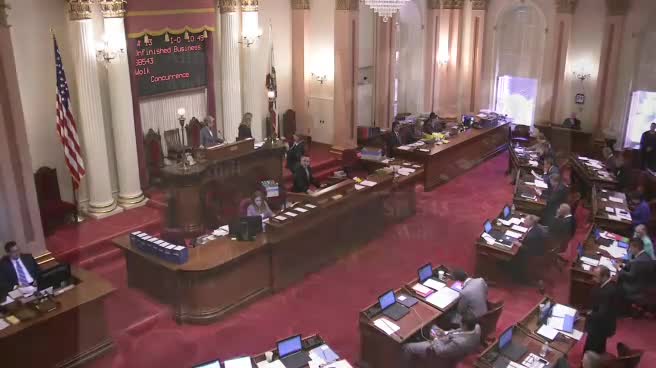 2MIN
Senate Floor
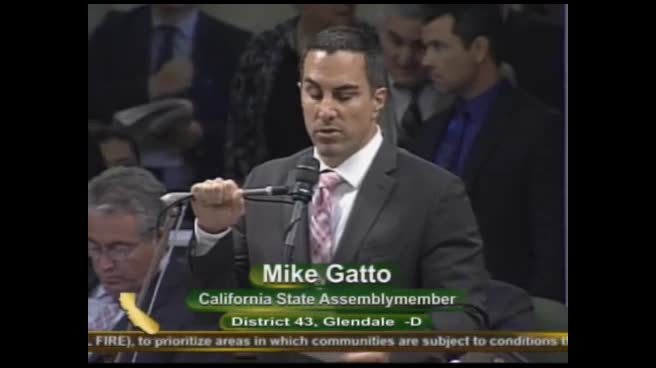 3MIN
Assembly Floor
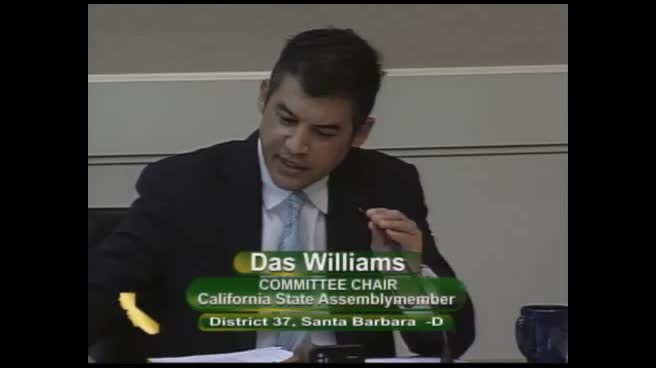 7MIN
Assembly Standing Committee on Natural Resources
 6MIN
Senate Floor
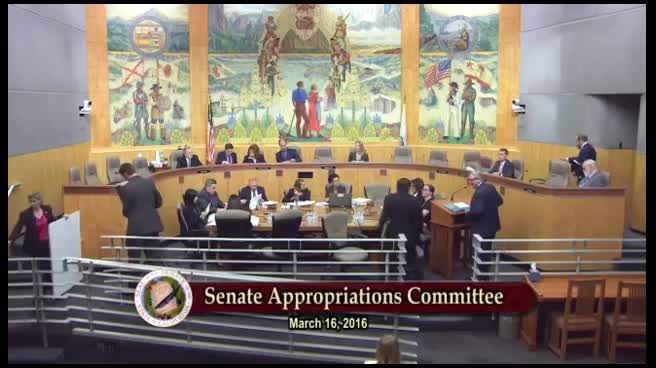 3MIN
Senate Standing Committee on Appropriations
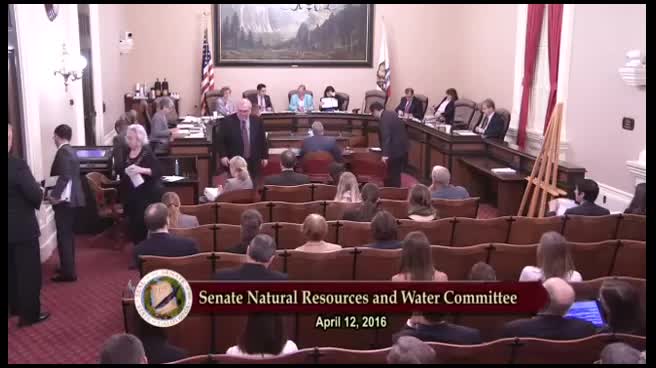 7MIN
Senate Standing Committee on Natural Resources and Water
Bill Author