SB 222: Local agencies: school bonds: general obligation bonds: statutory lien.
- Session Year: 2015-2016
- House: Senate
- Latest Version Date: 2015-07-13
(1)Except as otherwise provided by law, existing law provides that the governing board of a school district or community college district may, when in its judgment it is advisable, and shall, upon a petition of the majority of the qualified electors residing in the school district or community college district, order an election and submit to the electors of the district the question whether the bonds of the district shall be issued and sold for the purpose of raising money for certain school facilities purposes, including the purchasing of school lots and the building or purchasing of school buildings.
If the bond measure is approved by the electors, existing law requires the board of supervisors of the county whose county superintendent of schools has jurisdiction over the school district or community college district to annually, at the time of making the levy of taxes for county purposes, levy a tax for that year upon the property in the district for the interest and redemption of all outstanding bonds of the school district or community college district. Existing law requires that all taxes levied, when collected, to be paid into the county treasury, as provided, to be used for the payment of the principal and interest of the bonds and for no other purpose.
This bill would require bonds issued and sold pursuant to these provisions to be secured by a statutory lien on all revenues received pursuant to the levy and collection of the tax, as provided.
(2)Existing law authorizes local agencies to issue general obligation bonds, as provided.
This bill would require general obligation bonds issued and sold by or on behalf of a local agency to be secured by a statutory lien on all revenues received pursuant to the levy and collection of the property tax imposed to service those bonds, as provided.
(1)Except as otherwise provided by law, existing law provides that the governing board of a school district or community college district may, when in its judgment it is advisable, and shall, upon a petition of the majority of the qualified electors residing in the school district or community college district, order an election and submit to the electors of the district the question whether the bonds of the district shall be issued and sold for the purpose of raising money for certain school facilities purposes, including the purchasing of school lots and the building or purchasing of school buildings.
If the bond measure is approved by the electors, existing law requires the board of supervisors of the county whose county superintendent of schools has jurisdiction over the school district or community college district to annually, at the time of making the levy of taxes for county purposes, levy a tax for that year upon the property in the district for the interest and redemption of all outstanding bonds of the school district or community college district. Existing law requires that all taxes levied, when collected, to be paid into the county treasury, as provided, to be used for the payment of the principal and interest of the bonds and for no other purpose.
This bill would require bonds issued and sold pursuant to these provisions to be secured by a statutory lien on all revenues received pursuant to the levy and collection of the tax, as provided.
Existing
(2)Existing law authorizes local agencies to issue general obligation bonds, as provided.
This bill would require general obligation bonds issued and sold by or on behalf of a local agency to be secured by a statutory lien on all revenues received pursuant to the levy and collection of the property tax imposed to service those bonds, as provided.
Existing law authorizes local agencies to issue general obligation bonds, as provided.
This bill would require general obligation bonds issued and sold by or on behalf of a local agency to be secured by a statutory lien on all revenues received pursuant to the levy and collection of the property tax imposed to service those bonds, as provided.
Except as otherwise provided by law, existing law provides that the governing board of a school district or community college district may, when in its judgment it is advisable, and shall, upon a petition of the majority of the qualified electors residing in the school district or community college district, order an election and submit to the electors of the district the question whether the bonds of the district shall be issued and sold for the purpose of raising money for certain school facilities purposes, including the purchasing of school lots and the building or purchasing of school buildings.
If the bond measure is approved by the electors, existing law requires the board of supervisors of the county whose county superintendent of schools has jurisdiction over the school district or community college district to annually, at the time of making the levy of taxes for county purposes, levy a tax for that year upon the property in the district for the interest and redemption of all outstanding bonds of the school district or community college district. Existing law requires that all taxes levied, when collected, to be paid into the county treasury, as provided, to be used for the payment of the principal and interest of the bonds and for no other purpose.
This bill would require bonds issued and sold pursuant to these provisions to be secured by a statutory lien on all revenues received pursuant to the levy and collection of the tax, as provided.
(a)When collected, all taxes levied shall be paid into the county treasury of the county whose superintendent of schools has jurisdiction over the school district on behalf of which the tax was levied, to the credit of the interest and sinking fund of the school district, or community college district as designated by the California Community Colleges Budget and Accounting Manual, and shall be used for the payment of the principal and interest of the bonds and for no other purpose.
(b)Bonds issued and sold pursuant to this chapter shall be secured by a statutory lien on all revenues received pursuant to the levy and collection of the tax. The lien shall automatically attach without further action or authorization by the governing board of the school district or community college district. The lien shall be valid and binding from the time the bonds are executed and delivered. The revenues received pursuant to the levy and collection of the tax shall be immediately subject to the lien, and the lien shall automatically attach to the revenues and be effective, binding, and enforceable against the school district or community college district, its successors, transferees, and creditors, and all others asserting rights therein, irrespective of whether those parties have notice of the lien and without the need for any physical delivery, recordation, filing, or further act.
SEC. 2.Article 5.5 (commencing with Section 53515) is added to Chapter 3 of Part 1 of Division 2 of Title 5 of the Government Code, to read:5.5.Lien for General Obligation Bonds53515.(a)General obligation bonds issued and sold by or on behalf of a local agency shall be secured by a statutory lien on all revenues received pursuant to the levy and collection of the tax. The lien shall automatically arise without the need for any action or authorization by the local agency or its governing body. The lien shall be valid and binding from the time the bonds are executed and delivered. The revenues received pursuant to the levy and collection of the tax shall be immediately subject to the lien, and the lien shall immediately attach to the revenues and be effective, binding, and enforceable against the local agency, its successors, transferees, and creditors, and all others asserting rights therein, irrespective of whether those parties have notice of the lien and without the need for any physical delivery, recordation, filing, or further act.
(b)This section is not intended to supplement or limit a local agencys power to issue general obligation bonds conferred by any other law.
(c)For purposes of this section, both of the following shall apply:
(1)Local agency means any city, county, city and county, school district, community college district, authority, or special district.
(2)General obligation bonds means bonds, warrants, notes, or other evidence of indebtedness of a local agency payable, both principal and interest, from the proceeds of ad valorem taxes that may be levied pursuant to paragraphs (2) and (3) of subdivision (b) of Section 1 of Article XIII A of the California Constitution.
All taxes levied, when collected (a)When collected, all taxes levied shall be paid into the county treasury of the county whose superintendent of schools has jurisdiction over the school district in on behalf of which the tax was levied, to the credit of the interest and sinking fund of the school district, or community college district as designated by the California Community Colleges Budget and Accounting Manual, and shall be used for the payment of the principal and interest of the bonds and for no other purpose.
(b)Bonds issued and sold pursuant to this chapter shall be secured by a statutory lien on all revenues received pursuant to the levy and collection of the tax. The lien shall automatically attach without further action or authorization by the governing board of the school district or community college district. The lien shall be valid and binding from the time the bonds are executed and delivered. The revenues received pursuant to the levy and collection of the tax shall be immediately subject to the lien, and the lien shall automatically attach to the revenues and be effective, binding, and enforceable against the school district or community college district, its successors, transferees, and creditors, and all others asserting rights therein, irrespective of whether those parties have notice of the lien and without the need for any physical delivery, recordation, filing, or further act.
SECTION 1.SEC. 2.Article 5.5 (commencing with Section 53515) is added to Chapter 3 of Part 1 of Division 2 of Title 5 of the Government Code, to read:5.5.Lien for General Obligation Bonds53515.(a)General obligation bonds issued and sold by or on behalf of a local agency shall be secured by a statutory lien on all revenues received pursuant to the levy and collection of the tax. The lien shall automatically arise without the need for any action or authorization by the local agency or its governing body. The lien shall be valid and binding from the time the bonds are executed and delivered. The revenues received pursuant to the levy and collection of the tax shall be immediately subject to the lien, and the lien shall immediately attach to the revenues and be effective, binding, and enforceable against the local agency, its successors, transferees, and creditors, and all others asserting rights therein, irrespective of whether those parties have notice of the lien and without the need for any physical delivery, recordation, filing, or further act.
(b)This section is not intended to supplement or limit a local agencys power to issue general obligation bonds conferred by any other law.
(c)For purposes of this section, both of the following shall apply:
(1)Local agency means any city, county, city and county, school district, community college district, authority, or special district.
(2)General Obligation obligation bonds means bonds, warrants, notes, or other evidence of indebtedness of a local agency payable, both principal and interest, from the proceeds of ad valorem taxes which that may be levied pursuant to paragraphs (2) and (3) of subdivision (b) of Section 1 of Article XIII A of the California Constitution.
(a)General obligation bonds issued and sold by or on behalf of a local agency shall be secured by a statutory lien on all revenues received pursuant to the levy and collection of the tax. The lien shall automatically arise without the need for any action or authorization by the local agency or its governing body. The lien shall be valid and binding from the time the bonds are executed and delivered. The revenues received pursuant to the levy and collection of the tax shall be immediately subject to the lien, and the lien shall immediately attach to the revenues and be effective, binding, and enforceable against the local agency, its successors, transferees, and creditors, and all others asserting rights therein, irrespective of whether those parties have notice of the lien and without the need for any physical delivery, recordation, filing, or further act.
(b)This section is not intended to supplement or limit a local agencys power to issue general obligation bonds conferred by any other law.
(c)For purposes of this section, both of the following shall apply:
(1)Local agency means any city, county, city and county, school district, community college district, authority, or special district.
(2)General Obligation bonds means bonds, warrants, notes, or other evidence of indebtedness of a local agency payable, both principal and interest, from the proceeds of ad valorem taxes which may be levied pursuant to paragraphs (2) and (3) of subdivision (b) of Section 1 of Article XIII A of the California Constitution.
SECTION 1.Section 15251 of the Education Code is amended to read:15251.(a)When collected, all taxes levied shall be paid into the county treasury of the county whose superintendent of schools has jurisdiction over the school district on behalf of which the tax was levied, to the credit of the interest and sinking fund of the school district, or community college district as designated by the California Community Colleges Budget and Accounting Manual, and shall be used for the payment of the principal and interest of the bonds and for no other purpose.
(b)Bonds issued and sold pursuant to this chapter shall be secured by a statutory lien on all revenues received pursuant to the levy and collection of the tax. The lien shall automatically attach without further action or authorization by the governing board of the school district or community college district. The lien shall be valid and binding from the time the bonds are executed and delivered. The revenues received pursuant to the levy and collection of the tax shall be immediately subject to the lien, and the lien shall automatically attach to the revenues and be effective, binding, and enforceable against the school district or community college district, its successors, transferees, and creditors, and all others asserting rights therein, irrespective of whether those parties have notice of the lien and without the need for any physical delivery, recordation, filing, or further act.
All taxes levied, when collected (a)When collected, all taxes levied shall be paid into the county treasury of the county whose superintendent of schools has jurisdiction over the school district in on behalf of which the tax was levied, to the credit of the interest and sinking fund of the school district, or community college district as designated by the California Community Colleges Budget and Accounting Manual, and shall be used for the payment of the principal and interest of the bonds and for no other purpose.
(b)Bonds issued and sold pursuant to this chapter shall be secured by a statutory lien on all revenues received pursuant to the levy and collection of the tax. The lien shall automatically attach without further action or authorization by the governing board of the school district or community college district. The lien shall be valid and binding from the time the bonds are executed and delivered. The revenues received pursuant to the levy and collection of the tax shall be immediately subject to the lien, and the lien shall automatically attach to the revenues and be effective, binding, and enforceable against the school district or community college district, its successors, transferees, and creditors, and all others asserting rights therein, irrespective of whether those parties have notice of the lien and without the need for any physical delivery, recordation, filing, or further act.
|
Date
|
Status
|
|---|---|
| May 19, 2015 | From committee with author's amendments. Read second time and amended. Re-referred to Com. on L. GOV. |
| Jul 13, 2015 | Chaptered by Secretary of State. Chapter 78, Statutes of 2015. |
| Jul 13, 2015 | Approved by the Governor. |
| Jul 1, 2015 | Enrolled and presented to the Governor at 4:45 p.m. |
| Jun 29, 2015 | Assembly amendments concurred in. (Ayes 37. Noes 0.) Ordered to engrossing and enrolling. |
| Jun 29, 2015 | Assembly amendments concurred in. (Ayes 37. Noes 0. Page 1660.) Ordered to engrossing and enrolling. |
| Jun 25, 2015 | Read third time. Passed. (Ayes 79. Noes 0. Page 2147.) Ordered to the Senate. |
| Jun 25, 2015 | In Senate. Concurrence in Assembly amendments pending. |
| Jun 18, 2015 | Read second time. Ordered to third reading. |
| Jun 17, 2015 | From committee: Do pass. (Ayes 9. Noes 0.) (June 17). |
| Feb 12, 2015 | Introduced. Read first time. To Com. on RLS. for assignment. To print. |
| May 14, 2015 | Referred to Com. on L. GOV. |
| Apr 23, 2015 | Read third time. Passed. (Ayes 38. Noes 0. Page 741.) Ordered to the Assembly. |
| Apr 23, 2015 | In Assembly. Read first time. Held at Desk. |
| Apr 15, 2015 | Read second time and amended. Ordered to third reading. |
| Apr 14, 2015 | From committee: Do pass as amended. (Ayes 6. Noes 0. Page 524.) (April 8). |
| Mar 19, 2015 | Set for hearing April 8. |
| Feb 26, 2015 | Referred to Com. on GOV. & F. |
| Feb 13, 2015 | From printer. May be acted upon on or after March 15. |
|
Date
|
Description
|
Location
|
Votes
|
|
|---|---|---|---|---|
| Jun 29, 2015 | Unfinished Business SB222 Block Concurrence | Senate Floor |
Passed |
|
| Jun 25, 2015 | SB 222 Block Senate Third Reading By MAIENSCHEIN | Assembly Floor |
Passed |
|
| Jun 17, 2015 | Do pass. | Assembly Standing Committee on Local Government |
Passed |
|
| Apr 23, 2015 | Senate 3rd Reading SB222 Block | Senate Floor |
Passed |
|
| Apr 8, 2015 | Do pass as amended | Senate Standing Committee on Governance and Finance |
Passed |
This list shows positions taken on this bill by organizations on the date displayed, which is linked to the original source.
Positions by individuals are not included.
|
Organization
|
Position
|
Date
|
|---|---|---|
| California Association Of School Business Officials | ** Support | Jun 29, 2015 |
| California Public Securities Association | ** Support | Jun 29, 2015 |
| Coalition For Adequate School Housing | ** Support | Jun 29, 2015 |
| Lemon Grove School District | ** Support | Jun 29, 2015 |
| Riverside County School District Superintendents | ** Support | Jun 29, 2015 |
| Riverside County Superintendent of Schools | ** Support | Jun 29, 2015 |
| San Diego Unified School District | ** Support | Jun 29, 2015 |
SB 222
Page 3
|
Office of Senate Floor Analyses (916) 651-1520 Fax: (916) 327-4478 |
UNFINISHED BUSINESS
Bill No: SB 222
Amended: 5/19/15
SENATE GOVERNANCE & FIN. COMMITTEE: 6-0, 4/8/15
AYES: Hertzberg, Nguyen, Beall, Hernandez, Lara, Pavley
NO VOTE RECORDED: Bates
SENATE FLOOR: 38-0, 4/23/15
AYES: Allen, Anderson, Bates, Beall, Berryhill, Block, De León, Fuller, Gaines, Galgiani, Hall, Hancock, Hernandez, Hertzberg, Hill, Hueso, Huff, Jackson, Lara, Leno, Leyva, Liu, McGuire, Mendoza, Mitchell, Monning, Moorlach, Morrell, Nguyen, Nielsen, Pan, Pavley, Roth, Runner, Stone, Vidak, Wieckowski, Wolk
NO VOTE RECORDED: Cannella
ASSEMBLY FLOOR: 79-0, 6/25/15 - See last page for vote
SUBJECT: Local agencies: school bonds: general obligation bonds: statutory lien
DIGEST: This bill specifies that general obligation bonds issued and sold by local governments, including school districts, are secured by a statutory lien.
Assembly Amendments specify that school bonds issued and sold to be secured by a statutory lien on all revenues received pursuant to the levy and collection of the tax, as provided.
Existing law authorizes cities, counties, school districts, community college districts, and some special districts to issue general obligation (GO) bonds, secured by ad valorem property tax revenues, with voter approval.
This bill:
Requires all GO bonds issued and sold by or on behalf of a local agency, including a school district, to be secured by a statutory lien on all revenues received, pursuant to the levy and collection of the tax.
Requires the lien to automatically arise without any further action or authorization by the local agency or its governing board
Requires the lien to be valid and binding from the time the bonds are executed and delivered.
Requires the revenue received, pursuant to the levy and collection of the tax, to be immediately subject to the lien and requires the lien to immediately attach to the revenues and be effective, binding, and enforceable against the local agency, its successors, transfers, and creditors, irrespective of whether those parties have notice of the lien and without the need for any physical delivery, recordation, filing or further act.
Specifies that this section is not intended to supplement or limit a local agency's power to issue GO bonds conferred by any other law.
Defines local agency to mean any city, county, city and county, school district, community college district, authority, or special district.
Defines GO bonds to mean bonds, warrants, notes, or other evidence of indebtedness of a local agency payable from the proceeds of ad valorem taxes that may be lived, pursuant to the California Constitution Article XIII A ,Section 1(b)(2)(3).
FISCAL EFFECT: Appropriation: No Fiscal Com.: No Local: No
California Association of School Business Officials
California Public Securities Association
Coalition for Adequate School Housing
Lemon Grove School District
Riverside County School District Superintendents
Riverside County Superintendent of Schools
San Diego Unified School District
OPPOSITION: (Verified 6/26/15)
None received
ARGUMENTS IN SUPPORT: According to supporters, bond rating agencies perceive that some school districts’ distressed financial conditions could pose a threat to those districts’ GO bond payments. As a result, districts in financial difficulty receive lower GO bond ratings than do districts in more stable financial condition. Fiscally distressed school districts are often among those districts that most need the kinds of facilities renovation or rehabilitation that can be financed through GO debt. Lower bond ratings increase those districts’ borrowing costs, creating an additional obstacle to financing their facilities projects. By enacting language that unambiguously attaches statutory liens to GO bonds issued by all local governments, including school districts, SB 222 will improve some local governments’ bond ratings. Higher ratings will reduce the bonds’ interest rates, allowing taxpayers to finance more public improvements at lower costs.
AYES: Achadjian, Alejo, Travis Allen, Baker, Bigelow, Bloom, Bonilla, Bonta, Brough, Brown, Burke, Calderon, Campos, Chang, Chau, Chávez, Chiu, Chu, Cooley, Cooper, Dababneh, Dahle, Daly, Dodd, Eggman, Frazier, Beth Gaines, Gallagher, Cristina Garcia, Eduardo Garcia, Gatto, Gipson, Gomez, Gonzalez, Gordon, Gray, Grove, Hadley, Harper, Roger Hernández, Holden, Irwin, Jones, Jones-Sawyer, Kim, Lackey, Levine, Linder, Lopez, Low, Maienschein, Mathis, Mayes, McCarty, Medina, Mullin, Nazarian, Obernolte, O'Donnell, Olsen, Patterson, Perea, Quirk, Rendon, Ridley-Thomas, Rodriguez, Salas, Santiago, Steinorth, Mark Stone, Thurmond, Ting, Wagner, Waldron, Weber, Wilk, Williams, Wood, Atkins
NO VOTE RECORDED: Melendez
Prepared by: Brian Weinberger / GOV. & F. / (916) 651-4119
6/26/15 15:24:32
SB 222
Page 3
|
Office of Senate Floor Analyses (916) 651-1520 Fax: (916) 327-4478 |
UNFINISHED BUSINESS
Bill No: SB 222
Amended: 5/19/15
SENATE GOVERNANCE & FIN. COMMITTEE: 6-0, 4/8/15
AYES: Hertzberg, Nguyen, Beall, Hernandez, Lara, Pavley
NO VOTE RECORDED: Bates
SENATE FLOOR: 38-0, 4/23/15
AYES: Allen, Anderson, Bates, Beall, Berryhill, Block, De León, Fuller, Gaines, Galgiani, Hall, Hancock, Hernandez, Hertzberg, Hill, Hueso, Huff, Jackson, Lara, Leno, Leyva, Liu, McGuire, Mendoza, Mitchell, Monning, Moorlach, Morrell, Nguyen, Nielsen, Pan, Pavley, Roth, Runner, Stone, Vidak, Wieckowski, Wolk
NO VOTE RECORDED: Cannella
ASSEMBLY FLOOR: 79-0, 6/25/15 - See last page for vote
SUBJECT: Local agencies: school bonds: general obligation bonds: statutory lien
DIGEST: This bill specifies that general obligation bonds issued and sold by local governments, including school districts, are secured by a statutory lien.
Assembly Amendments specify that school bonds issued and sold to be secured by a statutory lien on all revenues received pursuant to the levy and collection of the tax, as provided.
Existing law authorizes cities, counties, school districts, community college districts, and some special districts to issue general obligation (GO) bonds, secured by ad valorem property tax revenues, with voter approval.
This bill:
Requires all GO bonds issued and sold by or on behalf of a local agency, including a school district, to be secured by a statutory lien on all revenues received, pursuant to the levy and collection of the tax.
Requires the lien to automatically arise without any further action or authorization by the local agency or its governing board
Requires the lien to be valid and binding from the time the bonds are executed and delivered.
Requires the revenue received, pursuant to the levy and collection of the tax, to be immediately subject to the lien and requires the lien to immediately attach to the revenues and be effective, binding, and enforceable against the local agency, its successors, transfers, and creditors, irrespective of whether those parties have notice of the lien and without the need for any physical delivery, recordation, filing or further act.
Specifies that this section is not intended to supplement or limit a local agency's power to issue GO bonds conferred by any other law.
Defines local agency to mean any city, county, city and county, school district, community college district, authority, or special district.
Defines GO bonds to mean bonds, warrants, notes, or other evidence of indebtedness of a local agency payable from the proceeds of ad valorem taxes that may be lived, pursuant to the California Constitution Article XIII A, Section 1(b)(2)(3).
FISCAL EFFECT: Appropriation: No Fiscal Com.: No Local: No
California Association of School Business Officials
California Public Securities Association
Coalition for Adequate School Housing
Lemon Grove School District
Riverside County School District Superintendents
Riverside County Superintendent of Schools
San Diego Unified School District
OPPOSITION: (Verified 6/26/15)
None received
ARGUMENTS IN SUPPORT: According to supporters, bond rating agencies perceive that some school districts’ distressed financial conditions could pose a threat to those districts’ GO bond payments. As a result, districts in financial difficulty receive lower GO bond ratings than do districts in more stable financial condition. Fiscally distressed school districts are often among those districts that most need the kinds of facilities renovation or rehabilitation that can be financed through GO debt. Lower bond ratings increase those districts’ borrowing costs, creating an additional obstacle to financing their facilities projects. By enacting language that unambiguously attaches statutory liens to GO bonds issued by all local governments, including school districts, SB 222 will improve some local governments’ bond ratings. Higher ratings will reduce the bonds’ interest rates, allowing taxpayers to finance more public improvements at lower costs.
AYES: Achadjian, Alejo, Travis Allen, Baker, Bigelow, Bloom, Bonilla, Bonta, Brough, Brown, Burke, Calderon, Campos, Chang, Chau, Chávez, Chiu, Chu, Cooley, Cooper, Dababneh, Dahle, Daly, Dodd, Eggman, Frazier, Beth Gaines, Gallagher, Cristina Garcia, Eduardo Garcia, Gatto, Gipson, Gomez, Gonzalez, Gordon, Gray, Grove, Hadley, Harper, Roger Hernández, Holden, Irwin, Jones, Jones-Sawyer, Kim, Lackey, Levine, Linder, Lopez, Low, Maienschein, Mathis, Mayes, McCarty, Medina, Mullin, Nazarian, Obernolte, O'Donnell, Olsen, Patterson, Perea, Quirk, Rendon, Ridley-Thomas, Rodriguez, Salas, Santiago, Steinorth, Mark Stone, Thurmond, Ting, Wagner, Waldron, Weber, Wilk, Williams, Wood, Atkins
NO VOTE RECORDED: Melendez
Prepared by: Brian Weinberger / GOV. & F. / (916) 651-4119
6/26/15 15:30:14
SB 222
Page 3
SENATE THIRD READING
SB 222
(Block)
As Amended May 19, 2015
Majority vote
SENATE VOTE: 38-0
Committee |
Votes |
Ayes |
|
Local Government |
9-0 |
Maienschein, Gonzalez, Alejo, Chiu, Cooley, Gordon, Holden, Linder, Waldron |
|
SUMMARY: Enacts a statutory lien to secure general obligation (GO) bonds issued or sold by a city, county, city and county, school district, community college district, authority, or special district. Specifically, this bill:
Requires all GO bonds issued and sold by or on behalf of a local agency to be secured by a statutory lien on all revenues received, pursuant to the levy and collection of the tax.
Requires the lien to automatically arise without any further action or authorization by the local agency or its governing board
Requires the lien to be valid and binding from the time the bonds are executed and delivered.
Requires the revenue received, pursuant to the levy and collection of the tax, to be immediately subject to the lien and requires the lien to immediately attach to the revenues and be effective, binding, and enforceable against the local agency, its successors, transfers, and creditors, irrespective of whether those parties have notice of the lien and without the need for any physical delivery, recordation, filing or further act.
Specifies that this section is not intended to supplement or limit a local agency's power to issue GO bonds conferred by any other law.
Defines local agency to mean any city, county, city and county, school district, community college district, authority, or special district.
Defines GO bonds to mean bonds, warrants, notes, or other evidence of indebtedness of a local agency payable from the proceeds of ad valorem taxes that may be lived, pursuant to the California Constitution Article XIII A ,Section 1(b)(2)(3).
FISCAL EFFECT: None
COMMENTS:
General Obligation Bonds. The Legislature has granted cities, counties, school districts and several types of special districts the authority to issue GO bonds. These GO bonds issued by local agencies are secured by the legal obligation to levy an ad valorem property tax on taxable property in an amount sufficient to pay the debt service. The rate of the annual ad valorem taxes levied by the local agency to repay GO bonds is determined by the relationship between the assessed valuation of taxable property in the local agency and the amount of debt service due on the GO bonds in any year. Two-thirds of voters must approve the issuance of a GO bond, and in doing so, approve the levy of an ad valorem tax to pay the bond. Proposition 39 (2000) enables school districts to issue GO bonds upon a 55% voter approval, subject to specified conditions. Because GO bonds are backed by such a broad and reliable security pledge, they typically obtain the highest bond ratings and widest investor acceptance, which results in the lowest borrowing costs among various types of long-term bonds.
Bankruptcy. Recent bankruptcy cases across the country (Jefferson County, Alabama and City of Detroit, Michigan) have raised new questions about the security and treatment of GO bonds after the filing of Chapter 9 (municipal bankruptcy). It is difficult to conclude the treatment of GO bonds in all Chapter 9 cases due to the differences in state law. However, California is listed as one of the five states that have GO bonds backed by a statutory lien, pursuant to the requirements under state law which require local agencies to secure GO bonds with a broad pledge of voter approved ad valorem tax revenues. A statutory lien is one type of lien recognized by the Bankruptcy Code that arises by statute, and does not require any consent between parties (security interests) or judicial action (judicial lien). In Bankruptcy Court, GO bonds backed by statutory liens are secured claims meaning they cannot be altered.
In past bankruptcy cases in California (San Jose Unified in 1983, Orange County in 1994, and Sierra Kings Health Care District in 2009), GO bond debt was preserved and the local agencies continued to make payments to bondholders. While there have been more recent cases of bankruptcy in California among cities and special districts, financially struggling school districts take a different path. As a result of court decisions (Butt v. State of California, 1992) placing the ultimate responsibility for ensuring the equitable provision of public education to all students, including those in financially failing school districts, and the resulting early experiences with districts on the verge of insolvency, the state developed a process for providing financial oversight to school districts, and for providing financial assistance and financial recovery to school districts in financial trouble [AB 1200 (Eastin), Chapter 1213, Statutes of 1991]. As a result, the AB 1200 process has been sufficient to pull nine school districts out of immediate financial trouble and return them to a more stable fiscal condition.
Bill Summary. This bill enacts a statutory lien to secure GO bonds issued by a city, county, city and county, special district, authority, school district, and community college district. This bill requires the statutory lien arise automatically without the need for any action or authorization by the local agency or its governing body. Under this bill, the lien will be valid and binding from the time the bonds are executed and delivered. Additionally, this bill requires that the lien must immediately attach to the GO bond revenues and be effective, binding, and enforceable against the local agency, its successors, purchasers of those revenues, creditors, and all other asserting rights therein, irrespective of whether those parties have notice of the lien and without the need for any physical delivery, recordation, filing, or further act. School districts have the authority to issue GO bonds under both the Government Code and the Education Code, therefore, the author and sponsor want to amend both codes to emphasize the statutory lien for school districts.
This bill is sponsored by San Diego Unified School District.
Author's Statement. According to the author, "[This bill] clarifies that GO bonds issued and sold by school districts, community college districts, and local governments are secured by a statutory lien on the taxes collected for their payment. Current practice among bond rating agencies is to analyze the fiscal strength of the issuing district or region when giving the bonds a rating because they are concerned that if the district or local government were to declare bankruptcy, the taxes levied for payment of their general obligation bonds could be diverted by the bankruptcy court reducing or suspending payments to the bondholders. In the case of school districts with less financial stability, it can result in a lower rating on the bond issuance which results in taxpayers paying more for improvements to their schools than their counterparts in districts with more financial stability, even though the risk is the same.
"[This bill] clarifies that the statutory liens protect GO bonds thus eliminating the risk of non-repayment. In the event credit ratings were improved, it could result in savings to a school district, community college district, or local government."
Policy Consideration. Supporters of this bill contend that current practice among bond rating agencies is to analyze the financial strength of the issuing local agency as opposed to the actual security for repayment of the GO bond debt, the property tax base. Proponents argue that this causes school districts with less financial stability to get a lower rating on bond issuance causing some districts to pay more for school improvements than other districts with greater financial stability. While equity is a good public policy goal, the Legislature may wish to consider if this bill will achieve that equity and if bond rating agencies will still analyze the overall financial strength of a local agency despite the pledged security of a statutory lien on the revenue that will be used to repay the bond debt.
Arguments in Support. Supporters argue that this bill clarifies existing law to secure GO bonds by way of a statutory lien on the taxes collected for their repayment. By clarifying in statute that these are statutory liens, it would reduce bankruptcy risks on GO bonds and local agencies would potentially benefit from higher credit ratings, improved interest rates, and savings to their bond costs.
Arguments in Opposition. None on file.
Analysis Prepared by: Misa Lennox / L. GOV. / (916) 319-3958 FN: 0000979
SB 222
Page 4
Date of Hearing: June 17, 2015
ASSEMBLY COMMITTEE ON LOCAL GOVERNMENT
Brian Maienschein, Chair
SB 222
(Block) – As Amended May 19, 2015
SENATE VOTE: 38-0
SUBJECT: Local agencies: school bonds: general obligation bonds: statutory lien.
SUMMARY:
Enacts a statutory lien to secure general obligation (G.O.) bonds
issued or sold
by a city, county, city and county, school
district, community college district, authority, or special district.
Specifically, this bill:
Requires all GO bonds issued and sold by or on behalf of a local agency to be secured by a statutory lien on all revenues received, pursuant to the levy and collection of the tax.
Requires the lien to automatically arise without any further action or authorization by the local agency or its governing board
Requires the lien to be valid and binding from the time the bonds are executed and delivered.
Requires the revenue received, pursuant to the levy and collection of the tax, to be immediately subject to the lien and requires the lien to immediately attach to the revenues and be effective, binding, and enforceable against the local agency, its successors, transfers, and creditors, irrespective of whether those parties have notice of the lien and without the need for any physical delivery, recordation, filing or further act.
Specifies that this section is not intended to supplement or limit a local agency's power to issue GO bonds conferred by any other law.
Defines local agency to mean any city, county, city and county, school district, community college district, authority, or special district.
Defines GO bonds to mean bonds, warrants, notes, or other evidence of indebtedness of a local agency payable from the proceeds of ad valorem taxes that may be lived, pursuant to paragraphs 2 and 3 of subdivision (b) of Section 1 of Article XIII A of the California Constitution.
FISCAL EFFECT: None
COMMENTS:
General Obligation Bonds. The Legislature has granted cities, counties, school districts and several types of special districts the authority to issue GO bonds. These GO bonds issued by local agencies are secured by the legal obligation to levy an ad valorem property tax on taxable property in an amount sufficient to pay the debt service. The rate of the annual ad valorem taxes levied by the local agency to repay GO bonds is determined by the relationship between the assessed valuation of taxable property in the local agency and the amount of debt service due on the GO bonds in any year. Two-thirds of voters must approve the issuance of a GO bond, and in doing so, approve the levy of an ad valorem tax to pay the bond. Proposition 39 (2000) enables school districts to issue GO bonds upon a 55% voter approval, subject to specified conditions. Because GO bonds are backed by such a broad and reliable security pledge, they typically obtain the highest bond ratings and widest investor acceptance, which results in the lowest borrowing costs among various types of long-term bonds.
Bankruptcy. Recent bankruptcy cases across the country (Jefferson County, Alabama and City of Detroit, Michigan) have raised new questions about the security and treatment of GO bonds after the filing of Chapter 9 (municipal bankruptcy). It is difficult to conclude the treatment of GO bonds in all Chapter 9 cases due to the differences in state law. However, California is listed as one of the five states that have GO bonds backed by a statutory lien, pursuant to the requirements under state law which require local agencies to secure GO bonds with a broad pledge of voter approved ad valorem tax revenues. A statutory lien is one type of lien recognized by the Bankruptcy Code that arises by statute, and does not require any consent between parties (security interests) or judicial action (judicial lien). In Bankruptcy Court, GO bonds backed by statutory liens are secured claims meaning they cannot be altered.
In past bankruptcy cases in California (San Jose Unified in 1983, Orange County in 1994, and Sierra Kings Health Care District in 2009), GO bond debt was preserved and the local agencies continued to make payments to bondholders. While there have been more recent cases of bankruptcy in California among cities and special districts, financially struggling school districts take a different path. As a result of court decisions (Butt v. State of California, 1992) placing the ultimate responsibility for ensuring the equitable provision of public education to all students, including those in financially failing school districts, and the resulting early experiences with districts on the verge of insolvency, the state developed a process for providing financial oversight to school districts, and for providing financial assistance and financial recovery to school districts in financial trouble [AB 1200 (Eastin), Chapter 1213, Statutes of 1991]. As a result, the AB 1200 process has been sufficient to pull nine school districts out of immediate financial trouble and return them to a more stable fiscal condition.
Bill Summary. This bill enacts a statutory lien to secure GO bonds issued by a city, county, city and county, special district, authority, school district, and community college district. This bill requires the statutory lien arise automatically without the need for any action or authorization by the local agency or its governing body. Under this bill, the lien will be valid and binding from the time the bonds are executed and delivered. Additionally, this bill requires that the lien must immediately attach to the GO bond revenues and be effective, binding, and enforceable against the local agency, its successors, purchasers of those revenues, creditors, and all other asserting rights therein, irrespective of whether those parties have notice of the lien and without the need for any physical delivery, recordation, filing, or further act. School districts have the authority to issue GO bonds under both the Government Code and the Education Code, therefore, the author and sponsor want to amend both codes to emphasize the statutory lien for school districts.
This bill is sponsored by San Diego Unified School District.
Author's Statement. According to the author, "[This bill] clarifies that GO bonds issued and sold by school districts, community college districts, and local governments are secured by a statutory lien on the taxes collected for their payment. Current practice among bond rating agencies is to analyze the fiscal strength of the issuing district or region when giving the bonds a rating because they are concerned that if the district or local government were to declare bankruptcy, the taxes levied for payment of their general obligation bonds could be diverted by the bankruptcy court reducing or suspending payments to the bondholders. In the case of school districts with less financial stability, it can result in a lower rating on the bond issuance which results in taxpayers paying more for improvements to their schools than their counterparts in districts with more financial stability, even though the risk is the same.
"[This bill] clarifies that the statutory liens protect GO bonds thus eliminating the risk of non-repayment. In the event credit ratings were improved, it could result in savings to a school district, community college district, or local government."
Policy Consideration. Supporters of the bill contend that current practice among bond rating agencies is to analyze the financial strength of the issuing local agency as opposed to the actual security for repayment of the GO bond debt, the property tax base. Proponents argue that this causes school districts with less financial stability to get a lower rating on bond issuance causing some districts to pay more for school improvements than other districts with greater financial stability. While equity is a good public policy goal, the Committee may wish to consider if this bill will achieve that equity and if bond rating agencies will still analyze the overall financial strength of a local agency despite the pledged security of a statutory lien on the revenue that will be used to repay the bond debt.
Arguments in Support. Supporters argue that this bill clarifies existing law to secure
GO bonds by way of a statutory lien on the taxes collected for their repayment. By clarifying in statute that these are statutory liens, it would reduce bankruptcy risks on GO bonds and local agencies would potentially benefit from higher credit ratings, improved interest rates, and savings to their bond costs.Arguments in Opposition. None on file.
REGISTERED SUPPORT / OPPOSITION:
Support Opposition
California Association of School Business Officials None on file
California School Boards Association
California Public Securities Association
Coalition for Adequate School Housing
Lemon Grove School District
Los Angeles Unified School District
Riverside County Superintendent of Schools
Santee School District
San Diego Unified School District
San Marcos Unified School District
Vista Unified School District
Analysis Prepared by: Misa Lennox / L. GOV. / (916) 319-3958
SB 222
Page 3
|
Office of Senate Floor Analyses (916) 651-1520 Fax: (916) 327-4478 |
THIRD READING
Bill No: SB 222
Amended: 4/15/15
SENATE GOVERNANCE & FIN. COMMITTEE: 6-0, 4/8/15
AYES: Hertzberg, Nguyen, Beall, Hernandez, Lara, Pavley
NO VOTE RECORDED: Bates
SUBJECT: School bonds: school facilities: statutory lien
DIGEST: This bill specifies that general obligation bonds issued and sold by local governments, including school districts, are secured by a statutory lien.
Existing law authorizes cities, counties, school districts, community college districts, and some special districts to issue general obligation (GO) bonds, secured by ad valorem property tax revenues, with voter approval.
This bill:
Defines “local agency” as any city, county, city and county, school district, community college district, authority, or special district.
Defines “general obligation bonds” as bonds, warrants, notes or other evidence of indebtedness of a local agency payable, both principal and interest, from the proceeds of ad valorem taxes which may be levied pursuant to Article XIIIA, Section 1(b)(2) or Section 1(b)(3) of the California Constitution.
Directs that GO bonds issued and sold by or on behalf of a local agency shall be secured by a statutory lien on all revenues received pursuant to the levy and collection of the tax. The lien shall automatically arise without the need for any action or authorization by the local agency or its governing body. The lien shall be valid and binding from the time the bonds are executed and delivered. The revenues received pursuant to the levy and collection of the tax shall be immediately subject to the lien, and the lien shall immediately attach to the revenues and be effective, binding, and enforceable against the local agency, its successors, transferees, and creditors, and all others asserting rights therein, irrespective of whether those parties have notice of the lien and without the need for any physical delivery, recordation, filing, or further act.
Declares that the bill’s provisions are intended to neither supplement nor limit a local agency’s power to issue GO bonds conferred by any other law.
FISCAL EFFECT: Appropriation: No Fiscal Com.: No Local: No
California Association of School Business Officials
California Public Securities Association
Coalition for Adequate School Housing
Lemon Grove School District
Riverside County School District Superintendents
Riverside County Superintendent of Schools
San Diego Unified School District.
OPPOSITION: (Verified 4/14/15)
None received
ARGUMENTS IN SUPPORT: According to supporters, bond rating agencies perceive that some school districts’ distressed financial conditions could pose a threat to those districts’ GO bond payments. As a result, districts in financial difficulty receive lower GO bond ratings than do districts in more stable financial condition. Fiscally distressed school districts are often among those districts that most need the kinds of facilities renovation or rehabilitation that can be financed through GO debt. Lower bond ratings increase those districts’ borrowing costs, creating an additional obstacle to financing their facilities projects. By enacting language that unambiguously attaches statutory liens to GO bonds issued by all local governments, including school districts, SB 222 will improve some local governments’ bond ratings. Higher ratings will reduce the bonds’ interest rates, allowing taxpayers to finance more public improvements at lower costs.
Prepared by: Brian Weinberger / GOV. & F. / (916) 651-4119
4/15/15 16:29:09
**** END ***
SB 222 (Block) 2/12/15 Page 3 of 3
SENATE COMMITTEE ON GOVERNANCE AND FINANCE
Senator Robert M. Hertzberg, Chair
2015 - 2016 Regular
Bill No: |
SB 222 |
Hearing Date: |
4/8/15 |
Author: |
Block |
Tax Levy: |
No |
Version: |
2/12/15 |
Fiscal: |
No |
Consultant: |
Weinberger |
||
STATUTORY LIEN FOR SCHOOL GENERAL OBLIGATION BONDS
Specifies that general obligation bonds issued and sold by a school district or community college district are secured by a statutory lien.
Background and Existing Law
School districts can finance improvements with district-wide voter-approved general obligation (GO) bonds (Education Code 15100, et seq.). School districts can also finance improvements with voter-approved GO bonds issued by "school facilities improvement districts" that are less than district-wide (Education Code 15300, et seq., added by AB 3747, Quackenbush, 1994 and recodified by SB 161, Greene, 1997).
Like all GO bonds issued by California local governments, school districts’ GO bonds are secured by a district’s pledge to levy ad valorem property taxes in an unlimited amount as necessary to pay debt service on the bonds. Because GO bonds are backed by such a broad and reliable security pledge, they typically obtain the highest bond ratings and widest investor acceptance, which results in the lowest borrowing costs among various types of long-term bonds.
It has generally been assumed that the broad pledge of ad valorem tax revenues to back GO bonds pursuant to state law establishes a “statutory lien,” which federal bankruptcy law would treat as a secured claim that would not be subject to modification if an issuer files for bankruptcy. Recent high-profile cases of municipal insolvency, like the City of Detroit’s bankruptcy filing, have caused some municipal finance practitioners to raise questions about the security of GO bonds in municipal bankruptcy proceedings.
School district officials worry that uncertainty about whether a statutory lien secures a school district’s GO bonds may cause ratings agencies to give those bonds a lower rating than they would receive without that uncertainty. A lower rating increases the borrowing costs that are borne by the district’s taxpayers. School district officials want legislators to eliminate potential uncertainty by amending state law to explicitly declare that a statutory lien secures school districts’ GO bonds.
Proposed Law
Senate Bill 222 declares that bonds issued and sold pursuant to the statutes that govern school and community college districts’ general obligation bonds are secured by a statutory lien on all revenues received pursuant to the levy and collection of the tax levied by the district upon the property in the district for the interest and redemption of all outstanding bonds of the district.
SB 222 requires that:
The lien must automatically attach without further action or authorization by the governing board of the school district or community college district.
The lien is valid and binding from the time the bonds are executed and delivered.
The revenues received pursuant to the levy and collection of the tax are immediately subject to the lien
The lien must automatically attach to the revenues and be effective, binding, and enforceable against the school district or community college district, its successors, transferees, and creditors, and all others asserting rights therein, irrespective of whether those parties have notice of the lien and without the need for any physical delivery, recordation, filing, or further act.
State Revenue Impact
No estimate.
Comments
1. Purpose of the bill. Bond rating agencies perceive that some school districts’ distressed financial conditions could pose a threat to those districts’ GO bond payments. As a result, districts in financial difficulty receive lower GO bond ratings than do districts in more stable financial condition. Fiscally distressed school districts are often among those districts that most need the kinds of facilities renovation or rehabilitation that can be financed through GO debt. Lower bond ratings increase those districts’ borrowing costs, creating an additional obstacle to financing their facilities projects. By enacting language that unambiguously attaches statutory liens to school districts’ GO bonds, SB 222 will improve some districts’ bond ratings. Higher ratings will reduce the bonds’ interest rates, allowing district taxpayers to finance more school facility improvements at lower costs.
2. Unintended consequences. One rule of legal interpretation is that if a law mentions some things, by implication it excludes other things (expressio unius est exclusio alterius). By explicitly applying a statutory lien only to school districts’ GO bonds, SB 222 may imply that a statutory lien does not apply to GO bonds issued by a city, county, or special district. That implication could have negative consequences for non-school GO bond ratings. To avoid raising unintended questions about whether a statutory lien applies only to some local government GO bonds and not others, the Committee may wish to consider amending SB 222 to apply the bill’s provisions to all general obligation bonds issued by California local governments.
3. Uncertain benefits. The benefits of enacting explicit statutory lien language for local government GO bonds may not be widespread. A commentary on statutory liens issued by the ratings agency Standard & Poor’s (S&P) on March 24, 2015 suggests that statutory lien provisions, like those in SB 222, may only have a positive effect on ratings of bonds issued by a relatively small universe of fiscally distressed issuers. The commentary notes that a bankruptcy filing could call the timeliness of GO bond payments into question regardless of whether a statutory lien guarantees bondholders’ claims on pledged tax revenues. As a result, because the timeliness of payments is a critical component of GO bond ratings, regardless of an issuer’s ability to pay, SB 222 may not change the vast majority of ratings. S&P’s commentary proposes that possible ratings benefits may be warranted if some fiscally distressed issuers are less likely to default on bond payments because they understand that they ultimately will be responsible for those payments regardless of any subsequent bankruptcy filing.
Support and Opposition
(4/2/15)
Support: California Association of School Business Officials; Coalition for Adequate School Housing; Lemon Grove School District; Riverside County school district superintendents; Riverside County Superintendent of Schools; San Diego Unified School District.
Opposition: Unknown.
-- END --
Discussed in Hearing
View Older Hearings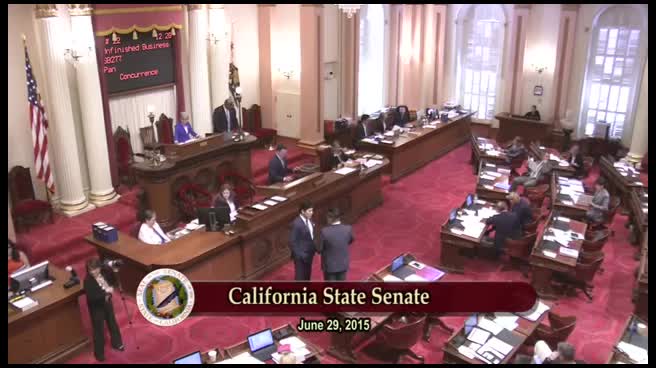

Bill Author

Bill Co-Author(s):