SB 359: California Mathematics Placement Act of 2015.
- Session Year: 2015-2016
- House: Senate
- Latest Version Date: 2015-10-05
(1)Existing law establishes a system of public elementary and secondary education in this state, and authorizes local educational agencies throughout the state to provide instruction to pupils.
This bill would enact the California Mathematics Placement Act of 2015. The bill would require governing boards or bodies of local educational agencies, as defined, that serve pupils entering grade 9 and that have not adopted a fair, objective, and transparent mathematics placement policy as of January 1, 2016, to, before the beginning of the 201617 school year, develop and adopt, in a regularly scheduled public meeting, a fair, objective, and transparent mathematics placement policy for pupils entering grade 9 with specified elements, and would authorize governing boards or bodies of local educational agencies serving pupils who are transitioning between elementary and middle school or elementary and junior high school to develop and implement a mathematics placement policy for these pupils, as applicable, with these specified elements. The bill would further require each governing board or body of a local educational agency to ensure that its mathematics placement policy is posted on its Internet Web site. By imposing additional requirements on local educational agencies, the bill would impose a state-mandated local program.
(2)The California Constitution requires the state to reimburse local agencies and school districts for certain costs mandated by the state. Statutory provisions establish procedures for making that reimbursement.
This bill would provide that, if the Commission on State Mandates determines that the bill contains costs mandated by the state, reimbursement for those costs shall be made pursuant to these statutory provisions.
(1)Existing law establishes a system of public elementary and secondary education in this state, and authorizes local educational agencies throughout the state to provide instruction to pupils.
This bill would enact the California Mathematics Placement Act of 2015. The bill would require governing boards or bodies of local educational agencies, as defined, that serve pupils entering grade 9 and that have not adopted a fair, objective, and transparent mathematics placement policy as of January 1, 2016, to to, before the beginning of the 201617 school year, develop and adopt, in a regularly scheduled public meeting, a fair, objective, and transparent mathematics placement policy for pupils entering grade 9 with specified elements, and would authorize governing boards or bodies of local educational agencies serving pupils who are transitioning between elementary and middle school or elementary and junior high school to develop and implement a mathematics placement policy for these pupils, as applicable, with these specified elements. The bill would further require each governing board or body of a local educational agency to ensure that its mathematics placement policy is posted on its Internet Web site. By imposing additional requirements on local educational agencies, the bill would impose a state-mandated local program.
(2)The California Constitution requires the state to reimburse local agencies and school districts for certain costs mandated by the state. Statutory provisions establish procedures for making that reimbursement.
This bill would provide that, if the Commission on State Mandates determines that the bill contains costs mandated by the state, reimbursement for those costs shall be made pursuant to these statutory provisions.
(1)Existing law establishes a system of public elementary and secondary education in this state, and authorizes local educational agencies throughout the state to provide instruction to pupils.
This bill would enact the California Mathematics Placement Act of 2015. The bill would require governing boards or bodies of local educational agencies, as defined, serving pupils in grade 8 or 9, or both, that do not have a that serve pupils entering grade 9 and that have not adopted a fair, objective, and transparent mathematics placement policy as of January 1, 2016, to develop, adopt develop and adopt, in a regularly scheduled public meeting, and implement a fair, objective, and transparent mathematics placement policy for pupils in entering grade 9 with specified elements, and would authorize governing boards or bodies of local educational agencies serving pupils who are transitioning between elementary and middle school or elementary and junior high school to develop and implement a mathematics placement policy for these pupils, as applicable, with these specified elements. The bill would further require each governing board or body of a local educational agency to ensure that its mathematics placement policy is posted prominently on its Internet Web site. By imposing additional requirements on local educational agencies, the bill would impose a state-mandated local program.
(2)The California Constitution requires the state to reimburse local agencies and school districts for certain costs mandated by the state. Statutory provisions establish procedures for making that reimbursement.
This bill would provide that, if the Commission on State Mandates determines that the bill contains costs mandated by the state, reimbursement for those costs shall be made pursuant to these statutory provisions.
(1)Existing law establishes a system of public elementary and secondary education in this state, and authorizes local educational agencies throughout the state to provide instruction to pupils.
This bill would enact the California Mathematics Placement Act of 2015. The bill would require governing boards or bodies of local educational agencies, as defined, serving pupils in grade 8 or 9, or both, that do not have a mathematics placement policy as of January 1, 2016, to develop, adopt in a regularly scheduled public meeting, and implement a fair, objective, and transparent mathematics placement policy for pupils in grade 9 with specified elements. elements, and would authorize governing boards or bodies of local educational agencies serving pupils who are transitioning between elementary and middle school or elementary and junior high school to develop and implement a mathematics placement policy for these pupils, as applicable, with these specified elements. The bill would further require each governing board or body of a local educational agency to ensure that its mathematics placement policy is posted prominently on its Internet Web site. By imposing additional requirements on local educational agencies, the bill would impose a state-mandated local program.
(2)The California Constitution requires the state to reimburse local agencies and school districts for certain costs mandated by the state. Statutory provisions establish procedures for making that reimbursement.
This bill would provide that, if the Commission on State Mandates determines that the bill contains costs mandated by the state, reimbursement for those costs shall be made pursuant to these statutory provisions.
(1)Existing law establishes a system of public elementary and secondary education in this state, and authorizes local educational agencies throughout the state to provide instruction to pupils.
This bill would enact the California Mathematics Placement Act of 2015. The bill would require governing boards of local educational agencies, as defined, serving pupils in grade 8 or 9, or both, that do not have a mathematics placement policy as of January 1, 2016, to develop, adopt in a regularly scheduled public meeting, and implement a fair, objective, and transparent mathematics placement policy with specified elements. The bill would further require each governing board of a local educational agency to ensure that its mathematics placement policy is posted prominently on its Internet Web site. By imposing additional requirements on local educational agencies, the bill would impose a state-mandated local program.
(2)The California Constitution requires the state to reimburse local agencies and school districts for certain costs mandated by the state. Statutory provisions establish procedures for making that reimbursement.
This bill would provide that, if the Commission on State Mandates determines that the bill contains costs mandated by the state, reimbursement for those costs shall be made pursuant to these statutory provisions.
(1)Existing law establishes a system of public elementary and secondary education in this state, and authorizes local educational agencies throughout the state to provide instruction to pupils.
This bill would enact the California Mathematics Placement Act of 2015. The bill would require each governing board of a governing boards of local educational agency, agencies, as defined, serving pupils in grade 8 or 9, or both, that do not have a mathematics placement policy as of January 1, 2016, to develop, adopt in a regularly scheduled public meeting, and implement a fair, objective, and transparent mathematics placement policy with specified elements. The bill would further require each governing board of a local educational agency to ensure that its mathematics placement policy is available to each pupil and his or her parent or legal guardian and is posted prominently on its Internet Web site. By imposing additional requirements on local educational agencies, the bill would impose a state-mandated local program.
(2)The California Constitution requires the state to reimburse local agencies and school districts for certain costs mandated by the state. Statutory provisions establish procedures for making that reimbursement.
This bill would provide that, if the Commission on State Mandates determines that the bill contains costs mandated by the state, reimbursement for those costs shall be made pursuant to these statutory provisions.
(1)Existing law establishes a system of public elementary and secondary education in this state, and authorizes local educational agencies throughout the state to provide instruction to pupils.
This bill would enact the California Mathematics Placement Act of 2015. The bill would require each governing board of a local educational agency, as defined, serving pupils in grade 8 or 9, or both, to develop develop, adopt in a regularly scheduled public meeting, and implement a fair, objective, and transparent statewide mathematics placement policy with specified elements. The bill would further require each local educational agency to ensure that its mathematics placement policy is available to each pupil and his or her parent or legal guardian and is posted prominently on its Internet Web site. By imposing additional requirements on local educational agencies, the bill would impose a state-mandated local program.
(2)The California Constitution requires the state to reimburse local agencies and school districts for certain costs mandated by the state. Statutory provisions establish procedures for making that reimbursement.
This bill would provide that, if the Commission on State Mandates determines that the bill contains costs mandated by the state, reimbursement for those costs shall be made pursuant to these statutory provisions.
(1)Existing law establishes a system of public elementary and secondary education in this state, and authorizes local educational agencies throughout the state to provide instruction to pupils.
This bill would enact the Fair California Mathematics and Academic Placement Act of 2015. The bill would express findings and declarations of the Legislature relating to the importance of pupil achievement in mathematics. The bill would require the Superintendent of Public Instruction each local educational agency, as defined, serving pupils in grade 8 or 9, or both, to develop and establish implement a fair, objective, and transparent statewide mathematics and academic placement policy with specified elements and would require school districts to implement that policy. To the extent that the bill would impose new duties on school districts, it would constitute elements. The bill would further require each local educational agency to ensure that its mathematics placement policy is available to each pupil and his or her parent or legal guardian and is posted prominently on its Internet Web site. By imposing additional requirements on local educational agencies, the bill would impose a state-mandated local program.
(2)The California Constitution requires the state to reimburse local agencies and school districts for certain costs mandated by the state. Statutory provisions establish procedures for making that reimbursement.
This bill would provide that, if the Commission on State Mandates determines that the bill contains costs mandated by the state, reimbursement for those costs shall be made pursuant to these statutory provisions.
(1)Existing law establishes a system of public elementary and secondary education in this state, and authorizes local educational agencies throughout the state to provide instruction to pupils.
This bill would enact the Fair Mathematics and Academic Placement Act of 2015. The bill would express findings and declarations of the Legislature relating to the importance of pupil achievement in mathematics. The bill would require the Superintendent of Public Instruction to develop and establish a fair, objective, and transparent statewide mathematics and academic placement policy with specified elements and would require school districts to implement that policy. To the extent that the bill would impose new duties on school districts, it would constitute a state-mandated local program.
(2)The California Constitution requires the state to reimburse local agencies and school districts for certain costs mandated by the state. Statutory provisions establish procedures for making that reimbursement.
This bill would provide that, if the Commission on State Mandates determines that the bill contains costs mandated by the state, reimbursement for those costs shall be made pursuant to these statutory provisions.
The Legislature finds and declares all of the following:
(a)Pupil achievement in mathematics is important to prepare pupils for college and their future careers, especially those careers in the fields of science, technology, engineering, and mathematics (STEM).
(b)Placement in appropriate mathematics courses is critically important for a pupil during his or her middle and high school years. A pupils 9th grade math course placement is a crucial crossroads for his or her future educational success. Misplacement in the sequence of mathematics courses creates a number of barriers and results in pupils being less competitive for college admissions, including admissions at the California State University and University of California.
(c)The most egregious examples of mathematics misplacement occur with successful pupils and, disproportionately, with successful pupils of color. These successful pupils are achieving a grade of B or better, or are testing at proficient or even advanced proficiency on state assessments. Nevertheless, they are held back to repeat 8th grade mathematics coursework rather than advancing to the next course in the recommended mathematics course sequence.
(d)Mathematics misplacement has far-reaching impacts on a pupils confidence, general knowledge of mathematical concepts, and high school experience, and may also impact the college career opportunities available to the pupil.
(e)New research shows that it is less common for pupils of color, even high-achieving pupils of color, to reach calculus by grade 12 compared to their white and Asian peers.
(f)All pupils, regardless of race, ethnicity, gender, or socioeconomic background, deserve an equal chance to advance in mathematics.
(g)With the shift towards implementation of the Common Core State Standards for Mathematics, it is particularly important for all pupils to have access to high-quality mathematics programs that meet the goals and expectations of these standards.
(h)It is crucial for teachers and guidance personnel to advise pupils and parents on the importance of accurate mathematics course placement and its impact on future college eligibility so pupils may take each course in the mathematics course sequence.
(i)California faces a looming shortage of college-educated workers in an increasingly competitive global economy.
(j)A policy for correct mathematics placement must be addressed in order to ensure a fair process and chance of success for all pupils.
SEC. 2.Section 51224.7 is added to the Education Code, to read:51224.7.(a)This act shall be known, and may be cited, as the California Mathematics Placement Act of 2015.
(b)Governing boards or bodies of local educational agencies that serve pupils entering grade 9 and that have not adopted a fair, objective, and transparent mathematics placement policy, as described in paragraphs (1) to (5), inclusive, as of January 1, 2016, shall, before the beginning of the 201617 school year, develop and adopt, in a regularly scheduled public meeting, a fair, objective, and transparent mathematics placement policy for pupils entering grade 9 that does all of the following:
(1)Systematically takes multiple objective academic measures of pupil performance into consideration. For purposes of this paragraph, objective academic measures means measures, such as statewide mathematics assessments, including interim and summative assessments authorized pursuant to Section 60640, placement tests that are aligned to state-adopted content standards in mathematics, classroom assignment and grades, and report cards.
(2)Includes at least one placement checkpoint within the first month of the school year to ensure accurate placement and permit reevaluation of individual pupil progress.
(3)Requires examination of aggregate pupil placement data annually to ensure that pupils who are qualified to progress in mathematics courses based on their performance on objective academic measures selected for inclusion in the policy pursuant to paragraph (1) are not held back in a disproportionate manner on the basis of their race, ethnicity, gender, or socioeconomic background. The local educational agency shall report the aggregate results of this examination to the governing board or body of the local educational agency.
(4)Offers clear and timely recourse for each pupil and his or her parent or legal guardian who questions the pupils placement.
(5)For nonunified school districts, addresses the consistency of mathematics placement policies between elementary and high school districts.
(c)Governing boards or bodies of local educational agencies serving pupils who are transitioning between elementary and middle school or elementary and junior high school may develop and implement a mathematics placement policy for these pupils, as applicable, that satisfies paragraphs (1) to (5), inclusive, of subdivision (b).
(d)Each governing board or body of a local educational agency shall ensure that its mathematics placement policy is posted on its Internet Web site.
(e)For purposes of this section, local educational agency means county office of education, school district, state special school, or charter school.
SEC. 3.If the Commission on State Mandates determines that this act contains costs mandated by the state, reimbursement to local agencies and school districts for those costs shall be made pursuant to Part 7 (commencing with Section 17500) of Division 4 of Title 2 of the Government Code.
The Legislature finds and declares all of the following:
(a)Pupil achievement in mathematics is important to prepare pupils for college and their future careers, especially those careers in the fields of science, technology, engineering, and mathematics (STEM).
(b)Placement in appropriate mathematics courses is critically important for a pupil during his or her middle and high school years. A pupils 9th grade math course placement is a crucial crossroads for his or her future educational success. Misplacement in the sequence of mathematics courses creates a number of barriers and results in pupils being less competitive for college admissions, including admissions at the California State University and University of California.
(c)The most egregious examples of mathematics misplacement occur with successful pupils and, disproportionately, with successful pupils of color. These successful pupils are achieving a grade of B or better, or are testing at proficient or even advanced proficiency on state assessments. Nevertheless, they are held back to repeat 8th grade mathematics coursework rather than advancing to the next course in the recommended mathematics course sequence.
(d)Mathematics misplacement has far-reaching impacts on a pupils confidence, general knowledge of mathematical concepts, and high school experience, and may also impact the college career opportunities available to the pupil.
(e)New research shows that it is less common for pupils of color, even high-achieving pupils of color, to reach calculus by grade 12 compared to their white and Asian peers.
(f)All pupils, regardless of race, ethnicity, gender, or socioeconomic background, deserve an equal chance to advance in mathematics.
(g)With the shift towards implementation of the Common Core State Standards for Mathematics, it is particularly important for all pupils to have access to high-quality mathematics programs that meet the goals and expectations of these standards.
(h)It is crucial for teachers and guidance personnel to advise pupils and parents on the importance of accurate mathematics course placement and its impact on future college eligibility so pupils may take each course in the mathematics course sequence.
(i)California faces a looming shortage of college-educated workers in an increasingly competitive global economy.
(j)A policy for correct mathematics placement must be addressed in order to ensure a fair process and chance of success for all pupils.
SEC. 2.Section 51224.7 is added to the Education Code, to read:51224.7.(a)This act shall be known, and may be cited, as the California Mathematics Placement Act of 2015.
(b)Governing boards or bodies of local educational agencies that serve pupils entering grade 9 and that have not adopted a fair, objective, and transparent mathematics placement policy, as described in paragraphs (1) to (5), inclusive, as of January 1, 2016, shall shall, before the beginning of the 201617 school year, develop and adopt, in a regularly scheduled public meeting, a fair, objective, and transparent mathematics placement policy for pupils entering grade 9 that does all of the following:
(1)Systematically takes multiple objective academic measures of pupil performance into consideration. For purposes of this paragraph, objective academic measures means measures, such as statewide mathematics assessments, including interim and summative assessments authorized pursuant to Section 60640, placement tests that are aligned to state-adopted content standards in mathematics, classroom assignment and grades, and report cards.
(2)Includes at least one placement checkpoint within the first month of the school year to ensure accurate placement and permit reevaluation of individual pupil progress.
(3)Requires examination of aggregate pupil placement data annually to ensure that pupils who are qualified to progress in mathematics courses based on their performance on objective academic measures selected for inclusion in the policy pursuant to paragraph (1) are not held back in a disproportionate manner on the basis of their race, ethnicity, gender, or socioeconomic background. The local educational agency shall report the aggregate results of this examination to the governing board or body of the local educational agency.
(4)Offers clear and timely recourse for each pupil and his or her parent or legal guardian who questions the pupils placement.
(5)For nonunified school districts, addresses the consistency of mathematics placement policies between elementary and high school districts.
(c)Governing boards or bodies of local educational agencies serving pupils who are transitioning between elementary and middle school or elementary and junior high school may develop and implement a mathematics placement policy for these pupils, as applicable, that satisfies paragraphs (1) to (5), inclusive, of subdivision (b).
(d)Each governing board or body of a local educational agency shall ensure that its mathematics placement policy is posted on its Internet Web site.
(e)For purposes of this section, local educational agency means county office of education, school district, state special school, or charter school.
SEC. 3.If the Commission on State Mandates determines that this act contains costs mandated by the state, reimbursement to local agencies and school districts for those costs shall be made pursuant to Part 7 (commencing with Section 17500) of Division 4 of Title 2 of the Government Code.
The Legislature finds and declares all of the following:
(a)Pupil achievement in mathematics is important to prepare pupils for college and their future careers, especially those careers in the fields of science, technology, engineering, and mathematics (STEM).
(b)Placement in appropriate mathematics courses is critically important for a pupil during his or her middle and high school years. A pupils 9th grade math course placement is a crucial crossroads for his or her future educational success. Misplacement in the sequence of mathematics courses creates a number of barriers and results in pupils being less competitive for college admissions, including admissions at the California State University and University of California.
(c)The most egregious examples of mathematics misplacement occur with successful pupils and, disproportionately, with successful pupils of color. These successful pupils are achieving a grade of B or better, or are testing at proficient or even advanced proficiency on state assessments. Nevertheless, they are held back to repeat 8th grade mathematics coursework rather than advancing to the next course in the recommended mathematics course sequence.
(d)Mathematics misplacement has far-reaching impacts on a pupils confidence, general knowledge of mathematical concepts, and high school experience, and may also impact the college career opportunities available to the pupil.
(e)New research shows that it is less common for pupils of color, even high-achieving pupils of color, to reach calculus by grade 12 compared to their white and Asian peers.
(f)All pupils, regardless of race, ethnicity, gender, or socioeconomic background, deserve an equal chance to advance in mathematics.
(g)With the shift towards implementation of the Common Core State Standards for Mathematics, it is particularly important for all pupils to have access to high-quality mathematics programs that meet the goals and expectations of these standards.
(h)It is crucial for teachers and guidance personnel to advise pupils and parents on the importance of accurate mathematics course placement and its impact on future college eligibility so pupils may take each course in the mathematics course sequence.
(i)California faces a looming shortage of college-educated workers in an increasingly competitive global economy.
(j)A policy for correct mathematics placement must be addressed in order to ensure a fair process and chance of success for all pupils.
SEC. 2.Section 51224.7 is added to the Education Code, to read:51224.7.(a)This act shall be known, and may be cited, as the California Mathematics Placement Act of 2015.
(b)Governing boards or bodies of local educational agencies serving pupils in grade 8 or 9, or both, that do not have a that serve pupils entering grade 9 and that have not adopted a fair, objective, and transparent mathematics placement policy policy, as described in paragraphs (1) to (5), inclusive, as of January 1, 2016, shall develop, adopt develop and adopt, in a regularly scheduled public meeting, and implement a fair, objective, and transparent mathematics placement policy for pupils in entering grade 9 that does all of the following:
(1)Systematically takes multiple objective academic measures of pupil performance into consideration. For purposes of this paragraph, objective academic measures means measures, such as statewide mathematics assessments, including interim and summative assessments authorized pursuant to Section 60640, placement tests that are aligned to state-adopted content standards in mathematics, classroom assignment and grades, and report cards.
(2)Includes at least one placement checkpoint within the first month of the school year to ensure accurate placement and permit reevaluation of individual pupil progress.
(3)Requires examination of aggregate pupil placement data annually to ensure that pupils who are qualified to progress in mathematics courses based on their performance on objective academic measures selected for inclusion in the policy pursuant to paragraph (1) are not held back in a disproportionate manner on the basis of their race, ethnicity, gender, or socioeconomic background. The local educational agency shall report the aggregate results of this examination to the governing board or body of the local educational agency and prominently post the examination results on its Internet Web site. agency.
(4)Offers clear and timely recourse for each pupil and his or her parent or legal guardian who questions the pupils placement.
(5)For nonunified school districts, addresses the consistency of mathematics placement policies between elementary and high school districts.
(c)Governing boards or bodies of local educational agencies serving pupils who are transitioning between elementary and middle school or elementary and junior high school may develop and implement a mathematics placement policy for these pupils, as applicable, that satisfies paragraphs (1) to (5), inclusive, of subdivision (b).
(d)Each governing board or body of a local educational agency shall ensure that its mathematics placement policy is posted prominently on its Internet Web site.
(e)For purposes of this section, local educational agency means county office of education, school district, state special school, or charter school.
SEC. 3.If the Commission on State Mandates determines that this act contains costs mandated by the state, reimbursement to local agencies and school districts for those costs shall be made pursuant to Part 7 (commencing with Section 17500) of Division 4 of Title 2 of the Government Code.
The Legislature finds and declares all of the following:
(a)Pupil achievement in mathematics is important to prepare pupils for college and their future careers, especially those careers in the fields of science, technology, engineering, and mathematics (STEM).
(b)Placement in appropriate mathematics courses is critically important for a pupil during his or her middle and high school years. A pupils 9th grade math course placement is a crucial crossroads for his or her future educational success. Misplacement in the sequence of mathematics courses creates a number of barriers and results in pupils being less competitive for college admissions, including admissions at the California State University and University of California.
(c)The most egregious examples of mathematics misplacement occur with successful pupils and, disproportionately, with successful pupils of color. These successful pupils are achieving a grade of B or better, or are testing at proficient or even advanced proficiency on state assessments. Nevertheless, they are held back to repeat 8th grade mathematics coursework rather than advancing to the next course in the recommended mathematics course sequence.
(d)Mathematics misplacement has far-reaching impacts on a pupils confidence, general knowledge of mathematical concepts, and high school experience, and may also impact the college career opportunities available to the pupil.
(e)New research shows that it is less common for pupils of color, even high-achieving pupils of color, to reach calculus by grade 12 compared to their white and Asian peers.
(f)All pupils, regardless of race or ethnic race, ethnicity, gender, or socioeconomic background, deserve an equal chance to advance in mathematics.
(g)With the shift towards implementation of the Common Core State Standards for Mathematics, it is particularly important for all pupils to have access to high-quality mathematics programs that meet the goals and expectations of these standards.
(h)It is crucial for teachers and guidance personnel to advise pupils and parents on the importance of accurate mathematics course placement and its impact on future college eligibility so pupils may take each course in the mathematics course sequence.
(i)California faces a looming shortage of college-educated workers in an increasingly competitive global economy.
(j)A policy for correct mathematics placement must be addressed in order to ensure a fair process and chance of success for all pupils.
SEC. 2.Section 51224.7 is added to the Education Code, to read:51224.7.(a)This act shall be known, and may be cited, as the California Mathematics Placement Act of 2015.
(b)Governing boards or bodies of local educational agencies serving pupils in grade 8 or 9, or both, that do not have a mathematics placement policy as of January 1, 2016, shall develop, adopt in a regularly scheduled public meeting, and implement a fair, objective, and transparent mathematics placement policy for pupils in grade 9 that does all of the following:
(1)Systematically takes multiple objective academic measures of pupil performance into consideration, such as year-end grade 8 assessments, pupil grades, and coursework. consideration. For purposes of this paragraph, objective academic measures means measures, such as statewide mathematics assessments, including interim and summative assessments authorized pursuant to Section 60640, placement tests that are aligned to state-adopted content standards in mathematics, classroom assignment and grades, and report cards.
(2)Includes at least one placement checkpoint within the first month of the academic school year to ensure accurate placement and permit reevaluation of individual pupil progress.
(3)Requires examination of aggregate pupil placement data annually to ensure that there is no disproportionate impact in the course placement of pupils by race, gender, ethnicity, or socioeconomic background. pupils who are qualified to progress in mathematics courses based on their performance on objective academic measures selected for inclusion in the policy pursuant to paragraph (1) are not held back in a disproportionate manner on the basis of their race, ethnicity, gender, or socioeconomic background. The local educational agency shall report the aggregate results of this examination to the governing board or body of the local educational agency and prominently post the examination results on its Internet Web site. This report may be included as part of the local educational agencys accountability report of its local control and accountability plan.
(4)Offers clear and timely recourse for each pupil and his or her parent or legal guardian who questions the pupils placement.
(5)For nonunified school districts, addresses the consistency of mathematics placement policies between elementary and high school districts.
(c)Governing boards or bodies of local educational agencies serving pupils who are transitioning between elementary and middle school or elementary and junior high school may develop and implement a mathematics placement policy for these pupils, as applicable, that satisfies paragraphs (1) to (5), inclusive, of subdivision (b).
(c)
(d)Each governing board or body of a local educational agency shall ensure that its mathematics placement policy is posted prominently on its Internet Web site.
(d)
(e)For purposes of this section, local educational agency means county office of education, school district, state special school, or direct-funded charter school as described in Section 47651. charter school.
SEC. 3.If the Commission on State Mandates determines that this act contains costs mandated by the state, reimbursement to local agencies and school districts for those costs shall be made pursuant to Part 7 (commencing with Section 17500) of Division 4 of Title 2 of the Government Code.
The Legislature finds and declares all of the following:
(a)Pupil achievement in mathematics is important to prepare pupils for college and their future careers, especially those careers in the fields of science, technology, engineering, and mathematics (STEM).
(b)Placement in appropriate mathematics courses is critically important for a pupil during his or her middle and high school years. A pupils 9th grade math course placement is a crucial crossroads for his or her future educational success. Misplacement in the sequence of mathematics courses creates a number of barriers and results in pupils being less competitive for college admissions, including admissions at the California State University and University of California.
(c)The most egregious examples of mathematics misplacement occur with successful pupils and, disproportionately, with successful pupils of color. These successful pupils are achieving a grade of B or better, or are testing at proficient or even advanced proficiency on state assessments. Nevertheless, they are held back to repeat 8th grade mathematics coursework rather than advancing to the next course in the recommended mathematics course sequence.
(d)Mathematics misplacement has far-reaching impacts on a pupils confidence, general knowledge of mathematical concepts, and high school experience, and may also impact the college career opportunities available to the pupil.
(e)New research shows that it is less common for pupils of color, even high-achieving pupils of color, to reach calculus by grade 12 compared to their white and Asian peers.
(f)All pupils, regardless of race or ethnic background, deserve an equal chance to advance in mathematics.
(g)With the shift towards implementation of the Common Core State Standards for Mathematics, it is particularly important for all pupils to have access to high-quality mathematics programs that meet the goals and expectations of these standards.
(h)It is crucial for teachers and guidance personnel to advise pupils and parents on the importance of accurate mathematics course placement and its impact on future college eligibility so pupils may take each course in the mathematics course sequence.
(i)California faces a looming shortage of college-educated workers in an increasingly competitive global economy.
(j)A policy for correct mathematics placement must be addressed in order to ensure a fair process and chance of success for all pupils.
SEC. 2.Section 51224.7 is added to the Education Code, to read:51224.7.(a)This act shall be known, and may be cited, as the California Mathematics Placement Act of 2015.
(b)Governing boards of local educational agencies serving pupils in grade 8 or 9, or both, that do not have a mathematics placement policy as of January 1, 2016, shall develop, adopt in a regularly scheduled public meeting, and implement a fair, objective, and transparent mathematics placement policy that does all of the following:
(1)Systematically takes current academic objective multiple objective academic measures into consideration, such as statewide year-end grade 8 assessments, pupil grades, and diagnostic placement tests. coursework.
(2)Includes at least one progress checkpoint during placement checkpoint within the first month of the academic year to ensure accurate placement and permit reevaluation of individual pupil progress.
(3)Requires examination of aggregate pupil placement data annually to ensure that there is no disproportionate impact in the course placement of pupils by race, gender, ethnicity, or socioeconomic background. The local educational agency shall report the aggregate results of this examination to the governing board of the local educational agency and prominently post the examination results on its Internet Web site. This report may be included as part of the local educational agencys accountability report of its local control and accountability plan.
(4)Offers clear and timely recourse for each pupil and his or her parent or legal guardian who questions the pupils placement.
(c)Each governing board of a local educational agency shall ensure that its mathematics placement policy is posted prominently on its Internet Web site.
(d)For purposes of this section, local educational agency means county office of education, school district, state special school, or direct-funded charter school as described in Section 47651.
SEC. 3.If the Commission on State Mandates determines that this act contains costs mandated by the state, reimbursement to local agencies and school districts for those costs shall be made pursuant to Part 7 (commencing with Section 17500) of Division 4 of Title 2 of the Government Code.
The Legislature finds and declares all of the following:
(a)Pupil achievement in mathematics is important to prepare pupils for college and their future careers, especially those careers in the fields of science, technology, engineering, and mathematics (STEM).
(b)A pupils 9th grade math course placement is a crucial crossroads for his or her future educational success. Misplacement in the sequence of mathematics courses creates a number of barriers and results in pupils being less competitive for college admissions, including admissions at the California State University and University of California.
(c)The most egregious examples of mathematics misplacement occur with successful pupils and, disproportionately, with successful pupils of color. These successful pupils are achieving a grade of B or better, or are testing at proficient or even advanced proficiency on state assessments. Nevertheless, they are held back to repeat 8th grade mathematics coursework rather than advancing to the next course in the recommended mathematics course sequence.
(d)Mathematics misplacement has far-reaching impacts on a pupils confidence, general knowledge of mathematical concepts, and high school experience, and may also impact the college career opportunities available to the pupil.
(e)New research shows that it is less common for pupils of color, even high-achieving pupils of color, to reach calculus by grade 12 compared to their white and Asian peers.
(f)All pupils, regardless of race or ethnic background, deserve an equal chance to advance in mathematics.
(g)With the shift towards implementation of the Common Core State Standards for Mathematics, it is particularly important for all pupils to have access to high-quality mathematics programs that meet the goals and expectations of these standards.
(h)It is crucial for teachers and guidance personnel to advise pupils and parents on the importance of accurate mathematics course placement and its impact on future college eligibility so pupils may take each course in the mathematics course sequence.
(i)California faces a looming shortage of college-educated workers in an increasingly competitive global economy.
(j)A policy for correct mathematics placement must be addressed in order to ensure a fair process and chance of success for all pupils.
SEC. 2.Section 51224.7 is added to the Education Code, to read:51224.7.(a)This act shall be known, and may be cited, as the California Mathematics Placement Act of 2015.
(b)Each governing board of a local educational agency Governing boards of local educational agencies serving pupils in grade 8 or 9, or both, that do not have a mathematics placement policy as of January 1, 2016, shall develop, adopt in a regularly scheduled public meeting, andimplement and implement a fair, objective, and transparent mathematics placement policy that does all of the following:
(1)Systematically takes current academic objective measures into consideration, such as statewide assessments, pupil grades, and diagnostic placement tests.
(2)Includes multiple progress checkpoints throughout at least one progress checkpoint during the academic year to permit reevaluation of individual pupil progress, including at least one checkpoint within the first three months of the academic year. progress.
(3)Requires examination of pupil placement data, at least annually, data annually to ensure that there is no disproportionate impact in the course placement of pupils by race, gender, ethnicity, or socioeconomic background. The local educational agency shall report the aggregate results of this examination to the governing board of the local educational agency and prominently post the examination results on its Internet Web site. This report may be included as part of the local educational agencys accountability report of its local control and accountability plan.
(4)Offers clear and immediate timely recourse for each pupil and his or her parent or legal guardian who questions the pupils placement.
(c)Each governing board of a local educational agency shall ensure that its mathematics placement policy is available to each pupil and his or her parent or legal guardian and is posted prominently on its Internet Web site.
(d)For purposes of this section, local educational agency means county office of education, school district, state special school, or direct-funded charter school as described in Section 47651.
SEC. 3.If the Commission on State Mandates determines that this act contains costs mandated by the state, reimbursement to local agencies and school districts for those costs shall be made pursuant to Part 7 (commencing with Section 17500) of Division 4 of Title 2 of the Government Code.
The Legislature finds and declares all of the following:
(a)Pupil achievement in mathematics is important to prepare pupils for college and their future careers, especially those careers in the fields of science, technology, engineering, and mathematics (STEM).
(b)A pupils 9th grade math course placement is a crucial crossroads for his or her future educational success. Misplacement in the sequence of mathematics courses creates a number of barriers and results in pupils being less competitive for college admissions, including admissions at the California State University and University of California.
(c)The most egregious examples of mathematics misplacement occur with successful pupils and, disproportionately, with successful pupils of color. These successful pupils are achieving a grade of B or better, or are testing at proficient or even advanced proficiency on state assessments. Nevertheless, they are held back to repeat 8th grade mathematics coursework rather than advancing to the next course in the recommended mathematics course sequence.
(d)Mathematics misplacement has far-reaching impacts on a pupils confidence, general knowledge of mathematical concepts, and high school experience, and may also impact the college career opportunities available to the pupil.
(e)New research shows that it is less common for pupils of color, even high-achieving pupils of color, to reach calculus by grade 12 compared to their white and Asian peers.
(f)All pupils, regardless of race or ethnic background, deserve an equal chance to advance in mathematics.
(g)With the shift towards implementation of the Common Core State Standards for Mathematics, it is particularly important for all pupils to have access to high-quality mathematics programs that meet the goals and expectations of these standards.
(h)It is crucial for teachers and guidance personnel to advise pupils and parents on the importance of accurate mathematics course placement and its impact on future college eligibility so pupils may take each course in the mathematics course sequence.
(i)California faces a looming shortage of college-educated workers in an increasingly competitive global economy.
(j)A policy for correct mathematics placement must be addressed in order to ensure a fair process and chance of success for all pupils.
SEC. 2.Section 51224.7 is added to the Education Code, to read:51224.7.(a)This act shall be known, and may be cited, as the California Mathematics Placement Act of 2015.
(b)Each governing board of a local educational agency serving pupils in grade 8 or 9, or both, shall develop develop, adopt in a regularly scheduled public meeting, andimplement a fair, objective, and transparent statewide mathematics placement policy that does all of the following:
(1)Systematically takes current academic objective measures into consideration, such as statewide assessments, pupil grades, and diagnostic placement tests.
(2)Includes multiple progress checkpoints throughout the academic year to permit reevaluation of individual pupil progress, including at least one checkpoint within the first three months of the academic year.
(3)Requires examination of pupil placement data, at least annually, to ensure that there is no disproportionate impact in the course placement of pupils by race, gender, ethnicity, or socioeconomic background. The local educational agency shall report the aggregate results of this examination to the governing board of the local educational agency and prominently post the examination results on its Internet Web site. This report may be included as part of the local educational agencys accountability report of its local control and accountability plan.
(4)Offers clear and immediate recourse for each pupil and his or her parent or legal guardian who questions the pupils placement.
(c)Each local educational agency shall ensure that its mathematics placement policy is available to each pupil and his or her parent or legal guardian and is posted prominently on its Internet Web site.
(d)For purposes of this section, local educational agency means county office of education, school district, state special school, or direct-funded charter school as described in Section 47651.
SEC. 3.If the Commission on State Mandates determines that this act contains costs mandated by the state, reimbursement to local agencies and school districts for those costs shall be made pursuant to Part 7 (commencing with Section 17500) of Division 4 of Title 2 of the Government Code.
The Legislature finds and declares all of the following:
(a)Pupil achievement in mathematics is important to prepare pupils for college and their future careers, especially those careers in the STEM fields of science, technology, engineering, and mathematics. mathematics (STEM).
(b)A pupils 9th grade math course placement is a crucial crossroads for his or her future educational success. Misplacement in the sequence of mathematics courses creates a number of barriers, barriers and results in pupils being less competitive for college admissions. admissions, including admissions at the California State University and University of California.
(c)The most egregious examples of mathematics misplacement often occur with successful pupils and, disproportionately, with successful pupils of color. Often, these These successful pupils of underrepresented populations are achieving grades a grade of B or better, or are testing at proficient or even advanced proficiency levels on state assessments, but are nevertheless assessments. Nevertheless, they are held back to repeat 8th grade mathematics coursework rather than advancing to the next course in the recommended mathematics course sequence.
(d)Mathematics misplacement has far-reaching impacts on a pupils confidence, general knowledge of mathematical concepts, and high school experience, and may also impact the college career opportunities available to the pupil.
(e)New research shows that it is less common for pupils of color, even high-achieving pupils of color, to reach calculus by grade 12 compared to their white and Asian peers.
(f)All pupils, regardless of race or ethnic background, deserve an equal chance to advance in mathematics.
(g)With the shift towards implementation of the Common Core State Standards for Mathematics, it is particularly important for all pupils to have access to high-quality mathematics programs that meet the goals and expectations of these standards.
(h)It is crucial for teachers and guidance personnel to advise pupils and parents on the importance of accurate mathematics course placement and its impact on future college eligibility so pupils may take each course in the mathematics course sequence.
(i)California faces a looming shortage of college-educated workers in an increasingly competitive global economy.
(j)A policy for correct mathematics placement must be addressed in order to ensure a fair process and chance of success for all pupils.
SEC. 2.Section 51224.7 is added to the Education Code, to read:51224.7.(a)This act shall be known, and may be cited, as the Fair California Mathematics and Academic Placement Act of 2015.
(b)The Superintendent Each local educational agency serving pupils in grade 8 or 9, or both, shall develop and establish implement a fair, objective, and transparent statewide mathematics and academic placement policy that shall include at least all of the following elements: does all of the following:
(1)Systematically take multiple objective measures takes current academic objective measures into consideration, such as diagnostic placement tests, statewide assessments, pupil grades, and pupil work. diagnostic placement tests.
(2)Include Includes multiple progress checkpoints through throughout the academic year to permit the reevaluation of individual pupil progress. progress, including at least one checkpoint within the first three months of the academic year.
(3)Require periodic Requires examination of pupil placement data data, at least annually, to ensure that there is no disproportionate impact in the course placement of pupils by race, ethnicity, or socioeconomic background. The local educational agency shall report the aggregate results of this examination to the governing board of the local educational agency and prominently post the examination results on its Internet Web site. This report may be included as part of the local educational agencys accountability report of its local control and accountability plan.
(4)Be readily available to pupils and parents, and offer clear recourse for pupils and parents who question placement decisions.
(c)School districts shall implement the statewide mathematics and academic placement policy established by the Superintendent pursuant to subdivision (a).
(4)Offers clear and immediate recourse for each pupil and his or her parent or legal guardian who questions the pupils placement.
(c)Each local educational agency shall ensure that its mathematics placement policy is available to each pupil and his or her parent or legal guardian and is posted prominently on its Internet Web site.
(d)For purposes of this section, local educational agency means county office of education, school district, state special school, or direct-funded charter school as described in Section 47651.
SEC. 3.If the Commission on State Mandates determines that this act contains costs mandated by the state, reimbursement to local agencies and school districts for those costs shall be made pursuant to Part 7 (commencing with Section 17500) of Division 4 of Title 2 of the Government Code.
The Legislature finds and declares all of the following:
(a)Pupil achievement in mathematics is important to prepare pupils for college and their future careers, especially those careers in the STEM fields of science, technology, engineering, and mathematics.
(b)A pupils 9th grade math course placement is a crucial crossroads for his or her future educational success. Misplacement in the sequence of mathematics courses creates a number of barriers, and results in pupils being less competitive for college admissions.
(c)The most egregious examples of mathematics misplacement often occur with successful pupils and, disproportionately, with successful pupils of color. Often, these successful pupils of underrepresented populations are achieving grades of B or better, or are testing at proficient or even advanced proficiency levels on state assessments, but are nevertheless held back to repeat 8th grade mathematics coursework rather than advancing to the next course in the recommended mathematics course sequence.
SEC. 2.Section 51224.7 is added to the Education Code, to read:51224.7.(a)This act shall be known, and may be cited, as the Fair Mathematics and Academic Placement Act of 2015.
(b)The Superintendent shall develop and establish a fair, objective, and transparent statewide mathematics and academic placement policy that shall include at least all of the following elements:
(1)Systematically take multiple objective measures into consideration, such as diagnostic placement tests, statewide assessments, pupil grades, and pupil work.
(2)Include multiple progress checkpoints through the academic year to permit the reevaluation of pupil progress.
(3)Require periodic examination of pupil placement data to ensure that there is no disproportionate impact in the course placement of pupils by race, ethnicity, or socioeconomic background.
(4)Be readily available to pupils and parents, and offer clear recourse for pupils and parents who question placement decisions.
(c)School districts shall implement the statewide mathematics and academic placement policy established by the Superintendent pursuant to subdivision (a).
SEC. 3.If the Commission on State Mandates determines that this act contains costs mandated by the state, reimbursement to local agencies and school districts for those costs shall be made pursuant to Part 7 (commencing with Section 17500) of Division 4 of Title 2 of the Government Code.
|
Date
|
Status
|
|---|---|
| Aug 31, 2015 | Read second time. Ordered to third reading. |
| Jun 24, 2015 | From committee with author's amendments. Read second time and amended. Re-referred to Com. on ED. |
| Jul 1, 2015 | July 1 hearing postponed by committee. |
| Jul 16, 2015 | From committee with author's amendments. Read second time and amended. Re-referred to Com. on APPR. |
| Jul 16, 2015 | From committee: Do pass and re-refer to Com. on APPR. (Ayes 7. Noes 0.) (July 15). Re-referred to Com. on APPR. |
| Aug 17, 2015 | From committee with author's amendments. Read second time and amended. Re-referred to Com. on APPR. |
| Aug 19, 2015 | August 19 set for first hearing. Placed on APPR. suspense file. |
| Aug 28, 2015 | From committee: Do pass as amended. (Ayes 17. Noes 0.) (August 27). |
| Aug 28, 2015 | Read second time and amended. Ordered to second reading. |
| Jun 18, 2015 | Referred to Com. on ED. |
| Sep 3, 2015 | In Senate. Concurrence in Assembly amendments pending. |
| Sep 3, 2015 | Read third time. Passed. Ordered to the Senate. |
| Sep 3, 2015 | Read third time. Passed. (Ayes 77. Noes 0. Page 2852.) Ordered to the Senate. |
| Sep 4, 2015 | Assembly amendments concurred in. (Ayes 39. Noes 1. Page 2504.) Ordered to engrossing and enrolling. |
| Sep 4, 2015 | Assembly amendments concurred in. (Ayes 39. Noes 1.) Ordered to engrossing and enrolling. |
| Sep 10, 2015 | Enrolled and presented to the Governor at 3:30 p.m. |
| Oct 5, 2015 | Approved by the Governor. |
| Oct 5, 2015 | Chaptered by Secretary of State. Chapter 508, Statutes of 2015. |
| May 1, 2015 | Set for hearing May 11. |
| Feb 25, 2015 | From printer. May be acted upon on or after March 27. |
| Mar 5, 2015 | Referred to Com. on ED. |
| Mar 20, 2015 | Set for hearing April 8. |
| Mar 26, 2015 | April 8 set for first hearing canceled at the request of author. |
| Apr 2, 2015 | Set for hearing April 15. |
| Apr 6, 2015 | From committee with author's amendments. Read second time and amended. Re-referred to Com. on ED. |
| Apr 22, 2015 | From committee: Do pass as amended and re-refer to Com. on APPR. (Ayes 8. Noes 0. Page 647.) (April 15). |
| Apr 23, 2015 | Read second time and amended. Re-referred to Com. on APPR. |
| Feb 24, 2015 | Introduced. Read first time. To Com. on RLS. for assignment. To print. |
| May 11, 2015 | May 11 hearing: Placed on APPR. suspense file. |
| May 23, 2015 | Set for hearing May 28. |
| Jun 1, 2015 | From committee: Do pass as amended. (Ayes 7. Noes 0. Page 1152.) (May 28). |
| Jun 1, 2015 | From committee: Do pass as amended. (Ayes 7. Noes 0.) (May 28). |
| Jun 2, 2015 | Read second time and amended. Ordered to third reading. |
| Jun 4, 2015 | In Assembly. Read first time. Held at Desk. |
| Jun 4, 2015 | Read third time. Passed. (Ayes 40. Noes 0. Page 1325.) Ordered to the Assembly. |
| Jun 4, 2015 | Read third time. Passed. (Ayes 40. Noes 0.) Ordered to the Assembly. |
|
Date
|
Description
|
Location
|
Votes
|
|
|---|---|---|---|---|
| Sep 4, 2015 | Unfinished Business SB359 Mitchell Concurrence | Senate Floor |
Passed |
|
| Sep 3, 2015 | SB 359 Mitchell Senate Third Reading By JONES-SAWYER | Assembly Floor |
Passed |
|
| Aug 27, 2015 | Do pass as amended. | Assembly Standing Committee on Appropriations |
Passed |
|
| Jul 15, 2015 | Do pass and be re-referred to the Committee on [Appropriations] | Assembly Standing Committee on Education |
Passed |
|
| Jun 4, 2015 | Senate 3rd Reading SB359 Mitchell | Senate Floor |
Passed |
|
| May 28, 2015 | Do pass as amended | Senate Standing Committee on Appropriations |
Passed |
|
| May 11, 2015 | Placed on suspense file | Senate Standing Committee on Appropriations |
Passed |
|
| Apr 15, 2015 | Do pass as amended, but first amend, and re-refer to the Committee on [Appropriations] | Senate Standing Committee on Education |
Passed |
This list shows positions taken on this bill by organizations on the date displayed, which is linked to the original source.
Positions by individuals are not included.
|
Organization
|
Position
|
Date
|
|---|---|---|
| Association Of California School Administrators | ** Support | Jul 15, 2015 |
| Bayer Corporation | * Support | Jul 15, 2015 |
| Bayer Healthcare | * Support | Jul 15, 2015 |
| California Court Appointed Special Advocates Association | ** Support | Jul 15, 2015 |
| California School Boards Association | ** Support | Jul 15, 2015 |
| California State Conference of the NAACP | ** Support | Jul 15, 2015 |
| California State PTA | * Support | Jul 15, 2015 |
| Campbell Union High School District | * Indeterminate | May 11, 2015 |
| Education Trust-West | ** Support | Jun 4, 2015 |
| Equal Justice Society | ** Support | Jun 4, 2015 |
| Hispanic Association Of Colleges And Universities (Hacu) | * Support | Jul 15, 2015 |
| Jefferson Elementary School District | * Support | Aug 19, 2015 |
| Lawyer's Committee for Civil Rights | * Support | Jul 15, 2015 |
| League Of California Community Foundations | * Indeterminate | May 11, 2015 |
| People | ** Support | May 11, 2015 |
| Public Advocates | * Support | Jul 15, 2015 |
| San Francisco Unified School District | * Support | Jul 15, 2015 |
| San Jose Silicon Valley Chamber of Commerce | ** Support | Jun 4, 2015 |
| San Mateo County Office Of Education | ** Support | Jun 4, 2015 |
| Silicon Valley Community Foundation | * Support | Aug 19, 2015 |
| Silicon Valley Leadership Group | * Support | Jul 15, 2015 |
| St James Community Foundation | * Support | Jul 15, 2015 |
| St. James A.M.E. Zion Church | * Support | Jul 15, 2015 |
| u None received. | ** Against | May 11, 2015 |
| University of California | * Support | Jul 15, 2015 |
SB 359
Page 5
|
Office of Senate Floor Analyses (916) 651-1520 Fax: (916) 327-4478 |
UNFINISHED BUSINESS
Bill No: SB 359
Amended: 8/28/15
SENATE EDUCATION COMMITTEE: 8-0, 4/15/15
AYES: Liu, Huff, Block, Hancock, Leyva, Mendoza, Pan, Vidak
SENATE APPROPRIATIONS COMMITTEE: 7-0, 5/28/15
AYES: Lara, Bates, Beall, Hill, Leyva, Mendoza, Nielsen
SENATE FLOOR: 40-0, 6/4/15
AYES: Allen, Anderson, Bates, Beall, Berryhill, Block, Cannella, De León, Fuller, Gaines, Galgiani, Glazer, Hall, Hancock, Hernandez, Hertzberg, Hill, Hueso, Huff, Jackson, Lara, Leno, Leyva, Liu, McGuire, Mendoza, Mitchell, Monning, Moorlach, Morrell, Nguyen, Nielsen, Pan, Pavley, Roth, Runner, Stone, Vidak, Wieckowski, Wolk
ASSEMBLY FLOOR: 77-0, 9/3/15 - See last page for vote
SUBJECT: California Mathematics Placement Act of 2015
DIGEST: This bill requires each local educational agency (LEA) that serves students entering grade 9 to develop and adopt a fair, objective, and transparent mathematics placement policy for students entering grade 9.
Assembly Amendments clarify that mathematics placement policies are to affect students entering grade 9; require mathematics placement policies to be adopted before the beginning of the 2016-17 school year; modify what constitutes objective academic measures of student performance; specify that the placement checkpoint is to occur within the first month of the school year; modify the examination of student placement data and clarify that the examination is of aggregate data; delete the authority for the report of aggregate results to be include as part of the LEA’s accountability report of its local control and accountability plan; and adds the authority for governing boards or bodies of LEAs serving students who are transitioning between elementary and middle school or elementary and junior high school to develop and implement a mathematics placement policy.
Existing law:
Requires students to successfully complete two courses in mathematics as a condition of graduation from high school. (Education Code § 51225.3)
Requires that one of those courses, or “a combination of the two courses” required for graduation meet or exceed the rigor of the 1997 content standards for Algebra 1. (EC § 51224.5)
Established the Academic Content Standards Commission for the purpose of developing the California Common Core Standards in English language arts and mathematics, and required the State Board of Education to reject or adopt those standards by August 2, 2010. (EC § 60605.8)
This bill:
Establishes the California Mathematics Placement Act.
Requires, before the beginning of the 2016-17 school year, the governing board or body of each LEA that serve students entering grade 9 to develop and adopt a fair, objective, and transparent mathematics placement policy for students entering grade 9 that does all of the following:
Systematically takes into consideration multiple objective academic measures of student performance, as defined (see #8).
Includes at least one placement checkpoint within the first month of the school year to ensure accurate placement and permit reevaluation of individual pupil progress.
Requires examination of aggregate student placement data annually to ensure students who are qualified to progress in mathematics courses based on their performance on objective academic measures are not held back in a disproportionate manner on the basis of their race, ethnicity, gender, or socioeconomic background.
Requires the LEA to report the aggregate results of this examination to the LEA’s governing board and post the examination results on the LEA’s website.
Offers clear and timely recourse for each student and his or her parent who questions the student’s placement.
For non-unified school districts, addresses the consistency of mathematics placement policies between elementary and high school districts.
Authorizes governing boards or bodies of LEAs serving students who are transitioning between elementary and middle school or elementary and junior high school to develop and implement a mathematics placement policy for these students.
Requires the governing boards of each LEA to adopt the mathematics placement policy in a regularly scheduled public meeting.
Requires each LEA to ensure that its mathematics placement policy is posted on the LEA’s website.
Clarifies that this bill applies only to LEAs that do not have a mathematics placement policy as described by this bill as of January 1, 2016.
Defines “local educational agency” as a county office of education, school district, state special school, or charter school.
Defines “objective academic measures” to mean measures, such as statewide mathematics assessments, including interim and summative assessments, placement tests that are aligned to state-adopted content standards in mathematics, classroom assignment and grades, and report cards.
States legislative findings and declarations relative to mathematics misplacement.
Background
How
do schools currently determine math placement? Current law is
silent with regard to mathematics placement policies or practices.
According to Appendix A of the 2013 Mathematics Framework, which was
adopted by the State Board of Education on November 6, 2013:
Most districts typically rely on teacher recommendations and course grades to determine course placement (Bitter and O’Day 2010, p. 6), with standardized mathematics test scores, student/parent preferences, and counselor recommendations also factoring into the decision (Hallinan 2003). Teacher and counselor placement
recommendations include subjective judgments about “students’ personalities, behavior and motivation” in addition to test score performance.
[http://www.cde.ca.gov/ci/ma/cf/documents/aug2013apxacourseplace.pdf]
FISCAL EFFECT: Appropriation: No Fiscal Com.: Yes Local: Yes
According to the Assembly Appropriations Committee, this bill would impose unknown Proposition 98/General Fund state mandated costs, likely in the low millions, for LEAs without a mathematics placement policy to develop and implement one in accordance with the requirements of this bill. Costs to the state would depend on the number of LEAs that would be required to develop a placement policy. For illustration, assuming roughly half of all school districts, county offices of education, and charter schools serving students entering 9th grade were required to implement a policy, statewide costs would range from $2.8 million to $5.8 million. This assumes average LEA administrative costs in the range of $4,000 to $8,000 per LEA.
None received
None received
ASSEMBLY FLOOR: 77-0, 9/03/15
AYES: Achadjian, Alejo, Travis Allen, Baker, Bigelow, Bloom, Bonilla, Bonta, Brough, Brown, Burke, Calderon, Campos, Chang, Chau, Chávez, Chiu, Chu, Cooley, Cooper, Dababneh, Dahle, Daly, Dodd, Eggman, Frazier, Beth Gaines, Gallagher, Cristina Garcia, Eduardo Garcia, Gatto, Gipson, Gomez, Gonzalez, Gordon, Gray, Grove, Harper, Roger Hernández, Holden, Irwin, Jones, Jones-Sawyer, Kim, Lackey, Levine, Linder, Lopez, Low, Maienschein, Mathis, Mayes, McCarty, Medina, Melendez, Mullin, Nazarian, Obernolte, O'Donnell, Olsen, Patterson, Quirk, Rendon, Ridley-Thomas, Rodriguez, Salas, Santiago, Steinorth, Mark Stone, Thurmond, Ting, Wagner, Waldron, Weber, Wilk, Williams, Atkins
NO VOTE RECORDED: Hadley, Perea, Wood
Prepared by: Lynn Lorber / ED. / (916) 651-4105
9/3/15 17:34:56
**** END ****
SB 359
Page 5
SENATE THIRD READING
SB 359
(Mitchell)
As Amended August 28, 2015
Majority vote
SENATE VOTE: 40-0
Committee |
Votes |
Ayes |
Noes |
Education |
7-0 |
O'Donnell, Chávez, Kim, McCarty, Santiago, Thurmond, Weber |
|
Appropriations |
17-0 |
Gomez, Bigelow, Bloom, Bonta, Calderon, Chang, Nazarian, Eggman, Gallagher, Eduardo Garcia, Holden, Jones, Quirk, Rendon, Wagner, Weber, Wood |
|
SUMMARY: Requires local educational agencies (LEAs) and charter schools serving students entering grade nine to adopt a fair, objective, and transparent mathematics placement policy. Specifically, this bill:
Makes findings and declarations regarding students' inappropriate placement in mathematics courses at the secondary level.
States that the act shall be known as the California Mathematics Placement Act of 2015.
Requires governing boards of LEAs serving students entering grade 9 that do not have a fair, objective, and transparent mathematics placement policy as of January 1, 2016, to develop and adopt in a regularly scheduled public meeting a fair, objective, and transparent mathematics placement policy before the beginning of the 2016-17 school year that:
Systematically takes multiple, objective academic measures into consideration.
Defines "objective academic measures" to mean measures such as statewide mathematics assessments, including interim and summative assessments; placement tests that are aligned to state-adopted content standards in mathematics; classroom assignments and grades; and report cards.
Includes at least one placement checkpoint within the first month of the school year to ensure accurate placement.
Requires annual examination of aggregate pupil placement data to ensure that students who are qualified to progress in mathematics courses based on their performance on objective academic measures are not held back in a disproportionate manner on the basis of their race, ethnicity, gender, or socioeconomic background.
Requires LEAs to report the aggregate results of this examination to their governing boards.
Offers clear and timely recourse for each student and his or her parent or guardian who questions the student's placement.
For non-unified school districts, addresses the consistency of mathematics placement policies between elementary and high school districts.
States that LEAs serving students who are transitioning between elementary and middle or junior high schools may develop and implement policies meeting the criteria above.
Requires LEAs to post their mathematics placement policies on their Web sites.
Defines "local educational agency" to mean a county office of education, school district, state special school, or charter school.
FISCAL EFFECT: According to the Assembly Appropriations Committee, unknown Proposition 98/General Fund state mandated costs, likely in the low millions, for LEAs without a mathematics placement policy to develop and implement one in accordance with the requirements of this bill. Costs to the state would depend on the number of LEAs that would be required to develop a placement policy. For illustration, assuming roughly half of all school districts, county offices of education, and charter schools serving students entering 9th grade were required to implement a policy, statewide costs would range from $2.8 million to $5.8 million. This assumes average LEA administrative costs in the range of $4,000 to $8,000 per LEA.
COMMENTS:
Need for the bill. According to the author's office, "Math misplacement occurs when 9th grade students are held back to repeat their 8th grade math course despite achieving a "B" grade or better, or testing at proficient or advanced on state assessments, instead of being placed in the next course in the recommended math sequence as a freshman in high school. Most universities, including the California State University and the University of California, require at least three years of math for college eligibility and prefer students who have taken high-level math courses such as Calculus or Advanced Placement Statistics. Failing to take high level math classes in high school can have significant ramifications on the student’s future economic success."
Study finds many students who successfully pass algebra in 8th grade placed in same course in 9th grade. A 2010 study by the Noyce Foundation which examined the math placement practices of nine school districts and their effect on 1,700 students found:
Forty-six percent of 8th grade algebra students who earned a grade of B- or better were placed in Algebra again in 9th grade, or dropped to a less advanced course.
Forty-five percent of 8th grade algebra students who met or exceeded standards on standardized assessments (California Standards Test or the formative Mathematics Assessment Resource Service assessments) were placed in algebra again in 9th grade.
Nearly half of the students who were successful in algebra in the 8th grade and who were placed again in Algebra in 9th grade were no more successful in their second experience.
Evidence suggesting (but is not generalizable because of the methodology of this study) that Latino, African American, and Pacific Islander students who were successful in 8th grade algebra were less likely than other students to be placed in algebra again in 9th grade.
A new definition of "math misplacement". Prior to the publication of the above data, "math misplacement" was typically considered to mean the placement of students in courses for which they were academically unprepared. The state's Mathematics Framework states that "[math] misplacement is common," and devotes the discussion of this problem predominantly to the problem of students' lack of readiness for the course.
Enrollment in 8th grade algebra has increased dramatically in recent years, from 32% to 54% between 2003 and 2009, according to the CDE. Scores on the California Standards Test in algebra increased for students overall during this period, but scores have risen more dramatically for low income, English learner, African American, and Latino students, as well as students with disabilities.
Yet concerns persist about inappropriate placement in this course. These concerns are based in part on proficiency scores on the California Standards Test, but also on the observations that many students retake algebra in 9th grade, and that many retake the algebra CST (which occurs each time a student takes the course). The misplacement data presented above raises the question: could some part of California's students' math "failure" actually be success in disguise?
How do schools determine math placement? Current law is silent with regard to mathematics placement policies and practices. The state's Mathematics Framework states:
Most districts typically rely on teacher recommendations and course grades to determine course placement (Bitter and O'Day 2010, page 6), with standardized mathematics test scores, student/parent preferences, and counselor recommendations also factoring into the decision (Hallinan 2003). Teacher and counselor placement recommendations include subjective judgments about “students’ personalities, behavior and motivation” in addition to test score performance. [emphasis added]
What causes math misplacement? There are several factors which have been identified as leading to students’ misplacement in math courses in 9th grade. Among them are:
Over-reliance on subjective measures. Use of subjective measures to determine placement may be a significant factor in math misplacement. Research on math placement illustrates the potential consequences of over-reliance on subjective judgments in placement decisions:
A 2014 longitudinal study of placement of students in algebra in 8th grade investigated the relationship between standardized test scores and teacher evaluation of students’ math skills on math placement. It found that African American students had two-thirds the chance of being placed in algebra than other students of the same ability. For white students, test scores were a stronger predictor of algebra placement than teacher evaluation, but for African American students, teacher evaluations significantly outweighed test scores. Students who had high test scores but low teacher evaluations had only one-tenth the rate of algebra placement as students who had high test scores and high teacher evaluations. For high-achieving African American students, the rate of algebra placement was 40% lower than for high-achieving white students. Even for African American students with high test scores and high teacher evaluations, the rate of placement was no higher than for those African American students with average scores and evaluations.
Another study of math placement in an urban school district found that among 8th grade students scoring in the highest quartile on a statewide standardized assessment of mathematics, placement in the 9th grade "gatekeeper" mathematics courses differed dramatically by schools within the same district. Overall, 27% of high scoring students were not placed in appropriate courses, and low socio-economic students were three times as likely as wealthier students to be denied appropriate placement. The school observed to have a culture of low expectations placed the least number of high-achieving students in the appropriate courses.
Poor timing of data availability from some objective measures. Data from statewide assessments has historically been available only after placement recommendations have been made. This should improve, however, with the state's new, computer-based assessments, which will produce test scores for non-performance items within weeks after test administration.
Absence of consistently-applied policies. There is no statewide data on school districts' math policies. Some districts, such as Capistrano Unified School District, do have clear placement policies posted on their Web sites. But anecdotal evidence suggests that some school districts either lack a formal, publicly-accessible placement policy, or that their existing policies are not applied consistently.
Lack of coordination between middle and high schools. A 2012 report by WestEd, "College Bound in Middle School and High School? How Math Course Sequences Matter," found poor coordination between middle and high schools in math placement, reporting that of the districts studied, "none had focused on the relationship between students' math performance in early middle school and later course taking and achievement," reflecting a "disjuncture, or lack of communication, between middle- and high-school staff." It noted that "middle-school staff never learned how their students fared in high school; high-school teachers do not systematically seem to know how their students had performed in middle school before transitioning to high school."
Wide variation in course names. As noted above, there are many names for mathematics courses used by school districts, and this variation may result in improper course placement in the transition between schools and districts.
Parental involvement. Research has demonstrated that more educated parents are more likely to intervene in mathematics course placement decisions affecting their children.
Concern in high schools about quality of 8th grade algebra courses. A 2009 EdSource report notes a concern, expressed by the CDE, that “some students who pass algebra I in grade eight might be placed in the course again by high schools that criticize the quality of 8th grade courses.”
Non-unified districts. For non-unified school districts, math placement policies may not consistently align between elementary feeder districts and high school districts.
Lack of sufficient counselors. Likely contributing to the problem of math misplacement is California’s poor counselor-to-student ratio. In 2010-2011, the state ranked last in the nation, with one counselor for every 1,016 students.
What happens when districts implement a math placement policy based on objective measures? According to the Silicon Valley Community Foundation, twenty-two school districts are actively working to improve their math placement practices. One of these, the Sequoia Union High School District, reviewed its math placement practices and found that math misplacement was occurring almost exclusively among students of color coming from a lower income area. They examined the reasons why teachers were recommending that students who had succeeded in algebra were being placed in algebra again, and found a variety of reasons, from concerns that students didn’t pay enough attention in class, to poor homework completion, to a general perception that students weren’t ready to face academic challenges. Sequoia Union High School District began placing students in math courses based on test scores, and within a year had achieved "accurate placement" aligned to ability between 96% and 99% of the time.
Math misplacement may begin even earlier than 8th grade. While there is no statewide data on math placement practices in the transition between elementary and middle school, limited evidence suggests that math misplacement may occur at this juncture as well. For example, the Fremont Unified School district Web site states that sixth grade students must take a math placement test, and that "no changes may be made to a student's math course pathway until after 9th grade." It also states that absent students must take the placement test on the day they return to school or they will "will lose the opportunity to accelerate and will automatically be placed in the non-accelerated course." While the 8th to 9th grade transition is a critical one, math misplacement may occur long before. This bill includes a permissive statement on the inclusion of the elementary to middle school transition in math placement policies.
Analysis Prepared by: Tanya Lieberman / ED. / (916) 319-2087 FN: 0001829
Date of Hearing: August 19, 2015
ASSEMBLY COMMITTEE ON APPROPRIATIONS
Jimmy Gomez, Chair
SB 359
(Mitchell) – As Amended July 16, 2015
Policy Committee: |
Education |
Vote: |
7 - 0 |
|
|
|
|
|
|
|
|
Urgency: No State Mandated Local Program: Yes Reimbursable: Yes
SUMMARY:
This bill creates the California Mathematics Placement Act of 2015 to require school boards or governing bodies of local education agencies serving pupils in grades 8 or 9, or both, that do not have a mathematics placement policy in place as of January 1, 2016, to develop a math placement policy. Specifically, this bill:
Requires new math placement policies to be adopted in a regularly scheduled public meeting and to be a fair, objective and transparent mathematics placement policy for pupils in grade 9.
Requires placement policies adopted pursuant to this bill to do the following:
Systematically takes multiple objective academic measures of pupil performance into consideration. For purposes of this paragraph, “objective academic measures” means measures, such as statewide mathematics assessments, including interim and summative assessments, placement tests that are aligned to state-adopted content standards in mathematics, classroom assignment and grades, and report cards.
Includes at least one placement checkpoint within the first month of the school year to ensure accurate placement and permit reevaluation of individual pupil progress.
Requires examination of aggregate pupil placement data annually to ensure that pupils who are qualified to progress in mathematics courses based on their performance on objective academic measures selected for inclusion in the policy pursuant to paragraph (1) are not held back in a disproportionate manner on the basis of their race, ethnicity, gender, or socioeconomic background. The local educational agency shall report the aggregate results of this examination to the governing board or body of the local educational agency and prominently post the examination results on its Internet Web site.
Offers clear and timely recourse for each pupil and his or her parent or legal guardian who questions the pupil’s placement.
(5) For nonunified school districts, addresses the consistency of mathematics placement policies between elementary and high school districts.
(c) Governing boards or bodies of local educational agencies serving pupils who are transitioning between elementary and middle school or elementary and junior high school may develop and implement a mathematics placement policy for these pupils, as applicable, that satisfies paragraphs (1) to (5), inclusive, of subdivision (b).
(d) Each governing board or body of a local educational agency shall ensure that its mathematics placement policy is posted prominently on its Internet Web site.
(e) For purposes of this section, “local educational agency” means county office of education, school district, state special school, or charter school.
FISCAL EFFECT:
>
COMMENTS:
Purpose.
Mandate for some. The bill requires only governing boards of school districts that do not have a mathematics placement policy as of January 1, 2016 to develop a policy that meets specified requirements of the bill, including implementing a fair, objective and transparent policy. School districts that have already developed policies are not required to modify their policies to meet the criteria of the bill. This could result in the continuance of poor placement policies. The committee may wish to consider whether there is a minimum standard that all math placement policies should meet regardless of when they were developed.
Analysis Prepared by: Misty Feusahrens / APPR. / (916) 319-2081
Date of Hearing: August 19, 2015
ASSEMBLY COMMITTEE ON APPROPRIATIONS
Jimmy Gomez, Chair
SB 359
(Mitchell) – As Amended August 17, 2015
Policy Committee: |
Education |
Vote: |
7 - 0 |
|
|
|
|
|
|
|
|
Urgency: No State Mandated Local Program: Yes Reimbursable: Yes
SUMMARY:
This bill creates the California Mathematics Placement Act of 2015 to require school boards or governing bodies of local education agencies (LEAs) serving pupils entering grade 9, and that have not adopted a fair, objective, and transparent mathematics placement policy as of January 1, 2016, to develop and adopt a math placement policy. Specifically, this bill:
Requires new math placement policies for pupils entering 9th grade to be adopted in a regularly scheduled public meeting and requires the policy to be a fair, objective, and transparent.
Requires placement policies adopted pursuant to this bill to do the following:
Systematically take multiple objective academic measures of pupil performance into consideration. For purposes of this paragraph, “objective academic measures” means measures, such as statewide mathematics assessments, including interim and summative assessments, placement tests that are aligned to state-adopted content standards in mathematics, classroom assignment and grades, and report cards.
Include at least one placement checkpoint within the first month of the school year to ensure accurate placement and permit reevaluation of individual pupil progress.
Require examination of aggregate pupil placement data annually to ensure that pupils who are qualified to progress in mathematics courses based on their performance on objective academic are not held back in a disproportionate manner on the basis of their race, ethnicity, gender, or socioeconomic background. The LEA's required to report the aggregate results of this examination to the governing board or body of the LEA.
Offer clear and timely recourse for each pupil and his or her parent or legal guardian who questions the pupil’s placement.
For nonunified school districts, addresses the consistency of mathematics placement policies between elementary and high school districts.
Authorizes governing boards serving pupils who are transitioning between elementary and middle school or elementary and junior high school to develop and implement a mathematics placement policy.
Requires each governing board to ensure the LEAs mathematics placement policy is posted on its Internet Web site.
FISCAL EFFECT:
Unknown Proposition 98/GF state mandated costs, likely in the low millions, for LEAs without a mathematics placement policy to develop and implement one in accordance with the requirements of this bill. Costs to the state would depend on the number of LEAs that would be required to develop a placement policy. For illustration, assuming roughly half of all school districts, COEs, and charter schools serving students entering 9th grade were required to implement a policy, statewide costs would range from $2.8 million to $5.8 million. This assumes average LEA administrative costs in the range of $4,000 to $8,000 per LEA.
COMMENTS:
Purpose. This bill is in part a response to a 2010 study by the Noyce Foundation which examined the math placement practices of nine school districts and their effect on 1,700 students. The study found:
Nearly 65% of students who were placed in Algebra in 8th grade were placed in Algebra again in 9th grade.
46% of 8th grade Algebra students who earned a grade of B- or better were placed in Algebra again in 9th grade, or dropped to a less advanced course.
45% of 8th grade Algebra students who met or exceeded standards on standardized assessments (California Standards Test or the formative Mathematics Assessment Resource Service assessments) were placed in Algebra again in 9th grade.
Nearly half of the students who were successful in Algebra in the eighth grade and who were placed again in Algebra in ninth grade were no more successful in their second experience.
Current law is silent with regard to mathematics placement policies and practices. The state’s Mathematics Framework states: "Most districts typically rely on teacher recommendations and course grades to determine course placement, with standardized mathematics test scores, student/parent preferences, and counselor recommendations also factoring into the decision. Teacher and counselor placement recommendations include subjective judgments about students’ personalities, behavior and motivation in addition to test score performance."
This bill seeks to ensure LEAs have fair, objective, and transparent mathematics placement policy so that students are promoted to the next mathematics class based on an unbiased decision process.
Timing of policy adoption. This bill requires governing boards serving pupils entering grade 9 that have not adopted a fair, objective, and transparent mathematics placement policy as of January 1, 2016, to develop and adopt a policy. The bill does not, however, state when the policy shall be adopted. The committee may wish to consider amending the bill to require policies to be adopted within a certain timeline.
Analysis Prepared by: Misty Feusahrens / APPR. / (916) 319-2081
SB 359
Page 8
Date of Hearing: July 15, 2015
ASSEMBLY COMMITTEE ON EDUCATION
Patrick O'Donnell, Chair
SB 359
(Mitchell) – As Amended June 24, 2015
SENATE VOTE: 40-0
SUBJECT: California Mathematics Placement Act of 2015.
SUMMARY: Requires local educational agencies and charter schools serving students in grades 8 and 9 to adopt and implement a fair, objective, and transparent mathematics placement policy. Specifically, this bill:
Makes findings and declarations regarding the problem of students being inappropriately placed in mathematics courses at the secondary level.
States that the act shall be known as the California Mathematics Placement Act of 2015.
Requires governing boards of local educational agencies serving pupils in grade 8 or 9, or both, that do not have a mathematics placement policy as of January 1, 2016, to develop, adopt in a regularly scheduled public meeting, and implement a fair, objective, and transparent mathematics placement policy that:
systematically takes multiple, objective academic measures into consideration, such as year-end 8th grade statewide assessments, pupil grades, and coursework
includes at least one placement checkpoint within the first month of the academic year to ensure accurate placement
requires examination of aggregate pupil placement data annually to ensure that there is no disproportionate impact in the course placement of pupils by race, gender, ethnicity, or socioeconomic background
requires LEAs to report the aggregate results of this examination to the governing board of the local educational agency and prominently post the examination results on its website. States that this report may be included as part of the local educational agency’s accountability report of its local control and accountability plan.
offers clear and timely recourse for each pupil and his or her parent or legal guardian who questions the pupil’s placement
Requires each governing board of a local educational agency shall ensure that its mathematics placement policy is posted prominently on its Internet Web site.
Defines “local educational agency” to mean a county office of education, school district, state special school, or direct-funded charter school.
EXISTING LAW:
Requires completion of two courses in mathematics before graduation from high school.
Requires that one of those courses, or “a combination of the two courses” required for graduation meet or exceed the rigor of the 1997 content standards for Algebra 1.
Establishes the Academic Content Standards Commission and requires it to develop standards in language arts and mathematics, at least 85% of which must be those developed by the Common Core State Standards (CCSS) Initiative. Requires the State Board of Education (SBE) to accept or reject these standards by August 2, 2010.
Authorizes the Superintendent of Public Instruction to recommend modifications to the adopted CCSS in mathematics to the SBE, and authorizes the SBE to adopt modifications to the standards.
FISCAL EFFECT: According to the Senate Appropriations Committee, “Unknown, potentially significant costs for LEAs without a mathematics placement policy to develop and implement one in accordance with the requirements of this bill. Costs to the state would depend on the number of LEAs that would be required to develop a placement policy as these activities, as well as implementing the policy, could be determined to be a reimbursable state mandate.”
COMMENTS:
Need for the bill. According to the author’s office, “Math misplacement occurs when 9th grade students are held back to repeat their 8th grade math course despite achieving a “B” grade or better, or testing at proficient or advanced on state assessments, instead of being placed in the next course in the recommended math sequence as a freshman in high school. Most universities, including the California State University and the University of California, require at least three years of math for college eligibility and prefer students who have taken high-level math courses such as Calculus or Advanced Placement Statistics. Failing to take high level math classes in high school can have significant ramifications on the student’s future economic success.”
Study finds many students who successfully pass Algebra in 8th grade placed in same course in 9th grade. A 2010 study by the Noyce Foundation which examined the math placement practices of nine school districts and their effect on 1,700 students found:
Nearly 65% of students who were placed in Algebra in 8th grade were placed in Algebra again in 9th grade.
46% of 8th grade Algebra students who earned a grade of B- or better were placed in Algebra again in 9th grade, or dropped to a less advanced course.
45% of 8th grade Algebra students who met or exceeded standards on standardized assessments (California Standards Test or the formative Mathematics Assessment Resource Service assessments) were placed in Algebra again in 9th grade.
Nearly half of the students who were successful in Algebra in the eighth grade and who were placed again in Algebra in ninth grade were no more successful in their second experience.
Evidence suggesting (but is not generalizable because of the methodology of this study) that Latino, African American, and Pacific Islander students who were successful in 8th grade Algebra were less likely than other students to be placed in Algebra again in 9th grade.
There are a “large and confusing array of names for math classes” in 8th and 9th grades among the districts surveyed.
Math placement in 8th and 9th grade key to future achievement and college-readiness. Placement in 8th grade algebra, often described as a “gatekeeper” or “gateway” course, has long term implications, generally determining whether students to advanced mathematics in high school.
The state’s Mathematics Framework, adopted by the SBE in 2013, describes 8th grade math placement as predictive of course taking patterns in high school. In many districts, students who are not on this track in 8th grade will only progress to advanced mathematics in 12th grade by taking the extraordinary measure of taking two math courses in one year. This has implications for postsecondary options, as calculus or other high level mathematics courses are preferred by many institutions of higher education. The Mathematics Framework also characterizes 9th grade as “a key year for students in terms of future academic success,” citing research showing that most students who fall off track for college eligibility do so in the 9th grade.
A new definition of “math misplacement.” Prior to the publication of the above data, “math misplacement” was typically considered to mean the placement of students in courses for which they were academically unprepared. The state’s Mathematics Framework states that “[math] misplacement is common,” and devotes the discussion of this problem predominantly to the problem of students’ lack of readiness for the course.
Enrollment in 8th grade algebra has increased dramatically in recent years, from 32 percent to 54 percent between 2003 and 2009, according to the CDE. Scores on the California Standards Test in algebra increased for students overall during this period, but scores have risen more dramatically for low income, English learner, African American, and Latino students, as well as students with disabilities.
Yet concerns persist about inappropriate placement in this course. These concerns are based in part on proficiency scores on the California Standards Test, but also on the observations that many students retake Algebra in 9th grade, and that many retake the algebra CST (which occurs each time a student takes the course).
Given the data presented above, coupled with research presented below, the Committee may wish to consider if any part of California’s students’ math “failure” could actually be success in disguise.
How do schools determine math placement? Current law is silent with regard to mathematics placement policies and practices. The state’s Mathematics Framework states:
Most districts typically rely on teacher recommendations and course grades to determine course placement (Bitter and O’Day 2010, p. 6), with standardized mathematics test scores, student/parent preferences, and counselor recommendations also factoring into the decision (Hallinan 2003). Teacher and counselor placement recommendations include subjective judgments about “students’ personalities, behavior and motivation” in addition to test score performance. [emphasis added]
What causes math misplacement? There are several factors which have been identified as leading to students’ misplacement in math courses in 9th grade. Among them are:
Over-reliance on subjective measures. Use of subjective measures to determine placement may be a significant factor in math misplacement. Research on math placement illustrates the potential consequences of over-reliance on subjective judgments in placement decisions:
A 2014 longitudinal study of placement of students in algebra in 8th grade investigated the relationship between standardized test scores and teacher evaluation of students’ math skills on math placement. It found that African American students had 2/3 the chance of being placed in algebra than other students of the same ability. For white students, test scores were a stronger predictor of algebra placement than teacher evaluation, but for African American students teacher evaluations significantly outweighed test scores. Students who had high test scores but low teacher evaluations had only 1/10th the rate of algebra placement as students who had high test scores and high teacher evaluations. For high-achieving African American students, the rate of algebra placement was 40% lower than for high-achieving white students. Even for African American students with high test scores and high teacher evaluations, the rate of placement was no higher than for those African American students with average scores and evaluations.
Another study of math placement in an urban school district found that among 8th grade students scoring in the highest quartile on a statewide standardized assessment of mathematics, placement in the 9th grade “gatekeeper” mathematics courses differed dramatically by schools within the same district. Overall, 27% of high scoring students were not placed in appropriate courses, and low socio-economic students were three times as likely as wealthier students to be denied appropriate placement. The school observed to have a culture of low expectations placed the least number of high-achieving students in the appropriate courses.
Poor timing of data availability from some objective measures. Data from statewide assessments has historically been available only after placement recommendations have been made. This should improve, however, with the state’s new, computer-based assessments, which will produce test scores for non-performance items within weeks after test administration.
Absence of consistently-applied policies. There is no statewide data on school districts’ math policies. Some districts, such as Capistrano Unified School District, do have clear placement policies posted on their websites. But anecdotal evidence suggests that some school districts either lack a formal, publicly-accessible placement policy, or that their existing policies are not applied consistently.
Lack of coordination between middle and high schools. A report by WestEd, “College Bound in Middle School and High School? How Math Course Sequences Matter,” found poor coordination between middle and high schools in math placement, reporting that of the districts studies, “none had focused on the relationship between students’ math performance in early middle school and later course taking and achievement,” reflecting a “disjuncture, or lack of communication, between middle- and high-school staff.” It noted that “middle-school staff never learned how their students fared in high school; high-school teachers do not systematically seem to know how their students had performed in middle school before transitioning to high school.”
Wide variation in course names. As noted above, there are many names for mathematics courses used by school districts, and this variation may result in improper course placement in the transition between schools and districts.
Parental involvement. Research has demonstrated that more educated parents are more likely to intervene in mathematics course placement decisions affecting their children.
Concern in high schools about quality of 8th grade algebra courses. A 2009 EdSource report notes a concern, expressed by the CDE, that “some students who pass Algebra I in grade 8 might be placed in the course again by high schools that criticize the quality of 8th grade courses.”
Non-unified districts. For non-unified school districts, math placement policies may not consistently align between elementary feeder districts and high school districts.
Lack of sufficient counselors. Likely contributing to the problem of math misplacement is California’s poor counselor-to-student ratio. In 2010-2011, the state ranked last in the nation, with one counselor for every 1,016 students.
What happens when districts implement a math placement policy based on objective measures? According to the Silicon Valley Community Foundation, twenty-two school districts are actively working to improve their math placement practices. One school district, the Jefferson Union High School District worked with its four feeder elementary district to adopt a common math placement protocol.
Another district, the Sequoia Union High School District, reviewed its math placement practices and found that math misplacement was occurring almost exclusively among students of color coming from a lower income area. They examined the reasons why teachers were recommending that students who had succeeded in algebra were being placed in algebra again, and found a variety of reasons, from concerns that students didn’t pay enough attention in class, to poor homework completion, to a general perception that students weren’t ready to face academic challenges.
Sequoia Union High School District began placing students in math courses based on test scores, and within a year had achieved “accurate placement” aligned to ability between 96% and 99% of the time.
Math misplacement may begin even earlier than 8th grade. While there is no statewide data on math placement practices in the transition between elementary and middle school, limited evidence suggests that math misplacement may occur at this juncture as well. For example, the Fremont Unified School district website states that 6th grade students must take a math placement test, and that “no changes may be made to a student’s math course pathway until after 9th grade.” It also states that absent students must take the placement test on the day they return to school or they will “will lose the opportunity to accelerate and will automatically be placed in the non-accelerated course.” The Committee may wish to consider that while the 8th to 9th grade transition is a critical one, math misplacement may occur long before. This bill, as proposed to be amended (see Recommended Amendments below), includes a permissive statement on the inclusion of the elementary to middle school transition in math placement policies.
What math placement tests are districts using? Some school districts use placement tests in 8th grade (and earlier) to determine math placement, but there is no statewide information on what kinds of assessments are being used - whether they are aligned to state content standards, whether they are valid and reliable for placement purposes, or how they are developed. According to their websites, the Los Angeles Unified School District and the San Diego Unified School District, and developed their own math placement examinations for use with their students. This bill, as proposed to be amended (see Recommended Amendments below), lists placement tests that are aligned to state-adopted content standards as one possible objective measure that districts could use in their placement policies.
Model math placement policy allows subjective measures to advance students, but not hold them back. The Lawyers’ Committee on Civil Rights has created a model math placement policy which relies on objective measures of achievement. It permits subjective measures such as staff recommendations only to advance students, but does not allow them to hold students back. This policy would allow a school to advance a student in spite of poor test scores if, for example, the teacher knows that the student is proficient in the content but has poor test taking skills.
Two-year Algebra 1 policy. Current law requires that students complete two years of mathematics in order to graduate from high school, and that one of those courses be Algebra 1. This is currently interpreted to mean that a student may take Algebra 1 over the course of two years and satisfy the two-year mathematics graduation requirement. Enrollment in 2 year algebra has declined from a peak enrollment of 760,000 in 2010-11 to 49,000 students in 2012-13, perhaps reflecting the transition to integrated mathematics. AB 220 (Holden) of this Session allows students to enroll in a 2 year version of Mathematics 1 (integrated mathematics). The Committee may wish to consider if students who successfully complete Algebra 1 in 8th grade are ever subsequently enrolled in a two-year Algebra course, further degrading their chances of meeting college entrance requirements.
Transition to Common Core mathematics means changes in rigor and organization of math content. The transition to the state’s new Common Core aligned Mathematics standards means changes in both rigor and organization of mathematics content.
The Mathematics Framework describes the new mathematics standards for 8th grade as of “significantly higher rigor” than those forming the basis of Algebra 1 in the past. In terms of organization of content, the standards provide school districts the option of offering either the traditional sequence of secondary math courses, or an integrated math sequence. Integrated Math consists of a sequence of three courses known as Mathematics 1, Mathematics 2, and Mathematics 3 (with advanced topics in the fourth year). The integrated pathway presents secondary mathematics as a connected subject, with each course containing standards from the six conceptual categories of math content.
A November, 2013 survey published by the Consortium for the Implementation of the Common Core State Standards found that more school districts had chosen an integrated sequence (32%) than continue with the more traditional mathematics sequence (26%), but that over 40% of school districts had not selected a mathematics sequence.
Recommended amendments. Staff recommends the following amendments:
This bill refers to districts enrolling students in grades 8 and 9, but does not specifically state that the policy must address placement in those grades. Staff recommends that Section 2(a) be amended to add “mathematics placement policy for grade 9…”
Staff recommends that the section specifying examples of objective measures which policies could include be amended to read: “Systematically takes multiple, existing and objective academic measures of pupil performance into consideration. For purposes of this section, ‘objective academic measures’ means measures, such as statewide mathematics assessments, including interim and summative assessments, authorized by Section 60640, placement tests that are aligned to state-adopted content standards in mathematics, classroom assignments and grades, and report cards.”
Staff recommends that the section requiring policies to include a placement checkpoint be amended to read: “Includes at least one placement review within the first month of the academic year to ensure accurate placement.”
Staff recommends that the first sentence of the paragraph on “disproportionate impact” be amended to read: “Requires examination of aggregate pupil placement data annually to ensure that pupils who are qualified to progress in mathematics courses based on measures of pupil performance selected for inclusion in the policy pursuant to (b)(1) are not held back in a disproportionate manner on the basis of race, ethnicity, gender or socio-economic background.”
Staff recommends deleting a reference to local educational agencies including a math placement report in their Local Control Accountability Plans.
As noted above, inconsistency between elementary and high school districts may cause math misplacement. To address this, staff recommends and amendment to Section 2, add (b)(5) to read: “For non-unified school districts, address the consistency of placement policies between elementary and high school districts.”
Staff recommends addressing earlier math placement in the transition between elementary and middle school in a permissive manner, by adding: “Local educational agencies may, at their discretion, also address in this policy mathematics placement in the transition between elementary and middle school or junior high school, as applicable.”
For clarity in describing charter schools, in Section 2 (d), staff recommends amending this section to read:
direct-fundedcharter schoolas described in Section 47651.Staff recommends amending the intent section to be consistent with the section on “disproportionate impact”
Related legislation. AB 1012 (Jones-Sawyer) of this Session prohibits students from being placed in courses they have satisfactorily completed, except under specified circumstances. This bill is now pending in the Senate.
AB 220 (Holden) of this Session allows the course Mathematics 1 (integrated mathematics) to satisfy a mathematics graduation requirement. This bill reflects the option provided by the SBE for LEAs to offer either integrated or traditional mathematics courses aligned to the Common Core State Standards. This bill is now pending in the Senate.
SR 60 (Mitchell, 2014) asks local school boards to develop, adopt, and monitor a fair, objective, and transparent mathematics placement policy.
REGISTERED SUPPORT / OPPOSITION:
Support
Silicon Valley Community Foundation (sponsor)
California State Conference of the NAACP (Co-sponsor)
Association of California School Administrators
Bayer Corporation
California Court Appointed Special Advocates Association
California School Boards Association
California State PTA
Education Trust – West
Public Advocates
San Francisco Unified School District
University of California
Numerous individuals
Opposition
None on file
Analysis Prepared by: Tanya Lieberman / ED. / (916) 319-2087
SB 359
Page 4
|
Office of Senate Floor Analyses (916) 651-1520 Fax: (916) 327-4478 |
THIRD READING
Bill No: SB 359
Amended: 6/2/15
SENATE EDUCATION COMMITTEE: 8-0, 4/15/15
AYES: Liu, Huff, Block, Hancock, Leyva, Mendoza, Pan, Vidak
SENATE APPROPRIATIONS COMMITTEE: 7-0, 5/28/15
AYES: Lara, Bates, Beall, Hill, Leyva, Mendoza, Nielsen
SUBJECT: California Mathematics Placement Act of 2015.
SOURCE: California State Conference of the NAACP
Silicon Valley Community Foundation
DIGEST: This bill requires each local educational agency serving grades 8 or 9 to develop and implement a fair, objective, and transparent mathematics placement policy.
Existing law:
Requires students to successfully complete two courses in mathematics as a condition of graduation from high school. (Education Code § 51225.3)
Requires that one of those courses, or “a combination of the two courses” required for graduation meet or exceed the rigor of the 1997 content standards for Algebra 1. (EC § 51224.5)
Established the Academic Content Standards Commission for the purpose of developing the California Common Core Standards in English language arts and mathematics, and required the State Board of Education to reject or adopt those standards by August 2, 2010. (EC § 60605.8)
This bill:
Establishes the California Mathematics Placement Act.
Requires the governing board of each local educational agency (LEA) serving grade 8 or grade 9, or both, to develop and implement a fair, objective, and transparent statewide mathematics placement policy that does all of the following:
Systematically takes current academic objective measures into consideration, such as statewide assessments, student grades, and diagnostic placement tests.
Includes at least one progress checkpoint during the academic year to permit reevaluation of individual student progress.
Requires examination of student placement data annually to ensure that there is no disproportionate impact in the course placement of students by race, gender, ethnicity, or socioeconomic background.
Requires the LEA to report the aggregate results of this examination to the LEA’s governing board and prominently post the examination results on the LEA’s website. This report may be included as part of the LEA’s accountability report of its local control and accountability plan.
Offers clear and timely recourse for each student and his or her parent who questions the student’s placement.
Requires the governing boards of each LEA to adopt the mathematics placement policy in a regularly scheduled public meeting.
Requires each LEA to ensure that its mathematics placement policy is posted prominently on the LEA’s website.
Clarifies that this bill applies only to LEAs that do not have a mathematics placement policy as of January 1, 2016.
Defines “local educational agency” as a county office of education, school district, state special school, or direct-funded charter school.
States legislative findings and declarations relative to mathematics misplacement.
Comments
How
do schools currently determine math placement? Current law is
silent with regard to mathematics placement policies or practices.
According to Appendix A of the 2013 Mathematics Framework, which was
adopted by the State Board of Education on November 6, 2013:
Most districts typically rely on teacher recommendations and course grades to determine course placement (Bitter and O’Day 2010, p. 6), with standardized mathematics test scores, student/parent preferences, and counselor recommendations also factoring into the decision (Hallinan 2003). Teacher and counselor placement
recommendations include subjective judgments about “students’ personalities, behavior and motivation” in addition to test score performance.
[http://www.cde.ca.gov/ci/ma/cf/documents/aug2013apxacourseplace.pdf]
Why include grade 8? This bill requires each LEA serving grades 8 or 9 to develop and implement a mathematics placement policy. This bill includes grade 8 because many students take Algebra I in grade 7, or earlier, and are affected by placement decisions in grade 8. This bill sunshines math placement practices by requiring LEAs to have a policy with specific elements, ensuring schools consistently use objective measurements, apply the practice uniformly, and make students and parents aware of the placement policies. This bill does not require the policies of LEAs to accept completion of Algebra I in middle school as satisfying high school graduation requirements. Students who successfully complete Algebra I in grade 8 and are not required to take Algebra I in high school would still be required to complete two mathematics courses while in high school.
FISCAL EFFECT: Appropriation: No Fiscal Com.: Yes Local: Yes
According to the Senate Appropriations Committee, this bill imposes unknown, potentially significant costs for LEAs without a mathematics placement policy to develop and implement one in accordance with the requirements of this bill. Costs to the state would depend on the number of LEAs that would be required to develop a placement policy as these activities, as well as implementing the policy, could be determined to be a reimbursable state mandate.
California State Conference of the National Association for the Advancement of
Colored People (co-source)
Silicon Valley Community Foundation (co-source)
Association of California School Administrators
Bayer
California School Boards Association
Education Trust-West
Equal Justice Society
Lawyers’ Committee for Civil Rights of the San Francisco Bay Area
Public Advocates
San Jose Silicon Valley Chamber of Commerce
San Mateo County Office of Education
St. James Community Foundation
None received
ARGUMENTS IN SUPPORT: According to the Education Trust-West, some students are disadvantaged by unfair math placement practices that require students to repeat Algebra or other classes after having already passed the course in the eighth grade. Due to bias or opinions that are not based on data or evidence, some high schools require entering freshmen to retake their college preparatory math course. This reduces the total number of college preparatory courses taken in high school, weakens the student’s preparation for university-level coursework, and potentially threatens his or her chances for admission to competitive institutions.
Prepared by: Lynn Lorber / ED. / (916) 651-4105
6/2/15 12:52:20
SB 359 (Mitchell) Page 2 of 2
SENATE COMMITTEE ON APPROPRIATIONS
Senator Ricardo Lara, Chair
2015 - 2016 Regular Session
SB 359 (Mitchell) - California Mathematics Placement Act of 2015
|
|
Version: April 23, 2015 |
Policy Vote: ED. 8 - 0 |
Urgency: No |
Mandate: Yes |
Hearing Date: May 28, 2015 |
Consultant: Jillian Kissee |
SUSPENSE FILE. AS AMENDED.
Bill Summary:
This bill requires each local educational agency (LEA) serving students in grade 8 or 9 to develop and implement a fair, objective, and transparent mathematics placement policy.
Fiscal Impact (as approved on May 28, 2015):
Mandate: Unknown, potentially significant costs for LEAs without a mathematics placement policy to develop and implement one in accordance with the requirements of this bill. Costs to the state would depend on the number of LEAs that would be required to develop a placement policy as these activities, as well as implementing the policy, could be determined to be a reimbursable state mandate.
Background:
Current law requires students to successfully complete two courses in
mathematics as a condition of graduation from high school. (Education
Code § 51225.3)
Current law also requires that one of those courses, or “a combination of the two courses” required for graduation meet or exceed the rigor of the 1997 content standards for Algebra 1. (EC § 51224.5)
Current law is silent with regard to mathematics placement policies or practices.
Proposed
Law: This bill requires each LEA serving students in grade 8 or
9, or both, to develop and implement a fair, objective, and
transparent mathematics placement policy.
Specifically, the policy must be adopted in a regularly scheduled public meeting and must: (1) take current academic objective measures into consideration, such as student grades; (2) include multiple progress checkpoints throughout the academic year to permit reevaluation of individual student progress; and (3) offer clear and immediate recourse for each student and their parent who questions the placement.
The policy must also include an examination of student placement data to ensure that there is no disproportionate placement of students by race, gender, ethnicity, or socioeconomic background. The LEA must report the aggregate results of the examination to its governing board and prominently post this information on its website. This bill authorizes that this report be included in the LEA’s local control and accountability plan.
Related Legislation:
AB 220 (Holden, 2015) allows the course Mathematics 1, which is aligned to the state’s adopted academic content standards, to satisfy a mathematics graduation requirement. AB 220 is pending in the Senate Rules Committee.
SR 60 (Mitchell, 2014) asks local school boards to develop, adopt, and monitor a fair, objective, and transparent mathematics placement policy.
Staff Comments:
This bill could result in a reimbursable state mandate as it requires each LEAs to develop and implement a new mathematics placement policy, including the required components.
The plan
requires, among other things, multiple checkpoints throughout the
academic year to permit reevaluation of student progress and the
examination of student placement data that would first have to be
gathered and then monitored, to ensure no there is no
disproportionate impact on the placement of students among student
demographic groups. The LEA is also required to submit a report of
the aggregated results of this examination to its governing board.
Finally, the LEA must provide immediate recourse if a parent or
student disagrees with the placement. Assuming additional staffing
is needed at each LEA (1,044) for examining student placement data as
well as for addressing appeals in each high school (1,305) and middle
school (1,267), local costs Proposition 98 General Fund costs could
be in the mid hundreds of millions. Costs would vary by LEA
depending on its size and need for additional staff.
Even if LEAs currently have their own mathematics placement policy, which may differ, they would be required to amend their policy to comply with this new law and could receive a reimbursement for this activity if it is deemed a reimbursable state mandate.
Committee amendments (as adopted on May 28, 2015): Amendments reduce requirements to apply to LEAs that do not have a mathematics placement policy. In addition, amendments reduce the minimum number of checkpoints required to reevaluate pupil progress and provide other technical changes.
-- END --
SB 359 (Mitchell) Page 2 of 2
SENATE COMMITTEE ON APPROPRIATIONS
Senator Ricardo Lara, Chair
2015 - 2016 Regular Session
SB 359 (Mitchell) - California Mathematics Placement Act of 2015
|
|
Version: April 23, 2015 |
Policy Vote: ED. 8 - 0 |
Urgency: No |
Mandate: Yes |
Hearing Date: May 11, 2015 |
Consultant: Jillian Kissee |
This bill meets the criteria for referral to the Suspense File.
Bill Summary:
This bill requires each local educational agency (LEA) serving students in grade 8 or 9 to develop and implement a fair, objective, and transparent mathematics placement policy.
Fiscal Impact:
Mandate: Potential costs in the mid hundreds of millions in Proposition 98 General Fund to develop and implement a mathematics placement policy as prescribed in this bill.
Background:
Current law requires students to successfully complete two courses in
mathematics as a condition of graduation from high school. (Education
Code § 51225.3)
Current law also requires that one of those courses, or “a combination of the two courses” required for graduation meet or exceed the rigor of the 1997 content standards for Algebra 1. (EC § 51224.5)
Current law is silent with regard to mathematics placement policies or practices.
Proposed
Law: This bill requires each LEA serving students in grade 8 or
9, or both, to develop and implement a fair, objective, and
transparent mathematics placement policy.
Specifically, the policy must be adopted in a regularly scheduled public meeting and must: (1) take current academic objective measures into consideration, such as student grades; (2) include multiple progress checkpoints throughout the academic year to permit reevaluation of individual student progress; and (3) offer clear and immediate recourse for each student and their parent who questions the placement.
The policy must also include an examination of student placement data to ensure that there is no disproportionate placement of students by race, gender, ethnicity, or socioeconomic background. The LEA must report the aggregate results of the examination to the governing board of the LEA and prominently post this information on its website. This bill authorizes that this report be included in the LEA’s local control and accountability plan.
Related Legislation:
AB 220 (Holden, 2015) allows the course Mathematics 1, which is aligned to the state’s adopted academic content standards, to satisfy a mathematics graduation requirement. AB 220 is pending in the Senate Rules Committee.
SR 60 (Mitchell, 2014) asks local school boards to develop, adopt, and monitor a fair, objective, and transparent mathematics placement policy.
Staff Comments:
This bill could result in a reimbursable state mandate as it requires each LEAs to develop and implement a new mathematics placement policy, including the required components.
The plan
requires, among other things, multiple checkpoints throughout the
academic year to permit reevaluation of student progress and the
examination of student placement data that would first have to be
gathered and then monitored, to ensure no there is no
disproportionate impact on the placement of students among student
demographic groups. The LEA is also required to submit a report of
the aggregated results of this examination to its governing board.
Finally, the LEA must provide immediate recourse if a parent or
student disagrees with the placement. Assuming additional staffing
is needed at each LEA (1,044) for examining student placement data as
well as for addressing appeals in each high school (1,305) and middle
school (1,267), local costs Proposition 98 General Fund costs could
be in the mid hundreds of millions. Costs would vary by LEA
depending on its size and need for additional staff.
Even if LEAs currently have their own mathematics placement policy, which may differ, they would be required to amend their policy to comply with this new law and could receive a reimbursement for this activity if it is deemed a reimbursable state mandate.
-- END --
SB 359 (Mitchell) Page 4 of 4
SENATE COMMITTEE ON EDUCATION
Senator Carol Liu, Chair
2015 - 2016 Regular
Bill No: SB 359
Author: |
Mitchell |
||
Version: |
April 6, 2015 Hearing Date: April 15, 2015 |
||
Urgency: |
No |
Fiscal: |
Yes |
Consultant: |
Lynn Lorber |
||
Subject: California Mathematics Placement Act of 2015
SUMMARY
This bill requires each local educational agency serving grades 8 or 9 to develop and implement a fair, objective, and transparent mathematics placement policy.
BACKGROUND
Current law:
Requires students to successfully complete two courses in mathematics as a condition of graduation from high school. (Education Code § 51225.3)
Requires that one of those courses, or “a combination of the two courses” required for graduation meet or exceed the rigor of the 1997 content standards for Algebra 1. (EC § 51224.5)
Established the Academic Content Standards Commission for the purpose of developing the California Common Core Standards in English language arts and mathematics, and required the State Board of Education to reject or adopt those standards by August 2, 2010. (EC § 60605.8)
ANALYSIS
This bill requires each local educational agency serving grades 8 or 9 to develop and implement a fair, objective, and transparent mathematics placement policy. Specifically, this bill:
Establishes the California Mathematics Placement Act.
Requires each local educational agency (LEA) serving grade 8 or grade 9, or both, to develop and implement a fair, objective, and transparent statewide mathematics placement policy that does all of the following:
Systematically takes current academic objective measures into consideration, such as statewide assessments, student grades, and diagnostic placement tests.
Includes multiple progress checkpoints throughout the academic year to permit reevaluation of individual student progress, including at least one checkpoint within the first three months of the academic year.
Requires examination of student placement data, at least annually, to ensure that there is no disproportionate impact in the course placement of students by race, ethnicity, or socioeconomic background.
Requires the local educational agency (LEA) to report the aggregate results of this examination to the LEA’s governing board and prominently post the examination results on the LEA’s website. This report may be included as part of the LEA’s accountability report of its local control and accountability plan.
Offers clear and immediate recourse for each student and his or her parent who questions the student’s placement.
Requires each LEA to ensure that its mathematics placement policy is available to each student and parent, and is posted prominently on the LEA’s website.
Defines “local educational agency” as a county office of education, school district, state special school, or direct-funded charter school.
States legislative findings and declarations relative to mathematics misplacement.
STAFF
COMMENTS
Need for the bill. According to the author, “Math misplacement occurs when 9th grade students are held back to repeat their 8th grade math course despite achieving a “B” grade or better, or testing at proficient or advanced on state assessments instead of being placed in the next course in the recommended math sequence as a freshman in high school. Most universities, including the California State University and the University of California, require at least three years of math for college eligibility and prefer students who have taken high-level math courses such as Calculus or Advanced Placement Statistics. Failing to take high level math classes in high school can have significant ramifications on the student’s future economic success.”
How do schools currently determine math placement? Current law is silent with regard to mathematics placement policies or practices. According to Appendix A of the 2013 Mathematics Framework, which was adopted by the State Board of Education on November 6, 2013:
Most districts typically rely on teacher recommendations and course grades to determine course placement (Bitter and O’Day 2010, p. 6), with standardized mathematics test scores, student/parent preferences, and counselor recommendations also factoring into the decision (Hallinan 2003). Teacher and counselor placement
recommendations include subjective judgments about “students’ personalities, behavior and motivation” in addition to test score performance.
http://www.cde.ca.gov/ci/ma/cf/documents/aug2013apxacourseplace.pdf
Why include grade 8? This bill requires each local educational agency (LEA) serving grades 8 or 9 to develop and implement a mathematics placement policy. This bill includes grade 8 because many students take Algebra I in grade 7, or earlier, and are affected by placement decisions in grade 8. This bill sunshines math placement practices by requiring LEAs to have a policy with specific elements, ensuring schools consistently use objective measurements, apply the practice uniformly, and make students and parents aware of the placement policies. This bill does not require the policies of LEAs to accept completion of Algebra I in middle school as satisfying high school graduation requirements. Students who successfully complete Algebra I in grade 8 and are not required to take Algebra I in high school would still be required to complete two mathematics courses while in high school.
Clarifying and technical amendments.
Specifically require the governing board of an LEA to adopt the policy in a regularly scheduled public meeting.
On page 3, line 23, strike “statewide.”
On page 3, at the end of line 36, insert “gender.”
Related and prior legislation.
RELATED LEGISLATION
AB 220 (Holden, 2015) allows the course Mathematics 1 to satisfy a mathematics graduation requirement. States that a student who completes a course in Algebra 1 or Mathematics 1 before 9th grade is exempt from the above requirement but not from the requirement to take two math courses in grades 9 to 12. AB 220 is pending in the Assembly Appropriations Committee.
AB 770 (Irwin, 2015) establishes a grant program, and as a condition of receiving a grant, requires the governing board of a community college district to demonstrate in its application that the community colleges will among other things:
Adopt placement tests and related policies that include multiple measures of student performance, including grades in high school courses and input from counselors.
Increase the placement of students directly in gateway English and mathematics courses and career pathways supplemented by remediation.
AB 770 is scheduled to be heard by the Assembly Higher Education Committee on April 21.
PRIOR LEGISLATION
SR 60 (Mitchell, 2014) asks
local school boards to develop, adopt, and monitor a fair, objective,
and transparent mathematics placement policy.
SUPPORT
Bayer
California School Boards Association
California State Conference of the National Association for the Advancement of Colored
People
Lawyers’ Committee for Civil Rights of the San Francisco Bay Area
Public Advocates
Silicon Valley Community Foundation
OPPOSITION
None received.
-- END --
Discussed in Hearing
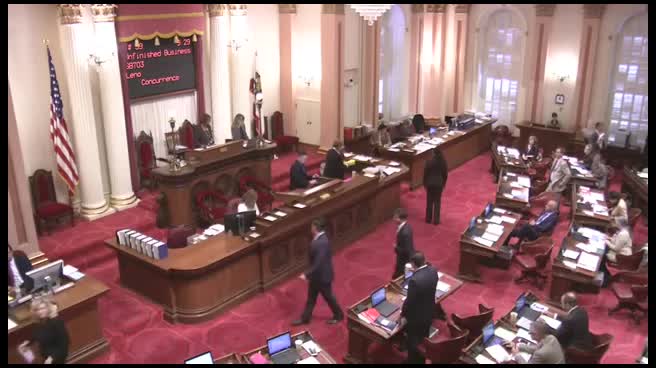 2MIN
Senate Floor
 4MIN
Assembly Floor
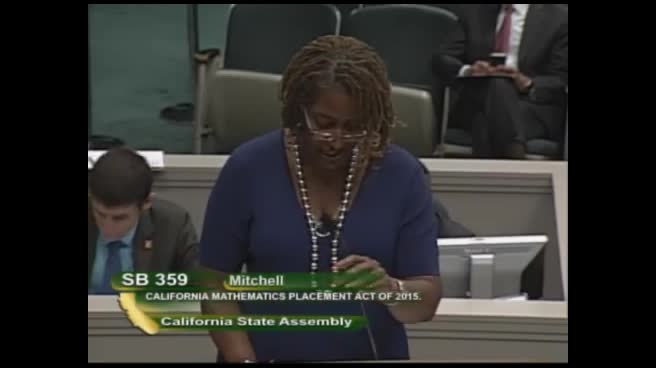 4MIN
Assembly Standing Committee on Appropriations
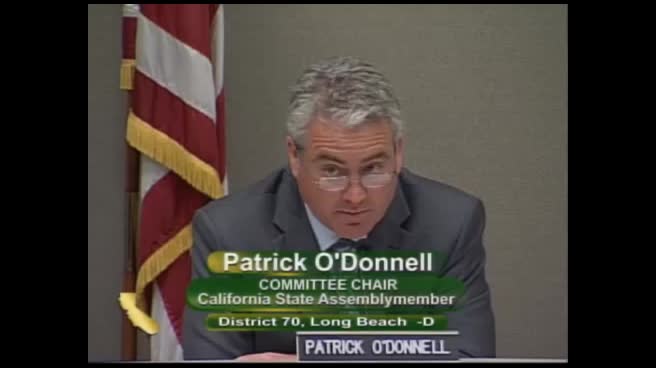 18MIN
Assembly Standing Committee on Education
 2MIN
Senate Floor
 8MIN
Senate Standing Committee on Appropriations
Bill Author