SB 369: California Longitudinal Pupil Achievement Data System: pupils of military families.
- Session Year: 2015-2016
- House: Senate
- Latest Version Date: 2015-09-02
Existing law establishes the California Longitudinal Pupil Achievement Data System, as provided, and requires the system to have specified characteristics, including, among other things, the capability to monitor pupil achievement on certain tests and the high school exit examination from year to year and school to school.
Existing law also ratifies the Interstate Compact on Educational Opportunity for Military Children with the purpose of removing barriers to educational success imposed on children of military families due to the frequent moves and deployment of their parents.
This bill would require, on or before July 1, 2016, the Superintendent of Public Instruction to add a reporting process within the California Longitudinal Pupil Achievement Data System requiring local educational agencies to report the enrollment of pupils of military families, as defined. The bill would require the State Department of Education to include pupils of military families as an indicator for specified purposes. The bill would prohibit this data from being used to compile reports required by specified federal provisions. By requiring local educational agencies to report this information, the bill would impose a state-mandated local program.
The California Constitution requires the state to reimburse local agencies and school districts for certain costs mandated by the state. Statutory provisions establish procedures for making that reimbursement.
This bill would provide that, if the Commission on State Mandates determines that the bill contains costs mandated by the state, reimbursement for those costs shall be made pursuant to these statutory provisions.
(a)On or before July 1, 2016, the Superintendent shall add a reporting process within the California Longitudinal Pupil Achievement Data System requiring local educational agencies to report the enrollment of pupils of military families.
(b)The department shall include pupils of military families as an indicator for purposes of Section 60901.
(c)Data collected pursuant to this section shall not be used to compile reports required by the federal No Child Left Behind Act of 2001 (20 U.S.C. Sec. 6301 et seq.), including, but not limited to, dropout and graduation rates.
(d)The implementation of this section shall not subject the department to a loss of funding pursuant to the conditions specified in Provision 16 of Item 6100-001-0890 of the Budget Act of 2015.
(e)For purposes of this section, pupils of military families means pupils whose parent or legal guardian is an active duty member of the Armed Forces of the United States.
SEC. 2.If the Commission on State Mandates determines that this act contains costs mandated by the state, reimbursement to local agencies and school districts for those costs shall be made pursuant to Part 7 (commencing with Section 17500) of Division 4 of Title 2 of the Government Code.
(a)On or before July 1, 2016, the Superintendent shall add a reporting process within the California Longitudinal Pupil Achievement Data System requiring local educational agencies to report the enrollment of pupils of military families.
(b)The department shall include pupils of military families as an indicator for purposes of Section 60901.
(c)Data collected pursuant to this section shall not be used to compile reports required by the federal No Child Left Behind Act of 2001 (20 U.S.C. Sec. 6301 et seq.), including, but not limited to, dropout and graduation rates.
(d)The implementation of this section shall not subject the department to a loss of funding pursuant to the conditions specified in Provision 16 of Item 6110-001-0890 6100-001-0890 of the 2015 Budget Act. Act of 2015.
(e)For purposes of this section, pupils of military families means pupils whose parent or legal guardian is an active duty member of the Armed Forces of the United States.
SEC. 2.If the Commission on State Mandates determines that this act contains costs mandated by the state, reimbursement to local agencies and school districts for those costs shall be made pursuant to Part 7 (commencing with Section 17500) of Division 4 of Title 2 of the Government Code.
(a)On or before July 1, 2016, the Superintendent shall add a reporting process within the California Longitudinal Pupil Achievement Data System requiring local educational agencies to report the enrollment of pupils of military families.
(b)The department shall include pupils of military families as an indicator for purposes of Section 60901.
(c)Data collected pursuant to this section shall not be used to compile reports required by the federal No Child Left Behind Act of 2001 (20 U.S.C. Sec. 6301 et seq.), including, but not limited to, dropout and graduation rates.
(d)The implementation of this section shall not subject the department to a loss of funding pursuant to the conditions specified in Provision 16 of Item 6110-001-0890 of the 2015 Budget Act.
(e)For purposes of this section, pupils of military families means pupils whose parent or legal guardian is an active duty member of the Armed Forces of the United States.
SEC. 2.If the Commission on State Mandates determines that this act contains costs mandated by the state, reimbursement to local agencies and school districts for those costs shall be made pursuant to Part 7 (commencing with Section 17500) of Division 4 of Title 2 of the Government Code.
|
Date
|
Status
|
|---|---|
| Jun 18, 2015 | Referred to Com. on ED. |
| Apr 25, 2016 | Last day to consider Governor’s veto pursuant to Joint Rule 58.5. |
| Apr 25, 2016 | Last day to consider Governors veto pursuant to Joint Rule 58.5. |
| Oct 9, 2015 | Vetoed by the Governor. |
| Oct 9, 2015 | In Senate. Consideration of Governor's veto pending. |
| Sep 3, 2015 | Enrolled and presented to the Governor at 5:45 p.m. |
| Sep 1, 2015 | Assembly amendments concurred in. (Ayes 40. Noes 0.) Ordered to engrossing and enrolling. |
| Sep 1, 2015 | Assembly amendments concurred in. (Ayes 40. Noes 0. Page 2368.) Ordered to engrossing and enrolling. |
| Aug 31, 2015 | Read third time. Passed. (Ayes 79. Noes 0. Page 2694.) Ordered to the Senate. |
| Aug 31, 2015 | Read third time. Passed. Ordered to the Senate. |
| Aug 31, 2015 | In Senate. Concurrence in Assembly amendments pending. |
| Aug 28, 2015 | Read second time. Ordered to third reading. |
| Aug 28, 2015 | From committee: Do pass. (Ayes 17. Noes 0.) (August 27). |
| Aug 19, 2015 | August 19 set for first hearing. Placed on APPR. suspense file. |
| Jul 16, 2015 | From committee: Do pass and re-refer to Com. on APPR. (Ayes 7. Noes 0.) (July 15). Re-referred to Com. on APPR. |
| Jul 16, 2015 | From committee with author's amendments. Read second time and amended. Re-referred to Com. on APPR. |
| Feb 24, 2015 | Introduced. Read first time. To Com. on RLS. for assignment. To print. |
| Jun 2, 2015 | In Assembly. Read first time. Held at Desk. |
| Jun 1, 2015 | Read third time. Passed. (Ayes 40. Noes 0.) Ordered to the Assembly. |
| Jun 1, 2015 | Read third time. Passed. (Ayes 40. Noes 0. Page 1201.) Ordered to the Assembly. |
| May 28, 2015 | Read second time. Ordered to third reading. |
| May 28, 2015 | From committee: Do pass. (Ayes 7. Noes 0.) (May 28). |
| May 28, 2015 | From committee: Do pass. (Ayes 7. Noes 0. Page 1152.) (May 28). |
| May 23, 2015 | Set for hearing May 28. |
| Apr 20, 2015 | April 20 hearing: Placed on APPR. suspense file. |
| Apr 14, 2015 | Set for hearing April 20. |
| Apr 8, 2015 | From committee: Do pass and re-refer to Com. on APPR. with recommendation: To consent calendar. (Ayes 8. Noes 0.) (April 8). Re-referred to Com. on APPR. |
| Apr 8, 2015 | From committee: Do pass and re-refer to Com. on APPR. with recommendation: To consent calendar. (Ayes 8. Noes 0. Page 521.) (April 8). Re-referred to Com. on APPR. |
| Mar 20, 2015 | Set for hearing April 8. |
| Mar 5, 2015 | Referred to Com. on ED. |
| Feb 25, 2015 | From printer. May be acted upon on or after March 27. |
|
Date
|
Description
|
Location
|
Votes
|
|
|---|---|---|---|---|
| Sep 1, 2015 | Unfinished Business SB369 Block Concurrence | Senate Floor |
Passed |
|
| Aug 31, 2015 | SB 369 Block Senate Third Reading By CHÁVEZ | Assembly Floor |
Passed |
|
| Aug 27, 2015 | Do pass. | Assembly Standing Committee on Appropriations |
Passed |
|
| Jul 15, 2015 | Do pass and be re-referred to the Committee on [Appropriations] | Assembly Standing Committee on Education |
Passed |
|
| Jun 1, 2015 | Senate 3rd Reading SB369 Block | Senate Floor |
Passed |
|
| May 28, 2015 | Do pass | Senate Standing Committee on Appropriations |
Passed |
|
| Apr 20, 2015 | Placed on suspense file | Senate Standing Committee on Appropriations |
Passed |
|
| Apr 8, 2015 | Do pass, but first be re-referred to the Committee on [Appropriations] with the recommendation: To Consent Calendar | Senate Standing Committee on Education |
Passed |
This list shows positions taken on this bill by organizations on the date displayed, which is linked to the original source.
Positions by individuals are not included.
|
Organization
|
Position
|
Date
|
|---|---|---|
| American Legion - Department of California | ** Support | Aug 31, 2015 |
| AMVETS - Department of California | ** Support | Aug 31, 2015 |
| California State PTA | ** Support | Aug 31, 2015 |
| Department of Defense, Military Community and Family Policy | ** Support | Aug 31, 2015 |
| Military Officers Association Of America, California Council Of Chapters | ** Support | Aug 31, 2015 |
| u None received. | ** Against | Jun 1, 2015 |
| U. S. Department of Defense | ** Support | Jul 15, 2015 |
| United States Marine Corps, Marine Corps Installations West | ** Support | Aug 31, 2015 |
| United States Navy, Navy Region Southwest | ** Support | Aug 31, 2015 |
| US Marine Corps | * Support | Jul 15, 2015 |
| Vietnam Veterans of America - California State Council | ** Support | Aug 31, 2015 |
SB 369
Page 6
|
Office of Senate Floor Analyses (916) 651-1520 Fax: (916) 327-4478 |
SB 369 |
VETO
Bill No: SB 369
Amended: 7/16/15
SENATE EDUCATION COMMITTEE: 8-0, 4/8/15
AYES: Liu, Huff, Block, Hancock, Leyva, Mendoza, Pan, Vidak
SENATE APPROPRIATIONS COMMITTEE: 7-0, 5/28/15
AYES: Lara, Bates, Beall, Hill, Leyva, Mendoza, Nielsen
SENATE FLOOR: 40-0, 6/01/15
AYES: Allen, Anderson, Bates, Beall, Berryhill, Block, Cannella, De León, Fuller, Gaines, Galgiani, Glazer, Hall, Hancock, Hernandez, Hertzberg, Hill, Hueso, Huff, Jackson, Lara, Leno, Leyva, Liu, McGuire, Mendoza, Mitchell, Monning, Moorlach, Morrell, Nguyen, Nielsen, Pan, Pavley, Roth, Runner, Stone, Vidak, Wieckowski, Wolk
ASSEMBLY FLOOR: 79-0, 8/31/15 - See last page for vote
SENATE FLOOR: 40-0, 9/1/15
AYES: Allen, Anderson, Bates, Beall, Berryhill, Block, Cannella, De León, Fuller, Gaines, Galgiani, Glazer, Hall, Hancock, Hernandez, Hertzberg, Hill, Hueso, Huff, Jackson, Lara, Leno, Leyva, Liu, McGuire, Mendoza, Mitchell, Monning, Moorlach, Morrell, Nguyen, Nielsen, Pan, Pavley, Roth, Runner, Stone, Vidak, Wieckowski, Wolk
SUBJECT: California Longitudinal Pupil Achievement Data System: pupils of military families
DIGEST: This bill requires that the Superintendent of Public Instruction (SPI) add an indicator to the California Longitudinal Pupil Achievement Data System (CALPADS) to identify pupils of military families
Assembly Amendments are technical and correct an error made in reference to a provision in the Budget Act of 2015.
Existing law:
Establishes the CALPADS to accomplish all of the following goals:
Provide school districts and the California Department of Education (CDE) access to data necessary to comply with the No Child Left Behind Act (NCLB) reporting requirements.
Provide a better means of evaluating educational progress and investments over time.
Provide local educational agencies information that can be used to improve pupil achievement.
Provide an efficient, flexible, and secure means of maintaining longitudinal statewide pupil level data.
Facilitate the ability of the state to publicly report data required by federal law.
Ensure compliance with the federal Family Educational Rights and Privacy Act (FERPA). (Education Code § 60900 et. seq.)
This bill:
Adds an indicator to the CALPADS to identify pupils of military families.
Requires the SPI to add a reporting process within CALPADS requiring local education agencies (LEAs) to report the enrollment of pupils of military families on or before July 1, 2016.
Requires the CDE to include an indicator for pupils of military families in CALPADS.
Provides that the data collection pursuant to this requirement shall be used to compile reports required by the federal NCLB, including, but not limited to, dropout and graduation rates.
Provides that upon implementation of this bill, the CDE is not subject to the penalty contained in provision 16 of Item 6100-001-0890 of the Budget Act of 2015.
Defines “pupils of military families” to mean pupils whose parent or legal guardian is an active duty member of the Armed Forces of the United States.
Identifies the bill as potentially creating unfunded state reimbursable mandated costs.
Comments
Need for this bill. More than 60,000 school-aged children of active duty service members attend California schools. However, there is no method for identifying this student group or tracking their academic progress in school. According to the author, creating an indicator will help determine school attendance and educational outcomes, as well as assist districts in identifying the needs of military children including additional counseling and academic services relative to the deployment or relocation of a parent.
What currently exists? According to the Marine Corps Installations West,
there are approximately 13 school districts currently identifying military students within their local data systems. These districts include: Travis Unified, San Diego Unified, South Bay Unified, Murrieta Valley Unified, Coronado Unified, Lakeside Union, Santee, La Mesa/Spring Valley, Lemon Grove, Chula Vista Elementary, Poway Unified, Los Angeles Unified, and Sweetwater Union High. It is unclear if any of the remaining school districts identify military children using internal resources.
California Longitudinal Pupil Achievement Data System (CALPADS). The CALPADS was created to enable California to meet federal requirements delineated in the NCLB Act 2001, which increases accountability for student achievement. CALPADS has been operational since 2009 and contains information on student demographics, program participation, grade level, enrollment, course enrollment and completion, discipline, and statewide assessment data.
The student level, longitudinal data in CALPADS enables the facilitation of program evaluation, the assessment of student achievement over time, the calculation of more accurate dropout and graduation rates, the efficient creation of reports to meet state and federal reporting requirements, and the ability to create ad hoc reports and responses to relevant questions. CALPADS provides LEAs with access to longitudinal data and reports on their own students, and it gives LEAs immediate access to information on new students, enabling the LEAs to place students appropriately and to determine whether an assessment is necessary.
Budget prohibits additional data elements. A provision in the 2015 Budget Act, as a condition of receiving funds, prohibits CDE from adding data elements to CALPADS, as specified. This bill includes a provision to preclude CDE from being subject to this penalty.
Prior legislation
AB 2341 (Quirk-Silva, 2014) identical to SB 369, would have added an indicator to CALPADS to identify pupils of military families. The bill was held in Senate Appropriations Committee Suspense file.
FISCAL EFFECT: Appropriation: No Fiscal Com.: Yes Local: Yes
According to the Senate Appropriations Committee:
CALPADS – Minor General Fund costs to the CDE to create a new indicator in CALPADS to identify pupils of military families, and communicate the new requirements to LEAs.
LEAs – Unknown, but potentially significant one-time mandated costs on LEAs, reimbursable from the General Fund, for approximately 1,000 schools districts to develop and implement a local process for identifying and tracking pupils of military families, and inputting that information into CALPADS. Likely minor, but potentially significant ongoing mandated costs on LEAs for additional data entry to update CALPADS.
American Legion – Department of California
AMVETS – Department of California
California State PTA
Department of Defense, Military Community and Family Policy
Military Officers Association of America, California Council of Chapters
United States Marine Corps, Marine Corps Installations West
United States Navy, Navy Region Southwest
Vietnam Veterans of America – California State Council
OPPOSITION: (Verified 8/31/15)
None received
ASSEMBLY FLOOR: 79-0, 8/31/15
AYES: Achadjian, Alejo, Travis Allen, Baker, Bigelow, Bloom, Bonilla, Bonta, Brough, Brown, Burke, Calderon, Campos, Chang, Chau, Chávez, Chiu, Chu, Cooley, Cooper, Dababneh, Dahle, Daly, Dodd, Eggman, Frazier, Beth Gaines, Cristina Garcia, Eduardo Garcia, Gatto, Gipson, Gomez, Gonzalez, Gordon, Gray, Grove, Hadley, Harper, Roger Hernández, Holden, Irwin, Jones, Jones-Sawyer, Kim, Lackey, Levine, Linder, Lopez, Low, Maienschein, Mathis, Mayes, McCarty, Medina, Melendez, Mullin, Nazarian, Obernolte, O'Donnell, Olsen, Patterson, Perea, Quirk, Rendon, Ridley-Thomas, Rodriguez, Salas, Santiago, Steinorth, Mark Stone, Thurmond, Ting, Wagner, Waldron, Weber, Wilk, Williams, Wood, Atkins
NO VOTE RECORDED: Gallagher
GOVERNOR’S VETO MESSAGE:
I am returning Senate Bill 369 without my signature.
This bill would require the Superintendent of Public Instruction to add an indicator to the California Longitudinal Pupil Achievement Data System to identify students of military families.
While California is strongly committed to supporting military families, I am not convinced how collecting state level data serves a useful purpose. Local school districts already identify students of military families and apply directly for federal grants based on local need.
This ever-relentless effort to collect and store more and more personal data in state computers should give us pause.
Prepared by: Olgalilia Ramirez / ED. / (916) 651-4105
11/4/15 14:01:18
**** END ****
SB 369
Page 5
|
Office of Senate Floor Analyses (916) 651-1520 Fax: (916) 327-4478 |
UNFINISHED BUSINESS
Bill No: SB 369
Amended: 7/16/15
SENATE EDUCATION COMMITTEE: 8-0, 4/8/15
AYES: Liu, Huff, Block, Hancock, Leyva, Mendoza, Pan, Vidak
SENATE APPROPRIATIONS COMMITTEE: 7-0, 5/28/15
AYES: Lara, Bates, Beall, Hill, Leyva, Mendoza, Nielsen
SENATE FLOOR: 40-0, 6/1/15
AYES: Allen, Anderson, Bates, Beall, Berryhill, Block, Cannella, De León, Fuller, Gaines, Galgiani, Glazer, Hall, Hancock, Hernandez, Hertzberg, Hill, Hueso, Huff, Jackson, Lara, Leno, Leyva, Liu, McGuire, Mendoza, Mitchell, Monning, Moorlach, Morrell, Nguyen, Nielsen, Pan, Pavley, Roth, Runner, Stone, Vidak, Wieckowski, Wolk
ASSEMBLY FLOOR: 79-0, 8/31/15 - See last page for vote
SUBJECT: California Longitudinal Pupil Achievement Data System: pupils of military families
DIGEST: This bill requires that the Superintendent of Public Instruction (SPI) add an indicator to the California Longitudinal Pupil Achievement Data System (CALPADS) to identify pupils of military families
Assembly Amendments are technical and correct an error made in reference to a provision in the Budget Act of 2015.
Existing law:
Establishes the CALPADS to accomplish all of the following goals:
Provide school districts and the California Department of Education (CDE) access to data necessary to comply with the No Child Left Behind Act (NCLB) reporting requirements.
Provide a better means of evaluating educational progress and investments over time.
Provide local educational agencies information that can be used to improve pupil achievement.
Provide an efficient, flexible, and secure means of maintaining longitudinal statewide pupil level data.
Facilitate the ability of the state to publicly report data required by federal law.
Ensure compliance with the federal Family Educational Rights and Privacy Act (FERPA). (Education Code § 60900 et. seq.)
This bill:
Adds an indicator to the CALPADS to identify pupils of military families.
Requires the SPI to add a reporting process within CALPADS requiring local education agencies (LEAs) to report the enrollment of pupils of military families on or before July 1, 2016.
Requires the CDE to include an indicator for pupils of military families in CALPADS.
Provides that the data collection pursuant to this requirement shall be used to compile reports required by the federal NCLB, including, but not limited to, dropout and graduation rates.
Provides that upon implementation of this bill, the CDE is not subject to the penalty contained in provision 16 of Item 6100-001-0890 of the Budget Act of 2015.
Defines “pupils of military families” to mean pupils whose parent or legal guardian is an active duty member of the Armed Forces of the United States.
Identifies the bill as potentially creating unfunded state reimbursable mandated costs.
Comments
Need for this bill. More than 60,000 school-aged children of active duty service members attend California schools. However, there is no method for identifying this student group or tracking their academic progress in school. According to the author, creating an indicator will help determine school attendance and educational outcomes, as well as assist districts in identifying the needs of military children including additional counseling and academic services relative to the deployment or relocation of a parent.
What currently exists? According to the Marine Corps Installations West,
there are approximately 13 school districts currently identifying military students within their local data systems. These districts include: Travis Unified, San Diego Unified, South Bay Unified, Murrieta Valley Unified, Coronado Unified, Lakeside Union, Santee, La Mesa/Spring Valley, Lemon Grove, Chula Vista Elementary, Poway Unified, Los Angeles Unified, and Sweetwater Union High. It is unclear if any of the remaining school districts identify military children using internal resources.
California Longitudinal Pupil Achievement Data System (CALPADS). The CALPADS was created to enable California to meet federal requirements delineated in the NCLB Act 2001, which increases accountability for student achievement. CALPADS has been operational since 2009 and contains information on student demographics, program participation, grade level, enrollment, course enrollment and completion, discipline, and statewide assessment data.
The student level, longitudinal data in CALPADS enables the facilitation of program evaluation, the assessment of student achievement over time, the calculation of more accurate dropout and graduation rates, the efficient creation of reports to meet state and federal reporting requirements, and the ability to create ad hoc reports and responses to relevant questions. CALPADS provides LEAs with access to longitudinal data and reports on their own students, and it gives LEAs immediate access to information on new students, enabling the LEAs to place students appropriately and to determine whether an assessment is necessary.
Budget prohibits additional data elements. A provision in the 2015 Budget Act, as a condition of receiving funds, prohibits CDE from adding data elements to CALPADS, as specified. This bill includes a provision to preclude CDE from being subject to this penalty.
Prior legislation
AB 2341 (Quirk-Silva, 2014) identical to SB 369, would have added an indicator to CALPADS to identify pupils of military families. The bill was held in Senate Appropriations Committee Suspense file.
FISCAL EFFECT: Appropriation: No Fiscal Com.: Yes Local: Yes
According to the Senate Appropriations Committee:
CALPADS – Minor General Fund costs to the CDE to create a new indicator in CALPADS to identify pupils of military families, and communicate the new requirements to LEAs.
LEAs – Unknown, but potentially significant one-time mandated costs on LEAs, reimbursable from the General Fund, for approximately 1,000 schools districts to develop and implement a local process for identifying and tracking pupils of military families, and inputting that information into CALPADS. Likely minor, but potentially significant ongoing mandated costs on LEAs for additional data entry to update CALPADS.
American Legion – Department of California
AMVETS – Department of California
California State PTA
Department of Defense, Military Community and Family Policy
Military Officers Association of America, California Council of Chapters
United States Marine Corps, Marine Corps Installations West
United States Navy, Navy Region Southwest
Vietnam Veterans of America – California State Council
OPPOSITION: (Verified 8/31/2015)
None received
ASSEMBLY FLOOR: 79-0, 8/31/15
AYES: Achadjian, Alejo, Travis Allen, Baker, Bigelow, Bloom, Bonilla, Bonta, Brough, Brown, Burke, Calderon, Campos, Chang, Chau, Chávez, Chiu, Chu, Cooley, Cooper, Dababneh, Dahle, Daly, Dodd, Eggman, Frazier, Beth Gaines, Cristina Garcia, Eduardo Garcia, Gatto, Gipson, Gomez, Gonzalez, Gordon, Gray, Grove, Hadley, Harper, Roger Hernández, Holden, Irwin, Jones, Jones-Sawyer, Kim, Lackey, Levine, Linder, Lopez, Low, Maienschein, Mathis, Mayes, McCarty, Medina, Melendez, Mullin, Nazarian, Obernolte, O'Donnell, Olsen, Patterson, Perea, Quirk, Rendon, Ridley-Thomas, Rodriguez, Salas, Santiago, Steinorth, Mark Stone, Thurmond, Ting, Wagner, Waldron, Weber, Wilk, Williams, Wood, Atkins
NO VOTE RECORDED: Gallagher
Prepared by: Olgalilia Ramirez / ED. / (916) 651-4105
8/31/15 18:40:38
**** END ****
SB 369
Page 2
SENATE THIRD READING
SB 369
(Block)
As Amended July 16, 2015
Majority vote
SENATE VOTE: 40-0
Committee |
Votes |
Ayes |
Noes |
Education |
7-0 |
O'Donnell, Chávez, Kim, McCarty, Santiago, Thurmond, Weber |
|
Appropriations |
17-0 |
Gomez, Bigelow, Bloom, Bonta, Calderon, Chang, Nazarian, Eggman, Gallagher, Eduardo Garcia, Holden, Jones, Quirk, Rendon, Wagner, Weber, Wood |
|
SUMMARY: Requires the Superintendent of Public Instruction (SPI), on or before July 1, 2016, to add a reporting process within the California Longitudinal Pupil Achievement Data System (CALPADS) requiring local educational agencies to report the enrollment of pupils of military families. Specifically, this bill:
Requires the California Department of Education (CDE) to include military families as an indicator for purposes of a currently-required quarterly report on student attendance.
Specifies data collected for purposes of this bill shall not be used to compile reports required by the federal No Child Left Behind Act, including, but not limited to, dropout and graduation rates.
Specifies that implementation of this bill shall not subject the CDE to a loss of funding pursuant to provisional budget language in the 2015 Budget Act that prohibits additional components to be added to CALPADS.
FISCAL EFFECT: According to the Assembly Appropriations Committee:
General Fund administrative costs of approximately $15,000 to CDE to modify CALPADS to include a new indicator for students of military families.
Unknown Proposition 98 (1988)/General Fund costs for local educational agencies (LEAs) to update user interface with CALPADS and collect and report this data to CALPADS. For illustration, assuming approximately 10,000 schools dedicated one hour of staff time collecting and entering data, statewide costs would be approximately $500,000. The requirements in the bill impose a state mandate on LEAs which is likely to be deemed by the Commission on State Mandates to be reimbursable.
COMMENTS:
Purpose. Currently, there is no method of tracking attendance of students of military families. Supporters state that including an indicator in CALPADS would build awareness of students that may be affected by the deployment of a parent and facilitate data-driven decision making to improve the distribution of Department of Defense funding and local resources to offer appropriate support.
Budget conflict. The CDE indicates that the change required by this bill is relatively simple and could probably be achieved in approximately one year. However, the 2015-16 Budget Act prohibits the CDE from adding additional data elements to CALPADS. Specifically, provisional language states, "As a further condition of receiving these [federal] funds, the SDE shall not add additional data elements to CALPADS, require local educational agencies to use the data collected through the CALPADS for any purpose, or otherwise expand or enhance the system beyond the data elements and functionalities that are identified in the most current approved Feasibility Study and Special Project Reports and the CALPADS Data guide v4.1." This bill contains a provision that exempts its requirements from this Budget Act prohibition.
Prior legislation. This bill is substantially similar to AB 2431 (Quirk-Silva) of 2014, which was held on the Suspense file in the Senate Appropriations Committee.
Analysis Prepared by: Rick Pratt / ED. / (916) 319-2087 FN: 0001628
Date of Hearing: August 19, 2015
ASSEMBLY COMMITTEE ON APPROPRIATIONS
Jimmy Gomez, Chair
SB 369
(Block) – As Amended July 16, 2015
Policy Committee: |
Education |
Vote: |
7 - 0 |
|
|
|
|
|
|
|
|
Urgency: No State Mandated Local Program: Yes Reimbursable: Yes
SUMMARY:
This bill requires the Superintendent of Public Instruction (SPI), on or before July 1, 2016, to add a reporting process within the California Longitudinal Pupil Achievement Data System (CALPADS) requiring local educational agencies to report the enrollment of pupils of military families. Specifically, this bill:
Requires the California Department of Education to include military families as an indicator for purposes of a currently-required quarterly report on student attendance.
Specifies data collected for purposes of this bill shall not be used to compile reports required by the federal No Child Left Behind Act, including, but not limited to, dropout and graduation rates.
Specifies that implementation of this bill shall not subject the CDE to a loss of funding pursuant to provisional budget language in the 2015 Budget Act that prohibits additional components to be added to CALPADS.
FISCAL EFFECT:
General Fund administrative costs of approximately $15,000 to CDE to modify CALPADS to include a new indicator for students of military families.
Unknown Proposition 98/GF costs for local educational agencies (LEAs) to update user interface with CALPADS and collect and report this data to CALPADS. For illustration, assuming approximately 10,000 schools dedicated one hour of staff time collecting and entering data, statewide costs would be approximately $500,000. The requirements in the bill impose a state mandate on LEAs which is likely to be deemed by the Commission on State Mandates to be reimbursable.
COMMENTS:
Purpose. Currently, there is no method of tracking attendance of students of military families. Supporters state that including an indicator in CALPADS would build awareness of students that may be affected by the deployment of a parent and facilitate data-driven decision making to improve the distribution of Department of Defense funding and local resources to offer appropriate support.
Budget conflict. The CDE indicates that the change required by this bill is relatively simple and could probably be achieved in approximately one year. However, the 2015-16 Budget Act prohibits the CDE from adding additional data elements to CALPADS. Specifically, provisional language states, "As a further condition of receiving these [federal] funds, the SDE shall not add additional data elements to CALPADS, require local educational agencies to use the data collected through the CALPADS for any purpose, or otherwise expand or enhance the system beyond the data elements and functionalities that are identified in the most current approved Feasibility Study and Special Project Reports and the CALPADS Data guide v4.1." This bill contains a provision that exempts its requirements from this Budget Act prohibition.
Prior legislation. This bill is substantially similar to AB 2431 (Quirk-Silva) of 2014, which was held on the Suspense file in the Senate Appropriations Committee.
Analysis Prepared by: Misty Feusahrens / APPR. / (916) 319-2081
SB 369
Page 3
Date of Hearing: July 15, 2015
ASSEMBLY COMMITTEE ON EDUCATION
Patrick O'Donnell, Chair
SB 369
(Block) – As Introduced February 24, 2015
SENATE VOTE: 40-0
SUBJECT: California Longitudinal Pupil Achievement Data System: pupils of military families.
SUMMARY: Requires the California Longitudinal Pupil Achievement Data System (CALPADS) to be expanded to include data on the enrollment of pupils of military families. Specifically, this bill:
Requires the Superintendent of Public Instruction (SPI), on or before July 1, 2016, to add a reporting process within CALPADS requiring local educational agencies (LEAs) to report the enrollment of pupils of military families.
Requires the California Department of Education (CDE) to include pupils of military families as an indicator for purposes of a currently-required quarterly report on pupil attendance.
Specifies that implementation of this requirement shall not subject the CDE to a loss of funding pursuant to Item 6110-001-0890 of the 2015 Budget Act.
Defines "pupils of military families" to mean pupils whose parent or legal guardian is an active duty member of the Armed Forces of the United States.
EXISTING LAW: Establishes CALPADS to accomplish all of the following goals:
Provide school districts and the CDE access to data necessary to comply with federal No Child Left Behind (NCLB) reporting requirements.
Provide a better means of evaluating educational progress and investments over time.
Provide local educational agencies information that can be used to improve pupil achievement.
Provide an efficient, flexible, and secure means of maintaining longitudinal statewide pupil level data.
Facilitate the ability of the state to publicly report data required by federal law.
Ensure compliance with the federal Family Educational Rights and Privacy Act (FERPA).
Existing law also prohibits, via Budget Bill language, the expansion of CALPADS for any purpose.
FISCAL EFFECT: According to the Senate Appropriations Committee:
CALPADS – Minor General Fund costs to the CDE to create a new indicator in CALPADS to identify pupils of military families, and communicate the new requirements to LEAs.
LEAs – Unknown, but potentially significant one-time mandated costs on LEAs, reimbursable from the General Fund, for approximately 1,000 schools districts to develop and implement a local process for identifying and tracking pupils of military families, and inputting that information into CALPADS. Likely minor, but potentially significant ongoing mandated costs on LEAs for additional data entry to update CALPADS. (see staff comments)
COMMENTS: CALPADS was created to enable California to meet federal requirements delineated in the No Child Left Behind (NCLB) Act of 2001. CALPADS has been operational since 2009 and contains information on student demographics, program participation, grade level, enrollment, course enrollment and completion, discipline, and statewide assessment data. The student-level, longitudinal data in CALPADS enables the facilitation of program evaluation, the assessment of student achievement over time, the calculation of more accurate dropout and graduation rates, the efficient creation of reports to meet state and federal reporting requirements, and the ability to create ad hoc reports and responses to relevant questions. CALPADS provides local educational agencies (LEAs) with access to longitudinal data and reports on their own students, and it gives LEAs immediate access to information on new students, enabling the LEAs to place students appropriately and to determine whether any assessments are necessary.
Impact on CALPADS. The CDE indicates that the change required by this bill is relatively simple and could probably be achieved in approximately one year. The process involves adding a new field to CALPADS and testing and de-bugging the software change. LEAs would need to change the online user interface, which they use to report data to CALPADS, and add the military status of parents/guardians to the information they collect from families.
However, budget language prohibits the CDE from adding additional data elements to CALPADS. Specifically, provision 13 of budget item 6110-001-0890 of the Budget Act of 2015 provides, in part, "As a further condition of receiving these [federal] funds, the SDE shall not add additional data elements to CALPADS, require local educational agencies to use the data collected through the CALPADS for any purpose, or otherwise expand or enhance the system beyond the data elements and functionalities that are identified in the most current approved Feasibility Study and Special Project Reports and the CALPADS Data guide v4.1." This bill contains a provision that exempts its requirements from this Budget Act prohibition.
Arguments in support. Supporters argue that children in military families experience events that affect their education, such as moving frequently and having a parent deployed away from the family. Currently, there is no method of tracking their attendance and progress to evaluate programs and identify best practices. Including an indicator in CALPADS for the children of military families would permit such tracking over time. Supporters argue that collecting this information would build awareness at the school and classroom level of students that may be affected by the deployment of a parent and facilitate data-driven decision making to improve the distribution of Department of Defense and local resources to offer appropriate support.
Technical correction needed. This bill references Item 6110-001-0890 of the 2015 Budget Act. The correct item number in the 2015 Budget Act is 6100-001-0890. Staff recommends the bill be amended to make this correction.
REGISTERED SUPPORT / OPPOSITION:
Support
American Legion-Department of California
AMVETS-Department of California
California State PTA
Military Officers Association of America, California Council of Chapters
U. S. Department of Defense
Vietnam Veterans of America, California State Council
Two individuals
Opposition
None received
Analysis Prepared by: Rick Pratt / ED. / (916) 319-2087
SB 369
Page 4
|
Office of Senate Floor Analyses (916) 651-1520 Fax: (916) 327-4478 |
THIRD READING
Bill No: SB 369
Introduced: 2/24/15
SENATE EDUCATION COMMITTEE: 8-0, 4/8/15
AYES: Liu, Huff, Block, Hancock, Leyva, Mendoza, Pan, Vidak
SENATE APPROPRIATIONS COMMITTEE: 7-0, 5/28/15
AYES: Lara, Bates, Beall, Hill, Leyva, Mendoza, Nielsen
SUBJECT: California Longitudinal Pupil Achievement Data System: pupils of military families
DIGEST: This bill requires that the Superintendent of Public Instruction (SPI) add an indicator to the California Longitudinal Pupil Achievement Data System (CALPADS) to identify pupils of military families.
Existing law:
Establishes the CALPADS to accomplish all of the following goals:
Provide school districts and the California Department of Education (CDE) access to data necessary to comply with the No Child Left Behind Act (NCLB) reporting requirements.
Provide a better means of evaluating educational progress and investments over time.
Provide local educational agencies information that can be used to improve pupil achievement.
Provide an efficient, flexible, and secure means of maintaining longitudinal statewide pupil level data.
Facilitate the ability of the state to publicly report data required by federal law.
Ensure compliance with the federal Family Educational Rights and Privacy Act (FERPA). (Education Code § 60900 et. seq.)
This bill:
Adds an indicator to the CALPADS to identify pupils of military families.
Requires the SPI to add a reporting process within CALPADS requiring local education agencies (LEAs) to report the enrollment of pupils of military families on or before July 1, 2016.
Requires the CDE to include an indicator for pupils of military families in CALPADS.
Provides that the data collection pursuant to this requirement shall be used to compile reports required by the federal NCLB, including, but not limited to, dropout and graduation rates.
Provides that upon implementation of this bill, the CDE is not subject to the penalty contained in provision 16 of Item 6110-001-0890 of the 2015 Budget Act.
Defines “pupils of military families” to mean pupils whose parent or legal guardian is an active duty member of the Armed Forces of the United States.
Identifies the bill as potentially creating unfunded state reimbursable mandated costs.
Comments
Need for this bill. More than 60,000 school-aged children of active duty service members attend California schools. However, there is no method for identifying this student group or tracking their academic progress in school. According to the author, creating an indicator will help determine school attendance and educational outcomes, as well as assist districts in identifying the needs of military children including additional counseling and academic services relative to the deployment or relocation of a parent.
What currently exists? According to the Marine Corps Installations West,
there are approximately 13 school districts currently identifying military students within their local data systems. These districts include: Travis Unified, San Diego Unified, South Bay Unified, Murrieta Valley Unified, Coronado Unified, Lakeside Union, Santee, La Mesa/Spring Valley, Lemon Grove, Chula Vista Elementary, Poway Unified, Los Angeles Unified, and Sweetwater Union High. It is unclear if any of the remaining school districts identify military children using internal resources.
California Longitudinal Pupil Achievement Data System (CALPADS). The CALPADS was created to enable California to meet federal requirements delineated in the NCLB Act 2001, which increases accountability for student achievement. CALPADS has been operational since 2009 and contains information on student demographics, program participation, grade level, enrollment, course enrollment and completion, discipline, and statewide assessment data.
The student level, longitudinal data in CALPADS enables the facilitation of program evaluation, the assessment of student achievement over time, the calculation of more accurate dropout and graduation rates, the efficient creation of reports to meet state and federal reporting requirements, and the ability to create ad hoc reports and responses to relevant questions. CALPADS provides LEAs with access to longitudinal data and reports on their own students, and it gives LEAs immediate access to information on new students, enabling the LEAs to place students appropriately and to determine whether an assessment is necessary.
Budget prohibits additional data elements. A provision in the 2015 Budget Act, as a condition of receiving funds, prohibits CDE from adding data elements to CALPADS, as specified. This bill includes a provision to preclude CDE from being subject to this penalty.
Prior legislation.
AB 2341 (Quirk-Silva, 2014) identical to SB 369, would have added an indicator to CALPADS to identify pupils of military families. The bill was held in Senate Appropriations Committee Suspense file.
FISCAL EFFECT: Appropriation: No Fiscal Com.: Yes Local: Yes
According to the Senate Appropriations Committee:
CALPADS – Minor General Fund costs to the CDE to create a new indicator in CALPADS to identify pupils of military families, and communicate the new requirements to LEAs.
LEAs – Unknown, but potentially significant one-time mandated costs on LEAs, reimbursable from the General Fund, for approximately 1,000 schools districts to develop and implement a local process for identifying and tracking pupils of military families, and inputting that information into CALPADS. Likely minor, but potentially significant ongoing mandated costs on LEAs for additional data entry to update CALPADS.
American Legion – Department of California
AMVETS – Department of California
California State PTA
Department of Defense, Military Community and Family Policy
Military Officers Association of America, California Council of Chapters
United States Marine Corps, Marine Corps Installations West
United States Navy, Navy Region Southwest
Vietnam Veterans of America – California State Council
None received
Prepared by: Olgalilia Ramirez / ED. / (916) 651-4105
5/31/15 13:12:59
**** END ****
SB 369 (Block) Page 2 of 2
SENATE COMMITTEE ON APPROPRIATIONS
Senator Ricardo Lara, Chair
2015 - 2016 Regular Session
SB 369 (Block) - California Longitudinal Pupil Achievement Data System: pupils of military families
|
|
Version: February 24, 2015 |
Policy Vote: ED. 8 - 0 |
Urgency: No |
Mandate: Yes |
Hearing Date: April 20, 2015 |
Consultant: Mark McKenzie |
This bill meets the criteria for referral to the Suspense File.
Bill Summary:
SB 369 adds an indicator to the California Longitudinal Pupil Achievement Data System (CALPADS) to identify pupils of military families, and requires local educational agencies (LEAs) to report enrollment of pupils of military families, as specified.
Fiscal Impact:
CALPADS – Minor General Fund costs to the California Department of Education (CDE) to create a new indicator in CALPADS to identify pupils of military families, and communicate the new requirements to LEAs.
LEAs – Unknown, but potentially significant one-time mandated costs on LEAs, reimbursable from the General Fund, for approximately 1,000 schools districts to develop and implement a local process for identifying and tracking pupils of military families, and inputting that information into CALPADS. Likely minor, but potentially significant ongoing mandated costs on LEAs for additional data entry to update CALPADS. (see staff comments)
Background:
Existing law provides for the development and implementation of CALPADS to provide for the retention and analysis of longitudinal pupil achievement data. CALPADS was created to enable CDE and LEAs to meet federal requirements established by the No Child Left Behind (NCLB) Act of 2001, which increases accountability for student achievement. The system was developed and implemented using federal funds, and has been operational since 2009. CALPADS is accessible by CDE and LEAs and contains student-level longitudinal information on demographics, program participation, grade level, enrollment, course enrollment and completion, discipline, statewide assessments, and other data.
Proposed Law:
SB 369 requires the Superintendent of Public Instruction to add a reporting process within CALPADS requiring LEAs to report the enrollment of pupils of military families by July 1, 2016. The bill requires CDE to include pupils of military families as an indicator for purposes of collecting and reporting attendance data, and prohibits data collected on pupils of military families to be used to compile reports required under the NCLB Act, including dropout and graduation rates. SB 369 defines "pupils of military families" to mean pupils whose parent or legal guardian is an active duty member of the Armed Forces of the United States.
Related Legislation:
AB 2341 (Quirk-Silva), which was held on this Committee’s Suspense File in 2014, is nearly identical to this bill.
Staff Comments:
This bill enacts new state and local data collection requirements. At the state level, CDE expects to incur minor costs of approximately $10,000 to modify CALPADS to allow for the collection of data identifying pupils of military families. Costs to exclude this data from federal NCLB Act reports would be minor and absorbable.
This bill also imposes a state mandate on LEAs which is likely to be deemed by the Commission on State Mandates to be reimbursable. Schools districts will have to establish procedures, collect information on whether or not pupils have a parent or legal guardian who is an active duty member of the military, and enter the data into CALPADS. This information will likely need to be collected annually to account for enrollment changes and to determine whether a pupil’s status as a military family member changes based on his or her parent’s service status. LEAs will likely be eligible for reimbursement for staff time spent on training, data collection, and data entry. Reimbursable costs for mandated activities would be subject to a determination by the Commission on State Mandates. Staff estimates that reimbursements could be in the hundreds of thousands of dollars initially, with lower ongoing costs once procedures are in place. Actual costs are unknown, but for illustrative purposes, if an employee at each of California’s approximately 10,000 schools spent 1-2 hours per school year collecting and entering this data, at an average staff time cost of $50 per hour including benefits, annual costs would be in the range of $500,000 to $1 million, reimbursable from the General Fund.
Staff notes that provisional language has been included in the Budget Act in recent years to prohibit CDE, as a condition of receiving specified federal funds, from adding new data elements to CALPADS, requiring LEAs to use data collected through CALPADS for any purpose, or otherwise expanding or enhancing the system beyond current data elements and functionalities. This language is intended to limit the expansion of CALPADS beyond existing federal and state requirements, and to minimize costs. While the 2015 Budget Act will not be approved until later in the legislative session, SB 369 anticipates the inclusion of similar provisional language in the Budget Act, and explicitly exempts CDE from the penalty as a result of implementing the new data collection requirement specified in the bill.
-- END --
SB 369 (Block) Page 3 of 3
SENATE COMMITTEE ON EDUCATION
Senator Carol Liu, Chair
2015 - 2016 Regular
Bill No: SB 369
Author: |
Block |
||
Version: |
February 24, 2015 Hearing Date: April 8, 2015 |
||
Urgency: |
No |
Fiscal: |
Yes |
Consultant: |
Olgalilia Ramirez |
||
Subject: California Longitudinal Pupil Achievement Data System: pupils of military ………… families
SUMMARY
This bill requires that the Superintendent of Public Instruction (SPI) add an indicator to the California Longitudinal Pupil Achievement Data System (CALPADS) to identify pupils of military families.
BACKGROUND
Existing law establishes the CALPADS to accomplish all of the following goals:
Provide school districts and the California Department of Education (CDE) access to data necessary to comply with the No Child Left Behind Act (NCLB) reporting requirements.
Provide a better means of evaluating educational progress and investments over time.
Provide local educational agencies information that can be used to improve pupil achievement.
Provide an efficient, flexible, and secure means of maintaining longitudinal statewide pupil level data.
Facilitate the ability of the state to publicly report data required by federal law.
Ensure compliance with the federal Family Educational Rights and Privacy Act (FERPA). (Education Code § 60900 et. seq.)
ANALYSIS
This bill adds an indicator to the California Longitudinal Pupil Achievement Data System (CALPADS) to identify pupils of military families. More specifically, this bill:
Requires the Superintendent of Public Instruction (SPI) to add a reporting process within CALPADS requiring local education agencies (LEAs) to report the enrollment of pupils of military families on or before July 1, 2016.
Requires the California Department of Education (CDE) to include an
indicator for pupils of military families in California Longitudinal Pupil
Achievement Data System (CALPADS).
Provides that the data collection pursuant to this requirement shall be used to compile reports required by the federal No Child Left Behind Act (NCLB), including, but not limited to, dropout and graduation rates.
Provides that upon implementation of this bill, the CDE is not subject to the penalty contained in provision 16 of Item 6110-001-0890 of the 2015 Budget Act.
Defines “pupils of military families” to mean pupils whose parent or legal guardian is an active duty member of the Armed Forces of the United States.
Identifies the bill as potentially creating unfunded state reimbursable mandated costs.
STAFF COMMENTS
Need for this bill. More than 60,000 school-aged children of active duty service members attend California schools. However, there is no method for identify this student group or tracking their academic progress in school. According to the author, creating an indicator will help determine school attendance and educational outcomes, as well as assist districts in identifying the needs of military children including additional counseling and academic services relative to the deployment or relocation of a parent.
What currently exists? According to the Marine Corps Installations West,
there are approximately 13 school districts currently identifying military students within their local data systems. These districts include: Travis Unified, San Diego Unified, South Bay Unified, Murrieta Valley Unified, Coronado Unified, Lakeside Union, Santee, La Mesa/Spring Valley, Lemon Grove, Chula Vista Elementary, Poway Unified, Los Angeles Unified, and Sweetwater Union High. It is unclear if any of the remaining school districts identify military children using internal resources.
California Longitudinal Pupil Achievement Data System (CALPADS). The CALPADS was created to enable California to meet federal requirements delineated in the NCLB Act 2001, which increases accountability for student achievement. CALPADs has been operational since 2009 and contains information on student demographics, program participation, grade level, enrollment, course enrollment and completion, discipline, and statewide assessment data.
The student level, longitudinal data in California Longitudinal Pupil Achievement Data System (CALPADS) enables the facilitation of program evaluation, the assessment of student achievement over time, the calculation of more accurate dropout and graduation rates, the efficient creation of reports to meet state and federal reporting requirements, and the ability to create ad hoc reports and responses to relevant questions. CALPADS provides local educational agencies (LEAs) with access to longitudinal data and reports on their own students, and it gives LEAs immediate access to information on new students, enabling the LEAs to place students appropriately and to determine whether an assessment is necessary.
Budget prohibits additional data elements. A provision in the 2015 Budget Act, as a condition of receiving funds, prohibits CDE from adding data elements to California Longitudinal Pupil Achievement Data System (CALPADS), as specified. This bill includes a provision to preclude California Department of Education (CDE) from being subject to this penalty.
Prior legislation.
AB 2341 (Quirk-Silva, 2014) identical to SB 369, would have added an indicator to CALPADS to identify pupils of military families. The bill was held in Senate Appropriations Committee Suspense file.
SUPPORT
American Legion – Department of California
AMVETS – Department of California
Department of Defense, Military Community and Family Policy
Military Officers Association of America, California Council of Chapters
United States Marine Corps, Marine Corps Installations West
United States Navy, Navy Region Southwest
Vietnam Veterans of America – California State Council
OPPOSITION
None received.
-- END --
Discussed in Hearing
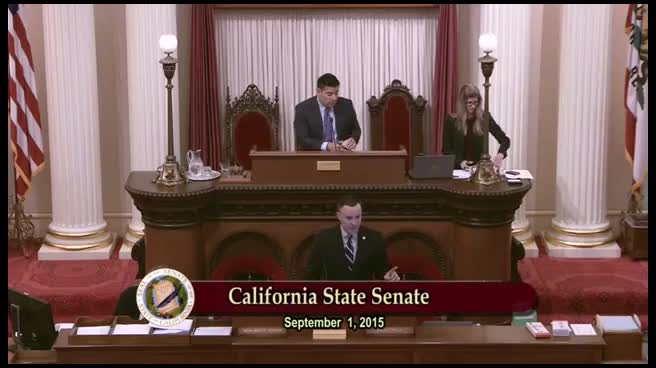 1MIN
Senate Floor
 1MIN
Assembly Floor
 6MIN
Assembly Standing Committee on Education
 1MIN
Senate Floor
Bill Author

Bill Co-Author(s):