SB 411: Crimes.
- Session Year: 2015-2016
- House: Senate
- Latest Version Date: 2015-08-11
Under existing law, every person who deters or prevents an executive officer from performing any of his or her duties, or knowingly resists the officer, is punishable by a fine or imprisonment, or both, as specified.
This bill would provide that the fact that a person takes a photograph or makes an audio or video recording of an executive officer, while the officer is in a public place or the person taking the photograph or making the recording is in a place he or she has the right to be, is not, in and of itself, a violation of the above-mentioned provision.
Under existing law, every person who willfully resists, delays, or obstructs any public officer, peace officer, or emergency medical technician in the discharge or attempt to discharge any of his or her duties shall be punished by a fine or imprisonment, or both, as specified.
This bill would provide that the fact that a person takes a photograph or makes an audio or video recording of a public officer or peace officer, while the officer is in a public place or the person taking the photograph or making the recording is in a place he or she has the right to be, is not, in and of itself, a violation of the above-mentioned provision, nor does it constitute reasonable suspicion to detain the person or probable cause to arrest the person.
(a)Every person who attempts, by means of any threat or violence, to deter or prevent an executive officer from performing any duty imposed upon the officer by law, or who knowingly resists, by the use of force or violence, the officer, in the performance of his or her duty, is punishable by a fine not exceeding ten thousand dollars ($10,000), or by imprisonment pursuant to subdivision (h) of Section 1170, or in a county jail not exceeding one year, or by both such fine and imprisonment.
(b)The fact that a person takes a photograph or makes an audio or video recording of an executive officer, while the officer is in a public place or the person taking the photograph or making the recording is in a place he or she has the right to be, does not constitute, in and of itself, a violation of subdivision (a).
SEC. 2.Section 148 of the Penal Code is amended to read:148.(a)(1)Every person who willfully resists, delays, or obstructs any public officer, peace officer, or an emergency medical technician, as defined in Division 2.5 (commencing with Section 1797) of the Health and Safety Code, in the discharge or attempt to discharge any duty of his or her office or employment, when no other punishment is prescribed, shall be punished by a fine not exceeding one thousand dollars ($1,000), or by imprisonment in a county jail not to exceed one year, or by both that fine and imprisonment.
(2)Except as provided by subdivision (d) of Section 653t, every person who knowingly and maliciously interrupts, disrupts, impedes, or otherwise interferes with the transmission of a communication over a public safety radio frequency shall be punished by a fine not exceeding one thousand dollars ($1,000), imprisonment in a county jail not exceeding one year, or by both that fine and imprisonment.
(b)Every person who, during the commission of any offense described in subdivision (a), removes or takes any weapon, other than a firearm, from the person of, or immediate presence of, a public officer or peace officer shall be punished by imprisonment in a county jail not to exceed one year or pursuant to subdivision (h) of Section 1170.
(c)Every person who, during the commission of any offense described in subdivision (a), removes or takes a firearm from the person of, or immediate presence of, a public officer or peace officer shall be punished by imprisonment pursuant to subdivision (h) of Section 1170.
(d)Except as provided in subdivision (c) and notwithstanding subdivision (a) of Section 489, every person who removes or takes without intent to permanently deprive, or who attempts to remove or take a firearm from the person of, or immediate presence of, a public officer or peace officer, while the officer is engaged in the performance of his or her lawful duties, shall be punished by imprisonment in a county jail not to exceed one year or pursuant to subdivision (h) of Section 1170.
In order to prove a violation of this subdivision, the prosecution shall establish that the defendant had the specific intent to remove or take the firearm by demonstrating that any of the following direct, but ineffectual, acts occurred:
(1)The officers holster strap was unfastened by the defendant.
(2)The firearm was partially removed from the officers holster by the defendant.
(3)The firearm safety was released by the defendant.
(4)An independent witness corroborates that the defendant stated that he or she intended to remove the firearm and the defendant actually touched the firearm.
(5)An independent witness corroborates that the defendant actually had his or her hand on the firearm and tried to take the firearm away from the officer who was holding it.
(6)The defendants fingerprint was found on the firearm or holster.
(7)Physical evidence authenticated by a scientifically verifiable procedure established that the defendant touched the firearm.
(8)In the course of any struggle, the officers firearm fell and the defendant attempted to pick it up.
(e)A person shall not be convicted of a violation of subdivision (a) in addition to a conviction of a violation of subdivision (b), (c), or (d) when the resistance, delay, or obstruction, and the removal or taking of the weapon or firearm or attempt thereof, was committed against the same public officer, peace officer, or emergency medical technician. A person may be convicted of multiple violations of this section if more than one public officer, peace officer, or emergency medical technician are victims.
(f)This section shall not apply if the public officer, peace officer, or emergency medical technician is disarmed while engaged in a criminal act.
(g)The fact that a person takes a photograph or makes an audio or video recording of a public officer or peace officer, while the officer is in a public place or the person taking the photograph or making the recording is in a place he or she has the right to be, does not constitute, in and of itself, a violation of subdivision (a), nor does it constitute reasonable suspicion to detain the person or probable cause to arrest the person.
(a)Every person who attempts, by means of any threat or violence, to deter or prevent an executive officer from performing any duty imposed upon such the officer by law, or who knowingly resists, by the use of force or violence, such the officer, in the performance of his or her duty, is punishable by a fine not exceeding ten thousand dollars ($10,000), or by imprisonment pursuant to subdivision (h) of Section 1170, or in a county jail not exceeding one year, or by both such fine and imprisonment.
(b)The fact that a person takes a photograph or makes an audio or video recording of an executive officer, while the officer is in a public place or the person taking the photograph or making the recording is in a place he or she has the right to be, does not constitute, in and of itself, a violation of subdivision (a).
SEC. 2.Section 148 of the Penal Code is amended to read:148.(a)(1)Every person who willfully resists, delays, or obstructs any public officer, peace officer, or an emergency medical technician, as defined in Division 2.5 (commencing with Section 1797) of the Health and Safety Code, in the discharge or attempt to discharge any duty of his or her office or employment, when no other punishment is prescribed, shall be punished by a fine not exceeding one thousand dollars ($1,000), or by imprisonment in a county jail not to exceed one year, or by both that fine and imprisonment.
(2)Except as provided by subdivision (d) of Section 653t, every person who knowingly and maliciously interrupts, disrupts, impedes, or otherwise interferes with the transmission of a communication over a public safety radio frequency shall be punished by a fine not exceeding one thousand dollars ($1,000), imprisonment in a county jail not exceeding one year, or by both that fine and imprisonment.
(b)Every person who, during the commission of any offense described in subdivision (a), removes or takes any weapon, other than a firearm, from the person of, or immediate presence of, a public officer or peace officer shall be punished by imprisonment in a county jail not to exceed one year or pursuant to subdivision (h) of Section 1170.
(c)Every person who, during the commission of any offense described in subdivision (a), removes or takes a firearm from the person of, or immediate presence of, a public officer or peace officer shall be punished by imprisonment pursuant to subdivision (h) of Section 1170.
(d)Except as provided in subdivision (c) and notwithstanding subdivision (a) of Section 489, every person who removes or takes without intent to permanently deprive, or who attempts to remove or take a firearm from the person of, or immediate presence of, a public officer or peace officer, while the officer is engaged in the performance of his or her lawful duties, shall be punished by imprisonment in a county jail not to exceed one year or pursuant to subdivision (h) of Section 1170.
In order to prove a violation of this subdivision, the prosecution shall establish that the defendant had the specific intent to remove or take the firearm by demonstrating that any of the following direct, but ineffectual, acts occurred:
(1)The officers holster strap was unfastened by the defendant.
(2)The firearm was partially removed from the officers holster by the defendant.
(3)The firearm safety was released by the defendant.
(4)An independent witness corroborates that the defendant stated that he or she intended to remove the firearm and the defendant actually touched the firearm.
(5)An independent witness corroborates that the defendant actually had his or her hand on the firearm and tried to take the firearm away from the officer who was holding it.
(6)The defendants fingerprint was found on the firearm or holster.
(7)Physical evidence authenticated by a scientifically verifiable procedure established that the defendant touched the firearm.
(8)In the course of any struggle, the officers firearm fell and the defendant attempted to pick it up.
(e)A person shall not be convicted of a violation of subdivision (a) in addition to a conviction of a violation of subdivision (b), (c), or (d) when the resistance, delay, or obstruction, and the removal or taking of the weapon or firearm or attempt thereof, was committed against the same public officer, peace officer, or emergency medical technician. A person may be convicted of multiple violations of this section if more than one public officer, peace officer, or emergency medical technician are victims.
(f)This section shall not apply if the public officer, peace officer, or emergency medical technician is disarmed while engaged in a criminal act.
(g)The fact that a person takes a photograph or makes an audio or video recording of a public officer or peace officer, while the officer is in a public place or the person taking the photograph or making the recording is in a place he or she has the right to be, does not constitute, in and of itself, a violation of subdivision (a), nor does it constitute reasonable suspicion to detain the person or probable cause to arrest the person.
|
Date
|
Status
|
|---|---|
| May 14, 2015 | Referred to Com. on PUB. S. |
| Aug 11, 2015 | Chaptered by Secretary of State. Chapter 177, Statutes of 2015. |
| Aug 11, 2015 | Approved by the Governor. |
| Jul 30, 2015 | Enrolled and presented to the Governor at 10 a.m. |
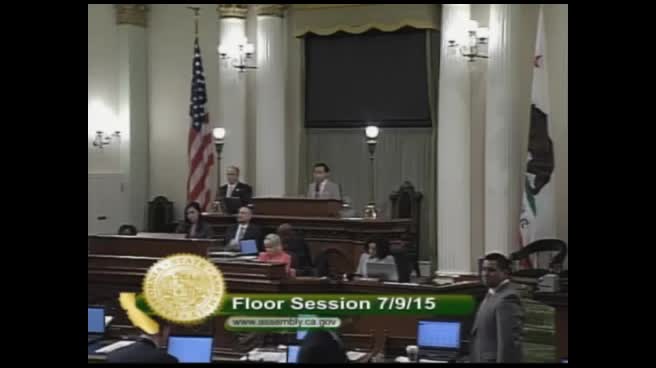
| Jul 9, 2015 | Read third time. Passed. (Ayes 74. Noes 2. Page 2327.) Ordered to the Senate. |
| Jul 9, 2015 | Read third time. Passed. Ordered to the Senate. |
| Jul 9, 2015 | In Senate. Ordered to engrossing and enrolling. |
| Jul 2, 2015 | Read second time. Ordered to third reading. |
| Jul 1, 2015 | From committee: Do pass. (Ayes 6. Noes 0.) (June 30). |
| Feb 25, 2015 | Introduced. Read first time. To Com. on RLS. for assignment. To print. |
| Apr 13, 2015 | Read third time. Passed. (Ayes 31. Noes 3. Page 559.) Ordered to the Assembly. |
| Apr 13, 2015 | In Assembly. Read first time. Held at Desk. |
| Apr 8, 2015 | Read second time. Ordered to third reading. |
| Apr 7, 2015 | From committee: Do pass. (Ayes 7. Noes 0. Page 508.) (April 7). |
| Mar 10, 2015 | Set for hearing April 7. |
| Mar 5, 2015 | Referred to Com. on PUB. S. |
| Feb 26, 2015 | From printer. May be acted upon on or after March 28. |
|
Date
|
Description
|
Location
|
Votes
|
|
|---|---|---|---|---|
| Jul 9, 2015 | SB 411 Lara Senate Third Reading By GARCIA, C. | Assembly Floor |
Passed |
|
| Jun 30, 2015 | Do pass. | Assembly Standing Committee on Public Safety |
Passed |
|
| Apr 13, 2015 | Senate 3rd Reading SB411 Lara | Senate Floor |
Passed |
|
| Apr 7, 2015 | Do pass | Senate Standing Committee on Public Safety |
Passed |
This list shows positions taken on this bill by organizations on the date displayed, which is linked to the original source.
Positions by individuals are not included.
|
Organization
|
Position
|
Date
|
|---|---|---|
| Alameda County Board of Supervisors | ** Support | Jul 9, 2015 |
| Alliance for Boys and Men of Color | ** Support | Jul 9, 2015 |
| America Friends Service Committee | * Support | Apr 7, 2015 |
| American Civil Liberties Union of California | ** Support | Jul 9, 2015 |
| Asian Law Alliance | ** Support | Jul 9, 2015 |
| Bill of Rights Defense Committee | ** Support | Jul 9, 2015 |
| California Attorneys For Criminal Justice | ** Support | Jul 9, 2015 |
| California Immigrant Policy Center | ** Support | Jul 9, 2015 |
| California Newspaper Publishers Association | ** Support | Jul 9, 2015 |
| California Public Defenders Association | ** Support | Jul 9, 2015 |
| Californians United for a Responsible Budget | ** Support | Jul 9, 2015 |
| City Of Oakland | ** Support | Jul 9, 2015 |
| Conference of California Bar Associations | ** Support | Jul 9, 2015 |
| Consumer Electronics Association | ** Support | Jul 9, 2015 |
| Courage Campaign | ** Support | Jul 9, 2015 |
| Drug Policy Alliance | ** Support | Jul 9, 2015 |
| Ella Baker Center For Human Rights | ** Support | Jul 9, 2015 |
| Friends Committee On Legislation Of California | ** Support | Jul 9, 2015 |
| Legal Services for Prisoners with Children | ** Support | Jul 9, 2015 |
| Los Angeles Black Worker Center | ** Support | Jul 9, 2015 |
| NAACP - California State Conference | ** Support | Jul 9, 2015 |
| Page J | ** Support | Jul 9, 2015 |
| Page K | ** Support | Jul 9, 2015 |
| PolicyLink | ** Support | Jul 9, 2015 |
| Progressive Christians Uniting | ** Support | Jul 9, 2015 |
| Public Defender's Office, San Bernardino County | * Support | Apr 7, 2015 |
SB 411
Page 2
SENATE THIRD READING
SB 411
(Lara)
As Introduced February 25, 2015
Majority vote
SENATE VOTE: 31-3
Committee |
Votes |
Ayes |
Noes |
Public Safety |
6-0 |
Quirk, Melendez, Lackey, Lopez, Low, Santiago |
|
SUMMARY: Provides that the fact that a person takes a photograph or makes an audio or video recording of a public officer, peace officer, or executive officer, while the officer is in a public place or the person taking the photograph or making the recording is in a place he or she has the right to be, is not, in and of itself, a violation of specified offenses for obstruction of an officer, nor does it constitute reasonable suspicion to detain the person or probable cause to arrest the person. Specifically, this bill:
States that the fact that a person takes a photograph or makes an audio or video recording of an executive officer, while the officer is in a public place or the person taking the photograph or making the recording is in a place he or she has the right to be, does not constitute, in and of itself, a violation of attempting by means of threats or violence, to deter or prevent an executive officer from performing their duty, or resisting by the use of force or violence the officer, in performance of his or her duty.
Provides that the fact that a person takes a photograph or makes an audio or video recording of a public officer or peace officer, while the officer is in a public place or the person taking the photograph or making the recording is in a place he or she has the right to be, is not, in and of itself, a violation of willfully resisting, delaying, or obstructing a public officer, or peace officer, nor does it constitute reasonable suspicion to detain the person or probable cause to arrest the person.
States that the fact that a person takes a photograph or makes an audio or video recording of a public officer or peace officer, while the officer is in a public place or the person taking the photograph or making the recording is in a place he or she has the right to be, does not constitute reasonable suspicion to detain the person or probable cause to arrest the person.
EXISTING LAW:
States that every person who attempts, by means of any threat or violence, to deter or prevent an executive officer from performing any duty imposed on the officer by law, or who knowingly resists, by the use of force or violence, such officer, in the performance of his duty, is punishable by a fine not exceeding $10,000, or by imprisonment pursuant to subdivision (h) of Section 1170, or in a county jail not exceeding one year, or by both such fine and imprisonment.
Provides that every person who willfully resists, delays, or obstructs any public officer, peace officer, or an emergency medical technician, as specified, in the discharge or attempt to discharge any duty of his or her office or employment, when no other punishment is prescribed, shall be punished by a fine not exceeding $1,000, or by imprisonment in a county jail not to exceed one year, or by both that fine and imprisonment.
States that every person who knowingly and maliciously interrupts, disrupts, impedes, or otherwise interferes with the transmission of a communication over a public safety radio frequency shall be punished by a fine not exceeding $1,000, imprisonment in a county jail not exceeding one year, or by both that fine and imprisonment.
Provides that any person who removes or takes any weapon, other than a firearm, from the person of, or immediate presence of, a public officer or peace officer, while willfully resisting, delaying obstructing the officer in the discharge or attempt to discharge any official duty, shall be punished by imprisonment in a county jail not to exceed one year or pursuant to subdivision (h) of Section 1170.
Provides that any person who removes or takes a firearm from the person of, or immediate presence of, a public officer or peace officer, while willfully resisting, delaying obstructing the officer in the discharge or attempt to discharge any official duty, shall be punished by imprisonment pursuant to subdivision (h) of Section 1170.
FISCAL EFFECT: Unknown. This bill has been keyed non-fiscal by the Legislative Counsel.
COMMENTS: According to the author, "Our Constitution guarantees us all the fundamental right to freedom of speech. Recent events throughout the country and here in California have raised questions about when an individual can – and can't – record. SB 411 will help erase ambiguity, enhance transparency and ensure that freedom of speech is protected for both civilians and police officers."
Analysis Prepared by: David Billingsley / PUB. S. / (916) 319-3744 FN: 0001114
SB 411
Page 5
Date of Hearing: June 30, 2015
Counsel: David Billingsley
ASSEMBLY COMMITTEE ON PUBLIC SAFETY
Bill Quirk, Chair
SB 411
(Lara) – As Introduced February 25, 2015
SUMMARY:
Provides that
the fact that a person takes a photograph or makes an audio or video
recording of a public officer, peace officer, or executive officer,
while the officer is in a public place or the person taking the
photograph or making the recording is in a place he or she has the
right to be, is not, in and of itself, a violation of specified
offenses for obstruction of an officer, nor does it constitute
reasonable suspicion to detain the person or probable cause to arrest
the person. Specifically, this bill:
States that the fact that a person takes a photograph or makes an audio or video recording of an executive officer, while the officer is in a public place or the person taking the photograph or making the recording is in a place he or she has the right to be, does not constitute, in and of itself, a violation of attempting by means of threats or violence, to deter or prevent an executive officer from performing their duty, or resisting by the use of force or violence the officer, in performance of his or her duty.
Provides that the fact that a person takes a photograph or makes an audio or video recording of a public officer or peace officer, while the officer is in a public place or the person taking the photograph or making the recording is in a place he or she has the right to be, is not, in and of itself, a violation of willfully resisting, delaying, or obstructing a public officer, or peace officer, nor does it constitute reasonable suspicion to detain the person or probable cause to arrest the person.
States that the fact that a person takes a photograph or makes an audio or video recording of a public officer or peace officer, while the officer is in a public place or the person taking the photograph or making the recording is in a place he or she has the right to be, does not constitute reasonable suspicion to detain the person or probable cause to arrest the person.
EXISTING LAW:
States that every person who attempts, by means of any threat or violence, to deter or prevent an executive officer from performing any duty imposed on the officer by law, or who knowingly resists, by the use of force or violence, such officer, in the performance of his duty, is punishable by a fine not exceeding ten thousand dollars ($10,000), or by imprisonment pursuant to subdivision (h) of Section 1170, or in a county jail not exceeding one year, or by both such fine and imprisonment. (Pen. Code, § 69.)
Provides that every person who willfully resists, delays, or obstructs any public officer, peace officer, or an emergency medical technician, as specified, in the discharge or attempt to discharge any duty of his or her office or employment, when no other punishment is prescribed, shall be punished by a fine not exceeding one thousand dollars ($1,000), or by imprisonment in a county jail not to exceed one year, or by both that fine and imprisonment.
States that every person who knowingly and maliciously interrupts, disrupts, impedes, or otherwise interferes with the transmission of a communication over a public safety radio frequency shall be punished by a fine not exceeding one thousand dollars ($1,000), imprisonment in a county jail not exceeding one year, or by both that fine and imprisonment. (Pen. Code, § 148, subd. (a).)
Provides that any person who removes or takes any weapon, other than a firearm, from the person of, or immediate presence of, a public officer or peace officer, while willfully resisting, delaying obstructing the officer in the discharge or attempt to discharge any official duty, shall be punished by imprisonment in a county jail not to exceed one year or pursuant to subdivision (h) of Section 1170. (Pen. Code, § 148, subd. (b).)
Provides that any person who removes or takes a firearm from the person of, or immediate presence of, a public officer or peace officer, while willfully resisting, delaying obstructing the officer in the discharge or attempt to discharge any official duty, shall be punished by imprisonment pursuant to subdivision (h) of Section 1170. (Pen. Code, §148, subd. (c).)
FISCAL EFFECT: Unknown.
COMMENTS:
Author's Statement: According to the author, “Our Constitution guarantees us all the fundamental right to freedom of speech. Recent events throughout the country and here in California have raised questions about when an individual can – and can’t – record. SB 411 will help erase ambiguity, enhance transparency and ensure that freedom of speech is protected for both civilians and police officers.”
Need for Clarification to Ensure Consistency in Encounters Between Law Enforcement and Citizens: With the prevalence of cell phones and other devices that can record video or take pictures, it is common practice for citizens to record interactions between law enforcement and the public. Cell phone video recordings have been used to expose misconduct on the part of police officers as well as exonerate police officers from wrongful accusations. However, the dynamic of cell phone use by citizens to record police conduct has led to situations in which law enforcement have stopped, sometimes forcefully, the use of a recording device by a citizen.
In April 2015, a woman standing on the sidewalk used her cell phone to record video of two men standing a short distance away, wearing black shirts with tactical vests reading “Police” across the back. The men noticed her recording moments earlier and began to back up toward her to block her view. About 27 seconds into the video, a third man, a deputy U.S. marshal wearing a tactical vest and carrying a rifle, walks across a front lawn toward the sidewalk where the woman is standing. The marshal wrestled the device out of her hand and smashed it on the ground. The phone’s screen was shattered and the device stopped working. The woman said she began recording when she saw the law enforcement presence, their military-style weapons and a line of people being detained. http://www.latimes.com/local/lanow/la-me-ln-feds-probe-video-phone-in-south-gate-20150421-story.html
Providing clear guidelines to law enforcement and the public can serve to ensure that interactions involving the use of a cell phone recording will be conducted in a consistent and lawful manner.
Federal Courts have Recognized the First Amendment Right to Record a Police Officer Engaged in Their Duties in a Public Place: This legislation expressly provides that it is not a crime to take a photograph or record a law enforcement officer while the officer is performing any official duty in a public place or in a place where the person taking the photograph or making the recording has a right to be.
This is consistent with 9th Circuit case law, which expressly provides that the public be permitted to film matters of public interest:
In this Circuit, an individual has a right 'to be free from
police action motivated by retaliatory animus.” Ford
v. City of Yakima
(9th Cir. 2013) 706 F.3d 1188, 1193
(quoting Skoog
v. Cnty. of Clackamas
(9th Cir. 2006) 469 F.3d 1221, 1231-32.) In
general, the public enjoys a “First
Amendment
right to film matters of public interest.” Fordyce v. City of
Seattle (9th Cir. 1995) 55 F.3d 436, 439; see also Glik
v. Cunniffe
(1st Cir. 2011) 655 F.3d 78, 82. (“the
First
Amendment's aegis . . . encompasses a range
of conduct related to the gathering and dissemination of information
. . . The filming of government officials engaged in their duties in
a public place, including police officers performing their
responsibilities, fits comfortably within these principles.").
“To
demonstrate retaliation in violation of the First
Amendment, [a plaintiff] must [show] that
[Defendants] took action that would chill or silence a person of
ordinary firmness from future First
Amendment activities.” Skoog
at 1231-32. The Ninth Circuit has explicitly
“recognized that a retaliatory police action such as an arrest or
search and seizure would chill a person of ordinary firmness from
engaging in future First
Amendment activity. Ford,
at 1193.
Quoted from American
News and Information Services, Inc. v. William D. Gore, (S.D.Ca.
September 17, 2014, CA12-CV-2186)
2014 U.S. Dist. LEXIS 132591.)
Argument in Support: According to the American Civil Liberties Union of California, “There is a clear constitutional right to photograph and record the police in the performance of their duties. This right serves as an important check and balance, and provides a means for members of the public to safely and accurately record matters of public importance. Indeed, as one federal court found,
‘The filming of government officials engaged in their duties in a
public place, including police officers performing their
responsibilities, fits comfortably within these principles [of
protected First Amendment activity]. Gathering information about
government officials in a form that can readily be disseminated to
others serves a cardinal First Amendment interest in protecting and
promoting the free discussion of governmental affairs…[f]reedom of
expression has particular significance with respect to government
because [i]t is here that the state has a special incentive to
repress opposition and often wields a more effective power of
suppression…This is particularly true of law enforcement officials,
who are granted substantial discretion that may be misused to deprive
individuals of their liberties…Ensuring the public's right to
gather information about their officials not only aids in the
uncovering of abuses, but also may have a salutary effect on the
functioning of government more generally.’
“(Glik v. Cunniffe (1st Cir. 2011) 655 F.3d 78, 82-83, internal citations and quotations omitted.) Likewise, in a 2012 letter to the Baltimore Police Department, the U.S. Department of Justice urged,
‘Policies should affirmatively set forth the contours of individuals’ First Amendment right to observe and record police officers engaged in the public discharge of their duties. Recording governmental officers engaged in public duties is a form of speech through which private individuals may gather and disseminate information of public concern, including the conduct of law enforcement officers.’
“(Jonathan M. Smith, U.S. Dept. of Justice Letter to Baltimore City Police Dept. (May 14, 2012) http://www.justice.gov/crt/about/spl/documents/Sharp_ltr_5-14-12.pdf.) Therefore, protecting our right to photograph and record law enforcement in the performance of their duties both strengthens our communities and ensures the proper functioning of government.
“Despite the well-established right to take photographs and make audio and video recordings of police officers, and despite the clear language of Penal Code sections 69 and 148 – which specify that only when a person uses threats or violence to deter or prevent an officer from performing the officer’s duties, or when a person resists, delays, or obstructs an officer in the performance of the officer’s duties should that person be punished – members of the public have nonetheless been arrested and detained for lawfully photographing and recording the police. Law enforcement officers violate the Constitution’s core protections when they arrest and detain people for legally pursuing constitutionally protected activity. 1 Such violations threaten our liberties and make our communities less safe.
"By recognizing the existing
constitutional right to photograph and record the police, SB
411 helps to safeguard our collective freedoms and takes an important
step towards ensuring that individuals are not punished for the mere
exercise of their constitutional rights."
Prior Legislation: AB 1492 (Lowenthal), of the 2009-2010 Legislative Session, would have made it illegal to fail to comply with the officer’s direction to stop using a wireless telephone or other communication device, when stopped for a traffic violation. Would not have prohibited a person from using a wireless telephone or other communication device to record, tape, or otherwise film anything that occurs during a traffic stop. AB 1492 was held in the Assembly Public Safety Committee.
REGISTERED SUPPORT / OPPOSITION:
Support
California Public
Defenders Association (Sponsor)
California Attorneys for
Criminal Justice (Co-Sponsor)
Conference of California Bar
Associations (Co-Sponsor)
Alameda County Board of Supervisors
Alliance for Boys
and Men of Color
American Civil Liberties Union of California
Asian Law
Alliance
Bill of Rights Defense Committee
California Immigrant Policy Center
California Newspaper Publishers Association
Californians United for a Responsible Budget
City of
Oakland
Consumer Electronics Association
Courage Campaign
Drug Policy Alliance
Ella Baker Center for Human Rights
Friends Committee on Legislation of California
Legal Services for Prisoners with Children
Los Angeles Black Worker Center
NAACP – California State Conference
PolicyLink
Progressive
Christians Uniting
19 private individuals
Opposition
None
Analysis Prepared by: David Billingsley / PUB. S. / (916) 319-3744
1 The use of police authority against individuals to deter their protected speech – which includes photography – is unconstitutional. (See Duran v. City of Douglas, 904 F.2d 1372, 1375-78 (9th Cir. 1990) (holding that a police officer’s traffic stop and subsequent arrest of an individual who directed obscene gestures and words toward that officer was unlawful because it was well-established that police officers may not exercise their authority for personal motives, especially in response to an individual’s criticism or insults); see also Beck v. City of Upland, 527 F.3d 853, 871 (9th Cir. 2008) (holding that Duran clearly established that police officers could not use their power to retaliate against an individual for his free speech).
SB 411
Page 3
|
Office of Senate Floor Analyses (916) 651-1520 Fax: (916) 327-4478 |
THIRD READING
Bill No: SB 411
Introduced: 2/25/15
SENATE PUBLIC SAFETY COMMITTEE: 7-0, 4/7/15
AYES: Hancock, Anderson, Leno, Liu, McGuire, Monning, Stone
SOURCE: California Attorneys for Criminal Justice
California Public Defenders Association
Conference of California Bar Associations
DIGEST: This bill provides that taking a photograph or making an audio or video recording of: (1) an executive officer, while the officer is in a public place or in a place where the person taking the photograph or making the recording has the right to be, is not, in and of itself, a violation of the law stating that every person who deters or prevents an executive officer from performing any of his or her duties, or knowingly resists the officer, is punishable by a fine or imprisonment; or, (2) a public officer or peace officer, while the officer is in a public place or in a place where the person taking the photograph or making the recording has the right to be, is not, in and of itself, a violation of the law stating every person who willfully resists, delays, or obstructs any public officer, peace officer, or emergency medical technician in the discharge or attempt to discharge any of his or her duties shall be punished by a fine or imprisonment, or both, nor do these actions constitute reasonable suspicion to detain the person or probable cause to arrest the person.
Existing law:
States that every person who attempts, by means of any threat or violence, to deter or prevent an executive officer from performing any duty imposed on the officer by law, or who knowingly resists, by the use of force or violence, such officer, in the performance of his duty, is punishable by a fine not exceeding ten thousand dollars ($10,000), or by imprisonment pursuant to subdivision (h) of Penal Code Section 1170, or in a county jail not exceeding one year, or by both such fine and imprisonment. (Penal Code § 69.)
States that every person who willfully resists, delays, or obstructs any public officer, peace officer, or an emergency medical technician, as specified, in the discharge or attempt to discharge any duty of his or her office or employment, when no other punishment is prescribed, shall be punished by a fine not exceeding one thousand dollars ($1,000), or by imprisonment in a county jail not to exceed one year, or by both that fine and imprisonment. And, except as otherwise provided, every person who knowingly and maliciously interrupts, disrupts, impedes, or otherwise interferes with the transmission of a communication over a public safety radio frequency shall be punished by a fine not exceeding one thousand dollars ($1,000), imprisonment in a county jail not exceeding one year, or by both that fine and imprisonment. (Penal Code § 148(a).)
This bill:
Provides that taking a photograph or making an audio or video recording of an executive officer, while the officer is in a public place or in a place where the person taking the photograph or making the recording has the right to be, is not, in and of itself, a violation of Penal Code Section 69.
Provides that taking a photograph or making an audio or video recording of a public officer or peace officer, while the officer is in a public place or in a place where the person taking the photograph or making the recording has the right to be, is not, in and of itself, a violation of Penal Code Section 148 (a), nor does it constitute reasonable suspicion to detain the person or probable cause to arrest the person.
NOTE: Please see the policy committee analysis for a full discussion of this bill.
FISCAL EFFECT: Appropriation: No Fiscal Com.: No Local: No
California Attorneys for Criminal Justice (co-source)
California Public Defenders Association (co-source)
Conference of California Bar Associations (co-source)
American Civil Liberties Union of California
Asian Law Alliance
Bill of Rights Defense Committee
California Newspaper Publishers Association
Consumer Electronics Association
Courage Campaign
Friends Committee on Legislation in California
Legal Services for Prisoners with Children
None received
ARGUMENTS IN SUPPORT: The American Civil Liberties Union of California states:
Despite the well-established right to take photographs and make audio and video recordings of police officers, and despite the clear language of Penal Code sections 69 and 148 – which specify that only when a person uses threats or violence to deter or prevent an officer from performing the officer’s duties, or when a person resists, delays, or obstructs an officer in the performance of the officer’s duties should that person be punished – members of the public have nonetheless been arrested and detained for lawfully photographing and recording the police. Law enforcement officers violate the Constitution’s core protections when they arrest and detain people for legally pursuing constitutionally protected activity. Such violations threaten our liberties and make our communities less safe.
By recognizing the existing constitutional right to photograph and record the police, SB 411 helps to safeguard our collective freedoms and takes an important step towards ensuring that individuals are not punished for the mere exercise of their constitutional rights.
Prepared by: Jessica Devencenzi / PUB. S. /
4/8/15 15:13:19
**** END ****
SB 411 (Lara ) Page 6 of 6
SENATE COMMITTEE ON PUBLIC SAFETY
Senator Loni Hancock, Chair
2015 - 2016 Regular
Bill No: SB 411 Hearing Date: April 7, 2015
Author: |
Lara |
||
Version: |
February 25, 2015 |
||
Urgency: |
No |
Fiscal: |
No |
Consultant: |
JRD |
||
Subject: Crimes: Photographing or Recording Officers
HISTORY
Source: California Public Defenders and Conference of California Bar Associations
Prior Legislation: No
Support: American Civil Liberties Union; Asian Law Alliance; Bill of Rights Defense Committee; Courage Campaign; Legal Services for Prisoners with Children
Opposition: None Known
PURPOSE
The purpose of this legislation it to expressly provide that it is not a crime to take a photograph or record a law enforcement officer while the officer is performing any official duty in a public place or in a place where the person taking the photograph or making the recording has a right to be.
Current law states that every person who attempts, by means of any threat or violence, to deter or prevent an executive officer from performing any duty imposed on the officer by law, or who knowingly resists, by the use of force or violence, such officer, in the performance of his duty, is punishable by a fine not exceeding ten thousand dollars ($10,000), or by imprisonment pursuant to subdivision (h) of Section 1170, or in a county jail not exceeding one year, or by both such fine and imprisonment. (Penal Code § 69.)
Under existing law every person who willfully resists, delays, or obstructs any public officer, peace officer, or an emergency medical technician, as specified, in the discharge or attempt to discharge any duty of his or her office or employment, when no other punishment is prescribed, shall be punished by a fine not exceeding one thousand dollars ($1,000), or by imprisonment in a county jail not to exceed one year, or by both that fine and imprisonment. And, except as otherwise provided, every person who knowingly and maliciously interrupts, disrupts, impedes, or otherwise interferes with the transmission of a communication over a public safety radio frequency shall be punished by a fine not exceeding one thousand dollars ($1,000), imprisonment in a county jail not exceeding one year, or by both that fine and imprisonment. (Penal Code § 148(a).) Every person who, during the commission of one of these offenses:
Removes or takes any weapon, other than a firearm, from the person of, or immediate presence of, a public officer or peace officer shall be punished by imprisonment in a county jail not to exceed one year or pursuant to subdivision (h) of Section 1170. (Penal Code § 148(b).)
Removes or takes a firearm from the person of, or immediate presence of, a public officer or peace officer shall be punished by imprisonment pursuant to subdivision (h) of Section 1170. (Penal Code §148(c).)
This bill would provide that taking a photograph or making an audio or video recording of an executive officer, while the officer is in a public place or in a place where the person taking the photograph or making the recording has the right to be, does not, in and of itself, constitute interference with a public duty, as specified.
This bill would provide that taking a photograph or making an audio or video recording of a public officer or peace officer, while the officer is in a public place or in a place where the person taking the photograph or making the recording has the right to be, does not, in and of itself, constitute obstruction of an officer, as specified, nor does it constitute reasonable suspicion to detain the person or probable cause to arrest the person.
RECEIVERSHIP/OVERCROWDING CRISIS AGGRAVATION
For the past eight years, this Committee has scrutinized legislation referred to its jurisdiction for any potential impact on prison overcrowding. Mindful of the United States Supreme Court ruling and federal court orders relating to the state’s ability to provide a constitutional level of health care to its inmate population and the related issue of prison overcrowding, this Committee has applied its “ROCA” policy as a content-neutral, provisional measure necessary to ensure that the Legislature does not erode progress in reducing prison overcrowding.
On February 10, 2014, the federal court ordered California to reduce its in-state adult institution population to 137.5% of design capacity by February 28, 2016, as follows:
143% of design bed capacity by June 30, 2014;
141.5% of design bed capacity by February 28, 2015; and,
137.5% of design bed capacity by February 28, 2016.
In February of this year the administration reported that as “of February 11, 2015, 112,993 inmates were housed in the State’s 34 adult institutions, which amounts to 136.6% of design bed capacity, and 8,828 inmates were housed in out-of-state facilities. This current population is now below the court-ordered reduction to 137.5% of design bed capacity.”( Defendants’ February 2015 Status Report In Response To February 10, 2014 Order, 2:90-cv-00520 KJM DAD PC, 3-Judge Court, Coleman v. Brown, Plata v. Brown (fn. omitted).
While significant gains have been made in reducing the prison population, the state now must stabilize these advances and demonstrate to the federal court that California has in place the “durable solution” to prison overcrowding “consistently demanded” by the court. (Opinion Re: Order Granting in Part and Denying in Part Defendants’ Request For Extension of December 31, 2013 Deadline, NO. 2:90-cv-0520 LKK DAD (PC), 3-Judge Court, Coleman v. Brown, Plata v. Brown (2-10-14). The Committee’s consideration of bills that may impact the prison population therefore will be informed by the following questions:
Whether a proposal erodes a measure which has contributed to reducing the prison population;
Whether a proposal addresses a major area of public safety or criminal activity for which there is no other reasonable, appropriate remedy;
Whether a proposal addresses a crime which is directly dangerous to the physical safety of others for which there is no other reasonably appropriate sanction;
Whether a proposal corrects a constitutional problem or legislative drafting error; and
Whether a proposal proposes penalties which are proportionate, and cannot be achieved through any other reasonably appropriate remedy.
COMMENTS
1. Need for This Bill
According to the Author:
Over the past decade, technological advances have made it so that nearly every citizen has a hand-held recording device. Current statues do not reflect the advancements of recording technology and existing law is not clear on what constitutes an obstruction of an officer when using these devices to record officers exercising their duties in public. This lack of clarity has increased conflict between police officers and members of the public.
In several California cases and beyond, members of the public have been arrested while recording or photographing police activity in public places. Videos and reports have surfaced online of civilians being arrested for recording officers in the cities of Los Angeles, Torrance, and San Diego, as well as the County of Orange. This conflict extends past police officers and civilians to professional photographers and media personnel. In Berkeley, CA a journalist was arrested after recording law enforcement officers in a public place.
As evidenced by these reports, the law’s obscurity has led to confusion about protected citizen oversight activities, such as filming and photographing. While many police officers understand the right of people to exercise their first amendment right, current statutes provide little guidance on whether recording constitutes delaying or obstructing an officer. The vagueness of the law necessitates a clarification to give all citizens and law enforcement officers a clear understanding that individuals have a right to record police officers in public during the discharge of their duties.
Additionally, the law should be clarified to include that reasonable suspicion cannot be used against a First Amendment right. When often people are found to be recording an officer and they are detained or arrested, reasonable suspicion is used as a tool for the arrest.
Ultimately, clarifying the law can benefit both police and civilians. A recent example of a civilian recording helping the police occurred on February 28, 2015 when the LAPD turned to deadly force after failing to subdue a man. Bystander video, as well as video from a security camera, shows that the man acted violently toward the police and attempted to grab the officer’s gun. Recordings of law enforcement activity can create not only clear evidentiary accounts that benefit civilians, but innocent police officers as well.
As Los Angeles County Sherriff’s Chief Bobby Denham of the Central Patrol Division said in the LA Times in response to the introduction of body cameras, "We’re in an age now where this kind of technology is expected. It gives us an opportunity to do better.” As we move further into the smart-phone age and hand-held recording technologies continue to become more accessible to everyday citizens, SB 411 will help members of the public understand how they can use their First Amendment rights in relation to public police activities. It helps ensure the protections of rights by promoting transparency and community trust. In the end, it is the intent of SB 411 to limit future conflicts between civilians and law enforcement. . .
Our Constitution guarantees us all the fundamental right to freedom of speech. Recent events throughout the country and here in California have raised questions about when an individual can – and can’t – record. SB 411 will help erase ambiguity, enhance transparency and ensure that freedom of speech is protected for both civilians and police officers.
2. Effect of Legislation
This legislation expressly provides that it is not a crime to take a photograph or record a law enforcement officer while the officer is performing any official duty in a public place or in a place where the person taking the photograph or making the recording has a right to be.
This is consistent with 9th Circuit case law, which expressly provides that the public be permitted to film matters of public interest:
“In this Circuit, an individual
has a right 'to be free from police action motivated by retaliatory
animus.” Ford
v. City of Yakima,
706 F.3d 1188, 1193 (9th Cir. 2013)
(quoting Skoog
v. Cnty. of Clackamas,
469 F.3d 1221, 1231-32 (9th Cir. 2006)).
In general, the public enjoys a “First
Amendment
right to film matters of public interest.” Fordyce
v. City of Seattle, 55
F.3d 436, 439 (9th Cir. 1995); see
also Glik
v. Cunniffe,
655 F.3d 78, 82 (1st Cir. 2011)
(“the First
Amendment's
aegis . . . encompasses a range of conduct related to the gathering
and dissemination of information . . . The filming of government
officials engaged in their duties in a public place, including police
officers performing their responsibilities, fits comfortably within
these principles.").
“To demonstrate retaliation in
violation of the First
Amendment,
[a plaintiff] must [show] that [Defendants] took action that would
chill or silence a person of ordinary firmness from future First
Amendment
activities.” Skoog,
469 F.3d at 1231-32.
The Ninth Circuit has explicitly “recognized that a retaliatory
police action such as an arrest or search and seizure would chill a
person of ordinary firmness from engaging in future First
Amendment
activity.” Ford,
706 F.3d at 1193.
(American News and Information Services, Inc. v. William D. Gore, 2014 U.S. Dist. LEXIS 132591 (September 17, 2014).)
SHOULD CALIFORNIA LAW EXPLICITLY PERMIT THE PHOTOGRAPHING OR RECORDING OF LAW ENFORCEMENT IN PUBLIC WHEN THE OFFICER IS DISCHARGING AN OFFICIAL DUTY?
3. Argument in Support
According to the American Civil Liberties Union of California:
There is a clear constitutional right to photograph and record the police in the performance of their duties. [Footnote omitted.] This right serves as an important check and balance, and provides a means for members of the public to safely and accurately record matters of public importance. Indeed, as one federal court found,
“The filming of government officials engaged in their duties in a public place, including police officers performing their responsibilities, fits comfortably within these principles [of protected First Amendment activity]. Gathering information about government officials in a form that can readily be disseminated to others serves a cardinal First Amendment interest in protecting and promoting the free discussion of governmental affairs…[f]reedom of expression has particular significance with respect to government because [i]t is here that the state has a special incentive to repress opposition and often wields a more effective power of suppression…This is particularly true of law enforcement officials, who are granted substantial discretion that may be misused to deprive individuals of their liberties…Ensuring the public's right to gather information about their officials not only aids in the uncovering of abuses, but also may have a salutary effect on the functioning of government more generally.”
(Glik v. Cunniffe (1st Cir. 2011) 655 F.3d 78, 82-83, internal citations and quotations omitted.) Likewise, in a 2012 letter to the Baltimore Police Department, the U.S. Department of Justice urged,
“Policies should affirmatively set forth the contours of individuals’ First Amendment right to observe and record police officers engaged in the public discharge of their duties. Recording governmental officers engaged in public duties is a form of speech through which private individuals may gather and disseminate information of public concern, including the conduct of law enforcement officers.”
(Jonathan M. Smith, U.S. Dept. of Justice Letter to Baltimore City Police Dept. (May 14, 2012) http://www.justice.gov/crt/about/spl/documents/Sharp_ltr_5-14-12.pdf.) Therefore, protecting our right to photograph and record law enforcement in the performance of their duties both strengthens our communities and ensures the proper functioning of government.
Despite the well-established right to take photographs and make audio and video recordings of police officers, and despite the clear language of Penal Code sections 69 and 148 – which specify that only when a person uses threats or violence to deter or prevent an officer from performing the officer’s duties, or when a person resists, delays, or obstructs an officer in the performance of the officer’s duties should that person be punished – members of the public have nonetheless been arrested and detained for lawfully photographing and recording the police. Law enforcement officers violate the Constitution’s core protections when they arrest and detain people for legally pursuing constitutionally protected activity. Such violations threaten our liberties and make our communities less safe.
By recognizing the existing constitutional right to photograph and record the police, SB 411 helps to safeguard our collective freedoms and takes an important step towards ensuring that individuals are not punished for the mere exercise of their constitutional rights.
-- END --
Discussed in Hearing
 1MIN
Assembly Floor
 7MIN
Senate Floor
 8MIN
Senate Standing Committee on Public Safety
Bill Author

Bill Co-Author(s):