SB 450: Elections: vote by mail voting and mail ballot elections.
- Session Year: 2015-2016
- House: Senate
- Latest Version Date: 2016-09-29
Existing law requires all vote by mail ballots to be voted on or before the day of the election and requires the vote by mail voter to return the ballot by mail or in person, as specified, to the elections official who issued the ballot.
This bill would require an elections official who receives a vote by mail ballot that he or she did not issue to forward that ballot to the elections official who issued the ballot no later than 8 days after receipt. By requiring an elections official to forward a ballot to the elections official who issued the ballot, the bill would impose a state-mandated local program.
Existing law authorizes cities with a population of fewer than 100,000 persons, school districts, and special districts to conduct an all-mailed ballot special election to fill a vacancy on the legislative or governing body of those entities under specified conditions.
This bill, the California Voters Choice Act, would, on or after January 1, 2018, authorize specified counties, and on or after January 1, 2020, authorize any county except the County of Los Angeles, to conduct any election as an all-mailed ballot election if certain conditions are satisfied, including conditions related to ballot dropoff locations, vote centers, and plans for the administration of all-mailed ballot elections. The bill would require the Secretary of State, within 6 months of each all-mailed ballot election conducted by a county pursuant to these provisions, to report certain information to the Legislature regarding that election. The bill would require the county that conducted the all-mailed ballot election to submit to the Secretary of State the information needed for the Secretary of State to prepare the report.
This bill would, on or after January 1, 2020, authorize the County of Los Angeles to conduct any election as a vote center election if certain conditions are satisfied, including conditions related to ballot dropoff locations and vote centers. The bill would, on or after January 1, 2020, authorize the County of Los Angeles to conduct a special election as an all-mailed ballot election pursuant to specified provisions that apply to every county that chooses to conduct a special election as an all-mailed ballot election.
This bill would also require the Secretary of State to establish a taskforce that includes certain individuals to review all-mailed ballot elections conducted pursuant to these provisions and to provide comments and recommendations to the Legislature within 6 months of each all-mailed ballot election or vote center election.
This bill would incorporate additional changes to Section 3017 of the Elections Code proposed by AB 1921 that would become operative only if AB 1921 and this bill are both chaptered and this bill is chaptered last.
The California Constitution requires the state to reimburse local agencies and school districts for certain costs mandated by the state. Statutory provisions establish procedures for making that reimbursement.
This bill would provide that, if the Commission on State Mandates determines that the bill contains costs mandated by the state, reimbursement for those costs shall be made pursuant to these statutory provisions.
Existing law requires all vote by mail ballots to be voted on or before the day of the election and requires the vote by mail voter to return the ballot by mail or in person, as specified, to the elections official who issued the ballot.
This bill would require an elections official who receives a vote by mail ballot that he or she did not issue to forward that ballot to the elections official who issued the ballot no later than 8 days after receipt. By requiring an elections official to forward a ballot to the elections official who issued the ballot, the bill would impose a state-mandated local program.
Existing law authorizes cities with a population of fewer than 100,000 persons, school districts, and special districts to conduct an all-mailed ballot special election to fill a vacancy on the legislative or governing body of those entities under specified conditions.
This bill bill, the California Voters Choice Act, would, on or after January 1, 2018, authorize specified counties, and on or after January 1, 2020, authorize any county except the County of Los Angeles, to conduct any election as an all-mailed ballot election if certain conditions are satisfied, including conditions related to ballot dropoff locations, vote centers, and plans for the administration of all-mailed ballot elections. The bill would require the Secretary of State, within 6 months of each all-mailed ballot election conducted by a county pursuant to these provisions, to report certain information to the Legislature regarding that election. The bill would require the county that conducted the all-mailed ballot election to submit to the Secretary of State the information needed for the Secretary of State to prepare the report.
This bill would, on or after January 1, 2020, authorize the County of Los Angeles to conduct any election as a vote center election if certain conditions are satisfied, including conditions related to ballot dropoff locations and vote centers. The bill would, on or after January 1, 2020, authorize the County of Los Angeles to conduct a special election as an all-mailed ballot election pursuant to specified provisions that apply to every county that chooses to conduct a special election as an all-mailed ballot election.
This bill would also require the Secretary of State to establish a taskforce that includes certain individuals to review all-mailed ballot elections conducted pursuant to these provisions and to provide comments and recommendations to the Legislature within 6 months of each all-mailed ballot election or vote center election.
This bill would incorporate additional changes to Section 3017 of the Elections Code proposed by AB 1921 that would become operative only if AB 1921 and this bill are both chaptered and this bill is chaptered last.
The California Constitution requires the state to reimburse local agencies and school districts for certain costs mandated by the state. Statutory provisions establish procedures for making that reimbursement.
This bill would provide that, if the Commission on State Mandates determines that the bill contains costs mandated by the state, reimbursement for those costs shall be made pursuant to these statutory provisions.
Existing law requires all vote by mail ballots to be voted on or before the day of the election. Existing law authorizes a vote by mail voter who is unable to return his or her vote by mail ballot to designate his or her spouse, child, parent, grandparent, grandchild, brother, sister, or a person residing in the same household as the voter to return the ballot, as specified. Existing law prohibits a vote by mail voters ballot from being returned by specified persons, including, among others, a paid or volunteer worker of a political party. election and requires the vote by mail voter to return the ballot by mail or in person, as specified, to the elections official who issued the ballot.
This bill would remove those restrictions and instead authorize a vote by mail voter who is unable to return his or her vote by mail ballot to designate any person to return the ballot. require an elections official who receives a vote by mail ballot that he or she did not issue to forward that ballot to the elections official who issued the ballot no later than 8 days after receipt. By requiring an elections official to forward a ballot to the elections official who issued the ballot, the bill would impose a state-mandated local program.
Existing law authorizes cities with a population of fewer than 100,000 persons, school districts, and special districts to conduct an all-mailed ballot special election to fill a vacancy on the legislative or governing body of those entities under specified conditions.
This bill would, on or after January 1, 2018, authorize specified counties, and on or after January 1, 2020, authorize any county except the County of Los Angeles, to conduct any election as an all-mailed ballot election if certain conditions are satisfied, including conditions related to ballot dropoff locations, vote centers, and plans for the administration of all-mailed ballot elections. The bill would require the Secretary of State, within 6 months of each all-mailed ballot election conducted by a county pursuant to these provisions, to report certain information to the Legislature regarding that election. The bill would require the county that conducted the all-mailed ballot election to submit to the Secretary of State the information needed for the Secretary of State to prepare the report.
This bill would, on or after January 1, 2020, authorize the County of Los Angeles to conduct any election as a vote center election if certain conditions are satisfied, including conditions related to ballot dropoff location locations and vote centers. The bill would, on or after January 1, 2020, authorize the County of Los Angeles to conduct a special election as an all-mailed ballot election pursuant to specified provisions that apply to every county that chooses to conduct a special election as an all-mailed ballot election.
This bill would also require the Secretary of State to establish a taskforce that includes certain individuals to review all-mailed ballot elections conducted pursuant to these provisions and to provide comments and recommendations to the Legislature within 6 months of each all-mailed ballot election or vote center election.
This bill would incorporate additional changes to Section 3017 of the Elections Code proposed by AB 1921 that would become operative only if AB 1921 and this bill are both chaptered and this bill is chaptered last.
The California Constitution requires the state to reimburse local agencies and school districts for certain costs mandated by the state. Statutory provisions establish procedures for making that reimbursement.
This bill would provide that, if the Commission on State Mandates determines that the bill contains costs mandated by the state, reimbursement for those costs shall be made pursuant to these statutory provisions.
Existing law requires all vote by mail ballots to be voted on or before the day of the election. Existing law authorizes a vote by mail voter who is unable to return his or her vote by mail ballot to designate his or her spouse, child, parent, grandparent, grandchild, brother, sister, or a person residing in the same household as the voter to return the ballot, as specified. Existing law prohibits a vote by mail voters ballot from being returned by specified persons, including, among others, a paid or volunteer worker of a political party.
This bill would remove those restrictions and instead authorize a vote by mail voter who is unable to return his or her vote by mail ballot to designate any person to return the ballot.
Existing law authorizes cities with a population of fewer than 100,000 persons, school districts, and special districts to conduct an all-mailed ballot special election to fill a vacancy on the legislative or governing body of those entities under specified conditions.
This bill would, on or after January 1, 2018, authorize a county specified counties, and on or after January 1, 2020, authorize any county except the County of Los Angeles, to conduct any election as an all-mailed ballot election if certain conditions are satisfied, including conditions related to ballot dropoff locations and vote centers. The bill would require a county that conducts an all-mailed ballot election to report certain information to the Legislature and the Secretary of State regarding all-mailed ballot elections conducted pursuant to these provisions. locations, vote centers, and plans for the administration of all-mailed ballot elections. The bill would require the Secretary of State State, within 6 months of each all-mailed ballot election conducted by a county pursuant to these provisions, to report certain information to the Legislature regarding the success of the first all-mailed ballot election conduct pursuant to these provisions by a county. that election. The bill would require the county that conducted the all-mailed ballot election to submit to the Secretary of State the information needed for the Secretary of State to prepare the report.
This bill would, on or after January 1, 2020, authorize the County of Los Angeles to conduct any election as a vote center election if certain conditions are satisfied, including conditions related to ballot dropoff location and vote centers. The bill would, on or after January 1, 2020, authorize the County of Los Angeles to conduct a special election as an all-mailed ballot election pursuant to specified provisions that apply to every county that chooses to conduct a special election as an all-mailed ballot election.
The This bill would also require the Secretary of State to establish a taskforce that includes certain individuals to review all-mailed ballot elections conducted pursuant to these provision provisions and to provide comments and recommendations to the Legislature on or before April 1, 2021. within 6 months of each all-mailed ballot election or vote center election.
Existing law authorizes cities with a population of less fewer than 100,000 persons, school districts, and special districts to conduct an all-mailed ballot special election to fill a vacancy on the legislative or governing body of those entities under specified conditions.
This bill would, on or after January 1, 2018, authorize a county to conduct any election as an all-mailed ballot election if certain conditions are satisfied, including conditions related to ballot dropoff locations and polling vote centers. The bill would require a county that conducts an all-mailed ballot election to report certain information to the Legislature and the Secretary of State regarding the success of the first all-mailed ballot election elections conducted pursuant to these provisions. The bill would require the Secretary of State to report certain information to the Legislature regarding the success of the first all-mailed ballot election conduct pursuant to these provisions by a county.
The bill would also require the Secretary of State to establish a taskforce that includes certain individuals to review all-mailed ballot elections conducted pursuant to these provision and to provide comments and recommendations to the Legislature on or before April 1, 2021.
Existing law authorizes cities with a population of less than 100,000 persons, school districts, and special districts to conduct an all-mailed ballot special election to fill a vacancy on the legislative or governing body of those entities under specified conditions.
This bill would, on or after January 1, 2018, authorize a county to conduct any election as an all-mailed ballot election if certain conditions are satisfied, including conditions related to ballot dropoff locations and polling centers. The bill would require a county that conducts an all-mailed ballot election to report certain information to the Legislature and the Secretary of State regarding the success of the first all-mailed ballot election conducted pursuant to these provisions.
Existing law, for each election, requires each appropriate elections official to cause to be printed sample ballots, as specified, and requires the sample ballots to be mailed to each registered voter not more than 40 nor less than 21 days before the election. Existing law requires the elections official to include with the sample ballot an application for a vote by mail ballot.
This bill would require the application for a vote by mail ballot that is included with the sample ballot to include a space for the voter to apply for permanent vote by mail status. By requiring elections officials to provide a higher level of service, the bill would impose a state-mandated local program.
The California Constitution requires the state to reimburse local agencies and school districts for certain costs mandated by the state. Statutory provisions establish procedures for making that reimbursement.
This bill would provide that, if the Commission on State Mandates determines that the bill contains costs mandated by the state, reimbursement for those costs shall be made pursuant to these statutory provisions.
This act shall be known, and may be cited, as the California Voters Choice Act.
SEC. 2.Section 3017 of the Elections Code is amended to read:3017.(a)All vote by mail ballots cast under this division shall be voted on or before the day of the election. After marking the ballot, the vote by mail voter shall do any of the following: (1) return the ballot by mail or in person to the elections official who issued the ballot, (2) return the ballot in person to a member of a precinct board at a polling place or vote center within the state, or (3) return the ballot to a vote by mail ballot dropoff location within the state that is provided pursuant to Section 3025 or 4005. However, a vote by mail voter who is unable to return the ballot may designate his or her spouse, child, parent, grandparent, grandchild, brother, sister, or a person residing in the same household as the vote by mail voter to return the ballot to the elections official who issued the ballot, to the precinct board at a polling place or vote center within the state, or to a vote by mail ballot dropoff location within the state that is provided pursuant to Section 3025 or 4005. The ballot must, however, be received by the elections official who issued the ballot, the precinct board, or the vote by mail ballot dropoff location before the close of the polls on election day. If a vote by mail ballot is returned to a precinct board at a polling place or vote center, or to a vote by mail ballot dropoff location, that is located in a county that is not the county of the elections official who issued the ballot, the elections official for the county in which the vote by mail ballot is returned shall forward the ballot to the elections official who issued the ballot no later than eight days after receipt.
(b)The elections official shall establish procedures to ensure the secrecy of a ballot returned to a precinct polling place and the security, confidentiality, and integrity of any personal information collected, stored, or otherwise used pursuant to this section.
(c)On or before March 1, 2008, the elections official shall establish procedures to track and confirm the receipt of voted vote by mail ballots and to make this information available by means of online access using the countys elections division Internet Web site. If the county does not have an elections division Internet Web site, the elections official shall establish a toll-free telephone number that may be used to confirm the date a voted vote by mail ballot was received.
(d)The provisions of this section are mandatory, not directory, and a ballot shall not be counted if it is not delivered in compliance with this section.
(e)Notwithstanding subdivision (a), a vote by mail voters ballot shall not be returned by a paid or volunteer worker of a general purpose committee, controlled committee, independent expenditure committee, political party, candidates campaign committee, or any other group or organization at whose behest the individual designated to return the ballot is performing a service. However, this subdivision does not apply to a candidate or a candidates spouse.
SEC. 2.5.Section 3017 of the Elections Code is amended to read:3017.(a)All vote by mail ballots cast under this division shall be voted on or before the day of the election. After marking the ballot, the vote by mail voter shall do any of the following: (1) return the ballot by mail or in person to the elections official who issued the ballot, (2) return the ballot in person to a member of a precinct board at a polling place or vote center within the state, or (3) return the ballot to a vote by mail ballot dropoff location within the state that is provided pursuant to Section 3025 or 4005. However, a vote by mail voter who is unable to return the ballot may designate any person to return the ballot to the elections official who issued the ballot, to the precinct board at a polling place or vote center within the state, or to a vote by mail ballot dropoff location within the state that is provided pursuant to Section 3025 or 4005. The ballot must, however, be received by the elections official who issued the ballot, the precinct board, or the vote by mail ballot dropoff location before the close of the polls on election day. If a vote by mail ballot is returned to a precinct board at a polling place or vote center, or to a vote by mail ballot dropoff location, that is located in a county that is not the county of the elections official who issued the ballot, the elections official for the county in which the vote by mail ballot is returned shall forward the ballot to the elections official who issued the ballot no later than eight days after receipt.
(b)The elections official shall establish procedures to ensure the secrecy of a ballot returned to a precinct polling place and the security, confidentiality, and integrity of any personal information collected, stored, or otherwise used pursuant to this section.
(c)On or before March 1, 2008, the elections official shall establish procedures to track and confirm the receipt of voted vote by mail ballots and to make this information available by means of online access using the countys elections division Internet Web site. If the county does not have an elections division Internet Web site, the elections official shall establish a toll-free telephone number that may be used to confirm the date a voted vote by mail ballot was received.
(d)The provisions of this section are mandatory, not directory, and a ballot shall not be counted if it is not delivered in compliance with this section.
(e)(1)A person designated to return a vote by mail ballot shall not receive any form of compensation based on the number of ballots that the person has returned and no individual, group, or organization shall provide compensation on this basis.
(2)For purposes of this paragraph, compensation means any form of monetary payment, goods, services, benefits, promises or offers of employment, or any other form of consideration offered to another person in exchange for returning another voters vote by mail ballot.
(3)Any person in charge of a vote by mail ballot and who knowingly and willingly engages in criminal acts related to that ballot as described in Division 18 (commencing with Section 18000), including, but not limited to, fraud, bribery, intimidation, and tampering with or failing to deliver the ballot in a timely fashion, is subject to the appropriate punishment specified in that division.
SEC. 3.Section 4005 is added to the Elections Code, to read:4005.(a)Notwithstanding Section 4000 or any other law, on or after January 1, 2018, the Counties of Calaveras, Inyo, Madera, Napa, Nevada, Orange, Sacramento, San Luis Obispo, San Mateo, Santa Clara, Shasta, Sierra, Sutter, and Tuolumne, and, except as provided in Section 4007, on or after January 1, 2020, any county may conduct any election as an all-mailed ballot election if all of the following apply:
(1)(A)At least two ballot dropoff locations are provided within the jurisdiction where the election is held or the number of ballot dropoff locations are fixed in a manner so that there is at least one ballot dropoff location provided for every 15,000 registered voters within the jurisdiction where the election is held, as determined on the 88th day before the day of the election, whichever results in more ballot dropoff locations. For purposes of this subparagraph, a vote center that includes an exterior ballot drop box counts only as a single ballot dropoff location. Ballot dropoff locations shall comply with the regulations adopted pursuant to subdivision (b) of Section 3025.
(B)A ballot dropoff location provided for under this section consists of a secure, accessible, and locked ballot box located as near as possible to established public transportation routes and that is able to receive voted ballots. All ballot dropoff locations shall be open at least during regular business hours beginning not less than 28 days before the day of the election, and on the day of the election. At least one ballot dropoff location shall be an accessible, secured, exterior drop box that is available for a minimum of 12 hours per day including regular business hours.
(2)(A)The county elections official permits a voter residing in the county to do any of the following at a vote center:
(i)Return, or vote and return, his or her vote by mail ballot.
(ii)Register to vote, update his or her voter registration, and vote pursuant to Section 2170.
(iii)Receive and vote a provisional ballot pursuant to Section 3016 or Article 5 (commencing with Section 14310) of Chapter 3 of Division 14.
(iv)Receive a replacement ballot upon verification that a ballot for the same election has not been received from the voter by the county elections official. If the county elections official is unable to determine if a ballot for the same election has been received from the voter, the county elections official may issue a provisional ballot.
(v)Vote a regular, provisional, or replacement ballot using accessible voting equipment that provides for a private and independent voting experience.
(B)Each vote center shall have at least three voting machines that are accessible to voters with disabilities.
(3)(A)On the day of the election, from 7 a.m. to 8 p.m., inclusive, and on each of the three days before the election, for a minimum of eight hours per day, at least one vote center is provided for every 10,000 registered voters within the jurisdiction where the election is held, as determined on the 88th day before the day of the election. At least 90 percent of the number of vote centers required by this subparagraph shall be open for all four days during the required times. Up to 10 percent of the number of vote centers required by this subparagraph may be open for less than four days if at least one vote center is provided for every 10,000 registered voters on each day.
(B)Notwithstanding subparagraph (A), for a jurisdiction with fewer than 20,000 registered voters, a minimum of two voter centers are provided on the day of the election and on each of the three days before the election within the jurisdiction where the election is held.
(4)(A)Beginning 10 days before the day of the election and continuing daily up to and including the fourth day before the election, for a minimum of eight hours per day, at least one vote center is provided for every 50,000 registered voters within the jurisdiction where the election is held, as determined on the 88th day before the day of the election.
(B)Notwithstanding subparagraph (A), for a jurisdiction with fewer than 50,000 registered voters, a minimum of two vote centers are provided within the jurisdiction where the election is held.
(C)The vote centers provided under this section are established in accordance with the accessibility requirements described in Article 5 (commencing with Section 12280) of Chapter 3 of Division 12, the federal Americans with Disabilities Act of 1990 (42 U.S.C. Sec. 12101 et seq.), the federal Help America Vote Act of 2002 (52 U.S.C. Sec. 20901 et seq.), and the federal Voting Rights Act of 1965 (52 U.S.C. Sec. 10101 et seq.).
(D)The vote centers provided under this section are equitably distributed across the county so as to afford maximally convenient options for voters and are established at accessible locations as near as possible to established public transportation routes. The vote centers shall be equipped with voting units or systems that are accessible to individuals with disabilities and that provide the same opportunity for access and participation as is provided to voters who are not disabled, including the ability to vote privately and independently in accordance with Sections 12280 and 19240.
(E)(i)The vote centers provided under this section have an electronic mechanism for the county elections official to immediately access, at a minimum, all of the following voter registration data:
(I)Name.
(II)Address.
(III)Date of birth.
(IV)Language preference.
(V)Party preference.
(VI)Precinct.
(VII)Whether or not the voter has been issued a vote by mail ballot and whether or not a ballot has been received by the county elections official.
(ii)The electronic mechanism used to access voter registration data shall not be connected in any way to a voting system.
(5)A method is available for voters with disabilities to request and receive a blank vote by mail ballot and, if a replacement ballot is necessary, a blank replacement ballot that voters with disabilities can read and mark privately and independently pursuant to the federal Help America Vote Act of 2002 (52 U.S.C. Sec. 20901 et seq.).
(6) (A) Except as otherwise provided for in this section, election boards for the vote centers established under this section meet the requirements for eligibility and composition pursuant to Article 1 (commencing with Section 12300) of Chapter 4 of Division 12.
(B)Each vote center provides language assistance in all languages required in the jurisdiction under subdivision (c) of Section 12303 or Section 203 of the federal Voting Rights Act of 1965 (52 U.S.C. Sec. 10101 et seq.) in a manner that enables voters of the applicable language minority groups to participate effectively in the electoral process. Each vote center shall post information regarding the availability of language assistance in English and all other languages for which language assistance is required to be provided in the jurisdiction under subdivision (c) of Section 12303 or Section 203 of the federal Voting Rights Act of 1965 (52 U.S.C. Sec. 10101 et seq.).
(i)If a vote center is located in, or adjacent to, a precinct, census tract, or other defined geographical subsection required to establish language requirements under subdivision (c) of Section 12303 or Section 203 of the federal Voting Rights Act of 1965 (52 U.S.C. Sec. 10101 et seq.), or if it is identified as needing language assistance through the public input process described in clause (ii), the county elections official shall ensure that the vote center is staffed by election board members who speak the required language. If the county elections official is unable to recruit election board members who speak the required language, alternative methods of effective language assistance shall be provided by the county elections official.
(ii)The county elections official shall solicit public input regarding which vote centers should be staffed by election board members who are fluent in a language in addition to English pursuant to subdivision (c) of Section 12303 and Section 203 of the federal Voting Rights Act of 1965 (52 U.S.C. Sec. 10101 et seq.).
(iii)The county elections official shall provide notice in the sample ballot, in vote by mail materials, and on his or her Internet Web site of the specific language services available at each vote center.
(C)Each vote center provides election materials translated in all languages required in the jurisdiction under subdivision (c) of Section 14201 and Section 203 of the federal Voting Rights Act of 1965 (52 U.S.C. Sec. 10101 et seq.).
(D)Each vote center provides reasonable modifications and auxiliary aids and services as required by the federal Americans with Disabilities Act of 1990 (42 U.S.C. Sec. 12101 et seq.) and the federal Rehabilitation Act of 1973 (29 U.S.C. Sec. 701 et seq.).
(7)(A)Beginning 10 days before the election, the county elections official maintains, in an electronic format, an index of voters who have done any of the following at one of the voter centers established pursuant to this section:
(i)Registered to vote or updated his or her voter registration.
(ii)Received and voted a provisional ballot or replacement ballot.
(iii)Voted a ballot using equipment at the vote center.
(B)The index required by subparagraph (A) includes the same information for each voter as is required to be included on copies of the index of affidavits of voter registration that are posted pursuant to Section 14294. The index required by subparagraph (A) shall be updated continuously during any time that a vote center is open in the jurisdiction.
(8)(A)Beginning 29 days before the day of the election, the county elections official mails to each registered voter a vote by mail ballot packet that includes a return envelope with instructions for the use and return of the vote by mail ballot.
(B)The county elections official delivers to each voter, with either the sample ballot sent pursuant to Section 13303 or with the vote by mail ballot packet, all of the following:
(i)A notice, translated in all languages required under subdivision (c) of Section 14201 and Section 203 of the federal Voting Rights Act of 1965 (52 U.S.C. Sec. 10101 et seq.), that informs voters of all of the following:
(I)An all-mailed ballot election is being conducted and each eligible voter will be issued a vote by mail ballot by mail.
(II)The voter may cast a vote by mail ballot in person at a vote center during the times and days specified in subparagraph (A) of paragraph (4) or on election day.
(III)No later than seven days before the day of the election, the voter may request the county elections official to send a vote by mail ballot in a language other than English pursuant to Section 203 of the federal Voting Rights Act of 1965 (52 U.S.C. Sec. 10101 et seq.) or a facsimile copy of the ballot printed in a language other than English pursuant to Section 14201.
(IV)No later than seven days before the day of the election, the voter may request the county elections official to send or deliver a ballot that voters with disabilities can read and mark privately and independently pursuant to the federal Help America Vote Act of 2002 (52 U.S.C. Sec. 20901 et seq.).
(ii)A list of the ballot dropoff locations and vote centers established pursuant to this section, including the dates and hours they are open. The list shall also be posted on the Internet Web site of the county elections official in a format that is accessible for people with disabilities pursuant to Section 11135 of the Government Code.
(iii)A postage-paid postcard that the voter may return to the county elections official for the purpose of requesting a vote by mail ballot in a language other than English or for the purpose of requesting a vote by mail ballot in an accessible format.
(C)Upon request, the county elections official provides written voting materials to voters with disabilities in an accessible format, as required by the federal Americans with Disabilities Act of 1990 (42 U.S.C. Sec. 12101 et seq.) and the federal Rehabilitation Act of 1973 (29 U.S.C. Sec. 701 et seq.).
(9)(A)The county elections official establishes a language accessibility advisory committee that is comprised of representatives of language minority communities. The committee shall be established no later than October 1 of the year before the first election conducted pursuant to this section. The committee shall hold its first meeting no later than April 1 of the year in which the first election is conducted pursuant to this section.
(B)The county elections official establishes a voting accessibility advisory committee that is comprised of voters with disabilities. The committee shall be established no later than October 1 of the year before the first election conducted pursuant to this section. The committee shall hold its first meeting no later than April 1 of the year in which the first election is conducted pursuant to this section.
(C)A county with fewer than 50,000 registered voters may establish a joint advisory committee for language minority communities and voters with disabilities.
(10)(A)The county elections official develops a draft plan for the administration of elections conducted pursuant to this section in consultation with the public, including both of the following:
(i)One meeting, publicly noticed at least 10 days in advance of the meeting, that includes representatives, advocates, and other stakeholders representing each community for which the county is required to provide voting materials and assistance in a language other than English under subdivision (c) of Section 14201 and the federal Voting Rights Act of 1965 (52 U.S.C. Sec. 10101 et seq.).
(ii)One meeting, publicly noticed at least 10 days in advance of the meeting, that includes representatives from the disability community and community organizations and individuals that advocate on behalf of, or provide services to, individuals with disabilities.
(B)The county elections official, when developing the draft plan for the administration of elections conducted pursuant to this section, considers, at a minimum, all of the following:
(i)Vote center and ballot dropoff location proximity to public transportation.
(ii)Vote center and ballot dropoff location proximity to communities with historically low vote by mail usage.
(iii)Vote center and ballot dropoff location proximity to population centers.
(iv)Vote center and ballot dropoff location proximity to language minority communities.
(v)Vote center and ballot dropoff location proximity to voters with disabilities.
(vi)Vote center and ballot dropoff location proximity to communities with low rates of household vehicle ownership.
(vii)Vote center and ballot dropoff location proximity to low-income communities.
(viii)Vote center and ballot dropoff location proximity to communities of eligible voters who are not registered to vote and may need access to same day voter registration.
(ix)Vote center and ballot dropoff location proximity to geographically isolated populations, including Native American reservations.
(x)Access to accessible and free parking at vote centers and ballot dropoff locations.
(xi)The distance and time a voter must travel by car or public transportation to a vote center and ballot dropoff location.
(xii)The need for alternate methods for voters with disabilities for whom vote by mail ballots are not accessible to cast a ballot.
(xiii)Traffic patterns near vote centers and ballot dropoff locations.
(xiv)The need for mobile vote centers in addition to the number of vote centers established pursuant to this section.
(C)The county elections official publicly notices the draft plan for the administration of elections conducted pursuant to this section and accepts public comments on the draft plan for at least 14 days before the hearing held pursuant to subparagraph (D).
(D)(i)Following the 14-day review period required by subparagraph (C), the county elections official holds a public meeting to consider the draft plan for the administration of elections conducted pursuant to this section and to accept public comments. The meeting shall be publicly noticed at least 10 days in advance of the meeting on the Internet Web sites of the clerk of the county board of supervisors and the county elections official, or, if neither the clerk of the county board of supervisors nor the county elections official maintain an Internet Web site, in the office of the county elections official.
(ii)After the public hearing to consider the draft plan for the administration of elections conducted pursuant to this section and to accept public comments, the county elections official shall consider any public comments he or she receives from the public and shall amend the draft plan in response to the public comments to the extent he or she deems appropriate. The county elections official shall publicly notice the amended draft plan and shall accept public comments on the amended draft plan for at least 14 days before the county elections official may adopt the amended draft plan pursuant to subparagraph (E).
(E)(i)Following the 14-day review and comment period required by clause (ii) of subparagraph (D), the county elections official may adopt a final plan for the administration of elections conducted pursuant to this section, and shall submit the voter education and outreach plan that is required by clause (i) of subparagraph (I) to the Secretary of State for approval.
(ii)The Secretary of State shall approve, approve with modifications, or reject a voter education and outreach plan submitted pursuant to clause (i) of subparagraph (I) within 14 days after the plan is submitted by the county elections official.
(iii)The draft plan, the amended draft plan, and the adopted final plan for the administration of elections conducted pursuant to this section shall be posted on the Internet Web site of the county elections official in each language in which the county is required to provide voting materials and assistance under subdivision (c) of Section 14201 and the federal Voting Rights Act of 1965 (52 U.S.C. Sec. 10101 et seq.), and the Secretary of States Internet Web site in a format that is accessible for people with disabilities pursuant to Section 11135 of the Government Code.
(F)Public meetings held pursuant to this paragraph shall, upon request, provide auxiliary aids and services to ensure effective communication with people with disabilities.
(G)Within two years of the adoption of the first plan for the administration of elections conducted pursuant to this section, the county elections official shall hold public meetings in accordance with the procedures described in subparagraphs (C) to (F), inclusive, to consider revising the first plan for the administration of elections conducted pursuant to this section. Every four years thereafter, the county elections official shall hold public meetings in accordance with the procedures described in subparagraphs (C) to (F), inclusive, to consider revising the plan for the administration of elections conducted pursuant to this section.
(H)(i)With reasonable public notification, a county elections official may amend a plan for the administration of elections conducted pursuant to this section no more than 120 days before the date of an election held pursuant to this section.
(ii)With reasonable public notification, a county elections official may amend a plan for the administration of elections conducted pursuant to this section more than 120 days before the date of an election held pursuant to this section if he or she provides at least 30 days to accept public comments on the amended plan.
(I)The plan for the administration of elections conducted pursuant to this section, includes all of the following:
(i)A voter education and outreach plan that is approved by the Secretary of State and that includes all of the following:
(I)A description of how the county elections official will use the media, including social media, newspapers, radio, and television that serve language minority communities for purposes of informing voters of the upcoming election and promoting the toll-free voter assistance hotline.
(II)A description of how the county elections official will use the media, including social media, newspapers, radio, and television for purposes of informing voters of the availability of a vote by mail ballot in an accessible format and the process for requesting such a ballot.
(III)A description of how the county elections official will have a community presence to educate voters regarding the provisions of this section.
(IV)A description of the accessible information that will be publicly available on the accessible Internet Web site of the county elections official.
(V)A description of the method used by the county elections official to identify language minority voters.
(VI)A description of how the county elections official will educate and communicate the provisions of this section to the public, including:
(ia)Communities for which the county is required to provide voting materials and assistance in a language other than English under subdivision (c) of Section 14201 and the federal Voting Rights Act of 1965 (52 U.S.C. Sec. 10101 et seq.). The county elections official shall hold at least one bilingual voter education workshop for each language in which the county is required to provide voting materials and assistance in a language other than English under subdivision (c) of Section 14201 and the federal Voting Rights Act of 1965 (52 U.S.C. Sec. 10101 et seq.).
(ib)The disability community, including organizations and individuals that advocate on behalf of, or provide services to, individuals with disabilities. The county elections official shall hold at least one voter education workshop to increase accessibility and participation of eligible voters with disabilities.
(VII)A description of how the county will spend the necessary resources on voter education and outreach to ensure that voters are fully informed about the election. This description shall include information about the amount of money the county plans to spend on voter education and outreach activities under the plan, and how that compares to the amount of money spent on voter education and outreach in recent similar elections in the same jurisdiction that were not conducted pursuant to this section.
(VIII)At least one public service announcement in the media, including newspapers, radio, and television, that serve English-speaking citizens for purposes of informing voters of the upcoming election and promoting the toll-free voter assistance hotline. Outreach made under this subclause shall include access for voters who are deaf or hard of hearing and voters who are blind or visually impaired.
(IX)At least one public service announcement in the media, including newspapers, radio, and television, that serve non-English-speaking citizens for each language in which the county is required to provide voting materials and assistance under subdivision (c) of Section 14201 and the federal Voting Rights Act of 1965 (52 U.S.C. Sec. 10101 et seq.) for purposes of informing voters of the upcoming election and promoting the toll-free voter assistance hotline.
(X)At least two direct contacts with voters for purposes of informing voters of the upcoming election and promoting the toll-free voter assistance hotline. The two direct contacts are in addition to any other required contacts including, but not limited to, sample ballots and the delivery of vote by mail ballots.
(ii)A description of how a voter with disabilities may request and receive a blank vote by mail ballot and, if a replacement ballot is necessary, a blank replacement ballot that a voter with disabilities can mark privately and independently.
(iii)A description of how the county elections official will address significant disparities in voter accessibility and participation identified in the report required by subdivision (g).
(iv)A description of the methods and standards that the county elections official will use to ensure the security of voting conducted at vote centers.
(v)Information about estimated short-term and long-term costs and savings from conducting elections pursuant to this section as compared to recent similar elections in the same jurisdiction that were not conducted pursuant to this section.
(vi)To the extent available at the time of publication, information on all of the following:
(I)The total number of vote centers to be established.
(II)The total number of ballot dropoff locations to be established.
(III)The location of each vote center.
(IV)The location of each ballot dropoff location and whether it is inside or outside.
(V)A map of the locations of each vote center and ballot dropoff location.
(VI)The hours of operation for each vote center.
(VII)The hours of operation for each ballot dropoff location.
(VIII)The security and contingency plans that would be implemented by the county elections official to do both of the following:
(ia)Prevent a disruption of the vote center process.
(ib)Ensure that the election is properly conducted if a disruption occurs.
(IX)The number of election board members and the number of bilingual election board members and the languages spoken.
(X)The services provided to voters with disabilities, including, but not limited to, the type and number of accessible voting machines and reasonable modifications at each vote center.
(XI)The design, layout, and placement of equipment inside each voter center that protects each voters right to cast a private and independent ballot.
(vii)A toll-free voter assistance hotline that is accessible to voters who are deaf or hard of hearing, and that is maintained by the county elections official that is operational no later than 29 days before the day of the election until 5 p.m. on the day after the election. The toll-free voter assistance hotline shall provide assistance to voters in all languages in which the county is required to provide voting materials and assistance under subdivision (c) of Section 14201 and the federal Voting Rights Act of 1965 (52 U.S.C. Sec. 10101 et seq.).
(J)The plan for the administration of elections conducted pursuant to this section is posted in a format that is accessible to persons with disabilities on the Internet Web site of the Secretary of State and on the Internet Web site of the county elections official.
(b)Notwithstanding Section 4000 or any other law, on or after January 1, 2018, the Counties of Calaveras, Inyo, Madera, Napa, Nevada, Orange, Sacramento, San Luis Obispo, San Mateo, Santa Clara, Shasta, Sierra, Sutter, and Tuolumne, and on or after January 1, 2020, any county may conduct a special election as an all-mailed ballot election under this section if all of the following apply:
(1)The county elections official has done either of the following:
(A)Previously conducted an election as an all-mailed ballot election in accordance with subdivision (a).
(B)Adopted a final plan for the administration of elections pursuant to clause (i) of subparagraph (E) of paragraph (9) of subdivision (a), in which case the county elections official shall complete all activities provided for in the voter education and outreach plan that is required by clause (i) of subparagraph (I) of paragraph (9) of subdivision (a) before the day of the special election.
(2)(A)On the day of election, from 7 a.m. to 8 p.m., inclusive, at least one vote center is provided for every 30,000 registered voters. If the jurisdiction is not wholly contained within the county, the county elections official shall make a reasonable effort to establish a vote center within the jurisdiction where the special election is held.
(B)Notwithstanding subparagraph (A), for a jurisdiction with fewer than 30,000 registered voters, the county elections official makes a reasonable effort to establish a vote center.
(3)(A)Not less than 10 days before the day of the election, for a minimum of eight hours per day, at least one vote center is provided for every 60,000 registered voters. If the jurisdiction is not wholly contained within the county, the county elections official shall make a reasonable effort to establish a vote center within the jurisdiction where the special election is held.
(B)Notwithstanding subparagraph (A), for a jurisdiction with fewer than 30,000 registered voters, the county elections official makes a reasonable effort to establish a vote center.
(4)(A)At least one ballot dropoff location is provided for every 15,000 registered voters. At least one ballot dropoff location shall be located within the jurisdiction where the special election is held. All ballot dropoff locations shall be open at least during regular business hours beginning not less than 28 days before the day of the election, and on the day of the election.
(B)Notwithstanding subparagraph (A), for a jurisdiction with fewer than 15,000 registered voters, at least one ballot dropoff location shall be provided.
(c)Except as otherwise provided in this section, the election day procedures shall be conducted in accordance with Division 14 (commencing with Section 14000).
(d)The county elections official may provide, at his or her discretion, additional ballot dropoff locations and vote centers for purposes of this section.
(e)The return of voted vote by mail ballots is subject to Sections 3017 and 3020.
(f)For the sole purpose of reporting the results of an election conducted pursuant to this section, upon completion of the ballot count, the county elections official shall divide the jurisdiction into precincts pursuant to Article 2 (commencing with Section 12220) of Chapter 3 of Division 12 and shall prepare a statement of the results of the election in accordance with Sections 15373 and 15374.
(g)(1)(A)Within six months of each election conducted pursuant to this section or Section 4007, the Secretary of State shall report to the Legislature, to the extent possible, all of the following information by categories of race, ethnicity, language preference, age, gender, disability, permanent vote by mail status, historical polling place voters, political party affiliation, and language minorities as it relates to the languages required under subdivision (c) of Section 14201 and Section 203 of the federal Voting Rights Act of 1965 (52 U.S.C. Sec. 10101 et seq.):
(i)Voter turnout.
(ii)Voter registration.
(iii)Ballot rejection rates.
(iv)Reasons for ballot rejection.
(v)Provisional ballot use.
(vi)Accessible vote by mail ballot use.
(vii)The number of votes cast at each vote center.
(viii)The number of ballots returned at ballot dropoff locations.
(ix)The number of ballots returned by mail.
(x)The number of persons who registered to vote at a vote center.
(xi)Instances of voter fraud.
(xii)Any other problems that became known to the county elections official or the Secretary of State during the election or canvass.
(B)The report required by subparagraph (A) shall be posted on the Internet Web site of the Secretary of State in a format that is accessible for people with disabilities pursuant to Section 11135 of the Government Code.
(C)The report required by subparagraph (A) shall be submitted to the Legislature in compliance with Section 9795 of the Government Code.
(D)If an election is conducted pursuant to this section, the county shall submit, to the extent possible, to the Secretary of State the information needed for the Secretary of State to prepare the report required by subparagraph (A).
(2)The county elections official shall post on his or her Internet Web site a report that compares the cost of elections conducted pursuant to this section to the costs of previous elections. The report shall be posted in a format that is accessible for people with disabilities pursuant to Section 11135 of the Government Code.
(h)The Secretary of State shall enforce the provisions of this section pursuant to Section 12172.5 of the Government Code.
(i)For purposes of this section, disability has the same meaning as defined in subdivisions (j), (m), and (n) of Section 12926 of the Government Code.
SEC. 4.Section 4006 is added to the Elections Code, to read:4006.For any election conducted pursuant to Section 4005, the county elections official shall make a reasonable effort to inform a voter of either of the following:
(a)If the voters vote by mail ballot envelope is missing a signature.
(b)How the voter can correct the missing signature.
SEC. 5.Section 4007 is added to the Elections Code, to read:4007.(a)On or after January 1, 2020, the County of Los Angeles may conduct any election as a vote center election if all of the following apply:
(1)The county elections official complies with all the provisions of subdivision (a) of Section 4005 that are not inconsistent with this section.
(2)Every permanent vote by mail voter receives a ballot.
(3)At least two ballot dropoff locations are provided within the jurisdiction where the election is held or the number of ballot dropoff locations are fixed in a manner so that there is at least one ballot dropoff location provided for every 15,000 permanent vote by mail registered voters within the jurisdiction where the election is held, as determined on the 88th day before the day of the election, whichever results in more ballot dropoff locations.
(4)Within the jurisdiction where the election is held, at least one vote center is provided for each city that has at least 1,000 registered voters according to the official report of registration submitted by the county elections official to the Secretary of State before the last general election.
(5)On the day of the election, from 7 a.m. to 8 p.m., inclusive, and on each of the three days before the election, for a minimum of eight hours per day, at least one vote center is provided for every 7,500 registered voters within the jurisdiction where the election is held, as determined on the 88th day before the day of the election. At least 90 percent of the number of vote centers required by this subparagraph shall be open for all four days during the required times. Up to 10 percent of the number of vote centers required by this subparagraph may be open for less than four days if at least one vote center is provided for every 7,500 registered voters on each day.
(6)Beginning 10 days before the day of the election and continuing up to and including the fourth day before the day of the election, for a minimum of eight hours per day, at least one vote center is provided for every 30,000 registered voters within the jurisdiction where the election is held, as determined on the 88th day before the election.
(7)Precincts with fewer than 500 registered voters are designated as all vote-by-mail ballot precincts.
(8)Voters residing in a legislative or congressional district that lies partially within the County of Los Angeles and that also lies within another county that is conducting an election pursuant to subdivision (a) of Section 4005 receive a vote by mail ballot if they are eligible to vote in that election.
(9)Voters in a precinct that is either more than a 30 minute travel time from a vote center or in which the polling place in the most recent statewide general election is more than 15 miles from the nearest vote center are mailed a vote by mail ballot.
(10)The vote centers are located within a reasonable travel time of registered voters.
(11)The county elections official conducts a service area analysis of the vote center plans, identifies services gaps, and publicly reports those findings.
(b)Notwithstanding Section 4000 or any other law, on or after January 1, 2020, the County of Los Angeles may conduct a special election as an all-mailed ballot election pursuant to subdivision (b) of Section 4005.
(c)No later than four years after conducting the first vote center election pursuant to this section, the County of Los Angeles may conduct all-mailed ballot elections pursuant to Section 4005 and shall not conduct vote center elections pursuant to this section.
SEC. 6.Section 4008 is added to the Elections Code, to read:4008.(a)The Secretary of State shall establish a taskforce that includes representatives of all of the following:
(1)County elections officials.
(2)Individuals with demonstrated language accessibility experience for languages covered under the federal Voting Rights Act of 1965 (52 U.S.C. Sec. 10101 et seq.).
(3)The disability community and community organizations and individuals that advocate on behalf of, or provide services to, individuals with disabilities.
(4)Experts with demonstrated experience in the field of elections.
(b)The taskforce shall review elections conducted pursuant to Section 4005 or 4007 and provide comments and recommendations to the Legislature within six months of each election conducted pursuant to Section 4005 or 4007.
(c)This section shall remain in effect only until January 1, 2022, and as of that date is repealed, unless a later enacted statute, that is enacted before January 1, 2022, deletes or extends that date.
SEC. 7.Section 15320 of the Elections Code is amended to read:15320.Vote by mail ballots and mail ballot precinct ballots returned to the elections office and to the polls on election day that are not included in the semifinal official canvass phase of the election, including any ballots returned to another jurisdiction in the state and forwarded to the elections official who issued the ballot pursuant to Section 3017, shall be processed and counted during the official canvass in the manner prescribed by Chapter 2 (commencing with Section 15100) and pursuant to the requirements of Section 3019.
SEC. 8.Section 2.5 of this bill incorporates amendments to Section 3017 of the Elections Code proposed by both this bill and Assembly Bill 1921. It shall only become operative if (1) both bills are enacted and become effective on or before January 1, 2017, (2) each bill amends Section 3017 of the Elections Code, and (3) this bill is enacted after Assembly Bill 1921, in which case Section 2 of this bill shall not become operative.
SEC. 9.If the Commission on State Mandates determines that this act contains costs mandated by the state, reimbursement to local agencies and school districts for those costs shall be made pursuant to Part 7 (commencing with Section 17500) of Division 4 of Title 2 of the Government Code.
This act shall be known, and may be cited, as the California Voters Choice Act.
SECTION 1.SEC. 2.Section 3017 of the Elections Code is amended to read:3017.(a)All vote by mail ballots cast under this division shall be voted on or before the day of the election. After marking the ballot, the vote by mail voter shall do any of the following: (1) return the ballot by mail or in person to the elections official who issued the ballot, (2) return the ballot in person to a member of a precinct board at a polling place or vote center within the state, or (3) return the ballot to a vote by mail ballot dropoff location within the state that is provided pursuant to Section 3025 or 4005. However, a vote by mail voter who is unable to return the ballot may designate his or her spouse, child, parent, grandparent, grandchild, brother, sister, or a person residing in the same household as the vote by mail voter to return the ballot to the elections official who issued the ballot, to the precinct board at a polling place or vote center within the state, or to a vote by mail ballot dropoff location within the state that is provided pursuant to Section 3025 or 4005. The ballot must, however, be received by the elections official who issued the ballot, the precinct board, or the vote by mail ballot dropoff location before the close of the polls on election day. If a vote by mail ballot is returned to a precinct board at a polling place or vote center, or to a vote by mail ballot dropoff location, that is located in a county that is not the county of the elections official who issued the ballot, the elections official for the county in which the vote by mail ballot is returned shall forward the ballot to the elections official who issued the ballot no later than eight days after receipt.
(b)The elections official shall establish procedures to ensure the secrecy of a ballot returned to a precinct polling place and the security, confidentiality, and integrity of any personal information collected, stored, or otherwise used pursuant to this section.
(c)On or before March 1, 2008, the elections official shall establish procedures to track and confirm the receipt of voted vote by mail ballots and to make this information available by means of online access using the countys elections division Internet Web site. If the county does not have an elections division Internet Web site, the elections official shall establish a toll-free telephone number that may be used to confirm the date a voted vote by mail ballot was received.
(d)The provisions of this section are mandatory, not directory, and a ballot shall not be counted if it is not delivered in compliance with this section.
(e)Notwithstanding subdivision (a), a vote by mail voters ballot shall not be returned by a paid or volunteer worker of a general purpose committee, controlled committee, independent expenditure committee, political party, candidates campaign committee, or any other group or organization at whose behest the individual designated to return the ballot is performing a service. However, this subdivision does not apply to a candidate or a candidates spouse.
SEC. 1.5.SEC. 2.5.Section 3017 of the Elections Code is amended to read:3017.(a)All vote by mail ballots cast under this division shall be voted on or before the day of the election. After marking the ballot, the vote by mail voter shall do any of the following: (1) return the ballot by mail or in person to the elections official who issued the ballot, (2) return the ballot in person to a member of a precinct board at a polling place or vote center within the state, or (3) return the ballot to a vote by mail ballot dropoff location within the state that is provided pursuant to Section 3025 or 4005. However, a vote by mail voter who is unable to return the ballot may designate any person to return the ballot to the elections official who issued the ballot, to the precinct board at a polling place or vote center within the state, or to a vote by mail ballot dropoff location within the state that is provided pursuant to Section 3025 or 4005. The ballot must, however, be received by the elections official who issued the ballot, the precinct board, or the vote by mail ballot dropoff location before the close of the polls on election day. If a vote by mail ballot is returned to a precinct board at a polling place or vote center, or to a vote by mail ballot dropoff location, that is located in a county that is not the county of the elections official who issued the ballot, the elections official for the county in which the vote by mail ballot is returned shall forward the ballot to the elections official who issued the ballot no later than eight days after receipt.
(b)The elections official shall establish procedures to ensure the secrecy of a ballot returned to a precinct polling place and the security, confidentiality, and integrity of any personal information collected, stored, or otherwise used pursuant to this section.
(c)On or before March 1, 2008, the elections official shall establish procedures to track and confirm the receipt of voted vote by mail ballots and to make this information available by means of online access using the countys elections division Internet Web site. If the county does not have an elections division Internet Web site, the elections official shall establish a toll-free telephone number that may be used to confirm the date a voted vote by mail ballot was received.
(d)The provisions of this section are mandatory, not directory, and a ballot shall not be counted if it is not delivered in compliance with this section.
(e)(1)A person designated to return a vote by mail ballot shall not receive any form of compensation based on the number of ballots that the person has returned and no individual, group, or organization shall provide compensation on this basis.
(2)For purposes of this paragraph, compensation means any form of monetary payment, goods, services, benefits, promises or offers of employment, or any other form of consideration offered to another person in exchange for returning another voters vote by mail ballot.
(3)Any person in charge of a vote by mail ballot and who knowingly and willingly engages in criminal acts related to that ballot as described in Division 18 (commencing with Section 18000), including, but not limited to, fraud, bribery, intimidation, and tampering with or failing to deliver the ballot in a timely fashion, is subject to the appropriate punishment specified in that division.
SEC. 2.SEC. 3.Section 4005 is added to the Elections Code, to read:4005.(a)Notwithstanding Section 4000 or any other law, on or after January 1, 2018, the Counties of Calaveras, Inyo, Madera, Napa, Nevada, Orange, Sacramento, San Luis Obispo, San Mateo, Santa Clara, Shasta, Sierra, Sutter, and Tuolumne, and, except as provided in Section 4007, on or after January 1, 2020, any county may conduct any election as an all-mailed ballot election if all of the following apply:
(1)(A)At least two ballot dropoff locations are provided within the jurisdiction where the election is held or the number of ballot dropoff locations are fixed in a manner so that there is at least one ballot dropoff location provided for every 15,000 registered voters within the jurisdiction where the election is held, as determined on the 88th day before the day of the election, whichever results in more ballot dropoff locations. For purposes of this subparagraph, a vote center that includes an exterior ballot drop box counts only as a single ballot dropoff location. Ballot dropoff locations shall comply with the regulations adopted pursuant to subdivision (b) of Section 3025.
(B)A ballot dropoff location provided for under this section consists of a secure, accessible, and locked ballot box located as near as possible to established public transportation routes and that is able to receive voted ballots. All ballot dropoff locations shall be open at least during regular business hours beginning not less than 28 days before the day of the election, and on the day of the election. At least one ballot dropoff location shall be an accessible, secured, exterior drop box that is available for a minimum of 12 hours per day including regular business hours.
(2)(A)The county elections official permits a voter residing in the county to do any of the following at a vote center:
(i)Return, or vote and return, his or her vote by mail ballot.
(ii)Register to vote, update his or her voter registration, and vote pursuant to Section 2170.
(iii)Receive and vote a provisional ballot pursuant to Section 3016 or Article 5 (commencing with Section 14310) of Chapter 3 of Division 14.
(iv)Receive a replacement ballot upon verification that a ballot for the same election has not been received from the voter by the county elections official. If the county elections official is unable to determine if a ballot for the same election has been received from the voter, the county elections official may issue a provisional ballot.
(v)Vote a regular, provisional, or replacement ballot using accessible voting equipment that provides for a private and independent voting experience.
(B)Each vote center shall have at least three voting machines that are accessible to voters with disabilities.
(3)(A)On the day of the election, from 7 a.m. to 8 p.m., inclusive, and on each of the three days before the election, for a minimum of eight hours per day, at least one vote center is provided for every 10,000 registered voters within the jurisdiction where the election is held, as determined on the 88th day before the day of the election. At least 90 percent of the number of vote centers required by this subparagraph shall be open for all four days during the required times. Up to 10 percent of the number of vote centers required by this subparagraph may be open for less than four days if at least one vote center is provided for every 10,000 registered voters on each day.
(B)Notwithstanding subparagraph (A), for a jurisdiction with fewer than 20,000 registered voters, a minimum of two voter centers are provided on the day of the election and on each of the three days before the election within the jurisdiction where the election is held.
(4)(A)Beginning 10 days before the day of the election and continuing daily up to and including the fourth day before the election, for a minimum of eight hours per day, at least one vote center is provided for every 50,000 registered voters within the jurisdiction where the election is held, as determined on the 88th day before the day of the election.
(B)Notwithstanding subparagraph (A), for a jurisdiction with fewer than 50,000 registered voters, a minimum of two vote centers are provided within the jurisdiction where the election is held.
(C)The vote centers provided under this section are established in accordance with the accessibility requirements described in Article 5 (commencing with Section 12280) of Chapter 3 of Division 12, the federal Americans with Disabilities Act of 1990 (42 U.S.C. Sec. 12101 et seq.), the federal Help America Vote Act of 2002 (52 U.S.C. Sec. 20901 et seq.), and the federal Voting Rights Act of 1965 (52 U.S.C. Sec. 10101 et seq.).
(D)The vote centers provided under this section are equitably distributed across the county so as to afford maximally convenient options for voters and are established at accessible locations as near as possible to established public transportation routes. The vote centers shall be equipped with voting units or systems that are accessible to individuals with disabilities and that provide the same opportunity for access and participation as is provided to voters who are not disabled, including the ability to vote privately and independently in accordance with Sections 12280 and 19240.
(E)(i)The vote centers provided under this section have an electronic mechanism for the county elections official to immediately access, at a minimum, all of the following voter registration data:
(I)Name.
(II)Address.
(III)Date of birth.
(IV)Language preference.
(V)Party preference.
(VI)Precinct.
(VII)Whether or not the voter has been issued a vote by mail ballot and whether or not a ballot has been received by the county elections official.
(ii)The electronic mechanism used to access voter registration data shall not be connected in any way to a voting system.
(5)A method is available for voters with disabilities to request and receive a blank vote by mail ballot and, if a replacement ballot is necessary, a blank replacement ballot that voters with disabilities can read and mark privately and independently pursuant to the federal Help America Vote Act of 2002 (52 U.S.C. Sec. 20901 et seq.).
(6) (A) Except as otherwise provided for in this section, election boards for the vote centers established under this section meet the requirements for eligibility and composition pursuant to Article 1 (commencing with Section 12300) of Chapter 4 of Division 12.
(B)Each vote center provides language assistance in all languages required in the jurisdiction under subdivision (c) of Section 12303 or Section 203 of the federal Voting Rights Act of 1965 (52 U.S.C. Sec. 10101 et seq.) in a manner that enables voters of the applicable language minority groups to participate effectively in the electoral process. Each vote center shall post information regarding the availability of language assistance in English and all other languages for which language assistance is required to be provided in the jurisdiction under subdivision (c) of Section 12303 or Section 203 of the federal Voting Rights Act of 1965 (52 U.S.C. Sec. 10101 et seq.).
(i)If a vote center is located in, or adjacent to, a precinct, census tract, or other defined geographical subsection required to establish language requirements under subdivision (c) of Section 12303 or Section 203 of the federal Voting Rights Act of 1965 (52 U.S.C. Sec. 10101 et seq.), or if it is identified as needing language assistance through the public input process described in clause (ii), the county elections official shall ensure that the vote center is staffed by election board members who speak the required language. If the county elections official is unable to recruit election board members who speak the required language, alternative methods of effective language assistance shall be provided by the county elections official.
(ii)The county elections official shall solicit public input regarding which vote centers should be staffed by election board members who are fluent in a language in addition to English pursuant to subdivision (c) of Section 12303 and Section 203 of the federal Voting Rights Act of 1965 (52 U.S.C. Sec. 10101 et seq.).
(iii)The county elections official shall provide notice in the sample ballot, in vote by mail materials, and on his or her Internet Web site of the specific language services available at each vote center.
(C)Each vote center provides election materials translated in all languages required in the jurisdiction under subdivision (c) of Section 14201 and Section 203 of the federal Voting Rights Act of 1965 (52 U.S.C. Sec. 10101 et seq.).
(D)Each vote center provides reasonable modifications and auxiliary aids and services as required by the federal Americans with Disabilities Act of 1990 (42 U.S.C. Sec. 12101 et seq.) and the federal Rehabilitation Act of 1973 (29 U.S.C. Sec. 701 et seq.).
(7)(A)Beginning 10 days before the election, the county elections official maintains, in an electronic format, an index of voters who have done any of the following at one of the voter centers established pursuant to this section:
(i)Registered to vote or updated his or her voter registration.
(ii)Received and voted a provisional ballot or replacement ballot.
(iii)Voted a ballot using equipment at the vote center.
(B)The index required by subparagraph (A) includes the same information for each voter as is required to be included on copies of the index of affidavits of voter registration that are posted pursuant to Section 14294. The index required by subparagraph (A) shall be updated continuously during any time that a vote center is open in the jurisdiction.
(8)(A)Beginning 29 days before the day of the election, the county elections official mails to each registered voter a vote by mail ballot packet that includes a return envelope with instructions for the use and return of the vote by mail ballot.
(B)The county elections official delivers to each voter, with either the sample ballot sent pursuant to Section 13303 or with the vote by mail ballot packet, all of the following:
(i)A notice, translated in all languages required under subdivision (c) of Section 14201 and Section 203 of the federal Voting Rights Act of 1965 (52 U.S.C. Sec. 10101 et seq.), that informs voters of all of the following:
(I)An all-mailed ballot election is being conducted and each eligible voter will be issued a vote by mail ballot by mail.
(II)The voter may cast a vote by mail ballot in person at a vote center during the times and days specified in subparagraph (A) of paragraph (4) or on election day.
(III)No later than seven days before the day of the election, the voter may request the county elections official to send a vote by mail ballot in a language other than English pursuant to Section 203 of the federal Voting Rights Act of 1965 (52 U.S.C. Sec. 10101 et seq.) or a facsimile copy of the ballot printed in a language other than English pursuant to Section 14201.
(IV)No later than seven days before the day of the election, the voter may request the county elections official to send or deliver a ballot that voters with disabilities can read and mark privately and independently pursuant to the federal Help America Vote Act of 2002 (52 U.S.C. Sec. 20901 et seq.).
(ii)A list of the ballot dropoff locations and vote centers established pursuant to this section, including the dates and hours they are open. The list shall also be posted on the Internet Web site of the county elections official in a format that is accessible for people with disabilities pursuant to Section 11135 of the Government Code.
(iii)A postage-paid postcard that the voter may return to the county elections official for the purpose of requesting a vote by mail ballot in a language other than English or for the purpose of requesting a vote by mail ballot in an accessible format.
(C)Upon request, the county elections official provides written voting materials to voters with disabilities in an accessible format, as required by the federal Americans with Disabilities Act of 1990 (42 U.S.C. Sec. 12101 et seq.) and the federal Rehabilitation Act of 1973 (29 U.S.C. Sec. 701 et seq.).
(9)(A)The county elections official establishes a language accessibility advisory committee that is comprised of representatives of language minority communities. The committee shall be established no later than October 1 of the year before the first election conducted pursuant to this section. The committee shall hold its first meeting no later than April 1 of the year in which the first election is conducted pursuant to this section.
(B)The county elections official establishes a voting accessibility advisory committee that is comprised of voters with disabilities. The committee shall be established no later than October 1 of the year before the first election conducted pursuant to this section. The committee shall hold its first meeting no later than April 1 of the year in which the first election is conducted pursuant to this section.
(C)A county with fewer than 50,000 registered voters may establish a joint advisory committee for language minority communities and voters with disabilities.
(10)(A)The county elections official develops a draft plan for the administration of elections conducted pursuant to this section in consultation with the public, including both of the following:
(i)One meeting, publicly noticed at least 10 days in advance of the meeting, that includes representatives, advocates, and other stakeholders representing each community for which the county is required to provide voting materials and assistance in a language other than English under subdivision (c) of Section 14201 and the federal Voting Rights Act of 1965 (52 U.S.C. Sec. 10101 et seq.).
(ii)One meeting, publicly noticed at least 10 days in advance of the meeting, that includes representatives from the disability community and community organizations and individuals that advocate on behalf of, or provide services to, individuals with disabilities.
(B)The county elections official, when developing the draft plan for the administration of elections conducted pursuant to this section, considers, at a minimum, all of the following:
(i)Vote center and ballot dropoff location proximity to public transportation.
(ii)Vote center and ballot dropoff location proximity to communities with historically low vote by mail usage.
(iii)Vote center and ballot dropoff location proximity to population centers.
(iv)Vote center and ballot dropoff location proximity to language minority communities.
(v)Vote center and ballot dropoff location proximity to voters with disabilities.
(vi)Vote center and ballot dropoff location proximity to communities with low rates of household vehicle ownership.
(vii)Vote center and ballot dropoff location proximity to low-income communities.
(viii)Vote center and ballot dropoff location proximity to communities of eligible voters who are not registered to vote and may need access to same day voter registration.
(ix)Vote center and ballot dropoff location proximity to geographically isolated populations, including Native American reservations.
(vi)
(x)Access to accessible and free parking at vote centers and ballot dropoff locations.
(vii)
(xi)The distance and time a voter must travel by car or public transportation to a vote center and ballot dropoff location.
(viii)
(xii)The need for alternate methods for voters with disabilities for whom vote by mail ballots are not accessible to cast a ballot.
(ix)
(xiii)Traffic patterns near vote centers and ballot dropoff locations.
(x)
(xiv)The need for mobile vote centers in addition to the number of vote centers established pursuant to this section.
(C)The county elections official publicly notices the draft plan for the administration of elections conducted pursuant to this section and accepts public comments on the draft plan for at least 14 days before the hearing held pursuant to subparagraph (D).
(D)(i)Following the 14-day review period required by subparagraph (C), the county elections official holds a public meeting to consider the draft plan for the administration of elections conducted pursuant to this section and to accept public comments. The meeting shall be publicly noticed at least 10 days in advance of the meeting on the Internet Web sites of the clerk of the county board of supervisors and the county elections official, or, if neither the clerk of the county board of supervisors nor the county elections official maintain an Internet Web site, in the office of the county elections official.
(ii)After the public hearing to consider the draft plan for the administration of elections conducted pursuant to this section and to accept public comments, the county elections official shall consider any public comments he or she receives from the public and shall amend the draft plan in response to the public comments to the extent he or she deems appropriate. The county elections official shall publicly notice the amended draft plan and shall accept public comments on the amended draft plan for at least 14 days before the county elections official may adopt the amended draft plan pursuant to subparagraph (E).
(E)(i)Following the 14-day review and comment period required by clause (ii) of subparagraph (D), the county elections official may adopt a final plan for the administration of elections conducted pursuant to this section, and shall submit the voter education and outreach plan that is required by clause (i) of subparagraph (I) to the Secretary of State for approval.
(ii)The Secretary of State shall approve, approve with modifications, or reject a voter education and outreach plan submitted pursuant to clause (i) of subparagraph (I) within 14 days after the plan is submitted by the county elections official.
(iii)The draft plan, the amended draft plan, and the adopted final plan for the administration of elections conducted pursuant to this section shall be posted on the Internet Web site of the county elections official in each language in which the county is required to provide voting materials and assistance under subdivision (c) of Section 14201 and the federal Voting Rights Act of 1965 (52 U.S.C. Sec. 10101 et seq.), and the Secretary of States Internet Web site in a format that is accessible for people with disabilities pursuant to Section 11135 of the Government Code.
(F)Public meetings held pursuant to this paragraph shall, upon request, provide auxiliary aids and services to ensure effective communication with people with disabilities.
(G)Within two years of the adoption of the first plan for the administration of elections conducted pursuant to this section, the county elections official shall hold public meetings in accordance with the procedures described in subparagraphs (C) to (F), inclusive, to consider revising the first plan for the administration of elections conducted pursuant to this section. Every four years thereafter, the county elections official shall hold public meetings in accordance with the procedures described in subparagraphs (C) to (F), inclusive, to consider revising the plan for the administration of elections conducted pursuant to this section.
(H)(i)With reasonable public notification, a county elections official may amend a plan for the administration of elections conducted pursuant to this section no more than 120 days before the date of an election held pursuant to this section.
(ii)With reasonable public notification, a county elections official may amend a plan for the administration of elections conducted pursuant to this section more than 120 days before the date of an election held pursuant to this section if he or she provides at least 30 days to accept public comments on the amended plan.
(I)The plan for the administration of elections conducted pursuant to this section, includes all of the following:
(i)A voter education and outreach plan that is approved by the Secretary of State and that includes all of the following:
(I)A description of how the county elections official will use the media, including social media, newspapers, radio, and television that serve language minority communities for purposes of informing voters of the upcoming election and promoting the toll-free voter assistance hotline.
(II)A description of how the county elections official will use the media, including social media, newspapers, radio, and television for purposes of informing voters of the availability of a vote by mail ballot in an accessible format and the process for requesting such a ballot.
(III)A description of how the county elections official will have a community presence to educate voters regarding the provisions of this section.
(IV)A description of the accessible information that will be publicly available on the accessible Internet Web site of the county elections official.
(V)A description of the method used by the county elections official to identify language minority voters.
(VI)A description of how the county elections official will educate and communicate the provisions of this section to the public, including:
(ia)Communities for which the county is required to provide voting materials and assistance in a language other than English under subdivision (c) of Section 14201 and the federal Voting Rights Act of 1965 (52 U.S.C. Sec. 10101 et seq.). The county elections official shall hold at least one bilingual voter education workshop for each language in which the county is required to provide voting materials and assistance in a language other than English under subdivision (c) of Section 14201 and the federal Voting Rights Act of 1965 (52 U.S.C. Sec. 10101 et seq.).
(ib)The disability community, including organizations and individuals that advocate on behalf of, or provide services to, individuals with disabilities. The county elections official shall hold at least one voter education workshop to increase accessibility and participation of eligible voters with disabilities.
(VII)A description of how the county will spend the necessary resources on voter education and outreach to ensure that voters are fully informed about the election. This description shall include information about the amount of money the county plans to spend on voter education and outreach activities under the plan, and how that compares to the amount of money spent on voter education and outreach in recent similar elections in the same jurisdiction that were not conducted pursuant to this section.
(VIII)At least one public service announcement in the media, including newspapers, radio, and television, that serve English-speaking citizens for purposes of informing voters of the upcoming election and promoting the toll-free voter assistance hotline. Outreach made under this subclause shall include access for voters who are deaf or hard of hearing and voters who are blind or visually impaired.
(IX)At least one public service announcement in the media, including newspapers, radio, and television, that serve non-English-speaking citizens for each language in which the county is required to provide voting materials and assistance under subdivision (c) of Section 14201 and the federal Voting Rights Act of 1965 (52 U.S.C. Sec. 10101 et seq.) for purposes of informing voters of the upcoming election and promoting the toll-free voter assistance hotline.
(X)At least two direct contacts with voters for purposes of informing voters of the upcoming election and promoting the toll-free voter assistance hotline. The two direct contacts are in addition to any other required contacts including, but not limited to, sample ballots and the delivery of vote by mail ballots.
(ii)A description of how a voter with disabilities may request and receive a blank vote by mail ballot and, if a replacement ballot is necessary, a blank replacement ballot that a voter with disabilities can mark privately and independently.
(iii)A description of how the county elections official will address significant disparities in voter accessibility and participation identified in the report required by subdivision (g).
(iv)A description of the methods and standards that the county elections official will use to ensure the security of voting conducted at vote centers.
(v)Information about estimated short-term and long-term costs and savings from conducting elections pursuant to this section as compared to recent similar elections in the same jurisdiction that were not conducted pursuant to this section.
(vi)To the extent available at the time of publication, information on all of the following:
(I)The total number of vote centers to be established.
(II)The total number of ballot dropoff locations to be established.
(III)The location of each vote center.
(IV)The location of each ballot dropoff location and whether it is inside or outside.
(V)A map of the locations of each vote center and ballot dropoff location.
(VI)The hours of operation for each vote center.
(VII)The hours of operation for each ballot dropoff location.
(VIII)The security and contingency plans that would be implemented by the county elections official to do both of the following:
(ia)Prevent a disruption of the vote center process.
(ib)Ensure that the election is properly conducted if a disruption occurs.
(IX)The number of election board members and the number of bilingual election board members and the languages spoken.
(X)The services provided to voters with disabilities, including, but not limited to, the type and number of accessible voting machines and reasonable modifications at each vote center.
(XI)The design, layout, and placement of equipment inside each voter center that protects each voters right to cast a private and independent ballot.
(vii)A toll-free voter assistance hotline that is accessible to voters who are deaf or hard of hearing, and that is maintained by the county elections official that is operational no later than 29 days before the day of the election until 5 p.m. on the day after the election. The toll-free voter assistance hotline shall provide assistance to voters in all languages in which the county is required to provide voting materials and assistance under subdivision (c) of Section 14201 and the federal Voting Rights Act of 1965 (52 U.S.C. Sec. 10101 et seq.).
(J)The plan for the administration of elections conducted pursuant to this section is posted in a format that is accessible to persons with disabilities on the Internet Web site of the Secretary of State and on the Internet Web site of the county elections official.
(b)Notwithstanding Section 4000 or any other law, on or after January 1, 2018, the Counties of Calaveras, Inyo, Madera, Napa, Nevada, Orange, Sacramento, San Luis Obispo, San Mateo, Santa Clara, Shasta, Sierra, Sutter, and Tuolumne, and on or after January 1, 2020, any county may conduct a special election as an all-mailed ballot election under this section if all of the following apply:
(1)The county elections official has done either of the following:
(A)Previously conducted an election as an all-mailed ballot election in accordance with subdivision (a).
(B)Adopted a final plan for the administration of elections pursuant to clause (i) of subparagraph (E) of paragraph (9) of subdivision (a), in which case the county elections official shall complete all activities provided for in the voter education and outreach plan that is required by clause (i) of subparagraph (I) of paragraph (9) of subdivision (a) before the day of the special election.
(2)(A)On the day of election, from 7 a.m. to 8 p.m., inclusive, at least one vote center is provided for every 30,000 registered voters. The If the jurisdiction is not wholly contained within the county, the county elections official shall make a reasonable effort to establish a vote center within the jurisdiction where the special election is held.
(B)Notwithstanding subparagraph (A), for a jurisdiction with fewer than 30,000 registered voters, the county elections official makes a reasonable effort to establish a vote center.
(3)(A)Not less than 10 days before the day of the election, for a minimum of eight hours per day, at least one vote center is provided for every 60,000 registered voters. If the jurisdiction is not wholly contained within the county, the county elections official shall make a reasonable effort to establish a vote center within the jurisdiction where the special election is held.
(B)Notwithstanding subparagraph (A), for a jurisdiction with fewer than 30,000 registered voters, the county elections official makes a reasonable effort to establish a vote center.
(4)(A)At least one ballot dropoff location is provided for every 15,000 registered voters. At least one ballot dropoff location shall be located within the jurisdiction where the special election is held. All ballot dropoff locations shall be open at least during regular business hours beginning not less than 28 days before the day of the election, and on the day of the election.
(B)Notwithstanding subparagraph (A), for a jurisdiction with fewer than 15,000 registered voters, at least one ballot dropoff location shall be provided.
(c)Except as otherwise provided in this section, the election day procedures shall be conducted in accordance with Division 14 (commencing with Section 14000).
(d)The county elections official may provide, at his or her discretion, additional ballot dropoff locations and vote centers for purposes of this section.
(e)The return of voted vote by mail ballots is subject to Sections 3017 and 3020.
(f)For the sole purpose of reporting the results of an election conducted pursuant to this section, upon completion of the ballot count, the county elections official shall divide the jurisdiction into precincts pursuant to Article 2 (commencing with Section 12220) of Chapter 3 of Division 12 and shall prepare a statement of the results of the election in accordance with Sections 15373 and 15374.
(g)(1)(A)Within six months of each election conducted pursuant to this section or Section 4007, the Secretary of State shall report to the Legislature, to the extent possible, all of the following information by categories of race, ethnicity, language preference, age, gender, disability, permanent vote by mail status, historical polling place voters, political party affiliation, and language minorities as it relates to the languages required under subdivision (c) of Section 14201 and Section 203 of the federal Voting Rights Act of 1965 (52 U.S.C. Sec. 10101 et seq.):
(i)Voter turnout.
(ii)Voter registration.
(iii)Ballot rejection rates.
(iv)Reasons for ballot rejection.
(v)Provisional ballot use.
(vi)Accessible vote by mail ballot use.
(vii)The number of votes cast at each vote center.
(viii)The number of ballots returned at ballot dropoff locations.
(ix)The number of ballots returned by mail.
(x)The number of persons who registered to vote at a vote center.
(xi)Instances of voter fraud.
(xii)Any other problems that became known to the county elections official or the Secretary of State during the election or canvass.
(B)The report required by subparagraph (A) shall be posted on the Internet Web site of the Secretary of State in a format that is accessible for people with disabilities pursuant to Section 11135 of the Government Code.
(C)The report required by subparagraph (A) shall be submitted to the Legislature in compliance with Section 9795 of the Government Code.
(D)If an election is conducted pursuant to this section, the county shall submit, to the extent possible, to the Secretary of State the information needed for the Secretary of State to prepare the report required by subparagraph (A).
(2)The county elections official shall post on his or her Internet Web site a report that compares the cost of elections conducted pursuant to this section to the costs of previous elections. The report shall be posted in a format that is accessible for people with disabilities pursuant to Section 11135 of the Government Code.
(h)The Secretary of State shall enforce the provisions of this section pursuant to Section 12172.5 of the Government Code.
(i)For purposes of this section, disability has the same meaning as defined in subdivisions (j), (m), and (n) of Section 12926 of the Government Code.
SEC. 3.SEC. 4.Section 4006 is added to the Elections Code, to read:4006.For any election conducted pursuant to Section 4005, the county elections official shall make a reasonable effort to inform a voter of either of the following:
(a)If the voters vote by mail ballot envelope is missing a signature.
(b)How the voter can correct the missing signature.
SEC. 4.SEC. 5.Section 4007 is added to the Elections Code, to read:4007.(a)On or after January 1, 2020, the County of Los Angeles may conduct any election as a vote center election if all of the following apply:
(1)The county elections official complies with all the provisions of subdivision (a) of Section 4005 that are not inconsistent with this section.
(2)Every permanent vote by mail voter receives a ballot.
(3)At least two ballot dropoff locations are provided within the jurisdiction where the election is held or the number of ballot dropoff locations are fixed in a manner so that there is at least one ballot dropoff location provided for every 15,000 permanent vote by mail registered voters within the jurisdiction where the election is held, as determined on the 88th day before the day of the election, whichever results in more ballot dropoff locations.
(4)Within the jurisdiction where the election is held, at least one vote center is provided for each city that has at least 1,000 registered voters according to the official report of registration submitted by the county elections official to the Secretary of State before the last general election.
(4)
(5)On the day of the election, from 7 a.m. to 8 p.m., inclusive, and on each of the three days before the election, for a minimum of eight hours per day, at least one vote center is provided for every 7,500 registered voters within the jurisdiction where the election is held, as determined on the 88th day before the day of the election. At least 90 percent of the number of vote centers required by this subparagraph shall be open for all four days during the required times. Up to 10 percent of the number of vote centers required by this subparagraph may be open for less than four days if at least one vote center is provided for every 7,500 registered voters on each day.
(5)
(6)Beginning 10 days before the day of the election and continuing up to and including the fourth day before the day of the election, for a minimum of eight hours per day, at least one vote center is provided for every 30,000 registered voters within the jurisdiction where the election is held, as determined on the 88th day before the election.
(6)
(7)Precincts with fewer than 500 registered voters are designated as all vote-by-mail ballot precincts.
(7)
(8)Voters residing in a legislative or congressional district that lies partially within the County of Los Angeles and that also lies within another county that is conducting an election pursuant to subdivision (a) of Section 4005 receive a vote by mail ballot if they are eligible to vote in that election.
(8)
(9)Voters in a precinct that is either more than a 30 minute travel time from a vote center or in which the polling place in the most recent statewide general election is more than 15 miles from the nearest vote center are mailed a vote by mail ballot.
(9)
(10)The vote centers are located within a reasonable travel time of registered voters.
(10)
(11)The county elections official conducts a service area analysis of the vote center plans, identifies services gaps, and publicly reports those findings.
(b)Notwithstanding Section 4000 or any other law, on or after January 1, 2020, the County of Los Angeles may conduct a special election as an all-mailed ballot election pursuant to subdivision (b) of Section 4005.
(c)No later than four years after conducting the first vote center election pursuant to this section, the County of Los Angeles may conduct all-mailed ballot elections pursuant to Section 4005 and shall not conduct vote center elections pursuant to this section.
SEC. 5.SEC. 6.Section 4008 is added to the Elections Code, to read:4008.(a)The Secretary of State shall establish a taskforce that includes representatives of all of the following:
(1)County elections officials.
(2)Individuals with demonstrated language accessibility experience for languages covered under the federal Voting Rights Act of 1965 (52 U.S.C. Sec. 10101 et seq.).
(3)The disability community and community organizations and individuals that advocate on behalf of, or provide services to, individuals with disabilities.
(4)Experts with demonstrated experience in the field of elections.
(b)The taskforce shall review elections conducted pursuant to Section 4005 or 4007 and provide comments and recommendations to the Legislature within six months of each election conducted pursuant to Section 4005 or 4007.
(c)This section shall remain in effect only until January 1, 2022, and as of that date is repealed, unless a later enacted statute, that is enacted before January 1, 2022, deletes or extends that date.
SEC. 6.SEC. 7.Section 15320 of the Elections Code is amended to read:15320.Vote by mail ballots and mail ballot precinct ballots returned to the elections office and to the polls on election day that are not included in the semifinal official canvass phase of the election, including any ballots returned to another jurisdiction in the state and forwarded to the elections official who issued the ballot pursuant to Section 3017, shall be processed and counted during the official canvass in the manner prescribed by Chapter 2 (commencing with Section 15100) and pursuant to the requirements of Section 3019.
SEC. 7.SEC. 8.Section 1.5 2.5 of this bill incorporates amendments to Section 3017 of the Elections Code proposed by both this bill and Assembly Bill 1921. It shall only become operative if (1) both bills are enacted and become effective on or before January 1, 2017, (2) each bill amends Section 3017 of the Elections Code, and (3) this bill is enacted after Assembly Bill 1921, in which case Section 1 2 of this bill shall not become operative.
SEC. 8.SEC. 9.If the Commission on State Mandates determines that this act contains costs mandated by the state, reimbursement to local agencies and school districts for those costs shall be made pursuant to Part 7 (commencing with Section 17500) of Division 4 of Title 2 of the Government Code.
(a)All vote by mail ballots cast under this division shall be voted on or before the day of the election. After marking the ballot, the vote by mail voter shall do any of the following: (1) return the ballot by mail or in person to the elections official who issued the ballot, (2) return the ballot in person to a member of a precinct board at a polling place or vote center within the state, or (3) return the ballot to a vote by mail ballot dropoff location within the state that is provided pursuant to Section 3025 or 4005. However, a vote by mail voter who is unable to return the ballot may designate any person his or her spouse, child, parent, grandparent, grandchild, brother, sister, or a person residing in the same household as the vote by mail voter to return the ballot to the elections official who issued the ballot, to the precinct board at a polling place or vote center within the state, or to a vote by mail ballot dropoff location within the state that is provided pursuant to Section 3025 or 4005. The ballot must, however, be received by the elections official who issued the ballot, the precinct board, or the vote by mail ballot dropoff location before the close of the polls on election day. If a vote by mail ballot is returned to a precinct board at a polling place or vote center, or to a vote by mail ballot dropoff location, that is located in a county that is not the county of the elections official who issued the ballot, the elections official for the county in which the vote by mail ballot is returned shall forward the ballot to the elections official who issued the ballot no later than eight days after receipt.
(b)The elections official shall establish procedures to ensure the secrecy of a ballot returned to a precinct polling place and the security, confidentiality, and integrity of any personal information collected, stored, or otherwise used pursuant to this section.
(c)On or before March 1, 2008, the elections official shall establish procedures to track and confirm the receipt of voted vote by mail ballots and to make this information available by means of online access using the countys elections division Internet Web site. If the county does not have an elections division Internet Web site, the elections official shall establish a toll-free telephone number that may be used to confirm the date a voted vote by mail ballot was received.
(d)The provisions of this section are mandatory, not directory, and a ballot shall not be counted if it is not delivered in compliance with this section.
(e)Notwithstanding subdivision (a), a vote by mail voters ballot shall not be returned by a paid or volunteer worker of a general purpose committee, controlled committee, independent expenditure committee, political party, candidates campaign committee, or any other group or organization at whose behest the individual designated to return the ballot is performing a service. However, this subdivision does not apply to a candidate or a candidates spouse.
SEC. 1.5.Section 3017 of the Elections Code is amended to read:3017.(a)All vote by mail ballots cast under this division shall be voted on or before the day of the election. After marking the ballot, the vote by mail voter shall do any of the following: (1) return the ballot by mail or in person to the elections official from whom it came, who issued the ballot, (2) return the ballot in person to a member of a precinct board at a polling place or vote center within the jurisdiction, state, or (3) return the ballot to the elections official from whom it came at a vote by mail ballot drop-off location, if dropoff location within the state that is provided pursuant to Section 3025. 3025 or 4005. However, a vote by mail voter who is unable to return the ballot may designate his or her spouse, child, parent, grandparent, grandchild, brother, sister, or a person residing in the same household as the vote by mail voter any person to return the ballot to the elections official from whom it came or who issued the ballot, to the precinct board at a polling place or vote center within the jurisdiction. state, or to a vote by mail ballot dropoff location within the state that is provided pursuant to Section 3025 or 4005. The ballot must, however, be received by either the elections official from whom it came or who issued the ballot, the precinct board board, or the vote by mail ballot dropoff location before the close of the polls on election day. If a vote by mail ballot is returned to a precinct board at a polling place or vote center, or to a vote by mail ballot dropoff location, that is located in a county that is not the county of the elections official who issued the ballot, the elections official for the county in which the vote by mail ballot is returned shall forward the ballot to the elections official who issued the ballot no later than eight days after receipt.
(b)The elections official shall establish procedures to ensure the secrecy of a ballot returned to a precinct polling place and the security, confidentiality, and integrity of any personal information collected, stored, or otherwise used pursuant to this section.
(c)On or before March 1, 2008, the elections official shall establish procedures to track and confirm the receipt of voted vote by mail ballots and to make this information available by means of online access using the countys elections division Internet Web site. If the county does not have an elections division Internet Web site, the elections official shall establish a toll-free telephone number that may be used to confirm the date a voted vote by mail ballot was received.
(d)The provisions of this section are mandatory, not directory, and a ballot shall not be counted if it is not delivered in compliance with this section.
(e)Notwithstanding subdivision (a), a (1)A person designated to return a vote by mail voters ballot shall not be returned by a paid or volunteer worker of a general purpose committee, controlled committee, independent expenditure committee, political party, candidates campaign committee, or any other group or organization at whose behest the individual designated to return the ballot is performing a service. However, this subdivision does not apply to a candidate or a candidates spouse. receive any form of compensation based on the number of ballots that the person has returned and no individual, group, or organization shall provide compensation on this basis.
(2)For purposes of this paragraph, compensation means any form of monetary payment, goods, services, benefits, promises or offers of employment, or any other form of consideration offered to another person in exchange for returning another voters vote by mail ballot.
(3)Any person in charge of a vote by mail ballot and who knowingly and willingly engages in criminal acts related to that ballot as described in Division 18 (commencing with Section 18000), including, but not limited to, fraud, bribery, intimidation, and tampering with or failing to deliver the ballot in a timely fashion, is subject to the appropriate punishment specified in that division.
SEC. 2.Section 4005 is added to the Elections Code, to read:4005.(a)Notwithstanding Section 4000 or any other law, on or after January 1, 2018, the Counties of Calaveras, Inyo, Madera, Napa, Nevada, Orange, Sacramento, San Luis Obispo, San Mateo, Santa Clara, Shasta, Sierra, Sutter, and Tuolumne, and, except as provided in Section 4007, on or after January 1, 2020, any county may conduct any election as an all-mailed ballot election if all of the following apply:
(1)(A)At least two ballot dropoff locations are provided within the jurisdiction where the election is held or the number of ballot dropoff locations are fixed in a manner so that there is at least one ballot dropoff location provided for every 15,000 registered voters within the jurisdiction where the election is held, as determined on the 88th day before the day of the election, whichever results in more ballot dropoff locations. For purposes of this subparagraph, a vote center that includes an exterior ballot drop box counts only as a single ballot dropoff location. Ballot dropoff locations shall comply with the regulations adopted pursuant to subdivision (b) of Section 3025.
(B)A ballot dropoff location provided for under this section consists of a secure, accessible, and locked ballot box located as near as possible to established public transportation routes and that is able to receive voted ballots. All ballot dropoff locations shall be open at least during regular business hours beginning not less than 28 days before the date day of the election, and on the date day of the election. At least one ballot dropoff location shall be an accessible, secured, exterior drop box that is available for a minimum of 12 hours per day including regular business hours.
(2)(A)The county elections official permits a voter residing in the county to do any of the following at a vote center:
(i)Return, or vote and return, his or her vote by mail ballot.
(ii)Register to vote, update his or her voter registration, and vote pursuant to Section 2170.
(iii)Receive and vote a provisional ballot pursuant to Section 3016 or Article 5 (commencing with Section 14310) of Chapter 3 of Division 14.
(iv)Receive a replacement ballot upon verification that a ballot for the same election has not been received from the voter by the county elections official. If the county elections official is unable to determine if a ballot for the same election has been received from the voter, the county elections official may issue a provisional ballot.
(v)Vote a regular, provisional, or replacement ballot using accessible voting equipment that provides for a private and independent voting experience.
(B)Each vote center shall have at least three voting machines that are accessible to voters with disabilities.
(3)(A)On the day of the election, from 7 a.m. to 8 p.m., inclusive, and on each of the three days before the election, for a minimum of eight hours per day, at least one vote center is provided for every 10,000 registered voters within the jurisdiction where the election is held, as determined on the 88th day before the day of the election. At least 90 percent of the number of vote centers required by this subparagraph shall be open for all four days during the required times. Up to 10 percent of the number of vote centers required by this subparagraph may be open for less than four days if at least one vote center is provided for every 10,000 registered voters on each day.
(B)Notwithstanding subparagraph (A), for a jurisdiction with fewer than 20,000 registered voters, a minimum of two voter centers are provided on the day of the election and on each of the three days before the election within the jurisdiction where the election is held.
(4)(A)Beginning 10 days before the day of the election and continuing daily up to and including the fourth day before the election, for a minimum of eight hours per day, at least one vote center is provided for every 50,000 registered voters within the jurisdiction where the election is held, as determined on the 88th day before the day of the election.
(B)Notwithstanding subparagraph (A), for a jurisdiction with fewer than 50,000 registered voters, a minimum of two vote centers are provided within the jurisdiction where the election is held.
(C)The vote centers provided under this section are established in accordance with the accessibility requirements described in Article 5 (commencing with Section 12280) of Chapter 3 of Division 12, the federal Americans with Disabilities Act of 1990 (42 U.S.C. Sec. 12101 et seq.), the federal Help America Vote Act of 2002 (52 U.S.C. Sec. 20901 et seq.), and the federal Voting Rights Act of 1965 (52 U.S.C. Sec. 10101 et seq.).
(D)The vote centers provided under this section are equitably distributed across the county so as to afford maximally convenient options for voters and are established at accessible locations as near as possible to established public transportation routes. The vote centers shall be equipped with voting units or systems that are accessible to individuals with disabilities and that provide the same opportunity for access and participation as is provided to voters who are not disabled, including the ability to vote privately and independently in accordance with Sections 12280 and 19240.
(E)(i)The vote centers provided under this section have an electronic mechanism for the county elections official to immediately access, at a minimum, all of the following voter registration data:
(I)Name.
(II)Address.
(III)Date of birth.
(IV)Language preference.
(V)Party preference.
(VI)Precinct.
(VII)Whether or not the voter has been issued a vote by mail ballot and whether or not a ballot has been received by the county elections official.
(ii)The electronic mechanism used to access voter registration data shall not be connected in any way to a voting system.
(5)A method is available for voters with disabilities to request and receive a blank vote by mail ballot and, if a replacement ballot is necessary, a blank replacement ballot that voters with disabilities can read and mark privately and independently pursuant to the federal Help America Vote Act of 2002 (52 U.S.C. Sec. 20901 et seq.).
(6) (A) Except as otherwise provided for in this section, election boards for the vote centers established under this section meet the requirements for eligibility and composition pursuant to Article 1 (commencing with Section 12300) of Chapter 4 of Division 12.
(B)Each vote center provides language assistance in all languages required in the jurisdiction under subdivision (c) of Section 12303 or Section 203 of the federal Voting Rights Act of 1965 (52 U.S.C. Sec. 10101 et seq.) in a manner that enables voters of the applicable language minority groups to participate effectively in the electoral process. Each vote center shall post information regarding the availability of language assistance in English and all other languages for which language assistance is required to be provided in the jurisdiction under subdivision (c) of Section 12303 or Section 203 of the federal Voting Rights Act of 1965 (52 U.S.C. Sec. 10101 et seq.).
(i)If a vote center is located in, or adjacent to, a precinct, census tract, or other defined geographical subsection required to establish language requirements under subdivision (c) of Section 12303 or Section 203 of the federal Voting Rights Act of 1965 (52 U.S.C. Sec. 10101 et seq.), or if it is identified as needing language assistance through the public input process described in clause (ii), the county elections official shall ensure that the vote center is staffed by election board members who speak the required language. If the county elections official is unable to recruit election board members who speak the required language, alternative methods of effective language assistance shall be provided by the county elections official.
(ii)The county elections official shall solicit public input regarding which vote centers should be staffed by election board members who are fluent in a language in addition to English pursuant to subdivision (c) of Section 12303 and Section 203 of the federal Voting Rights Act of 1965 (52 U.S.C. Sec. 10101 et seq.).
(iii)The county elections official shall provide notice in the sample ballot, in vote by mail materials, and on his or her Internet Web site of the specific language services available at each vote center.
(C)Each vote center provides election materials translated in all languages required in the jurisdiction under subdivision (c) of Section 14201 and Section 203 of the federal Voting Rights Act of 1965 (52 U.S.C. Sec. 10101 et seq.).
(D)Each vote center provides reasonable modifications and auxiliary aids and services as required by the federal Americans with Disabilities Act of 1990 (42 U.S.C. Sec. 12101 et seq.) and the federal Rehabilitation Act of 1973 (29 U.S.C. Sec. 701 et seq.).
(7)(A)Beginning 10 days before the election, the county elections official maintains, in an electronic format, an index of voters who have done any of the following at one of the voter centers established pursuant to this section:
(i)Registered to vote or updated his or her voter registration.
(ii)Received and voted a provisional ballot or replacement ballot.
(iii)Voted a ballot using equipment at the vote center.
(B)The index required by subparagraph (A) includes the same information for each voter as is required to be included on copies of the index of affidavits of voter registration that are posted pursuant to Section 14294. The index required by subparagraph (A) shall be updated continuously during any time that a vote center is open in the jurisdiction.
(8)(A)Beginning 29 days before the day of the election, the county elections official mails to each registered voter a vote by mail ballot packet that includes a return envelope with instructions for the use and return of the vote by mail ballot.
(B)The county elections official delivers to each voter, with either the sample ballot sent pursuant to Section 13303 or with the vote by mail ballot packet, all of the following:
(i)A notice, translated in all languages required under subdivision (c) of Section 14201 and Section 203 of the federal Voting Rights Act of 1965 (52 U.S.C. Sec. 10101 et seq.), that informs voters of all of the following:
(I)An all-mailed ballot election is being conducted and each eligible voter will be issued a vote by mail ballot by mail.
(II)The voter may cast a vote by mail ballot in person at a vote center during the times and days specified in subparagraph (A) of paragraph (4) or on election day.
(III)No later than seven days before the day of the election, the voter may request the county elections official to send a vote by mail ballot in a language other than English pursuant to Section 203 of the federal Voting Rights Act of 1965 (52 U.S.C. Sec. 10101 et seq.) or a facsimile copy of the ballot printed in a language other than English pursuant to Section 14201.
(IV)No later than seven days before the day of the election, the voter may request the county elections official to send or deliver a ballot that voters with disabilities can read and mark privately and independently pursuant to the federal Help America Vote Act of 2002 (52 U.S.C. Sec. 20901 et seq.).
(ii)A list of the ballot dropoff locations and vote centers established pursuant to this section, including the dates and hours they are open. The list shall also be posted on the Internet Web site of the county elections official in a format that is accessible for people with disabilities pursuant to Section 11135 of the Government Code.
(iii)A postage-paid postcard that the voter may return to the county elections official for the purpose of requesting a vote by mail ballot in a language other than English. English or for the purpose of requesting a vote by mail ballot in an accessible format.
(C)Upon request, the county elections official provides written voting materials to voters with disabilities in an accessible format, as required by the federal Americans with Disabilities Act of 1990 (42 U.S.C. Sec. 12101 et seq.) and the federal Rehabilitation Act of 1973 (29 U.S.C. Sec. 701 et seq.).
(9)(A)The county elections official establishes a language accessibility advisory committee that is comprised of representatives of language minority communities. The committee shall be established no later than October 1 of the year before the first election conducted pursuant to this section. The committee shall hold its first meeting no later than April 1 of the year in which the first election is conducted pursuant to this section.
(B)The county elections official establishes a voting accessibility advisory committee that is comprised of voters with disabilities. The committee shall be established no later than October 1 of the year before the first election conducted pursuant to this section. The committee shall hold its first meeting no later than April 1 of the year in which the first election is conducted pursuant to this section.
(C)A county with fewer than 50,000 registered voters may establish a joint advisory committee for language minority communities and voters with disabilities.
(10)(A)The county elections official develops a draft plan for the administration of elections conducted pursuant to this section in consultation with the public, including both of the following:
(i)One meeting, publicly noticed at least 10 days in advance of the meeting, that includes representatives, advocates, and other stakeholders representing each community for which the county is required to provide voting materials and assistance in a language other than English under subdivision (c) of Section 14201 and the federal Voting Rights Act of 1965 (52 U.S.C. Sec. 10101 et seq.).
(ii)One meeting, publicly noticed at least 10 days in advance of the meeting, that includes representatives from the disability community and community organizations and individuals that advocate on behalf of, or provide services to, individuals with disabilities.
(B)The county elections official, when developing the draft plan for the administration of elections conducted pursuant to this section, considers, at a minimum, all of the following:
(i)Vote center and ballot dropoff location proximity to public transportation.
(ii)Vote center and ballot dropoff location proximity to communities with historically low vote by mail usage.
(iii)Vote center and ballot dropoff location proximity to population centers.
(iv)Vote center and ballot dropoff location proximity to language minority communities.
(v)Vote center and ballot dropoff location proximity to voters with disabilities.
(vi)Access to accessible and free parking at vote centers and ballot dropoff locations.
(vii)The distance and time a voter must travel by car or public transportation to a vote center and ballot dropoff location.
(viii)The need for alternate methods for voters with disabilities for whom vote by mail ballots are not accessible to cast a ballot.
(ix)Traffic patterns near vote centers and ballot dropoff locations.
(x)The need for mobile vote centers in addition to the number of vote centers established pursuant to this section.
(C)The county elections official publicly notices the draft plan for the administration of elections conducted pursuant to this section and accepts public comments on the draft plan for at least 14 days before the hearing held pursuant to subparagraph (D).
(D)(i)Following the 14-day review period required by subparagraph (C), the county elections official holds a public meeting to consider the draft plan for the administration of elections conducted pursuant to this section and to accept public comment. comments. The meeting shall be publicly noticed at least 10 days in advance of the meeting on the Internet Web sites of the clerk of the county board of supervisors and the county elections official, or, if neither the clerk of the county board of supervisors nor the county elections official maintain an Internet Web site, in the office of the county elections official.
(ii)After the public hearing to consider the draft plan for the administration of elections conducted pursuant to this section and to accept public comments, the county elections official shall consider any public comments he or she receives from the public and shall amend the draft plan in response to the public comments to the extent he or she deems appropriate. The county elections official shall publicly notice the amended draft plan and shall accept public comments on the amended draft plan for at least 14 days before the county elections official may adopt the amended draft plan pursuant to subparagraph (E).
(E)(i)Following the 14-day review and comment period required by clause (ii) of subparagraph (D), the county elections official may adopt a final plan for the administration of elections conducted pursuant to this section, and shall submit the voter education and outreach plan that is required by clause (i) of subparagraph (I) to the Secretary of State for approval.
(ii)The Secretary of State shall approve, approve with modifications, or reject a voter education and outreach plan submitted pursuant to clause (i) of subparagraph (I) within 14 days after the plan is submitted by the county elections official.
(iii)The draft plan, the amended draft plan, and the adopted final plan for the administration of elections conducted pursuant to this section shall be posted on the Internet Web site of the county elections official in each language in which the county is required to provide voting materials and assistance under subdivision (c) of Section 14201 and the federal Voting Rights Act of 1965 (52 U.S.C. Sec. 10101 et seq.), and the Secretary of States Internet Web site in a format that is accessible for people with disabilities pursuant to Section 11135 of the Government Code.
(F)Public meetings held pursuant to this paragraph shall, upon request, provide auxiliary aids and services to ensure effective communication with people with disabilities.
(G)Within two years of the adoption of the first plan for the administration of elections conducted pursuant to this section, the county elections official shall hold public meetings in accordance with the procedures described in subparagraphs (C) to (F), inclusive, to consider revising the first plan for the administration of elections conducted pursuant to this section. Every four years thereafter, the county elections official shall hold public meetings in accordance with the procedures described in subparagraphs (C) to (F), inclusive, to consider revising the plan for the administration of elections conducted pursuant to this section.
(H)(i)With reasonable public notification, a county elections official may amend a plan for the administration of elections conducted pursuant to this section no more than 120 days before the date of an election held pursuant to this section.
(ii)With reasonable public notification, a county elections official may amend a plan for the administration of elections conducted pursuant to this section more than 120 days before the date of an election held pursuant to this section if he or she provides at least 30 days to accept public comment comments on the amended plan.
(I)The plan for the administration of elections conducted pursuant to this section, includes all of the following:
(i)A voter education and outreach plan that is approved by the Secretary of State and that includes all of the following:
(I)A description of how the county elections official will use the media, including social media, newspapers, radio, and television that serve language minority communities for purposes of informing voters of the upcoming election and promoting the toll-free voter assistance hotline.
(II)A description of how the county elections official will use the media, including social media, newspapers, radio, and television for purposes of informing voters of the availability of a vote by mail ballot in an accessible format and the process for requesting such a ballot.
(II)
(III)A description of how the county elections official will have a community presence to educate voters regarding the provisions of this section.
(III)
(IV)A description of the accessible information that will be publicly available on the accessible Internet Web site of the county elections official.
(IV)
(V)A description of the method used by the county elections official to identify language minority voters.
(V)
(VI)A description of how the county elections official will educate and communicate the provisions of this section to the public, including:
(ia)Communities for which the county is required to provide voting materials and assistance in a language other than English under subdivision (c) of Section 14201 and the federal Voting Rights Act of 1965 (52 U.S.C. Sec. 10101 et seq.). The county elections official shall hold at least one bilingual voter education workshop for each language in which the county is required to provide voting materials and assistance in a language other than English under subdivision (c) of Section 14201 and the federal Voting Rights Act of 1965 (52 U.S.C. Sec. 10101 et seq.).
(ib)The disability community, including organizations and individuals that advocate on behalf of, or provide services to, individuals with disabilities. The county elections official shall hold at least one voter education workshop to increase accessibility and participation of eligible voters with disabilities.
(VI)
(VII)A description of how the county will spend the necessary resources on voter education and outreach to ensure that voters are fully informed about the election. This description shall include information about the amount of money the county plans to spend on voter education and outreach activities under the plan, and how that compares to the amount of money spent on voter education and outreach in recent similar elections in the same jurisdiction that were not conducted pursuant to this section.
(VII)
(VIII)At least one public service announcement in the media, including newspapers, radio, and television, that serve English-speaking citizens for purposes of informing voters of the upcoming election and promoting the toll-free voter assistance hotline. Outreach made under this subclause shall include access for voters who are deaf or hard of hearing and voters who are blind or visually impaired.
(VIII)
(IX)At least one public service announcement in the media, including newspapers, radio, and television, that serve non-English-speaking citizens for each language in which the county is required to provide voting materials and assistance under subdivision (c) of Section 14201 and the federal Voting Rights Act of 1965 (52 U.S.C. Sec. 10101 et seq.) for purposes of informing voters of the upcoming election and promoting the toll-free voter assistance hotline.
(IX)
(X)At least two direct contacts with voters for purposes of informing voters of the upcoming election and promoting the toll-free voter assistance hotline.
(ii)A description of how a voter with disabilities may request and receive a blank vote by mail ballot and, if a replacement ballot is necessary, a blank replacement ballot that voters a voter with disabilities can mark privately and independently.
(iii)A description of how the county elections official will address significant disparities in voter accessibility and participation identified in the report required by subdivision (g).
(iv)A description of the methods and standards that the county elections official will use to ensure the security of voting conducted at vote centers.
(v)Information about estimated short-term and long-term costs and savings from conducting elections pursuant to this section as compared to recent similar elections in the same jurisdiction that were not conducted pursuant to this section.
(vi)To the extent available at the time of publication, information on all of the following:
(I)The total number of vote centers to be established.
(II)The total number of ballot dropoff locations to be established.
(III)The location of each vote center.
(IV)The location of each ballot dropoff location and whether it is inside or outside.
(V)A map of the locations of each vote center and ballot dropoff location.
(VI)The hours of operation for each vote center.
(VII)The hours of operation for each ballot dropoff location.
(VIII)The security and contingency plans that would be implemented by the county elections official to do both of the following:
(ia)Prevent a disruption of the vote center process.
(ib)Ensure that the election is properly conducted if a disruption occurs.
(IX)The number of election board members and the number of bilingual election board members and the languages spoken.
(X)The services provided to voters with disabilities, including, but not limited to, the type and number of accessible voting machines and reasonable modifications at each vote center.
(XI)The design, layout, and placement of equipment inside each voter center that protects each voters right to cast a private and independent ballot.
(vii)A toll-free voter assistance hotline that is accessible to voters who are deaf or hard of hearing, and that is maintained by the county elections official that is operational no later than 29 days before the day of the election until 5 p.m. on the day after the election. The toll-free voter assistance hotline shall provide assistance to voters in all languages in which the county is required to provide voting materials and assistance under subdivision (c) of Section 14201 and the federal Voting Rights Act of 1965 (52 U.S.C. Sec. 10101 et seq.).
(J)The plan for the administration of elections conducted pursuant to this section is posted in a format that is accessible to persons with disabilities on the Internet Web site of the Secretary of State and on the Internet Web site of the county elections official.
(b)Notwithstanding Section 4000 or any other law, on or after January 1, 2018, the Counties of Calaveras, Inyo, Madera, Napa, Nevada, Orange, Sacramento, San Luis Obispo, San Mateo, Santa Clara, Shasta, Sierra, Sutter, and Tuolumne, and on or after January 1, 2020, any county may conduct a special election as an all-mailed ballot election under this section if all of the following apply:
(1)The county elections official has done either of the following:
(A)Previously conducted an election as an all-mailed ballot election in accordance with subdivision (a).
(B)Adopted a final plan for the administration of elections pursuant to clause (i) of subparagraph (E) of paragraph (9) of subdivision (a), in which case the county elections official shall complete all activities provided for in the voter education and outreach plan that is required by clause (i) of subparagraph (I) of paragraph (9) of subdivision (a) before the day of the special election.
(2)(A)On the day of election, from 7 a.m. to 8 p.m., inclusive, at least one vote center is provided for every 30,000 registered voters. The county elections official shall make a reasonable effort to establish a vote center within the jurisdiction where the special election is held.
(B)Notwithstanding subparagraph (A), for a jurisdiction with fewer than 30,000 registered voters, the county elections official makes a reasonable effort to establish a vote center.
(3)(A)Not less than 10 days before the day of the election, for a minimum of eight hours per day, at least one vote center is provided for every 60,000 registered voters. If the jurisdiction is not wholly contained within the county, the county elections official shall make a reasonable effort to establish a vote center within the jurisdiction where the special election is held.
(B)Notwithstanding subparagraph (A), for a jurisdiction with fewer than 30,000 registered voters, the county elections official makes a reasonable effort to establish a vote center.
(4)(A)At least one ballot dropoff location is provided for every 15,000 registered voters. At least one ballot dropoff location shall be located within the jurisdiction where the special election is held. All ballot dropoff locations shall be open at least during regular business hours beginning not less than 28 days before the day of the election, and on the day of the election.
(B)Notwithstanding subparagraph (A), for a jurisdiction with fewer than 15,000 registered voters, at least one ballot dropoff location shall be provided.
(c)Except as otherwise provided in this section, the election day procedures shall be conducted in accordance with Division 14 (commencing with Section 14000).
(d)The county elections official may provide, at his or her discretion, additional ballot dropoff locations and vote centers for purposes of this section.
(e)The return of voted vote by mail ballots is subject to Sections 3017 and 3020.
(f)For the sole purpose of reporting the results of an election conducted pursuant to this section, upon completion of the ballot count, the county elections official shall divide the jurisdiction into precincts pursuant to Article 2 (commencing with Section 12220) of Chapter 3 of Division 12 and shall prepare a statement of the results of the election in accordance with Sections 15373 and 15374.
(g)(1)(A)Within six months of each election conducted pursuant to this section or Section 4007, the Secretary of State shall report to the Legislature, to the extent possible, all of the following information by categories of race, ethnicity, language preference, age, gender, disability, permanent vote by mail status, historical polling place voters, political party affiliation, and language minorities as it relates to the languages required under subdivision (c) of Section 14201 and Section 203 of the federal Voting Rights Act of 1965 (52 U.S.C. Sec. 10101 et seq.):
(i)Voter turnout.
(ii)Voter registration.
(iii)Ballot rejection rates.
(iv)Reasons for ballot rejection.
(v)Provisional ballot use.
(vi)Accessible vote by mail ballot use.
(vi)
(vii)The number of votes cast at each vote center.
(vii)
(viii)The number of ballots returned at ballot dropoff locations.
(viii)
(ix)The number of ballots returned by mail.
(ix)
(x)The number of persons who registered to vote at a vote center.
(x)
(xi)Instances of voter fraud.
(xi)
(xii)Any other problems that became known to the county elections official or the Secretary of State during the election or canvass.
(B)The report required by subparagraph (A) shall be posted on the Internet Web site of the Secretary of State in a format that is accessible for people with disabilities pursuant to Section 11135 of the Government Code.
(C)The report required by subparagraph (A) shall be submitted to the Legislature in compliance with Section 9795 of the Government Code.
(D)If an election is conducted pursuant to this section, the county shall submit, to the extent possible, to the Secretary of State the information needed for the Secretary of State to prepare the report required by subparagraph (A).
(2)The county elections official shall post on his or her Internet Web site a report that compares the cost of elections conducted pursuant to this section to the costs of previous elections. The report shall be posted in a format that is accessible for people with disabilities pursuant to Section 11135 of the Government Code.
(h)The Secretary of State shall enforce the provisions of this section pursuant to Section 12172.5 of the Government Code.
(i)For purposes of this section, disability has the same meaning as defined in subdivisions (j), (m), and (n) of Section 12926 of the Government Code.
SEC. 3.Section 4006 is added to the Elections Code, to read:4006.For any election conducted pursuant to Section 4005, the county elections official shall make a reasonable effort to inform a voter of either of the following:
(a)If the voters vote by mail ballot envelope is missing a signature.
(b)How the voter can correct the missing signature.
SEC. 4.Section 4007 is added to the Elections Code, to read:4007.(a)On or after January 1, 2020, the County of Los Angeles may conduct any election as a vote center election if all of the following apply:
(1)The county elections official complies with all the provisions of subdivision (a) of Section 4005 that are not inconsistent with this section.
(2)Every permanent vote by mail voter receives a ballot.
(3)At least two ballot dropoff locations are provided within the jurisdiction where the election is held or the number of ballot dropoff locations are fixed in a manner so that there is at least one ballot dropoff location provided for every 15,000 permanent vote by mail registered voters within the jurisdiction where the election is held, as determined on the 88th day before the day of the election, whichever results in more ballot dropoff locations.
(4)On the day of the election, from 7 a.m. to 8 p.m., inclusive, and on each of the three days before the election, for a minimum of eight hours per day, at least one vote center is provided for every 7,500 registered voters within the jurisdiction where the election is held, as determined on the 88th day before the day of the election. At least 90 percent of the number of vote centers required by this subparagraph shall be open for all four days during the required times. Up to 10 percent of the number of vote centers required by this subparagraph may be open for less than four days if at least one vote center is provided for every 7,500 registered voters on each day.
(5)Beginning 10 days before the day of the election and continuing up to and including the fourth day before the day of the election, for a minimum of eight hours per day, at least one vote center is provided for every 30,000 registered voters within the jurisdiction where the election is held, as determined on the 88th day before the election.
(6)Precincts with fewer than 500 registered voters are designated as all vote-by-mail ballot precincts.
(7)Voters residing in jurisdictions a legislative or congressional district that lies partially within the County of Los Angeles that border a and that also lies within another county that is conducting an election pursuant to subdivision (a) of Section 4005 receive a vote by mail ballot if they are eligible to vote in that election.
(8)Voters in a precinct that is either more than a 30 minute travel time from a vote center or in which the polling place in the most recent statewide general election is more than 15 miles from the nearest vote center are mailed a vote by mail ballot.
(9)The vote centers are located within a reasonable travel time of registered voters.
(10)The county elections official conducts a service area analysis of the vote center plans, identifies services gaps, and publicly reports those findings.
(b)Notwithstanding Section 4000 or any other law, on or after January 1, 2020, the County of Los Angeles may conduct a special election as an all-mailed ballot election pursuant to subdivision (b) of Section 4005.
(c)No later than four years after conducting the first vote center election pursuant to this section, the County of Los Angeles may conduct all-mailed ballot elections pursuant to Section 4005 and shall not conduct vote center elections pursuant to this section.
SEC. 5.Section 4008 is added to the Elections Code, to read:4008.(a)The Secretary of State shall establish a taskforce that includes representatives of all of the following:
(1)County elections officials.
(2)Individuals with demonstrated language accessibility experience for languages covered under the federal Voting Rights Act of 1965 (52 U.S.C. Sec. 10101 et seq.).
(3)The disability community and community organizations and individuals that advocate on behalf of, or provide services to, individuals with disabilities.
(4)Experts with demonstrated experience in the field of elections.
(b)The taskforce shall review elections conducted pursuant to Section 4005 or 4007 and provide comments and recommendations to the Legislature within six months of each election conducted pursuant to Section 4005 or 4007.
(c)This section shall remain in effect only until January 1, 2022, and as of that date is repealed, unless a later enacted statute, that is enacted before January 1, 2022, deletes or extends that date.
SEC. 6.Section 15320 of the Elections Code is amended to read:15320.Vote by mail ballots and mail ballot precinct ballots returned to the elections office and to the polls on election day that are not included in the semifinal official canvass phase of the election, including any ballots returned to another jurisdiction in the state and forwarded to the elections official who issued the ballot pursuant to Section 3017, shall be processed and counted during the official canvass in the manner prescribed by Chapter 2 (commencing with Section 15100) and pursuant to the requirements of Section 3019.
SEC. 7.Section 1.5 of this bill incorporates amendments to Section 3017 of the Elections Code proposed by both this bill and Assembly Bill 1921. It shall only become operative if (1) both bills are enacted and become effective on or before January 1, 2017, (2) each bill amends Section 3017 of the Elections Code, and (3) this bill is enacted after Assembly Bill 1921, in which case Section 1 of this bill shall not become operative.
SEC. 8.If the Commission on State Mandates determines that this act contains costs mandated by the state, reimbursement to local agencies and school districts for those costs shall be made pursuant to Part 7 (commencing with Section 17500) of Division 4 of Title 2 of the Government Code.
(a)All vote by mail ballots cast under this division shall be voted on or before the day of the election. After marking the ballot, the vote by mail voter shall do any of the following: (1) return the ballot by mail or in person to the elections official from whom it came, who issued the ballot, (2) return the ballot in person to a member of a precinct board at a polling place or vote center within the jurisdiction, state, or (3) return the ballot to the elections official from whom it came at a vote by mail ballot drop-off location, if dropoff location within the state that is provided pursuant to Section 3025. 3025 or 4005. However, a vote by mail voter who is unable to return the ballot may designate his or her spouse, child, parent, grandparent, grandchild, brother, sister, or a person residing in the same household as the vote by mail voter any person to return the ballot to the elections official from whom it came or who issued the ballot, to the precinct board at a polling place or vote center within the jurisdiction. state, or to a vote by mail ballot dropoff location within the state that is provided pursuant to Section 3025 or 4005. The ballot must, however, be received by either the elections official from whom it came or who issued the ballot, the precinct board board, or the vote by mail ballot dropoff location before the close of the polls on election day. If a vote by mail ballot is returned to a precinct board at a polling place or vote center, or to a vote by mail ballot dropoff location, that is located in a county that is not the county of the elections official who issued the ballot, the elections official for the county in which the vote by mail ballot is returned shall forward the ballot to the elections official who issued the ballot no later than eight days after receipt.
(b)The elections official shall establish procedures to ensure the secrecy of a ballot returned to a precinct polling place and the security, confidentiality, and integrity of any personal information collected, stored, or otherwise used pursuant to this section.
(c)On or before March 1, 2008, the elections official shall establish procedures to track and confirm the receipt of voted vote by mail ballots and to make this information available by means of online access using the countys elections division Internet Web site. If the county does not have an elections division Internet Web site, the elections official shall establish a toll-free telephone number that may be used to confirm the date a voted vote by mail ballot was received.
(d)The provisions of this section are mandatory, not directory, and a ballot shall not be counted if it is not delivered in compliance with this section.
(e)Notwithstanding subdivision (a), a vote by mail voters ballot shall not be returned by a paid or volunteer worker of a general purpose committee, controlled committee, independent expenditure committee, political party, candidates campaign committee, or any other group or organization at whose behest the individual designated to return the ballot is performing a service. However, this subdivision does not apply to a candidate or a candidates spouse.
SECTION 1.SEC. 2.Section 4005 is added to the Elections Code, to read:4005.(a)Notwithstanding Section 4000 or any other law, on or after January 1, 2018, a county the counties of Calaveras, Inyo, Madera, Napa, Nevada, Orange, Sacramento, San Luis Obispo, San Mateo, Santa Clara, Shasta, Sierra, Sutter, and Tuolumne, and, except as provided in Section 4007, on or after January 1, 2020, any county may conduct any election as an all-mailed ballot election if all of the following apply:
(1)(A)At least two ballot dropoff locations are provided within the jurisdiction where the election is held or the number of ballot dropoff locations are fixed in a manner so that there is at least one ballot dropoff location provided for every 15,000 registered voters within the jurisdiction where the election is held, as determined on the 88th day before the day of the election, whichever results in more ballot dropoff locations. For purposes of this subparagraph, a vote center that includes an exterior ballot drop box counts only as a single ballot dropoff location. Ballot dropoff locations shall comply with the regulations adopted pursuant to subdivision (b) of Section 3025.
(B)A ballot dropoff location provided for under this section consists of a secure, accessible, and locked ballot box located as near as possible to established public transportation routes and that is able to receive voted ballots. All ballot dropoff locations shall be open at least during regular business hours beginning not less than 28 days before the date of the election, and on the date of the election. At least one ballot dropoff location shall be an accessible, secured, exterior drop box that is available for a minimum of 12 hours per day including regular business hours.
(2)(A)The county elections official permits a voter residing in the county to do any of the following at a vote center:
(A)
(i)Return, or vote and return, his or her vote by mail ballot.
(B)
(ii)Register to vote, update his or her voter registration, and vote pursuant to Section 2170.
(C)
(iii)Receive and vote a provisional ballot pursuant to Section 3016 or Article 5 (commencing with Section 14310) of Chapter 3 of Division 14.
(D)
(iv)Receive a replacement ballot upon verification that a ballot for the same election has not been received from the voter by the county elections official. If the county elections official is unable to determine if a ballot for the same election has been received from the voter, the county elections official may issue a provisional ballot.
(E)
(v)Vote a regular, provisional, or replacement ballot using accessible voting equipment that provides for a private and independent voting experience.
(B)Each vote center shall have at least three voting machines that are accessible to voters with disabilities.
(3)(A)On the day of the election, from 7 a.m. to 8 p.m., inclusive, and on each of the three days before the election, for a minimum of eight hours per day, at least one vote center is provided for every 15,000 10,000 registered voters within the jurisdiction where the election is held, as determined on the 88th day before the day of the election. At least 90 percent of the number of vote centers required by this subparagraph shall be open for all four days during the required times. Up to 10 percent of the number of vote centers required by this subparagraph may be open for less than four days if at least one vote center is provided for every 10,000 registered voters on each day.
(B)Notwithstanding subparagraph (A), for a jurisdiction with fewer than 30,000 20,000 registered voters, a minimum of two voter centers are provided on the day of the election and on each of the three days before the election within the jurisdiction where the election is held.
(4)(A)Not less than Beginning 10 days before the day of the election, election and continuing daily up to and including the fourth day before the election, for a minimum of eight hours per day, at least one vote center is provided for every 30,000 50,000 registered voters within the jurisdiction where the election is held, as determined on the 88th day before the day of the election.
(B)Notwithstanding subparagraph (A), for a jurisdiction with fewer than 30,000 50,000 registered voters, a minimum of two vote centers are provided within the jurisdiction where the election is held.
(C)The vote centers provided under this section are established in accordance with the accessibility requirements described in Article 5 (commencing with Section 12280) of Chapter 3 of Division 12, the federal Americans with Disabilities Act of 1990 (42 U.S.C. Sec. 12101 et seq.), the federal Help America Vote Act of 2002 (52 U.S.C. Sec. 20901 et seq.), and the federal Voting Rights Act of 1965 (52 U.S.C. Sec. 10101 et seq.).
(D)The vote centers provided under this section are equitably distributed across the county so as to afford maximally convenient options for voters and are established at accessible locations as near as possible to established public transportation routes. The vote centers shall be equipped with voting units or systems that are accessible to individuals with disabilities and that provide the same opportunity for access and participation as is provided to voters who are not disabled, including the ability to vote privately and independently in accordance with Sections 12280 and 19240.
(E)(i)Vote The vote centers provided under this section have an electronic mechanism for the county elections official to immediately access, at a minimum, all of the following voter registration data:
(I)Name.
(II)Address.
(III)Date of birth.
(IV)Language preference.
(V)Party preference.
(VI)Precinct.
(VII)Whether or not the voter has been issued a vote by mail ballot and whether or not a ballot has been received by the county elections official.
(ii)The electronic mechanism used to access voter registration data shall not be connected in any way to a voting system.
(5)A method is available for voters with disabilities to request and deliver receive a blank vote by mail ballot and, if a replacement ballot is necessary, a blank replacement ballot that voters with disabilities can read and mark privately and independently. independently pursuant to the federal Help America Vote Act of 2002 (52 U.S.C. Sec. 20901 et seq.).
(6) (A) Except as otherwise provided for in this section, election boards for the vote centers established under this section meet the requirements for eligibility and composition pursuant to Article 1 (commencing with Section 12300) of Chapter 4 of Division 12.
(B)Each vote center provides language assistance in all languages required in the jurisdiction under subdivision (c) of Section 12303 or Section 203 of the federal Voting Rights Act of 1965 (52 U.S.C. Sec. 10101 et seq.) in a manner that enables voters of the applicable language minority groups to participate effectively in the electoral process. Each vote center shall post information regarding the availability of language assistance in English and all other languages for which language assistance is required to be provided in the jurisdiction under subdivision (c) of Section 12303 or Section 203 of the federal Voting Rights Act of 1965 (52 U.S.C. Sec. 10101 et seq.).
(i)If a vote center is located in, or adjacent to, a precinct, census tract, or other defined geographical subsection required to establish language requirements under subdivision (c) of Section 12303 or Section 203 of the federal Voting Rights Act of 1965 (52 U.S.C. Sec. 10101 et seq.), or if it is identified as needing language assistance through the public input process described in clause (ii), the county elections official shall ensure that the vote center is staffed by election board members who speak the required language. If the county elections official is unable to recruit election board members who speak the required language, alternative methods of effective language assistance shall be provided by the county elections official.
(ii)The county elections official shall solicit public input regarding which vote centers should be staffed by election board members who are fluent in a language in addition to English pursuant to subdivision (c) of Section 12303 and Section 203 of the federal Voting Rights Act of 1965 (52 U.S.C. Sec. 10101 et seq.).
(iii)The county elections official shall provide notice in the sample ballot, in vote by mail materials, and on his or her Internet Web site of the specific language services available at each vote center.
(C)Each vote center provides election materials translated in all languages required in the jurisdiction under subdivision (c) of Section 14201 and Section 203 of the federal Voting Rights Act of 1965 (52 U.S.C. Sec. 10101 et seq.).
(D)Each vote center provides reasonable modifications and auxiliary aids and services as required by the federal American Americans with Disabilities Act of 1990 (42 U.S.C. Sec. 12101 et seq.). seq.) and the federal Rehabilitation Act of 1973 (29 U.S.C. Sec. 701 et seq.).
(7)(A)Beginning 10 days before the election, the county elections official maintains, in an electronic format, an index of voters who have done any of the following at one of the voter centers established pursuant to this section:
(i)Registered to vote or updated his or her voter registration.
(ii)Received and voted a provisional ballot or replacement ballot.
(iii)Voted a ballot using equipment at the vote center.
(B)The index required by subparagraph (A) includes the same information for each voter as is required to be included on copies of the index of affidavits of voter registration that are posted pursuant to Section 14294. The index required by subparagraph (A) shall be updated continuously during any time that a vote center is open in the jurisdiction.
(7)
(8)(A)At least Beginning 29 days before the date day of the election, the county elections official mails to each registered voter a vote by mail ballot packet that includes a return envelope with instructions for the use and return of the vote by mail ballot.
(B)The county elections official delivers to each voter, with either the sample ballot sent pursuant to Section 13303 or with the vote by mail ballot packet, all of the following:
(i)A notice, translated in all languages required under subdivision (c) of Section 14201 and Section 203 of the federal Voting Rights Act of 1965 (52 U.S.C. Sec. 10101 et seq.), that informs voters of all of the following:
(I)An all-mailed ballot election is being conducted and each eligible voter will be issued a vote by mail ballot by mail.
(II)The voter may cast a vote by mail ballot in person at a vote center during the times and days specified in subparagraph (A) of paragraph (4) or on election day.
(III)At least No later than seven days before the date day of the election, the voter may request the county elections official to send a vote by mail ballot in a language other than English pursuant to Section 203 of the federal Voting Rights Act of 1965 (52 U.S.C. Sec. 10101 et seq.) or a facsimile copy of the ballot printed in a language other than English pursuant to Section 14201.
(IV)No later than seven days before the day of the election, the voter may request the county elections official to send or deliver a ballot that voters with disabilities can read and mark privately and independently pursuant to the federal Help America Vote Act of 2002 (52 U.S.C. Sec. 20901 et seq.).
(ii)A list of the ballot dropoff locations and vote centers established pursuant to this section, including the dates and hours they are open. The list shall also be posted in an accessible format on the Internet Web site of the county elections official. official in a format that is accessible for people with disabilities pursuant to Section 11135 of the Government Code.
(iii)A postage-paid postcard that the voter may return to the county elections official for the purpose of requesting a vote by mail ballot in a language other than English.
(C)Upon request, the county elections official provides written voting materials to voters with disabilities in an accessible format. format, as required by the federal Americans with Disabilities Act of 1990 (42 U.S.C. Sec. 12101 et seq.) and the federal Rehabilitation Act of 1973 (29 U.S.C. Sec. 701 et seq.).
(9)(A)The county elections official establishes a language accessibility advisory committee that is comprised of representatives of language minority communities. The committee shall be established no later than October 1 of the year before the first election conducted pursuant to this section. The committee shall hold its first meeting no later than April 1 of the year in which the first election is conducted pursuant to this section.
(B)The county elections official establishes a voting accessibility advisory committee that is comprised of voters with disabilities. The committee shall be established no later than October 1 of the year before the first election conducted pursuant to this section. The committee shall hold its first meeting no later than April 1 of the year in which the first election is conducted pursuant to this section.
(C)A county with fewer than 50,000 registered voters may establish a joint advisory committee for language minority communities and voters with disabilities.
(8)
(10)(A)The county elections official develops a draft plan for the administration of elections conducted pursuant to this section in consultation with the public, including both of the following:
(i)One meeting, publicly noticed at least 10 days in advance of the meeting, that includes representatives, advocates, and other stakeholders representing each community for which the county is required to provide voting materials and assistance in a language other than English under subdivision (c) of Section 14201 and the federal Voting Rights Act of 1965 (52 U.S.C. Sec. 10101 et seq.).
(ii)One meeting, publicly noticed at least 10 days in advance of the meeting, that includes representatives from the disability community and community organizations and individuals that advocate on behalf of, or provide services to, individuals with disabilities.
(B)The county elections official, when developing the draft plan for the administration of elections conducted pursuant to this section, considers, at a minimum, all of the following:
(i)Vote center and ballot dropoff location proximity to public transportation.
(ii)Vote center and ballot dropoff location proximity to communities with historically low vote by mail usage.
(iii)Vote center and ballot dropoff location proximity to population centers.
(iv)Vote center and ballot dropoff location proximity to language minority communities.
(v)Vote center and ballot dropoff location proximity to voters with disabilities.
(vi)Access to accessible and free parking at vote centers and ballot dropoff locations.
(vii)The distance and time a voter must travel by car or public transportation to a vote center and ballot dropoff location.
(viii)The availability of need for alternate methods for voters with disabilities for whom vote by mail ballot ballots are not accessible to cast a ballot.
(ix)Traffic patterns near vote centers and ballot dropoff locations.
(x)The availability of need for mobile vote centers in addition to the number of vote centers established pursuant to this section.
(C)The county elections official publicly notices the draft plan for the administration of elections conducted pursuant to this section and accepts public comments on the draft plan for at least 14 days before the hearing held pursuant to subparagraph (D).
(D)(i)Following the 14-day review period required by subparagraph (C), the county elections official holds a public meeting to consider the draft plan for the administration of elections conducted pursuant to this section and to accept public comment. The meeting shall be publicly noticed at least 10 days in advance of the meeting on the Internet Web sites of the clerk of the county board of supervisors and the county elections official, or, if neither the clerk of the county board of supervisors nor the county elections official maintain an Internet Web site, in the office of the county elections official.
(ii)After the public hearing to consider the draft plan for the administration of elections conducted pursuant to this section and to accept public comments, the county elections official may amend the draft plan. shall consider any public comments he or she receives from the public and shall amend the draft plan in response to the public comments to the extent he or she deems appropriate. The county elections official shall publicly notice the amended draft plan and shall accept public comments on the amended draft plan for at least 14 days before the county elections official may adopt the amended draft plan pursuant to subparagraph (E).
(E)(i)Following the 14-day review and comment period required by clause (ii) of subparagraph (D), the county elections official may adopt a final plan for the administration of elections conducted pursuant to this section. section, and shall submit the voter education and outreach plan that is required by clause (i) of subparagraph (I) to the Secretary of State for approval.
(ii)The Secretary of State shall approve, approve with modifications, or reject a voter education and outreach plan submitted pursuant to clause (i) of subparagraph (I) within 14 days after the plan is submitted by the county elections official.
(iii)The draft plan, the amended draft plan, and the adopted final plan for the administration of elections conducted pursuant to this section shall be posted on the Internet Web site of the county elections official in each language in which the county is required to provide voting materials and assistance under subdivision (c) of Section 14201 and the federal Voting Rights Act of 1965 (52 U.S.C. Sec. 10101 et seq.), and the Secretary of States Internet Web site in a format that is accessible for people with disabilities pursuant to Section 11135 of the Government Code.
(F)Public meetings held pursuant to this paragraph shall, upon request, provide auxiliary aids and services to ensure effective communication with people with disabilities.
(G)Within two years of the adoption of the first plan for the administration of elections conducted pursuant to this section, the county elections official shall hold public meetings in accordance with the procedures described in subparagraphs (C) to (F), inclusive, to consider revising the first plan for the administration of elections conducted pursuant to this section. Every four years thereafter, the county elections official shall hold public meetings in accordance with the procedures described in subparagraphs (C) to (F), inclusive, to consider revising the plan for the administration of elections conducted pursuant to this section.
(H)(i)With reasonable public notification, a county elections official may amend a plan for the administration of elections conducted pursuant to this section no more than 120 days before the date of an election held pursuant to this section.
(ii)With reasonable public notification, a county elections official may amend a plan for the administration of elections conducted pursuant to this section more than 120 days before the date of an election held pursuant to this section if he or she provides at least 30 days to accept public comment on the amended plan.
(I)The plan for the administration of elections conducted pursuant to this section, includes all of the following:
(i)A voter education and outreach plan that is approved by the Secretary of State and that includes all of the following:
(i)
(I)A description of how the county elections official will use the media, including social media, newspapers, radio, and television that serve language minority communities for purposes of informing voters of the upcoming election and promoting the toll-free voter assistance hotline.
(ii)
(II)A description of how the county elections official will have a community presence to educate voters regarding the provisions of this section.
(iii)
(III)A description of the accessible information that will be publicly available on the accessible Internet Web site of the county elections official.
(IV)A description of the method used by the county elections official to identify language minority voters.
(iv)
(V)A description of how the county elections official will educate and communicate the provisions of this section to the public, including:
(I)
(ia)Communities for which the county is required to provide voting materials and assistance in a language other than English under subdivision (c) of Section 14201 and the federal Voting Rights Act of 1965 (52 U.S.C. Sec. 10101 et seq.). The county elections official shall hold at least one bilingual voter education workshop for each language in which the county is required to provide voting materials and assistance in a language other than English under subdivision (c) of Section 14201 and the federal Voting Rights Act of 1965 (52 U.S.C. Sec. 10101 et seq.).
(II)
(ib)The disability community, including organizations and individuals that advocate on behalf of, or provide services to, individuals with disabilities. The county elections official shall hold at least one voter education workshop to increase accessibility and participation of eligible voters with disabilities.
(VI)A description of how the county will spend the necessary resources on voter education and outreach to ensure that voters are fully informed about the election. This description shall include information about the amount of money the county plans to spend on voter education and outreach activities under the plan, and how that compares to the amount of money spent on voter education and outreach in recent similar elections in the same jurisdiction that were not conducted pursuant to this section.
(VII)At least one public service announcement in the media, including newspapers, radio, and television, that serve English-speaking citizens for purposes of informing voters of the upcoming election and promoting the toll-free voter assistance hotline. Outreach made under this subclause shall include access for voters who are deaf or hard of hearing and voters who are blind or visually impaired.
(VIII)At least one public service announcement in the media, including newspapers, radio, and television, that serve non-English-speaking citizens for each language in which the county is required to provide voting materials and assistance under subdivision (c) of Section 14201 and the federal Voting Rights Act of 1965 (52 U.S.C. Sec. 10101 et seq.) for purposes of informing voters of the upcoming election and promoting the toll-free voter assistance hotline.
(IX)At least two direct contacts with voters for purposes of informing voters of the upcoming election and promoting the toll-free voter assistance hotline.
(v)
(ii)A description of how a voter with disabilities may request and receive a blank vote by mail ballot and, if a replacement ballot is necessary, a blank replacement ballot that voters with disabilities can mark privately and independently.
(vi)
(iii)A description of how the county elections official will address significant disparities in voter accessibility and participation identified in the reports report required by subdivision (f). (g).
(iv)A description of the methods and standards that the county elections official will use to ensure the security of voting conducted at vote centers.
(v)Information about estimated short-term and long-term costs and savings from conducting elections pursuant to this section as compared to recent similar elections in the same jurisdiction that were not conducted pursuant to this section.
(vii)
(vi)To the extent available at the time of publication, information on all of the following:
(I)The total number of vote centers to be established.
(II)The total number of ballot dropoff locations to be established.
(III)The location of each vote center.
(IV)The location of each ballot dropoff location and whether it is inside or outside.
(V)A map of the locations of each vote center and ballot dropoff location.
(VI)The hours of operation for each vote center.
(VII)The hours of operation for each ballot dropoff location.
(VIII)The security and contingency plans that would be implemented by the county elections official to do both of the following:
(ia)Prevent a disruption of the vote center process.
(ib)Ensure that the election is properly conducted if a disruption occurs.
(IX)The number of election board members and the number of bilingual election board members and the languages spoken.
(X)The services provided to voters with disabilities, including, but not limited to, the type and number of accessible voting machines and related accessible services reasonable modifications at each vote center.
(XI)The design, layout, and placement of equipment inside each voter center that protects each voters right to cast a private and independent ballot.
(viii)
(vii)A toll-free voter assistance hotline that is accessible to voters who are deaf or hard of hearing, and that is maintained by the county elections official that is operational no later than 29 days before the date day of the election until 5 p.m. on the day after the election. The toll-free voter assistance hotline shall provide assistance to voters in all languages in which the county is required to provide voting materials and assistance under subdivision (c) of Section 14201 and the federal Voting Rights Act of 1965 (52 U.S.C. Sec. 10101 et seq.).
(ix)At least one public service announcement in the media, including newspapers, radio, and television, that serve English-speaking citizens for purposes of informing voters of the upcoming election and promoting the toll-free voter assistance hotline.
(x)At least one public service announcement in the media, including newspapers, radio, and television, that serve non-English-speaking citizens for each language in which the county is required to provide voting materials and assistance under subdivision (c) of Section 14201 and the federal Voting Rights Act of 1965 (52 U.S.C. Sec. 10101 et seq.) for purposes of informing voters of the upcoming election and promoting the toll-free voter assistance hotline.
(J)The plan for the administration of elections conduct conducted pursuant to this section is posted in a format that is accessible to persons with disabilities on the Internet Web site of the Secretary of State and on the Internet Web site of the county elections official.
(b)Notwithstanding Section 4002 4000 or any other law, on or after January 1, 2018, a county elections official the counties of Calaveras, Inyo, Madera, Napa, Nevada, Orange, Sacramento, San Luis Obispo, San Mateo, Santa Clara, Shasta, Sierra, Sutter, and Tuolumne, and on or after January 1, 2020, any county may conduct a special election as an all-mailed ballot election under this section if all of the following apply:
(1)The county elections official has done either of the following:
(A)Previously conducted an election as an all-mailed ballot election in accordance with subdivision (a).
(B)Adopted a final plan for the administration of elections pursuant to clause (i) of subparagraph (E) of paragraph (9) of subdivision (a), in which case the county elections official shall complete all activities provided for in the voter education and outreach plan that is required by clause (i) of subparagraph (I) of paragraph (9) of subdivision (a) before the day of the special election.
(1)
(2)(A)On the day of election, from 7 a.m. to 8 p.m., inclusive, at least one vote center is provided for every 30,000 registered voters. The county elections official shall make a reasonable effort to establish a vote center within the jurisdiction where the special election is held.
(B)Notwithstanding subparagraph (A), for a jurisdiction with fewer than 30,000 registered voters, the county elections official makes a reasonable effort to establish a vote center.
(2)
(3)(A)Not less than 10 days before the day of the election, for a minimum of eight hours per day, at least one vote center is provided for every 60,000 registered voters. The If the jurisdiction is not wholly contained within the county, the county elections official shall make a reasonable effort to establish a vote center within the jurisdiction where the special election is held.
(B)Notwithstanding subparagraph (A), for a jurisdiction with fewer than 30,000 registered voters, the county elections official makes a reasonable effort to establish a vote center.
(3)
(4)(A)At least one ballot dropoff location is provided for every 15,000 registered voters. At least one ballot dropoff location shall be located within the jurisdiction where the special election is held. All ballot dropoff locations shall be open at least during regular business hours beginning not less than 28 days before the date day of the election, and on the date day of the election.
(B)Notwithstanding subparagraph (A), for a jurisdiction with fewer than 15,000 registered voters, at least one ballot dropoff location shall be provided.
(c)Except as otherwise provided in this section, the election day procedures shall be conducted in accordance with Division 14 (commencing with Section 14000).
(d)The county elections official may provide, at his or her discretion, additional ballot dropoff locations and vote centers for purposes of this section.
(e)The return of voted vote by mail ballots is subject to Sections 3017 and 3020.
(f)For the sole purpose of reporting the results of an election conducted pursuant to this section, upon completion of the ballot count, the county elections official shall divide the jurisdiction into precincts pursuant to Article 2 (commencing with Section 12220) of Chapter 3 of Division 12 and shall prepare a statement of the results of the election in accordance with Sections 15373 and 15374.
(g)(1)(A)If an Within six months of each election is conducted pursuant to this section, section or Section 4007, the Secretary of State shall report to the Legislature regarding the success of the first election conducted pursuant to this section, including, Legislature, to the extent possible, the turnout of different populations, including the population all of the following information by categories of race, ethnicity, language preference, age, gender, disability, permanent vote by mail status, and historical polling place voters, political party affiliation affiliation, and language minorities as it relates to the languages required under subdivision (c) of Section 14201 and Section 203 of the federal Voting Rights Act of 1965 (52 U.S.C. Sec. 10101 et seq.). seq.):
(i)Voter turnout.
(ii)Voter registration.
(iii)Ballot rejection rates.
(iv)Reasons for ballot rejection.
(v)Provisional ballot use.
(vi)The number of votes cast at each vote center.
(vii)The number of ballots returned at ballot dropoff locations.
(viii)The number of ballots returned by mail.
(ix)The number of persons who registered to vote at a vote center.
(x)Instances of voter fraud.
(xi)Any other problems that became known to the county elections official or the Secretary of State during the election or canvass.
(B)The report required by subparagraph (A) shall be posted on the Internet Web site of the Secretary of State in a format that is accessible for people with disabilities pursuant to Section 11135 of the Government Code.
(C)The report required by subparagraph (A) shall be submitted to the Legislature in compliance with Section 9795 of the Government Code.
(B)
(D)If an election is conducted pursuant to this section, the county shall submit to the Legislature and submit, to the extent possible, to the Secretary of State a report that includes all of the following: the information needed for the Secretary of State to prepare the report required by subparagraph (A).
(i)Information on the cost to conduct the election.
(ii)The number of ballots that were not counted and the reasons they were not counted.
(iii)Voter fraud.
(iv)Any other problems that became known to the county during the election or canvass.
(v)The number of votes cast at each vote center.
(2)Whenever possible, using the criteria set forth in paragraph (1), the reports shall compare the election conducted pursuant to this section to similar elections not conducted pursuant to this section in the same jurisdiction or comparable jurisdictions.
(3)Within six months after the date of the election or before the date of a subsequent election conducted pursuant to this section, whichever is sooner, the Secretary of State and counties shall do all of the following with respect to the reports required by this subdivision:
(A)Submit the reports to the Legislature in compliance with Section 9795 of the Government Code.
(B)Post the reports in a format that is accessible to voters with disabilities on the Internet Web site of the Secretary of State or the county elections official, as applicable.
(2)The county elections official shall post on his or her Internet Web site a report that compares the cost of elections conducted pursuant to this section to the costs of previous elections. The report shall be posted in a format that is accessible for people with disabilities pursuant to Section 11135 of the Government Code.
(h)The Secretary of State shall enforce the provisions of this section pursuant to Section 12172.5 of the Government Code.
(i)For purposes of this section, disability has the same meaning as defined in subdivisions (j), (m), and (n) of Section 12926 of the Government Code.
SEC. 3.Section 4006 is added to the Elections Code, to read:4006.For any election conducted pursuant to Section 4005, the county elections official shall make a reasonable effort to inform a voter of either of the following:
(a)If the voters vote by mail ballot envelope is missing a signature.
(b)How the voter can correct the missing signature.
SEC. 4.Section 4007 is added to the Elections Code, to read:4007.(a)On or after January 1, 2020, the County of Los Angeles may conduct any election as a vote center election if all of the following apply:
(1)The county elections official complies with all the provisions of subdivision (a) of Section 4005 that are not inconsistent with this section.
(2)Every permanent vote by mail voter receives a ballot.
(3)At least two ballot dropoff locations are provided within the jurisdiction where the election is held or the number of ballot dropoff locations are fixed in a manner so that there is at least one ballot dropoff location provided for every 15,000 permanent vote by mail registered voters within the jurisdiction where the election is held, as determined on the 88th day before the day of the election, whichever results in more ballot dropoff locations.
(4)On the day of the election, from 7 a.m. to 8 p.m., inclusive, and on each of the three days before the election, for a minimum of eight hours per day, at least one vote center is provided for every 7,500 registered voters within the jurisdiction where the election is held, as determined on the 88th day before the day of the election. At least 90 percent of the number of vote centers required by this subparagraph shall be open for all four days during the required times. Up to 10 percent of the number of vote centers required by this subparagraph may be open for less than four days if at least one vote center is provided for every 7,500 registered voters on each day.
(5)Beginning 10 days before the day of the election and continuing up to and including the fourth day before the day of the election, for a minimum of eight hours per day, at least one vote center is provided for every 30,000 registered voters within the jurisdiction where the election is held, as determined on the 88th day before the election.
(6)Precincts with fewer than 500 registered voters are designated as all vote-by-mail ballot precincts.
(7)Voters residing in jurisdictions within the County of Los Angeles that border a county that is conducting an election pursuant to subdivision (a) of Section 4005 receive a vote by mail ballot if they are eligible to vote in that election.
(8)Voters in a precinct that is either more than a 30 minute travel time from a vote center or in which the polling place in the most recent statewide general election is more than 15 miles from the nearest vote center are mailed a vote by mail ballot.
(9)The vote centers are located within a reasonable travel time of registered voters.
(10)The county elections official conducts a service area analysis of the vote center plans, identifies services gaps, and publicly reports those findings.
(b)Notwithstanding Section 4000 or any other law, on or after January 1, 2020, the County of Los Angeles may conduct a special election as an all-mailed ballot election pursuant to subdivision (b) of Section 4005.
(c)No later than four years after conducting the first vote center election pursuant to this section, the County of Los Angeles may conduct all-mailed ballot elections pursuant to Section 4005 and shall not conduct vote center elections pursuant to this section.
SEC. 2.SEC. 5.Section 4005.5 4008 is added to the Elections Code, to read:4005.5.4008.(a)The Secretary of State shall establish a taskforce that includes representatives of all of the following:
(1)County elections officials.
(2)Individuals with demonstrated language accessibility experience for languages covered under the federal Voting Rights Act of 1965 (52 U.S.C. Sec. 10101 et seq.).
(3)The disability community and community organizations and individuals that advocate on behalf of, or provide services to, individuals with disabilities.
(4)Experts with demonstrated experience in the field of elections.
(b)The taskforce shall review elections conducted pursuant to Section 4005 or 4007 and provide comments and recommendations to the Legislature on or before April 1, 2021. within six months of each election conducted pursuant to Section 4005 or 4007.
(c)This section shall remain in effect only until January 1, 2022, and as of that date is repealed, unless a later enacted statute, that is enacted before January 1, 2022, deletes or extends that date.
SEC. 6.Section 15320 of the Elections Code is amended to read:15320.Vote by mail ballots and mail ballot precinct ballots returned to the elections office and to the polls on election day that are not included in the semifinal official canvass phase of the election election, including any ballots returned to another jurisdiction in the state and forwarded to the elections official who issued the ballot pursuant to Section 3017, shall be processed and counted during the official canvass in the manner prescribed by Chapter 2 (commencing with Section 15100) and pursuant to the requirements of Section 3019.
(a)Notwithstanding Section 4000 or any other law, on or after January 1, 2018, a county may conduct any election as an all-mailed ballot election if all of the following apply:
(1)(A)At least one two ballot dropoff location is locations are provided within the jurisdiction where the election is held or the number of ballot dropoff locations are fixed in a manner so that there is at least one ballot dropoff location provided for every 5,000 15,000 registered voters within the jurisdiction where the election is held, as determined on the 88th day before the day of the election, whichever results in more ballot dropoff locations.
(B)A ballot dropoff location provided for under this section consists of a secure, accessible, and locked ballot box located in a secure public building that meets the accessibility requirements for a polling place and is open during business hours to receive voted vote by mail ballots beginning not less than 14 days before the date of the election. able to receive voted ballots. All ballot dropoff locations shall be open at least during regular business hours beginning not less than 28 days before the date of the election, and on the date of the election. At least one ballot dropoff location shall be an accessible, secured, exterior drop box that is available for a minimum of 12 hours per day including regular business hours.
(2)Ballot dropoff locations are placed in a manner that best serves the voters at accessible locations as near as possible to established public transportation routes.
(3)
(2)The county elections official permits a voter residing in the county to do any of the following at a polling vote center:
(A)Return, or vote and return, his or her vote by mail ballot.
(B)Register to vote vote, update his or her voter registration, and vote pursuant to Section 2170.
(C)Receive and vote a provisional ballot pursuant to Section 3016 or Article 5 (commencing with Section 14310) of Chapter 3 of Division 14.
(4)Every polling center is open to voters not less than 10 days before the date of the election for a minimum of eight hours per day except that every polling center is open from 7 a.m. to 8 p.m. on the day of the election, except as provided in Section 14401.
(5)(A)At least one polling center is provided within the jurisdiction where the election is held or the number of polling centers are fixed in a manner so that there is at least one polling center provided for every 15,000 registered voters within the jurisdiction where the election is held, as determined on the 88th day before the day of the election, whichever results in more polling centers.
(D)Receive a replacement ballot upon verification that a ballot for the same election has not been received from the voter by the county elections official. If the county elections official is unable to determine if a ballot for the same election has been received from the voter, the county elections official may issue a provisional ballot.
(E)Vote a regular, provisional, or replacement ballot using accessible voting equipment that provides for a private and independent voting experience.
(3)(A)On the day of the election, from 7 a.m. to 8 p.m., at least one vote center is provided for every 15,000 registered voters within the jurisdiction where the election is held, as determined on the 88th day before the day of the election.
(B)Notwithstanding subparagraph (A), for a jurisdiction with fewer than 30,000 registered voters, a minimum of two voter centers are provided on the day of the election within the jurisdiction where the election is held.
(4)(A)Not less than 10 days before the day of the election, for a minimum of eight hours per day, at least one vote center is provided for every 30,000 registered voters within the jurisdiction where the election is held, as determined on the 88th day before the day of the election.
(B)Notwithstanding subparagraph (A), for a jurisdiction with fewer than 30,000 registered voters, a minimum of two vote centers are provided within the jurisdiction where the election is held.
(B)
(C)The polling vote centers provided under this section are established in accordance with the accessibility requirements described in Article 5 (commencing with Section 12280) of Chapter 3 of Division 12, the federal Americans with Disabilities Act of 1990 (42 U.S.C. Sec. 12101 et seq.), the federal Help America Vote Act of 2002 (52 U.S.C. Sec. 20901 et seq.), and the federal Voting Rights Act of 1965 (52 U.S.C. Sec. 10101 et seq.).
(C)
(D)The polling vote centers provided under this section are established at accessible locations as near as possible to established public transportation routes and are routes. The vote centers shall be equipped with voting units or systems that are accessible to individuals with disabilities and that provide the same opportunity for access and participation as is provided to voters who are not disabled, including the ability to vote privately and independently in accordance with Sections 12280 and 19240.
(E)(i)Vote centers provided under this section have an electronic mechanism for the county elections official to immediately access, at a minimum, all of the following voter registration data:
(I)Name.
(II)Address.
(III)Date of birth.
(IV)Language preference.
(V)Party preference.
(VI)Precinct.
(VII)Whether or not the voter has been issued a vote by mail ballot and whether or not a ballot has been received by the county elections official.
(ii)The electronic mechanism used to access voter registration data shall not be connected in any way to a voting system.
(5)A method is available to request and deliver a blank vote by mail ballot and, if a replacement ballot is necessary, a blank replacement ballot that voters with disabilities can mark privately and independently.
(6) (A) Except as otherwise provided for in this section, precinct election boards for the polling vote centers established under this section meet the requirements for eligibility and composition pursuant to Article 1 (commencing with Section 12300) of Chapter 4 of Division 12.
(B)If a polling center is located in an area otherwise consisting of one or more precincts for which the county elections official is required to recruit precinct board members who are fluent in a language in addition to English pursuant to subdivision (c) of Section 12303 and the federal Voting Rights Act of 1965 (52 U.S.C. Sec. 10101 et seq.), the county elections official makes reasonable efforts to ensure that the polling center is staffed by precinct board members who speak that language.
(B)Each vote center provides language assistance in all languages required in the jurisdiction under subdivision (c) of Section 12303 or Section 203 of the federal Voting Rights Act of 1965 (52 U.S.C. Sec. 10101 et seq.) in a manner that enables voters of the applicable language minority groups to participate effectively in the electoral process. Each vote center shall post information regarding the availability of language assistance in English and all other languages for which language assistance is required to be provided in the jurisdiction under subdivision (c) of Section 12303 or Section 203 of the federal Voting Rights Act of 1965 (52 U.S.C. Sec. 10101 et seq.).
(i)If a vote center is located in, or adjacent to, a precinct, census tract, or other defined geographical subsection required to establish language requirements under subdivision (c) of Section 12303 or Section 203 of the federal Voting Rights Act of 1965 (52 U.S.C. Sec. 10101 et seq.), or if it is identified as needing language assistance through the public input process described in clause (ii), the county elections official shall ensure that the vote center is staffed by election board members who speak the required language. If the county elections official is unable to recruit election board members who speak the required language, alternative methods of effective language assistance shall be provided by the county elections official.
(ii)The county elections official shall solicit public input regarding which vote centers should be staffed by election board members who are fluent in a language in addition to English pursuant to subdivision (c) of Section 12303 and Section 203 of the federal Voting Rights Act of 1965 (52 U.S.C. Sec. 10101 et seq.).
(iii)The county elections official shall provide notice in the sample ballot, in vote by mail materials, and on his or her Internet Web site of the specific language services available at each vote center.
(C)Each vote center provides election materials translated in all languages required in the jurisdiction under subdivision (c) of Section 14201 and Section 203 of the federal Voting Rights Act of 1965 (52 U.S.C. Sec. 10101 et seq.).
(D)Each vote center provides reasonable modifications and auxiliary aids and services as required by the federal American with Disabilities Act (42 U.S.C. Sec. 12101 et seq.).
(7)(A)The At least 29 days before the date of the election, the county elections official delivers mails to each registered voter all supplies necessary for the use and return of the vote by mail ballot, including an envelope for the a vote by mail ballot packet that includes a return envelope with instructions for the use and return of the voted vote by mail ballot.
(B)The county elections official delivers to each voter, with either the sample ballot sent pursuant to Section 13303 or with the vote by mail ballot, ballot packet, all of the following:
(i)A notice, translated in all languages required under subdivision (c) of Section 14201 and Section 203 of the federal Voting Rights Act of 1965 (52 U.S.C. Sec. 10101 et seq.), that informs voters of all of the following:
(I)An all-mailed ballot election is being conducted and each eligible voter will receive be issued a vote by mail ballot by mail.
(II)The voter may cast a vote by mail ballot in person at a polling vote center during the times and days specified in subparagraph (A) of paragraph (4) (4) or on election day.
(III)The At least seven days before the date of the election, the voter may request the county elections official to send a vote by mail ballot in a language other than English pursuant to Section 203 of the federal Voting Rights Act of 1965 (52 U.S.C. Sec. 10101 et seq.) or a facsimile copy of the ballot printed in a language other than English pursuant to Section 14201.
(ii)A list of the ballot dropoff locations and polling vote centers established pursuant to this section. section, including the dates and hours they are open. The list shall also be posted in an accessible format on the Internet Web site of the county elections official.
(iii)A postage-paid postcard that the voter may return to the county elections official for the purpose of requesting a vote by mail ballot in a language other than English.
(8)(A)The county elections official submits to the Secretary of State a voter education and outreach plan to be implemented by the county for any election conducted pursuant to this section. The voter education and outreach plan shall include, but shall not be limited to, all of the following:
(i)One education and outreach meeting that includes representatives, advocates, and other stakeholders representing each community for which the county is required to provide voting materials and assistance in a language other than English under subdivision (c) of Section 14201 and the federal Voting Rights Act of 1965 (52 U.S.C. Sec. 10101 et seq.).
(ii)One education and outreach meeting that includes representatives from community organizations and individuals that advocate on behalf of, or provide services to, individuals with disabilities.
(iii)At least one bilingual voter education workshop for each language in which the county is required to provide voting materials and assistance under subdivision (c) of Section 14201 and the federal Voting Rights Act of 1965 (52 U.S.C. Sec. 10101 et seq.).
(iv)At least one voter education workshop to increase accessibility for participation of eligible voters with disabilities.
(C)Upon request, the county elections official provides written voting materials to voters with disabilities in an accessible format.
(8)(A)The county elections official develops a draft plan for the administration of elections conducted pursuant to this section in consultation with the public, including both of the following:
(i)One meeting, publicly noticed at least 10 days in advance of the meeting, that includes representatives, advocates, and other stakeholders representing each community for which the county is required to provide voting materials and assistance in a language other than English under subdivision (c) of Section 14201 and the federal Voting Rights Act of 1965 (52 U.S.C. Sec. 10101 et seq.).
(ii)One meeting, publicly noticed at least 10 days in advance of the meeting, that includes representatives from the disability community and community organizations and individuals that advocate on behalf of, or provide services to, individuals with disabilities.
(B)The county elections official, when developing the draft plan for the administration of elections conducted pursuant to this section, considers, at a minimum, all of the following:
(i)Vote center and ballot dropoff location proximity to public transportation.
(ii)Vote center and ballot dropoff location proximity to communities with historically low vote by mail usage.
(iii)Vote center and ballot dropoff location proximity to population centers.
(iv)Vote center and ballot dropoff location proximity to language minority communities.
(v)Vote center and ballot dropoff location proximity to voters with disabilities.
(vi)Access to accessible and free parking at vote centers and ballot dropoff locations.
(vii)The distance and time a voter must travel by car or public transportation to a vote center and ballot dropoff location.
(viii)The availability of alternate methods for voters with disabilities for whom vote by mail ballot are not accessible to cast a ballot.
(ix)Traffic patterns near vote centers and ballot dropoff locations.
(x)The availability of mobile vote centers in addition to the number of vote centers established pursuant to this section.
(C)The county elections official publicly notices the draft plan for the administration of elections conducted pursuant to this section and accepts public comments on the draft plan for at least 14 days before the hearing held pursuant to subparagraph (D).
(D)(i)Following the 14-day review period required by subparagraph (C), the county elections official holds a public meeting to consider the draft plan for the administration of elections conducted pursuant to this section and to accept public comment. The meeting shall be publicly noticed at least 10 days in advance of the meeting on the Internet Web sites of the clerk of the county board of supervisors and the county elections official, or, if neither the clerk of the county board of supervisors nor the county elections official maintain an Internet Web site, in the office of the county elections official.
(ii)After the public hearing to consider the draft plan for the administration of elections conducted pursuant to this section and to accept public comments, the county elections official may amend the draft plan. The county elections official shall publicly notice the amended draft plan and shall accept public comments on the amended draft plan for at least 14 days before the county elections official may adopt the amended draft plan pursuant to subparagraph (E).
(E)Following the 14-day review and comment period required by clause (ii) of subparagraph (D), the county elections may adopt a final plan for the administration of elections conducted pursuant to this section.
(F)Public meetings held pursuant to this paragraph shall, upon request, provide auxiliary aids and services to ensure effective communication with people with disabilities.
(G)Within two years of the adoption of the first plan for the administration of elections conducted pursuant to this section, the county elections official shall hold public meetings in accordance with the procedures described in subparagraphs (C) to (F), inclusive, to consider revising the first plan for the administration of elections conducted pursuant to this section. Every four years thereafter, the county elections official shall hold public meetings in accordance with the procedures described in subparagraphs (C) to (F), inclusive, to consider revising the plan for the administration of elections conducted pursuant to this section.
(H)(i)With reasonable public notification, a county elections official may amend a plan for the administration of elections conducted pursuant to this section no more than 120 days before the date of an election held pursuant to this section.
(ii)With reasonable public notification, a county elections official may amend a plan for the administration of elections conducted pursuant to this section more than 120 days before the date of an election held pursuant to this section if he or she provides at least 30 days to accept public comment on the amended plan.
(I)The plan for the administration of elections conducted pursuant to this section, includes all of the following:
(i)A description of how the county elections official will use the media, including social media, newspapers, radio, and television that serve language minority communities for purposes of informing voters of the upcoming election and promoting the toll-free voter assistance hotline.
(ii)A description of how the county elections official will have a community presence to educate voters regarding the provisions of this section.
(iii)A description of the accessible information that will be publicly available on the accessible Internet Web site of the county elections official.
(iv)A description of how the county elections official will educate and communicate the provisions of this section to the public, including:
(I)Communities for which the county is required to provide voting materials and assistance in a language other than English under subdivision (c) of Section 14201 and the federal Voting Rights Act of 1965 (52 U.S.C. Sec. 10101 et seq.).
(II)The disability community, including organizations and individuals that advocate on behalf of, or provide services to, individuals with disabilities.
(v)A description of how a voter with disabilities may request and receive a blank vote by mail ballot and, if a replacement ballot is necessary, a blank replacement ballot that voters with disabilities can mark privately and independently.
(vi)A description of how the county elections official will address significant disparities in voter accessibility and participation identified in the reports required by subdivision (f).
(vii)To the extent available at the time of publication, information on all of the following:
(I)The total number of vote centers to be established.
(II)The total number of ballot dropoff locations to be established.
(III)The location of each vote center.
(IV)The location of each ballot dropoff location and whether it is inside or outside.
(V)A map of the locations of each vote center and ballot dropoff location.
(VI)The hours of operation for each vote center.
(VII)The hours of operation for each ballot dropoff location.
(VIII)The security and contingency plans that would be implemented by the county elections official to do both of the following:
(ia)Prevent a disruption of the vote center process.
(ib)Ensure that the election is properly conducted if a disruption occurs.
(IX)The number of election board members and the number of bilingual election board members and the languages spoken.
(X)The type and number of accessible voting machines and related accessible services at each vote center.
(XI)The design, layout, and placement of equipment inside each voter center that protects each voters right to cast a private ballot.
(v)
(viii)A toll-free voter assistance hotline maintained by the county elections official that is operational no later than 29 days before the date of the election until 5 p.m. on the day after the election. The toll-free voter assistance hotline shall provide assistance to voters in all languages in which the county is required to provide voting materials and assistance under subdivision (c) of Section 14201 and the federal Voting Rights Act of 1965 (52 U.S.C. Sec. 10101 et seq.).
(vi)
(ix)At least one public service announcement in the media, including newspapers, radio, and television, that serve English-speaking citizens for purposes of informing voters of the upcoming election and promoting the toll-free voter assistance hotline.
(vii)
(x)At least one public service announcement in the media, including newspapers, radio, and television, that serve non-English-speaking citizens for each language in which the county is required to provide voting materials and assistance under subdivision (c) of Section 14201 and the federal Voting Rights Act of 1965 (52 U.S.C. Sec. 10101 et seq.) for purposes of informing voters of the upcoming election and promoting the toll-free voter assistance hotline.
(viii)A voter education social media strategy that is developed in partnership with community organizations and individuals that advocate on behalf of, or provide services to, non-English-speaking individuals and individuals with disabilities.
(B)
(J)The voter education and outreach plan plan for the administration of elections conduct pursuant to this section is posted in a format that is accessible to persons with disabilities on the Internet Web site of the Secretary of State and on the Internet Web site of the county elections official.
(b)Notwithstanding Section 4002 or any other law, on or after January 1, 2018, a county elections official may conduct a special election as an all-mailed ballot election under this section if all of the following apply:
(1)(A)On the day of election, from 7 a.m. to 8 p.m., at least one vote center is provided for every 30,000 registered voters. The county elections official shall make a reasonable effort to establish a vote center within the jurisdiction where the special election is held.
(B)Notwithstanding subparagraph (A), for a jurisdiction with fewer than 30,000 registered voters, the county elections official makes a reasonable effort to establish a vote center.
(2)(A)Not less than 10 days before the day of the election, for a minimum of eight hours per day, at least one vote center is provided for every 60,000 registered voters. The county elections official shall make a reasonable effort to establish a vote center within the jurisdiction where the special election is held.
(B)Notwithstanding subparagraph (A), for a jurisdiction with fewer than 30,000 registered voters, the county elections official makes a reasonable effort to establish a vote center.
(3)(A)At least one ballot dropoff location is provided for every 15,000 registered voters. At least one ballot dropoff location shall be located within the jurisdiction where the special election is held. All ballot dropoff locations shall be open at least during regular business hours beginning not less than 28 days before the date of the election, and on the date of the election.
(B)Notwithstanding subparagraph (A), for a jurisdiction with fewer than 15,000 registered voters, at least one ballot dropoff location shall be provided.
(b)
(c)Except as otherwise provided in this section, the election day procedures shall be conducted in accordance with Division 14 (commencing with Section 14000).
(c)
(d)The county elections official may provide, at his or her discretion, additional ballot dropoff locations and polling vote centers for purposes of this section.
(d)
(e)The return of voted vote by mail ballots is subject to Sections 3017 and 3020.
(e)
(f)For the sole purpose of reporting the results of an election conducted pursuant to this section, upon completion of the ballot count, the county elections official shall divide the jurisdiction into precincts pursuant to Article 2 (commencing with Section 12220) of Chapter 3 of Division 12 and shall prepare a statement of the results of the election in accordance with Sections 15373 and 15374.
(f)
(g)(1)(A)If an election is conducted pursuant to this section, the county Secretary of State shall report to the Legislature and to the Secretary of State regarding the success of the first election conducted pursuant to this section, including, but not limited to, all of the following: to the extent possible, the turnout of different populations, including the population categories of race, ethnicity, language preference, age, gender, disability, permanent vote by mail status, and political party affiliation as it relates to the languages required under the federal Voting Rights Act of 1965 (52 U.S.C. Sec. 10101 et seq.).
(A)Any statistics on the cost to conduct the election.
(B)
The turnout of different populations, including, but not limited to, and to the extent possible, the population categories of race, ethnicity, language preference, age, gender, disability, permanent vote by mail status, and political party affiliation as it relates to the languages required under the federal Voting Rights Act of 1965 (52 U.S.C. Sec. 10101 et seq.).
(B)If an election is conducted pursuant to this section, the county shall submit to the Legislature and to the Secretary of State a report that includes all of the following:
(i)Information on the cost to conduct the election.
(C)
(ii)The number of ballots that were not counted and the reasons they were rejected. not counted.
(D)
(iii)Voter fraud.
(E)
(iv)Any other problems that became known to the county during the election or canvass.
(v)The number of votes cast at each vote center.
(2)Whenever possible, using the criteria set forth in paragraph (1), the report reports shall compare the election conducted pursuant to this section to similar elections not conducted pursuant to this section in the same jurisdiction or comparable jurisdictions.
(3)Within six months after the date of the election or before the date of a subsequent election conducted pursuant to this section, whichever is sooner, a county the Secretary of State and counties shall do all of the following with respect to the report reports required by this subdivision:
(A)Submit the report reports to the Legislature in compliance with Section 9795 of the Government Code.
(B)Submit the report to the Secretary of State.
(C)
(B)Post the report reports in a format that is accessible to voters with disabilities on the Internet Web site of the Secretary of State or the county elections official. official, as applicable.
(h)The Secretary of State shall enforce the provisions of this section pursuant to Section 12172.5 of the Government Code.
(i)For purposes of this section, disability has the same meaning as defined in subdivisions (j), (m), and (n) of Section 12926 of the Government Code.
SEC. 2.Section 4005.5 is added to the Elections Code, to read:4005.5.(a)The Secretary of State shall establish a taskforce that includes representatives of all of the following:
(1)County elections officials.
(2)Individuals with demonstrated language accessibility experience for languages covered under the federal Voting Rights Act of 1965 (52 U.S.C. Sec. 10101 et seq.).
(3)The disability community and community organizations and individuals that advocate on behalf of, or provide services to, individuals with disabilities.
(4)Experts with demonstrated experience in the field of elections.
(b)The taskforce shall review elections conducted pursuant to Section 4005 and provide comments and recommendations to the Legislature on or before April 1, 2021.
(c)This section shall remain in effect only until January 1, 2022, and as of that date is repealed, unless a later enacted statute, that is enacted before January 1, 2022, deletes or extends that date.
(a)Notwithstanding Section 4000 or any other law, on or after January 1, 2018, a county may conduct any election as an all-mailed ballot election if all of the following apply:
(1)(A)At least one ballot dropoff location is provided within the jurisdiction where the election is held or the number of ballot dropoff locations are fixed in a manner so that there is at least one ballot dropoff location provided for every 5,000 registered voters within the jurisdiction where the election is held, as determined on the 88th day before the day of the election, whichever results in more ballot dropoff locations.
(B)A ballot dropoff location provided for under this section consists of a locked ballot box located in a secure public building that meets the accessibility requirements for a polling place and is open during business hours to receive voted vote by mail ballots beginning not less than 14 days before the date of the election.
(2)Ballot dropoff locations are placed in a manner that best serves the voters at accessible locations as near as possible to established public transportation routes.
(3)The county elections official permits a voter residing in the county to do any of the following at a polling center:
(A)Return, or vote and return, his or her vote by mail ballot.
(B)Register to vote and vote pursuant to Section 2170.
(C)Receive and vote a provisional ballot pursuant to Section 3016 or Article 5 (commencing with Section 14310) of Chapter 3 of Division 14.
(4)Every polling center is open to voters not less than 10 days before the date of the election for a minimum of eight hours per day except that every polling center is open from 7 a.m. to 8 p.m. on the day of the election, except as provided in Section 14401.
(5)(A)At least one polling center is provided within the jurisdiction where the election is held or the number of polling centers are fixed in a manner so that there is at least one polling center provided for every 15,000 registered voters within the jurisdiction where the election is held, as determined on the 88th day before the day of the election, whichever results in more polling centers.
(B)The polling centers provided under this section are established in accordance with the accessibility requirements described in Article 5 (commencing with Section 12280) of Chapter 3 of Division 12, the federal Americans with Disabilities Act of 1990 (42 U.S.C. Sec. 12101 et seq.), the federal Help America Vote Act of 2002 (52 U.S.C. Sec. 20901 et seq.), and the federal Voting Rights Act of 1965 (52 U.S.C. Sec. 10101 et seq.).
(C)The polling centers provided under this section are established at accessible locations as near as possible to established public transportation routes and are equipped with voting units or systems that are accessible to individuals with disabilities and that provide the same opportunity for access and participation as is provided to voters who are not disabled, including the ability to vote privately and independently in accordance with Sections 12280 and 19240.
(6)(A)Except as otherwise provided for in this section, precinct boards for the polling centers established under this section meet the requirements for eligibility and composition pursuant to Article 1 (commencing with Section 12300) of Chapter 4 of Division 12.
(B)If a polling center is located in an area otherwise consisting of one or more precincts for which the county elections official is required to recruit precinct board members who are fluent in a language in addition to English pursuant to subdivision (c) of Section 12303 and the federal Voting Rights Act of 1965 (52 U.S.C. Sec. 10101 et seq.), the county elections official makes reasonable efforts to ensure that the polling center is staffed by precinct board members who speak that language.
(7)(A)The county elections official delivers to each voter all supplies necessary for the use and return of the vote by mail ballot, including an envelope for the return of the voted vote by mail ballot.
(B)The county elections official delivers to each voter, with either the sample ballot sent pursuant to Section 13303 or with the vote by mail ballot, all of the following:
(i)A notice, translated in all languages required under subdivision (c) of Section 14201 and Section 203 of the federal Voting Rights Act of 1965 (52 U.S.C. Sec. 10101 et seq.), that informs voters of all of the following:
(I)An all-mailed ballot election is being conducted and each eligible voter will receive a vote by mail ballot by mail.
(II)The voter may cast a vote by mail ballot in person at a polling center during the times and days specified in paragraph (4) or on election day.
(III)The voter may request the county elections official to send a vote by mail ballot in a language other than English pursuant to Section 203 of the federal Voting Rights Act of 1965 (52 U.S.C. Sec. 10101 et seq.) or a facsimile copy of the ballot printed in a language other than English pursuant to Section 14201.
(ii)A list of the ballot dropoff locations and polling centers established pursuant to this section. The list shall also be posted on the Internet Web site of the county elections official.
(iii)A postage-paid postcard that the voter may return to the county elections official for the purpose of requesting a vote by mail ballot in a language other than English.
(8)(A)The county elections official submits to the Secretary of State a voter education and outreach plan to be implemented by the county for any election conducted pursuant to this section. The voter education and outreach plan shall include, but shall not be limited to, all of the following:
(i)One education and outreach meeting that includes representatives, advocates, and other stakeholders representing each community for which the county is required to provide voting materials and assistance in a language other than English under subdivision (c) of Section 14201 and the federal Voting Rights Act of 1965 (52 U.S.C. Sec. 10101 et seq.).
(ii)One education and outreach meeting that includes representatives from community organizations and individuals that advocate on behalf of, or provide services to, individuals with disabilities.
(iii)At least one bilingual voter education workshop for each language in which the county is required to provide voting materials and assistance under subdivision (c) of Section 14201 and the federal Voting Rights Act of 1965 (52 U.S.C. Sec. 10101 et seq.).
(iv)At least one voter education workshop to increase accessibility for participation of eligible voters with disabilities.
(v)A toll-free voter assistance hotline maintained by the county elections official that is operational no later than 29 days before the date of the election until 5 p.m. on the day after the election. The toll-free voter assistance hotline shall provide assistance to voters in all languages in which the county is required to provide voting materials and assistance under subdivision (c) of Section 14201 and the federal Voting Rights Act of 1965 (52 U.S.C. Sec. 10101 et seq.).
(vi)At least one public service announcement in the media, including newspapers, radio, and television, that serve English-speaking citizens for purposes of informing voters of the upcoming election and promoting the toll-free voter assistance hotline.
(vii)At least one public service announcement in the media, including newspapers, radio, and television, that serve non-English-speaking citizens for each language in which the county is required to provide voting materials and assistance under subdivision (c) of Section 14201 and the federal Voting Rights Act of 1965 (52 U.S.C. Sec. 10101 et seq.) for purposes of informing voters of the upcoming election and promoting the toll-free voter assistance hotline.
(viii)A voter education social media strategy that is developed in partnership with community organizations and individuals that advocate on behalf of, or provide services to, non-English-speaking individuals and individuals with disabilities.
(B)The voter education and outreach plan is posted on the Internet Web site of the Secretary of State and on the Internet Web site of the county elections official.
(b)Except as otherwise provided in this section, the election day procedures shall be conducted in accordance with Division 14 (commencing with Section 14000).
(c)The county elections official may provide, at his or her discretion, additional ballot dropoff locations and polling centers for purposes of this section.
(d)The return of voted vote by mail ballots is subject to Sections 3017 and 3020.
(e)For the sole purpose of reporting the results of an election conducted pursuant to this section, upon completion of the ballot count, the county elections official shall divide the jurisdiction into precincts pursuant to Article 2 (commencing with Section 12220) of Chapter 3 of Division 12 and shall prepare a statement of the results of the election in accordance with Sections 15373 and 15374.
(f)(1)If an election is conducted pursuant to this section, the county shall report to the Legislature and to the Secretary of State regarding the success of the first election conducted pursuant to this section, including, but not limited to, all of the following:
(A)Any statistics on the cost to conduct the election.
(B)The turnout of different populations, including, but not limited to, and to the extent possible, the population categories of race, ethnicity, language preference, age, gender, disability, permanent vote by mail status, and political party affiliation as it relates to the languages required under the federal Voting Rights Act of 1965 (52 U.S.C. Sec. 10101 et seq.).
(C)The number of ballots that were not counted and the reasons they were rejected.
(D)Voter fraud.
(E)Any other problems that became known to the county during the election or canvass.
(2)Whenever possible, using the criteria set forth in paragraph (1), the report shall compare the election conducted pursuant to this section to similar elections not conducted pursuant to this section in the same jurisdiction or comparable jurisdictions.
(3)Within six months after the date of the election or before the date of a subsequent election conducted pursuant to this section, whichever is sooner, a county shall do all of the following with respect to the report required by this subdivision:
(A)Submit the report to the Legislature in compliance with Section 9795 of the Government Code.
(B)Submit the report to the Secretary of State.
(C)Post the report on the Internet Web site of the county elections official.
SECTION 1.Section 3022 of the Elections Code is amended to read:3022.The elections official shall include with the sample ballot an application for a vote by mail ballot, and the application shall include a space for the voter to apply for permanent vote by mail status.
SEC. 2.If the Commission on State Mandates determines that this act contains costs mandated by the state, reimbursement to local agencies and school districts for those costs shall be made pursuant to Part 7 (commencing with Section 17500) of Division 4 of Title 2 of the Government Code.
The elections official shall include with the sample ballot an application for a vote by mail ballot. ballot, and the application shall include a space for the voter to apply for permanent vote by mail status.
SEC. 2.If the Commission on State Mandates determines that this act contains costs mandated by the state, reimbursement to local agencies and school districts for those costs shall be made pursuant to Part 7 (commencing with Section 17500) of Division 4 of Title 2 of the Government Code.
|
Date
|
Status
|
|---|---|
| Aug 23, 2016 | Read third time. Passed. (Ayes 47. Noes 31. Page 6118.) Ordered to the Senate. |
| Aug 12, 2016 | From committee: Do pass as amended. (Ayes 14. Noes 6.) (August 11). |
| Aug 15, 2016 | Read second time and amended. Ordered to second reading. |
| Aug 16, 2016 | Read second time. Ordered to third reading. |
| Aug 18, 2016 | Ordered to third reading. |
| Aug 18, 2016 | Read third time and amended. |
| Aug 18, 2016 | Read third time and amended. (Ayes 51. Noes 26. Page 5867.) |
| Aug 23, 2016 | In Senate. Concurrence in Assembly amendments pending. |
| Aug 23, 2016 | Read third time. Passed. Ordered to the Senate. |
| Aug 3, 2016 | August 3 set for first hearing. Placed on APPR. suspense file. |
| Aug 24, 2016 | From committee: Be re-referred to Com. on E. & C.A. pursuant to Senate Rule 29.10(d). (Ayes 5. Noes 0.) Re-referred to Com. on E. & C.A. |
| Aug 24, 2016 | Re-referred to Com. on RLS. pursuant to Senate Rule 29.10(d). |
| Aug 25, 2016 | From committee: That the Assembly amendments be concurred in. (Ayes 4. Noes 1. Page 5437.) |
| Aug 25, 2016 | From committee: That the Assembly amendments be concurred in. (Ayes 4. Noes 1.) |
| Aug 25, 2016 | Set for hearing August 25. |
| Aug 29, 2016 | Assembly amendments concurred in. (Ayes 26. Noes 11.) Ordered to engrossing and enrolling. |
| Aug 29, 2016 | Assembly amendments concurred in. (Ayes 27. Noes 11. Page 5475.) Ordered to engrossing and enrolling. |
| Sep 8, 2016 | Enrolled and presented to the Governor at 5 p.m. |
| May 14, 2015 | Read third time. Passed. (Ayes 36. Noes 0. Page 994.) Ordered to the Assembly. |
| Feb 26, 2015 | From printer. May be acted upon on or after March 28. |
| Mar 5, 2015 | Referred to Com. on E. & C.A. |
| Apr 9, 2015 | Set for hearing April 21. |
| Apr 22, 2015 | From committee: Do pass and re-refer to Com. on APPR. (Ayes 5. Noes 0. Page 723.) (April 21). Re-referred to Com. on APPR. |
| Apr 24, 2015 | Set for hearing May 4. |
| May 4, 2015 | From committee: Be ordered to second reading pursuant to Senate Rule 28.8. |
| May 5, 2015 | Read second time. Ordered to third reading. |
| May 14, 2015 | In Assembly. Read first time. Held at Desk. |
| Feb 25, 2015 | Introduced. Read first time. To Com. on RLS. for assignment. To print. |
| May 14, 2015 | Read third time. Passed. (Ayes 36. Noes 0.) Ordered to the Assembly. |
| May 28, 2015 | Referred to Com. on E. & R. |
| Jun 15, 2015 | From committee with author's amendments. Read second time and amended. Re-referred to Com. on E. & R. |
| Jun 23, 2015 | July 1 set for first hearing canceled at the request of author. |
| Jul 7, 2015 | From committee with author's amendments. Read second time and amended. Re-referred to Com. on E. & R. |
| Jul 14, 2015 | July 15 hearing postponed by committee. |
| Jun 21, 2016 | From committee with author's amendments. Read second time and amended. Re-referred to Com. on E. & R. |
| Jun 29, 2016 | From committee: Do pass and re-refer to Com. on APPR. (Ayes 5. Noes 2.) (June 29). Re-referred to Com. on APPR. |
|
Date
|
Description
|
Location
|
Votes
|
|
|---|---|---|---|---|
| Aug 29, 2016 | Unfinished Business SB450 Allen Concurrence | Senate Floor |
Passed |
|
| Aug 25, 2016 | That the Assembly amendments be concurred in | Senate Standing Committee on Elections and Constitutional Amendments |
Passed |
|
| Aug 23, 2016 | SB 450 Allen Senate Third Reading By GONZALEZ | Assembly Floor |
Passed |
|
| Aug 18, 2016 | SB 450 Allen Senate Third Reading By GONZALEZ Amendment Set #1 | Assembly Floor |
Passed |
|
| Aug 11, 2016 | Do pass as amended. | Assembly Standing Committee on Appropriations |
Passed |
|
| Jun 29, 2016 | Do pass and be re-referred to the Committee on [Appropriations] | Assembly Standing Committee on Elections and Redistricting |
Passed |
|
| May 14, 2015 | Senate 3rd Reading SB450 Allen | Senate Floor |
Passed |
|
| Apr 21, 2015 | Do pass, but first be re-referred to the Committee on [Appropriations] | Senate Standing Committee on Elections and Constitutional Amendments |
Passed |
This list shows positions taken on this bill by organizations on the date displayed, which is linked to the original source.
Positions by individuals are not included.
|
Organization
|
Position
|
Date
|
|---|---|---|
| ACLU | * Indeterminate | Jun 29, 2016 |
| American Civil Liberties Union of California | * Against | Jun 29, 2016 |
| American Federation Of State, County And Municipal Employees, Afl-Cio | ** Support | Aug 25, 2016 |
| Asian Magazine of Justice California | * Indeterminate | Jun 29, 2016 |
| California Association of Clerks and Election Officials | ** Support | Aug 25, 2016 |
| California Association of Non-Profits | * Support | Aug 25, 2016 |
| California Association Of Nonprofits | * Support | Aug 25, 2016 |
| California Common Cause | * Support | Aug 25, 2016 |
| California Election Officials | * Support | Aug 25, 2016 |
| California Foundation For Independent Living Centers | ** Support | Aug 25, 2016 |
| California League Of Conservation Voters | ** Support | Aug 25, 2016 |
| California Nurses Association | ** Support | Aug 25, 2016 |
| California Public Interest Research Group (Calpirg) | * Indeterminate | Jun 29, 2016 |
| California School Employees Association | * Indeterminate | Jun 29, 2016 |
| California State Association Of Counties | * Support | Aug 25, 2016 |
| California Transit Association | * Support | Aug 25, 2016 |
| California Voter Foundation | * Indeterminate | Jun 29, 2016 |
| CALPIRG | * Support | Jun 29, 2016 |
| City Clerks Association of California | ** Support | Aug 25, 2016 |
| Common Cause - California | * Support | Aug 25, 2016 |
| Consumer Watchdog | ** Support | Aug 25, 2016 |
| Courage Campaign | ** Support | Aug 25, 2016 |
| Department Of Finance | ** Against | Aug 25, 2016 |
| Disability Rights California | * Indeterminate | Jun 29, 2016 |
| Disability Rights California | * Against | Jun 29, 2016 |
| E. & R. | ** Against | Jun 29, 2016 |
| Election Integrity Project | ** Against | Aug 25, 2016 |
| Equality California | ** Support | Aug 25, 2016 |
| Howard Jarvis Taxpayers Association | ** Against | Aug 25, 2016 |
| League Of California Cities | ** Support | Jun 29, 2016 |
| League Of Women Voters Of California | * Support | Aug 25, 2016 |
| Los Angeles County | * Indeterminate | Jun 29, 2016 |
| Los Angeles County Board of Supervisors | * Support | Aug 25, 2016 |
| NARAL Pro-Choice California | ** Support | Aug 25, 2016 |
| Next Gen Climate Action | * Support | Aug 25, 2016 |
| Nextgen Climate Action | * Support | Aug 25, 2016 |
| One individual | ** Against | Jun 29, 2016 |
| Rural County Representatives of California | ** Support | Aug 25, 2016 |
| San Fernando Valley Young Democrats | ** Support | Aug 25, 2016 |
| San Mateo County Board of Supervisors | ** Support | Aug 25, 2016 |
| Secretary of State Alex Padilla | ** Support | Aug 25, 2016 |
| Sierra Club California | ** Support | Aug 25, 2016 |
| Urban Counties of California | * Support | Aug 25, 2016 |
| Voting Rights Task Force | * Indeterminate | Jun 29, 2016 |
Office of Senate Floor Analyses (916) 651-1520 Fax: (916) 327-4478 | SB |
UNFINISHED BUSINESS
Bill No: SB 450
:
PRIOR VOTES NOT RELEVANT
SENATE ELECTIONS & C.A. COMMITTEE: 4-1, 8/25/16 (Pursuant to Senate Rule 29.10)
AYES: Allen, Hancock, Hertzberg, Liu
NOES: Anderson
ASSEMBLY FLOOR: 47-31, 8/23/16 - See last page for vote
SOURCE: Secretary of State Alex Padilla
DIGEST: This bill permits counties to conduct elections in which every voter is mailed a ballot and vote centers and ballot drop-off locations are available prior to and on election day, in lieu of operating polling places for the election, subject to certain conditions.
Assembly Amendments (1) delete the prior version of this bill and instead permit specified counties beginning in 2018, and all other counties beginning in 2020, to conduct elections in which every voter is mailed a ballot and vote centers and ballot drop-off locations are available prior to and on election day, in lieu of operating polling places for the election, subject to certain conditions; and (2) permit Los Angeles County, beginning in 2020 and for a period of not more than four years, to conduct elections in which vote centers and ballot drop-off locations are available prior to and on election day, in lieu of operating polling places for the election, subject to certain conditions.
Existing law:
- Allows any voter to receive a vote by mail (VBM) ballot for an election. Allows a voter who wishes to receive a VBM ballot for every election in which that voter is eligible to vote to become a permanent VBM voter.
- Allows local elections held on no more than three different dates in Monterey, Sacramento, San Mateo, and Yolo counties to be conducted wholly by mail, as part of a pilot project lasting through January 1, 2018, subject to certain conditions.
- Permits San Diego County, as part of a pilot program lasting through January 1, 2021, to conduct a special election to fill a vacancy in the Legislature or in Congress as an all-mailed ballot election, subject to certain conditions and reporting requirements.
This bill:
- Permits the counties of Calaveras, Inyo, Madera, Napa, Nevada, Orange, Sacramento, San Luis Obispo, San Mateo, Santa Clara, Shasta, Sierra, Sutter, and Tuolumne, on or after January 1, 2018, and all other counties, on or after January 1, 2020, to choose to conduct elections where all voters are mailed a ballot and where vote centers and ballot drop-off locations are available prior to and on election day, in lieu of operating polling places for the election, subject to the following conditions:
- Vote Centers. Requires vote centers to be open, in lieu of polling places, on election day, and for the 10 days prior to election day. Requires, for regularly scheduled elections, one vote center for every 50,000 registered voters from the 10th day to the 4th day prior to the election, and one vote center for every 10,000 registered voters from the 3rd day prior to the election through election day, with no fewer than two vote centers. Requires, for special elections, one vote center for every 60,000 registered voters from the 10th day to the day prior to the election, and one vote center for every 30,000 registered voters on election day, as specified. Specifies minimum hours of operation at vote centers. Requires that a voter be able to return a VBM ballot, register to vote, and vote at any vote center in the voter's county of residence. Requires vote centers to be accessible to voters with disabilities, and requires language assistance to be provided at vote centers consistent with current state and federal law.
- VBM Ballots and Return. Requires all registered voters to be mailed ballots and requires ballot drop-off locations, consisting of a secure, accessible, locked ballot box, to be available from the 28th day before the election through election day, as specified. Requires a ballot drop-off location for every 15,000 registered voters.
- Election Administration. Requires county elections officials to develop a plan for conducting elections, and specifies the elements of the plan, including voter education and outreach, and the public process for developing the plan. Requires the Secretary of State (SOS) to review and approve the voter education and outreach portions of the plan.
- Requires a toll-free voter assistance hotline, accessible to voters who are deaf and hard of hearing, maintained by the county elections official that is operational no later than 29 days before the day of the election until 5 p.m. on the day after the election. Requires the hotline to provide assistance to voters in all languages in which the county is required to provide voting materials and assistance, as specified.
- Requires the county elections official to establish a Language Access Advisory Committee and a Voting Accessibility Advisory Committee, as specified.
- Permits a county to conduct a special election as an all-mailed ballot election under this bill, as specified.
- Los Angeles County Alternative. Permits Los Angeles County, beginning January 1, 2020, to conduct elections subject to the same conditions that are generally applicable above, with the following exceptions:
- The county is not required to mail a ballot to every registered voter, but is required to mail ballots to permanent VBM voters, voters in precincts with fewer than 500 registered voters, voters in jurisdictions that are shared with counties that are conducting elections pursuant to this bill, and voters in precincts that are either more than a 30-minute travel time from a vote center, or where the precinct's polling place from the last statewide election is more than 15 miles from the nearest vote center.
- Requires, for regularly scheduled elections, one vote center for every 30,000 registered voters from the 10th day to the 4th day prior to the election, and one vote center for every 7,500 registered voters from the 3rd day prior to the election through election day. Additionally requires a vote center to be located in every city within the county that has at least 1,000 registered voters. Requires at least one drop-off location for every 15,000 permanent VBM voters, with no fewer than two drop-off locations, as specified.
- Provides that the county may conduct elections under this alternative for no more than four years, and allows the county to conduct elections as otherwise provided in this bill after that time.
- Requires the SOS to report specified information to the Legislature within six months of any election conducted pursuant to this bill and establish a task force to review these elections and to provide recommendations to the Legislature.
- Allows a VBM ballot to be returned to any polling place within the state, instead of being limited to polling places within the jurisdiction of the elections official who issued the ballot.
- Contains double-jointing language to avoid chaptering problems with AB 1921 (Gonzalez).
Background
Colorado Model of Elections. As noted in the author's statement below, the provisions of this bill are modeled after the way that Colorado conducts its elections. The essence of Colorado's elections system is that voters may choose to vote at home using a ballot that is mailed to them, or may visit any of the several vote centers within their home county on election day, or on the days leading up to election day, including weekends.
Technical Requirements for Vote Centers. Because voters have the option of casting a ballot at any vote center in the county, vote centers need to have a system that can provide any eligible voter in the county with the appropriate ballot. While smaller counties that have fewer ballot styles may be able to accommodate that need using pre-printed paper ballots, vote centers in larger jurisdictions likely will feature electronic voting systems that are pre-loaded with all the ballot types in the county, or ballot-on-demand printers that can produce the appropriate paper ballots as needed.
Additionally, in order to verify the registration of voters, determine the correct ballot type for each voter, and ensure that a voter has not already cast a ballot, vote centers must have a mechanism to verify voter registration information. In most jurisdictions, this requirement is likely to be met through the use of electronic poll books that can communicate with the voter registration database in real-time.
Comments
According to the author, California saw historically low voter turnout in 2014. Only 25 percent of all registered California voters cast a ballot in the June primary and only 42 percent participated in the November general election. Los Angeles County – the largest voting jurisdiction in the country – had the lowest turnout among all of California's 58 counties. Fewer than 17 percent of Los Angeles County voters cast a ballot in the June primary and only 31 percent voted in November. While voter turnout was poor across the entire country in 2014, California ranked an inexcusable 43rd in turnout among the 50 states and District of Columbia.
Since 1960 turnout of registered voters in California off-year general elections has steadily decreased from a high of 79 percent in 1966 to a previous low of 50.5 percent in 2002. Turnout for off-year primary elections since 1960 has also steadily decreased from a high of almost 69 percent in 1978 – when Proposition 13 appeared on the ballot – to a previous low of 33 percent in 2010.
SB 450 is modeled on the very successful way Colorado conducts its elections wherein every voter automatically receives a VBM ballot who may then return that ballot by mail or in person at numerous drop-off locations and innovative vote centers. In lieu of traditional neighborhood polling places, these vote centers are placed in convenient locations all over town and open several days prior to each election. Furthermore, voters can use any vote center or drop-off location in their home county – they are not limited to using the one closest to their residence.
At the vote centers, voters can register to vote, cast a vote, or get a new ballot if they lost or damaged their mail ballot. They are also equipped with accessible voting machines for disabled voters and electronic poll books that interact with the official voter database.
Fully implemented for the 2014 elections, this hybrid system resulted in Colorado achieving one of the highest voter turnouts in the nation. SB 450 will replicate this system in California on a county by county, opt-in basis beginning in 2018.
The language of SB 450 was painstakingly developed with the input of the SOS, county elections officials, and numerous advocates representing all facets of California's very diverse electorate. This effort is evident in the unprecedented lengths to which the bill goes toward accommodating non-English proficient voters and voters with accessibility needs as well as requiring extensive community involvement and voter education.
A majority of our voters are already casting ballots by mail. During the November, 2014 General Election over 60 percent of all voters statewide used a VBM ballot. Use of mail ballots in local and special elections is even higher. Furthermore, a recent poll conducted by the Public Policy Institute of California found that 70 percent of California adults favor sending every registered voter a VBM ballot.
SB 450 offers the best opportunity to significantly increase voter participation while also saving participating counties money over the current system.
FISCAL EFFECT: Appropriation: Fiscal Com.: Local:
According to the Assembly Appropriations Committee:
- The SOS will incur ongoing General Fund costs of about $280,000 for three positions to review and approve county voter education and outreach plans, provide technical support for election equipment at vote centers, which will be connected to the statewide voter registration database (VoteCal), conduct demographic analysis of election data, and staff the SOS task force.
- Initial costs to participating counties will likely be significant, but in many cases will result in long-term cost savings. Since the bill is permissible, any county costs will not be state reimbursable.
Secretary of State Alex Padilla (source)
American Federation of State, County and Municipal Employees, AFL-CIO
California Association of Clerks and Election Officials
California Association of Nonprofits
California Common Cause
California Foundation for Independent Living Centers
California League of Conservation Voters
California Nurses Association
California Public Interest Research Group
California State Association of Counties
California Transit Association
City Clerks Association of California
Consumer Watchdog
Courage Campaign
Equality California
League of Women Voters of California
Los Angeles County Board of Supervisors
NARAL Pro-Choice California
Next Gen Climate Action
Rural County Representatives of California
San Fernando Valley Young Democrats
San Mateo County Board of Supervisors
Service Employees International Union
Sierra Club California
Urban Counties of California
OPPOSITION: (Verified 8/25/16)
Department of Finance
Election Integrity Project
Howard Jarvis Taxpayers Association
ASSEMBLY FLOOR: 47-31, 8/23/16
AYES: Alejo, Arambula, Atkins, Bloom, Bonilla, Bonta, Brown, Burke, Calderon, Campos, Chau, Chiu, Chu, Cooley, Cooper, Daly, Dodd, Eggman, Frazier, Eduardo Garcia, Gipson, Gomez, Gonzalez, Gordon, Hadley, Roger Hernández, Holden, Irwin, Jones-Sawyer, Levine, Low, McCarty, Medina, Mullin, Nazarian, O'Donnell, Quirk, Ridley-Thomas, Rodriguez, Santiago, Mark Stone, Thurmond, Ting, Weber, Williams, Wood, Rendon
NOES: Achadjian, Travis Allen, Baker, Bigelow, Brough, Chang, Chávez, Dababneh, Dahle, Beth Gaines, Gallagher, Cristina Garcia, Gatto, Grove, Harper, Jones, Kim, Lackey, Linder, Maienschein, Mathis, Mayes, Melendez, Obernolte, Olsen, Patterson, Salas, Steinorth, Wagner, Waldron, Wilk
NO VOTE RECORDED: Gray, Lopez
8/25/16 17:30:41
SENATE COMMITTEE ON
ELECTIONS AND CONSTITUTIONAL AMENDMENTS
Senator Ben Allen, Chair
2015 - 2016 Regular
Bill No: SB Hearing Date: 08/25/16
Author: | |||
Version: | 8/18/16 Amended | ||
Urgency: | No | Fiscal: | Yes |
Consultant: | Darren Chesin | ||
Subject: Elections: vote by mail voting and mail ballot elections
DIGEST
Permits specified counties beginning in 2018, and all other counties beginning in 2020, to conduct elections in which every voter is mailed a ballot and vote centers and ballot drop-off locations are available prior to and on Election Day, in lieu of operating polling places for the election, subject to certain conditions. Permits Los Angeles County, beginning in 2020 and for a period of not more than four years, to conduct elections in which vote centers and ballot drop-off locations are available prior to and on election day, in lieu of operating polling places for the election, subject to certain conditions.
ANALYSIS
Existing law:
- Allows a voter who wishes to receive a vote by mail (VBM) ballot for every election in which that voter is eligible to vote to become a permanent VBM voter.
- Permits, but does not require, elections officials to allow voters to cast ballots prior to an election at their offices or satellite locations on weekends or times beyond regular office hours.
- Permits a voter who is otherwise qualified to register to vote to complete a conditional voter registration, as defined, and to cast a provisional ballot during the 14 days immediately preceding an election or on Election Day at the office of the elections official. Permits the county elections official to offer conditional voter registration at satellite offices of the county elections official. Provides that these provisions do not become operative until January 1 of the year following the year in which the Secretary of State (SOS) certifies that the state has a statewide voter registration database that complies with the requirements of the federal Help America Vote Act (HAVA).
- Allows local elections held on no more than three different dates in Monterey, Sacramento, San Mateo, and Yolo counties to be conducted wholly by mail, as part of a pilot project lasting through January 1, 2018, subject to certain conditions.
- Permits San Diego County, as part of a pilot program lasting through January 1, 2021, to conduct a special election to fill a vacancy in the Legislature or in Congress as an all-mailed ballot election, subject to certain conditions and reporting requirements.
- Requires precinct boundaries to be fixed in a manner so that the number of voters in the precinct does not exceed 1,000 on the 88th day prior to the day of election, except as specified. Requires an elections official, at least 29 days prior to an election, to designate a polling place for each precinct, except as specified.
- Requires a state or a political subdivision of a state to provide voting materials in the language of a minority group according to specified criteria.
- Requires the elections official to make reasonable efforts to recruit elections officials who are fluent in a language if three percent or more of the voting-age residents in the precinct are fluent in that language and lack sufficient skill in English to vote without assistance.
- Requires the elections official to undertake necessary measures when locating polling places to ensure that polling places meet the guidelines promulgated by the SOS for accessibility by the physically handicapped.
- Requires, pursuant to HAVA, that voting systems used in an election for federal office be accessible for individuals with disabilities, including nonvisual accessibility for the blind and visually impaired, in a manner that provides the same opportunity for access and participation, including privacy and independence, as for other voters.
This bill:
- Permits the counties of Calaveras, Inyo, Madera, Napa, Nevada, Orange, Sacramento, San Luis Obispo, San Mateo, Santa Clara, Shasta, Sierra, Sutter, and Tuolumne, on or after January 1, 2018, and all other counties, on or after January 1, 2020, to choose to conduct elections where all voters are mailed a ballot and where vote centers and ballot drop-off locations are available prior to and on Election Day, in lieu of operating polling places for the election, subject to the following conditions:
- Vote Centers. Requires vote centers to be open, in lieu of polling places, on Election Day, and for the 10 days prior to Election Day. Requires, for regularly scheduled elections, one vote center for every 50,000 registered voters from the 10th day to the 4th day prior to the election, and one vote center for every 10,000 registered voters from the 3rd day prior to the election through election day, with no fewer than two vote centers.
Requires, for special elections, one vote center for every 60,000 registered voters from the 10th day to the day prior to the election, and one vote center for every 30,000 registered voters on Election Day, as specified. Specifies minimum hours of operation at vote centers. Requires vote centers to be accessible to voters with disabilities, and requires language assistance to be provided at vote centers consistent with current state and federal law. Requires vote centers to be equitably distributed around the county so as to afford maximally convenient options for voters at accessible locations as near as possible to established public transportation routes.
Requires every vote center to have an electronic mechanism that allows elections officials to immediately access voter registration data, including whether each voter has been issued a VBM ballot and whether a ballot has been received by the elections official.
Provides that the requirements for eligibility and composition of precinct boards at polling places generally apply for election boards at vote centers, except as otherwise specified.
Requires that a voter be able to do any of the following at any vote center in the voter's county of residence:
- Return, or vote and return, a VBM ballot;
- Register to vote, or update his or her registration, and vote, as specified;
- Receive and vote a provisional ballot, as specified;
- Receive a replacement ballot upon verification that a ballot for the same election has not been received from the voter by the elections official; and,
- Vote a regular, provisional, or replacement ballot using accessible voting equipment that provides for a private and independent voting experience.
- Vote by Mail Ballots and Return. Requires all registered voters to be mailed ballots and requires ballot drop-off locations, consisting of a secure, accessible, locked ballot box, to be available from the 28th day before the election through Election Day, as specified. Requires a ballot drop-off location for every 15,000 registered voters.
- Election Administration. Requires county elections officials to develop a plan for conducting elections, and specifies the elements of the plan, including voter education and outreach, and the public process for developing the plan. Requires the SOS to review and approve the voter education and outreach portions of the plan.
- Requires a toll-free voter assistance hotline, accessible to voters who are deaf and hard of hearing, maintained by the county elections official that is operational no later than 29 days before the day of the election until 5 p.m. on the day after the election. Requires the hotline to provide assistance to voters in all languages in which the county is required to provide voting materials and assistance, as specified.
- Requires the county elections official to establish a Language Access Advisory Committee and a Voting Accessibility Advisory Committee, as specified.
- Permits a county to conduct a special election as an all-mailed ballot election under this bill, as specified.
- Los Angeles County Alternative. Permits Los Angeles County, beginning January 1, 2020, to conduct elections subject to the same conditions that are generally applicable above, with the following exceptions:
- The county is not required to mail a ballot to every registered voter, but is required to mail ballots to permanent VBM voters, voters in precincts with fewer than 500 registered voters, voters in jurisdictions that are shared with counties that are conducting elections pursuant to this bill, and voters in precincts that are either more than a 30-minute travel time from a vote center, or where the precinct's polling place from the last statewide election is more than 15 miles from the nearest vote center.
- Requires, for regularly scheduled elections, one vote center for every 30,000 registered voters from the 10th day to the 4th day prior to the election, and one vote center for every 7,500 registered voters from the 3rd day prior to the election through election day. Additionally requires a vote center to be located in every city within the county that has at least 1,000 registered voters. Requires at least one drop-off location for every 15,000 permanent VBM voters, with no fewer than two drop-off locations, as specified.
- Provides that the county may conduct elections under this alternative for no more than four years, and allows the county to conduct elections as otherwise provided in this bill after that time.
- Requires the SOS to report specified information to the Legislature within six months of any election conducted pursuant to this bill and establish a task force to review these elections and to provide recommendations to the Legislature.
- Allows a VBM ballot to be returned to any polling place within the state, instead of being limited to polling places within the jurisdiction of the elections official who issued the ballot.
- Contains double-jointing language to avoid chaptering problems with AB 1921 (Gonzalez).
BACKGROUND
Colorado Model of Elections. As noted in the author's statement below, the provisions of this bill are modeled after the way that Colorado conducts its elections. The essence of Colorado's elections system is that voters may choose to vote at home using a ballot that is mailed to them, or may visit any of the several vote centers within their home county on election day, or on the days leading up to Election Day, including weekends. Voters may mail the voted ballot back to elections officials, or may return it in person to the elections official's office, a vote center, or a designated drop-off location.
Vote Centers vs. Polling Places. Vote centers under this bill are polling locations at which any registered voter in a county can cast a regular (i.e., non-provisional) ballot, regardless of the voter's precinct. Voters do not need to vote at polling places near their homes, but can vote at any of the vote centers throughout the county.
Vote centers provide greater flexibility to voters in deciding where and when to cast their ballots. The trade-off is that there are fewer physical voting locations on Election Day itself in elections using vote centers than in elections using neighborhood polling places. On the other hand, because vote centers would be open for the 10 days prior to Election Day (including two full weekends), the number of days and hours during which in-person voting is available would increase significantly. Additionally, with vote centers, a voter could have the flexibility to vote near his or her work, or near his or her child's school, if that was a more convenient option. Because of the reduced number of physical voting locations, elections officials would also have greater flexibility to locate vote centers near established public transportation routes and in areas with sufficient parking. (In fact, this bill would require elections officials to take those factors into consideration when deciding where to locate vote centers.)
Technical Requirements for Vote Centers. Because voters have the option of casting a ballot at any vote center in the county, vote centers need to have a system that can provide any eligible voter in the county with the appropriate ballot. While smaller counties that have fewer ballot styles may be able to accommodate that need using pre-printed paper ballots, vote centers in larger jurisdictions likely will feature electronic voting systems that are pre-loaded with all the ballot types in the county, or ballot-on-demand printers that can produce the appropriate paper ballots as needed.
Additionally, in order to verify the registration of voters, determine the correct ballot type for each voter, and ensure that a voter has not already cast a ballot, vote centers must have a mechanism to verify voter registration information. In most jurisdictions, this requirement is likely to be met through the use of electronic poll books that can communicate with the voter registration database in real-time.
Conditional Voter Registration, a.k.a. "Election Day" Registration. AB 1436 (Feuer, Chapter 497, Statutes of 2012), permits "conditional voter registration," under which a person is allowed to register to vote and vote at the office of the county elections official at any time, including on election day, if certain requirements are met. AB 1436 does not, however, require conditional voter registration to be available at polling places. Conditional voter registration will go into effect on January 1 of the year following the date that the SOS certifies the operation of VoteCal. Under conditional voter registration, voters will cast provisional ballots which will be counted only if the elections official is able to determine the person's eligibility to vote, as specified.
One of the conditions of this bill would require that conditional voter registration be available at every vote center. Because counties would not be allowed to operate vote centers pursuant to this bill until 2018, and because VoteCal is scheduled to be fully implemented this year, the state law providing for conditional voter registration is expected to be in effect before any elections are conducted under the provisions of this bill.
Early Adopters. The following table details the 14 counties that would have the option of adopting the provisions of this bill beginning in 2018, and the number of vote centers and drop-off locations that each county would be required to operate, based on current registration figures.
County | Registered Voters* | Polling Places at 11/2014 Election** | Vote Centers, E-10 to E-4 | Vote Centers, E-3 through Election Day | Drop-off Locations |
Orange | 1,395,380 | 1135 | 28 | 140 | 94 |
Santa Clara | 788,063 | 697 | 16 | 79 | 53 |
Sacramento | 715,975 | 528 | 15 | 72 | 48 |
San Mateo | 367,155 | 211 | 8 | 37 | 25 |
San Luis Obispo | 155,801 | 145 | 4 | 16 | 11 |
Shasta | 96,310 | 79 | 2 | 10 | 7 |
Napa | 72,461 | 13 | 2 | 8 | 5 |
Nevada | 66,149 | 39 | 2 | 7 | 5 |
Madera | 54,017 | 39 | 2 | 6 | 4 |
Sutter | 42,351 | 22 | 2 | 5 | 3 |
Tuolumne | 29,472 | 27 | 2 | 3 | 2 |
Calaveras | 27,532 | 15 | 2 | 3 | 2 |
Inyo | 9,697 | 5 | 2 | 2 | 2 |
Sierra | 2,217 | 0*** | 2 | 2 | 2 |
*As of 5/23/2016, per Secretary of State's Report of Registration.
**According to information provided by the counties to the United States Election Assistance Commission as part of the 2014 Election Administration and Voting Survey.
***Due to the fact that none of Sierra County's precincts have more than 250 registered voters, all of its precincts were designated as mailed-ballot precincts for the November 2014 Election. As a result, it did not have polling places for that election.
COMMENTS
- According to the author, California saw historically low voter turnout in 2014. Only 25 percent of all registered California voters cast a ballot in the June primary and only 42 percent participated in the November general election. Los Angeles County – the largest voting jurisdiction in the country – had the lowest turnout among all of California's 58 counties. Fewer than 17 percent of Los Angeles County voters cast a ballot in the June primary and only 31 percent voted in November. While voter turnout was poor across the entire country in 2014, California ranked an inexcusable 43rd in turnout among the 50 states and District of Columbia.
Since 1960 turnout of registered voters in California off-year general elections has steadily decreased from a high of 79 percent in 1966 to a previous low of 50.5 percent in 2002. Turnout for off-year primary elections since 1960 has also steadily decreased from a high of almost 69 percent in 1978 – when Proposition 13 appeared on the ballot – to a previous low of 33 percent in 2010.
SB 450 is modeled on the very successful way Colorado conducts its elections wherein every voter automatically receives a VBM ballot who may then return that ballot by mail or in person at numerous drop-off locations and innovative vote centers. In lieu of traditional neighborhood polling places, these vote centers are placed in convenient locations all over town and open several days prior to each election. Furthermore, voters can use any vote center or drop-off location in their home county – they are not limited to using the one closest to their residence.
At the vote centers, voters can register to vote, cast a vote, or get a new ballot if they lost or damaged their mail ballot. They are also equipped with accessible voting machines for disabled voters and electronic poll books that interact with the official voter database.
Fully implemented for the 2014 elections, this hybrid system resulted in Colorado achieving one of the highest voter turnouts in the nation. SB 450 will replicate this system in California on a county by county, opt-in basis beginning in 2018.
The language of SB 450 was painstakingly developed with the input of the SOS, county elections officials, and numerous advocates representing all facets of California's very diverse electorate. This effort is evident in the unprecedented lengths to which the bill goes toward accommodating non-English proficient voters and voters with accessibility needs as well as requiring extensive community involvement and voter education.
A majority of our voters are already casting ballots by mail. During the November, 2014 General Election over 60 percent of all voters statewide used a VBM ballot. Use of mail ballots in local and special elections is even higher. Furthermore, a recent poll conducted by the Public Policy Institute of California found that 70 percent of California adults favor sending every registered voter a VBM ballot.
SB 450 offers the best opportunity to significantly increase voter participation while also saving participating counties money over the current system.
RELATED/PRIOR LEGISLATION
SB 439 (Allen, Chapter 734, Statutes of 2015), allows elections officials to offer conditional voter registration at satellite offices on days other than election day, and requires the SOS to adopt and publish standards for electronic poll books and ballot on demand printers, as specified.
AB 3024 (Wolk of 2006), would have authorized Solano County to conduct a pilot project whereby the county elections official would establish vote centers in lieu of polling places in each precinct. AB 3024 was vetoed by Governor Schwarzenegger. In his veto message, the Governor stated that "[w]hile the vote center system may offer some advantages over the current precinct-based voting system, the proposed pilot project would reduce the number of voting locations by 80 percent, and thereby significantly increase the distance that voters would have to travel in order to vote. This burden would fall disproportionately on those who are less mobile, frequently the poor, disabled, and elderly."
PRIOR ACTION
Assembly Floor: | 47 - 31 |
Assembly Appropriations Committee: |
|
Assembly Elections and Redistricting Committee: Senate Floor: Senate Elections and Constitutional Amendments: |
36 - 0 5 - 0 |
POSITIONS
Sponsor: Secretary of State
Support: American Federation of State, County and Municipal Employees, AFL-CIO
California Association of Clerks and Election Officials
California Association of Nonprofits
California Foundation for Independent Living Centers
California League of Conservation Voters
California Common Cause
California Nurses Association
California Public Interest Research Group
California State Association of Counties
California Transit Association
City Clerks Association of California
Consumer Watchdog
Courage Campaign
Equality California
Los Angeles County Board of Supervisors
NARAL Pro-Choice California
Rural County Representatives of California
San Fernando Valley Young Democrats
San Mateo County Board of Supervisors
Service Employees International Union
Sierra Club California
Oppose: Department of Finance
Election Integrity Project
Howard Jarvis Taxpayers Association
SENATE THIRD READING
STR Bill Id:SB 450
Author:(Allen and Hertzberg)
As Amended Ver:August 15, 2016
Majority vote
SENATE VOTE: (vote not relevant)
Committee | Votes | Ayes | Noes |
Elections | 5-2 | Weber, Gordon, Low, Mullin, Nazarian | Harper, Travis Allen |
Appropriations | 14-6 | Gonzalez, Bloom, Bonilla, Bonta, Calderon, Daly, Eggman, Eduardo Garcia, Holden, Quirk, Santiago, Weber, Wood, McCarty | Bigelow, Chang, Gallagher, Jones, Obernolte, Wagner |
SUMMARY: Permits counties to conduct elections in which every voter is mailed a ballot and vote centers and ballot drop-off locations are available prior to and on election day, in lieu of operating polling places for the election, subject to certain conditions. Specifically, this bill:
- Permits the counties of Calaveras, Inyo, Madera, Napa, Nevada, Orange, Sacramento, San Luis Obispo, San Mateo, Santa Clara, Shasta, Sierra, Sutter, and Tuolumne, on or after January 1, 2018, and all other counties, on or after January 1, 2020, to choose to conduct elections where all voters are mailed a ballot and where vote centers and ballot drop-off locations are available prior to and on election day, in lieu of operating polling places for the election, subject to the following conditions:
- Vote Centers. Requires vote centers to be open, in lieu of polling places, on election day, and for the 10 days prior to election day. Requires, for regularly scheduled elections, one vote center for every 50,000 registered voters from the 10th day to the 4th day prior to the election, and one vote center for every 10,000 registered voters from the 3rd day prior to the election through election day, with no fewer than two vote centers. Requires, for special elections, one vote center for every 60,000 registered voters from the 10th day to the day prior to the election, and one vote center for every 30,000 registered voters on election day, as specified. Specifies minimum hours of operation at vote centers. Requires that a voter be able to return a vote by mail (VBM) ballot, register to vote, and vote at any vote center in the voter's county of residence. Requires vote centers to be accessible to voters with disabilities, and requires language assistance to be provided at vote centers consistent with current state and federal law.
- Vote by Mail Ballots and Return. Requires all registered voters to be mailed ballots and requires ballot drop-off locations, consisting of a secure, accessible, locked ballot box, to be available from the 28th day before the election through Election Day, as specified. Requires a ballot drop-off location for every 15,000 registered voters.
- Election Administration. Requires county elections officials to develop a plan for conducting elections, and specifies the elements of the plan, including voter education and outreach, and the public process for developing the plan. Requires the Secretary of State (SOS) to review and approve the voter education and outreach portions of the plan.
- Requires a toll-free voter assistance hotline, accessible to voters who are deaf and hard of hearing, maintained by the county elections official that is operational no later than 29 days before the day of the election until 5 p.m. on the day after the election. Requires the hotline to provide assistance to voters in all languages in which the county is required to provide voting materials and assistance, as specified.
- Requires the county elections official to establish a Language Access Advisory Committee and a Voting Accessibility Advisory Committee, as specified.
- Permits a county to conduct a special election as an all-mailed ballot election under this bill only if the county has either previously conducted an election in accordance with the provisions of this bill, or has adopted a final election administration plan and completed all activities provided for in the county's outreach plan prior to the special election.
- Los Angeles County Alternative. Permits Los Angeles County, beginning January 1, 2020, to conduct elections subject to the same conditions that are generally applicable above, with the following exceptions:
- The county is not required to mail a ballot to every registered voter, but is required to mail ballots to permanent VBM voters, voters in precincts with fewer than 500 registered voters, voters in jurisdictions that are shared with counties that are conducting elections pursuant to this bill, and voters in precincts that are either more than a 30-minute travel time from a vote center, or where the precinct's polling place from the last statewide election is more than 15 miles from the nearest vote center.
- Requires, for regularly scheduled elections, one vote center for every 30,000 registered voters from the 10th day to the 4th day prior to the election, and one vote center for every 7,500 registered voters from the 3rd day prior to the election through election day. Requires, for regularly scheduled elections, at least one drop-off location for every 15,000 permanent VBM voters, with no fewer than two drop-off locations, as specified.
- Provides that the county may conduct elections under this alternative for no more than four years, and allows the county to conduct elections as otherwise provided in this bill after that time.
- Requires the SOS to do all of the following:
- Report specified information to the Legislature within six months of any election conducted pursuant to this bill, including information about turnout by various demographic groups.
- Establish a task force, as specified and in existence until January 1, 2022, to review elections conducted pursuant to this bill, and to provide comments and recommendations to the Legislature no later than six months after each election.
- Enforce the provisions of this bill, as specified.
- Allows a VBM ballot to be returned to any polling place within the state, instead of being limited to polling places within the jurisdiction of the elections official who issued the ballot.
- Contains double-jointing language to avoid chaptering problems with AB 1921 (Gonzalez).
FISCAL EFFECT: According to the Assembly Appropriations Committee:
- The SOS will incur ongoing General Fund costs of about $280,000 for three positions to review and approve county voter education and outreach plans, provide technical support for election equipment at vote centers, which will be connected to the statewide voter registration database (VoteCal), conduct demographic analysis of election data, and staff the SOS task force.
- Initial costs to participating counties will likely be significant, but in many cases will result in long-term cost savings. Since the bill is permissible, any county costs will not be state reimbursable.
COMMENTS: According to the author, "California saw historically low voter turnout in 2014. Only 25% of all registered California voters cast a ballot in the June primary and only 42% participated in the November general election.
"SB 450 is modeled on the very successful way Colorado conducts its elections wherein every voter automatically receives a vote by mail ballot who may then return that ballot by mail or in person at numerous drop-off locations and innovative vote centers. In lieu of traditional neighborhood polling places, these vote centers are placed in convenient locations all over town and open several days prior to each election. Furthermore, voters can use any vote center or drop-off location in their home county – they are not limited to using the one closest to their residence.
"Fully implemented for the 2014 elections, this hybrid system resulted in Colorado achieving one of the highest voter turnouts in the nation. SB 450 will replicate this system in California on a county by county, opt-in basis beginning in 2018."
While the provisions of this bill are modeled after Colorado law, California's unique challenges will necessitate policies that differ from the Colorado model in some respects. For example, California's language assistance requirements under the federal Voting Rights Act are much more extensive than Colorado's obligations under that law. Other challenges that California likely will face in moving to an election system similar to Colorado's include the state's size (both in terms of population and geography), and the fact that fewer voters and elections officials have familiarity with vote centers and elections in which all voters are mailed a ballot. Overcoming these challenges may require more robust voter education and outreach, and may require other adjustments to the Colorado model. This bill contains many adjustments to the Colorado model in an attempt to address this state's unique challenges.
Vote centers are polling locations at which any registered voter in a county can cast a regular (i.e., non-provisional) ballot, regardless of the voter's precinct. Voters do not need to vote at polling places near their homes, but can vote at any of the vote centers throughout the county.
Vote centers provide greater flexibility to voters in deciding where and when to cast their ballots. The trade-off is that there are considerably fewer physical voting locations in elections using vote centers than in elections using neighborhood polling places. This reduction in the number of physical voting locations could increase the distance that some voters have to travel in order to cast a ballot in person.
On the other hand, because vote centers would be open for the 10 days prior to election day (including two full weekends), the number of days and hours during which in-person voting is available would increase significantly. Additionally, with vote centers, a voter has the flexibility to vote near his or her work, or near his or her child's school, if that is a more convenient option.
This bill includes an option for conducting elections that is only available to Los Angeles County. While that option is similar to the model offered to other counties under the bill, the "Los Angeles option" generally requires a larger number of vote centers, but does not require the county to mail a ballot to every registered voter. This option is designed, in part, in recognition of the fact that voters in Los Angeles County use VBM ballots at much lower rates than in other counties in the state. Furthermore, the county's large population would create significant logistical challenges if the county were required to begin mailing VBM ballots to millions of additional registered voters in a short period of time. This bill, however, requires Los Angeles County to transition to the election model that is applicable to all other counties after four years of conducting elections under the Los Angeles option.
Please see the policy committee analysis for a full discussion of this bill.
Analysis Prepared by: Ethan Jones / E. & R. / (916) 319-2094 FN: 0004003
SENATE THIRD READING
STR Bill Id:SB 450
Author:(Allen and Hertzberg)
As Amended Ver:August 18, 2016
Majority vote
SENATE VOTE: 36-0
Committee | Votes | Ayes | Noes |
Elections | 5-2 | Weber, Gordon, Low, Mullin, Nazarian | Harper, Travis Allen |
Appropriations | 14-6 | Gonzalez, Bloom, Bonilla, Bonta, Calderon, Daly, Eggman, Eduardo Garcia, Holden, Quirk, Santiago, Weber, Wood, McCarty | Bigelow, Chang, Gallagher, Jones, Obernolte, Wagner |
SUMMARY: Permits counties to conduct elections in which every voter is mailed a ballot and vote centers and ballot drop-off locations are available prior to and on election day, in lieu of operating polling places for the election, subject to certain conditions. Specifically, this bill:
- Permits the counties of Calaveras, Inyo, Madera, Napa, Nevada, Orange, Sacramento, San Luis Obispo, San Mateo, Santa Clara, Shasta, Sierra, Sutter, and Tuolumne, on or after January 1, 2018, and all other counties, on or after January 1, 2020, to choose to conduct elections where all voters are mailed a ballot and where vote centers and ballot drop-off locations are available prior to and on election day, in lieu of operating polling places for the election, subject to the following conditions:
- Vote Centers. Requires vote centers to be open, in lieu of polling places, on election day, and for the 10 days prior to election day. Requires, for regularly scheduled elections, one vote center for every 50,000 registered voters from the 10th day to the 4th day prior to the election, and one vote center for every 10,000 registered voters from the 3rd day prior to the election through election day, with no fewer than two vote centers. Requires, for special elections, one vote center for every 60,000 registered voters from the 10th day to the day prior to the election, and one vote center for every 30,000 registered voters on election day, as specified. Specifies minimum hours of operation at vote centers. Requires that a voter be able to return a vote by mail (VBM) ballot, register to vote, and vote at any vote center in the voter's county of residence. Requires vote centers to be accessible to voters with disabilities, and requires language assistance to be provided at vote centers consistent with current state and federal law.
- Vote by Mail Ballots and Return. Requires all registered voters to be mailed ballots and requires ballot drop-off locations, consisting of a secure, accessible, locked ballot box, to be available from the 28th day before the election through Election Day, as specified. Requires a ballot drop-off location for every 15,000 registered voters.
- Election Administration. Requires county elections officials to develop a plan for conducting elections, and specifies the elements of the plan, including voter education and outreach, and the public process for developing the plan. Requires the Secretary of State (SOS) to review and approve the voter education and outreach portions of the plan.
- Requires a toll-free voter assistance hotline, accessible to voters who are deaf and hard of hearing, maintained by the county elections official that is operational no later than 29 days before the day of the election until 5 p.m. on the day after the election. Requires the hotline to provide assistance to voters in all languages in which the county is required to provide voting materials and assistance, as specified.
- Requires the county elections official to establish a Language Access Advisory Committee and a Voting Accessibility Advisory Committee, as specified.
- Permits a county to conduct a special election as an all-mailed ballot election under this bill only if the county has either previously conducted an election in accordance with the provisions of this bill, or has adopted a final election administration plan and completed all activities provided for in the county's outreach plan prior to the special election.
- Los Angeles County Alternative. Permits Los Angeles County, beginning January 1, 2020, to conduct elections subject to the same conditions that are generally applicable above, with the following exceptions:
- The county is not required to mail a ballot to every registered voter, but is required to mail ballots to permanent VBM voters, voters in precincts with fewer than 500 registered voters, voters in jurisdictions that are shared with counties that are conducting elections pursuant to this bill, and voters in precincts that are either more than a 30-minute travel time from a vote center, or where the precinct's polling place from the last statewide election is more than 15 miles from the nearest vote center.
- Requires, for regularly scheduled elections, one vote center for every 30,000 registered voters from the 10th day to the 4th day prior to the election, and one vote center for every 7,500 registered voters from the 3rd day prior to the election through election day. Requires at least one vote center to be provided in each city that has at least 1,000 registered voters, as specified. Requires, for regularly scheduled elections, at least one drop-off location for every 15,000 permanent VBM voters, with no fewer than two drop-off locations, as specified.
- Provides that the county may conduct elections under this alternative for no more than four years, and allows the county to conduct elections as otherwise provided in this bill after that time.
- Requires the SOS to do all of the following:
- Report specified information to the Legislature within six months of any election conducted pursuant to this bill, including information about turnout by various demographic groups.
- Establish a task force, as specified and in existence until January 1, 2022, to review elections conducted pursuant to this bill, and to provide comments and recommendations to the Legislature no later than six months after each election.
- Enforce the provisions of this bill, as specified.
- Allows a VBM ballot to be returned to any polling place within the state, instead of being limited to polling places within the jurisdiction of the elections official who issued the ballot.
- Contains double-jointing language to avoid chaptering problems with AB 1921 (Gonzalez).
FISCAL EFFECT: According to the Assembly Appropriations Committee:
- The SOS will incur ongoing General Fund costs of about $280,000 for three positions to review and approve county voter education and outreach plans, provide technical support for election equipment at vote centers, which will be connected to the statewide voter registration database (VoteCal), conduct demographic analysis of election data, and staff the SOS task force.
- Initial costs to participating counties will likely be significant, but in many cases will result in long-term cost savings. Since the bill is permissible, any county costs will not be state reimbursable.
COMMENTS: According to the author, "California saw historically low voter turnout in 2014. Only 25% of all registered California voters cast a ballot in the June primary and only 42% participated in the November general election.
"SB 450 is modeled on the very successful way Colorado conducts its elections wherein every voter automatically receives a vote by mail ballot who may then return that ballot by mail or in person at numerous drop-off locations and innovative vote centers. In lieu of traditional neighborhood polling places, these vote centers are placed in convenient locations all over town and open several days prior to each election. Furthermore, voters can use any vote center or drop-off location in their home county – they are not limited to using the one closest to their residence.
"Fully implemented for the 2014 elections, this hybrid system resulted in Colorado achieving one of the highest voter turnouts in the nation. SB 450 will replicate this system in California on a county by county, opt-in basis beginning in 2018."
While the provisions of this bill are modeled after Colorado law, California's unique challenges will necessitate policies that differ from the Colorado model in some respects. For example, California's language assistance requirements under the federal Voting Rights Act are much more extensive than Colorado's obligations under that law. Other challenges that California likely will face in moving to an election system similar to Colorado's include the state's size (both in terms of population and geography), and the fact that fewer voters and elections officials have familiarity with vote centers and elections in which all voters are mailed a ballot. Overcoming these challenges may require more robust voter education and outreach, and may require other adjustments to the Colorado model. This bill contains many adjustments to the Colorado model in an attempt to address this state's unique challenges.
Vote centers are polling locations at which any registered voter in a county can cast a regular (i.e., non-provisional) ballot, regardless of the voter's precinct. Voters do not need to vote at polling places near their homes, but can vote at any of the vote centers throughout the county.
Vote centers provide greater flexibility to voters in deciding where and when to cast their ballots. The trade-off is that there are considerably fewer physical voting locations in elections using vote centers than in elections using neighborhood polling places. This reduction in the number of physical voting locations could increase the distance that some voters have to travel in order to cast a ballot in person.
On the other hand, because vote centers would be open for the 10 days prior to election day (including two full weekends), the number of days and hours during which in-person voting is available would increase significantly. Additionally, with vote centers, a voter has the flexibility to vote near his or her work, or near his or her child's school, if that is a more convenient option.
This bill includes an option for conducting elections that is only available to Los Angeles County. While that option is similar to the model offered to other counties under the bill, the "Los Angeles option" generally requires a larger number of vote centers, but does not require the county to mail a ballot to every registered voter. This option is designed, in part, in recognition of the fact that voters in Los Angeles County use VBM ballots at much lower rates than in other counties in the state. Furthermore, the county's large population would create significant logistical challenges if the county were required to begin mailing VBM ballots to millions of additional registered voters in a short period of time. This bill, however, requires Los Angeles County to transition to the election model that is applicable to all other counties after four years of conducting elections under the Los Angeles option.
Please see the policy committee analysis for a full discussion of this bill.
Analysis Prepared by: Ethan Jones / E. & R. / (916) 319-2094 FN: 0004444
Date of Hearing: August 3, 2016
ASSEMBLY COMMITTEE ON APPROPRIATIONS
Lorena Gonzalez, Chair
SBPCA Bill Id:SB 450
Author:(Allen) – As Amended Ver:June 21, 2016
Policy Committee: | Elections and Redistricting | Vote: | 5 - 2 |
Urgency: No State Mandated Local Program: No Reimbursable: No
SUMMARY:
This bill authorizes counties to conduct elections in which every voter is mailed a ballot and vote centers and ballot drop-off locations are available prior to and on election day, in lieu of operating polling places for the election. Specifically, this bill:
- Authorizes 14 counties (Calaveras, Inyo, Madera, Napa, Nevada, Orange, Sacramento, San Luis Obispo, San Mateo, Santa Clara, Shasta, Sierra, Sutter, and Tuolumne), on or after January 1, 2018, and all other counties, on or after January 1, 2020, to choose to conduct elections where all voters are mailed a ballot and where vote centers and ballot drop-off locations are available prior to and on election day, in lieu of operating polling places for the election, subject to specified conditions, including the following:
- Vote Centers. Requires vote centers to be open, in lieu of polling places, on election day and for 10 days preceding election day; specifies minimum hours of operation; requires, for regular elections, one voter center for every 50,000 registered voters from the 10th day through the 4th day prior to the election, and then one voter center for every 10,000 registered voters from the 3rd day prior to the election through election day; requires equal distribution and accessibility of vote centers; and requires language assistance consistent with current law requirements by jurisdiction.
- Ballot Drop-Off Locations. Requires ballot drop-off locations, consisting of a secure, accessible, locked ballot box to be available from the 28th day before the election through election day; requires one drop-off for every 15,000 registered voters.
- Election Administration. Requires county elections officials to develop a plan for conducting these elections, and specifies the elements of the plan, including voter education and outreach, and the public process for developing the plan. The Secretary of State (SOS) will be required to review and approve the voter education and outreach portions of the plan.
- Requires a toll-free voter assistance hotline, accessible to voters who are deaf and hard of hearing, to be maintained by the county elections official no later than 29 days before the day of the election until 5 p.m. on the day after the election.
- Requires the county elections official to establish a Language Access Advisory Committee (LAAC), as specified.
- Los Angeles County Option. Permits LA County, beginning January 1, 2020, to conduct elections subject to the same conditions generally applicable above, with the following exceptions:
- The county is only required to mail a ballot to all of the following voters:
- Permanent VBM voters;
- Precincts with fewer than 500 registered voters;
- Voters who reside in jurisdictions adjacent to counties conducting elections pursuant to this bill; and,
- Voters in precincts either more than a 30-minute travel time from a vote center, or where the precinct's traditional polling place from the last statewide election is more than 15 miles from the nearest vote center.
- Vote Centers. For regular elections, requires one voter center for every 30,000 registered voters from the 10th day through the 4th day prior to the election and then one voter center for every 7,500 registered voters from the 3rd day prior to the election through election day.
- Ballot Drop-Off Locations. For regular elections, at least one drop-off location for every 15,000 VBM voters.
- The county is only required to mail a ballot to all of the following voters:
- Requires the Secretary of SOS to:
- Report to the Legislature specified data from counties within six months of any election conducted pursuant to this bill.
- Establish a task force, as specified and until January 1, 2022, to review elections conducted pursuant to this bill to provide comments and recommendations to the Legislature within six months after each election.
- Enforce the provisions of this bill.
- Repeals limits on the individuals who a voter may designate to return his or her VBM ballot, and instead permits a voter to designate any person to return his or her VBM ballot.
- Allows a VBM ballot to be returned to any polling place within the state, instead of being limited to polling places within the jurisdiction of the elections official who issued the ballot.
FISCAL EFFECT:
- The SOS will incur ongoing General Fund costs of about $280,000 for three positions to review and approve county voter education and outreach plans, provide technical support for election equipment at vote centers, which will be connected to the statewide voter registration database (VoteCal), conduct demographic analysis of election data, and staff the SOS task force.
- Initial costs to participating counties will likely be significant, but in many cases will result in long-term cost savings. Since the bill is permissible, any county costs will not be state reimbursable.
COMMENTS:
- Purpose. According to the author, "California saw historically low voter turnout in 2014. Only 25 percent of all registered California voters cast a ballot in the June primary and only 42 percent participated in the November general election. Los Angeles County – the largest voting jurisdiction in the country – had the lowest turnout among all of California's 58 counties. Fewer than 17 percent of L.A. County voters cast a ballot in the June primary and only 31 percent voted in November. While voter turnout was poor across the entire country in 2014, California ranked an inexcusable 43rd in turnout among the 50 states and District of Columbia.
"SB 450 [sponsored by the SOS] is modeled on the very successful way Colorado conducts its elections wherein every voter automatically receives a vote by mail ballot who may then return that ballot by mail or in person at numerous drop-off locations and innovative vote centers. In lieu of traditional neighborhood polling places, these vote centers are placed in convenient locations all over town and open several days prior to each election. Furthermore, voters can use any vote center or drop-off location in their home county – they are not limited to using the one closest to their residence.
"Fully implemented for the 2014 elections, this hybrid system resulted in Colorado achieving one of the highest voter turnouts in the nation…SB 450 will replicate this system in California on a county by county, opt-in basis beginning in 2018…SB 450 offers the best opportunity to significantly increase voter participation while also saving participating counties money over the current system."
- Colorado Election Model. Colorado's election system came about through a series of changes over time. Larimer County in Colorado piloted the first use of vote centers in 2003. By 2010, more than two-thirds of Colorado counties conducted the statewide primary election as an all-mail ballot election. In 2013, the Colorado Legislature adopted and the Governor signed HB 1303, which established the framework under which Colorado's elections are now conducted.
While the provisions of this bill are modeled after Colorado law, California's unique challenges will necessitate policies that differ from the Colorado model in some respects, particularly the requirement that many California jurisdictions provide assistance to some voters in languages other than English and Spanish.
Other challenges that California likely will face in moving to an election system similar to Colorado's include the state's size (both in terms of population and geography), and the fact that fewer voters and elections officials have familiarity with vote centers and elections in which all voters are mailed a ballot. Overcoming these challenges may require more robust voter education and outreach, and may require other adjustments to the Colorado model. This bill contains many adjustments to the Colorado model in an attempt to address this state's unique challenges.
- Los Angeles Option. While similar to the election model offered to other counties under the bill, the "Los Angeles option" generally requires a larger number of vote centers than are otherwise required, but does not require the county to mail a ballot to every registered voter. This option is designed, in part, in recognition of the fact that voters in Los Angeles County use VBM ballots at much lower rates than in other counties in the state. Furthermore, the county's large population would create significant logistical challenges if the county were required to begin mailing VBM ballots to millions of additional registered voters in a short period of time. This bill, however, would require the county to transition to the election model that is applicable to all other counties after four years of conducting elections under the "Los Angeles option."
- Related Legislation. AB 1921 (Gonzalez), pending in the Senate Floor, permits a VBM voter to who is unable to return his or her ballot to designate any person to return the ballot, as specified.
Analysis Prepared by: Chuck Nicol / APPR. / (916) 319-2081
Date of Hearing: June 29, 2016
ASSEMBLY COMMITTEE ON ELECTIONS AND REDISTRICTING
Shirley Weber, Chair
SBPCA Bill Id:SB 450
Author:(Allen and Hertzberg) – As Amended Ver:June 21, 2016
SENATE VOTE: (vote not relevant)
SUBJECT: Elections: vote by mail voting and mail ballot elections.
SUMMARY: Permits specified counties beginning in 2018, and all other counties beginning in 2020, to conduct elections in which every voter is mailed a ballot and vote centers and ballot drop-off locations are available prior to and on election day, in lieu of operating polling places for the election, subject to certain conditions. Permits Los Angeles County, beginning in 2020 and for a period of not more than four years, to conduct elections in which vote centers and ballot drop-off locations are available prior to and on election day, in lieu of operating polling places for the election, subject to certain conditions. Specifically, this bill:
- Permits the counties of Calaveras, Inyo, Madera, Napa, Nevada, Orange, Sacramento, San Luis Obispo, San Mateo, Santa Clara, Shasta, Sierra, Sutter, and Tuolumne, on or after January 1, 2018, and permits all other counties, on or after January 1, 2020, to choose to conduct elections where all voters are mailed a ballot and where vote centers and ballot drop-off locations are available prior to and on election day, in lieu of operating polling places for the election, subject to the following conditions:
- Vote Centers. Requires vote centers to be open, in lieu of polling places, on election day, and for the 10 days prior to election day, in accordance with the following:
- Number of Vote Centers and Dates and Hours of Operation. Requires the number of vote centers, and the dates and times that those vote centers are available, to comply with the following:
- Regular Elections. At a regularly scheduled election, requires vote centers to be open in accordance with the following:
- From the 10th day through the fourth day prior to the election, requires at least one vote center for every 50,000 registered voters, with no fewer than two vote centers, each open for at least eight hours per day.
- From the third day prior to the election through election day, requires at least one vote center for every 10,000 registered voters, with no fewer than two vote centers. Requires each vote center to be open for at least eight hours per day on the days prior to election day, and from 7 a.m. to 8 p.m. on election day. Requires at least 90 percent of the number of required vote centers to be open for all four days; provides that up to 10 percent of the locations need not be open for all four days as long as the total number of vote centers open on each day does not fall below the required number of locations.
- Requires vote centers to be located in the jurisdiction where the election is being held.
- From the 10th day through the fourth day prior to the election, requires at least one vote center for every 50,000 registered voters, with no fewer than two vote centers, each open for at least eight hours per day.
- Special Elections. At a special election, requires vote centers to be open in accordance with the following:
- From the 10th day through the day prior to the election, requires at least one vote center for every 60,000 registered voters, each open for at least eight hours per day, provided, however, that in jurisdictions with fewer than 30,000 registered voters, the elections official is only required to make a reasonable effort to establish a vote center.
- On election day, requires at least one vote center for every 30,000 registered voters, each open from 7 a.m. to 8 p.m., provided, however, that in jurisdictions with fewer than 30,000 registered voters, the elections official is only required to make a reasonable effort to establish a vote center.
- Requires vote centers to be located in the jurisdiction where the election is being held unless the jurisdiction is not wholly contained within the county, in which case the elections official is required to make a reasonable effort to locate at least one vote center in the jurisdiction.
- From the 10th day through the day prior to the election, requires at least one vote center for every 60,000 registered voters, each open for at least eight hours per day, provided, however, that in jurisdictions with fewer than 30,000 registered voters, the elections official is only required to make a reasonable effort to establish a vote center.
- Regular Elections. At a regularly scheduled election, requires vote centers to be open in accordance with the following:
- Location of Vote Centers. Requires vote centers to be located in accordance with the following requirements:
- Equitably distributed around the county so as to afford maximally convenient options for voters.
- At accessible locations as near as possible to established public transportation routes.
- Voter Experience at a Vote Center. Requires that a voter be able to do any of the following at a vote center:
- Return, or vote and return, a vote by mail (VBM) ballot;
- Register to vote, or update his or her registration, and vote, as specified;
- Receive and vote a provisional ballot, as specified;
- Receive a replacement ballot upon verification that a ballot for the same election has not been received from the voter by the elections official; and,
- Vote a regular, provisional, or replacement ballot using accessible voting equipment that provides for a private and independent voting experience.
- Return, or vote and return, a vote by mail (VBM) ballot;
- Assistance Available at, and Accessibility of, Vote Centers.
- Language Assistance. Requires vote centers to comply with the following language assistance requirements:
- Assistance is provided in all languages required in the jurisdiction pursuant to state and federal law, in a manner that enables voters of applicable language minority groups to participate effectively in the electoral process.
- Information is posted at each vote center regarding the availability of language assistance in English and any other languages required in the jurisdiction under state and federal law.
- If a vote center is in or adjacent to a precinct, census tract, or other defined geographical subsection identified in establishing language requirements under state or federal law, or identified as needing language assistance through the public input process established by this bill, the vote center is staffed by election board members who speak the required language. If the elections official is unable to recruit board members who speak the required language, alternative methods of effective language assistance are provided.
- Translated election materials are provided in all languages required in that jurisdiction under state or federal law.
- Accessibility. Requires vote centers to comply with the following disability accessibility requirements:
- Reasonable modifications and auxiliary aids and services are provided as required by federal law, as specified.
- Vote centers comply with state and federal accessibility requirements, as specified.
- Each vote center is equipped with no fewer than three accessible voting units that provide individuals with disabilities the same opportunity for access and participation as is provided to voters who are not disabled, including the ability to vote privately and independently, as specified.
- Reasonable modifications and auxiliary aids and services are provided as required by federal law, as specified.
- Language Assistance. Requires vote centers to comply with the following language assistance requirements:
- Additional Requirements.
- Requires every vote center to have an electronic mechanism that allows elections officials to immediately access voter registration data, including whether each voter has been issued a VBM ballot and whether a ballot has been received by the elections official.
- Provides that the requirements for eligibility and composition of precinct boards at polling places generally apply for election boards at vote centers, except as otherwise specified.
- Requires every vote center to have an electronic mechanism that allows elections officials to immediately access voter registration data, including whether each voter has been issued a VBM ballot and whether a ballot has been received by the elections official.
- Number of Vote Centers and Dates and Hours of Operation. Requires the number of vote centers, and the dates and times that those vote centers are available, to comply with the following:
- Vote by Mail Ballots and Ballot Return. Requires registered voters to be mailed ballots and requires drop-off locations to be established as follows:
- Materials and Information Mailed to Voters. Requires the elections official to mail all of the following to each registered voter:
- A VBM ballot, along with instructions and a ballot return envelope, beginning the 29th day before the election.
- A notice, translated in all languages required for the jurisdiction under state and federal law, that informs voters of all of the following:
- An all-mailed ballot election is being conducted and each eligible voter will be issued a ballot by mail;
- The voter may cast a ballot in person at a vote center during specified days and times;
- The voter may request the elections official to send a ballot or a copy of a ballot in a language other than English, if such materials are required by state or federal law, no later than seven days before the election; and,
- The voter may request the elections official to deliver a ballot that voters with disabilities can mark privately and independently, as specified, no later than seven days before the election.
- An all-mailed ballot election is being conducted and each eligible voter will be issued a ballot by mail;
- A list of the ballot drop-off locations and vote centers established pursuant to this bill, including the dates and hours they are open. Additionally requires this list to be posted in an accessible format, as specified, on the Internet Web site of the county elections official.
- A postage-paid postcard that the voter may return to the county elections official for the purpose of requesting a ballot in a language other than English.
- Ballot Drop-Off Locations. Provides that a "ballot drop-off location" consists of a secure, accessible, locked ballot box located as near as possible to established public transportation routes to receive voted ballots. Requires drop-off locations to comply with specified regulations adopted by the Secretary of State (SOS). Requires the elections official to provide ballot drop-off locations that comply with the following:
- Number of Drop-Off Locations and Dates and Hours of Operation. Requires drop-off locations to be open during regular business hours beginning not less than 28 days before the election, and on the date of the election, and requires the number of drop-off locations to comply with the following:
- Regular Elections. For regularly scheduled elections:
- Regular Elections. For regularly scheduled elections:
- Number of Drop-Off Locations and Dates and Hours of Operation. Requires drop-off locations to be open during regular business hours beginning not less than 28 days before the election, and on the date of the election, and requires the number of drop-off locations to comply with the following:
- Materials and Information Mailed to Voters. Requires the elections official to mail all of the following to each registered voter:
- Vote Centers. Requires vote centers to be open, in lieu of polling places, on election day, and for the 10 days prior to election day, in accordance with the following:
At least one drop-off location is provided for every 15,000 registered voters, with no fewer than two drop-off locations; and,
At least one drop-off location includes an accessible, secured, exterior drop box that is available for a minimum of 12 hours a day including regular business hours.
- Special Elections. For special elections, at least one drop-off location is provided for every 15,000 registered voters, with at least one drop-off location located within the jurisdiction where the special election is held.
- Special Elections. For special elections, at least one drop-off location is provided for every 15,000 registered voters, with at least one drop-off location located within the jurisdiction where the special election is held.
- Accessibility of VBM Ballots and Written Election Materials.
- Requires that a method be available for a voter with a disability to request a blank VBM ballot and, if a replacement ballot is necessary, a blank replacement ballot, that voters with disabilities can read and mark privately and independently, as specified.
- Requires the elections official, upon request, to provide written voting materials in an accessible format to voters with disabilities, as specified.
- Election Administration Plan. Requires the elections official to develop a plan for the administration of elections (administration plan) pursuant to this bill.
- Operational Details.
- Requires the elections official, when developing the administration plan, to consider the following:
- The proximity of vote centers and drop-off locations to all of the following:
- The proximity of vote centers and drop-off locations to all of the following:
- Requires the elections official, when developing the administration plan, to consider the following:
- Operational Details.
Public transportation;
Communities with historically low VBM usage;
Population centers;
Language minority communities; and,
Voters with disabilities.
- Access to accessible and free parking at vote centers and drop-off locations.
- Distance and time a voter must travel by car or public transportation to a vote center and drop-off location.
- Need for alternate methods for voters with disabilities for whom VBM ballots are not accessible to cast a ballot.
- Traffic patterns near vote centers and drop-off locations.
- Need for mobile vote centers.
- Access to accessible and free parking at vote centers and drop-off locations.
- Requires the administration plan to include information on the following, to the extent available at the time of publication:
- The numbers, locations, and operating hours of vote centers and drop-off locations to be established, and an indication of whether drop-off locations are inside or outside.
- A map with the location of each vote center and drop-off location.
- Security and contingency plans to be implemented by the county to do both of the following:
- The numbers, locations, and operating hours of vote centers and drop-off locations to be established, and an indication of whether drop-off locations are inside or outside.
Prevent a disruption of the vote center process; and,
Ensure that the election is properly conducted if a disruption occurs.
- The number of election board staff including bilingual board members and languages spoken.
- The services provided for individuals with disabilities including, but not limited to, the type and number of accessible voting machines and reasonable modifications at each vote center.
- The design, layout, and placement of equipment inside each vote center that protects each voter's right to cast a private and independent ballot.
- The number of election board staff including bilingual board members and languages spoken.
- Voter Education and Outreach Plan. Requires the administration plan to include a voter education and outreach plan (outreach plan) that is subject to all of the following requirements:
- Requires the outreach plan to include descriptions of the following:
- How the elections official will use the media, including social media, newspapers, radio, and television, that serve language minority communities for purposes of informing voters of the upcoming election and promoting the toll-free voter assistance hotline.
- How the elections official will have a community presence to educate voters.
- The accessible information that will be publicly available on the elections official's website.
- The method used by the elections official to identify language minority voters.
- How the elections official will educate and communicate the provisions of this bill to the public, including but not limited to:
- How the elections official will use the media, including social media, newspapers, radio, and television, that serve language minority communities for purposes of informing voters of the upcoming election and promoting the toll-free voter assistance hotline.
- Requires the outreach plan to include descriptions of the following:
Communities for which the county is required to provide voting materials and assistance in a language other than English under state and federal law, including a plan for a bilingual voter education workshop for each such language; and,
The disability community including organizations and individuals that advocate on behalf of, or provide services to, individuals with disabilities, including a plan for a voter education workshop to increase accessibility for participation of voters with disabilities.
- How the county will spend the necessary resources on voter education and outreach to ensure that voters are fully informed about the election, including information about how the education and outreach budget compares to recent similar elections.
- A plan for at least one public service announcement in the media, including newspapers, radio, and television, that serve English-speaking citizens for purposes of informing voters of the upcoming election and promoting the toll-free voter assistance hotline. Requires this outreach to include access for voters who are deaf, hard of hearing, blind, or visually impaired.
- A plan for at least one public service announcement in the media, including newspapers, radio, and television, that serve non-English-speaking citizens for each language in which the county is required to provide voting materials and assistance, for purposes of informing voters of the upcoming election and promoting the toll-free voter assistance hotline.
- At least two direct contacts with voters, in addition to the mailing of the VBM ballot and of the sample ballot, for the purposes of informing voters of the upcoming election, and promoting the toll-free voter assistance hotline.
- How the county will spend the necessary resources on voter education and outreach to ensure that voters are fully informed about the election, including information about how the education and outreach budget compares to recent similar elections.
- Requires the county elections official, after the adoption of the final administration plan, to submit the outreach plan to the SOS for approval.
- Requires the SOS to approve, approve with modifications, or reject a voter education and outreach plan within 14 days after the plan is submitted by an elections official.
- Miscellaneous Elements of the Administration Plan. Requires the administration plan to include descriptions of all of the following:
- How a voter with disabilities may request and receive a blank VBM ballot and, if a replacement ballot is necessary, a blank replacement ballot that voters with disabilities can mark privately and independently.
- How the elections official will address significant disparities in voter accessibility and participation identified in reports required by this bill.
- The methods and standards that the county elections official will use to ensure the security of voting conducted at vote centers.
- Estimated short- and long-term costs and savings from conducting elections pursuant to this bill as compared to recent similar elections.
- Process for Adoption of Administration Plan.
- Requires a draft plan for the administration of vote centers to be developed in consultation with the public, which includes, but is not limited to, both of the following:
- One meeting, publicly noticed 10 days prior to the meeting, that includes representatives, advocates, and other stakeholders representing each community for which the county is required to provide voting materials and assistance in a language other than English under state and federal law; and,
- One meeting, publicly noticed 10 days prior to the meeting, that includes representatives from the disability community and community organizations and individuals that advocate on behalf of, or provide services to, individuals with disabilities.
- One meeting, publicly noticed 10 days prior to the meeting, that includes representatives, advocates, and other stakeholders representing each community for which the county is required to provide voting materials and assistance in a language other than English under state and federal law; and,
- Requires the county elections official to provide public notice of the draft plan and to accept public comments on the draft plan for a period of 14 days. Requires the elections official, following the public comment period, to hold a public meeting, noticed 10 days in advance, as specified, to consider the draft plan and public comments.
- Requires the elections official to consider any public comments and permits the official to amend the draft plan after the consideration of the public comments. Requires the elections official to publicly notice the amended draft plan and accept public comments for a period of 14 days. Permits the elections official to adopt a final plan following this 14 day public comment period.
- Requires auxiliary aids and services to be provided upon request at any public meeting held for the development of the administration plan in order to ensure effective communication with people with disabilities.
- Requires the draft plan, amended plan, and adopted plan to be posted on the county's website in each language in which the county is required to provide voting materials and assistance, and on the county's and the SOS's website in an accessible format, as specified.
- Requires a draft plan for the administration of vote centers to be developed in consultation with the public, which includes, but is not limited to, both of the following:
- Updates and Amendments to the Administration Plan.
- Requires the elections official to hold additional public meetings to consider revising the plan, subject to the requirements outlined above, not more than two years after the adoption of the first plan, and every four years thereafter.
- Permits an elections official to amend a plan for the administration of elections under this bill as follows:
- In the last 120 days before an election held pursuant to this bill, the plan may be amended with reasonable public notification; and,
- If it is more than 120 days before an election held pursuant to this bill, the plan may be amended with reasonable public notification after a 30 day period during which public comments are accepted on the amended plan.
- In the last 120 days before an election held pursuant to this bill, the plan may be amended with reasonable public notification; and,
- Requires the elections official to hold additional public meetings to consider revising the plan, subject to the requirements outlined above, not more than two years after the adoption of the first plan, and every four years thereafter.
- Additional Requirements.
- Requires a toll-free voter assistance hotline, which is accessible to voters who are deaf and hard of hearing, maintained by the county elections official that is operational no later than 29 days before the day of the election until 5 p.m. on the day after the election. Requires the hotline to provide assistance to voters in all languages in which the county is required to provide voting materials and assistance, as specified.
- Requires the county elections official to establish a Language Access Advisory Committee (LAAC), comprised of representatives of language minority communities, and a Voting Accessibility Advisory Committee (VAAC), comprised of voters with disabilities. Requires the LAAC and the VAAC to be established no later than October 1 of the year prior to the first election conducted pursuant to this bill, and requires the LAAC and the VAAC to hold their first meetings no later than April 1 of the year in which the first election is conducted pursuant to this bill. Permits a county with fewer than 50,000 registered voters to establish a joint advisory committee for language minority communities and voters with disabilities.
- Requires the elections official to solicit public input about which vote centers should be staffed by election board members who are fluent in a language in addition to English.
- Requires the county elections official to provide notice in the sample ballot, in VBM materials, and on the elections official's Internet Web site of the specific language services available at each vote center.
- Requires election day procedures to be conducted as provided in existing law, except where otherwise specified.
- Permits the county elections official to provide additional ballot drop-off locations and vote centers beyond the number required by this bill.
- Provides that the return of voted VBM ballots is subject to provisions of existing law that apply to VBM ballots.
- Requires election results from an election that is conducted pursuant to this bill to be reported by precinct.
- Requires an elections official who conducts an election in accordance with the provisions of this bill to maintain an electronic index of voters who have done any of the following at a vote center:
- Registered to vote or updated his or her voter registration;
- Received and voted a provisional ballot or replacement ballot; or,
- Voted a ballot using the equipment at a vote center.
- Registered to vote or updated his or her voter registration;
- Permits a county to conduct a special election as an all-mailed ballot election under this bill only if the county has done one of the following:
- Previously conducted an election in accordance with the provisions of this bill; or,
- Adopted a final election administration plan, as specified, and completed all activities provided for in the county's outreach plan prior to the special election.
- Previously conducted an election in accordance with the provisions of this bill; or,
- Requires a county elections official that conducts an election pursuant to this bill to make a reasonable effort to inform a voter whose VBM ballot is missing a signature of that fact, and to notify those voters on how to correct the missing signature.
- Requires a toll-free voter assistance hotline, which is accessible to voters who are deaf and hard of hearing, maintained by the county elections official that is operational no later than 29 days before the day of the election until 5 p.m. on the day after the election. Requires the hotline to provide assistance to voters in all languages in which the county is required to provide voting materials and assistance, as specified.
- Los Angeles County Alternative. Permits Los Angeles County, beginning January 1, 2020, to conduct elections subject to the same conditions that are generally applicable above, with the following exceptions:
- The county is not required to mail a ballot to every registered voter, but is required to mail ballots to all of the following voters:
- Permanent VBM voters;
- Precincts with fewer than 500 registered voters;
- Voters who reside in jurisdictions adjacent to counties that are conducting elections pursuant to this bill; and,
- Voters in precincts that are either more than a 30 minute travel time from a vote center, or where the precinct's traditional polling place from the last statewide election is more than 15 miles from the nearest vote center.
- Permanent VBM voters;
- At a regularly scheduled election, the county establishes vote centers in accordance with the following:
- Beginning 10 days before the election and continuing daily through and including the fourth day before the election, requires vote centers to be open for at least eight hours per day, and requires at least one vote center for every 30,000 registered voters.
- Beginning on the third day before the election and continuing daily through and including election day, requires at least one vote center for every 7,500 registered voters. Requires each vote center to be open for at least eight hours per day on the days prior to election day, and from 7 a.m. to 8 p.m. on election day. Requires at least 90 percent of the number of required vote centers to be open for all four days; provides that up to 10 percent of the locations need not be open for all four days as long as the total number of vote centers open on each day does not fall below the required number of locations.
- Beginning 10 days before the election and continuing daily through and including the fourth day before the election, requires vote centers to be open for at least eight hours per day, and requires at least one vote center for every 30,000 registered voters.
- For regularly scheduled elections, the county establishes at least one drop-off location for every 15,000 permanent VBM voters, with no fewer than two drop-off locations, as specified.
- Requires vote centers to be located within a reasonable travel time of registered voters.
- Requires the county to conduct a service area analysis of its vote center plans to identify service gaps, and requires the county to report its findings.
- Provides that the county may conduct elections under this alternative for no more than four years, and allows the county to conduct elections as otherwise provided in this bill after that time.
- The county is not required to mail a ballot to every registered voter, but is required to mail ballots to all of the following voters:
- Reporting Requirements. Establishes reporting requirements for an election that is conducted pursuant to this bill.
- Requires the SOS to submit a report to the Legislature, and to post that report in an accessible format on the SOS's website, within six months after the date of any election conducted pursuant to this bill, that includes the following information by categories of race, ethnicity, language preference, age, gender, disability, permanent VBM status, historical polling place voters, political party preference, and language minorities, as specified, to the extent possible:
- Voter turnout;
- Voter registration;
- Ballot rejection rates, and the reasons for ballot rejection;
- Provisional ballot use;
- The number of votes cast at each vote center;
- The number of ballots returned at drop-off locations;
- The number of ballots returned by mail;
- The number of persons who registered to vote at a vote center;
- Instances of voter fraud; and,
- Any other problems that became known to counties or the SOS during the election or the canvass of the election.
- Voter turnout;
- Requires a county that conducts an election pursuant to this bill to do both of the following:
- To the extent possible, submit information to the SOS that the SOS needs to prepare the report detailed above.
- Post a report on its official website in an accessible format, as specified, that compares the costs of elections conducted pursuant to this bill to the costs of previous similar elections.
- To the extent possible, submit information to the SOS that the SOS needs to prepare the report detailed above.
- Requires the SOS to submit a report to the Legislature, and to post that report in an accessible format on the SOS's website, within six months after the date of any election conducted pursuant to this bill, that includes the following information by categories of race, ethnicity, language preference, age, gender, disability, permanent VBM status, historical polling place voters, political party preference, and language minorities, as specified, to the extent possible:
- Task Force. Requires the SOS to establish a task force, in existence until January 1, 2022, to review elections conducted pursuant to this bill, and to provide comments and recommendations to the Legislature no later than six months after each election. Requires the task force to include, but not be limited to, the following:
- County elections officials;
- Individuals with demonstrated language accessibility experience for languages covered under federal law;
- Representatives from the disability community and community organizations and individuals that advocate on behalf of, or provide services to, individuals with disabilities; and,
- Other experts with demonstrated experience in the field of elections.
- County elections officials;
- Requires the SOS to enforce the provisions of this bill, as specified.
- Repeals limits on the individuals who a voter may designate to return his or her VBM ballot, and instead permits a voter to designate any person to return his or her VBM ballot.
- Allows a VBM ballot to be returned to any polling place within the state, instead of being limited to polling places within the jurisdiction of the elections official who issued the ballot.
- Permits a voted VBM ballot to be returned in person to any member of a precinct board at any polling place or vote center within the state, instead of being limited to polling places within the jurisdiction of the elections official who issued the ballot.
- Provides that if a VBM ballot is returned to a precinct board of a polling place, vote center, or ballot drop-off location that is located in a county other than the county from which the ballot was issued, the elections official for the county in which the VBM ballot was returned shall forward the ballot to the elections official who issued it no later than eight days after receipt.
- Permits a voted VBM ballot to be returned in person to any member of a precinct board at any polling place or vote center within the state, instead of being limited to polling places within the jurisdiction of the elections official who issued the ballot.
- Makes technical and corresponding changes.
EXISTING LAW:
- Allows any voter to receive a VBM ballot for an election. Allows a voter who wishes to receive a VBM ballot for every election in which that voter is eligible to vote to become a permanent VBM voter.
- Permits, but does not require, elections officials to allow voters to cast ballots prior to an election at their offices or satellite locations on weekends or times beyond regular office hours.
- Permits a voter who is otherwise qualified to register to vote to complete a conditional voter registration, as defined, and to cast a provisional ballot during the 14 days immediately preceding an election or on election day at the office of the elections official. Permits the county elections official to offer conditional voter registration at satellite offices of the county elections official. Provides that these provisions do not become operative until January 1 of the year following the year in which the SOS certifies that the state has a statewide voter registration database that complies with the requirements of the federal Help America Vote Act (HAVA).
- Allows local elections held on no more than three different dates in Monterey, Sacramento, San Mateo, and Yolo counties to be conducted wholly by mail, as part of a pilot project lasting through January 1, 2018, subject to certain conditions.
- Permits San Diego County, as part of a pilot program lasting through January 1, 2021, to conduct a special election to fill a vacancy in the Legislature or in Congress as an all-mailed ballot election, subject to certain conditions and reporting requirements.
- Requires precinct boundaries to be fixed in a manner so that the number of voters in the precinct does not exceed 1,000 on the 88th day prior to the day of election, except as specified. Requires an elections official, at least 29 days prior to an election, to designate a polling place for each precinct, except as specified.
- Requires a state or a political subdivision of a state to provide voting materials in the language of a minority group when that group within the jurisdiction has an illiteracy rate that is higher than the national illiteracy rate, and the number of United States citizens of voting age in that single language group within the jurisdiction meets at least one of the following tests:
- Numbers more than 10,000;
- Makes up more than five percent of all voting age citizens; or,
- On an Indian reservation, exceeds five percent of all reservation residents.
- Requires the elections official to make reasonable efforts to recruit elections officials who are fluent in a language if three percent or more of the voting-age residents in the precinct are fluent in that language and lack sufficient skill in English to vote without assistance.
- Requires, in counties where the SOS has determined it is appropriate, each precinct board to post at least one copy of the ballot with ballot measures and ballot instructions printed in Spanish. Provides that the ballot shall also be posted in other languages if a significant and substantial need is found by the SOS.
- Provides that in determining whether it is appropriate to require a county to post a copy of the ballot at a precinct in a language other than English, the SOS shall find a need to post such translated copies of the ballot if the number of residents of voting age in the precinct who are members of a single language minority and who lack sufficient skills in English to vote without assistance equals three percent or more of the voting-age residents.
- Requires the elections official to undertake necessary measures when locating polling places to ensure that polling places meet the guidelines promulgated by the SOS for accessibility by the physically handicapped.
- Requires, pursuant to HAVA, that voting systems used in an election for federal office be accessible for individuals with disabilities, including nonvisual accessibility for the blind and visually impaired, in a manner that provides the same opportunity for access and participation, including privacy and independence, as for other voters.
FISCAL EFFECT: Unknown
COMMENTS:
- Purpose of the Bill: According to the author:
California saw historically low voter turnout in 2014. Only 25 percent of all registered California voters cast a ballot in the June primary and only 42 percent participated in the November general election. Los Angeles County – the largest voting jurisdiction in the country – had the lowest turnout among all of California's 58 counties. Fewer than 17 percent of L.A. County voters cast a ballot in the June primary and only 31 percent voted in November. While voter turnout was poor across the entire country in 2014, California ranked an inexcusable 43rd in turnout among the 50 states and District of Columbia.
Since 1960 turnout of registered voters in California off-year general elections has steadily decreased from a high of 79 percent in 1966 to a previous low of 50.5 percent in 2002. Turnout for off-year primary elections since 1960 has also steadily decreased from a high of almost 69 percent in 1978 – when Proposition 13 appeared on the ballot – to a previous low of 33 percent in 2010.
SB 450 is modeled on the very successful way Colorado conducts its elections wherein every voter automatically receives a vote by mail ballot who may then return that ballot by mail or in person at numerous drop-off locations and innovative vote centers. In lieu of traditional neighborhood polling places, these vote centers are placed in convenient locations all over town and open several days prior to each election. Furthermore, voters can use any vote center or drop-off location in their home county – they are not limited to using the one closest to their residence.
At the vote centers, voters can register to vote, cast a vote, or get a new ballot if they lost or damaged their mail ballot. They are also equipped with accessible voting machines for disabled voters and electronic poll books that interact with the official voter database.
Fully implemented for the 2014 elections, this hybrid system resulted in Colorado achieving one of the highest voter turnouts in the nation. SB 450 will replicate this system in California on a county by county, opt-in basis beginning in 2018.
The language of SB 450 was painstakingly developed with the input of the Secretary of State, county elections officials, and numerous advocates representing all facets of California's very diverse electorate. This effort is evident in the unprecedented lengths to which the bill goes toward accommodating non-English proficient voters and voters with accessibility needs as well as requiring extensive community involvement and voter education.
A majority of our voters are already casting ballots by mail. During the November, 2014 General Election over 60 percent of all voters statewide used a vote by mail ballot. Use of mail ballots in local and special elections is even higher. Furthermore, a recent poll conducted by the Public Policy Institute of California found that 70 percent of California adults favor sending every registered voter a vote by mail ballot.
SB 450 offers the best opportunity to significantly increase voter participation while also saving participating counties money over the current system.
- Colorado Model of Elections: As noted in the author's statement above, the provisions of this bill are modeled after the way that Colorado conducts its elections. The essence of Colorado's elections system is that voters may choose to vote at home using a ballot that is mailed to them, or may visit any of the several vote centers within their home county on election day, or on the days leading up to election day, including weekends. The key elements of Colorado's system are as follows:
- Every registered voter is mailed a ballot.
- Voters may mail the voted ballot back to elections officials, or may return it in person to the elections official's office, a vote center, or a designated drop-off location.
- Instead of traditional neighborhood polling places, Colorado provides vote centers which are open 8 to 14 days prior to election day, depending on the type of election. Vote centers provide all of the following services:
- Voter registration through election day;
- Voting;
- Provisional voting for anyone who lost their ballot, or who otherwise needs a replacement ballot; and,
- Accessible voting machines for disabled voters.
- Voter registration through election day;
- In counties with at least 10,000 voters, one vote center is provided for every 30,000 voters during early voting, with a minimum of one vote center, and one vote center is provided for every 15,000 voters on election day, with a minimum of three vote centers. In counties with fewer than 10,000 voters, at least one vote center is provided during early voting, and at least one vote center is provided on election day.
- In counties with at least 25,000 voters, at least one stand-alone drop-off location is provided for every 30,000 voters.
- Every registered voter is mailed a ballot.
Colorado's election system came about through a series of changes over time. Larimer County in Colorado piloted the first use of vote centers in 2003, and in 2004, Colorado's SB 153 established the legal framework permitting the use of vote centers for conducting an election. By the 2006 statewide election, 19 Colorado counties were using election day vote centers.
In 2002, Colorado adopted a no-excuse, permanent absentee voting system under which any voter could sign-up to receive an absentee ballot (referred to as VBM ballots in California) at any election. By 2008, 50 percent of Colorado voters were signed-up as permanent absentee voters, and in 2009, the Colorado Legislature passed a bill allowing counties to conduct primary elections as all-mail ballot elections. As a result, in 2010, more than two-thirds of Colorado counties conducted the statewide primary election as an all-mail ballot election.
In 2013, the Colorado Legislature adopted and the Governor signed HB 1303, which established the framework under which Colorado's elections are now conducted. HB 1303, among other provisions, authorized voter registration to continue through election day, required that every registered voter be mailed a ballot no later than 22 days before each election, and required county clerks to establish vote centers, as outlined above. Although the changes made by HB 1303 were significant, many Colorado counties and many Colorado voters already had experienced elections conducted using vote centers, and had experienced elections in which every voter was mailed a ballot, as detailed above.
While the provisions of this bill are modeled after Colorado law, California's unique challenges will necessitate policies that differ from the Colorado model in some respects. For example, under the federal Voting Rights Act (VRA), certain jurisdictions in Colorado are required to provide elections materials and assistance in Spanish, but Colorado counties generally are not required to provide assistance in other languages. By contrast, Los Angeles County is required to provide language assistance in nine languages other than English. (Los Angeles also offers bilingual poll worker assistance in another seven languages.) Many other California counties also are required to provide assistance in languages other than English and Spanish. When elections are conducted using polling places, bilingual poll workers can be directed to those areas that have higher residential concentrations of voters who require assistance in a particular language. But in an election system where voters have the option of voting at any vote center countywide, and aren't tied to a specific voting location, it can be more challenging to determine where best to place bilingual election workers.
Other challenges that California likely will face in moving to an election system similar to Colorado's include the state's size (both in terms of population and geography), and the fact that fewer voters and elections officials have familiarity with vote centers and elections in which all voters are mailed a ballot. Overcoming these challenges may require more robust voter education and outreach, and may require other adjustments to the Colorado model. This bill contains many adjustments to the Colorado model in an attempt to address this state's unique challenges.
- Vote Centers vs. Polling Places: Vote centers are polling locations at which any registered voter in a county can cast a regular (i.e., non-provisional) ballot, regardless of the voter's precinct. Voters do not need to vote at polling places near their homes, but can vote at any of the vote centers throughout the county.
Vote centers provide greater flexibility to voters in deciding where and when to cast their ballots. The trade-off is that there are considerably fewer physical voting locations in elections using vote centers than in elections using neighborhood polling places. For example, Orange County had 1,135 polling places for the November 2014 general election. By contrast, if Orange County chose to conduct a statewide election pursuant to SB 450, it would be required to have 140 vote centers open on election day and each of the three days prior to the election (Saturday, Sunday, and Monday), and 28 vote centers open each day between the 10th day (Saturday) and the 4th day (the following Friday) before the election. (The county would also be required to have 94 ballot drop-off locations for the 28 days before the election.) This reduction in the number of physical voting locations could increase the distance that some voters have to travel in order to cast a ballot in person.
On the other hand, because vote centers would be open for the 10 days prior to election day (including two full weekends), the number of days and hours during which in-person voting is available would increase significantly. Additionally, with vote centers, a voter could have the flexibility to vote near his or her work, or near his or her child's school, if that was a more convenient option. Because of the reduced number of physical voting locations, elections officials would also have greater flexibility to locate vote centers near established public transportation routes and in areas with sufficient parking. (In fact, this bill would require elections officials to take those factors into consideration when deciding where to locate vote centers.) - Technical Requirements for Vote Centers: Because voters have the option of casting a ballot at any vote center in the county, vote centers need to have a system that can provide any eligible voter in the county with the appropriate ballot. While smaller counties that have fewer ballot styles may be able to accommodate that need using pre-printed paper ballots, vote centers in larger jurisdictions likely will feature electronic voting systems that are pre-loaded with all the ballot types in the county, or ballot-on-demand printers that can produce the appropriate paper ballots as needed.
Additionally, in order to verify the registration of voters, determine the correct ballot type for each voter, and ensure that a voter has not already cast a ballot, vote centers must have a mechanism to verify voter registration information. In most jurisdictions, this requirement is likely to be met through the use of electronic poll books that can communicate with the voter registration database in real-time. - VoteCal: On October 29, 2002, President George W. Bush signed HAVA. Enacted partially in response to the 2000 Presidential election, HAVA was designed to improve the administration of federal elections. Among other provisions, HAVA requires every state to implement a single, uniform, official, centralized, interactive computerized statewide voter registration list defined, maintained, and administered at the state level. This statewide voter registration list will serve as the official list of eligible voters for any federal election held within the state.
At the time HAVA was approved, California was already using a statewide voter registration system, known as Calvoter, which achieved some of the goals of the voter registration list required by HAVA. However, Calvoter did not satisfy many of the requirements in that law, including requirements that the database be fully interactive and have the capability of storing a complete voter registration history for every voter. Discussions between the United States Department of Justice and the SOS led to the adoption of a memorandum of agreement (MOA) between the two parties. In that MOA, the SOS committed to further upgrades to the Calvoter system to achieve short-term interim compliance with the requirements of HAVA, and to complete development and implementation of a longer-term solution for replacing the Calvoter system with a new permanent statewide voter registration system. That new permanent system is commonly known as VoteCal.
After a number of delays, the VoteCal system has been developed and rolled out to all 58 counties. Although every California county now has access to the VoteCal system, it will not become the official system of record for voter registration information in California until the system is certified by the SOS. That certification is expected to happen later this summer. - Conditional Voter Registration (a.k.a. "Election Day" Registration): AB 1436 (Feuer), Chapter 497, Statutes of 2012, permits "conditional voter registration," under which a person is allowed to register to vote and vote at the office of the county elections official at any time, including on election day, if certain requirements are met. AB 1436 does not, however, require conditional voter registration to be available at polling places. Conditional voter registration will go into effect on January 1 of the year following the date that the SOS certifies the operation of VoteCal. Under conditional voter registration, voters will cast provisional ballots which will be counted only if the elections official is able to determine the person's eligibility to vote, as specified.
One of the conditions of this bill would require that conditional voter registration be available at every vote center. Because counties would not be allowed to operate vote centers pursuant to this bill until 2018, and because VoteCal is scheduled to be fully implemented this summer, the state law providing for conditional voter registration is expected to be in effect before any elections are conducted under the provisions of this bill. - San Mateo Pilot Project: As noted above, existing law allows four counties to conduct certain local elections as mailed ballot elections, subject to certain conditions, as part of a pilot project lasting through January 1, 2018. San Mateo County conducted its first election under that pilot project last November, and submitted its required report on that election to the Legislature last month.
While the pilot project in which San Mateo is participating is described as an all-mailed ballot pilot project, the actual election that was conducted in San Mateo last November shares some similarities with the manner in which elections would be conducted under this bill. While all registered voters were mailed a ballot, the county also opened 32 "universal polling places," which functioned similar to vote centers, on election day, and had two vote centers and 20 ballot drop-off locations available for 28 days prior to the election. (By contrast, had the election been a regularly scheduled election conducted pursuant to the terms of this bill, San Mateo County would have been required to have 36 vote centers open on election day and for the three days prior to election day, eight vote centers open from the 10th day before the election through the fourth day before the election, and 24 ballot drop-off locations available for 28 days prior to the election.) San Mateo County also conducted an extensive voter education and outreach campaign, similar to that which would be required by this bill, and sent between three and six pieces of mail to every registered voter to educate voters about the election, similar to this bill's requirement that elections officials make at least two direct contacts with voters, in addition to the mailing of the VBM ballot and of the sample ballot, for the purposes of informing voters of the election. On the other hand, San Mateo County also prepaid the return postage on VBM ballots—something that is not required by this bill.
The report to the Legislature regarding San Mateo County's election found that turnout in the pilot election was slightly higher than in the two most recent similar elections in the county (elections held in November 2011 and November 2013). In addition, turnout was higher than in the two most recent similar elections among all age groups and political party preferences, for both men and women, for voters who were not signed up as permanent VBM voters, and among whites, Asian Americans, and Latinos. Among African American voters and permanent VBM voters, turnout was higher than in the 2013 election, but lower than the 2011 election. While the report noted that previous research suggested that increased convenience and mobilization by the office of the elections official could have contributed to the observed changes in turnout, it also cautioned that "the degree to which these increases in turnout can be attributed to each of these factors is uncertain, however, as the pilot did not include an experimental component." - Early Adopters: Of the 14 counties that would have the option of adopting the provisions of this bill beginning in 2018, three of the counties have more than 500,000 registered voters based on the SOS's most recent report of registration (Orange, Santa Clara, and Sacramento); two of the counties have more than 100,000, but fewer than 500,000 registered voters (San Mateo and San Luis Obispo); four of the counties have more than 50,000, but fewer than 100,000 registered voters (Shasta, Napa, Nevada, and Madera); and five of the counties have fewer than 50,000 registered voters (Sutter, Tuolumne, Calaveras, Inyo, and Sierra).
The following table details the 14 counties that would have the option of adopting the provisions of this bill beginning in 2018, and the number of vote centers and drop-off locations that each county would be required to operate, based on current registration figures.
County | Registered Voters* | Polling Places at 11/2014 Election** | Vote Centers, E-10 to E-4 | Vote Centers, E-3 through Election Day | Drop-off Locations |
Orange | 1,395,380 | 1135 | 28 | 140 | 94 |
Santa Clara | 788,063 | 697 | 16 | 79 | 53 |
Sacramento | 715,975 | 528 | 15 | 72 | 48 |
San Mateo | 367,155 | 211 | 8 | 37 | 25 |
San Luis Obispo | 155,801 | 145 | 4 | 16 | 11 |
Shasta | 96,310 | 79 | 2 | 10 | 7 |
Napa | 72,461 | 13 | 2 | 8 | 5 |
Nevada | 66,149 | 39 | 2 | 7 | 5 |
Madera | 54,017 | 39 | 2 | 6 | 4 |
Sutter | 42,351 | 22 | 2 | 5 | 3 |
Tuolumne | 29,472 | 27 | 2 | 3 | 2 |
Calaveras | 27,532 | 15 | 2 | 3 | 2 |
Inyo | 9,697 | 5 | 2 | 2 | 2 |
Sierra | 2,217 | 0*** | 2 | 2 | 2 |
*As of 5/23/2016, per Secretary of State's Report of Registration.
**According to information provided by the counties to the United States Election Assistance Commission as part of the 2014 Election Administration and Voting Survey.
***Due to the fact that none of Sierra County's precincts have more than 250 registered voters, all of its precincts were designated as mailed-ballot precincts for the November 2014 election. As a result, it did not have polling places for that election.
- Los Angeles Option: This bill includes an option for conducting elections that is only available to Los Angeles County. While that option is similar to the election model offered to other counties under the bill, the "Los Angeles option" generally requires a larger number of vote centers than are otherwise required, but does not require the county to mail a ballot to every registered voter. This option is designed, in part, in recognition of the fact that voters in Los Angeles County use VBM ballots at much lower rates than in other counties in the state. Furthermore, the county's large population would create significant logistical challenges if the county were required to begin mailing VBM ballots to millions of additional registered voters in a short period of time. This bill, however, would require Los Angeles County to transition to the election model that is applicable to all other counties after four years of conducting elections under the "Los Angeles option."
The following table details the number of vote centers and drop-off locations that Los Angeles County would be required to operate under each of these two systems, based on current registration numbers.
Voting Model | Registered Voters* | Polling Places at 11/2014 Election** | Vote Centers, E-10 to E-4 | Vote Centers, E-3 through Election Day | Drop-off Locations |
"Los Angeles Option" | 4,909,904 | 2,849 | 164 | 655 | 102*** |
General SB 450 Option | 4,909,904 | 2,849 | 99 | 491 | 328 |
*As of 5/23/2016, per Secretary of State's Report of Registration.
**According to information provided by Los Angeles County to the United States Election Assistance Commission as part of the 2014 Election Administration and Voting Survey.
***Based on 1,525,569 permanent VBM voters as of 5/1/2016, according to information from the website of the Los Angeles County Registrar-Recorder/County Clerk.
- Arguments in Support: The sponsor of this bill, Secretary of State Alex Padilla, writes in support:
California's current election system feeds the lack of confidence that keeps many eligible voters away from our democracy. In a September 2015 Public Policy Institute of California survey the #3 reason registered voters cited for not voting was a lack of confidence in elections. The top reason unregistered voters do not register and vote was lack of confidence in elections and politics.
SB 450 would allow counties to adopt tested and proven policies that increase voter participation. Specifically, the bill would, beginning January 1, 2018, allow specified counties to send every registered voter a ballot 28 days before Election Day, provide in-person early voting 10 days before Election Day, widely deploy Same Day Voter Registration and establish vote centers across the county which can be used by every voter.
The State of Colorado adopted these policies statewide in 2014 and California's San Mateo County piloted these policies for their 2015 local elections. Both Colorado and San Mateo saw an increase in voter participation and a reduction in the use of provisional ballots. In 2014, Colorado had the 3rd highest turnout in the nation; while California was 43rd. San Mateo had the highest turnout, among all demographics in 20 years.
The Colorado and San Mateo experiences demonstrate research conducted by the California Institute of Technology, New York University and the Brennan Center for Justice on the effects these policies have on turnout and voter experience. California Institute of Technology and New York University concluded that widely available Same Day Voter Registration would increase turnout in California by an average of 4.8% with bigger gains among young people, Latinos and new citizens. The Brennan Center found that early voting can result in shorter lines on Election Day, improved poll worker performance, early correction of registration or voting errors, and increased voter satisfaction.
Also in support of this bill, Consumer Watchdog writes:
SB 450 would enact several key reforms that have proven to increase participation, improve election administration, and save money.
The bill would allow California counties, beginning in 2018, to begin conducting elections in a new way. A similar system used in Colorado has already proven to increase turnout while reducing administrative costs. It would reduce barriers for voters, including:
Extended period to vote: Every registered voter will receive a ballot a month before Election Day and can start voting a month before. Voters may mail their ballot back, drop it at a voter drop-box or at any vote center in their county;
Weekend voting: Every voter can vote in‐person at least 10 days before Election Day, which includes 2 weekends;
More convenient voting locations: Voters can use any vote center in their county to cast a ballot. Many of these vote centers will be in more convenient locations, for example near a voter’s workplace or school;
Greater language access: Every vote center will provide translated materials and assistance in the languages protected by the federal Voting Rights Act;
Greater disabled access: Every vote center will have accessible voting machines to assist voters with physical impairments to vote on their own, and any voter can request an accessible ballot, including ballots necessary for the visually impaired;
Same Day Voter Registration: Every vote center will have to provide same‐day voter registration which allows citizens to register to vote or update their registration information until the close of the polls on Election Day;
Direct public participation: The public will have an unprecedented voice in how elections are run, including formal consultation on the location and number of vote centers and ballot drop boxes.
- Concerns Raised: While not taking an official position on the bill, the American Civil Liberties Union of California, Advancement Project, Asian Americans Advancing Justice – California, California Calls, California Foundation for Independent Living Centers, California Voter Foundation, Disability Rights California, and PICO California sent a joint letter of concerns. The letter suggests the following amendments to address the concerns those organizations have identified:
Participating counties must provide return envelopes with prepaid postage.
When approving vote-by-mail pilot programs that authorize a county to mail all voters ballots in lieu of providing accessible neighborhood polling sites, the Legislature has consistently recognized that all-mail ballot programs must be conditioned on the provision of prepaid postage on ballot return envelopes…
The Legislature has acknowledged that lack of postage can be a barrier to participation for low income persons, the elderly, and people with disabilities. The San Mateo County vote-by-mail pilot, tested for the first time in November 2015, confirmed the importance of prepaid postage to ensuring voter participation…. Expansion of the S.B. 450 vote-by-mail model to other counties should occur in 2022, not in 2020…
[B]efore opening up to the entire state, the S.B. 450 vote-by-mail model should be implemented and tested for a presidential primary and election by the limited number of counties initially authorized to participate. This will give the initial counties the opportunity to develop and test best practices, will give the S.B. 450 task force the opportunity to meaningfully evaluate and compare the impact of both the vote-by-mail model and the Los Angeles County vote center model in a presidential election year, and will afford the Legislature the time needed to enact any legislative changes necessary to ensure the best model and practices are in place to serve California voters’ and election officials’ beyond 2020.
In the absence of ballots mailed to all voters, the proposed Los Angeles County vote center model should provide 1) one vote center for every 5,000 voters from E-3 to Election Day, and 2) a lower threshold for when a ballot must be mailed to a voter who does not have ready access to a vote center.
1) In the absence of mailed ballots, Los Angeles County must provide more vote centers than the 1 per 7,500 vote center ratio that S.B. 450 currently proposes….
Los Angeles County has pointed to Travis County as a jurisdiction for comparison since vote centers are used in a manner similar to what Los Angeles County proposes. However, while Travis County does not mail all voters a ballot, it provides far more vote centers per person than what S.B. 450 proposes for Los Angeles County. For example, in 2012, Travis County had 207 vote centers for 635,300 registered voters, a ratio of one vote center per 3,069 registered voters. Two years later, in 2014, Travis County had 186 vote centers for 652,463 registered voters, a ratio of one vote center per 3,585 registered voters. Thus, under the most recent version of S.B. 450, Los Angeles County would have one vote center for more than twice as many voters, presenting challenges both in terms of the distance and means of getting to a vote center and in terms of predicting the sheer volume of voters and wait times to be managed at vote centers when voters have not been mailed a ballot to offset in-person turnout….
2) Ballots should be mailed to all voters who are more than 10 minutes from a vote center, as determined by travel time from their home to a vote center via public transportation, and to any voter who lives more than five miles from a vote center.
- Arguments in Opposition: In opposition to this bill, the Election Integrity Project writes:
By allowing “convenience” and indiscriminant use of the vote by mail ballot, California law already significantly increases the threat to election integrity by opening the door to many forms of ballot harvesting. Currently, roughly 50% of California voters either choose to or have been forced into voting with a mail ballot. However, the other half of Californians are exercising their right of choice to vote in person, and do so wisely because of the increased risk to the integrity of a vote by mail ballot, regardless of how it is submitted. SB 450 would remove all choice from the citizens of California without their consent by allowing the county bureaucracy to choose an all-mail ballot format for elections. Citizens should not be subjected to such a choice without their consent.
- Related Legislation: AB 1921 (Gonzalez), which is pending on the Senate Floor, permits a VBM voter to who is unable to return his or her ballot to designate any person to return the ballot, as specified. AB 1921 was approved by this committee on a 5-2 vote, and was approved by the Assembly on a 46-29 vote.
- Previous Legislation: SB 439 (Allen), Chapter 734, Statutes of 2015, allows elections officials to offer conditional voter registration at satellite offices on days other than election day, and requires the SOS to adopt and publish standards for electronic poll books and ballot on demand printers, as specified.
AB 3024 (Wolk) of 2006, would have authorized Solano County to conduct a pilot project whereby the county elections official would establish vote centers in lieu of polling places in each precinct. AB 3024 was vetoed by Governor Schwarzenegger. In his veto message, the Governor stated that "[w]hile the vote center system may offer some advantages over the current precinct-based voting system, the proposed pilot project would reduce the number of voting locations by 80 percent, and thereby significantly increase the distance that voters would have to travel in order to vote. This burden would fall disproportionately on those who are less mobile, frequently the poor, disabled, and elderly."
REGISTERED SUPPORT / OPPOSITION:
Support
Secretary of State Alex Padilla (sponsor)
American Federation of State, County and Municipal Employees, AFL-CIO (prior version)
California Association of Clerks and Election Officials
California Association of Nonprofits (prior version)
California Common Cause
California Foundation for Independent Living Centers (if amended) (prior version)
California League of Conservation Voters
California Nurses Association (prior version)
California State Association of Counties (prior version)
California Transit Association (prior version)
CALPIRG
City Clerks Association of California (prior version)
Consumer Watchdog
Courage Campaign (prior version)
Equality California (prior version)
League of California Cities (in concept) (prior version)
Los Angeles County Board of Supervisors
NARAL Pro-Choice California (prior version)
San Mateo County Board of Supervisors (prior version)
Sierra Club California
Urban Counties of California
Opposition
Election Integrity Project
One Individual (prior version)
Analysis Prepared by: Ethan Jones / E. & R. / (916) 319-2094
SB 450
Page 20
Date of Hearing: July 15, 2015
ASSEMBLY COMMITTEE ON ELECTIONS AND REDISTRICTING
Sebastian Ridley-Thomas, Chair
SB 450
(Allen) – As Amended July 7, 2015
SENATE VOTE: (vote not relevant)
SUBJECT: Elections: all-mailed ballot elections.
SUMMARY: Permits counties, beginning in 2018, to conduct elections in which every voter is mailed a ballot and vote centers and ballot dropoff locations are available prior to and on election day, in lieu of operating polling places for the election, subject to certain conditions. Specifically, this bill:
Permits a county, on or after January 1, 2018, to choose to conduct elections where all voters are mailed a ballot and where vote centers and ballot dropoff locations are available prior to and on election day, in lieu of operating polling places for the election, subject to the following conditions:
Requires the elections official, no later than 29 days before the election, to mail a vote by mail (VBM) ballot packet, including a return envelope with instructions for the use and return of the ballot, to every registered voter who is eligible to vote in the election.
Requires the elections official to deliver all of the following to each voter, with either the sample ballot or with the VBM ballot packet:
A notice, translated in all languages required for the jurisdiction under state and federal law, that informs voters of all of the following:
An all-mailed ballot election is being conducted and each eligible voter will be issued a ballot by mail;
The voter may cast a ballot in person at a vote center during specified days and times; and,
The voter may request the elections official, no later than seven days before the date of the election, to send a ballot in a language other than English if such ballots are available pursuant to federal law, or a facsimile copy of the ballot printed in a language other than English if such copies are required pursuant to a specified provision of state law.
A list of the ballot dropoff locations and vote centers established pursuant to this bill, including the dates and hours they are open. Additionally requires this list to be posted in an accessible format on the Internet Web site of the county elections official.
A postage-paid postcard that the voter may return to the county elections official for the purpose of requesting a ballot in a language other than English.
Provides that a "ballot dropoff location" consists of a secure, accessible, locked ballot box able to receive voted ballots. Requires the elections official to provide ballot dropoff locations that comply with the following:
All dropoff locations are open at least during regular business hours beginning not less than 28 days before the election, and on the date of the election;
For regularly scheduled elections:
There is at least one dropoff location provided for every 15,000 registered voters, with not fewer than two dropoff locations; and,
At least one dropoff location includes an accessible, secured, exterior drop box that is available for a minimum of 12 hours a day including regular business hours.
For special elections, at least one dropoff location is provided for every 15,000 registered voters, with at least one dropoff location located within the jurisdiction where the special election is held.
Provides that a "vote center" is a location where a voter can do any of the following:
Return, or vote and return, his or her VBM ballot;
Register to vote, or update the voter's registration, and vote, as specified;
Receive and vote a provisional ballot, as specified;
Receive a replacement ballot upon verification that a ballot for the same election has not been received from the voter by the elections official; and,
Vote a regular, provisional, or replacement ballot using accessible voting equipment that provides for a private and independent voting experience.
Requires vote centers to comply with the following requirements:
To be at accessible locations as near as possible to established public transportation routes.
To have an electronic mechanism, which is not connected to the voting system, with which the elections official can immediately access the following voter registration data:
Name;
Address;
Date of birth;
Language preference;
Party preference;
Precinct; and,
Whether or not the voter has been issued a VBM ballot and whether or not a ballot has been received by the elections official.
To comply with the following language accessibility requirements:
Assistance is provided in all languages required in the jurisdiction pursuant to state and federal law, in a manner that enables voters of applicable language minority groups to participate effectively in the electoral process.
Information is posted regarding the availability of language assistance in English and any other languages required in the jurisdiction under state and federal law.
If a vote center is located in or adjacent to a precinct, census tract, or other defined geographical subsection identified in establishing language requirements under state or federal law, or identified as needing language assistance through the public input process established by this bill, the vote center is staffed by election board members who speak the required language. If the elections official is unable to recruit election board members who speak the required language, alternative methods of effective language assistance are provided.
Translated election materials are provided in all languages required in that jurisdiction under state or federal law.
To comply with the following disability accessibility requirements:
Reasonable modifications and auxiliary aids and services are provided as required by the federal Americans with Disabilities Act (ADA).
Comply with the accessibility requirements for polling places that are contained in the Elections Code, and with the accessibility requirements of the federal ADA, the federal Help America Vote Act (HAVA), and the federal Voting Rights Act (VRA).
Are equipped with voting units or systems that are accessible to individuals with disabilities and that provide the same opportunity for access and participation as is provided to voters who are not disabled, including the ability to vote privately and independently, as specified.
Requires the number of vote centers, and the dates and times that those vote centers are available, to comply with the following:
Vote centers are open on the following days and hours:
For the 10 days prior to election day, not less than eight hours each day; and,
On election day, from 7 a.m. to 8 p.m.
At least the following number of vote centers are established by the elections official:
At a regularly scheduled election:
For the 10 days prior to election day, one vote center for every 30,000 registered voters, but not fewer than two vote centers; and,
On election day, one vote center for every 15,000 registered voters, but not fewer than two vote centers.
At a special election:
For the 10 days prior to election day, one vote center for every 60,000 registered voters provided, however, that in jurisdictions with fewer than 30,000 registered voters, the elections official is only required to make a reasonable effort to establish a vote center; and,
On election day, one vote center for every 30,000 registered voters provided, however, that in jurisdictions with fewer than 30,000 registered voters, the elections official is only required to make a reasonable effort to establish a vote center.
Requires vote centers at a regular election to be located in the jurisdiction where the election is being held. Requires the elections official, at a special election, to make a reasonable effort to locate at least one vote center in the jurisdiction where the election is being held.
Provides that the requirements for eligibility and composition of precinct boards at polling places generally apply for election boards at vote centers, except as otherwise specified.
Requires that a method be available to request and deliver a blank VBM ballot and, if a replacement ballot is necessary, a blank replacement ballot, that voters with disabilities can mark privately and independently.
Requires the elections official, upon request, to provide written voting materials in an accessible format to voters with disabilities.
Requires the elections official to develop a plan for the administration of elections pursuant to this bill.
Requires a draft plan for the administration of vote centers to be developed in consultation with the public, which shall include, but not be limited to, the following:
One meeting, publically noticed 10 days prior to the meeting, that includes representatives, advocates, and other stakeholders representing each community for which the county is required to provide voting materials and assistance in a language other than English under state and federal law; and,
One meeting, publically noticed 10 days prior to the meeting, that includes representatives from the disability community and community organizations and individuals that advocate on behalf of, or provide services to, individuals with disabilities.
Requires the elections official, when developing the administration plan, to consider the following:
The proximity of vote centers and dropoff locations to all of the following:
Public transportation;
Communities with historically low VBM usage;
Population centers;
Language minority communities; and,
Voters with disabilities.
Access to accessible and free parking at vote centers and dropoff locations.
Distance and time a voter must travel by car or public transportation to a vote center and dropoff location.
Availability of alternate methods for voters with disabilities for whom VBM ballots are not accessible to cast a ballot.
Traffic patterns near vote centers and dropoff locations.
Availability of mobile voter centers.
Requires the county elections official to provide public notice of the draft plan and to accept public comments on the draft plan for a period of 14 days. Requires the elections official, following the public comment period, to hold a public meeting, noticed 10 days in advance, as specified, to consider the draft plan and public comments.
Permits the elections official to amend the draft plan after the consideration of the public comments. Requires the elections official to publicly notice the amended draft plan and accept public comments for a period of 14 days. Permits the elections official to adopt a final plan following this 14 day public comment period.
Requires auxiliary aids and services to be provided upon request at any public meeting held for the development of the administration plan in order to ensure effective communication with people with disabilities.
Requires the elections official to hold additional public meetings to consider revising the plan, subject to the requirements outlined above, not more than two years after the adoption of the first plan, and every four years thereafter.
Permits an elections official to amend a plan for the administration of elections under this bill as follows:
In the last 120 days before an election held pursuant to this bill, the plan may be amended with reasonable public notification; and,
If it is more than 120 days before an election held pursuant to this bill, the plan may be amended with reasonable public notification after a 30 day period during which public comments are accepted on the amended plan.
Requires the administration plan developed pursuant to this process to include all of the following:
A description of how the elections official will use the media, including social media, newspapers, radio, and television, that serve language minority communities for purposes of informing voters of the upcoming election and promoting the toll-free voter assistance hotline.
A description of how the elections official will have a community presence to educate voters regarding the provisions of this bill.
A description of accessible information that will be publicly available on the elections official's website.
A description of how the elections official will educate and communicate the provisions of this bill to the public, including but not limited to:
Communities for which the county is required to provide voting materials and assistance in a language other than English under state and federal law; and,
The disability community including organizations and individuals that advocate on behalf of, or provide services to, individuals with disabilities.
A description of how a voter with disabilities may request and receive a blank VBM ballot and, if a replacement ballot is necessary, a blank replacement ballot that voters with disabilities can mark privately and independently.
A description of how the elections official will address significant disparities in voter accessibility and participation identified in reports required by this bill.
Information on the following, to the extent available at the time of publication:
The numbers and locations of vote centers and dropoff locations to be established, and an indication of whether dropoff locations are inside or outside;
A map with the location of each vote center and dropoff location;
Hours of operation for each vote center and each dropoff location;
Security and contingency plans to be implemented by the county to do both of the following:
Prevent a disruption of the vote center process; and,
Ensure that the election is properly conducted if a disruption occurs.
The number of election board staff including bilingual board members and languages spoken;
The type and number of accessible voting machines and other related services at each vote center; and,
The design, layout, and placement of equipment inside each vote center that protects each voter's right to cast a private ballot.
Requires a toll-free voter assistance hotline to be maintained by the county elections official that is operational no later than 29 days before the date of the election until 5 p.m. on the day after the election. Requires the hotline to provide assistance to voters in all languages in which the county is required to provide voting materials and assistance under state and federal law.
Requires the county elections official to solicit public input about which vote centers should be staffed by election board members who are fluent in a language in addition to English.
Requires the county elections official to provide notice in the sample ballot, in VBM materials, and on the elections official's Internet Web site of the specific language services available at each vote center.
Requires the elections official to provide at least one public service announcement in the media, including newspapers, radio, and television, that serve English-speaking citizens for purposes of informing voters of the upcoming election and promoting the toll-free voter assistance hotline.
Requires the elections official to provide at least one public service announcement in the media, including newspapers, radio, and television, that serve non-English-speaking citizens for each language in which the county is required to provide voting materials and assistance under state and federal law for purposes of informing voters of the upcoming election and promoting the toll-free voter assistance hotline.
Requires the elections administration plan to be posted in a format that is accessible to persons with disabilities on the websites of the Secretary of State (SOS) and of the county elections official.
Requires election day procedures to be conducted as provided in existing law, except where otherwise specified.
Permits the county elections official to provide additional ballot dropoff locations and vote centers beyond the number required by this bill.
Provides that the return of voted VBM ballots is subject to provisions of existing law that apply to VBM ballots.
Requires election results from an election that is conducted pursuant to this bill to be reported by precinct.
Establishes reporting requirements for an election that is conducted pursuant to this bill.
Requires the following reports to be submitted to the Legislature and posted in an accessible format to the website of the SOS or the county elections official, respectively, within six months after the date of the election or before the date of a subsequent election conducted pursuant to this bill, whichever is sooner:
A report by the SOS to the Legislature regarding the success of the first election conducted pursuant to this bill, including, to the extent possible, the turnout of different populations, including the population categories of race, ethnicity, language preference, age, gender, disability, permanent VBM status, and political party preference; and,
A report by each county that conducts an election pursuant to this bill to the Legislature and the SOS with the following information regarding the election:
Information on the cost to conduct the election;
The number of ballots that were not counted and the reasons they were rejected;
Voter fraud;
Any other problems that became known to the county during the election or canvass; and,
The number of votes cast at each vote center.
Requires, whenever possible, that the reports prepared under this bill compare the election to similar elections not conducted pursuant to this bill in the same jurisdiction or comparable jurisdictions.
Requires the SOS to enforce the provisions of this bill.
Requires the SOS to establish a task force to review elections conducted pursuant to this bill, and to provide comments and recommendations to the Legislature no later than April 1, 2021. Requires the task force to include, but not be limited to, the following:
County elections officials;
Individuals with demonstrated language accessibility experience for languages covered under federal law;
Representatives from the disability community and community organizations and individuals that advocate on behalf of, or provide services to, individuals with disabilities; and,
Other experts with demonstrated experience in the field of elections.
EXISTING LAW:
Allows any voter to receive a VBM ballot for an election. Allows a voter who wishes to receive a VBM ballot for every election in which that voter is eligible to vote to become a permanent VBM voter.
Permits any voter to cast a VBM ballot in person at the office of the elections official beginning on the 29th day prior to an election, until the close of polls on election day. Provides, for the purposes of this provision, that the office of the elections official may include satellite locations.
Permits, but does not require, elections officials to allow voters to cast VBM ballots prior to an election at their offices or satellite locations on weekends or at times beyond regular office hours.
Entitles a voter to cast a provisional ballot if that voter claims to be properly registered, but the voter's qualification or entitlement to vote cannot be immediately established.
Requires the elections official during the official canvass to examine the records with respect to a provisional ballot cast, and provides that if the county elections official can verify the eligibility of the provisional voter, that the provisional ballot shall be counted.
Permits a voter who is otherwise qualified to register to vote to complete a conditional voter registration, as defined, and to cast a provisional ballot during the 14 days immediately preceding an election or on election day at the office of the elections official. Permits the county elections official to offer conditional voter registration at satellite offices of the county elections official on election day. Provides that these provisions do not become operative until January 1 of the year following the year in which the SOS certifies that the state has a statewide voter registration database that complies with the requirements of HAVA.
Permits an election to be conducted wholly by mail if the governing body authorizes the use of mailed ballots for the election, the election occurs on an established mailed ballot election date, and the election is one of the following:
An election in which no more than 1,000 registered voters are eligible to participate;
An election in a city, county, or district with 5,000 or fewer registered voters that is restricted to the imposition of special taxes, expenditure limitation overrides, or both;
An election on the issuance of a general obligation water bond;
An election in one of four specifically enumerated water districts; or,
An election or assessment ballot proceeding required or authorized by the state Constitution under Proposition 218.
Authorizes a school district or city with a population of 100,000 or less to conduct an all-mail ballot election to fill a vacancy in a special election.
Authorizes a district to conduct any election as an all-mailed ballot election on any date other than an established election date.
Permits San Mateo and Yolo counties, as part of a pilot program lasting through January 1, 2018, to conduct elections on up to three dates as all-mailed ballot elections, subject to certain conditions and reporting requirements.
Permits San Diego County, as part of a pilot program lasting through January 1, 2020, to conduct a special election to fill a vacancy in the Legislature or in Congress as an all-mailed ballot election, subject to certain conditions and reporting requirements.
Requires precinct boundaries to be fixed in a manner so that the number of voters in the precinct does not exceed 1,000 on the 88th day prior to the day of election, except as specified.
Requires an elections official, at least 29 days prior to an election, to designate a polling place for each precinct, except as specified.
Permits an elections official to consolidate not more than six existing precincts at any election that is not a statewide primary or general election. Requires the polling place used for a consolidated precinct to be located within the boundaries of the consolidated precinct.
Permits an elections official to make a precinct an all-mailed ballot precinct, for which no polling place is established, if the precinct contains 250 or fewer registered voters.
Requires a state or a political subdivision of a state to provide voting materials in the language of a minority group when that group within the jurisdiction has an illiteracy rate that is higher than the national illiteracy rate, and the number of United States citizens of voting age in that single language group within the jurisdiction meets at least one of the following tests:
Numbers more than 10,000;
Makes up more than five percent of all voting age citizens; or,
On an Indian reservation, exceeds five percent of all reservation residents.
Requires the elections official to make reasonable efforts to recruit elections officials who are fluent in a language if three percent or more of the voting-age residents in the precinct are fluent in that language and lack sufficient skill in English to vote without assistance.
Requires, in counties where the SOS has determined it is appropriate, each precinct board to post at least one copy of the ballot with ballot measures and ballot instructions printed in Spanish. Provides that the ballot shall also be posted in other languages if a significant and substantial need is found by the SOS.
Provides that in determining whether it is appropriate to require a county to post a copy of the ballot at a precinct in a language other than English, the SOS shall find a need to post such translated copies of the ballot if the number of residents of voting age in the precinct who are members of a single language minority and who lack sufficient skills in English to vote without assistance equals three percent or more of the voting-age residents in the precinct.
Requires the elections official to undertake necessary measures when locating polling places to ensure that polling places meet the guidelines promulgated by the SOS for accessibility by the physically handicapped.
Requires at least one voting unit at each polling place to provide voters with disabilities the access required under HAVA, as specified.
Requires, pursuant to HAVA, that voting systems used in an election for Federal office be accessible for individuals with disabilities, including nonvisual accessibility for the blind and visually impaired, in a manner that provides the same opportunity for access and participation, including privacy and independence, as for other voters.
Requires, pursuant to the VRA, that any voter who requires assistance to vote by reason of blindness, disability, or inability to read or write, be given assistance by a person of the voter's choice, other than the voter's employer or agent of that employer or officer or agent of the voter's union.
Provides, pursuant to the ADA, that no qualified individual with a disability shall, by reason of such disability, be excluded from participation in or be denied the benefits of services, programs, or activities of a state or local government.
FISCAL EFFECT: Unknown
COMMENTS:
Author's Amendments: The author of this bill has proposed two technical amendments to correct drafting errors in the most recent version of the bill. On page 8, line 33, and on page 9, line 4, the word "hearing" should be replaced by "meeting."
Due to upcoming committee deadlines and the Legislature's upcoming recess, committee staff recommends that this bill not be amended in committee today. Instead, if it is the committee's desire to approve this bill with amendments, committee staff recommends that the bill be passed out of committee with the author's commitment to take those amendments subsequent to passage by this committee.Purpose of the Bill: According to the author:
California saw historically low voter turnout in 2014. Only 25 percent of all registered California voters cast a ballot in the June primary and only 42 percent participated in the November general election. Los Angeles County – the largest voting jurisdiction in the country – had the lowest turnout among all of California's 58 counties. Fewer than 17 percent of L.A. County voters cast a ballot in the June primary and only 31 percent voted in November. While voter turnout was poor across the entire country in 2014, California ranked an inexcusable 43rd in turnout among the 50 states and District of Columbia.
Since 1960 turnout of registered voters in California off-year general elections has steadily decreased from a high of 79 percent in 1966 to a previous low of 50.5 percent in 2002. Turnout for off-year primary elections since 1960 has also steadily decreased from a high of almost 69 percent in 1978 – when Proposition 13 appeared on the ballot – to a previous low of 33 percent in 2010.
SB 450 is modeled on the very successful way Colorado conducts its elections wherein every voter automatically receives a vote by mail ballot who may then return that ballot by mail or in person at numerous drop-off locations and innovative vote centers. In lieu of traditional neighborhood polling places, these vote centers are placed in convenient locations all over town and open several days prior to each election. Furthermore, voters can use any vote center or drop-off location in their home county – they are not limited to using the one closest to their residence.
At the vote centers, voters can register to vote, cast a vote, or get a new ballot if they lost or damaged their mail ballot. They are also equipped with accessible voting machines for disabled voters and electronic poll books that interact with the official voter database.
Fully implemented for the 2014 elections, this hybrid system resulted in Colorado achieving one of the highest voter turnouts in the nation. SB 450 will replicate this system in California on a county by county, opt-in basis beginning in 2018.
The language of SB 450 was painstakingly developed with the input of the Secretary of State, county elections officials, and numerous advocates representing all facets of California's very diverse electorate. This effort is evident in the unprecedented lengths to which the bill goes toward accommodating non-English proficient voters and voters with accessibility needs as well as requiring extensive community involvement and voter education.
A majority of our voters are already casting ballots by mail. During the November, 2014 General Election over 60 percent of all voters statewide used a vote by mail ballot. Use of mail ballots in local and special elections is even higher. Furthermore, a recent poll conducted by the Public Policy Institute of California found that 70 percent of California adults favor sending every registered voter a vote by mail ballot.
SB 450 offers the best opportunity to significantly increase voter participation while also saving participating counties money over the current system.
Colorado Model of Elections: As noted in the author's statement above, the provisions of this bill are modeled after the way that Colorado conducts its elections. The essence of Colorado's elections system is that voters may choose to vote at home using a ballot that is mailed to them, or may visit any of the several vote centers within their home county on election day, or on the days leading up to election day, including weekends. The key elements of Colorado's system are as follows:
Every registered voter is mailed a ballot.
Voters may mail the voted ballot back to elections officials, or may return it in person to the elections official's office, a vote center, or a designated dropoff location.
Instead of traditional neighborhood polling places, Colorado provides vote centers which are open 8 to 14 days prior to election day, depending on the type of election. Vote centers provide all of the following services:
Voter registration through election day;
Voting;
Provisional voting for anyone who lost their ballot, or who otherwise needs a replacement ballot; and,
Accessible voting machines for disabled voters.
In counties with at least 10,000 voters, one vote center is provided for every 30,000 voters during early voting, with a minimum of one vote center, and one vote center is provided for every 15,000 voters on election day, with a minimum of three vote centers. In counties with fewer than 10,000 voters, at least one vote center is provided during early voting, and at least one vote center is provided on election day.
In counties with at least 25,000 voters, at least one stand-alone dropoff location is provided for every 30,000 voters.
Colorado's election system came about through a series of changes
over time. Larimer County in Colorado piloted the first use of vote
centers in 2003, and in 2004, Colorado's SB 153 established the legal
framework permitting the use of vote centers for conducting an
election. By the 2006 statewide election, 19 Colorado counties were
using election day vote centers.
In 2002, Colorado
adopted a no-excuse, permanent absentee voting system under which any
voter could sign-up to receive an absentee ballot at any election.
By 2008, 50 percent of Colorado voters were signed-up as permanent
absentee voters, and in 2009, the Colorado Legislature passed
a bill allowing counties to conduct primary elections as all-mail
ballot elections. As a result, in 2010, more than two-thirds of
Colorado counties conducted the statewide primary election as an
all-mail ballot election.
In 2013, the Colorado
Legislature adopted and the Governor signed HB 1303, which
established the framework under which Colorado's elections are now
conducted. HB 1303, among other provisions, authorized voter
registration to continue through election day, required that every
registered voter be mailed a ballot no later than 22 days before each
election, and required county clerks to establish vote centers, as
outlined above. Although the changes made by HB 1303 were
significant, many Colorado counties and many Colorado voters already
had experienced elections conducted using vote centers, and had
experienced elections in which every voter was mailed a ballot, as
detailed above.
While the provisions of this bill are
modeled after Colorado law, California's unique challenges will
necessitate policies that differ from the Colorado model in some
respects. For example, under the VRA, certain jurisdictions in
Colorado are required to provide elections materials and assistance
in Spanish, but Colorado counties generally are not required to
provide assistance in other languages. By contrast, Los Angeles
County is required to provide language assistance in nine languages
other than English. (Los Angeles also chooses to offer bilingual
poll worker assistance in another seven languages.) Many other
California counties also are required to provide assistance in
languages other than English and Spanish. When elections are
conducted using polling places, bilingual poll workers can be
directed to those areas that have higher residential concentrations
of voters who require assistance in a particular language. But in an
election system where voters have the option of voting at any vote
center countywide, and aren't tied to a specific voting location, it
can be more challenging to determine where best to place bilingual
election workers.
Other challenges that California
likely will face in moving to an election system similar to
Colorado's include the state's size (both in terms of population and
geography), and the fact that fewer voters and elections officials
have familiarity with vote centers and elections in which all voters
are mailed a ballot. Overcoming these challenges may require more
robust voter education and outreach, and may require other
adjustments to the Colorado model. This bill contains many
adjustments to the Colorado model in an attempt to address this
state's unique challenges.
Vote Centers vs. Polling Places: Vote centers are polling locations at which any registered voter in a county can cast a regular (i.e., non-provisional) ballot, regardless of the voter's precinct. Voters do not need to vote at polling places near their homes, but can vote at any of the vote centers throughout the county.
Vote centers provide greater flexibility to voters in deciding where and when to cast their ballot. The trade-off is that there are considerably fewer physical voting locations in elections using vote centers than in elections using neighborhood polling places. For example, Los Angeles County had 4,684 polling places for the November 2014 general election. By contrast, if Los Angeles County chose to conduct a statewide election pursuant to this bill, it would be required to have 328 vote centers open on election day, and 164 vote centers open for the 10 days before the election. (The county would also be required to have 328 ballot dropoff locations for the 28 days before the election.) This substantial reduction in the number of physical voting locations could significantly increase the distance that some voters have to travel in order to cast a ballot in person.
On the other hand, because vote centers would be open for the 10 days prior to election day, the number of days and hours during which in-person voting is available would increase significantly. Additionally, with vote centers, a voter could have the flexibility to vote near his or her work, or near his or her child's school, if that was a more convenient option. Because of the reduced number of physical voting locations, elections officials would also have greater flexibility to locate vote centers near established public transportation routes and in areas with sufficient parking. (In fact, this bill would require elections officials to take those factors into consideration when deciding where to locate vote centers.)
Technical Requirements for Vote Centers: Because voters have the option of casting a ballot at any vote center in the county, vote centers need to have a system that can provide any eligible voter in the county with the appropriate ballot. While smaller counties that have fewer ballot styles may be able to accommodate that need using pre-printed paper ballots, vote centers in larger jurisdictions likely will feature electronic voting systems that are pre-loaded with all the ballot types in the county, or ballot-on-demand printers that can produce the appropriate paper ballots as needed.
Additionally, in order to verify the registration of voters, determine the correct ballot type for each voter, and ensure that a voter has not already cast a ballot, vote centers must have a mechanism to verify voter registration information. In most jurisdictions, this requirement is likely to be met through the use of electronic poll books that can communicate with the voter registration database in real-time.
VoteCal: On October 29, 2002, President George W. Bush signed HAVA. Enacted partially in response to the 2000 Presidential election, HAVA was designed to improve the administration of federal elections. Among other provisions, HAVA requires every state to implement a single, uniform, official, centralized, interactive computerized statewide voter registration list defined, maintained, and administered at the state level. This statewide voter registration list will serve as the official list of eligible voters for any federal election held within the state.
At the time HAVA was approved, California was already using a statewide voter registration system, known as Calvoter, which achieved some of the goals of the voter registration list required by HAVA. However, Calvoter did not satisfy many of the requirements in that law, including requirements that the database be fully interactive and have the capability of storing a complete voter registration history for every voter. Discussions between the United States Department of Justice and the SOS led to the adoption of a memorandum of agreement (MOA) between the two parties. In that MOA, the SOS committed to further upgrades to the Calvoter system to achieve short term interim compliance with the requirements of HAVA, and to complete development and implementation of a longer term solution for replacing the Calvoter system with a new permanent statewide voter registration system. That new permanent system is commonly known as VoteCal.
After a number of delays, the VoteCal system is being developed and is currently in testing. The system is scheduled to be rolled out to five counties later this month as a pilot, and if VoteCal is operating as anticipated, it will then be deployed to the remaining 53 counties in six waves between October 2015 and March 2016. After the final wave is completed, the SOS will certify VoteCal as the system of record for voter registration information in California. The current project schedule provides for that certification to occur by June 2016.Conditional Voter Registration (a.k.a. "Election Day" Registration): AB 1436 (Feuer), Chapter 497, Statutes of 2012, permits "conditional voter registration," under which a person is allowed to register to vote and vote at the office of the county elections official at any time, including on election day, if certain requirements are met. Conditional voter registration will not go into effect until January 1 of the year following the date that the SOS certifies the operation of VoteCal. Under conditional voter registration, voters will cast provisional ballots which will be counted only if the elections official is able to determine the person's eligibility to vote, as specified.
One of the conditions of this bill would require that conditional voter registration be available at every vote center. Because counties would not be allowed to operate vote centers pursuant to this bill until 2018, and because VoteCal is scheduled to be fully implemented in 2016, the state law providing for conditional voter registration is expected to be in effect before any elections are conducted under the provisions of this bill.
Arguments in Support: The sponsor of this bill, Secretary of State Alex Padilla, writes in support:
While voter participation was historically low nationwide in 2014,
some states maintained stronger participation. For example, Colorado
had the 3rd highest voter turnout last year – 56% of their eligible
citizens cast a ballot. The state recently enacted numerous reforms
to improve election administration. This past May, I travelled to
Denver, Colorado to observe their mayoral election and to identify
best practices for California. Colorado's recent reforms include
sending every voter a ballot nearly a month before Election Day,
providing locations to drop off a ballot, replacing polling places
with vote centers which any voter in a county may use, providing
nearly 2 weeks of early, in-person voting, and allowing for same day
voter registration at each vote center.
SB 450 would allow
California counties, beginning in 2018, to implement a new election
model based on the best practices I witnessed in Colorado:
Every registered voter will be sent a ballot, which according to the Presidential Commission on Election Administration, can increase "aggregate turnout by two to four percentage points in presidential, midterm, and odd-year elections."
Replace polling places with vote centers. Voters will be able to go to vote in person at any center in the county, use accessible voting machines, be provided with language assistance, and utilize conditional voter registration.
Eligible voters, or voters who missed the voter registration deadline, will have access to conditional voter registration (CVR) at every vote center for at least 10 days before Election Day. CVR, which is California's version of same day registration, has the potential to increase voter turnout by up to ten percentage points, according to a report by Demos.
Voters will be provided with ten days of in-person, early voting. Voters will have 93 hours, including time on weekends, to vote in-person at multiple locations. This year the Public Policy Institute of California (PPIC) found that 30% of infrequent voters said they did not have enough time to vote.
In addition to vote centers, voters will be able to use ballot drop boxes throughout a county. In Colorado, 72% of voters placed their ballot in a drop box.
SB 450 goes beyond the Colorado reforms:
Language minorities, protected by the Voting Rights Act, will have access to translated materials and language assistance at every vote center.
Disabled voters will have access to alternative means of voting so that they may vote privately and independently.
Vote centers will be required to be near to public transportation.
County elections officials are encouraged to use mobile voting methods to further increase voting opportunities.
The public will have a say in the number and the location of vote centers and drop boxes through an open process conducted by county election officials.
The Secretary of State will establish a taskforce to review and make recommendations for improvements for elections conducted under this legislation.
In support of this bill, the California Nurses Association
(CNA) writes:
While recent efforts have been made to increase civic participation
in California, voter turnout is still a serious problem. During the
2014 elections, California experienced its lowest voter turnout since
[World War II]. California ranks 38th in voter registration and 42nd
in voter turnout. CNA strongly supports this effort to modernize our
elections and boost election turnout and civic
participation….
California is not responding to the
changing needs of its citizens. People travel for work and school,
oftentimes quite a distance away from their homes. Yet, they are
still tied to a polling precinct that offers limited hours of
availability and a fixed location that hampers the choice of voters
to vote near their work or schools….
[SB] 450 will
address the issue of outdated voting technology while giving voters
more flexibility in casting their vote.
The California Association of Clerks and Election Officials (CACEO)
writes that it "is excited by the interest in modernizing the
election paradigm in California and is optimistic about the future
and the potential benefits this bill offers the voters of the state.
We are particularly pleased with the improvement in voting
opportunities this bill provides for voters with disabilities. We
believe this bill represents the broadest expansion of options for
voters with disabilities of any proposed state elections legislation
in many years." While CACEO has a support position, it notes in
its letter that the support position "is predicated on the
assumption of continued collaboration and dialogue to refine the
bill." In particular, CACEO expresses a desire to continue
conversations regarding refining the bill to address (1) flexibility
for election administrators "to adapt to changing conditions and
to function in an agile manner" and (2) a state funding
mechanism to deal with the "significant up-front investment
costs to implement the provisions of this bill."
Arguments in Opposition and Concerns Raised: Disability Rights California (DRC), which has an "oppose unless amended" position on this bill, writes:
Vote by mail, while useful for some people with disabilities, is
currently inaccessible to numbers of voters with disabilities, such
as those who are blind, have manual dexterity disabilities or
learning disabilities. As you know, paper ballots are not accessible
to people with certain disabilities because they cannot read or mark
the ballot unassisted, which means they cannot vote privately or
independently as required by the federal Help America Vote Act.
Many people with disabilities who find paper ballots inaccessible would like to vote by mail just like other voters. Maintaining a separate but unequal system runs afoul of the right voters have to vote privately and in secret.
While the bill proposes to mitigate this inequity through
alternatives so voters with disabilities can vote privately and
independently, it does not go far enough to ensure equal access to
the voting process.
To address these concerns, DRC suggests amendments to (1) require
counties that opt-in to the vote center model to establish a mobile
vote center; (2) provide that the method under this bill for voters
with disabilities to mark a VBM ballot privately and independently
also be required to allow those voters to read the ballot
privately and independently; and, (3) include an interactive process
for voters with disabilities to request or receive plans or voter
information in a specific alternative format.
The
California Council of the Blind (CCB), which does not have an
official position on the bill, nonetheless raises similar concerns to
those raised by DRC. In its letter, CCB indicates that it "can
support this bill only if (1) the bill retains the requirement…that
counties offer vote by mail ballots that blind and visually impaired
voters can privately and independently read and mark before a county
may conduct a vote by mail election under the legislation (2) the
Legislature takes immediate steps to pass companion legislation that
would create vote by mail ballots that blind voters can privately and
independently read and mark, and (3) the Legislature clarifies and
strengthens certain other accessibility provisions."
The
American Civil Liberties Union (ACLU) of California, which has an
"oppose unless amended" position on this bill, states:
Allowing every county to adopt a vote center model without first
studying, in a more limited way, how California's voters adapt to
this model creates grave risk that, despite your intentions,
fundamental voting rights will be disregarded, voters will be
deterred, and turnout could be suppressed among protected groups.
Accordingly, we recommend amending SB 450 to limit the vote center
model to a carefully monitored pilot program that will develop best
practices to ensure no voter is wrongly excluded. In the
alternative, if a larger trial is attempted, SB 450 should impose
strict criteria participating counties must meet before being allowed
to implement a vote center experiment.
Related Legislation: SB 439 (Allen), which is also being heard in this committee today, would allow elections officials to offer conditional voter registration at satellite offices on days other than election day, and would require the SOS to adopt and publish standards for electronic poll books and ballot on demand printers, as specified.
AB 1020 (Ridley-Thomas), which is pending in the Senate Appropriations Committee, updates various provisions of state law in preparation for the deployment of the federally-mandated VoteCal statewide voter registration database.
Previous Legislation: AB 3024 (Wolk) of 2006, would have authorized Solano County to conduct a pilot project whereby the county elections official would establish vote centers in lieu of polling places in each precinct. AB 3024 was vetoed by Governor Schwarzenegger. In his veto message, the Governor stated that "[w]hile the vote center system may offer some advantages over the current precinct-based voting system, the proposed pilot project would reduce the number of voting locations by 80 percent, and thereby significantly increase the distance that voters would have to travel in order to vote. This burden would fall disproportionately on those who are less mobile, frequently the poor, disabled, and elderly."
REGISTERED SUPPORT / OPPOSITION:
Support
Secretary of State Alex Padilla (sponsor)
American Federation of State, County and Municipal Employees, AFL-CIO (prior version)
California Association of Clerks and Election Officials
California Foundation for Independent Living Centers (if amended)
California League of Conservation Voters (prior version)
California Nurses Association (prior version)
California State Association of Counties
California Transit Association (prior version)
Consumer Watchdog
Sierra Club California (prior version)
Opposition
American Civil Liberties Union of California (unless amended)
Disability Rights California (unless amended)
Analysis Prepared by: Ethan Jones / E. & R. / (916) 319-2094
SB 450
Page 2
|
Office of Senate Floor Analyses (916) 651-1520 Fax: (916) 327-4478 |
THIRD READING
Bill No: SB 450
Introduced: 2/25/15
SENATE ELECTIONS & C.A. COMMITTEE: 5-0, 4/21/15
AYES: Allen, Anderson, Hancock, Hertzberg, Liu
SENATE APPROPRIATIONS COMMITTEE: Senate Rule 28.8
SUBJECT: Elections: sample ballots
DIGEST: This bill requires the application for a vote by mail (VBM) ballot that is included with the sample ballot to include a space for the voter to apply for permanent VBM status.
Existing law:
Requires the appropriate elections official for each election to produce sample ballots, as specified, and requires the sample ballots to be mailed to each registered voter not more than 40 nor less than 21 days before the election.
Permits any registered voter to request a VBM ballot and to apply for permanent VBM status.
Requires the elections official to include with the sample ballot an application for a VBM ballot.
This bill requires the application for a VBM ballot that is included with the sample ballot to include a space for the voter to apply for permanent VBM status.
Background
VBM popularity. California voters who use VBM ballots make up an increasingly larger portion of the overall turnout. For instance, 60.52% of all voters statewide in the November 4, 2014 General Election and 69.4% of all voters in the June 3, 2014 Primary Election used a VBM ballot – almost half of whom are permanent VBM voters.
Comments
According to the author, this bill requires the application for a VBM ballot that is included with a sample ballot to simply include a space for the voter to apply for permanent VBM status. This change would merely require a minor revision to the existing application which many elections officials already include. Sample ballots are one of the main sources of VBM applications and including a space permitting voters to apply for permanent VBM status will make the process that much more convenient.
FISCAL EFFECT: Appropriation: No Fiscal Com.: Yes Local: Yes
None received
None received
Prepared by: Darren Chesin / E. & C.A. / (916) 651-4106
5/15/15 13:23:07
SB 450 (Allen) Page 2 of 2
SENATE COMMITTEE ON
ELECTIONS AND CONSTITUTIONAL AMENDMENTS
Senator Benjamin Allen, Chair
2015 - 2016 Regular
Bill No: SB 450 Hearing Date: 4/21/15
Author: |
Allen |
||
Version: |
2/25/15 |
||
Urgency: |
No |
Fiscal: |
Yes |
Consultant: |
Darren Chesin |
||
Subject: Elections: sample ballots
DIGEST
This bill requires the application for a vote by mail (VBM) ballot that is included with the sample ballot to include a space for the voter to apply for permanent VBM status.
ANALYSIS
Existing law:
Requires the appropriate elections official for each election to produce sample ballots, as specified, and requires the sample ballots to be mailed to each registered voter not more than 40 nor less than 21 days before the election.
Permits any registered voter to request a VBM ballot and to apply for permanent VBM status.
Requires the elections official to include with the sample ballot an application for a VBM ballot.
This bill:
Requires the application for a VBM ballot that is included with the sample ballot to include a space for the voter to apply for permanent VBM status.
BACKGROUND
VBM Popularity. California voters who use VBM ballots make up an increasingly larger portion of the overall turnout. For instance, 60.52% of all voters statewide in the November 4, 2014 General Election and 69.4% of all voters in the June 3, 2014 Primary Election used a VBM ballot – almost half of whom are permanent VBM voters.
COMMENTS
According to the author: This bill would require the application for a vote by mail ballot that is included with a sample ballot to simply include a space for the voter to apply for permanent vote by mail status. This change would merely require a minor revision to the existing application which many elections officials already include. Sample ballots are one of the main sources of VBM applications and including a space permitting voters to apply for permanent VBM status will make the process that much more convenient.
RELATED/PRIOR LEGISLATION
N/A
POSITIONS
Sponsor: Author
Support: None received
Oppose: None received
-- END --
Discussed in Hearing
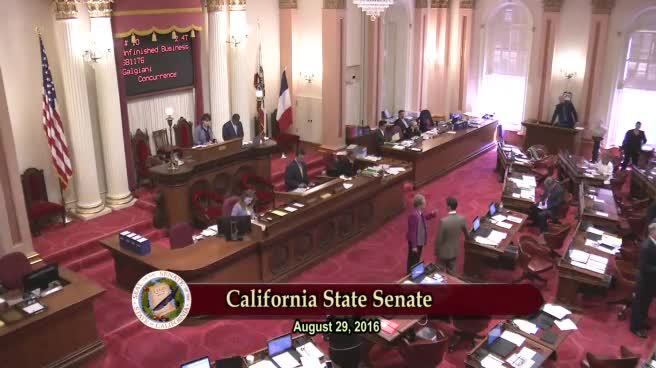 12MIN
Senate Floor
 26MIN
Senate Standing Committee on Elections and Constitutional Amendments
 3MIN
Assembly Floor
 1MIN
Assembly Floor
Assembly Standing Committee on Elections and Redistricting
 1MIN





