SB 507: Sexually violent predators.
- Session Year: 2015-2016
- House: Senate
- Latest Version Date: 2015-10-07
Existing law provides for the civil commitment of criminal offenders who have been determined to be sexually violent predators for treatment in a secure state hospital facility. Under existing law, persons to be evaluated for civil commitment are evaluated by 2 practicing psychiatrists or psychologists designated by the Director of State Hospitals. If both evaluators concur that the person is likely to engage in acts of sexual violence without appropriate treatment and custody, the director is required to forward a request for a petition for commitment to the district attorney or county counsel, who may then file the petition with the court.
Under existing law, if the attorney petitioning for commitment determines that updated evaluations are necessary in order to properly present the case for commitment, the attorney may request the department to perform updated evaluations, which include the review of available medical and psychological records, including treatment records, consultation with current treating clinicians, and interviews of the person being evaluated. Existing law requires that the department forward the updated evaluations to the petitioning attorney and to the counsel for the person who is the subject of the commitment hearing.
This bill would require the evaluator performing an updated evaluation to include a statement listing the medical and psychological records reviewed by the evaluator, and would direct the court to issue a subpoena, upon the request of either party to the civil commitment proceeding, for a certified copy of these records. The bill would authorize the attorneys to use the records in the commitment proceeding, but would prohibit disclosure of the records for any other purpose.
Existing law provides for the civil commitment of criminal offenders who have been determined to be sexually violent predators for treatment in a secure state hospital facility. Under existing law, persons to be evaluated for civil commitment are evaluated by 2 practicing psychiatrists or psychologists designated by the Director of State Hospitals. If both evaluators concur that the person is likely to engage in acts of sexual violence without appropriate treatment and custody, the director is required to forward a request for a petition for commitment to the district attorney or county counsel, who may then file the petition with the court.
Under existing law, if the attorney petitioning for commitment determines that updated evaluations are necessary in order to properly present the case for commitment, the attorney may request the department to perform updated evaluations, which include the review of available medical and psychological records, including treatment records, consultation with current treating clinicians, and interviews of the person being evaluated. Existing law requires that the department forward the updated evaluations to the petitioning attorney and to the counsel for the person who is the subject of the commitment hearing.
This bill would require the evaluator performing an updated evaluation to include a statement listing the medical and psychological records reviewed by the evaluator, and would direct the court to issue a subpoena, upon the request of either party to the civil commitment proceeding, for a certified copy of these records. The bill would authorize either party to move to quash the subpoena, in whole or in part, on the ground that a record or portion of a record is not likely to lead to the discovery of admissible evidence regarding whether the person is a sexually violent predator. The bill would authorize the attorneys to use the records in the commitment proceeding, but would prohibit disclosure of the records for any other purpose. The bill would also prohibit the attorney petitioning for commitment from providing access to these records to any 3rd party, including an expert retained or sought to be retained by that attorney, without the consent of the court upon noticed motion.
Existing law provides for the civil commitment of criminal offenders who have been determined to be sexually violent predators for treatment in a secure state hospital facility. Under existing law, persons to be evaluated for civil commitment are evaluated by 2 practicing psychiatrists or psychologists designated by the Director of State Hospitals. If both evaluators concur that the person is likely to engage in acts of sexual violence without appropriate treatment and custody, the director is required to forward a request for a petition for commitment to the district attorney or county counsel, who may then file the petition with the court.
Under existing law, if one or more of the original evaluators is no longer available to testify for the petitioner in court proceedings, if the attorney petitioning for commitment determines that updated evaluations are necessary in order to properly present the case for commitment, the attorney petitioning for commitment may request the department to perform replacement evaluations. These replacement evaluations updated evaluations, which include the review of available medical and psychological records, including treatment records, consultation with current treating clinicians, and interviews of the person being evaluated. Existing law requires that the department forward the replacement updated evaluations to the petitioning attorney and to the counsel for the person who is the subject of the commitment hearing.
This bill would require the evaluator performing an updated evaluation to include a statement listing the medical and psychological records reviewed by the evaluator, and would direct the court to issue a subpoena, upon the request of either party to the civil commitment proceeding, for a certified copy of these records. The bill would authorize either party to move to quash the subpoena, in whole or in part, on the ground that a record or portion of a record is not likely to lead to the discovery of admissible evidence regarding whether the person is a sexually violent predator. The bill would authorize the attorneys to use the records in the commitment proceeding, but would prohibit disclosure of the records for any other purpose. The bill would also prohibit the attorney petitioning for commitment from providing access to these records to any 3rd party, including an expert retained or sought to be retained by that attorney, without the consent of the court upon noticed motion.
Existing law provides for the civil commitment of criminal offenders who have been determined to be sexually violent predators for treatment in a secure state hospital facility. Under existing law, persons to be evaluated for civil commitment are evaluated by 2 practicing psychiatrists or psychologists designated by the Director of State Hospitals. If both evaluators concur that the person is likely to engage in acts of sexual violence without appropriate treatment and custody, the director is required to forward a request for a petition for commitment to the district attorney or county counsel, who may then file the petition with the court.
Under existing law, if one or more of the original evaluators is no longer available to testify for the petitioner in court proceedings, the attorney petitioning for commitment may request the department to perform replacement evaluations. These replacement evaluations include the review of available medical and psychological records, including treatment records, consultation with current treating clinicians, and interviews of the person being evaluated. Existing law requires that the department forward the replacement evaluations to the petitioning attorney and to the counsel for the person who is the subject of the commitment hearing.
This bill would provide that the attorneys in the civil commitment proceeding have the same access to medical and psychological records as the evaluators performing a replacement evaluation, and would direct the court to issue a subpoena or court order for those records upon request. require the evaluator performing an updated evaluation to include a statement listing the medical and psychological records reviewed by the evaluator, and would direct the court to issue a subpoena, upon the request of either party to the civil commitment proceeding, for a certified copy of these records. The bill would authorize the attorneys to use the records in the commitment proceeding, but would prohibit disclosure of the records for any other purpose. The bill would also prohibit the attorney petitioning for commitment from providing access to these records to any 3rd party, including an expert retained or sought to be retained by that attorney, without the consent of the court upon noticed motion.
Existing law provides for the civil commitment of criminal offenders who have been determined to be sexually violent predators for treatment in a secure state hospital facility. Under existing law, persons to be evaluated for civil commitment are evaluated by 2 practicing psychiatrists or psychologists designated by the Director of State Hospitals. If both evaluators concur that the person is likely to engage in acts of sexual violence without appropriate treatment and custody, the director is required to forward a request for a petition for commitment to the district attorney or county counsel, who may then file the petition with the court.
Under existing law, if one or more of the original evaluators is no longer available to testify for the petitioner in court proceedings, the attorney petitioning for commitment may request the department to perform replacement evaluations. These replacement evaluations include the review of available medical and psychological records, including treatment records, consultation with current treating clinicians, and interviews of the person being evaluated. Existing law requires that the department forward the replacement evaluations to the petitioning attorney and to the counsel for the person who is the subject of the commitment hearing.
This bill would provide that the attorneys in the civil commitment proceeding have the same access to medical and psychological records as the evaluators performing a replacement evaluation, and would direct the court to issue a subpoena or court order for those records upon request. The bill would authorize the attorneys to use the records in the commitment proceeding, but would prohibit disclosure of the records for any other purpose.
(a)A person subject to this article shall be entitled to a trial by jury, to the assistance of counsel, to the right to retain experts or professional persons to perform an examination on his or her behalf, and to have access to all relevant medical and psychological records and reports. In the case of a person who is indigent, the court shall appoint counsel to assist him or her, and, upon the persons request, assist the person in obtaining an expert or professional person to perform an examination or participate in the trial on the persons behalf. Any right that may exist under this section to request DNA testing on prior cases shall be made in conformity with Section 1405 of the Penal Code.
(b)The attorney petitioning for commitment under this article shall have the right to demand that the trial be before a jury.
(c)(1)If the attorney petitioning for commitment under this article determines that updated evaluations are necessary in order to properly present the case for commitment, the attorney may request the State Department of State Hospitals to perform updated evaluations. If one or more of the original evaluators is no longer available to testify for the petitioner in court proceedings, the attorney petitioning for commitment under this article may request the State Department of State Hospitals to perform replacement evaluations. When a request is made for updated or replacement evaluations, the State Department of State Hospitals shall perform the requested evaluations and forward them to the petitioning attorney and to the counsel for the person subject to this article. However, updated or replacement evaluations shall not be performed except as necessary to update one or more of the original evaluations or to replace the evaluation of an evaluator who is no longer available to testify for the petitioner in court proceedings. These updated or replacement evaluations shall include review of available medical and psychological records, including treatment records, consultation with current treating clinicians, and interviews of the person being evaluated, either voluntarily or by court order. If an updated or replacement evaluation results in a split opinion as to whether the person subject to this article meets the criteria for commitment, the State Department of State Hospitals shall conduct two additional evaluations in accordance with subdivision (f) of Section 6601.
(2)For purposes of this subdivision, no longer available to testify for the petitioner in court proceedings means that the evaluator is no longer authorized by the Director of State Hospitals to perform evaluations regarding sexually violent predators as a result of any of the following:
(A)The evaluator has failed to adhere to the protocol of the State Department of State Hospitals.
(B)The evaluators license has been suspended or revoked.
(C)The evaluator is unavailable pursuant to Section 240 of the Evidence Code.
(D)The independent professional or state employee who has served as the evaluator has resigned or retired and has not entered into a new contract to continue as an evaluator in the case, unless this evaluator, in his or her most recent evaluation of the person subject to this article, opined that the person subject to this article does not meet the criteria for commitment.
(d)This section does not prevent the defense from presenting otherwise relevant and admissible evidence.
(e)If the person subject to this article or the petitioning attorney does not demand a jury trial, the trial shall be before the court without a jury.
(f)A unanimous verdict shall be required in any jury trial.
(g)The court shall notify the State Department of State Hospitals of the outcome of the trial by forwarding to the department a copy of the minute order of the court within 72 hours of the decision.
(h)This section does not limit any legal or equitable right that a person may have to request DNA testing.
(i)Subparagraph (D) of paragraph (2) of subdivision (c) does not affect the authority of the State Department of State Hospitals to conduct two additional evaluations when an updated or replacement evaluation results in a split opinion.
(j)(1)Notwithstanding any other law, the evaluator performing an updated evaluation shall include with the evaluation a statement listing all records reviewed by the evaluator pursuant to subdivision (c). The court shall issue a subpoena, upon the request of either party, for a certified copy of these records. The records shall be provided to the attorney petitioning for commitment and the counsel for the person subject to this article. The attorneys may use the records in proceedings under this article and shall not disclose them for any other purpose.
(2)This subdivision does not affect the right of a party to object to the introduction at trial of all or a portion of a record subpoenaed under paragraph (1) on the ground that it is more prejudicial than probative pursuant to Section 352 of the Evidence Code or that it is not material to the issue of whether the person subject to this article is a sexually violent predator, as defined in subdivision (a) of Section 6600, or to any other issue to be decided by the court. If the relief is granted, in whole or in part, the record or records shall retain any confidentiality that may apply under Section 5328 of this code and Section 1014 of the Evidence Code.
(3)This subdivision does not affect any right of a party to seek to obtain other records regarding the person subject to this article.
(4)Except as provided in paragraph (1), this subdivision does not affect any right of a committed person to assert that records are confidential under Section 5328 of this code or Section 1014 of the Evidence Code.
SEC. 2.Nothing in this act is intended to affect the determination by the Supreme Court of California, in People v. Superior Court (Smith) (Docket No. S225562), whether an expert retained by the district attorney in a proceeding under the Sexually Violent Predator Act (Article 4 (commencing with Section 6600) of Chapter 2 of Part 2 of Division 6 of the Welfare and Institutions Code) is entitled to review otherwise confidential treatment information under Section 5328 of the Welfare and Institutions Code.
(a)A person subject to this article shall be entitled to a trial by jury, to the assistance of counsel, to the right to retain experts or professional persons to perform an examination on his or her behalf, and to have access to all relevant medical and psychological records and reports. In the case of a person who is indigent, the court shall appoint counsel to assist him or her, and, upon the persons request, assist the person in obtaining an expert or professional person to perform an examination or participate in the trial on the persons behalf. Any right that may exist under this section to request DNA testing on prior cases shall be made in conformity with Section 1405 of the Penal Code.
(b)The attorney petitioning for commitment under this article shall have the right to demand that the trial be before a jury.
(c)(1)If the attorney petitioning for commitment under this article determines that updated evaluations are necessary in order to properly present the case for commitment, the attorney may request the State Department of State Hospitals to perform updated evaluations. If one or more of the original evaluators is no longer available to testify for the petitioner in court proceedings, the attorney petitioning for commitment under this article may request the State Department of State Hospitals to perform replacement evaluations. When a request is made for updated or replacement evaluations, the State Department of State Hospitals shall perform the requested evaluations and forward them to the petitioning attorney and to the counsel for the person subject to this article. However, updated or replacement evaluations shall not be performed except as necessary to update one or more of the original evaluations or to replace the evaluation of an evaluator who is no longer available to testify for the petitioner in court proceedings. These updated or replacement evaluations shall include review of available medical and psychological records, including treatment records, consultation with current treating clinicians, and interviews of the person being evaluated, either voluntarily or by court order. If an updated or replacement evaluation results in a split opinion as to whether the person subject to this article meets the criteria for commitment, the State Department of State Hospitals shall conduct two additional evaluations in accordance with subdivision (f) of Section 6601.
(2)For purposes of this subdivision, no longer available to testify for the petitioner in court proceedings means that the evaluator is no longer authorized by the Director of State Hospitals to perform evaluations regarding sexually violent predators as a result of any of the following:
(A)The evaluator has failed to adhere to the protocol of the State Department of State Hospitals.
(B)The evaluators license has been suspended or revoked.
(C)The evaluator is unavailable pursuant to Section 240 of the Evidence Code.
(D)The independent professional or state employee who has served as the evaluator has resigned or retired and has not entered into a new contract to continue as an evaluator in the case, unless this evaluator, in his or her most recent evaluation of the person subject to this article, opined that the person subject to this article does not meet the criteria for commitment.
(d)This section does not prevent the defense from presenting otherwise relevant and admissible evidence.
(e)If the person subject to this article or the petitioning attorney does not demand a jury trial, the trial shall be before the court without a jury.
(f)A unanimous verdict shall be required in any jury trial.
(g)The court shall notify the State Department of State Hospitals of the outcome of the trial by forwarding to the department a copy of the minute order of the court within 72 hours of the decision.
(h)This section does not limit any legal or equitable right that a person may have to request DNA testing.
(i)Subparagraph (D) of paragraph (2) of subdivision (c) does not affect the authority of the State Department of State Hospitals to conduct two additional evaluations when an updated or replacement evaluation results in a split opinion.
(j)(1)Notwithstanding any other law, the evaluator performing an updated evaluation shall include with the evaluation a statement listing all records reviewed by the evaluator pursuant to subdivision (c). The court shall issue a subpoena, upon the request of either party, for a certified copy of these records. The records shall be provided to the attorney petitioning for commitment and the counsel for the person subject to this article. The attorneys may use the records in proceedings under this article and shall not disclose them for any other purpose.
(2)Either party may move to quash the subpoena, in whole or in part, on the ground that a record or portion of a record is not likely to lead to the discovery of admissible evidence regarding This subdivision does not affect the right of a party to object to the introduction at trial of all or a portion of a record subpoenaed under paragraph (1) on the ground that it is more prejudicial than probative pursuant to Section 352 of the Evidence Code or that it is not material to the issue of whether the person subject to this article is a sexually violent predator, as defined in subdivision (a) of Section 6600, or to any other issue to be decided by the court. If the motion to quash relief is granted, in whole or in part, the record or records shall retain any confidentiality that may apply under Section 5328 of this code and Section 1014 of the Evidence Code.
(3)This subdivision does not affect any right of a party to object to the introduction of evidence that is more prejudicial than probative.
(4)This subdivision does not create any new rights or limitations regarding the retention of an expert witness by either party or access to records by an expert retained or sought to be retained by either party. The attorney petitioning for commitment shall not provide access to the records obtained under paragraph (1) to any third party, including an expert retained or sought to be retained by that attorney, without the consent of the court upon noticed motion.
(5)
(3)This subdivision does not affect any right of a party to seek to obtain other records regarding the person subject to this article.
(6)
(4)Except as provided in paragraph (1), this subdivision does not affect any right of a committed person to assert that records are confidential under Section 5328 of this code or Section 1014 of the Evidence Code.
SEC. 2.Nothing in this act is intended to affect the determination by the Supreme Court of California, in People v. Superior Court (Smith) (Docket No. S225562), whether an expert retained by the district attorney in a proceeding under the Sexually Violent Predator Act (Article 4 (commencing with Section 6600) of Chapter 2 of Part 2 of Division 6 of the Welfare and Institutions Code) is entitled to review otherwise confidential treatment information under Section 5328 of the Welfare and Institutions Code.
(a)A person subject to this article shall be entitled to a trial by jury, to the assistance of counsel, to the right to retain experts or professional persons to perform an examination on his or her behalf, and to have access to all relevant medical and psychological records and reports. In the case of a person who is indigent, the court shall appoint counsel to assist him or her, and, upon the persons request, assist the person in obtaining an expert or professional person to perform an examination or participate in the trial on the persons behalf. Any right that may exist under this section to request DNA testing on prior cases shall be made in conformity with Section 1405 of the Penal Code.
(b)The attorney petitioning for commitment under this article shall have the right to demand that the trial be before a jury.
(c)(1)If the attorney petitioning for commitment under this article determines that updated evaluations are necessary in order to properly present the case for commitment, the attorney may request the State Department of State Hospitals to perform updated evaluations. If one or more of the original evaluators is no longer available to testify for the petitioner in court proceedings, the attorney petitioning for commitment under this article may request the State Department of State Hospitals to perform replacement evaluations. When a request is made for updated or replacement evaluations, the State Department of State Hospitals shall perform the requested evaluations and forward them to the petitioning attorney and to the counsel for the person subject to this article. However, updated or replacement evaluations shall not be performed except as necessary to update one or more of the original evaluations or to replace the evaluation of an evaluator who is no longer available to testify for the petitioner in court proceedings. These updated or replacement evaluations shall include review of available medical and psychological records, including treatment records, consultation with current treating clinicians, and interviews of the person being evaluated, either voluntarily or by court order. If an updated or replacement evaluation results in a split opinion as to whether the person subject to this article meets the criteria for commitment, the State Department of State Hospitals shall conduct two additional evaluations in accordance with subdivision (f) of Section 6601.
(2)For purposes of this subdivision, no longer available to testify for the petitioner in court proceedings means that the evaluator is no longer authorized by the Director of State Hospitals to perform evaluations regarding sexually violent predators as a result of any of the following:
(A)The evaluator has failed to adhere to the protocol of the State Department of State Hospitals.
(B)The evaluators license has been suspended or revoked.
(C)The evaluator is unavailable pursuant to Section 240 of the Evidence Code.
(D)The independent professional or state employee who has served as the evaluator has resigned or retired and has not entered into a new contract to continue as an evaluator in the case, unless this evaluator, in his or her most recent evaluation of the person subject to this article, opined that the person subject to this article does not meet the criteria for commitment.
(d)Nothing in this section shall This section does not prevent the defense from presenting otherwise relevant and admissible evidence.
(e)If the person subject to this article or the petitioning attorney does not demand a jury trial, the trial shall be before the court without a jury.
(f)A unanimous verdict shall be required in any jury trial.
(g)The court shall notify the State Department of State Hospitals of the outcome of the trial by forwarding to the department a copy of the minute order of the court within 72 hours of the decision.
(h)Nothing in this section shall This section does not limit any legal or equitable right that a person may have to request DNA testing.
(i)Nothing in subparagraph Subparagraph (D) of paragraph (2) of subdivision (c) shall be construed to does not affect the authority of the State Department of State Hospitals to conduct two additional evaluations when an updated or replacement evaluation results in a split opinion.
(j)(1)Notwithstanding any other law law, the evaluator performing an updated evaluation shall include with the evaluation a statement listing all records reviewed by the evaluator pursuant to subdivision (c). The court shall issue a subpoena, upon the request of either party, for a certified copy of these records. The records shall be provided to the attorney petitioning for commitment and the counsel for the person subject to this article. The attorneys may use the records in proceedings under this article and shall not disclose them for any other purpose.
(2)Either party may move to quash the subpoena, in whole or in part, on the ground that a record or portion of a record is not likely to lead to the discovery of admissible evidence regarding whether the person subject to this article is a sexually violent predator, as defined in subdivision (a) of Section 6600. If the motion to quash is granted, in whole or in part, the record or records shall retain any confidentiality that may apply under Section 5328 of this code and Section 1014 of the Evidence Code.
(2)
(3)This subdivision does not affect any right of a party to object to the introduction of evidence that is more prejudicial than probative.
(3)
(4)This subdivision does not create any new rights or limitations regarding the retention of an expert witness by either party or access to records by an expert retained or sought to be retained by either party. The attorney petitioning for commitment shall not provide access to the records obtained under paragraph (1) to any third party, including an expert retained or sought to be retained by that attorney, without the consent of the court upon noticed motion.
(4)
(5)This subdivision does not affect any right of a party to seek to obtain other records regarding the person subject to this article.
(5)
(6)Except as provided in paragraph (1), this subdivision does not affect any right of a committed person to assert that records are confidential under Section 5328 of this code or Section 1014 of the Evidence Code.
(a)A person subject to this article shall be entitled to a trial by jury, to the assistance of counsel, to the right to retain experts or professional persons to perform an examination on his or her behalf, and to have access to all relevant medical and psychological records and reports. In the case of a person who is indigent, the court shall appoint counsel to assist him or her, and, upon the persons request, assist the person in obtaining an expert or professional person to perform an examination or participate in the trial on the persons behalf. Any right that may exist under this section to request DNA testing on prior cases shall be made in conformity with Section 1405 of the Penal Code.
(b)The attorney petitioning for commitment under this article shall have the right to demand that the trial be before a jury.
(c)(1)If the attorney petitioning for commitment under this article determines that updated evaluations are necessary in order to properly present the case for commitment, the attorney may request the State Department of State Hospitals to perform updated evaluations. If one or more of the original evaluators is no longer available to testify for the petitioner in court proceedings, the attorney petitioning for commitment under this article may request the State Department of State Hospitals to perform replacement evaluations. When a request is made for updated or replacement evaluations, the State Department of State Hospitals shall perform the requested evaluations and forward them to the petitioning attorney and to the counsel for the person subject to this article. However, updated or replacement evaluations shall not be performed except as necessary to update one or more of the original evaluations or to replace the evaluation of an evaluator who is no longer available to testify for the petitioner in court proceedings. These updated or replacement evaluations shall include review of available medical and psychological records, including treatment records, consultation with current treating clinicians, and interviews of the person being evaluated, either voluntarily or by court order. If an updated or replacement evaluation results in a split opinion as to whether the person subject to this article meets the criteria for commitment, the State Department of State Hospitals shall conduct two additional evaluations in accordance with subdivision (f) of Section 6601.
(2)For purposes of this subdivision, no longer available to testify for the petitioner in court proceedings means that the evaluator is no longer authorized by the Director of State Hospitals to perform evaluations regarding sexually violent predators as a result of any of the following:
(A)The evaluator has failed to adhere to the protocol of the State Department of State Hospitals.
(B)The evaluators license has been suspended or revoked.
(C)The evaluator is unavailable pursuant to Section 240 of the Evidence Code.
(D)The independent professional or state employee who has served as the evaluator has resigned or retired and has not entered into a new contract to continue as an evaluator in the case, unless this evaluator, in his or her most recent evaluation of the person subject to this article, opined that the person subject to this article does not meet the criteria for commitment.
(d)Nothing in this section shall prevent the defense from presenting otherwise relevant and admissible evidence.
(e)If the person subject to this article or the petitioning attorney does not demand a jury trial, the trial shall be before the court without a jury.
(f)A unanimous verdict shall be required in any jury trial.
(g)The court shall notify the State Department of State Hospitals of the outcome of the trial by forwarding to the department a copy of the minute order of the court within 72 hours of the decision.
(h)Nothing in this section shall limit any legal or equitable right that a person may have to request DNA testing.
(i)Nothing in subparagraph (D) of paragraph (2) of subdivision (c) shall be construed to affect the authority of the State Department of State Hospitals to conduct two additional evaluations when an updated or replacement evaluation results in a split opinion.
(j)(1)Notwithstanding any other law, the attorney petitioning for commitment and the counsel for the person subject to this article shall have the same access to records as an evaluator pursuant to paragraph (1) of subdivision (c), and the court shall issue a subpoena or court order for those records upon request. the evaluator performing an updated evaluation shall include with the evaluation a statement listing all records reviewed by the evaluator pursuant to subdivision (c). The court shall issue a subpoena, upon the request of either party, for a certified copy of these records. The records shall be provided to the attorney petitioning for commitment and the counsel for the person subject to this article. The attorneys may use the records in proceedings under this article and shall not disclose them for any other purpose. The records are confidential to the extent otherwise provided by law.
(2)This subdivision does not affect any right of a party to object to the introduction of evidence that is more prejudicial than probative.
(3)This subdivision does not create any new rights or limitations regarding the retention of an expert witness by either party or access to records by an expert retained or sought to be retained by either party. The attorney petitioning for commitment shall not provide access to the records obtained under paragraph (1) to any third party, including an expert retained or sought to be retained by that attorney, without the consent of the court upon noticed motion.
(4)This subdivision does not affect any right of a party to seek to obtain other records regarding the person subject to this article.
(5)Except as provided in paragraph (1), this subdivision does not affect any right of a committed person to assert that records are confidential under Section 5328 of this code or Section 1014 of the Evidence Code.
(a)A person subject to this article shall be entitled to a trial by jury, to the assistance of counsel, to the right to retain experts or professional persons to perform an examination on his or her behalf, and to have access to all relevant medical and psychological records and reports. In the case of a person who is indigent, the court shall appoint counsel to assist him or her, and, upon the persons request, assist the person in obtaining an expert or professional person to perform an examination or participate in the trial on the persons behalf. Any right that may exist under this section to request DNA testing on prior cases shall be made in conformity with Section 1405 of the Penal Code.
(b)The attorney petitioning for commitment under this article shall have the right to demand that the trial be before a jury.
(c)(1)If the attorney petitioning for commitment under this article determines that updated evaluations are necessary in order to properly present the case for commitment, the attorney may request the State Department of State Hospitals to perform updated evaluations. If one or more of the original evaluators is no longer available to testify for the petitioner in court proceedings, the attorney petitioning for commitment under this article may request the State Department of State Hospitals to perform replacement evaluations. When a request is made for updated or replacement evaluations, the State Department of State Hospitals shall perform the requested evaluations and forward them to the petitioning attorney and to the counsel for the person subject to this article. However, updated or replacement evaluations shall not be performed except as necessary to update one or more of the original evaluations or to replace the evaluation of an evaluator who is no longer available to testify for the petitioner in court proceedings. These updated or replacement evaluations shall include review of available medical and psychological records, including treatment records, consultation with current treating clinicians, and interviews of the person being evaluated, either voluntarily or by court order. If an updated or replacement evaluation results in a split opinion as to whether the person subject to this article meets the criteria for commitment, the State Department of State Hospitals shall conduct two additional evaluations in accordance with subdivision (f) of Section 6601.
(2)For purposes of this subdivision, no longer available to testify for the petitioner in court proceedings means that the evaluator is no longer authorized by the Director of State Hospitals to perform evaluations regarding sexually violent predators as a result of any of the following:
(A)The evaluator has failed to adhere to the protocol of the State Department of State Hospitals.
(B)The evaluators license has been suspended or revoked.
(C)The evaluator is unavailable pursuant to Section 240 of the Evidence Code.
(D)The independent professional or state employee who has served as the evaluator has resigned or retired and has not entered into a new contract to continue as an evaluator in the case, unless this evaluator, in his or her most recent evaluation of the person subject to this article, opined that the person subject to this article does not meet the criteria for commitment.
(d)Nothing in this section shall prevent the defense from presenting otherwise relevant and admissible evidence.
(e)If the person subject to this article or the petitioning attorney does not demand a jury trial, the trial shall be before the court without a jury.
(f)A unanimous verdict shall be required in any jury trial.
(g)The court shall notify the State Department of State Hospitals of the outcome of the trial by forwarding to the department a copy of the minute order of the court within 72 hours of the decision.
(h)Nothing in this section shall limit any legal or equitable right that a person may have to request DNA testing.
(i)Nothing in subparagraph (D) of paragraph (2) of subdivision (c) shall be construed to affect the authority of the State Department of State Hospitals to conduct two additional evaluations when an updated or replacement evaluation results in a split opinion.
(j)Notwithstanding any other law, the attorney petitioning for commitment and the counsel for the person subject to this article shall have the same access to records as an evaluator pursuant to paragraph (1) of subdivision (c), and the court shall issue a subpoena or court order for those records upon request. The attorneys may use the records in proceedings under this article and shall not disclose them for any other purpose. The records are confidential to the extent otherwise provided by law.
|
Date
|
Status
|
|---|---|
| Sep 10, 2015 | In Senate. Concurrence in Assembly amendments pending. |
| Jun 4, 2015 | Read third time. Passed. (Ayes 40. Noes 0. Page 1325.) Ordered to the Assembly. |
| Jun 4, 2015 | Read third time. Passed. (Ayes 40. Noes 0.) Ordered to the Assembly. |
| Jun 18, 2015 | Referred to Com. on PUB. S. |
| Jul 2, 2015 | From committee with author's amendments. Read second time and amended. Re-referred to Com. on PUB. S. |
| Jul 14, 2015 | From committee: Do pass and re-refer to Com. on APPR. (Ayes 7. Noes 0.) (July 14). Re-referred to Com. on APPR. |
| Aug 19, 2015 | August 19 set for first hearing. Placed on APPR. suspense file. |
| Aug 28, 2015 | From committee: Do pass. (Ayes 17. Noes 0.) (August 27). |
| Aug 28, 2015 | Read second time. Ordered to third reading. |
| Jun 4, 2015 | In Assembly. Read first time. Held at Desk. |
| Sep 10, 2015 | Read third time. Passed. Ordered to the Senate. |
| Sep 10, 2015 | Read third time. Passed. (Ayes 79. Noes 1. Page 3091.) Ordered to the Senate. |
| Sep 11, 2015 | Assembly amendments concurred in. (Ayes 40. Noes 0. Page 2753.) Ordered to engrossing and enrolling. |
| Sep 11, 2015 | Assembly amendments concurred in. (Ayes 40. Noes 0.) Ordered to engrossing and enrolling. |
| Sep 16, 2015 | Enrolled and presented to the Governor at 4:45 p.m. |
| Oct 7, 2015 | Approved by the Governor. |
| Oct 7, 2015 | Chaptered by Secretary of State. Chapter 576, Statutes of 2015. |
| Apr 29, 2015 | From committee: Do pass as amended and re-refer to Com. on APPR. (Ayes 7. Noes 0.) (April 28). |
| Feb 27, 2015 | From printer. May be acted upon on or after March 29. |
| Mar 12, 2015 | Referred to Com. on PUB. S. |
| Mar 20, 2015 | Set for hearing April 14. |
| Apr 8, 2015 | April 14 hearing postponed by committee. |
| Apr 9, 2015 | Set for hearing April 21. |
| Apr 21, 2015 | April 21 set for first hearing canceled at the request of author. |
| Apr 23, 2015 | Set for hearing April 28. |
| Apr 29, 2015 | From committee: Do pass as amended and re-refer to Com. on APPR. (Ayes 7. Noes 0. Page 823.) (April 28). |
| Feb 26, 2015 | Introduced. Read first time. To Com. on RLS. for assignment. To print. |
| Apr 30, 2015 | Read second time and amended. Re-referred to Com. on APPR. |
| May 8, 2015 | Set for hearing May 18. |
| May 18, 2015 | May 18 hearing: Placed on APPR. suspense file. |
| May 23, 2015 | Set for hearing May 28. |
| Jun 1, 2015 | From committee: Do pass as amended. (Ayes 7. Noes 0. Page 1155.) (May 28). |
| Jun 1, 2015 | From committee: Do pass as amended. (Ayes 7. Noes 0.) (May 28). |
| Jun 2, 2015 | Read second time and amended. Ordered to third reading. |
|
Date
|
Description
|
Location
|
Votes
|
|
|---|---|---|---|---|
| Sep 11, 2015 | Unfinished Business SB507 Pavley Concurrence | Senate Floor |
Passed |
|
| Sep 10, 2015 | SB 507 Pavley Senate Third Reading By COOLEY | Assembly Floor |
Passed |
|
| Aug 27, 2015 | Do pass. | Assembly Standing Committee on Appropriations |
Passed |
|
| Jul 14, 2015 | Do pass and be re-referred to the Committee on [Appropriations] | Assembly Standing Committee on Public Safety |
Passed |
|
| Jun 4, 2015 | Senate 3rd Reading SB507 Pavley | Senate Floor |
Passed |
|
| May 28, 2015 | Do pass as amended | Senate Standing Committee on Appropriations |
Passed |
|
| May 18, 2015 | Placed on suspense file | Senate Standing Committee on Appropriations |
Passed |
|
| Apr 28, 2015 | Do pass as amended, but first amend, and re-refer to the Committee on [Appropriations] | Senate Standing Committee on Public Safety |
Passed |
This list shows positions taken on this bill by organizations on the date displayed, which is linked to the original source.
Positions by individuals are not included.
|
Organization
|
Position
|
Date
|
|---|---|---|
| American Civil Liberties Union of California | ** Against | Sep 11, 2015 |
| Association For Los Angeles Deputy Sheriffs | ** Support | Sep 11, 2015 |
| Association of Deputy District Attorneys | ** Support | Sep 11, 2015 |
| California Association Of Code Enforcement Officers | ** Support | Sep 11, 2015 |
| California College And University Police Chiefs Association | ** Support | Sep 11, 2015 |
| California District Attorneys Association | ** Support | Sep 11, 2015 |
| California Psychiatric Association | ** Against | Sep 11, 2015 |
| California Public Defenders Association | ** Against | Sep 11, 2015 |
| California State Lodge, Fraternal Order of Police | ** Support | Sep 11, 2015 |
| Crime Victims United | ** Support | Sep 11, 2015 |
| Legal Services for Prisoners with Children | ** Against | Sep 11, 2015 |
| Long Beach Police Officers Association | ** Support | Sep 11, 2015 |
| Los Angeles County District Attorney'S Office | ** Support | Sep 11, 2015 |
| Los Angeles County Professional Peace Officers Association | ** Support | Sep 11, 2015 |
| Los Angeles Police Protective League | ** Support | Sep 11, 2015 |
| PUB. S. | ** Against | Sep 10, 2015 |
| Sacramento County Deputy Sheriffs' Association | ** Support | Sep 10, 2015 |
| Santa Ana Police Officers Association | ** Support | Sep 11, 2015 |
SB 507
Page 8
|
Office of Senate Floor Analyses (916) 651-1520 Fax: (916) 327-4478 |
UNFINISHED BUSINESS
Bill No: SB 507
Amended: 7/2/15
SENATE PUBLIC SAFETY COMMITTEE: 7-0, 4/28/15
AYES: Hancock, Anderson, Leno, Liu, McGuire, Monning, Stone
SENATE APPROPRIATIONS COMMITTEE: 7-0, 5/28/15
AYES: Lara, Bates, Beall, Hill, Leyva, Mendoza, Nielsen
SENATE FLOOR: 40-0, 6/4/15
AYES: Allen, Anderson, Bates, Beall, Berryhill, Block, Cannella, De León, Fuller, Gaines, Galgiani, Glazer, Hall, Hancock, Hernandez, Hertzberg, Hill, Hueso, Huff, Jackson, Lara, Leno, Leyva, Liu, McGuire, Mendoza, Mitchell, Monning, Moorlach, Morrell, Nguyen, Nielsen, Pan, Pavley, Roth, Runner, Stone, Vidak, Wieckowski, Wolk
ASSEMBLY FLOOR: 79-1, 9/10/15 - See last page for vote
SUBJECT: Sexually violent predators
SOURCE: Los Angeles County District Attorney
DIGEST: This bill (1) provides that in an Sexually Violent Predator (SVP) proceeding, the prosecutor and the attorney for an alleged SVP shall have access to records considered by an expert who performed replacement or updated evaluations; (2) specifies that the records shall be obtained through a court subpoena; (3) allows either party to object that the records are not relevant or are more prejudicial (unfairly harmful) than relevant; (4) specifies that records not disclosed pursuant to the motion retain confidentiality protections; and (5) states that the bill is not intended to affect the pending decision of the California Supreme Court whether a prosecution expert is entitled to review otherwise confidential SVP treatment records.
Assembly Amendments (1) strike the provisions that would have authorized a prosecutor or defense attorney to move to quash (rescind) a subpoena issued for SVP treatment records on the grounds that the material would not lead to relevant evidence in an SVP proceeding and, instead, provide that either party may move the court to prohibit introduction of any evidence in the records that is not relevant to the issue of the person’s SVP status; (2) and state that this bill is not intended to affect the pending determination by the California Supreme in People v. Superior Court (Smith) (S225562) whether a prosecution expert is entitled to review otherwise confidential treatment records in an SVP proceed.
Existing law:
Defines an SVP as “a person who has been convicted of a sexually violent offense against at least one victim, and who has a diagnosed mental disorder that makes the person a danger to the health and safety of others in that it is likely that he or she will engage in sexually violent criminal behavior.” (Welf. & Inst. Code, § 6600, subd. (a)(1).)
Provides that where the Department of Corrections and Rehabilitation determines that an inmate fits specified criteria, the inmate shall be referred for evaluation to the Department of State Hospitals (DSH). (Welf. & Inst. Code § 6601, subd. (b).)
Provides that the inmate shall be evaluated by any combination of two practicing psychiatrists or psychologists designated by the Director of the DSH. If both evaluators concur that the person meets SVP commitment criteria, DSH shall request the district attorney or county counsel in the county of commitment to prison to file a commitment petition. (Welf. & Inst. Code § 6601, subd. (d).) The district attorney typically represents the state in SVP cases.
Provides that if the evaluators designated by DSH disagree, two independent evaluators shall be appointed. If the second pair of evaluators agree that the person is an SVP, the case can proceed. (Welf. & Inst. Code § 6601, subd. (c)-(e).)
Provides that if DSH requests the district attorney to petition for commitment, the prosecutor shall have access to “copies of the evaluation reports and any other supporting documents.” (Welf. & Inst. Code § 6601, subd. (d).)
Grants an alleged SVP “access to all relevant medical and psychological records and reports” for purposes of trial. (Welf. & Inst. Code, § 6603, subd. (a).)
Provides that the matter shall be set for trial if the court finds probable cause that the person is an SVP and that eiher party may demand the trial be by jury (Welf. Inst. Code § 6602.)
Provides that the prosecutor has the burden proof beyond a reasonable doubt that the person is an SVP. (Welf. & Inst. Code §§ 6603 and 6604.)
Provides that if the prosecutor determines that updated or replacement evaluations are necessary in order to properly present the case, DSH shall perform the updated evaluations, as follows:
The evaluations shall be ordered only as necessary to update one or more of the original evaluations or to replace the evaluation of an evaluator who is no longer available to testify for the petitioner in court proceedings.
The evaluations shall include review of available medical and psychological records, including treatment records, consultation with current treating clinicians, and interviews of the alleged SVP.
DSH shall forward the new or updated evaluations to the prosecutor and counsel for the alleged SVP.
If an updated or replacement evaluation results in a split opinion as to whether the alleged SVP meets the criteria for commitment, DSH shall conduct two additional evaluations, as specified. (Welf. & Inst. Code § 6603, subd. (c)(1).)
Provides that if the second pair of experts performing the updated evaluations concludes that the person is not an SVP, or if there is a split of opinion, the case shall proceed on the basis of the original evaluations concluding or finding that the person is an SVP. (Reilly v. Superior Court ( 2013) 57 Cal.4th 641.)
Defines “no longer able to testify for the petitioner in court proceedings” as the evaluator is no longer authorized by DSH to perform evaluations of SVPs as a result of any of the following:
The evaluator has failed to adhere to the protocol of the DSH;
The evaluator’s license has been suspended or revoked;
c) The evaluator is legally unavailable, as specified; or
d) The evaluator has retired or not entered into a new contract with to continue as an evaluator. (Welf. & Inst. Code § 6603, subd. (c)(1)-(2).)
Provides that a new evaluator shall not be appointed if the resigned or retired evaluator has opined that the individual named in the petition has not met the criteria for commitment, as specified. (Welf. & Inst. Code § 6603, subd. (c)(1)(D).)
This bill:
Provides that where updated or replacement evaluations have been prepared for a commitment trial, the evaluator shall list all records he or she considered in preparing the evaluation.
Provides that the prosecutor or the person alleged to be an SVP can request that the court obtain the records through a subpoena and that the records shall then be provided to the prosecutor and counsel for the alleged SVP.
Prohibits the prosecutor and counsel for the SVP from using the records except in the SVP proceeding.
Authorizes either party to move the court to bar admission into evidence of all or any part of the records on the grounds that the material is not relevant or that the prejudice of the material outweighs its evidentiary value.
Provides that any records that are excluded from trial shall retain confidentiality under the psychotherapist-patient privilege or the statute providing confidentiality for records of treatment of DSH patients.
Provides that except as concerns updated or replacement SVP records, any party may assert that any records are confidential treatment or therapy records.
Provides that this bill is not intended to affect the determination by the California Supreme Court whether a prosecution expert is entitled to review otherwise confidential treatment records of an alleged SVP.
Background
The Sexually Violent Predator Act (SVPA) establishes a civil commitment scheme for sex offenders who are about to be released from prison. A person is subject to commitment as an SVP if he has committed specified sex offense, has a diagnosable mental disorder that makes it likely that he will engage in sexually-violent criminal behavior, and two licensed psychiatrists or psychologists concur in the diagnosis. (All but one SVP have been men.) If both evaluators agree that the person meets SVP criteria, the case is referred to the county prosecutor who may file a petition for civil commitment. In an SVP trial the prosecutor has the burden to prove beyond a reasonable doubt that the offender meets the statutory criteria. (Cooley v. Superior Court (Martinez) (2002) 29 Cal.4th 228, 246.)
The DSH must conduct a yearly examination of an SVP and submit an annual report to the court. (Welf. & Inst. Code, § 6604.9.) DSH also has a continuing obligation to seek judicial review any time the director finds that a no longer meets SVP criteria. (Welf. & Inst. Code, § 6607.)
The SVPA was substantially amended by Proposition 83 (“Jessica's Law”) in 2006. Originally, a SVP commitment was for two years. Jessica's Law provides for indeterminate commitment, until it is shown that the person no longer poses a danger to others. (People v. McKee (2010) 47 Cal. 4th 1172, 1185-1187.)
The SVPA law is one of a number of "forensic" involuntary commitment categories in California. Forensic patients are involuntarily committed to DSH from the criminal justice system for treatment. Forensic patients include mentally disordered offenders (MDO), persons found not guilty by reason of insanity (NGI) and defendants who are incompetent to stand trial (IST). Forensic patients comprise over 90% of DSH patients. The SVPA is constitutional because it “establishes a nonpunitive, civil commitment scheme covering persons who must be treated as sick persons, not criminals. (Hubbart v. Superior Court (People) (1999) 19 Cal.4th 1138 1166-1167.)
Generally, records of treatment of DSH patients, including SVP records, are confidential, unless otherwise specified. (Welf. & Inst. Code 5328.) Section 5238 states that "[a]ll information and records obtained in the course of providing services under… Division 6 [including SVP law] to either voluntary or involuntary
recipients of services shall be confidential." (See, Gilbert v. Superior Court (2014) 224 Cal.App.4th 376,)
There are numerous exceptions to the confidentiality of the treatment records of forensic patients. As relevant to this bill, subdivision (c) of Section 6603 creates a limited exception to confidentiality rules in the context of updated or replacement expert evaluations on the issue of whether a person is an SVP. Under section 6603, subdivision (c)(1), the People may obtain updated evaluations of an alleged SVP and obtain access to “otherwise confidential treatment information … to the extent such information is contained in an updated mental evaluation.” (Albertson v. Superior Court (2001) 25 Cal.4th 796, 807, italics added.)
The policy basis for the confidentiality of psychotherapy records has been long recognized by California courts: "[A]n environment of confidentiality of treatment is vitally important to the successful operation of psychotherapy." (In re Lifschutz (1970) 2 Cal.3d 415, 422.) It can be argued that if all therapy records are open to prosecutors, SVP patients may be particularly reluctant to be truthful in therapy, greatly reducing the effectiveness of treatment, or patients may attempt to manipulate their therapists in the hope of creating a positive record. Under current law, an SVP is committed indefinitely. He must essentially create a record that he is no longer an SVP, rather than hope that the prosecutor would not prevail at a recommitment trial
As noted above, the SVPA is constitutional because its purpose is treatment of mentally disordered persons, not punishment or preventive detention. (Hubbart v. Superior Court (People), supra, 19 Cal.4th 1138 1166-1167.) If all psychotherapy records are open to prosecutors, SVP patients will likely argue that the records simply become evidence for prosecutors of SVP status, equivalent to evidence of guilt at a criminal trial. The Legislature in coming years may wish to review how the opening of all treatment records to prosecutors changes the conduct of SVP patients, the matters considered at trial and trial outcomes.
FISCAL EFFECT: Appropriation: No Fiscal Com.: Yes Local: No
According to the Assembly Appropriations Committee:
Potential future increased cost to the Department of State Hospitals (DSH) if the release of the records extends the period of custody of an SVP in the DSH, and minor additional cost to provide copies of records utilized to conduct evaluations. The annual cost to DSH to treat an SVP is in the range of $200,000.
Los Angeles County District Attorney’s Office (source)
Association for Los Angeles Deputy Sheriffs
Association of Deputy District Attorneys
California Association of Code Enforcement Officers
California College and University Police Chiefs Association
California District Attorneys Association
California Narcotics Officers Association
California State Lodge, Fraternal Order of Police
Crime Victims United
Long Beach Police Officers Association
Los Angeles County Professional Peace Officers Association
Los Angeles Police Protective League
Riverside Sheriffs Association
Sacramento County Deputy Sheriff’s Association
Santa Ana Police Officers Association
OPPOSITION: (Verified 9/11/15)
American Civil Liberties Union of California
California Psychiatric Association
California Public Defenders Association
Legal Services for Prisoners with Children
ASSEMBLY FLOOR: 79-1, 9/10/15
AYES: Achadjian, Alejo, Travis Allen, Baker, Bigelow, Bloom, Bonilla, Bonta, Brough, Brown, Burke, Calderon, Campos, Chang, Chau, Chávez, Chiu, Chu, Cooley, Cooper, Dababneh, Dahle, Daly, Dodd, Eggman, Frazier, Gallagher, Cristina Garcia, Eduardo Garcia, Gatto, Gipson, Gomez, Gonzalez, Gordon, Gray, Grove, Hadley, Harper, Roger Hernández, Holden, Irwin, Jones, Jones-Sawyer, Kim, Lackey, Levine, Linder, Lopez, Low, Maienschein, Mathis, Mayes, McCarty, Medina, Melendez, Mullin, Nazarian, Obernolte, O'Donnell, Olsen, Patterson, Perea, Quirk, Rendon, Ridley-Thomas, Rodriguez, Salas, Santiago, Steinorth, Mark Stone, Thurmond, Ting, Wagner, Waldron, Weber, Wilk, Williams, Wood, Atkins
NOES: Beth Gaines
Prepared by: Jerome McGuire / PUB. S. /
9/11/15 11:10:40
**** END ****
SB 507
Page 7
|
Office of Senate Floor Analyses (916) 651-1520 Fax: (916) 327-4478 |
UNFINISHED BUSINESS
Bill No: SB 507
Amended: 7/2/15
SENATE PUBLIC SAFETY COMMITTEE: 7-0, 4/28/15
AYES: Hancock, Anderson, Leno, Liu, McGuire, Monning, Stone
SENATE APPROPRIATIONS COMMITTEE: 7-0, 5/28/15
AYES: Lara, Bates, Beall, Hill, Leyva, Mendoza, Nielsen
SENATE FLOOR: 40-0, 6/4/15
AYES: Allen, Anderson, Bates, Beall, Berryhill, Block, Cannella, De León, Fuller, Gaines, Galgiani, Glazer, Hall, Hancock, Hernandez, Hertzberg, Hill, Hueso, Huff, Jackson, Lara, Leno, Leyva, Liu, McGuire, Mendoza, Mitchell, Monning, Moorlach, Morrell, Nguyen, Nielsen, Pan, Pavley, Roth, Runner, Stone, Vidak, Wieckowski, Wolk
ASSEMBLY FLOOR: 79-1, 9/10/15 - See last page for vote
SUBJECT: Sexually violent predators
SOURCE: Los Angeles County District Attorney
DIGEST: This bill (1) provides that in an Sexually Violent Predator (SVP) proceeding, the prosecutor and the attorney for an alleged SVP shall have access to records considered by an expert who performed replacement or updated evaluations; (2) specifies that the records shall be obtained through a court subpoena; (3) allows either party to object that the records are not relevant or are more prejudicial (unfairly harmful) than relevant; (4) specifies that records not disclosed pursuant to the motion retain confidentiality protections; and (5) states that the bill is not intended to affect the pending decision of the California Supreme Court whether a prosecution expert is entitled to review otherwise confidential SVP treatment records.
Assembly Amendments (1) strike the provisions that would have authorized a prosecutor or defense attorney to move to quash (rescind) a subpoena issued for SVP treatment records on the grounds that the material would not lead to relevant evidence in an SVP proceeding and, instead, provide that either party may move the court to prohibit introduction of any evidence in the records that is not relevant to the issue of the person’s SVP status; (2) and state that this bill is not intended to affect the pending determination by the California Supreme in People v. Superior Court (Smith) (S225562) whether a prosecution expert is entitled to review otherwise confidential treatment records in an SVP proceed.
Existing law:
Defines an SVP as “a person who has been convicted of a sexually violent offense against at least one victim, and who has a diagnosed mental disorder that makes the person a danger to the health and safety of others in that it is likely that he or she will engage in sexually violent criminal behavior.” (Welf. & Inst. Code, § 6600, subd. (a)(1).)
Provides that where the Department of Corrections and Rehabilitation determines that an inmate fits specified criteria, the inmate shall be referred for evaluation to the Department of State Hospitals (DSH). (Welf. & Inst. Code § 6601, subd. (b).)
Provides that the inmate shall be evaluated by any combination of two practicing psychiatrists or psychologists designated by the Director of the DSH. If both evaluators concur that the person meets SVP commitment criteria, DSH shall request the district attorney or county counsel in the county of commitment to prison to file a commitment petition. (Welf. & Inst. Code § 6601, subd. (d).) The district attorney typically represents the state in SVP cases.
Provides that if the evaluators designated by DSH disagree, two independent evaluators shall be appointed. If the second pair of evaluators agree that the person is an SVP, the case can proceed. (Welf. & Inst. Code § 6601, subd. (c)-(e).)
Provides that if DSH requests the district attorney to petition for commitment, the prosecutor shall have access to “copies of the evaluation reports and any other supporting documents.” (Welf. & Inst. Code § 6601, subd. (d).)
Grants an alleged SVP “access to all relevant medical and psychological records and reports” for purposes of trial. (Welf. & Inst. Code, § 6603, subd. (a).)
Provides that the matter shall be set for trial if the court finds probable cause that the person is an SVP and that eiher party may demand the trial be by jury (Welf. Inst. Code § 6602.)
Provides that the prosecutor has the burden proof beyond a reasonable doubt that the person is an SVP. (Welf. & Inst. Code §§ 6603 and 6604.)
Provides that if the prosecutor determines that updated or replacement evaluations are necessary in order to properly present the case, DSH shall perform the updated evaluations, as follows:
The evaluations shall be ordered only as necessary to update one or more of the original evaluations or to replace the evaluation of an evaluator who is no longer available to testify for the petitioner in court proceedings.
The evaluations shall include review of available medical and psychological records, including treatment records, consultation with current treating clinicians, and interviews of the alleged SVP.
DSH shall forward the new or updated evaluations to the prosecutor and counsel for the alleged SVP.
If an updated or replacement evaluation results in a split opinion as to whether the alleged SVP meets the criteria for commitment, DSH shall conduct two additional evaluations, as specified. (Welf. & Inst. Code § 6603, subd. (c)(1).)
Provides that if the second pair of experts performing the updated evaluations concludes that the person is not an SVP, or if there is a split of opinion, the case shall proceed on the basis of the original evaluations concluding or finding that the person is an SVP. (Reilly v. Superior Court ( 2013) 57 Cal.4th 641.)
Defines “no longer able to testify for the petitioner in court proceedings” as the evaluator is no longer authorized by DSH to perform evaluations of SVPs as a result of any of the following:
The evaluator has failed to adhere to the protocol of the DSH;
The evaluator’s license has been suspended or revoked;
c) The evaluator is legally unavailable, as specified; or
d) The evaluator has retired or not entered into a new contract with to continue as an evaluator. (Welf. & Inst. Code § 6603, subd. (c)(1)-(2).)
Provides that a new evaluator shall not be appointed if the resigned or retired evaluator has opined that the individual named in the petition has not met the criteria for commitment, as specified. (Welf. & Inst. Code § 6603, subd. (c)(1)(D).)
This bill:
Provides that where updated or replacement evaluations have been prepared for a commitment trial, the evaluator shall list all records he or she considered in preparing the evaluation.
Provides that the prosecutor or the person alleged to be an SVP can request that the court obtain the records through a subpoena and that the records shall then be provided to the prosecutor and counsel for the alleged SVP.
Prohibits the prosecutor and counsel for the SVP from using the records except in the SVP proceeding.
Authorizes either party to move the court to bar admission into evidence of all or any part of the records on the grounds that the material is not relevant or that the prejudice of the material outweighs its evidentiary value.
Provides that any records that are excluded from trial shall retain confidentiality under the psychotherapist-patient privilege or the statute providing confidentiality for records of treatment of DSH patients.
Provides that except as concerns updated or replacement SVP records, any party may assert that any records are confidential treatment or therapy records.
Provides that this bill is not intended to affect the determination by the California Supreme Court whether a prosecution expert is entitled to review otherwise confidential treatment records of an alleged SVP.
Background
The Sexually Violent Predator Act (SVPA) establishes a civil commitment scheme for sex offenders who are about to be released from prison. A person is subject to commitment as an SVP if he has committed specified sex offense, has a diagnosable mental disorder that makes it likely that he will engage in sexually-violent criminal behavior, and two licensed psychiatrists or psychologists concur in the diagnosis. (All but one SVP have been men.) If both evaluators agree that the person meets SVP criteria, the case is referred to the county prosecutor who may file a petition for civil commitment. In an SVP trial the prosecutor has the burden to prove beyond a reasonable doubt that the offender meets the statutory criteria. (Cooley v. Superior Court (Martinez) (2002) 29 Cal.4th 228, 246.)
The DSH must conduct a yearly examination of an SVP and submit an annual report to the court. (Welf. & Inst. Code, § 6604.9.) DSH also has a continuing obligation to seek judicial review any time the director finds that a no longer meets SVP criteria. (Welf. & Inst. Code, § 6607.)
The SVPA was substantially amended by Proposition 83 (“Jessica's Law”) in 2006. Originally, a SVP commitment was for two years. Jessica's Law provides for indeterminate commitment, until it is shown that the person no longer poses a danger to others. (People v. McKee (2010) 47 Cal. 4th 1172, 1185-1187.)
The SVPA law is one of a number of "forensic" involuntary commitment categories in California. Forensic patients are involuntarily committed to DSH from the criminal justice system for treatment. Forensic patients include mentally disordered offenders (MDO), persons found not guilty by reason of insanity (NGI) and defendants who are incompetent to stand trial (IST). Forensic patients comprise over 90% of DSH patients. The SVPA is constitutional because it “establishes a nonpunitive, civil commitment scheme covering persons who must be treated as sick persons, not criminals. (Hubbart v. Superior Court (People) (1999) 19 Cal.4th 1138 1166-1167.)
Generally, records of treatment of DSH patients, including SVP records, are confidential, unless otherwise specified. (Welf. & Inst. Code 5328.) Section 5238 states that "[a]ll information and records obtained in the course of providing services under… Division 6 [including SVP law] to either voluntary or involuntary
recipients of services shall be confidential." (See, Gilbert v. Superior Court (2014) 224 Cal.App.4th 376,)
There are numerous exceptions to the confidentiality of the treatment records of forensic patients. As relevant to this bill, subdivision (c) of Section 6603 creates a limited exception to confidentiality rules in the context of updated or replacement expert evaluations on the issue of whether a person is an SVP. Under section 6603, subdivision (c)(1), the People may obtain updated evaluations of an alleged SVP and obtain access to “otherwise confidential treatment information … to the extent such information is contained in an updated mental evaluation.” (Albertson v. Superior Court (2001) 25 Cal.4th 796, 807, italics added.)
The policy basis for the confidentiality of psychotherapy records has been long recognized by California courts: "[A]n environment of confidentiality of treatment is vitally important to the successful operation of psychotherapy." (In re Lifschutz (1970) 2 Cal.3d 415, 422.) It can be argued that if all therapy records are open to prosecutors, SVP patients may be particularly reluctant to be truthful in therapy, greatly reducing the effectiveness of treatment, or patients may attempt to manipulate their therapists in the hope of creating a positive record. Under current law, an SVP is committed indefinitely. He must essentially create a record that he is no longer an SVP, rather than hope that the prosecutor would not prevail at a recommitment trial
As noted above, the SVPA is constitutional because its purpose is treatment of mentally disordered persons, not punishment or preventive detention. (Hubbart v. Superior Court (People), supra, 19 Cal.4th 1138 1166-1167.) If all psychotherapy records are open to prosecutors, SVP patients will likely argue that the records simply become evidence for prosecutors of SVP status, equivalent to evidence of guilt at a criminal trial. The Legislature in coming years may wish to review how the opening of all treatment records to prosecutors changes the conduct of SVP patients, the matters considered at trial and trial outcomes.
FISCAL EFFECT: Appropriation: No Fiscal Com.: Yes Local: No
According to the Assembly Appropriations Committee:
Potential future increased cost to the Department of State Hospitals (DSH) if the release of the records extends the period of custody of an SVP in the DSH, and minor additional cost to provide copies of records utilized to conduct evaluations. The annual cost to DSH to treat an SVP is in the range of $200,000.
Los Angeles County District Attorney (source)
Association of Deputy District Attorneys
Association for Los Angeles Deputy Sheriffs
California District Attorneys Association
Crime Victims United of California
Fraternal Order of Police; California State Lodge
Los Angeles Police Protective League
Riverside Sheriffs Association
Sacramento County Deputy Sheriffs’ Association
Santa Ana Police Officers Association
American Civil Liberties Union
California Public Defenders Association
ASSEMBLY FLOOR: 79-1, 9/10/15
AYES: Achadjian, Alejo, Travis Allen, Baker, Bigelow, Bloom, Bonilla, Bonta, Brough, Brown, Burke, Calderon, Campos, Chang, Chau, Chávez, Chiu, Chu, Cooley, Cooper, Dababneh, Dahle, Daly, Dodd, Eggman, Frazier, Gallagher, Cristina Garcia, Eduardo Garcia, Gatto, Gipson, Gomez, Gonzalez, Gordon, Gray, Grove, Hadley, Harper, Roger Hernández, Holden, Irwin, Jones, Jones-Sawyer, Kim, Lackey, Levine, Linder, Lopez, Low, Maienschein, Mathis, Mayes, McCarty, Medina, Melendez, Mullin, Nazarian, Obernolte, O'Donnell, Olsen, Patterson, Perea, Quirk, Rendon, Ridley-Thomas, Rodriguez, Salas, Santiago, Steinorth, Mark Stone, Thurmond, Ting, Wagner, Waldron, Weber, Wilk, Williams, Wood, Atkins
NOES: Beth Gaines
Prepared by: Jerome McGuire / PUB. S. /
9/10/15 23:22:49
**** END ****
SB 507
Page 4
SENATE THIRD READING
SB 507
(Pavley)
As Amended July 2, 2015
Majority vote
SENATE VOTE: 40-0
Committee |
Votes |
Ayes |
Noes |
Public Safety |
7-0 |
Quirk, Melendez, Jones-Sawyer, Lackey, Lopez, Low, Santiago |
|
Appropriations |
17-0 |
Gomez, Bigelow, Bloom, Bonta, Calderon, Chang, Nazarian, Eggman, Gallagher, Eduardo Garcia, Holden, Jones, Quirk, Rendon, Wagner, Weber, Wood |
|
SUMMARY: Allows the prosecutor petitioning for commitment of a person alleged to be a sexually violent predator (SVP) to access treatment records reviewed by the expert evaluators. Specifically, this bill:
Requires an evaluator who is performing an updated evaluation to include a statement listing all records reviewed to make that evaluation.
Allows either party to subpoena for a certified copy of the records. The records shall be provided to both the attorney petitioning for commitment and the attorney for the SVP.
Allows the attorneys to use the records for the SVP proceedings, but prohibits disclosure for any other purpose.
Specifies that the right of any party to object to all or a portion of a subpoenaed record on grounds of prejudicial effect outweighing probative value, or on the basis of materiality to the issue of whether the person is a SVP or to any other issue to be decided by the court remains unaffected.
States that if the objection is sustained in whole or in part, the record or records shall retain their confidentiality, as specified.
Specifies that this subdivision does not affect the right of a party to seek other records regarding the SVP.
Provides that with the exception created above, the rights of a SVP to assert that his or her records are confidential are not affected.
States that this bill does not affect the California Supreme Court's determination of the issue of whether or not an expert retained by the district attorney in a SVP proceeding is entitled to review otherwise confidential treatment information.
EXISTING LAW:
Provides for the civil commitment for psychiatric and psychological treatment of a prison inmate found to be a SVP after the person has served his or her prison commitment.
Defines a "sexually violent predator" as "a person who has been convicted of a sexually violent offense against at least one victim, and who has a diagnosed mental disorder that makes the person a danger to the health and safety of others in that it is likely that he or she will engage in sexually violent criminal behavior."
Provides that if evaluators concur that a petition should be filed to commit a person as a SVP, the Director of the Department of State Hospitals (DSH) shall forward a request for a petition for commitment to the pertinent prosecuting attorney for the county. Copies of the evaluation reports and any other supporting documentation shall be made available to that attorney.
States that if the county's designated prosecuting attorney concurs with the recommendation, then the commitment petition shall be filed in the county of conviction.
Entitles a person alleged to be a SVP to certain rights, including the right to a jury trial, to the assistance of counsel, to retain experts or professionals to perform an examination, and to have access to all relevant medical and psychological records and reports.
Allows the prosecutor to obtain updated evaluations of the alleged SVP if he or she determines they are necessary to properly present the case for commitment. The prosecutor may also obtain replacement evaluations if the original evaluator is no longer available to testify.
Specifies that updated or replacement evaluations include review of available medical and psychological records, including treatment records, consultation with current treating clinicians, and interviews with the alleged SVP.
Permits a person committed as a SVP to be held for an indeterminate term upon commitment.
Requires that a person found to have been a SVP and committed to the DSH have a current examination on his or her mental condition made at least yearly. The report shall be in the form of a declaration. The report must be filed with the court and also be served on the prosecuting agency involved in the initial commitment. The report shall include consideration of conditional release to a less restrictive alternative or an unconditional release is in the best interest of the person and also what conditions can be imposed to adequately protect the community.
Permits the SVP to retain a qualified expert or professional person to examine him or her, and the retained individual shall have access to all records concerning the SVP.
Provides that when DSH determines that the person's condition has so changed that he or she is not likely to commit acts of predatory sexual violence while under community treatment and supervision, then the DSH Director shall forward a report and recommendation for conditional release to the court, the prosecuting agency, and the attorney of record for the committed person.
Establishes a process whereby a person committed as a SVP can petition for conditional release any time after one year of commitment, notwithstanding the lack of recommendation or concurrence by the Director of DSH.
Provides that all information and records obtained in the course of providing services to either a voluntary or involuntary recipient of services under the Sexually Violent Predator Act (SVPA) shall be confidential, except under limited circumstances.
FISCAL EFFECT: According to the Assembly Appropriations Committee, potential future increased cost to the Department of State Hospitals (DSH) if the release of the records extends the period of custody of an SVP in the DSH, and minor additional cost to provide copies of records utilized to conduct evaluations. The annual cost to DSH to treat an SVP is in the range of $200,000.
COMMENTS: According to the author, "SB 507 addresses the need for fair hearings when Sexually Violent Predators (SVPs) come up for state hospital commitment reviews. This bill establishes that both prosecuting attorneys and defense attorneys will have equal access to mental health treatment records before SVPs are assessed for their potential release from state’s hospitals. A lack of access to these records can deprive judges and juries of the information they need to decide whether or not it is safe to release a violent sex offender from a state hospital. The records would remain confidential for all purposes other than the SVP proceedings.
"Under California law, SVPs are those who have been convicted of a sexually violent offense, such as forcible rape, forcible sodomy, or child molestation, and who have been determined by a judge or jury to be likely to commit a similar offense in the future due to a diagnosed mental disorder. In these instances, SVPs are committed to a state hospital.
"In 1996, the Legislature created the Sex Offender Commitment Program to target a small, but extremely dangerous subset of sexually violent offenders who present a continuing threat to society because their diagnosed mental disorders predispose them to engage in sexually violent criminal behavior.
"This can be particularly problematic in SVP cases because the District Attorney [DA] is charged with proving to a unanimous jury, beyond a reasonable doubt, that a sexual predator currently has a diagnosed mental disorder which predisposes him to commit sexually violent crimes, and that he meets the criteria for indefinite commitment of a state hospital for sex offender treatment.
"In Albertson v. Superior Court (2001) 25 Cal. 4th 796, the court held that WIC [Welfare and Institutions Code] Section 6603 granted express authority for updated evaluations and clarified an exception to the general rule of confidentiality of treatment records in that it allows the district attorney 'access to treatment record information, insofar as that information is contained in an updated evaluation.' Some trial courts have interpreted this language to grant the DA access only to treatment information and not to the records themselves.
"The court issued this decision immediately after the Legislature enacted Section 6603 to allow prosecuting attorneys to request updated evaluations. Section 6603 states that the updated evaluations shall include a review of medical and mental health records. It did not explicitly grant access of the records to prosecutors, nor did it explicitly deny or limit access either. The Albertson court noted that 'in a SVPA proceeding, a district attorney may obtain, through updated mental evaluations otherwise confidential information concerning an alleged SVP's treatment.'
"At the present time, whether or not the DA is granted direct access to the records or whether the DA is only allowed to access records relied upon by the evaluating psychologists, depends upon the judge's reading of Albertson. As a result, the issue is repeatedly litigated and the results vary throughout California.
"In Seaton vs. Mayberg (2010) 610 P.3rd 530, 539, the Ninth Circuit court cited that sexually violent predator evaluations fall within those long established exceptions to the confidentiality of medical communications. It cited other public health and public safety requirements overcoming a right to privacy include cases of restraint due to insanity, contagious diseases, abuse of children and gunshot wounds. In People v. Martinez, the 4th District Court of Appeal held that it is not a violation of the California right to privacy (Article I, Section 1 of the California Constitution) to provide copies of mental health treatment records to the prosecutor in an SVP case. People v. Martinez (1994) 88 Cal App 4th 465.
"Some of California's most violent sexual predators can be released back into society if complete information is not available to prosecutors and defense lawyers at the time the predator's cases are being reviewed. This bill is needed to help ensure such mistakes are prevented in the future, providing more peace of mind to already traumatized victims, their families and the public at large.
"According to the National Intimate Partners and Sexual Violence Survey, conducted by the Centers for Disease Control and Prevention, there are an estimated two million female victims of rape in California, and estimated 8.5 million survivors of sexual violence, other than rape, in the United States.
"There are 20 states that have laws providing for involuntary civil commitment of sexually violent predators similar to California's SVP law, in addition to the federal SVP law (the Adam Walsh Act). California is the only state that does not have a specific legislative provision granting prosecutors access to mental health and medical records for the purpose of carrying out sexually violent predator commitment law."
Analysis Prepared by: Sandy Uribe / PUB. S. / (916) 319-3744 FN: 0001613
Date of Hearing: August 19, 2015
ASSEMBLY COMMITTEE ON APPROPRIATIONS
Jimmy Gomez, Chair
SB 507
(Pavley) – As Amended July 2, 2015
Policy Committee: |
Public Safety |
Vote: |
7 - 0 |
|
|
|
|
|
|
|
|
Urgency: No State Mandated Local Program: No Reimbursable: No
SUMMARY:
This bill allows the prosecutor petitioning for commitment of a person alleged to be a sexually violent predator (SVP) to access treatment records reviewed by the expert evaluators. Specifically, this bill:
Requires an evaluator who is performing an updated evaluation to include a statement listing all records reviewed to make that evaluation.
Allows either party to subpoena for a certified copy of the records. The records shall be provided to both the attorney petitioning for commitment and the attorney for the SVP.
Allows the attorneys to use the records for the SVP proceedings, but prohibits disclosure for any other purpose.
FISCAL EFFECT:
Potential future increased cost to the Department of State Hospitals (DSH) if the release of the records extends the period of custody of an SVP in the DSH, and minor additional cost to provide copies of records utilized to conduct evaluations. The annual cost to DSH to treat an SVP is in the range of $200,000.
COMMENTS:
Purpose/Background. SVPs are individuals who are committed to a state hospitals because they have been convicted of a sexually violent offense and who have been determined by a judge or jury to be likely to commit a similar offense in the future due to a diagnosed mental disorder.
"In Albertson v. Superior Court (2001) 25 Cal. 4th 796, the court held that current law granted express authority for updated evaluations and clarified an exception to the general rule of confidentiality of treatment records in that it allows the district attorney “access to treatment record information, insofar as that information is contained in an updated evaluation.”
The court issued this decision immediately after the Legislature enacted the law to allow prosecuting attorneys to request updated evaluations of SVPs. Current law states that the updated evaluations shall include a review of medical and mental health records. It did not explicitly grant access of the records to prosecutors, nor did it explicitly deny or limit access either. The Albertson court noted that 'in a SVPA proceeding, a district attorney may obtain, through updated mental evaluations otherwise confidential information concerning an alleged SVP’s treatment.
In some counties, trial courts have interpreted this language to
grant the district attorney access only to treatment information and
not to the records themselves. A lack of access to the "full
record" can deprive judges and juries of the information they
need to decide whether or not it is safe to release a violent sex
offender from a state hospital.
SB 507 establishes that
prosecuting attorneys and defense attorneys will have equal access to
mental health treatment records before SVPs are assessed for their
potential release from state’s hospitals. The records would remain
confidential for all purposes other than the SVP proceeding.
Argument in Support: The Los Angeles District Attorney's Office, the sponsor of this bill, states, "Los Angeles courts have recently refused to provide prosecutors with access to treatment records necessary to prepare for trial. Given that SVP cases are based upon the current mental condition of the offender and given that the district attorney must prove the People's case to a jury, beyond a reasonable doubt, this places the People in an untenable position.
Arguments in Opposition: The California Psychiatric Association (CPA) writes, "The CPA has concerns that SB 507 would breach the patient-psychotherapist privilege thereby undermining both the purposes and effectiveness of therapy. Courts have ruled, that even though 'the privilege may operate in particular cases to withhold relevant information, the interests of society will be better served if psychiatrists are able to assure patients that their confidences will be protected. The confidentiality concerns are also shared by ACLU.
Prior Legislation:
SB 295 (Emmerson), Chapter 182, Statutes of 2013, revised the procedures to be used by the courts for SVP petitions, whether with or without DSH concurrence, for conditional release and unconditional discharge.
Proposition 83 ("Jessica's Law"), operative on November 7, 2006, and SB 1128 (Alquist), Chapter 337, Statutes of 2006, made numerous changes to sex offender and SVP law, including making commitment terms indefinite.
SB 2018 (Schiff), Chapter 420, Statutes of 2000, allows the prosecutor to obtain updated or replacement evaluations.
Analysis Prepared by: Pedro R. Reyes / APPR. / (916) 319-2081
SB 507
Page 11
Date of Hearing: July 14, 2015
Counsel: Sandy Uribe
ASSEMBLY COMMITTEE ON PUBLIC SAFETY
Bill Quirk, Chair
SB 507
(Pavley) – As Amended July 2, 2015
SUMMARY:
Allows the prosecutor petitioning for commitment of a person alleged
to be a sexually violent predator (SVP) to access treatment records
reviewed by the expert evaluators. Specifically, this bill:
Requires an evaluator who is performing an updated evaluation to include a statement listing all records reviewed to make that evaluation.
Allows either party to subpoena for a certified copy of the records. The records shall be provided to both the attorney petitioning for commitment and the attorney for the SVP.
Allows the attorneys to use the records for the SVP proceedings, but prohibits disclosure for any other purpose.
Specifies that the right of any party to object to all or a portion of a subpoenaed record on grounds of prejudicial effect outweighing probative value, or on the basis of materiality to the issue of whether the person is a SVP or to any other issue to be decided by the court remains unaffected.
States that if the objection is sustained in whole or in part, the record or records shall retain their confidentiality, as specified.
Specifies that this subdivision does not affect the right of a party to seek other records regarding the SVP.
Provides that with the exception created above, the rights of a SVP to assert that his or her records are confidential are not affected.
States that this bill does not affect the California Supreme Court's determination of the issue of whether or not an expert retained by the district attorney in a SVP proceeding is entitled to review otherwise confidential treatment information.
EXISTING LAW:
Provides for the civil commitment for psychiatric and psychological treatment of a prison inmate found to be a SVP after the person has served his or her prison commitment. (Welf. & Inst. Code, § 6600, et seq.)
Defines a "sexually violent predator" as "a person who has been convicted of a sexually violent offense against at least one victim, and who has a diagnosed mental disorder that makes the person a danger to the health and safety of others in that it is likely that he or she will engage in sexually violent criminal behavior." (Welf. & Inst. Code, § 6600, subd. (a)(1).)
Provides that if evaluators concur that a petition should be filed to commit a person as a SVP, the Director of the Department of State Hospitals (DSH) shall forward a request for a petition for commitment to the pertinent prosecuting attorney for the county. Copies of the evaluation reports and any other supporting documentation shall be made available to that attorney. (Welf. & Inst. Code, § 6601, subds. (d) & (h).)
States that if the county's designated prosecuting attorney concurs with the recommendation, then the commitment petition shall be filed in the county of conviction. (Welf. & Inst. Code, § 6601, subd. (i).)
Entitles a person alleged to be a SVP to certain rights, including the right to a jury trial, to the assistance of counsel, to retain experts or professionals to perform an examination, and to have access to all relevant medical and psychological records and reports. (Welf. & Inst. Code, § 6603, subd. (a).)
Allows the prosecutor to obtain updated evaluations of the alleged SVP if he or she determines they are necessary to properly present the case for commitment. The prosecutor may also obtain replacement evaluations if the original evaluator is no longer available to testify. (Welf. & Inst. Code, § 6603, subd. (c).)
Specifies that updated or replacement evaluations include review of available medical and psychological records, including treatment records, consultation with current treating clinicians, and interviews with the alleged SVP. (Welf. & Inst. Code, § 6603, subd. (c).)
Permits a person committed as a SVP to be held for an indeterminate term upon commitment. (Welf. & Inst. Code, §§ 6604 & 6604.1.)
Requires that a person found to have been a SVP and committed to the DSH have a current examination on his or her mental condition made at least yearly. The report shall be in the form of a declaration. The report must be filed with the court and also be served on the prosecuting agency involved in the initial commitment. The report shall include consideration of conditional release to a less restrictive alternative or an unconditional release is in the best interest of the person and also what conditions can be imposed to adequately protect the community. (Welf. & Inst. Code, § 6604.9.)
Permits the SVP to retain a qualified expert or professional person to examine him or her, and the retained individual shall have access to all records concerning the SVP. (Welf. & Inst. Code, § 6604.9, subd. (a).)
Provides that when DSH determines that the person's condition has so changed that he or she is not likely to commit acts of predatory sexual violence while under community treatment and supervision, then the DSH Director shall forward a report and recommendation for conditional release to the court, the prosecuting agency, and the attorney of record for the committed person. (Welf. & Inst. Code, § 6607.)
Establishes a process whereby a person committed as a SVP can petition for conditional release any time after one year of commitment, notwithstanding the lack of recommendation or concurrence by the Director of DSH. (Welf. & Inst. Code, § 6608, subd. (a).)
Provides that all information and records obtained in the course of providing services to either a voluntary or involuntary recipient of services under the Sexually Violent Predator Act (SVPA) shall be confidential, except under limited circumstances. (Welf. & Inst. Code, § 5328.)
FISCAL EFFECT: Unknown
COMMENTS:
Author's Statement: According to the author, "SB 507 addresses the need for fair hearings when Sexually Violent Predators (SVPs) come up for state hospital commitment reviews. This bill establishes that both prosecuting attorneys and defense attorneys will have equal access to mental health treatment records before SVPs are assessed for their potential release from state’s hospitals. A lack of access to these records can deprive judges and juries of the information they need to decide whether or not it is safe to release a violent sex offender from a state hospital. The records would remain confidential for all purposes other than the SVP proceedings.
"Under California law, SVPs are those who have been convicted of a sexually violent offense, such as forcible rape, forcible sodomy, or child molestation, and who have been determined by a judge or jury to be likely to commit a similar offense in the future due to a diagnosed mental disorder. In these instances, SVPs are committed to a state hospital.
"In 1996, the Legislature created the Sex Offender Commitment Program to target a small, but extremely dangerous subset of sexually violent offenders who present a continuing threat to society because their diagnosed mental disorders predispose them to engage in sexually violent criminal behavior.
"This can be particularly problematic in SVP cases because the District Attorney is charged with proving to a unanimous jury, beyond a reasonable doubt, that a sexual predator currently has a diagnosed mental disorder which predisposes him to commit sexually violent crimes, and that he meets the criteria for indefinite commitment of a state hospital for sex offender treatment.
"In Albertson v. Superior Court (2001) 25 Cal. 4th 796, the court held that WIC section 6603 granted express authority for updated evaluations and clarified an exception to the general rule of confidentiality of treatment records in that it allows the district attorney “access to treatment record information, insofar as that information is contained in an updated evaluation.” Some trial courts have interpreted this language to grant the DA access only to treatment information and not to the records themselves.
"The court issued this decision immediately after the Legislature enacted Section 6603 to allow prosecuting attorneys to request updated evaluations. Section 6603 states that the updated evaluations shall include a review of medical and mental health records. It did not explicitly grant access of the records to prosecutors, nor did it explicitly deny or limit access either. The Albertson court noted that 'in a SVPA proceeding, a district attorney may obtain, through updated mental evaluations otherwise confidential information concerning an alleged SVP’s treatment.'
"At the present time, whether or not the DA is granted direct access to the records or whether the DA is only allowed to access records relied upon by the evaluating psychologists, depends upon the judge’s reading of Albertson. As a result, the issue is repeatedly litigated and the results vary throughout California.
"In Seaton vs. Mayberg (2010) 610 P.3rd 530, 539, the Ninth Circuit court cited that sexually violent predator evaluations fall within those long established exceptions to the confidentiality of medical communications. It cited other public health and public safety requirements overcoming a right to privacy include cases of restraint due to insanity, contagious diseases, abuse of children and gunshot wounds. In People v. Martinez, the 4th District Court of Appeal held that it is not a violation of the California right to privacy (Article I, Section 1 of the California Constitution) to provide copies of mental health treatment records to the prosecutor in an SVP case. People v. Martinez (1994) 88 Cal App 4th 465.
"Some of California’s most violent sexual predators can be released back into society if complete information is not available to prosecutors and defense lawyers at the time the predator’s cases are being reviewed. This bill is needed to help ensure such mistakes are prevented in the future, providing more peace of mind to already traumatized victims, their families and the public at large.
"According to the National Intimate Partners and Sexual Violence Survey, conducted by the Centers for Disease Control and Prevention, there are an estimated two million female victims of rape in California, and estimated 8.5 million survivors of sexual violence, other than rape, in the United States.
"There are 20 states that have laws providing for involuntary civil commitment of sexually violent predators similar to California’s SVP law, in addition to the federal SVP law (the Adam Walsh Act). California is the only state that does not have a specific legislative provision granting prosecutors access to mental health and medical records for the purpose of carrying out sexually violent predator commitment law."
SVP Law Generally: The Sexually Violent Predator Act (SVPA) establishes an extended civil commitment scheme for sex offenders who are about to be released from prison, but are referred to the DSH for treatment in a state hospital because they have suffered from a mental illness which causes them to be a danger to the safety of others.
The DSH uses a specified criterion to determine whether or not an individual qualifies for treatment as a SVP. Under existing law, a person may be deemed a SVP if: (a) the defendant has committed specified sex offenses against two or more victims; (b) the defendant has a diagnosable mental disorder that makes the person a danger to the health and safety of others in that it is likely that he or she will engage in sexually violent criminal behavior; and, (c) two licensed psychiatrists or psychologists concur in the diagnosis. If both clinical evaluators find that the person meets the criteria, the case is referred to the county district attorney who may file a petition for civil commitment.
Once a petition has been filed, a judge holds a probable cause hearing; and if probable cause is found, the case proceeds to a trial at which the prosecutor must prove to a jury beyond a reasonable doubt that the offender meets the statutory criteria. The state must prove “[1] a person who has been convicted of a sexually violent offense against [at least one] victim[] and [2] who has a diagnosed mental disorder that [3] makes the person a danger to the health and safety of others in that it is likely that he or she will engage in [predatory] sexually violent criminal behavior.” (Cooley v. Superior Court (Martinez) (2002) 29 Cal.4th 228, 246.) If the prosecutor meets this burden, the person is then be civilly committed to a DSH facility for treatment.
The DSH must conduct a yearly examination of a SVP's mental condition and submit an annual report to the court. This annual review includes an examination by a qualified expert. (Welf. & Inst. Code, § 6605, subd. (a).) In addition, the DSH has an obligation to seek judicial review any time it believes a person committed as a SVP no longer meets the criteria, not just annually. (Welf. & Inst. Code, § 6605, subd. (f).)
The SVPA was substantially amended by Proposition 83 ("Jessica's Law") operative on November 7, 2006. Originally, a SVP commitment was for two years; but now, under Jessica's Law, a person committed as a SVP may be held for an indeterminate term upon commitment or until it is shown the defendant no longer poses a danger to others. (See People v. McKee (2010) 47 Cal. 4th 1172, 1185-1187.) Jessica's Law also amended the SVPA to make it more difficult for SVPs to petition for less restrictive alternatives to commitment. These changes have survived due process, ex post facto, and, more recently, equal protection challenges. (See People v. McKee, supra, 47 Cal. 4th 1172; and People v. McKee (2012) 207 Cal.App.4th 1325.)
Obtaining Release From Commitment: A person committed as a SVP may petition the court for conditional release or unconditional discharge after one year of commitment. (Welf. & Inst. Code, § 6608, subd. (a).) The petition can be filed with, or without, the concurrence of the Director of State Hospitals. The Director's concurrence or lack thereof makes a difference in the process used.
A SVP can, with the concurrence of the Director of State Hospitals, petition for unconditional discharge if the patient "no longer meets the definition of a SVP," or for conditional release. (Welf. & Inst. Code, § 6604.9, subd. (d).) If an evaluator determines that the person no longer qualifies as a SVP or that conditional release is in the person's best interest and conditions can be imposed to adequately protect the community, but the Director of State Hospitals disagrees with the recommendation, the Director must nevertheless authorize the petition. (People v. Landau (2011) 199 Cal.App.4th 31, 37-39.) When the petition is filed with the concurrence of the DSH, the court order a show cause hearing. (Welf. & Inst. Code, § 6604.9, subd. (f).) If probable cause is found, the patient thereafter has a right to a jury trial and is entitled to relief unless the district attorney proves "beyond a reasonable doubt that the committed person's diagnosed mental disorder remains such that he or she is a danger to the health and safety of others and is likely to engage in sexually violent behavior if discharged." (Welf. & Inst. Code, § 6605.)
A committed person may also petition for conditional release or unconditional discharge notwithstanding the lack of recommendation or concurrence by the Director of State Hospitals. (Welf. & Inst. Code, § 6608, subd. (a).) Upon receipt of this type of petition, the court "shall endeavor whenever possible to review the petition and determine if it is based upon frivolous grounds and, if so, shall deny the petition without a hearing." (Welf. & Inst. Code, § 6608, subd. (a).) If the petition is not found to be frivolous, the court is required to hold a hearing. (People v. Smith (2013) 216 Cal.App.4th 947.)
The SVPA does not define the term "frivolous." The courts have applied the definition of "frivolous" found in Code of Civil Procedure section 128.5, subdivision (b)(2): "totally and completely without merit" or "for the sole purpose of harassing an opposing party." (People v. Reynolds (2010) 181 Cal.App.4th 1402, 1411; see also People v. McKee, supra, 47 Cal.4th 1172; People v. Collins (2003) 110 Cal.App.4th 340, 349.) Additionally, in Reynolds, supra, 181 Cal.App.4th at p. 1407, the court interpreted Welfare and Institutions Code section 6608 to require the petitioner to allege facts in the petition that will show he or she is not likely to engage in sexually-violent criminal behavior due to a diagnosed mental disorder, without supervision and treatment in the community, since that is the relief requested.
Once the court sets the hearing on the petition, then the petitioner is entitled to both the assistance of counsel, and the appointment of an expert. (People v. McKee, supra, 47 Cal.4th 1172, 1193.) At the hearing, the person petitioning for release has the burden of proof by a preponderance of the evidence. (Welf. & Inst. Code, § 6608, subd. (i); People v. Rasmuson (2006) 145 Cal.App.4th 1487, 1503.) If the petition is denied, the SVP may not file a subsequent petition until one year from the date of the denial. (Welf. & Inst. Code, § 6608, subd. (h).)
Disclosure of Records: Under current law, the prosecuting attorney can access the mental health records of a person who is initially referred to a state hospital for a SVP screening. (See Welf. & Inst. Code, § 6601, subd. (d).) The psychotherapist-patient privilege arguably does not attach because the consultation is not for purposes of treatment; rather the person is being examined by a potential adversary's doctor for the potential adversary's purpose. (See e.g., Seaton v. Mayberg (2010) 610 F.3d 530, 540.)
However, once the person is in treatment, Welfare and Institutions Code section 5328 requires the confidentiality of all information and records obtained in the course of providing services to either voluntary or involuntary recipients of treatment under the SVPA. There are several limited exceptions to the general rule on the confidentiality of treatment records. For example, section 5328, subdivision (f) permits release of information "to the courts, as necessary to the administration of justice." Similarly, subdivision (j) permits release "to the attorney for the patient in any and all proceedings upon presentation of a release of information signed by the patient."
Additionally, under section 6603, the prosecution may access "otherwise confidential treatment information … to the extent such information is contained in an updated evaluation."
In Albertson v. Superior Court (2001) 25 Cal.4th 796, the California Supreme Court considered, inter alia, whether the legislation amending section 6603, subdivision (c), regarding updated and replacement evaluations authorized the prosecutor to obtain access to the SVP's treatment records. The statute provides in pertinent part: "These updated or replacement evaluations shall include review of available medical and psychological records, including treatment records, consultation with current treating clinicians, and interviews of the person being evaluated, either voluntarily or by court order." Relying on legislative history the court held "that in an SVPA proceeding a local government's designated counsel (here, the district attorney) may obtain, through updated mental evaluations, otherwise confidential information concerning an alleged SVP's treatment." (Id. at p. 805.) The court referenced letters in opposition to the bill which raised concerns that the language would compromise confidentiality, and a recommendation from the Assembly Public Safety Committee to omit the language mandating the release of treatment records. (Id. at pp. 806-807.) The court noted that despite this recommendation, the final version of the bill left intact the language allowing review of treatment records. (Id. at p. 807.) The court concluded that the provision provides an exception to the general rule of confidentiality of treatment records, and allows the district attorney access to treatment record information, insofar as that information is contained in an updated evaluation. (Ibid.; italics added.)
However, at least one recent appellate court case has interpreted section 6603 to give prosecutors limited direct access to such records. See (Gilbert v. Superior Court (2014) 224 Cal.App.4th 367, 382.)
This bill seeks to ensure that the prosecuting attorney has access to all the records on which the evaluators have based their evaluations. The most recent amendments to the bill require an evaluator to list in the evaluation all the records relied upon. These are the records which will be subject to disclosure.
It should be noted that the California Supreme Court recently granted review in People v. Superior Court (Smith) (Feb. 24, 2015, G050827) [nonpub. opn.], review granted 5/20/2015 (S225562) and one of the questions it is considering whether prosecutors pursing recommitment under the SVP statute should have access to confidential patient-psychotherapist records. Should the Legislature intervene at this time when the subject matter addressed by this bill will be decided by the California Supreme Court?
Psychotherapist-Patient Privilege: "Crucial to psychotherapeutic treatment is a patient's readiness to reveal his thoughts, dreams, fantasies, sins and shame. It would be unreasonable to expect a patient to freely participate in such treatment if he knew that what he said and what the therapist learned from what he said could all be revealed in court. A patient in therapy has and needs a justifiable expectation of confidentiality as to his psychotherapeutic treatment." (In re Eduardo A. (1989) 209 Cal.App.3d 1038, 1042.)
Recently, the California Supreme Court held that in a trial under the SVPA, admission of defendant's therapy records and therapist's testimony, under the dangerous patient exception was erroneous. (People v. Gonzales (2013) 56 Cal.4th 353, 357.) Before the SVP trial, the prosecutor sought to access the defendant's psychological records compiled during evaluations and counseling sessions. The trial court granted access to the records based on the dangerous-patient exception to the psychotherapist-patient privilege. The appellate court reversed, holding that disclosure was inappropriate and that the error amounted to a violation of the federal constitutional right of privacy. The Supreme Court granted the People's petition for review. (Ibid.) The Supreme Court agreed that it was erroneous to permit disclosure of the records under the dangerous-patient exception to the psychotherapist-patient privilege.
The court stated that, regardless of whether or not it would be useful or valuable for a district attorney to have access to confidential communications made by a SVP in the course of therapy sessions in order to evaluate his or her mental condition or potential danger, the usefulness or value of such information was not a valid basis to eliminate the patient's right to protect against the disclosure of such communications. (Id. at p. 374.)
However, the Court did note that the privilege is not absolute and when a therapist providing treatment to a SVP concludes that the patient is a danger to himself or others and disclosure is necessary to prevent the threatened danger, despite the psychotherapist-patient privilege, the therapist may testify in an SVP proceeding. (Id. at p. 380.) In this case, the trial court's conclusion that the dangerous patient exception applied was based solely on the prosecution's conclusory offer of proof that the records and testimony of the therapist would show that the therapist believed appellant presented a danger, and no actual proof was presented. Nevertheless, the Court noted that even when some of the patient's statements in therapy might be subject to disclosure under the dangerous-patient exception, the rest of the confidential communications during therapy sessions remain privileged. (Id. at p. 382.)
Argument in Support: The Los Angeles District Attorney's Office, the sponsor of this bill, states, "Los Angeles courts have recently refused to provide prosecutors with access to treatment records necessary to prepare for trial. Given that SVP cases are based upon the current mental condition of the offender and given that the district attorney must prove the People's care to a jury, beyond a reasonable doubt, this places the People in an untenable position.
"SB 507 would require that attorneys for both the People and the SVP be provided copies of records that were reviewed by the State Department of State Hospital experts as part of the offender's updated evaluation. Since these experts testify in the SVP trial, the bill permits records they reviewed as part of their evaluation to be used for the purpose of that trial. However, the records would remain confidential for all other purposes….
"In the past, state hospital records were routinely provided to district attorneys in SVP cases. In the last few years, Los Angeles courts have denied requests for subpoenas for state hospital records when requested by the People. A review of California counties revealed that courts in every other California county surveyed grant the People access to these records. Moreover, every one of the 20 states that have sexually violent predator laws grants prosecutors access to mental health and medical records for the purpose of carrying out the law.
"The SVP is entitled to hire his or her own experts, at the expense of the state. That expert is given full access to the mental health records. It is difficult, if not impossible, to cross examine the SVP's expert without knowing what is in the mental health records.
"Even direct examination of the state hospital evaluators is difficult as crucial evidence is often left out of their reports. This is unavoidable given that the evaluator generally provides only a brief summary of the records he or she has reviewed as part of the evaluation…."
Arguments in Opposition:
The California Psychiatric Association (CPA) writes, "The CPA has concerns that SB 507 would breach the patient-psychotherapist privilege thereby undermining both the purposes and effectiveness of therapy. Courts have ruled, that even though 'the privilege may operate in particular cases to withhold relevant information, the interests of society will be better served if psychiatrists are able to assure patients that their confidences will be protects (sic).' (People v. Gonzales (2013) 56 Cal.4th 353, citing California Law Revision Com.) CPA's further concern is that if enacted SB 507 would not only have serious adverse effects on its members, other mental health professionals as well as on the patients they treat, it may open the door to further incursions into the relationship between a therapist and their patient.
"The CPA supports current law that provides comprehensive safeguards requiring and permitting reports to the authorities from an individual's confidential therapy under certain delineated circumstances. None allows direct disclosure of the record themselves. The precedent SB 507 would set were it to be enacted may threaten to broaden out those exceptions in carefully crafted current law and could potentially allow direct disclosure in those laws."
The California Public Defenders Association states, "Under existing law, individuals subject to Welfare & Institutions Code section 6603 are Pretrial Detainees. They have not been committed under the SVPA. They are being held on probable cause pending trial.
"Under existing practice, many of these Pretrial Detainee Individuals have been given the opportunity for the first time and have successfully participated in sex offender treatment at Coalinga State Hospital. Some of these Pretrial Detainees have completed years of sex offender treatment at Coalinga which entailed undergoing a course of incredibly invasive treatment, where they were expected to speak openly, in a group setting, about their most painful childhood experiences, their most shameful thoughts, fantasies and actions, and their plans for relapse prevention when released. Most, if not, all of them were never given the option of participating in a comprehensive intensive sex offender treatment program before because, with the exception of a small pilot program, sex offender treatment has not been available in California prisons for decades. If sex offender treatment had been offered in prison, many of these Pretrial Detainees Individuals would never have been held under the SVPA.
"When the prosecution requests updated evaluations pursuant to Welfare & Institutions Code section 6603, the independent and state evaluators are obligated to determine whether the Pretrial Detainees are currently dangerous. If the Pretrial Detainee is infirm, significantly older or has successfully completed many years of sex offender treatment, the state and independent mental health professionals may find that the Pretrial Detainee does not currently meet the criteria for commitment under the SVPA. The evaluators’ conclusions are grounded in evidence based research. The evaluators are trained by the Department of State Hospitals and adhere to the protocol promulgated by the Department.
"SB 507 would give district attorneys access to the Pretrial Detainees’ mental health records so that they could “second guess” the Department of State Hospitals mental health professionals thus allowing the district attorneys to supplant the Department’s evidence based judgment with their own non-scientific judgment about an individual Pretrial Detainee’s future dangerousness. This is a slippery slope which trends away from a civil commitment scheme based on independent expert opinion toward further incarceration for past crimes."
According to the ACLU, "We appreciate that the bill has been amended to make clear that it is not intended to impact the issue of prosecutor’s use of expert witnesses in SVP proceedings, now before the California Supreme Court in the case of People v. Superior Court (Smith) (Docket No. S225562). This has been one of our concerns about the bill.
"The Smith case will also address the issue that is the core of SB 507: whether prosecutors pursing recommitment under the SVP statute should have access to confidential patient-psychotherapist records. We believe that the Legislature should wait until the court has ruled on this issue before changing the current rules.
"We remain concerned that SB 507 invades the confidential nature of the patient-therapist relationship, as discussed in People v. Gonzales (2013) 56 Cal.4th 353. Giving the prosecution complete and unfettered access to the patient’s treatment records would make it even more difficult for the patient to share honestly and openly with the therapist and, ultimately, make it more difficult to treat these individuals."
Related Legislation: AB 262 (Lackey) places additional residency restrictions on SVP's conditionally released for community outpatient treatment. AB 262 failed passage in this committee and granted reconsideration.
Prior Legislation:
SB 295 (Emmerson), Chapter 182, Statutes of 2013, revised the procedures to be used by the courts for SVP petitions, whether with or without DSH concurrence, for conditional release and unconditional discharge.
Proposition 83 ("Jessica's Law"), operative on November 7, 2006, and SB 1128 (Alquist), Chapter 337, Statutes of 2006, made numerous changes to sex offender and SVP law, including making commitment terms indefinite.
SB 2018 (Schiff), Chapter 420, Statutes of 2000, allows the prosecutor to obtain updated or replacement evaluations.
REGISTERED SUPPORT / OPPOSITION:
Support
Los Angeles County
District Attorney's Office (Sponsor)
Association of Deputy
District Attorneys
Association for Los Angeles Deputy
Sheriffs
California Association of Code Enforcement
Officers
California College and University Police Chiefs
Association
California Narcotic Officers Association
California
State Lodge, Fraternal Order of Police
Crime Victims United of
California
Long Beach Police Officers Association
Los
Angeles County Professional Peace Officers Association
Los
Angeles Police Protective League
Sacramento County Deputy
Sheriffs' Association
Riverside Sheriffs Association
Opposition
American Civil
Liberties Union
California Psychiatric Association
California
Public Defenders Association
Legal Services for Prisoners with
Children
Analysis Prepared by: Sandy Uribe / PUB. S. / (916) 319-3744
SB 507
Page 7
|
Office of Senate Floor Analyses (916) 651-1520 Fax: (916) 327-4478 |
THIRD READING
Bill No: SB 507
Amended: 6/2/15
SENATE PUBLIC SAFETY COMMITTEE: 7-0, 4/28/15
AYES: Hancock, Anderson, Leno, Liu, McGuire, Monning, Stone
SENATE APPROPRIATIONS COMMITTEE: 7-0, 5/28/15
AYES: Lara, Bates, Beall, Hill, Leyva, Mendoza, Nielsen
SUBJECT: Sexually violent predators
SOURCE: Los Angeles County District Attorney
DIGEST: This bill 1) provides that the prosecutor or county attorney petitioning for commitment of a person alleged to be a sexually violent predator (SVP) and the attorney for the person shall have access to records considered by the expert evaluators who performed replacement or updated evaluations of the alleged SVP; 2) specifies that the records are to be obtained through a subpoena duces tecum issued by the court; 3) allows either party to move to quash the subpoena on the grounds that the records, or any part thereof, is not likely to discovery of evidence relevant to whether the person is an SVP; 4) specifies that records not disclosed pursuant to the motion retain confidentiality protections; 5) prohibits the prosecutor from disclosing the records to a retained expert; and, 6) prohibits any use of the records beyond necessary for trial in the matter.
Existing law:
Defines an SVP as “a person who has been convicted of a sexually violent offense against at least one victim, and who has a diagnosed mental disorder that makes the person a danger to the health and safety of others in that it is likely that he or she will engage in sexually violent criminal behavior.” (Welf. & Inst. Code, § 6600, subd. (a)(1).)
Provides that where the Department of Corrections and Rehabilitation determines that an inmate fits specified criteria, the inmate shall be referred for evaluation to the Department of State Hospitals (DSH). (Welf. & Inst. Code § 6601, subd. (b).)
Provides that the inmate shall be evaluated by any combination of two practicing psychiatrists or psychologists designated by the Director of the DSH. If both evaluators concur that the person meets SVP commitment criteria, DSH shall request the district attorney or county counsel in the county of commitment to prison to file a commitment petition. (Welf. & Inst. Code § 6601, subd. (d).) The district attorney typically represents the state in SVP cases.
Provides that if the evaluators designated by DSH disagree, two independent evaluators shall be appointed. If the second pair of evaluators agree that the person is an SVP, the case can proceed. (Welf. & Inst. Code § 6601, subd. (c)-(e).)
Provides that if DSH requests the district attorney to petition for commitment, the prosecutor shall have access to “copies of the evaluation reports and any other supporting documents.” (Welf. & Inst. Code § 6601, subd. (d).)
Grants an alleged SVP “access to all relevant medical and psychological records and reports” for purposes of trial. (Welf. & Inst. Code, § 6603, subd. (a).)
Provides that the matter shall be set for trial if the court finds probable cause that the person is an SVP and that eiher party may demand the trial be by jury (Welf. Inst. Code § 6602.)
Provides that the prosecutor has the burden proof beyond a reasonable doubt that the person is an SVP. (Welf. & Inst. Code §§ 6603 and 6604.)
Provides that if the prosecutor determines that updated or replacement evaluations are necessary in order to properly present the case, DSH shall perform the updated evaluations, as follows:
The evaluations shall be ordered only as necessary to update one or more of the original evaluations or to replace the evaluation of an evaluator who is no longer available to testify for the petitioner in court proceedings.
The evaluations shall include review of available medical and psychological records, including treatment records, consultation with current treating clinicians, and interviews of the alleged SVP.
DSH shall forward the new or updated evaluations to the prosecutor and counsel for the alleged SVP.
If an updated or replacement evaluation results in a split opinion as to whether the alleged SVP meets the criteria for commitment, DSH shall conduct two additional evaluations, as specified. (Welf. & Inst. Code § 6603, subd. (c)(1).)
Provides that if the second pair of experts performing the updated evaluations conclude that the person is not an SVP, or if there is a split of opinion, the case shall proceed on the basis of the original evaluations concluding or finding that the person is an SVP. (Reilly v. Superior Court ( 2013) 57 Cal.4th 641.)
Defines “no longer able to testify for the petitioner in court proceedings” as the evaluator is no longer authorized by DSH to perform evaluations of SVPs as a result of any of the following:
The evaluator has failed to adhere to the protocol of the DSH;
The evaluator’s license has been suspended or revoked;
The evaluator is legally unavailable, as specified; or
The evaluator has retired or not entered into a new contract with to continue as an evaluator. (Welf. & Inst. Code § 6603, subd. (c)(1)-(2).)
Provides that a new evaluator shall not be appointed if the resigned or retired evaluator has opined that the individual named in the petition has not met the criteria for commitment, as specified. (Welf. & Inst. Code § 6603, subd. (c)(1)(D).)
This bill:
Provides that where updated or replacement evaluations have been prepared for a commitment trial, the evaluator shall list all records he or she considered in preparing the evaluation.
Provides that the prosecutor or the person alleged to be an SVP can request that the court obtain the records through a subpoena duces tecum.
Provides that either party may move to quash the subpoena, in whole or in part, on the grounds that the record or records would not lead to discovery of admissible evidence on the question of whether the person is an SVP.
Provides that records that would lead to admissible evidence shall be provided to the prosecutor and the alleged SVP and that the parties may use the records at trial and shall not disclose them for any other purpose.
Provides that any records not subject to disclosure, including records covered by an order granting a motion to quash the subpoena, shall remain confidential and subject to an applicable evidentiary privilege, as specified.
Provides that the provisions authorizing disclosure of records do not create any new rights or limitations concerning the hiring of expert witnesses or an expert’s access to records. The records shall not be disclosed to any third party, including an expert retained by the prosecutor or the alleged SVP, except pursuant to a court order.
Background:
The Sexually Violent Predator Act (SVPA) establishes a civil commitment scheme for sex offenders who are about to be released from prison. There has only been a single woman committed to the SVP program. A person is subject to commitment as an SVP if he has committed specified sex offense, has a diagnosable mental disorder that makes it likely that he will engage in sexually-violent criminal behavior, and two licensed psychiatrists or psychologists concur in the diagnosis. If both evaluators agree that the person meets SVP criteria, the case is referred to the district attorney (or county counsel) who may file a petition for civil commitment. Upon the filing of a petition, the court holds a probable cause hearing. If probable cause is found, the case proceeds to a trial at which the prosecutor has the burden to prove beyond a reasonable doubt that the offender meets the statutory criteria. (Cooley v. Superior Court (Martinez) (2002) 29 Cal.4th 228, 246.) If the prosecutor meets this burden, the person then can be civilly committed to a DSH facility for treatment.
The DSH must conduct a yearly examination of an SVP's mental condition and submit an annual report to the court. (Welf. & Inst. Code, § 6604.9.) DSH also has a continuing obligation to seek judicial review any time the director finds that a no longer meets SVP criteria. (Welf. & Inst. Code, § 6607.)
The SVPA was substantially amended by Proposition 83 (“Jessica's Law”) in 2006. Originally, a SVP commitment was for two years. Jessica's Law provides for indeterminate commitment, until it is shown that the person no longer poses a danger to others. (People v. McKee (2010) 47 Cal. 4th 1172, 1185-1187.) Jessica's Law also amended the SVPA to make it more difficult for SVPs to petition for less restrictive alternatives to commitment.
The California Constitution includes an explicit right to privacy. (Art. I, § 1.) The "penumbras" of specific rights in the United States Constitution include a right to privacy for matters relating to family and procreation. (Griswold v. Connecticut (1965) 381 US. 479, 481-486; Roe v. Wade (1973) 410 U.S. 113.) The United States Supreme Court has not clearly described a more general right to privacy, except as is created by the Fourth Amendment right to be free from unreasonable searches and seizures. (People v. Gonzales (2013) 56 Cal.4th 353, 370-372.) The California Evidence Code includes a psychotherapist-patient confidentiality privilege. (Evid. Code § 1014.) The patient is the holder of the privilege. (People v. Gonzales, supra, 46 Cal.4th, at p.384.)
The SVPA law is one of a number of "forensic" involuntary commitment categories in California. Forensic patients are involuntarily committed to DSH from the criminal justice system for treatment. Forensic patients include mentally disordered offenders (MDO), persons found not guilty by reason of insanity (NGI) and defendants who are incompetent to stand trial (IST). Forensic patients comprise over 90% of DSH patients. The SVPA is constitutional because it “establishes a nonpunitive, civil commitment scheme covering persons who must be treated as sick persons, not criminals. (Hubbart v. Superior Court (People) (1999) 19 Cal.4th 1138 1166-1167.)
Generally, records of treatment of DSH patients, including SVP records, are confidential, unless otherwise specified. (Welf. & Inst. Code 5328.) Section 5238 states that "[a]ll information and records obtained in the course of providing services under… Division 6 [including SVP law] to either voluntary or involuntary
recipients of services shall be confidential." (See, Gilbert v. Superior Court (2014) 224 Cal.App.4th 376,)
There are numerous exceptions to the confidentiality of the treatment records of forensic patients. As relevant to this bill, subdivision (c) of Section 6603 creates a limited exception to confidentiality rules in the context of updated or replacement expert evaluations on the issue of whether a person is an SVP. Under section 6603, subdivision (c)(1), the People may obtain updated evaluations of an alleged SVP and obtain access to “otherwise confidential treatment information … to the extent such information is contained in an updated mental evaluation.” (Albertson v. Superior Court (2001) 25 Cal.4th 796, 807, italics added.)
The policy basis for the confidentiality of psychotherapy records has been long recognized by California courts: "[A]n environment of confidentiality of treatment is vitally important to the successful operation of psychotherapy." (In re Lifschutz (1970) 2 Cal.3d 415, 422.) It can be argued that if all therapy records are open to prosecutors, SVP patients may be particularly reluctant to be truthful in therapy, greatly reducing the effectiveness of treatment, or patients may attempt to manipulate their therapists in the hope of creating a positive record. Under current law, an SVP is committed indefinitely. He must essentially create a record that he is no longer an SVP, rather than hope that the prosecutor would not prevail at a recommitment trial
As noted above, the SVPA is constitutional because its purpose is treatment of mentally disordered persons, not punishment or preventive detention. (Hubbart v. Superior Court (People), supra, 19 Cal.4th 1138 1166-1167.) If all psychotherapy records are open to prosecutors, SVP patients will likely argue that the records simply become evidence for prosecutors of SVP status, equivalent to evidence of guilt at a criminal trial. The Legislature in coming years may wish to review how the opening of all treatment records to prosecutors changes the conduct of SVP patients, the matters considered at trial and trial outcomes.
FISCAL EFFECT: Appropriation: No Fiscal Com.: Yes Local: No
According to the Senate Appropriations Committee:
DSH administration: Minor administrative costs (General Fund) to DSH to provide certified copies of records utilized to conduct updated evaluations.
SVP caseload: Potential future increase in annual state costs to the extent increased access to records results in fewer SVP releases from DSH custody. The annual cost to DSH to treat a SVP is estimated at $210,000 (General Fund).
Court impact: Potential increase in court time and costs to the extent motions to quash the production of records results in lengthier hearings.
Los Angeles County District Attorney (sponsor)
Association of Deputy District Attorneys
Association for Los Angeles Deputy Sheriffs
California District Attorneys Association
Crime Victims United of California
Fraternal Order of Police; California State Lodge
Los Angeles Police Protective League
Riverside Sheriffs Association
Sacramento County Deputy Sheriffs’ Association
Santa Ana Police Officers Association
American Civil Liberties Union
California Public Defenders Association
Prepared by: Jerome McGuire / PUB. S. /
6/2/15 20:47:33
**** END ****
SB 507 (Pavley) Page 3 of 3
SENATE COMMITTEE ON APPROPRIATIONS
Senator Ricardo Lara, Chair
2015 - 2016 Regular Session
SB 507 (Pavley) - Sexually violent predators
|
|
Version: April 30, 2015 |
Policy Vote: PUB. S. 7 - 0 |
Urgency: No |
Mandate: No |
Hearing Date: May 28, 2015 |
Consultant: Jolie Onodera |
SUSPENSE FILE. AS AMENDED.
Bill Summary:
SB 507 would require an evaluator designated by the Department of State Hospitals (DSH) who performs an updated evaluation to include a statement listing the medical and psychological records reviewed by the evaluator, and would direct the court to issue a subpoena, upon a request of either party to the Sexually Violent Predator (SVP) commitment proceeding, for a certified copy of these records.
Fiscal Impact (as approved May 28, 2015):
DSH administration: Minor administrative costs (General Fund) to DSH to provide certified copies of records utilized to conduct updated evaluations.
SVP caseload: Potential future increase in annual state costs to the extent increased access to records results in fewer SVP releases from DSH custody. The annual cost to DSH to treat a SVP is estimated at $210,000 (General Fund).
Court impact: Potential increase in court time and costs to the extent motions to quash the production of records results in lengthier hearings.
Background:
Existing law provides for the civil commitment of criminal offenders who have been determined to be sexually violent predators (SVPs) for treatment in a secure state hospital facility. Under existing law, individuals to be evaluated for civil commitment are evaluated by two practicing psychiatrists or psychologists designated by the DSH. If both evaluators concur that the person is likely to engage in acts of sexual violence without appropriate treatment and custody, the Director of DSH is required to forward a request for a petition for commitment to the district attorney or county counsel, who may then file the petition with the court.
Under existing law, if one or more of the evaluators is no longer available to testify for the petitioner in court proceedings, the attorney petitioning for commitment may request the DSH to perform replacement evaluations. These evaluations include the review of available medical and psychological records, including treatment records, consultation with current treating clinicians, and interviews of the person being evaluated. Existing law requires that the DSH forward the replacement evaluations to the petitioning attorney and to the counsel for the person who is the subject of the commitment hearing.
Proposed Law:
This bill would require an evaluator performing an updated evaluation of an individual potentially subject to a civil commitment as an SVP to include with the evaluation a statement listing all records reviewed by the evaluator, including medical and psychological records, treatment records, consultation with current treating clinicians, and interviews of the person being evaluated, either voluntarily or by court order. Additionally, this bill:
Requires the court to issue a subpoena, upon the request of either party, for a certified copy of the records.
Requires the records to be provided to the attorney petitioning for commitment and the counsel for the person subject to potential commitment.
Provides that the bill’s provisions do not affect the right of any party to object to the introduction of evidence that is more prejudiced than probative.
Provides that the bill’s provisions do not create any new rights or limitations regarding the retention of an expert witness by either party or access to records by an expert retained or sought to be retained by either party.
Prohibits the attorney petitioning for commitment from providing access to the records to any third party without the consent of the court upon noticed motion.
Prior Legislation:
AB 1607 (Fox) Chapter 877/2014 provides that the designated attorney for the county of domicile of a conditionally released SVP patient - the county to which the person will be released - shall be determined by a newly defined process involving the court, the county of commitment and each county that could be determined to be the county of domicile.
SB 295 (Emmerson) Chapter 182/2013 made a series of clarifying revisions to procedures used by the courts for handling SVP petitions regarding conditional and unconditional release.
SB 760 (Alquist) Chapter 790/2012 authorized an attorney petitioning for the commitment of a SVP to request the DSH to perform a replacement evaluation if the evaluator “is no longer able to testify for the petitioner in court proceedings” as a result of the retirement or resignation of the evaluator and the evaluator has not entered into a new contract to continue as an evaluator on the case except in the instance the evaluator has opined that the individual named in the petition has not met the criteria for commitment, as specified.
Proposition 83 (Jessica’s Law) 2006, provided that a person committed as an SVP may be held for an indeterminate term upon commitment or until it is shown that the defendant no longer poses a danger to others. Jessica’s Law also amended the SVP Act to make it more difficult for SVPs to petition for less restrictive alternatives to commitment.
Staff Comments: The DSH would likely incur minor administrative costs to provide certified copies of records to parties in a SVP proceeding. To the extent the provision of additional treatment records in these proceedings results in fewer SVP releases from DSH custody, the provisions of this bill could result in increased costs to DSH for SVP treatment. While the number of persons that will be impacted is unknown, the annual cost to DSH to treat one SVP patient is estimated at $210,000 (General Fund). To the extent persons who otherwise would have been released and subsequently reoffend and are committed to state prison, the provisions of this measure could result in future cost savings that would partially offset the additional costs to DSH.
Committee amendments (as adopted May 28, 2015): To address record confidentiality concerns, the amendments provide that either party may move to quash the production of all or a portion of a record or records subpoenaed on the ground that the record is not likely to lead to the discovery of admissible evidence regarding whether or not the person is a SVP. If the motion to quash is granted, the records shall retain any confidentiality that may apply under existing law.
-- END --
SB 507 (Pavley) Page 3 of 3
SENATE COMMITTEE ON APPROPRIATIONS
Senator Ricardo Lara, Chair
2015 - 2016 Regular Session
SB 507 (Pavley) - Sexually violent predators
|
|
Version: April 30, 2015 |
Policy Vote: PUB. S. 7 - 0 |
Urgency: No |
Mandate: No |
Hearing Date: May 18, 2015 |
Consultant: Jolie Onodera |
This bill meets the criteria for referral to the Suspense File.
Bill Summary:
SB 507 would require an evaluator designated by the Department of State Hospitals (DSH) who performs an updated evaluation to include a statement listing the medical and psychological records reviewed by the evaluator, and would direct the court to issue a subpoena, upon a request of either party to the Sexually Violent Predator (SVP) commitment proceeding, for a certified copy of these records.
Fiscal Impact:
DSH administration: Minor administrative costs (General Fund) to DSH to provide certified copies of records utilized to conduct updated evaluations.
SVP caseload: Potential future increase in annual state costs to the extent increased access to records results in fewer SVP releases from DSH custody. The annual cost to DSH to treat a SVP is estimated at $210,000 (General Fund).
Background:
Existing law provides for the civil commitment of criminal offenders who have been determined to be sexually violent predators (SVPs) for treatment in a secure state hospital facility. Under existing law, individuals to be evaluated for civil commitment are evaluated by two practicing psychiatrists or psychologists designated by the DSH. If both evaluators concur that the person is likely to engage in acts of sexual violence without appropriate treatment and custody, the Director of DSH is required to forward a request for a petition for commitment to the district attorney or county counsel, who may then file the petition with the court.
Under existing law, if one or more of the evaluators is no longer available to testify for the petitioner in court proceedings, the attorney petitioning for commitment may request the DSH to perform replacement evaluations. These evaluations include the review of available medical and psychological records, including treatment records, consultation with current treating clinicians, and interviews of the person being evaluated. Existing law requires that the DSH forward the replacement evaluations to the petitioning attorney and to the counsel for the person who is the subject of the commitment hearing.
Proposed Law:
This bill would require an evaluator performing an updated evaluation of an individual potentially subject to a civil commitment as an SVP to include with the evaluation a statement listing all records reviewed by the evaluator, including medical and psychological records, treatment records, consultation with current treating clinicians, and interviews of the person being evaluated, either voluntarily or by court order. Additionally, this bill:
Requires the court to issue a subpoena, upon the request of either party, for a certified copy of the records.
Requires the records to be provided to the attorney petitioning for commitment and the counsel for the person subject to potential commitment.
Provides that the bill’s provisions do not affect the right of any party to object to the introduction of evidence that is more prejudiced than probative.
Provides that the bill’s provisions do not create any new rights or limitations regarding the retention of an expert witness by either party or access to records by an expert retained or sought to be retained by either party.
Prohibits the attorney petitioning for commitment from providing access to the records to any third party without the consent of the court upon noticed motion.
Prior Legislation:
AB 1607 (Fox) Chapter 877/2014 provides that the designated attorney for the county of domicile of a conditionally released SVP patient - the county to which the person will be released - shall be determined by a newly defined process involving the court, the county of commitment and each county that could be determined to be the county of domicile.
SB 295 (Emmerson) Chapter 182/2013 made a series of clarifying revisions to procedures used by the courts for handling SVP petitions regarding conditional and unconditional release.
SB 760 (Alquist) Chapter 790/2012 authorized an attorney petitioning for the commitment of a SVP to request the DSH to perform a replacement evaluation if the evaluator “is no longer able to testify for the petitioner in court proceedings” as a result of the retirement or resignation of the evaluator and the evaluator has not entered into a new contract to continue as an evaluator on the case except in the instance the evaluator has opined that the individual named in the petition has not met the criteria for commitment, as specified.
Proposition 83 (Jessica’s Law) 2006, provided that a person committed as an SVP may be held for an indeterminate term upon commitment or until it is shown that the defendant no longer poses a danger to others. Jessica’s Law also amended the SVP Act to make it more difficult for SVPs to petition for less restrictive alternatives to commitment.
Staff Comments: The DSH would likely incur minor administrative costs to provide certified copies of records to parties in a SVP proceeding. To the extent the provision of additional treatment records in these proceedings results in fewer SVP releases from DSH custody, the provisions of this bill could result in increased costs to DSH for SVP treatment. While the number of persons that will be impacted is unknown, the annual cost to DSH to treat one SVP patient is estimated at $210,000 (General Fund). To the extent persons who otherwise would have been released and subsequently reoffend and are committed to state prison, the provisions of this measure could result in future cost savings that would partially offset the additional costs to DSH.
-- END --
SB 507 (Pavley ) Page 14 of 14
SENATE COMMITTEE ON PUBLIC SAFETY
Senator Loni Hancock, Chair
2015 - 2016 Regular
Bill No: SB 507 Hearing Date: April 28, 2015
Author: |
Pavley |
||
Version: |
February 26, 2015 |
||
Urgency: |
No |
Fiscal: |
Yes |
Consultant: |
JM |
||
Subject: Sexually Violent Predators
HISTORY
Source: Los Angeles County District Attorney
Prior Legislation: AB 1607 (Fox) - Ch. 877, Stats. 2014
SB 295 (Emmerson) - Ch. 182, Stats. 2013
SB 760 (Alquist) - Ch. 790, Stats. 2012
Proposition 83, November 2006 General Election
SB 1128 (Alquist) - Ch. 337, Stats. 2006
AB 893 (Horton) - Ch. 162, Stats. 2005
AB 2450 (Canciamilla) - Ch. 425, Stats. 2004
AB 493 (Salinas) - Ch. 222, Stats. 2004
SB 659 (Correa) - Ch. 248, Stats. 2001
AB 1142 (Runner) - Ch. 323, Stats. 2001
SB 2018 (Schiff) - Ch. 420, Stats. 2000
SB 451 (Schiff) - Ch. 41, Stats. 2000
AB 2849 (Havice) - Ch. 643, Stats. 2000
SB 746 (Schiff) - Ch. 995, Stats. 1999
SB 11 (Schiff) - Ch. 136, Stats. 1999
SB 1976 (Mountjoy) - Ch. 961, Stats. 1998
AB 888 (Rogan) - Ch. 763, Stats. 1995
SB 1143 (Mountjoy) - Ch. 764, Stats. 1995
Support: Crime Victims United of California; California District Attorneys Association
Opposition: American Civil Liberties Union; California Public Defenders Association
PURPOSE
The purpose of this bill is to provide that the prosecutor or county attorney petitioning for commitment of a person alleged to be a sexually violent predator and the attorney for the person shall have the same access to records as the expert evaluators, and to prohibit any other use of the otherwise confidential records.
COMMENTS
Existing law provides for the civil commitment for psychiatric and psychological treatment of a prison inmate found to be a sexually violent predator (SVP) after the person has served his or her prison commitment. (Welf. & Inst. Code, § 6600, et seq.)
Existing law defines an SVP as “a person who has been convicted of a sexually violent offense against at least one victim, and who has a diagnosed mental disorder that makes the person a danger to the health and safety of others in that it is likely that he or she will engage in sexually violent criminal behavior.” (Welf. & Inst. Code, § 6600, subd. (a)(1).)
Existing law provides that where the Department of Corrections and Rehabilitation determines that an inmate fits the criteria for evaluation as an SVP, the inmate shall be referred for evaluation to the Department of State Hospitals (DSH). (Welf. & Inst. Code § 6601, subd. (b).)
Existing law provides that the inmate “shall be evaluated by two practicing psychiatrists or psychologists, or one practicing psychiatrist and one practicing psychologist, designated by the Director of the DSH.” If both evaluators concur that the person meets the criteria for SVP commitment, DSH shall request a district attorney or county counsel1 in the county of commitment to prison to file a commitment petition. (Welf. & Inst. Code § 6601, subd. (d).)
Existing law provides that if the evaluators designated by DSH disagree, additional, independent evaluators are appointed. The second pair of evaluators must agree that the person meets the requirement for SVP commitment or the case cannot proceed. (Welf. & Inst. Code § 6601, subd. (c)-(e).)
Existing law provides that if DSH requests the district attorney to petition for commitment, the prosecutor shall have access to “copies of the evaluation reports and any other supporting documents” considered by the evaluators. (Welf. & Inst. Code § 6601, subd. (d).)
Existing law provides for a hearing procedure to determine whether there is probable cause to believe that a person who is the subject of a petition for civil commitment as an SVP is likely to engage in sexually violent predatory criminal behavior upon his or her release from prison. (Welf. Inst. Code § 6602.)
Existing law provides that a person committed as a SVP shall be held for an indeterminate term upon commitment. (Welf. & Inst. Code, § 6604.1.)
Existing law requires a jury trial at the request of either party with a determination beyond a reasonable doubt that the person is an SVP. (Welf. & Inst. Code § 6603.)
Existing law grants an alleged SVP “access to all and to have access to all relevant medical and psychological records and reports.” (Welf. & Inst. Code, § 6603, subd. (a)
Existing law provides that if the attorney petitioning for commitment of an SVP determines that updated evaluations are necessary in order to properly present the case for commitment, the attorney may request the Department of Mental Health (now denominated the Department of State Hospitals – DSH) to perform updated evaluations.
If one or more of the original evaluators is no longer available to testify for the prosecution in court proceedings, the prosecutor may request the DSH to perform replacement evaluations.
DSH shall perform the requested evaluations and forward them to the prosecutor and counsel for the alleged SVP.
Updated or replacement evaluations shall be ordered only as necessary to update one or more of the original evaluations or to replace the evaluation of an evaluator who is no longer available to testify for the petitioner in court proceedings.
Updated or replacement evaluations shall include review of available medical and psychological records, including treatment records, consultation with current treating clinicians, and interviews of the alleged SVP.
If an updated or replacement evaluation results in a split opinion as to whether the alleged SVP meets the criteria for commitment, DSH shall conduct two additional evaluations, as specified. (Welf. & Inst. Code § 6603, subd. (c)(1).)
Existing law provides that if the second pair of experts performing the updated evaluations conclude that the person is not an SVP, or if there is a split of opinion, the case shall proceed on the basis of the original evaluations concluding or finding that the person is an SVP. (Reilly v. Superior Court ( 2013) 57 Cal.4th 641.)
Existing law defines “no longer able to testify for the petitioner in court proceedings” as the evaluator is no longer authorized by DSH to perform evaluations of SVPs as a result of any of the following:
The evaluator has failed to adhere to the protocol of the DSH;
The evaluator’s license has been suspended or revoked;
The evaluator is legally unavailable, as specified; or
The evaluator has retired or not entered into a new contract with to continue as an evaluator. (Welf. & Inst. Code § 6603, subd. (c)(1)-(2).)
Existing law provides that a new evaluator shall not be appointed if the resigned or retired evaluator has opined that the individual named in the petition has not met the criteria for commitment, as specified. (Welf. & Inst. Code § 6603, subd. (c)(1).)
Existing law requires that an SVP patient have an annual examination on his mental condition. The report on the examination shall include consideration of whether or not conditional release to a less restrictive alternative or an unconditional release is in the SVP patient’s best interest and what conditions would adequately protect the community. (Welf. & Inst. Code, § 6604.9.)
Existing law provides that if DSH determines that an SVP patient's condition has so changed that he or she no longer meets the SVP criteria, or that he can be safely and conditionally released under supervision, the SVP patient can file a petition for unconditional release or a petition for conditional release. (Welf. & Inst. Code, § 6604.9.)
Existing law provides that upon receipt of a petition for unconditional release, the court shall set a hearing to determine if there is probable cause that the SVP patient “has so changed that he or she is not a danger to the health and safety of others and is not likely to engage in sexually violent criminal behavior. If the court finds probable to support such a finding, the matter shall be set for a jury trial as though it were an original petition for commitment. (Welf. & Inst. Code, §§ 6604.9 and 6605.)
Existing law provides that if DSH, independent of the annual review and report of an SVP’s mental condition, that the SVP patient can be safely and conditionally released under supervision, the court shall forward a report and recommendation for conditional release to the prosecutor and the attorney for the SVP patient. (Welf. & Inst. Code, § 6607.)
Existing law provides that if DSH does not concur that an SVP can be safely and conditionally released under supervision, the SVP can petition for conditional release or an unconditional discharge any time after one year of commitment. (Welf. & Inst. Code § 6608, subd. (a).)
Existing law provides that, if the court finds the conditional release petition is not frivolous, the court shall give notice of the hearing date to the attorney designated to represent the county of commitment, the attorney for the committed person, and the Director of State Hospitals at least 30 court days before the hearing date. (Welf. & Inst. Code § 6608, subd. (b).)
Existing law provides that where DSH in the annual report on the mental status of an SVP patient finds that the conditional discharge would be in the best interests of the patient under conditions that would protect the public, the following shall:
The state shall have the burden of proof by a preponderance of the evidence that the SVP would be likely to commit sexually violent offenses if conditionally released.
If the petition for conditional release is denied by court, the SVP may not file another petition for conditional release for one year. (Welf. & Inst. Code § 6608, subd. (i).)
Existing law provides that if in the annual report DSH does not find that conditional discharge is appropriate, the SVP patient shall have the burden of proof by a preponderance of the evidence at the hearing. (Welf. & Inst. Code § 6608, subd. (i).)
Existing law requires the court to first obtain the written recommendation of the director of the treatment facility before taking any action on the petition for conditional release if the is made without the consent of the director of the treatment facility. (Welf. & Inst. Code, § 6608, subd. (c).)
Existing law provides that the court shall hold a hearing to determine whether the person committed would be a danger to the health and safety of others in that it is likely that he or she will engage in sexually violent criminal behavior due to his or her diagnosed mental disorder if under supervision and treatment in the community.
Existing law provides that the attorney designated the county of commitment shall represent the state and have the committed person evaluated by experts chosen by the state and that the committed person shall have the right to the appointment of experts, if he or she so requests. (Welf. & Inst. Code, § 6608, subd. (e).)
Existing law requires the court to order the committed person placed with an appropriate forensic conditional release program (CONREP) operated by the state for one year if the court at the hearing determines that the committed person would not be a danger to others due to his or her diagnosed mental disorder while under supervision and treatment in the community.
Existing law provides that a substantial portion of SVP CONREP shall include outpatient supervision and treatment. The court shall retain jurisdiction of the person throughout the course of the program. (Welf. & Inst. Code § 6608, subd. (e).)
Existing law provides that if the court denies the petition to place the person in an appropriate forensic conditional release program, the person may not file a new application until one year has elapsed from the date of the denial. (Welf. & Inst. Code § 6608, subd. (h)
Existing law allows, after a minimum of one year on conditional release, the committed person, with or without the recommendation or concurrence of the Director of State Hospitals, to petition the court for unconditional discharge, as specified. If the court finds probable cause that the person is no longer an SVP, the court shall set the matter for jury trial. The state shall bear the burden to prove beyond a reasonable doubt that the person remains an SVP. (Welf. & Inst. Code §§ 6605, subds. (a)-(b) and 6608, subd. (k).)
Existing law provides that a person petitioning for conditional release is entitled to assistance of counsel in the conditional release and county of domicile hearings. (Welf. & Inst. Code § 6608, subd. (a.))
Existing law provides that the procedure for a conditional release hearing in a case in which the county of domicile has not yet been determined by the court, proceed as follows:
The court, upon deeming that a conditional release petition is not frivolous, shall provide notice to the attorney for the committed person, the designated attorney for the county of commitment, and the Director of State Hospitals of its intent to set a conditional release hearing, and requires these entities to notify the court within 30 court days of receiving the notice of intent if it is alleged that a county other than the county of commitment is the domicile county.
The court shall deem the county of commitment as the county of domicile and set a date for the conditional release hearing, with at least 30 court days’ notice, as specified, if no county, other than the county of commitment, is alleged to be the county of domicile.
The court shall, after giving 30-days’ notice, hold a hearing to determine the county of domicile if any other county, other than the county of commitment, is alleged to be the county of domicile. Allows the designated attorney for any alleged county of domicile, the attorney for the county of commitment, the attorney for the petitioner, and the Director of State Hospitals to file and serve declarations, documentary evidence, and other pleadings, specific to the issue of domicile only, at least 10 court days prior to the hearing. Allows the court, in its discretion, to decide the issue of domicile based upon the pleadings alone or permit such additional argument and testimony as is in the interest of justice.
The court, after determining county of domicile, shall set a date for a conditional release hearing and give notice of the hearing, as specified, including to the designated attorney for the county of domicile at least 30 court days before the date of the hearing.
The designated attorney of the domicile county has the right to represent the state at the conditional release hearing, and to provide notice to parties, as specified, if he or she elects to do so. The designated attorney from each of the county commitment and domicile may mutually agree that the attorney for the county of domicile will represent the state in the conditional release hearing. The attorneys from each county should cooperate.
The court’s determination of a county of domicile is final and applies to future proceedings relative to the commitment or release of a SVP. (Welf. & Inst. Code §§ 6608, subd. (b). 6608.5.)
Existing law provides that a conditional release hearing in a case in which the county of domicile has been determined by the court, shall proceed as follows:
The court, upon deeming that a conditional release petition is not frivolous, to provide notice to the attorney for the committed person, the designated attorney for the county of commitment, the attorney for the county of domicile and the Director of State Hospitals of the date of the conditional release hearing at least 30 days prior to the hearing.
Provides that representation of the state at the conditional release shall be the attorney for the county of commitment unless the attorney for the county of domicile has been deemed to represent the state. (Welf. & Inst. Code § 6608, subd. (c.).)
Existing law provides, if a committed person has been conditionally released by a court to a county other than the county of domicile – the county of placement - and the jurisdiction of the person has been transferred to that county, the notice required for a subsequent conditional release hearing is to be given to the designated attorney of the county of placement, who will represent the state in any further proceedings. (Welf. & Inst. Code § 6608, subd. (d).)
Existing law provides that if the committed person has been placed on conditional release in a county other than the county of commitment, jurisdiction of the person shall, upon the request of the designated attorney of the county of placement, be transferred to that county. (Welf. & Inst. Code § 6608.5, subd. (g).)
This bill provides that where updated or replacement evaluations have been prepared, the attorney petitioning for commitment and the SVP patient’s counsel “shall have the same access to records as an [expert psychologist or psychiatrist] evaluator.” The court shall issue a subpoena or court order for those records upon request. The attorneys may only use the records in proceedings under this article and shall not be disclose them for any other purpose. The records are confidential to the extent otherwise provided by law.
This bill does not limit the access of the prosecutor and counsel for an SVP patient or alleged SVP to records relied upon by the evaluators.
RECEIVERSHIP/OVERCROWDING CRISIS AGGRAVATION
For the past eight years, this Committee has scrutinized legislation referred to its jurisdiction for any potential impact on prison overcrowding. Mindful of the United States Supreme Court ruling and federal court orders relating to the state’s ability to provide a constitutional level of health care to its inmate population and the related issue of prison overcrowding, this Committee has applied its “ROCA” policy as a content-neutral, provisional measure necessary to ensure that the Legislature does not erode progress in reducing prison overcrowding.
On February 10, 2014, the federal court ordered California to reduce its in-state adult institution population to 137.5% of design capacity by February 28, 2016, as follows:
143% of design bed capacity by June 30, 2014;
141.5% of design bed capacity by February 28, 2015; and,
137.5% of design bed capacity by February 28, 2016.
In February of this year the administration reported that as “of February 11, 2015, 112,993 inmates were housed in the State’s 34 adult institutions, which amounts to 136.6% of design bed capacity, and 8,828 inmates were housed in out-of-state facilities. This current population is now below the court-ordered reduction to 137.5% of design bed capacity.”( Defendants’ February 2015 Status Report In Response To February 10, 2014 Order, 2:90-cv-00520 KJM DAD PC, 3-Judge Court, Coleman v. Brown, Plata v. Brown (fn. omitted).
While significant gains have been made in reducing the prison population, the state now must stabilize these advances and demonstrate to the federal court that California has in place the “durable solution” to prison overcrowding “consistently demanded” by the court. (Opinion Re: Order Granting in Part and Denying in Part Defendants’ Request For Extension of December 31, 2013 Deadline, NO. 2:90-cv-0520 LKK DAD (PC), 3-Judge Court, Coleman v. Brown, Plata v. Brown (2-10-14). The Committee’s consideration of bills that may impact the prison population therefore will be informed by the following questions:
Whether a proposal erodes a measure which has contributed to reducing the prison population;
Whether a proposal addresses a major area of public safety or criminal activity for which there is no other reasonable, appropriate remedy;
Whether a proposal addresses a crime which is directly dangerous to the physical safety of others for which there is no other reasonably appropriate sanction;
Whether a proposal corrects a constitutional problem or legislative drafting error; and
Whether a proposal proposes penalties which are proportionate, and cannot be achieved through any other reasonably appropriate remedy.
COMMENTS
Need for This Bill
According to the author:
In 1996, the Legislature created the Sex Offender Commitment Program to target a small, but extremely dangerous subset of “sexually violent predators” (SVPs) who present a continuing threat to society because their mental disorders predispose them to engage in sexually violent behavior. Specifically, an SVP is a person who was previously convicted of a sexually violent offense and committed to prison for that or another offense. Prior to release from prison, experts from the Department of State Hospitals evaluate the inmate to determine if he is likely, because of a mental disorder, to commit a sexually violent offense if released. The person is then entitled to a trial in which the prosecutor must establish beyond a reasonable doubt that the experts’ opinions are correct. If the jury or court agrees, the person is committed to a state hospital as an SVP.
Despite the critical role DSH evaluations play in the SVP commitment process, as the California State Auditor cited in its March 2015 report, the California Department of State Hospitals “has not ensured that it conducts these evaluations in a consistent manner” and have noted “instances in which evaluators did not demonstrate that they considered all relevant information.”
The court in Albertson v. Superior Court (2001) 25 Cal. 4th 796, held that Welfare and Institutions Code (WIC) Section 6603 grants express authority for updated expert evaluations and clarified an exception to the general rule of confidentiality of treatment records that allows the prosecutor “access to treatment record information, insofar as that information is contained in an updated evaluation.” Some trial courts have interpreted this language to grant the DA access only to treatment information and not to the records themselves. Section 6603 states that the updated evaluations shall include a review of medical and mental health records. It does not explicitly grant prosecutor’s access to the records, nor did it explicitly deny or limit access. The Albertson court noted that “in a SVPA proceeding, a district attorney may obtain, through updated mental evaluations otherwise confidential information concerning an alleged SVP’s treatment.” Whether the DA is granted direct access to the records, or only allowed to access records relied upon by the evaluators, depends upon each judge’s reading of Albertson. As a result, the issue is repeatedly litigated and the results vary throughout California.
In Seaton v. Mayberg (2010) 610 Fed.3rd 530, 539, the U.S. Ninth Circuit court held that sexually violent predator evaluations fall within a number of long-established exceptions to the confidentiality of medical communication. These include cases of restraint due to insanity, contagious diseases, abuse of children and gunshot wounds. In People v. Martinez, the 4th District Court of Appeal held that it is not a violation of the California right to privacy (to provide copies of mental health treatment records to the prosecutor in an SVP case. (People v. Martinez (1994) 88 Cal App 4th 465.
Some of California’s most violent sexual predators can be released back into society if complete information is not available to prosecutors and defense lawyers at the time the predator’s cases are being reviewed. This bill is needed to help ensure such mistakes are prevented in the future, providing more peace of mind to already traumatized victims, their families and the public at large.
According to the National Intimate Partners and Sexual Violence Survey, conducted by the Centers for Disease Control and Prevention, there are an estimated two million female victims of rape in California, and estimated 8.5 million survivors of sexual violence, other than rape, in the United States.
Twenty others states and the federal government allow involuntary civil commitment of sexually violent predators. California is the only state that does not have a specific legislative provision granting prosecutors access to mental health and medical records for the purpose of carrying out sexually violent predator commitment law.
2. SVP Law Generally
The Sexually Violent Predator Act (SVPA) establishes a civil commitment scheme for sex offenders who are about to be released from prison. The DSH uses specified criteria to determine whether an individual qualifies for treatment as a SVP. A person may be deemed a SVP if: (a) the person has committed specified sex offenses against one or more victims; (b) he has a diagnosable mental disorder that makes him2 a danger to the health and safety of others in that it is likely that he or she will engage in sexually-violent criminal behavior; and, (3) two licensed psychiatrists or psychologists concur in the diagnosis. If both clinical evaluators find that the person meets the criteria, the case is referred to the county district attorney who may file a petition for civil commitment.
Once a petition has been filed, a judge holds a probable cause hearing; and if probable cause is found, the case proceeds to a trial at which the prosecutor must prove to a jury beyond a reasonable doubt that the offender meets the statutory criteria. The state must prove “[1] a person who has been convicted of a sexually violent offense against [at least one] victim and [2] who has a diagnosed mental disorder that [3] makes the person a danger to the health and safety of others in that it is likely that he or she will engage in [predatory] sexually violent criminal behavior.” (Cooley v. Superior Court (Martinez) (2002) 29 Cal.4th 228, 246.) If the prosecutor meets this burden, the person then can be civilly committed to a DSH facility for treatment.
The DSH must conduct a yearly examination of a SVP's mental condition and submit an annual report to the court. This annual review includes an examination by a qualified expert. (Welf. & Inst. Code, § 6604.9.) In addition, DSH has an obligation to seek judicial review any time it believes a person committed as a SVP no longer meets the criteria, not just annually. (Welf. & Inst. Code, § 6607.)
The SVPA was substantially amended by Proposition 83 (“Jessica's Law”), which became operative on November 7, 2006. Originally, a SVP commitment was for two years; but now, under Jessica's Law, a person committed as a SVP may be held for an indeterminate term upon
commitment or until it is shown that the defendant no longer poses a danger to others. (See People v. McKee (2010) 47 Cal. 4th 1172, 1185-1187.) Jessica's Law also amended the SVPA to make it more difficult for SVPs to petition for less restrictive alternatives to commitment. These changes have survived due process, ex post facto, and, more recently, equal protection challenges. (See, People v. McKee, supra, 47 Cal. 4th 1172 and People v. McKee (2012) 207 Cal.App.4th 1325.) The standards and procedures for conditional release proceedings were changed by SB 295 (Emmerson) Ch. 182, Stats. 2013.
3. Extent of Confidentiality of Psychotherapy Treatment Records of Persons Committed as SVPs and Alleged SVPs
a. Privacy Rights Generally and the Psychotherapist-Patient Privilege
The California Constitution includes an explicit right to privacy. (Art. I, § 1.) The "penumbras" of specific rights in the United States Constitution include a right to privacy for matters relating to family and procreation. (Griswold v. Connecticut ( 1965) 381 US. 479, 481-486; Roe v. Wade (1973) 410 U.S. 113.) The United States Supreme Court has not clearly described a more general right to privacy, except as is created by the Fourth Amendment right to be free from unreasonable searches and seizures. (People v. Gonzales (2013) 56 Cal.4th 353, 370-372.)
The California Evidence Code includes a psychotherapist-patient confidentiality privilege. (Evid. Code § 1014.) The patient is the holder of the privilege and the privilege is substantially broader than the doctor-patient privilege. (People v. Gonzales, supra, 46 Cal.4th, at p.384.) The privilege applies apart from any privacy rights a person may have in medical records generally.
b. Involuntary Forensic Mental Health Treatment
The SVP law and program is one of a number of "forensic" involuntary commitment categories in California. Forensic patients are involuntarily committed to DSH from the criminal justice system for treatment. Forensic patients include mentally disordered offenders (MDO), persons found not guilty by reason of insanity (NGI) and defendants who are incompetent to stand trial (IST). Forensic patients comprise over 90% of DSH patients. DSH also treats is true civil commitment patients pursuant to the Lanterman-Petris-Short (LPS) Act. An LPS patient is a person with a mental illness who is either gravely disabled and cannot care for himself or herself, or is a danger to self or others. (Welf. & Inst. Code §§ 5000-5550.)
As described above, an SVP is involuntarily committed for mental health treatment because he has a mental disorder that makes it likely that he will engage in sexually violent and predatory sex crimes if released into society. Nevertheless, the SVP is constitutional because it “establish[es] a nonpunitive, civil commitment scheme covering persons who are to be viewed, "’not as criminals, but as sick persons.’" (Hubbart v. Superior Court (People) (1999) 19 Cal.4th 1138 1166-1167; Welf. and Inst. code § 6250.)
c. Treatment and Confidentiality in SVP Commitments
Generally, records of treatment of DSH patients, including SVP records, are confidential, unless otherwise specified. (Welf. & Inst. Code 5328.)3 Section 5238 states that "[a]ll information and records obtained in the course of providing services under… Division 6 [including SVP law] to either voluntary or involuntary recipients of services shall be confidential." (See, Gilbert v. Superior Court (2014) 224 Cal.App.4th 376,)
However, subdivision (c) of Section 6603 creates a limited exception to confidentiality rules in the context of updated or replacement expert evaluations on the issue of whether a person is an SVP: Under section 6603, subdivision (c)(1), the People may obtain updated evaluations of an alleged SVP and obtain access to “otherwise confidential treatment information … to the extent such information is contained in an updated mental evaluation.” (Albertson v. Superior Court (2001) 25 Cal.4th 796, 807, italics added.)
The Supreme Court recently reiterated the limitations on the prosecution's access to treatment information, specifically holding that section 6603 does not authorize disclosure of therapy records directly to the People but authorizes review of such records by the independent evaluators and grants the People access to otherwise confidential treatment information only to the extent it is contained in the updated mental evaluation. (People v. Gonzales (2013) 56 Cal.4th 353, 379, fn. 11.)
The SVP law requires that an SVP be given or offered treatment if the state has proved that he is too dangerous to be released into society after he has served his full prison term. It appears that the most complete way to determine if an SVP patient continues to pose an unacceptable danger is through an evaluation of his or her most recent psychiatric records, as well as past reports and transcripts. However, review of treatment records for purposes of recommitment proceedings raises constitutional privacy and statutory confidentiality issues. (Sporich v. Superior Court (2000) 77Cal.App.4th at pp. 426-427.)4
The sponsor and author cite People v. Martinez (1994) 88 Cal.App.4th 465 in explicitly or implicitly arguing that an SVP or alleged SVP has little or no expectation of privacy in any of his medical or psychological records, including records of individual psychotherapy sessions. It does not appear that Martinez can be read that broadly, although the opinion includes some statements to that effect. The court in Martinez also recognized that an SVP patient has substantial privacy expectations or rights in medical or psychological matters, including psychotherapy records that are generally protected by the psychotherapist/patient privilege. The court, nevertheless, held that the state’s interest in the records outweighed Martinez’s privacy interests, although the opinion can be read as holding that giving the prosecutor access to psychotherapy records was error, although harmless in the context of the SVP trial. (Id., at p 479.). Further, the court specifically rejected a privacy claim as to the records relied upon by the experts who evaluated Martinez. The court held:
The examination of records by the prosecutor was harmless. The relevant information in the records was available to the prosecutor in summary form in the reports from Drs. Vognsen and Malinek. Defendant concedes that these witnesses were authorized to examine and consider defendant's records, and because they relied upon these records in forming their opinions, it was proper for the prosecutor to examine them concerning this information. (See People v. Visciotti (1992) 2 Cal. 4th 1, 81["It is proper to question an expert about matter on which the expert bases his or her opinion and on the reasons for that opinion"].) Moreover, their testimony constituted substantial, if not compelling, evidence to support the trial court's decision to sustain the commitment petition. Consequently, any impropriety by the prosecutor in reviewing defendant's records was harmless under any standard of review. (See Chapman v. California (1967) 386 U.S. 18; People v. Watson (1956) 46 Cal. 2d 818.) (People v. Martinez, supra, 88 Cal.App.4th 465, 482.)
The court in Martinez also appears to have relied upon upheld the disclosure of Martinez’s treatment records based on the “dangerous patient" exception in Evidence Code Section 1024 to the confidentiality of psychotherapy records.5 (Id., at p. 479-484.) It appears that the court applied the dangerous patient exception because the purpose of the former MDSO law and the SVP law is to protect the public from sexual crimes. Such reasoning could arguably establish a blanket exception to confidentiality in any involuntary commitment based on the danger to the public that flowed from a person’s mental disorder.
The California Supreme Court in People v. Gonzales, supra, 56 Cal.4th 353, held that the dangerous patient exception does not, per se, authorize disclosure to the prosecutor in a SVP case of the alleged SVP or SVP patient’s psychotherapy records. (Id., at pp. 959-960.) The dangerous patient exception allows disclosure of confidential treatment information to prevent a specific and imminent harm. Gonzalez's holding that the dangerous patient exception does not generally apply in an SVP case does not, however, tell us when prosecutors can get access to such records.
This bill would essentially eliminate the restrictions and limitation imposed on the state in seeking to obtain treatment records that were considered in updated evaluations. The sponsor – the Los Angeles Attorney – emphasizes the public safety purpose of the SVPA and essentially argues that any right or expectation of privacy for an SVP in his treatment records must yield to the prosecutor’s need to obtain all information necessary to establish that a person is an SVP or remains an SVP.
d. Federal Court Opinion noted in Author’s Background Material– Seaton v. Mayberg
The author’s background cites a decision of the Federal 9th Circuit Court of Appeal in arguing that an SVP or an alleged SVP has no viable claim of confidentiality or privacy in treatment records:
In a section 1983 civil rights claim, the Ninth Circuit court evaluated the claim and determined that there is no constitutional right to privacy in medical records protected by the due process clause. "Whatever constitutional right to privacy of medical information may exist, the California civil commitment procedure for sexually violent predators falls outside it." (Seaton v. Mayberg (2010) 610 P.3rd 530, 539.) The court set forth several examples where those without criminal convictions have no right to privacy and found that a sexually violent predator evaluation falls within those long established exceptions to the confidentiality of medical communications. Other public health and safety requirements overcoming a right to privacy include cases of restraint due to insanity, contagious diseases, abuse of children, and gunshot wounds. ...California is the only state that does not have a legislative provision granting prosecutors access to mental health and medical records for the purpose of carrying out sexually violent predator commitment law.
Seaton concerned the confidentiality of the records of a prison inmate who was being evaluated as an alleged SVP, not treatment records of a person already committed to the SVP program. (Id., at pp. 532-533.) Seaton can be read as holding that the federal constitution does not include a substantial right of privacy beyond family and procreative matters. Specifically the court stated that constitutional protections do not extend to medical records generally, contrary to the assumptions of many. For example, the privacy protections in HIPPA cannot be asserted by an individual citizen. (Id., at pp. 533-541.)
e. California Courts and Seaton
California courts have considered Seaton and noted that the opinions of lower federal courts concerning federal constitutional issues, although persuasive, are not binding on California courts. (People v. Zapien (1993) 4 Cal.4th 929, 989.) These California decisions have found that SVP treatment records are essentially presumed to be confidential until a contrary rule is demonstrated. (People v. Gonzales, supra, 56 Cal.4th 353, 387, fn. 19.)
f. SVP Patients may be Reluctant to Engage in Psychotherapy if the Records are Completely Open to Prosecutors as Evidence that a Person is or Remains an SVP
The policy basis for the confidentiality of psychotherapy records has been long recognized by California courts: "[A]n environment of confidentiality of treatment is vitally important to the successful operation of psychotherapy." (In re Lifschutz (1970) 2 Cal.3d 415, 422.) This bill squarely presents the issue of how this principle should be applied to SVP treatment. It can be argued that if all therapy records are open to prosecutors, SVP patients may be particularly reluctant to be truthful in therapy, greatly reducing the effectiveness of treatment. If all psychotherapy records are available to the prosecutor, an SVP would have a considerable incentive to be dishonest and attempt to manipulate his therapist in the hope of creating a record that he is no longer a sexual predator.
Prior to 2006 - when an SVP was subject to recommitment every two years - DSH personnel noted that many SVP patients did not actively engage in treatment because they were afraid that admissions of prior sexual misconduct would be used against them at a recommitment trial.
Under current law, an SVP is committed indefinitely. He must essentially create a record that he is no longer an SVP, rather than hope that the prosecutor would not prevail at a recommitment trial
As noted above, the SVP law is constitutional because its purpose is treatment of mentally disordered persons, not punishment or preventive detention. (Hubbart v. Superior Court (People), supra, 19 Cal.4th 1138 1166-1167.) If all psychotherapy records are open to prosecutors, SVP patients will likely argue that the records simply become evidence for prosecutors of SVP status, equivalent to evidence of guilt at a criminal trial.
Should this bill be enacted, the Legislature in coming years may wish to review how the opening of all treatment records to prosecutors changes the conduct of SVP patients, the matters considered at trial and trial outcomes. Committee members may wish to consider whether access to psychotherapy records by prosecutors should be obtained through a motion to the court in which the prosecutor can establish good cause for release of the records.
-- END –
1 The counsel for the state is designated by the board of supervisors and is typically the district attorney. (Welf. and Inst. Code § 6601, subd. (f).)
2 Virtually all SVPs have been men.
3 However, the confidentiality and other rules concerning treatment of mentally disordered offenders, persons not guilty by reason of insanity and persons who are incompetent to stand trial can be described as a patchwork of statutes and court decisions. For example, there are Evidence Code provisions concerning MDOs and specific provisions authorizing release of records where specified forensic patients are accused of a crime in a DSH facility. (Welf. & Inst. Code 5328.1.)
4 The core holding in Sporich was that prosecutor could not obtain updated or new evaluations for a commitment proceeding. The Legislature superseded this holding by granting express authority for the state to obtain updated or new evaluations in Welfare and Institutions Code Section 6603, subdivision (c) – the section and subdivision considered by this bill.
5 The opinion in Martinez analyzes SVP privacy and confidentiality from a number of perspectives, without clearly explaining the basis for its ruling. The opinion can arguably be cited as supporting opposing arguments.
SB 507 (Pavley ) Page 14 of 14
SENATE COMMITTEE ON PUBLIC SAFETY
Senator Loni Hancock, Chair
2015 - 2016 Regular
Bill No: SB 507 Hearing Date: April 21, 2015
Author: |
Pavley |
||
Version: |
February 26, 2015 |
||
Urgency: |
No |
Fiscal: |
Yes |
Consultant: |
JM |
||
Subject: Sexually Violent Predators
HISTORY
Source: Los Angeles County District Attorney
Prior Legislation: AB 1607 (Fox) Ch. 877, Stats. 2014
SB 295 (Emmerson) Ch. 182, Stats. 2013
SB 760 (Alquist) Ch. 790, Stats. 2012
Proposition 83, November 2006 General Election
SB 1128 (Alquist) Ch. 337, Statutes 2006
AB 893 (Horton) Ch. 162, Stats. 2005
AB 2450 (Canciamilla) Ch. 425, Stats. 2004
AB 493 (Salinas) Ch. 222, Stats. 2004
SB 659 (Correa) Ch. 248, Stats. 2001
AB 1142 (Runner) Ch. 323, Stats. 2001
SB 2018 (Schiff) Ch. 420, Stats. 2000
SB 451 (Schiff) Ch. 41, Stats. 2000
AB 2849 (Havice) Ch. 643, Stats. 2000
SB 746 (Schiff) Ch. 995, Stats. 1999
SB 11 (Schiff) Ch. 136, Stats. 1999
SB 1976 (Mountjoy) – Ch. 961, Stats. 1998
AB 888 (Rogan) – Ch. 763, Stats. 1995
SB 1143 (Mountjoy) – Ch. 764, Stats 1995
Support: Crime Victims United of California; California District Attorneys Association
Opposition: American Civil Liberties Union; California Public Defenders Association
PURPOSE
The purpose of this bill is to provide that the prosecutor or county attorney petitioning for commitment of a person alleged to be a sexually violent predator and the attorney for the person shall have the same access to records as the expert evaluators, and to prohibit any other use of the otherwise confidential records.
Existing law provides for the civil commitment for psychiatric and psychological treatment of a prison inmate found to be a sexually violent predator (SVP) after the person has served his or her prison commitment. (Welf. & Inst. Code, § 6600, et seq.)
Existing law defines an SVP as “a person who has been convicted of a sexually violent offense against at least one victim, and who has a diagnosed mental disorder that makes the person a danger to the health and safety of others in that it is likely that he or she will engage in sexually violent criminal behavior.” (Welf. & Inst. Code, § 6600, subd. (a)(1).)
Existing law provides that where the Department of Corrections and Rehabilitation determines that an inmate fits the criteria for evaluation as an SVP, the inmate shall be referred for evaluation to the Department of State Hospitals (DSH). (Welf. & Inst. Code § 6601, subd. (b).)
Existing law provides that the inmate “shall be evaluated by two practicing psychiatrists or psychologists, or one practicing psychiatrist and one practicing psychologist, designated by the Director of the DSH.” If both evaluators concur that the person meets the criteria for SVP commitment, DSH shall request a district attorney or county counsel1 in the county of commitment to prison to file a commitment petition. (Welf. & Inst. Code § 6601, subd. (d).)
Existing law provides that if the evaluators designated by DSH disagree, additional, independent evaluators are appointed. The second pair of evaluators must agree that the person meets the requirement for SVP commitment or the case cannot proceed. (Welf. & Inst. Code § 6601, subd. (c)-(e).)
Existing law provides that if DSH requests the district attorney to petition for commitment, the prosecutor shall have access to “copies of the evaluation reports and any other supporting documents” considered by the evaluators. (Welf. & Inst. Code § 6601, subd. (d).)
Existing law provides for a hearing procedure to determine whether there is probable cause to believe that a person who is the subject of a petition for civil commitment as an SVP is likely to engage in sexually violent predatory criminal behavior upon his or her release from prison. (Welf. Inst. Code § 6602.)
Existing law provides that a person committed as a SVP shall be held for an indeterminate term upon commitment. (Welf. & Inst. Code, § 6604.1.)
Existing law requires a jury trial at the request of either party with a determination beyond a reasonable doubt that the person is an SVP. (Welf. & Inst. Code § 6603.)
Existing law grants an alleged SVP “access to all and to have access to all relevant medical and psychological records and reports.” (Welf. & Inst. Code, § 6603, subd. (a)
Existing law provides that if the attorney petitioning for commitment of an SVP determines that updated evaluations are necessary in order to properly present the case for commitment, the attorney may request the Department of Mental Health (now denominated the Department of State Hospitals – DSH) to perform updated evaluations.
If one or more of the original evaluators is no longer available to testify for the prosecution in court proceedings, the prosecutor may request the DSH to perform replacement evaluations.
DSH shall perform the requested evaluations and forward them to the prosecutor and counsel for the alleged SVP.
Updated or replacement evaluations shall be ordered only as necessary to update one or more of the original evaluations or to replace the evaluation of an evaluator who is no longer available to testify for the petitioner in court proceedings.
Updated or replacement evaluations shall include review of available medical and psychological records, including treatment records, consultation with current treating clinicians, and interviews of the alleged SVP.
If an updated or replacement evaluation results in a split opinion as to whether the alleged SVP meets the criteria for commitment, DSH shall conduct two additional evaluations, as specified. (Welf. & Inst. Code § 6603, subd. (c)(1).)
Existing law provides that if the second pair of experts performing the updated evaluations conclude that the person is not an SVP, or if there is a split of opinion, the case shall proceed on the basis of the original evaluations concluding or finding that the person is an SVP. (Reilly v. Superior Court ( 2013) 57 Cal.4th 641.)
Existing law defines “no longer able to testify for the petitioner in court proceedings” as the evaluator is no longer authorized by DSH to perform evaluations of SVPs as a result of any of the following:
The evaluator has failed to adhere to the protocol of the DSH;
The evaluator’s license has been suspended or revoked;
The evaluator is legally unavailable, as specified; or
The evaluator has retired or not entered into a new contract with to continue as an evaluator. (Welf. & Inst. Code § 6603, subd. (c)(1)-(2).)
Existing law provides that a new evaluator shall not be appointed if the resigned or retired evaluator has opined that the individual named in the petition has not met the criteria for commitment, as specified. (Welf. & Inst. Code § 6603, subd. (c)(1).)
Existing law requires that an SVP patient have an annual examination on his mental condition. The report on the examination shall include consideration of whether or not conditional release to a less restrictive alternative or an unconditional release is in the SVP patient’s best interest and what conditions would adequately protect the community. (Welf. & Inst. Code, § 6604.9.)
Existing law provides that if DSH determines that an SVP patient's condition has so changed that he or she no longer meets the SVP criteria, or that he can be safely and conditionally released under supervision, the SVP patient can file a petition for unconditional release or a petition for conditional release. (Welf. & Inst. Code, § 6604.9.)
Existing law provides that upon receipt of a petition for unconditional release, the court shall set a hearing to determine if there is probable cause that the SVP patient “has so changed that he or she is not a danger to the health and safety of others and is not likely to engage in sexually violent criminal behavior. If the court finds probable to support such a finding, the matter shall be set for a jury trial as though it were an original petition for commitment. (Welf. & Inst. Code, §§ 6604.9 and 6605.)
Existing law provides that if DSH, independent of the annual review and report of an SVP’s mental condition, that the SVP patient can be safely and conditionally released under supervision, the court shall forward a report and recommendation for conditional release to the prosecutor and the attorney for the SVP patient. (Welf. & Inst. Code, § 6607.)
Existing law provides that if DSH does not concur that an SVP can be safely and conditionally released under supervision, the SVP can petition for conditional release or an unconditional discharge any time after one year of commitment. (Welf. & Inst. Code § 6608, subd. (a).)
Existing law provides that, if the court finds the conditional release petition is not frivolous, the court shall give notice of the hearing date to the attorney designated to represent the county of commitment, the attorney for the committed person, and the Director of State Hospitals at least 30 court days before the hearing date. (Welf. & Inst. Code § 6608, subd. (b).)
Existing law provides that where DSH in the annual report on the mental status of an SVP patient finds that the conditional discharge would be in the best interests of the patient under conditions that would protect the public, the following shall:
The state shall have the burden of proof by a preponderance of the evidence that the SVP would be likely to commit sexually violent offenses if conditionally released.
If the petition for conditional release is denied by court, the SVP may not file another petition for conditional release for one year. (Welf. & Inst. Code § 6608, subd. (i).)
Existing law provides that if in the annual report DSH does not find that conditional discharge is appropriate, the SVP patient shall have the burden of proof by a preponderance of the evidence at the hearing. (Welf. & Inst. Code § 6608, subd. (i).)
Existing law requires the court to first obtain the written recommendation of the director of the treatment facility before taking any action on the petition for conditional release if the is made without the consent of the director of the treatment facility. (Welf. & Inst. Code, § 6608, subd. (c).)
Existing law provides that the court shall hold a hearing to determine whether the person committed would be a danger to the health and safety of others in that it is likely that he or she will engage in sexually violent criminal behavior due to his or her diagnosed mental disorder if under supervision and treatment in the community.
Existing law provides that the attorney designated the county of commitment shall represent the state and have the committed person evaluated by experts chosen by the state and that the committed person shall have the right to the appointment of experts, if he or she so requests. (Welf. & Inst. Code, § 6608, subd. (e).)
Existing law requires the court to order the committed person placed with an appropriate forensic conditional release program (CONREP) operated by the state for one year if the court at the hearing determines that the committed person would not be a danger to others due to his or her diagnosed mental disorder while under supervision and treatment in the community.
Existing law provides that a substantial portion of SVP CONREP shall include outpatient supervision and treatment. The court shall retain jurisdiction of the person throughout the course of the program. (Welf. & Inst. Code § 6608, subd. (e).)
Existing law provides that if the court denies the petition to place the person in an appropriate forensic conditional release program, the person may not file a new application until one year has elapsed from the date of the denial. (Welf. & Inst. Code § 6608, subd. (h)
Existing law allows, after a minimum of one year on conditional release, the committed person, with or without the recommendation or concurrence of the Director of State Hospitals, to petition the court for unconditional discharge, as specified. If the court finds probable cause that the person is no longer an SVP, the court shall set the matter for jury trial. The state shall bear the burden to prove beyond a reasonable doubt that the person remains an SVP. (Welf. & Inst. Code §§ 6605, subds. (a)-(b) and 6608, subd. (k).)
Existing law provides that a person petitioning for conditional release is entitled to assistance of counsel in the conditional release and county of domicile hearings. (Welf. & Inst. Code § 6608, subd. (a.))
Existing law provides that the procedure for a conditional release hearing in a case in which the county of domicile has not yet been determined by the court, proceed as follows:
The court, upon deeming that a conditional release petition is not frivolous, shall provide notice to the attorney for the committed person, the designated attorney for the county of commitment, and the Director of State Hospitals of its intent to set a conditional release hearing, and requires these entities to notify the court within 30 court days of receiving the notice of intent if it is alleged that a county other than the county of commitment is the domicile county.
The court shall deem the county of commitment as the county of domicile and set a date for the conditional release hearing, with at least 30 court days’ notice, as specified, if no county, other than the county of commitment, is alleged to be the county of domicile.
The court shall, after giving 30-days’ notice, hold a hearing to determine the county of domicile if any other county, other than the county of commitment, is alleged to be the county of domicile. Allows the designated attorney for any alleged county of domicile, the attorney for the county of commitment, the attorney for the petitioner, and the Director of State Hospitals to file and serve declarations, documentary evidence, and other pleadings, specific to the issue of domicile only, at least 10 court days prior to the hearing. Allows the court, in its discretion, to decide the issue of domicile based upon the pleadings alone or permit such additional argument and testimony as is in the interest of justice.
The court, after determining county of domicile, shall set a date for a conditional release hearing and give notice of the hearing, as specified, including to the designated attorney for the county of domicile at least 30 court days before the date of the hearing.
The designated attorney of the domicile county has the right to represent the state at the conditional release hearing, and to provide notice to parties, as specified, if he or she elects to do so. The designated attorney from each of the county commitment and domicile may mutually agree that the attorney for the county of domicile will represent the state in the conditional release hearing. The attorneys from each county should cooperate.
The court’s determination of a county of domicile is final and applies to future proceedings relative to the commitment or release of a SVP. (Welf. & Inst. Code §§ 6608, subd. (b). 6608.5.)
Existing law provides that a conditional release hearing in a case in which the county of domicile has been determined by the court, shall proceed as follows:
The court, upon deeming that a conditional release petition is not frivolous, to provide notice to the attorney for the committed person, the designated attorney for the county of commitment, the attorney for the county of domicile and the Director of State Hospitals of the date of the conditional release hearing at least 30 days prior to the hearing.
Provides that representation of the state at the conditional release shall be the attorney for the county of commitment unless the attorney for the county of domicile has been deemed to represent the state. (Welf. & Inst. Code § 6608, subd. (c.).)
Existing law provides, if a committed person has been conditionally released by a court to a county other than the county of domicile – the county of placement - and the jurisdiction of the person has been transferred to that county, the notice required for a subsequent conditional release hearing is to be given to the designated attorney of the county of placement, who will represent the state in any further proceedings. (Welf. & Inst. Code § 6608, subd. (d).)
Existing law provides that if the committed person has been placed on conditional release in a county other than the county of commitment, jurisdiction of the person shall, upon the request of the designated attorney of the county of placement, be transferred to that county. (Welf. & Inst. Code § 6608.5, subd. (g).)
This bill provides that where updated or replacement evaluations have been prepared, the attorney petitioning for commitment and the SVP patient’s counsel “shall have the same access to records as an [expert psychologist or psychiatrist] evaluator.” The court shall issue a subpoena or court order for those records upon request. The attorneys may only use the records in proceedings under this article and shall not be disclose them for any other purpose. The records are confidential to the extent otherwise provided by law.
This bill does not limit the access of the prosecutor and counsel for an SVP patient or alleged SVP to records relied upon by the evaluators.
RECEIVERSHIP/OVERCROWDING CRISIS AGGRAVATION
For the past eight years, this Committee has scrutinized legislation referred to its jurisdiction for any potential impact on prison overcrowding. Mindful of the United States Supreme Court ruling and federal court orders relating to the state’s ability to provide a constitutional level of health care to its inmate population and the related issue of prison overcrowding, this Committee has applied its “ROCA” policy as a content-neutral, provisional measure necessary to ensure that the Legislature does not erode progress in reducing prison overcrowding.
On February 10, 2014, the federal court ordered California to reduce its in-state adult institution population to 137.5% of design capacity by February 28, 2016, as follows:
143% of design bed capacity by June 30, 2014;
141.5% of design bed capacity by February 28, 2015; and,
137.5% of design bed capacity by February 28, 2016.
In February of this year the administration reported that as “of February 11, 2015, 112,993 inmates were housed in the State’s 34 adult institutions, which amounts to 136.6% of design bed capacity, and 8,828 inmates were housed in out-of-state facilities. This current population is now below the court-ordered reduction to 137.5% of design bed capacity.”( Defendants’ February 2015 Status Report In Response To February 10, 2014 Order, 2:90-cv-00520 KJM DAD PC, 3-Judge Court, Coleman v. Brown, Plata v. Brown (fn. omitted).
While significant gains have been made in reducing the prison population, the state now must stabilize these advances and demonstrate to the federal court that California has in place the “durable solution” to prison overcrowding “consistently demanded” by the court. (Opinion Re: Order Granting in Part and Denying in Part Defendants’ Request For Extension of December 31, 2013 Deadline, NO. 2:90-cv-0520 LKK DAD (PC), 3-Judge Court, Coleman v. Brown, Plata v. Brown (2-10-14). The Committee’s consideration of bills that may impact the prison population therefore will be informed by the following questions:
Whether a proposal erodes a measure which has contributed to reducing the prison population;
Whether a proposal addresses a major area of public safety or criminal activity for which there is no other reasonable, appropriate remedy;
Whether a proposal addresses a crime which is directly dangerous to the physical safety of others for which there is no other reasonably appropriate sanction;
Whether a proposal corrects a constitutional problem or legislative drafting error; and
Whether a proposal proposes penalties which are proportionate, and cannot be achieved through any other reasonably appropriate remedy.
COMMENTS
Need for This Bill
According to the author:
In 1996, the Legislature created the Sex Offender Commitment Program to target a small, but extremely dangerous subset of “sexually violent predators” (SVPs) who present a continuing threat to society because their mental disorders predispose them to engage in sexually violent behavior. Specifically, an SVP is a person who was previously convicted of a sexually violent offense and committed to prison for that or another offense. Prior to release from prison, experts from the Department of State Hospitals evaluate the inmate to determine if he is likely, because of a mental disorder, to commit a sexually violent offense if released. The person is then entitled to a trial in which the prosecutor must establish beyond a reasonable doubt that the experts’ opinions are correct. If the jury or court agrees, the person is committed to a state hospital as an SVP
Despite the critical role DSH evaluations play in the SVP commitment process, as the California State Auditor cited in its March 2015 report, the California Department of State Hospitals “has not ensured that it conducts these evaluations in a consistent manner” and have noted “instances in which evaluators did not demonstrate that they considered all relevant information.”
The court in Albertson v. Superior Court (2001) 25 Cal. 4th 796, held that Welfare and Institutions Code (WIC) Section 6603 grants express authority for updated expert evaluations and clarified an exception to the general rule of confidentiality of treatment records that allows the prosecutor “access to treatment record information, insofar as that information is contained in an updated evaluation.” Some trial courts have interpreted this language to grant the DA access only to treatment information and not to the records themselves. Section 6603 states that the updated evaluations shall include a review of medical and mental health records. It does not explicitly grant prosecutor’s access to the records, nor did it explicitly deny or limit access. The Albertson court noted that “in a SVPA proceeding, a district attorney may obtain, through updated mental evaluations otherwise confidential information concerning an alleged SVP’s treatment.” Whether the DA is granted direct access to the records, or only allowed to access records relied upon by the evaluators, depends upon each judge’s reading of Albertson. As a result, the issue is repeatedly litigated and the results vary throughout California.
In Seaton v. Mayberg (2010) 610 Fed.3rd 530, 539, the U.S. Ninth Circuit court held that sexually violent predator evaluations fall within a number of long-established exceptions to the confidentiality of medical communication. These include cases of restraint due to insanity, contagious diseases, abuse of children and gunshot wounds. In People v. Martinez, the 4th District Court of Appeal held that it is not a violation of the California right to privacy (to provide copies of mental health treatment records to the prosecutor in an SVP case. (People v. Martinez (1994) 88 Cal App 4th 465.
Some of California’s most violent sexual predators can be released back into society if complete information is not available to prosecutors and defense lawyers at the time the predator’s cases are being reviewed. This bill is needed to help ensure such mistakes are prevented in the future, providing more peace of mind to already traumatized victims, their families and the public at large.
According to the National Intimate Partners and Sexual Violence Survey, conducted by the Centers for Disease Control and Prevention, there are an estimated two million female victims of rape in California, and estimated 8.5 million survivors of sexual violence, other than rape, in the United States.
Twenty others states and the federal government allow involuntary civil commitment of sexually violent predators. California is the only state that does not have a specific legislative provision granting prosecutors access to mental health and medical records for the purpose of carrying out sexually violent predator commitment law.
2. SVP Law Generally
The Sexually Violent Predator Act (SVPA) establishes a civil commitment scheme for sex offenders who are about to be released from prison. The DSH uses specified criteria to determine whether an individual qualifies for treatment as a SVP. A person may be deemed a SVP if: (a) the person has committed specified sex offenses against one or more victims; (b) he has a diagnosable mental disorder that makes him2 a danger to the health and safety of others in that it is likely that he or she will engage in sexually-violent criminal behavior; and, (3) two licensed psychiatrists or psychologists concur in the diagnosis. If both clinical evaluators find that the person meets the criteria, the case is referred to the county district attorney who may file a petition for civil commitment.
Once a petition has been filed, a judge holds a probable cause hearing; and if probable cause is found, the case proceeds to a trial at which the prosecutor must prove to a jury beyond a reasonable doubt that the offender meets the statutory criteria. The state must prove “[1] a person who has been convicted of a sexually violent offense against [at least one] victim[] and [2] who has a diagnosed mental disorder that [3] makes the person a danger to the health and safety of others in that it is likely that he or she will engage in [predatory] sexually violent criminal behavior.” (Cooley v. Superior Court (Martinez) (2002) 29 Cal.4th 228, 246.) If the prosecutor meets this burden, the person then can be civilly committed to a DSH facility for treatment.
The DSH must conduct a yearly examination of a SVP's mental condition and submit an annual report to the court. This annual review includes an examination by a qualified expert. (Welf. & Inst. Code, § 6604.9.) In addition, DSH has an obligation to seek judicial review any time it believes a person committed as a SVP no longer meets the criteria, not just annually. (Welf. & Inst. Code, § 6607.)
The SVPA was substantially amended by Proposition 83 (“Jessica's Law”), which became operative on November 7, 2006. Originally, a SVP commitment was for two years; but now, under Jessica's Law, a person committed as a SVP may be held for an indeterminate term upon
commitment or until it is shown that the defendant no longer poses a danger to others. (See People v. McKee (2010) 47 Cal. 4th 1172, 1185-1187.) Jessica's Law also amended the SVPA to make it more difficult for SVPs to petition for less restrictive alternatives to commitment. These changes have survived due process, ex post facto, and, more recently, equal protection challenges. (See, People v. McKee, supra, 47 Cal. 4th 1172 and People v. McKee (2012) 207 Cal.App.4th 1325.) The standards and procedures for conditional release proceedings were changed by SB 295 (Emmerson) Ch. 182, Stats. 2013.
3. Extent of Confidentiality of Psychotherapy Treatment Records of Persons Committed as SVPs and Alleged SVPs
a. Privacy Rights Generally and the Psychotherapist-Patient Privilege
The California Constitution includes an explicit right to privacy. (Art. I, § 1.) The "penumbras" of specific rights in the United States Constitution include a right to privacy for matters relating to family and procreation. (Griswold v. Connecticut ( 1965) 381 US. 479, 481-486; Roe v. Wade (1973) 410 U.S. 113.) The United States Supreme Court has not clearly described a more general right to privacy, except as is created by the Fourth Amendment right to be free from unreasonable searches and seizures. (People v. Gonzales (2013) 56 Cal.4th 353, 370-372.)
The California Evidence Code includes a psychotherapist-patient confidentiality privilege. (Evid. Code § 1014.) The patient is the holder of the privilege and the privilege is substantially broader than the doctor-patient privilege. (People v. Gonzales, supra, 46 Cal.4th, at p.384.) The privilege applies apart from any privacy rights a person may have in medical records generally.
b. Involuntary Forensic Mental Health Treatment
The SVP law and program is one of a number of "forensic" involuntary commitment categories in California. Forensic patients are involuntarily committed to DSH from the criminal justice system for treatment. Forensic patients include mentally disordered offenders (MDO), persons found not guilty by reason of insanity (NGI) and defendants who are incompetent to stand trial (IST). Forensic patients comprise over 90% of DSH patients. DSH also treats is true civil commitment patients pursuant to the Lanterman-Petris-Short (LPS) Act. An LPS patient is a person with a mental illness who is either gravely disabled and cannot care for himself or herself, or is a danger to self or others. (Welf. & Inst. Code §§ 5000-5550.)
As described above, an SVP is involuntarily committed for mental health treatment because he has a mental disorder that makes it likely that he will engage in sexually violent and predatory sex crimes if released into society. Nevertheless, the SVP is constitutional because it “establish[es] a nonpunitive, civil commitment scheme covering persons who are to be viewed, "’not as criminals, but as sick persons.’" (Hubbart v. Superior Court (People) (1999) 19 Cal.4th 1138 1166-1167; Welf. and Inst. code § 6250.)
c. Treatment and Confidentiality in SVP Commitments
Generally, records of treatment of DSH patients, including SVP records, are confidential, unless otherwise specified. (Welf. & Inst. Code 5328.)3 Section 5238 states that "[a]ll information and records obtained in the course of providing services under… Division 6 [including SVP law] to either voluntary or involuntary recipients of services shall be confidential." (See, Gilbert v. Superior Court (2014) 224 Cal.App.4th 376,)
However, subdivision (c) of Section 6603 creates a limited exception to confidentiality rules in the context of updated or replacement expert evaluations on the issue of whether a person is an SVP: Under section 6603, subdivision (c)(1), the People may obtain updated evaluations of an alleged SVP and obtain access to “otherwise confidential treatment information … to the extent such information is contained in an updated mental evaluation.” (Albertson v. Superior Court (2001) 25 Cal.4th 796, 807, italics added.)
The Supreme Court recently reiterated the limitations on the prosecution's access to treatment information, specifically holding that section 6603 does not authorize disclosure of therapy records directly to the People but authorizes review of such records by the independent evaluators and grants the People access to otherwise confidential treatment information only to the extent it is contained in the updated mental evaluation. (People v. Gonzales (2013) 56 Cal.4th 353, 379, fn. 11.)
The SVP law requires that an SVP be given or offered treatment if the state has proved that he is too dangerous to be released into society after he has served his full prison term. It appears that the most complete way to determine if an SVP patient continues to pose an unacceptable danger is through an evaluation of his or her most recent psychiatric records, as well as past reports and transcripts. However, review of treatment records for purposes of recommitment proceedings raises constitutional privacy and statutory confidentiality issues. (Sporich v. Superior Court (2000) 77Cal.App.4th at pp. 426-427.)4
The sponsor and author cite People v. Martinez (1994) 88 Cal.App.4th 465 in explicitly or implicitly arguing that an SVP or alleged SVP has little or no expectation of privacy in any of his medical or psychological records, including records of individual psychotherapy sessions. It does not appear that Martinez can be read that broadly, although the opinion includes some statements to that effect. The court in Martinez also recognized that an SVP patient has substantial privacy expectations or rights in medical or psychological matters, including psychotherapy records that are generally protected by the psychotherapist/patient privilege. The court, nevertheless, held that the state’s interest in the records outweighed Martinez’s privacy interests, although the opinion can be read as holding that giving the prosecutor access to psychotherapy records was error, although harmless in the context of the SVP trial. (Id., at p 479.). Further, the court specifically rejected a privacy claim as to the records relied upon by the experts who evaluated Martinez. The court held:
The examination of records by the prosecutor was harmless. The relevant information in the records was available to the prosecutor in summary form in the reports from Drs. Vognsen and Malinek. Defendant concedes that these witnesses were authorized to examine and consider defendant's records, and because they relied upon these records in forming their opinions, it was proper for the prosecutor to examine them concerning this information. (See People v. Visciotti (1992) 2 Cal. 4th 1, 81["It is proper to question an expert about matter on which the expert bases his or her opinion and on the reasons for that opinion"].) Moreover, their testimony constituted substantial, if not compelling, evidence to support the trial court's decision to sustain the commitment petition. Consequently, any impropriety by the prosecutor in reviewing defendant's records was harmless under any standard of review. (See Chapman v. California (1967) 386 U.S. 18; People v. Watson (1956) 46 Cal. 2d 818.) (People v. Martinez, supra, 88 Cal.App.4th 465, 482.)
The court in Martinez also appears to have relied upon upheld the disclosure of Martinez’s treatment records based on the “dangerous patient" exception in Evidence Code Section 1024 to the confidentiality of psychotherapy records.5 (Id., at p. 479-484.) It appears that the court applied the dangerous patient exception because the purpose of the former MDSO law and the SVP law is to protect the public from sexual crimes. Such reasoning could arguably establish a blanket exception to confidentiality in any involuntary commitment based on the danger to the public that flowed from a person’s mental disorder.
The California Supreme Court in People v. Gonzales, supra, 56 Cal.4th 353, held that the dangerous patient exception does not, per se, authorize disclosure to the prosecutor in a SVP case of the alleged SVP or SVP patient’s psychotherapy records. (Id., at pp. 959-960.) The dangerous patient exception allows disclosure of confidential treatment information to prevent a specific and imminent harm. Gonzalez's holding that the dangerous patient exception does not generally apply in an SVP case does not, however, tell us when prosecutors can get access to such records.
This bill would essentially eliminate the restrictions and limitation imposed on the state in seeking to obtain treatment records that were considered in updated evaluations. The sponsor – the Los Angeles Attorney – emphasizes the public safety purpose of the SVPA and essentially argues that any right or expectation of privacy for an SVP in his treatment records must yield to the prosecutor’s need to obtain all information necessary to establish that a person is an SVP or remains an SVP.
d. Federal Court Opinion noted in Author’s Background Material– Seaton v. Mayberg
The author’s background cites a decision of the Federal 9th Circuit Court of Appeal in arguing that an SVP or an alleged SVP has no viable claim of confidentiality or privacy in treatment records:
In a section 1983 civil rights claim, the Ninth Circuit court evaluated the claim and determined that there is no constitutional right to privacy in medical records protected by the due process clause. "Whatever constitutional right to privacy of medical information may exist, the California civil commitment procedure for sexually violent predators falls outside it." (Seaton v. Mayberg (2010) 610 P.3rd 530, 539.) The court set forth several examples where those without criminal convictions have no right to privacy and found that a sexually violent predator evaluation falls within those long established exceptions to the confidentiality of medical communications. Other public health and safety requirements overcoming a right to privacy include cases of restraint due to insanity, contagious diseases, abuse of children, and gunshot wounds. ...California is the only state that does not have a legislative provision granting prosecutors access to mental health and medical records for the purpose of carrying out sexually violent predator commitment law.
Seaton concerned the confidentiality of the records of a prison inmate who was being evaluated as an alleged SVP, not treatment records of a person already committed to the SVP program. (Id., at pp. 532-533.) Seaton can be read as holding that the federal constitution does not include a substantial right of privacy beyond family and procreative matters. Specifically the court stated that constitutional protections do not extend to medical records generally, contrary to the assumptions of many. For example, the privacy protections in HIPPA cannot be asserted by an individual citizen. (Id., at pp. 533-541.)
e. California Courts and Seaton
California courts have considered Seaton and noted that the opinions of lower federal courts concerning federal constitutional issues, although persuasive, are not binding on California courts. (People v. Zapien (1993) 4 Cal.4th 929, 989.) These California decisions have found that SVP treatment records are essentially presumed to be confidential until a contrary rule is demonstrated. (People v. Gonzales, supra, 56 Cal.4th 353, 387, fn. 19.)
f. SVP Patients may be Reluctant to Engage in Psychotherapy if the Records are Completely Open to Prosecutors as Evidence that a Person is or Remains an SVP
The policy basis for the confidentiality of psychotherapy records has been long recognized by California courts: "[A]n environment of confidentiality of treatment is vitally important to the successful operation of psychotherapy." (In re Lifschutz (1970) 2 Cal.3d 415, 422.) This bill squarely presents the issue of how this principle should be applied to SVP treatment. It can be argued that if all therapy records are open to prosecutors, SVP patients may be particularly reluctant to be truthful in therapy, greatly reducing the effectiveness of treatment. If all psychotherapy records are available to the prosecutor, an SVP would have a considerable incentive to be dishonest and attempt to manipulate his therapist in the hope of creating a record that he is no longer a sexual predator.
Prior to 2006 - when an SVP was subject to recommitment every two years - DSH personnel noted that many SVP patients did not actively engage in treatment because they were afraid that admissions of prior sexual misconduct would be used against them at a recommitment trial.
Under current law, an SVP is committed indefinitely. He must essentially create a record that he is no longer an SVP, rather than hope that the prosecutor would not prevail at a recommitment trial
As noted above, the SVP law is constitutional because its purpose is treatment of mentally disordered persons, not punishment or preventive detention. (Hubbart v. Superior Court (People), supra, 19 Cal.4th 1138 1166-1167.) If all psychotherapy records are open to prosecutors, SVP patients will likely argue that the records simply become evidence for prosecutors of SVP status, equivalent to evidence of guilt at a criminal trial.
Should this bill be enacted, the Legislature in coming years may wish to review how the opening of all treatment records to prosecutors changes the conduct of SVP patients, the matters considered at trial and trial outcomes. Committee members may wish to consider whether access to psychotherapy records by prosecutors should be obtained through a motion to the court in which the prosecutor can establish good cause for release of the records.
-- END –
1 The counsel for the state is designated by the board of supervisors and is typically the district attorney. (Welf. and Inst. Code § 6601, subd. (f).)
2 Virtually all SVPs have been men.
3 However, the confidentiality and other rules concerning treatment of mentally disordered offenders, persons not guilty by reason of insanity and persons who are incompetent to stand trial can be described as a patchwork of statutes and court decisions. For example, there are Evidence Code provisions concerning MDOs and specific provisions authorizing release of records where specified forensic patients are accused of a crime in a DSH facility. (Welf. & Inst. Code 5328.1.)
4 The core holding in Sporich was that prosecutor could not obtain updated or new evaluations for a commitment proceeding. The Legislature superseded this holding by granting express authority for the state to obtain updated or new evaluations in Welfare and Institutions Code Section 6603, subdivision (c) – the section and subdivision considered by this bill.
5 The opinion in Martinez analyzes SVP privacy and confidentiality from a number of perspectives, without clearly explaining the basis for its ruling. The opinion can arguably be cited as supporting opposing arguments.
Discussed in Hearing
View Older Hearings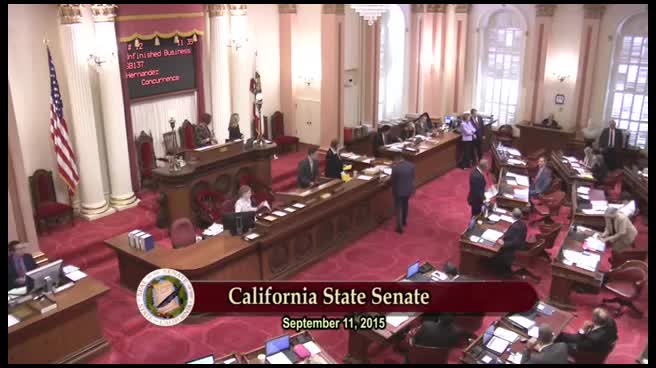
Bill Author

Bill Co-Author(s):