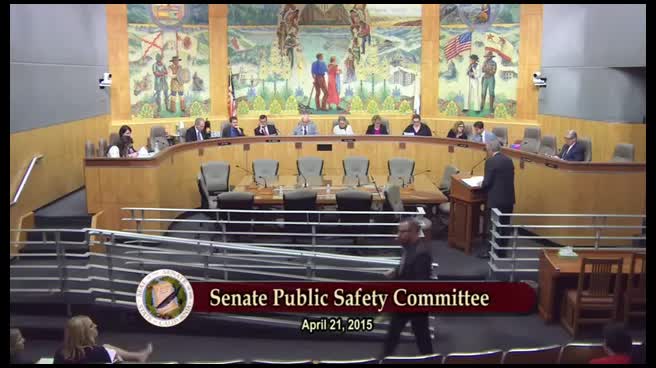
SB 635: Erroneous conviction and imprisonment: compensation.
- Session Year: 2015-2016
- House: Senate
- Latest Version Date: 2015-10-01
Existing law provides that a person who (1) has been convicted of a felony and imprisoned in the state prison or incarcerated in a county jail for that conviction, (2) is granted a pardon by the Governor for specified reasons, and (3) has served the term or any part thereof for which he or she was imprisoned, may present a claim against the state to the California Victim Compensation and Government Claims Board for the pecuniary injury sustained by him or her through the erroneous conviction and imprisonment, as specified. Existing law provides an opportunity for the Attorney General to respond to a claim, and for a hearing on the claim, as specified. Existing law provides that if the evidence shows that the crime with which the claimant was charged was either not committed at all, or, if committed, was not committed by the claimant, and that the claimant has sustained pecuniary injury through his or her erroneous conviction and imprisonment, the California Victim Compensation and Government Claims Board shall report the facts of the case and its conclusions to the Legislature, with a recommendation that an appropriation be made by the Legislature for the purpose of indemnifying the claimant for the pecuniary injury. Existing law provides that the amount of the recommended appropriation shall be a sum equivalent to $100 per day of incarceration served after the claimant was convicted.
This bill would expand the scope of a compensable injury to include nonpecuniary injuries. The bill would increase the amount of the recommended appropriation to $140 per day of incarceration served after the claimant was convicted, as specified. This bill would make other technical, nonsubstantive changes.
Existing law provides that a person who (1) has been convicted of a felony and imprisoned in the state prison or incarcerated in a county jail for that conviction, (2) is granted a pardon by the Governor for specified reasons, and (3) has served the term or any part thereof for which he or she was imprisoned, may present a claim against the state to the California Victim Compensation and Government Claims Board for the pecuniary injury sustained by him or her through the erroneous conviction and imprisonment, as specified. Existing law provides an opportunity for the Attorney General to respond to a claim, and for a hearing on the claim, as specified. Existing law provides that if the evidence shows that the crime with which the claimant was charged was either not committed at all, or, if committed, was not committed by the claimant, and that the claimant has sustained pecuniary injury through his or her erroneous conviction and imprisonment, the California Victim Compensation and Government Claims Board shall report the facts of the case and its conclusions to the Legislature, with a recommendation that an appropriation be made by the Legislature for the purpose of indemnifying the claimant for the pecuniary injury. Existing law provides that the amount of the recommended appropriation shall be a sum equivalent to $100 per day of incarceration served after the claimant was convicted.
This bill would expand the scope of a compensable injury to include nonpecuniary injuries. The bill would increase the amount of the recommended appropriation to $136.98 $140 per day of incarceration served after the claimant was convicted, but not to exceed $50,000 per year for each full year of incarceration served. as specified. This bill would make other technical, nonsubstantive changes.
Existing law provides that a person who (1) has been convicted of a felony and imprisoned in the state prison or incarcerated in a county jail for that conviction, (2) is granted a pardon by the Governor for specified reasons, and (3) has served the term or any part thereof for which he or she was imprisoned, may present a claim against the state to the California Victim Compensation and Government Claims Board for the pecuniary injury sustained by him or her through the erroneous conviction and imprisonment, as specified. Existing law provides an opportunity for the Attorney General to respond to a claim, and for a hearing on the claim, as specified. Existing law provides that if the evidence shows that the crime with which the claimant was charged was either not committed at all, or, if committed, was not committed by the claimant, and that the claimant has sustained pecuniary injury through his or her erroneous conviction and imprisonment, the California Victim Compensation and Government Claims Board shall report the facts of the case and its conclusions to the Legislature, with a recommendation that an appropriation be made by the Legislature for the purpose of indemnifying the claimant for the pecuniary injury. Existing law provides that the amount of the recommended appropriation shall be a sum equivalent to $100 per day of incarceration served after the claimant was convicted.
This bill would increase the amount of the recommended appropriation to $136.98 per day of incarceration served after the claimant was convicted, but not to exceed $50,000 per year for each full year of incarceration served. This bill would make other technical, nonsubstantive changes.
If the evidence shows that the crime with which the claimant was charged was either not committed at all, or, if committed, was not committed by the claimant, and that the claimant has sustained injury through his or her erroneous conviction and imprisonment, the California Victim Compensation and Government Claims Board shall report the facts of the case and its conclusions to the next Legislature, with a recommendation that the Legislature make an appropriation for the purpose of indemnifying the claimant for the injury. The amount of the appropriation recommended shall be a sum equivalent to one hundred forty dollars ($140) per day of incarceration served, and shall include any time spent in custody, including in a county jail, that is considered to be part of the term of incarceration. That appropriation shall not be treated as gross income to the recipient under the Revenue and Taxation Code.
If the evidence shows that the crime with which the claimant was charged was either not committed at all, or, if committed, was not committed by the claimant, and that the claimant has sustained injury through his or her erroneous conviction and imprisonment, the California Victim Compensation and Government Claims Board shall report the facts of the case and its conclusions to the next Legislature, with a recommendation that the Legislature make an appropriation for the purpose of indemnifying the claimant for the injury. The amount of the appropriation recommended shall be a sum equivalent to one hundred forty dollars ($140) per day of incarceration served, and shall include any time spent in custody, including in a county jail, that is considered to be part of the term of incarceration. That appropriation shall not be treated as gross income to the recipient under the Revenue and Taxation Code.
If the evidence shows that the crime with which the claimant was charged was either not committed at all, or, if committed, was not committed by the claimant, and that the claimant has sustained injury through his or her erroneous conviction and imprisonment, the California Victim Compensation and Government Claims Board shall report the facts of the case and its conclusions to the next Legislature, with a recommendation that an appropriation be made by the Legislature make an appropriation for the purpose of indemnifying the claimant for the injury. The amount of the appropriation recommended shall be a sum equivalent to one hundred forty dollars ($140) per day of incarceration served, and shall include any time spent in custody, including in a county jail, that is considered to be part of the term of incarceration. That appropriation shall not be treated as gross income to the recipient under the Revenue and Taxation Code.
If the evidence shows that the crime with which the claimant was charged was either not committed at all, or, if committed, was not committed by the claimant, and that the claimant has sustained pecuniary injury through his or her erroneous conviction and imprisonment, the California Victim Compensation and Government Claims Board shall report the facts of the case and its conclusions to the next Legislature, with a recommendation that an appropriation be made by the Legislature for the purpose of indemnifying the claimant for the pecuniary injury. The amount of the appropriation recommended shall be a sum equivalent to one hundred thirty-six forty dollars and ninety-eight cents ($136.98) ($140) per day of incarceration served, but not to exceed fifty thousand dollars ($50,000) per year for every full year of incarceration served, subsequent to the claimants conviction. and shall include any time spent in custody, including in county jail, that is considered to be part of the term of incarceration. That appropriation shall not be treated as gross income to the recipient under the Revenue and Taxation Code.
If the evidence shows that the crime with which the claimant was charged was either not committed at all, or, if committed, was not committed by the claimant, and that the claimant has sustained pecuniary injury through his or her erroneous conviction and imprisonment, the California Victim Compensation and Government Claims Board shall report the facts of the case and its conclusions to the next Legislature, with a recommendation that an appropriation be made by the Legislature for the purpose of indemnifying the claimant for the pecuniary injury. The amount of the appropriation recommended shall be a sum equivalent to one hundred dollars ($100) one hundred thirty-six dollars and ninety-eight cents ($136.98) per day of incarceration served, but not to exceed fifty thousand dollars ($50,000) per year for every full year of incarceration served, subsequent to the claimants conviction conviction. and that That appropriation shall not be treated as gross income to the recipient under the Revenue and Taxation Code.
|
Date
|
Status
|
|---|---|
| Jun 2, 2015 | Read third time. Passed. (Ayes 40. Noes 0.) Ordered to the Assembly. |
| Oct 1, 2015 | Chaptered by Secretary of State. Chapter 422, Statutes of 2015. |
| Oct 1, 2015 | Approved by the Governor. |
| Sep 15, 2015 | Enrolled and presented to the Governor at 9:30 a.m. |
| Sep 10, 2015 | Assembly amendments concurred in. (Ayes 39. Noes 0.) Ordered to engrossing and enrolling. |
| Sep 10, 2015 | Assembly amendments concurred in. (Ayes 39. Noes 0. Page 2669.) Ordered to engrossing and enrolling. |
| Sep 8, 2015 | Read third time. Passed. (Ayes 79. Noes 0. Page 2954.) Ordered to the Senate. |
| Sep 8, 2015 | Read third time. Passed. Ordered to the Senate. |
| Sep 8, 2015 | In Senate. Concurrence in Assembly amendments pending. |
| Sep 3, 2015 | Read third time and amended. |
| Sep 3, 2015 | Ordered to third reading. |
| Aug 28, 2015 | Read second time. Ordered to third reading. |
| Aug 28, 2015 | From committee: Do pass. (Ayes 17. Noes 0.) (August 27). |
| Aug 19, 2015 | August 19 set for first hearing. Placed on APPR. suspense file. |
| Jul 14, 2015 | From committee: Do pass and re-refer to Com. on APPR. with recommendation: To consent calendar. (Ayes 7. Noes 0.) (July 14). Re-referred to Com. on APPR. |
| Jun 18, 2015 | Referred to Com. on PUB. S. |
| Feb 27, 2015 | Introduced. To Com. on RLS. for assignment. To print. |
| Jun 2, 2015 | Read third time. Passed. (Ayes 40. Noes 0. Page 1242.) Ordered to the Assembly. |
| Jun 2, 2015 | In Assembly. Read first time. Held at Desk. |
| May 28, 2015 | Read second time. Ordered to third reading. |
| May 28, 2015 | From committee: Do pass. (Ayes 7. Noes 0.) (May 28). |
| May 28, 2015 | From committee: Do pass. (Ayes 7. Noes 0. Page 1157.) (May 28). |
| May 23, 2015 | Set for hearing May 28. |
| May 18, 2015 | May 18 hearing: Placed on APPR. suspense file. |
| May 8, 2015 | Set for hearing May 18. |
| Apr 29, 2015 | Read second time and amended. Re-referred to Com. on APPR. |
| Apr 28, 2015 | From committee: Do pass as amended and re-refer to Com. on APPR. (Ayes 7. Noes 0. Page 730.) (April 21). |
| Mar 24, 2015 | Set for hearing April 21. |
| Mar 12, 2015 | Referred to Coms. on PUB. S. and APPR. |
| Mar 2, 2015 | Read first time. |
| Mar 2, 2015 | From printer. May be acted upon on or after April 1. |
|
Date
|
Description
|
Location
|
Votes
|
|
|---|---|---|---|---|
| Sep 10, 2015 | Unfinished Business SB635 Nielsen Concurrence | Senate Floor |
Passed |
|
| Sep 8, 2015 | SB 635 Nielsen Senate Third Reading By BONTA | Assembly Floor |
Passed |
|
| Aug 27, 2015 | Do pass. | Assembly Standing Committee on Appropriations |
Passed |
|
| Jul 14, 2015 | Do pass and be re-referred to the Committee on [Appropriations] with recommendation: To Consent Calendar | Assembly Standing Committee on Public Safety |
Passed |
|
| Jun 2, 2015 | Senate 3rd Reading SB635 Nielsen | Senate Floor |
Passed |
|
| May 28, 2015 | Do pass | Senate Standing Committee on Appropriations |
Passed |
|
| May 18, 2015 | Placed on suspense file | Senate Standing Committee on Appropriations |
Passed |
|
| Apr 21, 2015 | Do pass as amended, but first amend, and re-refer to the Committee on [Appropriations] | Senate Standing Committee on Public Safety |
Passed |
This list shows positions taken on this bill by organizations on the date displayed, which is linked to the original source.
Positions by individuals are not included.
|
Organization
|
Position
|
Date
|
|---|---|---|
| California Attorneys For Criminal Justice | ** Support | Sep 8, 2015 |
| California Innocence Project | ** Support | Sep 8, 2015 |
| California Public Defenders Association | ** Support | Sep 8, 2015 |
| Legal Services for Prisoners with Children | ** Support | Sep 8, 2015 |
SB 635
Page 6
|
Office of Senate Floor Analyses (916) 651-1520 Fax: (916) 327-4478 |
UNFINISHED BUSINESS
Bill No: SB 635
Author: Nielsen (R) and Leno (D), et al.
Amended: 9/3/15
SENATE PUBLIC SAFETY COMMITTEE: 7-0, 4/21/15
AYES: Hancock, Anderson, Leno, Liu, McGuire, Monning, Stone
SENATE APPROPRIATIONS COMMITTEE: 7-0, 5/28/15
AYES: Lara, Bates, Beall, Hill, Leyva, Mendoza, Nielsen
SENATE FLOOR: 40-0, 6/2/15
AYES: Allen, Anderson, Bates, Beall, Berryhill, Block, Cannella, De León, Fuller, Gaines, Galgiani, Glazer, Hall, Hancock, Hernandez, Hertzberg, Hill, Hueso, Huff, Jackson, Lara, Leno, Leyva, Liu, McGuire, Mendoza, Mitchell, Monning, Moorlach, Morrell, Nguyen, Nielsen, Pan, Pavley, Roth, Runner, Stone, Vidak, Wieckowski, Wolk
ASSEMBLY FLOOR: 79-0, 9/8/15 - See last page for vote
SUBJECT: Erroneous conviction and imprisonment: compensation
SOURCE: California Innocence Project
DIGEST: This bill 1) raises the compensation for innocent persons who were wrongly convicted from $100 per day to $140, to reflect the effect of inflation on the amount originally set in 2000; 2) strikes an inaccurate reference to compensation for “pecuniary” injury suffered by wrongly imprisoned persons; and 3) includes time spent in county jail as part of the incarceration for the wrongful conviction in the calculation of compensation for wrongful imprisonment.
Assembly Amendments are grammatical, changing a phrase about a legislative appropriation from passive to active voice; and add a coauthor.
Existing law:
Includes procedures for the filing and hearing of a petition for a writ of habeas corpus, which allows a person to challenge his or her incarceration or related restraint as unlawful. (Pen. Code §§1474-1508.)
Describes specific grounds for a writ of habeas corpus, including:
False evidence that was material or substantially probative on the issue of guilt or punishment was introduced against the person at a trial or hearing related to the petitioner’s incarceration.
A person entered a guilty plea based on false physical evidence that the person entering the plea believed to be true.
The specified grounds for a writ of habeas corpus do not limit any other valid grounds for the writ or other available remedies. (Pen. Code §1473.)
Provides that a person who is no longer unlawfully imprisoned or restrained as a result of a criminal conviction may file a motion to vacate the judgment for the following reasons:
Newly discovered evidence of fraud by a government official completely and conclusively undermines the prosecution’s case and points unerringly to innocence.
Newly discovered evidence that a government official testified falsely at trial and the testimony was substantially material and probative on the issue of guilt. (Pen. Code §1474.6.)
Provides that any person who, having been convicted of a crime and imprisoned in the state prison, is granted a pardon by the Governor because the crime with which he or she was charged either did not occur; or if it did occur, was not committed by him or her; or who is innocent of the charges for either of the foregoing reasons, and who has served any part of the term for which imprisoned may present a claim against the State to the Victims Compensation and Government Claims Board (board) for the pecuniary injury sustained through the wrongful conviction and imprisonment. (Pen. Code § 4900.)
Provides that an unlawfully imprisoned person (exonoree) shall be entitled to a recommendation by the board for compensation without a hearing under the following circumstances:
A court in a contested habeas corpus proceeding or motion to vacate a judgment finds that the evidence unerringly points to the innocence of the exonoree. (Pen. Code § 1485.55, subd. (a).)
The court grants a habeas corpus petition or motion to vacate judgment on any ground other than the evidence unerringly points to innocence and the petitioner proves by a preponderance of the evidence that he or she is innocent. (Pen Code § 1485.55, subds. (b)-(d).)
A federal court in a habeas corpus matter grants the petitioner's motion for a finding of factual innocence. (Pen Code § 1485.55, subds. (b)-(d).)
A court issues a certificate of innocence upon the stipulation by the prosecutor or a hearing. (Pen. Code §§ 861.8, 861.86 and 861.865.
Provides that factual findings, including witness credibility determinations, made by a court in a hearing on a habeas corpus petition, a motion to vacate a judgment or a petition for a certificate of factual innocence shall be binding on the board, the fact finder and the Attorney General in a proceeding to consider a claim filed by a person who alleges that he or she is entitled to compensation despite his or her innocence. (Pen. Code § 1485.5, subd. (c).)
Provides that where the district attorney or Attorney General stipulates to or does not contest the factual allegations underlying one or more of the grounds for granting a writ of habeas corpus or motion to vacate a judgment, the facts underlying the court’s ruling or order shall be binding on the board, the fact finder and the Attorney General in a proceeding to consider a claim filed by a person who alleges that he or she is entitled to compensation despite his or her innocence. (Pen. Code § 1485.5, subd. (a).)
Requires a district attorney to notify the Attorney General before stipulating to facts that will be basis for granting a habeas corpus petition or motion to vacate a judgment. (Pen. Code § 1485.5, subd. (b).)
Provides that an innocent person who has served an executed felony sentence in a jail may be entitled to compensation. (Pen. Code § 4900.)
Provides that the Attorney General shall have 60 days to respond to a claim for compensation filed with the board, and that extensions of time may be granted for good cause.
Provides that the board shall deny a claim for compensation if the board finds by a preponderance of the evidence that the claimant pled guilty with the specific intent to shield another from prosecution in the underlying conviction for which the claimant seeks compensation. (Pen. Code § 4903, subd. (c).)
Raises the daily compensation rate for an exonoree from $100 to $140 per day.
Strikes an inaccurate reference to compensation for “pecuniary injury” suffered by a wrongly imprisoned person.
This bill provides that where a wrongfully convicted and imprisoned person spends part of his incarceration for the offense in a county jail, that time is included in the calculation for compensation.
Background
An exonerated person is released into a society that is very unlike the society they left when he or she was initially imprisoned. They must learn to provide the requirements of daily living after being held in a rigid, institutional structure where they occupied the lowest level.
This bill increases the compensation for wrongful imprisonment of an exonerated person from $100 to $140 per day. This increase reflects the effect of inflation on the rate of compensation since 2000.
This bill strikes a reference in current law to compensation paid to an exonerated person for his or her "pecuniary injury" suffered through wrongful imprisonment. "Pecuniary injury” appears to be an unfortunate and unsound description of the unique harm suffered when factually innocent persons are imprisoned. In a recent case, an exonoree was denied compensation because he had been homeless and unemployed at the time of his arrest and conviction. A pecuniary injury standard would best be applied to a commercial dispute or a tort for negligence that results in loss of income or financial position. Strict application of the term would allow little or no compensation to a person who was initially imprisoned at a young age - before he or she had an opportunity to develop earning power - and then held for decades. Thus, the board concluded, he suffered no pecuniary injury. A person who served substantially less time in prison, but who lost income from an established career, could receive much greater compensation. Further, if compensation is measured by pecuniary injury, imprisonment of a person with a high income should require the state to pay substantially more than the current limit of $100 per day of imprisonment.
When a person is charged with a serious crime, bail is typically set in a high amount. If the person cannot afford bail, he or she remains in jail through the trial process. At the time of sentencing, the jail custody time attributable to the case for which the defendant is being sentenced is essentially made part of the person’s sentence. The time an innocent person spends in custody during the trial process is clearly a time of extreme anxiety, as he or she faces a long prison term for a crime he or she did not commit. The person would not typically be involved in any programs and would often be transported from his or her cell to court and back. Arguably, whatever harm is suffered by a person who is wrongly imprisoned extends to the time in jail custody prior to sentencing.
FISCAL EFFECT: Appropriation: No Fiscal Com.: Yes Local: No
According to the Senate Appropriations Committee, potentially significant increase in erroneous conviction compensation payments in the range of $148,000 to $517,000 (General Fund) per claim paid, as follows:
Based on the average claim payment of about $369,000, increasing the daily compensation rate to $140 per day would increase the average claim payment to nearly $517,000, an increase of $148,000. This estimate does not include the additional increase to the average claim payment as a result of compensation for time spent in custody in county jail.
Potential increase in claim payments due to compensation for time spent in county jail as part of the term of incarceration. While the average length of stay in jail that is considered part of the term of incarceration is unknown, for context, for every claim in which 25 days were spent in custody in jail, additional costs of $3,500 per claim would result.
Potential increase of $517,000 per claim to the extent removing the requirement that a claimant prove pecuniary loss could result in approval of claims that would have been denied under current law. The board indicates one claim in 2014 was denied for lack of pecuniary loss.
California Innocence Project (source)
American Civil Liberties Union
California Attorneys for Criminal Justice
California Public Defenders Association
Legal Services for Prisoners with Children
None received
ASSEMBLY FLOOR: 79-0, 9/8/15
AYES: Achadjian, Alejo, Travis Allen, Baker, Bigelow, Bloom, Bonilla, Bonta, Brough, Brown, Burke, Calderon, Campos, Chang, Chau, Chiu, Chu, Cooley, Cooper, Dababneh, Dahle, Daly, Dodd, Eggman, Frazier, Beth Gaines, Gallagher, Cristina Garcia, Eduardo Garcia, Gatto, Gipson, Gomez, Gonzalez, Gordon, Gray, Grove, Hadley, Harper, Roger Hernández, Holden, Irwin, Jones, Jones-Sawyer, Kim, Lackey, Levine, Linder, Lopez, Low, Maienschein, Mathis, Mayes, McCarty, Medina, Melendez, Mullin, Nazarian, Obernolte, O'Donnell, Olsen, Patterson, Perea, Quirk, Rendon, Ridley-Thomas, Rodriguez, Salas, Santiago, Steinorth, Mark Stone, Thurmond, Ting, Wagner, Waldron, Weber, Wilk, Williams, Wood, Atkins
NO VOTE RECORDED: Chávez
Prepared by: Jerome McGuire / PUB. S. /
9/8/15 21:47:13
**** END ****
SB 635
Page 5
SENATE THIRD READING
SB 635
(Nielsen and Leno)
As Amended September 3, 2015
Majority vote
SENATE VOTE: 40-0
Committee |
Votes |
Ayes |
Noes |
Public Safety |
7-0 |
Quirk, Melendez, Jones-Sawyer, Lackey, Lopez, Low, Santiago |
|
Appropriations |
17-0 |
Gomez, Bigelow, Bloom, Bonta, Calderon, Chang, Nazarian, Eggman, Gallagher, Eduardo Garcia, Holden, Jones, Quirk, Rendon, Wagner, Weber, Wood |
|
SUMMARY: Increases the compensation rate for innocent persons who were wrongly convicted of a crime. Specifically, this bill:
Increases the compensation for innocent persons who were wrongly convicted from $100 per day of wrongful incarceration to $140 per day.
Requires that time spent in custody in a county jail as part of the term of incarceration be included in the calculation of compensation for the wrongful imprisonment.
Deletes the requirement that a wrongly convicted person sustain a pecuniary loss in order to receive compensation.
EXISTING LAW:
Provides that any person who, having been convicted of any crime against the state amounting to a felony and imprisoned in the state prison for that conviction, is granted a pardon by the Governor for the reason that the crime with which he or she was charged was either not committed at all or, if committed, was not committed by him or her, or who, being innocent of the crime with which he or she was charged for either of the foregoing reasons, shall have served the term or any part thereof for which he or she was imprisoned, may, as specified, present a claim against the state to the Victim Compensation and Government Claims Board (VCGCB) for the pecuniary injury sustained by him or her through the erroneous conviction and imprisonment.
Requires a claim to VCGCB to be presented within a period of two years after judgment of acquittal or discharge given, or after pardon granted, or after release from imprisonment.
Requires VCGCB to fix a time and place for the hearing of the claim and mail notice thereof to the claimant and to the Attorney General (AG) at least 15 days prior to the time fixed for the hearing.
States that at the hearing, the claimant shall introduce evidence in support of the claim, and the AG may introduce evidence in opposition thereto. The claimant must prove the facts set forth in the statement constituting the claim, including the following:
The fact that the crime with which he or she was charged was either not committed at all, or, if committed, was not committed by him or her;
The fact that he or she did not, by any act or omission on his or her part, intentionally contribute to the bringing about of his or her arrest or conviction for the crime with which he or she was charged; and,
The pecuniary injury sustained by him or her through his or her erroneous conviction and imprisonment.
States if the evidence proves all of the above, VCGCB shall report the facts of the case and its conclusions to the Legislature, with a recommendation that an appropriation be made by the Legislature for the purpose of indemnifying the claimant for the pecuniary injury. The amount of the appropriation recommended shall be a sum equivalent to $100 per day of incarceration served subsequent to the claimant's conviction and that appropriation shall not be treated as gross income to the recipient under the Revenue and Taxation Code.
States that every person who is unlawfully imprisoned or restrained of his liberty, under any pretense whatever, to prosecute a writ of habeas corpus, to inquire into the cause of such imprisonment or restraint.
Provides that a writ of habeas corpus may be prosecuted for, but not limited to, the following reasons:
False evidence that is substantially material or probative on the issue of guilt or punishment was introduced against a person at any hearing or trial relating to his incarceration; or,
False physical evidence, believed by a person to be factual, probative, or material on the issue of guilt, which was known by the person at the time of entering a plea of guilty, which was a material factor directly related to the plea of guilty by the person.
States that nothing in the provisions authorizing a writ of habeas corpus shall be construed as limiting the grounds for which a writ of habeas corpus may be prosecuted or as precluding the use of any other remedies.
Provides that the application for the writ is made by petition, signed either by the party for whose relief it is intended, or by some person in his behalf, and must specify:
That the person in whose behalf the writ is applied for is imprisoned or restrained of his liberty, the officer or person by whom he is so confined or restrained, and the place where, naming all the parties, if they are known, or describing them, if they are not known;
If the imprisonment is alleged to be illegal, the petition must also state in what the alleged illegality consists; and,
The petition must be verified by the oath or affirmation of the party making the application.
States that the writ must be directed to the person having custody of or restraining the person on whose behalf the application is made, and must command him to have the body of such person before the court or judge before whom the writ is returnable, at a time and place therein specified.
Requires the person upon whom the writ is served must state in his return, plainly and unequivocally:
Whether he has or has not the party in his custody, or under his power or restraint;
If he has the party in his custody or power, or under his restraint, he must state the authority and cause of such imprisonment or restraint;
If the party is detained by virtue of any writ, warrant, or other written authority, a copy thereof must be annexed to the return, and the original produced and exhibited to the Court or Judge on the hearing of such return; and,
If the person upon whom the writ is served had the party in his power or custody, or under his restraint, at any time prior or subsequent to the date of the writ of habeas corpus, but has transferred such custody or restraint to another, the return must state particularly to whom, at what time and place, for what cause, and by what authority such transfer took place;
The return must be signed by the person making the same, and, except when such person is a sworn public officer, and makes such return in his official capacity, it must be verified by his oath.
Requires the court or judge before whom the writ is returned, immediately after the return, to proceed to hear and examine the return, and such other matters as may be properly submitted to their hearing and consideration.
States that the party brought before the court or judge, on the return of the writ, may deny or controvert any of the material facts or matters set forth in the return, or except to the sufficiency thereof, or allege any fact to show either that his imprisonment or detention is unlawful, or that he is entitled to his discharge. The court or judge must thereupon proceed in a summary way to hear such proof as may be produced against such imprisonment or detention, or in favor of the same, and to dispose of such party as the justice of the case may require, and have full power and authority to require and compel the attendance of witnesses, by process of subpoena and attachment, and to do and perform all other acts and things necessary to a full and fair hearing and determination of the case.
States if no legal cause is shown for such imprisonment or restraint, or for the continuation thereof, such court or judge must discharge such party from the custody or restraint under which he is held.
FISCAL EFFECT: According to the Assembly Appropriations Committee, potentially significant increase in erroneous conviction compensation payments in the range of $148,000 to $517,000 (General Fund) per claim paid, as follows:
Based on the average claim payment of about $369,000, increasing the daily compensation rate to $140 per day would increase the average claim payment to nearly $517,000, an increase of $148,000. This estimate does not include the additional increase to the average claim payment as a result of compensation for time spent in custody in county jail.
Payments due to compensation for time spent in county jail as part of the term of incarceration. While the average length of stay in jail that is considered part of the term of incarceration is unknown, for context, for every claim in which 25 days were spent in custody in jail, additional costs of $3,500 per claim would result.
New claims of $517,000 per claim on average, to the extent removing the requirement that a claimant prove pecuniary loss could result in approval of claims that would have been denied under current law. The Victim Compensation and Government Claims Board indicates one claim in 2014 was denied for lack of pecuniary loss.
COMMENTS: According to the author, "Senate Bill 635 is a long overdue effort to help address perhaps the greatest nightmare that can occur in the American justice system: the wrongful conviction and incarceration of an innocent person. This bill would modestly increase the amount an exonerated person receives in restitution compensation, which has not been adjusted for inflation in nearly two decades.
"Following release, exonerees are faced with the overwhelming task of reintegrating back into society. While even rightfully convicted parolees receive a nominal amount of cash and counseling that facilitate their re-entry into the public, the fully exonerated are given very limited resources.
"In 2000, the Legislature passed AB 1799 (Baugh), Chapter 630, Statutes of 2000, with overwhelming support. The bill increased potential compensation for wrongful incarceration from a maximum of $10,000 to a sum of $100 per day spent incarcerated. That level of compensation remains unchanged 15 years later.
"SB 635 increases the amount of compensation that an exoneree can receive following the finding of his or her factual innocence. Recompense would be $140.00 per day spent incarcerated. According to the Bureau of Labor Statistics, this increase corresponds to inflation.
"The fundamental rights to life, liberty and the pursuit of happiness are enshrined in the Declaration of Independence. Americans are recognized globally for their willingness to defend their own freedoms and those of others. But sometimes that commitment to defend freedom must be directed inward, when our own justice system erroneously takes those precious rights from an individual. Taking moral responsibility for one’s own errors is a key attribute of a truly just society.
"As a former Chairman of the Board of Prison Terms, I have seen many people who deserve to spend the rest of their lives behind bars because of their vicious crimes against society. However, in cases where an innocent person has been wrongly accused and incarcerated, we as a society have the responsibility to acknowledge that our system is not perfect and they deserve compensation to get their lives back in order"
Analysis Prepared by: Gregory Pagan / PUB. S. / (916) 319-3744 FN: 0002044
SB 635
Page 4
SENATE THIRD READING
SB 635
(Nielsen and Leno)
As Amended April 29, 2015
Majority vote
SENATE VOTE: 40-0
Committee |
Votes |
Ayes |
Noes |
Public Safety |
7-0 |
Quirk, Melendez, Jones-Sawyer, Lackey, Lopez, Low, Santiago |
|
Appropriations |
17-0 |
Gomez, Bigelow, Bloom, Bonta, Calderon, Chang, Nazarian, Eggman, Gallagher, Eduardo Garcia, Holden, Jones, Quirk, Rendon, Wagner, Weber, Wood |
|
SUMMARY: Increases the compensation for innocent persons who were wrongly convicted from $100 per day of wrongful incarceration to $140 per day, and requires that time spent in custody in a county jail as part of the term of incarceration be included in the calculation of compensation for the wrongful imprisonment.
EXISTING LAW:
Provides that any person who, having been convicted of any crime against the state amounting to a felony and imprisoned in the state prison for that conviction, is granted a pardon by the Governor for the reason that the crime with which he or she was charged was either not committed at all or, if committed, was not committed by him or her, or who, being innocent of the crime with which he or she was charged for either of the foregoing reasons, shall have served the term or any part thereof for which he or she was imprisoned, may, as specified, present a claim against the state to the Victim Compensation and Government Claims Board (VCGCB) for the pecuniary injury sustained by him or her through the erroneous conviction and imprisonment.
Requires a claim to VCGCB to be presented within a period of two years after judgment of acquittal or discharge given, or after pardon granted, or after release from imprisonment.
Requires VCGCB to fix a time and place for the hearing of the claim and mail notice thereof to the claimant and to the AG at least 15 days prior to the time fixed for the hearing.
States that at the hearing, the claimant shall introduce evidence in support of the claim, and the Attorney General (AG) may introduce evidence in opposition thereto. The claimant must prove the facts set forth in the statement constituting the claim, including the following:
The fact that the crime with which he or she was charged was either not committed at all, or, if committed, was not committed by him or her;
The fact that he or she did not, by any act or omission on his or her part, intentionally contribute to the bringing about of his or her arrest or conviction for the crime with which he or she was charged; and,
The pecuniary injury sustained by him or her through his or her erroneous conviction and imprisonment.
States if the evidence proves all of the above, VCGCB shall report the facts of the case and its conclusions to the Legislature, with a recommendation that an appropriation be made by the Legislature for the purpose of indemnifying the claimant for the pecuniary injury. The amount of the appropriation recommended shall be a sum equivalent to $100 per day of incarceration served subsequent to the claimant's conviction and that appropriation shall not be treated as gross income to the recipient under the Revenue and Taxation Code.
States that every person who is unlawfully imprisoned or restrained of his liberty, under any pretense whatever, to prosecute a writ of habeas corpus, to inquire into the cause of such imprisonment or restraint.
Provides that a writ of habeas corpus may be prosecuted for, but not limited to, the following reasons:
False evidence that is substantially material or probative on the issue of guilt or punishment was introduced against a person at any hearing or trial relating to his incarceration; or,
False physical evidence, believed by a person to be factual, probative, or material on the issue of guilt, which was known by the person at the time of entering a plea of guilty, which was a material factor directly related to the plea of guilty by the person.
States that nothing in the provisions authorizing a writ of habeas corpus shall be construed as limiting the grounds for which a writ of habeas corpus may be prosecuted or as precluding the use of any other remedies.
Provides that the application for the writ is made by petition, signed either by the party for whose relief it is intended, or by some person in his behalf, and must specify:
That the person in whose behalf the writ is applied for is imprisoned or restrained of his liberty, the officer or person by whom he is so confined or restrained, and the place where, naming all the parties, if they are known, or describing them, if they are not known;
If the imprisonment is alleged to be illegal, the petition must also state in what the alleged illegality consists; and,
The petition must be verified by the oath or affirmation of the party making the application.
States that the writ must be directed to the person having custody of or restraining the person on whose behalf the application is made, and must command him to have the body of such person before the court or judge before whom the writ is returnable, at a time and place therein specified.
Requires the person upon whom the writ is served must state in his return, plainly and unequivocally:
Whether he has or has not the party in his custody, or under his power or restraint;
If he has the party in his custody or power, or under his restraint, he must state the authority and cause of such imprisonment or restraint;
If the party is detained by virtue of any writ, warrant, or other written authority, a copy thereof must be annexed to the return, and the original produced and exhibited to the Court or Judge on the hearing of such return; and,
If the person upon whom the writ is served had the party in his power or custody, or under his restraint, at any time prior or subsequent to the date of the writ of habeas corpus, but has transferred such custody or restraint to another, the return must state particularly to whom, at what time and place, for what cause, and by what authority such transfer took place;
The return must be signed by the person making the same, and, except when such person is a sworn public officer, and makes such return in his official capacity, it must be verified by his oath.
Requires the court or judge before whom the writ is returned, immediately after the return, to proceed to hear and examine the return, and such other matters as may be properly submitted to their hearing and consideration.
States that the party brought before the court or judge, on the return of the writ, may deny or controvert any of the material facts or matters set forth in the return, or except to the sufficiency thereof, or allege any fact to show either that his imprisonment or detention is unlawful, or that he is entitled to his discharge. The court or judge must thereupon proceed in a summary way to hear such proof as may be produced against such imprisonment or detention, or in favor of the same, and to dispose of such party as the justice of the case may require, and have full power and authority to require and compel the attendance of witnesses, by process of subpoena and attachment, and to do and perform all other acts and things necessary to a full and fair hearing and determination of the case.
States if no legal cause is shown for such imprisonment or restraint, or for the continuation thereof, such court or judge must discharge such party from the custody or restraint under which he is held.
FISCAL EFFECT: According to the Assembly Appropriations Committee, potentially significant increase in erroneous conviction compensation payments in the range of $148,000 to $517,000 (General Fund) per claim paid, as follows:
Based on the average claim payment of about $369,000, increasing the daily compensation rate to $140 per day would increase the average claim payment to nearly $517,000, an increase of $148,000. This estimate does not include the additional increase to the average claim payment as a result of compensation for time spent in custody in county jail.
Payments due to compensation for time spent in county jail as part of the term of incarceration. While the average length of stay in jail that is considered part of the term of incarceration is unknown, for context, for every claim in which 25 days were spent in custody in jail, additional costs of $3,500 per claim would result.
New claims of $517,000 per claim on average, to the extent removing the requirement that a claimant prove pecuniary loss could result in approval of claims that would have been denied under current law. The Victim Compensation and Government Claims Board indicates one claim in 2014 was denied for lack of pecuniary loss.
COMMENTS: According to the author, "Senate Bill 635 is a long overdue effort to help address perhaps the greatest nightmare that can occur in the American justice system: the wrongful conviction and incarceration of an innocent person. This bill would modestly increase the amount an exonerated person receives in restitution compensation, which has not been adjusted for inflation in nearly two decades.
"Following release, exonerees are faced with the overwhelming task of reintegrating back into society. While even rightfully convicted parolees receive a nominal amount of cash and counseling that facilitate their re-entry into the public, the fully exonerated are given very limited resources.
"In 2000, the Legislature passed AB 1799 (Baugh), Chapter 630, Statutes of 2000, with overwhelming support. The bill increased potential compensation for wrongful incarceration from a maximum of $10,000 to a sum of $100 per day spent incarcerated. That level of compensation remains unchanged 15 years later.
"SB 635 increases the amount of compensation that an exoneree can receive following the finding of his or her factual innocence. Recompense would be $140.00 per day spent incarcerated. According to the Bureau of Labor Statistics, this increase corresponds to inflation.
"The fundamental rights to life, liberty and the pursuit of happiness are enshrined in the Declaration of Independence. Americans are recognized globally for their willingness to defend their own freedoms and those of others. But sometimes that commitment to defend freedom must be directed inward, when our own justice system erroneously takes those precious rights from an individual. Taking moral responsibility for one’s own errors is a key attribute of a truly just society.
"As a former Chairman of the Board of Prison Terms, I have seen many people who deserve to spend the rest of their lives behind bars because of their vicious crimes against society. However, in cases where an innocent person has been wrongly accused and incarcerated, we as a society have the responsibility to acknowledge that our system is not perfect and they deserve compensation to get their lives back in order"
Analysis Prepared by: Gregory Pagan / PUB. S. / (916) 319-3744 FN: 0001618
Date of Hearing: August 19, 2015
ASSEMBLY COMMITTEE ON APPROPRIATIONS
Jimmy Gomez, Chair
SB 635
(Nielsen) – As Amended April 29, 2015
Policy Committee: |
Public Safety |
Vote: |
7 - 0 |
|
|
|
|
|
|
|
|
Urgency: No State Mandated Local Program: No Reimbursable: No
SUMMARY:
This bill increases the compensation for innocent persons who were wrongly convicted, from $100 per day of wrongful incarceration to $140 per day, and requires that time spent in custody in a county jail as part of the term of incarceration be included in the calculation of compensation for the wrongful imprisonment. This bill would also expand the scope of a compensable injury to include non-pecuniary injuries.
FISCAL EFFECT:
Potentially significant increase in erroneous conviction compensation payments in the range of $148,000 to $517,000 (GF) per claim paid, as follows:
Based on the average claim payment of about $369,000, increasing the daily compensation rate to $140 per day would increase the average claim payment to nearly $517,000, an increase of $148,000. This estimate does not include the additional increase to the average claim payment as a result of compensation for time spent in custody in county jail.
Payments due to compensation for time spent in county jail as part of the term of incarceration. While the average length of stay in jail that is considered part of the term of incarceration is unknown, for context, for every claim in which 25 days were spent in custody in jail, additional costs of $3,500 per claim would result.
New claims of $517,000 per claim on average, to the extent removing the requirement that a claimant prove pecuniary loss could result in approval of claims that would have been denied under current law. The Victim Compensation and Government Claims Board indicates one claim in 2014 was denied for lack of pecuniary loss.
COMMENTS:
Purpose/Background. SB 635 increases the amount of compensation that an exoneree can receive following the finding of his or her factual innocence. The rate in SB 635 is $140 per day spent incarcerated, which has not been increased from $100 per day since 2000. According to the Bureau of Labor Statistics, this increase corresponds to inflation.
SB 635 also provides compensation for days served in custody, including county jail, that is considered part of the term of incarceration and removes the requirement of financial injury to qualify for the compensation.
Support. Legal Services for Prisoners with Children, in support, point out that the $140 per day rate brings the State in alignment with the rates in Florida and Mississippi, and the federal wrongful conviction rate.
Related Legislation. AB 1140 (Bonta), set to be heard this month, amends the victim compensation program and increases the compensation rate to $130 per day.
Analysis Prepared by: Pedro R. Reyes / APPR. / (916) 319-2081
SB 635
Page 5
Date of Hearing: July 14, 2015
Chief Counsel: Gregory Pagan
ASSEMBLY COMMITTEE ON PUBLIC SAFETY
Bill Quirk, Chair
SB 635
(Nielsen) – As Amended April 29, 2015
SUMMARY:
Increases the compensation for innocent persons who were wrongly
convicted from $100 per day of wrongful incarceration to $140 per
day, and requires that time spent in custody in a county jail as part
of the term of incarceration be included in the calculation of
compensation for the wrongful imprisonment.
EXISTING LAW:
Provides that any person who, having been convicted of any crime against the state amounting to a felony and imprisoned in the state prison for that conviction, is granted a pardon by the Governor for the reason that the crime with which he or she was charged was either not committed at all or, if committed, was not committed by him or her, or who, being innocent of the crime with which he or she was charged for either of the foregoing reasons, shall have served the term or any part thereof for which he or she was imprisoned, may, as specified, present a claim against the state to the Victim Compensation and Government Claims Board (VCGCB) for the pecuniary injury sustained by him or her through the erroneous conviction and imprisonment. (Pen. Code, § 4900.)
Requires a claim to VCGCB to be presented within a period of two years after judgment of acquittal or discharge given, or after pardon granted, or after release from imprisonment. (Pen. Code, § 4901.)
Requires VCGCB to fix a time and place for the hearing of the claim and mail notice thereof to the claimant and to the AG at least 15 days prior to the time fixed for the hearing. (Penal Code Section 4902.)
States that at the hearing, the claimant shall introduce evidence in support of the claim, and the Attorney General (AG) may introduce evidence in opposition thereto. The claimant must prove the facts set forth in the statement constituting the claim, including the following:
The fact that the crime with which he or she was charged was either not committed at all, or, if committed, was not committed by him or her;
The fact that he or she did not, by any act or omission on his or her part, intentionally contribute to the bringing about of his or her arrest or conviction for the crime with which he or she was charged; and,
The pecuniary injury sustained by him or her through his or her erroneous conviction and imprisonment. (Pen. Code, § 4903.)
States if the evidence proves all of the above, VCGCB shall report the facts of the case and its conclusions to the Legislature, with a recommendation that an appropriation be made by the Legislature for the purpose of indemnifying the claimant for the pecuniary injury. The amount of the appropriation recommended shall be a sum equivalent to $100 per day of incarceration served subsequent to the claimant's conviction and that appropriation shall not be treated as gross income to the recipient under the Revenue and Taxation Code. (Pen. Code, § 4904.)
States that every person who is unlawfully imprisoned or restrained of his liberty, under any pretense whatever, to prosecute a writ of habeas corpus, to inquire into the cause of such imprisonment or restraint. (Pen. Code, § 1473, subd. (a).)
Provides that a writ of habeas corpus may be prosecuted for, but not limited to, the following reasons (Pen. Code, § 1473, subd. (b)):
False evidence that is substantially material or probative on the issue of guilt or punishment was introduced against a person at any hearing or trial relating to his incarceration; or,
False physical evidence, believed by a person to be factual, probative, or material on the issue of guilt, which was known by the person at the time of entering a plea of guilty, which was a material factor directly related to the plea of guilty by the person.
States that nothing in the provisions authorizing a writ of habeas corpus shall be construed as limiting the grounds for which a writ of habeas corpus may be prosecuted or as precluding the use of any other remedies. (Pen. Code, § 1473, subd. (d).)
Provides that the application for the writ is made by petition, signed either by the party for whose relief it is intended, or by some person in his behalf, and must specify (Pen. Code, § 1474):
That the person in whose behalf the writ is applied for is imprisoned or restrained of his liberty, the officer or person by whom he is so confined or restrained, and the place where, naming all the parties, if they are known, or describing them, if they are not known;
If the imprisonment is alleged to be illegal, the petition must also state in what the alleged illegality consists; and,
The petition must be verified by the oath or affirmation of the party making the application.
States that the writ must be directed to the person having custody of or restraining the person on whose behalf the application is made, and must command him to have the body of such person before the Court or Judge before whom the writ is returnable, at a time and place therein specified. (Pen. Code, § 1477.)
Requires the person upon whom the writ is served must state in his return, plainly and unequivocally (Pen. Code, § 1480):
Whether he has or has not the party in his custody, or under his power or restraint;
If he has the party in his custody or power, or under his restraint, he must state the authority and cause of such imprisonment or restraint;
If the party is detained by virtue of any writ, warrant, or other written authority, a copy thereof must be annexed to the return, and the original produced and exhibited to the Court or Judge on the hearing of such return; and,
If the person upon whom the writ is served had the party in his power or custody, or under his restraint, at any time prior or subsequent to the date of the writ of habeas corpus, but has transferred such custody or restraint to another, the return must state particularly to whom, at what time and place, for what cause, and by what authority such transfer took place;
The return must be signed by the person making the same, and, except when such person is a sworn public officer, and makes such return in his official capacity, it must be verified by his oath.
Requires the Court or Judge before whom the writ is returned, immediately after the return, to proceed to hear and examine the return, and such other matters as may be properly submitted to their hearing and consideration. (Pen. Code, § 1483.)
States that the party brought before the Court or Judge, on the return of the writ, may deny or controvert any of the material facts or matters set forth in the return, or except to the sufficiency thereof, or allege any fact to show either that his imprisonment or detention is unlawful, or that he is entitled to his discharge. The Court or Judge must thereupon proceed in a summary way to hear such proof as may be produced against such imprisonment or detention, or in favor of the same, and to dispose of such party as the justice of the case may require, and have full power and authority to require and compel the attendance of witnesses, by process of subpoena and attachment, and to do and perform all other acts and things necessary to a full and fair hearing and determination of the case. (Pen. Code, § 1484.)
States if no legal cause is shown for such imprisonment or restraint, or for the continuation thereof, such Court or Judge must discharge such party from the custody or restraint under which he is held. (Pen. Code, § 1485.)
FISCAL EFFECT: Unknown
COMMENTS:
Author's Statement: According to the author, " Senate Bill 635 is a long overdue effort to help address perhaps the greatest nightmare that can occur in the American justice system: the wrongful conviction and incarceration of an innocent person. This bill would modestly increase the amount an exonerated person receives in restitution compensation, which has not been adjusted for inflation in nearly two decades.
"Following release, exonerees are faced with the overwhelming task of reintegrating back into society. While even rightfully convicted parolees receive a nominal amount of cash and counseling that facilitate their re-entry into the public, the fully exonerated are given very limited resources.
"In 2000, the Legislature passed AB 1799 (Baugh) with overwhelming support. The bill increased potential compensation for wrongful incarceration from a maximum of $10,000 to a sum of $100 per day spent incarcerated. That level of compensation remains unchanged 15 years later.
"SB 635 increases the amount of compensation that an exoneree can receive following the finding of his or her factual innocence. Recompense would be $140.00 per day spent incarcerated. According to the Bureau of Labor Statistics, this increase corresponds to inflation.
"The fundamental rights to life, liberty and the pursuit of happiness are enshrined in the Declaration of Independence. Americans are recognized globally for their willingness to defend their own freedoms and those of others. But sometimes that commitment to defend freedom must be directed inward, when our own justice system erroneously takes those precious rights from an individual. Taking moral responsibility for one’s own errors is a key attribute of a truly just society.
"As a former Chairman of the Board of Prison Terms, I have seen
many people who deserve to spend the rest of their lives behind bars
because of their vicious crimes against society. However, in cases
where an innocent person has been wrongly accused and incarcerated,
we as a society have the responsibility to acknowledge that our
system is not perfect and they deserve compensation to get their
lives back in order"
Prior Legislation: AB 1799 (Baugh), Chapter 630, Statutes of 1999, removed the $10,000 limitation on the recommended appropriation for a person wrongly convicted, and made the recommended compensation $100 for each day of incarceration.
REGISTERED SUPPORT / OPPOSITION:
Support
California Innocence
Project (Co-sponsor)
Northern California Innocence Project
(Co-sponsor)
American Civil Liberties Union
California
Public Defenders Association
Legal Services for Prisoners with
Children
Opposition
None
Analysis Prepared by: Gregory Pagan / PUB. S. / (916) 319-3744
SB 635
Page 6
|
Office of Senate Floor Analyses (916) 651-1520 Fax: (916) 327-4478 |
THIRD READING
Bill No: SB 635
Author: Nielsen (R) and Leno (D), et al.
Amended: 4/29/15
SENATE PUBLIC SAFETY COMMITTEE: 7-0, 4/21/15
AYES: Hancock, Anderson, Leno, Liu, McGuire, Monning, Stone
SENATE APPROPRIATIONS COMMITTEE: 7-0, 5/28/15
AYES: Lara, Bates, Beall, Hill, Leyva, Mendoza, Nielsen
SUBJECT: Erroneous conviction and imprisonment: compensation
SOURCE: California Innocence Project
DIGEST: This bill 1) raises the compensation for innocent persons who were wrongly convicted from $100 per day to $140, to reflect the effect of inflation on the amount originally set in 2000; 2) strikes an inaccurate reference to compensation for “pecuniary” injury suffered by wrongly imprisoned persons; and 3) includes time spent in county jail as part of the incarceration for the wrongful conviction in the calculation of compensation for wrongful imprisonment.
Existing law:
Includes procedures for the filing and hearing of a petition for a writ of habeas corpus, which allows a person to challenge his or her incarceration or related restraint as unlawful. (Pen. Code §§1474-1508.)
Describes specific grounds for a writ of habeas corpus, including:
False evidence that was material or substantially probative on the issue of guilt or punishment was introduced against the person at a trial or hearing related to the petitioner’s incarceration.
A person entered a guilty plea based on false physical evidence that the person entering the plea believed to be true.
The specified grounds for a writ of habeas corpus do not limit any other valid grounds for the writ or other available remedies. (Pen. Code §1473.)
Provides that a person who is no longer unlawfully imprisoned or restrained as a result of a criminal conviction may file a motion to vacate the judgment for the following reasons:
Newly discovered evidence of fraud by a government official completely and conclusively undermines the prosecution’s case and points unerringly to innocence.
Newly discovered evidence that a government official testified falsely at trial and the testimony was substantially material and probative on the issue of guilt. (Pen. Code §1474.6.)
Provides that any person who, having been convicted of a crime and imprisoned in the state prison, is granted a pardon by the Governor because the crime with which he or she was charged either did not occur; or if it did occur, was not committed by him or her; or who is innocent of the charges for either of the foregoing reasons, and who has served any part of the term for which imprisoned may present a claim against the State to the Victims Compensation and Government Claims Board (board) for the pecuniary injury sustained through the wrongful conviction and imprisonment. (Pen. Code § 4900.)
Provides that an unlawfully imprisoned person (exonoree) shall be entitled to a recommendation by the board for compensation without a hearing under the following circumstances:
A court in a contested habeas corpus proceeding or motion to vacate a judgment finds that the evidence unerringly points to the innocence of the exonoree. (Pen. Code § 1485.55, subd. (a).)
The court grants a habeas corpus petition or motion to vacate judgment on any ground other than the evidence unerringly points to innocence and the petitioner proves by a preponderance of the evidence that he or she is innocent. (Pen Code § 1485.55, subds. (b)-(d).)
A federal court in a habeas corpus matter grants the petitioner's motion for a finding of factual innocence. (Pen Code § 1485.55, subds. (b)-(d).)
A court issues a certificate of innocence upon the stipulation by the prosecutor or a hearing. (Pen. Code §§ 861.8, 861.86 and 861.865.
Provides that factual findings, including witness credibility determinations, made by a court in a hearing on a habeas corpus petition, a motion to vacate a judgment or a petition for a certificate of factual innocence shall be binding on the board, the fact finder and the Attorney General in a proceeding to consider a claim filed by a person who alleges that he or she is entitled to compensation despite his or her innocence. (Pen. Code § 1485.5, subd. (c).)
Provides that where the district attorney or Attorney General stipulates to or does not contest the factual allegations underlying one or more of the grounds for granting a writ of habeas corpus or motion to vacate a judgment, the facts underlying the court’s ruling or order shall be binding on the board, the fact finder and the Attorney General in a proceeding to consider a claim filed by a person who alleges that he or she is entitled to compensation despite his or her innocence. (Pen. Code § 1485.5, subd. (a).)
Requires a district attorney to notify the Attorney General before stipulating to facts that will be basis for granting a habeas corpus petition or motion to vacate a judgment. (Pen. Code § 1485.5, subd. (b).)
Provides that an innocent person who has served an executed felony sentence in a jail may be entitled to compensation. (Pen. Code § 4900.)
Provides that the Attorney General shall have 60 days to respond to a claim for compensation filed with the board, and that extensions of time may be granted for good cause.
Provides that the board shall deny a claim for compensation if the board finds by a preponderance of the evidence that the claimant pled guilty with the specific intent to shield another from prosecution in the underlying conviction for which the claimant seeks compensation. (Pen. Code § 4903, subd. (c).)
Raises the daily compensation rate for an exonoree from $100 to $140 per day.
Strikes an inaccurate reference to compensation for “pecuniary injury” suffered by a wrongly imprisoned person.
This bill provides that where a wrongfully convicted and imprisoned person spends part of his incarceration for the offense in a county jail, that time is included in the calculation for compensation.
Background
An exonerated person is released into a society that is very unlike the society they left when he or she was initially imprisoned. They must learn to provide the requirements of daily living after being held in a rigid, institutional structure where they occupied the lowest level.
This bill increases the compensation for wrongful imprisonment of an exonerated person from $100 to $140 per day. This increase reflects the effect of inflation on the rate of compensation since 2000.
This bill strikes a reference in current law to compensation paid to an exonerated person for his or her "pecuniary injury" suffered through wrongful imprisonment. "Pecuniary injury” appears to be an unfortunate and unsound description of the unique harm suffered when factually innocent persons are imprisoned. In a recent case, an exonoree was denied compensation because he had been homeless and unemployed at the time of his arrest and conviction. A pecuniary injury standard would best be applied to a commercial dispute or a tort for negligence that results in loss of income or financial position. Strict application of the term would allow little or no compensation to a person who was initially imprisoned at a young age - before he or she had an opportunity to develop earning power - and then held for decades. Thus, the board concluded, he suffered no pecuniary injury. A person who served substantially less time in prison, but who lost income from an established career, could receive much greater compensation. Further, if compensation is measured by pecuniary injury, imprisonment of a person with a high income should require the state to pay substantially more than the current limit of $100 per day of imprisonment.
When a person is charged with a serious crime, bail is typically set in a high amount. If the person cannot afford bail, he or she remains in jail through the trial process. At the time of sentencing, the jail custody time attributable to the case for which the defendant is being sentenced is essentially made part of the person’s sentence. The time an innocent person spends in custody during the trial process is clearly a time of extreme anxiety, as he or she faces a long prison term for a crime he or she did not commit. The person would not typically be involved in any programs and would often be transported from his or her cell to court and back. Arguably, whatever harm is suffered by a person who is wrongly imprisoned extends to the time in jail custody prior to sentencing.
FISCAL EFFECT: Appropriation: No Fiscal Com.: Yes Local: No
According to the Senate Appropriations Committee, potentially significant increase in erroneous conviction compensation payments in the range of $148,000 to $517,000 (General Fund) per claim paid, as follows:
Based on the average claim payment of about $369,000, increasing the daily compensation rate to $140 per day would increase the average claim payment to nearly $517,000, an increase of $148,000. This estimate does not include the additional increase to the average claim payment as a result of compensation for time spent in custody in county jail.
Potential increase in claim payments due to compensation for time spent in county jail as part of the term of incarceration. While the average length of stay in jail that is considered part of the term of incarceration is unknown, for context, for every claim in which 25 days were spent in custody in jail, additional costs of $3,500 per claim would result.
Potential increase of $517,000 per claim to the extent removing the requirement that a claimant prove pecuniary loss could result in approval of claims that would have been denied under current law. The board indicates one claim in 2014 was denied for lack of pecuniary loss.
California Innocence Project (source)
American Civil Liberties Union
California Attorneys for Criminal Justice
California Public Defenders Association
Legal Services for Prisoners with Children
OPPOSITION: (Verified 5/28/15)
None received
Prepared by: Jerome McGuire / PUB. S. /
5/31/15 12:32:00
SB 635 (Nielsen) Page 3 of 3
SENATE COMMITTEE ON APPROPRIATIONS
Senator Ricardo Lara, Chair
2015 - 2016 Regular Session
SB 635 (Nielsen) - Erroneous conviction and imprisonment: compensation
|
|
Version: April 29, 2015 |
Policy Vote: PUB. S. 7 - 0 |
Urgency: No |
Mandate: No |
Hearing Date: May 18, 2015 |
Consultant: Jolie Onodera |
This bill meets the criteria for referral to the Suspense File.
Bill Summary:
SB 635 would raise the compensation for an erroneously convicted and imprisoned person from $100 per day of incarceration served to $140 per day of incarceration served, including any time spent in custody in county jail that is considered to be part of the term of incarceration. This bill would also expand the scope of a compensable injury to include non-pecuniary injuries.
Fiscal Impact:
Potentially significant increase in erroneous conviction compensation payments in the range of $148,000 to $517,000 (General Fund) per claim paid, as follows:
Based on the average claim payment of about $369,000, increasing the daily compensation rate to $140 per day would increase the average claim payment to nearly $517,000, an increase of $148,000. This estimate does not include the additional increase to the average claim payment as a result of compensation for time spent in custody in county jail.
Potential increase in claim payments due to compensation for time spent in county jail as part of the term of incarceration. While the average length of stay in jail that is considered part of the term of incarceration is unknown, for context, for every claim in which 25 days were spent in custody in jail, additional costs of $3,500 per claim would result.
Potential increase of $517,000 per claim to the extent removing the requirement that a claimant prove pecuniary loss could result in approval of claims that would have been denied under current law. The VCGCB indicates one claim in 2014 was denied for lack of pecuniary loss.
Background:
Existing law provides that any person who, having been convicted of a crime and imprisoned in the state prison, is granted a pardon by the Governor because the crime with which he or she was charged either did not occur, or if it did occur, was not committed by him or her, or who is innocent of the charges for either of the foregoing reasons, and who has served any part of the term for which imprisoned may present a claim against the State to the Victim Compensation and Government Claims Board (VCGCB) for the pecuniary injury sustained through the wrongful conviction and imprisonment. (Penal Code (PC) § 4900.)
Existing law provides that if the evidence shows that the crime with which the claimant was charged was either not committed at all, or, if committed, was not committed by the claimant, and that the claimant has sustained pecuniary injury through his or her erroneous conviction and imprisonment, the VCGCB shall report the facts of the case and its conclusions to the next Legislature, with a recommendation that an appropriation be made by the Legislature for the purpose of indemnifying the claimant for the pecuniary injury. Under existing law, the amount of the appropriation recommended shall be a sum equivalent to $100 per day of incarceration served subsequent to the claimant’s conviction and that appropriation shall not be treated as gross income to the recipient under the Revenue and Taxation Code. (PC § 4904.)
Proposed Law:
This bill would raise the compensation for an erroneously convicted and imprisoned person from $100 per day of incarceration served to $140 per day of incarceration served, including any time spent in custody in county jail that is considered to be part of the term of incarceration. This bill would also expand the scope of a compensable injury to include non-pecuniary injuries.
Related Legislation:
SB 694 (Leno) 2015 would allow the granting of a habeas corpus petition based on new evidence which “raises a reasonable probability of a different outcome if a new trial were granted.” This bill is pending on the Suspense File of this Committee.
Prior Legislation: SB 618 (Leno) Chapter 800/2013 streamlined and provided clarity to the process for compensating persons who have been exonerated after serving time incarcerated.
Staff Comments:
By increasing the daily rate of compensation for an erroneously convicted and imprisoned person from $100 per day of incarceration served to $140 per day of incarceration served, including any time spent in custody in county jail that is considered to be part of the term of incarceration, this bill will result in increased payment amounts from the General Fund.
Since 2001, there have been 17 claims approved for payment of compensation for erroneous convictions. While it is unknown how many approved claims will be impacted prospectively, based on the average claim payment of about $369,000, increasing the daily compensation rate to $140 per day would increase the average claim payment to nearly $517,000, an increase of $148,000 per claim.
The impact of additionally compensating a person for time spent in custody in county jail that is considered part of the term of incarceration would also increase the cost of each claim payment. Costs would be dependent on the individual case. While the average length of stay in jail that would be applicable under the provisions of this bill is unknown, for context, every 25 days spent in custody in county jail would result in additional costs of $3,500 per claim. To the extent the time spent in jail is greater or less, costs would vary accordingly.
This bill removes the existing requirement that a claimant prove the loss was pecuniary in nature. As a result, this provision could result in approval of claims that otherwise would have been denied under current law. The VCGCB indicates one claim in 2014 was denied for lack of pecuniary loss. While the number of claimants impacted is not estimated to be significant, the potential increase in payments is estimated at $517,000 per claim.
-- END --
SB 635 (Nielsen ) Page 6 of 6
SENATE COMMITTEE ON PUBLIC SAFETY
Senator Loni Hancock, Chair
2015 - 2016 Regular
Bill No: SB 635 Hearing Date: April 21, 2015
Author: |
Nielsen |
||
Version: |
February 27, 2015 |
||
Urgency: |
No |
Fiscal: |
No |
Consultant: |
JM |
||
Subject: Erroneous Conviction and Imprisonment: Compensation
HISTORY
Source: California Innocence Project
Prior Legislation: SB 618 (Leno) - Ch. 800, Stats. 2013
AB 316 (Solorio) - Ch. 432, Stats. 2009
AB 2937 (Solorio) - vetoed, 2008,
AB 1799 (Baugh) - Ch. 630, Stats. 2000\
Support: American Civil Liberties Union; Legal Services for Prisoners with Children; California Public Defenders Association; California Attorneys for Criminal Justice
Opposition: None known
PURPOSE
The purpose of this bill is to raise the compensation for innocent persons who were wrongly convicted from $100 per day to $136.98, or $50,000 per year, to reflect the effect of inflation on the amount originally set in 2000.
Existing law includes procedures for the filing and hearing of a petition for a writ of habeas corpus, which allows a person to challenge his or her incarceration or related restraint as unlawful. (Pen. Code §§1474-1508.)
Existing law describes specific grounds for a writ of habeas corpus, including:
False evidence that was material or substantially probative on the issue of guilt or punishment was introduced against the person at a trial or hearing related to the petitioner’s incarceration.
A person entered a guilty plea based on false physical evidence that the person entering the plea believed to be true.
The specified grounds for a writ of habeas corpus do not limit any other valid grounds for the writ or other available remedies. (Pen. Code §1473.)
Existing law provides that a person who is no longer unlawfully imprisoned or restrained as a result of a criminal conviction may file a motion to vacate the judgment for the following reasons:
Newly discovered evidence of fraud by a government official completely and conclusively undermines the prosecution’s case and points unerringly to innocence.
Newly discovered evidence that a government official testified falsely at trial and the testimony was substantially material and probative on the issue of guilt. (Pen. Code §1474.6.)
Existing law provides that any person who, having been convicted of a crime and imprisoned in the state prison, is granted a pardon by the Governor because the crime with which he or she was charged either did not occur; or if it did occur, was not committed by him or her; or who is innocent of the charges for either of the foregoing reasons, and who has served any part of the term for which imprisoned may present a claim against the State to the Victims Compensation and Government Claims Board (board) for the pecuniary injury sustained through the wrongful conviction and imprisonment. (Pen. Code § 4900.)
Existing law provides that an unlawfully imprisoned person (exonoree) shall be entitled to a recommendation by the board for compensation without a hearing under the following circumstances:
A court in a contested habeas corpus proceeding or motion to vacate a judgment finds that the evidence unerringly points to the innocence of the exonoree. (Pen. Code § 1485.55, subd. (a).)
The court grants a habeas corpus petition or motion to vacate judgment on any ground other than the evidence unerringly points to innocence and the petitioner proves by a preponderance of the evidence that he or she is innocent. (Pen Code § 1485.55, subds. (b)-(d).)
A federal court in a habeas corpus matter grants the petitioner's motion for a finding of factual innocence. (Pen Code § 1485.55, subds. (b)-(d).)
A court issues a certificate of innocence upon the stipulation by the prosecutor or a hearing. (Pen. Code §§ 861.8, 861.86 and 861.865.
Existing law provides that factual findings, including witness credibility determinations, made by a court in a hearing on a habeas corpus petition, a motion to vacate a judgment or a petition for a certificate of factual innocence shall be binding on the board, the fact finder and the Attorney General in a proceeding to consider a claim filed by a person who alleges that he or she is entitled to compensation despite his or her innocence. (Pen. Code § 1485.5, subd. (c).)
Existing law provides that where the district attorney of Attorney stipulates to or does not contest the factual allegations underlying one or more of the grounds for granting a writ of habeas corpus or motion to vacate a judgment, the facts underlying the courts ruling or order shall be binding on the board, the fact finder and the Attorney General in a proceeding to consider a claim filed by a person who alleges that he or she is entitled to compensation despite his or her innocence. (Pen. Code § 1485.5, subd. (a).)
Existing law requires a district attorney to notify the Attorney General before stipulating to facts that will be basis for granting a habeas corpus petition or motion to vacate a judgment. (Pen. Code § 1485.5, subd. (b).)
Existing law provides that an innocent person who has served an executed felony sentence in a jail may be entitled to compensation. (Pen. Code § 4900.)
Existing law provides that the Attorney General shall have 60 days to respond to a claim for compensation filed with the board, and that extensions of time may be granted for good cause.
Existing law provides that the board shall deny a claim for compensation if the board finds by a preponderance of the evidence that the claimant pled guilty with the specific intent to shield another from prosecution in the underlying conviction for which the claimant seeks compensation. (Pen. Code § 4903, subd. (c).)
This bill raises the daily compensation rate for an exonoree from $100 to $136.98, but not to exceed $50,000 per year for each full year of incarceration.
RECEIVERSHIP/OVERCROWDING CRISIS AGGRAVATION
For the past eight years, this Committee has scrutinized legislation referred to its jurisdiction for any potential impact on prison overcrowding. Mindful of the United States Supreme Court ruling and federal court orders relating to the state’s ability to provide a constitutional level of health care to its inmate population and the related issue of prison overcrowding, this Committee has applied its “ROCA” policy as a content-neutral, provisional measure necessary to ensure that the Legislature does not erode progress in reducing prison overcrowding.
On February 10, 2014, the federal court ordered California to reduce its in-state adult institution population to 137.5% of design capacity by February 28, 2016, as follows:
143% of design bed capacity by June 30, 2014;
141.5% of design bed capacity by February 28, 2015; and,
137.5% of design bed capacity by February 28, 2016.
In February of this year the administration reported that as “of February 11, 2015, 112,993 inmates were housed in the State’s 34 adult institutions, which amounts to 136.6% of design bed capacity, and 8,828 inmates were housed in out-of-state facilities. This current population is now below the court-ordered reduction to 137.5% of design bed capacity.”( Defendants’ February 2015 Status Report In Response To February 10, 2014 Order, 2:90-cv-00520 KJM DAD PC, 3-Judge Court, Coleman v. Brown, Plata v. Brown (fn. omitted).
While significant gains have been made in reducing the prison population, the state now must stabilize these advances and demonstrate to the federal court that California has in place the “durable solution” to prison overcrowding “consistently demanded” by the court. (Opinion Re: Order Granting in Part and Denying in Part Defendants’ Request For Extension of December 31, 2013 Deadline, NO. 2:90-cv-0520 LKK DAD (PC), 3-Judge Court, Coleman v. Brown, Plata v. Brown (2-10-14). The Committee’s consideration of bills that may impact the prison population therefore will be informed by the following questions:
Whether a proposal erodes a measure which has contributed to reducing the prison population;
Whether a proposal addresses a major area of public safety or criminal activity for which there is no other reasonable, appropriate remedy;
Whether a proposal addresses a crime which is directly dangerous to the physical safety of others for which there is no other reasonably appropriate sanction;
Whether a proposal corrects a constitutional problem or legislative drafting error; and
Whether a proposal proposes penalties which are proportionate, and cannot be achieved through any other reasonably appropriate remedy.
COMMENTS
Need for This Bill
According to the author:
Senate Bill 635 is a long overdue effort to help address perhaps the greatest nightmare that can occur in the American justice system: the wrongful conviction and incarceration of an innocent person. This bill would modestly increase the amount an exonerated person receives in restitution compensation, which has not been adjusted for inflation in nearly two decades.
Following release, exonerees are faced with the overwhelming task of reintegrating back into society. While even rightfully convicted parolees receive a nominal amount of cash and counseling that facilitate their re-entry into the public, the fully exonerated are given very limited resources.
In 2000, the Legislature passed AB 1799 (Baugh) with overwhelming support. The bill increased potential compensation for wrongful incarceration from a maximum of $10,000 to a sum of $100 per day spent incarcerated. That level of compensation remains unchanged 15 years later.
As a former chairman of the Board of Prison Terms, I have seen many people who deserve to spend the rest of their lives behind bars because of their vicious crimes against society. However, in cases where an innocent person has been wrongly incarcerated, we have a responsibility to acknowledge that our system is not perfect and they deserve compensation to get their lives back in order.
SB 635 increases the amount of compensation that an exoneree can receive following the finding of his or her factual innocence. Recompense would be $136.98 per day spent incarcerated. According to the Bureau of Labor Statistics, this increase corresponds to inflation.
Author’s Proposed Amendment to Include Jail Custody Pending Trial and Sentencing in the Calculation of an Exonorees Compensation.
The author has informed committee staff of his intention to amend the bill to “include any time spent in custody, including in county jail, that is considered to be part of the term of incarceration” in the calculation of an exonoree’s compensation. When a person is charged with a serious crime, bail is typically set in a high amount. If the person cannot afford bail, he or she remains in jail through the trial process. At the time of sentencing, the jail custody time attributable to the case for which the defendant is being sentenced is essentially made part of the person’s sentence.
The time an innocent person spends in custody during the trial process is clearly a time of extreme anxiety, as he or she faces a long prison term for a crime he or she did not commit. The person would not typically be involved in any programs and would often be transported from his or her cell to court and back. Arguably, whatever harm is suffered by a person who is wrongly imprisoned extends to the time in jail custody prior to sentencing.
SHOULD THE AUTHOR’S PROPOSED AMENDMENT TO INCLUDE JAIL CUSTODY TIME ATTRIBUTABLE TO THE CHARGES FOR WHICH AN EXONOREE WAS WRONGLY IMPRISONED BE INCLUDED IN THE CALCULATION OF THE EXONOREE’S COMPENSATION?
Statutory Compensation for a “Pecuniary Injury” suffered by an Exonoree and the Experiences of Exonorees after Release.
Existing law states that an innocent person who has been wrongly imprisoned is entitled to compensation for his or her "pecuniary injury." The term "pecuniary injury” appears to be an unfortunate and unsound description of the unique harm suffered by innocent persons who are wrongly imprisoned. Pecuniary injury would best be applied to a commercial dispute or a tort for negligence that results in loss of income or financial position. Strict application of the term would allow little or no compensation to a person who was initially imprisoned at a young age - before he or she had an opportunity to develop earning power - and then held for decades.1 A person who served substantially less time in prison, but who lost income from an established career, could receive much greater compensation. Further, if compensation is measured by pecuniary injury, imprisonment of a person with a high income should require the state to pay substantially more than the current limit of $100 per day of imprisonment.
Perhaps the only comparable harm to that suffered by a person who was unjustly imprisoned is that experienced by somebody who was kidnapped and held against her or his will for many years. A kidnapped person might have been subject to physical or sexual abuse not experienced by an exonoree. However, an exonoree experienced years of being considered - perhaps even by loved ones - as a perpetrator of a heinous crime.
An exonerated person is released into a society that is very unlike the society they left when he or she was initially imprisoned. They must learn to provide the requirements of daily living after being held in a rigid, institutional structure where they occupied the lowest level.
An article by Ariel Levy about exonorees in the April 13, 2015 issue of the New Yorker profiles a number of exonorees. The title of the article – The Price of a Life – illustrates the difficulty of adequately or accurately describing the harm suffered by an innocent person who served a lengthy prison term.2 The histories and struggles of the exonorees are often remarkably similar. Most cases involved law enforcement investigations in which the detectives and officers concluded that the eventual exonoree was guilty and built a case to match that conclusion. In many cases, heinous serial crimes had gone unsolved and pressure to solve the crimes built in the community. The most disturbing cases involved confessions that were secured by particularly abusive interrogation, or where it appears that evidence was manufactured or planted to conform the evidence to the assumptions of investigators.
Virtually all the exonorees profiled in the article suffered from post-traumatic-stress-disorder (PTSD). They often developed an overwhelming sense of helplessness while imprisoned. Upon release, they typically had no marketable job skills and few or no resources. They had to depend on others for the basic necessities of life. As noted by the author, exonorees are not eligible for the services provided to parolees – housing, job placement and drug treatment, for example. Many exonorees have never used a computer, let alone the Internet. One exonoree was extremely puzzled about why “everyone was walking around holding their heads like they had an earache.” He knew nothing about cell phones.
Compensation for Exonorees is not Consistent across the United States
Statutory compensation for exonoress varies widely. The New Yorker article reported that Missouri gives exonorees $50 per day of incarceration. Wisconsin pays no more than $25,000. There are caps of $500,000 in Massachusetts, $300,000 in Maine and $2 million in Florida. Compensation in a lawsuit for violation of civil rights is typically much higher than statutory payments, but cities, counties and states often fight the suits and appeal judgments, delaying payment for many years. Prosecutors and government officials may continue to claim that exonoree is guilty, even after innocence is conclusively established.
-- END –
1 In a recent case, an exonoree was denied compensation because he had been homeless and unemployed at the time of his arrest and conviction. Thus, the board concluded, he suffered no pecuniary injury.
2 http://www.newyorker.com/magazine/2015/04/13/the-price-of-a-life