SB 719: Department of Transportation: motor vehicle technologies testing.
- Session Year: 2015-2016
- House: Senate
- Latest Version Date: 2015-08-10
Existing law provides that the Department of Transportation has full possession and control of the state highway system. Existing law requires the department to adopt a balanced, multimodal research and development program, including the research and development of new technologies, and to consult with affected state agencies, including, among others, the Department of the California Highway Patrol, in the performance of those duties.
Existing law establishes rules of the road for the operation of a vehicle on state highways and roads. These rules require motor vehicles being driven outside of a business or residence district in a caravan or motorcade, whether or not towing other vehicles, to be operated so as to allow sufficient space and in no event less than 100 feet between each vehicle or combination of vehicles so as to enable any other vehicle to overtake or pass.
This bill would authorize the department, in coordination with the Department of the California Highway Patrol, to conduct testing of technologies that enable drivers to safely operate motor vehicles with less than 100 feet between each vehicle or combination of vehicles and would exempt motor vehicles participating in this testing from the above-described rule. The bill would require the department to report its findings from the testing to the Legislature on or before July 1, 2017, and would repeal these provisions on January 1, 2018.
Existing law provides that the Department of Transportation has full possession and control of the state highway system. Existing law requires the department to adopt a balanced, multimodal research and development program, including the research and development of new technologies, and to consult with affected state agencies, including, among others, the Department of the California Highway Patrol, in the performance of those duties.
Existing law establishes rules of the road for the operation of a vehicle on state highways and roads. These rules require motor vehicles being driven outside of a business or residence district in a caravan or motorcade, whether or not towing other vehicles, to be operated so as to allow sufficient space and in no event less than 100 feet between each vehicle or combination of vehicles so as to enable any other vehicle to overtake or pass.
This bill would authorize the department, in coordination with the Department of the California Highway Patrol, to conduct testing of technologies that involve motor vehicles being operated enable drivers to safely operate motor vehicles with less than 100 feet between each vehicle or combination of vehicles and would exempt motor vehicles participating in this testing from the above-described rule. The bill would require the department to report its findings from the testing to the Legislature on or before January July 1, 2017, and would repeal these provisions on January 1, 2018.
Existing law provides that the Department of Transportation has full possession and control of the state highway system. Existing law requires the department to adopt a balanced, multimodal research and development program, including the research and development of new technologies, and to consult with affected state agencies, including, among others, the Department of the California Highway Patrol, in the performance of those duties.
Existing law establishes rules of the road for the operation of a vehicle on state highways and roads. These rules require motor vehicles being driven outside of a business or residence district in a caravan or motorcade, whether or not towing other vehicles, to be operated so as to allow sufficient space and in no event less than 100 feet between each vehicle or combination of vehicles so as to enable any other vehicle to overtake or pass.
This bill would authorize the department, in coordination with the Department of the California Highway Patrol, to conduct testing of technologies that involve motor vehicles being operated with less than 100 feet between each vehicle or combination of vehicles and would exempt motor vehicles participating in this testing from the above-described rule. The bill would require the department to report its findings from the testing to the Legislature on or before January 1, 2017, and would repeal these provisions on January 1, 2018.
(a)The department, in coordination with the Department of the California Highway Patrol, may conduct testing of technologies that enable drivers to safely operate motor vehicles with less than 100 feet between each vehicle or combination of vehicles.
(b)Notwithstanding Section 21705 of the Vehicle Code or any other provision of law, motor vehicles participating in testing of those technologies pursuant to subdivision (a) may be operated with less than 100 feet between each vehicle or combination of those vehicles.
(c)The department may only use motor vehicles and streets and highways in testing conducted pursuant to subdivision (a) that the Department of the California Highway Patrol authorizes for those uses.
(d)The department shall report its findings from the testing conducted pursuant to subdivision (a) to the Legislature on or before July 1, 2017. The report required by this subdivision shall be submitted in compliance with Section 9795.
(e)This section shall remain in effect only until January 1, 2018, and as of that date is repealed, unless a later enacted statute, that is enacted before January 1, 2018, deletes or extends that date.
(a)The department, in coordination with the Department of the California Highway Patrol, may conduct testing of technologies that involve motor vehicles being operated enable drivers to safely operate motor vehicles with less than 100 feet between each vehicle or combination of vehicles.
(b)Notwithstanding Section 21705 of the Vehicle Code or any other provision of law, motor vehicles participating in testing of those technologies pursuant to subdivision (a) may be operated with less than 100 feet between each vehicle or combination of those vehicles.
(c)The department may only use motor vehicles and streets and highways in testing conducted pursuant to subdivision (a) that the Department of the California Highway Patrol authorizes for those uses.
(d)The department shall report its findings from the testing conducted pursuant to subdivision (a) to the Legislature on or before July 1, 2017. The report required by this subdivision shall be submitted in compliance with Section 9795.
(e)This section shall remain in effect only until January 1, 2018, and as of that date is repealed, unless a later enacted statute, that is enacted before January 1, 2018 deletes or extends that date.
(a)The department, in coordination with the Department of the California Highway Patrol, may conduct testing of technologies that involve motor vehicles being operated with less than 100 feet between each vehicle or combination of vehicles.
(b)Notwithstanding Section 21705 of the Vehicle Code or any other provision of law, motor vehicles participating in testing of those technologies pursuant to subdivision (a) may be operated with less than 100 feet between each vehicle or combination of those vehicles.
(c)The department may only use motor vehicles and streets and highways in testing conducted pursuant to subdivision (a) that the Department of the California Highway Patrol authorizes for those uses.
(d)The department shall report its findings from the testing conducted pursuant subdivision (a) to the Legislature on or before July 1, 2017. The report required by this subdivision shall be submitted in compliance with Section 9795.
(e)This section shall remain in effect only until January 1, 2018, and as of that date is repealed, unless a later enacted statute, that is enacted before January 1, 2018 deletes or extends that date.
|
Date
|
Status
|
|---|---|
| May 14, 2015 | In Assembly. Read first time. Held at Desk. |
| Aug 10, 2015 | Chaptered by Secretary of State. Chapter 163, Statutes of 2015. |
| Aug 10, 2015 | Approved by the Governor. |
| Jul 30, 2015 | Enrolled and presented to the Governor at 10 a.m. |
| Jul 16, 2015 | Read third time. Passed. (Ayes 79. Noes 0. Page 2434.) Ordered to the Senate. |
| Jul 16, 2015 | In Senate. Ordered to engrossing and enrolling. |
| Jul 9, 2015 | Read second time. Ordered to consent calendar. |
| Jul 8, 2015 | From committee: Do pass. Ordered to consent calendar. (Ayes 14. Noes 0.) (July 8). |
| Jun 23, 2015 | From committee: Do pass and re-refer to Com. on APPR. with recommendation: To consent calendar. (Ayes 16. Noes 0.) (June 22). Re-referred to Com. on APPR. |
| Jun 1, 2015 | Referred to Com. on TRANS. |
| May 14, 2015 | Read third time. Passed. (Ayes 35. Noes 0.) Ordered to the Assembly. |
| May 14, 2015 | Read third time. Passed. (Ayes 35. Noes 0. Page 995.) Ordered to the Assembly. |
| Feb 27, 2015 | Introduced. To Com. on RLS. for assignment. To print. |
| May 5, 2015 | Read second time. Ordered to third reading. |
| May 4, 2015 | From committee: Be ordered to second reading pursuant to Senate Rule 28.8. |
| Apr 24, 2015 | Set for hearing May 4. |
| Apr 21, 2015 | Read second time and amended. Re-referred to Com. on APPR. |
| Apr 20, 2015 | From committee: Do pass as amended and re-refer to Com. on APPR. (Ayes 11. Noes 0. Page 620.) (April 14). |
| Apr 2, 2015 | Set for hearing April 14. |
| Apr 1, 2015 | April 7 hearing postponed by committee. |
| Mar 26, 2015 | Set for hearing April 7. |
| Mar 19, 2015 | Referred to Com. on T. & H. |
| Mar 2, 2015 | Read first time. |
| Mar 2, 2015 | From printer. May be acted upon on or after April 1. |
|
Date
|
Description
|
Location
|
Votes
|
|
|---|---|---|---|---|
| Jul 16, 2015 | SB 719 Hernandez Consent Calendar Second Day Regular Session | Assembly Floor |
Passed |
|
| Jul 8, 2015 | Do pass. To Consent Calendar. | Assembly Standing Committee on Appropriations |
Passed |
|
| Jun 22, 2015 | Do pass and be re-referred to the Committee on [Appropriations] with recommendation: To Consent Calendar | Assembly Standing Committee on Transportation |
Passed |
|
| May 14, 2015 | Senate 3rd Reading SB719 Hernandez | Senate Floor |
Passed |
|
| Apr 14, 2015 | Do pass as amended, but first amend, and re-refer to the Committee on [Appropriations] | Senate Standing Committee on Transportation and Housing |
Passed |
This list shows positions taken on this bill by organizations on the date displayed, which is linked to the original source.
Positions by individuals are not included.
|
Organization
|
Position
|
Date
|
|---|---|---|
| Peloton Technologies | * Indeterminate | Apr 14, 2015 |
Date of Hearing: July 8, 2015
ASSEMBLY COMMITTEE ON APPROPRIATIONS
Jimmy Gomez, Chair
SB 719
(Hernandez) – As Amended April 21, 2015
Policy Committee: |
Transportation |
Vote: |
16 - 0 |
|
|
|
|
|
|
|
|
Urgency: No State Mandated Local Program: No Reimbursable: No
SUMMARY:
This bill:
Authorizes Caltrans, in coordination with the CHP, to test technologies enabling drivers to safely operate motor vehicles with less than 100 feet between each vehicle or combination of vehicles.
Requires Caltrans to report its finding from the above test to the Legislature by July 1, 2017.
FISCAL EFFECT:
Costs to Caltrans for the testing and report will be covered under a $2 million demonstration program funded through a $1.6 million federal grant and $460,000 in state and local sources.
COMMENTS:
Purpose. A partnership between Caltrans, the University of California at Berkeley, private truck manufacturers, and others recently received a federal grant to demonstrate partially automated trucks in closely spaced operations, also known as “truck platooning.” Caltrans states that this grant funding supports a research project designed to explore three potential benefits of truck platooning: increasing throughput, reducing fuel consumption due to improved aerodynamics, and the resulting emission reductions from reduced fuel consumption.
According to the author, Caltrans needs a temporary exemption from the 100-foot minimum spacing in current law in order to perform the truck platooning tests.
Analysis Prepared by: Chuck Nicol / APPR. / (916) 319-2081
SB 719
Page 2
Date of Hearing: June 22, 2015
ASSEMBLY COMMITTEE ON TRANSPORTATION
Jim Frazier, Chair
SB 719
(Hernandez) – As Amended April 21, 2015
SENATE VOTE: 35-0
SUBJECT: Department of Transportation: motor vehicle technologies testing.
SUMMARY: Authorizes the Department of Transportation (Caltrans) to test technologies that involve motor vehicles being operated within less than 100 feet between each vehicle. Requires the vehicles and routes used in the testing process to be approved by the California Highway Patrol (CHP). Specifies the authorized testing period will end on January 1, 2018.
EXISTING LAW:
Provides that Caltrans has full possession and control of the state highway system.
Prohibits a driver of a motor vehicle from following another vehicle more closely than is resonable and prudent contingent on various factors such as vehicle traffic and weather conditions.
Prohibits motor vehicles being driven outside of a business or residence district traveling in a caravan or motorcade to travel less than 100 feet between each vehicle or combination of vehicles, as specified.
FISCAL EFFECT: Unknown
COMMENTS: The study of intelligent transportation systems (ITS) by the federal government, state agencies, and research institutions has significantly increased over the past five years. At the federal level, the Federal Highway Administration's (FHWA) Exploratory Advance Research Program is currently researching advanced transportation tools such as vehicle-to-vehicle (V2V) technology, vehicle-to-infrastructure (V2I) technology, and automated highway systems (AHS). Additionally, FHWA also allocates federal grants to state transportation agencies to further advance ITS research efforts in their respective states.
These studies aim to identify transportation solutions that will improve traffic effectiveness and improve road safety. For example, AHS holds great promise in improving traffic flow on congested roadways and producing significant improvements in capacity. AHS is a vehicle- and road-based system that can drive a vehicle automatically. This is done using sensors that determine a vehicle’s lane position and the speed and location of other vehicles. Actuators on the throttle, brake, and steering wheel give the vehicle the necessary commands to safely navigate on the roadway. AHS vehicles often also have equipment to communicate with other AHS vehicles. Automated highways can be safer, more efficient, and produce lower emissions compared to the traffic flow on conventional highways.
Currently, Caltrans has received federal funds to research and conduct demonstrations on partially automated trucks in closely spaced operations, also known as “truck platooning.”
This demonstration program is in partnership with the University of California at Berkeley, private truck manufacturers, and a number of other stakeholders and will study the technical feasibility and benefits of partially automated truck platooning with the end goal of developing a policy framework that will allow for the general use of this technology. Ultimately, Caltrans and program partners will focus on two specific research areas: 1) testing truck driver preferences using truck platooning technology in different environments; and, 2) testing energy consumption savings associated with this technology. The $2 million demonstration program is funded primarily through a $1.6 million federal grant coupled with $460,000 from state and local sources and will run until December 2016.
The author introduced SB 719 to provide a temporary exemption from existing law in order to allow Caltrans to carry out truck platoon testing throughout the demonstration program. The author notes SB 719 will ensure that federal grant money is utilized and will allow Caltrans and stakeholders the opportunity to identify trucking efficiencies, improve traffic congestion, and reduce pollution.
REGISTERED SUPPORT / OPPOSITION:
Support
Department of Transportation (Caltrans)
Opposition
None on file
Analysis Prepared by: Manny Leon / TRANS. / (916) 319-2093
SB 719
Page 4
|
Office of Senate Floor Analyses (916) 651-1520 Fax: (916) 327-4478 |
THIRD READING
Bill No: SB 719
Amended: 4/21/15
SENATE TRANS. & HOUSING COMMITTEE: 11-0, 4/14/15
AYES: Beall, Cannella, Allen, Bates, Gaines, Galgiani, Leyva, McGuire, Mendoza, Roth, Wieckowski
SENATE APPROPRIATIONS COMMITTEE: Senate Rule 28.8
SUBJECT: Department of Transportation: motor vehicle technologies testing
DIGEST: This bill authorizes the Department of Transportation (Caltrans) to test technologies that enable drivers to safely operate motor vehicles with less than 100 feet between them.
Existing law:
Restricts a driver of a motor vehicle from following another vehicle more closely than is reasonable and prudent, depending on various factors such as the speed of his or her vehicle and the traffic on and condition of the roadway.
Specifies that a driver of a truck cannot follow any closer than 300 feet behind another truck, except to pass, unless travelling on a highway with two or more lanes in the same direction of travel.
This bill:
Authorizes Caltrans, in coordination with the California Highway Patrol (CHP), to test technologies that enable drivers to safely operate motor vehicles with less than 100 feet between each vehicle or combination of vehicles.
Requires CHP to authorize the motor vehicles as well as the streets and highways that Caltrans may use in testing these technologies.
Requires Caltrans to report its findings from these tests to the Legislature on or before July 1, 2017.
Sunsets on January 1, 2018.
Comments
Purpose. Recently, a partnership between Caltrans, the University of California at Berkeley, private truck manufacturers, and others received a federal grant to demonstrate partially automated trucks in closely spaced operations, also known as “truck platooning.” Caltrans states that this grant funding supports a research project designed to explore three potential benefits of truck platooning: increasing throughput, reducing fuel consumption due to improved aerodynamics, and the resulting emission reductions from reduced fuel consumption.
According to the author, Caltrans needs a temporary exemption from existing law in order to perform the truck platooning tests. This bill grants Caltrans the necessary exemption from existing law.
Truck platooning and connected vehicles. Due to the fact that people operating vehicles require time and space to react to changing driving conditions, the present system of driving on roadways requires a tremendous amount of space between vehicles. The amount of space between vehicles increases as the speed of the vehicles increases. For example, a parked car requires approximately 100 square feet of ground space. When the same vehicle is moving at 70 mph, because of the longitudinal space requirements to allow for human reaction time, it requires approximately 5,000 square feet of space on a freeway. This space requirement is even higher for trucks and commands a premium price in an already developed urban environment such as southern California.
Automated Highway Systems, or AHS, holds great promise in improving traffic flow on congested roadways and promises dramatic improvements in capacity. AHS is a vehicle- and road-based system that can drive a vehicle automatically. This is done using sensors that determine a vehicle’s lane position and the speed and location of other vehicles. Actuators on the throttle, brake, and steering wheel give the vehicle the necessary commands to safely navigate the vehicle on the roadway. AHS vehicles often also have equipment to communicate with other AHS vehicles. Automated highways are safer, more efficient, and produce lower emissions compared to the traffic flow on conventional highways.
The objective of Caltrans’ latest project is to improve freight operations by building on previous research that successfully demonstrated two-truck platoons driving as closely as three meters apart at highway speeds. This project will advance the state of the art in driver-assist systems that facilitate the formation of three-truck platoons, and will tackle the technical challenges of automating lane changing, merging, and joining and leaving a truck platoon.
Caltrans claims that AHS will eventually deliver incredible benefits to the state. Automating truck speed and spacing, in conjunction with vehicle-to-vehicle communications, can as much as double throughput capacity on the state’s highways. Close-formation platoons also reduce aerodynamic drag, with fuel consumption savings — and carbon emissions reductions — in the range of 10% to 15%. Ultimately, successful platoon maneuvering on dedicated truck-ways may help to accommodate future increases in freight volumes in high-density urban corridors.
Related Legislation
SB 431 (Beall) requires that an officer’s determination of what is a reasonable and prudent following distance take into account the presence of vehicle automation technology, such as a “driver-assistive truck platooning system” as defined. The bill is pending in the Assembly.
FISCAL EFFECT: Appropriation: No Fiscal Com.: Yes Local: No
None received
None received
Prepared by: Eric Thronson / T. & H. / (916) 651-4121
5/6/15 16:16:31
**** END ****
SB 719 (Hernandez) Page 4 of 4
SENATE COMMITTEE ON TRANSPORTATION AND HOUSING
Senator Jim Beall, Chair
2015 - 2016 Regular
Bill No: SB 719 Hearing Date: 4/14/2015
Author: |
Hernandez |
||
Version: |
2/27/2015 |
||
Urgency: |
No |
Fiscal: |
Yes |
Consultant: |
Eric Thronson |
||
SUBJECT: Testing motor vehicle platooning technologies
DIGEST: This bill authorizes the Department of Transportation (Caltrans) to test technologies that involve motor vehicles being operated with less than 100 feet between them.
ANALYSIS:
Existing law restricts a driver of a motor vehicle from following another vehicle more closely than is reasonable and prudent, depending on various factors such as the speed of his or her vehicle and the traffic on and condition of the roadway. Further, existing law specifies that a driver of a truck cannot follow any closer than 300 feet behind another truck, except to pass, unless travelling on a highway with two or more lanes in the same direction of travel.
This bill:
Authorizes Caltrans, in coordination with the California Highway Patrol (CHP), to test technologies that involve motor vehicles being operated with less than 100 feet between each vehicle or combination of vehicles.
Requires CHP to authorize the motor vehicles as well as the streets and highways that Caltrans may use in testing these technologies.
Requires Caltrans to report its findings from these tests to the Legislature on or before July 1, 2017.
Sunsets on January 1, 2018.
COMMENTS:
Purpose. Recently, a partnership between Caltrans, the University of California at Berkeley, private truck manufacturers, and others received a federal grant to demonstrate partially automated trucks in closely spaced operations, also known as “truck platooning.” Caltrans states that this grant funding supports a research project designed to explore three potential benefits of truck platooning: increasing throughput, reducing fuel consumption due to improved aerodynamics, and the resulting emission reductions from reduced fuel consumption.
According to the author, Caltrans needs a temporary exemption from existing law in order to perform the truck platooning tests. This bill grants Caltrans the necessary exemption from existing law.
Truck platooning and connected vehicles. Due to the fact that people operating vehicles require time and space to react to changing driving conditions, the present system of driving on roadways requires a tremendous amount of space between vehicles. The amount of space between vehicles increases as the speed of the vehicles increases. For example, a parked car requires approximately 100 square feet of ground space. When the same vehicle is moving at 70 mph, because of the longitudinal space requirements to allow for human reaction time, it requires approximately 5,000 square feet of space on a freeway. This space requirement is even higher for trucks and commands a premium price in an already developed urban environment such as southern California.
Automated Highway Systems, or AHS, holds great promise in improving traffic flow on congested roadways and promises dramatic improvements in capacity. AHS is a vehicle- and road-based system that can drive a vehicle automatically. This is done using sensors that determine a vehicle’s lane position and the speed and location of other vehicles. Actuators on the throttle, brake, and steering wheel give the vehicle the necessary commands to safely navigate the vehicle on the roadway. AHS vehicles often also have equipment to communicate with other AHS vehicles. Automated highways are safer, more efficient, and produce lower emissions compared to the traffic flow on conventional highways.
The objective of Caltrans’ latest project is to improve freight operations by building on previous research that successfully demonstrated two-truck platoons driving as closely as three meters apart at highway speeds. This project will advance the state of the art in driver-assist systems that facilitate the formation of three-truck platoons, and will tackle the technical challenges of automating lane changing, merging, and joining and leaving a truck platoon.
Caltrans claims that AHS will eventually deliver incredible benefits to the state. Automating truck speed and spacing, in conjunction with vehicle-to-vehicle communications, can as much as double throughput capacity on the state’s highways. Close-formation platoons also reduce aerodynamic drag, with fuel consumption savings — and carbon emissions reductions — in the range of 10% to 15%. Ultimately, successful platoon maneuvering on dedicated truck-ways may help to accommodate future increases in freight volumes in high-density urban corridors.
Improve clarity of language. As written, this bill authorizes Caltrans “to conduct testing of technologies that involve motor vehicles being operated with less than 100 feet between each vehicle or combination of vehicles.” Some suggest this language is too ambiguous, as “technologies that involve motor vehicles” driving closely with each other could mean a number of different things. For example, because the description of the testing is written in such a passive tense, it could allow Caltrans to test remote-controlled vehicles without drivers to operate in close proximity to each other. While the possibility of automated technologies which allow for drivers to “connect” to neighboring vehicles while travelling in tandem is promising, some may be uncomfortable with the concept of sharing the highway with driverless, entirely autonomous vehicles.
Caltrans states that the testing which this bill authorizes is for trucks with drivers to “platoon” on existing highways. Given that Caltrans knows what specific technology they intend to test in this research project, there seems to be no reason to describe the testing with such ambiguous language. In fact, it may be valuable for the Legislature to clearly describe the type of testing Caltrans is authorized to conduct. In this light, the committee may wish to clarify what Caltrans is authorized to test by amending the bill to state that Caltrans:
May conduct testing of technologies which enable drivers to safely operate motor vehicles with less than 100 feet between each vehicle or combination of vehicles.
Technical amendment.
Line 17, insert “to” between “pursuant” and “subdivision”.
RELATED LEGISLATION:
SB 431 (Beall) — requires that an officer’s determination of what is a reasonable and prudent following distance take into account the presence of vehicle automation technology, such as a “driver-assistive truck platooning system” as defined. This bill is pending in this committee.
FISCAL EFFECT: Appropriation: No Fiscal Com.: Yes Local: No
POSITIONS: (Communicated to the committee before noon on Wednesday,
April 8, 2015.)
SUPPORT:
None received.
OPPOSITION:
None received.
-- END --
Discussed in Hearing
 1MIN
Senate Floor
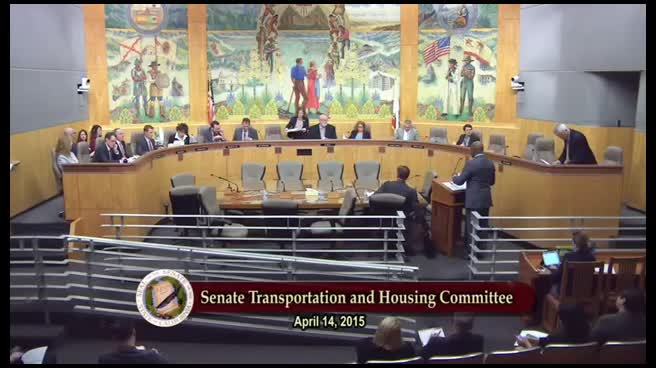 4MIN
Senate Standing Committee on Transportation and Housing
Bill Author

Bill Co-Author(s):