SB 873: Revised Uniform Fiduciary Access to Digital Assets Act.
- Session Year: 2015-2016
- House: Senate
- Latest Version Date: 2016-09-24
Existing law provides for the disposition of a testators property by will. Existing law also provides for the disposition of that portion of a decedents estate not disposed of by will. Existing law provides that the decedents property, including property devised by a will, is generally subject to probate administration, except as specified.
AB 691 of the 201516 Regular Session would enact the Revised Uniform Fiduciary Access to Digital Assets Act, which would authorize a decedents personal representative or trustee to access and manage digital assets and electronic communications, as specified. Among other provisions, AB 691 would provide that a custodian of digital assets, and its officers, employees, and agents, are immune from liability for an act or omission done in good faith and in compliance with the act.
This bill would specify that this immunity does not apply in a case of gross negligence or willful or wanton misconduct. The bill would become operative only if AB 691 is enacted prior to the enactment of this bill.
Existing law establishes a low-income housing tax credit program pursuant to which the California Tax Credit Allocation Committee provides procedures and requirements for the allocation of state insurance, income, and corporation tax credit amounts among low-income housing projects based on federal law.
This bill, beginning on or after January 1, 2017, and before January 1, 2020, would allow a taxpayer that is allowed a low-income housing tax credit to elect to sell all or a portion of that credit to one or more unrelated parties, as described, for each taxable year in which the credit is allowed for not less than 80% of the amount of the credit to be sold, and would provide for the one-time resale of that credit, as provided. The bill would require the California Tax Credit Allocation Committee to enter into an agreement with the Franchise Tax Board to pay any costs incurred by the Franchise Tax Board in administering these provisions.
Existing law, in the case of a partnership, requires the allocation of the credits, on or after January 1, 2009, and before January 1, 2016, to partners based upon the partnership agreement, regardless of how the federal low-income housing tax credit, as provided, is allocated to the partners, or whether the allocation of the credit under the terms of the agreement has substantial economic effect, as specified.
This bill would extend the January 1, 2016, date to January 1, 2020.
This bill would take effect immediately as a tax levy.
Existing law establishes a low-income housing tax credit program pursuant to which the California Tax Credit Allocation Committee provides procedures and requirements for the allocation of state insurance, income, and corporation tax credit amounts among low-income housing projects based on federal law.
This bill, beginning on or after January 1, 2016, 2017, and before January 1, 2020, would allow a taxpayer that is allowed a low-income housing tax credit to elect to sell all or a portion of that credit to one or more unrelated parties, as described, for each taxable year in which the credit is allowed for not less than 80% of the amount of the credit to be sold, and would provide for the one-time resale of that credit, as provided. The bill would require the California Tax Credit Allocation Committee to enter into an agreement with the Franchise Tax Board to pay any costs incurred by the Franchise Tax Board in administering these provisions.
Existing law, in the case of a partnership, requires the allocation of the credits, on or after January 1, 2009, and before January 1, 2016, to partners based upon the partnership agreement, regardless of how the federal low-income housing tax credit, as provided, is allocated to the partners, or whether the allocation of the credit under the terms of the agreement has substantial economic effect, as specified.
This bill would eliminate extend the January 1, 2016, date. date to January 1, 2020.
This bill would take effect immediately as a tax levy.
Existing law establishes a low-income housing tax credit program pursuant to which the California Tax Credit Allocation Committee provides procedures and requirements for the allocation of state insurance, income, and corporation tax credit amounts among low-income housing projects based on federal law.
This bill, beginning on or after January 1, 2016, would allow a taxpayer that is allowed a low-income housing tax credit to elect to sell all or a portion of that credit to one or more unrelated parties, as described, for each taxable year in which the credit is allowed for not less than 80% of the amount of the credit to be sold, and would provide for the one-time resale of that credit, as provided. The bill would require the California Tax Credit Allocation Committee to enter into an agreement with the Franchise Tax Board to pay any costs incurred by the Franchise Tax Board in administering these provisions.
Existing law, in the case of a partnership, requires the allocation of the credits, on or after January 1, 2009, and before January 1, 2016, to partners based upon the partnership agreement, regardless of how the federal low-income housing tax credit, as provided, is allocated to the partners, or whether the allocation of the credit under the terms of the agreement has substantial economic effect, as specified.
This bill would eliminate the January 1, 2016, date.
This bill would take effect immediately as a tax levy.
It is the intent of the Legislature that this act be enacted subsequent, and as a companion, to Assembly Bill 691 so that if Assembly Bill 691 is chaptered, the version of Section 881 of the Probate Code contained in this act shall replace the version of that same section provided in Assembly Bill 691.
SEC. 2.Section 881 of the Probate Code, as added by Assembly Bill 691 of the 201516 Regular Session, is amended to read:881.(a)Not later than 60 days after receipt of the information required under Sections 876 to 879, inclusive, a custodian shall comply with a request under this part from a fiduciary or designated recipient to disclose digital assets or terminate an account. If the custodian fails to comply with a request, the fiduciary or designated recipient may apply to the court for an order directing compliance.
(b)An order under subdivision (a) directing compliance shall contain a finding that compliance is not in violation of Section 2702 of Title 18 of the United States Code.
(c)A custodian may notify a user that a request for disclosure of digital assets or to terminate an account was made pursuant to this part.
(d)A custodian may deny a request under this part from a fiduciary or designated recipient for disclosure of digital assets or to terminate an account if the custodian is aware of any lawful access to the account following the date of death of the user.
(e)This part does not limit a custodians ability to obtain or to require a fiduciary or designated recipient requesting disclosure or account termination under this part to obtain a court order that makes all of the following findings:
(1)The account belongs to the decedent, principal, or trustee.
(2)There is sufficient consent from the decedent, principal, or settlor to support the requested disclosure.
(3)Any specific factual finding required by any other applicable law in effect at that time, including, but not limited to, a finding that disclosure is not in violation of Section 2702 of Title 18 of the United States Code.
(f)(1)A custodian and its officers, employees, and agents are immune from liability for an act or omission done in good faith and in compliance with this part.
(2)The protections specified in paragraph (1) shall not apply in a case of gross negligence or willful or wanton misconduct of the custodian or its officers, employees, or agents.
SEC. 3.This act shall become operative only if Assembly Bill 691 is also enacted and this act is enacted after Assembly Bill 691.
It is the intent of the Legislature that this act be enacted subsequent, and as a companion, to Assembly Bill 691 so that if Assembly Bill 691 is chaptered, the version of Section 881 of the Probate Code contained in this act shall replace the version of that same section provided in Assembly Bill 691.
SECTION 1.SEC. 2.Section 881 of the Probate Code, as added by Assembly Bill 691 of the 201516 Regular Session, is amended to read:881.(a)Not later than 60 days after receipt of the information required under Sections 876 to 879, inclusive, a custodian shall comply with a request under this part from a fiduciary or designated recipient to disclose digital assets or terminate an account. If the custodian fails to comply with a request, the fiduciary or designated recipient may apply to the court for an order directing compliance.
(b)An order under subdivision (a) directing compliance shall contain a finding that compliance is not in violation of Section 2702 of Title 18 of the United States Code.
(c)A custodian may notify a user that a request for disclosure of digital assets or to terminate an account was made pursuant to this part.
(d)A custodian may deny a request under this part from a fiduciary or designated recipient for disclosure of digital assets or to terminate an account if the custodian is aware of any lawful access to the account following the date of death of the user.
(e)This part does not limit a custodians ability to obtain or to require a fiduciary or designated recipient requesting disclosure or account termination under this part to obtain a court order that makes all of the following findings:
(1)The account belongs to the decedent, principal, or trustee.
(2)There is sufficient consent from the decedent, principal, or settlor to support the requested disclosure.
(3)Any specific factual finding required by any other applicable law in effect at that time, including, but not limited to, a finding that disclosure is not in violation of Section 2702 of Title 18 of the United States Code.
(f)(1)A custodian and its officers, employees, and agents are immune from liability for an act or omission done in good faith and in compliance with this part.
(2)The protections specified in paragraph (1) shall not apply in a case of gross negligence or willful or wanton misconduct of the custodian or its officers, employees, or agents under this part. agents.
SEC. 2.SEC. 3.This act shall become operative only if Assembly Bill 691 is also enacted and this act is enacted after Assembly Bill 691.
(a)Not later than 60 days after receipt of the information required under Sections 876 to 879, inclusive, a custodian shall comply with a request under this part from a fiduciary or designated recipient to disclose digital assets or terminate an account. If the custodian fails to comply with a request, the fiduciary or designated recipient may apply to the court for an order directing compliance.
(b)An order under subdivision (a) directing compliance shall contain a finding that compliance is not in violation of Section 2702 of Title 18 of the United States Code.
(c)A custodian may notify a user that a request for disclosure of digital assets or to terminate an account was made pursuant to this part.
(d)A custodian may deny a request under this part from a fiduciary or designated recipient for disclosure of digital assets or to terminate an account if the custodian is aware of any lawful access to the account following the date of death of the user.
(e)This part does not limit a custodians ability to obtain or to require a fiduciary or designated recipient requesting disclosure or account termination under this part to obtain a court order that makes all of the following findings:
(1)The account belongs to the decedent, principal, or trustee.
(2)There is sufficient consent from the decedent, principal, or settlor to support the requested disclosure.
(3)Any specific factual finding required by any other applicable law in effect at that time, including, but not limited to, a finding that disclosure is not in violation of Section 2702 of Title 18 of the United States Code.
(f)(1)A custodian and its officers, employees, and agents are immune from liability for an act or omission done in good faith in compliance with this part.
(2)The protections specified in paragraph (1) shall not apply in a case of gross negligence or willful or wanton misconduct of the custodian or its officers, employees, or agents under this part.
SEC. 2.This act shall become operative only if Assembly Bill 691 is also enacted and this act is enacted after Assembly Bill 691.
SECTION 1.Section 12206 of the Revenue and Taxation Code is amended to read:12206.(a)(1)There shall be allowed as a credit against the tax, described by Section 12201, a state low-income housing tax credit in an amount equal to the amount determined in subdivision (c), computed in accordance with Section 42 of the Internal Revenue Code, relating to low-income housing credit, except as otherwise provided in this section.
(2)Taxpayer, for purposes of this section, means the sole owner in the case of a C corporation, the partners in the case of a partnership, and the shareholders in the case of an S corporation.
(3)Housing sponsor, for purposes of this section, means the sole owner in the case of a C corporation, the partnership in the case of a partnership, and the S corporation in the case of an S corporation.
(b)(1)The amount of the credit allocated to any housing sponsor shall be authorized by the California Tax Credit Allocation Committee, or any successor thereof, based on a projects need for the credit for economic feasibility in accordance with the requirements of this section.
(A)Except for projects to provide farmworker housing, as defined in subdivision (h) of Section 50199.7 of the Health and Safety Code, that are allocated credits solely under the set-aside described in subdivision (c) of Section 50199.20 of the Health and Safety Code, the low-income housing project shall be located in California and shall meet either of the following requirements:
(i)The projects housing sponsor has been allocated by the California Tax Credit Allocation Committee a credit for federal income tax purposes under Section 42 of the Internal Revenue Code, relating to low-income housing credit.
(ii)It qualifies for a credit under Section 42(h)(4)(B) of the Internal Revenue Code, relating to special rule where 50 percent or more of building is financed with tax-exempt bonds subject to volume cap.
(B)The California Tax Credit Allocation Committee shall not require fees for the credit under this section in addition to those fees required for applications for the tax credit pursuant to Section 42 of the Internal Revenue Code, relating to low-income housing credit. The committee may require a fee if the application for the credit under this section is submitted in a calendar year after the year the application is submitted for the federal tax credit.
(C)(i)For a project that receives a preliminary reservation of the state low-income housing tax credit, allowed pursuant to subdivision (a), on or after January 1, 2009, and before January 1, 2020, including preliminary reservations received in 2016, the credit shall be allocated to the partners of a partnership owning the project in accordance with the partnership agreement, regardless of how the federal low-income housing tax credit with respect to the project is allocated to the partners, or whether the allocation of the credit under the terms of the agreement has substantial economic effect, within the meaning of Section 704(b) of the Internal Revenue Code, relating to determination of distributive share.
(ii)This subparagraph does not apply to a project that receives a preliminary reservation of state low-income housing tax credits under the set-aside described in subdivision (c) of Section 50199.20 of the Health and Safety Code unless the project also receives a preliminary reservation of federal low-income housing tax credits.
(2)(A)The California Tax Credit Allocation Committee shall certify to the housing sponsor the amount of tax credit under this section allocated to the housing sponsor for each credit period.
(B)In the case of a partnership or an S corporation, the housing sponsor shall provide a copy of the California Tax Credit Allocation Committee certification to the taxpayer.
(C)The taxpayer shall attach a copy of the certification to any return upon which a tax credit is claimed under this section.
(D)In the case of a failure to attach a copy of the certification for the year to the return in which a tax credit is claimed under this section, no credit under this section shall be allowed for that year until a copy of that certification is provided.
(E)All elections made by the taxpayer pursuant to Section 42 of the Internal Revenue Code, relating to low-income housing credit, shall apply to this section.
(F)(i)Except as described in clause (ii), for buildings located in designated difficult development areas (DDAs) or qualified census tracts (QCTs), as defined in Section 42(d)(5)(B) of the Internal Revenue Code, relating to increase in credit for buildings in high-cost areas, credits may be allocated under this section in the amounts prescribed in subdivision (c), provided that the amount of credit allocated under Section 42 of the Internal Revenue Code, relating to low-income housing credit, is computed on 100 percent of the qualified basis of the building.
(ii)Notwithstanding clause (i), the California Tax Credit Allocation Committee may allocate the credit for buildings located in DDAs or QCTs that are restricted to having 50 percent of its occupants be special needs households, as defined in the California Code of Regulations by the California Tax Credit Allocation Committee, even if the taxpayer receives federal credits pursuant to Section 42(d)(5)(B) of the Internal Revenue Code, relating to increase in credit for buildings in high-cost areas, provided that the credit allowed under this section shall not exceed 30 percent of the eligible basis of the building.
(G)(i)The California Tax Credit Allocation Committee may allocate a credit under this section in exchange for a credit allocated pursuant to Section 42(d)(5)(B) of the Internal Revenue Code, relating to increase in credit for buildings in high-cost areas, in amounts up to 30 percent of the eligible basis of a building if the credits allowed under Section 42 of the Internal Revenue Code, relating to low-income housing credit, are reduced by an equivalent amount.
(ii)An equivalent amount shall be determined by the California Tax Credit Allocation Committee based upon the relative amount required to produce an equivalent state tax credit to the taxpayer.
(c)Section 42(b) of the Internal Revenue Code, relating to applicable percentage, shall be modified as follows:
(1)In the case of any qualified low-income building that receives an allocation after 1989 and is a new building not federally subsidized, the term applicable percentage means the following:
(A)For each of the first three years, the percentage prescribed by the Secretary of the Treasury for new buildings that are not federally subsidized for the taxable year, determined in accordance with the requirements of Section 42(b)(2) of the Internal Revenue Code, relating to temporary minimum credit rate for nonfederally subsidized new buildings, in lieu of the percentage prescribed in Section 42(b)(1)(A) of the Internal Revenue Code.
(B)For the fourth year, the difference between 30 percent and the sum of the applicable percentages for the first three years.
(2)In the case of any qualified low-income building that receives an allocation after 1989 and that is a new building that is federally subsidized or that is an existing building that is at risk of conversion, the term applicable percentage means the following:
(A)For each of the first three years, the percentage prescribed by the Secretary of the Treasury for new buildings that are federally subsidized for the taxable year.
(B)For the fourth year, the difference between 13 percent and the sum of the applicable percentages for the first three years.
(3)For purposes of this section, the term at risk of conversion, with respect to an existing property means a property that satisfies all of the following criteria:
(A)The property is a multifamily rental housing development in which at least 50 percent of the units receive governmental assistance pursuant to any of the following:
(i)New construction, substantial rehabilitation, moderate rehabilitation, property disposition, and loan management set-aside programs, or any other program providing project-based assistance pursuant to Section 8 of the United States Housing Act of 1937, Section 1437f of Title 42 of the United States Code, as amended.
(ii)The Below-Market-Interest-Rate Program pursuant to Section 221(d)(3) of the National Housing Act, Sections 1715l(d)(3) and (5) of Title 12 of the United States Code.
(iii)Section 236 of the National Housing Act, Section 1715z-1 of Title 12 of the United States Code.
(iv)Programs for rent supplement assistance pursuant to Section 101 of the Housing and Urban Development Act of 1965, Section 1701s of Title 12 of the United States Code, as amended.
(v)Programs pursuant to Section 515 of the Housing Act of 1949, Section 1485 of Title 42 of the United States Code, as amended.
(vi)The low-income housing credit program set forth in Section 42 of the Internal Revenue Code, relating to low-income housing credit.
(B)The restrictions on rent and income levels will terminate or the federally insured mortgage on the property is eligible for prepayment any time within five years before or after the date of application to the California Tax Credit Allocation Committee.
(C)The entity acquiring the property enters into a regulatory agreement that requires the property to be operated in accordance with the requirements of this section for a period equal to the greater of 55 years or the life of the property.
(D)The property satisfies the requirements of Section 42(e) of the Internal Revenue Code, relating to rehabilitation expenditures treated as a separate new building, except that the provisions of Section 42(e)(3)(A)(ii)(I) shall not apply.
(d)The term qualified low-income housing project as defined in Section 42(c)(2) of the Internal Revenue Code, relating to qualified low-income building, is modified by adding the following requirements:
(1)The taxpayer shall be entitled to receive a cash distribution from the operations of the project, after funding required reserves, that, at the election of the taxpayer, is equal to:
(A)An amount not to exceed 8 percent of the lesser of:
(i)The owner equity, which shall include the amount of the capital contributions actually paid to the housing sponsor and shall not include any amounts until they are paid on an investor note.
(ii)Twenty percent of the adjusted basis of the building as of the close of the first taxable year of the credit period.
(B)The amount of the cashflow from those units in the building that are not low-income units. For purposes of computing cashflow under this subparagraph, operating costs shall be allocated to the low-income units using the floor space fraction, as defined in Section 42 of the Internal Revenue Code, relating to low-income housing credit.
(C)Any amount allowed to be distributed under subparagraph (A) that is not available for distribution during the first five years of the compliance period may be accumulated and distributed any time during the first 15 years of the compliance period but not thereafter.
(2)The limitation on return applies in the aggregate to the partners if the housing sponsor is a partnership and in the aggregate to the shareholders if the housing sponsor is an S corporation.
(3)The housing sponsor shall apply any cash available for distribution in excess of the amount eligible to be distributed under paragraph (1) to reduce the rent on rent-restricted units or to increase the number of rent-restricted units subject to the tests of Section 42(g)(1) of the Internal Revenue Code, relating to in general.
(e)The provisions of Section 42(f) of the Internal Revenue Code, relating to definition and special rules relating to credit period, shall be modified as follows:
(1)The term credit period as defined in Section 42(f)(1) of the Internal Revenue Code, relating to credit period defined, is modified by substituting four taxable years for 10 taxable years.
(2)The special rule for the first taxable year of the credit period under Section 42(f)(2) of the Internal Revenue Code, relating to special rule for first year of credit period, shall not apply to the tax credit under this section.
(3)Section 42(f)(3) of the Internal Revenue Code, relating to determination of applicable percentage with respect to increases in qualified basis after first year of credit period, is modified to read:
If, as of the close of any taxable year in the compliance period, after the first year of the credit period, the qualified basis of any building exceeds the qualified basis of that building as of the close of the first year of the credit period, the housing sponsor, to the extent of its tax credit allocation, shall be eligible for a credit on the excess in an amount equal to the applicable percentage determined pursuant to subdivision (c) for the four-year period beginning with the later of the taxable years in which the increase in qualified basis occurs.
(f)The provisions of Section 42(h) of the Internal Revenue Code, relating to limitation on aggregate credit allowable with respect to projects located in a state, shall be modified as follows:
(1)Section 42(h)(2) of the Internal Revenue Code, relating to allocated credit amount to apply to all taxable years ending during or after credit allocation year, does not apply and instead the following provisions apply:
The total amount for the four-year credit period of the housing credit dollars allocated in a calendar year to any building shall reduce the aggregate housing credit dollar amount of the California Tax Credit Allocation Committee for the calendar year in which the allocation is made.
(2)Paragraphs (3), (4), (5), (6)(E)(i)(II), (6)(F), (6)(G), (6)(I), (7), and (8) of Section 42(h) of the Internal Revenue Code, relating to limitation on aggregate credit allowable with respect to projects located in a state, do not apply to this section.
(g)The aggregate housing credit dollar amount that may be allocated annually by the California Tax Credit Allocation Committee pursuant to this section, Section 17058, and Section 23610.5 shall be an amount equal to the sum of all the following:
(1)Seventy million dollars ($70,000,000) for the 2001 calendar year, and, for the 2002 calendar year and each calendar year thereafter, seventy million dollars ($70,000,000) increased by the percentage, if any, by which the Consumer Price Index for the preceding calendar year exceeds the Consumer Price Index for the 2001 calendar year. For the purposes of this paragraph, the term Consumer Price Index means the last Consumer Price Index for All Urban Consumers published by the federal Department of Labor.
(2)The unused housing credit ceiling, if any, for the preceding calendar years.
(3)The amount of housing credit ceiling returned in the calendar year. For purposes of this paragraph, the amount of housing credit dollar amount returned in the calendar year equals the housing credit dollar amount previously allocated to any project that does not become a qualified low-income housing project within the period required by this section or to any project with respect to which an allocation is canceled by mutual consent of the California Tax Credit Allocation Committee and the allocation recipient.
(4)Five hundred thousand dollars ($500,000) per calendar year for projects to provide farmworker housing, as defined in subdivision (h) of Section 50199.7 of the Health and Safety Code.
(5)The amount of any unallocated or returned credits under former Sections 17053.14, 23608.2, and 23608.3, as those sections read prior to January 1, 2009, until fully exhausted for projects to provide farmworker housing, as defined in subdivision (h) of Section 50199.7 of the Health and Safety Code.
(h)The term compliance period as defined in Section 42(i)(1) of the Internal Revenue Code, relating to compliance period, is modified to mean, with respect to any building, the period of 30 consecutive taxable years beginning with the first taxable year of the credit period with respect thereto.
(i)(1)Section 42(j) of the Internal Revenue Code, relating to recapture of credit, shall not be applicable and the provisions in paragraph (2) shall be substituted in its place.
(2)The requirements of this section shall be set forth in a regulatory agreement between the California Tax Credit Allocation Committee and the housing sponsor, and this agreement shall be subordinated, when required, to any lien or encumbrance of any banks or other institutional lenders to the project. The regulatory agreement entered into pursuant to subdivision (f) of Section 50199.14 of the Health and Safety Code, shall apply, provided that the agreement includes all of the following provisions:
(A)A term not less than the compliance period.
(B)A requirement that the agreement be recorded in the official records of the county in which the qualified low-income housing project is located.
(C)A provision stating which state and local agencies can enforce the regulatory agreement in the event the housing sponsor fails to satisfy any of the requirements of this section.
(D)A provision that the regulatory agreement shall be deemed a contract enforceable by tenants as third-party beneficiaries thereto and that allows individuals, whether prospective, present, or former occupants of the building, who meet the income limitation applicable to the building, the right to enforce the regulatory agreement in any state court.
(E)A provision incorporating the requirements of Section 42 of the Internal Revenue Code, relating to low-income housing credit, as modified by this section.
(F)A requirement that the housing sponsor notify the California Tax Credit Allocation Committee or its designee and the local agency that can enforce the regulatory agreement if there is a determination by the Internal Revenue Service that the project is not in compliance with Section 42(g) of the Internal Revenue Code, relating to qualified low-income housing project.
(G)A requirement that the housing sponsor, as security for the performance of the housing sponsors obligations under the regulatory agreement, assign the housing sponsors interest in rents that it receives from the project, provided that until there is a default under the regulatory agreement, the housing sponsor is entitled to collect and retain the rents.
(H)A provision that the remedies available in the event of a default under the regulatory agreement that is not cured within a reasonable cure period include, but are not limited to, allowing any of the parties designated to enforce the regulatory agreement to collect all rents with respect to the project; taking possession of the project and operating the project in accordance with the regulatory agreement until the enforcer determines the housing sponsor is in a position to operate the project in accordance with the regulatory agreement; applying to any court for specific performance; securing the appointment of a receiver to operate the project; or any other relief as may be appropriate.
(j)(1)The committee shall allocate the housing credit on a regular basis consisting of two or more periods in each calendar year during which applications may be filed and considered. The committee shall establish application filing deadlines, the maximum percentage of federal and state low-income housing tax credit ceiling that may be allocated by the committee in that period, and the approximate date on which allocations shall be made. If the enactment of federal or state law, the adoption of rules or regulations, or other similar events prevent the use of two allocation periods, the committee may reduce the number of periods and adjust the filing deadlines, maximum percentage of credit allocated, and the allocation dates.
(2)The committee shall adopt a qualified allocation plan, as provided in Section 42(m)(1) of the Internal Revenue Code, relating to plans for allocation of credit among projects. In adopting this plan, the committee shall comply with the provisions of Sections 42(m)(1)(B) and 42(m)(1)(C) of the Internal Revenue Code, relating to qualified allocation plan and relating to certain selection criteria must be used, respectively.
(3)Notwithstanding Section 42(m) of the Internal Revenue Code, relating to responsibilities of housing credit agencies, the California Tax Credit Allocation Committee shall allocate housing credits in accordance with the qualified allocation plan and regulations, which shall include the following provisions:
(A)All housing sponsors, as defined by paragraph (3) of subdivision (a), shall demonstrate at the time the application is filed with the committee that the project meets the following threshold requirements:
(i)The housing sponsor shall demonstrate that there is a need and demand for low-income housing in the community or region for which it is proposed.
(ii)The projects proposed financing, including tax credit proceeds, shall be sufficient to complete the project and that the proposed operating income shall be adequate to operate the project for the extended use period.
(iii)The project shall have enforceable financing commitments, either construction or permanent financing, for at least 50 percent of the total estimated financing of the project.
(iv)The housing sponsor shall have and maintain control of the site for the project.
(v)The housing sponsor shall demonstrate that the project complies with all applicable local land use and zoning ordinances.
(vi)The housing sponsor shall demonstrate that the project development team has the experience and the financial capacity to ensure project completion and operation for the extended use period.
(vii)The housing sponsor shall demonstrate the amount of tax credit that is necessary for the financial feasibility of the project and its viability as a qualified low-income housing project throughout the extended use period, taking into account operating expenses, a supportable debt service, reserves, funds set aside for rental subsidies and required equity, and a development fee that does not exceed a specified percentage of the eligible basis of the project prior to inclusion of the development fee in the eligible basis, as determined by the committee.
(B)The committee shall give a preference to those projects satisfying all of the threshold requirements of subparagraph (A) if both of the following apply:
(i)The project serves the lowest income tenants at rents affordable to those tenants.
(ii)The project is obligated to serve qualified tenants for the longest period.
(C)In addition to the provisions of subparagraphs (A) and (B), the committee shall use the following criteria in allocating housing credits:
(i)Projects serving large families in which a substantial number, as defined by the committee, of all residential units are low-income units with three and more bedrooms.
(ii)Projects providing single-room occupancy units serving very low income tenants.
(iii)Existing projects that are at risk of conversion, as defined by paragraph (3) of subdivision (c).
(iv)Projects for which a public agency provides direct or indirect long-term financial support for at least 15 percent of the total project development costs or projects for which the owners equity constitutes at least 30 percent of the total project development costs.
(v)Projects that provide tenant amenities not generally available to residents of low-income housing projects.
(4)For purposes of allocating credits pursuant to this section, the committee shall not give preference to any project by virtue of the date of submission of its application except to break a tie when two or more of the projects have an equal rating.
(k)Section 42(l) of the Internal Revenue Code, relating to certifications and other reports to secretary, shall be modified as follows:
The term secretary shall be replaced by the term Franchise Tax Board.
(l)In the case in which the credit allowed under this section exceeds the tax, the excess may be carried over to reduce the tax in the following year, and succeeding years if necessary, until the credit has been exhausted.
(m)The provisions of Section 11407(a) of Public Law 101-508, relating to the effective date of the extension of the low-income housing credit, apply to calendar years after 1993.
(n)The provisions of Section 11407(c) of Public Law 101-508, relating to election to accelerate credit, do not apply.
(o)(1)For a project that receives a preliminary reservation under this section beginning on or after January 1, 2017, and before January 1, 2020, a taxpayer may make an irrevocable election in its application to the California Tax Credit Allocation Committee to sell all or any portion of any credit allowed under this section to one or more unrelated parties for each taxable year in which the credit is allowed subject to both of the following conditions:
(A)The credit is sold for consideration that is not less than 80 percent of the amount of the credit.
(B)The unrelated party or parties purchasing any or all of the credit pursuant to this subdivision is a taxpayer allowed the credit under this section for the taxable year of the purchase or any prior taxable year or is a taxpayer allowed the federal credit under Section 42 of the Internal Revenue Code, relating to low-income housing credit, for the taxable year of the purchase or any prior taxable year in connection with any project located in this state. For purposes of this subparagraph, taxpayer allowed the credit under this section means a taxpayer that is allowed the credit under this section without regard to the purchase of a credit pursuant to this subdivision.
(2)(A)The taxpayer that originally received the credit shall report to the California Tax Credit Allocation Committee within 10 days of the sale of the credit, in the form and manner specified by the California Tax Credit Allocation Committee, all required information regarding the purchase and sale of the credit, including the social security or other taxpayer identification number of the unrelated party or parties to whom the credit has been sold, the face amount of the credit sold, and the amount of consideration received by the taxpayer for the sale of the credit.
(B)The California Tax Credit Allocation Committee shall provide an annual listing to the Franchise Tax Board, in a form and manner agreed upon by the California Tax Credit Allocation Committee and the Franchise Tax Board, of the taxpayers that have sold or purchased a credit pursuant to this subdivision.
(3)(A)A credit may be sold pursuant to this subdivision to more than one unrelated party.
(B)(i)Except as provided in clause (ii), a credit shall not be resold by the unrelated party to another taxpayer or other party.
(ii)All or any portion of any credit allowed under this section may be resold once by an original purchaser to one or more unrelated parties, subject to all of the requirements of this subdivision.
(4)Notwithstanding any other provision of law, the taxpayer that originally received the credit that is sold pursuant to paragraph (1) shall remain solely liable for all obligations and liabilities imposed on the taxpayer by this section with respect to the credit, none of which shall apply to any party to whom the credit has been sold or subsequently transferred. Parties who purchase credits pursuant to paragraph (1) shall be entitled to utilize the purchased credits in the same manner in which the taxpayer that originally received the credit could utilize them.
(5)A taxpayer shall not sell a credit allowed by this section if the taxpayer was allowed the credit on any tax return of the taxpayer.
(6)Notwithstanding paragraph (1), the taxpayer, with the approval of the Executive Director of the California Tax Credit Allocation Committee, may rescind the election to sell all or any portion of the credit allowed under this section if the consideration for the credit falls below 80 percent of the amount of the credit after the California Tax Credit Allocation Committee reservation.
(p)The California Tax Credit Allocation Committee may prescribe rules, guidelines, or procedures necessary or appropriate to carry out the purposes of this section, including any guidelines regarding the allocation of the credit allowed under this section. Chapter 3.5 (commencing with Section 11340) of Part 1 of Division 3 of Title 2 of the Government Code shall not apply to any rule, guideline, or procedure prescribed by the California Tax Credit Allocation Committee pursuant to this section.
(q)This section shall remain in effect for as long as Section 42 of the Internal Revenue Code, relating to low-income housing credit, remains in effect.
SEC. 2.Section 17058 of the Revenue and Taxation Code is amended to read:17058.(a)(1)There shall be allowed as a credit against the net tax, defined in Section 17039, a state low-income housing tax credit in an amount equal to the amount determined in subdivision (c), computed in accordance with Section 42 of the Internal Revenue Code, relating to low-income housing credit, except as otherwise provided in this section.
(2)Taxpayer, for purposes of this section, means the sole owner in the case of an individual, the partners in the case of a partnership, and the shareholders in the case of an S corporation.
(3)Housing sponsor, for purposes of this section, means the sole owner in the case of an individual, the partnership in the case of a partnership, and the S corporation in the case of an S corporation.
(b)(1)The amount of the credit allocated to any housing sponsor shall be authorized by the California Tax Credit Allocation Committee, or any successor thereof, based on a projects need for the credit for economic feasibility in accordance with the requirements of this section.
(A)The low-income housing project shall be located in California and shall meet either of the following requirements:
(i)Except for projects to provide farmworker housing, as defined in subdivision (h) of Section 50199.7 of the Health and Safety Code, that are allocated credits solely under the set-aside described in subdivision (c) of Section 50199.20 of the Health and Safety Code, the projects housing sponsor has been allocated by the California Tax Credit Allocation Committee a credit for federal income tax purposes under Section 42 of the Internal Revenue Code, relating to low-income housing credit.
(ii)It qualifies for a credit under Section 42(h)(4)(B) of the Internal Revenue Code, relating to special rule where 50 percent or more of building is financed with tax-exempt bonds subject to volume cap.
(B)The California Tax Credit Allocation Committee shall not require fees for the credit under this section in addition to those fees required for applications for the tax credit pursuant to Section 42 of the Internal Revenue Code, relating to low-income housing credit. The committee may require a fee if the application for the credit under this section is submitted in a calendar year after the year the application is submitted for the federal tax credit.
(C)(i)For a project that receives a preliminary reservation of the state low-income housing tax credit, allowed pursuant to subdivision (a), on or after January 1, 2009, and before January 1, 2020, including preliminary reservations received in 2016, the credit shall be allocated to the partners of a partnership owning the project in accordance with the partnership agreement, regardless of how the federal low-income housing tax credit with respect to the project is allocated to the partners, or whether the allocation of the credit under the terms of the agreement has substantial economic effect, within the meaning of Section 704(b) of the Internal Revenue Code, relating to determination of distributive share.
(ii)To the extent the allocation of the credit to a partner under this section lacks substantial economic effect, any loss or deduction otherwise allowable under this part that is attributable to the sale or other disposition of that partners partnership interest made prior to the expiration of the federal credit shall not be allowed in the taxable year in which the sale or other disposition occurs, but shall instead be deferred until and treated as if it occurred in the first taxable year immediately following the taxable year in which the federal credit period expires for the project described in clause (i).
(iii)This subparagraph does not apply to a project that receives a preliminary reservation of state low-income housing tax credits under the set-aside described in subdivision (c) of Section 50199.20 of the Health and Safety Code unless the project also receives a preliminary reservation of federal low-income housing tax credits.
(2)(A)The California Tax Credit Allocation Committee shall certify to the housing sponsor the amount of tax credit under this section allocated to the housing sponsor for each credit period.
(B)In the case of a partnership or an S corporation, the housing sponsor shall provide a copy of the California Tax Credit Allocation Committee certification to the taxpayer.
(C)The taxpayer shall, upon request, provide a copy of the certification to the Franchise Tax Board.
(D)All elections made by the taxpayer pursuant to Section 42 of the Internal Revenue Code, relating to low-income housing credit, apply to this section.
(E)(i)Except as described in clause (ii), for buildings located in designated difficult development areas (DDAs) or qualified census tracts (QCTs), as defined in Section 42(d)(5)(B) of the Internal Revenue Code, relating to increase in credit for buildings in high-cost areas, credits may be allocated under this section in the amounts prescribed in subdivision (c), provided that the amount of credit allocated under Section 42 of the Internal Revenue Code, relating to low-income housing credit, is computed on 100 percent of the qualified basis of the building.
(ii)Notwithstanding clause (i), the California Tax Credit Allocation Committee may allocate the credit for buildings located in DDAs or QCTs that are restricted to having 50 percent of its occupants be special needs households, as defined in the California Code of Regulations by the California Tax Credit Allocation Committee, even if the taxpayer receives federal credits pursuant to Section 42(d)(5)(B) of the Internal Revenue Code, relating to increase in credit for buildings in high-cost areas, provided that the credit allowed under this section shall not exceed 30 percent of the eligible basis of the building.
(F)(i)The California Tax Credit Allocation Committee may allocate a credit under this section in exchange for a credit allocated pursuant to Section 42(d)(5)(B) of the Internal Revenue Code, relating to increase in credit for buildings in high-cost areas, in amounts up to 30 percent of the eligible basis of a building if the credits allowed under Section 42 of the Internal Revenue Code, relating to low-income housing credit, are reduced by an equivalent amount.
(ii)An equivalent amount shall be determined by the California Tax Credit Allocation Committee based upon the relative amount required to produce an equivalent state tax credit to the taxpayer.
(c)Section 42(b) of the Internal Revenue Code, relating to applicable percentage, shall be modified as follows:
(1)In the case of any qualified low-income building placed in service by the housing sponsor during 1987, the term applicable percentage means 9 percent for each of the first three years and 3 percent for the fourth year for new buildings (whether or not the building is federally subsidized) and for existing buildings.
(2)In the case of any qualified low-income building that receives an allocation after 1989 and is a new building not federally subsidized, the term applicable percentage means the following:
(A)For each of the first three years, the percentage prescribed by the Secretary of the Treasury for new buildings that are not federally subsidized for the taxable year, determined in accordance with the requirements of Section 42(b)(2) of the Internal Revenue Code, relating to temporary minimum credit rate for nonfederally subsidized new buildings, in lieu of the percentage prescribed in Section 42(b)(1)(A) of the Internal Revenue Code.
(B)For the fourth year, the difference between 30 percent and the sum of the applicable percentages for the first three years.
(3)In the case of any qualified low-income building that receives an allocation after 1989 and that is a new building that is federally subsidized or that is an existing building that is at risk of conversion, the term applicable percentage means the following:
(A)For each of the first three years, the percentage prescribed by the Secretary of the Treasury for new buildings that are federally subsidized for the taxable year.
(B)For the fourth year, the difference between 13 percent and the sum of the applicable percentages for the first three years.
(4)For purposes of this section, the term at risk of conversion, with respect to an existing property means a property that satisfies all of the following criteria:
(A)The property is a multifamily rental housing development in which at least 50 percent of the units receive governmental assistance pursuant to any of the following:
(i)New construction, substantial rehabilitation, moderate rehabilitation, property disposition, and loan management set-aside programs, or any other program providing project-based assistance pursuant to Section 8 of the United States Housing Act of 1937, Section 1437f of Title 42 of the United States Code, as amended.
(ii)The Below-Market-Interest-Rate Program pursuant to Section 221(d)(3) of the National Housing Act, Sections 1715l(d)(3) and (5) of Title 12 of the United States Code.
(iii)Section 236 of the National Housing Act, Section 1715z-1 of Title 12 of the United States Code.
(iv)Programs for rent supplement assistance pursuant to Section 101 of the Housing and Urban Development Act of 1965, Section 1701s of Title 12 of the United States Code, as amended.
(v)Programs pursuant to Section 515 of the Housing Act of 1949, Section 1485 of Title 42 of the United States Code, as amended.
(vi)The low-income housing credit program set forth in Section 42 of the Internal Revenue Code, relating to low-income housing credit.
(B)The restrictions on rent and income levels will terminate or the federally insured mortgage on the property is eligible for prepayment any time within five years before or after the date of application to the California Tax Credit Allocation Committee.
(C)The entity acquiring the property enters into a regulatory agreement that requires the property to be operated in accordance with the requirements of this section for a period equal to the greater of 55 years or the life of the property.
(D)The property satisfies the requirements of Section 42(e) of the Internal Revenue Code, relating to rehabilitation expenditures treated as a separate new building, except that the provisions of Section 42(e)(3)(A)(ii)(I) shall not apply.
(d)The term qualified low-income housing project as defined in Section 42(c)(2) of the Internal Revenue Code, relating to qualified low-income building, is modified by adding the following requirements:
(1)The taxpayer shall be entitled to receive a cash distribution from the operations of the project, after funding required reserves, that, at the election of the taxpayer, is equal to:
(A)An amount not to exceed 8 percent of the lesser of:
(i)The owner equity, which shall include the amount of the capital contributions actually paid to the housing sponsor and shall not include any amounts until they are paid on an investor note.
(ii)Twenty percent of the adjusted basis of the building as of the close of the first taxable year of the credit period.
(B)The amount of the cashflow from those units in the building that are not low-income units. For purposes of computing cashflow under this subparagraph, operating costs shall be allocated to the low-income units using the floor space fraction, as defined in Section 42 of the Internal Revenue Code, relating to low-income housing credit.
(C)Any amount allowed to be distributed under subparagraph (A) that is not available for distribution during the first five years of the compliance period may be accumulated and distributed any time during the first 15 years of the compliance period but not thereafter.
(2)The limitation on return applies in the aggregate to the partners if the housing sponsor is a partnership and in the aggregate to the shareholders if the housing sponsor is an S corporation.
(3)The housing sponsor shall apply any cash available for distribution in excess of the amount eligible to be distributed under paragraph (1) to reduce the rent on rent-restricted units or to increase the number of rent-restricted units subject to the tests of Section 42(g)(1) of the Internal Revenue Code, relating to in general.
(e)The provisions of Section 42(f) of the Internal Revenue Code, relating to definition and special rules relating to credit period, shall be modified as follows:
(1)The term credit period as defined in Section 42(f)(1) of the Internal Revenue Code, relating to credit period defined, is modified by substituting four taxable years for 10 taxable years.
(2)The special rule for the first taxable year of the credit period under Section 42(f)(2) of the Internal Revenue Code, relating to special rules for first year of credit period, shall not apply to the tax credit under this section.
(3)Section 42(f)(3) of the Internal Revenue Code, relating to determination of applicable percentage with respect to increases in qualified basis after first year of credit period, is modified to read:
If, as of the close of any taxable year in the compliance period, after the first year of the credit period, the qualified basis of any building exceeds the qualified basis of that building as of the close of the first year of the credit period, the housing sponsor, to the extent of its tax credit allocation, shall be eligible for a credit on the excess in an amount equal to the applicable percentage determined pursuant to subdivision (c) for the four-year period beginning with the taxable year in which the increase in qualified basis occurs.
(f)The provisions of Section 42(h) of the Internal Revenue Code, relating to limitation on aggregate credit allowable with respect to projects located in a state, shall be modified as follows:
(1)Section 42(h)(2) of the Internal Revenue Code, relating to allocated credit amount to apply to all taxable years ending during or after credit allocation year, does not apply and instead the following provisions apply:
The total amount for the four-year credit period of the housing credit dollars allocated in a calendar year to any building shall reduce the aggregate housing credit dollar amount of the California Tax Credit Allocation Committee for the calendar year in which the allocation is made.
(2)Paragraphs (3), (4), (5), (6)(E)(i)(II), (6)(F), (6)(G), (6)(I), (7), and (8) of Section 42(h) of the Internal Revenue Code, relating to limitation on aggregate credit allowable with respect to projects located in a state, do not apply to this section.
(g)The aggregate housing credit dollar amount that may be allocated annually by the California Tax Credit Allocation Committee pursuant to this section, Section 12206, and Section 23610.5 shall be an amount equal to the sum of all the following:
(1)Seventy million dollars ($70,000,000) for the 2001 calendar year, and, for the 2002 calendar year and each calendar year thereafter, seventy million dollars ($70,000,000) increased by the percentage, if any, by which the Consumer Price Index for the preceding calendar year exceeds the Consumer Price Index for the 2001 calendar year. For the purposes of this paragraph, the term Consumer Price Index means the last Consumer Price Index for All Urban Consumers published by the federal Department of Labor.
(2)The unused housing credit ceiling, if any, for the preceding calendar years.
(3)The amount of housing credit ceiling returned in the calendar year. For purposes of this paragraph, the amount of housing credit dollar amount returned in the calendar year equals the housing credit dollar amount previously allocated to any project that does not become a qualified low-income housing project within the period required by this section or to any project with respect to which an allocation is canceled by mutual consent of the California Tax Credit Allocation Committee and the allocation recipient.
(4)Five hundred thousand dollars ($500,000) per calendar year for projects to provide farmworker housing, as defined in subdivision (h) of Section 50199.7 of the Health and Safety Code.
(5)The amount of any unallocated or returned credits under former Sections 17053.14, 23608.2, and 23608.3, as those sections read prior to January 1, 2009, until fully exhausted for projects to provide farmworker housing, as defined in subdivision (h) of Section 50199.7 of the Health and Safety Code.
(h)The term compliance period as defined in Section 42(i)(1) of the Internal Revenue Code, relating to compliance period, is modified to mean, with respect to any building, the period of 30 consecutive taxable years beginning with the first taxable year of the credit period with respect thereto.
(i)Section 42(j) of the Internal Revenue Code, relating to recapture of credit, does not apply and the following requirements of this section shall be set forth in a regulatory agreement between the California Tax Credit Allocation Committee and the housing sponsor, and this agreement shall be subordinated, when required, to any lien or encumbrance of any banks or other institutional lenders to the project. The regulatory agreement entered into pursuant to subdivision (f) of Section 50199.14 of the Health and Safety Code shall apply, provided that the agreement includes all of the following provisions:
(1)A term not less than the compliance period.
(2)A requirement that the agreement be recorded in the official records of the county in which the qualified low-income housing project is located.
(3)A provision stating which state and local agencies can enforce the regulatory agreement in the event the housing sponsor fails to satisfy any of the requirements of this section.
(4)A provision that the regulatory agreement shall be deemed a contract enforceable by tenants as third-party beneficiaries thereto and that allows individuals, whether prospective, present, or former occupants of the building, who meet the income limitation applicable to the building, the right to enforce the regulatory agreement in any state court.
(5)A provision incorporating the requirements of Section 42 of the Internal Revenue Code, relating to low-income housing credit, as modified by this section.
(6)A requirement that the housing sponsor notify the California Tax Credit Allocation Committee or its designee if there is a determination by the Internal Revenue Service that the project is not in compliance with Section 42(g) of the Internal Revenue Code, relating to qualified low-income housing project.
(7)A requirement that the housing sponsor, as security for the performance of the housing sponsors obligations under the regulatory agreement, assign the housing sponsors interest in rents that it receives from the project, provided that until there is a default under the regulatory agreement, the housing sponsor is entitled to collect and retain the rents.
(8)A provision that the remedies available in the event of a default under the regulatory agreement that is not cured within a reasonable cure period include, but are not limited to, allowing any of the parties designated to enforce the regulatory agreement to collect all rents with respect to the project; taking possession of the project and operating the project in accordance with the regulatory agreement until the enforcer determines the housing sponsor is in a position to operate the project in accordance with the regulatory agreement; applying to any court for specific performance; securing the appointment of a receiver to operate the project; or any other relief as may be appropriate.
(j)(1)The committee shall allocate the housing credit on a regular basis consisting of two or more periods in each calendar year during which applications may be filed and considered. The committee shall establish application filing deadlines, the maximum percentage of federal and state low-income housing tax credit ceiling that may be allocated by the committee in that period, and the approximate date on which allocations shall be made. If the enactment of federal or state law, the adoption of rules or regulations, or other similar events prevent the use of two allocation periods, the committee may reduce the number of periods and adjust the filing deadlines, maximum percentage of credit allocated, and the allocation dates.
(2)The committee shall adopt a qualified allocation plan, as provided in Section 42(m)(1) of the Internal Revenue Code, relating to plans for allocation of credit among projects. In adopting this plan, the committee shall comply with the provisions of Sections 42(m)(1)(B) and 42(m)(1)(C) of the Internal Revenue Code, relating to qualified allocation plan and relating to certain selection criteria must be used, respectively.
(3)Notwithstanding Section 42(m) of the Internal Revenue Code, relating to responsibilities of housing credit agencies, the California Tax Credit Allocation Committee shall allocate housing credits in accordance with the qualified allocation plan and regulations, which shall include the following provisions:
(A)All housing sponsors, as defined by paragraph (3) of subdivision (a), shall demonstrate at the time the application is filed with the committee that the project meets the following threshold requirements:
(i)The housing sponsor shall demonstrate that there is a need and demand for low-income housing in the community or region for which it is proposed.
(ii)The projects proposed financing, including tax credit proceeds, shall be sufficient to complete the project and that the proposed operating income shall be adequate to operate the project for the extended use period.
(iii)The project shall have enforceable financing commitments, either construction or permanent financing, for at least 50 percent of the total estimated financing of the project.
(iv)The housing sponsor shall have and maintain control of the site for the project.
(v)The housing sponsor shall demonstrate that the project complies with all applicable local land use and zoning ordinances.
(vi)The housing sponsor shall demonstrate that the project development team has the experience and the financial capacity to ensure project completion and operation for the extended use period.
(vii)The housing sponsor shall demonstrate the amount of tax credit that is necessary for the financial feasibility of the project and its viability as a qualified low-income housing project throughout the extended use period, taking into account operating expenses, a supportable debt service, reserves, funds set aside for rental subsidies and required equity, and a development fee that does not exceed a specified percentage of the eligible basis of the project prior to inclusion of the development fee in the eligible basis, as determined by the committee.
(B)The committee shall give a preference to those projects satisfying all of the threshold requirements of subparagraph (A) if both of the following apply:
(i)The project serves the lowest income tenants at rents affordable to those tenants.
(ii)The project is obligated to serve qualified tenants for the longest period.
(C)In addition to the provisions of subparagraphs (A) and (B), the committee shall use the following criteria in allocating housing credits:
(i)Projects serving large families in which a substantial number, as defined by the committee, of all residential units are low-income units with three and more bedrooms.
(ii)Projects providing single-room occupancy units serving very low income tenants.
(iii)Existing projects that are at risk of conversion, as defined by paragraph (4) of subdivision (c).
(iv)Projects for which a public agency provides direct or indirect long-term financial support for at least 15 percent of the total project development costs or projects for which the owners equity constitutes at least 30 percent of the total project development costs.
(v)Projects that provide tenant amenities not generally available to residents of low-income housing projects.
(4)For purposes of allocating credits pursuant to this section, the committee shall not give preference to any project by virtue of the date of submission of its application.
(k)Section 42(l) of the Internal Revenue Code, relating to certifications and other reports to secretary, shall be modified as follows:
The term secretary shall be replaced by the term Franchise Tax Board.
(l)In the case in which the credit allowed under this section exceeds the net tax, the excess may be carried over to reduce the net tax in the following year, and succeeding years, if necessary, until the credit has been exhausted.
(m)A project that received an allocation of a 1989 federal housing credit dollar amount shall be eligible to receive an allocation of a 1990 state housing credit dollar amount, subject to all of the following conditions:
(1)The project was not placed in service prior to 1990.
(2)To the extent the amendments made to this section by the Statutes of 1990 conflict with any provisions existing in this section prior to those amendments, the prior provisions of law shall prevail.
(3)Notwithstanding paragraph (2), a project applying for an allocation under this subdivision is subject to the requirements of paragraph (3) of subdivision (j).
(n)The credit period with respect to an allocation of credit in 1989 by the California Tax Credit Allocation Committee of which any amount is attributable to unallocated credit from 1987 or 1988 shall not begin until after December 31, 1989.
(o)The provisions of Section 11407(a) of Public Law 101-508, relating to the effective date of the extension of the low-income housing credit, apply to calendar years after 1989.
(p)The provisions of Section 11407(c) of Public Law 101-508, relating to election to accelerate credit, do not apply.
(q)(1)For a project that receives a preliminary reservation under this section beginning on or after January 1, 2017, and before January 1, 2020, a taxpayer may make an irrevocable election in its application to the California Tax Credit Allocation Committee to sell all or any portion of any credit allowed under this section to one or more unrelated parties for each taxable year in which the credit is allowed subject to both of the following conditions:
(A)The credit is sold for consideration that is not less than 80 percent of the amount of the credit.
(B)The unrelated party or parties purchasing any or all of the credit pursuant to this subdivision is a taxpayer allowed the credit under this section for the taxable year of the purchase or any prior taxable year or is a taxpayer allowed the federal credit under Section 42 of the Internal Revenue Code, relating to low-income housing credit, for the taxable year of the purchase or any prior taxable year in connection with any project located in this state. For purposes of this subparagraph, taxpayer allowed the credit under this section means a taxpayer that is allowed the credit under this section without regard to the purchase of a credit pursuant to this subdivision.
(2)(A)The taxpayer that originally received the credit shall report to the California Tax Credit Allocation Committee within 10 days of the sale of the credit, in the form and manner specified by the California Tax Credit Allocation Committee, all required information regarding the purchase and sale of the credit, including the social security or other taxpayer identification number of the unrelated party or parties to whom the credit has been sold, the face amount of the credit sold, and the amount of consideration received by the taxpayer for the sale of the credit.
(B)The California Tax Credit Allocation Committee shall provide an annual listing to the Franchise Tax Board, in a form and manner agreed upon by the California Tax Credit Allocation Committee and the Franchise Tax Board, of the taxpayers that have sold or purchased a credit pursuant to this subdivision.
(3)(A)A credit may be sold pursuant to this subdivision to more than one unrelated party.
(B)(i)Except as provided in clause (ii), a credit shall not be resold by the unrelated party to another taxpayer or other party.
(ii)All or any portion of any credit allowed under this section may be resold once by an original purchaser to one or more unrelated parties, subject to all of the requirements of this subdivision.
(4)Notwithstanding any other provision of law, the taxpayer that originally received the credit that is sold pursuant to paragraph (1) shall remain solely liable for all obligations and liabilities imposed on the taxpayer by this section with respect to the credit, none of which shall apply to any party to whom the credit has been sold or subsequently transferred. Parties who purchase credits pursuant to paragraph (1) shall be entitled to utilize the purchased credits in the same manner in which the taxpayer that originally received the credit could utilize them.
(5)A taxpayer shall not sell a credit allowed by this section if the taxpayer was allowed the credit on any tax return of the taxpayer.
(6)Notwithstanding paragraph (1), the taxpayer, with the approval of the Executive Director of the California Tax Credit Allocation Committee, may rescind the election to sell all or any portion of the credit allowed under this section if the consideration for the credit falls below 80 percent of the amount of the credit after the California Tax Credit Allocation Committee reservation.
(r)The California Tax Credit Allocation Committee may prescribe rules, guidelines, or procedures necessary or appropriate to carry out the purposes of this section, including any guidelines regarding the allocation of the credit allowed under this section. Chapter 3.5 (commencing with Section 11340) of Part 1 of Division 3 of Title 2 of the Government Code shall not apply to any rule, guideline, or procedure prescribed by the California Tax Credit Allocation Committee pursuant to this section.
(s)The amendments to this section made by Chapter 1222 of the Statutes of 1993 apply only to taxable years beginning on or after January 1, 1994.
(t)This section shall remain in effect on and after December 1, 1990, for as long as Section 42 of the Internal Revenue Code, relating to low-income housing credit, remains in effect. Any unused credit may continue to be carried forward, as provided in subdivision (l), until the credit has been exhausted.
SEC. 3.Section 23610.5 of the Revenue and Taxation Code is amended to read:23610.5.(a)(1)There shall be allowed as a credit against the tax, defined by Section 23036, a state low-income housing tax credit in an amount equal to the amount determined in subdivision (c), computed in accordance with Section 42 of the Internal Revenue Code, relating to low-income housing credit, except as otherwise provided in this section.
(2)Taxpayer, for purposes of this section, means the sole owner in the case of a C corporation, the partners in the case of a partnership, and the shareholders in the case of an S corporation.
(3)Housing sponsor, for purposes of this section, means the sole owner in the case of a C corporation, the partnership in the case of a partnership, and the S corporation in the case of an S corporation.
(b)(1)The amount of the credit allocated to any housing sponsor shall be authorized by the California Tax Credit Allocation Committee, or any successor thereof, based on a projects need for the credit for economic feasibility in accordance with the requirements of this section.
(A)The low-income housing project shall be located in California and shall meet either of the following requirements:
(i)Except for projects to provide farmworker housing, as defined in subdivision (h) of Section 50199.7 of the Health and Safety Code, that are allocated credits solely under the set-aside described in subdivision (c) of Section 50199.20 of the Health and Safety Code, the projects housing sponsor has been allocated by the California Tax Credit Allocation Committee a credit for federal income tax purposes under Section 42 of the Internal Revenue Code, relating to low-income housing credit.
(ii)It qualifies for a credit under Section 42(h)(4)(B) of the Internal Revenue Code, relating to special rule where 50 percent or more of building is financed with tax-exempt bonds subject to volume cap.
(B)The California Tax Credit Allocation Committee shall not require fees for the credit under this section in addition to those fees required for applications for the tax credit pursuant to Section 42 of the Internal Revenue Code, relating to low-income housing credit. The committee may require a fee if the application for the credit under this section is submitted in a calendar year after the year the application is submitted for the federal tax credit.
(C)(i)For a project that receives a preliminary reservation of the state low-income housing tax credit, allowed pursuant to subdivision (a), on or after January 1, 2009, and before January 1, 2020, including preliminary reservations received in 2016, the credit shall be allocated to the partners of a partnership owning the project in accordance with the partnership agreement, regardless of how the federal low-income housing tax credit with respect to the project is allocated to the partners, or whether the allocation of the credit under the terms of the agreement has substantial economic effect, within the meaning of Section 704(b) of the Internal Revenue Code, relating to determination of distributive share.
(ii)To the extent the allocation of the credit to a partner under this section lacks substantial economic effect, any loss or deduction otherwise allowable under this part that is attributable to the sale or other disposition of that partners partnership interest made prior to the expiration of the federal credit shall not be allowed in the taxable year in which the sale or other disposition occurs, but shall instead be deferred until and treated as if it occurred in the first taxable year immediately following the taxable year in which the federal credit period expires for the project described in clause (i).
(iii)This subparagraph does not apply to a project that receives a preliminary reservation of state low-income housing tax credits under the set-aside described in subdivision (c) of Section 50199.20 of the Health and Safety Code unless the project also receives a preliminary reservation of federal low-income housing tax credits.
(2)(A)The California Tax Credit Allocation Committee shall certify to the housing sponsor the amount of tax credit under this section allocated to the housing sponsor for each credit period.
(B)In the case of a partnership or an S corporation, the housing sponsor shall provide a copy of the California Tax Credit Allocation Committee certification to the taxpayer.
(C)The taxpayer shall, upon request, provide a copy of the certification to the Franchise Tax Board.
(D)All elections made by the taxpayer pursuant to Section 42 of the Internal Revenue Code, relating to low-income housing credit, apply to this section.
(E)(i)Except as described in clause (ii), for buildings located in designated difficult development areas (DDAs) or qualified census tracts (QCTs), as defined in Section 42(d)(5)(B) of the Internal Revenue Code, relating to increase in credit for buildings in high-cost areas, credits may be allocated under this section in the amounts prescribed in subdivision (c), provided that the amount of credit allocated under Section 42 of the Internal Revenue Code, relating to low-income housing credit, is computed on 100 percent of the qualified basis of the building.
(ii)Notwithstanding clause (i), the California Tax Credit Allocation Committee may allocate the credit for buildings located in DDAs or QCTs that are restricted to having 50 percent of its occupants be special needs households, as defined in the California Code of Regulations by the California Tax Credit Allocation Committee, even if the taxpayer receives federal credits pursuant to Section 42(d)(5)(B) of the Internal Revenue Code, relating to increase in credit for buildings in high-cost areas, provided that the credit allowed under this section shall not exceed 30 percent of the eligible basis of the building.
(F)(i)The California Tax Credit Allocation Committee may allocate a credit under this section in exchange for a credit allocated pursuant to Section 42(d)(5)(B), relating to increase in credit for buildings in high-cost areas, of the Internal Revenue Code in amounts up to 30 percent of the eligible basis of a building if the credits allowed under Section 42 of the Internal Revenue Code, relating to low-income housing credits, are reduced by an equivalent amount.
(ii)An equivalent amount shall be determined by the California Tax Credit Allocation Committee based upon the relative amount required to produce an equivalent state tax credit to the taxpayer.
(c)Section 42(b) of the Internal Revenue Code, relating to applicable percentage, shall be modified as follows:
(1)In the case of any qualified low-income building placed in service by the housing sponsor during 1987, the term applicable percentage means 9 percent for each of the first three years and 3 percent for the fourth year for new buildings (whether or not the building is federally subsidized) and for existing buildings.
(2)In the case of any qualified low-income building that receives an allocation after 1989 and is a new building not federally subsidized, the term applicable percentage means the following:
(A)For each of the first three years, the percentage prescribed by the Secretary of the Treasury for new buildings that are not federally subsidized for the taxable year, determined in accordance with the requirements of Section 42(b)(2) of the Internal Revenue Code, relating to temporary minimum credit rate for nonfederally subsidized new buildings, in lieu of the percentage prescribed in Section 42(b)(1)(A) of the Internal Revenue Code.
(B)For the fourth year, the difference between 30 percent and the sum of the applicable percentages for the first three years.
(3)In the case of any qualified low-income building that receives an allocation after 1989 and that is a new building that is federally subsidized or that is an existing building that is at risk of conversion, the term applicable percentage means the following:
(A)For each of the first three years, the percentage prescribed by the Secretary of the Treasury for new buildings that are federally subsidized for the taxable year.
(B)For the fourth year, the difference between 13 percent and the sum of the applicable percentages for the first three years.
(4)For purposes of this section, the term at risk of conversion, with respect to an existing property means a property that satisfies all of the following criteria:
(A)The property is a multifamily rental housing development in which at least 50 percent of the units receive governmental assistance pursuant to any of the following:
(i)New construction, substantial rehabilitation, moderate rehabilitation, property disposition, and loan management set-aside programs, or any other program providing project-based assistance pursuant to Section 8 of the United States Housing Act of 1937, Section 1437f of Title 42 of the United States Code, as amended.
(ii)The Below-Market-Interest-Rate Program pursuant to Section 221(d)(3) of the National Housing Act, Sections 1715l(d)(3) and (5) of Title 12 of the United States Code.
(iii)Section 236 of the National Housing Act, Section 1715z-1 of Title 12 of the United States Code.
(iv)Programs for rent supplement assistance pursuant to Section 101 of the Housing and Urban Development Act of 1965, Section 1701s of Title 12 of the United States Code, as amended.
(v)Programs pursuant to Section 515 of the Housing Act of 1949, Section 1485 of Title 42 of the United States Code, as amended.
(vi)The low-income housing credit program set forth in Section 42 of the Internal Revenue Code, relating to low-income housing credit.
(B)The restrictions on rent and income levels will terminate or the federally insured mortgage on the property is eligible for prepayment any time within five years before or after the date of application to the California Tax Credit Allocation Committee.
(C)The entity acquiring the property enters into a regulatory agreement that requires the property to be operated in accordance with the requirements of this section for a period equal to the greater of 55 years or the life of the property.
(D)The property satisfies the requirements of Section 42(e) of the Internal Revenue Code, relating to rehabilitation expenditures treated as a separate new building, except that the provisions of Section 42(e)(3)(A)(ii)(I) shall not apply.
(d)The term qualified low-income housing project as defined in Section 42(c)(2) of the Internal Revenue Code, relating to qualified low-income building, is modified by adding the following requirements:
(1)The taxpayer shall be entitled to receive a cash distribution from the operations of the project, after funding required reserves, that, at the election of the taxpayer, is equal to:
(A)An amount not to exceed 8 percent of the lesser of:
(i)The owner equity, which shall include the amount of the capital contributions actually paid to the housing sponsor and shall not include any amounts until they are paid on an investor note.
(ii)Twenty percent of the adjusted basis of the building as of the close of the first taxable year of the credit period.
(B)The amount of the cashflow from those units in the building that are not low-income units. For purposes of computing cashflow under this subparagraph, operating costs shall be allocated to the low-income units using the floor space fraction, as defined in Section 42 of the Internal Revenue Code, relating to low-income housing credit.
(C)Any amount allowed to be distributed under subparagraph (A) that is not available for distribution during the first five years of the compliance period may be accumulated and distributed any time during the first 15 years of the compliance period but not thereafter.
(2)The limitation on return applies in the aggregate to the partners if the housing sponsor is a partnership and in the aggregate to the shareholders if the housing sponsor is an S corporation.
(3)The housing sponsor shall apply any cash available for distribution in excess of the amount eligible to be distributed under paragraph (1) to reduce the rent on rent-restricted units or to increase the number of rent-restricted units subject to the tests of Section 42(g)(1) of the Internal Revenue Code, relating to in general.
(e)The provisions of Section 42(f) of the Internal Revenue Code, relating to definition and special rules relating to credit period, shall be modified as follows:
(1)The term credit period as defined in Section 42(f)(1) of the Internal Revenue Code, relating to credit period defined, is modified by substituting four taxable years for 10 taxable years.
(2)The special rule for the first taxable year of the credit period under Section 42(f)(2) of the Internal Revenue Code, relating to special rule for first year of credit period, shall not apply to the tax credit under this section.
(3)Section 42(f)(3) of the Internal Revenue Code, relating to determination of applicable percentage with respect to increases in qualified basis after first year of credit period, is modified to read:
If, as of the close of any taxable year in the compliance period, after the first year of the credit period, the qualified basis of any building exceeds the qualified basis of that building as of the close of the first year of the credit period, the housing sponsor, to the extent of its tax credit allocation, shall be eligible for a credit on the excess in an amount equal to the applicable percentage determined pursuant to subdivision (c) for the four-year period beginning with the later of the taxable years in which the increase in qualified basis occurs.
(f)The provisions of Section 42(h) of the Internal Revenue Code, relating to limitation on aggregate credit allowable with respect to projects located in a state, shall be modified as follows:
(1)Section 42(h)(2) of the Internal Revenue Code, relating to allocated credit amount to apply to all taxable years ending during or after credit allocation year, does not apply and instead the following provisions apply:
The total amount for the four-year credit period of the housing credit dollars allocated in a calendar year to any building shall reduce the aggregate housing credit dollar amount of the California Tax Credit Allocation Committee for the calendar year in which the allocation is made.
(2)Paragraphs (3), (4), (5), (6)(E)(i)(II), (6)(F), (6)(G), (6)(I), (7), and (8) of Section 42(h) of the Internal Revenue Code, relating to limitation on aggregate credit allowable with respect to projects located in a state, do not apply to this section.
(g)The aggregate housing credit dollar amount that may be allocated annually by the California Tax Credit Allocation Committee pursuant to this section, Section 12206, and Section 17058 shall be an amount equal to the sum of all the following:
(1)Seventy million dollars ($70,000,000) for the 2001 calendar year, and, for the 2002 calendar year and each calendar year thereafter, seventy million dollars ($70,000,000) increased by the percentage, if any, by which the Consumer Price Index for the preceding calendar year exceeds the Consumer Price Index for the 2001 calendar year. For the purposes of this paragraph, the term Consumer Price Index means the last Consumer Price Index for All Urban Consumers published by the federal Department of Labor.
(2)The unused housing credit ceiling, if any, for the preceding calendar years.
(3)The amount of housing credit ceiling returned in the calendar year. For purposes of this paragraph, the amount of housing credit dollar amount returned in the calendar year equals the housing credit dollar amount previously allocated to any project that does not become a qualified low-income housing project within the period required by this section or to any project with respect to which an allocation is canceled by mutual consent of the California Tax Credit Allocation Committee and the allocation recipient.
(4)Five hundred thousand dollars ($500,000) per calendar year for projects to provide farmworker housing, as defined in subdivision (h) of Section 50199.7 of the Health and Safety Code.
(5)The amount of any unallocated or returned credits under former Sections 17053.14, 23608.2, and 23608.3, as those sections read prior to January 1, 2009, until fully exhausted for projects to provide farmworker housing, as defined in subdivision (h) of Section 50199.7 of the Health and Safety Code.
(h)The term compliance period as defined in Section 42(i)(1) of the Internal Revenue Code, relating to compliance period, is modified to mean, with respect to any building, the period of 30 consecutive taxable years beginning with the first taxable year of the credit period with respect thereto.
(i)Section 42(j) of the Internal Revenue Code, relating to recapture of credit, does not apply and the following shall be substituted in its place:
The requirements of this section shall be set forth in a regulatory agreement between the California Tax Credit Allocation Committee and the housing sponsor, and this agreement shall be subordinated, when required, to any lien or encumbrance of any banks or other institutional lenders to the project. The regulatory agreement entered into pursuant to subdivision (f) of Section 50199.14 of the Health and Safety Code shall apply, provided that the agreement includes all of the following provisions:
(1)A term not less than the compliance period.
(2)A requirement that the agreement be recorded in the official records of the county in which the qualified low-income housing project is located.
(3)A provision stating which state and local agencies can enforce the regulatory agreement in the event the housing sponsor fails to satisfy any of the requirements of this section.
(4)A provision that the regulatory agreement shall be deemed a contract enforceable by tenants as third-party beneficiaries thereto and that allows individuals, whether prospective, present, or former occupants of the building, who meet the income limitation applicable to the building, the right to enforce the regulatory agreement in any state court.
(5)A provision incorporating the requirements of Section 42 of the Internal Revenue Code, relating to low-income housing credit, as modified by this section.
(6)A requirement that the housing sponsor notify the California Tax Credit Allocation Committee or its designee if there is a determination by the Internal Revenue Service that the project is not in compliance with Section 42(g) of the Internal Revenue Code, relating to qualified low-income housing project.
(7)A requirement that the housing sponsor, as security for the performance of the housing sponsors obligations under the regulatory agreement, assign the housing sponsors interest in rents that it receives from the project, provided that until there is a default under the regulatory agreement, the housing sponsor is entitled to collect and retain the rents.
(8)A provision that the remedies available in the event of a default under the regulatory agreement that is not cured within a reasonable cure period include, but are not limited to, allowing any of the parties designated to enforce the regulatory agreement to collect all rents with respect to the project; taking possession of the project and operating the project in accordance with the regulatory agreement until the enforcer determines the housing sponsor is in a position to operate the project in accordance with the regulatory agreement; applying to any court for specific performance; securing the appointment of a receiver to operate the project; or any other relief as may be appropriate.
(j)(1)The committee shall allocate the housing credit on a regular basis consisting of two or more periods in each calendar year during which applications may be filed and considered. The committee shall establish application filing deadlines, the maximum percentage of federal and state low-income housing tax credit ceiling that may be allocated by the committee in that period, and the approximate date on which allocations shall be made. If the enactment of federal or state law, the adoption of rules or regulations, or other similar events prevent the use of two allocation periods, the committee may reduce the number of periods and adjust the filing deadlines, maximum percentage of credit allocated, and the allocation dates.
(2)The committee shall adopt a qualified allocation plan, as provided in Section 42(m)(1) of the Internal Revenue Code, relating to plans for allocation of credit among projects. In adopting this plan, the committee shall comply with the provisions of Sections 42(m)(1)(B) and 42(m)(1)(C) of the Internal Revenue Code, relating to qualified allocation plan and relating to certain selection criteria must be used, respectively.
(3)Notwithstanding Section 42(m) of the Internal Revenue Code, relating to responsibilities of housing credit agencies, the California Tax Credit Allocation Committee shall allocate housing credits in accordance with the qualified allocation plan and regulations, which shall include the following provisions:
(A)All housing sponsors, as defined by paragraph (3) of subdivision (a), shall demonstrate at the time the application is filed with the committee that the project meets the following threshold requirements:
(i)The housing sponsor shall demonstrate that there is a need for low-income housing in the community or region for which it is proposed.
(ii)The projects proposed financing, including tax credit proceeds, shall be sufficient to complete the project and shall be adequate to operate the project for the extended use period.
(iii)The project shall have enforceable financing commitments, either construction or permanent financing, for at least 50 percent of the total estimated financing of the project.
(iv)The housing sponsor shall have and maintain control of the site for the project.
(v)The housing sponsor shall demonstrate that the project complies with all applicable local land use and zoning ordinances.
(vi)The housing sponsor shall demonstrate that the project development team has the experience and the financial capacity to ensure project completion and operation for the extended use period.
(vii)The housing sponsor shall demonstrate the amount of tax credit that is necessary for the financial feasibility of the project and its viability as a qualified low-income housing project throughout the extended use period, taking into account operating expenses, a supportable debt service, reserves, funds set aside for rental subsidies and required equity, and a development fee that does not exceed a specified percentage of the eligible basis of the project prior to inclusion of the development fee in the eligible basis, as determined by the committee.
(B)The committee shall give a preference to those projects satisfying all of the threshold requirements of subparagraph (A) if both of the following apply:
(i)The project serves the lowest income tenants at rents affordable to those tenants.
(ii)The project is obligated to serve qualified tenants for the longest period.
(C)In addition to the provisions of subparagraphs (A) and (B), the committee shall use the following criteria in allocating housing credits:
(i)Projects serving large families in which a substantial number, as defined by the committee, of all residential units are low-income units with three and more bedrooms.
(ii)Projects providing single-room occupancy units serving very low income tenants.
(iii)Existing projects that are at risk of conversion, as defined by paragraph (4) of subdivision (c).
(iv)Projects for which a public agency provides direct or indirect long-term financial support for at least 15 percent of the total project development costs or projects for which the owners equity constitutes at least 30 percent of the total project development costs.
(v)Projects that provide tenant amenities not generally available to residents of low-income housing projects.
(4)For purposes of allocating credits pursuant to this section, the committee shall not give preference to any project by virtue of the date of submission of its application except to break a tie when two or more of the projects have an equal rating.
(5)Not less than 20 percent of the low-income housing tax credits available annually under this section, Section 12206, and Section 17058 shall be set aside for allocation to rural areas as defined in Section 50199.21 of the Health and Safety Code. Any amount of credit set aside for rural areas remaining on or after October 31 of any calendar year shall be available for allocation to any eligible project. No amount of credit set aside for rural areas shall be considered available for any eligible project so long as there are eligible rural applications pending on October 31.
(k)Section 42(l) of the Internal Revenue Code, relating to certifications and other reports to secretary, shall be modified as follows:
The term secretary shall be replaced by the term Franchise Tax Board.
(l)In the case in which the credit allowed under this section exceeds the tax, the excess may be carried over to reduce the tax in the following year, and succeeding years if necessary, until the credit has been exhausted.
(m)A project that received an allocation of a 1989 federal housing credit dollar amount shall be eligible to receive an allocation of a 1990 state housing credit dollar amount, subject to all of the following conditions:
(1)The project was not placed in service prior to 1990.
(2)To the extent the amendments made to this section by the Statutes of 1990 conflict with any provisions existing in this section prior to those amendments, the prior provisions of law shall prevail.
(3)Notwithstanding paragraph (2), a project applying for an allocation under this subdivision is subject to the requirements of paragraph (3) of subdivision (j).
(n)The credit period with respect to an allocation of credit in 1989 by the California Tax Credit Allocation Committee of which any amount is attributable to unallocated credit from 1987 or 1988 shall not begin until after December 31, 1989.
(o)The provisions of Section 11407(a) of Public Law 101-508, relating to the effective date of the extension of the low-income housing credit, apply to calendar years after 1989.
(p)The provisions of Section 11407(c) of Public Law 101-508, relating to election to accelerate credit, do not apply.
(q)(1)A corporation may elect to assign any portion of any credit allowed under this section to one or more affiliated corporations for each taxable year in which the credit is allowed. For purposes of this subdivision, affiliated corporation has the meaning provided in subdivision (b) of Section 25110, as that section was amended by Chapter 881 of the Statutes of 1993, as of the last day of the taxable year in which the credit is allowed, except that 100 percent is substituted for more than 50 percent wherever it appears in the section, as that section was amended by Chapter 881 of the Statutes of 1993, and voting common stock is substituted for voting stock wherever it appears in the section, as that section was amended by Chapter 881 of the Statutes of 1993.
(2)The election provided in paragraph (1):
(A)May be based on any method selected by the corporation that originally receives the credit.
(B)Shall be irrevocable for the taxable year the credit is allowed, once made.
(C)May be changed for any subsequent taxable year if the election to make the assignment is expressly shown on each of the returns of the affiliated corporations that assign and receive the credits.
(r)(1)For a project that receives a preliminary reservation under this section beginning on or after January 1, 2017, and before January 1, 2020, a taxpayer may make an irrevocable election in its application to the California Tax Credit Allocation Committee to sell all or any portion of any credit allowed under this section to one or more unrelated parties for each taxable year in which the credit is allowed subject to both of the following conditions:
(A)The credit is sold for consideration that is not less than 80 percent of the amount of the credit.
(B)(i)The unrelated party or parties purchasing any or all of the credit pursuant to this subdivision is a taxpayer allowed the credit under this section for the taxable year of the purchase or any prior taxable year or is a taxpayer allowed the federal credit under Section 42 of the Internal Revenue Code, relating to low-income housing credit, for the taxable year of the purchase or any prior taxable year in connection with any project located in this state.
(ii)For purposes of this subparagraph, taxpayer allowed the credit under this section means a taxpayer that is allowed the credit under this section without regard to the purchase of a credit pursuant to this subdivision without regard to any of the following:
(I)The purchase of a credit under this section pursuant to this subdivision.
(II)The assignment of a credit under this section pursuant to subdivision (q).
(III)The assignment of a credit under this section pursuant to Section 23363.
(2)(A)The taxpayer that originally received the credit shall report to the California Tax Credit Allocation Committee within 10 days of the sale of the credit, in the form and manner specified by the California Tax Credit Allocation Committee, all required information regarding the purchase and sale of the credit, including the social security or other taxpayer identification number of the unrelated party or parties to whom the credit has been sold, the face amount of the credit sold, and the amount of consideration received by the taxpayer for the sale of the credit.
(B)The California Tax Credit Allocation Committee shall provide an annual listing to the Franchise Tax Board, in a form and manner agreed upon by the California Tax Credit Allocation Committee and the Franchise Tax Board, of the taxpayers that have sold or purchased a credit pursuant to this subdivision.
(3)(A)A credit may be sold pursuant to this subdivision to more than one unrelated party.
(B)(i)Except as provided in clause (ii), a credit shall not be resold by the unrelated party to another taxpayer or other party.
(ii)All or any portion of any credit allowed under this section may be resold once by an original purchaser to one or more unrelated parties, subject to all of the requirements of this subdivision.
(4)Notwithstanding any other provision of law, the taxpayer that originally received the credit that is sold pursuant to paragraph (1) shall remain solely liable for all obligations and liabilities imposed on the taxpayer by this section with respect to the credit, none of which shall apply to any party to whom the credit has been sold or subsequently transferred. Parties who purchase credits pursuant to paragraph (1) shall be entitled to utilize the purchased credits in the same manner in which the taxpayer that originally received the credit could utilize them.
(5)A taxpayer shall not sell a credit allowed by this section if the taxpayer was allowed the credit on any tax return of the taxpayer.
(6)Notwithstanding paragraph (1), the taxpayer, with the approval of the Executive Director of the California Tax Credit Allocation Committee, may rescind the election to sell all or any portion of the credit allowed under this section if the consideration for the credit falls below 80 percent of the amount of the credit after the California Tax Credit Allocation Committee reservation.
(s)The California Tax Credit Allocation Committee may prescribe rules, guidelines, or procedures necessary or appropriate to carry out the purposes of this section, including any guidelines regarding the allocation of the credit allowed under this section. Chapter 3.5 (commencing with Section 11340) of Part 1 of Division 3 of Title 2 of the Government Code shall not apply to any rule, guideline, or procedure prescribed by the California Tax Credit Allocation Committee pursuant to this section.
(t)Any unused credit may continue to be carried forward, as provided in subdivision (l), until the credit has been exhausted.
(u)This section shall remain in effect on and after December 1, 1990, for as long as Section 42 of the Internal Revenue Code, relating to low-income housing credit, remains in effect.
(v)The amendments to this section made by Chapter 1222 of the Statutes of 1993 shall apply only to taxable years beginning on or after January 1, 1994, except that paragraph (1) of subdivision (q), as amended, shall apply to taxable years beginning on or after January 1, 1993.
SEC. 4.The California Tax Credit Allocation Committee shall enter into an agreement with the Franchise Tax Board to pay any costs incurred by the Franchise Tax Board in the administration of subdivision (o) of Section 12206, subdivision (q) of Section 17058, and subdivision (r) of Section 23610.5 of the Revenue and Taxation Code.
SEC. 5.This act provides for a tax levy within the meaning of Article IV of the Constitution and shall go into immediate effect.
(a)(1)There shall be allowed as a credit against the tax, described by Section 12201, a state low-income housing tax credit in an amount equal to the amount determined in subdivision (c), computed in accordance with Section 42 of the Internal Revenue Code, relating to low-income housing credit, except as otherwise provided in this section.
(2)Taxpayer, for purposes of this section, means the sole owner in the case of a C corporation, the partners in the case of a partnership, and the shareholders in the case of an S corporation.
(3)Housing sponsor, for purposes of this section, means the sole owner in the case of a C corporation, the partnership in the case of a partnership, and the S corporation in the case of an S corporation.
(b)(1)The amount of the credit allocated to any housing sponsor shall be authorized by the California Tax Credit Allocation Committee, or any successor thereof, based on a projects need for the credit for economic feasibility in accordance with the requirements of this section.
(A)Except for projects to provide farmworker housing, as defined in subdivision (h) of Section 50199.7 of the Health and Safety Code, that are allocated credits solely under the set-aside described in subdivision (c) of Section 50199.20 of the Health and Safety Code, the low-income housing project shall be located in California and shall meet either of the following requirements:
(i)The projects housing sponsor has been allocated by the California Tax Credit Allocation Committee a credit for federal income tax purposes under Section 42 of the Internal Revenue Code, relating to low-income housing credit.
(ii)It qualifies for a credit under Section 42(h)(4)(B) of the Internal Revenue Code, relating to special rule where 50 percent or more of building is financed with tax-exempt bonds subject to volume cap.
(B)The California Tax Credit Allocation Committee shall not require fees for the credit under this section in addition to those fees required for applications for the tax credit pursuant to Section 42 of the Internal Revenue Code, relating to low-income housing credit. The committee may require a fee if the application for the credit under this section is submitted in a calendar year after the year the application is submitted for the federal tax credit.
(C)(i)For a project that receives a preliminary reservation of the state low-income housing tax credit, allowed pursuant to subdivision (a), on or after January 1, 2009, and before January 1, 2020, including preliminary reservations received in 2016, the credit shall be allocated to the partners of a partnership owning the project in accordance with the partnership agreement, regardless of how the federal low-income housing tax credit with respect to the project is allocated to the partners, or whether the allocation of the credit under the terms of the agreement has substantial economic effect, within the meaning of Section 704(b) of the Internal Revenue Code, relating to determination of distributive share.
(ii)This subparagraph does not apply to a project that receives a preliminary reservation of state low-income housing tax credits under the set-aside described in subdivision (c) of Section 50199.20 of the Health and Safety Code unless the project also receives a preliminary reservation of federal low-income housing tax credits.
(2)(A)The California Tax Credit Allocation Committee shall certify to the housing sponsor the amount of tax credit under this section allocated to the housing sponsor for each credit period.
(B)In the case of a partnership or an S corporation, the housing sponsor shall provide a copy of the California Tax Credit Allocation Committee certification to the taxpayer.
(C)The taxpayer shall attach a copy of the certification to any return upon which a tax credit is claimed under this section.
(D)In the case of a failure to attach a copy of the certification for the year to the return in which a tax credit is claimed under this section, no credit under this section shall be allowed for that year until a copy of that certification is provided.
(E)All elections made by the taxpayer pursuant to Section 42 of the Internal Revenue Code, relating to low-income housing credit, shall apply to this section.
(F)(i)Except as described in clause (ii), for buildings located in designated difficult development areas (DDAs) or qualified census tracts (QCTs), as defined in Section 42(d)(5)(B) of the Internal Revenue Code, relating to increase in credit for buildings in high-cost areas, credits may be allocated under this section in the amounts prescribed in subdivision (c), provided that the amount of credit allocated under Section 42 of the Internal Revenue Code, relating to low-income housing credit, is computed on 100 percent of the qualified basis of the building.
(ii)Notwithstanding clause (i), the California Tax Credit Allocation Committee may allocate the credit for buildings located in DDAs or QCTs that are restricted to having 50 percent of its occupants be special needs households, as defined in the California Code of Regulations by the California Tax Credit Allocation Committee, even if the taxpayer receives federal credits pursuant to Section 42(d)(5)(B) of the Internal Revenue Code, relating to increase in credit for buildings in high-cost areas, provided that the credit allowed under this section shall not exceed 30 percent of the eligible basis of the building.
(G)(i)The California Tax Credit Allocation Committee may allocate a credit under this section in exchange for a credit allocated pursuant to Section 42(d)(5)(B) of the Internal Revenue Code, relating to increase in credit for buildings in high-cost areas, in amounts up to 30 percent of the eligible basis of a building if the credits allowed under Section 42 of the Internal Revenue Code, relating to low-income housing credit, are reduced by an equivalent amount.
(ii)An equivalent amount shall be determined by the California Tax Credit Allocation Committee based upon the relative amount required to produce an equivalent state tax credit to the taxpayer.
(c)Section 42(b) of the Internal Revenue Code, relating to applicable percentage, shall be modified as follows:
(1)In the case of any qualified low-income building that receives an allocation after 1989 and is a new building not federally subsidized, the term applicable percentage means the following:
(A)For each of the first three years, the percentage prescribed by the Secretary of the Treasury for new buildings that are not federally subsidized for the taxable year, determined in accordance with the requirements of Section 42(b)(2) of the Internal Revenue Code, relating to temporary minimum credit rate for nonfederally subsidized new buildings, in lieu of the percentage prescribed in Section 42(b)(1)(A) of the Internal Revenue Code.
(B)For the fourth year, the difference between 30 percent and the sum of the applicable percentages for the first three years.
(2)In the case of any qualified low-income building that receives an allocation after 1989 and that is a new building that is federally subsidized or that is an existing building that is at risk of conversion, the term applicable percentage means the following:
(A)For each of the first three years, the percentage prescribed by the Secretary of the Treasury for new buildings that are federally subsidized for the taxable year.
(B)For the fourth year, the difference between 13 percent and the sum of the applicable percentages for the first three years.
(3)For purposes of this section, the term at risk of conversion, with respect to an existing property means a property that satisfies all of the following criteria:
(A)The property is a multifamily rental housing development in which at least 50 percent of the units receive governmental assistance pursuant to any of the following:
(i)New construction, substantial rehabilitation, moderate rehabilitation, property disposition, and loan management set-aside programs, or any other program providing project-based assistance pursuant to Section 8 of the United States Housing Act of 1937, Section 1437f of Title 42 of the United States Code, as amended.
(ii)The Below-Market-Interest-Rate Program pursuant to Section 221(d)(3) of the National Housing Act, Sections 1715l(d)(3) and (5) of Title 12 of the United States Code.
(iii)Section 236 of the National Housing Act, Section 1715z-1 of Title 12 of the United States Code.
(iv)Programs for rent supplement assistance pursuant to Section 101 of the Housing and Urban Development Act of 1965, Section 1701s of Title 12 of the United States Code, as amended.
(v)Programs pursuant to Section 515 of the Housing Act of 1949, Section 1485 of Title 42 of the United States Code, as amended.
(vi)The low-income housing credit program set forth in Section 42 of the Internal Revenue Code, relating to low-income housing credit.
(B)The restrictions on rent and income levels will terminate or the federally insured mortgage on the property is eligible for prepayment any time within five years before or after the date of application to the California Tax Credit Allocation Committee.
(C)The entity acquiring the property enters into a regulatory agreement that requires the property to be operated in accordance with the requirements of this section for a period equal to the greater of 55 years or the life of the property.
(D)The property satisfies the requirements of Section 42(e) of the Internal Revenue Code, relating to rehabilitation expenditures treated as a separate new building, except that the provisions of Section 42(e)(3)(A)(ii)(I) shall not apply.
(d)The term qualified low-income housing project as defined in Section 42(c)(2) of the Internal Revenue Code, relating to qualified low-income building, is modified by adding the following requirements:
(1)The taxpayer shall be entitled to receive a cash distribution from the operations of the project, after funding required reserves, that, at the election of the taxpayer, is equal to:
(A)An amount not to exceed 8 percent of the lesser of:
(i)The owner equity, which shall include the amount of the capital contributions actually paid to the housing sponsor and shall not include any amounts until they are paid on an investor note.
(ii)Twenty percent of the adjusted basis of the building as of the close of the first taxable year of the credit period.
(B)The amount of the cashflow from those units in the building that are not low-income units. For purposes of computing cashflow under this subparagraph, operating costs shall be allocated to the low-income units using the floor space fraction, as defined in Section 42 of the Internal Revenue Code, relating to low-income housing credit.
(C)Any amount allowed to be distributed under subparagraph (A) that is not available for distribution during the first five years of the compliance period may be accumulated and distributed any time during the first 15 years of the compliance period but not thereafter.
(2)The limitation on return applies in the aggregate to the partners if the housing sponsor is a partnership and in the aggregate to the shareholders if the housing sponsor is an S corporation.
(3)The housing sponsor shall apply any cash available for distribution in excess of the amount eligible to be distributed under paragraph (1) to reduce the rent on rent-restricted units or to increase the number of rent-restricted units subject to the tests of Section 42(g)(1) of the Internal Revenue Code, relating to in general.
(e)The provisions of Section 42(f) of the Internal Revenue Code, relating to definition and special rules relating to credit period, shall be modified as follows:
(1)The term credit period as defined in Section 42(f)(1) of the Internal Revenue Code, relating to credit period defined, is modified by substituting four taxable years for 10 taxable years.
(2)The special rule for the first taxable year of the credit period under Section 42(f)(2) of the Internal Revenue Code, relating to special rule for first year of credit period, shall not apply to the tax credit under this section.
(3)Section 42(f)(3) of the Internal Revenue Code, relating to determination of applicable percentage with respect to increases in qualified basis after first year of credit period, is modified to read:
If, as of the close of any taxable year in the compliance period, after the first year of the credit period, the qualified basis of any building exceeds the qualified basis of that building as of the close of the first year of the credit period, the housing sponsor, to the extent of its tax credit allocation, shall be eligible for a credit on the excess in an amount equal to the applicable percentage determined pursuant to subdivision (c) for the four-year period beginning with the later of the taxable years in which the increase in qualified basis occurs.
(f)The provisions of Section 42(h) of the Internal Revenue Code, relating to limitation on aggregate credit allowable with respect to projects located in a state, shall be modified as follows:
(1)Section 42(h)(2) of the Internal Revenue Code, relating to allocated credit amount to apply to all taxable years ending during or after credit allocation year, does not apply and instead the following provisions apply:
The total amount for the four-year credit period of the housing credit dollars allocated in a calendar year to any building shall reduce the aggregate housing credit dollar amount of the California Tax Credit Allocation Committee for the calendar year in which the allocation is made.
(2)Paragraphs (3), (4), (5), (6)(E)(i)(II), (6)(F), (6)(G), (6)(I), (7), and (8) of Section 42(h) of the Internal Revenue Code, relating to limitation on aggregate credit allowable with respect to projects located in a state, do not apply to this section.
(g)The aggregate housing credit dollar amount that may be allocated annually by the California Tax Credit Allocation Committee pursuant to this section, Section 17058, and Section 23610.5 shall be an amount equal to the sum of all the following:
(1)Seventy million dollars ($70,000,000) for the 2001 calendar year, and, for the 2002 calendar year and each calendar year thereafter, seventy million dollars ($70,000,000) increased by the percentage, if any, by which the Consumer Price Index for the preceding calendar year exceeds the Consumer Price Index for the 2001 calendar year. For the purposes of this paragraph, the term Consumer Price Index means the last Consumer Price Index for All Urban Consumers published by the federal Department of Labor.
(2)The unused housing credit ceiling, if any, for the preceding calendar years.
(3)The amount of housing credit ceiling returned in the calendar year. For purposes of this paragraph, the amount of housing credit dollar amount returned in the calendar year equals the housing credit dollar amount previously allocated to any project that does not become a qualified low-income housing project within the period required by this section or to any project with respect to which an allocation is canceled by mutual consent of the California Tax Credit Allocation Committee and the allocation recipient.
(4)Five hundred thousand dollars ($500,000) per calendar year for projects to provide farmworker housing, as defined in subdivision (h) of Section 50199.7 of the Health and Safety Code.
(5)The amount of any unallocated or returned credits under former Sections 17053.14, 23608.2, and 23608.3, as those sections read prior to January 1, 2009, until fully exhausted for projects to provide farmworker housing, as defined in subdivision (h) of Section 50199.7 of the Health and Safety Code.
(h)The term compliance period as defined in Section 42(i)(1) of the Internal Revenue Code, relating to compliance period, is modified to mean, with respect to any building, the period of 30 consecutive taxable years beginning with the first taxable year of the credit period with respect thereto.
(i)(1)Section 42(j) of the Internal Revenue Code, relating to recapture of credit, shall not be applicable and the provisions in paragraph (2) shall be substituted in its place.
(2)The requirements of this section shall be set forth in a regulatory agreement between the California Tax Credit Allocation Committee and the housing sponsor, and this agreement shall be subordinated, when required, to any lien or encumbrance of any banks or other institutional lenders to the project. The regulatory agreement entered into pursuant to subdivision (f) of Section 50199.14 of the Health and Safety Code, shall apply, provided that the agreement includes all of the following provisions:
(A)A term not less than the compliance period.
(B)A requirement that the agreement be recorded in the official records of the county in which the qualified low-income housing project is located.
(C)A provision stating which state and local agencies can enforce the regulatory agreement in the event the housing sponsor fails to satisfy any of the requirements of this section.
(D)A provision that the regulatory agreement shall be deemed a contract enforceable by tenants as third-party beneficiaries thereto and that allows individuals, whether prospective, present, or former occupants of the building, who meet the income limitation applicable to the building, the right to enforce the regulatory agreement in any state court.
(E)A provision incorporating the requirements of Section 42 of the Internal Revenue Code, relating to low-income housing credit, as modified by this section.
(F)A requirement that the housing sponsor notify the California Tax Credit Allocation Committee or its designee and the local agency that can enforce the regulatory agreement if there is a determination by the Internal Revenue Service that the project is not in compliance with Section 42(g) of the Internal Revenue Code, relating to qualified low-income housing project.
(G)A requirement that the housing sponsor, as security for the performance of the housing sponsors obligations under the regulatory agreement, assign the housing sponsors interest in rents that it receives from the project, provided that until there is a default under the regulatory agreement, the housing sponsor is entitled to collect and retain the rents.
(H)A provision that the remedies available in the event of a default under the regulatory agreement that is not cured within a reasonable cure period include, but are not limited to, allowing any of the parties designated to enforce the regulatory agreement to collect all rents with respect to the project; taking possession of the project and operating the project in accordance with the regulatory agreement until the enforcer determines the housing sponsor is in a position to operate the project in accordance with the regulatory agreement; applying to any court for specific performance; securing the appointment of a receiver to operate the project; or any other relief as may be appropriate.
(j)(1)The committee shall allocate the housing credit on a regular basis consisting of two or more periods in each calendar year during which applications may be filed and considered. The committee shall establish application filing deadlines, the maximum percentage of federal and state low-income housing tax credit ceiling that may be allocated by the committee in that period, and the approximate date on which allocations shall be made. If the enactment of federal or state law, the adoption of rules or regulations, or other similar events prevent the use of two allocation periods, the committee may reduce the number of periods and adjust the filing deadlines, maximum percentage of credit allocated, and the allocation dates.
(2)The committee shall adopt a qualified allocation plan, as provided in Section 42(m)(1) of the Internal Revenue Code, relating to plans for allocation of credit among projects. In adopting this plan, the committee shall comply with the provisions of Sections 42(m)(1)(B) and 42(m)(1)(C) of the Internal Revenue Code, relating to qualified allocation plan and relating to certain selection criteria must be used, respectively.
(3)Notwithstanding Section 42(m) of the Internal Revenue Code, relating to responsibilities of housing credit agencies, the California Tax Credit Allocation Committee shall allocate housing credits in accordance with the qualified allocation plan and regulations, which shall include the following provisions:
(A)All housing sponsors, as defined by paragraph (3) of subdivision (a), shall demonstrate at the time the application is filed with the committee that the project meets the following threshold requirements:
(i)The housing sponsor shall demonstrate that there is a need and demand for low-income housing in the community or region for which it is proposed.
(ii)The projects proposed financing, including tax credit proceeds, shall be sufficient to complete the project and that the proposed operating income shall be adequate to operate the project for the extended use period.
(iii)The project shall have enforceable financing commitments, either construction or permanent financing, for at least 50 percent of the total estimated financing of the project.
(iv)The housing sponsor shall have and maintain control of the site for the project.
(v)The housing sponsor shall demonstrate that the project complies with all applicable local land use and zoning ordinances.
(vi)The housing sponsor shall demonstrate that the project development team has the experience and the financial capacity to ensure project completion and operation for the extended use period.
(vii)The housing sponsor shall demonstrate the amount of tax credit that is necessary for the financial feasibility of the project and its viability as a qualified low-income housing project throughout the extended use period, taking into account operating expenses, a supportable debt service, reserves, funds set aside for rental subsidies and required equity, and a development fee that does not exceed a specified percentage of the eligible basis of the project prior to inclusion of the development fee in the eligible basis, as determined by the committee.
(B)The committee shall give a preference to those projects satisfying all of the threshold requirements of subparagraph (A) if both of the following apply:
(i)The project serves the lowest income tenants at rents affordable to those tenants.
(ii)The project is obligated to serve qualified tenants for the longest period.
(C)In addition to the provisions of subparagraphs (A) and (B), the committee shall use the following criteria in allocating housing credits:
(i)Projects serving large families in which a substantial number, as defined by the committee, of all residential units are low-income units with three and more bedrooms.
(ii)Projects providing single-room occupancy units serving very low income tenants.
(iii)Existing projects that are at risk of conversion, as defined by paragraph (3) of subdivision (c).
(iv)Projects for which a public agency provides direct or indirect long-term financial support for at least 15 percent of the total project development costs or projects for which the owners equity constitutes at least 30 percent of the total project development costs.
(v)Projects that provide tenant amenities not generally available to residents of low-income housing projects.
(4)For purposes of allocating credits pursuant to this section, the committee shall not give preference to any project by virtue of the date of submission of its application except to break a tie when two or more of the projects have an equal rating.
(k)Section 42(l) of the Internal Revenue Code, relating to certifications and other reports to secretary, shall be modified as follows:
The term secretary shall be replaced by the term Franchise Tax Board.
(l)In the case in which the credit allowed under this section exceeds the tax, the excess may be carried over to reduce the tax in the following year, and succeeding years if necessary, until the credit has been exhausted.
(m)The provisions of Section 11407(a) of Public Law 101-508, relating to the effective date of the extension of the low-income housing credit, apply to calendar years after 1993.
(n)The provisions of Section 11407(c) of Public Law 101-508, relating to election to accelerate credit, do not apply.
(o)(1)For a project that receives a preliminary reservation under this section beginning on or after January 1, 2016, 2017, and before January 1, 2020, a taxpayer may make an irrevocable election in its application to the California Tax Credit Allocation Committee to sell all or any portion of any credit allowed under this section to one or more unrelated parties for each taxable year in which the credit is allowed subject to both of the following conditions:
(A)The credit is sold for consideration that is not less than 80 percent of the amount of the credit.
(B)The unrelated party or parties purchasing any or all of the credit pursuant to this subdivision is a taxpayer allowed the credit under this section for the taxable year of the purchase or any prior taxable year or is a taxpayer allowed the federal credit under Section 42 of the Internal Revenue Code, relating to low-income housing credit, for the taxable year of the purchase or any prior taxable year in connection with any project located in this state. For purposes of this subparagraph, taxpayer allowed the credit under this section means a taxpayer that is allowed the credit under this section without regard to the purchase of a credit pursuant to this subdivision.
(2)(A)The taxpayer that originally received the credit shall report to the California Tax Credit Allocation Committee within 10 days of the sale of the credit, in the form and manner specified by the California Tax Credit Allocation Committee, all required information regarding the purchase and sale of the credit, including the social security or other taxpayer identification number of the unrelated party or parties to whom the credit has been sold, the face amount of the credit sold, and the amount of consideration received by the taxpayer for the sale of the credit.
(B)The California Tax Credit Allocation Committee shall provide an annual listing to the Franchise Tax Board, in a form and manner agreed upon by the California Tax Credit Allocation Committee and the Franchise Tax Board, of the taxpayers that have sold or purchased a credit pursuant to this subdivision.
(3)(A)A credit may be sold pursuant to this subdivision to more than one unrelated party.
(B)(i)Except as provided in clause (ii), a credit shall not be resold by the unrelated party to another taxpayer or other party.
(ii)All or any portion of any credit allowed under this section may be resold once by an original purchaser to one or more unrelated parties, subject to all of the requirements of this subdivision.
(4)Notwithstanding any other provision of law, the taxpayer that originally received the credit that is sold pursuant to paragraph (1) shall remain solely liable for all obligations and liabilities imposed on the taxpayer by this section with respect to the credit, none of which shall apply to any party to whom the credit has been sold or subsequently transferred. Parties who purchase credits pursuant to paragraph (1) shall be entitled to utilize the purchased credits in the same manner in which the taxpayer that originally received the credit could utilize them.
(5)A taxpayer shall not sell a credit allowed by this section if the taxpayer was allowed the credit on any tax return of the taxpayer.
(6)Notwithstanding paragraph (1), the taxpayer, with the approval of the Executive Director of the California Tax Credit Allocation Committee, may rescind the election to sell all or any portion of the credit allowed under this section if the consideration for the credit falls below 80 percent of the amount of the credit after the California Tax Credit Allocation Committee reservation.
(p)The California Tax Credit Allocation Committee may prescribe rules, guidelines, or procedures necessary or appropriate to carry out the purposes of this section, including any guidelines regarding the allocation of the credit allowed under this section. Chapter 3.5 (commencing with Section 11340) of Part 1 of Division 3 of Title 2 of the Government Code shall not apply to any rule, guideline, or procedure prescribed by the California Tax Credit Allocation Committee pursuant to this section.
(q)This section shall remain in effect for as long as Section 42 of the Internal Revenue Code, relating to low-income housing credit, remains in effect.
SEC. 2.Section 17058 of the Revenue and Taxation Code is amended to read:17058.(a)(1)There shall be allowed as a credit against the net tax, defined in Section 17039, a state low-income housing tax credit in an amount equal to the amount determined in subdivision (c), computed in accordance with Section 42 of the Internal Revenue Code, relating to low-income housing credit, except as otherwise provided in this section.
(2)Taxpayer, for purposes of this section, means the sole owner in the case of an individual, the partners in the case of a partnership, and the shareholders in the case of an S corporation.
(3)Housing sponsor, for purposes of this section, means the sole owner in the case of an individual, the partnership in the case of a partnership, and the S corporation in the case of an S corporation.
(b)(1)The amount of the credit allocated to any housing sponsor shall be authorized by the California Tax Credit Allocation Committee, or any successor thereof, based on a projects need for the credit for economic feasibility in accordance with the requirements of this section.
(A)The low-income housing project shall be located in California and shall meet either of the following requirements:
(i)Except for projects to provide farmworker housing, as defined in subdivision (h) of Section 50199.7 of the Health and Safety Code, that are allocated credits solely under the set-aside described in subdivision (c) of Section 50199.20 of the Health and Safety Code, the projects housing sponsor has been allocated by the California Tax Credit Allocation Committee a credit for federal income tax purposes under Section 42 of the Internal Revenue Code, relating to low-income housing credit.
(ii)It qualifies for a credit under Section 42(h)(4)(B) of the Internal Revenue Code, relating to special rule where 50 percent or more of building is financed with tax-exempt bonds subject to volume cap.
(B)The California Tax Credit Allocation Committee shall not require fees for the credit under this section in addition to those fees required for applications for the tax credit pursuant to Section 42 of the Internal Revenue Code, relating to low-income housing credit. The committee may require a fee if the application for the credit under this section is submitted in a calendar year after the year the application is submitted for the federal tax credit.
(C)(i)For a project that receives a preliminary reservation of the state low-income housing tax credit, allowed pursuant to subdivision (a), on or after January 1, 2009, and before January 1, 2020, including preliminary reservations received in 2016, the credit shall be allocated to the partners of a partnership owning the project in accordance with the partnership agreement, regardless of how the federal low-income housing tax credit with respect to the project is allocated to the partners, or whether the allocation of the credit under the terms of the agreement has substantial economic effect, within the meaning of Section 704(b) of the Internal Revenue Code, relating to determination of distributive share.
(ii)To the extent the allocation of the credit to a partner under this section lacks substantial economic effect, any loss or deduction otherwise allowable under this part that is attributable to the sale or other disposition of that partners partnership interest made prior to the expiration of the federal credit shall not be allowed in the taxable year in which the sale or other disposition occurs, but shall instead be deferred until and treated as if it occurred in the first taxable year immediately following the taxable year in which the federal credit period expires for the project described in clause (i).
(iii)This subparagraph does not apply to a project that receives a preliminary reservation of state low-income housing tax credits under the set-aside described in subdivision (c) of Section 50199.20 of the Health and Safety Code unless the project also receives a preliminary reservation of federal low-income housing tax credits.
(2)(A)The California Tax Credit Allocation Committee shall certify to the housing sponsor the amount of tax credit under this section allocated to the housing sponsor for each credit period.
(B)In the case of a partnership or an S corporation, the housing sponsor shall provide a copy of the California Tax Credit Allocation Committee certification to the taxpayer.
(C)The taxpayer shall, upon request, provide a copy of the certification to the Franchise Tax Board.
(D)All elections made by the taxpayer pursuant to Section 42 of the Internal Revenue Code, relating to low-income housing credit, apply to this section.
(E)(i)Except as described in clause (ii), for buildings located in designated difficult development areas (DDAs) or qualified census tracts (QCTs), as defined in Section 42(d)(5)(B) of the Internal Revenue Code, relating to increase in credit for buildings in high-cost areas, credits may be allocated under this section in the amounts prescribed in subdivision (c), provided that the amount of credit allocated under Section 42 of the Internal Revenue Code, relating to low-income housing credit, is computed on 100 percent of the qualified basis of the building.
(ii)Notwithstanding clause (i), the California Tax Credit Allocation Committee may allocate the credit for buildings located in DDAs or QCTs that are restricted to having 50 percent of its occupants be special needs households, as defined in the California Code of Regulations by the California Tax Credit Allocation Committee, even if the taxpayer receives federal credits pursuant to Section 42(d)(5)(B) of the Internal Revenue Code, relating to increase in credit for buildings in high-cost areas, provided that the credit allowed under this section shall not exceed 30 percent of the eligible basis of the building.
(F)(i)The California Tax Credit Allocation Committee may allocate a credit under this section in exchange for a credit allocated pursuant to Section 42(d)(5)(B) of the Internal Revenue Code, relating to increase in credit for buildings in high-cost areas, in amounts up to 30 percent of the eligible basis of a building if the credits allowed under Section 42 of the Internal Revenue Code, relating to low-income housing credit, are reduced by an equivalent amount.
(ii)An equivalent amount shall be determined by the California Tax Credit Allocation Committee based upon the relative amount required to produce an equivalent state tax credit to the taxpayer.
(c)Section 42(b) of the Internal Revenue Code, relating to applicable percentage, shall be modified as follows:
(1)In the case of any qualified low-income building placed in service by the housing sponsor during 1987, the term applicable percentage means 9 percent for each of the first three years and 3 percent for the fourth year for new buildings (whether or not the building is federally subsidized) and for existing buildings.
(2)In the case of any qualified low-income building that receives an allocation after 1989 and is a new building not federally subsidized, the term applicable percentage means the following:
(A)For each of the first three years, the percentage prescribed by the Secretary of the Treasury for new buildings that are not federally subsidized for the taxable year, determined in accordance with the requirements of Section 42(b)(2) of the Internal Revenue Code, relating to temporary minimum credit rate for nonfederally subsidized new buildings, in lieu of the percentage prescribed in Section 42(b)(1)(A) of the Internal Revenue Code.
(B)For the fourth year, the difference between 30 percent and the sum of the applicable percentages for the first three years.
(3)In the case of any qualified low-income building that receives an allocation after 1989 and that is a new building that is federally subsidized or that is an existing building that is at risk of conversion, the term applicable percentage means the following:
(A)For each of the first three years, the percentage prescribed by the Secretary of the Treasury for new buildings that are federally subsidized for the taxable year.
(B)For the fourth year, the difference between 13 percent and the sum of the applicable percentages for the first three years.
(4)For purposes of this section, the term at risk of conversion, with respect to an existing property means a property that satisfies all of the following criteria:
(A)The property is a multifamily rental housing development in which at least 50 percent of the units receive governmental assistance pursuant to any of the following:
(i)New construction, substantial rehabilitation, moderate rehabilitation, property disposition, and loan management set-aside programs, or any other program providing project-based assistance pursuant to Section 8 of the United States Housing Act of 1937, Section 1437f of Title 42 of the United States Code, as amended.
(ii)The Below-Market-Interest-Rate Program pursuant to Section 221(d)(3) of the National Housing Act, Sections 1715l(d)(3) and (5) of Title 12 of the United States Code.
(iii)Section 236 of the National Housing Act, Section 1715z-1 of Title 12 of the United States Code.
(iv)Programs for rent supplement assistance pursuant to Section 101 of the Housing and Urban Development Act of 1965, Section 1701s of Title 12 of the United States Code, as amended.
(v)Programs pursuant to Section 515 of the Housing Act of 1949, Section 1485 of Title 42 of the United States Code, as amended.
(vi)The low-income housing credit program set forth in Section 42 of the Internal Revenue Code, relating to low-income housing credit.
(B)The restrictions on rent and income levels will terminate or the federally insured mortgage on the property is eligible for prepayment any time within five years before or after the date of application to the California Tax Credit Allocation Committee.
(C)The entity acquiring the property enters into a regulatory agreement that requires the property to be operated in accordance with the requirements of this section for a period equal to the greater of 55 years or the life of the property.
(D)The property satisfies the requirements of Section 42(e) of the Internal Revenue Code, relating to rehabilitation expenditures treated as a separate new building, except that the provisions of Section 42(e)(3)(A)(ii)(I) shall not apply.
(d)The term qualified low-income housing project as defined in Section 42(c)(2) of the Internal Revenue Code, relating to qualified low-income building, is modified by adding the following requirements:
(1)The taxpayer shall be entitled to receive a cash distribution from the operations of the project, after funding required reserves, that, at the election of the taxpayer, is equal to:
(A)An amount not to exceed 8 percent of the lesser of:
(i)The owner equity, which shall include the amount of the capital contributions actually paid to the housing sponsor and shall not include any amounts until they are paid on an investor note.
(ii)Twenty percent of the adjusted basis of the building as of the close of the first taxable year of the credit period.
(B)The amount of the cashflow from those units in the building that are not low-income units. For purposes of computing cashflow under this subparagraph, operating costs shall be allocated to the low-income units using the floor space fraction, as defined in Section 42 of the Internal Revenue Code, relating to low-income housing credit.
(C)Any amount allowed to be distributed under subparagraph (A) that is not available for distribution during the first five years of the compliance period may be accumulated and distributed any time during the first 15 years of the compliance period but not thereafter.
(2)The limitation on return applies in the aggregate to the partners if the housing sponsor is a partnership and in the aggregate to the shareholders if the housing sponsor is an S corporation.
(3)The housing sponsor shall apply any cash available for distribution in excess of the amount eligible to be distributed under paragraph (1) to reduce the rent on rent-restricted units or to increase the number of rent-restricted units subject to the tests of Section 42(g)(1) of the Internal Revenue Code, relating to in general.
(e)The provisions of Section 42(f) of the Internal Revenue Code, relating to definition and special rules relating to credit period, shall be modified as follows:
(1)The term credit period as defined in Section 42(f)(1) of the Internal Revenue Code, relating to credit period defined, is modified by substituting four taxable years for 10 taxable years.
(2)The special rule for the first taxable year of the credit period under Section 42(f)(2) of the Internal Revenue Code, relating to special rules for first year of credit period, shall not apply to the tax credit under this section.
(3)Section 42(f)(3) of the Internal Revenue Code, relating to determination of applicable percentage with respect to increases in qualified basis after first year of credit period, is modified to read:
If, as of the close of any taxable year in the compliance period, after the first year of the credit period, the qualified basis of any building exceeds the qualified basis of that building as of the close of the first year of the credit period, the housing sponsor, to the extent of its tax credit allocation, shall be eligible for a credit on the excess in an amount equal to the applicable percentage determined pursuant to subdivision (c) for the four-year period beginning with the taxable year in which the increase in qualified basis occurs.
(f)The provisions of Section 42(h) of the Internal Revenue Code, relating to limitation on aggregate credit allowable with respect to projects located in a state, shall be modified as follows:
(1)Section 42(h)(2) of the Internal Revenue Code, relating to allocated credit amount to apply to all taxable years ending during or after credit allocation year, does not apply and instead the following provisions apply:
The total amount for the four-year credit period of the housing credit dollars allocated in a calendar year to any building shall reduce the aggregate housing credit dollar amount of the California Tax Credit Allocation Committee for the calendar year in which the allocation is made.
(2)Paragraphs (3), (4), (5), (6)(E)(i)(II), (6)(F), (6)(G), (6)(I), (7), and (8) of Section 42(h) of the Internal Revenue Code, relating to limitation on aggregate credit allowable with respect to projects located in a state, do not apply to this section.
(g)The aggregate housing credit dollar amount that may be allocated annually by the California Tax Credit Allocation Committee pursuant to this section, Section 12206, and Section 23610.5 shall be an amount equal to the sum of all the following:
(1)Seventy million dollars ($70,000,000) for the 2001 calendar year, and, for the 2002 calendar year and each calendar year thereafter, seventy million dollars ($70,000,000) increased by the percentage, if any, by which the Consumer Price Index for the preceding calendar year exceeds the Consumer Price Index for the 2001 calendar year. For the purposes of this paragraph, the term Consumer Price Index means the last Consumer Price Index for All Urban Consumers published by the federal Department of Labor.
(2)The unused housing credit ceiling, if any, for the preceding calendar years.
(3)The amount of housing credit ceiling returned in the calendar year. For purposes of this paragraph, the amount of housing credit dollar amount returned in the calendar year equals the housing credit dollar amount previously allocated to any project that does not become a qualified low-income housing project within the period required by this section or to any project with respect to which an allocation is canceled by mutual consent of the California Tax Credit Allocation Committee and the allocation recipient.
(4)Five hundred thousand dollars ($500,000) per calendar year for projects to provide farmworker housing, as defined in subdivision (h) of Section 50199.7 of the Health and Safety Code.
(5)The amount of any unallocated or returned credits under former Sections 17053.14, 23608.2, and 23608.3, as those sections read prior to January 1, 2009, until fully exhausted for projects to provide farmworker housing, as defined in subdivision (h) of Section 50199.7 of the Health and Safety Code.
(h)The term compliance period as defined in Section 42(i)(1) of the Internal Revenue Code, relating to compliance period, is modified to mean, with respect to any building, the period of 30 consecutive taxable years beginning with the first taxable year of the credit period with respect thereto.
(i)Section 42(j) of the Internal Revenue Code, relating to recapture of credit, does not apply and the following requirements of this section shall be set forth in a regulatory agreement between the California Tax Credit Allocation Committee and the housing sponsor, and this agreement shall be subordinated, when required, to any lien or encumbrance of any banks or other institutional lenders to the project. The regulatory agreement entered into pursuant to subdivision (f) of Section 50199.14 of the Health and Safety Code shall apply, provided that the agreement includes all of the following provisions:
(1)A term not less than the compliance period.
(2)A requirement that the agreement be recorded in the official records of the county in which the qualified low-income housing project is located.
(3)A provision stating which state and local agencies can enforce the regulatory agreement in the event the housing sponsor fails to satisfy any of the requirements of this section.
(4)A provision that the regulatory agreement shall be deemed a contract enforceable by tenants as third-party beneficiaries thereto and that allows individuals, whether prospective, present, or former occupants of the building, who meet the income limitation applicable to the building, the right to enforce the regulatory agreement in any state court.
(5)A provision incorporating the requirements of Section 42 of the Internal Revenue Code, relating to low-income housing credit, as modified by this section.
(6)A requirement that the housing sponsor notify the California Tax Credit Allocation Committee or its designee if there is a determination by the Internal Revenue Service that the project is not in compliance with Section 42(g) of the Internal Revenue Code, relating to qualified low-income housing project.
(7)A requirement that the housing sponsor, as security for the performance of the housing sponsors obligations under the regulatory agreement, assign the housing sponsors interest in rents that it receives from the project, provided that until there is a default under the regulatory agreement, the housing sponsor is entitled to collect and retain the rents.
(8)A provision that the remedies available in the event of a default under the regulatory agreement that is not cured within a reasonable cure period include, but are not limited to, allowing any of the parties designated to enforce the regulatory agreement to collect all rents with respect to the project; taking possession of the project and operating the project in accordance with the regulatory agreement until the enforcer determines the housing sponsor is in a position to operate the project in accordance with the regulatory agreement; applying to any court for specific performance; securing the appointment of a receiver to operate the project; or any other relief as may be appropriate.
(j)(1)The committee shall allocate the housing credit on a regular basis consisting of two or more periods in each calendar year during which applications may be filed and considered. The committee shall establish application filing deadlines, the maximum percentage of federal and state low-income housing tax credit ceiling that may be allocated by the committee in that period, and the approximate date on which allocations shall be made. If the enactment of federal or state law, the adoption of rules or regulations, or other similar events prevent the use of two allocation periods, the committee may reduce the number of periods and adjust the filing deadlines, maximum percentage of credit allocated, and the allocation dates.
(2)The committee shall adopt a qualified allocation plan, as provided in Section 42(m)(1) of the Internal Revenue Code, relating to plans for allocation of credit among projects. In adopting this plan, the committee shall comply with the provisions of Sections 42(m)(1)(B) and 42(m)(1)(C) of the Internal Revenue Code, relating to qualified allocation plan and relating to certain selection criteria must be used, respectively.
(3)Notwithstanding Section 42(m) of the Internal Revenue Code, relating to responsibilities of housing credit agencies, the California Tax Credit Allocation Committee shall allocate housing credits in accordance with the qualified allocation plan and regulations, which shall include the following provisions:
(A)All housing sponsors, as defined by paragraph (3) of subdivision (a), shall demonstrate at the time the application is filed with the committee that the project meets the following threshold requirements:
(i)The housing sponsor shall demonstrate that there is a need and demand for low-income housing in the community or region for which it is proposed.
(ii)The projects proposed financing, including tax credit proceeds, shall be sufficient to complete the project and that the proposed operating income shall be adequate to operate the project for the extended use period.
(iii)The project shall have enforceable financing commitments, either construction or permanent financing, for at least 50 percent of the total estimated financing of the project.
(iv)The housing sponsor shall have and maintain control of the site for the project.
(v)The housing sponsor shall demonstrate that the project complies with all applicable local land use and zoning ordinances.
(vi)The housing sponsor shall demonstrate that the project development team has the experience and the financial capacity to ensure project completion and operation for the extended use period.
(vii)The housing sponsor shall demonstrate the amount of tax credit that is necessary for the financial feasibility of the project and its viability as a qualified low-income housing project throughout the extended use period, taking into account operating expenses, a supportable debt service, reserves, funds set aside for rental subsidies and required equity, and a development fee that does not exceed a specified percentage of the eligible basis of the project prior to inclusion of the development fee in the eligible basis, as determined by the committee.
(B)The committee shall give a preference to those projects satisfying all of the threshold requirements of subparagraph (A) if both of the following apply:
(i)The project serves the lowest income tenants at rents affordable to those tenants.
(ii)The project is obligated to serve qualified tenants for the longest period.
(C)In addition to the provisions of subparagraphs (A) and (B), the committee shall use the following criteria in allocating housing credits:
(i)Projects serving large families in which a substantial number, as defined by the committee, of all residential units are low-income units with three and more bedrooms.
(ii)Projects providing single-room occupancy units serving very low income tenants.
(iii)Existing projects that are at risk of conversion, as defined by paragraph (4) of subdivision (c).
(iv)Projects for which a public agency provides direct or indirect long-term financial support for at least 15 percent of the total project development costs or projects for which the owners equity constitutes at least 30 percent of the total project development costs.
(v)Projects that provide tenant amenities not generally available to residents of low-income housing projects.
(4)For purposes of allocating credits pursuant to this section, the committee shall not give preference to any project by virtue of the date of submission of its application.
(k)Section 42(l) of the Internal Revenue Code, relating to certifications and other reports to secretary, shall be modified as follows:
The term secretary shall be replaced by the term Franchise Tax Board.
(l)In the case in which the credit allowed under this section exceeds the net tax, the excess may be carried over to reduce the net tax in the following year, and succeeding years, if necessary, until the credit has been exhausted.
(m)A project that received an allocation of a 1989 federal housing credit dollar amount shall be eligible to receive an allocation of a 1990 state housing credit dollar amount, subject to all of the following conditions:
(1)The project was not placed in service prior to 1990.
(2)To the extent the amendments made to this section by the Statutes of 1990 conflict with any provisions existing in this section prior to those amendments, the prior provisions of law shall prevail.
(3)Notwithstanding paragraph (2), a project applying for an allocation under this subdivision is subject to the requirements of paragraph (3) of subdivision (j).
(n)The credit period with respect to an allocation of credit in 1989 by the California Tax Credit Allocation Committee of which any amount is attributable to unallocated credit from 1987 or 1988 shall not begin until after December 31, 1989.
(o)The provisions of Section 11407(a) of Public Law 101-508, relating to the effective date of the extension of the low-income housing credit, apply to calendar years after 1989.
(p)The provisions of Section 11407(c) of Public Law 101-508, relating to election to accelerate credit, do not apply.
(q)(1)For a project that receives a preliminary reservation under this section beginning on or after January 1, 2016, 2017, and before January 1, 2020, a taxpayer may make an irrevocable election in its application to the California Tax Credit Allocation Committee to sell all or any portion of any credit allowed under this section to one or more unrelated parties for each taxable year in which the credit is allowed subject to both of the following conditions:
(A)The credit is sold for consideration that is not less than 80 percent of the amount of the credit.
(B)The unrelated party or parties purchasing any or all of the credit pursuant to this subdivision is a taxpayer allowed the credit under this section for the taxable year of the purchase or any prior taxable year or is a taxpayer allowed the federal credit under Section 42 of the Internal Revenue Code, relating to low-income housing credit, for the taxable year of the purchase or any prior taxable year in connection with any project located in this state. For purposes of this subparagraph, taxpayer allowed the credit under this section means a taxpayer that is allowed the credit under this section without regard to the purchase of a credit pursuant to this subdivision.
(2)(A)The taxpayer that originally received the credit shall report to the California Tax Credit Allocation Committee within 10 days of the sale of the credit, in the form and manner specified by the California Tax Credit Allocation Committee, all required information regarding the purchase and sale of the credit, including the social security or other taxpayer identification number of the unrelated party or parties to whom the credit has been sold, the face amount of the credit sold, and the amount of consideration received by the taxpayer for the sale of the credit.
(B)The California Tax Credit Allocation Committee shall provide an annual listing to the Franchise Tax Board, in a form and manner agreed upon by the California Tax Credit Allocation Committee and the Franchise Tax Board, of the taxpayers that have sold or purchased a credit pursuant to this subdivision.
(3)(A)A credit may be sold pursuant to this subdivision to more than one unrelated party.
(B)(i)Except as provided in clause (ii), a credit shall not be resold by the unrelated party to another taxpayer or other party.
(ii)All or any portion of any credit allowed under this section may be resold once by an original purchaser to one or more unrelated parties, subject to all of the requirements of this subdivision.
(4)Notwithstanding any other provision of law, the taxpayer that originally received the credit that is sold pursuant to paragraph (1) shall remain solely liable for all obligations and liabilities imposed on the taxpayer by this section with respect to the credit, none of which shall apply to any party to whom the credit has been sold or subsequently transferred. Parties who purchase credits pursuant to paragraph (1) shall be entitled to utilize the purchased credits in the same manner in which the taxpayer that originally received the credit could utilize them.
(5)A taxpayer shall not sell a credit allowed by this section if the taxpayer was allowed the credit on any tax return of the taxpayer.
(6)Notwithstanding paragraph (1), the taxpayer, with the approval of the Executive Director of the California Tax Credit Allocation Committee, may rescind the election to sell all or any portion of the credit allowed under this section if the consideration for the credit falls below 80 percent of the amount of the credit after the California Tax Credit Allocation Committee reservation.
(r)The California Tax Credit Allocation Committee may prescribe rules, guidelines, or procedures necessary or appropriate to carry out the purposes of this section, including any guidelines regarding the allocation of the credit allowed under this section. Chapter 3.5 (commencing with Section 11340) of Part 1 of Division 3 of Title 2 of the Government Code shall not apply to any rule, guideline, or procedure prescribed by the California Tax Credit Allocation Committee pursuant to this section.
(s)The amendments to this section made by Chapter 1222 of the Statutes of 1993 apply only to taxable years beginning on or after January 1, 1994.
(t)This section shall remain in effect on and after December 1, 1990, for as long as Section 42 of the Internal Revenue Code, relating to low-income housing credit, remains in effect. Any unused credit may continue to be carried forward, as provided in subdivision (l), until the credit has been exhausted.
SEC. 3.Section 23610.5 of the Revenue and Taxation Code is amended to read:23610.5.(a)(1)There shall be allowed as a credit against the tax, defined by Section 23036, a state low-income housing tax credit in an amount equal to the amount determined in subdivision (c), computed in accordance with Section 42 of the Internal Revenue Code, relating to low-income housing credit, except as otherwise provided in this section.
(2)Taxpayer, for purposes of this section, means the sole owner in the case of a C corporation, the partners in the case of a partnership, and the shareholders in the case of an S corporation.
(3)Housing sponsor, for purposes of this section, means the sole owner in the case of a C corporation, the partnership in the case of a partnership, and the S corporation in the case of an S corporation.
(b)(1)The amount of the credit allocated to any housing sponsor shall be authorized by the California Tax Credit Allocation Committee, or any successor thereof, based on a projects need for the credit for economic feasibility in accordance with the requirements of this section.
(A)The low-income housing project shall be located in California and shall meet either of the following requirements:
(i)Except for projects to provide farmworker housing, as defined in subdivision (h) of Section 50199.7 of the Health and Safety Code, that are allocated credits solely under the set-aside described in subdivision (c) of Section 50199.20 of the Health and Safety Code, the projects housing sponsor has been allocated by the California Tax Credit Allocation Committee a credit for federal income tax purposes under Section 42 of the Internal Revenue Code, relating to low-income housing credit.
(ii)It qualifies for a credit under Section 42(h)(4)(B) of the Internal Revenue Code, relating to special rule where 50 percent or more of building is financed with tax-exempt bonds subject to volume cap.
(B)The California Tax Credit Allocation Committee shall not require fees for the credit under this section in addition to those fees required for applications for the tax credit pursuant to Section 42 of the Internal Revenue Code, relating to low-income housing credit. The committee may require a fee if the application for the credit under this section is submitted in a calendar year after the year the application is submitted for the federal tax credit.
(C)(i)For a project that receives a preliminary reservation of the state low-income housing tax credit, allowed pursuant to subdivision (a), on or after January 1, 2009, and before January 1, 2020, including preliminary reservations received in 2016, the credit shall be allocated to the partners of a partnership owning the project in accordance with the partnership agreement, regardless of how the federal low-income housing tax credit with respect to the project is allocated to the partners, or whether the allocation of the credit under the terms of the agreement has substantial economic effect, within the meaning of Section 704(b) of the Internal Revenue Code, relating to determination of distributive share.
(ii)To the extent the allocation of the credit to a partner under this section lacks substantial economic effect, any loss or deduction otherwise allowable under this part that is attributable to the sale or other disposition of that partners partnership interest made prior to the expiration of the federal credit shall not be allowed in the taxable year in which the sale or other disposition occurs, but shall instead be deferred until and treated as if it occurred in the first taxable year immediately following the taxable year in which the federal credit period expires for the project described in clause (i).
(iii)This subparagraph does not apply to a project that receives a preliminary reservation of state low-income housing tax credits under the set-aside described in subdivision (c) of Section 50199.20 of the Health and Safety Code unless the project also receives a preliminary reservation of federal low-income housing tax credits.
(2)(A)The California Tax Credit Allocation Committee shall certify to the housing sponsor the amount of tax credit under this section allocated to the housing sponsor for each credit period.
(B)In the case of a partnership or an S corporation, the housing sponsor shall provide a copy of the California Tax Credit Allocation Committee certification to the taxpayer.
(C)The taxpayer shall, upon request, provide a copy of the certification to the Franchise Tax Board.
(D)All elections made by the taxpayer pursuant to Section 42 of the Internal Revenue Code, relating to low-income housing credit, apply to this section.
(E)(i)Except as described in clause (ii), for buildings located in designated difficult development areas (DDAs) or qualified census tracts (QCTs), as defined in Section 42(d)(5)(B) of the Internal Revenue Code, relating to increase in credit for buildings in high-cost areas, credits may be allocated under this section in the amounts prescribed in subdivision (c), provided that the amount of credit allocated under Section 42 of the Internal Revenue Code, relating to low-income housing credit, is computed on 100 percent of the qualified basis of the building.
(ii)Notwithstanding clause (i), the California Tax Credit Allocation Committee may allocate the credit for buildings located in DDAs or QCTs that are restricted to having 50 percent of its occupants be special needs households, as defined in the California Code of Regulations by the California Tax Credit Allocation Committee, even if the taxpayer receives federal credits pursuant to Section 42(d)(5)(B) of the Internal Revenue Code, relating to increase in credit for buildings in high-cost areas, provided that the credit allowed under this section shall not exceed 30 percent of the eligible basis of the building.
(F)(i)The California Tax Credit Allocation Committee may allocate a credit under this section in exchange for a credit allocated pursuant to Section 42(d)(5)(B), relating to increase in credit for buildings in high-cost areas, of the Internal Revenue Code in amounts up to 30 percent of the eligible basis of a building if the credits allowed under Section 42 of the Internal Revenue Code, relating to low-income housing credits, are reduced by an equivalent amount.
(ii)An equivalent amount shall be determined by the California Tax Credit Allocation Committee based upon the relative amount required to produce an equivalent state tax credit to the taxpayer.
(c)Section 42(b) of the Internal Revenue Code, relating to applicable percentage, shall be modified as follows:
(1)In the case of any qualified low-income building placed in service by the housing sponsor during 1987, the term applicable percentage means 9 percent for each of the first three years and 3 percent for the fourth year for new buildings (whether or not the building is federally subsidized) and for existing buildings.
(2)In the case of any qualified low-income building that receives an allocation after 1989 and is a new building not federally subsidized, the term applicable percentage means the following:
(A)For each of the first three years, the percentage prescribed by the Secretary of the Treasury for new buildings that are not federally subsidized for the taxable year, determined in accordance with the requirements of Section 42(b)(2) of the Internal Revenue Code, relating to temporary minimum credit rate for nonfederally subsidized new buildings, in lieu of the percentage prescribed in Section 42(b)(1)(A) of the Internal Revenue Code.
(B)For the fourth year, the difference between 30 percent and the sum of the applicable percentages for the first three years.
(3)In the case of any qualified low-income building that receives an allocation after 1989 and that is a new building that is federally subsidized or that is an existing building that is at risk of conversion, the term applicable percentage means the following:
(A)For each of the first three years, the percentage prescribed by the Secretary of the Treasury for new buildings that are federally subsidized for the taxable year.
(B)For the fourth year, the difference between 13 percent and the sum of the applicable percentages for the first three years.
(4)For purposes of this section, the term at risk of conversion, with respect to an existing property means a property that satisfies all of the following criteria:
(A)The property is a multifamily rental housing development in which at least 50 percent of the units receive governmental assistance pursuant to any of the following:
(i)New construction, substantial rehabilitation, moderate rehabilitation, property disposition, and loan management set-aside programs, or any other program providing project-based assistance pursuant to Section 8 of the United States Housing Act of 1937, Section 1437f of Title 42 of the United States Code, as amended.
(ii)The Below-Market-Interest-Rate Program pursuant to Section 221(d)(3) of the National Housing Act, Sections 1715l(d)(3) and (5) of Title 12 of the United States Code.
(iii)Section 236 of the National Housing Act, Section 1715z-1 of Title 12 of the United States Code.
(iv)Programs for rent supplement assistance pursuant to Section 101 of the Housing and Urban Development Act of 1965, Section 1701s of Title 12 of the United States Code, as amended.
(v)Programs pursuant to Section 515 of the Housing Act of 1949, Section 1485 of Title 42 of the United States Code, as amended.
(vi)The low-income housing credit program set forth in Section 42 of the Internal Revenue Code, relating to low-income housing credit.
(B)The restrictions on rent and income levels will terminate or the federally insured mortgage on the property is eligible for prepayment any time within five years before or after the date of application to the California Tax Credit Allocation Committee.
(C)The entity acquiring the property enters into a regulatory agreement that requires the property to be operated in accordance with the requirements of this section for a period equal to the greater of 55 years or the life of the property.
(D)The property satisfies the requirements of Section 42(e) of the Internal Revenue Code, relating to rehabilitation expenditures treated as a separate new building, except that the provisions of Section 42(e)(3)(A)(ii)(I) shall not apply.
(d)The term qualified low-income housing project as defined in Section 42(c)(2) of the Internal Revenue Code, relating to qualified low-income building, is modified by adding the following requirements:
(1)The taxpayer shall be entitled to receive a cash distribution from the operations of the project, after funding required reserves, that, at the election of the taxpayer, is equal to:
(A)An amount not to exceed 8 percent of the lesser of:
(i)The owner equity, which shall include the amount of the capital contributions actually paid to the housing sponsor and shall not include any amounts until they are paid on an investor note.
(ii)Twenty percent of the adjusted basis of the building as of the close of the first taxable year of the credit period.
(B)The amount of the cashflow from those units in the building that are not low-income units. For purposes of computing cashflow under this subparagraph, operating costs shall be allocated to the low-income units using the floor space fraction, as defined in Section 42 of the Internal Revenue Code, relating to low-income housing credit.
(C)Any amount allowed to be distributed under subparagraph (A) that is not available for distribution during the first five years of the compliance period may be accumulated and distributed any time during the first 15 years of the compliance period but not thereafter.
(2)The limitation on return applies in the aggregate to the partners if the housing sponsor is a partnership and in the aggregate to the shareholders if the housing sponsor is an S corporation.
(3)The housing sponsor shall apply any cash available for distribution in excess of the amount eligible to be distributed under paragraph (1) to reduce the rent on rent-restricted units or to increase the number of rent-restricted units subject to the tests of Section 42(g)(1) of the Internal Revenue Code, relating to in general.
(e)The provisions of Section 42(f) of the Internal Revenue Code, relating to definition and special rules relating to credit period, shall be modified as follows:
(1)The term credit period as defined in Section 42(f)(1) of the Internal Revenue Code, relating to credit period defined, is modified by substituting four taxable years for 10 taxable years.
(2)The special rule for the first taxable year of the credit period under Section 42(f)(2) of the Internal Revenue Code, relating to special rule for first year of credit period, shall not apply to the tax credit under this section.
(3)Section 42(f)(3) of the Internal Revenue Code, relating to determination of applicable percentage with respect to increases in qualified basis after first year of credit period, is modified to read:
If, as of the close of any taxable year in the compliance period, after the first year of the credit period, the qualified basis of any building exceeds the qualified basis of that building as of the close of the first year of the credit period, the housing sponsor, to the extent of its tax credit allocation, shall be eligible for a credit on the excess in an amount equal to the applicable percentage determined pursuant to subdivision (c) for the four-year period beginning with the later of the taxable years in which the increase in qualified basis occurs.
(f)The provisions of Section 42(h) of the Internal Revenue Code, relating to limitation on aggregate credit allowable with respect to projects located in a state, shall be modified as follows:
(1)Section 42(h)(2) of the Internal Revenue Code, relating to allocated credit amount to apply to all taxable years ending during or after credit allocation year, does not apply and instead the following provisions apply:
The total amount for the four-year credit period of the housing credit dollars allocated in a calendar year to any building shall reduce the aggregate housing credit dollar amount of the California Tax Credit Allocation Committee for the calendar year in which the allocation is made.
(2)Paragraphs (3), (4), (5), (6)(E)(i)(II), (6)(F), (6)(G), (6)(I), (7), and (8) of Section 42(h) of the Internal Revenue Code, relating to limitation on aggregate credit allowable with respect to projects located in a state, do not apply to this section.
(g)The aggregate housing credit dollar amount that may be allocated annually by the California Tax Credit Allocation Committee pursuant to this section, Section 12206, and Section 17058 shall be an amount equal to the sum of all the following:
(1)Seventy million dollars ($70,000,000) for the 2001 calendar year, and, for the 2002 calendar year and each calendar year thereafter, seventy million dollars ($70,000,000) increased by the percentage, if any, by which the Consumer Price Index for the preceding calendar year exceeds the Consumer Price Index for the 2001 calendar year. For the purposes of this paragraph, the term Consumer Price Index means the last Consumer Price Index for All Urban Consumers published by the federal Department of Labor.
(2)The unused housing credit ceiling, if any, for the preceding calendar years.
(3)The amount of housing credit ceiling returned in the calendar year. For purposes of this paragraph, the amount of housing credit dollar amount returned in the calendar year equals the housing credit dollar amount previously allocated to any project that does not become a qualified low-income housing project within the period required by this section or to any project with respect to which an allocation is canceled by mutual consent of the California Tax Credit Allocation Committee and the allocation recipient.
(4)Five hundred thousand dollars ($500,000) per calendar year for projects to provide farmworker housing, as defined in subdivision (h) of Section 50199.7 of the Health and Safety Code.
(5)The amount of any unallocated or returned credits under former Sections 17053.14, 23608.2, and 23608.3, as those sections read prior to January 1, 2009, until fully exhausted for projects to provide farmworker housing, as defined in subdivision (h) of Section 50199.7 of the Health and Safety Code.
(h)The term compliance period as defined in Section 42(i)(1) of the Internal Revenue Code, relating to compliance period, is modified to mean, with respect to any building, the period of 30 consecutive taxable years beginning with the first taxable year of the credit period with respect thereto.
(i)Section 42(j) of the Internal Revenue Code, relating to recapture of credit, does not apply and the following shall be substituted in its place:
The requirements of this section shall be set forth in a regulatory agreement between the California Tax Credit Allocation Committee and the housing sponsor, and this agreement shall be subordinated, when required, to any lien or encumbrance of any banks or other institutional lenders to the project. The regulatory agreement entered into pursuant to subdivision (f) of Section 50199.14 of the Health and Safety Code shall apply, provided that the agreement includes all of the following provisions:
(1)A term not less than the compliance period.
(2)A requirement that the agreement be recorded in the official records of the county in which the qualified low-income housing project is located.
(3)A provision stating which state and local agencies can enforce the regulatory agreement in the event the housing sponsor fails to satisfy any of the requirements of this section.
(4)A provision that the regulatory agreement shall be deemed a contract enforceable by tenants as third-party beneficiaries thereto and that allows individuals, whether prospective, present, or former occupants of the building, who meet the income limitation applicable to the building, the right to enforce the regulatory agreement in any state court.
(5)A provision incorporating the requirements of Section 42 of the Internal Revenue Code, relating to low-income housing credit, as modified by this section.
(6)A requirement that the housing sponsor notify the California Tax Credit Allocation Committee or its designee if there is a determination by the Internal Revenue Service that the project is not in compliance with Section 42(g) of the Internal Revenue Code, relating to qualified low-income housing project.
(7)A requirement that the housing sponsor, as security for the performance of the housing sponsors obligations under the regulatory agreement, assign the housing sponsors interest in rents that it receives from the project, provided that until there is a default under the regulatory agreement, the housing sponsor is entitled to collect and retain the rents.
(8)A provision that the remedies available in the event of a default under the regulatory agreement that is not cured within a reasonable cure period include, but are not limited to, allowing any of the parties designated to enforce the regulatory agreement to collect all rents with respect to the project; taking possession of the project and operating the project in accordance with the regulatory agreement until the enforcer determines the housing sponsor is in a position to operate the project in accordance with the regulatory agreement; applying to any court for specific performance; securing the appointment of a receiver to operate the project; or any other relief as may be appropriate.
(j)(1)The committee shall allocate the housing credit on a regular basis consisting of two or more periods in each calendar year during which applications may be filed and considered. The committee shall establish application filing deadlines, the maximum percentage of federal and state low-income housing tax credit ceiling that may be allocated by the committee in that period, and the approximate date on which allocations shall be made. If the enactment of federal or state law, the adoption of rules or regulations, or other similar events prevent the use of two allocation periods, the committee may reduce the number of periods and adjust the filing deadlines, maximum percentage of credit allocated, and the allocation dates.
(2)The committee shall adopt a qualified allocation plan, as provided in Section 42(m)(1) of the Internal Revenue Code, relating to plans for allocation of credit among projects. In adopting this plan, the committee shall comply with the provisions of Sections 42(m)(1)(B) and 42(m)(1)(C) of the Internal Revenue Code, relating to qualified allocation plan and relating to certain selection criteria must be used, respectively.
(3)Notwithstanding Section 42(m) of the Internal Revenue Code, relating to responsibilities of housing credit agencies, the California Tax Credit Allocation Committee shall allocate housing credits in accordance with the qualified allocation plan and regulations, which shall include the following provisions:
(A)All housing sponsors, as defined by paragraph (3) of subdivision (a), shall demonstrate at the time the application is filed with the committee that the project meets the following threshold requirements:
(i)The housing sponsor shall demonstrate that there is a need for low-income housing in the community or region for which it is proposed.
(ii)The projects proposed financing, including tax credit proceeds, shall be sufficient to complete the project and shall be adequate to operate the project for the extended use period.
(iii)The project shall have enforceable financing commitments, either construction or permanent financing, for at least 50 percent of the total estimated financing of the project.
(iv)The housing sponsor shall have and maintain control of the site for the project.
(v)The housing sponsor shall demonstrate that the project complies with all applicable local land use and zoning ordinances.
(vi)The housing sponsor shall demonstrate that the project development team has the experience and the financial capacity to ensure project completion and operation for the extended use period.
(vii)The housing sponsor shall demonstrate the amount of tax credit that is necessary for the financial feasibility of the project and its viability as a qualified low-income housing project throughout the extended use period, taking into account operating expenses, a supportable debt service, reserves, funds set aside for rental subsidies and required equity, and a development fee that does not exceed a specified percentage of the eligible basis of the project prior to inclusion of the development fee in the eligible basis, as determined by the committee.
(B)The committee shall give a preference to those projects satisfying all of the threshold requirements of subparagraph (A) if both of the following apply:
(i)The project serves the lowest income tenants at rents affordable to those tenants.
(ii)The project is obligated to serve qualified tenants for the longest period.
(C)In addition to the provisions of subparagraphs (A) and (B), the committee shall use the following criteria in allocating housing credits:
(i)Projects serving large families in which a substantial number, as defined by the committee, of all residential units are low-income units with three and more bedrooms.
(ii)Projects providing single-room occupancy units serving very low income tenants.
(iii)Existing projects that are at risk of conversion, as defined by paragraph (4) of subdivision (c).
(iv)Projects for which a public agency provides direct or indirect long-term financial support for at least 15 percent of the total project development costs or projects for which the owners equity constitutes at least 30 percent of the total project development costs.
(v)Projects that provide tenant amenities not generally available to residents of low-income housing projects.
(4)For purposes of allocating credits pursuant to this section, the committee shall not give preference to any project by virtue of the date of submission of its application except to break a tie when two or more of the projects have an equal rating.
(5)Not less than 20 percent of the low-income housing tax credits available annually under this section, Section 12206, and Section 17058 shall be set aside for allocation to rural areas as defined in Section 50199.21 of the Health and Safety Code. Any amount of credit set aside for rural areas remaining on or after October 31 of any calendar year shall be available for allocation to any eligible project. No amount of credit set aside for rural areas shall be considered available for any eligible project so long as there are eligible rural applications pending on October 31.
(k)Section 42(l) of the Internal Revenue Code, relating to certifications and other reports to secretary, shall be modified as follows:
The term secretary shall be replaced by the term Franchise Tax Board.
(l)In the case in which the credit allowed under this section exceeds the tax, the excess may be carried over to reduce the tax in the following year, and succeeding years if necessary, until the credit has been exhausted.
(m)A project that received an allocation of a 1989 federal housing credit dollar amount shall be eligible to receive an allocation of a 1990 state housing credit dollar amount, subject to all of the following conditions:
(1)The project was not placed in service prior to 1990.
(2)To the extent the amendments made to this section by the Statutes of 1990 conflict with any provisions existing in this section prior to those amendments, the prior provisions of law shall prevail.
(3)Notwithstanding paragraph (2), a project applying for an allocation under this subdivision is subject to the requirements of paragraph (3) of subdivision (j).
(n)The credit period with respect to an allocation of credit in 1989 by the California Tax Credit Allocation Committee of which any amount is attributable to unallocated credit from 1987 or 1988 shall not begin until after December 31, 1989.
(o)The provisions of Section 11407(a) of Public Law 101-508, relating to the effective date of the extension of the low-income housing credit, apply to calendar years after 1989.
(p)The provisions of Section 11407(c) of Public Law 101-508, relating to election to accelerate credit, do not apply.
(q)(1)A corporation may elect to assign any portion of any credit allowed under this section to one or more affiliated corporations for each taxable year in which the credit is allowed. For purposes of this subdivision, affiliated corporation has the meaning provided in subdivision (b) of Section 25110, as that section was amended by Chapter 881 of the Statutes of 1993, as of the last day of the taxable year in which the credit is allowed, except that 100 percent is substituted for more than 50 percent wherever it appears in the section, as that section was amended by Chapter 881 of the Statutes of 1993, and voting common stock is substituted for voting stock wherever it appears in the section, as that section was amended by Chapter 881 of the Statutes of 1993.
(2)The election provided in paragraph (1):
(A)May be based on any method selected by the corporation that originally receives the credit.
(B)Shall be irrevocable for the taxable year the credit is allowed, once made.
(C)May be changed for any subsequent taxable year if the election to make the assignment is expressly shown on each of the returns of the affiliated corporations that assign and receive the credits.
(r)(1)For a project that receives a preliminary reservation under this section beginning on or after January 1, 2016, 2017, and before January 1, 2020, a taxpayer may make an irrevocable election in its application to the California Tax Credit Allocation Committee to sell all or any portion of any credit allowed under this section to one or more unrelated parties for each taxable year in which the credit is allowed subject to both of the following conditions:
(A)The credit is sold for consideration that is not less than 80 percent of the amount of the credit.
(B)(i)The unrelated party or parties purchasing any or all of the credit pursuant to this subdivision is a taxpayer allowed the credit under this section for the taxable year of the purchase or any prior taxable year or is a taxpayer allowed the federal credit under Section 42 of the Internal Revenue Code, relating to low-income housing credit, for the taxable year of the purchase or any prior taxable year in connection with any project located in this state.
(ii)For purposes of this subparagraph, taxpayer allowed the credit under this section means a taxpayer that is allowed the credit under this section without regard to the purchase of a credit pursuant to this subdivision without regard to any of the following:
(I)The purchase of a credit under this section pursuant to this subdivision.
(II)The assignment of a credit under this section pursuant to subdivision (q).
(III)The assignment of a credit under this section pursuant to Section 23363.
(2)(A)The taxpayer that originally received the credit shall report to the California Tax Credit Allocation Committee within 10 days of the sale of the credit, in the form and manner specified by the California Tax Credit Allocation Committee, all required information regarding the purchase and sale of the credit, including the social security or other taxpayer identification number of the unrelated party or parties to whom the credit has been sold, the face amount of the credit sold, and the amount of consideration received by the taxpayer for the sale of the credit.
(B)The California Tax Credit Allocation Committee shall provide an annual listing to the Franchise Tax Board, in a form and manner agreed upon by the California Tax Credit Allocation Committee and the Franchise Tax Board, of the taxpayers that have sold or purchased a credit pursuant to this subdivision.
(3)(A)A credit may be sold pursuant to this subdivision to more than one unrelated party.
(B)(i)Except as provided in clause (ii), a credit shall not be resold by the unrelated party to another taxpayer or other party.
(ii)All or any portion of any credit allowed under this section may be resold once by an original purchaser to one or more unrelated parties, subject to all of the requirements of this subdivision.
(4)Notwithstanding any other provision of law, the taxpayer that originally received the credit that is sold pursuant to paragraph (1) shall remain solely liable for all obligations and liabilities imposed on the taxpayer by this section with respect to the credit, none of which shall apply to any party to whom the credit has been sold or subsequently transferred. Parties who purchase credits pursuant to paragraph (1) shall be entitled to utilize the purchased credits in the same manner in which the taxpayer that originally received the credit could utilize them.
(5)A taxpayer shall not sell a credit allowed by this section if the taxpayer was allowed the credit on any tax return of the taxpayer.
(6)Notwithstanding paragraph (1), the taxpayer, with the approval of the Executive Director of the California Tax Credit Allocation Committee, may rescind the election to sell all or any portion of the credit allowed under this section if the consideration for the credit falls below 80 percent of the amount of the credit after the California Tax Credit Allocation Committee reservation.
(s)The California Tax Credit Allocation Committee may prescribe rules, guidelines, or procedures necessary or appropriate to carry out the purposes of this section, including any guidelines regarding the allocation of the credit allowed under this section. Chapter 3.5 (commencing with Section 11340) of Part 1 of Division 3 of Title 2 of the Government Code shall not apply to any rule, guideline, or procedure prescribed by the California Tax Credit Allocation Committee pursuant to this section.
(t)Any unused credit may continue to be carried forward, as provided in subdivision (l), until the credit has been exhausted.
(u)This section shall remain in effect on and after December 1, 1990, for as long as Section 42 of the Internal Revenue Code, relating to low-income housing credit, remains in effect.
(v)The amendments to this section made by Chapter 1222 of the Statutes of 1993 shall apply only to taxable years beginning on or after January 1, 1994, except that paragraph (1) of subdivision (q), as amended, shall apply to taxable years beginning on or after January 1, 1993.
SEC. 4.The California Tax Credit Allocation Committee shall enter into an agreement with the Franchise Tax Board to pay any costs incurred by the Franchise Tax Board in the administration of subdivision (o) of Section 12206, subdivision (q) of Section 17058, and subdivision (r) of Section 23610.5 of the Revenue and Taxation Code.
SEC. 5.This act provides for a tax levy within the meaning of Article IV of the Constitution and shall go into immediate effect.
(a)(1)There shall be allowed as a credit against the tax, described by Section 12201, a state low-income housing tax credit in an amount equal to the amount determined in subdivision (c), computed in accordance with Section 42 of the Internal Revenue Code, relating to low-income housing credit, except as otherwise provided in this section.
(2)Taxpayer, for purposes of this section, means the sole owner in the case of a C corporation, the partners in the case of a partnership, and the shareholders in the case of an S corporation.
(3)Housing sponsor, for purposes of this section, means the sole owner in the case of a C corporation, the partnership in the case of a partnership, and the S corporation in the case of an S corporation.
(b)(1)The amount of the credit allocated to any housing sponsor shall be authorized by the California Tax Credit Allocation Committee, or any successor thereof, based on a projects need for the credit for economic feasibility in accordance with the requirements of this section.
(A)Except for projects to provide farmworker housing, as defined in subdivision (h) of Section 50199.7 of the Health and Safety Code, that are allocated credits solely under the set-aside described in subdivision (c) of Section 50199.20 of the Health and Safety Code, the low-income housing project shall be located in California and shall meet either of the following requirements:
(i)The projects housing sponsor has been allocated by the California Tax Credit Allocation Committee a credit for federal income tax purposes under Section 42 of the Internal Revenue Code, relating to low-income housing credit.
(ii)It qualifies for a credit under Section 42(h)(4)(B) of the Internal Revenue Code, relating to special rule where 50 percent or more of building is financed with tax-exempt bonds subject to volume cap.
(B)The California Tax Credit Allocation Committee shall not require fees for the credit under this section in addition to those fees required for applications for the tax credit pursuant to Section 42 of the Internal Revenue Code, relating to low-income housing credit. The committee may require a fee if the application for the credit under this section is submitted in a calendar year after the year the application is submitted for the federal tax credit.
(C)(i)For a project that receives a preliminary reservation of the state low-income housing tax credit, allowed pursuant to subdivision (a), on or after January 1, 2009, the credit shall be allocated to the partners of a partnership owning the project in accordance with the partnership agreement, regardless of how the federal low-income housing tax credit with respect to the project is allocated to the partners, or whether the allocation of the credit under the terms of the agreement has substantial economic effect, within the meaning of Section 704(b) of the Internal Revenue Code, relating to determination of distributive share.
(ii)This subparagraph does not apply to a project that receives a preliminary reservation of state low-income housing tax credits under the set-aside described in subdivision (c) of Section 50199.20 of the Health and Safety Code unless the project also receives a preliminary reservation of federal low-income housing tax credits.
(2)(A)The California Tax Credit Allocation Committee shall certify to the housing sponsor the amount of tax credit under this section allocated to the housing sponsor for each credit period.
(B)In the case of a partnership or an S corporation, the housing sponsor shall provide a copy of the California Tax Credit Allocation Committee certification to the taxpayer.
(C)The taxpayer shall attach a copy of the certification to any return upon which a tax credit is claimed under this section.
(D)In the case of a failure to attach a copy of the certification for the year to the return in which a tax credit is claimed under this section, no credit under this section shall be allowed for that year until a copy of that certification is provided.
(E)All elections made by the taxpayer pursuant to Section 42 of the Internal Revenue Code, relating to low-income housing credit, shall apply to this section.
(F)(i)Except as described in clause (ii), for buildings located in designated difficult development areas (DDAs) or qualified census tracts (QCTs), as defined in Section 42(d)(5)(B) of the Internal Revenue Code, relating to increase in credit for buildings in high-cost areas, credits may be allocated under this section in the amounts prescribed in subdivision (c), provided that the amount of credit allocated under Section 42 of the Internal Revenue Code, relating to low-income housing credit, is computed on 100 percent of the qualified basis of the building.
(ii)Notwithstanding clause (i), the California Tax Credit Allocation Committee may allocate the credit for buildings located in DDAs or QCTs that are restricted to having 50 percent of its occupants be special needs households, as defined in the California Code of Regulations by the California Tax Credit Allocation Committee, even if the taxpayer receives federal credits pursuant to Section 42(d)(5)(B) of the Internal Revenue Code, relating to increase in credit for buildings in high-cost areas, provided that the credit allowed under this section shall not exceed 30 percent of the eligible basis of the building.
(G)(i)The California Tax Credit Allocation Committee may allocate a credit under this section in exchange for a credit allocated pursuant to Section 42(d)(5)(B) of the Internal Revenue Code, relating to increase in credit for buildings in high-cost areas, in amounts up to 30 percent of the eligible basis of a building if the credits allowed under Section 42 of the Internal Revenue Code, relating to low-income housing credit, are reduced by an equivalent amount.
(ii)An equivalent amount shall be determined by the California Tax Credit Allocation Committee based upon the relative amount required to produce an equivalent state tax credit to the taxpayer.
(c)Section 42(b) of the Internal Revenue Code, relating to applicable percentage, shall be modified as follows:
(1)In the case of any qualified low-income building that receives an allocation after 1989 and is a new building not federally subsidized, the term applicable percentage means the following:
(A)For each of the first three years, the percentage prescribed by the Secretary of the Treasury for new buildings that are not federally subsidized for the taxable year, determined in accordance with the requirements of Section 42(b)(2) of the Internal Revenue Code, relating to temporary minimum credit rate for nonfederally subsidized new buildings, in lieu of the percentage prescribed in Section 42(b)(1)(A) of the Internal Revenue Code.
(B)For the fourth year, the difference between 30 percent and the sum of the applicable percentages for the first three years.
(2)In the case of any qualified low-income building that receives an allocation after 1989 and that is a new building that is federally subsidized or that is an existing building that is at risk of conversion, the term applicable percentage means the following:
(A)For each of the first three years, the percentage prescribed by the Secretary of the Treasury for new buildings that are federally subsidized for the taxable year.
(B)For the fourth year, the difference between 13 percent and the sum of the applicable percentages for the first three years.
(3)For purposes of this section, the term at risk of conversion, with respect to an existing property means a property that satisfies all of the following criteria:
(A)The property is a multifamily rental housing development in which at least 50 percent of the units receive governmental assistance pursuant to any of the following:
(i)New construction, substantial rehabilitation, moderate rehabilitation, property disposition, and loan management set-aside programs, or any other program providing project-based assistance pursuant to Section 8 of the United States Housing Act of 1937, Section 1437f of Title 42 of the United States Code, as amended.
(ii)The Below-Market-Interest-Rate Program pursuant to Section 221(d)(3) of the National Housing Act, Sections 1715l(d)(3) and (5) of Title 12 of the United States Code.
(iii)Section 236 of the National Housing Act, Section 1715z-1 of Title 12 of the United States Code.
(iv)Programs for rent supplement assistance pursuant to Section 101 of the Housing and Urban Development Act of 1965, Section 1701s of Title 12 of the United States Code, as amended.
(v)Programs pursuant to Section 515 of the Housing Act of 1949, Section 1485 of Title 42 of the United States Code, as amended.
(vi)The low-income housing credit program set forth in Section 42 of the Internal Revenue Code, relating to low-income housing credit.
(B)The restrictions on rent and income levels will terminate or the federally insured mortgage on the property is eligible for prepayment any time within five years before or after the date of application to the California Tax Credit Allocation Committee.
(C)The entity acquiring the property enters into a regulatory agreement that requires the property to be operated in accordance with the requirements of this section for a period equal to the greater of 55 years or the life of the property.
(D)The property satisfies the requirements of Section 42(e) of the Internal Revenue Code, relating to rehabilitation expenditures treated as a separate new building, except that the provisions of Section 42(e)(3)(A)(ii)(I) shall not apply.
(d)The term qualified low-income housing project as defined in Section 42(c)(2) of the Internal Revenue Code, relating to qualified low-income building, is modified by adding the following requirements:
(1)The taxpayer shall be entitled to receive a cash distribution from the operations of the project, after funding required reserves, that, at the election of the taxpayer, is equal to:
(A)An amount not to exceed 8 percent of the lesser of:
(i)The owner equity, which shall include the amount of the capital contributions actually paid to the housing sponsor and shall not include any amounts until they are paid on an investor note.
(ii)Twenty percent of the adjusted basis of the building as of the close of the first taxable year of the credit period.
(B)The amount of the cashflow from those units in the building that are not low-income units. For purposes of computing cashflow under this subparagraph, operating costs shall be allocated to the low-income units using the floor space fraction, as defined in Section 42 of the Internal Revenue Code, relating to low-income housing credit.
(C)Any amount allowed to be distributed under subparagraph (A) that is not available for distribution during the first five years of the compliance period may be accumulated and distributed any time during the first 15 years of the compliance period but not thereafter.
(2)The limitation on return applies in the aggregate to the partners if the housing sponsor is a partnership and in the aggregate to the shareholders if the housing sponsor is an S corporation.
(3)The housing sponsor shall apply any cash available for distribution in excess of the amount eligible to be distributed under paragraph (1) to reduce the rent on rent-restricted units or to increase the number of rent-restricted units subject to the tests of Section 42(g)(1) of the Internal Revenue Code, relating to in general.
(e)The provisions of Section 42(f) of the Internal Revenue Code, relating to definition and special rules relating to credit period, shall be modified as follows:
(1)The term credit period as defined in Section 42(f)(1) of the Internal Revenue Code, relating to credit period defined, is modified by substituting four taxable years for 10 taxable years.
(2)The special rule for the first taxable year of the credit period under Section 42(f)(2) of the Internal Revenue Code, relating to special rule for first year of credit period, shall not apply to the tax credit under this section.
(3)Section 42(f)(3) of the Internal Revenue Code, relating to determination of applicable percentage with respect to increases in qualified basis after first year of credit period, is modified to read:
If, as of the close of any taxable year in the compliance period, after the first year of the credit period, the qualified basis of any building exceeds the qualified basis of that building as of the close of the first year of the credit period, the housing sponsor, to the extent of its tax credit allocation, shall be eligible for a credit on the excess in an amount equal to the applicable percentage determined pursuant to subdivision (c) for the four-year period beginning with the later of the taxable years in which the increase in qualified basis occurs.
(f)The provisions of Section 42(h) of the Internal Revenue Code, relating to limitation on aggregate credit allowable with respect to projects located in a state, shall be modified as follows:
(1)Section 42(h)(2) of the Internal Revenue Code, relating to allocated credit amount to apply to all taxable years ending during or after credit allocation year, does not apply and instead the following provisions apply:
The total amount for the four-year credit period of the housing credit dollars allocated in a calendar year to any building shall reduce the aggregate housing credit dollar amount of the California Tax Credit Allocation Committee for the calendar year in which the allocation is made.
(2)Paragraphs (3), (4), (5), (6)(E)(i)(II), (6)(F), (6)(G), (6)(I), (7), and (8) of Section 42(h) of the Internal Revenue Code, relating to limitation on aggregate credit allowable with respect to projects located in a state, do not apply to this section.
(g)The aggregate housing credit dollar amount that may be allocated annually by the California Tax Credit Allocation Committee pursuant to this section, Section 17058, and Section 23610.5 shall be an amount equal to the sum of all the following:
(1)Seventy million dollars ($70,000,000) for the 2001 calendar year, and, for the 2002 calendar year and each calendar year thereafter, seventy million dollars ($70,000,000) increased by the percentage, if any, by which the Consumer Price Index for the preceding calendar year exceeds the Consumer Price Index for the 2001 calendar year. For the purposes of this paragraph, the term Consumer Price Index means the last Consumer Price Index for All Urban Consumers published by the federal Department of Labor.
(2)The unused housing credit ceiling, if any, for the preceding calendar years.
(3)The amount of housing credit ceiling returned in the calendar year. For purposes of this paragraph, the amount of housing credit dollar amount returned in the calendar year equals the housing credit dollar amount previously allocated to any project that does not become a qualified low-income housing project within the period required by this section or to any project with respect to which an allocation is canceled by mutual consent of the California Tax Credit Allocation Committee and the allocation recipient.
(4)Five hundred thousand dollars ($500,000) per calendar year for projects to provide farmworker housing, as defined in subdivision (h) of Section 50199.7 of the Health and Safety Code.
(5)The amount of any unallocated or returned credits under former Sections 17053.14, 23608.2, and 23608.3, as those sections read prior to January 1, 2009, until fully exhausted for projects to provide farmworker housing, as defined in subdivision (h) of Section 50199.7 of the Health and Safety Code.
(h)The term compliance period as defined in Section 42(i)(1) of the Internal Revenue Code, relating to compliance period, is modified to mean, with respect to any building, the period of 30 consecutive taxable years beginning with the first taxable year of the credit period with respect thereto.
(i)(1)Section 42(j) of the Internal Revenue Code, relating to recapture of credit, shall not be applicable and the provisions in paragraph (2) shall be substituted in its place.
(2)The requirements of this section shall be set forth in a regulatory agreement between the California Tax Credit Allocation Committee and the housing sponsor, and this agreement shall be subordinated, when required, to any lien or encumbrance of any banks or other institutional lenders to the project. The regulatory agreement entered into pursuant to subdivision (f) of Section 50199.14 of the Health and Safety Code, shall apply, provided that the agreement includes all of the following provisions:
(A)A term not less than the compliance period.
(B)A requirement that the agreement be recorded in the official records of the county in which the qualified low-income housing project is located.
(C)A provision stating which state and local agencies can enforce the regulatory agreement in the event the housing sponsor fails to satisfy any of the requirements of this section.
(D)A provision that the regulatory agreement shall be deemed a contract enforceable by tenants as third-party beneficiaries thereto and that allows individuals, whether prospective, present, or former occupants of the building, who meet the income limitation applicable to the building, the right to enforce the regulatory agreement in any state court.
(E)A provision incorporating the requirements of Section 42 of the Internal Revenue Code, relating to low-income housing credit, as modified by this section.
(F)A requirement that the housing sponsor notify the California Tax Credit Allocation Committee or its designee and the local agency that can enforce the regulatory agreement if there is a determination by the Internal Revenue Service that the project is not in compliance with Section 42(g) of the Internal Revenue Code, relating to qualified low-income housing project.
(G)A requirement that the housing sponsor, as security for the performance of the housing sponsors obligations under the regulatory agreement, assign the housing sponsors interest in rents that it receives from the project, provided that until there is a default under the regulatory agreement, the housing sponsor is entitled to collect and retain the rents.
(H)A provision that the remedies available in the event of a default under the regulatory agreement that is not cured within a reasonable cure period include, but are not limited to, allowing any of the parties designated to enforce the regulatory agreement to collect all rents with respect to the project; taking possession of the project and operating the project in accordance with the regulatory agreement until the enforcer determines the housing sponsor is in a position to operate the project in accordance with the regulatory agreement; applying to any court for specific performance; securing the appointment of a receiver to operate the project; or any other relief as may be appropriate.
(j)(1)The committee shall allocate the housing credit on a regular basis consisting of two or more periods in each calendar year during which applications may be filed and considered. The committee shall establish application filing deadlines, the maximum percentage of federal and state low-income housing tax credit ceiling that may be allocated by the committee in that period, and the approximate date on which allocations shall be made. If the enactment of federal or state law, the adoption of rules or regulations, or other similar events prevent the use of two allocation periods, the committee may reduce the number of periods and adjust the filing deadlines, maximum percentage of credit allocated, and the allocation dates.
(2)The committee shall adopt a qualified allocation plan, as provided in Section 42(m)(1) of the Internal Revenue Code, relating to plans for allocation of credit among projects. In adopting this plan, the committee shall comply with the provisions of Sections 42(m)(1)(B) and 42(m)(1)(C) of the Internal Revenue Code, relating to qualified allocation plan and relating to certain selection criteria must be used, respectively.
(3)Notwithstanding Section 42(m) of the Internal Revenue Code, relating to responsibilities of housing credit agencies, the California Tax Credit Allocation Committee shall allocate housing credits in accordance with the qualified allocation plan and regulations, which shall include the following provisions:
(A)All housing sponsors, as defined by paragraph (3) of subdivision (a), shall demonstrate at the time the application is filed with the committee that the project meets the following threshold requirements:
(i)The housing sponsor shall demonstrate that there is a need and demand for low-income housing in the community or region for which it is proposed.
(ii)The projects proposed financing, including tax credit proceeds, shall be sufficient to complete the project and that the proposed operating income shall be adequate to operate the project for the extended use period.
(iii)The project shall have enforceable financing commitments, either construction or permanent financing, for at least 50 percent of the total estimated financing of the project.
(iv)The housing sponsor shall have and maintain control of the site for the project.
(v)The housing sponsor shall demonstrate that the project complies with all applicable local land use and zoning ordinances.
(vi)The housing sponsor shall demonstrate that the project development team has the experience and the financial capacity to ensure project completion and operation for the extended use period.
(vii)The housing sponsor shall demonstrate the amount of tax credit that is necessary for the financial feasibility of the project and its viability as a qualified low-income housing project throughout the extended use period, taking into account operating expenses, a supportable debt service, reserves, funds set aside for rental subsidies and required equity, and a development fee that does not exceed a specified percentage of the eligible basis of the project prior to inclusion of the development fee in the eligible basis, as determined by the committee.
(B)The committee shall give a preference to those projects satisfying all of the threshold requirements of subparagraph (A) if both of the following apply:
(i)The project serves the lowest income tenants at rents affordable to those tenants.
(ii)The project is obligated to serve qualified tenants for the longest period.
(C)In addition to the provisions of subparagraphs (A) and (B), the committee shall use the following criteria in allocating housing credits:
(i)Projects serving large families in which a substantial number, as defined by the committee, of all residential units are low-income units with three and more bedrooms.
(ii)Projects providing single-room occupancy units serving very low income tenants.
(iii)Existing projects that are at risk of conversion, as defined by paragraph (3) of subdivision (c).
(iv)Projects for which a public agency provides direct or indirect long-term financial support for at least 15 percent of the total project development costs or projects for which the owners equity constitutes at least 30 percent of the total project development costs.
(v)Projects that provide tenant amenities not generally available to residents of low-income housing projects.
(4)For purposes of allocating credits pursuant to this section, the committee shall not give preference to any project by virtue of the date of submission of its application except to break a tie when two or more of the projects have an equal rating.
(k)Section 42(l) of the Internal Revenue Code, relating to certifications and other reports to secretary, shall be modified as follows:
The term secretary shall be replaced by the term Franchise Tax Board.
(l)In the case in which the credit allowed under this section exceeds the tax, the excess may be carried over to reduce the tax in the following year, and succeeding years if necessary, until the credit has been exhausted.
(m)The provisions of Section 11407(a) of Public Law 101-508, relating to the effective date of the extension of the low-income housing credit, apply to calendar years after 1993.
(n)The provisions of Section 11407(c) of Public Law 101-508, relating to election to accelerate credit, do not apply.
(o)(1)For a project that receives a preliminary reservation under this section beginning on or after January 1, 2016, a taxpayer may make an irrevocable election in its application to the California Tax Credit Allocation Committee to sell all or any portion of any credit allowed under this section to one or more unrelated parties for each taxable year in which the credit is allowed subject to both of the following conditions:
(A)The credit is sold for consideration that is not less than 80 percent of the amount of the credit.
(B)The unrelated party or parties purchasing any or all of the credit pursuant to this subdivision is a taxpayer allowed the credit under this section for the taxable year of the purchase or any prior taxable year or is a taxpayer allowed the federal credit under Section 42 of the Internal Revenue Code, relating to low-income housing credit, for the taxable year of the purchase or any prior taxable year in connection with any project located in this state. For purposes of this subparagraph, taxpayer allowed the credit under this section means a taxpayer that is allowed the credit under this section without regard to the purchase of a credit pursuant to this subdivision.
(2)(A)The taxpayer that originally received the credit shall report to the California Tax Credit Allocation Committee within 10 days of the sale of the credit, in the form and manner specified by the California Tax Credit Allocation Committee, all required information regarding the purchase and sale of the credit, including the social security or other taxpayer identification number of the unrelated party or parties to whom the credit has been sold, the face amount of the credit sold, and the amount of consideration received by the taxpayer for the sale of the credit.
(B)The California Tax Credit Allocation Committee shall provide an annual listing to the Franchise Tax Board, in a form and manner agreed upon by the California Tax Credit Allocation Committee and the Franchise Tax Board, of the taxpayers that have sold or purchased a credit pursuant to this subdivision.
(3)(A)A credit may be sold pursuant to this subdivision to more than one unrelated party.
(B)(i)Except as provided in clause (ii), a credit shall not be resold by the unrelated party to another taxpayer or other party.
(ii)All or any portion of any credit allowed under this section may be resold once by an original purchaser to one or more unrelated parties, subject to all of the requirements of this subdivision.
(4)Notwithstanding any other provision of law, the taxpayer that originally received the credit that is sold pursuant to paragraph (1) shall remain solely liable for all obligations and liabilities imposed on the taxpayer by this section with respect to the credit, none of which shall apply to any party to whom the credit has been sold or subsequently transferred. Parties who purchase credits pursuant to paragraph (1) shall be entitled to utilize the purchased credits in the same manner in which the taxpayer that originally received the credit could utilize them.
(5)A taxpayer shall not sell a credit allowed by this section if the taxpayer was allowed the credit on any tax return of the taxpayer.
(6)Notwithstanding paragraph (1), the taxpayer, with the approval of the Executive Director of the California Tax Credit Allocation Committee, may rescind the election to sell all or any portion of the credit allowed under this section if the consideration for the credit falls below 80 percent of the amount of the credit after the California Tax Credit Allocation Committee reservation.
(p)The California Tax Credit Allocation Committee may prescribe rules, guidelines, or procedures necessary or appropriate to carry out the purposes of this section, including any guidelines regarding the allocation of the credit allowed under this section. Chapter 3.5 (commencing with Section 11340) of Part 1 of Division 3 of Title 2 of the Government Code shall not apply to any rule, guideline, or procedure prescribed by the California Tax Credit Allocation Committee pursuant to this section.
(q)This section shall remain in effect for as long as Section 42 of the Internal Revenue Code, relating to low-income housing credit, remains in effect.
SEC. 2.Section 17058 of the Revenue and Taxation Code is amended to read:17058.(a)(1)There shall be allowed as a credit against the net tax, defined in Section 17039, a state low-income housing tax credit in an amount equal to the amount determined in subdivision (c), computed in accordance with Section 42 of the Internal Revenue Code, relating to low-income housing credit, except as otherwise provided in this section.
(2)Taxpayer, for purposes of this section, means the sole owner in the case of an individual, the partners in the case of a partnership, and the shareholders in the case of an S corporation.
(3)Housing sponsor, for purposes of this section, means the sole owner in the case of an individual, the partnership in the case of a partnership, and the S corporation in the case of an S corporation.
(b)(1)The amount of the credit allocated to any housing sponsor shall be authorized by the California Tax Credit Allocation Committee, or any successor thereof, based on a projects need for the credit for economic feasibility in accordance with the requirements of this section.
(A)The low-income housing project shall be located in California and shall meet either of the following requirements:
(i)Except for projects to provide farmworker housing, as defined in subdivision (h) of Section 50199.7 of the Health and Safety Code, that are allocated credits solely under the set-aside described in subdivision (c) of Section 50199.20 of the Health and Safety Code, the projects housing sponsor has been allocated by the California Tax Credit Allocation Committee a credit for federal income tax purposes under Section 42 of the Internal Revenue Code, relating to low-income housing credit.
(ii)It qualifies for a credit under Section 42(h)(4)(B) of the Internal Revenue Code, relating to special rule where 50 percent or more of building is financed with tax-exempt bonds subject to volume cap.
(B)The California Tax Credit Allocation Committee shall not require fees for the credit under this section in addition to those fees required for applications for the tax credit pursuant to Section 42 of the Internal Revenue Code, relating to low-income housing credit. The committee may require a fee if the application for the credit under this section is submitted in a calendar year after the year the application is submitted for the federal tax credit.
(C)(i)For a project that receives a preliminary reservation of the state low-income housing tax credit, allowed pursuant to subdivision (a), on or after January 1, 2009, the credit shall be allocated to the partners of a partnership owning the project in accordance with the partnership agreement, regardless of how the federal low-income housing tax credit with respect to the project is allocated to the partners, or whether the allocation of the credit under the terms of the agreement has substantial economic effect, within the meaning of Section 704(b) of the Internal Revenue Code, relating to determination of distributive share.
(ii)To the extent the allocation of the credit to a partner under this section lacks substantial economic effect, any loss or deduction otherwise allowable under this part that is attributable to the sale or other disposition of that partners partnership interest made prior to the expiration of the federal credit shall not be allowed in the taxable year in which the sale or other disposition occurs, but shall instead be deferred until and treated as if it occurred in the first taxable year immediately following the taxable year in which the federal credit period expires for the project described in clause (i).
(iii)This subparagraph does not apply to a project that receives a preliminary reservation of state low-income housing tax credits under the set-aside described in subdivision (c) of Section 50199.20 of the Health and Safety Code unless the project also receives a preliminary reservation of federal low-income housing tax credits.
(2)(A)The California Tax Credit Allocation Committee shall certify to the housing sponsor the amount of tax credit under this section allocated to the housing sponsor for each credit period.
(B)In the case of a partnership or an S corporation, the housing sponsor shall provide a copy of the California Tax Credit Allocation Committee certification to the taxpayer.
(C)The taxpayer shall, upon request, provide a copy of the certification to the Franchise Tax Board.
(D)All elections made by the taxpayer pursuant to Section 42 of the Internal Revenue Code, relating to low-income housing credit, apply to this section.
(E)(i)Except as described in clause (ii), for buildings located in designated difficult development areas (DDAs) or qualified census tracts (QCTs), as defined in Section 42(d)(5)(B) of the Internal Revenue Code, relating to increase in credit for buildings in high-cost areas, credits may be allocated under this section in the amounts prescribed in subdivision (c), provided that the amount of credit allocated under Section 42 of the Internal Revenue Code, relating to low-income housing credit, is computed on 100 percent of the qualified basis of the building.
(ii)Notwithstanding clause (i), the California Tax Credit Allocation Committee may allocate the credit for buildings located in DDAs or QCTs that are restricted to having 50 percent of its occupants be special needs households, as defined in the California Code of Regulations by the California Tax Credit Allocation Committee, even if the taxpayer receives federal credits pursuant to Section 42(d)(5)(B) of the Internal Revenue Code, relating to increase in credit for buildings in high-cost areas, provided that the credit allowed under this section shall not exceed 30 percent of the eligible basis of the building.
(F)(i)The California Tax Credit Allocation Committee may allocate a credit under this section in exchange for a credit allocated pursuant to Section 42(d)(5)(B) of the Internal Revenue Code, relating to increase in credit for buildings in high-cost areas, in amounts up to 30 percent of the eligible basis of a building if the credits allowed under Section 42 of the Internal Revenue Code, relating to low-income housing credit, are reduced by an equivalent amount.
(ii)An equivalent amount shall be determined by the California Tax Credit Allocation Committee based upon the relative amount required to produce an equivalent state tax credit to the taxpayer.
(c)Section 42(b) of the Internal Revenue Code, relating to applicable percentage, shall be modified as follows:
(1)In the case of any qualified low-income building placed in service by the housing sponsor during 1987, the term applicable percentage means 9 percent for each of the first three years and 3 percent for the fourth year for new buildings (whether or not the building is federally subsidized) and for existing buildings.
(2)In the case of any qualified low-income building that receives an allocation after 1989 and is a new building not federally subsidized, the term applicable percentage means the following:
(A)For each of the first three years, the percentage prescribed by the Secretary of the Treasury for new buildings that are not federally subsidized for the taxable year, determined in accordance with the requirements of Section 42(b)(2) of the Internal Revenue Code, relating to temporary minimum credit rate for nonfederally subsidized new buildings, in lieu of the percentage prescribed in Section 42(b)(1)(A) of the Internal Revenue Code.
(B)For the fourth year, the difference between 30 percent and the sum of the applicable percentages for the first three years.
(3)In the case of any qualified low-income building that receives an allocation after 1989 and that is a new building that is federally subsidized or that is an existing building that is at risk of conversion, the term applicable percentage means the following:
(A)For each of the first three years, the percentage prescribed by the Secretary of the Treasury for new buildings that are federally subsidized for the taxable year.
(B)For the fourth year, the difference between 13 percent and the sum of the applicable percentages for the first three years.
(4)For purposes of this section, the term at risk of conversion, with respect to an existing property means a property that satisfies all of the following criteria:
(A)The property is a multifamily rental housing development in which at least 50 percent of the units receive governmental assistance pursuant to any of the following:
(i)New construction, substantial rehabilitation, moderate rehabilitation, property disposition, and loan management set-aside programs, or any other program providing project-based assistance pursuant to Section 8 of the United States Housing Act of 1937, Section 1437f of Title 42 of the United States Code, as amended.
(ii)The Below-Market-Interest-Rate Program pursuant to Section 221(d)(3) of the National Housing Act, Sections 1715l(d)(3) and (5) of Title 12 of the United States Code.
(iii)Section 236 of the National Housing Act, Section 1715z-1 of Title 12 of the United States Code.
(iv)Programs for rent supplement assistance pursuant to Section 101 of the Housing and Urban Development Act of 1965, Section 1701s of Title 12 of the United States Code, as amended.
(v)Programs pursuant to Section 515 of the Housing Act of 1949, Section 1485 of Title 42 of the United States Code, as amended.
(vi)The low-income housing credit program set forth in Section 42 of the Internal Revenue Code, relating to low-income housing credit.
(B)The restrictions on rent and income levels will terminate or the federally insured mortgage on the property is eligible for prepayment any time within five years before or after the date of application to the California Tax Credit Allocation Committee.
(C)The entity acquiring the property enters into a regulatory agreement that requires the property to be operated in accordance with the requirements of this section for a period equal to the greater of 55 years or the life of the property.
(D)The property satisfies the requirements of Section 42(e) of the Internal Revenue Code, relating to rehabilitation expenditures treated as a separate new building, except that the provisions of Section 42(e)(3)(A)(ii)(I) shall not apply.
(d)The term qualified low-income housing project as defined in Section 42(c)(2) of the Internal Revenue Code, relating to qualified low-income building, is modified by adding the following requirements:
(1)The taxpayer shall be entitled to receive a cash distribution from the operations of the project, after funding required reserves, that, at the election of the taxpayer, is equal to:
(A)An amount not to exceed 8 percent of the lesser of:
(i)The owner equity, which shall include the amount of the capital contributions actually paid to the housing sponsor and shall not include any amounts until they are paid on an investor note.
(ii)Twenty percent of the adjusted basis of the building as of the close of the first taxable year of the credit period.
(B)The amount of the cashflow from those units in the building that are not low-income units. For purposes of computing cashflow under this subparagraph, operating costs shall be allocated to the low-income units using the floor space fraction, as defined in Section 42 of the Internal Revenue Code, relating to low-income housing credit.
(C)Any amount allowed to be distributed under subparagraph (A) that is not available for distribution during the first five years of the compliance period may be accumulated and distributed any time during the first 15 years of the compliance period but not thereafter.
(2)The limitation on return applies in the aggregate to the partners if the housing sponsor is a partnership and in the aggregate to the shareholders if the housing sponsor is an S corporation.
(3)The housing sponsor shall apply any cash available for distribution in excess of the amount eligible to be distributed under paragraph (1) to reduce the rent on rent-restricted units or to increase the number of rent-restricted units subject to the tests of Section 42(g)(1) of the Internal Revenue Code, relating to in general.
(e)The provisions of Section 42(f) of the Internal Revenue Code, relating to definition and special rules relating to credit period, shall be modified as follows:
(1)The term credit period as defined in Section 42(f)(1) of the Internal Revenue Code, relating to credit period defined, is modified by substituting four taxable years for 10 taxable years.
(2)The special rule for the first taxable year of the credit period under Section 42(f)(2) of the Internal Revenue Code, relating to special rules for first year of credit period, shall not apply to the tax credit under this section.
(3)Section 42(f)(3) of the Internal Revenue Code, relating to determination of applicable percentage with respect to increases in qualified basis after first year of credit period, is modified to read:
If, as of the close of any taxable year in the compliance period, after the first year of the credit period, the qualified basis of any building exceeds the qualified basis of that building as of the close of the first year of the credit period, the housing sponsor, to the extent of its tax credit allocation, shall be eligible for a credit on the excess in an amount equal to the applicable percentage determined pursuant to subdivision (c) for the four-year period beginning with the taxable year in which the increase in qualified basis occurs.
(f)The provisions of Section 42(h) of the Internal Revenue Code, relating to limitation on aggregate credit allowable with respect to projects located in a state, shall be modified as follows:
(1)Section 42(h)(2) of the Internal Revenue Code, relating to allocated credit amount to apply to all taxable years ending during or after credit allocation year, does not apply and instead the following provisions apply:
The total amount for the four-year credit period of the housing credit dollars allocated in a calendar year to any building shall reduce the aggregate housing credit dollar amount of the California Tax Credit Allocation Committee for the calendar year in which the allocation is made.
(2)Paragraphs (3), (4), (5), (6)(E)(i)(II), (6)(F), (6)(G), (6)(I), (7), and (8) of Section 42(h) of the Internal Revenue Code, relating to limitation on aggregate credit allowable with respect to projects located in a state, do not apply to this section.
(g)The aggregate housing credit dollar amount that may be allocated annually by the California Tax Credit Allocation Committee pursuant to this section, Section 12206, and Section 23610.5 shall be an amount equal to the sum of all the following:
(1)Seventy million dollars ($70,000,000) for the 2001 calendar year, and, for the 2002 calendar year and each calendar year thereafter, seventy million dollars ($70,000,000) increased by the percentage, if any, by which the Consumer Price Index for the preceding calendar year exceeds the Consumer Price Index for the 2001 calendar year. For the purposes of this paragraph, the term Consumer Price Index means the last Consumer Price Index for All Urban Consumers published by the federal Department of Labor.
(2)The unused housing credit ceiling, if any, for the preceding calendar years.
(3)The amount of housing credit ceiling returned in the calendar year. For purposes of this paragraph, the amount of housing credit dollar amount returned in the calendar year equals the housing credit dollar amount previously allocated to any project that does not become a qualified low-income housing project within the period required by this section or to any project with respect to which an allocation is canceled by mutual consent of the California Tax Credit Allocation Committee and the allocation recipient.
(4)Five hundred thousand dollars ($500,000) per calendar year for projects to provide farmworker housing, as defined in subdivision (h) of Section 50199.7 of the Health and Safety Code.
(5)The amount of any unallocated or returned credits under former Sections 17053.14, 23608.2, and 23608.3, as those sections read prior to January 1, 2009, until fully exhausted for projects to provide farmworker housing, as defined in subdivision (h) of Section 50199.7 of the Health and Safety Code.
(h)The term compliance period as defined in Section 42(i)(1) of the Internal Revenue Code, relating to compliance period, is modified to mean, with respect to any building, the period of 30 consecutive taxable years beginning with the first taxable year of the credit period with respect thereto.
(i)Section 42(j) of the Internal Revenue Code, relating to recapture of credit, does not apply and the following requirements of this section shall be set forth in a regulatory agreement between the California Tax Credit Allocation Committee and the housing sponsor, and this agreement shall be subordinated, when required, to any lien or encumbrance of any banks or other institutional lenders to the project. The regulatory agreement entered into pursuant to subdivision (f) of Section 50199.14 of the Health and Safety Code shall apply, provided that the agreement includes all of the following provisions:
(1)A term not less than the compliance period.
(2)A requirement that the agreement be recorded in the official records of the county in which the qualified low-income housing project is located.
(3)A provision stating which state and local agencies can enforce the regulatory agreement in the event the housing sponsor fails to satisfy any of the requirements of this section.
(4)A provision that the regulatory agreement shall be deemed a contract enforceable by tenants as third-party beneficiaries thereto and that allows individuals, whether prospective, present, or former occupants of the building, who meet the income limitation applicable to the building, the right to enforce the regulatory agreement in any state court.
(5)A provision incorporating the requirements of Section 42 of the Internal Revenue Code, relating to low-income housing credit, as modified by this section.
(6)A requirement that the housing sponsor notify the California Tax Credit Allocation Committee or its designee if there is a determination by the Internal Revenue Service that the project is not in compliance with Section 42(g) of the Internal Revenue Code, relating to qualified low-income housing project.
(7)A requirement that the housing sponsor, as security for the performance of the housing sponsors obligations under the regulatory agreement, assign the housing sponsors interest in rents that it receives from the project, provided that until there is a default under the regulatory agreement, the housing sponsor is entitled to collect and retain the rents.
(8)A provision that the remedies available in the event of a default under the regulatory agreement that is not cured within a reasonable cure period include, but are not limited to, allowing any of the parties designated to enforce the regulatory agreement to collect all rents with respect to the project; taking possession of the project and operating the project in accordance with the regulatory agreement until the enforcer determines the housing sponsor is in a position to operate the project in accordance with the regulatory agreement; applying to any court for specific performance; securing the appointment of a receiver to operate the project; or any other relief as may be appropriate.
(j)(1)The committee shall allocate the housing credit on a regular basis consisting of two or more periods in each calendar year during which applications may be filed and considered. The committee shall establish application filing deadlines, the maximum percentage of federal and state low-income housing tax credit ceiling that may be allocated by the committee in that period, and the approximate date on which allocations shall be made. If the enactment of federal or state law, the adoption of rules or regulations, or other similar events prevent the use of two allocation periods, the committee may reduce the number of periods and adjust the filing deadlines, maximum percentage of credit allocated, and the allocation dates.
(2)The committee shall adopt a qualified allocation plan, as provided in Section 42(m)(1) of the Internal Revenue Code, relating to plans for allocation of credit among projects. In adopting this plan, the committee shall comply with the provisions of Sections 42(m)(1)(B) and 42(m)(1)(C) of the Internal Revenue Code, relating to qualified allocation plan and relating to certain selection criteria must be used, respectively.
(3)Notwithstanding Section 42(m) of the Internal Revenue Code, relating to responsibilities of housing credit agencies, the California Tax Credit Allocation Committee shall allocate housing credits in accordance with the qualified allocation plan and regulations, which shall include the following provisions:
(A)All housing sponsors, as defined by paragraph (3) of subdivision (a), shall demonstrate at the time the application is filed with the committee that the project meets the following threshold requirements:
(i)The housing sponsor shall demonstrate that there is a need and demand for low-income housing in the community or region for which it is proposed.
(ii)The projects proposed financing, including tax credit proceeds, shall be sufficient to complete the project and that the proposed operating income shall be adequate to operate the project for the extended use period.
(iii)The project shall have enforceable financing commitments, either construction or permanent financing, for at least 50 percent of the total estimated financing of the project.
(iv)The housing sponsor shall have and maintain control of the site for the project.
(v)The housing sponsor shall demonstrate that the project complies with all applicable local land use and zoning ordinances.
(vi)The housing sponsor shall demonstrate that the project development team has the experience and the financial capacity to ensure project completion and operation for the extended use period.
(vii)The housing sponsor shall demonstrate the amount of tax credit that is necessary for the financial feasibility of the project and its viability as a qualified low-income housing project throughout the extended use period, taking into account operating expenses, a supportable debt service, reserves, funds set aside for rental subsidies and required equity, and a development fee that does not exceed a specified percentage of the eligible basis of the project prior to inclusion of the development fee in the eligible basis, as determined by the committee.
(B)The committee shall give a preference to those projects satisfying all of the threshold requirements of subparagraph (A) if both of the following apply:
(i)The project serves the lowest income tenants at rents affordable to those tenants.
(ii)The project is obligated to serve qualified tenants for the longest period.
(C)In addition to the provisions of subparagraphs (A) and (B), the committee shall use the following criteria in allocating housing credits:
(i)Projects serving large families in which a substantial number, as defined by the committee, of all residential units are low-income units with three and more bedrooms.
(ii)Projects providing single-room occupancy units serving very low income tenants.
(iii)Existing projects that are at risk of conversion, as defined by paragraph (4) of subdivision (c).
(iv)Projects for which a public agency provides direct or indirect long-term financial support for at least 15 percent of the total project development costs or projects for which the owners equity constitutes at least 30 percent of the total project development costs.
(v)Projects that provide tenant amenities not generally available to residents of low-income housing projects.
(4)For purposes of allocating credits pursuant to this section, the committee shall not give preference to any project by virtue of the date of submission of its application.
(k)Section 42(l) of the Internal Revenue Code, relating to certifications and other reports to secretary, shall be modified as follows:
The term secretary shall be replaced by the term Franchise Tax Board.
(l)In the case in which the credit allowed under this section exceeds the net tax, the excess may be carried over to reduce the net tax in the following year, and succeeding years, if necessary, until the credit has been exhausted.
(m)A project that received an allocation of a 1989 federal housing credit dollar amount shall be eligible to receive an allocation of a 1990 state housing credit dollar amount, subject to all of the following conditions:
(1)The project was not placed in service prior to 1990.
(2)To the extent the amendments made to this section by the Statutes of 1990 conflict with any provisions existing in this section prior to those amendments, the prior provisions of law shall prevail.
(3)Notwithstanding paragraph (2), a project applying for an allocation under this subdivision is subject to the requirements of paragraph (3) of subdivision (j).
(n)The credit period with respect to an allocation of credit in 1989 by the California Tax Credit Allocation Committee of which any amount is attributable to unallocated credit from 1987 or 1988 shall not begin until after December 31, 1989.
(o)The provisions of Section 11407(a) of Public Law 101-508, relating to the effective date of the extension of the low-income housing credit, apply to calendar years after 1989.
(p)The provisions of Section 11407(c) of Public Law 101-508, relating to election to accelerate credit, do not apply.
(q)(1)For a project that receives a preliminary reservation under this section beginning on or after January 1, 2016, a taxpayer may make an irrevocable election in its application to the California Tax Credit Allocation Committee to sell all or any portion of any credit allowed under this section to one or more unrelated parties for each taxable year in which the credit is allowed subject to both of the following conditions:
(A)The credit is sold for consideration that is not less than 80 percent of the amount of the credit.
(B)The unrelated party or parties purchasing any or all of the credit pursuant to this subdivision is a taxpayer allowed the credit under this section for the taxable year of the purchase or any prior taxable year or is a taxpayer allowed the federal credit under Section 42 of the Internal Revenue Code, relating to low-income housing credit, for the taxable year of the purchase or any prior taxable year in connection with any project located in this state. For purposes of this subparagraph, taxpayer allowed the credit under this section means a taxpayer that is allowed the credit under this section without regard to the purchase of a credit pursuant to this subdivision.
(2)(A)The taxpayer that originally received the credit shall report to the California Tax Credit Allocation Committee within 10 days of the sale of the credit, in the form and manner specified by the California Tax Credit Allocation Committee, all required information regarding the purchase and sale of the credit, including the social security or other taxpayer identification number of the unrelated party or parties to whom the credit has been sold, the face amount of the credit sold, and the amount of consideration received by the taxpayer for the sale of the credit.
(B)The California Tax Credit Allocation Committee shall provide an annual listing to the Franchise Tax Board, in a form and manner agreed upon by the California Tax Credit Allocation Committee and the Franchise Tax Board, of the taxpayers that have sold or purchased a credit pursuant to this subdivision.
(3)(A)A credit may be sold pursuant to this subdivision to more than one unrelated party.
(B)(i)Except as provided in clause (ii), a credit shall not be resold by the unrelated party to another taxpayer or other party.
(ii)All or any portion of any credit allowed under this section may be resold once by an original purchaser to one or more unrelated parties, subject to all of the requirements of this subdivision.
(4)Notwithstanding any other provision of law, the taxpayer that originally received the credit that is sold pursuant to paragraph (1) shall remain solely liable for all obligations and liabilities imposed on the taxpayer by this section with respect to the credit, none of which shall apply to any party to whom the credit has been sold or subsequently transferred. Parties who purchase credits pursuant to paragraph (1) shall be entitled to utilize the purchased credits in the same manner in which the taxpayer that originally received the credit could utilize them.
(5)A taxpayer shall not sell a credit allowed by this section if the taxpayer was allowed the credit on any tax return of the taxpayer.
(6)Notwithstanding paragraph (1), the taxpayer, with the approval of the Executive Director of the California Tax Credit Allocation Committee, may rescind the election to sell all or any portion of the credit allowed under this section if the consideration for the credit falls below 80 percent of the amount of the credit after the California Tax Credit Allocation Committee reservation.
(r)The California Tax Credit Allocation Committee may prescribe rules, guidelines, or procedures necessary or appropriate to carry out the purposes of this section, including any guidelines regarding the allocation of the credit allowed under this section. Chapter 3.5 (commencing with Section 11340) of Part 1 of Division 3 of Title 2 of the Government Code shall not apply to any rule, guideline, or procedure prescribed by the California Tax Credit Allocation Committee pursuant to this section.
(s)The amendments to this section made by Chapter 1222 of the Statutes of 1993 apply only to taxable years beginning on or after January 1, 1994.
(t)This section shall remain in effect on and after December 1, 1990, for as long as Section 42 of the Internal Revenue Code, relating to low-income housing credit, remains in effect. Any unused credit may continue to be carried forward, as provided in subdivision (l), until the credit has been exhausted.
SEC. 3.Section 23610.5 of the Revenue and Taxation Code is amended to read:23610.5.(a)(1)There shall be allowed as a credit against the tax, defined by Section 23036, a state low-income housing tax credit in an amount equal to the amount determined in subdivision (c), computed in accordance with Section 42 of the Internal Revenue Code, relating to low-income housing credit, except as otherwise provided in this section.
(2)Taxpayer, for purposes of this section, means the sole owner in the case of a C corporation, the partners in the case of a partnership, and the shareholders in the case of an S corporation.
(3)Housing sponsor, for purposes of this section, means the sole owner in the case of a C corporation, the partnership in the case of a partnership, and the S corporation in the case of an S corporation.
(b)(1)The amount of the credit allocated to any housing sponsor shall be authorized by the California Tax Credit Allocation Committee, or any successor thereof, based on a projects need for the credit for economic feasibility in accordance with the requirements of this section.
(A)The low-income housing project shall be located in California and shall meet either of the following requirements:
(i)Except for projects to provide farmworker housing, as defined in subdivision (h) of Section 50199.7 of the Health and Safety Code, that are allocated credits solely under the set-aside described in subdivision (c) of Section 50199.20 of the Health and Safety Code, the projects housing sponsor has been allocated by the California Tax Credit Allocation Committee a credit for federal income tax purposes under Section 42 of the Internal Revenue Code, relating to low-income housing credit.
(ii)It qualifies for a credit under Section 42(h)(4)(B) of the Internal Revenue Code, relating to special rule where 50 percent or more of building is financed with tax-exempt bonds subject to volume cap.
(B)The California Tax Credit Allocation Committee shall not require fees for the credit under this section in addition to those fees required for applications for the tax credit pursuant to Section 42 of the Internal Revenue Code, relating to low-income housing credit. The committee may require a fee if the application for the credit under this section is submitted in a calendar year after the year the application is submitted for the federal tax credit.
(C)(i)For a project that receives a preliminary reservation of the state low-income housing tax credit, allowed pursuant to subdivision (a), on or after January 1, 2009, the credit shall be allocated to the partners of a partnership owning the project in accordance with the partnership agreement, regardless of how the federal low-income housing tax credit with respect to the project is allocated to the partners, or whether the allocation of the credit under the terms of the agreement has substantial economic effect, within the meaning of Section 704(b) of the Internal Revenue Code, relating to determination of distributive share.
(ii)To the extent the allocation of the credit to a partner under this section lacks substantial economic effect, any loss or deduction otherwise allowable under this part that is attributable to the sale or other disposition of that partners partnership interest made prior to the expiration of the federal credit shall not be allowed in the taxable year in which the sale or other disposition occurs, but shall instead be deferred until and treated as if it occurred in the first taxable year immediately following the taxable year in which the federal credit period expires for the project described in clause (i).
(iii)This subparagraph does not apply to a project that receives a preliminary reservation of state low-income housing tax credits under the set-aside described in subdivision (c) of Section 50199.20 of the Health and Safety Code unless the project also receives a preliminary reservation of federal low-income housing tax credits.
(2)(A)The California Tax Credit Allocation Committee shall certify to the housing sponsor the amount of tax credit under this section allocated to the housing sponsor for each credit period.
(B)In the case of a partnership or an S corporation, the housing sponsor shall provide a copy of the California Tax Credit Allocation Committee certification to the taxpayer.
(C)The taxpayer shall, upon request, provide a copy of the certification to the Franchise Tax Board.
(D)All elections made by the taxpayer pursuant to Section 42 of the Internal Revenue Code, relating to low-income housing credit, apply to this section.
(E)(i)Except as described in clause (ii), for buildings located in designated difficult development areas (DDAs) or qualified census tracts (QCTs), as defined in Section 42(d)(5)(B) of the Internal Revenue Code, relating to increase in credit for buildings in high-cost areas, credits may be allocated under this section in the amounts prescribed in subdivision (c), provided that the amount of credit allocated under Section 42 of the Internal Revenue Code, relating to low-income housing credit, is computed on 100 percent of the qualified basis of the building.
(ii)Notwithstanding clause (i), the California Tax Credit Allocation Committee may allocate the credit for buildings located in DDAs or QCTs that are restricted to having 50 percent of its occupants be special needs households, as defined in the California Code of Regulations by the California Tax Credit Allocation Committee, even if the taxpayer receives federal credits pursuant to Section 42(d)(5)(B) of the Internal Revenue Code, relating to increase in credit for buildings in high-cost areas, provided that the credit allowed under this section shall not exceed 30 percent of the eligible basis of the building.
(F)(i)The California Tax Credit Allocation Committee may allocate a credit under this section in exchange for a credit allocated pursuant to Section 42(d)(5)(B), relating to increase in credit for buildings in high-cost areas, of the Internal Revenue Code in amounts up to 30 percent of the eligible basis of a building if the credits allowed under Section 42 of the Internal Revenue Code, relating to low-income housing credits, are reduced by an equivalent amount.
(ii)An equivalent amount shall be determined by the California Tax Credit Allocation Committee based upon the relative amount required to produce an equivalent state tax credit to the taxpayer.
(c)Section 42(b) of the Internal Revenue Code, relating to applicable percentage, shall be modified as follows:
(1)In the case of any qualified low-income building placed in service by the housing sponsor during 1987, the term applicable percentage means 9 percent for each of the first three years and 3 percent for the fourth year for new buildings (whether or not the building is federally subsidized) and for existing buildings.
(2)In the case of any qualified low-income building that receives an allocation after 1989 and is a new building not federally subsidized, the term applicable percentage means the following:
(A)For each of the first three years, the percentage prescribed by the Secretary of the Treasury for new buildings that are not federally subsidized for the taxable year, determined in accordance with the requirements of Section 42(b)(2) of the Internal Revenue Code, relating to temporary minimum credit rate for nonfederally subsidized new buildings, in lieu of the percentage prescribed in Section 42(b)(1)(A) of the Internal Revenue Code.
(B)For the fourth year, the difference between 30 percent and the sum of the applicable percentages for the first three years.
(3)In the case of any qualified low-income building that receives an allocation after 1989 and that is a new building that is federally subsidized or that is an existing building that is at risk of conversion, the term applicable percentage means the following:
(A)For each of the first three years, the percentage prescribed by the Secretary of the Treasury for new buildings that are federally subsidized for the taxable year.
(B)For the fourth year, the difference between 13 percent and the sum of the applicable percentages for the first three years.
(4)For purposes of this section, the term at risk of conversion, with respect to an existing property means a property that satisfies all of the following criteria:
(A)The property is a multifamily rental housing development in which at least 50 percent of the units receive governmental assistance pursuant to any of the following:
(i)New construction, substantial rehabilitation, moderate rehabilitation, property disposition, and loan management set-aside programs, or any other program providing project-based assistance pursuant to Section 8 of the United States Housing Act of 1937, Section 1437f of Title 42 of the United States Code, as amended.
(ii)The Below-Market-Interest-Rate Program pursuant to Section 221(d)(3) of the National Housing Act, Sections 1715l(d)(3) and (5) of Title 12 of the United States Code.
(iii)Section 236 of the National Housing Act, Section 1715z-1 of Title 12 of the United States Code.
(iv)Programs for rent supplement assistance pursuant to Section 101 of the Housing and Urban Development Act of 1965, Section 1701s of Title 12 of the United States Code, as amended.
(v)Programs pursuant to Section 515 of the Housing Act of 1949, Section 1485 of Title 42 of the United States Code, as amended.
(vi)The low-income housing credit program set forth in Section 42 of the Internal Revenue Code, relating to low-income housing credit.
(B)The restrictions on rent and income levels will terminate or the federally insured mortgage on the property is eligible for prepayment any time within five years before or after the date of application to the California Tax Credit Allocation Committee.
(C)The entity acquiring the property enters into a regulatory agreement that requires the property to be operated in accordance with the requirements of this section for a period equal to the greater of 55 years or the life of the property.
(D)The property satisfies the requirements of Section 42(e) of the Internal Revenue Code, relating to rehabilitation expenditures treated as a separate new building, except that the provisions of Section 42(e)(3)(A)(ii)(I) shall not apply.
(d)The term qualified low-income housing project as defined in Section 42(c)(2) of the Internal Revenue Code, relating to qualified low-income building, is modified by adding the following requirements:
(1)The taxpayer shall be entitled to receive a cash distribution from the operations of the project, after funding required reserves, that, at the election of the taxpayer, is equal to:
(A)An amount not to exceed 8 percent of the lesser of:
(i)The owner equity, which shall include the amount of the capital contributions actually paid to the housing sponsor and shall not include any amounts until they are paid on an investor note.
(ii)Twenty percent of the adjusted basis of the building as of the close of the first taxable year of the credit period.
(B)The amount of the cashflow from those units in the building that are not low-income units. For purposes of computing cashflow under this subparagraph, operating costs shall be allocated to the low-income units using the floor space fraction, as defined in Section 42 of the Internal Revenue Code, relating to low-income housing credit.
(C)Any amount allowed to be distributed under subparagraph (A) that is not available for distribution during the first five years of the compliance period may be accumulated and distributed any time during the first 15 years of the compliance period but not thereafter.
(2)The limitation on return applies in the aggregate to the partners if the housing sponsor is a partnership and in the aggregate to the shareholders if the housing sponsor is an S corporation.
(3)The housing sponsor shall apply any cash available for distribution in excess of the amount eligible to be distributed under paragraph (1) to reduce the rent on rent-restricted units or to increase the number of rent-restricted units subject to the tests of Section 42(g)(1) of the Internal Revenue Code, relating to in general.
(e)The provisions of Section 42(f) of the Internal Revenue Code, relating to definition and special rules relating to credit period, shall be modified as follows:
(1)The term credit period as defined in Section 42(f)(1) of the Internal Revenue Code, relating to credit period defined, is modified by substituting four taxable years for 10 taxable years.
(2)The special rule for the first taxable year of the credit period under Section 42(f)(2) of the Internal Revenue Code, relating to special rule for first year of credit period, shall not apply to the tax credit under this section.
(3)Section 42(f)(3) of the Internal Revenue Code, relating to determination of applicable percentage with respect to increases in qualified basis after first year of credit period, is modified to read:
If, as of the close of any taxable year in the compliance period, after the first year of the credit period, the qualified basis of any building exceeds the qualified basis of that building as of the close of the first year of the credit period, the housing sponsor, to the extent of its tax credit allocation, shall be eligible for a credit on the excess in an amount equal to the applicable percentage determined pursuant to subdivision (c) for the four-year period beginning with the later of the taxable years in which the increase in qualified basis occurs.
(f)The provisions of Section 42(h) of the Internal Revenue Code, relating to limitation on aggregate credit allowable with respect to projects located in a state, shall be modified as follows:
(1)Section 42(h)(2) of the Internal Revenue Code, relating to allocated credit amount to apply to all taxable years ending during or after credit allocation year, does not apply and instead the following provisions apply:
The total amount for the four-year credit period of the housing credit dollars allocated in a calendar year to any building shall reduce the aggregate housing credit dollar amount of the California Tax Credit Allocation Committee for the calendar year in which the allocation is made.
(2)Paragraphs (3), (4), (5), (6)(E)(i)(II), (6)(F), (6)(G), (6)(I), (7), and (8) of Section 42(h) of the Internal Revenue Code, relating to limitation on aggregate credit allowable with respect to projects located in a state, do not apply to this section.
(g)The aggregate housing credit dollar amount that may be allocated annually by the California Tax Credit Allocation Committee pursuant to this section, Section 12206, and Section 17058 shall be an amount equal to the sum of all the following:
(1)Seventy million dollars ($70,000,000) for the 2001 calendar year, and, for the 2002 calendar year and each calendar year thereafter, seventy million dollars ($70,000,000) increased by the percentage, if any, by which the Consumer Price Index for the preceding calendar year exceeds the Consumer Price Index for the 2001 calendar year. For the purposes of this paragraph, the term Consumer Price Index means the last Consumer Price Index for All Urban Consumers published by the federal Department of Labor.
(2)The unused housing credit ceiling, if any, for the preceding calendar years.
(3)The amount of housing credit ceiling returned in the calendar year. For purposes of this paragraph, the amount of housing credit dollar amount returned in the calendar year equals the housing credit dollar amount previously allocated to any project that does not become a qualified low-income housing project within the period required by this section or to any project with respect to which an allocation is canceled by mutual consent of the California Tax Credit Allocation Committee and the allocation recipient.
(4)Five hundred thousand dollars ($500,000) per calendar year for projects to provide farmworker housing, as defined in subdivision (h) of Section 50199.7 of the Health and Safety Code.
(5)The amount of any unallocated or returned credits under former Sections 17053.14, 23608.2, and 23608.3, as those sections read prior to January 1, 2009, until fully exhausted for projects to provide farmworker housing, as defined in subdivision (h) of Section 50199.7 of the Health and Safety Code.
(h)The term compliance period as defined in Section 42(i)(1) of the Internal Revenue Code, relating to compliance period, is modified to mean, with respect to any building, the period of 30 consecutive taxable years beginning with the first taxable year of the credit period with respect thereto.
(i)Section 42(j) of the Internal Revenue Code, relating to recapture of credit, does not apply and the following shall be substituted in its place:
The requirements of this section shall be set forth in a regulatory agreement between the California Tax Credit Allocation Committee and the housing sponsor, and this agreement shall be subordinated, when required, to any lien or encumbrance of any banks or other institutional lenders to the project. The regulatory agreement entered into pursuant to subdivision (f) of Section 50199.14 of the Health and Safety Code shall apply, provided that the agreement includes all of the following provisions:
(1)A term not less than the compliance period.
(2)A requirement that the agreement be recorded in the official records of the county in which the qualified low-income housing project is located.
(3)A provision stating which state and local agencies can enforce the regulatory agreement in the event the housing sponsor fails to satisfy any of the requirements of this section.
(4)A provision that the regulatory agreement shall be deemed a contract enforceable by tenants as third-party beneficiaries thereto and that allows individuals, whether prospective, present, or former occupants of the building, who meet the income limitation applicable to the building, the right to enforce the regulatory agreement in any state court.
(5)A provision incorporating the requirements of Section 42 of the Internal Revenue Code, relating to low-income housing credit, as modified by this section.
(6)A requirement that the housing sponsor notify the California Tax Credit Allocation Committee or its designee if there is a determination by the Internal Revenue Service that the project is not in compliance with Section 42(g) of the Internal Revenue Code, relating to qualified low-income housing project.
(7)A requirement that the housing sponsor, as security for the performance of the housing sponsors obligations under the regulatory agreement, assign the housing sponsors interest in rents that it receives from the project, provided that until there is a default under the regulatory agreement, the housing sponsor is entitled to collect and retain the rents.
(8)A provision that the remedies available in the event of a default under the regulatory agreement that is not cured within a reasonable cure period include, but are not limited to, allowing any of the parties designated to enforce the regulatory agreement to collect all rents with respect to the project; taking possession of the project and operating the project in accordance with the regulatory agreement until the enforcer determines the housing sponsor is in a position to operate the project in accordance with the regulatory agreement; applying to any court for specific performance; securing the appointment of a receiver to operate the project; or any other relief as may be appropriate.
(j)(1)The committee shall allocate the housing credit on a regular basis consisting of two or more periods in each calendar year during which applications may be filed and considered. The committee shall establish application filing deadlines, the maximum percentage of federal and state low-income housing tax credit ceiling that may be allocated by the committee in that period, and the approximate date on which allocations shall be made. If the enactment of federal or state law, the adoption of rules or regulations, or other similar events prevent the use of two allocation periods, the committee may reduce the number of periods and adjust the filing deadlines, maximum percentage of credit allocated, and the allocation dates.
(2)The committee shall adopt a qualified allocation plan, as provided in Section 42(m)(1) of the Internal Revenue Code, relating to plans for allocation of credit among projects. In adopting this plan, the committee shall comply with the provisions of Sections 42(m)(1)(B) and 42(m)(1)(C) of the Internal Revenue Code, relating to qualified allocation plan and relating to certain selection criteria must be used, respectively.
(3)Notwithstanding Section 42(m) of the Internal Revenue Code, relating to responsibilities of housing credit agencies, the California Tax Credit Allocation Committee shall allocate housing credits in accordance with the qualified allocation plan and regulations, which shall include the following provisions:
(A)All housing sponsors, as defined by paragraph (3) of subdivision (a), shall demonstrate at the time the application is filed with the committee that the project meets the following threshold requirements:
(i)The housing sponsor shall demonstrate that there is a need for low-income housing in the community or region for which it is proposed.
(ii)The projects proposed financing, including tax credit proceeds, shall be sufficient to complete the project and shall be adequate to operate the project for the extended use period.
(iii)The project shall have enforceable financing commitments, either construction or permanent financing, for at least 50 percent of the total estimated financing of the project.
(iv)The housing sponsor shall have and maintain control of the site for the project.
(v)The housing sponsor shall demonstrate that the project complies with all applicable local land use and zoning ordinances.
(vi)The housing sponsor shall demonstrate that the project development team has the experience and the financial capacity to ensure project completion and operation for the extended use period.
(vii)The housing sponsor shall demonstrate the amount of tax credit that is necessary for the financial feasibility of the project and its viability as a qualified low-income housing project throughout the extended use period, taking into account operating expenses, a supportable debt service, reserves, funds set aside for rental subsidies and required equity, and a development fee that does not exceed a specified percentage of the eligible basis of the project prior to inclusion of the development fee in the eligible basis, as determined by the committee.
(B)The committee shall give a preference to those projects satisfying all of the threshold requirements of subparagraph (A) if both of the following apply:
(i)The project serves the lowest income tenants at rents affordable to those tenants.
(ii)The project is obligated to serve qualified tenants for the longest period.
(C)In addition to the provisions of subparagraphs (A) and (B), the committee shall use the following criteria in allocating housing credits:
(i)Projects serving large families in which a substantial number, as defined by the committee, of all residential units are low-income units with three and more bedrooms.
(ii)Projects providing single-room occupancy units serving very low income tenants.
(iii)Existing projects that are at risk of conversion, as defined by paragraph (4) of subdivision (c).
(iv)Projects for which a public agency provides direct or indirect long-term financial support for at least 15 percent of the total project development costs or projects for which the owners equity constitutes at least 30 percent of the total project development costs.
(v)Projects that provide tenant amenities not generally available to residents of low-income housing projects.
(4)For purposes of allocating credits pursuant to this section, the committee shall not give preference to any project by virtue of the date of submission of its application except to break a tie when two or more of the projects have an equal rating.
(5)Not less than 20 percent of the low-income housing tax credits available annually under this section, Section 12206, and Section 17058 shall be set aside for allocation to rural areas as defined in Section 50199.21 of the Health and Safety Code. Any amount of credit set aside for rural areas remaining on or after October 31 of any calendar year shall be available for allocation to any eligible project. No amount of credit set aside for rural areas shall be considered available for any eligible project so long as there are eligible rural applications pending on October 31.
(k)Section 42(l) of the Internal Revenue Code, relating to certifications and other reports to secretary, shall be modified as follows:
The term secretary shall be replaced by the term Franchise Tax Board.
(l)In the case in which the credit allowed under this section exceeds the tax, the excess may be carried over to reduce the tax in the following year, and succeeding years if necessary, until the credit has been exhausted.
(m)A project that received an allocation of a 1989 federal housing credit dollar amount shall be eligible to receive an allocation of a 1990 state housing credit dollar amount, subject to all of the following conditions:
(1)The project was not placed in service prior to 1990.
(2)To the extent the amendments made to this section by the Statutes of 1990 conflict with any provisions existing in this section prior to those amendments, the prior provisions of law shall prevail.
(3)Notwithstanding paragraph (2), a project applying for an allocation under this subdivision is subject to the requirements of paragraph (3) of subdivision (j).
(n)The credit period with respect to an allocation of credit in 1989 by the California Tax Credit Allocation Committee of which any amount is attributable to unallocated credit from 1987 or 1988 shall not begin until after December 31, 1989.
(o)The provisions of Section 11407(a) of Public Law 101-508, relating to the effective date of the extension of the low-income housing credit, apply to calendar years after 1989.
(p)The provisions of Section 11407(c) of Public Law 101-508, relating to election to accelerate credit, do not apply.
(q)(1)A corporation may elect to assign any portion of any credit allowed under this section to one or more affiliated corporations for each taxable year in which the credit is allowed. For purposes of this subdivision, affiliated corporation has the meaning provided in subdivision (b) of Section 25110, as that section was amended by Chapter 881 of the Statutes of 1993, as of the last day of the taxable year in which the credit is allowed, except that 100 percent is substituted for more than 50 percent wherever it appears in the section, as that section was amended by Chapter 881 of the Statutes of 1993, and voting common stock is substituted for voting stock wherever it appears in the section, as that section was amended by Chapter 881 of the Statutes of 1993.
(2)The election provided in paragraph (1):
(A)May be based on any method selected by the corporation that originally receives the credit.
(B)Shall be irrevocable for the taxable year the credit is allowed, once made.
(C)May be changed for any subsequent taxable year if the election to make the assignment is expressly shown on each of the returns of the affiliated corporations that assign and receive the credits.
(r)(1)For a project that receives a preliminary reservation under this section beginning on or after January 1, 2016, a taxpayer may make an irrevocable election in its application to the California Tax Credit Allocation Committee to sell all or any portion of any credit allowed under this section to one or more unrelated parties for each taxable year in which the credit is allowed subject to both of the following conditions:
(A)The credit is sold for consideration that is not less than 80 percent of the amount of the credit.
(B)(i)The unrelated party or parties purchasing any or all of the credit pursuant to this subdivision is a taxpayer allowed the credit under this section for the taxable year of the purchase or any prior taxable year or is a taxpayer allowed the federal credit under Section 42 of the Internal Revenue Code, relating to low-income housing credit, for the taxable year of the purchase or any prior taxable year in connection with any project located in this state.
(ii)For purposes of this subparagraph, taxpayer allowed the credit under this section means a taxpayer that is allowed the credit under this section without regard to the purchase of a credit pursuant to this subdivision without regard to any of the following:
(I)The purchase of a credit under this section pursuant to this subdivision.
(II)The assignment of a credit under this section pursuant to subdivision (q).
(III)The assignment of a credit under this section pursuant to Section 23363.
(2)(A)The taxpayer that originally received the credit shall report to the California Tax Credit Allocation Committee within 10 days of the sale of the credit, in the form and manner specified by the California Tax Credit Allocation Committee, all required information regarding the purchase and sale of the credit, including the social security or other taxpayer identification number of the unrelated party or parties to whom the credit has been sold, the face amount of the credit sold, and the amount of consideration received by the taxpayer for the sale of the credit.
(B)The California Tax Credit Allocation Committee shall provide an annual listing to the Franchise Tax Board, in a form and manner agreed upon by the California Tax Credit Allocation Committee and the Franchise Tax Board, of the taxpayers that have sold or purchased a credit pursuant to this subdivision.
(3)(A)A credit may be sold pursuant to this subdivision to more than one unrelated party.
(B)(i)Except as provided in clause (ii), a credit shall not be resold by the unrelated party to another taxpayer or other party.
(ii)All or any portion of any credit allowed under this section may be resold once by an original purchaser to one or more unrelated parties, subject to all of the requirements of this subdivision.
(4)Notwithstanding any other provision of law, the taxpayer that originally received the credit that is sold pursuant to paragraph (1) shall remain solely liable for all obligations and liabilities imposed on the taxpayer by this section with respect to the credit, none of which shall apply to any party to whom the credit has been sold or subsequently transferred. Parties who purchase credits pursuant to paragraph (1) shall be entitled to utilize the purchased credits in the same manner in which the taxpayer that originally received the credit could utilize them.
(5)A taxpayer shall not sell a credit allowed by this section if the taxpayer was allowed the credit on any tax return of the taxpayer.
(6)Notwithstanding paragraph (1), the taxpayer, with the approval of the Executive Director of the California Tax Credit Allocation Committee, may rescind the election to sell all or any portion of the credit allowed under this section if the consideration for the credit falls below 80 percent of the amount of the credit after the California Tax Credit Allocation Committee reservation.
(s)The California Tax Credit Allocation Committee may prescribe rules, guidelines, or procedures necessary or appropriate to carry out the purposes of this section, including any guidelines regarding the allocation of the credit allowed under this section. Chapter 3.5 (commencing with Section 11340) of Part 1 of Division 3 of Title 2 of the Government Code shall not apply to any rule, guideline, or procedure prescribed by the California Tax Credit Allocation Committee pursuant to this section.
(t)Any unused credit may continue to be carried forward, as provided in subdivision (l), until the credit has been exhausted.
(u)This section shall remain in effect on and after December 1, 1990, for as long as Section 42 of the Internal Revenue Code, relating to low-income housing credit, remains in effect.
(v)The amendments to this section made by Chapter 1222 of the Statutes of 1993 shall apply only to taxable years beginning on or after January 1, 1994, except that paragraph (1) of subdivision (q), as amended, shall apply to taxable years beginning on or after January 1, 1993.
SEC. 4.The California Tax Credit Allocation Committee shall enter into an agreement with the Franchise Tax Board to pay any costs incurred by the Franchise Tax Board in the administration of subdivision (o) of Section 12206, subdivision (q) of Section 17058, and subdivision (r) of Section 23610.5 of the Revenue and Taxation Code.
SEC. 5.This act provides for a tax levy within the meaning of Article IV of the Constitution and shall go into immediate effect.
(a)(1)There shall be allowed as a credit against the tax (as tax, described by Section 12201) 12201, a state low-income housing tax credit in an amount equal to the amount determined in subdivision (c), computed in accordance with Section 42 of the Internal Revenue Code, relating to low-income housing credit, except as otherwise provided in this section.
(2)Taxpayer, for purposes of this section, means the sole owner in the case of a C corporation, the partners in the case of a partnership, and the shareholders in the case of an S corporation.
(3)Housing sponsor, for purposes of this section, means the sole owner in the case of a C corporation, the partnership in the case of a partnership, and the S corporation in the case of an S corporation.
(b)(1)The amount of the credit allocated to any housing sponsor shall be authorized by the California Tax Credit Allocation Committee, or any successor thereof, based on a projects need for the credit for economic feasibility in accordance with the requirements of this section.
(A)Except for projects to provide farmworker housing, as defined in subdivision (h) of Section 50199.7 of the Health and Safety Code, that are allocated credits solely under the set-aside described in subdivision (c) of Section 50199.20 of the Health and Safety Code, the low-income housing project shall be located in California and shall meet either of the following requirements:
(i)The projects housing sponsor shall have has been allocated by the California Tax Credit Allocation Committee a credit for federal income tax purposes under Section 42 of the Internal Revenue Code. Code, relating to low-income housing credit.
(ii)It shall qualify qualifies for a credit under Section 42(h)(4)(B) of the Internal Revenue Code. Code, relating to special rule where 50 percent or more of building is financed with tax-exempt bonds subject volume cap.
(B)The California Tax Credit Allocation Committee shall not require fees for the credit under this section in addition to those fees required for applications for the tax credit pursuant to Section 42 of the Internal Revenue Code. Code, relating to low-income housing credit. The committee may require a fee if the application for the credit under this section is submitted in a calendar year after the year the application is submitted for the federal tax credit.
(C)(i)For a project that receives a preliminary reservation of the state low-income housing tax credit, allowed pursuant to subdivision (a), on or after January 1, 2009, and before January 1, 2016, the credit shall be allocated to the partners of a partnership owning the project in accordance with the partnership agreement, regardless of how the federal low-income housing tax credit with respect to the project is allocated to the partners, or whether the allocation of the credit under the terms of the agreement has substantial economic effect, within the meaning of Section 704(b) of the Internal Revenue Code. Code, relating to determination of distributive share.
(ii)This subparagraph shall does not apply to a project that receives a preliminary reservation of state low-income housing tax credits under the set-aside described in subdivision (c) of Section 50199.20 of the Health and Safety Code unless the project also receives a preliminary reservation of federal low-income housing tax credits.
(iii)This subparagraph shall cease to be operative with respect to any project that receives a preliminary reservation of a credit on or after January 1, 2016.
(2)(A)The California Tax Credit Allocation Committee shall certify to the housing sponsor the amount of tax credit under this section allocated to the housing sponsor for each credit period.
(B)In the case of a partnership or an S corporation, the housing sponsor shall provide a copy of the California Tax Credit Allocation Committee certification to the taxpayer.
(C)The taxpayer shall attach a copy of the certification to any return upon which a tax credit is claimed under this section.
(D)In the case of a failure to attach a copy of the certification for the year to the return in which a tax credit is claimed under this section, no credit under this section shall be allowed for that year until a copy of that certification is provided.
(E)All elections made by the taxpayer pursuant to Section 42 of the Internal Revenue Code Code, relating to low-income housing credit, shall apply to this section.
(F)(i)Except as described in clause (ii), for buildings located in designated difficult development areas (DDAs) or qualified census tracts (QCTs), as defined in Section 42(d)(5)(B) of the Internal Revenue Code, relating to increase in credit for buildings in high-cost areas, credits may be allocated under this section in the amounts prescribed in subdivision (c), provided that the amount of credit allocated under Section 42 of the Internal Revenue Code Code, relating to low-income housing credit, is computed on 100 percent of the qualified basis of the building.
(ii)Notwithstanding clause (i), the California Tax Credit Allocation Committee may allocate the credit for buildings located in DDAs or QCTs that are restricted to having 50 percent of its occupants be special needs households, as defined in the California Code of Regulations by the California Tax Credit Allocation Committee, even if the taxpayer receives federal credits pursuant to Section 42(d)(5)(B) of the Internal Revenue Code, relating to increase in credit for buildings in high-cost areas, provided that the credit allowed under this section shall not exceed 30 percent of the eligible basis of the building.
(G)(i)The California Tax Credit Allocation Committee may allocate a credit under this section in exchange for a credit allocated pursuant to Section 42(d)(5)(B) of the Internal Revenue Code Code, relating to increase in credit for buildings in high-cost areas, in amounts up to 30 percent of the eligible basis of a building if the credits allowed under Section 42 of the Internal Revenue Code Code, relating to low-income housing credit, are reduced by an equivalent amount.
(ii)An equivalent amount shall be determined by the California Tax Credit Allocation Committee based upon the relative amount required to produce an equivalent state tax credit to the taxpayer.
(c)Section 42(b) of the Internal Revenue Code Code, relating to applicable percentage, shall be modified as follows:
(1)In the case of any qualified low-income building that receives an allocation after 1989 and is a new building not federally subsidized, the term applicable percentage means the following:
(A)For each of the first three years, the percentage prescribed by the Secretary of the Treasury for new buildings that are not federally subsidized for the taxable year, determined in accordance with the requirements of Section 42(b)(2) of the Internal Revenue Code, relating to temporary minimum credit rate for nonfederally subsidized new buildings, in lieu of the percentage prescribed in Section 42(b)(1)(A) of the Internal Revenue Code.
(B)For the fourth year, the difference between 30 percent and the sum of the applicable percentages for the first three years.
(2)In the case of any qualified low-income building that receives an allocation after 1989 and that is a new building that is federally subsidized or that is an existing building that is at risk of conversion, the term applicable percentage means the following:
(A)For each of the first three years, the percentage prescribed by the Secretary of the Treasury for new buildings that are federally subsidized for the taxable year.
(B)For the fourth year, the difference between 13 percent and the sum of the applicable percentages for the first three years.
(3)For purposes of this section, the term at risk of conversion, with respect to an existing property means a property that satisfies all of the following criteria:
(A)The property is a multifamily rental housing development in which at least 50 percent of the units receive governmental assistance pursuant to any of the following:
(i)New construction, substantial rehabilitation, moderate rehabilitation, property disposition, and loan management set-aside programs, or any other program providing project-based assistance pursuant to Section 8 of the United States Housing Act of 1937, Section 1437f of Title 42 of the United States Code, as amended.
(ii)The Below-Market-Interest-Rate Program pursuant to Section 221(d)(3) of the National Housing Act, Sections 1715l(d)(3) and (5) of Title 12 of the United States Code.
(iii)Section 236 of the National Housing Act, Section 1715z-1 of Title 12 of the United States Code.
(iv)Programs for rent supplement assistance pursuant to Section 101 of the Housing and Urban Development Act of 1965, Section 1701s of Title 12 of the United States Code, as amended.
(v)Programs pursuant to Section 515 of the Housing Act of 1949, Section 1485 of Title 42 of the United States Code, as amended.
(vi)The low-income housing credit program set forth in Section 42 of the Internal Revenue Code. Code, relating to low-income housing credit.
(B)The restrictions on rent and income levels will terminate or the federal federally insured mortgage on the property is eligible for prepayment any time within five years before or after the date of application to the California Tax Credit Allocation Committee.
(C)The entity acquiring the property enters into a regulatory agreement that requires the property to be operated in accordance with the requirements of this section for a period equal to the greater of 55 years or the life of the property.
(D)The property satisfies the requirements of Section 42(e) of the Internal Revenue Code regarding rehabilitation expenditures, Code, relating to rehabilitation expenditures treated as a separate new building, except that the provisions of Section 42(e)(3)(A)(ii)(I) shall not apply.
(d)The term qualified low-income housing project as defined in Section 42(c)(2) of the Internal Revenue Code Code, relating to qualified low-income building, is modified by adding the following requirements:
(1)The taxpayer shall be entitled to receive a cash distribution from the operations of the project, after funding required reserves, which, that, at the election of the taxpayer, is equal to:
(A)An amount not to exceed 8 percent of the lesser of:
(i)The owner equity equity, which shall include the amount of the capital contributions actually paid to the housing sponsor and shall not include any amounts until they are paid on an investor note.
(ii)Twenty percent of the adjusted basis of the building as of the close of the first taxable year of the credit period.
(B)The amount of the cashflow from those units in the building that are not low-income units. For purposes of computing cashflow under this subparagraph, operating costs shall be allocated to the low-income units using the floor space fraction, as defined in Section 42 of the Internal Revenue Code. Code, relating to low-income housing credit.
(C)Any amount allowed to be distributed under subparagraph (A) that is not available for distribution during the first five years of the compliance period may accumulate and be be accumulated and distributed any time during the first 15 years of the compliance period but not thereafter.
(2)The limitation on return shall apply applies in the aggregate to the partners if the housing sponsor is a partnership and in the aggregate to the shareholders if the housing sponsor is an S corporation.
(3)The housing sponsor shall apply any cash available for distribution in excess of the amount eligible to be distributed under paragraph (1) to reduce the rent on rent-restricted units or to increase the number of rent-restricted units subject to the tests of Section 42(g)(1) of the Internal Revenue Code. Code, relating to in general.
(e)The provisions of Section 42(f) of the Internal Revenue Code Code, relating to definition and special rules relating to credit period, shall be modified as follows:
(1)The term credit period as defined in Section 42(f)(1) of the Internal Revenue Code Code, relating to credit period defined, is modified by substituting four taxable years for 10 taxable years.
(2)The special rule for the first taxable year of the credit period under Section 42(f)(2) of the Internal Revenue Code Code, relating to special rule for first year of credit period, shall not apply to the tax credit under this section.
(3)Section 42(f)(3) of the Internal Revenue Code Code, relating to determination of applicable percentage with respect to increases in qualified basis after first year of credit period, is modified to read:
If, as of the close of any taxable year in the compliance period, after the first year of the credit period, the qualified basis of any building exceeds the qualified basis of that building as of the close of the first year of the credit period, the housing sponsor, to the extent of its tax credit allocation, shall be eligible for a credit on the excess in an amount equal to the applicable percentage determined pursuant to subdivision (c) for the four-year period beginning with the later of the taxable years in which the increase in qualified basis occurs.
(f)The provisions of Section 42(h) of the Internal Revenue Code Code, relating to limitation on aggregate credit allowable with respect to projects located in a state, shall be modified as follows:
(1)Section 42(h)(2) of the Internal Revenue Code shall not be applicable and instead the following provisions shall be applicable: Code, relating to allocated credit amount to apply to all taxable years ending during or after credit allocation year, does not apply and instead the following provisions apply:
The total amount for the four-year credit period of the housing credit dollars allocated in a calendar year to any building shall reduce the aggregate housing credit dollar amount of the California Tax Credit Allocation Committee for the calendar year in which the allocation is made.
(2)Paragraphs (3), (4), (5), (6)(E)(i)(II), (6)(F), (6)(G), (6)(I), (7), and (8) of Section 42(h) of the Internal Revenue Code shall not be applicable. Code, relating to limitation on aggregate credit allowable with respect to projects located in a state, do not apply to this section.
(g)The aggregate housing credit dollar amount that may be allocated annually by the California Tax Credit Allocation Committee pursuant to this section, Section 17058, and Section 23610.5 shall be an amount equal to the sum of all the following:
(1)Seventy million dollars ($70,000,000) for the 2001 calendar year, and, for the 2002 calendar year and each calendar year thereafter, seventy million dollars ($70,000,000) increased by the percentage, if any, by which the Consumer Price Index for the preceding calendar year exceeds the Consumer Price Index for the 2001 calendar year. For the purposes of this paragraph, the term Consumer Price Index means the last Consumer Price Index for All Urban Consumers published by the federal Department of Labor.
(2)The unused housing credit ceiling, if any, for the preceding calendar years.
(3)The amount of housing credit ceiling returned in the calendar year. For purposes of this paragraph, the amount of housing credit dollar amount returned in the calendar year equals the housing credit dollar amount previously allocated to any project that does not become a qualified low-income housing project within the period required by this section or to any project with respect to which an allocation is canceled by mutual consent of the California Tax Credit Allocation Committee and the allocation recipient.
(4)Five hundred thousand dollars ($500,000) per calendar year for projects to provide farmworker housing, as defined in subdivision (h) of Section 50199.7 of the Health and Safety Code.
(5)The amount of any unallocated or returned credits under former Sections 17053.14, 23608.2, and 23608.3, as those sections read prior to January 1, 2009, until fully exhausted for projects to provide farmworker housing, as defined in subdivision (h) of Section 50199.7 of the Health and Safety Code.
(h)The term compliance period as defined in Section 42(i)(1) of the Internal Revenue Code Code, relating to compliance period, is modified to mean, with respect to any building, the period of 30 consecutive taxable years beginning with the first taxable year of the credit period with respect thereto.
(i)(1)Section 42(j) of the Internal Revenue Code Code, relating to recapture of credit, shall not be applicable and the provisions in paragraph (2) shall be substituted in its place.
(2)The requirements of this section shall be set forth in a regulatory agreement between the California Tax Credit Allocation Committee and the housing sponsor, which and this agreement shall be subordinated, when required, to any lien or encumbrance of any banks or other institutional lenders to the project. The regulatory agreement entered into pursuant to subdivision (f) of Section 50199.14 of the Health and Safety Code, shall apply, providing provided that the agreement includes all of the following provisions:
(A)A term not less than the compliance period.
(B)A requirement that the agreement be recorded in the official records of the county in which the qualified low-income housing project is located.
(C)A provision stating which state and local agencies can enforce the regulatory agreement in the event the housing sponsor fails to satisfy any of the requirements of this section.
(D)A provision that the regulatory agreement shall be deemed a contract enforceable by tenants as third-party beneficiaries thereto and which that allows individuals, whether prospective, present, or former occupants of the building, who meet the income limitation applicable to the building, the right to enforce the regulatory agreement in any state court.
(E)A provision incorporating the requirements of Section 42 of the Internal Revenue Code Code, relating to low-income housing credit, as modified by this section.
(F)A requirement that the housing sponsor notify the California Tax Credit Allocation Committee or its designee and the local agency that can enforce the regulatory agreement if there is a determination by the Internal Revenue Service that the project is not in compliance with Section 42(g) of the Internal Revenue Code. Code, relating to qualified low-income housing project.
(G)A requirement that the housing sponsor, as security for the performance of the housing sponsors obligations under the regulatory agreement, assign the housing sponsors interest in rents that it receives from the project, provided that until there is a default under the regulatory agreement, the housing sponsor is entitled to collect and retain the rents.
(H)The A provision that the remedies available in the event of a default under the regulatory agreement that is not cured within a reasonable cure period, period include, but are not limited to, allowing any of the parties designated to enforce the regulatory agreement to collect all rents with respect to the project; taking possession of the project and operating the project in accordance with the regulatory agreement until the enforcer determines the housing sponsor is in a position to operate the project in accordance with the regulatory agreement; applying to any court for specific performance; securing the appointment of a receiver to operate the project; or any other relief as may be appropriate.
(j)(1)The committee shall allocate the housing credit on a regular basis consisting of two or more periods in each calendar year during which applications may be filed and considered. The committee shall establish application filing deadlines, the maximum percentage of federal and state low-income housing tax credit ceiling that may be allocated by the committee in that period, and the approximate date on which allocations shall be made. If the enactment of federal or state law, the adoption of rules or regulations, or other similar events prevent the use of two allocation periods, the committee may reduce the number of periods and adjust the filing deadlines, maximum percentage of credit allocated, and the allocation dates.
(2)The committee shall adopt a qualified allocation plan, as provided in Section 42(m)(1) of the Internal Revenue Code. Code, relating to plans for allocation of credit among projects. In adopting this plan, the committee shall comply with the provisions of Sections 42(m)(1)(B) and 42(m)(1)(C) of the Internal Revenue Code. Code, relating to qualified allocation plan and relating to certain selection criteria must be used, respectively.
(3)Notwithstanding Section 42(m) of the Internal Revenue Code, relating to responsibilities of housing credit agencies, the California Tax Credit Allocation Committee shall allocate housing credits in accordance with the qualified allocation plan and regulations, which shall include the following provisions:
(A)All housing sponsors, as defined by paragraph (3) of subdivision (a), shall demonstrate at the time the application is filed with the committee that the project meets the following threshold requirements:
(i)The housing sponsor shall demonstrate that there is a need and demand for low-income housing in the community or region for which it is proposed.
(ii)The projects proposed financing, including tax credit proceeds, shall be sufficient to complete the project and that the proposed operating income shall be adequate to operate the project for the extended use period.
(iii)The project shall have enforceable financing commitments, either construction or permanent financing, for at least 50 percent of the total estimated financing of the project.
(iv)The housing sponsor shall have and maintain control of the site for the project.
(v)The housing sponsor shall demonstrate that the project complies with all applicable local land use and zoning ordinances.
(vi)The housing sponsor shall demonstrate that the project development team has the experience and the financial capacity to ensure project completion and operation for the extended use period.
(vii)The housing sponsor shall demonstrate the amount of tax credit that is necessary for the financial feasibility of the project and its viability as a qualified low-income housing project throughout the extended use period, taking into account operating expenses, a supportable debt service, reserves, funds set aside for rental subsidies, subsidies and required equity, and a development fee that does not exceed a specified percentage of the eligible basis of the project prior to inclusion of the development fee in the eligible basis, as determined by the committee.
(B)The committee shall give a preference to those projects satisfying all of the threshold requirements of subparagraph (A) if both of the following apply:
(i)The project serves the lowest income tenants at rents affordable to those tenants.
(ii)The project is obligated to serve qualified tenants for the longest period.
(C)In addition to the provisions of subparagraphs (A) and (B), the committee shall use the following criteria in allocating housing credits:
(i)Projects serving large families in which a substantial number, as defined by the committee, of all residential units is comprised of are low-income units with three and more bedrooms.
(ii)Projects providing single-room occupancy units serving very low income tenants.
(iii)Existing projects that are at risk of conversion, as defined by paragraph (3) of subdivision (c).
(iv)Projects for which a public agency provides direct or indirect long-term financial support for at least 15 percent of the total project development costs or projects for which the owners equity constitutes at least 30 percent of the total project development costs.
(v)Projects that provide tenant amenities not generally available to residents of low-income housing projects.
(4)For purposes of allocating credits pursuant to this section, the committee shall not give preference to any project by virtue of the date of submission of its application except to break a tie when two or more of the projects have an equal rating.
(k)Section 42(l) of the Internal Revenue Code Code, relating to certifications and other reports to secretary, shall be modified as follows:
The term secretary shall be replaced by the term California Franchise Franchise Tax Board.
(l)In the case where the state in which the credit allowed under this section exceeds the tax, the excess may be carried over to reduce the tax in the following year, and succeeding years if necessary, until the credit has been exhausted.
(m)The provisions of Section 11407(a) of Public Law 101-508, relating to the effective date of the extension of the low-income housing credit, shall apply to calendar years after 1993.
(n)The provisions of Section 11407(c) of Public Law 101-508, relating to election to accelerate credit, shall do not apply.
(o)(1)For a project that receives a preliminary reservation under this section beginning on or after January 1, 2016, a taxpayer may make an irrevocable election in its application to the California Tax Credit Allocation Committee to sell all or any portion of any credit allowed under this section to one or more unrelated parties for each taxable year in which the credit is allowed subject to both of the following conditions:
(A)The credit is sold for consideration that is not less than 80 percent of the amount of the credit.
(B)The unrelated party or parties purchasing any or all of the credit pursuant to this subdivision is a taxpayer allowed the credit under this section for the taxable year of the purchase or any prior taxable year or is a taxpayer allowed the federal credit under Section 42 of the Internal Revenue Code, relating to low-income housing credit, for the taxable year of the purchase or any prior taxable year in connection with any project located in this state. For purposes of this subparagraph, taxpayer allowed the credit under this section means a taxpayer that is allowed the credit under this section without regard to the purchase of a credit pursuant to this subdivision.
(2)(A)The taxpayer that originally received the credit shall report to the California Tax Credit Allocation Committee within 10 days of the sale of the credit, in the form and manner specified by the California Tax Credit Allocation Committee, all required information regarding the purchase and sale of the credit, including the social security or other taxpayer identification number of the unrelated party to whom the credit has been sold, the face amount of the credit sold, and the amount of consideration received by the taxpayer for the sale of the credit.
(B)The California Tax Credit Allocation Committee shall provide an annual listing to the Franchise Tax Board, in a form and manner agreed upon by the California Tax Credit Allocation Committee and the Franchise Tax Board, of the taxpayers that have sold or purchased a credit pursuant to this subdivision.
(3)(A)A credit may be sold pursuant to this subdivision to more than one unrelated party.
(B)(i)Except as provided in clause (ii), a credit shall not be resold by the unrelated party to another taxpayer or other party.
(ii)All or any portion of any credit allowed under this section may be resold once by an original purchaser to one or more unrelated parties, subject to all of the requirements of this subdivision.
(4)Notwithstanding any other provision of law, the taxpayer that originally received the credit that is sold pursuant to paragraph (1) shall remain solely liable for all obligations and liabilities imposed on the taxpayer by this section with respect to the credit, none of which shall apply to any party to whom the credit has been sold or subsequently transferred. Parties who purchase credits pursuant to paragraph (1) shall be entitled to utilize the purchased credits in the same manner in which the taxpayer that originally received the credit could utilize them.
(5)A taxpayer shall not sell a credit allowed by this section if the taxpayer was allowed the credit on any tax return of the taxpayer.
(6)Notwithstanding paragraph (1), the taxpayer, with the approval of the Executive Director of the California Tax Credit Allocation Committee, may rescind the election to sell all or any portion of the credit allowed under this section if the consideration for the credit falls below 80 percent of the amount of the credit after the California Tax Credit Allocation Committee reservation.
(p)The California Tax Credit Allocation Committee may prescribe rules, guidelines, or procedures necessary or appropriate to carry out the purposes of this section, including any guidelines regarding the allocation of the credit allowed under this section. Chapter 3.5 (commencing with Section 11340) of Part 1 of Division 3 of Title 2 of the Government Code shall not apply to any rule, guideline, or procedure prescribed by the California Tax Credit Allocation Committee pursuant to this section.
(o)
(q)This section shall remain in effect for as long as Section 42 of the Internal Revenue Code, relating to low-income housing credits, credit, remains in effect.
SEC. 2.Section 17058 of the Revenue and Taxation Code is amended to read:17058.(a)(1)There shall be allowed as a credit against the net tax (as tax, defined in Section 17039) 17039, a state low-income housing tax credit in an amount equal to the amount determined in subdivision (c), computed in accordance with the provisions of Section 42 of the Internal Revenue Code, relating to low-income housing credit, except as otherwise provided in this section.
(2)Taxpayer Taxpayer, for purposes of this section section, means the sole owner in the case of an individual, the partners in the case of a partnership, and the shareholders in the case of an S corporation.
(3)Housing sponsor sponsor, for purposes of this section section, means the sole owner in the case of an individual, the partnership in the case of a partnership, and the S corporation in the case of an S corporation.
(b)(1)The amount of the credit allocated to any housing sponsor shall be authorized by the California Tax Credit Allocation Committee, or any successor thereof, based on a projects need for the credit for economic feasibility in accordance with the requirements of this section.
(A)The low-income housing project shall be located in California and shall meet either of the following requirements:
(i)Except for projects to provide farmworker housing, as defined in subdivision (h) of Section 50199.7 of the Health and Safety Code, that are allocated credits solely under the set-aside described in subdivision (c) of Section 50199.20 of the Health and Safety Code, the projects housing sponsor has been allocated by the California Tax Credit Allocation Committee a credit for federal income tax purposes under Section 42 of the Internal Revenue Code. Code, relating to low-income housing credit.
(ii)It qualifies for a credit under Section 42(h)(4)(B) of the Internal Revenue Code. Code, relating to special rule where 50 percent or more of building is financed with tax-exempt bonds subject to volume cap.
(B)The California Tax Credit Allocation Committee shall not require fees for the credit under this section in addition to those fees required for applications for the tax credit pursuant to Section 42 of the Internal Revenue Code. Code, relating to low-income housing credit. The committee may require a fee if the application for the credit under this section is submitted in a calendar year after the year the application is submitted for the federal tax credit.
(C)(i)For a project that receives a preliminary reservation of the state low-income housing tax credit, allowed pursuant to subdivision (a), on or after January 1, 2009, and before January 1, 2016, the credit shall be allocated to the partners of a partnership owning the project in accordance with the partnership agreement, regardless of how the federal low-income housing tax credit with respect to the project is allocated to the partners, or whether the allocation of the credit under the terms of the agreement has substantial economic effect, within the meaning of Section 704(b) of the Internal Revenue Code. Code, relating to determination of distributive share.
(ii)To the extent the allocation of the credit to a partner under this section lacks substantial economic effect, any loss or deduction otherwise allowable under this part that is attributable to the sale or other disposition of that partners partnership interest made prior to the expiration of the federal credit shall not be allowed in the taxable year in which the sale or other disposition occurs, but shall instead be deferred until and treated as if it occurred in the first taxable year immediately following the taxable year in which the federal credit period expires for the project described in clause (i).
(iii)This subparagraph does not apply to a project that receives a preliminary reservation of state low-income housing tax credits under the set-aside described in subdivision (c) of Section 50199.20 of the Health and Safety Code unless the project also receives a preliminary reservation of federal low-income housing tax credits.
(iv)This subparagraph shall cease to be operative with respect to any project that receives a preliminary reservation of a credit on or after January 1, 2016.
(2)(A)The California Tax Credit Allocation Committee shall certify to the housing sponsor the amount of tax credit under this section allocated to the housing sponsor for each credit period.
(B)In the case of a partnership or an S corporation, the housing sponsor shall provide a copy of the California Tax Credit Allocation Committee certification to the taxpayer.
(C)The taxpayer shall, upon request, provide a copy of the certification to the Franchise Tax Board.
(D)All elections made by the taxpayer pursuant to Section 42 of the Internal Revenue Code Code, relating to low-income housing credit, apply to this section.
(E)(i)Except as described in clause (ii), for buildings located in designated difficult development areas (DDAs) or qualified census tracts (QCTs), as defined in Section 42(d)(5)(B) of the Internal Revenue Code, relating to increase in credit for buildings in high-cost areas, credits may be allocated under this section in the amounts prescribed in subdivision (c), provided that the amount of credit allocated under Section 42 of the Internal Revenue Code Code, relating to low-income housing credit, is computed on 100 percent of the qualified basis of the building.
(ii)Notwithstanding clause (i), the California Tax Credit Allocation Committee may allocate the credit for buildings located in DDAs or QCTs that are restricted to having 50 percent of its occupants be special needs households, as defined in the California Code of Regulations by the California Tax Credit Allocation Committee, even if the taxpayer receives federal credits pursuant to Section 42(d)(5)(B) of the Internal Revenue Code, relating to increase in credit for buildings in high-cost areas, provided that the credit allowed under this section shall not exceed 30 percent of the eligible basis of the building.
(F)(i)The California Tax Credit Allocation Committee may allocate a credit under this section in exchange for a credit allocated pursuant to Section 42(d)(5)(B) of the Internal Revenue Code Code, relating to increase in credit for buildings in high-cost areas, in amounts up to 30 percent of the eligible basis of a building if the credits allowed under Section 42 of the Internal Revenue Code Code, relating to low-income housing credit, are reduced by an equivalent amount.
(ii)An equivalent amount shall be determined by the California Tax Credit Allocation Committee based upon the relative amount required to produce an equivalent state tax credit to the taxpayer.
(c)Section 42(b) of the Internal Revenue Code Code, relating to applicable percentage, shall be modified as follows:
(1)In the case of any qualified low-income building placed in service by the housing sponsor during 1987, the term applicable percentage means 9 percent for each of the first three years and 3 percent for the fourth year for new buildings (whether or not the building is federally subsidized) and for existing buildings.
(2)In the case of any qualified low-income building that receives an allocation after 1989 and is a new building not federally subsidized, the term applicable percentage means the following:
(A)For each of the first three years, the percentage prescribed by the Secretary of the Treasury for new buildings that are not federally subsidized for the taxable year, determined in accordance with the requirements of Section 42(b)(2) of the Internal Revenue Code, relating to temporary minimum credit rate for nonfederally subsidized new buildings, in lieu of the percentage prescribed in Section 42(b)(1)(B) 42 (b)(1)(A) of the Internal Revenue Code.
(B)For the fourth year, the difference between 30 percent and the sum of the applicable percentages for the first three years.
(3)In the case of any qualified low-income building that receives an allocation after 1989 and that is a new building that is federally subsidized or that is an existing building that is at risk of conversion, the term applicable percentage means the following:
(A)For each of the first three years, the percentage prescribed by the Secretary of the Treasury for new buildings that are federally subsidized for the taxable year.
(B)For the fourth year, the difference between 13 percent and the sum of the applicable percentages for the first three years.
(4)For purposes of this section, the term at risk of conversion, with respect to an existing property means a property that satisfies all of the following criteria:
(A)The property is a multifamily rental housing development in which at least 50 percent of the units receive governmental assistance pursuant to any of the following:
(i)New construction, substantial rehabilitation, moderate rehabilitation, property disposition, and loan management set-aside programs, or any other program providing project-based assistance pursuant to Section 8 of the United States Housing Act of 1937, Section 1437f of Title 42 of the United States Code, as amended.
(ii)The Below-Market-Interest-Rate Program pursuant to Section 221(d)(3) of the National Housing Act, Sections 1715l(d)(3) and (5) of Title 12 of the United States Code.
(iii)Section 236 of the National Housing Act, Section 1715z-1 of Title 12 of the United States Code.
(iv)Programs for rent supplement assistance pursuant to Section 101 of the Housing and Urban Development Act of 1965, Section 1701s of Title 12 of the United States Code, as amended.
(v)Programs pursuant to Section 515 of the Housing Act of 1949, Section 1485 of Title 42 of the United States Code, as amended.
(vi)The low-income housing credit program set forth in Section 42 of the Internal Revenue Code. Code, relating to low-income housing credit.
(B)The restrictions on rent and income levels will terminate or the federal federally insured mortgage on the property is eligible for prepayment any time within five years before or after the date of application to the California Tax Credit Allocation Committee.
(C)The entity acquiring the property enters into a regulatory agreement that requires the property to be operated in accordance with the requirements of this section for a period equal to the greater of 55 years or the life of the property.
(D)The property satisfies the requirements of Section 42(e) of the Internal Revenue Code regarding rehabilitation expenditures, Code, relating to rehabilitation expenditures treated as a separate new building, except that the provisions of Section 42(e)(3)(A)(ii)(I) do shall not apply.
(d)The term qualified low-income housing project as defined in Section 42(c)(2) of the Internal Revenue Code Code, relating to qualified low-income building, is modified by adding the following requirements:
(1)The taxpayer shall be entitled to receive a cash distribution from the operations of the project, after funding required reserves, that, at the election of the taxpayer, is equal to:
(A)An amount not to exceed 8 percent of the lesser of:
(i)The owner equity that equity, which shall include the amount of the capital contributions actually paid to the housing sponsor and shall not include any amounts until they are paid on an investor note.
(ii)Twenty percent of the adjusted basis of the building as of the close of the first taxable year of the credit period.
(B)The amount of the cashflow from those units in the building that are not low-income units. For purposes of computing cashflow under this subparagraph, operating costs shall be allocated to the low-income units using the floor space fraction, as defined in Section 42 of the Internal Revenue Code. Code, relating to low-income housing credit.
(C)Any amount allowed to be distributed under subparagraph (A) that is not available for distribution during the first five years of the compliance period may be accumulated and distributed any time during the first 15 years of the compliance period but not thereafter.
(2)The limitation on return applies in the aggregate to the partners if the housing sponsor is a partnership and in the aggregate to the shareholders if the housing sponsor is an S corporation.
(3)The housing sponsor shall apply any cash available for distribution in excess of the amount eligible to be distributed under paragraph (1) to reduce the rent on rent-restricted units or to increase the number of rent-restricted units subject to the tests of Section 42(g)(1) of the Internal Revenue Code. Code, relating to in general.
(e)The provisions of Section 42(f) of the Internal Revenue Code Code, relating to definition and special rules relating to credit period, shall be modified as follows:
(1)The term credit period as defined in Section 42(f)(1) of the Internal Revenue Code Code, relating to credit period defined, is modified by substituting four taxable years for 10 taxable years.
(2)The special rule for the first taxable year of the credit period under Section 42(f)(2) of the Internal Revenue Code does Code, relating to special rules for first year of credit period, shall not apply to the tax credit under this section.
(3)Section 42(f)(3) of the Internal Revenue Code Code, relating to determination of applicable percentage with respect to increases in qualified basis after first year of credit period, is modified to read:
If, as of the close of any taxable year in the compliance period, after the first year of the credit period, the qualified basis of any building exceeds the qualified basis of that building as of the close of the first year of the credit period, the housing sponsor, to the extent of its tax credit allocation, shall be eligible for a credit on the excess in an amount equal to the applicable percentage determined pursuant to subdivision (c) for the four-year period beginning with the taxable year in which the increase in qualified basis occurs.
(f)The provisions of Section 42(h) of the Internal Revenue Code Code, relating to limitation on aggregate credit allowable with respect to projects located in a state, shall be modified as follows:
(1)Section 42(h)(2) of the Internal Revenue Code Code, relating to allocated credit amount to apply to all taxable years ending during or after credit allocation year, does not apply and instead the following provisions apply:
The total amount for the four-year credit period of the housing credit dollars allocated in a calendar year to any building shall reduce the aggregate housing credit dollar amount of the California Tax Credit Allocation Committee for the calendar year in which the allocation is made.
(2)Paragraphs (3), (4), (5), (6)(E)(i)(II), (6)(F), (6)(G), (6)(I), (7), and (8) of Section 42(h) of the Internal Revenue Code Code, relating to limitation on aggregate credit allowable with respect to projects located in a state, do not apply to this section.
(g)The aggregate housing credit dollar amount that may be allocated annually by the California Tax Credit Allocation Committee pursuant to this section, Section 12206, and Section 23610.5 shall be an amount equal to the sum of all the following:
(1)Seventy million dollars ($70,000,000) for the 2001 calendar year, and, for the 2002 calendar year and each calendar year thereafter, seventy million dollars ($70,000,000) increased by the percentage, if any, by which the Consumer Price Index for the preceding calendar year exceeds the Consumer Price Index for the 2001 calendar year. For the purposes of this paragraph, the term Consumer Price Index means the last Consumer Price Index for All Urban Consumers published by the federal Department of Labor.
(2)The unused housing credit ceiling, if any, for the preceding calendar years.
(3)The amount of housing credit ceiling returned in the calendar year. For purposes of this paragraph, the amount of housing credit dollar amount returned in the calendar year equals the housing credit dollar amount previously allocated to any project that does not become a qualified low-income housing project within the period required by this section or to any project with respect to which an allocation is canceled by mutual consent of the California Tax Credit Allocation Committee and the allocation recipient.
(4)Five hundred thousand dollars ($500,000) per calendar year for projects to provide farmworker housing, as defined in subdivision (h) of Section 50199.7 of the Health and Safety Code.
(5)The amount of any unallocated or returned credits under former Sections 17053.14, 23608.2, and 23608.3, as those sections read prior to January 1, 2009, until fully exhausted for projects to provide farmworker housing, as defined in subdivision (h) of Section 50199.7 of the Health and Safety Code.
(h)The term compliance period as defined in Section 42(i)(1) of the Internal Revenue Code Code, relating to compliance period, is modified to mean, with respect to any building, the period of 30 consecutive taxable years beginning with the first taxable year of the credit period with respect thereto.
(i)Section 42(j) of the Internal Revenue Code Code, relating to recapture of credit, does not apply and the following requirements of this section shall be set forth in a regulatory agreement between the California Tax Credit Allocation Committee and the housing sponsor, which and this agreement shall be subordinated, when required, to any lien or encumbrance of any banks or other institutional lenders to the project. The regulatory agreement entered into pursuant to subdivision (f) of Section 50199.14 of the Health and Safety Code shall apply, provided that the agreement includes all of the following provisions:
(1)A term not less than the compliance period.
(2)A requirement that the agreement be recorded in the official records of the county in which the qualified low-income housing project is located.
(3)A provision stating which state and local agencies can enforce the regulatory agreement in the event the housing sponsor fails to satisfy any of the requirements of this section.
(4)A provision that the regulatory agreement shall be deemed a contract enforceable by tenants as third-party beneficiaries thereto and that allows individuals, whether prospective, present, or former occupants of the building, who meet the income limitation applicable to the building, the right to enforce the regulatory agreement in any state court.
(5)A provision incorporating the requirements of Section 42 of the Internal Revenue Code Code, relating to low-income housing credit, as modified by this section.
(6)A requirement that the housing sponsor notify the California Tax Credit Allocation Committee or its designee if there is a determination by the Internal Revenue Service that the project is not in compliance with Section 42(g) of the Internal Revenue Code. Code, relating to qualified low-income housing project.
(7)A requirement that the housing sponsor, as security for the performance of the housing sponsors obligations under the regulatory agreement, assign the housing sponsors interest in rents that it receives from the project, provided that until there is a default under the regulatory agreement, the housing sponsor is entitled to collect and retain the rents.
(8)The A provision that the remedies available in the event of a default under the regulatory agreement that is not cured within a reasonable cure period, period include, but are not limited to, allowing any of the parties designated to enforce the regulatory agreement to collect all rents with respect to the project; taking possession of the project and operating the project in accordance with the regulatory agreement until the enforcer determines the housing sponsor is in a position to operate the project in accordance with the regulatory agreement; applying to any court for specific performance; securing the appointment of a receiver to operate the project; or any other relief as may be appropriate.
(j)(1)The committee shall allocate the housing credit on a regular basis consisting of two or more periods in each calendar year during which applications may be filed and considered. The committee shall establish application filing deadlines, the maximum percentage of federal and state low-income housing tax credit ceiling that may be allocated by the committee in that period, and the approximate date on which allocations shall be made. If the enactment of federal or state law, the adoption of rules or regulations, or other similar events prevent the use of two allocation periods, the committee may reduce the number of periods and adjust the filing deadlines, maximum percentage of credit allocated, and the allocation dates.
(2)The committee shall adopt a qualified allocation plan, as provided in Section 42(m)(1) of the Internal Revenue Code. Code, relating to plans for allocation of credit among projects. In adopting this plan, the committee shall comply with the provisions of Sections 42(m)(1)(B) and 42(m)(1)(C) of the Internal Revenue Code. Code, relating to qualified allocation plan and relating to certain selection criteria must be used, respectively.
(3)Notwithstanding Section 42(m) of the Internal Revenue Code, relating to responsibilities of housing credit agencies, the California Tax Credit Allocation Committee shall allocate housing credits in accordance with the qualified allocation plan and regulations, which shall include the following provisions:
(A)All housing sponsors, as defined by paragraph (3) of subdivision (a), shall demonstrate at the time the application is filed with the committee that the project meets the following threshold requirements:
(i)The housing sponsor shall demonstrate that there is a need and demand for low-income housing in the community or region for which it is proposed.
(ii)The projects proposed financing, including tax credit proceeds, shall be sufficient to complete the project and that the proposed operating income shall be adequate to operate the project for the extended use period.
(iii)The project shall have enforceable financing commitments, either construction or permanent financing, for at least 50 percent of the total estimated financing of the project.
(iv)The housing sponsor shall have and maintain control of the site for the project.
(v)The housing sponsor shall demonstrate that the project complies with all applicable local land use and zoning ordinances.
(vi)The housing sponsor shall demonstrate that the project development team has the experience and the financial capacity to ensure project completion and operation for the extended use period.
(vii)The housing sponsor shall demonstrate the amount of tax credit that is necessary for the financial feasibility of the project and its viability as a qualified low-income housing project throughout the extended use period, taking into account operating expenses, a supportable debt service, reserves, funds set aside for rental subsidies and required equity, and a development fee that does not exceed a specified percentage of the eligible basis of the project prior to inclusion of the development fee in the eligible basis, as determined by the committee.
(B)The committee shall give a preference to those projects satisfying all of the threshold requirements of subparagraph (A) if both of the following apply:
(i)The project serves the lowest income tenants at rents affordable to those tenants.
(ii)The project is obligated to serve qualified tenants for the longest period.
(C)In addition to the provisions of subparagraphs (A) and (B), the committee shall use the following criteria in allocating housing credits:
(i)Projects serving large families in which a substantial number, as defined by the committee, of all residential units is comprised of are low-income units with three and more bedrooms.
(ii)Projects providing single-room occupancy units serving very low income tenants.
(iii)Existing projects that are at risk of conversion, as defined by paragraph (4) of subdivision (c).
(iv)Projects for which a public agency provides direct or indirect long-term financial support for at least 15 percent of the total project development costs or projects for which the owners equity constitutes at least 30 percent of the total project development costs.
(v)Projects that provide tenant amenities not generally available to residents of low-income housing projects.
(4)For purposes of allocating credits pursuant to this section, the committee shall not give preference to any project by virtue of the date of submission of its application.
(k)Section 42(l) of the Internal Revenue Code Code, relating to certifications and other reports to secretary, shall be modified as follows:
The term secretary shall be replaced by the term California Franchise Franchise Tax Board.
(l)In the case in which the credit allowed under this section exceeds the net tax, the excess credit may be carried over to reduce the net tax in the following year, and succeeding taxable years, if necessary, until the credit has been exhausted.
(m)A project that received an allocation of a 1989 federal housing credit dollar amount shall be eligible to receive an allocation of a 1990 state housing credit dollar amount, subject to all of the following conditions:
(1)The project was not placed in service prior to 1990.
(2)To the extent the amendments made to this section by the Statutes of 1990 conflict with any provisions existing in this section prior to those amendments, the prior provisions of law shall prevail.
(3)Notwithstanding paragraph (2), a project applying for an allocation under this subdivision is subject to the requirements of paragraph (3) of subdivision (j).
(n)The credit period with respect to an allocation of credit in 1989 by the California Tax Credit Allocation Committee of which any amount is attributable to unallocated credit from 1987 or 1988 shall not begin until after December 31, 1989.
(o)The provisions of Section 11407(a) of Public Law 101-508, relating to the effective date of the extension of the low-income housing credit, apply to calendar years after 1989.
(p)The provisions of Section 11407(c) of Public Law 101-508, relating to election to accelerate credit, do not apply.
(q)(1)For a project that receives a preliminary reservation under this section beginning on or after January 1, 2016, a taxpayer may make an irrevocable election in its application to the California Tax Credit Allocation Committee to sell all or any portion of any credit allowed under this section to one or more unrelated parties for each taxable year in which the credit is allowed subject to both of the following conditions:
(A)The credit is sold for consideration that is not less than 80 percent of the amount of the credit.
(B)The unrelated party or parties purchasing any or all of the credit pursuant to this subdivision is a taxpayer allowed the credit under this section for the taxable year of the purchase or any prior taxable year or is a taxpayer allowed the federal credit under Section 42 of the Internal Revenue Code, relating to low-income housing credit, for the taxable year of the purchase or any prior taxable year in connection with any project located in this state. For purposes of this subparagraph, taxpayer allowed the credit under this section means a taxpayer that is allowed the credit under this section without regard to the purchase of a credit pursuant to this subdivision.
(2)(A)The taxpayer that originally received the credit shall report to the California Tax Credit Allocation Committee within 10 days of the sale of the credit, in the form and manner specified by the California Tax Credit Allocation Committee, all required information regarding the purchase and sale of the credit, including the social security or other taxpayer identification number of the unrelated party to whom the credit has been sold, the face amount of the credit sold, and the amount of consideration received by the taxpayer for the sale of the credit.
(B)The California Tax Credit Allocation Committee shall provide an annual listing to the Franchise Tax Board, in a form and manner agreed upon by the California Tax Credit Allocation Committee and the Franchise Tax Board, of the taxpayers that have sold or purchased a credit pursuant to this subdivision.
(3)(A)A credit may be sold pursuant to this subdivision to more than one unrelated party.
(B)(i)Except as provided in clause (ii), a credit shall not be resold by the unrelated party to another taxpayer or other party.
(ii)All or any portion of any credit allowed under this section may be resold once by an original purchaser to one or more unrelated parties, subject to all of the requirements of this subdivision.
(4)Notwithstanding any other provision of law, the taxpayer that originally received the credit that is sold pursuant to paragraph (1) shall remain solely liable for all obligations and liabilities imposed on the taxpayer by this section with respect to the credit, none of which shall apply to any party to whom the credit has been sold or subsequently transferred. Parties who purchase credits pursuant to paragraph (1) shall be entitled to utilize the purchased credits in the same manner in which the taxpayer that originally received the credit could utilize them.
(5)A taxpayer shall not sell a credit allowed by this section if the taxpayer was allowed the credit on any tax return of the taxpayer.
(6)Notwithstanding paragraph (1), the taxpayer, with the approval of the Executive Director of the California Tax Credit Allocation Committee, may rescind the election to sell all or any portion of the credit allowed under this section if the consideration for the credit falls below 80 percent of the amount of the credit after the California Tax Credit Allocation Committee reservation.
(r)The California Tax Credit Allocation Committee may prescribe rules, guidelines, or procedures necessary or appropriate to carry out the purposes of this section, including any guidelines regarding the allocation of the credit allowed under this section. Chapter 3.5 (commencing with Section 11340) of Part 1 of Division 3 of Title 2 of the Government Code shall not apply to any rule, guideline, or procedure prescribed by the California Tax Credit Allocation Committee pursuant to this section.
(q)
(s)The amendments to this section made by the act adding this subdivision Chapter 1222 of the Statutes of 1993 apply only to taxable years beginning on or after January 1, 1994.
(r)
(t)This section shall remain in effect on and after December 1, 1990, for as long as Section 42 of the Internal Revenue Code, relating to low-income housing credits, credit, remains in effect. Any unused credit may continue to be carried forward, as provided in subdivision (l), until the credit has been exhausted.
SEC. 3.Section 23610.5 of the Revenue and Taxation Code is amended to read:23610.5.(a)(1)There shall be allowed as a credit against the tax (as tax, defined by Section 23036) 23036, a state low-income housing tax credit in an amount equal to the amount determined in subdivision (c), computed in accordance with Section 42 of the Internal Revenue Code of 1986, Code, relating to low-income housing credit, except as otherwise provided in this section.
(2)Taxpayer, for purposes of this section, means the sole owner in the case of a C corporation, the partners in the case of a partnership, and the shareholders in the case of an S corporation.
(3)Housing sponsor, for purposes of this section, means the sole owner in the case of a C corporation, the partnership in the case of a partnership, and the S corporation in the case of an S corporation.
(b)(1)The amount of the credit allocated to any housing sponsor shall be authorized by the California Tax Credit Allocation Committee, or any successor thereof, based on a projects need for the credit for economic feasibility in accordance with the requirements of this section.
(A)The low-income housing project shall be located in California and shall meet either of the following requirements:
(i)Except for projects to provide farmworker housing, as defined in subdivision (h) of Section 50199.7 of the Health and Safety Code, that are allocated credits solely under the set-aside described in subdivision (c) of Section 50199.20 of the Health and Safety Code, the projects housing sponsor has been allocated by the California Tax Credit Allocation Committee a credit for federal income tax purposes under Section 42 of the Internal Revenue Code. Code, relating to low-income housing credit.
(ii)It qualifies for a credit under Section 42(h)(4)(B) of the Internal Revenue Code. Code, relating to special rule where 50 percent or more of building is financed with tax-exempt bonds subject to volume cap.
(B)The California Tax Credit Allocation Committee shall not require fees for the credit under this section in addition to those fees required for applications for the tax credit pursuant to Section 42 of the Internal Revenue Code. Code, relating to low-income housing credit. The committee may require a fee if the application for the credit under this section is submitted in a calendar year after the year the application is submitted for the federal tax credit.
(C)(i)For a project that receives a preliminary reservation of the state low-income housing tax credit, allowed pursuant to subdivision (a), on or after January 1, 2009, and before January 1, 2016, the credit shall be allocated to the partners of a partnership owning the project in accordance with the partnership agreement, regardless of how the federal low-income housing tax credit with respect to the project is allocated to the partners, or whether the allocation of the credit under the terms of the agreement has substantial economic effect, within the meaning of Section 704(b) of the Internal Revenue Code. Code, relating to determination of distributive share.
(ii)To the extent the allocation of the credit to a partner under this section lacks substantial economic effect, any loss or deduction otherwise allowable under this part that is attributable to the sale or other disposition of that partners partnership interest made prior to the expiration of the federal credit shall not be allowed in the taxable year in which the sale or other disposition occurs, but shall instead be deferred until and treated as if it occurred in the first taxable year immediately following the taxable year in which the federal credit period expires for the project described in clause (i).
(iii)This subparagraph does not apply to a project that receives a preliminary reservation of state low-income housing tax credits under the set-aside described in subdivision (c) of Section 50199.20 of the Health and Safety Code unless the project also receives a preliminary reservation of federal low-income housing tax credits.
(iv)This subparagraph shall cease to be operative with respect to any project that receives a preliminary reservation of a credit on or after January 1, 2016.
(2)(A)The California Tax Credit Allocation Committee shall certify to the housing sponsor the amount of tax credit under this section allocated to the housing sponsor for each credit period.
(B)In the case of a partnership or an S corporation, the housing sponsor shall provide a copy of the California Tax Credit Allocation Committee certification to the taxpayer.
(C)The taxpayer shall, upon request, provide a copy of the certification to the Franchise Tax Board.
(D)All elections made by the taxpayer pursuant to Section 42 of the Internal Revenue Code Code, relating to low-income housing credit, apply to this section.
(E)(i)Except as described in clause (ii), for buildings located in designated difficult development areas (DDAs) or qualified census tracts (QCTs), as defined in Section 42(d)(5)(B) of the Internal Revenue Code, relating to increase in credit for buildings in high-cost areas, credits may be allocated under this section in the amounts prescribed in subdivision (c), provided that the amount of credit allocated under Section 42 of the Internal Revenue Code Code, relating to low-income housing credit, is computed on 100 percent of the qualified basis of the building.
(ii)Notwithstanding clause (i), the California Tax Credit Allocation Committee may allocate the credit for buildings located in DDAs or QCTs that are restricted to having 50 percent of its occupants be special needs households, as defined in the California Code of Regulations by the California Tax Credit Allocation Committee, even if the taxpayer receives federal credits pursuant to Section 42(d)(5)(B) of the Internal Revenue Code, relating to increase in credit for buildings in high cost areas, provided that the credit allowed under this section shall not exceed 30 percent of the eligible basis of the building.
(F)(i)The California Tax Credit Allocation Committee may allocate a credit under this section in exchange for a credit allocated pursuant to Section 42(d)(5)(B), relating to increase in credit for buildings in high cost areas, of the Internal Revenue Code in amounts up to 30 percent of the eligible basis of a building if the credits allowed under Section 42 of the Internal Revenue Code, relating to low-income housing credits, are reduced by an equivalent amount.
(ii)An equivalent amount shall be determined by the California Tax Credit Allocation Committee based upon the relative amount required to produce an equivalent state tax credit to the taxpayer.
(c)Section 42(b) of the Internal Revenue Code Code, relating to applicable percentage, shall be modified as follows:
(1)In the case of any qualified low-income building placed in service by the housing sponsor during 1987, the term applicable percentage means 9 percent for each of the first three years and 3 percent for the fourth year for new buildings (whether or not the building is federally subsidized) and for existing buildings.
(2)In the case of any qualified low-income building that receives an allocation after 1989 and is a new building not federally subsidized, the term applicable percentage means the following:
(A)For each of the first three years, the percentage prescribed by the Secretary of the Treasury for new buildings that are not federally subsidized for the taxable year, determined in accordance with the requirements of Section 42(b)(2) of the Internal Revenue Code, relating to temporary minimum credit rate for nonfederally subsidized new buildings, in lieu of the percentage prescribed in Section 42(b)(1)(A) of the Internal Revenue Code.
(B)For the fourth year, the difference between 30 percent and the sum of the applicable percentages for the first three years.
(3)In the case of any qualified low-income building that receives an allocation after 1989 and that is a new building that is federally subsidized or that is an existing building that is at risk of conversion, the term applicable percentage means the following:
(A)For each of the first three years, the percentage prescribed by the Secretary of the Treasury for new buildings that are federally subsidized for the taxable year.
(B)For the fourth year, the difference between 13 percent and the sum of the applicable percentages for the first three years.
(4)For purposes of this section, the term at risk of conversion, with respect to an existing property means a property that satisfies all of the following criteria:
(A)The property is a multifamily rental housing development in which at least 50 percent of the units receive governmental assistance pursuant to any of the following:
(i)New construction, substantial rehabilitation, moderate rehabilitation, property disposition, and loan management set-aside programs, or any other program providing project-based assistance pursuant to Section 8 of the United States Housing Act of 1937, Section 1437f of Title 42 of the United States Code, as amended.
(ii)The Below-Market-Interest-Rate Program pursuant to Section 221(d)(3) of the National Housing Act, Sections 1715l(d)(3) and (5) of Title 12 of the United States Code.
(iii)Section 236 of the National Housing Act, Section 1715z-1 of Title 12 of the United States Code.
(iv)Programs for rent supplement assistance pursuant to Section 101 of the Housing and Urban Development Act of 1965, Section 1701s of Title 12 of the United States Code, as amended.
(v)Programs pursuant to Section 515 of the Housing Act of 1949, Section 1485 of Title 42 of the United States Code, as amended.
(vi)The low-income housing credit program set forth in Section 42 of the Internal Revenue Code. Code, relating to low-income housing credit.
(B)The restrictions on rent and income levels will terminate or the federally insured mortgage on the property is eligible for prepayment any time within five years before or after the date of application to the California Tax Credit Allocation Committee.
(C)The entity acquiring the property enters into a regulatory agreement that requires the property to be operated in accordance with the requirements of this section for a period equal to the greater of 55 years or the life of the property.
(D)The property satisfies the requirements of Section 42(e) of the Internal Revenue Code regarding rehabilitation expenditures Code, relating to rehabilitation expenditures treated as a separate new building, except that the provisions of Section 42(e)(3)(A)(ii)(I) shall not apply.
(d)The term qualified low-income housing project as defined in Section 42(c)(2) of the Internal Revenue Code Code, relating to qualified low-income building, is modified by adding the following requirements:
(1)The taxpayer shall be entitled to receive a cash distribution from the operations of the project, after funding required reserves, that that, at the election of the taxpayer, is equal to:
(A)An amount not to exceed 8 percent of the lesser of:
(i)The owner equity, that which shall include the amount of the capital contributions actually paid to the housing sponsor and shall not include any amounts until they are paid on an investor note.
(ii)Twenty percent of the adjusted basis of the building as of the close of the first taxable year of the credit period.
(B)The amount of the cashflow from those units in the building that are not low-income units. For purposes of computing cashflow under this subparagraph, operating costs shall be allocated to the low-income units using the floor space fraction, as defined in Section 42 of the Internal Revenue Code. Code, relating to low-income housing credit.
(C)Any amount allowed to be distributed under subparagraph (A) that is not available for distribution during the first five years of the compliance period may be accumulated and distributed any time during the first 15 years of the compliance period but not thereafter.
(2)The limitation on return applies in the aggregate to the partners if the housing sponsor is a partnership and in the aggregate to the shareholders if the housing sponsor is an S corporation.
(3)The housing sponsor shall apply any cash available for distribution in excess of the amount eligible to be distributed under paragraph (1) to reduce the rent on rent-restricted units or to increase the number of rent-restricted units subject to the tests of Section 42(g)(1) of the Internal Revenue Code. Code, relating to in general.
(e)The provisions of Section 42(f) of the Internal Revenue Code Code, relating to definition and special rules relating to credit period, shall be modified as follows:
(1)The term credit period as defined in Section 42(f)(1) of the Internal Revenue Code Code, relating to credit period defined, is modified by substituting four taxable years for 10 taxable years.
(2)The special rule for the first taxable year of the credit period under Section 42(f)(2) of the Internal Revenue Code Code, relating to special rule for first year of credit period, shall not apply to the tax credit under this section.
(3)Section 42(f)(3) of the Internal Revenue Code Code, relating to determination of applicable percentage with respect to increases in qualified basis after first year of credit period, is modified to read:
If, as of the close of any taxable year in the compliance period, after the first year of the credit period, the qualified basis of any building exceeds the qualified basis of that building as of the close of the first year of the credit period, the housing sponsor, to the extent of its tax credit allocation, shall be eligible for a credit on the excess in an amount equal to the applicable percentage determined pursuant to subdivision (c) for the four-year period beginning with the later of the taxable years in which the increase in qualified basis occurs.
(f)The provisions of Section 42(h) of the Internal Revenue Code Code, relating to limitation on aggregate credit allowable with respect to projects located in a state, shall be modified as follows:
(1)Section 42(h)(2) of the Internal Revenue Code Code, relating to allocated credit amount to apply to all taxable years ending during or after credit allocation year, does not apply and instead the following provisions apply:
The total amount for the four-year credit period of the housing credit dollars allocated in a calendar year to any building shall reduce the aggregate housing credit dollar amount of the California Tax Credit Allocation Committee for the calendar year in which the allocation is made.
(2)Paragraphs (3), (4), (5), (6)(E)(i)(II), (6)(F), (6)(G), (6)(I), (7), and (8) of Section 42(h) of the Internal Revenue Code Code, relating to limitation on aggregate credit allowable with respect to projects located in a state, do not apply to this section.
(g)The aggregate housing credit dollar amount that may be allocated annually by the California Tax Credit Allocation Committee pursuant to this section, Section 12206, and Section 17058 shall be an amount equal to the sum of all the following:
(1)Seventy million dollars ($70,000,000) for the 2001 calendar year, and, for the 2002 calendar year and each calendar year thereafter, seventy million dollars ($70,000,000) increased by the percentage, if any, by which the Consumer Price Index for the preceding calendar year exceeds the Consumer Price Index for the 2001 calendar year. For the purposes of this paragraph, the term Consumer Price Index means the last Consumer Price Index for All Urban Consumers published by the federal Department of Labor.
(2)The unused housing credit ceiling, if any, for the preceding calendar years.
(3)The amount of housing credit ceiling returned in the calendar year. For purposes of this paragraph, the amount of housing credit dollar amount returned in the calendar year equals the housing credit dollar amount previously allocated to any project that does not become a qualified low-income housing project within the period required by this section or to any project with respect to which an allocation is canceled by mutual consent of the California Tax Credit Allocation Committee and the allocation recipient.
(4)Five hundred thousand dollars ($500,000) per calendar year for projects to provide farmworker housing, as defined in subdivision (h) of Section 50199.7 of the Health and Safety Code.
(5)The amount of any unallocated or returned credits under former Sections 17053.14, 23608.2, and 23608.3, as those sections read prior to January 1, 2009, until fully exhausted for projects to provide farmworker housing, as defined in subdivision (h) of Section 50199.7 of the Health and Safety Code.
(h)The term compliance period as defined in Section 42(i)(1) of the Internal Revenue Code Code, relating to compliance period, is modified to mean, with respect to any building, the period of 30 consecutive taxable years beginning with the first taxable year of the credit period with respect thereto.
(i)Section 42(j) of the Internal Revenue Code Code, relating to recapture of credit, does not apply and the following shall be substituted in its place:
The requirements of this section shall be set forth in a regulatory agreement between the California Tax Credit Allocation Committee and the housing sponsor, and this agreement shall be subordinated, when required, to any lien or encumbrance of any banks or other institutional lenders to the project. The regulatory agreement entered into pursuant to subdivision (f) of Section 50199.14 of the Health and Safety Code shall apply, provided that the agreement includes all of the following provisions:
(1)A term not less than the compliance period.
(2)A requirement that the agreement be recorded in the official records of the county in which the qualified low-income housing project is located.
(3)A provision stating which state and local agencies can enforce the regulatory agreement in the event the housing sponsor fails to satisfy any of the requirements of this section.
(4)A provision that the regulatory agreement shall be deemed a contract enforceable by tenants as third-party beneficiaries thereto, thereto and that allows individuals, whether prospective, present, or former occupants of the building, who meet the income limitation applicable to the building, the right to enforce the regulatory agreement in any state court.
(5)A provision incorporating the requirements of Section 42 of the Internal Revenue Code Code, relating to low-income housing credit, as modified by this section.
(6)A requirement that the housing sponsor notify the California Tax Credit Allocation Committee or its designee if there is a determination by the Internal Revenue Service that the project is not in compliance with Section 42(g) of the Internal Revenue Code. Code, relating to qualified low-income housing project.
(7)A requirement that the housing sponsor, as security for the performance of the housing sponsors obligations under the regulatory agreement, assign the housing sponsors interest in rents that it receives from the project, provided that until there is a default under the regulatory agreement, the housing sponsor is entitled to collect and retain the rents.
(8)A provision that the remedies available in the event of a default under the regulatory agreement that is not cured within a reasonable cure period include, but are not limited to, allowing any of the parties designated to enforce the regulatory agreement to collect all rents with respect to the project; taking possession of the project and operating the project in accordance with the regulatory agreement until the enforcer determines the housing sponsor is in a position to operate the project in accordance with the regulatory agreement; applying to any court for specific performance; securing the appointment of a receiver to operate the project; or any other relief as may be appropriate.
(j)(1)The committee shall allocate the housing credit on a regular basis consisting of two or more periods in each calendar year during which applications may be filed and considered. The committee shall establish application filing deadlines, the maximum percentage of federal and state low-income housing tax credit ceiling that may be allocated by the committee in that period, and the approximate date on which allocations shall be made. If the enactment of federal or state law, the adoption of rules or regulations, or other similar events prevent the use of two allocation periods, the committee may reduce the number of periods and adjust the filing deadlines, maximum percentage of credit allocated, and the allocation dates.
(2)The committee shall adopt a qualified allocation plan, as provided in Section 42(m)(1) of the Internal Revenue Code. Code, relating to plans for allocation of credit among projects. In adopting this plan, the committee shall comply with the provisions of Sections 42(m)(1)(B) and 42(m)(1)(C) of the Internal Revenue Code. Code, relating to qualified allocation plan and relating to certain selection criteria must be used, respectively.
(3)Notwithstanding Section 42(m) of the Internal Revenue Code, relating to responsibilities of housing credit agencies, the California Tax Credit Allocation Committee shall allocate housing credits in accordance with the qualified allocation plan and regulations, which shall include the following provisions:
(A)All housing sponsors, as defined by paragraph (3) of subdivision (a), shall demonstrate at the time the application is filed with the committee that the project meets the following threshold requirements:
(i)The housing sponsor shall demonstrate that there is a need for low-income housing in the community or region for which it is proposed.
(ii)The projects proposed financing, including tax credit proceeds, shall be sufficient to complete the project and shall be adequate to operate the project for the extended use period.
(iii)The project shall have enforceable financing commitments, either construction or permanent financing, for at least 50 percent of the total estimated financing of the project.
(iv)The housing sponsor shall have and maintain control of the site for the project.
(v)The housing sponsor shall demonstrate that the project complies with all applicable local land use and zoning ordinances.
(vi)The housing sponsor shall demonstrate that the project development team has the experience and the financial capacity to ensure project completion and operation for the extended use period.
(vii)The housing sponsor shall demonstrate the amount of tax credit that is necessary for the financial feasibility of the project and its viability as a qualified low-income housing project throughout the extended use period, taking into account operating expenses, a supportable debt service, reserves, funds set aside for rental subsidies and required equity, and a development fee that does not exceed a specified percentage of the eligible basis of the project prior to inclusion of the development fee in the eligible basis, as determined by the committee.
(B)The committee shall give a preference to those projects satisfying all of the threshold requirements of subparagraph (A) if both of the following apply:
(i)The project serves the lowest income tenants at rents affordable to those tenants.
(ii)The project is obligated to serve qualified tenants for the longest period.
(C)In addition to the provisions of subparagraphs (A) and (B), the committee shall use the following criteria in allocating housing credits:
(i)Projects serving large families in which a substantial number, as defined by the committee, of all residential units are low-income units with three and more bedrooms.
(ii)Projects providing single-room occupancy units serving very low income tenants.
(iii)Existing projects that are at risk of conversion, as defined by paragraph (4) of subdivision (c).
(iv)Projects for which a public agency provides direct or indirect long-term financial support for at least 15 percent of the total project development costs or projects for which the owners equity constitutes at least 30 percent of the total project development costs.
(v)Projects that provide tenant amenities not generally available to residents of low-income housing projects.
(4)For purposes of allocating credits pursuant to this section, the committee shall not give preference to any project by virtue of the date of submission of its application except to break a tie when two or more of the projects have an equal rating.
(5)Not less than 20 percent of the low-income housing tax credits available annually under this section, Section 12206, and Section 17058 shall be set aside for allocation to rural areas as defined in Section 50199.21 of the Health and Safety Code. Any amount of credit set aside for rural areas remaining on or after October 31 of any calendar year shall be available for allocation to any eligible project. No amount of credit set aside for rural areas shall be considered available for any eligible project so long as there are eligible rural applications pending on October 31.
(k)Section 42(l) of the Internal Revenue Code Code, relating to certifications and other reports to secretary, shall be modified as follows:
The term secretary shall be replaced by the term California Franchise Franchise Tax Board.
(l)In the case in which the state credit allowed under this section exceeds the tax, the excess may be carried over to reduce the tax in the following year, and succeeding years if necessary, until the credit has been exhausted.
(m)A project that received an allocation of a 1989 federal housing credit dollar amount shall be eligible to receive an allocation of a 1990 state housing credit dollar amount, subject to all of the following conditions:
(1)The project was not placed in service prior to 1990.
(2)To the extent the amendments made to this section by the Statutes of 1990 conflict with any provisions existing in this section prior to those amendments, the prior provisions of law shall prevail.
(3)Notwithstanding paragraph (2), a project applying for an allocation under this subdivision shall be is subject to the requirements of paragraph (3) of subdivision (j).
(n)The credit period with respect to an allocation of credit in 1989 by the California Tax Credit Allocation Committee of which any amount is attributable to unallocated credit from 1987 or 1988 shall not begin until after December 31, 1989.
(o)The provisions of Section 11407(a) of Public Law 101-508, relating to the effective date of the extension of the low-income housing credit, apply to calendar years after 1989.
(p)The provisions of Section 11407(c) of Public Law 101-508, relating to election to accelerate credit, do not apply.
(q)(1)A corporation may elect to assign any portion of any credit allowed under this section to one or more affiliated corporations for each taxable year in which the credit is allowed. For purposes of this subdivision, affiliated corporation has the meaning provided in subdivision (b) of Section 25110, as that section was amended by Chapter 881 of the Statutes of 1993, as of the last day of the taxable year in which the credit is allowed, except that 100 percent is substituted for more than 50 percent wherever it appears in the section, as that section was amended by Chapter 881 of the Statutes of 1993, and voting common stock is substituted for voting stock wherever it appears in the section, as that section was amended by Chapter 881 of the Statutes of 1993.
(2)The election provided in paragraph (1):
(A)May be based on any method selected by the corporation that originally receives the credit.
(B)Shall be irrevocable for the taxable year the credit is allowed, once made.
(C)May be changed for any subsequent taxable year if the election to make the assignment is expressly shown on each of the returns of the affiliated corporations that assign and receive the credits.
(r)(1)For a project that receives a preliminary reservation under this section beginning on or after January 1, 2016, a taxpayer may make an irrevocable election in its application to the California Tax Credit Allocation Committee to sell all or any portion of any credit allowed under this section to one or more unrelated parties for each taxable year in which the credit is allowed subject to both of the following conditions:
(A)The credit is sold for consideration that is not less than 80 percent of the amount of the credit.
(B)(i)The unrelated party or parties purchasing any or all of the credit pursuant to this subdivision is a taxpayer allowed the credit under this section for the taxable year of the purchase or any prior taxable year or is a taxpayer allowed the federal credit under Section 42 of the Internal Revenue Code, relating to low-income housing credit, for the taxable year of the purchase or any prior taxable year in connection with any project located in this state.
(ii)For purposes of this subparagraph, taxpayer allowed the credit under this section means a taxpayer that is allowed the credit under this section without regard to the purchase of a credit pursuant to this subdivision without regard to any of the following:
(I)The purchase of a credit under this section pursuant to this subdivision.
(II)The assignment of a credit under this section pursuant to subdivision (q).
(III)The assignment of a credit under this section pursuant to Section 23363.
(2)(A)The taxpayer that originally received the credit shall report to the California Tax Credit Allocation Committee within 10 days of the sale of the credit, in the form and manner specified by the California Tax Credit Allocation Committee, all required information regarding the purchase and sale of the credit, including the social security or other taxpayer identification number of the unrelated party to whom the credit has been sold, the face amount of the credit sold, and the amount of consideration received by the taxpayer for the sale of the credit.
(B)The California Tax Credit Allocation Committee shall provide an annual listing to the Franchise Tax Board, in a form and manner agreed upon by the California Tax Credit Allocation Committee and the Franchise Tax Board, of the taxpayers that have sold or purchased a credit pursuant to this subdivision.
(3)(A)A credit may be sold pursuant to this subdivision to more than one unrelated party.
(B)(i)Except as provided in clause (ii), a credit shall not be resold by the unrelated party to another taxpayer or other party.
(ii)All or any portion of any credit allowed under this section may be resold once by an original purchaser to one or more unrelated parties, subject to all of the requirements of this subdivision.
(4)Notwithstanding any other provision of law, the taxpayer that originally received the credit that is sold pursuant to paragraph (1) shall remain solely liable for all obligations and liabilities imposed on the taxpayer by this section with respect to the credit, none of which shall apply to any party to whom the credit has been sold or subsequently transferred. Parties who purchase credits pursuant to paragraph (1) shall be entitled to utilize the purchased credits in the same manner in which the taxpayer that originally received the credit could utilize them.
(5)A taxpayer shall not sell a credit allowed by this section if the taxpayer was allowed the credit on any tax return of the taxpayer.
(6)Notwithstanding paragraph (1), the taxpayer, with the approval of the Executive Director of the California Tax Credit Allocation Committee, may rescind the election to sell all or any portion of the credit allowed under this section if the consideration for the credit falls below 80 percent of the amount of the credit after the California Tax Credit Allocation Committee reservation.
(s)The California Tax Credit Allocation Committee may prescribe rules, guidelines, or procedures necessary or appropriate to carry out the purposes of this section, including any guidelines regarding the allocation of the credit allowed under this section. Chapter 3.5 (commencing with Section 11340) of Part 1 of Division 3 of Title 2 of the Government Code shall not apply to any rule, guideline, or procedure prescribed by the California Tax Credit Allocation Committee pursuant to this section.
(r)
(t)Any unused credit may continue to be carried forward, as provided in subdivision (l), until the credit has been exhausted.
(u)This section shall remain in effect on and after December 1, 1990, for as long as Section 42 of the Internal Revenue Code, relating to low-income housing credits, credit, remains in effect.
(s)
(v)The amendments to this section made by the act adding this subdivision Chapter 1222 of the Statutes of 1993 shall apply only to taxable years beginning on or after January 1, 1994, except that paragraph (1) of subdivision (q), as amended, shall apply to taxable years beginning on or after January 1, 1993.
SEC. 4.The California Tax Credit Allocation Committee shall enter into an agreement with the Franchise Tax Board to pay any costs incurred by the Franchise Tax Board in the administration of subdivision (o) of Section 12206, subdivision (q) of Section 17058, and subdivision (r) of Section 23610.5 of the Revenue and Taxation Code.
SEC. 5.This act provides for a tax levy within the meaning of Article IV of the Constitution and shall go into immediate effect.
|
Date
|
Status
|
|---|---|
| Aug 29, 2016 | Read second time. Ordered to consent calendar. |
| Jun 27, 2016 | Read second time and amended. Re-referred to Com. on APPR. |
| Aug 3, 2016 | August 3 set for first hearing. Placed on APPR. suspense file. |
| Aug 12, 2016 | From committee: Do pass. (Ayes 15. Noes 0.) (August 11). |
| Aug 15, 2016 | Read second time. Ordered to third reading. |
| Aug 19, 2016 | Ordered to third reading. |
| Aug 19, 2016 | Re-referred to Com. on JUD. pursuant to Assembly Rule 77.2. |
| Aug 19, 2016 | Read third time and amended. |
| Aug 19, 2016 | Read third time and amended. (Ayes 73. Noes 0. Page 5957.) |
| Aug 24, 2016 | From committee: Do pass as amended. Ordered to consent calendar. (Ayes 10. Noes 0.) (August 23). |
| Aug 25, 2016 | Read second time and amended. Ordered to second reading. |
| Jun 23, 2016 | From committee: Do pass as amended and re-refer to Com. on APPR. (Ayes 9. Noes 0.) (June 20). |
| Aug 30, 2016 | Assembly Rule 63 suspended. |
| Aug 30, 2016 | From consent calendar. |
| Aug 30, 2016 | In Senate. Concurrence in Assembly amendments pending. |
| Aug 30, 2016 | Ordered to third reading. |
| Aug 30, 2016 | Read third time. Passed. Ordered to the Senate. |
| Aug 30, 2016 | Read third time. Passed. (Ayes 79. Noes 0. Page 6481.) Ordered to the Senate. |
| Aug 31, 2016 | Assembly amendments concurred in. (Ayes 39. Noes 0. Page 5574.) Ordered to engrossing and enrolling. |
| Aug 31, 2016 | Assembly amendments concurred in. (Ayes 39. Noes 0.) Ordered to engrossing and enrolling. |
| Sep 9, 2016 | Enrolled and presented to the Governor at 3:30 p.m. |
| May 20, 2016 | Set for hearing May 27. |
| Jan 15, 2016 | From printer. May be acted upon on or after February 14. |
| Jan 28, 2016 | Referred to Com. on GOV. & F. |
| Feb 24, 2016 | Set for hearing March 16. |
| Mar 8, 2016 | March 16 hearing postponed by committee. |
| Mar 10, 2016 | Set for hearing March 30. |
| Apr 4, 2016 | From committee: Do pass as amended and re-refer to Com. on APPR. (Ayes 7. Noes 0. Page 3334.) (March 30). |
| Apr 4, 2016 | From committee: Do pass as amended and re-refer to Com. on APPR. (Ayes 7. Noes 0.) (March 30). |
| Apr 5, 2016 | Read second time and amended. Re-referred to Com. on APPR. |
| Apr 8, 2016 | Set for hearing April 18. |
| Apr 18, 2016 | April 18 hearing: Placed on APPR. suspense file. |
| Jan 14, 2016 | Introduced. Read first time. To Com. on RLS. for assignment. To print. |
| May 27, 2016 | From committee: Do pass. (Ayes 6. Noes 0. Page 3998.) (May 27). |
| May 27, 2016 | From committee: Do pass. (Ayes 6. Noes 0.) (May 27). |
| May 27, 2016 | Read second time. Ordered to third reading. |
| May 31, 2016 | Read third time. Passed. (Ayes 39. Noes 0. Page 4036.) Ordered to the Assembly. |
| May 31, 2016 | Read third time. Passed. (Ayes 39. Noes 0.) Ordered to the Assembly. |
| Jun 1, 2016 | In Assembly. Read first time. Held at Desk. |
| Jun 6, 2016 | Referred to Coms. on H. & C.D. and REV. & TAX. |
| Jun 15, 2016 | From committee: Do pass and re-refer to Com. on REV. & TAX. (Ayes 6. Noes 0.) (June 15). Re-referred to Com. on REV. & TAX. |
| Jun 20, 2016 | June 20 set for first hearing. Placed on REV. & TAX. suspense file. |
|
Date
|
Description
|
Location
|
Votes
|
|
|---|---|---|---|---|
| Aug 31, 2016 | Unfinished Business SB873 Beall Concurrence | Senate Floor |
Passed |
|
| Aug 30, 2016 | SB 873 Beall Senate Third Reading By CALDERON | Assembly Floor |
Passed |
|
| Aug 23, 2016 | Do pass as amended. To Consent Calendar. | Assembly Standing Committee on Judiciary |
Passed |
|
| Aug 19, 2016 | SB 873 Beall Senate Third Reading Amendment Set #1 | Assembly Floor |
Passed |
|
| Aug 11, 2016 | Do pass. | Assembly Standing Committee on Appropriations |
Passed |
|
| Jun 20, 2016 | Do pass as amended and be re-referred to the Committee on [Appropriations] | Assembly Standing Committee on Revenue and Taxation |
Passed |
|
| Jun 15, 2016 | Do pass and be re-referred to the Committee on [Revenue and Taxation] | Assembly Standing Committee on Housing and Community Development |
Passed |
|
| May 31, 2016 | Senate 3rd Reading SB873 Beall | Senate Floor |
Passed |
|
| May 27, 2016 | Do pass | Senate Standing Committee on Appropriations |
Passed |
|
| Apr 18, 2016 | Placed on suspense file | Senate Standing Committee on Appropriations |
Passed |
|
| Mar 30, 2016 | Do pass as amended, but first amend, and re-refer to the Committee on [Appropriations] | Senate Standing Committee on Governance and Finance |
Passed |
This list shows positions taken on this bill by organizations on the date displayed, which is linked to the original source.
Positions by individuals are not included.
|
Organization
|
Position
|
Date
|
|---|---|---|
| Association Of Regional Center Agencies | ** Support | Aug 30, 2016 |
| Burbank Housing Development Corporation | ** Support | May 31, 2016 |
| California Apartment Association | ** Support | Aug 30, 2016 |
| California Coalition For Rural Housing | ** Support | Aug 30, 2016 |
| California Council For Affordable Housing | ** Support | Aug 30, 2016 |
| California Economic Summit | ** Support | Aug 30, 2016 |
| California Housing Consortium | ** Support | Aug 30, 2016 |
| California Housing Partnership Association | ** Support | Aug 30, 2016 |
| California State Treasurer John Chiang | ** Support | Aug 30, 2016 |
| Cities Association of Santa Clara County | ** Support | Aug 30, 2016 |
| City of Dublin | ** Support | Aug 30, 2016 |
| City Of Livermore | ** Support | Aug 30, 2016 |
| Glendale, City Of | ** Support | Aug 30, 2016 |
| League Of California Cities | ** Support | Aug 30, 2016 |
| Los Angeles, City Of | ** Support | Aug 30, 2016 |
| Marin County Board of Supervisors | * Support | Mar 30, 2016 |
| Mayor of Los Angeles, Eric Garcetti | ** Support | May 31, 2016 |
| North Los Angeles County Regional Center | ** Support | Aug 30, 2016 |
| Page Q | ** Support | Aug 30, 2016 |
| Palm Communities | ** Support | Aug 30, 2016 |
| People's Self-Help Housing | ** Support | Aug 30, 2016 |
| San Diego Housing Federation | ** Support | May 31, 2016 |
| San Jose, City Of | ** Support | Aug 30, 2016 |
| Santa Clara County Board of Supervisors | ** Support | Aug 30, 2016 |
| Santa Monica, City Of | ** Support | Aug 30, 2016 |
| SV@Home | ** Support | Aug 30, 2016 |
| The Arc and United Cerebral Palsy California Collaboration | ** Support | May 31, 2016 |
(Without Reference to File)
SENATE THIRD READING
STR Bill Id:SB 873
Author:(Beall)
As Amended Ver:August 25, 2016
Majority vote
SENATE VOTE: 39-0
Committee | Votes | Ayes | Noes |
Housing | 6-0 | Chiu, Steinorth, Burke, Chau, Beth Gaines, Lopez | |
Revenue & Taxation | 9-0 | Ridley-Thomas, Brough, Dababneh, Gipson, Mullin, O'Donnell, Patterson, Quirk, Wagner | |
Appropriations | 15-0 | Gonzalez, Bigelow, Bloom, Bonilla, Bonta, Chang, Eggman, Eduardo Garcia, Jones, Obernolte, Quirk, Santiago, Weber, Wood, McCarty | |
Judiciary | 10-0 | Mark Stone, Wagner, Alejo, Chau, Chiu, Gallagher, Cristina Garcia, Holden, Maienschein, Ting |
SUMMARY: Companion legislation to AB 691 (Calderon) of the current legislative session, the Revised Uniform Fiduciary Access to Digital Assets Act (RUFADAA), that seeks to narrow the scope of immunity from liability provided to custodians of digital assets for complying with the Act. Specifically, this bill:
- Declares that is the intent of the Legislature that this act shall be enacted subsequent, and as a companion, to AB 691 so that in the event that AB 691 is chaptered, the version of Probate Code Section 881 reflected in this act shall replace the version of that same section which is provided in AB 691.
- Establishes that a custodian and its officers, employees, and agents are not immune from liability for an act or omission done in good faith in compliance with AB 691 in a case of gross negligence or willful or wanton misconduct of the custodian or its officers, employees, or agents.
- Provides that this act shall become operative only if AB 691 is also enacted and this act is enacted after AB 691.
- Makes other technical and corrective amendments.
FISCAL EFFECT: None.
COMMENTS: This bill is a companion to AB 691 (Calderon) of the current session, and is intended to enact changes to Probate Code Section 881, as proposed to be added by AB 691. Specifically, this bill seeks to narrow the scope of custodians' immunity from liability for compliance with RUFADAA, as currently provided by AB 691. As currently in print, AB 691 provides that "a custodian and its officers, employees, and agents are immune from liability for an act or omission done in good faith in compliance with this part [i.e. the entirety of RUFADAA]." Probate Code Section 881Subdivision (f), as proposed by AB 691, would grant custodians broad immunity from liability as long as they act in good faith in complying with the Act—with no exception even for conduct amounting to gross negligence or willful or wanton misconduct.
Opponents of AB 691, including the American Civil Liberties Union (ACLU), Consumer Watchdog, and the Privacy Rights Clearinghouse, contend that the broad grant of immunity in that legislation gives custodians no incentive to act responsibly, and increases the probability that cases of privacy invasion will occur since there will be little consequence to custodians for their careless actions, or even gross negligence. They state:
Is it possible that [custodians] will make mistakes – both by releasing too much information without authorization, or releasing it to the wrong person? We think the history of digital records shows that it is likely there will be mistakes. While mistakes cannot be prevented they should be deterred. Unfortunately, (AB 691) does very little or nothing to give technology companies an incentive to behave responsibly. (AB 691) gives custodians sole and complete discretion to release all digital assets, and it gives them complete immunity when they do it wrongly. ...The only liability they would apparently not be absolved for is for direct violation of a court order, which is arguably beyond the province of the Legislature in any event. The combination of total discretion and no responsibility for unlawful conduct will give custodians very little reason to behave with reasonable prudence.
According to the Uniform Law Commission (ULC), the drafters of RUFADAA, the release of digital assets or electronic communications, if not done carefully, could result in harm or an invasion of privacy. The ULC's official comments to RUFADAA even state: "Access to a digital asset might invade the privacy or harm the reputation of the decedent, protected person, principal, or settlor; it might harm the family or business of the decedent, protected person, principal, or settlor; and it might harm other persons." (Uniform Law Commission, Revised Uniform Fiduciary Access to Digital Assets Act (2015), p. 30.)
While the ULC's intent may have been to protect the custodian from liability for disclosure of a digital asset as long as the custodian was acting in good-faith compliance, the Legislature has a long history of ensuring that legislation it approves does not provide blanket immunity from liability for acts rising to the level of gross negligence or willful or wanton misconduct, even when done "in good faith." (See, e.g. AB 83 (Feuer), Chapter 77, Statutes of 2009, amending the California "Good Samaritan" statute to grant qualified immunity to any person who renders medical or non-medical aid in an emergency, so long as that person acts in good faith and not for compensation, but specifically exempting gross negligence and willful or wanton misconduct.)
In order to ensure that RUFADAA, should it become law, would not immunize a custodian from liability for a disclosure of information that constituted gross negligence or willful or wanton misconduct, the author of AB 691 has agreed to revise the immunity language in Probate Code Section 881subdivision (f), as provided in his bill. Because AB 691 cannot be amended in the Assembly to address this concern, the author of AB 691 and the author of this bill have agreed to use this bill as a vehicle to amend Section 881, as proposed to be added by AB 691, for the purpose of narrowing the scope of custodian immunity from liability. As amended in the Assembly, this bill establishes that, if RUFADAA is enacted into law, a custodian is not immune from liability for an act or omission done in good faith in compliance with the Act but which constitutes gross negligence or willful or wanton misconduct. In addition, the author of AB 691 is now the principal co-author of this bill.
Recent amendments state the Legislature's intent that this act shall be enacted subsequent, and as a companion, to AB 691 so that in the event that AB 691 is chaptered, the version of Section 881 of the Probate Code reflected in this act shall replace the version of that same section which is provided in AB 691. The bill specifically provides that this bill shall become operative only if Assembly Bill 691 is also enacted and this bill is enacted after Assembly Bill 691.
As recently amended, the bill also clarifies that a custodian and its officers, employees, and agents are immune from liability for an act or omission done in good faith and in compliance with RUFADAA (emphasis added), and corrects a drafting error from the previous set of amendments.
Analysis Prepared by: Anthony Lew / JUD. / (916) 319-2334 FN: 0005006
Office of Senate Floor Analyses (916) 651-1520 Fax: (916) 327-4478 | SB |
UNFINISHED BUSINESS
Bill No: SB 873
:
PRIOR VOTES NOT RELEVANT
ASSEMBLY FLOOR: 79-0, 8/30/16 - See last page for vote
DIGEST: This bill is a companion bill to AB 691 (Calderon, 2016), the Revised Uniform Fiduciary Access to Digital Assets Act (RUFADAA), which establishes a modified version of the RUFADAA and establishes procedures for a decedent’s personal representative or trustee to obtain digital assets and electronic information from the custodian of those assets and information. Relevant to this bill, AB 691 provides that a custodian and its officers, employees, and agents are immune from liability for an act or omission done in good faith in compliance with the RUFADAA. This bill limits the immunity provision in AB 691 if that bill is enacted and instead provides that the immunity provision “shall not apply in a case of gross negligence or willful or wanton misconduct of the custodian or its officers, employees, or agents.”
Assembly Amendments (1) gut the contents of SB 873; (2) declare the intent of the Legislature that Section 881 of the Probate Code as reflected in this bill shall replace the same section that is reflected in AB 691; (3) provide that provisions of this bill only become operative if AB 691 is enacted prior to this bill; and (4) provide that a custodian and its officers, employees, and agents are immune from liability for an act or omission done in good faith and in compliance with the RUFADAA, however, the immunity shall not apply in a case of gross negligence or willful or wanton misconduct of the custodian or its officers, employees, or agents.
Existing law:
- Authorizes a decedent’s personal representative or the public administrator to take possession or control of all of the decedent’s property to be administered in the decedent’s estate, and requires the personal representative to take all steps reasonably necessary for the management, protection, and preservation of, the estate in his/her possession.
- Provides that the personal representative has the management and control of the estate and prescribes fiduciary duties to the personal representative.
- Requires the personal representative to file with the court clerk an inventory of property to be administered in the decedent’s estate together with an appraisal.
- Requires the account to include both a financial statement and a report of administration, as specified, and requires the statement of liabilities in the report of administration to include information as to whether notice to creditors was given, as specified, creditor claims were filed, as specified, creditor claims were not paid, satisfied, or adequately provided for, and whether any real or personal property is security for a claim, whether by mortgage, deed of trust, lien, or other encumbrance.
- Requires the personal representative to either petition for an order for final distribution of the estate or make a report of status of administration within one year after the date of issuance of letters in an estate for which a federal estate tax return is not required, and within 18 months after the date of issuance of letters in an estate for which a federal estate tax return is required.
- Provides that if a report of status of administration is made, the report must show the condition of the estate, the reasons why the estate cannot be distributed and closed, and an estimate of the time needed to close administration of the estate, and authorizes the court to require the personal representative to appear before the court to show the condition of the estate and the reasons why the estate cannot be distributed and closed.
- Establishes, under the Electronic Discovery Act, procedures, evidentiary privileges, and judicial review for the request and production of electronically stored information, as defined.
- Limits, under the Electronic Communications Privacy Act (ECPA), the disclosure by an electronic communication service or remote computing service of electronic communication of a user, and provides definitions for “electronic communication,” “user,” electronic communications system,” and “electronic communication service.”
- Prohibits a person or entity providing an electronic communication service to the public from knowingly divulging to any person or entity the contents of a communication while in electronic storage by that service, and prohibits a person or entity providing remote computing service to the public from knowingly divulging to any person or entity the contents of any communication which is carried or maintained on that service:
- On behalf of, and received by means of electronic transmission from (or created by means of computer processing of communications received by means of electronic transmission from), a subscriber or customer of such service; and
- Solely for the purpose of providing storage or computer processing services to such subscriber or customer, if the provider is not authorized to access the contents of any such communications for purposes of providing any services other than storage or computer processing.
- Authorizes disclosure of the content of electronic communications with the lawful consent of the originator or an addressee or intended recipient of such communication, or the subscriber in the case of remote computing service.
- Authorizes disclosure of a record or other information pertaining to a subscriber or customer of an electronic communication service or remote computing service (not including the contents of communications), including to any person other than a governmental entity.
AB 691 (Calderon, 2016), the companion measure to this bill:
- Establishes the RUFADAA and authorizes a decedent’s personal representative or trustee (fiduciary) to access and manage digital assets and electronic communications, as specified.
- Authorizes a person to use an online tool to give directions to the custodian of his/her digital assets regarding the disclosure of those assets.
- Specifies that, if a person has not used an online tool to give that direction, he or she may give direction regarding the disclosure of digital assets in a will, trust, power of attorney, or other record.
- Requires a custodian, as specified, of the digital assets to comply with a fiduciary’s request for disclosure of digital assets to terminate an account, except under certain circumstances, including when the decedent has prohibited this disclosure using the online tool.
- Specifies that a user’s direction through the online tool or testamentary document would override a contrary provision in a terms-of-service agreement.
- Provides that a fiduciary’s or designated recipient’s access to digital assets may be modified or eliminated by a user, by federal law, or by a terms-of-service agreement unless the terms of service agreement is contrary to the user’s direction in an online tool or the user’s direction in a testamentary device;.
- Authorizes the custodian, in its sole discretion, only if consistent with the user’s designation in the online tool or in the user’s testamentary document, to do any of the following when disclosing the digital assets of a user:
- Grant the fiduciary or designated recipient full access to the user’s account;
- Grant the fiduciary or designated recipient partial access to the user’s account sufficient to perform the tasks with which the fiduciary or designated recipient is charged; and
- Provide the fiduciary or designated recipient with a copy in a record of any digital asset that, on the date the custodian received the request for disclosure, the user could have accessed if the user were alive and had full capacity and access to the account.
- Authorizes a custodian to assess a reasonable administrative charge for the cost of disclosing digital assets and would not require a custodian to disclose a digital asset deleted by a user.
- Provides that if a user directs or a fiduciary or designated recipient requests a custodian to disclose some, but not all, of the user’s digital assets, the custodian need not disclose the assets if segregation of the assets would impose an undue burden on the custodian.
- Authorizes the custodian, fiduciary, or designated recipient to petition the court for an order, as specified, if the custodian believes the direction or request imposes an undue burden.
- Provides that the legal duties imposed on a fiduciary charged with managing tangible property apply to the management of digital assets, including all of the following: (a) the duty of care; (b) the duty of loyalty; and (c) the duty of confidentiality.
- Provides that a fiduciary with authority over the property of a decedent or settlor has the right of access to any digital asset in which the decedent or settlor had a right or interest, as specified.
- Makes disclosure of the contents of the deceased user’s or settlor’s account to a fiduciary of the deceased user or settlor subject to the same license, restrictions, terms of service, and legal obligations, including copyright law, that applied to the deceased user or settlor.
- Provides that a custodian and its officers, employees, and agents are immune from liability for an act or omission done in good faith in compliance with the RUFADAA.
This bill:
- Replaces Section 881 of the Probate Code as added by AB 691 in order to limit the immunity provided in AB 691.
- Provides that it is the intent of the Legislature that SB 873 be enacted subsequent, and as a companion, to AB 691 so that if AB 691 is chaptered, the version of Section 881 of the Probate Code contained in SB 873 shall replace the version of that same section provided in AB 691.
- Provides that a custodian and its officers, employees, and agents are immune from liability for an act or omission done in good faith and in compliance with the RUFADAA.
- Provides that the immunity shall not apply in a case of gross negligence or willful or wanton misconduct of the custodian or its officers, employees, or agents.
- Provides that SB 873 shall become operative only if AB 691 is also enacted and SB 873 is enacted after AB 691.
Background
In July 2014, the National Conference of Commissioners on Uniform State Laws (NCCUSL) approved the Uniform Fiduciary Access to Digital Assets Act (UFADAA), which was recommended for enactment in all states “to vest fiduciaries with the authority to access, control, or copy digital assets and accounts[,] . . . remove barriers to a fiduciary’s access to electronic records[,] and to leave unaffected other law, such as fiduciary, probate, trust, banking, investment, securities, and agency law.” (NCCUSL, Uniform Fiduciary Access to Digital Assets Act (Apr. 2, 2015) <http://www.uniformlaws.org/shared/docs/ Fiduciary%20Access%20to%20Digital%20Assets/2014_UFADAA_Final.pdf [as of Apr. 14, 2016] p. 1.)
UFADAA was recently revised to clarify the application of federal privacy laws and give legal effect to an account holder’s instructions for the disposition of digital assets. According to NCCUSL, the 2014 UFADAA provided fiduciaries with default access to all digital information, but the revised act protects the contents of electronic communications from disclosure without the user’s consent, and fiduciaries can still access other digital assets unless prohibited by the user.
AB 691 (Calderon) adopts a modified version of the Revised Uniform Fiduciary Access to Digital Assets Act (RUFADAA) and establishes procedures for a decedent’s personal representative or trustee to obtain digital assets and electronic information from the custodian of those assets and information. AB 691 was approved by the Senate and Assembly and is currently to engrossing and enrolling.
On May 3, 2016, the Senate Committee on Judiciary passed AB 691, the RUFADAA on a vote of 6-0. That version of AB 691 contained the probate code section this bill, SB 873, would replace. On August 1, 2016, the Senate passed AB 691 that also contained the immunity language this bill seeks to replace. In the version of Probate Code Section 881 as passed in AB 691 the immunity provision provided that a “custodian and its officers, employees, and agents are immune from liability for an act or omission done in good faith in compliance with” the RUFADAA. This bill, SB 873 (Beall) would limit the immunity provided in AB 691 and instead provide that a “custodian and its officers, employees, and agents are immune from liability for an act or omission done in good faith and in compliance with” the RUFADAA, however, the immunity provision “shall not apply in a case of gross negligence or willful or wanton misconduct of the custodian or its officers, employees, or agents.”
After AB 691 left the Senate, the author agreed to limit the immunity provision in new Probate Code Section 881. Because AB 691 was already in the Assembly for a concurrence vote, it was necessary to use another legislative vehicle to narrow the limitation on immunity. This bill, SB 873, was amended to become companion legislation to AB 691 and will not become operative unless AB 691 is enacted first.
Comments
The author writes:
AB 691 would provide that a custodian of digital assets is immune from liability for an act or omission done in good faith and in compliance with the act. The companion bill, SB 873, further clarifies the intent by specifying immunity does not apply in a case of gross negligence or willful or wanton misconduct. It is important for custodians to feel confident that disclosing certain information to fiduciaries to help administer an estate will be protected from litigation if they acted in good faith, but not extend the immunity protections included in the bill to those who clearly diverge away from the guidance AB 691 provides.
FISCAL EFFECT: Appropriation: Fiscal Com.: Local:
None received
OPPOSITION: (Verified 8/27/16)
None received
ASSEMBLY FLOOR: 79-0, 8/30/16
AYES: Achadjian, Alejo, Travis Allen, Arambula, Atkins, Baker, Bigelow, Bloom, Bonilla, Bonta, Brough, Brown, Burke, Calderon, Campos, Chang, Chau, Chávez, Chiu, Chu, Cooley, Cooper, Dababneh, Dahle, Daly, Dodd, Eggman, Frazier, Beth Gaines, Gallagher, Cristina Garcia, Eduardo Garcia, Gatto, Gipson, Gomez, Gonzalez, Gordon, Gray, Grove, Hadley, Harper, Roger Hernández, Holden, Irwin, Jones, Jones-Sawyer, Kim, Lackey, Levine, Linder, Lopez, Low, Maienschein, Mathis, Mayes, McCarty, Medina, Melendez, Mullin, Obernolte, O'Donnell, Olsen, Patterson, Quirk, Ridley-Thomas, Rodriguez, Salas, Santiago, Steinorth, Mark Stone, Thurmond, Ting, Wagner, Waldron, Weber, Wilk, Williams, Wood, Rendon
NO VOTE RECORDED: Nazarian
8/30/16 21:19:32
**** END ****
Date of Hearing: August 23, 2016
ASSEMBLY COMMITTEE ON JUDICIARY
Mark Stone, Chair
SBPCA Bill Id:SB 873
Author:(Beall) – As Amended Ver:August 19, 2016
PROPOSED CONSENT (As Proposed to Be Amended)
SENATE VOTE: Not Relevant
SUBJECT: REVISED UNIFORM FIDUCIARY ACCESS TO DIGITAL ASSETS ACT (RUFADAA): IMMUNITY FROM LIABILITY
KEY ISSUE: should companion legislation to assembly bill 691 be approved to ensure that IF RUFADAA IS ENACTED in AB 691, the new law would NOT IMMUNIZE custodians of digital assets from liability for their gross negligence or willful or wanton misconduct in disclosURE of assets, AS SPECIFIED?
SYNOPSIS
AB 691 (Calderon) seeks to establish the Revised Uniform Fiduciary Access to Digital Access Act (RUFADAA) to specify rules for the disclosure of electronic communications from a custodian of a person's digital assets (custodian) to the personal representative of the estate of a deceased user or the trustee of the deceased user's trust for the purpose of administering the estate or trust. As currently in print, AB 691 would broadly immunize custodians from liability for any act or omission done “in good faith in compliance” with RUFADAA.
In order to ensure that RUFADAA, should it become law, does not immunize a custodian from liability for disclosure of information that amounts to gross negligence or willful or wanton misconduct, the author of AB 691 has agreed to take steps to revise the immunity language in subdivision (f) of Probate Code Section 881, as provided in his bill. Because AB 691 cannot be amended in the Assembly to address this concern, the author of AB 691 and the author of this bill have agreed that this bill will be a companion legislation to AB 691 for the purpose of amending Section 881in order to narrow the scope of custodian immunity from liability under RUFADAA. As recently amended in the Assembly, this bill establishes that, if RUFADAA is enacted into law, a custodian and its officers, employees, and agents are not immune from liability for an act or omission done in good faith in compliance with the Act if the custodian acts with gross negligence or willful or wanton misconduct. In addition, the recent amendments also provide that this bill shall become operative only if Assembly Bill 691 is also enacted and this bill is enacted after Assembly Bill 691. Proposed author's amendments to the bill would adopt a short neutral statement declaring the co-authors' intent to use this vehicle as a companion bill to AB 691 and describing how it would operate to replace the Section 881 provisions currently provided in AB 691. In addition, the proposed author's amendments would make other minor drafting corrections to the bill.
There is no known opposition to this bill, and it is believed that the privacy advocates that currently oppose AB 691 do not oppose this bill because they had previously recommended that AB 691 be amended to narrow the scope of immunity from liability provided to custodians. Both AB 691 and this bill are scheduled to be heard by this Committee on August 23, 2016. If this bill is approved by this Committee, it will likely be referred back to the Senate for hearing because the Assembly amendments replaced the previous contents of the bill approved by the Senate.
SUMMARY: Companion legislation to Assembly Bill 691 (2016), the Revised Uniform Fiduciary Access to Digital Assets Act, that seeks to narrow the scope of immunity from liability provided to custodians of digital assets for complying with the Act. Specifically, this bill:
- Declares that is the intent of the Legislature that this act shall be enacted subsequent, and as a companion, to AB 691 so that in the event that AB 691 is chaptered, the version of Section 881 of the Probate Code reflected in this act shall replace the version of that same section which is provided in AB 691.
- Establishes that a custodian and its officers, employees, and agents are not immune from liability for an act or omission done in good faith in compliance with Assembly Bill 691 in a case of gross negligence or willful or wanton misconduct of the custodian or its officers, employees, or agents.
- Provides that this act shall become operative only if Assembly Bill 691 is also enacted and this act is enacted after Assembly Bill 691.
- Makes other technical and corrective amendments.
EXISTING LAW:
- Pursuant to the federal Electronic Communications Privacy Act (ECPA), restricts the ability of an electronic communication service or remote computing service to share information with any party but the user. (18 U.S.C. Sections 2510-22.)
- Pursuant to the federal Stored Communications Act (SCA), prohibits a person or entity providing an electronic communication service to the public from knowingly divulging to any person or entity the contents of a communication while in electronic storage by that service. (18. U.S.C. Sec. 2702 (a)(1).)
- Pursuant to the SCA, prohibits a person or entity providing remote computing service to the public from knowingly divulging to any person or entity the contents of any communication which is carried or maintained on that service, on behalf of, and received by means of electronic transmission from a subscriber or customer of such service, and solely for the purpose of providing storage or computer processing services to such subscriber or customer, if the provider is not authorized. (18. U.S.C. Sec. 2702 (a)(2).)
- Pursuant to the SCA, authorizes disclosure of the content of electronic communications to an addressee or intended recipient of such communication or an agent of such addressee or intended recipient, as otherwise authorized under ECPA or the SCA; or with the lawful consent of the originator or an addressee or intended recipient of such communication, or the subscriber in the case of remote computing service. (18 U.S.C. Sec. 2702 (b).)
- Pursuant to the SCA, authorizes disclosure of a record or other information pertaining to a subscriber or customer of an electronic communication service or remote computing service (not including the contents of communications) as otherwise authorized, with the lawful consent of the customer or subscriber; or to any person other than a governmental entity. (18 U.S.C. Sec. 2702 (c).)
- Provides that no person who in good faith, and not for compensation, renders emergency medical or nonmedical care at the scene of an emergency shall be liable for any civil damages resulting from any act or omission other than an act or omission constituting gross negligence or willful or wanton misconduct. (Health and Safety Code Section 1799.102.)
- Generally excludes gross negligence or willful or wanton misconduct from the range of behaviors covered under immunity from liability provisions, particularly those seeking to encourage lay persons to take action or render aid. (See, e.g. Sections 1714.2 (b), 1714.21 (e), 1714.23 (c), and 1714.55 (a) of the Civil Code; also Sections 49409, 49414 (g)(4), and 49417 (d) of the Education Code.)
FISCAL EFFECT: As currently in print this bill is keyed non-fiscal.
COMMENTS: This bill is a companion to AB 691 (Calderon) of the current session, and is intended to enact changes to Section 881 of the Probate Code, as proposed to be added by AB 691, for the purpose of narrowing the scope of custodian immunity from liability under RUFADAA.
This bill is intended to narrow the scope of custodians' immunity from liability for compliance with RUFADAA, as currently provided by AB 691. As currently in print, AB 691 provides that "a custodian and its officers, employees, and agents are immune from liability for an act or omission done in good faith in compliance with this part [i.e. the entirety of RUFADAA]." Subdivision (f) of Probate Code Section 881, as proposed by AB 691, would grant custodians broad immunity from liability as long as they act in good faith in complying with the Act—with no exception even for conduct amounting to gross negligence or willful or wanton misconduct.
Opponents of AB 691, including the ACLU, Consumer Watchdog, and the Privacy Rights Clearinghouse, contend that the broad grant of immunity in that legislation gives custodians no incentive to act responsibly, and increases the probability that cases of privacy invasion will occur since there will be little consequence to custodians for their careless actions, or even gross negligence. They state:
Is it possible that [custodians] will make mistakes – both by releasing too much information without authorization, or releasing it to the wrong person? We think the history of digital records shows that it is likely there will be mistakes. While mistakes cannot be prevented they should be deterred. Unfortunately, this bill does very little or nothing to give technology companies an incentive to behave responsibly. It gives custodians sole and complete discretion to release all digital assets, and it gives them complete immunity when they do it wrongly. . . The only liability they would apparently not be absolved for is for direct violation of a court order, which is arguably beyond the province of the Legislature in any event. The combination of total discretion and no responsibility for unlawful conduct will give custodians very little reason to behave with reasonable prudence.
According to the Uniform Law Commission, the drafters of RUFADAA, the release of digital assets or electronic communications, if not done carefully, could result in harm or an invasion of privacy. The ULC's official comments to RUFADAA even state: "Access to a digital asset might invade the privacy or harm the reputation of the decedent, protected person, principal, or settlor; it might harm the family or business of the decedent, protected person, principal, or settlor; and it might harm other persons. (Uniform Law Commission, Revised Uniform Fiduciary Access to Digital Assets Act (2015), p. 30.)
While the ULC's intent may have been to protect the custodian from liability for disclosure of a digital asset as long as the custodian was acting in good-faith compliance, this Committee has a long history of ensuring that legislation it approves does not provide blanket immunity from liability for acts rising to the level of gross negligence or willful or wanton misconduct, even when done "in good faith." (See, e.g. AB 83 (Feuer), Ch. 77, Stats. 2009, amending the California "Good Samaritan" statute to grant qualified immunity to any person who renders medical or non-medical aid in an emergency, so long as that person acts in good faith and not for compensation, but specifically exempting gross negligence and willful or wanton misconduct.)
In order to ensure that RUFADAA, should it become law, would not immunize a custodian from liability for a disclosure of information that constituted gross negligence or willful or wanton misconduct, the author of AB 691 has agreed to revise the immunity language in subdivision (f) of Probate Code Section 881, as provided in his bill. Because AB 691 cannot be amended in the Assembly to address this concern, the author of AB 691 and the author of this bill have agreed to use this bill as a vehicle to amend Section 881, as proposed to be added by AB 691, for the purpose of narrowing the scope of custodian immunity from liability. As recently amended in the Assembly, this bill establishes that, if RUFADAA is enacted into law, a custodian is not immune from liability for an act or omission done in good faith in compliance with the Act but which constitutes gross negligence or willful or wanton misconduct. In addition, the author of AB 691 is now the principal co-author of this bill. The most recent amendments also provide that this bill shall become operative only if Assembly Bill 691 is also enacted and this bill is enacted after Assembly Bill 691.
Proposed author's amendment to add language declaring Legislative intent. As proposed to be amended, this bill would adopt a short neutral statement declaring the co-authors' intent to use this vehicle as a companion bill to AB 691 and describing how it would operate to replace similar provisions in AB 691. Specifically, the proposed amendment is:
On page 3, between lines 31 and 32, insert:
SEC. 3. It is the intent of the Legislature that this act shall be enacted subsequent, and as a companion, to AB 691 so that in the event that AB 691 is chaptered, the version of Section 881 of the Probate Code reflected in this act shall replace the version of that same section which is provided in AB 691.
Proposed author's amendment to make minor drafting corrections. Proposed amendments to the bill would also clarify that a custodian and its officers, employees, and agents are immune from liability for an act or omission done in good faith and in compliance with RUFADAA. (Emphasis added.) The addition of the word "and" is intended to correct an apparent drafting oversight and harmonize the language of the statute with the stated intent of the bill.
According to the Senate Judiciary analysis of May 3, 2016, quoting the original comments by the Uniform Law Commission:
This bill would make a custodian and its officers, employees, and agents immune from liability for an act or omission done in good faith and compliance with the RUFADAA. According to comments pertaining to this provision provided in RUFADAA:
‘This section establishes that custodians are protected from liability when they act in accordance with the procedures of this act and in good faith.’" (emphasis added) (Senate Judiciary analysis (May 3, 2016), p.17, citing the Uniform Law Commission, Revised Uniform Fiduciary Access to Digital Assets Act (2015), p. 30.)
Unfortunately, Section 881(f) of this bill omits the “and” between the terms “good faith” and “in compliance.” Accordingly, the proposed amendment seeks to more accurately reflect the intent of the drafters of RUFADAA, as well as what was stated as the bill’s intent as approved by the Senate Judiciary Committee. The proposed amendment is:
On page 3, line 25, after "faith", insert "and"
Finally, proposed amendments to the bill correct a drafting error in the August 19, 2016 amendments taken by the author at the request of the Assembly Judiciary Committee. The proposed amendment is:
On page 3, line 29, delete "under this part"
REGISTERED SUPPORT / OPPOSITION:
Support
None on file
Opposition
None on file
Analysis Prepared by: Anthony Lew / JUD. / (916) 319-2334
SENATE THIRD READING
STR Bill Id:
Author:()
As Amended Ver:
Majority vote. Urgency
SENATE VOTE: 39-0
Committee | Votes | Ayes | Noes |
Housing | 6-0 | Chiu, Steinorth, Burke, Chau, Beth Gaines, Lopez | |
Revenue & Taxation | 9-0 | Ridley-Thomas, Brough, Dababneh, Gipson, Mullin, O'Donnell, Patterson, Quirk, Wagner | |
Appropriations | 15-0 | Gonzalez, Bigelow, Bloom, Bonilla, Bonta, Chang, Eggman, Eduardo Garcia, Jones, Obernolte, Quirk, Santiago, Weber, Wood, McCarty |
|
SUMMARY: Allows taxpayers to sell Low-Income Housing Tax Credits (LIHTCs) and extends the sunset date on provisions relating to the allocation of federal and state LIHTCs. Specifically, this bill:
- Allows a taxpayer to make an irrevocable election to sell all or any portion of the state LIHTC to an unrelated party for projects that receive a preliminary reservation on or after January 1, 2017, and before January 1, 2020, subject to both of the following conditions:
- The consideration received by the taxpayer from the sale of the LIHTC equals at least 80% of the credit amount; and,
- The purchaser of the credit is a taxpayer allowed a state or federal LIHTC in connection with a project in this state in the same taxable year as the credit purchased, or any previous taxable year.
- Allows an LIHTC purchaser to resell the credit once, subject to all of the applicable requirements.
- Specifies that the taxpayer that originally received the LIHTC will remain solely liable for all obligations and liabilities imposed on the taxpayer by law with respect to the credit, none of which shall apply to any party to whom the credit has been sold or subsequently transferred.
- Extends the sunset date the provisions allowing the state LIHTC to be allocated within the partnership agreement differently than federal LIHTCs to January 1, 2020.
FISCAL EFFECT: According to the Assembly Appropriations Committee, General Fund (GF) revenue gain of $300,000 in 2016-17, and GF revenue losses of $100,000 and $700,000 in 2017-18 and 2018-19, respectively.
COMMENTS:
Federal LIHTC Program. The LIHTC is an indirect federal subsidy developed in 1986 to incentivize the private development of affordable rental housing for low-income households. The federal LIHTC program replaced traditional housing tax incentives, such as accelerated depreciation, with a tax credit that enables low-income housing sponsors and developers to raise project equity through the allocation of tax benefits to investors.
Two types of federal tax credits are available, the 9% and 4% credits. These terms refer to the approximate percentage of a project's "qualified basis" a taxpayer may deduct from his/her annual federal tax liability in each of 10 years. For projects that are not financed with a federal subsidy, the applicable rate is 9%. For projects that are federally subsidized (including projects financed with more than 50% with tax-exempt bonds), the applicable rate is 4%.
State LIHTC Program. In 1987, the Legislature authorized a state LIHTC program to augment the federal program. While the state LIHTC program is patterned after the federal program, there are several differences, including a provision allowing investors to claim the state LIHTC over a four-year allocation period, rather than the federal 10-year. Furthermore, unlike the federal LIHTC program, the California LIHTC law requires project developers or housing sponsors to agree to a minimum of 55 years of rent and income restrictions.
State tax credits can only be awarded to projects that have also received, or are concurrently receiving, an allocation of the federal LIHTCs. Federal law specifies that each state must designate a "housing credit agency" to administer the federal LIHTC program. In California, responsibility for administering the federal program is assigned to the California Tax Credit Allocation Committee (TCAC), which is comprised of the State Treasurer, the State Controller, the Director of Finance, and three non-voting members. TCAC allocates both federal and state LIHTCs through a competitive application process.
The amount of state LIHTC that may be annually allocated by the TCAC is limited to $70 million, adjusted for inflation, plus any unallocated or unused credits from previous years. In 2015, the total state credit amount available for allocation was approximately $90 million (representing all four years of allocation), plus $5.5 million in farmworker state credit available for agricultural worker housing. The TCAC awarded approximately $123.1 million in state tax credits to 47 projects in 2015, including one farmworker state credit award of almost $1 million.
Housing partnership agreements and tax liability. Investment partnerships are a primary source of equity financing for LIHTC projects. A typical arrangement is to match a corporate tax credit investor with a project developer or sponsor, creating a partnership (such as a general partnership or a LLC) where the investor is allocated the LIHTC in exchange for cash and the developer acts as a general partner (or managing member). The money that investors pay for the partnership interest is paid into the low-income housing project as equity financing. Although investors are buying an interest in a rental housing partnership, this process is commonly referred to as "buying" tax credits because they receive tax credits in return for their investment. According to TCAC, this arrangement usually finances 30% to 60% of the capital costs of project construction.
This structure of investors being able to claim state LIHTCs in exchange for part ownership of the project can also lead to adverse federal tax consequences for those investors. Specifically, because taxpayers can deduct their state taxes paid from their federal taxes, a state LIHTC can actually increase federal taxpayer liabilities. Because of these federal tax liabilities, the amount of tax credits an investor will receive often exceed the amount of investments actually made.
Purpose. According to the author, this bill will increase the value of state LIHTCs by eliminating the federal tax impacts associated with investors claiming the state LIHTCs. The author argues that allowing developers to sell their state LIHTCs to investors will make the state LIHTC more lucrative for these investors and allow them to invest more dollars into affordable housing projects. By selling their credits to other eligible taxpayers, investors can devote more resources to affordable housing projects without concern for federal tax liability.
Enacted Budget. This bill duplicates provisions in the enacted 2016-17 budget. The enacted budget modifies the state LIHTC to allow developers to sell the credit, with similar restrictions established by this bill.
Analysis Prepared by: Lisa Engel / H. & C.D. / (961) 319-2085 FN: 0004131
Date of Hearing: August 3, 2016
ASSEMBLY COMMITTEE ON APPROPRIATIONS
Lorena Gonzalez, Chair
SBPCA Bill Id:SB 873
Author:(Beall) – As Amended Ver:June 27, 2016
Policy Committee: | Housing and Community Development | Vote: | 6 - 0 |
Revenue and Taxation | 9 - 0 |
Urgency: No State Mandated Local Program: No Reimbursable: No
SUMMARY:
This bill allows taxpayers to sell Low-Income Housing Tax Credits (LIHTCs) and extends the sunset date on provisions relating to the allocation of federal and state LIHTCs. Specifically, this bill:
- Allows a taxpayer to make an irrevocable election to sell all or any portion of the state LIHTC to an unrelated party for projects that receive a preliminary reservation on or after January 1, 2017, and before January 1, 2020, subject to both of the following conditions:
- The consideration received by the taxpayer from the sale of the LIHTC equals at least 80% of the credit amount; and,
- The purchaser of the credit is a taxpayer allowed a state or federal LIHTC in connection with a project in this state in the same taxable year as the credit purchased, or any previous taxable year.
- Allows an LIHTC purchaser to resell the credit once, subject to all of the applicable requirements.
- Specifies that the taxpayer that originally received the LIHTC will remain solely liable for all obligations and liabilities imposed on the taxpayer by law with respect to the credit, none of which shall apply to any party to whom the credit has been sold or subsequently transferred.
- Extends the sunset date the provisions allowing the state LIHTC to be allocated within the partnership agreement differently than federal LIHTCs to January 1, 2020.
FISCAL EFFECT:
GF revenue gain of $300,000 in 2016-17, and GF revenue losses of $100,000 and $700,000 in 2017-18 and 2018-19, respectively.
COMMENTS:
- Federal LIHTC Program. The LIHTC is an indirect federal subsidy developed in 1986 to incentivize the private development of affordable rental housing for low-income households. The federal LIHTC program replaced traditional housing tax incentives, such as accelerated depreciation, with a tax credit that enables low-income housing sponsors and developers to raise project equity through the allocation of tax benefits to investors.
Two types of federal tax credits are available, the 9% and 4% credits. These terms refer to the approximate percentage of a project's "qualified basis" a taxpayer may deduct from his/her annual federal tax liability in each of 10 years. For projects that are not financed with a federal subsidy, the applicable rate is 9%. For projects that are federally subsidized (including projects financed with more than 50% with tax-exempt bonds), the applicable rate is 4%.
- State LIHTC Program. In 1987, the Legislature authorized a state LIHTC program to augment the federal program. While the state LIHTC program is patterned after the federal program, there are several differences, including a provision allowing investors to claim the state LIHTC over a four-year allocation period, rather than the federal 10-year. Furthermore, unlike the federal LIHTC program, the California LIHTC law requires project developers or housing sponsors to agree to a minimum of 55 years of rent and income restrictions.
State tax credits can only be awarded to projects that have also received, or are concurrently receiving, an allocation of the federal LIHTCs. Federal law specifies that each state must designate a "housing credit agency" to administer the federal LIHTC program. In California, responsibility for administering the federal program is assigned to the California TCAC, which is comprised of the State Treasurer, the State Controller, the Director of Finance, and three non-voting members. TCAC allocates both federal and state LIHTCs through a competitive application process.
The amount of state LIHTC that may be annually allocated by the TCAC is limited to $70 million, adjusted for inflation, plus any unallocated or unused credits from previous years. In 2015, the total state credit amount available for allocation was approximately $90 million (representing all four years of allocation), plus $5.5 million in farmworker state credit available for agricultural worker housing. The TCAC awarded approximately $123.1 million in state tax credits to 47 projects in 2015, including one farmworker state credit award of almost $1 million.
- Housing partnership agreements and tax liability. Investment partnerships are a primary source of equity financing for LIHTC projects. A typical arrangement is to match a corporate tax credit investor with a project developer or sponsor, creating a partnership (such as a general partnership or a LLC) where the investor is allocated the LIHTC in exchange for cash and the developer acts as a general partner (or managing member). The money that investors pay for the partnership interest is paid into the low-income housing project as equity financing. Although investors are buying an interest in a rental housing partnership, this process is commonly referred to as "buying" tax credits because they receive tax credits in return for their investment. According to TCAC, this arrangement usually finances 30% to 60% of the capital costs of project construction.
This structure of investors being able to claim state LIHTCs in exchange for part ownership of the project can also lead to adverse federal tax consequences for those investors. Specifically, because taxpayers can deduct their state taxes paid from their federal taxes, a state LIHTC can actually increase federal taxpayer liabilities. Because of these federal tax liabilities, the amount of tax credits an investor will receive often exceed the amount of investments actually made.
- Purpose. According to the author, SB 873 will increase the value of state LIHTCs by eliminating the federal tax impacts associated with investors claiming the state LIHTCs. The author argues that allowing developers to sell their state LIHTCs to investors will make the state LIHTC more lucrative for these investors and allow them to invest more dollars into affordable housing projects. By selling their credits to other eligible taxpayers, investors can devote more resources to affordable housing projects without concern for federal tax liability.
- Enacted Budget. This bill duplicates provisions in the enacted 2016-17 budget. The enacted budget modifies the state LIHTC to allow developers to sell the credit, with similar restrictions established by SB 873.
Analysis Prepared by: Luke Reidenbach / APPR. / (916) 319-2081
Date of Hearing: June 20, 2016
ASSEMBLY COMMITTEE ON REVENUE AND TAXATION
Sebastian Ridley-Thomas, Chair
SBPCA Bill Id:SB 873
Author:(Beall) – As Amended Ver:April 5, 2016
Majority vote. Fiscal committee. Tax levy.
SENATE VOTE: 39-0
SUBJECT: Income taxes: insurance taxes: credits: low-income housing: sale of credit
SUMMARY: Allows taxpayers to sell Low-Income Housing Tax (LIHT) credits and removes the sunset date on provisions relating to the allocation of federal and state LIHT credits. Specifically, this bill:
- Allows a taxpayer to make an irrevocable election to sell all or any portion of the state LIHT credit to an unrelated party, subject to both of the following conditions:
- The consideration received by the taxpayer from the sale of the LIHT credit equals at least 80% of the credit amount; and,
- The purchaser of the credit is a taxpayer allowed a state or federal LIHT credit in connection with a project in this state in the same taxable year as the credit purchased, or any previous taxable year.
- Applies to projects that receive a preliminary reservation beginning on or after January 1, 2016.
- Allows an LIHT credit purchaser to resell the credit once, subject to all of the applicable requirements.
- Requires the taxpayer to report to the California Tax Credit Allocation Committee (TCAC), within 10 days of the sale of the credit, certain specified information regarding the purchase and sale of the credit, as provided by the TCAC.
- Requires the TCAC to provide an annual listing to the Franchise Tax Board (FTB), in a form and manner agreed upon by the TCAC and the FTB, of the taxpayers that have sold or purchased a LIHT credit.
- Specifies that the taxpayer that originally received the LIHT credit will remain solely liable for all obligations and liabilities imposed on the taxpayer by law with respect to the credit, none of which shall apply to any party to whom the credit has been sold or subsequently transferred.
- Disallows a sale of a LIHT credit if the taxpayer was allowed the credit on any of his/her tax returns.
- Allows the taxpayer who has made an election to sell a LIHT credit, with the approval of the Executive Director of the TCAC, to rescind this election if the consideration for the credit falls below 80% of the amount of the credit after the TCAC reservation.
- Allows TCAC to issue regulations necessary to implement this bill and exempts these regulations from the Administrative Procedures Act.
- Requires the TCAC to enter into an agreement with the FTB to pay any costs incurred by the FTB in the administration of the LIHT credit that was sold.
- Repeals the sunset date, thus making permanent the provisions allowing the state LIHT credit to be allocated within the partnership agreement differently than federal LIHT credits.
- Makes several technical, grammatical, and conforming changes.
- Takes effect immediately as a tax levy.
EXISTING LAW:
- Allows a state tax credit for costs related to construction, rehabilitation, or acquisition of low-income housing. This credit, which mirrors a federal LIHT credit, may be used by taxpayers to offset the tax under the Personal Income Tax (PIT), the Corporation Tax (CT), and the Insurance Tax (IT) laws.
- Requires the California TCAC to allocate each year the California LIHT credits based upon qualifications of the applicant and proposed project. The California LIHT credit is available only to projects that have received an allocation of the federal LIHT credit.
- Limits the annual aggregate amount of the state LIHT credit to $70 million, as adjusted for an increase in the California consumer price index from 2002, plus any unused LIHT credits for the preceding calendar year and any LIHT credits returned in the calendar year. The California LIHT credit awarded may be claimed as a credit against tax over a four-year period.
- Requires TCAC to certify the amount of tax credit allocated. In the case of a partnership or an S Corporation, a copy of the certificate is provided to each taxpayer. The taxpayer is required, upon request, to provide a copy of the certificate to the FTB.
- Allows, until January 1, 2016, the partnership agreements formed to construct low-income housing projects to allocate the state LIHT credits to investors in a manner that differs from the proportional allocation of the federal LIHT credits by disconnecting federal tax rules that apply to partnerships, to which California conforms.
FISCAL EFFECT: The FTB staff estimates that this bill would result in a revenue gain of $300,000 in fiscal year (FY) 2016-17, and a revenue loss of $100,000 in FY 2017-18 and $700,000 in FY 2018-19.
COMMENTS:
- The Author's Statement. The author has provided the following statement in support of this bill:
"SB 873 seeks to increase the impact of the state's existing low-income housing tax credit (LIHTC) with no fiscal impact to the state by structuring the credits in a way that is not subject to federal taxation. LIHTCs are awarded to developers of qualified projects and are the primary source of capital to construct and rehabilitate thousands of affordable housing units each year. Non-profit affordable housing developers, who do not have the required tax liability on their own, must seek out private equity investments for their developments. Under current law, investors must become owners of the property to claim the credits against their state tax liabilities. Due to the fact that state taxes are deductible from federal taxes, a reduction in the state tax liability increases the federal tax liability for the investor. With the federal corporate tax rate at 35%, investors will generally invest no more than 65 cents for each dollar of state credit. SB 377 addresses this issue by allowing a developer who is awarded state credits to sell the credits to an investor without admitting the investor to the ownership partnership and thereby increasing the value of the credit, closer to one dollar for each dollar of credit, to the investor.
"SB 873 will significantly increase the value of state LIHTCs and therefore the public benefit because it will largely eliminate the federal tax impacts associated with investors claiming state credits. It will also greatly increase the efficiency of the program by keeping an additional $25 million in California and allow 535 more affordable housing units to be built for the same level of state tax expenditure. In other words, this bill gives the state a bigger bang for its buck."
- Background: Federal LIHT Credit Program. The LIHT credit is an indirect federal subsidy developed in 1986 to incentivize the private development of affordable rental housing for low-income households. The federal LIHT credit program replaced traditional housing tax incentives, such as accelerated depreciation, with a tax credit that enables low-income housing sponsors and developers to raise project equity through the allocation of tax benefits to investors. Two types of federal tax credits are available: the 9% and 4% credits.[1]
Each year, the Federal Government allocates funding to the states for LIHT credits on the basis of a per-resident formula. State or local housing authorities review proposals submitted by developers and select projects based on a variety of prescribed criteria. Only rental housing buildings, which are either undergoing rehabilitation or newly constructed, are eligible for the LIHT credit programs. In addition, the qualified low-income housing projects must comply with both rent and income restrictions. Rents on tax credit units cannot exceed 30% of an imputed income based on 1.5 persons per bedroom. Furthermore, the initial incomes of households in those units may not exceed either 60% or 50% of the area median income, adjusted for household size. A project developer or sponsor who applies for the tax credit allocation must also elect to set aside a minimum of either 40% of the units to be occupied by households with incomes of 60% or less of the area median gross income or 20% of the units to household with incomes of 50% or less of the area median gross income. Finally, credit projects must remain affordable for at least 30 years. However, in California, project developers or housing sponsors must agree to a minimum of 55 years of rent and income restrictions. Federal law specifies that each state must designate a "housing credit agency" to administer the federal LIHT credit program. In California, responsibility for administering the federal program is assigned to the California TCAC. - State LIHT Credit Program. In 1987, the Legislature authorized a state LIHT credit program to augment the federal program. Current state tax law generally conforms to federal law with respect to the LIHT credit, except that state law is limited to projects located in California. While the state LIHT credit program is patterned after the federal program, there are several differences, including a provision allowing investors to claim the state LIHT credit over a four-year, rather than the federal 10-year, allocation period.
State tax credits can only be awarded to projects that have also received, or are concurrently receiving, an allocation of the federal LIHT credits. The amount of state LIHT credit that may be annually allocated by the TCAC is limited to $70 million, adjusted for inflation. In 2014, the total credit amount available for allocation was $103 million (representing all four years of allocation), plus any unused or returned credit allocations from previous years. Because the LIHT credit is capped and allocated, TCAC awards tax credits to projects on a competitive basis. The TCAC evaluates the applications and allocates the available funds to those investors/developers who promise to produce the most housing for the state's dollar. Although the program is in the form of a tax credit, all the participants behave virtually as though they were dealing with an allocation of grant funds. - The Financing Structure. To raise funds for construction or rehabilitation of low-income housing buildings, project developers or housing sponsors usually enter into various financing transactions with private entities. Investment partnerships are a primary source of equity financing for LIHT credit projects. A typical arrangement is to match a corporate tax credit investor with a project developer or sponsor, creating a partnership (such as a general partnership or a LLC) where the investor is allocated the LIHT credits in exchange for cash and the developer acts as a general partner (or managing member). The money that investors pay for the partnership interest is paid into the low-income housing project as equity financing. Although investors are buying an interest in a rental housing partnership, this process is commonly referred to as "buying" tax credits because they receive tax credits in return for their investment. According to the TCAC report, partnership equity contributed to the project in exchange for the credit usually finances 30% to 60% of the capital costs of project construction.
The financing of a low-income housing building construction or rehabilitation using the LIHT credit thus requires the participation of a private investor (mostly a taxable corporation) that could take advantage of the credits to reduce its income tax liability. Once the low-income housing project is placed in service, or ready for occupancy, investors can receive their share of the federal and/or state credits each year of the 10-year or 4-year credit period, whichever is applicable, and can use the credit to offset federal or state income taxes otherwise owed as long as the project meets the LIHT credit requirements. Under both federal and state laws, an investor must retain ownership of the property (i.e., remain in the partnership) for at least 15 years after the project is placed in service in order to receive the full benefit of the tax credits, or the tax credits will be subject to recapture.
- What is the Problem with the Existing Ownership Structure? As discussed, under current state law, investors in a low-income housing project must receive an ownership interest in the partnership that develops the project in order to obtain a LIHT credit in exchange for the equity investment. According to the TCAC, the face amount of the state LIHT credits allocated to an investor generally exceeds the value of the investment. For example, a partnership agreement may allocate 100% of the state LIHT credits to an investor that in turn provides only 65% of the necessary equity funding for the project. Arguably, the discounted value attributable to the state LIHT credits is due to the fact that a state tax credit reduces the investor's state tax liability, which in turn decreases the amount of deductions available to offset the investor's federal tax liability. For example, a taxpayer who has claimed a $10 state tax credit to reduce his/her state income tax liability of $100 would pay less state income tax, namely $90 instead of $100. However, his/her federal tax liability potentially may be increased because he/she will be able to deduct only $90 worth of state tax instead of $100. At the 35% federal tax rate, the value of a $100 deduction is $35, whereas the value of a $90 deduction is only $31.50. According to the author, with the federal corporate tax rate of 35%, corporate investors are willing to pay no more than $0.65 for each $1 of a state LIHT credit.
- The Proposed Solution. This bill proposes to allow a project developer to sell the state LIHT credit to any unrelated person or entity regardless of whether the person or entity acquires an ownership interest in the partnership that develops the low-income housing project. As explained by the author, this bill would allow the developer to convert the state LIHT credit into cash, without tying the buyer to the project. This bill, nonetheless, requires the purchaser to claim a state or federal LIHT credit received in connection with any other project in this state in the same taxable year as the credit purchased or any previous taxable year. From a tax law perspective, the credit will be treated as an asset that if sold by the developer would trigger only a capital gain tax payable by the developer. Presumably, in the case of a developer that is a non-profit entity, no tax will be due.[2] Furthermore, the TCAC argues the purchaser of the LIHT credit will be able to deduct the full amount of the state tax liability, plus the amount of the credit, in calculating the federal income tax liability.[3] Consequently, the value of the state LIHT credit would be significantly enhanced to the potential purchasers.
- Federal Tax Treatment of State Tax Credits. In 2011, the Office of Chief Counsel of the Internal Revenue Service advised that "a state tax credit, to the extent it can only be applied against the original recipient's current or future state tax liability, is treated as a reduction or potential reduction in the taxpayer's state tax liability," and not as a payment of cash or property to the taxpayer that is includible in the taxpayer's gross income. As such, the amount of the state tax credit received by the taxpayer may not be deducted for federal tax purposes. In these circumstances, the federal effect of a state tax credit is to decrease a taxpayer's federal deduction for payment of state tax (Internal Revenue Code (IRC) Section 164).
In contrast, a sale or transfer of a state tax credit to another taxpayer for value would result in a different tax treatment. Specifically, the original recipient of the tax credit will be required to include the amount of consideration in his/her gross income and recognize capital gain on the credit sale, which means that a low-income housing developer may face a significant federal and state tax liability on the sale of tax credits proposed by this bill. However, many developers are nonprofit organizations not subject to either federal or state income tax. They may be able to sell the state LIHT credits without significant tax consequences. A potential purchaser of the discounted credit may also be subject to federal income tax on the discounted portion of the credit when he/she uses the credit to satisfy the state tax liability. Nonetheless, the purchase of a state tax credit may still be overall beneficial to the purchaser. As discussed, under existing federal law, a taxpayer may only deduct the actual payment of state tax liability and must exclude the amount of any state tax credit applied to reduce his/her original tax liability. But in the case of a transferrable state tax credit, the purchaser is not required to reduce the amount of a federal tax deduction by the amount of the purchased state credit. [4] Presumably, while the purchaser will be subject to federal tax on the discounted portion of the state credit when utilized, the amount of that tax will be less than the value of the federal deduction for the payment of state tax liability, including the state tax credit amount.
- A "Slippery Slope". The LIHT credit program induces investment into low-income housing by sanctioning a tax shelter structure that helps compensate private investors for allocating capital to an asset class with a relatively poor rate of return. Low-income housing projects face many barriers in California: the high cost of land, labor, and capitol, as well as state laws and policies protecting the environment among others. Thus, in return for providing the LIHT credit, the state receives more affordable housing. However, some opponents of the federal LIHT credit program believe that government subsidies for housing are not as efficient as demand-based subsidies, and that the LIHT credit program is not efficient as compared with other subsidy mechanisms: the equity capital raised from investment generally comes from syndicates of individual investors or from corporations at a steep price and the costs of the LIHT credit include the costs of administration by federal and state housing and tax agencies.[5]
If this bill were to become law, it would allow a sale of the LIHT credits to unrelated parties. Under federal law, no sale of LIHT credits is allowed. Furthermore, part of the LIHT credit claimed in previous years may be subject to recapture if, for example, the "qualified basis" in the low-income housing building decreases from one year to the next or the taxpayer disposes of the building or his/her interest in the building, without following the prescribed compliance procedures.
California largely conforms to the federal LIHT credit program and the California LIHT credit is available only to projects that have received an allocation of the federal LIHT credit. This bill would create non-conformity in the application of the federal and state LIHT credit programs by disconnecting the ownership in a low-income housing project from the utilization of the state LIHT credit. While the potential to increase the value of the LIHT credits is certainly important, so are arguably many other socially beneficial activities, including research and development, hiring new employees, encouraging monetary charitable contributions, and rehabilitating historic buildings, among others. Once the Legislature authorizes a sale of the LIHT credit in the open market, it may be asked later to provide a similar treatment to other worthy tax credits or expenditures, thus departing from this Committee's long-standing tax policy of allowing taxpayers that have earned a tax credit to use it in offsetting only their tax liability and not the tax liability of unrelated parties. Although the proposed sale of LIHT credit is limited only to existing investors eligible to claim either federal or state LIHT credits with respect to the original or a different qualified low-income housing project in California, the Committee may wish to consider whether the benefits of this tax credit sale outweigh the downside of creating a questionable policy precedent for other tax expenditure programs. The Committee may also wish to consider whether this bill will be one of many suggesting extraordinary circumstances for which a sale of tax credits is warranted.
- The 80% Limitation. This bill requires that the taxpayer receive at least 80% of the face value of the tax credit when sold to a third party. Establishing an arbitrary market price threshold, however, creates several problems. It is unclear whether or not third parties would be willing to receive a 20% benefit from the purchase of the tax credit. Furthermore, when considering a purchase of a tax credit, purchasers take into account all accompanying transaction costs, including the fees charged by independent brokers facilitating the sale. It appears that setting a floor of 80% may be a price above the point of equilibrium, pushing many buyers out of the market and unintentionally leaving many taxpayers without a way of liquidating acquired tax credits.
- Administration of the Tax Credit Sale. This bill provides that a seller of the LIHT credit will remain solely liable for all obligations and liabilities imposed on the seller with respect to the credit. However, this bill does not prohibit the sale of the credit prior to the completion of a federal or state audit of the credit; nor does it specify how the credits, that were approved for sale and purchase and then subsequently disallowed at audit, would or could be recaptured by the FTB. The Committee may wish to consider granting FTB the ability to collect from either the buyer or the seller of an LIHT credit if the taxpayer improperly claimed the purchased credit.
- Sunset Date. This bill does not contain a sunset date. Generally, a sunset date repeals the law at a specified future date and, thus, requires the Legislature to assess the effectiveness of the law. It should also be noted that, once enacted, it takes a two-thirds vote to rescind an existing tax expenditure absent a sunset date, effectively resulting in a "one-way ratchet" whereby tax expenditures can be conferred by majority vote, but cannot be rescinded, irrespective of their efficacy, without a supermajority vote. The Committee may consider adding a five-year sunset to this bill and requiring the Legislative Analyst to prepare a study regarding the effectiveness of the LIHT credit sale provisions, reporting back to the Legislature its findings prior to the sunset date.
- Retroactivity. This bill would allow a taxpayer to sell all or any portion of any LIHT credit for a project that receives a preliminary reservation beginning on or after January 1, 2016. Generally, tax credits are provided as a matter of legislative grace to encourage socially beneficial behavior that likely would not occur absent a financial incentive. This bill, however, applies to taxable years beginning on or after January 1, 2016, and thus would be providing a credit for behavior that had already taken place before this bill's enactment. The Committee may wish to consider the policy implications of providing such an incentive.
- Double-referred. SB 873 was referred to both this Committee and Committee on Housing and Community Development. SB 873 passed out of the Committee on Housing and Community Development on a 6-0 vote.
- Related Legislation. SB 377 (Beall), which was almost identical to this bill, was vetoed. The veto message follows:
"I am returning the following nine bills without my signature:
Assembly Bill 35
Assembly Bill 88
Assembly Bill 99
Assembly Bill 428
Assembly Bill 437
Assembly Bill 515
Assembly Bill 931
Senate Bill 251
Senate Bill 377
"Each of these bills creates a new tax credit or expands an existing tax credit.
"Despite strong revenue performance over the past few years, the state's budget has remained precariously balanced due to unexpected costs and the provision of new services. Now, without the extension of the managed care organization tax that I called for in special session, next year's budget faces the prospect of over $1 billion in cuts.
"Given these financial uncertainties, I cannot support providing additional tax credits that will make balancing the state's budget even more difficult. Tax credits, like new spending on programs, need to be considered comprehensively as part of the budget deliberations."
AB 35 (Chiu) would modify the existing LIHT credit program and would increase the aggregate credit amount that may be annually allocated to low-income housing projects by $300 million for the 2016 calendar year and each calendar year thereafter. AB 35 was vetoed.
AB 2817 (Chiu) would modify the existing LIHT credit program and would increase the aggregate credit amount that may be annually allocated to low-income housing projects by $300 million for the 2017 calendar year and each calendar year thereafter. AB 2817 is pending hearing by the Senate Committee on Governance and Finance and the Senate Committee on Transportation and Housing.
REGISTERED SUPPORT / OPPOSITION:
Support
California Apartment Association
Santa Clara County Board of Supervisors
North Los Angeles County Regional Center
Palm Communities
Opposition
None on file
Analysis Prepared by: Oksana Jaffe / REV. & TAX. / (916) 319-2098
These terms refer to the approximate percentage of a project's "qualified basis" a taxpayer may deduct from his/her annual federal tax liability in each of 10 years. For projects that are not financed with a federal subsidy, the applicable rate is 9%. For projects that are federally subsidized (including projects financed more than 50% with tax-exempt bonds), the applicable rate is 4%. Although the credits are known as the "9% and 4% credits", the actual rates fluctuate every month, based on the determination made by the Internal Revenue Service on a monthly basis. Nonetheless, Congress has established the minimum applicable percentage of 9% for allocations made for non-federally subsidized new buildings before January 1, 2015. ↑
It is unclear to Committee staff whether proceeds from the sale of credits would or would not be treated as unrelated business taxable income (UBTI). However, proponents have argued that gains from the sale of property (such as credits) by a tax-exempt, non-profit generally are exempt from UBTI treatment unless one of the exceptions applies (e.g., if the property is stock in trade, inventory, or held primarily for sale; or if the property is debt-financed). If one of the exceptions applies, the UBTI provisions still might not apply to the sale of the credits if, as the tax-exempt non-profit is likely to argue, the sale of the credits constitutes a trade or business that is substantially related to the non-profit's tax-exempt purposes. ↑
In reaching this conclusion, the California Housing Partnership Corporation relies on the IRS Chief Counsel Memorandum issued in 2004 with respect to a similar LIHT credit program implemented in Massachusetts. ↑
The usage of the transferrable state tax credit to satisfy the purchaser's state tax liability is not considered a reduction in that liability under IRC Section 164(a). ↑
See, e.g., Low-Income Housing Credit, L.E. Burman, Tax Policy Center. ↑
Date of Hearing: June 15, 2016
ASSEMBLY COMMITTEE ON HOUSING AND COMMUNITY DEVELOPMENT
David Chiu, Chair
SBPCA Bill Id:SB 873
Author:(Beall) – As Amended Ver:April 5, 2016
SENATE VOTE: 39-0
SUBJECT: Income taxes: insurance taxes: credits: low-income housing: sale of credit
SUMMARY: Allows a taxpayer who receives an allocation of state low- income housing tax credits (LIHTC) from the California Tax Credit Allocation Committee (TCAC) to sell all or any portion of the credit to one or more unrelated parties for each taxable year in which the credit is allowed for not less than 80% of the amount of the credit. Specifically, this bill:
- Allows a taxpayer to make an irrevocable election to sell all or any portion of the state LIHTC to an unrelated party, as defined, provided that the consideration received by the taxpayer from the sale of the LIHTC equals at least 80% of the credit amount.
- Defines an "unrelated party" as a taxpayer allowed either the state or federal LIHTC in connection with a low-income housing project in California.
- Requires the taxpayer to report to TCAC, within 10 days of the sale of the credit, certain specified information regarding the purchase and sale of the credit, as provided by TCAC.
- Requires TCAC to provide an annual listing to the Franchise Tax Board (FTB), in a form and manner agreed upon by TCAC and FTB, of the taxpayers that have sold or purchased a LIHTC.
- Applies to projects that receive a preliminary reservation beginning on or after January 1, 2017, and before January 1, 2027.
- Allows a one-time resale of the LIHTC by an original purchaser to an unrelated party, provided that all of the applicable requirements and definitions are satisfied.
- Specifies that a taxpayer that originally received the LIHTC will remain solely liable for all obligations and liabilities imposed on the taxpayer by law with respect to the credit, none of which shall apply to any party to whom the credit has been sold or subsequently transferred.
- Prohibits a sale of a LIHTC if the taxpayer was allowed the credit on any of his/her tax returns.
- Allows the taxpayer who has made an election to sell a LIHTC, with the approval of the Executive Director of TCAC, to rescind this election if the consideration for the credit falls below 80% of the amount of the credit after TCAC reservation.
- Authorizes TCAC to prescribe rules, guidelines, or procedures, as specified.
- Requires TCAC to report to the Legislature, on or before January 1, 2022, the total amount of credits allowed to, and sold by, taxpayers, as specified, including a separate accounting of credits sold to original purchasers by the original investors and credits resold by the original purchasers to secondary purchasers.
- Reinstates provisions that sunset last year that allow a partnership to allocate state LIHTC to investors, within the partnership, in a manner that differs from the proportional allocation of the federal LIHTC, by disconnecting the federal tax rules that apply to partnerships, to which California otherwise conforms.
- Takes effect immediately as a tax levy.
EXISTING LAW:
- Allows a state tax credit for costs related to construction, rehabilitation, or acquisition of low-income housing. This credit, which mirrors a federal LIHTC, may be used by taxpayers to offset the tax under the Personal Income Tax (PIT), the Corporation Tax (CT), and the Insurance Tax (IT) laws. (Revenue and Taxation Code Sections 12206, 17058, and 23610.5)
- Requires the TCAC to allocate the California LIHTC each year based upon qualification of the applicant and proposed project. The California LIHTC is available only to projects that received an allocation of the federal LIHTC. (Revenue and Taxation Code Sections 12206, 17058, and 23610.5)
- Limits the annual aggregate amount of the state LIHTC to $70 million, as adjusted for an increase in the California consumer price index from 2002, plus any unused LIHTC for the preceding calendar year and any LIHTC returned in the calendar year. The California LIHTC awarded may be claimed as a credit against tax over a four-year period. (Revenue and Taxation Code Sections 12206, 17058, and 23610.5)
- Requires TCAC to certify the amount of tax credit amount allocated. In the case of a partnership or an S Corporation, a copy of the certificate is provided to each taxpayer. The taxpayer is required, upon request, to provide a copy of the certificate to the Franchise Tax Board (FTB). (Revenue and Taxation Code Sections 12206, 17058, and 23610.5)
- Allows any unused credit to be carried forward until the credit is exhausted. (Revenue and Taxation Code Sections 12206, 17058, and 23610.5)
FISCAL EFFECT: According to the Senate Appropriations Committee, FTB estimates that the bill would lead to a General Fund revenue gain of $300,000 in 2016-17. The bill would result in General Fund revenue losses of $100,000 in 2017-18 and $700,000 in 2018-19. Losses would increase to $2 million by 2021.
FTB would likely incur increased annual administrative costs in the low hundreds of thousands of dollars (General Fund). To the extent that the TCAC requires additional resources as a result of the bill, fee revenue would likely be used.
COMMENTS:
Background: In 1986, the federal government authorized the LIHTC program to enable affordable housing developers to raise private capital through the sale of tax credits to investors. Two types of federal tax credits are available and are generally referred to as nine percent (9%) and four percent (4%) credits. In 1987, the legislature authorized a state LIHTC program to augment the federal tax credit program. State tax credits can only be awarded to projects that also receive federal LIHTCs, except for farmworker housing projects, which can receive state credits without federal credits. Investors can claim the state credit over four years. TCAC has authority for approximately $70 million in state tax credits each year. Projects that receive either state or federal tax credits are required to maintain the housing at affordable levels for 55 years.
TCAC administers the programs and awards credits to qualified developers who do not have sufficient tax liability to use the credits themselves so they sell those credits to private investors who use the credits to reduce their federal or state tax liability. The developer in turn invests the capital into the affordable housing project. Under current law, the investors must become owners of the property to claim the credits.
SB 873 would allow a developer who receives an award of state LIHTCs to sell the credits to an investor without requiring the investor to be part of the ownership entity for the project, typically a limited liability partnership. A developer could sell the tax credit to one or more unrelated parties if they received at least 80% of the value of the credit. The legislature has permitted taxpayers to sell tax credits in some limited cases. Taxpayers with motion picture production credits from independent films can sell the credit to unrelated investors, which can be a key financing tool for filmmakers to raise capital to produce a motion picture. In addition, corporate taxpayers can share credits within their unitary group.
SB 585 (Lowenthal) Statutes of 2008, Chapter 382 allowed LIHTC partnership agreements to allocate state tax credits to investors in a manner that differs from the proportional division of the federal credit. This authorization sunset on January 1, 2016. SB 873 would reinstate that authorization and allow it to continue indefinitely. TCAC reports that this ability has been used several times and allows much more flexibility for insurance companies and banks to invest in low-income housing drawing additional investors and capital into the state.
Affordable Housing Shortage: The Public Policy Institute of California has identified that more than 36% of mortgaged homeowners and 47% of all renters are spending more than 35% of their household incomes on housing. In California we have about 134,000 homeless people living in our streets, parks, alleys, and freeway off-ramps. At the same time vacancy rates are low and rents are increasing. Out of 5.1 million renters in California, 60% are in lower-income households, while one in four renter households are in the extremely low-income. One in two renters in California pay in excess of 30% of their income towards housing and one in four renters pay half of their income towards housing.
The funding sources to support construction of affordable housing have drastically diminished over the last five years. The dissolution of redevelopment agencies eliminated up to $1 billion in funding that was available for affordable housing construction. The last statewide housing bond was approved in 2008 and the proceeds of those bonds have been exhausted.
State and federal LIHTC represent one of the few remaining sources of funding for affordable housing construction in the state. Currently, investors receive approximately .65 cents on the dollar for state low-income housing tax credits.
Purpose of the bill: According to the author, “SB 873 seeks to increase the impact of the state’s existing LIHTC with no fiscal impact to the state by structuring the credits in a way that is not subject to federal taxation. LIHTCs are awarded to developers of qualified projects and are the primary source of capital to construct and rehabilitate thousands of affordable housing units each year. Non-profit affordable housing developers, who do not have the required tax liability on their own, must seek out private equity investments for their developments. Under current law, investors must become owners of the property to claim the credits against their state tax liabilities. Due to the fact that state taxes are deductible from federal taxes, a reduction in the state tax liability increases the federal tax liability for the investor. With the federal corporate tax rate at 35%, investors will generally invest no more than 65 cents for each dollar of state credit. SB 873 addresses this issue by allowing a developer who is awarded state credits to sell the credits to an investor without admitting the investor to the ownership partnership and thereby increasing the value of the credit, closer to one dollar for each dollar of credit, to the investor.
SB 873 will significantly increase the value of state LIHTCs and therefore the public benefit because it will largely eliminate the federal tax impacts associated with investors claiming state credits. It will also greatly increase the efficiency of the program and allow many more affordable housing units to be built for the same level of state tax expenditure. In other words, this bill gives the state a bigger bang for its buck.”
Previous legislation:
SB 377 (Beall) which was identical to this bill was vetoed by the Governor last year. The veto message follows:
I am returning the following nine bills without my signature:
Assembly Bill 35
Assembly Bill 88
Assembly Bill 99
Assembly Bill 428
Assembly Bill 437
Assembly Bill 515
Assembly Bill 931
Senate Bill 251
Senate Bill 377
Each of these bills creates a new tax credit or expands an existing tax credit.
Despite strong revenue performance over the past few years, the state's budget has remained precariously balanced due to unexpected costs and the provision of new services. Now, without the extension of the managed care organization tax that I called for in special session, next year's budget faces the prospect of over $1 billion in cuts.
Given these financial uncertainties, I cannot support providing additional tax credits that will make balancing the state's budget even more difficult. Tax credits, like new spending on programs, need to be considered comprehensively as part of the budget deliberations.
Related legislation:
AB 35 (Chiu) (2015): Would modify the existing LIHTC program and increases the aggregate credit amount that may be annually allocated to low-income housing projects by $300 million for the 2016 calendar year and each calendar year thereafter. This bill was vetoed by the Governor.
AB 2817 (Chiu (2016) Would modify the existing LIHTC program and increases the aggregate credit amount that may be annually allocated to low-income housing projects by $300 million for the 2017 calendar year and each calendar year thereafter. This bill has been referred to the Senate Committee on Governance and Finance and the Senate Committee on Transportation and Housing.
Double-referred: SB 873 was also referred to the Committee on Revenue and Taxation, where it will be heard should it pass out of this committee.
REGISTERED SUPPORT / OPPOSITION:
Support
California State Treasurer John Chiang (Co-Sponsor)
California Housing Partnership Association (Co-Sponsor)
Association of Regional Center Agencies
California Apartment Association
California Coalition for Rural Housing
California Council for Affordable Housing
California Economic Summit
California Housing Consortium
Cities Association of Santa Clara County
City of Dublin
City of Glendale
City of Livermore
City of Los Angeles
City of San Jose
City of Santa Monica
League of California Cities
North Los Angeles County Regional Center
People's Self-Help Housing
Santa Clara County Board of Supervisors
SV@Home
The Arc
United Cerebral Palsy California Collaboration
Opposition
None on file
Analysis Prepared by: Lisa Engel / H. & C.D. / (961) 319-2085
Office of Senate Floor Analyses (916) 651-1520 Fax: (916) 327-4478 | SB |
THIRD READING
Bill No: SB 873
:
SENATE GOVERNANCE & FIN. COMMITTEE: 7-0, 3/30/16
AYES: Hertzberg, Nguyen, Beall, Hernandez, Lara, Moorlach, Pavley
SENATE APPROPRIATIONS COMMITTEE: 6-0, 5/27/16
AYES: Lara, Bates, Beall, Hill, McGuire, Mendoza
NO VOTE RECORDED: Nielsen
SOURCE: State Treasurer John Chiang
California Housing Partnership Corporation
DIGEST: This bill allows low-income housing developers who receive Low-Income Housing Tax Credit (LIHTC) to sell the credits to other taxpayers under specified conditions.
Existing law:
- Allows tax credits against the Personal Income Tax, Corporation Tax, and Gross Premiums Tax for investors who provide project capital to low-income housing projects, equal to either 9% or 4% of the project’s basis over 10 years, in partial conformity with federal law. Taxpayers can begin claiming LIHTCs in the taxable year in which the housing project is placed in service, which must remain affordable to residents for 55 years.
- Directs the California Tax Credit Allocation Committee (CTCAC), comprised of the State Treasurer, the State Controller, the Director of Finance, and three non-voting members, to allocate state and federal LIHTCs
- Does not, generally, allow taxpayers to sell tax credits; however, taxpayers with motion picture production credits from independent films can sell the credit to unrelated investors.
- Allows taxpayers under the Corporation Tax Law to share credits within their unitary group (AB 1452, Committee on Budget, Chapter 763, Statutes of 2008).
This bill:
- Allows a taxpayer receiving a preliminary reservation for LIHTCs after January 1, 2016, to make an irrevocable election in its application to CTCAC to sell all or a portion of the credit.
- Requires, for the sale to be valid, that the purchaser of the credit to also claim a state or federal LIHTC in connection with a project in this state in the same taxable year as the credit purchased, or any previous taxable year.
- Requires, for the sale to be valid, that consideration received in the sale is not less than 80% of the credit amount, but allows the director of CTCAC to revoke the election if the consideration falls below that amount after CTCAC makes the reservation.
- Allows an LIHTC purchaser to resell the credit once, subject to all of the measure’s requirements.
- Prohibits taxpayers from claiming any credit allowed on a return by another taxpayer.
- Requires the taxpayer originally receiving the credit to report specified information to CTCAC within 10 days of the sale, and directs CTCAC to provide an annual listing of the names of taxpayers selling and purchasing LIHTCs to the Franchise Tax Board.
- Permits taxpayers purchasing credits to use them in the same way the taxpayer originally receiving it can, but clarifies that the taxpayer selling the credit is responsible for all obligations and liabilities imposed by each tax law.
- Allows CTCAC to issue regulations necessary to implement the bill, which are exempt from the Administrative Procedures Act.
- Reenacts without a sunset provision authority for taxpayers to allocate LIHTCs within the partnership agreement without economic substance, thereby allowing state tax credits to be allocated differently than federal ones.
- Applies its changes to each of the sections of law that authorize the credit in the Gross Premiums Tax, Personal Income Tax, and Corporation Tax.
- Makes several technical, grammatical, and conforming changes.
Background
LIHTC induces investment in low-income housing by providing a tax shelter for investors allocating capital to an asset class with a relatively poor rate of return. In return for providing the tax shelter, the state gets more low-income housing projects than it otherwise would have, but for the credit. Low-income housing projects often face many barriers in California: high costs of land, labor, and capital; resistance from local residents and state and local laws and policies protecting the environment, among others. Because the credit is capped and allocated, CTCAC must award credits to projects in a competitive process based on an evaluation of the most effective use of the tax credits, which differs from most other tax credits, where an individual or businesses qualify for a credit by virtue of incurring specific costs, such as research and development.
Housing developers design projects, and apply to CTCAC for credits. CTCAC then reviews the application, and either denies it or grants credits. If approved, the housing developer then forms partnership agreements with taxpayers that provide project capital for the low-income housing project in exchange for the credits at a discount. Tax credits are generally equal to 100% of a project’s eligible basis, or its cost less non-depreciable items. The value of the tax credits generally exceed the value of the project capital supplied, because current demand for the tax credits does not meet supply. For example, a partnership agreement may allocate 100% of tax credits to an investor that provides 75% of the necessary project funding; the value of the discounted tax credits is sufficient for investors to participate. Investors claim the credit until exhausted, then walk away from the partnership, and deduct the amount paid to the partnership in exchange for the tax credits as a capital loss.
With the exception of the motion picture production credit, California generally doesn’t allow sales of tax credits, as sales allow high-income taxpayers to buy down their tax obligations, often at a discount. A taxpayer with available capital can buy an LIHTC to shelter income from other sources from tax, whereas less sophisticated taxpayers cannot. However, Congress and the Legislature designed LIHTCs in this specific way because of the difficulty these socially beneficial projects experience attracting available capital.
From 2009 to 2016, state law allowed LIHTC partnership agreements to allocate the state LIHTC to investors in a manner that differs from the proportional division of the federal credit (SB 585, Lowenthal, Chapter 382, Statutes of 2008), a unique departure from federal partnership rules to which California conforms. These rules generally require that any allocation from the partnership to any of its members, such as income, losses, or tax credits, must have “substantial economic effect,” meaning that the partnership’s tax benefits must be proportionally allocated to each partner according to his or her contribution to or interests in the partnership relative to its other members.
Prior Legislation
SB 873 is almost identical to the last version of SB 377 (Beall, 2015). However, Governor Brown vetoed the bill, using the same veto message that he issued for several other bills, stating:
Despite strong revenue performance over the past few years, the state's budget has remained precariously balanced due to unexpected costs and the provision of new services. Now, without the extension of the managed care organization tax that I called for in special session, next year's budget faces the prospect of over $1 billion in cuts. Given these financial uncertainties, I cannot support providing additional tax credits that will make balancing the state's budget even more difficult. Tax credits, like new spending on programs, need to be considered comprehensively as part of the budget deliberations.
FISCAL EFFECT: Appropriation: Fiscal Com.: Local:
According to the Senate Appropriations Committee, the Franchise Tax Board (FTB) estimates that this bill would lead to a General Fund revenue gain of $300,000 in 2016-17. This bill would result in General Fund revenue losses of $100,000 in 2017-18 and $700,000 in 2018-19. Losses would increase to $2 million by 2021.
FTB would likely incur increased annual administrative costs in the low hundreds of thousands of dollars (General Fund). To the extent that the CTCAC requires additional resources as a result of this bill, fee revenue would likely be used.
State Treasurer John Chiang (co-source)
California Housing Partnership Corporation (co-source)
Association of Regional Center Agencies
Burbank Housing Development Corporation
California Apartment Association
California Coalition for Rural Housing
California Council for Affordable Housing
California Economic Summit
California Housing Consortium
Cities Association of Santa Clara County
City of Dublin
City of Glendale
City of Livermore
City of San Jose
City of Santa Monica
League of California Cities
Mayor of Los Angeles, Eric Garcetti
North Los Angeles County Regional Center
Palm Communities
People’s Self Help Housing
San Diego Housing Federation
Santa Clara County Board of Supervisors
SV@Home
The Arc and United Cerebral Palsy California Collaboration
OPPOSITION: (Verified 5/27/16)
None received
ARGUMENTS IN SUPPORT: According to the author, “SB 873 seeks to increase the impact of the state’s existing low-income housing tax credit (LIHTC) with no fiscal impact to the state by structuring the credits in a way that is not subject to federal taxation. LIHTCs are awarded to developers of qualified projects and are the primary source of capital to construct and rehabilitate thousands of affordable housing units each year. Non-profit affordable housing developers, who do not have the required tax liability on their own, must seek out private equity investments for their developments. Under current law, investors must become owners of the property to claim the credits against their state tax liabilities. Due to the fact that state taxes are deductible from federal taxes, a reduction in the state tax liability increases the federal tax liability for the investor. With the federal corporate tax rate at 35%, investors will generally invest no more than 65 cents for each dollar of state credit. SB 873 addresses this issue by allowing a developer who is awarded state credits to sell the credits to an investor without admitting the investor to the ownership partnership and thereby increasing the value of the credit, closer to one dollar for each dollar of credit, to the investor. SB 873 will significantly increase the value of state LIHTCs and therefore the public benefit because it will largely eliminate the federal tax impacts associated with investors claiming state credits. It will also greatly increase the efficiency of the program and allow many more affordable housing units to be built for the same level of state tax expenditure. In other words, this bill gives the state a bigger bang for its buck.”
Prepared by: Colin Grinnell / GOV. & F. / (916) 651-4119
5/28/16 16:50:05
**** END ****
SENATE COMMITTEE ON APPROPRIATIONS
Senator Ricardo Lara, Chair
2015 - 2016 Regular Session
SB 873 (Beall) - Income taxes: insurance taxes: credits: low-income housing: sale of credit
Version: April 5, 2016 | Policy Vote: GOV. & F. 7 - 0 |
Urgency: No | Mandate: No |
Hearing Date: April 18, 2016 | Consultant: Robert Ingenito |
This bill meets the criteria for referral to the Suspense File.
Bill Summary:
SB 873 would modify the existing Low-Income Housing Credit, and allow the credit to be sold.
Fiscal Impact:
The Franchise Tax Board (FTB) estimates that the bill would lead to a General Fund revenue gain of $300,000 in 2016-17. The bill would result in General Fund revenue losses of $100,000 in 2017-18 and $700,000 in 2018-19. Losses would increase to $2 million by 2021.
FTB would likely incur increased annual administrative costs in the low hundreds of thousands of dollars (General Fund). To the extent that the California Tax Credit Allocation Committee (CTCAC) requires additional resources as a result of the bill, fee revenue would likely be used.
Background:
Current federal law allows tax credits for investors who provide project capital to low-income housing projects. Taxpayers claim Low-Income Housing Tax Credits (LIHTCs) equal to either 9 percent or 4 percent of the project’s basis over 10 years, and start claiming the credit in the taxable year in which the project is placed in service. Projects must remain affordable to residents for 55 years.
The California Tax Credit Allocation Committee (CTCAC) allocates the federal credits. CTCAC awards federal credits based on a formula in federal law. Housing developers design projects, and apply to CTCAC for credits. CTCAC then reviews the application, and either denies it or grants credits. The housing developer then forms partnership agreements with taxpayers that provide project capital for the low-income housing project in exchange for the credits at a discount. Tax credits are generally equal to 100 percent of a project’s eligible basis, or its cost less non-depreciable items. CTCAC may allocate federal tax credits to any area of the State, but must conduct a feasibility analysis to ensure that the amount of credits granted doesn’t exceed the amount of capital needed to build the project.
Generally, current law does not permit taxpayers to sell tax credits; however, taxpayers with motion picture production credits from independent films can sell the credit to unrelated investors, which can be a key financing tool for filmmakers to raise capital to produce a motion picture. In addition, corporate taxpayers can share credits within their unitary group.
Proposed Law:
This bill would re-enact and make permanent prior law’s requirement that the LIHTC allocation to partners be based upon the partnership agreement, regardless of how the federal LIHTC is allocated to the partners, or whether the allocation has substantial economic effect, as specified. Additionally, the bill would amend the LIHTC to allow a taxpayer to make an irrevocable election to sell all or any portion of LIHTC to another taxpayer as part of its application to CTCAC, subject to specified requirements, including:
- The taxpayer purchasing the credit is also allowed the federal or state credit in connection with a project in California in the same or a previous taxable year as the credit they purchase. This restricts the pool of potential buyers only to those who currently or previously provided project capital for other LIHTC projects in the State.
- The taxpayer selling the credit must receive consideration that is not less than 80 percent of its value; however, CTCAC may revoke the election if the consideration amount falls below that level after it makes the credit reservation.
- The taxpayer selling the credit must report specified information to CTCAC within ten days of the sale.
- The taxpayer selling the credit remains solely liable to comply with statutes authorizing the LIHTC; the bill explicitly exempts taxpayers purchasing the credits from these requirements, but allows them to use the credit in the same manner as the taxpayer who sold it.
- CTCAC issues the taxpayer a preliminary reservation on or after January 1, 2016.
- Taxpayers purchasing the credit can use the credit in the same way the taxpayer originally receiving it can, and can sell to more than one other party. Taxpayers who originally purchase credits can resell them once, but credits cannot be subsequently resold. CTCAC must also provide an annual listing to the FTB of taxpayers selling and purchasing credits. CTCAC may also prescribe rules, guidelines, or procedures necessary to carry out the bill, which are exempt from the Administrative Procedures Act.
Related Legislation:
- SB 377 (Beall, 2015) was substantially similar to this bill. SB 377 was vetoed by Governor Brown.
- AB 35 (Chiu and Atkins, 2015) would have modified the existing Low-Income Housing Tax Credit program and increased the aggregate credit amount that may be annually allocated to low-income housing projects by $100 million for calendar years 2016 through 2021. AB 35 was vetoed by the Governor.
- AB 952 (Atkins, Chapter 771, Statutes of 2013), amended the existing LIHC to allow the state’s Housing Credits to be used in a Difficult Area or Tract for projects that dedicate at least 50 percent of the project’s units to be reserved for special needs populations as defined by the Committee regulations, allow the committee to replace the federal Housing Credit with a state Housing Credit of up to 30 percent of a project's eligible basis, if the federal Housing Credit is reduced in an equivalent amount, and to require the Committee to determine what an equivalent amount of state Housing Credit is necessary to replace the federal Housing Credit a taxpayer would have received.
Staff Comments:
This program is much different than other tax credits offered by the State, where any individual or businesses can qualify by virtue of incurring specific costs such as research and development or hiring specific individuals. The LIHTC induces investment in low-income housing by providing a tax shelter for investors for allocating capital to an asset class with a relatively lower rate of return. In return for providing the tax shelter, the State expands it stock of low-income housing beyond what would have happened on the natural. Low-income housing projects face many barriers in California: high costs of land, labor, and capital; resistance from local residents and state and local laws and policies concerning the environment, among others. Because the credit is capped and allocated, CTCAC awards tax credits to projects on a competitive process based on an evaluation of their most effective use.
FTB’s revenue estimate largely reflects timing differences in how the credits would be used under the provisions of this bill relative to current law. FTB estimates that four percent of the credits would be sold each year. However, because credits sold cannot be used until the building is put into service, the acceleration of credit use relative to current law will not begin until 2018, two years after the credit allocation. The revenue impact of the accelerated credit usage would not be fully phased in until taxable year 2021, since credits must be taken over a four-year period. For credits that are sold, it is assumed that the taxpayer would have additional capital gain income, in the amount of 80 percent of the value of the credits sold. This capital gain income must be claimed in the year the credits are purchased, which results in a positive revenue impact for the 2016 and 2017 taxable years. Combining the accelerated credit usage (relative to current law) and the offsetting capital gains tax, it is estimated the average annual revenue loss for income and franchise tax would be approximately $400,000 in 2018, increasing to $2 million in 2021.
-- END --
SENATE COMMITTEE ON GOVERNANCE AND FINANCE
Senator Robert M. Hertzberg, Chair
2015 - 2016 Regular
Bill No: | SB 873 | Hearing Date: | 3/30/16 |
Author: | Beall | Tax Levy: | Yes |
Version: | 1/14/16 | Fiscal: | Yes |
Consultant: | Grinnell | ||
Income taxes: insurance taxes: credits: low-income housing: sale of credit
Allows taxpayers to sell low-income housing tax credits; reenacts authority for partnership agreements to allocate state tax credits differently than federal ones.
Background
Current federal law allows tax credits against federal taxes for investors who provide project capital to low-income housing projects. Taxpayers claim Low-Income Housing Tax Credits (LIHTCs) equal to either 9% or 4% of the project’s basis over 10 years, and start claiming the credit in the taxable year in which the project is placed in service. State law also allows credits against the Personal Income Tax, Corporation Tax, and Gross Premiums Tax for the same projects. The credits are only available for rental housing projects which remain affordable to residents for 55 years, enforced by regulatory agreements recorded against each project.
The California Tax Credit Allocation Committee (CTCAC), comprised of the State Treasurer, the State Controller, the Director of Finance, and three non-voting members, allocates both federal and state credits. CTCAC awards a federal credit based on a formula in federal law, currently $2.25 per capita for each state, and a state credit up to a statutory cap annually adjusted for inflation, plus any unallocated credits from previous years. Housing developers design projects and apply to CTCAC for credits, who then review the application, and either denies it or grants credits. The housing developer then forms partnership agreements with taxpayers that provide project capital for the low-income housing project in exchange for the credits at a discount. Tax credits generally total 100% of a project’s eligible basis, or its cost less non-depreciable items. CTCAC may allocate federal tax credit to any area of the state, but must conduct a feasibility analysis to ensure that the amount of credit granted doesn’t exceed the amount of capital needed to build the project.
From 2009 to 2016, state law allowed LIHTC partnership agreements to allocate the state LIHTC to investors in a manner that differs from the proportional division of the federal credit (SB 585, Lowenthal, 2008), a unique departure from federal partnership rules to which California conforms. These rules generally require that any allocation from the partnership to any of its members, such as income, losses, or tax credits, must have “substantial economic effect,” meaning that the partnership’s tax benefits must be proportionally allocated to each partner according to his or her contribution to or interests in the partnership relative to its other members.
Generally, California doesn’t allow taxpayers to sell state tax credits; however, taxpayers with motion picture production credits from independent films can sell the credit to unrelated investors, which can be a key financing tool for filmmakers to raise capital to produce a motion picture. Additionally, corporation taxpayers can share credits within their unitary group (AB 1452, Committee on Budget, 2008). Seeking additional financing options, the State Treasurer wants to allow low-income housing developers to sell tax credits, and reenact the authority for projects to allocate state tax credits differently than federal ones.
Proposed Law
Senate Bill 873 amends the LIHTC for each tax to allow a taxpayer to make an irrevocable election to sell all or any portion of LIHTC to another taxpayer as part of its application to CTCAC, subject to several requirements, including:
- The taxpayer buying the credit is also allowed the federal or state credit in connection with a project in California in the same or a previous taxable year as the credit they purchase, which restricts the pool of potential buyers only to those who currently or in the past provided project capital for other LIHTC projects in the state.
- The taxpayer selling the credit must receive consideration that is not less than 80% of the credit’s value; however, the director of CTCAC may revoke the election if the consideration amount falls below that level after CTCAC makes the credit reservation.
- The taxpayer selling the credit must report specified information to CTCAC within ten days of the sale.
- The taxpayer selling the credit remains solely liable to comply with statutes authorizing the LIHTC; the bill explicitly exempts taxpayers purchasing the credits from these requirements, but allows them to use the credit in the same manner as the taxpayer who sold it.
- The taxpayer cannot sell the credit if he or she claims it on any return.
- CTCAC issues the taxpayer a preliminary reservation on or after January 1, 2016.
Taxpayers purchasing the credit can use the credit in the same way the taxpayer originally receiving it can, and can sell to more than one other party. Taxpayers who originally purchase credits can resell them once, but after that, credits cannot be subsequently resold. CTCAC must also provide an annual listing to the Franchise Tax Board (FTB) of taxpayers selling and purchasing credits. CTCAC may also prescribe rules, guidelines, or procedures necessary to carry out the bill, which are exempt from the Administrative Procedures Act.
The measure also reenacts without a sunset provision the taxpayer’s ability to make allocations of LIHTCs within the partnership agreement without economic substance thereby allowing state tax credits to be allocated differently than federal ones.
The bill also makes several technical, grammatical, and conforming changes.
State Revenue Impact
FTB estimates revenue gains of $300,000 in 2016-17, and revenue losses of $100,000 in 2017-18, $700,000 in 2018-19, which gradually increases to $2 million by 2021.
Comments
1. Purpose of the bill. According to the author, “SB 873 seeks to increase the impact of the state’s existing low-income housing tax credit (LIHTC) with no fiscal impact to the state by structuring the credits in a way that is not subject to federal taxation. LIHTCs are awarded to developers of qualified projects and are the primary source of capital to construct and rehabilitate thousands of affordable housing units each year. Non-profit affordable housing developers, who do not have the required tax liability on their own, must seek out private equity investments for their developments. Under current law, investors must become owners of the property to claim the credits against their state tax liabilities. Due to the fact that state taxes are deductible from federal taxes, a reduction in the state tax liability increases the federal tax liability for the investor. With the federal corporate tax rate at 35%, investors will generally invest no more than 65 cents for each dollar of state credit. SB 873 addresses this issue by allowing a developer who is awarded state credits to sell the credits to an investor without admitting the investor to the ownership partnership and thereby increasing the value of the credit, closer to one dollar for each dollar of credit, to the investor. SB 873 will significantly increase the value of state LIHTCs and therefore the public benefit because it will largely eliminate the federal tax impacts associated with investors claiming state credits. It will also greatly increase the efficiency of the program and allow many more affordable housing units to be built for the same level of state tax expenditure. In other words, this bill gives the state a bigger bang for its buck.”
2. A different kind of credit. The LIHTC induces investment in low-income housing by providing a tax shelter for investors allocating capital to an asset class with a relatively poor rate of return. In return for providing the tax shelter, the state gets more low-income housing than it otherwise would have. Low-income housing projects face many barriers in California: high costs of land, labor, and capital; resistance from local residents and state and local laws and policies protecting the environment, among others. Because the credit is capped and allocated, CTCAC awards tax credits to projects on a competitive process based on its evaluation of the most effective use of the tax credits, which contrasts with other state tax credits, where any individual or businesses can qualify for a credit by virtue of incurring specific costs such as research and development. Currently, housing sponsors form partnership agreements with investors, who provide capital to construct the housing project in exchange for the tax credits and an ownership stake in the project. The tax credits can exceed the value of the investment because tax credit demand exceeds supply. For example, a partnership agreement may allocate 100% of tax credits to an investor that provides 75% of the necessary project funding; the value of the discounted tax credits is sufficient for investors to participate. Investors claim the credit until exhausted, and then walk away from the partnership, deducting the amount paid to the partnership in exchange for the tax credits as a capital loss.
3. Gimme shelter. With the exception of the motion picture production credit, California generally doesn’t allow sales of tax credits, as sales allow high-income taxpayers to buy down their tax obligations, often at a discount. A taxpayer with available capital can buy an LIHTC to shelter income from other sources from tax, whereas less sophisticated taxpayers cannot. However, Congress and the Legislature designed LIHTCs in this specific way because of the difficulty these socially beneficial projects experience attracting available capital.
4. Taxing. The IRS Chief Counsel Advised in 2011 that the proceeds of sales of tax credits results in taxable income for federal purposes, as nothing in federal law explicitly exempts these sales from the Internal Revenue Code’s definition of income. California also conforms to this definition, which would normally trigger a significant combined liability for taxpayers selling tax credits under SB 873. However, because many low-income housing developers are non-profit, tax-exempt entities, they can sell tax credits without a tax implication.
5. Permanence. In addition to allowing sales of LIHTCs, SB 873 resurrects the currently expired ability of partnership agreements to allocate state credits differently than federal credits, which is generally precluded by federal and state law guiding partnerships. CTCAC reports that several projects have allocated capital using this authority, which adds much more flexibility for insurance companies and banks to invest in low-income housing. CTCAC also reports that this ability has drawn additional investors and capital into the state, and allowing this provision to remain expired would result in a reduction in demand, and thereby a loss of available capital.
6. Do it again. SB 873 is almost identical to the last version of SB 377 (Beall, 2015), which the Committee approved unanimously last year. That measure was amended in the Assembly Revenue and Taxation Committee to restrict the pool of potential buyers to those taxpayers who currently or in the past claimed state or federal EITCs, among other changes. However, Governor Brown vetoed the bill, using the same veto message that he issued for several other bills, stating:
“Despite strong revenue performance over the past few years, the state's budget has remained precariously balanced due to unexpected costs and the provision of new services. Now, without the extension of the managed care organization tax that I called for in special session, next year's budget faces the prospect of over $1 billion in cuts. Given these financial uncertainties, I cannot support providing additional tax credits that will make balancing the state's budget even more difficult. Tax credits, like new spending on programs, need to be considered comprehensively as part of the budget deliberations.”
7. Technicals. FTB and Committee Staff recommend the following grammatical amendments:
- On page 3, line 2, after “subject” insert “to”
- On page 13, line 32, after “party” insert “or parties”
- On page 27, line 3, after “party” insert “or parties”
Support and Opposition
(3/24/16)
Support: State Treasurer John Chiang, Association of Regional Center Agencies, California Housing Partnership Corporation, The Arc and United Cerebral Palsy California Collaboration, Santa Clara County Board of Supervisors.
Opposition: Unknown.
-- END --
Discussed in Hearing
 2MIN
Senate Floor
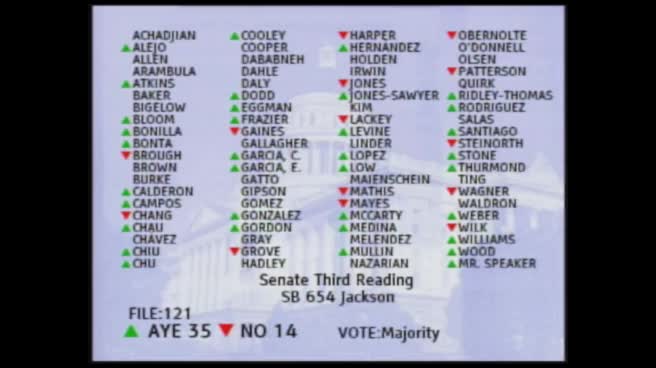 1MIN
Assembly Floor
 1MIN
Senate Floor
 5MIN
Senate Standing Committee on Governance and Finance
Bill Author

Bill Co-Author(s):