SB 881: Vehicles: violations: payment of fines and bail.
- Session Year: 2015-2016
- House: Senate
- Latest Version Date: 2016-09-28
Existing law requires a county to establish an amnesty program for unpaid fines and bail initially due on or before January 1, 2013, for Vehicle Code infractions to be conducted in accordance with guidelines adopted by the Judicial Council. Existing law requires the program to accept payments from October 1, 2015, to March 31, 2017, inclusive. Existing law requires the program to accept a reduced payment in full satisfaction of the fine or bail if the program participant certifies under penalty of perjury that he or she receives specified public benefits or his or her income is 125% or less of the current poverty guidelines. If the driving privilege of an amnesty program participant or a person who is in good standing in a comprehensive collection program has been suspended due to a Vehicle Code violation that is subject to the amnesty program, existing law requires the court to issue and file a certificate with the Department of Motor Vehicles demonstrating that the participant has appeared in court, paid the fine, or has otherwise satisfied the court.
This bill would require the court to issue and file the certificate with the department within 90 days. For applications submitted prior to January 1, 2017, the bill would require the court to issue and file the certificate no later than March 31, 2017. The bill would require, for applications submitted on or before March 31, 2017, that all terms and procedures related to a participants payment plans remain in effect after that date.
Existing law requires a county to establish an amnesty program for unpaid fines and bail initially due on or before January 1, 2013, for Vehicle Code infractions to be conducted in accordance with guidelines adopted by the Judicial Council. Existing law requires the program to accept payments from October 1, 2015, to March 31, 2017, inclusive. Existing law requires the program to accept a reduced payment in full satisfaction of the fine or bail if the program participant certifies under penalty of perjury that he or she receives specified public benefits or his or her income is 125% or less of the current poverty guidelines. Existing law requires certain funds collected under the amnesty program to be transferred, in specified percentages, to the Peace Officers Training Fund and the Corrections Training Fund, which are continuously appropriated funds. If the driving privilege of an amnesty program participant or a person who is in good standing in a comprehensive collection program has been suspended due to a Vehicle Code violation that is subject to the amnesty program, existing law requires the court to issue and file a certificate with the Department of Motor Vehicles demonstrating that the participant has appeared in court, paid the fine, or has otherwise satisfied the court.
This bill would extend the period for acceptance of payments under the amnesty program to December 31, 2017. The bill also would extend the initial due date for payment of the fine or bail for an eligible violation, from on or before January 1, 2013, to on or before January 1, 2015, and would require a specified certificate issued by the court to be filed within 90 days after issuance.
Because this bill would extend the terms of the amnesty program and would expand the scope of the crime of perjury, the bill would impose a state-mandated local program. The bill also would make an appropriation, by increasing the amount of money that would be deposited into continuously appropriated funds as a result of extending the programs duration.
The California Constitution requires the state to reimburse local agencies and school districts for certain costs mandated by the state. Statutory provisions establish procedures for making that reimbursement.
This bill would provide that with regard to certain mandates no reimbursement is required by this act for a specified reason.
With regard to any other mandates, this bill would provide that, if the Commission on State Mandates determines that the bill contains costs so mandated by the state, reimbursement for those costs shall be made pursuant to the statutory provisions noted above.
This bill would require the court to issue and file the certificate with the department within 90 days. For applications submitted prior to January 1, 2017, the bill would require the court to issue and file the certificate no later than March 31, 2017.
Existing law requires a county to establish an amnesty program for fines and bail initially due on or before January 1, 2013, for Vehicle Code infractions to be conducted in accordance with guidelines adopted by the Judicial Council. Existing law requires the program to accept payments from October 1, 2015, to March 31, 2017, inclusive. Existing law requires the program to accept a reduced payment in full satisfaction of the fine or bail if the program participant certifies under penalty of perjury that he or she receives specified public benefits or his or her income is 125% or less of the current poverty guidelines. Existing law requires certain funds collected under the amnesty program to be transferred, in specified percentages, to the Peace Officers Training Fund and the Corrections Training Fund, which are continuously appropriated funds.
This bill would extend the period for acceptance of payments under the amnesty program to December 31, 2017. The bill also would extend the initial due date for payment of the fine or bail for an eligible violation, from on or before January 1, 2013, to on or before January 1, 2015, and would require a specified certificate issued by the court to be filed within 90 days after issuance.
Because this bill would extend the terms of the amnesty program and would expand the scope of the crime of perjury, the bill would impose a state-mandated local program. The bill also would make an appropriation, by increasing the amount of money that would be deposited into continuously appropriated funds as a result of extending the programs duration.
The California Constitution requires the state to reimburse local agencies and school districts for certain costs mandated by the state. Statutory provisions establish procedures for making that reimbursement.
This bill would provide that with regard to certain mandates no reimbursement is required by this act for a specified reason.
With regard to any other mandates, this bill would provide that, if the Commission on State Mandates determines that the bill contains costs so mandated by the state, reimbursement for those costs shall be made pursuant to the statutory provisions noted above.
Existing law authorizes in addition to any other penalty in infraction, misdemeanor, or felony cases, the court to impose a civil assessment of up to $300 against any defendant who fails, after notice and without good cause, to appear in court for any proceeding authorized by law or who fails to pay all or any portion of a fine ordered by the court or to pay an installment of bail, as specified. Existing law requires the court to vacate the civil assessment under these circumstances if the defendant appears within the time specified in the notice and shows good cause for the failure to appear or for the failure to pay a fine or installment of bail.
This bill would provide that the ability to pay the civil assessment shall not be a prerequisite to trial, arraignment, or other court proceedings. The bill would require the drivers failure to appear or pay to be willful in order to be subject to the civil assessment. Payment of bail, fines, penalties, fees, or a civil assessment would not be required to schedule a court hearing on the pending underlying charge.
Existing law authorizes any county or court to implement a comprehensive collection program as a separate revenue collection activity, and requires the program to meet certain criteria, one of which is that the program engages in specified activities in collecting fines or penalties. One of those activities is initiating suspensions or holds for drivers licenses, as specified.
This bill would delete initiating suspensions or holds for drivers licenses from the list of activities the program may engage in. The bill would require the countys or courts program to provide payment plans, based on the debtors ability to pay.
Existing law authorizes the court to notify the Department of Motor Vehicles when a person has failed to appear, failed to pay a fine or bail, or failed to comply with a court order, with respect to various violations relating to vehicles. Existing law requires the department to suspend, and prohibits the department from issuing or renewing, a persons drivers license upon receipt of one of those notices, as specified.
This bill would delete the provisions requiring the court to notify the department of a failure to pay under the above circumstances and would require the court to notify the department only when the drivers failure to appear is willful. The bill would require the department, upon receipt of the notice, to order the persons privilege to operate a motor vehicle to be restricted for a period of 6 months, as specified, and the persons driving privilege would be fully reinstated upon expiration of the 6-month period. If, prior to the expiration of the 6-month period, the case in which the promise was given is adjudicated or the person who has violated the court order appears in court or otherwise satisfies the order of the court, the department would be required to immediately reinstate the persons full driving privilege. The bill also would revise certain court and department administrative procedures with respect to related certifications and records. The bill would repeal certain provisions requiring the department to suspend, or prohibiting the department from issuing or renewing, a persons drivers license upon receipt of one of those notices, with respect to designated violations. The bill would require the department to restore driving privileges that had been suspended pursuant to the deleted provisions, no later than July 1, 2017. The bill would specifically prohibit the department from using information reported pursuant to these provisions to suspend a drivers license. The bill would declare that its provisions do not alter existing law related to suspension of the privilege to operate a motor vehicle in connection with violations relating to reckless driving or driving under the influence of alcohol or drugs, as specified.
Existing law requires the department to check the record of an applicant for drivers license issuance or renewal for notices of failure to appear in court that have been filed with the department, and to take specified actions with respect to the issuance or renewal of the license.
This bill would limit the above requirement to notices of failure to appear for specified offenses involving driving under the influence of drugs or alcohol, or vehicular manslaughter.
Existing law provides that if a person convicted of an infraction fails to pay bail in installments as agreed to or a fine or an installment of a fine within the time authorized by the court, the court may impound the persons drivers license and order the person not to drive for a period not to exceed 30 days. Existing law also provides that if a defendant with a class C or M drivers license satisfies the court that impounding his or her drivers license and ordering the defendant not to drive will affect his or her livelihood, the court shall order that the person limit his or her driving for a period not to exceed 30 days to driving that is essential in the courts determination to the persons employment, including the persons driving to and from his or her place of employment if other means of transportation are not reasonably available.
This bill would delete the class C and M license restrictions for that exemption, thereby permitting the holder of any drivers license to utilize that exemption.
Existing law authorizes in addition to any other penalty in infraction, misdemeanor, or felony cases, the court to impose a civil assessment of up to $300 against any defendant who fails, after notice and without good cause, to appear in court for any proceeding authorized by law or who fails to pay all or any portion of a fine ordered by the court or to pay an installment of bail, as specified. Existing law requires the court to vacate the civil assessment under these circumstances if the defendant appears within the time specified in the notice and shows good cause for the failure to appear or for the failure to pay a fine or installment of bail.
This bill would provide that the ability to pay the civil assessment shall not be a prerequisite to trial, arraignment, or other court proceedings. The bill would require the drivers failure to appear or pay to be willful in order to be subject to the civil assessment. Payment of bail, fines, penalties, fees, or a civil assessment would not be required to schedule a court hearing on the pending underlying charge.
Existing law authorizes any county or court to implement a comprehensive collection program as a separate revenue collection activity, and requires the program to meet certain criteria, one of which is that the program engages in specified activities in collecting fines or penalties. One of those activities is initiating suspensions or holds for drivers licenses, as specified.
This bill would delete initiating suspensions or holds for drivers licenses from the list of activities the program may engage in. The bill would require the countys or courts program to provide payment plans, based on the debtors ability to pay.
Existing law authorizes the court to notify the Department of Motor Vehicles when a person has failed to appear, failed to pay a fine or bail, or failed to comply with a court order, with respect to various violations relating to vehicles. Existing law requires the department to suspend, and prohibits the department from issuing or renewing, a persons drivers license upon receipt of one of those notices, as specified.
This bill would require a court delete the provisions requiring the court to notify the department of a failure to pay under the above circumstances and would require the court to notify the department only when the drivers failure to appear or pay is willful. The bill would require the department, upon receipt of the notice, to order the persons privilege to operate a motor vehicle to be restricted for a period of 6 months, as specified, and the persons driving privilege would be fully reinstated upon expiration of the 6-month period. If, prior to the expiration of the 6-month period, the case in which the promise was given is adjudicated or the person who has violated the court order appears in court or otherwise satisfies the order of the court, the department would be required to immediately reinstate the persons full driving privilege. The bill also would revise certain court and department administrative procedures with respect to related certifications and records. The bill would repeal certain provisions requiring the department to suspend, or prohibiting the department from issuing or renewing, a persons drivers license upon receipt of one of those notices, with respect to designated violations. The bill would require the department to restore driving privileges that had been suspended pursuant to the deleted provisions, no later than July 1, 2017. The bill would specifically prohibit the department from using information reported pursuant to these provisions to suspend a drivers license. The bill would declare that its provisions do not alter existing law related to suspension of the privilege to operate a motor vehicle in connection with violations relating to reckless driving or driving under the influence of alcohol or drugs, as specified.Existing law requires the department to check the record of an applicant for drivers license issuance or renewal for notices of failure to appear in court that have been filed with the department, and to take specified actions with respect to the issuance or renewal of the license.
This bill would limit the above requirement to notices of failure to appear for specified offenses involving driving under the influence of drugs or alcohol, or vehicular manslaughter.
Existing law provides that if a person convicted of an infraction fails to pay bail in installments as agreed to or a fine or an installment of a fine within the time authorized by the court, the court may impound the persons drivers license and order the person not to drive for a period not to exceed 30 days. Existing law also provides that if a defendant with a class C or M drivers license satisfies the court that impounding his or her drivers license and ordering the defendant not to drive will affect his or her livelihood, the court shall order that the person limit his or her driving for a period not to exceed 30 days to driving that is essential in the courts determination to the persons employment, including the persons driving to and from his or her place of employment if other means of transportation are not reasonably available.
This bill would delete the class C and M license restrictions for that exemption, thereby permitting the holder of any drivers license to utilize that exemption.
Existing law authorizes in addition to any other penalty in infraction, misdemeanor, or felony cases, the court to impose a civil assessment of up to $300 against any defendant who fails, after notice and without good cause, to appear in court for any proceeding authorized by law or who fails to pay all or any portion of a fine ordered by the court or to pay an installment of bail, as specified. Existing law requires the court to vacate the civil assessment under these circumstances if the defendant appears within the time specified in the notice and shows good cause for the failure to appear or for the failure to pay a fine or installment of bail.
This bill would provide that the ability to pay the civil assessment shall not be a prerequisite to trial, arraignment, or other court proceedings. The bill would require the drivers failure to appear or pay to be willful in order to be subject to the civil assessment. Payment of bail, fines, penalties, fees, or a civil assessment would not be required to schedule a court hearing on the pending underlying charge.
Existing law authorizes any county or court to implement a comprehensive collection program as a separate revenue collection activity, and requires the program to meet certain criteria, one of which is that the program engages in specified activities in collecting fines or penalties. One of those activities is initiating suspensions or holds for drivers licenses, as specified.
This bill would delete initiating suspensions or holds for drivers licenses from the list of activities the program may engage in. The bill would require the countys or courts program to provide payment plans, based on the debtors ability to pay.
Existing law authorizes the court to notify the Department of Motor Vehicles when a person has failed to appear, failed to pay a fine or bail, or failed to comply with a court order, with respect to various violations relating to vehicles. Existing law requires the department to suspend, and prohibits the department from issuing or renewing, a persons drivers license upon receipt of one of those notices, as specified.
This bill would require a court to notify the department only when the drivers failure to appear or pay is willful. This The bill also would revise certain court and department administrative procedures with respect to related certifications and records. The bill would repeal certain provisions requiring the department to suspend, or prohibiting the department from issuing or renewing, a persons drivers license upon receipt of one of those notices, with respect to designated violations. The bill would require the department to restore driving privileges that had been suspended pursuant to the deleted provisions, upon the request of the suspended driver, no later than July 1, 2017. This The bill would specifically prohibit the department from using information reported pursuant to these provisions to suspend a drivers license. The bill would declare that its provisions do not alter existing law related to suspension of the privilege to operate a motor vehicle in connection with violations relating to reckless driving or driving under the influence of alcohol or drugs, as specified.
Existing law requires the department to check the record of an applicant for drivers license issuance or renewal for notices of failure to appear in court that have been filed with the department, and to take specified actions with respect to the issuance or renewal of the license.
This bill would limit the above requirement to notices of failure to appear for specified offenses involving driving under the influence of drugs or alcohol, or vehicular manslaughter.
Existing law provides that if a person convicted of an infraction fails to pay bail in installments as agreed to or a fine or an installment of a fine within the time authorized by the court, the court may impound the persons drivers license and order the person not to drive for a period not to exceed 30 days. Existing law also provides that if a defendant with a class C or M drivers license satisfies the court that impounding his or her drivers license and ordering the defendant not to drive will affect his or her livelihood, the court shall order that the person limit his or her driving for a period not to exceed 30 days to driving that is essential in the courts determination to the persons employment, including the persons driving to and from his or her place of employment if other means of transportation are not reasonably available.
This bill would delete the class C and M license restrictions for that exemption, thereby permitting the holder of any drivers license to utilize that exemption.
Existing law authorizes in addition to any other penalty in infraction, misdemeanor, or felony cases, the court to impose a civil assessment of up to $300 against any defendant who fails, after notice and without good cause, to appear in court for any proceeding authorized by law or who fails to pay all or any portion of a fine ordered by the court or to pay an installment of bail, as specified. Existing law requires the court to vacate the civil assessment under these circumstances if the defendant appears within the time specified in the notice and shows good cause for the failure to appear or for the failure to pay a fine or installment of bail.
This bill would provide that the ability to pay the civil assessment shall not be a prerequisite to trial, arraignment, or other court proceedings. The bill would require the drivers failure to appear or pay to be willful in order to be subject to the civil assessment. Payment of bail, fines, penalties, fees, or a civil assessment would not be required to schedule a court hearing on the pending underlying charge.
Existing law authorizes any county or court to implement a comprehensive collection program as a separate revenue collection activity, and requires the program to meet certain criteria, one of which is that the program engage engages in specified activities in collecting fines or penalties. One of those activities is initiating suspensions or holds for drivers licenses, as specified.
This bill would delete initiating suspensions or holds for drivers licenses from the list of activities the program may engage in. The bill would require the countys or courts program to provide payment plans, based on the debtors ability to pay.
Existing law authorizes the court to notify the Department of Motor Vehicles when a person has failed to appear, failed to pay a fine or bail, or failed to comply with a court order, with respect to various violations relating to vehicles. Existing law requires the department to suspend, and prohibits the department from issuing or renewing, a persons drivers license upon receipt of one of those notices, as specified.
This bill would require a court to notify the department only when the drivers failure to appear or pay is willful. This bill also would revise certain court and department administrative procedures with respect to related certifications and records. The bill would delete repeal certain provisions requiring the department to suspend suspend, or prohibiting the department from issuing or renewing, a persons drivers license upon receipt of one of those notices, with respect to designated violations. The bill would require the department to restore driving privileges that had been suspended pursuant to the deleted provisions, upon the request of the suspended driver. driver, no later than July 1, 2017. This bill would specifically prohibit the department from using information reported pursuant to these provisions to suspend a drivers license. The bill would declare that its provisions do not alter existing law related to suspension of the privilege to operate a motor vehicle in connection with violations relating to reckless driving or driving under the influence of alcohol or drugs, as specified.Existing law requires the department to check the record of an applicant for drivers license issuance or renewal for notices of failure to appear in court that have been filed with the department, and to take specified actions with respect to the issuance or renewal of the license.
This bill would limit the above requirement to notices of failure to appear for specified offenses involving driving under the influence of drugs or alcohol, or vehicular manslaughter.
Existing law provides that if a person convicted of an infraction fails to pay bail in installments as agreed to or a fine or an installment of a fine within the time authorized by the court, the court may impound the persons drivers license and order the person not to drive for a period not to exceed 30 days. Existing law also provides that if a defendant with a class C or M drivers license satisfies the court that impounding his or her drivers license and ordering the defendant not to drive will affect his or her livelihood, the court shall order that the person limit his or her driving for a period not to exceed 30 days to driving that is essential in the courts determination to the persons employment, including the persons driving to and from his or her place of employment if other means of transportation are not reasonably available.
This bill would delete the class C and M license restrictions for that exemption, thereby permitting the holder of any drivers license to utilize that exemption.
Existing law authorizes in addition to any other penalty in infraction, misdemeanor, or felony cases, the court to impose a civil assessment of up to $300 against any defendant who fails, after notice and without good cause, to appear in court for any proceeding authorized by law or who fails to pay all or any portion of a fine ordered by the court or to pay an installment of bail, as specified.
This bill would provide that the ability to pay the civil assessment shall not be a prerequisite trial, arraignment, or other court proceedings.
Existing law authorizes any county or court to implement a comprehensive collection program as a separate revenue collection activity, and requires the program to meet certain criteria, one of which is that the program engage in specified activities in collecting fines or penalties. One of those activities is initiating suspensions or holds for drivers licenses, as specified.
This bill would delete initiating suspensions or holds for drivers licenses from the list of activities the program may engage in.
Existing law authorizes the court to notify the Department of Motor Vehicles when a person has failed to appear, failed to pay a fine or bail, or failed to comply with a court order, with respect to various violations relating to vehicles. Existing law requires the department to suspend a persons drivers license upon receipt of one of those notices, as specified.
This bill would delete certain provisions requiring the department to suspend a persons drivers license upon receipt of one of those notices, with respect to designated violations. The bill would require the department to restore driving privileges that had been suspended pursuant to the deleted provisions, upon the request of the suspended driver. This bill would declare that its provisions do not alter existing law related to suspension of the privilege to operate a motor vehicle in connection with violations relating to reckless driving or driving under the influence of alcohol or drugs, as specified.
Existing law provides that if a person convicted of an infraction fails to pay bail in installments as agreed to or a fine or an installment of a fine within the time authorized by the court, the court may impound the persons drivers license and order the person not to drive for a period not to exceed 30 days. Existing law also provides that if a defendant with a class C or M drivers license satisfies the court that impounding his or her drivers license and ordering the defendant not to drive will affect his or her livelihood, the court shall order that the person limit his or her driving for a period not to exceed 30 days to driving that is essential in the courts determination to the persons employment, including the persons driving to and from his or her place of employment if other means of transportation are not reasonably available.
This bill would delete the class C and M license restrictions for that exemption, thereby permitting the holder of any drivers license to utilize that exemption.
(a)The Legislature finds and declares that a one-time infraction amnesty program would do all of the following:
(1)Provide relief to individuals who have found themselves in violation of a court-ordered obligation because they have unpaid traffic bail or fines.
(2)Provide relief to individuals who have found themselves in violation of a court-ordered obligation or who have had their driving privileges suspended pursuant to Section 13365.
(3)Provide increased revenue at a time when revenue is scarce by encouraging payment of old fines that have remained unpaid.
(4)Allow courts and counties to resolve older delinquent cases and focus limited resources on collections for more recent cases.
(b)A one-time amnesty program for unpaid fines and bail meeting the eligibility requirements set forth in subdivision (g) shall be established in each county. Unless agreed otherwise by the court and the county in writing, the government entities that are responsible for the collection of delinquent court-ordered debt shall be responsible for implementation of the amnesty program as to that debt, maintaining the same division of responsibility in place with respect to the collection of court-ordered debt under subdivision (b) of Section 1463.010 of the Penal Code.
(c)As used in this section, the term fine or bail refers to the total amounts due in connection with a specific violation, including, but not limited to, all of the following:
(1)Base fine or bail, as established by court order, by statute, or by the courts bail schedule.
(2)Penalty assessments imposed pursuant to Section 1464 of the Penal Code, and Sections 70372, 76000, 76000.5, 76104.6, and 76104.7 of, and paragraph (1) of subdivision (c) of Section 76000.10 of, the Government Code, and Section 42006 of this code.
(3)State surcharges imposed pursuant to Section 1465.7 of the Penal Code.
(4)Court operations assessments imposed pursuant to Section 1465.8 of the Penal Code.
(5)Criminal conviction assessments pursuant to Section 70373 of the Government Code.
(d)Notwithstanding subdivision (c), any civil assessment imposed pursuant to Section 1214.1 of the Penal Code shall not be collected, nor shall the payment of that assessment be a requirement of participation in the amnesty program.
(e)Concurrent with the amnesty program established pursuant to subdivision (b), between October 1, 2015, to March 31, 2017, inclusive, the following shall apply:
(1)The court shall, within 90 days, issue and file the appropriate certificate pursuant to subdivisions (a) and (b) of Section 40509 for any participant of the one-time amnesty program established pursuant to subdivision (b) demonstrating that the participant has appeared in court, paid the fine, or otherwise satisfied the court, if the driving privilege of that participant was suspended pursuant to Section 13365 in connection with a specific violation described in paragraph (1), (2), or (3) of subdivision (g). For applications submitted prior to January 1, 2017, that remain outstanding as of that date, the court shall issue and file the certificate no later than March 31, 2017. For applications submitted on or before March 31, 2017, all terms and procedures related to the participants payment plans shall remain in effect after March 31, 2017.
(2)The court shall, within 90 days, issue and file with the department the appropriate certificate pursuant to subdivisions (a) and (b) of Section 40509 for any person in good standing in a comprehensive collection program pursuant to subdivision (c) of Section 1463.007 of the Penal Code demonstrating that the person has appeared in court, paid the fine, or otherwise satisfied the court, if the driving privilege was suspended pursuant to Section 13365 in connection with a specific violation described in paragraph (1), (2), or (3) of subdivision (g). For applications submitted prior to January 1, 2017, that remain outstanding as of that date, the court shall issue and file the certificate no later than March 31, 2017. For applications submitted on or before March 31, 2017, all terms and procedures related to the participants payment plans shall remain in effect after March 31, 2017.
(3)Any person who is eligible for a drivers license pursuant to Section 12801, 12801.5, or 12801.9 shall be eligible for the amnesty program established pursuant to subdivision (b) for any specific violation described in subdivision (g). The department shall issue a drivers license to any person who is eligible pursuant to Section 12801, 12801.5, or 12801.9 if the person is participating in the amnesty program and is otherwise eligible for the drivers license but for the fines or bail to be collected through the program.
(4)The Department of Motor Vehicles shall not deny reinstating the driving privilege of any person who participates in the amnesty program established pursuant to subdivision (b) for any fines or bail in connection with the specific violation that is the basis for participation in the amnesty program.
(f)In addition to, and at the same time as, the mandatory one-time amnesty program is established pursuant to subdivision (b), the court and the county may jointly agree to extend that amnesty program to fines and bail imposed for a misdemeanor violation of this code and a violation of Section 853.7 of the Penal Code that was added to the misdemeanor case otherwise subject to the amnesty. The amnesty program authorized pursuant to this subdivision shall not apply to parking violations and violations of Sections 23103, 23104, 23105, 23152, and 23153.
(g)A violation is only eligible for amnesty if paragraph (1), (2), or (3) applies, and the requirements of paragraphs (4) to (8), inclusive, are met:
(1)The violation is an infraction violation filed with the court.
(2)It is a violation of subdivision (a) or (b) of Section 40508, or a violation of Section 853.7 of the Penal Code that was added to the case subject to paragraph (1).
(3)The violation is a misdemeanor violation filed with the court to which subdivision (f) applies.
(4)The initial due date for payment of the fine or bail was on or before January 1, 2013.
(5)There are no outstanding misdemeanor or felony warrants for the defendant within the county, except for misdemeanor warrants for misdemeanor violations subject to this section.
(6)The person does not owe victim restitution on any case within the county.
(7)The person has not made any payments for the violation after September 30, 2015, to a comprehensive collection program in the county pursuant to subdivision (c) of Section 1463.007 of the Penal Code.
(8)The person filed a request with the court on or before March 31, 2017.
(h)(1)Except as provided in paragraph (2), each amnesty program shall accept, in full satisfaction of any eligible fine or bail, 50 percent of the fine or bail amount, as defined in subdivision (c).
(2)If the participant certifies under penalty of perjury that he or she receives any of the public benefits listed in subdivision (a) of Section 68632 of the Government Code or is within the conditions described in subdivision (b) of Section 68632 of the Government Code, the amnesty program shall accept, in full satisfaction of any eligible fine or bail, 20 percent of the fine or bail amount, as defined in subdivision (c).
(i)The Judicial Council, in consultation with the California State Association of Counties, shall adopt guidelines for the amnesty program no later than October 1, 2015, and each program shall be conducted in accordance with the Judicial Councils guidelines. As part of its guidelines, the Judicial Council shall include all of the following:
(1)Each court or county responsible for implementation of the amnesty program pursuant to subdivision (b) shall recover costs pursuant to subdivision (a) of Section 1463.007 of the Penal Code and may charge an amnesty program fee of fifty dollars ($50) that may be collected with the receipt of the first payment of a participant.
(2)A payment plan option created pursuant to Judicial Council guidelines in which a monthly payment is equal to the amount that an eligible participant can afford to pay per month consistent with Sections 68633 and 68634 of the Government Code. If a participant chooses the payment plan option, the county or court shall collect all relevant information to allow for collection by the Franchise Tax Board pursuant to existing protocols prescribed by the Franchise Tax Board to collect delinquent debts of any amount in which a participant is delinquent or otherwise in default under his or her amnesty payment plan.
(3)If a participant does not comply with the terms of his or her payment plan under the amnesty program, including failing to make one or more payments, the appropriate agency shall send a notice to the participant that he or she has failed to make one or more payments and that the participant has 30 days to either resume making payments or to request that the agency change the payment amount. If the participant fails to respond to the notice within 30 days, the appropriate agency may refer the participant to the Franchise Tax Board for collection of any remaining balance owed, including an amount equal to the reasonable administrative costs incurred by the Franchise Tax Board to collect the delinquent amount owed. The Franchise Tax Board shall collect any delinquent amounts owed pursuant to existing protocols prescribed by the Franchise Tax Board. The comprehensive collection program may also utilize additional collection efforts pursuant to Section 1463.007 of the Penal Code, except for subparagraph (C) of paragraph (4) of subdivision (c) of that section.
(4)A plan for outreach that will, at a minimum, make available via an Internet Web site relevant information regarding the amnesty program, including how an individual may participate in the amnesty program.
(5)The Judicial Council shall reimburse costs incurred by the Department of Motor Vehicles up to an amount not to exceed two hundred fifty thousand dollars ($250,000), including all of the following:
(A)Providing on a separate insert with each motor vehicle registration renewal notice a summary of the amnesty program established pursuant to this section that is compliant with Section 7292 of the Government Code.
(B)Posting on the departments Internet Web site information regarding the amnesty program.
(C)Personnel costs associated with the amnesty program.
(j)The Judicial Council, in consultation with the department, may, within its existing resources, consider, adopt, or develop recommendations for an appropriate mechanism or mechanisms to allow reinstatement of the driving privilege of any person who otherwise meets the criteria for amnesty but who has violations in more than one county.
(k)A criminal action shall not be brought against a person for a delinquent fine or bail paid under the amnesty program.
(l)(1)The total amount of funds collected under the amnesty program shall, as soon as practical after receipt thereof, be deposited in the county treasury or the account established under Section 77009 of the Government Code. After acceptance of the amount specified in subdivision (h), notwithstanding Section 1203.1d of the Penal Code, the remaining revenues collected under the amnesty program shall be distributed on a pro rata basis in the same manner as a partial payment distributed pursuant to Section 1462.5 of the Penal Code.
(2)Notwithstanding Section 1464 of the Penal Code, the amount of funds collected pursuant to this section that would be available for distribution pursuant to subdivision (f) of Section 1464 of the Penal Code shall instead be distributed as follows:
(A)The first two hundred fifty thousand dollars ($250,000) received shall be transferred to the Judicial Council.
(B)Following the transfer of the funds described in subparagraph (A), once a month, both of the following transfers shall occur:
(i)An amount equal to 82.20 percent of the amount of funds collected pursuant to this section during the preceding month shall be transferred into the Peace Officers Training Fund.
(ii)An amount equal to 17.80 percent of the amount of funds collected pursuant to this section during the preceding month shall be transferred into the Corrections Training Fund.
(m)Each court or county implementing an amnesty program shall file, not later than May 31, 2017, a written report with the Judicial Council, on a form approved by the Judicial Council. The report shall include information about the number of cases resolved, the amount of money collected, and the operating costs of the amnesty program. Notwithstanding Section 10231.5 of the Government Code, on or before August 31, 2017, the Judicial Council shall submit a report to the Legislature summarizing the information provided by each court or county.
(a)The Legislature finds and declares that a one-time infraction amnesty program would do all of the following:
(1)Provide relief to individuals who have found themselves in violation of a court-ordered obligation because they have unpaid traffic bail or fines.
(2)Provide relief to individuals who have found themselves in violation of a court-ordered obligation or who have had their driving privileges suspended pursuant to Section 13365.
(3)Provide increased revenue at a time when revenue is scarce by encouraging payment of old fines that have remained unpaid.
(4)Allow courts and counties to resolve older delinquent cases and focus limited resources on collections for more recent cases.
(b)A one-time amnesty program for unpaid fines and bail meeting the eligibility requirements set forth in subdivision (g) shall be established in each county. Unless agreed otherwise by the court and the county in writing, the government entities that are responsible for the collection of delinquent court-ordered debt shall be responsible for implementation of the amnesty program as to that debt, maintaining the same division of responsibility in place with respect to the collection of court-ordered debt under subdivision (b) of Section 1463.010 of the Penal Code.
(c)As used in this section, the term fine or bail refers to the total amounts due in connection with a specific violation, which include, but are including, but not limited to, all of the following:
(1)Base fine or bail, as established by court order, by statute, or by the courts bail schedule.
(2)Penalty assessments imposed pursuant to Section 1464 of the Penal Code, and Sections 70372, 76000, 76000.5, 76104.6, and 76104.7 of, and paragraph (1) of subdivision (c) of Section 76000.10 of, the Government Code, and Section 42006 of this code.
(3)State surcharges imposed pursuant to Section 1465.7 of the Penal Code.
(4)Court operations assessments imposed pursuant to Section 1465.8 of the Penal Code.
(5)Criminal conviction assessments pursuant to Section 70373 of the Government Code.
(d)Notwithstanding subdivision (c), any civil assessment imposed pursuant to Section 1214.1 of the Penal Code shall not be collected, nor shall the payment of that assessment be a requirement of participation in the amnesty program.
(e)Concurrent with the amnesty program established pursuant to subdivision (b), between October 1, 2015, to March 31, 2017, inclusive, the following shall apply:
(1)The court shall, within 90 days, issue and file the appropriate certificate pursuant to subdivisions (a) and (b) of Section 40509 for any participant of the one-time amnesty program established pursuant to subdivision (b) demonstrating that the participant has appeared in court, paid the fine, or otherwise satisfied the court, if the driving privilege of that participant was suspended pursuant to Section 13365 in connection with a specific violation described in paragraph (1), (2), or (3) of subdivision (g). For applications submitted prior to January 1, 2017, that remain outstanding as of that date, the court shall issue and file the certificate no later than March 31, 2017. For applications submitted on or before March 31, 2017, all terms and procedures related to the participants payment plans shall remain in effect after March 31, 2017.
(2)The court shall, within 90 days, issue and file with the department the appropriate certificate pursuant to subdivisions (a) and (b) of Section 40509 for any person in good standing in a comprehensive collection program pursuant to subdivision (c) of Section 1463.007 of the Penal Code demonstrating that the person has appeared in court, paid the fine, or otherwise satisfied the court, if the driving privilege was suspended pursuant to Section 13365 in connection with a specific violation described in paragraph (1), (2), or (3) of subdivision (g). For applications submitted prior to January 1, 2017 that remain outstanding as of that date, the court shall issue and file the certificate no later than March 31, 2017. For applications submitted on or before March 31, 2017, all terms and procedures related to the participants payment plans shall remain in effect after March 31, 2017.
(3)Any person who is eligible for a drivers license pursuant to Section 12801, 12801.5, or 12801.9 shall be eligible for the amnesty program established pursuant to subdivision (b) for any specific violation described in subdivision (g). The department shall issue a drivers license to any person who is eligible pursuant to Section 12801, 12801.5, or 12801.9 if the person is participating in the amnesty program and is otherwise eligible for the drivers license but for the fines or bail to be collected through the program.
(4)The Department of Motor Vehicles shall not deny reinstating the driving privilege of any person who participates in the amnesty program established pursuant to subdivision (b) for any fines or bail in connection with the specific violation that is the basis for participation in the amnesty program.
(f)In addition to, and at the same time as, the mandatory one-time amnesty program is established pursuant to subdivision (b), the court and the county may jointly agree to extend that amnesty program to fines and bail imposed for a misdemeanor violation of this code and a violation of Section 853.7 of the Penal Code that was added to the misdemeanor case otherwise subject to the amnesty. The amnesty program authorized pursuant to this subdivision shall not apply to parking violations and violations of Sections 23103, 23104, 23105, 23152, and 23153.
(g)A violation is only eligible for amnesty if paragraph (1), (2), or (3) applies, and the requirements of paragraphs (4) to (7), (8), inclusive, are met:
(1)The violation is an infraction violation filed with the court.
(2)It is a violation of subdivision (a) or (b) of Section 40508, or a violation of Section 853.7 of the Penal Code that was added to the case subject to paragraph (1).
(3)The violation is a misdemeanor violation filed with the court to which subdivision (f) applies.
(4)The initial due date for payment of the fine or bail was on or before January 1, 2013.
(5)There are no outstanding misdemeanor or felony warrants for the defendant within the county, except for misdemeanor warrants for misdemeanor violations subject to this section.
(6)The person does not owe victim restitution on any case within the county.
(7)The person has not made any payments for the violation after September 30, 2015, to a comprehensive collection program in the county pursuant to subdivision (c) of Section 1463.007 of the Penal Code.
(8)The person filed a request with the court on or before March 31, 2017.
(h)(1)Except as provided in paragraph (2), each amnesty program shall accept, in full satisfaction of any eligible fine or bail, 50 percent of the fine or bail amount, as defined in subdivision (c).
(2)If the participant certifies under penalty of perjury that he or she receives any of the public benefits listed in subdivision (a) of Section 68632 of the Government Code or is within the conditions described in subdivision (b) of Section 68632 of the Government Code, the amnesty program shall accept, in full satisfaction of any eligible fine or bail, 20 percent of the fine or bail amount, as defined in subdivision (c).
(i)The Judicial Council, in consultation with the California State Association of Counties, shall adopt guidelines for the amnesty program no later than October 1, 2015, and each program shall be conducted in accordance with the Judicial Councils guidelines. As part of its guidelines, the Judicial Council shall include all of the following:
(1)Each court or county responsible for implementation of the amnesty program pursuant to subdivision (b) shall recover costs pursuant to subdivision (a) of Section 1463.007 of the Penal Code and may charge an amnesty program fee of fifty dollars ($50) that may be collected with the receipt of the first payment of a participant.
(2)A payment plan option created pursuant to Judicial Council guidelines in which a monthly payment is equal to the amount that an eligible participant can afford to pay per month consistent with Sections 68633 and 68634 of the Government Code. If a participant chooses the payment plan option, the county or court shall collect all relevant information to allow for collection by the Franchise Tax Board pursuant to existing protocols prescribed by the Franchise Tax Board to collect delinquent debts of any amount in which a participant is delinquent or otherwise in default under his or her amnesty payment plan.
(3)If a participant does not comply with the terms of his or her payment plan under the amnesty program, including failing to make one or more payments, the appropriate agency shall send a notice to the participant that he or she has failed to make one or more payments and that the participant has 30 days to either resume making payments or to request that the agency change the payment amount. If the participant fails to respond to the notice within 30 days, the appropriate agency may refer the participant to the Franchise Tax Board for collection of any remaining balance owed, including an amount equal to the reasonable administrative costs incurred by the Franchise Tax Board to collect the delinquent amount owed. The Franchise Tax Board shall collect any delinquent amounts owed pursuant to existing protocols prescribed by the Franchise Tax Board. The comprehensive collection program may also utilize additional collection efforts pursuant to Section 1463.007 of the Penal Code, except for subparagraph (C) of paragraph (4) of subdivision (c) of that section.
(4)A plan for outreach that will, at a minimum, make available via an Internet Web site relevant information regarding the amnesty program, including how an individual may participate in the amnesty program.
(5)The Judicial Council shall reimburse costs incurred by the Department of Motor Vehicles up to an amount not to exceed two hundred fifty thousand dollars ($250,000), including all of the following:
(A)Providing on a separate insert with each motor vehicle registration renewal notice a summary of the amnesty program established pursuant to this section that is compliant with Section 7292 of the Government Code.
(B)Posting on the departments Internet Web site information regarding the amnesty program.
(C)Personnel costs associated with the amnesty program.
(j)The Judicial Council, in consultation with the department, may, within its existing resources, consider, adopt, or develop recommendations for an appropriate mechanism or mechanisms to allow reinstatement of the driving privilege of any person who otherwise meets the criteria for amnesty but who has violations in more than one county.
(k)No A criminal action shall not be brought against a person for a delinquent fine or bail paid under the amnesty program.
(l)(1)The total amount of funds collected under the amnesty program shall, as soon as practical after receipt thereof, be deposited in the county treasury or the account established under Section 77009 of the Government Code. After acceptance of the amount specified in subdivision (h), notwithstanding Section 1203.1d of the Penal Code, the remaining revenues collected under the amnesty program shall be distributed on a pro rata basis in the same manner as a partial payment distributed pursuant to Section 1462.5 of the Penal Code.
(2)Notwithstanding Section 1464 of the Penal Code, the amount of funds collected pursuant to this section that would be available for distribution pursuant to subdivision (f) of Section 1464 of the Penal Code shall instead be distributed as follows:
(A)The first two hundred fifty thousand dollars ($250,000) received shall be transferred to the Judicial Council.
(B)Following the transfer of the funds described in subparagraph (A), once a month, both of the following transfers shall occur:
(i)An amount equal to 82.20 percent of the amount of funds collected pursuant to this section during the preceding month shall be transferred into the Peace Officers Training Fund.
(ii)An amount equal to 17.80 percent of the amount of funds collected pursuant to this section during the preceding month shall be transferred into the Corrections Training Fund.
(m)Each court or county implementing an amnesty program shall file, not later than May 31, 2017, a written report with the Judicial Council, on a form approved by the Judicial Council. The report shall include information about the number of cases resolved, the amount of money collected, and the operating costs of the amnesty program. Notwithstanding Section 10231.5 of the Government Code, on or before August 31, 2017, the Judicial Council shall submit a report to the Legislature summarizing the information provided by each court or county.
SEC. 2.No reimbursement is required by this act pursuant to Section 6 of Article XIIIB of the California Constitution for certain costs that may be incurred by a local agency or school district because, in that regard, this act creates a new crime or infraction, eliminates a crime or infraction, or changes the penalty for a crime or infraction, within the meaning of Section 17556 of the Government Code, or changes the definition of a crime within the meaning of Section 6 of Article XIIIB of the California Constitution.
However, if the Commission on State Mandates determines that this act contains other costs mandated by the state, reimbursement to local agencies and school districts for those costs shall be made pursuant to Part 7 (commencing with Section 17500) of Division 4 of Title 2 of the Government Code.
(a)The Legislature finds and declares that a one-time infraction amnesty program would do all of the following:
(1)Provide relief to individuals who have found themselves in violation of a court-ordered obligation because they have unpaid traffic bail or fines.
(2)Provide relief to individuals who have found themselves in violation of a court-ordered obligation or who have had their driving privileges suspended pursuant to Section 13365.
(3)Provide increased revenue at a time when revenue is scarce by encouraging payment of old fines that have remained unpaid.
(4)Allow courts and counties to resolve older delinquent cases and focus limited resources on collections for more recent cases.
(b)A one-time amnesty program for unpaid fines and bail meeting the eligibility requirements set forth in subdivision (g) shall be established in each county through December 31, 2017. county. Unless agreed otherwise by the court and the county in writing, the government entities that are responsible for the collection of delinquent court-ordered debt shall be responsible for implementation of the amnesty program as to that debt, maintaining the same division of responsibility in place with respect to the collection of court-ordered debt under subdivision (b) of Section 1463.010 of the Penal Code.
(c)As used in this section, the term fine or bail refers to the total amounts due in connection with a specific violation, which include, but are not limited to, all of the following:
(1)Base fine or bail, as established by court order, by statute, or by the courts bail schedule.
(2)Penalty assessments imposed pursuant to Section 1464 of the Penal Code, and Sections 70372, 76000, 76000.5, 76104.6, and 76104.7 of, and paragraph (1) of subdivision (c) of Section 76000.10 of, the Government Code, and Section 42006 of this code.
(3)State surcharges imposed pursuant to Section 1465.7 of the Penal Code.
(4)Court operations assessments imposed pursuant to Section 1465.8 of the Penal Code.
(5)Criminal conviction assessments pursuant to Section 70373 of the Government Code.
(d)Notwithstanding subdivision (c), any civil assessment imposed pursuant to Section 1214.1 of the Penal Code shall not be collected, nor shall the payment of that assessment be a requirement of participation in the amnesty program.
(e)Concurrent with the amnesty program established pursuant to subdivision (b), between October 1, 2015, to December March 31, 2017, inclusive, the following shall apply:
(1)The court shall issue, and file with the Department of Motor Vehicles within 90 days,, within 90 days, issue and file the appropriate certificate pursuant to subdivisions (a) and (b) of Section 40509 for any participant of the one-time amnesty program established pursuant to subdivision (b) demonstrating that the participant has appeared in court, paid the fine, or otherwise satisfied the court, if the driving privilege of that participant was suspended pursuant to Section 13365 in connection with a specific violation described in paragraph (1), (2), or (3) of subdivision (g). For applications submitted prior to January 1, 2017, that remain outstanding as of that date, the court shall issue and file the certificate no later than March 31, 2017.
(2)The court shall issue, and file with the department within 90 days,, within 90 days, issue and file with the department the appropriate certificate pursuant to subdivisions (a) and (b) of Section 40509 for any person in good standing in a comprehensive collection program pursuant to subdivision (c) of Section 1463.007 of the Penal Code demonstrating that the person has appeared in court, paid the fine, or otherwise satisfied the court, if the driving privilege was suspended pursuant to Section 13365 in connection with a specific violation described in paragraph (1), (2), or (3) of subdivision (g). For applications submitted prior to January 1, 2017 that remain outstanding as of that date, the court shall issue and file the certificate no later than March 31, 2017.
(3)Any person who is eligible for a drivers license pursuant to Section 12801, 12801.5, or 12801.9 shall be eligible for the amnesty program established pursuant to subdivision (b) for any specific violation described in subdivision (g). The department shall issue a drivers license to any person who is eligible pursuant to Section 12801, 12801.5, or 12801.9 if the person is participating in the amnesty program and is otherwise eligible for the drivers license but for the fines or bail to be collected through the program.
(4)The Department of Motor Vehicles shall not deny reinstating the driving privilege of any person who participates in the amnesty program established pursuant to subdivision (b) for any fines or bail in connection with the specific violation that is the basis for participation in the amnesty program.
(f)In addition to, and at the same time as, the mandatory one-time amnesty program is established pursuant to subdivision (b), the court and the county may jointly agree to extend that amnesty program to fines and bail imposed for a misdemeanor violation of this code and a violation of Section 853.7 of the Penal Code that was added to the misdemeanor case otherwise subject to the amnesty. The amnesty program authorized pursuant to this subdivision shall not apply to parking violations and violations of Sections 23103, 23104, 23105, 23152, and 23153.
(g)A violation is only eligible for amnesty if paragraph (1), (2), or (3) applies, and the requirements of paragraphs (4) to (7), inclusive, are met:
(1)The violation is an infraction violation filed with the court.
(2)It is a violation of subdivision (a) or (b) of Section 40508, or a violation of Section 853.7 of the Penal Code that was added to the case subject to paragraph (1).
(3)The violation is a misdemeanor violation filed with the court to which subdivision (f) applies.
(4)The initial due date for payment of the fine or bail was on or before January 1, 2015. 2013.
(5)There are no outstanding misdemeanor or felony warrants for the defendant within the county, except for misdemeanor warrants for misdemeanor violations subject to this section.
(6)The person does not owe victim restitution on any case within the county.
(7)The person has not made any payments for the violation after September 30, 2015, to a comprehensive collection program in the county pursuant to subdivision (c) of Section 1463.007 of the Penal Code.
(8)The person filed a request with the court on or before March 31, 2017.
(h)(1)Except as provided in paragraph (2), each amnesty program shall accept, in full satisfaction of any eligible fine or bail, 50 percent of the fine or bail amount, as defined in subdivision (c).
(2)If the participant certifies under penalty of perjury that he or she receives any of the public benefits listed in subdivision (a) of Section 68632 of the Government Code or is within the conditions described in subdivision (b) of Section 68632 of the Government Code, the amnesty program shall accept, in full satisfaction of any eligible fine or bail, 20 percent of the fine or bail amount, as defined in subdivision (c).
(i)The Judicial Council, in consultation with the California State Association of Counties, shall adopt guidelines for the amnesty program no later than October 1, 2015, and each program shall be conducted in accordance with the Judicial Councils guidelines. As part of its guidelines, the Judicial Council shall include all of the following:
(1)Each court or county responsible for implementation of the amnesty program pursuant to subdivision (b) shall recover costs pursuant to subdivision (a) of Section 1463.007 of the Penal Code and may charge an amnesty program fee of fifty dollars ($50) that may be collected with the receipt of the first payment of a participant.
(2)A payment plan option created pursuant to Judicial Council guidelines in which a monthly payment is equal to the amount that an eligible participant can afford to pay per month consistent with Sections 68633 and 68634 of the Government Code. If a participant chooses the payment plan option, the county or court shall collect all relevant information to allow for collection by the Franchise Tax Board pursuant to existing protocols prescribed by the Franchise Tax Board to collect delinquent debts of any amount in which a participant is delinquent or otherwise in default under his or her amnesty payment plan.
(3)If a participant does not comply with the terms of his or her payment plan under the amnesty program, including failing to make one or more payments, the appropriate agency shall send a notice to the participant that he or she has failed to make one or more payments and that the participant has 30 days to either resume making payments or to request that the agency change the payment amount. If the participant fails to respond to the notice within 30 days, the appropriate agency may refer the participant to the Franchise Tax Board for collection of any remaining balance owed, including an amount equal to the reasonable administrative costs incurred by the Franchise Tax Board to collect the delinquent amount owed. The Franchise Tax Board shall collect any delinquent amounts owed pursuant to existing protocols prescribed by the Franchise Tax Board. The comprehensive collection program may also utilize additional collection efforts pursuant to Section 1463.007 of the Penal Code, except for subparagraph (C) of paragraph (4) of subdivision (c) of that section.
(4)A plan for outreach that will, at a minimum, make available via an Internet Web site relevant information regarding the amnesty program, including how an individual may participate in the amnesty program.
(5)The Judicial Council shall reimburse costs incurred by the Department of Motor Vehicles up to an amount not to exceed two hundred fifty thousand dollars ($250,000), including all of the following:
(A)Providing on a separate insert with each motor vehicle registration renewal notice a summary of the amnesty program established pursuant to this section that is compliant with Section 7292 of the Government Code.
(B)Posting on the departments Internet Web site information regarding the amnesty program.
(C)Personnel costs associated with the amnesty program.
(j)The Judicial Council, in consultation with the department, may, within its existing resources, consider, adopt, or develop recommendations for an appropriate mechanism or mechanisms to allow reinstatement of the driving privilege of any person who otherwise meets the criteria for amnesty but who has violations in more than one county.
(k)No criminal action shall be brought against a person for a delinquent fine or bail paid under the amnesty program.
(l)(1)The total amount of funds collected under the amnesty program shall, as soon as practical after receipt thereof, be deposited in the county treasury or the account established under Section 77009 of the Government Code. After acceptance of the amount specified in subdivision (h), notwithstanding Section 1203.1d of the Penal Code, the remaining revenues collected under the amnesty program shall be distributed on a pro rata basis in the same manner as a partial payment distributed pursuant to Section 1462.5 of the Penal Code.
(2)Notwithstanding Section 1464 of the Penal Code, the amount of funds collected pursuant to this section that would be available for distribution pursuant to subdivision (f) of Section 1464 of the Penal Code shall instead be distributed as follows:
(A)The first two hundred fifty thousand dollars ($250,000) received shall be transferred to the Judicial Council.
(B)Following the transfer of the funds described in subparagraph (A), once a month, both of the following transfers shall occur:
(i)An amount equal to 82.20 percent of the amount of funds collected pursuant to this section during the preceding month shall be transferred into the Peace Officers Training Fund.
(ii)An amount equal to 17.80 percent of the amount of funds collected pursuant to this section during the preceding month shall be transferred into the Corrections Training Fund.
(m)Each court or county implementing an amnesty program shall file, not later than May 31, 2017, a written report with the Judicial Council, on a form approved by the Judicial Council. The report shall include information about the number of cases resolved, the amount of money collected, and the operating costs of the amnesty program. Notwithstanding Section 10231.5 of the Government Code, on or before August 31, 2017, the Judicial Council shall submit a report to the Legislature summarizing the information provided by each court or county.
SEC. 2.No reimbursement is required by this act pursuant to Section 6 of Article XIIIB of the California Constitution for certain costs that may be incurred by a local agency or school district because, in that regard, this act creates a new crime or infraction, eliminates a crime or infraction, or changes the penalty for a crime or infraction, within the meaning of Section 17556 of the Government Code, or changes the definition of a crime within the meaning of Section 6 of Article XIIIB of the California Constitution.
However, if the Commission on State Mandates determines that this act contains other costs mandated by the state, reimbursement to local agencies and school districts for those costs shall be made pursuant to Part 7 (commencing with Section 17500) of Division 4 of Title 2 of the Government Code.
(a)The Legislature finds and declares that a one-time infraction amnesty program would do all of the following:
(1)Provide relief to individuals who have found themselves in violation of a court-ordered obligation because they have unpaid traffic bail or fines.
(2)Provide relief to individuals who have found themselves in violation of a court-ordered obligation or who have had their driving privileges suspended pursuant to Section 13365.
(3)Provide increased revenue at a time when revenue is scarce by encouraging payment of old fines that have remained unpaid.
(4)Allow courts and counties to resolve older delinquent cases and focus limited resources on collections for more recent cases.
(b)A one-time amnesty program for fines and bail meeting the eligibility requirements set forth in subdivision (g) shall be established in each county. county through December 31, 2017. Unless agreed otherwise by the court and the county in writing, the government entities that are responsible for the collection of delinquent court-ordered debt shall be responsible for implementation of the amnesty program as to that debt, maintaining the same division of responsibility in place with respect to the collection of court-ordered debt under subdivision (b) of Section 1463.010 of the Penal Code.
(c)As used in this section, the term fine or bail refers to the total amounts due in connection with a specific violation, which include, but are not limited to, all of the following:
(1)Base fine or bail, as established by court order, by statute, or by the courts bail schedule.
(2)Penalty assessments imposed pursuant to Section 1464 of the Penal Code, and Sections 70372, 76000, 76000.5, 76104.6, and 76104.7 of, and paragraph (1) of subdivision (c) of Section 76000.10 of, the Government Code, and Section 42006 of this code.
(3)State surcharges imposed pursuant to Section 1465.7 of the Penal Code.
(4)Court operations assessments imposed pursuant to Section 1465.8 of the Penal Code.
(5)Criminal conviction assessments pursuant to Section 70373 of the Government Code.
(d)Notwithstanding subdivision (c), any civil assessment imposed pursuant to Section 1214.1 of the Penal Code shall not be collected, nor shall the payment of that assessment be a requirement of participation in the amnesty program.
(e)Concurrent with the amnesty program established pursuant to subdivision (b), between October 1, 2015, to March December 31, 2017, inclusive, the following shall apply:
(1)The court shall issue and issue, and file with the Department of Motor Vehicles within 90 days, the appropriate certificate pursuant to subdivisions (a) and (b) of Section 40509 for any participant of the one-time amnesty program established pursuant to subdivision (b) demonstrating that the participant has appeared in court, paid the fine, or otherwise satisfied the court, if the driving privilege of that participant was suspended pursuant to Section 13365 in connection with a specific violation described in paragraph (1), (2), or (3) of subdivision (g).
(2)The court shall issue and issue, and file with the department within 90 days, the appropriate certificate pursuant to subdivisions (a) and (b) of Section 40509 for any person in good standing in a comprehensive collection program pursuant to subdivision (c) of Section 1463.007 of the Penal Code demonstrating that the person has appeared in court, paid the fine, or otherwise satisfied the court, if the driving privilege was suspended pursuant to Section 13365 in connection with a specific violation described in paragraph (1), (2), or (3) of subdivision (g).
(3)Any person who is eligible for a drivers license pursuant to Section 12801, 12801.5, or 12801.9 shall be eligible for the amnesty program established pursuant to subdivision (b) for any specific violation described in subdivision (g). The department shall issue a drivers license to any person who is eligible pursuant to Section 12801, 12801.5, or 12801.9 if the person is participating in the amnesty program and is otherwise eligible for the drivers license but for the fines or bail to be collected through the program.
(4)The Department of Motor Vehicles shall not deny reinstating the driving privilege of any person who participates in the amnesty program established pursuant to subdivision (b) for any fines or bail in connection with the specific violation that is the basis for participation in the amnesty program.
(f)In addition to, and at the same time as, the mandatory one-time amnesty program is established pursuant to subdivision (b), the court and the county may jointly agree to extend that amnesty program to fines and bail imposed for a misdemeanor violation of this code and a violation of Section 853.7 of the Penal Code that was added to the misdemeanor case otherwise subject to the amnesty. The amnesty program authorized pursuant to this subdivision shall not apply to parking violations and violations of Sections 23103, 23104, 23105, 23152, and 23153.
(g)A violation is only eligible for amnesty if paragraph (1), (2), or (3) applies, and the requirements of paragraphs (4) to (7), inclusive, are met:
(1)The violation is an infraction violation filed with the court.
(2)It is a violation of subdivision (a) or (b) of Section 40508, or a violation of Section 853.7 of the Penal Code that was added to the case subject to paragraph (1).
(3)The violation is a misdemeanor violation filed with the court to which subdivision (f) applies.
(4)The initial due date for payment of the fine or bail was on or before January 1, 2013. 2015.
(5)There are no outstanding misdemeanor or felony warrants for the defendant within the county, except for misdemeanor warrants for misdemeanor violations subject to this section.
(6)The person does not owe victim restitution on any case within the county.
(7)The person has not made any payments for the violation after September 30, 2015, to a comprehensive collection program in the county pursuant to subdivision (c) of Section 1463.007 of the Penal Code.
(h)(1)Except as provided in paragraph (2), each amnesty program shall accept, in full satisfaction of any eligible fine or bail, 50 percent of the fine or bail amount, as defined in subdivision (c).
(2)If the participant certifies under penalty of perjury that he or she receives any of the public benefits listed in subdivision (a) of Section 68632 of the Government Code or is within the conditions described in subdivision (b) of Section 68632 of the Government Code, the amnesty program shall accept, in full satisfaction of any eligible fine or bail, 20 percent of the fine or bail amount, as defined in subdivision (c).
(i)The Judicial Council, in consultation with the California State Association of Counties, shall adopt guidelines for the amnesty program no later than October 1, 2015, and each program shall be conducted in accordance with the Judicial Councils guidelines. As part of its guidelines, the Judicial Council shall include all of the following:
(1)Each court or county responsible for implementation of the amnesty program pursuant to subdivision (b) shall recover costs pursuant to subdivision (a) of Section 1463.007 of the Penal Code and may charge an amnesty program fee of fifty dollars ($50) that may be collected with the receipt of the first payment of a participant.
(2)A payment plan option created pursuant to Judicial Council guidelines in which a monthly payment is equal to the amount that an eligible participant can afford to pay per month consistent with Sections 68633 and 68634 of the Government Code. If a participant chooses the payment plan option, the county or court shall collect all relevant information to allow for collection by the Franchise Tax Board pursuant to existing protocols prescribed by the Franchise Tax Board to collect delinquent debts of any amount in which a participant is delinquent or otherwise in default under his or her amnesty payment plan.
(3)If a participant does not comply with the terms of his or her payment plan under the amnesty program, including failing to make one or more payments, the appropriate agency shall send a notice to the participant that he or she has failed to make one or more payments and that the participant has 30 days to either resume making payments or to request that the agency change the payment amount. If the participant fails to respond to the notice within 30 days, the appropriate agency may refer the participant to the Franchise Tax Board for collection of any remaining balance owed, including an amount equal to the reasonable administrative costs incurred by the Franchise Tax Board to collect the delinquent amount owed. The Franchise Tax Board shall collect any delinquent amounts owed pursuant to existing protocols prescribed by the Franchise Tax Board. The comprehensive collection program may also utilize additional collection efforts pursuant to Section 1463.007 of the Penal Code, except for subparagraph (C) of paragraph (4) of subdivision (c) of that section.
(4)A plan for outreach that will, at a minimum, make available via an Internet Web site relevant information regarding the amnesty program, including how an individual may participate in the amnesty program.
(5)The Judicial Council shall reimburse costs incurred by the Department of Motor Vehicles up to an amount not to exceed two hundred fifty thousand dollars ($250,000), including all of the following:
(A)Providing on a separate insert with each motor vehicle registration renewal notice a summary of the amnesty program established pursuant to this section that is compliant with Section 7292 of the Government Code.
(B)Posting on the departments Internet Web site information regarding the amnesty program.
(C)Personnel costs associated with the amnesty program.
(j)The Judicial Council, in consultation with the department, may, within its existing resources, consider, adopt, or develop recommendations for an appropriate mechanism or mechanisms to allow reinstatement of the driving privilege of any person who otherwise meets the criteria for amnesty but who has violations in more than one county.
(k)No criminal action shall be brought against a person for a delinquent fine or bail paid under the amnesty program.
(l)(1)The total amount of funds collected under the amnesty program shall, as soon as practical after receipt thereof, be deposited in the county treasury or the account established under Section 77009 of the Government Code. After acceptance of the amount specified in subdivision (h), notwithstanding Section 1203.1d of the Penal Code, the remaining revenues collected under the amnesty program shall be distributed on a pro rata basis in the same manner as a partial payment distributed pursuant to Section 1462.5 of the Penal Code.
(2)Notwithstanding Section 1464 of the Penal Code, the amount of funds collected pursuant to this section that would be available for distribution pursuant to subdivision (f) of Section 1464 of the Penal Code shall instead be distributed as follows:
(A)The first two hundred fifty thousand dollars ($250,000) received shall be transferred to the Judicial Council.
(B)Following the transfer of the funds described in subparagraph (A), once a month, both of the following transfers shall occur:
(i)An amount equal to 82.20 percent of the amount of funds collected pursuant to this section during the preceding month shall be transferred into the Peace Officers Training Fund.
(ii)An amount equal to 17.80 percent of the amount of funds collected pursuant to this section during the preceding month shall be transferred into the Corrections Training Fund.
(m)Each court or county implementing an amnesty program shall file, not later than May 31, 2017, a written report with the Judicial Council, on a form approved by the Judicial Council. The report shall include information about the number of cases resolved, the amount of money collected, and the operating costs of the amnesty program. Notwithstanding Section 10231.5 of the Government Code, on or before August 31, 2017, the Judicial Council shall submit a report to the Legislature summarizing the information provided by each court or county.
SEC. 2.No reimbursement is required by this act pursuant to Section 6 of Article XIIIB of the California Constitution for certain costs that may be incurred by a local agency or school district because, in that regard, this act creates a new crime or infraction, eliminates a crime or infraction, or changes the penalty for a crime or infraction, within the meaning of Section 17556 of the Government Code, or changes the definition of a crime within the meaning of Section 6 of Article XIIIB of the California Constitution.
However, if the Commission on State Mandates determines that this act contains other costs mandated by the state, reimbursement to local agencies and school districts for those costs shall be made pursuant to Part 7 (commencing with Section 17500) of Division 4 of Title 2 of the Government Code.
SECTION 1.The Legislature finds and declares that this act shall not be interpreted to alter existing law regarding suspension of the privilege to operate a motor vehicle in connection with any of the following violations:
(a)Reckless driving, pursuant to Section 23103 of the Vehicle Code.
(b)Reckless driving proximately causing bodily injury to a person, pursuant to Sections 23104 and 23105 of the Vehicle Code.
(c)Driving under the influence of alcohol, drugs, or both, pursuant to Section 23152 of the Vehicle Code.
(d)Driving under the influence of alcohol, drugs, or both, and causing bodily injury to another person, pursuant to Section 23153 of the Vehicle Code.
SEC. 2.Section 1214.1 of the Penal Code is amended to read:1214.1.(a)In addition to any other penalty in infraction, misdemeanor, or felony cases, the court may impose a civil assessment of up to three hundred dollars ($300) against a defendant who willfully fails, after notice and without good cause, to appear in court for a proceeding authorized by law or who willfully fails to pay all or any portion of a fine ordered by the court or to pay an installment of bail as agreed to under Section 40510.5 of the Vehicle Code. This assessment shall be deposited in the Trial Court Trust Fund, as provided in Section 68085.1 of the Government Code.
(b)(1)The assessment imposed pursuant to subdivision (a) shall not become effective until at least 20 calendar days after the court mails a warning notice to the defendant by first-class mail to the address shown on the notice to appear or to the defendants last known address. Payment of bail, fines, penalties, fees, or a civil assessment shall not be required to schedule a court hearing on the pending underlying charge.
(2)Payment of bail, fines, penalties, fees, or a civil assessment shall not be required in order for the court to vacate the assessment at the time of appearance pursuant to paragraph (1). Payment of a civil assessment shall not be required to schedule a court hearing on a pending underlying charge.
(c)If a civil assessment is imposed pursuant to subdivision (a), no bench warrant or warrant of arrest shall be issued with respect to the failure to appear at the proceeding for which the assessment is imposed or the failure to pay the fine or installment of bail. An outstanding, unserved bench warrant or warrant of arrest for a failure to appear or for a failure to pay a fine or installment of bail shall be recalled prior to the subsequent imposition of a civil assessment.
(d)The assessment imposed pursuant to subdivision (a) shall be subject to the due process requirements governing defense and collection of civil money judgments generally. The ability to pay the assessment shall not be a prerequisite to arraignment, trial, or other court proceedings.
(e)Each court and county shall maintain the collection program that was in effect on July 1, 2005, unless otherwise agreed to by the court and county. If a court and a county do not agree on a plan for the collection of civil assessments imposed pursuant to this section, or any other collections under Section 1463.010, after the implementation of Sections 68085.6 and 68085.7 of the Government Code, the court or the county may request arbitration by a third party mutually agreed upon by the Administrative Director of the Courts and the California State Association of Counties.
SEC. 3.Section 1463.007 of the Penal Code is amended to read:1463.007.(a)Notwithstanding any other law, any county or court that operates a comprehensive collection program may deduct the costs of operating that program, excluding capital expenditures, from any revenues collected under that program. The costs shall be deducted before any distribution of revenues to other governmental entities required by any other law. Any county or court operating a comprehensive collection program may establish a minimum base fee, fine, forfeiture, penalty, or assessment amount for inclusion in the program.
(b)Once debt becomes delinquent, it continues to be delinquent and may be subject to collection by a comprehensive collection program. Debt is delinquent and subject to collection by a comprehensive collection program if any of the following conditions is met:
(1)A defendant does not post bail or appear on or before the date on which he or she promised to appear, or any lawful continuance of that date, if that defendant was eligible to post and forfeit bail.
(2)A defendant does not pay the amount imposed by the court on or before the date ordered by the court, or any lawful continuance of that date.
(3)A defendant has failed to make an installment payment on the date specified by the court.
(c)For the purposes of this section, a comprehensive collection program is a separate and distinct revenue collection activity that meets each of the following criteria:
(1)The program identifies and collects amounts arising from delinquent court-ordered debt, whether or not a warrant has been issued against the alleged violator.
(2)The program provides payment plans based on the debtors ability to pay, pursuant to Section 68632 of the Government Code.
(3)The program complies with the requirements of subdivision (b) of Section 1463.010.
(4)The program engages in each of the following activities:
(A)Attempts telephone contact with delinquent debtors for whom the program has a telephone number to inform them of their delinquent status and payment options.
(B)Notifies delinquent debtors for whom the program has an address in writing of their outstanding obligation within 95 days of delinquency.
(C)Generates internal monthly reports to track collections data, such as age of debt and delinquent amounts outstanding.
(D)Uses Department of Motor Vehicles information to locate delinquent debtors.
(E)Accepts payment of delinquent debt by credit card.
(5)The program engages in at least five of the following activities:
(A)Sends delinquent debt to the Franchise Tax Boards Court-Ordered Debt Collections Program.
(B)Sends delinquent debt to the Franchise Tax Boards Interagency Intercept Collections Program.
(C)Contracts with one or more private debt collectors to collect delinquent debt.
(D)Sends monthly bills or account statements to all delinquent debtors.
(E)Contracts with local, regional, state, or national skip tracing or locator resources or services to locate delinquent debtors.
(F)Coordinates with the probation department to locate debtors who may be on formal or informal probation.
(G)Uses Employment Development Department employment and wage information to collect delinquent debt.
(H)Establishes wage and bank account garnishments where appropriate.
(I)Places liens on real property owned by delinquent debtors when appropriate.
(J)Uses an automated dialer or automatic call distribution system to manage telephone calls.
SEC. 4.Section 12807 of the Vehicle Code is amended to read:12807.The department shall not issue or renew a drivers license to any person under either of the following circumstances:
(a)When a license previously issued to the person under this code has been suspended until the expiration of the period of the suspension, unless cause for suspension has been removed.
(b)When a license previously issued to the person under this code has been revoked until the expiration of one year after the date of the revocation, except where a different period of revocation is prescribed by this code, or unless the cause for revocation has been removed.
SEC. 5.Section 12808 of the Vehicle Code is amended to read:12808.(a)Before issuing or renewing any license, the department shall check the record of the applicant for conviction of traffic violations and traffic accidents.
(b)Before issuing or renewing any license, the department shall check the record of the applicant for notices of failure to appear in court filed with the department pursuant to subdivision (b) of Section 40509.5 and shall withhold or shall not issue a license to any applicant who has violated his or her written promise to appear in court unless the department has received a certificate issued by the magistrate or clerk of the court hearing the case in which the promise was given showing that the case has been adjudicated or unless the applicants record is cleared as provided in Chapter 6 (commencing with Section 41500) of Division 17. In lieu of the certificate of adjudication, a notice from the court stating that the original records have been lost or destroyed shall permit the department to issue a license.
(c)(1)Any notice received by the department pursuant to Section 40509, 40509.1, or 40509.5, except subdivision (b) of Section 40509.5, that has been on file five years may be removed from the department records and destroyed at the discretion of the department.
(2)Any notice received by the department under subdivision (b) of Section 40509.5 that has been on file 10 years may be removed from the department records and destroyed at the discretion of the department.
SEC. 6.Section 13365 of the Vehicle Code is repealed.SEC. 7.Section 13365.7 is added to the Vehicle Code, to read:13365.7.The department shall restore all driving privileges suspended pursuant to former Section 13365, no later than July 1, 2017.
SEC. 8.Section 40508 of the Vehicle Code is amended to read:40508.(a)A person willfully violating his or her written promise to appear or a lawfully granted continuance of his or her promise to appear in court or before a person authorized to receive a deposit of bail is guilty of a misdemeanor regardless of the disposition of the charge upon which he or she was originally arrested.
(b)A person willfully failing to pay bail in installments as agreed to under Section 40510.5 or a lawfully imposed fine for a violation of a provision of this code or a local ordinance adopted pursuant to this code within the time authorized by the court and without lawful excuse having been presented to the court on or before the date the bail or fine is due is guilty of a misdemeanor regardless of the full payment of the bail or fine after that time.
(c)A person willfully failing to comply with a condition of a court order for a violation of this code, other than for failure to appear or failure to pay a fine, is guilty of a misdemeanor, regardless of his or her subsequent compliance with the order.
(d)If a person convicted of an infraction fails to pay bail in installments as agreed to under Section 40510.5, or a fine or an installment thereof, within the time authorized by the court, the court may, except as otherwise provided in this subdivision, impound the persons drivers license and order the person not to drive for a period not to exceed 30 days. Before returning the license to the person, the court shall endorse on the reverse side of the license that the person was ordered not to drive, the period for which that order was made, and the name of the court making the order. If a defendant satisfies the court that impounding his or her drivers license and ordering the defendant not to drive will affect his or her livelihood, the court shall order that the person limit his or her driving for a period not to exceed 30 days to driving that is essential in the courts determination to the persons employment, including the persons driving to and from his or her place of employment if other means of transportation are not reasonably available. The court shall provide for the endorsement of the limitation on the persons license. The impounding of the license and ordering the person not to drive or the order limiting the persons driving does not constitute a suspension of the license, but a violation of the order constitutes contempt of court.
SEC. 9.Section 40509 of the Vehicle Code is amended to read:40509.(a)Except as required under subdivision (b) of Section 40509.5, if any person has willfully violated a written promise to appear or a lawfully granted continuance of his or her promise to appear in court or before the person authorized to receive a deposit of bail, or violated an order to appear in court, including, but not limited to, a written notice to appear issued in accordance with Section 40518, the magistrate or clerk of the court may give notice of the failure to appear to the department for any violation of this code, or any violation that can be heard by a juvenile traffic hearing referee pursuant to Section 256 of the Welfare and Institutions Code, or any violation of any other statute relating to the safe operation of a vehicle, except violations not required to be reported pursuant to paragraphs (1), (2), (3), (6), and (7) of subdivision (b) of Section 1803. Upon receipt of the notice, the department shall order the persons privilege to operate a motor vehicle restricted to employment-related or medically related purposes, including job training, for the person or a member of his or her family. The restriction shall be effective immediately and shall continue for a period of six months. Upon expiration of the six-month period of restriction, the persons driving privileges shall be fully reinstated. If, during the six-month period of restriction, the case in which the promise was given is adjudicated or the person who has violated the court order appears in court or otherwise satisfies the order of the court, the magistrate or clerk of the court hearing the case shall sign a certificate to that effect, and the department shall immediately reinstate the persons full driving privilege.
(b)(1)Notwithstanding subdivision (a), the court may notify the department of the total amount of bail, fines, assessments, and fees authorized or required by this code, including Section 40508.5, which are unpaid by any person.
(2)Once a court has established the amount of bail, fines, assessments, and fees, and notified the department, the court shall not further enhance or modify that amount.
(3)This subdivision applies only to violations of this code that do not require a mandatory court appearance, are not contested by the defendant, and do not require proof of correction certified by the court.
(c)Any violation subject to Section 40001, which is the responsibility of the owner of the vehicle, shall not be reported under this section.
(d)The department shall not suspend a drivers license on the basis of information reported to the department pursuant to this section.
SEC. 10.Section 40509.5 of the Vehicle Code is amended to read:40509.5.(a)Except as required under subdivision (b), if, with respect to an offense described in subdivision (d), a person has willfully violated his or her written promise to appear or a lawfully granted continuance of his or her promise to appear in court or before the person authorized to receive a deposit of bail, or violated an order to appear in court, including, but not limited to, a written notice to appear issued in accordance with Section 40518, the magistrate or clerk of the court may give notice of the failure to appear to the department for a violation of this code, a violation that can be heard by a juvenile traffic hearing referee pursuant to Section 256 of the Welfare and Institutions Code, or a violation of any other statute relating to the safe operation of a vehicle, except violations not required to be reported pursuant to paragraphs (1), (2), (3), (6), and (7) of subdivision (b) of Section 1803. Upon receipt of the notice, the department shall order the persons privilege to operate a motor vehicle restricted to employment-related or medically related purposes, including job training, for the person or a member of his or her family. The restriction shall be effective immediately and shall continue for a period of six months. Upon expiration of the six-month period of restriction, the persons driving privileges shall be fully reinstated. If, during the six-month period of restriction, the case in which the promise was given is adjudicated or the person who has violated the court order appears in court and satisfies the order of the court, the magistrate or clerk of the court hearing the case shall sign a certificate to that effect, and the department shall immediately reinstate the persons full driving privilege.
(b)If a person charged with a violation of Section 23152 or 23153, or Section 191.5 of the Penal Code, or subdivision (a) of Section 192.5 of that code has violated a lawfully granted continuance of his or her promise to appear in court or is released from custody on his or her own recognizance and willfully fails to appear in court or before the person authorized to receive a deposit of bail, or violated an order to appear in court, the magistrate or clerk of the court shall give notice to the department of the failure to appear. If thereafter the case in which the notice was given is adjudicated or the person who has violated the court order appears in court or otherwise satisfies the order of the court, the magistrate or clerk of the court hearing the case shall prepare a certificate to that effect. If the court provided the department with notice of the initial failure to appear, the certificate also shall be filed with the department.
(c)Except as required under subdivision (b), the court shall mail a courtesy warning notice to the defendant by first-class mail at the address shown on the notice to appear, at least 10 days before sending a notice to the department under this section.
(d)If the court notifies the department of a failure to appear pursuant to subdivision (a), no arrest warrant shall be issued for an alleged violation of subdivision (a) of Section 40508, unless one of the following criteria is met:
(1)The alleged underlying offense is a misdemeanor or felony.
(2)The alleged underlying offense is a violation of any provision of Division 12 (commencing with Section 24000), Division 13 (commencing with Section 29000), or Division 15 (commencing with Section 35000), required to be reported pursuant to Section 1803.
(3)The drivers record does not show that the defendant has a valid California drivers license.
(4)The drivers record shows an unresolved charge that the defendant is in violation of his or her written promise to appear for one or more other alleged violations of the law.
(e)Except as required under subdivision (b), in addition to the proceedings described in this section, the court may elect to notify the department pursuant to subdivision (b) of Section 40509.
(f) This section is applicable to courts that have elected to provide notice pursuant to subdivision (a). The method of commencing or terminating an election to proceed under this section shall be prescribed by the department.
(g)A violation subject to Section 40001, that is the responsibility of the owner of the vehicle, shall not be reported under this section.
(h)(1)The department shall not suspend a drivers license on the basis of information reported to the department pursuant to this section.
(2)This subdivision does not apply to a suspension pursuant to Section 13365.2 as a result of information provided under subdivision (b).
The Legislature finds and declares that this act shall not be interpreted to alter existing law regarding suspension of the privilege to operate a motor vehicle in connection with any of the following violations:
(a)Reckless driving, pursuant to Section 23103 of the Vehicle Code.
(b)Reckless driving proximately causing bodily injury to a person, pursuant to Sections 23104 and 23105 of the Vehicle Code.
(c)Driving under the influence of alcohol, drugs, or both, pursuant to Section 23152 of the Vehicle Code.
(d)Driving under the influence of alcohol, drugs, or both, and causing bodily injury to another person, pursuant to Section 23153 of the Vehicle Code.
SEC. 2.Section 1214.1 of the Penal Code is amended to read:1214.1.(a)In addition to any other penalty in infraction, misdemeanor, or felony cases, the court may impose a civil assessment of up to three hundred dollars ($300) against a defendant who willfully fails, after notice and without good cause, to appear in court for a proceeding authorized by law or who willfully fails to pay all or any portion of a fine ordered by the court or to pay an installment of bail as agreed to under Section 40510.5 of the Vehicle Code. This assessment shall be deposited in the Trial Court Trust Fund, as provided in Section 68085.1 of the Government Code.
(b)(1)The assessment imposed pursuant to subdivision (a) shall not become effective until at least 20 calendar days after the court mails a warning notice to the defendant by first-class mail to the address shown on the notice to appear or to the defendants last known address. Payment of bail, fines, penalties, fees, or a civil assessment shall not be required to schedule a court hearing on the pending underlying charge.
(2)Payment of bail, fines, penalties, fees, or a civil assessment shall not be required in order for the court to vacate the assessment at the time of appearance pursuant to paragraph (1). Payment of a civil assessment shall not be required to schedule a court hearing on a pending underlying charge.
(c)If a civil assessment is imposed pursuant to subdivision (a), no bench warrant or warrant of arrest shall be issued with respect to the failure to appear at the proceeding for which the assessment is imposed or the failure to pay the fine or installment of bail. An outstanding, unserved bench warrant or warrant of arrest for a failure to appear or for a failure to pay a fine or installment of bail shall be recalled prior to the subsequent imposition of a civil assessment.
(d)The assessment imposed pursuant to subdivision (a) shall be subject to the due process requirements governing defense and collection of civil money judgments generally. The ability to pay the assessment shall not be a prerequisite to arraignment, trial, or other court proceedings.
(e)Each court and county shall maintain the collection program that was in effect on July 1, 2005, unless otherwise agreed to by the court and county. If a court and a county do not agree on a plan for the collection of civil assessments imposed pursuant to this section, or any other collections under Section 1463.010, after the implementation of Sections 68085.6 and 68085.7 of the Government Code, the court or the county may request arbitration by a third party mutually agreed upon by the Administrative Director of the Courts and the California State Association of Counties.
SEC. 3.Section 1463.007 of the Penal Code is amended to read:1463.007.(a)Notwithstanding any other law, any county or court that operates a comprehensive collection program may deduct the costs of operating that program, excluding capital expenditures, from any revenues collected under that program. The costs shall be deducted before any distribution of revenues to other governmental entities required by any other law. Any county or court operating a comprehensive collection program may establish a minimum base fee, fine, forfeiture, penalty, or assessment amount for inclusion in the program.
(b)Once debt becomes delinquent, it continues to be delinquent and may be subject to collection by a comprehensive collection program. Debt is delinquent and subject to collection by a comprehensive collection program if any of the following conditions is met:
(1)A defendant does not post bail or appear on or before the date on which he or she promised to appear, or any lawful continuance of that date, if that defendant was eligible to post and forfeit bail.
(2)A defendant does not pay the amount imposed by the court on or before the date ordered by the court, or any lawful continuance of that date.
(3)A defendant has failed to make an installment payment on the date specified by the court.
(c)For the purposes of this section, a comprehensive collection program is a separate and distinct revenue collection activity that meets each of the following criteria:
(1)The program identifies and collects amounts arising from delinquent court-ordered debt, whether or not a warrant has been issued against the alleged violator.
(2)The program provides payment plans based on the debtors ability to pay, pursuant to Section 68632 of the Government Code.
(3)The program complies with the requirements of subdivision (b) of Section 1463.010.
(4)The program engages in each of the following activities:
(A)Attempts telephone contact with delinquent debtors for whom the program has a telephone number to inform them of their delinquent status and payment options.
(B)Notifies delinquent debtors for whom the program has an address in writing of their outstanding obligation within 95 days of delinquency.
(C)Generates internal monthly reports to track collections data, such as age of debt and delinquent amounts outstanding.
(D)Uses Department of Motor Vehicles information to locate delinquent debtors.
(E)Accepts payment of delinquent debt by credit card.
(5)The program engages in at least five of the following activities:
(A)Sends delinquent debt to the Franchise Tax Boards Court-Ordered Debt Collections Program.
(B)Sends delinquent debt to the Franchise Tax Boards Interagency Intercept Collections Program.
(C)Contracts with one or more private debt collectors to collect delinquent debt.
(D)Sends monthly bills or account statements to all delinquent debtors.
(E)Contracts with local, regional, state, or national skip tracing or locator resources or services to locate delinquent debtors.
(F)Coordinates with the probation department to locate debtors who may be on formal or informal probation.
(G)Uses Employment Development Department employment and wage information to collect delinquent debt.
(H)Establishes wage and bank account garnishments where appropriate.
(I)Places liens on real property owned by delinquent debtors when appropriate.
(J)Uses an automated dialer or automatic call distribution system to manage telephone calls.
SEC. 4.Section 12807 of the Vehicle Code is amended to read:12807.The department shall not issue or renew a drivers license to any person under either of the following circumstances:
(a)When a license previously issued to the person under this code has been suspended until the expiration of the period of the suspension, unless cause for suspension has been removed.
(b)When a license previously issued to the person under this code has been revoked until the expiration of one year after the date of the revocation, except where a different period of revocation is prescribed by this code, or unless the cause for revocation has been removed.
SEC. 5.Section 12808 of the Vehicle Code is amended to read:12808.(a)Before issuing or renewing any license, the department shall check the record of the applicant for conviction of traffic violations and traffic accidents.
(b)Before issuing or renewing any license, the department shall check the record of the applicant for notices of failure to appear in court filed with the department pursuant to subdivision (c) (b) of Section 40509.5 and shall withhold or shall not issue a license to any applicant who has violated his or her written promise to appear in court unless the department has received a certificate issued by the magistrate or clerk of the court hearing the case in which the promise was given showing that the case has been adjudicated or unless the applicants record is cleared as provided in Chapter 6 (commencing with Section 41500) of Division 17. In lieu of the certificate of adjudication, a notice from the court stating that the original records have been lost or destroyed shall permit the department to issue a license.
(c)(1)Any notice received by the department pursuant to Section 40509, 40509.1, or 40509.5, except subdivision (c) (b) of Section 40509.5, that has been on file five years may be removed from the department records and destroyed at the discretion of the department.
(2)Any notice received by the department under subdivision (c) (b) of Section 40509.5 that has been on file 10 years may be removed from the department records and destroyed at the discretion of the department.
SEC. 6.Section 13365 of the Vehicle Code is repealed.SEC. 7.Section 13365.7 is added to the Vehicle Code, to read:13365.7.The department shall restore all driving privileges suspended pursuant to former Section 13365, no later than July 1, 2017.
SEC. 8.Section 40508 of the Vehicle Code is amended to read:40508.(a)A person willfully violating his or her written promise to appear or a lawfully granted continuance of his or her promise to appear in court or before a person authorized to receive a deposit of bail is guilty of a misdemeanor regardless of the disposition of the charge upon which he or she was originally arrested.
(b)A person willfully failing to pay bail in installments as agreed to under Section 40510.5 or a lawfully imposed fine for a violation of a provision of this code or a local ordinance adopted pursuant to this code within the time authorized by the court and without lawful excuse having been presented to the court on or before the date the bail or fine is due is guilty of a misdemeanor regardless of the full payment of the bail or fine after that time.
(c)A person willfully failing to comply with a condition of a court order for a violation of this code, other than for failure to appear or failure to pay a fine, is guilty of a misdemeanor, regardless of his or her subsequent compliance with the order.
(d)If a person convicted of an infraction fails to pay bail in installments as agreed to under Section 40510.5, or a fine or an installment thereof, within the time authorized by the court, the court may, except as otherwise provided in this subdivision, impound the persons drivers license and order the person not to drive for a period not to exceed 30 days. Before returning the license to the person, the court shall endorse on the reverse side of the license that the person was ordered not to drive, the period for which that order was made, and the name of the court making the order. If a defendant satisfies the court that impounding his or her drivers license and ordering the defendant not to drive will affect his or her livelihood, the court shall order that the person limit his or her driving for a period not to exceed 30 days to driving that is essential in the courts determination to the persons employment, including the persons driving to and from his or her place of employment if other means of transportation are not reasonably available. The court shall provide for the endorsement of the limitation on the persons license. The impounding of the license and ordering the person not to drive or the order limiting the persons driving does not constitute a suspension of the license, but a violation of the order constitutes contempt of court.
SEC. 9.Section 40509 of the Vehicle Code is amended to read:40509.(a)Except as required under subdivision (c) (b) of Section 40509.5, if any person has willfully violated a written promise to appear or a lawfully granted continuance of his or her promise to appear in court or before the person authorized to receive a deposit of bail, or violated an order to appear in court, including, but not limited to, a written notice to appear issued in accordance with Section 40518, the magistrate or clerk of the court may give notice of the failure to appear to the department for any violation of this code, or any violation that can be heard by a juvenile traffic hearing referee pursuant to Section 256 of the Welfare and Institutions Code, or any violation of any other statute relating to the safe operation of a vehicle, except violations not required to be reported pursuant to paragraphs (1), (2), (3), (6), and (7) of subdivision (b) of Section 1803. If thereafter Upon receipt of the notice, the department shall order the persons privilege to operate a motor vehicle restricted to employment-related or medically related purposes, including job training, for the person or a member of his or her family. The restriction shall be effective immediately and shall continue for a period of six months. Upon expiration of the six-month period of restriction, the persons driving privileges shall be fully reinstated. If, during the six-month period of restriction, the case in which the promise was given is adjudicated or the person who has violated the court order appears in court or otherwise satisfies the order of the court, the magistrate or clerk of the court hearing the case shall sign a certificate to that effect. If the court provided the department with notice of the initial failure to appear, the certificate also shall be filed with the department. effect, and the department shall immediately reinstate the persons full driving privilege.
(b)If any person has willfully failed to pay a lawfully imposed fine within the time authorized by the court or to pay a fine pursuant to subdivision (a) of Section 42003, the magistrate or clerk of the court may give notice of the fact to the department for any violation, except violations not required to be reported pursuant to paragraphs (1), (2), (3), (6), and (7) of subdivision (b) of Section 1803. If thereafter the fine is fully paid, the magistrate or clerk of the court shall issue a certificate showing that the fine has been paid. If the court provided the department with notice of the initial failure to pay, the certificate also shall be filed with the department.
(c)
(b)(1)Notwithstanding subdivisions (a) and (b), subdivision (a), the court may notify the department of the total amount of bail, fines, assessments, and fees authorized or required by this code, including Section 40508.5, which are unpaid by any person.
(2)Once a court has established the amount of bail, fines, assessments, and fees, and notified the department, the court shall not further enhance or modify that amount.
(3)This subdivision applies only to violations of this code that do not require a mandatory court appearance, are not contested by the defendant, and do not require proof of correction certified by the court.
(d) With respect to a violation of this code, this section is applicable to any court that has not elected to be subject to the notice requirements of subdivision (b) of Section 40509.5.
(e)
(c)Any violation subject to Section 40001, which is the responsibility of the owner of the vehicle, shall not be reported under this section.
(f)
(d)The department shall not suspend a drivers license on the basis of information reported to the department pursuant to this section.
SEC. 10.Section 40509.5 of the Vehicle Code is amended to read:40509.5.(a)Except as required under subdivision (c), (b), if, with respect to an offense described in subdivision (e), (d), a person has willfully violated his or her written promise to appear or a lawfully granted continuance of his or her promise to appear in court or before the person authorized to receive a deposit of bail, or violated an order to appear in court, including, but not limited to, a written notice to appear issued in accordance with Section 40518, the magistrate or clerk of the court may give notice of the failure to appear to the department for a violation of this code, a violation that can be heard by a juvenile traffic hearing referee pursuant to Section 256 of the Welfare and Institutions Code, or a violation of any other statute relating to the safe operation of a vehicle, except violations not required to be reported pursuant to paragraphs (1), (2), (3), (6), and (7) of subdivision (b) of Section 1803. If thereafter Upon receipt of the notice, the department shall order the persons privilege to operate a motor vehicle restricted to employment-related or medically related purposes, including job training, for the person or a member of his or her family. The restriction shall be effective immediately and shall continue for a period of six months. Upon expiration of the six-month period of restriction, the persons driving privileges shall be fully reinstated. If, during the six-month period of restriction, the case in which the promise was given is adjudicated or the person who has violated the court order appears in court and satisfies the order of the court, the magistrate or clerk of the court hearing the case shall sign a certificate to that effect. If the court provided the department with notice of the initial failure to appear, the certificate also shall be filed with the department. effect, and the department shall immediately reinstate the persons full driving privilege.
(b)If, with respect to an offense described in subdivision (e), a person has willfully failed to pay a lawfully imposed fine, or bail in installments as agreed to under Section 40510.5, within the time authorized by the court or to pay a fine pursuant to subdivision (a) of Section 42003, the magistrate or clerk of the court may give notice of the fact to the department for a violation, except violations not required to be reported pursuant to paragraphs (1), (2), (3), (6), and (7) of subdivision (b) of Section 1803. If thereafter the fine or bail is fully paid, the magistrate or clerk of the court shall issue a certificate showing that the fine or bail has been paid. If the court provided the department with notice of the initial failure to pay, the certificate also shall be filed with the department.
(c)
(b)If a person charged with a violation of Section 23152 or 23153, or Section 191.5 of the Penal Code, or subdivision (a) of Section 192.5 of that code has violated a lawfully granted continuance of his or her promise to appear in court or is released from custody on his or her own recognizance and willfully fails to appear in court or before the person authorized to receive a deposit of bail, or violated an order to appear in court, the magistrate or clerk of the court shall give notice to the department of the failure to appear. If thereafter the case in which the notice was given is adjudicated or the person who has violated the court order appears in court or otherwise satisfies the order of the court, the magistrate or clerk of the court hearing the case shall prepare a certificate to that effect. If the court provided the department with notice of the initial failure to appear, the certificate also shall be filed with the department.
(d)
(c)Except as required under subdivision (c), (b), the court shall mail a courtesy warning notice to the defendant by first-class mail at the address shown on the notice to appear, at least 10 days before sending a notice to the department under this section.
(e)
(d)If the court notifies the department of a failure to appear or pay a fine or bail pursuant to subdivision (a) or (b), (a), no arrest warrant shall be issued for an alleged violation of subdivision (a) or (b) of Section 40508, unless one of the following criteria is met:
(1)The alleged underlying offense is a misdemeanor or felony.
(2)The alleged underlying offense is a violation of any provision of Division 12 (commencing with Section 24000), Division 13 (commencing with Section 29000), or Division 15 (commencing with Section 35000), required to be reported pursuant to Section 1803.
(3)The drivers record does not show that the defendant has a valid California drivers license.
(4)The drivers record shows an unresolved charge that the defendant is in violation of his or her written promise to appear for one or more other alleged violations of the law.
(f)
(e)Except as required under subdivision (c), (b), in addition to the proceedings described in this section, the court may elect to notify the department pursuant to subdivision (c) (b) of Section 40509.
(g)
(f) This section is applicable to courts that have elected to provide notice pursuant to subdivision (b). (a). The method of commencing or terminating an election to proceed under this section shall be prescribed by the department.
(h)
(g)A violation subject to Section 40001, that is the responsibility of the owner of the vehicle, shall not be reported under this section.
(i)
(h)(1)The department shall not suspend a drivers license on the basis of information reported to the department pursuant to this section.
(2)This subdivision does not apply to a suspension pursuant to Section 13365.2 as a result of information provided under subdivision (c). (b).
The Legislature finds and declares that this act shall not be interpreted to alter existing law regarding suspension of the privilege to operate a motor vehicle in connection with any of the following violations:
(a)Reckless driving, pursuant to Section 23103 of the Vehicle Code.
(b)Reckless driving proximately causing bodily injury to a person, pursuant to Sections 23104 and 23105 of the Vehicle Code.
(c)Driving under the influence of alcohol, drugs, or both, pursuant to Section 23152 of the Vehicle Code.
(d)Driving under the influence of alcohol, drugs, or both, and causing bodily injury to another person, pursuant to Section 23153 of the Vehicle Code.
SEC. 2.Section 1214.1 of the Penal Code is amended to read:1214.1.(a)In addition to any other penalty in infraction, misdemeanor, or felony cases, the court may impose a civil assessment of up to three hundred dollars ($300) against a defendant who willfully fails, after notice and without good cause, to appear in court for a proceeding authorized by law or who willfully fails to pay all or any portion of a fine ordered by the court or to pay an installment of bail as agreed to under Section 40510.5 of the Vehicle Code. This assessment shall be deposited in the Trial Court Trust Fund, as provided in Section 68085.1 of the Government Code.
(b)(1)The assessment imposed pursuant to subdivision (a) shall not become effective until at least 20 calendar days after the court mails a warning notice to the defendant by first-class mail to the address shown on the notice to appear or to the defendants last known address. Payment of bail, fines, penalties, fees, or a civil assessment shall not be required to schedule a court hearing on the pending underlying charge.
(2)Payment of bail, fines, penalties, fees, or a civil assessment shall not be required in order for the court to vacate the assessment at the time of appearance pursuant to paragraph (1). Payment of a civil assessment shall not be required to schedule a court hearing on a pending underlying charge.
(c)If a civil assessment is imposed pursuant to subdivision (a), no bench warrant or warrant of arrest shall be issued with respect to the failure to appear at the proceeding for which the assessment is imposed or the failure to pay the fine or installment of bail. An outstanding, unserved bench warrant or warrant of arrest for a failure to appear or for a failure to pay a fine or installment of bail shall be recalled prior to the subsequent imposition of a civil assessment.
(d)The assessment imposed pursuant to subdivision (a) shall be subject to the due process requirements governing defense and collection of civil money judgments generally. The ability to pay the assessment shall not be a prerequisite to arraignment, trial, or other court proceedings.
(e)Each court and county shall maintain the collection program that was in effect on July 1, 2005, unless otherwise agreed to by the court and county. If a court and a county do not agree on a plan for the collection of civil assessments imposed pursuant to this section, or any other collections under Section 1463.010, after the implementation of Sections 68085.6 and 68085.7 of the Government Code, the court or the county may request arbitration by a third party mutually agreed upon by the Administrative Director of the Courts and the California State Association of Counties.
SEC. 3.Section 1463.007 of the Penal Code is amended to read:1463.007.(a)Notwithstanding any other law, any county or court that operates a comprehensive collection program may deduct the costs of operating that program, excluding capital expenditures, from any revenues collected under that program. The costs shall be deducted before any distribution of revenues to other governmental entities required by any other law. Any county or court operating a comprehensive collection program may establish a minimum base fee, fine, forfeiture, penalty, or assessment amount for inclusion in the program.
(b)Once debt becomes delinquent, it continues to be delinquent and may be subject to collection by a comprehensive collection program. Debt is delinquent and subject to collection by a comprehensive collection program if any of the following conditions is met:
(1)A defendant does not post bail or appear on or before the date on which he or she promised to appear, or any lawful continuance of that date, if that defendant was eligible to post and forfeit bail.
(2)A defendant does not pay the amount imposed by the court on or before the date ordered by the court, or any lawful continuance of that date.
(3)A defendant has failed to make an installment payment on the date specified by the court.
(c)For the purposes of this section, a comprehensive collection program is a separate and distinct revenue collection activity that meets each of the following criteria:
(1)The program identifies and collects amounts arising from delinquent court-ordered debt, whether or not a warrant has been issued against the alleged violator.
(2)The program provides payment plans based on the debtors ability to pay, pursuant to Section 68632 of the Government Code.
(3)The program complies with the requirements of subdivision (b) of Section 1463.010.
(4)The program engages in each of the following activities:
(A)Attempts telephone contact with delinquent debtors for whom the program has a telephone number to inform them of their delinquent status and payment options.
(B)Notifies delinquent debtors for whom the program has an address in writing of their outstanding obligation within 95 days of delinquency.
(C)Generates internal monthly reports to track collections data, such as age of debt and delinquent amounts outstanding.
(D)Uses Department of Motor Vehicles information to locate delinquent debtors.
(E)Accepts payment of delinquent debt by credit card.
(5)The program engages in at least five of the following activities:
(A)Sends delinquent debt to the Franchise Tax Boards Court-Ordered Debt Collections Program.
(B)Sends delinquent debt to the Franchise Tax Boards Interagency Intercept Collections Program.
(C)Contracts with one or more private debt collectors to collect delinquent debt.
(D)Sends monthly bills or account statements to all delinquent debtors.
(E)Contracts with local, regional, state, or national skip tracing or locator resources or services to locate delinquent debtors.
(F)Coordinates with the probation department to locate debtors who may be on formal or informal probation.
(G)Uses Employment Development Department employment and wage information to collect delinquent debt.
(H)Establishes wage and bank account garnishments where appropriate.
(I)Places liens on real property owned by delinquent debtors when appropriate.
(J)Uses an automated dialer or automatic call distribution system to manage telephone calls.
SEC. 4.Section 12807 of the Vehicle Code is amended to read:12807.The department shall not issue or renew a drivers license to any person under either of the following circumstances:
(a)When a license previously issued to the person under this code has been suspended until the expiration of the period of the suspension, unless cause for suspension has been removed.
(b)When a license previously issued to the person under this code has been revoked until the expiration of one year after the date of the revocation, except where a different period of revocation is prescribed by this code, or unless the cause for revocation has been removed.
SEC. 5.Section 12808 of the Vehicle Code is amended to read:12808.(a)Before issuing or renewing any license, the department shall check the record of the applicant for conviction of traffic violations and traffic accidents.
(b)Before issuing or renewing any license, the department shall check the record of the applicant for notices of failure to appear in court filed with the department pursuant to subdivision (c) of Section 40509.5 and shall withhold or shall not issue a license to any applicant who has violated his or her written promise to appear in court unless the department has received a certificate issued by the magistrate or clerk of the court hearing the case in which the promise was given showing that the case has been adjudicated or unless the applicants record is cleared as provided in Chapter 6 (commencing with Section 41500) of Division 17. In lieu of the certificate of adjudication, a notice from the court stating that the original records have been lost or destroyed shall permit the department to issue a license.
(c)(1)Any notice received by the department pursuant to Section 40509, 40509.1, or 40509.5, except subdivision (c) of Section 40509.5, that has been on file five years may be removed from the department records and destroyed at the discretion of the department.
(2)Any notice received by the department under subdivision (c) of Section 40509.5 that has been on file 10 years may be removed from the department records and destroyed at the discretion of the department.
SEC. 6.Section 13365 of the Vehicle Code is repealed.SEC. 7.Section 13365.7 is added to the Vehicle Code, to read:13365.7.The department shall restore all driving privileges suspended pursuant to former Section 13365 upon the request of the suspended driver, Section 13365, no later than July 1, 2017.
SEC. 8.Section 40508 of the Vehicle Code is amended to read:40508.(a)A person willfully violating his or her written promise to appear or a lawfully granted continuance of his or her promise to appear in court or before a person authorized to receive a deposit of bail is guilty of a misdemeanor regardless of the disposition of the charge upon which he or she was originally arrested.
(b)A person willfully failing to pay bail in installments as agreed to under Section 40510.5 or a lawfully imposed fine for a violation of a provision of this code or a local ordinance adopted pursuant to this code within the time authorized by the court and without lawful excuse having been presented to the court on or before the date the bail or fine is due is guilty of a misdemeanor regardless of the full payment of the bail or fine after that time.
(c)A person willfully failing to comply with a condition of a court order for a violation of this code, other than for failure to appear or failure to pay a fine, is guilty of a misdemeanor, regardless of his or her subsequent compliance with the order.
(d)If a person convicted of an infraction fails to pay bail in installments as agreed to under Section 40510.5, or a fine or an installment thereof, within the time authorized by the court, the court may, except as otherwise provided in this subdivision, impound the persons drivers license and order the person not to drive for a period not to exceed 30 days. Before returning the license to the person, the court shall endorse on the reverse side of the license that the person was ordered not to drive, the period for which that order was made, and the name of the court making the order. If a defendant satisfies the court that impounding his or her drivers license and ordering the defendant not to drive will affect his or her livelihood, the court shall order that the person limit his or her driving for a period not to exceed 30 days to driving that is essential in the courts determination to the persons employment, including the persons driving to and from his or her place of employment if other means of transportation are not reasonably available. The court shall provide for the endorsement of the limitation on the persons license. The impounding of the license and ordering the person not to drive or the order limiting the persons driving does not constitute a suspension of the license, but a violation of the order constitutes contempt of court.
SEC. 9.Section 40509 of the Vehicle Code is amended to read:40509.(a)Except as required under subdivision (c) of Section 40509.5, if any person has willfully violated a written promise to appear or a lawfully granted continuance of his or her promise to appear in court or before the person authorized to receive a deposit of bail, or violated an order to appear in court, including, but not limited to, a written notice to appear issued in accordance with Section 40518, the magistrate or clerk of the court may give notice of the failure to appear to the department for any violation of this code, or any violation that can be heard by a juvenile traffic hearing referee pursuant to Section 256 of the Welfare and Institutions Code, or any violation of any other statute relating to the safe operation of a vehicle, except violations not required to be reported pursuant to paragraphs (1), (2), (3), (6), and (7) of subdivision (b) of Section 1803. If thereafter the case in which the promise was given is adjudicated or the person who has violated the court order appears in court or otherwise satisfies the order of the court, the magistrate or clerk of the court hearing the case shall sign a certificate to that effect. If the court provided the department with notice of the initial failure to appear, the certificate also shall be filed with the department.
(b)If any person has willfully failed to pay a lawfully imposed fine within the time authorized by the court or to pay a fine pursuant to subdivision (a) of Section 42003, the magistrate or clerk of the court may give notice of the fact to the department for any violation, except violations not required to be reported pursuant to paragraphs (1), (2), (3), (6), and (7) of subdivision (b) of Section 1803. If thereafter the fine is fully paid, the magistrate or clerk of the court shall issue a certificate showing that the fine has been paid. If the court provided the department with notice of the initial failure to pay, the certificate also shall be filed with the department.
(c)(1)Notwithstanding subdivisions (a) and (b), the court may notify the department of the total amount of bail, fines, assessments, and fees authorized or required by this code, including Section 40508.5, which are unpaid by any person.
(2)Once a court has established the amount of bail, fines, assessments, and fees, and notified the department, the court shall not further enhance or modify that amount.
(3)This subdivision applies only to violations of this code that do not require a mandatory court appearance, are not contested by the defendant, and do not require proof of correction certified by the court.
(d)With respect to a violation of this code, this section is applicable to any court that has not elected to be subject to the notice requirements of subdivision (b) of Section 40509.5.
(e)Any violation subject to Section 40001, which is the responsibility of the owner of the vehicle, shall not be reported under this section.
(f)The department shall not suspend a drivers license on the basis of information reported to the department pursuant to this section.
SEC. 10.Section 40509.5 of the Vehicle Code is amended to read:40509.5.(a)Except as required under subdivision (c), if, with respect to an offense described in subdivision (e), a person has willfully violated his or her written promise to appear or a lawfully granted continuance of his or her promise to appear in court or before the person authorized to receive a deposit of bail, or violated an order to appear in court, including, but not limited to, a written notice to appear issued in accordance with Section 40518, the magistrate or clerk of the court may give notice of the failure to appear to the department for a violation of this code, a violation that can be heard by a juvenile traffic hearing referee pursuant to Section 256 of the Welfare and Institutions Code, or a violation of any other statute relating to the safe operation of a vehicle, except violations not required to be reported pursuant to paragraphs (1), (2), (3), (6), and (7) of subdivision (b) of Section 1803. If thereafter the case in which the promise was given is adjudicated or the person who has violated the court order appears in court and satisfies the order of the court, the magistrate or clerk of the court hearing the case shall sign a certificate to that effect. If the court provided the department with notice of the initial failure to appear, the certificate also shall be filed with the department.
(b)If, with respect to an offense described in subdivision (e), a person has willfully failed to pay a lawfully imposed fine, or bail in installments as agreed to under Section 40510.5, within the time authorized by the court or to pay a fine pursuant to subdivision (a) of Section 42003, the magistrate or clerk of the court may give notice of the fact to the department for a violation, except violations not required to be reported pursuant to paragraphs (1), (2), (3), (6), and (7) of subdivision (b) of Section 1803. If thereafter the fine or bail is fully paid, the magistrate or clerk of the court shall issue a certificate showing that the fine or bail has been paid. If the court provided the department with notice of the initial failure to pay, the certificate also shall be filed with the department.
(c)If a person charged with a violation of Section 23152 or 23153, or Section 191.5 of the Penal Code, or subdivision (a) of Section 192.5 of that code has violated a lawfully granted continuance of his or her promise to appear in court or is released from custody on his or her own recognizance and willfully fails to appear in court or before the person authorized to receive a deposit of bail, or violated an order to appear in court, the magistrate or clerk of the court shall give notice to the department of the failure to appear. If thereafter the case in which the notice was given is adjudicated or the person who has violated the court order appears in court or otherwise satisfies the order of the court, the magistrate or clerk of the court hearing the case shall prepare a certificate to that effect. If the court provided the department with notice of the initial failure to appear, the certificate also shall be filed with the department.
(d)Except as required under subdivision (c), the court shall mail a courtesy warning notice to the defendant by first-class mail at the address shown on the notice to appear, at least 10 days before sending a notice to the department under this section.
(e)If the court notifies the department of a failure to appear or pay a fine or bail pursuant to subdivision (a) or (b), no arrest warrant shall be issued for an alleged violation of subdivision (a) or (b) of Section 40508, unless one of the following criteria is met:
(1)The alleged underlying offense is a misdemeanor or felony.
(2)The alleged underlying offense is a violation of any provision of Division 12 (commencing with Section 24000), Division 13 (commencing with Section 29000), or Division 15 (commencing with Section 35000), required to be reported pursuant to Section 1803.
(3)The drivers record does not show that the defendant has a valid California drivers license.
(4)The drivers record shows an unresolved charge that the defendant is in violation of his or her written promise to appear for one or more other alleged violations of the law.
(f)Except as required under subdivision (c), in addition to the proceedings described in this section, the court may elect to notify the department pursuant to subdivision (c) of Section 40509.
(g)This section is applicable to courts that have elected to provide notice pursuant to subdivision (b). The method of commencing or terminating an election to proceed under this section shall be prescribed by the department.
(h) A violation subject to Section 40001, that is the responsibility of the owner of the vehicle, shall not be reported under this section.
(i)(1)The department shall not suspend a drivers license on the basis of information reported to the department pursuant to this section.
(2)This subdivision does not apply to a suspension pursuant to Section 13365.2 as a result of information provided under subdivision (c).
The Legislature finds and declares that this act shall not be interpreted to alter existing law regarding suspension of the privilege to operate a motor vehicle in connection with any of the following violations:
(a)Reckless driving, pursuant to Section 23103 of the Vehicle Code.
(b)Reckless driving proximately causing bodily injury to a person, pursuant to Sections 23104 and 23105 of the Vehicle Code.
(c)Driving under the influence of alcohol, drugs, or both, pursuant to Section 23152 of the Vehicle Code.
(d)Driving under the influence of alcohol, drugs, or both, and causing bodily injury to another person, pursuant to Section 23153 of the Vehicle Code.
SEC. 2.Section 1214.1 of the Penal Code is amended to read:1214.1.(a)In addition to any other penalty in infraction, misdemeanor, or felony cases, the court may impose a civil assessment of up to three hundred dollars ($300) against a defendant who willfully fails, after notice and without good cause, to appear in court for a proceeding authorized by law or who willfully fails to pay all or any portion of a fine ordered by the court or to pay an installment of bail as agreed to under Section 40510.5 of the Vehicle Code. This assessment shall be deposited in the Trial Court Trust Fund, as provided in Section 68085.1 of the Government Code.
(b)(1)The assessment imposed pursuant to subdivision (a) shall not become effective until at least 20 calendar days after the court mails a warning notice to the defendant by first-class mail to the address shown on the notice to appear or to the defendants last known address. If the defendant appears within the time specified in the notice and shows good cause for the failure to appear or for the failure to pay a fine or installment of bail, the court shall vacate the assessment. Payment of bail, fines, penalties, fees, or a civil assessment shall not be required to schedule a court hearing on the pending underlying charge.
(2)Payment of bail, fines, penalties, fees, or a civil assessment shall not be required in order for the court to vacate the assessment at the time of appearance pursuant to paragraph (1). Payment of a civil assessment shall not be required to schedule a court hearing on a pending underlying charge.
(c)If a civil assessment is imposed pursuant to subdivision (a), no bench warrant or warrant of arrest shall be issued with respect to the failure to appear at the proceeding for which the assessment is imposed or the failure to pay the fine or installment of bail. An outstanding, unserved bench warrant or warrant of arrest for a failure to appear or for a failure to pay a fine or installment of bail shall be recalled prior to the subsequent imposition of a civil assessment.
(d)The assessment imposed pursuant to subdivision (a) shall be subject to the due process requirements governing defense and collection of civil money judgments generally. The ability to pay the assessment shall not be a prerequisite to arraignment, trial, or other court proceedings.
(e)Each court and county shall maintain the collection program that was in effect on July 1, 2005, unless otherwise agreed to by the court and county. If a court and a county do not agree on a plan for the collection of civil assessments imposed pursuant to this section, or any other collections under Section 1463.010, after the implementation of Sections 68085.6 and 68085.7 of the Government Code, the court or the county may request arbitration by a third party mutually agreed upon by the Administrative Director of the Courts and the California State Association of Counties.
SEC. 3.Section 1463.007 of the Penal Code is amended to read:1463.007.(a)Notwithstanding any other law, any county or court that operates a comprehensive collection program may deduct the costs of operating that program, excluding capital expenditures, from any revenues collected under that program. The costs shall be deducted before any distribution of revenues to other governmental entities required by any other law. Any county or court operating a comprehensive collection program may establish a minimum base fee, fine, forfeiture, penalty, or assessment amount for inclusion in the program.
(b)Once debt becomes delinquent, it continues to be delinquent and may be subject to collection by a comprehensive collection program. Debt is delinquent and subject to collection by a comprehensive collection program if any of the following conditions is met:
(1)A defendant does not post bail or appear on or before the date on which he or she promised to appear, or any lawful continuance of that date, if that defendant was eligible to post and forfeit bail.
(2)A defendant does not pay the amount imposed by the court on or before the date ordered by the court, or any lawful continuance of that date.
(3)A defendant has failed to make an installment payment on the date specified by the court.
(c)For the purposes of this section, a comprehensive collection program is a separate and distinct revenue collection activity that meets each of the following criteria:
(1)The program identifies and collects amounts arising from delinquent court-ordered debt, whether or not a warrant has been issued against the alleged violator.
(2)The program provides payment plans based on the debtors ability to pay, pursuant to Section 68632 of the Government Code.
(2)
(3)The program complies with the requirements of subdivision (b) of Section 1463.010.
(3)
(4)The program engages in each of the following activities:
(A)Attempts telephone contact with delinquent debtors for whom the program has a phone telephone number to inform them of their delinquent status and payment options.
(B)Notifies delinquent debtors for whom the program has an address in writing of their outstanding obligation within 95 days of delinquency.
(C)Generates internal monthly reports to track collections data, such as age of debt and delinquent amounts outstanding.
(D)Uses Department of Motor Vehicles information to locate delinquent debtors.
(E)Accepts payment of delinquent debt by credit card.
(4)
(5)The program engages in at least five of the following activities:
(A)Sends delinquent debt to the Franchise Tax Boards Court-Ordered Debt Collections Program.
(B)Sends delinquent debt to the Franchise Tax Boards Interagency Intercept Collections Program.
(C)Contracts with one or more private debt collectors to collect delinquent debt.
(D)Sends monthly bills or account statements to all delinquent debtors.
(E)Contracts with local, regional, state, or national skip tracing or locator resources or services to locate delinquent debtors.
(F)Coordinates with the probation department to locate debtors who may be on formal or informal probation.
(G)Uses Employment Development Department employment and wage information to collect delinquent debt.
(H)Establishes wage and bank account garnishments where appropriate.
(I)Places liens on real property owned by delinquent debtors when appropriate.
(J)Uses an automated dialer or automatic call distribution system to manage telephone calls.
SEC. 4.Section 12807 of the Vehicle Code is amended to read:12807.The department shall not issue or renew a drivers license to any person: person under either of the following circumstances:(a)When a license previously issued to the person under this code has been suspended until the expiration of the period of the suspension, unless cause for suspension has been removed.(b)When a license previously issued to the person under this code has been revoked until the expiration of one year after the date of the revocation, except where a different period of revocation is prescribed by this code, or unless the cause for revocation has been removed.(c)When the department has received a notice pursuant to Section 40509 or 40509.5, unless the department has received a certificate as provided in those sections.
SEC. 5.Section 12808 of the Vehicle Code is amended to read:12808.(a)The department shall, before Before issuing or renewing any license, the department shall check the record of the applicant for conviction of traffic violations and traffic accidents.
(b)The department shall, before Before issuing or renewing any license, the department shall check the record of the applicant for notices of failure to appear in court filed with it the department pursuant to subdivision (c) of Section 40509.5 and shall withhold or shall not issue a license to any applicant who has violated his or her written promise to appear in court unless the department has received a certificate issued by the magistrate or clerk of the court hearing the case in which the promise was given showing that the case has been adjudicated or unless the applicants record is cleared as provided in Chapter 6 (commencing with Section 41500) of Division 17. In lieu of the certificate of adjudication, a notice from the court stating that the original records have been lost or destroyed shall permit the department to issue a license.
(c)(1)Any notice received by the department pursuant to Section 40509, 40509.1, or 40509.5, except subdivision (c) of Section 40509.5, that has been on file five years may be removed from the department records and destroyed at the discretion of the department.
(2)Any notice received by the department under subdivision (c) of Section 40509.5 that has been on file 10 years may be removed from the department records and destroyed at the discretion of the department.
(d)This section shall become operative on January 1, 2011.
SEC. 4.SEC. 6.Section 13365 of the Vehicle Code is repealed.SEC. 5.Section 13365.5 of the Vehicle Code is repealed.SEC. 6.SEC. 7.Section 13365.7 is added to the Vehicle Code, to read:13365.7.The department shall restore all driving privileges suspended pursuant to former Section 13365 or 13365.5 upon the request of the suspended driver. driver, no later than July 1, 2017.
SEC. 7.SEC. 8.Section 40508 of the Vehicle Code is amended to read:40508.(a)A person willfully violating his or her written promise to appear or a lawfully granted continuance of his or her promise to appear in court or before a person authorized to receive a deposit of bail is guilty of a misdemeanor regardless of the disposition of the charge upon which he or she was originally arrested.
(b)A person willfully failing to pay bail in installments as agreed to under Section 40510.5 or a lawfully imposed fine for a violation of a provision of this code or a local ordinance adopted pursuant to this code within the time authorized by the court and without lawful excuse having been presented to the court on or before the date the bail or fine is due is guilty of a misdemeanor regardless of the full payment of the bail or fine after that time.
(c)A person willfully failing to comply with a condition of a court order for a violation of this code, other than for failure to appear or failure to pay a fine, is guilty of a misdemeanor, regardless of his or her subsequent compliance with the order.
(d)If a person convicted of an infraction fails to pay bail in installments as agreed to under Section 40510.5, or a fine or an installment thereof, within the time authorized by the court, the court may, except as otherwise provided in this subdivision, impound the persons drivers license and order the person not to drive for a period not to exceed 30 days. Before returning the license to the person, the court shall endorse on the reverse side of the license that the person was ordered not to drive, the period for which that order was made, and the name of the court making the order. If a defendant satisfies the court that impounding his or her drivers license and ordering the defendant not to drive will affect his or her livelihood, the court shall order that the person limit his or her driving for a period not to exceed 30 days to driving that is essential in the courts determination to the persons employment, including the persons driving to and from his or her place of employment if other means of transportation are not reasonably available. The court shall provide for the endorsement of the limitation on the persons license. The impounding of the license and ordering the person not to drive or the order limiting the persons driving does not constitute a suspension of the license, but a violation of the order constitutes contempt of court.
SEC. 8.SEC. 9.Section 40509 of the Vehicle Code is amended to read:40509.(a)Except as required under subdivision (c) of Section 40509.5, if any person has willfully violated a written promise to appear or a lawfully granted continuance of his or her promise to appear in court or before the person authorized to receive a deposit of bail, or violated an order to appear in court, including, but not limited to, a written notice to appear issued in accordance with Section 40518, the magistrate or clerk of the court may give notice of the failure to appear to the department for any violation of this code, or any violation that can be heard by a juvenile traffic hearing referee pursuant to Section 256 of the Welfare and Institutions Code, or any violation of any other statute relating to the safe operation of a vehicle, except violations not required to be reported pursuant to paragraphs (1), (2), (3), (6), and (7) of subdivision (b) of Section 1803. If thereafter the case in which the promise was given is adjudicated or the person who has violated the court order appears in court or otherwise satisfies the order of the court, the magistrate or clerk of the court hearing the case shall sign and file with the department a certificate to that effect. If the court provided the department with notice of the initial failure to appear, the certificate also shall be filed with the department.
(b)If any person has willfully failed to pay a lawfully imposed fine within the time authorized by the court or to pay a fine pursuant to subdivision (a) of Section 42003, the magistrate or clerk of the court may give notice of the fact to the department for any violation, except violations not required to be reported pursuant to paragraphs (1), (2), (3), (6), and (7) of subdivision (b) of Section 1803. If thereafter the fine is fully paid, the magistrate or clerk of the court shall issue and file with the department a certificate showing that the fine has been paid. If the court provided the department with notice of the initial failure to pay, the certificate also shall be filed with the department.
(c)(1)Notwithstanding subdivisions (a) and (b), the court may notify the department of the total amount of bail, fines, assessments, and fees authorized or required by this code, including Section 40508.5, which are unpaid by any person.
(2)Once a court has established the amount of bail, fines, assessments, and fees, and notified the department, the court shall not further enhance or modify that amount.
(3)This subdivision applies only to violations of this code that do not require a mandatory court appearance, are not contested by the defendant, and do not require proof of correction certified by the court.
(d)With respect to a violation of this code, this section is applicable to any court that has not elected to be subject to the notice requirements of subdivision (b) of Section 40509.5.
(e)Any violation subject to Section 40001, which is the responsibility of the owner of the vehicle, shall not be reported under this section.
(f)This section does not authorize the department to The department shall not suspend a drivers license on the basis of information reported to the department pursuant to this section.
SEC. 9.SEC. 10.Section 40509.5 of the Vehicle Code is amended to read:40509.5.(a)Except as required under subdivision (c), if, with respect to an offense described in subdivision (e), a person has willfully violated his or her written promise to appear or a lawfully granted continuance of his or her promise to appear in court or before the person authorized to receive a deposit of bail, or violated an order to appear in court, including, but not limited to, a written notice to appear issued in accordance with Section 40518, the magistrate or clerk of the court may give notice of the failure to appear to the department for a violation of this code, a violation that can be heard by a juvenile traffic hearing referee pursuant to Section 256 of the Welfare and Institutions Code, or a violation of any other statute relating to the safe operation of a vehicle, except violations not required to be reported pursuant to paragraphs (1), (2), (3), (6), and (7) of subdivision (b) of Section 1803. If thereafter the case in which the promise was given is adjudicated or the person who has violated the court order appears in court and satisfies the order of the court, the magistrate or clerk of the court hearing the case shall sign and file with the department a certificate to that effect. If the court provided the department with notice of the initial failure to appear, the certificate also shall be filed with the department.
(b)If, with respect to an offense described in subdivision (e), a person has willfully failed to pay a lawfully imposed fine, or bail in installments as agreed to under Section 40510.5, within the time authorized by the court or to pay a fine pursuant to subdivision (a) of Section 42003, the magistrate or clerk of the court may give notice of the fact to the department for a violation, except violations not required to be reported pursuant to paragraphs (1), (2), (3), (6), and (7) of subdivision (b) of Section 1803. If thereafter the fine or bail is fully paid, the magistrate or clerk of the court shall issue and file with the department a certificate showing that the fine or bail has been paid. If the court provided the department with notice of the initial failure to pay, the certificate also shall be filed with the department.
(c)If a person charged with a violation of Section 23152 or 23153, or Section 191.5 of the Penal Code, or subdivision (a) of Section 192.5 of that code has violated a lawfully granted continuance of his or her promise to appear in court or is released from custody on his or her own recognizance and willfully fails to appear in court or before the person authorized to receive a deposit of bail, or violated an order to appear in court, the magistrate or clerk of the court shall give notice to the department of the failure to appear. If thereafter the case in which the notice was given is adjudicated or the person who has violated the court order appears in court or otherwise satisfies the order of the court, the magistrate or clerk of the court hearing the case shall prepare and forward to the department a certificate to that effect. If the court provided the department with notice of the initial failure to appear, the certificate also shall be filed with the department.
(d)Except as required under subdivision (c), the court shall mail a courtesy warning notice to the defendant by first-class mail at the address shown on the notice to appear, at least 10 days before sending a notice to the department under this section.
(e)If the court notifies the department of a failure to appear or pay a fine or bail pursuant to subdivision (a) or (b), no arrest warrant shall be issued for an alleged violation of subdivision (a) or (b) of Section 40508, unless one of the following criteria is met:
(1)The alleged underlying offense is a misdemeanor or felony.
(2)The alleged underlying offense is a violation of any provision of Division 12 (commencing with Section 24000), Division 13 (commencing with Section 29000), or Division 15 (commencing with Section 35000), required to be reported pursuant to Section 1803.
(3)The drivers record does not show that the defendant has a valid California drivers license.
(4)The drivers record shows an unresolved charge that the defendant is in violation of his or her written promise to appear for one or more other alleged violations of the law.
(f)Except as required under subdivision (c), in addition to the proceedings described in this section, the court may elect to notify the department pursuant to subdivision (c) of Section 40509.
(g)This section is applicable to courts that have elected to provide notice pursuant to subdivision (b). The method of commencing or terminating an election to proceed under this section shall be prescribed by the department.
(h) A violation subject to Section 40001, that is the responsibility of the owner of the vehicle, shall not be reported under this section.
(i)(1)This section does not authorize the department to The department shall not suspend a drivers license on the basis of information reported to the department pursuant to this section.
(2)This subdivision does not apply to a suspension pursuant to Section 13365.2 as a result of information provided under subdivision (c).
The Legislature finds and declares that this act shall not be interpreted to alter existing law regarding suspension of the privilege to operate a motor vehicle in connection with any of the following violations:
(a)Reckless driving, pursuant to Section 23103 of the Vehicle Code.
(b)Reckless driving proximately causing bodily injury to a person, pursuant to Sections 23104 and 23105 of the Vehicle Code.
(c)Driving under the influence of alcohol, drugs, or both, pursuant to Section 23152 of the Vehicle Code.
(d)Driving under the influence of alcohol, drugs, or both, and causing bodily injury to another person, pursuant to Section 23153 of the Vehicle Code.
SEC. 2.Section 1214.1 of the Penal Code is amended to read:1214.1.(a)In addition to any other penalty in infraction, misdemeanor, or felony cases, the court may impose a civil assessment of up to three hundred dollars ($300) against a defendant who fails, after notice and without good cause, to appear in court for a proceeding authorized by law or who fails to pay all or any portion of a fine ordered by the court or to pay an installment of bail as agreed to under Section 40510.5 of the Vehicle Code. This assessment shall be deposited in the Trial Court Trust Fund, as provided in Section 68085.1 of the Government Code.
(b)(1)The assessment imposed pursuant to subdivision (a) shall not become effective until at least 20 calendar days after the court mails a warning notice to the defendant by first-class mail to the address shown on the notice to appear or to the defendants last known address. If the defendant appears within the time specified in the notice and shows good cause for the failure to appear or for the failure to pay a fine or installment of bail, the court shall vacate the assessment.
(2)Payment of bail, fines, penalties, fees, or a civil assessment shall not be required in order for the court to vacate the assessment at the time of appearance pursuant to paragraph (1). Payment of a civil assessment shall not be required to schedule a court hearing on a pending underlying charge.
(c)If a civil assessment is imposed pursuant to subdivision (a), no bench warrant or warrant of arrest shall be issued with respect to the failure to appear at the proceeding for which the assessment is imposed or the failure to pay the fine or installment of bail. An outstanding, unserved bench warrant or warrant of arrest for a failure to appear or for a failure to pay a fine or installment of bail shall be recalled prior to the subsequent imposition of a civil assessment.
(d)The assessment imposed pursuant to subdivision (a) shall be subject to the due process requirements governing defense and collection of civil money judgments generally. The ability to pay the assessment shall not be a prerequisite to arraignment, trial, or other court proceedings.
(e)Each court and county shall maintain the collection program that was in effect on July 1, 2005, unless otherwise agreed to by the court and county. If a court and a county do not agree on a plan for the collection of civil assessments imposed pursuant to this section, or any other collections under Section 1463.010, after the implementation of Sections 68085.6 and 68085.7 of the Government Code, the court or the county may request arbitration by a third party mutually agreed upon by the Administrative Director of the Courts and the California State Association of Counties.
SEC. 3.Section 1463.007 of the Penal Code is amended to read:1463.007.(a)Notwithstanding any other provision of law, any county or court that operates a comprehensive collection program may deduct the costs of operating that program, excluding capital expenditures, from any revenues collected under that program. The costs shall be deducted before any distribution of revenues to other governmental entities required by any other provision of law. Any county or court operating a comprehensive collection program may establish a minimum base fee, fine, forfeiture, penalty, or assessment amount for inclusion in the program.
(b)Once debt becomes delinquent, it continues to be delinquent and may be subject to collection by a comprehensive collection program. Debt is delinquent and subject to collection by a comprehensive collection program if any of the following conditions is met:
(1)A defendant does not post bail or appear on or before the date on which he or she promised to appear, or any lawful continuance of that date, if that defendant was eligible to post and forfeit bail.
(2)A defendant does not pay the amount imposed by the court on or before the date ordered by the court, or any lawful continuance of that date.
(3)A defendant has failed to make an installment payment on the date specified by the court.
(c)For the purposes of this section, a comprehensive collection program is a separate and distinct revenue collection activity that meets each of the following criteria:
(1)The program identifies and collects amounts arising from delinquent court-ordered debt, whether or not a warrant has been issued against the alleged violator.
(2)The program complies with the requirements of subdivision (b) of Section 1463.010.
(3)The program engages in each of the following activities:
(A)Attempts telephone contact with delinquent debtors for whom the program has a phone number to inform them of their delinquent status and payment options.
(B)Notifies delinquent debtors for whom the program has an address in writing of their outstanding obligation within 95 days of delinquency.
(C)Generates internal monthly reports to track collections data, such as age of debt and delinquent amounts outstanding.
(D)Uses Department of Motor Vehicles information to locate delinquent debtors.
(E)Accepts payment of delinquent debt by credit card.
(4)The program engages in at least five of the following activities:
(A)Sends delinquent debt to the Franchise Tax Boards Court-Ordered Debt Collections Program.
(B)Sends delinquent debt to the Franchise Tax Boards Interagency Intercept Collections Program.
(C)Initiates drivers license suspension or hold actions when appropriate.
(D)
(C)Contracts with one or more private debt collectors to collect delinquent debt.
(E)
(D)Sends monthly bills or account statements to all delinquent debtors.
(F)
(E)Contracts with local, regional, state, or national skip tracing or locator resources or services to locate delinquent debtors.
(G)
(F)Coordinates with the probation department to locate debtors who may be on formal or informal probation.
(H)
(G)Uses Employment Development Department employment and wage information to collect delinquent debt.
(I)
(H)Establishes wage and bank account garnishments where appropriate.
(J)
(I)Places liens on real property owned by delinquent debtors when appropriate.
(K)
(J)Uses an automated dialer or automatic call distribution system to manage telephone calls.
(d)This section shall become operative on July 1, 2012.
SEC. 4.Section 13365 of the Vehicle Code is repealed.13365.(a)Upon receipt of notification of a violation of subdivision (a) or (b) of Section 40508, the department shall take the following action:
(1)If the notice is given pursuant to subdivision (a) or (b) of Section 40509, if the driving record of the person who is the subject of the notice contains one or more prior notifications of a violation issued pursuant to Section 40509 or 40509.5, and if the persons driving privilege is not currently suspended under this section, the department shall suspend the driving privilege of the person.
(2)If the notice is given pursuant to subdivision (a) or (b) of Section 40509.5, and if the driving privilege of the person who is the subject of the notice is not currently suspended under this section, the department shall suspend the driving privilege of the person.
(b)A suspension under this section shall not be effective before a date 60 days after the date of receipt, by the department, of the notice given specified in subdivision (a), and the notice of suspension shall not be mailed by the department before a date 30 days after receipt of the notice given specified in subdivision (a).
The suspension shall continue until the suspended persons driving record does not contain any notification of a violation of subdivision (a) or (b) of Section 40508.
SEC. 5.Section 13365.5 of the Vehicle Code is repealed.13365.5.(a)Upon receipt of a notification issued pursuant to Section 40509.1, the department shall suspend the persons privilege to operate a motor vehicle until compliance with the court order is shown or as prescribed in subdivision (c) of Section 12808. The suspension under this section shall not be effective until 45 days after the giving of written notice by the department.
(b)This section does not apply to a notification of failure to comply with a court order issued for a violation enumerated in paragraph (1), (2), (3), (6), or (7) of subdivision (b) of Section 1803.
SEC. 6.Section 13365.7 is added to the Vehicle Code, to read:13365.7.The department shall restore all driving privileges suspended pursuant to former Section 13365 or 13365.5 upon the request of the suspended driver.
SEC. 7.Section 40508 of the Vehicle Code is amended to read:40508.(a)A person willfully violating his or her written promise to appear or a lawfully granted continuance of his or her promise to appear in court or before a person authorized to receive a deposit of bail is guilty of a misdemeanor regardless of the disposition of the charge upon which he or she was originally arrested.
(b)A person willfully failing to pay bail in installments as agreed to under Section 40510.5 or a lawfully imposed fine for a violation of a provision of this code or a local ordinance adopted pursuant to this code within the time authorized by the court and without lawful excuse having been presented to the court on or before the date the bail or fine is due is guilty of a misdemeanor regardless of the full payment of the bail or fine after that time.
(c)A person willfully failing to comply with a condition of a court order for a violation of this code, other than for failure to appear or failure to pay a fine, is guilty of a misdemeanor, regardless of his or her subsequent compliance with the order.
(d)If a person convicted of an infraction fails to pay bail in installments as agreed to under Section 40510.5, or a fine or an installment thereof, within the time authorized by the court, the court may, except as otherwise provided in this subdivision, impound the persons drivers license and order the person not to drive for a period not to exceed 30 days. Before returning the license to the person, the court shall endorse on the reverse side of the license that the person was ordered not to drive, the period for which that order was made, and the name of the court making the order. If a defendant with a class C or M drivers license satisfies the court that impounding his or her drivers license and ordering the defendant not to drive will affect his or her livelihood, the court shall order that the person limit his or her driving for a period not to exceed 30 days to driving that is essential in the courts determination to the persons employment, including the persons driving to and from his or her place of employment if other means of transportation are not reasonably available. The court shall provide for the endorsement of the limitation on the persons license. The impounding of the license and ordering the person not to drive or the order limiting the persons driving does not constitute a suspension of the license, but a violation of the order constitutes contempt of court.
SEC. 8.Section 40509 of the Vehicle Code is amended to read:40509.(a)Except as required under subdivision (c) of Section 40509.5, if any person has violated a written promise to appear or a lawfully granted continuance of his or her promise to appear in court or before the person authorized to receive a deposit of bail, or violated an order to appear in court, including, but not limited to, a written notice to appear issued in accordance with Section 40518, the magistrate or clerk of the court may give notice of the failure to appear to the department for any violation of this code, or any violation that can be heard by a juvenile traffic hearing referee pursuant to Section 256 of the Welfare and Institutions Code, or any violation of any other statute relating to the safe operation of a vehicle, except violations not required to be reported pursuant to paragraphs (1), (2), (3), (6), and (7) of subdivision (b) of Section 1803. If thereafter the case in which the promise was given is adjudicated or the person who has violated the court order appears in court or otherwise satisfies the order of the court, the magistrate or clerk of the court hearing the case shall sign and file with the department a certificate to that effect.
(b)If any person has willfully failed to pay a lawfully imposed fine within the time authorized by the court or to pay a fine pursuant to subdivision (a) of Section 42003, the magistrate or clerk of the court may give notice of the fact to the department for any violation, except violations not required to be reported pursuant to paragraphs (1), (2), (3), (6), and (7) of subdivision (b) of Section 1803. If thereafter the fine is fully paid, the magistrate or clerk of the court shall issue and file with the department a certificate showing that the fine has been paid.
(c)(1)Notwithstanding subdivisions (a) and (b), the court may notify the department of the total amount of bail, fines, assessments, and fees authorized or required by this code, including Section 40508.5, which are unpaid by any person.
(2)Once a court has established the amount of bail, fines, assessments, and fees, and notified the department, the court shall not further enhance or modify that amount.
(3)This subdivision applies only to violations of this code that do not require a mandatory court appearance, are not contested by the defendant, and do not require proof of correction certified by the court.
(d)With respect to a violation of this code, this section is applicable to any court which that has not elected to be subject to the notice requirements of subdivision (b) of Section 40509.5.
(e)Any violation subject to Section 40001, which is the responsibility of the owner of the vehicle, shall not be reported under this section.
(f)This section does not authorize the department to suspend a drivers license on the basis of information reported to the department pursuant to this section.
SEC. 9.Section 40509.5 of the Vehicle Code is amended to read:40509.5.(a)Except as required under subdivision (c), if, with respect to an offense described in subdivision (e), a person has violated his or her written promise to appear or a lawfully granted continuance of his or her promise to appear in court or before the person authorized to receive a deposit of bail, or violated an order to appear in court, including, but not limited to, a written notice to appear issued in accordance with Section 40518, the magistrate or clerk of the court may give notice of the failure to appear to the department for a violation of this code, a violation that can be heard by a juvenile traffic hearing referee pursuant to Section 256 of the Welfare and Institutions Code, or a violation of any other statute relating to the safe operation of a vehicle, except violations not required to be reported pursuant to paragraphs (1), (2), (3), (6), and (7) of subdivision (b) of Section 1803. If thereafter the case in which the promise was given is adjudicated or the person who has violated the court order appears in court and satisfies the order of the court, the magistrate or clerk of the court hearing the case shall sign and file with the department a certificate to that effect.
(b)If, with respect to an offense described in subdivision (e), a person has willfully failed to pay a lawfully imposed fine, or bail in installments as agreed to under Section 40510.5, within the time authorized by the court or to pay a fine pursuant to subdivision (a) of Section 42003, the magistrate or clerk of the court may give notice of the fact to the department for a violation, except violations not required to be reported pursuant to paragraphs (1), (2), (3), (6), and (7) of subdivision (b) of Section 1803. If thereafter the fine or bail is fully paid, the magistrate or clerk of the court shall issue and file with the department a certificate showing that the fine or bail has been paid.
(c)If a person charged with a violation of Section 23152 or 23153, or Section 191.5 of the Penal Code, or subdivision (a) of Section 192.5 of that code has violated a lawfully granted continuance of his or her promise to appear in court or is released from custody on his or her own recognizance and fails to appear in court or before the person authorized to receive a deposit of bail, or violated an order to appear in court, the magistrate or clerk of the court shall give notice to the department of the failure to appear. If thereafter the case in which the notice was given is adjudicated or the person who has violated the court order appears in court or otherwise satisfies the order of the court, the magistrate or clerk of the court hearing the case shall prepare and forward to the department a certificate to that effect.
(d)Except as required under subdivision (c), the court shall mail a courtesy warning notice to the defendant by first-class mail at the address shown on the notice to appear, at least 10 days before sending a notice to the department under this section.
(e)If the court notifies the department of a failure to appear or pay a fine or bail pursuant to subdivision (a) or (b), no arrest warrant shall be issued for an alleged violation of subdivision (a) or (b) of Section 40508, unless one of the following criteria is met:
(1)The alleged underlying offense is a misdemeanor or felony.
(2)The alleged underlying offense is a violation of any provision of Division 12 (commencing with Section 24000), Division 13 (commencing with Section 29000), or Division 15 (commencing with Section 35000), required to be reported pursuant to Section 1803.
(3)The drivers record does not show that the defendant has a valid California drivers license.
(4)The drivers record shows an unresolved charge that the defendant is in violation of his or her written promise to appear for one or more other alleged violations of the law.
(f)Except as required under subdivision (c), in addition to the proceedings described in this section, the court may elect to notify the department pursuant to subdivision (c) of Section 40509.
(g)This section is applicable to courts that have elected to provide notice pursuant to subdivision (b). The method of commencing or terminating an election to proceed under this section shall be prescribed by the department.
(h) A violation subject to Section 40001, that is the responsibility of the owner of the vehicle, shall not be reported under this section.
(i)(1)This section does not authorize the department to suspend a drivers license on the basis of information reported to the department pursuant to this section.
(2)This subdivision does not apply to a suspension pursuant to Section 13365.2 as a result of information provided under subdivision (c).
|
Date
|
Status
|
|---|---|
| Aug 29, 2016 | Read second time. Ordered to third reading. |
| Aug 12, 2016 | From committee: Do pass as amended. (Ayes 13. Noes 1.) (August 11). |
| Aug 15, 2016 | Read second time and amended. Ordered to second reading. |
| Aug 16, 2016 | Read second time. Ordered to third reading. |
| Aug 19, 2016 | Assembly Rule 69 suspended. |
| Aug 19, 2016 | Assembly Rule 69 suspended. (Ayes 48. Noes 23. Page 5945.) |
| Aug 19, 2016 | Ordered to third reading. |
| Aug 19, 2016 | Re-referred to Com. on TRANS. pursuant to Assembly Rule 77.2. |
| Aug 19, 2016 | Read third time and amended. |
| Aug 19, 2016 | Read third time and amended. (Ayes 73. Noes 0. Page 5968.) |
| Aug 24, 2016 | From committee with author's amendments. Read second time and amended. Re-referred to Com. on TRANS. |
| Aug 29, 2016 | From committee: Do pass. (Ayes 15. Noes 0.) (August 29). |
| Aug 3, 2016 | August 3 set for first hearing. Placed on APPR. suspense file. |
| Aug 30, 2016 | In Senate. Concurrence in Assembly amendments pending. |
| Aug 30, 2016 | Read third time. Passed. Ordered to the Senate. |
| Aug 30, 2016 | Read third time. Passed. (Ayes 80. Noes 0. Page 6478.) Ordered to the Senate. |
| Aug 31, 2016 | Assembly amendments concurred in. (Ayes 39. Noes 0. Page 5576.) Ordered to engrossing and enrolling. |
| Aug 31, 2016 | Assembly amendments concurred in. (Ayes 39. Noes 0.) Ordered to engrossing and enrolling. |
| Aug 31, 2016 | From committee: Be re-referred to Com. on T. & H. pursuant to Senate Rule 29.10(d). (Ayes 5. Noes 0. Page 5549.) Re-referred to Com. on T. & H. |
| Aug 31, 2016 | From committee: Be re-referred to Com. on T. & H. pursuant to Senate Rule 29.10(d). (Ayes 5. Noes 0.) Re-referred to Com. on T. & H. |
| Aug 31, 2016 | From committee: That the Assembly amendments be concurred in. (Ayes 10. Noes 0. Page 5607.) |
| Aug 31, 2016 | From committee: That the Assembly amendments be concurred in. (Ayes 10. Noes 0.) |
| Aug 31, 2016 | Re-referred to Com. on RLS. pursuant to Senate Rule 29.10(d). |
| Sep 9, 2016 | Enrolled and presented to the Governor at 3:30 p.m. |
| May 9, 2016 | May 9 hearing: Placed on APPR. suspense file. |
| Jan 19, 2016 | From printer. May be acted upon on or after February 18. |
| Jan 28, 2016 | Referred to Coms. on T. & H. and PUB. S. |
| Mar 17, 2016 | From committee with author's amendments. Read second time and amended. Re-referred to Com. on T. & H. |
| Mar 24, 2016 | Set for hearing April 12. |
| Apr 13, 2016 | From committee: Do pass and re-refer to Com. on PUB. S. (Ayes 11. Noes 0. Page 3523.) (April 12). Re-referred to Com. on PUB. S. |
| Apr 13, 2016 | From committee: Do pass and re-refer to Com. on PUB. S. (Ayes 11. Noes 0.) (April 12). Re-referred to Com. on PUB. S. |
| Apr 14, 2016 | Set for hearing April 19. |
| Apr 20, 2016 | From committee: Do pass and re-refer to Com. on APPR. (Ayes 6. Noes 1. Page 3612.) (April 19). Re-referred to Com. on APPR. |
| Apr 20, 2016 | From committee: Do pass and re-refer to Com. on APPR. (Ayes 6. Noes 1.) (April 19). Re-referred to Com. on APPR. |
| Apr 29, 2016 | Set for hearing May 9. |
| May 2, 2016 | From committee with author's amendments. Read second time and amended. Re-referred to Com. on APPR. |
| Jan 15, 2016 | Introduced. Read first time. To Com. on RLS. for assignment. To print. |
| May 20, 2016 | Set for hearing May 27. |
| May 27, 2016 | From committee: Do pass. (Ayes 5. Noes 2. Page 3998.) (May 27). |
| May 27, 2016 | From committee: Do pass. (Ayes 5. Noes 2.) (May 27). |
| May 27, 2016 | Read second time. Ordered to third reading. |
| May 31, 2016 | Read third time. Passed. (Ayes 32. Noes 7. Page 4037.) Ordered to the Assembly. |
| May 31, 2016 | Read third time. Passed. (Ayes 32. Noes 7.) Ordered to the Assembly. |
| Jun 1, 2016 | In Assembly. Read first time. Held at Desk. |
| Jun 6, 2016 | Referred to Coms. on TRANS. and PUB. S. |
| Jun 21, 2016 | From committee: Do pass and re-refer to Com. on PUB. S. (Ayes 11. Noes 4.) (June 20). Re-referred to Com. on PUB. S. |
| Jun 28, 2016 | From committee: Do pass as amended and re-refer to Com. on APPR. (Ayes 5. Noes 2.) (June 28). |
| Jun 29, 2016 | Read second time and amended. Re-referred to Com. on APPR. |
|
Date
|
Description
|
Location
|
Votes
|
|
|---|---|---|---|---|
| Aug 31, 2016 | Unfinished Business SB881 Hertzberg Concurrence | Senate Floor |
Passed |
|
| Aug 31, 2016 | That the Assembly amendments be concurred in | Senate Standing Committee on Transportation and Housing |
Passed |
|
| Aug 30, 2016 | SB 881 Hertzberg Senate Third Reading By LOW | Assembly Floor |
Passed |
|
| Aug 29, 2016 | Do pass. | Assembly Standing Committee on Transportation |
Passed |
|
| Aug 19, 2016 | SB 881 Hertzberg Senate Third Reading By A.,E.,S.,T., & I.M. Amendment Set #1 | Assembly Floor |
Passed |
|
| Aug 11, 2016 | Do pass as amended. | Assembly Standing Committee on Appropriations |
Passed |
|
| Jun 28, 2016 | Do pass as amended and be re-referred to the Committee on [Appropriations] | Assembly Standing Committee on Public Safety |
Passed |
|
| Jun 20, 2016 | Do pass and be re-referred to the Committee on [Public Safety] | Assembly Standing Committee on Transportation |
Passed |
|
| May 31, 2016 | Senate 3rd Reading SB881 Hertzberg | Senate Floor |
Passed |
|
| May 27, 2016 | Do pass | Senate Standing Committee on Appropriations |
Passed |
|
| May 9, 2016 | Placed on suspense file | Senate Standing Committee on Appropriations |
Passed |
|
| Apr 19, 2016 | Do pass, but first be re-referred to the Committee on [Appropriations] | Senate Standing Committee on Public Safety |
Passed |
|
| Apr 12, 2016 | Do pass, but first be re-referred to the Committee on [Public Safety] | Senate Standing Committee on Transportation and Housing |
Passed |
This list shows positions taken on this bill by organizations on the date displayed, which is linked to the original source.
Positions by individuals are not included.
|
Organization
|
Position
|
Date
|
|---|---|---|
| A New Way of Life Reentry Project | ** Support | Aug 30, 2016 |
| AIDS Legal Referral Panel | ** Support | Aug 30, 2016 |
| American Civil Liberties Union of California | ** Support | Aug 30, 2016 |
| Anti-Recidivism Coalition | * Support | Apr 19, 2016 |
| Asian Americans Advancing Justice, California | ** Support | Aug 30, 2016 |
| California Association of Local Agencies Commissions | * Support | Jun 20, 2016 |
| California Association Of Local Conservation Corps | ** Support | Aug 30, 2016 |
| California Attorneys For Criminal Justice | * Support | Apr 19, 2016 |
| California Department of Insurance | ** Support | Aug 30, 2016 |
| California Immigrant Policy Center | ** Support | Aug 30, 2016 |
| California Latinas for Reproductive Justice | ** Support | Aug 30, 2016 |
| California Police Chiefs Association | ** Against | May 31, 2016 |
| California Public Defenders Association | ** Support | Aug 30, 2016 |
| California State Association Of Counties | ** Against | Aug 30, 2016 |
| Californians United for a Responsible Budget | ** Support | May 31, 2016 |
| City and County of San Francisco | * Support | Jun 20, 2016 |
| Community Housing Partnership | ** Support | Aug 30, 2016 |
| Courage Campaign | ** Support | May 31, 2016 |
| Drug Policy Alliance | ** Support | Aug 30, 2016 |
| East Bay Community Law Center | ** Support | Aug 30, 2016 |
| Ella Baker Center For Human Rights | ** Support | Aug 30, 2016 |
| Forward Together | ** Support | Aug 30, 2016 |
| Haywood Burns Institute | ** Support | Aug 30, 2016 |
| Inland Empire Immigrant Youth Coalition | ** Support | Aug 30, 2016 |
| Law Foundation of Silicon Valley | ** Support | May 31, 2016 |
| Law Foundation of Silicone Valley | ** Support | Aug 30, 2016 |
| Lawyer's Committee for Civil Rights | * Support | Apr 12, 2016 |
| Legal Aid Association Of California | ** Support | Aug 30, 2016 |
| Legal Services for Prisoners with Children | ** Support | Aug 30, 2016 |
| Los Angeles Conservation Corps | ** Support | May 31, 2016 |
| Mental Health Advocacy Services, Inc. | ** Support | May 31, 2016 |
| National Center for Youth Law | * Support | Apr 19, 2016 |
| National Lawyers Guild, San Francisco Bay Area Chapter | ** Support | Aug 30, 2016 |
| OneJustice | ** Support | Aug 30, 2016 |
| Prison Policy Initiative | ** Support | May 31, 2016 |
| PUB. S. | ** Against | Aug 30, 2016 |
| Root & Rebound | ** Support | Aug 30, 2016 |
| Rubicon Programs | ** Support | May 31, 2016 |
| Safer Streets L.A. | ** Support | May 31, 2016 |
| San Diego Volunteer Lawyer Program | ** Support | Aug 30, 2016 |
| Western Center On Law And Poverty Inc. | ** Support | Aug 30, 2016 |
| Youth Justice Coalition | * Support | Apr 19, 2016 |
Office of Senate Floor Analyses (916) 651-1520 Fax: (916) 327-4478 | SB |
UNFINISHED BUSINESS
Bill No: SB 881
:
SENATE TRANS. & HOUSING COMMITTEE: 10-0, 8/31/16
AYES: Beall, Allen, Bates, Gaines, Galgiani, Leyva, McGuire, Mendoza, Roth, Wieckowski
NO VOTE RECORDED: Cannella
ASSEMBLY FLOOR: 80-0, 8/30/16 - See last page for vote
SOURCE: American Civil Liberties Union of California
Western Center on Law and Poverty
DIGEST: This bill modifies the traffic amnesty program, which assists individuals who have had their driver’s license suspended due to failure to pay traffic fines.
Assembly Amendments delete the Senate version of this bill and instead require the court, when required to issue and file a certificate with the Department of Motor Vehicles (DMV) regarding an individual who has satisfied the requirements of the amnesty program, to do so within 90 days; require the court, for applications submitted prior to January 1, 2017, that are still outstanding as of that date, to issue and file certificates no later than March 31, 2017; provide that for applications submitted on or before March 31, 2017, all terms and procedures related to the participant’s payment plans shall remain in effect after that date; and require an individual to file a request with the court by March 31, 2017, in order to be eligible for amnesty.
Existing law:
- Authorizes a court to notify the state DMV when an individual fails to pay a traffic fine (FTP), fails to appear in court (FTA), or fails to comply with a court order (FTC). Existing law requires the court to notify the DMV if the individual later pays the fine.
- Requires the court, when an individual appears before a traffic referee or superior court judge regarding a traffic offense, to consider the individual’s ability to pay if he or she so requests.
- Prohibits the DMV from issuing or renewing a license for an individual when:
- A license previously issued to the individual has been suspended, until the end of the suspension period, unless the cause for the suspension has been removed.
- A license previously issued to the individual has been revoked, until one year after the date of revocation, unless a different period of revocation has been prescribed or the cause for revocation has been removed.
- The DMV has received a notice from the court of an FTP or FTA.
- The individual’s driving record shows two or more FTPs and/or FTAs, until all FTPs and FTAs have been reported to DMV as cleared or adjudicated.
- Requires DMV to suspend the driver’s license of an individual when DMV receives a notice from the court of an FTP or FTA for that individual, until the individual’s driving record is cleared.
This bill:
- Requires a court, when notifying the DMV that an individual with a suspended license has appeared in court, paid the fine, or otherwise satisfied the requirements of the amnesty program, to do so within 90 days.
- Requires a court, for amnesty applications submitted prior to January 1, 2017 that are still outstanding as of that date, to notify the DMV no later than March 31, 2017, of individuals who have satisfied the requirements of the program.
- Provides, for applications submitted on or before March 31, 2017, that all terms and procedures related to the participant’s payment plans shall remain in effect after March 31, 2017.
- Requires an individual to file a request with the court by March 31, 2017, in order to be eligible for the amnesty program.
Background
The state Judicial Council annually adopts a uniform traffic penalty schedule for all non-parking infractions outlined in the Vehicle Code. Due to additional surcharges, penalties, and assessments, a base fine of $100, for example, results in a total fine of $541. For many individuals, a traffic violation can become prohibitively expensive and can lead to a suspended driver’s license. To address this concern, the 2015-16 Budget agreement authorized an 18-month traffic amnesty program for delinquent debt. Under this program, the $300 civil assessment imposed by collection programs for an FTA or FTP is waived. Individuals then receive a 50% reduction in the total amount of court-ordered debt owed for traffic infractions and certain traffic misdemeanors as long as specified criteria are met. In addition, participants in the amnesty program, as well as individuals currently making payments for the same violations included in the amnesty program, can have their driver’s licenses reinstated. Moreover, SB 405 (Hertzberg, Chapter 385, Statutes of 2015) required courts to allow individuals to schedule court proceedings even if bail or civil assessment has been imposed.
Legislative Analyst’s Office (LAO) recommendations. The LAO issued a report in January 2016 titled “Improving California’s Criminal Fine and Fee System.” In it, the LAO identified a number of problems, such as the fact that the complexity and piecemeal nature of the system makes it difficult to control the use of fine and fee revenues and to distribute revenue accurately. The LAO made two major recommendations. First, the Legislature should re-evaluate the structure of the system, giving consideration to system goals, ability to pay, consequences for failure to pay, and whether fines and fees should be adjusted. Second, the Legislature should increase legislative control of criminal fine and fee expenditures by depositing most revenue in the General Fund; consolidating most fines and fees; evaluating existing programs supported by the revenues; and mitigating impacts on local government.
Comments
- New bill. When this bill left the Senate, it focused on eliminating suspension of driver’s licenses as a means of collecting court-ordered debt associated with non-safety traffic offenses. After passing out of the Assembly Appropriations Committee, it was gutted and amended based on negotiations between the author, sponsors, Administration, and Judicial Council, to instead make several changes to the existing traffic amnesty program. According to the Western Center on Law and Poverty (WCLP), co-sponsor of this bill, “While all parties remain committed to resolving the issue of license suspensions for minor traffic tickets, the Administration prefers a ‘global’ solution that will ensure justice for those losing their licenses and a reliable revenue system for the courts of California.”
- Traffic amnesty program will expire in seven months. The author added a provision to this bill on August 15, 2016, to extend the traffic amnesty program, which currently expires on March 1, 2017, to December 31, 2017, in hopes of continuing the program while the “global solution” referenced in Comment 1) above could be developed and implemented. This provision, however, was removed on August 19, 2016, due to cost concerns raised by the Judicial Council. Thus, the traffic amnesty program will sunset on March 31, 2017, pursuant to existing law. WCLP states that “we have agreed to work with the Administration and the Judicial Council to fashion a solution that will be comprehensive and long-lasting.”
- Addressing program issues. WCLP states that the traffic amnesty program established in last year’s budget “was silent on several important subjects that have become problematic during its implementation.” This bill addresses those issues as follows: provides direction to the courts on how quickly applications for amnesty must be transmitted to DMV; clarifies that any application submitted on or before March 31, 2017, must be processed under the same terms of amnesty; and ensures that the terms and procedures of installment agreements entered into by March 31, 2017, will be honored after the amnesty programs ends.
Related/Prior Legislation
SB 405 (Hertzberg, Chapter 385, Statutes of 2015) required courts to allow individuals to schedule court proceedings, even if bail or civil assessment has been imposed, and clarified the traffic amnesty program.
SB 85 (Committee on Budget and Fiscal Review, Chapter 26, Statutes of 2015) authorized an 18-month traffic amnesty program, beginning October 1, 2015, for delinquent debt.
FISCAL EFFECT: Appropriation: Fiscal Com.: Local:
According to the Assembly Appropriations Committee, unknown one-time net revenue gain during extended amnesty period and longer term loss of revenue from reduced collections.
American Civil Liberties Union of California (co-source)
Western Center on Law and Poverty (co-source)
A New Way of Life Reentry Project
East Bay Community Law Center
Lawyers’ Committee for Civil Rights of the San Francisco Bay Area
Legal Services for Prisoners with Children
None received
ARGUMENTS IN SUPPORT: A coalition of supporters of this bill state that “this highly successful amnesty program has restored driver’s licenses to more than 100,000 Californians and has allowed the courts to resolve more than 132,000 delinquent debt cases in just the first seven months of the program.” To help ensure that all eligible Californians can receive the benefits of the program before it expires, this bill ensures that all amnesty applications filed by March 31, 2017, will be processed and that starting January 1, 2017, the courts must process these applications within 90 days.
ASSEMBLY FLOOR: 80-0, 8/30/16
AYES: Achadjian, Alejo, Travis Allen, Arambula, Atkins, Baker, Bigelow, Bloom, Bonilla, Bonta, Brough, Brown, Burke, Calderon, Campos, Chang, Chau, Chávez, Chiu, Chu, Cooley, Cooper, Dababneh, Dahle, Daly, Dodd, Eggman, Frazier, Beth Gaines, Gallagher, Cristina Garcia, Eduardo Garcia, Gatto, Gipson, Gomez, Gonzalez, Gordon, Gray, Grove, Hadley, Harper, Roger Hernández, Holden, Irwin, Jones, Jones-Sawyer, Kim, Lackey, Levine, Linder, Lopez, Low, Maienschein, Mathis, Mayes, McCarty, Medina, Melendez, Mullin, Nazarian, Obernolte, O'Donnell, Olsen, Patterson, Quirk, Ridley-Thomas, Rodriguez, Salas, Santiago, Steinorth, Mark Stone, Thurmond, Ting, Wagner, Waldron, Weber, Wilk, Williams, Wood, Rendon
8/31/16 16:10:33
**** END ****
SENATE COMMITTEE ON TRANSPORTATION AND HOUSING
Senator Jim Beall, Chair
2015 - 2016 Regular
Bill No: SB 881 Hearing Date: 8/31/2016
Author: | Hertzberg | ||
Version: | 8/24/2016 Amended | ||
Urgency: | No | Fiscal: | No |
Consultant: | Erin Riches | ||
SUBJECT: Vehicles: violations: payment of fines and bail
DIGEST: This bill modifies the traffic amnesty program, which assists individuals who have had their driver’s license suspended due to failure to pay traffic fines.
ANALYSIS:
Existing law:
- Authorizes a court to notify the state Department of Motor Vehicles (DMV) when an individual fails to pay a traffic fine (FTP), fails to appear in court (FTA), or fails to comply with a court order (FTC). Existing law requires the court to notify the DMV if the individual later pays the fine.
- When an individual appears before a traffic referee or superior court judge regarding a traffic offense, requires the court to consider the individual’s ability to pay if he or she so requests.
- Existing law prohibits the DMV from issuing or renewing a license for an individual when:
- A license previously issued to the individual has been suspended, until the end of the suspension period, unless the cause for the suspension has been removed.
- A license previously issued to the individual has been revoked, until one year after the date of revocation, unless a different period of revocation has been prescribed or the cause for revocation has been removed.
- The DMV has received a notice from the court of an FTP or FTA.
- The individual’s driving record shows two or more FTPs and/or FTAs, until all FTPs and FTAs have been reported to DMV as cleared or adjudicated.
- Requires DMV to suspend the driver’s license of an individual when DMV receives a notice from the court of an FTP or FTA for that individual, until the individual’s driving record is cleared.
This bill:
- Requires a court, when notifying the DMV that an individual with a suspended license has appeared in court, paid the fine, or otherwise satisfied the requirements of the amnesty program, to do so within 90 days.
- Requires a court, for amnesty applications submitted prior to January 1, 2017, that are still outstanding as of that date, to notify the DMV no later than March 31, 2017, of individuals who have satisfied the requirements of the program.
- Provides, for applications submitted on or before March 31, 2017, that all terms and procedures related to the participant’s payment plans shall remain in effect after March 31, 2017.
- Requires an individual to file a request with the court by March 31, 2017, in order to be eligible for the amnesty program.
COMMENTS:
- Purpose. The American Civil Liberties Union (ACLU), co-sponsor of this bill, states that this bill “follows up on last year’s SB 405 (Hertzberg) and the Governor’s traffic amnesty program, which have already helped more than 100,000 Californians get out of what the Governor described as a ‘hellhole of desperation.’” This program is designed to help individuals settle their unpaid tickets and, for those who had their driver’s licenses suspended as a result, to have their driving privileges reinstated if they come into good standing on a payment plan with a comprehensive collection program. This program has allowed the courts to resolve more than 132,000 delinquent debt cases in just the first seven months of the program. To help ensure that all eligible Californians can receive the benefits of the program before it expires, this bill ensures that all amnesty applications filed by March 31, 2017 will be processed, and that starting January 1, 2017, the courts must process these applications within 90 days.
- Background. The state Judicial Council annually adopts a uniform traffic-penalty schedule for all non-parking infractions outlined in the Vehicle Code. Due to additional surcharges, penalties, and assessments, a base fine of $100, for example, results in a total fine of $541. For many individuals, a traffic violation can become prohibitively expensive and can lead to a suspended driver’s license. To address this concern, the 2015-16 Budget agreement authorized an 18-month traffic amnesty program for delinquent debt. Under this program, the $300 civil assessment imposed by collection programs for an FTA or FTP is waived. Individuals then receive a 50% reduction in the total amount of court-ordered debt owed for traffic infractions and certain traffic misdemeanors as long as specified criteria are met. In addition, participants in the amnesty program, as well as individuals currently making payments for the same violations included in the amnesty program, can have their driver’s licenses reinstated. Moreover, SB 405 (Hertzberg, Chapter 385, Statutes of 2015) requires courts to allow individuals to schedule court proceedings even if bail or civil assessment has been imposed.
- LAO recommendations. The Legislative Analyst’s Office (LAO) issued a report in January 2016 titled “Improving California’s Criminal Fine and Fee System.” In it, the LAO identified a number of problems, such as the fact that the complexity and piecemeal nature of the system makes it difficult to control the use of fine and fee revenues and to distribute revenue accurately. The LAO made two major recommendations. First, the Legislature should re-evaluate the structure of the system, giving consideration to system goals, ability to pay, consequences for failure to pay, and whether fines and fees should be adjusted. Second, the Legislature should increase legislative control of criminal fine and fee expenditures by depositing most revenue in the General Fund; consolidating most fines and fees; evaluating existing programs supported by the revenues; and mitigating impacts on local government.
- New bill. When this bill left the Senate, it focused on eliminating suspension of driver’s licenses as a means of collecting court-ordered debt associated with non-safety traffic offenses. After passing out of the Assembly Appropriations Committee, it was gutted and amended based on negotiations between the author, sponsors, Administration, and Judicial Council, to instead make several changes to the existing traffic amnesty program. According to the Western Center on Law and Poverty (WCLP), co-sponsor of this bill, “While all parties remain committed to resolving the issue of license suspensions for minor traffic tickets, the Administration prefers a ‘global’ solution that will ensure justice for those losing their licenses and a reliable revenue system for the courts of California.”
- Traffic amnesty program will expire in seven months. The author added a provision to this bill on August 15 to extend the traffic amnesty program, which currently expires on March 1, 2017, to December 31, 2017, in hopes of continuing the program while the “global solution” referenced in Comment No. 4 could be developed and implemented. This provision, however, was removed on August 19 due to cost concerns raised by the Judicial Council. Thus, the traffic amnesty program will sunset on March 31, 2017, pursuant to existing law. WCLP states that “We have agreed to work with the Administration and the Judicial Council to fashion a solution that will be comprehensive and long-lasting.”
- Addressing program issues. WCLP states that the traffic amnesty program established in last year’s budget “was silent on several important subjects that have become problematic during its implementation.” This bill addresses those issues as follows: provides direction to the courts on how quickly applications for amnesty must be transmitted to DMV; clarifies that any application submitted on or before March 31, 2017, must be processed under the same terms of amnesty; and ensures that the terms and procedures of installment agreements entered into by March 31, 2017, will be honored after the amnesty programs ends.
Related Legislation:
SB 405 (Hertzberg, Chapter 385, Statutes of 2015) — requires courts to allow individuals to schedule court proceedings, even if bail or civil assessment has been imposed, and clarifies the traffic amnesty program.
SB 85 (Committee on Budget and Fiscal Review, Chapter 26, Statutes of 2015) — authorized an 18-month traffic amnesty program, beginning October 1, 2015, for delinquent debt.
FISCAL EFFECT: Appropriation: Fiscal Com.: Local:
POSITIONS: (Communicated to the committee by Monday, August 29, 2016.)
SUPPORT:
American Civil Liberties Union of California (co-sponsor)
Western Center on Law and Poverty (co-sponsor)
A New Way of Life Reentry Project
East Bay Community Law Center
Lawyers’ Committee for Civil Rights of the San Francisco Bay Area
Legal Services for Prisoners with Children
OPPOSITION:
None received
-- END --
SENATE THIRD READING
STR Bill Id:SB 881
Author:(Hertzberg)
As Amended Ver:August 24, 2016
Majority vote
SENATE VOTE: 32-7
Committee | Votes | Ayes | Noes |
Transportation | 15-0 | Frazier, Linder, Baker, Bloom, Brown, Chu, Daly, Dodd, Gomez, Kim, Mathis, Medina, Melendez, Nazarian, O'Donnell |
SUMMARY: Modifies the traffic amnesty program established for individuals who have had their driver's license suspended due to failure to pay (FTP) traffic fines. Specifically, this bill:
- Requires the court, where applicable, to file the appropriate documents certifying that a person with a suspended license has fulfilled the amnesty program requirements within 90 days.
- Requires the court to issue and file the required certificates to reinstate suspended driver's license for amnesty program participants no later than March 31, 2017, for applications submitted before January 1, 2017.
- Clarifies that amnesty program eligibility requirements, among other things, that applications be received by the court on or before the program expiration date of March 31, 2017.
- Clarifies that the court must process all applications received on or before the program's expiration date of March 31, 2017, and that all program terms and procedures related to a participant's payment plan shall remain in effect after the March 31, 2017, program expiration date.
- Makes related, clarifying and conforming amendments to existing law.
EXISTING LAW:
- Authorizes, pursuant to the 2015-16 Budget Act, [SB 85 (Committee on Budget and Fiscal Review), Chapter 26, Statutes of 2015], a one-time, 18-month traffic infraction amnesty program running from October 1, 2015, until March 31, 2017, that reduced the total amount of outstanding court-ordered debt owed for traffic infractions and certain traffic misdemeanors by 50%, provided specified criteria are met, and allowed driving privileges to be reinstated for individuals who have had their driving privileges revoked as a result of a failure to appear (FTA) or FTP.
- Required courts pursuant to SB 405 (Hertzberg), Chapter 385, Statutes of 2015, to allow individuals to schedule court proceedings, even if bail or civil assessment had been imposed, and further clarified the traffic amnesty program.
FISCAL EFFECT: According to the Assembly Appropriations Committee, unknown one-time net revenue gain during extended amnesty period and longer term loss of revenue from reduced collections.
COMMENTS: In June 2015, the Governor signed into law an amnesty program for unpaid tickets issued for certain traffic infractions. The amnesty program began on October 1, 2015, and is set to expire on March 31, 2017. The program is designed to help two groups of individuals. The first group includes individuals with unpaid tickets whose fines were originally due to be paid on or before January 1, 2013, and who had not made a payment after September 30, 2015. These persons are eligible to have their debt reduced by 50% or 80%, depending on their income and to have their driver's license reinstated if they meet certain requirements. The second group of individuals affected by the amnesty program includes those who made payments on fines after September 30, 2015. While this group is not eligible for a reduction of that particular ticket, they are eligible to have their driver's license reinstated if they are in good standing on a payment plan with a comprehensive collection program.
The Department of Motor Vehicles (DMV) reports that over 600,000 Californians currently have suspended driver's license for failure FTA for or FTP traffic tickets. The courts estimate that approximately 4.9 million people are eligible for the amnesty program, which represents approximately $4 billion in uncollected debt. To date, a total of 132,879 delinquent infraction and misdemeanor accounts have been resolved through the amnesty program resulting in nearly $19 million in gross revenues collected. With regard to driver's license reinstatement, the Judicial Council reports that over 104,000 requests have been made of the DMV to reinstate driving privileges through the amnesty program.
The author notes that despite the overall success of the amnesty program, he remains concerned that courts in some jurisdictions are significantly delayed in processing the certificates needed to allow DMV to reinstate the driving privilege for program participants. Furthermore, he contends that these delays unfairly harm program participants who need to drive, if for no other reason, than as a means to pay their debt. To address this issue, the author proposes to amend the amnesty program to require that courts process the necessary paperwork with the DMV within specified timeframes. The author has also suggested program amendments that would remove ambiguity with respect to other program requirements.
By specifying clear timeframes by which courts must process documents needed by DMV to reinstate driving privileges, this bill will help to ensure that the amnesty program benefits are fully realized by program participants. Additionally, the amendments clarifying, what some believe, are ambiguities with respect to overall program requirements will help to ensure the program operates as intended.
Analysis Prepared by: Victoria Alvarez / TRANS. / (916) 319-2093 FN: 0004955
SENATE THIRD READING
STR Bill Id:SB 881
Author:(Hertzberg)
As Amended Ver:August 15, 2016
2/3 vote
SENATE VOTE: 32-7
Committee | Votes | Ayes | Noes |
Transportation | 11-4 | Frazier, Bloom, Brown, Chu, Daly, Dodd, Eduardo Garcia, Gomez, Medina, Nazarian, O'Donnell | Baker, Kim, Mathis, Melendez |
Public Safety | 5-2 | Jones-Sawyer, Lopez, Low, Quirk, Santiago | Melendez, Lackey |
Appropriations | 13-1 | Gonzalez, Bonilla, Bonta, Calderon, Daly, Eggman, Eduardo Garcia, Holden, Quirk, Santiago, Weber, Wood, McCarty | Bloom |
SUMMARY: Modifies traffic amnesty programs established for individuals who have had their driver's license suspended due to failure to pay (FTP) traffic fines. Specifically, this bill:
- Extends the 18-month traffic amnesty program for delinquent debt for 9 months – from March 31, 2017, to December 31, 2017.
- Changes the latest date for which fines are applicable under the amnesty program from January 1, 2013, to January 1, 2015.
- Requires the court, when required to file a certificate with the California Department of Motor Vehicles (DMV) that a person with a suspended license has fulfilled the amnesty program requirements, to do so within 90 days.
- Makes related, clarifying and conforming amendments to existing law.
EXISTING LAW:
- Authorized, pursuant to the 2015-16 Budget Act, (SB 85 (Committee on Budget and Fiscal Review), Chapter 26, Statutes of 2015), a one-time, 18-month traffic infraction amnesty program that reduced the total amount of outstanding court-ordered debt owed for traffic infractions and certain traffic misdemeanors by 50% reduction provided specified criteria are met; and reinstated driving privileges for individuals who have had their driving privileges revoked as a result of a failure to appear (FTA) or FTP.
- Required courts to allow individuals to schedule court proceedings, even if bail or civil assessment had been imposed, and clarified the traffic amnesty program (SB 405 (Hertzberg), Chapter 385, Statutes of 2015).
FISCAL EFFECT: According to the Assembly Appropriations Committee, unknown one-time net revenue gain during extended amnesty period and longer term loss of revenue from reduced collections.
COMMENTS: In June 2015, the Governor signed into law a one-time amnesty program for unpaid traffic and non-traffic infraction tickets. The amnesty program, which began on October 1, 2015, and is slated to expire at the end of March 2017, is designed to help persons settle their unpaid tickets and, for those who had their driver's license suspended as a result, to have their driving privileges reinstated if they come into good standing on a payment plan with a comprehensive collection program. In most cases, an individual's debt is expected to be reduced by 50 or 80%, depending on their income. Persons ineligible for a reduced fine may be eligible to have their driver's license returned, depending on individual circumstances. The amnesty program does not apply to parking tickets, reckless driving, and driving under the influence of drugs or alcohol offenses.
The DMV reports that over 600,000 Californians currently have suspended driver's license for failure FTA/FTP for traffic tickets and there are an estimated 4.9 million persons eligible for the amnesty program with an estimated $4 billion in uncollected debt. To date, a total of 132,879 delinquent infraction and misdemeanor accounts have been resolved through the amnesty program resulting in nearly $19 million in gross revenues collected. With regard to driver's license reinstatement, the Judicial Council reports that over 104,000 requests have been made of the DMV to lift holds of driver's licenses.
By extending the traffic amnesty program by nine months – from March 31, 2017, to December 31, 2017, and similarly, by extending the date for eligible fines from January 1, 2013 to January 1, 2015, a great number of individuals will qualify for the amnesty program. While participation numbers have been somewhat low to date, it is possible that expanding program eligibility could encourage a greater numbers to participate.
Analysis Prepared by: Victoria Alvarez / TRANS. / (916) 319-2093 FN: 0004195
Date of Hearing: August 3, 2016
ASSEMBLY COMMITTEE ON APPROPRIATIONS
Lorena Gonzalez, Chair
SBPCA Bill Id:SB 881
Author:(Hertzberg) – As Amended Ver:June 29, 2016
Policy Committee: | Transportation | Vote: | 11 - 4 |
Public Safety | 5 - 2 | ||
|
|
Urgency: No State Mandated Local Program: No Reimbursable: No
SUMMARY:
This bill makes changes to existing law relating to suspended licenses for individuals who have failed to pay (FTP) a traffic fine or failed to appear (FTA) in court. Specifically, this bill:
- Prohibits the court from imposing a $300 civil assessment for a FTP or FTA, unless the defendant willfully fails to appear or pay.
- Requires county or court “comprehensive collection programs” to provide payment plans based on the debtor’s ability to pay, and prohibits a county or court from initiating driver’s license suspension or hold actions as part of a comprehensive collection program.
- Applies same criteria to qualify for payment plans per (2) as is used under current law to qualify for waiver of court fees.
- Repeals provisions requiring the DMV to suspend a person’s driver’s license upon notification from the court of a FTP or FTA, and requires the DMV to restore all driving privileges suspended as a result of a FTA or FTP by July 1, 2017.
- Prohibits the DMV from suspending a driver’s license upon notice from a court of a person’s FTA or FTP.
- Directs the DMV, upon notice from the court that the individual has an FTA on specified vehicle offenses, to limit an individual’s privilege to operate a vehicle to driving for employment or medical purposes for a period of six months and allows the restriction on driving privileges to be removed if the individual appears in court, resolves the case, or otherwise satisfies the court’s order.
- Specifies that the bill does not apply to license suspensions related to specified reckless driving or driving-under-the-influence violations.
FISCAL EFFECT:
- Revenue Impact. In 2013-14, about $675 million in delinquent court-ordered debt was collected statewide. This revenue is allocated among the courts, the state, and local governments and funds a variety of programs. With license suspension no longer a means of incentivizing payment of delinquent debt—particularly among those with the ability to pay their debts—and to the extent other authorized means of collection are less effective, there will be a reduction in debt collection revenue. This impact is unknown, but even a percentage reduction in single digits would total tens of millions of dollars annually. Offsetting this reduction to some extent should be an increase in debt collected through payment plans established for qualifying individuals.
- Court Costs. Unknown major costs, potentially in the millions of dollars annually statewide, to conduct hearings to determine willfulness when there is a FTA.
- Fee Waivers. The Judicial Council contends that the bill's provisions regarding payment plans, which references existing statutes regarding court fee waivers, could be interpreted to allow for a waiver of fines and penalty assessments. The Council estimates a resulting revenue loss, from reduced collections, of $94 million to $236 million. It is staff's understanding that a waiver is neither the author's nor the proponents' intent, which amendments can clarify.
- The DMV will incur one-time costs of around $250,000 to terminate the existing FTA/FTP suspensions, modify programming to stop taking suspension actions going forward, and impose a restriction on the driver license of a person reported as failing to appear for a traffic ticket. DMV estimates that approximately 550,000 drivers may be eligible to apply for a driver license as a result of having their suspension for FTA/FTPs terminated, which may require an undetermined amount of additional staffing to process this workload, depending on the timing of when these individuals seek a driver license.
COMMENTS:
- Background. Judicial Council annually adopts a uniform traffic penalty schedule for all non-parking infractions outlined in the Vehicle Code. Due to additional surcharges, penalties, and assessments, a base fine of $100, for example, often results in a total fine of $541. For many individuals, costly traffic fines such as these can become prohibitively expensive. If a person fails to pay these fines, or if they fail to appear in court, the court can add up to a $300 "civil assessment." Moreover, the court notifies the DMV, which results in suspension of the person’s driver’s license.
- Purpose. According to the author, "Millions of Californians cannot afford the cost of even minor traffic violations. Current law allows the courts to suspend those peoples’ driving right for failure to pay. Most of these folks are not unwilling to pay their debts, but simply unable. Taking one’s license – and generally one’s ability to find and retain work – does nothing to enforce collection of court-ordered debt. In fact, 88% of people with a suspended license lose their income. The practice costs taxpayers by crowding county jails, reduces state revenues, and is not an effective debt collection tool for low-income Californians.”
- Prior Legislation. The 2015-16 Budget Act authorized an 18-month traffic amnesty program for delinquent debt. Under this program, the $300 civil assessment imposed by collection programs for an FTA or FTP is waived. Further, individuals also receive a 50% reduction in the total amount of court-ordered debt owed for traffic infractions and certain traffic misdemeanors, provided specified criteria are met. In addition, participants in the amnesty program, as well as individuals currently making payments for certain violations included in the amnesty program, can have their driver’s licenses reinstated.
SB 405 (Hertzberg), Chapter 385, Statutes of 2015, required courts to allow court proceedings to be scheduled, even if bail or civil assessments are imposed, thereby allowing individuals to challenge traffic citations without first posting bail or paying fees.
- Opposition. The California Association of Counties (CSAC) argues that the bill removes a tool for the courts to collect fines and fees, eliminates an incentive for individuals to pay outstanding debt, and does not address the underlying problem of exorbitant fines and assessments. CSAC argues for devising a more comprehensive solution to this problem.
Analysis Prepared by: Chuck Nicol / APPR. / (916) 319-2081
Date of Hearing: June 28, 2016
Counsel: David Billingsley
ASSEMBLY COMMITTEE ON PUBLIC SAFETY
Reginald Byron Jones-Sawyer, Sr., Chair
SBPCA Bill Id:SB 881
Author:(Hertzberg) – As Amended Ver:May 2, 2016
As Proposed to be Amended in Committee
SUMMARY: Makes changes to existing law relating to suspended licenses for individuals who have failed to pay (FTP) a traffic fine or failed to appear (FTA) in court. Specifically, this bill:
- Prohibits the court from imposing a civil assessment for a FTP or FTA, unless the defendant willfully fails to appear or pay.
- Provides that the ability to pay the $300 assessment shall not be a prerequisite to arraignment, trial, or other court proceedings.
- Provides that payment of bail, fines, penalties, fees, or a civil assessment shall not be required to schedule a court hearing on a pending underlying charge.
- Requires a county or court “comprehensive collection programs” to provide payment plans based on the debtor’s ability to pay, as specified.
- Prohibits a county or court from initiating driver’s license suspension or hold actions as part of a comprehensive collection program.
- Repeals provisions that require the Department of Motor Vehicles (DMV) to suspend a person’s driver’s license upon notification from the court of a FTP or FTA.
- Directs DMV to restrict an individual’s privilege to operate a vehicle to driving for employment or medical purposes for a period of six months upon notice from the court that the individual has an FTA on specified vehicle offenses.
- Allows the restriction on driving privileges to be removed if the individual appears in court, resolves the case, or otherwise satisfies the court’s order.
- Requires DMV to restore all driving privileges suspended as a result of a FTA or FTP by July 1, 2017.
- Provides that the bill applies to commercial driver’s licenses, as well as Class C or M licenses (common and motorcycle licenses).
- Specifies that the court must notify DMV if a person has satisfied court orders related to a FTA or FTP, if the court previously notified DMV of that person’s FTA or FTP.
- Prohibits DMV from suspending a driver’s license upon notice from a court of a person’s FTA or FTP.
- Specifies that the bill does not apply to license suspensions that are related to specified reckless driving or driving under the influence violations.
EXISTING LAW:
- States that if that an individual has a specified failure to appear or failure to pay, DMV shall suspend the person’s driving privilege. (Veh. Code, § 13365.)
- Specifies that a suspension for an FTA or FTP shall not be effective before a date 60 days after the date of receipt, by the department, of the notice given as specified, and the notice of suspension shall not be mailed by DMV before a date 30 days after receipt of the specified notice. (Veh. Code, § 13365, subd. (b).)
- States that DMV shall not issue or renew a driver's license to any person when a license previously issued to the person has been suspended until the expiration of the period of the suspension, unless cause for suspension has been removed. (Veh. Code, § 12807, subd. (a).)
- States that the department shall, before issuing or renewing any license, check the record of the applicant for notices of failure to appear in court filed with it and shall withhold or shall not issue a license to any applicant who has violated his or her written promise to appear in court unless the department has received a certificate issued by the magistrate or clerk of the court hearing the case in which the promise was given showing that the case has been adjudicated or unless the applicant's record is cleared as provided. (Veh. Code, § 12808, subd. (b).)
- Provides that the court may impose a civil assessment of up to three hundred dollars ($300) against a defendant who fails, after notice and without good cause, to appear in court or who fails to pay all or any portion of a fine ordered by the court. (Pen. Code, § 1214.1, subd. (a).)
- States that payment of bail, fines, penalties, fees, or a civil assessment shall not be required in order for the court to vacate the assessment at the time of appearance. Payment of a civil assessment shall not be required to schedule a court hearing on a pending underlying charge. (Pen. Code, § 1214.1, subd. (b)(2).)
- Provides rules for counties to operate comprehensive collection program to collect delinquent fines. (Pen. Code, §, 1463.007.)
- Specifies that a comprehensive collection program engages in each of the following activities:
- Attempts telephone contact with delinquent debtors for whom the program has a phone number to inform them of their delinquent status and payment options;
- Notifies delinquent debtors for whom the program has an address in writing of their outstanding obligation within 95 days of delinquency;
- Generates internal monthly reports to track collections data, such as age of debt and delinquent amounts outstanding;
- Uses Department of Motor Vehicles information to locate delinquent debtors; and
- Accepts payment of delinquent debt by credit card.
- Attempts telephone contact with delinquent debtors for whom the program has a phone number to inform them of their delinquent status and payment options;
- Specifies that a comprehensive collection program engages in at least five of the following activities:
- Sends delinquent debt to the Franchise Tax Board's Court-Ordered Debt Collections Program.
- Sends delinquent debt to the Franchise Tax Board's Interagency Intercept Collections Program.
- Initiates driver's license suspension or hold actions when appropriate.
- Contracts with one or more private debt collectors to collect delinquent debt.
- Sends monthly bills or account statements to all delinquent debtors.
- Contracts with local, regional, state, or national skip tracing or locator resources or services to locate delinquent debtors.
- Coordinates with the probation department to locate debtors who may be on formal or informal probation.
- Uses Employment Development Department employment and wage information to collect delinquent debt.
- Establishes wage and bank account garnishments where appropriate.
- Places liens on real property owned by delinquent debtors when appropriate.
- Uses an automated dialer or automatic call distribution system to manage telephone calls.
- Sends delinquent debt to the Franchise Tax Board's Court-Ordered Debt Collections Program.
- Allows the clerk of the court to accept a payment and forfeiture of at least 10 percent of the total bail amount for each infraction violation of the Vehicle Code prior to the date on which the defendant promised to appear, or prior to the expiration of any lawful continuance of that date, or upon receipt of information that an action has been filed, and prior to the scheduled court date, if specified circumstances exist.
- Specifies that when a clerk accepts an agreement for payment and forfeiture of bail in installments, the clerk shall continue the appearance date of the defendant to the date to complete payment and forfeiture of bail in the agreement. (Veh. Code, § 40510.5, subd. (b).)
- Provides that for the purposes of reporting violations of the Vehicle Code to the Department of Motor Vehicles under Section 1803, the date that the defendant signs an agreement to pay and forfeit bail in installments shall be reported as the date of conviction. (Veh. Code, § 40510.5, subd. (d).)
- States that when the defendant fails to make an installment payment, the court may charge a failure to appear or pay and impose a civil assessment as specified. (Veh. Code, § 40510.5, subd. (e).)
- States that payment of a bail amount under this section is forfeited when collected and shall be distributed by the court in the same manner as other fines, penalties, and forfeitures collected for infractions. (Veh. Code, § 40510.5, subd. (f).)
- Requires courts to allow a defendant to appear for arraignment and trial without deposit of bail on traffic infraction violations of the Vehicle Code. (Rule of Court 4.105, subd. (b).) except:
- Courts must require the deposit of bail when the defendant elects a statutory procedure that requires the deposit of bail (Rule of Court 4.105, subd. (c)(1).);
- Courts may require the deposit of bail when the defendant does not sign a written promise to appear as required by the court (Rule of Court 4.105, subd. (c)(2).); and
- Courts may require a deposit of bail before trial if the court finds, based on the circumstances of a particular case, that the defendant is unlikely to appear as ordered without a deposit of bail and the court expressly states the reasons for the finding. (Rule of Court 4.105, subd. (c)(3).)
- Courts must require the deposit of bail when the defendant elects a statutory procedure that requires the deposit of bail (Rule of Court 4.105, subd. (c)(1).);
- States that courts must inform defendants of the option to appear in court without the deposit of bail in any instructions or other materials courts provide for the public that relate to bail for traffic infractions, including any website information, written instructions, courtesy notices, and forms. Courts must implement this subdivision as soon as reasonably possible but no later than September 15, 2015. (Rule of Court 4.105, subd. (d).)
FISCAL EFFECT: Unknown
COMMENTS:
- Author's Statement: According to the author, "Millions of Californians cannot afford the cost of even minor traffic violations. Current law allows the courts to suspend those peoples’ driving right for failure to pay. Most of these folks are not unwilling to pay their debts, but simply unable. Taking one’s license – and generally one’s ability to find and retain work – does nothing to enforce collection of court-ordered debt. In fact, 88% of people with a suspended license lose their income. The practice costs taxpayers by crowding county jails, reduces state revenues, and is not an effective debt collection tool for low-income Californians.”
- Existing Penalty Assessments: There are penalty assessments and fees added on to the base fine the court imposes on a defendant for a traffic ticket or criminal conviction.
Base Fine: $ 100
Penal Code 1464 state penalty on fines: 100 ($10 for every $10)
Penal Code 1465.7 state surcharge: 20 (20% surcharge)
Penal Code 1465.8 court operation assessment: 40 ($40 fee per offense)
Government Code 70372 court construction penalty: 50 ($5 for every $10)
Government Code 76000 penalty: 70 ($7 for every $10)
Government Code 76000.5 Maddy EMS penalty: 20 ($2 for every $10)
Government Code 76104.6 DNA fund penalty: 10 ($1 for every $10)
Government Code 76104.7 addt'l DNA fund penalty: 40 ($4 for every $10)
Government Code 70373 conviction assessment 30 ($30 or $35)
Total Fine with Assessments: $480
- Imposition of Civil Assessment When an Individual Misses a Court Date or Fails to Pay Fine: If a person a person misses a court date or a deadline to pay a traffic ticket, the court can add up to $300 to the original fine. (Pen. Code, § 1214.1.) This amount is referred to as a “civil assessment” and may only be imposed if the person gets notice and still does not pay or appear within a specified time.
This bill would add the requirement that the failure to appear or to pay is “willful” in order for a court to add the civil assessment up to $300. - DMV Suspension of Driver’s License Because of FTP or FTA: When people with tickets do not pay a fine on time or fail to appear in court, traffic courts notify the DMV. That notification results in a DMV suspension of the person’s driver’s license.
The consequences of unpaid fines and a suspended driver’s license are significant. First and foremost, a suspended license is a significant barrier to employment – many people lose their jobs or are denied jobs due solely to the lack of a license. Bad credit reports stemming from unpaid tickets can keep a family from being able to rent or buy a home. People without licenses cannot get auto insurance and cannot legally drive, whether for school, work, childcare, or medical appointments. These are steep penalties for an offense like making a left turn at the wrong time and not having money to pay the full fine. The following section will address the impact of court-ordered debt and license suspensions. (Not Just a Ferguson Problem: How Traffic Courts Drive Inequality in California. http://www.lccr.com/wp-content/uploads/Not-Just-a-Ferguson-Problem-How-Traffic-Courts-Drive-Inequality-in-California-4.20.15.pdf)
The loss of the ability to drive is a major threat to economic security, particularly for people who already have little or no income. For those who are employed, the suspension might cause them to lose their job once they can no longer drive on the job or no longer have reliable transportation to work. For those who are unemployed, not having a license can be an insurmountable barrier to finding work: a license is often needed for commuting, particularly as jobs are increasingly located outside of inner-city areas; many jobs require driving as part of the work responsibilities; and even for non-driving jobs, employers often require applicants to have a valid driver’s license as an indicator of reliability or responsibility. (Id.)
- Use of Driver’s License Suspension to Collect Revenues: Given the impacts that a license suspension has on an individual’s license, such a suspension is a significant incentive to pay fines and fees which have been imposed by the court. However, the same reasons that the suspension of a driver’s license provide an incentive to pay, create negative impacts on those individuals who are not in a financial position to pay the fines and fees imposed by the court. Individuals lacking the ability to pay the fine experience a punishment that results in further economic disruption which makes it even less likely that they will be able to pay in the future.
There is concern that if an individual’s license can no longer be suspended for a failure to pay, there will be a drop in revenue collected on outstanding fines. If that is the case, it is appropriate for the Legislature to evaluate whether the drop in revenue is worth avoiding further economic disruption for Californians caused by suspension of their driving privileges for failure to pay the fine. Avoiding the negative economic consequences of a license suspension might allow individuals to meet the economic obligations of their outstanding court fines.
Even without the ability to suspend a driver’s license for FTP, the courts have other tools ensure payment of fines from individuals that are working and bringing in income. Courts can pursue recovery through Franchise Tax Board. Wage garnishment and liens are available. Courts are also authorized to operate comprehensive collection programs to collect delinquent fines. - As Proposed to be Amended in Committee: The following amendments are proposed to be adopted in Committee:
- Direct DMV to restrict an individual’s privilege to operate a vehicle to driving for employment or medical purposes for a period of six months upon notice from the court that the individual has an FTA on specified vehicle offenses.
- Allow the restriction on driving privileges to be removed if the individual appears in court, resolves the case, or otherwise satisfies the court’s order.
- Direct DMV to restrict an individual’s privilege to operate a vehicle to driving for employment or medical purposes for a period of six months upon notice from the court that the individual has an FTA on specified vehicle offenses.
- Argument in Support: According to The Western Center on Law & Poverty, “The current system of license suspensions is not working. The DMV reports that 612,000 Californians currently have a license suspended solely for having an FTA or FTP. Millions of Californians have unresolved FTAs or FTPs that could lead to their license being suspended at any time. If license suspension was an effective tool for encouraging cooperation, the state would not have such high numbers. The truth is the tickets are too expensive, the civil assessments only make matters worse and that for millions of Californians they simply can’t afford to make the payments.
“The current practice results in racially and economically disproportionate outcomes that are significant and troubling. A coalition of legal service organizations did a regression analysis of DMV data by zip codes of persons who had a suspended driver license due solely to having an FTA or FTP. The data showed that African Americans were 60 more likely than their portion of the state’s population to have their license suspended and that Latinos were 20 percent more likely to have their license suspended. Our data analysis shows that in areas with high poverty levels that there are literally thousands of license suspensions in single zip codes. Impacts like these destroy trust in law enforcement and the courts and cause crippling and enduring financial hardship.
“Legal service organizations also made Public Record Act requests of law enforcement agencies on the number of stops, arrests and incarcerations for driving on a suspended license that was suspended due to an FTA or FTP. The Los Angeles County Sheriff reported that in a two year period 23,000 people were arrested for driving on a suspended license for FTA or FTP. Of those persons arrested, 31 percent were African American even though they constitute just 8 percent of the county’s population. In San Francisco, more than 10,000 persons were arrested for driving on a suspended license and 46 percent of them were African American.
“Suspending licenses should only be done to punish serious traffic safety violations. The American Association of Motor Vehicle Administrators (AAMVA) published a best practices guide in 2013 entitled Best Practices top Reducing Suspended Drivers. In its’ findings it says:
“Some studies have shown that suspending driving privileges for non-highway safety related reasons is not effective. The costs of arresting, processing, administering, and enforcing social non-conformance related driver license suspensions create a significant strain on budgets and other resources and detract from highway and public safety priorities.
“The AAMVA called for a nationwide change in the use of license suspensions:
“Eliminating driver license suspensions for non-highway safety violations will significantly reduce the burden on departments of motor vehicles (DMV’s), law enforcement, the courts and society. DMV’s for example, incur exorbitant costs to create, program systems and process these newly legislated suspension types.
“There are serious legal and constitutional issues with the use of license suspensions to collect exorbitant fines, fees and assessments. The Department of Justice Civil Rights division sent a letter to the heads of all 50 state courts outlining the impacts from using courts to generate revenue:
“Individuals may confront escalating debt; face repeated, unnecessary incarceration for nonpayment despite posing no danger to the community; lose their jobs; and become trapped in cycles of poverty that can be nearly impossible to escape.” - Argument in Opposition: According to The California State Association of Counties, “CSAC has serious concerns with the approach of SB 881, which does not address the complexity of the current collections system, but instead takes away a tool the courts use to collect the fines and fees they are mandated by law to collect. In addition, SB 881 requires the Department of Motor Vehicles (DMV( by July 2017, to restore all driving privileges that have been suspended due to a note of a Failure to Appear (FTA) or Failure to Pay (FTP. This provision eliminates any incentive for individuals to pay outstanding debt for traffic violations they received and failed to pay.
“SB 881 does not address the fact that individuals will still have burdensome court ordered debt that they cannot afford to pay. The unpaid debt can be passed on to the vehicle registration affecting the individual’s ability to register their vehicle and possibly impacting their ability to have valid car insurance.
“Over the last decade California has grappled with the increased costs of traffic fines and fees, and the disproportionate impact that these penalties have on low-income families. While the state Judicial Council annually adopts a uniform traffic penalty schedule for traffic infractions, there are approximately 310% additional penalty assessments added to these base fines to support various state and local government programs and services. As additional assessments have been added to penalties, the default rate has increase.
“With that said, CSAC understands the importance of creating a penalty fee system that provides a reasonable process for individuals to satisfy their financial obligations ordered by the court. That is why CSAC is partnering with the Judicial Council for a federal grant that looks at developing a system focusing on an individual’s ability to pay and alternatives for court imposed debt.” - Related Legislation:
- SB 405 (Hertzberg), Chapter 385, Statutes of 2015, required courts to allow individuals to schedule court proceedings, even if bail or civil assessment has been imposed, and clarifies the traffic amnesty program.
- SB 85 (Committee on Budget and Fiscal Review), Chapter 26, Statutes of 2015, authorized an 18-month traffic amnesty program, beginning October 1, 2015, for delinquent debt.
- SB 405 (Hertzberg), Chapter 385, Statutes of 2015, required courts to allow individuals to schedule court proceedings, even if bail or civil assessment has been imposed, and clarifies the traffic amnesty program.
- Prior Legislation:
- SB 366 (Wright), of the Legislative Session of 2013-2014, would have given courts more discretion to consider defendants ability to pay in setting fines and fees. SB 366 was held in the Senate Appropriations Committee.
- AB 2724 (Bradford), of the Legislative Session of 2013-2014, would have allowed defendants to get their driving privileges back when the driver’s license had been suspended for failing to pay a fine, if they agree to pay in installments. AB 2724 was held in the Assembly Appropriations Committee.
- SB 366 (Wright), of the Legislative Session of 2013-2014, would have given courts more discretion to consider defendants ability to pay in setting fines and fees. SB 366 was held in the Senate Appropriations Committee.
REGISTERED SUPPORT / OPPOSITION:
Support
AIDS Legal Referral Panel
Asian Americans Advancing Justice, California
American Civil Liberties Union of California
California Association of Local Conservation Corps
California Department of Insurance
California Immigrant Policy Center
California Latinas for Reproductive Justice
California Public Defender's Association
Community Housing Partnership
Drug Policy Alliance
East Bay Community Law Center
Ella Baker Center for Human Rights
Forward Together
Haywood Burns Institute
Inland Empire Immigrant Youth Coalition
Law Foundation of Silicone Valley
Legal Aid Association of California
Legal Services for Prisoners with Children
National Lawyers Guild, San Francisco Bay Area Chapter
OneJustice
Root & Rebound
Safer Streets LA
San Diego Volunteer Lawyer Program
Western Center on Law and Poverty
Opposition
California Police Chiefs Association, Inc.
California State Association of Counties
Analysis Prepared by: David Billingsley / PUB. S. / (916) 319-3744
Date of Hearing: June 20, 2016
ASSEMBLY COMMITTEE ON TRANSPORTATION
Jim Frazier, Chair
SBPCA Bill Id:SB 881
Author:(Hertzberg) – As Amended Ver:May 2, 2016
REVISED
SENATE VOTE: 32-7
SUBJECT: Vehicles: violations
SUMMARY: Makes a number of changes to existing law relating to suspended licenses for individuals who have failed to pay (FTP) a traffic fine or failed to appear (FTA) in court. Specifically, this bill:
- Prohibits the court from imposing a civil assessment for a FTP or FTA, unless the defendant willfully fails to appear or pay.
- Provides that the ability to pay the $300 assessment shall not be a prerequisite to arraignment, trial, or other court proceedings.
- Provides that payment of bail, fines, penalties, fees, or a civil assessment shall not be required to schedule a court hearing on a pending underlying charge.
- Requires county or court “comprehensive collection programs” to provide payment plans based on the debtor’s ability to pay, as specified.
- Prohibits a county or court from initiating driver’s license suspension or hold actions as part of a comprehensive collection program.
- Repeals provisions that would require the Department of Motor Vehicles (DMV) to suspend a person’s driver’s license upon notification from the court of a FTA or FTP.
- Requires DMV to restore all driving privileges suspended as a result of a FTA or FTP by July 1, 2017.
- Provides that the bill applies to commercial driver’s licenses, as well as Class C or M licenses (common and motorcycle licenses).
- Specifies that the court must notify DMV if a person has satisfied court orders related to a FTA or FTP, if the court previously notified DMV of that person’s FTA or FTP.
- Prohibits DMV from suspending a driver’s license upon notice from a court of a person’s FTA or FTP.
- Specifies that the bill does not apply to license suspensions that are related to specified reckless driving or driving under the influence violations.
EXISTING LAW:
- Authorizes a court to notify DMV when an individual fails to pay a traffic fine, fails to appear in court, or fails to comply with a court order.
- Requires DMV to suspend the driver’s license of an individual when DMV receives a notice from the court of an FTP or FTA for that individual.
- Requires the court to notify DMV if the individual later pays the fine at which time DMV is required to reinstate the individual's driver's license.
- Requires the court, when an individual appears before a traffic referee or superior court judge regarding a traffic offense, to consider the individual’s ability to pay if he or she so requests.
- Prohibits DMV from issuing or renewing a driver's license for an individual when:
- A license previously issued to the individual has been suspended, until the end of the suspension period, unless the cause for the suspension has been removed.
- A license previously issued to the individual has been revoked, until one year after the date of revocation, unless a different period of revocation has been prescribed or the cause for revocation has been removed.
- DMV receives a notice from the court of an individual's FTP or FTA.
- The individual’s driving record shows two or more FTPs and/or FTAs, until all FTPs and FTAs have been reported to DMV as cleared or adjudicated.
FISCAL EFFECT: Unknown
COMMENTS: Judicial Council annually adopts a uniform traffic penalty schedule for all non-parking infractions outlined in the Vehicle Code. Due to additional surcharges, penalties, and assessments, a base fine of $100, for example, often results in a total fine of $541. For many individuals, costly traffic fines such as these can become prohibitively expensive. If a person fails to pay these fines, or if they fail to appear in court, one of the court's recourses is to suspend the individual's driver's license.
According to the American Civil Liberties Union (ACLU), driver's license suspensions create a vicious economic cycle for those in poverty. They also point out that this cycle can quickly become a downward spiral. To illustrate this point, the ACLU cites the April 2015 report from the Back of the Road California Coalition entitled "Not Just a Ferguson Problem: How Traffic Courts Drive Inequality in California," which details how California's decision to significantly increase traffic fines and penalties, combined with policies that require full payment of fines and fees before the validity of a citation can be challenged, has resulted in 4.2 million driver's license suspensions because individuals cannot afford to pay their tickets. The ACLU also points out that the highest driver's license suspension rates are found in neighborhoods with high poverty rates. Studies also show that individuals who have their driver's license suspended often lose their jobs, which, in turn, further hinders their ability to earn an income, pay their fine, and support themselves and their families.
To address the growing backlog of unpaid tickets and the difficulties individuals were experiencing with having their driver's license suspended, the 2015-16 Budget Act authorized an 18-month traffic amnesty program for delinquent debt. Under this program, the $300 civil assessment imposed by collection programs for an FTA or FTP is waived. Further, individuals also receive a 50% reduction in the total amount of court-ordered debt owed for traffic infractions and certain traffic misdemeanors, provided specified criteria are met. In addition, participants in the amnesty program, as well as individuals currently making payments for certain violations included in the amnesty program, can have their driver’s licenses reinstated.
Also in 2015, the Legislature passed and the Governor signed into law, SB 405 (Hertzberg), Chapter 385, Statutes of 2015, which addressed the effects of hefty fines and assessments and the challenges they present to low-income individuals who are unable to challenge the citation in court until the citation was paid. SB 405 addressed this problem by requiring courts to allow court proceedings to be scheduled, even if bail or civil assessments are imposed, thereby allowing individuals to challenge traffic citations without first posting bail or paying fees.
The author has introduced SB 881 in an effort to continue to address the effects of costly, and often punitive, fines and assessments for relatively minor traffic infractions which, he notes, has a particularly devastating effect on low-income individuals. According to the author, traffic offenses represent the largest number of charges prosecuted in state and local courts. He also notes that in California, an infraction such as a broken tail light or expired tags, if not paid in a timely manner or if the individual does not appear in court, can result in suspension of the individual's driving privilege. The author adamantly contends that suspending the driver's license of low-income individuals for an FTA or FTP is an overly harsh punishment that ultimately undermines a person's ability to hold a job and make payments on their debt. He also asserts that the inability to drive, and therefore the inability to work, creates difficulty for not only the individual but, their entire family. The author notes that many individuals, out of necessity, will continue to drive without a driver's license which ultimately leads to further negative consequences.
Recently, the Solano County Superior Court was served with a complaint that is directly related to SB 881. Specifically, the complaint alleges that the court has failed to make determinations about whether an individual’s FTP is “willful” and that the court fails to provide adequate notice of an individual’s right to an ability to pay determination prior to referring an individual to DMV for license suspension (Rubicon Programs, American Civil Liberties Union of Northern California, Henry Washington v. Superior Court of Solono; Case No: FCS047212). The complaint also alleges that the court’s failure to provide adequate notice of the right to an ability to pay determination, prior to referring an individual to DMV for a driver’s license suspension for failure to pay, violates the California Constitution and rights provided under the Fourteenth Amendment of the United States Constitution. The complaint also alleges that many individuals FTA or otherwise respond to notices regarding traffic tickets and related fines and fees because they cannot pay the imposed fines and fees and, accordingly, they do not have adequate notice that they are entitled to relief based on their financial circumstances.
The complaint, which would achieve the same outcome as SB 881, seeks injunctive relief that would, among other things, prohibit the court from referring an individual to DMV for license suspension without a judicial determination that non-payment was willful; would prohibit the court from referring an individual to the DMV for license suspension for FTP or FTA until the court provides adequate notice to individuals; and asserts the individual's the right to an ability to pay determination and that the ability to pay be a critical factor in determining whether a driver’s license may be suspended.
Writing in support of SB 881, the Western Center on Law and Poverty (Western Center), a cosponsor of the bill and one of the co-counsels representing the plaintiffs in the Solano County Superior Court case, suggests that SB 881 proposes a fundamental shift in state policy that will reduce the negative procedural consequences that result from relatively minor traffic infractions. They point out that the response to the recent amnesty program has been strong, largely because it provides discounts on the debt, making it possible for low income individual's to pay and because it immediately restores an individual's driving privilege. The Western Center points out that the current system of license suspensions is not working and to illustrate their point they note that currently 612,000 Californians have suspended licenses solely because of FTAs and FTPs - a number they believe would be substantially lower if the punishment were effective.
Writing in opposition to this bill, the California State Association of Counties (CSAC) has expressed serious concerns with SB 881. CSAC points out that this bill provides an oversimplified solution to a very complex problem and, rather than address the problem directly, the bill instead simply removes a tool that is used by the courts to collect fines and fees as they are mandated to do. CSAC also notes that the bill's requirement that DMV restore driving privileges that have been suspended due to FTAs and FTPs would eliminate any incentive for individuals to pay outstanding debt for traffic violations they have received. CSAC also notes that while this bill would make it such that driving privileges cannot be affected for certain FTPs and FTAs, SB 881 bill fails to address the fact that an individual's vehicle registration would still be affected by an individual's FTA or FTP which would affect the individuals ability to properly register their car and obtain adequate insurance.
Committee concerns: While the goal of this bill is laudable, the Committee has number of concerns including:
- SB 881 fails to address the underlying problem of overly costly fines and penalties.
- According to the author, this bill seeks relief for low-income individuals however; SB 881 is not narrowly tailored to specifically address this population. Instead, this bill would allow all individuals, regardless of ability to pay, to avoid driver's license suspension for FTP or FTA.
- The issue of driver's license suspensions has recently become the subject of litigation in the Superior Court of California, Solano County. The Legislature has, in practice, refrained from passing legislation that could prejudice the outcome of pending litigation.
- By eliminating the option for courts to suspend the driving privilege as a consequence for FTAs, this bill could unintentionally encouraging individuals to avoid appearing in court to resolve citations.
Suggested amendments: The author may wish to consider amending SB 881 to allow driver's license suspensions to be utilized by courts, where necessary, to discourage FTAs by providing that a driver's license suspension can be lifted once the individual appears in court and establishes a payment plan or that the driver's license suspension be conditional, such as authorizing driving to and from work only.
Previous legislation: SB 405 (Hertzberg), Chapter 385, Statutes of 2015, required courts to allow individuals to schedule court proceedings, even if bail or civil assessment has been imposed, and clarifies the traffic amnesty program.
SB 85 (Committee on Budget and Fiscal Review), Chapter 26, Statutes of 2015, authorized an 18-month traffic amnesty program, beginning October 1, 2015, for delinquent debt.
REGISTERED SUPPORT / OPPOSITION:
Support
AIDS Legal Referral Panel
Asian Americans Advancing Justice, California
American Civil Liberties Union of California
California Association of Local Conservation Corps
California Department of Insurance
California Immigrant Policy Center
California Latinas for Reproductive Justice
California Public Defender's Association
Community Housing Partnership
East Bay Community Law Center
Ella Baker Center for Human Rights
Forward Together
Haywood Burns Institute
Inland Empire Immigrant Youth Coalition
Law Foundation of Silicone Valley
Legal Aid Association of California
Legal Services for Prisoners with Children
National Lawyers Guild, San Francisco Bay Area Chapter
OneJustice
Root & Rebound
Safer Streets LA
San Diego Volunteer Lawyer Program
Western Center on Law and Poverty
Opposition
California Police Chiefs Association, Inc.
California State Association of Counties
Analysis Prepared by: Victoria Alvarez / TRANS. / (916) 319-2093
Office of Senate Floor Analyses (916) 651-1520 Fax: (916) 327-4478 | SB |
THIRD READING
Bill No: SB 881
:
SENATE TRANS. & HOUSING COMMITTEE: 11-0, 4/12/16
AYES: Beall, Cannella, Allen, Bates, Gaines, Galgiani, Leyva, McGuire, Mendoza, Roth, Wieckowski
SENATE PUBLIC SAFETY COMMITTEE: 6-1, 4/19/16
AYES: Hancock, Anderson, Glazer, Leno, Liu, Monning
NOES: Stone
SENATE APPROPRIATIONS COMMITTEE: 5-2, 5/27/16
AYES: Lara, Beall, Hill, McGuire, Mendoza
NOES: Bates, Nielsen
SOURCE: American Civil Liberties Union of California
Western Center on Law and Poverty
DIGEST: This bill makes a number of changes to existing law relating to suspended licenses for individuals who have failed to pay a traffic fine or failed to appear in court.
Existing law:
- Authorizes a court to notify the state Department of Motor Vehicles (DMV) when an individual fails to pay a traffic fine (FTP), fails to appear in court (FTA), or fails to comply with a court order (FTC). Existing law requires the court to notify the DMV if the individual later pays the fine.
- Requires the court, when an individual appears before a traffic referee or superior court judge regarding a traffic offense, to consider the individual’s ability to pay if he or she so requests.
- Prohibits the DMV from issuing or renewing a license for an individual when:
- A license previously issued to the individual has been suspended, until the end of the suspension period, unless the cause for the suspension has been removed.
- A license previously issued to the individual has been revoked, until one year after the date of revocation, unless a different period of revocation has been prescribed or the cause for revocation has been removed.
- The DMV has received a notice from the court of an FTP or FTA.
- The individual’s driving record shows two or more FTPs and/or FTAs, until all FTPs and FTAs have been reported to DMV as cleared or adjudicated.
- Requires DMV to suspend the driver’s license of an individual when DMV receives a notice from the court of an FTP or FTA for that individual, until the individual’s driving record is cleared.
This bill:
- Deletes the existing law provision prohibiting DMV from issuing or renewing a driver’s license for an individual when DMV has received a notice from the court of an FTA or an FTP.
- Deletes the existing law provision requiring the DMV, upon notice from the court of an FTA or FTP, to suspend the individual’s driver’s license.
- Requires the DMV to, by July 1, 2017, restore all driving privileges that have been suspended due to a notice of an FTA or FTP.
- Provides that this bill applies to commercial driver’s licenses as well as Class C (common driver’s licenses) and Class M (motorcycle driver’s licenses).
- Provides that the provisions of this bill shall not apply to specified offenses related to reckless driving or driving under the influence of drugs or alcohol.
Background
The state Judicial Council annually adopts a uniform traffic penalty schedule for all non-parking infractions outlined in the Vehicle Code. Due to additional surcharges, penalties, and assessments, a base fine of $100, for example, results in a total fine of $541. For many individuals, a traffic violation can become prohibitively expensive and can lead to a suspended driver’s license. To address this concern, the 2015-16 Budget agreement authorized an 18-month traffic amnesty program for delinquent debt. Under this program, the $300 civil assessment imposed by collection programs for an FTA or FTP is waived. Individuals then receive a 50% reduction in the total amount of court-ordered debt owed for traffic infractions and certain traffic misdemeanors as long as specified criteria are met. In addition, participants in the amnesty program, as well as individuals currently making payments for the same violations included in the amnesty program, can have their driver’s licenses reinstated. Moreover, SB 405 (Hertzberg, Chapter 385, Statutes of 2015) requires courts to allow individuals to schedule court proceedings even if bail or civil assessment has been imposed.
Legislative Analyst’s Office (LAO) recommendations. The LAO issued a report in January 2016 titled “Improving California’s Criminal Fine and Fee System.” In it, the LAO identified a number of problems, such as the fact that the complexity and piecemeal nature of the system makes it difficult to control the use of fine and fee revenues and to distribute revenue accurately. The LAO made two major recommendations. First, the Legislature should re-evaluate the structure of the system, giving consideration to system goals, ability to pay, consequences for failure to pay, and whether fines and fees should be adjusted. Second, the Legislature should increase legislative control of criminal fine and fee expenditures by depositing most revenue in the General Fund; consolidating most fines and fees; evaluating existing programs supported by the revenues; and mitigating impacts on local government.
Recent amendments. This bill was amended on May 2, 2016, to require DMV to restore all driving privileges that have been suspended due to a notice of an FTA or FTP, rather than only restoring driving privileges upon request, in order to simplify implementation for DMV.
Related/Prior Legislation
SB 405 (Hertzberg, Chapter 385, Statutes of 2015) required courts to allow individuals to schedule court proceedings, even if bail or civil assessment has been imposed, and clarified the traffic amnesty program.
SB 85 (Committee on Budget and Fiscal Review, Chapter 26, Statutes of 2015) authorized an 18-month traffic amnesty program, beginning October 1, 2015, for delinquent debt.
FISCAL EFFECT: Appropriation: Fiscal Com.: Local:
According to the Senate Appropriations Committee:
- Trial court workload: Unknown major costs, likely in the millions annually, to conduct hearings to determine willfulness when there is an FTP, FTA, or FTC, and to the extent the courts are prohibited from requiring payment of bail, penalties, fees and assessments as a condition of conducting a hearing on an underlying charge. (Trial Court Trust Fund)
- Fine/penalty assessment impact: Unknown major reductions in collections of fines, fees, and assessments, likely in the millions and potentially tens of millions annually, by removing license suspensions as an incentive to pay court-ordered debt, and requiring collections programs to offer payment plans based upon the debtors ability to pay. Revenue reductions related to the latter provision would be partially mitigated by some revenue gains for partial payments on debt that may not have otherwise been paid. (General Fund, various special funds, local funds)
- DMV programming: One-time costs of up to $100,000 in 2016-17 to terminate existing license suspensions and make system changes to prospectively halt suspension actions. (Motor Vehicle Account)
- DMV license reinstatements: Potentially significant staffing costs to process license reinstatements for up to 550,000 drivers, likely fully offset by a significant increase in fee revenues paid by applicants for reinstatement ($55 each). Any costs and revenue gains would likely be spread over several fiscal years. (Motor Vehicle Account)
American Civil Liberties Union of California (co-source)
Western Center on Law and Poverty (co-source)
A New Way of Life Reentry Project
California Association of Local Conservation Corps
California Immigrant Policy Center
California Latinas for Reproductive Justice
Californians United for a Responsible Budget
Community Housing Partnership
Courage Campaign
Drug Policy Alliance
Ella Baker Center for Human Rights
Forward Together
Law Foundation of Silicon Valley
Legal Services for Prisoners with Children
Los Angeles Conservation Corps
Mental Health Advocacy Services, Inc.
National Lawyers Guild San Francisco Bay Area Chapter
Prison Policy Initiative
Rubicon Programs
Safer Streets L.A.
San Diego Volunteer Lawyer Program
W. Haywood Burns Institute
OPPOSITION: (Verified 5/27/16)
California Police Chiefs Association
ARGUMENTS IN SUPPORT: The author states that in California, a ticket for an infraction such as a broken tail light, expired registration tags, or fare evasion can ultimately lead to a suspended driver’s license if a defendant does not pay or make a court appearance. Suspending a license for failure to appear, or failure to pay a fine, is an overly harsh punishment that does not fit the offense and undermines the defendant’s ability to hold a job and make amends. Studies show that people who lose their driver’s licenses often end up losing their jobs, making it difficult to pay any fines or fees. In addition, unnecessary driver’s license suspensions add to the burden and costs of state agencies, law enforcement, and courts. This bill will help ensure that courts and counties will not suspend driver’s licenses as a means of collecting court-ordered debt associated with non-safety traffic offenses. This bill explicitly excludes reckless and drunk driving offenses from this change.
ARGUMENTS IN OPPOSITION: The California Police Chiefs Association, writing in opposition to this bill, states that “We agree that our laws should encourage compliance, which is why the system was set up to give individuals facing court charges time and notification to ensure they can abide by our laws. However, removing the penalties for disregarding our rules will only foster further disregard.”
5/28/16 16:45:53
**** END ****
SENATE COMMITTEE ON
Senator Ricardo Lara, Chair
2015 - 2016 Regular Session
SB 881 (Hertzberg) - Vehicles: violations
Version: | Policy Vote: |
Urgency: | Mandate: |
Hearing Date: | Consultant: |
This bill meets the criteria for referral to the Suspense File.
Bill Summary:
SB 881 would prohibit the courts from initiating driver’s license suspensions when a person fails to pay traffic fines and penalties or fails to appear in court, unless that failure is willful. The bill also requires the Department of Motor Vehicles (DMV) to restore all driving privileges by July 1, 2017 for those who have a suspension or hold as a result of a failure to pay (FTP), failure to appear (FTA), or failure to comply (FTC) with court orders.
Fiscal Impact:
- Trial court workload: Unknown major costs, likely in the millions annually, to conduct hearings to determine willfulness when there is a FTP, FTA, or FTC, and to the extent the courts are prohibited from requiring payment of bail, penalties, fees and assessments as a condition of conducting a hearing on an underlying charge. (Trial Court Trust Fund)
- Fine / penalty assessment impact: Unknown major reductions in collections of fines, fees, and assessments, likely in the millions and potentially tens of millions annually, by removing license suspensions as an incentive to pay court-ordered debt, and requiring collections programs to offer payment plans based upon the debtors ability to pay. Revenue reductions related to the latter provision would be partially mitigated by some revenue gains for partial payments on debt that may not have otherwise been paid. (General Fund, various special funds, local funds)
- DMV programming: One-time costs of up to $100,000 in 2016-17 to terminate existing license suspensions and make system changes to prospectively halt suspension actions. (Motor Vehicle Account)
- DMV license reinstatements: Potentially significant staffing costs to process license reinstatements for up to 550,000 drivers, likely fully offset by a significant increase in fee revenues paid by applicants for reinstatement ($55 each). Any costs and revenue gains would likely be spread over several fiscal years. (Motor Vehicle Account)
Background:
Existing law provides that in addition to any other penalty in an infraction, misdemeanor, or felony, the court may impose a civil penalty of up to $300 against any defendant who fails to appear in court for any proceeding or fails to pay any portion of the fine ordered by the court. Existing law provides that if any person has failed to pay a fine within the time authorized by the court, the magistrate or clerk of the court may give notice to the DMV for any violation. If the fine is later fully paid then the court shall inform the DMV. Upon receipt of a notice from the courts, DMV is required to suspend the person’s driver’s license, and may not issue or renew the license until the person’s driving record is cleared. The DMV estimates that there are approximately 550,000 individuals whose driving privileges have been suspended as a result of a failure to pay, failure to appear, or failure to comply with court orders.
Existing law, pursuant to a 2015-16 budget agreement, authorized an 18-month traffic amnesty program for delinquent debt (see “Related Legislation” below). Under this program, the $300 civil assessment imposed by collection programs for an FTA or FTP is waived. Individuals then receive a 50% reduction in the total amount of court-ordered debt owed for traffic infractions and certain traffic misdemeanors as long as specified criteria are met. In addition, participants in the amnesty program, as well as individuals currently making payments for the same violations included in the amnesty program, can have their driver’s licenses reinstated. Existing law also requires courts to allow individuals to schedule court proceedings even if bail or a civil assessment has been imposed.
In addition to base fines for traffic violations, existing law imposes numerous additional penalty assessments, fees, and surcharges for convictions of these infractions, all of which significantly increase the total bail owed as a result of violations. For example, the total bail on a violation with a base fine of $35 is $238, and the total bail on a violation with a base fine of $100 is $490 (not including fees associated with traffic violator schools). Existing law specifies a complex process for the distribution of fine and fee revenues to numerous state and local funds. Some of these add-on fines and fees were enacted to fund specific activities, such as emergency medical services or DNA-related activities, while others support general court operations, court facilities construction, or state and local general funds.
The following assessments and fees are a flat charge per conviction: a $4 Emergency Medical Air Transportation Penalty Assessment; a $40 Court Operations Assessment; A $30 Conviction Assessment Fee; and a $1 Night Court Fee. The following charges, however, are dependent upon amount of the base fine:
- State Penalty Assessment: $10 for every $10 of a base fine*
- County Penalty Assessment: $7 for every $10 of a base fine*
- Court Construction Penalty Assessment: $5 for every $10 of a base fine*
- Proposition 69 DNA Penalty Assessment: $1 for every $10 of a base fine*
- DNA Identification Fund Penalty Assessment: $4 for every $10 of a base fine*
- Emergency Medical Services Penalty Assessment: $2 for every $10 of a base fine*
- State Surcharge: 20% of a base fine
(* the base fines are rounded up to the next $10 increment for purposes of calculating the assessment)
Proposed Law:
SB 881 would make various changes to actions by the courts and DMV as a result of a person’s FTP, FTA, or FTC. Specifically, this bill would:
- Prohibit the court from imposing a civil assessment for a FTP or FTA, unless the defendant willfully fails to appear or pay.
- Provide that the ability to pay the $300 assessment shall not be a prerequisite to arraignment, trial, or other court proceedings.
- Provide that payment of bail, fines, penalties, fees, or a civil assessment shall not be required to schedule a court hearing on a pending underlying charge.
- Require county or court “comprehensive collection programs” to provide payment plans based on the debtor’s ability to pay, as specified.
- Prohibit a county or court from initiating driver’s license suspension or hold actions as part of a comprehensive collection program.
- Repeal provisions that would require DMV to suspend a person’s driver’s license upon notification from the court of a FTA or FTP.
- Require DMV to restore all driving privileges suspended as a result of a FTA or FTP by July 1, 2017.
- Provide that the bill applies to commercial driver’s licenses, as well as Class C or M licenses (common and motorcycle licenses).
- Specify that the court must notify DMV if a person has satisfied court orders related to a FTA or FTP, if the court previously notified DMV of that person’s FTA or FTP.
- Prohibit DMV from suspending a driver’s license upon notice from a court of a person’s FTA or FTP.
- Specify that the bill does not apply to license suspensions that are related to specified reckless driving or driving under the influence violations.
Related Legislation:
SB 85 (Committee on Budget and Fiscal Review), Chap. 26/2015, authorized an 18-month traffic amnesty program, beginning October 1, 2015, for delinquent debt.
SB 405 (Hertzberg), Chap. 385/2015, requires courts to allow individuals to schedule court proceedings, even if bail or civil assessment has been imposed, and clarifies the traffic amnesty program.
-- END --
SENATE COMMITTEE ON PUBLIC SAFETY
Senator Loni Hancock, Chair
2015 - 2016 Regular
Bill No: SB 881 Hearing Date: April 19, 2016
Author: | Hertzberg | ||
Version: | March 17, 2016 | ||
Urgency: | No | Fiscal: | Yes |
Consultant: | MK | ||
Subject: Vehicles: Violations
HISTORY
Source: Western Center on Law & Poverty
American Civil Liberties Union—California
A New Way of Life Reentry Project
California Public Defenders Association
East Bay Community Law Center
Lawyers' Committee for Civil Rights
Legal Services for Prisoners with Children
Prior Legislation: SB 85 (Budget and Fiscal Review) Chapter 26, Stats. 2015
SB 405 (Hertzberg) Chapter 385, Stats. 2015
Support: California Latinas for Reproductive Justice; Community Housing Partnership; Courage Campaign; Drug Policy Alliance; Ella Baker Center for Human Rights; Forward Together; Law Foundation of Silicon Valley; Mental Health Advocacy Services; National Lawyers Guild; Prison Policy Initiative; Rubicon Programs; San Diego Volunteer Lawyer Program; W. Haywood Burns Institute
Opposition: None known
PURPOSE
The purpose of this bill is to eliminate suspension of driver’s licenses as a means of collecting court-ordered debt associated with non-safety traffic offenses.
Existing law authorizes a court to notify the state Department of Motor Vehicles (DMV) when an individual fails to pay a traffic fine (FTP), fails to appear in court (FTA), or fails to comply with a court order (FTC). Existing law requires the court to notify the DMV if the individual later pays the fine. (Vehicle Code § 40509.5)
Existing law requires DMV to suspend the driver’s license of an individual when DMV receives a notice from the court of an FTP or FTA for that individual, until the individual’s driving record is cleared. (Vehicle Code §§ 13365 et seq.)
Existing law provides that, in addition to any other penalty in infraction, misdemeanor, or felony cases, the court may impose a civil assessment of up to $300 against a defendant who fails, after notice and without good cause, to appear in court for proceeding authorized by law or who fails to pay all or any portion of a fine ordered by the court or to pay an installment of bail. This assessment shall be deposited in the Trial Court Trust fund. (Penal Code § 1214.1 (a))
This bill requires that the failure to appear be willful.
Existing law provides that the $300 assessment shall not become effective until at least 20 calendar days after the court mails a warning to the defendant by first-class mail to the address on the notice to appear to the defendant’s last known address. If the defendant appears within the time specified in the notice and shows good cause for the failure to appear or the failure to pay a fine or installment of bail, the court shall vacate the assessment. (Penal Code § 1241.1 (b))
This bill deletes the language stating that if the person appears within the 20 days the court shall vacate the assessment.
This bill provides that payment of bail, fines, penalties, fees, or a civil assessment shall not be required to schedule a court hearing on a pending underlying charge.
Existing law provides that the $300 civil assessment shall be subject to the due process requirements governing defense and collection civil money judgements generally. (Penal Code § 1241.1(d))
This bill provides that the ability to pay the assessment shall not be a prerequisite to arraignment, trial or other court proceedings.
This bill makes a number of changes and deletions so that license suspension will no longer occur when a person has a failure to appear for a non-safety related traffic offense.
This bill provides that by July 1, 2017, at the request of the suspended driver, DMV shall restore all driving suspensions that were previously taken that would not be allowed under this bill.
This bill specifically states that it does not apply to reckless driving or driving under the influence cases.
RECEIVERSHIP/OVERCROWDING CRISIS AGGRAVATION
For the past several years this Committee has scrutinized legislation referred to its jurisdiction for any potential impact on prison overcrowding. Mindful of the United States Supreme Court ruling and federal court orders relating to the state’s ability to provide a constitutional level of health care to its inmate population and the related issue of prison overcrowding, this Committee has applied its “ROCA” policy as a content-neutral, provisional measure necessary to ensure that the Legislature does not erode progress in reducing prison overcrowding.
On February 10, 2014, the federal court ordered California to reduce its in-state adult institution population to 137.5% of design capacity by February 28, 2016, as follows:
- 143% of design bed capacity by June 30, 2014;
- 141.5% of design bed capacity by February 28, 2015; and,
- 137.5% of design bed capacity by February 28, 2016.
In December of 2015 the administration reported that as “of December 9, 2015, 112,510 inmates were housed in the State’s 34 adult institutions, which amounts to 136.0% of design bed capacity, and 5,264 inmates were housed in out-of-state facilities. The current population is 1,212 inmates below the final court-ordered population benchmark of 137.5% of design bed capacity, and has been under that benchmark since February 2015.” (Defendants’ December 2015 Status Report in Response to February 10, 2014 Order, 2:90-cv-00520 KJM DAD PC, 3-Judge Court, Coleman v. Brown, Plata v. Brown (fn. omitted).) One year ago, 115,826 inmates were housed in the State’s 34 adult institutions, which amounted to 140.0% of design bed capacity, and 8,864 inmates were housed in out-of-state facilities. (Defendants’ December 2014 Status Report in Response to February 10, 2014 Order, 2:90-cv-00520 KJM DAD PC, 3-Judge Court, Coleman v. Brown, Plata v. Brown (fn. omitted).)
While significant gains have been made in reducing the prison population, the state must stabilize these advances and demonstrate to the federal court that California has in place the “durable solution” to prison overcrowding “consistently demanded” by the court. (Opinion Re: Order Granting in Part and Denying in Part Defendants’ Request For Extension of December 31, 2013 Deadline, NO. 2:90-cv-0520 LKK DAD (PC), 3-Judge Court, Coleman v. Brown, Plata v. Brown (2-10-14). The Committee’s consideration of bills that may impact the prison population therefore will be informed by the following questions:
- Whether a proposal erodes a measure which has contributed to reducing the prison population;
- Whether a proposal addresses a major area of public safety or criminal activity for which there is no other reasonable, appropriate remedy;
- Whether a proposal addresses a crime which is directly dangerous to the physical safety of others for which there is no other reasonably appropriate sanction;
- Whether a proposal corrects a constitutional problem or legislative drafting error; and
- Whether a proposal proposes penalties which are proportionate, and cannot be achieved through any other reasonably appropriate remedy.
COMMENTS
1. Need for the Bill
According to the author:
A ticket in California for an infraction such as a broken tail light, expired tags, or fare evasion, can ultimately lead to a suspended driver’s license if a defendant does not pay or make a court appearance. Studies show that people who lose their driver’s licenses often lose their jobs, too. That makes it tougher for them to pay any fines or fees charged for minor traffic offenses. In addition, unnecessary driver’s license suspensions add to the burden – and costs – of state agencies, law enforcement, and courts.
The American Association of Motor Vehicle Administrators has recommended that states eliminate the use of license suspensions to collect debt while keeping suspensions in place for serious public safety violations. SB 881 follows this recommendation by eliminating the authority to suspend licenses for non-public safety violations. SB 881 maintains all other suspension authorities in the Vehicle Code. SB 881 explicitly declares that reckless and drunk driving offenses are not included in this change.
2. Background
The state Judicial Council annually adopts a uniform traffic penalty schedule for all non-parking infractions outlined in the Vehicle Code. In addition to a base fine there are an additional approximately 310% penalty assessments added to the base fine. For many individuals, a traffic violation can become prohibitively expensive and can lead to a suspended driver’s license. To address this concern, the 2015-16 budget agreement authorized an 18-month traffic amnesty program for delinquent debt. Under this program, the $300 civil assessment imposed by collection programs for an FTA or FTP is waived. Individuals then receive a 50% reduction in the total amount of court-ordered debt owed for traffic infractions and certain traffic misdemeanors as long as specified criteria are met. In addition, participants in the amnesty program, as well as individuals currently making payments for the same violations included in the amnesty program, can have their driver’s licenses reinstated. Moreover, SB 405 (Hertzberg, Chapter 385, Statutes of 2015) requires courts to allow individuals to schedule court proceedings even if bail or civil assessment has been imposed.
2. $300 Civil Assessment
When a person fails to appear in addition to the fines, penalty assessments and other penalties, the courts impose a civil assessment of $300. This bill would require that the failure to appear be willful. Currently, a court has no ability to waive the civil assessment even if the court believes the person had a valid reason to fail to appear.
Under existing statute a person must pay the civil assessments before challenging a traffic violation in court. However, California Rules of Court, rule 4.105 provides for appearances at arraignment and trial in infraction cases without prior deposit of bail and includes provisions requiring that courts consider the totality of the circumstances in determining bail amounts for infractions.
This bill makes it clear in statute that the ability to pay the civil assessment shall not be required to schedule a court hearing on the pending underlying charge.
3. No Suspended License for a Failure to Appear
Under existing law a person who fails to pay a traffic citation is found to be guilty of failing to appear. The court then notifies the DMV and the person’s license is suspended or they can’t renew their license until they take care of paying their fines. This bill removes the ability to suspend or deny a driver’s license for failing to appear on a non-safety traffic violation. It will not impact the more serious violations that have as part of their punishment a license suspension.
According to one of the sponsors the Western Center on Law and Poverty:
While WCLP has long advocated for policies to reduce poverty in California by increasing public benefit assistance, expanding affordable housing opportunities and ensuring that all Californians have access to affordable health care, in recent years we have begun to work on changing policies that reduces family income due to the cost of debt and traps them in poverty.
As with all our work, this new direction is a reflection of the issues that low income families bring into local legal service programs for resolution. In 2012, we began to hear that CalWORKs families were not able to succeed in their welfare to work activities because they did not have a driver’s license. The lack of a license made it hard to get to work and school on time. The lack of a license was a major barrier to employment because many employers will not hire a person without a license or one who has had their license suspended. As we talked with legal service partners across the state we learned that the issues related to license suspensions were widespread and also linked to an inability to pay court ordered debt due to traffic tickets.
In 2015 a coalition of legal service organizations, including WCLP, published a report, Not Just a Ferguson Problem, How California Courts are Driving Inequality.[1] The report documented that more than 4 million Californians had been cited by courts for failure to appear in traffic court (FTA) or failure to pay a traffic ticket (FTP). Under California’s Vehicle Code a person with an FTA or an FTP can have their license suspended and the license is not restored until all the fees, fines and assessments are paid off in full. As the report documented, many people lost their jobs when they got their license suspended and could not get a new one. Thus the license suspension did not have the desired impact of encouraging cooperation with the courts but actually impeded cooperation.
The report also stated that most California courts would not let a person contest an FTA or an FTP until they paid all the money they owed in advance to the court. Thus even if a person had good cause for not appearing or not paying they could not tell the judge unless they had the money to get their day in court. The effect of these so-called “Pay to Play” rules effectively created two systems of justice in California: If one has resources they could see a judge and have their day in court but if they did not have the resources they did not get their day in court and were saddled with hundreds or even thousands of dollars in debt that they could do nothing about
The Not Just a Ferguson Problem report garnered widespread media coverage which resulted in immediate action by all three branches of state government. The Governor proposed and passed an amnesty program that reduced court ordered debt and allowed people to immediately get their license restored.[2] The Chief Justice responded by passing urgency regulations that allowed some persons to see judges without paying all their debts in advance.[3] The Legislature approved the Governor’s amnesty plan and unanimously passed Senator Hertzberg’s SB 405 to further limit the “pay to play” practice.[4]
The response to the new amnesty program has been strong. The Judicial Council has reported more than a half a million hits to the webpage on amnesty and in the first few months of the program nearly 40,000 persons were in the process of having their driver’s license renewed.[5] We believe the reason for the success of the program is that it provides discounts on debt that is seen by our clients as an insurmountable burden and, perhaps most importantly, it immediately restores the driving privilege to persons who agree to make payments on the debt. Combined, amnesty participation reduces the stress many of our clients experience daily and provides an opportunity to escape from their current situation.
Despite all these impressive accomplishments the fact remains that thousands of Californians continue to be caught up in traffic ticket debt every week. The fees, fines and assessments are as high as ever. Persons continue to have their licenses suspended simply because they are poor. People are being arrested and jailed for driving on a suspended license because they have no other choice.
SB 881 proposes a fundamental shift in state policy that will reduce the negative consequences from minor traffic infractions. The bill proposes to eliminate license suspensions as a punishment for failure to appear for or pay minor traffic tickets. While state law has many grounds for suspending a license, SB 881 ONLY eliminates the authority for failures to appear or failures to pay under Vehicle Code section 13365. There are many reasons why the time has come to end this practice.
-- END –
The report can be viewed at http://wclp.org/wp-content/uploads/2015/04/Not-Just-a-Ferguson-Problem-How-Traffic-Courts-Drive-Inequality-in-California.pdf. ↑
For more information on amnesty see the Judicial Council’s webpage at http://www.courts.ca.gov/ trafficamnesty.htm or the advocate’s website Backontheroadca.org. ↑
The Judicial Council passed an expedited rule of court (Rule 4.105) in early June that can be found at http://www.courts.ca.gov/documents/2015-07-08_2015-06-08_mtg_rule-4_105.pdf . The Judicial Council later amended Rule 4.105 in October. This rule can be viewed at https://jcc.legistar.com/View.ashx?M=F&ID=4069617 &GUID=142F9D7F-438B-4DEC-B837-CC0791C4663E. ↑
The text of SB 405 can be viewed at http://leginfo.legislature.ca.gov/faces/billNavClient.xhtml?bill_id= 201520160SB405. ↑
The Judicial Council provided an statutorily mandated update on the first quarter of amnesty activity in March 2016. The data can be viewed at http://newsroom.courts.ca.gov/news/traffic-amnesty-provides-relief-to-thousands-of-californians ↑
SENATE COMMITTEE ON TRANSPORTATION AND HOUSING
Senator Jim Beall, Chair
2015 - 2016 Regular
Bill No: SB 881 Hearing Date: 4/12/2016
Author: | Hertzberg | ||
Version: | 3/17/2016 | ||
Urgency: | No | Fiscal: | Yes |
Consultant: | Erin Riches | ||
SUBJECT: Vehicles: violations
DIGEST: This bill makes a number of changes to existing law relating to suspended licenses for individuals who have failed to pay a traffic fine or failed to appear in court.
ANALYSIS:
Existing law:
- Authorizes a court to notify the state Department of Motor Vehicles (DMV) when an individual fails to pay a traffic fine (FTP), fails to appear in court (FTA), or fails to comply with a court order (FTC). Existing law requires the court to notify the DMV if the individual later pays the fine.
- When an individual appears before a traffic referee or superior court judge regarding a traffic offense, requires the court to consider the individual’s ability to pay if he or she so requests.
- Existing law prohibits the DMV from issuing or renewing a license for an individual when:
- A license previously issued to the individual has been suspended, until the end of the suspension period, unless the cause for the suspension has been removed.
- A license previously issued to the individual has been revoked, until one year after the date of revocation, unless a different period of revocation has been prescribed or the cause for revocation has been removed.
- The DMV has received a notice from the court of an FTP or FTA.
- The individual’s driving record shows two or more FTPs and/or FTAs, until all FTPs and FTAs have been reported to DMV as cleared or adjudicated.
- Requires DMV to suspend the driver’s license of an individual when DMV receives a notice from the court of an FTP or FTA for that individual, until the individual’s driving record is cleared.
This bill:
- Deletes the existing law provision prohibiting DMV from issuing or renewing a driver’s license for an individual when DMV has received a notice from the court of an FTA or an FTP.
- Deletes the existing law provision requiring the DMV, upon notice from the court of an FTA or FTP, to suspend the individual’s driver’s license.
- Requires the DMV to, upon request of the driver, restore all driving privileges that have been suspended due to a notice of an FTA or FTP, by July 1, 2017.
- Provides that this bill applies to commercial driver’s licenses as well as Class C (common driver’s licenses) and Class M (motorcycle driver’s licenses).
- Provides that the provisions of this bill shall not apply to specified offenses related to reckless driving or driving under the influence of drugs or alcohol.
COMMENTS:
- Purpose. The author states that in California, a ticket for an infraction such as a broken tail light, expired registration tags, or fare evasion can ultimately lead to a suspended driver’s license if a defendant does not pay or make a court appearance. Suspending a license for failure to appear, or failure to pay a fine, is an overly harsh punishment that does not fit the offense and undermines the defendant’s ability to hold a job and make amends. Studies show that people who lose their driver’s licenses often end up losing their jobs, making it difficult to pay any fines or fees. In addition, unnecessary driver’s license suspensions add to the burden and costs of state agencies, law enforcement, and courts. This bill will help ensure that courts and counties will not suspend driver’s licenses as a means of collecting court-ordered debt associated with non-safety traffic offenses. This bill explicitly excludes reckless and drunk driving offenses from this change.
- Background. The state Judicial Council annually adopts a uniform traffic penalty schedule for all non-parking infractions outlined in the Vehicle Code. Due to additional surcharges, penalties, and assessments, a base fine of $100, for example, results in a total fine of $541. For many individuals, a traffic violation can become prohibitively expensive and can lead to a suspended driver’s license. To address this concern, the 2015-16 budget agreement authorized an 18-month traffic amnesty program for delinquent debt. Under this program, the $300 civil assessment imposed by collection programs for an FTA or FTP is waived. Individuals then receive a 50% reduction in the total amount of court-ordered debt owed for traffic infractions and certain traffic misdemeanors as long as specified criteria are met. In addition, participants in the amnesty program, as well as individuals currently making payments for the same violations included in the amnesty program, can have their driver’s licenses reinstated. Moreover, SB 405 (Hertzberg, Chapter 385, Statutes of 2015) requires courts to allow individuals to schedule court proceedings even if bail or civil assessment has been imposed.
- LAO recommendations. The Legislative Analyst’s Office (LAO) issued a report in January 2016 titled “Improving California’s Criminal Fine and Fee System.” In it, the LAO identified a number of problems, such as the fact that the complexity and piecemeal nature of the system makes it difficult to control the use of fine and fee revenues and to distribute revenue accurately. The LAO made two major recommendations. First, the Legislature should re-evaluate the structure of the system, giving consideration to system goals, ability to pay, consequences for failure to pay, and whether fines and fees should be adjusted. Second, the Legislature should increase legislative control of criminal fine and fee expenditures by depositing most revenue in the General Fund; consolidating most fines and fees; evaluating existing programs supported by the revenues; and mitigating impacts on local government.
- What about violation points? The DMV assigns violation points against an individual’s driver’s license for certain traffic offenses to identify a driver as a negligent operator. Violation points vary with the gravity of the offense; for example, a “fix-it” ticket does not count for any violation points, a speeding ticket counts for one violation point, and driving while under the influence of alcohol or drugs counts for two violation points. Existing law authorizes the DMV to suspend an individual’s driver’s license for six months if he or she receives four points in one year, six points in two years, or eight points in three years. The DMV does not assign violation points until it receives a notice of conviction from the court. By removing the existing law provision requiring DMV to suspend/not issue/not renew the driver’s license of an individual for an FTP or FTA, this bill could potentially remove the incentive for an individual to adjudicate a moving violation and indirectly encourage him or her to simply leave the violation in an FTA or FTP state indefinitely. This bill would, for example, prevent the DMV from issuing violation points and eventually suspending the license of an individual with multiple violations for running red lights, if the individual chooses to never adjudicate the FTAs or FTPs.
- Opposition concerns. The California Police Chiefs Association, writing in opposition to this bill, states that “We agree that our laws should encourage compliance, which is why the system was set up to give individuals facing court charges time and notification to ensure they can abide by our laws. However, removing the penalties for disregarding our rules will only foster further disregard.”
- Issues to consider. The author may wish to consider addressing several issues as the bill moves forward:
- Should additional serious offenses be excluded from this bill? This bill excludes DUI and reckless driving offenses. It does not, however, exclude “wet reckless” offenses, specifically reckless driving involving alcohol that can be plea-bargained in place of a DUI. The author may wish to consider amending this bill to exclude this serious offense.
- Should moving violations be excluded from this bill? The author states that suspending an individual’s driver’s license for what started as a minor infraction such as broken tail light is an overly harsh punishment that does not fit the crime. This bill, however, goes beyond non-moving violations to include all but the most serious moving violations. The author may wish to consider narrowing this bill to apply only to non-moving violations, to ensure that deterrents remain in place for more serious violations.
- Should commercial driver’s license holders be excluded from this bill? This bill applies to commercial driver’s licenses as well as the more common Class C or motorcycle driver’s licenses. The author indicates it is important to include commercial drivers because a suspended driver’s license can result in temporary or permanent loss of employment for a truck driver. However, the state and federal governments have generally chosen to hold commercial drivers to a higher standard, imposing a much more rigorous set of training and testing requirements for commercial driver’s licenses. The author may wish to consider excluding commercial driver’s licenses from this bill.
- Double-referral. Should this bill pass this committee, it will be heard next in the Public Safety Committee. This committee will focus on the provisions relating to the Vehicle Code; the provisions of this bill relating to the Penal Code will be addressed by the Public Safety Committee.
Related Legislation:
SB 405 (Hertzberg, Chapter 385, Statutes of 2015) requires courts to allow individuals to schedule court proceedings, even if bail or civil assessment has been imposed, and clarifies the traffic amnesty program.
SB 85 (Committee on Budget and Fiscal Review, Chapter 26, Statutes of 2015) authorized an 18-month traffic amnesty program, beginning October 1, 2015, for delinquent debt.
FISCAL EFFECT: Appropriation: Fiscal Com.: Local:
POSITIONS: (Communicated to the committee before noon on Wednesday,
April 6, 2016.)
SUPPORT:
American Civil Liberties Union of California (co-sponsor)
Western Center on Law and Poverty (co-sponsor)
A New Way of Life Reentry Project
California Association of Local Conservation Corps
Californians United for a Responsible Budget
Community Housing Partnership
Courage Campaign
Forward Together
Law Foundation of Silicon Valley
Legal Services for Prisoners with Children
Los Angeles Conservation Corps
Mental Health Advocacy Services, Inc.
National Lawyers Guild San Francisco Bay Area Chapter
Prison Policy Initiative
Rubicon Programs
San Diego Volunteer Lawyer Program
W. Haywood Burns Institute
OPPOSITION:
California Police Chiefs Association
-- END --
Discussed in Hearing
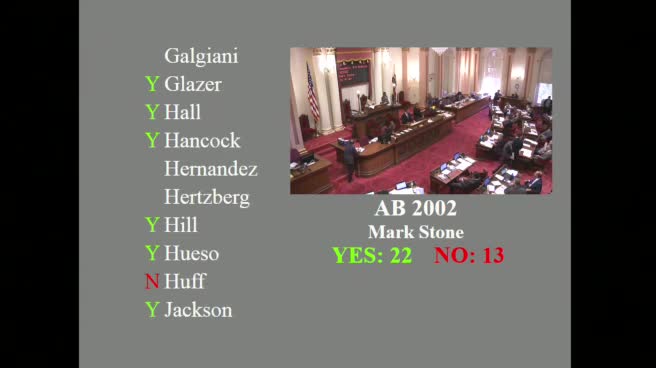 4MIN
Senate Floor
 50SEC
Assembly Floor
Assembly Standing Committee on Transportation
 3MIN
Senate Floor
 8MIN
Senate Standing Committee on Appropriations
 6MIN
Senate Standing Committee on Public Safety
Senate Standing Committee on Transportation and Housing
Bill Author