SB 883: Domestic violence: protective orders.
- Session Year: 2015-2016
- House: Senate
- Latest Version Date: 2016-09-13
Existing law generally punishes the willful disobedience of a court order as contempt of court by imprisonment in a county jail for a term not exceeding 6 months, a fine not exceeding $1,000, or both that imprisonment and fine. Existing law makes the willful and knowing violation of specified protective orders or stay-away court orders punishable by imprisonment in a county jail for not more than one year, or by a fine of not more than $1,000, or by both that imprisonment and fine for a first offense, and makes a 2nd or subsequent conviction for a violation of these specified protective orders or stay-away court orders occurring within 7 years of a prior conviction and involving an act of violence or credible threat of violence punishable as either a misdemeanor or a felony. If probation is granted upon conviction of a willful and knowing violation of these specified protective orders or stay-away court orders, existing law requires the court to impose a minimum period of probation of 36 months, a criminal protective order protecting the victim from further acts of violence, threats, stalking, sexual abuse, and harassment, a minimum fine of $500, successful completion of a batterers program, and a specified amount of appropriate community service, among other requirements.
Under existing law, any person who willfully inflicts corporal injury resulting in a traumatic condition upon a spouse or former spouse, cohabitant or former cohabitant, fiance or fiancee, or someone with whom the offender has, or previously had, an engagement or dating relationship, or the mother or father of the offenders child, is guilty of a felony or a misdemeanor. Upon a conviction under that provision, existing law authorizes the sentencing court to issue an order restraining the defendant from any contact with the victim for up to 10 years.
This bill would make a willful and knowing violation of the above protective order issued for the conviction of inflicting a corporal injury resulting in a traumatic condition punishable by imprisonment in a county jail not exceeding one year, or by a fine not exceeding $1,000, or by both that imprisonment and fine. The bill would make a 2nd or subsequent violation occurring within 7 years involving an act of violence or a credible threat of violence punishable as a felony or a misdemeanor. If probation is granted for a violation of this protective order, the bill would require the court to impose a minimum period of probation of 36 months, a criminal protective order protecting the victim from further acts of violence, threats, stalking, sexual abuse, and harassment, a minimum fine of $500, successful completion of a batterers program, and a specified amount of appropriate community service, among other requirements. By increasing the punishment for a crime, the bill would impose a state-mandated local program.
The California Constitution requires the state to reimburse local agencies and school districts for certain costs mandated by the state. Statutory provisions establish procedures for making that reimbursement.
This bill would provide that no reimbursement is required by this act for a specified reason.
Existing law generally punishes the willful disobedience of a court order as contempt of court by imprisonment in a county jail for a term not exceeding 6 months, a fine not exceeding $1,000, or both that imprisonment and fine. Existing law makes the willful and knowing violation of specified protective orders or stay-away court orders punishable by imprisonment in a county jail for not more than one year, or by a fine of not more than $1,000, or by both that imprisonment and fine for a first offense, and makes a 2nd or subsequent conviction for a violation of these specified protective orders or stay-away court orders occurring within 7 years of a prior conviction and involving an act of violence or credible threat of violence punishable as either a misdemeanor or a felony. If probation is granted upon conviction of a willful and knowing violation of these specified protective orders or stay-away court orders, existing law requires the court to impose a minimum period of probation of 36 months, a criminal protective order protecting the victim from further acts of violence, threats, stalking, sexual abuse, and harassment, a minimum fine of $500, successful completion of a batterers program, and a specified amount of appropriate community service, among other requirements.
Under existing law, any person who willfully, maliciously, or repeatedly follows or willfully and maliciously harasses another person and who makes a credible threat with the intent to place that person in reasonable fear for his or her safety, or the safety of his or her immediate family, is guilty of the crime of stalking, punishable as a felony or a misdemeanor. Upon conviction under that provision, existing law authorizes the sentencing court to issue an order restraining the defendant from any contact with the victim for up to 10 years.
Under existing law, any person who willfully inflicts corporal injury resulting in a traumatic condition upon a spouse or former spouse, cohabitant or former cohabitant, fiance or fiancee, or someone with whom the offender has, or previously had, an engagement or dating relationship, or the mother or father of the offenders child, is guilty of a felony or a misdemeanor. Upon a conviction under that provision, existing law authorizes the sentencing court to issue an order restraining the defendant from any contact with the victim for up to 10 years.
This bill would make a willful and knowing violation of the above protective order issued for the conviction of stalking inflicting a corporal injury resulting in a traumatic condition punishable by imprisonment in a county jail not exceeding one year, or by a fine not exceeding $1,000, or by both that imprisonment and fine. The bill would make a 2nd or subsequent violation occurring within 7 years involving an act of violence or a credible threat of violence punishable as a felony or a misdemeanor. If probation is granted for a violation of this protective order, the bill would require the court to impose a minimum period of probation of 36 months, a criminal protective order protecting the victim from further acts of violence, threats, stalking, sexual abuse, and harassment, a minimum fine of $500, successful completion of a batterers program, and a specified amount of appropriate community service, among other requirements. By increasing the punishment for a crime, the bill would impose a state-mandated local program.
The California Constitution requires the state to reimburse local agencies and school districts for certain costs mandated by the state. Statutory provisions establish procedures for making that reimbursement.
This bill would provide that no reimbursement is required by this act for a specified reason.
Existing law generally punishes the willful disobedience of a court order as contempt of court by imprisonment in a county jail for a term not exceeding 6 months, a fine not exceeding $1,000, or both that imprisonment and fine. Existing law makes the willful and knowing violation of specified protective orders or stay-away court orders punishable by imprisonment in a county jail for not more than one year, or by a fine of not more than $1,000, or by both that imprisonment and fine for a first offense, and makes a 2nd or subsequent conviction for a violation of these specified protective orders or stay-away court orders occurring within 7 years of a prior conviction and involving an act of violence or credible threat of violence punishable as either a misdemeanor or a felony. If probation is granted upon conviction of a willful and knowing violation of these specified protective orders or stay-away court orders, existing law requires the court to impose a minimum period of probation of 36 months, a criminal protective order protecting the victim from further acts of violence, threats, stalking, sexual abuse, and harassment, a minimum fine of $500, successful completion of a batterers program, and a specified amount of appropriate community service, among other requirements.
Under existing law, any person who willfully inflicts corporal injury resulting in a traumatic condition upon a spouse or former spouse, cohabitant or former cohabitant, fiance or fiancee, or someone with whom the offender has, or previously had, an engagement or dating relationship, or the mother or father of the offenders child, is guilty of a felony or a misdemeanor. Upon a conviction under that provision, existing law authorizes the sentencing court to issue an order restraining the defendant from any contact with the victim for up to 10 years.
Under existing law, any person who willfully, maliciously, or repeatedly follows or willfully and maliciously harasses another person and who makes a credible threat with the intent to place that person in reasonable fear for his or her safety, or the safety of his or her immediate family, is guilty of the crime of stalking, punishable as a felony or a misdemeanor. Upon conviction under that provision, existing law authorizes the sentencing court to issue an order restraining the defendant from any contact with the victim for up to 10 years.
This bill would make a willful and knowing violation of the above protective orders order issued for the conviction of inflicting a corporal injury resulting in a traumatic condition or stalking punishable by imprisonment in a county jail not exceeding one year, or by a fine not exceeding $1,000, or by both that imprisonment and fine. The bill would make a 2nd or subsequent violation occurring within 7 years involving an act of violence or a credible threat of violence punishable as a felony or a misdemeanor. If probation is granted for a violation of these protective orders, this protective order, the bill would require the court to impose a minimum period of probation of 36 months, a criminal protective order protecting the victim from further acts of violence, threats, stalking, sexual abuse, and harassment, a minimum fine of $500, successful completion of a batterers program, and a specified amount of appropriate community service, among other requirements. By increasing the punishment for a crime, the bill would impose a state-mandated local program.
The California Constitution requires the state to reimburse local agencies and school districts for certain costs mandated by the state. Statutory provisions establish procedures for making that reimbursement.
This bill would provide that no reimbursement is required by this act for a specified reason.
Existing law generally punishes the willful disobedience of a court order as contempt of court by imprisonment in a county jail for a term not exceeding 6 months, a fine not exceeding $1,000, or both that imprisonment and fine. Existing law makes the willful and knowing violation of specified protective orders or stay-away court orders punishable by imprisonment in a county jail for not more than one year, or by a fine of not more than $1,000, or by both that imprisonment and fine for a first offense, and makes a 2nd or subsequent conviction for a violation of these specified protective orders or stay-away court orders occurring within 7 years of a prior conviction and involving an act of violence or credible threat of violence punishable as either a misdemeanor or a felony. If probation is granted upon conviction of a willful and knowing violation of these specified protective orders or stay-away court orders, existing law requires the court to impose a minimum period of probation of 36 months, a criminal protective order protecting the victim from further acts of violence, threats, stalking, sexual abuse, and harassment, a minimum fine of $500, successful completion of a batterers program, and a specified amount of appropriate community service, among other requirements.
Under existing law, any person who willfully inflicts corporal injury resulting in a traumatic condition upon a spouse or former spouse, cohabitant or former cohabitant, fiance or fiancee, or someone with whom the offender has, or previously had, an engagement or dating relationship, or the mother or father of the offenders child, is guilty of a felony or a misdemeanor. Upon a conviction under that provision, existing law authorizes the sentencing court to issue an order restraining the defendant from any contact with the victim for up to 10 years.
Under existing law, any person who willfully, maliciously, or repeatedly follows or willfully and maliciously harasses another person and who makes a credible threat with the intent to place that person in reasonable fear for his or her safety, or the safety of his or her immediate family, is guilty of the crime of stalking, punishable as a felony or a misdemeanor. Upon conviction under that provision, existing law authorizes the sentencing court to issue an order restraining the defendant from any contact with the victim for up to 10 years.
This bill would make a willful and knowing violation of the above protective orders issued for the conviction of inflicting a corporal injury resulting in a traumatic condition or stalking punishable by imprisonment in a county jail not exceeding one year, or by a fine not exceeding $1,000, or by both that imprisonment and fine. The bill would make a 2nd or subsequent violation occurring within 7 years involving an act of violence or a credible threat of violence punishable as a felony or a misdemeanor. If probation is granted for a violation of these protective orders, the bill would require the court to impose a minimum period of probation of 36 months, a criminal protective order protecting the victim from further acts of violence, threats, stalking, sexual abuse, and harassment, a minimum fine of $500, successful completion of a batterers program, and a specified amount of appropriate community service, among other requirements. By increasing the punishment for a crime, the bill would impose a state-mandated local program.
The California Constitution requires the state to reimburse local agencies and school districts for certain costs mandated by the state. Statutory provisions establish procedures for making that reimbursement.
This bill would provide that no reimbursement is required by this act for a specified reason.
Existing law specifies that the terms of probation granted to a person who has been convicted of domestic violence, are required to include, among other things, a minimum period of probation of 36 months, notice to the victim of the disposition of the case, and successful completion of a batterers program, as defined, or, if such a program is not available, another appropriate counseling program designated by the court, for a period of not less than one year. Existing law provides for the approval of batterers programs by the probation department.
This bill would make technical, nonsubstantive changes to those provisions.
(a)Except as provided in subdivisions (b), (c), and (d), a person guilty of any of the following contempts of court is guilty of a misdemeanor:
(1)Disorderly, contemptuous, or insolent behavior committed during the sitting of a court of justice, in the immediate view and presence of the court, and directly tending to interrupt its proceedings or to impair the respect due to its authority.
(2)Behavior specified in paragraph (1) that is committed in the presence of a referee, while actually engaged in a trial or hearing, pursuant to the order of a court, or in the presence of any jury while actually sitting for the trial of a cause, or upon an inquest or other proceeding authorized by law.
(3)A breach of the peace, noise, or other disturbance directly tending to interrupt the proceedings of the court.
(4)Willful disobedience of the terms as written of any process or court order or out-of-state court order, lawfully issued by a court, including orders pending trial.
(5)Resistance willfully offered by any person to the lawful order or process of a court.
(6)The contumacious and unlawful refusal of a person to be sworn as a witness or, when so sworn, the like refusal to answer a material question.
(7)The publication of a false or grossly inaccurate report of the proceedings of a court.
(8)Presenting to a court having power to pass sentence upon a prisoner under conviction, or to a member of the court, an affidavit, testimony, or representation of any kind, verbal or written, in aggravation or mitigation of the punishment to be imposed upon the prisoner, except as provided in this code.
(9)Willful disobedience of the terms of an injunction that restrains the activities of a criminal street gang or any of its members, lawfully issued by a court, including an order pending trial.
(b)(1)A person who is guilty of contempt of court under paragraph (4) of subdivision (a) by willfully contacting a victim by telephone or mail, or directly, and who has been previously convicted of a violation of Section 646.9 shall be punished by imprisonment in a county jail for not more than one year, by a fine of five thousand dollars ($5,000), or by both that fine and imprisonment.
(2)For the purposes of sentencing under this subdivision, each contact shall constitute a separate violation of this subdivision.
(3)The present incarceration of a person who makes contact with a victim in violation of paragraph (1) is not a defense to a violation of this subdivision.
(c)(1)Notwithstanding paragraph (4) of subdivision (a), a willful and knowing violation of a protective order or stay-away court order described as follows shall constitute contempt of court, a misdemeanor, punishable by imprisonment in a county jail for not more than one year, by a fine of not more than one thousand dollars ($1,000), or by both that imprisonment and fine:
(A)An order issued pursuant to Section 136.2.
(B)An order issued pursuant to paragraph (2) of subdivision (a) of Section 1203.097.
(C)An order issued after a conviction in a criminal proceeding involving elder or dependent adult abuse, as defined in Section 368.
(D)An order issued pursuant to Section 1201.3.
(E)An order described in paragraph (3).
(F)An order issued pursuant to subdivision (j) of Section 273.5.
(2)If a violation of paragraph (1) results in a physical injury, the person shall be imprisoned in a county jail for at least 48 hours, whether a fine or imprisonment is imposed, or the sentence is suspended.
(3)Paragraphs (1) and (2) apply to the following court orders:
(A)An order issued pursuant to Section 6320 or 6389 of the Family Code.
(B)An order excluding one party from the family dwelling or from the dwelling of the other.
(C)An order enjoining a party from specified behavior that the court determined was necessary to effectuate the orders described in paragraph (1).
(4)A second or subsequent conviction for a violation of an order described in paragraph (1) occurring within seven years of a prior conviction for a violation of any of those orders and involving an act of violence or a credible threat of violence, as provided in subdivision (c) of Section 139, is punishable by imprisonment in a county jail not to exceed one year, or in the state prison for 16 months or two or three years.
(5)The prosecuting agency of each county shall have the primary responsibility for the enforcement of the orders described in paragraph (1).
(d)(1)A person who owns, possesses, purchases, or receives a firearm knowing he or she is prohibited from doing so by the provisions of a protective order as defined in Section 136.2 of this code, Section 6218 of the Family Code, or Section 527.6 or 527.8 of the Code of Civil Procedure, shall be punished under Section 29825.
(2)A person subject to a protective order described in paragraph (1) shall not be prosecuted under this section for owning, possessing, purchasing, or receiving a firearm to the extent that firearm is granted an exemption pursuant to subdivision (h) of Section 6389 of the Family Code.
(e)(1)If probation is granted upon conviction of a violation of subdivision (c), the court shall impose probation consistent with Section 1203.097.
(2)If probation is granted upon conviction of a violation of subdivision (c), the conditions of probation may include, in lieu of a fine, one or both of the following requirements:
(A)That the defendant make payments to a battered womens shelter, up to a maximum of one thousand dollars ($1,000).
(B)That the defendant provide restitution to reimburse the victim for reasonable costs of counseling and other reasonable expenses that the court finds are the direct result of the defendants offense.
(3)For an order to pay a fine, make payments to a battered womens shelter, or pay restitution as a condition of probation under this subdivision or subdivision (c), the court shall make a determination of the defendants ability to pay. In no event shall an order to make payments to a battered womens shelter be made if it would impair the ability of the defendant to pay direct restitution to the victim or court-ordered child support.
(4)If the injury to a married person is caused in whole, or in part, by the criminal acts of his or her spouse in violation of subdivision (c), the community property shall not be used to discharge the liability of the offending spouse for restitution to the injured spouse required by Section 1203.04, as operative on or before August 2, 1995, or Section 1202.4, or to a shelter for costs with regard to the injured spouse and dependents required by this subdivision, until all separate property of the offending spouse is exhausted.
(5)A person violating an order described in subdivision (c) may be punished for any substantive offenses described under Section 136.1 or 646.9. A finding of contempt shall not be a bar to prosecution for a violation of Section 136.1 or 646.9. However, a person held in contempt for a violation of subdivision (c) shall be entitled to credit for any punishment imposed as a result of that violation against any sentence imposed upon conviction of an offense described in Section 136.1 or 646.9. A conviction or acquittal for a substantive offense under Section 136.1 or 646.9 shall be a bar to a subsequent punishment for contempt arising out of the same act.
SEC. 2.No reimbursement is required by this act pursuant to Section 6 of Article XIIIB of the California Constitution because the only costs that may be incurred by a local agency or school district will be incurred because this act creates a new crime or infraction, eliminates a crime or infraction, or changes the penalty for a crime or infraction, within the meaning of Section 17556 of the Government Code, or changes the definition of a crime within the meaning of Section 6 of Article XIIIB of the California Constitution.
(a)Except as provided in subdivisions (b), (c), and (d), a person guilty of any of the following contempts of court is guilty of a misdemeanor:
(1)Disorderly, contemptuous, or insolent behavior committed during the sitting of a court of justice, in the immediate view and presence of the court, and directly tending to interrupt its proceedings or to impair the respect due to its authority.
(2)Behavior specified in paragraph (1) that is committed in the presence of a referee, while actually engaged in a trial or hearing, pursuant to the order of a court, or in the presence of any jury while actually sitting for the trial of a cause, or upon an inquest or other proceeding authorized by law.
(3)A breach of the peace, noise, or other disturbance directly tending to interrupt the proceedings of the court.
(4)Willful disobedience of the terms as written of any process or court order or out-of-state court order, lawfully issued by a court, including orders pending trial.
(5)Resistance willfully offered by any person to the lawful order or process of a court.
(6)The contumacious and unlawful refusal of a person to be sworn as a witness or, when so sworn, the like refusal to answer a material question.
(7)The publication of a false or grossly inaccurate report of the proceedings of a court.
(8)Presenting to a court having power to pass sentence upon a prisoner under conviction, or to a member of the court, an affidavit, testimony, or representation of any kind, verbal or written, in aggravation or mitigation of the punishment to be imposed upon the prisoner, except as provided in this code.
(9)Willful disobedience of the terms of an injunction that restrains the activities of a criminal street gang or any of its members, lawfully issued by a court, including an order pending trial.
(b)(1)A person who is guilty of contempt of court under paragraph (4) of subdivision (a) by willfully contacting a victim by telephone or mail, or directly, and who has been previously convicted of a violation of Section 646.9 shall be punished by imprisonment in a county jail for not more than one year, by a fine of five thousand dollars ($5,000), or by both that fine and imprisonment.
(2)For the purposes of sentencing under this subdivision, each contact shall constitute a separate violation of this subdivision.
(3)The present incarceration of a person who makes contact with a victim in violation of paragraph (1) is not a defense to a violation of this subdivision.
(c)(1)Notwithstanding paragraph (4) of subdivision (a), a willful and knowing violation of a protective order or stay-away court order described as follows shall constitute contempt of court, a misdemeanor, punishable by imprisonment in a county jail for not more than one year, by a fine of not more than one thousand dollars ($1,000), or by both that imprisonment and fine:
(A)An order issued pursuant to Section 136.2.
(B)An order issued pursuant to paragraph (2) of subdivision (a) of Section 1203.097.
(C)An order issued after a conviction in a criminal proceeding involving elder or dependent adult abuse, as defined in Section 368.
(D)An order issued pursuant to Section 1201.3.
(E)An order described in paragraph (3).
(F)An order issued pursuant to subdivision (k) of Section 646.9. (j) of Section 273.5.
(2)If a violation of paragraph (1) results in a physical injury, the person shall be imprisoned in a county jail for at least 48 hours, whether a fine or imprisonment is imposed, or the sentence is suspended.
(3)Paragraphs (1) and (2) apply to the following court orders:
(A)An order issued pursuant to Section 6320 or 6389 of the Family Code.
(B)An order excluding one party from the family dwelling or from the dwelling of the other.
(C)An order enjoining a party from specified behavior that the court determined was necessary to effectuate the orders described in paragraph (1).
(4)A second or subsequent conviction for a violation of an order described in paragraph (1) occurring within seven years of a prior conviction for a violation of any of those orders and involving an act of violence or a credible threat of violence, as provided in subdivision (c) of Section 139, is punishable by imprisonment in a county jail not to exceed one year, or in the state prison for 16 months or two or three years.
(5)The prosecuting agency of each county shall have the primary responsibility for the enforcement of the orders described in paragraph (1).
(d)(1)A person who owns, possesses, purchases, or receives a firearm knowing he or she is prohibited from doing so by the provisions of a protective order as defined in Section 136.2 of this code, Section 6218 of the Family Code, or Section 527.6 or 527.8 of the Code of Civil Procedure, shall be punished under Section 29825.
(2)A person subject to a protective order described in paragraph (1) shall not be prosecuted under this section for owning, possessing, purchasing, or receiving a firearm to the extent that firearm is granted an exemption pursuant to subdivision (h) of Section 6389 of the Family Code.
(e)(1)If probation is granted upon conviction of a violation of subdivision (c), the court shall impose probation consistent with Section 1203.097.
(2)If probation is granted upon conviction of a violation of subdivision (c), the conditions of probation may include, in lieu of a fine, one or both of the following requirements:
(A)That the defendant make payments to a battered womens shelter, up to a maximum of one thousand dollars ($1,000).
(B)That the defendant provide restitution to reimburse the victim for reasonable costs of counseling and other reasonable expenses that the court finds are the direct result of the defendants offense.
(3)For an order to pay a fine, make payments to a battered womens shelter, or pay restitution as a condition of probation under this subdivision or subdivision (c), the court shall make a determination of the defendants ability to pay. In no event shall an order to make payments to a battered womens shelter be made if it would impair the ability of the defendant to pay direct restitution to the victim or court-ordered child support.
(4)If the injury to a married person is caused in whole, or in part, by the criminal acts of his or her spouse in violation of subdivision (c), the community property shall not be used to discharge the liability of the offending spouse for restitution to the injured spouse required by Section 1203.04, as operative on or before August 2, 1995, or Section 1202.4, or to a shelter for costs with regard to the injured spouse and dependents required by this subdivision, until all separate property of the offending spouse is exhausted.
(5)A person violating an order described in subdivision (c) may be punished for any substantive offenses described under Section 136.1 or 646.9. A finding of contempt shall not be a bar to prosecution for a violation of Section 136.1 or 646.9. However, a person held in contempt for a violation of subdivision (c) shall be entitled to credit for any punishment imposed as a result of that violation against any sentence imposed upon conviction of an offense described in Section 136.1 or 646.9. A conviction or acquittal for a substantive offense under Section 136.1 or 646.9 shall be a bar to a subsequent punishment for contempt arising out of the same act.
SEC. 2.No reimbursement is required by this act pursuant to Section 6 of Article XIIIB of the California Constitution because the only costs that may be incurred by a local agency or school district will be incurred because this act creates a new crime or infraction, eliminates a crime or infraction, or changes the penalty for a crime or infraction, within the meaning of Section 17556 of the Government Code, or changes the definition of a crime within the meaning of Section 6 of Article XIIIB of the California Constitution.
(a)Except as provided in subdivisions (b), (c), and (d), a person guilty of any of the following contempts of court is guilty of a misdemeanor:
(1)Disorderly, contemptuous, or insolent behavior committed during the sitting of a court of justice, in the immediate view and presence of the court, and directly tending to interrupt its proceedings or to impair the respect due to its authority.
(2)Behavior specified in paragraph (1) that is committed in the presence of a referee, while actually engaged in a trial or hearing, pursuant to the order of a court, or in the presence of any jury while actually sitting for the trial of a cause, or upon an inquest or other proceeding authorized by law.
(3)A breach of the peace, noise, or other disturbance directly tending to interrupt the proceedings of the court.
(4)Willful disobedience of the terms as written of any process or court order or out-of-state court order, lawfully issued by a court, including orders pending trial.
(5)Resistance willfully offered by any person to the lawful order or process of a court.
(6)The contumacious and unlawful refusal of a person to be sworn as a witness or, when so sworn, the like refusal to answer a material question.
(7)The publication of a false or grossly inaccurate report of the proceedings of a court.
(8)Presenting to a court having power to pass sentence upon a prisoner under conviction, or to a member of the court, an affidavit, testimony, or representation of any kind, verbal or written, in aggravation or mitigation of the punishment to be imposed upon the prisoner, except as provided in this code.
(9)Willful disobedience of the terms of an injunction that restrains the activities of a criminal street gang or any of its members, lawfully issued by a court, including an order pending trial.
(b)(1)A person who is guilty of contempt of court under paragraph (4) of subdivision (a) by willfully contacting a victim by telephone or mail, or directly, and who has been previously convicted of a violation of Section 646.9 shall be punished by imprisonment in a county jail for not more than one year, by a fine of five thousand dollars ($5,000), or by both that fine and imprisonment.
(2)For the purposes of sentencing under this subdivision, each contact shall constitute a separate violation of this subdivision.
(3)The present incarceration of a person who makes contact with a victim in violation of paragraph (1) is not a defense to a violation of this subdivision.
(c)(1)Notwithstanding paragraph (4) of subdivision (a), a willful and knowing violation of a protective order or stay-away court order described as follows shall constitute contempt of court, a misdemeanor, punishable by imprisonment in a county jail for not more than one year, by a fine of not more than one thousand dollars ($1,000), or by both that imprisonment and fine:
(A)An order issued pursuant to Section 136.2.
(B)An order issued pursuant to paragraph (2) of subdivision (a) of Section 1203.097.
(C)An order issued after a conviction in a criminal proceeding involving elder or dependent adult abuse, as defined in Section 368.
(D)An order issued pursuant to Section 1201.3.
(E)An order described in paragraph (3).
(F)An order issued pursuant to subdivision (j) of Section 273.5.
(G)
(F)An order issued pursuant to subdivision (k) of Section 646.9.
(2)If a violation of paragraph (1) results in a physical injury, the person shall be imprisoned in a county jail for at least 48 hours, whether a fine or imprisonment is imposed, or the sentence is suspended.
(3)Paragraphs (1) and (2) apply to the following court orders:
(A)An order issued pursuant to Section 6320 or 6389 of the Family Code.
(B)An order excluding one party from the family dwelling or from the dwelling of the other.
(C)An order enjoining a party from specified behavior that the court determined was necessary to effectuate the orders described in paragraph (1).
(4)A second or subsequent conviction for a violation of an order described in paragraph (1) occurring within seven years of a prior conviction for a violation of any of those orders and involving an act of violence or a credible threat of violence, as provided in subdivision (c) of Section 139, is punishable by imprisonment in a county jail not to exceed one year, or in the state prison for 16 months or two or three years.
(5)The prosecuting agency of each county shall have the primary responsibility for the enforcement of the orders described in paragraph (1).
(d)(1)A person who owns, possesses, purchases, or receives a firearm knowing he or she is prohibited from doing so by the provisions of a protective order as defined in Section 136.2 of this code, Section 6218 of the Family Code, or Section 527.6 or 527.8 of the Code of Civil Procedure, shall be punished under Section 29825.
(2)A person subject to a protective order described in paragraph (1) shall not be prosecuted under this section for owning, possessing, purchasing, or receiving a firearm to the extent that firearm is granted an exemption pursuant to subdivision (h) of Section 6389 of the Family Code.
(e)(1)If probation is granted upon conviction of a violation of subdivision (c), the court shall impose probation consistent with Section 1203.097.
(2)If probation is granted upon conviction of a violation of subdivision (c), the conditions of probation may include, in lieu of a fine, one or both of the following requirements:
(A)That the defendant make payments to a battered womens shelter, up to a maximum of one thousand dollars ($1,000).
(B)That the defendant provide restitution to reimburse the victim for reasonable costs of counseling and other reasonable expenses that the court finds are the direct result of the defendants offense.
(3)For an order to pay a fine, make payments to a battered womens shelter, or pay restitution as a condition of probation under this subdivision or subdivision (c), the court shall make a determination of the defendants ability to pay. In no event shall an order to make payments to a battered womens shelter be made if it would impair the ability of the defendant to pay direct restitution to the victim or court-ordered child support.
(4)If the injury to a married person is caused in whole, or in part, by the criminal acts of his or her spouse in violation of subdivision (c), the community property shall not be used to discharge the liability of the offending spouse for restitution to the injured spouse required by Section 1203.04, as operative on or before August 2, 1995, or Section 1202.4, or to a shelter for costs with regard to the injured spouse and dependents required by this subdivision, until all separate property of the offending spouse is exhausted.
(5)A person violating an order described in subdivision (c) may be punished for any substantive offenses described under Section 136.1 or 646.9. A finding of contempt shall not be a bar to prosecution for a violation of Section 136.1 or 646.9. However, a person held in contempt for a violation of subdivision (c) shall be entitled to credit for any punishment imposed as a result of that violation against any sentence imposed upon conviction of an offense described in Section 136.1 or 646.9. A conviction or acquittal for a substantive offense under Section 136.1 or 646.9 shall be a bar to a subsequent punishment for contempt arising out of the same act.
SEC. 2.No reimbursement is required by this act pursuant to Section 6 of Article XIIIB of the California Constitution because the only costs that may be incurred by a local agency or school district will be incurred because this act creates a new crime or infraction, eliminates a crime or infraction, or changes the penalty for a crime or infraction, within the meaning of Section 17556 of the Government Code, or changes the definition of a crime within the meaning of Section 6 of Article XIIIB of the California Constitution.
(a)Except as provided in subdivisions (b), (c), and (d), a person guilty of any of the following contempts of court is guilty of a misdemeanor:
(1)Disorderly, contemptuous, or insolent behavior committed during the sitting of a court of justice, in the immediate view and presence of the court, and directly tending to interrupt its proceedings or to impair the respect due to its authority.
(2)Behavior specified in paragraph (1) that is committed in the presence of a referee, while actually engaged in a trial or hearing, pursuant to the order of a court, or in the presence of any jury while actually sitting for the trial of a cause, or upon an inquest or other proceeding authorized by law.
(3)A breach of the peace, noise, or other disturbance directly tending to interrupt the proceedings of the court.
(4)Willful disobedience of the terms as written of any process or court order or out-of-state court order, lawfully issued by a court, including orders pending trial.
(5)Resistance willfully offered by any person to the lawful order or process of a court.
(6)The contumacious and unlawful refusal of a person to be sworn as a witness or, when so sworn, the like refusal to answer a material question.
(7)The publication of a false or grossly inaccurate report of the proceedings of a court.
(8)Presenting to a court having power to pass sentence upon a prisoner under conviction, or to a member of the court, an affidavit, testimony, or representation of any kind, verbal or written, in aggravation or mitigation of the punishment to be imposed upon the prisoner, except as provided in this code.
(9)Willful disobedience of the terms of an injunction that restrains the activities of a criminal street gang or any of its members, lawfully issued by a court, including an order pending trial.
(b)(1)A person who is guilty of contempt of court under paragraph (4) of subdivision (a) by willfully contacting a victim by telephone or mail, or directly, and who has been previously convicted of a violation of Section 646.9 shall be punished by imprisonment in a county jail for not more than one year, by a fine of five thousand dollars ($5,000), or by both that fine and imprisonment.
(2)For the purposes of sentencing under this subdivision, each contact shall constitute a separate violation of this subdivision.
(3)The present incarceration of a person who makes contact with a victim in violation of paragraph (1) is not a defense to a violation of this subdivision.
(c)(1)Notwithstanding paragraph (4) of subdivision (a), a willful and knowing violation of a protective order or stay-away court order described as follows shall constitute contempt of court, a misdemeanor, punishable by imprisonment in a county jail for not more than one year, by a fine of not more than one thousand dollars ($1,000), or by both that imprisonment and fine:
(A)An order issued pursuant to Section 136.2.
(B)An order issued pursuant to paragraph (2) of subdivision (a) of Section 1203.097.
(C)An order issued after a conviction in a criminal proceeding involving elder or dependent adult abuse, as defined in Section 368.
(D)An order issued pursuant to Section 1201.3.
(E)An order described in paragraph (3).
(F)An order issued pursuant to subdivision (j) of Section 273.5.
(G)An order issued pursuant to subdivision (k) of Section 646.9.
(2)If a violation of paragraph (1) results in a physical injury, the person shall be imprisoned in a county jail for at least 48 hours, whether a fine or imprisonment is imposed, or the sentence is suspended.
(3)Paragraphs (1) and (2) apply to the following court orders:
(A)An order issued pursuant to Section 6320 or 6389 of the Family Code.
(B)An order excluding one party from the family dwelling or from the dwelling of the other.
(C)An order enjoining a party from specified behavior that the court determined was necessary to effectuate the orders described in paragraph (1).
(4)A second or subsequent conviction for a violation of an order described in paragraph (1) occurring within seven years of a prior conviction for a violation of any of those orders and involving an act of violence or a credible threat of violence, as provided in subdivision (c) of Section 139, is punishable by imprisonment in a county jail not to exceed one year, or in the state prison for 16 months or two or three years.
(5)The prosecuting agency of each county shall have the primary responsibility for the enforcement of the orders described in paragraph (1).
(d)(1)A person who owns, possesses, purchases, or receives a firearm knowing he or she is prohibited from doing so by the provisions of a protective order as defined in Section 136.2 of this code, Section 6218 of the Family Code, or Section 527.6 or 527.8 of the Code of Civil Procedure, shall be punished under Section 29825.
(2)A person subject to a protective order described in paragraph (1) shall not be prosecuted under this section for owning, possessing, purchasing, or receiving a firearm to the extent that firearm is granted an exemption pursuant to subdivision (h) of Section 6389 of the Family Code.
(e)(1)If probation is granted upon conviction of a violation of subdivision (c), the court shall impose probation consistent with Section 1203.097.
(2)If probation is granted upon conviction of a violation of subdivision (c), the conditions of probation may include, in lieu of a fine, one or both of the following requirements:
(A)That the defendant make payments to a battered womens shelter, up to a maximum of one thousand dollars ($1,000).
(B)That the defendant provide restitution to reimburse the victim for reasonable costs of counseling and other reasonable expenses that the court finds are the direct result of the defendants offense.
(3)For an order to pay a fine, make payments to a battered womens shelter, or pay restitution as a condition of probation under this subdivision or subdivision (c), the court shall make a determination of the defendants ability to pay. In no event shall an order to make payments to a battered womens shelter be made if it would impair the ability of the defendant to pay direct restitution to the victim or court-ordered child support.
(4)If the injury to a married person is caused in whole, or in part, by the criminal acts of his or her spouse in violation of subdivision (c), the community property shall not be used to discharge the liability of the offending spouse for restitution to the injured spouse required by Section 1203.04, as operative on or before August 2, 1995, or Section 1202.4, or to a shelter for costs with regard to the injured spouse and dependents required by this subdivision, until all separate property of the offending spouse is exhausted.
(5)A person violating an order described in subdivision (c) may be punished for any substantive offenses described under Section 136.1 or 646.9. A finding of contempt shall not be a bar to prosecution for a violation of Section 136.1 or 646.9. However, a person held in contempt for a violation of subdivision (c) shall be entitled to credit for any punishment imposed as a result of that violation against any sentence imposed upon conviction of an offense described in Section 136.1 or 646.9. A conviction or acquittal for a substantive offense under Section 136.1 or 646.9 shall be a bar to a subsequent punishment for contempt arising out of the same act.
SEC. 2.No reimbursement is required by this act pursuant to Section 6 of Article XIIIB of the California Constitution because the only costs that may be incurred by a local agency or school district will be incurred because this act creates a new crime or infraction, eliminates a crime or infraction, or changes the penalty for a crime or infraction, within the meaning of Section 17556 of the Government Code, or changes the definition of a crime within the meaning of Section 6 of Article XIIIB of the California Constitution.
SECTION 1.Section 1203.097 of the Penal Code is amended to read:1203.097.(a)If a person is granted probation for a crime in which the victim is a person defined in Section 6211 of the Family Code, the terms of probation shall include all of the following:
(1)A minimum period of probation of 36 months, which may include a period of summary probation as appropriate.
(2)A criminal court protective order protecting the victim from further acts of violence, threats, stalking, sexual abuse, and harassment, and, if appropriate, containing residence exclusion or stay-away conditions.
(3)Notice to the victim of the disposition of the case.
(4)Booking the defendant within one week of sentencing if the defendant has not already been booked.
(5)(A)A minimum payment by the defendant of a fee of five hundred dollars ($500) to be disbursed as specified in this paragraph. If, after a hearing in open court, the court finds that the defendant does not have the ability to pay, the court may reduce or waive this fee. If the court exercises its discretion to reduce or waive the fee, it shall state the reason on the record.
(B)Two-thirds of the moneys deposited with the county treasurer pursuant to this section shall be retained by counties and deposited in the domestic violence programs special fund created pursuant to Section 18305 of the Welfare and Institutions Code, to be expended for the purposes of Chapter 5 (commencing with Section 18290) of Part 6 of Division 9 of the Welfare and Institutions Code. Of the moneys deposited in the domestic violence programs special fund, no more than 8 percent may be used for administrative costs, as specified in Section 18305 of the Welfare and Institutions Code.
(C)The remaining one-third of the moneys shall be transferred, once a month, to the Controller for deposit in equal amounts in the Domestic Violence Restraining Order Reimbursement Fund and in the Domestic Violence Training and Education Fund, which are hereby created, in an amount equal to one-third of funds collected during the preceding month. Moneys deposited into these funds pursuant to this section shall be available upon appropriation by the Legislature and shall be distributed each fiscal year as follows:
(i)Funds from the Domestic Violence Restraining Order Reimbursement Fund shall be distributed to local law enforcement or other criminal justice agencies for state-mandated local costs resulting from the notification requirements set forth in subdivision (b) of Section 6380 of the Family Code, based on the annual notification from the Department of Justice of the number of restraining orders issued and registered in the state domestic violence restraining order registry maintained by the Department of Justice, for the development and maintenance of the domestic violence restraining order databank system.
(ii)Funds from the Domestic Violence Training and Education Fund shall support a statewide training and education program to increase public awareness of domestic violence and to improve the scope and quality of services provided to the victims of domestic violence. Grants to support this program shall be awarded on a competitive basis and be administered by the State Department of Public Health, in consultation with the statewide domestic violence coalition, which is eligible to receive funding under this section.
(D)The fee imposed by this paragraph shall be treated as a fee, not as a fine, and shall not be subject to reduction for time served as provided pursuant to Section 1205 or 2900.5.
(E)The fee imposed by this paragraph may be collected by the collecting agency, or the agencys designee, after the termination of the period of probation, whether probation is terminated by revocation or by completion of the term.
(6)Successful completion of a batterers program, as defined in subdivision (c), or if none is available, another appropriate counseling program designated by the court, for a period not less than one year with periodic progress reports by the program to the court every three months or less and weekly sessions of a minimum of two hours class time duration. The defendant shall attend consecutive weekly sessions, unless granted an excused absence for good cause by the program for no more than three individual sessions during the entire program, and shall complete the program within 18 months, unless, after a hearing, the court finds good cause to modify the requirements of consecutive attendance or completion within 18 months.
(7)(A)(i)The court shall order the defendant to comply with all probation requirements, including the requirements to attend counseling, keep all program appointments, and pay program fees based upon the ability to pay.
(ii)The terms of probation for offenders shall not be lifted until all reasonable fees due to the counseling program have been paid in full, but in no case shall probation be extended beyond the term provided in subdivision (a) of Section 1203.1. If the court finds that the defendant does not have the ability to pay the fees based on the defendants changed circumstances, the court may reduce or waive the fees.
(B)Upon request by the batterers program, the court shall provide the defendants arrest report, prior incidents of violence, and treatment history to the program.
(8)The court also shall order the defendant to perform a specified amount of appropriate community service, as designated by the court. The defendant shall present the court with proof of completion of community service and the court shall determine if the community service has been satisfactorily completed. If sufficient staff and resources are available, the community service shall be performed under the jurisdiction of the local agency overseeing a community service program.
(9)If the program finds that the defendant is unsuitable, the program shall immediately contact the probation department or the court. The probation department or court shall either recalendar the case for hearing or refer the defendant to an appropriate alternative batterers program.
(10)(A)Upon recommendation of the program, a court shall require a defendant to participate in additional sessions throughout the probationary period, unless it finds that it is not in the interests of justice to do so, states its reasons on the record, and enters them into the minutes. In deciding whether the defendant would benefit from more sessions, the court shall consider whether any of the following conditions exists:
(i)The defendant has been violence free for a minimum of six months.
(ii)The defendant has cooperated and participated in the batterers program.
(iii)The defendant demonstrates an understanding of and practices positive conflict resolution skills.
(iv)The defendant blames, degrades, or has committed acts that dehumanize the victim or puts at risk the victims safety, including, but not limited to, molesting, stalking, striking, attacking, threatening, sexually assaulting, or battering the victim.
(v)The defendant demonstrates an understanding that the use of coercion or violent behavior to maintain dominance is unacceptable in an intimate relationship.
(vi)The defendant has made threats to harm anyone in any manner.
(vii)The defendant has complied with applicable requirements under paragraph (6) of subdivision (c) or subparagraph (C) to receive alcohol counseling, drug counseling, or both.
(viii)The defendant demonstrates acceptance of responsibility for the abusive behavior perpetrated against the victim.
(B)The program shall immediately report any violation of the terms of the protective order, including any new acts of violence or failure to comply with the program requirements, to the court, the prosecutor, and, if formal probation has been ordered, to the probation department. The probationer shall file proof of enrollment in a batterers program with the court within 30 days of conviction.
(C)Concurrent with other requirements under this section, in addition to, and not in lieu of, the batterers program, and unless prohibited by the referring court, the probation department or the court may make provisions for a defendant to use his or her resources to enroll in a chemical dependency program or to enter voluntarily a licensed chemical dependency recovery hospital or residential treatment program that has a valid license issued by the state to provide alcohol or drug services to receive program participation credit, as determined by the court. The probation department shall document evidence of this hospital or residential treatment participation in the defendants program file.
(11)The conditions of probation may include, in lieu of a fine, but not in lieu of the fund payment required under paragraph (5), one or more of the following requirements:
(A)That the defendant make payments to a battered womens shelter, up to a maximum of five thousand dollars ($5,000).
(B)That the defendant reimburse the victim for reasonable expenses that the court finds are the direct result of the defendants offense.
For any order to pay a fine, to make payments to a battered womens shelter, or to pay restitution as a condition of probation under this subdivision, the court shall make a determination of the defendants ability to pay. Determination of a defendants ability to pay may include his or her future earning capacity. A defendant shall bear the burden of demonstrating lack of his or her ability to pay. Express findings by the court as to the factors bearing on the amount of the fine shall not be required. In no event shall any order to make payments to a battered womens shelter be made if it would impair the ability of the defendant to pay direct restitution to the victim or court-ordered child support. When the injury to a married person is caused, in whole or in part, by the criminal acts of his or her spouse in violation of this section, the community property shall not be used to discharge the liability of the offending spouse for restitution to the injured spouse, as required by Section 1203.04, as operative on or before August 2, 1995, or Section 1202.4, or to a shelter for costs with regard to the injured spouse, until all separate property of the offending spouse is exhausted.
(12)If it appears to the prosecuting attorney, the court, or the probation department that the defendant is performing unsatisfactorily in the assigned program, is not benefiting from counseling, or has engaged in criminal conduct, upon request of the probation officer, the prosecuting attorney, or on its own motion, the court, as a priority calendar item, shall hold a hearing to determine whether further sentencing should proceed. The court may consider factors, including, but not limited to, any violence by the defendant against the former or a new victim while on probation and noncompliance with any other specific condition of probation. If the court finds that the defendant is not performing satisfactorily in the assigned program, is not benefiting from the program, has not complied with a condition of probation, or has engaged in criminal conduct, the court shall terminate the defendants participation in the program and shall proceed with further sentencing.
(b)If a person is granted formal probation for a crime in which the victim is a person defined in Section 6211 of the Family Code, in addition to the terms specified in subdivision (a), all of the following shall apply:
(1)The probation department shall make an investigation and take into consideration the defendants age, medical history, employment and service records, educational background, community and family ties, prior incidents of violence, police report, treatment history, if any, demonstrable motivation, and other mitigating factors in determining which batterers program would be appropriate for the defendant. This information shall be provided to the batterers program if it is requested. The probation department shall also determine which community programs the defendant would benefit from and which of those programs would accept the defendant. The probation department shall report its findings and recommendations to the court.
(2)The court shall advise the defendant that the failure to report to the probation department for the initial investigation, as directed by the court, or the failure to enroll in a specified program, as directed by the court or the probation department, shall result in possible further incarceration. The court, in the interests of justice, may relieve the defendant from the prohibition set forth in this subdivision based upon the defendants mistake or excusable neglect. Application for this relief shall be filed within 20 court days of the missed deadline. This time limitation may not be extended. A copy of any application for relief shall be served on the office of the prosecuting attorney.
(3)After the court orders the defendant to a batterers program, the probation department shall conduct an initial assessment of the defendant, including, but not limited to, all of the following:
(A)Social, economic, and family background.
(B)Education.
(C)Vocational achievements.
(D)Criminal history.
(E)Medical history.
(F)Substance abuse history.
(G)Consultation with the probation officer.
(H)Verbal consultation with the victim, only if the victim desires to participate.
(I)Assessment of the future probability of the defendant committing murder.
(4)The probation department shall attempt to notify the victim regarding the requirements for the defendants participation in the batterers program, as well as regarding available victim resources. The victim also shall be informed that attendance in any program does not guarantee that an abuser will not be violent.
(c)The court or the probation department shall refer defendants only to batterers programs that follow standards outlined in paragraph (1), which may include, but are not limited to, lectures, classes, group discussions, and counseling. The probation department shall design and implement an approval and renewal process for batterers programs and shall solicit input from criminal justice agencies and domestic violence victim advocacy programs.
(1)The goal of a batterers program under this section shall be to stop domestic violence. A batterers program shall consist of the following components:
(A)Strategies to hold the defendant accountable for the violence in a relationship, including, but not limited to, providing the defendant with a written statement that the defendant shall be held accountable for acts or threats of domestic violence.
(B)A requirement that the defendant participate in ongoing same-gender group sessions.
(C)An initial intake that provides written definitions to the defendant of physical, emotional, sexual, economic, and verbal abuse, and the techniques for stopping these types of abuse.
(D)Procedures to inform the victim regarding the requirements for the defendants participation in the intervention program as well as regarding available victim resources. The victim also shall be informed that attendance in any program does not guarantee that an abuser will not be violent.
(E)A requirement that the defendant attend group sessions free of chemical influence.
(F)Educational programming that examines, at a minimum, gender roles, socialization, the nature of violence, the dynamics of power and control, and the effects of abuse on children and others.
(G)A requirement that excludes any couple counseling or family counseling, or both.
(H)Procedures that give the program the right to assess whether or not the defendant would benefit from the program and to refuse to enroll the defendant if it is determined that the defendant would not benefit from the program, so long as the refusal is not because of the defendants inability to pay. If possible, the program shall suggest an appropriate alternative program.
(I)Program staff who, to the extent possible, have specific knowledge regarding, but not limited to, spousal abuse, child abuse, sexual abuse, substance abuse, the dynamics of violence and abuse, the law, and procedures of the legal system.
(J)Program staff who are encouraged to utilize the expertise, training, and assistance of local domestic violence centers.
(K)A requirement that the defendant enter into a written agreement with the program, which shall include an outline of the contents of the program, the attendance requirements, the requirement to attend group sessions free of chemical influence, and a statement that the defendant may be removed from the program if it is determined that the defendant is not benefiting from the program or is disruptive to the program.
(L)A requirement that the defendant sign a confidentiality statement prohibiting disclosure of any information obtained through participating in the program or during group sessions regarding other participants in the program.
(M)Program content that provides cultural and ethnic sensitivity.
(N)A requirement of a written referral from the court or probation department prior to permitting the defendant to enroll in the program. The written referral shall state the number of minimum sessions required by the court.
(O)Procedures for submitting to the probation department all of the following uniform written responses:
(i)Proof of enrollment, to be submitted to the court and the probation department and to include the fee determined to be charged to the defendant, based upon the ability to pay, for each session.
(ii)Periodic progress reports that include attendance, fee payment history, and program compliance.
(iii)Final evaluation that includes the programs evaluation of the defendants progress, using the criteria set forth in subparagraph (A) of paragraph (10) of subdivision (a), and recommendation for either successful or unsuccessful termination or continuation in the program.
(P)A sliding fee schedule based on the defendants ability to pay. The batterers program shall develop and utilize a sliding fee scale that recognizes both the defendants ability to pay and the necessity of programs to meet overhead expenses. An indigent defendant may negotiate a deferred payment schedule, but shall pay a nominal fee, if the defendant has the ability to pay the nominal fee. Upon a hearing and a finding by the court that the defendant does not have the financial ability to pay the nominal fee, the court shall waive this fee. The payment of the fee shall be made a condition of probation if the court determines the defendant has the present ability to pay the fee. The fee shall be paid during the term of probation unless the program sets other conditions. The acceptance policies shall be in accordance with the scaled fee system.
(2)The court shall refer persons only to batterers programs that have been approved by the probation department pursuant to paragraph (5). The probation department shall do both of the following:
(A)Provide for the issuance of a provisional approval, provided that the applicant is in substantial compliance with applicable laws and regulations and an urgent need for approval exists. A provisional approval shall be considered an authorization to provide services and shall not be considered a vested right.
(B)If the probation department determines that a program is not in compliance with standards set by the department, the department shall provide written notice of the noncompliant areas to the program. The program shall submit a written plan of corrections within 14 days from the date of the written notice on noncompliance. A plan of correction shall include, but not be limited to, a description of each corrective action and timeframe for implementation. The department shall review and approve all or any part of the plan of correction and notify the program of approval or disapproval in writing. If the program fails to submit a plan of correction or fails to implement the approved plan of correction, the department shall consider whether to revoke or suspend approval and, upon revoking or suspending approval, shall have the option to cease referrals of defendants under this section.
(3)No program, regardless of its source of funding, shall be approved unless it meets all of the following standards:
(A)The establishment of guidelines and criteria for education services, including standards of services that may include lectures, classes, and group discussions.
(B)Supervision of the defendant for the purpose of evaluating the persons progress in the program.
(C)Adequate reporting requirements to ensure that all persons who, after being ordered to attend and complete a program, may be identified for either failure to enroll in, or failure to successfully complete, the program or for the successful completion of the program as ordered. The program shall notify the court and the probation department, in writing, within the period of time and in the manner specified by the court of any person who fails to complete the program. Notification shall be given if the program determines that the defendant is performing unsatisfactorily or if the defendant is not benefiting from the education, treatment, or counseling.
(D)No victim shall be compelled to participate in a program or counseling, and no program may condition a defendants enrollment on participation by the victim.
(4)In making referrals of indigent defendants to approved batterers programs, the probation department shall apportion these referrals evenly among the approved programs.
(5)The probation department shall have the sole authority to approve a batterers program for probation. The program shall be required to obtain only one approval but shall renew that approval annually.
(A)The procedure for the approval of a new or existing program shall include all of the following:
(i)The completion of a written application containing necessary and pertinent information describing the applicant program.
(ii)The demonstration by the program that it possesses adequate administrative and operational capability to operate a batterers treatment program. The program shall provide documentation to prove that the program has conducted batterers programs for at least one year prior to application. This requirement may be waived under subparagraph (A) of paragraph (2) if there is no existing batterers program in the city, county, or city and county.
(iii)The onsite review of the program, including monitoring of a session to determine that the program adheres to applicable statutes and regulations.
(iv)The payment of the approval fee.
(B)The probation department shall fix a fee for approval not to exceed two hundred fifty dollars ($250) and for approval renewal not to exceed two hundred fifty dollars ($250) every year in an amount sufficient to cover its costs in administering the approval process under this section. No fee shall be charged for the approval of local governmental entities.
(C)The probation department has the sole authority to approve the issuance, denial, suspension, or revocation of approval and to cease new enrollments or referrals to a batterers program under this section. The probation department shall review information relative to a programs performance or failure to adhere to standards, or both. The probation department may suspend or revoke an approval issued under this subdivision or deny an application to renew an approval or to modify the terms and conditions of approval, based on grounds established by probation, including, but not limited to, either of the following:
(i)Violation of this section by any person holding approval or by a program employee in a program under this section.
(ii)Misrepresentation of any material fact in obtaining the approval.
(6)For defendants who are chronic users or serious abusers of drugs or alcohol, standard components in the program shall include concurrent counseling for substance abuse and violent behavior, and in appropriate cases, detoxification and abstinence from the abused substance.
(7)The program shall conduct an exit conference that assesses the defendants progress during his or her participation in the batterers program.
(d)An act or omission relating to the approval of a batterers treatment program under paragraph (5) of subdivision (c) is a discretionary act pursuant to Section 820.2 of the Government Code.
(a)If a person is granted probation for a crime in which the victim is a person defined in Section 6211 of the Family Code, the terms of probation shall include all of the following:
(1)A minimum period of probation of 36 months, which may include a period of summary probation as appropriate.
(2)A criminal court protective order protecting the victim from further acts of violence, threats, stalking, sexual abuse, and harassment, and, if appropriate, containing residence exclusion or stay-away conditions.
(3)Notice to the victim of the disposition of the case.
(4)Booking the defendant within one week of sentencing if the defendant has not already been booked.
(5)(A)A minimum payment by the defendant of a fee of five hundred dollars ($500) to be disbursed as specified in this paragraph. If, after a hearing in open court, the court finds that the defendant does not have the ability to pay, the court may reduce or waive this fee. If the court exercises its discretion to reduce or waive the fee, it shall state the reason on the record.
(B)Two-thirds of the moneys deposited with the county treasurer pursuant to this section shall be retained by counties and deposited in the domestic violence programs special fund created pursuant to Section 18305 of the Welfare and Institutions Code, to be expended for the purposes of Chapter 5 (commencing with Section 18290) of Part 6 of Division 9 of the Welfare and Institutions Code. Of the moneys deposited in the domestic violence programs special fund, no more than 8 percent may be used for administrative costs, as specified in Section 18305 of the Welfare and Institutions Code.
(C)The remaining one-third of the moneys shall be transferred, once a month, to the Controller for deposit in equal amounts in the Domestic Violence Restraining Order Reimbursement Fund and in the Domestic Violence Training and Education Fund, which are hereby created, in an amount equal to one-third of funds collected during the preceding month. Moneys deposited into these funds pursuant to this section shall be available upon appropriation by the Legislature and shall be distributed each fiscal year as follows:
(i)Funds from the Domestic Violence Restraining Order Reimbursement Fund shall be distributed to local law enforcement or other criminal justice agencies for state-mandated local costs resulting from the notification requirements set forth in subdivision (b) of Section 6380 of the Family Code, based on the annual notification from the Department of Justice of the number of restraining orders issued and registered in the state domestic violence restraining order registry maintained by the Department of Justice, for the development and maintenance of the domestic violence restraining order databank system.
(ii)Funds from the Domestic Violence Training and Education Fund shall support a statewide training and education program to increase public awareness of domestic violence and to improve the scope and quality of services provided to the victims of domestic violence. Grants to support this program shall be awarded on a competitive basis and be administered by the State Department of Public Health, in consultation with the statewide domestic violence coalition, which is eligible to receive funding under this section.
(D)The fee imposed by this paragraph shall be treated as a fee, not as a fine, and shall not be subject to reduction for time served as provided pursuant to Section 1205 or 2900.5.
(E)The fee imposed by this paragraph may be collected by the collecting agency, or the agencys designee, after the termination of the period of probation, whether probation is terminated by revocation or by completion of the term.
(6)Successful completion of a batterers program, as defined in subdivision (c), or if none is available, another appropriate counseling program designated by the court, for a period not less than one year with periodic progress reports by the program to the court every three months or less and weekly sessions of a minimum of two hours class time duration. The defendant shall attend consecutive weekly sessions, unless granted an excused absence for good cause by the program for no more than three individual sessions during the entire program, and shall complete the program within 18 months, unless, after a hearing, the court finds good cause to modify the requirements of consecutive attendance or completion within 18 months.
(7)(A)(i)The court shall order the defendant to comply with all probation requirements, including the requirements to attend counseling, keep all program appointments, and pay program fees based upon the ability to pay.
(ii)The terms of probation for offenders shall not be lifted until all reasonable fees due to the counseling program have been paid in full, but in no case shall probation be extended beyond the term provided in subdivision (a) of Section 1203.1. If the court finds that the defendant does not have the ability to pay the fees based on the defendants changed circumstances, the court may reduce or waive the fees.
(B)Upon request by the batterers program, the court shall provide the defendants arrest report, prior incidents of violence, and treatment history to the program.
(8)The court also shall order the defendant to perform a specified amount of appropriate community service, as designated by the court. The defendant shall present the court with proof of completion of community service and the court shall determine if the community service has been satisfactorily completed. If sufficient staff and resources are available, the community service shall be performed under the jurisdiction of the local agency overseeing a community service program.
(9)If the program finds that the defendant is unsuitable, the program shall immediately contact the probation department or the court. The probation department or court shall either recalendar the case for hearing or refer the defendant to an appropriate alternative batterers program.
(10)(A)Upon recommendation of the program, a court shall require a defendant to participate in additional sessions throughout the probationary period, unless it finds that it is not in the interests of justice to do so, states its reasons on the record, and enters them into the minutes. In deciding whether the defendant would benefit from more sessions, the court shall consider whether any of the following conditions exists:
(i)The defendant has been violence free for a minimum of six months.
(ii)The defendant has cooperated and participated in the batterers program.
(iii)The defendant demonstrates an understanding of and practices positive conflict resolution skills.
(iv)The defendant blames, degrades, or has committed acts that dehumanize the victim or puts at risk the victims safety, including, but not limited to, molesting, stalking, striking, attacking, threatening, sexually assaulting, or battering the victim.
(v)The defendant demonstrates an understanding that the use of coercion or violent behavior to maintain dominance is unacceptable in an intimate relationship.
(vi)The defendant has made threats to harm anyone in any manner.
(vii)The defendant has complied with applicable requirements under paragraph (6) of subdivision (c) or subparagraph (C) to receive alcohol counseling, drug counseling, or both.
(viii)The defendant demonstrates acceptance of responsibility for the abusive behavior perpetrated against the victim.
(B)The program shall immediately report any violation of the terms of the protective order, including any new acts of violence or failure to comply with the program requirements, to the court, the prosecutor, and, if formal probation has been ordered, to the probation department. The probationer shall file proof of enrollment in a batterers program with the court within 30 days of conviction.
(C)Concurrent with other requirements under this section, in addition to, and not in lieu of, the batterers program, and unless prohibited by the referring court, the probation department or the court may make provisions for a defendant to use his or her resources to enroll in a chemical dependency program or to enter voluntarily a licensed chemical dependency recovery hospital or residential treatment program that has a valid license issued by the state to provide alcohol or drug services to receive program participation credit, as determined by the court. The probation department shall document evidence of this hospital or residential treatment participation in the defendants program file.
(11)The conditions of probation may include, in lieu of a fine, but not in lieu of the fund payment required under paragraph (5), one or more of the following requirements:
(A)That the defendant make payments to a battered womens shelter, up to a maximum of five thousand dollars ($5,000).
(B)That the defendant reimburse the victim for reasonable expenses that the court finds are the direct result of the defendants offense.
For any order to pay a fine, to make payments to a battered womens shelter, or to pay restitution as a condition of probation under this subdivision, the court shall make a determination of the defendants ability to pay. Determination of a defendants ability to pay may include his or her future earning capacity. A defendant shall bear the burden of demonstrating lack of his or her ability to pay. Express findings by the court as to the factors bearing on the amount of the fine shall not be required. In no event shall any order to make payments to a battered womens shelter be made if it would impair the ability of the defendant to pay direct restitution to the victim or court-ordered child support. When the injury to a married person is caused, in whole or in part, by the criminal acts of his or her spouse in violation of this section, the community property shall not be used to discharge the liability of the offending spouse for restitution to the injured spouse, as required by Section 1203.04, as operative on or before August 2, 1995, or Section 1202.4, or to a shelter for costs with regard to the injured spouse, until all separate property of the offending spouse is exhausted.
(12)If it appears to the prosecuting attorney, the court, or the probation department that the defendant is performing unsatisfactorily in the assigned program, is not benefiting from counseling, or has engaged in criminal conduct, upon request of the probation officer, the prosecuting attorney, or on its own motion, the court, as a priority calendar item, shall hold a hearing to determine whether further sentencing should proceed. The court may consider factors, including, but not limited to, any violence by the defendant against the former or a new victim while on probation and noncompliance with any other specific condition of probation. If the court finds that the defendant is not performing satisfactorily in the assigned program, is not benefiting from the program, has not complied with a condition of probation, or has engaged in criminal conduct, the court shall terminate the defendants participation in the program and shall proceed with further sentencing.
(b)If a person is granted formal probation for a crime in which the victim is a person defined in Section 6211 of the Family Code, in addition to the terms specified in subdivision (a), all of the following shall apply:
(1)The probation department shall make an investigation and take into consideration the defendants age, medical history, employment and service records, educational background, community and family ties, prior incidents of violence, police report, treatment history, if any, demonstrable motivation, and other mitigating factors in determining which batterers program would be appropriate for the defendant. This information shall be provided to the batterers program if it is requested. The probation department shall also determine which community programs the defendant would benefit from and which of those programs would accept the defendant. The probation department shall report its findings and recommendations to the court.
(2)The court shall advise the defendant that the failure to report to the probation department for the initial investigation, as directed by the court, or the failure to enroll in a specified program, as directed by the court or the probation department, shall result in possible further incarceration. The court, in the interests of justice, may relieve the defendant from the prohibition set forth in this subdivision based upon the defendants mistake or excusable neglect. Application for this relief shall be filed within 20 court days of the missed deadline. This time limitation may not be extended. A copy of any application for relief shall be served on the office of the prosecuting attorney.
(3)After the court orders the defendant to a batterers program, the probation department shall conduct an initial assessment of the defendant, including, but not limited to, all of the following:
(A)Social, economic, and family background.
(B)Education.
(C)Vocational achievements.
(D)Criminal history.
(E)Medical history.
(F)Substance abuse history.
(G)Consultation with the probation officer.
(H)Verbal consultation with the victim, only if the victim desires to participate.
(I)Assessment of the future probability of the defendant committing murder.
(4)The probation department shall attempt to notify the victim regarding the requirements for the defendants participation in the batterers program, as well as regarding available victim resources. The victim also shall be informed that attendance in any program does not guarantee that an abuser will not be violent.
(c)The court or the probation department shall refer defendants only to batterers programs that follow standards outlined in paragraph (1), which may include, but are not limited to, lectures, classes, group discussions, and counseling. The probation department shall design and implement an approval and renewal process for batterers programs and shall solicit input from criminal justice agencies and domestic violence victim advocacy programs.
(1)The goal of a batterers program under this section shall be to stop domestic violence. A batterers program shall consist of the following components:
(A)Strategies to hold the defendant accountable for the violence in a relationship, including, but not limited to, providing the defendant with a written statement that the defendant shall be held accountable for acts or threats of domestic violence.
(B)A requirement that the defendant participate in ongoing same-gender group sessions.
(C)An initial intake that provides written definitions to the defendant of physical, emotional, sexual, economic, and verbal abuse, and the techniques for stopping these types of abuse.
(D)Procedures to inform the victim regarding the requirements for the defendants participation in the intervention program as well as regarding available victim resources. The victim also shall be informed that attendance in any program does not guarantee that an abuser will not be violent.
(E)A requirement that the defendant attend group sessions free of chemical influence.
(F)Educational programming that examines, at a minimum, gender roles, socialization, the nature of violence, the dynamics of power and control, and the effects of abuse on children and others.
(G)A requirement that excludes any couple counseling or family counseling, or both.
(H)Procedures that give the program the right to assess whether or not the defendant would benefit from the program and to refuse to enroll the defendant if it is determined that the defendant would not benefit from the program, so long as the refusal is not because of the defendants inability to pay. If possible, the program shall suggest an appropriate alternative program.
(I)Program staff who, to the extent possible, have specific knowledge regarding, but not limited to, spousal abuse, child abuse, sexual abuse, substance abuse, the dynamics of violence and abuse, the law, and procedures of the legal system.
(J)Program staff who are encouraged to utilize the expertise, training, and assistance of local domestic violence centers.
(K)A requirement that the defendant enter into a written agreement with the program, which shall include an outline of the contents of the program, the attendance requirements, the requirement to attend group sessions free of chemical influence, and a statement that the defendant may be removed from the program if it is determined that the defendant is not benefiting from the program or is disruptive to the program.
(L)A requirement that the defendant sign a confidentiality statement prohibiting disclosure of any information obtained through participating in the program or during group sessions regarding other participants in the program.
(M)Program content that provides cultural and ethnic sensitivity.
(N)A requirement of a written referral from the court or probation department prior to permitting the defendant to enroll in the program. The written referral shall state the number of minimum sessions required by the court.
(O)Procedures for submitting to the probation department all of the following uniform written responses:
(i)Proof of enrollment, to be submitted to the court and the probation department and to include the fee determined to be charged to the defendant, based upon the ability to pay, for each session.
(ii)Periodic progress reports that include attendance, fee payment history, and program compliance.
(iii)Final evaluation that includes the programs evaluation of the defendants progress, using the criteria set forth in subparagraph (A) of paragraph (10) of subdivision (a), and recommendation for either successful or unsuccessful termination or continuation in the program.
(P)A sliding fee schedule based on the defendants ability to pay. The batterers program shall develop and utilize a sliding fee scale that recognizes both the defendants ability to pay and the necessity of programs to meet overhead expenses. An indigent defendant may negotiate a deferred payment schedule, but shall pay a nominal fee, if the defendant has the ability to pay the nominal fee. Upon a hearing and a finding by the court that the defendant does not have the financial ability to pay the nominal fee, the court shall waive this fee. The payment of the fee shall be made a condition of probation if the court determines the defendant has the present ability to pay the fee. The fee shall be paid during the term of probation unless the program sets other conditions. The acceptance policies shall be in accordance with the scaled fee system.
(2)The court shall refer persons only to batterers programs that have been approved by the probation department pursuant to paragraph (5). The probation department shall do both of the following:
(A)Provide for the issuance of a provisional approval, provided that the applicant is in substantial compliance with applicable laws and regulations and an urgent need for approval exists. A provisional approval shall be considered an authorization to provide services and shall not be considered a vested right.
(B)If the probation department determines that a program is not in compliance with standards set by the department, the department shall provide written notice of the noncompliant areas to the program. The program shall submit a written plan of corrections within 14 days from the date of the written notice on noncompliance. A plan of correction shall include, but not be limited to, a description of each corrective action and timeframe for implementation. The department shall review and approve all or any part of the plan of correction and notify the program of approval or disapproval in writing. If the program fails to submit a plan of correction or fails to implement the approved plan of correction, the department shall consider whether to revoke or suspend approval and, upon revoking or suspending approval, shall have the option to cease referrals of defendants under this section.
(3)No program, regardless of its source of funding, shall be approved unless it meets all of the following standards:
(A)The establishment of guidelines and criteria for education services, including standards of services that may include lectures, classes, and group discussions.
(B)Supervision of the defendant for the purpose of evaluating the persons progress in the program.
(C)Adequate reporting requirements to ensure that all persons who, after being ordered to attend and complete a program, may be identified for either failure to enroll in, or failure to successfully complete, the program or for the successful completion of the program as ordered. The program shall notify the court and the probation department, in writing, within the period of time and in the manner specified by the court of any person who fails to complete the program. Notification shall be given if the program determines that the defendant is performing unsatisfactorily or if the defendant is not benefiting from the education, treatment, or counseling.
(D)No victim shall be compelled to participate in a program or counseling, and no program may condition a defendants enrollment on participation by the victim.
(4)In making referrals of indigent defendants to approved batterers programs, the probation department shall apportion these referrals evenly among the approved programs.
(5)The probation department shall have the sole authority to approve a batterers program for probation. The program shall be required to obtain only one approval but shall renew that approval annually.
(A)The procedure for the approval of a new or existing program shall include all of the following:
(i)The completion of a written application containing necessary and pertinent information describing the applicant program.
(ii)The demonstration by the program that it possesses adequate administrative and operational capability to operate a batterers treatment program. The program shall provide documentation to prove that the program has conducted batterers programs for at least one year prior to application. This requirement may be waived under subparagraph (A) of paragraph (2) if there is no existing batterers program in the city, county, or city and county.
(iii)The onsite review of the program, including monitoring of a session to determine that the program adheres to applicable statutes and regulations.
(iv)The payment of the approval fee.
(B)The probation department shall fix a fee for approval not to exceed two hundred fifty dollars ($250) and for approval renewal not to exceed two hundred fifty dollars ($250) every year in an amount sufficient to cover its costs in administering the approval process under this section. No fee shall be charged for the approval of local governmental entities.
(C)The probation department has the sole authority to approve the issuance, denial, suspension, or revocation of approval and to cease new enrollments or referrals to a batterers program under this section. The probation department shall review information relative to a programs performance or failure to adhere to standards, or both. The probation department may suspend or revoke an approval issued under this subdivision or deny an application to renew an approval or to modify the terms and conditions of approval, based on grounds established by probation, including, but not limited to, either of the following:
(i)Violation of this section by any person holding approval or by a program employee in a program under this section.
(ii)Misrepresentation of any material fact in obtaining the approval.
(6)For defendants who are chronic users or serious abusers of drugs or alcohol, standard components in the program shall include concurrent counseling for substance abuse and violent behavior, and in appropriate cases, detoxification and abstinence from the abused substance.
(7)The program shall conduct an exit conference that assesses the defendants progress during his or her participation in the batterers program.
(d)An act or omission relating to the approval of a batterers treatment programs program under paragraph (5) of subdivision (c) is a discretionary act pursuant to Section 820.2 of the Government Code.
|
Date
|
Status
|
|---|---|
| May 31, 2016 | Read third time. Passed. (Ayes 39. Noes 0. Page 4037.) Ordered to the Assembly. |
| Sep 13, 2016 | Chaptered by Secretary of State. Chapter 342, Statutes of 2016. |
| Sep 13, 2016 | Approved by the Governor. |
| Aug 26, 2016 | Enrolled and presented to the Governor at 12:30 p.m. |
| Aug 22, 2016 | Read third time. Passed. (Ayes 79. Noes 0. Page 6018.) Ordered to the Senate. |
| Aug 22, 2016 | Read third time. Passed. Ordered to the Senate. |
| Aug 22, 2016 | In Senate. Ordered to engrossing and enrolling. |
| Aug 4, 2016 | Ordered to third reading. |
| Aug 4, 2016 | From consent calendar on motion of Assembly Member Waldron. |
| Aug 4, 2016 | From consent calendar on motion of Assembly Member Calderon. |
| Jun 30, 2016 | Read second time. Ordered to consent calendar. |
| Jun 29, 2016 | From committee: Do pass. Ordered to consent calendar. (Ayes 18. Noes 0.) (June 29). |
| Jun 15, 2016 | From committee: Do pass and re-refer to Com. on APPR. (Ayes 7. Noes 0.) (June 14). Re-referred to Com. on APPR. |
| Jun 6, 2016 | Referred to Com. on PUB. S. |
| Jun 1, 2016 | In Assembly. Read first time. Held at Desk. |
| May 31, 2016 | Read third time. Passed. (Ayes 39. Noes 0.) Ordered to the Assembly. |
| Jan 15, 2016 | Introduced. Read first time. To Com. on RLS. for assignment. To print. |
| May 27, 2016 | Read second time. Ordered to third reading. |
| May 27, 2016 | From committee: Do pass. (Ayes 7. Noes 0.) (May 27). |
| May 27, 2016 | From committee: Do pass. (Ayes 7. Noes 0. Page 3998.) (May 27). |
| May 20, 2016 | Set for hearing May 27. |
| Apr 18, 2016 | April 18 hearing: Placed on APPR. suspense file. |
| Apr 8, 2016 | Set for hearing April 18. |
| Apr 5, 2016 | From committee: Do pass and re-refer to Com. on APPR. (Ayes 7. Noes 0.) (April 5). Re-referred to Com. on APPR. |
| Apr 5, 2016 | From committee: Do pass and re-refer to Com. on APPR. (Ayes 7. Noes 0. Page 3395.) (April 5). Re-referred to Com. on APPR. |
| Mar 28, 2016 | From committee with author's amendments. Read second time and amended. Re-referred to Com. on PUB. S. |
| Mar 17, 2016 | From committee with author's amendments. Read second time and amended. Re-referred to Com. on PUB. S. |
| Mar 15, 2016 | Set for hearing April 5. |
| Mar 3, 2016 | Re-referred to Com. on PUB. S. |
| Feb 18, 2016 | From committee with author's amendments. Read second time and amended. Re-referred to Com. on RLS. |
| Jan 28, 2016 | Referred to Com. on RLS. |
| Jan 19, 2016 | From printer. May be acted upon on or after February 18. |
|
Date
|
Description
|
Location
|
Votes
|
|
|---|---|---|---|---|
| Aug 22, 2016 | SB 883 Roth Senate Third Reading By ATKINS | Assembly Floor |
Passed |
|
| Jun 29, 2016 | Do pass. To Consent Calendar. | Assembly Standing Committee on Appropriations |
Passed |
|
| Jun 14, 2016 | Do pass and be re-referred to the Committee on [Appropriations] | Assembly Standing Committee on Public Safety |
Passed |
|
| May 31, 2016 | Senate 3rd Reading SB883 Roth | Senate Floor |
Passed |
|
| May 27, 2016 | Do pass | Senate Standing Committee on Appropriations |
Passed |
|
| Apr 18, 2016 | Placed on suspense file | Senate Standing Committee on Appropriations |
Passed |
|
| Apr 5, 2016 | Do pass, but first be re-referred to the Committee on [Appropriations] | Senate Standing Committee on Public Safety |
Passed |
This list shows positions taken on this bill by organizations on the date displayed, which is linked to the original source.
Positions by individuals are not included.
|
Organization
|
Position
|
Date
|
|---|---|---|
| California District Attorneys Association | * Support | Jun 14, 2016 |
| California Public Defenders Association | ** Against | Jun 14, 2016 |
| Los Angeles County District Attorney'S Office | * Support | Jun 14, 2016 |
| PUB. S. | ** Against | Jun 14, 2016 |
| Riverside County | * Support | Apr 5, 2016 |
| Riverside County District Attorney | ** Support | May 31, 2016 |
| Riverside County District Attorney's Office | ** Support | Jun 14, 2016 |
SENATE THIRD READING
STR Bill Id:SB 883
Author:(Roth)
As Amended Ver:March 28, 2016
Majority vote
SENATE VOTE: 39-0
Committee | Votes | Ayes | Noes |
Public Safety | 7-0 | Jones-Sawyer, Melendez, Lackey, Lopez, Low, Quirk, Santiago | |
Appropriations | 18-0 | Gonzalez, Bigelow, Bloom, Bonta, Calderon, Chang, Daly, Eggman, Gallagher, Roger Hernández, Holden, Jones, Obernolte, Quirk, Santiago, Wagner, Weber, Wood |
SUMMARY: Conforms the punishment for a violation of a protection order issued after conviction of an offense involving domestic violence to the punishment for other similar protective orders. Specifically, this bill:
- Punishes the first violation of a post-conviction domestic violence restraining order with imprisonment in the county jail for up to one year, by a fine of up to $1,000, or both.
- Requires a first violation to include imprisonment in the county jail for at least 48 hours if the violation resulted in physical injury.
- Punishes a second or subsequent violation occurring within seven years and involving an act of violence, or a credible threat of violence, with imprisonment in the county jail not to exceed one year, or by 16 months, or two, or three years in state prison.
EXISTING LAW:
- Authorizes the trial court in a criminal case to issue protective orders when there is a good cause belief that harm to, or intimidation or dissuasion of a victim or witness has occurred or is reasonably likely to occur.
- Requires a court, in all cases where the defendant is charged with a crime of domestic violence, to consider issuing a protective order on its own motion. All interested parties shall receive a copy of those orders. In order to facilitate this, the court's records of all criminal cases involving domestic violence shall be marked to clearly alert the court to this issue.
- Allows a court, in any case in which a complaint, information, or indictment charging a crime of domestic violence has been filed, to consider, in determining whether good cause exists to issue a protective order, the underlying nature of the offense charged, and information provided to the court through a background check, including information about the defendant's prior convictions for domestic violence, other forms of violence or weapons offenses, and any current protective or restraining order issued by a criminal or civil court.
- Provides in all cases in which a criminal defendant has been convicted of a crime of domestic violence, as defined in relevant sections of the Family Code, or any crime that requires the defendant to register as a sex offender, the court, at the time of sentencing, shall consider issuing an order restraining the defendant from any contact with the victim. The order may be valid for up to 10 years, as determined by the court.
- Provides that a person violating a protective order may be punished for any substantive offense described in provisions of law related to intimidation of witnesses or victims, or for contempt of court.
- States that a violation of specified restraining orders, including elder abuse and domestic violence restraining orders issued as a condition of probation, is considered contempt of court and punishable as follows:
- The first violation is punishable as a misdemeanor with imprisonment in the county jail for up to one year, by a maximum fine of $1,000, or both; and,
- A second violation or subsequent violation occurring within seven years, and involving an act of violence or a credible threat of violence, is a wobbler, punishable by imprisonment in the county jail for up to one year, or in state prison for 16 months, or two or three years.
FISCAL EFFECT: According to the Assembly Appropriations Committee:
According to the California Department of Corrections (CDCR), the contracted out-of-state bed rate is $29,000. In 2012-13, four individuals were admitted in state prison for violating a protective order within seven years of a prior conviction. If two more individuals are committed for two years, the first-year cost (General Fund) will be $29,000, and annual ongoing cost will be $58,000.
Minor nonreimbursable local costs for incarceration, offset to a degree by fine revenue.
COMMENTS: According to the author, "Vigorous enforcement of protective order violations has been shown to be an effective tool in both protecting victims and in ensuring offender accountability. Under current law, a defendant whose more serious offense lands them in state prison receives less of a consequence for violation of the protective order than a defendant on probation. This bill makes all violations of all criminal restraining orders punishable in the same manner."
Please see the policy committee analysis for a full discussion of this bill.
Analysis Prepared by: Sandy Uribe / PUB. S. / (916) 319-3744 FN: 0003806
Date of Hearing: June 29, 2016
ASSEMBLY COMMITTEE ON APPROPRIATIONS
Lorena Gonzalez, Chair
SBPCA Bill Id:SB 883
Author:(Roth) – As Amended Ver:March 28, 2016
Policy Committee: | Public Safety | Vote: | 7 - 0 |
Urgency: No State Mandated Local Program: Yes Reimbursable: No
SUMMARY:
This bill conforms the punishment for violation of a protective order issued after conviction of an offense involving domestic violence to the punishment for other similar protective orders. Specifically, this bill:
- States that the first violation of a post-conviction domestic violence restraining order is punishable by imprisonment in the county jail for up to one year and/or by a fine of up to $1,000.
- Requires a first violation to include imprisonment in county jail for at least 48 hours if the violation resulted in physical injury.
- States that a second or subsequent violation occurring within seven years and involving an act of violence, or a credible threat of violence, is punishable by imprisonment in county jail not to exceed one year, or by 16 months, two or three years in state prison.
FISCAL EFFECT:
According to the California Department of Corrections (CDCR), the contracted out-of-state bed rate is $29,000. In 2012-13, four individuals were admitted in state prison for violating a protective order within seven years of a prior conviction. If two more individuals are committed for two years, the first-year cost (GF) will be $29,000, and annual ongoing cost will be $58,000.
Minor nonreimbursable local costs for incarceration, offset to a degree by fine revenue.
COMMENTS:
- Background. Current law states that a violation of specified restraining orders, including elder abuse and domestic violence restraining orders issued as a condition of probation, is considered contempt of court and punishable as follows:
- The first violation is punishable as a misdemeanor with imprisonment in county jail for up to one year, by a maximum fine of $1,000, or both; and,
- A second violation or subsequent violation occurring within seven years, and involving an act of violence or a credible threat of violence, is a wobbler, punishable by imprisonment in county jail for up to one year, or in state prison for 16 months, or two or three years.
- The first violation is punishable as a misdemeanor with imprisonment in county jail for up to one year, by a maximum fine of $1,000, or both; and,
- Purpose. According to the author, "Vigorous enforcement of protective order violations has been shown to be an effective tool in both protecting victims and in ensuring offender accountability. Under current law, a defendant whose more serious offense lands them in state prison receives less of a consequence for violation of the protective order than a defendant on probation.”
This bill makes the punishment for a violation of a post-conviction domestic violence restraining order consistent with that for other post-conviction restraining orders against defendants convicted of abuse.
- Argument in Support. According to the Riverside County District Attorney’s Office, “Currently, an offender who has been convicted of domestic violence and sentenced to prison is subject to less punishment for violating the protective order than all other types of offenders. SB 883 would create more uniform sentencing for protective order violations and give victims of our most serious offenses equal protection from unwanted contact."
- Argument in Opposition. According to California Public Defenders Association, "because the conduct covered by SB 883 is already illegal and is already punishable by time in jail or prison, SB 883 serves no significant purpose beyond slowing efforts to reform California’s over-crowded prison system.”
- Related Legislation. AB 2078 (Kim), awaiting a hearing in Senate Public Safety, is substantially similar to this bill.
- Prior Legislation:
- SB 352 (Block), Chapter 279, Statutes of 2015, authorizes a court to issue a post-conviction protective order in cases involving elder or dependent adult abuse.
- SB 723 (Pavley), Chapter 155, Statutes of 2011, allows a court to issue a protective order for up to 10 years when a defendant is convicted of an offense involving domestic violence, regardless of the sentence imposed.
- AB 289 (Spitzer) Chapter 582, Statutes of 2007, allows a court to issue a protective order for 10 years upon a defendant's felony conviction of willful infliction of corporal injury.
- SB 352 (Block), Chapter 279, Statutes of 2015, authorizes a court to issue a post-conviction protective order in cases involving elder or dependent adult abuse.
Analysis Prepared by: Pedro R. Reyes / APPR. / (916) 319-2081
Date of Hearing: June 14, 2016
Counsel: Sandy Uribe
ASSEMBLY COMMITTEE ON PUBLIC SAFETY
Reginald Byron Jones-Sawyer, Sr., Chair
SBPCA Bill Id:SB 883
Author:(Roth) – As Amended Ver:March 28, 2016
SUMMARY:
Conforms the punishment for a violation of a protection order issued after conviction of an offense involving domestic violence to the punishment for other similar protective orders. Specifically, this bill:
- Punishes the first violation of a post-conviction domestic violence restraining order is with imprisonment in the county jail for up to one year, by a fine of up to $1,000, or both.
- Requires a first violation to include imprisonment in the county jail for at least 48 hours if the violation resulted in physical injury.
- Punishes a second or subsequent violation occurring within seven years and involving an act of violence, or a credible threat of violence, with imprisonment in the county jail not to exceed one year, or by 16 months, or two, or three years in state prison.
EXISTING LAW:
- Authorizes the trial court in a criminal case to issue protective orders when there is a good cause belief that harm to, or intimidation or dissuasion of a victim or witness has occurred or is reasonably likely to occur. (Pen. Code, § 136.2, subd. (a).)
- Requires a court, in all cases where the defendant is charged with a crime of domestic violence, to consider issuing a protective order on its own motion. All interested parties shall receive a copy of those orders. In order to facilitate this, the court’s records of all criminal cases involving domestic violence shall be marked to clearly alert the court to this issue. (Pen. Code, § 136.2, subd. (e)(1).)
- Allows a court, in any case in which a complaint, information, or indictment charging a crime of domestic violence has been filed, to consider, in determining whether good cause exists to issue a protective order, the underlying nature of the offense charged, and information provided to the court through a background check, including information about the defendant's prior convictions for domestic violence, other forms of violence or weapons offenses, and any current protective or restraining order issued by a criminal or civil court. (Pen. Code, §§ 136.2, subd. (h) and 273.75.)
- Provides in all cases in which a criminal defendant has been convicted of a crime of domestic violence, as defined in relevant sections of the Family Code, or any crime that requires the defendant to register as a sex offender, the court, at the time of sentencing, shall consider issuing an order restraining the defendant from any contact with the victim. The order may be valid for up to 10 years, as determined by the court. (Pen. Code, § 136.2, subd. (i)(1).)
- Provides that a person violating a protective order may be punished for any substantive offense described in provisions of law related to intimidation of witnesses or victims, or for contempt of court. (Pen. Code, § 136.2, subd. (b).)
- States that a violation of specified restraining orders, including elder abuse and domestic violence restraining orders issued as a condition of probation, is considered contempt of court and punishable as follows:
- The first violation is punishable as a misdemeanor with imprisonment in the county jail for up to one year, by a maximum fine of $1,000, or both; and,
- A second violation or subsequent violation occurring within seven years, and involving an act of violence or a credible threat of violence, is a wobbler, punishable by imprisonment in the county jail for up to one year, or in state prison for 16 months, or two or three years. (Pen. Code, § 166, subd. (c).)
- The first violation is punishable as a misdemeanor with imprisonment in the county jail for up to one year, by a maximum fine of $1,000, or both; and,
FISCAL EFFECT: Unknown
COMMENTS:
- Author's Statement: According to the author, "Vigorous enforcement of protective order violations has been shown to be an effective tool in both protecting victims and in ensuring offender accountability. Under current law, a defendant whose more serious offense lands them in state prison receives less of a consequence for violation of the protective order than a defendant on probation. This bill makes all violations of all criminal restraining orders punishable in the same manner."
- Domestic Violence Restraining Orders: As a general matter, the court can issue a protective order in any criminal proceeding, including domestic violence cases, pursuant to Penal Code Section 136.2 where it finds good cause belief that harm to, or intimidation or dissuasion of, a victim or witness has occurred or is reasonably likely to occur. Protective orders issued under this statute are valid only during the pendency of the criminal proceedings. (People v. Ponce (2009) 173 Cal.App.4th 378, 382.)
When criminal proceedings have concluded, the court has authority to issue protective orders as a condition of probation. For example, when domestic violence criminal proceedings have concluded, the court can issue a "no-contact order" as a condition of probation. (Pen. Code, § 1203.097.)
Finally, in some cases in which probation has not been granted, the court also has the authority to issue post-conviction protective orders. The court is authorized to issue no-contact orders for up to 10 years when a defendant has been convicted of willful infliction of corporal injury to a spouse, former spouse, cohabitant, former cohabitant, or the mother or father of the defendant's child. The court can also issue no-contact orders lasting up to 10 years in cases involving a domestic-violence-related offense, rape, spousal rape, statutory rape, or any crime requiring sex offender registration. (Pen. Code, § 136.2, subd. (i)(1).) - Criminal Contempt: Disobedience of a court order may be punished as criminal contempt. The crime of contempt is a general intent crime. It is proven by showing that the defendant intended to commit the prohibited act, without any additional showing that he or she intended "to do some further act or achieve some additional consequence." (People v. Greenfield (1982) 134 Cal.App.3d Supp. 1, 4.) Nevertheless, a violation must also be willful, which in the case of a court order encompasses both intent to disobey the order, and disregard of the duty to obey the order." (In re Karpf (1970) 10 Cal.App.3d 355, 372.)
Criminal contempt under Penal Code Section 166 is a misdemeanor, and so proceedings under the statute are conducted like any other misdemeanor offense. (In re McKinney (1968) 70 Cal.2d 8, 10; In re Kreitman (1995) 40 Cal.App.4th 750, 755.) Therefore, the criminal contempt power is vested in the prosecution; the trial court has no power to institute criminal contempt proceedings under the Penal Code. (In re McKinney, supra, 70 Cal.2d at p. 13.) A defendant charged with the crime of contempt "is entitled to the full panoply of substantive and due process rights." (People v. Kalnoki (1992) 7 Cal.App.4th Supp. 8, 11.) Therefore, the defendant has the right to a jury trial, regardless of the sentence imposed. (People v. Earley (2004) 122 Cal.App.4th 542, 550.)
- Necessity for this Bill: There are certain violations of protective orders that are punished with an enhanced misdemeanor sentence when a violation of that order is proven. These include: (1) protective orders based on the court's finding of good cause belief that harm to, or intimidation or dissuasion of, a victim or witness has occurred or is reasonably likely to occur; (2) a protective order issued as a condition of probation in a domestic violence case; (3) an order issued after conviction in an elder or dependent adult abuse case; (4) a restraining order after conviction of a sex offense involving a minor; and (5) other family court protective orders.
In 2007, legislation was enacted authorizing a court to issue a protective order for 10 years upon a defendant's felony conviction of willful infliction of corporal injury. Subsequently, in 2011, the Legislature expanded this authority to cover all cases involving domestic violence, regardless of the sentence imposed. (SB 723 (Pavley), Chapter 155, Statutes of 2011.) However, a conforming cross reference was inadvertently omitted from the contempt of court statute, which among other things describes the punishment for violating restraining orders. (See Pen. Code, § 166.)
In contrast, last year when the legislature amended the elder abuse statute, Penal Code section 368, to allow for post-conviction restraining orders in all elder abuse cases regardless of whether probation was granted, the bill was amended to include a conforming cross reference to the statute that provides how a violation of the restraining order is punished, Penal Code section 166. (See SB 352 (Block), Chapter 279, Statutes of 2015, [June 17, 2015 amendments].)
This bill makes the punishment for a violation of a post-conviction domestic violence restraining orders consistent with that for other post-conviction restraining orders against defendants convicted of abuse.
- Argument in Support: According to the Riverside County District Attorney's Office, "Almost every single form of protective order (both civil and criminal) provides uniform incarceration. Victims of elder abuse, family law restraining order violations, civil restraining order violations, sexual assault protective orders, stalking protective orders, all have the similar levels of protection. Even victims whose offenders are currently awaiting trial receive the same level of protection. Offenders who violate any of these protective orders can receive up to one year in county jail.
"Currently, an offender who has been convicted of domestic violence and sentenced to prison is subject to less punishment for violating the protective order than all other types of offenders. SB 883 would create more uniform sentencing for protective order violations and give victims of our most serious offenses equal protection from unwanted contact." - Argument in Opposition: According to the California Public Defenders Association, "SB 883 proposes increased incarceration for individuals who violate protective orders issued under Penal Code 646.9. Under current law, an individual who disobeys such an order by contacting a protected party by phone, text, letter or in person may already be punished by up to a year in jail. Similarly, under current law, if the individual engages in any other criminal action while contacting the protected party (such as making threats), they are already subject to additional punishment, including potential prosecution as a felon and years in state prison. Nonetheless, SB 883 seeks to increase prison sentences for some violations of Penal Code section 166.
"This bill will unnecessarily increase prison over-crowding in California, threatening efforts to reduce California’s expensive and counter-productive reliance on incarceration to establish public policy.
"Here, because the conduct covered by SB 883 is already illegal and is already punishable by time in jail or prison, SB 883 serves no significant purpose beyond slowing efforts to reform California’s over-crowded prison system.
"Because criminal justice policies calling for ever-increasing amounts of prison time are ineffective, expensive, and a significant step backwards on the road to criminal justice reform." - Related Legislation: AB 2078 (Kim) is identical to this bill. AB 2078 is pending referral in the Senate Rules Committee.
- Prior Legislation:
- SB 352 (Block), Chapter 279, Statutes of 2015, authorizes a court to issue a post-conviction protective order in cases involving elder or dependent adult abuse.
- SB 723 (Pavley), Chapter 155, Statutes of 2011, allows a court to issue a protective order for up to 10 years when a defendant is convicted of an offense involving domestic violence, regardless of the sentence imposed.
- AB 289 (Spitzer) Chapter 582, Statutes of 2007, allows a court to issue a protective order for 10 years upon a defendant's felony conviction of willful infliction of corporal injury.
- SB 352 (Block), Chapter 279, Statutes of 2015, authorizes a court to issue a post-conviction protective order in cases involving elder or dependent adult abuse.
REGISTERED SUPPORT / OPPOSITION:
Support
California District Attorneys Association
Riverside County District Attorney's Office
Opposition
California Public Defenders Association
Analysis Prepared by: Sandy Uribe / PUB. S. / (916) 319-3744
Office of Senate Floor Analyses (916) 651-1520 Fax: (916) 327-4478 | SB |
THIRD READING
Bill No: SB 883
:
SENATE PUBLIC SAFETY COMMITTEE: 7-0, 4/5/16
AYES: Hancock, Anderson, Glazer, Leno, Liu, Monning, Stone
SENATE APPROPRIATIONS COMMITTEE: 7-0, 5/27/16
AYES: Lara, Bates, Beall, Hill, McGuire, Mendoza, Nielsen
SOURCE: Riverside County District Attorney
DIGEST: This bill conforms the misdemeanor punishment for a violation of a protection order issued after a conviction for felony domestic violence to the punishment for other similar protective orders.
Existing law:
- Authorizes the trial court in a criminal case to issue protective orders when there is a good cause belief that harm to, or intimidation or dissuasion of a victim or witness has occurred or is reasonably likely to occur. (Pen. Code, § 136.2, subd. (a).)
- Requires a court, in all cases where the defendant is charged with a crime of domestic violence, to consider issuing a protective order on its own motion. All interested parties are required to receive a copy of those orders, as specified. (Pen. Code, § 136.2, subd. (e)(1).)
- Allows a court, in any case in which a complaint, information, or indictment charging a crime of domestic violence has been filed, to consider, in determining whether good cause exists to issue a protective order, the underlying nature of the offense charged, and information provided to the court through a background check, including information about the defendant's prior convictions for domestic violence, other forms of violence or weapons offenses, and any current protective or restraining order issued by a criminal or civil court. (Pen. Code, §§ 136.2, subd. (h) and 273.75.)
- Provides in all cases in which a criminal defendant has been convicted of a crime of domestic violence, as defined in relevant sections of the Family Code, or any crime that requires the defendant to register as a sex offender, the court, at the time of sentencing, shall consider issuing an order restraining the defendant from any contact with the victim. The order may be valid for up to 10 years, as determined by the court. (Pen. Code, § 136.2, subd. (i)(1).)
- Provides that a person violating a protective order may be punished for any substantive offense described in provisions of law related to intimidation of witnesses or victims, or for contempt of court. (Pen. Code, § 136.2, subd. (b).)
- Sets forth the following circumstances constituting misdemeanor contempt of court:
- Disorderly, contemptuous, or insolent behavior committed during the sitting of a court of justice, in the immediate view and presence of the court, and directly tending to interrupt its proceedings or to impair the respect due to its authority.
- Behavior specified in paragraph (1) that is committed in the presence of a referee, while actually engaged in a trial or hearing, pursuant to the order of a court, or in the presence of any jury while actually sitting for the trial of a cause, or upon an inquest or other proceeding authorized by law.
- A breach of the peace, noise, or other disturbance directly tending to interrupt the proceedings of the court.
- Willful disobedience of the terms as written of any process or court order or out-of-state court order, lawfully issued by a court, including orders pending trial.
- Resistance willfully offered by any person to the lawful order or process of a court.
- The contumacious and unlawful refusal of a person to be sworn as a witness or, when so sworn, the like refusal to answer a material question.
- The publication of a false or grossly inaccurate report of the proceedings of a court.
- Presenting to a court having power to pass sentence upon a prisoner under conviction, or to a member of the court, an affidavit, testimony, or representation of any kind, verbal or written, in aggravation or mitigation of the punishment to be imposed upon the prisoner, except as provided in this code.
- Willful disobedience of the terms of an injunction that restrains the activities of a criminal street gang or any of its members, lawfully issued by a court, including an order pending trial. (Pen. Code § 166(a).)
- Existing law provides generally that the penalty for these contempt misdemeanors is up to six months in jail and a fine, except that in specified cases the penalty is up to a year in jail, and a fine of not more than $1000 or both.
- Provides that the willful and knowing violation of specified protective or stay-away orders are subject to the greater penalty of up to one year in jail and a fine of not more than $1,000 or both. (Pen. Code § 166 (b) and (c).) Where a violation results in physical injury, specified mandatory jail time applies. (Pen.l Code § 166(c)(2).) A second or subsequent conviction for a violation of these orders occurring within seven years of a prior conviction for a violation of any of those orders and involving an act of violence or “a credible threat” of violence, as defined, is punishable as a “wobbler,” (jail up to one year, or state prison for 16 months or two or three years).(Pen. Code § 166(c)(4).)
This bill adds a restraining order issued by the sentencing court in a felony domestic violence case (Pen. Code § 273.5(j)) to the list of protective or stay-away orders subject to these greater penalties.
Background
There are certain violations of protective orders that are punished with an enhanced misdemeanor sentence when a violation of that order is proven. These include: (1) protective orders based on the court's finding of good cause belief that harm to, or intimidation or dissuasion of, a victim or witness has occurred or is reasonably likely to occur; (2) a protective order issued as a condition of probation in a domestic violence case; (3) an order issued after conviction in an elder or dependent adult abuse case; (4) a restraining order after conviction of a sex offense involving a minor; and (5) other family court protective orders.
In 2007, legislation was enacted authorizing a court to issue a protective order for 10 years upon a defendant's felony conviction of willful infliction of corporal injury. Subsequently, in 2011, the Legislature expanded this authority to cover all cases involving domestic violence, regardless of the sentence imposed. (SB 723, Pavley, Chapter 155, Statutes of 2011.) However, a conforming cross reference was inadvertently omitted from the contempt of court statute, which among other things describes the punishment for violating restraining orders. (See Pen. Code, § 166.)
In contrast, last year when the Legislature amended the elder abuse statute, Penal Code Section 368, to allow for post-conviction restraining orders in all elder abuse cases regardless of whether probation was granted, the bill was amended to include a conforming cross reference to the statute that provides how a violation of the restraining order is punished, Penal Code Section 166. (See SB 352 (Block, Chapter 279, Statutes of 2015) [June 17, 2015 amendments].)
This bill makes the punishment for a violation of a post-conviction domestic violence restraining order consistent with that for other post-conviction restraining orders against defendants convicted of abuse.
FISCAL EFFECT: Appropriation: Fiscal Com.: Local:
According to the Senate Appropriations Committee:
- State prisons: Potential increase in state costs (General Fund) to the extent the greater penalty for violating protective orders issued for felony domestic violence convictions results in additional commitments to state prison for repeat violations that otherwise would have been subject to a misdemeanor charge. To the extent even two defendants statewide are impacted in any one year under the provisions of this bill could increase state incarceration costs by $58,000 based on the estimated contract bed rate of $29,000 per inmate.
- County jails: Potentially significant increase in local incarceration costs (Local Funds or General Fund*), for additional commitments to county jail, as well as longer lengths of stay for defendants that otherwise would have otherwise served shorter sentences in county jail under the six-month misdemeanor charge.
*Proposition 30 (2012) provides that legislation enacted after September 30, 2012, that has an overall effect of increasing the costs already borne by a local agency, as specified, apply to local agencies only to the extent the state provides annual funding for the cost increase. Although legislation creating a new crime or revising the definition of an existing crime is exempt from Proposition 30 state funding requirements, legislation that changes the penalty for an existing crime is not similarly specifically exempt. Violating a protective order issued for domestic violence convictions is an existing crime. To the extent the greater penalties imposed for violating these orders is determined to change the penalty for this crime, any increase in costs to local agencies attributable to the provisions of this legislation could potentially require annual funding from the state.
Riverside County District Attorney (source)
California District Attorneys Association
OPPOSITION: (Verified 5/27/16)
California Public Defenders Association
ARGUMENTS IN SUPPORT: The author states:
“Penal Code Section 166(c)(1) provides that violations of criminal restraining orders issued under 1203.097 (terms of domestic violence probation), 136.2 (criminal protective orders), and 368 PC (Elder Abuse), may be punishable by up to one year in county jail.
“Since they are not mentioned in subdivision (c), violations of criminal protective orders under 273.5(j) are only punishable as a 6 month misdemeanor offense. Because of this, an individual convicted of a violation of Penal Code Section 273.5 who violates a protective order receives a lesser potential sentence than someone who has yet to be convicted.”
ARGUMENTS IN OPPOSITION: The California Public Defenders Association states in part:
“SB 883 proposes increased incarceration for individuals who violate protective orders issued under Penal Code 646.9. Under current law, an individual who disobeys such an order by contacting a protected party by phone, text, letter or in person may already be punished by up to a year in jail. Similarly, under current law, if the individual engages in any other criminal action while contacting the protected party (such as making threats), the are already subject to additional punishment, including potential prosecution as a felony and years in state prison. Nonetheless, SB 883 seeks to increase prison sentences for some violations of Penal Code section 166.
“This bill will unnecessarily increase prison over-crowding in California, threatening efforts to reduce California’s expensive and counter-productive reliance on incarceration to establish public policy.”
5/28/16 16:50:07
**** END ****
SENATE COMMITTEE ON
Senator Ricardo Lara, Chair
2015 - 2016 Regular Session
SB 883 (Roth) - Domestic violence: protective orders
Version: | Policy Vote: |
Urgency: | Mandate: |
Hearing Date: April 18, 2016 | Consultant: |
This bill meets the criteria for referral to the Suspense File.
Bill Summary:
SB 883 would increase the penalty for a violation of a protection order issued after conviction of an offense involving domestic violence to conform to the penalty for violations of other similar protective orders.
Fiscal Impact:
- State prisons: Potential increase in state costs (General Fund) to the extent the greater penalty for violating protective orders issued for felony domestic violence convictions results in additional commitments to state prison for repeat violations that otherwise would have been subject to a misdemeanor charge. To the extent even two defendants statewide are impacted in any one year under the provisions of this bill could increase state incarceration costs by $58,000 based on the estimated contract bed rate of $29,000 per inmate.
- County jails: Potentially significant increase in local incarceration costs (Local Funds or General Fund*), for additional commitments to county jail, as well as longer lengths of stay for defendants that otherwise would have otherwise served shorter sentences in county jail under the six-month misdemeanor charge.
*Proposition 30 (2012) provides that legislation enacted after September 30, 2012, that has an overall effect of increasing the costs already borne by a local agency, as specified, apply to local agencies only to the extent the State provides annual funding for the cost increase. Although legislation creating a new crime or revising the definition of an existing crime is exempt from Proposition 30 state funding requirements, legislation that changes the penalty for an existing crime is not similarly specifically exempt. Violating a protective order issued for domestic violence convictions is an existing crime. To the extent the greater penalties imposed for violating these orders is determined to change the penalty for this crime, any increase in costs to local agencies attributable to the provisions of this legislation could potentially require annual funding from the State.
Background:
Existing law makes the willful and knowing violation of specified protective orders or stay-away court orders a misdemeanor, punishable by imprisonment in a county jail for up to one year, or by a fine of up to $1,000, or by both that imprisonment and fine, for a first offense. (Penal Code (PC) §166(c)(1).)
A second or subsequent conviction for this offense occurring within seven years of a prior conviction for violating an order and involving an act of violence or credible threat of violence is punishable as an alternate felony/misdemeanor, punishable by imprisonment in county jail for up to one year or in the state prison for 16 months, two years, or three years. (PC § 166(c)(4).)
Existing law provides that for cases in which a criminal defendant has been convicted of felony domestic violence, the court is required to consider issuing an order restraining the defendant from any contact with the victim, which may be valid for up to 10 years, as determined by the court. (PC § 273.5(j)) However, a restraining order issued under this Penal Code section is not listed under the specified protective orders subject to misdemeanor penalties pursuant to PC § 166 described above. As a result, violations of felony domestic violence restraining orders are only punishable as a misdemeanor offense subject to imprisonment in county jail for up to six months, a fine of up to $1,000, or both.(PC § 166(a)(4).)
This bill seeks to add restraining orders issued by the sentencing court in felony domestic violence cases under PC § 273.5(j) to the list of protective orders subject to the greater penalties prescribed under PC § 166.
Proposed Law:
This bill would conform the punishment for a violation of a protection order issued after conviction of an offense involving domestic violence to the punishment for other similar protective orders. Specifically, this bill:
- States that the first violation of a post-conviction domestic violence restraining order is punishable by imprisonment in the county jail for up to one year, by a fine of up to $1,000, or both.
- Requires a first violation to include imprisonment in the county jail for at least 48 hours if the violation resulted in physical injury.
- States that a second or subsequent violation occurring within seven years and involving an act of violence, or a credible threat of violence, is punishable by imprisonment in the county jail not to exceed one year, or by 16 months, two or three years in state prison.
Related Legislation:
AB 2078 (Kim) 2016 is identical to this measure. This bill is pending hearing in the Assembly Appropriations Committee.
Prior Legislation: SB 352 (Block) Chapter 279/2015 authorizes a court to issue a post-conviction protective order in cases involving elder or dependent adult abuse.
SB 723 (Pavley) Chapter 155/2011 allows a court to issue a protective order for up to 10 years when a defendant is convicted of an offense involving domestic violence, regardless of the sentence imposed.
SB 289 (Spitzer) Chapter 582/2007 allows a court to issue a protective order for 10 years upon a defendant’s felony conviction of willful infliction of corporal injury.
Staff Comments:
By increasing the punishment for violations of a restraining order for domestic violence convictions under PC § 273.5, the provisions of this bill could result in increased state and local costs for incarceration.
Statistics from the Department of Justice (DOJ) indicate over 10,000 convictions annually for each of the past three years for domestic violence pursuant to PC § 273.5(a) that could potentially be subject to a restraining order upon issuance of the court. However, data is unavailable on the number of these convictions that additionally had protective orders issued by the court. For protective orders currently covered under existing law by the greater penalties proposed to be extended to domestic violence cases under this measure, DOJ data reflects over 2,400 convictions in 2015, and 116 convictions for repeat offenders.
CDCR data indicates an average of 21 commitments released from state prison each year over each of past three years under repeat violations of protective orders pursuant to PC § 166(c)(4). The number of additional commitments to state prison cannot be estimated with certainty given the numerous factors involved in charging and sentencing, including but not limited to judicial and prosecutorial discretion, the prior criminal history of the defendant, and the elements specific to each case. However, to the extent even two defendants are committed to state prison in any one year resulting from the provisions of this bill, state incarceration costs would increase by $58,000 (General Fund).
Staff notes that violating a protective order is a crime under existing law. Pursuant to Proposition 30 (2012), legislation enacted after September 30, 2012, that has an overall effect of increasing the costs already borne by a local agency for programs or levels of service mandated by the 2011 Realignment Legislation apply to local agencies only to the extent that the state provides annual funding for the cost increase. Although Proposition 30 specifies that legislation defining a new crime or changing the definition of an existing crime is not subject to this provision, changing the penalty for a crime is not specifically exempted and could potentially require a subvention of funds from the state. To the extent increasing the penalty for violating protective orders issued for domestic violence convictions to conform to the penalty for violating other protective orders is determined to change the penalty for the existing crime, any increase in costs to local agencies attributable to provisions of this legislation could potentially require annual funding from the State.
The Three-Judge Court has ordered the State to reduce its prison population to 137.5 percent of the prison system’s design capacity by February 28, 2016. Pursuant to its February 10, 2014 order, the Court has ordered the CDCR to implement several population reduction measures, prohibited an increase in the population of inmates housed in out-of-state facilities, and indicated the Court will maintain jurisdiction over the State for as long as necessary to ensure that the State’s compliance with the 137.5 percent final benchmark is durable, and that such durability is firmly established. Any future increases to the State's prison population challenge the ability of the State to reach and maintain such a “durable solution,” and could require the State to pursue one of several options, including contracting-out for additional bed space or releasing current inmates earlier onto parole.
-- END --
SENATE COMMITTEE ON PUBLIC SAFETY
Senator Loni Hancock, Chair
2015 - 2016 Regular
Bill No: SB 883 Hearing Date: April 5, 2016
Author: | Roth | ||
Version: | March 28, 2016 | ||
Urgency: | No | Fiscal: | Yes |
Consultant: | AA | ||
Subject: Domestic Violence: Protective Orders
HISTORY
Source: Riverside County District Attorney
Prior Legislation: SB 352 (Block), Chapter 279, Statutes of 2015
SB 723 (Pavley), Chapter 155, Statutes of 2011
AB 289 (Spitzer), Chapter 582, Statutes of 2007
Support: California District Attorneys Association
Opposition: California Public Defenders Association
PURPOSE
The purpose of this bill is to conform the misdemeanor punishment for a violation of a protection order issued after a conviction for felony domestic violence to the punishment for other similar protective orders.
Current law authorizes the trial court in a criminal case to issue protective orders when there is a good cause belief that harm to, or intimidation or dissuasion of a victim or witness has occurred or is reasonably likely to occur. (Pen. Code, § 136.2, subd. (a).)
Current law requires a court, in all cases where the defendant is charged with a crime of domestic violence, to consider issuing a protective order on its own motion. All interested parties are required to receive a copy of those orders, as specified. (Pen. Code, § 136.2, subd. (e)(1).)
Current law allows a court, in any case in which a complaint, information, or indictment charging a crime of domestic violence has been filed, to consider, in determining whether good cause exists to issue a protective order, the underlying nature of the offense charged, and information provided to the court through a background check, including information about the defendant's prior convictions for domestic violence, other forms of violence or weapons offenses, and any current protective or restraining order issued by a criminal or civil court. (Pen. Code, §§ 136.2, subd. (h) and 273.75.)
Current law provides in all cases in which a criminal defendant has been convicted of a crime of domestic violence, as defined in relevant sections of the Family Code, or any crime that requires the defendant to register as a sex offender, the court, at the time of sentencing, shall consider issuing an order restraining the defendant from any contact with the victim. The order may be valid for up to 10 years, as determined by the court. (Pen. Code, § 136.2, subd. (i)(1).)
Current law provides that a person violating a protective order may be punished for any substantive offense described in provisions of law related to intimidation of witnesses or victims, or for contempt of court. (Pen. Code, § 136.2, subd. (b).)
Current law sets forth the following circumstances constituting misdemeanor contempt of court:
- Disorderly, contemptuous, or insolent behavior committed during the sitting of a court of justice, in the immediate view and presence of the court, and directly tending to interrupt its proceedings or to impair the respect due to its authority.
- Behavior specified in paragraph (1) that is committed in the presence of a referee, while actually engaged in a trial or hearing, pursuant to the order of a court, or in the presence of any jury while actually sitting for the trial of a cause, or upon an inquest or other proceeding authorized by law.
- A breach of the peace, noise, or other disturbance directly tending to interrupt the proceedings of the court.
- Willful disobedience of the terms as written of any process or court order or out-of-state court order, lawfully issued by a court, including orders pending trial.
- Resistance willfully offered by any person to the lawful order or process of a court.
- The contumacious and unlawful refusal of a person to be sworn as a witness or, when so sworn, the like refusal to answer a material question.
- The publication of a false or grossly inaccurate report of the proceedings of a court.
- Presenting to a court having power to pass sentence upon a prisoner under conviction, or to a member of the court, an affidavit, testimony, or representation of any kind, verbal or written, in aggravation or mitigation of the punishment to be imposed upon the prisoner, except as provided in this code.
- Willful disobedience of the terms of an injunction that restrains the activities of a criminal street gang or any of its members, lawfully issued by a court, including an order pending trial. (Penal Code § 166(a).)
Current law provides generally that the penalty for these contempt misdemeanors is up to six months in jail and a fine, except that in specified cases the penalty is up to a year in jail, and a fine of not more than $1000 or both.
Current law provides that the willful and knowing violation of specified protective or stay-away orders are subject to the greater penalty of up to one year in jail and a fine of not more than $1000 or both. (Penal Code § 166 (b) and (c).) Where a violation results in physical injury, specified mandatory jail time applies. (Penal Code § 166(c)(2).) A second or subsequent conviction for a violation of these orders occurring within seven years of a prior conviction for a violation of any of those orders and involving an act of violence or “a credible threat” of violence, as defined, is punishable as a “wobbler,” (jail up to one year, or state prison for 16 months or two or three years).(Penal Code § 166(c)(4).)
This bill would add a restraining order issued by the sentencing court in a felony domestic violence case (Penal Code § 273.5(j)) to the list of protective or stay-away orders subject to these greater penalties.
RECEIVERSHIP/OVERCROWDING CRISIS AGGRAVATION
For the past several years this Committee has scrutinized legislation referred to its jurisdiction for any potential impact on prison overcrowding. Mindful of the United States Supreme Court ruling and federal court orders relating to the state’s ability to provide a constitutional level of health care to its inmate population and the related issue of prison overcrowding, this Committee has applied its “ROCA” policy as a content-neutral, provisional measure necessary to ensure that the Legislature does not erode progress in reducing prison overcrowding.
On February 10, 2014, the federal court ordered California to reduce its in-state adult institution population to 137.5% of design capacity by February 28, 2016, as follows:
- 143% of design bed capacity by June 30, 2014;
- 141.5% of design bed capacity by February 28, 2015; and,
- 137.5% of design bed capacity by February 28, 2016.
In December of 2015 the administration reported that as “of December 9, 2015, 112,510 inmates were housed in the State’s 34 adult institutions, which amounts to 136.0% of design bed capacity, and 5,264 inmates were housed in out-of-state facilities. The current population is 1,212 inmates below the final court-ordered population benchmark of 137.5% of design bed capacity, and has been under that benchmark since February 2015.” (Defendants’ December 2015 Status Report in Response to February 10, 2014 Order, 2:90-cv-00520 KJM DAD PC, 3-Judge Court, Coleman v. Brown, Plata v. Brown (fn. omitted).) One year ago, 115,826 inmates were housed in the State’s 34 adult institutions, which amounted to 140.0% of design bed capacity, and 8,864 inmates were housed in out-of-state facilities. (Defendants’ December 2014 Status Report in Response to February 10, 2014 Order, 2:90-cv-00520 KJM DAD PC, 3-Judge Court, Coleman v. Brown, Plata v. Brown (fn. omitted).)
While significant gains have been made in reducing the prison population, the state must stabilize these advances and demonstrate to the federal court that California has in place the “durable solution” to prison overcrowding “consistently demanded” by the court. (Opinion Re: Order Granting in Part and Denying in Part Defendants’ Request For Extension of December 31, 2013 Deadline, NO. 2:90-cv-0520 LKK DAD (PC), 3-Judge Court, Coleman v. Brown, Plata v. Brown (2-10-14). The Committee’s consideration of bills that may impact the prison population therefore will be informed by the following questions:
- Whether a proposal erodes a measure which has contributed to reducing the prison population;
- Whether a proposal addresses a major area of public safety or criminal activity for which there is no other reasonable, appropriate remedy;
- Whether a proposal addresses a crime which is directly dangerous to the physical safety of others for which there is no other reasonably appropriate sanction;
- Whether a proposal corrects a constitutional problem or legislative drafting error; and
- Whether a proposal proposes penalties which are proportionate, and cannot be achieved through any other reasonably appropriate remedy.
COMMENTS
1. Stated Need for This Bill
The author states:
Penal Code Section 166(c)(1) provides that violations of criminal restraining orders issued under 1203.097 (terms of domestic violence probation), 136.2 (criminal protective orders), and 368 PC (Elder Abuse), may be punishable by up to one year in county jail.
Since they are not mentioned in subdivision (c), violations of criminal protective orders under 273.5(j) are only punishable as a 6 month misdemeanor offense. Because of this, an individual convicted of a violation of Penal Code Section 273.5 who violates a protective order receives a lesser potential sentence than someone who has yet to be convicted.
2. What This Bill Would Do
There are certain violations of protective orders that are punished with an enhanced misdemeanor sentence when a violation of that order is proven. These include: (1) protective orders based on the court's finding of good cause belief that harm to, or intimidation or dissuasion of, a victim or witness has occurred or is reasonably likely to occur; (2) a protective order issued as a condition of probation in a domestic violence case; (3) an order issued after conviction in an elder or dependent adult abuse case; (4) a restraining order after conviction of a sex offense involving a minor; and (5) other family court protective orders.
In 2007, legislation was enacted authorizing a court to issue a protective order for 10 years upon a defendant's felony conviction of willful infliction of corporal injury. Subsequently, in 2011, the Legislature expanded this authority to cover all cases involving domestic violence, regardless of the sentence imposed. (SB 723 (Pavley), Chapter 155, Statutes of 2011.) However, a conforming cross reference was inadvertently omitted from the contempt of court statute, which among other things describes the punishment for violating restraining orders. (See Pen. Code, § 166.)
In contrast, last year when the legislature amended the elder abuse statute, Penal Code section 368, to allow for post-conviction restraining orders in all elder abuse cases regardless of whether probation was granted, the bill was amended to include a conforming cross reference to the statute that provides how a violation of the restraining order is punished, Penal Code section 166. (See SB 352 (Block), Chapter 279, Statutes of 2015, [June 17, 2015 amendments].)
This bill makes the punishment for a violation of a post-conviction domestic violence restraining order consistent with that for other post-conviction restraining orders against defendants convicted of abuse.
3. Background
As a general matter, courts can issue a protective order in any criminal proceeding pursuant to Penal Code Section 136.2 where it finds good cause belief that harm to, or intimidation or dissuasion of, a victim or witness has occurred or is reasonably likely to occur. Protective orders issued under this statute are valid only during the pendency of the criminal proceedings. (People v. Ponce (2009) 173 Cal.App.4th 378, 382.)
When criminal proceedings have concluded, courts have authority to issue protective orders as a condition of probation. For example, when domestic violence criminal proceedings have concluded, the court can issue a "no-contact order" as a condition of probation. (Pen. Code, § 1203.097.)
In addition, in some cases in which probation has not been granted, courts also have the authority to issue post-conviction protective orders. Courts are authorized to issue no-contact orders for up to 10 years when a defendant has been convicted of willful infliction of corporal injury to a spouse, former spouse, cohabitant, former cohabitant, or the mother or father of the defendant's child. The court can also issue no-contact orders lasting up to 10 years in cases involving a domestic-violence-related offense, rape, spousal rape, statutory rape, or any crime requiring sex offender registration. (Pen. Code, § 136.2, subd. (i)(1).) The same is true of stalking cases (Pen. Code, §646.9, subd. (k)). Similarly, in cases involving a criminal conviction or juvenile adjudication for a sex offense in which the victim was a minor, the court may issue an order "that would prohibit … harassing, intimidating, or threatening the victim or the victim's family members or spouse." (Pen. Code, § 1201.3, subd. (a).)
Disobedience of a court order may be punished as criminal contempt. The crime of contempt is a general intent crime. It is proven by showing that the defendant intended to commit the prohibited act, without any additional showing that he or she intended "to do some further act or achieve some additional consequence." (People v. Greenfield (1982) 134 Cal.App.3d Supp. 1, 4.) Nevertheless, a violation must also be willful, which in the case of a court order encompasses both intent to disobey the order, and disregard of the duty to obey the order." (In re Karpf (1970) 10 Cal.App.3d 355, 372.)
Criminal contempt under Penal Code Section 166 is a misdemeanor, and so proceedings under the statute are conducted like any other misdemeanor offense. (In re McKinney (1968) 70 Cal.2d 8, 10; In re Kreitman (1995) 40 Cal.App.4th 750, 755.)
4. Related Legislation
This bill is identical to AB 2078 (Kim), which was heard and passed by the Assembly Committee on Public Safety on March 29, 2016.
-- END –
Discussed in Hearing
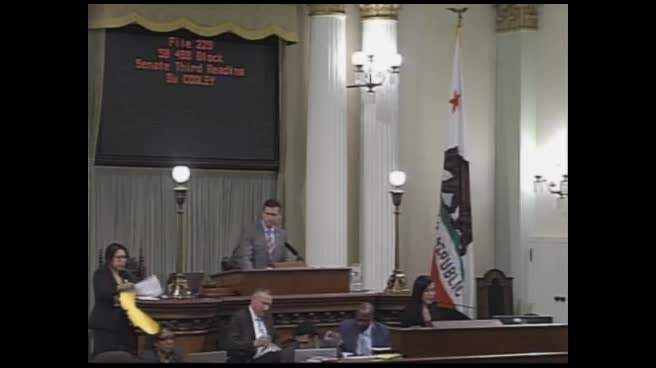 1MIN
Assembly Floor
 2MIN
Assembly Standing Committee on Public Safety
 1MIN
Senate Floor
 6MIN
Senate Standing Committee on Public Safety
Bill Author

Bill Co-Author(s):