SB 884: Special education: mental health services.
- Session Year: 2015-2016
- House: Senate
- Latest Version Date: 2016-09-29
Existing law requires the Superintendent of Public Instruction to administer the special education provisions of the Education Code and ensure provision of, and supervise, education and related services to individuals with exceptional needs, as required pursuant to the federal Individuals with Disabilities Education Act. Existing law provides for the establishment of Family Empowerment Centers on Disability to, among other things, ensure that children and young adults with disabilities receive the necessary educational support and services they need to complete their education.
Existing law separately requires the Controller, in consultation with the Department of Finance, the State Department of Education, and specified other entities, to propose the content of an audit guide for purposes of carrying out financial and compliance audits for local educational agencies.
This bill would require the audit guide to include audit procedures to review whether specified funding, which the bill would subject to existing state and federal audit requirements, for educationally related mental health services required by an individualized education program received by local educational agencies was used for its intended purpose in the 201617 fiscal year, and would require these audit procedures to be included in future fiscal years if recommended by the Controller, as specified. The bill would require the State Department of Education to include a link on the sample procedural safeguards maintained on its Internet Web site to the page on its Internet Web site that lists family empowerment centers and to include the link on specified forms. The bill would require the department to submit 2 reports, as specified, relating to the provision of mental health services to pupils through an individualized education program to the appropriate fiscal and policy committees of the Legislature by June 30, 2017.
Existing law requires the Superintendent of Public Instruction to administer the special education provisions of the Education Code and ensure provision of, and supervise, education and related services to individuals with exceptional needs, as required pursuant to the federal Individuals with Disabilities Education Act. Existing law provides for the establishment of Family Empowerment Centers on Disability to, among other things, ensure that children and young adults with disabilities receive the necessary educational support and services they need to complete their education.
Existing law separately requires the Controller, in consultation with the Department of Finance, the State Department of Education, and specified other entities, to propose the content of an audit guide for purposes of carrying out financial and compliance audits for local educational agencies.
This bill would require the audit guide to include an audit procedure audit procedures to review whether specified funding funding, which the bill would subject to existing state and federal audit requirements, for educationally related mental health services required by an individualized education program received by local educational agencies and charter schools was used for its intended purpose. purpose in the 201617 fiscal year, and would require these audit procedures to be included in future fiscal years if recommended by the Controller, as specified. The bill would require the State Department of Education to include a link on the sample procedural safeguards maintained on its Internet Web site to the page on its Internet Web site that lists family empowerment centers and to include the link on specified forms. The bill would require the department to submit 2 reports, as specified, relating to the provision of mental health services to pupils through an individualized education program to the appropriate fiscal and policy committees of the Legislature by June 30, 2017.
(1)Existing
Existing law requires the Superintendent of Public Instruction to administer the special education provisions of the Education Code and ensure provision of, and supervise, education and related services to individuals with exceptional needs, as required pursuant to the federal Individuals with Disabilities Education Act. Existing law provides for the establishment of Family Empowerment Centers on Disability to, among other things, ensure that children and young adults with disabilities receive the necessary educational support and services they need to complete their education.
Existing law establishes certain rights and procedural safeguards for parents and pupils of individuals with disabilities, and requires a public agency to give prior written notice to parents or guardians of an individual with exceptional needs when certain actions are taken with respect to his or her placement, identification, and assessment or the provision of a free and appropriate education.
This bill would require a local educational agency responsible for implementation of a pupils individualized education program to ensure that a copy of each prior written notice is included in the pupils records. The bill would require each special education local plan area to require each local educational agency to provide certain information to parents in their annual parent notification information, including information regarding family empowerment centers and parent training and information centers. By imposing new duties on special education local plan areas and local educational agencies, the bill would impose a state-mandated local program.
(2) Existing law requires the Superintendent to ensure that pupil and program performance results are monitored, and requires special education local plan areas to submit certain data to the Superintendent to evaluate special education programs, as specified.
The bill would require a special education local plan area to document and report to the State Department of Education funding allocations and expenditures for all mental health and special education services, and would require the department to post the information on the departments Internet Web site. The bill would require the department to align accounting code systems, as specified. The bill would also require a local educational agency responsible for a pupils individualized education program to annually report to the department the actual frequency and duration of mental health services provided and to annually report to the department certain data needed to document pupil outcomes on 6 outcome indicators, as specified. The bill would require the department to monitor the mental health services reported annually by local educational agencies and to review and require corrections to each local educational agencys procedures and documents. By imposing new duties on local educational agencies, the bill would impose a state-mandated local program.
(3) The California Constitution requires the state to reimburse local agencies and school districts for certain costs mandated by the state. Statutory provisions establish procedures for making that reimbursement.
This bill would provide that, if the Commission on State Mandates determines that the bill contains costs mandated by the state, reimbursement for those costs shall be made pursuant to these statutory provisions.
Existing law separately requires the Controller, in consultation with the Department of Finance, the State Department of Education, and specified other entities, to propose the content of an audit guide for purposes of carrying out financial and compliance audits for local educational agencies.
This bill would require the audit guide to include an audit procedure to review whether specified funding for educationally related mental health services required by an individualized education program received by local educational agencies and charter schools was used for its intended purpose. The bill would require the State Department of Education to include a link on the sample procedural safeguards maintained on its Internet Web site to the page on its Internet Web site that lists family empowerment centers and to include the link on specified forms. The bill would require the department to submit 2 reports, as specified, relating to the provision of mental health services to pupils through an individualized education program to the appropriate fiscal and policy committees of the Legislature by June 30, 2017.
(1)Existing law requires the Superintendent of Public Instruction to administer the special education provisions of the Education Code and ensure provision of, and supervise, education and related services to individuals with exceptional needs, as required pursuant to the federal Individuals with Disabilities Education Act.
Existing law establishes certain rights and procedural safeguards for parents and pupils of individuals with disabilities, and requires a public agency to give prior written notice to parents or guardians of an individual with exceptional needs when certain actions are taken with respect to his or her placement, identification, and assessment or the provision of a free and appropriate education.This bill would require prior written notice also to be given when there are any changes to the planned type or level of individualized education program services, would require a copy of the parent and pupils rights and procedural safeguards to be given each time prior written notice is given, and would require a local educational agency responsible for implementation of a pupils individualized education program to ensure that a copy of each prior written notice is included in the pupils records. The bill would require each special education local plan area to establish additional written policies and procedures requiring require each local educational agencies agency to provide certain information to parents in their annual parent notification information, including information regarding family empowerment centers and parent training and information centers. The bill would require a pupils individualized education program to include the type of provider delivering each related service listed. By imposing new duties on special education local plan areas and local educational agencies, the bill would impose a state-mandated local program.
(2) Existing law requires the Superintendent to ensure that pupil and program performance results are monitored, and requires special education local plan areas to submit certain data to the Superintendent to evaluate special education programs, as specified.The bill would require a special education local plan area to document and report to the State Department of Education funding allocations and expenditures for all mental health and special education services, and would require the department to post the information on the departments Internet Web site. The bill would require the department to align accounting code systems, as specified. The bill would also require a local educational agency responsible for a pupils individualized education program to annually report to the department the actual frequency and duration of related mental health services provided, provided and to annually report to the department certain data needed to document pupil outcomes on 6 outcome indicators, as specified. The bill would require the department to monitor the related mental health services reported annually by local educational agencies, agencies and to review and require corrections to each local educational agencys procedures and documents. By imposing new duties on local educational agencies, the bill would impose a state-mandated local program.
(3) The California Constitution requires the state to reimburse local agencies and school districts for certain costs mandated by the state. Statutory provisions establish procedures for making that reimbursement.This bill would provide that, if the Commission on State Mandates determines that the bill contains costs mandated by the state, reimbursement for those costs shall be made pursuant to these statutory provisions.
(1)Existing law requires the Superintendent of Public Instruction to administer the special education provisions of the Education Code and ensure provision of, and supervise, education and related services to individuals with exceptional needs, as required pursuant to the federal Individuals with Disabilities Education Act.
Existing law establishes certain rights and procedural safeguards for parents and pupils of individuals with disabilities, and requires a public agency to give prior written notice to parents or guardians of an individual with exceptional needs when certain actions are taken with respect his or her placement, identification, and assessment or the provision of a free and appropriate education.
This bill would require prior written notice also to be given when there are any changes to the planned type or level of individualized education program services, would require a copy of the parent and pupils rights and procedural safeguards to be given each time prior written notice is given, and would require a local educational agency responsible for a pupils individualized education program to ensure a copy of each prior written notice is included in the pupils records. The bill would require each special education local plan area to establish additional written policies and procedures requiring local educational agencies to provide certain information to parents in their annual parent notification information, including information regarding family empowerment centers and parent training and information centers. The bill would require a pupils individualized education program to include the type of provider delivering each related service listed. By imposing new duties on local educational agencies, the bill would impose a state-mandated local program.
(2)Existing law requires the Superintendent to ensure that pupil and program performance results are monitored, and requires special education local plan areas to submit certain data to the Superintendent to evaluate special education programs, as specified.
The bill would require a school district or special education local plan area to document and report to the department State Department of Education funding allocations and expenditures for all mental health and special education services, and would require the department to post the information on the departments Internet Web site. The bill would require the department to align accounting code systems, as specified. The bill would also require a local educational agency responsible for a pupils individualized education program to annually report to the department the actual frequency and duration of related services provided, and to annually report to the department certain data needed to document pupil outcomes on 6 outcome indicators, as specified. The bill would require the department to monitor the related services reported annually by local educational agencies, and to review and require corrections to each local educational agencys procedures and documents. By imposing new duties on local educational agencies, the bill would impose a state-mandated local program.
(3)The California Constitution requires the state to reimburse local agencies and school districts for certain costs mandated by the state. Statutory provisions establish procedures for making that reimbursement.
This bill would provide that, if the Commission on State Mandates determines that the bill contains costs mandated by the state, reimbursement for those costs shall be made pursuant to these statutory provisions.
(1)Existing law requires the Superintendent of Public Instruction to administer the special education provisions of the Education Code and ensure provision of, and supervise, education and related services to individuals with exceptional needs, as required pursuant to the federal Individuals with Disabilities Education Act.
This bill would state the intent of the Legislature to enact legislation relating to the provision of mental health services to pupils with exceptional needs.
Existing law establishes certain rights and procedural safeguards for parents and pupils of individuals with disabilities, and requires a public agency to give prior written notice to parents or guardians of an individual with exceptional needs when certain actions are taken with respect his or her placement, identification, and assessment or the provision of a free and appropriate education.
This bill would require prior written notice also to be given when there are any changes to the planned type or level of individualized education program services, would require a copy of the parent and pupils rights and procedural safeguards to be given each time prior written notice is given, and would require a local educational agency responsible for a pupils individualized education program to ensure a copy of each prior written notice is included in the pupils records. The bill would require each special education local plan area to establish additional written policies and procedures requiring local educational agencies to provide certain information to parents in their annual parent notification information, including information regarding family empowerment centers and parent training and information centers. The bill would require a pupils individualized education program to include the type of provider delivering each related service listed. By imposing new duties on local educational agencies, the bill would impose a state-mandated local program.
(2)Existing law requires the Superintendent to ensure that pupil and program performance results are monitored, and requires special education local plan areas to submit certain data to the Superintendent to evaluate special education programs, as specified.
The bill would require a school district or special education local plan area to document and report to the department funding allocations and expenditures for all mental health and special education services, and would require the department to post the information on the departments Internet Web site. The bill would require the department to align accounting code systems, as specified. The bill would also require a local educational agency responsible for a pupils individualized education program to annually report to the department the frequency and duration of related services provided, and to annually report certain data needed to document pupil outcomes on 6 outcome indicators, as specified. The bill would require the department to monitor the related services reported annually by local educational agencies, and to review and require corrections to each local educational agencys procedures and documents.
(3)The California Constitution requires the state to reimburse local agencies and school districts for certain costs mandated by the state. Statutory provisions establish procedures for making that reimbursement.
This bill would provide that, if the Commission on State Mandates determines that the bill contains costs mandated by the state, reimbursement for those costs shall be made pursuant to these statutory provisions.
Existing law requires the Superintendent of Public Instruction to administer the special education provisions of the Education Code and ensure provision of, and supervise, education and related services to individuals with exceptional needs, as required pursuant to the federal Individuals with Disabilities Education Act.
This bill would state the intent of the Legislature to enact legislation relating to the provision of mental health services to pupils with exceptional needs.
The funding appropriated in Item 6100-161-0001 of the annual Budget Act for mental health services shall be subject to existing state and federal audit requirements. Audit procedures shall be included in the audit guide to review whether funding for educationally related mental health services pursuant to this item was used by local educational agencies for its intended purposes in the 201617 fiscal year. These audit procedures shall be included in future fiscal years if the addition of these procedures is recommended by the Controller pursuant to subdivision (a) of Section 14502.1. If any mental health audit findings are generated through this process, the Superintendent shall ensure that the local educational agency has either corrected or developed a plan of correction for state and federal mental health funds pursuant to subdivision (m) of Section 41020.
SEC. 2.Section 56415 is added to the Education Code, to read:56415.The department shall include a link on the sample procedural safeguards maintained on its Internet Web site to the page on its Internet Web site that lists family empowerment centers. The department shall include this link on all sample procedural safeguard forms for which it maintains translations.
SEC. 3.The State Department of Education shall create a report on its compliance findings and corrective action plans related to the provision of mental health services for pupils with individualized education programs using data the department collects through its verification and comprehensive reviews, including those targeted and any randomly chosen for review. The department shall send this report to the appropriate fiscal and policy committees of the Legislature by June 30, 2017.
SEC. 4.(a)The State Department of Education shall create a report on pupil outcomes for pupils receiving mental health services through an individualized education program. The data used to create this report shall already be maintained by the department and shall be reported to the extent permitted under state and federal laws regarding the privacy of pupil information. These outcomes shall include all of the following:
(1)Graduation rates.
(2)Dropout rates.
(3)Statewide assessment results.
(4)Suspension and expulsion rates.
(5)Participation in general education classes.
(6)Postschool outcomes.
(b)The department shall send this report to the appropriate fiscal and policy committees of the Legislature by June 30, 2017.
The audit guide shall include an audit procedure to review whether the funding appropriated in Items 61001610001 and 61001610890 of the annual Budget Act and received by local educational agencies and charter schools, as applicable, for educationally related mental health services required by an individualized education program was used for its intended purpose.
SECTION 1.Section 14509 is added to the Education Code, to read:14509.The funding appropriated in Item 61001610001 of the annual Budget Act for mental health services shall be subject to existing state and federal audit requirements. Audit procedures shall be included in the audit guide to review whether funding for educationally related mental health services pursuant to this item was used by local educational agencies for its intended purposes in the 201617 fiscal year. These audit procedures shall be included in future fiscal years if the addition of these procedures is recommended by the Controller pursuant to subdivision (a) of Section 14502.1. If any mental health audit findings are generated through this process, the Superintendent shall ensure that the local educational agency has either corrected or developed a plan of correction for state and federal mental health funds pursuant to subdivision (m) of Section 41020.
SEC. 2.Section 56415 is added to the Education Code, to read:56415.The department shall include a link on the sample procedural safeguards maintained on its Internet Web site to the page on its Internet Web site that lists family empowerment centers. The department shall include this link on all sample procedural safeguard forms for which it maintains translations.
SEC. 3.The State Department of Education shall create a report on its compliance findings and corrective action plans related to the provision of mental health services for pupils with individualized education programs using data the department collects through its verification and comprehensive reviews, including those targeted and any randomly chosen for review. The department shall send this report to the appropriate fiscal and policy committees of the Legislature by June 30, 2017.
SEC. 4.(a)The State Department of Education shall create a report on pupil outcomes for pupils receiving mental health services through an individualized education program. The data used to create this report shall already be maintained by the department and shall be reported to the extent permitted under state and federal laws regarding the privacy of pupil information. These outcomes shall include all of the following:
(1)Graduation rate. rates.
(2)Dropout rate. rates.
(3)Statewide assessment results.
(4)Suspension and expulsion rates.
(5)Participation in general education classes.
(6)Postschool outcomes.
(b)The department shall send this report to the appropriate fiscal and policy committees of the Legislature by June 30, 2017.
The audit guide shall include an audit procedure to review whether the funding appropriated in Items 61001610001 and 61001610890 of the annual Budget Act and received by local educational agencies and charter schools, as applicable, for educationally related mental health services required by an individualized education program was used for its intended purpose.
SEC. 2.Section 56415 is added to the Education Code, to read:56415.The department shall include a link on the sample procedural safeguards maintained on its Internet Web site to the page on its Internet Web site that lists family empowerment centers. The department shall include this link on all sample procedural safeguard forms for which it maintains translations.
SEC. 3.The State Department of Education shall create a report on its compliance findings and corrective action plans related to the provision of mental health services for pupils with individualized education programs using data the department collects through its verification and comprehensive reviews, including those targeted and any randomly chosen for review. The department shall send this report to the appropriate fiscal and policy committees of the Legislature by June 30, 2017.
SEC. 4.(a)The State Department of Education shall create a report on pupil outcomes for pupils receiving mental health services through an individualized education program. The data used to create this report shall already be maintained by the department and shall be reported to the extent permitted under state and federal laws regarding the privacy of pupil information. These outcomes shall include all of the following:
(1)Graduation rate.
(2)Dropout rate.
(3)Statewide assessment results.
(4)Suspension and expulsion rates.
(5)Participation in general education classes.
(6)Postschool outcomes.
(b)The department shall send this report to the appropriate fiscal and policy committees of the Legislature by June 30, 2017.
SECTION 1.Section 56301.5 is added to the Education Code, to read:56301.5.Each special education local plan area shall require each local educational agency to provide informational materials, including, but not limited to, pupil and parent rights provided under the federal Individuals with Disabilities Education Act (20 U.S.C. Sec. 1400 et seq.) and information regarding family empowerment centers, including the link on the departments Internet Web site that provides the contact information for all family empowerment centers, and parent training and information centers in their community. The materials shall be provided in the three most common languages used by parents served by the local educational agency in the special education local plan area and shall be made available for local educational agencies to provide to their parents in their annual parent notification information.
SEC. 2.Section 56500.7 is added to the Education Code, to read:56500.7.The local educational agency responsible for implementation of a pupils individualized education program shall ensure that a copy of each prior written notice given pursuant to Section 56500.4 is included in the pupils records.
SEC. 3.Section 56600.7 is added to the Education Code, to read:56600.7.The local educational agency responsible for implementation of a pupils individualized education program shall annually report to the department the actual frequency and duration of each mental health service provided to the pupil pursuant to the pupils individualized education program.
SEC. 4.Section 56607 is added to the Education Code, to read:56607.(a)A special education local plan area shall document and report to the department all mental health and special education services funding allocations and expenditures and specify the dollar amount for each service.
(b)The department shall post the information on the departments Internet Web site.
(c)The department shall align accounting code systems to allow the department and school districts or special education local plan areas to accurately document the amount of funds expended for the provision of mental health and special education services from each funding source.
SEC. 5.Section 56608 is added to the Education Code, to read:56608.For each pupil receiving individualized education program mental health services, each local educational agency shall annually provide to the department the data needed to document the pupils outcomes on all of the following outcome indicators that are applicable to the pupil:
(a)Graduation rate.
(b)Dropout rate.
(c)Statewide assessment results.
(d)Suspension and expulsion rates.
(e)Participation in general education classes.
(f)Postschool outcomes.
SEC. 6.Section 56609 is added to the Education Code, to read:56609.(a)The department shall monitor the number and frequency of mental health services reported annually by local educational agencies and shall compare year-to-year changes for each local educational agency. If year-to-year services decline significantly, then the department shall investigate the cause for the decline in service provision.
(b)As part of its monitoring activities, the department shall review each local educational agencys procedures and documents used to meet the prior written notice requirement in Section 56500.4, and shall require corrections to those procedures and documents if the department finds that the procedures or documents do not fulfill statutory requirements.
SEC. 7.If the Commission on State Mandates determines that this act contains costs mandated by the state, reimbursement to local agencies and school districts for those costs shall be made pursuant to Part 7 (commencing with Section 17500) of Division 4 of Title 2 of the Government Code.
SEC. 8.It is the intent of the Legislature to enact legislation relating to the provision of mental health services to pupils with exceptional needs.
(a)All children with disabilities residing in the state, including children with disabilities who are homeless children or are wards of the state and children with disabilities attending private, including religious, elementary and secondary schools, regardless of the severity of their disabilities, and who are in need of special education and related services, shall be identified, located, and assessed and a practical method shall be developed and implemented to determine which children with disabilities are currently receiving needed special education and related services as required by Section 1412(a)(3) and (10)(A)(ii) of Title 20 of the United States Code. A child is not required to be classified by his or her disability so long as each child who has a disability listed in Section 1401(3) of Title 20 of the United States Code and who, by reason of that disability, needs special education and related services as an individual with exceptional needs defined in Section 56026.
(b)(1)In accordance with Section 300.111(c) of Title 34 of the Code of Federal Regulations, the requirements of this section also apply to highly mobile individuals with exceptional needs, including migrant children, and children who are suspected of being an individual with exceptional needs pursuant to Section 56026 and in need of special education, even though they are advancing from grade to grade.
(2)In accordance with Section 300.213 of Title 34 of the Code of Federal Regulations, the local educational agency shall cooperate in the efforts of the federal Secretary of Education, under Section 6398 of Title 20 of the United States Code, to ensure the linkage of records pertaining to migratory children with disabilities for the purpose of electronically exchanging, among other states, health and educational information regarding those children.
(c)(1)The child find process shall ensure the equitable participation in special education and related services of parentally placed private schoolchildren with disabilities and an accurate count of those children. Child find activities conducted by local educational agencies, or where applicable, the department, shall be similar to those activities undertaken for pupils in public schools.
(2)In accordance with Section 1412(a)(10)(A)(ii)(IV) of Title 20 of the United States Code, the cost of the child find activities in private, including religious, elementary and secondary schools, may not be considered in determining whether a local educational agency has met its obligations under the proportionate funding provisions for children enrolled in private, including religious, elementary and secondary schools.
(3)The child find process described in paragraph (1) shall be completed in a time period comparable to that for other pupils attending public schools in the local educational agency.
(d)(1)Each special education local plan area shall establish written policies and procedures pursuant to Section 56205 for use by its constituent local agencies for a continuous child find system that addresses the relationships among identification, screening, referral, assessment, planning, implementation, review, and the triennial assessment. The policies and procedures shall include, but need not be limited to, written notification of all parents of their rights under this chapter, and the procedure for initiating a referral for assessment to identify individuals with exceptional needs.
(2)In accordance with Section 1415(d)(1)(A) of Title 20 of the United States Code, and Section 300.504(a) of Title 34 of the Code of Federal Regulations, parents shall be given a copy of their rights and procedural safeguards only one time a school year, except that a copy also shall be given to the parents:
(A)Upon initial referral or parental request for assessment.
(B)Upon receipt of the first state complaint under Section 56500.2 in a school year.
(C)Upon receipt of the first due process hearing request under Section 56502 in a school year.
(D)When a decision is made to make a removal that constitutes a change of placement of an individual with exceptional needs because of a violation of a code of pupil conduct in accordance with Section 300.530(h) of Title 34 of the Code of Federal Regulations.
(E)Upon request by a parent.
(F)When a prior written notice is required pursuant to Section 56500.4.
(3)A local educational agency may place a current copy of the procedural safeguards notice on its Internet Web site, if such Web site exists, pursuant to Section 1415(d)(1)(B) of Title 20 of the United States Code.
(4)The contents of the procedural safeguards notice shall contain the requirements listed in Section 1415(d)(2) of Title 20 of the United States Code and Section 300.504(c) of Title 34 of the Code of Federal Regulations.
(5)Each special education local plan area shall establish additional written policies and procedures that require each local educational agency to provide informational materials, including, but not limited to, pupil and parent rights provided under the federal Individuals with Disabilities Education Act (20 U.S.C. Sec. 1400 et seq.), and information regarding family empowerment centers and parent training and information centers in their community. The materials shall be provided in the three most common languages used by parents served by the local educational agency in the special education local plan area, and shall be made available for local educational agencies to provide to their parents in their annual parent notification information.
(e)Child find data collected pursuant to this chapter, or collected pursuant to a regulation or an interagency agreement, are subject to the confidentiality requirements of Sections 300.611 to 300.627, inclusive, of Title 34 of the Code of Federal Regulations.
SEC. 2.Section 56345 of the Education Code is amended to read:56345.(a)The individualized education program is a written statement for each individual with exceptional needs that is developed, reviewed, and revised in accordance with this section, as required by Section 1414(d) of Title 20 of the United States Code, and that includes the following:
(1)A statement of the individuals present levels of academic achievement and functional performance, including the following:
(A)The manner in which the disability of the individual affects his or her involvement and progress in the general education curriculum.
(B)For preschool children, as appropriate, the manner in which the disability affects his or her participation in appropriate activities.
(C)For individuals with exceptional needs who take alternate assessments aligned to alternate achievement standards, a description of benchmarks or short-term objectives.
(2)A statement of measurable annual goals, including academic and functional goals, designed to do the following:
(A)Meet the needs of the individual that result from the disability of the individual to enable the pupil to be involved in and make progress in the general education curriculum.
(B)Meet each of the other educational needs of the pupil that result from the disability of the individual.
(3)A description of the manner in which the progress of the pupil toward meeting the annual goals described in paragraph (2) will be measured and when periodic reports on the progress the pupil is making toward meeting the annual goals, such as through the use of quarterly or other periodic reports, concurrent with the issuance of report cards, will be provided.
(4)A statement of the special education and related services and supplementary aids and services, based on peer-reviewed research to the extent practicable, to be provided to the pupil, or on behalf of the pupil, and a statement of the program modifications or supports for school personnel that will be provided to enable the pupil to do the following:
(A)To advance appropriately toward attaining the annual goals.
(B)To be involved in and make progress in the general education curriculum in accordance with paragraph (1) and to participate in extracurricular and other nonacademic activities.
(C)To be educated and participate with other individuals with exceptional needs and nondisabled pupils in the activities described in this subdivision.
(5)An explanation of the extent, if any, to which the pupil will not participate with nondisabled pupils in the regular class and in the activities described in subparagraph (C) of paragraph (4).
(6)(A)A statement of individual appropriate accommodations that are necessary to measure the academic achievement and functional performance of the pupil on state and districtwide assessments consistent with Section 1412(a)(16)(A) of Title 20 of the United States Code.
(B)If the individualized education program team determines that the pupil shall take an alternate assessment instead of a particular state or districtwide assessment of pupil achievement, a statement of the following:
(i)The reason why the pupil cannot participate in the regular assessment.
(ii)The reason why the particular alternate assessment selected is appropriate for the pupil.
(7)The projected date for the beginning of the services and modifications described in paragraph (4), and the anticipated frequency, location, and duration of those services and modifications. For each related service listed in the individualized education program, the individualized education program shall document the type of provider delivering the service pursuant to paragraph (3) of subdivision (a) of Section 3051 of Title 5 of the California Code of Regulations.
(8)Beginning not later than the first individualized education program to be in effect when the pupil is 16 years of age, or younger if determined appropriate by the individualized education program team, and updated annually thereafter, the following shall be included:
(A)Appropriate measurable postsecondary goals based upon age-appropriate transition assessments related to training, education, employment, and where appropriate, independent living skills.
(B)The transition services, as defined in Section 56345.1, including courses of study, needed to assist the pupil in reaching those goals.
(b)If appropriate, the individualized education program shall also include, but not be limited to, all of the following:
(1)For pupils in grades 7 to 12, inclusive, any alternative means and modes necessary for the pupil to complete the prescribed course of study of the district and to meet or exceed proficiency standards for graduation.
(2)For individuals whose native language is other than English, linguistically appropriate goals, objectives, programs, and services.
(3)Pursuant to Section 300.106 of Title 34 of the Code of Federal Regulations, extended school year services shall be included in the individualized education program and provided to the pupil if the individualized education program team of the pupil determines, on an individual basis, that the services are necessary for the provision of a free appropriate public education to the pupil.
(4)Provision for the transition into the regular class program if the pupil is to be transferred from a special class or nonpublic, nonsectarian school into a regular class in a public school for any part of the schoolday, including the following:
(A)A description of activities provided to integrate the pupil into the regular education program. The description shall indicate the nature of each activity, and the time spent on the activity each day or week.
(B)A description of the activities provided to support the transition of pupils from the special education program into the regular education program.
(5)For pupils with low-incidence disabilities, specialized services, materials, and equipment, consistent with guidelines established pursuant to Section 56136.
(c)It is the intent of the Legislature in requiring individualized education programs, that the local educational agency is responsible for providing the services delineated in the individualized education program. However, the Legislature recognizes that some pupils may not meet or exceed the growth projected in the annual goals and objectives of the individualized education program of the pupil.
(d)Consistent with Section 56000.5 and Section 1414(d)(3)(B)(iv) of Title 20 of the United States Code, it is the intent of the Legislature that, in making a determination of the services that constitute an appropriate education to meet the unique needs of a deaf or hard-of-hearing pupil in the least restrictive environment, the individualized education program team shall consider the related services and program options that provide the pupil with an equal opportunity for communication access. The individualized education program team shall specifically discuss the communication needs of the pupil, consistent with Deaf Students Education Services Policy Guidance (57 Fed. Reg. 49274 (October 1992)), including all of the following:
(1)The pupils primary language mode and language, which may include the use of spoken language with or without visual cues, or the use of sign language, or a combination of both.
(2)The availability of a sufficient number of age, cognitive, and language peers of similar abilities, which may be met by consolidating services into a local plan areawide program or providing placement pursuant to Section 56361.
(3)Appropriate, direct, and ongoing language access to special education teachers and other specialists who are proficient in the pupils primary language mode and language consistent with existing law regarding teacher training requirements.
(4)Services necessary to ensure communication-accessible academic instructions, school services, and extracurricular activities consistent with the federal Vocational Rehabilitation Act of 1973 (29 U.S.C. Sec. 794 et seq.) and the federal Americans with Disabilities Act of 1990 (42 U.S.C. Sec. 12101 et seq.).
(5)In accordance with Section 300.113 of Title 34 of the Code of Federal Regulations, each public agency shall ensure that hearing aids worn in school by children with hearing impairments, including deafness, are functioning properly.
(6)Subject to paragraph (7), each public agency, pursuant to Section 300.113(b) of Title 34 of the Code of Federal Regulations, shall ensure that external components of surgically implanted medical devices are functioning properly.
(7)For a child with a surgically implanted medical device who is receiving special education and a service under Section 56363, a public agency is not responsible for the postsurgical maintenance, programming, or replacement of the medical device that has been surgically implanted, or of an external component of the surgically implanted medical device.
(e)State moneys appropriated to districts or local educational agencies may not be used for any additional responsibilities and services associated with paragraphs (1) and (2) of subdivision (d), including the training of special education teachers and other specialists, even if those additional responsibilities or services are required pursuant to a judicial or state agency determination. Those responsibilities and services shall only be funded by a local educational agency as follows:
(1)The costs of those activities shall be funded from existing programs and funding sources.
(2)Those activities shall be supported by the resources otherwise made available to those programs.
(3)Those activities shall be consistent with Sections 56240 to 56243, inclusive.
(f)It is the intent of the Legislature that the communication skills of teachers who work with hard-of-hearing and deaf children be improved. This section does not remove the discretionary authority of the local educational agency in regard to in-service activities.
(g)Beginning not later than one year before the pupil reaches the age of 18 years, a statement that the pupil has been informed of the pupils rights under this part, if any, that will transfer to the pupil upon reaching the age of 18 years pursuant to Section 56041.5.
(h)The individualized education program team is not required to include information under one component of a pupils individualized education program that is already contained under another component of the individualized education program.
(i)This section does not require that additional information, beyond that explicitly required by Section 1414 of Title 20 of the United States Code and this part, be included in the individualized education program of a pupil.
SEC. 3.Section 56500.4 of the Education Code is amended to read:56500.4.(a)Pursuant to Section 1415(b)(3) and (4) and (c)(1) of Title 20 of the United States Code, and in accordance with Section 300.503 of Title 34 of the Code of Federal Regulations, prior written notice shall be given by the public agency to the parents or guardians of an individual with exceptional needs, or to the parents or guardians of a child upon initial referral for assessment, and a reasonable time before the public agency proposes to initiate or change, or refuses to initiate or change, the identification, assessment, or educational placement of the child, including any changes to the planned type or level of individualized education program services, or the provision of a free appropriate public education to the child. In accordance with Sections 300.304 and 300.503 of Title 34 of the Code of Federal Regulations, the public agency shall provide a description of any assessment procedures the agency proposes to conduct.
(b)The notice required under subdivision (a) shall, in accordance with Section 300.503(b) of Title 34 of the Code of Federal Regulations, include all of the following:
(1)A description of the action proposed or refused by the public agency.
(2)An explanation of why the public agency proposes or refuses to take the action.
(3)A description of each assessment procedure, assessment, record, or report the public agency used as a basis for the proposed or refused action.
(4)A statement that the parents of an individual with exceptional needs have protection under the procedural safeguards of this part and a copy of the procedural safeguards.
(5)Sources for parents to contact to obtain assistance in understanding the provisions of this part, including, but not limited to, the link on the departments Internet Web site that provides the contact information for all family empowerment centers and parent training and information centers in the special education local plan area of which the local educational agency is a member, or, upon the request of a parent, a printed copy of that information.
(6)A description of other options that the individualized education program team considered and the reasons why those options were rejected.
(7)A description of other factors that are relevant to the proposal or refusal of the agency.
(c)The local educational agency responsible for implementation of a pupils individualized education program shall ensure that a copy of each prior written notice given pursuant to this section is included in the pupils records.
SECTION 1.Section 56301.5 is added to the Education Code, to read:56301.5.Each special education local plan area shall require each local educational agency to provide informational materials, including, but not limited to, pupil and parent rights provided under the federal Individuals with Disabilities Education Act (20 U.S.C. Sec. 1400 et seq.) and information regarding family empowerment centers, including the link on the departments Internet Web site that provides the contact information for all family empowerment centers, and parent training and information centers in their community. The materials shall be provided in the three most common languages used by parents served by the local educational agency in the special education local plan area and shall be made available for local educational agencies to provide to their parents in their annual parent notification information.
SEC. 2.Section 56500.7 is added to the Education Code, to read:56500.7.The local educational agency responsible for implementation of a pupils individualized education program shall ensure that a copy of each prior written notice given pursuant to Section 56500.4 is included in the pupils records.
SEC. 4.SEC. 3.Section 56600.7 is added to the Education Code, to read:56600.7.The local educational agency responsible for implementation of a pupils individualized education program shall annually report to the department the actual frequency and duration of each related mental health service provided to the pupil pursuant to the pupils individualized education program.
SEC. 5.SEC. 4.Section 56607 is added to the Education Code, to read:56607.(a)A special education local plan area shall document and report to the department all mental health and special education services funding allocations and expenditures and specify the dollar amount for each service.
(b)The department shall post the information on the departments Internet Web site.
(c)The department shall align accounting code systems to allow the department and school districts or special education local plan areas to accurately document the amount of funds expended for the provision of mental health and special education services from each funding source.
SEC. 6.SEC. 5.Section 56608 is added to the Education Code, to read:56608.For each pupil receiving individualized education program related mental health services, each local educational agency shall annually provide to the department the data needed to document the pupils outcomes on all of the following outcome indicators that are applicable to the pupil:
(a)Graduation rate.
(b)Dropout rate.
(c)Statewide assessment results.
(d)Suspension and expulsion rates.
(e)Participation in general education classes.
(f)Postschool outcomes.
SEC. 7.SEC. 6.Section 56609 is added to the Education Code, to read:56609.(a)The department shall monitor the number and frequency of related mental health services reported annually by local educational agencies and shall compare year-to-year changes for each local educational agency. If year-to-year services decline significantly, then the department shall investigate the cause for the decline in service provision.
(b)As part of its monitoring activities, the department shall review each local educational agencys procedures and documents used to meet the prior written notice requirement in Section 56500.4, and shall require corrections to those procedures and documents if the department finds that the procedures or documents do not fulfill statutory requirements.
SEC. 8.SEC. 7.If the Commission on State Mandates determines that this act contains costs mandated by the state, reimbursement to local agencies and school districts for those costs shall be made pursuant to Part 7 (commencing with Section 17500) of Division 4 of Title 2 of the Government Code.
SEC. 9.SEC. 8.It is the intent of the Legislature to enact legislation relating to the provision of mental health services to pupils with exceptional needs.
(a)All children with disabilities residing in the state, including children with disabilities who are homeless children or are wards of the state and children with disabilities attending private, including religious, elementary and secondary schools, regardless of the severity of their disabilities, and who are in need of special education and related services, shall be identified, located, and assessed and a practical method shall be developed and implemented to determine which children with disabilities are currently receiving needed special education and related services as required by Section 1412(a)(3) and (10)(A)(ii) of Title 20 of the United States Code. A child is not required to be classified by his or her disability so long as each child who has a disability listed in Section 1401(3) of Title 20 of the United States Code and who, by reason of that disability, needs special education and related services as an individual with exceptional needs defined in Section 56026.
(b)(1)In accordance with Section 300.111(c) of Title 34 of the Code of Federal Regulations, the requirements of this section also apply to highly mobile individuals with exceptional needs, including migrant children, and children who are suspected of being an individual with exceptional needs pursuant to Section 56026 and in need of special education, even though they are advancing from grade to grade.
(2)In accordance with Section 300.213 of Title 34 of the Code of Federal Regulations, the local educational agency shall cooperate in the efforts of the federal Secretary of Education, under Section 6398 of Title 20 of the United States Code, to ensure the linkage of records pertaining to migratory children with disabilities for the purpose of electronically exchanging, among other states, health and educational information regarding those children.
(c)(1)The child find process shall ensure the equitable participation in special education and related services of parentally placed private schoolchildren with disabilities and an accurate count of those children. Child find activities conducted by local educational agencies, or where applicable, the department, shall be similar to those activities undertaken for pupils in public schools.
(2)In accordance with Section 1412(a)(10)(A)(ii)(IV) of Title 20 of the United States Code, the cost of the child find activities in private, including religious, elementary and secondary schools, may not be considered in determining whether a local educational agency has met its obligations under the proportionate funding provisions for children enrolled in private, including religious, elementary and secondary schools.
(3)The child find process described in paragraph (1) shall be completed in a time period comparable to that for other pupils attending public schools in the local educational agency.
(d)(1)Each special education local plan area shall establish written policies and procedures pursuant to Section 56205 for use by its constituent local agencies for a continuous child find system that addresses the relationships among identification, screening, referral, assessment, planning, implementation, review, and the triennial assessment. The policies and procedures shall include, but need not be limited to, written notification of all parents of their rights under this chapter, and the procedure for initiating a referral for assessment to identify individuals with exceptional needs.
(2)In accordance with Section 1415(d)(1)(A) of Title 20 of the United States Code, and Section 300.504(a) of Title 34 of the Code of Federal Regulations, parents shall be given a copy of their rights and procedural safeguards only one time a school year, except that a copy also shall be given to the parents:
(A)Upon initial referral or parental request for assessment.
(B)Upon receipt of the first state complaint under Section 56500.2 in a school year.
(C)Upon receipt of the first due process hearing request under Section 56502 in a school year.
(D)When a decision is made to make a removal that constitutes a change of placement of an individual with exceptional needs because of a violation of a code of pupil conduct in accordance with Section 300.530(h) of Title 34 of the Code of Federal Regulations.
(E)Upon request by a parent.
(F)When a prior written notice is required pursuant to Section 56500.4.
(3)A local educational agency may place a current copy of the procedural safeguards notice on its Internet Web site, if such Web site exists, pursuant to Section 1415(d)(1)(B) of Title 20 of the United States Code.
(4)The contents of the procedural safeguards notice shall contain the requirements listed in Section 1415(d)(2) of Title 20 of the United States Code and Section 300.504(c) of Title 34 of the Code of Federal Regulations.
(5)Each special education local plan area shall establish additional written policies and procedures that require each local educational agency to provide informational materials, including, but not limited to, pupil and parent rights provided under the federal Individuals with Disabilities Education Act (20 U.S.C. Sec. 1400 et seq.), and information regarding family empowerment centers and parent training and information centers in their community. The materials shall be provided in the three most common languages used by parents served by the local educational agency in the special education local plan area, and shall be made available for local educational agencies to provide to their parents in their annual parent notification information.
(e)Child find data collected pursuant to this chapter, or collected pursuant to a regulation or an interagency agreement, are subject to the confidentiality requirements of Sections 300.611 to 300.627, inclusive, of Title 34 of the Code of Federal Regulations.
SEC. 2.Section 56345 of the Education Code is amended to read:56345.(a)The individualized education program is a written statement for each individual with exceptional needs that is developed, reviewed, and revised in accordance with this section, as required by Section 1414(d) of Title 20 of the United States Code, and that includes the following:
(1)A statement of the individuals present levels of academic achievement and functional performance, including the following:
(A)The manner in which the disability of the individual affects his or her involvement and progress in the general education curriculum.
(B)For preschool children, as appropriate, the manner in which the disability affects his or her participation in appropriate activities.
(C)For individuals with exceptional needs who take alternate assessments aligned to alternate achievement standards, a description of benchmarks or short-term objectives.
(2)A statement of measurable annual goals, including academic and functional goals, designed to do the following:
(A)Meet the needs of the individual that result from the disability of the individual to enable the pupil to be involved in and make progress in the general education curriculum.
(B)Meet each of the other educational needs of the pupil that result from the disability of the individual.
(3)A description of the manner in which the progress of the pupil toward meeting the annual goals described in paragraph (2) will be measured and when periodic reports on the progress the pupil is making toward meeting the annual goals, such as through the use of quarterly or other periodic reports, concurrent with the issuance of report cards, will be provided.
(4)A statement of the special education and related services and supplementary aids and services, based on peer-reviewed research to the extent practicable, to be provided to the pupil, or on behalf of the pupil, and a statement of the program modifications or supports for school personnel that will be provided to enable the pupil to do the following:
(A)To advance appropriately toward attaining the annual goals.
(B)To be involved in and make progress in the general education curriculum in accordance with paragraph (1) and to participate in extracurricular and other nonacademic activities.
(C)To be educated and participate with other individuals with exceptional needs and nondisabled pupils in the activities described in this subdivision.
(5)An explanation of the extent, if any, to which the pupil will not participate with nondisabled pupils in the regular class and in the activities described in subparagraph (C) of paragraph (4).
(6)(A)A statement of individual appropriate accommodations that are necessary to measure the academic achievement and functional performance of the pupil on state and districtwide assessments consistent with Section 1412(a)(16)(A) of Title 20 of the United States Code.
(B)If the individualized education program team determines that the pupil shall take an alternate assessment instead of a particular state or districtwide assessment of pupil achievement, a statement of the following:
(i)The reason why the pupil cannot participate in the regular assessment.
(ii)The reason why the particular alternate assessment selected is appropriate for the pupil.
(7)The projected date for the beginning of the services and modifications described in paragraph (4), and the anticipated frequency, location, and duration of those services and modifications. For each related service listed in the individualized education program, the individualized education program shall document the type of provider delivering the service pursuant to paragraph (3) of subdivision (a) of Section 3051 of Title 5 of the California Code of Regulations.
(8)Beginning not later than the first individualized education program to be in effect when the pupil is 16 years of age, or younger if determined appropriate by the individualized education program team, and updated annually thereafter, the following shall be included:
(A)Appropriate measurable postsecondary goals based upon age-appropriate transition assessments related to training, education, employment, and where appropriate, independent living skills.
(B)The transition services, as defined in Section 56345.1, including courses of study, needed to assist the pupil in reaching those goals.
(b)If appropriate, the individualized education program shall also include, but not be limited to, all of the following:
(1)For pupils in grades 7 to 12, inclusive, any alternative means and modes necessary for the pupil to complete the prescribed course of study of the district and to meet or exceed proficiency standards for graduation.
(2)For individuals whose native language is other than English, linguistically appropriate goals, objectives, programs, and services.
(3)Pursuant to Section 300.106 of Title 34 of the Code of Federal Regulations, extended school year services shall be included in the individualized education program and provided to the pupil if the individualized education program team of the pupil determines, on an individual basis, that the services are necessary for the provision of a free appropriate public education to the pupil.
(4)Provision for the transition into the regular class program if the pupil is to be transferred from a special class or nonpublic, nonsectarian school into a regular class in a public school for any part of the schoolday, including the following:
(A)A description of activities provided to integrate the pupil into the regular education program. The description shall indicate the nature of each activity, and the time spent on the activity each day or week.
(B)A description of the activities provided to support the transition of pupils from the special education program into the regular education program.
(5)For pupils with low-incidence disabilities, specialized services, materials, and equipment, consistent with guidelines established pursuant to Section 56136.
(c)It is the intent of the Legislature in requiring individualized education programs, that the local educational agency is responsible for providing the services delineated in the individualized education program. However, the Legislature recognizes that some pupils may not meet or exceed the growth projected in the annual goals and objectives of the individualized education program of the pupil.
(d)Consistent with Section 56000.5 and Section 1414(d)(3)(B)(iv) of Title 20 of the United States Code, it is the intent of the Legislature that, in making a determination of the services that constitute an appropriate education to meet the unique needs of a deaf or hard-of-hearing pupil in the least restrictive environment, the individualized education program team shall consider the related services and program options that provide the pupil with an equal opportunity for communication access. The individualized education program team shall specifically discuss the communication needs of the pupil, consistent with Deaf Students Education Services Policy Guidance (57 Fed. Reg. 49274 (October 1992)), including all of the following:
(1)The pupils primary language mode and language, which may include the use of spoken language with or without visual cues, or the use of sign language, or a combination of both.
(2)The availability of a sufficient number of age, cognitive, and language peers of similar abilities, which may be met by consolidating services into a local plan areawide program or providing placement pursuant to Section 56361.
(3)Appropriate, direct, and ongoing language access to special education teachers and other specialists who are proficient in the pupils primary language mode and language consistent with existing law regarding teacher training requirements.
(4)Services necessary to ensure communication-accessible academic instructions, school services, and extracurricular activities consistent with the federal Vocational Rehabilitation Act of 1973 (29 U.S.C. Sec. 794 et seq.) and the federal Americans with Disabilities Act of 1990 (42 U.S.C. Sec. 12101 et seq.).
(5)In accordance with Section 300.113 of Title 34 of the Code of Federal Regulations, each public agency shall ensure that hearing aids worn in school by children with hearing impairments, including deafness, are functioning properly.
(6)Subject to paragraph (7), each public agency, pursuant to Section 300.113(b) of Title 34 of the Code of Federal Regulations, shall ensure that external components of surgically implanted medical devices are functioning properly.
(7)For a child with a surgically implanted medical device who is receiving special education and a service under Section 56363, a public agency is not responsible for the postsurgical maintenance, programming, or replacement of the medical device that has been surgically implanted, or of an external component of the surgically implanted medical device.
(e)State moneys appropriated to districts or local educational agencies may not be used for any additional responsibilities and services associated with paragraphs (1) and (2) of subdivision (d), including the training of special education teachers and other specialists, even if those additional responsibilities or services are required pursuant to a judicial or state agency determination. Those responsibilities and services shall only be funded by a local educational agency as follows:
(1)The costs of those activities shall be funded from existing programs and funding sources.
(2)Those activities shall be supported by the resources otherwise made available to those programs.
(3)Those activities shall be consistent with Sections 56240 to 56243, inclusive.
(f)It is the intent of the Legislature that the communication skills of teachers who work with hard-of-hearing and deaf children be improved. This section does not remove the discretionary authority of the local educational agency in regard to in-service activities.
(g)Beginning not later than one year before the pupil reaches the age of 18 years, a statement that the pupil has been informed of the pupils rights under this part, if any, that will transfer to the pupil upon reaching the age of 18 years pursuant to Section 56041.5.
(h)The individualized education program team is not required to include information under one component of a pupils individualized education program that is already contained under another component of the individualized education program.
(i)This section does not require that additional information, beyond that explicitly required by Section 1414 of Title 20 of the United States Code and this part, be included in the individualized education program of a pupil.
SEC. 3.Section 56500.4 of the Education Code is amended to read:56500.4.(a)Pursuant to Section 1415(b)(3) and (4) and (c)(1) of Title 20 of the United States Code, and in accordance with Section 300.503 of Title 34 of the Code of Federal Regulations, prior written notice shall be given by the public agency to the parents or guardians of an individual with exceptional needs, or to the parents or guardians of a child upon initial referral for assessment, and a reasonable time before the public agency proposes to initiate or change, or refuses to initiate or change, the identification, assessment, or educational placement of the child, including any changes to the planned type or level of individualized education program services, or the provision of a free appropriate public education to the child. In accordance with Sections 300.304 and 300.503 of Title 34 of the Code of Federal Regulations, the public agency shall provide a description of any assessment procedures the agency proposes to conduct.
(b)The notice required under subdivision (a) shall, in accordance with Section 300.503(b) of Title 34 of the Code of Federal Regulations, include all of the following:
(1)A description of the action proposed or refused by the public agency.
(2)An explanation of why the public agency proposes or refuses to take the action.
(3)A description of each assessment procedure, assessment, record, or report the public agency used as a basis for the proposed or refused action.
(4)A statement that the parents of an individual with exceptional needs have protection under the procedural safeguards of this part and a copy of the procedural safeguards.
(5)Sources for parents to contact to obtain assistance in understanding the provisions of this part, including, but not limited to, the link on the departments Internet Web site that provides the contact information for all family empowerment centers and parent training and information centers in the special education local plan area of which the local educational agency is a member. member, or, upon the request of a parent, a printed copy of that information.
(6)A description of other options that the individualized education program team considered and the reasons why those options were rejected.
(7)A description of other factors that are relevant to the proposal or refusal of the agency.
(c)The local educational agency responsible for implementation of a pupils individualized education program shall ensure that a copy of each prior written notice given pursuant to this section is included in the pupils records.
SEC. 4.Section 56600.7 is added to the Education Code, to read:56600.7.The local educational agency responsible for implementation of a pupils individualized education program shall annually report to the department the actual frequency and duration of each related service provided to the pupil pursuant to the pupils individualized education program.
SEC. 5.Section 56607 is added to the Education Code, to read:56607.(a)A school district or special education local plan area shall document and report to the department all mental health and special education services funding allocations and expenditures and specify the dollar amount for each service.
(b)The department shall post the information on the departments Internet Web site.
(c)The department shall align accounting code systems to allow the department and school districts or special education local plan areas to accurately document the amount of funds expended for the provision of mental health and special education services from each funding source.
SEC. 6.Section 56608 is added to the Education Code, to read:56608.For each pupil receiving individualized education program related services, each local educational agency shall annually provide to the department the data needed to document the pupils outcomes on all of the following outcome indicators that are applicable to the pupil:
(a)Graduation rate.
(b)Dropout rate.
(c)Statewide assessment results.
(d)Suspension and expulsion rates.
(e)Participation in general education classes.
(f)Postschool outcomes.
SEC. 7.Section 56609 is added to the Education Code, to read:56609.(a)The department shall monitor the number and frequency of related services reported annually by local educational agencies and shall compare year-to-year changes for each local educational agency. If year-to-year services decline significantly, then the department shall investigate the cause for the decline in service provision.
(b)As part of its monitoring activities, the department shall review each local educational agencys procedures and documents used to meet the prior written notice requirement in Section 56500.4, and shall require corrections to those procedures and documents if the department finds that the procedures or documents do not fulfill statutory requirements.
SEC. 8.If the Commission on State Mandates determines that this act contains costs mandated by the state, reimbursement to local agencies and school districts for those costs shall be made pursuant to Part 7 (commencing with Section 17500) of Division 4 of Title 2 of the Government Code.
SEC. 9.It is the intent of the Legislature to enact legislation relating to the provision of mental health services to pupils with exceptional needs.
(a)All children with disabilities residing in the state, including children with disabilities who are homeless children or are wards of the state and children with disabilities attending private, including religious, elementary and secondary schools, regardless of the severity of their disabilities, and who are in need of special education and related services, shall be identified, located, and assessed and a practical method is shall be developed and implemented to determine which children with disabilities are currently receiving needed special education and related services as required by Section 1412(a)(3) and (10)(A)(ii) of Title 20 of the United States Code. A child is not required to be classified by his or her disability so long as each child who has a disability listed in Section 1401(3) of Title 20 of the United States Code and who, by reason of that disability, needs special education and related services as an individual with exceptional needs defined in Section 56026.
(b)(1)In accordance with Section 300.111(c) of Title 34 of the Code of Federal Regulations, the requirements of this section also apply to highly mobile individuals with exceptional needs, including migrant children, and children who are suspected of being an individual with exceptional needs pursuant to Section 56026 and in need of special education, even though they are advancing from grade to grade.
(2)In accordance with Section 300.213 of Title 34 of the Code of Federal Regulations, the local educational agency shall cooperate in the efforts of the federal Secretary of Education, under Section 6398 of Title 20 of the United States Code, to ensure the linkage of records pertaining to migratory children with disabilities for the purpose of electronically exchanging, among other states, health and educational information regarding those children.
(c)(1)The child find process shall ensure the equitable participation in special education and related services of parentally placed private schoolchildren with disabilities and an accurate count of those children. Child find activities conducted by local educational agencies, or where applicable, the department, shall be similar to those activities undertaken for pupils in public schools.
(2)In accordance with Section 1412(a)(10)(A)(ii)(IV) of Title 20 of the United States Code, the cost of the child find activities in private, including religious, elementary and secondary schools, may not be considered in determining whether a local educational agency has met its obligations under the proportionate funding provisions for children enrolled in private, including religious, elementary and secondary schools.
(3)The child find process described in paragraph (1) shall be completed in a time period comparable to that for other pupils attending public schools in the local educational agency.
(d)(1)Each special education local plan area shall establish written policies and procedures pursuant to Section 56205 for use by its constituent local agencies for a continuous child find system that addresses the relationships among identification, screening, referral, assessment, planning, implementation, review, and the triennial assessment. The policies and procedures shall include, but need not be limited to, written notification of all parents of their rights under this chapter, and the procedure for initiating a referral for assessment to identify individuals with exceptional needs.
(2)In accordance with Section 1415(d)(1)(A) of Title 20 of the United States Code, and Section 300.504(a) of Title 34 of the Code of Federal Regulations, parents shall be given a copy of their rights and procedural safeguards only one time a school year, except that a copy also shall be given to the parents:
(A)Upon initial referral or parental request for assessment.
(B)Upon receipt of the first state complaint under Section 56500.2 in a school year.
(C)Upon receipt of the first due process hearing request under Section 56502 in a school year.
(D)When a decision is made to make a removal that constitutes a change of placement of an individual with exceptional needs because of a violation of a code of pupil conduct in accordance with Section 300.530(h) of Title 34 of the Code of Federal Regulations.
(E)Upon request by a parent.
(F)When a prior written notice is required pursuant to Section 56500.4.
(3)A local educational agency may place a current copy of the procedural safeguards notice on its Internet Web site, if such Web site exists, pursuant to Section 1415(d)(1)(B) of Title 20 of the United States Code.
(4)The contents of the procedural safeguards notice shall contain the requirements listed in Section 1415(d)(2) of Title 20 of the United States Code and Section 300.504(c) of Title 34 of the Code of Federal Regulations.
(5)Each special education local plan area shall establish additional written policies and procedures that require each local educational agency to provide informational materials, including, but not limited to, pupil and parent rights provided under the federal Individuals with Disabilities Education Act (20 U.S.C. Sec. 1400 et seq), and information regarding family empowerment centers and parent training and information centers in their community. The materials shall be provided in the three most common languages used by parents served by the local educational agency in the special education local plan area, and shall be made available for local educational agencies to provide to their parents in their annual parent notification information.
(e)Child find data collected pursuant to this chapter, or collected pursuant to a regulation or an interagency agreement, are subject to the confidentiality requirements of Sections 300.611 to 300.627, inclusive, of Title 34 of the Code of Federal Regulations.
SEC. 2.Section 56345 of the Education Code is amended to read:56345.(a)The individualized education program is a written statement for each individual with exceptional needs that is developed, reviewed, and revised in accordance with this section, as required by Section 1414(d) of Title 20 of the United States Code, and that includes the following:
(1)A statement of the individuals present levels of academic achievement and functional performance, including the following:
(A)The manner in which the disability of the individual affects his or her involvement and progress in the general education curriculum.
(B)For preschool children, as appropriate, the manner in which the disability affects his or her participation in appropriate activities.
(C)For individuals with exceptional needs who take alternate assessments aligned to alternate achievement standards, a description of benchmarks or short-term objectives.
(2)A statement of measurable annual goals, including academic and functional goals, designed to do the following:
(A)Meet the needs of the individual that result from the disability of the individual to enable the pupil to be involved in and make progress in the general education curriculum.
(B)Meet each of the other educational needs of the pupil that result from the disability of the individual.
(3)A description of the manner in which the progress of the pupil toward meeting the annual goals described in paragraph (2) will be measured and when periodic reports on the progress the pupil is making toward meeting the annual goals, such as through the use of quarterly or other periodic reports, concurrent with the issuance of report cards, will be provided.
(4)A statement of the special education and related services and supplementary aids and services, based on peer-reviewed research to the extent practicable, to be provided to the pupil, or on behalf of the pupil, and a statement of the program modifications or supports for school personnel that will be provided to enable the pupil to do the following:
(A)To advance appropriately toward attaining the annual goals.
(B)To be involved in and make progress in the general education curriculum in accordance with paragraph (1) and to participate in extracurricular and other nonacademic activities.
(C)To be educated and participate with other individuals with exceptional needs and nondisabled pupils in the activities described in this subdivision.
(5)An explanation of the extent, if any, to which the pupil will not participate with nondisabled pupils in the regular class and in the activities described in subparagraph (C) of paragraph (4).
(6)(A)A statement of individual appropriate accommodations that are necessary to measure the academic achievement and functional performance of the pupil on state and districtwide assessments consistent with Section 1412(a)(16)(A) of Title 20 of the United States Code.
(B)If the individualized education program team determines that the pupil shall take an alternate assessment instead of a particular state or districtwide assessment of pupil achievement, a statement of the following:
(i)The reason why the pupil cannot participate in the regular assessment.
(ii)The reason why the particular alternate assessment selected is appropriate for the pupil.
(7)The projected date for the beginning of the services and modifications described in paragraph (4), and the anticipated frequency, location, and duration of those services and modifications. For each related service listed in the individualized education program, the individualized education program shall document the type of provider delivering the service pursuant to paragraph (3) of subdivision (a) of Section 3051 of Title 5 of the California Code of Regulations.
(8)Beginning not later than the first individualized education program to be in effect when the pupil is 16 years of age, or younger if determined appropriate by the individualized education program team, and updated annually thereafter, the following shall be included:
(A)Appropriate measurable postsecondary goals based upon age-appropriate transition assessments related to training, education, employment, and where appropriate, independent living skills.
(B)The transition services, as defined in Section 56345.1, including courses of study, needed to assist the pupil in reaching those goals.
(b)If appropriate, the individualized education program shall also include, but not be limited to, all of the following:
(1)For pupils in grades 7 to 12, inclusive, any alternative means and modes necessary for the pupil to complete the prescribed course of study of the district and to meet or exceed proficiency standards for graduation.
(2)For individuals whose native language is other than English, linguistically appropriate goals, objectives, programs, and services.
(3)Pursuant to Section 300.106 of Title 34 of the Code of Federal Regulations, extended school year services shall be included in the individualized education program and provided to the pupil if the individualized education program team of the pupil determines, on an individual basis, that the services are necessary for the provision of a free appropriate public education to the pupil.
(4)Provision for the transition into the regular class program if the pupil is to be transferred from a special class or nonpublic, nonsectarian school into a regular class in a public school for any part of the schoolday, including the following:
(A)A description of activities provided to integrate the pupil into the regular education program. The description shall indicate the nature of each activity, and the time spent on the activity each day or week.
(B)A description of the activities provided to support the transition of pupils from the special education program into the regular education program.
(5)For pupils with low-incidence disabilities, specialized services, materials, and equipment, consistent with guidelines established pursuant to Section 56136.
(c)It is the intent of the Legislature in requiring individualized education programs, that the local educational agency is responsible for providing the services delineated in the individualized education program. However, the Legislature recognizes that some pupils may not meet or exceed the growth projected in the annual goals and objectives of the individualized education program of the pupil.
(d)Consistent with Section 56000.5 and Section 1414(d)(3)(B)(iv) of Title 20 of the United States Code, it is the intent of the Legislature that, in making a determination of the services that constitute an appropriate education to meet the unique needs of a deaf or hard-of-hearing pupil in the least restrictive environment, the individualized education program team shall consider the related services and program options that provide the pupil with an equal opportunity for communication access. The individualized education program team shall specifically discuss the communication needs of the pupil, consistent with Deaf Students Education Services Policy Guidance (57 Fed. Reg. 49274 (October 1992)), including all of the following:
(1)The pupils primary language mode and language, which may include the use of spoken language with or without visual cues, or the use of sign language, or a combination of both.
(2)The availability of a sufficient number of age, cognitive, and language peers of similar abilities, which may be met by consolidating services into a local plan areawide program or providing placement pursuant to Section 56361.
(3)Appropriate, direct, and ongoing language access to special education teachers and other specialists who are proficient in the pupils primary language mode and language consistent with existing law regarding teacher training requirements.
(4)Services necessary to ensure communication-accessible academic instructions, school services, and extracurricular activities consistent with the federal Vocational Rehabilitation Act of 1973 (29 U.S.C. Sec. 794 et seq.) and the federal Americans with Disabilities Act of 1990 (42 U.S.C. Sec. 12101 et seq.).
(5)In accordance with Section 300.113 of Title 34 of the Code of Federal Regulations, each public agency shall ensure that hearing aids worn in school by children with hearing impairments, including deafness, are functioning properly.
(6)Subject to paragraph (7), each public agency, pursuant to Section 300.113(b) of Title 34 of the Code of Federal Regulations, shall ensure that external components of surgically implanted medical devices are functioning properly.
(7)For a child with a surgically implanted medical device who is receiving special education and a service under Section 56363, a public agency is not responsible for the postsurgical maintenance, programming, or replacement of the medical device that has been surgically implanted, or of an external component of the surgically implanted medical device.
(e)State moneys appropriated to districts or local educational agencies may not be used for any additional responsibilities and services associated with paragraphs (1) and (2) of subdivision (d), including the training of special education teachers and other specialists, even if those additional responsibilities or services are required pursuant to a judicial or state agency determination. Those responsibilities and services shall only be funded by a local educational agency as follows:
(1)The costs of those activities shall be funded from existing programs and funding sources.
(2)Those activities shall be supported by the resources otherwise made available to those programs.
(3)Those activities shall be consistent with Sections 56240 to 56243, inclusive.
(f)It is the intent of the Legislature that the communication skills of teachers who work with hard-of-hearing and deaf children be improved. This section does not remove the discretionary authority of the local educational agency in regard to in-service activities.
(g)Beginning not later than one year before the pupil reaches the age of 18 years, a statement that the pupil has been informed of the pupils rights under this part, if any, that will transfer to the pupil upon reaching the age of 18 years pursuant to Section 56041.5.
(h)The individualized education program team is not required to include information under one component of a pupils individualized education program that is already contained under another component of the individualized education program.
(i)This section does not require that additional information, beyond that explicitly required by Section 1414 of Title 20 of the United States Code and this part, be included in the individualized education program of a pupil.
SEC. 3.Section 56500.4 of the Education Code is amended to read:56500.4.(a)Pursuant to Section 1415(b)(3) and (4) and (c)(1) of Title 20 of the United States Code, and in accordance with Section 300.503 of Title 34 of the Code of Federal Regulations, prior written notice shall be given by the public agency to the parents or guardians of an individual with exceptional needs, or to the parents or guardians of a child upon initial referral for assessment, and a reasonable time before the public agency proposes to initiate or change, or refuses to initiate or change, the identification, assessment, or educational placement of the child, including any changes to the planned type or level of individualized education program services, or the provision of a free appropriate public education to the child. In accordance with Sections 300.304 and 300.503 of Title 34 of the Code of Federal Regulations, the public agency shall provide a description of any assessment procedures the agency proposes to conduct.
(b)The notice required under subdivision (a) shall, in accordance with Section 300.503(b) of Title 34 of the Code of Federal Regulations, include all of the following:
(1)A description of the action proposed or refused by the public agency.
(2)An explanation of why the public agency proposes or refuses to take the action.
(3)A description of each assessment procedure, assessment, record, or report the public agency used as a basis for the proposed or refused action.
(4)A statement that the parents of an individual with exceptional needs have protection under the procedural safeguards of this part and, if this notice is not an initial referral for assessment, the means by which a copy of a description part and a copy of the procedural safeguards can be obtained. safeguards.
(5)Sources for parents to contact to obtain assistance in understanding the provisions of this part. part, including, but not limited to, contact information for all family empowerment centers and parent training and information centers in the special education local plan area of which the local educational agency is a member.
(6)A description of other options that the individualized education program team considered and the reasons why those options were rejected.
(7)A description of other factors that are relevant to the proposal or refusal of the agency.
(c)The local educational agency responsible for implementation of a pupils individualized education program shall ensure that a copy of each prior written notice given pursuant to this section is included in the pupils records.
SEC. 4.Section 56600.7 is added to the Education Code, to read:56600.7.The local educational agency responsible for implementation of a pupils individualized education program shall annually report to the department the actual frequency and duration of each related service provided to the pupil pursuant to the pupils individualized education program.
SEC. 5.Section 56607 is added to the Education Code, to read:56607.(a)A school district or special education local plan area shall document and report to the department all mental health and special education services funding allocations and expenditures and specify the dollar amount for each service.
(b)The department shall post the information on the departments Internet Web site.
(c)The department shall align accounting code systems to allow the department and school districts or special education local plan areas to accurately document the amount of funds expended for the provision of mental health and special education services from each funding source.
SEC. 6.Section 56608 is added to the Education Code, to read:56608.For each pupil receiving individualized education program related services, each local educational agency shall annually provide the data needed to document the pupils outcomes on all of the following outcome indicators that are applicable to the pupil:
(a)Graduation rate.
(b)Dropout rate.
(c)Statewide assessment results.
(d)Suspension and expulsion rates.
(e)Participation in general education classes.
(f)Post school outcomes.
SEC. 7.Section 56609 is added to the Education Code, to read:56609.(a)The department shall monitor the number and frequency of related services reported annually by local educational agencies and shall compare year-to-year changes for each local educational agency. If year-to-year services decline significantly, then the department shall investigate the cause for the decline in service provision.
(b)As part of its monitoring activities, the department shall review each local educational agencys procedures and documents used to meet the prior written notice requirement in Section 56500.4, and shall require corrections to those procedures and documents if the department finds that the procedures or documents do not fulfil statutory requirements.
SEC. 8.If the Commission on State Mandates determines that this act contains costs mandated by the state, reimbursement to local agencies and school districts for those costs shall be made pursuant to Part 7 (commencing with Section 17500) of Division 4 of Title 2 of the Government Code.
SECTION 1.SEC. 9.It is the intent of the Legislature to enact legislation relating to the provision of mental health services to pupils with exceptional needs.
It is the intent of the Legislature to enact legislation relating to the provision of mental health services to pupils with exceptional needs.
|
Date
|
Status
|
|---|---|
| Aug 11, 2016 | From consent calendar on motion of Assembly Member Waldron. |
| Jun 2, 2016 | Read third time. Passed. (Ayes 39. Noes 0. Page 4150.) Ordered to the Assembly. |
| Jun 2, 2016 | Read third time. Passed. (Ayes 39. Noes 0.) Ordered to the Assembly. |
| Jun 13, 2016 | Referred to Com. on ED. |
| Jun 29, 2016 | From committee: Do pass as amended and re-refer to Com. on APPR. (Ayes 7. Noes 0.) (June 22). |
| Jun 30, 2016 | Read second time and amended. Re-referred to Com. on APPR. |
| Aug 1, 2016 | From committee with author's amendments. Read second time and amended. Re-referred to Com. on APPR. |
| Aug 3, 2016 | From committee: Do pass. Ordered to consent calendar. (Ayes 20. Noes 0.) (August 3). |
| Aug 4, 2016 | Read second time. Ordered to consent calendar. |
| Aug 11, 2016 | From consent calendar on motion of Assembly Member Cooper. |
| Jun 2, 2016 | In Assembly. Read first time. Held at Desk. |
| Aug 11, 2016 | Ordered to third reading. |
| Aug 18, 2016 | Read third time. Passed. Ordered to the Senate. |
| Aug 18, 2016 | Read third time. Passed. (Ayes 77. Noes 0. Page 5904.) Ordered to the Senate. |
| Aug 19, 2016 | In Senate. Concurrence in Assembly amendments pending. |
| Aug 23, 2016 | Ordered to special consent calendar. |
| Aug 25, 2016 | Assembly amendments concurred in. (Ayes 39. Noes 0. Page 5428.) Ordered to engrossing and enrolling. |
| Aug 25, 2016 | Assembly amendments concurred in. (Ayes 39. Noes 0.) Ordered to engrossing and enrolling. |
| Aug 30, 2016 | Enrolled and presented to the Governor at 1:30 p.m. |
| Apr 22, 2016 | Set for hearing May 2. |
| Jan 20, 2016 | From printer. May be acted upon on or after February 19. |
| Jan 28, 2016 | Referred to Com. on RLS. |
| Mar 17, 2016 | From committee with author's amendments. Read second time and amended. Re-referred to Com. on RLS. |
| Mar 31, 2016 | Re-referred to Com. on ED. |
| Apr 1, 2016 | Set for hearing April 6. |
| Apr 12, 2016 | From committee: Do pass as amended and re-refer to Com. on APPR. (Ayes 9. Noes 0. Page 3417.) (April 6). |
| Apr 12, 2016 | From committee: Do pass as amended and re-refer to Com. on APPR. (Ayes 9. Noes 0.) (April 6). |
| Apr 13, 2016 | Read second time and amended. Re-referred to Com. on APPR. |
| Jan 19, 2016 | Introduced. Read first time. To Com. on RLS. for assignment. To print. |
| Apr 28, 2016 | May 2 hearing postponed by committee. |
| Apr 29, 2016 | Set for hearing May 9. |
| May 9, 2016 | May 9 hearing: Placed on APPR. suspense file. |
| May 20, 2016 | Set for hearing May 27. |
| May 27, 2016 | From committee: Do pass as amended. (Ayes 7. Noes 0. Page 3999.) (May 27). |
| May 27, 2016 | From committee: Do pass as amended. (Ayes 7. Noes 0.) (May 27). |
| May 31, 2016 | Ordered to special consent calendar. |
| May 31, 2016 | Read second time and amended. Ordered to third reading. |
|
Date
|
Description
|
Location
|
Votes
|
|
|---|---|---|---|---|
| Aug 25, 2016 | Special Consent SB884 Beall | Senate Floor |
Passed |
|
| Aug 18, 2016 | SB 884 Beall Senate Third Reading By MAIENSCHEIN | Assembly Floor |
Passed |
|
| Aug 3, 2016 | Do pass. To Consent Calendar. | Assembly Standing Committee on Appropriations |
Passed |
|
| Jun 22, 2016 | Do pass as amended and be re-referred to the Committee on [Appropriations] | Assembly Standing Committee on Education |
Passed |
|
| Jun 2, 2016 | Special Consent # SB884 Beall | Senate Floor |
Passed |
|
| May 27, 2016 | Do pass as amended | Senate Standing Committee on Appropriations |
Passed |
|
| May 9, 2016 | Placed on suspense file | Senate Standing Committee on Appropriations |
Passed |
|
| Apr 6, 2016 | Do pass as amended, but first amend, and re-refer to the Committee on [Appropriations] | Senate Standing Committee on Education |
Passed |
This list shows positions taken on this bill by organizations on the date displayed, which is linked to the original source.
Positions by individuals are not included.
|
Organization
|
Position
|
Date
|
|---|---|---|
| Alta Loma School District | ** Against | Jun 22, 2016 |
| Association Of California School Administrators | * Indeterminate | Jun 22, 2016 |
| Association Of California School Administrators | * Against | Jun 22, 2016 |
| California Alliance Of Child And Family Services | * Indeterminate | Jun 22, 2016 |
| California Association Of School Business Officials | * Against | Jun 22, 2016 |
| California Association Of School Business Officials | * Indeterminate | Jun 22, 2016 |
| California Council Of Community Behavioral Health Agencies | ** Support | Jun 22, 2016 |
| California Coverage and Health Initiatives | * Indeterminate | Apr 6, 2016 |
| California School Boards Association | * Indeterminate | Jun 22, 2016 |
| California SELPA Organization | * Indeterminate | Apr 6, 2016 |
| California State PTA | * Support | Jun 22, 2016 |
| California State PTA | * Indeterminate | Jun 22, 2016 |
| California Teachers Association | ** Against | Jun 22, 2016 |
| California Youth Empowerment Network | ** Support | Jun 22, 2016 |
| Clovis Unified School District | ** Against | Jun 22, 2016 |
| Coalinga-Huron Unified School District | ** Against | Jun 22, 2016 |
| Coalition for Adequate Funding for Special Education | ** Against | Jun 22, 2016 |
| Community Health Partnership | ** Support | Jun 22, 2016 |
| Dinuba Unified School District | ** Against | Jun 22, 2016 |
| Glendora Unified School District | ** Against | Jun 22, 2016 |
| National Alliance on Mental Illness, California | ** Support | Jun 22, 2016 |
| One individual | ** Support | Jun 22, 2016 |
| Sacramento City Unified School District | * Indeterminate | Jun 22, 2016 |
| Sacramento City Unified School District | * Against | Jun 22, 2016 |
| SELPA Administrators of California | * Indeterminate | Jun 22, 2016 |
| Special Education Local Plan Area Administrators | ** Against | Jun 22, 2016 |
| Steinberg Institute | * Indeterminate | Jun 22, 2016 |
| Steinberg Institute | * Support | Jun 22, 2016 |
| uNone received. | ** Against | Apr 6, 2016 |
| Western Center On Law And Poverty Inc. | ** Support | Jun 22, 2016 |
Office of Senate Floor Analyses (916) 651-1520 Fax: (916) 327-4478 | SB 884 |
UNFINISHED BUSINESS
Bill No: SB 884
Amended: 8/1/16
SENATE EDUCATION COMMITTEE: 9-0, 4/6/16
AYES: Liu, Block, Hancock, Huff, Leyva, Mendoza, Monning, Pan, Vidak
SENATE APPROPRIATIONS COMMITTEE: 7-0, 5/27/16
AYES: Lara, Bates, Beall, Hill, McGuire, Mendoza, Nielsen
SENATE FLOOR: 39-0, 6/2/16
AYES: Allen, Anderson, Bates, Beall, Berryhill, Block, Cannella, De León, Fuller, Gaines, Galgiani, Glazer, Hall, Hancock, Hernandez, Hertzberg, Hill, Hueso, Huff, Jackson, Lara, Leno, Leyva, Liu, McGuire, Mendoza, Mitchell, Monning, Moorlach, Morrell, Nguyen, Nielsen, Pan, Pavley, Roth, Stone, Vidak, Wieckowski, Wolk
NO VOTE RECORDED: Runner
ASSEMBLY FLOOR: 77-0, 8/18/16 - See last page for vote
SUBJECT: Special education: mental health services
DIGEST: This bill requires that funding for mental health services for students with individualized education programs (IEPs) be subject to existing state and federal audit requirements, requires the California Department of Education (CDE) to create a report on its compliance findings and corrective action plans related to the provision of mental health services for students, requires the CDE to create a report on pupil outcomes for students receiving mental health services, and requires the CDE to include a link to information on family empowerment centers on its sample procedural safeguards.
Assembly Amendments delete the contents of the bill; provide that specified funding for mental health services be subject to existing state and federal audit requirements; require the audit guide to include an audit procedure to review whether specified funding was used for its intended purpose; require the Superintendent of Public Instruction (SPI) to ensure that the local educational agency (LEA) has either corrected or developed a plan of correction; require the CDE to include on its Web site a link on the sample procedural safeguards to a list of family empowerment centers; require the CDE to create a report on its compliance findings and corrective action plans; and, require the CDE to create a report on student outcomes, as specified.
ANALYSIS: Existing federal and state law provides that every individual with exceptional needs who is eligible to receive special education instruction and related services shall receive that instruction and those services through a free appropriate public education in the least restrictive environment. (United States Code, Title 20, § 1412; Code of Federal Regulations, Title 34, § 300.101 and § 300.114; Education Code § 56040 and § 56040.1)
Existing federal law provides that related services means transportation, and developmental, corrective, and other supportive services (including speech-language pathology and audiology services, interpreting services, psychological services, physical and occupational therapy, recreation, including therapeutic recreation, social work services, school nurse services designed to enable a child with a disability to receive a free appropriate public education as described in the IEP of the child, counseling services, including rehabilitation counseling, orientation and mobility services, and medical services, except that such medical services shall be for diagnostic and evaluation purposes only) as may be required to assist a child with a disability to benefit from special education, and includes early identification and assessment of disabling conditions in children. (United States Code, Title 20 § 1401(26); Code of Federal Regulations, Title 34 § 300.34)
Existing state law:
- Requires the SPI to ensure that student and program performance results are monitored at the state and local levels by evaluating student performance against key performance indicators.
- Requires the SPI, as part of state monitoring and enforcement, to use quantifiable indicators, and qualitative indicators as needed, to adequately measure performance in the indicators established by the United States Secretary of Education in specified priority areas. (EC § 56600.6)
This bill:
- Requires funding for mental health services for students with an IEP to be subject to existing state and federal audit requirements, and requires audit procedures be included in the audit guide to review whether this funding was used for its intended purposes in the 2016–17 fiscal year.
- Requires these audit procedures to be included in future fiscal years if the addition of these procedures is recommended by the State Controller.
- Requires the SPI, if any mental health audit findings are generated through this process, to ensure that the LEA has either corrected or developed a plan of correction for state and federal mental health funds.
- Requires the CDE to create a report on its compliance findings and corrective action plans related to the provision of mental health services for students with an IEP using data the CDE collects through its verification and comprehensive reviews, including those targeted and any randomly chosen for review. This bill requires the CDE to provide this report to the appropriate fiscal and policy committees of the Legislature by June 30, 2017.
- Requires the CDE to create a report on student outcomes for students receiving mental health services through an IEP using data already maintained by the CDE. This bill requires the outcomes to include all of the following:
- Graduation rates.
- Dropout rates.
- Statewide assessment results.
- Suspension and expulsion rates.
- Participation in general education classes.
- Post-school outcomes.
- Requires the CDE to provide the report described in 5) above to the appropriate fiscal and policy committees of the Legislature by June 30, 2017.
- Requires the CDE to include a link on the sample procedural safeguards form maintained on its Web site to the page on its Web site that lists family empowerment centers, and to include this link on all sample procedural safeguard forms for which it maintains translations.
Comments
Recent state audit. AB 114 (Committee on Budget, Chapter 43, Statutes of 2011) transferred funding and responsibility for providing mental health services for students with IEPs from county mental health departments to LEAs.
In January, 2016, the Bureau of State Audits released a report, requested by the author and other members of the Legislature, on the effect of AB 114 on mental health services for students. The report, titled Student Mental Health Services: Some Students' Services Were Affected by a New State Law, and the State Needs to Analyze Student Outcomes and Track Service Costs, found that:
- The most commonly offered types of mental health services and the providers of those services generally did not change.
- The number of students who received these mental health services remained steady or grew.
- The provider of the most common mental health services generally had already been, and continued to be, the LEA.
- The majority of changes to services were unrelated to AB 114.
The audit also found that for individual student records reviewed:
- Although the most common types of mental health services offered and the service providers generally did not change, LEAs removed mental health services from student IEPs in the two years after AB 114 took effect.
- Although most service reductions were not related to AB 114, such as those prompted by a student graduating, IEP teams did not always record in the IEP document their rationale of why a service was removed.
- For 40% of the students who had a change to their mental health services or their educational placement within two years of AB 114's implementation, the IEP teams did not document the rationale for the changes.
- For 13 of the 44 students reviewed who had a mental health service removed from their IEPs, either the LEAs could not satisfactorily explain why the services were removed or the removal was related to AB 114. In three cases, the LEA had no assurance that removing services would not adversely affect access to education.
Audit recommendations regarding data collection and monitoring. The audit made several recommendations related to data collection and monitoring of student mental health services:
- Require LEAs to use six performance indicators to perform analysis annually on the subset of students receiving mental health services.
- Require CDE to analyze and report on the outcomes for students receiving mental health services, including outcomes across six performance indicators, in order to demonstrate whether those services are effective.
- Require CDE to collect information about the frequency of the provision of each service contained in all students' IEPs.
- Require CDE to annually review the frequency of mental health services and follow up with Special Education Local Plan Areas when it observes a significant reduction in the frequency of services.
- Require CDE to develop, and require all LEAs to follow, an accounting methodology to track and report expenditures related to special education mental health services.
This bill includes some, but not all, of the recommendations in the audit, and also includes requirements that were not recommended by the audit.
K-12 Audit Guide process. Existing law requires the State Controller's Office, the Department of Finance, the CDE, and certain education stakeholders to propose the content of the K-12 audit guide for annual financial and compliance audits of school districts, county offices of education, and other local education agencies. This bill deviates from the existing process and requires specific procedures to be included in the guide for the 2016-17 fiscal year only. Procedures for the review of mental health expenditures, as specified, could be included in future years but only upon the recommendation of the Controller.
FISCAL EFFECT: Appropriation: No Fiscal Com.: Yes Local: No
According to the Assembly Appropriations Committee:
- Minor/absorbable costs to the Controller's Office to add an additional item to the annual K-12 audit guide.
- Minor General Fund administrative costs to CDE of approximately $10,000 to $20,000 to report on compliance findings and corrective action plans and to report on pupil outcomes, as specified, since reports are based on existing data.
None received
OPPOSITION: (Verified 8/19/16)
None received
ASSEMBLY FLOOR: 77-0, 8/18/16
AYES: Achadjian, Alejo, Travis Allen, Arambula, Atkins, Baker, Bigelow, Bloom, Bonilla, Bonta, Brough, Brown, Burke, Calderon, Campos, Chang, Chau, Chávez, Chiu, Chu, Cooley, Cooper, Dababneh, Dahle, Daly, Dodd, Frazier, Beth Gaines, Gallagher, Cristina Garcia, Eduardo Garcia, Gatto, Gipson, Gomez, Gonzalez, Gordon, Gray, Grove, Hadley, Harper, Holden, Irwin, Jones, Jones-Sawyer, Kim, Lackey, Levine, Linder, Lopez, Low, Maienschein, Mathis, Mayes, McCarty, Medina, Melendez, Mullin, Nazarian, Obernolte, O'Donnell, Olsen, Quirk, Ridley-Thomas, Rodriguez, Salas, Santiago, Steinorth, Mark Stone, Thurmond, Ting, Wagner, Waldron, Weber, Wilk, Williams, Wood, Rendon
NO VOTE RECORDED: Eggman, Roger Hernández, Patterson
Prepared by: Lynn Lorber / ED. / (916) 651-4105
8/19/16 18:19:39
**** END ****
SENATE THIRD READING
STR Bill Id:SB 884
Author:(Beall)
As Amended Ver:August 1, 2016
Majority vote
SENATE VOTE: 39-0
Committee | Votes | Ayes | Noes |
Education | 7-0 | O'Donnell, Olsen, Kim, McCarty, Santiago, Thurmond, Weber | |
Appropriations | 20-0 | Gonzalez, Bigelow, Bloom, Bonilla, Bonta, Calderon, Chang, Daly, Eggman, Gallagher, Eduardo Garcia, Holden, Jones, Obernolte, Quirk, Santiago, Wagner, Weber, Wood, Chau |
SUMMARY: Requires that funding for mental health services for students with individualized education programs (IEPs) be subject to local audit in the 2016-17 fiscal year, requires the California Department of Education (CDE) to create a report on its compliance findings and corrective action plans related to the provision of mental health services for students with IEPs, requires the CDE to create a report on pupil outcomes for students receiving mental health services pursuant to their IEPs, and requires the CDE to include a link to information on family empowerment centers on its sample procedural safeguards.
- Requires that funding for mental health services for students with disabilities be subject to existing state and federal audit requirements, and that audit procedures be included in the audit guide to review whether this funding was used for its intended purposes in the 2016–17 fiscal year.
- Requires that these audit procedures be included in future fiscal years if the addition of these procedures is recommended by the State Controller.
- Requires that if any audit findings are generated through this process, the Superintendent of Public Instruction ensure that the local educational agency (LEA) has either corrected them or has developed a plan of correction.
- Requires the CDE to create a report on its compliance findings and corrective action plans related to the provision of mental health services for students with IEPs using data the department collects through its verification and comprehensive reviews, including those targeted and any randomly chosen for review. Requires the CDE to provide this report to the appropriate fiscal and policy committees of the Legislature by June 30, 2017.
- Requires the CDE to create a report on pupil outcomes for students receiving mental health services through an IEP using data already maintained by the department. Requires the outcomes to include all of the following: graduation rates, dropout rates, statewide assessment results, suspension and expulsion rates, participation in general education classes, and postschool outcomes. Requires the CDE to provide this report to the appropriate fiscal and policy committees of the Legislature by June 30, 2017.
- Requires the CDE to include a link on the sample procedural safeguards form maintained on its Web site to the page on its Web site that lists family empowerment centers, and to include this link on all sample procedural safeguard forms for which it maintains translations.
FISCAL EFFECT:
According to the Assembly Appropriations Committee:
- Minor/absorbable costs to the Controller's Office to add an additional item to the annual K-12 audit guide.
- Minor General Fund administrative costs to CDE of approximately $10,000 to $20,000 to report on compliance findings and corrective action plans and to report on pupil outcomes, as specified, since reports are based on existing data.
COMMENTS:
Recent state audit. AB 114 (Committee on Budget), Chapter 43, Statutes of 2011, which took effect in July 2011, transferred funding and responsibility for providing mental health services for students with IEPs from county mental health departments to LEAs.
In January, 2016, the Bureau of State Audits released a report, requested by the author and other members of the Legislature, on the effect of AB 114 on mental health services for students. The report, titled Student Mental Health Services: Some Students' Services Were Affected by a New State Law, and the State Needs to Analyze Student Outcomes and Track Service Costs, found that:
- The most commonly offered types of mental health services and the providers of those services generally did not change.
- The number of students who received these mental health services remained steady or grew.
- The provider of the most common mental health services generally had already been, and continued to be, the LEA.
- The majority of changes to services were unrelated to AB 114.
The audit also found that for individual student records reviewed:
- Although the most common types of mental health services offered and the service providers generally did not change, LEAs removed mental health services from student IEPs in the two years after AB 114 took effect.
- Although most service reductions were not related to AB 114, such as those prompted by a student graduating, IEP teams did not always record in the IEP document their rationale of why a service was removed.
- For 40% of the students who had a change to their mental health services or their educational placement within two years of AB 114's implementation, the IEP teams did not document the rationale for the changes.
- For 13 of the 44 students reviewed who had a mental health service removed from their IEPs, either the LEAs could not satisfactorily explain why the services were removed or the removal was related to AB 114. In three cases, the LEA had no assurance that removing services would not adversely affect access to education.
Audit recommendations regarding data collection and monitoring. The audit made several recommendations related to data collection and monitoring of student mental health services:
- Require LEAs to use six performance indicators to perform analysis annually on the subset of students receiving mental health services.
- Require CDE to analyze and report on the outcomes for students receiving mental health services, including outcomes across six performance indicators, in order to demonstrate whether those services are effective.
- Require CDE to collect information about the frequency of the provision of each service contained in all students' IEPs.
- Require CDE to annually review the frequency of mental health services and follow up with Special Education Local Plan Areas (SELPAs) when it observes a significant reduction in the frequency of services.
- Require CDE to develop, and require all LEAs to follow, an accounting methodology to track and report expenditures related to special education mental health services.
This bill includes some, but not all, of the recommendations in the audit, and also includes requirements that were not recommended by the audit.
K-12 Audit Guide process. Existing law requires the State Controller's Office, the Department of Finance, the CDE, and certain education stakeholders to propose the content of the K-12 audit guide for annual financial and compliance audits of school districts, county offices of education, and other local education agencies. This bill would deviate from the existing process and require specific procedures to be included in the guide for the 2016-17 fiscal year only. Procedures for the review of mental health expenditures, as specified, could be included in future years but only upon the recommendation of the Controller.
Analysis Prepared by: Tanya Lieberman / ED. / (916) 319-2087 FN: 0004064
Date of Hearing: August 3, 2016
ASSEMBLY COMMITTEE ON APPROPRIATIONS
Lorena Gonzalez, Chair
SBPCA Bill Id:SB 884
Author:(Beall) – As Amended Ver:August 1, 2016
Policy Committee: | Education | Vote: | 7 - 0 |
Urgency: No State Mandated Local Program: No Reimbursable: No
SUMMARY:
This bill requires the K-12 audit guide to include an audit procedure for educationally related mental health service expenditures, and requires the California Department of Education (CDE) to report outcomes for students who receive educationally related mental health services. Specifically, this bill:
- Requires audit procedures to be included in the K-12 audit guide to review whether state funding for educationally related mental health services was used by local education agencies (LEAs) for its intended purpose in the 2016-17 fiscal year. Requires the audit procedures to be included in future years if recommended by the Controller. Requires the Superintendent of Public Instruction (SPI) to ensure any negative audit findings are corrected, consistent with existing law.
- Requires the CDE to create a report on its compliance findings and corrective action plans related to the provision of mental health services for students with Individualized Education Programs (IEPs) using data the department collects through its verification and comprehensive reviews, including those targeted and any randomly chosen for review. Requires the CDE to provide this report to the appropriate fiscal and policy committees of the Legislature by June 30, 2017.
- Requires the CDE to create a report on pupil outcomes for students receiving mental health services through an IEP using data already maintained by the department. Requires the outcomes to include all of the following: graduation rate; dropout rate; statewide assessment results; suspension and expulsion rates; participation in general education classes; and postschool outcomes. Requires the CDE to provide this report to the appropriate fiscal and policy committees of the Legislature by June 30, 2017.
- Requires CDE to include a link to the list of family empowerment centers as part of their existing special education procedural safeguards maintained on the department's website.
FISCAL EFFECT:
- Minor/absorbable costs to the Controller's Office to add an additional item to the annual K-12 audit guide.
- Minor General Fund administrative costs to CDE of approximately $10,000 to $20,000 to report on compliance findings and corrective action plans and to report on pupil outcomes, as specified, since reports are based on existing data.
COMMENTS:
- Purpose. AB 114, Chapter 43, Statutes of 2011, repealed the state mandate on county mental health agencies to provide mental health services to students with disabilities and shifted the responsibility to school districts. In January 2016, the Bureau of State Audits released a report, requested by the author and other members of the Legislature, on the effect of AB 114 on mental health services for students. The Auditor evaluated four Special Education Local Plan Areas (SELPAS) and examined their use of mental health funds, student performance outcomes, and whether they provided mental health services to students as required by federal and state law. The report found that mental health services and the providers of those services generally did not change and the number of students who received these mental health services remained steady or grew. Although most services continued, the report did find that for 40% of the students that had changes to their mental health services or their educational placement, the IEP teams did not document the rationale for the changes.
According to the author, this bill provides fiscal transparency of mental health funds by requiring the annual local audit of LEAs to determine whether the funds were used for its intended purpose. This bill will also require the CDE to create a report on student outcome data with information provided by LEAs; such as graduation, suspension and expulsion rates, etc., for children with a mental health service component in their IEP. By providing statewide transparency of mental health funding, student outcome data, and information support to parents/guardians, it is the author's hope that California can ensure that its most vulnerable children in public schools are receiving the adequate care and services they need.
- Sources of funding for mental health services in schools. Schools have several options for funding mental health services to students with IEPs. Resources include state and federal special education funds, Local Control Funding Formula revenue, local tax revenue, Medi-Cal funds through the Medi-Cal LEA billing option program, Early and Periodic Screening Diagnostic and Treatment (EPSDT) program funds through partnership with county mental health agencies, and private insurance. The state audit referenced above found that LEAs do indeed combine multiple funding sources to provide these services. The audit provisions proposed in this bill focus only on state funding provided pursuant to AB 114. The 2016-17 Budget Act provides $360 million (Proposition 98/GF) and $69 million (federal funds) for services required by AB 114.
- K-12 Audit Guide process. Existing law requires the State Controller’s Office, the Department of Finance, CDE, and certain education stakeholders to propose the content of the K-12 audit guide for annual financial and compliance audits of school districts, county offices of education, and other local education agencies. This bill would deviate from the existing process and require specific procedures to be included in the guide for the 2016-17 fiscal years only. Procedures for the review of mental health expenditures, as specified, could be included in future years but only upon the recommendation of the Controller.
- Audit concerns. SELPA administrators are concerned about the ability of the audit to accurately attribute educationally related mental health services expenditures to the district level when districts are members of a multi-district SELPA. Mental health funding is allocated to SELPAs. According to the SELPA administrators, some SELPAs hold their member districts responsible for providing all services and flow funds to districts. In this case, the audit would accurately reflect expenditures. However, some SELPAs coordinate expenditures regionally and provide funds to LEAs or vendors on a reimbursement basis. In this case, all early mental health service expenditures would be reflected in the SELPA administrative unit. According to SELPAs, these expenditures are not reflected in an individual school district audit. Committee staff has clarified this issue with CDE and CDE indicates they would track expenditures in both of these circumstances.
- Opposition. The Coalition for Adequate Funding for Special Education is opposed to this bill as they do not believe the bill is necessary. They state that existing state and federal special education law, regulation and legal decisions appropriately ensure that children with disabilities are provided the strongest education protections and due process opportunities as compared to other children in our education system. Specifically, the Coalition opposes the requirement that the CDE report compliance findings and corrective action plans related to the provision of mental health services using data collected through special education verification and comprehensive reviews. The Coalition does not believe this will provide an accurate picture of what is happening throughout the state and will instead spotlight LEAs with negative findings since these verification reviews are typically done on LEAs suspected not to be in compliance with the law. The Coalition also opposes the requirement for CDE to report on pupil outcomes. The Coalition believes strongly that this sets forth an unrealistic expectation that one can legitimately link a student with disabilities’ educational outcomes with a single isolated service when the student is receiving multiple services that are typically designed to work in tandem to address the child’s diagnosed disability.
Analysis Prepared by: Misty Feusahrens / APPR. / (916) 319-2081
Date of Hearing: June 22, 2016
ASSEMBLY COMMITTEE ON EDUCATION
Patrick O'Donnell, Chair
SBPCA Bill Id:SB 884
Author:(Beall) – As Amended Ver:May 31, 2016
SENATE VOTE: 39-0
SUBJECT: Special education: procedural safeguards and records: mental health services
SUMMARY: Requires local educational agencies (LEAs) and special education local plan areas (SELPAs) to collect and report specific information relative to mental health services, requires the California Department of Education (CDE) to monitor and compare specific information relative to mental health services, and requires LEAs to provide specified informational materials to parents. Specifically, this bill:
- Requires each SELPA to require each LEA to provide parents with informational materials, including procedural safeguards, information regarding family empowerment centers, and parent training and information centers in their community.
- Requires that this information be provided in the three most common languages used by parents locally, and be made available for LEAs to provide to parents in their annual parent notification.
- Requires LEAs to ensure that a copy of each prior written notice is included in the pupil’s records.
- Requires each LEA to annually report to the CDE the actual frequency and duration of each mental health service provided to each student as required by their IEP.
- Requires SELPAs to document and report to the CDE all mental health and special education services funding allocations and expenditures and specify the dollar amount for each service.
- Requires the CDE to post this information on its website.
- Requires the CDE to align accounting code systems to allow the department and school districts or SELPAs to accurately document the amount of funds expended for the provision of mental health and special education services from each funding source.
- Requires each LEA to annually provide to the CDE data needed to document specified outcomes for each student receiving mental health services through their IEPs:
- graduation rate
- dropout rate
- statewide assessment results
- suspension and expulsion rates
- participation in general education classes
- postschool outcomes
- Requires the CDE to monitor the number and frequency of mental health services reported annually by LEAs and compare year-to-year changes for each LEA. Requires that if year-to-year services decline significantly, the CDE investigate the cause for the decline in service provision.
- Requires, as part of its monitoring activities, the CDE to review each LEA’s procedures and documents used to meet the prior written notice requirements and requires that CDE require corrections to those procedures and documents if the department finds that the procedures or documents do not fulfill statutory requirements.
EXISTING LAW:
- Federal and state law requires that every individual with exceptional needs who is eligible to receive special education instruction and related services receive that instruction and those services through a free appropriate public education in the least restrictive environment.
- Federal law provides that related services means transportation, and developmental, corrective, and other supportive services, including speech-language pathology and audiology services, interpreting services, psychological services, physical and occupational therapy, recreation, including therapeutic recreation, social work services, school nurse services designed to enable a child with a disability to receive a free appropriate public education as described in the individualized education program (IEP) of the child, counseling services, including rehabilitation counseling, orientation and mobility services, and medical services.
- Requires the Superintendent of Public Instruction (SPI) to ensure that student and program performance results are monitored at the state and local levels by evaluating student performance against key performance indicators.
- Requires the SPI, as part of state monitoring and enforcement, to use quantifiable indicators, and qualitative indicators as needed, to adequately measure performance in the indicators established by the United States Secretary of Education in the priority areas, as described.
- Requires each SELPA to submit to the SPI at least annually information in order for the SPI to carry out the evaluation responsibilities described above.
FISCAL EFFECT:
According to the Senate Appropriations Committee:
- Mandate costs: This bill imposes several mandated activities that would drive unknown but likely significant costs to the state, potentially in the millions to low tens of millions, if the Commission on State Mandates determines these activities to be reimbursable. If so, this could also result in pressure to increase the K-12 mandate block grant. (Proposition 98)
- Administrative costs: The CDE estimates one-time costs of $300,000 and ongoing costs of $400,000 to implement this bill. One-time activities include making changes to the school accounting manual and software that collects financial data. (General Fund)
COMMENTS:
Recent state audit. AB 114 (Chapter 43, Statutes of 2011), which took effect in July 2011, transferred funding and responsibility for providing mental health services for students with IEPs from county mental health departments to LEAs.
In January, 2016, the Bureau of State Audits released a report, requested by the author and other members of the Legislature, on the effect of AB 114 on mental health services for students. The report, titled Student Mental Health Services: Some Students’ Services Were Affected by a New State Law, and the State Needs to Analyze Student Outcomes and Track Service Costs, found that:
- The most commonly offered types of mental health services and the providers of those services generally did not change.
- The number of students who received these mental health services remained steady or grew.
- The provider of the most common mental health services generally had already been, and continued to be, the LEA.
- The majority of changes to services were unrelated to AB 114.
The audit also found that for individual student records reviewed:
- Although the most common types of mental health services offered and the service providers generally did not change, LEAs removed mental health services from student IEPs in the two years after AB 114 took effect.
- Although most service reductions were not related to AB 114, such as those prompted by a student graduating, IEP teams did not always record in the IEP document their rationale of why a service was removed.
.
- For 40 percent of the students who had a change to their mental health services or their educational placement within two years of AB 114’s implementation, the IEP teams did not document the rationale for the changes.
- For 13 of the 44 students reviewed who had a mental health service removed from their IEPs, either the LEAs could not satisfactorily explain why the services were removed or the removal was related to AB 114. In three cases, the LEA had no assurance that removing services would not adversely affect access to education.
Audit recommendations regarding data collection and monitoring. The audit made several recommendations related to data collection and monitoring of student mental health services:
- Require LEAs to use six performance indicators to perform analysis annually on the subset of students receiving mental health services.
- Require CDE to analyze and report on the outcomes for students receiving mental health services, including outcomes across six performance indicators, in order to demonstrate whether those services are effective.
- Require CDE to collect information about the frequency of the provision of each service contained in all students’ IEPs.
- Require CDE to annually review the frequency of mental health services and follow up with SELPAs when it observes a significant reduction in the frequency of services.
- Require CDE to develop, and require all LEAs to follow, an accounting methodology to track and report expenditures related to special education mental health services.
This bill includes some, but not all, of the recommendations in the audit, and also includes requirements that were not recommended by the audit.
How schools provide mental health services? Most of the mental health services provided by schools are related to services required by a student’s IEP. Schools may employ staff directly as well as contract with county mental health agencies or private providers.
Schools also have the discretion to provide counseling and mental health services, or refer to outside providers, to students who do not have an IEP. These services may be provided by a school counselor, psychologist or social worker, or other qualified personnel employed by an outside entity.
LEAs may use multiple sources of funding to meet the mental health needs of their students, including AB 114 funds, state or federal special education funds, Local Control Funding Formula revenue, local tax revenue, Medi-Cal funds through the Medi-Cal LEA billing option program, Early and Periodic Screening Diagnostic and Treatment (EPSDT) program funds through partnership with county mental health agencies, and private insurance. The state audit referenced above found that LEAs do indeed combine multiple funding sources to provide these services.
How do the requirements of this bill compare to current practice? This bill establishes a number of requirements on LEAs and CDE. Some of these activities are already conducted, or are conducted in a different manner, by those agencies, and some of them constitute new activities. Below is a comparison between key provisions of this bill and current requirements:
- Reporting on mental health services. This bill requires each LEA to annually report to the CDE the actual frequency and duration of each mental health service provided to each student as required by their IEP. LEAs are currently required by federal law to report services offered. According to the SELPA Administrators Association, this provision could mean that LEAs would be required to create service logs to track the required information. This would require significant time and financial resources.
- Reporting on expenditures for mental health for all students. This bill requires SELPAs to document and report to the CDE all mental health and special education services funding allocations and expenditures and specify the dollar amount for each service. LEAs are currently required to report on their expenditures of AB 114 funds to the CDE.
- Reporting on student outcomes. This bill requires each LEA to annually provide to the CDE data needed to document specified outcomes for each student receiving mental health services, including data on graduation rates, dropout rates, statewide assessment results, suspension and expulsion rates, participation in general education classes, and post-school outcomes. According to the CDE, this data is already reported to the state and maintained in either the CASEMIS or CALPADS data systems.
- State monitoring of mental health services. This bill requires the CDE to monitor the number and frequency of mental health services reported annually by LEAs and compare year-to-year changes for each LEA. Requires that if year-to-year services decline significantly, then the CDE investigate the cause for the decline in service provision. The CDE does not conduct verification reviews (to monitor whether services planned in IEPs are being provided) in all school districts, but does conduct them in approximately 30-50 targeted districts per year, chosen based on indications of compliance problems. Expanding verification reviews to all students with mental health services indicated in their IEPs would be a significant expansion of the department’s monitoring role. Opponents of this bill also note that a year-to-year decline in services can have many causes (such as natural enrollment trends or early intervention programming which reduces enrollment in special education). It is unclear what is envisioned by the requirement that CDE “investigate” such a decline in services, but if this were interpreted to extend beyond current monitoring practices it too would likely significantly expand the state’s monitoring function.
- Family empowerment centers information. This bill requires each SELPA to require each LEA to provide parents with informational materials, including procedural safeguards, information regarding family empowerment centers, and parent training and information centers in their community. The bill also requires this information to be provided in the three most common languages used by parents locally, and be made available for LEAs to provide to parents in their annual parent notification. The CDE maintains translated versions of the procedural safeguards on its website in four languages, and LEAs are currently required to provide copies of procedural safeguards to parents at times specified in the law.
Arguments in support. The California Council of Community Behavioral Health Agencies writes that since the enactment of AB 114 it is now “impossible to determine if the shift in services has actually benefitted students,” and that “SB 884 would institute stringent standards for accountability, transparency, and monitoring of services and spending, so the state can accurately assess whether students’ needs are being met. The bill also strengthens students’ and parents’ rights by requiring schools to give them written notification of impending changes to IEPs and to provide informational materials regarding their rights.”
The Western Center on Law and Poverty writes, “There is simply too little data to determine whether the LEAs are meeting their responsibility to provide necessary mental health services to school children in special education,” and supports SB 884 because it would strengthen requirements for accountability, transparency, and monitoring of services and spending.
Arguments in opposition. The Coalition for Adequate Funding for Special Education writes, “The Coalition believes this bill will result in significant new unfunded state mandates to LEAs by requiring greater levels of administrative reporting by teachers and administrators that will take critical time away from the classroom and our most vulnerable at-risk children. Additionally, new unfunded special education service requirements will place additional fiscal pressures on an LEA’s local budget and result in the diversion of Local Control Funding Formula funding to backfill the cost of these new mandates.”
The California Teachers Association writes, “CTA believes implementation of this bill would divert funding from Proposition 98 and limited special education funding, unnecessarily burden service providers which would impact the quality and delivery of individual instruction, inappropriately increase the workload for special education teachers regarding duplicative data reporting, and impact the local priorities in each LEA’s Local Control and Accountability Plan, which is developed with community stakeholders and teachers to meet the educational needs of all students, including pupils with disabilities.”
Recommended amendments. To addressing the author’s interest in improved fiscal and programmatic accountability for student mental health services, while also addressing the above concerns about mandated costs, duplicative requirements, and the diversion of resources away from instruction and delivery of services, staff recommends the following amendments:
Delete the current contents of the bill and replace with the following:
- Require that the K-12 education audit guide include an audit procedure that reviews whether the funding received by an LEA for educationally related mental health services required by an IEP (AB 114 funds) was used for its intended purpose.
- Require that the CDE create a report to the Legislature on its compliance findings and corrective action plans related to the provision of mental health services for students with IEPs, based on the data they currently collect through their verification reviews of a subset of districts.
- Require CDE create a report to the Legislature on the student outcomes for which data is currently available for students receiving mental health services through their IEPs.
- Require the CDE to include a link to the page on its website which lists family empowerment centers on its sample procedural safeguards, in all languages for which it maintains a translation.
Related legislation. SB 1113 (Beall) of this Session authorizes LEAs to enter into partnerships, as specified, with county mental health plans for the provision of EPSDT mental health services. That bill was approved by this Committee on April 15th and is pending in the Assembly Health Committee.
AB 2091 (Lopez) of this Session requires LEAs to provide parents with a translated copy of an IEP and other specified documents, upon request, and requires that the IEP and related documents be translated by a qualified translator. This bill is pending in the Senate Appropriations Committee.
REGISTERED SUPPORT / OPPOSITION:
Support
California Council of Community Behavioral Health Agencies (sponsor)
California State PTA
California Youth Empowerment Network
Community Health Partnership
National Alliance on Mental Illness, California
Steinberg Institute
Western Center on Law and Poverty
One individual
Opposition
Alta Loma School District
Association of California School Administrators
California Association of School Business Officials
California Teachers Association
Clovis Unified School District
Coalinga-Huron Unified School District
Coalition for Adequate Funding for Special Education
Dinuba Unified School District
Glendora Unified School District
Kern County Superintendent of Schools
Sacramento City Unified School District
Special Education Local Plan Area Administrators
Analysis Prepared by: Tanya Lieberman / ED. / (916) 319-2087
Office of Senate Floor Analyses (916) 651-1520 Fax: (916) 327-4478 | SB |
THIRD READING
Bill No: SB 884
:
SENATE EDUCATION COMMITTEE: 9-0, 4/6/16
AYES: Liu, Block, Hancock, Huff, Leyva, Mendoza, Monning, Pan, Vidak
SENATE APPROPRIATIONS COMMITTEE: 7-0, 5/27/16
AYES: Lara, Bates, Beall, Hill, McGuire, Mendoza, Nielsen
DIGEST: This bill requires local educational agencies (LEAs) and special education local plan areas to collect and report specific information relative to mental health services, requires the California Department of Education to monitor and compare specific information relative to mental health services, and requires LEAs to provide specified informational materials to parents.
Existing federal and state law:
- Provides that every individual with exceptional needs who is eligible to receive special education instruction and related services shall receive that instruction and those services through a free appropriate public education in the least restrictive environment. (United States Code, Title 20, § 1412; Code of Federal Regulations, Title 34, § 300.101 and § 300.114; Education Code § 56040 and § 56040.1)
Existing federal law:
- Provides that related services means transportation, and developmental, corrective, and other supportive services (including speech-language pathology and audiology services, interpreting services, psychological services, physical and occupational therapy, recreation, including therapeutic recreation, social work services, school nurse services designed to enable a child with a disability to receive a free appropriate public education as described in the individualized education program of the child, counseling services, including rehabilitation counseling, orientation and mobility services, and medical services, except that such medical services shall be for diagnostic and evaluation purposes only) as may be required to assist a child with a disability to benefit from special education, and includes early identification and assessment of disabling conditions in children. (United States Code, Title 20 § 1401(26); Code of Federal Regulations, Title 34 § 300.34)
Existing state law:
Outcomes for students with exceptional needs
- Requires the Superintendent of Public Instruction (SPI) to ensure that student and program performance results are monitored at the state and local levels by evaluating student performance against key performance indicators.
- Requires the SPI, as part of state monitoring and enforcement, to use quantifiable indicators, and qualitative indicators as needed, to adequately measure performance in the indicators established by the United States Secretary of Education in the priority areas, as described. (EC § 56600.6)
Reporting by LEAs
- Requires each special education local plan area (SELPA) to submit to the SPI at least annually information in order for the SPI to carry out the evaluation responsibilities described above. (EC § 56601)
Existing federal and state law:
Notification
- Requires parents to be given a copy of their rights and procedural safeguards only one time a school year, except that a copy also must be given to the parents:
- Upon initial referral or parental request for assessment.
- Upon receipt of the first state complaint in a school year.
- Upon receipt of the first due process hearing request in a school year.
- When a decision is made to make a removal that constitutes a change of placement because of a violation of a code of student conduct.
- Upon request by a parent. (EC § 56301; United States Code, Title 20 § 1415(d)(1)(A); Code of Federal Regulations, Title 34, § 300.50(a))
Existing state law:
- Requires, also, an LEA, when convening an individualized education program team meeting, to inform the parent and student of the federal and state procedural safeguards that were provided in the notice of parent rights. (EC § 56500.1)
Prior written notice
Existing federal and state law:
- Requires LEAs to provide prior written notice to parents and in a reasonable time before the LEA proposes to initiate a change, or refuses to initiate or change the identification, assessment, or educational placement of the student, or the provisions of free appropriate public education to the student.
- Requires the notice to include all of the following:
- A description of the action proposed or refused by the LEA.
- An explanation of why the LEA proposes or refuses to take the action.
- A description of each assessment procedure, assessment, record, or report the LEA used as a basis for the proposed or refused action.
- A statement that the parents have protection under the procedural safeguards and the means by which a copy of a description of the procedural safeguards can be obtained.
- Sources for parents to contact to obtain assistance in understanding laws.
- A description of other options that the individualized education program (IEP) team considered and the reasons why those options were rejected.
- A description of other factors that are relevant to the proposal or refusal of the LEA. (United States Code, Title 20 § 1415; Code of Federal Regulations, Title 34, § 300.503; EC § 56500.4)
- A description of the action proposed or refused by the LEA.
This bill:
Frequency and duration of mental health services
- Requires the LEA that is responsible for implementation of a student’s IEP to annually report to the California Department of Education (CDE) the actual frequency and duration of each mental health service provided to the student pursuant to the student’s IEP.
Student outcomes
- Requires each LEA, for each student receiving IEP mental health services, to annually provide to the CDE the data needed to document the student’s outcomes on all of the following outcome indicators that are applicable to the student:
- Graduation rate.
- Dropout rate.
- Statewide assessment results.
- Suspension and expulsion rates.
- Participation in general education classes.
- Post school outcomes.
CDE monitoring
- Requires the CDE to monitor the number and frequency of mental health services reported annually by LEAs and compare year-to-year changes for each LEA. This bill requires the CDE to investigate the cause for any significant decline in service provision.
- Requires the CDE, as part of its monitoring activities, to review each LEA’s procedures and documents used to meet the prior written notice requirement, and require corrections to those procedures and documents if the CDE finds that the procedures or documents do not fulfill statutory requirements.
Accounting
- Requires a SELPA to document and report to the CDE all mental health and special education services funding allocations and expenditures, and specify the dollar amount for each service. This bill requires the CDE to post the information on its Web site.
- Requires the CDE align accounting code systems to allow the CDE and school districts or SELPAs to accurately document the amount of funds expended for the provision of mental health and special education services from each funding source.
Prior written notice
- Requires the LEA that is responsible for implementation of a student’s IEP to ensure that a copy of each prior written notice given to the student’s parents is included in the student’s records.
Notification to parents
- Requires each SELPA to require each LEA to provide informational materials, including, but not limited to, student and parent rights and information regarding family empowerment centers and parent training and information centers in their community.
- Requires the information to be provided in the three most common languages used by parents served by the LEA and the SELPA, and be made available for LEAs to provide to their parents in the annual parent notification information.
- Requires the existing annual notification to parents to also include the informational materials relating to special education pursuant to 8) and 9) above.
Comments
Recent State audit. The Bureau of State Audits released a report in January 2016, Student Mental Health Services: Some Students’ Services Were Affected by a New State Law, and the State Needs to Analyze Student Outcomes and Track Service Costs. The audit noted key points: the most commonly offered types of mental health services and the providers of those services generally did not change; the number of students who received these mental health services remained steady or grew; the provider of the most common mental health services generally had already been, and continues to be, the local educational agency; the majority of changes to services were unrelated to AB 114 (Budget Committee, Chapter 43, Statutes of 2011).
However, the audit also noted that: LEAs removed mental health services from student IEPs in the two years after AB 114 took effect, yet some IEPs did not include the rationale for such changes; LEAs and the CDE do not know whether student outcomes have been affected by AB 114; LEAs could not determine their total costs to provide mental health services; some have not spent all the funding they received that is dedicated for mental health services.
How schools provide mental health services. Most of the mental health services provided by schools are within the context of meeting the requirements specified in a student’s IEP. Federal and state law requires the instruction and related services detailed in an IEP to be provided, irrespective of the internal capacity of the school to provide the instruction and services. Schools employ qualified staff directly as well as contract with county mental health agencies or private providers.
Schools currently have the discretion to provide counseling and mental health services, or refer to county and community organizations, to students who do not have an IEP. These services may be provided by a school counselor, psychologist or social worker, or other qualified personnel employed by an outside entity.
FISCAL EFFECT: Appropriation: Fiscal Com.: Local:
According to the Senate Appropriations Committee:
- Mandate costs: This bill imposes several mandated activities that would drive unknown but likely significant costs to the state, potentially in the millions to low tens millions, if the Commission on State Mandates determines these activities to be reimbursable. If so, this could also result in pressure to increase the K-12 mandate block grant. (Proposition 98)
- Administrative costs: The CDE estimates one-time costs of $300,000 and ongoing costs of $400,000 to implement this bill. One-time activities include making changes to the school accounting manual and software that collects financial data. (General Fund)
None received
OPPOSITION: (Verified 5/27/16)
None received
5/31/16 21:58:38
**** END ****
SENATE COMMITTEE ON APPROPRIATIONS
Senator Ricardo Lara, Chair
2015 - 2016 Regular Session
SB 884 (Beall) - Special education: procedural safeguards and records
Version: April 13, 2016 | Policy Vote: ED. 9 - 0 |
Urgency: No | Mandate: Yes |
Hearing Date: May 27, 2016 | Consultant: Jillian Kissee |
Bill Summary:
This bill requires, among other things, local educational agencies (LEAs) and special education local plan areas to collect and report specific information regarding special education and related services; requires the California Department of Education (CDE) to monitor the level of services provided and compare this information from year-to-year; and requires specific local and state accounting and reporting of each special education and related service.
*********** ANALYSIS ADDENDUM – SUSPENSE FILE ***********
The following information is revised to reflect amendments
adopted by the committee on May 27, 2016
Fiscal Impact:
- Mandate costs: This bill imposes several mandated activities that would drive unknown but likely significant costs to the state, potentially in the millions to low tens millions, if the Commission on State Mandates determines these activities to be reimbursable. If so, this could also result in pressure to increase the K-12 mandate block grant. (Proposition 98)
- Administrative costs: The CDE estimates one-time costs of $300,000 and ongoing costs of $400,000 to implement this bill. One-time activities include making changes to the school accounting manual and software that collects financial data. (General Fund)
Author Amendments:
Delete requirements to provide copies of parents’ rights and procedural safeguards, and written notices beyond what is required by federal law. Delete requirement to document the type of provider delivering each related service in an individualized education program. Require LEAs to report to the CDE the frequency and duration of each mental health service, instead of related service, provided in an individualized education program and report on student outcomes. Require the CDE to monitor the level of mental health services, instead of related services, reported by LEAs.
-- END --
SENATE COMMITTEE ON
Senator Ricardo Lara, Chair
2015 - 2016 Regular Session
SB 884 (Beall) - Special education: procedural safeguards and records
Version: | Policy Vote: |
Urgency: | Mandate: |
Hearing Date: | Consultant: |
This bill meets the criteria for referral to the Suspense File.
Bill Summary:
This bill requires, among other things, local educational agencies (LEAs) and special education local plan areas (SELPAs) to collect and report specific information regarding special education and related services; requires the California Department of Education (CDE) to monitor and compare specific information; and requires specific local and state accounting and reporting of each special education and related service.
Fiscal Impact:
- Mandate costs: This bill imposes several mandated activities that would drive unknown but likely substantial costs to the state, potentially in the mid to high tens of millions, if the Commission on State Mandates determines these activities to be reimbursable. If so, this could also result in pressure to increase the K-12 mandate block grant. See staff comments. (Proposition 98)
- Administrative costs: The CDE estimates one-time costs of $300,000 and ongoing costs of $400,000 to implement this bill. One-time activities include making changes to the school accounting manual and software that collects financial data. (General Fund)
Background: Existing federal and state law provide that every individual with exceptional needs who is eligible to receive special education instruction and related services shall receive that instruction and those services through a free appropriate public education in the least restrictive environment. (United States Code, Title 20, § 1412; Code of Federal Regulations, Title 34, § 300.101 and § 300.114; Education Code § 56040 and § 56040.1)
Existing federal and state law provide that the IEP is a written statement for each individual with exceptional needs that is developed, reviewed, and revised by the IEP team, as specified, and must include certain components. Federal law only requires schools to provide special education services to students with diagnosed disabilities that interfere with their educational attainment. Federal and state law also require the instruction and related services detailed in an IEP to be provided irrespective of the internal capacity of the school to provide the instruction and services.
Schools use a variety of funds to provide required services in an IEP. For mental health, schools use restricted mental health funds, federal and state special education funds, and many also use unrestricted general funds. Schools may also be reimbursed for some costs through Medi-Cal (or even private insurance) for providing some mental health services to eligible students.
According to the author, this bill is in response to the Bureau of State Audits report, Student Mental Health Services: Some Students’ Services Were Affected by a New State Law, and the State Needs to Analyze Student Outcomes and Track Service Costs. This bill seeks to address transparency and accountability issues within LEAs delivering mental health services to K-12 students.
Proposed Law: This bill:
- Expands the requirement for SELPAs to provide procedural safeguards to parents.
- Requires SELPAs to develop additional written policies and procedures regarding specified informational materials and make them available to LEAs.
- Expands the required content of a student IEP.
- Expands the instances in which a prior written notice is required to be provided to the parents or guardians.
- Expands the required contents of the notice to include a link on the CDE’s website that provides the contact information for all family empowerment centers and parent training and information centers in the SELPA or a printed copy of that information upon request.
- Requires an LEA to ensure a copy of each prior written notice given is included in the student’s records.
- Requires specific local and state accounting and reporting of each special education and related service.
- Requires an LEA to annually report to the CDE outcomes of special education services pertaining to several indicators.
- Requires the CDE to monitor special education related services to identify and investigate any significant declines in services and review for accuracy LEAs’ procedures for prior written notices.
Related Legislation: SB 1113 (Beall) authorizes LEAs to enter into partnerships, as specified, with county mental health plans for the provision of Early and Periodic Screening, Diagnosis, and Treatment mental health services and to expand the allowable uses of specified mental health funds. SB 1113 is scheduled to be heard by this committee on May 9, 2016.
Staff Comments: This bill imposes several new mandates on LEAs that go beyond federal special education law. Costs related to state-mandated activities included in this bill are unknown and will likely vary by LEA. Some of the costs are driven by required activities applicable to each of the state’s over 700,000 children receiving special education and other costs are driven by requirements imposed on either the state’s approximately 130 SELPAs or 1,000 LEAs.
This bill requires LEAs to annually report to the CDE, the actual frequency and duration of each related service provided pursuant to a student’s IEP. According to federal law, related services means transportation, and developmental, corrective, and other supportive services (including speech-language pathology and audiology services, interpreting services, psychological services, physical and occupational therapy, recreation, including therapeutic recreation, social work services, school nurse services, counseling services, including rehabilitation counseling, orientation and mobility services, and medical services, as specified) and includes early identification and assessment of disabling conditions in children.
LEAs are also not currently required to document the actual services that have been provided in contrast to what is delineated in the IEP. Presumably, to implement this requirement, LEAs would have to create a tracking system in which staff would record planned IEP services and actual services that were performed for each student and for each service, compile the information, and report it to the CDE.
Other costs include: requiring the type of provider for each related service to be included in IEPs; documenting and reporting to the CDE all mental health and special education services funding allocations and expenditures, for each service; and reporting student outcome data to the CDE. If school staff spent two hours to implement these requirements for each student with an IEP in the state, costs would reach $70 million. The requirements to provide parents procedural safeguards beyond the existing requirement of once per year, and a prior written notice upon a change in the type or level of service in an IEP, could result in additional costs in the hundreds of thousands.
Finally this bill also imposes requirements on SELPAs that could drive state costs of at least in the tens of thousands. These include developing additional written policies and procedures requiring LEAs to provide specified informational materials, translating them into common languages, and updating written notices to include required information.
-- END --
SENATE COMMITTEE ON EDUCATION
Senator Carol Liu, Chair
2015 - 2016 Regular
Bill No: SB 884
Author: | |||
Version: | March 17, 2016 Hearing Date: April 6, 2016 | ||
Urgency: | No | Fiscal: | Yes |
Consultant: | Lynn Lorber | ||
Subject: Special education: procedural safeguards and records
SUMMARY
This bill requires local educational agencies and special education local plan areas to collect and report specific information relative to mental health services, requires the California Department of Education to monitor and compare specific information, and expands the situations in which parents must be provided with notice of procedural safeguards and prior written notification of proposed activities.
BACKGROUND
Existing federal and state law provides that every individual with exceptional needs who is eligible to receive special education instruction and related services shall receive that instruction and those services through a free appropriate public education in the least restrictive environment. (United States Code, Title 20, § 1412; Code of Federal Regulations, Title 34, § 300.101 and § 300.114; Education Code § 56040 and § 56040.1)
Existing federal law provides that related services means transportation, and developmental, corrective, and other supportive services (including speech-language pathology and audiology services, interpreting services, psychological services, physical and occupational therapy, recreation, including therapeutic recreation, social work services, school nurse services designed to enable a child with a disability to receive a free appropriate public education as described in the individualized education program of the child, counseling services, including rehabilitation counseling, orientation and mobility services, and medical services, except that such medical services shall be for diagnostic and evaluation purposes only) as may be required to assist a child with a disability to benefit from special education, and includes early identification and assessment of disabling conditions in children. (United States Code, Title 20 § 1401(26); Code of Federal Regulations, Title 34 § 300.34)
Individualized education program (IEP)
Existing federal and state law provides that the IEP is a written statement for each individual with exceptional needs that is developed, reviewed, and revised by the IEP team, as specified. Each IEP must include:
- A statement of the individual’s present levels of academic achievement and functional performance.
- A statement of measurable annual goals, including academic and functional goals.
- A description of the manner in which the progress of the student toward meeting the annual goals will be measured and when periodic reports on the progress the student is making toward meeting the annual goals.
- A statement of the special education and related services and supplementary aids and services to be provided to the student, and a statement of the program modifications or supports for school personnel that will be provided.
- An explanation of the extent to which the student will not participate with non-disabled students in the regular class and activities.
- A statement of individual appropriate accommodations that are necessary to measure the academic achievement and functional performance of the student on state and districtwide assessments.
- The projected date for the beginning of the services and modifications, and the anticipated frequency, location, and duration of those services and modifications.
- Beginning with the first individualized education program (IEP) to be in effect when the student is 16 years old, appropriate measurable postsecondary goals and transition services. (United States Code, Title 20 § 1414(d); EC § 56345)
Outcomes for students with exceptional needs
- Existing federal law requires each state to:
- Monitor each local educational agency (LEA), using quantifiable indicators, and qualitative indicators as needed, in each of the following priority areas:
- Provision of a free appropriate public education (FAPE) in the least restrictive environment.
i) State exercise of general supervisory authority, including child find, effective monitoring, the use of resolution sessions, mediation, voluntary binding arbitration, and a system of transition services.
ii) Disproportionate representation of racial and ethnic groups in special education and related services, to the extent the representation is the result of inappropriate identification.
- As part of the State Performance Plan, to establish measurable and rigorous targets for the indicators for each priority area described above.
- Report annually to the public on the performance of each LEA on the targets in the state’s performance plan. (United States Code, Title 20 § 1416; 34 Code of Federal Regulations § 300.602)
- Provide assurances to the United States Secretary for Education that it has in effect policies and procedures to ensure that, among other things, the state has established goals for the performance of students with disabilities that are the same as the State’s definition of adequate yearly progress, and address graduation rates and dropout rates.
(United States Code, Title 20 § 1412)
- Existing state law requires:
- The Superintendent of Public Instruction (SPI) to ensure that student and program performance results are monitored at the state and local levels by evaluating student performance against key performance indicators.
- The SPI, as part of state monitoring and enforcement, to use quantifiable indicators, and qualitative indicators as needed, to adequately measure performance in the indicators established by the United States Secretary of Education in the priority areas described in #1 above. (EC § 56600.6)
- The Superintendent of Public Instruction (SPI) to ensure that student and program performance results are monitored at the state and local levels by evaluating student performance against key performance indicators.
Reporting by LEAs
Existing state law requires each special education local plan area (SELPA) to submit to the SPI at least annually information in order for the SPI to carry out the evaluation responsibilities described in #2 above. (EC § 56601)
Notification
- Existing federal and state law requires parents to be given a copy of their rights and procedural safeguards only one time a school year, except that a copy also must be given to the parents:
- Upon initial referral or parental request for assessment.
- Upon receipt of the first state complaint in a school year.
- Upon receipt of the first due process hearing request in a school year.
- When a decision is made to make a removal that constitutes a change of placement because of a violation of a code of student conduct.
- Upon request by a parent. (EC § 56301; United States Code, Title 20 § 1415(d)(1)(A); Code of Federal Regulations, Title 34, § 300.50(a))
- Upon initial referral or parental request for assessment.
- Existing state law also requires an LEA, when convening an individualized education program team meeting, to inform the parent and student of the federal and state procedural safeguards that were provided in the notice of parent rights. (EC § 56500.1)
Prior written notice
Existing federal and state law:
- Requires LEAs to provide prior written notice to parents and in a reasonable time before the local educational agency (LEA) proposes to initiate a change, or refuses to initiate or change the identification, assessment, or educational placement of the student, or the provisions of free appropriate public education (FAPE) to the student.
- Requires the notice to include all of the following:
- A description of the action proposed or refused by the LEA.
- An explanation of why the LEA proposes or refuses to take the action.
- A description of each assessment procedure, assessment, record, or report the LEA used as a basis for the proposed or refused action.
- A statement that the parents have protection under the procedural safeguards and the means by which a copy of a description of the procedural safeguards can be obtained.
- Sources for parents to contact to obtain assistance in understanding laws.
- A description of other options that the individualized education program (IEP) team considered and the reasons why those options were rejected.
- A description of other factors that are relevant to the proposal or refusal of the LEA. (United States Code, Title 20 § 1415; Code of Federal Regulations, Title 34, § 300.503; EC § 56500.4)
- A description of the action proposed or refused by the LEA.
ANALYSIS
This bill requires local educational agencies and special education local plan areas to collect and report specific information relative to mental health services, requires the California Department of Education to monitor and compare specific information, and expands the situations in which parents must be provided with notice of procedural safeguards and prior written notification of proposed activities. Specifically, this bill:
Contents of IEP
- Expands the required components of a student’s IEP by requiring each IEP to document the type of provider delivering each related service listed in the IEP.
Frequency and duration of related services
- Requires the local educational agency (LEA) that is responsible for implementation of a student’s individualized education program (IEP) to annually report to the California Department of Education (CDE) the actual frequency and duration of each related service provided to the student pursuant to the student’s IEP.
Student outcomes
- Requires each LEA, for each student receiving IEP related services, to annually provide the data needed to document the student’s outcomes on all of the following outcome indicators that are applicable to the student:
- Graduation rate.
- Dropout rate.
- Statewide assessment results.
- Suspension and expulsion rates.
- Participation in general education classes.
- Post school outcomes.
- Graduation rate.
CDE monitoring
- Requires the CDE to monitor the number and frequency of related services reported annually by LEAs and compare year-to-year changes for each LEA. This bill requires the CDE to investigate the cause for any significant decline in service provision.
- Requires the CDE, as part of its monitoring activities, to review each LEA’s procedures and documents used to meet the prior written notice requirement, and require corrections to those procedures and documents if the CDE finds that the procedures or documents do not fulfill statutory requirements.
Accounting
- Requires a school district or special education local plan area (SELPA) to document and report to the CDE all mental health and special education services funding allocations and expenditures, and specify the dollar amount for each service. This bill requires the CDE to post the information on its website.
- Requires the CDE align accounting code systems to allow the CDE and school districts or SELPAs to accurately document the amount of funds expended for the provision of mental health and special education services from each funding source.
Prior written notice
- Expands the requirement for local educational agencies (LEAs) to provide to parents “prior written notice” before the LEA initiates or changes the identification, assessment, or educational placement of a student by also requiring prior written notice regarding any changes to the planned type or level of individualized education program (IEP) services.
- Modifies the information required to be included in a prior written notice by requiring a copy of the procedural safeguards to be provided to a parent rather than providing the means by which a copy can be obtained by the parent.
- Expands the information required to be included in a prior written notice by adding the contact information for all family empowerment centers and parent training and information centers in the special education local plan area (SELPA) of which the LEA is a member.
- Requires the LEA that is responsible for implementation of a student’s IEP to ensure that a copy of each prior written notice given to the student’s parents is included in the student’s records.
Notification to parents
- Expands the situations in which LEAs are required to provide parents with a copy of their rights and procedural safeguards to include anytime that a parent receives a “prior written notice” from an LEA, which occurs upon the initial referral for assessment and before the LEA proposes to initiate or change, or refuses to initiate or change, the identification, assessment, or educational placement of a student.
- Requires each SELPA to establish additional written policies and procedures that require each LEA to provide informational materials, including but not limited to, student and parent rights and information regarding family empowerment centers and parent training and information centers in their community.
- Requires the information to be provided in the three most common languages used by parents served by the LEA and the SELPA, and be made available for LEAs to provide to their parents in the annual parent notification information.
STAFF COMMENTS
- Need for the bill. According to the author, “In 2011, AB 114 was signed into law, which transferred the responsibility of providing mental health services from county mental health departments to LEAs. As a result, LEAs are now responsible for ensuring that students receive mental health services. Since the transition five years ago, it has been difficult to determine if the shift in services has actually benefited students due to three glaring problems revealed by the California State Audit report release in January of this year:
- Insufficient record-keeping by the sampled local educational agencies (LEAs) that could shed information on student performance outcomes, making it impossible to assess the effectiveness or lack thereof regarding the mental health services that were provided.
- Lack of documentation on how funds were spent for mental health services, including the total amount spent and on what services.
- Significant changes made in a students’ individualized education program (IEP) left unexplained, specifically in some cases where the school district made unilateral changes without notifying the parent.
- Insufficient record-keeping by the sampled local educational agencies (LEAs) that could shed information on student performance outcomes, making it impossible to assess the effectiveness or lack thereof regarding the mental health services that were provided.
SB 884 is a response to the audit report and seeks to address transparency and accountability issues within LEAs delivering mental health services to K-12 students.”
- Recent State audit. The Bureau of State Audits released a report in January 2016, Student Mental Health Services: Some Students’ Services Were Affected by a New State Law, and the State Needs to Analyze Student Outcomes and Track Service Costs. The audit noted key points: the most commonly offered types of mental health services and the providers of those services generally did not change; the number of students who received these mental health services remained steady or grew; the provider of the most common mental health services generally had already been, and continues to be, the local educational agency; the majority of changes to services were unrelated to AB 114.
However, the audit also noted that: local educational agencies removed mental health services from student IEPs in the two years after AB 114 took effect, yet some IEPs did not include the rationale for such changes; LEAs and the California Department of Education (CDE) do not know whether student outcomes have been affected by AB 114; LEAs could not determine their total costs to provide mental health services; some have not spent all the funding they received that is dedicated for mental health services.
This audit made several recommendations; those that are related to provisions of this bill include:- Require LEAs to use six performance indicators to perform analysis annually on the subset of students receiving mental health services.
- Require CDE to analyze and report on the outcomes for students receiving mental health services, including outcomes across six performance indicators, in order to demonstrate whether those services are effective.
- Require CDE to report annually regarding outcomes for students receiving mental health services in six key areas.
- Require California Department of Education (CDE) to collect information about the frequency of the provision of each service contained in all students’ individualized education programs (IEPs). Require CDE to annually review the frequency of mental health services and follow up with special education local plan areas (SELPAs) when it observes a significant reduction in the frequency of services.
- Require CDE to develop, and require all local educational agencies (LEAs) to follow, an accounting methodology to track and report expenditures related to special education mental health services. [http://www.bsa.ca.gov/pdfs/reports/2015-112.pdf]
- Require LEAs to use six performance indicators to perform analysis annually on the subset of students receiving mental health services.
This bill attempts to implement some of the recommendations included in this audit, but does not include all the recommendations in the audit. Further, this bill also includes provisions that were not recommended by the audit.
- How schools provide mental health services. Most of the mental health services provided by schools are within the context of meeting the requirements specified in a student’s IEP. Federal and state law requires the instruction and related services detailed in an IEP to be provided, irrespective of the internal capacity of the school to provide the instruction and services. Schools employ qualified staff directly as well as contract with county mental health agencies or private providers.
Schools currently have the discretion to provide counseling and mental health services, or refer to county and community organizations, to students who do not have an IEP. These services may be provided by a school counselor, psychologist or social worker, or other qualified personnel employed by an outside entity.
The CDE has issued guidance to LEAs on the transition of special education and related services formerly provided by county mental health agencies: http://www.cde.ca.gov/sp/se/ac/ab114twg.asp. - How do schools pay for mental health services? Most of the mental health services provided by schools are within the context of meeting the requirements specified in a student’s IEP, and therefore schools use restricted mental health funds or special education funds, or a combination of those funds, and many also use unrestricted general funds.
Schools may be reimbursed for some costs through Medi-Cal (or even private insurance) for providing some mental health services to eligible students:- The Medi-Cal Local Billing Option allows schools to access federal funding for health care services (mostly used for services provided to students with IEPs).
- County mental health agencies are responsible for administering the Early and Periodic Screening, Diagnosis and Treatment (EPSDT) benefit for children and youth from birth to age 21 who meet income eligibility and the medical necessity criteria. Schools are not currently authorized to seek
- The Medi-Cal Local Billing Option allows schools to access federal funding for health care services (mostly used for services provided to students with IEPs).
reimbursement for Early and Periodic Screening, Diagnosis and
Treatment (EPSDT) benefits; schools may be reimbursed with EPSDT
funds but only upon agreement with the county mental health agency.
- Covering the cost of individualized education program (IEP)-based services via private insurance is only an option if the parent consents, and the school must provide prior notice to the parent about potential implications of accessing private insurance, such as how it might affect lifetime caps.
- Consistent with audit recommendations.
Student outcomes. The audit found that local educational agencies (LEAs) are unable to determine whether significant changes to services negatively affected their students. The audit recommended that LEAs use six performance indicators to perform analysis annually on the subset of the student receiving mental health services. Existing federal law requires States to establish measurable and rigorous targets, and report annually to the public on the performance of each LEA on the targets in the state’s performance plan. The Special Education Annual Performance Report Measures are a series of reports by the California Department of Education to disseminate educational data. LEAs currently report to the California Department of Education (CDE) data specific to 17 indicators, but do not disaggregate data for the subset of students with IEPs who receive mental health services. This bill requires LEAs to annually provide data to document outcomes on 6 of the 17 indicators, as recommended by the recent audit. Will this data provide any clear evidence that mental health services are successfully meeting the needs of students?
Notwithstanding the question of the usefulness of this data, staff recommends an amendment to clarify that LEAs are to report this data to the CDE.
Frequency and duration. This bill requires LEAs to annually report to the CDE, the actual frequency and duration of each related service provided pursuant to a student’s IEP. This bill requires the CDE to monitor the number and frequency of related services reported by LEAs, and compare year-to-year changes for each LEA, and requires the CDE to investigate if year-to-year services decline significantly. LEAs are not currently required to document the actual services that were provided, in contrast to what is delineated in the IEP. This bill appears to require LEAs to keep service logs to differentiate what the IEP calls for versus what is actually provided. Further, this bill requires LEAs to report on the provision of each related service, not just mental health services.
Will data relative to actual frequency and duration provide valuable information? Can the CDE extrapolate valid conclusions using this data? Will this data allow for consideration of other factors, such as placement into foster care, in determining whether mental health services are successfully meeting the needs of students?
Accounting. The recent State audit found that while local educational agencies (LEAs) are required to report how much of their mental health funding they spent, LEAs are not required to track the total costs to provide mental health services. This bill requires a school district or special education local plan area (SELPA) to document and report to the California Department of Education (CDE) all mental health and special education services funding allocations and expenditures, and specify the dollar amount for each service. This bill requires the CDE to align accounting code systems to allow the CDE and LEAs to accurately document the amount of funds expended for the provision of mental health and special education services from each funding source.
Staff recommends an amendment to strike reference to school districts, thereby ensuring that the entity receiving the funds (SELPAs) is the entity that reports allocations and expenditures.
- Related to the audit but not consistent with its recommendations. The recent State audit found that some LEAs had not established minimum qualifications for their mental health staff to ensure staff were properly qualified when hired. The audit also found that LEAs do not always obtain and retain documentation of a contracted service provider’s qualifications. This bill expands the required components of a student’s individualized education program (IEP) by requiring the IEP to document the type of provider delivering each related service. According to the author’s office, the intent is to describe the job classification/licensure of the professional who is to provide the services (i.e. school psychologist, licensed mental health provider). While it is likely that most IEPs currently indicate which type of professional will provide a related service, it is not clearly required by statute. It is unclear if requiring the IEP to specify the type of professional who will provide related services addresses the concern raised in the audit.
Staff notes that this bill requires a student’s IEP to document the type of provider delivering each related service, not just mental health services. - Provisions not specifically related to the audit.
Prior written notice. This bill expands the requirement to provide parents with written notice prior to a LEA initiating or changing the identification, assessment, or educational placement by also requiring prior written notice regarding any changes to the planned type or level of IEP services. Any changes to the type or level of services constitute a change of placement, and therefore prior written notice should already be provided.
This bill modifies the information required to be included in a prior written notice by requiring a copy of the procedural safeguards to be provided to a parent rather than providing the means by which a copy can be obtained by the parent. The procedural safeguards must be provided to parents under several scenarios. Is it necessary to also provide a copy of the procedural safeguards when given prior written notice?
Existing law requires prior written notices to include, among other things, sources for parents to contact to obtain assistance in understanding laws. This bill expands the information required to be included in a prior written notice by adding the contact information for all family empowerment centers and parent training and information centers in the special education local plan area (SELPA) of which the local educational agency (LEA) is a member. There are a limited number of these federally funded and mandated centers; it’s possible that none exist within the boundaries of a SELPA. Rather than requiring prior written notice to include this information, staff recommends an amendment to require prior written notice to include the existing link to the California Department of Education’s (CDE’s) website that provides contact information for all centers, or upon the request of a parent, a printed copy of the information on CDE’s website.
Notice of rights and procedural safeguards. Existing law requires LEAs to provide to parents their rights and procedural safeguards only one time a school year, except that a copy also must be given to the parents upon initial referral or parental request for assessment, upon receipt of the first state complaint in a school year, upon receipt of the first due process hearing request in a school year, when a decision is made to make a removal that constitutes a change of placement because of a violation of a code of student conduct, or upon request by a parent. Parents must also be informed of the procedural safeguards at each individualized education program (IEP) team meeting. This bill expands the situations in which LEAs must provide to parents a copy of procedural safeguards to include anytime that a parent receives a “prior written notice” from an LEA. Parents may receive numerous prior written notices each year. Is it necessary to provide a copy of procedural safeguards to parents under additional scenarios?
This bill requires each SELPA to establish additional written policies and procedures that require each LEA to provide informational materials, including but not limited to, student and parent rights and information regarding family empowerment centers and parent training and information centers in their community. It is unclear why SELPAs need to establish additional policies and procedures.
This bill requires the information to be provided in the three most common languages used by parents served by the LEA in the SELPA, and be made available for LEAs to provide to their parents in the annual parent notification information. Should SELPAs be responsible for translating this information? Existing law requires, if 15% or more of the enrolled students speak a single primary language other than English, all notices, reports, statements, or records sent to the parent by the school or school district shall, in addition to being written in English, be written in the primary language.
Information specific to procedural safeguards can be found on the CDE’s website: http://www.cde.ca.gov/sp/se/qa/pseng.asp. Information specific to parental rights can be found on the CDE’s website: http://www.cde.ca.gov/sp/se/qa/pssummary.asp.
Information specific to parent organizations can be found on the California Department of Education’s (CDE’s) website: http://www.cde.ca.gov/sp/se/qa/caprntorg.asp.
- Recommended in the audit but not included in the bill. The recent State audit includes a recommendation to require local educational agencies (LEAs) to include directly in a student’s individualized education program (IEP) the reasons for any changes to student placement or services. Existing law requires LEAs to provide prior written notice to parents in a reasonable time before the LEA proposes to initiate a change, or refuses to initiate or change the identification, assessment, or educational placement of the student, or the provisions of free appropriate public education to the student. The notice must include an explanation of why the LEA proposes or refuses to take the action. A proposed reduction in, or elimination of, services constitutes a change of placement. Therefore, a parent should receive a written explanation including the rationale for a proposed change; however, no such requirement exists for such rationale to be documented in the student’s IEP. This bill does not propose to require a student’s IEP to document the rationale for changes in placement or services. Should this bill be amended to require such documentation, or document that such rationale was provided via prior written notice pursuant to existing law?
- Mandates. This bill creates several unfunded mandates that exceed the federal Individuals with Disabilities Education Act.
- Related legislation. SB 1113 (Beall) authorizes LEAs to enter into partnerships, as specified, with county mental health plans for the provision of Early and Periodic Screening, Diagnosis, and Treatment mental health services and to expand the allowable uses of specified mental health funds, and requires the CDE to expand its reporting system for mental health services to include academic performance and other measures. SB 1113 is scheduled to be heard by this Committee on April 6.
AB 1644 (Bonta), the School-Based Early Mental Health Intervention and Prevention Services Support Program, establishes a four-year pilot program to
encourage and support local decisions to provide funding for the eligible support services. AB 1644 is pending in the Assembly Education Committee.
- Prior legislation. AB 1025 (Thurmond, 2015) required a designated county office of education to establish a three-year pilot program in school districts to encourage inclusive practices that integrate mental health, special education, and school climate interventions following a multi-tiered framework. AB 1025 was held in the Senate Appropriations Committee.
SB 463 (Hancock, 2015) required the California Department of Education (CDE), to the extent that funding is available in the Budget Act of 2015, to designate a county office of education to be the fiduciary agent for the Safe and Supportive Schools Train the Trainer Program. SB 463 is pending in the Assembly Education Committee.
AB 1133 (Achadjian, 2015) required the State Public Health Officer to establish a four-year pilot program to, among other things, provide free regional training and technical assistance in support services that include intervention and prevention services, use of trained staff to meet with students on a short-term weekly basis in a one-on-one setting, the potential for support services to help fulfill state priorities described by the local control funding formula and local goals described by local control and accountability plans, and state resources available to support student mental health and positive learning environments. AB 1133 was held in the Assembly Appropriations Committee.
AB 580 (O’Donnell, 2015) required the California Department of Education (CDE) to develop model referral protocols for voluntary use by schools to address the appropriate and timely referral by school staff of students with mental health concerns. AB 580 vetoed by the Governor, whose veto message read:
California does not currently have specific model referral protocols for addressing student mental health as outlined by this bill. However, the California Department of Education recently received a grant from the federal Department of Health and Human Services, Substance Abuse and Mental Health Services Administration to identify and address critical student and family mental health needs. It's premature to impose an additional and overly prescriptive requirement until the current efforts are completed and we can strategically target resources to best address student mental health.
AB 1018 (Cooper, 2015) required the CDE and the Department of Health Care Services to convene a task force to examine the delivery of mental health services through the Early and Periodic Screening, Diagnosis, and Treatment services. AB 1018 was held in the Senate Appropriations Committee.
SB 596 (Yee, 2014) required the CDE to establish a three-year pilot program to encourage inclusive practices that integrate mental health, special education, and school climate interventions following a multi-tiered framework. SB 596 was held at the Assembly Desk.
AB 174 (Bonta, 2014) required the Department of Public Health to establish a pilot program in Alameda County, to the extent that funding is made available, to provide grants to eligible applicants for activities and services that directly address the mental health and related needs of students impacted by trauma. AB 174 was vetoed by the Governor, whose veto message read:
I support the efforts of the bill but am returning it without my signature, as Alameda County can establish such a program without state intervention and may even be able to use Mental Health Services Act funding to do so. Waiting for the state to act may cause unnecessary delays in delivering valuable mental health services to students. All counties - not just Alameda- should explore all potential funding options, including Mental Health Services Act funds, to tailor programs that best meet local needs.
SUPPORT
California Alliance of Child and Family Services
Western Center on Law & Poverty
OPPOSITION
None received.
-- END --
Discussed in Hearing
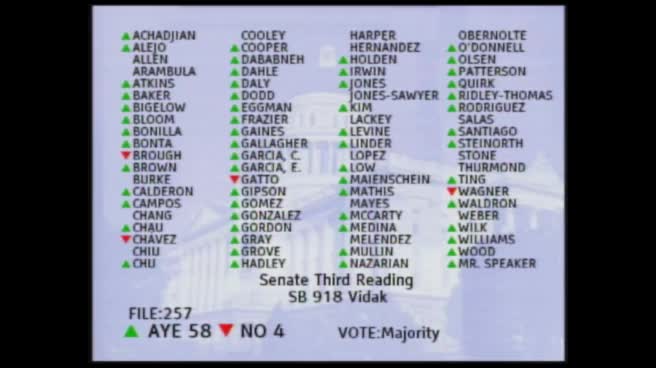 1MIN
Assembly Floor
 7MIN
Assembly Standing Committee on Education
 6MIN
Senate Standing Committee on Appropriations
 12MIN
Senate Standing Committee on Education
Bill Author

Bill Co-Author(s):