SB 982: State Department of Developmental Services: developmental centers.
- Session Year: 2015-2016
- House: Senate
- Latest Version Date: 2016-09-24
Existing law vests in the State Department of Developmental Services jurisdiction over state hospitals referred to as developmental centers for the provision of residential care to individuals with developmental disabilities, including the Sonoma Developmental Center, the Fairview Developmental Center, and the Porterville Developmental Center, as specified. Existing law requires the department to comply with procedural requirements when closing a developmental center. Existing law required, on or before October 1, 2015, the State Department of Developmental Services to submit to the Legislature a plan or plans to close one or more developmental centers.
This bill would require the department to seek to modify the contract in existence on January 1, 2017, for the conduct of a movers longitudinal study to include specified requirements, including, among others, a requirement that at least 250 individuals who meet certain criteria participate in the study. The bill would require the department to annually submit interim reports to the Legislature regarding the study. The bill would require, upon the completion of the study, the department to submit the study to the Legislature, as specified.
Existing law vests in the State Department of Developmental Services jurisdiction over state hospitals referred to as developmental centers for the provision of residential care to individuals with developmental disabilities, including the Sonoma Developmental Center, the Fairview Developmental Center, and the Porterville Developmental Center, as specified. Existing law requires the department to comply with procedural requirements when closing a developmental center. Existing law required, on or before October 1, 2015, the State Department of Developmental Services to submit to the Legislature a plan or plans to close one or more developmental centers.
This bill would require the department to contract for a longitudinal study, commencing July 1, 2017, to, among other things, assess the quality of life and outcomes of developmental center residents who relocate from the Sonoma Developmental Center, the Fairview Developmental Center, and the general treatment area of the Porterville Developmental Center as a result of the closure of those centers and to make specified recommendations. The bill would specify the qualifications and duties of the contractor, as specified. seek to modify the contract in existence on January 1, 2017, for the conduct of a movers longitudinal study to include specified requirements, including, among others, a requirement that at least 250 individuals who meet certain criteria participate in the study. The bill would require the department to annually submit interim reports to the Legislature regarding the study at the end of the first and second years of the study. The bill would require, upon the completion of the study, the department to submit the study to the Legislature, as specified.
Existing law vests in the State Department of Developmental Services jurisdiction over state hospitals referred to as developmental centers for the provision of residential care to individuals with developmental disabilities, including the Sonoma Developmental Center, the Fairview Developmental Center, and the Porterville Developmental Center, as specified. Existing law requires the department to comply with procedural requirements when closing a developmental center. Existing law required, on or before October 1, 2015, the State Department of Developmental Services to submit to the Legislature a plan or plans to close one or more developmental centers.
This bill would require the department to contract for a longitudinal study, commencing July 1, 2017, to to, among other things, assess the quality of life and outcomes of developmental center residents who relocate from the Sonoma Developmental Center, the Fairview Developmental Center, and the general treatment area of the Porterville Developmental Center as a result of the closure of those centers. centers and to make specified recommendations. The bill would specify the qualifications and duties of the contractor, as specified. The bill would require the department to submit interim reports to the Legislature regarding the study at the end of the first and second years of the study. The bill would require, upon the completion of the study, the department to submit the study to the Legislature, as specified.
Existing law vests in the State Department of Developmental Services jurisdiction over state hospitals referred to as developmental centers for the provision of residential care to individuals with developmental disabilities, including the Sonoma State Hospital. Developmental Center, the Fairview Developmental Center, and the Porterville Developmental Center, as specified. Existing law requires the department to comply with procedural requirements when closing a developmental center. Existing law required, on or before October 1, 2015, the State Department of Developmental Services to submit to the Legislature a plan or plans to close one or more developmental centers.
This bill would require, until January 1, 2021, require the department to develop and conduct a 3-year contract for a longitudinal study, over the course of the 201718 through 201920, inclusive, fiscal years, study, commencing July 1, 2017, to assess the quality of life and outcomes of developmental center residents that who relocate from the Sonoma State Hospital Developmental Center, the Fairview Developmental Center, and the general treatment area of the Porterville Developmental Center as a result of the closure of that center. those centers. The bill would specify the contents of the study, including assessments of the residents before they leave the center and at one-year and two-year intervals after they relocate from the center. qualifications and duties of the contractor, as specified. The bill would require the department to submit interim reports to the Legislature regarding the study at the end of the first and second years of the study. The bill would require, upon the completion of the study, the department to submit the study to the Legislature, as specified.
Existing law vests in the State Department of Developmental Services jurisdiction over state hospitals referred to as developmental centers for the provision of residential care to individuals with developmental disabilities, including the Sonoma State Hospital. Existing law requires the department to comply with procedural requirements when closing a developmental center. Existing law required, on or before October 1, 2015, the State Department of Developmental Services to submit to the Legislature a plan or plans to close one or more developmental centers.
This bill would require, until January 1, 2021, the department to develop and conduct a 3-year longitudinal study, over the course of the 201718 through 201920, inclusive, fiscal years, to assess the quality of life and outcomes of developmental center residents that relocate from the Sonoma State Hospital as a result of the closure of that center. The bill would specify the contents of the study, including assessments of the residents before they leave the center and at one-year and two-year intervals after they relocate from the center. The bill would require the department to submit interim reports to the Legislature regarding the study at the end of the first and second years of the study. The bill would require, upon the completion of the study, the department to submit the study to the Legislature, as specified.
Existing law authorizes the Director of Developmental Services, upon nomination and acceptance, to be appointed as either guardian or conservator of the person or estate, or both, of a developmentally disabled person. Existing law provides that the director may petition for his appointment to act as conservator or guardian in the superior court of the county where the main administrative office of the regional center serving the developmentally disabled person is located.
Existing law requires the alleged developmentally disabled person to be present at the hearing if he or she is within the state and is able to attend. Existing law provides that if he or she is unable to attend the hearing by reason of physical or other inability, that inability shall be evidenced by the affidavit or certificate of a duly licensed medical practitioner, as specified. Existing law requires that the affidavit or certificate be filed no later than 10 days prior to the time of the hearing.
This bill would instead require the affidavit or certificate described above to be filed no later than 5 days prior to the time of the hearing. The bill would also make technical, nonsubstantive changes to these provisions.
It is the intent of the Legislature to ensure the appropriate transition of consumers currently living in developmental centers from those centers to community living arrangements as a result of the closure of the Sonoma Developmental Center, the Fairview Developmental Center, and the general treatment area of the Porterville Developmental Center. It is the further intent of the Legislature to measure the unique needs of people transitioning from developmental centers, including providing information about the quality of life, satisfaction with services, the degree to which the individuals achieve their goals, and other measures as determined by the department.
SEC. 2.Section 4474.12 is added to the Welfare and Institutions Code, immediately following Section 4474.11, to read:4474.12.(a)The department shall seek to modify the contract in existence on January 1, 2017, for the conduct of a movers longitudinal study to include all of the following:
(1)A requirement that at least 250 individuals who meet the following criteria participate in the study:
(A)Volunteered to participate in the study.
(B)Proportionately selected from among individuals who have moved into the community from Sonoma Developmental Center, Fairview Developmental Center, or Porterville Developmental Center.
(C)Proportionately selected from among individuals who have moved into the community at different stages of the closure process.
(2)A requirement that the study follow a sample of individuals described in paragraph (1) for a two-year period after the individual moves into the community from the developmental center.
(3)A requirement that the study include individuals who move into the community from a developmental center during the first year of the study, and during each subsequent year of the study, until the developmental centers identified in subparagraph (B) of paragraph (1) close.
(4)A requirement that researchers conducting the study meet with each individual participating in the study at intervals of three months, six months, one year, and two years following the persons move into the community from the developmental center to discuss the individuals quality of life and services and supports.
(b)The movers longitudinal study described in this section is one element of the quality assurance instrument required pursuant to Section 4571.
(c)(1)For purposes of conducting the study, the department shall maintain and update the addresses of, and contact information for, former residents of the centers who relocated as a result of the closure of the centers.
(2)The department shall ensure, to the extent permitted by law, that researchers conducting the study have access to data and other information necessary to conduct the study, including the addresses of, and contact information for, former residents of the centers who relocated due to the closure of the centers.
(d)The department shall annually submit interim reports to the Legislature regarding the study in accordance with the requirements of Section 9795 of the Government Code. The reports shall include information about consumer and family satisfaction and adequacy of community services. Upon the completion of the study as described in subdivision (a), the department shall submit the study to the Legislature, in accordance with the requirements of Section 9795 of the Government Code.
It is the intent of the Legislature to ensure the appropriate transition of consumers currently living in developmental centers from those centers to community living arrangements as a result of the closure of the Sonoma Developmental Center, the Fairview Developmental Center, and the general treatment area of the Porterville Developmental Center. It is the further intent of the Legislature to measure the unique needs of people transitioning from developmental centers, including providing information about the quality of life, satisfaction with services, the degree to which the individuals achieve their goals, and other measures as determined by the department.
SEC. 2.Section 4474.12 is added to the Welfare and Institutions Code, immediately following Section 4474.11, to read:4474.12.(a)To ensure that persons with developmental disabilities who are moved from developmental centers to the community are receiving necessary services and supports, the department shall contract with an independent agency or organization for a longitudinal study, commencing July 1, 2017, to assess the quality of life and outcomes of developmental center residents who relocate from the Sonoma Developmental Center, the Fairview Developmental Center, and the general treatment area of the Porterville Developmental Center, as those institutions are identified in Sections 4440 and 4440.5, as a result of the closure of those centers. The study shall supplement the quality assessment system established by Section 4571 and make recommendations regarding improving health and safety, choice, integration, and other similar factors based on the data collected. The study shall be conducted each year concerning residents who move from the developmental centers until two years following the date the last resident moves from the developmental centers.
(b)The contractor shall be experienced in all of the following:
(1)Designing valid tracking instruments.
(2)Tracking the quality of community programs, including outcome-based measures such as health and safety, quality of life, integration, choice, and consumer satisfaction.
(3)Tracking the quality and appropriateness of community placements for persons moving from large institutions into community settings.
(4)Developing data systems.
(5)Data analysis and report preparation.
(c)(1)The contractor shall measure consumer and family satisfaction with services provided, including case management and quality of life, including, but not limited to, health and safety, independence, productivity, integration, opportunities for choice, and delivery of needed services.
(2)The contractor shall meet with each person, and the persons family, or legal guardian or conservator, when appropriate, no less than once per year to discuss quality of life and observe the persons services and supports.
(3)In cases in which the consumer is not capable of communicating his or her responses, and in which a family member, or legal guardian or conservator, is not involved, the contractor shall meet with no fewer than two persons familiar with the consumer. Additionally, the contractor shall interview staff and friends who know the consumer best and review records, as appropriate, and shall use any data concerning the consumer collected through the quality assurance instrument pursuant to Section 4571.
(d)The contract may be satisfied by the same contractor used by the department to implement the quality assurance instrument pursuant to Section 4571, if appropriate.
4474.12.(a)The department shall seek to modify the contract in existence on January 1, 2017, for the conduct of a movers longitudinal study to include all of the following:
(1)A requirement that at least 250 individuals who meet the following criteria participate in the study:
(A)Volunteered to participate in the study.
(B)Proportionately selected from among individuals who have moved into the community from Sonoma Developmental Center, Fairview Developmental Center, or Porterville Developmental Center.
(C)Proportionately selected from among individuals who have moved into the community at different stages of the closure process.
(2)A requirement that the study follow a sample of individuals described in paragraph (1) for a two-year period after the individual moves into the community from the developmental center.
(3)A requirement that the study include individuals who move into the community from a developmental center during the first year of the study, and during each subsequent year of the study, until the developmental centers identified in subparagraph (B) of paragraph (1) close.
(4)A requirement that researchers conducting the study meet with each individual participating in the study at intervals of three months, six months, one year, and two years following the persons move into the community from the developmental center to discuss the individuals quality of life and services and supports.
(b)The movers longitudinal study described in this section is one element of the quality assurance instrument required pursuant to Section 4571.
(e)
(c)(1)For purposes of conducting the study, the department shall maintain and update the addresses of, and contact information for, former residents of the centers who relocated as a result of the closure of the centers.
(2)The department shall ensure, to the extent permitted by law, that researchers conducting the study have access to data and other information necessary to conduct the study, including the addresses of, and contact information for, former residents of the centers who relocated due to the closure of the centers.
(f)
(d)The department shall annually submit interim reports to the Legislature regarding the study at the end of the first and second years of the study, in accordance with the requirements of Section 9795 of the Government Code. The reports shall include information about consumer and family satisfaction and adequacy of community services. Upon the completion of the study as described in subdivision (a), the department shall submit the study to the Legislature, in accordance with the requirements of Section 9795 of the Government Code.
It is the intent of the Legislature to ensure the appropriate transition of consumers currently living in developmental centers from those centers to community living arrangements as a result of the closure of the Sonoma Developmental Center, the Fairview Developmental Center, and the general treatment area of the Porterville Developmental Center. It is the further intent of the Legislature to measure the unique needs of people transitioning from developmental centers, including providing information about the quality of life, satisfaction with services, the degree to which the individuals achieve their goals, and other measures as determined by the department.
SECTION 1.SEC. 2.Section 4474.12 is added to the Welfare and Institutions Code, immediately following Section 4474.11, to read:4474.12.(a)To ensure that persons with developmental disabilities who are moved from developmental centers to the community are receiving necessary services and supports, the department shall contract with an independent agency or organization for a longitudinal study, commencing July 1, 2017, to assess the quality of life and outcomes of developmental center residents who relocate from the Sonoma Developmental Center, the Fairview Developmental Center, and the general treatment area of the Porterville Developmental Center, as those institutions are identified in Sections 4440 and 4440.5, as a result of the closure of those centers. The study shall supplement the quality assessment system established by Section 4571 and make recommendations regarding improving health and safety, choice, integration, and other similar factors based on the data collected. The study shall be conducted each year concerning residents who move from the developmental centers until two years following the date the last resident moves from the developmental centers.
(b)The contractor shall be experienced in all of the following:
(1)Designing valid tracking instruments.
(2)Tracking the quality of community programs, including outcome-based measures such as health and safety, quality of life, integration, choice, and consumer satisfaction.
(3)Tracking the quality and appropriateness of community placements for persons moving from large institutions into community settings.
(4)Developing data systems.
(5)Data analysis and report preparation.
(c)(1)The contractor shall measure consumer and family satisfaction with services provided, including case management and quality of life, including, but not limited to, health and safety, independence, productivity, integration, opportunities for choice, and delivery of needed services.
(2)The contractor shall meet with each person, and the persons family, or legal guardian or conservator, when appropriate, no less than once per year to discuss quality of life and observe the persons services and supports.
(3)In cases in which the consumer is not capable of communicating his or her responses, and in which a family member, or legal guardian or conservator, is not involved, the contractor shall meet with no fewer than two persons familiar with the consumer. Additionally, the contractor shall interview staff and friends who know the consumer best and review records, as appropriate. appropriate, and shall use any data concerning the consumer collected through the quality assurance instrument pursuant to Section 4571.
(d)The contract may be satisfied by the same contractor used by the department to implement the quality assurance instrument pursuant to Section 4571, if appropriate.
(e)(1)For purposes of conducting the study, the department shall maintain and update the addresses of, and contact information for, former residents of the center centers who relocated as a result of the closure of the centers.
(2)The department shall ensure, to the extent permitted by law, that researchers conducting the study have access to data and other information necessary to conduct the study, including the addresses of, and contact information for, former residents of the center centers who relocated due to the closure of the center. centers.
(f)The department shall submit interim reports to the Legislature regarding the study at the end of the first and second years of the study, in accordance with the requirements of Section 9795 of the Government Code. Upon the completion of the study, study as described in subdivision (a), the department shall submit the study to the Legislature, in accordance with the requirements of Section 9795 of the Government Code.
(a)The To ensure that persons with developmental disabilities who are moved from developmental centers to the community are receiving necessary services and supports, the department shall develop and conduct a three-year contract with an independent agency or organization for a longitudinal study study, commencing July 1, 2017, to assess the quality of life and outcomes of developmental center residents that who relocate from the Sonoma State Hospital Developmental Center, the Fairview Developmental Center, and the general treatment area of the Porterville Developmental Center, as those institutions are identified in Sections 4440 and 4440.5, as a result of the closure of that center. The study shall be conducted over the course of the 201718 through 201920, inclusive, fiscal years. those centers.
(b)The study conducted pursuant to this section shall do all of the following:
(1)Measure the residents quality of life, their satisfaction with services, the degree to which the residents achieve their goals, such as independence, and other dimensions as determined by the department.
(2)Include assessments of the residents before they leave the center and at one-year and two-year intervals after they relocate from the center.
(3)Track the residential locations of the former residents of the center for purposes of conducting the one-year and two-year postrelocation reassessments.
(4)Include a written report that does all of the following:
(A)Summarizes the findings based on the data collected.
(B)Provides recommendations regarding how the closure could have been conducted in a manner that better served the needs of the residents and their families.
(C)Specifies any community-based services for former residents that need to be improved.
(b)The contractor shall be experienced in all of the following:
(1)Designing valid tracking instruments.
(2)Tracking the quality of community programs, including outcome-based measures such as health and safety, quality of life, integration, choice, and consumer satisfaction.
(3)Tracking the quality and appropriateness of community placements for persons moving from large institutions into community settings.
(4)Developing data systems.
(5)Data analysis and report preparation.
(c)(1)The contractor shall measure consumer and family satisfaction with services provided, including case management and quality of life, including, but not limited to, health and safety, independence, productivity, integration, opportunities for choice, and delivery of needed services.
(2)The contractor shall meet with each person, and the persons family, or legal guardian or conservator, when appropriate, no less than once per year to discuss quality of life and observe the persons services and supports.
(3)In cases in which the consumer is not capable of communicating his or her responses, and in which a family member, or legal guardian or conservator, is not involved, the contractor shall meet with no fewer than two persons familiar with the consumer. Additionally, the contractor shall interview staff and friends who know the consumer best and review records, as appropriate.
(d)The contract may be satisfied by the same contractor used by the department to implement the quality assurance instrument pursuant to Section 4571, if appropriate.
(c)
(e)(1)For purposes of conducting the study, the department shall maintain and update the addresses of, and contact information for, former residents of the center who relocated as a result of the closure of the center. centers.
(2)The department shall ensure, to the extent permitted by law, that researchers conducting the study have access to data and other information necessary to conduct the study, including the addresses of, and contact information for, former residents of the center who relocated due to the closure of the center.
(d)
(f)The department shall submit interim reports to the Legislature regarding the study at the end of the first and second years of the study, in accordance with the requirements of Section 9795 of the Government Code. Upon the completion of the study, the department shall submit the study to the Legislature, in accordance with the requirements of Section 9795 of the Government Code.
(e)This section shall remain in effect only until January 1, 2021, and as of that date is repealed, unless a later enacted statute, that is enacted before January 1, 2021, deletes or extends that date.
(a)The department shall develop and conduct a three-year longitudinal study to assess the quality of life and outcomes of developmental center residents that relocate from the Sonoma State Hospital as a result of the closure of that center. The study shall be conducted over the course of the 201718 through 201920, inclusive, fiscal years.
(b)The study conducted pursuant to this section shall do all of the following:
(1)Measure the residents quality of life, their satisfaction with services, the degree to which the residents achieve their goals, such as independence, and other dimensions as determined by the department.
(2)Include assessments of the residents before they leave the center and at one-year and two-year intervals after they relocate from the center.
(3)Track the residential locations of the former residents of the center for purposes of conducting the one-year and two-year postrelocation reassessments.
(4)Include a written report that does all of the following:
(A)Summarizes the findings based on the data collected.
(B)Provides recommendations regarding how the closure could have been conducted in a manner that better served the needs of the residents and their families.
(C)Specifies any community-based services for former residents that need to be improved.
(c)(1)For purposes of conducting the study, the department shall maintain and update the addresses of, and contact information for, former residents of the center who relocated as a result of the closure of the center.
(2)The department shall ensure, to the extent permitted by law, that researchers conducting the study have access to data and other information necessary to conduct the study, including the addresses of, and contact information for, former residents of the center who relocated due to the closure of the center.
(d)The department shall submit interim reports to the Legislature regarding the study at the end of the first and second years of the study, in accordance with the requirements of Section 9795 of the Government Code. Upon the completion of the study, the department shall submit the study to the Legislature, in accordance with the requirements of Section 9795 of the Government Code.
(e)This section shall remain in effect only until January 1, 2021, and as of that date is repealed, unless a later enacted statute, that is enacted before January 1, 2021, deletes or extends that date.
SECTION 1.Section 416.7 of the Health and Safety Code is amended to read:416.7.If the alleged developmentally disabled person is within the state and is able to attend, he or she shall be present at the hearing. If he or she is unable to attend by reason of physical or other inability, that inability shall be evidenced by the affidavit or certificate of a duly licensed medical practitioner as provided in Section 1825 of the Probate Code. The affidavit or certificate shall be filed no later than five business days prior to the time of the hearing.
If the alleged developmentally disabled person is within the state and is able to attend, he or she shall be present at the hearing. If he or she is unable to attend by reason of physical or other inability, such that inability shall be evidenced by the affidavit or certificate of a duly licensed medical practitioner as provided in Section 1825 of the Probate Code. Such The affidavit or certificate shall be filed no later than 10 five business days prior to the time of the hearing.
|
Date
|
Status
|
|---|---|
| May 31, 2016 | Read second time and amended. Ordered to third reading. |
| Aug 30, 2016 | Enrolled and presented to the Governor at 1:30 p.m. |
| Aug 25, 2016 | Assembly amendments concurred in. (Ayes 39. Noes 0.) Ordered to engrossing and enrolling. |
| Aug 25, 2016 | Assembly amendments concurred in. (Ayes 39. Noes 0. Page 5426.) Ordered to engrossing and enrolling. |
| Aug 23, 2016 | Read third time. Passed. (Ayes 79. Noes 0. Page 6101.) Ordered to the Senate. |
| Aug 23, 2016 | Read third time. Passed. Ordered to the Senate. |
| Aug 23, 2016 | In Senate. Concurrence in Assembly amendments pending. |
| Aug 16, 2016 | Read second time. Ordered to third reading. |
| Aug 15, 2016 | Read second time and amended. Ordered to second reading. |
| Aug 12, 2016 | From committee: Do pass as amended. (Ayes 20. Noes 0.) (August 11). |
| Aug 3, 2016 | August 3 set for first hearing. Placed on APPR. suspense file. |
| Jun 29, 2016 | From committee: Do pass and re-refer to Com. on APPR. (Ayes 7. Noes 0.) (June 28). Re-referred to Com. on APPR. |
| Jun 9, 2016 | Referred to Com. on HUM. S. |
| Jun 2, 2016 | In Assembly. Read first time. Held at Desk. |
| Jun 1, 2016 | Read third time. Passed. (Ayes 38. Noes 0.) Ordered to the Assembly. |
| Jun 1, 2016 | Read third time. Passed. (Ayes 38. Noes 0. Page 4096.) Ordered to the Assembly. |
| Feb 10, 2016 | Introduced. Read first time. To Com. on RLS. for assignment. To print. |
| May 27, 2016 | From committee: Do pass as amended. (Ayes 6. Noes 0.) (May 27). |
| May 27, 2016 | From committee: Do pass as amended. (Ayes 6. Noes 0. Page 4001.) (May 27). |
| May 20, 2016 | Set for hearing May 27. |
| May 2, 2016 | May 2 hearing: Placed on APPR. suspense file. |
| Apr 22, 2016 | Set for hearing May 2. |
| Apr 14, 2016 | Read second time and amended. Re-referred to Com. on APPR. |
| Apr 13, 2016 | From committee: Do pass as amended and re-refer to Com. on APPR. (Ayes 4. Noes 0.) (April 12). |
| Apr 13, 2016 | From committee: Do pass as amended and re-refer to Com. on APPR. (Ayes 4. Noes 0. Page 3518.) (April 12). |
| Apr 7, 2016 | Set for hearing April 12. |
| Mar 31, 2016 | Re-referred to Com. on HUMAN S. |
| Mar 29, 2016 | Withdrawn from committee. |
| Mar 29, 2016 | Re-referred to Com. on RLS. |
| Mar 28, 2016 | From committee with author's amendments. Read second time and amended. Re-referred to Com. on JUD. |
| Feb 18, 2016 | Referred to Com. on JUD. |
| Feb 11, 2016 | From printer. May be acted upon on or after March 12. |
|
Date
|
Description
|
Location
|
Votes
|
|
|---|---|---|---|---|
| Aug 25, 2016 | Unfinished Business SB982 McGuire Concurrence | Senate Floor |
Passed |
|
| Aug 23, 2016 | SB 982 McGuire Senate Third Reading By DODD | Assembly Floor |
Passed |
|
| Aug 11, 2016 | Do pass as amended. | Assembly Standing Committee on Appropriations |
Passed |
|
| Jun 28, 2016 | Do pass and be re-referred to the Committee on [Appropriations] | Assembly Standing Committee on Human Services |
Passed |
|
| Jun 1, 2016 | Senate 3rd Reading SB982 McGuire | Senate Floor |
Passed |
|
| May 27, 2016 | Do pass as amended | Senate Standing Committee on Appropriations |
Passed |
|
| May 2, 2016 | Placed on suspense file | Senate Standing Committee on Appropriations |
Passed |
|
| Apr 12, 2016 | Do pass as amended, but first amend, and re-refer to the Committee on [Appropriations] | Senate Standing Committee on Human Services |
Passed |
This list shows positions taken on this bill by organizations on the date displayed, which is linked to the original source.
Positions by individuals are not included.
|
Organization
|
Position
|
Date
|
|---|---|---|
| Alameda County Board of Supervisors | * Support | Jun 26, 2018 |
| Alliance for Children's Rights | * Support | Jun 26, 2018 |
| American Academy of Pediatrics | * Support | Jun 26, 2018 |
| Board of Supervisors of Santa Cruz | * Support | Jun 26, 2018 |
| Board of Supervisors of Ventura County | * Support | Jun 26, 2018 |
| Board of Supervisors San Francisco | * Support | Jun 26, 2018 |
| California Association Of Psychiatric Technicians | ** Support | Aug 23, 2016 |
| California Black Health Network | * Support | Jun 26, 2018 |
| California County Welfare Directors Association | * Indeterminate | Jun 26, 2018 |
| California Latinas Reproductive Justice | * Support | Jun 26, 2018 |
| Children Now | * Support | Jun 26, 2018 |
| City and County of San Francisco | * Support | Jun 26, 2018 |
| Disability Rights California | ** Support | Aug 23, 2016 |
| First Five California | * Support | Jun 26, 2018 |
| League of Woman Voters of California | * Support | Jun 26, 2018 |
| Los Angeles County Board of Supervisors | * Support | Jun 26, 2018 |
| Los Angeles County Office Of Education | * Support | Jun 26, 2018 |
| Mayor Mark Farrell | * Support | Jun 26, 2018 |
| National Council of Jewish Women | * Support | Jun 26, 2018 |
| Parent Hospital Association | ** Support | Aug 23, 2016 |
| Parent Voices California | * Support | Jun 26, 2018 |
| Parent Voices of Contra Costa County | * Support | Jun 26, 2018 |
| SEIU | * Support | Jun 26, 2018 |
| Sonoma County Board of Supervisors | ** Support | Aug 23, 2016 |
| Sonoma Land Trust | ** Support | Aug 23, 2016 |
| Stronger California Women's Coalition | * Support | Jun 26, 2018 |
| The Children's Law Center of California | * Support | Jun 26, 2018 |
| United Ways Of California | * Support | Jun 26, 2018 |
| Western Center On Law And Poverty Inc. | * Support | Jun 26, 2018 |
Office of Senate Floor Analyses (916) 651-1520 Fax: (916) 327-4478 | SB |
UNFINISHED BUSINESS
Bill No: SB 982
: 8/15/16
SENATE HUMAN SERVICES COMMITTEE: 4-0, 4/12/16
AYES: McGuire, Berryhill, Hancock, Liu
NO VOTE RECORDED: Nguyen
SENATE APPROPRIATIONS COMMITTEE: 6-0, 5/27/16
AYES: Lara, Bates, Beall, Hill, McGuire, Mendoza
NO VOTE RECORDED: Nielsen
SENATE FLOOR: 38-0, 6/1/16
AYES: Allen, Anderson, Bates, Beall, Berryhill, Block, Cannella, De León, Fuller, Gaines, Galgiani, Glazer, Hall, Hancock, Hernandez, Hertzberg, Hill, Hueso, Huff, Jackson, Lara, Leno, Leyva, Liu, McGuire, Mendoza, Mitchell, Monning, Moorlach, Morrell, Nguyen, Pan, Pavley, Roth, Stone, Vidak, Wieckowski, Wolk
NO VOTE RECORDED: Nielsen, Runner
ASSEMBLY FLOOR: 79-0, 8/23/16 - See last page for vote
DIGEST: This bill requires the state Department of Developmental Services (DDS) to seek to modify an existing contract to conduct a movers’ longitudinal study of individuals who are moving from one of the state’s developmental centers to a community setting. The bill requires that at least 250 individuals who meet certain criteria participate in the study, among other criteria. The bill requires DDS to annually submit interim reports to the Legislature and to submit a final report upon conclusion of the study, as specified.
Assembly Amendments clarify that the requirements of the bill be added to an existing longitudinal study, specify the size and composition of study participants, delete the requirement to interview family members and require annual reporting to the Legislature, as specified.
Existing law:
- Establishes the Lanterman Developmental Disabilities Services Act, which declares California’s responsibility to provide an array of services and supports to meet the needs of each person with developmental disabilities in the least restrictive environment, and to support their integration into the mainstream life of the community. (WIC 4500, et seq.)
- Establishes the jurisdiction of DDS over including Sonoma, Fairview and Porterville developmental centers and the responsibility of each facility to create bylaws and rules, as specified. (WIC 4440)
- Requires DDS to submit a detailed plan to the Legislature when it proposes closure of a developmental center no later than April 1 immediately prior to the fiscal year in which the plan is to be implemented, and as a part of the Governor’s proposed budget. (WIC 4474.1. (a))
- Establishes a system of nonprofit regional centers to provide fixed points of contact in the community for all persons with developmental disabilities and their families, to coordinate services and supports best suited to them throughout their lifetime. (WIC 4620)
- Requires DDS to implement a unified quality assessment system, and expresses Legislative intent that this system will ensure the well-being of consumers, taking into account their informed and expressed choices. Requires DDS with its stakeholders to identify a valid and reliable quality assurance instrument, as specified, and to contract with an entity with experience in tracking outcomes and developing data systems. (WIC 4571)
- Requires DDS, in consultation with the contractor, to establish the methodology by which the quality assurance instrument shall be administered, including, but not limited to, how often and to whom the quality assurance will be administered, and the design of a stratified, random sample among the entire population of consumers served by regional centers. Requires the contractor to provide aggregate information for regional centers and the state as a whole. (WIC 4571 (e))
This bill:
- Declares Legislative intent to ensure the appropriate transition of consumers currently living in developmental centers from those centers to community living arrangements as a result of the closure of the state’s three remaining DCs. It is the further intent of the Legislature to measure the unique needs of people transitioning from developmental centers, including providing information about the quality of life, satisfaction with services, the degree to which the individuals achieve their goals.
- Requires DDS to seek to modify a contract in existence on January 1, 2017, to conduct a movers longitudinal study to include at least 250 voluntary participants who were proportionately selected from among individuals who have moved into the community from each of the three developmental centers and who have moved into the community at different stages of the closure process.
- Requires that the study follow the sample of individuals for a two-year period after the individual moves into the community from the developmental center.
- Requires that the study include individuals who move into the community from a developmental center during the first year of the study, and during each subsequent year of the study, until the developmental centers close.
- Requires that researchers meet with each individual participating in the study at intervals of three months, six months, one year, and two years following the person’s move into the community from the developmental center to discuss the individual’s quality of life and services and supports.
- Establishes that the movers longitudinal study is one element of the quality assurance instrument required under current law.
- Requires DDS to maintain and update the addresses of, and contact information for, former residents who relocated as a result of the closure of the centers.
- Requires DDS to ensure, to the extent permitted by law, that researchers conducting the study have access to data and other information necessary to conduct the study, including contact information for former residents who relocated due to the closure of the centers, as specified.
- Requires DDS to annually submit interim reports about the study to the Legislature, as specified, and requires the reports to include information about consumer and family satisfaction and adequacy of community services. Requires DDS to submit the completed study to the Legislature, as specified.
Background
DDS operates three state developmental centers – Sonoma, Fairview and Porterville – and one smaller facility in Cathedral City that is often used as a step-down placement for individuals with developmental disabilities and challenging behavioral needs. Each developmental center has three levels of care – a skilled nursing facility, an intermediate care facility for individuals with intellectual disabilities (ICF/IID), and a small acute care hospital.
The developmental centers once were considered the placement of preference for individuals with significant needs. At its peak in 1968, the developmental center system housed more than 13,400 individuals in seven facilities. Since then a series of federal and state legal decisions began the movement to provide services for individuals with developmental disabilities in their communities. Of the three remaining facilities, the oldest is Sonoma Developmental Center (1891) and the newest is Fairview Developmental Center (1959).
As of August 10, 2016, the four state-run facilities collectively served 957 individuals with significant physical or behavioral developmental disabilities. Of these, 206 individuals were in the secure treatment program at Porterville Developmental Center, which is not slated for closure. Another 145 were in the general treatment program. Some 217 individuals lived at Fairview Developmental Center and 344 were at Sonoma. The remaining 45 were at Canyon Springs, a smaller state-run facility in Riverside County, which is not slated for closure.
Licensing and Certification concerns. In January 2013, four of the 10 ICF units at Sonoma DC were withdrawn from federal certification by DDS, in response to notice that the federal government was moving to decertify, and defund, all the ICF units at the facility. The actions came on the heels of widely reported revelations of multiple instances of abuse, neglect, and other lapses in caregiving at the institution. In March 2013, DDS entered into a Program Improvement Plan agreement, which was accepted by the federal Centers for Medicare and Medicaid Services (CMS). As a condition of the Program Improvement Plan, DDS contracted with a consultant to develop an action plan ensuring compliance with federal and state licensing and certification requirements.
The Administration assumed these corrective actions would result in the restoration of certification and federal funding by July 1, 2014. However, this did not occur. A survey of the seven certified ICF units at Sonoma DC in May 2014 resulted in their ultimate decertification. Over the next 14 months, CMS and the Administration negotiated terms of a settlement, as DDS simultaneously began moving to close Sonoma Developmental Center, with the intent to have most residents moved before losing federal funding. On June 30, 2015, DDS and the federal government agreed to extend the federal funding to July 1, 2016 with the potential for one or more extensions, as long as DDS continued to make improvements in the care at Sonoma. However, on May 13, 2016, CMS notified DDS that it had not made sufficient progress and that approximately $26.4 million in annual federal funding for the ICF units would cease on July 1.
Similar concerns and CMS findings were mirrored at the other two developmental centers and on April 1, 2016, DDS revealed plans for closure of Fairview Developmental Center and the general treatment area at Porterville DC.
A July 1, 2016 agreement with the CMS outlines annual extensions of federal funding for the ICF units at Fairview and Porterville providing the state adheres to its plans to transition residents to community settings, maintains appropriate staffing levels and does not violate other terms of the agreement. Funding cannot be extended for Fairview Developmental Center beyond Dec. 31, 2019 and beyond Oct. 31, 2021 for the general treatment area Porterville Developmental Center. The secure treatment area of Porterville DC is not included in closure plans.
Community based services. California’s 21 nonprofit regional centers are part of a system of care for individuals with developmental disabilities overseen by DDS. DDS is responsible for coordinating care and providing services for nearly 300,000 people who receive services and supports to live in their communities, as of August 2016. Regional centers provide diagnosis and assessment of eligibility and case managers help to plan, access, coordinate and monitor the services and supports that are needed because of an individual’s developmental disability. Services for consumers are determined through an individual program plan (IPP).
Quality Assessments. DDS has used a variety of quality assessment tools, beginning in 1993 with the Quality Tracking Project, which focused on individuals who were placed in the community from a developmental center as a result of the Coffelt lawsuit. According to DDS, the study assessed consumer and family satisfaction, case management activities, independence, productivity, integration, choice and self-determination, service delivery patterns, health, safety, psychoactive medication usage, qualities of home settings, and costs of services. Using six different research designs and more than 4,000 visits, the survey ultimately was reported in 19 separate reports and found that movers had improvements in self-care abilities, social behaviors, opportunities for choice making and consumer satisfaction, among other domains. Negative outcomes included fewer individuals with paid jobs and making less money than they did in the DCs. Use of sedatives and psychotropic medications had increased.
As part of the plan to close Stockton Developmental Center, DDS agreed to complete a three-year longitudinal study in three phases to track consumer outcomes and the quality of life of individuals upon its closure in 1996. California State University, Sacramento was chosen to conduct the study. A year later, responding to parent concerns, the Legislature codified the state’s responsibility to track and evaluate the well-being of individuals moving from DCs, (SB 391, Chapter 294, Statutes of 1997). The obligation was fulfilled by a variety of contracts with researchers. In 2009, as part of the budget process, this statute was deleted and replaced by language directing DDS to complete a single survey, the Quality Assessment Project, (WIC 4571) which was intended to provide more appropriate information. To satisfy this requirement, DDS chose to use the National Core Indicator survey.
National Core Indicator survey. The NCI is a collaborative effort between the National Association of State Directors of Developmental Disabilities Services (NASDDDS) and the Human Services Research Institute. The program began in 1997 to support NASDDDS member agencies to gather a standard set of performance and outcome measures to track their own performance, compare results across states, and to establish national benchmarks. Indicators address such key areas as employment, rights, service planning, community inclusion, choice, loneliness, and health and safety. In California, the NCI Quality Assessment Project operates on a three-year cycle, alternating data collection among three groups of people served by regional centers: adult consumers, guardians and family members, and family members of children receiving services.
DDS also is conducting a longitudinal study of movers and their families during the first two years post transition into the community. This longitudinal study will survey the first 125 people transitioning from a developmental center into the community and their families beginning in January 2016. Study participants will be surveyed using the NCI tools at 3 months, 6 months, 1 year, and 2 years.
This bill seeks to broaden that study by doubling its size and including a sample of movers over the duration of the closure process, to more accurately capture the experiences of all movers.
Related Legislation
AB 9 (Evans, Chapter 9, 4th Extraordinary Session) established a requirement in statute for DDS to track outcomes of consumers in the system.
FISCAL EFFECT: Appropriation: Fiscal Com.: Local:
According to an Assembly floor analysis, the Assembly Appropriations Committee notes this bill may result in onetime costs of up to $100,000 to incorporate provisions of this bill into an ongoing DDS study.
California Association of Psychiatric Technicians
Disability Rights California
Parent Hospital Association
Sonoma County Board of Supervisors
Sonoma Land Trust
The Service Employees International Union, Local 1000
OPPOSITION: (Verified 8/23/16)
None received
ARGUMENTS IN SUPPORT: Disability Rights California writes that a similar study of individuals who moved from Agnews Developmental Center provided important information and a means to help assure the quality of life and outcomes for those individuals as they transitioned to the community. This bill “ensures and objective analysis of developmental center mover satisfaction by looking at meaningful outcome measures,” writes DRC.
ARGUMENTS IN OPPOSITION: The California Department of Finance writes in opposition to this bill that it would require General Fund expenditures not already in the budget and that the study may be duplicative of existing efforts. Recent amendments to this bill have resulted in DDS removing its opposition.
ASSEMBLY FLOOR: 79-0, 8/23/16
AYES: Achadjian, Alejo, Travis Allen, Arambula, Atkins, Baker, Bigelow, Bloom, Bonilla, Bonta, Brough, Brown, Burke, Calderon, Campos, Chang, Chau, Chávez, Chiu, Chu, Cooley, Cooper, Dababneh, Dahle, Daly, Dodd, Eggman, Frazier, Beth Gaines, Gallagher, Cristina Garcia, Eduardo Garcia, Gatto, Gipson, Gomez, Gonzalez, Gordon, Grove, Hadley, Harper, Roger Hernández, Holden, Irwin, Jones, Jones-Sawyer, Kim, Lackey, Levine, Linder, Lopez, Low, Maienschein, Mathis, Mayes, McCarty, Medina, Melendez, Mullin, Nazarian, Obernolte, O'Donnell, Olsen, Patterson, Quirk, Ridley-Thomas, Rodriguez, Salas, Santiago, Steinorth, Mark Stone, Thurmond, Ting, Wagner, Waldron, Weber, Wilk, Williams, Wood, Rendon
NO VOTE RECORDED: Gray
8/23/16 19:54:32
SENATE THIRD READING
STR Bill Id:SB 982
Author:(McGuire)
As Amended Ver:August 15, 2016
Majority vote
SENATE VOTE: 38-0
Committee | Votes | Ayes | Noes |
Human Services | 7-0 | Bonilla, Grove, Arambula, Lopez, Maienschein, Mark Stone, Thurmond | |
Appropriations | 20-0 | Gonzalez, Bigelow, Bloom, Bonilla, Bonta, Calderon, Chang, Daly, Eggman, Gallagher, Eduardo Garcia, Holden, Jones, Obernolte, Quirk, Santiago, Wagner, Weber, Wood, McCarty |
|
SUMMARY: Requires the Department of Developmental Services (DDS) to seek to modify the existing contract for a longitudinal study in order to collect data on the quality of life of residents of the Sonoma Developmental Center (SDC), the Fairview Developmental Center (FDC), and the general treatment area of the Porterville Developmental Center (PDC) who transition out of the facilities due the closure of these centers. Specifically, this bill:
- States Legislative intent to ensure the appropriate transition of developmental center residents to community living arrangements in response to the closure of SDC, FDC, and the general treatment area of PDC and to measure the unique needs of this population, as specified.
- Requires DDS to seek to modify the existing contract for the conduct of movers longitudinal study to include all of the following requirements:
- That no fewer than 250 volunteer participants are selected proportionally from among movers from the State's three Developmental Centers and from among individuals who have moved into the community at different stages of the closure process;
- That the study follow a sample of individuals, as specified, for a two-year period after the individual moves into the community from the developmental center;
- That the study include individuals who move into the community from a developmental center during the first year of the study, and during each subsequent year of the study, until the remaining developmental centers close; and
- That researcher conducting the study meet with each individual participating in the study at specified intervals following the person's move into the community to discuss the individual's quality of life and services and supports.
- Requires DDS, for purposes of conducting the study, to:
- Maintain and update contact information for former residents of the centers who relocated as a result of the closure of the centers;
- Ensure, to the extent permitted by law, that researchers conducting the study have access to data and other information necessary to conduct the study, as specified; and
- Submit annual interim reports to the Legislature regarding the study and submit the study to the Legislature upon its completion, as specified.
EXISTING LAW:
- Establishes the Lanterman Developmental Disabilities Services Act, which declares California's responsibility for providing an array of services and supports to meet the needs of each person with developmental disabilities in the least restrictive environment, regardless of age or degree of disability, and to support their integration into the mainstream life of the community. (Welfare and Institutions Code Section (WIC) 4500, et seq.)
- Establishes the jurisdiction of DDS over state developmental centers, including Sonoma, Fairview and Porterville developmental centers and the responsibility of each facility to create bylaws and rules, as specified. (WIC 4440)
- Requires DDS to submit a detailed plan to the Legislature when it proposes closure of a developmental center no later than April 1 immediately prior to the fiscal year in which the plan is to be implemented, and as a part of the Governor's proposed budget. (WIC 4474.1. (a))
- Establishes a system of nonprofit regional centers to provide fixed points of contact in the community for all persons with developmental disabilities and their families, to coordinate services and supports best suited to them throughout their lifetime. (WIC 4620)
- Requires DDS to implement an improved, unified quality assessment system, and expresses Legislative intent that this system will ensure the well-being of consumers, taking into account their informed and expressed choices. Requires DDS with its stakeholders to identify a valid and reliable quality assurance instrument, as specified, and to contract with an entity with experience in tracking outcomes and developing data systems. (WIC 4571)
- Requires DDS, in consultation with the contractor, to establish the methodology by which the quality assurance instrument shall be administered, including, but not limited to, how often and to whom the quality assurance will be administered, and the design of a stratified, random sample among the entire population of consumers served by regional centers. Further, requires the contractor to provide aggregate information for regional centers and the state as a whole. (WIC 4571 (e))
FISCAL EFFECT: According to the Assembly Appropriations Committee, this bill may result in onetime costs of up to $100,000 to incorporate provisions of this bill into an ongoing DDS study.
COMMENTS:
The Lanterman Developmental Disabilities Act of 1969: Also known as the Lanterman Act, this legislation forms the basis of the State's commitment to provide individuals with developmental disabilities a variety of supports and services which are overseen and administered by DDS. Under the Lanterman Act, a developmental disability is defined as a "substantial disability" that starts before age 18 and is expected to continue indefinitely; such disabilities include cerebral palsy, epilepsy, and autism, among others. Services for these individuals are currently distributed through two distinct tracks.
Regional Centers: Community-based services are coordinated through California's 21 regional centers which assess eligibility and develop individual program plans (IPPs) through an interdisciplinary team. Funded through DDS, regional centers served an estimated 290,496 consumers in 2015-16 according to the Legislative Analyst's Office. Services and supports can include housing, activity and employment programs, in-home care, transportation, and other support services that enable individuals to lead independent lives in the community. A majority of those receiving services through regional centers are low-income individuals enrolled in Medi-Cal. More than 99% of DDS consumers receive services under the Community Services Program, meaning these consumers live in the community with their parents or other relatives, in their own houses or apartments, or in residential facilities or group homes designed to meet their needs.
Developmental Centers: In addition to the 21 regional centers, DDS operates three 24-hour facilities, known as developmental centers: Fairview Developmental Center (FDC) in Orange County, Porterville Developmental Center (PDC) in Tulare County, and Sonoma Developmental Center (SDC) in Sonoma County. In 2015-16, approximately 1,000 consumers received care and supervision in a DC. Each DC is licensed by the Department of Public Health (DPH) and certified by DPH on behalf of the federal Centers for Medicare and Medicaid Services (CMS) as skilled nursing facilities, intermediate care facilities for the developmentally disabled, and general acute care hospitals. Developmental centers are licensed and certified to provide a broad array of services based on each resident's IPP, including nursing services, assistance with activities of daily living, specialized rehabilitative services, individualized dietary services, and vocational or other day programs.
Developmental Center closures: Over the past 15 years DPH, CMS, and the United States Department of Justice have identified problems in California's developmental centers, including inadequate care, insufficient staffing, and insufficient reporting and investigation of instances of abuse and neglect. In January 2014, the Task Force on the Future of the Developmental Centers convened by the Administration released a plan for the long-term future of the developmental centers. In May 2015, Governor Brown's administration announced plans to initiate and develop closure plans for the state's remaining developmental centers, except for the secure treatment program at Porterville DC (and a smaller facility at Canyon Springs in Riverside County). Currently the administration's intent is to have the last developmental center closure completed by 2021.
Quality of life assessments: Since 1993, DDS has utilized a number of tracking projects to ensure quality of life is maintained when residents of developmental centers transition to the community.
Coffelt Quality Tracking Project: Between 1993-1998 DDS agreed to develop a contract with an independent consultant to track individuals placed in the community and to monitor their satisfaction with their living arrangements and the quality of services and supports they were receiving. The study assessed consumer and family satisfaction, case management activities, independence, productivity, integration, choice and self-determination, service delivery patterns, health, safety, psychoactive medication usage, qualities of home settings and costs of services. Ultimately the study concluded that improvements were made among those who moved to the community in self-care abilities, social behaviors, and integration; however the study also found that fewer individuals had paid jobs in the community and were earning less money in the community than they had in the developmental centers, and the use of sedatives and psychotropic medications had increased.
Stockton Developmental Center Longitudinal Quality of Life Study: In 1995, DDS agreed to complete a three-year longitudinal study in three phases in order to track consumer outcomes and the quality of life of individuals moving from Stockton Developmental Center upon its closure in 1996. A contract was entered into between DDS and California State University Sacramento and the study began by interviewing residents in Stockton Developmental Center in 1995 before their move to the community. One to two years later the residents were interviewed again on subjects similar to those discussed in the Coffelt project. Many of the residents however were moved to different developmental centers as suitable placements in the community could not be found; these residents later formed the basis for the founding of the Secure Treatment Program at Porterville.
SB 391 (Solis and Ducheny), Chapter 294, Statutes of 1997: In 1997 and in response to concerns expressed by the California Association for State Hospital Parent Councils for the Retarded and Protection and Advocacy, SB 391 was signed into law. The legislation added Section 4418.1 to the Welfare and Institutions Code and codified requirements for tracking individuals moving from developmental centers in order to ensure long-term well-being and self-sufficiency. The legislation also required DDS to contract with an independent contractor to complete an annual Quality of Life survey on all persons who moved from DCs to the community since April 1993.
National Core Indicator (NCI) Survey: In 2009, SB 391 was repealed and was replaced by Welfare and Institutions Code Section 4571 which implemented the National Core Indicator (NCI) Survey, a nation-wide quality assessment survey used by DDS to monitor the performance of developmental disabilities service system as well as regional center performance in providing services and supports to consumers. Conducted by the State Council on Developmental Disabilities, the survey collects data on consumer and family satisfaction, quality of services, linguistic and cultural competency, and personal results.
Need for this bill: According to the author's office, "In the 2015 May Revision, the Governor announced the closure of the remaining three developmental centers in California. This means in the next five years over 1,000 developmental center residents – the most medically fragile in the state system - will be transitioning into the community system with no developmental center to fall back on if the placement fails. [This bill] requires a quality of life study to monitor and evaluate the transition process and ensure our state follows through with its commitment to provide appropriate services to developmentally disabled Californians. Currently, there is no way to track developmental center movers from beginning to end of the transition. [This bill] will aid in the transition by assuring families that their loved ones are receiving quality care. Additionally, it would enable the State to learn from and correct any challenges that may arise and would provide transparency and accountability on the state's investment and responsibility to the Developmentally Disabled community. Given the fact that there will NO LONGER be any developmental centers to fall back on if residents have challenges in the community, a comprehensive study should be required."
PRIOR LEGISLATION
SB 391 (Solis and Ducheny), Chapter 294, Statutes of 1997, codified in statute the State's obligation to track individuals moving from developmental centers into the community. It also specified that beginning July 1, 1998, an independent contractor must provide a report to the Governor, the Legislature, and DDS outlining activities and findings of the annual Quality of Life survey.
Analysis Prepared by: Kelsy Castillo / HUM. S. / (916) 319-2089 FN: 0004189
Date of Hearing: August 3, 2016
ASSEMBLY COMMITTEE ON APPROPRIATIONS
Lorena Gonzalez, Chair
SBPCA Bill Id:SB 982
Author:(McGuire) – As Amended Ver:May 31, 2016
Policy Committee: | Human Services | Vote: | 7 - 0 |
Urgency: No State Mandated Local Program: No Reimbursable: No
SUMMARY: This bill requires the Department of Developmental Services (DDS) to contract with an outside agency, beginning July 1, 2017, to conduct a longitudinal study to collect data on the quality of life of residents of the Sonoma Developmental Center (SDC), the Fairview Developmental Center (FDC), and the general treatment area of the Porterville Developmental Center (PDC) who transition out of the facilities due the closure of these centers. Specifically, this bill:
- Requires the study to supplement the quality assessment system established in current law and that the study be conducted each year regarding residents who move from the developmental centers (DCs) until two years following the date the last resident moves from the developmental centers.
- Requires the contractor to perform the following duties:
- Measure consumer and family satisfaction with services provided, as specified;
- Meet with each person, and the person’s family, or legal guardian or conservator, when appropriate, no less than once per year to discuss quality of life and observe the person’s services and supports; and
- Meet with no fewer than two persons familiar with the consumer and interview staff and friends who know the consumer best and review records, and use data collected through the quality assurance instrument, in the event that a consumer is not capable of communicating his or her responses and a family member, or legal guardian or conservator is not involved.
- Requires DDS, for purposes of conducting the study, to:
- Maintain and update contact information for former residents of the centers who relocated as a result of the closure of the centers:
- Ensure that researchers conducting the study have access to data and other information necessary to conduct the study: and
- Submit interim reports to the Legislature regarding the study at the end of the first and second years of the study and submit the study to the Legislature upon its completion.
FISCAL EFFECT:
DDS estimates ongoing costs in the range of $373,000 to $467, 000 ($290,000 to $360,000 GF) per year for approximately six-and-a-half-years, for an independent contractor to undertake the required study.
COMMENTS:
- Purpose. In the 2015 May Revision, the Governor announced the closure of the remaining three DCs in California. According to the author’s office, “This means in the next five years over 1,000 developmental center residents will be transitioning into the community system. This bill requires a longitudinal quality of life study to monitor and evaluate the transition process and ensure our state follows through with its commitment to provide appropriate services to developmentally disabled Californians. Given the fact that there will NO LONGER be any DCs to fall back on if residents have challenges in the community, a comprehensive longitudinal study should be required.”
- Background. Over the past 15 years the Department of Public Health, the federal Centers for Medicare and Medicaid Services, and the U.S. Department of Justice have identified problems in California’s DCs, including inadequate care, insufficient staffing, and insufficient reporting and investigation of instances of abuse and neglect. In January 2014, the Task Force on the Future of the Developmental Centers convened by the Administration released a plan for the long-term future of the developmental centers. In May 2015, Governor Brown’s Administration announced plans to initiate and develop closure plans for the state’s remaining DCs, except for the secure treatment program at Porterville DC (and a smaller facility at Canyon Springs in Riverside County). Currently the administration’s intent is to have the last DC closure completed by 2021.
Since 1993, DDS has utilized a number of tracking projects to ensure quality of life is maintained when residents of DCs transition to the community. In 1997, in response to concerns expressed by the California Association for State Hospital Parent Councils for the Retarded and Protection and Advocacy, the legislature codified requirements for tracking individuals moving from DCs in order to ensure long-term well-being and self-sufficiency. The legislation also required DDS to contract with an independent contractor to complete an annual Quality of Life survey on all persons who moved from DCs to the community since April 1993.
In 2009, the above requirement was replaced by the National Core Indicator (NCI) Survey, a nation-wide quality assessment survey used by DDS to monitor the performance of developmental disabilities service system as well as regional center performance in providing services and supports to consumers. Conducted by the State Council on Developmental Disabilities, the survey collects data on consumer and family satisfaction, quality of services, linguistic and cultural competency, and personal results.
- Opposition. In opposition to the bill, DDS indicates that the information obtained through the study required in this bill "would be an additional layer of data collection and reporting on top of the existing and planned quality assurance processes for monitoring DC movers, would be costly, and would not add significantly, if at all, to data and information that is being, or will be obtained through the existing processes."
- Prior Legislation. SB 391 (Solis and Ducheny), Chapter 294, Statutes of 1997, codified the State’s obligation to track individuals moving from DCs into the community. It also specified that, beginning July 1, 1998, an independent contractor must provide a report to the Governor, the Legislature, and DDS outlining activities and findings of the annual Quality of Life survey.
Analysis Prepared by: Jennifer Swenson / APPR. / (916) 319-2081
Date of Hearing: June 28 2016
ASSEMBLY COMMITTEE ON HUMAN SERVICES
Susan Bonilla, Chair
SBPCA Bill Id:SB 982
Author:(McGuire) – As Amended Ver:May 31, 2016
SENATE VOTE: 38-0
SUBJECT: State Department of Developmental Services: developmental centers
SUMMARY: Requires the Department of Developmental Services (DDS) to contract with an outside agency for the purposes of conducting a longitudinal study to collect data on the quality of life of residents of the Sonoma Developmental Center (SDC), the Fairview Developmental Center (FDC), and the general treatment area of the Porterville Developmental Center (PDC) who transition out of the facilities due the closure of these centers.
Specifically, this bill:
- States Legislative intent to ensure the appropriate transition of developmental center residents to community living arrangements in response to the closure of SDC, FDC, and the general treatment area of PDC, and to measure the unique needs of this population, as specified.
- Requires DDS to contract with an independent agency or organization to conduct a longitudinal study, beginning July 1, 2017, to assess the quality of life and outcomes of developmental center residents who transition out of SDC, FDC, and the general treatment area of PDC due to the closure of these facilities. Further, requires the study to:
- Supplement the quality assessment system established in current law and make recommendations based on the collected data as it pertains to health and safety, choice, integration, and other similar factors, as specified; and
- Be conducted each year concerning residents who move from the developmental centers until two years following the date the last resident moves from the developmental centers.
- Requires the contractor with whom DDS contracts to be experienced in a number of areas, including, but not limited to: designing valid tracking instruments and tracking the quality of community programs, including outcome-based measures such as health and safety, quality of life, integration, choice, and consumer satisfaction.
- Requires the contractor to perform the following duties:
- Measure consumer and family satisfaction with services provided, as specified;
- Meet with each person, and the person’s family, or legal guardian or conservator, when appropriate, no less than once per year to discuss quality of life and observe the person’s services and supports; and
- Meet with no fewer than two persons familiar with the consumer, and interview staff and friends who know the consumer best and review records, and use data collected through the quality assurance instrument, as specified, in the event that a consumer is not capable of communicating his or her responses and a family member, or legal guardian or conservator is not involved.
- Allows DDS to contract with the same contractor used to implement the quality assurance instrument, as specified, if appropriate.
- Requires DDS, for purposes of conducting the study, to:
- Maintain and update contact information for former residents of the centers who relocated as a result of the closure of the centers;
- Ensure, to the extent permitted by law, that researchers conducting the study have access to data and other information necessary to conduct the study, as specified; and
- Submit interim reports to the Legislature regarding the study at the end of the first and second years of the study and Submit the study to the Legislature upon its completion, as specified.
EXISTING LAW:
- Establishes the Lanterman Developmental Disabilities Services Act, which declares California’s responsibility for providing an array of services and supports to meet the needs of each person with developmental disabilities in the least restrictive environment, regardless of age or degree of disability, and to support their integration into the mainstream life of the community. (WIC 4500, et seq.)
- Establishes the jurisdiction of DDS over state developmental centers, including Sonoma, Fairview and Porterville developmental centers and the responsibility of each facility to create bylaws and rules, as specified. (WIC 4440)
- Requires DDS to submit a detailed plan to the Legislature when it proposes closure of a developmental center no later than April 1 immediately prior to the fiscal year in which the plan is to be implemented, and as a part of the Governor’s proposed budget. (WIC 4474.1. (a))
- Establishes a system of nonprofit regional centers to provide fixed points of contact in the community for all persons with developmental disabilities and their families, to coordinate services and supports best suited to them throughout their lifetime. (WIC 4620)
- Requires DDS to implement an improved, unified quality assessment system, and expresses Legislative intent that this system will ensure the well-being of consumers, taking into account their informed and expressed choices. Requires DDS with its stakeholders to identify a valid and reliable quality assurance instrument, as specified, and to contract with an entity with experience in tracking outcomes and developing data systems. (WIC 4571)
- Requires DDS, in consultation with the contractor, to establish the methodology by which the quality assurance instrument shall be administered, including, but not limited to, how often and to whom the quality assurance will be administered, and the design of a stratified, random sample among the entire population of consumers served by regional centers. Further, requires the contractor to provide aggregate information for regional centers and the state as a whole. (WIC 4571 (e))
FISCAL EFFECT: According to the Senate Appropriations Committee on May 27, 2016, this bill may result in ongoing costs of $500,000 (General Fund and federal funds) per year for several years for an independent contractor to undertake the required study.
COMMENTS:
The Lanterman Developmental Disabilities Act of 1969: Also known as the Lanterman Act, this legislation forms the basis of the State’s commitment to provide individuals with developmental disabilities a variety of supports and services which are overseen and administered by DDS. Under the Lanterman Act, a developmental disability is defined as a “substantial disability” that starts before age 18 and is expected to continue indefinitely; such disabilities include cerebral palsy, epilepsy, and autism, among others. Services for these individuals are currently distributed through two distinct tracks.
Regional Centers: Community-based services are coordinated through California’s 21 regional centers which assess eligibility and develop individual program plans (IPPs) through an interdisciplinary team. Funded through DDS, regional centers served an estimated 290,496 consumers in 2015-16 according to the Legislative Analyst’s Office. Services and supports can include housing, activity and employment programs, in-home care, transportation, and other support services that enable individuals to lead independent lives in the community. A majority of those receiving services through regional centers are low-income individuals enrolled in Medi-Cal. More than 99% of DDS consumers receive services under the Community Services Program, meaning these consumers live in the community with their parents or other relatives, in their own houses or apartments, or in residential facilities or group homes designed to meet their needs.
Developmental Centers: In addition to the 21 regional centers, DDS operates three 24-hour facilities, known as developmental centers: Fairview Developmental Center (FDC) in Orange County, Porterville Developmental Center (PDC) in Tulare County, and Sonoma Developmental Center (SDC) in Sonoma County. In 2015-16, approximately 1,000 consumers received care and supervision in a DC. Each DC is licensed by the Department of Public Health (DPH) and certified by DPH on behalf of the federal Centers for Medicare and Medicaid Services (CMS) as skilled nursing facilities, intermediate care facilities for the developmentally disabled, and general acute care hospitals. Developmental centers are licensed and certified to provide a broad array of services based on each resident’s IPP, including nursing services, assistance with activities of daily living, specialized rehabilitative services, individualized dietary services, and vocational or other day programs.
Developmental Center closures: Over the past 15 years DPH, CMS, and the U.S. Department of Justice have identified problems in California’s developmental centers, including inadequate care, insufficient staffing, and insufficient reporting and investigation of instances of abuse and neglect. In January 2014, the Task Force on the Future of the Developmental Centers convened by the Administration released a plan for the long-term future of the developmental centers. In May 2015, Governor Brown’s administration announced plans to initiate and develop closure plans for the state’s remaining developmental centers, except for the secure treatment program at Porterville DC (and a smaller facility at Canyon Springs in Riverside County). Currently the administration’s intent is to have the last developmental center closure completed by 2021.
Quality of life assessments: Since 1993, DDS has utilized a number of tracking projects to ensure quality of life is maintained when residents of developmental centers transition to the community.
Coffelt Quality Tracking Project: Between 1993-1998 DDS agreed to develop a contract with an independent consultant to track individuals placed in the community and to monitor their satisfaction with their living arrangements and the quality of services and supports they were receiving. The study assessed consumer and family satisfaction, case management activities, independence, productivity, integration, choice and self-determination, service delivery patterns, health, safety, psychoactive medication usage, qualities of home settings and costs of services. Ultimately the study concluded that improvements were made among those who moved to the community in self-care abilities, social behaviors, and integration; however the study also found that fewer individuals had paid jobs in the community and were earning less money in the community than they had in the developmental centers, and the use of sedatives and psychotropic medications had increased.
Stockton Developmental Center Longitudinal Quality of Life Study: In 1995, DDS agreed to complete a three-year longitudinal study in three phases in order to track consumer outcomes and the quality of life of individuals moving from Stockton Developmental Center upon its closure in 1996. A contract was entered into between DDS and CSU Sacramento and the study began by interviewing residents in Stockton Developmental Center in 1995 before their move to the community. One to two years later the residents were interviewed again on subjects similar to those discussed in the Coffelt project. Many of the residents however were moved to different developmental centers as suitable placements in the community could not be found; these residents later formed the basis for the founding of the Secure Treatment Program at Porterville.
SB 391 (Solis and Ducheny), Chapter 294, Statutes of 1997: In 1997 and in response to concerns expressed by the California Association for State Hospital Parent Councils for the Retarded and Protection and Advocacy, SB 391 was signed into law. The legislation added Section 4418.1 to the Welfare and Institutions Code and codified requirements for tracking individuals moving from developmental centers in order to ensure long-term well-being and self-sufficiency. The legislation also required DDS to contract with an independent contractor to complete an annual Quality of Life survey on all persons who moved from DCs to the community since April 1993.
National Core Indicator (NCI) Survey: In 2009, SB 391 was repealed and was replaced by Welfare and Institutions Code Section 4571 which implemented the National Core Indicator (NCI) Survey, a nation-wide quality assessment survey used by DDS to monitor the performance of developmental disabilities service system as well as regional center performance in providing services and supports to consumers. Conducted by the State Council on Developmental Disabilities, the survey collects data on consumer and family satisfaction, quality of services, linguistic and cultural competency, and personal results.
Need for this bill: According to the author’s office, “In the 2015 May Revision, the Governor announced the closure of the remaining three developmental centers in California. This means in the next five years over 1,000 developmental center residents – the most medically fragile in the state system - will be transitioning into the community system with no developmental center to fall back on if the placement fails. [This bill] requires a longitudinal quality of life study to monitor and evaluate the transition process and ensure our state follows through with its commitment to provide appropriate services to developmentally disabled Californians. Currently, there is therefore no way to track specific developmental center movers. [This bill] will aid in the transition by assuring families that their loved ones are receiving quality care. Additionally, it would enable the State to learn from and correct any challenges that may arise from the transition in real time, and would provide transparency and accountability on the state’s investment and responsibility to the Developmentally Disabled community. Given the fact that there will NO LONGER be any developmental centers to fall back on if residents have challenges in the community, a comprehensive longitudinal study should be required.”
PRIOR LEGISLATION
SB 391 (Solis and Ducheny), Chapter 294, Statutes of 1997, codified in statute the State’s obligation to track individuals moving from developmental centers into the community. It also specified that beginning July 1, 1998, an independent contractor must provide a report to the Governor, the Legislature, and DDS outlining activities and findings of the annual Quality of Life survey.
REGISTERED SUPPORT / OPPOSITION:
Support
Sonoma County Board of Supervisors
Opposition
None on file.
Analysis Prepared by: Kelsy Castillo / HUM. S. / (916) 319-2089
Office of Senate Floor Analyses (916) 651-1520 Fax: (916) 327-4478 | SB |
THIRD READING
Bill No: SB 982
:
SENATE HUMAN SERVICES COMMITTEE: 4-0, 4/12/16
AYES: McGuire, Berryhill, Hancock, Liu
NO VOTE RECORDED: Nguyen
SENATE APPROPRIATIONS COMMITTEE: 6-0, 5/27/16
AYES: Lara, Bates, Beall, Hill, McGuire, Mendoza
NO VOTE RECORDED: Nielsen
DIGEST: This bill requires the Department of Developmental Services (DDS) to contract for a longitudinal study, as specified, to assess the quality of life and outcomes of residents that relocate from the Sonoma and Fairview developmental centers, and the general treatment of Porterville Developmental Center as a result of the closure of those centers. This bill specifies qualifications and duties of the contractor and requires DDS to submit interim and final reports to the Legislature.
ANALYSIS:
Existing law:
- Establishes the Lanterman Developmental Disabilities Services Act, which declares California’s responsibility to provide an array of services and supports to meet the needs of each person with developmental disabilities in the least restrictive environment, and to support their integration into the mainstream life of the community. (WIC 4500, et seq.)
- Establishes the jurisdiction of DDS over including Sonoma, Fairview and Porterville developmental centers and the responsibility of each facility to create bylaws and rules, as specified. (WIC 4440)
- Requires DDS to submit a detailed plan to the Legislature when it proposes closure of a developmental center no later than April 1 immediately prior to the fiscal year in which the plan is to be implemented, and as a part of the Governor’s proposed budget. (WIC 4474.1. (a))
- Establishes a system of nonprofit regional centers to provide fixed points of contact in the community for all persons with developmental disabilities and their families, to coordinate services and supports best suited to them throughout their lifetime. (WIC 4620)
- Requires DDS to implement a unified quality assessment system, and expresses Legislative intent that this system will ensure the well-being of consumers, taking into account their informed and expressed choices. Requires DDS with its stakeholders to identify a valid and reliable quality assurance instrument, as specified, and to contract with an entity with experience in tracking outcomes and developing data systems. (WIC 4571)
- Requires DDS, in consultation with the contractor, to establish the methodology by which the quality assurance instrument shall be administered, including, but not limited to, how often and to whom the quality assurance will be administered, and the design of a stratified, random sample among the entire population of consumers served by regional centers. Requires the contractor to provide aggregate information for regional centers and the state as a whole. (WIC 4571 (e))
This bill:
- Declares Legislative intent to measure the unique needs of people transitioning from developmental centers, including specified outcomes, in order to ensure the appropriate transition of consumers currently living in developmental centers to the community living arrangements as a result of the closure of the state’s three remaining developmental centers.
- Adds a new section, WIC 4474.12, requiring DDS to contract with an independent agency or organization for a longitudinal study, commencing July 1, 2017, to assess the quality of life and outcomes of developmental center residents who relocate from the Sonoma Developmental Center, the Fairview Developmental Center, and the general treatment area of the Porterville Developmental Center, as a result of the closure of those centers, in order to ensure that persons with developmental disabilities who are moved from developmental centers to the community are receiving necessary services and supports.
- Requires the study to supplement the quality assessment system, as defined, and to make recommendations about improving health and safety, choice, integration and other similar factors based on the data collected. The study shall be conducted each year concerning residents who move from the developmental centers until two years after the last resident moves from the developmental centers.
- Requires that the contractor be experienced in all of the following:
- Designing valid tracking instruments.
- Tracking the quality of community programs, including outcome-based measures such as health and safety, quality of life, integration, choice, and consumer satisfaction.
- Tracking the quality and appropriateness of community placements for persons moving from large institutions into community settings.
- Developing data systems.
- Data analysis and report preparation.
- Requires that the contractor measure consumer and family satisfaction with services provided, including case management and quality of life, including, but not limited to, health and safety, independence, productivity, integration, opportunities for choice, and delivery of needed services.
- Requires the contractor to meet with each person, and the person’s family, or legal guardian or conservator, when appropriate, no less than once per year to discuss quality of life and observe the person’s services and supports.
- Requires that in cases in which the consumer is not capable of communicating his or her responses, and in which a family member, or legal guardian or conservator, is not involved, the contractor shall meet with no fewer than two persons familiar with the consumer. Additionally, requires the contractor to interview staff and friends who know the consumer best and review records, as appropriate, and to use any data concerning the consumer collected through the quality assurance instrument, as specified.
- Permits the contract, if appropriate, to be satisfied by the same contractor used by DDS to implement the quality assurance instrument pursuant to Section 4571, which is the National Core Indicator survey.
- Requires DDS to maintain and update the addresses of, and contact information for, former residents of the centers who relocated as a result of the closure of the centers to facilitate the survey, and requires DDS to ensure that researchers conducting the study have access to data and other information necessary to conduct the study, as defined and to the extent permitted by law.
- Requires DDS to submit interim reports to the Legislature regarding the study at the end of the first and second years of the study, as specified, and to submit the study to the Legislature, upon completion.
Background
Purpose. The author has modeled the longitudinal study described in this bill after one conducted as part of the Stockton Developmental Center closure, which measured movers’ quality of life, satisfaction with services, and other factors. The author states that requiring a comprehensive longitudinal study would ensure families that their loved ones are receiving quality care, enable the state to learn from and correct any challenges that may arise and improve accountability.
Developmental Centers. DDS operates three state developmental centers – Sonoma, Fairview and Porterville – and one smaller facility in Cathedral City that is often used as a step-down placement for individuals with developmental disabilities and challenging behavioral needs. Each developmental center has three levels of care – a skilled nursing facility, an intermediate care facility for individuals with intellectual disabilities (ICF/IID), and a small acute care hospital.
In April of 2015, the Administration submitted a proposed plan of closure for the Sonoma Developmental Center. This plan is currently under review of legislative budget committees and must be approved prior to implementation. On April 1, 2016, the Administration submitted proposed closure plans for Fairview Developmental Center and the general treatment program at Porterville Developmental Center. These plans must also be approved by the Legislature.
The developmental centers once were considered the placement of preference for individuals with significant needs. At its peak in 1968, the developmental center system housed more than 13,400 individuals in seven facilities. Since then a series of federal and state legal decisions began the movement to provide services for individuals with developmental disabilities in their communities. Of the three remaining facilities, the oldest is Sonoma Developmental Center (1891) and the newest is Fairview Developmental Center (1959).
As of May 25, 2016, the four state-run facilities collectively served 980 individuals with significant physical or behavioral developmental disabilities. Of these, 195 individuals were in the secure treatment program at Porterville Developmental Center, and 155 were in the general treatment program. Another 229 individuals lived at Fairview Developmental Center and 353 were at Sonoma. The remaining 48 were at Canyon Springs, a smaller state-run facility in Riverside County, which is not slated for closure.
Licensing and Certification concerns. In January 2013, four of the 10 ICF units at Sonoma DC were withdrawn from federal certification by DDS, in response to notice that the federal government was moving to decertify, and defund, all the ICF units at the facility. The actions came on the heels of widely reported revelations of multiple instances of abuse, neglect, and other lapses in caregiving at the institution. In March 2013, DDS entered into a Program Improvement Plan agreement, which was accepted by the federal Centers for Medicare and Medicaid Services (CMS). As a condition of the Program Improvement Plan, DDS contracted with a consultant to develop an action plan ensuring compliance with federal and state licensing and certification requirements.
The Administration assumed these corrective actions would result in the restoration of certification and federal funding by July 1, 2014. However, this did not occur. A survey of the seven certified ICF units at Sonoma DC in May 2014 resulted in their decertification. Over the next 14 months, CMS and the Administration negotiated terms of a settlement, as DDS simultaneously began moving to close Sonoma Developmental Center, with the intent to have most residents moved before losing federal funding. On June 30, 2015, DDS and the federal government agreed to extend the federal funding to July 1, 2016 with the potential for one or more extensions, as long as DDS continued to make improvements in the care at Sonoma. However, on May 13, CMS notified DDS that it had not made sufficient progress and that approximately $26.4 million in annual federal funding for the ICF units would cease July 1.
Similar concerns and CMS findings followed at the other two developmental centers and on April 1, 2016, DDS revealed plans for closure of Fairview Developmental Center and the general treatment area at Porterville DC. An agreement with CMS is still pending, and anticipated this week.
Community based services. California’s 21 nonprofit regional centers are part of a system of care for individuals with developmental disabilities overseen by DDS. DDS is responsible for coordinating care and providing services for nearly 290,000 people who receive services and supports to live in their communities, as of March 2016. Regional centers provide diagnosis and assessment of eligibility and case managers help to plan, access, coordinate and monitor the services and supports that are needed because of an individual’s developmental disability. Services for consumers are determined through an individual program plan (IPP).
Quality Assessments. DDS has used a variety of quality assessment measurements, beginning in 1993 with the Coffelt settlement Quality Tracking Project, which focused on individuals who were placed in the community from a developmental center as a result of the lawsuit. According to DDS, the study assessed consumer and family satisfaction, case management activities, independence, productivity, integration, choice and self-determination, service delivery patterns, health, safety, psychoactive medication usage, qualities of home settings, and costs of services. Using six different research designs and more than 4,000 visits, the survey ultimately was reported in 19 separate reports and found that movers had improvements in self-care abilities, social behaviors, opportunities for choice making and consumer satisfaction, among other domains. Negative outcomes included fewer individuals with paid jobs and making less money than they did in the DCs. Use of sedatives and psychotropic medications had increased.
As part of the plan to close Stockton Developmental Center, DDS agreed to complete a three-year longitudinal study in three phases to track consumer outcomes and the quality of life of individuals upon its closure in 1996. California State University, Sacramento was chosen to conduct the study.
A year later, responding to parent concerns, the Legislature codified the state’s responsibility to track and evaluate the well-being of individuals moving from DCs, (SB 391, Chapter 294, Statutes of 1997). The obligation was fulfilled by a variety of contracts with researchers. In 2009, as part of the budget process, this section of statute was deleted and replaced by language directing DDS to complete a single survey, the Quality Assessment Project, (WIC 4571) which was intended to provide more appropriate information. To satisfy this requirement, DDS chose to use the National Core Indicator survey.
National Core Indicator survey (NCI). The NCI is a collaborative effort between the National Association of State Directors of Developmental Disabilities Services (NASDDDS) and the Human Services Research Institute. The program began in 1997 to support NASDDDS member agencies to gather a standard set of performance and outcome measures to track their own performance, compare results across states, and to establish national benchmarks. Indicators address such key areas as employment, rights, service planning, community inclusion, choice, loneliness, and health and safety. In California, the NCI Quality Assessment Project operates on a three-year cycle, alternating data collection among three groups of people served by regional centers: adult consumers, guardians and family members, and family members of children receiving services.
DDS also is conducting a longitudinal study of movers and their families during the first two years post transition into the community. This longitudinal study will survey the first 100 people transitioning from a developmental center into the community and their families beginning in January 2016. Study participants will be surveyed using the NCI tools at 3 months, 6 months, 1 year, and 2 years.
Related/Prior Legislation
AB 9 (Evans, Chapter 9, Statutes of 2009, 4th Extraordinary Session) established a requirement in statute for DDS to track outcomes of consumers in the system.
FISCAL EFFECT: Appropriation: Fiscal Com.: Local:
According to an analysis by the Senate Committee on Appropriations, this bill will cost around $500,000 per year for several years, for an independent contractor to undertake the required study (General Fund and federal funds).
California Association of Psychiatric Technicians
Disability Rights California
Parent Hospital Association
Sonoma County Board of Supervisors
Sonoma Land Trust
OPPOSITION: (Verified 5/31/16)
None received
ARGUMENTS IN SUPPORT: The (Sonoma) Parent Hospital Association writes that this bill provides a mechanism for the state Legislature to receive regular status reports on the SDC closure and the quality of life for residents to ensure all commitments to care are being met and are on target.
5/31/16 20:45:27
**** END ****
SENATE COMMITTEE ON
Senator Ricardo Lara, Chair
2015 - 2016 Regular Session
SB 982 (McGuire) - State Department of Developmental Services: developmental centers
Version: | Policy Vote: |
Urgency: | Mandate: |
Hearing Date: | Consultant: |
Bill Summary:
SB 982 would require the Department of Developmental Services to contract with an independent agency for a longitudinal study of developmental center residents who relocate to the community as a result of developmental center closures.
*********** ANALYSIS ADDENDUM – SUSPENSE FILE ***********
The following information is revised to reflect amendments
adopted by the committee on May 27, 2016
Fiscal Impact:
Ongoing costs, likely around $500,000 per year for several years, for an independent contractor to undertake the required study (General Fund and federal funds). Under the bill, the contractor would be required to conduct interviews with former developmental center residents and family members and review information held by the Department to assess former resident satisfaction and quality of life. In addition to the requirement for in-person interviews, the contractor will also need to review data from the Department and regional centers, analyze the collected data, and report to the Department.
Author Amendments:
Clarify that existing data sources can be used to develop the study.
Committee Amendments:
Specify that the study shall continue until two years after the last resident has moved out of the developmental centers.
-- END --
SENATE COMMITTEE ON APPROPRIATIONS
Senator Ricardo Lara, Chair
2015 - 2016 Regular Session
SB 982 (McGuire) - State Department of Developmental Services: developmental centers
Version: April 14, 2016 | Policy Vote: HUMAN S. 4 - 0 |
Urgency: No | Mandate: No |
Hearing Date: May 2, 2016 | Consultant: Brendan McCarthy |
This bill meets the criteria for referral to the Suspense File.
Bill Summary:
SB 982 would require the Department of Developmental Services to contract with an independent agency for a longitudinal study of developmental center residents who relocate to the community as a result of developmental center closures.
Fiscal Impact:
Ongoing costs, likely between $500,000 and $1 million per year, for an independent contractor to undertake the required study (General Fund and federal funds). Under the bill, the contractor would be required to conduct interviews with former developmental center residents and family members and review information held by the Department to assess former resident satisfaction and quality of life. In addition to the requirement for in-person interviews, the contractor will also need to review data from the Department and regional centers, analyze the collected data, and report to the Department.
Background:
California provides community-based services to approximately 250,000 persons with developmental disabilities and their families through a statewide system of 21 regional centers. Regional centers diagnostic and assessment services to determine eligibility, convene planning teams to develop an Individual Program Plan for each eligible consumer, and either provide or obtain from generic agencies appropriate services for each consumer in accordance with the Individual Program Plan.
In addition, the state operates developmental centers for developmentally disabled individuals with significant service needs. At one time, the state operated eight developmental centers with a peak total population of 13,400. Today the state operates three developmental centers with a population of about 1,000 residents. The Administration has submitted plans to the Legislature to close Sonoma Developmental Center, Fairview Developmental Center, and the general treatment program at Porterville Developmental Center.
Historically, individuals were placed in developmental centers (or state hospitals) because they had health care or support needs that could not be met in a community setting. Over time, services and supports available in the community have grown and today many current developmental center residents or individuals who once would have been developmental center residents are able to reside in community settings with services and supports coordinated by a regional center. The long-run trend is for reduced residency in regional centers. There is a moratorium in place preventing new admissions to developmental centers in most circumstances.
Proposed Law:
SB 982 would require the Department of Developmental Services to contract with an independent agency for a longitudinal study of developmental center residents who relocate to the community as a result of developmental center closures.
Specific provisions of the bill would:
- Require the Department to contract with an independent agency or organization for a longitudinal study to assess the quality of life and outcomes of residents who relocate to the community;
- Specify required qualifications for the contractor;
- Require the contractor to measure consumer and family satisfaction with services provided;
- Require the contactor to conduct in-person interviews with former residents and/or family, legal guardians, or conservators, at least once per year;
- Require the contractor to interview staff and friends of the consumer and review records;
- Require the Department to provide the contractor with access to Department records;
- Require the Department to submit interim reports at the end of the first and second years and at the completion of the study.
Staff Comments:
The study required in the bill is modelled on a study that was required for former residents of the now-closed Stockton Developmental Center. However, many of the former residents from the Stockton Developmental Center moved to other state facilities, which simplified the process for collecting data about those individuals.
While the intention of the bill seems to be for a three-year longitudinal study, the bill does not specify the deadline for the Department to submit the final study or include a sunset date.
-- END --
SENATE COMMITTEE ON HUMAN SERVICES
Senator McGuire, Chair
2015 - 2016 Regular
Bill No: SB 982
Author: | McGuire | ||
Version: | March 28, 2016 | Hearing Date: | April 12, 2016 |
Urgency: | No | Fiscal: | Yes |
Consultant: | Mareva Brown | ||
Subject: State Department of Developmental Services: Sonoma State Hospital
SUMMARY
This bill requires the Department of Developmental Services (DDS) to develop and conduct a three-year longitudinal study, as specified, between 2017 and 2020 to assess the quality of life and outcomes of residents that relocate from the Sonoma Developmental Center as a result of the closure of that center. The bill specifies the contents of the study, including assessments of the residents before they leave the center and at one-year and two-year intervals after they relocate. It requires DDS to submit interim and final reports to the Legislature, as specified.
ABSTRACT
Existing law:
- Establishes the Lanterman Developmental Disabilities Services Act, which declares California’s responsibility for providing an array of services and supports to meet the needs of each person with developmental disabilities in the least restrictive environment, regardless of age or degree of disability, and to support their integration into the mainstream life of the community. (WIC 4500, et seq.)
- Establishes the jurisdiction of DDS over state developmental centers, including Sonoma, Fairview and Porterville developmental centers and the responsibility of each facility to create bylaws and rules, as specified. (WIC 4440)
- Requires DDS to submit a detailed plan to the Legislature when it proposes closure of a developmental center no later than April 1 immediately prior to the fiscal year in which the plan is to be implemented, and as a part of the Governor’s proposed budget. (WIC 4474.1. (a))
- Establishes a system of nonprofit regional centers to provide fixed points of contact in the community for all persons with developmental disabilities and their families, to coordinate services and supports best suited to them throughout their lifetime. (WIC 4620)
- Requires DDS to implement an improved, unified quality assessment system, and expresses Legislative intent that this system will ensure the well-being of consumers, taking into account their informed and expressed choices. Requires DDS with its stakeholders to identify a valid and reliable quality assurance instrument, as specified, and to contract with an entity with experience in tracking outcomes and developing data systems. (WIC 4571)
- Requires DDS, in consultation with the contractor, to establish the methodology by which the quality assurance instrument shall be administered, including, but not limited to, how often and to whom the quality assurance will be administered, and the design of a stratified, random sample among the entire population of consumers served by regional centers. Requires the contractor to provide aggregate information for regional centers and the state as a whole. (WIC 4571 (e))
This bill:
Adds a new section, WIC 4474.12, requiring DDS to develop and conduct a three-year longitudinal study to assess the quality of life and outcomes of developmental center residents that relocate from the Sonoma State Hospital as a result of the closure of that center. Specifies that the study shall be conducted over the course of the 2017–18 through 2019–20, inclusive, fiscal years.
- Requires the study to do all of the following:
- Measure the residents’ quality of life, their satisfaction with services, the degree to which the residents achieve their goals, such as independence, and other dimensions as determined by the department.
- Include assessments of the residents before they leave the center and at one-year and two-year intervals after they relocate from the center.
- Track the residential locations of the former residents of the center for purposes of conducting the one-year and two-year post relocation reassessments.
- Include a written report that does all of the following:
- Summarizes the findings based on the data collected.
- Provides recommendations regarding how the closure could have been conducted in a manner that better served the needs of the residents and their families.
- Specifies any community-based services for former residents that need to be improved.
- Requires DDS to maintain and update the addresses of, and contact information for, former residents of the center who relocated as a result of the closure of the center.
- Requires DDS to ensure, to the extent permitted by law, that researchers conducting the study have access to data and other information necessary to conduct the study, including the addresses of, and contact information for, former residents of the center who relocated due to the closure of the center.
- Requires DDS to submit interim reports to the Legislature regarding the study at the end of the first and second years of the study, and to submit the study to the Legislature upon its completion, as specified.
- Sunsets the study on January 1, 2021.
FISCAL IMPACT
This bill has not been analyzed by a fiscal committee.
BACKGROUND AND DISCUSSION
Purpose of the bill:
This bill requires DDS to develop and conduct a three-year longitudinal study to assess the quality of life and outcomes of developmental center residents that relocate from the Sonoma Developmental Center as a result of the closure of that center. According to the author, the longitudinal study would be modeled after study conducted as part of the Stockton Developmental Center closure which measured residents’ quality of life, satisfaction with services, and other factors before the individual left the developmental center and one and two years after they had moved. Additionally, developmental center residents and their family members were asked to assess how well the closure was handled and to make recommendations for how the process could be improved, the author states.
The author states that requiring a comprehensive longitudinal study would ensure families that their loved ones are receiving quality care, enable the state to learn from and correct any challenges that may arise from the transition and would be a transparency and accountability mechanism. The author further states, “Although there are currently tracking mechanisms, given the fact that there will NO LONGER be any developmental centers to fall back on if a resident has challenges in the community, a comprehensive longitudinal study should be required.”
Developmental Centers
DDS operates three state developmental centers – Sonoma, Fairview and Porterville developmental centers – and one smaller, 55-bed facility in Cathedral City that is often used as a step-down placement for individuals with developmental disabilities and challenging behavioral needs. Each developmental center has three levels of care – a skilled nursing facility, an intermediate care facility for individuals with intellectual disabilities (ICF/IID), and a few beds in a general acute care hospital.
In April of 2015, the Administration submitted a proposed plan of closure for the Sonoma Developmental Center. This plan is currently under review of legislative budget committees and must be approved prior to implementation. On April 1, 2016, the Administration submitted proposed closure plans for Fairview Developmental Center and the general treatment program at Porterville Developmental Center. These plans must also be approved by the Legislature.
The developmental centers once were considered the placement of preference for individuals with significant needs. At its peak in 1968, the developmental center system housed more than 13,400 individuals in seven facilities. Of the three remaining facilities, the oldest is Sonoma Developmental Center (1891) and the newest is Fairview Developmental Center (1959). Since then a series of federal and state legal decisions began the movement to provide services for individuals with developmental disabilities in their communities.
As of March 30, 2016, the four state-run facilities collectively served 1,005 individuals with significant physical or behavioral developmental disabilities. Of these, 204 individuals were in the secure treatment program at Porterville Developmental Center, and 158 were in the general treatment program. Another 237 individuals lived at Fairview Developmental Center and 359 were at Sonoma. The remaining 47 were at Canyon Springs, a smaller state-run facility in Riverside County, which is not slated for closure.
Licensing and Certification concerns
In January 2013, four of the 10 ICF units at Sonoma DC were withdrawn from federal certification by DDS, in response to notice that the federal government was moving to decertify, and defund, the entire group of ICF units at the facility. These actions came on the heels of widely reported revelations of multiple instances of abuse, neglect, and other lapses in caregiving at the institution. In March 2013, DDS entered into a Program Improvement Plan agreement with the state Department of Public Health (DPH), which was accepted by the federal Centers for Medicare and Medicaid Services (CMS). As a condition of the Program Improvement Plan, DDS contracted with an outside consultant, the Delmarva Foundation, to conduct a root cause analysis of the problems at Sonoma DC, and to develop an action plan to ensure compliance with federal and state licensing and certification requirements. On October 31, 2013, the DPH accepted the Sonoma DC action plan which included the opening of a new ICF unit, 118.5 new staff positions, three new wheelchair transport vehicles, and extensive staff training.
The Administration assumed these corrective actions would result in the restoration of certification and federal funding by July 1, 2014. However, this did not occur. A survey of the seven certified ICF units at Sonoma DC in May 2014 resulted in their decertification. Over the next 14 months, while CMS and the Administration negotiated terms of a settlement. On June 30, 2015, DDS entered into a settlement agreement with CMS to extend the final termination date for the remaining ICF residences to July 1, 2016 with the potential for one or more extensions, while DDS must continue program improvement activities. Concurrent with these activities is the planned closure of the developmental center.
Similar concerns and CMS findings followed at the other two developmental centers and on April 1, 2016, DDS revealed plans for closure of Fairview Developmental Center and the general treatment area at Porterville DC. An agreement with CMS is anticipated to follow within several weeks.
Community based services
California’s 21 nonprofit regional centers are part of a system of care for individuals with developmental disabilities overseen by DDS. DDS is responsible for coordinating care and providing services for nearly 290,000 people who receive services and supports to live in their communities, as of March 2016. Regional centers provide diagnosis and assessment of eligibility and case managers help to plan, access, coordinate and monitor the services and supports that are needed because of an individual’s developmental disability. Services for consumers are determined through an individual program plan (IPP).
Quality Assessments
DDS has used a variety of quality assessment measurements, beginning in 1993 with the Coffelt settlement Quality Tracking Project, which focused on individuals who were placed in the community from a developmental center as a result of the lawsuit. According to DDS, The study assessed consumer and family satisfaction, case management activities, independence, productivity, integration, choice and self-determination, service delivery patterns, health, safety, psychoactive medication usage, qualities of home settings, and costs of services. Using six different research designs and more than 4000 visits, the survey ultimately was reported in 19 separate reports and found that movers had improvements in self-care abilities, social behaviors, opportunities for choice making and consumer satisfaction, among other domains. Negative outcomes included fewer individuals with paid jobs and making less money than they did in the DCs. Use of sedatives and psychotropic medications had increased.
As part of the plan to close Stockton Developmental Center, DDS agreed to complete a three-year longitudinal study in three phases to track consumer outcomes and the quality of life of individuals upon its closure in 1996. An interagency agreement was reached with California State University, Sacramento (CSUS) to conduct the study.
In 1997, responding to parent concerns, the Legislature codified the state’s responsibility to track and evaluate the well-being of individuals moving from DCs, (SB 391, Chapter 294, Statutes of 1997). The obligation was fulfilled by a variety of contracts with researchers. In 2009, as part of the budget process, this section of statute was deleted and replaced by language directing DDS to complete a single survey, the Quality Assessment Project, (WIC 4571) which was intended to provide more appropriate information for CMS in seeking renewal of the Home and Community Based Services (HCBS) Waiver, which provides substantial matching funding for community programs. To satisfy this requirement, DDS chose to use the National Core Indicator survey.
National Core Indicator survey
The National Core Indicators (NCI) is a collaborative effort between the National Association of State Directors of Developmental Disabilities Services (NASDDDS) and the Human Services Research Institute (HSRI). The program began in 1997 to support NASDDDS member agencies to gather a standard set of performance and outcome measures that can be used to track their own performance over time, to compare results across states, and to establish national benchmarks. Indicators address key areas of concern including employment, rights, service planning, community inclusion, choice, and health and safety, including loneliness. In California, the NCI Quality Assessment Project operates on a three year cycle, alternating data collection between three distinct groups of people serviced by regional centers: adult consumers, guardians and family members and family members of children who receive services.
DDS also is conducting a longitudinal study to better understand the experience among movers and their families during the first two years post transition into the community. This longitudinal study will survey the first 100 people transitioning from a developmental center into the community and their families beginning in January 2016. Study participants will be surveyed at 3 months, 6 months, 1 year, and 2 years post transition using the NCI survey tools.
Related legislation:
AB 9 (Evans, Chapter 9, 4th Extraordinary Session) established a requirement in statute for DDS to track outcomes of consumers in the system.
COMMENTS
The author may want to consider aligning the language of this bill more closely with the language of the prior statutorily required movers study, in order to ensure consistency in outcomes and greater chances of comparability. Staff also recommends broadening the scope to all three DCs that are slated for closure and removing the sunset date to capture more robust data. Specifically, staff recommends the following amendments:
WIC 4474.12. (a) To ensure that persons with developmental disabilities who are moved from developmental centers to the community are receiving necessary services and supports, the department shall develop and conduct a three-year contract with an independent agency or organization for a longitudinal study, commencing July 1, 2017, to assess the quality of life and outcomes of developmental center residents that relocate from the Sonoma State Hospital Developmental Center, Fairview Developmental Center and the general treatment area of Porterville Developmental Center as a result of the closure of that those centers. The study shall be conducted over the course of the 2017–18 through 2019–20, inclusive, fiscal years.
(b) The contractor shall be experienced in all of the following:
- Designing valid tracking instruments
- Tracking the quality of community programs, including outcome-based measures such as health and safety, quality of life, integration, choice and consumer satisfaction.
- Tracking the quality and appropriateness of community placements for persons moving from large institutions into community settings.
- Developing data systems
- Data analysis and report preparation
(c)The contractor shall measure consumer and family satisfaction with services provided, including case management and quality of life, including but not limited to health and safety, independence, productivity, integration, opportunities for choice and delivery of needed services.
- The contractor shall meet with each person, and the person’s family, legal guardian or conservator, when appropriate, no less than once a year to discuss quality of life and observe the person’s services and supports.
- In cases where the consumer is not capable of communicating his or her responses and where there is no family member, guardian or conservator involved, the contractor shall meet with no less than two persons familiar with the consumer. Additionally, the contractor shall interview staff and friends who know the consumer best and review records, as appropriate.
(d) The contract may be satisfied by the same contractor used by DDS to implement the quality assurance instrument pursuant to WIC 4571, if appropriate.
(b) The study conducted pursuant to this section shall do all of the following:
(1) Measure the residents’ quality of life, their satisfaction with services, the degree to which the residents achieve their goals, such as independence, and other dimensions as determined by the department.
(2) Include assessments of the residents before they leave the center and at one-year and two-year intervals after they relocate from the center.
(3) Track the residential locations of the former residents of the center for purposes of conducting the one-year and two-year postrelocation reassessments.
(4) Include a written report that does all of the following:
(A) Summarizes the findings based on the data collected.
(B) Provides recommendations regarding how the closure could have been conducted in a manner that better served the needs of the residents and their families.
(C) Specifies any community-based services for former residents that need to be improved.
(c) (e)(1) For purposes of conducting the study, the department shall maintain and update the addresses of, and contact information for, former residents of the center who relocated as a result of the closure of the center.
(2) The department shall ensure, to the extent permitted by law, that researchers conducting the study have access to data and other information necessary to conduct the study, including the addresses of, and contact information for, former residents of the center who relocated due to the closure of the center.
(d) (f)The department shall submit interim reports to the Legislature regarding the study at the end of the first and second years of the study, in accordance with the requirements of Section 9795 of the Government Code. Upon the completion of the study, the department shall submit the study to the Legislature, in accordance with the requirements of Section 9795 of the Government Code.
(e) This section shall remain in effect only until January 1, 2021, and as of that date is repealed, unless a later enacted statute, that is enacted before January 1, 2021, deletes or extends that date.
>
POSITIONS
Support:
Parent Hospital Association
Sonoma County Board of Supervisors
Sonoma Land Trust
California Association of Psychiatric Technicians
Oppose:
-- END --
Discussed in Hearing
 13MIN
Assembly Standing Committee on Human Services
 1MIN
Assembly Floor
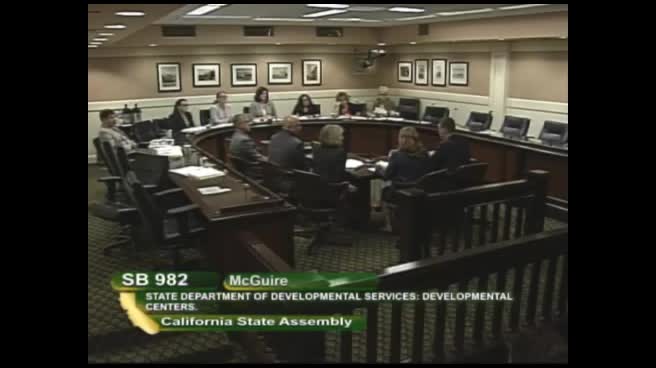 5MIN
Assembly Standing Committee on Human Services
 2MIN
Senate Floor
Bill Author

Bill Co-Author(s):