SB 996: Property taxation: welfare exemption.
- Session Year: 2015-2016
- House: Senate
- Latest Version Date: 2016-09-29
The California Constitution authorizes the Legislature to exempt from taxation property that is used exclusively for religious, hospital, or charitable purposes, and is owned or held in trust by a nonprofit entity. Pursuant to this constitutional authority, existing law partially exempts from property taxation property used exclusively for rental housing and related facilities, if specified criteria are met, including, except in the case of a limited partnership in which the managing general partner is a nonprofit corporation eligible for the exemption, that 90% or more of the occupants of the property are lower income households whose rents do not exceed the rent limits prescribed by a specified law. Existing law limits the total exemption amount allowed to a taxpayer, with respect to a single property or multiple properties for any fiscal year on the sole basis of the application of this criterion, to $20,000 of tax.
This bill would increase that total exemption amount allowed to $10,000,000 in assessed value, with respect to lien dates occurring on and after January 1, 2017.
This bill would require any outstanding qualified ad valorem tax in excess of the $20,000 limitation, and related interest or penalty, which was levied or imposed on and after January 1, 2013, and before January 1, 2017, with respect to qualified property for which a qualified claim was filed, to be canceled to the extent that the amount canceled does not result in a total exemption amount in excess of $100,000 of tax being allowed to a qualified taxpayer with respect to a single property or multiple properties for any fiscal year. The bill would, on and after January 1, 2017, prohibit an escape assessment from being levied on qualified property if that amount would be subject to cancellation pursuant to this bill.
This bill would require a claim for the welfare exemption on qualified property to be accompanied by an affidavit containing specified information regarding the units occupied by lower income households for which the exemption is claimed.
By imposing new duties upon county tax officials, this bill would impose a state-mandated local program.
This bill would make legislative findings and declarations regarding the public purpose served by the bill.
Existing constitutional provisions require that a statute that limits the right of access to the meetings of public bodies or the writings of public officials and agencies be adopted with findings demonstrating the interest protected by the limitation and the need for protecting that interest.
This bill would make legislative findings to that effect.
The California Constitution requires local agencies, for the purpose of ensuring public access to the meetings of public bodies and the writings of public officials and agencies, to comply with a statutory enactment that amends or enacts laws relating to public records or open meetings and contains findings demonstrating that the enactment furthers the constitutional requirements relating to this purpose.
This bill would make legislative findings to that effect.
The California Constitution requires the state to reimburse local agencies and school districts for certain costs mandated by the state. Statutory provisions establish procedures for making that reimbursement.
This bill would provide that with regard to certain mandates no reimbursement is required by this act for a specified reason.
With regard to any other mandates, this bill would provide that, if the Commission on State Mandates determines that the bill contains costs so mandated by the state, reimbursement for those costs shall be made pursuant to the statutory provisions noted above.
Section 2229 of the Revenue and Taxation Code requires the Legislature to reimburse local agencies annually for certain property tax revenues lost as a result of any exemption or classification of property for purposes of ad valorem property taxation.
This bill would provide that, notwithstanding Section 2229 of the Revenue and Taxation Code, no appropriation is made and the state shall not reimburse local agencies for property tax revenues lost by them pursuant to the bill.
The California Constitution authorizes the Legislature to exempt from taxation property that is used exclusively for religious, hospital, or charitable purposes, and is owned or held in trust by a nonprofit entity. Pursuant to this constitutional authority, existing law partially exempts from property taxation property used exclusively for rental housing and related facilities, if specified criteria are met, including, except in the case of a limited partnership in which the managing general partner is a nonprofit corporation eligible for the exemption, that 90% or more of the occupants of the property are lower income households whose rents do not exceed the rent limits prescribed by a specified law. Existing law limits the total exemption amount allowed to a taxpayer, with respect to a single property or multiple properties for any fiscal year on the sole basis of the application of this criterion, to $20,000 of tax.
This bill would increase that total exemption amount allowed to $10,000,000 in assessed value, with respect to lien dates occurring on and after January 1, 2017.
This bill would require any outstanding qualified ad valorem tax in excess of the $20,000 limitation, and related interest or penalty, which was levied or imposed on and after January 1, 2013, and before January 1, 2017, with respect to qualified property for which a qualified claim was filed, to be canceled, and any such qualified ad valorem tax, and related interest or penalty levied or imposed that was paid on or before January 1, 2017, to be refunded, canceled to the extent that the amount canceled or refunded does not result in a total exemption amount in excess of $100,000 of tax being allowed to a qualified taxpayer with respect to a single property or multiple properties for any fiscal year. The bill would, on and after January 1, 2017, prohibit an escape assessment from being levied on qualified property if that amount would be subject to cancellation or refund pursuant to this bill.
This bill would require a claim for the welfare exemption on qualified property to be accompanied by an affidavit containing specified information regarding the units occupied by lower income households for which the exemption is claimed.
By imposing new duties upon county tax officials, this bill would impose a state-mandated local program.
This bill would make legislative findings and declarations regarding the public purpose served by the bill.
Existing constitutional provisions require that a statute that limits the right of access to the meetings of public bodies or the writings of public officials and agencies be adopted with findings demonstrating the interest protected by the limitation and the need for protecting that interest.
This bill would make legislative findings to that effect.
The California Constitution requires local agencies, for the purpose of ensuring public access to the meetings of public bodies and the writings of public officials and agencies, to comply with a statutory enactment that amends or enacts laws relating to public records or open meetings and contains findings demonstrating that the enactment furthers the constitutional requirements relating to this purpose.
This bill would make legislative findings to that effect.
The California Constitution requires the state to reimburse local agencies and school districts for certain costs mandated by the state. Statutory provisions establish procedures for making that reimbursement.
This bill would provide that with regard to certain mandates no reimbursement is required by this act for a specified reason.
With regard to any other mandates, this bill would provide that, if the Commission on State Mandates determines that the bill contains costs so mandated by the state, reimbursement for those costs shall be made pursuant to the statutory provisions noted above.
Section 2229 of the Revenue and Taxation Code requires the Legislature to reimburse local agencies annually for certain property tax revenues lost as a result of any exemption or classification of property for purposes of ad valorem property taxation.
This bill would provide that, notwithstanding Section 2229 of the Revenue and Taxation Code, no appropriation is made and the state shall not reimburse local agencies for property tax revenues lost by them pursuant to the bill.
The California Constitution authorizes the Legislature to exempt from taxation property that is used exclusively for religious, hospital, or charitable purposes, and is owned or held in trust by a nonprofit entity. Pursuant to this constitutional authority, existing law partially exempts from property taxation property used exclusively for rental housing and related facilities, if specified criteria are met, including, except in the case of a limited partnership in which the managing general partner is a nonprofit corporation eligible for the exemption, that 90% or more of the occupants of the property are lower income households whose rents do not exceed the rent limits prescribed by a specified law. Existing law limits the total exemption amount allowed to a taxpayer, with respect to a single property or multiple properties for any fiscal year on the sole basis of the application of this criterion, to $20,000 of tax.
This bill would increase that total exemption amount allowed to $10,000,000 in assessed value, with respect to lien dates occurring on and after January 1, 2017.
This bill would require any outstanding qualified ad valorem tax in excess of the $20,000 limitation, and related interest or penalty, which was levied or imposed on and after January 1, 2013, and before January 1, 2017, with respect to qualified property for which a qualified claim was filed, to be canceled, and any such qualified ad valorem tax, and related interest or penalty levied or imposed that was paid on or before January 1, 2017, to be refunded, to the extent that the amount canceled or refunded does not result in a total exemption amount in excess of $100,000 of tax being allowed to a qualified taxpayer with respect to a single property or multiple properties for any fiscal year. The bill would, on and after January 1, 2017, prohibit an escape assessment from being levied on qualified property if that amount would be subject to cancellation or refund pursuant to this bill.
This bill would require a claim for the welfare exemption on qualified property to be accompanied by an affidavit containing specified information regarding the units occupied by lower income households for which the exemption is claimed.
By imposing new duties upon county tax officials, this bill would impose a state-mandated local program.
This bill would make legislative findings and declarations regarding the public purpose served by the bill.
Existing constitutional provisions require that a statute that limits the right of access to the meetings of public bodies or the writings of public officials and agencies be adopted with findings demonstrating the interest protected by the limitation and the need for protecting that interest.
This bill would make legislative findings to that effect.
The California Constitution requires local agencies, for the purpose of ensuring public access to the meetings of public bodies and the writings of public officials and agencies, to comply with a statutory enactment that amends or enacts laws relating to public records or open meetings and contains findings demonstrating that the enactment furthers the constitutional requirements relating to this purpose.
This bill would make legislative findings to that effect.
The California Constitution requires the state to reimburse local agencies and school districts for certain costs mandated by the state. Statutory provisions establish procedures for making that reimbursement.
This bill would provide that with regard to certain mandates no reimbursement is required by this act for a specified reason.
With regard to any other mandates, this bill would provide that, if the Commission on State Mandates determines that the bill contains costs so mandated by the state, reimbursement for those costs shall be made pursuant to the statutory provisions noted above.
Section 2229 of the Revenue and Taxation Code requires the Legislature to reimburse local agencies annually for certain property tax revenues lost as a result of any exemption or classification of property for purposes of ad valorem property taxation.
This bill would provide that, notwithstanding Section 2229 of the Revenue and Taxation Code, no appropriation is made and the state shall not reimburse local agencies for property tax revenues lost by them pursuant to the bill.
The California Constitution authorizes the Legislature to exempt from taxation property that is used exclusively for religious, hospital, or charitable purposes, and is owned or held in trust by a nonprofit entity. Pursuant to this constitutional authority, existing law partially exempts from property taxation property used exclusively for rental housing and related facilities, if specified criteria are met, including, except in the case of a limited partnership in which the managing general partner is a nonprofit corporation eligible for the exemption, that 90% or more of the occupants of the property are lower income households whose rents do not exceed the rent limits prescribed by a specified law. Existing law limits the total exemption amount allowed to a taxpayer, with respect to a single property or multiple properties for any fiscal year on the sole basis of the application of this criterion, to $20,000 of tax.
This bill would increase that total exemption amount allowed to $100,000 of tax, $10,000,000 in assessed value, with respect to lien dates occurring on and after January 1, 2017.
This bill would require any outstanding qualified ad valorem tax in excess of the $20,000 limitation, and related interest or penalty, which was levied or imposed on and after January 1, 2013, and before January 1, 2017, with respect to qualified property for which a qualified claim was filed, to be canceled, and any such qualified ad valorem tax, and related interest or penalty levied or imposed that was paid on or before January 1, 2017, to be refunded, to the extent that the amount canceled or refunded does not result in a total exemption amount in excess of $100,000 of tax being allowed to a qualified taxpayer with respect to a single property or multiple properties for any fiscal year. The bill would, on and after January 1, 2017, prohibit an escape assessment from being levied on qualified property if that amount would be subject to cancellation or refund pursuant to this bill.
This bill would require a claim for the welfare exemption on qualified property to be accompanied by an affidavit containing specified information regarding the units occupied by lower income households for which the exemption is claimed.
By imposing new duties upon county tax officials, this bill would impose a state-mandated local program.
This bill would make legislative findings and declarations regarding the public purpose served by the bill.
By imposing new duties upon county tax officials with respect to the refund of these property tax payments, this bill would impose a state-mandated local program.
The California Constitution requires the state to reimburse local agencies and school districts for certain costs mandated by the state. Statutory provisions establish procedures for making that reimbursement.
This bill would provide that, if the Commission on State Mandates determines that the bill contains costs mandated by the state, reimbursement for those costs shall be made pursuant to these statutory provisions.
Existing constitutional provisions require that a statute that limits the right of access to the meetings of public bodies or the writings of public officials and agencies be adopted with findings demonstrating the interest protected by the limitation and the need for protecting that interest.
This bill would make legislative findings to that effect.
The California Constitution requires local agencies, for the purpose of ensuring public access to the meetings of public bodies and the writings of public officials and agencies, to comply with a statutory enactment that amends or enacts laws relating to public records or open meetings and contains findings demonstrating that the enactment furthers the constitutional requirements relating to this purpose.
This bill would make legislative findings to that effect.
The California Constitution requires the state to reimburse local agencies and school districts for certain costs mandated by the state. Statutory provisions establish procedures for making that reimbursement.
This bill would provide that with regard to certain mandates no reimbursement is required by this act for a specified reason.
With regard to any other mandates, this bill would provide that, if the Commission on State Mandates determines that the bill contains costs so mandated by the state, reimbursement for those costs shall be made pursuant to the statutory provisions noted above.
Section 2229 of the Revenue and Taxation Code requires the Legislature to reimburse local agencies annually for certain property tax revenues lost as a result of any exemption or classification of property for purposes of ad valorem property taxation.
This bill would provide that, notwithstanding Section 2229 of the Revenue and Taxation Code, no appropriation is made and the state shall not reimburse local agencies for property tax revenues lost by them pursuant to the bill.
The California Constitution authorizes the Legislature to exempt from taxation property that is used exclusively for religious, hospital, or charitable purposes, and is owned or held in trust by a nonprofit entity. Pursuant to this constitutional authority, existing law partially exempts from property taxation property used exclusively for rental housing and related facilities, if specified criteria are met, including, except in the case of a limited partnership in which the managing general partner is a nonprofit corporation eligible for the exemption, that 90% or more of the occupants of the property are lower income households whose rents do not exceed the rent limits prescribed by a specified law. Existing law limits the total exemption amount allowed to a taxpayer, with respect to a single property or multiple properties for any fiscal year on the sole basis of the application of this criterion, to $20,000 of tax.
This bill would increase that total exemption amount allowed to $100,000 of tax, with respect to lien dates occurring on and after January 1, 2017.
This bill would require any outstanding qualified ad valorem tax in excess of the $20,000 limitation, and related interest or penalty, which was levied or imposed on and after January 1, 2013, and before January 1, 2017, with respect to qualified property for which a qualified claim was filed, to be canceled, and any such qualified ad valorem tax, and related interest or penalty levied or imposed that was paid on or before January 1, 2017, to be refunded, to the extent that the amount canceled or refunded does not result in a total exemption amount in excess of $100,000 of tax being allowed to a qualified taxpayer with respect to a single property or multiple properties for any fiscal year. The bill would, on and after January 1, 2017, prohibit an escape assessment from being levied on qualified property if that amount would be subject to cancellation or refund pursuant to this bill.
This bill would make legislative findings and declarations regarding the public purpose served by the bill.
By imposing new duties upon county tax officials with respect to the refund of these property tax payments, this bill would impose a state-mandated local program.
The California Constitution requires the state to reimburse local agencies and school districts for certain costs mandated by the state. Statutory provisions establish procedures for making that reimbursement.
This bill would provide that, if the Commission on State Mandates determines that the bill contains costs mandated by the state, reimbursement for those costs shall be made pursuant to these statutory provisions.
Section 2229 of the Revenue and Taxation Code requires the Legislature to reimburse local agencies annually for certain property tax revenues lost as a result of any exemption or classification of property for purposes of ad valorem property taxation.
This bill would provide that, notwithstanding Section 2229 of the Revenue and Taxation Code, no appropriation is made and the state shall not reimburse local agencies for property tax revenues lost by them pursuant to the bill.
(a)Property used exclusively for religious, hospital, scientific, or charitable purposes owned and operated by community chests, funds, foundations, limited liability companies, or corporations organized and operated for religious, hospital, scientific, or charitable purposes is exempt from taxation, including ad valorem taxes to pay the interest and redemption charges on any indebtedness approved by the voters prior to July 1, 1978, or any bonded indebtedness for the acquisition or improvement of real property approved on or after July 1, 1978, by two-thirds of the votes cast by the voters voting on the proposition, if:
(1)The owner is not organized or operated for profit. However, in the case of hospitals, the organization shall not be deemed to be organized or operated for profit if, during the immediately preceding fiscal year, operating revenues, exclusive of gifts, endowments and grants-in-aid, did not exceed operating expenses by an amount equivalent to 10 percent of those operating expenses. As used herein, operating expenses include depreciation based on cost of replacement and amortization of, and interest on, indebtedness.
(2)No part of the net earnings of the owner inures to the benefit of any private shareholder or individual.
(3)The property is used for the actual operation of the exempt activity, and does not exceed an amount of property reasonably necessary to the accomplishment of the exempt purpose.
(A)For the purposes of determining whether the property is used for the actual operation of the exempt activity, consideration shall not be given to use of the property for either or both of the following described activities if that use is occasional:
(i)The owner conducts fundraising activities on the property and the proceeds derived from those activities are not unrelated business taxable income, as defined in Section 512 of the Internal Revenue Code, of the owner and are used to further the exempt activity of the owner.
(ii)The owner permits any other organization that meets all of the requirements of this subdivision, other than ownership of the property, to conduct fundraising activities on the property and the proceeds derived from those activities are not unrelated business taxable income, as defined in Section 512 of the Internal Revenue Code, of the organization, are not subject to the tax on unrelated business taxable income that is imposed by Section 511 of the Internal Revenue Code, and are used to further the exempt activity of the organization.
(B)For purposes of subparagraph (A):
(i)Occasional use means use of the property on an irregular or intermittent basis by the qualifying owner or any other qualifying organization described in clause (ii) of subparagraph (A) that is incidental to the primary activities of the owner or the other organization.
(ii)Fundraising activities means both activities involving the direct solicitation of money or other property and the anticipated exchange of goods or services for money between the soliciting organization and the organization or person solicited.
(C)Subparagraph (A) shall have no application in determining whether paragraph (3) has been satisfied unless the owner of the property and any other organization using the property as provided in subparagraph (A) have filed with the assessor a valid organizational clearance certificate issued pursuant to Section 254.6.
(D)For the purposes of determining whether the property is used for the actual operation of the exempt activity, consideration shall not be given to the use of the property for meetings conducted by any other organization if the meetings are incidental to the other organizations primary activities, are not fundraising meetings or activities as defined in subparagraph (B), are held no more than once per week, and the other organization and its use of the property meet all other requirements of paragraphs (1) to (5), inclusive, of this subdivision. The owner or the other organization also shall file with the assessor a copy of a valid, unrevoked letter or ruling from the Internal Revenue Service or the Franchise Tax Board stating that the other organization, or the national organization of which it is a local chapter or affiliate, qualifies as an exempt organization under Section 501(c)(3) or 501(c)(4) of the Internal Revenue Code or Section 23701d, 23701f, or 23701w.
(E)Nothing in subparagraph (A), (B), (C), or (D) shall be construed to either enlarge or restrict the exemption provided for in subdivision (b) of Section 4 and Section 5 of Article XIII of the California Constitution and this section.
(4)The property is not used or operated by the owner or by any other person so as to benefit any officer, trustee, director, shareholder, member, employee, contributor, or bondholder of the owner or operator, or any other person, through the distribution of profits, payment of excessive charges or compensations, or the more advantageous pursuit of their business or profession.
(5)The property is not used by the owner or members thereof for fraternal or lodge purposes, or for social club purposes except where that use is clearly incidental to a primary religious, hospital, scientific, or charitable purpose.
(6)The property is irrevocably dedicated to religious, charitable, scientific, or hospital purposes and upon the liquidation, dissolution, or abandonment of the owner will not inure to the benefit of any private person except a fund, foundation, or corporation organized and operated for religious, hospital, scientific, or charitable purposes.
(7)The property, if used exclusively for scientific purposes, is used by a foundation or institution that, in addition to complying with the foregoing requirements for the exemption of charitable organizations in general, has been chartered by the Congress of the United States (except that this requirement shall not apply when the scientific purposes are medical research), and whose objects are the encouragement or conduct of scientific investigation, research, and discovery for the benefit of the community at large.
The exemption provided for herein shall be known as the welfare exemption. This exemption shall be in addition to any other exemption now provided by law, and the existence of the exemption provision in paragraph (2) of subdivision (a) of Section 202 shall not preclude the exemption under this section for museum or library property. Except as provided in subdivision (e), this section shall not be construed to enlarge the college exemption.
(b)Property used exclusively for school purposes of less than collegiate grade and owned and operated by religious, hospital, or charitable funds, foundations, limited liability companies, or corporations, which property and funds, foundations, limited liability companies, or corporations meet all of the requirements of subdivision (a), shall be deemed to be within the exemption provided for in subdivision (b) of Section 4 and Section 5 of Article XIII of the California Constitution and this section.
(c)Property used exclusively for nursery school purposes and owned and operated by religious, hospital, or charitable funds, foundations, limited liability companies, or corporations, which property and funds, foundations, limited liability companies, or corporations meet all the requirements of subdivision (a), shall be deemed to be within the exemption provided for in subdivision (b) of Section 4 and Section 5 of Article XIII of the California Constitution and this section.
(d)Property used exclusively for a noncommercial educational FM broadcast station or an educational television station, and owned and operated by religious, hospital, scientific, or charitable funds, foundations, limited liability companies, or corporations meeting all of the requirements of subdivision (a), shall be deemed to be within the exemption provided for in subdivision (b) of Section 4 and Section 5 of Article XIII of the California Constitution and this section.
(e)Property used exclusively for religious, charitable, scientific, or hospital purposes and owned and operated by religious, hospital, scientific, or charitable funds, foundations, limited liability companies, or corporations or educational institutions of collegiate grade, as defined in Section 203, which property and funds, foundations, limited liability companies, corporations, or educational institutions meet all of the requirements of subdivision (a), shall be deemed to be within the exemption provided for in subdivision (b) of Section 4 and Section 5 of Article XIII of the California Constitution and this section. As to educational institutions of collegiate grade, as defined in Section 203, the requirements of paragraph (6) of subdivision (a) shall be deemed to be met if both of the following are met:
(1)The property of the educational institution is irrevocably dedicated in its articles of incorporation to charitable and educational purposes, to religious and educational purposes, or to educational purposes.
(2)The articles of incorporation of the educational institution provide for distribution of its property upon its liquidation, dissolution, or abandonment to a fund, foundation, or corporation organized and operated for religious, hospital, scientific, charitable, or educational purposes meeting the requirements for exemption provided by Section 203 or this section.
(f)Property used exclusively for housing and related facilities for elderly or handicapped families and financed by, including, but not limited to, the federal government pursuant to Section 202 of Public Law 86-372 (12 U.S.C. Sec. 1701q), as amended, Section 231 of Public Law 73-479 (12 U.S.C. Sec. 1715v), Section 236 of Public Law 90-448 (12 U.S.C. Sec. 1715z), or Section 811 of Public Law 101-625 (42 U.S.C. Sec. 8013), and owned and operated by religious, hospital, scientific, or charitable funds, foundations, limited liability companies, or corporations meeting all of the requirements of this section shall be deemed to be within the exemption provided for in subdivision (b) of Section 4 and Section 5 of Article XIII of the California Constitution and this section.
The amendment of this paragraph made by Chapter 1102 of the Statutes of 1984 does not constitute a change in, but is declaratory of, existing law. However, no refund of property taxes shall be required as a result of this amendment for any fiscal year prior to the fiscal year in which the amendment takes effect.
Property used exclusively for housing and related facilities for elderly or handicapped families at which supplemental care or services designed to meet the special needs of elderly or handicapped residents are not provided, or that is not financed by the federal government pursuant to Section 202 of Public Law 86-372 (12 U.S.C. Sec. 1701q), as amended, Section 231 of Public Law 73-479 (12 U.S.C. Sec. 1715v), Section 236 of Public Law 90-448 (12 U.S.C. Sec. 1715z), or Section 811 of Public Law 101-625 (42 U.S.C. Sec. 8013), shall not be entitled to exemption pursuant to this subdivision unless the property is used for housing and related facilities for low- and moderate-income elderly or handicapped families. Property that would otherwise be exempt pursuant to this subdivision, except that it includes some housing and related facilities for other than low- or moderate-income elderly or handicapped families, shall be entitled to a partial exemption. The partial exemption shall be equal to that percentage of the value of the property that is equal to the percentage that the number of low- and moderate-income elderly and handicapped families represents of the total number of families occupying the property.
As used in this subdivision, low and moderate income has the same meaning as the term persons and families of low or moderate income as defined by Section 50093 of the Health and Safety Code.
(g)(1)Property used exclusively for rental housing and related facilities and owned and operated by religious, hospital, scientific, or charitable funds, foundations, limited liability companies, or corporations, including limited partnerships in which the managing general partner is an eligible nonprofit corporation or eligible limited liability company, meeting all of the requirements of this section, or by veterans organizations, as described in Section 215.1, meeting all the requirements of paragraphs (1) to (7), inclusive, of subdivision (a), shall be deemed to be within the exemption provided for in subdivision (b) of Section 4 and Section 5 of Article XIII of the California Constitution and this section and shall be entitled to a partial exemption equal to that percentage of the value of the property that is equal to the percentage that the number of units serving lower income households represents of the total number of residential units in any year in which any of the following criteria applies:
(A)The acquisition, rehabilitation, development, or operation of the property, or any combination of these factors, is financed with tax-exempt mortgage revenue bonds or general obligation bonds, or is financed by local, state, or federal loans or grants and the rents of the occupants who are lower income households do not exceed those prescribed by deed restrictions or regulatory agreements pursuant to the terms of the financing or financial assistance.
(B)The owner of the property is eligible for and receives low-income housing tax credits pursuant to Section 42 of the Internal Revenue Code of 1986, as added by Public Law 99-514.
(C)In the case of a claim, other than a claim with respect to property owned by a limited partnership in which the managing general partner is an eligible nonprofit corporation, that is filed for the 200001 fiscal year or any fiscal year thereafter, 90 percent or more of the occupants of the property are lower income households whose rent does not exceed the rent prescribed by Section 50053 of the Health and Safety Code. The total exemption amount allowed under this subdivision to a taxpayer, with respect to a single property or multiple properties for any fiscal year on the sole basis of the application of this subparagraph, may not exceed ten million dollars ($10,000,000) in assessed value.
(D)(i)The property was previously purchased and owned by the Department of Transportation pursuant to a consent decree requiring housing mitigation measures relating to the construction of a freeway and is now solely owned by an organization that qualifies as an exempt organization under Section 501(c)(3) of the Internal Revenue Code.
(ii)This subparagraph shall not apply to property owned by a limited partnership in which the managing partner is an eligible nonprofit corporation.
(2)In order to be eligible for the exemption provided by this subdivision, the owner of the property shall do both of the following:
(A)(i)For any claim filed for the 200001 fiscal year or any fiscal year thereafter, certify and ensure, subject to the limitation in clause (ii), that there is an enforceable and verifiable agreement with a public agency, a recorded deed restriction, or other legal document that restricts the projects usage and that provides that the units designated for use by lower income households are continuously available to or occupied by lower income households at rents that do not exceed those prescribed by Section 50053 of the Health and Safety Code, or, to the extent that the terms of federal, state, or local financing or financial assistance conflicts with Section 50053, rents that do not exceed those prescribed by the terms of the financing or financial assistance.
(ii)In the case of a limited partnership in which the managing general partner is an eligible nonprofit corporation, the restriction and provision specified in clause (i) shall be contained in an enforceable and verifiable agreement with a public agency, or in a recorded deed restriction to which the limited partnership certifies.
(B)Certify that the funds that would have been necessary to pay property taxes are used to maintain the affordability of, or reduce rents otherwise necessary for, the units occupied by lower income households.
(3)As used in this subdivision:
(A)Lower income households has the same meaning as the term lower income households as defined by Section 50079.5 of the Health and Safety Code.
(B)Related facilities means any managers units and any and all common area spaces that are included within the physical boundaries of the rental housing development, including, but not limited to, common area space, walkways, balconies, patios, clubhouse space, meeting rooms, laundry facilities, and parking areas, except any portions of the overall development that are nonexempt commercial space.
(C)Units serving lower income households shall mean units that are occupied by lower income households at an affordable rent, as defined in Section 50053 of the Health and Safety Code or, to the extent that the terms of federal, state, or local financing or financial assistance conflicts with Section 50053, rents that do not exceed those prescribed by the terms of the financing or financial assistance. Units reserved for lower income households at an affordable rent that are temporarily vacant due to tenant turnover or repairs shall be counted as occupied.
(h)Property used exclusively for an emergency or temporary shelter and related facilities for homeless persons and families and owned and operated by religious, hospital, scientific, or charitable funds, foundations, limited liability companies, or corporations meeting all of the requirements of this section shall be deemed to be within the exemption provided for in subdivision (b) of Section 4 and Section 5 of Article XIII of the California Constitution and this section. Property that otherwise would be exempt pursuant to this subdivision, except that it includes housing and related facilities for other than an emergency or temporary shelter, shall be entitled to a partial exemption.
As used in this subdivision, emergency or temporary shelter means a facility that would be eligible for funding pursuant to Chapter 11 (commencing with Section 50800) of Part 2 of Division 31 of the Health and Safety Code.
(i)Property used exclusively for housing and related facilities for employees of religious, charitable, scientific, or hospital organizations that meet all the requirements of subdivision (a) and owned and operated by funds, foundations, limited liability companies, or corporations that meet all the requirements of subdivision (a) shall be deemed to be within the exemption provided for in subdivision (b) of Section 4 and Section 5 of Article XIII of the California Constitution and this section to the extent the residential use of the property is institutionally necessary for the operation of the organization.
(j)For purposes of this section, charitable purposes include educational purposes. For purposes of this subdivision, educational purposes means those educational purposes and activities for the benefit of the community as a whole or an unascertainable and indefinite portion thereof, and do not include those educational purposes and activities that are primarily for the benefit of an organizations shareholders. Educational activities include the study of relevant information, the dissemination of that information to interested members of the general public, and the participation of interested members of the general public.
(k)In the case of property used exclusively for the exempt purposes specified in this section, owned and operated by limited liability companies that are organized and operated for those purposes, the State Board of Equalization shall adopt regulations to specify the ownership, organizational, and operational requirements for those companies to qualify for the exemption provided by this section.
(l)The amendments made by Chapter 354 of the Statutes of 2004 shall apply with respect to lien dates occurring on and after January 1, 2005.
(m)The amendments made by the act adding this subdivision shall apply with respect to lien dates occurring on and after January 1, 2017.
SEC. 2.Section 214.17 is added to the Revenue and Taxation Code, to read:214.17.(a)For purposes of this section:
(1)Total exemption amount limitation means the exemption amount limitation with respect to a single property or multiple properties that is specified in subparagraph (C) of paragraph (1) of subdivision (g) of Section 214, as that section read before January 1, 2017.
(2)(A)Qualified property means property used exclusively for rental housing and related facilities where 90 percent or more of the occupants of the property are lower income households whose rent does not exceed the rent prescribed by Section 50053 of the Health and Safety Code and that qualifies for exemption under Section 214 on the sole basis of this criteria as specified in subparagraph (C) of paragraph (1) of subdivision (g) of Section 214.
(B)Qualified property does not include property owned by a limited partnership in which the managing general partner is an eligible nonprofit organization, as described in subparagraph (C) of paragraph (1) of subdivision (g) of Section 214.
(3)Qualified taxpayer means a taxpayer subject to the total exemption amount limitation.
(4)Qualified claim means a claim for exemption that was filed for a qualified property with the assessor on and after January 1, 2013, and before January 1, 2017, for which the assessor granted a partial exemption.
(5)Qualified ad valorem tax in excess of the total exemption amount limitation, and related interest or penalty means that portion of ad valorem tax levied to a qualified taxpayer on qualified property with respect to a single property or multiple properties that does not exceed one hundred thousand dollars ($100,000) of tax, and any interest or penalty imposed with regard to that portion of tax.
(b)(1)Any outstanding qualified ad valorem tax in excess of the total exemption amount limitation, and related interest or penalty, which was levied or imposed on and after January 1, 2013, and before January 1, 2017, with respect to a qualified property for which a qualified claim was filed, shall be canceled to the extent that the amount canceled does not result in a total exemption amount in excess of one hundred thousand dollars ($100,000) of tax being allowed to a qualified taxpayer with respect to a single property or multiple properties that are qualified property for any fiscal year.
(2)On or after January 1, 2017, an escape assessment shall not be levied on qualified property if that amount would be subject to cancellation under paragraph (1).
SEC. 3.Section 259.14 is added to the Revenue and Taxation Code, to read:259.14.(a)The claim for welfare exemption on qualified property, in addition to giving any other information as prescribed by the board, shall be accompanied by an affidavit that provides both of the following:
(1)A list of units occupied by lower income households for which the exemption is claimed.
(2)All of the following nonpersonally identifiable information about the occupants of the units listed pursuant to paragraph (1):
(A)The actual household income of the occupant.
(B)The maximum rent that may be charged to the occupant.
(C)The actual rent charged to the occupant.
(b)The affidavit required to accompany the claim for welfare exemption pursuant to subdivision (a) shall be confidential and shall not be subject to public disclosure.
(c)For purposes of this section, qualified property has the same meaning as that term is defined in Section 214.17.
SEC. 4.The Legislature finds and declares that Section 2 of this act fulfills a statewide public purpose because it addresses Californias serious shortage of affordable, decent, safe, and sanitary housing for persons and families of low or moderate income, including the elderly and handicapped, by providing necessary property tax relief for certain tax-exempt organizations so that these tax-exempt organizations can provide this affordable housing for persons and families of low or moderate income.
SEC. 5.The Legislature finds and declares that Section 3 of this act, which adds Section 259.14 to the Revenue and Taxation Code, imposes a limitation on the publics right of access to the meetings of public bodies or the writings of public officials and agencies within the meaning of Section 3 of Article I of the California Constitution. Pursuant to that constitutional provision, the Legislature makes the following findings to demonstrate the interest protected by this limitation and the need for protecting that interest:
In order to protect the privacy of an individuals personal and financial information contained in an affidavit accompanying a claim for welfare exemption, as required by this act, it is in the states interest to limit public access to information.
SEC. 6.The Legislature finds and declares that Section 3 of this act, which adds Section 259.14 to the Revenue and Taxation Code, furthers, within the meaning of paragraph (7) of subdivision (b) of Section 3 of Article I of the California Constitution, the purposes of that constitutional section as it relates to the right of public access to the meetings of local public bodies or the writings of local public officials and local agencies. Pursuant to paragraph (7) of subdivision (b) of Section 3 of Article I of the California Constitution, the Legislature makes the following findings:
The protection of sensitive personal and personal financial information contained in an affidavit accompanying a claim for welfare exemption, as required by this act, is consistent with and furthers proper access to documents and information in the possession of local government agencies.
SEC. 7.No reimbursement is required by this act pursuant to Section 6 of Article XIII B of the California Constitution for certain costs that may be incurred by a local agency or school district because, in that regard, the only costs that may be incurred by a local agency or school district under this act would result from a legislative mandate that is within the scope of paragraph (7) of subdivision (b) of Section 3 of Article I of the California Constitution.
However, if the Commission on State Mandates determines that this act contains other costs mandated by the state, reimbursement to local agencies and school districts for those costs shall be made pursuant to Part 7 (commencing with Section 17500) of Division 4 of Title 2 of the Government Code.
SEC. 8.Notwithstanding Section 2229 of the Revenue and Taxation Code, no appropriation is made by this act and the state shall not reimburse any local agency for any property tax revenues lost by it pursuant to this act.
(a)Property used exclusively for religious, hospital, scientific, or charitable purposes owned and operated by community chests, funds, foundations, limited liability companies, or corporations organized and operated for religious, hospital, scientific, or charitable purposes is exempt from taxation, including ad valorem taxes to pay the interest and redemption charges on any indebtedness approved by the voters prior to July 1, 1978, or any bonded indebtedness for the acquisition or improvement of real property approved on or after July 1, 1978, by two-thirds of the votes cast by the voters voting on the proposition, if:
(1)The owner is not organized or operated for profit. However, in the case of hospitals, the organization shall not be deemed to be organized or operated for profit if, during the immediately preceding fiscal year, operating revenues, exclusive of gifts, endowments and grants-in-aid, did not exceed operating expenses by an amount equivalent to 10 percent of those operating expenses. As used herein, operating expenses include depreciation based on cost of replacement and amortization of, and interest on, indebtedness.
(2)No part of the net earnings of the owner inures to the benefit of any private shareholder or individual.
(3)The property is used for the actual operation of the exempt activity, and does not exceed an amount of property reasonably necessary to the accomplishment of the exempt purpose.
(A)For the purposes of determining whether the property is used for the actual operation of the exempt activity, consideration shall not be given to use of the property for either or both of the following described activities if that use is occasional:
(i)The owner conducts fundraising activities on the property and the proceeds derived from those activities are not unrelated business taxable income, as defined in Section 512 of the Internal Revenue Code, of the owner and are used to further the exempt activity of the owner.
(ii)The owner permits any other organization that meets all of the requirements of this subdivision, other than ownership of the property, to conduct fundraising activities on the property and the proceeds derived from those activities are not unrelated business taxable income, as defined in Section 512 of the Internal Revenue Code, of the organization, are not subject to the tax on unrelated business taxable income that is imposed by Section 511 of the Internal Revenue Code, and are used to further the exempt activity of the organization.
(B)For purposes of subparagraph (A):
(i)Occasional use means use of the property on an irregular or intermittent basis by the qualifying owner or any other qualifying organization described in clause (ii) of subparagraph (A) that is incidental to the primary activities of the owner or the other organization.
(ii)Fundraising activities means both activities involving the direct solicitation of money or other property and the anticipated exchange of goods or services for money between the soliciting organization and the organization or person solicited.
(C)Subparagraph (A) shall have no application in determining whether paragraph (3) has been satisfied unless the owner of the property and any other organization using the property as provided in subparagraph (A) have filed with the assessor a valid organizational clearance certificate issued pursuant to Section 254.6.
(D)For the purposes of determining whether the property is used for the actual operation of the exempt activity, consideration shall not be given to the use of the property for meetings conducted by any other organization if the meetings are incidental to the other organizations primary activities, are not fundraising meetings or activities as defined in subparagraph (B), are held no more than once per week, and the other organization and its use of the property meet all other requirements of paragraphs (1) to (5), inclusive, of this subdivision. The owner or the other organization also shall file with the assessor a copy of a valid, unrevoked letter or ruling from the Internal Revenue Service or the Franchise Tax Board stating that the other organization, or the national organization of which it is a local chapter or affiliate, qualifies as an exempt organization under Section 501(c)(3) or 501(c)(4) of the Internal Revenue Code or Section 23701d, 23701f, or 23701w.
(E)Nothing in subparagraph (A), (B), (C), or (D) shall be construed to either enlarge or restrict the exemption provided for in subdivision (b) of Section 4 and Section 5 of Article XIII of the California Constitution and this section.
(4)The property is not used or operated by the owner or by any other person so as to benefit any officer, trustee, director, shareholder, member, employee, contributor, or bondholder of the owner or operator, or any other person, through the distribution of profits, payment of excessive charges or compensations, or the more advantageous pursuit of their business or profession.
(5)The property is not used by the owner or members thereof for fraternal or lodge purposes, or for social club purposes except where that use is clearly incidental to a primary religious, hospital, scientific, or charitable purpose.
(6)The property is irrevocably dedicated to religious, charitable, scientific, or hospital purposes and upon the liquidation, dissolution, or abandonment of the owner will not inure to the benefit of any private person except a fund, foundation, or corporation organized and operated for religious, hospital, scientific, or charitable purposes.
(7)The property, if used exclusively for scientific purposes, is used by a foundation or institution that, in addition to complying with the foregoing requirements for the exemption of charitable organizations in general, has been chartered by the Congress of the United States (except that this requirement shall not apply when the scientific purposes are medical research), and whose objects are the encouragement or conduct of scientific investigation, research, and discovery for the benefit of the community at large.
The exemption provided for herein shall be known as the welfare exemption. This exemption shall be in addition to any other exemption now provided by law, and the existence of the exemption provision in paragraph (2) of subdivision (a) of Section 202 shall not preclude the exemption under this section for museum or library property. Except as provided in subdivision (e), this section shall not be construed to enlarge the college exemption.
(b)Property used exclusively for school purposes of less than collegiate grade and owned and operated by religious, hospital, or charitable funds, foundations, limited liability companies, or corporations, which property and funds, foundations, limited liability companies, or corporations meet all of the requirements of subdivision (a), shall be deemed to be within the exemption provided for in subdivision (b) of Section 4 and Section 5 of Article XIII of the California Constitution and this section.
(c)Property used exclusively for nursery school purposes and owned and operated by religious, hospital, or charitable funds, foundations, limited liability companies, or corporations, which property and funds, foundations, limited liability companies, or corporations meet all the requirements of subdivision (a), shall be deemed to be within the exemption provided for in subdivision (b) of Section 4 and Section 5 of Article XIII of the California Constitution and this section.
(d)Property used exclusively for a noncommercial educational FM broadcast station or an educational television station, and owned and operated by religious, hospital, scientific, or charitable funds, foundations, limited liability companies, or corporations meeting all of the requirements of subdivision (a), shall be deemed to be within the exemption provided for in subdivision (b) of Section 4 and Section 5 of Article XIII of the California Constitution and this section.
(e)Property used exclusively for religious, charitable, scientific, or hospital purposes and owned and operated by religious, hospital, scientific, or charitable funds, foundations, limited liability companies, or corporations or educational institutions of collegiate grade, as defined in Section 203, which property and funds, foundations, limited liability companies, corporations, or educational institutions meet all of the requirements of subdivision (a), shall be deemed to be within the exemption provided for in subdivision (b) of Section 4 and Section 5 of Article XIII of the California Constitution and this section. As to educational institutions of collegiate grade, as defined in Section 203, the requirements of paragraph (6) of subdivision (a) shall be deemed to be met if both of the following are met:
(1)The property of the educational institution is irrevocably dedicated in its articles of incorporation to charitable and educational purposes, to religious and educational purposes, or to educational purposes.
(2)The articles of incorporation of the educational institution provide for distribution of its property upon its liquidation, dissolution, or abandonment to a fund, foundation, or corporation organized and operated for religious, hospital, scientific, charitable, or educational purposes meeting the requirements for exemption provided by Section 203 or this section.
(f)Property used exclusively for housing and related facilities for elderly or handicapped families and financed by, including, but not limited to, the federal government pursuant to Section 202 of Public Law 86-372 (12 U.S.C. Sec. 1701q), as amended, Section 231 of Public Law 73-479 (12 U.S.C. Sec. 1715v), Section 236 of Public Law 90-448 (12 U.S.C. Sec. 1715z), or Section 811 of Public Law 101-625 (42 U.S.C. Sec. 8013), and owned and operated by religious, hospital, scientific, or charitable funds, foundations, limited liability companies, or corporations meeting all of the requirements of this section shall be deemed to be within the exemption provided for in subdivision (b) of Section 4 and Section 5 of Article XIII of the California Constitution and this section.
The amendment of this paragraph made by Chapter 1102 of the Statutes of 1984 does not constitute a change in, but is declaratory of, existing law. However, no refund of property taxes shall be required as a result of this amendment for any fiscal year prior to the fiscal year in which the amendment takes effect.
Property used exclusively for housing and related facilities for elderly or handicapped families at which supplemental care or services designed to meet the special needs of elderly or handicapped residents are not provided, or that is not financed by the federal government pursuant to Section 202 of Public Law 86-372 (12 U.S.C. Sec. 1701q), as amended, Section 231 of Public Law 73-479 (12 U.S.C. Sec. 1715v), Section 236 of Public Law 90-448 (12 U.S.C. Sec. 1715z), or Section 811 of Public Law 101-625 (42 U.S.C. Sec. 8013), shall not be entitled to exemption pursuant to this subdivision unless the property is used for housing and related facilities for low- and moderate-income elderly or handicapped families. Property that would otherwise be exempt pursuant to this subdivision, except that it includes some housing and related facilities for other than low- or moderate-income elderly or handicapped families, shall be entitled to a partial exemption. The partial exemption shall be equal to that percentage of the value of the property that is equal to the percentage that the number of low- and moderate-income elderly and handicapped families represents of the total number of families occupying the property.
As used in this subdivision, low and moderate income has the same meaning as the term persons and families of low or moderate income as defined by Section 50093 of the Health and Safety Code.
(g)(1)Property used exclusively for rental housing and related facilities and owned and operated by religious, hospital, scientific, or charitable funds, foundations, limited liability companies, or corporations, including limited partnerships in which the managing general partner is an eligible nonprofit corporation or eligible limited liability company, meeting all of the requirements of this section, or by veterans organizations, as described in Section 215.1, meeting all the requirements of paragraphs (1) to (7), inclusive, of subdivision (a), shall be deemed to be within the exemption provided for in subdivision (b) of Section 4 and Section 5 of Article XIII of the California Constitution and this section and shall be entitled to a partial exemption equal to that percentage of the value of the property that is equal to the percentage that the number of units serving lower income households represents of the total number of residential units in any year in which any of the following criteria applies:
(A)The acquisition, rehabilitation, development, or operation of the property, or any combination of these factors, is financed with tax-exempt mortgage revenue bonds or general obligation bonds, or is financed by local, state, or federal loans or grants and the rents of the occupants who are lower income households do not exceed those prescribed by deed restrictions or regulatory agreements pursuant to the terms of the financing or financial assistance.
(B)The owner of the property is eligible for and receives low-income housing tax credits pursuant to Section 42 of the Internal Revenue Code of 1986, as added by Public Law 99-514.
(C)In the case of a claim, other than a claim with respect to property owned by a limited partnership in which the managing general partner is an eligible nonprofit corporation, that is filed for the 200001 fiscal year or any fiscal year thereafter, 90 percent or more of the occupants of the property are lower income households whose rent does not exceed the rent prescribed by Section 50053 of the Health and Safety Code. The total exemption amount allowed under this subdivision to a taxpayer, with respect to a single property or multiple properties for any fiscal year on the sole basis of the application of this subparagraph, may not exceed ten million dollars ($10,000,000) in assessed value.
(D)(i)The property was previously purchased and owned by the Department of Transportation pursuant to a consent decree requiring housing mitigation measures relating to the construction of a freeway and is now solely owned by an organization that qualifies as an exempt organization under Section 501(c)(3) of the Internal Revenue Code.
(ii)This subparagraph shall not apply to property owned by a limited partnership in which the managing partner is an eligible nonprofit corporation.
(2)In order to be eligible for the exemption provided by this subdivision, the owner of the property shall do both of the following:
(A)(i)For any claim filed for the 200001 fiscal year or any fiscal year thereafter, certify and ensure, subject to the limitation in clause (ii), that there is an enforceable and verifiable agreement with a public agency, a recorded deed restriction, or other legal document that restricts the projects usage and that provides that the units designated for use by lower income households are continuously available to or occupied by lower income households at rents that do not exceed those prescribed by Section 50053 of the Health and Safety Code, or, to the extent that the terms of federal, state, or local financing or financial assistance conflicts with Section 50053, rents that do not exceed those prescribed by the terms of the financing or financial assistance.
(ii)In the case of a limited partnership in which the managing general partner is an eligible nonprofit corporation, the restriction and provision specified in clause (i) shall be contained in an enforceable and verifiable agreement with a public agency, or in a recorded deed restriction to which the limited partnership certifies.
(B)Certify that the funds that would have been necessary to pay property taxes are used to maintain the affordability of, or reduce rents otherwise necessary for, the units occupied by lower income households.
(3)As used in this subdivision:
(A)Lower income households has the same meaning as the term lower income households as defined by Section 50079.5 of the Health and Safety Code.
(B)Related facilities means any managers units and any and all common area spaces that are included within the physical boundaries of the rental housing development, including, but not limited to, common area space, walkways, balconies, patios, clubhouse space, meeting rooms, laundry facilities, and parking areas, except any portions of the overall development that are nonexempt commercial space.
(C)Units serving lower income households shall mean units that are occupied by lower income households at an affordable rent, as defined in Section 50053 of the Health and Safety Code or, to the extent that the terms of federal, state, or local financing or financial assistance conflicts with Section 50053, rents that do not exceed those prescribed by the terms of the financing or financial assistance. Units reserved for lower income households at an affordable rent that are temporarily vacant due to tenant turnover or repairs shall be counted as occupied.
(h)Property used exclusively for an emergency or temporary shelter and related facilities for homeless persons and families and owned and operated by religious, hospital, scientific, or charitable funds, foundations, limited liability companies, or corporations meeting all of the requirements of this section shall be deemed to be within the exemption provided for in subdivision (b) of Section 4 and Section 5 of Article XIII of the California Constitution and this section. Property that otherwise would be exempt pursuant to this subdivision, except that it includes housing and related facilities for other than an emergency or temporary shelter, shall be entitled to a partial exemption.
As used in this subdivision, emergency or temporary shelter means a facility that would be eligible for funding pursuant to Chapter 11 (commencing with Section 50800) of Part 2 of Division 31 of the Health and Safety Code.
(i)Property used exclusively for housing and related facilities for employees of religious, charitable, scientific, or hospital organizations that meet all the requirements of subdivision (a) and owned and operated by funds, foundations, limited liability companies, or corporations that meet all the requirements of subdivision (a) shall be deemed to be within the exemption provided for in subdivision (b) of Section 4 and Section 5 of Article XIII of the California Constitution and this section to the extent the residential use of the property is institutionally necessary for the operation of the organization.
(j)For purposes of this section, charitable purposes include educational purposes. For purposes of this subdivision, educational purposes means those educational purposes and activities for the benefit of the community as a whole or an unascertainable and indefinite portion thereof, and do not include those educational purposes and activities that are primarily for the benefit of an organizations shareholders. Educational activities include the study of relevant information, the dissemination of that information to interested members of the general public, and the participation of interested members of the general public.
(k)In the case of property used exclusively for the exempt purposes specified in this section, owned and operated by limited liability companies that are organized and operated for those purposes, the State Board of Equalization shall adopt regulations to specify the ownership, organizational, and operational requirements for those companies to qualify for the exemption provided by this section.
(l)The amendments made by Chapter 354 of the Statutes of 2004 shall apply with respect to lien dates occurring on and after January 1, 2005.
(m)The amendments made by the act adding this subdivision shall apply with respect to lien dates occurring on and after January 1, 2017.
SEC. 2.Section 214.17 is added to the Revenue and Taxation Code, to read:214.17.(a)For purposes of this section:
(1)Total exemption amount limitation means the exemption amount limitation with respect to a single property or multiple properties that is specified in subparagraph (C) of paragraph (1) of subdivision (g) of Section 214, as that section read before January 1, 2017.
(2)(A)Qualified property means property used exclusively for rental housing and related facilities where 90 percent or more of the occupants of the property are lower income households whose rent does not exceed the rent prescribed by Section 50053 of the Health and Safety Code and that qualifies for exemption under Section 214 on the sole basis of this criteria as specified in subparagraph (C) of paragraph (1) of subdivision (g) of Section 214.
(B)Qualified property does not include property owned by a limited partnership in which the managing general partner is an eligible nonprofit organization, as described in subparagraph (C) of paragraph (1) of subdivision (g) of Section 214.
(3)Qualified taxpayer means a taxpayer subject to the total exemption amount limitation.
(4)Qualified claim means a claim for exemption that was filed for a qualified property with the assessor on and after January 1, 2013, and before January 1, 2017, for which the assessor granted a partial exemption.
(5)Qualified ad valorem tax in excess of the total exemption amount limitation, and related interest or penalty means that portion of ad valorem tax levied to a qualified taxpayer on qualified property with respect to a single property or multiple properties that does not exceed one hundred thousand dollars ($100,000) of tax, and any interest or penalty imposed with regard to that portion of tax.
(b)(1)To the extent that the amount canceled or refunded does not result in a total exemption amount in excess of one hundred thousand dollars ($100,000) of tax being allowed to a qualified taxpayer with respect to a single property or multiple properties that are qualified property for any fiscal year, each of the following shall be canceled or refunded as provided:
(A)
(b)(1)Any outstanding qualified ad valorem tax in excess of the total exemption amount limitation, and related interest or penalty, which was levied or imposed on and after January 1, 2013, and before January 1, 2017, with respect to a qualified property for which a qualified claim was filed, shall be canceled. canceled to the extent that the amount canceled does not result in a total exemption amount in excess of one hundred thousand dollars ($100,000) of tax being allowed to a qualified taxpayer with respect to a single property or multiple properties that are qualified property for any fiscal year.
(B)Any qualified ad valorem tax in excess of the total exemption amount limitation, and related interest or penalty, which was levied or imposed on and after January 1, 2013, and before January 1, 2017, with respect to a qualified property for which a qualified claim was filed, and paid on or before January 1, 2017, shall be refunded.
(2)On or after January 1, 2017, an escape assessment shall not be levied on qualified property if that amount would be subject to cancellation or refund under paragraph (1).
SEC. 3.Section 259.14 is added to the Revenue and Taxation Code, to read:259.14.(a)The claim for welfare exemption on qualified property, in addition to giving any other information as prescribed by the board, shall be accompanied by an affidavit that provides both of the following:
(1)A list of units occupied by lower income households for which the exemption is claimed.
(2)All of the following nonpersonally identifiable information about the occupants of the units listed pursuant to paragraph (1):
(A)The actual household income of the occupant.
(B)The maximum rent that may be charged to the occupant.
(C)The actual rent charged to the occupant.
(b)The affidavit required to accompany the claim for welfare exemption pursuant to subdivision (a) shall be confidential and shall not be subject to public disclosure.
(c)For purposes of this section, qualified property has the same meaning as that term is defined in Section 214.17.
SEC. 4.The Legislature finds and declares that Section 2 of this act fulfills a statewide public purpose because it addresses Californias serious shortage of affordable, decent, safe, and sanitary housing for persons and families of low or moderate income, including the elderly and handicapped, by providing necessary property tax relief for certain tax-exempt organizations so that these tax-exempt organizations can provide this affordable housing for persons and families of low or moderate income.
SEC. 5.The Legislature finds and declares that Section 3 of this act, which adds Section 259.14 to the Revenue and Taxation Code, imposes a limitation on the publics right of access to the meetings of public bodies or the writings of public officials and agencies within the meaning of Section 3 of Article I of the California Constitution. Pursuant to that constitutional provision, the Legislature makes the following findings to demonstrate the interest protected by this limitation and the need for protecting that interest:
In order to protect the privacy of an individuals personal and financial information contained in an affidavit accompanying a claim for welfare exemption, as required by this act, it is in the states interest to limit public access to information.
SEC. 6.The Legislature finds and declares that Section 3 of this act, which adds Section 259.14 to the Revenue and Taxation Code, furthers, within the meaning of paragraph (7) of subdivision (b) of Section 3 of Article I of the California Constitution, the purposes of that constitutional section as it relates to the right of public access to the meetings of local public bodies or the writings of local public officials and local agencies. Pursuant to paragraph (7) of subdivision (b) of Section 3 of Article I of the California Constitution, the Legislature makes the following findings:
The protection of sensitive personal and personal financial information contained in an affidavit accompanying a claim for welfare exemption, as required by this act, is consistent with and furthers proper access to documents and information in the possession of local government agencies.
SEC. 7.No reimbursement is required by this act pursuant to Section 6 of Article XIII B of the California Constitution for certain costs that may be incurred by a local agency or school district because, in that regard, the only costs that may be incurred by a local agency or school district under this act would result from a legislative mandate that is within the scope of paragraph (7) of subdivision (b) of Section 3 of Article I of the California Constitution.
However, if the Commission on State Mandates determines that this act contains other costs mandated by the state, reimbursement to local agencies and school districts for those costs shall be made pursuant to Part 7 (commencing with Section 17500) of Division 4 of Title 2 of the Government Code.
SEC. 8.Notwithstanding Section 2229 of the Revenue and Taxation Code, no appropriation is made by this act and the state shall not reimburse any local agency for any property tax revenues lost by it pursuant to this act.
(a)Property used exclusively for religious, hospital, scientific, or charitable purposes owned and operated by community chests, funds, foundations, limited liability companies, or corporations organized and operated for religious, hospital, scientific, or charitable purposes is exempt from taxation, including ad valorem taxes to pay the interest and redemption charges on any indebtedness approved by the voters prior to July 1, 1978, or any bonded indebtedness for the acquisition or improvement of real property approved on or after July 1, 1978, by two-thirds of the votes cast by the voters voting on the proposition, if:
(1)The owner is not organized or operated for profit. However, in the case of hospitals, the organization shall not be deemed to be organized or operated for profit if, during the immediately preceding fiscal year, operating revenues, exclusive of gifts, endowments and grants-in-aid, did not exceed operating expenses by an amount equivalent to 10 percent of those operating expenses. As used herein, operating expenses include depreciation based on cost of replacement and amortization of, and interest on, indebtedness.
(2)No part of the net earnings of the owner inures to the benefit of any private shareholder or individual.
(3)The property is used for the actual operation of the exempt activity, and does not exceed an amount of property reasonably necessary to the accomplishment of the exempt purpose.
(A)For the purposes of determining whether the property is used for the actual operation of the exempt activity, consideration shall not be given to use of the property for either or both of the following described activities if that use is occasional:
(i)The owner conducts fundraising activities on the property and the proceeds derived from those activities are not unrelated business taxable income, as defined in Section 512 of the Internal Revenue Code, of the owner and are used to further the exempt activity of the owner.
(ii)The owner permits any other organization that meets all of the requirements of this subdivision, other than ownership of the property, to conduct fundraising activities on the property and the proceeds derived from those activities are not unrelated business taxable income, as defined in Section 512 of the Internal Revenue Code, of the organization, are not subject to the tax on unrelated business taxable income that is imposed by Section 511 of the Internal Revenue Code, and are used to further the exempt activity of the organization.
(B)For purposes of subparagraph (A):
(i)Occasional use means use of the property on an irregular or intermittent basis by the qualifying owner or any other qualifying organization described in clause (ii) of subparagraph (A) that is incidental to the primary activities of the owner or the other organization.
(ii)Fundraising activities means both activities involving the direct solicitation of money or other property and the anticipated exchange of goods or services for money between the soliciting organization and the organization or person solicited.
(C)Subparagraph (A) shall have no application in determining whether paragraph (3) has been satisfied unless the owner of the property and any other organization using the property as provided in subparagraph (A) have filed with the assessor a valid organizational clearance certificate issued pursuant to Section 254.6.
(D)For the purposes of determining whether the property is used for the actual operation of the exempt activity, consideration shall not be given to the use of the property for meetings conducted by any other organization if the meetings are incidental to the other organizations primary activities, are not fundraising meetings or activities as defined in subparagraph (B), are held no more than once per week, and the other organization and its use of the property meet all other requirements of paragraphs (1) to (5), inclusive, of this subdivision. The owner or the other organization also shall file with the assessor a copy of a valid, unrevoked letter or ruling from the Internal Revenue Service or the Franchise Tax Board stating that the other organization, or the national organization of which it is a local chapter or affiliate, qualifies as an exempt organization under Section 501(c)(3) or 501(c)(4) of the Internal Revenue Code or Section 23701d, 23701f, or 23701w.
(E)Nothing in subparagraph (A), (B), (C), or (D) shall be construed to either enlarge or restrict the exemption provided for in subdivision (b) of Section 4 and Section 5 of Article XIII of the California Constitution and this section.
(4)The property is not used or operated by the owner or by any other person so as to benefit any officer, trustee, director, shareholder, member, employee, contributor, or bondholder of the owner or operator, or any other person, through the distribution of profits, payment of excessive charges or compensations, or the more advantageous pursuit of their business or profession.
(5)The property is not used by the owner or members thereof for fraternal or lodge purposes, or for social club purposes except where that use is clearly incidental to a primary religious, hospital, scientific, or charitable purpose.
(6)The property is irrevocably dedicated to religious, charitable, scientific, or hospital purposes and upon the liquidation, dissolution, or abandonment of the owner will not inure to the benefit of any private person except a fund, foundation, or corporation organized and operated for religious, hospital, scientific, or charitable purposes.
(7)The property, if used exclusively for scientific purposes, is used by a foundation or institution that, in addition to complying with the foregoing requirements for the exemption of charitable organizations in general, has been chartered by the Congress of the United States (except that this requirement shall not apply when the scientific purposes are medical research), and whose objects are the encouragement or conduct of scientific investigation, research, and discovery for the benefit of the community at large.
The exemption provided for herein shall be known as the welfare exemption. This exemption shall be in addition to any other exemption now provided by law, and the existence of the exemption provision in paragraph (2) of subdivision (a) of Section 202 shall not preclude the exemption under this section for museum or library property. Except as provided in subdivision (e), this section shall not be construed to enlarge the college exemption.
(b)Property used exclusively for school purposes of less than collegiate grade and owned and operated by religious, hospital, or charitable funds, foundations, limited liability companies, or corporations, which property and funds, foundations, limited liability companies, or corporations meet all of the requirements of subdivision (a), shall be deemed to be within the exemption provided for in subdivision (b) of Section 4 and Section 5 of Article XIII of the California Constitution and this section.
(c)Property used exclusively for nursery school purposes and owned and operated by religious, hospital, or charitable funds, foundations, limited liability companies, or corporations, which property and funds, foundations, limited liability companies, or corporations meet all the requirements of subdivision (a), shall be deemed to be within the exemption provided for in subdivision (b) of Section 4 and Section 5 of Article XIII of the California Constitution and this section.
(d)Property used exclusively for a noncommercial educational FM broadcast station or an educational television station, and owned and operated by religious, hospital, scientific, or charitable funds, foundations, limited liability companies, or corporations meeting all of the requirements of subdivision (a), shall be deemed to be within the exemption provided for in subdivision (b) of Section 4 and Section 5 of Article XIII of the California Constitution and this section.
(e)Property used exclusively for religious, charitable, scientific, or hospital purposes and owned and operated by religious, hospital, scientific, or charitable funds, foundations, limited liability companies, or corporations or educational institutions of collegiate grade, as defined in Section 203, which property and funds, foundations, limited liability companies, corporations, or educational institutions meet all of the requirements of subdivision (a), shall be deemed to be within the exemption provided for in subdivision (b) of Section 4 and Section 5 of Article XIII of the California Constitution and this section. As to educational institutions of collegiate grade, as defined in Section 203, the requirements of paragraph (6) of subdivision (a) shall be deemed to be met if both of the following are met:
(1)The property of the educational institution is irrevocably dedicated in its articles of incorporation to charitable and educational purposes, to religious and educational purposes, or to educational purposes.
(2)The articles of incorporation of the educational institution provide for distribution of its property upon its liquidation, dissolution, or abandonment to a fund, foundation, or corporation organized and operated for religious, hospital, scientific, charitable, or educational purposes meeting the requirements for exemption provided by Section 203 or this section.
(f)Property used exclusively for housing and related facilities for elderly or handicapped families and financed by, including, but not limited to, the federal government pursuant to Section 202 of Public Law 86-372 (12 U.S.C. Sec. 1701q), as amended, Section 231 of Public Law 73-479 (12 U.S.C. Sec. 1715v), Section 236 of Public Law 90-448 (12 U.S.C. Sec. 1715z), or Section 811 of Public Law 101-625 (42 U.S.C. Sec. 8013), and owned and operated by religious, hospital, scientific, or charitable funds, foundations, limited liability companies, or corporations meeting all of the requirements of this section shall be deemed to be within the exemption provided for in subdivision (b) of Section 4 and Section 5 of Article XIII of the California Constitution and this section.
The amendment of this paragraph made by Chapter 1102 of the Statutes of 1984 does not constitute a change in, but is declaratory of, existing law. However, no refund of property taxes shall be required as a result of this amendment for any fiscal year prior to the fiscal year in which the amendment takes effect.
Property used exclusively for housing and related facilities for elderly or handicapped families at which supplemental care or services designed to meet the special needs of elderly or handicapped residents are not provided, or that is not financed by the federal government pursuant to Section 202 of Public Law 86-372 (12 U.S.C. Sec. 1701q), as amended, Section 231 of Public Law 73-479 (12 U.S.C. Sec. 1715v), Section 236 of Public Law 90-448 (12 U.S.C. Sec. 1715z), or Section 811 of Public Law 101-625 (42 U.S.C. Sec. 8013), shall not be entitled to exemption pursuant to this subdivision unless the property is used for housing and related facilities for low- and moderate-income elderly or handicapped families. Property that would otherwise be exempt pursuant to this subdivision, except that it includes some housing and related facilities for other than low- or moderate-income elderly or handicapped families, shall be entitled to a partial exemption. The partial exemption shall be equal to that percentage of the value of the property that is equal to the percentage that the number of low- and moderate-income elderly and handicapped families represents of the total number of families occupying the property.
As used in this subdivision, low and moderate income has the same meaning as the term persons and families of low or moderate income as defined by Section 50093 of the Health and Safety Code.
(g)(1)Property used exclusively for rental housing and related facilities and owned and operated by religious, hospital, scientific, or charitable funds, foundations, limited liability companies, or corporations, including limited partnerships in which the managing general partner is an eligible nonprofit corporation or eligible limited liability company, meeting all of the requirements of this section, or by veterans organizations, as described in Section 215.1, meeting all the requirements of paragraphs (1) to (7), inclusive, of subdivision (a), shall be deemed to be within the exemption provided for in subdivision (b) of Section 4 and Section 5 of Article XIII of the California Constitution and this section and shall be entitled to a partial exemption equal to that percentage of the value of the property that is equal to the percentage that the number of units serving lower income households represents of the total number of residential units in any year in which any of the following criteria applies:
(A)The acquisition, rehabilitation, development, or operation of the property, or any combination of these factors, is financed with tax-exempt mortgage revenue bonds or general obligation bonds, or is financed by local, state, or federal loans or grants and the rents of the occupants who are lower income households do not exceed those prescribed by deed restrictions or regulatory agreements pursuant to the terms of the financing or financial assistance.
(B)The owner of the property is eligible for and receives low-income housing tax credits pursuant to Section 42 of the Internal Revenue Code of 1986, as added by Public Law 99-514.
(C)In the case of a claim, other than a claim with respect to property owned by a limited partnership in which the managing general partner is an eligible nonprofit corporation, that is filed for the 200001 fiscal year or any fiscal year thereafter, 90 percent or more of the occupants of the property are lower income households whose rent does not exceed the rent prescribed by Section 50053 of the Health and Safety Code. The total exemption amount allowed under this subdivision to a taxpayer, with respect to a single property or multiple properties for any fiscal year on the sole basis of the application of this subparagraph, may not exceed ten million dollars ($10,000,000) in assessed value.
(D)(i)The property was previously purchased and owned by the Department of Transportation pursuant to a consent decree requiring housing mitigation measures relating to the construction of a freeway and is now solely owned by an organization that qualifies as an exempt organization under Section 501(c)(3) of the Internal Revenue Code.
(ii)This subparagraph shall not apply to property owned by a limited partnership in which the managing partner is an eligible nonprofit corporation.
(2)In order to be eligible for the exemption provided by this subdivision, the owner of the property shall do both of the following:
(A)(i)For any claim filed for the 200001 fiscal year or any fiscal year thereafter, certify and ensure, subject to the limitation in clause (ii), that there is an enforceable and verifiable agreement with a public agency, a recorded deed restriction, or other legal document that restricts the projects usage and that provides that the units designated for use by lower income households are continuously available to or occupied by lower income households at rents that do not exceed those prescribed by Section 50053 of the Health and Safety Code, or, to the extent that the terms of federal, state, or local financing or financial assistance conflicts with Section 50053, rents that do not exceed those prescribed by the terms of the financing or financial assistance.
(ii)In the case of a limited partnership in which the managing general partner is an eligible nonprofit corporation, the restriction and provision specified in clause (i) shall be contained in an enforceable and verifiable agreement with a public agency, or in a recorded deed restriction to which the limited partnership certifies.
(B)Certify that the funds that would have been necessary to pay property taxes are used to maintain the affordability of, or reduce rents otherwise necessary for, the units occupied by lower income households.
(3)As used in this subdivision:
(A)Lower income households has the same meaning as the term lower income households as defined by Section 50079.5 of the Health and Safety Code.
(B)Related facilities means any managers units and any and all common area spaces that are included within the physical boundaries of the rental housing development, including, but not limited to, common area space, walkways, balconies, patios, clubhouse space, meeting rooms, laundry facilities facilities, and parking areas, except any portions of the overall development that are nonexempt commercial space.
(C)Units serving lower income households shall mean units that are occupied by lower income households at an affordable rent, as defined in Section 50053 of the Health and Safety Code or, to the extent that the terms of federal, state, or local financing or financial assistance conflicts with Section 50053, rents that do not exceed those prescribed by the terms of the financing or financial assistance. Units reserved for lower income households at an affordable rent that are temporarily vacant due to tenant turnover or repairs shall be counted as occupied.
(h)Property used exclusively for an emergency or temporary shelter and related facilities for homeless persons and families and owned and operated by religious, hospital, scientific, or charitable funds, foundations, limited liability companies, or corporations meeting all of the requirements of this section shall be deemed to be within the exemption provided for in subdivision (b) of Section 4 and Section 5 of Article XIII of the California Constitution and this section. Property that otherwise would be exempt pursuant to this subdivision, except that it includes housing and related facilities for other than an emergency or temporary shelter, shall be entitled to a partial exemption.
As used in this subdivision, emergency or temporary shelter means a facility that would be eligible for funding pursuant to Chapter 11 (commencing with Section 50800) of Part 2 of Division 31 of the Health and Safety Code.
(i)Property used exclusively for housing and related facilities for employees of religious, charitable, scientific, or hospital organizations that meet all the requirements of subdivision (a) and owned and operated by funds, foundations, limited liability companies, or corporations that meet all the requirements of subdivision (a) shall be deemed to be within the exemption provided for in subdivision (b) of Section 4 and Section 5 of Article XIII of the California Constitution and this section to the extent the residential use of the property is institutionally necessary for the operation of the organization.
(j)For purposes of this section, charitable purposes include educational purposes. For purposes of this subdivision, educational purposes means those educational purposes and activities for the benefit of the community as a whole or an unascertainable and indefinite portion thereof, and do not include those educational purposes and activities that are primarily for the benefit of an organizations shareholders. Educational activities include the study of relevant information, the dissemination of that information to interested members of the general public, and the participation of interested members of the general public.
(k)In the case of property used exclusively for the exempt purposes specified in this section, owned and operated by limited liability companies that are organized and operated for those purposes, the State Board of Equalization shall adopt regulations to specify the ownership, organizational, and operational requirements for those companies to qualify for the exemption provided by this section.
(l)The amendments made by Chapter 354 of the Statutes of 2004 shall apply with respect to lien dates occurring on and after January 1, 2005.
(m)The amendments made by the act adding this subdivision shall apply with respect to lien dates occurring on and after January 1, 2017.
SEC. 2.Section 214.17 is added to the Revenue and Taxation Code, to read:214.17.(a)For purposes of this section:
(1)Total exemption amount limitation means the exemption amount limitation with respect to a single property or multiple properties that is specified in subparagraph (C) of paragraph (1) of subdivision (g) of Section 214, as that section read before January 1, 2017.
(2)(A)Qualified property means property used exclusively for rental housing and related facilities where 90 percent or more of the occupants of the property are lower income households whose rent does not exceed the rent prescribed by Section 50053 of the Health and Safety Code and that qualifies for exemption under Section 214 on the sole basis of this criteria as specified in subparagraph (C) of paragraph (1) of subdivision (g) of Section 214.
(B)Qualified property does not include property owned by a limited partnership in which the managing general partner is an eligible nonprofit organization, as described in subparagraph (C) of paragraph (1) of subdivision (g) of Section 214.
(3)Qualified taxpayer means a taxpayer subject to the total exemption amount limitation.
(4)Qualified claim means a claim for exemption that was filed for a qualified property with the assessor on and after January 1, 2013, and before January 1, 2017, for which the assessor granted a partial exemption.
(5)Qualified ad valorem tax, and related interest, or penalty tax in excess of the total exemption amount limitation, and related interest or penalty means that portion of ad valorem tax levied to a qualified taxpayer on qualified property with respect to a single property or multiple properties that does not exceed one hundred thousand dollars ($100,000) of tax, and any interest or penalty imposed with regard to that portion of tax.
(b)(1)To the extent that the amount canceled or refunded does not result in a total exemption amount in excess of one hundred thousand dollars ($100,000) of tax being allowed to a qualified taxpayer with respect to a single property or multiple properties that are qualified property for any fiscal year, each of the following shall be canceled or refunded as provided:
(A)Any outstanding qualified ad valorem tax in excess of the total exemption amount limitation, and related interest or penalty, which was levied or imposed on and after January 1, 2013, and before January 1, 2017, with respect to a qualified property for which a qualified claim was filed, shall be canceled.
(B)Any qualified ad valorem tax in excess of the total exemption amount limitation, and related interest or penalty, which was levied or imposed on and after January 1, 2013, and before January 1, 2017, with respect to a qualified property for which a qualified claim was filed, and paid on or before January 1, 2017, shall be refunded.
(2)On or after January 1, 2017, an escape assessment shall not be levied on qualified property if that amount would be subject to cancellation or refund under paragraph (1).
SEC. 3.Section 259.14 is added to the Revenue and Taxation Code, to read:259.14.(a)The claim for welfare exemption on qualified property, in addition to giving any other information as prescribed by the board, shall be accompanied by an affidavit that provides both of the following:
(1)A list of units occupied by lower income households for which the exemption is claimed.
(2)All of the following nonpersonally identifiable information about the occupants of the units listed pursuant to paragraph (1):
(A)The actual household income of the occupant.
(B)The maximum rent that may be charged to the occupant.
(C)The actual rent charged to the occupant.
(b)The affidavit required to accompany the claim for welfare exemption pursuant to subdivision (a) shall be confidential and shall not be subject to public disclosure.
(c)For purposes of this section, qualified property has the same meaning as that term is defined in Section 214.17.
SEC. 4.The Legislature finds and declares that Section 2 of this act fulfills a statewide public purpose because it addresses Californias serious shortage of affordable, decent, safe, and sanitary housing for persons and families of low or moderate income, including the elderly and handicapped, by providing necessary property tax relief for certain tax-exempt organizations so that these tax-exempt organizations can provide this affordable housing for persons and families of low or moderate income.
SEC. 5.The Legislature finds and declares that Section 3 of this act, which adds Section 259.14 to the Revenue and Taxation Code, imposes a limitation on the publics right of access to the meetings of public bodies or the writings of public officials and agencies within the meaning of Section 3 of Article I of the California Constitution. Pursuant to that constitutional provision, the Legislature makes the following findings to demonstrate the interest protected by this limitation and the need for protecting that interest:
In order to protect the privacy of an individuals personal and financial information contained in an affidavit accompanying a claim for welfare exemption, as required by this act, it is in the states interest to limit public access to information.
SEC. 6.The Legislature finds and declares that Section 3 of this act, which adds Section 259.14 to the Revenue and Taxation Code, furthers, within the meaning of paragraph (7) of subdivision (b) of Section 3 of Article I of the California Constitution, the purposes of that constitutional section as it relates to the right of public access to the meetings of local public bodies or the writings of local public officials and local agencies. Pursuant to paragraph (7) of subdivision (b) of Section 3 of Article I of the California Constitution, the Legislature makes the following findings:
The protection of sensitive personal and personal financial information contained in an affidavit accompanying a claim for welfare exemption, as required by this act, is consistent with and furthers proper access to documents and information in the possession of local government agencies.
SEC. 7.No reimbursement is required by this act pursuant to Section 6 of Article XIII B of the California Constitution for certain costs that may be incurred by a local agency or school district because, in that regard, the only costs that may be incurred by a local agency or school district under this act would result from a legislative mandate that is within the scope of paragraph (7) of subdivision (b) of Section 3 of Article I of the California Constitution.
However, if the Commission on State Mandates determines that this act contains other costs mandated by the state, reimbursement to local agencies and school districts for those costs shall be made pursuant to Part 7 (commencing with Section 17500) of Division 4 of Title 2 of the Government Code.
SEC. 8.Notwithstanding Section 2229 of the Revenue and Taxation Code, no appropriation is made by this act and the state shall not reimburse any local agency for any property tax revenues lost by it pursuant to this act.
(a)Property used exclusively for religious, hospital, scientific, or charitable purposes owned and operated by community chests, funds, foundations, limited liability companies, or corporations organized and operated for religious, hospital, scientific, or charitable purposes is exempt from taxation, including ad valorem taxes to pay the interest and redemption charges on any indebtedness approved by the voters prior to July 1, 1978, or any bonded indebtedness for the acquisition or improvement of real property approved on or after July 1, 1978, by two-thirds of the votes cast by the voters voting on the proposition, if:
(1)The owner is not organized or operated for profit. However, in the case of hospitals, the organization shall not be deemed to be organized or operated for profit if, during the immediately preceding fiscal year, operating revenues, exclusive of gifts, endowments and grants-in-aid, did not exceed operating expenses by an amount equivalent to 10 percent of those operating expenses. As used herein, operating expenses include depreciation based on cost of replacement and amortization of, and interest on, indebtedness.
(2)No part of the net earnings of the owner inures to the benefit of any private shareholder or individual.
(3)The property is used for the actual operation of the exempt activity, and does not exceed an amount of property reasonably necessary to the accomplishment of the exempt purpose.
(A)For the purposes of determining whether the property is used for the actual operation of the exempt activity, consideration shall not be given to use of the property for either or both of the following described activities if that use is occasional:
(i)The owner conducts fundraising activities on the property and the proceeds derived from those activities are not unrelated business taxable income, as defined in Section 512 of the Internal Revenue Code, of the owner and are used to further the exempt activity of the owner.
(ii)The owner permits any other organization that meets all of the requirements of this subdivision, other than ownership of the property, to conduct fundraising activities on the property and the proceeds derived from those activities are not unrelated business taxable income, as defined in Section 512 of the Internal Revenue Code, of the organization, are not subject to the tax on unrelated business taxable income that is imposed by Section 511 of the Internal Revenue Code, and are used to further the exempt activity of the organization.
(B)For purposes of subparagraph (A):
(i)Occasional use means use of the property on an irregular or intermittent basis by the qualifying owner or any other qualifying organization described in clause (ii) of subparagraph (A) that is incidental to the primary activities of the owner or the other organization.
(ii)Fundraising activities means both activities involving the direct solicitation of money or other property and the anticipated exchange of goods or services for money between the soliciting organization and the organization or person solicited.
(C)Subparagraph (A) shall have no application in determining whether paragraph (3) has been satisfied unless the owner of the property and any other organization using the property as provided in subparagraph (A) have filed with the assessor a valid organizational clearance certificate issued pursuant to Section 254.6.
(D)For the purposes of determining whether the property is used for the actual operation of the exempt activity, consideration shall not be given to the use of the property for meetings conducted by any other organization if the meetings are incidental to the other organizations primary activities, are not fundraising meetings or activities as defined in subparagraph (B), are held no more than once per week, and the other organization and its use of the property meet all other requirements of paragraphs (1) to (5), inclusive, of this subdivision. The owner or the other organization also shall file with the assessor a copy of a valid, unrevoked letter or ruling from the Internal Revenue Service or the Franchise Tax Board stating that the other organization, or the national organization of which it is a local chapter or affiliate, qualifies as an exempt organization under Section 501(c)(3) or 501(c)(4) of the Internal Revenue Code or Section 23701d, 23701f, or 23701w.
(E)Nothing in subparagraph (A), (B), (C), or (D) shall be construed to either enlarge or restrict the exemption provided for in subdivision (b) of Section 4 and Section 5 of Article XIII of the California Constitution and this section.
(4)The property is not used or operated by the owner or by any other person so as to benefit any officer, trustee, director, shareholder, member, employee, contributor, or bondholder of the owner or operator, or any other person, through the distribution of profits, payment of excessive charges or compensations, or the more advantageous pursuit of their business or profession.
(5)The property is not used by the owner or members thereof for fraternal or lodge purposes, or for social club purposes except where that use is clearly incidental to a primary religious, hospital, scientific, or charitable purpose.
(6)The property is irrevocably dedicated to religious, charitable, scientific, or hospital purposes and upon the liquidation, dissolution, or abandonment of the owner will not inure to the benefit of any private person except a fund, foundation, or corporation organized and operated for religious, hospital, scientific, or charitable purposes.
(7)The property, if used exclusively for scientific purposes, is used by a foundation or institution that, in addition to complying with the foregoing requirements for the exemption of charitable organizations in general, has been chartered by the Congress of the United States (except that this requirement shall not apply when the scientific purposes are medical research), and whose objects are the encouragement or conduct of scientific investigation, research, and discovery for the benefit of the community at large.
The exemption provided for herein shall be known as the welfare exemption. This exemption shall be in addition to any other exemption now provided by law, and the existence of the exemption provision in paragraph (2) of subdivision (a) of Section 202 shall not preclude the exemption under this section for museum or library property. Except as provided in subdivision (e), this section shall not be construed to enlarge the college exemption.
(b)Property used exclusively for school purposes of less than collegiate grade and owned and operated by religious, hospital, or charitable funds, foundations, limited liability companies, or corporations, which property and funds, foundations, limited liability companies, or corporations meet all of the requirements of subdivision (a), shall be deemed to be within the exemption provided for in subdivision (b) of Section 4 and Section 5 of Article XIII of the California Constitution and this section.
(c)Property used exclusively for nursery school purposes and owned and operated by religious, hospital, or charitable funds, foundations, limited liability companies, or corporations, which property and funds, foundations, limited liability companies, or corporations meet all the requirements of subdivision (a), shall be deemed to be within the exemption provided for in subdivision (b) of Section 4 and Section 5 of Article XIII of the California Constitution and this section.
(d)Property used exclusively for a noncommercial educational FM broadcast station or an educational television station, and owned and operated by religious, hospital, scientific, or charitable funds, foundations, limited liability companies, or corporations meeting all of the requirements of subdivision (a), shall be deemed to be within the exemption provided for in subdivision (b) of Section 4 and Section 5 of Article XIII of the California Constitution and this section.
(e)Property used exclusively for religious, charitable, scientific, or hospital purposes and owned and operated by religious, hospital, scientific, or charitable funds, foundations, limited liability companies, or corporations or educational institutions of collegiate grade, as defined in Section 203, which property and funds, foundations, limited liability companies, corporations, or educational institutions meet all of the requirements of subdivision (a), shall be deemed to be within the exemption provided for in subdivision (b) of Section 4 and Section 5 of Article XIII of the California Constitution and this section. As to educational institutions of collegiate grade, as defined in Section 203, the requirements of paragraph (6) of subdivision (a) shall be deemed to be met if both of the following are met:
(1)The property of the educational institution is irrevocably dedicated in its articles of incorporation to charitable and educational purposes, to religious and educational purposes, or to educational purposes.
(2)The articles of incorporation of the educational institution provide for distribution of its property upon its liquidation, dissolution, or abandonment to a fund, foundation, or corporation organized and operated for religious, hospital, scientific, charitable, or educational purposes meeting the requirements for exemption provided by Section 203 or this section.
(f)Property used exclusively for housing and related facilities for elderly or handicapped families and financed by, including, but not limited to, the federal government pursuant to Section 202 of Public Law 86-372 (12 U.S.C. Sec. 1701q), as amended, Section 231 of Public Law 73-479 (12 U.S.C. Sec. 1715v), Section 236 of Public Law 90-448 (12 U.S.C. Sec. 1715z), or Section 811 of Public Law 101-625 (42 U.S.C. Sec. 8013), and owned and operated by religious, hospital, scientific, or charitable funds, foundations, limited liability companies, or corporations meeting all of the requirements of this section shall be deemed to be within the exemption provided for in subdivision (b) of Section 4 and Section 5 of Article XIII of the California Constitution and this section.
The amendment of this paragraph made by Chapter 1102 of the Statutes of 1984 does not constitute a change in, but is declaratory of, existing law. However, no refund of property taxes shall be required as a result of this amendment for any fiscal year prior to the fiscal year in which the amendment takes effect.
Property used exclusively for housing and related facilities for elderly or handicapped families at which supplemental care or services designed to meet the special needs of elderly or handicapped residents are not provided, or that is not financed by the federal government pursuant to Section 202 of Public Law 86-372 (12 U.S.C. Sec. 1701q), as amended, Section 231 of Public Law 73-479 (12 U.S.C. Sec. 1715v), Section 236 of Public Law 90-448 (12 U.S.C. Sec. 1715z), or Section 811 of Public Law 101-625 (42 U.S.C. Sec. 8013), shall not be entitled to exemption pursuant to this subdivision unless the property is used for housing and related facilities for low- and moderate-income elderly or handicapped families. Property that would otherwise be exempt pursuant to this subdivision, except that it includes some housing and related facilities for other than low- or moderate-income elderly or handicapped families, shall be entitled to a partial exemption. The partial exemption shall be equal to that percentage of the value of the property that is equal to the percentage that the number of low- and moderate-income elderly and handicapped families represents of the total number of families occupying the property.
As used in this subdivision, low and moderate income has the same meaning as the term persons and families of low or moderate income as defined by Section 50093 of the Health and Safety Code.
(g)(1)Property used exclusively for rental housing and related facilities and owned and operated by religious, hospital, scientific, or charitable funds, foundations, limited liability companies, or corporations, including limited partnerships in which the managing general partner is an eligible nonprofit corporation or eligible limited liability company, meeting all of the requirements of this section, or by veterans organizations, as described in Section 215.1, meeting all the requirements of paragraphs (1) to (7), inclusive, of subdivision (a), shall be deemed to be within the exemption provided for in subdivision (b) of Section 4 and Section 5 of Article XIII of the California Constitution and this section and shall be entitled to a partial exemption equal to that percentage of the value of the property that is equal to the percentage that the number of units serving lower income households represents of the total number of residential units in any year in which any of the following criteria applies:
(A)The acquisition, rehabilitation, development, or operation of the property, or any combination of these factors, is financed with tax-exempt mortgage revenue bonds or general obligation bonds, or is financed by local, state, or federal loans or grants and the rents of the occupants who are lower income households do not exceed those prescribed by deed restrictions or regulatory agreements pursuant to the terms of the financing or financial assistance.
(B)The owner of the property is eligible for and receives low-income housing tax credits pursuant to Section 42 of the Internal Revenue Code of 1986, as added by Public Law 99-514.
(C)In the case of a claim, other than a claim with respect to property owned by a limited partnership in which the managing general partner is an eligible nonprofit corporation, that is filed for the 200001 fiscal year or any fiscal year thereafter, 90 percent or more of the occupants of the property are lower income households whose rent does not exceed the rent prescribed by Section 50053 of the Health and Safety Code. The total exemption amount allowed under this subdivision to a taxpayer, with respect to a single property or multiple properties for any fiscal year on the sole basis of the application of this subparagraph, may not exceed one hundred thousand dollars ($100,000) of tax. ten million dollars ($10,000,000) in assessed value.
(D)(i)The property was previously purchased and owned by the Department of Transportation pursuant to a consent decree requiring housing mitigation measures relating to the construction of a freeway and is now solely owned by an organization that qualifies as an exempt organization under Section 501(c)(3) of the Internal Revenue Code.
(ii)This subparagraph shall not apply to property owned by a limited partnership in which the managing partner is an eligible nonprofit corporation.
(2)In order to be eligible for the exemption provided by this subdivision, the owner of the property shall do both of the following:
(A)(i)For any claim filed for the 200001 fiscal year or any fiscal year thereafter, certify and ensure, subject to the limitation in clause (ii), that there is an enforceable and verifiable agreement with a public agency, a recorded deed restriction, or other legal document that restricts the projects usage and that provides that the units designated for use by lower income households are continuously available to or occupied by lower income households at rents that do not exceed those prescribed by Section 50053 of the Health and Safety Code, or, to the extent that the terms of federal, state, or local financing or financial assistance conflicts with Section 50053, rents that do not exceed those prescribed by the terms of the financing or financial assistance.
(ii)In the case of a limited partnership in which the managing general partner is an eligible nonprofit corporation, the restriction and provision specified in clause (i) shall be contained in an enforceable and verifiable agreement with a public agency, or in a recorded deed restriction to which the limited partnership certifies.
(B)Certify that the funds that would have been necessary to pay property taxes are used to maintain the affordability of, or reduce rents otherwise necessary for, the units occupied by lower income households.
(3)As used in this subdivision:
(A)Lower income households has the same meaning as the term lower income households as defined by Section 50079.5 of the Health and Safety Code.
(B)Related facilities means any managers units and any and all common area spaces that are included within the physical boundaries of the rental housing development, including, but not limited to, common area space, walkways, balconies, patios, clubhouse space, meeting rooms, laundry facilities and parking areas, except any portions of the overall development that are nonexempt commercial space.
(C)Units serving lower income households shall mean units that are occupied by lower income households at an affordable rent, as defined in Section 50053 of the Health and Safety Code or, to the extent that the terms of federal, state, or local financing or financial assistance conflicts with Section 50053, rents that do not exceed those prescribed by the terms of the financing or financial assistance. Units reserved for lower income households at an affordable rent that are temporarily vacant due to tenant turnover or repairs shall be counted as occupied.
(h)Property used exclusively for an emergency or temporary shelter and related facilities for homeless persons and families and owned and operated by religious, hospital, scientific, or charitable funds, foundations, limited liability companies, or corporations meeting all of the requirements of this section shall be deemed to be within the exemption provided for in subdivision (b) of Section 4 and Section 5 of Article XIII of the California Constitution and this section. Property that otherwise would be exempt pursuant to this subdivision, except that it includes housing and related facilities for other than an emergency or temporary shelter, shall be entitled to a partial exemption.
As used in this subdivision, emergency or temporary shelter means a facility that would be eligible for funding pursuant to Chapter 11 (commencing with Section 50800) of Part 2 of Division 31 of the Health and Safety Code.
(i)Property used exclusively for housing and related facilities for employees of religious, charitable, scientific, or hospital organizations that meet all the requirements of subdivision (a) and owned and operated by funds, foundations, limited liability companies, or corporations that meet all the requirements of subdivision (a) shall be deemed to be within the exemption provided for in subdivision (b) of Section 4 and Section 5 of Article XIII of the California Constitution and this section to the extent the residential use of the property is institutionally necessary for the operation of the organization.
(j)For purposes of this section, charitable purposes include educational purposes. For purposes of this subdivision, educational purposes means those educational purposes and activities for the benefit of the community as a whole or an unascertainable and indefinite portion thereof, and do not include those educational purposes and activities that are primarily for the benefit of an organizations shareholders. Educational activities include the study of relevant information, the dissemination of that information to interested members of the general public, and the participation of interested members of the general public.
(k)In the case of property used exclusively for the exempt purposes specified in this section, owned and operated by limited liability companies that are organized and operated for those purposes, the State Board of Equalization shall adopt regulations to specify the ownership, organizational, and operational requirements for those companies to qualify for the exemption provided by this section.
(l)The amendments made by Chapter 354 of the Statutes of 2004 shall apply with respect to lien dates occurring on and after January 1, 2005.
(m)The amendments made by the act adding this subdivision shall apply with respect to lien dates occurring on and after January 1, 2017.
SEC. 2.Section 214.17 is added to the Revenue and Taxation Code, to read:214.17.(a)For purposes of this section:
(1)Total exemption amount limitation means the exemption amount limitation with respect to a single property or multiple properties that is specified in subparagraph (C) of paragraph (1) of subdivision (g) of Section 214, as that section read before January 1, 2017.
(2)(A)Qualified property means property used exclusively for rental housing and related facilities where 90 percent or more of the occupants of the property are lower income households whose rent does not exceed the rent prescribed by Section 50053 of the Health and Safety Code and that qualifies for exemption under Section 214 on the sole basis of this criteria as specified in subparagraph (C) of paragraph (1) of subdivision (g) of Section 214.
(B)Qualified property does not include property owned by a limited partnership in which the managing general partner is an eligible nonprofit organization, as described in subparagraph (C) of paragraph (1) of subdivision (g) of Section 214.
(3)Qualified taxpayer means a taxpayer subject to the total exemption amount limitation.
(4)Qualified claim means a claim for exemption that was filed for a qualified property with the assessor on and after January 1, 2013, and before January 1, 2017, for which the assessor granted a partial exemption.
(5)Qualified ad valorem tax, and related interest, or penalty means that portion of ad valorem tax levied to a qualified taxpayer on qualified property with respect to a single property or multiple properties that does not exceed one hundred thousand dollars ($100,000) of tax, and any interest or penalty imposed with regard to that portion of tax.
(b)(1)To the extent that the amount canceled or refunded does not result in a total exemption amount in excess of one hundred thousand dollars ($100,000) of tax being allowed to a qualified taxpayer with respect to a single property or multiple properties that are qualified property for any fiscal year, each of the following shall be canceled or refunded as provided:
(A)Any outstanding qualified ad valorem tax in excess of the total exemption amount limitation, and related interest or penalty, which was levied or imposed on and after January 1, 2013, and before January 1, 2017, with respect to a qualified property for which a qualified claim was filed, shall be canceled.
(B)Any qualified ad valorem tax in excess of the total exemption amount limitation, and related interest or penalty, which was levied or imposed on and after January 1, 2013, and before January 1, 2017, with respect to a qualified property for which a qualified claim was filed, and paid on or before January 1, 2017, shall be refunded.
(2)On or after January 1, 2017, an escape assessment shall not be levied on qualified property if that amount would be subject to cancellation or refund under paragraph (1).
SEC. 3.Section 259.14 is added to the Revenue and Taxation Code, to read:259.14.(a)The claim for welfare exemption on qualified property, in addition to giving any other information as prescribed by the board, shall be accompanied by an affidavit that provides both of the following:
(1)A list of units occupied by lower income households for which the exemption is claimed.
(2)All of the following nonpersonally identifiable information about the occupants of the units listed pursuant to paragraph (1):
(A)The actual household income of the occupant.
(B)The maximum rent that may be charged to the occupant.
(C)The actual rent charged to the occupant.
(b)The affidavit required to accompany the claim for welfare exemption pursuant to subdivision (a) shall be confidential and shall not be subject to public disclosure.
(c)For purposes of this section, qualified property has the same meaning as that term is defined in Section 214.17.
SEC. 3.SEC. 4.The Legislature finds and declares that Section 2 of this act fulfills a statewide public purpose because it addresses Californias serious shortage of affordable, decent, safe, and sanitary housing for persons and families of low or moderate income, including the elderly and handicapped, by providing necessary property tax relief for certain tax-exempt organizations so that these tax-exempt organizations can provide this affordable housing for persons and families of low or moderate income.
SEC. 5.The Legislature finds and declares that Section 3 of this act, which adds Section 259.14 to the Revenue and Taxation Code, imposes a limitation on the publics right of access to the meetings of public bodies or the writings of public officials and agencies within the meaning of Section 3 of Article I of the California Constitution. Pursuant to that constitutional provision, the Legislature makes the following findings to demonstrate the interest protected by this limitation and the need for protecting that interest:
In order to protect the privacy of an individuals personal and financial information contained in an affidavit accompanying a claim for welfare exemption, as required by this act, it is in the states interest to limit public access to information.
SEC. 6.The Legislature finds and declares that Section 3 of this act, which adds Section 259.14 to the Revenue and Taxation Code, furthers, within the meaning of paragraph (7) of subdivision (b) of Section 3 of Article I of the California Constitution, the purposes of that constitutional section as it relates to the right of public access to the meetings of local public bodies or the writings of local public officials and local agencies. Pursuant to paragraph (7) of subdivision (b) of Section 3 of Article I of the California Constitution, the Legislature makes the following findings:
The protection of sensitive personal and personal financial information contained in an affidavit accompanying a claim for welfare exemption, as required by this act, is consistent with and furthers proper access to documents and information in the possession of local government agencies.
SEC. 7.No reimbursement is required by this act pursuant to Section 6 of Article XIII B of the California Constitution for certain costs that may be incurred by a local agency or school district because, in that regard, the only costs that may be incurred by a local agency or school district under this act would result from a legislative mandate that is within the scope of paragraph (7) of subdivision (b) of Section 3 of Article I of the California Constitution.
However, if the Commission on State Mandates determines that this act contains other costs mandated by the state, reimbursement to local agencies and school districts for those costs shall be made pursuant to Part 7 (commencing with Section 17500) of Division 4 of Title 2 of the Government Code.
SEC. 4.If the Commission on State Mandates determines that this act contains costs mandated by the state, reimbursement to local agencies and school districts for those costs shall be made pursuant to Part 7 (commencing with Section 17500) of Division 4 of Title 2 of the Government Code.
SEC. 5.SEC. 8.Notwithstanding Section 2229 of the Revenue and Taxation Code, no appropriation is made by this act and the state shall not reimburse any local agency for any property tax revenues lost by it pursuant to this act.
(a)Property used exclusively for religious, hospital, scientific, or charitable purposes owned and operated by community chests, funds, foundations, limited liability companies, or corporations organized and operated for religious, hospital, scientific, or charitable purposes is exempt from taxation, including ad valorem taxes to pay the interest and redemption charges on any indebtedness approved by the voters prior to July 1, 1978, or any bonded indebtedness for the acquisition or improvement of real property approved on or after July 1, 1978, by two-thirds of the votes cast by the voters voting on the proposition, if:
(1)The owner is not organized or operated for profit. However, in the case of hospitals, the organization shall not be deemed to be organized or operated for profit if, during the immediately preceding fiscal year, operating revenues, exclusive of gifts, endowments and grants-in-aid, did not exceed operating expenses by an amount equivalent to 10 percent of those operating expenses. As used herein, operating expenses include depreciation based on cost of replacement and amortization of, and interest on, indebtedness.
(2)No part of the net earnings of the owner inures to the benefit of any private shareholder or individual.
(3)The property is used for the actual operation of the exempt activity, and does not exceed an amount of property reasonably necessary to the accomplishment of the exempt purpose.
(A)For the purposes of determining whether the property is used for the actual operation of the exempt activity, consideration shall not be given to use of the property for either or both of the following described activities if that use is occasional:
(i)The owner conducts fundraising activities on the property and the proceeds derived from those activities are not unrelated business taxable income, as defined in Section 512 of the Internal Revenue Code, of the owner and are used to further the exempt activity of the owner.
(ii)The owner permits any other organization that meets all of the requirements of this subdivision, other than ownership of the property, to conduct fundraising activities on the property and the proceeds derived from those activities are not unrelated business taxable income, as defined in Section 512 of the Internal Revenue Code, of the organization, are not subject to the tax on unrelated business taxable income that is imposed by Section 511 of the Internal Revenue Code, and are used to further the exempt activity of the organization.
(B)For purposes of subparagraph (A):
(i)Occasional use means use of the property on an irregular or intermittent basis by the qualifying owner or any other qualifying organization described in clause (ii) of subparagraph (A) that is incidental to the primary activities of the owner or the other organization.
(ii)Fundraising activities means both activities involving the direct solicitation of money or other property and the anticipated exchange of goods or services for money between the soliciting organization and the organization or person solicited.
(C)Subparagraph (A) shall have no application in determining whether paragraph (3) has been satisfied unless the owner of the property and any other organization using the property as provided in subparagraph (A) have filed with the assessor a valid organizational clearance certificate issued pursuant to Section 254.6.
(D)For the purposes of determining whether the property is used for the actual operation of the exempt activity, consideration shall not be given to the use of the property for meetings conducted by any other organization if the meetings are incidental to the other organizations primary activities, are not fundraising meetings or activities as defined in subparagraph (B), are held no more than once per week, and the other organization and its use of the property meet all other requirements of paragraphs (1) to (5), inclusive, of this subdivision. The owner or the other organization also shall file with the assessor a copy of a valid, unrevoked letter or ruling from the Internal Revenue Service or the Franchise Tax Board stating that the other organization, or the national organization of which it is a local chapter or affiliate, qualifies as an exempt organization under Section 501(c)(3) or 501(c)(4) of the Internal Revenue Code or Section 23701d, 23701f, or 23701w.
(E)Nothing in subparagraph (A), (B), (C), or (D) shall be construed to either enlarge or restrict the exemption provided for in subdivision (b) of Section 4 and Section 5 of Article XIII of the California Constitution and this section.
(4)The property is not used or operated by the owner or by any other person so as to benefit any officer, trustee, director, shareholder, member, employee, contributor, or bondholder of the owner or operator, or any other person, through the distribution of profits, payment of excessive charges or compensations, or the more advantageous pursuit of their business or profession.
(5)The property is not used by the owner or members thereof for fraternal or lodge purposes, or for social club purposes except where that use is clearly incidental to a primary religious, hospital, scientific, or charitable purpose.
(6)The property is irrevocably dedicated to religious, charitable, scientific, or hospital purposes and upon the liquidation, dissolution, or abandonment of the owner will not inure to the benefit of any private person except a fund, foundation, or corporation organized and operated for religious, hospital, scientific, or charitable purposes.
(7)The property, if used exclusively for scientific purposes, is used by a foundation or institution that, in addition to complying with the foregoing requirements for the exemption of charitable organizations in general, has been chartered by the Congress of the United States (except that this requirement shall not apply when the scientific purposes are medical research), and whose objects are the encouragement or conduct of scientific investigation, research, and discovery for the benefit of the community at large.
The exemption provided for herein shall be known as the welfare exemption. This exemption shall be in addition to any other exemption now provided by law, and the existence of the exemption provision in paragraph (2) of subdivision (a) of Section 202 shall not preclude the exemption under this section for museum or library property. Except as provided in subdivision (e), this section shall not be construed to enlarge the college exemption.
(b)Property used exclusively for school purposes of less than collegiate grade and owned and operated by religious, hospital, or charitable funds, foundations, limited liability companies, or corporations, which property and funds, foundations, limited liability companies, or corporations meet all of the requirements of subdivision (a), shall be deemed to be within the exemption provided for in subdivision (b) of Section 4 and Section 5 of Article XIII of the California Constitution and this section.
(c)Property used exclusively for nursery school purposes and owned and operated by religious, hospital, or charitable funds, foundations, limited liability companies, or corporations, which property and funds, foundations, limited liability companies, or corporations meet all the requirements of subdivision (a), shall be deemed to be within the exemption provided for in subdivision (b) of Section 4 and Section 5 of Article XIII of the California Constitution and this section.
(d)Property used exclusively for a noncommercial educational FM broadcast station or an educational television station, and owned and operated by religious, hospital, scientific, or charitable funds, foundations, limited liability companies, or corporations meeting all of the requirements of subdivision (a), shall be deemed to be within the exemption provided for in subdivision (b) of Section 4 and Section 5 of Article XIII of the California Constitution and this section.
(e)Property used exclusively for religious, charitable, scientific, or hospital purposes and owned and operated by religious, hospital, scientific, or charitable funds, foundations, limited liability companies, or corporations or educational institutions of collegiate grade, as defined in Section 203, which property and funds, foundations, limited liability companies, corporations, or educational institutions meet all of the requirements of subdivision (a), shall be deemed to be within the exemption provided for in subdivision (b) of Section 4 and Section 5 of Article XIII of the California Constitution and this section. As to educational institutions of collegiate grade, as defined in Section 203, the requirements of paragraph (6) of subdivision (a) shall be deemed to be met if both of the following are met:
(1)The property of the educational institution is irrevocably dedicated in its articles of incorporation to charitable and educational purposes, to religious and educational purposes, or to educational purposes.
(2)The articles of incorporation of the educational institution provide for distribution of its property upon its liquidation, dissolution, or abandonment to a fund, foundation, or corporation organized and operated for religious, hospital, scientific, charitable, or educational purposes meeting the requirements for exemption provided by Section 203 or this section.
(f)Property used exclusively for housing and related facilities for elderly or handicapped families and financed by, including, but not limited to, the federal government pursuant to Section 202 of Public Law 86-372 (12 U.S.C. Sec. 1701q), as amended, Section 231 of Public Law 73-479 (12 U.S.C. Sec. 1715v), Section 236 of Public Law 90-448 (12 U.S.C. Sec. 1715z), or Section 811 of Public Law 101-625 (42 U.S.C. Sec. 8013), and owned and operated by religious, hospital, scientific, or charitable funds, foundations, limited liability companies, or corporations meeting all of the requirements of this section shall be deemed to be within the exemption provided for in subdivision (b) of Section 4 and Section 5 of Article XIII of the California Constitution and this section.
The amendment of this paragraph made by Chapter 1102 of the Statutes of 1984 does not constitute a change in, but is declaratory of, existing law. However, no refund of property taxes shall be required as a result of this amendment for any fiscal year prior to the fiscal year in which the amendment takes effect.
Property used exclusively for housing and related facilities for elderly or handicapped families at which supplemental care or services designed to meet the special needs of elderly or handicapped residents are not provided, or that is not financed by the federal government pursuant to Section 202 of Public Law 86-372 (12 U.S.C. Sec. 1701q), as amended, Section 231 of Public Law 73-479 (12 U.S.C. Sec. 1715v), Section 236 of Public Law 90-448 (12 U.S.C. Sec. 1715z), or Section 811 of Public Law 101-625 (42 U.S.C. Sec. 8013), shall not be entitled to exemption pursuant to this subdivision unless the property is used for housing and related facilities for low- and moderate-income elderly or handicapped families. Property that would otherwise be exempt pursuant to this subdivision, except that it includes some housing and related facilities for other than low- or moderate-income elderly or handicapped families, shall be entitled to a partial exemption. The partial exemption shall be equal to that percentage of the value of the property that is equal to the percentage that the number of low- and moderate-income elderly and handicapped families represents of the total number of families occupying the property.
As used in this subdivision, low and moderate income has the same meaning as the term persons and families of low or moderate income as defined by Section 50093 of the Health and Safety Code.
(g)(1)Property used exclusively for rental housing and related facilities and owned and operated by religious, hospital, scientific, or charitable funds, foundations, limited liability companies, or corporations, including limited partnerships in which the managing general partner is an eligible nonprofit corporation or eligible limited liability company, meeting all of the requirements of this section, or by veterans organizations, as described in Section 215.1, meeting all the requirements of paragraphs (1) to (7), inclusive, of subdivision (a), shall be deemed to be within the exemption provided for in subdivision (b) of Section 4 and Section 5 of Article XIII of the California Constitution and this section and shall be entitled to a partial exemption equal to that percentage of the value of the property that is equal to the percentage that the number of units serving lower income households represents of the total number of residential units in any year in which any of the following criteria applies:
(A)The acquisition, rehabilitation, development, or operation of the property, or any combination of these factors, is financed with tax-exempt mortgage revenue bonds or general obligation bonds, or is financed by local, state, or federal loans or grants and the rents of the occupants who are lower income households do not exceed those prescribed by deed restrictions or regulatory agreements pursuant to the terms of the financing or financial assistance.
(B)The owner of the property is eligible for and receives low-income housing tax credits pursuant to Section 42 of the Internal Revenue Code of 1986, as added by Public Law 99-514.
(C)In the case of a claim, other than a claim with respect to property owned by a limited partnership in which the managing general partner is an eligible nonprofit corporation, that is filed for the 200001 fiscal year or any fiscal year thereafter, 90 percent or more of the occupants of the property are lower income households whose rent does not exceed the rent prescribed by Section 50053 of the Health and Safety Code. The total exemption amount allowed under this subdivision to a taxpayer, with respect to a single property or multiple properties for any fiscal year on the sole basis of the application of this subparagraph, may not exceed twenty one hundred thousand dollars ($20,000) ($100,000) of tax.
(D)(i)The property was previously purchased and owned by the Department of Transportation pursuant to a consent decree requiring housing mitigation measures relating to the construction of a freeway and is now solely owned by an organization that qualifies as an exempt organization under Section 501(c)(3) of the Internal Revenue Code.
(ii)This subparagraph shall not apply to property owned by a limited partnership in which the managing partner is an eligible nonprofit corporation.
(2)In order to be eligible for the exemption provided by this subdivision, the owner of the property shall do both of the following:
(A)(i)For any claim filed for the 200001 fiscal year or any fiscal year thereafter, certify and ensure, subject to the limitation in clause (ii), that there is an enforceable and verifiable agreement with a public agency, a recorded deed restriction, or other legal document that restricts the projects usage and that provides that the units designated for use by lower income households are continuously available to or occupied by lower income households at rents that do not exceed those prescribed by Section 50053 of the Health and Safety Code, or, to the extent that the terms of federal, state, or local financing or financial assistance conflicts with Section 50053, rents that do not exceed those prescribed by the terms of the financing or financial assistance.
(ii)In the case of a limited partnership in which the managing general partner is an eligible nonprofit corporation, the restriction and provision specified in clause (i) shall be contained in an enforceable and verifiable agreement with a public agency, or in a recorded deed restriction to which the limited partnership certifies.
(B)Certify that the funds that would have been necessary to pay property taxes are used to maintain the affordability of, or reduce rents otherwise necessary for, the units occupied by lower income households.
(3)As used in this subdivision:
(A)Lower income households has the same meaning as the term lower income households as defined by Section 50079.5 of the Health and Safety Code.
(B)Related facilities means any managers units and any and all common area spaces that are included within the physical boundaries of the rental housing development, including, but not limited to, common area space, walkways, balconies, patios, clubhouse space, meeting rooms, laundry facilities and parking areas, except any portions of the overall development that are nonexempt commercial space.
(C)Units serving lower income households shall mean units that are occupied by lower income households at an affordable rent, as defined in Section 50053 of the Health and Safety Code or, to the extent that the terms of federal, state, or local financing or financial assistance conflicts with Section 50053, rents that do not exceed those prescribed by the terms of the financing or financial assistance. Units reserved for lower income households at an affordable rent that are temporarily vacant due to tenant turnover or repairs shall be counted as occupied.
(h)Property used exclusively for an emergency or temporary shelter and related facilities for homeless persons and families and owned and operated by religious, hospital, scientific, or charitable funds, foundations, limited liability companies, or corporations meeting all of the requirements of this section shall be deemed to be within the exemption provided for in subdivision (b) of Section 4 and Section 5 of Article XIII of the California Constitution and this section. Property that otherwise would be exempt pursuant to this subdivision, except that it includes housing and related facilities for other than an emergency or temporary shelter, shall be entitled to a partial exemption.
As used in this subdivision, emergency or temporary shelter means a facility that would be eligible for funding pursuant to Chapter 11 (commencing with Section 50800) of Part 2 of Division 31 of the Health and Safety Code.
(i)Property used exclusively for housing and related facilities for employees of religious, charitable, scientific, or hospital organizations that meet all the requirements of subdivision (a) and owned and operated by funds, foundations, limited liability companies, or corporations that meet all the requirements of subdivision (a) shall be deemed to be within the exemption provided for in subdivision (b) of Section 4 and Section 5 of Article XIII of the California Constitution and this section to the extent the residential use of the property is institutionally necessary for the operation of the organization.
(j)For purposes of this section, charitable purposes include educational purposes. For purposes of this subdivision, educational purposes means those educational purposes and activities for the benefit of the community as a whole or an unascertainable and indefinite portion thereof, and do not include those educational purposes and activities that are primarily for the benefit of an organizations shareholders. Educational activities include the study of relevant information, the dissemination of that information to interested members of the general public, and the participation of interested members of the general public.
(k)In the case of property used exclusively for the exempt purposes specified in this section, owned and operated by limited liability companies that are organized and operated for those purposes, the State Board of Equalization shall adopt regulations to specify the ownership, organizational, and operational requirements for those companies to qualify for the exemption provided by this section.
(l)The amendments made by Chapter 354 of the Statutes of 2004 shall apply with respect to lien dates occurring on and after January 1, 2005.
(m)The amendments made by the act adding this subdivision shall apply with respect to lien dates occurring on and after January 1, 2017.
SEC. 2.Section 214.17 is added to the Revenue and Taxation Code, to read:214.17.(a)For purposes of this section:
(1)Total exemption amount limitation means the exemption amount limitation with respect to a single property or multiple properties that is specified in subparagraph (C) of paragraph (1) of subdivision (g) of Section 214, as that section read before January 1, 2017.
(2)(A)Qualified property means property used exclusively for rental housing and related facilities where 90 percent or more of the occupants of the property are lower income households whose rent does not exceed the rent prescribed by Section 50053 of the Health and Safety Code and that qualifies for exemption under Section 214 on the sole basis of this criteria as specified in subparagraph (C) of paragraph (1) of subdivision (g) of Section 214.
(B)Qualified property does not include property owned by a limited partnership in which the managing general partner is an eligible nonprofit organization, as described in subparagraph (C) of paragraph (1) of subdivision (g) of Section 214.
(3)Qualified taxpayer means a taxpayer subject to the total exemption amount limitation.
(4)Qualified claim means a claim for exemption that was filed for a qualified property with the assessor on and after January 1, 2013, and before January 1, 2017, for which the assessor granted a partial exemption.
(5)Qualified ad valorem tax, and related interest, or penalty means that portion of ad valorem tax levied to a qualified taxpayer on qualified property with respect to a single property or multiple properties that does not exceed one hundred thousand dollars ($100,000) of tax, and any interest or penalty imposed with regard to that portion of tax.
(b)(1)To the extent that the amount canceled or refunded does not result in a total exemption amount in excess of one hundred thousand dollars ($100,000) of tax being allowed to a qualified taxpayer with respect to a single property or multiple properties that are qualified property for any fiscal year, each of the following shall be canceled or refunded as provided:
(A)Any outstanding qualified ad valorem tax in excess of the total exemption amount limitation, and related interest or penalty, which was levied or imposed on and after January 1, 2013, and before January 1, 2017, with respect to a qualified property for which a qualified claim was filed, shall be canceled.
(B)Any qualified ad valorem tax in excess of the total exemption amount limitation, and related interest or penalty, which was levied or imposed on and after January 1, 2013, and before January 1, 2017, with respect to a qualified property for which a qualified claim was filed, and paid on or before January 1, 2017, shall be refunded.
(2)On or after January 1, 2017, an escape assessment shall not be levied on qualified property if that amount would be subject to cancellation or refund under paragraph (1).
SEC. 3.The Legislature finds and declares that Section 2 of this act fulfills a statewide public purpose because it addresses Californias serious shortage of affordable, decent, safe, and sanitary housing for persons and families of low or moderate income, including the elderly and handicapped, by providing necessary property tax relief for certain tax-exempt organizations so that these tax-exempt organizations can provide this affordable housing for persons and families of low or moderate income.
SEC. 4.If the Commission on State Mandates determines that this act contains costs mandated by the state, reimbursement to local agencies and school districts for those costs shall be made pursuant to Part 7 (commencing with Section 17500) of Division 4 of Title 2 of the Government Code.
SEC. 5.Notwithstanding Section 2229 of the Revenue and Taxation Code, no appropriation is made by this act and the state shall not reimburse any local agency for any property tax revenues lost by it pursuant to this act.
|
Date
|
Status
|
|---|---|
| Aug 16, 2016 | Read second time. Ordered to third reading. |
| Jun 1, 2016 | In Assembly. Read first time. Held at Desk. |
| Jun 6, 2016 | Referred to Com. on REV. & TAX. |
| Jun 20, 2016 | June 20 set for first hearing. Placed on REV. & TAX. suspense file. |
| Jun 22, 2016 | From committee: Do pass as amended and re-refer to Com. on APPR. (Ayes 9. Noes 0.) (June 20). |
| Jun 23, 2016 | Read second time and amended. Re-referred to Com. on APPR. |
| Aug 3, 2016 | August 3 set for first hearing. Placed on APPR. suspense file. |
| Aug 12, 2016 | From committee: Do pass as amended. (Ayes 15. Noes 0.) (August 11). |
| Aug 15, 2016 | Read second time and amended. Ordered to second reading. |
| May 31, 2016 | Read third time. Passed. (Ayes 39. Noes 0.) Ordered to the Assembly. |
| Aug 18, 2016 | Read third time. Passed. Ordered to the Senate. |
| Aug 18, 2016 | Read third time. Passed. (Ayes 79. Noes 0. Page 5893.) Ordered to the Senate. |
| Aug 19, 2016 | In Senate. Concurrence in Assembly amendments pending. |
| Aug 23, 2016 | Ordered to special consent calendar. |
| Aug 25, 2016 | Assembly amendments concurred in. (Ayes 39. Noes 0. Page 5429.) Ordered to engrossing and enrolling. |
| Aug 25, 2016 | Assembly amendments concurred in. (Ayes 39. Noes 0.) Ordered to engrossing and enrolling. |
| Aug 30, 2016 | Enrolled and presented to the Governor at 1:30 p.m. |
| Feb 10, 2016 | Introduced. Read first time. To Com. on RLS. for assignment. To print. |
| May 31, 2016 | Read third time. Passed. (Ayes 39. Noes 0. Page 4040.) Ordered to the Assembly. |
| May 27, 2016 | Read second time. Ordered to third reading. |
| May 27, 2016 | From committee: Do pass. (Ayes 7. Noes 0.) (May 27). |
| May 27, 2016 | From committee: Do pass. (Ayes 7. Noes 0. Page 4001.) (May 27). |
| May 20, 2016 | Set for hearing May 27. |
| May 2, 2016 | From committee with author's amendments. Read second time and amended. Re-referred to Com. on APPR. |
| Apr 11, 2016 | April 11 hearing: Placed on APPR. suspense file. |
| Apr 1, 2016 | Set for hearing April 11. |
| Mar 30, 2016 | From committee: Do pass and re-refer to Com. on APPR. (Ayes 7. Noes 0.) (March 30). Re-referred to Com. on APPR. |
| Mar 30, 2016 | From committee: Do pass and re-refer to Com. on APPR. (Ayes 7. Noes 0. Page 3334.) (March 30). Re-referred to Com. on APPR. |
| Mar 10, 2016 | Set for hearing March 30. |
| Mar 8, 2016 | March 16 hearing postponed by committee. |
| Feb 24, 2016 | Set for hearing March 16. |
| Feb 18, 2016 | Referred to Com. on GOV. & F. |
| Feb 11, 2016 | From printer. May be acted upon on or after March 12. |
|
Date
|
Description
|
Location
|
Votes
|
|
|---|---|---|---|---|
| Aug 25, 2016 | Special Consent SB996 Hill | Senate Floor |
Passed |
|
| Aug 18, 2016 | SB 996 Hill Senate Third Reading By MULLIN | Assembly Floor |
Passed |
|
| Aug 11, 2016 | Do pass as amended. | Assembly Standing Committee on Appropriations |
Passed |
|
| Jun 20, 2016 | Do pass as amended and be re-referred to the Committee on [Appropriations] | Assembly Standing Committee on Revenue and Taxation |
Passed |
|
| May 31, 2016 | Senate 3rd Reading SB996 Hill | Senate Floor |
Passed |
|
| May 27, 2016 | Do pass | Senate Standing Committee on Appropriations |
Passed |
|
| Apr 11, 2016 | Placed on suspense file | Senate Standing Committee on Appropriations |
Passed |
|
| Mar 30, 2016 | Do pass, but first be re-referred to the Committee on [Appropriations] | Senate Standing Committee on Governance and Finance |
Passed |
This list shows positions taken on this bill by organizations on the date displayed, which is linked to the original source.
Positions by individuals are not included.
|
Organization
|
Position
|
Date
|
|---|---|---|
| Saint Francis Center | ** Support | May 31, 2016 |
| San Mateo County Board of Supervisors | ** Support | Aug 18, 2016 |
| San Mateo; County Of | ** Support | May 31, 2016 |
| St. Francis Center | ** Support | Aug 18, 2016 |
| The Arc and United Cerebral Palsy California Collaboration | ** Support | Aug 18, 2016 |
Office of Senate Floor Analyses (916) 651-1520 Fax: (916) 327-4478 | SB |
UNFINISHED BUSINESS
Bill No: SB 996
:
SENATE GOVERNANCE & FIN. COMMITTEE: 7-0, 3/30/16
AYES: Hertzberg, Nguyen, Beall, Hernandez, Lara, Moorlach, Pavley
SENATE APPROPRIATIONS COMMITTEE: 7-0, 5/27/16
AYES: Lara, Bates, Beall, Hill, McGuire, Mendoza, Nielsen
SENATE FLOOR: 39-0, 5/31/16
AYES: Allen, Anderson, Bates, Beall, Berryhill, Block, Cannella, De León, Fuller, Gaines, Galgiani, Glazer, Hall, Hancock, Hernandez, Hertzberg, Hill, Hueso, Huff, Jackson, Lara, Leno, Leyva, Liu, McGuire, Mendoza, Mitchell, Monning, Moorlach, Morrell, Nguyen, Nielsen, Pan, Pavley, Roth, Stone, Vidak, Wieckowski, Wolk
NO VOTE RECORDED: Runner
ASSEMBLY FLOOR: 79-0, 8/18/16 - See last page for vote
DIGEST: This bill increases the amount of the welfare exemption from property tax for non-publicly financed affordable housing.
Assembly Amendments delete the authority to refund taxes previously paid based on the bill’s increased exemption, and make technical and conforming changes.
Existing law:
- Provides that all property is taxable unless explicitly exempted by the Constitution or federal law.
- Allows the Legislature to exempt property used for charitable purposes, and owned by nonprofit entities organized and operated for charitable purposes, such as universities, hospitals, and libraries. The Legislature has enacted this exemption, commonly known as the “welfare exemption.”
- Allows the welfare exemption for property used exclusively for rental housing, so long as it meets the general requirements to receive the welfare exemption, if:
- The project is publicly financed with tax-exempt mortgage revenue bonds, general obligation bonds, grants, or low-income housing tax credits; the property is enforceably restricted for low-income housing, rents do not exceed those prescribed in deed restrictions, and the property owner certifies that funds that would have been used to pay property taxes are used to maintain the affordability of the units or reduce rents.
- In the case of non-publicly financed affordable housing, 90% of units are affordable, determined by reference to the Health and Safety Code, and the property is managed solely by a non-profit organization. However, in this case, the taxpayer is exempt only up to $20,000 in tax for all properties the taxpayer owns in the state.
This bill:
- Increases the exemption amount for non-publicly financed affordable housing to $10 million ($100,000 in tax), and deletes the former limit of $20,000 in tax, effective for lien dates on or after January 1, 2017.
- Allows taxpayers to file claims to cancel current taxes, imposed between January 1, 2013, and January 1, 2017, for non-publicly financed affordable housing that met the current requirements for the welfare exemption, but who paid tax based on a value that exceeds the current cap, but under the measure’s revised limit. This bill does not allow cancellations of taxes that exceed the measure’s increased cap of $10 million in value.
- Prohibits escape assessments on property for which the above cancellation and refund authority applies.
- Requires claims for welfare exemptions for non-publicly financed affordable housing to include an affidavit from the property owner which includes a list of units occupied by lower income households for which the exemption is claimed, and nonpersonalized information regarding the actual household income of the occupant, the maximum rent that may be charged to the occupant, and the actual rent charged to the occupant. This bill provides that the affidavit is confidential and not subject to public disclosure.
- Makes legislative findings and declarations:
- Expressing the statewide interest necessary for the bill’s retroactive effect.
- Stating that the interest of protecting the privacy of an individual’s personal and financial information justifies the limitation on the public’s right to know under Section Three of Article I of the California Constitution.
- Provides that state reimbursement of local agency costs or revenue losses is not required.
Background
Prior to 1999, rental housing owners could claim a welfare exemption from property tax for low-income housing if 20% of the property’s residents were low-income. After the Los Angeles Housing Project investigated some of the city’s worst housing projects, they discovered that some substandard housing projects were exempt from property tax under that section of law. Responding to the investigation, the Legislature enacted AB 1559 (Wiggins, Chapter 527, Statues of 1999), which repealed the occupancy test, instead requiring owners to receive public financing in the forms listed above for the project to claim the welfare exemption, in addition to the above requirements. However, AB 1559 revoked the exemption for many worthy properties that weren’t publicly financed, so the Legislature subsequently enacted AB 659 (Wiggins, Chapter 601, Statutes of 2000), which further refined the law to:
- Reenact the occupancy threshold, but increased to 90%,
- Cap the exemption amount to $20,000 in tax for all properties the taxpayer owns in the state, and
- Require the property be managed solely by a non-profit organization, specifically excluding limited partnerships, to be eligible for the exemption.
Since 2000, the value of housing has increased, compelling some non-profits to pay taxes on amounts that exceed the $20,000 cap, and discouraging other groups from acquiring rental housing in the hopes of preserving existing affordable units in their areas. After the Long Beach Affordable Housing Coalition acquired housing constructed as mitigation when the Century Freeway (I-105) in Los Angeles was built, the Legislature deleted the cap for those specific units to ensure they could claim the welfare exemption (SB 1284, Lowenthal, Chapter 524, Statutes of 2008).
BOE monitors the statewide cap, as it receives annual welfare exemption filings filed with assessors. Based on this data, the 1999/2000 legislative reforms were successful: BOE reports that only 26 organizations in the state own housing subject to the limit, of which, only three exceed the cap, with five more close to it. However, the cap hinders nonprofit organizations that own or want to purchase affordable housing in their communities, and can be especially burdensome for statewide organizations because the cap applies to all of its property in California. Additionally, no other organizations claiming the welfare exemption are subject to a similar cap, such as hospitals, churches, and universities.
FISCAL EFFECT: Appropriation: Fiscal Com.: Local:
According to the Assembly Appropriations Committee, SB 996’s fiscal effect is annual ongoing property tax revenue losses of approximately $240,000, resulting in GF costs of approximately $120,000 as a result of the Proposition 98 guarantee, and one-time property tax refund or cancellations of about $400,000, resulting in GF costs of approximately $200,000 as a result of the Proposition 98 guarantee.
ARC and United Cerebral Palsy
County of San Mateo,
Ministry Services of the Daughters of Charity of St. Vincent De Paul
Saint Francis Center
OPPOSITION: (Verified 8/18/16)
None received
ARGUMENTS IN SUPPORT: According to the author, “California has a serious shortage of affordable housing. SB 996 provides the necessary property tax relief to certain nonprofit organizations so that these tax-exempt organizations can continue to provide more affordable housing for low income people and families.”
ASSEMBLY FLOOR: 79-0, 8/18/16
AYES: Achadjian, Alejo, Travis Allen, Arambula, Atkins, Baker, Bigelow, Bloom, Bonilla, Bonta, Brough, Brown, Burke, Calderon, Campos, Chang, Chau, Chávez, Chiu, Chu, Cooley, Cooper, Dababneh, Dahle, Daly, Dodd, Eggman, Frazier, Beth Gaines, Gallagher, Cristina Garcia, Eduardo Garcia, Gatto, Gipson, Gomez, Gonzalez, Gordon, Gray, Grove, Hadley, Harper, Holden, Irwin, Jones, Jones-Sawyer, Kim, Lackey, Levine, Linder, Lopez, Low, Maienschein, Mathis, Mayes, McCarty, Medina, Melendez, Mullin, Nazarian, Obernolte, O'Donnell, Olsen, Patterson, Quirk, Ridley-Thomas, Rodriguez, Salas, Santiago, Steinorth, Mark Stone, Thurmond, Ting, Wagner, Waldron, Weber, Wilk, Williams, Wood, Rendon
NO VOTE RECORDED: Roger Hernández
8/19/16 19:21:50
**** END ****
SENATE THIRD READING
STR Bill Id:SB 996
Author:(Hill)
As Amended Ver:August 15, 2016
Majority vote
SENATE VOTE: 39-0
Committee | Votes | Ayes | Noes |
Revenue & Taxation | 9-0 | Ridley-Thomas, Brough, Dababneh, Gipson, Mullin, O'Donnell, Patterson, Quirk, Wagner | |
Appropriations | 15-0 | Gonzalez, Bigelow, Bloom, Bonilla, Bonta, Chang, Eggman, Eduardo Garcia, Jones, Obernolte, Quirk, Santiago, Weber, Wood, McCarty |
SUMMARY: Increases the total property tax welfare exemption amount allowed to a qualified taxpayer from $20,000 to $100,000, and allows a cancellation of property tax outstanding in excess of $20,000 to the extent that the amount canceled does not exceed $100,000. Specifically, this bill:
- Increases the welfare exemption cap imposed on a qualified taxpayer from $2 million of assessed value ($20,000) to $10 million of assessed value ($100,000), with respect to lien dates occurring on and after January 1, 2017.
- Requires any outstanding ad valorem tax in excess of the $20,000 cap, and related interest or penalty, imposed on and after January 1, 2013, and before January 1, 2017, to be canceled if a qualified claim was filed, to the extent the amount canceled does not result in a total exemption amount in excess of $100,000 allowed to a qualified taxpayer.
- Prohibits, on and after January 1, 2017, an escape assessment from being levied on qualified property if that amount would be subject to cancellation.
- Requires a claim for the welfare exemption on qualified property to be accompanied by a confidential affidavit, not subject to public disclosure, including a list of units occupied by lower income households for which the exemption is claimed, and the following non-personally identifiable information about the occupants:
- The actual household income of the occupant;
- The maximum rent that may be charged to the occupant; and,
- The actual rent charged to the occupant.
- Defines a "qualified taxpayer" as a taxpayer subject to the total exemption amount limitation with respect to a single property or multiple properties that is specified in Revenue and Taxation Code (R&TC) Section 214(g)(1)(C).
- Defines a "qualified claim" as a claim for exemption that was filed for a qualified property with the assessor on and after January 1, 2013, and before January 1, 2017, for which the assessor granted a partial exemption.
- Defines a "qualified property" as property used exclusively for rental housing and related facilities where 90% or more of the occupants of the property are lower income households as prescribed by Health and Safety Code (H&SC) Section 50053, and that qualifies for exemption under R&TC Section 214(g)(1)(C), except for property owned by a limited partnership in which the managing general partner is an eligible nonprofit organization.
- Makes findings and declarations that the cancelation of any outstanding ad valorem tax fulfills a statewide public purpose because it addresses California's serious shortage of affordable, decent, safe, and sanitary housing for low or moderate income households, including the elderly and handicapped, by providing necessary property tax relief for certain tax-exempt organizations providing affordable housing.
- Makes findings and declarations that the protection of the confidential affidavit from public disclosure limits the public's right of access to the writings of public officials and agencies within the meaning of the California Constitution Article I Section 3, but is necessary in the state's interest to protect the privacy of an individual's personal and financial information.
- Imposes a state-mandated local program, for which no reimbursement is required because the only costs that may be incurred by a local agency or school district under this act would result from a legislative mandated within the scope of the California Constitution Article I Section 3(b)(7). However, if the Commission on State Mandates determines that this bill contains other costs mandated by the state, reimbursement for those costs will be made as required by statute.
- Provides that no appropriation is made by this act and that no reimbursement is required of any local agency for any property tax revenues lost.
EXISTING LAW:
- Limits the maximum amount of any ad valorem tax on real property at 1% of full cash value.
- Requires property to be reassessed to current fair market value whenever it is purchased, newly constructed, or when ownership changes, with specified exceptions, and provides a rebuttable presumption that the fair market value is the purchase price.
- Defines "purchase price" as the total consideration provided by the purchaser or on the purchaser's behalf, valued in money, whether paid in money or otherwise.
- Authorizes the Legislature to exempt from taxation property used exclusively for religious, hospital, or charitable purposes, as specified. (California Constitution Article XIII, Section 4(b).) The Legislature has implemented this "welfare exemption" in R&TC Section 214.
- Grants a partial welfare exemption, equal to the percentage of units serving lower income households as defined in H&SC Section 50053, to property used exclusively for rental housing and operated by non-profit organizations, as specified, under either of the following conditions:
- The project is publicly financed with tax-exempt mortgage revenue bonds, general obligation bonds, grants, or low-income housing tax credits (LIHTCs); or,
- In the case of non-publicly financed affordable housing, 90% of units are affordable for lower income households, and the property is managed solely by a non-profit organization, with the taxpayer only exempt from the first $20,000 in tax for all properties the taxpayer owns in the state.
- Requires rental property owners seeking the welfare exemption to do the following:
- File an enforceable and verifiable agreement with a public agency or other restriction, as specified, that provides that the units designated for use by lower income households are continuously available to or occupied by lower income households; and,
- Certify that the funds that would have been used to pay property taxes are used to maintain the affordability of, or reduce rents otherwise necessary for, the units occupied by lower income households.
FISCAL EFFECT: According to the Assembly Appropriations Committee, annual ongoing property tax revenue losses of approximately $240,000, resulting in General Fund (GF) costs of approximately $120,000 as a result of the Proposition 98 guarantee.
COMMENTS:
- Property Tax Welfare Exemption: The California Constitution exempts from property taxes, in whole or in part, "property used exclusively for religious, hospital, or charitable purposes and owned or held in trust by corporations or other entities (1) that are organized and operating for those purposes, (2) that are nonprofit, and (3) no part of whose net earnings inures to the benefit of any private shareholder or individual." With regard to housing owned and used by these nonprofit entities, courts have ruled that this "welfare exemption" applies to uses that are either primary to or incidental to and reasonably necessary for the accomplishment of the exempt purposes of the organization.
Existing law provides that a partial welfare exemption also applies to property owned by a non-profit organization and operated exclusively for rental housing occupied by lower income households, defined as 30% to 60% of area median income (AMI). The partial exemption is granted in proportion to the percentage of rental units serving lower income households. For example, if lower income households occupy 95% of a rental property, the welfare exemption is granted in an amount equal to 95% of the value of the property.
To qualify for the welfare exemption, the rental property must be financed with tax-exempt mortgage revenue bonds or general obligation bonds; local, state, or federal loans or grants; or LIHTCs with rents of the lower-income households below deed restrictions set by the terms of the financing. There is no cap on the amount of exemption from which the non-profit organization may benefit if the rental property receives government financing. Alternatively, rental properties without government financing may also qualify for the rental exemption, but under more restrictive conditions. The rental property must be solely managed by a non-profit organization (limited partnerships with a non-profit organization serving as the managing general partner are not eligible) and lower income households must comprise 90% or more of its occupants. Additionally, there is a statewide cap on the total amount of exempt property from which a non-profit organization may benefit, limited to the first $20,000 of property tax ($2 million of assessed value), with respect to a single property or multiple properties for any fiscal year.
- History of the Welfare Exemption Cap: Prior to 2000, non-profit rental housing owners could generally claim the welfare exemption if 20% of the property's occupants were low income. After the Los Angeles Housing Project investigated some of the city's worst housing projects, they discovered abuse of the welfare exemption that enabled owners of substandard housing properties to benefit from relief. It was alleged that substandard housing owners were partnering with nonprofit organizations in a limited partnership as a ruse to obtain the welfare exemption, or were creating their own non-profit organizations for the sole purpose of holding their properties. In response, AB 1559 (Wiggins), Chapter 927, Statutes of 1999, repealed the occupancy test and instead required owners to receive government financing to qualify for the welfare exemption, as such properties would at least be subject to some level of government oversight, presumably resulting in less fraud and higher quality housing for tenants. AB 1559 also imposed higher documentation standards to substantiate that a rental property is dedicated to low-income housing.
However, reforms set forth by AB 1559 inadvertently resulted in revocation of the welfare exemption from otherwise deserving non-profit organizations that provided affordable rental housing without any government financing. In response, AB 659 (Wiggins), Chapter 601, Statutes of 2000, reinstated the welfare exemption for non-publicly financed rental housing with the restrictions provided for in existing law today: a) ineligibility of owners organized as a limited partnership, b) 90% lower-income households occupancy threshold, and c) $20,000 statewide welfare exemption cap.
- Purpose of this Bill – Increase the Cap: The cap was intended to preclude "bad actors" from exploiting the welfare exemption by creating shell non-profit organizations. According to data compiled by the BOE, which monitors the welfare exemption and the statewide cap, there are 26 non-profit organizations in California that provide affordable rental housing subject to the cap. These 26 organizations own 76 properties of various types (single-family residences, multifamily residences, and apartment complexes) located across 11 counties. Currently, three of these 26 organizations own an amount rental property which puts them over the cap, and must therefore pay property taxes in excess of the first $20,000 otherwise due.
According to the author, the three organizations over the cap are located in the district he represents. For example, the Ministry Services of the Daughters of Charity of St. Vincent de Paul owns and operates housing in Los Altos Hills that exclusively serves low-income families and has been billed for over $68,000 in property taxes (the amount in excess of the current $20,000 cap) that could otherwise be put toward providing more affordable housing for those in need. This bill would increase the welfare exemption cap from $20,000 to be expressed as $10 million in assessed value ($100,000).
Since the creation of the welfare exemption cap over 15 years ago, few non-profit organizations that own rental housing have exceeded the cap as the majority of affordable housing projects receive government financing and are thus not subject to the cap. However, as property values continue to rise across California, it is possible that more and more properties may become limited by the cap, especially in areas with high costs of living such as the San Francisco Bay Area. Increasing the cap to $10 million in assessed value would put all non-publicly financed rental housing properties partially exempt from property tax back under the cap and potentially allow non-profit organizations to acquire and operate more affordable housing units without fear of breaching the cap.
- Cancellation of Property Taxes: This bill would also provide a cancellation of property taxes owed between $20,000 and $100,000 by the qualified non-profit organization if the organization filed a welfare exemption claim within the last four years but was required to pay tax because of the cap. As amended, this bill would not provide a refund of property taxes previously paid.
Prior legislation that altered when property tax was due has provided for cancellations of tax, but not refunds of tax. For example, SB 1284 (Lowenthal), Chapter 524, Statutes of 2008, provided that specified affordable housing properties acquired by a non-profit organization in Long Beach, as a result of mitigation efforts from the construction of the Century Freeway (I-105) in Los Angeles County, were excluded from the welfare exemption cap that would have otherwise applied, and canceled all outstanding taxes back to the date of acquisition. Subsequent legislation, SB 996 (Lowenthal), of the 2009-10 Legislative Session, would have allowed refunds of property taxes paid on the properties exempt from the welfare exemption cap by SB 1284, but was not enacted. Similarly, SB 559 (Kehoe), Chapter 555, Statutes of 2007, which reversed past assessments for changes in ownership triggered by transfers of property between registered domestic partners, provided for cancellations of tax in the assessment year in which the claim for reassessment was filed, but explicitly prohibited refunds of tax for any prior assessment year.
- Additional Reporting Requirements: This bill also requires all non-publicly financed, non-profit organizations, not just those that would benefit from increasing the cap, to report additional information to county assessors when they claim the welfare exemption. The required information will include a list of units occupied by lower income households, actual household income of the occupant, maximum rent that may be charged to the occupant, and actual rent charged to the occupant. According to the California Assessors Association, additional reporting is needed because unlike rental housing properties eligible for the welfare exemption because of government financing, the county assessor's office is the only government entity charged with exemption compliance for non-publicly financed rental housing properties. To the extent that additional properties become exempt from tax as a result of increasing the cap, additional information may facilitate efforts to verify eligibility.
Analysis Prepared by: irene ho / REV. & TAX. / (916) 319-2098 FN: 0004269
Date of Hearing: August 3, 2016
ASSEMBLY COMMITTEE ON APPROPRIATIONS
Lorena Gonzalez, Chair
SBPCA Bill Id:SB 996
Author:(Hill) – As Amended Ver:June 23, 2016
Policy Committee: | Revenue and Taxation | Vote: | 9 - 0 |
Urgency: No State Mandated Local Program: Yes Reimbursable: No
SUMMARY:
This bill increases the total property tax welfare exemption allowed to a qualified nonprofit taxpayer from $20,000 to $100,000 with respect to lien dates occurring on or after January 1, 2017. This bill also allows a cancellation or refund of property tax outstanding or paid in excess of $20,000 between January 1, 2013 and January 1, 2017, to the extent that the amount canceled or refunded does not exceed $100,000.
FISCAL EFFECT:
- Annual ongoing property tax revenue losses of approximately $240,000, resulting in GF costs of approximately $120,000 as a result of the Proposition 98 guarantee.
- One-time property tax refund or cancellations of about $400,000, resulting in GF costs of approximately $200,000 as a result of the Proposition 98 guarantee.
COMMENTS:
- Purpose. According to the author, SB 996 will provide property tax relief to certain nonprofit organizations that can provide more affordable housing for low-income families.
- The Property Tax Welfare Exemption. Existing law provides a partial property tax welfare exemption to property owned by a nonprofit organization and operated exclusively for rental housing occupied by lower income households. The partial exemption is granted in proportion to the percentage of rental units serving lower income households. For example, if lower income households occupy 95% of a rental property, the welfare exemption is granted in an amount equal to 95% of the value of the property.
The amount of exemption also depends on the property’s financing. There is no cap on the amount of exemption if the rental property receives government financing. Alternatively, rental properties without government financing may also qualify for the rental exemption, but under more restrictive conditions. The rental property must be solely managed by a nonprofit organization and lower income households must comprise 90% or more of its occupants. For these properties, there is a statewide cap on the total amount of exempt property from which a nonprofit organization may benefit, limited to the first $20,000 of property tax ($2 million of assessed value), with respect to a single property or multiple properties for any fiscal year.
- The impact of SB 996. SB 996 increases the statewide cap on the total property exemption available to certain nonprofits. This cap was originally intended to preclude "bad actors" from exploiting the welfare exemption by creating shell nonprofit organizations. Currently, there are 26 nonprofit organizations in California that provide affordable rental housing subject to the cap. These 26 organizations own 76 properties of various types (single-family residences, multifamily residences, and apartment complexes) located across 11 counties. Currently, three of these 26 organizations own an amount rental property which puts them over the cap, and must therefore pay property taxes in excess of the first $20,000 otherwise due.
The Assembly Revenue and Taxation Committee’s analysis of SB 996 notes that since the creation of the welfare exemption cap over 15 years ago, few nonprofit organizations that own rental housing have exceeded the cap. This is largely because a majority of affordable housing projects receive government financing and are therefore not subject to the cap. However, as property values continue to rise across California, it is possible that more and more properties may become limited by the cap, especially in areas with high costs of living such as the San Francisco Bay Area.
Analysis Prepared by: Luke Reidenbach / APPR. / (916) 319-2081
Date of Hearing: June 20, 2016
ASSEMBLY COMMITTEE ON REVENUE AND TAXATION
Sebastian Ridley-Thomas, Chair
SBPCA Bill Id:SB 996
Author:(Hill) – As Amended Ver:May 2, 2016
Majority vote. Fiscal committee.
SENATE VOTE: 39-0
SUBJECT: Property taxation: welfare exemption
SUMMARY: Increases the total property tax welfare exemption amount allowed to a qualified taxpayer from $20,000 to $100,000, and allows a cancellation or refund of property tax outstanding or paid in excess of $20,000 to the extent that the amount canceled or refunded does not exceed $100,000. Specifically, this bill:
- Increases the welfare exemption cap imposed on a qualified taxpayer from $2 million of assessed value ($20,000) to $10 million of assessed value ($100,000), with respect to lien dates occurring on and after January 1, 2017.
- Requires any outstanding or paid ad valorem tax in excess of the $20,000 cap, and related interest or penalty, imposed on and after January 1, 2013, and before January 1, 2017, to be canceled or refunded if a qualified claim was filed, to the extent the amount canceled or refunded does not result in a total exemption amount in excess of $100,000 allowed to a qualified taxpayer.
- Prohibits, on and after January 1, 2017, an escape assessment from being levied on qualified property if that amount would be subject to cancellation or refund.
- Requires a claim for the welfare exemption on qualified property to be accompanied by a confidential affidavit, not subject to public disclosure, including a list of units occupied by lower income households for which the exemption is claimed, and the following non-personally identifiable information about the occupants:
- The actual household income of the occupant;
- The maximum rent that may be charged to the occupant; and,
- The actual rent charged to the occupant.
- Defines a "qualified taxpayer" as a taxpayer subject to the total exemption amount limitation with respect to a single property or multiple properties that is specified in Revenue and Taxation Code (R&TC) Section 214(g)(1)(C).
- Defines a "qualified claim" as a claim for exemption that was filed for a qualified property with the assessor on and after January 1, 2013, and before January 1, 2017, for which the assessor granted a partial exemption.
- Defines a "qualified property" as property used exclusively for rental housing and related facilities where 90% or more of the occupants of the property are lower income households as prescribed by Health and Safety Code (H&SC) Section 50053, and that qualifies for exemption under R&TC Section 214(g)(1)(C), except for property owned by a limited partnership in which the managing general partner is an eligible nonprofit organization.
- Makes findings and declarations that the cancelation or refund of any outstanding or paid ad valorem tax fulfills a statewide public purpose because it addresses California's serious shortage of affordable, decent, safe, and sanitary housing for low or moderate income households, including the elderly and handicapped, by providing necessary property tax relief for certain tax-exempt organizations providing affordable housing.
- Makes findings and declarations that the protection of the confidential affidavit from public disclosure limits the public's right of access to the writings of public officials and agencies within the meaning of Section 3 of Article I of the California Constitution, but is necessary in the state's interest to protect the privacy of an individual's personal and financial information.
- Imposes a state-mandated local program, for which no reimbursement is required because the only costs that may be incurred by a local agency or school district under this act would result from a legislative mandated within the scope of Article I of the California Constitution Section 3(b)(7). However, if the Commission on State Mandates determines that this bill contains other costs mandated by the state, reimbursement for those costs will be made as required by statute.
- Provides that no appropriation is made by this act and that no reimbursement is required of any local agency for any property tax revenues lost.
EXISTING LAW:
- Limits the maximum amount of any ad valorem tax on real property at 1% of full cash value.
- Requires property to be reassessed to current fair market value whenever it is purchased, newly constructed, or when ownership changes, with specified exceptions, and provides a rebuttable presumption that the fair market value is the purchase price.
- Defines "purchase price" as the total consideration provided by the purchaser or on the purchaser's behalf, valued in money, whether paid in money or otherwise.
- Authorizes the Legislature to exempt from taxation property used exclusively for religious, hospital, or charitable purposes, as specified. (California Constitution Article XIII, Section 4(b).) The Legislature has implemented this "welfare exemption" in R&TC Section 214.
- Grants a partial welfare exemption, equal to the percentage of units serving lower income households as defined in H&SC Section 50053, to property used exclusively for rental housing and operated by non-profit organizations, as specified, under either of the following conditions:
- The project is publicly financed with tax-exempt mortgage revenue bonds, general obligation bonds, grants, or low-income housing tax credits (LIHTCs); or,
- In the case of non-publicly financed affordable housing, 90% of units are affordable for lower income households, and the property is managed solely by a non-profit organization, with the taxpayer only exempt from the first $20,000 in tax for all properties the taxpayer owns in the state.
- Requires rental property owners seeking the welfare exemption to do the following:
- File an enforceable and verifiable agreement with a public agency or other restriction, as specified, that provides that the units designated for use by lower income households are continuously available to or occupied by lower income households; and,
- Certify that the funds that would have been used to pay property taxes are used to maintain the affordability of, or reduce rents otherwise necessary for, the units occupied by lower income households.
FISCAL EFFECT: According to the State Board of Equalization (BOE), annual property tax revenue losses of $240,000 and one-time property tax refund or cancellations of about $400,000.
COMMENTS:
- Author's Statement: The author has provided the following statement in support of this bill:
California has a serious shortage of affordable housing. SB 996 provides the necessary property tax relief to certain nonprofit organizations so that these tax-exempt organizations can continue to provide more affordable housing for low income people and families.
There are only 76 different properties in California owned by 26 nonprofits that are currently being reported to the Board of Equalization by the County assessors that are subject to this cap. Only eight of these are close to or over the cap. The three charities in my district are the only ones in the entire state currently over the cap.
- Arguments in Support: Proponents of this bill state the following:
Given the severe nature of [San Mateo] County's affordable housing challenge, it is critically important to preserve and assist the efforts of non-profits like the Ministry Services of the Daughters of Charity of St. Vincent de Paul in Los Altos and the Saint Francis Center in Redwood City, which collectively provide approximately 86 units of affordable housing to extremely low-income residents in East Palo Alto and North Fair Oaks. In addition to owning and operating housing that is 100 percent dedicated to low-income families, these nonprofit organizations provide much needed nutrition, clothing and educational assistance to the residents of these low-income communities. Moreover, the organizations have committed to reinvesting any property tax savings back into their mission of providing more affordable housing and other supportive services.
- Property Tax Welfare Exemption: The California Constitution exempts from property taxes, in whole or in part, "property used exclusively for religious, hospital, or charitable purposes and owned or held in trust by corporations or other entities (1) that are organized and operating for those purposes, (2) that are nonprofit, and (3) no part of whose net earnings inures to the benefit of any private shareholder or individual." With regard to housing owned and used by these nonprofit entities, courts have ruled that this "welfare exemption" applies to uses that are either primary to or incidental to and reasonably necessary for the accomplishment of the exempt purposes of the organization. For example, in Cedars of Lebanon Hospital v. County of Los Angeles (1950) 35 Cal. 2d 729, the court exempted any housing facility for interns, resident doctors, student nurses, and certain hospital employees deemed essential to the operation of a complete modern hospital on a 24-hour basis.
Existing law provides that a partial welfare exemption also applies to property owned by a non-profit organization and operated exclusively for rental housing occupied by lower income households, defined as 30% to 60% of area median income AMI. The partial exemption is granted in proportion to the percentage of rental units serving lower income households. For example, if lower income households occupy 95% of a rental property, the welfare exemption is granted in an amount equal to 95% of the value of the property.
To qualify for the welfare exemption, the rental property must be financed with tax-exempt mortgage revenue bonds or general obligation bonds; local, state, or federal loans or grants; or LIHTCs with rents of the lower-income households below deed restrictions set by the terms of the financing. There is no cap on the amount of exemption from which the non-profit organization may benefit if the rental property receives government financing. Alternatively, rental properties without government financing may also qualify for the rental exemption, but under more restrictive conditions. The rental property must be solely managed by a non-profit organization (limited partnerships with a non-profit organization serving as the managing general partner are not eligible) and lower income households must comprise 90% or more of its occupants. Additionally, there is a statewide cap on the total amount of exempt property from which a non-profit organization may benefit, limited to the first $20,000 of property tax ($2 million of assessed value), with respect to a single property or multiple properties for any fiscal year.
- History of the Welfare Exemption Cap: Prior to 2000, non-profit rental housing owners could generally claim the welfare exemption if 20% of the property's occupants were low income. After the Los Angeles Housing Project investigated some of the city's worst housing projects, they discovered abuse of the welfare exemption that enabled owners of substandard housing properties to benefit from relief. It was alleged that substandard housing owners were partnering with nonprofit organizations in a limited partnership as a ruse to obtain the welfare exemption, or were creating their own non-profit organizations for the sole purpose of holding their properties. In response, AB 1559 (Wiggins), Chapter 927, Statutes of 1999, repealed the occupancy test and instead required owners to receive government financing to qualify for the welfare exemption, as such properties would at least be subject to some level of government oversight, presumably resulting in less fraud and higher quality housing for tenants. AB 1559 also imposed higher documentation standards to substantiate that a rental property is dedicated to low-income housing.
However, reforms set forth by AB 1559 inadvertently resulted in revocation of the welfare exemption from otherwise deserving non-profit organizations that provided affordable rental housing without any government financing. In response, AB 659 (Wiggins), Chapter 601, Statutes of 2000, reinstated the welfare exemption for non-publicly financed rental housing with the restrictions provided for in existing law today: (a) ineligibility of owners organized as a limited partnership, (b) 90% lower-income households occupancy threshold, and (c) $20,000 statewide welfare exemption cap.
- Purpose of this Bill – Increase the Cap: The cap was intended to preclude "bad actors" from exploiting the welfare exemption by creating shell non-profit organizations. According to data compiled by the BOE, which monitors the welfare exemption and the statewide cap, there are 26 non-profit organizations in California that provide affordable rental housing subject to the cap. These 26 organizations own 76 properties of various types (single-family residences, multifamily residences, and apartment complexes) located across 11 counties. Currently, three of these 26 organizations own an amount rental property which puts them over the cap, and must therefore pay property taxes in excess of the first $20,000 otherwise due.
According to the author, the three organizations over the cap are located in the district he represents. For example, the Ministry Services of the Daughters of Charity of St. Vincent de Paul owns and operates housing in Los Altos Hills that exclusively serves low-income families and has been billed for over $68,000 in property taxes (the amount in excess of the current $20,000 cap) that could otherwise be put toward providing more affordable housing for those in need. This bill would increase the welfare exemption cap from $20,000 to be expressed as $10 million in assessed value ($100,000).
Since the creation of the welfare exemption cap over 15 years ago, few non-profit organizations that own rental housing have exceeded the cap as the majority of affordable housing projects receive government financing and are thus not subject to the cap. However, as property values continue to rise across California, it is possible that more and more properties may become limited by the cap, especially in areas with high costs of living such as the San Francisco Bay Area. Increasing the cap to $10 million in assessed value would put all non-publicly financed rental housing properties partially exempt from property tax back under the cap and potentially allow non-profit organizations to acquire and operate more affordable housing units without fear of breaching the cap.
- Refund of Property Taxes Previously Paid: This bill would also provide a cancellation or refund of property taxes owed or paid between $20,000 and $100,000 by the qualified non-profit organization if the organization filed a welfare exemption claim within the last four years but was required to pay tax because of the cap. Existing law allows property tax refunds in very limited instances. Generally, refunds may be granted if the taxes were overpaid, paid more than once, erroneously collected or levied, illegally assessed or levied, an assessor's clerical error, or an error based on erroneous information supplied by the assesse.
Prior legislation that altered when property tax was due has provided for cancellations of tax, but not refunds of tax. For example, SB 1284 (Lowenthal), Chapter 524, Statutes of 2008, provided that specified affordable housing properties acquired by a non-profit organization in Long Beach, as a result of mitigation efforts from the construction of the Century Freeway (I-105) in Los Angeles County, were excluded from the welfare exemption cap that would have otherwise applied, and canceled all outstanding taxes back to the date of acquisition. Subsequent legislation, SB 996 (Lowenthal), of the 2009-10 Legislative Session, would have allowed refunds of property taxes paid on the properties exempt from the welfare exemption cap by SB 1284, but was not enacted. Similarly, SB 559 (Kehoe), Chapter 555, Statutes of 2007, which reversed past assessments for changes in ownership triggered by transfers of property between registered domestic partners, provided for cancellations of tax in the assessment year in which the claim for reassessment was filed, but explicitly prohibited refunds of tax for any prior assessment year.
While properties currently affected by the $20,000 cap may no longer owe property tax in subsequent years if the cap is increased to $10 million in assessed value, providing a refund of property tax properly paid pursuant to existing law at the time of assessment and collection diverges from precedent that generally only allows for refunds necessitated by unintentional mistakes. The Committee may wish to consider the precedent set by allowing a property tax refund as set forth in this bill, and whether it may incentivize other taxpayers to seek a similar refund.
- Additional Reporting Requirements: This bill also requires all non-publicly financed, non-profit organizations, not just those that would benefit from increasing the cap, to report additional information to county assessors when they claim the welfare exemption. The required information will include a list of units occupied by lower income households, actual household income of the occupant, maximum rent that may be charged to the occupant, and actual rent charged to the occupant. According to the California Assessors Association, additional reporting is needed because unlike rental housing properties eligible for the welfare exemption because of government financing, the county assessor's office is the only government entity charged with exemption compliance for non-publicly financed rental housing properties. To the extent that additional properties become exempt from tax as a result of increasing the cap, additional information may facilitate efforts to verify eligibility.
- Technical Amendment: Committee staff suggests adoption of the following amendment:
On Page 12, Line 33, replace "qualified ad valorem tax, and related interest, or penalty" with "qualified ad valorem tax in excess of the total exemption amount limitation, and related interest or penalty".
- Related Legislation: SB 678 (Hill) was substantially similar to this bill. SB 678 was held on the Senate Committee on Appropriations' Suspense File.
- Prior Legislation: SB 996 (Lowenthal), of the 2009-2010 Legislative Session, would have allowed refund of property taxes previously paid in excess of $20,000 welfare exemption cap for specified affordable housing properties excluded from the cap. SB 999 was held on the Senate Committee on Appropriations' Suspense File.
SB 1284 (Lowenthal), Chapter 524, Statutes of 2008, provided that specified affordable housing properties acquired by a non-profit organization in Long Beach, as a result of mitigation efforts from the construction of the Century Freeway (I-105) in Los Angeles County, were excluded from the welfare exemption cap that would have otherwise applied.
REGISTERED SUPPORT / OPPOSITION:
Support
San Mateo County Board of Supervisors
St. Francis Center
The Arc and United Cerebral Palsy California Collaboration
Opposition
None on file
Analysis Prepared by: Irene Ho / REV. & TAX. / (916) 319-2098
Office of Senate Floor Analyses (916) 651-1520 Fax: (916) 327-4478 | SB |
THIRD READING
Bill No: SB 996
:
SENATE GOVERNANCE & FIN. COMMITTEE: 7-0, 3/30/16
AYES: Hertzberg, Nguyen, Beall, Hernandez, Lara, Moorlach, Pavley
SENATE APPROPRIATIONS COMMITTEE: 7-0, 5/27/16
AYES: Lara, Bates, Beall, Hill, McGuire, Mendoza, Nielsen
DIGEST: This bill increases the welfare exemption for non-publicly financed affordable housing.
Existing law:
- Provides that all property is taxable unless explicitly exempted by the Constitution or federal law.
- Allows the Legislature to exempt property used for charitable purposes, and owned by nonprofit entities organized and operated for charitable purposes, such as universities, hospitals, and libraries. The Legislature has enacted this exemption, commonly known as the “welfare exemption.”
- Allows the welfare exemption for property used exclusively for rental housing, so long as it meets the general requirements to receive the welfare exemption, if:
- The project is publicly financed with tax-exempt mortgage revenue bonds, general obligation bonds, grants, or low-income housing tax credits; the property is enforceably restricted for low-income housing, rents do not exceed those prescribed in deed restrictions, and the property owner certifies that funds that would have been used to pay property taxes are used to maintain the affordability of the units or reduce rents.
- In the case of non-publicly financed affordable housing, 90% of units are affordable, determined by reference to the Health and Safety Code, and the property is managed solely by a non-profit organization. However, in this case, the taxpayer is exempt only up to $20,000 in tax for all properties the taxpayer owns in the state.
This bill:
- Increases the exemption amount for non-publicly financed affordable housing to $10 million ($100,000 in tax), and deletes the former limit of $20,000 in tax, effective for lien dates on or after January 1, 2017.
- Allows taxpayers to file claims to cancel current taxes, and refund previous taxes, penalties, and interest imposed between January 1, 2013, and January 1, 2017, for non-publicly financed affordable housing that met the current requirements for the welfare exemption. This bill does not allow cancellations or refunds of taxes that exceed the measure’s increased cap of $10 million in value.
- Prohibits escape assessments on property for which the above cancellation and refund authority applies.
- Requires claims for welfare exemptions for non-publicly financed affordable housing to include an affidavit from the property owner which includes a list of units occupied by lower income households for which the exemption is claimed, and nonpersonalized information regarding the actual household income of the occupant, the maximum rent that may be charged to the occupant, and the actual rent charged to the occupant. This bill provides that the affidavit is confidential and not subject to public disclosure.
- Makes legislative findings and declarations:
- Expressing the statewide interest necessary for the bill’s retroactive effect.
- Stating that the interest of protecting the privacy of an individual’s personal and financial information justifies the limitation on the public’s right to know under Section Three of Article I of the California Constitution.
- Provides that state reimbursement of local agency costs or revenue losses is not required.
Background
Prior to 1999, rental housing owners could claim a welfare exemption from property tax for low-income housing if 20% of the property’s residents were low-income. After the Los Angeles Housing Project investigated some of the city’s worst housing projects, they discovered that some substandard housing projects were exempt from property tax under that section of law. Responding to the investigation, the Legislature enacted AB 1559 (Wiggins, Chapter 527, Statues of 1999), which repealed the occupancy test, instead requiring owners to receive public financing in the forms listed above for the project to claim the welfare exemption, in addition to the above requirements. However, AB 1559 revoked the exemption for many worthy properties that weren’t publicly financed, so the Legislature subsequently enacted AB 659 (Wiggins, Chapter 601, Statutes of 2000), which further refined the law to:
- Reenact the occupancy threshold, but increased to 90%,
- Cap the exemption amount to $20,000 in tax for all properties the taxpayer owns in the state, and
- Require the property be managed solely by a non-profit organization, specifically excluding limited partnerships, to be eligible for the exemption.
Since 2000, the value of housing has increased, compelling some non-profits to pay taxes on amounts that exceed the $20,000 cap, and discouraging other groups from acquiring rental housing in the hopes of preserving existing affordable units in their areas. After the Long Beach Affordable Housing Coalition acquired housing constructed as mitigation when the Century Freeway (I-105) in Los Angeles was built, the Legislature deleted the cap for those specific units to ensure they could claim the welfare exemption (SB 1284, Lowenthal, Chapter 524, Statutes of 2008).
BOE monitors the statewide cap, as it receives annual welfare exemption filings filed with assessors. Based on this data, the 1999/2000 legislative reforms were successful: BOE reports that only 26 organizations in the state own housing subject to the limit, of which, only three exceed the cap, with five more close to it. However, the cap hinders nonprofit organizations that own or want to purchase affordable housing in their communities, and can be especially burdensome for statewide organizations because the cap applies to all of its property in California. Additionally, no other organizations claiming the welfare exemption are subject to a similar cap, such as hospitals, churches, and universities.
FISCAL EFFECT: Appropriation: Fiscal Com.: Local:
According to the Senate Appropriations Committee, “The Board of Equalization (BOE) indicates that it would incur minor and absorbable administrative costs to update claim forms, Property Tax Rule 140, and its Assessors’ Handbook. BOE estimates that the measure would result in an annual reduction of $240,000 to local property tax revenues. Additionally, the bill would result in a one-time property tax refund or cancellation of roughly $100,000 per year for four years. Lower local property tax revenues lead to increased General Fund Proposition 98 spending by up to roughly 50 percent (the exact amount depends on the specific amount of the annual Proposition 98 guarantee, which in turns depends upon a variety of economic, demographic and budgetary factors). Under the California Constitution, this bill’s imposing of new duties on local county officials related to the real property tax assessment process could be subject to reimbursement by the State. The magnitude of these potential costs is unknown.”
The Arc and United Cerebral Palsy California Collaboration
County of San Mateo
Ministry Services of the Daughters of Charity of St. Vincent De Paul
Saint Francis Center
OPPOSITION: (Verified 5/27/16)
None received
ARGUMENTS IN SUPPORT: According to the author, “California has a serious shortage of affordable housing. SB 996 provides the necessary property tax relief to certain nonprofit organizations so that these tax-exempt organizations can continue to provide more affordable housing for low income people and families.
5/28/16 17:11:56
**** END ****
SENATE COMMITTEE ON APPROPRIATIONS
Senator Ricardo Lara, Chair
2015 - 2016 Regular Session
SB 996 (Hill) - Property taxation: welfare exemption
Version: February 10, 2016 | Policy Vote: GOV. & F. 7 - 0 |
Urgency: No | Mandate: Yes |
Hearing Date: April 11, 2016 | Consultant: Robert Ingenito |
This bill meets the criteria for referral to the Suspense File.
Bill Summary:
SB 996 would increase the welfare exemption tax cap on certain low-income housing owned by nonprofit entities.
Fiscal Impact:
- The Board of Equalization (BOE) indicates that it would incur minor and absorbable administrative costs to update claim forms, Property Tax Rule 140, and its Assessors’ Handbook.
- BOE estimates that the measure would result in an annual reduction of $240,000 to local property tax revenues. Additionally, the bill would result in a one-time property tax refund or cancellation of roughly $100,000 per year for four years. Lower local property tax revenues lead to increased General Fund Proposition 98 spending by up to roughly 50 percent (the exact amount depends on the specific amount of the annual Proposition 98 guarantee, which in turns depends upon a variety of economic, demographic and budgetary factors).
- Under the California Constitution, this bill’s imposing of new duties on local county officials related to the real property tax assessment process could be subject to reimbursement by the State. The magnitude of these potential costs is unknown.
Background: All property in California is taxable unless explicitly exempted. Specifically, the Legislature may exempt property owned by nonprofit entities organized and operated for charitable purposes, such as universities, hospitals, and libraries (known as the “welfare exemption.”). According to the Legislative Analyst’s Office, the welfare exemption results in roughly $3 billion in foregone local property tax revenues.
The welfare exemption includes property used exclusively for rental housing, if (1) specified financing mechanisms finance the housing, (2) the property is restricted for low-income housing, and rents do not exceed specified levels, and (3) the property owner certifies that funds that would have been used to pay property taxes are used to maintain the affordability of the units or reduce rents.
Bill Summary: This bill would increase the amount of the property tax welfare exemption for nonprofit agencies owning non-publicly financed rental housing from $20,000 to $100,000. Additionally, it would allow refunds and cancellations of taxes imposed between January 1, 2013, and January 1, 2017 as a result of the exemption cap. Finally, the bill would preclude assessors from issuing an escape assessment for taxpayers with cancelled or refunded taxes.
Legislative History: This measure is identical to SB 678 (Hill), which was held on this Committee’s suspense file in January 2016.
Staff Comments: Currently, 26 nonprofit organizations own 76 properties of various types, including single-family residences, multifamily residences, and apartments, potentially subject to the $20,000 cap. However, only the three organizations in San Mateo County are known to own property exceeding the cap, which consequently is partially taxable. Nonprofit organizations report their holdings to their local assessor, and this information is annually transmitted to BOE. Most counties report that they have no such properties; the 76 properties are located in only 11 counties.
The cap has not been increased since its creation over 15 years ago. Twenty thousand dollars in tax is equivalent to $2 million in assessed value at the basic 1 percent tax rate. Increasing the cap to $100,000 in tax ($10 million in assessed value) would allow the low-income housing properties owned by the three San Mateo County organizations to be exempt under the welfare exemption.
As noted above, the three impacted organizations would see reduced property tax bills by up to $80,000 each ($240,000 total). Additionally, there would be a one-time property tax refund of approximately $100,000 per year for four years (or $400,000 total). BOE indicates that no other organizations currently exceed the cap; however, five other organizations are approaching it. The revenue loss resulting from the bill could grow if other organizations acquire more property subject to the cap or if assessed values over time exceed $20,000 in tax due to the application of the annual inflation factor (up to 2 percent).
When the Legislature set the $20,000 cap in 2000, it was part of a series of reforms that responded to an investigation that showed affordable housing developers were not providing basic maintenance to the housing giving rise to the exemption. Other reforms adopted as part of the package, such as making the exemption contingent upon deed restrictions binding rents, and limiting the exemption solely to non-profit organizations owning the units, appear to have succeeded. Consequently, the cap could hinder nonprofit organizations seeking that own, or want to purchase, affordable housing in their communities, and can be especially burdensome for organizations operating statewide. Additionally, no other organizations claiming the welfare exemption (such as hospitals, churches, and universities) are subject to a similar cap.
-- END --
SENATE COMMITTEE ON GOVERNANCE AND FINANCE
Senator Robert M. Hertzberg, Chair
2015 - 2016 Regular
Bill No: | SB 996 | Hearing Date: | 3/30/16 |
Author: | Hill | Tax Levy: | No |
Version: | 2/10/16 Click here to enter text. | Fiscal: | Yes |
Consultant: | Grinnell | ||
Property taxation: welfare exemption
Increases the amount of the welfare exemption for non-publicly financed affordable housing.
Background
The California Constitution provides that all property is taxable unless explicitly exempted by the Constitution or federal law, but also allows the Legislature to exempt property used for charitable purposes, and owned by nonprofit entities organized and operated for charitable purposes, such as universities, hospitals, and libraries. The Legislature enacted this exemption, commonly known as the “welfare exemption.” The welfare exemption has a similar policy genesis as non-profit status for charitable groups: revenues paid in tax to the government divert needed resources away from the organization’s good works. According to the Legislative Analyst’s Office, local agencies statewide forego $3 billion annually in property tax revenues from welfare exempt properties.
The welfare exemption includes property used exclusively for rental housing, if:
- Tax-exempt mortgage revenue bonds; general obligation bonds; federal, state, or local grants; or federal low-income housing tax credits finance the housing,
- The property is enforceably restricted for low-income housing, and rents do not exceed those prescribed in deed restrictions, and
- The property owner certifies that funds that would have been used to pay property taxes are used to maintain the affordability of the units or reduce rents.
Prior to 1999, rental housing owners could claim a welfare exemption from property tax for low-income housing if 20% of the property’s residents were low-income. After the Los Angeles Housing Project investigated some of the city’s worst housing projects, they discovered that some substandard housing projects were exempt from property tax under that section of law. Responding to the investigation, the Legislature enacted AB 1559 (Wiggins, 1999), which repealed the occupancy test, instead requiring owners to receive public financing in the forms listed above for the project to claim the welfare exemption, in addition to the above requirements. However, AB 1559 revoked the exemption for many worthy properties that weren’t publicly financed, so the Legislature subsequently enacted AB 659 (Wiggins, 2000), which further refined the law to:
- Reenact the occupancy threshold, but increased to 90%,
- Cap the exemption amount to $20,000 in tax for all properties the taxpayer owns in the state, and
- Require the property be managed solely by a non-profit organization, specifically excluding limited partnerships, to be eligible for the exemption.
Since 2000, the value of housing has increased, compelling some non-profits to pay taxes on amounts that exceed the $20,000 cap, and discouraging other groups from acquiring rental housing in the hopes of preserving existing affordable units in their areas. After the Long Beach Affordable Housing Coalition acquired housing constructed as mitigation when the Century Freeway (I-105) in Los Angeles was built, the Legislature deleted the cap for those specific units (SB 1284, Lowenthal, 2008). Other nonprofit organizations want the Legislature to increase the statewide cap.
Proposed Law
Senate Bill 996 increases the amount of the welfare exemption from property tax for nonprofit agencies owning non-publicly financed rental housing from $20,000 to $100,000, effective on the January 1, 2017, lien date. The measure also creates a process for affected taxpayers to file a claim to have taxes in the current year cancelled, and obtain refunds for previous taxes paid, and also contains legislative findings and declarations stating a public purpose necessary to issue refunds of previously paid taxes. The bill also precludes assessors from issuing an escape assessment for taxpayers with cancelled or refunded taxes.
State Revenue Impact
According to the Board of Equalization (BOE), SB 996 results in property tax revenue losses of $240,000 annually, and one-time refunds and cancellations of $400,000.
Comments
1. Purpose of the bill. According to the author, “California has a serious shortage of affordable housing. SB 996 provides the necessary property tax relief to certain nonprofit organizations so that these tax-exempt organizations can continue to provide more affordable housing for low income people and families.”
2. As time goes by. When the Legislature set the $20,000 cap in 2000, it was part of a series of reforms that responded to an investigation that showed affordable housing owners were not providing basic maintenance to the housing that qualifies them for the exemption. Other reforms adopted as part of the package, such as making the exemption contingent upon deed restrictions binding rents, and limiting the exemption solely to non-profit organizations owning the units, should have chased out any potential bad actors over the past fifteen years. BOE monitors the statewide cap, as it receives annual welfare exemption filings filed with assessors. Based on this data, the legislative reforms were successful: BOE reports that only 26 organizations in the state own housing subject to the limit, of which, only three exceed the cap, with five more close to it. However, the cap hinders nonprofit organizations that own or want to purchase affordable housing in their communities, and can be especially burdensome for statewide organizations because the cap applies to all of its property in California. Additionally, no other organizations claiming the welfare exemption are subject to a similar cap, such as hospitals, churches, and universities.
3. Do it again. SB 996 is identical to SB 678 (Hill), which the Committee approved in January. However, that measure was held on the Senate Appropriations Committee’s suspense file.
Support and Opposition
(3/23/16)
Support: County of San Mateo, Ministry Services of the Daughters of Charity of St. Vincent De Paul, Saint Francis Center
Opposition: Unknown.
-- END --
Discussed in Hearing
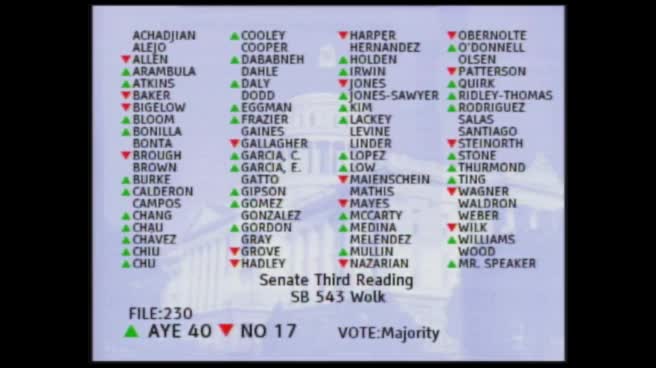 2MIN
Assembly Floor
 1MIN
Senate Floor
 4MIN
Senate Standing Committee on Governance and Finance
Bill Author

Bill Co-Author(s):