SB 998: Vehicles: public transit bus lanes.
- Session Year: 2015-2016
- House: Senate
- Latest Version Date: 2016-09-27
Existing law makes it unlawful for a person to stop or park a motor vehicle in specified places, including an area designated as a fire lane by the fire department or fire district, as specified. A violation of these provisions is an infraction.
This bill would prohibit a person from operating a motor vehicle, or stopping, parking, or leaving a vehicle standing, on a portion of the highway designated for the exclusive use of public transit buses, subject to specified exceptions. Because a violation of these provisions would be a crime, this bill would impose a state-mandated local program. The bill would also require a public transit agency to place and maintain signs and traffic control devices indicating that a portion of a highway is designated for the exclusive use of public transit buses, as specified.
The California Constitution requires the state to reimburse local agencies and school districts for certain costs mandated by the state. Statutory provisions establish procedures for making that reimbursement.
This bill would provide that no reimbursement is required by this act for a specified reason.
Existing law makes it unlawful for a person to stop or park a motor vehicle in specified places, including an area designated as a fire lane by the fire department or fire district, as specified. A violation of these provisions is an infraction.
This bill would prohibit a person from operating a motor vehicle, or stopping, parking, or leaving a vehicle standing, on a portion of the highway designated for the exclusive use of public transit buses, subject to specified exceptions. Because a violation of these provisions would be a crime, this bill would impose a state-mandated local program.
The California Constitution requires the state to reimburse local agencies and school districts for certain costs mandated by the state. Statutory provisions establish procedures for making that reimbursement.
This bill would provide that no reimbursement is required by this act for a specified reason.
Existing law makes it unlawful for a person to stop or park a motor vehicle in specified places, including an area designated as a fire lane by the fire department or fire district, as specified. A violation of these provisions is an infraction.
Existing law authorizes a local authority to permit a portion of the highway under its jurisdiction to be used exclusively for a public mass transit guideway.
This bill would prohibit a person from operating a motor vehicle, or stopping, parking, or leaving a vehicle standing, on a public mass transit guideway, portion of the highway designated for the exclusive use of public transit buses, subject to specified exceptions. Because a violation of these provisions would be a crime, this bill would impose a state-mandated local program.
The California Constitution requires the state to reimburse local agencies and school districts for certain costs mandated by the state. Statutory provisions establish procedures for making that reimbursement.
This bill would provide that no reimbursement is required by this act for a specified reason.
Existing law makes it unlawful for a person to stop or park a motor vehicle in specified places, including an area designated as a fire lane by the fire department or fire district, as specified. A violation of these provisions is an infraction.
Existing law authorizes a local authority to permit a portion of the highway under its jurisdiction to be used exclusively for a public mass transit guideway.
This bill would prohibit a person from operating a motor vehicle, or stopping, parking, or leaving a vehicle standing, on a public mass transit guideway, subject to specified exceptions. Because a violation of these provisions would be a crime, this bill would impose a state-mandated local program.
The California Constitution requires the state to reimburse local agencies and school districts for certain costs mandated by the state. Statutory provisions establish procedures for making that reimbursement.
This bill would provide that no reimbursement is required by this act for a specified reason.
(a)A person shall not operate a motor vehicle on a portion of a highway that has been designated for the exclusive use of public transit buses, except in compliance with the directions of a peace officer or official traffic control device.
(b)This section does not apply to a driver who is required to enter a lane designated for the exclusive use of public transit buses in order to make a right turn or a left turn in a location where there is no left-turn lane for motorists, or who is entering into or exiting from a highway, unless there are signs prohibiting turns across the lane or the lane is delineated by a physical separation, including, but not limited to, a curb, fence, landscaping, or other barrier.
(c)A public transit agency, with the agreement of the agency with jurisdiction over the highway, shall place and maintain, or cause to be placed and maintained, signs and other official traffic control devices, as necessary, indicating that a portion of a highway is designated for the exclusive use of public transit buses and to advise motorists of the hours of operation of the lane as an exclusive public transit bus lane.
SEC. 2.Section 22500 of the Vehicle Code is amended to read:22500.A person shall not stop, park, or leave standing any vehicle whether attended or unattended, except when necessary to avoid conflict with other traffic or in compliance with the directions of a peace officer or official traffic control device, in any of the following places:
(a)Within an intersection, except adjacent to curbs as may be permitted by local ordinance.
(b)On a crosswalk, except that a bus engaged as a common carrier or a taxicab may stop in an unmarked crosswalk to load or unload passengers when authorized by the legislative body of a city pursuant to an ordinance.
(c)Between a safety zone and the adjacent right-hand curb or within the area between the zone and the curb as may be indicated by a sign or red paint on the curb, which sign or paint was erected or placed by local authorities pursuant to an ordinance.
(d)Within 15 feet of the driveway entrance to a fire station. This subdivision does not apply to any vehicle owned or operated by a fire department and clearly marked as a fire department vehicle.
(e)(1)In front of a public or private driveway, except that a bus engaged as a common carrier, schoolbus, or a taxicab may stop to load or unload passengers when authorized by local authorities pursuant to an ordinance.
(2)In unincorporated territory, where the entrance of a private road or driveway is not delineated by an opening in a curb or by other curb construction, so much of the surface of the ground as is paved, surfaced, or otherwise plainly marked by vehicle use as a private road or driveway entrance, shall constitute a driveway.
(f)On a portion of a sidewalk, or with the body of the vehicle extending over a portion of a sidewalk, except electric carts when authorized by local ordinance, as specified in Section 21114.5. Lights, mirrors, or devices that are required to be mounted upon a vehicle under this code may extend from the body of the vehicle over the sidewalk to a distance of not more than 10 inches.
(g)Alongside or opposite a street or highway excavation or obstruction when stopping, standing, or parking would obstruct traffic.
(h)On the roadway side of a vehicle stopped, parked, or standing at the curb or edge of a highway, except for a schoolbus when stopped to load or unload pupils in a business or residence district where the speed limit is 25 miles per hour or less.
(i)Except as provided under Section 22500.5, alongside curb space authorized for the loading and unloading of passengers of a bus engaged as a common carrier in local transportation when indicated by a sign or red paint on the curb erected or painted by local authorities pursuant to an ordinance.
(j)In a tube or tunnel, except vehicles of the authorities in charge, being used in the repair, maintenance, or inspection of the facility.
(k)Upon a bridge, except vehicles of the authorities in charge, being used in the repair, maintenance, or inspection of the facility, and except that buses engaged as a common carrier in local transportation may stop to load or unload passengers upon a bridge where sidewalks are provided, when authorized by local authorities pursuant to an ordinance, and except that local authorities pursuant to an ordinance or the Department of Transportation pursuant to an order, within their respective jurisdictions, may permit parking on bridges having sidewalks and shoulders of sufficient width to permit parking without interfering with the normal movement of traffic on the roadway. Local authorities, by ordinance or resolution, may permit parking on these bridges on state highways in their respective jurisdictions if the ordinance or resolution is first approved in writing by the Department of Transportation. Parking shall not be permitted unless there are signs in place, as may be necessary, to indicate the provisions of local ordinances or the order of the Department of Transportation.
(l)In front of or upon that portion of a curb that has been cut down, lowered, or constructed to provide wheelchair accessibility to the sidewalk.
(m)In a portion of a highway that has been designated for the exclusive use of public transit buses.
SEC. 3.No reimbursement is required by this act pursuant to Section 6 of Article XIIIB of the California Constitution because the only costs that may be incurred by a local agency or school district will be incurred because this act creates a new crime or infraction, eliminates a crime or infraction, or changes the penalty for a crime or infraction, within the meaning of Section 17556 of the Government Code, or changes the definition of a crime within the meaning of Section 6 of Article XIIIB of the California Constitution.
(a)A person shall not operate a motor vehicle on a portion of a highway that has been designated for the exclusive use of public transit buses, except in compliance with the directions of a peace officer or official traffic control device.
(b)This section does not apply to a driver who is required to enter a lane designated for the exclusive use of public transit buses in order to make a right turn or a left turn in a location where there is no left-turn lane for motorists, or who is entering into or exiting from a highway, unless there are signs prohibiting turns across the lane or the lane is delineated by a physical separation, including, but not limited to, a curb, fence, landscaping, or other barrier.
(c)A public transit agency, with the agreement of the agency with jurisdiction over the highway, shall place and maintain, or cause to be placed and maintained, signs and other official traffic control devices, as necessary, indicating that a portion of a highway is designated for the exclusive use of public transit busses and to advise motorists of the hours of operation of the lane as an exclusive public transit bus lane.
SEC. 2.Section 22500 of the Vehicle Code is amended to read:22500.A person shall not stop, park, or leave standing any vehicle whether attended or unattended, except when necessary to avoid conflict with other traffic or in compliance with the directions of a peace officer or official traffic control device, in any of the following places:
(a)Within an intersection, except adjacent to curbs as may be permitted by local ordinance.
(b)On a crosswalk, except that a bus engaged as a common carrier or a taxicab may stop in an unmarked crosswalk to load or unload passengers when authorized by the legislative body of a city pursuant to an ordinance.
(c)Between a safety zone and the adjacent right-hand curb or within the area between the zone and the curb as may be indicated by a sign or red paint on the curb, which sign or paint was erected or placed by local authorities pursuant to an ordinance.
(d)Within 15 feet of the driveway entrance to a fire station. This subdivision does not apply to any vehicle owned or operated by a fire department and clearly marked as a fire department vehicle.
(e)(1)In front of a public or private driveway, except that a bus engaged as a common carrier, schoolbus, or a taxicab may stop to load or unload passengers when authorized by local authorities pursuant to an ordinance.
(2)In unincorporated territory, where the entrance of a private road or driveway is not delineated by an opening in a curb or by other curb construction, so much of the surface of the ground as is paved, surfaced, or otherwise plainly marked by vehicle use as a private road or driveway entrance, shall constitute a driveway.
(f)On a portion of a sidewalk, or with the body of the vehicle extending over a portion of a sidewalk, except electric carts when authorized by local ordinance, as specified in Section 21114.5. Lights, mirrors, or devices that are required to be mounted upon a vehicle under this code may extend from the body of the vehicle over the sidewalk to a distance of not more than 10 inches.
(g)Alongside or opposite a street or highway excavation or obstruction when stopping, standing, or parking would obstruct traffic.
(h)On the roadway side of a vehicle stopped, parked, or standing at the curb or edge of a highway, except for a schoolbus when stopped to load or unload pupils in a business or residence district where the speed limit is 25 miles per hour or less.
(i)Except as provided under Section 22500.5, alongside curb space authorized for the loading and unloading of passengers of a bus engaged as a common carrier in local transportation when indicated by a sign or red paint on the curb erected or painted by local authorities pursuant to an ordinance.
(j)In a tube or tunnel, except vehicles of the authorities in charge, being used in the repair, maintenance, or inspection of the facility.
(k)Upon a bridge, except vehicles of the authorities in charge, being used in the repair, maintenance, or inspection of the facility, and except that buses engaged as a common carrier in local transportation may stop to load or unload passengers upon a bridge where sidewalks are provided, when authorized by local authorities pursuant to an ordinance, and except that local authorities pursuant to an ordinance or the Department of Transportation pursuant to an order, within their respective jurisdictions, may permit parking on bridges having sidewalks and shoulders of sufficient width to permit parking without interfering with the normal movement of traffic on the roadway. Local authorities, by ordinance or resolution, may permit parking on these bridges on state highways in their respective jurisdictions if the ordinance or resolution is first approved in writing by the Department of Transportation. Parking shall not be permitted unless there are signs in place, as may be necessary, to indicate the provisions of local ordinances or the order of the Department of Transportation.
(l)In front of or upon that portion of a curb that has been cut down, lowered, or constructed to provide wheelchair accessibility to the sidewalk.
(m)In a portion of a highway that has been designated for the exclusive use of public transit buses.
SEC. 3.No reimbursement is required by this act pursuant to Section 6 of Article XIIIB of the California Constitution because the only costs that may be incurred by a local agency or school district will be incurred because this act creates a new crime or infraction, eliminates a crime or infraction, or changes the penalty for a crime or infraction, within the meaning of Section 17556 of the Government Code, or changes the definition of a crime within the meaning of Section 6 of Article XIIIB of the California Constitution.
A person shall not operate a motor vehicle on a portion of a highway that has been designated for the exclusive use of public transit buses, except in compliance with the directions of a peace officer or official traffic control device.
SECTION 1.Section 21655.1 is added to the Vehicle Code, to read:21655.1.A person shall not operate a motor vehicle on a portion of a highway that has been designated for the exclusive use of public transit buses, except in compliance with the directions of a peace officer or official traffic control device.
SEC. 2.Section 22500 of the Vehicle Code is amended to read:22500.A person shall not stop, park, or leave standing any vehicle whether attended or unattended, except when necessary to avoid conflict with other traffic or in compliance with the directions of a peace officer or official traffic control device, in any of the following places:
(a)Within an intersection, except adjacent to curbs as may be permitted by local ordinance.
(b)On a crosswalk, except that a bus engaged as a common carrier or a taxicab may stop in an unmarked crosswalk to load or unload passengers when authorized by the legislative body of a city pursuant to an ordinance.
(c)Between a safety zone and the adjacent right-hand curb or within the area between the zone and the curb as may be indicated by a sign or red paint on the curb, which sign or paint was erected or placed by local authorities pursuant to an ordinance.
(d)Within 15 feet of the driveway entrance to a fire station. This subdivision does not apply to any vehicle owned or operated by a fire department and clearly marked as a fire department vehicle.
(e)(1)In front of a public or private driveway, except that a bus engaged as a common carrier, schoolbus, or a taxicab may stop to load or unload passengers when authorized by local authorities pursuant to an ordinance.
(2)In unincorporated territory, where the entrance of a private road or driveway is not delineated by an opening in a curb or by other curb construction, so much of the surface of the ground as is paved, surfaced, or otherwise plainly marked by vehicle use as a private road or driveway entrance, shall constitute a driveway.
(f)On a portion of a sidewalk, or with the body of the vehicle extending over a portion of a sidewalk, except electric carts when authorized by local ordinance, as specified in Section 21114.5. Lights, mirrors, or devices that are required to be mounted upon a vehicle under this code may extend from the body of the vehicle over the sidewalk to a distance of not more than 10 inches.
(g)Alongside or opposite a street or highway excavation or obstruction when stopping, standing, or parking would obstruct traffic.
(h)On the roadway side of a vehicle stopped, parked, or standing at the curb or edge of a highway, except for a schoolbus when stopped to load or unload pupils in a business or residence district where the speed limit is 25 miles per hour or less.
(i)Except as provided under Section 22500.5, alongside curb space authorized for the loading and unloading of passengers of a bus engaged as a common carrier in local transportation when indicated by a sign or red paint on the curb erected or painted by local authorities pursuant to an ordinance.
(j)In a tube or tunnel, except vehicles of the authorities in charge, being used in the repair, maintenance, or inspection of the facility.
(k)Upon a bridge, except vehicles of the authorities in charge, being used in the repair, maintenance, or inspection of the facility, and except that buses engaged as a common carrier in local transportation may stop to load or unload passengers upon a bridge where sidewalks are provided, when authorized by local authorities pursuant to an ordinance, and except that local authorities pursuant to an ordinance or the Department of Transportation pursuant to an order, within their respective jurisdictions, may permit parking on bridges having sidewalks and shoulders of sufficient width to permit parking without interfering with the normal movement of traffic on the roadway. Local authorities, by ordinance or resolution, may permit parking on these bridges on state highways in their respective jurisdictions if the ordinance or resolution is first approved in writing by the Department of Transportation. Parking shall not be permitted unless there are signs in place, as may be necessary, to indicate the provisions of local ordinances or the order of the Department of Transportation.
(l)In front of or upon that portion of a curb that has been cut down, lowered, or constructed to provide wheelchair accessibility to the sidewalk.
(m)In a portion of a highway that has been designated for the exclusive use of public transit buses.
SEC. 3.No reimbursement is required by this act pursuant to Section 6 of Article XIIIB of the California Constitution because the only costs that may be incurred by a local agency or school district will be incurred because this act creates a new crime or infraction, eliminates a crime or infraction, or changes the penalty for a crime or infraction, within the meaning of Section 17556 of the Government Code, or changes the definition of a crime within the meaning of Section 6 of Article XIIIB of the California Constitution.
(a)A local authority, with respect to any highway under its jurisdiction, may authorize or permit a portion of the highway to be used exclusively for a public mass transit guideway.
(b)A person shall not operate a motor vehicle on a portion of a highway designated by local authority to be exclusively used as a public mass transit guideway, except when necessary to avoid conflict with other traffic or in compliance with the directions of a peace officer or official traffic control device.
SECTION 1.Section 21655.10 is added to the Vehicle Code, immediately following Section 21655.9, to read:21655.10.A person shall not operate a motor vehicle on a portion of a highway that has been designated for the exclusive use of public transit buses, except in compliance with the directions of a peace officer or official traffic control device.
SEC. 2.Section 22500 of the Vehicle Code is amended to read:22500.A person shall not stop, park, or leave standing any vehicle whether attended or unattended, except when necessary to avoid conflict with other traffic or in compliance with the directions of a peace officer or official traffic control device, in any of the following places:
(a)Within an intersection, except adjacent to curbs as may be permitted by local ordinance.
(b)On a crosswalk, except that a bus engaged as a common carrier or a taxicab may stop in an unmarked crosswalk to load or unload passengers when authorized by the legislative body of a city pursuant to an ordinance.
(c)Between a safety zone and the adjacent right-hand curb or within the area between the zone and the curb as may be indicated by a sign or red paint on the curb, which sign or paint was erected or placed by local authorities pursuant to an ordinance.
(d)Within 15 feet of the driveway entrance to a fire station. This subdivision does not apply to any vehicle owned or operated by a fire department and clearly marked as a fire department vehicle.
(e)(1)In front of a public or private driveway, except that a bus engaged as a common carrier, schoolbus, or a taxicab may stop to load or unload passengers when authorized by local authorities pursuant to an ordinance.
(2)In unincorporated territory, where the entrance of a private road or driveway is not delineated by an opening in a curb or by other curb construction, so much of the surface of the ground as is paved, surfaced, or otherwise plainly marked by vehicle use as a private road or driveway entrance, shall constitute a driveway.
(f)On a portion of a sidewalk, or with the body of the vehicle extending over a portion of a sidewalk, except electric carts when authorized by local ordinance, as specified in Section 21114.5. Lights, mirrors, or devices that are required to be mounted upon a vehicle under this code may extend from the body of the vehicle over the sidewalk to a distance of not more than 10 inches.
(g)Alongside or opposite a street or highway excavation or obstruction when stopping, standing, or parking would obstruct traffic.
(h)On the roadway side of a vehicle stopped, parked, or standing at the curb or edge of a highway, except for a schoolbus when stopped to load or unload pupils in a business or residence district where the speed limit is 25 miles per hour or less.
(i)Except as provided under Section 22500.5, alongside curb space authorized for the loading and unloading of passengers of a bus engaged as a common carrier in local transportation when indicated by a sign or red paint on the curb erected or painted by local authorities pursuant to an ordinance.
(j)In a tube or tunnel, except vehicles of the authorities in charge, being used in the repair, maintenance, or inspection of the facility.
(k)Upon a bridge, except vehicles of the authorities in charge, being used in the repair, maintenance, or inspection of the facility, and except that buses engaged as a common carrier in local transportation may stop to load or unload passengers upon a bridge where sidewalks are provided, when authorized by local authorities pursuant to an ordinance, and except that local authorities pursuant to an ordinance or the Department of Transportation pursuant to an order, within their respective jurisdictions, may permit parking on bridges having sidewalks and shoulders of sufficient width to permit parking without interfering with the normal movement of traffic on the roadway. Local authorities, by ordinance or resolution, may permit parking on these bridges on state highways in their respective jurisdictions if the ordinance or resolution is first approved in writing by the Department of Transportation. Parking shall not be permitted unless there are signs in place, as may be necessary, to indicate the provisions of local ordinances or the order of the Department of Transportation.
(l)In front of or upon that portion of a curb that has been cut down, lowered, or constructed to provide wheelchair accessibility to the sidewalk.
(m)In a portion of a highway under the jurisdiction of a local authority that has been designated by that authority to be used exclusively for a for the exclusive use of public mass transit guideway pursuant to Section 21655.7. buses.
SEC. 3.No reimbursement is required by this act pursuant to Section 6 of Article XIIIB of the California Constitution because the only costs that may be incurred by a local agency or school district will be incurred because this act creates a new crime or infraction, eliminates a crime or infraction, or changes the penalty for a crime or infraction, within the meaning of Section 17556 of the Government Code, or changes the definition of a crime within the meaning of Section 6 of Article XIIIB of the California Constitution.
(a)A local authority, with respect to any highway under its jurisdiction, may authorize or permit a portion of the highway to be used exclusively for a public mass transit guideway.
(b)A person shall not operate a motor vehicle on a portion of a highway designated by local authority to be exclusively used as a public mass transit guideway, except when necessary to avoid conflict with other traffic or in compliance with the directions of a peace officer or official traffic control device.
SEC. 2.Section 22500 of the Vehicle Code is amended to read:22500.No A person shall not stop, park, or leave standing any vehicle whether attended or unattended, except when necessary to avoid conflict with other traffic or in compliance with the directions of a peace officer or official traffic control device, in any of the following places:
(a)Within an intersection, except adjacent to curbs as may be permitted by local ordinance.
(b)On a crosswalk, except that a bus engaged as a common carrier or a taxicab may stop in an unmarked crosswalk to load or unload passengers when authorized by the legislative body of any a city pursuant to an ordinance.
(c)Between a safety zone and the adjacent right-hand curb or within the area between the zone and the curb as may be indicated by a sign or red paint on the curb, which sign or paint was erected or placed by local authorities pursuant to an ordinance.
(d)Within 15 feet of the driveway entrance to any a fire station. This subdivision does not apply to any vehicle owned or operated by a fire department and clearly marked as a fire department vehicle.
(e)(1)In front of a public or private driveway, except that a bus engaged as a common carrier, schoolbus, or a taxicab may stop to load or unload passengers when authorized by local authorities pursuant to an ordinance.
In
(2)In unincorporated territory, where the entrance of a private road or driveway is not delineated by an opening in a curb or by other curb construction, so much of the surface of the ground as is paved, surfaced, or otherwise plainly marked by vehicle use as a private road or driveway entrance, shall constitute a driveway.
(f)On any a portion of a sidewalk, or with the body of the vehicle extending over any a portion of a sidewalk, except electric carts when authorized by local ordinance, as specified in Section 21114.5. Lights, mirrors, or devices that are required to be mounted upon a vehicle under this code may extend from the body of the vehicle over the sidewalk to a distance of not more than 10 inches.
(g)Alongside or opposite any a street or highway excavation or obstruction when stopping, standing, or parking would obstruct traffic.
(h)On the roadway side of any a vehicle stopped, parked, or standing at the curb or edge of a highway, except for a schoolbus when stopped to load or unload pupils in a business or residence district where the speed limit is 25 miles per hour or less.
(i)Except as provided under Section 22500.5, alongside curb space authorized for the loading and unloading of passengers of a bus engaged as a common carrier in local transportation when indicated by a sign or red paint on the curb erected or painted by local authorities pursuant to an ordinance.
(j)In a tube or tunnel, except vehicles of the authorities in charge, being used in the repair, maintenance, or inspection of the facility.
(k)Upon a bridge, except vehicles of the authorities in charge, being used in the repair, maintenance, or inspection of the facility, and except that buses engaged as a common carrier in local transportation may stop to load or unload passengers upon a bridge where sidewalks are provided, when authorized by local authorities pursuant to an ordinance, and except that local authorities pursuant to an ordinance or the Department of Transportation pursuant to an order, within their respective jurisdictions, may permit parking on bridges having sidewalks and shoulders of sufficient width to permit parking without interfering with the normal movement of traffic on the roadway. Local authorities, by ordinance or resolution, may permit parking on these bridges on state highways in their respective jurisdictions if the ordinance or resolution is first approved in writing by the Department of Transportation. Parking shall not be permitted unless there are signs in place, as may be necessary, to indicate the provisions of local ordinances or the order of the Department of Transportation.
(l)In front of or upon that portion of a curb that has been cut down, lowered, or constructed to provide wheelchair accessibility to the sidewalk.
(m)In a portion of a highway under the jurisdiction of a local authority that has been designated by that authority to be used exclusively for a public mass transit guideway pursuant to Section 21655.7.
SEC. 3.No reimbursement is required by this act pursuant to Section 6 of Article XIIIB of the California Constitution because the only costs that may be incurred by a local agency or school district will be incurred because this act creates a new crime or infraction, eliminates a crime or infraction, or changes the penalty for a crime or infraction, within the meaning of Section 17556 of the Government Code, or changes the definition of a crime within the meaning of Section 6 of Article XIIIB of the California Constitution.
|
Date
|
Status
|
|---|---|
| Jun 6, 2016 | June 13 hearing postponed by committee. |
| Aug 31, 2016 | Enrolled and presented to the Governor at 3 p.m. |
| Aug 25, 2016 | Assembly amendments concurred in. (Ayes 39. Noes 0.) Ordered to engrossing and enrolling. |
| Aug 25, 2016 | Assembly amendments concurred in. (Ayes 39. Noes 0. Page 5429.) Ordered to engrossing and enrolling. |
| Aug 23, 2016 | Ordered to special consent calendar. |
| Aug 19, 2016 | In Senate. Concurrence in Assembly amendments pending. |
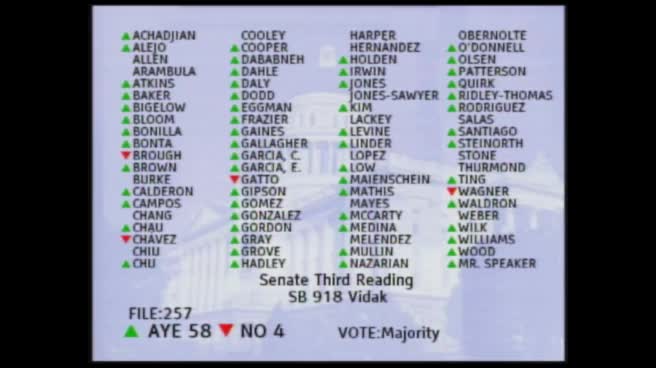
| Aug 18, 2016 | Read third time. Passed. (Ayes 79. Noes 0. Page 5896.) Ordered to the Senate. |
| Aug 18, 2016 | Read third time. Passed. Ordered to the Senate. |
| Aug 11, 2016 | Read third time and amended. |
| Aug 11, 2016 | Ordered to third reading. |
| Aug 8, 2016 | Ordered to third reading. |
| Aug 8, 2016 | From consent calendar on motion of Assembly Member Calderon. |
| Aug 4, 2016 | Read second time. Ordered to consent calendar. |
| Aug 3, 2016 | From committee: Do pass. Ordered to consent calendar. (Ayes 20. Noes 0.) (August 3). |
| Jun 28, 2016 | From committee: Do pass and re-refer to Com. on APPR. with recommendation: To consent calendar. (Ayes 15. Noes 0.) (June 27). Re-referred to Com. on APPR. |
| Feb 10, 2016 | Introduced. Read first time. To Com. on RLS. for assignment. To print. |
| May 16, 2016 | Referred to Com. on TRANS. |
| May 10, 2016 | In Assembly. Read first time. Held at Desk. |
| May 9, 2016 | Read third time. Passed. (Ayes 35. Noes 0.) Ordered to the Assembly. |
| May 9, 2016 | Read third time. Passed. (Ayes 35. Noes 0. Page 3807.) Ordered to the Assembly. |
| May 3, 2016 | Read second time and amended. Ordered to third reading. |
| May 2, 2016 | From committee: Be ordered to second reading pursuant to Senate Rule 28.8 and be amended. |
| Apr 22, 2016 | Set for hearing May 2. |
| Apr 20, 2016 | From committee: Do pass and re-refer to Com. on APPR. (Ayes 11. Noes 0.) (April 19). Re-referred to Com. on APPR. |
| Apr 20, 2016 | From committee: Do pass and re-refer to Com. on APPR. (Ayes 11. Noes 0. Page 3615.) (April 19). Re-referred to Com. on APPR. |
| Apr 6, 2016 | From committee with author's amendments. Read second time and amended. Re-referred to Com. on T. & H. |
| Mar 24, 2016 | Set for hearing April 19. |
| Feb 18, 2016 | Referred to Com. on T. & H. |
| Feb 11, 2016 | From printer. May be acted upon on or after March 12. |
|
Date
|
Description
|
Location
|
Votes
|
|
|---|---|---|---|---|
| Aug 25, 2016 | Special Consent SB998 Wieckowski | Senate Floor |
Passed |
|
| Aug 18, 2016 | SB 998 Wieckowski Senate Third Reading By LOW | Assembly Floor |
Passed |
|
| Aug 3, 2016 | Do pass. To Consent Calendar. | Assembly Standing Committee on Appropriations |
Passed |
|
| Jun 27, 2016 | Do pass and be re-referred to the Committee on [Appropriations] with recommendation: To Consent Calendar | Assembly Standing Committee on Transportation |
Passed |
|
| May 9, 2016 | Senate 3rd Reading SB998 Wieckowski | Senate Floor |
Passed |
|
| Apr 19, 2016 | Do pass, but first be re-referred to the Committee on [Appropriations] | Senate Standing Committee on Transportation and Housing |
Passed |
This list shows positions taken on this bill by organizations on the date displayed, which is linked to the original source.
Positions by individuals are not included.
|
Organization
|
Position
|
Date
|
|---|---|---|
| Alameda-Contra Costa Transit District | ** Support | Aug 11, 2016 |
| California Transit Association | ** Support | Aug 11, 2016 |
| San Bernardino Associated Governments | ** Support | Aug 11, 2016 |
| Santa Clara Valley Transportation Authority | ** Support | Aug 11, 2016 |
Office of Senate Floor Analyses (916) 651-1520 Fax: (916) 327-4478 | SB |
UNFINISHED BUSINESS
Bill No: SB 998
:
SENATE TRANS. & HOUSING COMMITTEE: 11-0, 4/19/16
AYES: Beall, Cannella, Allen, Bates, Gaines, Galgiani, Leyva, McGuire, Mendoza, Roth, Wieckowski
SENATE APPROPRIATIONS COMMITTEE: Senate Rule 28.8
SENATE FLOOR: 35-0, 5/9/16
AYES: Allen, Anderson, Berryhill, Block, Cannella, De León, Fuller, Galgiani, Glazer, Hall, Hancock, Hernandez, Hertzberg, Hill, Hueso, Huff, Jackson, Lara, Leno, Leyva, Liu, McGuire, Mendoza, Mitchell, Monning, Moorlach, Morrell, Nguyen, Pan, Pavley, Roth, Stone, Vidak, Wieckowski, Wolk
NO VOTE RECORDED: Bates, Beall, Gaines, Nielsen, Runner
ASSEMBLY FLOOR: 79-0, 8/18/16 - See last page for vote
SUBJECT: Vehicles: public transit bus lanes
SOURCE: Alameda-Contra Costa Transit District
Santa Clara Valley Transportation Authority
DIGEST: This bill prohibits an individual from operating, stopping, parking, or leaving a motor vehicle in a transit-only lane of a highway.
Assembly Amendments provide an exception for instances in which drivers need to cross a bus lane to make a turn, and ensure that public transit agencies post signs stating hours of operation and when the lanes are for “bus only” use.
Existing law:
- Prohibits an individual from stopping, parking, or leaving a vehicle, except when necessary to avoid conflict with other traffic or in compliance with directions from a peace officer or official traffic control device, in specified situations. These situations include, but are not limited to, within an intersection, on a crosswalk, in front of a driveway, in a tunnel, on a bridge, and in passenger loading zones, including bus stops.
- Provides that these offenses are infractions, subject to a fine of $100 for the first offense, $200 for the second offense occurring within one year of a prior offense, and $250 for a third or subsequent offense occurring within one year of two or more prior offenses.
This bill:
- Prohibits an individual from operating a motor vehicle on a portion of highway that has been designated for the exclusive use of public transit buses, except in compliance with directions from a peace officer or official traffic control device.
- Prohibits an individual from stopping, parking, or leaving a vehicle, except when necessary to avoid conflict with other traffic or in compliance with directions from a peace officer or official traffic control device, on a portion of highway that has been designated for the exclusive use of public transit buses.
- Provides that these restrictions do not apply to a driver who enters a bus lane in order to make a turn.
- Requires the bus agency, with the agreement of the agency with jurisdiction over the highway, to post signs indicating that the lane is exclusively for bus use and the hours that this restriction applies.
Comments
- Purpose. The author states that Bus Rapid Transit (BRT) is a high-capacity, lower cost public transit service intended to effectively accommodate longer distance passenger trips in transit corridors in urban areas. By operating in dedicated bus-only lanes, public transit agencies are able to decrease travel times and make bus service more reliable and competitive with automobiles. This bill will help ensure the success and efficiency of existing BRT lanes and encourage more public transit agencies to plan for BRT lanes in the future.
- Bus stops v. bus lanes. Existing law prohibits a motorist from stopping, parking, or leaving a vehicle in a bus stop, punishable as an infraction and subject to a $100 fine (higher for subsequent offenses). This bill expands those prohibitions to BRT lanes, as well as prohibiting driving in a BRT lane. These new offenses would also be infractions, subject to the same fines.
- Fines. Due to additional surcharges, penalties, and assessments, a $100 base fine for an infraction — such as the offenses created by this bill — results in a total of $541. A similar bill, SB 1051 (Hancock, 2016), authorizes the Alameda-Contra Costa Transit District, in addition to the City and County of San Francisco, to enforce parking violations in transit-only traffic lanes and bus stops using video cameras. Current law specifies that these violations, in contrast to the violations created by this bill, are civil penalties, not infractions, subject to a fine of not less than $250 nor more than $1,000. Civil penalties differ from infractions in that civil penalties are not subject to add-on fees.
- Can’t these motorists be cited now? Santa Clara Valley Transportation Authority, co-sponsor of this bill, states that because transit agencies are not statutorily created special districts, they do not have the authority under state law to cite vehicles that are parked, stopped, left standing, or driven in a designated bus-only lane. In addition, while existing law prohibits parking, stopping, or leaving a vehicle in a bus stop, it does not address BRT lanes. By specifically designating prohibitions in BRT lanes, this bill authorizes transit agencies to issue citations for impeding BRT service operations.
FISCAL EFFECT: Appropriation: Fiscal Com.: Local:
According to the Assembly Appropriations Committee, there would be minor nonreimbursable costs for enforcement, offset to some extent by fine revenues.
Alameda-Contra Costa Transit District (co-source)
Santa Clara Valley Transportation Authority (co-source)
California Transit Association
OPPOSITION: (Verified 8/18/16)
None received
ASSEMBLY FLOOR: 79-0, 8/18/16
AYES: Achadjian, Alejo, Travis Allen, Arambula, Atkins, Baker, Bigelow, Bloom, Bonilla, Bonta, Brough, Brown, Burke, Calderon, Campos, Chang, Chau, Chávez, Chiu, Chu, Cooley, Cooper, Dababneh, Dahle, Daly, Dodd, Eggman, Frazier, Beth Gaines, Gallagher, Cristina Garcia, Eduardo Garcia, Gatto, Gipson, Gomez, Gonzalez, Gordon, Gray, Grove, Hadley, Harper, Holden, Irwin, Jones, Jones-Sawyer, Kim, Lackey, Levine, Linder, Lopez, Low, Maienschein, Mathis, Mayes, McCarty, Medina, Melendez, Mullin, Nazarian, Obernolte, O'Donnell, Olsen, Patterson, Quirk, Ridley-Thomas, Rodriguez, Salas, Santiago, Steinorth, Mark Stone, Thurmond, Ting, Wagner, Waldron, Weber, Wilk, Williams, Wood, Rendon
NO VOTE RECORDED: Roger Hernández
8/19/16 19:29:28
SENATE THIRD READING
STR Bill Id:SB 998
Author:(Wieckowski)
As Amended Ver:August 11, 2016
Majority vote
SENATE VOTE: 35-0
Committee | Votes | Ayes | Noes |
Transportation | 15-0 | Frazier, Linder, Baker, Bloom, Brown, Chu, Daly, Dodd, Eduardo Garcia, Gomez, Kim, Mathis, Melendez, Nazarian, O'Donnell | |
Appropriations | 20-0 | Gonzalez, Bigelow, Bloom, Bonilla, Bonta, Calderon, Chang, Daly, Eggman, Gallagher, Eduardo Garcia, Holden, Jones, Obernolte, Quirk, Santiago, Wagner, Weber, Wood, Chau |
SUMMARY: Prohibits an individual from operating, stopping, parking or leaving a motor vehicle in a portion of the highway designated exclusively for public transit buses, except in specific circumstances, and requires signs be erected to identify these lanes. Specifically, this bill:
- Prohibits a person from operating a motor vehicle on a portion of the highway designated for the exclusive use of public transit buses, except in compliance with the directions of a peace officer or official traffic control device.
- Exempts drivers from the prohibition of driving in a lane designated for the exclusive use of public transit buses in order for the driver to make a right or left turn where there is no left-turn lane for motorists, or entering or exiting a highway, unless there are signs prohibiting turns across the lane or the lane is delineated by a physical separation.
- Prohibits a person from stopping, parking, or leaving a vehicle standing in a portion of the highway designated for the exclusive use of public transit buses, except when necessary to avoid conflict with other traffic or in compliance with directions of a peace officer or official traffic control device.
- Requires public transit agencies, with the agreement of the agency with jurisdiction over the highway, to place and maintain signs and other traffic control devices indicating the portion of the highway is for the exclusive use of public transit buses, including any specific hours of operation.
EXISTING LAW: Prohibits a person from stopping, parking, or leaving a vehicle, except when necessary to avoid conflict with other traffic or in compliance with directions of a peace officer or official traffic control device, in any of the following places: an intersection, on a crosswalk, between a safety zone and the adjacent right-hand curb, within 15 feet of the driveway entrance to a fire station, in front of a driveway, a portion of a sidewalk, on the roadway side of a parked vehicle, in a tunnel, on a bridge, and in passenger loading zones, including bus stops.
FISCAL EFFECT: According to the Assembly Appropriations Committee, minor non-reimbursable costs for enforcement, offset to some extent by fine revenues.
COMMENTS: Bus Rapid Transit (BRT) is a high-capacity, lower-cost public transit service intended to effectively accommodate longer-distance passenger trips in transit-intensive corridors in urbanized areas. By operating in bus-only lanes in these corridors, public transit agencies are able to decrease travel times, increase reliability, and make their bus service a more attractive transportation alternative to driving. BRT is gaining popularity as a solution to buses stuck in regular traffic congestion. Additionally, BRT is less expensive than constructing a fixed guideway rail line and is flexible to meet community needs.
Several public transit agencies in California are currently operating or constructing BRT projects utilizing exclusive bus-only lanes, including the Alameda-Contra Costa Transit District (AC Transit), the Los Angeles County Metropolitan Transportation Authority, Omnitrans in San Bernardino County, the Sacramento Regional Transit District, the San Diego Metropolitan Transit System, and the Santa Clara Valley Transportation Authority (VTA).
For example, in 2014 the San Bernardino Associated Governments (SANBAG) opened the sbX Green line, the county's first-ever express passenger service, offering alternative transportation to major destinations in the cities of San Bernardino and Loma Linda. The 16-mile corridor provides service every 10 minutes during peak hours. In writing in support of this bill, SANBAG noted that they have included more express bus routes in their 2016 regional transportation plan and that in addition to providing new transit options, the future corridors will reduce congestion and improve air quality in the valley. SANBAG goes on to state that enforcement of current and future dedicated transit lanes is critical to the safety and efficiency of BRT operations in San Bernardino County. As to new systems, the co-sponsors of the bill, AC Transit, will launch service on a BRT corridor from downtown Oakland to the San Leandro Bay Area Rapid Transit (BART) station in late 2017.
Current law prohibits motorists from stopping, parking or leaving a vehicle in a bus stop area; however there is no comparable state law relating to bus-only lanes. As noted by VTA, the co-sponsor of this bill, because there is no state prohibition of this activity, public transit agencies cannot ticket motorists who are inappropriately using bus-only lanes and obstructing the operation of BRT service.
California continues to encourage and support the expansion of public transportation options and operations to meet the needs of the traveling public and the state's air quality goals. Updating the state's traffic laws to match these innovations is important for their success.
Analysis Prepared by: Melissa White / TRANS. / (916) 319-2093 FN: 0003970
SENATE THIRD READING
STR Bill Id:SB 998
Author:(Wieckowski)
As Amended Ver:May 3, 2016
Majority vote
SENATE VOTE: 35-0
Committee | Votes | Ayes | Noes |
Transportation | 15-0 | Frazier, Linder, Baker, Bloom, Brown, Chu, Daly, Dodd, Eduardo Garcia, Gomez, Kim, Mathis, Melendez, Nazarian, O'Donnell | |
Appropriations | 20-0 | Gonzalez, Bigelow, Bloom, Bonilla, Bonta, Calderon, Chang, Daly, Eggman, Gallagher, Eduardo Garcia, Holden, Jones, Obernolte, Quirk, Santiago, Wagner, Weber, Wood, Chau |
|
SUMMARY: Prohibits an individual from operating, stopping, parking or leaving a motor vehicle in a portion of the highway designated exclusively for public transit buses. Specifically, this bill:
- Prohibits a person from operating a motor vehicle on a portion of the highway designated for the exclusive use of public transit buses, except in compliance with the directions of a peace officer or official traffic control device.
- Prohibits a person from stopping, parking, or leaving a vehicle standing in a portion of the highway designated for the exclusive use of public transit buses, except when necessary to avoid conflict with other traffic or in compliance with directions of a peace officer or official traffic control device.
EXISTING LAW: Prohibits a person from stopping, parking, or leaving a vehicle, except when necessary to avoid conflict with other traffic or in compliance with directions of a peace officer or official traffic control device, in any of the following places: an intersection, on a crosswalk, between a safety zone and the adjacent right-hand curb, within 15 feet of the driveway entrance to a fire station, in front of a driveway, a portion of a sidewalk, on the roadway side of a parked vehicle, in a tunnel, on a bridge, and in passenger loading zones, including bus stops.
FISCAL EFFECT: According to the Assembly Appropriations Committee, minor non-reimbursable costs for enforcement, offset to some extent by fine revenues.
COMMENTS: Bus Rapid Transit (BRT) is a high-capacity, lower-cost public transit service intended to effectively accommodate longer-distance passenger trips in transit-intensive corridors in urbanized areas. By operating in bus-only lanes in these corridors, public transit agencies are able to decrease travel times, increase reliability, and make their bus service a more attractive transportation alternative to driving. BRT is gaining popularity as a solution to buses stuck in regular traffic congestion. Additionally, BRT is less expensive than constructing a fixed guideway rail line and is flexible to meet community needs.
Several public transit agencies in California are currently operating or constructing BRT projects utilizing exclusive bus-only lanes, including the Alameda-Contra Costa Transit District (AC Transit), the Los Angeles County Metropolitan Transportation Authority, Omnitrans in San Bernardino County, the Sacramento Regional Transit District, the San Diego Metropolitan Transit System, and the Santa Clara Valley Transportation Authority (VTA).
For example, in 2014 the San Bernardino Associated Governments (SANBAG) opened the sbX Green line, the county's first-ever express passenger service, offering alternative transportation to major destinations in the cities of San Bernardino and Loma Linda. The 16-mile corridor provides service every 10 minutes during peak hours. In writing in support of this bill, SANBAG noted that they have included more express bus routes in their 2016 regional transportation plan and that in addition to providing new transit options, the future corridors will reduce congestion and improve air quality in the valley. SANBAG goes on to state that enforcement of current and future dedicated transit lanes is critical to the safety and efficiency of BRT operations in San Bernardino County. As to new systems, the co-sponsors of the bill, AC Transit, will launch service on a BRT corridor from downtown Oakland to the San Leandro Bay Area Rapid Transit (BART) station in late 2017.
Current law prohibits motorists from stopping, parking or leaving a vehicle in a bus stop area; however there is no comparable state law relating to bus-only lanes. As noted by VTA, the co-sponsor of this bill, because there is no state prohibition of this activity, public transit agencies cannot ticket motorists who are inappropriately using bus-only lanes and obstructing the operation of BRT service.
California continues to encourage and support the expansion of public transportation options and operations to meet the needs of the traveling public and the state's air quality goals. Updating the state's traffic laws to match these innovations is important for their success.
Analysis Prepared by: Melissa White / TRANS. / (916) 319-2093 FN: 0003898
Date of Hearing: August 3, 2016
ASSEMBLY COMMITTEE ON APPROPRIATIONS
Lorena Gonzalez, Chair
SBPCA Bill Id:SB 998
Author:(Wieckowski) – As Amended Ver:May 3, 2016
Policy Committee: | Transportation | Vote: | 15 - 0 |
|
| ||
|
|
Urgency: No State Mandated Local Program: Yes Reimbursable: No
SUMMARY:
This bill prohibits a person from operating a motor vehicle on, or from stopping, parking, or leaving a vehicle standing in, a portion of the highway designated for the exclusive use of public transit buses, except in compliance with the directions of a peace officer or official traffic control device.
FISCAL EFFECT:
Minor nonreimbursable costs for enforcement, offset to some extent by fine revenues.
COMMENTS:
Purpose. Several public transit agencies are currently operating or constructing bus rapid transit (BRT) projects utilizing exclusive bus-only lanes. These include the Alameda-Contra Costa Transit District (AC Transit), the Los Angeles County Metropolitan Transportation Authority, Omnitrans in San Bernardino County, the Sacramento Regional Transit District, the San Diego Metropolitan Transit System, and the Santa Clara Valley Transportation Authority (VTA).
Current law prohibits motorists from stopping, parking or leaving a vehicle in a bus stop area; however there is no comparable state law relating to bus-only lanes. As noted by VTA, the co-sponsor of this bill, because there is no state prohibition of this activity, public transit agencies cannot ticket motorists who are inappropriately using bus-only lanes and obstructing the operation of BRT service.
Analysis Prepared by: Chuck Nicol / APPR. / (916) 319-2081
Date of Hearing: June 27, 2016
ASSEMBLY COMMITTEE ON TRANSPORTATION
Jim Frazier, Chair
SBPCA Bill Id:SB 998
Author:(Wieckowski) – As Amended Ver:May 3, 2016
SENATE VOTE: 35-0
SUBJECT: Vehicles: mass transit guideways
SUMMARY: Prohibits an individual from operating, stopping, parking or leaving a motor vehicle in a portion of the highway designated exclusively for public transit buses. Specifically, this bill:
- Prohibits a person from operating a motor vehicle on a portion of the highway designated for the exclusive use of public transit buses, except in compliance with the directions of a peace officer or official traffic control device.
- Prohibits a person from stopping, parking, or leaving a vehicle standing in a portion of the highway designated for the exclusive use of public transit buses, except when necessary to avoid conflict with other traffic or in compliance with directions of a peace officer or official traffic control device.
EXISTING LAW: Prohibits a person from stopping, parking, or leaving a vehicle, except when necessary to avoid conflict with other traffic or in compliance with directions of a peace officer or official traffic control device, in any of the following places: an intersection, on a crosswalk, between a safety zone and the adjacent right-hand curb, within 15 feet of the driveway entrance to a fire station, in front of a driveway, a portion of a sidewalk, on the roadway side of a parked vehicle, in a tunnel, on a bridge, and in passenger loading zones, including bus stops.
FISCAL EFFECT: Unknown
COMMENTS: Bus Rapid Transit (BRT) is a high-capacity, lower-cost public transit service intended to effectively accommodate longer-distance passenger trips in transit-intensive corridors in urbanized areas. By operating in bus-only lanes in these corridors, public transit agencies are able to decrease travel times, increase reliability, and make their bus service a more attractive transportation alternative to driving. BRT is gaining popularity as a solution to buses stuck in regular traffic congestion. Additionally, BRT is less expensive than constructing a fixed guideway rail line and is flexible to meet community needs.
Several public transit agencies in California are currently operating or constructing BRT projects utilizing exclusive bus-only lanes, including the Alameda-Contra Costa Transit District (AC Transit), the Los Angeles County Metropolitan Transportation Authority, Omnitrans in San Bernardino County, the Sacramento Regional Transit District, the San Diego Metropolitan Transit System, and the Santa Clara Valley Transportation Authority (VTA).
For example, in 2014 the San Bernardino Associated Governments (SANBAG) opened the sbX Green line, the county’s first-ever express passenger service, offering alternative transportation to major destinations in the cities of San Bernardino and Loma Linda. The 16-mile corridor provides service every 10 minutes during peak hours. In writing in support of SB 998, SANBAG noted that they have included more express bus routes in their 2016 regional transportation plan and that in addition to providing new transit options, the future corridors will reduce congestion and improve air quality in the valley. SANBAG goes on to state that enforcement of current and future dedicated transit lanes is critical to the safety and efficiency of BRT operations in San Bernardino County. As to new systems, the co-sponsors of the bill, AC Transit, will launch service on a BRT corridor from downtown Oakland to the San Leandro BART station in late 2017.
Current law prohibits motorists from stopping, parking or leaving a vehicle in a bus stop area; however there is no comparable state law relating to bus-only lanes. As noted by VTA, the co-sponsor of this bill, because there is no state prohibition of this activity, public transit agencies cannot ticket motorists who are inappropriately using bus-only lanes and obstructing the operation of BRT service.
California continues to encourage and support the expansion of public transportation options and operations to meet the needs of the traveling public and the state’s air quality goals. Updating the state’s traffic laws to match these innovations is important for their success.
Related legislation: SB 1051 (Hancock) authorizes AC Transit, until January 1, 2022, to enforce parking violations in transit-only traffic lanes. SB 1051 passed out of committee on June 20, 2016, and is scheduled to be heard by the Assembly Committee on Privacy and Consumer Protection Committee on June 28, 2016.
REGISTERED SUPPORT / OPPOSITION:
Support
Alameda-Contra Costa Transit District (Sponsor)
Santa Clara Valley Transportation Authority (Sponsor)
California Transit Association
San Bernardino Associated Governments
Opposition
None on file
Analysis Prepared by: Melissa White / TRANS. / (916) 319-2093
Office of Senate Floor Analyses (916) 651-1520 Fax: (916) 327-4478 | SB |
THIRD READING
Bill No: SB 998
:
SENATE TRANS. & HOUSING COMMITTEE: 11-0, 4/19/16
AYES: Beall, Cannella, Allen, Bates, Gaines, Galgiani, Leyva, McGuire, Mendoza, Roth, Wieckowski
SENATE APPROPRIATIONS COMMITTEE: Senate Rule 28.8
SOURCE: Alameda-Contra Costa Transit District
Santa Clara Valley Transportation Authority
DIGEST: This bill prohibits an individual from operating, stopping, parking, or leaving a motor vehicle in a transit-only lane of a highway.
Existing law:
- Prohibits an individual from stopping, parking, or leaving a vehicle, except when necessary to avoid conflict with other traffic or in compliance with directions from a peace officer or official traffic control device, in specified situations. These situations include, but are not limited to, within an intersection, on a crosswalk, in front of a driveway, in a tunnel, on a bridge, and in passenger loading zones, including bus stops.
- Provides that these offenses are infractions, subject to a fine of $100 for the first offense, $200 for the second offense occurring within one year of a prior offense, and $250 for a third or subsequent offense occurring within one year of two or more prior offenses.
This bill:
- Prohibits an individual from operating a motor vehicle on a portion of highway that has been designated for the exclusive use of public transit buses, except in compliance with directions from a peace officer or official traffic control device.
- Prohibits an individual from stopping, parking, or leaving a vehicle, except when necessary to avoid conflict with other traffic or in compliance with directions from a peace officer or official traffic control device, on a portion of highway that has been designated for the exclusive use of public transit buses.
Comments
- Purpose. The author states that Bus Rapid Transit (BRT) is a high-capacity, lower cost public transit service intended to effectively accommodate longer distance passenger trips in transit corridors in urban areas. By operating in dedicated bus-only lanes, public transit agencies are able to decrease travel times and make bus service more reliable and competitive with automobiles. This bill will help ensure the success and efficiency of existing BRT lanes and encourage more public transit agencies to plan for BRT lanes in the future.
- Bus stops v. bus lanes. Existing law prohibits a motorist from stopping, parking, or leaving a vehicle in a bus stop, punishable as an infraction and subject to a $100 fine (higher for subsequent offenses). This bill expands those prohibitions to BRT lanes, as well as prohibiting driving in a BRT lane. These new offenses would also be infractions, subject to the same fines.
- Fines. Due to additional surcharges, penalties, and assessments, a $100 base fine for an infraction — such as the offenses created by this bill — results in a total of $541. A similar bill, SB 1051 (Hancock), authorizes the Alameda-Contra Costa Transit District, in addition to the City and County of San Francisco, to enforce parking violations in transit-only traffic lanes and bus stops using video cameras. Current law specifies that these violations, in contrast to the violations created by this bill, are civil penalties, not infractions, subject to a fine of not less than $250 nor more than $1,000. Civil penalties differ from infractions in that civil penalties are not subject to add-on fees.
- Can’t these motorists be cited now? Santa Clara Valley Transportation Authority, co-sponsor of this bill, states that because transit agencies are not statutorily created special districts, they do not have the authority under state law to cite vehicles that are parked, stopped, left standing, or driven in a designated bus-only lane. In addition, while existing law prohibits parking, stopping, or leaving a vehicle in a bus stop, it does not address BRT lanes. By specifically designating prohibitions in BRT lanes, this bill authorizes transit agencies to issue citations for impeding BRT service operations.
Related Legislation
SB 1051 (Hancock) allows the Alameda-Contra Costa Transit District to enforce parking violations in transit-only traffic lanes and bus stops using video cameras.
FISCAL EFFECT: Appropriation: Fiscal Com.: Local:
Alameda-Contra Costa Transit District (co-source)
Santa Clara Valley Transportation Authority (co-source)
California Transit Association
None received
5/4/16 15:04:13
**** END ****
SENATE COMMITTEE ON TRANSPORTATION AND HOUSING
Senator Jim Beall, Chair
2015 - 2016 Regular
Bill No: Hearing Date: 4/19/2016
Author: | Wieckowski | ||
Version: | 4/6/2016 | ||
Urgency: | No | Fiscal: | Yes |
Consultant: | Erin Riches | ||
SUBJECT:
DIGEST: This bill prohibits an individual from operating, stopping, parking, or leaving a motor vehicle in a transit-only lane of a highway.
ANALYSIS:
Existing law:
- Prohibits an individual from stopping, parking, or leaving a vehicle, except when necessary to avoid conflict with other traffic or in compliance with directions from a peace officer or official traffic control device, in specified situations. These situations include, but are not limited to, within an intersection, on a crosswalk, in front of a driveway, in a tunnel, on a bridge, and in passenger loading zones, including bus stops.
- Provides that these offenses are infractions, subject to a fine of $100 for the first offense, $200 for the second offense occurring within one year of a prior offense, and $250 for a third or subsequent offense occurring within one year of two or more prior offenses.
This bill prohibits an individual from:
- Operating a motor vehicle on a portion of highway that has been designated for the exclusive use of public transit buses, except in compliance with directions from a peace officer or official traffic control device.
- Stopping, parking, or leaving a vehicle, except when necessary to avoid conflict with other traffic or in compliance with directions from a peace officer or official traffic control device, on a portion of highway that has been designated for the exclusive use of public transit buses.
COMMENTS:
- Purpose. The author states that Bus Rapid Transit (BRT) is a high-capacity, lower cost public transit service intended to effectively accommodate longer distance passenger trips in transit corridors in urban areas. By operating in dedicated bus-only lanes, public transit agencies are able to decrease travel times and make bus service more reliable and competitive with automobiles. BRT is gaining popularity as a solution to buses stuck in traffic; several public transit agencies in California are currently operating or constructing BRT projects with exclusive bus-only lanes. These agencies include the Alameda-Contra Costa Transit District, Los Angeles County Metropolitan Authority, Omnitrans in San Bernardino County, Sacramento Regional Transit District, San Diego Metropolitan Transit System, and the Santa Clara Valley Transportation Authority. This bill will help ensure the success and efficiency of existing BRT lanes and encourage more public transit agencies to plan for BRT lanes in the future.
- Bus stops v. bus lanes. Existing law prohibits a motorist from stopping, parking, or leaving a vehicle in a bus stop, punishable as an infraction and subject to a $100 fine (or higher for subsequent offenses). This bill expands those prohibitions to BRT lanes, as well as prohibiting driving in a BRT lane. These new offenses would also be infractions, subject to the same fines.
- Fines. Due to additional surcharges, penalties, and assessments, a $100 base fine for an infraction — such as the offenses created by this bill — results in a total of $541. A similar bill, SB 1051 (Hancock) authorizes the Alameda-Contra Costa Transit District, in addition to the City and County of San Francisco, to enforce parking violations in transit-only traffic lanes and bus stops using video cameras. Current law specifies that these violations are civil penalties, not infractions, subject to a fine of not less than $250 nor more than $1,000. Civil penalties differ from infractions in that civil penalties are not subject to the add-on fees.
- Can’t these motorists be cited now? Santa Clara Valley Transportation authority, co-sponsor of this bill, states that because transit agencies are not statutorily created special districts, they do not have the authority under state law to cite vehicles that are parked, stopped, left standing, or driven in a designated bus-only lane. In addition, while existing law prohibits parking, stopping, or leaving a vehicle in a bus stop, it does not address BRT lanes. By specifically designating prohibitions in BRT lanes, this bill would authorize transit agencies to issue citations for impeding BRT service operations.
Related Legislation:
SB 1051 (Hancock) — allows the Alameda-Contra Costa Transit District to enforce parking violations in transit-only traffic lanes and bus stops using video cameras. SB 1051 is also being heard by this committee today.
FISCAL EFFECT: Appropriation: No Fiscal Com.: Yes Local: Yes
POSITIONS: (Communicated to the committee before noon on Wednesday,
April 13, 2016.)
SUPPORT:
Alameda-Contra Costa Transit District
Santa Clara Valley Transportation Authority
OPPOSITION:
None received
-- END --
Discussed in Hearing
 46SEC
Assembly Floor
 1MIN
Assembly Floor
 1MIN
Senate Floor
 3MIN
Senate Standing Committee on Transportation and Housing
Bill Author
Bill Co-Author(s):