SCR 92: Korean-American Day.
- Session Year: 2015-2016
- House: Senate
- Latest Version Date: 2016-03-10
This measure would proclaim January 13, 2016, as Korean-American Day.
This measure would proclaim January 13, 2016, as Korean-American Day.
This measure would proclaim January 13, 2016, as Korean-American Day.
WHEREAS, On January 13, 1903, the history of Korean immigration to America began, when 102 courageous Korean men, women, and children landed in Hawaii after venturing across the vast Pacific Ocean aboard the S.S. Gaelic; and
WHEREAS, The hopes of these Korean immigrants for America, the land of opportunity, were quickly hindered by social, economic, and language barriers of unforeseen magnitude; and
WHEREAS, These Korean immigrants did not falter in their pursuit of the American dream. Through tenacious effort and sacrifice, they established a new home in a new land and educated their Korean-American children; and
WHEREAS, Between 1904 and 1907, approximately 1,000 Korean Americans entered the United States mainland from Hawaii through San Francisco, where the first Korean-American political organizations and Korean-language publications were established; and
WHEREAS, Many Korean Americans left San Francisco, primarily to become farmworkers. Some Korean Americans combined their money and resources to lease farmland near the towns of Dinuba and Reedley in the San Joaquin Valley and in the Sacramento Valley. Dozens of other Korean Americans served as wage laborers for mining companies and as section hands on the railroads in Montana, Oregon, Utah, and Washington; and
WHEREAS, The Japanese occupation of Korea prevented further Korean immigration into the United States. However, many Korean Americans desired to establish families in the United States, despite the new limitations on immigration. As a result, a picture bride system was established, which delivered approximately 1,000 new Korean immigrants to Hawaii, and 100 more to the Pacific Coast of the United States mainland, before 1924; and
WHEREAS, San Francisco remained the center of the Korean-American community during this period, but there was a gradual migration of Korean Americans from San Francisco and the surrounding rural areas to southern California. As more employment opportunities opened up, a new, burgeoning community of Korean Americans began to thrive in the Los Angeles area; and
WHEREAS, While the first Korean immigrants to the United States fought and sacrificed to establish themselves, their children grew up to be patriotic citizens, many of whom went on to serve in the Armed Forces of the United States during World War II and to make other important contributions to mainstream American society; and
WHEREAS, The Federal Immigration Act of 1965 opened the door for a new wave of Korean immigrants to enter the United States. Since its enactment, Korean Americans have become one of the fastest growing groups of Asian Americans in the United States. In 1960, approximately 25,000 people of Korean ancestry lived in the United States, but by 1970, that number increased to 69,130. By 1980, the number of people of Korean ancestry living in the United States had increased over fivefold to 354,593, and by 1990, that number more than doubled, increasing to 798,849. In 2007, it was estimated that 1,555,293 people with some Korean ancestry lived in the United States, representing more than a sixtyfold increase since 1960; and
WHEREAS, With diligence, fortitude, and an enduring belief in the American dream, Korean immigrants have helped to turn emergent areas within the State of California into thriving and respectable communities, while raising their children to be productive Korean Americans; and
WHEREAS, Korean Americans have become an integral part of mainstream American society and have made important contributions as Californians in the fields of finance, technology, law, medicine, education, sports, media, the arts, the military, and government, as well as other areas; and
WHEREAS, As the Korean-American community prepares for a new era and creates new history, Korean Americans must instill in younger generations the proper appreciation for the courage and values of their forefathers, a deep sense of their roots, and pride in their own cultural heritage so that they may better contribute to the great State of California, rich with ethnic and cultural diversity; now, therefore, be it
Resolved by the Senate of the State of California, the Assembly thereof concurring, That the Legislature of the State of California hereby proclaims January 13, 2016, as Korean-American Day; and be it further
Resolved, That the Secretary of the Senate transmit copies of this resolution to the author for appropriate distribution.
|
Date
|
Status
|
|---|---|
| Jan 7, 2016 | Introduced. Referred to Com. on RLS. |
| Jan 15, 2016 | From committee: Ordered to third reading. |
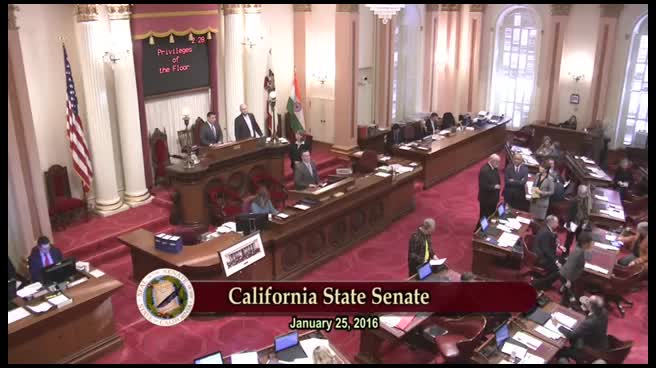
| Jan 25, 2016 | Read. Adopted. (Ayes 38. Noes 0. Page 2941.) Ordered to the Assembly. |
| Jan 26, 2016 | In Assembly. Held at Desk. |
| Feb 22, 2016 | Referred to Com. on RLS. |
| Feb 29, 2016 | From committee: Be adopted. Ordered to consent calendar. (Ayes 8. Noes 0.) (February 29). |
| Mar 3, 2016 | In Senate. Ordered to engrossing and enrolling. |
| Mar 3, 2016 | Read. Adopted. Ordered to the Senate. |
| Mar 3, 2016 | Read. Adopted. (Ayes 75. Noes 0. Page 3817.) Ordered to the Senate. |
| Mar 10, 2016 | Chaptered by Secretary of State. Res. Chapter 9, Statutes of 2016. |
| Mar 10, 2016 | Enrolled and filed with the Secretary of State at 11:45 a.m. |
|
Date
|
Description
|
Location
|
Votes
|
|
|---|---|---|---|---|
| Mar 3, 2016 | SCR 92 Pan Consent Calendar Second Day | Assembly Floor |
Passed |
|
| Feb 29, 2016 | Be adopted. To Consent Calendar. | Assembly Standing Committee on Rules |
Passed |
|
| Jan 25, 2016 | Senate 3rd Reading SCR92 Pan | Senate Floor |
Passed |
This list shows positions taken on this bill by organizations on the date displayed, which is linked to the original source.
Positions by individuals are not included.
|
Organization
|
Position
|
Date
|
|---|---|---|
| California Asian Pacific Chamber Of Commerce | ** Support | Jan 25, 2016 |
Date of Hearing: February 29, 2016
ASSEMBLY COMMITTEE ON
, Chair
SBPCA Bill Id:
Author:() – As Ver:January 7, 2016
SENATE VOTE: 38-0
SUBJECT:
SUMMARY: Proclaims January 13, 2016, as Korean-American Day. Specifically, this resolution makes the following legislative findings:
- On January 13, 1903, the history of Korean immigration to America began as 102 courageous Korean men, women, and children ventured across the Pacific Ocean aboard the S.S. Gaelic to land in Hawaii.
- While the first Korean immigrants fought and sacrificed to establish themselves in the United States, their children grew up to be patriotic American citizens, served in the Armed Forces of the United States during World War II, and made other important contributions to mainstream America.
- As the Korean-American community prepares for a new era and creates new history, Korean Americans must instill in the upcoming generations an appreciation for and pride in their own cultural heritage so that they may better contribute to the great State of California.
FISCAL EFFECT: None
REGISTERED SUPPORT / OPPOSITION:
Support
None on file
Opposition
None on file
Analysis Prepared by:
Office of Senate Floor Analyses (916) 651-1520 Fax: (916) 327-4478 | SCR 92 |
THIRD READING
Bill No: SCR 92
Introduced: 1/7/16
DIGEST:
This resolution proclaims January 13, 2016, as Korean-American Day.
ANALYSIS: This resolution makes the following legislative findings:
- On January 13, 1903, the history of Korean immigration to America began, when 102 courageous Korean men, women, and children landed in Hawaii after venturing across the vast Pacific Ocean aboard the S.S. Gaelic.
- While the first Korean immigrants to the United States fought and sacrificed to establish themselves, their children grew up to be patriotic citizens, many of whom went on to serve in the Armed Forces of the United States during World War II and to make other important contributions to mainstream American society.
- As the Korean-American community prepares for a new era and creates new history, Korean Americans must instill in younger generations the proper appreciation for the courage and values of their forefathers, a deep sense of their roots, and pride in their own cultural heritage so that they may better contribute to the great State of California, rich with ethnic and cultural diversity.
This resolution proclaims January 13, 2016, as Korean-American Day.
Prior Legislation
ACR 3 (Kim, Resolution Chapter 5, Statutes of 2015) proclaimed January 13, 2015, as Korean-American Day.
ACR 90 (Hayashi) would have proclaimed January 13, 2012, as Korean-American Day. The resolution died in Assembly Rules Committee.
ACR 3 (Hayashi) would have proclaimed January 13, 2011, as Korean-American Day. The resolution died on the Senate Inactive File.
ACR 96 (Hayashi, Resolution Chapter 1, Statutes of 2010) proclaimed January 13, 2010, as Korean-American Day.
ACR 9 (Hayashi, Resolution Chapter 7, Statutes of 2009) proclaimed January 13, 2009, as Korean-American Day.
FISCAL EFFECT: Appropriation: No Fiscal Com.: No Local: No
California Asian Pacific Chamber of Commerce
OPPOSITION: (Verified 1/15/16)
None received
Prepared by: Jonas Austin / SFA / (916) 651-1520
1/15/16 15:16:36
**** END ****
Bill Author

Bill Co-Author(s):