SJR 18: Small unmanned aircraft systems.
- Session Year: 2015-2016
- House: Senate
- Latest Version Date: 2016-05-20
This measure would request the President of the United States and the United States Secretary of Transportation to allow for the operation of small unmanned aircraft systems by farmers and rangeland managers pursuant to emergency rules adopted by the administration, as specified.
This measure would request the President of the United States and the United States Secretary of Transportation to allow for the operation of small unmanned aircraft systems by farmers and rangeland managers pursuant to emergency rules adopted by the administration, as specified.
This measure would request the President of the United States and the United States Secretary of Transportation to allow for the operation of small unmanned aircraft systems by farmers and rangeland managers pursuant to emergency rules adopted by the administration, as specified.
This measure would request the President of the United States and the United States Secretary of Transportation to allow for the operation of small unmanned aircraft systems by farmers and rangeland managers pursuant to emergency rules adopted by the administration using its emergency powers, administration, as specified.
This measure would request the President of the United States and the United States Secretary of Transportation to allow for the operation of small unmanned aircraft systems by farmers and rangeland managers pursuant to emergency rules adopted by the administration using its emergency powers, as specified.
WHEREAS, In the western United States, water is a vital and scarce resource, the availability of which has and continues to circumscribe growth, development, economic well-being, and environmental quality of life; and
WHEREAS, The wise use, conservation, development, and management of our water resources is critical to maintaining human life, health, safety, and property; and
WHEREAS, The western United States is currently experiencing serious drought conditions that are predicted to worsen; and
WHEREAS, Agricultural irrigation uses a significant amount of water, making the agricultural sector one of the most important sectors to examine when considering water conservation; and
WHEREAS, Even modest improvements in agricultural water use can result in significant amounts of water not being depleted regionwide, which can then be utilized elsewhere; and
WHEREAS, Precision agricultural management studies have shown that farmers can reduce the amount of water, fertilizer, and pesticide needed by their fields by utilizing high-resolution, high-quality remotely sensed imagery to guide their application efforts of water, fertilizer, and pesticide; and
WHEREAS, Small unmanned aircraft systems (sUAS) have the capability to quickly provide expansive, high-resolution, and high-quality remotely sensed imagery that can measure specific bands in the solar spectrum, such as the thermal infrared band, which allows farmers to better understand and manage their water use; and
WHEREAS, The Federal Aviation Administration (FAA) is currently in the process of adopting rules for the usage of sUAS in agricultural management; and
WHEREAS, Flights of sUAS, for the purposes of precision agricultural management, could occur safely at low altitudes, in rural areas removed from other air traffic and human populations, and in accordance with the FAAs proposed guidelines; and
WHEREAS, Small unmanned aircraft systems have been used in precision agricultural management in Japan for a decade, successfully optimizing and monitoring the management of 2.5 million acres of farmland, 40 percent of which are rice fields, without any significant reported incidents; and
WHEREAS, Several University of California campuses and the California State University system are developing precision agriculture applications with sUAS to help save water and improve crop and environmental monitoring. For example, the Mechatronics Embedded Systems and Automation Lab at the University of California, Merced, has developed numerous innovations for precision agricultural management with sUAS; and
WHEREAS, Flights of sUAS also have the capacity for detecting invasive plant species that deplete high amounts of water such as yellow star thistle, arundo, tamarisk, and cheatgrass, which serve no agricultural purpose and removal of which would help in water conservation efforts; and
WHEREAS, The use of sUAS is an emerging technology and has great promise for the development of models that forecast and predict economic impacts of droughts and meteorological phenomena; now, therefore, be it
Resolved by the Senate and the Assembly of the State of California, jointly, That, due to the severity of the drought gripping the western United States, the California Legislature respectfully requests the President of the United States and the United States Secretary of Transportation, more specifically the FAA, to allow for the operation of sUAS by farmers and rangeland managers pursuant to emergency rules adopted by the administration before the FAA rules for sUAS are finalized. The emergency rules should be based on the proposed FAA rules for sUAS that were released in February 2015 and that incorporate all of the following:
(a)That the emergency FAA rules for sUAS operation be applicable to counties located in the western portion of the United States that are projected to be in drought during the current growing season, as defined by the National Oceanic and Atmospheric Associations Seasonal Drought Outlook.
(b)That the emergency FAA rules for sUAS operation allow farmers to contract with sUAS flight service providers to execute missions on their behalf in the airspace overlying lands that they own or control under the proposed FAA rules for sUAS.
(c)That the emergency FAA rules for sUAS operations that allow universities and government agencies seeking to operate or procure providers for sUAS missions for drought-related research or precision management applications be given expedited approval.
(d)That the emergency FAA rules for sUAS operation also allow farmers and rangeland managers to use sUAS imagery to detect highly water-depletive invasive species on their land or public lands that they manage; and be it further
Resolved, That the Secretary of the Senate transmit copies of this resolution to the President and Vice President of the United States, the Speaker of the House of Representatives, the Majority Leader of the Senate, each Senator and Representative from California in the Congress of the United States, and the Federal Aviation Administration.
WHEREAS, In the western United States, water is a vital and scarce resource, the availability of which has and continues to circumscribe growth, development, economic well-being, and environmental quality of life; and
WHEREAS, The wise use, conservation, development, and management of our water resources is critical to maintaining human life, health, safety, and property; and
WHEREAS, The western United States is currently experiencing serious drought conditions that are predicted to worsen; and
WHEREAS, Agricultural irrigation uses a significant amount of water, making the agricultural sector one of the most important sectors to examine when considering water conservation; and
WHEREAS, Even modest improvements in agricultural water use can result in significant amounts of water not being depleted regionwide, which can then be utilized elsewhere; and
WHEREAS, Precision agricultural management studies have shown that farmers can reduce the amount of water, fertilizer, and pesticide needed by their fields by utilizing high-resolution, high-quality remotely sensed imagery to guide their application efforts of water, fertilizer, and pesticide; and
WHEREAS, Small unmanned aircraft systems (sUAS) have the capability to quickly provide expansive, high-resolution, and high-quality remotely sensed imagery that can measure specific bands in the solar spectrum, such as the thermal infrared band, which allows farmers to better understand and manage their water use; and
WHEREAS, The Federal Aviation Administration (FAA) is currently in the process of adopting rules for the usage of sUAS in agricultural management; and
WHEREAS, Flights of sUAS, for the purposes of precision agricultural management, could occur safely at low altitudes, in rural areas removed from other air traffic and human populations, and in accordance with the FAAs proposed guidelines; and
WHEREAS, Small unmanned aircraft systems have been used in precision agricultural management in Japan for a decade, successfully optimizing and monitoring the management of 2.5 million acres of farmland, 40 percent of which are rice fields, without any significant reported incidents; and
WHEREAS, Flights of sUAS also have the capacity for detecting invasive plant species that deplete high amounts of water such as yellow star thistle, arundo, tamarisk, and cheatgrass, which serve no agricultural purpose and removal of which would help in water conservation efforts; and
WHEREAS, The use of sUAS is an emerging technology and has great promise for the development of models that forecast and predict economic impacts of droughts and meteorological phenomena; now, therefore, be it
Resolved by the Senate and the Assembly of the State of California, jointly, That, due to the severity of the drought gripping the western United States, the California Legislature respectfully requests the President of the United States and the United States Secretary of Transportation, more specifically the FAA, to allow for the operation of sUAS by farmers and rangeland managers pursuant to emergency rules adopted by the administration using its emergency powers and before the FAA rules for sUAS are finalized. The emergency rules should be based on the proposed FAA rules for sUAS that were released in February 2015 and that incorporate all of the following:
(a)That the emergency FAA rules for sUAS operation be applicable to counties located in the western portion of the United States that are projected to be in drought during the current growing season, as defined by the National Oceanic and Atmospheric Associations Seasonal Drought Outlook.
(b)That the emergency FAA rules for sUAS operation allow farmers to contract with sUAS flight service providers to execute missions on their behalf in the airspace overlying lands that they own or control under the proposed FAA rules for sUAS.
(c)That the emergency FAA rules for sUAS operations that allow universities and government agencies seeking to operate or procure providers for sUAS missions for drought-related research or precision management applications be given expedited approval.
(d)That the emergency FAA rules for sUAS operation also allow farmers and rangeland managers to use sUAS imagery to detect highly water-depletive invasive species on their land or public lands that they manage; and be it further
Resolved, That the Secretary of the Senate transmit copies of this resolution to the President and Vice President of the United States, the Speaker of the House of Representatives, the Majority Leader of the Senate, each Senator and Representative from California in the Congress of the United States, and the Federal Aviation Administration.
WHEREAS, In the western United States, water is a vital and scarce resource, the availability of which has and continues to circumscribe growth, development, economic well-being, and environmental quality of life; and
WHEREAS, The wise use, conservation, development, and management of our water resources is critical to maintaining human life, health, safety, and property; and
WHEREAS, The western United States is currently experiencing serious drought conditions that are predicted to worsen; and
WHEREAS, Agricultural irrigation uses a significant amount of water, making the agricultural sector one of the most important sectors to examine when considering water conservation; and
WHEREAS, Even modest improvements in agricultural water use can result in significant amounts of water not being depleted regionwide, which can then be utilized elsewhere; and
WHEREAS, Precision agricultural management studies have shown that farmers can reduce the amount of water, fertilizer, and pesticide needed by their fields by utilizing high-resolution, high-quality remotely sensed imagery to guide their application efforts of water, fertilizer, and pesticide; and
WHEREAS, Small unmanned aircraft systems (sUAS) have the capability to quickly provide expansive, high-resolution, and high-quality remotely sensed imagery that can measure specific bands in the solar spectrum, such as the thermal infrared band, which allows farmers to better understand and manage their water use; and
WHEREAS, The Federal Aviation Administration (FAA) is currently in the process of adopting rules for the usage of sUAS in agricultural management; and
WHEREAS, Flights of sUAS, for the purposes of precision agricultural management, could occur safely at low altitudes, in rural areas removed from other air traffic and human populations, and in accordance with the FAAs proposed guidelines; and
WHEREAS, sUAS have been used in precision agricultural management in Japan for a decade, successfully optimizing and monitoring the management of 2.5 million acres of farmland, 40 percent of which are rice fields, without any significant reported incidents; and
WHEREAS, Flights of sUAS also have the capacity for detecting invasive plant species that deplete high amounts of water such as yellow star thistle, arundo, tamarisk, and cheatgrass, which serve no agricultural purpose and removal of which would help in water conservation efforts; and
WHEREAS, The use of sUAS is an emerging technology and has great promise for the development of models that forecast and predict economic impacts of droughts and meteorological phenomena; now, therefore, be it
Resolved by the Senate and the Assembly of the State of California, jointly, That, due to the severity of the drought gripping the western United States, the California Legislature respectfully requests the President of the United States and the United States Secretary of Transportation, more specifically the FAA, to allow for the operation of sUAS by farmers and rangeland managers pursuant to emergency rules adopted by the administration using its emergency powers and before the FAA rules for sUAS are finalized. The emergency rules should be based on the proposed FAA rules for sUAs that were released February 2015 and that incorporate all of the following:
(a)That the emergency FAA rules for sUAS operation be applicable to counties located in the western portion of the United States that are projected to be in drought during the current growing season, as defined by National Oceanic and Atmospheric Associations Seasonal Drought Outlook.
(b)That the emergency FAA rules for sUAS operation allow farmers to contract with sUAS flight service providers to execute missions on their behalf under the proposed FAA rules for sUAS.
(c)That the emergency FAA rules for sUAS operations that allow universities and government agencies seeking to operate or procure providers for sUAS missions for drought-related research or precision management applications be given expedited approval.
(d)That the emergency FAA rules for sUAS operation also allow farmers and rangeland managers to use sUAS imagery to detect highly water-depletive invasive species on their land or public lands that they manage; and be it further
Resolved, That the Secretary of the Senate transmit copies of this resolution to the President and Vice President of the United States, the Speaker of the House of Representatives, the Majority Leader of the Senate, each Senator and Representative from California in the Congress of the United States, and the Federal Aviation Administration.
|
Date
|
Status
|
|---|---|
| Sep 4, 2015 | Referred to Com. on P. & C.P. |
| May 20, 2016 | Enrolled and filed with the Secretary of State at 3:15 p.m. |
| May 20, 2016 | Chaptered by Secretary of State. Res. Chapter 43, Statutes of 2016. |
| May 12, 2016 | Assembly amendments concurred in. (Ayes 37. Noes 0.) Ordered to engrossing and enrolling. |
| May 12, 2016 | Assembly amendments concurred in. (Ayes 37. Noes 0. Page 3840.) Ordered to engrossing and enrolling. |
| May 9, 2016 | Read. Adopted. (Ayes 78. Noes 0. Page 4725.) Ordered to the Senate. |
| May 9, 2016 | Read. Adopted. Ordered to the Senate. |
| May 9, 2016 | In Senate. Concurrence in Assembly amendments pending. |
| May 4, 2016 | From committee: Be adopted. Ordered to consent calendar. (Ayes 11. Noes 0.) (May 3). |
| Mar 8, 2016 | From committee with author's amendments. Read second time and amended. Re-referred to Com. on P. & C.P. |
| Jul 16, 2015 | Introduced. Referred to Com. on RLS. |
| Sep 2, 2015 | Read. Adopted. (Ayes 39. Noes 0.) Ordered to the Assembly. |
| Sep 2, 2015 | Read. Adopted. (Ayes 39. Noes 0. Page 2428.) Ordered to the Assembly. |
| Sep 2, 2015 | In Assembly. Held at Desk. |
| Sep 1, 2015 | Read second time and amended. Ordered to third reading. |
| Sep 1, 2015 | (Corrected September 1). |
| Aug 31, 2015 | From committee: Be adopted as amended. (Ayes 7. Noes 0.) (August 25). |
| Aug 31, 2015 | From committee: Be adopted as amended. (Ayes 7. Noes 0. Page 2174.) (August 25). |
| Aug 21, 2015 | Set for hearing August 25. |
| Aug 17, 2015 | Re-referred to Com. on JUD. |
|
Date
|
Description
|
Location
|
Votes
|
|
|---|---|---|---|---|
| May 12, 2016 | Unfinished Business SJR18 Wolk Concurrence | Senate Floor |
Passed |
|
| May 9, 2016 | SJR 18 Wolk Consent Calendar Second Day Regular Session | Assembly Floor |
Passed |
|
| May 3, 2016 | Be adopted. To Consent Calendar. | Assembly Standing Committee on Privacy and Consumer Protection |
Passed |
|
| Sep 2, 2015 | Senate 3rd Reading SJR18 Wolk | Senate Floor |
Passed |
|
| Aug 25, 2015 | Be adopted as amended | Senate Standing Committee on Judiciary |
Passed |
This list shows positions taken on this bill by organizations on the date displayed, which is linked to the original source.
Positions by individuals are not included.
|
Organization
|
Position
|
Date
|
|---|---|---|
| California GIS Council | ** Support | May 12, 2016 |
| Central Coast Forest Association | ** Support | May 12, 2016 |
| Great California Drone Debate Project | ** Support | May 12, 2016 |
Office of Senate Floor Analyses (916) 651-1520 Fax: (916) 327-4478 | SJR |
UNFINISHED BUSINESS
Bill No: SJR 18
:
SENATE JUDICIARY COMMITTEE: 7-0, 8/25/15
AYES: Jackson, Moorlach, Anderson, Hertzberg, Leno, Monning, Wieckowski
SENATE FLOOR: 39-0, 9/2/15
AYES: Allen, Anderson, Bates, Beall, Berryhill, Block, Cannella, De León, Fuller, Gaines, Galgiani, Glazer, Hall, Hancock, Hernandez, Hertzberg, Hill, Hueso, Huff, Jackson, Lara, Leno, Leyva, McGuire, Mendoza, Mitchell, Monning, Moorlach, Morrell, Nguyen, Nielsen, Pan, Pavley, Roth, Runner, Stone, Vidak, Wieckowski, Wolk
NO VOTE RECORDED: Liu
ASSEMBLY FLOOR: 78-0, 5/9/16 (Consent) - See last page for vote
SOURCE: Great California Drone Debate Project
DIGEST: This resolution urges the President of the United States and the United States Secretary of Transportation to allow for the operation of small unmanned aircraft systems (sUAS) by farmers and rangeland managers pursuant to emergency rules adopted by the administration.
Assembly Amendments add statements regarding the development of precision agriculture applications using sUAS by several University of California (UC) and California State University (CSU) campuses.
Existing federal law:
- Provides that the Federal Aviation Administration (FAA) shall regulate aircraft operations conducted in the national airspace, including unmanned aircraft operations. (49 U.S.C. Sec. 40103; 49 U.S.C. Sec. 40102(a)(6).)
- Directs the Secretary of Transportation, in consultation with representatives of the aviation industry, federal agencies that employ unmanned aircraft systems technology in the national airspace system, and the unmanned aircraft systems industry, to develop a comprehensive plan to safely accelerate the integration of civil unmanned aircraft systems into the national airspace system. (Federal Aviation Administration Modernization and Reform Act of 2012, H.R.658, 112th Congress (2011-2012).)
- Authorizes the Secretary of Transportation to determine if certain unmanned aircraft systems may operate safely in the national airspace system before completion of the plan required in the above provision. (Federal Aviation Administration Modernization and Reform Act of 2012, H.R.658, 112th Congress (2011-2012).)
This resolution makes the following statements:
- In the western United States, water is a vital and scarce resource, the availability of which has and continues to circumscribe growth, development, economic well-being, and environmental quality of life;
- The wise use, conservation, development, and management of our water resources is critical to maintaining human life, health, safety, and property;
- The western United States is currently experiencing serious drought conditions that are predicted to worsen;
- Agricultural irrigation uses a significant amount of water, making the agricultural sector one of the most important sectors to examine when considering water conservation;
- Even modest improvements in agricultural water use can result in significant amounts of water not being depleted regionwide, which can then be utilized elsewhere; and
- Precision agricultural management studies have shown that farmers can reduce the amount of water, fertilizer, and pesticide needed by their fields by utilizing high-resolution, high-quality remotely sensed imagery to guide their application efforts of water, fertilizer, and pesticide.
This resolution makes the following additional statements:
- sUAS have the capability to quickly provide expansive, high-resolution, and high-quality remotely sensed imagery that can measure specific bands in the solar spectrum, such as the thermal infrared band, which allows farmers to better understand and manage their water use;
- The FAA is currently in the process of adopting rules for the usage of sUAS in agricultural management;
- Flights of sUAS, for the purposes of precision agricultural management, could occur safely at low altitudes, in rural areas removed from other air traffic and human populations, and in accordance with the FAA’s proposed guidelines;
- sUAS have been used in precision agricultural management in Japan for a decade, successfully optimizing and monitoring the management of 2.5 million acres of farmland, 40 percent of which are rice fields, without any significant reported incidents;
- Several UC campuses and the CSU system are developing precision agriculture applications with sUAS to help save water and improve crop and environmental monitoring, including the Mechatronics Embedded Systems and Automation Lab at UC Merced, which has developed numerous innovations for precision agricultural management with sUAS;
- Flights of sUAS also have the capacity for detecting invasive plant species that deplete high amounts of water such as yellow star thistle, arundo, tamarisk, and cheatgrass, which serve no agricultural purpose and removal of which would help in water conservation efforts; and
- The use of sUAS is an emerging technology and has great promise for the development of models that forecast and predict economic impacts of droughts and meteorological phenomena.
This resolution respectfully requests the President of the United States and the United States Secretary of Transportation, more specifically the FAA, to allow for the operation of sUAS by farmers and rangeland managers pursuant to emergency rules adopted by the administration before the FAA rules for sUAS are finalized.
This resolution specifies that the emergency rules should be based on the proposed FAA rules for sUAS that were released in February 2015 and that incorporate all of the following:
- That the emergency FAA rules for sUAS operation be applicable to counties located in the western portion of the United States that are projected to be in drought during the current growing season, as defined by the National Oceanic and Atmospheric Association’s Seasonal Drought Outlook;
- That the emergency FAA rules for sUAS operation allow farmers to contract with sUAS flight service providers to execute missions on their behalf in the airspace overlying lands that they own or control under the proposed FAA rules for sUAS;
- That the emergency FAA rules for sUAS operations that allow universities and government agencies seeking to operate or procure providers for sUAS missions for drought-related research or precision management applications be given expedited approval; and
- That the emergency FAA rules for sUAS operation also allow farmers and rangeland managers to use sUAS imagery to detect highly water-depletive invasive species on their land or public lands that they manage.
Background
The development of sUAS – known variously as “unmanned aerial vehicles,” “remote piloted aircraft,” or simply “drones” – promises to transform the way Californians interact with each other and their environment. Just a few decades ago, small aircraft of this type were the exclusive domain of hobbyists. Within the last decade or so, the public has become familiar with the military’s use of unmanned aircraft to accomplish certain mission objectives, ranging from clandestine intelligence gathering to aerial warfare. However, in December 2013 when Amazon, FedEx, and UPS announced their plans to integrate unmanned aircraft into their logistics and delivery services, the possibility of widespread civilian and commercial adoption of this technology became clear.
Drone technology holds great promise to transform the way California’s farmers and ranchers manage livestock and agricultural resources. According to a news article from last year:
For centuries, much of farming has been legwork: walking down rows, through patches, going plant-by-plant to check for weeds, bugs, parched soil, any sign of distress. Modern machinery, soil-testing, computers, and ground-based sensors have made crop monitoring and tending more efficient, but still lots goes unnoticed. Even with a trained eye, there also are inevitably data that can’t be detected at scale, such as nitrogen deficiency or diminished photosynthesis, the chlorophyll-powered process that is crucial for a healthy plant. And if one ailing plant is found, what is the impact on the sometimes hundreds of thousands of plants that surround it? Farmers were long left to guess.
Not for much longer: Agriculture drones may soon be flying across America’s farmland . . . the impact on the US farm sector could be huge: billions of dollars in economic returns and tens of thousands of jobs within only a few years. The American Farm Bureau Federation estimates farmers’ return-on-investment alone could be $12 per acre for corn and $2 to $3 per acre for soybeans and wheat.
It’s the latest — and most arresting — transformation in the burgeoning field of precision agriculture, which incorporates geospatial data and sensors to microtarget fields for better growth. Or, in other words, a Big Data revolution on the farm.
. . .
Despite the pervasive idea that drones are primarily useful for surveillance or warfare, agriculture drones are expected to make up 80 percent of the future commercial market, according to the Association for Unmanned Vehicle Systems International. Yes, they will be deployed as worker bees, spraying and treating crops, but the potential is much bigger: Super-high resolution spectral imaging will garner data-driven insight, allowing for more targeted fertilizing and better use of water and labor. The need for common fertilizers, such as nitrogen, as well as herbicides, insecticides, and fungicides that pollute local waterways could be substantially reduced. Even for organic farmers, monitoring for disease and drought could be made far easier. (John Wihbey, Agricultural Drones May Change the Way We Farm, Boston Globe, <https://www.bostonglobe.com/ideas/2015/ 08/22/agricultural-drones-change-way-farm/WTpOWMV9j4C7kchvbmPr4J/ story.html [as of Aug. 21, 2015].)
This resolution calls upon the President and the Secretary of Transportation to allow for the operation of drones by farmers and rangeland managers pursuant to emergency rules adopted by the administration before final rules for commercial drone use are promulgated by the FAA.
Comments
The author writes:
Currently the Federal Aviation Administration (FAA) requires anyone intending to use a small unmanned aircraft system (sUAS) for commercial purposes to file for a Section 333 exemption. Precision agriculture is one of the commercial purposes the FAA allows Section 333 exemptions for. As of February 2015, the FAA has issued interim rules regulating sUAS usage for commercial purposes; final regulations are expected in 2017.
SJR 18 requests that the FAA adopt emergency rules to allow farmers and rangeland managers to use sUAS for agricultural management. These rules would be limited to the region projected to be in drought during the current growing season, as defined by the National Oceanic and Atmospheric Association’s Seasonal Drought Outlook. Farmers would be able to contract with sUAS flight service providers, farmers and rangeland managers could use sUAS imagery to detect water-depletive invasive species, and universities and government agencies seeking to use sUAS for drought-related research will be given expedited approval.
The severity of the current drought in California requires every means to save water possible, especially agricultural usage. Every tool available should be utilized to help reduce water usage.
Related Legislation
SB 807 (Gaines, 2016) provides public entities and public employees with immunity from civil liability for any damage to an unmanned aircraft system if the damage was caused while the public entity or public employee was providing, and the unmanned aircraft system was interfering with, the operation, support, or enabling of specified emergency services. The bill provides similar immunity to emergency responders employed by private entities or who are unpaid volunteers when those emergency responders act within the scope of authority provided by a public entity or a public employee. The bill is awaiting referral in the Assembly.
SB 868 (Jackson, 2016) enacts the State Remote Piloted Aircraft Act, which creates a regulatory framework that allows for the deployment of drone technology under specified restrictions. The bill, among other things, limits drone use near critical infrastructure, heliports, and airports, without permission, limits drone use over state parks, wildlife refuges, the State Capitol, or other designated safety areas, without a permit or permission, prohibits the weaponization of drones, and prohibits the reckless operation of drones and drone interference with manned aircraft. The bill is pending in the Senate Appropriations Committee.
AB 2320 (Calderon, 2016) places several restrictions on the use of unmanned aircraft systems, including using such systems to violate protective orders, to view the scene of an emergency in a way that impedes police officers, firefighters, emergency medical, or other emergency personnel, or military personnel in the performance of their emergency duties, or to stalk another person by willfully, maliciously, and repeatedly following or willfully and maliciously harassing another person. The bill is pending in the Assembly Appropriations Committee.
FISCAL EFFECT: Appropriation: No Fiscal Com.: Local: No
Great California Drone Debate Project (source)
OPPOSITION: (Verified 5/10/16)
None received
ASSEMBLY FLOOR: 78-0, 5/9/16
AYES: Achadjian, Alejo, Travis Allen, Arambula, Atkins, Baker, Bigelow, Bloom, Bonilla, Bonta, Brough, Brown, Burke, Calderon, Campos, Chang, Chau, Chávez, Chiu, Chu, Cooley, Cooper, Dababneh, Dahle, Daly, Dodd, Eggman, Frazier, Gallagher, Cristina Garcia, Gatto, Gipson, Gomez, Gonzalez, Gordon, Gray, Grove, Hadley, Harper, Roger Hernández, Holden, Irwin, Jones, Jones-Sawyer, Kim, Lackey, Levine, Linder, Lopez, Low, Maienschein, Mathis, Mayes, McCarty, Medina, Melendez, Mullin, Nazarian, Obernolte, O'Donnell, Olsen, Patterson, Quirk, Ridley-Thomas, Rodriguez, Salas, Santiago, Steinorth, Mark Stone, Thurmond, Ting, Wagner, Waldron, Weber, Wilk, Williams, Wood, Rendon
NO VOTE RECORDED: Beth Gaines, Eduardo Garcia
5/11/16 15:44:23
**** END ****
Date of Hearing: May 3, 2016
ASSEMBLY COMMITTEE ON PRIVACY AND CONSUMER PROTECTION
Ed Chau, Chair
SBPCA Bill Id:SJR 18
Author:(Wolk) – As Amended Ver:March 8, 2016
SENATE VOTE: 39-0
SUBJECT: Small unmanned aircraft systems
SUMMARY: Urges the President of the United States and the United States Secretary of Transportation to allow for the operation of small unmanned aircraft systems (sUAS) by farmers and rangeland managers pursuant to emergency rules adopted by the administration using its emergency powers. Specifically, this bill:
- Declares:
- In the western United States, water is a vital and scarce resource, the availability of which has and continues to circumscribe growth, development, economic well-being, and environmental quality of life;
- The wise use, conservation, development, and management of our water resources is critical to maintaining human life, health, safety, and property;
- The western United States is currently experiencing serious drought conditions that are predicted to worsen;
- Agricultural irrigation uses a significant amount of water, making the agricultural sector one of the most important sectors to examine when considering water conservation;
- Even modest improvements in agricultural water use can result in significant amounts of water not being depleted regionwide, which can then be utilized elsewhere;
- Precision agricultural management studies have shown that farmers can reduce the amount of water, fertilizer, and pesticide needed by their fields by utilizing high-resolution, high-quality remotely sensed imagery to guide their application efforts of water, fertilizer, and pesticide;
- sUAS have the capability to quickly provide expansive, high-resolution, and high-quality remotely sensed imagery that can measure specific bands in the solar spectrum, such as the thermal infrared band, which allows farmers to better understand and manage their water use;
- The Federal Aviation Administration (FAA) is currently in the process of adopting rules for the usage of sUAS in agricultural management;
- Flights of sUAS, for the purposes of precision agricultural management, could occur safely at low altitudes, in rural areas removed from other air traffic and human populations, and in accordance with the FAA’s proposed guidelines;
- sUAS have been used in precision agricultural management in Japan for a decade, successfully optimizing and monitoring the management of 2.5 million acres of farmland, 40% of which are rice fields, without any significant reported incidents;
- Several University of California campuses and the California State University system are developing precision agriculture applications with sUAS to help save water and improve crop and environmental monitoring, including the Mechatronics Embedded Systems and Automation Lab at the University of California, Merced, which has developed numerous innovations for precision agricultural management with sUAS;
- Flights of sUAS also have the capacity for detecting invasive plant species that deplete high amounts of water such as yellow star thistle, arundo, tamarisk, and cheatgrass, which serve no agricultural purpose and removal of which would help in water conservation efforts; and
- The use of sUAS is an emerging technology and has great promise for the development of models that forecast and predict economic impacts of droughts and meteorological phenomena.
- Respectfully requests that, due to the severity of the drought gripping the western United States, the President of the United States and the United States Secretary of Transportation, more specifically the FAA, allow for the operation of sUAS by farmers and rangeland managers pursuant to emergency rules adopted by the administration before the FAA rules for sUAS are finalized.
- Specifies that the emergency rules should be based on the proposed FAA rules for sUAS that were released in February 2015, and should also incorporate all of the following:
- That the emergency FAA rules for sUAS operations be applicable to counties located in the western portion of the United States that are projected to be in drought during the current growing season, as defined by the National Oceanic and Atmospheric Association’s Seasonal Drought Outlook.
- That the emergency FAA rules for sUAS operations allow farmers to contract with UAS flight service providers to execute missions on their behalf in the airspace overlying lands that they own or control under the proposed FAA rules for UAS.
- That the emergency FAA rules for sUAS operations that allow universities and government agencies seeking to operate or procure providers for UAS missions for drought-related research or precision management applications be given expedited approval.
- That the emergency FAA rules for sUAS operations also allow farmers and rangeland managers to use sUAS imagery to detect highly water-depletive invasive species on their land or public lands that they manage.
EXISTING LAW:
- Requires the FAA to regulate aircraft operations conducted in the national airspace, including unmanned aircraft operations. (49 U.S.C. Sec. 40102(a)(6), and 40103)
- Requires, under the FAA Modernization and Reform Act of 2012, the Secretary of Transportation and the FAA, in consultation with representatives of the aviation industry, federal agencies that employ unmanned aircraft, and the UAS industry, to develop a comprehensive plan to safely integrate UAS into the national airspace system by September 30, 2015, and to develop and implement certification requirements for the operation of UAS in the national airspace system by December 31, 2015. (Federal Aviation Administration Modernization and Reform Act of 2012, H.R.658, 112th Congress (2011-2012), Public Law Number 112-095)
- Authorizes the United States Secretary of Transportation to determine if certain UAS may operate safely in the national airspace system before completion of the plan required in the above provision. (Federal Aviation Administration Modernization and Reform Act of 2012, H.R.658, 112th Congress (2011-2012), Public Law Number 112-095)
FISCAL EFFECT: None. This bill is keyed nonfiscal by the Legislative Counsel.
COMMENTS:
- Purpose of this bill. This bill asks the federal government to adopt interim regulations to allow farmers and rangeland managers to operate sUAS to facilitate farm water conservation and to allow universities and government agencies to conduct sUAS missions for drought-related research and precision agricultural and water management. SJR 18 is sponsored by a 2015 Davis Senior High School class project entitled, “The Great California Drone Debate.”
- Author's statement. According to the author, "Currently the [FAA] requires anyone intending to use a small [UAS] for commercial purposes to file for a Section 333 exemption. Precision agriculture is one of the commercial purposes the FAA allows Section 333 exemptions for. As of February 2015, the FAA has issued interim rules regulating UAS usage for commercial purposes; final regulations are expected in 2017."
"SJR 18 requests that the FAA adopt emergency rules to allow farmers and rangeland managers to use UAS for agricultural management. These rules would be limited to the region projected to be in drought during the current growing season, as defined by the National Oceanic and Atmospheric Association’s Seasonal Drought Outlook. Farmers would be able to contract with UAS flight service providers, farmers and rangeland managers could use UAS imagery to detect water-depletive invasive species, and universities and government agencies seeking to use UAS for drought-related research will be given expedited approval."
"The severity of the current drought in California requires every means to save water possible, especially agricultural usage. Every tool available should be utilized to help reduce water usage."
- FAA’s forthcoming regulation of sUAS. In 2012, Congress passed the FAA Modernization and Reform Act of 2012 (Act). The Act required the FAA to establish a framework for safely integrating UAS into the national airspace no later than September 30, 2015, and authorized the FAA establish interim requirements for the commercial operation of UAS. Under the interim rules, UAS operators must meet certain standards and apply for a commercial use exemption and an FAA Certificate of Authorization to operate in in “navigable airspace,” which is generally above 500 feet and within a five mile radius of airports.
On February 15, 2015, the FAA proposed a new framework of regulations to allow the use of “small” UAS (under 55 pounds) from the ground up to 500 feet. If enacted, the proposed rules would limit flights to non-recreational, daylight uses and would require the UAS pilot to maintain a visual line of sight with the UAS. The FAA has stated it may also create a less strict regulatory framework for “micro” UAS (under 4.4 pounds). Such regulations, once enacted, may be found to preempt state statutes governing drone use. - Growth in commercial and agricultural uses of UAS. Commercial applications for UAS are growing exponentially. UAS gives the news media economical and environmentally-friendly access to aerial views of traffic, storms, and other events when compared to the current use of helicopters and other manned aircraft. UAS is the planned future delivery system for mail delivery and Internet companies, such as Fed Ex and Amazon. And UAS is used in the agricultural industry to observe and measure crops while conserving resources and avoiding the use of heavy equipment.
According to an August 2015 article in the Boston Globe, drone technology may transform the way California’s farmers and ranchers manage livestock and agricultural resources:
For centuries, much of farming has been legwork: walking down rows, through patches, going plant-by-plant to check for weeds, bugs, parched soil, any sign of distress. Modern machinery, soil-testing, computers, and ground-based sensors have made crop monitoring and tending more efficient, but still lots goes unnoticed. Even with a trained eye, there also are inevitably data that can’t be detected at scale, such as nitrogen deficiency or diminished photosynthesis, the chlorophyll-powered process that is crucial for a healthy plant. And if one ailing plant is found, what is the impact on the sometimes hundreds of thousands of plants that surround it? Farmers were long left to guess.
Not for much longer: Agriculture drones may soon be flying across America’s farmland . . . the impact on the US farm sector could be huge: billions of dollars in economic returns and tens of thousands of jobs within only a few years. The American Farm Bureau Federation estimates farmers’ return-on-investment alone could be $12 per acre for corn and $2 to $3 per acre for soybeans and wheat.
It’s the latest — and most arresting — transformation in the burgeoning field of precision agriculture, which incorporates geospatial data and sensors to microtarget fields for better growth. Or, in other words, a Big Data revolution on the farm. . . .
Despite the pervasive idea that drones are primarily useful for surveillance or warfare, agriculture drones are expected to make up 80 percent of the future commercial market, according to the Association for Unmanned Vehicle Systems International. Yes, they will be deployed as worker bees, spraying and treating crops, but the potential is much bigger: Super-high resolution spectral imaging will garner data-driven insight, allowing for more targeted fertilizing and better use of water and labor. The need for common fertilizers, such as nitrogen, as well as herbicides, insecticides, and fungicides that pollute local waterways could be substantially reduced. Even for organic farmers, monitoring for disease and drought could be made far easier. (John Wihbey, Agricultural Drones May Change The Way We Farm, Boston Globe, <https://www.bostonglobe.com/ideas/2015/ 08/22/agricultural-drones-change-way-farm/WTpOWMV9j4C7kchvbmPr4J/ story.html> [as of Aug. 21, 2015].)
This resolution calls upon the President and the Secretary of Transportation to allow for the operation of drones by farmers and rangeland managers as soon as possible under emergency rules until the final rules for commercial drone use are promulgated by the FAA.
REGISTERED SUPPORT / OPPOSITION:
Support
California GIS Council
Central Coast Forest Association
Opposition
None on file.
Analysis Prepared by: Jennie Bretschneider / P. & C.P. / (916) 319-2200
SJR 18
Page 8
|
Office of Senate Floor Analyses (916) 651-1520 Fax: (916) 327-4478 |
THIRD READING
Bill No: SJR 18
Amended: 9/1/15
SENATE JUDICIARY COMMITTEE: 7-0, 8/25/15
AYES: Jackson, Moorlach, Anderson, Hertzberg, Leno, Monning, Wieckowski
SUBJECT: Small unmanned aircraft systems.
SOURCE: Great California Drone Debate Project
DIGEST: This resolution urges the President of the United States and the United States Secretary of Transportation to allow for the operation of small unmanned aircraft systems by farmers and rangeland managers pursuant to emergency rules adopted by the Administration.
Existing federal law:
Provides that the Federal Aviation Administration (FAA) shall regulate aircraft operations conducted in the national airspace, including unmanned aircraft operations. (49 U.S.C. Sec. 40103; 49 U.S.C. Sec. 40102(a)(6).)
Directs the Secretary of Transportation, in consultation with representatives of the aviation industry, federal agencies that employ unmanned aircraft systems technology in the national airspace system, and the unmanned aircraft systems industry, to develop a comprehensive plan to safely accelerate the integration of civil unmanned aircraft systems into the national airspace system. (FAA Modernization and Reform Act of 2012, H.R.658, 112th Congress (2011-2012).)
Authorizes the Secretary of Transportation to determine if certain unmanned aircraft systems may operate safely in the national airspace system before completion of the plan required in the above provision. (FAA Modernization and Reform Act of 2012, H.R.658, 112th Congress (2011-2012).)
This resolution makes the following statements:
In the western United States, water is a vital and scarce resource, the availability of which has and continues to circumscribe growth, development, economic well-being, and environmental quality of life;
The wise use, conservation, development, and management of our water resources is critical to maintaining human life, health, safety, and property;
The western United States is currently experiencing serious drought conditions that are predicted to worsen;
Agricultural irrigation uses a significant amount of water, making the agricultural sector one of the most important sectors to examine when considering water conservation;
Even modest improvements in agricultural water use can result in significant amounts of water not being depleted regionwide, which can then be utilized elsewhere; and
Precision agricultural management studies have shown that farmers can reduce the amount of water, fertilizer, and pesticide needed by their fields by utilizing high-resolution, high-quality remotely sensed imagery to guide their application efforts of water, fertilizer, and pesticide.
This resolution makes the following additional statements:
Small unmanned aircraft systems (sUAS) have the capability to quickly provide expansive, high-resolution, and high-quality remotely sensed imagery that can measure specific bands in the solar spectrum, such as the thermal infrared band, which allows farmers to better understand and manage their water use;
The FAA is currently in the process of adopting rules for the usage of sUAS in agricultural management;
Flights of sUAS, for the purposes of precision agricultural management, could occur safely at low altitudes, in rural areas removed from other air traffic and human populations, and in accordance with the FAA’s proposed guidelines;
sUAS have been used in precision agricultural management in Japan for a decade, successfully optimizing and monitoring the management of 2.5 million acres of farmland, 40 percent of which are rice fields, without any significant reported incidents;
Flights of sUAS also have the capacity for detecting invasive plant species that deplete high amounts of water such as yellow star thistle, arundo, tamarisk, and cheatgrass, which serve no agricultural purpose and removal of which would help in water conservation efforts; and
The use of sUAS is an emerging technology and has great promise for the development of models that forecast and predict economic impacts of droughts and meteorological phenomena.
This resolution respectfully requests the President of the United States and the United States Secretary of Transportation, more specifically the FAA, to allow for the operation of sUAS by farmers and rangeland managers pursuant to emergency rules adopted by the administration before the FAA rules for sUAS are finalized.
This resolution specifies that the emergency rules should be based on the proposed FAA rules for sUAS that were released in February 2015 and that incorporate all of the following:
That the emergency FAA rules for sUAS operation be applicable to counties located in the western portion of the United States that are projected to be in drought during the current growing season, as defined by the National Oceanic and Atmospheric Association’s Seasonal Drought Outlook;
That the emergency FAA rules for sUAS operation allow farmers to contract with sUAS flight service providers to execute missions on their behalf in the airspace overlying lands that they own or control under the proposed FAA rules for sUAS;
That the emergency FAA rules for sUAS operations that allow universities and government agencies seeking to operate or procure providers for sUAS missions for drought-related research or precision management applications be given expedited approval; and
That the emergency FAA rules for sUAS operation also allow farmers and rangeland managers to use sUAS imagery to detect highly water-depletive invasive species on their land or public lands that they manage.
Background
The development of small unmanned aircraft systems – known variously as “unmanned aerial vehicles,” “remote piloted aircraft,” or simply “drones” – promises to transform the way Californians interact with each other and their environment. Just a few decades ago, small aircraft of this type were the exclusive domain of hobbyists. Within the last decade or so, the public has become familiar with the military’s use of unmanned aircraft to accomplish certain mission objectives, ranging from clandestine intelligence gathering to aerial warfare. However, in December 2013 when Amazon, FedEx, and UPS announced their plans to integrate unmanned aircraft into their logistics and delivery services, the possibility of widespread civilian and commercial adoption of this technology became clear.
Drone technology holds great promise to transform the way California’s farmers and ranchers manage livestock and agricultural resources. According to a recent news article:
For centuries, much of farming has been legwork: walking down rows, through patches, going plant-by-plant to check for weeds, bugs, parched soil, any sign of distress. Modern machinery, soil-testing, computers, and ground-based sensors have made crop monitoring and tending more efficient, but still lots goes unnoticed. Even with a trained eye, there also are inevitably data that can’t be detected at scale, such as nitrogen deficiency or diminished photosynthesis, the chlorophyll-powered process that is crucial for a healthy plant. And if one ailing plant is found, what is the impact on the sometimes hundreds of thousands of plants that surround it? Farmers were long left to guess.
Not for much longer: Agriculture drones may soon be flying across America’s farmland . . . the impact on the US farm sector could be huge: billions of dollars in economic returns and tens of thousands of jobs within only a few years. The American Farm Bureau Federation estimates farmers’ return-on-investment alone could be $12 per acre for corn and $2 to $3 per acre for soybeans and wheat.
It’s the latest — and most arresting — transformation in the burgeoning field of precision agriculture, which incorporates geospatial data and sensors to microtarget fields for better growth. Or, in other words, a Big Data revolution on the farm.
. . .
Despite the pervasive idea that drones are primarily useful for surveillance or warfare, agriculture drones are expected to make up 80 percent of the future commercial market, according to the Association for Unmanned Vehicle Systems International. Yes, they will be deployed as worker bees, spraying and treating crops, but the potential is much bigger: Super-high resolution spectral imaging will garner data-driven insight, allowing for more targeted fertilizing and better use of water and labor. The need for common fertilizers, such as nitrogen, as well as herbicides, insecticides, and fungicides that pollute local waterways could be substantially reduced. Even for organic farmers, monitoring for disease and drought could be made far easier. (John Wihbey, Agricultural Drones May Change the Way We Farm, Boston Globe, <https://www.bostonglobe.com/ideas/2015/ 08/22/agricultural-drones-change-way-farm/WTpOWMV9j4C7kchvbmPr4J/ story.html [as of Aug. 21, 2015].)
This resolution calls upon the President and the Secretary of Transportation to allow for the operation of drones by farmers and rangeland managers pursuant to emergency rules adopted by the administration before final rules for commercial drone use are promulgated by the FAA.
Comments
The author writes:
Currently the Federal Aviation Administration (FAA) requires anyone intending to use a small unmanned aircraft system (sUAS) for commercial purposes to file for a Section 333 exemption. Precision agriculture is one of the commercial purposes the FAA allows Section 333 exemptions for. As of February 2015, the FAA has issued interim rules regulating sUAS usage for commercial purposes; final regulations are expected in 2017.
SJR 18 requests that the FAA adopt emergency rules to allow farmers and rangeland managers to use sUAS for agricultural management. These rules would be limited to the region projected to be in drought during the current growing season, as defined by the National Oceanic and Atmospheric Association’s Seasonal Drought Outlook. Farmers would be able to contract with sUAS flight service providers, farmers and rangeland managers could use sUAS imagery to detect water-depletive invasive species, and universities and government agencies seeking to use sUAS for drought-related research will be given expedited approval.
The severity of the current drought in California requires every means to save water possible, especially agricultural usage. Every tool available should be utilized to help reduce water usage.
Related/Prior Legislation
SB 142 (Jackson, 2015) clarifies that the operation of an unmanned aerial vehicle less than 350 feet above the property of another, without permission or legal authority, constitutes trespass. The bill has been enrolled and is awaiting action by Governor Brown.
SB 168 (Gaines, 2015) makes it unlawful to knowingly, intentionally, or recklessly operate an unmanned aircraft in a manner that prevents or delays the extinguishment of a fire, or in any way interferes with the efforts of firefighters to control, contain, or extinguish a fire. The bill also provides that an emergency responder shall not be liable for any damage to an unmanned aircraft system if the damage was caused while the emergency responder was providing, and the unmanned aircraft system was interfering with, the operation, support, or enabling of ambulance services, firefighting-related services, or search and rescue services. The bill is awaiting referral in the Assembly Rules Committee.
SB 170 (Gaines, 2015) provides that a person who knowingly and intentionally operates an unmanned aircraft on or above the grounds of a state prison or a jail is guilty of a misdemeanor, except as specified. The bill is pending on the Assembly Floor.
SB 262 (Galgiani, 2015) authorizes law enforcement agencies to use unmanned aircraft systems provided such use complies with certain conditions, including: search and seizure protections in the U.S. and California Constitutions; federal law applicable to unmanned aircraft systems; and state law applicable to law enforcement agency use of surveillance technology. The bill also requires law enforcement agencies to receive approval from their local governing body prior to using unmanned aircraft systems, and restricts the use of such systems for conducting surveillance of private property. The bill is pending in the Senate Judiciary Committee.
SB 271 (Gaines, 2015) makes it an infraction to operate an unmanned aircraft on the grounds of, or less than 350 feet above ground level within the airspace overlaying, a public school providing instruction in kindergarten or grades 1 to 12 during school hours and without permission of school officials. The bill exempts specified media and news personnel unless they receive a request from school officials to cease using an unmanned aircraft above a school, and also exempts law enforcement. The bill is pending on the Assembly Floor.
AB 14 (Waldron, 2015) creates the Unmanned Aircraft Systems Task Force, which is required to research, develop, and formulate a comprehensive policy for unmanned aircraft systems in California. The task force is required to submit, among other things, a policy draft and suggested legislation pertaining to unmanned aircraft systems to the Legislature and the Governor on or before January 1, 2018. The bill is pending reconsideration in the Assembly Transportation Committee.
AB 56 (Quirk, 2015) prohibits law enforcement agencies from using unmanned aircraft systems, or contracting for the use of these systems, unless the law enforcement agency complies with specified requirements, including the development of a policy concerning the use of the system, and complies with certain provisions of state and federal law. The bill prohibits a law enforcement agency from using an unmanned aircraft system to surveil private property without a warrant, and requires images, footage, or data obtained through the use of such a system to be permanently destroyed within one year, except as specified. The bill is pending on the Senate Floor.
AB 856 (Calderon, 2015) renders a person liable for physical invasion of privacy when that person knowingly enters upon the land of another without permission, including entry into the airspace above the land, in order to capture any type of visual image, sound recording, or other physical impression of a person engaging in a private, personal, or familial activity and the invasion occurs in a manner that is offensive to a reasonable person. The bill is pending action in Engrossing and Enrolling.
AB 1327 (Gorell, 2014) would have prohibited public agencies from using unmanned aircraft systems, or contracting for the use of these systems, with certain exceptions for law enforcement agencies acting pursuant to a warrant and in certain other cases, including when the use or operation of the unmanned aircraft system achieves the core mission of the agency and the purpose of use is unrelated to the gathering of criminal intelligence. The bill would have also required notice by public agencies intending to deploy unmanned aircraft, would have required images, footage, or data obtained through the use of such aircraft to be permanently destroyed within one year except as specified, and would have prohibited equipping unmanned aircraft with weapons. The bill was vetoed by Governor Brown.
SB 15 (Padilla, 2013) would have, among other things, required law enforcement agencies to obtain search warrants when using unmanned aircraft, and would have required that an application for the search warrant specify the intended purpose for which the unmanned aircraft would be used. The bill would have also restricted data collection by unmanned aircraft and would have prohibited equipping unmanned aircraft with weapons. The bill died in the Assembly Public Safety Committee.
AB 1524 (Waldron, 2013) would have required any entity that owns or operates an unmanned aircraft to place identifying information or digitally store identifying information on the aircraft. The bill would have exempted model aircraft, and would have made a person or entity that violates its provisions liable for a civil fine not to exceed $2,500. The bill was set for hearing in the Assembly Transportation Committee, but the hearing was cancelled at the author’s request.
FISCAL EFFECT: Appropriation: No Fiscal Com.: No Local: No
Great California Drone Debate Project (source)
None received
Prepared by: Tobias Halvarson / JUD. / (916) 651-4113
9/1/15 21:37:28
**** END ****
SJR 18 (Wolk)
Page 8 of 8
Senator Hannah-Beth Jackson, Chair
2015-2016 Regular Session
SJR 18 (Wolk)
Version: July 16, 2015
Hearing Date: August 25, 2015
Fiscal: No
Urgency: No
TH
SUBJECT
Small Unmanned Aircraft Systems
DESCRIPTION
This resolution urges the President of the United States and the United States Secretary of Transportation to allow for the operation of small unmanned aircraft systems by farmers and rangeland managers pursuant to emergency rules adopted by the administration using its emergency powers.
BACKGROUND
The development of small unmanned aircraft systems – known variously as “unmanned aerial vehicles,” “remote piloted aircraft,” or simply “drones” – promises to transform the way Californians interact with each other and their environment. Just a few decades ago, small aircraft of this type were the exclusive domain of hobbyists. Within the last decade or so, the public has become familiar with the military’s use of unmanned aircraft to accomplish certain mission objectives, ranging from clandestine intelligence gathering to aerial warfare. However, in December 2013 when Amazon, FedEx, and UPS announced their plans to integrate unmanned aircraft into their logistics and delivery services, the possibility of widespread civilian and commercial adoption of this technology became clear.
Drone technology holds great promise to transform the way California’s farmers and ranchers manage livestock and agricultural resources. According to a recent news article:
For centuries, much of farming has been legwork: walking down rows, through patches, going plant-by-plant to check for weeds, bugs, parched soil, any sign of distress. Modern machinery, soil-testing, computers, and ground-based sensors have made crop monitoring and tending more efficient, but still lots goes unnoticed. Even with a trained eye, there also are inevitably data that can’t be detected at scale, such as nitrogen deficiency or diminished photosynthesis, the chlorophyll-powered process that is crucial for a healthy plant. And if one ailing plant is found, what is the impact on the sometimes hundreds of thousands of plants that surround it? Farmers were long left to guess.
Not for much longer: Agriculture drones may soon be flying across America’s farmland . . . the impact on the US farm sector could be huge: billions of dollars in economic returns and tens of thousands of jobs within only a few years. The American Farm Bureau Federation estimates farmers’ return-on-investment alone could be $12 per acre for corn and $2 to $3 per acre for soybeans and wheat.
It’s the latest — and most arresting — transformation in the burgeoning field of precision agriculture, which incorporates geospatial data and sensors to microtarget fields for better growth. Or, in other words, a Big Data revolution on the farm.
. . .
Despite the pervasive idea that drones are primarily useful for surveillance or warfare, agriculture drones are expected to make up 80 percent of the future commercial market, according to the Association for Unmanned Vehicle Systems International. Yes, they will be deployed as worker bees, spraying and treating crops, but the potential is much bigger: Super-high resolution spectral imaging will garner data-driven insight, allowing for more targeted fertilizing and better use of water and labor. The need for common fertilizers, such as nitrogen, as well as herbicides, insecticides, and fungicides that pollute local waterways could be substantially reduced. Even for organic farmers, monitoring for disease and drought could be made far easier. (John Wihbey, Agricultural Drones May Change The Way We Farm, Boston Globe, <https://www.bostonglobe.com/ideas/2015/ 08/22/agricultural-drones-change-way-farm/WTpOWMV9j4C7kchvbmPr4J/ story.html> [as of Aug. 21, 2015].)
This resolution calls upon the President and the Secretary of Transportation to allow for the operation of drones by farmers and rangeland managers pursuant to emergency rules adopted by the administration before final rules for commercial drone use are promulgated by the Federal Aviation Administration.
CHANGES TO EXISTING LAW
Existing federal law provides that the Federal Aviation Administration shall regulate aircraft operations conducted in the national airspace, including unmanned aircraft operations. (49 U.S.C. Sec. 40103; 49 U.S.C. Sec. 40102(a)(6).)
Existing federal law directs the Secretary of Transportation, in consultation with representatives of the aviation industry, federal agencies that employ unmanned aircraft systems technology in the national airspace system, and the unmanned aircraft systems industry, to develop a comprehensive plan to safely accelerate the integration of civil unmanned aircraft systems into the national airspace system. (Federal Aviation Administration Modernization and Reform Act of 2012, H.R.658, 112th Congress (2011-2012).)
Existing federal law authorizes the Secretary of Transportation to determine if certain unmanned aircraft systems may operate safely in the national airspace system before completion of the plan required in the above provision. (Federal Aviation Administration Modernization and Reform Act of 2012, H.R.658, 112th Congress (2011-2012).)
This measure would make the following statements:
in the western United States, water is a vital and scarce resource, the availability of which has and continues to circumscribe growth, development, economic well-being, and environmental quality of life;
the wise use, conservation, development, and management of our water resources is critical to maintaining human life, health, safety, and property;
the western United States is currently experiencing serious drought conditions that are predicted to worsen;
agricultural irrigation uses a significant amount of water, making the agricultural sector one of the most important sectors to examine when considering water conservation;
even modest improvements in agricultural water use can result in significant amounts of water not being depleted regionwide, which can then be utilized elsewhere; and
precision agricultural management studies have shown that farmers can reduce the amount of water, fertilizer, and pesticide needed by their fields by utilizing high-resolution, high-quality remotely sensed imagery to guide their application efforts of water, fertilizer, and pesticide.
This measure would make the following additional statements:
small unmanned aircraft systems (sUAS) have the capability to quickly provide expansive, high-resolution, and high-quality remotely sensed imagery that can measure specific bands in the solar spectrum, such as the thermal infrared band, which allows farmers to better understand and manage their water use;
the Federal Aviation Administration (FAA) is currently in the process of adopting rules for the usage of sUAS in agricultural management;
flights of sUAS, for the purposes of precision agricultural management, could occur safely at low altitudes, in rural areas removed from other air traffic and human populations, and in accordance with the FAA’s proposed guidelines;
sUAS have been used in precision agricultural management in Japan for a decade, successfully optimizing and monitoring the management of 2.5 million acres of farmland, 40 percent of which are rice fields, without any significant reported incidents;
flights of sUAS also have the capacity for detecting invasive plant species that deplete high amounts of water such as yellow star thistle, arundo, tamarisk, and cheatgrass, which serve no agricultural purpose and removal of which would help in water conservation efforts; and
the use of sUAS is an emerging technology and has great promise for the development of models that forecast and predict economic impacts of droughts and meteorological phenomena.
This measure would respectfully request the President of the United States and the United States Secretary of Transportation, more specifically the FAA, to allow for the operation of sUAS by farmers and rangeland managers pursuant to emergency rules adopted by the administration using its emergency powers and before the FAA rules for sUAS are finalized.
This measure would specify that the emergency rules should be based on the proposed FAA rules for sUAS that were released February 2015 and that incorporate all of the following:
that the emergency FAA rules for sUAS operation be applicable to counties located in the western portion of the United States that are projected to be in drought during the current growing season, as defined by National Oceanic and Atmospheric Association’s Seasonal Drought Outlook;
that the emergency FAA rules for sUAS operation allow farmers to contract with sUAS flight service providers to execute missions on their behalf under the proposed FAA rules for sUAS;
that the emergency FAA rules for sUAS operations that allow universities and government agencies seeking to operate or procure providers for sUAS missions for drought-related research or precision management applications be given expedited approval; and
that the emergency FAA rules for sUAS operation also allow farmers and rangeland managers to use sUAS imagery to detect highly water-depletive invasive species on their land or public lands that they manage.
COMMENT
Stated need for the bill
The author writes:
Currently the Federal Aviation Administration (FAA) requires anyone intending to use a small unmanned aircraft system (sUAS) for commercial purposes to file for a Section 333 exemption. Precision agriculture is one of the commercial purposes the FAA allows Section 333 exemptions for. As of February 2015, the FAA has issued interim rules regulating sUAS usage for commercial purposes; final regulations are expected in 2017.
SJR 18 requests that the FAA adopt emergency rules to allow farmers and rangeland managers to use sUAS for agricultural management. These rules would be limited to the region projected to be in drought during the current growing season, as defined by the National Oceanic and Atmospheric Association’s Seasonal Drought Outlook. Farmers would be able to contract with sUAS flight service providers, farmers and rangeland managers could use sUAS imagery to detect water-depletive invasive species, and universities and government agencies seeking to use sUAS for drought-related research will be given expedited approval.
The severity of the current drought in California requires every means to save water possible, especially agricultural usage. Every tool available should be utilized to help reduce water usage.
Present Use of Drones in California
At present, the use of unmanned aerial vehicles in the skies over California is fairly restricted. Congress effectively closed the national airspace to commercial drone flights in the Federal Aviation Administration (FAA) Modernization and Reform Act of 2012.1 That Act established a framework for safely integrating unmanned aircraft into the national airspace2 no later than September 30, 2015. Until these vehicles can be safely integrated into our airspace, federal law generally prohibits the commercial use of drones.
The federal Modernization and Reform Act does, however, permit certain commercial unmanned aircraft operations to take place before the integration framework is implemented. Section 333 of the Act authorizes the Secretary of Transportation to establish special interim requirements for the operation of these aircraft by designated operators, provided the aircraft and their operators meet certain minimum standards and have applied for a commercial use exemption. The FAA has promulgated rules allowing for these exempted commercial uses in Part 11 of Title 14 of the Code of Federal Regulations. To date, around 700 commercial operators have applied for, and received, permission to fly commercial drones, including several film production companies, construction, surveying, and inspection companies, and a number of real estate firms.
This resolution would call upon the President to promulgate new emergency rules to allow farmers and ranch managers to use drones during California’s ongoing drought. As noted in the Background, drone technology could enable farmers and ranchers to use remote sensors to monitor hydration and growth rates of crops and rangelands in real-time. With this data, water could be directed with precision to areas in need, enabling farmers and ranchers to reduce their overall water use and avoid waste.
Author’s Amendments
The author offers the following technical and clarifying amendments which delete an inaccurate reference to “emergency powers,” and clarify that the requested emergency regulations should authorize farmers and ranchers to operate drones above land which they own or control.
On page 3, lines 2 and 3, strike “using its emergency powers and”
On page 3, line 14, following “behalf” insert “in the airspace overlying lands which they own or control”
Support: None Known
Opposition: None Known
HISTORY
Source: Great California Drone Debate Project
Related Pending Legislation:
SB 142 (Jackson, 2015) clarifies that the operation of an unmanned aerial vehicle less than 350 feet above the property of another, without permission or legal authority, constitutes trespass. The bill is pending on the Assembly Floor.
SB 167 (Gaines, 2015) makes it unlawful to knowingly, intentionally, or recklessly operate an unmanned aircraft in a manner that prevents or delays the extinguishment of a fire, or in any way interferes with the efforts of firefighters to control, contain, or extinguish a fire. The bill makes a violation of this prohibition punishable by up to 6 months imprisonment in a county jail, by a fine of up to $5,000, or by both fine and imprisonment. The bill is pending in the Senate Public Safety Committee.
SB 168 (Gaines, 2015) provides that an emergency responder shall not be liable for any damage to an unmanned aircraft system if the damage was caused while the emergency responder was providing, and the unmanned aircraft system was interfering with, the operation, support, or enabling of ambulance services, firefighting-related services, or search and rescue services. This bill is pending in the Senate Judiciary Committee.
SB 170 (Gaines, 2015) provides that a person who knowingly and intentionally operates an unmanned aircraft on or above the grounds of a state prison or a jail is guilty of a misdemeanor, except as specified. The bill is pending on the Assembly Floor.
SB 262 (Galgiani, 2015) authorizes law enforcement agencies to use unmanned aircraft systems provided such use complies with certain conditions, including: search and seizure protections in the U.S. and California Constitutions; federal law applicable to unmanned aircraft systems; and state law applicable to law enforcement agency use of surveillance technology. The bill also requires law enforcement agencies to receive approval from their local governing body prior to using unmanned aircraft systems, and restricts the use of such systems for conducting surveillance of private property. The bill is pending in the Senate Judiciary Committee.
SB 271 (Gaines, 2015) makes it an infraction to operate an unmanned aircraft on the grounds of, or less than 350 feet above ground level within the airspace overlaying, a public school providing instruction in kindergarten or grades 1 to 12 during school hours and without permission of school officials. The bill exempts specified media and news personnel unless they receive a request from school officials to cease using an unmanned aircraft above a school, and also exempts law enforcement. The bill is pending on the Assembly Floor.
AB 14 (Waldron, 2015) creates the Unmanned Aircraft Systems Task Force, which is required to research, develop, and formulate a comprehensive policy for unmanned aircraft systems in California. The task force is required to submit, among other things, a policy draft and suggested legislation pertaining to unmanned aircraft systems to the Legislature and the Governor on or before January 1, 2018. The bill is pending reconsideration in the Assembly Transportation Committee.
AB 56 (Quirk, 2015) prohibits law enforcement agencies from using unmanned aircraft systems, or contracting for the use of these systems, unless the law enforcement agency complies with specified requirements, including the development of a policy concerning the use of the system, and complies with certain provisions of state and federal law. The bill prohibits a law enforcement agency from using an unmanned aircraft system to surveil private property without a warrant, and would require images, footage, or data obtained through the use of such a system to be permanently destroyed within one year, except as specified. The bill is pending in the Senate Appropriations Committee.
AB 856 (Calderon, 2015) renders a person liable for physical invasion of privacy when that person knowingly enters upon the land of another without permission, including entry into the airspace above the land, in order to capture any type of visual image, sound recording, or other physical impression of a person engaging in a private, personal, or familial activity and the invasion occurs in a manner that is offensive to a reasonable person. This bill is pending on the Senate Floor.
Prior Legislation:
AB 1327 (Gorell, 2014) would have prohibited public agencies from using unmanned aircraft systems, or contracting for the use of these systems, with certain exceptions for law enforcement agencies acting pursuant to a warrant and in certain other cases, including when the use or operation of the unmanned aircraft system achieves the core mission of the agency and the purpose of use is unrelated to the gathering of criminal intelligence. The bill would have also required notice by public agencies intending to deploy unmanned aircraft, would have required images, footage, or data obtained through the use of such aircraft to be permanently destroyed within one year except as specified, and would have prohibited equipping unmanned aircraft with weapons. The bill was vetoed by Governor Brown.
SB 15 (Padilla, 2013) would have, among other things, required law enforcement agencies to obtain search warrants when using unmanned aircraft, and would have required that an application for the search warrant specify the intended purpose for which the unmanned aircraft would be used. The bill would have also restricted data collection by unmanned aircraft and would have prohibited equipping unmanned aircraft with weapons. The bill died in the Assembly Public Safety Committee.
AB 1524 (Waldron, 2013) would have required any entity that owns or operates an unmanned aircraft to place identifying information or digitally store identifying information on the aircraft. The bill would have exempted model aircraft, and would have made a person or entity that violates its provisions liable for a civil fine not to exceed $2,500. The bill was set for hearing in the Assembly Transportation Committee, but the hearing was cancelled at the author’s request.
**************
1 H.R.658, 112th Congress (2011-2012). In general, the FAA is tasked with regulating aircraft operations conducted in the national airspace under 49 U.S.C. Sec. 40103. This authority extends to unmanned aircraft operations, which, by definition, are considered to be “aircraft.” (See 49 U.S.C. Sec. 40102(a)(6), which defines an “aircraft” as “any contrivance invented, used, or designed to navigate, or fly in, the air.”)
2 The Federal Aviation Act of 1958 delegated regulatory authority over navigable airspace within the United States to the FAA. (See 49 U.S.C. Sec. 40101 et seq.). Though not precisely defined, “navigable airspace” means “airspace above the minimum altitudes of flight prescribed by regulations under [the Act], including airspace needed to ensure safety in the takeoff and landing of aircraft.” (49 U.S.C. Sec. 40102(a)(32).)
Discussed in Hearing
 2MIN
Senate Floor
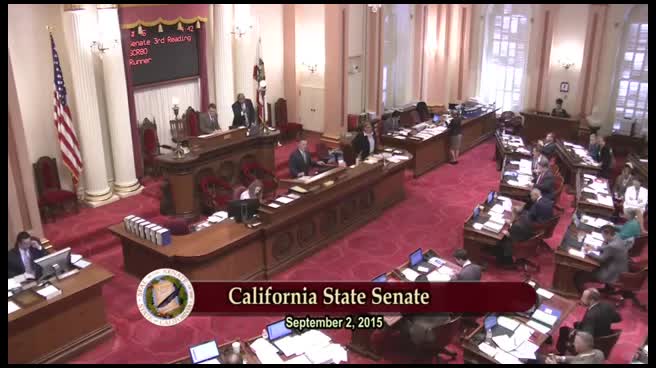 4MIN
Senate Floor
 17MIN