SJR 28: Immigrant children: legal representation.
- Session Year: 2015-2016
- House: Senate
- Latest Version Date: 2016-09-09
This measure would urge the federal government to ensure that immigrant children are afforded due process under the law in removal proceedings by providing government-funded attorneys, trained in immigration law, to all indigent children seeking an immigration remedy. The measure would urge the federal government to first hear cases involving children that have legal counsel and to immediately halt cases brought against unrepresented immigrant children until lawyers are made available to represent them.
This measure would urge the federal government to ensure that immigrant children are afforded due process under the law in removal proceedings by providing government-funded attorneys, trained in immigration law, to all indigent children seeking an immigration remedy. The measure would urge the federal government to first hear cases involving children that have legal counsel and to immediately halt cases brought against unrepresented immigrant children until lawyers are made available to represent them.
This measure would urge the federal government to ensure that immigrant children are afforded due process under the law in removal proceedings by providing government-funded attorneys, trained in immigration law, to all indigent children seeking an immigration remedy. The measure would urge the federal government to first hear cases involving children that have legal counsel and to immediately halt cases brought against unrepresented immigrant children until lawyers are made available to represent them.
WHEREAS, The Fifth Amendment to the United States Constitution provides that a person shall not be deprived of life, liberty, or property without due process of law, thereby ensuring that he or she will receive a fundamentally fair, orderly, and just judicial proceeding before being deprived of his or her freedom; and
WHEREAS, Former Assistant Chief Immigration Judge Jack H. Weil, a senior official in the United States Department of Justice, asserted in a deposition that he has trained toddlers in immigration law and can afford them a fair hearing without the toddler being represented by legal counsel; and
WHEREAS, The assertion made by Judge Weil is contemptible and offensive to our countrys Fifth Amendment constitutional mandate to provide all with due process under the law; and
WHEREAS, Due process cannot be guaranteed in an adversarial immigration removal proceeding without legal representation; and
WHEREAS, Article 14 of the Universal Declaration of Human Rights, adopted in 1948, states that Everyone has the right to seek and to enjoy in other countries asylum from persecution. Accordingly, children escaping from violence in other countries, whether unaccompanied or accompanied by a parent, are not illegal when they come to the United States in search of asylum; and
WHEREAS, The protections of Article 14 have been incorporated by the United States Congress into domestic law, which now protects all asylum seekers, including children, by prohibiting the federal government from returning to their home countries persons who have fled persecution due to race, religion, nationality, political opinion, or membership in a particular social group; and
WHEREAS, It is our nations legal and moral obligation to open our arms to children who fear harm in their country of origin and to foreign-born children in the United States who cannot be reunified with one or both parents due to abuse, neglect, or abandonment and who are therefore eligible for Special Immigrant Juvenile Status or any other immigration remedy; and
WHEREAS, Respect for due process requires that all indigent children seeking asylum, Special Immigrant Juvenile Status, or other immigration remedies in defense of deportation be afforded government-funded competent immigration counsel; and
WHEREAS, According to a study by the Transactional Records Access Clearinghouse, the foremost authority on federal immigration enforcement data, unrepresented children were ordered to leave the United States in 86 percent of cases, whereas represented children were ordered to leave the United States in only 16 percent of cases; and
WHEREAS, As demonstrated by the same study, the provision of legal representation would improve the integrity of the immigration court system, because children without legal representation fail to appear in court and therefore are ordered removed in absentia in 75 percent of cases. By comparison, children with legal representation do consistently appear in court and are therefore ordered removed in absentia in only 3 percent of cases; and
WHEREAS, The federal government is denying indigent immigrant children in California their rights to a fair trial under the Fifth Amendment to the United States Constitution because the federal government does not provide these children with legal representation in immigration court. These children therefore face the threat of deportation to violent and dangerous conditions where they may face persecution, violence, or even death; and
WHEREAS, Human Rights Watch filed an amicus brief in the case of J.E.F.M. v. Lynch, a nationwide lawsuit on behalf of thousands of children who are challenging the federal governments failure to provide the children with legal representation in deportation hearings, arguing that the failure of the United States government to appoint lawyers to represent immigrant children facing deportation violates their basic rights under international law; and
WHEREAS, The California Attorney General has engaged in efforts to close the legal services gap for unaccompanied immigrant children across California and joined an amicus brief in J.E.F.M. v. Lynch.
WHEREAS, Since January 2014, at least 83 deportees, including children, from the United States, were reported murdered upon their return to Guatemala, Honduras, and El Salvador, which remain three of the most violent countries in the world; and
WHEREAS, There are currently over 13,800 children in California that are not represented by legal counsel in immigration court; and
WHEREAS, California has a duty to protect the welfare of children within our state, including immigrant children; and
WHEREAS, California values immigrant children and has made this clear through legislative enactments, including Assembly Bill 540 (2001), Assembly Bills 130 and 131 (2011), commonly referred to as the California Dream Act, Senate Bill 1064 (2012), Senate Bill 873 (2014), commonly referred to as the Unaccompanied Minors Program, Senate Bill 1210 (2014), commonly referred to as the California DREAM Loan Program, and Senate Bills 4 and 75 (2015), commonly referred to as the Health4All Kids Act; and
WHEREAS, Special Immigrant Juvenile Status under Section 1101(a)(27)(J) of Title 8 of the United States Code is immigration relief that relies on a states interest in the welfare of children and provides for Special Immigrant Juvenile Status where a state court determines that reunification with one or both of the immigrants parents is not viable due to abuse, neglect, abandonment, or similar basis found under state law and that it would not be in the childs best interest to return to his or her home country; and
WHEREAS, California makes an annual $3 million investment to ensure that unaccompanied minors receive the legal representation that they need to pursue Special Immigrant Juvenile Status and other immigration relief; and
WHEREAS, California passed Senate Bill 873 (2014) and Assembly Bill 900 (2015) to ensure that California courts issue the predicate orders necessary for children to apply for Special Immigrant Juvenile Status; and
WHEREAS, California is disadvantaged when Californias children are denied their rights under the United States Constitution, including their right to due process; and
WHEREAS, California has a strong interest in ensuring that the children living in this state are not unfairly deported. Schools are disrupted when children are pulled from classes, communities are thrown into disorder when families are torn apart, the health and welfare of these children are put at risk, and the state is denied the potential societal and economic contributions of these children; now, therefore, be it
Resolved by the Senate and the Assembly of the State of California, jointly, That the Legislature of the State of California urges the federal government to take action to remedy this injury to the State of California, through appropriate measures within the United States Department of Justice, the United States Department of Homeland Security, and the Office of Refugee Resettlement, and ensure that immigrant children are afforded due process under the law when they are fighting to remain in the United States of America, by providing government-funded attorneys, trained in immigration law, to all indigent children fighting deportation and seeking an immigration remedy; and be it further
Resolved, That the Legislature of the State of California urges the federal government to rearrange its dockets to first hear the cases of children who have legal representation and to immediately halt cases it is pursuing against unrepresented immigrant children until lawyers are made available to represent them; and be it further
Resolved, That the Secretary of the Senate transmit copies of this resolution to the President and Vice President of the United States, to the Speaker of the House of Representatives, to the Majority Leader of the Senate, to each Senator and Representative from California in the Congress of the United States, and to the author for appropriate distribution.
WHEREAS, The Fifth Amendment to the United States Constitution provides that a person shall not be deprived of life, liberty, or property without due process of law, thereby ensuring that he or she will receive a fundamentally fair, orderly, and just judicial proceeding before being deprived of his or her freedom; and
WHEREAS, Former Assistant Chief Immigration Judge Jack H. Weil, a senior official in the United States Department of Justice, asserted in a deposition that he has trained toddlers in immigration law and can afford them a fair hearing without the toddler being represented by legal counsel; and
WHEREAS, The assertion made by Judge Weil is contemptible and offensive to our countrys Fifth Amendment constitutional mandate to provide all with due process under the law; and
WHEREAS, Due process cannot be guaranteed in an adversarial immigration removal proceeding without legal representation; and
WHEREAS, Article 14 of the Universal Declaration of Human Rights, adopted in 1948, states that Everyone has the right to seek and to enjoy in other countries asylum from persecution. Accordingly, children escaping from violence in other countries, whether unaccompanied or accompanied by a parent, are not illegal when they come to the United States in search of asylum; and
WHEREAS, The protections of Article 14 have been incorporated by the United States Congress into domestic law, which now protects all asylum seekers, including children, by prohibiting the federal government from returning to their home countries persons who have fled persecution due to race, religion, nationality, political opinion, or membership in a particular social group; and
WHEREAS, It is our nations legal and moral obligation to open our arms to children who fear harm in their country of origin and to foreign-born children in the United States who cannot be reunified with one or both parents due to abuse, neglect, or abandonment and who are therefore eligible for Special Immigrant Juvenile Status or any other immigration remedy; and
WHEREAS, Respect for due process requires that all indigent children seeking asylum, Special Immigrant Juvenile Status, or other immigration remedies in defense of deportation be afforded government-funded competent immigration counsel; and
WHEREAS, According to a study by the Transactional Records Access Clearinghouse, the foremost authority on federal immigration enforcement data, unrepresented children were ordered to leave the United States in 86 percent of cases, whereas represented children were ordered to leave the United States in only 16 percent of cases; and
WHEREAS, As demonstrated by the same study, the provision of legal representation would improve the integrity of the immigration court system, because children without legal representation fail to appear in court and therefore are ordered removed in absentia in 75 percent of cases. By comparison, children with legal representation do consistently appear in court and are therefore ordered removed in absentia in only 3 percent of cases; and
WHEREAS, The federal government is denying indigent immigrant children in California their rights to a fair trial under the Fifth Amendment to the United States Constitution because the federal government does not provide these children with legal representation in immigration court. These children therefore face the threat of deportation to violent and dangerous conditions where they may face persecution, violence, or even death; and
WHEREAS, Human Rights Watch filed an amicus brief in the case of J.E.F.M. v. Lynch, a nationwide lawsuit on behalf of thousands of children who are challenging the federal governments failure to provide the children with legal representation in deportation hearings, arguing that the failure of the United States government to appoint lawyers to represent immigrant children facing deportation violates their basic rights under international law; and
WHEREAS, the California Attorney General has engaged in efforts to close the legal services gap for unaccompanied immigrant children across California and joined an amicus brief in J.E.F.M. v. Lynch.
WHEREAS, Since January 2014, at least 83 deportees, including children, from the United States, were reported murdered upon their return to Guatemala, Honduras, and El Salvador, which remain three of the most violent countries in the world; and
WHEREAS, There are currently over 13,800 children in California that are not represented by legal counsel in immigration court; and
WHEREAS, California has a duty to protect the welfare of children within our state, including immigrant children; and
WHEREAS, California values immigrant children and has made this clear through legislative enactments, including Assembly Bill 540 (2001), Assembly Bills 130 and 131 (2011), commonly referred to as the California Dream Act, Senate Bill 1064 (2012), Senate Bill 873 (2014), commonly referred to as the Unaccompanied Minors Program, Senate Bill 1210 (2014), commonly referred to as the California DREAM Loan Program, and Senate Bills 4 and 75 (2015), commonly referred to as the Health4All Kids Act; and
WHEREAS, Special Immigrant Juvenile Status under Section 1101(a)(27)(J) of Title 8 of the United States Code is immigration relief that relies on a states interest in the welfare of children and provides for Special Immigrant Juvenile Status where a state court determines that reunification with one or both of the immigrants parents is not viable due to abuse, neglect, abandonment, or similar basis found under state law and that it would not be in the childs best interest to return to his or her home country; and
WHEREAS, California makes an annual $3 million investment to ensure that unaccompanied minors receive the legal representation that they need to pursue Special Immigrant Juvenile Status and other immigration relief; and
WHEREAS, California passed Senate Bill 873 (2014) and Assembly Bill 900 (2015) to ensure that California courts issue the predicate orders necessary for children to apply for Special Immigrant Juvenile Status; and
WHEREAS, California is disadvantaged when Californias children are denied their rights under the United States Constitution, including their right to due process; and
WHEREAS, California has a strong interest in ensuring that the children living in this state are not unfairly deported. Schools are disrupted when children are pulled from classes, communities are thrown into disorder when families are torn apart, the health and welfare of these children are put at risk, and the state is denied the potential societal and economic contributions of these children; now, therefore, be it
Resolved by the Senate and the Assembly of the State of California, jointly, That the Legislature of the State of California urges the federal government to take action to remedy this injury to the State of California, through appropriate measures within the United States Department of Justice, the United States Department of Homeland Security, and the Office of Refugee Resettlement, and ensure that immigrant children are afforded due process under the law when they are fighting to remain in the United States of America, by providing government-funded attorneys, trained in immigration law, to all indigent children fighting deportation and seeking an immigration remedy; and be it further
Resolved, That the Legislature of the State of California urges the federal government to rearrange its dockets to first hear the cases of children who have legal representation and to immediately halt cases it is pursuing against unrepresented immigrant children until lawyers are made available to represent them; and be it further
Resolved, That the Secretary of the Senate transmit copies of this resolution to the President and Vice President of the United States, to the Speaker of the House of Representatives, to the Majority Leader of the Senate, to each Senator and Representative from California in the Congress of the United States, and to the author for appropriate distribution.
|
Date
|
Status
|
|---|---|
| Aug 23, 2016 | Introduced. Referred to Com. on RLS. |
| Aug 25, 2016 | From committee: Ordered to third reading. |
| Aug 25, 2016 | Read. Adopted. (Ayes 31. Noes 2. Page 5412.) Ordered to the Assembly. |
| Aug 25, 2016 | Read. Adopted. (Ayes 31. Noes 2.) Ordered to the Assembly. |
| Aug 26, 2016 | In Assembly. Held at Desk. |
| Aug 29, 2016 | Referred to Com. on JUD. |
| Aug 31, 2016 | Assembly Rule 63 suspended. |
| Aug 31, 2016 | From committee: Be adopted. Ordered to third reading. (Ayes 8. Noes 0.) (August 31). |
| Aug 31, 2016 | In Senate. Ordered to engrossing and enrolling. |
| Aug 31, 2016 | Read. Adopted. Ordered to the Senate. |
| Aug 31, 2016 | Read. Adopted. (Ayes 58. Noes 8. Page 6547.) Ordered to the Senate. |
| Sep 9, 2016 | Chaptered by Secretary of State. Res. Chapter 190, Statutes of 2016. |
| Sep 9, 2016 | Enrolled and filed with the Secretary of State at 11 a.m. |
|
Date
|
Description
|
Location
|
Votes
|
|
|---|---|---|---|---|
| Aug 31, 2016 | SJR 28 Lara Senate Third Reading | Assembly Floor |
Passed |
|
| Aug 31, 2016 | Be adopted. To third reading. | Assembly Standing Committee on Judiciary |
Passed |
|
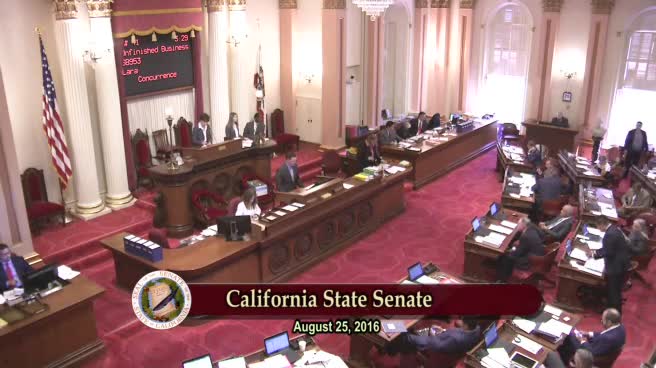
| Aug 25, 2016 | Senate 3rd Reading SJR28 Lara | Senate Floor |
Passed |
This list shows positions taken on this bill by organizations on the date displayed, which is linked to the original source.
Positions by individuals are not included.
Date of Hearing: August 31, 2016
ASSEMBLY COMMITTEE ON JUDICIARY
Mark Stone, Chair
SBPCA Bill Id:SJR 28
Author:(Lara) – As Introduced Ver:August 23, 2016
SENATE VOTE: 31-2
SUBJECT: IMMIGRANT CHILDREN: LEGAL REPRESENTATION
KEY ISSUE: IN ORDER TO ENSURE DUE PROCESS TO THOUSANDS OF IMMIGRANT CHILDREN FACING REMOVAL PROCEEDINGS WITHOUT LEGAL representation, SHOULD THE LEGISLATURE URGE THE FEDERAL GOVERNMENT TO PROVIDE AND PAY FOR LEGAL counsel FOR THESE CHILDREN, AND TO IMMEDIATELY STOP pursuing CASES AGAINST UNREPRESENTED CHILDREN UNTIL counsel is appointed to REPRESENT them?
SYNOPSIS
According to the author, this resolution responds to the federal government's controversial policy of seeking deportation of thousands of Central American children who have been detained at the southern border of the U.S. in recent years—many of them unaccompanied and trying to escape poverty and street violence in countries including El Salvador, Guatemala and Honduras. Of particular controversy, is the fact that the U.S. government is seeking to deport these children without ensuring that they have legal representation in immigration court—a regrettable approach that does not acknowledge the injustice of having children too young to understand the legal process left to fend for themselves in deportation hearings without legal counsel. The author notes that the American Civil Liberties Union and other immigrant advocates recently filed a nationwide class-action lawsuit on behalf of thousands of children, challenging the federal government's failure to provide the children with legal representation in deportation hearings.
Accordingly, this measure urges the federal government to ensure that immigrant children are afforded due process under the law in removal proceedings by providing government-funded attorneys, trained in immigration law, to all indigent children fighting deportation and seeking an immigration remedy. The measure also urges the federal government to rearrange its dockets to first hear the cases of children who have legal representation and to immediately halt cases it is pursuing against unrepresented immigrant children until lawyers are made available to represent them. This resolution is consistent with other recent laws enacted by the Legislature, described below, intended to enable immigrant children to remain in the country by obtaining Special Immigrant Juvenile Status, a federal immigration classification that may help undocumented, vulnerable children and youth remain in the United States. This measure previously passed the Senate by a bipartisan 31-2 vote.
SUMMARY: Urges the federal government to ensure that immigrant children are afforded due process under the law in removal proceedings by providing government-funded attorneys, trained in immigration law, to indigent children seeking an immigration remedy. Specifically, this measure:
- Finds and declares that Article 14 of the Universal Declaration of Human Rights, adopted in 1948, states that “Everyone has the right to seek and to enjoy in other countries asylum from persecution," and that, accordingly, children escaping from violence in other countries, whether unaccompanied or accompanied by a parent, are not “illegal” when they come to the U.S. in search of asylum. Further states that the protections of Article 14 have been incorporated by Congress into domestic law, which now protects all asylum seekers, including children, by prohibiting the federal government from returning to their home countries persons who have fled persecution due to race, religion, nationality, political opinion, or membership in a particular social group.
- Declares that it is our nation’s legal and moral obligation to open our arms to children who fear harm in their country of origin and to foreign-born children in the United States who cannot be reunified with one or both parents due to abuse, neglect, or abandonment and who are therefore eligible for Special Immigrant Juvenile Status or any other immigration remedy.
- States that respect for due process requires that all indigent children seeking asylum, Special Immigrant Juvenile Status, or other immigration remedies in defense of deportation be afforded government-funded competent immigration counsel.
- Finds that the federal government is denying indigent immigrant children in California their rights to a fair trial under the Fifth Amendment because it does not provide these children with legal representation in immigration court, and these children therefore face the threat of deportation to violent and dangerous conditions where they may face persecution, violence, or even death.
- States that California has a duty to protect the welfare of children within our state, including immigrant children, and that our state values immigrant children and has made this clear through legislative enactments, including AB 540 (2001), AB 130 and AB 131 (2011), commonly referred to as the California Dream Act, SB 1064 (2012), SB 873 (2014), commonly referred to as the Unaccompanied Minors Program, SB 1210 (2014), commonly referred to as the California DREAM Loan Program, and SB 4 and SB 75 (2015), commonly referred to as the Health4All Kids Act.
- Declares that California passed SB 873 (2014) and AB 900 (2015) to ensure that California courts issue the predicate orders necessary for children to apply for Special Immigrant Juvenile Status, and also states that California makes an annual $3 million investment to ensure that unaccompanied minors receive the legal representation that they need to pursue SIJS and other immigration relief.
- States that California has a strong interest in ensuring that the children living in this state are not unfairly deported, and that schools are disrupted when children are pulled from classes, communities are thrown into disorder when families are torn apart, the health and welfare of these children are put at risk, and the state is denied the potential societal and economic contributions of these children.
- Urges the federal government to take action to remedy this injury to the State of California, through appropriate measures within the United States Department of Justice, the United States Department of Homeland Security, and the Office of Refugee Resettlement, and ensure that immigrant children are afforded due process under the law when they are fighting to remain in the United States of America, by providing government-funded attorneys, trained in immigration law, to all indigent children fighting deportation and seeking an immigration remedy.
- Urges the federal government to rearrange its dockets to first hear the cases of children who have legal representation and to immediately halt cases it is pursuing against unrepresented immigrant children until lawyers are made available to represent them.
EXISTING FEDERAL LAW:
- Pursuant to the Immigration and Naturalization Act, protects all asylum seekers by prohibiting the federal government from returning to their home countries people who have fled persecution on account of race, religion, nationality, political opinion, or membership in a particular social group. (8 U.S.C. Sec. 1101 (a)(42)(A).)
- Pursuant to the Immigration and Naturalization Act, defines a "special immigrant juvenile" as a person under 21 who is declared a dependent by a juvenile court or committed to the custody of a state agency or a court-appointed individual, whose reunification with one or both of his or her parents is not viable due to abuse, neglect, abandonment, or a similar basis found under state law, and whose return to his or her country of nationality or last habitual residence is not in his or her best interest. Allows such person to obtain special immigrant juvenile status (SIJS) and, based on that status, apply for a visa for lawful permanent residency. (8 U.S.C. Sections 1101(a)(27)(J), 1153(b)(4).)
- Pursuant to case law, establishes that immigrant detainees with mental disabilities who are facing deportation and who are unable to adequately represent themselves are entitled to qualified legal representatives provided by the federal government for representation during all phases of their immigration proceedings, including appeals and custody hearings. (Franco-Gonzalez v. Holder, CV 10-02211-DMG.)
- Provides that a person shall not be deprived of life, liberty, or property without due process of law. (Amendment V, U.S. Constitution.)
EXISTING STATE LAW:
- Provides that the Department of Social Services, subject to the availability of funding from the annual Budget Act, shall contract with qualified nonprofit legal services organizations to provide legal services to unaccompanied undocumented minors who are transferred to the care and custody of the federal Office of Refugee Resettlement and who are present in this state. (Welfare and Institutions Code Section 13300(a).)
- Provides that the superior court, including a juvenile, probate, or family court department or division of the superior court, has jurisdiction to make judicial determinations regarding the custody and care of juveniles within the meaning of the federal Immigration and Nationality Act. Requires the superior court to make an order containing the necessary findings regarding SIJS pursuant to federal law, if there is evidence to support those findings. (Code of Civil Procedure Section 155.)
- Authorizes a court, with the consent of the proposed ward, to appoint a guardian of the person for an unmarried individual who is 18 years of age or older, but who has not yet attained 21 years of age in connection with a petition to make the necessary findings regarding special immigrant juvenile status pursuant to subdivision (b) of Section 155 of the Code of Civil Procedure. (Probate Code Section 1510.1(a)(1).)
- Authorizes a court, at the request of or with the consent of the ward, to extend an existing guardianship of the person for a ward past 18 years of age, for purposes of allowing the ward to complete the application process with the United States Citizenship and Immigration Services for classification as a special immigrant juvenile pursuant to Section 1101(a)(27)(J) of Title 8 of the United States Code. (Probate Code Section 1510.1(b)(1).)
FISCAL EFFECT: As currently in print this measure is keyed non-fiscal.
COMMENTS: This measure urges the federal government to ensure that immigrant children are afforded due process under the law in removal proceedings, by providing government-funded attorneys, trained in immigration law, to all indigent children fighting deportation and seeking an immigration remedy.
Author's statement. According to the author:
In 2014, tens of thousands of unaccompanied minors immigrated to the United States. This influx caught the U.S. officials by surprise and exposed the structural shortcomings that exist within the immigration court processing system. These children were detained into border patrol facilities along the border throughout the American southwest while they awaited court hearings. Most of the children appearing in immigration courts are from Central America, escapees of the poverty and street violence that make El Salvador, Guatemala and Honduras some of the most dangerous countries in the world.
Thousands of unaccompanied minors are currently caught in legal limbo. These children are required to represent themselves in court and make a legal case before a judge explaining why their pleas for asylum should be granted. (However), Jack H. Weil, a U.S. Court of Appeals Judge for the 9th Circuit, stated in early 2016 that children as young as 3 years old can be taught immigration law and represent themselves. (These) unaccompanied minors . . . are pleading for asylum or other type of relief in a complex legal system they do not understand. SJR 28 urges the federal government to provide these children with due process and legal counsel so they can adequately plead their asylum cases in court.
Controversial deportation policy for immigrant children who have no legal counsel. According to the author, this resolution is in response to the federal government's controversial policy of seeking deportation of thousands of Central American children who have been detained at the southern border of the U.S. in recent years. A recent editorial in the New York Times summarizes the controversy:
The children are part of an influx of families fleeing persecution in Guatemala, Honduras and El Salvador. This emergency has become a political headache for the Obama administration, which has been doing all it can to handle the arrivals of thousands of would-be refugees while deterring future arrivals. Among other tactics, it has been rushing their cases through the clogged immigration courts with the so-called rocket docket and has recently been conducting raids to round up immigrants who have not responded to deportation orders.
While federal law does not require that noncitizens be given government-appointed lawyers in immigration proceedings, it does require a “full and fair hearing” before a judge. Yet the administration argues that it has no constitutional obligation to provide counsel for children in immigration court and refuses to acknowledge the injustice of having children too young to understand the legal process fending for themselves in deportation hearings. The result would be farcical were it not also tragic, because these children face grave danger, if not violent death, in being returned to their home countries. ("Migrant Children Deserve a Voice in Court." Editorial Board, New York Times: March 8, 2016. [Available at: http://www.nytimes.com/2016/03/08/opinion/migrant-children-deserve-a-voice-in-court.html])
The resolution further states that since January 2014, at least 83 deportees, including children, from the United States, were reported murdered upon their return to Guatemala, Honduras, and El Salvador--three of the most violent countries in the world.
Recent litigation to ensure legal representation for these immigrant children facing removal proceedings. In July 2014, the American Civil Liberties Union (ACLU) and several other immigrant advocates filed a nationwide class-action lawsuit on behalf of thousands of children challenging the federal government's failure to provide them with legal representation in deportation hearings. According to the author, Human Rights Watch has filed an amicus brief in the case, and California Attorney General Kamala Harris has joined an amicus brief in the case urging the court to ensure legal representation for these children.
According to the ACLU website about the litigation:
(These children) are scheduled to appear at deportation hearings without any legal representation and face a very real risk of being sent back into the perilous circumstances they left. The Obama administration has announced programs to provide legal assistance to a limited number of youth facing deportation hearings, but this proposal does not come close to meeting the urgent need for legal representation for all children whom the government wants to deport. The administration's programs are not sufficient to meet the overwhelming need. In the meantime, children continue to appear alone in court every day, where they continue to receive orders requiring them to leave the United States.
The complaint charges the U.S. Department of Justice, Department of Homeland Security, U.S. Immigration and Customs Enforcement, Department of Health and Human Services, Executive Office for Immigration Review, and Office of Refugee Resettlement with violating the U.S. Constitution's Fifth Amendment Due Process Clause and the Immigration and Nationality Act’s provisions requiring a "full and fair hearing" before an immigration judge. It seeks to require the government to provide children with legal representation in their deportation hearings. (Available at: https://www.aclu.org/cases/jefm-v-lynch.)
This bill seeks to ensure due process for children facing removal in immigration proceedings without the help of legal representation. According to the author, there are currently over 13,800 children in California that are not represented by legal counsel in immigration court. The author contends that respect for due process requires that all indigent children seeking asylum, Special Immigrant Juvenile Status, or other immigration remedies in defense of deportation be afforded government-funded competent immigration counsel. While this measure recognizes that the particular population of children singled out by this measure are among those deserving of legal representation in order to ensure that the law is applied correctly, it should also be noted that all detainees, children and non-children alike, should be entitled to counsel in order to guarantee due process. After all, as the measure itself states, "Due process cannot be guaranteed in an adversarial immigration removal proceeding without legal representation."
Nevertheless, this resolution urges the federal government to take action to take appropriate measures within the U.S. Department of Justice, the U.S. Department of Homeland Security, and the Office of Refugee Resettlement, to ensure that immigrant children are afforded due process under the law by providing government-funded attorneys, trained in immigration law, to all indigent children fighting deportation and seeking an immigration remedy. In addition, the measure urges the federal government to rearrange its dockets to first hear the cases of children who have legal representation and to immediately halt cases it is pursuing against unrepresented immigrant children until lawyers are made available to represent them.
This bill is consistent with recent laws enacted by the Legislature to help vulnerable immigrant children to remain in the country by obtaining Special Immigrant Juvenile Status. "Special Immigrant Juvenile Status" is a federal immigration classification that may help undocumented, vulnerable children and youth remain in the United States. Under the Trafficking Victims Protection Reauthorization Act of 2008, Pub. L. No. 110-457, any unmarried person under age 21 who has been abused, neglected or abandoned by a parent may seek classification as a Special Immigrant Juvenile and then immediately apply for lawful permanent resident status. To be eligible for SIJS, a state juvenile court must first find that:
- The child is a dependent of a juvenile court or committed to the custody of a state agency or a court-appointed individual;
- Reunification with one or both of the child's parents is not viable due to abuse, neglect, abandonment, or a similar basis found under state law; and
- Return to the child's country of nationality or last habitual residence is not in his or her best interest. (8 U.S.C. Section 1101(a)(27)(J).)
The first finding originally only applied to children under the direct jurisdiction of the juvenile court, thus limiting eligibility for SIJS. This was expanded in 2008 to include children with a court-appointed custodian, thus allowing the required findings to be made on behalf of children with guardianships established by a probate court and custodial arrangements established by a family court. This significantly expanded the number of immigrant children eligible for SIJS. Once a state court makes the requisite findings, the child may apply to the U.S. Citizenship and Immigration Services for SIJS. (8 U.S.C. Section 1153(b)(4).)
In 2014, the Legislature passed and the Governor signed AB 873 (Ch. 685, Stats. 2014), legislation which specifically provides that superior courts can make the findings necessary for a child to be eligible for SIJS. In particular, AB 873 ensured that the superior court, including a juvenile, probate, or family court, has jurisdiction to make judicial determinations regarding the custody and care of juveniles within the meaning of the federal Immigration and Nationality Act, and requires the court to make an order containing the necessary findings for SIJS, if there is evidence to support them. (Code of Civil Procedure Section 155.) As a result, the law helps facilitate the necessary state court findings that allow vulnerable immigrant youth to successfully apply for SIJS.
In 2015, the Legislature enacted follow-up legislation, AB 900 (Ch. 694, Stats. 2015), which closed a gap in the law and extended guardianship proceedings until age 21 for under-18 youth in California in need of the Special Immigrant Juvenile Status finding. The Legislature acted to expand potential coverage of SIJS because, before AB 900 was enacted, there was no state court proceeding under which the requisite court findings could be made for youths who are at least 18, but less than 21, who were not dependents of the juvenile court.
Finally, as also stated in the resolution, the author notes that California annually makes a $3 million investment to ensure that unaccompanied minors receive the legal representation that they need to pursue SIJS and other immigration relief. For these reasons, this measure is consistent with recent legislation and actions taken to help immigrant youth seek Special Immigrant Juvenile Status and remain in this country.
Pending Related Legislation. As approved by this Committee, SB 1289 (Lara) of 2016 sought, among other things, to require immigrant detention facilities to have a Legal Orientation Program, as specified, that includes an orientation on immigration removal proceedings and forms of relief, distribution of self-help materials, provision of private and individual consultations with unrepresented detainees to discuss their cases, and referrals to pro bono legal services. In addition, the bill sought to prohibit immigrant detention facilities from depriving immigrant detainees from access to an attorney or other authorized legal representative, and from access to translation or interpreters. SB 1289 is currently in the Senate, awaiting concurrence with Assembly amendments.
As approved by this Committee, AB 1462 (Gonzalez) of 2015 sought to require select state departments or agencies, as determined by the Governor, to contract with qualified nonprofit or community-based organizations to provide legal services to DACA and DAPA applicants in California, subject to the availability of funding in the annual Budget Act. AB 1462 was held on suspense by the Assembly Appropriations Committee.
REGISTERED SUPPORT / OPPOSITION:
Support
None on file
Opposition
None on file
Analysis Prepared by: Anthony Lew / JUD. / (916) 319-2334
(Without Reference to File)
SENATE THIRD READING
STR Bill Id:SJR 28
Author:(Lara)
As Introduced Ver:August 23, 2016
Majority vote
SENATE VOTE: 31-2
Committee | Votes | Ayes | Noes |
Judiciary | 8-0 | Mark Stone, Wagner, Alejo, Chau, Chiu, Cristina Garcia, Holden, Ting |
|
SUMMARY: Urges the federal government to ensure that immigrant children are afforded due process under the law in removal proceedings by providing government-funded attorneys, trained in immigration law, to indigent children seeking an immigration remedy. Specifically, this measure:
- Finds and declares that Article 14 of the Universal Declaration of Human Rights, adopted in 1948, states that "Everyone has the right to seek and to enjoy in other countries asylum from persecution," and that, accordingly, children escaping from violence in other countries, whether unaccompanied or accompanied by a parent, are not "illegal" when they come to the United States (U.S.) in search of asylum. Further states that the protections of Article 14 have been incorporated by Congress into domestic law, which now protects all asylum seekers, including children, by prohibiting the federal government from returning to their home countries persons who have fled persecution due to race, religion, nationality, political opinion, or membership in a particular social group.
- Declares that it is our nation's legal and moral obligation to open our arms to children who fear harm in their country of origin and to foreign-born children in the United States who cannot be reunified with one or both parents due to abuse, neglect, or abandonment and who are therefore eligible for Special Immigrant Juvenile Status (SIJS) or any other immigration remedy.
- States that respect for due process requires that all indigent children seeking asylum, Special Immigrant Juvenile Status, or other immigration remedies in defense of deportation be afforded government-funded competent immigration counsel.
- Finds that the federal government is denying indigent immigrant children in California their rights to a fair trial under the Fifth Amendment because it does not provide these children with legal representation in immigration court, and these children therefore face the threat of deportation to violent and dangerous conditions where they may face persecution, violence, or even death.
- States that California has a duty to protect the welfare of children within our state, including immigrant children, and that our state values immigrant children and has made this clear through legislative enactments, including AB 540 (Firebaugh), Chapter 814, Statutes of 2001; AB 130 (Cedillo), Chapter 93, Statutes of 2011; and AB 131 (Cedillo), Chapter 604, Statutes of 2011, commonly referred to as the California Dream Act; SB 1064 (De León), Chapter 845, Statutes of 2012; SB 873 (Committee on Budget and Fiscal Review), Chapter 685, Statutes of 2014, commonly referred to as the Unaccompanied Minors Program; SB 1210 (Lara), Chapter 754, Statutes of 2014, commonly referred to as the California DREAM Loan Program; and SB 4 (Lara), Chapter 709, Statutes of 2015, and SB 75 (Committee on Budget and Fiscal Review), Chapter 18, Statutes of 2015, commonly referred to as the Health4All Kids Act.
- Declares that California passed SB 873 (2014) and AB 900 (Levine), Chapter 694, Statutes of 2015, to ensure that California courts issue the predicate orders necessary for children to apply for Special Immigrant Juvenile Status, and also states that California makes an annual $3 million investment to ensure that unaccompanied minors receive the legal representation that they need to pursue SIJS and other immigration relief.
- States that California has a strong interest in ensuring that the children living in this state are not unfairly deported, and that schools are disrupted when children are pulled from classes, communities are thrown into disorder when families are torn apart, the health and welfare of these children are put at risk, and the state is denied the potential societal and economic contributions of these children.
- Urges the federal government to take action to remedy this injury to the State of California, through appropriate measures within the United States Department of Justice, the United States Department of Homeland Security, and the Office of Refugee Resettlement, and ensure that immigrant children are afforded due process under the law when they are fighting to remain in the United States of America, by providing government-funded attorneys, trained in immigration law, to all indigent children fighting deportation and seeking an immigration remedy.
- Urges the federal government to rearrange its dockets to first hear the cases of children who have legal representation and to immediately halt cases it is pursuing against unrepresented immigrant children until lawyers are made available to represent them.
FISCAL EFFECT: None
COMMENTS: This measure urges the federal government to ensure that immigrant children are afforded due process under the law in removal proceedings, by providing government-funded attorneys, trained in immigration law, to all indigent children fighting deportation and seeking an immigration remedy.
According to the author, this resolution is in response to the federal government's controversial policy of seeking deportation of thousands of Central American children who have been detained at the southern border of the U.S. in recent years. A recent editorial in the New York Times summarizes the controversy:
The children are part of an influx of families fleeing persecution in Guatemala, Honduras and El Salvador. This emergency has become a political headache for the Obama administration, which has been doing all it can to handle the arrivals of thousands of would-be refugees while deterring future arrivals. Among other tactics, it has been rushing their cases through the clogged immigration courts with the so-called rocket docket and has recently been conducting raids to round up immigrants who have not responded to deportation orders.
While federal law does not require that noncitizens be given government-appointed lawyers in immigration proceedings, it does require a "full and fair hearing" before a judge. Yet the administration argues that it has no constitutional obligation to provide counsel for children in immigration court and refuses to acknowledge the injustice of having children too young to understand the legal process fending for themselves in deportation hearings. The result would be farcical were it not also tragic, because these children face grave danger, if not violent death, in being returned to their home countries. ("Migrant Children Deserve a Voice in Court." Editorial Board, New York Times: March 8, 2016. [Available at: http://www.nytimes.com/2016/03/08/opinion/migrant-children-deserve-a-voice-in-court.html])
The resolution further states that since January 2014, at least 83 deportees, including children, from the United States, were reported murdered upon their return to Guatemala, Honduras, and El Salvador--three of the most violent countries in the world.
Recent litigation to ensure legal representation for these immigrant children facing removal proceedings. In July 2014, the American Civil Liberties Union (ACLU) and several other immigrant advocates filed a nationwide class-action lawsuit on behalf of thousands of children challenging the federal government's failure to provide them with legal representation in deportation hearings. According to the author, Human Rights Watch has filed an amicus brief in the case, and California Attorney General Kamala Harris has joined an amicus brief in the case urging the court to ensure legal representation for these children.
According to the ACLU website about the litigation:
(These children) are scheduled to appear at deportation hearings without any legal representation and face a very real risk of being sent back into the perilous circumstances they left. The Obama administration has announced programs to provide legal assistance to a limited number of youth facing deportation hearings, but this proposal does not come close to meeting the urgent need for legal representation for all children whom the government wants to deport. The administration's programs are not sufficient to meet the overwhelming need. In the meantime, children continue to appear alone in court every day, where they continue to receive orders requiring them to leave the United States. (Available at: https://www.aclu.org/cases/jefm-v-lynch.)
This bill seeks to ensure due process for children facing removal in immigration proceedings without the help of legal representation. According to the author, there are currently over 13,800 children in California that are not represented by legal counsel in immigration court. The author contends that respect for due process requires that all indigent children seeking asylum, Special Immigrant Juvenile Status, or other immigration remedies in defense of deportation be afforded government-funded competent immigration counsel. While this measure recognizes that the particular population of children singled out by this measure are among those deserving of legal representation in order to ensure that the law is applied correctly, it should also be noted that all detainees, children and non-children alike, should be entitled to counsel in order to guarantee due process. After all, as the measure itself states, "Due process cannot be guaranteed in an adversarial immigration removal proceeding without legal representation."
Nevertheless, this resolution urges the federal government to take action to take appropriate measures within the U.S. Department of Justice, the U.S. Department of Homeland Security, and the Office of Refugee Resettlement, to ensure that immigrant children are afforded due process under the law by providing government-funded attorneys, trained in immigration law, to all indigent children fighting deportation and seeking an immigration remedy. In addition, the measure urges the federal government to rearrange its dockets to first hear the cases of children who have legal representation and to immediately halt cases it is pursuing against unrepresented immigrant children until lawyers are made available to represent them.
This bill is consistent with recent laws enacted by the Legislature to help vulnerable immigrant children to remain in the country by obtaining Special Immigrant Juvenile Status. "Special Immigrant Juvenile Status" is a federal immigration classification that may help undocumented, vulnerable children and youth remain in the United States. Under the Trafficking Victims Protection Reauthorization Act of 2008, Pub. L. No. 110-457, any unmarried person under age 21 who has been abused, neglected or abandoned by a parent may seek classification as a Special Immigrant Juvenile and then immediately apply for lawful permanent resident status. To be eligible for SIJS, a state juvenile court must first find that: 1) the child is a dependent of a juvenile court or committed to the custody of a state agency or a court-appointed individual; 2) reunification with one or both of the child's parents is not viable due to abuse, neglect, abandonment, or a similar basis found under state law; and 3) return to the child's country of nationality or last habitual residence is not in his or her best interest. (8 United States Code (U.S.C.) Section 1101(a)(27)(J).) Once a state court makes the requisite findings, the child may apply to the U.S. Citizenship and Immigration Services for SIJS. (8 U.S.C. Section 1153(b)(4).)
In 2014, the Legislature passed and the Governor signed AB 873, legislation which specifically provides that superior courts can make the findings necessary for a child to be eligible for SIJS. In particular, AB 873 ensured that the superior court, including a juvenile, probate, or family court, has jurisdiction to make judicial determinations regarding the custody and care of juveniles within the meaning of the federal Immigration and Nationality Act, and requires the court to make an order containing the necessary findings for SIJS, if there is evidence to support them. (Code of Civil Procedure Section 155.) As a result, the law helps facilitate the necessary state court findings that allow vulnerable immigrant youth to successfully apply for SIJS.
In 2015, the Legislature enacted follow-up legislation, AB 900, which closed a gap in the law and extended guardianship proceedings until age 21 for under-18 youth in California in need of the Special Immigrant Juvenile Status finding. The Legislature acted to expand potential coverage of SIJS because, before AB 900 was enacted, there was no state court proceeding under which the requisite court findings could be made for youths who are at least 18, but less than 21, who were not dependents of the juvenile court.
Finally, as also stated in the resolution, the author notes that California annually makes a $3 million investment to ensure that unaccompanied minors receive the legal representation that they need to pursue SIJS and other immigration relief. For these reasons, this measure is consistent with recent legislation and actions taken to help immigrant youth seek Special Immigrant Juvenile Status and remain in this country.
Analysis Prepared by: Anthony Lew / JUD. / (916) 319-2334 FN: 0005019
Office of Senate Floor Analyses (916) 651-1520 Fax: (916) 327-4478 | SJR 28 |
THIRD READING
Bill No: SJR 28
Introduced: 8/23/16
SUBJECT: Immigrant children: legal representation
DIGEST:
This resolution urges the federal government to ensure that immigrant children are afforded due process under the law in removal proceedings by providing government-funded attorneys, trained in immigration law, to all indigent children seeking an immigration remedy; and urges the federal government to first hear cases involving children that have legal counsel and to immediately halt cases brought against unrepresented immigrant children until lawyers are made available to represent them.
ANALYSIS: This resolution makes the following legislative findings:
- The Fifth Amendment to the U.S. Constitution provides that a person shall not be deprived of life, liberty, or property without due process of law, thereby ensuring that he or she will receive a fundamentally fair, orderly, and just judicial proceeding before being deprived of his or her freedom.
- Due process cannot be guaranteed in an adversarial immigration removal proceeding without legal representation.
- Article 14 of the Universal Declaration of Human Rights, adopted in 1948, states that “Everyone has the right to seek and to enjoy in other countries asylum from persecution.” Accordingly, children escaping from violence in other countries, whether unaccompanied or accompanied by a parent, are not “illegal” when they come to the U.S. in search of asylum. The protections of Article 14 have been incorporated by Congress into domestic law, which now protects all asylum seekers, including children, by prohibiting the federal government from returning to their home countries persons who have fled persecution due to race, religion, nationality, political opinion, or membership in a particular social group.
- It is our nation’s legal and moral obligation to open our arms to children who fear harm in their country of origin and to foreign-born children in the United States who cannot be reunified with one or both parents due to abuse, neglect, or abandonment and who are therefore eligible for Special Immigrant Juvenile Status or any other immigration remedy.
- Respect for due process requires that all indigent children seeking asylum, Special Immigrant Juvenile Status, or other immigration remedies in defense of deportation be afforded government-funded competent immigration counsel.
- The federal government is denying indigent immigrant children in California their rights to a fair trial under the Fifth Amendment because the federal government does not provide these children with legal representation in immigration court. These children therefore face the threat of deportation to violent and dangerous conditions where they may face persecution, violence, or even death.
- California has a duty to protect the welfare of children within our state, including immigrant children.
- California values immigrant children and has made this clear through legislative enactments, including AB 540 (2001), AB 130 and AB 131 (2011), commonly referred to as the California Dream Act, SB 1064 (2012), SB 873 (2014), commonly referred to as the Unaccompanied Minors Program, SB 1210 (2014), commonly referred to as the California DREAM Loan Program, and SB 4 and SB 75 (2015), commonly referred to as the Health4All Kids Act. California passed SB 873 (2014) and AB 900 (2015) to ensure that California courts issue the predicate orders necessary for children to apply for Special Immigrant Juvenile Status.
- California has a strong interest in ensuring that the children living in this state are not unfairly deported. Schools are disrupted when children are pulled from classes, communities are thrown into disorder when families are torn apart, the health and welfare of these children are put at risk, and the state is denied the potential societal and economic contributions of these children.
This resolution urges the federal government to ensure that immigrant children are afforded due process under the law in removal proceedings by providing government-funded attorneys, trained in immigration law, to all indigent children seeking an immigration remedy; and urges the federal government to first hear cases involving children that have legal counsel and to immediately halt cases brought against unrepresented immigrant children until lawyers are made available to represent them.
FISCAL EFFECT: Appropriation: No Fiscal Com.: No Local: No
None received
OPPOSITION: (Verified 8/24/16)
None received
Prepared by: Melissa Ward / SFA / (916) 651-1520
8/25/16 12:30:07
**** END ****
Discussed in Hearing
View Older Hearings
Bill Author

Bill Co-Author(s):